Showing posts with label kyrgyzstan. Show all posts

Tuesday, July 27, 2010

Daily Sources 7/27

LATEST ECB LENDING DATA MIXED

Brian Blackstone at Real Time Economics reports
"Total loans to the private sector grew 0.3% last month from one year ago. Though hardly signaling a resurgence in economic activity, that’s still the best pace in almost one year and well above the trough of -0.8% last October.

What ECB economists will notice is the breakdown. Loans to households grew 2.8% on the year, led by a 3.4% rise in lending for home purchases (consumer credit fell). Home loans have been rising steadily since early last year, when they were contracting on an annual basis. The rise in lending to households last month offset a 1.9% drop in loans to nonfinancial corporations.

According to an ECB paper last year, loans to households tend to be a leading indicator for GDP by one or two quarters, while loans to businesses lag the economic cycle."
CHINA INVESTS HEAVILY IN BRAZIL

John Pomfret at the Washington Post reports that China is investing heavily into Brazil. Now some in Brazil, and elsewhere in South America, are beginning to see the Chinese as the new colonialists. Worth reading in full.

ENGLISH SPREADING IN INDONESIA DRIVING FEARS FOR THE FATE OF INDONESIAN

Norimitsu Onishi at the New York Times reports that English is spreading in Indonesia as the language of the upper classes; some fear for the fate of the native Indonesian language as a result.

LEBANON CLAIMS ISRAELI OFFSHORE GAS FIELDS CROSS INTO LEBANESE TERRITORY

Bassem Mroue at the Associated Press reports that Hezbollah is claiming that Israel's offshore gas fields found last year cross into Lebanese territory and that force needs to be used to stop them from being stolen from.

KYRGYZSTAN'S ENERGY CRISIS WORSENS

Asyl Osmonaliyeva at Central Asia Online reports that Kyrgyzstan's energy crisis is deepening.

CONSUMER CONFIDENCE FELL TO A FIVE MONTH LOW OF 50.4

Shobhana Chandra at Bloomberg reports that
"The Conference Board’s sentiment index fell to 50.4, below the median forecast of economists surveyed by Bloomberg News and the lowest level in five months, figures from the New York-based private research group showed today."
CASE SHILLER INDEX UP

Invictus at the Big Picture hosts a graph of the Case Shiller Index, which showed a small rise in its most recent reading:


Free Exchange wonders why the readings are up in places where the bubble was worst, such as Las Vegas.

Wednesday, July 29, 2009

Daily Sources 7/29

1. UN WARNS THAT DEVELOPED WORLD WILL FACE WATER PROBLEMS DRIVEN BY GLOBAL WARNING AND OUTLINES GRIM SCENARIO FOR DEVELOPING WORLD

Thalif Deen at IPS reports that UN Secretary-General Ban Ki-moon yesterday said that
"The United States, Spain, Australia and the Netherlands are likely to face the consequences of climate change resulting in water-related disasters, including droughts, floods, hurricanes and sea-level rise.

'Even the world's richest nations are not immune,' UN Secretary-General Ban Ki-moon warned Tuesday.

Citing official US figures, he said the state of California, the world's fifth largest economy, 'could see prime farmland reduced to a dustbowl, and major cities running out of water by the end of the century'.

Blaming it on the negative impact of global warming, he said that climate is changing--globally. 'And so, therefore, must we.'

He quoted scientists as saying that by 2020, 75 to 250 million people in Africa will face growing shortages of water due to climate change.

'Yields from rain-fed agriculture could fall by half in some African countries in the next 10 years. These are frightening scenarios,' he declared."
(h/t Aqua Blog Maven at Aquafornia.)

2. JAPANESE RETAIL SALES DOWN 3% YOY IN JUNE

Toru Fujioka at Bloomberg reports that Japanese retail sales fell 3% year over year in June, from May they fell 0.3%.
"'The worst is over but that doesn’t completely wipe out households’ concerns,' said Takeshi Minami, chief economist at Norinchukin Research Institute in Tokyo. 'Japan’s recovery will be weak until a pickup in jobs and wages boosts consumer spending.'"
3. CHINA CUTS GASOLINE AND DIESEL PRICES

Wan Zhihong at China Daily reports that Beijing has cut the prices of gasoline and diesel by 220 yuan per ton or 3%, effective today.
"This equals price cut of 0.16 yuan per liter in gasoline prices (~$0.089/gallon) and 0.19 yuan per liter (~$0.105/gallon) in diesel prices. It is the second price cut on fuel prices this year.

The price cut was in response to recent falls in global crude prices, according to the National Development and Reform Commission (NDRC), the country's top economic planning body.

China adopted a new oil pricing system this year, under which domestic fuel prices would be adjusted when the moving average of a basket of international crude (Brent, Dubai and Cinta) changes more than 4% over a period of 22 working days."
Bloomberg reports:
"Pump prices for 90 octane gasoline will be set at a maximum of 5.7 yuan ($0.83) a liter, or about $3.14 a gallon, in Beijing, the National Development and Reform Commission said in a statement on its Web site. Prices were adjusted to reflect the decline in global crude prices, said China’s top planning agency."
The reduction in price will encourage demand, of course.

4. MANUFACTURERS SAYS CHINESE COST OF LABOR NOT FALLING IN RESPONSE TO GLOBAL DOWNTURN, REPORTS OF ILLUSORY REAL ESTATE BOOM

The American Chamber of Commerce recently released a report which says that the cost of labor is not falling substantially in China despite the global economic slowdown.
"Even with the current economic conditions, manufacturing in China has become more expensive. Companies reported that costs are still rising--up to 15% in 2008 compared to an increase of 10% in 2007--particularly in compensation costs for management, support staff and blue-collar workers as well as raw materials. Although labor and raw materials costs have come down from the premium levels of last summer, they are expected to rise again once market conditions improve.

Finding reliable, experienced talent has always been a challenge in China and despite rising unemployment during the current downturn, companies must ensure turnover remains at a minimum for when growth resumes.

• 86% of companies reported implementing pay-for-performance compensation plans.
• 62% of companies said they were providing training and development programs."
(h/t Carlos Tejada at the China Journal.) Meanwhile, China Stakes reports that while the Chinese real estate market appears to be in the midst of a boom, defaults are on the rise.
"Statistics show that from May 1 to July 24, which seemed to be good days for Shanghai's real estate market, many housing projects were seeing over 30% cancellations, and the cancellation rate of some projects was as high as 125%. Behind the 'boom' of the housing market are irregular behaviors such as getting bank loans by cheating and making fake housing purchasing contracts.

Among the top ten housing projects with the highest cancellation rates, 60% are developments by small and medium real estate companies. 'In fact, it is still difficult for small and medium developer to get credit support from banks,' said a sales manager of a medium real estate company.

Now it is common for developers to sell an apartment to an employee as a "reward" and then secure a loan from a bank with the housing purchasing contract signed by the employee. 'There's a window between the sale and the issuance of housing ownership certificate, during which employees can decide whether to keep or cancel the contract,' the sales manager added."
Prieur du Plessis at Investment Postcards from Cape Town links to a video of Hugh Hendry
"walking around the streets of China (presumably Beijing or Shanghai) and pointing out numerous empty buildings. Huge debt must have been incurred in erecting these buildings and without tenants there is no prospect of servicing the debt. What’s more, the workmanship also seems shoddy as a nearly-completed 13-story building in Shanghai collapsed last month.

Who will pick up the tab for creating all the overcapacity in the Chinese economy?"
Worth checking out.

5. EUROZONE BANKERS TIGHTENING CREDIT, FRUSTRATING STIMULUS EFFORTS

Margot Patrick, Laurence Norman, and Nina Koeppen at the Wall Street Journal report that the European Central Bank released a report today showing that eurozone banks continued to tighten credit in the second quarter, frustrating efforts at stimulus.
"Banks in the 16-country euro zone further tightened their credit standards in the second quarter, and companies and households may even face slightly tougher requirements in the current quarter, the European Central Bank said in a report on bank lending released Wednesday."
"'Access to credit has become clearly more difficult,' said Ifo Institute President Hans-Werner Sinn, commenting on the think-tank's latest credit constraint survey for German industry and trade, also published Wednesday. 'Despite the expansive monetary policy of the ECB, banks have become more restrictive in granting credit,' Mr Sinn said."
Worth reading in full.

6. TURKISH CENTRAL BANK GOVERNOR INDICATES RATE CUTS TO CONTINUE


Ali Berat Meric and Steve Bryant at Bloomberg report that the governor of the Turkish central bank--Durmus Yilmaz--has indicated that it will continue to cut the benchmark interest rate and is unlikely to raise the rate until some point in 2011.
"The bank reduced its forecast for year-end inflation to 5.9% from 6%, assuming that 'policy rates are further lowered in the short term and held unchanged until the end of 2010,' Yilmaz said at a news conference in Ankara today. Inflation was 5.7% in June, compared with the bank’s year-end target of 7.5%."
7. BAGHDAD PLEDGES SUPPORT IN SUPPRESSING THE PKK

Thomas Grove and Pinar Aydinli at Reuters report that Iraqi Minister of State for National Security Shirwan al-Waeli told a news conference in Ankara that Baghdad will cooperate with Turkish and American efforts to suppress the Kurdish Workers' Party (PKK) until it is eliminated.
"Waeli and Turkish Interior Minister Besir Atalay told the joint news conference they expected concrete results of their cooperation by the time they meet again in Iraq in October but provided no further details."
8. IRAQI CABINET APPROVES THE RE-INCORPORATION OF A NATIONAL OIL COMPANY, OIL EXPORTS AND REVENUES INCREASE

Dow Jones Newswires reports that the Iraqi cabinet yesterday approved a law which would establish an Iraqi national oil company; it now must be approved by the parliament.
"The reinstated national oil company would act as the parent of the existing three major Iraqi oil operators--the South Oil Co., Iraq's largest petroleum company in Basra; North Oil Co. in Kirkuk; and Missan Oil Co. in Ammarh in southern Iraq."
"'In the new draft law we didn't mention the fields that the new company would run,' [Thamir] Ghadhban [an energy adviser to Prime Minister Nouri al-Maliki] said. 'The fields to be operated by the company would be determined by a federal oil and gas council yet to be established,' he said.

The previous law stated that the INOC would have authority to conclude service and management contracts with international oil companies to improve oil recovery from producing fields. It isn't known if that provision was retained in the new law."
Meanwhile, Ben Lando at the Iraqi Oil Report reports that the Iraqi Oil Ministry announced that oil exports and revenues increased in June.
"The Oil Ministry data show oil exports reached 1.923 mb/d last month, up from 1.906 mb/d in May. Iraqi crude fetched an average $64.37/b, a more than $7/b increase on May.

Iraq earned nearly $62 billion in oil revenue last year and through July 22 this year’s exports have brought in $17.11 billion, according to the U.S. State Department’s most recent Iraq Status Report. It also estimated July production thus far at 2.46 mb/d and exports at 1.99 mb/d."
9. KYRGYZ POLICE BREAK UP ELECTION PROTESTS

The Associated Press reports that Kyrgyz police broke up opposition rallies protesting the recent Kyrgyz election results, which they contend were rigged.
"The opposition planned separate rallies and marches around the country Wednesday, rather than call all of its supporters to the center of the capital, Bishkek, in an effort to avoid a confrontation with police."
10. IRANIAN DEATHS IN DETENTION FUELING PUBLIC ANGER

Robert F Worth at the New York Times reports that accounts regarding the abuse of protesters arrested in Iran is fueling widespread anger at the administration.
"The head of Iran’s Supreme Administrative Court, Ayatollah Ghorbanali Dorri-Najafabadi, said more prisoners would be released by the end of the week. He added that a 'serious judicial inquiry' was being conducted into the deaths that have occurred in prisons since the June 12 election.

On Wednesday, there were conflicting reports about whether the government had released Saeed Hajjarian, a prominent reformist figure whose family said he was being subjected to torture.

Iran plans to put 20 people accused of rioting on trial starting Saturday, the official IRNA news agency reported. They are charged with 'attacking military units and universities, carrying firearms and explosives, organizing thugs and rioters, and vandalizing public property.'

On Tuesday, the state-financed English-language broadcaster Press TV quoted Farhad Tajari, deputy head of the parliamentary judicial commission, as saying that the former deputy interior minister, Mostafa Tajzadeh, and former deputy speaker of Parliament, Behzad Nabavi, were in detention facing major security charges and could be released on bail.

The prisoner releases appear to be the act of a government desperate to defuse the issue, coming quickly after the head of Iran’s judiciary promised Monday that the detainees’ cases would be expedited."
11. OBAMA ADMINISTRATION TO EASE SANCTIONS ON A CASE-BY-CASE BASIS WITH SYRIA

Sharon Otterman at the New York Times reports that Obama Administration officials yesterday indicated that a message was conveyed by George Mitchell to Syrian President Bashar al-Assad that the US will take new actions to ease sanctions on Syria on a case-by-case basis.
"[T]he American government [will] try to expedite the process for obtaining individual exemptions to the sanctions, which prohibit the export of all American products to Syria except food and medicine.

The move will particularly affect 'requests to export products related to information technology and telecommunication equipment and parts and components related to the safety of civil aviation,' said a State Department spokesman, Andrew J Laine."
The law imposing sanctions on Syria itself will, at this stage, remain untouched, but the Administration is indicating that OFAC will take a broader view when considering corporate requests for individual waivers.

12. UN WARNS OF WORSENING SITUATION IN SOUTH LEBANON

Naharnet News Desk reports that the UN has warned of a deteriorating situation in south Lebanon.
"The warning was made by Oscar Fernandez-Taranco, Assistant Secretary-General for Political Affairs, during a Security Council meeting on the Middle East.

Taranco urged both the Israeli and Lebanese sides to 'end' their violations of Security Council Resolution 1701 which halted a 34-day war between the Jewish state and Hizbullah in the summer of 2006."
(h/t Michael Collins Dunn at the MEI's Editor's Blog.)

13. VENEZUELA RECALLS COLOMBIAN AMBASSADOR, THREATENS TO SHUT OFF TRADE, FARC SAYS HAD MADE NO ELECTION CAMPAIGN CONTRIBUTIONS TO ANY FOREIGN CANDIDATE, VENEZUELAN OIL MINISTER SAYS JAPAN-VENEZUELAN ORINOCO E&P JV WILL BE FINALIZED BY YEAR END

Christopher Toothaker at the Associated Press reported yesterday that Venezuela has recalled its ambassador to Colombia and threatened to halt imports from the country on the accusation aired by Bogota that anti-tank weapons found in a FARC stash came from Venezuela.
"Chávez also said he would sever diplomatic ties completely and seize control of Colombian-owned businesses 'if there's one more accusation against Venezuela.'"
"Chávez also raised the possibility of shutting down a 139-mile (224-kilometer) pipeline that carries 5.7 million to 8.5 million cubic meters (200 million to 300 million cubic feet) of natural gas daily from Colombia to oil installations in western Venezuela.

'The gas that comes from Colombia isn't indispensable for us. We could shut down that gas pipeline,' he said."
Tensions between Caracas and Bogota have long been tense, most recently inflamed by US plans to expand our military presence at three military bases in Colombia--see Daily Sources 7/22 #12. Meanwhile, the Associated Press reported yesterday that FARC officially denied that it had contributed to the 2006 election campaign of Ecuadorian President Rafael Correa. Correa recently publicly asked FARC to confirm that he had received no campaign contributions from the militant organization. FARC stated that it had at no time contributed to any election campaign in any foreign state.
"The FARC's ruling secretariat contends in a July 25 communique that video given to The Associated Press earlier this month by Colombian officials was manipulated by Bogota and Washington. The video shows the FARC's No 2 leader reading a letter in which contributions to Correa's campaign are mentioned."
Meanwhile, Carlos Camacho and Takeo Kumagai at Platts report that Venezuelan oil minister Rafael Ramirez announced yesterday that Japan and Venezuela will have an exploration and production plan for the Junin area of the Orinoco belt ready by October and a JV to carry out the E&P activity will be launched by year-end.
"Ramirez did not mention, which Japanese companies would be given the E&P contract (in a minority role, by law) together with PDVSA, but Mitsubishi, Itochu, Mitsui and Marubeni all have ongoing energy projects in Venezuela."
14. US MANUFACTURED DURABLE GOODS DOWN 2.5% IN JUNE FROM MAY, DOWN 27.7% YOY, MORTGAGE ASSOCIATION WARNS THAT INCENTIVES FOR MODIFYING MORTGAGES INSUFFICIENT

The Commerce Department today announced that new orders for manufactured durable goods in June fell $4.1 billion or 2.5% from May. Excluding transportation equipment, new orders rose 1.1%. Un-seasonally adjusted year over year new orders were down 26.7%, excluding transportation they are down 23.4% year over year. Meanwhile, Al Yoon at Reuters reports that the Independent Mortgage Servicers Coalition has issued a warning that the government incentives to modify bad mortgages may prove counterproductive.
"'We are in a position where it's a very tough balance act, and that's weighing heavily on us now,' said [Bruce] Rose [CEO of Carrington Capital Management, LLC], in an interview on Monday. 'This is a classic case of an unfunded government mandate.'

The costs of borrowing to finance delinquent payments to bond investors far outweigh expected revenue from incentives paid by the government, Rose said. The government will pay servicers $1,000 for every loan modified, and another $1,000 a year for three years if the borrower stays current.

The group since September has approached the Treasury, the Federal Reserve and Congress for help in funding the temporary 'advances' that are fully reimbursed when a loan is modified or foreclosed, Rose said. Help offered through the Fed's Term Asset-Backed Securities Loan Facility (TALF,) which allows for the pooling of advances for sale to investors, has backfired, and is increasing financing costs, he said."
(h/t Yves Smith at naked capitalism.)

15. COMMERCIAL CRUDE STOCKS WAY UP, REFINING UTILIZATION DOWN, IEA SUGGESTS $50-60 BOTTOM FOR OIL PRICE

The EIA reports that commercial crude stocks built by a whopping 5.1 million barrels in the week ended July 24 to 347.8 million barrels. The stock levels are above the five year historical range for this time of year and the build was versus the median expectation of analysts of a 1.5 million barrel draw, per a Bloomberg survey. Gasoline stocks were drawn down by 2.3 million barrels and are near the top of the five year historical range. Distillate stocks, on the other hand, continued to build by another 2.1 million barrels versus analyst expectations of a 1 million barrel build. Distillate--diesel and heating oil--stocks are well above the historical range for this time of year, there are 32.1 million barrels more distillate held in commercial stocks than the equivalent week last year, or 24.6% more.


The ongoing build is consistent with the reports from the American Truckers Association, the American Association of Railroads, and US major ports. Total US refining utilization fell to 84.57% from the 85.84% reported for the week previous. For the week ended July 27, the national average of regular gasoline prices rose by 4 cents to $250.3/gallon, just inside the range where you start to see demand fall. The EIA report includes the following observation:
"On May 21, NOAA predicted a 70% probability that nine to 14 named storms will form within the Atlantic Basin during the current hurricane season, including four to seven total hurricanes of which one to three will be intense. These ranges are slightly above the seasonal average. Using these storm projections, the STEO analysis estimates the uncertainty surrounding seasonal shut-in projections. The median of the probability distribution represents an outage of 4.5 million barrels for the entire season, which is the assumption that the STEO uses for its forecasts for crude oil production."
Upstream online reports that Eduardo Lopez, a senior oil demand analyst at the International Energy Agency told Reuters that
"The evidence so far suggests that prices have probably reached a floor which maybe around $50 to $60. So, unless something dramatic were to happen, its plausible...prices will remain again at around that level, of course with probably a lot of volatility."
Monday Mark Shenk at Bloomberg noted that the current demand projections from the IEA do not correlate well with its past correlation with global GDP growth--see Daily Sources 7/27 #12.

16. FARM STATES INFLUENCE ON FOREIGN ENERGY POLICY--SHOCKED, JUST SHOCKED

Keith Johnson at Environmental Capital has a nice anecdote of how farm-state congressmen influence US foreign policy--including energy policy.
"Iowa’s Republican Sen. Chuck Grassley is holding up the nomination of Thomas Shannon to become ambassador to Brazil. The problem? Mr. Shannon has hinted he’s in favor of repealing the $0.54 cent-per-gallon tariff the US levies on imports of Brazilian sugar-cane ethanol—a direct threat to the farm-state interests Mr. Grassley represents."
Worth reading in full.

Wednesday, June 24, 2009

Daily Sources 6/24

1. JAPANESE EXPORTS IN MAY DOWN 40.9% YOY, 0.3% MOM; CHINESE GDP GROWTH NOT TRANSLATING INTO MORE IMPORTS; CHINA'S NBS PROVIDES QUARTERLY ESTIMATES OF GDP GROWTH

Jason Clenfield at Bloomberg reports that Japanese exports fell by 40.9% in May from a year previous, a sharper decline than the 39.1% seen in April. Exports fell by 0.3% in May from April.
"Shipments to China, Japan’s biggest trading partner, fell 29.7%, more than April’s 25.9%. Exports to Asia slid 35.5% from 33.4% a month earlier.
...
Imports slid 42.4% from a year earlier, and the trade surplus narrowed 12.1% to ¥299.8 billion (~ $3.1 billion), the Finance Ministry said."
Brad Setser at Follow the Money notes:
"US exports to China are also down (15.6% y/y, through in the first four months of 2009, though a bit less in April itself). The eurozone’s exports to China are also down--though the 8% or so fall y/y fall in the eurozone’s exports to China seems a bit more modest than the fall in Japan’s exports to China.

China’s economy may have expanded over the last year, but that expansion clearly hasn’t fed through into more Chinese demand for US, European or Japanese goods."
In the meantime, Andrew Batson at China Journal reports that Guo Tongxin, an official at the National Bureau of Statistics, provided GDP estimates on a quarterly basis in contrast to Beijing's traditional practice of providing year on year data.

"The new estimates from Guo, which only cover 2008 and early 2009, may be a surprise for skeptics who suspect that China’s statistics officials are only capable of reporting nice-sounding numbers. These figures actually show the slowdown in the fourth quarter of last year was even sharper than most outside economists had believed.

Economists surveyed by the Journal in February had, on average, estimated that fourth-quarter GDP expanded at an annualized rate of 2.1%. Guo cited what he called a preliminary estimate that fourth quarter GDP grew 0.1% from the previous quarter, equivalent to an annualized rate of just 0.4%.

The headline year-on-year growth rate announced at the time, by comparison, was 6.8%--a gap that clearly shows how quarterly and annual growth rates can give very different pictures of economic turning points."
2. THE US AND EU LODGE WTO COMPLAINT AGAINST CHINA ALLEGING THAT BEIJING HAS BLOCKED THE EXPORT OF RAW MATERIALS

Gabriella Stern at China Journal reports that the EU and the US have filed a WTO complaint against China. The complaint alleges:
"that Beijing unfairly helps domestic makers of steel, aluminum and chemicals, among others, by effectively blocking overseas exports of raw materials (eg. the ingredients that go into steel, aluminum and chemicals)."
Stern adds:
"Brian Blackstone points out the irony that the US government is complaining about China holding back on exports when Washington’s usual stance is to complain about China flooding the world with its exports. There are, indeed, many ironies in the messy world of trade disputes. This is the Obama administration’s first WTO complaint against China and the timing is sensitive, given America’s deep dependence on Beijing’s purchases of US sovereign debt--and also the global importance of a Chinese economic recovery spurred by that government’s thus-far-effective stimulus program."
3. BEIJING SUSPENDS REFORESTATION EFFORT ON FOOD SECURITY CONCERNS

Jonathan Watts at the Guardian reports that Beijing has suspended the reforestation of marginal arable land on fears of food shortages.
"Lu Xinshe, deputy head of the ministry of land and resources, said the country was struggling to hold the 120 million hectare 'red line' considered the minimum land areas needed for food self-sufficiency.
...
By the end of last year, the amount of arable land in China had decreased to within 1% of the 'red line.'"
In November, Zhang Xiaoqiang, Vice Chairman of China's National Development and Reform Commission, set as a national strategic priority domestic production of 95% of their grain consumption through 2020--see Daily Sources 11/14 #5. China was facing the worst drought it has seen since 1951 at the beginning of the year--see Daily Sources 2/9 #13--I have no idea what the rainfall situation is now.
"[S]elf-sufficiency [of 95%] requires the production of 500 million metric tons of grain a year. To maintain this level, prime minister Wen Jiabao has said the state would increase spending on agricultural production by 20%, well above inflation."
4. GERMAN HOUSEHOLD CONSUMPTION UP IN Q1; CABINET ADOPTS FISCAL PLAN WITH DEFICIT SPENDING

Eurointelligence reports that German household consumption appeared to rise in the first quarter, per FT Deutschland.

"Why should this be so? First, the article says, unemployment was still low and will be rising more strongly later this year and in 2010. But also there have been a number of tax cuts, a large increase in pension payments, a large increase in public sector wages to support private sector incomes."
In the meantime, Der Spiegel reports that Chancellor Merkel's cabinet adopted a fiscal plan for the next four years, which includes deficit spending.
"In total, it calls for €310 billion ($436 billion) in fresh debt from 2010 to 2013, including a whopping €86.1 billion ($121.2 billion) for 2010, far and away the largest single-year budgetary hole in the history of post-war Germany.

The 2010 total could even top €100 billion depending on the development of expenses related to Germany's economic stimulus packages (worth a total of €82 billion) and its bank bailout fund (worth €500 billion). Germany's previous record for fresh debt in a single fiscal year was the €40 billion borrowed in 1996. Steinbrück's new plan calls for new debt to begin falling after 2010, with €71.1 billion necessary in 2011, €58.7 billion in 2012 and €45.9 billion in 2013."
5. INTERNATIONAL INVESTORS LEARY OF NEW DELHI'S NEW DEBT ISSUANCE PLANS

Anil Varma and Anoop Agrawal at Bloomberg report that international investors appear uncomfortable with Indian Prime Minister Manmohan Singh’s plan to sell a record $74 billion in bonds this fiscal year.
"Foreign funds cut holdings of local-currency debt by 20% from a January peak to $5.7 billion, according to India’s Securities and Exchange Board. Investec Asset Management Ltd., Nikko Asset Management Ltd. and ING Investment Management, which together manage more than $15 billion in emerging-market debt, say they’re avoiding the market.

Yields are rising as Singh boosts spending on infrastructure and programs to reduce poverty, which he says are needed to return the economy to 9% growth, from the 6% forecast by the central bank for the year started April 1. Standard & Poor’s said June 22 that India may raise its budget deficit estimate in July to 6.5% of GDP, the most in 19 years. It has a negative outlook on the nation’s BBB- credit rating, the lowest investment grade."
6. KYRGYZSTAN REVERSES DECISION TO CLOSE MANAS AIR BASE TO US

Michael Schwirtz and Clifford J Levy at the New York Times report that Bishkek has decided to reverse its decision to end the US lease of the Manas air base.
"[T]he base is to be renamed a transit center, as opposed to an air base. And the Kyrgyz will control security around the base; currently, American military personnel do. The text of the new agreement specifies few other restrictions on how the United States can use the base. There do not seem to be any prohibitions on shipping weaponry.

One major change, though, is the rent. It will rise to $60 million annually from $17.4 million, Kadyrbek Sarbayev, Kyrgyzstan’s foreign minister, told the Kyrgyz Parliament on Tuesday.

Washington will also pay $36.6 million to expand the airport and will contribute tens of millions of dollars toward economic development and the fight against drug trafficking, Mr. Sarbayev said. He said the agreement would be for one year and would be contingent on the situation in Afghanistan."
The agreement must now be approved by parliament, which is reportedly a sure thing.

7. SINOPEC OFFERS $7.24 BILLION FOR ADDAX A WEEK AHEAD OF BAGHDAD'S OIL CONCESSION AUCTIONS

Kate Mackenzie at FT Energy Source reports that the rumored acquisition attempt of Addax Petroleum, which has a large stake in the Taq Taq field in Kurdish Iraq, are true. Sinopec has offered $7.24 billion for the company and the board has recommended the sale to its shareholders. Baghdad is set to auction concessions next week. Yesterday, the Kurdish government released a statement calling the planned auction "unconstitutional"--see Daily Sources 6/23 #5. On June 1, the Kurdish Regional Government presented Baghdad with a fait accompli, sending oil through the Iraq-Turkey pipeline without an arrangement for revenues to accrue to the operators of the fields--see Daily Sources 5/12 #8. Iraqi parliamentarians are openly calling for the resignation of oil minister Hussein al-Shahristani for his alleged mismanagement of the issue of oil concessions--see Daily Sources 5/21 #6.

8. LARGE MIDDLE EASTERN BUY US$/€ PROGRAM REPORTED

Macro Man reports that there "appears to be a large EUR/USD buy program emanating from the Middle East."

9. US TO SEND AMBASSADOR TO DAMASCUS AFTER 5 YR HIATUS

Patrick Rucker at Reuters reports that the US will send an ambassador to Syria, after having recalled the ambassador in 2005.

10. US EMBASSY IN KHARTOUM WARNS OF POTENTIAL ISLAMIC MILITANT ATTACKS ON GOVT

Andrew Heavens at Reuters reports that the US embassy in Sudan has issued a statement warning of attacks by Islamic militants on the government in Khartoum. The statement read in part:
"Statements threatening violent action against the government of Sudan have been posted on a jihadist website, following the death of a suspected Islamic extremist."
In the meantime, BBC News reports that representatives of southern and northern Sudan have agreed to abide by a ruling at the Hague's Court of Arbitration on the status of Abyei in talks led in Washington, DC, by US Sudan envoy Scott Gration.


Much of Sudan's oil wealth is in the region. The south began demobilizing earlier this month--see Daily Sources 6/11 #9.

11. CARACAS DOLLAR SALE PRIORITIES HURTING REGIONAL EXPORTERS TO VENEZUELA

Andrea Jaramillo at Bloomberg reports that Fabricato Tejicondor SA, Colombia’s biggest textile maker, has announced that exports to Venezuela have fallen by about 70% after Caracas decided to stop allowing the industry's importers to purchase dollars at the official exchange rate.
"Importers ... have to buy dollars in Venezuela’s unregulated parallel market, where the bolivar trades at 6.63 per dollar, a rate that is 68% weaker than the official 2.15-per-dollar, said Fabricato Chief Executive Officer Oscar Ivan Zuluaga. He said the surge in the cost in bolivar terms 'put a brake on demand' in Venezuela, which accounts for about half of Fabricato’s exports."
On April 24, the Venezuelan finance minister said that Caracas would make imports of food and medicine a priority in allotting dollars for sale at the official rate this year.

12. NEW ONE FAMILY HOME SALES UP 0.6% IN MAY FROM APRIL, DOWN 32.8% YOY

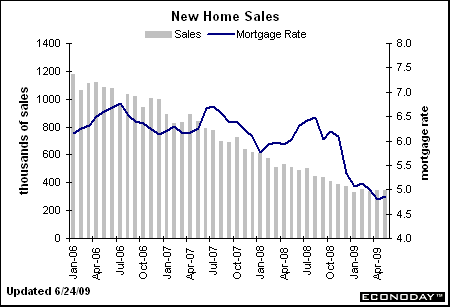
Barry Ritholtz at the Big Picture reports that sales of new one-family homes were up 0.6% in May from April, but notes that the margin of error is plus or minus 17.8%.
"And as expected, April’s data was revised downwards.

Year over year, sales fell 32.8%--a valid number relative to the error (±10.9%) below the May 2008 estimate ...."
He links to a Barron's Econoday chart plotting new homes sales since January 2006:


13. DURABLE GOODS ORDERS UP 1.8% IN MAY FROM APRIL

Shobhana Chandra and Courtney Schlisserman at Bloomberg reports that the Commerce Department announced today that orders for durable goods rose 1.8% from April.
"Economists projected goods orders would drop 0.9 percent, according to the median of 75 forecasts in a Bloomberg News survey. Estimates ranged from a decline of 3.9% to a gain of 1%. Commerce revised the April gain to 1.8% from a previously reported 1.9% increase."
14. US COMMERCIAL CRUDE STOCKS DOWN 3.8 MB, GASOLINE UP 3.9 MB, REFINERY UTILIZATION UP TO 87.05%

The EIA reports that commercial crude stocks were drawn down by 3.8 million barrels in the week ended June 19 to 353.9 million barrels. Holdings are well above the historical range for this time of year, but have been falling steadily in recent weeks. A Bloomberg News survey had the median expectation of analysts for a 950,000 barrel draw. Commercial gasoline stocks grew by 3.9 million barrels and are at the bottom of the historical range for this time of year. Distillate stocks grew by 2.1 million barrels and are 32.7% larger than the comparable week last year. The national average price of gasoline rose to $2.691/gallon for the week ended June 22. Refinery utilization for the week ended June 19 rose to 87.05% from the 85.90% seen in the week ended June 12.

Friday, June 12, 2009

Daily Sources 6/12

1. RECENT MOVES TO PURCHASE IMF SDR BONDS MAY BE MORE ABOUT DEVELOPING NATION PARTICIPATION IN THE IMF THAN CHALLENGE TO THE DOLLAR: JAPAN'S TRUST IN THE US UNSHAKABLE, MEXICO MAY PURCHASE BONDS

Susanne Walker at Bloomberg reports that in an interview with the news wire Japanese Finance Minister Kaoru Yosano said
"The US dollar’s position as the world’s reserve currency isn’t under threat. Our trust in US Treasuries is absolutely unshakable."
Meanwhile, Jens Erik Gould, also at Bloomberg reports that Mexican central bank Governor Guillermo Ortiz said in an interview that Mexico would contribute more to the IMF either by purchasing special drawing rights bonds or by directly lending to the institution. He went on to say:
"The IMF has to be re-energized and revitalized and that of course involves changes in the governing structure, and at the center of those changes is a greater participation from the emerging markets. The other side of the coin is that they also have to contribute."
He further indicated:
"The dollar will remain the central reserve currency probably for some time. I am not really worried about the status of the dollar at the present time."
Simon Johnson's analysis of the April 2 G-20 meeting provides, I think, some insight into what is taking place here--see Daily Sources 4/3 #3. In short, he argued that the Obama Administration convinced the Europeans, who traditionally have led the IMF, to make the selection process for its chief open and transparent. "Insiders" believe the current IMF managing director to resign within the year, meaning that the campaign for the next MD has already begun.
"How did the Obama administration pull this off? In a brilliant move, they took the lead by volunteering to open up the selection process for the World Bank, the IMF’s sister organization, which has always been run by an American. The next president of the World Bank is very likely to be Chinese."


2. CHINA'S NBR SAYS INDUSTRIAL PRODUCTION UP 8.9% IN MAY YOY, TURNS OUT THAT CAR STATS ARE NOT FOR PURCHASES, BUT FOR DELIVERIES FROM FACTORIES TO RETAIL OUTLETS, FITCH RATINGS SKEPTICAL OF CHINESE FINANCIAL SECTOR DATA

Terence Poon and Juan Chen at Dow Jones report that China's National Bureau of Statistics announced that value-added industrial production rose by 8.9% in May from a year previous. And Yves Smith at Naked Capitalism says she feels like she's being gaslighted, given the recent revelation that the data on car sales from China are not for cars that people have bought, but for a shipment from a factory to a retailer. She quotes from MetalMiner:
"There are some apparently contradictory numbers coming out of China at the moment. Take those car sales as an example. Our man on the ground tells us BYD, a noted Chinese car maker, reported 30,000 car sales of one model by end of last year, but the number plate agency recorded only 10,000 new cars of that model registered for use on the road. What happened to the other 20,000 are they running around without number plates? In a police state, I don’t think so. Our understanding is auto sales are recorded in China when they leave the factory, not when they are registered on the road, so dealers can build up inventory while car 'sales' are rising."
So maybe sales of cars in China aren't quite outstripping those in the US. Which is perhaps more reason to doubt the official GDP and industrial production numbers, given electricity generation and consumption and apparent oil demand numbers, as per the IEA--see Daily Sources 5/14 #2. In late May, the China Electricity Council, or association, announced it would stop publishing electricity consumption numbers--see Daily Sources 6/8 #6. Of course, the number of cars on the road have a large effect on oil consumption. (But it would be inadvisable to mount a high horse on this issue, lest it die underneath you--see Michael J. Panzner's elucidation of how the US government cooks its own statistics at Financial Armageddon.) That said, James T. Areddy at China Journal notes that Charlene Chu, a Fitch Ratings analyst in Beijing,
"has compiled numbers that seem to suggest that when credit policy in China has gotten tighter and stock prices have gone lower, banks have started peddling more wealth management products to their rich clients — and in doing so piled up hidden risks for themselves.

After Wall Street collapsed last year and US government was prompted to bail out its biggest banks, China’s financial institutions gained recognition as among the world’s largest and healthiest. After all, nonperforming loan ratios in China were near 2% on average last year from about 15% in 2003.

Chu, a former China watcher for the Federal Reserve Bank of New York, isn’t sanguine about such figures. The Fitch analyst has long argued that NPL ratios and other basic indicators of banking-system health favored by China’s policymakers sometimes mask other concerns. She sees evidence that local banks are downgrading their assessment of loans within the five categories of loan quality, without boosting NPLs, and notes that Chinese banks’ profit margins are getting pinched."
Chu says the sector suffers from "high information risk." Worth reading in full.

3. EUROZONE INDUSTRIAL PRODUCTION DOWN 1.9% IN APRIL MOM, 21.6% YOY

Ralph Atkins at the Financial Times reports that Eurostat announced that eurozone industrial production fell by 1.9% in April from March, down 21.6% since April 2008.
"Economists pointed out that the latest fall in industrial production was noticeably less severe than around the turn of the year, and that other 'hard' data--for instance, German industrial orders figures--have shown a marked improvement.

Still, the sharp contraction in activity has left the eurozone economy badly wounded. Industrial production in April was down to a level not seen for almost 12 years, and the latest monthly fall offered scant hope of an early return to economic growth.

'We are definitely in the recovery phase but today’s data confirm that it will be fragile and there will be negative surprises,' said Marco Annunziata, chief economist at Unicredit. 'Policymakers should not be in any hurry to withdraw [economic] policy stimulus.'"
4. SPAIN TO DECIDE ON RENEWING NUCLEAR POWER LICENSE IN COMING WEEKS

Elisa Santafe at the AFP reports that Madrid will either come down for or against nuclear power in the coming weeks as it decides whether to renew the operating licenses of the oldest of its six nuclear power plants.
"Prime Minister Jose Luis Rodriguez Zapatero, whose socialist government has backed the development renewable energy sources such as solar and wind power, has said he wants to phase out nuclear energy in the country when the life span of its six nuclear plants expires.

But on Monday the five-member board of the country's nuclear watchdog unanimously agreed to recommend that the Garona nuclear plant in northern Spain should get a new 10-year operating license if it upgrades its safety equipment.

Nuclear Safety Council chairwoman Carmen Martinez Ten said the decision was taken on technical and security grounds and not for reasons of 'energy policy, economics or another nature'."
Phasing out nuclear energy doesn't make a lot of sense from the perspective of Spain's energy security--it provides about 20% of the country's electricity generation--be interesting to see. (h/t Leanon at Drum Beat.)

5. ITALY TO RECEIVE PREFERENTIAL TREATMENT IN LIBYA

Adam L. Freeman and Flavia Krause-Jackson at Bloomberg report that Libyan leader Muammar Qaddafi promised today to give Italian companies preferential treatment.
"Qaddafi is visiting Italy for the first time after the country agreed last year to pay the North African nation $5 billion (3.5 billion euros) over 25 years to compensate for the occupation from 1911 to 1943. That paved the way for closer commercial ties and increased efforts by Libya to contain illegal immigration."
"Libya, Africa’s third-largest oil producer, is studying further investment in Italy’s Enel SpA and Eni SpA, Shokri Ghanem, chairman of Libya’s National Oil Corp., said on June 1 in Abu Dhabi. The Libyan Investment Authority, the country’s investment arm, has $80 billion in liquid assets. Libya owns almost 5 percent of UniCredit SpA, Italy’s biggest bank.

'Libya is an important country for us,' Fulvio Conti, chief executive officer of Enel, told reporters in Rome today, news agency Radiocor reported. 'We have always had excellent relations and we will continue to do so in the future.'

Libya accounted for 31% of Italy’s oil imports in the first quarter while the North African country’s gas met 13% of Italian demand, according to the Italian statistics agency."
Italy is also moving to integrate its energy sector more closely with Russia, following, it seems, Berlin's lead in that area.

6. UN SECURITY COUNCIL ANNOUNCES NEW SANCTIONS ON NORTH KOREA

Colum Lynch at the Washington Post reports that the UN Security Council today voted unanimously to impose new financial, military and trade sanctions on North Korea in response to its recent decision to restart its nuclear program, nuclear test blast, and missile launches--as well as its decision to call the 1953 Armistice a dead letter.The sanctions do not provide for a comprehensive trade embargo, however, and China specifically inserted an exception which would allow for continued sales of small arms and light weapons.
"The resolution calls for UN members to inspect all shipments entering or leaving North Korea if there is a reasonable suspicion that the cargo contains banned nuclear or missile technology. Member nations would be given the right to search ships suspected of carrying banned materials on the high seas and to seize any contraband.

The resolution, however, includes important caveats, such as the need for the flag state--the country in which a ship is registered--to approve the searches. If the flag state does not allow inspections on the high seas, it would be required to direct the ship to a nearby port for a search. But council members would not be authorized to use force to ensure that happens."
Galrahn at Information Dissemination notes that a resolution was introduced in Japan yesterday to allow for naval intercepts, ie participation in a blockade:
"Japan may change its laws to allow its navy to inspect North Korean vessels on the high seas if the UN Security Council approves such a step, the government said on Thursday.

'Once the resolution is adopted, we have to clear the issue of enacting a domestic law,' to pave the way for naval intercepts by officially pacifist Japan, said Chief Cabinet Secretary Takeo Kawamura."
Some analysts believe that the recent measures taken by Pyongyang are the result of the question of succession--the USDOS Press Secretary answered some related questions in the briefing today:
"QUESTION: When South Korea media, at the beginning of this month, first started reporting on the existence of documents in which North Korean diplomats stationed overseas were apparently being foresworn to allegiance to Kim Jong-un as the successor of Kim Jong-il, the spokesman for this Department at the podium on June 2, who shall remain nameless, but whose initials are Robert Wood, said – (laughter) – that such reports were speculative. I wonder whether the Department today still regards the reporting surrounding the apparent anointment of Kim Jong-un to be purely speculative.

MR. CROWLEY: Obviously, we have heard the same reports that you have heard, and we know there are questions of succession in North Korea, given the questionable health of Kim Jong-il. As to--as far as we know, Kim Jong-il is still the leader of North Korea. I believe his--he is in firm control of the country. What happens down the road, we don’t know. That is up to North Korea.

QUSTION: So you are no more illuminated on the subject of whether or not Kim Jong-un has been anointed the successor today than the Department was when this question was raised on June 2?

MR. CROWLEY: It is something that we are conscious of. We are looking at it. We don’t know that it necessarily influences what is happening now.

QUESTION: But you don’t question that the anointment has occurred?

MR. CROWLEY: I don’t--I mean, who the--we know who the current leader of North Korea is. Who the next leader of North Korea is is up to North Korea. We are more conscious of what they are doing and for whatever reason, obviously, the actions that North Korea has taken recently are provocative, unhelpful. We expect sometime today there will be a vote on a new Security Council resolution. And at the end of this vote, should the resolution be adopted, North Korea will be facing a sanctions regime unlike any other on earth.

And in that regard, we will continue close consultations with the members of the Security Council, those in the five-party process, for the moment. We will implement those sanctions aggressively. As I think Ambassador Bosworth said in testimony yesterday before the Senate Foreign Relations Committee, we are taking appropriate defensive measures. But he made clear also that the door is still open to negotiations, and we hope that North Korea will, at some point in the future, come back to that process."


7. TALIBAN TARGETS ISLAMIC INSTITUTIONS IN PAKISTAN

Shaiq Hussain and Haq Nawaz Khan at the Washington Post report that a top anti-Taliban cleric was killed in a suicide bomb attack on a religious seminary in Lahore today. An apparently coordinated attack took place in a mosque in the northwestern garrison town of Nowshera, where another bomb killed four and wounded many others. I doubt that the decision by the Taliban to target Islamic institutions will be likely to bolster its reputation in Pakistan, nor cow the population at large. Sounds like they're getting desperate to me.

8. KYRGYZSTAN REBUFFS APPEAL TO KEEP MANAS OPEN ... THE UZBEK CONNECTION

Michael Schwirtz at the New York Times reports that Kyrgyzstan yesterday rebuffed an appeal from the Obama Administration to allow the US to continue to operate from the Manas airbase.
"On Thursday, Foreign Minister Kadyrbek Sarbayev said there were no plans to reverse that decision, despite the appeal by Mr. Obama, who, according to the Kyrgyz government, sent a letter to Mr. Bakiyev seeking greater cooperation between the countries. American officials in the region had no immediate public comment on the Kyrgyz government’s statement."
In May, Uzbek President Islam Karimov announced during a state visit of South Korean President President Lee Myung-Bak that the Navoi cargo airbase is being used for non-lethal supply to NATO forces in Afghanistan. The announcement coincided with a number of agreements with KNOC--Korea's state oil company--and seemed an indication that South Korea was coordinating energy security policy with the US--see Daily Sources 5/13 #8. The Kyrgyz parliament voted to approve its President's measure to end the lease of the Manas base to US forces on February 19. A former Kyrgyz Ambassador to the US published an opinion piece at the time which stated that Russian pressure was not the primary reason for the closure--and that the original reason for allowing the US access was Bishkek's conflict with the Islamic Movement of Uzbekistan and sympathy for the US following 9/11. That said, Russia's offer of aid was almost half of Kyrgyz GDP--$150 million in aid, forgiveness of $180 million in debt, and $2 billion in loans--see Daily Sources 2/20 #4.

9. OBAMA'S CAIRO SPEECH MAY HAVE INSPIRED HAMAS POLICY SHIFT, NETANYAHU GOVT SEEMS UNLIKELY TO ACCEPT TWO-STATE SOLUTION

Middle East Pulse reports that according to Assaf Gabor in Makor Rishon-Hatzofe Obama's Cairo speech may have inspired a shift in Hamas policy:
"Hamas Political Bureau Director Khaled Mashal: 'Hamas will not be an obstacle to a peace agreement in the 1967 borders, Hamas will be a positive element helping to reach a solution that is fair to the Palestinians and will enable them to realize their rights.'

In response, high-ranking Hamas figure Salah Bardawil told Makor Rishon-Hatzofe, 'Mashal disclosed the first details of Hamas's new policy, as a factor that will act in the framework of a Palestinian government, after there is Palestinian unity, and in the framework of the Mecca agreement.'

Bardawil explained Hamas's strategy, which is dealing with a situation of being globally ostracized: 'The change is a response to Israeli pressure to make Hamas irrelevant and to disregard it as representing the Palestinian majority.' He said that the new compromising American policy had an effect: 'Khaled Mashal, after Obama's visit and the change in policy being led by Obama, said this with the goal of showing the world the real problem, which is Israel's attitude."
Bardawil further suggested that the condition for Hamas recognizing Israel is a Palestinian state. Gil Hoffman at the Jerusalem Post seems to suggest that a two-state solution is something that the Netanyahu administration cannot politically accept, however. (h/t to Michael Collins Dunn at MEI's Editor's Blog for both of these.)

10. OPEC SUPPLIED 118KB/D MORE IN MAY THAN APRIL, REDUCES GLOBAL DEMAND FORECAST BY 200 KB/D, UPBEAT ON GLOBAL ECONOMY

Alexander Kwiatkowski at Bloomberg reports that OPEC reported that it supplied 118 kb/d more oil in May than it did in April.
"OPEC reduced the forecast for demand for its crude as global consumption shrinks. The group estimates it will need to produce 28.6 mb/d in 2009 to balance global supply and demand, 2.2 mb/d less than last year. Last month it estimated that it would need to pump 28.8 mb/d."
The report indicated the organization's view that:
"In light of the considerable challenges the world economy and commodity market, particularly the oil market, have undergone, the worst appears to be behind us. Prices have not only remained steady, but have even moved higher."
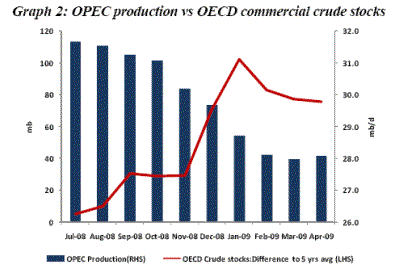
Kate Mackenzie at FT Energy Source puts that in the context of the IEA's decision yesterday to up its demand forecast for 2009 by 120kb/d and the EIA's earlier slight increase in projected world demand--by 5kb/d IIRC. She notes that OPEC indicated that the contango in oil has flattened some as OECD inventories fell in parallel with falling production.


11. BRAZIL'S SENATE TO SET UP NEW OIL COMPANY FOR SANTOS BASIN

Kate Mackenzie at FT Energy Source reports that new regulations are being introduced quickly which, in sum, will create a 100% state-owned company to lease Brazil's pre-salt fields, or Santos basin, to Petrobras and others.
"Petrobras, although state-controlled, is 60% owned by mostly foreign shareholders, and the country’s left-wing government is unenthusiastic about sharing the huge gains from the pre-salt fields with others--hence the creation of the new company. The plan is that the new state-owned company will be able to grant concessions without going to tender, which industry observers believe will favor Petrobras. For international oil companies, however, the outlook is less certain."


12. CHÁVEZ THREATENS TO SHUT GLOBOVISIÓN--A BIT MORE DIRECTLY THIS TIME

Christopher Toothaker at the Associated Press reports that Hugo Chávez yesterday urged executives at Globovisión "to reflect" upon their critical stance towards the government, or the station "won't be on the airwaves much longer."
"Globovisión--a Caracas-based all-news network--has been the only anti-Chavez channel on the open airwaves since 2007, when Chavez refused to renew the broadcast license of another opposition-sided channel, Radio Caracas Television. That network moved to cable."
The best summary of the recent efforts to silence opposition in Venezuela I've seen recently was Fausta Wertz's--see Daily Sources 6/1 #10.

Wednesday, May 13, 2009

Daily Sources 5/13

1. EUROZONE INDUSTRIAL PRODUCTION DOWN 20% IN MARCH YOY, EVEN AS GERMAN IP IS FLAT

Jan Strupczewski at Reuters reports that Eurostat released data today showing the industrial production in the eurozone fell by 20% in March from the year previous. From February, industrial production for the 16 members of the monetary union fell 2% in March.
"Industrial production accounts for roughly 17% of euro zone gross domestic product and the grim March output data could mean the economy shrank more than economists expect.

'Following today's release this indicator is pointing to a -2.2-2.3% quarter-on-quarter reading in Q1. This suggests downside risks to our 2% forecast,' said Saleem Bahaj, economist at Goldman Sachs.

Eurostat also revised down production data for February to a monthly fall of 2.5% from the initially reported decline of 2.3% and, in year-on-year terms, to a plunge of 19.1% from 18.4%."
However, Germany, the largest economy in the eurozone, announced flat industrial production in March last week, though exports continued to drop--see Daily Sources 5/8 #4.

2. CHINESE INDUSTRIAL PRODUCTION UP 7.3% IN APRIL YOY, EVEN AS ELECTRICAL GENERATION DOWN AS MUCH AS 4% YOY AND INDUSTRIAL PRODUCTS IMPORTS FALL BY 14.3%

The AFP reports that Chinese industrial output rose by 7.3% in April year over year according to data released by the National Bureau of Statistics today.
"The figure was down from 8.3% growth in March, and 11.0% in February, according to earlier data issued by the government.

'It was a small fluctuation in a generally upgoing trend,' said Lian Ping, a Shanghai-based economist with the Bank of Communications.

'It's rather unlikely it will go back to a rate of around five percent,' he said.

Growth in industrial output--a main gauge of activity in factories and plants across China--hit lows of little more than five percent at the end of last year."
On May 5, the China Electricity Council released preliminary data that electricity generation was down 3.55% from a year previous and that the finalized statistic--to be released later this month--was likely to be a 4% decline. This was also in the face of CLSA Asia Pacific Markets' positive PMI reading for April--see Daily Sources 5/5 #3 for both of these. I find the notion of industrial production continuing to increase at annual rates of 7% or more difficult to reconcile with electrical generation decreases of annual rates of up to 4%.
"Exports of industrial products totaled 566.2 billion yuan (~ $83 billion ) last month, a steep decline of 14.3% from the same month in 2008, the statistics bureau said."
3. CHINA BANKING REGULATORS PROPOSE RULES FOR ESTABLISHMENT OF CONSUMER LENDING FIRMS AS WESTERN BANKS EXIT CHINESE FINANCIAL SECTOR IN ORDER TO SHORE UP BOOKS

Sky Canaves at the China Journal reports that the China Banking Regulatory Commission told Xinhua that it had issued a draft of new regulations that establish guidelines for the establishment of new consumer financing corporations. Although there was a record number of new loans made in the first quarter and April, consumer lending accounts for only 12% of total loans--see Daily Sources 5/7 #2 and Daily Sources 5/12 #2.
"Under the proposed rules, domestic and foreign-invested consumer finance companies would be able to make loans for durable goods, as well as general-purpose personal loans, in amounts up to five times the borrower’s monthly income.

The finance companies would not be allowed to accept deposits and would have to maintain a minimum registered capital of 300 million yuan (~ $44 million). Prospective applicants should have at least 80 billion yuan in total assets, five years of experience in consumer financing, and profitability in the last two fiscal years, according to the draft rules."
Canaves notes that private consumption currently accounts for about 35% of Chinese GDP. Chen Qiong, an official with the commission said,
"The establishment of consumer finance companies will expedite an increase in personal consumption, thus driving increases in the production and sales volumes of manufacturers and retailers, while also driving demand in related industries and altering the GDP’s over-reliance on exports and fixed asset investment."
In the meantime, Louise Story and David Barboza at the New York Times reports that Bank of America agreed yesterday to sell about a third of its 16% stake in China Construction Bank for $7.3 billion.
"[A] person involved in the deal said Bank of America agreed to a private placement sale to a consortium that includes China Life Insurance, Temasek Holdings of Singapore and the private investment firm Hopu Investments of China, which is partly controlled by Fang Fenglei, the Chinese partner of Goldman Sachs. ...
Bank of America’s move comes a few weeks after Allianz and American Express sold nearly $2 billion worth of shares in another big Chinese bank, the Industrial and Commercial Bank of China, according to Reuters. The Royal Bank of Scotland also recently sold its stake in the Bank of China."
4. CHINA MAY HAVE RESTARTED AS MUCH AS 1.4 MMT OF ALUMINUM CAPACITY IN APRIL AS RIO TINTO DEAL LOOKS LIKELY TO SOUR

Richard Dobson at Bloomberg report Ru Xiaojie, an analyst at Aluminum Corp. of China Ltd., indicated at a conference today that the country may have restarted as much as 1.4 million metric tons of capacity in April. Ms. Ru indicated that the country may produce as much as 12.6 million tonnes of aluminum this year. Alcoa notes there is oversupply on the market. Meanwhile, the Rio Tinto Chinalco deal appears unlikely to go through.

5. KAZAKH PRESIDENT SIGNS BILL INTO LAW SENDING MORE GAS VIA RUSSIA, EU NABUCCO EFFORT DOESN'T SECURE FEEDSTOCK PARTICIPATION AS THE U.S. SEEMS TO RELAX SUPPORT FOR NABUCCO

Upstream online.com reports that Kazakh President Nursultan Nazarbayev has signed into law Kazakhstan's agreement with Russia and Turkmenistan today to carry more natural gas via the Central Asia-Center pipeline system, which would take the gas to Europe through Russia.

"The Russian pipeline plan is expected to transport up to an extra 10 billion cubic metres of Turkmen gas a year and the same volume of extra Kazakh supplies, according to the original deal."
Last Friday's the EU, meaning I infer Andris Piebalgs, signed an "energy agreement" with Azerbaijan, Georgia, Turkey and Egypt regarding a southern transit corridor. The Southern Corridor Summit apparently failed to seal the deal with other key meeting participants: Turkmenistan and Kazakhstan, ie most of the feedstock, which now appears to have gone north. On Friday the rumor that the US was not unequivocal in its support for Nabucco was mooted at the USDOS daily press briefing:
"QUESTION: Robert, just a quick thing on energy issues. The new Obama Administration envoy for energy Richard Morningstar was in a conference in Bulgaria, and he seemed to say that the Nabucco pipeline, which is EU-backed, was not, quote, 'the holy grail,' and suggested that the Russian alternative, South Stream, might work as well. Is this part of the reset in relations with Russia and the US? And what’s the US position on the two pipelines?

MR. WOOD: I think it--I think--and I haven’t seen the remarks from Ambassador Morningstar. But we have always supported diversification of energy supply and resources. And--but I don’t have the specifics with regard to the two pipelines. I haven’t heard--you know, only--I’ve only heard what you have said about it. I’d have to talk to Ambassador Morningstar to get further clarification. But as I said, we want to see a diversification of energy resources in that region, as we said, and worldwide in general."


6. OFFICIAL KREMLIN STRATEGY FORECAST EXPECTS RESOURCES TO BE CENTER OF FUTURE INTERNATIONAL DISPUTES

Al Jazeera reports today that the Kremlin released its National Security Strategy today which forecast that
"The attention of international politics in the long-term perspective will be concentrated on the acquisition of energy resources.

Amid competitive struggle for resources, attempts to use military force to solve emerging problems can't be excluded.

The existing balance of forces near the borders of the Russian Federation and its allies can be violated."
The document identified the Middle East, the Barents Sea, the Arctic, the Caspian Sea and Central Asia as likely loci of future resource conflicts. (h/t Leanan at the Oil Drum's Drumbeat.)

7. BANK ROSSI CUTS RATES ON OIL PRICE INCREASES, WHILE OPEC MONTHLY OIL REPORT SHOWS INCREASE IN SUPPLY IN APRIL, BIGGEST CHEATER IS IRAN

Emma O’Brien at Bloomberg reports that Bank Rossi cut its benchmark interest rates effective tomorrow today, the refinancing rate, seen as the limit for borrowing, was cut to 12% from 12.5% and the repurchase rate charged on central bank loans was cut to 11% from 11.5%.
"Bank Rossii has been buying foreign currency on the market as a way of reducing the ruble’s volatility and controlling its advance, [First Deputy Chairman Alexei] Ulyukayev said. The central bank is purchasing dollars and euros at about 37.20 versus the basket, after earlier defending 37.25, MDM [Bank]’s [Mikhail] Galkin, [head of fixed-income and credit research in Moscow] said, adding that policy makers bought about $1 billion yesterday."
The ruble has been climbing on stronger oil prices.


Spencer Swartz at Environmental Capital reports that OPEC's monthly report released today found that its eleven central members increased oil production by 220 kb/d.
"The production increase--as if the global recession and rising oil prices weren’t already a good enough deterrent--further diminishes the prospect of OPEC announcing any production cut when it meets in Vienna May 28. After months of reducing its output by around 150,000 barrels a day more than its OPEC quota obliges it to, Saudi Arabia, OPEC’s top dog, will be in no mood to hear Iran talk about more cuts when the Persian state is pumping some 400,000 barrels over its quota, according to OPEC’s latest data.

The kingdom was already annoyed privately in March when OPEC last met about the “cheaters” within OPEC. Ditto with the other OPEC Gulf producers, like Kuwait, which have also been carrying their full weight of OPEC cuts and forgoing oil revenue.

The April rise in production 'buries the chance of a fresh cut,' says one analyst who tracks OPEC closely."
Jackson Thies and Mine Yücel at the Dallas Federal Reserve Bank produce a graph showing OPEC production as a percentage of the (implied) quota in February and March:


The EIA produced a graph of OPEC surplus capacity versus price in today's Week in Petroleum report as well:


All fundamentals--even with the reduction in commercial stockpiles reported on below--do seem to point toward a downward pressure on price.

8. UZBEKISTAN, VIA SOUTH KOREA, TO ALLOW NATO SUPPLY TO AFGHANISTAN VIA NAVOI, OBVIATING MANAS CONTROVERSY

Deirdre Tynan at EurasiaNet.org reports that Uzbek President Islam Karimov announced during the state visit of South Korean President Lee Myung-Bak that a cargo airport in the city of Navoi is being used for non-lethal supply of NATO forces in Afghanistan.


A South Korean corporation is heading a renovation project at the airport which would convert it into a world-class air freight hub.
"South Korea’s involvement in the project provides a face-saving way for the resumption of US-Uzbek strategic cooperation, capping over a year of US diplomatic efforts to bridge the rift that opened amid the fallout from the 2005 Andijan massacre.

Karimov evicted US forces from an air base in Karshi Khanabad in late 2005 as a response to US protests over his administration’s handling of the Andijan events.

The Uzbek-South Korean agreement regarding Navoi airport gives Karimov the ability to deny to Moscow that he has cut a deal with the United States. But at the same time, Washington stands to get what it needs--a transit base that can take over much of the load from the American base in Kyrgyzstan, which is scheduled to close this summer."
Though the deal is publicly a commercial arrangement between South Korean and Uzbek entities, the US Transportation Command in late 2008 conducted a market survey which concluded that the hub at Navoi could provide "an integrated commercial-based solution to meet US forces’ transportation requirements to Afghanistan." In late February, the Kyrgyz Parliament voted nearly unanimously to formally cancel the US lease to Manas, giving the President the power to serve US forces an eviction notice within 180 days--see Daily Sources 2/20 #4. In the beginning of February the Kyrgyz President, Kurmanbek Bakiyev, announced in Moscow that he had secured $150 million in aid from Moscow, the forgiveness of $180 million in debt, and $2 billion in loans. Kyrgyz nominal GDP in 2008 was about $5 billion. US annual aid was running at about $150 million, but mostly was directed to non-governmental recipients--see Daily Sources 2/5 #6. Navoi's use as a supply route for NATO forces came as KNOC signed deals to explore five oil and gas fields as part of an oil for infrastructure strategy being employed by the big four energy importers in Asia--China, India, Japan, and South Korea--see Daily Sources 5/12 #6. If Seoul is coordinating its energy security policy with US general security concerns in Asia that may well, in certain corners of the world, give it a considerable edge, in a way similar to, say, Total's decision to enter a new upstream venture in Venezuela in conjunction with China's CNPC--see Daily Sources 4/14 #6. Tynan's piece at EurasiaNet is well worth reading in full. (h/t FP Passport's Morning Brief.)

9. POPE CALLS FOR TWO STATE SOLUTION TO ISRAEL PALESTINE CONFLICT AND END TO GAZA EMBARGO, ANGERS EVERYONE

Howard Schneider at the Washington Post reports that Pope Benedict called for greater international pressure on Israel for the creation of a Palestinian state as well as urging an end to the embargo on Gaza. Scneider quotes the Pope as telling the crowd in Bethlehem, which is located in the West Bank:
"I call on the international community to bring its influence to bear in favor of a solution. ... I pray too that, with the assistance of the international community, reconstruction work can proceed swiftly wherever homes, schools or hospitals have been damaged or destroyed, especially during the recent fighting in Gaza. ... Please be assured of my solidarity with you in the immense work of rebuilding which now lies ahead, and my prayers that the embargo will soon be lifted."


Unsurprisingly, the pontiff managed to displease everyone, as Israelis condemned him for not making stronger expressions of regret for the Holocaust and Palestinians said that since he did not refer to the situation as the "Israeli occupation," he is a tacit ally of Tel Aviv. However, perhaps Benedict's overriding concern was to assure--in light of his speech in 2006 which highlighted a dialogue of Manuel II Paleologus saying that the spread of faith by the sword was irrational and contrary to God's will which offended so many and the recent televised meeting of US Christian soldiers in Afghanistan mulling over how best to proselytize given their situation--that Islamic community that Catholicism, insofar as he is its highest plenipotentiary, is not a sponsor of what many in the Muslim community regard as a Crusade.

10. MEND SAYS CIVIL WAR EMERGING IN NIGERIA

Platts reports that Nigeria's MEND released an email statement warning oil companies to remove personnel from the region as the conflict with the central authorities flared up.
"Oil companies operating in the region are advised to evacuate their staff within the next 24 hours to avoid them being part of the statistics of an emerging civil war.

All freedom fighters in the Niger Delta have been placed on alert to defend their positions and unleash a horrible toll on the oil industry and the Nigerian economy."
11. US RETAIL SALES DOWN 0.4% IN APRIL FROM MARCH

Jeff Bater at the Wall Street Journal reports that US retail sales fell by 0.4% in April from March, according to the latest data from the Commerce Department.
"Sales in March were revised down, decreasing 1.3% instead of 1.2% as previously reported. Sales rose in January and February, after sliding six straight months."
Import prices rose by 1.6% in April from March, completely due to the 15.4% increase in petroleum prices during that time. Excluding oil, import prices were down 0.4% in April from March, and 5.6% down in April from a year previous. Including oil, import prices in April were down 16.3% from the year previous, "the biggest one-year drop since the index was first published in 1982."

12. GOVERNMENT ONLY GUY HIRING, BUT GOVERNMENT IS BROKE, WILL IT GO AFTER PREDATORY LENDERS TO SHORE UP REVENUES?

Rebecca Wilder makes the point that the April jobs report showed that the government was adding a record number of jobs, but that this is taking place as state budgets generally are sharply in the red. She notes that federal jobs only account for 13% of all government jobs (as of April), whereas state jobs have a 24% share and local governments account for 64%. She links to Conor Dougherty's story at Real Time Economics which notes that revenue has declined in 45 of the 47 states which have reported their first quarter numbers. The WSJ helpfully provides a map:


Dougherty notes that the steepest decline in revenue was seen in Alaska, where first quarter revenues were down a whopping 74.1%, primarily on oil prices. In the meantime, Bruce Krasting at his blog notes that Goldman Sachs settled with the Massachusetts Attorney General for $60 million in a case which charged GS with predatory lending practices in Boston. Krastings notes:
"This means next to nothing for Goldman Sachs. However, a very dangerous precedent has been set. In the critical years 2005-2007 Goldman was ranked 15th in the League Tables for sub prime and Alt-A origination/securitization. Goldman’s management must be pleased as punch with that poor showing today. Those that ranked high on that list are no doubt consulting with their attorneys.

If Goldman gets its hand slapped for $60 million over 714 mortgages what does this mean for Countrywide Financial?"
(h/t Yves Smith at naked capitalism.)

13. FORECLOSURES UP, SPREADING TO SUBURBS, AND CORRELATED TO JOB LOSSES, WHICH ARE EXPECTED TO CONTINUE

On top of this news, Dan Levy at Bloomberg reports that US foreclosure filings rose to a record level for the second consecutive month in April, per data released from RealtyTrac today. 342,038 properties received an auction or default notice in April, as banks have increased their efforts to seize properties.
"Foreclosure filings jumped 32% from the year-earlier period, RealtyTrac said. Filings were little changed from March as some states delayed seizures. Ten states accounted for three-quarters of all foreclosures in April, with California leading the nation."
The culprit? "The inevitable result" of steep job losses. (California, incidentally, is one of the state's facing the worst budget shortfall this year.) And Crain's Chicago Business News notes that the foreclosure wave has headed out to the Chicago suburbs from the city proper according to data from the Woodstock Institute, perhaps indicating that the same is happening generally across the nation.
"Foreclosure cases filed in the first quarter jumped between 25% and 70% from the fourth quarter in DuPage, Will, McHenry, Lake and Kane counties, according to new data provided to Crain's by the Woodstock Institute, a Chicago-based housing advocacy group. Meanwhile, foreclosures fell 8% in Chicago, the first quarterly decline in a year.

Across the six-county Chicago metropolitan area, foreclosure filings rose 6% in the first quarter to 17,819, the highest one-quarter total since the housing crisis began in mid-2006.

The shifting locus of new foreclosures shows how the recession and job losses are supplanting subprime lending as the main driver of mortgage defaults, says Geoff Smith, vice-president in charge of research at Woodstock. While the first wave of foreclosures hit hardest in poorer city neighborhoods targeted by high-interest-rate lenders with loose credit standards, the latest round is striking middle-class areas where most borrowers qualified for standard-rate mortgages."
(I also came across this article due to Yves Smith's daily links.)


And on top of that, Phil Izzo at Real Time Economics records that the National Association of Realtors reported yesterday that the median single-family home price fell 14% in the first quarter from the year previous to $169,000. Izzo's post includes a useful sortable chart of the rate of change in home prices by region correlated to job losses for the same. "The data are sortable by city, state, price, percent change from a year earlier and unemployment rate." Michael Shenk, a Research Assistant at the Federal Reserve Bank of Cleveland plots a graph of the number of new single family home sales versus the median sales price for those houses:


(I wonder whether the average sales price would look worse than the median sales price.) Shenk notes:
"[T]he most positive sign for housing markets is that the home-price indexes are beginning to suggest that price declines may be slowing. Both the latest S&P/Case-Shiller indexes and the FHFA index indicate some stability in the 12-month growth rate of prices as of February. The FHFA index shows prices actually improving in February, while the Case-Shiller index, which is narrower than the FHFA index in terms of geographic coverage but also includes nonconforming loans which the FHFA index leaves out, simply has prices falling at a slower pace."


(h/t Mark Thoma at Economist's View.)

14. MIT COMMERCIAL REAL ESTATE INDEX SHOWS PRICES FELL 28% YOY

In the meantime, the MIT commercial property price transactions-based index developed by Professor David Geltner showed that transaction prices of commercial property sold by major institutional investors fell by 5.8% in the first quarter. The index is now down 21% on the year and 26% below its peak in mid-2007. Geltner commented:
"It's possible that the first quarter of 2009 was the nadir in market sentiment. Sales volume is down almost to nothing, as reflected in our demand index. The prices buyers are willing to pay fell a record 12% in the first quarter and is now 28% below a year ago and 39% below its mid-2007 peak."
(I also came across this story via Mark Thoma's blog.)

15. OBAMA ADMINISTRATION TO REGULATE DERIVATIVES

Stephen Labaton at the New York Times reports that the Obama Administration will ask Congress to pass legislation which would require that all derivatives instruments be traded via an exchange and be subject to tight regulatory oversight.

16. COMMERCIAL OIL STOCKS UNEXPECTEDLY FALL, SENATE TO CONSIDER STRATEGIC PETROLEUM PRODUCTS RESERVE

In a sharp reversal from weeks of stock builds, the EIA today announced that commercial stocks of crude oil fell by a whopping 4.7 million barrels in the week ended May 8 to 370.6 million barrels. Though the stocks are still well above the five year historical range for this time of year and at highs last seen in the early 90s, a Bloomberg survey indicated that the median expectation of analysts was for a one million barrel build. Gasoline inventories also fell by 4.1 million barrels, and are now in the middle of the five year historical range for this time of year, versus a split analyst expectation for builds and draws. Distillate stocks built by a million barrels to 147.5 million barrels and are completely counter-cyclical with 40.4 million barrels (37.7%) more in storage than this week last year.


Nick Snow at the Oil & Gas Journal reports that the US Senate Energy and Natural Resources Committee will consider a bill introduced by Jeff Bingaman (D-NM)--S. 967, the Strategic Petroleum Reserve Modernization Act of 2009--which would create a strategic petroleum products reserve. Europe maintains products reserves, but the US strategic reserve is entirely made of crude. There are two primary difficulties with creating strategic products reserves:

One: Petroleum products degrade in storage at relatively speedy rates; crudes do not.
Two: The specifications for each petroleum product in the US varies by state. So, for example, gasoline stored for use in Texas would meet the environmental regulations for Texas gasoline, much more lax than those in California.

Of course, in an emergency Washington has in the past relaxed specifications requirements to meet products shortages, so this second objection is more about the rationality of the US products market than a products SPR, per se.