Showing posts with label OPEC. Show all posts

Tuesday, July 13, 2010

Daily Sources 7/13

WILL CHINA'S DEBT EXPLOSION BITE IT IN THE BUTT?

Asks Michael Schuman at the Curious Capitalist.

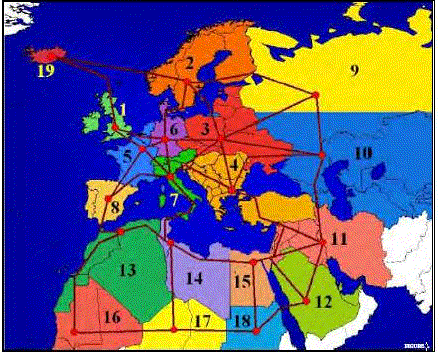
THE NOTION OF A EUROPEAN-NORTH AFRICAN SUPER-GRID GAINING GROUND

FT Energy Source reproduces an interview with Gregor Czisch of Germany’s Kassel University, who argues that such a supergrid would not be more geopolitically compromising than the current dependence on natural gas.


SOUTH KOREAN INDUSTRIES TO SPEND $18.5 BILLION ON GREEN TECHS TO 2013

Shinhye Kang at Bloomberg reports that South Korean companies plan to spend $18.5 billion in clean energy technologies to capture government spending on green technology and jobs. In the meantime, Choe Sang-Hun at the New York Times reports that there may be some friction between Seoul and DC when they begin renegotiating their nuclear fuel treaty later this year. Nuclear energy provides about 40% of South Korea's electricity. Seoul wants to reprocess the nuclear fuel; the US is opposed because reprocessing makes making nuclear weapons a simpler prospect.

PUTIN EXTENDS FUEL SUBSIDIES FOR FARMERS FACING DROUGHT

Maria Kolesnikova at Bloomberg reports that Prime Minister Putin has agreed to continue fuel discounts to farmers in Russia, who are facing the worst drought in a decade.

OPEC PREDICTS 2.1% INCREASE IN GLOBAL OIL DEMAND IN 2010

Robert Perkins at Platts reports that the IEA predicts a 2.1% increase in global oil demand in 2010, or an additional 1.8 million b/d rise from 2009. For 2011, the IEA predicts a 1.3 million b/d year-on-year growth in global oil demand to 87.8 million b/d. The slowing demand growth comes on top of predictions of growing global GDP.

BASHIR CHARGED WITH GENOCIDE BY INTERNATIONAL CRIMINAL COURT

Colum Lynch and Rebecca Hamilton at the Washington Post report that the International Criminal Court has charged the sitting Sudanese President, Omar Hassan al-Bashir, with genocide. David Eggers and John Pendergrast opine in the New York Times that the US should threaten Sudan to try and ensure that the North-South peace referendum takes place in January. Right now it looks to them that war is inevitable between them. Although they make room for the ICC's recent holding, it is not clear to me how it would be likely to produce a peaceful solution to the emerging problem.

PEMEX TO SELL DOLLAR BONDS

Gabrielle Coppola and Andres R. Martinez at Bloomberg report that Pemex, Mexico's national oil company, will sell at least $500 million in dollar bonds, yielding 250 basis points over US Treasuries today.

BOSTON FED PRESIDENT WORRIED MORE ABOUT DEFLATION THAN INFLATION

Jon Hilsenrath at Real Time Economics reports that Federal Reserve Bank of Boston President Eric Rosengren is more concerned about the possibility of deflation than of inflation.
“The core inflation rate is right around 1%,” he said. “Given the amount of substantial excess capacity that we have in the economy, there is some risk of further disinflation. And I would say the risk of deflation has gone up and is more of a risk than I would like to see at this point.”
Rebecca Wilder at News N Economics reports that inflation expectations for all the developed countries appear to be going down.


Edward Hugh at Fistful of Euros argues that there is a global slowdown in the works.

Monday, August 3, 2009

Daily Sources 8/3

1. EUROPE RETURNING TO NUCLEAR POWER

Kate Mackenzie at FT Energy Source has a good summary of the nuclear renaissance in Europe--where several countries have reversed, or are in the process of reversing, decisions to eliminate nuclear power from the generation mix.

2. TBLISI SAYS MOSCOW ATTEMPTING LAND GRAB FROM SOUTH OSSETIA

Misha Dzhindzhikhashvili at the Associated Press reports that Tblisi today accused Russia of attempting to take more territory outside the breakaway province of South Ossetia.
"'It's very alarming that as the first anniversary of the Russian aggression against Georgia comes close, Russia and its puppets are deliberately inciting tensions and behave defiantly,' the Georgian Foreign Ministry said.

But South Ossetia's spokeswoman Irina Gagloyeva told The Associated Press that the border move was legitimate and rejected any land-grabbing ambitions.

'Let the Georgians relax about their territory. We don't need a single centimeter of their soil,' Gagloyeva said."
3. CHINESE CRUDE STOCKS FALL 2.7% IN JUNE FROM MAY, REFINERIES PRODUCED 7.77 MB/D

Jim Bai and Aizhu Chen at Reuters write that Xinhua reported that Chinese crude stocks fell by 2.7% in June from May to 275 million barrels.
"Chinese refineries boosted production by 6% in June to a record 7.77 mb/d after a rise in domestic motor fuel prices aided margins."
4. TOKYO CONCERNED BY SLATE OF IRANIAN NEWS OF NEW CHINESE-IRANIAN OIL DEALS

Kyodo News reports that Tokyo has responded to the news aired in Iran that CNPC was to take a 70% share in South Azadegan, a field which Japan had secured interest earlier but dropped it on international concern about Tehran's nuclear program, by calling for renewed international cooperation on the issue. Japanese Vice Economy, Trade and Industry Minister Harufumi Mochizuki said "It is not desirable that international cooperation collapses this way." CNPC on Friday had denied that a new MOU regarding the field had been signed--see Daily Sources 7/31 #7. Tamsin Carlisle at the National reports that on Saturday a Chinese consortium signed a deal to build a new 360 kb/d refinery in Khuzestan province and expand the capacity of a refinery in Abadan to 360 kb/d from 210 kb/d. Carlisle provides a decent summary of Chinese-Iranian energy deals this year and further in the past as well as different details on the CNPC Azadegan deal:
"The agreement called for CNPC to purchase a 63% stake in the $2.5bn project from NIOC, leaving the Iranian state oil company with a 27% interest and Japan’s Inpex with 10%."
5. INDIA AND CHINA TO COOPERATE ON MONITORING HIMALAYAN MELTING GLACIERS

James Lamont at the Financial Times reports that India and China will collaborate on monitoring melting glaciers in the Himalayas, a crucial source of water supply for both countries.
"Jairam Ramesh, India's environment minister, said academic research bodies on both sides would share information. He also told the FT that New Delhi was also open to a dialogue about water resources with Beijing, saying the two countries had shared concerns."
6. SAUDI ARAMCO TO CUT PRICES, OPEC PRODUCING SLIGHTLY MORE IN JULY FROM JUNE

Christian Schmollinger at Bloomberg report that Saudi Aramco may cut the price of Arab Light crude oil by as average of $1.30/b,
"according to a survey of refiners from South Korea, Japan, Singapore and India. The company is expected to set new official levels this week. Extra Light may fall by $1.40/b, said the traders who asked not to be identified, citing confidentiality agreements.

Saudi Arabian Oil, known as Saudi Aramco, last month raised Arab Light by 10 cents to a premium of $1.50/b to the average of Persian Gulf benchmark’s Oman and Dubai. That was the highest price since July 2008. Asian refiners have been reducing their output as falling consumer demand has cut their so-called crack spreads, or profit margins."
Meanwhile, Karyn Peterson and Mark Shenk at Bloomberg report that the news wire's latest survey showed that OPEC increased oil output by 45kb/d to 28.39 mb/d in July from June."The 11 OPEC members with quotas ... pumped 26.035 mb/d, 1.19 million more than their target."
"Iran, the member that’s least compliant with output limits, according to the survey, expects oil prices to reach $80/b by the end of the year on 'optimistic' signs in the market, the country’s OPEC Governor, Mohammad Ali Khatibi, said.

Angola increased production by 20,000 barrels to 1.81 mb/d. The gain left output 293,000 barrels above the nation’s target, the second-biggest excess in the group. Output in the African country surpassed Nigeria’s for the first time since June 2008.

Venezuela raised output by 10,000 barrels to 2.21 mb/d. The South American country pumped 224 kb/d above its target of 1.986 million last month, the survey showed."
7. 100 IRANIAN POLITICIANS PUT ON TRIAL FOR FOMENTING UNREST IN COOPERATION WITH FOREIGNERS, LOTR FORMERLY INAUGURATES AHMADINEJAD'S SECOND TERM

Borzou Daragahi at the LA Times reported yesterday that Iran put 100 prominent politicians on trial, charging them with fomenting unrest in conspiracy with foreigners.
"Analysts say the confessions read at the trials are meant to lift the morale of hard-liners upset by coverage by reformist news outlets and Persian-language news channels abroad as well as to frighten opponents and take the wind out of the sails of the protest movement.

But as night fell, Tehran, the capital, erupted in angry cries of 'Allahu Akbar!' or 'God is great!' in what has become a daily rooftop ritual of protest."
The nighttime chants deliberately mirror events of the 1979 revolution. Thomas Erdbrink at the Washington Post reports that today Mahmoud Ahmadinejad was inaugurated by Leader of the Revolution Ayatollah Ali Khamenei as president for a second term. Karroubi, Mousavi, and Rafsanjani all elected not to attend the ceremony.
"Relatives of the late Ayatollah Ruhollah Khomeini, who led Iran's 1979 Islamic revolution, also failed to show up. According to pro-opposition Web sites, Hassan Khomeini, a grandson who usually attends such ceremonies, left for Pakistan some days ago. Other prominent absentees were two Friday prayer leaders from the Shiite holy city of Qom, the Parlemannews Web site reported."
8. NIGERIAN AGRICULTURAL POTENTIAL UNTAPPED, LEAVING FOOD SUPPLY VULNERABLE

David Hecht at the Washington Post notes that Nigeria's food supply is especially vulnerable to a disruption caused by low rainfall or other climate-driven variables. He concludes:
"The good news is that Nigeria has boundless agricultural potential. Of the 3.14 million irrigable hectares of land in the country, the World Bank says only 7% is currently being utilized. And though large tracts of farmland have been lost to desertification, more than half the country's estimated 98 million hectares of arable land currently lie fallow.

'The opportunities for our farmers are enormous if only they were to get the right institutional support,' said Sabo Nanono, the head of Kano state's commercial farmers association. 'We could feed the entire West African region; we could produce enough rice in just two or three [of Nigeria's 36] states to feed the nation and even to export.'

Somehow, the supply chain that feeds 140 million people keeps cranking along. The country has not seen a major famine for nearly four decades, since the Biafran civil war. But Nanono warned that it wouldn't take much to send this vulnerable country--and region--over the edge.

'The reality is that if the rains are bad throughout the region or the price of inputs became unaffordable, there could be massive food shortages, and neither the government nor any other institution stands ready to help,' he said. 'Then only God could save us.'"
Hecht's report is part of the Food Insecurity Project.

9. SOUTH AFRICAN PMI DOWN TO 37.3 IN JULY

Nasreen Seria at Bloomberg reports that South Africa's PMI fell to 37.3 in July from 37.9 in June. It is the first fall in PMI seen in three months.
"Manufacturing output, which makes up 15% of the economy, fell 17.1% in May from a year ago, after dropping a record 21.8% in the previous month, the statistics office said on July 9. Production has dropped every month since October 2008."
10. SETSER AND ZIEMBA ESTIMATE MAJOR SOVEREIGN WEALTH FUNDS HOLD ABOUT $1.5 TRILLION IN FOREIGN ASSETS, DOWN FROM $1.8 TRILLION LAST YEAR

Brad Setser and Rachel Ziemba at Follow the Money estimate, in contrast to other estimates, that total external assets of major sovereign wealth funds roughly were about $1.5 trillion as of June 2009, down from their estimate of roughly $1.8 trillion held in the middle of 2008.
"$1.5 trillion is lot of money. But it is substantially less than $7 trillion or so held as traditional foreign exchange reserves."
The post includes an extremely interesting table of estimated assets held by each major sovereign wealth funds at the bottom.

11. 1.5 MILLION TO EXHAUST INITIAL UNEMPLOYMENT INSURANCE IN THE NEXT FEW MONTHS, 1-IN-3 GROCERY SHOPPERS NOW ONLY PURCHASE ITEMS ON SALE

Barry Ritholtz has a pair of posts looking at the rate of people who have exhausted their unemployment insurance. In the first, he notes that the New York Times estimates that about 1.5 million more people will have exhausted their unemployment insurance over the course of the next few months. He links to a helpful graph from the NY Times:


In the second, he notes, as have others such as Rebecca Wilder at News and Economics, that there are additional unemployment programs available after one exhausts the initial unemployment insurance:
"[T]he Emergency Unemployment Compensation (EUC) which is good for 20 weeks. Then, there is the Supplemental EUC, which depending upon what your state thinks of the Federal largesse of handing out money to the recently unemployed, ranges anywhere from 13 to 20 more weeks."
Evidently, as of July 11, the number of people who have exhausted their initial unemployment insurance and are now on EUC or supplemental EUC, has gone from 127,000 a year ago to 2.66 million. The worry is that given that 70% of the economy is based on household consumption, growing unemployment will undermine any nascent recovery. In that vein, Credit Bubble Stocks notes that Information Resources Inc. has published market research which concludes that now
"about 1 in 3 [grocery] shoppers buy exclusively items on sale, twice as many as 18 months ago."
12. US PMI UP TO 48.9 IN JULY

Mark Shenk at Bloomberg reports that the Institute for Supply Management released its PMI today showing an uptick to 48.9 in July from 44.8 in June. (A reading above 50 indicates expansion; below 50 indicates contraction.) It is the highest reading seen since August 2008.

13. CHEVRON TO END ALL ONSHORE GAS DRILLING IN THE US

I missed the interesting factoid reported Friday by the Associated Press that Chevron will stop all US onshore gas rigs on low profitability this year.
"'By the end of the year, we will not have a single gas land-rig running,' George Kirkland, Chevron’s executive vice president for global upstream and gas said in a conference call."

Tuesday, July 14, 2009

Daily Sources 7/14

1. CHINA CALLS ON ERDOGAN TO WITHDRAW REMARKS ON UIGHURS, ONLY GULF STATE TO PUBLICLY CRITICIZE BEIJING IS IRAN

China Daily, a state owned newspaper, published an editorial today entitled "Don't Twist Facts" which states that Turkish Prime Minister Recep Tayyip Erdogan would be "well advised" to withdraw his statement saying that the events in Xinjiang amount to "a kind of genocide." The piece notes that China's one child policy applies only to Han Chinese and not to ethnic minorities, arguing that the immigration policy in the region cannot, therefore, be seen as colonization or a drowning out of the ethnic Uighurs in a sea of Han. It concludes:
"Mr Erdogan's remarks, which constitute interference in China's internal affairs, are the last thing the Uighur and Han Chinese would find helpful when they are looking forward to lasting peace."
Josef Federman at the Associated Press reports that much of the Arab Muslim world has remained mute on the question of the Uighurs, but that senior official in (Persian) Iran criticized Beijing openly:
"Iran has been one of the few Muslim countries to speak out on the crackdown. On Sunday, the official IRNA news agency reported that Foreign Minister Manouchehr Mottaki had discussed the ethnic clashes in a phone conversation with his Chinese counterpart and 'reflected concerns among Islamic countries.'

High-ranking clerics also condemned the crackdown and urged the government to complain to China.

'Silence and indifference toward such oppressions on the people is an unforgivable vice,' said Grand Ayatollah Youssef Saanei, a major religious figure who has criticized his own government's violent response to mass protests over the disputed June 12 election."
Iran has a very close relationship with Beijing, it's original oil sales to the country were conducted with a military organization solely incorporated to conduct the exchanges.

2. CHINA'S PROPERTY INDEX CLIMBS 0.61%

Xinhua reports that China's national property climate index rose 0.61% to 96.55 last month per an announcement by the National Bureau of Statistics.
"Real estate investment nationwide rose by 9.9% in the first half from the same period last year, and the growth rate was 3.1 percentage points higher than the January-May level, said NBS."
3. CHINA SURPASSES US AS WORLD'S LARGEST MARKET FOR WIND POWER

Keith Bradsher at the New York Times reports that China surpasses the US this year as the world's largest market for wind energy,
"now building 6 wind farms with a capacity of 10,000 to 20,000 megawatts apiece, using extensive low-interest loans from state-owned banks."
In May, Joerg Wuttke, president of the European Union Chamber of Commerce in China, accused Beijing of deliberately locking out foreign corporations from stimulus-related projects, specifically addressing a package of wind turbine orders worth €5 billion (~ $6.98 billion)--see Daily Sources 5/28 #3.

4. MÜNCHAU'S ANALYSIS OF THE GERMAN HIGH COURT'S RULING ON THE LISBON TREATY--THOSE IN MONETARY UNION SHOULD BE AFRAID

Wolfgang Münchau had an opinion piece in yesterday's Financial Times which examines the consequences of Germany's recent high court ruling on the Lisbon Treaty--see Daily Sources 6/30 #2. He makes three main points about the ruling:
"First, Germany’s constitutional court takes a clear stance on sovereignty. Ultimate authority always has to rest in a single place--and that is the member state for now. If you wanted to transfer sovereignty to the EU, you would have to dump your national constitution and adopt a European version in its place. As this is not going to happen, the court, in effect, ruled that all sovereignty in the EU is national. Power may be shared, but sovereignty may not."
"Second, the court does not recognize the European parliament as a genuine legislature, representing the will of a single European people, but as a representative body of member states. ... As a result, Germany will be able to ratify the Lisbon treaty only after a change in a domestic power-sharing law."
"Third, and perhaps most important, the court has given an explicit opinion on the question of European integration. Where does it end? The answer is: right here. The court said member states must have sovereignty in the following areas: criminal law, police, military operations, fiscal policy, social policy, education, culture, media, and relations with religious groups. In other words, European integration ends with the Lisbon treaty."
He concludes that anyone in a monetary union with Germany ought, therefore, to be worried. Well worth reading.

5. ITALY CALLS FOR EUROPEAN OIL FUTURES MARKET & GLOBAL REGS

Lorenzo Totaro at Bloomberg reports that the Italian Electricity and Gas Authority Chairman Alessandro Ortis said in a presentation in Rome today that a European oil market should be established in order to quell price volatility. He argued that the situation requires "A real, regulated European oil bourse open to selected operators" which would trade "long or very long term products, with delivery within Europe and guaranteed by a reliable central European counterpart." Ortis also joined the chorus of politicos who blame "speculation" for the price volatility, calling for global "governance agreements and international rules."

6. RELIANCE WANTS TO SELL DIRECTLY INTO US AS PROSPECTS OF LIFTING SUBSIDIES ON GASOLINE IN INDIA GET BETTER

Rakteem Katakey at Bloomberg reports that Reliance is seeking to sell petroleum products directly into the US--minus an intermediary.
"Reliance is currently selling fuel through Hess Corp. ... . Mumbai-based Reliance has leased storage space from Hess, [an anonymous company executive] said, without giving capacity details."
In April, Platts reported that in March Reliance had taken 1.3 million barrels of clean storage from Hess in the New York Harbor area--see Daily Sources 4/13. (The reason given for Reliance exporting in the story is extremely misleading--the Jamnagar refinery was always slated to be an export refinery--excess refining capacity is a strategy endorsed by New Delhi, though Reliance is private, and based on precedents set in Singapore and South Korea.) In June, Reliance halted exports of gasoline to Iran under pressure from the US, perhaps this (odd) story is more about that--see Daily Sources 6/4 #8--and the following. Vandana Hari at The Barrel reports that the Congress Party, having won a larger share of the vote in the recent elections, may press ahead with the liberalization of gasoline prices. Diesel is unlikely to be fully de-subsidized because of its role in agriculture and power generation, but it appears there is some likelihood that gasoline prices will become completely deregulated and unsubsidized.
"LPG and kerosene subsidies look likely to be left undisturbed for now. While kerosene is used by the poorest for cooking and home lighting, the consumers of LPG do not necessarily need state help to pay the market price of a cylinder. LPG could be taken down the same route as gasoil, with government help kicking in when prices cross a pain threshold.

As fuel price liberalization eases the subsidy burden of state-owned refiners and marketers Indian Oil Corp., Bharat Petroleum Corp. and Hindustan Petroleum Corp., as well as their upstream peers Oil and Natural Gas Corp. and GAIL, it would free up cash for their business growth and expansion."
There have been several stories recently about how Chinese state corporations have been making successful bids for overseas resources, often beating out competing Indian bids.

7. PAKISTAN LIFTS RESTRICTIONS ON PEOPLE RETURNING TO THE SWAT VALLEY

Izaz Mohmand at Reuters reports that Pakistan has lifted restriction on displaced people returning to the Swat Valley.

8. PHOTOS OF A DRY EUPHRATES, SECURITY TIGHTENED AROUND CHRISTIAN CHURCHES ON LAST WEEK'S SPREE OF ATTACKS

The New York Times carries a photo essay by Moises Saman of the ongoing agricultural crisis in Iraq as the country watches its rivers go dry as Turkey and Syria withhold water via dam projects at their source--see Daily Sources 6/8 #10. The accompanying story has the following anecdote:
"The Sunni areas upriver seem to have enough water, Mr Joda [a man who resides near Karbala] observed, a comment heavy with implication."
That said,
"Recently, the Water Ministry announced that Turkey had doubled the water flow into the Euphrates, salvaging the planting phase of the rice season in some areas."
Meanwhile, Nada Bakri at the Washington Post reports that security has been tightened around Christian churches in Baghdad and the northern province of Nineveh after a string of attacks last week.
"Iraq's Christians were the target of Islamist extremists after the U.S.-led invasion of Iraq in 2003 that toppled Saddam Hussein. Many have fled the country despite improved security. But fears of renewed attacks have mounted. In past weeks, devastating bombings also have struck Iraq's Turkmen and Shabak minorities in the north, which remains one of Iraq's most diverse regions."
9. RAFSANJANI TO MAKE FRIDAY'S WEEKLY KEYNOTE SERMON

Borzou Daragahi at the LA Times reports that Ayatollah Ali Akbar Hashemi Rafsanjani will deliver the nation's weekly keynote religious sermon, after having stayed away--for reasons which are the source of much speculation--for two months. Mousavi and Khatami will reportedly also attend the sermon.
"News of the return of reformists and moderates to the official Friday prayer ceremony could serve as a challenge to hard-liners, led by supreme leader Ali Khamenei, on their home turf. Alternately, it could be a sign that the two sides have brokered a truce in their continuing political conflict."
Iason Athanasiadis at the Christian Science Monitor reports that reformists are organizing to flood the prayer hall. (For some reason the CSM site appears to be down for me completely, here is an abstract at Iranian.com.) (h/t Juan Cole at informed comment.)

10. OPEC SAYS FUNDAMENTALS UNLIKELY TO PUT UPWARD PRESSURE ON PRICE IN 2010

OPEC published its monthly report today, which I have not had time to read, but which Platts reports it forecasts that fundamentals are unlikely to push oil prices up significantly in 2010.
"Although OPEC sees world oil demand growing by 500 kb/d in 2010, it expects this to be satisfied by non-OPEC producers and sees demand for its own crude falling by 400 kb/d next year on top of the 2.3 mb/d drop in demand between 2008 and 2009.

With current crude production--estimated at 28.44 mb/d in June--more than 300 kb/d than the 28.1 mb/d projected 2010 call on OPEC crude, the cartel will have food for thought at its next meeting, scheduled for September 9 in Vienna."
11. BRAZILIAN RETAIL SALES CLIMB FOR SECOND STRAIGHT MONTH, UNEMPLOYMENT DECLINES

Joshua Goodman and Andre Soliani at Bloomberg report that Brazil's retail sales rose by 0.8% in May from April and 4% from a year previous, according to the national statistics agency. April's year on year sales increase was revised upward to 7.1%.
"Unemployment fell for the second straight month in May, to 8.8%, while companies added jobs for the fourth month, cementing expectations that the economic recovery gained pace in the second quarter."
(Apparently in this case unemployment is not a lagging indicator.) Analysts see the rebound in sales as evidence that consumer demand is driving the Brazilian recovery.

12. US RETAIL SALES UP 0.6% IN JUNE FROM MAY, MOSTLY ON GASOLINE PRICES, THOUGH SALES OF AUTOS AND PARTS UP TOO; ZUCKERMAN PESSIMISTIC ON ECONOMY GIVEN UNEMPLOYMENT PICTURE

Shobhana Chandra at Bloomberg reports that retail sales rose 0.6% in June from May, the largest gain since January.
"Excluding autos and gas, purchases dropped for a fourth consecutive month. The Labor Department’s producer-price index gained 1.8%, twice as much as anticipated."
Sales at auto dealers and parts shops grew by 2.3%. Gasoline and diesel prices represent the largest share of the gain. However, the EIA yesterday reported that the average price of gasoline nationally fell 8¢ to $2.528/gallon in the week ended July 13 per Platts, just inside the price range ($2.50-3.00/gallon where driving starts to fall off). On the other hand, Mortimer Zuckerman has an opinion piece in the Wall Street Journal today where he argues that the economy is worse than we think, mostly because the average length of unemployment has grown sharply.
"Unemployment has doubled to 9.5% from 4.8% in only 16 months, a rate so fast it may influence future economic behavior and outlook."
Worth reading in full.

Tuesday, June 23, 2009

Daily Sources 6/23

1. THE EU SUGGESTS IT IS COMFORTABLE WITH $70/B BUT NOT $80/B, OPEC SUGGESTS $80/B IS REQUIRED; BUNDESBANK ADDS TO LIST OF ECONOMIC ANALYSIS BLAMING OIL FOR PART OF CURRENT CRISIS; VERLEGER SAYS OIL TO GO TO $20/B BY DECEMBER

Kate Mackenzie at FT Energy Source reports that in the annual meeting of the EU and OPEC today the EU's energy commissioner, Andris Piebalgs, suggested that the EU would be comfortable with an oil price of $70/b. She quotes from a Reuters story:
"For the fragile world economy, $80 could be alarming, but representing the European Union, Energy Commissioner Andris Piebalgs said a price approaching $70 was not damaging. 'What we also discussed in our meeting is that $70 per barrel, the current price, definitely does not impede the recovery of the economy,' he said. 'We really believe the current situation has some good stability. If it continues it will be a chance for (economic) recovery and also guarantee that upstream investments will continue.'"
Piebalgs indicated that the EU was in agreement with OPEC insofar as it thought that "speculation" in the oil markets needed to be curbed. Alessandro Torello and Flemming Emil Hansen at Dow Jones Newswires reports that OPEC President Jose Maria Botelho de Vasconcelos told journalists in a press conference following the meeting that OPEC "would like to reach the $80 per barrel, so that investment could be met."
"He said the current level of between $60 a barrel and $70 a barrel is comfortable as it allows some investment, but a higher price would be better."
Eurointelligence notes that a report by the Bundesbank suggests that the oil shock was a contributing cause of the current economic crisis:
"FT Deutschland quotes from a Bundesbank study that apart from the financial crisis, the sharp rise in oil prices was an important contributing factor for the recession. For Germany, the costs of energy imports to from 1.8% of GDP in 2004 to 3.4% in 2008. The shock would have been much harder had it not been for the appreciation of the euro and the increase in energy saving and efficiency. The Bundesbank report also explained that the auto crisis in the US was caused in part by an oil-price induce switch to smaller and medium sized cars, which are mostly produced outside the US."
Tom Liodice at the Platts blog The Barrel reports that Philip Verleger in his Notes at the Margin forecast that oil will fall to as low as $20/b by December 20.
"The $20/b claim is one not just to 'stand out and be different,' but Verleger believes that continuously rising inventories might have something to do with it and points to data released last week by the Energy Information Group.

'[G]lobal supply has been running ahead of global demand since March 2007,' Verleger said. 'Over the first five months of 2009, supply exceeded demand by 1.7 mb/d. The 14-month build in inventories has caused the stock accumulation to approach the peak last record by EIG in 1997.'

Verleger believes that the monthly inventory builds have to stop soon because global consumption will increase or global supply will decline.

'My guess is it will be production, not consumption that falls,' Vergler notes. 'Oil producers will find themselves in the same predicament as natural gas producers today. In the case of gas, output is shut in because there are no buyers.'"
Other bears include Fereidun Fesharaki, who in the beginning of June suggested that there would be a $20/b drop in price in the middle of Summer due to the inventory build-up--see Daily Sources 6/1 #2--and Takayuki Nogami, a senior economist at Japan Oil, Gas and Metals National Corporation, who suggested that oil was likely to fall to $45/b by the end of July after economic optimism evaporates in the face of large inventories--see Daily Sources 5/28 #6.

2. EUROZONE STILL CONTRACTING, BUT AT SLOWER RATE; GERMANY DOING WORSE, FRANCE DOING RELATIVELY BETTER; SARKOZY REJECTS AUSTERITY; HOUSEHOLD SAVINGS RATES IN DEVELOPED WORLD SPIKING; ECB INDICATES IT WILL NOT LOWER RATES FURTHER; FALL IN PRIVATE FINANCIAL FLOWS TO AND FROM THE US FROM 2007 SHARPER THAN FALLS IN TRADE FLOWS

Edward Hugh has a useful post at Fistful of Euros where he notes that the eurozone economy is still contracting, but the rate of contraction has stabilized.
"[T]he flash reading on the composite purchasing managers index (which covers both industry and services) for the 16 nation euro area [rose] to 44.4, fractionally above the 44 registered in May."
(Readings below 50 indicate contraction; above 50 indicates expansion.) He notes that the German private sector contracted slightly in May,
"The flash estimate for the manufacturing PMI index rose to 40.5 from 39.6 in May, but the flash services PMI reading fell to 44.3 from 45.2 last month. And in the manufacturing sector the ratio of new orders to stocks of finished goods fell back to 1.12 after rising to 1.18 in May. Which effectively means inventories started to rise again."


The French economy, on the other hand is recovering, though Hugh notes that the recovery is especially fragile at this stage. Well worth reading in full. Eurointelligence reports that in his speech to the parliament at Versailles yesterday, President Sarkozy rejected austerity measures:
"Sarkozy focused mostly on cushioning the effects of the recession rather than presenting a reinvigorated reform agenda. No tax rise and no austerity policies ('since these have always failed,') but more investment into the future: Reindustrialisation, support for the young and unemployed, universities and schools, etc., as the way out of the crisis.

In his speech Sarkozy distinguished between 'good' (cyclical and 'bad' (structural) deficits and a third type of deficit that would be 'reabsorbed by allocating the proceeds of growth'

He announced a new public bond to raise money for 'priority investments'. In the next three months the government will hold vast consultations with different stakeholders to identify priority investments (Les Echos has more details) Jean Francis Percresse writes that such a public bond could reunite the nation behind a growth strategy while at the same time accepting reforms such as the rise in the pensions age. But this was not a new strategy for France. The old policies had led to the present accumulation of debt."
Rebecca Wilder notes that household savings rates are rising in the US, Canada, the UK, and Germany. She plots a graph of personal savings rates for those countries from the first quarter of 1997:


She comments:
"The wealth effects have been smaller in Germany and Canada ... but the impact on household saving has been very similar. This suggests that the wealth effect is (likely) a dominant determinant of saving patterns. Deleveraging may only be secondary, suggesting that renewed economic growth and a stabilization of asset values may cap the US saving rate below a German-style saving rate, 10%-12%."
Well worth reading in full. Peter Boockvar at the Big Picture notes that European Central Bank [ECB] member Weber today said, in effect, that the ECB would not lower the benchmark rate any further. He also sniped at the Fed's policy, saying
"the past has shown that an overly generous provision of liquidity in global financial markets in connection with a very low level of interest rates promotes the formation of asset price bubbles."
And Brad Setser, at Follow the Money, notes that the fall in private financial flows--both to and from the US--was sharper than even trade flows.

"One thing though is sure: the scale of the collapse in private financial flows the experienced during this crisis is entirely unprecedented. There were a few instances in the past when private flows (excluding flows into Treasuries) were slightly negative. But outflows of 5% of GDP in a quarter are entirely unprecedented. And now that the US data has been revised to reflect the survey, adding private purchases of Treasuries back in doesn’t change all that much …"
Well worth reading in full.

3. PETTIS ARGUES THAT CHINESE GDP GROWTH WILL BE CAPPED BY CONSUMPTION GROWTH AS US SAVINGS RATE GROWS

Michael Pettis at China Financial Markets has an interesting analysis of the effect of the growing US household savings rate on the Chinese economy:
"Now that the US is raising its saving rate, this means among other things that the growth in US consumption will be lower than the growth in US GDP. If the US GDP grows slowly, consumption will be flat. If it contracts, consumption will contract sharply. In either case the US trade deficit should continue declining except in the very unlikely event that US investment grows by more than the increase in savings.

Since the balance of payments must balance, if US GDP growth exceeds US consumption growth, China’s consumption growth must exceed China’s GDP growth, and Chinese savings must decline. Chinese savings can decline because consumption rises, or they can decline because GDP declines, but they must decline.

That implies that Chinese GDP growth, rather than be constrained on the bottom by consumption growth (i.e. GDP must grow faster than consumption), will now be constrained on the top by consumption growth. China’s growth in GDP, in other words, will be less than its growth in consumption unless there is a surge in investment. There has, of course, been a fiscally induced surge in investment, but with rising debt and collapsing corporate profitability, I think this can at best continue for a year or two, and probably much less.

So what does that mean for future Chinese growth? When China was growing at 11-13% a year, Chinese consumption was growing by 9% a year. The rapid reversal in the earlier decline in US savings might cause Chinese GDP growth to grow by at least 1-2% below consumption. So if we assume that Chinese consumption continues growing at 9%, this initially suggests GDP growth rates of 7-8%.

But hold on. If GDP growth rates of 11-13% translate into 9% consumption growth rates, is it reasonable to assume that GDP growth rates of 7-8% will still result in 9% growth rates in consumption? I doubt it. My guess is that the growth in Chinese consumption will also slow. This suggests that while the US is adjusting, China’s annual growth rate must be significantly below 7-8%, perhaps 5-6%, or even lower. The key is the rate of Chinese and US fiscal expansion, in the former case to permit the rise in Chinese savings rates not to constrain domestic growth, and in the latter case to slow down the contraction of the US trade deficit."
Really should be read in full. (h/t Yves Smith at naked capitalism, whose comments on the piece are also worth reading.)

4. JAPAN BANK FOR INTERNATIONAL COOPERATION TO REVIEW LOANS TO VENEZUELA FOR REFINERY EXPANSIONS, NIPPON EXPORT AND INVESTMENT INSURANCE CONSIDERING ENDING COVERAGE FOR PROJECTS IN VENEZUELA ALTOGETHER


Steven Bodzin and Shigeru Sato at Bloomberg report that the Japan Bank for International Cooperation [JBIC] is reviewing agreements to provide Venezuela $1.5 billion in financing for the expansion of the El Palito and Puerto La Cruz refineries after the Chávez administration has moved to nationalize plants owned by Japanese companies and delayed payments to oil services companies.
Further, Nippon Export and Investment Insurance is considering ending coverage for projects in Venezuela altogether.
"Planned Japanese investments in Venezuela include $10 billion in liquefied natural gas projects, $8 billion in petrochemicals and $1.5 billion for the refineries, Chávez said while visiting Japanese Prime Minister Taro Aso in April."
Chávez signed the loan agreement with JBIC in Toyko in April--see Daily Sources 4/1 #8. Last week the the Lloyd’s and London company insurance markets’ Joint War Committee has reacted to Chávez's renewed nationalization drive by placing the country on its list of most risky places for shipping--see Daily Sources 6/15 #10.

5. KURDISH GOV SAYS SCHEDULED BAGHDAD OIL CONCESSIONS UNCONSTITUTIONAL

The AFP reports that the Kurdish government today released a statement labeling the oil and gas contracts Baghdad is set to award this month "unconstitutional." The statement said Baghdad's policy was
"unconstitutional and against the economic interests of the Iraqi people. ... The regional government of Kurdistan has made clear progress in increasing Iraq's oil exports and oil revenues in a short time. This progress has been made by focusing on exploration and not on existing fields, in line with the best practices of international markets, and in accordance with the principles of the Constitution of Iraq. The regional government regrets that it cannot say the same thing on the procedures taken the Federal Ministry of Oil of Iraq."
(h/t Juan Cole at Informed Comment, who sees the conflict over oil concessions as an emerging constitutional crisis.)

6. PALESTINIAN PM CALLS FOR STATE WITHIN TWO YEARS, JUDT IN NY TIMES SAYS DISTINCTION BETWEEN SETTLEMENTS "SPECIOUS"

Howard Schneider at the Washington Post reports that in a speech yesterday, Palestinian Prime Minister Salam Fayyad called for the establishment of a Palestinian state within two years. He called upon Palestinians to accept the Palestinian Authority as the only institution responsible for security in the territories.
"There is no pluralism in security. The Palestinian Authority is solely responsible. We have to put a stop to this senseless argumentation. I call upon you all to line up on the project of state-building, good government and proper management so the Palestinian state can be a reality."
He also promised peace with Israel, saying
"We hope to embody our state next to your state through a meaningful peace. We do not wish to build walls but bridges."
Yesterday, Tony Judt, one of the more influential historians whose focus of study is the 20th century intellectual history, had a remarkable op ed in the New York Times, in which he argues that the distinction between "authorized" and "unauthorized" settlements made by the Israeli government is sophistic.Key excerpt:
"But if I am right, and there is no realistic prospect of removing Israel’s settlements, then for the American government to agree that the mere nonexpansion of 'authorized' settlements is a genuine step toward peace would be the worst possible outcome of the present diplomatic dance. No one else in the world believes this fairy tale; why should we? Israel’s political elite would breathe an unmerited sigh of relief, having once again pulled the wool over the eyes of its paymaster. The United States would be humiliated in the eyes of its friends, not to speak of its foes. If America cannot stand up for its own interests in the region, at least let it not be played yet again for a patsy."
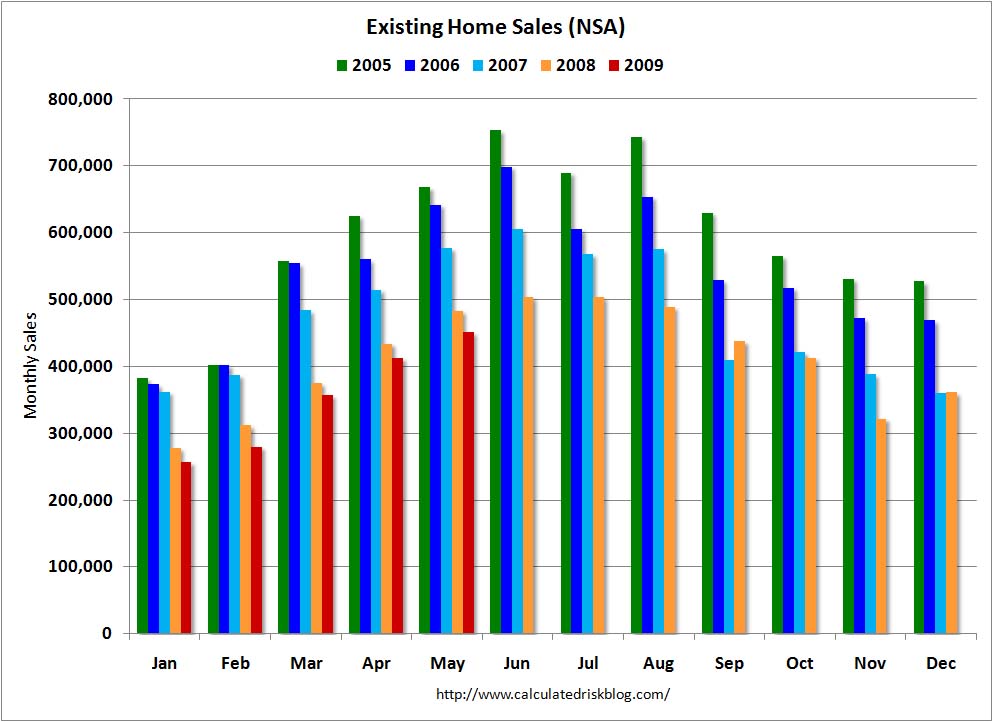
7. MAY EXISTING HOME SALES DOWN 3.6%; MOODY'S SAYS US SOVEREIGN DEBT Aaa RATING SOLID

Barry Ritholtz at the Big Picture reports that in May existing home sales fell by 3.6% from May 2008.
"Sales in May 2009 rose 2.4% from April to 4.77 million. Note that these are apple and orange comparisons--revised to unrevised numbers. Once again, the prior monthly number was revised downwards (4.68 million down to 4.66 million)."
He links to a chart plotting monthly existing home sales from 2005 from Calculated Risk:


Meanwhile, Keiko Ujikane and Jason Clenfield at Bloomberg report that Moody's Aaa rating of US sovereign debt 'remains solid."
"'Although the US is losing altitude in the Aaa range, it is starting from a very strong base,' Cailleteau, who is chief international economist at Moody’s, said in Tokyo today. The economy is resilient enough to recover and the government is committed to raising taxes and cutting spending, he said."
8. BLOG COMPARING NEWS HEADLINES FROM GREAT DEPRESSION TO CURRENT CRISIS

An interesting new blog which gives headlines from the week 79 years ago in the Great Depression has been linked to general all over the economic blogosphere.

Monday, June 22, 2009

Daily Sources 6/22

1. GORDON BROWN ASKS MINISTERS TO FORMULATE PROPOSALS FOR HANDLING OIL PRICE, INCLUDING PLAN TO HAVE IMF ACT AS PRICE REGULATOR; CGES SAYS OPEC SHOULD INCREASE PRODUCTION TO HELP GLOBAL ECONOMIC RECOVERY, BUT WON'T; HAMILTON SHOWS CONSUMER SENTIMENT STRONGLY CORRELATED TO GAS PRICE; AIRLINES COMPLAIN TO OBAMA OF OIL SPECULATION; ANDY XIE ARGUES STIMULUS BACKED LENDING SURGE IN CHINA BEING INVESTED IN COMMODITY SPECULATION

Kate Mackenzie at FT Energy Source reports that UK Prime Minister Gordon Brown asked top ministers at the Treasury and the Department of Business to draw up plans for responding to high oil prices. Apparently the administration is also considering proposals by which the IMF would take a role in monitoring oil prices--and influencing price. (The IEA mostly acts as a data collector and canary.)
"Brown believes that the G20 meeting in London in the spring missed an opportunity to put in place measures to stabilize the oil price, after it fell from a peak of $147 a barrel to less than $35 early this year."
The idea currently being mulled could reportedly form a key element of the UK proposal at the G20 meeting to be held in Pittsburgh in October. In the meantime, Platts reports that the Centre for Global Energy Studies, based in London and led by former Saudi Arabian oil minister Ahmed Zaki Yamani,
"is forecasting that oil prices will rise steadily through the rest of this year, reaching $80/b in the fourth quarter, as OPEC continues to maintain its current levels of quota compliance."
The CGES argues that OPEC should raise production in order to moderate price and gird a potential economic recovery, but is choosing not to do so. James Hamilton at Econobrowser plots the correlation between gasoline price and US consumer sentiment (with the dashed line [RH] being the miles per dollar spent on gasoline and the solid line [LH] representing the Reuters/Michigan index of consumer sentiment):


He comments:
"So how should we assess the likely consequences of the fact that gas prices have now come back up significantly from their lows of December? The Edelstein-Kilian regressions employed in my paper from a recent conference at the Brookings Institution imply that a 20% increase in energy prices would historically be followed within 2 months by a 15-point drop in consumer sentiment and a 1.4% decline (relative to trend) in real consumption spending. From that perspective, the 46% (logarithmic) increase in (seasonally unadjusted) gasoline prices since December is quite worrisome.

On the other hand, since those December prices were 88% (logarithmically) below the July 2008 peak, consumers should have been giddy in December and still be significantly more sanguine now than they had been last summer, if the only thing on their mind was the price of gasoline.

Only problem is, consumers were anything but giddy in December. Credit and employment challenges have weighed far more heavily than gas prices over the last 9 months, and are presumably far more important than gas prices for determining what happens over the next few months as well."
A bit wonky, but nonetheless the must read of the day. And Kyle Peterson at Reuters reports that the Airline Transport Association sent a letter dated June 11 to President Obama, complaining of the role of speculators in the oil market:
"A repeat of last summer's astronomical crude-oil prices will bring the nation's economic recovery to a painful halt. ... Businesses that spend billions of dollars on fuel each year, already dealing with the impacts of decreased consumer spending, are especially vulnerable."
(h/t Kate Mackenzie at FT Energy Source.) In the meantime, Andy Xie on Friday had an opinion piece at Caijin Magazine where he argued that the lending inside mandated by the stimulus program has not been spent on "tangible projects" but in asset markets.
"There's little doubt that China's bank lending since last December has driven speculative inventory demand for commodities. Chinese banks lend for commodity purchases, allowing the underlying commodities to be used as collateral. These loans are structured like mortgages.

Banks usually have to be extremely cautious about such lending, as commodity prices fluctuate far more than property prices. But Chinese banks are relatively lenient. As an industrializing economy, China's support for industrial activities such as raw material purchases for production is understandable. However, when commodities are bought on speculation, lenders face high risks without benefiting the economy.
...
The international media has been following reports of record commodity imports by China. The surge is being portrayed as reflecting China's recovering economy. Indeed, the international financial market is portraying China's perceived recovery as a harbinger for global recovery. It is a major factor pushing up stock prices around the world.

But China's imports are mostly for speculative inventories. Bank loans were so cheap and easy to get that many commodity distributors used financing for speculation. The first wave of purchases was to arbitrage the difference between spot and futures prices. That was smart. But now that price curves have flattened for most commodities, these imports are based on speculation that prices will increase. Demand from China's army of speculators is driving up prices, making their expectations self-fulfilling in the short term."
The other must read of the day.

2. GLOBAL RETAIL SALES NUMBERS DOWN

Rebecca Wilder at News N Economics notes that retail sales are taking a serious hit globally. Here is her graph of retail numbers for Asia:


She observes:
"Out of the 27 countries listed below, 18 posted a positive average annual growth rate in 2008, while just 5 saw the same in 2009 ytd."
Worth reading in full.

3. WORLD BANK SAYS GLOBAL ECONOMY TO CONTRACT BY 2.9% IN 2009, TRADE TO FALL BY 9.7%

Timothy R Homan at Bloomberg reports that the World Bank released a report today forecasting that the global economy will contract by 2.9% in 2009, a rougher contraction than the bank previously forecast of 1.7%. Global trade is expected to fall by 9.7% versus the fall of 6.1% forecast in March.
"'Unemployment is on the rise, and poverty is set to increase in developing economies, bringing with it a substantial deterioration in conditions for the world’s poor,' the World Bank said. While the world is set to return to growth in the second half of 2009, a recovery will be subdued, the report said.

Reduced capital inflows from exports, remittances and foreign direct investment means 'increasingly grave economic prospects' for developing nations, the lender said. After peaking at $1.2 trillion in 2007, inflows this year may fall to $363 billion, it said."
4. SARKOZY TO GIVE "STATE OF THE UNION ADDRESS" IN VERSAILLES, OVERTURN CENTURY OF PRECEDENT

Emmanuel Georges-Picot at the Associated Press reports that French President Nicolas Sarkozy has decided to overturn 136 years of precedent and directly address both houses of the French parliament today at the Chateau of Versailles. Sarkozy means to use the event to establish a platform by which to address the country on big issues along the lines of the American "State of the Nation" address.
"The last presidential speech to France's parliament was in 1873, before lawmakers banned the practice to protect the separation of powers and keep the president in check."
5. MALAYSIA'S CENTRAL BANK TAKES KEY STEP IN DIRECTION OF PURCHASING YUAN-DENOMINATED DEBT AS RESERVE

Denis McMahon at the Wall Street Journal reports that the China Securities Regulatory Commission said on June 12 that it had approved the Malaysian central bank--Bank Negara Malaysia--as a qualified foreign institutional investor [QFII].
"That status allows the Malaysian central bank to invest in China's exchange-traded equities and debt, including Ministry of Finance bonds."
Potentially, therefore, Bank Negara Malaysia could act as the first central bank to buy Chinese debt as a reserve. However, Bank Negara Malaysia has yet to be approved by China's currency regulator to purchase renminbi. In February, China and Malaysia signed a currency swap agreement.

6. RUSSIA INVOLVED IN TAIWANESE JET FIGHTER UPGRADE, BELARUS & RUSSIA ANNOUNCE JOINT MILITARY EXERCISES

Yevgeny Bendersky at the Compass notes the recent report that Russia was involved in the development of the third generation fighter planes for the Republic of Taiwan.
"According to The China Times, Taiwan has begun work on a new military aircraft after appeals to the US with a request for the sale of 66 fighter aircraft F-16C/D. Washington, as previously reported, denied this request, not wanting to spoil relations with Beijing. Chinese journalists also point out that the plane, developed by a public company Taiwan Aerospace Industrial Development Corporation (AIDC), has two engines and has a short take-off capability. Its development, according to The China Times, was completed only after Russia sent its experts to Taiwan--the source did not specify what Russian organization or company they represented.

This is certainly a new turn for the Russian defense industry and presents a dilemma for the United States. Washington and Taipei have a very close defense relationship, even if certain military hardware is not sold to the ROC from time to time. Taiwan is one of the high-tech sources for a great deal of technology that powers high-tech American industry, as well as American military developments. Russians were always keen on seeing first hand how far Western--and US in particular--military development has advanced, since at this time, Moscow can only watch on the sidelines as America and her allies implement next-generation high-tech military gear. Did the Russians get a chance to see first hand the advanced technology that Washington sold to Taipei, and did they take good notes to take back with them? An even larger question is what this news may do to the Moscow-Beijing military cooperation. Russia has sold a wide variety of advanced high-tech aircraft to mainland China recently, including Su-27 multi-role fighter bomber. China, making sure it was able to level the playing field, quickly reverse-engineered the Russian plane and began its indigenous production under J-11 designation.

Russians recently expressed concern that China is making plans to produce its own version of an even more advanced plane that Russia sold to Beijing about 8 years ago--Su-30 Flanker multirole fighter, a more advanced version of Su-27. Since all of Taiwan's military aircraft are designed and fielded against mainland China, Russian know-how now is part of ROC's high-tech air force pointed at the mainland. One has to wonder what Beijing thinks about all this, and whether Moscow's action was a pay back of sorts for China deciding to copy Russian technology."
Bendersky also notes that Belarus and Russia announced their joint military exercises for 2009, on the back of the recent refusal of Minsk to join the Moscow-led Collective Security Treaty--see Daily Sources 6/15 #3.

7. TALIBAN OPERATIONS IN AFGHANISTAN AND PAKISTAN RE-CENTRALIZING

Matthew Rosenberg, Yochi J. Dreazen and Siobhan Gorman at the Wall Street Journal report that Mullah Omar, the head of the Taliban, has been reasserting direct control over the militants in their struggle with NATO in Afghanistan.
"'This is Quetta's answer to Obama's surge,' said a senior member of a militant network led by Gulbuddin Hekmatyar, an independent Afghan warlord who fights alongside the Taliban. He was referring to plans by the administration of President Barack Obama to send an additional 21,000 troops to Afghanistan over the next few months. The Quetta 'are not ready to lay down their weapons,' he said in an interview in the Pakistani city of Peshawar."
Omar is thought to lead the Taliban leadership council from the city of Quetta in south Pakistan. There are some indications that the effort to re-centralize decision-making for the Taliban is upsetting some lieutenants which may make them more amenable to US outreach efforts. Insofar as Omar is directing attacks at Islamic institutions in Pakistan, I suspect he is setting fire to his own bed.

8. ZADARI SAYS US TOO COZY WITH DICTATORS, ASKS FOR MORE MONEY

Pakistan's President, Asif Ali Zardari, has an op ed in today's Washington Post, which sounds more than a little like a rebuke. To wit:
"The West, most notably the United States, has been all too willing to dance with dictators in pursuit of perceived short-term goals. The litany of these policies and their consequences clutter the earth, from the Marcos regime in the Philippines, to the Shah in Iran, to Mohammed Zia ul-Haq and Pervez Musharraf in Pakistan. Invariably, each case has proved that myopic strategies that sacrifice principle lead to unanticipated long-term consequences."
His ask sounds more like a threat than a plea:
"We need immediate assistance. The Obama administration recognizes that only an economically viable Pakistan can contain the terrorist menace. The United States has committed $1.5 billion a year for five years to help stabilize our economy, and the House of Representatives and the Senate Foreign Relations Committee have acted decisively to reorient the Pakistani-American relationship toward not just a military alliance but a sustained economic partnership.

Now, the rest of the world must step up and match the US effort. Pakistan needs a robust assistance package so that we can deliver for the people and defeat the militants. And the rest of the world should again follow the American lead in helping us deal with the millions of internally displaced people who are the most recent victims of terrorism in our nation.

But aid is not enough. In the long term, Pakistan needs trade to allow us to become economically independent. Only such an economically robust Pakistan will be able to contain the fanatics and demonstrate to the 1.5 billion Muslims worldwide that democracy and economic development go hand in hand. Notably, the United States is moving forward with regional opportunity zones in Afghanistan and the Federally Administered Tribal Areas region of Pakistan that will remove trade barriers and provide economic incentives to build factories, start industries, employ workers -- and give hope to the people. This opportunity zone concept should be a model to Europe, as well. Europe must realize that it is in its own self-interest, as the United States has realized, to do everything possible to grow the Pakistani economy and to provide incentives for Pakistani exports to the continent."
I suspect that someone's PR advisers weren't thinking when they composed this. It is not exactly a secret that Zadari is known to his countrymen as Mr. 5% nor that he recently moved to try and bar his main opponent for the office of President from running for office and his brother from running the province he had been elected to govern. Insofar as he backed down in the face of the lawyers' movement, I feel that he is "committed" to rule of law and democracy, but the rhetoric of the piece is rather closer to that of Evita Peron than to Nelson Mandela. Should be read in full, of course.

9. CONTINUED US JOBLESS CLAIMS FALLING MOST LIKELY DUE TO INSURANCE EXPIRING

Barry Ritholtz at the Big Picture observes that the decline reported in continuing claims is not due to the unemployed finding work, but rather to their unemployment insurance expiring. He plots the "exhaustion rate" for jobless benefits:


and notes, "They are now unemployed AND broke. That is hardly a green shoot ..."

Wednesday, June 17, 2009

Daily Sources 6/17

1. JAPAN TO FINANCE CLEAN ENERGY EXPORTS

Keith Johnson at Environmental Capital notes that Japan plans to underwrite the switch of other countries to clean energy, but only if they use Japanese technology. Johnson quotes from a report from Bloomberg:
"Japan plans to offer loans to power producers in the US and Australia that buy so-called clean coal generators from Japanese manufacturers, according to a government document obtained by Bloomberg News. Funding from state-owned Japan Bank for International Cooperation would help drive sales of the plants that cost about $3.1 billion apiece, said a senior trade ministry official involved in producing the 113-page draft plan, due to be released today."
2. RUSSIA & CHINA RELEASE JOINT STATEMENT EXPRESSING CONCERN RE: NORTH KOREA

Steve Gutterman at the Associated Press reports that Chinese President Hu Jintao and Russia's Dmitry Medvedev issued a joint statement today after meeting in Moscow:
"expressed serious concern in connection with the situation on the Korean peninsula."
"Hu and Medvedev called for the 'swiftest renewal' of the talks involving their countries as well as North and South Korea, Japan and the United States, which broke down months ago.

The statement included no new initiatives on the mounting problem and used language that appeared aimed at avoiding raise North Korea's ire further."
3. US EXPLORING RUSSIAN PARTICIPATION IN MISSILE SHIELD SCHEME

Walter Pincus at the Washington Post reports that Deputy Defense Secretary William J. Lynn III told Congress yesterday that the US is considering ways to incorporate Russia into a missile defense system for Europe.
"Lynn said that a radar installation in Armavir in southern Russia 'would provide helpful early-warning detection in the case of an Iranian ballistic missile attack.' [Lt. Gen. Patrick] O'Reilly [director of the Missile Defense Agency] told the panel that he had visited a Russian radar facility at Gabala, Azerbaijan, and that both Russian radars would be helpful in monitoring Iranian missile tests. The data gained 'would significantly help our development of our missile defenses,' O'Reilly added.

Overall, Lynn said, 'the involvement of Russian assets, particularly Russian radars, would enhance the capability of that kind of European-based system.'

He also suggested another potential advantage of including Moscow in the effort: 'A US-Russian collaboration would have an additional benefit of a diplomatic signaling to the Iranians that this is an unacceptable course for them to pursue and that they will face a concerted international front, should they proceed down that path.'"
Confirmation, as far as I'm concerned, that the Obama administration is putting the squeeze on Iran by pursuing a "reboot" in relations with Moscow.

4. BRIC SUMMIT ENDS WITH JOINT STATEMENT CALLING FOR LARGER SAY IN INTERNATIONAL FINANCIAL SYSTEM, RUSSIA AND CHINA AGREE TO EXPLORE MORE SETTLEMENT IN DOMESTIC CURRENCIES IN BILATERAL TRADE, BUT GAZPROM ANNOUNCES GAS PIPELINE TO CHINA DELAYED BY NO AGREEMENT ON PRICE, AND LUKOIL VP CALLS FOR MOSCOW TO JOIN OPEC

Andrew Osborne at the Wall Street Journal reports that the BRIC countries released a joint statement following their summit yesterday in Ekaterinburg saying:
"The emerging and developing economies must have greater voice and representation in international financial institutions. There is a strong need for a stable, predictable and more diversified international monetary system."
Meanwhile, Lyubov Pronina and Alex Nicholson at Bloomberg report that following their bilateral meeting in Moscow of President Hu Jintao said that they agreed to expand the use of the yuan and ruble in settling bilateral trade between the two countries. Medvedev told reporters:
"We agreed to take further steps in this direction, including, perhaps, by adjusting contracts and laws that already exist."
However, Vladimir Soldatkin at Reuters reports that Gazprom deputy chief executive Alexander Ananenkov told a news conference that construction on natural gas pipelines to China have been delayed, as "it still cannot reach a pricing deal with Beijing." Further differences in perceived interests between Russia and China were illustrated by the comments by Lukoil VP Leonid Fedun made in an interview with the Kommersant newspaper reported in Reuters,
"Russia should join OpEC and move to direct contracts. Then we will jointly control 51% of world output and we can dictate the price by directive."
5. ACCESS TO CHINESE STIMULUS PROGRAM MONIES REQUIRES PREFERENCE FOR CHINESE FIRMS

Ian Johnson at the Wall Street Journal reports that a recent directive issued by various central government agencies, including from the National Reform and Development Commission, seems to require that projects receiving stimulus-mandated funds give preference to Chinese companies.
"The notice, dated May 26 but only posted on the commission's Web site this month, is part of a broader buy-local push in recent months by authorities, who have quietly been indicating that most of the two-year four trillion yuan ($588 billion) in stimulus spending will be aimed at Chinese companies.

'Apart from engineering goods or service that cannot be obtained under reasonable business conditions inside China, domestic products should be purchased for the government investment program,' according to the official notice."
6. LACK OF INDEPENDENT JUDICIARY IN CHINA LEAVES JUSTICE SYSTEM MORE VULNERABLE TO MOB RULE

Sky Canaves at China Journal notes that the lack of an independent judiciary in China works both ways:
"But nowadays, courts also seem to take guidance from below.

Deng Yujiao, a young hotel worker charged with killing a local official (who she alleged tried to rape her), was set free yesterday after a brief trial and the murder charges against her dismissed, a result that is being cited as a 'significant victory of the Chinese Internet users and Chinese democracy.'

The unofficial precedents for the outcome of Deng’s case can be seen in a couple of other cases from last year that pitted the small guy against perceived official privilege. Xu Ting, a young migrant worker who took advantage of a faulty ATM to withdraw a load of cash and then ran away, was tried and sentenced to life in prison. But Internet users noted that officials charged with corruption involving similar sums (175,000 yuan) would face much lighter penalties, sparking a media outcry that resulted in a retrial and a much shorter sentence of five years for Xu."
The problem of course is that the law is supposed to act as a barrier to mob rule, not to simply preside over judgments made by rumor and innuendo.

7. IN CENTRAL ASIA FINANCIAL CRISIS MAY DRIVE IMMIGRATION

Erica Alini at Real Time Economics notes that in a recent report by the Central Asia-Caucasus institute, "anecdotal evidence suggests that since the world economy nose-dived last fall, 'a higher number of young men bought one-way tickets to Russian cities in November 2008 through January 2009.'"
"Russia is a prime destination for migrant laborers from Uzbekistan, Kyrgyzstan, and Tajikistan, where remittances account for between 8% and nearly 50% of the national income. Thus, as the Russian economy started contracting amidst the economic downturn last year, Central Asia felt the pinch.

When the downturn poked the Russian housing bubble, Central Asian migrants were hit particularly hard because many of them work in construction, Willem Van Eeghen, a migration expert at the World Bank, said.

By December 2008 remittances were down by nearly half in Tajikistan and Kyrgyzstan, according Ms. Marat.

Uncharacteristically, though, the plunge in remittances seems to be pushing even more Tajiks, Kyrgyzs and Uzbeks toward Russia. That’s because many of them seem to think that home offers no prospect, even as things get tough abroad. "
8. SOUTH KOREAN LNG IMPORTS DOWN 41% YOY

Jonty Rushforth at Platts reports that South Korean LNG imports are down 41% year on year in May to 1.26 million metric tons from 2.13 million metric tons.
"They were also down 28.6% from April this year, when the country imported 1.76 million mt."
Not a green shoot.

9. NIGERIAN NIGER DELTA MILITANT TO ACCEPT AMNESTY OFFER

The BBC reports that one of Nigeria's militant leaders of the Niger Delta, Ateke Tom, has accepted, with provisions, the offer of the President to extend amnesty to those militants who lay down their weapons.
"'If the government is sincere, we are ready to lay down our arms,' Mr Tom told the BBC's Network Africa program.

'If the government is not sincere, we will not lay down our arms and the struggle will continue.'

President Yar'Adua first made the offer of an amnesty several weeks ago.

'It will be a great pleasure for me to personally accept the first militant leader to take advantage of the amnesty,' he said."
11. IEA CHIEF ECONOMIST SUGGESTS THAT $70/B OIL LIKELY TO TRANSLATE INTO INTEREST RATE HIKES ON INFLATION, BUT CPI DOWN 1.3% IN MAY YOY

Eurointelligence reports that Fatih Birol, the chief economist at the IEA, suggested that $70/b oil will lead to inflationary pressures, which will force central banks to raise their benchmark interest rates and undermine any nascent recovery. In the meantime, Brian Blackstone at the Wall Street Journal reports that the Labor Department announced that the consumer price index rose 0.1% in May from April; core CPI, which excludes both energy and food prices, also rose from May by 0.1%.
"Consumer prices fell 1.3% compared to one year ago, the largest 12-month decline since April 1950. That's way below the 2% annual rate of inflation that most Fed officials think is consistent with their dual mandate of price stability and maximum employment.

Earlier this month, San Francisco Fed President Janet Yellen said that after once favoring 1.5% as an inflation objective, 'I think if I now had to write down a number, I'd probably write 2%.'"
Sarah-Jane Belfield at Platts reports that demand for jet fuel in April fell month over month by 1.67% to 1.418 billion gallons, per the Bureau of Transportation Statistics. The drop from a year previous was 6.96%. Not a green shoot.

12. EIA ANNOUNCES CRUDE STOCKS DOWN, BUT REFINERY UTILIZATION FLAT, ARE STOCKS AT SEA SIMPLY BEING RESTOCKED?

The EIA reported that commercial crude stocks fell by 3.9 million barrels in the week ended June 12 to 357.7 million barrels--well above the historical range for this time of year, but well down from previous highs. Gasoline stocks, on the other hand, built by 3.4 million barrels, and are just below the historical range for this time of year. Distillate stocks grew by 300,000 barrels, and remain at levels well above the historical range. Izabella Kaminska at FT Alphaville asks whether or not floating oil storage has been restocked, and not unloaded due to a shrinking contango.
"This certainly would explain the larger than expected crude draw in the face of unchanged refinery utilization, and only a small rise in imports."
13. DOE DECIDES ON COMPANIES TO RECEIVE $18.5 BILLION IN FEDERAL LOAN GUARANTEES TO BUILD FIRST NEW NUCLEAR REACTORS IN THE US IN 30 YEARS

Keith Johnson at Environmental Capital reports that the Department of Energy has settled on the first companies which will receive $18.5 billion in federal loan guarantees to help build four new nuclear reactors--the first to be built in the US in three decades. The winners are UniStar Nuclear Energy, NRG Energy Inc., Scana Corp and Southern Co.
"As the WSJ notes, 'Foreign partners that might be able to contribute loans or equity were also considered a plus.' For instance, UniStar hopes to get the French government to kick in $10 billion; NRG wants the Japanese government to underwrite one-third of its costs.

The $18.5 billion in loan guarantees is a small fraction of the $122 billion that nuclear companies had applied for."

Friday, June 12, 2009

Daily Sources 6/12

1. RECENT MOVES TO PURCHASE IMF SDR BONDS MAY BE MORE ABOUT DEVELOPING NATION PARTICIPATION IN THE IMF THAN CHALLENGE TO THE DOLLAR: JAPAN'S TRUST IN THE US UNSHAKABLE, MEXICO MAY PURCHASE BONDS

Susanne Walker at Bloomberg reports that in an interview with the news wire Japanese Finance Minister Kaoru Yosano said
"The US dollar’s position as the world’s reserve currency isn’t under threat. Our trust in US Treasuries is absolutely unshakable."
Meanwhile, Jens Erik Gould, also at Bloomberg reports that Mexican central bank Governor Guillermo Ortiz said in an interview that Mexico would contribute more to the IMF either by purchasing special drawing rights bonds or by directly lending to the institution. He went on to say:
"The IMF has to be re-energized and revitalized and that of course involves changes in the governing structure, and at the center of those changes is a greater participation from the emerging markets. The other side of the coin is that they also have to contribute."
He further indicated:
"The dollar will remain the central reserve currency probably for some time. I am not really worried about the status of the dollar at the present time."
Simon Johnson's analysis of the April 2 G-20 meeting provides, I think, some insight into what is taking place here--see Daily Sources 4/3 #3. In short, he argued that the Obama Administration convinced the Europeans, who traditionally have led the IMF, to make the selection process for its chief open and transparent. "Insiders" believe the current IMF managing director to resign within the year, meaning that the campaign for the next MD has already begun.
"How did the Obama administration pull this off? In a brilliant move, they took the lead by volunteering to open up the selection process for the World Bank, the IMF’s sister organization, which has always been run by an American. The next president of the World Bank is very likely to be Chinese."


2. CHINA'S NBR SAYS INDUSTRIAL PRODUCTION UP 8.9% IN MAY YOY, TURNS OUT THAT CAR STATS ARE NOT FOR PURCHASES, BUT FOR DELIVERIES FROM FACTORIES TO RETAIL OUTLETS, FITCH RATINGS SKEPTICAL OF CHINESE FINANCIAL SECTOR DATA

Terence Poon and Juan Chen at Dow Jones report that China's National Bureau of Statistics announced that value-added industrial production rose by 8.9% in May from a year previous. And Yves Smith at Naked Capitalism says she feels like she's being gaslighted, given the recent revelation that the data on car sales from China are not for cars that people have bought, but for a shipment from a factory to a retailer. She quotes from MetalMiner:
"There are some apparently contradictory numbers coming out of China at the moment. Take those car sales as an example. Our man on the ground tells us BYD, a noted Chinese car maker, reported 30,000 car sales of one model by end of last year, but the number plate agency recorded only 10,000 new cars of that model registered for use on the road. What happened to the other 20,000 are they running around without number plates? In a police state, I don’t think so. Our understanding is auto sales are recorded in China when they leave the factory, not when they are registered on the road, so dealers can build up inventory while car 'sales' are rising."
So maybe sales of cars in China aren't quite outstripping those in the US. Which is perhaps more reason to doubt the official GDP and industrial production numbers, given electricity generation and consumption and apparent oil demand numbers, as per the IEA--see Daily Sources 5/14 #2. In late May, the China Electricity Council, or association, announced it would stop publishing electricity consumption numbers--see Daily Sources 6/8 #6. Of course, the number of cars on the road have a large effect on oil consumption. (But it would be inadvisable to mount a high horse on this issue, lest it die underneath you--see Michael J. Panzner's elucidation of how the US government cooks its own statistics at Financial Armageddon.) That said, James T. Areddy at China Journal notes that Charlene Chu, a Fitch Ratings analyst in Beijing,
"has compiled numbers that seem to suggest that when credit policy in China has gotten tighter and stock prices have gone lower, banks have started peddling more wealth management products to their rich clients — and in doing so piled up hidden risks for themselves.

After Wall Street collapsed last year and US government was prompted to bail out its biggest banks, China’s financial institutions gained recognition as among the world’s largest and healthiest. After all, nonperforming loan ratios in China were near 2% on average last year from about 15% in 2003.

Chu, a former China watcher for the Federal Reserve Bank of New York, isn’t sanguine about such figures. The Fitch analyst has long argued that NPL ratios and other basic indicators of banking-system health favored by China’s policymakers sometimes mask other concerns. She sees evidence that local banks are downgrading their assessment of loans within the five categories of loan quality, without boosting NPLs, and notes that Chinese banks’ profit margins are getting pinched."
Chu says the sector suffers from "high information risk." Worth reading in full.

3. EUROZONE INDUSTRIAL PRODUCTION DOWN 1.9% IN APRIL MOM, 21.6% YOY

Ralph Atkins at the Financial Times reports that Eurostat announced that eurozone industrial production fell by 1.9% in April from March, down 21.6% since April 2008.
"Economists pointed out that the latest fall in industrial production was noticeably less severe than around the turn of the year, and that other 'hard' data--for instance, German industrial orders figures--have shown a marked improvement.

Still, the sharp contraction in activity has left the eurozone economy badly wounded. Industrial production in April was down to a level not seen for almost 12 years, and the latest monthly fall offered scant hope of an early return to economic growth.

'We are definitely in the recovery phase but today’s data confirm that it will be fragile and there will be negative surprises,' said Marco Annunziata, chief economist at Unicredit. 'Policymakers should not be in any hurry to withdraw [economic] policy stimulus.'"
4. SPAIN TO DECIDE ON RENEWING NUCLEAR POWER LICENSE IN COMING WEEKS

Elisa Santafe at the AFP reports that Madrid will either come down for or against nuclear power in the coming weeks as it decides whether to renew the operating licenses of the oldest of its six nuclear power plants.
"Prime Minister Jose Luis Rodriguez Zapatero, whose socialist government has backed the development renewable energy sources such as solar and wind power, has said he wants to phase out nuclear energy in the country when the life span of its six nuclear plants expires.

But on Monday the five-member board of the country's nuclear watchdog unanimously agreed to recommend that the Garona nuclear plant in northern Spain should get a new 10-year operating license if it upgrades its safety equipment.

Nuclear Safety Council chairwoman Carmen Martinez Ten said the decision was taken on technical and security grounds and not for reasons of 'energy policy, economics or another nature'."
Phasing out nuclear energy doesn't make a lot of sense from the perspective of Spain's energy security--it provides about 20% of the country's electricity generation--be interesting to see. (h/t Leanon at Drum Beat.)

5. ITALY TO RECEIVE PREFERENTIAL TREATMENT IN LIBYA

Adam L. Freeman and Flavia Krause-Jackson at Bloomberg report that Libyan leader Muammar Qaddafi promised today to give Italian companies preferential treatment.
"Qaddafi is visiting Italy for the first time after the country agreed last year to pay the North African nation $5 billion (3.5 billion euros) over 25 years to compensate for the occupation from 1911 to 1943. That paved the way for closer commercial ties and increased efforts by Libya to contain illegal immigration."
"Libya, Africa’s third-largest oil producer, is studying further investment in Italy’s Enel SpA and Eni SpA, Shokri Ghanem, chairman of Libya’s National Oil Corp., said on June 1 in Abu Dhabi. The Libyan Investment Authority, the country’s investment arm, has $80 billion in liquid assets. Libya owns almost 5 percent of UniCredit SpA, Italy’s biggest bank.

'Libya is an important country for us,' Fulvio Conti, chief executive officer of Enel, told reporters in Rome today, news agency Radiocor reported. 'We have always had excellent relations and we will continue to do so in the future.'

Libya accounted for 31% of Italy’s oil imports in the first quarter while the North African country’s gas met 13% of Italian demand, according to the Italian statistics agency."
Italy is also moving to integrate its energy sector more closely with Russia, following, it seems, Berlin's lead in that area.

6. UN SECURITY COUNCIL ANNOUNCES NEW SANCTIONS ON NORTH KOREA

Colum Lynch at the Washington Post reports that the UN Security Council today voted unanimously to impose new financial, military and trade sanctions on North Korea in response to its recent decision to restart its nuclear program, nuclear test blast, and missile launches--as well as its decision to call the 1953 Armistice a dead letter.The sanctions do not provide for a comprehensive trade embargo, however, and China specifically inserted an exception which would allow for continued sales of small arms and light weapons.
"The resolution calls for UN members to inspect all shipments entering or leaving North Korea if there is a reasonable suspicion that the cargo contains banned nuclear or missile technology. Member nations would be given the right to search ships suspected of carrying banned materials on the high seas and to seize any contraband.

The resolution, however, includes important caveats, such as the need for the flag state--the country in which a ship is registered--to approve the searches. If the flag state does not allow inspections on the high seas, it would be required to direct the ship to a nearby port for a search. But council members would not be authorized to use force to ensure that happens."
Galrahn at Information Dissemination notes that a resolution was introduced in Japan yesterday to allow for naval intercepts, ie participation in a blockade:
"Japan may change its laws to allow its navy to inspect North Korean vessels on the high seas if the UN Security Council approves such a step, the government said on Thursday.

'Once the resolution is adopted, we have to clear the issue of enacting a domestic law,' to pave the way for naval intercepts by officially pacifist Japan, said Chief Cabinet Secretary Takeo Kawamura."
Some analysts believe that the recent measures taken by Pyongyang are the result of the question of succession--the USDOS Press Secretary answered some related questions in the briefing today:
"QUESTION: When South Korea media, at the beginning of this month, first started reporting on the existence of documents in which North Korean diplomats stationed overseas were apparently being foresworn to allegiance to Kim Jong-un as the successor of Kim Jong-il, the spokesman for this Department at the podium on June 2, who shall remain nameless, but whose initials are Robert Wood, said – (laughter) – that such reports were speculative. I wonder whether the Department today still regards the reporting surrounding the apparent anointment of Kim Jong-un to be purely speculative.

MR. CROWLEY: Obviously, we have heard the same reports that you have heard, and we know there are questions of succession in North Korea, given the questionable health of Kim Jong-il. As to--as far as we know, Kim Jong-il is still the leader of North Korea. I believe his--he is in firm control of the country. What happens down the road, we don’t know. That is up to North Korea.

QUSTION: So you are no more illuminated on the subject of whether or not Kim Jong-un has been anointed the successor today than the Department was when this question was raised on June 2?

MR. CROWLEY: It is something that we are conscious of. We are looking at it. We don’t know that it necessarily influences what is happening now.

QUESTION: But you don’t question that the anointment has occurred?

MR. CROWLEY: I don’t--I mean, who the--we know who the current leader of North Korea is. Who the next leader of North Korea is is up to North Korea. We are more conscious of what they are doing and for whatever reason, obviously, the actions that North Korea has taken recently are provocative, unhelpful. We expect sometime today there will be a vote on a new Security Council resolution. And at the end of this vote, should the resolution be adopted, North Korea will be facing a sanctions regime unlike any other on earth.

And in that regard, we will continue close consultations with the members of the Security Council, those in the five-party process, for the moment. We will implement those sanctions aggressively. As I think Ambassador Bosworth said in testimony yesterday before the Senate Foreign Relations Committee, we are taking appropriate defensive measures. But he made clear also that the door is still open to negotiations, and we hope that North Korea will, at some point in the future, come back to that process."


7. TALIBAN TARGETS ISLAMIC INSTITUTIONS IN PAKISTAN

Shaiq Hussain and Haq Nawaz Khan at the Washington Post report that a top anti-Taliban cleric was killed in a suicide bomb attack on a religious seminary in Lahore today. An apparently coordinated attack took place in a mosque in the northwestern garrison town of Nowshera, where another bomb killed four and wounded many others. I doubt that the decision by the Taliban to target Islamic institutions will be likely to bolster its reputation in Pakistan, nor cow the population at large. Sounds like they're getting desperate to me.

8. KYRGYZSTAN REBUFFS APPEAL TO KEEP MANAS OPEN ... THE UZBEK CONNECTION

Michael Schwirtz at the New York Times reports that Kyrgyzstan yesterday rebuffed an appeal from the Obama Administration to allow the US to continue to operate from the Manas airbase.
"On Thursday, Foreign Minister Kadyrbek Sarbayev said there were no plans to reverse that decision, despite the appeal by Mr. Obama, who, according to the Kyrgyz government, sent a letter to Mr. Bakiyev seeking greater cooperation between the countries. American officials in the region had no immediate public comment on the Kyrgyz government’s statement."
In May, Uzbek President Islam Karimov announced during a state visit of South Korean President President Lee Myung-Bak that the Navoi cargo airbase is being used for non-lethal supply to NATO forces in Afghanistan. The announcement coincided with a number of agreements with KNOC--Korea's state oil company--and seemed an indication that South Korea was coordinating energy security policy with the US--see Daily Sources 5/13 #8. The Kyrgyz parliament voted to approve its President's measure to end the lease of the Manas base to US forces on February 19. A former Kyrgyz Ambassador to the US published an opinion piece at the time which stated that Russian pressure was not the primary reason for the closure--and that the original reason for allowing the US access was Bishkek's conflict with the Islamic Movement of Uzbekistan and sympathy for the US following 9/11. That said, Russia's offer of aid was almost half of Kyrgyz GDP--$150 million in aid, forgiveness of $180 million in debt, and $2 billion in loans--see Daily Sources 2/20 #4.

9. OBAMA'S CAIRO SPEECH MAY HAVE INSPIRED HAMAS POLICY SHIFT, NETANYAHU GOVT SEEMS UNLIKELY TO ACCEPT TWO-STATE SOLUTION

Middle East Pulse reports that according to Assaf Gabor in Makor Rishon-Hatzofe Obama's Cairo speech may have inspired a shift in Hamas policy:
"Hamas Political Bureau Director Khaled Mashal: 'Hamas will not be an obstacle to a peace agreement in the 1967 borders, Hamas will be a positive element helping to reach a solution that is fair to the Palestinians and will enable them to realize their rights.'

In response, high-ranking Hamas figure Salah Bardawil told Makor Rishon-Hatzofe, 'Mashal disclosed the first details of Hamas's new policy, as a factor that will act in the framework of a Palestinian government, after there is Palestinian unity, and in the framework of the Mecca agreement.'

Bardawil explained Hamas's strategy, which is dealing with a situation of being globally ostracized: 'The change is a response to Israeli pressure to make Hamas irrelevant and to disregard it as representing the Palestinian majority.' He said that the new compromising American policy had an effect: 'Khaled Mashal, after Obama's visit and the change in policy being led by Obama, said this with the goal of showing the world the real problem, which is Israel's attitude."
Bardawil further suggested that the condition for Hamas recognizing Israel is a Palestinian state. Gil Hoffman at the Jerusalem Post seems to suggest that a two-state solution is something that the Netanyahu administration cannot politically accept, however. (h/t to Michael Collins Dunn at MEI's Editor's Blog for both of these.)

10. OPEC SUPPLIED 118KB/D MORE IN MAY THAN APRIL, REDUCES GLOBAL DEMAND FORECAST BY 200 KB/D, UPBEAT ON GLOBAL ECONOMY

Alexander Kwiatkowski at Bloomberg reports that OPEC reported that it supplied 118 kb/d more oil in May than it did in April.
"OPEC reduced the forecast for demand for its crude as global consumption shrinks. The group estimates it will need to produce 28.6 mb/d in 2009 to balance global supply and demand, 2.2 mb/d less than last year. Last month it estimated that it would need to pump 28.8 mb/d."
The report indicated the organization's view that:
"In light of the considerable challenges the world economy and commodity market, particularly the oil market, have undergone, the worst appears to be behind us. Prices have not only remained steady, but have even moved higher."
Kate Mackenzie at FT Energy Source puts that in the context of the IEA's decision yesterday to up its demand forecast for 2009 by 120kb/d and the EIA's earlier slight increase in projected world demand--by 5kb/d IIRC. She notes that OPEC indicated that the contango in oil has flattened some as OECD inventories fell in parallel with falling production.


11. BRAZIL'S SENATE TO SET UP NEW OIL COMPANY FOR SANTOS BASIN

Kate Mackenzie at FT Energy Source reports that new regulations are being introduced quickly which, in sum, will create a 100% state-owned company to lease Brazil's pre-salt fields, or Santos basin, to Petrobras and others.
"Petrobras, although state-controlled, is 60% owned by mostly foreign shareholders, and the country’s left-wing government is unenthusiastic about sharing the huge gains from the pre-salt fields with others--hence the creation of the new company. The plan is that the new state-owned company will be able to grant concessions without going to tender, which industry observers believe will favor Petrobras. For international oil companies, however, the outlook is less certain."


12. CHÁVEZ THREATENS TO SHUT GLOBOVISIÓN--A BIT MORE DIRECTLY THIS TIME

Christopher Toothaker at the Associated Press reports that Hugo Chávez yesterday urged executives at Globovisión "to reflect" upon their critical stance towards the government, or the station "won't be on the airwaves much longer."
"Globovisión--a Caracas-based all-news network--has been the only anti-Chavez channel on the open airwaves since 2007, when Chavez refused to renew the broadcast license of another opposition-sided channel, Radio Caracas Television. That network moved to cable."
The best summary of the recent efforts to silence opposition in Venezuela I've seen recently was Fausta Wertz's--see Daily Sources 6/1 #10.