Showing posts with label FOMC. Show all posts

Wednesday, August 11, 2010

Daily Sources 8/11

CHINESE ECONOMY SLOWING SOME FROM BREAKNECK SPEEDS

Keith Bradsher at the New York Times reports that the Chinese economy is slowing:
"The gradual slowing in China is evident in the factories that have turned the country into the manufacturing center of the world. Industrial output rose 13.4 percent last month compared with the same month last year.

By comparison, industrial output had been up 13.7 percent in June from a year earlier, and was up 16.5 percent as recently as May.

Much the same pattern was evident in fixed asset investment, which was up 24.9 percent last month compared with a year earlier. It had been ahead by 25.5 percent in June, and 25.9 percent in May.

Retail sales rose 17.9 percent in July compared with the same month last year, as Chinese consumers with rising wages continued to flock to stores for ever more spending. But sales had grown 18.3 percent in June compared with a year earlier, and had been up 18.7 percent in May."
What we would do for such growth!

RUSSIA DEPLOYS S-300 MISSILE SYSTEM IN ABKHAZIA

Dmitry Solovyov at Reuters reports that Russia has deployed a S-300 missile system in Abkhazia.
"The S-300, codenamed 'Favorite' in Russia, is a mobile, long-range air defense system that can detect, track and destroy ballistic missiles, cruise missiles and both high- and low-flying aircraft."
RUSSIAN ECONOMY GROWS BY 5.2% IN THE SECOND QUARTER FROM A YEAR EARLIER

Maria Levitov at Bloomberg reports that the Russian Federal Statistics Service said today in an email that its second quarter economic growth came in at 5.2% over the second quarter of last year.

IEA REPORTS THAT IRANIAN IMPORTS OF GASOLINE HURT BY SANCTIONS; TURKEY INDICATES IT WILL NOT COMPLY WITH GASOLINE SANCTIONS ON IRAN

Carola Hoyos at the Financial Times reports that the most recent IEA report says that the tougher sanctions on Iran have halved Tehran's gasoline imports.
"As a result Iran has been forced to pay a 25 per cent premium to market prices for its petrol deliveries as many companies shy away from supplying the country, the International Energy Agency reported on Wednesday."
Meanwhile, Orhan Coskun at Reuters reports that the Turkish Energy Minister told the wire service that Ankara will support sales of gasoline to Iran.
"Tupras, Turkey's sole refiner and gasoline exporter which is owned by Koc Holding, declined to say whether the company had sold anything to Iran. The refiner buys 33 percent of its crude from the Islamic Republic, however."
Also, if I remember correctly, Turkey imports some natural gas from Iran.

UN APPEALING FOR $459 MILLION FOR FLOOD RELIEF IN PAKISTAN

The Associated Press reports that the UN is appealing for $459 million in order to help flood victims in Pakistan.
"The UN Office for the Coordination of Humanitarian Affairs said 'the worst monsoon-related floods in living memory' has affected more than 14 million people and at least six or seven million require immediate humanitarian assistance including food, clean water, shelter and medical care."
AN OVERVIEW OF THE INDIAN ENERGY SECTOR

Utpal Bhaskar and Elizabeth Roche at livemint.com gives a pretty good overview of the energy situation facing India.

VENEZUELA AND COLOMBIA REINSTATE DIPLOMATIC RELATIONS; COLOMBIA INDICATES THAT IT IS OPEN TO TALKS WITH FARC REBELS

The BBC reports that Colombia and Venezuela reinstated diplomatic relations yesterday. Relations were cut off after the Colombian government accused Venezuela of allowing Colombian rebels to operate from Venezuela. Juan Forero at the Washington Post reports that the new Colombian President, Juan Manuel Santos, has indicated that the government is open to talks with FARC.

BRAZILIAN GROWTH Q-O-Q WAS 1.32%

Andre Soliani and Iuri Dantas at Bloomberg report that Brazilian growth from the second quarter over the first quarter was at 1.32%, "compared with a 2.45% jump in the first three months of the year."
"Latin America’s biggest economy is regaining speed in the third quarter, growing 5 percent to 6 percent, after slowing in the second quarter, Finance Minister Guido Mantega said yesterday. Brazil’s gross domestic product expanded 9 percent from a year earlier in the first quarter, the fastest rate since 1995, led by domestic demand and a record rate of investment."
FOMC LEAVES BENCHMARK INTEREST RATE UNCHANGED

The Federal Open Market Committee left the US benchmark interest rates at 0-0.25% yesterday. Real Time Economics hosts the full statement of the FOMC.

US TRADE DEFICIT RISES TO $50 BILLION

Free Exchange reports that the US trade deficit rose to $50 billion:


FOOD PRICES TO STAY HIGH IN NEAR FUTURE; US WILL TAKE ADVANTAGE OF RUSSIAN BAN ON WHEAT EXPORTS

Michael Schuman at the Curious Capitalist reports that food prices are likely to stay high by the standard of recent history.
"But whatever happens to wheat over the next few weeks, food is still expensive by the standards of recent history, and is likely to stay that way. The Organization for Economic Cooperation and Development and the Food & Agriculture Organization spelled that out in a June report. Their outlook sees average wheat and coarse grain prices between 15% and 40% higher in real terms (adjusted for inflation) over the next 10 years than their average levels during the period between 1997 and 2006. Real prices for vegetable oils are projected to be more than 40% higher, while dairy prices are forecast to be on average between 16% and 45% percent higher."
Meanwhile, Alan Bjerga at Bloomberg reports that the US has been contacted by grain importers to see if the US can fill orders for wheat that have been cut off by the recent ban on wheat exports by Russia.
[Agriculture Secretary Tom] Vilsack said he expects markets to stabilize as more information on the drought’s effects, including tomorrow’s USDA crop forecasts, becomes available.
EIA REPORTS THAT CRUDE OIL STORAGE FELL BY 3 MILLION BARRELS IN WEEK ENDED AUGUST 6TH

The EIA today reported that stocks of crude oil fell by 3 million barrels to 355 million barrels the week ended August 6th. The amount of crude in storage is well above the historical average. Gasoline stocks rose by 0.4 million barrels countercyclically and distillate stocks grew by 3.5 million barrels. Both are also well above the historical average. Refining capacity utilization fell to 88.1%. The national price of gasoline rose 4.8 cents to 278.3 cents in the week ended August 9th.

Wednesday, July 1, 2009

Daily Sources 7/1

1. JAPAN TO MOVE AHEAD WITH STRATEGIC PETROLEUM PRODUCTS RESERVE IN AUGUST

Takeo Kumagai at Platts reports that Japan's Ministry of Economy, Trade & Industry [METI] has decided to move ahead with plans to establish strategic petroleum product reserves beginning in mid-August with a day's worth of kerosene consumption.
"After nearly three years of discussing the matter in depth both internally and at its advisory meetings, METI was set to introduce the national oil products stockpile this year, with one or a combination of light and middle distillates, equivalent to one day's consumption of the particular product or products chosen, Platts reported earlier.

METI has chosen to start the products stockpile with kerosene because it would affect consumers living in northern Japan during the country's winter demand season, the official said. Kerosene is used as heating oil in Japan, with demand typically peaking over December-February."
2. CHINA'S OFFICIAL PMI UP TO 53.2, CLSA'S CHINA PMI UP TO 51.8; CHINA TO BAN IMPORTS OF US CHICKEN

Terence Poon at the Wall Street Journal reported yesterday that the official purchasing manager's index for China rose to 53.2 in June from 53.1 in May. (A reading of above 50 indicates expansion; below 50 indicates contraction.)
"The new export orders component of the PMI rose to 51.4 in June from 50.1 in May. June was the second consecutive month where the export-order subindex has remained above 50, suggesting a deterioration in exports in the past several months is abating.

But the inventory subindex of the PMI fell to 45 in June from 46.2 in May. [Moody's] Economy.com's [analyst] Sherman Chan said that drop suggests manufacturers remain cautious about building up inventories amid an uncertain global economic outlook.

'If the external environment doesn't improve, it will be difficult for the government to sustain its fiscal spending for a long time,' she said."
Chinaknowledge reports that CLSA Asia-Pacific Markets' China PMI also showed improvement, rising to to 51.8% in June from 51.2% in May. Meanwhile, Lauren Etter and Stephen Power at the Wall Street Journal reports that China is expected to ban imports of US chicken in the next several days.
"The potential ban could be a big blow to the US chicken industry, which has been struggling with high grain prices and a price-depressing oversupply of chicken. Exports had been a bright spot for the industry, and last year China surpassed Russia as the largest destination for US chicken, according to the USA Poultry & Egg Export Council."
"[I]n 2007 lawmakers inserted a provision in the 2008 fiscal-year spending bill that prohibited the USDA from allowing chicken processed in China to be imported. The same prohibition was included in the spending bill in the next two fiscal years.

Trade tension between China and the US heightened earlier this week when the US International Trade Commission recommended imposing punitive duties of as much as 55% on low-cost Chinese tire imports because they are disrupting the US market, in a move that could sharply increase costs for consumers. GITI Tire, China's largest tire manufacturer, has called the move 'decidedly protectionist' and said it would take its case to President Barack Obama.

Last week, the House approved legislation to curb US greenhouse-gas emissions that includes a provision to impose tariffs on goods from countries that don't match US efforts to combat climate change."
Last week the US and EU lodged a WTO complaint alleging that China was blocking the export of raw materials--Daily Sources 6/24 #2.

3. ASHGABAT INVITES MEDVEDEV FOR VISIT TO DISCUSS GAS PURCHASES

Upstream online reports that Turkmen President Kurbanguly Berdymukhamedov has invited President Medvedev to visit Ashgabat to discuss the resumption of Turkmen gas exports to Russia.
"Russia, the main buyer of Turkmen gas, halted its imports in April after a pipeline explosion.

The pipeline has been repaired but the two sides cannot agree on new terms of sales as Russia's Gazprom needs less gas than in the past."
The move comes after China sealed a deal to increase its gas imports from Turkmenistan by 30% last week--see Daily Sources 6/25 #3. Ashgabat publicly suspected that Gazprom had engineered the explosion at the pipeline in order to stop paying the $340/tcm (~$9.61/MMBtu) price it had reportedly contracted to pay for Turkmen gas on December 31, 2008--see Daily Sources 4/14 #7.

4. INDIAN OIL REFINERS NERVOUS ABOUT DELAYED MONSOON EFFECT ON DIESEL PURCHASES

Murali Gopalan and Richa Mishra at the Hindu Business Line reports that Indian oil refiners are worried about heavy losses on diesel as low rainfall so far this year results in digging and pumping groundwater and diesel electricity generation.
"[W]hile [oil demand] growth figures for May are negative ... , diesel consumption at 4.748 million tonnes ... was otherwise normal and has not fallen in absolute terms.

Another reason for this was due to a continuous decline in the industrial sector’s use as diesel-direct sales showed negative growth of 4.7% in May.

It was the sixth successive month when industrial sales of diesel showed negative growth, coinciding with the onset of the economic recession in the second half of 2008-09. While economics dictated the pace of diesel consumption so far, the weather patterns could change the pattern, fear experts.

However, the consumption trend for diesel seems to be changing in June, with the eastern region recording a 45% growth, with Bihar alone registering nearly 65%."
5. MALAYSIA TO PULL BACK MALAY-PREFERENTIAL POLICY

Thomas Fuller at the New York Times reports that the Prime Minister of Malaysia, Najib Razak, announced a rollback in the policy which required companies issuing stock to reserve 30% of their shares for ethnic Malays.
"'The world is changing quickly, and we must be ready to change with it or risk being left behind,' he said Tuesday.

The change would leave some ethnic preferences intact and come with caveats. But it would dilute one of the most important components of what is known as the New Economic Policy, introduced in 1971: the requirement that companies listing on the stock exchange sell 30% of their shares to ethnic Malays.

That requirement was scrapped for companies already listed on the stock exchange and reduced to 12.5% for initial public offerings. The requirement will remain in place for 'strategic industries' like telecommunications, water, ports and energy.

Mr. Najib also said he would lower barriers for foreign investors. The government would eliminate a special vetting process for foreign companies wanting to invest in, merge or take over a Malaysian company, he said."
6. IMF EXPECTED TO AUTHORIZE $150 ISSUANCE OF SDR-DENOMINATED DEBT TODAY

Timothy R Homan at Bloomberg reports that the IMF board of directors are expected to authorize the issuance of as much as $150 billion in SDR-denominated bonds, voting on the matter today.
"The IMF is also considering making them tradable between all central banks from countries that are IMF members, said a G- 8 official, who spoke on condition of anonymity. It would stop short of allowing them to trade on the open market, he said."
7. SARKOZY TELLS NETANYAHU TO GET RID OF LIEBERMAN

Michael Collins Dunn at the MEI Editor's Blog notes that President Sarkozy has reportedly expressed in a "private message" to Benjamin Netanyahu that he should remove Avigdor Lieberman from his post as foreign minister.

8. KIRKUK FIRST CITY SINCE START OF IRAQ WAR TO GET 24 HOUR ELECTRICITY


Diaa Al-Khalidi at the Iraq Oil Report reports that Kirkuk has become the first Iraqi city to enjoy 24-hour electricity since 1993--and the first time the city itself has experienced it since 1991, when Saddam Hussein cut power to the regions in order to ensure round the clock access in Baghdad following his defeat in Kuwait.
Kirkuk is outside the formal borders of the Kurdish Regional Authority, but, if I understand correctly, currently effectively security in the city is provided by it:


Security is key in the maintenance of energy infrastructure.

9. ARAMCO AND CONOCO TO RESUME BIDDING FOR CONSTRUCTION OF YANBU EXPORT REFINERY

Sheila McNulty at FT Energy Source reports that Saudi Aramco and ConocoPhillips have decided to resume the bidding process for the construction of the 400 kb/d export refinery at Yanbu. "Now some bids are to be awarded in November 2009 and the others in the second quarter of 2010." Evidently, the bidding process has resumed on an optimistic view of the global economy going forward--and that sufficient financing exists to get it done. (I suspect that this would more likely be the view of Saudi Aramco than ConocoPhillips, given the recent statements from OPEC, but Saudi Aramco controls the facts on the ground.)

10. OPEC 11 SUPPLIES 110 KB/D MORE OIL IN JUNE THAN MAY

Reuters reports that OPEC 11 output in June rose to 26.02 mb/d in June from 25.91 mb/d in May--a 72% compliance rate with the implied production target of 24.84 mb/d, down from 75% in May.

11. NIGER DELTA MILITANT GROUP CRITICIZES MEND FOR ATTACKS AFTER AMNESTY OFFER

Platts reports that the Ijaw Youth Campaign for Peace [IYC]--a coalition from the ethnic Ijaw community in Nigeria's Niger Delta--issued a statement today condemning continued attacks on oil installations by MEND following the introduction of the amnesty offer by Abuja.
"'We are shocked by the activities of our sons considering the recent [press] release by MEND [saying] they have vandalized Shell platforms in Forcados,' the IYC said.

'If the purported sabotage was actually true we in the Ijaw Youth Campaign for Peace hereby condemn it in all facets,' the group stated.

The group said the continued sabotage of oil installations 'will present our people as not actually fighting for a genuine cause, but personal gain, which the government can see as armed robbery and criminality.'"
The story also notes reports that the amnesty offer has hit a snag as the heavy military presence in the region has made militants leery of going to areas designated as arms collection centers.

12. OAS GIVES HONDURAS ULTIMATUM, UN CALLS FOR ZEYALA'S RETURN, ARGENTINA'S FERNANDEZ TO TRAVEL TO HONDURAS TO NEGOTIATE SOLUTION, CHAVEZ SAYS VENEZUELA MAY CEASE ALL CRUDE EXPORTS TO HONDURAS--ALL 0 KB/D OF THEM

Ginger Thompson at the Washington Post reports that the Organization of American States on Wednesday gave Honduras three days to restore ousted President Manuel Zelaya to power or face expulsion from the organization.
"Diplomats said they had rarely seen the OAS unite so solidly behind a common cause, and that it was the first time the group had invoked its so-called Democratic Charter since it was adopted in 2001 as a clean break with the region’s history of authoritarian rule."
The United States is the only country in the Western Hemisphere which has not reacted to the coup by withdrawing its ambassador. On the other hand, Joshua Goodman and Andres R Martinez at Bloomberg report that yesterday the UN General Assembly passed a resolution, co-sponsored by the US, calling for the restoration of Zelaya.
"OAS Secretary General Jose Miguel Insulza said yesterday he wanted to return to the Central American nation with Zelaya to demand his reinstatement. Argentine President Cristina Fernandez de Kirchner will accompany the mission, Buenos Aires newspaper Infobae reported.

As protests against Zelaya swell, a showdown is imminent. [Interim Honduran President Roberto] Micheletti said that Zelaya faces arrest and 20 years in prison should he attempt to return to Honduras, Central America’s third-poorest country.

The country’s Supreme Court, congress and business groups have also expressed support for Zelaya’s removal, over concerns he was seeking to retain power beyond his original mandate by ignoring court rulings and changing the constitution through a referendum on term limits.

Approval for the Zelaya government fell to 30 percent in February from a high of 57 percent in January 2007, according to a nationwide poll by CID-Gallup. The former cattle rancher lost support over the past two years as he strengthened ties with Chavez ... ."
Paul Talley at the Compass comments:
"For Fernandez, accompanying Zelaya gives her a chance to play a popular role in world politics that might offer a distraction from her own political problems at home."
Talley seems skeptical about the practical effect however--his post is worth a look. Meanwhile, Carlos Camacho at Platts reports that Hugo Chávez has delayed a trip to the Dominican Republic to finalize PdVSA's purchase of a 49% stake in the Refidomsa refinery there until the Honduran crisis is resolved. Chávez has reportedly threatened to halt all exports of crude to Honduras until Zelaya is reinstated. Of course, Honduras has no refining capacity, so a halt in crude exports wouldn't have much of an effect upon the country.

13. SURVEY SHOWS OBAMA MOST TRUSTED LEADER IN THE WORLD

World Public Opinion recently conducted a survey of 19,224 people in 20 countries, asking them to rate their confidence in leaders of foreign countries. The margins of error in the polls range from ±3-4%. "The survey was conducted between April 4 and June 12, 2009, prior to Obama's speech in Cairo but subsequent to his Ankara speech." The poll seems to show that Obama has by far the most trust of any world leader internationally.


That's a fair amount of political capital. The poll includes ratings for Putin (somewhat oddly), Ban Ki-Moon, Merkel, Brown, Sarkozy, Hu Jintao, and Ahmadinejad. (h/t Greg Scoblete at the Compass.)

14. KC FED CHIEF SAYS THE GOVT HAS INSTITUTIONALIZED "TOO BIG TO FAIL", ST. LOUIS FED CHIEF SAYS FED RATES LIKELY TO STAY UNCHANGED FOR "FORESEEABLE FUTURE," SF FED CHIEF TAKES AIM AT INFLATIONISTAS, SAYING DOWNTURN LIKELY TO BE PROLONGED

Greg Robb and Kate Gibson at MarketWatch report that Thomas Hoenig, president of the Federal Reserve Bank of Kansas City, has criticized the "ad hoc" approach to the financial crisis, saying it has institutionalized the notion of "too big to fail."
"'The current crisis has made it clear that the group of systemically important firms that might be deemed worthy of special consideration by policy-makers is larger than previously thought,' Hoenig said in a Tuesday speech at New York University."
"The Obama administration's overhaul of financial rules is only a start of a dialogue on the issue, Hoenig commented. 'The most important part of any plan ... will be the requirement that public authorities resolve such institutions by taking them into receivership and restructuring them to emerge under new and more careful management and ownership,' without exceptions."
Worth reading in full (h/t Yves Smith at naked capitalism.) Meanwhile, Jon Hilsenrath at Real Time Economics reports that James Bullard, president of the St Louis Fed, said in a talk at Philadelphia’s Global Interdependence Center today that the Fed Funds Rate is likely to remain at its current rate for the "foreseeable future." He also said that the Fed's
"'liquidity programs', such as efforts to support the commercial paper market or money market mutual funds, are on track to end next year 'if financial conditions continue to improve."
He further indicated that the Fed may reevaluate its purchases of mortgage-backed securities in its next meeting in August. In a story which has received wide coverage in the econoblogosphere, Jon Hilsenrath at Real Time Economics reports that Janet Yellen, President of the Federal Reserve Bank of San Francisco, took aim at the inflationistas, saying:
"We are far from the kinds of unemployment rates that would make inflation a danger. ... The very weak economy is, if anything, putting downward pressure on wages and prices ...

In past deep recessions, the Fed was able to step on the accelerator by cutting the federal funds rate sharply, causing the economy to shoot ahead. This time, we already have our foot planted firmly on the floor. We can’t take the federal funds rate any lower than zero. I believe that the Fed’s novel programs are stimulating the flow of credit, but they simply aren’t as powerful levers as large rate cuts, so this time monetary policy alone can’t power a rapid recovery.
...
I also think that a massive shift in consumer behavior is under way—one that will produce great benefits in the long run but slow our recovery in the short term. 4 American households entered this recession stretched to the limit with mortgage and other debt. The personal saving rate fell from around 8 percent of disposable income two decades ago to almost zero. Households financed their lifestyles by drawing on increasing stock market and housing wealth, and taking on higher levels of debt. But falling house and stock prices have destroyed trillions of dollars in wealth, cutting off those ready sources of cash. What’s more, the stark realities of this recession have scared many households straight, convincing them that they need to save larger fractions of their incomes. In the long run, higher saving promises to channel resources from consumption to investment, making capital more readily available to retool industry and fix our infrastructure. But, in the here and now, such a rediscovery of thrift means fewer sales at the mall, and fewer jobs on assembly lines and store counters."
The full text of her speech can be found here.

15. FORD TO RAMP UP PRODUCTION

Nick Bunkley at the New York Times reports that vehicle sales were down 11% in June from June 2008, the lowest annual rate of decline seen by any major carmaker since last Summer.
"Ford said this week that it was increasing production in the third quarter, which starts Wednesday, to match the rise in demand its dealers were seeing. The company now plans to build 67,000 more vehicles, a 16% increase, than it did in the third quarter of 2008.
...
Over all, industry sales are expected to be down at least 25% compared with June 2008. Though dismal by any measure, it could be the first time since September that total sales fell by less than 30 percent on a year-over-year basis, a positive sign.

June could also be the first month this year in which new vehicles sold at an annualized rate of at least 10 million. For most of the last decade, auto sales in the United States were around 17 million a year before plummeting in 2008. Fewer than 5 million vehicles were sold in the first half of 2009, a decrease of nearly 37%."
16. CRUDE STOCKS SHARPLY DOWN, BUT PRODUCTS STOCKS SHARPLY UP ... REFINING UTILIZATION SLIGHTLY DOWN

The EIA reports that commercial crude stocks were drawn down in the week ended June 26 by 3.7 million barrels to 350.2 million barrels, still above the historical range for this time of year, but not dramatically higher any more. Gasoline stocks grew by 2.3 million barrels, and are now in the middle of the five-year historical range for this time of year. The median analyst expectation per a Bloomberg survey was for a 2 million barrel build. Distillate stocks also grew by 2.9 million barrels to 155 million barrels, 34.3 million more barrels than were held in commercial inventories in the comparable week last year. The analyst expectation was for a 1.5 million barrel build. The national average price of gasoline for the week ended June 29 fell by 4.9¢ to $2.642/gallon. Refinery utilization for the week ended June 26 fell .06% to 86.99%.

17. 10 TOP US CITIES GROWING FASTER THAN THEIR SUBURBS SINCE 2007

Conor Dougherty at Real Time Economics notes the report by Mark Mather at the Population Reference Bureau which shows that population in the ten largest American cities have been growing faster than the areas around them since 2007:


Worth reading in full.

Thursday, June 11, 2009

Daily Souces 6/11

1. WHO RAISES THREAT LEVEL FOR SWINE FLU TO PANDEMIC

The Economist reports that the World Health Organization has raised the threat level for swine flu to "pandemic." The country with the most recorded cases--the United States.

2. JAPAN CUTS TARGET CONSUMPTION OF BIOFUELS

Takeo Kumagai at Platts reports that Japan has cut its target consumption of biofuels to 600k kl/year by 2020 from its previous goal of 2 million kl/y. 600 kl/year is about 3.77 mb/y or 10.3 kb/d--significant, but neither target was truly game-changing.

3. CHINA WILL NOT SET BINDING TARGETS ON EMISSIONS CUTS, AUTO SALES IN MAY UP 34% YOY

AFP reports that following talks with US climate envoy Todd Stern, Chinese foreign ministry spokesman Qin Gang told reporters that Beijing was unable to commit to a binding greenhouse emissions cuts target:
"China is still a developing country and the present task confronting China is to develop its economy and alleviate poverty, as well as raise the living standard of its people.

Given that, it is natural for China to have some increase in its emissions, so it is not possible for China in that context to accept a binding or compulsory target."
Meanwhile, Patricia Jiayi Ho at the Wall Street Journal reports that the Chinese stimulus program has boosted auto sales in that country by 34% year over year.

"Auto sales last month totaled 1.12 million units, the China Association of Automobile Manufacturers said. In contrast, U.S. car sales fell 34% in May to 925,824 units."
Of course, autos produce copious amounts of greenhouse gases.

4. CHINESE EXPORTS DOWN 26.4% IN MAY YOY, EXPORTS DOWN 25.2%; CONTINUES TO BUILD CAPACITY W/O CLEAR MARKET TO SELL PRODUCT TO; INTRODUCES REBATE ON STEEL LIKELY TO FUEL TRADE WARS


Andrew Batson at the Wall Street Journal reports that Chinese exports fell by 26.4% from the year previous.
Despite a binge in commodities purchase, the total dollar value of Chinese imports fell by 25.2% from a year earlier.
"Other data issued Thursday showed stimulus money continuing to flow into the economy. Fixed-asset investment, China's main measure of capital spending, rose 38.7% in May from a year earlier and is up 32.9% so far in 2009. That is the fastest growth since the investment boom of 2004--but activity still remains concentrated in the areas benefiting from the government measures."
Brad Setser at Follow the Money helpfully produces a graph of the year over year change in Chinese imports and exports in three month moving averages:


He comments (and as always, it is worth reading his entire post):
"The sharp fall is over. But there isn’t yet much sign of recovery. Not in Chinese demand for the world’s products. Or in Chinese exports to the world.

To me, though, the biggest puzzle is on the import side. A strong, growing economy driven by a surge in fixed investment would normally be expected to generate strong demand for the rest of the world’s goods, especially if China is growing far faster than the rest of the world."
Macroman follows up his especially interesting post yesterday by noting that Chinese PMI accurately foretold the collapse in exports, but the recovery in the PMI has yet to show up on the export side:


He comments:
"While it's true that the PMI data may now be capturing more of the internally-driven investment dynamic within China, it's worth pointing out that the latest survey had export orders rising.

This, of course, begs the question of who the Chinese plan on selling to. It's all well and good continuing to build factories and export capacity, but the real world isn't like Field of Dreams; just because you build it doesn't mean that customers will come. Yesterday's US trade figures were telling in that regard. Imports declined again in April; while an inveterate "second derivative" believer may find reasons for optimism in the slight lessening of the pace of import decline in yesterday's data, Macro Man is rather more skeptical. And the fact that US exports declined as well suggests that domestic demand in the rest of the world remains flaccid at best."
Well worth reading in full. For more on US demand, see #11. In the meantime, Yves Smith notes the report from MetalMiner which notes that "China has just offered a new 9% VAT rebate for flat-rolled steel products and hot rolled ferro-alloy products starting June 1" and that that is sure to "fuel the trade wars."
"The new rebate for steel ... will have the effect of two things. First, it will promote exports of steel products (vs. production for domestic consumption) as the 9% can only be claimed if goods are exported. It will further stimulate aggressive anti-dumping action on part of the US domestic steel industry (we have another anti-dumping case to report shortly)."
5. ECB REPORTS THAT HOUSE PRICES ROSE SLIGHTLY IN EUROZONE 2H 2008; WILL LEND RIKSBANK €3BN TO AVERT CRISIS IN SWEDISH FINANCIAL SECTOR

Joellen Perry at Real Time Economics reports that according to the European Central Bank's [ECB] latest monthly bulletin, house prices rose in Austria and Portugal, but fell across the eurozone generally:

"Overall, euro-zone house prices still eked out a gain in the second half of last year, rising 0.6% compared to the same time period the year before. But that’s well down from a peak of 7.7% in the first half of 2005. And the ECB says it’s likely to get worse before it gets better."
Meanwhile, Ralph Atkins, Joshua Chaffin, and Robert Anderson at the Financial Times yesterday reported that the ECB will lend the Riksbank (Swedish Central Bank) €3 billion (~ $4.2 billion) to boost the Swedish central bank’s foreign reserves as a measure to avert a collapse of the Swedish financial sector, which dominates the Baltic's financial sector.
"The ECB move signaled the Frankfurt institution’s willingness to shore up official European help for countries such as Latvia, which is fighting to avoid a potentially disastrous devaluation of its currency."
Last Wednesday the Riksbank released it biannual financial stability report which estimated that Swedish banks faced 170 billion krona (~$22.8 billion) in losses, 40% of which would come from exposure to Eastern Europe. The report also argued that the banks were sufficiently capitalized to handle the crisis--see Daily Sources 6/3 #5.

6. BRAZIL CUTS BENCHMARK INTEREST RATE BY 1% TO 9.25%

Andre Soliani and Heloiza Canassa at Bloomberg report that the Brazilian central bank last night cut the benchmark interest rate by 1% to 9.25%. The cut was more than analyst expectations for a 0.75% cut.
"'The committee agreed that any additional monetary easing must be implemented in a more parsimonious way,' policy makers said in a statement accompanying their decision. The monetary policy committee 'will closely follow the evolution of the prospective scenario for inflation until its next meeting to then decide the next steps of the monetary policy strategy.'

Brazil’s annual inflation slowed to 5.2% in May, the lowest rate in 12 months. Nobrega forecasts consumer-price increases will slow to 3.8% by year-end.

'The central bank may slow down the pace of cuts at the next meeting,' said Cristiano Souza, an economist at Grupo Santander Brasil. 'But the rate cuts haven’t come to an end yet.'"
7. KHURAIS OIL FIELD PROJECT STARTS PRODUCTION

Reuters published a factbox on the Khurais oilfield project, a Saudi field with Arab Light grade crude which has just begun production with a capacity of 1.2 mb/d--or about 1.5% of daily global demand.

8. NO MECHANISM YET FOR OIL FIELD OPERATORS IN IRAQ'S KURDISH REGION TO BE PAID

Ed Crooks at FT Energy Source notes that although exports from the Tawke and Taq Taq fields in Iraq's Kurdish region have begun, a mechanism by which the operators would be paid has yet to be arrived at.
"The problem for the KRG is that while the stand-off with Baghdad over oil revenues persists, paying DNO and their other companies for their oil sales would leave it out of pocket. Ashti Hawrami, the KRG oil minister, has promised that the companies will get paid. But to a cynic, his assurances sound suspiciously like 'the check is in the post'."
9. SOUTH SUDAN BEGANS DEMOBILIZATION

BBC reports that demobilization has begun in southern Sudan. "[M]any fear renewed fighting ahead of a referendum on the south's potential full independence due in 2011."

10. RAIL FREIGHT VOLUMES CONTINUE TO DECLINE

Railfax's report is out. Their chart for total North American traffic in 13 week rolling averages:


For the week ended June 6th, coal volumes are down 9.2% from the comparable week a year ago, metals are down 53.8%, autos are down 51.1%.

11. FORECLOSURES UP 19% IN MAY, RETAIL SALES UP 0.5% MOSTLY ON GASOLINE, BEIGE BOOK SEEMS TO WARN MORE OF DEFLATION THAN INFLATION, AMERICANS LIKELY TO SPEND A LOT LESS FOR A LONG TIME, VOLCKER SEES A LONG SLOG WITH HIGH UNEMPLOYMENT, SAYS NO CURRENT ALTERNATIVE TO THE DOLLAR

Barry Ritholtz reports that US foreclosure filings were up 19% and hosts the following graph from RealtyTrac:


Jeff Bater and Brian Blackstone at the Wall Street Journal report that the Commerce Department announced retail sales climbed by 0.5% in May from April. However, if you exclude gasoline sales, the increase is 0.2%. They also report that the Labor Department announced that initial jobless claims fell by 24,000 to 601,000 for the week ended June 6.
"Meanwhile, according to Thursday's report the tally of continuing claims--those drawn by workers for more than one week in the week ended May 30--jumped 59,000 to 6,816,000, the 19th-straight record high. The previous week, initially reported to have been a slight decline, was revised to show a small increase.

Including extended benefit and other federal programs, the total number of people collecting jobless benefits was almost 8.5 million in the May 23 week. That number isn't adjusted for seasonal fluctuations."
Meanwhile, Izabella Kaminska at FT Alphaville reports that the Fed's Beige Book released yesterday was "more of a deflation alert than anything else," and includes the following excerpts from the book, which is used by the Federal Open Market Committee to decide on the federal funds rate:
"With few exceptions, Districts reported that prices at all stages of production were generally flat or falling. The notable exception to the downward pressure on prices was the widely-reported increase in oil prices."
and
"For the most part, raw materials prices and product pricing were stable or declined, and little inflationary pressure is expected during the next 12 months."
And Barbara Kiviat at the Curious Capitalist reports that some analysts think we have a long way to go before consumers begin spending again.
"One way to understand the Great Consumer Retrenchment is to look at the amount of debt the typical household carries as a percentage of its disposable income. The ratio of debt to income increased from about 35% in the early 1950s to about 65% by the mid-1960s, where it more or less stayed until the late 1980s. That's when debt started its epic rise, hitting 100% of income in 2001 and going all the way up to 133% in 2007. That figure is now starting to fall. At the end of 2008, the debt-to-income ratio was down to 130%."
Kiviat notes that the new Fed data on household debt released today suggests that that ratio has fallen to 127.5% and notes that that's quite some distance for just three months.
"[Chief Economist & Strategist at Gluskin Sheff, Devid] Rosenberg, for one, thinks that to get back to a sustainable level, households have got another $3 to $5 trillion in debt to pay down—o-r default on."
In that context, Real Time Economics reports that Paul Volcker, addressing a forum in Beijing, said
"that the US faces 'a long slog, with continuing high levels of unemployment.'

Volcker, known for successfully bringing inflation under control during his term at the Federal Reserve, said that the current economic situation 'is not an environment in which inflationary pressures are at all likely for some time to come.'"
Volcker also indicated that for the foreseeable future there is no alternative to the dollar, but that:
"the ultimate logic of a globalized financial system is a world currency.

The theoretical premise that a system of floating exchange rates would promote swift and efficient adjustment has not been borne out in practice."

Friday, June 5, 2009

Daily Sources 6/5

1. BUNDESBANK FORECASTS GERMAN GDP TO CONTRACT BY 6.2% IN 2009

Der Spiegel reports that the Bundesbank expects the German economy to contract by 6.2% in 2009. The bank expects downward pressure on the economy to end by the close of 2009, but only forecasts GDP growth of 0.0% for 2010.
"The low point of the recession could be reached this summer, the forecast noted. Still, Bundesbank President Axel Weber said it was too early to breathe a sigh relief. The report added that unemployment will continue to rise in the coming quarters, and by mid-2010, the number of jobless is expected to be 1 million people greater than it was this spring--reaching a total of around 4.4 million unemployed persons, or 10.5%."
2. DUTCH EUROPEAN PARLIAMENT ELECTIONS BIG WINNER FOR ANTI-ISLAMIST 'PARTY FOR FREEDOM'

Der Spiegel reports that preliminary data on the Dutch European Parliament elections show Geert Wilders' "Party for Freedom" would get four of 25 Dutch seats in the legislature, making it the second largest Dutch party represented in Brussels.
"Wilders, who has become popular in the Netherlands running on an anti-Islam and anti-political establishment platform, promised voters he would be tough on immigration and criticized Turkey's bid to join the EU. 'Should Turkey as an Islamic country be able to join the European Union? We are the only party in Holland that says, it is an Islamic country, so no, not in 10 years, not in a million years,' Wilders said."
3. RUSSIA TO CONSIDER SETTLING CHINESE TRADE IN LOCAL CURRENCIES, GAZPROM AND E.ON FINALIZE ASSET SWAP DEAL

Lyubov Pronina at Bloomberg reports that Russian President Medvedev has joined Brazil and Malaysia in the number of countries considering settling international trade with China in their respective domestic currencies. Meanwhile, Nadia Rodova and Anna Shiryaevskaya at Platts report that Gazprom and Germany's E.ON Ruhrgas have signed an asset swap agreement with E.ON receiving 25% of Severneftegazprom, a Gazprom subsidiary developing the Yuzhno-Russkoye oil and
gas field.
"Following the deal Gazprom will own 50% plus six ordinary registered shares of Severneftegazprom; Germany's BASF will own 25% minus three ordinary registered shares and three preferred shares without voting rights; and E.ON will own 25% minus three ordinary registered shares and three preferred shares without voting rights, Gazprom said.

In turn, the agreement gives Gazprom will take E.ON Ruhrgas' 49% stake in Gerosgaz, which owns 2.93% of Gazprom.

'By implementing this asset exchange transaction, Gazprom and E.ON have once again demonstrated a successful development of long-term Russian-German cooperation in the energy sphere,' [Gazprom CEO] Alexei Miller said in a statement."


The Yuzhno-Russkoye oil and gas field is thought to have 856.2 billion cubic meters of gas and 20.35 million metric tons (~148.6 million barrels) of oil and gas condensate reserves.

4. RIO TINTO BOARD REJECTS CHINALCO BID

David Barboza and Michael Wines at the New York Times report that in a meeting in London Thursday, the board of Rio Tinto rejected an offer of $19.5 billion by the Aluminum Corp. of China, or Chinalco, to take a 15% stake in the company. Chinalco's currently has a 9.3% share of the company. Political opposition to the deal in Australia began early on. In the middle of May, Chinalco revised its offer down from a 18.5% stake to 15--see Daily Sources 5/21 #2.
"Chinalco said it regretted the decision and had worked hard to try to revise the deal to reflect changed market conditions, as well as the response from shareholders and regulators.

'As a result, we are very disappointed with this outcome,' Chinalco’s president, Xiong Weiping, said in a statement."
Rio Tinto will combine its iron ore assets in Australia with those of BHP Billiton.

5. CHINESE MALE-FEMALE RATIO DRIVING UP 'BRIDE PRICES', INCREASINGLY A TARGET OF CONS

Mei Fong at the Wall Street Journal reports that the male-female ratio (120-100) in China has pushed up the dowries--or "bride price"--of potential brides so much that they have become the target of con artists.
"While there are no nationwide statistics, wedding scams have occurred before, but usually isolated cases. Mr. Tang, Xin'an's Communist Party secretary [Xin'an is a village of 14,000 in Shaanxi province], says he has never before seen such clusters of cases. Most of the 11 families involved lost an average of 40,000 yuan (~ $5,862 or roughly GDP per capita in purchasing power parity terms). Officials consider these to be fraud cases. So if caught, the women could serve jail time, according to police."
The story provides more anecdotal evidence for the case made by Shang-Jin Wei of Columbia University and Xiaobo Zhang of IFPRI that the one child policy in China has made the society even more one of saving than in the past--see Daily Sources 5/28 #2.

6. GLOBOVISIÓN PRES TO BE CHARGED WITH 'USURY'

Fabiola Sanchez at the Associated Press reports that Venezuelan prosecutors have charged the president of Globovisión, the sole opposition television station remaining in the country, Guillermo Zuloaga, of "usury."
"Trade Minister Eduardo Saman accused Zuloaga of keeping the cars off the market while waiting for their price to rise--involving a possible violation of foreign exchange rules that give importers access to dollars only if they aren't used to gain a 'disproportionate advantage' over rivals.

It was not clear if Zuloaga received dollars that way from the government, but importers who violate those terms can be prosecuted under Venezuelan usury law."
Last week Hugo Chávez said that the Supreme Court, attorney general, and telecommunications chief should take action against "poisonous media" or resign. Meanwhile, Platts reports that PdVSA said in a statement that it had taken over 45% of all private oil services companies operations in the country since nationalizations began again two weeks ago. "So far, around 76 companies have been nationalized, including the local units of Williams International."

7. CHILE TO COMMISSION LNG GASIFICATION PLANT BY END OF MONTH, EXXON SIGNS CONTRACTS TO BUILD LNG EXPORT FACILITY IN PAPUA NEW GUINEA

SAI reports that Chile will commission its 2.5 million tonne/year LNG-10 million cubic meter natural gas liquefaction plant in Quintero at the end of the month.
"The first vessel carrying LNG to Chile from Atlantic LNG’s facilities in Trinidad & Tobago is due to arrive at the plant owned by Chilean energy company ENAP, Endesa Chile, Metrogas and BG Group before the end of June."
Meanwhile, Russell Gold at Environmental Capital reports that Exxon Mobil has signed two construction contracts in the last 24 hours which lay the groundwork for building an LNG export facility in Papua New Guinea.
"Exxon didn’t cut its capital expenditures program during the oil-price drop, but it’s still noteworthy when they push a couple big high-cost projects ahead. And while Exxon didn’t really slow its spending, others did. But projects are looking more financially robust now because costs are falling. The big energy consultant IHS/CERA updated its upstream operating cost index today: it’s down 8% from six months ago. Meanwhile, capital costs are down 9%.

The question haunting oil circles is whether enough new investment will be undertaken to head off a major supply crunch in coming years as demand for black gold grows in Asia and elsewhere. The McKinsey Quarterly, a publication from the consulting group, recently warned that the 'tight demand–supply balance seen at the end of 2007 could return sooner than many observers might have anticipated' as oil companies--state owned and publicly traded--ease up on capital spending."
All of which may be true, but even if there is a supply shortfall does duly develop in 2010, that shouldn't have the effect of pushing up price on oil for delivery next month.

8. NEW U.S. EMISSIONS REGULATIONS PUSHING CANADIAN OIL SANDS PRODUCERS TOWARD ASIAN MARKET

Gary Park at Platts reported (on May 13) that Canadian oil sands operators are looking for Asian participation as the US Congress considers legislation which could limit the purchase of fuels produced by large carbon emitting processes. There are three key competing pipeline plans for taking oil sands products to the Pacific--Enbridge's 525 kb/d Northern Gateway pipeline, Kinder Morgan's 400 kb/d expansion to its 300 kb/d Trans Mountain pipeline and Kinder Morgan's 400 kb/d Northern Leg Expansion to Kitimat.


As Park reports:
"There has been no more public display of those problems than the roller-coaster efforts since 2005 by Canadian pipeline giant Enbridge to open the door to Asia through its 525 kb/d Northern Gateway pipeline, with 80% of volumes targeted for Asia and the rest for California, although the California option may disappear if the state bans fuels derived from 'dirty oil,' such as oil sands.

The initial plan involved a memorandum of understanding with PetroChina to aggregate 200 kb/d of oil sands production in return for a possible 49% equity stake in the C$5.2 billion venture.

It came to an acrimonious end in mid-2007, with PetroChina refusing to extend its MOU with Enbridge and accusing the Canadian government and producers of not doing enough to support Northern Gateway and allow energy trade between Canada and China.

Enbridge CEO Pat Daniel refused to abandon an idea that had already cost about C$100 million to develop a regulatory application.

'We decided enough of this fun ... we need to have customer support,' he said.

So he embarked on frequent selling trips to Asia, pointedly excluding China, shifting his focus to potential customers in South Korea, Japan, Taiwan and Singapore.

In the process, Enbridge secured financial commitments from unidentified producers and refiners to carry the proposal through Canada's National Energy Board and pay for the initial development costs.

Daniel said Northern Gateway is now a 'broad-based, industry-wide initiative ... we offered 50% of the equity to those companies supporting the project and we've had very good uptake on that.'"
Well worth reading in full. Perhaps the story can be said to put the recent report by the Council on Foreign Relations explaining that the "well-to-wheel" carbon footprint of developing bitumen deposits is "only" 17% more than conventional oil in context--see Daily Sources 5/22 #8.

9. ICAP SHIPPING SAYS 7 SUPERTANKERS USED AS STORAGE TO UNLOAD

Alaric Nightingale at Bloomberg reports that Simon Chattrabhuti, a London-based analyst at ICAP Shipping, in an email note today said that a notice of redelivery had been issued for seven supertankers currently being used for oil storage. In late May, Frontline Ltd. estimated that as many as 60 supertankers had been chartered for oil storage.

10. SOVEREIGN DEBT ISSUES TO CLIMB PRECIPITOUSLY, MAY EXPOSE COUNTRIES FAVORING SHORT-TERM DEBT TO "ROLL-OVER" RISK

Gillian Tett at the Financial Times notes that the projected amount of debt to be issued by OECD countries this year is at $12 trillion, up from $9 trillion in 2008.
"So deep in the bowels of western [Debt Management Offices, or DMOs], some officials are now scanning the calendar and wondering how they can organize all those looming debt sales. Most governments hold auctions on particular days of the week and there are only 52 weeks in the year.

Thus, even if the DMOs cancel their summer holidays--which some will--it may be tough to schedule all these looming sales. No wonder some western government officials are starting to mumble about the risk of 'auction fatigue', or the chance that investors get so overwhelmed with these sales that they go on strike. Nor is it little surprise that some western government officials are quietly debating whether they can can dramatically expand the size of individual auctions, to get these bonds sold, without creating a market glut, or panic.

Thus far, thankfully, there is little sign of any such panic."
"[T]he average US maturity in late 2007, was just 4.7 years and will almost certainly decline further. This year, the OECD projects that no less than 70% of US issuance will be short term. That leaves the treasury market now exposed to a mild version of the same problem that plagued conduits or structured investment vehicles that relied on short-term funding in the commercial paper market: namely 'rollover risk'."
Tett also notes that a number of European countries have average debt maturities of less than five years, including Norway and Hungary. A must read.

11. U.S. UNEMPLOYMENT CLIMBS TO 9.4%, FALL IN TEMP EMPLOYMENT SLOWS, BUT 12 MO MOVING TREND STILL DOWNWARD

Peter S Goodman and Jack Healy at the New York Times report that the US lost another 345,000 jobs in May, pushing the headline unemployment rate to 9.4%.
"[W]age growth has been stagnating even as gasoline and medical costs rise, putting pressure on household finances. Wages were 3.1% higher in May than a year ago, but that growth slowed drastically this year. In April and May, average hourly wages grew just 0.1%, to a seasonally adjusted $18.54, from $18.52, according to the Labor Department. Wages for manufacturing workers fell 0.1%."
The broader U-6 unemployment rate, which includes "marginally attached" workers, rose to 16.4%. Barry Ritholtz at the Big Picture notes that the fall in temporary help has flattened out, though the year over year loss for May is of 26.9%.


Jesse's Café Américain plots a chart of the 12 month moving averages of job growth from the middle of '04:


Jesse comments: "We will get a little more optimistic when the longer term trend turns higher."

12. REGIONAL FED PREZES GETTING NERVOUS ABOUT POTENTIAL INFLATION, TRADERS SEE 67% CHANCE FOMC WILL RAISE FED FUNDS RATE IN NOV MEETING

Sudeep Reddy at Real Time Economics reports that there are signs that some Federal Reserve policy makers are becoming nervous about the potential for inflation. Atlanta Fed President Dennis Lockhart recently told Market News that the central bank must be "anticipatory" and shouldn't wait too long to tighten monetary policy. Earlier this week, Kansas City Fed President Thomas Hoenig warned of "significant" inflationary pressures.
"Mr. Lockhart has suggested that the Fed eventually could start raising rates--he says it’s not time yet--while maintaining an expansionary policy through other programs. The Federal Open Market Committee’s most recent policy statement said the federal funds rate is likely to remain at 'exceptionally low levels ... for an extended period.' The FOMC may soon be discussing what constitutes an extended period."
Susanne Walker and Dakin Campbell at Bloomberg report that US treasuries fell, driving two year yields to an eight month high, on speculation that the FOMC will raise rates later this year.
"Traders see a 67% chance the Fed will raise its target rate for overnight loans between banks at its November policy meeting. The bets increased from 25% a week ago, according to futures traded on the Chicago Board of Trade. 88% of traders see no change in the rate at the central bank’s meeting this month."

Thursday, May 7, 2009

Daily Sources 5/7

1. CZECH SENATE PASSES LISBON TREATY, ALL EYES TURN BACK TO IRELAND; THE EU TO OFFER ADDITIONAL AID TO A STRANGE MEDLEY OF FORMER SOVIET REPUBLICS; THE ECB LOWERS BENCHMARK INTEREST RATE TO 1% AND ENGAGES IN QUANTITATIVE EASING; THE BANK OF ENGLAND ENGAGES IN ADDITIONAL QUANTITATIVE EASING; AND MANY INDICATORS SEEM TO POINT TO A BOTTOMING OF THE FINANCIAL CRISIS ... BUT OIL LOOKS POISED TO PUT THE KIBOSH ON IT ALL

Jess Smee at Der Spiegel reports that the Czech Senate yesterday approved the Lisbon Treaty, with 54 of 79 voting to ratify. President Vaclav Klaus is a euroskeptic and will ensure that the treaty is reviewed by the Czech Republic's high court, but most expect much of that to be a formality.
"The international treaty--which replaces the ill-fated European Constitution rejected by French and Dutch voters with a slightly altered version of the same document, this time written in legalese, filled with caveats for different member states and sans some of the features of a United Europe such as a flag and an anthem--can only be adopted when it is approved by all members. In addition to Ireland, the Czech Republic, Poland and Germany must all still sign the treaty before it can be officially ratified."
Now attention will turn to Ireland, which rejected the treaty last year. In the meantime, Anatoly Medetsky at the Moscow Times reports that the European Union will offer today at a conference better trade ties and visa rules as well as €350 million ($466 million) in aid over four years for six countries neighboring Russia as part of an initiative known as the "Eastern Partnership."
"The EU names as a flagship project to pursue with the eastern partners the development of the 'southern energy corridor'--a term that describes all pipelines needed to bring Caspian Sea and Central Asian gas to the EU. The main part of the corridor is Nabucco, said Ferran Espuny, an EU energy spokesman.

Talks to secure commitments to supply gas and build pipelines for Nabucco are progressing well, Espuny said Wednesday."
The Eastern Partnership specifically refers to Armenia, Azerbaijan, Georgia, Moldova, Ukraine, and Belarus--with Belarus being the most surprising choice of all. In the meantime, the European Central Bank cut its benchmark interest rate by a quarter percent to 1% today, per a Bloomberg story by Jana Randow and Simone Meier. The bank also indicated it would purchase as much as €60 billion (~$80.5 billion) in bonds.
"ECB officials have spent the past months bickering over whether to fight a recession by purchasing assets, with Bundesbank President Axel Weber leading resistance to such a move. The US Federal Reserve, the Bank of England and Bank of Japan have lowered rates close to zero and are already buying bonds, effectively printing money to reflate their economies in a policy known as quantitative easing."
(h/t reader Charles.) Lukanyo Mnyanda at Bloomberg reports that Bank of England decided today to maintain its benchmark interest rate at 0.5%, but that it also announced it will spend an additional £50 billion (~ $75 billion) "of newly printed money to spur economic growth." Rebecca Wilder's weekly summary of global economic data seems to show that the aggressive stimulus measures are having some effect. She concludes that Chinese manufacturing probably has passed a cyclical low and that the same is true of the US, that export declines have slowed in South Korea, but are falling more steeply in India,


and that lagging indicators unemployment and prices are surging and falling on energy, respectively. I always find her analysis helpful and worth checking out. I would only point out, however, that if inflation is falling mostly on energy prices, then recent events in the oil market, counter intuitive as they might be, could translate into a considerable obstacle to global recovery, with the price of WTI having climbed $6/b over the course of the last week and some predicting a spike to $71/b on the back of cash-strapped traders trying to exit short positions--see Daily Sources 5/6 #7. As I've noted before, $70/b looks more or less to be the price after which demand starts to contract, as you can see in this chart of vehicle miles driven over the price of oil:


2. BEIJING ALLEGEDLY TO INCREASE GOLD HOLDINGS, PERHAPS EVEN FROM ITS PURPORTED NEMESIS THE IMF, AND IN THE FACE OF 10 YEAR EUROPEAN MONETARY AUTHORITIES POLICIES OF SELLING THE RESERVE METAL, CHINESE STATE BANKS MET 92% OF LENDING TARGET SET BY STIMULUS IN FIRST QUARTER, BUT WHERE DID THE MONEY GO? AND CAN BEIJING SECURE THE TRUST OF THE INTERNATIONAL FINANCIAL COMMUNITY (AND DOES THAT MATTER?), WELL MIDDLE EASTERN ARAB NATIONS ARE STICKING TO DOLLAR PEG FOR NOW, THANK YOU VERY MUCH--BUT WHAT WOULD THAT MEAN FOR THE COMMON CURRENCY SET FOR 2010?, ARAB FOREIGN MINISTERS IN CAIRO TO COORDINATE POLICY ON ISRAEL/PALESTINE

Patti Waldmeir at the Financial Times reported yesterday that analysts believe that Beijing has embarked upon a policy of increasing its holdings of gold bullion in order to diversify its foreign reserves.
"Beijing and Shanghai-based gold industry analysts said the country had almost doubled its bullion holdings. But they said China was likely to make as many purchases as possible within its borders, rather than turn to international markets where it could push up gold prices."
If it is state policy, turning to domestic markets for gold may be complicated by private household demand for gold, as evidenced by the 19.6% spike in gold and jewelry sales over the May Day Holiday of May 1 - 3 as reported by the Commerce Ministry--see Daily Sources 5/4 #2.
"China’s current gold reserves represent only about 1.6% of total foreign reserves, a vastly smaller percentage than the world’s average of 10.5%. Nevertheless, its percentage is similar to the 2.2% in Japan, the world’s seventh-largest holder. The challenge for Beijing is to attain a similar diversification, requiring large amounts of gold, without disturbing the market."
Ms. Waldmeir indicates that analysts speculate that Beijing may try and increase its holdings via the expected IMF sale of 400 metric tonnes of gold bullion, perhaps in an "off-market agreement." That would be interesting in the context of the speculation that the Chiang Mai Initiative is in effect an attempt to decouple from the IMF and the Western-led international financial system. That said, Javier Blas at the Financial Times also reports that the paper conducted an analysis showing that had several central banks of Europe not embarked upon a policy of selling gold ten years ago, they would be $40 billion richer than they are now. That, in and of itself, is not an astonishingly large number in the context of central banking--or so it seems to me--but the story also notes:
"The proportion of European reserves held as gold remains extremely large even after years of sales, at an average of about 60%, compared with the world average of 10.5%."
Several of the central banks that embarked upon the policy of gold sales had held as much as 90% of their reserves in gold. The move out of gold and into bonds was justified by the notion that bonds are less volatile, and, indeed, it is the case that the so-called "Great Moderation" did not affect commodities, which is why the notion of "core inflation" was invented--or so I surmise.


The FT includes a fascinating and especially informative graphic illustrating global central bank gold holdings and with commentary here. Terence Poon at the Wall Street Journal reports that the People's Bank of China said today that the country had yet to establish a solid economic footing in the crisis, and sounded a note of caution with respect to new lending.
"The central bank reiterated that it will maintain its moderately loose monetary policy and ensure sufficient liquidity in the banking system, but it added that loan quality needs to improve to 'prevent risks of amplifying volatility in the economy and of rebounding nonperforming loans.'

Despite its concerns about the sharp loan growth, the PBOC promised to ensure credit levels will accommodate economic growth. 'If the international financial crisis deepens in the future, credit will need to continue growing at a certain pace,' it said.

China extended 4.58 trillion yuan ($670 billion) of new loans in the first quarter, already 92% of the minimum five trillion yuan target the government set for the full year."
Meaning, I take it, that further strong measures to stimulate domestic demand will be required. Andrew Batson at the China Journal reports that the most recent central bank quarterly monetary policy release gives some hints as to where the loans are coming from and going to:
"China’s state-controlled banks are clearly leading the lending charge, accounting for 50.5% of the new credit extended during the quarter. Foreign banks are, however, behaving more like they are elsewhere, and are not following their Chinese colleagues into the lending surge. Loans by foreign financial institutions declined by 26.4 billion yuan in the first quarter.

The central bank’s breakdown of new medium- and long-term borrowing, the kind most likely to be used to pay for investment, shows that 50.1% went to infrastructure in the first quarter. That clearly reflects how banks are being pressed to give priority to government stimulus projects. But such lending has its own risks. 'Recent bank lending has been concentrated in government projects which, while helping drive rapid investment, also requires evaluation of local governments’ ability to repay the debts,' the central bank said.

Outside of stimulus projects, demand for credit is not as strong. Only 7.9% of new medium- and long-term lending went to manufacturing, and 11.2% to real estate development."
Andrew Batson, in the WSJ, reports that Beijing is responding to concerns about the veracity of the statistics it releases on the economy, by conducting an overhaul of the economic data collection system in the country.
"During the current downturn, China's National Bureau of Statistics has tried to provide more and better information. It is publishing data on food prices more frequently, and promises more detailed figures on output, jobs and wages. New penalties for falsifying statistical reports are also now in force.

But the real test will be whether higher authorities permit the numbers to show politically inconvenient fluctuations in China's economy.

'I think the check is less technical ability and resources, and more whether they are allowed to announce bad news, instead of only good news and okay news,' said Derek Scissors, a fellow at the Heritage Foundation in Washington."
This bit causes just a bit of cognitive dissonance given Beijing's recent decision to allow financial news organizations to operate in the country, but prohibit them from engaging in news gathering operations--see Daily Sources 5/1 #1. Meanwhile, Shanthy Nambiar and Camilla Hall at Bloomberg report that Saudi Arabia, Qatar and Bahrain monetary officials indicated today that they saw no need to move away from the dollar pegs for their currencies.
"A decision on the date for a single currency shared by Saudi Arabia, the UAE, Kuwait, Qatar and Bahrain hasn’t been taken yet, according to [Saudi central bank Governor Mohammed] al-Jasser.

Qatar’s central bank Governor al-Thani said today he still thinks meeting the 2010 target for the currency between Saudi Arabia, the UAE, Kuwait, Qatar and Bahrain is possible.

'We will still continue with 2010 and we’ll be working hard on the schedule to achieve our goals and objectives,' he said."
Meanwhile, the BBC reports that Arab foreign ministers are meeting in Cairo to formulate a common approach to the Middle East process.
"The Arab foreign ministers will also decide whether to send their report on alleged Israeli crimes in Gaza to the International Criminal Court."
3. TEPCO TO RESTART 1.356 GW NO 7 NUCLEAR REACTOR IN THE NEXT COUPLE MONTHS, SHOULD REDUCE DEMAND FOR LNG/CRUDE

Takeo Kumagai and Jonty Rushforth at Platts reports that Tokyo Electric Power Co. is ready to restart the 1.356 GW No. 7 nuclear reactor at the Kashiwazaki-Kariwa nuclear power plant, after receiving approval from the local authorities today.
"All of Tepco's nuclear reactors at the Kashiwazaki-Kariwa nuclear power plant, with a combined capacity of 8.212 GW over seven units, have been offline since they were shut July 16, 2007, following an earthquake.

The earthquake did relatively little damage to units No. 6 and No. 7, which have been repaired, but there is no timeframe for bringing the remaining five units back online. The No. 6 and No. 7 reactors each have a capacity of 1.356 GW."
It can take from two to three months to bring the reactor back on line following the approval of the local authorities. In the absence of the operating plant, Tepco is being forced to directly burn crude, low sulfur fuel oil, LNG, and coal as feedstock replacements.

4. SECTION OF PIPELINE SERVING KURDISH AUTONOMOUS REGION BLOWN UP, JUST AFTER WORLD CLASS GIANT OIL FIELD FIND

Following the news yesterday that a world class giant oil field find was confirmed in the Kurdish Autonomous Region of Iraq, the AFP reports that a section of the oil pipeline running from the large Bai Hassan oilfield near Kirkuk was blown up.


"'We were forced to interrupt pumping in 15 wells' because of the blast, [a North Oil Company, or government,] official said, adding that repairs will take up to seven days.

The North Oil Company produces 650,000-670,000 barrels of oil per day."
5. APPROX. 500,000 FLEE SWAT, BUNER, AND DIR; IS SHARIF PLAYING POLITICS WITH HIS COUNTRY'S SURVIVAL?

Alan Cowell at the New York Times reports that the International Red Cross published a statement today saying:
"[A]lthough figures remain unverifiable at this stage, reports indicated that up to 500,000 Pakistanis have been recently displaced by conflict in Dir, Buner and Swat."


It has been reported that PML-N's leader Nawaz Sharif has rejected an offer to rejoin the coalition government led by the PPP's Zardari, currently in talks with the Obama Administration in Washington, DC. An editorial in the Karachi Dawn suggests:
"Today, rising militancy is the main threat to national security, but the political class is divided on what is the best response. The PPP has shown itself willing to support military action, but the PML-N has baulked at supporting the option. Perhaps cleverly the PML-N has discerned that the electorate is not ready to support the military option because it causes unacceptable losses to local populations without seemingly being able to defeat the militants. And therefore, while sitting in the opposition, the PML-N can cleave to the populist line and not bear the burden of devising a credible and effective counter-insurgency and counter-terrorism policy which will inevitably involve a long-drawn-out and messy fight.

But what is good for the PML-N’s popularity is not necessarily what is best for the national interest. If the PPP and PML-N are nudged, or themselves agree, to join hands at the centre, they can form a formidable political alliance. The PML-N’s popularity in Punjab is unquestioned and Mr Sharif’s bona fides as the representative of the political right and conservative Pakistan are formidable. With the PML-N on board, the government will genuinely be able to claim its position on militancy represents the national will."
6. EL PAÍS ACCUSES CARACAS OF SHELTERING FARC LEADERS

Fausta Wertz at the Compass reports that Spanish daily El País published an article yesterday which speculates that three top FARC leaders are hiding out in Venezuela.
"The article from El País came up after Colombian president Alvaro Uribe urged Chávez to help destroy the FARC. Chávez flat-out refused, saying that it's not his war."
Ms. Wertz also notes that Chávez blamed the US for the recent crash of a helicopter, saying that the cost of patrolling the border with Colombia was beyond the financial resources of Caracas and that the conflict within Colombia itself is fueled to a great extent by the drug war. Fair points in my view, after all even the US with the largest federal government budget in the world finds cross-border traffic driven by the drug war impossible to police--and the precipitous decline in oil prices has put a serious crimp in Chávez's discretionary funds. (The proposed US budget includes $27 billion for "border and related security," an increase of 8% from last year. $27 billion is more than 8% of Venezuela's total GDP $331.8 billion and a little less than 27% of the 2008 budget in Caracas. It is 0.7% of the US proposed budget. Just sayin'.) However, it is also interesting in the context of Chávez's recent claim that Venezuela will not tolerate incursions by FARC into its territory--see Daily Sources 5/1 #2. Anyone who has been following my thinking on Chavez knows I don't think there's much chance of reconciliation, but in this particular instance I think that El País and Wertz are overstating the shock, just a bit.

7. OBAMA PROPOSES $3.4 TRILLION BUDGET PLAN

Lori Montgomery, Amy Goldstein and William Branigin at the Washington Post have the story on the Obama $3.4 trillion budget plan.
"The new budget documents, totaling more than 1,500 pages, fill in the details of a broad outline that Obama released in February. They include a massive appendix listing program-by-program information on the roughly 40% of the fiscal 2010 budget that constitutes discretionary spending, which will be set by Congress in what is expected to be a contentious appropriations process."
Under the plan, spending on operations in Afghanistan would exceed spending for Iraq for the first time since the second Gulf War began.

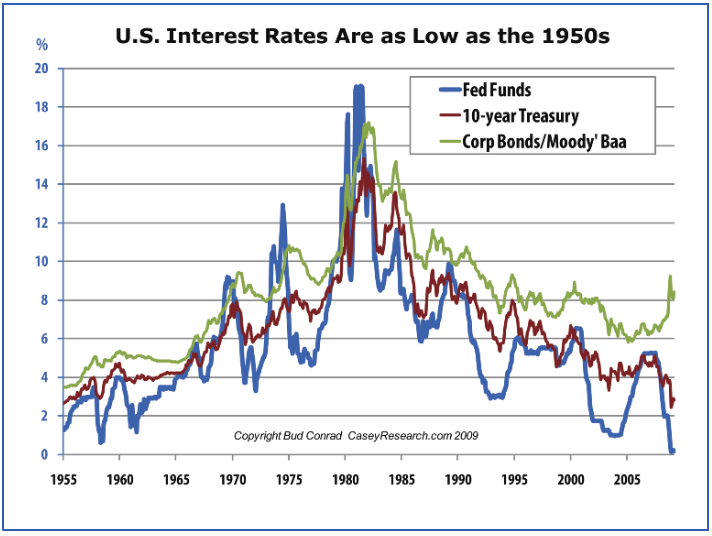
8. FED FUNDS RATE SINCE 1955

Barry Ritholtz at the Big Picture posts a graph plotting the Federal Funds Rate from 1955 on:


9. RETAIL DATA LOOKS BAD FOR ALL BUT APPAREL AND DISCOUNTERS--THE DATA TO BECOME EVEN MORE MURKY GOING FORWARD

Phil Izzo at Real Time Economics reports that a number of large retailers have released their sales data for April today, and RTE has posted a sortable table of the numbers on their site. Luxury retailers fared the worst. Discount and youth apparel firms seem, after a quick look, to have done relatively well. In a related story, Phil Izzo also reports that Wal Mart will no longer publish monthly sales data.
"The change also will remove an important piece for forecasters looking to get a handle on monthly retail sales. Wal-Mart is the nation’s largest retailer with $29.85 billion in sales just for April. An index for retail sales published by Thomson Reuters for April came in up 1.2% for the month, but excluding Wal-Mart’s results it posted a drop of 2.7%."
An already murky picture is thus going to become murkier--almost certainly at the advice of the corporation's investor relations team.

Wednesday, March 18, 2009

Daily Sources 3/18

1. Krishna Guha, Bertrand Benoit, Chris Giles and Daniel Pimlott at the Financial Times report that the IMF will reduce today its forecast for global GDP in 2009 to a contraction of 0.6%.
"The eurozone economy was forecast to contract by 3.2% in 2009, [Ms. Ter-Minassian, an adviser to IMF managing director Dominique Strauss-Kahn] said, against the earlier forecast of a 2% decline. The US would shrink by 2.6% (1.6%), and Japan 5% (2.6%), making it the worst-hit big economy. The IMF in Washington said the figures cited by Ms Ter-Minassian were 'unofficial' and 'out of date'."
In early March the IMF began indicating that a downward revision was under way--see Daily Sources 3/3 #1.

2. Philip P. Pan and Karen DeYoung at the Washington Post report that many Russia analysts believe that Moscow is signaling interest in a deal on Iran.
"In a meeting last week with a bipartisan commission studying US policy toward Russia, President Dmitry Medvedev expressed alarm in 'very graphic language' over Iran's successful test launch of a satellite last month, linking it to Tehran's nuclear program, said Dmitri Simes, director of the commission.

'Medvedev said it demonstrated how far-reaching Iran's nuclear ambitions are, and that he was very concerned,' said Simes, who is also president of the Nixon Center in Washington. 'He felt it was a clear challenge to both Russian and American interests and said he would like both countries to work on this challenge together.'"
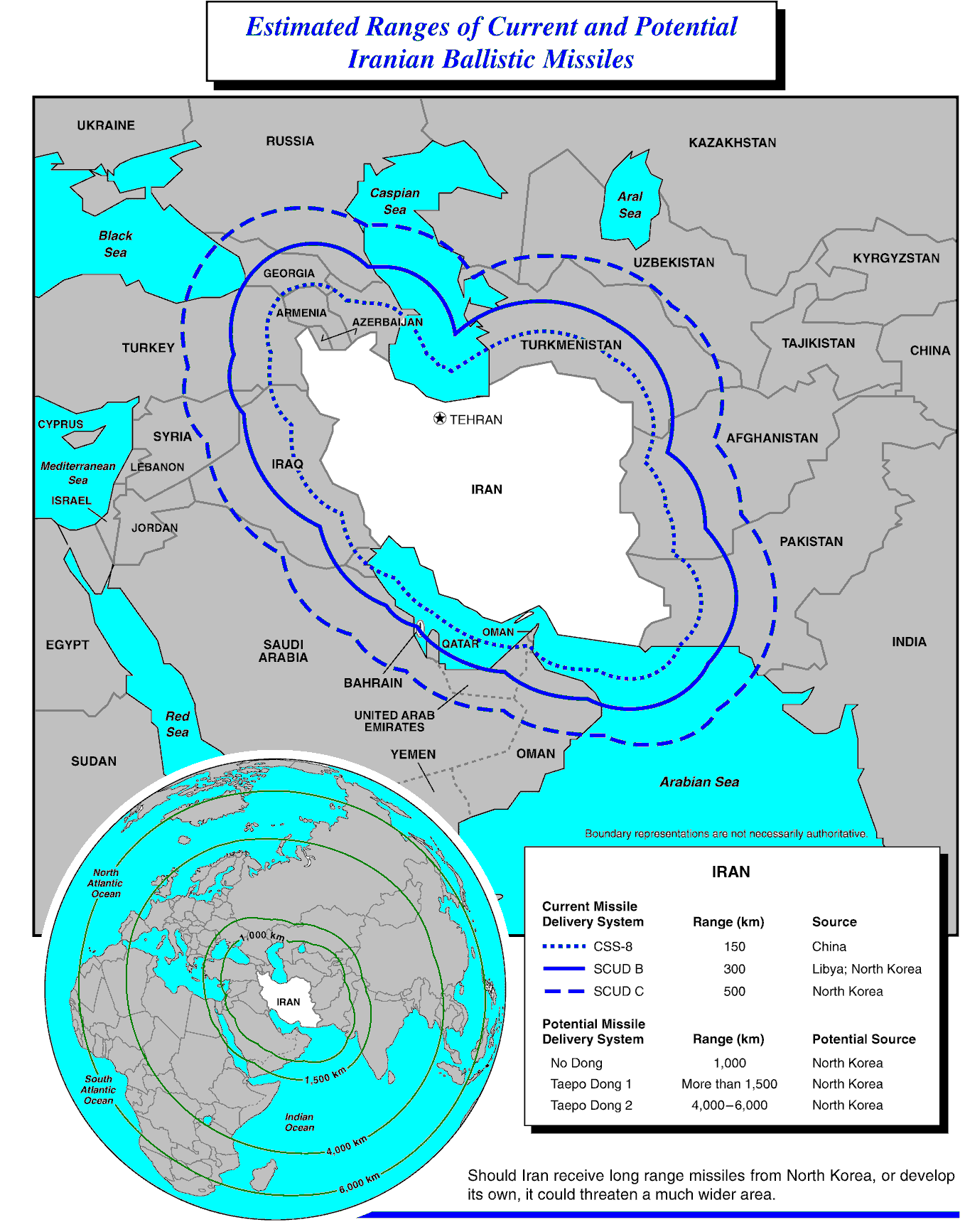
The Federation of American Scientists provide the following illustration of Iranian missile capabilities.


Satellite launches reportedly use technologies required for the development of ICBMs. In November, Iran claimed it had successfully tested missiles with a range of 1,200 miles, which as you can see from the map does not quite put Moscow in range--and obviously is even further from presenting any potential threat to, say, Warsaw. That said, it plainly makes a lot of sense that Iran's perennial missile tests would have the--likely unintended--effect of ruffling Moscow's feathers, given that a nuclear armed Tehran which could reach Moscow is definitely not in their interests.
"Alexander Pikayev, a top arms control scholar in Moscow, said Russian policy toward Iran will be determined by competing interest groups and political factions. Defense manufacturers and the atomic energy industry oppose tougher sanctions, for example, but the United States could win over the latter by reviving a bilateral pact on civilian nuclear cooperation that was frozen after the Georgian war, he said.

Pikayev said Medvedev may be more likely to support sanctions because a breakthrough in US relations would boost his political stature at home and set him apart from his powerful predecessor, Prime Minister Vladimir Putin. Putin might resist, but his relationship with Iranian President Mahmoud Ahmadinejad is said to be strained and he surprised Russia's foreign policy establishment by endorsing earlier U.N. sanctions, Pikayev said."
Frankly, I doubt this assessment--I think the notion of a nuclear armed Iran with the capability of hitting Moscow will outweigh the economic considerations involved in putting the kibosh on nuclear power cooperation with Iran. Indeed, it is hard to see many places in which Iranian and Russian interests coincide. Perhaps they do in terms of energy pricing, but Iran's potential as an alternative source of gas for European industry is probably a critical item in Moscow's long term thinking. And as the weekend's events proved, Russia still regards oil production coordination with OPEC as being less in its interest than good terms with Europe--and producing at full bore to claim all price increases produced by the cartel. (A policy which Iran appears to follow with respect to the organization's production quotas as well, ironically enough.)

3. The Associated Press reports that North Korea yesterday gave the organizations distributing US food aid inside that country till the end of March to leave--rejecting all future food aid.

4. Judy Dempsey at the New York Times yesterday reported that Russia signed two natural gas deals with Hungary yesterday. One deal signed last week has the Budapest and the Hungarian Development Bank to finance the South Stream project on Hungarian soil.


The other deal has Gazprom and MOL establishing a 1.3 billion cubic meters storage facility in Hungary. To make sense of that, here is a map that Jérôme Guillet drew up of Ukraine's gas infrastructure--note the three asterixes to the West, which represent gas storage facilities.


As Guillet pointed out in a piece for the European Tribune:
"Storage capacity is important in the gas business, as demand is seasonal (there is more in winter for heating) and can almost triple in Europe between summer and winter. If you can pre-position your gas near the markets when transport capacity becomes strained, you can extract a lot more value from that seasonality. The storage facilities near the Hungarian and Slovak borders were ideal for Soviet exports, but now they are in Ukrainian hands, and thus Russia must have a minimum of technical cooperation from the Ukrainians, who physically control and operate these facilities, not to lose a lot of money in their export markets. More, unavoidable leverage for the Ukrainians."
Hungarian Prime Minister Ferenc Gyurcsany's plea for a regional aid package from the EU was turned down last week. He has been a supporter of the Nabucco Pipeline, but questions of sourcing the gas (which would likely have to come from Iran) and project financing continue to bedevil the project.

5. Edward Hugh at Fistful of Euros posts that Poland's Central Statistical Office has released its industrial output data for February showing a 14.3% annual rate of decline in February, following a revised annual rate of decline of 15.3% in January. Output was up 2.7% in February from January however. Hugh provides a helpful graph of industrial production for the last two years:


Hugh points out that industrial production is on the decline across the spectrum of export-oriented Eastern European economies, warning against too much disambiguation between them. Worth reading and mercifully short.

6. Bettina Wassener at the New York Times reports that the World Bank lowered its forecast for Chinese growth in GDP for 2009 to 6.5%. 6.5%, though quite high by global standards just now, is well below the Chinese principle of "bao ba"--or "protect the 8"--below which conventional wisdom holds that Beijing will begin to see significant, read destabilizing, social unrest. Kevin Hamlin at Bloomberg reports that bank sees signs China's economy is stabilizing faster than the rest of the world.
"'The government’s stimulus is working,' said Louis Kuijs, a senior economist at the World Bank in Beijing. 'China’s fundamentals are strong enough to ride out this storm.'"
Meanwhile, Andrew Batson at China Journal helpfully translated the complete text of Chinese Ministry of Commerce’s statement announcing its decision to block Coca Cola’s proposed acquisition of China Huiyuan Juice Group Ltd. Key excerpt:
"Through its review, the Ministry of Commerce found that this concentration will have an adverse impact on competition. After the concentration is completed, Coca-Cola could use its market dominance in carbonated soft drinks to limit competition in the market for juice through tying, bundling or other exclusive transactions, resulting in consumers being forced to accept higher prices and reduced variety. At the same time, because brands can restrict entry to the market, it would be hard for the threat of potential competition to remove the restrictive effect on competition. In addition, the concentration will also reduce the room for small and medium-sized juice companies to survive, and will have an adverse effect on the structure of competition in China’s juice market."
The notion that dominance in the carbonated drink market could adversely affect competition in the juice market is unlikely to please most corporate headquarters. The fact that the Ministry of Commerce took stock of the market power of brands is interesting given that some have written that the primary value-addition that Western corporations bring to emerging markets is, well, brands. Meanwhile, the Sydney Morning Herald reports that shares in Rio Tinto have taken a beating on fears that the deal with Chinalco taking a 18% stake in the company.
"'[The 8.7% decline in share price] is [due to] the uncertainty surrounding the Chinalco deal, there has been a bit of talk out today that there is a lot of opposition to the deal and this is what's weighing on it,' MF Global senior trader Anthony Anderson said.

'The FIRB extension and the senate inquiry into foreign investment is adding to the uncertainty.'

The mounting political concern follows a decision by the Foreign Investment Review Board (FIRB) to extend its review to 90 days and initiate a more in-depth examination of the transaction, after the initial 30-day evaluation period closed on Monday.

The transaction, which has been backed by the Rio Tinto board, will also allow Chinalco to appoint two new non-executive board members to the global miners board."
(h/t Emmanuel at International Political Economy Zone.)

7. Platts reports that Italian major Eni has signed a major cooperation agreement with Pakistan to develop major projects all along the oil and gas product chain.
"The agreement also allows Eni to become a strategic partner in developing the oil and gas sector in Pakistan and to enter fields which are currently managed by state-run oil companies."
8. David E. Sanger and Eric Schmitt at the New York Times reports that "two of the high-level reports on Pakistan and Afghanistan that have been forwarded to the White House in recent weeks have called for broadening the target area to include a major insurgent sanctuary in and around the city of Quetta."


Baluchistan has separatist tendencies and is in the middle of a small bore separatist struggle, both in Pakistan and Iran.


Note that Baluchis can be found in southern Afghanistan where most of that country's opium production--and violence--is concentrated.

9. Galrahn at Information Dissemination notes that due to the Obama Administration's review of all military ties, GE has been asked to freeze work on turbines it was to provide the Indian navy for three Shivalik-class stealth frigates. Though I strongly disagree with the way Galrahn frames the story, I think it is an important data point. Clearly the US is likely to approve continued sales of engines to the Indian Navy.

10. Maher Chmaytelli and Juan Pablo Spinetto at Bloomberg report that Shokri Ghanem, chairman of Libya’s state-run National Oil Corp., told journalists today in Vienna that Libya will exercise its right to buy Calgary-based Verenex Energy Inc., which would effectively block CNPC's bid for the E&P company.
"Verenex has assets in Libya that are worth 'hundreds of millions' of dollars, Ghanem said in an interview with Bloomberg on March 16."
It is an interesting signal given China's Africa Policy announced in 2006 and Ghaddafi's recent selection as chair of the African Union--see Daily Sources 2/3 #9.

11. Justin Stares at Lloyd's List reports that the Bangladeshi High Court ordered the closure of all ship breaking yards operating without environmental clearance.
"Industry sources said they were 'staggered' by the ruling, which if confirmed will close down one of the world’s largest breaking industries just as scrapping activity peaks.

'None of the 36 shipbreaking yards in Chittagong currently have an environmental clearance,' said the NGO Platform on Shipbreaking. 'The decision therefore effectively shuts down an industry that has been highly criticized by environmentalists and human rights activists for many years for operating with complete disregard for the law, human health and the environment.'

The scrapping industry, which claims to employ 250,000 either directly or indirectly in Bangladesh, is expected to appeal.

The court was ruling on a petition filed by the Bangladesh Environmental Lawyers Association. Judges ordered that no ship on the Greenpeace 'dangerous ships list' be allowed into the country, according to reports by the platform and local media."
It is a decision bound to amplify the effects of the financial crisis, economically-speaking ... it seems that probity only comes when it will hurt the most, ironically. Note the significance of the courts in the Muslim-majority nation. Well-worth reading in full.

12. Nasreen Seria at Bloomberg reports that the South African Reserve Bank's Monetary Policy Committee will meet next week and accelerate its schedule to monthly meetings for the rest of the year from planned meetings every two months.
"Global economic conditions 'are getting worse' and the 'changed' environment requires the MPC to meet more regularly, Governor Tito Mboweni said in a phone interview from Pretoria today."
13. Victor L. Simpson at the Associated Press reports that in Cameroon Pope Benedict XVI reiterated yesterday that condoms were not an answer to the fight on AIDS--"You can't resolve it with the distribution of condoms. ... On the contrary, it increases the problem." I would note that Africa is one region where Catholicism--and more conservative Catholicism--is growing quickly. However, perhaps the one really impressive and compellingly moral US foreign policy triumph under the Bush Administration was the huge increase in aid to Africa in terms of the fight on AIDS, including condoms and retro-viral drugs. The people in Africa are well aware of how these aid programs have reduced the mortality rate in the continent. The notion that condoms are against life and a concession to death, and thus amoral, as opposed to a way to protect life and thus moral, will not, I believe, make much sense to them. Pope Benedict XVI appears to have a tin ear when it comes to husbanding the moral authority of the Church.

14. The Port of Long Beach recently posted its numbers for February, showing a 40% decline in container traffic from February 2008:


So far in 2009 the port has recorded a 20.2% decline in traffic. The Port of Marseilles, France, also recently posted its report for February, showing a 21% annual decline in total traffic. It registered a 16% decline from the traffic seen in January:


Hydrocarbons account for about 74% of Marseilles' traffic and it lost about 12% in volume from the year before. The grim trade data continue their march.

15. Bob Willis at Bloomberg reports that the consumer price index rose by 0.4% in February from January. Excluding fuel and food, prices climbed by 0.2% from the month prior. On an annual basis, the consumer price index rose by 0.2%, up from the 0% annual rate seen in January. Excluding fuel and food, prices climbed by an annual rate of 1.8% in February, up from a 1.7% annual rate of increase seen in January.
"Energy expenses increased 3.3%, led by an 8.3% increase in gasoline prices. Still, the fuel’s cost is down 36% from a year earlier.

Food prices, which account for about a fifth of the CPI, fell 0.1%, the first drop since April 2006."
16. The Federal Open Market Committee met today and decided to keep the federal funds rate unchanged at 0-.25%. Excerpt from its press release:
"To provide greater support to mortgage lending and housing markets, the Committee decided today to increase the size of the Federal Reserve’s balance sheet further by purchasing up to an additional $750 billion of agency mortgage-backed securities, bringing its total purchases of these securities to up to $1.25 trillion this year, and to increase its purchases of agency debt this year by up to $100 billion to a total of up to $200 billion. Moreover, to help improve conditions in private credit markets, the Committee decided to purchase up to $300 billion of longer-term Treasury securities over the next six months."
This follows the latest Treasury International Capital data which shows, courtesy of Brad Setser at Follow the Money, that foreign purchases of long term treasuries have collapsed:


Foreign government demand for US agency debt fell off a cliff late last year and purchases were even banned by Moscow just the other week. Meanwhile, Jon Hilsenrath at Real Time Economics reports that the Fed's quarterly survey of banks shows that during the week of February 2-6, banks extended $85.6 billion in credit to businesses, an increase of 13% from the first quarter of 2008--per JP Morgan Chase economist Michael Feroli:


17. The EIA reported that crude oil stocks built by 2 million barrels in the week ended March 13 to 353.3 million barrels, well above the historical average for this time of year, but still below the most recent peak of 354 million barrels seen on June 29, 2007. According to a survey by Bloomberg, analysts had expected a 1.5 million barrel build. Gasoline stocks grew by 3.2 million barrels, are near the top of the historical average. Analysts had expected a 1.5 million barrel draw. Distillates stocks grew by 100,000 barrels, are well above the five year historical average range as well as counter-cyclical, and versus analyst expectations of a 1 million barrel build. Taken in isolation, the data would be bearish on the price of crude.