Showing posts with label IAEA. Show all posts

Thursday, July 2, 2009

Daily Sources 7/2

1. JAPANESE HAWK CHOSEN TO LEAD IAEA

Sharon Otterman at the New York Times reports that Japanese diplomat, Yukiya Amano, was elected to head the UN's atomic watchdog--the IAEA.
"Depicted by experts as the candidate favored by the United States and other wealthy nations, Mr Amano favors maintaining the current approach toward controlling nuclear proliferation in Iran, which Western countries suspect of trying to build nuclear weapons. Iran says its nuclear program is purely for civilian purposes to generate energy.

'He’s a nonproliferation and disarmament guy, and he believes in it,' said David A Kay, a former IAEA official and senior fellow at the Potomac Institute for Policy Studies. 'He has been around in trying to keep the inspections in Iran going, and I expect him to continue very much in that line. He will not want to create a situation in which military action is the only alternative.'"
2. CHINA TO RESUME ALLOWING IMF REVIEWS OF ECONOMY

Andrew Batson at the Wall Street Journal reports that China next week will take a step toward reconciling with the IMF, which it has blocked from reviewing its economy for the last three years.
"But a team of IMF officials visited China about a month ago, and have completed a draft review that is now being circulated for comments.

The IMF's draft report says China's exchange rate 'continues to be substantially undervalued,' according to a person who has seen the document, called an Article IV consultation. That's in line with what senior IMF officials have repeatedly said in public. China has kept its currency, the yuan or renminbi, basically fixed against the US dollar since July last year, though it has risen, along with the dollar, against other currencies since then.

That description nonetheless marks a climbdown from an earlier push to label China's exchange rate as 'fundamentally misaligned,' a designation that would suggest the country is in violation of the IMF charter. The draft report also states that Chinese authorities 'disagreed with the staff's assessment' of the exchange rate, and notes their argument that the global turmoil calls for 'a policy of stability.'"
Simon Johnson argued in April that the Obama Administration had pulled off a coup at the G20 meeting, effectively getting Europe to make the selection process for the head of the IMF transparent in return, more or less, for opening up the process at the World Bank, the next head of which Johnson thinks is likely to be Chinese--see Daily Sources 4/3 #3. Clearly in order to clear the field for their own candidates and a larger role generally, Beijing will first be forced to work with the organizations they want to influence or lead.

3. PBOC TO ENCOURAGE CROSS-BORDER SETTLEMENT IN YUAN

Bob Chen and David Yong at Bloomberg report that the People's Bank of China will encourage cross border settlement in the renminbi starting today, per regulations posted on the central bank's website.
"Transactions inside China will take place in Shanghai and four cities in southern Guangdong province, including Guangzhou and Shenzhen, while those outside China will occur in Hong Kong, Macau and the Association of Southeast Asian Nations, it said."
(h/t Jesse's Café Américain.)

4. CNPC MAY REVIVE BID ON ARGENTINE UNIT OF REPSOL-YPF, CNOOC MAY JOIN IN

Sui-Lee Wee at Reuters reports that CNPC plans to revive its $17 billion bid for the Argentinian unit of Repsol-YPF, reportedly planning to make an offer for as much as 75%. CNOOC also may enter a bid for the remaining 25%. "Goldman Sachs is advising YPF on the sale, while Morgan Stanley and JP Morgan are advising CNPC and CNOOC respectively." YPF, or Yacimientos Petrolíferos Fiscales, was the national oil company of Argentina until 1991, when it was privatized and then purchased by Repsol. (h/t Carola Hoyos at FT Energy Source.)

5. SPANISH CONSUMER CREDIT DOWN 33.7% IN Q1

Edward Harrison at Credit Writedowns reports that consumer credit in Spain fell by 33.7% in the first quarter, according to the National Association of Financial Credit Institutions (Asnef).
"Asnef stressed that the fall in the consumer sector has been mainly due to losses on personal loans, due to the sharp decline in the credit available for consumer goods and by the contraction of revolving credit associated with credit card usage."
Harrison says he expects more failures or bailouts of Spanish banks in coming months. Worth reading in full.

6. RIKSBANK CUTS BENCHMARK INTEREST RATE TO 0.25%

Malin Rising at the Associated Press reports that the Riksbank cut its benchmark interest rate by 0.25% to 0.25% today.
"The central bank said it now expects Swedish gross domestic product to decline by 5.4% in 2009 -- a sharper drop than its previous forecast of a 4.5% fall. However, it raised its outlook for 2010 GDP to a growth rate of 1.4% from 1.3% previously.

It said the economic outlook is still uncertain and that although GDP is expected to be positive in 2010, employment will not begin to rise until 2011."
7. FINAL SECTION OF SINO-KAZAKH CRUDE PIPELINE COMPLETED

Naubet Bisenov at Platts reports that Kazakhstan's KazStroyService has finished the 10 million metric ton/annum (200 kb/d) Kenkiyak-Kumkol pipeline and will begin test runs on it shortly.
"The Kenkiyak-Kumkol link is the final section of the Sino-Kazakh crude pipeline which runs from Atyrau on the Caspian Sea coast of the Central Asian nation, to Atasu near Kazakhstan's eastern border, then onwards to Alashankou in China's northwestern Xinjiang Uygur autonomous region.

The Sino-Kazakh crude pipeline is jointly developed by Kazakh state oil company KazMunaiGaz and Chinese state oil giant China National Petroleum Corp."


8. TALIBAN HAS WORN OUT ITS WELCOME IN PAKISTAN

In another interesting report by World Public Opinion, an institute based out of the University of Maryland, Pakistani opinion has turned sharply against the Taliban.

"Large majorities express confidence in the government (69%) and the military (72%) to handle the situation [in Swat]. Retrospectively, the public leans (by 45% to 40%) toward thinking the government was right to try to make an agreement in which the Pakistani Taliban would shut down its camps and turn in its heavy weapons in return for a shari'a court system in Swat. But now 67% think the Pakistani Taliban violated the agreement when it sent its forces into more areas, and 63% think the people of Swat disapprove of the agreement.

On the Afghan Taliban, an overwhelming 87% think that groups fighting to overthrow the Afghan government should not be allowed to have bases in Pakistan. Most (77%) do not believe the Afghan Taliban has bases in Pakistan. However, if Pakistan's government were to identify such bases in the country, three in four (78%) think it should close the bases even if it requires using military force.

Public attitudes toward al Qaeda training camps follow the same pattern. Those saying the 'activities of al Qaeda' are a critical threat to Pakistan are up 41 points to 82%. Almost all (88%) think al Qaeda should not be allowed to operate training camps in Pakistan. Though 76% do not believe there are such camps, if the Pakistani government were to identify them, 74% say the government should close them, with force if necessary."
Unsurprising, to me, but still well worth reading in full. (h/t Juan Cole at Informed Comment.)

9. PETROBRAS STRIKES MORE OIL ONSHORE IN THE ESPIRITO SANTO BASIN

Tom Hennigan at Platts reports that Petrobras struck oil onshore in the Espirito Santo basin.
"The Espirito Santo basin has seen a string of strikes in recent months. Last week the company reported strikes in blocks ES-T-390 and BT-ES-15. Since March it has also made four oil strikes in the onshore ES-T-364 block alone.

The company also announced a gas and an oil and gas find in the onshore ES-T-505 block."
The block block is 100% owned by Petrobras. Seems like every other week they make a new announcement of new oil.

10. HONDURAN CRISIS IN PART DUE TO NO PROCESS FOR REMOVING PRESIDENT IN CONGRESS & HIS RELATIONSHIP WITH CHÁVEZ, SAY EXPERTS

Kevin Sullivan at Real Clear World posts the quick analysis of several Honduras experts. Juan Carlos Hidalgo at the CATO Institute makes the interesting observation:
"The Honduran constitution does not provide an effective civilian mechanism for removing a president from office after repeated violations of the law, such as impeachment. Honduras’ Supreme Court nonetheless ordered Zelaya’s removal and Congress bestowed the presidency on the civilian figure--the president of Congress--next in the line of succession according to the constitution. "
Jesus Rios at Gallup World Poll makes another interesting observation:
"The latest remarks by interim leader Micheletti suggest Zelaya’s increasing alignment to President Hugo Chavez’s regime is at the core of the crisis. So, if Zelaya does in fact return to power before the November presidential election, the question then becomes: how will he manage to govern amidst an adverse public opinion environment and among institutions that backed his ousting, including his own political party? And, what role, if any, will Chávez play in Honduran politics from now on? Will Zelaya drop or moderate his pro-Chávez stance to regain political support? According to the 2008 Gallup survey, just 20% of Hondurans approve of President Hugo Chávez."
11. WTO WARNS ON INCREASING PROTECTIONISM, SAYS GLOBAL TRADE VOLUMES WILL CONTRACT BY 10% IN 2009

Joshua Chaffin at the Financial Times reports that the WTO published a report today which warns that
"[g]overnments around the world have continued to push up trade barriers in spite of high-profile pledges at the G20 summit and other forums to resist protectionism"
The organization lowered its forecast for world trade to a contraction of 10% in the volume of goods and services.


12. BLS REPORTS 476,000 JOB LOSSES IN JUN, STATE FISCAL RESPONSIBILITY MEANS STATE ECONOMIC POLICY CONTRACTIONARY IN RECESSION

Barry Ritholtz at the Big Picture reports that the Bureau of Labor Statistics announced today that there were 467,000 job losses in June. The unemployment rate rose by 0.1% to 9.5%. The U-6 measure--marginally attached and involuntary part time workers--rose to 16.5%. Temporary employment fell by 37,600.
"Hours worked fell 0.8%, bringing the average workweek down 0.1 hours to 33; This is a record low going back to 1964."
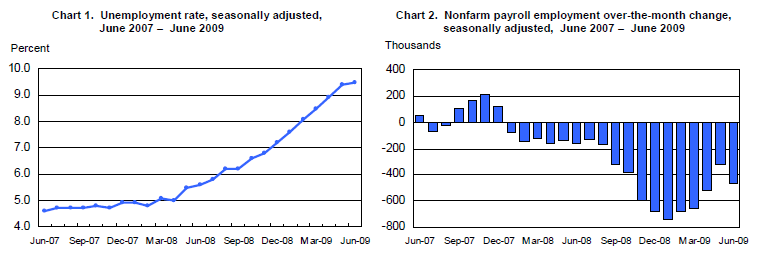

Peter Boockvar, also at the Big Picture, also notes that initial jobless claims totaled 614,000. Continuing claims fell by 58,000 from last week.
"While there is no question benefits are expiring without one finding a job, as evidenced by the rising exhaustion rate, many losing those benefits now started getting them when initial claims were running in the 400k range last summer. Now its running above 600k, so there are still more people filing initial claims than getting removed from the continuing claims data, thus continuing claims still should trend higher assuming no sudden change in hiring trends."
Meanwhile, Free exchange makes the important observation:
"[S]tate budget policies are sharply contractionary at this point. Despite allocations of federal aid to states, services are being cut, state employees are being laid off, and taxes are being raised in order to balance the budgets of local governments constitutionally unable to run deficits. It's not at all clear that the federal stimulus will entirely compensate for state-level fiscal tightening, which means that American fiscal policy could, on net, be contractionary."
13. BARCLAYS EXPECTS WTI TO AVG $71/B IN W3

Yee Kai Pin at Bloomberg reports that Paul Horsnell's commodity team at Barclays has lifted its third quarter forecast for WTI to $71/b from $62/b. Horsnell increased his Q3 forecast for Brent to $69/b.
"'Among all the changes that have kept commodities on the boil in recent years, the key factor is that 'normal' is not what it used to be,' the analysts said in the report. 'Oil prices below $70 or copper prices below $3,000 are no longer normal.'"
I think he's wrong, but he does know of what he speaks.

Tuesday, December 9, 2008

Daily Sources 12/9

1. Secretary of Defense Robert Gates, who will also serve in the same role in the Obama administration, writes in Foreign Affairs that the military in coming years cannot expect to be engaged primarily in conventional warfare, but in assymetrical conflicts. Selected quotes:
"Direct military force will continue to play a role in the long-term effort against terrorists and other extremists. But over the long term, the United States cannot kill or capture its way to victory. Where possible, what the military calls kinetic operations should be subordinated to measures aimed at promoting better governance, economic programs that spur development, and efforts to address the grievances among the discontented, from whom the terrorists recruit.

...

But before the United States begins rearming for another Cold War, it must remember that what is driving Russia is a desire to exorcise past humiliation and dominate its 'near abroad' -- not an ideologically driven campaign to dominate the globe.

...

War is inevitably tragic, inefficient, and uncertain, and it is important to be skeptical of systems analyses, computer models, game theories, or doctrines that suggest otherwise. We should look askance at idealistic, triumphalist, or ethnocentric notions of future conflict that aspire to transcend the immutable principles and ugly realities of war, that imagine it is possible to cow, shock, or awe an enemy into submission, instead of tracking enemies down hilltop by hilltop, house by house, block by bloody block. As General William Tecumseh Sherman said, 'Every attempt to make war easy and safe will result in humiliation and disaster.'"
All in all, a very sensible realist document. However, my view is that the less the military is used as the deciding factor in the pursuit of political aims, the better. There is a limit to how much territory can effectively be administered, while developing domestic administrative capability, by the US armed forces. Either way, well worth reading in full, and an extremely welcome tone of sobriety coming from the incoming US cabinet.

2. Will McCants at Jihadica writes that al-Shabaab in Somalia has announced the establishment of another governorate for the southern province of Lower Shabelle in southern Somalia.

"The new governorate has a governor and supervisors for missionizing and education, security and morality policing, courts, and the treasury."
Al-Shabaab sees what it has done so far as "liberating" the local populace from criminal gangs which were extorting them. However, its decision to destroy the local saints shrines--which are part of the local Sufi-inspired Islam--will probably ultimately alienate many.

3. Asif Ali Zadari, President of Pakistan, has an Op-Ed in the New York Times where he argues that his government is a target of the same terrorists who attacked Mumbai. He points out that his wife was a victim of the ideological fellow-travelers of these terrorists and that, therefore, he is in a position to understand the aggrieved feelings of the people of India. He writes that Pakistan has over 150,000 soldiers engaging the Taliban in northwest Pakistan and says that the best thing the world can do to combat the menace is to support the current government, which is democratic, and provide the help it needs to build anti-terrorism capability. Worth reading in full.

4. Candace Rondeaux at the Washington Post reports that Pakistani authorities announced tey have arrested a suspected ringleader of the Mumbai attacks in Kashmir yesterday.
"Pakistani security forces arrested 22 people, including Zaki-ur-Rehman Lakhvi, one of at least five Lashkar members named by Indian authorities as the organizers of the Mumbai siege, according to local residents and a Jamaat-ud-Dawa member."
There has been no independent confirmation of the arrests so far.

5. Borzou Daragahi at the Los Angeles Times has an interview with Mohamed El-Baradei, the head of the IAEA. He regards the efforts to isolate Iran in order to try and ensure that it does not use its nuclear program to build weapons a failure so far and appears to endorse a "grand bargain" solution for the impasse between the United States and Iran. I think there is little point in pursuing a grand bargain, but El-Baradei certainly has more experience in difficult diplomatic negotiations than me. Worth reading in full.

6. Steve Erlanger at the New York Times reports that the European Union is launching an effort, led by Nicolas Sarkozy, to place a global ban on all nuclear weapons testing and a suspension of all fissile material production.

7. Alex Nicholson at Bloomberg reports that the Russian Federal Statistics Service published data showing that GDP growth fell to 6.2% in the third quarter, down from 7.5% in the second. This is the slowest rate seen in three years or so. "The Economy Ministry has a forecast of 6.8% to 7% growth this year, implying 5% growth in the fourth quarter, [Chris] Weafer [a chief strategist at UralSib Financial Corp. in Moscow] said."

8. Li Yanping and Kevin Hamlin at Bloomberg report that an adviser to the People's Bank of China, Fan Gang, said today in Beijing that "November figures will come out soon, and industrial growth will be something around 5 percent and export growth will be negative."

9. Belinda Cao at Bloomberg writes that a Nomura Holdings Inc. report by Sun Mingchun argues that China will widen the yuan's daily trading band against the dollar from 0.5% to 3%.
"Sun said the yuan’s trade-weighted real effective rate gained 12.3 percent in the past four months, exceeding advances made in the two years through July, according to rates calculated by the Bank for International Settlements.

'Should the dollar start to fall versus other currencies, we’ll expect the yuan to go back on the course of appreciation,' he said."
10. Tony Munroe and Kevin Liffey at Reuters report that Japanese GDP contracted by 0.5% in the third quarter, a deeper cut than the previous estimate of 0.1%. In year-over-year terms, that represents a contraction of about 1.8%.

11. Eurointelligence reports that Mercedes this week was the last German auto manufacturer to mandate compulsory reduction in labor work hours so as to reduce supply in the face of falling global demand.

12. Ian Austen at the New York Times reports that the Bank of Canada cut today its benchmark interest rate by 75 basis points (0.75%) to 1.5%. This was done with the legislative wing of the government shut down by the Parliament in order to prevent his own ouster--until late January, anyways.

13. Joshua Goodman and Andre Soliani at Bloomberg report that Brazil's GDP grew at an annual rate of 6.8% in the third quarter.
"Finance Minister Guido Mantega, speaking to reporters after the GDP report, said economic growth may slow to between 3 percent and 3.5 percent in the fourth quarter before rebounding to 4 percent growth next year. Brazil’s economy may fully recover its current growth pace in 2010, he added."
Annual inflation is at 6.39% which is near the upper limit of the band set by the government of 6.5%.

14. Fabio Alves at Bloomberg reports that the investor relations manager for Petrobras told an investors conference in New York that the pre-salt fields may be able to produce oil at less than $40/b. This follows assurances by Petrobras CEO Jose Sergio Gabrielli last week that production was economic at below $50/b (see Daily Sources 12/5 #8) and a report from Banco Santander following a meeting with the manager of the pre-salt regions suggesting that Petrobras could make a profit from them at $50/b. (see Daily Sources 12/2 #11). Petrobras has approved a pilot project for the Tupi field--in the pre-salt region--which would begin production in 2010 with target production of 100 kb/d. Testing is expected to begin in March 2009 and will initially produce 15-30 kb/d.


Tupi is estimated to have between 5-8 billion barrels of oil. "The oil company this week said it raised $7.5 billion this year to finance investments. Petrobras said in a regulatory filing that it has always borrowed funds in the domestic and international markets." The investor relations manager told the conference that Petrobras in negotiating with the Chinese development bank for further financing. Given China's resource policy, the implication is that terms will be friendly. Eric Watkins at the Oil & Gas Journal reports that Mines and Energy Minister Edison Lobao gave an interview with the daily Folha de Sao Paulo that China has offered Petrobras $10 billion initially and that the UAE is also interested in financing the project. Lobao also told the state news agency that the company is still reviewing its 2009-2013 strategic plan, which is due to be released for comment by the end of the year, after the board meets to finalize it by December 19-20.

15. Nidaa Bakhsh at Bloomberg reports that Total SA is starting gasoline units at its La Mede refinery after a 2 month halt. The unit now should have a production capacity of about 35.5 kb/d and the refinery has a throughput capacity of 157 kb/d. Gasoline has been trading at a discount to Brent in London since October 1, which is part of the reason it is so cheap currently in the US.
"France was the third-largest foreign supplier of gasoline to the U.S. in September, shipping 3.58 million barrels, according to the U.S. Energy Department. Only the Netherlands and U.K. shipped more."
Dieselization and its discontents. Tara Patel at Bloomberg has the related story that the closure of the Fos and Lavera oil terminals at Marseilles has left 13 oil tankers and 22 carriers of refined products stuck offshore. The La Mede refinery gets its feedstock by this port.

16. Tom Liodice at the Barrel reports that Philip Verleger, in the most recent edition of his "Notes at the Margin," believes that OPEC will need to cut production allocations by 7.7 million barrels in order to restore market balance. 7.7 million barrels!
"Here's why, according to Verleger:

-Global demand is down in December year-over-year by 5.2 million b/d to 81.6 million b/d, from 86.8 million b/d.

-Non-OPEC production is projected at 49.4 million b/d, with OPEC NGLs at 5.2 million b/d, and processing gain at 2.3 million b/d.

Verleger says that after adding those numbers, the call on OPEC is at 23.7 million b/d. By contrast, Platts' estimate of OPEC production in October was 32.26 million b/d, before its recent cut of 1.5 million b/d reached at a meeting in November. A call of 23.7 million b/d would stand in stark contrast to the IEA's estimate of a fourth quarter call of 31.1 million b/d and a full 2009 average of 30.4 million b/d."
Verleger also argues that current global stocks are probably around 61-2 days--much more than OPEC estimates of around 55 days--and that by December 17 stocks may hold 65 days-worth of consumption. It is worth noting, I think, that Verleger's low-case scenario in early Fall was $10/b--which most thought astoundingly low. (His high price scenario was $250/b, which made the entire projection thing just a bit difficult to take seriously, however.)

Verleger believes that the current contango is due to nearly all available storage being full, meaning that there are few places still available to put oil bought today to profit from the contango. This puts further downward pressure on the spot price of oil because so little will be bought for future use--most must be sent to refineries for throughput now. The EIA data suggests otherwise, but clearly Verleger thinks the data--IEA, EIA, and OPEC--is all wrong, by 6-7 days worth of consumption, or 492-574 million barrels wrong (given consumption of 82 mb/d as opposed to, say, EIA 2009 projections of 85 mb/d). That's mighty wrong. (Still he seems to think that there may be enough room for an additional 255 million barrels.)

People pay Verleger plenty of money for his observations--and me I put these out for free, so take it for what it's worth, but I think he is probably wrong about this. Still, even more reason to suspect that OPEC will cut deep in their December 17 meeting. And Jordan Burke at Bloomberg reports, Boone Pickens believes that OPEC will cut from 2 to 2.5 mb/d in that meeting. And the big news today is that the EIA's Short-Term Energy Outlook released today forecasts a 5.8% decline in US petroleum production consumption in 2008, or a whopping 1.2 mb/d! Global oil consumption is predicted to fall by 50 kb/d in 2008 and 450 kb/d in 2009. And, the EIA expects non-OPEC supply to grow for the first time in over five years by 410 kb/d, reversing a 310 kb/d decline in 2008. The EIA apparently expects the call on OPEC in 2009 to decrease by precisely that--860 kb/d. Wednesday's EIA stocks numbers may be a decisive factor in the December 17 meeting.

17. Eurointelligence reports that yields on the three month treasury bill are now half a basis point, or 0.005%. The latest issue was three times oversubscribed.