Showing posts with label Latvia. Show all posts

Tuesday, July 28, 2009

Daily Sources 7/28

1. MAYER AND WOOD ARGUE THAT CHINA'S ENTRANCE INTO THE WORLD ECONOMY HAS NOT SIGNIFICANTLY DE-INDUSTRIALIZED REST OF DEVELOPING WORLD

Jörg Mayer and Adrian Wood at Vox EU argue that China's integration into the world's economy has not had the effect of substantially de-industrializing other developing nations.
"The biggest possible effect would be for a country which initially produced or exported equal amounts of manufactures and of primary products, where a 15% fall in the ratio would reduce the share of manufactures by 3.5 percentage points.

These estimates are imprecise and subject to error; the true answer may lie outside their range. But there is no plausible modification of the calculations that could make the true answer much larger. This is mainly because, despite its size, China’s opening had only a modest effect on world average endowments. The upper-limit estimates, obtained by simply adding China’s endowments to the rest of the world’s, are a 9% rise (from 0.43 to 0.47) in the share of the global workforce with a complete primary or secondary education, and a 17% fall in the average land/labour ratio, from 2.9 to 2.4 square kilometres of land per 100 workers ... . The average effect on the structure of output and trade in other countries is unlikely to have been larger than these world average endowment changes and was probably smaller.

The significance of the China effect varied widely among developing countries. This is partly because its size varied with the composition of each country’s manufacturing and primary production – how closely its industrial products competed with Chinese exports, and how much demand there was from China for its primary exports (more, say, for copper than for coffee). It is also because there were many other forces acting on sectoral structures--including changes in countries’ own trade policies--whose effects often outweighed those of China."
Worth reading in full.

2. NEPAL HARASSING TIBETAN REFUGEES

Gopal Sharma at Reuters reports that Nepal is responding to pressure from Beijing by cracking down on Tibetan refugees in the country.
"Nepali authorities have regularly broken up protests by Tibetan exiles and arrested them for protesting against China's crackdown on demonstrations in Tibet.

The Washington-based [International Campaign for Tibet] said Tibetan refugees were 'increasingly demoralized' as Nepal 'relinquishes its historic and sovereign interests in response to incentivized political pressure from Beijing and its sympathizers.'

ICT said 'pre-emptive arrests of Tibetans, ID checks and house searches' by authorities were contributing to a 'widespread sense of fear and insecurity' among the exiles.

'Nepal's political leadership is betting that the internal benefits of assuaging China in the cause of oppressing Tibetans will be greater... than the traditional legal and historical concepts,' Mary Beth Markey, Vice President at ICT said."
3. INDIA TO ANNOUNCE SOLAR POWER TARGETS OF 1/8TH TOTAL ELECTRICITY DEMAND, CENTRAL BANK LEAVES INTEREST RATE UNCHANGED ON INFLATION CONCERNS

Krittivas Mukherjee and David Fogarty at Reuters reports that India will announce its targets for solar power generation in September. The plan promises to
"boost output from near zero to 20 gigawatts (GW) by 2020 as it firms up its national plan to fight global warming, draft documents show.

The target, which would help India close the gap on solar front-runners like China, is part of an ambitious $19 billion, 30-year scheme that could could increase India's leverage in international talks for a new UN climate pact in December, one of several measures meant to help cut emissions.

If fully implemented, solar power would be equivalent to one-eighth of India's current installed power base, helping the world's fourth-largest emitter of planet-warming greenhouse gas emissions limit its heavy reliance on dirty coal and assuaging the nagging power deficit that has crimped its growth.

The 'National Solar Mission', yet to be formally adopted by Prime Minister Manmohan Singh's special panel on climate, envisages the creation of a statutory solar authority that would make it mandatory for states to buy some solar power, according to a draft of the plan, which provided detailed proposals for the first time, obtained by Reuters ... ."
Meanwhile, Cherian Thomas at Bloomberg reports that India's central bank decided today to leave its benchmark interest rate unchanged at 3.25%.
"The central bank raised its inflation forecast for the year to March 31 to 'around 5%' from an April estimate of 4%, citing 'elevated' food and commodity prices."
4. EU TO TRAIN SOMALI SECURITY FORCES TO POLICE PIRACY

BBC News reports that the EU has announced plans to train Somali security forces to tackle the piracy plaguing their coasts.
"It will send a planning team to the region next month. The training will take place in neighboring Djibouti, which has French and US military bases."
(h/t Joshua Keating at FP's Morning Brief.)

5. IMF AND LATVIA REACH ACCORD, MAY OPEN UP NEW FUNDING

Aaron Eglitis and Timothy R Homan at Bloomberg report that the IMF and Latvia have reached an accord paving the way for the country to receive its first financial assistance from the organization since December.
"The review may unlock about 195 million euros ($285 million), which the IMF withheld in March after the Baltic country failed to commit to budget cuts, the fund said in an e- mailed statement.

Latvia turned to a group led by the European Commission and the IMF for a 7.5 billion-euro stabilization loan in December after its second-biggest bank needed a state rescue. The IMF announcement followed a 1.2 billion-euro transfer by the European Commission yesterday, helping quell concern about a lats devaluation that may have destabilized currencies across the region."
6. MOUSAVI CALLS FOR NEW STREET PROTESTS NEXT WEEK IN IRAN

Borzou Daragahi at the LA Times reports that opposition candidate Mir-Hossein Mousavi has called for more street protests during religious festivals next week.

7. KENYA TO BUILD AFRICA'S LARGEST WIND FARM

Xan Rice at the UK Guardian reports that Kenya plans to build the largest wind farm in Africa.
"Some 365 giant wind turbines are to be installed in desert around Lake Turkana in northern Kenya – used as a backdrop for the film The Constant Gardener--creating the biggest wind farm on the continent. When complete in 2012, the £533m (~ $758.8 million) project will have a capacity of 300MW, a quarter of Kenya's current installed power and one of the highest proportions of wind energy to be fed in a national grid anywhere in the world."
8. FUEL OIL APPROACHING COST OF CRUDE, HURTS SHIPPING, CHINESE FUEL OIL IMPORTS ROCKET UPWARD (FROM LOW BASE), VIETNAMESE MAIDEN REFINERY TO TAKE SPOT GASOLINE DEMAND OFF MARKET, WALL OF ASIAN PACIFIC REFINING YET TO PLAY OUT

Christian Schmollinger and Alaric Nightingale at Bloomberg report that the price of fuel oil--bunker fuel, the bottom of the barrel, which is used to power ships in great part because it is cheap, generally trading at a considerable discount to crude, is approaching the price of light crude and may surpass it.
"Fuel oil may surpass crude 'for quite some time, six months is possible,' JPMorgan Chase & Co. vice president of energy strategy Vima Jayabalan said in a phone interview from Singapore."
This means that the effect of rising crude prices is having a more pronounced affect upon the cost of shipping than it did during the 2003-2008 run up in the price of crude.
"'It’s really hurting' ship owners, said Parul Bhambri, a Singapore-based analyst at Drewry.

Maersk said May 12 that falling demand for freight hobbled its ability to pass on fuel costs to customers in the first quarter, when its shipping line lost $559 million after taxes, compared with an $80 million profit a year earlier. The shares are down 40% in the past year in Copenhagen trading."


As the price of fuel oil rises, however, many simple refineries, which do not have the equipment to maximize gasoline and diesel output, can become profitable again, which may undergird a recovery in overall crude demand. That said, it still doesn't look like there's much demand for gasoline and diesel out there, which could push down the crack spread and thus the price of crude. Winnie Lee at Platts reports that Chinese fuel oil imports in June were up 6.26% from May and 45.94% from June 2008 to 13.7 kb/d. It's largest supplier was Venezuela. In that vein, Irene Tang at Platt's the Barrel blog reports that the commissioning of Vietnam's first refinery at Dung Quat is poised to erase about 30% of the country's product import demand, which will in turn erase its demand for spot gasoline purchases. The wall of new refining capacity in Asia has yet to fully be appreciated,
"China has now joined India in becoming a major swing exporter of gasoline. Apart from greenfield refineries coming onstream in the country, Beijing's decision to adopt a new products pricing formula for the domestic market and the resulting price revisions in tandem with the global benchmarks has encouraged more speculative buying at the wholesale level, causing wide fluctuations in refiner inventories.

This, in turn, has made Chinese gasoline export volumes unpredictable. The latest customs figures show gasoline exports hit a two-year high of 560,000 mt in June, a 273% surge from the corresponding month of last year. The previous high was in April 2007, at 590,000 mt.

The figures point to Chinese 'apparent' gasoline demand in June being just 1.8% higher than the same month a year ago, a contrast with on-year growth rates of 20.2% in May and 13% in April. The anomaly of the June figure, in the backdrop of staggering double-digit growth rates of automobile sales in China and a 7.7% on-year average gasoline demand growth in the first half of the year, can only be explained by wild swings in stock builds and draws."
"The full impact of the start-up of Reliance Industries' new 580,000 b/d refinery in Jamnagar should be apparent as early as August, as the company's older 660,000 b/d refinery is now restarting from a partial shutdown. Monthly gasoline exports from RIL are expected to more than double to well above 600,000 mt."
9. NIGERIAN REBELS IN SOUTH TARGET OIL MINISTER'S COMPANY, NORTHERN ISLAMISTS CONTINUE UNREST

Platts reports that the Nigerian Joint Revolutionary Council has issued a warning to UK-based independent producer Afren Resources to stop operating in the Niger Delta or risk attacks on its equipment and personnel.
"The Joint Revolutionary Council, which styles itself as a coalition of militant groups based in southern Rivers and Bayelsa states, said in a statement that its ultimatum to Afren was aimed at expressing the group's opposition to the policies of Nigeria's Oil Minister Rilwanu Lukman--policies the group sees as skewed against the Niger Delta region in the country's south.

Lukman was a co-founder of Afren and stepped down from his position as chairman of the company's board of directors once he was appointed oil minister for Nigeria in late 2008. His shares in the company were to be held in a blind trust, the company said in a statement at the time."
Lukman wants to site an oil university in his home state in the north--Kaduna. Meanwhile, Ibrahim Mshelizza at Reuters reports on the increasing Islamist inspired unrest in northern Nigeria.
"The violence was triggered when some members of the group called Boko Haram, which wants a wider adoption of Islamic sharia law across Africa's most populous nation, were arrested Sunday in Bauchi state.

Unrest spread to the northern states of Kano, Yobe and Borno, whose capital Maiduguri is home to the group's leader, Mohammed Yusuf, and has seen the worst violence.


'The situation has been contained in Bauchi and Yobe. The bad situation we have now is in Borno where the leader of the group is residing ... We are going to launch an operation, a main operation to flush them out,' [Nigerian President Umaru] Yar'Adua told reporters after meeting security chiefs and state governors."
10. PRESSURE TO CHANGE DRUG WAR STRATEGY BUILDING IN MEXICO, MEXICAN CRUDE PRODUCTION WAY DOWN

William Booth and Steve Fainaru at the Washington Post report on the growing pressure on Mexican President to change Mexico's "surge" strategy in dealing with its drug cartels.
"Dan Lund, president of the MUND Group polling organization, said public support for Calderón's strategy appears to be weakest in the places where the federal government needs it most. 'In a series of national surveys, polls consistently have found a reasonable but cautious level of support for using the military in the front lines against the cartels,' he said. 'But in all the states where the military is actually deployed, the support goes down, sometimes dramatically.'

The situation has been exacerbated by the global economic crisis, which has cast millions of Mexicans into poverty. José Luis Piñeyro, a Mexican military analyst who maintains close ties with the armed forces, said rising unemployment and poverty 'is creating what I call an "army in reserve,"' for the traffickers.

In Michoacan, La Familia has used the media to try to align itself with the disenfranchised. After the recent attacks, one of its leaders, Servando Gómez, called a local television station and told viewers: 'I want to say to all Michoacanans, we love them and respect them.'"
Meanwhile, there was plenty of stories on the decline in Mexican production last week. John Kingston at the Barrel notes:
"But here's the more stunning figure: what's happened in two years. In July 2007, Pemex reported crude output of 3.165 million b/d. That's a 20.4% decline in 23 months."
11. VATICAN AIMS AT FREE MARKETEERS, SAYING MARKETS WITHOUT ETHICS DESTROY WEALTH AND CREATE POVERTY

Flavia Krause-Jackson at Bloomberg reports that the Vatican has attacked free markets, saying that they have legitimized greed. On June 7, the pope published an encyclical which examined the financial crisis and means out of it, saying that once profit becomes the exclusive goal of business, it destroys wealth and creates poverty.
"Last November, Italian Finance Minister Giulio Tremonti said the pope had pronounced a 'prophecy' in a paper Benedict wrote when he was a cardinal.

In 1985, then-Cardinal Joseph Ratzinger presented a paper titled 'Market Economy and Ethics' at a Rome event on the Catholic Church and the economy. He said a decline in ethics 'can actually cause the laws of the market to collapse.'"
I think it is plain that markets cannot sustain themselves without a modicum of trust, engendered by ethics held in common.

12. CFTC MAY OR MAY NOT REVISE LAST YEAR'S REPORT EXONERATING SPECULATION IN PRICE VOLATILITY, LONDON'S FSA EXONERATES SPECULATORS

Ianthe Jeanne Dugan and Alistair MacDonald at the Wall Street Journal report that the CFTC
"plans to issue a report next month suggesting speculators played a significant role in driving wild swings in oil prices--a reversal of an earlier CFTC position that augurs intensifying scrutiny on investors."
However, I understand that the Chair of the CFTC indicated today that the story in the WSJ that the report will be redone and altered are premature and inaccurate. From the WSJ story,
"In the US, the CFTC begins public hearings Tuesday to determine whether to limit speculative investments in commodities. Congress also is weighing whether to give the CFTC the authority, under a broader proposal to revamp financial regulation, to regulate commodities investments that occur off traditional exchanges. Byron Dorgan, a North Dakota Democrat, has called on the CFTC to curb 'oil speculators looking for a quick buck at the expense of American consumers.'"
I suspect that the direction of these accusations is misdirected, given that commercials may choose to purchase futures to profit on price just as much as to hedge their obligations.


Positions net long and short for the week ended July 21 only comprised 1% of the market. Note that from 2008 open interest--or the total number of contracts--has been steadily falling for both futures and options--though the trend for options was up through February.


If you include options, the number of positions held by traders net long or short represent 3.17% of the market--not an especially large share. Meanwhile, Alistair MacDonald and Carolyn Cui at the Wall Street Journal report that the Financial Services Authority in London has found no evidence that speculators are behind the wild swings in oil price seen from 2008.
"One person familiar with the matter said the FSA had seen no evidence to suggest that speculators are driving up the price of oil.

'More than they ever were before, [investors] are looking to the global economic climate and nobody is sure on that, and that is perhaps driving the volatility,' he said.

Given that view, the FSA doesn't believe that limiting the size of trading positions would be 'beneficial' for the market, said a person familiar with the matter. Still, the FSA acknowledges it doesn't have a 'full explanation' as to why the market has moved the way it has, said a person familiar with the matter.

The FSA's conclusion contradicts British Prime Minister Gordon Brown, who has linked the recent rises in oil to speculation.
...
Politicians around the world are worried about the effect of rising oil prices on the recovery potential of their recession-hit economies. World leaders from French President Nicolas Sarkozy to the leaders of Asia's biggest oil-consuming nations have tied these rises to oil speculators."
"Speculation," of course, is sufficiently vague to represent a politically useful bogeyman, and it seems likely that someone will call financial protectionism. That said, I do think it is in the global economic interest to make the cost of energy--and in particular transportation fuels--more stable and predictable, I just don't think that attacking "speculation" is a particularly productive way of doing so.

13. TRUCKING VOLUMES IN US DOWN 13.6% IN JUNE YOY

The American Truckers Association yesterday announced that their
"advance seasonally adjusted (SA) For-Hire Truck Tonnage Index fell 2.4% in June. In May, SA tonnage jumped 3.2%. June’s decrease, which lowered the SA index to 99.8 (2000=100), wasn’t large enough to completely offset the robust gain in the previous month."
Over June 2008, tonnage fell 13.6%, which exceeded the year over year drop of 11%.
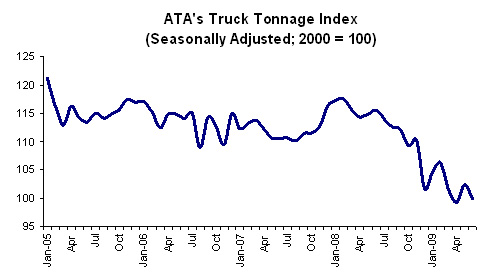


The ATA release warns:
"The sample includes an array of trucking companies, ranging from small fleets to multi-billion dollar carriers. When a company in the sample fails, we include its final month of operation and zero it out for the following month, with the assumption that the remaining carriers pick up that freight. As a result, it is close to a net wash and does not end up in a false increase. Nevertheless, some carriers are picking up freight from failures, and it may have boosted the index. Due to our correction mentioned above, however, it should be limited."
(h/t Barry Ritholtz at the Big Picture.)

14. HOME PRICE DECLINE SLOWING, CALIFORNIA FORECLOSURES DOUBLE NEW HOME SALES IN JUNE

Barry Ritholtz reports that home price declines are "slowly abating." Here is his graph:
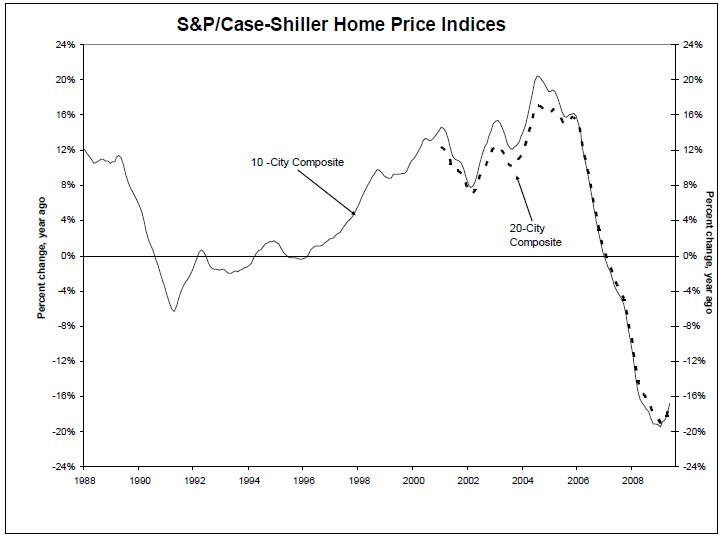


Jake at Econopic picked up on the Big Picture's quote of the day of Mark M Hanson which notes that California foreclosures are more than double the national new home sales for June. His graph:


15. EPA MAY GIVE ALGAE BIG BOOST

Russell Gold at Environmental Capital notes that Blair Carter at the Renewable + Law Blog reports that "that the Environmental Protection Agency will count algae as an advanced biofuel under Renewable Fuel Standard rules being developed."
"Why do EPA’s steps towards including algae matter? Because when Congress created its mandate to blend advanced biofuel into the fuel pool, it created a big market for these fuels. By 2012, the law mandates that two billion gallons of these advanced biofuels be blended, a figure that rises by tenfold by 2022. It’s all in Section 202 of the Energy Independence and Security Act of 2007.

... For algae to be included, the law says it needs to have no more than 50% of the 'lifecycle greenhouse gas emissions' of gasoline and diesel. This could be tricky, says David Woodburn, an alternative energy analyst with ThinkEquity. 'The hard part for me is understanding how the EPA plans to calculate the GHG emissions of algae fuels, based on the variety of feedstocks (sugar, CO2, other), processes (open ponds, photobioreactors), and algae varieties being explored--especially before November,' he says, noting when the rules are supposed to be finished."
Blair Carter's post can be found here.

16. TEXAS DROUGHT GETS WORSE

Tom Benning at the Wall Street Jounral reports on the drought in Texas.
"Nearly 80 of Texas' 254 counties are in 'extreme' or 'exceptional' drought, the worst possible levels on the US Department of Agriculture's index. Though other states are experiencing drought, no counties in the continental U.S. outside Texas currently register worse than 'severe.' In late April, the USDA designated 70 Texas counties as primary natural-disaster areas because of drought, above-normal temperatures and associated wildfires."
The Journal carries an interactive graphic:

Monday, February 9, 2009

Daily Sources 2/9

1. Peter Boone, Simon Johnson, and James Kwak at Baseline Scenario have a long and detailed post on the likely direction of the global economy, which they say faces an economic environment similar to the one faced by Japan in the 1990s and a "lost decade" for the global economy is a likely outcome.
"[The] situation in emerging markets is moving sharply towards near-crisis, particularly as global trade contracts and there are immediate effects on both corporates and the financial system. Currency collapse and debt default will be averted only by fiscal austerity. The current IMF strategy - most clearly evident in East-Central Europe - is to protect creditors fully with programs that do not allow for nominal exchange rate depreciation. This approach increases the degree of contraction and social costs faced by domestic residents, while also making economic recovery more difficult. These programs will likely prove more unpopular and less successful than were similar programs in Latin America in the 1980s and in Asia in the 1990s. As East-Central Europe slips into deeper recession, there are severe negative consequences for West European banks with a high exposure to the region (including Austria, Sweden and Greece)."
Quite long and detailed, but worth reading if you have the time.

2. Marcus Hand at Lloyd's List reported Friday that the Thursday surge seen in the Baltic Dry Index of 14% was driven by a jump in Chinese iron ore imports. Given that there will be limited demand for steel in the near term--though the stimulus program should provide some sort of bottom--the recovery in the BDI could be short-lived. But, so far anyway, the BDI continues to show signs of recovery, so much so that you can even discern it from a year's-eye view:


Another potential reason for the recovery, however limited, indicated by the BDI has been the Chinese New Year. I don't see how the New Years would have an affect now; clearly the BDI couldn't have fallen all that much farther from its low.

3. David Pearson at Real Time Economics reports that Bank of France governor Christian Noyer said in a radio interview Saturday that there was no risk that any eurozone countries would leave the monetary union.
"There has been some speculation in recent weeks that one or two countries might seek to leave the system to escape its rigid policy rules. But Noyer observed that recent investment rating downgrades of sovereign debt by some rating agencies have been 'very excessively exaggerated.'"
4. Andrew Batson at Real Time Economics looks at the analyst disputes over the extent to which Beijing's official economic data represents reality. He includes a list of estimates by several banks regarding what the 6.8% official GDP growth for the fourth quarter represents in terms of annual GDP growth.


The story also quotes the head of China's National Bureau of Statistics--Ma Jiantang--as throwing water on the notion that electricity consumption growth is a good proxy for GDP growth, "‘You have negative growth in electricity consumption, so how can GDP be growing by 6.8%?’ People who hold this view do not actually understand the internal relationships of different factors in the economy." Fair enough, still I'd appreciate an explanation of those "internal relationships of different factors in the economy."

Meanwhile, Zhang Dingmin at Bloomberg reports that China's Ministry of Finance’s research institute published a report Saturday calling for depreciation of the renminbi to about 6.93 per dollar (or about $0.1443/renminbi, about a 1.5% depreciation from the current interbank rate.)

5. In a series of post, Edward Hugh at Fistful of Euros reports that the Latvian economy contracted by 10.4% in the fourth quarter, that the Bank of France expects a contraction of 0.6% in the first quarter, which would mean that it will have technically entered a recession, and that the German Federal Statistics Office announced this morning that December exports were up 3.7% in November and down 7.7% from a year before.

6. The Spanish finance minister, Pedro Sobles, has an opinion piece in Wall Street Journal Europe calling for further economic cooperation in the face of the financial crisis.

7. Joaquín Almunia--European commissioner for economic and monetary affairs--has an opinion piece at Wall Street Journal Europe which argues that the reluctance to moderate the excesses of the laissez faire system are gone, suggesting a new consensus.
"The period we are entering will be characterized by a more active involvement of the public sector in the economy and, in particular, by a more abundant and extensive regulation of the financial system. That system will have to be more transparent, its supervision more rigorous, cross-border coordination of supervisory authorities more efficient, and risk management more cautious. Consensus on all these aspects is very broad: The roadmaps which have been drawn up listing the initiatives to make this possible, at the European and global levels, are detailed and lay down a strict timetable. Europe has started delivering: We have taken steps to strengthen capital requirements, to have stricter regulation for credit rating agencies and to protect bank deposits. We have changed accounting rules and taken steps to bring the credit default swaps market into central clearing in the EU.

But we have no illusions about the scale of the task ahead. We need to deliver more and do so quickly, all while coordinating action at the international level. This requires urgently involving the emerging economies in this task and in the relevant international forums such as the International Monetary Fund and the Financial Stability Forum."
8. Edward Hugh at Fistful of Euros reports that the great bulk of the speculative attacks on the ruble have apparently been funded by the government itself! It turns out that Moscow had extended credit to the banks in an effort to combat the credit crunch, and that the banks had used the funds to finance speculative attacks on the ruble.
"Kommersant reported (Friday) that policy makers planned to reduce bank loans in an attempt to limit bets on the ongoing ruble devaluation. As a result the ruble remained safely within the target band all day Friday, and there was no need for any kind of intervention."
Meanwhile, Hugh lists a long roster of indicators showing that the Russian economy is going through a brutal contraction.

"If we look at the monthly contraction rate as a reflection of the current quarter on quarter contraction, we find a rate of minus 1.6%, which means that the present rate is something like a 6.5% annualized [rate of contraction]. At present this is stationary and not accelerating, but it is quite strong, especially for an economy which only six months ago was expanding at a 6.5% annualized rate."
Long, but worth a look.

9. Philip P. Pan at the Washington Post has an interesting piece which argues that recent moves by Russian President Medvedev suggest that he is increasingly asserting independence from Putin and that a break is developing between the two men.
"In a sign of tensions in the relationship, one Russian official, also speaking on the condition of anonymity, said Putin and Medvedev recently decided that a note-taker should keep minutes of their discussions because 'misunderstandings' had arisen following past meetings. 'It's a very bad sign,' the official said, arguing that a rift in the leadership could destabilize the government."
Tea leaves aside, the narrative that Putin is the absolute ruler of Russia with Medvedev as his pawn has been way oversold. That said, the notion that there is a real break between the two looks like wishful thinking to me at this stage. Either way, the article is well worth reading. Craig Whitlock, also at the Washington Post, on Sunday reported that Vice President Biden, said at an international security conference in Munich on Saturday that the Administration seeks to "reset" relations with Moscow.Biden said,
"The last few years have seen a dangerous drift in relations between Russia and members of our alliance. The US and Russia can disagree but still work together where its interests coincide."
Angela Merkel echoed the need to incorporate Russia into European security projects, but Nicholas Sarkozy and Polish prime minister Donald Tusk both appeared convinced of hostile intentions on the part of Moscow. Long, but also worth reading.

10. Shigeru Sato at Bloomberg reports that Japanese refiners have told the media that Saudi Aramco has slashed the amount of crude it will supply them by 11 to 14% from their annual contracted levels.

11. Jim Jelter at Market Watch on Saturday reported that Iraqi Oil Minister, Hussain al-Shahristani, told journalists that he expected OPEC to cut supply again in the March meeting. Al-Shahristani said that Baghdad thinks the price should be at least $70/b. (Revenues from the oil and gas sector account for about 90% of the government's budget.) Margaret McQuaile and Stuart Elliott at Platts report that OPEC's secretary general--Abdalla el-Badri--suggested that OPEC needs to comply completely with the current 4.2 mb/d supply cut before another cut could be agreed to. Badri said that 897 kb/d of supply needs to come offline before the 4.2 mb/d target is met. He also urged non-OPEC producers to join in the cut, saying "We urge Norway, Russia and Mexico to give a hand, because the situation is very difficult and we cannot handle it by ourselves." He also said that OPEC currently has 8 mb/d of surplus capacity shut in.

12. The Gulf Times reports that Iran's National Audit Office reported that $1.058 billion in surplus oil revenues for the 2006-7 budget has not been returned to the national treasury by the Ahmadinejad administration.

13. Shai Oster at the Wall Street Journal reported Friday that Chinese President Hu Jintao and Premier Wen Jiabao ordered the State Council on Thursday to make every effort to combat the drought now afflicting China. The drought is the worst seen since 1951 in some areas, and is likely to severely affect the wheat crop.
"The affected area is primarily in central and eastern China, covering the country's breadbasket where much of the winter wheat crop is raised. The area also includes the region surrounding Beijing, the capital, which hasn't had precipitation in more than 100 days. In all, 1.85 million livestock are short of water."
The International Grains Council forecast a sharp reduction in the world wheat 2009-2010 harvest in late January (see Daily Sources 1/30 #8.) In November, China's National Development and Reform Commission set grain self-sufficiency as a national security goal of 2020 (see Daily Sources 11/4 #5.)

14. Joshua Partlow at the Washington Post reports that the drought in Argentina has killed at least 1.5 million cattle there. The drought started a couple of years ago near Buenos Aires and has spread through the pampas--Argentina's breadbasket. The cattle are so starved that the government has recently reduced the minimum weight allowable for the market to 575 lbs from 615 lbs.
"Agricultural groups estimate that Argentina, one of the world's top grain exporters, has lost more than $5 billion from the weather and that it could significantly slow the nation's economic growth. The 2008 harvests of several crops came in far smaller than those of the previous year."

Wednesday, January 14, 2009

Daily Sources 1/14

1. Lucian Kim and Ben Farey at Bloomberg report that Russian President Dmitry Medvedev called for an emergency summit in Moscow to resolve the dispute, tentatively scheduled for Saturday, January 17.
"Russia is prepared to compensate Ukraine should it agree to ship gas to Europe from underground storage reservoirs near its western border, Medvedev said. Russia is also ready, together with the EU, to provide Ukraine with loans to pay for gas “at market prices,” he said."
Allegations that Moscow had barred EU monitors from gas dispatching centers were not repeated in the press, and I have been led to understand that the accusation has been withdrawn accompanied by apologies, though I have found no reporting on the matter. Gazprom CEO has told the media that Ukraine has demanded 1.5 billion cubic meters of gas for free in the first three months of the year to resume transit to Europe. Ukraine in turn has accused Gazprom of providing supply in such a way that would force Naftogaz to cut supply to its own domestic constituency. Platts reports that the European Commission has already shifted its focus to energy security for 2009 in response to the current crisis. Key issues include increased oil stocks and data coordination, gas supply diversification, and a review of nuclear power strategy. Reuters reports that European Commission chief Jose Manuel Barroso has told the media that he would advise EU firms to sue Russian and Ukrainian firms were supply not resumed shortly. Obviously, the threat of taking the state gas companies to court is unlikely to resolve the crisis in a timely fashion, suggesting that the EU has run out of ideas on how to approach the crisis.

2. Ellen Barry at the New York Times reports that violent protests took place in Riga late last night in which some protesters threw molotov cocktails at police. From the photographs the protests appear pretty serious, and President Valdis Zatlers said today that he might call for a referendum which would allow voters to dissolve parliament, should they so choose. Some members of parliament suggested that foreign influences--presumably meaning Moscow--were responsible for the violent nature of the protests.

3. Olesya Varanyan and Ellen Barry at the New York Times report that a deal struck last month which gave Russian state energy company Inter RAO joint control of the Inguri hydroelectric plant for ten years has created a bit of a row in the Georgian parliament. The plant, on the Georgian border with breakaway region Abkhazia, provides Georgia with half of its electricity requirement. Inter RAO will pay $9 million a year to co-manage the plant, previously electricity supplied to Abkhazia and the Russian north Caucasus simply went unpaid for.

4. Ariana Eunjung Cha at the Washington Post reports that China became the third largest economy in the world in 2007, with a GDP of $3.38 trillion versus Germany's GDP that year of $3.32 trillion. China's statistics bureau released revised figures today showing larger growth than previously estimated. "In 2007, the United States remained the world's largest economy with a GDP of $13.8 trillion and Japan the second-largest with a $4.38 trillion GDP, according to calculations based on an annual average of daily exchange rates by Merrill Lynch."

5. Carter Dougherty at the New York Times reports that German GDP shrank by 2% in the fourth quarter of 2008, apparently from falling exports. For 2008 as a whole the economy grew by 1.3%, down from the 2.5% growth rate seen in 2007.

6. Peter Mandelson, the UK secretary of state for business, has an op ed in yesterday's Wall Street Journal which argues that the Doha round of world trade negotiations should be President-elect Obama's top priority. Key excerpt:
"Inevitably, President Obama and his trade representative, Ron Kirk, will ask why this is worth their valuable political capital. The answer comes in two parts.

First, the global economic downturn has made a world trade deal more important rather than less. G-20 leaders in Washington in November recognized that securing the open trading system is an integral part of reforming and strengthening the governance of economic globalization after the banking crisis. This remains true even if their trade negotiators subsequently came up short in Geneva.

Second, US leadership is the only way to make it happen. It is not sufficient, but it is indispensable.

The importance of a Doha deal is that it would freeze global tariffs at today's levels or lower, which is an insurance policy against future protectionism. It would reform farm supports in the rich world, which is a good thing in itself, especially if you're a farmer in the developing world. It would see the big emerging economies pay into the global trading system, which has served them so well, with proportionate tariff cuts -- the kind of responsibility that goes with their overdue presence around the G-20 table. By establishing the parameters for the next decade of trade growth, just as the Uruguay world trade deal did back in 1994, it would be a signal of confidence in our shared global economic future at a time of immense strain.

The reality that waits for President Obama is that Doha now cannot be done without a fresh drive from the US. A new sense of commitment from Washington has to encourage the emerging economies back to the table on the basis of a clear sense of global equity."
Worth reading in full.

7. Rattaphol Onsanit at Bloomberg reports that the Thai central bank cut its benchmark interest rate by 0.75% to 2%, deeper than most economists had expected.

8. Reuters reports that the Qatari oil minister, Abdullah al-Attiyah, suggested in New Delhi today that $70/b was a reasonable price for oil, as it would ensure further investment. Al-Attiyah said he was against prices above $100/b. He also said that indications so far were that the OPEC members were complying with their production allocations. Platts reports that Saudi oil minister Ali Naimi told the conference in New Delhi that the fall in oil prices will play a major role in aiding the recovery of the global economy. Naimi does not think the current price levels reflect fundamentals, however:
"This price decline is partially due to the cooperation of producers and consumers, and as such demonstrates the ameliorating effect that can be achieved when stakeholders work together... With collaboration, combined with the Kingdom's moderate pricing policies, this aided price moderation for a short period. However, because of the current worldwide economic and financial downturn, price deceleration is to levels not reflective again of market fundamentals."
Meanwhile, Kate Galbraith at the New York Times reports that several states are considering raising gasoline taxes in order to meet some of their budgetary requirements. Bills have been drafted for approval in the California, Massachusetts, New Hampshire, Illinois, and Oregon legislatures. Both houses in the Iowa legislature would reportedly support an increase and a state task force in Ohio last week recommended raising the gas tax there by 13 cents. (Galbraith's article is well worth reading in full.) People are driving much less these days, which has reduced the volume of monies entering state coffers. That said, some argue that each $0.10 fall in the price of gasoline equals a $12 billion tax cut nationally, and raising gas taxes would be regressive, especially hurting low income consumers, who are already the most responsive to changes in price.

9. Ambrose Evans-Pritchard at the UK Telegraph reports that freight rates for containers via ship from Asia to Europe have fallen to zero, with brokers charging only operating costs for South China cargoes and North China cargoes at below cost. (h/t Yves Smith at naked capitalism)

10. Winnie Zhu at Bloomberg reports that China cut petroleum product prices for the second time in a month, bringing prices closer to world market rates.
"'Today's move shows the government will adjust domestic fuel prices more frequently and bring them closer to global markets,' said Qiu Xiaofeng, an oil analyst with China Merchants Securities Co."
Maybe, but it doesn't mean the government is allowing the price to float, which had been suggested earlier.

11. Juan Cole at Informed Comment reports that the conflict in Gaza is undermining the previously blossoming security relationship between Israel and Turkey. Prime Minister Erdogan has defended his criticism of the actions in Gaza saying "Some say my criticism is harsh, I assume it is not as harsh as phosphorus bombs or fire from tanks ... ." Yesterday at 11 am all students in schools were ordered to observe a minute of silence for the victims in Gaza. A consumer boycott of Israeli goods has been launched in the country.

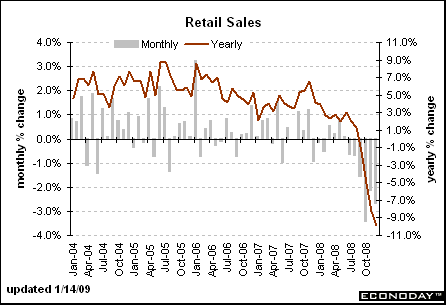
12. Barry Ritholtz reports that retail sales fell 9.8% year over year in December. Gasoline and auto sales led the decline. He links to a Barron's graph which tells the story well:


13. The EIA's This Week in Petroleum reported today that crude oil stocks grew by 1.2 million barrels for the week ended January 9 to 326.6 million barrels altogether. The numbers are well below the analyst expectations via a Bloomberg survey of a 2.5 million barrel build, but the total is well above the historical range. Gasoline stocks grew by 2.1 million barrels, somewhat more than analyst expectations of a 1.85 million barrel build, and are in the middle of the historical range. Distillate stocks grew by a whopping 6.4 million barrels and are well above the historical range. Inventories at Cushing, Oklahoma, are reportedly now at 33 million barrels, not far from capacity. Taken in isolation, the report should put downward pressure on price.

Martyn Wingrove and David Osler at Lloyd's List report that brokers and ship owners estimate that as much as 80 million barrels of crude is either in storage or en route to a storage destination on supertankers and some suezmaxes. "Rising storage requirements helped boost charter rates for VLCCs operating on the Middle East to Asia routes to around W75 – a time charter equivalent of up to $80,000 per day."

The EIA's Short Term Energy Outlook forecasts that US total oil consumption fell to 19.51 mb/d in 2008, down from 20.68 in 2007. The EIA predicts consumption will fall further in 2009 to 19.12 mb/d.

Tuesday, November 25, 2008

Daily Sources 11/25

1. Brad Setser at Follow the Money argues that the time of the sovereign wealth funds is over. Those funded by oil revenues are no longer receiving the cash flows that they once enjoyed. Brazil, Russia, South Korea, and India will not have large funds in the near future in Setser's opinion. Abu Dhabi's fund will be hampered by the need to finance Dubai's debt, as the emirate's domestic state firms were heavily leveraged. Norway's fund had $380 billion earlier in the year, and now has about $300 billion. The problem is that the funds were set up to invest surplus funds in equities and it is precisely the equity markets which have been hit the hardest by the current crisis. In an ironic twist, the US is purchasing equities now that they are cheap by taking stakes in firms with large international positions. China is the wildcard. Well worth reading in full.

2. Platts reports that Russian energy minister Sergei Shmatko told reporters in New Delhi that Russia "will coordinate with OPEC." OPEC representatives have recently suggested that one critical element of the November 29 meeting in Cairo would be to secure Russia cooperation with their efforts to shore up the price of oil. Moscow has typically been cool to the idea of coordinating production with the cartel, but yesterday a senior executive at Lukoil suggested that doing so would be in the Russian interest. This is the first indication from an official government representative that Moscow might adopt the strategy of pursuing a closer relationship with producers rather than a symbiotic energy security relationship with Europe. Moscow could potentially play the role of a swing producer--it produces about as much oil as Saudi Arabia--but so far has opted to produce at full tilt and send it all to market.

3. Ulf Laessing at Reuters reports that the Kuwait Investment Authority has repatriated $3.7 billion in foreign investments in order to shore up the local stock market.

4. Eric Watkins at the Oil & Gas Journal reports that Total and Saudi Aramco have decided to delay the award of the $10 billion, 400 kb/d, export refinery in Jubail given the global economic environment. Last week Riyadh decided to suspend development of the Manifa field, which was planned to produce 900 kb/d by 2011 and which was to fuel the Jubail refinery. (Also last week Conoco and Aramco announced they would delay construction of the 400 kb/d export refinery to be built at Yanbu.)


5. The Associated Press reports that Russian warships arrived off Venezuela's coast today. The ships are slated to take part in military exercises this month and were clearly sent in response to the American presence in the Caucasus. US State Department Spokesman Scott McCormack on Monday seemed to mock the move in the State Department's daily briefing of the press, saying "You know, I don’t know. Are they accompanied by tugboats this time? I – you know, look, there’s no – I don’t think there’s any – there’s any question about, you know, who the region looks to in terms of political, economic, diplomatic and as well as military power." (Peter the Great is the Russian Navy's flagship--a nuclear cruiser--which seemed to face some operational difficulties earlier this year.) The joke suggests a certain level of insobriety at the State Department, a not entirely welcome apprehension. Almost immediately afterward, however, he gave the official American response: "I don’t know if the intention was provocative. Certainly, we don’t – we won’t view it that way."

6. Sinan Salaheddin at the Associated Press reports that the chair of the Iraqi Parliament's Committee on Oil and Gas has criticized the deal between the Oil Ministry and Shell to jointly exploit natural gas in the southeastern province of Basra.

7. Galrahn at Information Dissemination posits the argument that it is in the interests of the US to fail to police piracy originating from Somalia because to do so would deny funding to the capitalist elements of society at the very time that the Islamists are struggling for funding. The argument contains some odd presumptions, and, for example, his analysis of the operating cost additions in the shipping industry is misguided. (It is not just, for example, the oil industry which is abandoning the route via the Suez Canal, but all shipping--including container ships, etc.. When so many tonne miles are added, and so much capacity is thereby taken off line, prices should go up. And, the shipping industry certainly hopes so!) Alaric Nightingale at Bloomberg reports that tanker rates have not revived on the back of the route shift, however, with the cost of shipping Middle East crude to Asia, the global benchmark, falling to 66 Worldscale (WS). That is a big decline from the top of the market, but, if I understand correctly, much better than what other categories of shipping are receiving on the market.

"[W]hile hire rates may have declined, returns for shipowners remain profitable. The route from Saudi Arabia to Japan is paying shipowners $44,442 a day, according to the Baltic Exchange. Frontline Ltd. said Aug. 21 it needs $31,500 a day to break even on each of the vessels."
And sending tankers past the Cape of Good Hope instead of through the Suez adds a considerable amount of time to a shipment.
"Sailing at 14 knots, it takes 33.2 days to ship Saudi Arabian crude oil to Rotterdam via the Cape of Good Hope, compared with 19.2 days going through the Suez Canal, according to the world-register.net Web site."
That said, business requires the rule of law in order to operate, which, for example, is why the Islamists have supporters in Somalia, and, as an article today suggests, support is rebuilding for them in Afghanistan. Nonetheless, it would be interesting if the US were put in a position to support the pirates as the only viable governing alternative to the Islamists. It would not, as Galrahn suggests however, be especially supportive of the free market ideology.

8. Steven Bodzin at Bloomberg reports that Hugo Chavez told reporters that OPEC should reintroduce the practice of announcing a price band that it is prepared to defend, and that a fair price for oil is between $80-100/b.

9. AFP reports that on Monday China signed a protocol with Jordan to assist Amman in mining and enriching uranium, as well as with scientific training for the construction and operation of nuclear power plants. "The country's 1.2 billion tonnes of phosphate reserves are estimated to contain 130,000 tonnes of uranium and the government intends to start mining the radioactive ore to fuel its first nuclear plant."

10. Kim Barker at the Chicago Tribune reports that "pervasive corruption" is fueling anger at the Karzai government in Kabul. The corruption is causing many to long for Taliban rule as the Taliban strictly enforced the law. As I have pointed out in a few posts much earlier in the year, one of the central preoccupations of Islam is with the rule of law.

11. Calvin Lee at Platts reports that Yang Qing, deputy director of China's National Development and Reform Commission's price monitoring bureau told a forum in Beijing Tuesday that export growth was falling sharply due to the fall in US demand. According to Yang, a 1% drop in US GDP will cause Chinese export growth to contract by 7-8%. (Not exports, but export growth.) Geoff Dyer at the Financial Times reports that the World Bank's quarterly report on China predicted that China's growth rate will fall to 7.5% next year, 0.5% below the rate generally reported as necessary to absorb growth in the labor market and thus avoid social unrest.

12. José de Cordoba at the Wall Street Journal reports that the government of Hugo Chavez is providing safe havens inside Venezuela for members of FARC to carry out cross-border operations into Columbia. FARC is allegedly setting up road checks, "meting out justice to petty thieves and extorting businessmen." FARC leadership is also apparently living on and operating from the Venezuelan side of the border, and some of the organization's predatory behavior with the locals has apparently roiled some in Caracas. FARC also evidently has offices in Venezuelan cities deep inside the country. The article is worth reading in full and includes, in a sidebar, translations of some of the FARC emails found on a computer captured earlier this year. Below is the Journal's map of the regions where FARC and the ELN have set up shop inside Venezuela.


13. Tim Johnston at the Washington Post reports that Thai protesters broke through riot police lines and stormed the Suvarnabhumi Airport, shutting down the new facility. Generally speaking, this would be pretty startling news, indicating that the government is about to fall in short order. But the protest movement has only been able to muster about 20,000 people, which is not enough, usually, to do things like grab control of major ports or broadcast stations. Either the government is about to change, a crackdown is about to be instituted, or the numbers are being woefully under-reported. This seems especially the case given that the police have been fired upon by some protesters. The Post has a slide show of the protesters--looks like they overpowered a considerable force of riot police.

14. Eurointellingence reports that the Franco-German summit went badly. Angela Merkel wants to schedule another summit for January to see how successful the various national stimulae have been, and just after France has passed on the baton of the EU Presidency.

15. Aaron Eglitis and Ellen Pinchuk at Bloomberg report that the Latvian Finance Minister Atis Slakteris told the journalists that the country will likely ask the IMF and the European Union for emergency funds of as much as €3 billion (~ $3.85 billion).
"'The Baltic countries, in particular Estonia and Latvia that have experienced the strongest upswing, are now facing a severe downturn," Helge Pedersen, global chief economist for Nordea, said in a report. Estonia contracted 3.3 percent in the third quarter. Swedbank AB, the biggest bank in the Baltic states, said on Nov. 20 it expects Latvia’s economy to shrink 4 percent next year."
16. Robert Barnett has an opinion piece at the New York Times which points out that the UK on October 29 recognized Tibet as a part of the People's Republic of China, a switch from its previous position that Tibet was an autonomous region. The British recognition of Tibet as an autonomous region had provided the legal basis for negotiations between Beijing and Tibetan representatives. No more. Barnett suggests that London has reversed course because the UK requires the cooperation of Beijing in the current financial crisis.

17. Norma Cohen at the Financial Times reports that the OECD released its world economic forecast today which predicts that the US and the eurozone both are about to enter four straight quarters of economic contraction. "In pinpointing countries that will experience a severe downturn, in addition to the UK, the OECD lists Hungary, Iceland, Ireland, Spain and Turkey."

18. Stefan Wagstyl at the Financial Times reports that the European Bank for Reconstruction and Development has cut its forecast of GDP growth in 2009 for Central and Eastern Europe from 5.7% to 3%.
"In Russia, the region’s largest economy, the bank forecasts a slowdown in growth from an expected 7.3 per cent this year to 3 per cent, following the drop in oil prices. In neighbouring Ukraine, the decline is predicted to be even steeper, from 6 per cent to 1 per cent. The average for the former Soviet Union (minus the Baltic states) is likely to be 3.4 per cent, from 7.3 per cent this year.

Further west, in Poland, the second biggest economy after Russia, the EBRD predicts a decline from 5.3 per cent to 2.8 per cent.

The worst performance is expected in the Baltic states, with recession in Estonia and Latvia next year. Central Europe and the Baltic states as a whole are predicted to see growth almost halve from 4.3 per cent in 2008 to 2.2 per cent. In south-east Europe the forecast fall is even greater, from 6.5 per cent to 3.1 per cent."
19. The Associated Press reports that the Conference Board said today "that its Consumer Confidence Index was 44.9, up from a revised 38.8 in October. Last month’s reading was the lowest since the research group started tracking the index in 1967."

20. Michael M. Grynbaum at the New York Times reports that most recent numbers for the Case-Shiller Home Price Index were released today and that they suggest that home prices fell across the United States by an annual rate of 16.6% in the third quarter. Also today the Commerce Department revised its estimate of the contraction seen in the third quarter from down 0.3% from the year before to down 0.5%.

21. Damian Paletta at Real Time Economics reports that the FDIC has released its list of troubled banks and the number of challenged banks has grown from 171 at the end of the third quarter from 117 at the end of the second quarter. The post includes a link to an interactive table of the banks that have been forced to shut down by federal regulators this year.

22. Yves Smith provides a quick reaction to the news that the Treasury and Federal Reserve Bank have announced a plan to provide $800 billion to support consumer lending. Real Time Economics provides the text of the announcement.

Wednesday, September 24, 2008

Daily Sources 9/25

1. Kevin Hamlin at Bloomberg has the much commented on story (h/t Naked Capitalism) that Chinese academic Yu Yongding said today that the leaders of the major Asian economies need to come to some sort of agreement whereby they would agree not to dump US debt. I think it is important to stress that Mr. Yu is not speaking for the government of China. He has served as the Director-General of the Institute of World Economics and Politics (IWEP) since 1998 and as the President of the China Society of World Economics since 2001, as Editor of China and World Economy, and Associate Editor of Asian Economic Policy Review.

This is not to say that Dr. Yu is not influential: he was formerly the academic member of the Monetary Policy Committee of the People's Ban of China (PBOC) and a member of National Advisory Committee of the 11th Five Year Plan of the National Reform and Development Commission (NDRC). The NDRC, formerly the State Planning Committee, was expanded into a sort of super-ministry with 26 departments in 2003. It plays the dominant role in setting Chinese energy policy, for example, though this is set to be transferred to the new National Energy Bureau in an effort to centralize Chinese energy policy making and oversight.

Either way, he is not a member of government now. As per Hamlin:
"China is very worried about the safety of its assets," [Yu] said. "If you want China to keep calm, you must ensure China that its assets are safe." ... Yu said China is helping the U.S. "in a very big way" and added that it should get something in return. The U.S. should avoid labeling it an unfair trader and a currency manipulator and not politicize other issues, he said.
...
"Our export-growth strategy has run its natural course,'' he said. ``We should change course." ... China should stop intervening in the foreign currency markets and thus allow rapid appreciation of the yuan, he said. ... If China doesn't allow the yuan to appreciate and continues to promote export-led growth it will lead to confrontation with the U.S. and Europe, Yu said.
...
"China knows what to do. We don't need your intervention."
... in an evident allusion to the bail out plan. In a related story by Alan Wheatley and Langi Chiang at Reuters, Chinese regulators have allegedly told Chinese banks to stop interbank lending to US banks.


As to Chinese policy going forward, Leslie Hook has an opinion piece at the Wall Street Journal Asia which is mostly an interview with Liu Mingkang, the Chairman of China's Banking Regulation Commission.
He thinks that the abandonment of Glass-Steagall was a pivotal mistake by US legislators:
According to Mr. Liu, the chief regulator for China's banking sector, "the problem started a good 10 years ago, when people over there [in the U.S.] thought, 'We've got to boost innovations. So the Glass-Steagall Act is just the last stumbling stone on our way ahead. Move it away.'" ... Mr. Liu isn't "100%" in favor of the Act, which separated commercial and investment banking in the post-Depression era. (The U.S. repealed the law in 1999, under the Clinton administration.) But he maintains that this separation is good for China, where, he says, the capital market is the capital market, and the banking industry is the banking industry.
(Although the Act was repealed during the Clinton Administration, it was repealed by a GOP dominated Congress.)

2. Edmund L. Andrews at the New York Times reports that Ben Bernanke told the Congressional Joint Economic Committee that "economic activity appears to have decelerated broadly" across the spectrum of industries and services.

3. William Branigin, Dan Eggen and Paul Kane at the Washington Post have the story that Congressional negotiators have emerged from off-the-record meetings and announced that they are close to an agreement regarding the bailout proposal. The Dems have apparently gotten the GOP to agree to strict oversight, curbs on executive pay, help for homeowners, and an equity position for taxpayer monies. Headlines aside, the House Minority Leader John A. Boehner, also declared today that there was no deal on the bailout package.

4. Real Time Economics reports that the German Finance Minister, Peer Steinbrueck, in a parliamentary debate said he approved of recent actions by US authorities to stem the financial melt-down, though he argued they were late to act, and added that it's "'not necessary nor reasonable' for Germany or Europe to take similar action because 'the financial market crisis is most of all an American problem.'" He also argued that this meltdown signaled that "The U.S. will lose its status as the super power of the global financial system, not abruptly but it will erode. The global financial system will become more multipolar." What I find odd about this statement is the inferred notion that international finance is national in nature, though perhaps he was merely signaling that the central role of the dollar is going to erode ... further.

5. On Tuesday, Neil MacFarquhar had the story that the UN General Assembly meeting in New York was being used by "one world leader after another" to criticize the US for the financial crisis. Out of those mentioned in the story, the unusual (and significant) suspects are: Brazil and Germany (though the critique came from Berlin, not in NY). The Secretary General of the UN, Ban Ki-Moon, used his opening speech to criticize the notion of free markets.
“What you are seeing here is the letting off of some political steam,” said Mark Malloch Brown, a British cabinet minister and former senior United Nations official. “They are all remembering the very hard, unforgiving advice that they got from American financial institutions” to “deflate your economy, let your banks go to the wall,” he said. “There is a resentment at what they would see as a further evidence of double standards.”
6. Neil MacFarquhar and Thom Shanker at the New York Times report that leaders from Ukraine, Poland, and Latvia urged the UN to "stand up to" Russia in the General Assembly this week. Did other neighbors refrain or was it simply not reported? If they refrained from comment, or joining in assent with the others, that would be interesting to know.

7. Colum Lynch at the Washington Post has the story that the Russian Foreign Minister, Sergei Lavrov, said yesterday that Russia has refused to attend a high level meeting to discuss options regarding Iran in retaliation for not being invited to the meeting held by the G-7 to discuss the financial meltdown. And Philip P. Pan at the Washington Post reports that a former Chechen rebel leader who switched sides and helped bring Chechnya under control, so to speak, was assassinated in Moscow yesterday. Though it seems to fall on deaf ears, as I keep on reiterating, American and Russian interests are more aligned than, say, Russian and Iranian, or even Chinese, interests. I wish the relevant authorities would begin to act on that hypothesis, at least.

8. Seeking Alpha has an analysis of ENI's (Italy's largest oil company) evident strategy of long term and close cooperation with Gazprom. I would add that American sound and fury about oil diplomacy notwithstanding, it still appears that Europe as a whole is continuing to pursue a policy of energy interdependence with Russia as their view to security.

9. Russian Energy Minister Sergei Shmatko said, apropos the high level delegation Moscow will send to OPEC's December meeting, "Russia must deal [more] actively with issues of influencing the level of crude prices. A Russian factor must appear." He said Russia might best do this by providing more regular production forecasts from its fields. (So this could either mean for manipulation or for improved transparency.) Shmatko made clear that Russia was not contemplating joint actions with OPEC.

10. Ronald Buchanan at Platts reports that Mexico's state oil company, Pemex, has shut in 250 kb/d of crude production because US refineries shut down for Hurricane Ike has meant a lack of demand. Storage tanks were full. Two tankers were to arrive yesterday to help free up some storage. This is on top of reduced overall crude production from Mexico.

11. Tom Doggett at Reuters has the very interesting story that the head of the IEA, Nobuo Tanaka, appeared to agree with the US decision not to draw on IEA emergency gasoline stockpiles, saying that the market was taking care of the issue.
"We have consulted very closely with the Department of Energy on the current situation," Tanaka said, adding that the U.S. oil industry was "much better prepared" to handle the supply disruption caused by hurricanes Gustav and Ike than it was when Hurricane Katrina hit three years ago. ... "If the disruption continues in a very serious level, we definitely will use our (petroleum reserves) ... activate them, if necessary," he said."
Second guessing these statements is a bit of a dog's game, but the IEA is a particularly political organization and cannot really be seen to be publicly disagreeing with its member nations--and the US is a member nation. The clear signal that IEA was ready to supply gasoline should be good for the markets. But I would point out that gasoline lines are growing in the American south-east and that the lowest stock levels since 1967 should increase gasoline prices significantly.

12. Eric Schmitt at the New York Times reports that Pakistani and American forces exchanged fire on the Afghan border today. This is becoming worrisome.

13. Geoff Dyer and Benedict Mander of the Financial Times reported yesterday that Hugo Chavez struck a deal in Beijing to jointly build a refinery in Venezuela. He also announced that the two would double the size of their joint investment fund to $12 billion (€8.2bn, £6.5bn). Chavez announced before he set foot there that Venezuela would purchase 24 military air craft from China and was set to sign some 30 agreements while there, including the construction of four oil tankers and projects in agriculture, telecommunications, agriculture and electronics. Bilateral trade between the two is expected to exceed $8 billion, up from under $200 a decade ago. Nonetheless, announcements that refineries are going to be built are made all the time. They very rarely are actually made, and there aren't a lot of reasons for China to think it likely to be worth the effort. As I wrote to a buddy of mine last night:
I don't really see why China would think Venezuela attractive. Refineries cost several billion dollars, even small ones, and especially ones complicated enough to handle venezuelan crudes cost even more, and require lots of technical expertise. That's the technical expertise which the Venezuelans basically announced via recent prerequisite of technology transfer in all joint efforts that they didn't have themselves. Therefore, Chavez is asking China to:

a) pony up money
b) pony up expertise
c) pony up technology

and

d) trust that Chavez will not nationalize the effort once China has sunk all of the above into the effort,

even though China has

e) no ability to really project power into the region.

(After all, Chavez would still be protected behind an American umbrella of power. Venezuela has a history, actually, of utilizing the Monroe Doctrine to their advantage with colonial powers.)
But you pays your monies you makes your choice.