Showing posts with label kenya. Show all posts

Tuesday, July 28, 2009

Daily Sources 7/28

1. MAYER AND WOOD ARGUE THAT CHINA'S ENTRANCE INTO THE WORLD ECONOMY HAS NOT SIGNIFICANTLY DE-INDUSTRIALIZED REST OF DEVELOPING WORLD

Jörg Mayer and Adrian Wood at Vox EU argue that China's integration into the world's economy has not had the effect of substantially de-industrializing other developing nations.
"The biggest possible effect would be for a country which initially produced or exported equal amounts of manufactures and of primary products, where a 15% fall in the ratio would reduce the share of manufactures by 3.5 percentage points.

These estimates are imprecise and subject to error; the true answer may lie outside their range. But there is no plausible modification of the calculations that could make the true answer much larger. This is mainly because, despite its size, China’s opening had only a modest effect on world average endowments. The upper-limit estimates, obtained by simply adding China’s endowments to the rest of the world’s, are a 9% rise (from 0.43 to 0.47) in the share of the global workforce with a complete primary or secondary education, and a 17% fall in the average land/labour ratio, from 2.9 to 2.4 square kilometres of land per 100 workers ... . The average effect on the structure of output and trade in other countries is unlikely to have been larger than these world average endowment changes and was probably smaller.

The significance of the China effect varied widely among developing countries. This is partly because its size varied with the composition of each country’s manufacturing and primary production – how closely its industrial products competed with Chinese exports, and how much demand there was from China for its primary exports (more, say, for copper than for coffee). It is also because there were many other forces acting on sectoral structures--including changes in countries’ own trade policies--whose effects often outweighed those of China."
Worth reading in full.

2. NEPAL HARASSING TIBETAN REFUGEES

Gopal Sharma at Reuters reports that Nepal is responding to pressure from Beijing by cracking down on Tibetan refugees in the country.
"Nepali authorities have regularly broken up protests by Tibetan exiles and arrested them for protesting against China's crackdown on demonstrations in Tibet.

The Washington-based [International Campaign for Tibet] said Tibetan refugees were 'increasingly demoralized' as Nepal 'relinquishes its historic and sovereign interests in response to incentivized political pressure from Beijing and its sympathizers.'

ICT said 'pre-emptive arrests of Tibetans, ID checks and house searches' by authorities were contributing to a 'widespread sense of fear and insecurity' among the exiles.

'Nepal's political leadership is betting that the internal benefits of assuaging China in the cause of oppressing Tibetans will be greater... than the traditional legal and historical concepts,' Mary Beth Markey, Vice President at ICT said."
3. INDIA TO ANNOUNCE SOLAR POWER TARGETS OF 1/8TH TOTAL ELECTRICITY DEMAND, CENTRAL BANK LEAVES INTEREST RATE UNCHANGED ON INFLATION CONCERNS

Krittivas Mukherjee and David Fogarty at Reuters reports that India will announce its targets for solar power generation in September. The plan promises to
"boost output from near zero to 20 gigawatts (GW) by 2020 as it firms up its national plan to fight global warming, draft documents show.

The target, which would help India close the gap on solar front-runners like China, is part of an ambitious $19 billion, 30-year scheme that could could increase India's leverage in international talks for a new UN climate pact in December, one of several measures meant to help cut emissions.

If fully implemented, solar power would be equivalent to one-eighth of India's current installed power base, helping the world's fourth-largest emitter of planet-warming greenhouse gas emissions limit its heavy reliance on dirty coal and assuaging the nagging power deficit that has crimped its growth.

The 'National Solar Mission', yet to be formally adopted by Prime Minister Manmohan Singh's special panel on climate, envisages the creation of a statutory solar authority that would make it mandatory for states to buy some solar power, according to a draft of the plan, which provided detailed proposals for the first time, obtained by Reuters ... ."
Meanwhile, Cherian Thomas at Bloomberg reports that India's central bank decided today to leave its benchmark interest rate unchanged at 3.25%.
"The central bank raised its inflation forecast for the year to March 31 to 'around 5%' from an April estimate of 4%, citing 'elevated' food and commodity prices."
4. EU TO TRAIN SOMALI SECURITY FORCES TO POLICE PIRACY

BBC News reports that the EU has announced plans to train Somali security forces to tackle the piracy plaguing their coasts.
"It will send a planning team to the region next month. The training will take place in neighboring Djibouti, which has French and US military bases."
(h/t Joshua Keating at FP's Morning Brief.)

5. IMF AND LATVIA REACH ACCORD, MAY OPEN UP NEW FUNDING

Aaron Eglitis and Timothy R Homan at Bloomberg report that the IMF and Latvia have reached an accord paving the way for the country to receive its first financial assistance from the organization since December.
"The review may unlock about 195 million euros ($285 million), which the IMF withheld in March after the Baltic country failed to commit to budget cuts, the fund said in an e- mailed statement.

Latvia turned to a group led by the European Commission and the IMF for a 7.5 billion-euro stabilization loan in December after its second-biggest bank needed a state rescue. The IMF announcement followed a 1.2 billion-euro transfer by the European Commission yesterday, helping quell concern about a lats devaluation that may have destabilized currencies across the region."
6. MOUSAVI CALLS FOR NEW STREET PROTESTS NEXT WEEK IN IRAN

Borzou Daragahi at the LA Times reports that opposition candidate Mir-Hossein Mousavi has called for more street protests during religious festivals next week.

7. KENYA TO BUILD AFRICA'S LARGEST WIND FARM

Xan Rice at the UK Guardian reports that Kenya plans to build the largest wind farm in Africa.
"Some 365 giant wind turbines are to be installed in desert around Lake Turkana in northern Kenya – used as a backdrop for the film The Constant Gardener--creating the biggest wind farm on the continent. When complete in 2012, the £533m (~ $758.8 million) project will have a capacity of 300MW, a quarter of Kenya's current installed power and one of the highest proportions of wind energy to be fed in a national grid anywhere in the world."
8. FUEL OIL APPROACHING COST OF CRUDE, HURTS SHIPPING, CHINESE FUEL OIL IMPORTS ROCKET UPWARD (FROM LOW BASE), VIETNAMESE MAIDEN REFINERY TO TAKE SPOT GASOLINE DEMAND OFF MARKET, WALL OF ASIAN PACIFIC REFINING YET TO PLAY OUT

Christian Schmollinger and Alaric Nightingale at Bloomberg report that the price of fuel oil--bunker fuel, the bottom of the barrel, which is used to power ships in great part because it is cheap, generally trading at a considerable discount to crude, is approaching the price of light crude and may surpass it.
"Fuel oil may surpass crude 'for quite some time, six months is possible,' JPMorgan Chase & Co. vice president of energy strategy Vima Jayabalan said in a phone interview from Singapore."
This means that the effect of rising crude prices is having a more pronounced affect upon the cost of shipping than it did during the 2003-2008 run up in the price of crude.
"'It’s really hurting' ship owners, said Parul Bhambri, a Singapore-based analyst at Drewry.

Maersk said May 12 that falling demand for freight hobbled its ability to pass on fuel costs to customers in the first quarter, when its shipping line lost $559 million after taxes, compared with an $80 million profit a year earlier. The shares are down 40% in the past year in Copenhagen trading."


As the price of fuel oil rises, however, many simple refineries, which do not have the equipment to maximize gasoline and diesel output, can become profitable again, which may undergird a recovery in overall crude demand. That said, it still doesn't look like there's much demand for gasoline and diesel out there, which could push down the crack spread and thus the price of crude. Winnie Lee at Platts reports that Chinese fuel oil imports in June were up 6.26% from May and 45.94% from June 2008 to 13.7 kb/d. It's largest supplier was Venezuela. In that vein, Irene Tang at Platt's the Barrel blog reports that the commissioning of Vietnam's first refinery at Dung Quat is poised to erase about 30% of the country's product import demand, which will in turn erase its demand for spot gasoline purchases. The wall of new refining capacity in Asia has yet to fully be appreciated,
"China has now joined India in becoming a major swing exporter of gasoline. Apart from greenfield refineries coming onstream in the country, Beijing's decision to adopt a new products pricing formula for the domestic market and the resulting price revisions in tandem with the global benchmarks has encouraged more speculative buying at the wholesale level, causing wide fluctuations in refiner inventories.

This, in turn, has made Chinese gasoline export volumes unpredictable. The latest customs figures show gasoline exports hit a two-year high of 560,000 mt in June, a 273% surge from the corresponding month of last year. The previous high was in April 2007, at 590,000 mt.

The figures point to Chinese 'apparent' gasoline demand in June being just 1.8% higher than the same month a year ago, a contrast with on-year growth rates of 20.2% in May and 13% in April. The anomaly of the June figure, in the backdrop of staggering double-digit growth rates of automobile sales in China and a 7.7% on-year average gasoline demand growth in the first half of the year, can only be explained by wild swings in stock builds and draws."
"The full impact of the start-up of Reliance Industries' new 580,000 b/d refinery in Jamnagar should be apparent as early as August, as the company's older 660,000 b/d refinery is now restarting from a partial shutdown. Monthly gasoline exports from RIL are expected to more than double to well above 600,000 mt."
9. NIGERIAN REBELS IN SOUTH TARGET OIL MINISTER'S COMPANY, NORTHERN ISLAMISTS CONTINUE UNREST

Platts reports that the Nigerian Joint Revolutionary Council has issued a warning to UK-based independent producer Afren Resources to stop operating in the Niger Delta or risk attacks on its equipment and personnel.
"The Joint Revolutionary Council, which styles itself as a coalition of militant groups based in southern Rivers and Bayelsa states, said in a statement that its ultimatum to Afren was aimed at expressing the group's opposition to the policies of Nigeria's Oil Minister Rilwanu Lukman--policies the group sees as skewed against the Niger Delta region in the country's south.

Lukman was a co-founder of Afren and stepped down from his position as chairman of the company's board of directors once he was appointed oil minister for Nigeria in late 2008. His shares in the company were to be held in a blind trust, the company said in a statement at the time."
Lukman wants to site an oil university in his home state in the north--Kaduna. Meanwhile, Ibrahim Mshelizza at Reuters reports on the increasing Islamist inspired unrest in northern Nigeria.
"The violence was triggered when some members of the group called Boko Haram, which wants a wider adoption of Islamic sharia law across Africa's most populous nation, were arrested Sunday in Bauchi state.

Unrest spread to the northern states of Kano, Yobe and Borno, whose capital Maiduguri is home to the group's leader, Mohammed Yusuf, and has seen the worst violence.


'The situation has been contained in Bauchi and Yobe. The bad situation we have now is in Borno where the leader of the group is residing ... We are going to launch an operation, a main operation to flush them out,' [Nigerian President Umaru] Yar'Adua told reporters after meeting security chiefs and state governors."
10. PRESSURE TO CHANGE DRUG WAR STRATEGY BUILDING IN MEXICO, MEXICAN CRUDE PRODUCTION WAY DOWN

William Booth and Steve Fainaru at the Washington Post report on the growing pressure on Mexican President to change Mexico's "surge" strategy in dealing with its drug cartels.
"Dan Lund, president of the MUND Group polling organization, said public support for Calderón's strategy appears to be weakest in the places where the federal government needs it most. 'In a series of national surveys, polls consistently have found a reasonable but cautious level of support for using the military in the front lines against the cartels,' he said. 'But in all the states where the military is actually deployed, the support goes down, sometimes dramatically.'

The situation has been exacerbated by the global economic crisis, which has cast millions of Mexicans into poverty. José Luis Piñeyro, a Mexican military analyst who maintains close ties with the armed forces, said rising unemployment and poverty 'is creating what I call an "army in reserve,"' for the traffickers.

In Michoacan, La Familia has used the media to try to align itself with the disenfranchised. After the recent attacks, one of its leaders, Servando Gómez, called a local television station and told viewers: 'I want to say to all Michoacanans, we love them and respect them.'"
Meanwhile, there was plenty of stories on the decline in Mexican production last week. John Kingston at the Barrel notes:
"But here's the more stunning figure: what's happened in two years. In July 2007, Pemex reported crude output of 3.165 million b/d. That's a 20.4% decline in 23 months."
11. VATICAN AIMS AT FREE MARKETEERS, SAYING MARKETS WITHOUT ETHICS DESTROY WEALTH AND CREATE POVERTY

Flavia Krause-Jackson at Bloomberg reports that the Vatican has attacked free markets, saying that they have legitimized greed. On June 7, the pope published an encyclical which examined the financial crisis and means out of it, saying that once profit becomes the exclusive goal of business, it destroys wealth and creates poverty.
"Last November, Italian Finance Minister Giulio Tremonti said the pope had pronounced a 'prophecy' in a paper Benedict wrote when he was a cardinal.

In 1985, then-Cardinal Joseph Ratzinger presented a paper titled 'Market Economy and Ethics' at a Rome event on the Catholic Church and the economy. He said a decline in ethics 'can actually cause the laws of the market to collapse.'"
I think it is plain that markets cannot sustain themselves without a modicum of trust, engendered by ethics held in common.

12. CFTC MAY OR MAY NOT REVISE LAST YEAR'S REPORT EXONERATING SPECULATION IN PRICE VOLATILITY, LONDON'S FSA EXONERATES SPECULATORS

Ianthe Jeanne Dugan and Alistair MacDonald at the Wall Street Journal report that the CFTC
"plans to issue a report next month suggesting speculators played a significant role in driving wild swings in oil prices--a reversal of an earlier CFTC position that augurs intensifying scrutiny on investors."
However, I understand that the Chair of the CFTC indicated today that the story in the WSJ that the report will be redone and altered are premature and inaccurate. From the WSJ story,
"In the US, the CFTC begins public hearings Tuesday to determine whether to limit speculative investments in commodities. Congress also is weighing whether to give the CFTC the authority, under a broader proposal to revamp financial regulation, to regulate commodities investments that occur off traditional exchanges. Byron Dorgan, a North Dakota Democrat, has called on the CFTC to curb 'oil speculators looking for a quick buck at the expense of American consumers.'"
I suspect that the direction of these accusations is misdirected, given that commercials may choose to purchase futures to profit on price just as much as to hedge their obligations.


Positions net long and short for the week ended July 21 only comprised 1% of the market. Note that from 2008 open interest--or the total number of contracts--has been steadily falling for both futures and options--though the trend for options was up through February.


If you include options, the number of positions held by traders net long or short represent 3.17% of the market--not an especially large share. Meanwhile, Alistair MacDonald and Carolyn Cui at the Wall Street Journal report that the Financial Services Authority in London has found no evidence that speculators are behind the wild swings in oil price seen from 2008.
"One person familiar with the matter said the FSA had seen no evidence to suggest that speculators are driving up the price of oil.

'More than they ever were before, [investors] are looking to the global economic climate and nobody is sure on that, and that is perhaps driving the volatility,' he said.

Given that view, the FSA doesn't believe that limiting the size of trading positions would be 'beneficial' for the market, said a person familiar with the matter. Still, the FSA acknowledges it doesn't have a 'full explanation' as to why the market has moved the way it has, said a person familiar with the matter.

The FSA's conclusion contradicts British Prime Minister Gordon Brown, who has linked the recent rises in oil to speculation.
...
Politicians around the world are worried about the effect of rising oil prices on the recovery potential of their recession-hit economies. World leaders from French President Nicolas Sarkozy to the leaders of Asia's biggest oil-consuming nations have tied these rises to oil speculators."
"Speculation," of course, is sufficiently vague to represent a politically useful bogeyman, and it seems likely that someone will call financial protectionism. That said, I do think it is in the global economic interest to make the cost of energy--and in particular transportation fuels--more stable and predictable, I just don't think that attacking "speculation" is a particularly productive way of doing so.

13. TRUCKING VOLUMES IN US DOWN 13.6% IN JUNE YOY

The American Truckers Association yesterday announced that their
"advance seasonally adjusted (SA) For-Hire Truck Tonnage Index fell 2.4% in June. In May, SA tonnage jumped 3.2%. June’s decrease, which lowered the SA index to 99.8 (2000=100), wasn’t large enough to completely offset the robust gain in the previous month."
Over June 2008, tonnage fell 13.6%, which exceeded the year over year drop of 11%.
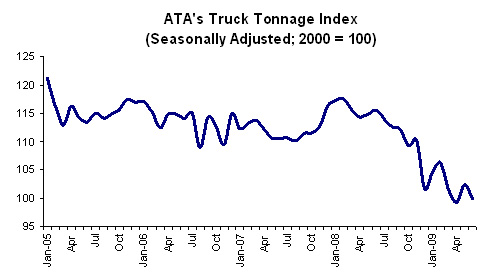


The ATA release warns:
"The sample includes an array of trucking companies, ranging from small fleets to multi-billion dollar carriers. When a company in the sample fails, we include its final month of operation and zero it out for the following month, with the assumption that the remaining carriers pick up that freight. As a result, it is close to a net wash and does not end up in a false increase. Nevertheless, some carriers are picking up freight from failures, and it may have boosted the index. Due to our correction mentioned above, however, it should be limited."
(h/t Barry Ritholtz at the Big Picture.)

14. HOME PRICE DECLINE SLOWING, CALIFORNIA FORECLOSURES DOUBLE NEW HOME SALES IN JUNE

Barry Ritholtz reports that home price declines are "slowly abating." Here is his graph:
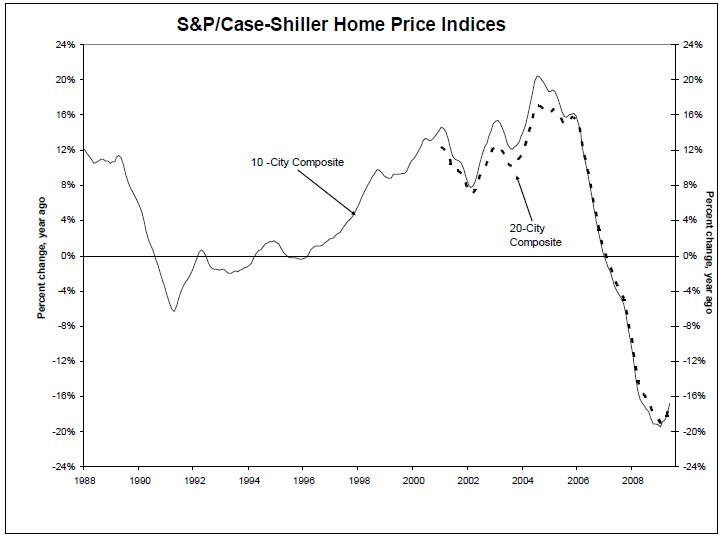


Jake at Econopic picked up on the Big Picture's quote of the day of Mark M Hanson which notes that California foreclosures are more than double the national new home sales for June. His graph:


15. EPA MAY GIVE ALGAE BIG BOOST

Russell Gold at Environmental Capital notes that Blair Carter at the Renewable + Law Blog reports that "that the Environmental Protection Agency will count algae as an advanced biofuel under Renewable Fuel Standard rules being developed."
"Why do EPA’s steps towards including algae matter? Because when Congress created its mandate to blend advanced biofuel into the fuel pool, it created a big market for these fuels. By 2012, the law mandates that two billion gallons of these advanced biofuels be blended, a figure that rises by tenfold by 2022. It’s all in Section 202 of the Energy Independence and Security Act of 2007.

... For algae to be included, the law says it needs to have no more than 50% of the 'lifecycle greenhouse gas emissions' of gasoline and diesel. This could be tricky, says David Woodburn, an alternative energy analyst with ThinkEquity. 'The hard part for me is understanding how the EPA plans to calculate the GHG emissions of algae fuels, based on the variety of feedstocks (sugar, CO2, other), processes (open ponds, photobioreactors), and algae varieties being explored--especially before November,' he says, noting when the rules are supposed to be finished."
Blair Carter's post can be found here.

16. TEXAS DROUGHT GETS WORSE

Tom Benning at the Wall Street Jounral reports on the drought in Texas.
"Nearly 80 of Texas' 254 counties are in 'extreme' or 'exceptional' drought, the worst possible levels on the US Department of Agriculture's index. Though other states are experiencing drought, no counties in the continental U.S. outside Texas currently register worse than 'severe.' In late April, the USDA designated 70 Texas counties as primary natural-disaster areas because of drought, above-normal temperatures and associated wildfires."
The Journal carries an interactive graphic:

Friday, May 1, 2009

Life Imitates Lysistrata, 2,420 Years Later

Parselelo Kantai at the FT reports:

Kenyan women call for sex boycott
"Kenyan women’s organisations have called for a national sex boycott to force feuding male politicians in the coalition government to resolve differences.

The women said they were prepared to pay prostitutes to withhold their services for a week to make the campaign more effective."
Worth reading in full. Makes you wonder whether Aristophones was relating a story about something that had actually happened once, as opposed to creating something out of whole cloth. In any case, it surely is one sign that maybe women have a point when they say the world would be a better place were they in charge. There's also that old Roman saying, "Rome rules the world, and the wives of the Romans rule Rome."

(h/t Yves Smith at naked capitalism.)

Monday, March 30, 2009

Daily Sources 3/30

1. Jason Clenfield at Bloomberg reports that Japanese industrial production fell by 9.4% in February from January, as per the Trade Ministry. "Inventories fell an unprecedented 4.2%."
"There are signs a recovery may be stirring in the US, Japan’s biggest market. US orders for durable goods rose in February for the first time in seven months. Inventories of long-lasting durable goods fell for a second month and new home sales increased for the first time since July.

In Japan, the drop in inventories adds to evidence that the worst of the manufacturing slump may be over. Companies said they would increase production 2.9% this month and 3.1% in April, today’s survey showed."
2. Volkhard Windfuhr and Bernhard Zand at Der Spiegel recently conducted an interview with Sheik Hamad bin Khalifa Al-Thani, the Emir of Qatar in which he addressed a wide range of issues, and indicated that as a member of OPEC Qatar's position was that oil should be at $40/b to help support a global recovery. Key excerpts:
"SPIEGEL: How do you believe oil prices will develop now?

Hamad: I think the oil price should continue (to stay) in the $40 range for at least one or two more years.

SPIEGEL: Why so modest?

Hamad: Because this way we can help the world out of this crisis. If the world economy recovers, it will be good for us, too. Automatically, the price of oil will go up again. I don't see why OPEC countries should continue to cut production just to keep the price of oil high. This will not affect the industrial countries alone, it will also hit poor countries in Africa, Asia and Latin America. Who will look after them?

SPIEGEL: That's not the kind of argument you often hear when talking to oil producers.

Hamad: Yes, but I believe this battle is a battle for the whole world. Everybody should be helping each other for the next two years."
Interestingly, the Emir appears to believe that Europe will not be as badly affected by the economic crisis as the US. The Emir also addressed the issue of the emerging natural gas cartel:
"SPIEGEL: Europe has staked its future on natural gas, but we are concerned about supplies. Can Qatar step in to fill the breach if Russia fails to deliver?

Hamad: We are selling gas to Italy, Spain, Belgium and, starting within the next few weeks, to Britain. I know that the Germans prefer to have their own gas supply, but I think our gas could come to Germany through another European country. However, this depends on the quantities we have on hand and the price.

SPIEGEL: Europeans are also worried about the creation of a so-called Gas-OPEC. Is there another cartel in the making that will be able to set prices at will?

Hamad: With OPEC they have a cartel. Why don't we have this gas cartel as well? And why don't we make a sort of agreement between consumers and producers? I wouldn't mind such a gas cartel, but it will take time because some countries today sell for high prices and others sell for low prices. It will be hard for those selling high to bring their prices down. So we will need time."
The Emir also stated unequivocally that Qatar would not stand with the US against Iran. But, similarly, he thinks it would be hard for the Arab countries of the Gulf to stand with Iran against the US. He further states that though he welcomes the Obama Administration's new timbre in its approach to the region, that the other conflicts in the region also need to be addressed. He indicates Qatar's continued support for the Arab Peace Plan of 2002, with qualifications:
"Hamad: I think Israel will not accept the return of the Palestinian refugees. But on the issue of dividing the city of Jerusalem (and turning over East Jerusalem to the Palestinians), I think they should accept it."
Which seems reasonably rational to me. He also addressed the issue of the ICC's arrest warrant for Sudan President al-Bashir:
"SPIEGEL: The International Criminal Court has issued an arrest warrant against Sudan's president, Omar al-Bashir. Why are you opposed to this?

Hamad: If anything happened to Omar al-Bashir and Sudan ended up in chaos, the whole of Africa would also sink into chaos. Sudan is a vast land with a lot of borders. Al-Qaida would be happy to see Sudan become like Iraq.

SPIEGEL: Isn't it time for the Arab world to finally do something about the Darfur problem?

Hamad: We have been mediating in Sudan for a long time, particularly because the groups in Darfur do not want the Arab League to get involved. My hope is that we do not see interference from some other Arab countries. We are confident. We need to give the parties time--we have to let them shout and issue their grievances, and finally we need to get the process of negotiations going and discuss the future of their country.

SPIEGEL: Al-Bashir is now in Doha to attend the Arab summit.

Hamad: I sent my prime minister to invite him."
The Emir is extremely frank for the duration of the interview--a must read.

3. Juan Cole at Informed Comment helpfully provided the USG Open Source Center's translation of the March 22nd speech of the Supreme Leader [more accurately Leader of the Revolution or LOTR] Ayatollah Ali Khamenei in response to the overture made directly by President Obama. (The USG Open Source Center paradoxically does not just simply publish their efforts.) This section of the speech begins with a long recitation of historical offenses of the US--real and imagined. (For example, Khamenei indicates that the US green-lighted Saddam Hussein's initial attack on Iran, something I believe is not the case.) The LOTR is not respectful, ironically enough--even if predictably enough--in the way he addresses the President's speech. For example, the LOTR says
"They have the slogan of change. Where is the change? What has changed? Clarify this to us."
Which on one level is fair enough, but also just off kilter, given that the change promised was to the American people, not the Islamic Republic of Iran. He also has a rather different take on the world's reception of the new POTUS than I, insofar as the LOTR remarks that the US is "hated in the world."
"Today, you are hated in the world. You should know this, if you do not already. Nations set fire to your flag. Muslim nations across the world chant 'Death to America.'"
The last bit being true of few nations outside of Iran itself. Just prior to this the LOTR chooses to question whether or not the POTUS is indeed in charge in the US, which seems to me a rather pointed insult.
"I would like to say that I do not know who makes decisions for the United States, the President, the Congress, elements behind the scenes?
He then manages to come quite close to calling the President a liar. (Remember, the US's official position in the IAEA is that Tehran is lying about its nuclear program.)
"You may say that you want to change policies, but not your aims, that you will change tactics. This is not change. This is deceit."
He also brings up the question of translation in a somewhat insulting way--and I might even be inclined to concede this point, so to speak, but Juan Cole, who is clearly a partisan of reconciliation seems to think this is a reasonable translation, so I imagine it is a fair representation.
"This is my advice to US officials, the President, and others. Listen well to these words, and have them translated for you. Of course, do not give it to the Zionists to translate for you. Consult healthy people, and seek their opinions."
(In fact, the government did release an official translation of bits and pieces of the speech in a summary in English here.) That noted, there are a few elements of the speech which could be regarded as an opening.
"But I would like to say that we have logic. Since the beginning, the Iranian nation moved with logic. Regarding our vital issues, we are not sentimental. We do not make decisions based on emotion. We make decisions through calculation."
And he concludes the section of the speech dealing with the Obama Nowruz greeting with:
"If you go on with the slogan of discussion and pressure, saying that you will negotiate with Iran, and at the same time impose pressure, threats, and changes, then our nation will not like such words. We do not have any experience with the new US President and Government. We shall see and judge. You change, and we shall change as well. If you do not change, our people became more and more experienced, stronger, and more patient in the past 30 years."
This could be seen as an opening, though I would note that the change in tone was not reciprocated--and this is from a culture acutely sensitive to matters of politesse. I would also note that the key section which some argue represents an offering was not included in the official translation of key elements of the speech offered on the LOTR's website.

That said, some argue the move is a clear opening. Juan Cole's response is here, and he wrote
"The US corporate media mysteriously interpreted Khamenei's words as a rebuff to Obama, but in light of the phrase I just quoted, I can't understand how they reached that conclusion."
Given the points I mention above, I find it incredibly difficult to understand how it is that Dr. Cole "cannot understand how they reached that conclusion" and how it could even be characterized as "mysterious." In any case, Cole chose to frame the speech as a "grumpy old man's" response to the Obama overture in which he was making his first offer in what he expects to be a long period of haggling toward a grand bargain.

Farideh Farhi--a very well-respected Iran expert--also believes the speech was conciliatory, though she disagrees with the "grumpy old man" characterization and does not think that everything is on the table. Her take is:
"Clearly from [the LOTR's] view, engagement in talks must be accompanied with some concrete steps that show Iran that the United States is interested in a process and give and take and not a process based on 'either deception or intimidation.' Deception because the objective remains the same while the softer language is a mere tactical change. Intimidation because talks are combined with further squeeze of Iran."
It is worth reading the speech for yourself. Meanwhile, on Saturday Ernesto Londoño at the Washington Post reported that the Mujaheddin-e Khalq, or MEK, will be removed from their camp near the Iranian border and that the leaders will be separated from followers who will be "de-brainwashed" or "re-educated" depending on your point of view. The question of US support for the organization is one of the major sticking points addressed by the LOTR's speech.

4. Stuart Williams at AFP reports that the World Bank forecasts that Russian GDP will shrink by 4.5% in 2009.
"The forecast is considerably more pessimistic than that of the Russian government, which is predicting a contraction of 2.2 percent in GDP in 2009."
5. Nadia Rodova and Stuart Elliott at Platts report that Surgutneftegaz informed the press today that it had purchased a 21.2% stake in Hungarian oil and gas company MOL from Austria's OMV.
"This price represents a 93% premium to Friday's closing price, a 27% premium to the 12-month average price, and a 19% discount to the 12-month peak price of Hungarian Forint 23,700, Renaissance Capital said in a research note."
6. Edward Hugh at Fistful of Euros reported Sunday that the Bank of Spain intervened to take over Caja Castilla La Mancha, whose losses are estimated to be as much as €3 billion. Spanish financial shares fell sharply today in reaction to the news.

7. Reuters reports that the Bank of England today released data showing that the number of new mortgages approved in the UK in February grew at the fastest rate seen since May 2008.
"Mortgage lending rose by £1.507 billion, almost double analysts' forecasts for an £800 million rise, and up from just over £1 billion in January."
8. Chris Baldwin and David Sheppard at Reuters report that Europe's oil refining sector is shutting down gasoline units, given the collapse in demand from the US. Topper refineries--simple refineries without additional sophisticated processing units which increase production of certain products like gasoline or diesel--account for about 1 mb/d of Europe's 16 mb/d throughput capacity are the most likely to be decommissioned. Traditionally European surplus gasoline production has often been shipped to the US, serving as an upper boundary, so to speak, on the price of gasoline.
"'Europe's oil demand may never reach its peak again,' Leo Drollas, chief economist at the Center of Global Energy Studies (CGES), said."
9. Eric Watkins at the Oil & Gas Journal reports that Habib Kagimu, chairman of Tamoil Uganda Ltd., has suggested that Kenya's Mombasa-to-Eldoret oil pipeline could eventually be extended to Uganda's Albertine rift basin, where several big crude discoveries have been made recently.


10. Shailagh Murray and Karen DeYoung at the Washington Post reports that at a Capitol Hill news conference slated for tomorrow a bill will be introduced to lift the travel ban to Cuba. If the measure were to pass it would be an extremely significant reversal of long standing US-Cuba policy.

11. Liz Capo McCormick at Bloomberg reports that the Fed purchased $2.499 billion of US treasuries in its third direct purchase of US debt. The number was much less than the market was anticipating given the size of the Fed's program as announced.

12. An extremely interesting article discussing whether Goldman Sachs deliberately manipulated the price of oil upwards in June-July 2008 in a short squeeze, by Christopher Helman and Liz Moyer at Forbes.

Friday, January 16, 2009

Daily Sources 1/16

1. James T. Areddy at the China Journal reports that Shanghai firm Data Driven Marketing Asia surveyed 4,500 people in five cities across China and found that 60% of middle class consumers have already cut spending or plan to this year.
"In Shanghai, 64% of respondents to DDM’s survey said yes to the statement 'my company is not as busy as before' and almost a third in China’s commercial capital said their employer has already laid off workers. Forty-two percent of Shanghai consumers furthermore predicted the economy would be 'bad' in the next 12 months, compared with 19% saying so in Beijing, where consumer sentiment remained the strongest in the survey. Over the next five years, 60% of Shanghai residents and 71% of Beijing people said, economic conditions will be good."
And in a Financial Times piece published Monday and reproduced by RGE Economonitor Micheal Pettis argues that US consumers must increase their savings by at least 6% of GDP to bring their balance sheets to the historical midpoint, and that Chinese consumption must grow by 25% in order to offset increased US savings. China has, under this take, considerable excess production capacity which it is likely going to continue to attempt to export--just as the US did in the 1930s. But, attempts to resurrect growth on foreign consumption is likely to result in protectionist measures. Well-worth reading in full.

Ambrose Evans-Pritchard at the UK Telegraph blogs that Albert Edwards--an analyst at Societe General who hews to the Austrian school of economics--recently published a note arguing that the Chinese economy is imploding, which will scare the regime in Beijing, pushing them to devalue the yuan to create export-based jobs, and lead to a trade war.
"Mr Edwards said investors have a "touching faith" that China's authorities are in control of events.

'Could the economic situation in China become so bad that it threatens the regime itself? Of course it could. But before being swept away in a tidal wave of worker unrest it has one key tool in its economic armoury it has used before. MEGA-DEVALUATION. China has a track record of such things. At the end of 1993 the authorities devalued the yuan by 33pc.'

A replay would be the surest route to a Smoot-Hawley II."
Uncharacteristically of Evans-Pritchard, he does not think this alarmist outlook likely, displaying a touching faith in the authorities in Beijing. And Brad Setser at Follow the Money gives a quick take on the just-released November treasury international capital (TIC) data, showing that Beijing has cut down on long term US debt (and cut out agencies altogether), but substantially increased their purchases of short-term US debt. The graph he drew up makes the point eloquently (courtesy of CFR):


Setser calculates that China's total US treasury holdings are up by $29.1 billion, but reallocated from long term to short term instruments. This may have had something with 3 month bills yielding zero for some time last month.

In a response to an analysis by Wang Toa at UBS that I noted at the time (see Daily Sources 1/8 #7), Victor Shih at RGE Economonitor thinks that unemployment will likely reach 50 million people in China by the end of 2009.
"Even if the unemployed force reaches 50 million, the Chinese government would only have to pay (50 million*100dollar*12 months) 60 billion USD (408 billion RMB). That is a substantial sum, but China can surely handle it for two to three years, suffering perhaps slightly lower credit ratings. However, the notion that migrant workers have less ability to act collectively is unfounded based on everything that we know about unrests in China. All of the rebellions in Chinese history were led and carried out by peasants, including the one that put the current regime in power. Besides 1989, the largest domestic disturbance took place in rural Renshou County in the mid 90s, which saw the deployment of tens of thousands of troops. Furthermore, unlike the layoffs in the 90s, which mostly affected middle-age or elderly SOE workers, the current wave of layoffs affects a young and vibrant cohort most capable of carrying violent collective action against the state. Without any systematic triggers, we at least will see a spike in localized riots which necessitate the mobilization of People's Armed Police (PAP) units all over China. The central government would also be compelled to (and they are doing so already) roll out generous unemployment benefits for migrant workers and college graduates (to the tune of 300-400 billion RMB). If a systematic trigger occurs and instability spreads to a sizable city, we will see the large scale mobilization of both PAP and army units and possibly substantial bloodshed. In most scenarios, the CCP regime would still survive a large scale, cross regional rebellion. However, "overall investor confidence" will be lost."
Well worth reading in full. And Li Yanping at Bloomberg reports that James McCormack, the Hong Kong-based head of Asian sovereign ratings for Fitch, said in a teleconference today that the Chinese economy likely will face a hard landing.
"'The 6 percent number is already what we would call a hard landing in China, meaning rising unemployment and the need for an aggressive policy response,' McCormack said. 'Social unrest is a big unknown.'"
McCormack thinks that exports might decline as much as 6% in 2009, down from growth of 17.2% in 2008. (h/t Yves Smith at naked capitalism.)

2. Platts reports that Vladimir Putin told the media that the volume of natural gas required to operate Ukraine's pipeline infrastructure would cost $730 million in the first quarter of 2009.
"Putin said Ukraine requested 140 million cubic meters of gas to fill the gas export pipelines and 21 million cu m/day to ensure gas compressing stations operations."
That's 2,030 million cubic meters altogether, or $359.60/thousand cubic meters (tcm) for the so-called "technical gas." Moscow is currently asking Ukraine to pay $450/tcm for natural gas not used to run the pipelines. Gazprom CEO Alexei Miller also told the media today that he was trying to put together a consortium of European companies to pay for the technical gas. Italy's ENI has already agreed to join the consortium, Germany's E.ON Ruhrgas and France's GDF Suez are "actively considering" it, and Austria's OMV, Germany's Wingas, and the Dutch company Gasterra have all been invited to join.

In the meantime, Platts reports that Yevgeniy Fedorov, the head of the State Duma committee for economic policy and enterprise, told journalists that the inauguration of President-elect Obama will likely bring an end to the gas dispute. The MP said,
"A political calculation shows that after January 20, when Obama and (incoming US secretary of state Hillary) Clinton take office, the US pressure will considerably ease and this will create conditions for solving the gas conflict."
Russians are evidently extremely suspicious of an agreement signed between DC and Kiev just as the gas negotiations were taking place. Reportedly France has declined to take part in the summit this weekend saying that sufficient conditions for negotiations were not there. Meanwhile, Alexander Medvedev, deputy chairman of Gazprom, has an opinion piece in the Wall Street Journal giving his case.
"What the world has witnessed recently is arguably the most serious breach of transit obligations ever, creating a stranglehold over the supply of gas to the whole of Europe."
Worth reading, but when all is said and done, Gazprom really did not do enough to try and affect the tenor of the narrative of the dispute in the American media, which was, I think, a grave miscalculation.

3. Joel Kurtzman of the Milken Institute has an op ed in the Wall Street Journal where he argues that Mexico is in danger of becoming a failed state as it loses its drug war. (This echoes a similar op ed in the Los Angeles Times which appeared yesterday by Denise Dresser.)
"But the path forward will be a difficult one. Not only must Mexico fight its drug lords, it must do so while putting its institutional house in order. That means firing government employees who are either corrupt or not willing to do the job required to root out corruption. It will also likely require putting hundreds, or even thousands, of police officers in jail."
Fair enough, but all this talk ignores the white elephant in the room: the root of the problem is US drug law itself, which targets providers and not consumers, and by refusing to come to terms with a failed policy of prohibition, the US is exporting instability to its neighbors.

4. Jens Erik Gould and Hugh Collins at Bloomberg report that the Banco de Mexico reduced the benchmark interest rate by 0.5% to 7.75%.

5. Richard Katz, the editor of the Oriental Economist Alert, has an opinion piece in Wall Street Journal Asia in which he argues that the Japanese stimulus program is far too small.
"Since September, two successive prime ministers have offered two small stimulus plans. The second package, just passed by the Lower House of the Diet on January 13, provides for an actual increase in deficit spending of a mere 1% of GDP. That's a drop in the bucket compared to Japan's downturn. Worse yet, the proposed fiscal 2009 budget -- to begin on April 1 -- provides no new stimulus. Talk of an increase in spending by 6.5% is misleading because it compares fiscal year 2009 to the initial budget for fiscal year 2008. The final budget for fiscal 2008, including the two supplementary budgets, is actually a bit higher than proposed spending in fiscal 2009."
Well worth reading in full.

6. Mark Shenk at Bloomberg reports that the IEA estimates consumption will shrink by 0.6% to 85.3 mb/d in 2009.

7. Glenn R. Simpson and Jay Solomon at the Wall Street Journal report that Iran is trying to import from China treated metals which can potentially be used in missile weapons systems. Among the metals sought are tungsten copper, titanium, and specialized aluminum sheets. The UAE have apparently intercepted more than one of these shipments and reported them to US officials. Given that Iran is one of the UAE's larger trade partners, this is very significant, perhaps showing that the Emirates are uncomfortable with Iran's nuclear program, or perhaps showing that they want to curry favor with Washington as they pursue a nuclear power deal with the US. There is no way to conclude from the metals themselves that they have the sole end use of weapons systems, they merely can be used for such.

8. Richard Meade at Lloyd's List reports that the United States and Kenya are nearing a deal where piracy suspects captured off Somalia would be delivered to Nairobi for prosecution.

9. Mary Jordan at the Washington Post reports that Americans abroad now have a new cachet with the election of Barack Obama, reversing hostility seen for a long time under the Bush Administration. In a way it's a silly piece, and popularity isn't necessarily a good in and of itself, however, it does mean that the US will have an easier time building international coalitions and political will for action dealing with international problems than it has in a long time. And that is a good in and of itself if you are primarily concerned with the national interest.

10. Reuters reports that US headline consumer price inflation fell by 0.7% in December. On a year over year basis they rose by 0.1%.

Tuesday, September 23, 2008

Daily Sources 9/23

1. Real Time Economics had the story that the Central Bank Governors and Finance Ministers of the G7 had a conference call yesterday and released a statement in support of the actions they had collectively taken to support the financial system. "We reaffirm our strong and shared commitment to protect the integrity of the international financial system and facilitate liquid, smooth functioning markets, which are essential for supporting the health of the world economy. We strongly welcome the extraordinary actions taken by the United States to enhance the stability of financial markets and address credit concerns, especially through its plan to implement a program to remove illiquid assets that are destabilizing financial institutions. We also strongly welcome the measures taken by other G-7 countries." The G-7 is comprised of Canada, France, Germany, Italy, Japan, United Kingdom, and United States of America. Nota bene: Russia was not included, as that would be the G-8. Is this as punishment for Georgia or a sign that the Russian government really no longer supports the financial system as is?

2. The AFP has the story that the Russian Foreign Ministry released a statement today stating that the country has no intention to unilaterally determine the borders of the Arctic--"Russia strictly abides by the norms and principles of international law and is firmly determined to act within existing international agreements and mechanisms."

3. Brian Baskin at Dow Jones has the story that refiners in the US are not facing cut backs in crude allocated to them by Riyadh. Given that refiners in Texas and Louisiana take two thirds of the crude Saudi Arabia exports to the US, and that Hurricanes Ike and Gustav have shut down most of the refineries in those two states, the remainder of that allocation has either not been, in fact, produced or sold to refiners in Europe or Asia or sold on the spot markets. "The U.S. is often the last to feel the impact of a cut in Saudi production as refiners rarely purchase the full amount they are allocated each month." If it is being produced, where is the demand coming from? Somewhere, evidently, as Stefano Ambrogi at Reuters reports that Lloyd's Marine Intelligence Unit said today that "oil shipments from 11 OPEC producers, including Iraq, rose to 23.644 million bpd from Aug. 17 to Sept. 7, versus 23.485 million bpd in the previous four weeks." Gustav made landfall on September 1st. OPEC's meeting which produced promise to more closely hone to quotas took place on the 9th.

4. I wrote a few posts ago that it looked as if there was a change in official policy in Iran to recognize that the holocaust happened, in response to remarks made in New York by the Ambassador to the UN and to remarks on Friday by President Ahmadinejad. However, on Friday, as noted yesterday, the Supreme Leader, Khamenei, made clear that he regarded the Isreali people as an enemy. And today, in the Los Angeles Times, Ahmadinejad reiterated a position of at best ambiguity, at worst denial, of the holocaust. To wit,
"If we agree and accept that certain events had occurred during World War II, well, where did they indeed happen? In Germany, in Poland and in Great Britain. Now, what does this exactly have to do with Palestine? Why is it that the Palestinian people should pay for it?"
The companion article to the interview included the context around this statement:
"'Who are these people? Where did they come from?' he asked in reference to Jews who founded the state of Israel in the wake of the Nazi slaughter in Europe during World War II. He spoke in Persian through an interpreter, whose translation of his next sentence began: 'We've agreed. . . .' before she was cut off and corrected by Ahmadinejad: 'If we agree and accept that certain events had occurred during World War II,' came the next sentence, 'well, where did they indeed happen?'"
This comes on top of the news reported by Thomas Erdbrink at the Washington Post that Ahmadinejad has dismissed the Governor of the Iranian Central Bank, Tahmasb Mazaheri.
"Mazaheri's departure clears the path for Ahmadinejad to change the economy the way he wants," said Mohammad Atrianfar, a journalist, politician and critic of Ahmadinejad. "Mazaheri, who was much more professional than the president, would delay or alter government plans. Now the president has a free hand."
This would apparently eliminate all obstacles to Ahmadinejad's plan to stop subsidizing basic goods generally, and instead distribute money to the poor directly via individual bank accounts. Inflation in August in Iran was 27.2%. If Ahmadinejad succeeds in implementing this plan and it corresponds to a strengthening in Iran's economic situation generally, it could hugely strengthen his hand. If not ...

5. Nick Tattersall at Reuters reports that MEND said today that the Nigerian air force had launched an air assault on their encampments today. MEND said they will continue to respect their unilateral cease fire nonetheless.

6. John Kingston at Platt's blog "The Barrel" notes that production at Mexico's largest field--Cantarell--dropped below 1 mb/d in August (to 998 kb/d). He writes, "There's nobody who thinks the Mexican problem is a weak reserve basis. It's simply a mismanaged approach toward developing those reserves." In point of fact, there are some who believe that mismanagement has little to do with it, specifically some at the Oil Drum, who note that the production profile of Mexico looks quite similar to peak production profiles of oil fields. They argue that management or mismanagement would do little to change the picture. Mexico is in the process of re-examining its oil laws to allow for the participation of foreign majors in the hopes of increasing production and efficiency at Pemex.

7. Emma Graham-Harrison at Reuters has the story that Chinese oil consumption grew by 7% year over year in the month of August to cover Olympics-driven demand, but points to analysts who think that inventories are full to the brim, and that demand is dropping. (Which would be consistent with yesterday's story regarding Sinopec's announcement that they will import 239 kb/d less from September through December, or a reduction of about 3% in Chinese consumption from August.)

8. The African Press Agency reports that the Kenyan Association of Manufacturers warned Monday that 80,000 Kenyans were at risk of losing their jobs because of the high energy price environment. Electricity costs have gone up by 600% in the past year. There are about 37.9 million people in Kenya (est. July 2008), 42% (15.2 million) of whom are 14 years old or under (2008 est.). The labor force is estimated to comprise about 11.85 million people (or ~ 31.2% of the population as per 2005 est.) and the unemployment rate is estimated--as of 2001--to be 40%, or 4.7 millions. 73% of Kenya's power generation is met via hydroelectric dams, which are affected by changes in the climate, and there are limits to new capacity. (On September 11, Sinohydro was chosen to build a new hydroelectric dam at Sang’oro, which is hoped to mitigate the risks of changes in the weather to the power supply.) Low rainfall in late 2007 and early 2008 have reduced electrical while demand has grown rapidly, which probably accounts for some of the price issues. A quick search hasn't yielded what feedstock accounts for the rest of Kenyan power generation, but, for example, if it is produced by coal and/or diesel / fuel oil, that also would account for increase in costs if those inputs are passed through to consumers.