Showing posts with label uae. Show all posts

Monday, August 2, 2010

Daily Sources 8/2

The China Car Times reports that"China now has 65,000km of highways across the nation, making it the second largest highway network in the world after the United States." According to the state's 2020 plan, China should have 100,000km of highways by then, about the same as what we have in the US. This should provide a tremendous economic boost over time as well as security dividends in China where it will be easier to deploy troops from one place to another.

CHINESE PMI FALLS TO 51.2

Peter Boockvar at the Big Picture reports that China's state Purchasing Managers' Index fell to 51.2. (Numbers above 50 indicate expansion; below 50 indicates contraction.)

GUANGZHOU AND HONG KONG ANTI-MANDARIN PROTESTS

Carmen Ng at China Real Time reports that there has been a second protest in Guangzhou and Hong Kong regarding the plan to change some prime time TV programming from Cantonese to Mandarin speaking. The first took place July 25th.

JAPANESE JULY PMI FELL SLIGHTLY TO 52.8

Prieur du Plessis at Investment Postcards from Cape Town reports that Japanese Purchasing Managers' Index fell slightly to 52.8. (Numbers above 50 indicate expansion; below 50 indicates contraction.)


GERMAN ELECTRICITY AND NATURAL GAS DEMAND UP 8% IN 1H

Andreas Franke at Platts reports that natural gas and electric power demand in Germany grew by 8% in the first half of the year over the same period one year ago.
"Based on its latest estimates, electricity consumption was up by 4.6% at 274 billion KWh, while the use of natural gas was 14% higher than in the first half of 2009, the BDEW said in the statement.

According to the BDEW, the main reason for the demand increase is the positive development of industrial production in Germany, which accounts for 40-45% of energy demand, while the demand for gas was also boosted by the long winter."
Demand has still not recovered to pre-crisis levels, however.

SPAIN TO CUT SUBSIDIES TO PHOTOVOLTAIC POWER PLANTS BY 45%

Victor Mallet at the Financial Times reports that Spain's industry ministry has announced the subsidized electricity prices paid to photovoltaic power plants by up to 45%. Worth reading in full.

AFTER NUCLEAR DEALS, SOUTH KOREA AND UAE AGREE TO COOPERATE IN OIL AND GAS EXPLORATION AS WELL AS STOCKPILING OIL IN SOUTH KOREA


Shinhye Kang and Ayesha Daya at Bloomberg report that after having secured a deal to build the UAE nuclear power plants South Korea and the Emirates have agreed to cooperate on oil and gas exploration and for the stockpiling of oil in South Korea.
Part of Seoul's energy security program has to do with oil stockpiling by various producers in South Korea to take advantage of quick changes in the Asian oil market. South Korea gets to draw down on those stockpiles in case of an emergency disruption in oil supply. The UAE is a major entrepot for stockpiling oil in the Middle East.

DELINQUENCIES GROW IN COMMERCIAL REAL ESTATE MARKET

Yves Smith at naked capitalism reports that the commercial real estate sector is feeling pain:
"• All deals seasoned at least a year have a total unpaid balance of $767.76 billion, with $60.45 billion delinquent – a 7.87% rate (up from only 5.28% six months prior).
• When agency CMBS deals are removed from the equation, deals seasoned at least a year have a total unpaid balance of $736.75 billion, with $60.39 billion delinquent – a 8.2% rate (up from only 5.46% six months prior).
• Conduit and fusion deals seasoned at least a year have a total unpaid balance of $655.41 billion, with $54.69 billion delinquent – a 8.35% rate (up from only 5.33% six months prior)."
JULY PMI DOWN TO 55.5

Shobhana Chandra at Bloomberg reports that US manufacturing grew at a slightly slower rate in July than June. The Institute for Supply Management's Purchasing Managers' Index fell to 55.5 from 56.2 in June. (Readings above 50 indicate growth; readings below 50 indicate contraction.)

BEN BERNANKE SAYS CONSUMER SPENDING TO PICK UP IN COMING MONTHS

Scott Lanman and Steve Matthews at Bloomberg report that Fed chief Ben Bernanke said in a speech today that consumer spending was likely to pick up in coming months.

HARLESS ARGUES THAT STRUCTURAL UNEMPLOYMENT NOT A PROBLEM

Andy Harless at Employement, Interest and Money argues that we are not seeing new structural unemployment, but rather cyclical unemployment. Worth reading in full.

MAXINE UDALL REPORTS THAT ROADS ARE BEING ALLOWED TO REVERT TO GRAVEL

Maxine Udall reports that in the US highways are being allowed to turn back to gravel. This should have significant detriments going forward, including that the amount of gas to travel from one place to another on gravel roads is higher than on paved roads. A must read.

Monday, July 19, 2010

Daily Sources 7/19

GOLDMAN SACHS BEING FROZEN OUT OF EUROPEAN SOVEREIGN DEBT OFFERINGS

Elena Moya at the Guardian UK reports that European governments are freezing Goldman Sachs out of debt offerings. An observer in France says that there would be rioting in the streets if Paris chose Goldman to lead a bond sale. Worth reading in full.

PRIVATE EQUITY INVESTMENT IN INDIA GROWING RAPIDLY

James Lamont at beyondbrics reports that India's private equity market is predicted to reach $17 billion this year.
"New investments will originate from the US where investors seek to participate in India and China’s high growth profiles. Average deal size among private equity investments this year is already between $50m and $200m, up from an average of $21m last year."
CLINTON ANNOUNCES NEW AID PROJECTS FOR PAKISTAN

BBC News reports that US Secretary of State Hillary Clinton announced a number of new aid projects for Pakistan worth $500 million. The projects include the building of two new hydroelectric dams. The aid money comes from a five year $7.5 billion aid package agreed to by Congress last year.

HUNGARY SUSPENDS BUDGETARY REVIEW BY IMF AND EU

Judy Dempsey at the New York Times reports that Hungary's government has stated that it will not pursue further austerity measures despite pressure from international creditors. The IMF and EU suspended a budgetary review of Hungary over the weekend.

MOODY'S DOWNGRADES IRISH DEBT

Matthew Saltmarsh at the New York Times reports that Ireland's debt has been downgraded by Moody's to Aa2 from Aa1. It's outlook has been changed from stable to negative. Not sure why anyone would pay any attention to the ratings agencies after this last bugaboo, but there you have it. The rating is still well above junk.

IRANIAN REVOLUTIONARY GUARD PULLS OUT OF PHASES 15 AND 16 OF SOUTH PARS

Aresu Eqbali at Platts reports that due to sanctions, the Iranian Revolutionary Guard has pulled out of phases 15 and 16 of the South Pars project.
"The IRGC and its affiliates have grown into an economic power in Iran, largely as a result of a succession of UN sanctions imposed by the international community over suspicions that Tehran is secretly developing nuclear weapons, a charge the Iranians deny.

The involvement of IRGC or its subsidiaries would make it difficult to source parts and equipment from foreign companies, which run the risk of being in breach of the sanctions should they have to deal with Khatam al-Anbiya or any other banned entity."
BOEING SELLS 30 777S TO DUBAI

Christopher Drew at the New York Times reports that the Dubai-based Emirates Airlines has put in a purchase order to Boeing for 30 777s. Airbus has sold 131 commercial airplanes this year; Boeing has sold 177.

WATER START UP SEEKS MARKETS IN INDIA, SAUDI ARABIA, CYPRUS AND IRAQ

John Collins Rudolf reports that a start up company in Texas plans to ship fresh water from Sitka, Alaska, to markets in India, Saudi Arabia, Iraq, and Cyprus. The company has no contracts yet, but has signed a deal with Sitka.

MOZAMBIQUE SOURCE OF COKING COAL FOR CHINA, INDIA, AND SOUTH AFRICA

Frontier Markets reports that interest is growing in Mozambique from China, India, and South Africa due to its reserves of coking coal for use in their steel plants.

BUILDER CONFIDENCE IN NEWLY BUILT, SINGLE FAMILY HOMES DECLINES ACCORDING TO HMI

Free exchange opines that the outlook for housing will be grim for the foreseeable future.


TWO AND HALF MILLION UNEMPLOYED LOSE ACCESS TO UNEMPLOYMENT BENEFITS

Phil Izzo at Real Time Economics reports that 2,502,000 jobless Americans have lost access to unemployment benefits since June 2.
"The Senate is expected next week to vote to extend unemployment benefits, but the delay has caused a lapse in benefits for some 2.5 million of the nation’s jobless."
Meanwhile, Tom Barkley at Real Time Economics reports that the National Association for Business Economics survey of 84 companies found that they were back in hiring mode. Meanwhile, Free Exchange reproduces a Brookings graph which plots the length of time it will take for jobs to reach the height seen prior to the recession with how many jobs need to be created.


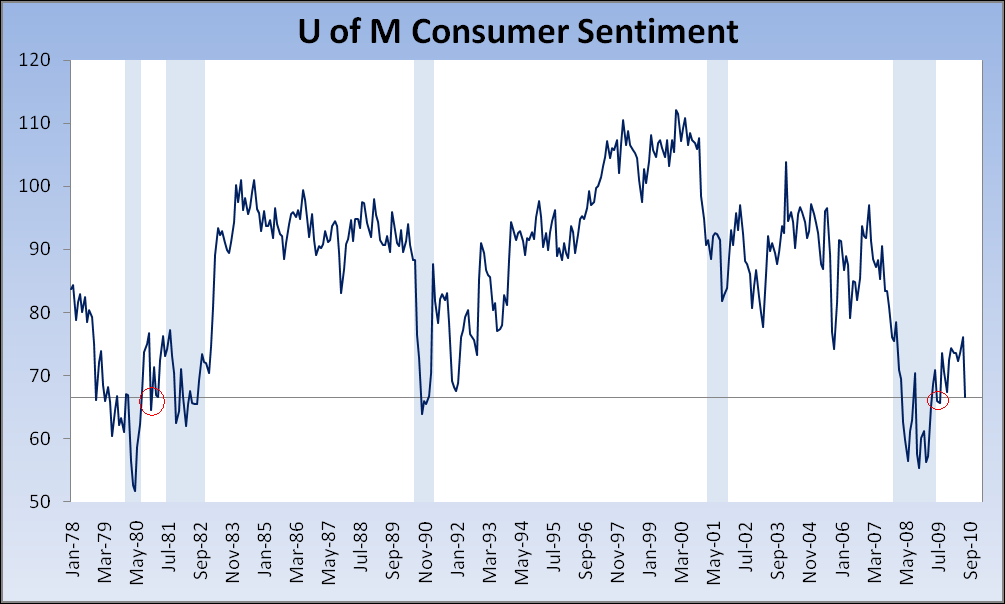
Invictus at the Big Picture reproduces a graph from the University of Michigan's Consumer Sentiment Survey and notes that the reading looks a lot like the last time we had a double dip recession.


THE CLEVELAND FED REPORTS THAT THE PUBLIC EXPECTS INFLATION TO STAY BELOW 2% OVER THE NEXT DECADE
"The Cleveland Fed’s estimate of inflation expectations is based on a model that combines information from a number of sources to address the shortcomings of other, commonly used measures, such as the "break-even" rate derived from Treasury inflation protected securities (TIPS) or survey-based estimates."

Thursday, July 15, 2010

Daily Sources 7/15

1. FRANCE, GERMANY AND THE UK WORKING TO CONVINCE EU TO ADOPT 30% CARBON REDUCTIONS BY 2020

Paul Whitehead at Platts reports that France, Germany and the UK have launched an effort to convince the EU as a whole to adopt a measure calling for 30% carbon reductions by 2020. The current goal for the EU is a 20% reduction by 2020.

2. TURKISH CENTRAL BANK LEAVES BENCHMARK RATE UNCHANGED

Steve Bryant at Bloomberg reports that the Turkish central bank left its key benchmark rate unchanged at 7%.

3. CHINESE GDP GROWTH UP BY 10.3% IN THE SECOND QUARTER

BBC reports that GDP in China grew by 10.3% in the second quarter, down from the 11.9% seen in the first quarter.
"Other official Chinese figures show retail sales are growing at around 18% a year, which suggests that consumption is still rising."
Meanwhile, Frontier Markets reports that manufacturing is already switching from China to other, cheaper, locales. Michael Schuman at the Curious Capitalist notes that some economists expect China to relax lending quotas again in a second stimulus.

4. MICHAEL PETTIS ARGUES THAT A FLOOD OF MONEY TO THE US IS MORE LIKELY THAN CHINA DUMPING US TREASURIES

Michael Pettis at Chinese Financial Markets argues that the US is more likely to see a "tsunami" of foreign capital entering the country than China exercising the "nuclear option" and selling its US treasuries holdings. He says the latter cannot and will not happen. Worth reading in full.

5. JAPANESE CARBON EMISSIONS CUTS GOALS INCOMPATIBLE WITH PROJECTED INDUSTRIAL DEMAND GROWTH

Hong Chou Hui at Platts writes that a new report by a consultancy predicts that Japanese manufacturing may be forced overseas if its goal for carbon emissions reductions--25% by 2020--are to be met. Forecasts of growth in industrial power demand are incompatible with the carbon emissions goals.

6. UAE AMBASSADOR SAYS AN ATTACK ON IRAN PREFERABLE TO IRANIAN NUCLEAR WEAPONS

Alexander Smoltczyk and Bernhard Zand at Der Spiegel report that the UAE ambassador to the US said
"A military attack on Iran by whomever would be a disaster, but Iran with a nuclear weapon would be a bigger disaster."
Spiegel concludes that an axis is forming against Iran in the Middle East.

7. TWO HOUSES BEING KEPT OFF MARKET FOR EVERY HOUSE ON SALE

Yves Smith at naked capitalism reports that for every house on sale there are two houses being kept off the market, or shadow housing.
"James Saccacio, CEO of RealtyTrac, said at the current pace, more than 3m properties will receive a foreclosure filing by the end of the year, and lenders will repossess more than 1m of them. According to a report from the Toronto-based Capital Economics, the weight of the shadow inventory may contribute to a double dip in the housing market. The report found that for every home currently on the market, two homes are waiting to be sold."


8. 429,000 NEW JOBLESS CLAIMS LAST WEEK

Kelly Evans at Real Time Economics reports that there were 429,000 initial jobless claims last week.

9. INDUSTRIAL PRODUCTION UP 0.1%

Courtney Schlisserman at Bloomberg reports that industrial production rose 0.1% in June.

Thursday, August 6, 2009

Daily Sources 8/6

1. JAPANESE GOVT REPORT COMPARES PARTY PLANS FOR GREENHOUSE GAS EMISSIONS REDUCTIONS ON ECONOMY

Yoko Kubota at Reuters reports that the plan by Japanese opposition party to cut greenhouse gas emissions by 25% from 1990 levels by 2020 would, per a government report, "push down real gross domestic product growth by 3.2 percentage points and the unemployment rate could grow by 1.3 percentage points." The government plan for an 8% reduction from 1990 levels by 2020 would, per the report, "push down Japan's economic growth by 0.6 percentage points and raise unemployment by 0.2 percentage points in 2020."

2. PBOC'S MONETARY REPORT INDICATES EASY CREDIT POLICY TO CONTINUE, MINISTRY OF HUMAN RESOURCES WARNS EMPLOYMENT SITUATION GRAVE, ELECTRICITY DATA SHOWS STEEP FALLS IN CONSUMPTION, BANKS LEND LESS IN JULY CONTRA PBOC REPORT, AND BP SAYS GDP DATA MORE OR LESS TRUSTWORTHY

Andrew Batson at the Wall Street Journal reports that the People's Bank of China's quarterly monetary report reaffirmed its commitment to continuing easy credit policies.
"'China's economy is now in a critical period of stabilization and recovery, and maintaining stable and rapid economic growth is still the most important task we face ... . Although the general trend of stabilization in the [global] economy has been basically established, the process of recovery may be slow and tortuous.'

With global demand for China's exports still weak, a solid rebound depends on domestic consumption and investment, the central bank said. Chinese companies may be more willing to ramp up production now that inventories have been reduced.

Sentiment among private-sector businesses remains weak, it said, and consumers' worries about future income could crimp spending. 'The foundation of the economic recovery is not yet stable,' it said, echoing other agencies' recent comments."
In a somewhat different take on the question of whether migrant unemployed in China are a reason to worry from the story cited yesterday--see Daily Sources 8/5 #1--Yves Smith links to an AFP report that
"China Tuesday warned of a 'grave' situation in the jobs market with millions of graduates and migrant workers yet to find work as companies continue to struggle with the effects of the global slump...

'China's current employment situation is still grave and the pressure for job creation remains large,' said Wang Yadong, a senior official at the Ministry of Human Resources and Social Security's employment section."
She also notes that:
"First-half electricity use by small and medium-sized enterprises fell almost 50% year-on-year, as these companies were more exposed to the economic downturn, the National Bureau of Statistics said on August 3.

SMEs saw power consumption plunge 48.9% year-on-year, against a 5.9% industry-wide drop."
And in contrast to the affirmation of the People's Bank of China in its quarterly report mentioned above:
"China's big state-owned commercial banks extended around 168 billion yuan worth of new loans in July, down sharply from the 497 billion issued in June, banking sources told Caijing on August 4."
And she picks up on the story in the FT yesterday that if you add up the output numbers of the various provinces, they are 10% more than overall national output as reported by Beijing. And to muddy the waters further, Sheetal Nasta at Platts reports that the chief Asia economist of BP, Chi Zhang, said at an event at the British Chamber of Commerce in Shanghai Wednesday that
"'in general, [the] data reflects economic growth reality,' given that China is 'very manufacturing intensive and there has been a lot of industrialization and an urbanization process is going on.'

While he admitted the Chinese have been likely 'taking advantage of low energy prices,' he retreated from the notion that government stockpiling was inflating prices.

Speaking of the oil price spike in 2008, he said data from BP's annual statistical review, issued earlier this year, shows that the 'big spike' in (price) coincided with related economic activity, primarily supply-side constraints due to investment shortfalls, geopolitical issues and few technological breakthroughs."
The continuing incredulity regarding official output growth numbers in China was driven by the disparity between the electricity consumption numbers, which are no longer published--see Daily Sources 6/8 #6--later reinforced by skepticism expressed in the May report by the International Energy Agency which suggested that oil demand would have been stronger than reported if it were to reconcile with the GDP numbers and suggested the possibility that "Real GDP data aren’t accurate and shouldn’t be taken at face value"--see Daily Sources 5/14 #2.

3. GERMAN FINANCE MINISTER SAYS FINANCIAL SECTOR RETURNING TO 'CASINO CAPITALISM', ECB MAINTAINS BENCHMARK RATE AND INDICATES THERE WILL BE NO ADDT'L STIMULUS

Der Spiegel reports that Finance Minister Peer Steinbrück is in the media warning against the return of 'casino capitalism.' Among other comments, he said:
"In the United States and Britain, lobbyists are already questioning some regulatory measures."
and, in Germany,
"Taxpayers are continuing to completely finance big bonuses [at banking firms]."
Meanwhile, Christian Vits and Simone Meier at Bloomberg report that European Central Bank president Jean-Claude Trichet indicated that the bank is unlikely to provide further stimulus after its monetary committee left the benchmark interest rate at 1%.
"Rates are 'appropriate' and policy makers are 'satisfied' with their asset-purchase program and measures to improve the flow of credit, he said."
"The ECB currently predicts the euro-region economy will contract about 4.6% this year and 0.3% in 2010. Inflation will average about 0.3% this year and 1% in 2010. The bank aims to keep inflation just below 2%."
4. BANK OF ENGLAND TO EXPAND QUANTITATIVE EASING, LONDON TO REPLACE SHORT HAUL AVIATION WITH HIGH SPEED RAIL

Niel Shah at the Wall Street Journal reports that the Bank of England today announced it would expand its quantitative easing program, increasing purchases by £50 billion (~ $85 billion) to a total of £175 billion.
"The increase required the bank to get special permission from the UK Treasury, which had previously capped the program at £150 billion.

The expansion of the program suggests policy makers are still worried about the long term outlook for the UK economy despite a recent spate of positive data pointing to recoveries in house prices, manufacturing and services."
"While banks' reserves of cash have more than tripled since the central bank launched the program back in March, one broad measure of lending in the economy--M4 money supply excluding certain financial intermediaries--has hardly budged. In the second quarter, the measure was up just 3.1% from the same period a year earlier, the weakest expansion since 1999.

Beyond that, rising unemployment and peoples' efforts to pare down heavy debt loads are likely to weigh on consumer spending, by far the largest driver of demand in the UK economy. As of May, the UK unemployment rate stood at 7.6%, the highest level in 12 years."
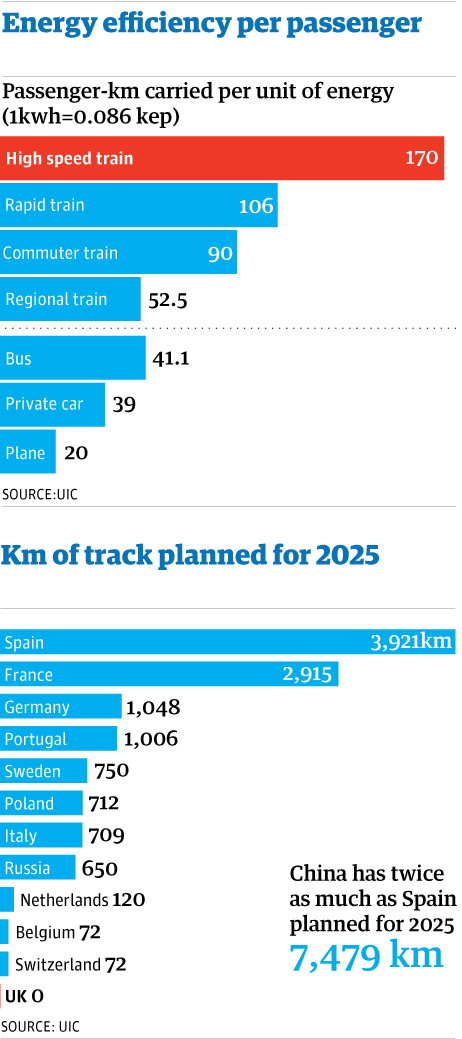
Meanwhile, Dan Milmo and Julian Glover at the Guardian report that Downing Street has announced plans which would replace domestic air travel with a high speed--250 mph--rail.
"The transport secretary, Lord Adonis, said switching 46 million domestic air passengers a year to a multibillion-pound north-south rail line was 'manifestly in the public interest'. Marking a government shift against aviation, Adonis added that rail journeys should be preferred to plane trips.

'For reasons of carbon reduction and wider environmental benefits, it is manifestly in the public interest that we systematically replace short-haul aviation with high-speed rail. But we would have to have, of course, the high-speed network before we can do it,' he said."


5. GEORGIAN AND RUSSIAN OFFICIALS TRY TO CALM WORRIES ABOUT NEW FIGHTING BREAKING OUT, SAAKASHVILI LAYS BLAME FOR 2008 CONFLICT ON MOSCOW IN OP ED

Jim Heintz at the Associated Press reports that senior officials in Tblisi and Moscow are walking back from rhetoric suggesting the possibility of renewed fighting.
"The deputy chief of Russia's general staff says Georgia is too weak after the war that devastated its military and caused an estimated $1 billion damage to the struggling country.

Georgia's national security adviser, however, says the danger of new fighting appears low because of 'preventive diplomacy' and because Russia knows a new war would undermine its influence among neighbors and rapprochement with the West."
In the meantime, Georgian President Mikheil Saakashvili has an op ed in today's Washington Post which lays the blame on last year's conflict squarely on Russia. Key excerpt:
"Russian provocations have not stopped; snipers in Russian-controlled areas have killed 28 Georgian policemen. In recent days, Moscow has engaged in a series of provocative acts and statements, echoing its prelude to last year's invasion. Even as the world watches, Moscow has vetoed monitoring missions from the United Nations and the Organization for Security and Cooperation in Europe. In violation of the cease-fire, Russia also denies European Union monitors access to the occupied territories.

Despite all this, and contrary to some expectations, Georgia has rebounded. Our democratic institutions are growing. Foreign investors are returning. The world should recognize that the kind of behavior Russia exhibited last August threatens not only Georgia but our entire region."
6. TURKISH PM MEETS WITH HEAD OF LARGEST TURKISH KURD PARTY, ANKARA SIGNS ON TO SOUTH STREAM

Nicholas Birch at the Wall Street Journal reports that Prime Minister Recep Tayyip Erdogan of Turkey met with the leader of the main Kurdish party in the country Wednesday, in what is the first meeting of the head of government with the party in the country's history.
"[M]any analysts say the new Kurdish opening is qualitatively different from anything that came before.

'For the first time ever, Turkish state institutions are working in synch to solve the problem,' said Henri Barkey, a Turkish expert at the Carnegie Endowment for International Peace, a Washington-based think tank.

The main catalyst for Turkey's new sense of urgency is Washington's announcement that it plans to pull its soldiers out of Iraq, Turkey's southern neighbor, by 2011.

The planned withdrawal has speeded up a rapprochement between Turkey and Iraqi Kurds, whose relations have been blighted for years by the PKK's use of Iraqi Kurdish mountains for its military bases."
"'There is an economic side to the rapprochement. "Turkey wants to use northern Iraqi gas for Nabucco,' says Bayram Bozyel, a Turkish Kurdish politician, referring to a pipeline project that the US and EU hope will help break a Russian stranglehold on European natural-gas supplies. 'And the [Iraqi] Kurds want to pump gas north.' That would be risky in the midst of a guerrilla war. The PKK claimed responsibility last year for a bomb attack on a major oil pipeline that passes through the same region."
Well worth reading.Today Russia and Turkey signed a deal to route Russia's South Stream pipeline through Turkey, per Charles Recknagel at RFE/RL.
"'The South Stream pipeline is a much needed project that is particularly important in the context of ensuring the energy security of the whole of Europe and the development of a broad range of ties between Russia and Turkey,' Putin said. 'Our negotiations showed that we can find solutions, together with the Turkish leadership, that open the way to new, large-scale energy projects.'"
7. IRAN LOWERS OFFICIAL PRICE OF OIL SOLD TO ASIA, QATAR LOWERS OFFICIAL PRICE OF OIL, FOLLOWING SAUDI ARAMCO REDUCTION ON PRICE TO ASIA

Yee Kai Pin at Bloomberg reports that the National Iranian Oil Company will reduce the official selling price of Iranian Light into Asia for the first time in four months.
"[NIOC] will set Iranian Light for September at 9 cents a barrel above the average of Persian Gulf benchmarks Oman and Dubai grades, based on a quarterly formula tied to prices set by Saudi Arabian Oil Co. The premium will be down $1.75, or 95%, from August and will be the smallest in seven months."
Meanwhile, Yee Kai Pin reports that Qatar Petroleum will also reduce the official selling price of Qatari crudes.
"The state-owned company cut its July price of Qatar Land crude oil to $65.50/b, down $5.60 from June, the official Qatar News Agency said on its Web site. The July price of Qatar Marine grade was reduced by $5.38 to $64.72/b. The cuts are the first in five months."
Earlier this week, Saudi Aramco cut its official selling price of Arab Light into Asia--see Daily Sources 8/3 #6. (The middle eastern national oil companies have different official prices for different regions of the world.)

8. DUBAI'S PROPERTY PRICE COLLAPSE SHARPEST IN WORLD

Kevin Brass at the New York Times reports that Dubai's property market is leading the world in price collapse.
"Dubai prices have dropped 32% in the last year and 40% in the last quarter, according to the latest edition of the Knight Frank Global House Price Index, released today.

Along with Dubai, Latvia (36%) and Singapore (23.8%) saw the largest declines since the first quarter of 2008, the property firm reports."
9. MEND LEADER INDICATES MOST NIGER DELTA MILITANTS WANT TO TAKE ADVANTAGE OF AMNESTY PROGRAM WHICH OFFICIALLY BEGAN TODAY; ANALYSTS DOUBT DIRE NIGERIAN PRODUCTION NUMBERS

Dulue Mbachu at Bloomberg reports that the leader of Nigerian militant group MEND indicated in a telephone interview that most fighters want to accept the government's amnesty program, saying "Like the government, we also want peace for there to be development."
"A government panel set up last year recommended raising the share of revenue going to states in the oil region to 25% from the current 13%. MEND wants the oil region to control 100% of oil revenue and pay a tax to the central government, according to the group’s spokesman, Jomo Gbomo.

'Whatever the people are demanding is also what I want,' Okah said, declining to commit to a figure.

The MEND leader said militant commanders in the oil region are divided between those who want money in exchange for weapons, as offered by the government, and those who want their political demands met.

'Personally I want a situation where weapons will be surrendered without cash,' Okah said. 'Because people can submit their weapons and buy new ones.'"
BBC News reports on the amnesty program which officially began today.
"Officials said gunmen who accept amnesty would be given 65,000 naira ($433; £255) a month for food and living expenses during the rehabilitation program, which runs from 6 August to 4 October.

But the main rebel group in the region, the Movement for the Emancipation of the Niger Delta (MEND), has not yet said it will take part in the amnesty.

'When we choose to disarm, it will be done freely, knowing that the reason for our uprising which is the emancipation of the Niger Delta from neglect and injustice has been achieved,' the group said in statement e-mailed to the AFP news agency.

The group, which called a temporary ceasefire last month after one of its leaders was freed from jail, is in talks with senior officials about the terms of any possible amnesty."


Tom Burgis at FT Energy Source reports that many believe that the current numbers for oil production coming from official Nigerian government sources are deliberately understated.
"On Wednesday afternoon, a Nigerian oil executive speaking in private snorted at the idea that production could be so low, suggesting 1.6m b/d was more accurate. Stewart Williams, principal sub-Saharan Africa analyst at energy consultancy Wood Mackenzie, puts production at 1.5m b/d to 1.6m b/d.

Why the discrepancy? Analysts with a cynical streak (easily acquired in a country so riddled with corruption and electoral violence) remark that it is in the state’s interest to create a sense of crisis as it tries to force through a comprehensive reform of the oil sector.

That the bill has merits--including the promise of greater transparency and restructuring the hopelessly ineffective state company--misses the point. Oil companies and the delta’s influential governors, who stand to get less cash as a result, are united in opposition to it.

The oil companies, too, are making data scarce at the moment. Like the government, they may have an interest in uncertainty as the negotiations continue."
10. BRAZILIAN SENATE'S INVESTIGATION INTO PETROBRAS TAX EVASION AND CORRUPTION CHARGES BEGIN TODAY, LULA INDICATES THAT HE BACKS FULL CONTROL OF PRE-SALT FOR PETROBRAS

Helder Marinho and Alexander Ragir at Bloomberg report that the Brazilian Senate's investigation into tax evasion and corruption allegations against state oil company Petrobras began today.
"An 11-member Senate committee, led by a member of [Brazilian President Luiz Inacio Lula da Silva's], Workers’ Party, is investigating the allegations. [CEO Jose Sergio] Gabrielli told Petrobras’s 74,000 employees in a July 14 letter that the company fired three employees after an internal investigation, and cooperated with the prosecutor’s office and federal police, into the bidding process for oil platforms.

Gabrielli, Chief Financial Officer Almir Barbassa and Haroldo Lima, the head of Brazil’s petroleum regulator, are among officials the committee in charge of the probe will invite to testify, according to a list senators handed to reporters during a session of the probe committee held today.

The officials will not be legally summoned or required to speak under oath, and the hearings will be arranged at their convenience, Senator Romero Juca said today in Brasilia. Juca, the head of the government coalition in the Senate, is responsible for leading the probe and writing its reports. Fired Petrobras executives will not be called to testify, he said."
"Since Lula first took office in January 2003, lawmakers have set up 25 committees to investigate everything from health insurance plans to piracy of industrial goods and corruption, according to CAC Consultoria Politica, a Brasilia-based political consultancy. While some ended without any conclusion, a 2005 investigation into allegations the Workers’ Party paid bribes to legislators in exchange for votes in Congress led to the resignation of Lula’s chief of staff, Jose Dirceu."
Natuza Nery at Reuters reported yesterday that Lula was to propose to Congress today that Petrobas be the exclusive operator of new offshore sub-salt oil fields. In June, resolutions were being introduced in the Brazilian Senate to create a new, 100% state-owned company, to lease Brazil's sub-salt fields--see Daily Sources 6/12 #11. (A majority of voting shares in Petrobras are owned by the government, but foreign investors own about 60% of its total outstanding stock.)

11. VENEZUELA TO PURCHASE SEVERAL DOZEN TANKS FROM RUSSIA, BANS COLOMBIAN STATE OIL COMPANY FROM PARTICIPATION IN ORINOCO BELT

Fabiola Sanchez at the Associated Press reports that President Hugo Chávez in a news conference yesterday said that Venezuela was going to purchase several dozen Russian tanks in a deal he wants to seal during a visit to Russia in September.
"'We're going to buy several battalions of Russian tanks,' Chavez said ...

Chavez's government has already bought more than $4 billion worth of Russian arms since 2005, including helicopters, fighter jets and Kalashnikov assault rifles.

The socialist leader called Colombia's plan to host more US soldiers a 'hostile act' and a 'true threat' to Venezuela and its leftist allies. He warned that a possible US buildup could lead to the 'start of a war in South America,' but gave no indication that Venezuela's military is mobilizing in preparation for any conflict."
"Cuban ex-President Fidel Castro supported Chavez in a column published Wednesday on the Cubadebate Web site, saying that 'Venezuela isn't arming itself against the sister nation of Colombia, it's arming itself against the (US) empire.'

'The threat ... is directed at all the countries' of South America, Castro wrote."
Meanwhile, Upstream online reports that Chávez told journalists yesterday that Ecopetrol, Colombia's national oil company, will have no role in developing the Orinoco belt.
"Chávez said ... that Colombia’s increased cooperation with the US to fight guerrillas and drugs is part of the US’s long- term plan to invade Venezuela and seize the Orinoco Belt."
"Ecopetrol was one of 19 companies that paid $2 million apiece for detailed information on the Carabobo block in the Orinoco Belt."
12. 24% OF OWNER-OCCUPIED HOMES UNDER WATER IN US, PERSONAL SAVINGS RATE INCREASE AHISTORICAL IN FACE OF REDUCED FEDERAL TAX RECEIPTS, AND AS UNEMPLOYMENT LOOKS SET TO CONTINUE TO RISE

Nick Timiraos at Developments reports that 24% of owner-occupied homes had mortgage debt which exceeded the market value of the home in question at the end of June, according to data from Equifax and Moody’s Economy.com.
"That number rises to 32% when looking at the share of homeowners with mortgages that don’t have equity left in their homes.

Overall, 16 million homeowners are 'upside-down' on their mortgages, up from 10 million, or 15% of owner-occupied homes, one year ago.

Nearly 10% of owner-occupied homes now have mortgage debt with loan-to-value ratios of at least 125%, and roughly half of those homes have mortgage debt with loan-to-value ratios of 150% or more."
In her most recent series of posts, Rebecca Wilder at News N Economics notes that a) this recession is different from past recessions in the sense that the personal savings rate is trending up:


And b) that the Daily Treasury Statement of August 4 "shows that the 1-month cumulative sum of income tax receipts (withheld plus paid taxes) is dropping at a 13% annual pace." She comments:
"This is the most up-to-date macroeconomic information out there, as most of the reports are 1-2 months old at the time of release. And the implication of this DTS is: that personal income and spending, which just released this week for June ... are likely to be weak into July."
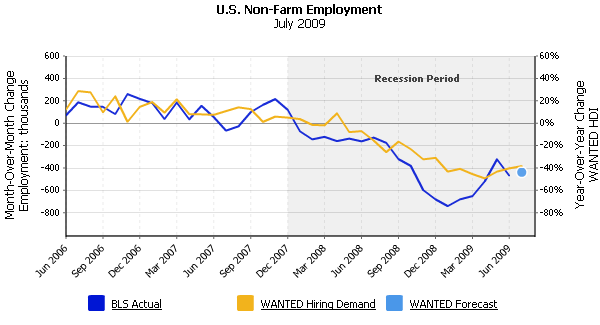
In that vein, Barry Ritholtz links to a graph by Bruce Murray, CEO of WANTED USA, plotting the actual month over month change in non-farm unemployment against year over year percent change in hiring demand:


13. RAIL TRAFFIC VOLUMES BOTTOMED OUT AT 18.9% BELOW LAST YEAR'S NUMBERS

The Railfax report is out today, and seems to indicate that rail traffic volumes have reached a bottom and holding steady at about 18.9% below their seasonal levels. Their chart for weekly loaded units in North America for the week ended August 1 in four week rolling averages:


Their chart for crushed stone and lumber and wood products, key components in construction, in four week rolling averages for North America:

Thursday, June 25, 2009

Daily Sources 6/25

1. OECD REVISES FORECAST FOR CHINESE 2009 GDP GROWTH UPWARD TO 7.7%

Liu Li at the Wall Street Journal reports that the OECD has upped its forecast of Chinese GDP growth in 2009 to 7.7% from its 6.3% projection made in March.
"The OECD said it now expects China's economy, the world's third largest, to grow 9.3% in 2010, up from its previous projection of 8.5%. Still, it cautioned that 'the outlook for 2010 is more uncertain and depends on the extent to which private consumption and business investment react to the stronger economic situation, as both the fiscal and monetary stimulus will be easing.'"
The OECD stood by its projection that the consumer price index in China would fall by 1% in 2009 versus the projections coming out of Beijing of an 4% increase.

2. CONSUMER SENTIMENT UPTICK IN JAPAN, BUT BOJ SEEMS TO BE DISCOURAGING TOO MUCH OPTIMISM

Edward Hugh at Fistful of Euros has a characteristically long and detailed post on the Japanese economy where he notes that consumer sentiment is upbeat, with the confidence index climbing to 35.7 from 32.4 in April, according to the Cabinet Office in Tokyo--but in the face of horrible export numbers. Hugh notes that the OECD's new forecast has Japan's GDP still on course to contract by 6.8% in 2009 and has revised its forecast for 2010 down to 0.7% growth in 2010. Hugh remarks:
"In its Monthly Report of Recent Economic and Financial Developments the BOJ revised its basic view of the economy upwards for the second consecutive month. In April, the Bank were saying that “Japan’s economic conditions have deteriorated significantly”, but this was revised in May to the view that 'Japan’s economic conditions have been deteriorating, but exports and production are beginning to level out', and in June to the view that 'Japan’s economic conditions, after deteriorating significantly, have begun to stop worsening'.

This has been widely seen as an indication that the BOJ has revised its view on the economy upward, but the BOJ itself has been trying to discourage this interpretation. At the press conference, Governor Shirakawa said that the BOJ’s view on the current state of the economy was in line with the forecast made in the Outlook for Economic Activity and Prices report published on 30 April, namely that 'the pace of deterioration in economic conditions will likely moderate gradually and start to level out', thus emphasizing that the BOJ has not changed its view. To reinforce this point, using the analogy of a weather forecast, he said that if the weather forecast for the following day turns out to have been right, this does not mean that the forecast has been revised."
Well worth reading in full.

3. CHINA AND TURKMENISTAN INK DEAL FOR ADDITIONAL 30% SUPPLY OF NAT GAS, CHINA AGREES TO $4 BILLION LOAN ON PREFERENTIAL TERMS

Alexander Vershinin at the Associated Press reports that China has signed a 30 year deal to increase purchases of Turkmen natural gas by 30%.
"Chinese Vice Premier Li Keqiang met with his Turkmen counterpart Wednesday to sign the contract, which increases gas deliveries to 40 billion cubic meters (52 billion cubic yards) annually, the state-run newspaper Neutral Turkmenistan reported.

Work on a 7,000-kilometer (4,300-mile) pipeline from Turkmenistan to China is expected to be finished by the end of the year.

'This agreement is very important for ensuring a stable, long-term and adequate supply of gas for this pipeline,' Li said at an official signing ceremony, according to the newspaper.

China has also committed to lending Turkmenistan's state gas company $4 billion on preferential terms, the newspaper reported."
4. JAPAN STRIKES DEAL WITH ADNOC TO INCREASE ITS STRATEGIC PETROLEUM RESERVE

Chikako Mogi at Reuters reports that the Japanese trade ministry has concluded a basic agreement with the UAE's ADNOC to store stocks of oil in Kagoshima, southern Japan.
"The ministry did not provide details of the volume that Japan was expected to receive from ADNOC.

The ministry said the project will help beef up Japan's energy security by tapping the supply from ADNOC in times of supply shortages."
5. KOGAS AND GAZPROM AGREE TO FEASIBILITY STUDY ON NAT GAS PIPELINE EXTENSION TO SOUTH KOREA

Eric Watkins at the Oil & Gas Journal reports that Gazprom and Kogas have signed a memorandum of understanding to study the feasibility of supplying gas to South Korea via a pipeline extension from the Sakhalin-Khabarovsk-Vladivostok (SKV) gas pipeline.

"According to analyst Global Insight, two pipeline options between Russia and South Korea are currently being evaluated: an overland route via North Korea and a direct subsea line.

'The first option suffers from severe geopolitical risks while the second option presents partners with formidable technological and financial challenges,' GI said, adding, 'A drawn-out negotiation and planning process for the project…can be assured in either scenario.'

Underlining that point, Russian officials also have been courting Japanese investors into joining the SKV pipeline project."
In televised comments during his visit to Tokyo in May, Prime Minister Vladimir Putin said,
"Japanese partners could take part in projects to develop pipelines and other transport infrastructure. I mean from Sakhalin Island to Khabarovsk to Vladivostok." (see Daily Sources 5/12 #4.
6. IRAQI MINISTRY CONSIDERING HOW TO RESPOND TO SINOPEC'S BID FOR ADDAX

Anthony DiPaola at Bloomberg reports that the Iraqi Oil Ministry is considering whether to exclude Sinopec from bidding on developing oil fields, following the news that the company had made an offer on Addax Petroleum, which operates fields in Kurdish Iraq. (See Daily Sources 6/24 #7.)
"The Oil Minister hasn’t yet decided, a ministry spokesman said by telephone today. The Chinese company, also known as Sinopec Group, is among more than 30 oil producers short-listed by Iraq to bid for development rights on June 29 and 30.

The government hasn’t received official notification of the agreement between Sinopec and Addax, said Abdul Mahdy al-Ameedi, deputy director general of the Oil Ministry department running the bid rounds.

'They can participate so far,' he said of Sinopec. 'There are some days until the bidding process,' he said, adding the government would be reviewing the deal."
7. OPEC SAYS WORLD OIL MARKET IN "DELICATE AND PRECARIOUS" STATE

Margaret McQuaile at Platts reports that in its latest bulletin, OPEC said that the world oil market is in a "delicate and precarious state."
"A commentary in the latest issue of the OPEC Bulletin said oil prices were now 'closer to levels that could support sound investment plans for future production' but were not justified by fundamentals of supply and demand.

It noted that OPEC's own crude basket, which had stood at $44/barrel at the start of the March 15 ministerial meeting, had climbed above $70/b since the most recent conference on May 28 despite supply continuing to be greater than demand and OECD commercial stocks remaining well above five-year average levels."
8. RUMORS OF SAUDI-SYRIAN-LEBANESE 'GRAND BARGAIN'

Michael Collins Dunn at the MEI's Editor's Blog reports that there are rumors of a grand bargain being arranged between the Saudis, Damascus, and Lebanon.
"To sum it all up before I start linking: Syria is going to accept the idea of Sa‘d Hariri as Prime Minister in Lebanon. In turn, Saudi Arabia is going to patch up its relations with Syria. King ‘Abdullah will then visit Damascus. And if the Lebanese can smooth out the outlines of a unity government of some sort, Syria won't stand in the way."
Worth reading in full.

9. US DELIVERS WEAPONS TO SOMALIA'S TFG

Stephanie McCrummen at the Washington Post reports that the US has sent a shipment of weapons and ammunition in aid for the transitional federal government in Somalia.
"To cut off the rebels' weapons and supplies, the United States has stepped up pressure on Eritrea, and foreign warships patrolling Somali waters to combat piracy have begun blocking cargo ships heading to the rebel-held port of Kismaayo in southern Somalia.

African diplomats have also proposed a no-fly zone over Somalia to prevent weapons from being flown in from Eritrea to the rebels, but it is unclear whether that idea will gather necessary support at the United Nations."
10. MEND ATTACKS IN NIGERIA FORCE CLOSING OF TWO REFINERIES, GAZPROM AGREES TO JV WITH THE NIGERIAN NATIONAL OIL COMPANY, GAZPROM TO BEGIN CONSTRUCTION ON TRANS-SAHARAN PIPELINE NEXT YEAR, TOTAL OFFERS TO COOPERATE WITH GAZPROM--ESPECIALLY IN AFRICA

Jacinta Moran at Platts reports that Nigeria shut down the 125 kb/d Warri and the 150 kb/d Port Harcourt after attacks by MEND on pipelines and other oil facilities have cut the flow of crude, making operations impossible. Warri has reportedly been shut down for over a month.
"Nigeria's main militant group earlier Thursday said it sabotaged a Shell oil pipeline in the Delta today, the latest in a slew of attacks against facilities in Africa's biggest oil producing country.

The Movement for the Emancipation of the Niger Delta (MEND) said in an emailed statement it had attacked the Billie-Krakama pipeline in Rivers state in the Niger Delta.

'Cawthorne Channel 1, 2 and 3 flow stations feeding the Bonny export terminal have been effectively put out of service,' it said."
Susan Njanji at AFP reports that Shell confirmed that the Billie-Krakama pipeline had been attacked and stated that it had been shut down.
"President Umaru Yar'Adua on Wednesday expressed hope he could resolve the Niger Delta crisis this year.

'I am hopeful and confident that by the end of this year, we will have a secure and stable environment in the Niger Delta,' he told a news conference with [Russian President] Medvedev [who was in Nigeria yesterday to pursue energy cooperation initiatives.]

Yar'Adua is Thursday expected to unveil details of an amnesty package for militants who cease hostilities as part of efforts to end the unrest and save the crucial oil and gas industry."
BBC reported last week that one militant leader took advantage of the amnesty offer--see Daily Sources 6/17 #9. Meanwhile, Medvedev's visit evidently bore fruit as Gazprom announced that they have started a 50-50 JV in oil, gas, gas processing and transportation. Gazprom also announced it plans to begin construction of the Trans-Saharan pipeline next year.


Meanwhile, Simon Shuster at Reuters reports that the general director of Total E&P Russie told reporters today, "We are very open to discussing with a company like Gazprom to have developments abroad including, of course, in Africa."Douglas Muir at Fistful of Euros observes:
"If you’re a human being who speaks French, you’re more likely to be African than European. La Francophonie’s demographic center of gravity is now somewhere around Bamako, Mali.
...
Demographic growth plus the slow-but-steady rise of literacy rates in most of Africa means that by the next decade, most literate Francophones will be African too.
...
[T]he Academie Francaise has always allowed non-French citizens to be members; by 2050, I’d expect these members to be approaching a majority.
...
If you’re a human being who speaks French, and is also a practicing Catholic, you’re almost certainly African--like, ten-to-one odds. Plenty of people have already pointed out that Catholicism, slowly retreating in Europe, is growing like crazy in Africa, so I won’t go into that here.

But: French is now one of the major languages of Islam. "


11. VENEZUELA AND US TO EXCHANGE AMBASSADORS

Ian James at the Associated Press reports that Venezuela and the United States will exchange ambassadors, after each expelled them nine months ago.

12. CREDIT CARD CHARGEOFFS RISE WITH UNEMPLOYMENT INSURANCE EXHAUSTION RATES, INITIAL UNEMPLOYMENT CLAIMS UP

Barry Ritholtz at the Big Picture compares credit card charge off rates to the rate of people who have exhausted their unemployment insurance.


Meanwhile, Glenn Somerville at Reuters reports that initial unemployment claims rose by 15,000 to a seasonally-adjusted total of 627,000.
"Continued claims, which gauge how many Americans were still on jobless rolls after an initial week of claims, rose 29,000 to 6.738 million in the week ended June 13, the latest period for which the data was available."
12. ANOTHER STUDY LINKING US RECESSIONS TO PRICE OF OIL

Sheila McNulty at FT Energy Source reports that Steven Kopits of Douglas Westwood Energy research has released a study which notes that in the last 37 years the US has experienced seven recessions, and that oil has played an important role in each. "In every case when oil consumption breached 4% of GDP, he notes, the US has suffered a recession." Koptis also remarks that every time there has been a sustained rise of more than 50% or more in the price of oil, the US enters a recession. McNulty writes:
"From his research, then, it seems there are three rules by which to avoid recession caused by oil prices:

- Crude oil expenditures should not exceed 4% of GDP.

- Oil prices should not increase by more than 50% year-on-year.

- Oil price increases should not be so great that a potential demand adjustment should have to reach 0.8% of GDP on an annual basis, as shedding demand at this rate has generally been associated with recession."
Kotis' piece graphs nominal and inflation-adjusted crude prices from 1970-2009, shading the periods of US recession.


His work can be found here--well worth reading in full. Meanwhile, Grant Smith at Bloomberg reports that Barclay's Capital technical analysis that crude will fall to below $66/b after having broken through a "Ichimoku cloud" at $70.35/b.
"The so-called Ichimoku cloud is an area bound by two predictive lines on a general-overview chart, the investment banking arm of Barclays Plc said. Crude breached the lower boundary of this cloud at around $70.35 a barrel in New York on June 19, and oil may consequently be dragged towards a support layer around $66 and fall below that, the bank said.

'You still want to be looking to sell,' Barclays analyst MacNeil Curry said in a telephone interview from New York. 'In the sessions ahead, we look for a break of trend-line support at $66.83 to reignite the downtrend,' the bank said in a report."
This analysis comes from a different team, if I understand aright, than the one led by Paul Horsnell in London, which correctly predicted in May that prices were set to breach $70/b--see Daily Sources 5/14 #9.

Tuesday, June 9, 2009

Daily Sources 6/9

1. PAKISTANI ARMY JOINS POSSE EFFORTS TO PUNISH TALIBAN, TALIBAN RESPONDS BY KILLING MORE PAKISTANIS

Griff Witte at the Washington Post reports that a truck bomb exploded outside a hotel at the provincial capital of Pakistan's North-West Frontier Province, Peshawar, killing 11 people and wounding at least 50.


Alamgir Bitani at Reuters reports that the Pakistani army is coordinating attacks with the citizen's militias:
"[O]n Tuesday, the army came to the help of a pro-government militia fighting the Taliban in a northwestern district after outrage over a suspected Taliban bomb attack at a mosque last week that killed about 40 people.

The villagers' action is the latest in a series of examples of people turning on the Taliban in recent weeks, underscoring the shift in public opinion away from the Islamists.

Army helicopters had attacked militants surrounded by militia fighters in a village in the Upper Dir district, senior police officer Rahim Gul told Reuters by telephone.

Gul said more people were joining the militia and it was making advances after heavy clashes. Paramilitary soldiers set up mortars on high ground above the village. About 25 militants were killed in the fighting, police and the military said."
2. HERITAGE TO AQUIRE TURKEY'S GENEL ENERJI, KNOC, SINOPEC, CNPC, CNOOC ALL MAY BE BIDDING FOR ADDAX--IS ANKARA EDGING TOWARDS COOPERATING WITH THE KRG AS OPPOSED TO BAGHDAD--IS TEHRAN WORRIED ABOUT THIS POTENTIAL?

Ben Lando at the Iraq Oil Report writes that Canada's Heritage Oil is likely to acquire Turkey’s Genel Enerji, which has a 44% share in a joint venture with Addax, the Taq Taq Operating Co. (TTOPCO).

"If shareholders approve, Heritage will purchase Genel for about $2.5 billion in stock, forming the new company HeritaGE Oil.

Genel is spread throughout the KRG, beyond its 44% stake in TTOPCO. It owns a 25% share in DNO’s Tawke project--the other field to begin exports earlier this month--as well as 40% in the Norwegian firm’s Dohuk project. It owns 40% and 20%, respectively, in two other young projects in the KRG.

And, it has a 25% stake in Heritage’s Miran project."
KRG's Minister of Natural Resources Ashti Hawrami has estimated that the field has recoverable reserves of one billion barrels. Miran is thought to have a 2.3-4.2 billion barrels of recoverable oil--see Daily Sources 5/6 #4. Tawke is thought to have total volumes of oil in place are ranging from 0.9 to 1.9 billion barrels, with an estimate of 1.3 billion barrels in place, and total recoverable oil from 150 million barrels to 370 million barrels, as of 2007. Genel Enerji is a subsidiary of Çukurova Holdings Group, a Turkish conglomerate which has roots dating back to the foundation of the Turkish Republic in 1923 with interests in automotive, paper, chemicals, textiles, telecommunications, construction, banking, insurance, media and services to maritime transportation and information technology services. It has foreign operations in Azerbaijan, Spain, Germany, Switzerland, the Netherlands, Northern Cyprus, the UAE, Moldova, Georgia, Kazakhstan, Qatar, and Ukraine as well as Iraq. Çukurova's business dealings in Iraq date back to 1979, when it worked on water projects for the Hussein government. Ed Crooks and William Macnamara at the Financial Times report that Korea National Oil Corp. (KNOC) is considering a takeover or asset deal with Addax, a partner in the TTOPO joint venture with several interests in Africa. As Lando reports, SK Energy, a South Korean refining firm, was cut off from Iraq's crude supply when it joined a consortium of South Korean firms operating in Kurdish Iraq. It left the consortium, and now is receiving crude as normal. Sinopec, CNPC, and CNOOC are also reportedly considering some sort of participation with or acquisition of Addax, but their participation could jeopardize their potential participation in bidding via Baghdad. For example, Sinopec and CNPC are in a joint bid agreement with Shell for developing the Kirkuk oil field.

However, the KRG effectively presented Baghdad with a fait accompli when it said that oil would begin to flow through the Kirkuk pipeline to Turkey on June 1 from these fields, given that they control the fields and part of the pipeline--see Daily Sources 5/12 #8--and so the oil has begun to flow. In the middle of May, Austria's OMV, Hungary's MOL and UAE-based Crescent Petroleum and Dana Gas entered a partnership to invest as much as $8 billion into the Kurdish Autonomous Region--see Daily Sources 5/18 #4. Russia's Putin-connected Surgutneftgas has recently purchased a 21.2% stake of MOL from OMV and Gazprom signed a deal in March with MOL to establish a 1.3 billion cubic meter natural gas storage facility in Hungary, nearer to Gazprom's potential market than western Ukraine--see Daily Sources 3/18 #4. Of course, no one wants to upset Baghdad, but the KRG is manifestly capable of providing security for operations, and Baghdad is not.

Add to the mix the recent reporting by Delphine Strauss posted at FT Energy Source that Turkey appears to have resurrected the demand that 15% of any gas being sent through Anatolia by the potential Nabucco pipeline be reserved for Turkish consumption.
"Turkey’s ongoing bilateral negotiations over the price and quantity of the gas it buys from Azerbaijan will certainly influence its stance on Nabucco--which could soften if it secures its own share of gas to be pumped from Azerbaijan’s Shah Deniz field.

But analysts say the stubborn negotiating tactics are less about supply concerns and more about Turkey’s ambition of becoming an energy hub, not just a transit country. Turkey is already able to re-export gas it buys from Azerbaijan and is seeking the same right from Russia.

Mr Morningstar puts it differently, saying 'Turkey does have to satisfy internal gas demand but it also has a strategic vision--I believe it wants to play a major role in the Caucasus and Central Asia and this project is a way to do it.'"
Of course, in the middle of May Gazprom's Alexei Miller told Bloomberg TV that the company stood ready to purchase all of the gas from the second phase of the development of the Shah Deniz field--see Daily Sources 5/15 #7.


Clearly Iraq could eventually provide feedstock for Nabucco, but just now only the Kurdish Regional Authority appears ready to provide the relative security required for such a project to really begin. Further, Iran has lately suggested that it's Pars Pipeline could obviate Turkey altogether, going through Iraq to the Syrian Mediterranean Coast--which would make sense, perhaps pressure Anakara, but most likely go directly through KRG-controlled territory, also obviating Baghdad.


Without saying it's gonna happen, it does strike me as ironically possible that Ankara could be considering the KRG a better partner in terms of its goal of regional energy hub than Baghdad. I can't imagine, for example, that folks in Ankara were especially thrilled with the news reported by the Associated Press' Hamza Hendawi and Qassim Abdul-Zahra today that there are negotiations ongoing between al-Maliki's Dawa Party and the Supreme Iraqi Islamic Council to reform the so-called United Iraqi Alliance. The UAE's participation in the Kurdish Autonomous Region [KAR] may well also be designed to off-set the so-called "Shia Crescent." Moscow now may be part of the natural gas troika with Iran and Qatar--see Daily Sources 10/24 #2--but they are still competitors. The fact that MOL--and by extension Surgutneftgas and Gazprom--is also getting involved in the KAR underscores the potential calculation on the part of Ankara that one key bit of leverage they might like to have, vis-a-vis, getting closer to EU acceptance, would likely be being a larger node in their energy supply picture. I further would not be surprised if US diplomats quietly made this point to folks in Ankara, and pointed out how helpful good relations with the KRG might be in terms of Ankara's long-term goals.

Hell, even Tehran's talk of having begun construction of the Pars Pipeline without having actually figured out where it will eventually go--see Daily Sources 6/4 #6--though the first assumption is Turkey, may be an attempt to try and secure a more secure role in European energy supply via supplying Nabucco, pace what Baghdad, even a Shi'a Baghdad, thinks. All speculation, I guess, but interesting speculation.

3. ISRAELI MINISTER URGES SANCTIONS ON U.S.--BOOK SAYS ATTACK ON THE 1967 USS LIBERTY WAS DONE WITH KNOWLEDGE THAT IT WAS AMERICAN

In a fascinating bit of news, Gil Hoffman and Hilary Leila Krieger at the Jerusalem Post report that Likud Minister-without-Portfolio, Yossi Peled, wrote a letter proposing sanctions on the US to the Israeli cabinet this Sunday! Apparently Peled believes that the Obama Administration has an activist agenda which does not mesh with Israel.
"[T]he minister suggests reconsidering military and civilian purchases from the US, selling sensitive equipment that the Washington opposes distributing internationally, and allowing other countries that compete with the US to get involved with the peace process and be given a foothold for their military forces and intelligence agencies.

Peled said that shifting military acquisition to America's competition would make Israel less dependent on the US. For instance, he suggested buying planes from the France-based Airbus firm instead of the American Boeing."
(h/t Michael Collins Dunn at MEI Editor's Blog.) And, Jeff Stein at Spy Talk reports that a new book by James Scott, The Attack on the Liberty: The Untold Story of Israel's Deadly 1967 Assault on a US Spy Ship, alleges that Israeli pilots which were involved in the attack on the US spy ship were told "two times" that the ship was American after radioing the hull number back to air control.
"'There clearly were individuals inside Israel's chain of command who knew this was an American ship in time to prevent the fatal torpedo boat attack that left more than two dozen of the Liberty's sailors dead," Scott says.

Yet the Israelis informed Johnson administration officials that they were innocent--and outraged by such suggestions.

That prompted the State Department's number two official, Nicholas B. Katzenbach, to summon Israel's ambassador Abraham Harman, Scott writes.

'The secret memo of the meeting,' Scott writes, 'declassified 33 years later, records Katzenbach telling the Israeli ambassador' that Tel Aviv's initial protest 'contains some statements they might find hard to live with if the text some day became public.'"
At the time the Johnson Administration was a bit too preoccupied with the Vietnam War and pushing forward the civil rights movement to want to focus on the attack.

4. CHINA DRIVING UPTICK IN BALTIC DRY INDEX / IRON ORE RATES, DOES BEIJING'S BINGE COMMODITIES PURCHASES POLICY UNDERMINE LIKELIEST SOURCE OF RECOVERY?; CHINESE STIMULUS MAY FORCE LOCAL GOVTS INTO BANKRUPTCY; CHINESE SUPREME COURTS INSTRUCTS LOWER COURTS TO COOPERATE WITH AUTHORITIES TO CATCH MASS INCIDENTS BEFORE THEY HAPPEN

Maritime Global Net reported yesterday that Thailand-based Precious Shipping has said that the current rise in the Baltic Dry Index is unsustainable, given binge iron ore purchases in China. The post quotes Precious Shipping as arguing that the:
"rise in iron ore imports is despite the fact that steel production in China in the first four months of 2009 has been roughly at the same levels as we had seen in 2008. An explanation for these increased iron ore imports could be the fact that domestically produced iron ore in China is of a rather poor quality and quite expensive when compared to spot imported prices. Another explanation could be that of speculators getting into the import market to try and get hold of 'cheap' iron ire that would possibly be required under the Chinese government's US$586bn stimulus plan. And a third could be the impending conclusion of the iron ore contract price negotiations."
In any case, the company expects iron ore cargoes to level off. (h/t Yves Smith at naked capitalism.) In the meantime, Michelle Wiese Bockmann at Lloyd's List reports that Chinese steelmakers have accepted contracts on iron ore (from Rio Tinto) at a 33% discount to last year's prices, apparently abandoning allegedly holding out for a 40% discount. Dow Jones reports that the Chinese Ministry of Transport estimated that 3.26 mb/d of crude were delivered to China via seaports in May, up 5.1% from the same month last year.
"However, seaborne imports fell 9.8% from April, according to calculations by Dow Jones Newswires, which may indicate crude demand is slowing from the high levels recorded earlier this year."
On June 1, Zhang Guobao, the director of China's National Energy Administration, told reporters that crude storage facilities in the country had been completely filled--see Daily Sources 6/1 #2. A few days later, journalists were taken to heretofore secret strategic petroleum reserves by the State Council Information Office, apparently to show them that the tanks were indeed full to the brim--see Daily Sources 6/4 #2. All of which followed a report by Sanford Bernstein which used satellite images to deduce that about 400 kb/d of oil was being added to China's SPRs--see Daily Sources 5/22 #2. I wonder to what extent Beijing's central planners' decision to green light large purchases of commodities as the complex's prices have collapsed is based on an effort to provide some economic support to the commodity producing nations, with which Beijing wants a good long-term relationship looking forward. On the other hand, I wonder whether the decision to purchase counter-cyclically may support commodity producing nations while simultaneously undermining the main potential source of recovery: it's export market, or the developed world. Michael Pettis at China Financial Markets wonders whether the stimulus package will bankrupt China's local governments, quoting from Australian paper the Age:
"Beijing will have to jam on the economic brakes to save cities from bankrupting themselves, says a top Chinese adviser. He Fan, an assistant director at the Chinese Academy of Social Sciences who frequently advises top leaders, says as much as two-thirds of Beijing’s 4 trillion yuan ($A773 billion) stimulus program will be spent by local governments, financed mainly by state-owned banks.

'Some local governments will virtually go bankrupt,' Professor He told BusinessDay. 'Previously, local governments got all their money from selling land. This is not sustainable. Some areas have already sold quotas from the next 30 years.' A number of large cities are thought to be at risk, including Kunming and Hangzhou, with their funding problems exacerbated by a slump in real estate sales."
Of the monies already committed to the stimulus, the great majority has come from the central government, while local governments have reportedly lollygagged. In any case, the Professor He notes that the lending institutions can apply for a bailout if their loans go bad--and pretty much expect one--given that they were asked to make the loans by Beijing. Meanwhile, Xie Chuanjiao at China Daily reports that the Supreme People's Court has released guidelines to local courts which requires them to cooperate closely with authorities to reduce "mass incidents."
"'The courts will focus on dealing with a sharp increase in mass incidents especially in the mediation of demonstrations. If there is any trend seen in "mass petitions", the courts should also work closely with local administrative departments,' the document said.

Judicial departments should 'establish an early warning mechanism' and direct their resources in line with law enforcement, the SPC said."
Worth reading in full. In late May, apparently as a warning and part of an effort to anticipate and ward off incendiary cases, Beijing bgean denying license renewals to law firms which practice human rights law in the country--see Daily Sources 5/28 #1.

5. SEOUL PLACES FINANCIAL SANCTIONS ON 3 NORTH KOREAN COMPANIES NOT OPERATING IN SOUTH KOREA

Choe Sang-Hun at the New York Times reports that Seoul has imposed its first financial sanctions on North Korea.
"On Tuesday, the Ministry of Strategy and Finance in Seoul said that it has banned trading with three North Korean firms--Korea Mining Development Trading Corporation, Tanchon Commercial Bank, and Korea Ryongbong General Corporation--and will freeze their assets. But officials said that these firms have no trading with South Korea or assets in the South."


6. JATROPHA TREE WATER GUZZLER

Phil McKenna at MIT Technology Review reports that a recent study done by researchers at the University of Twente, in the Netherlands, shows that the jatropha tree
"requires five times as much water per unit of energy as sugarcane and corn, and nearly ten times as much as sugar beet--the most water-efficient biofuel crop, according to the same study."
Jatropha had been touted as a potential solution because it does relatively well in arid situations. But, according to the research, the Jatropha only really thrives in extremely wet conditions.
"The team calculated that jatropha requires an average of 20,000 liters of water for every liter of biodiesel produced in India, Indonesia, Nicaragua, Brazil, and Guatemala--the only countries for which jatropha production figures were available. For all the other crops, the researchers used much more comprehensive--and thus truly global--data from the Food and Agriculture Organization of the United Nations. Soybeans and rapeseed, the two other biodiesel crops considered in the study, were next highest in terms of water consumption, each requiring roughly 14,000 liters of water per liter of fuel."
India has bet heavily on the jatropha, and apparently the Energy and Resources Institute (TERI)--an Indian research group--began a $9.4 million project to produce genetically altered jatropha with a higher oil content. Protests have taken place in parts of India over government plans to reclassify lands for the seeding of jatropha; unrest over reduced food crop yields due to biodiesel programs via the jatropha tree have also broken out in the Philippines and Myanmar--see Daily Sources 5/6 #6.

7. AVERAGE US HOURS PER WORK WEEK TO 1964 LOW, MEANS NEW HIRING UNLIKELY ANY TIME SOON, POSSIBLY MEANS HOUSING MARKET GOT A LONG WAY TO GO TO RECOVER

Jeff Frankel, a member of the National Bureau of Economic Research's Business Cycle Dating Committee, on his blog argues that the labor market has yet to signal a turnaround, contra much of the reporting last week. Frankel explains why average hours worked is a better indicator of direction, in his estimation, than jobs added or lost:
"I like to look at the rate of change of total hours worked in the economy. Total hours worked is equal to the total number of workers employed multiplied by the average length of the workweek for the average worker. The length of the workweek tends to respond at turning points faster than does the number of jobs. When demand is slowing, firms tend to cut back on overtime, and then switch to part-time workers or in some cases cut workers back to partial workweeks, before they lay them off. Conversely, when demand is rising, firms tend to end furloughs, and if necessary ask workers to work overtime, before they hire new workers. (The hours worked measure improved in April 1991 and November 2001 which on other grounds were eventually declared to mark the ends of their respective recessions.) The phenomenon is called 'labor hoarding' and it is attributable to the costs of finding, hiring and training new workers and the costs in terms of severance pay and morale when firing workers."
By that metric the latest data from the Bureau of Labor Statistics is not so encouraging as the length of the average workweek fell to it's lowest since 1964.


Worth reading in full. Barbara Kiviat at the Curious Capitalist adds the observation that the number of temporary layoffs is low, while the number of people who are involuntarily working part time is "uncharacteristically" high. Thus,
"When sales pick back up, businesses don't have to go out and hire more people--they simply return their workers to full-time schedules.

Put those two things together, and you've got an economic recovery without a particular jump in job growth. The implication, according to the economists: 'a longer and slower recovery path for the unemployment rate.'"
Mark Thoma at Economist's View links to a graph from a report from the Atlanta Fed by Melinda Pitts and Menbere Shiferaw which raised some animal spirits on the job data front:


Note that the only sector hiring since the beginning of 2008 has been the government and that manufacturing has been shedding jobs from the beginning of the data set at the start of '07.

Wednesday, June 3, 2009

Daily Sources 6/3

1. JAPAN MAY NEED TO SHUT MORE THAN A 5TH OF ITS REFINING CAPACITY ON REDUCED DEMAND

Reuters reports that Nippon Oil Corp President Shinji Nishio told the Reuters Energy Summit that Japan may be forced to shut as much as 1 mb/d of refining throughput capacity, more than a fifth of the country's total capacity, as oil demand is falling more quickly than previously expected.
"'I think we are likely to see an even faster decline than the government's projection,' he said in Tokyo.

Japan's trade ministry projects oil sales will fall by an average annual 3.5% to 168.2 million kl (2.9 mb/d) in the year from April 2013, from a total 3.46 mb/d last year. It has the capacity to refine 4.8 mb/d.

'Unless we cut the capacity by (1 mb/d), the nation's production will not be at an optimum level,' he said. 'When you think about the future beyond (2013), we will have to cut even further.'

Major Japanese refiners have slashed refinery production sharply in response to weakening demand, but relatively few have thus far mothballed capacity, despite a downturn in global profit margins that is likely to curtail hopes of shifting to exports."
There will be fierce competition for export markets given the wall of new refining capacity which is hitting the Asia Pacific.

2. C.I.C. TAKES AN ADDITIONAL $1.2 BILLION IN MORGAN STANLEY; AN OBSCURE TOW TRUCK MANUFACTURER TO BUY G.M.'S HUMMER UNIT

Jason Dean and Peter Stein at the Deal Journal report that the China Investment Corporation--one of China's sovereign wealth funds--took an additional $1.2 billion stake in Morgan Stanley yesterday.
"CIC executives and other Chinese officials have talked about how little confidence they had in US and European financial sector, thanks in large part to the heavy paper losses CIC suffered on a previous $5.6 billion stake it bought in Morgan Stanley in December 2007, plus an earlier stake in Blackstone Group. Officials said they worried about the market turmoil and the uncertainty over US and European government bailout programs.

So, the new deal is clearly a new vote of confidence by CIC–though one perhaps foreshadowed in April, when CIC Chairman Lou Jiwei said the fund was starting to see opportunities and planned to expand its overseas investments this year."
This comes a day after the news that Chinese students at Peking University laughed at Secretary Geithner's assertion that Chinese assets were safe. The article also points out that Temasek--Singapore's sovereign wealth fund--sold its entire stake in Bank of America in the middle of May. At that time the New York Times reported that Bank of America sold a consortium of sellers which included Temasek about a third of its 16% holding in China Construction Bank. Meanwhile, Joe McDonald at the Associated Press reports that Sichuan Tengzhong Heavy Industrial Machinery Co. announced yesterday that it would purchase the Hummer unit of GM.
"Tengzhong's Web site says the company is privately owned, though that status can be murky in the Chinese system. Comments posted Wednesday on Chinese Web sites for car lovers asked whether China's military financed the Hummer takeover."
The company is four years old and has 4,300 employees. It makes cement mixers and tow trucks--the Hummer will be its first venture into passenger cars.

3. KASHGAR PARTY SECRETARY SAYS BEIJING HAS DISRUPTED 7 UIGHUR TERRORIST CELLS THIS YEAR

The Associated Press reports that the Communist Party secretary of Kashgar, China, Zhang Jian, told China Daily that the government had uncovered seven Uighur terrorist cells in the city so far this year.
"Zhang was quoted in a Xinhua News Agency article Tuesday saying the government had broken up 591 alleged separatist and terrorist groups from 1990 until 2003.

Last July, the China Daily paper said officials had foiled a dozen terrorist cells linked to foreign-based organizations in the region, making it hard to determine if the seven marked an increase in activity.

China says militants among the Uighurs--Turkic-speaking Muslims--are leading a violent Islamic separatist movement in Xinjiang and are seeking to set up an independent state in the Central Asia border region. A series of several attacks around the Olympics last year were blamed on separatist groups."


(h/t Sky Canaves at China Journal.)

4. CHANCELLOR MERKEL SPEECH ATTACKS Q.E., DER SPIEGEL WORRIES SHE IS BEING LEFT OUT OF THE LOOP

Joellen Perry at Real Time Economics reports that German Chancellor Angela Merkel said in a speech yesterday in Berlin:
"[T]he independence of the European Central Bank must be preserved and the things that other central banks are now doing must be retracted. I view with great skepticism the powers of the Fed, for example, and also how, within Europe, the Bank of England has carved out its own small line. The European Central Bank has also bowed somewhat to international pressure with the purchase of covered bonds. We must return together to an independent central-bank policy and to a policy of reason, otherwise we will be in exactly the same situation in 10 years’ time."
Meanwhile, Gregor Peter Schmitz and Gabor Steingart in Der Spiegel report that the White House views the Chancellor as difficult, and that Berlin is increasingly being left out of the loop in international financial policy decisions.
"Washington has not forgotten how she thwarted the US Treasury's attempts to solve the crisis within the forum of the G-20. The Chancellery instead used diplomatic channels to push for a meeting of G-8 states.

The thinking in Berlin was that Germany would have had more influence over G-8 decisions. And that would have meant that China, the world's third largest economy and the US's biggest creditor, would not have been involved. However, the US regarded Germany's stance as unacceptable both economically and politically. In the end Berlin had to back down.

Ever since, the Germans have been shown time and again that things can be done without them. It was the Americans and the British who were behind the push to triple the International Monetary Fund's lending capacity to $750 billion. The Germans, who had originally specified a lower figure, were persuaded to fall in line.

The IMF's executive board, on which Germany has a seat, didn't even get to meet to discuss the issue. It simply had to implement the decision made at the London G-20 summit. For the first time in the IMF's history huge sums could be doled out without obligations attached. In recent weeks credit lines worth billions of dollars have been granted to Poles, Mexicans and Colombians. A leading IMF employees said: 'We have almost no control over how this money is used.'"
When President Obama visits Germany en route to Normandy to commemorate the beach landing of 1944, he will visit the Buchenwald concentration camp. Well worth reading in full.

5. RIKSBANK SAYS LOAN LOSSES FACED BY MAJOR SWEDISH BANKS LIKELY $22.8 BILLION, 40% OF WHICH ON EASTERN EUROPE EXPOSURE

Mia Shanley and Niklas Pollard at Reuters report that the Swedish central bank, or Riksbank, said in its biannual financial stability report that it expected loan losses at major Swedish banks of 170 billion krona (~$22.8 billion) this year and next.
"The central bank said it estimated just under 40 percent of total losses were expected to stem from the banks' operations in the Baltic countries and the rest of eastern Europe.

'It is primarily the corporate sector, both in Sweden and in other countries where the Swedish banks have operations, that is contributing to the increase in loan losses,' it said.

The Riksbank said the main scenario set out in its report was 'very uncertain' and that conditions for banks could prove more daunting than previously thought, for instance if either the regional or wider downturn worsened."
The report said that Swedish banks were sufficiently capitalized to weather the crisis, and "well-capitalized in an international comparison." (h/t Chuck Butler's Daily Pfenning.)

6. OBAMA IN SAUDI ARABIA TO VISIT BIRTHPLACE OF ISLAM, AL-QAEDA RELEASES OSAMA TAPE

Scott Wilson at the Washington Post reports that President Obama is in Riyadh today to discuss with King Abdullah Iran's nuclear program, the Palestine peace process, and, in all likelihood, the price of oil. On the tarmac the President told reporters:
"Obviously the United States and Saudi Arabia have a long history of friendship, we have a strategic relationship. ... I thought it was very important to come to the place where Islam began and to seek His Majesty's counsel and to discuss with him many of the issues that we confront here in the Middle East."
Al-Qaeda released a new audio-tape, purportedly by Osama bin-Laden, to al Jazeera to coincide with the visit in which it accuses the President of "planting seeds [of] 'revenge and hatred' toward the United States in the Muslim world." Thomas Hegghammer at Jihadica observes that the tape did not reach the news organization by "regular channels" and deduces that bin-Laden may be feeling the squeeze. An excerpt:
"While most statements by AQ Central in recent years have been posted directly on the Internet, this one was distributed 'the old way', in a physical copy delivered by courier to al-Jazeera. As of 2pm EST, the statement has not yet appeared on the forums. Moreover, the absence of references to recent events suggests the tape was recorded several weeks ago. Finally the length of the tape is reportedly only around four minutes, which is unusually short. In all these respects, the latest tape differs from UBL’s three previous statements this year, on Gaza in January and on Gaza and Somalia in March."
Worth reading in full.

7. SYRIA AGREES TO HOST US MILITARY DELEGATION IN DAMASCUS FOR DISCUSSIONS ON IRAQ

Glenn Kessler at the Washington Post reports that Syria has agreed to schedule a meeting with a US delegation of military commanders in Damascus in the coming weeks to discuss how best to put down the insurgency in Iraq.
"US officials said the administration was not committing to drafting a formal plan for improving relations, but the two visits could form the building blocks of a new relationship. Although officials from US Central Command have met their Syrian counterparts at regional security meetings on Iraq, military officials have been unable for years to have a thorough, joint discussion on the situation in Iraq."
8. SHEIK OF DUBAI SAYS MIDDLE EAST NEEDS TO CONCENTRATE ON EDUCATION

Mohammed bin Rashid al-Maktoum, vice president and prime minister of the UAE as well as the ruler of Dubai, has an opinion piece in today's Wall Street Journal where he remarks that over half of the 300 million people in the Middle East are under 25 years of age, meaning that efforts to win hearts and minds should be a priority. Key excerpt:
"[P]erhaps Mr. Obama might want to consider a new American-Arab education and health-care initiative. Arabs have the primary responsibility to create a better investment climate and stronger policies concerning education and economics. This will require greater transparency in governance, a stronger rule of law, and more independent institutions of justice.

Far too frequently in our region, good governance strategies take a back seat to military spending. Such recklessness has cost Arabs decades in lost development. The total expenditure on conflicts in the Middle East in the last six decades has exceeded $3 trillion. In fact, the Middle East is the world's most militarized region. And how much do we spend on education? The per capita expenditure of our region's 22 nations has shrunk in the last 15 years to 10% from 20% of what the world's 30 wealthiest countries spend.

We in the United Arab Emirates are dedicated a new education paradigm, notwithstanding some recent setbacks on account of the world financial crisis. We're urging our Arab brethren to do the same."
Worth reading in full.

9. ISRAELI FOREIGN MINISTER SAYS TEL AVIV WILL NOT ATTACK IRAN

Steve Gutterman at the Associated Press reports that Israel's Foreign Minister Avigdor Lieberman said to reporters after a Moscow meeting with Vladimir Putin:
"We do not intend to bomb Iran, and nobody will solve their problems with our hands. We don't need that. Israel is a strong country, we can protect ourselves. But the world should understand that the Iran's entrance into the nuclear club would prompt a whole arms race, a crazy race of unconventional weaponry across the Mideast. That is a threat to the entire world order, a challenge to the whole international community. So we do not want a global problem to be solved with our hands."
Lieberman also suggested that those most concerned about a nuclear-armed Iran were its Arab neighbors in the Middle East, more so than Israel in any case.

10. CNPC TO REPLACE TOTAL ON SOUTH PARS PHASE 11

Zahra Hosseinian and Fredrik Dahl at Reuters report that IRNA, Iran's state news agency, has reported that CNPC has replaced Total SA as the developer of Phase 11 of the South Pars gas fields. The announcement today was made to coincide with Iran's foreign minister scheduled meeting with President Sarkozy in Paris.
"It was signed in Beijing by Seifollah Jashnsaz, managing director of the state National Iranian Oil Company (NIOC), and his CNPC counterpart, ... IRNA ... said.

'The signing of the cooperation agreement between Iran and China took place as CNPC has replaced the French company of Total,' IRNA said.

Jashnsaz said the aim was to reach daily production of 50 million cubic metres of natural gas and other products.

Total had no immediate comment on the report. In Beijing, CNPC officials were not immediately available for comment."
11. USDOE OFFICIAL REMARKS ON LARGE RESERVES IN UGANDA, HERITAGE OIL IN MERGER TALKS

Edris Kisambira at Kampala's East African Business Week reports that Sally Kornfield, a senior analyst in the USDOE's office of fossil energy, told a visiting Ugandan delegation in Washington DC yesterday that:
"You are blessed with amazing reservoirs. Your reservoirs are incredible. I am amazed by what I have seen, you might rival Saudi Arabia."
Heritage Oil announced that it had found enough oil in Uganda to expect a return on its investment in January, estimating that its blocks by Lake Albert contain 2 billion barrels--see Daily Sources 1/13 #10. In May, Heritage announced a world class giant oil field find in Kurdish Iraq--see Daily Sources 5/6 #4. Fred Pals at Bloomberg reports that Heritage today announced that it is in preliminary discussions which may lead to a merger.
"'No agreement has been reached between the third party and the company and there can be no assurances that any agreement will be reached or even if reached, that any such agreement will be completed,' Heritage said in the statement."
Last year Heritage had received an "unsolicited approach." From the story it is unclear if this is a merger discussion or a takeover.

12. U.S. COMPROMISE ON CUBAN READMISSION TO O.A.S. REJECTED

Mark Landler at the New York Times reports that a compromise fashioned by Secretary of State Clinton regarding the readmission of Cuba to the Organization of American States failed to gain any traction at the club's meeting in Honduras today. The compromise would have given Havana a road map to readmission, enumerating the steps it would have to take in order to rejoin. It was reportedly clear that there was a clear majority in favor of Cuba's readmission, though whether or not a vote would be forced on the issue was yet to be seen. It would take a two-thirds majority for the ban to be overturned.

13. A.D.P. ESTIMATES U.S. COMPANIES CUT 532,000 WORKERS IN MAY, FIVE TIMES AS MANY OFFICIAL UNEMPLOYED AS REPORTED JOB OPENINGS

Courtney Schlisserman at Bloomberg reports that ADP Employer Services has released its estimate that US companies cut about 532,000 workers from their payrolls in May. "April’s reading was revised to show a reduction of 545,000 workers, up from a previous estimate of 491,000." Barry Ritholtz at the Big Picture links to Econopic Data's graphs of Job Openings plus number of Unemployed:


There are nearly five times as many reported unemployed people as there are reported job openings.

14. EIA REPORTS CRUDE STOCK BUILD

The EIA reported that, for the week ended May 29, commercial stocks of crude oil grew by 2.9 million barrels to nearly 366 million barrels.


As you can see from the EIA's graph above, commercial stocks remain quite high, historically speaking, and the stock build was contrary to analyst expectations of a 1.5 million barrel draw, per the Bloomberg survey. Gasoline stocks fell by 200,000, versus analyst expectations of a 650,000 build, and are below the five year average historical range for this time of year. Distillate stocks continue to grow by 1.6 million barrels.