Showing posts with label singapore. Show all posts

Thursday, July 22, 2010

Daily Sources 7/22

1. EUROPEAN DATA OPTIMISTIC

Quentin Peel at the Financial Times reports that both manufacturing and services purchasing manager indices showed unexpected strength in the Eurozone.
"Taken in isolation, the indices suggest a real growth rate of gross domestic product in the eurozone of 0.7 per cent in the third quarter – above the 0.5 per cent for the second quarter – but analysts warned against extrapolating the figures for the full quarter."
Worth reading in full.


2. US CHIEF OF THE JOINT CHIEFS OF STAFF SAYS HE HAS MOVED FROM BEING CURIOUS TO CONCERNED AT CHINESE NAVAL BUILD UP

Brian Spegele at China Real Time reports that the chairman of the Joint Chiefs of Staff, Adm. Mike Mullen, told troops at a town hall meeting in South Korea Wednesday that
“I have moved from being curious about what [the Chinese] are doing to being concerned about what they are doing.”
This has apparently been the position of the chairman for some time now.

3. IS JAPAN IN DANGER OF FAILING?

Barry Ritholtz at the Big Picture reports on Vitaliy Katsenelson's argument that Japan will be the next big economy to crash.


4. ICJ RULES KOSOVO SECESSION LEGAL

Douglas Muir at A Fistful of Euros reports that the International Court of Justice today ruled that the Kosovo unilateral declaration of independence was legal. What does that mean for Catalonia, Scotland, Abkhazia, etc.?

5. VENEZUELA SEVERS DIPLOMATIC RELATIONS WITH COLOMBIA AGAIN

Christopher Toothaker at the Associated Press reports.

6. ONGC AND PETROVIETNAM TO PURCHASE BP STAKE IN OFFSHORE GAS FIELD

Nidhi Verma at Reuters reports that India's state owned ONGC has reached an agreement in principle with PetroVietnam for a joint purchase of BP's stake in a Vietnamese offshore gas field.

7. SOUTH AFRICA KEEPS BENCHMARK INTEREST RATE AT 6.5%

Nasreen Seria and Franz Wild at Bloomberg report that South Africa's central bank has decided to keep interest rates steady at 6.5%.
"Seven interest rate cuts since December 2008 and inflation at its slowest pace in four years have helped to spur consumer spending and growth in Africa’s biggest economy. [Central Bank Governor Gill] Marcus resisted calls from labor unions and exporters to cut interest rates again today as the World Cup, which ended on July 11, fueled wage demands and pushed up prices of hotel rooms, flights and restaurant bills."
8. FORMER SINGAPORE PRIME MINISTER SAYS ENERGY INDEPENDENCE UNATAINABLE

Peter Maloney at Platts reports that the former Prime Minister of Singapore answered the question of whether the city state could become energy independent firmly in the negative.
"He was also refreshingly direct about the prospect of renewable energy making a significant dent in Singapore's energy mix. Wind power is out, he said. The island does not have winds that are strong or consistent enough. And solar power is too expensive.

Lee noted that China has a huge share of the market for photovoltaic equipment, but the Chinese charge too much. If they want to lower prices, then Singapore might be interested, he said. Until then the island nation is looking to diversify its energy sources in other ways.

Right now, about 80% of the country's electricity is generated by natural gas, most of it from Indonesia. So Singapore is building an LNG regasification terminal to import LNG from Qatar."
9. PERU TO PURCHASE RECORD NUMBER OF DOLLARS TO STAVE OFF SOL'S APPRECIATION

John Quigley at Bloomberg reports that Peru may purchase a record number of dollars to prevent the sol from appreciating on investment in the country.
"Foreign investors are moving capital into the country as policy makers lift borrowing costs to prevent the $129 billion economy from overheating. The central bank will probably raise reserve requirements again, following an increase on July 18, Segura said. The Finance Ministry said this week it will coordinate dollar purchases with the central bank to slow gains in the currency."
10. INITIAL JOBLESS CLAIMS RISE TO 464K

Peter Boockvar at the Big Picture reports that initial jobless claims totaled 464k, 19k above expectations and up from a revised 427k last week.

11. RAILFAX WEEKLY DATA--LOOKS LIKE GROWTH IS MODERATING

Atlantic Systems Inc.'s weekly railfax showed that year to date rail carriage of coal was down 1.4%. That should mean for no recovery in industrial production in the US.


Their graph of total North American carloads of waste and scrap material in four week rolling averages:

Monday, July 27, 2009

Daily Sources 7/27

1. US-CHINA STRATEGIC AND ECONOMIC DIALOGUE KICKS OFF TODAY

Secretary of State Hillary Clinton and Treasury Secretary Timothy Geithner have an op ed in today's Wall Street Journal to outline the aims of the US-China Strategic and Economic Dialogue which kicks off today. Key excerpt:
"To keep up with these changes that affect our citizens and our planet, we need to update our official ties with Beijing. During their first meeting in April, President Barack Obama and President Hu Jintao announced a new dialogue as part of the administration’s efforts to build a positive, cooperative and comprehensive relationship with Beijing. So this week we will meet together in Washington with two of the highest-ranking officials in the Chinese government, Vice Premier Wang Qishan and State Councilor Dai Bingguo, to develop a new framework for US-China relations. Many of our cabinet colleagues will join us in this 'Strategic and Economic Dialogue,' along with an equally large number of the most senior leaders of the Chinese government. Why are we doing this with China, and what does it mean for Americans?

Simply put, few global problems can be solved by the US or China alone. And few can be solved without the US and China together. The strength of the global economy, the health of the global environment, the stability of fragile states and the solution to nonproliferation challenges turn in large measure on cooperation between the US and China. While our two-day dialogue will break new ground in combining discussions of both economic and foreign policies, we will be building on the efforts of the past seven US administrations and on the existing tapestry of government-to-government exchanges and cooperation in several dozen different areas.

At the top of the list will be assuring recovery from the most serious global economic crisis in generations and assuring balanced and sustained global growth once recovery has taken hold. When the current crisis struck, the US and China acted quickly and aggressively to support economic activity and to create and save jobs. The success of the world’s major economies in blunting the force of the global recession and setting the stage for recovery is due in substantial measure to the bold steps our two nations have taken.

As we move toward recovery, we must take additional steps to lay the foundation for balanced and sustainable growth in the years to come. That will involve Americans rebuilding our savings, strengthening our financial system and investing in energy, education and health care to make our nation more productive and prosperous. For China it involves continuing financial sector reform and development. It also involves spurring domestic demand growth and making the Chinese economy less reliant on exports. Raising personal incomes and strengthening the social safety net to address the reasons why Chinese feel compelled to save so much would provide a powerful boost to Chinese domestic demand and global growth."
2. CHINA TO LAUNCH ARABIC-LANGUAGE TV STATION IN MIDDLE EAST AND AFRICA

The AFP reported on Saturday that China Central Television launched an Arabic-language channel which will air in the Middle East and Africa.
"Beijing is carrying out a multibillion-dollar effort to raise the profile of its state media abroad by expanding CCTV, the Communist Party newspaper People's Daily and the official Xinhua News Agency.

The effort has a budget of 45 billion yuan ($6.6 billion), according to a report last month by the Hong Kong newspaper South China Morning Post.

The Arabic channel will carry news, feature stories, entertainment and education programs and will gradually expand its offerings, CCTV said. The network already broadcasts in English, French and Spanish as well as in Mandarin."
It also has plans for a Russian language channel. (h/t Sky Canaves at China Journal.)

3. FIRST PUBLIC PRESIDENT-TO-PRESIDENT EXCHANGE BETWEEN BEIJING AND TAIPEI IN 60 YEARS


Weiyi Lim at Bloomberg reports that China’s President Hu Jintao sent a message congratulating Taiwanese President Ma Ying-jeou on his election to the head of the Kuomintang Party. It was the first public exchange between the leaders of mainland China and Taiwan in 60 years.

4. PETROCHINA BUYS 70.13% OF SINGAPORE PETROLEUM COMPANY

Norazlina Juma'at at Platts reports that PetroChina International on Friday announced it had increased its holdings of Singapore Petroleum Company to approximately 70.13% of the shares outstanding.
"On June 21 PetroChina had completed a deal to buy 45.51% in SPC from Singapore's Keppel Corp. for just over $1 billion and had launched an offer for all remaining shares."
SPC operates one of the three major refining projects in Singapore, which is a major trading and shipping hub for petroleum products in the Asia Pacific. The city state's total refining capacity is about 1.3 mb/d. SPC owns 50% of Singapore Refining Company Private Limited which has a 50% stake in the 273.6 kb/d refinery joint venture with Chevron on Jurong Island.

5. INDIA LAUNCHES FIRST INDIGENOUS NUCLEAR POWER SUBMARINE FOR SEA TEST

Voice of America reports that India has launched its first indigenously built nuclear-powered submarine, the Arihant or "Destroyer of Enemies," for sea trials in the Bay of Bengal. The Arihant was built with the assistance of Russia, has a crew of about 100 men, and will be armed with ballistic missiles.
"India already has fighter aircraft and missiles capable of carrying nuclear warheads. If all goes well with the trials, the Arihant will give India an underwater ballistic missile capability after the tests are conducted.

After launching the submarine, Prime Minister Singh said 'we do not have any aggressive designs nor do we seek to threaten anyone.' But he said that the sea is increasingly becoming relevant in the context of India's security interests, making it necessary to 're-adjust our military preparedness to this changing environment.'"
Galrahn at Information Dissemination comments:
"This beings India closer to becoming the first nation in decades to develop a nuclear triad, and the first nation to do so in the Indian Ocean area. While this development does not shift any balance of power in the region, it certainly gives both Pakistan and China something to think about. There is something else though, it will also give India a case for becoming a permanent member of the UN Security Council, a discussion the current permanent five members are not looking forward to."
6. RUSSIAN ORTHODOX CHURCH PATRIARCH IN KIEV TO TRY AND MEND RIFT WITH UKRAINIAN METROPOLITAN

Maria Danilova at the Associated Press reports that the Russian Orthodox Church Patriarch Kirill led a prayer service in Kiev today in part of a 10-day visit intended to mend the rift between the Russian Orthodox Church and a breakaway Ukrainian Orthodox church.
"Currently, Ukraine's main Orthodox church answers to Kirill, but a breakaway church that has proclaimed itself independent from Moscow in the 1990's has been gaining popularity and political support in this predominantly Orthodox country of 46 million.

[Ukrainian President Viktor] Yushchenko, who has sought to break free from Russia's centuries-old political dominance and integrate with the West, has appealed to the spiritual leader of the world's 250 million Orthodox believers, Patriarch Bartholomew I of Constantinople, to recognize a local Ukrainian church that would be independent of the powerful Moscow patriarchate.

Bartholomew, who visited Kiev last summer, has not given a clear response.

Kirill is to meet with Yushchenko later in the day. He told reporters after the prayers that he had no immediate plans to meet with the representatives of the breakaway church, the Ukrainian Orthodox Church Kiev Patriarchate."


7. TURKMENISTAN SAYS IT WILL HONOR DECISION OF INTERNATIONAL ARBITRATION COURT'S RULING ON CASPIAN BORDER WITH AZERBAIJAN

John Roberts at Platts reports that Turkmen President Gurbanguly Berdimukhammedov on Friday officially asked foreign minister Rashid Meredov to file a request before an international court of arbitration asking it to settle a long-standing dispute between Ashgabat and Baku on their Caspian borders.
"'The issue of demarcation of the sea bed and the sea's mineral resources between Turkmenistan and Azerbaijan, as well as the definition of median line there, remain unresolved for a long time due to Azerbaijan's specific position,' Berdimukhammedov [reportedly said on Saturday].

'Turkmenistan will be ready to accept any ruling to be issued by the International Court of Arbitration on this issue,' he said.

In its first response to the Berdymukhammedov declaration, Azerbaijan made no direct reference to arbitration, but the statement from deputy foreign minister Xalaf Xalafov to Azerbaijan's ANS television Saturday that Baku would defend its position could be interpreted as an indication that it was prepared to submit its case to arbitration."
Any planned natural gas pipeline that would traverse the Caspian would theoretically at least require the demarcation and sea bed issues resolved previous to construction. One potential pipeline to be routed through the Caspian is Nabucco. Worth reading in full.

8. 80-90% VOTER TURNOUT REPORTED IN KURDISH REGIONAL GOVERNMENT ELECTIONS THIS WKEND

Ben Lando, Serage Malik, Rawsam Latif and Istifan Braymok at Iraq Oil Report that turnout in the Kurdish Regional Government's elections this weekend was at, according to early estimates, between 80 and 90% of eligible voters.
"To be sure, there have been complaints, during the campaign and at the polls, and it’s up to the Independent High Electoral Commission in the coming days to determine how serious they are. Preliminary results are expected by Sunday, and final results certified by the IHEC within five days. But in a region specifically and in a country generally where the challenger has seen bullets and prison instead of campaign flyers, the general sentiment is forward looking."
9. IRANIAN PARLIAMENTARIANS CRITICIZE PRESIDENT'S RELUCTANCE TO IMMEDIATELY HONOR LOTR'S INSTRUCTIONS, SOME CALL FOR VOTE OF CONFIDENCE

Press TV reports that more than 200 members of Iran's parliament, the Majlis, have called upon President Ahmadinejad to "fully and promptly comply with the Leader's instructions."
"[T]he president's reluctance to reverse the decision [to appoint his son in law first Vice President] was called into question even by his own ministers. As a sign of protest, three of the ministers--Intelligence Minister Gholam-Hossein Mohseni-Ejei, Culture and Islamic Guidance Minister Mohammad-Hassan Saffar-Harandi and Labor Minister Mohammad Jahromi--walked out of a Cabinet meeting on Thursday.

Although news broke out that the Ahmadinejad administration had sacked the ministers, the government moved to clarify the issue after a senior member of parliament suggested that the administration had lost its legitimacy with the measure as it had removed too many Cabinet members during the first Ahmadinejad tenure.

Only the intelligence minister has been removed, said an official working for the presidential office.

The dismissal has intensified pressures on Ahmadinejad by parliament members who contend that the ninth government is obliged to seek a new vote of confidence in its remaining 7 days in office.

According to parliament Vice Speaker Mohammad-Reza Bahonar, all Cabinet sessions of the current government are 'illegal' until the official second-term inauguration of the president."
Article 136 of the Constitution requires the President to call for a vote of confidence at the Majlis is half or more of his cabinet is replaced.

10. KUWAIT, QATAR, BAHRAIN LINK ELECTRICITY GRIDS

Miriam Amie at Platts writes that KUNA reported today that Sunday Kuwait, Qatar, and Bahrain successfully linked their electrical power grid networks.
"Over a decade ago, the six GCC states agreed at a summit to set up the power grid to cope with the regions rapidly increasing electricity consumption. Draws on electrical power stations throughout the GCC increase dramatically during peak usage times in summer between April and September.

The estimated $1.4 billion electrical network is being initiated one year later than previously expected.

Earlier this month, five of the GCC states, except Oman, signed a power trading agreement setting terms between transmission system operators, and power procurement companies for the purpose of exchanging or trading electrical power."
11. DECOUPLING WAS ALWAYS A MYTH, ARGUES WÄLTI

Sébastien Wälti at VoxEU argues that the notion that the developing economies were decoupling from the developed economies was always a myth, and that the process of globalization leads, intuitively even, to greater business cycle synchronization.

"Figure 2 shows that the degree of business cycle synchronicity between emerging markets and advanced economies has not decreased in recent years. The evidence on individual emerging markets shows that there is no country (except for Peru) which reports a general decline in its degree of synchronicity with all four groups of advanced economies."
12. IEA OIL DEMAND FORECAST AHISTORICAL RELATIONSHIP TO GDP PREDICTION

Mark Shenk at Bloomberg notes that the most recent IEA forecast of a 1.7% increase in oil consumption in 2010 does not fit the historical relationship between GDP growth as forecast by the IMF and oil consumption.
"[T]he IEA’s projections for oil demand growth will trail the World Bank’s forecast for GDP growth by 0.8 percentage points, the least in 14 years. Since 1997, oil use has followed GDP by an average of more than 2 percentage points and in 2006 the spread widened to 3.9 percentage points."
"'There’s been a remarkable correlation between GDP and oil demand growth,' said Edward Morse, head of economic research at LCM Commodities LLC in New York. 'The IEA numbers are implausible.'"
(h/t Joshua Keating at the FP Morning Brief.)

13. NEW SINGLE FAMILY HOME SALES DOWN 21.3% (±11.4%) FROM JUNE 2008

Barry Ritholtz at the Big Picture reports that US Census Bureau and Department of Housing and Urban Development announced today that sales of new one-family homes were up 11.0% (±13.2%) in June from May, which is statistically insignificant. They are down 21.3% (±11.4%) from June 2008, which is statistically significant.

14. 80% OF DERIVATIVE ASSETS AND LIABILITIES HELD BY 5 FIRMS (ENERGY FIRMS USING DERIVATIVES MOSTLY FOR HEDGING) PER FITCH REPORT

In a story picked up on in the econoblogosphere over the weekend, David M Katz at CFO.com wrote on July 24 that a Fitch Ratings report released a week prior to his story indicated that about 80% of derivative assets and liabilities are held by five firms--JP Morgan Chase, Bank of America, Goldman Sachs, Citigroup, and Morgan Stanley.
"Those five banks also account for more than 96% of the companies' exposure to credit derivatives.

About 52% of the companies reviewed disclosed there were credit-risk-related contingent features in their derivative positions. Such features require a company to post collateral or settle outstanding derivative liabilities if there's a downgrade of the company's credit rating.

The Fitch analysts also found that just 22 companies disclosed the use of equity derivatives. Just six nonfinancial firms--IBM, General Motors, Verizon, Comcast, Textron, and PG&E--reported exposure to share-based derivatives.

For the report, the rating agency reviewed first-quarter 2009 filings of the companies, which come from a range of industries and represent almost $6.4 trillion in aggregate outstanding debt. The companies also recorded a total notional amount of derivative positions of more than $296 trillion.

Unlike the financial firms, which both use derivatives and issue them for profit, nonfinancial companies seem mostly to use derivatives just to hedge specific risks, according to Fitch. While 'derivatives trading by utilities and energy companies appear to be very limited,' for instance, 'most of the companies reviewed in both industries report the use of derivatives for hedging commodity risks,' the report found."
It is rather hard to disaggregate hedging from speculative use of derivatives by major energy firms, I would be rather interested to see the methodology for that in this report.

Wednesday, June 3, 2009

Daily Sources 6/3

1. JAPAN MAY NEED TO SHUT MORE THAN A 5TH OF ITS REFINING CAPACITY ON REDUCED DEMAND

Reuters reports that Nippon Oil Corp President Shinji Nishio told the Reuters Energy Summit that Japan may be forced to shut as much as 1 mb/d of refining throughput capacity, more than a fifth of the country's total capacity, as oil demand is falling more quickly than previously expected.
"'I think we are likely to see an even faster decline than the government's projection,' he said in Tokyo.

Japan's trade ministry projects oil sales will fall by an average annual 3.5% to 168.2 million kl (2.9 mb/d) in the year from April 2013, from a total 3.46 mb/d last year. It has the capacity to refine 4.8 mb/d.

'Unless we cut the capacity by (1 mb/d), the nation's production will not be at an optimum level,' he said. 'When you think about the future beyond (2013), we will have to cut even further.'

Major Japanese refiners have slashed refinery production sharply in response to weakening demand, but relatively few have thus far mothballed capacity, despite a downturn in global profit margins that is likely to curtail hopes of shifting to exports."
There will be fierce competition for export markets given the wall of new refining capacity which is hitting the Asia Pacific.

2. C.I.C. TAKES AN ADDITIONAL $1.2 BILLION IN MORGAN STANLEY; AN OBSCURE TOW TRUCK MANUFACTURER TO BUY G.M.'S HUMMER UNIT

Jason Dean and Peter Stein at the Deal Journal report that the China Investment Corporation--one of China's sovereign wealth funds--took an additional $1.2 billion stake in Morgan Stanley yesterday.
"CIC executives and other Chinese officials have talked about how little confidence they had in US and European financial sector, thanks in large part to the heavy paper losses CIC suffered on a previous $5.6 billion stake it bought in Morgan Stanley in December 2007, plus an earlier stake in Blackstone Group. Officials said they worried about the market turmoil and the uncertainty over US and European government bailout programs.

So, the new deal is clearly a new vote of confidence by CIC–though one perhaps foreshadowed in April, when CIC Chairman Lou Jiwei said the fund was starting to see opportunities and planned to expand its overseas investments this year."
This comes a day after the news that Chinese students at Peking University laughed at Secretary Geithner's assertion that Chinese assets were safe. The article also points out that Temasek--Singapore's sovereign wealth fund--sold its entire stake in Bank of America in the middle of May. At that time the New York Times reported that Bank of America sold a consortium of sellers which included Temasek about a third of its 16% holding in China Construction Bank. Meanwhile, Joe McDonald at the Associated Press reports that Sichuan Tengzhong Heavy Industrial Machinery Co. announced yesterday that it would purchase the Hummer unit of GM.
"Tengzhong's Web site says the company is privately owned, though that status can be murky in the Chinese system. Comments posted Wednesday on Chinese Web sites for car lovers asked whether China's military financed the Hummer takeover."
The company is four years old and has 4,300 employees. It makes cement mixers and tow trucks--the Hummer will be its first venture into passenger cars.

3. KASHGAR PARTY SECRETARY SAYS BEIJING HAS DISRUPTED 7 UIGHUR TERRORIST CELLS THIS YEAR

The Associated Press reports that the Communist Party secretary of Kashgar, China, Zhang Jian, told China Daily that the government had uncovered seven Uighur terrorist cells in the city so far this year.
"Zhang was quoted in a Xinhua News Agency article Tuesday saying the government had broken up 591 alleged separatist and terrorist groups from 1990 until 2003.

Last July, the China Daily paper said officials had foiled a dozen terrorist cells linked to foreign-based organizations in the region, making it hard to determine if the seven marked an increase in activity.

China says militants among the Uighurs--Turkic-speaking Muslims--are leading a violent Islamic separatist movement in Xinjiang and are seeking to set up an independent state in the Central Asia border region. A series of several attacks around the Olympics last year were blamed on separatist groups."


(h/t Sky Canaves at China Journal.)

4. CHANCELLOR MERKEL SPEECH ATTACKS Q.E., DER SPIEGEL WORRIES SHE IS BEING LEFT OUT OF THE LOOP

Joellen Perry at Real Time Economics reports that German Chancellor Angela Merkel said in a speech yesterday in Berlin:
"[T]he independence of the European Central Bank must be preserved and the things that other central banks are now doing must be retracted. I view with great skepticism the powers of the Fed, for example, and also how, within Europe, the Bank of England has carved out its own small line. The European Central Bank has also bowed somewhat to international pressure with the purchase of covered bonds. We must return together to an independent central-bank policy and to a policy of reason, otherwise we will be in exactly the same situation in 10 years’ time."
Meanwhile, Gregor Peter Schmitz and Gabor Steingart in Der Spiegel report that the White House views the Chancellor as difficult, and that Berlin is increasingly being left out of the loop in international financial policy decisions.
"Washington has not forgotten how she thwarted the US Treasury's attempts to solve the crisis within the forum of the G-20. The Chancellery instead used diplomatic channels to push for a meeting of G-8 states.

The thinking in Berlin was that Germany would have had more influence over G-8 decisions. And that would have meant that China, the world's third largest economy and the US's biggest creditor, would not have been involved. However, the US regarded Germany's stance as unacceptable both economically and politically. In the end Berlin had to back down.

Ever since, the Germans have been shown time and again that things can be done without them. It was the Americans and the British who were behind the push to triple the International Monetary Fund's lending capacity to $750 billion. The Germans, who had originally specified a lower figure, were persuaded to fall in line.

The IMF's executive board, on which Germany has a seat, didn't even get to meet to discuss the issue. It simply had to implement the decision made at the London G-20 summit. For the first time in the IMF's history huge sums could be doled out without obligations attached. In recent weeks credit lines worth billions of dollars have been granted to Poles, Mexicans and Colombians. A leading IMF employees said: 'We have almost no control over how this money is used.'"
When President Obama visits Germany en route to Normandy to commemorate the beach landing of 1944, he will visit the Buchenwald concentration camp. Well worth reading in full.

5. RIKSBANK SAYS LOAN LOSSES FACED BY MAJOR SWEDISH BANKS LIKELY $22.8 BILLION, 40% OF WHICH ON EASTERN EUROPE EXPOSURE

Mia Shanley and Niklas Pollard at Reuters report that the Swedish central bank, or Riksbank, said in its biannual financial stability report that it expected loan losses at major Swedish banks of 170 billion krona (~$22.8 billion) this year and next.
"The central bank said it estimated just under 40 percent of total losses were expected to stem from the banks' operations in the Baltic countries and the rest of eastern Europe.

'It is primarily the corporate sector, both in Sweden and in other countries where the Swedish banks have operations, that is contributing to the increase in loan losses,' it said.

The Riksbank said the main scenario set out in its report was 'very uncertain' and that conditions for banks could prove more daunting than previously thought, for instance if either the regional or wider downturn worsened."
The report said that Swedish banks were sufficiently capitalized to weather the crisis, and "well-capitalized in an international comparison." (h/t Chuck Butler's Daily Pfenning.)

6. OBAMA IN SAUDI ARABIA TO VISIT BIRTHPLACE OF ISLAM, AL-QAEDA RELEASES OSAMA TAPE

Scott Wilson at the Washington Post reports that President Obama is in Riyadh today to discuss with King Abdullah Iran's nuclear program, the Palestine peace process, and, in all likelihood, the price of oil. On the tarmac the President told reporters:
"Obviously the United States and Saudi Arabia have a long history of friendship, we have a strategic relationship. ... I thought it was very important to come to the place where Islam began and to seek His Majesty's counsel and to discuss with him many of the issues that we confront here in the Middle East."
Al-Qaeda released a new audio-tape, purportedly by Osama bin-Laden, to al Jazeera to coincide with the visit in which it accuses the President of "planting seeds [of] 'revenge and hatred' toward the United States in the Muslim world." Thomas Hegghammer at Jihadica observes that the tape did not reach the news organization by "regular channels" and deduces that bin-Laden may be feeling the squeeze. An excerpt:
"While most statements by AQ Central in recent years have been posted directly on the Internet, this one was distributed 'the old way', in a physical copy delivered by courier to al-Jazeera. As of 2pm EST, the statement has not yet appeared on the forums. Moreover, the absence of references to recent events suggests the tape was recorded several weeks ago. Finally the length of the tape is reportedly only around four minutes, which is unusually short. In all these respects, the latest tape differs from UBL’s three previous statements this year, on Gaza in January and on Gaza and Somalia in March."
Worth reading in full.

7. SYRIA AGREES TO HOST US MILITARY DELEGATION IN DAMASCUS FOR DISCUSSIONS ON IRAQ

Glenn Kessler at the Washington Post reports that Syria has agreed to schedule a meeting with a US delegation of military commanders in Damascus in the coming weeks to discuss how best to put down the insurgency in Iraq.
"US officials said the administration was not committing to drafting a formal plan for improving relations, but the two visits could form the building blocks of a new relationship. Although officials from US Central Command have met their Syrian counterparts at regional security meetings on Iraq, military officials have been unable for years to have a thorough, joint discussion on the situation in Iraq."
8. SHEIK OF DUBAI SAYS MIDDLE EAST NEEDS TO CONCENTRATE ON EDUCATION

Mohammed bin Rashid al-Maktoum, vice president and prime minister of the UAE as well as the ruler of Dubai, has an opinion piece in today's Wall Street Journal where he remarks that over half of the 300 million people in the Middle East are under 25 years of age, meaning that efforts to win hearts and minds should be a priority. Key excerpt:
"[P]erhaps Mr. Obama might want to consider a new American-Arab education and health-care initiative. Arabs have the primary responsibility to create a better investment climate and stronger policies concerning education and economics. This will require greater transparency in governance, a stronger rule of law, and more independent institutions of justice.

Far too frequently in our region, good governance strategies take a back seat to military spending. Such recklessness has cost Arabs decades in lost development. The total expenditure on conflicts in the Middle East in the last six decades has exceeded $3 trillion. In fact, the Middle East is the world's most militarized region. And how much do we spend on education? The per capita expenditure of our region's 22 nations has shrunk in the last 15 years to 10% from 20% of what the world's 30 wealthiest countries spend.

We in the United Arab Emirates are dedicated a new education paradigm, notwithstanding some recent setbacks on account of the world financial crisis. We're urging our Arab brethren to do the same."
Worth reading in full.

9. ISRAELI FOREIGN MINISTER SAYS TEL AVIV WILL NOT ATTACK IRAN

Steve Gutterman at the Associated Press reports that Israel's Foreign Minister Avigdor Lieberman said to reporters after a Moscow meeting with Vladimir Putin:
"We do not intend to bomb Iran, and nobody will solve their problems with our hands. We don't need that. Israel is a strong country, we can protect ourselves. But the world should understand that the Iran's entrance into the nuclear club would prompt a whole arms race, a crazy race of unconventional weaponry across the Mideast. That is a threat to the entire world order, a challenge to the whole international community. So we do not want a global problem to be solved with our hands."
Lieberman also suggested that those most concerned about a nuclear-armed Iran were its Arab neighbors in the Middle East, more so than Israel in any case.

10. CNPC TO REPLACE TOTAL ON SOUTH PARS PHASE 11

Zahra Hosseinian and Fredrik Dahl at Reuters report that IRNA, Iran's state news agency, has reported that CNPC has replaced Total SA as the developer of Phase 11 of the South Pars gas fields. The announcement today was made to coincide with Iran's foreign minister scheduled meeting with President Sarkozy in Paris.
"It was signed in Beijing by Seifollah Jashnsaz, managing director of the state National Iranian Oil Company (NIOC), and his CNPC counterpart, ... IRNA ... said.

'The signing of the cooperation agreement between Iran and China took place as CNPC has replaced the French company of Total,' IRNA said.

Jashnsaz said the aim was to reach daily production of 50 million cubic metres of natural gas and other products.

Total had no immediate comment on the report. In Beijing, CNPC officials were not immediately available for comment."
11. USDOE OFFICIAL REMARKS ON LARGE RESERVES IN UGANDA, HERITAGE OIL IN MERGER TALKS

Edris Kisambira at Kampala's East African Business Week reports that Sally Kornfield, a senior analyst in the USDOE's office of fossil energy, told a visiting Ugandan delegation in Washington DC yesterday that:
"You are blessed with amazing reservoirs. Your reservoirs are incredible. I am amazed by what I have seen, you might rival Saudi Arabia."
Heritage Oil announced that it had found enough oil in Uganda to expect a return on its investment in January, estimating that its blocks by Lake Albert contain 2 billion barrels--see Daily Sources 1/13 #10. In May, Heritage announced a world class giant oil field find in Kurdish Iraq--see Daily Sources 5/6 #4. Fred Pals at Bloomberg reports that Heritage today announced that it is in preliminary discussions which may lead to a merger.
"'No agreement has been reached between the third party and the company and there can be no assurances that any agreement will be reached or even if reached, that any such agreement will be completed,' Heritage said in the statement."
Last year Heritage had received an "unsolicited approach." From the story it is unclear if this is a merger discussion or a takeover.

12. U.S. COMPROMISE ON CUBAN READMISSION TO O.A.S. REJECTED

Mark Landler at the New York Times reports that a compromise fashioned by Secretary of State Clinton regarding the readmission of Cuba to the Organization of American States failed to gain any traction at the club's meeting in Honduras today. The compromise would have given Havana a road map to readmission, enumerating the steps it would have to take in order to rejoin. It was reportedly clear that there was a clear majority in favor of Cuba's readmission, though whether or not a vote would be forced on the issue was yet to be seen. It would take a two-thirds majority for the ban to be overturned.

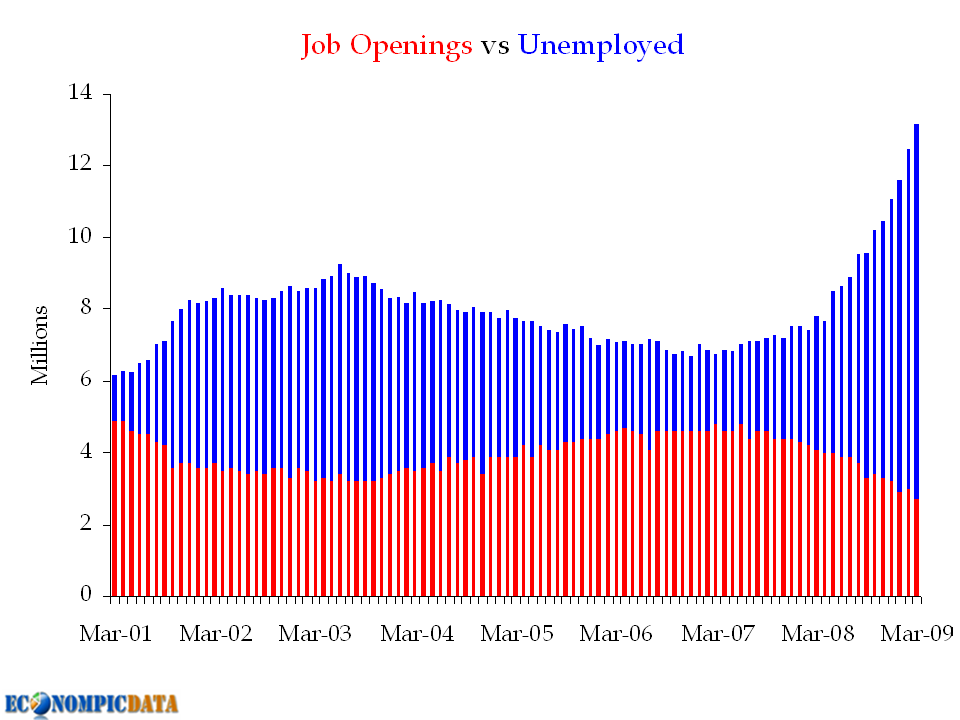
13. A.D.P. ESTIMATES U.S. COMPANIES CUT 532,000 WORKERS IN MAY, FIVE TIMES AS MANY OFFICIAL UNEMPLOYED AS REPORTED JOB OPENINGS

Courtney Schlisserman at Bloomberg reports that ADP Employer Services has released its estimate that US companies cut about 532,000 workers from their payrolls in May. "April’s reading was revised to show a reduction of 545,000 workers, up from a previous estimate of 491,000." Barry Ritholtz at the Big Picture links to Econopic Data's graphs of Job Openings plus number of Unemployed:


There are nearly five times as many reported unemployed people as there are reported job openings.

14. EIA REPORTS CRUDE STOCK BUILD

The EIA reported that, for the week ended May 29, commercial stocks of crude oil grew by 2.9 million barrels to nearly 366 million barrels.


As you can see from the EIA's graph above, commercial stocks remain quite high, historically speaking, and the stock build was contrary to analyst expectations of a 1.5 million barrel draw, per the Bloomberg survey. Gasoline stocks fell by 200,000, versus analyst expectations of a 650,000 build, and are below the five year average historical range for this time of year. Distillate stocks continue to grow by 1.6 million barrels.

Tuesday, May 26, 2009

Daily Sources 5/26

1. JAPAN MAINTAINS 0.1% INTEREST; WILL ACCEPT US, UK, AND FRENCH DEBT FROM DISTRESSED BANKS IN RETURN FOR EMERGENCY FUNDS

The AFP reports that on Friday the Bank of Japan [BoJ] decided to maintain its benchmark interest rate at 0.1%.
"The BoJ also expanded the types of debt it will accept from banks in return for emergency funds to include bonds issued by the governments of the United States, Britain, Germany, and France."
2. E.U. PARLIAMENT PRESIDENT INDICATES THAT BERLIN IS UNLIKELY TO OK TURKEY ACCESSION TO E.U. ANY TIME IN THE NEAR OR MEDIUM TERM

Der Spiegel reports that the President of the European Parliament, Hans-Gert Pöttering, said in alive chat:
"It is my deep belief that--politically, culturally, financially and geographically--it would be too much to have Turkey as a member of the European Union."
Spiegel's backgrounder:
"With his statements, Pöttering underscored one of the central demands being made during the European election campaign in Germany by the Christian Democrats and their sister party in the state of Bavaria, the Christian Social Union (CSU). Both parties are calling for a 'consolidation phase' in the European Union and for Turkey not to be given full membership. 'The European Union cannot be borderless,' German Chancellor Angela Merkel said during the presentation of the party's European election manifesto in Berlin on Monday. The position puts the CDU on a direct confrontation course with its coalition partners in the German government, the center-left Social Democrats (SPD). For years, the SPD has pushed for full membership for Turkey in the EU, arguing it would be prudent for security policy and that the country serves as an important bridge to the Islamic world."
3. RUSSIA IN NEW ENRICHED URANIUM DEAL WITH THE U.S.

Steve Gutterman at the Associated Press reports that Russian uranium export company, Tekhsnabexport aka Tenex, signed a $1 billion package of contracts to supply three US utilities with enriched uranium.
"Tenex will supply fuel to the US utilities from 2014 through 2020 under the contracts, which provide the option for renewal, [Sergei] Novikov [, spokesman for the state nuclear agency Rosatom,] told the AP."
Russia is already the largest supplier of enriched uranium to the US nuclear sector under the Megatons for Megawatts agreement which exports uranium from dismantled Russian nuclear warheads which has been modified for commercial use. The Megatons for Megawatts deal is set to expire in 2013 and up until now US corporations had not contracted for the supply of uranium enriched from the raw ore.

4. CHINA AND RUSSIA JOIN U.S. IN CONDEMNATION OF NORTH KOREAN NUCLEAR TEST

Evan Ramstad, Jay Solomon and Peter Spiegel at the Wall Street Journal report that North Korea's nuclear weapons test Monday was met with near-universal condemnation internationally.
"The United Nations Security Council, holding an emergency meeting in New York Monday afternoon, 'voiced their strong opposition to and condemnation of the nuclear test,' said the current council president, Russian Ambassador Vitaly Churkin.

Mr. Churkin said in a statement that council members 'demand that [North Korea] comply fully with its obligations' not to conduct tests, under a Security Council resolution passed after Pyongyang announced its first test blast in October 2006."
Beijing released a statement saying it was "resolutely opposed to the test."

5. CHINA STATISTICS AGENCY RESPONDS TO ENERGY COMMUNITY'S SKEPTICISM REGARDING ITS INDUSTRIAL PRODUCTION/GDP NUMBERS

Andrew Batson reports that China's National Bureau of Statistics [NBS] is fighting back against the criticism leveled at it by the Paris-based IEA that its official 6.1% GDP growth rate for the first quarter doesn't add up with the fact that electric production fell by 3% for the same time period. (The IEA's report with its criticism was released on May 14--see Daily Sources 5/14 #2. That the criticism was fairly broadly held by the analytical community, see my comment on Daily Sources 5/13 #2 that it was "difficult to reconcile" the notion that industrial production was growing at 7% or more while electrical generation was dropping by as much as 4%.) The NBS pointed out on its website that comparing electricity consumption and GDP can be like comparing apples to oranges as electricity is measured in volumetric terms and GDP in yuan and,
"The bureau said that such gaps have appeared in other countries before without prompting notable comment. In 2001, it said, electricity consumption in the US dropped 3.6%, while GDP grew by 0.8%. In 2003. Japan’s electricity consumption declined 1.3%, while GDP grew 1.8%."
The NBS said that total energy consumption rose by 3% in the first quarter, which it argues is in line with its figure of 6.1% GDP growth for the period.
"But in a new report Monday, Standard Chartered economists Stephen Green and Li Wei argue that, properly measured, energy-intensive industries are not declining any faster than other industries. And the historical relationships between other statistical indicators have also broken down in recent months. So they conclude that the gap between falling electricity output and rising measures of value-added still looks 'problematic.'"
6. PETROCHINA TO TAKE 50% STAKE IN SINGAPORE'S JURONG ISLAND REFINERY


Jamil Anderlini at the Financial Times reports that PetroChina will pay $1 billion for the 45.5% stake in the Singapore Petroleum Company [SPC] held by Keppel Corporation.
SPC operates one of the three major refining projects in Singapore, which is a major trading and shipping hub for petroleum products in the Asia Pacific. The city state's total refining capacity is about 1.3 mb/d. SPC owns 50% of Singapore Refining Company Private Limited which has a 50% stake in the 273.6 kb/d refinery joint venture with Chevron on Jurong Island. The other two refineries are held by ExxonMobil (605 kb/d) and Royal Dutch Shell (458 kb/d).

7. U.S. ASKS CHINA TO GET MORE INVOLVED IN PAKISTAN

Paul Richter at the Los Angeles Times reports that the US has asked China to provide Pakistan with training and military equipment to help counter the growing militant threat in the country.
"Richard C. Holbrooke, the administration's special representative for Pakistan and Afghanistan, has visited China and Saudi Arabia, another key ally, in recent weeks as part of the effort."
An interesting development to be sure, especially in light of the statement by the Chinese Ambassador to Pakistan's statement in early May that the US presence in the region was a "serious concern"--see Daily Sources 5/8 #5.

8. FRANCE INAUGURATES "PEACE CAMP" IN U.A.E.

BBC reports that President Nicolas Sarkozy formally opened a French air base in the UAE today. The base can house as many as 500 troops and includes a naval and air base as well as training facilities.
"'Be assured that France is on your side in the event your security is at risk,' Mr. Sarkozy said in an interview with the UAE's official news agency.

'Through this base--the first in the Middle East--France is ready to shoulder its responsibilities to ensure stability in this strategic region.'

An aide to Mr. Sarkozy is quoted by AFP news agency linking the base to an alleged Iranian threat: 'We are deliberately taking a deterrent stance. If Iran were to attack, we would effectively be attacked also.'"
In a standard issue Newspeak cogitation, the base has been named "Peace Camp." Mr. Sarkozy is also in the UAE to discuss their potential purchase of 60 new Rafale multipurpose jets, in a deal worth about €8 billion (~ $11 billion).


(h/t Joshua Keating at Morning Brief.)

9. VENEZUELA MAY WITHDRAW FROM THE O.A.S., START NEW HEMISPHERICAL ORGANIZATION WITH CUBA; MEANWHILE LEAKED ISREALI REPORT CLAIMS VENEZUELA IS SUPPLYING URANIUM TO IRAN'S NUCLEAR PROGRAM

The AP reports that Chávez has indicated that he would like to withdraw Venezuela from the Organization of American States [OAS] and work with Cuba--expelled from the OAS in 1962 primarily at the behest of the US--to develop an alternative organization to coordinate the interests of the Western Hemisphere. Meanwhile, Mark Lavie at the Associated Press reports that an Israeli government report was leaked to the media which claims that Venezuela and Bolivia supply Iran with uranium for its nuclear program.
"Bolivia has uranium deposits. Venezuela is not currently mining its own estimated 50,000 tons of untapped uranium reserves, according to an analysis published in December by the Carnegie Endowment for International Peace. The Carnegie report said, however, that recent collaboration with Iran in strategic minerals has generated speculation that Venezuela could mine uranium for Iran."
10. ECUADOR PROPOSES KEEPING OIL IN GROUND, SELLING CARBON CREDITS TO DEVELOPED WORLD

Joshua Partlow at the Washington Post reports that Ecuador--which rejoined OPEC 2007 after a 15 year hiatus--is trying to gauge interest in a plan whereby it would leave the oil reserves found under its Yasuni National Park untouched in return for cash from the developed world.
"Ecuador would sell certificates to governments or companies that would allow them to emit carbon dioxide in amounts corresponding to the carbon left underground in Yasuni."

"[Roque] Sevílla [, a prominent Ecuadoran environmentalist who is on the committee in charge of the Yasuni initiative,] said that focusing on carbon could save Yasuni. The 410 million tons of carbon dioxide that would avoid being emitted could raise $4 billion to $7 billion, Ecuador estimates."
The EIA estimates that Ecuador exported about 327 kb/d in 2008 and that it has about 4.517 billion barrels in proved reserves. About one fifth of this, or 831 million barrels, is thought to be under the Yasuni National Park. In June, the German Parliament resolved to support the project and provided funds for a study on how to put it into practice.

11. SOMALI TRANSITIONAL GOVERNMENT ASKS FOR INTERNATIONAL AID VS INTERNATIONAL JIHADIST-BACKED AL-SHABAAB

CNN reports that the President of the Transitional Federal Government [TFG] of Somalia, Sheikh Sharif Sheikh Ahmed, yesterday asked for international assistance in combating al-Shabaab via the media:
"I am calling on the international community to help Somalia defend against foreign militants who have invaded the country."
Al-Shabaab, which has splintered off from the Islamic Courts Union--the government ousted by Ethiopia with tacit US support after having been fingered as having ties to al-Qaeda--has become a cause celebre in the international jihadist community. (For example, Osama bin Laden issued an audio statement attacking the TFG, thus implicitly supporting al-Shabaab, in the middle of March, per Thomas Hegghammer at Jihadica.)

12. MERRILL LYNCH JOINS THOSE ARGUING SPIKE IN OIL PRICES A MAJOR CONTRIBUTING CAUSE TO CURRENT CRISIS; SAUDI KING CALLS FOR $75-80/B OIL (JUST THE PRICE AT WHICH DEMAND STARTS TO FALL), SAUDI OIL MINISTER CALLS FOR OPEC MAINTAINING CURRENT QUOTAS, BUT EVERYONE APPEARS TO BE PREPARING TO PRODUCE MORE & CHINA LOOKS SET TO RAISE PRODUCT PRICES ON DAY OF OPEC MEETING

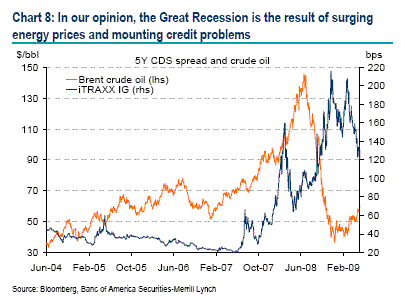
Kate Mackenzie at FT Energy Source reports that Merril Lynch’s London-based commodities team has released a paper arguing--in parallel to James Hamilton's recent work--that the oil shock of 2006-8 is responsible for sharply worsening the current financial crisis. She quotes from the note:
"In our opinion, the Great Recession of 2008-09 is the result of a simultaneous shock of surging energy prices and mounting credit problems (Chart 8). The crisis was precipitated by the collapse of Lehman Brothers, but it was the oil price spike that killed emerging market growth. We firmly believe that the world economy would not have contracted so sharply in 4Q08 without the tremendous oil price spike to $150/bbl that occurred in 3Q08 ...."


The Merrill Lynch team thinks that a jump in oil prices to $70-80/b could pose risks to growth in the OECD countries and that the emerging markets face problems between $90-100/b. (This jibes with my thoughts on the subject earlier. To wit, that $70-80/b is where you see demand destruction in the US in the past--see Daily Sources 5/8 #3--or about $2.50-$3.00/gallon average national gasoline and diesel prices--see VMT vs Real Gasoline and Diesel Prices 1980-Oct 2008. Insofar as emerging market economies are dependent upon exports to the OECD countries and that those exports tend to be production inputs or relatively unsophisticated manufactured goods, I am unclear as to why $90-100/b is acceptable to them, given that high petroleum products prices essentially act as a regressive tax, ie hurts the pocketbook of their target market.)


Meanwhile, Kate Dourian at Platts reports that in an interview with Kuwait's Al-Seyassah newspaper, King Abdullah of Saudi Arabia said,
"We still believe that $75 or maybe $80/b is a fair price for oil, particularly in current circumstances."
And Tarek El-Tablawy at the Associated Press reports in an interview, Ali al-Naimi, the Saudi Oil Minister, told the Saudi daily Al-Hayat that OPEC was likely to maintain its current production quotas.
"Boosting production 'will not happen until we are sure that global inventories are reduced to their normal levels,' said al-Naimi, whose country is the world's largest exporter of crude. He said world crude inventories are currently at between 61 and 62 days of forward cover and the group wants to see them down to 52 or 54 days."
But, Ayesha Daya at Bloomberg reports that the latest Joint Oil Data Initiative [JODI] data indicates that Saudi Arabian oil output jumped from 8.065 mb/d in February to 8.358 mb/d in March, well above the implied quota of 8.051 mb/d. And Platts reports that despite a week's worth of fighting in the Niger Delta, which has recently forced Chevron to shut in 100 kb/d of production, a Nigeria National Petroleum Corp [NNPC] official said crude exports, including condensates, will export 2.01 mb/d in June and 2.04 mb/d in July. Nigeria's implied OPEC quota has been reported from 1.74 mb/d to 1.67 mb/d. The NNPC official said that the country is currently at 1.66 mb/d. Meanwhile, Platts reports that Sinopec's Chairman Su Shulin was quoted by the People's Daily yesterday as saying that he expected the government to lift the guidance price of petroleum products by May 28, which is when OPEC is set to meet.
"Sinopec's refining business has been in the red recently as international crude prices have risen above $60/barrel, Su said.

'According to the information released on May 8--regarding the [new] oil pricing mechanism--prices of oil products sold in the domestic market will be revised when the moving average of international crude prices over 22 consecutive working days falls outside a 4% fluctuation range,' Su said, indicating that domestic oil prices should be adjusted following the recent uptick in global crude oil prices.

The 22-day moving average of the crude basket rose above the 4% fluctuation range from May 1, hovering around 5-10%, Platts data showed."
14. CHINA HOLDS SO MANY U.S. DOLLARS THAT IT MUST BUY MORE TO SUPPORT THEIR PRICE

Jamil Anderlini at the Financial Times writes that China is stuck in a "dollar trap," meaning that it has no choice but to continue buying dollars with its growing reserves if it wants to conserve the value of its current holdings.
"Chinese and western officials in Beijing said China was caught in a 'dollar trap' and has little choice but to keep pouring the bulk of its growing reserves into the US Treasury, which remains the only market big enough and liquid enough to support its huge purchases.

In March alone, China’s direct holdings of US Treasury securities rose $23.7 billion to reach a new record of $768bn, according to preliminary US data, allowing China to retain its title as the biggest creditor of the US government."
Rebecca Wilder at News N Economics notes that according to IMF data China is by far the world's largest capital exporter, just as the US is the largest capital importer.


Ms. Wilder comments:
"China's current account flows are likely to end up in US capital markets. This makes sense, as the US is expected to be one of the forces to pull the globe out of recession through renewed import demand for global exports in the wake of massive fiscal and monetary policy. Eventually, though, push will have to come to shove when it comes to the US-China current account imbalance. The only question is when!"
Worth reading in full. Meanwhile, Ambrose Evans-Pritchard at the UK Telegraph reports that the yield on US 10 year treasuries has risen over 90 basis points since March, suggesting some resistance to the product in the market. (The People's Bank of China has rerouted its purchases of agencies and long term treasuries to treasury bills.)
"The US is not alone in facing a deficit crisis. Governments worldwide have to raise some $6 trillion in debt this year, with huge demands in Japan and Europe. Kyle Bass from the US fund Hayman Advisors said the markets were choking on debt.

'There isn't enough capital in the world to buy the new sovereign issuance required to finance the giant fiscal deficits that countries are so intent on running. There is simply not enough money out there,' he said. 'If the US loses control of long rates, they will not be able to arrest asset price declines. If they print too much money, they will debase the dollar and cause stagflation.'"
Olivier Accominotti pointed out that France was in much the same situation in terms of holdings of UK sterling in the years leading up to WWII--see Daily Sources 4/23 #1--the dispute over which, by the way, was one key reason that the UK and the US were late to heed Paris' warnings as events began to hint at maleficent intent from Berlin at the time.

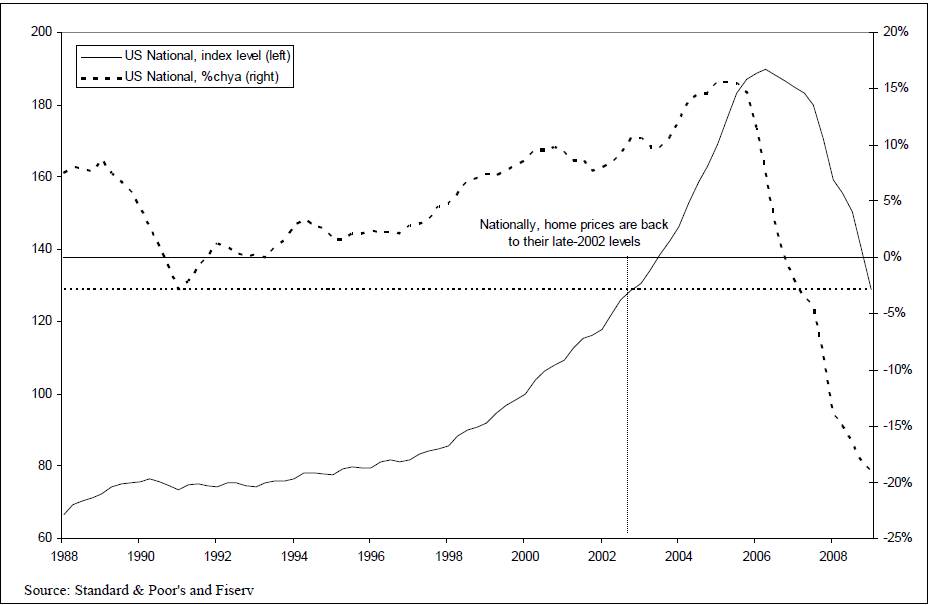
15. U.S. CONFIDENCE UP AS CASE-SHILLER PRICE INDEX DECLINES BY 19.1% IN THE FIRST QUARTER FROM A YEAR AGO!

The Associated Press reports that the Conference Board's Consumer Confidence Index in May rose to 54.9, from a revised 40.8 in April. The reading is the highest seen in eight months.
"'Looking ahead, consumers are considerably less pessimistic than they were earlier this year, and expectations are that business conditions, the labor market and incomes will improve in the coming months,' Lynn Franco, director of the Conference Board Consumer Research Center, said in a statement. 'While confidence is still weak by historic standards, as far as consumers are concerned, the worst is now behind us.'"
Interestingly, the Case-Shiller Home Price Index declined 19.1% in the first quarter from a year ago, and 7.5% from the fourth quarter, per Barry Ritholtz at the Big Picture. Ritholtz notes that prices are now at their 2002 levels:

Tuesday, April 14, 2009

Daily Sources 4/14

still working on redrafting the format of Daily Sources ... all comments welcome

1. CHINA PUBLISHES HUMAN RIGHTS GOALS

China yesterday published its "National Human Rights Action Plan of China (2009-10)," which emphasized economic, social, and communal rights though it did outline some aims more in line with traditional western notions of individual human rights--most significantly legal rights of defendants.
"The 22,000-word, two-year plan outlines the government's aim for broader access to social security, health care and education. The death penalty will be 'strictly controlled and prudently applied,' it states, adding that defendants will be guaranteed fair trials. Forced confessions by torture and the mistreatment of detainees will be prohibited. These rights are to be 'promoted and protected' within two years, the document said."
Some international human rights groups criticized the document as being vague and simply reiterating commitments already made, but I rather think the point is that Beijing accepts them as goals. Humans are, after all, teleological creatures, and in order to plot a course to B from A, one must first figure out what B is. (Indeed, this feature of human life is what Machiavelli meant by "the ends justify the means.") The fact that the government accepts a) that Enlightenment and Magna Carta-based rights are in fact rights, entitled to legal protection and b)
"'China has a long road ahead in its efforts to improve its human-rights situation,' the document acknowledges"
is a very important step forward for liberty generally--and the step itself potentially undermines the legitimacy of the regime itself. (Loretta Chao in the Wall Street Journal.)

2. NORTH KOREA PULLS OUT OF NEGOTIATIONS ... WITH EVERYONE

North Korea reacted to the official condemnation by the UN Security Council Monday of its satellite launch by announcing its withdrawal from the six party talks--with China, Japan, Russia, South Korea and the US--which aim to denuclearize the nation and restart its nuclear program:
"'We have no choice but to further strengthen our nuclear deterrent to cope with additional military threats by hostile forces,' the statement [published today by the North Korean Foreign Ministry] said. It also hinted that the North would conduct more satellite tests, saying it will 'continue to exercise its sovereign rights to use space.'"
(Associated Press: "N. Korea to boycott six-party nuclear talks.") The response of to the statement by US and the other members of the six party talks has been to refer to the official condemnation. From the US State Department briefing today:
"[L]et me just say I know you all have a lot of questions about North Korea. I don’t have very much at all today that I’m going to give you. And I know you’re going to come at me with a lot of questions from various angles, but I just want to basically refer you back to the UN Security Council presidential statement that was issued. And this presidential statement made very clear the position of the UN Security Council plus Japan. And as you know, the statement calls for an early resumption of the Six-Party Talks, a verifiable denuclearization of the Korean Peninsula, and full implementation of the joint statement of 2005. I don’t have much more for you right now. At some later point, we’ll have more to say, but right now, that’s all I have."
3. TAIWAN LIKELY TO REVERSE NUCLEAR POWER BAN ON EMISSIONS CONCERNS

Taiwan has scheduled a two-day "state conference" beginning tomorrow which will bring together 205 government officials to debate whether Taipei should overturn its eight year old ban on new nuclear power plants:
"'Nuclear power is an inevitable option because we want to cut carbon emissions,' Tu Yueh-yuan, chief engineer of state-run Taiwan Power Co., said on April 2. The company has room to add as many as 10 reactors at its existing nuclear power plants, she said. To authorize that, [Taiwanese President] Ma [Ying-jeou] would have to reverse a decision by his predecessor, Chen Shui-bian."
The key problem facing the relatively small island nation vis-a-vis expanding its nuclear power capacity is how to safely dispose of the waste. (Yu-huay Sun: "Taiwan Energy Talks Pit Ma Against Nuclear Opponents," Bloomberg News.)

4. BEIJING'S LATEST ALTERNATIVE CURRENCY MOVE TAKES PLACE IN A WORSENING ECONOMIC ENVIRONMENT--AND IN THE PLACE MOST AFFECTED

The latest move in the question of an alternative to the dollar was made by Beijing last week when it decided to allow five of its largest trading cities--Shanghai, Guangzhou, Shenzhen, Zhuhai and Dongguan (four of which are in Guandong Province)--to settle cross-border trade deals in renminbi.
"The yuan settlement move may be a potentially huge boon to Chinese firms, which can sidestep foreign exchange risk without having to buy derivative products to hedge their currency exposure.

But it could be doomed to failure if Beijing can’t convince foreign counterparties to China’s trade that getting paid in yuan is in their own best interest.

That’s not going to be easy. Under current rules, if firms or individuals outside of China were to hold yuan, they wouldn’t be allowed to directly invest it in China’s capital markets. And as for hedging currency risk, Shanghai’s forwards and swaps markets are equally off-limits."
(See Denis McMahon: "The Yuan Abroad: Useful If Strong," China Journal and Denis McMahon: "Beijing Aims to Expand Foreign Trade in Yuan," The Wall Street Journal.)The State Council has asked for the cities involved to submit regulations proposals for the pilot program. It has yet to announce a date for the program to commence. The news comes on top of the recent story that preliminary estimates of GDP growth for Guandong Province in the first two months of 2009 are at 5% and 5.5% for the first quarter, 5% less growth than seen last year.
"Guangdong’s import and export dropped 25.9%, year on year, in January and February, and 22.9% in the first quarter. Guangdong’s foreign trade dependence is as high as 155%, more than double China’s average."
(China Stakes: "Export Plummet Shock: A Guangdong Tiger Under Water," h/t Yves Smith at naked capitalism.) Meanwhile, Cao Jianhai, a professor at the Chinese Academy of Social Sciences, said that the rebound in Chinese property markets was likely unsustainable and that residential property prices were likely to fall by 40 to 50% from their levels in 2008.
"'Prices may not fall in the near term but I expect a collapse starting next year, followed by many years of stagnation,” said Mr Cao, known as one of the 'three swordsmen' of the real estate market because of his influence as an official economist."
(See The Financial Times: "Property prices in China set to halve.")

5. SINGAPORE AND ASEAN 5 POSTING HORRIBLE ECONOMIC GROWTH NUMBERS

Rebecca Wilder notes that Singapore's Ministry of Trade and Industry today announced that it had downwardly revised its 2009 GDP growth forecast from between -2% and -5% in January to between -6% and -9% in April. The revision was made on the base of an advance estimate for first quarter GDP of a 11.5% contraction. Ms. Wilder helpfully produces a graph plotting the annual GDP growth (on a quarterly basis) of the ASEAN 5:


(Her post is worth a look: "Singapore is dropping quickly; dismal growth expected for the ASEAN countries" at News N Economics.)

6. TOTAL'S VENEZUELA GAMBIT ... RISKY AND SEEMS TO IGNORE THE REFINING PICTURE IN THE ASIA PACIFIC ... MEANWHILE RUSSIA AND BRAZIL TAKING MARKET SHARE ON OPEC CUTS

Following the visit of Hugo Chávez to China, the CEO of CNPC, Jiang Jiemin, said he would submit a plan to establish a joint refinery with the PdVSA in Guangdong province. The refinery would have a throughput of 20 million tonnes a year (~400 kb/d) and be 51%-owned by CNPC and 49% by PdVSA. Given that the refinery would be sophisticated, it could make the import of larger volumes of Venezuelan crude--a major goal of the Chávez administration, more viable as most new sophisticated refining capacity on or coming on line in China already has dedicated supply--mostly from the Saudi Arabia. However, there is reason to doubt that these ideas will go forward as planned:
"In May 2008, Chinese state media reported that CNPC subsidiary PetroChina entered into a joint venture agreement with PDVSA to build a 400 kb/d refinery in Guangdong province, configured to process Venezuelan heavy oil.

Under the agreement, witnessed by Chávez and Chinese Vice Premier Hui Liangyu, the crude is to be sourced from the Junin 4 block in the Orinoco belt.

At the time, officials said that the joint refinery, Venezuela's first such investment in China, would advance Chávez's goal of shipping to China 1 mb/d of oil by 2011, or 13% of current Chinese oil demand.

Reports vary on just how much oil Venezuela actually ships to China. Last May, Ramirez said shipments amounted to 500,000 b/d of oil, while Chinese state media reported 300—380 kb/d of products and 80 kb/d of crude."
(Eric Watkins: "China, Venezuela agree to speed up increased oil shipments," The Oil & Gas Journal.) That said, it is reported that senior officials from CNPC, PdVSA and Total SA are scheduled to meet next month in Caracas to discuss a potential 20 year contract to send 200 kb/d of Venezuelan oil to China, possibly starting in 2013, and with volumes rising beyond that.
"CNPC is talking to Total about a package involving a joint bid for Orinoco oil assets, building an upgrader to process the heavy oil produced in Venezuela and shipping it to a CNPC-PDVSA refinery to be built in Guangdong, southern China, a CNPC official told the news agency.

Total declined to comment, but a company spokeswoman told Dow Jones that the company had extensive links with China and confirmed that 'we are in discussions with CNPC on a variety of projects.'"
(Upstream online: "Caracas lines up three-way Orinoco pact.") In February Total CEO Christophe de Margerie told reporters in London that investment in Venezuela was preferable to Brazil, because there was less competition in Venezuela--see Daily Sources 2/13 #9. The statement was somewhat mystifying because, after all, the reason there is less competition in Venezuela is because Chávez has a habit of nationalizing your investments. However, if a project were done in conjunction with Chinese national oil companies, and increased economic integration with China is a goal of Caracas because Chávez believes Beijing may be able to offer military-political defense of his regime from an inevitably hostile US, then perhaps Total may be able to feel better protected against loss of its assets. Indeed, de Margerie may even feel that Chávez would not just be less likely to alienate Paris because of its habitual gad fly approach to US international policies, but also because of the cultural affinity that his first party--The Fifth Republic Movement--claimed with France (see my first post Venezuela vs ExxonMobil). That would be a reasonable strategy--an extremely risky one in my view, but international oil companies are rather experienced in taking such risks.

In the meantime, Brazil and Russia have taken advantage of the supply cuts made by OPEC to take a larger share of the US oil import market (which itself is shrinking).
"US imports from the Organization of Petroleum Exporting Countries fell 818 kb/d, or 14%, to 5.02 million in January from a year earlier, according to the latest monthly report from the Energy Department. At the same time, imports from Brazil more than doubled to 397,000 and Russia’s increased almost 10-fold to 157,000, a trend that continued in February and March, according to data from each country."
The story puts the data in a very strange way, but the latest monthly import data on the EIA website shows that Russian imports grew to 516 kb/d in January from 382kb/d in December (or 35%) and Brazilian imports grew to 450 kb/d in January from 225 kb/d in December (or 100%). (That said, imports from Brazil had been as must as 354 kb/d as recently as October and imports from Russia had been as much as 490 kb/d in August, so although there may be a trend, it is not as pronounced as those percentages would imply. See: EIA: "US Imports by Country of Origin.")
"Russian overall exports climbed 6.3% in February and 2.2% in March, according to the Energy Ministry. Brazilian total exports more than doubled in both February and March, according to Brazil’s Trade Ministry."
(Mark Shenk: "OPEC Cuts Thwarted as Brazil, Russia Grab US Market," Bloomberg News.) Beyond that, Saudi Arabia has put a hold on its two new major export refinery plans--for Tanbu and Jubail--of 800 kb/d in total throughput, but still has a fairly aggressive schedule of capacity addition downstream. Reuters ran the numbers in a series of tables:


As you can see, a fair amount, 440 kb/d is inside China itself--and we can expect a considerable portion of the domestic export refinery plans to target the Chinese market. This is probably true of any excess capacity produced from its JV refineries in Japan and South Korea as well:


7. TURKMEN PIPELINE BLAST ALLEGEDLY DUE TO GAZRPOM'S RELUCTANCE TO HONOR CONTRACT TERMS ... MEANWHILE LUKOIL SEEKS BP'S STAKE IN CPC AND IS DRILLING OVERSEAS DUE TO MOSCOW'S RELUCTANCE TO GRANT MORE DRILLING RIGHTS

Turkmen President Gurbanguli Berdymukhamedov has accused Moscow of being behind the recent natural gas pipeline blast which cut off its exports through Russia to eastern Europe and wants an international investigation into the causes of the pipeline blast.
"'Turkmenistan's president [Gurbanguly Berdymukhamedov] has ordered the government to carry out...an international study to investigate the causes of the incident,' the [Turkmen Foreign] ministry said in a statement."
In a televised speech at a Cabinet meeting the President said:
"We won't allow them to hurt our image as a reliable supplier of energy resources to global markers."
Gazprom has refused to comment on the issue, but Russian Foreign Minister Sergei Lavrov described the explosion as "purely technical." Evidently, Gazprom reduced intake by a full 90% without informing their Turkmen counterparts in advance. This was allegedly done because Gazprom at this time cannot recoup the cost of Turkmen gas, which it reportedly contracted for on December 31, 2008 at $340/tcm (~$9.61/MMBtu.) Yesterday, UK front month natural gas contracts closed at £0.2934/therm (~$4.31/MMBtu). Front month Brent closed at $52.14/b or about $8.99/MMBtu. Urals spot on Friday closed at $50.34/b or about $8.68/MMBtu. (The actual terms of the Turkmen contract are unknown, but it is thought they are tied by some formula to the price of oil, with a floor and a ceiling price.) (See: Alexander Vershinin: "Turkmen leader: Russia must pay for pipeline blast," Associated Press and Nadia Rodova: "Turkmenistan wants international experts to study gas line blast," Platts.) Meanwhile, Lukoil CEO Vagit Alekperov told Bloomberg in a televised interview that the company will seek to buy out BP's stake in the Caspian Pipeline Consortium.
"'Now we need to tie up the formalities and receive permission from the Kazakh government,' Alekperov said. 'I plan to be in Kazakhstan from April 25-30 where I’ll meet with the Kazakh president and I’ll raise that question in the hope of getting a positive answer.'"


Chevron, the operator of the Tenghiz field which is supplies much of the CPC pipeline's throughput, said in February that it intends to increase output in the field to 400 kb/d this year. Shareholders in the consortium plan to invest $1.6 billion to double pipeline capacity to 1.3 mb/d from 2013. (Stephen Bierman and Ellen Pinchuk: "Lukoil to Seek Kazakh Approval to Buy BP’s CPC, Tengiz Stakes," Bloomberg News.)Lukoil also is planning to drill for oil offshore the Ivory Coast and Ghana.
"'After the outstanding discoveries made in the recent years on the sea shelf of Ghana, this area is one of the most promising for exploration in West Africa,' Andrei Kuzyaev, head of Lukoil Overseas Holding Ltd., said in a statement on April 2."
Evidently a part of the thinking behind Lukoil's overseas acquisitions is that Moscow is slowing down the number of licenses to drill it is offering domestically. The number of auctions for oil licenses offered by Moscow last year fell to 147, or by half.
(Stephen Bierman and Ellen Pinchuk: "Lukoil to Drill in Africa as It Urges Russia to Offer Licenses," Bloomberg News.)


8. POLAND TO SEEK $20.5 BILLION CREDIT LINE FROM IMF

IMF Managing Director Dominique Strauss-Khan send an email statement to reporters saying that Poland was seeking a one-year credit line from the institution of $20.5 billion.
"Poland will become the second country after Mexico to use the flexible credit line as its economy faces the sharpest slowdown in almost a decade. The zloty lost almost a third of its value from a record high in July as investors sold riskier emerging-market assets amid the global credit crunch.

'This is the reflection of our cautious and responsible economic policy,' Finance Minister Jacek Rostowski told journalists after the government’s weekly meeting. 'This will help protect the zloty against uncontrolled depreciation that we saw during the first two months of this year. The consequences will be very positive for Poland.'

The loan will raise foreign reserves by almost a third, help cut Poland’s debt-servicing costs and facilitate access to international financing, he said.

'If Poland follows Mexico, maybe other countries would be willing to arrange a credit line,' said Ralph Sueppel, chief economist and strategist at London-based hedge fund BlueCrest Capital Management Ltd., which manages about $2 billion in emerging-market assets. 'The advantage for the Poland is that it provides support at a time when dollar funding is short.'"
(Marta Waldoch and Ewa Krukowska: "Poland to Ask IMF for Credit to Shield Economy, Zloty," Bloomberg News.)

9. CAIRO LOSING PATIENCE WITH HIZBULLAH ... HIZBULLAH MAKES OUT THAT CAIRO IS SUPPORTER OF TEL AVIV

The BBC reports that Egypt has accused 49 suspects of being agents of Hizbullah and planning hostile operations on its soil. Egyptian security forces are searching for 13 additional suspects on the Sinai Peninsula. Michael Collins Dunn comments:
"Part of the surprise here — actually a clever tactical move — is that Nasrullah did not offer the usual flat denial of involvement, but portrayed Hizbullah as trying to relieve the siege of Gaza, thus reminding the world that Egypt's keeping the Rafah crossing closed is as much responsible for Gaza's suffering as Israel's closure of the other crossings. Popular opinion inside Egypt has generally been critical of the government's policies on Gaza, and Hizbullah is playing to that.

Of course, there's a certain disingenuousness to Hizbullah claiming it does not carry out operations in other countries and admitting that it had agents operating in Sinai. But by rationalizing their presence rather than denying it, Nasrullah subtly shifts the debate from one of violating Egyptian sovereignty to one of spotlighting Egypt's keeping Rafah closed."
(see BBC News: "Egypt 'hunts Hezbollah suspects'," and Michael Collins Dunn, "Egypt/Hizbullah Feud Heating Up," MEI Editor's Blog.)

10. IRAN EMBARKS UPON STRATEGY OF MAKING AMICABLE NEGOTIATIONS AS POLITICALLY DIFFICULT TO PURSUE AS POSSIBLE

The US is continuing its strategy of engagement with Iran, as evidenced by yesterday's US Press Briefing:
"QUESTION: Separate issue. On Iran, Javier Solana spoke to Mr. Jalili and it seems that Iran is welcoming what they say – you know, they hope to be a constructive dialogue with the P-5+1. I just wondered whether you had any details on Solana’s call and whether you, you know, welcomed their welcoming of talks?

MR. WOOD: Yeah, I mean, of course, we welcome the fact that they’re, you know, interested in having a dialogue. And you know, I would refer you again to the sincere offer of the P-5+1 to provide Iran with what we believe is a very good, substantive package of incentives. We want to deal with Iran on this issue. It’s an important issue to the international community. And Iran needs to show the international community that its nuclear program is a peaceful one. Right now, the international community is very skeptical about that. But as I’ve said, we want to directly engage Iran on a range of issues, and we encourage Iran to continue – well, we encourage Iran to come forward and provide the international community with all of the assurances that it requires to be convinced that Iran is pursuing a peaceful nuclear program. But as I said, we remain skeptical about it."
And David Sanger at the New York Times reports that the US and its European allies are preparing "proposals" to drop the former US insistence on a rapid shut down of nuclear facilities in the early stages of negotiations with Tehran. But, in the meantime, Tehran appears to be doing much to make the realization of such negotiations more difficult. It has tried Roxana Saberi, a US-Iranian dual citizen and reporter, for espionage in a closed door trial with the verdict expected in two weeks. She has been imprisoned since late January for charges of purchasing alcohol originally. The charges have swiftly escalated to espionage. (The Associated Press: "Iran Says U.S. Journalist Has Been Tried Behind Closed Doors.") Today President Mahmoud Ahmadinejad has announced Iran will launch a satellite soon--on a missile with a range of up to 1,500 km (930 miles). Satellites pose a concern because they can be fitted with weapons and the technology is the basis for ICBMs. (And satellites have also proven to be of particular concern to Moscow.) (Hossein Jaseb and Hashem Kalantari: "Iran Plans to Send Bigger Satellite Into Space," Reuters.) And the Islamic Revolution Passdaran Guards Corp (IRGC) published a statement accusing Amsterdam (!) of attempting to instigate a "color revolution" in Iran via its support of internet websites.
"The statement, released by the 'IRGC Center for Organized Cyber Crimes,' claims, ‎‎'Hostile countries have demonstrated increasing interest in utilizing cyber space with the ‎expansion of the Internet, supporting the creation of websites, blogs and internet radio ‎and television networks.'

The IRGC’s statement identifies the 'Dutch Project' as one of the main soft overthrow ‎threats against the Islamic Republic, noting, 'One such country, which has supported the ‎opposition movement financially in recent years, is the Netherlands, which passed a ‎budget addendum in 2005 sponsored by Farah Karimi, an Iranian-born representative in ‎the Dutch parliament and a member of the leftist Green Party.' ‎

In another part of the IRGC statement, it is claimed that the Dutch budget is part of the ‎‎'long-term and strategic planning along the ideology of NATO,' which is 'pursuing the ‎agenda of global imperialism by absorbing vast capital, expert human resources and ‎political networks, setting up a group of expert journalists from the domestic and foreign ‎opposition with the help of the British, political and diplomatic support from the Dutch, ‎and with planning and secret budgets from the United States.'"
(Rooz online: "Revelations against Dutch Projects‎--Passdaran Guards Corp’s Statement on 'Media Overthrow'.) And Tehran has also given Shell and Repsol until May 20 to "clarify their involvement" in the Phase 13 of the South Pars project.
"'If subsequent to the expiry of the deadline these companies do not make clear their involvement in the Persian LNG project, talks will begin directly with Chinese (companies),' Seifollah Jashnsaz, managing director of the National Iranian Oil Company (NIOC), told the ISNA news agency.

'Presently not much remains to the end of this deadline,' he said, without giving further detail."
(Hashem Kalantari and Jonathan Gleave, "Iran gives Shell/Repsol deadline on LNG project," Reuters.)

11. SWAT VALLEY ADOPTS SHARIA ... TALIBAN EXPANDING TO PUNJAB

Pakistani President Asif Ali Zadari has signed into law legislation which introduces sharia law into the Swat Valley. The Taliban has been de facto in control of the region for some time now. The agreement, it should be noted, maintains the federal judiciary as the court of appeals--and thus superior to the Sharia courts. (See: BBC News, "Pakistan passes Swat Sharia deal.") Meanwhile, Sabrina Tavernise, Richard A. Oppel Jr. and Eric Schmitt at the New York Times report that the Taliban is making inroads in Punjab, the most populous region in Pakistan and the region at the heart of the recent dispute with Nawaz Sharif.

12. RED SHIRT PROTEST IN THAILAND SHUT DOWN BY MILITARY

The Red Shirt protests in Thailand have reportedly come to a halt after a large military presence intimidated the bulk of the protesters.
"'I want to save the people,' Jatuporn Phromphan, one of the protest leaders, said as he walked up to surrender to police with a grim-faced band of supporters. 'But I will continue to fight for democracy.'"
Evidently the military has either decided that it needs to create a sense of stability or it is backing the so-called Yellow Shirts. (Tim Johnston: "Thai Protesters Give Up to Avoid Further Violence Troops, Protesters Clash in Bangkok," The Washington Post -- includes a slide show.)

13. US MARITIME STRATEGY GOING FORWARD

Professor Tom Fedyszyn gave a copy of his power point presentation illustrating the evolution of the thinking behind US grand naval strategy going forward to Steve Clemons at The Washington Note, who made it available to all. Key excerpt:
"Today’s Maritime Strategy “Bottom egg” = Obama Direction

- Maritime security
- Maintenance of global commons
- Promotion of free trade
- Building partnerships
- Anti-piracy
- Humanitarian assistance
- Greatest threat to world instability is economic recession
- Need for US to cooperate and build partnerships
- World trade is cornerstone of strong economy
- US provides strong moral leadership
- Less implied concern over international power rivalries"
Very much worth a look.

14. RETAIL SALES DOWN, CORE CONSUMER PRICES FLAT ... SO MONEY SUPPLY AIN'T GROWING ALL THAT MUCH ... IN THE MEANTIME THE EIA FORECASTS INDUSTRIAL DEMAND FOR NATURAL GAS WILL DROP BY 7.4% IN 2009

The Commerce Department announced today that retail sales had fallen by 1.1% in March from a year earlier.
"Excluding autos, retail sales fell 0.9% after a 1% rise in February. That also was worse than analysts' forecasts of a flat reading for last month.

Sales at appliance stores fell 5.9% last month and furniture stores reported a 1.7% decline. Sales at specialty clothing stores fell 1.8% and dipped 0.2% at general merchandise stores, a category that includes Wal-Mart Stores Inc., Target Corp. and Macy's."
"Meanwhile, the Labor Department reported that wholesale prices plunged 1.2% in March as the cost of gasoline, other energy products and food fell sharply.

Gas prices fell 13.1%, the steepest drop since December, while food costs dipped 0.7%. Excluding volatile food and energy prices, the Producer Price Index was unchanged, below analysts' forecasts of a 0.1% rise."
(Associated Press: "Retail sales tumble unexpectedly in March; Consumer spending subdued amid rising unemployment.") IN the meantime, the EIA released its forecast today that natural gas consumption by the industrial sector is expected to decline by 7.4% in 2009 from 2008. The new forecast cut the average price forecast for natural gas delivered to Henry Hub at $4.24/Mcf.
"[The] EIA said it expects LNG imports to increase to about 480 Bcf this year, from 352 Bcf in 2008. Lower global economic activity and new liquefaction capacity in the Middle East and elsewhere should boost US imports."
(Joel Kirkland: "Industrial sector gas use could decline 7% in 2009: US EIA," Platts.) Not an especially rosy picture of near term economic growth from an official government agency, in other words.