Showing posts with label sweden. Show all posts

Thursday, July 2, 2009

Daily Sources 7/2

1. JAPANESE HAWK CHOSEN TO LEAD IAEA

Sharon Otterman at the New York Times reports that Japanese diplomat, Yukiya Amano, was elected to head the UN's atomic watchdog--the IAEA.
"Depicted by experts as the candidate favored by the United States and other wealthy nations, Mr Amano favors maintaining the current approach toward controlling nuclear proliferation in Iran, which Western countries suspect of trying to build nuclear weapons. Iran says its nuclear program is purely for civilian purposes to generate energy.

'He’s a nonproliferation and disarmament guy, and he believes in it,' said David A Kay, a former IAEA official and senior fellow at the Potomac Institute for Policy Studies. 'He has been around in trying to keep the inspections in Iran going, and I expect him to continue very much in that line. He will not want to create a situation in which military action is the only alternative.'"
2. CHINA TO RESUME ALLOWING IMF REVIEWS OF ECONOMY

Andrew Batson at the Wall Street Journal reports that China next week will take a step toward reconciling with the IMF, which it has blocked from reviewing its economy for the last three years.
"But a team of IMF officials visited China about a month ago, and have completed a draft review that is now being circulated for comments.

The IMF's draft report says China's exchange rate 'continues to be substantially undervalued,' according to a person who has seen the document, called an Article IV consultation. That's in line with what senior IMF officials have repeatedly said in public. China has kept its currency, the yuan or renminbi, basically fixed against the US dollar since July last year, though it has risen, along with the dollar, against other currencies since then.

That description nonetheless marks a climbdown from an earlier push to label China's exchange rate as 'fundamentally misaligned,' a designation that would suggest the country is in violation of the IMF charter. The draft report also states that Chinese authorities 'disagreed with the staff's assessment' of the exchange rate, and notes their argument that the global turmoil calls for 'a policy of stability.'"
Simon Johnson argued in April that the Obama Administration had pulled off a coup at the G20 meeting, effectively getting Europe to make the selection process for the head of the IMF transparent in return, more or less, for opening up the process at the World Bank, the next head of which Johnson thinks is likely to be Chinese--see Daily Sources 4/3 #3. Clearly in order to clear the field for their own candidates and a larger role generally, Beijing will first be forced to work with the organizations they want to influence or lead.

3. PBOC TO ENCOURAGE CROSS-BORDER SETTLEMENT IN YUAN

Bob Chen and David Yong at Bloomberg report that the People's Bank of China will encourage cross border settlement in the renminbi starting today, per regulations posted on the central bank's website.
"Transactions inside China will take place in Shanghai and four cities in southern Guangdong province, including Guangzhou and Shenzhen, while those outside China will occur in Hong Kong, Macau and the Association of Southeast Asian Nations, it said."
(h/t Jesse's Café Américain.)

4. CNPC MAY REVIVE BID ON ARGENTINE UNIT OF REPSOL-YPF, CNOOC MAY JOIN IN

Sui-Lee Wee at Reuters reports that CNPC plans to revive its $17 billion bid for the Argentinian unit of Repsol-YPF, reportedly planning to make an offer for as much as 75%. CNOOC also may enter a bid for the remaining 25%. "Goldman Sachs is advising YPF on the sale, while Morgan Stanley and JP Morgan are advising CNPC and CNOOC respectively." YPF, or Yacimientos Petrolíferos Fiscales, was the national oil company of Argentina until 1991, when it was privatized and then purchased by Repsol. (h/t Carola Hoyos at FT Energy Source.)

5. SPANISH CONSUMER CREDIT DOWN 33.7% IN Q1

Edward Harrison at Credit Writedowns reports that consumer credit in Spain fell by 33.7% in the first quarter, according to the National Association of Financial Credit Institutions (Asnef).
"Asnef stressed that the fall in the consumer sector has been mainly due to losses on personal loans, due to the sharp decline in the credit available for consumer goods and by the contraction of revolving credit associated with credit card usage."
Harrison says he expects more failures or bailouts of Spanish banks in coming months. Worth reading in full.

6. RIKSBANK CUTS BENCHMARK INTEREST RATE TO 0.25%

Malin Rising at the Associated Press reports that the Riksbank cut its benchmark interest rate by 0.25% to 0.25% today.
"The central bank said it now expects Swedish gross domestic product to decline by 5.4% in 2009 -- a sharper drop than its previous forecast of a 4.5% fall. However, it raised its outlook for 2010 GDP to a growth rate of 1.4% from 1.3% previously.

It said the economic outlook is still uncertain and that although GDP is expected to be positive in 2010, employment will not begin to rise until 2011."
7. FINAL SECTION OF SINO-KAZAKH CRUDE PIPELINE COMPLETED

Naubet Bisenov at Platts reports that Kazakhstan's KazStroyService has finished the 10 million metric ton/annum (200 kb/d) Kenkiyak-Kumkol pipeline and will begin test runs on it shortly.
"The Kenkiyak-Kumkol link is the final section of the Sino-Kazakh crude pipeline which runs from Atyrau on the Caspian Sea coast of the Central Asian nation, to Atasu near Kazakhstan's eastern border, then onwards to Alashankou in China's northwestern Xinjiang Uygur autonomous region.

The Sino-Kazakh crude pipeline is jointly developed by Kazakh state oil company KazMunaiGaz and Chinese state oil giant China National Petroleum Corp."


8. TALIBAN HAS WORN OUT ITS WELCOME IN PAKISTAN

In another interesting report by World Public Opinion, an institute based out of the University of Maryland, Pakistani opinion has turned sharply against the Taliban.

"Large majorities express confidence in the government (69%) and the military (72%) to handle the situation [in Swat]. Retrospectively, the public leans (by 45% to 40%) toward thinking the government was right to try to make an agreement in which the Pakistani Taliban would shut down its camps and turn in its heavy weapons in return for a shari'a court system in Swat. But now 67% think the Pakistani Taliban violated the agreement when it sent its forces into more areas, and 63% think the people of Swat disapprove of the agreement.

On the Afghan Taliban, an overwhelming 87% think that groups fighting to overthrow the Afghan government should not be allowed to have bases in Pakistan. Most (77%) do not believe the Afghan Taliban has bases in Pakistan. However, if Pakistan's government were to identify such bases in the country, three in four (78%) think it should close the bases even if it requires using military force.

Public attitudes toward al Qaeda training camps follow the same pattern. Those saying the 'activities of al Qaeda' are a critical threat to Pakistan are up 41 points to 82%. Almost all (88%) think al Qaeda should not be allowed to operate training camps in Pakistan. Though 76% do not believe there are such camps, if the Pakistani government were to identify them, 74% say the government should close them, with force if necessary."
Unsurprising, to me, but still well worth reading in full. (h/t Juan Cole at Informed Comment.)

9. PETROBRAS STRIKES MORE OIL ONSHORE IN THE ESPIRITO SANTO BASIN

Tom Hennigan at Platts reports that Petrobras struck oil onshore in the Espirito Santo basin.
"The Espirito Santo basin has seen a string of strikes in recent months. Last week the company reported strikes in blocks ES-T-390 and BT-ES-15. Since March it has also made four oil strikes in the onshore ES-T-364 block alone.

The company also announced a gas and an oil and gas find in the onshore ES-T-505 block."
The block block is 100% owned by Petrobras. Seems like every other week they make a new announcement of new oil.

10. HONDURAN CRISIS IN PART DUE TO NO PROCESS FOR REMOVING PRESIDENT IN CONGRESS & HIS RELATIONSHIP WITH CHÁVEZ, SAY EXPERTS

Kevin Sullivan at Real Clear World posts the quick analysis of several Honduras experts. Juan Carlos Hidalgo at the CATO Institute makes the interesting observation:
"The Honduran constitution does not provide an effective civilian mechanism for removing a president from office after repeated violations of the law, such as impeachment. Honduras’ Supreme Court nonetheless ordered Zelaya’s removal and Congress bestowed the presidency on the civilian figure--the president of Congress--next in the line of succession according to the constitution. "
Jesus Rios at Gallup World Poll makes another interesting observation:
"The latest remarks by interim leader Micheletti suggest Zelaya’s increasing alignment to President Hugo Chavez’s regime is at the core of the crisis. So, if Zelaya does in fact return to power before the November presidential election, the question then becomes: how will he manage to govern amidst an adverse public opinion environment and among institutions that backed his ousting, including his own political party? And, what role, if any, will Chávez play in Honduran politics from now on? Will Zelaya drop or moderate his pro-Chávez stance to regain political support? According to the 2008 Gallup survey, just 20% of Hondurans approve of President Hugo Chávez."
11. WTO WARNS ON INCREASING PROTECTIONISM, SAYS GLOBAL TRADE VOLUMES WILL CONTRACT BY 10% IN 2009

Joshua Chaffin at the Financial Times reports that the WTO published a report today which warns that
"[g]overnments around the world have continued to push up trade barriers in spite of high-profile pledges at the G20 summit and other forums to resist protectionism"
The organization lowered its forecast for world trade to a contraction of 10% in the volume of goods and services.


12. BLS REPORTS 476,000 JOB LOSSES IN JUN, STATE FISCAL RESPONSIBILITY MEANS STATE ECONOMIC POLICY CONTRACTIONARY IN RECESSION

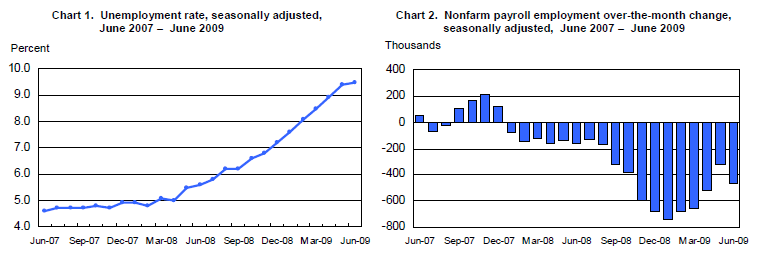
Barry Ritholtz at the Big Picture reports that the Bureau of Labor Statistics announced today that there were 467,000 job losses in June. The unemployment rate rose by 0.1% to 9.5%. The U-6 measure--marginally attached and involuntary part time workers--rose to 16.5%. Temporary employment fell by 37,600.
"Hours worked fell 0.8%, bringing the average workweek down 0.1 hours to 33; This is a record low going back to 1964."

Peter Boockvar, also at the Big Picture, also notes that initial jobless claims totaled 614,000. Continuing claims fell by 58,000 from last week.
"While there is no question benefits are expiring without one finding a job, as evidenced by the rising exhaustion rate, many losing those benefits now started getting them when initial claims were running in the 400k range last summer. Now its running above 600k, so there are still more people filing initial claims than getting removed from the continuing claims data, thus continuing claims still should trend higher assuming no sudden change in hiring trends."
Meanwhile, Free exchange makes the important observation:
"[S]tate budget policies are sharply contractionary at this point. Despite allocations of federal aid to states, services are being cut, state employees are being laid off, and taxes are being raised in order to balance the budgets of local governments constitutionally unable to run deficits. It's not at all clear that the federal stimulus will entirely compensate for state-level fiscal tightening, which means that American fiscal policy could, on net, be contractionary."
13. BARCLAYS EXPECTS WTI TO AVG $71/B IN W3

Yee Kai Pin at Bloomberg reports that Paul Horsnell's commodity team at Barclays has lifted its third quarter forecast for WTI to $71/b from $62/b. Horsnell increased his Q3 forecast for Brent to $69/b.
"'Among all the changes that have kept commodities on the boil in recent years, the key factor is that 'normal' is not what it used to be,' the analysts said in the report. 'Oil prices below $70 or copper prices below $3,000 are no longer normal.'"
I think he's wrong, but he does know of what he speaks.

Wednesday, June 3, 2009

Daily Sources 6/3

1. JAPAN MAY NEED TO SHUT MORE THAN A 5TH OF ITS REFINING CAPACITY ON REDUCED DEMAND

Reuters reports that Nippon Oil Corp President Shinji Nishio told the Reuters Energy Summit that Japan may be forced to shut as much as 1 mb/d of refining throughput capacity, more than a fifth of the country's total capacity, as oil demand is falling more quickly than previously expected.
"'I think we are likely to see an even faster decline than the government's projection,' he said in Tokyo.

Japan's trade ministry projects oil sales will fall by an average annual 3.5% to 168.2 million kl (2.9 mb/d) in the year from April 2013, from a total 3.46 mb/d last year. It has the capacity to refine 4.8 mb/d.

'Unless we cut the capacity by (1 mb/d), the nation's production will not be at an optimum level,' he said. 'When you think about the future beyond (2013), we will have to cut even further.'

Major Japanese refiners have slashed refinery production sharply in response to weakening demand, but relatively few have thus far mothballed capacity, despite a downturn in global profit margins that is likely to curtail hopes of shifting to exports."
There will be fierce competition for export markets given the wall of new refining capacity which is hitting the Asia Pacific.

2. C.I.C. TAKES AN ADDITIONAL $1.2 BILLION IN MORGAN STANLEY; AN OBSCURE TOW TRUCK MANUFACTURER TO BUY G.M.'S HUMMER UNIT

Jason Dean and Peter Stein at the Deal Journal report that the China Investment Corporation--one of China's sovereign wealth funds--took an additional $1.2 billion stake in Morgan Stanley yesterday.
"CIC executives and other Chinese officials have talked about how little confidence they had in US and European financial sector, thanks in large part to the heavy paper losses CIC suffered on a previous $5.6 billion stake it bought in Morgan Stanley in December 2007, plus an earlier stake in Blackstone Group. Officials said they worried about the market turmoil and the uncertainty over US and European government bailout programs.

So, the new deal is clearly a new vote of confidence by CIC–though one perhaps foreshadowed in April, when CIC Chairman Lou Jiwei said the fund was starting to see opportunities and planned to expand its overseas investments this year."
This comes a day after the news that Chinese students at Peking University laughed at Secretary Geithner's assertion that Chinese assets were safe. The article also points out that Temasek--Singapore's sovereign wealth fund--sold its entire stake in Bank of America in the middle of May. At that time the New York Times reported that Bank of America sold a consortium of sellers which included Temasek about a third of its 16% holding in China Construction Bank. Meanwhile, Joe McDonald at the Associated Press reports that Sichuan Tengzhong Heavy Industrial Machinery Co. announced yesterday that it would purchase the Hummer unit of GM.
"Tengzhong's Web site says the company is privately owned, though that status can be murky in the Chinese system. Comments posted Wednesday on Chinese Web sites for car lovers asked whether China's military financed the Hummer takeover."
The company is four years old and has 4,300 employees. It makes cement mixers and tow trucks--the Hummer will be its first venture into passenger cars.

3. KASHGAR PARTY SECRETARY SAYS BEIJING HAS DISRUPTED 7 UIGHUR TERRORIST CELLS THIS YEAR

The Associated Press reports that the Communist Party secretary of Kashgar, China, Zhang Jian, told China Daily that the government had uncovered seven Uighur terrorist cells in the city so far this year.
"Zhang was quoted in a Xinhua News Agency article Tuesday saying the government had broken up 591 alleged separatist and terrorist groups from 1990 until 2003.

Last July, the China Daily paper said officials had foiled a dozen terrorist cells linked to foreign-based organizations in the region, making it hard to determine if the seven marked an increase in activity.

China says militants among the Uighurs--Turkic-speaking Muslims--are leading a violent Islamic separatist movement in Xinjiang and are seeking to set up an independent state in the Central Asia border region. A series of several attacks around the Olympics last year were blamed on separatist groups."


(h/t Sky Canaves at China Journal.)

4. CHANCELLOR MERKEL SPEECH ATTACKS Q.E., DER SPIEGEL WORRIES SHE IS BEING LEFT OUT OF THE LOOP

Joellen Perry at Real Time Economics reports that German Chancellor Angela Merkel said in a speech yesterday in Berlin:
"[T]he independence of the European Central Bank must be preserved and the things that other central banks are now doing must be retracted. I view with great skepticism the powers of the Fed, for example, and also how, within Europe, the Bank of England has carved out its own small line. The European Central Bank has also bowed somewhat to international pressure with the purchase of covered bonds. We must return together to an independent central-bank policy and to a policy of reason, otherwise we will be in exactly the same situation in 10 years’ time."
Meanwhile, Gregor Peter Schmitz and Gabor Steingart in Der Spiegel report that the White House views the Chancellor as difficult, and that Berlin is increasingly being left out of the loop in international financial policy decisions.
"Washington has not forgotten how she thwarted the US Treasury's attempts to solve the crisis within the forum of the G-20. The Chancellery instead used diplomatic channels to push for a meeting of G-8 states.

The thinking in Berlin was that Germany would have had more influence over G-8 decisions. And that would have meant that China, the world's third largest economy and the US's biggest creditor, would not have been involved. However, the US regarded Germany's stance as unacceptable both economically and politically. In the end Berlin had to back down.

Ever since, the Germans have been shown time and again that things can be done without them. It was the Americans and the British who were behind the push to triple the International Monetary Fund's lending capacity to $750 billion. The Germans, who had originally specified a lower figure, were persuaded to fall in line.

The IMF's executive board, on which Germany has a seat, didn't even get to meet to discuss the issue. It simply had to implement the decision made at the London G-20 summit. For the first time in the IMF's history huge sums could be doled out without obligations attached. In recent weeks credit lines worth billions of dollars have been granted to Poles, Mexicans and Colombians. A leading IMF employees said: 'We have almost no control over how this money is used.'"
When President Obama visits Germany en route to Normandy to commemorate the beach landing of 1944, he will visit the Buchenwald concentration camp. Well worth reading in full.

5. RIKSBANK SAYS LOAN LOSSES FACED BY MAJOR SWEDISH BANKS LIKELY $22.8 BILLION, 40% OF WHICH ON EASTERN EUROPE EXPOSURE

Mia Shanley and Niklas Pollard at Reuters report that the Swedish central bank, or Riksbank, said in its biannual financial stability report that it expected loan losses at major Swedish banks of 170 billion krona (~$22.8 billion) this year and next.
"The central bank said it estimated just under 40 percent of total losses were expected to stem from the banks' operations in the Baltic countries and the rest of eastern Europe.

'It is primarily the corporate sector, both in Sweden and in other countries where the Swedish banks have operations, that is contributing to the increase in loan losses,' it said.

The Riksbank said the main scenario set out in its report was 'very uncertain' and that conditions for banks could prove more daunting than previously thought, for instance if either the regional or wider downturn worsened."
The report said that Swedish banks were sufficiently capitalized to weather the crisis, and "well-capitalized in an international comparison." (h/t Chuck Butler's Daily Pfenning.)

6. OBAMA IN SAUDI ARABIA TO VISIT BIRTHPLACE OF ISLAM, AL-QAEDA RELEASES OSAMA TAPE

Scott Wilson at the Washington Post reports that President Obama is in Riyadh today to discuss with King Abdullah Iran's nuclear program, the Palestine peace process, and, in all likelihood, the price of oil. On the tarmac the President told reporters:
"Obviously the United States and Saudi Arabia have a long history of friendship, we have a strategic relationship. ... I thought it was very important to come to the place where Islam began and to seek His Majesty's counsel and to discuss with him many of the issues that we confront here in the Middle East."
Al-Qaeda released a new audio-tape, purportedly by Osama bin-Laden, to al Jazeera to coincide with the visit in which it accuses the President of "planting seeds [of] 'revenge and hatred' toward the United States in the Muslim world." Thomas Hegghammer at Jihadica observes that the tape did not reach the news organization by "regular channels" and deduces that bin-Laden may be feeling the squeeze. An excerpt:
"While most statements by AQ Central in recent years have been posted directly on the Internet, this one was distributed 'the old way', in a physical copy delivered by courier to al-Jazeera. As of 2pm EST, the statement has not yet appeared on the forums. Moreover, the absence of references to recent events suggests the tape was recorded several weeks ago. Finally the length of the tape is reportedly only around four minutes, which is unusually short. In all these respects, the latest tape differs from UBL’s three previous statements this year, on Gaza in January and on Gaza and Somalia in March."
Worth reading in full.

7. SYRIA AGREES TO HOST US MILITARY DELEGATION IN DAMASCUS FOR DISCUSSIONS ON IRAQ

Glenn Kessler at the Washington Post reports that Syria has agreed to schedule a meeting with a US delegation of military commanders in Damascus in the coming weeks to discuss how best to put down the insurgency in Iraq.
"US officials said the administration was not committing to drafting a formal plan for improving relations, but the two visits could form the building blocks of a new relationship. Although officials from US Central Command have met their Syrian counterparts at regional security meetings on Iraq, military officials have been unable for years to have a thorough, joint discussion on the situation in Iraq."
8. SHEIK OF DUBAI SAYS MIDDLE EAST NEEDS TO CONCENTRATE ON EDUCATION

Mohammed bin Rashid al-Maktoum, vice president and prime minister of the UAE as well as the ruler of Dubai, has an opinion piece in today's Wall Street Journal where he remarks that over half of the 300 million people in the Middle East are under 25 years of age, meaning that efforts to win hearts and minds should be a priority. Key excerpt:
"[P]erhaps Mr. Obama might want to consider a new American-Arab education and health-care initiative. Arabs have the primary responsibility to create a better investment climate and stronger policies concerning education and economics. This will require greater transparency in governance, a stronger rule of law, and more independent institutions of justice.

Far too frequently in our region, good governance strategies take a back seat to military spending. Such recklessness has cost Arabs decades in lost development. The total expenditure on conflicts in the Middle East in the last six decades has exceeded $3 trillion. In fact, the Middle East is the world's most militarized region. And how much do we spend on education? The per capita expenditure of our region's 22 nations has shrunk in the last 15 years to 10% from 20% of what the world's 30 wealthiest countries spend.

We in the United Arab Emirates are dedicated a new education paradigm, notwithstanding some recent setbacks on account of the world financial crisis. We're urging our Arab brethren to do the same."
Worth reading in full.

9. ISRAELI FOREIGN MINISTER SAYS TEL AVIV WILL NOT ATTACK IRAN

Steve Gutterman at the Associated Press reports that Israel's Foreign Minister Avigdor Lieberman said to reporters after a Moscow meeting with Vladimir Putin:
"We do not intend to bomb Iran, and nobody will solve their problems with our hands. We don't need that. Israel is a strong country, we can protect ourselves. But the world should understand that the Iran's entrance into the nuclear club would prompt a whole arms race, a crazy race of unconventional weaponry across the Mideast. That is a threat to the entire world order, a challenge to the whole international community. So we do not want a global problem to be solved with our hands."
Lieberman also suggested that those most concerned about a nuclear-armed Iran were its Arab neighbors in the Middle East, more so than Israel in any case.

10. CNPC TO REPLACE TOTAL ON SOUTH PARS PHASE 11

Zahra Hosseinian and Fredrik Dahl at Reuters report that IRNA, Iran's state news agency, has reported that CNPC has replaced Total SA as the developer of Phase 11 of the South Pars gas fields. The announcement today was made to coincide with Iran's foreign minister scheduled meeting with President Sarkozy in Paris.
"It was signed in Beijing by Seifollah Jashnsaz, managing director of the state National Iranian Oil Company (NIOC), and his CNPC counterpart, ... IRNA ... said.

'The signing of the cooperation agreement between Iran and China took place as CNPC has replaced the French company of Total,' IRNA said.

Jashnsaz said the aim was to reach daily production of 50 million cubic metres of natural gas and other products.

Total had no immediate comment on the report. In Beijing, CNPC officials were not immediately available for comment."
11. USDOE OFFICIAL REMARKS ON LARGE RESERVES IN UGANDA, HERITAGE OIL IN MERGER TALKS

Edris Kisambira at Kampala's East African Business Week reports that Sally Kornfield, a senior analyst in the USDOE's office of fossil energy, told a visiting Ugandan delegation in Washington DC yesterday that:
"You are blessed with amazing reservoirs. Your reservoirs are incredible. I am amazed by what I have seen, you might rival Saudi Arabia."
Heritage Oil announced that it had found enough oil in Uganda to expect a return on its investment in January, estimating that its blocks by Lake Albert contain 2 billion barrels--see Daily Sources 1/13 #10. In May, Heritage announced a world class giant oil field find in Kurdish Iraq--see Daily Sources 5/6 #4. Fred Pals at Bloomberg reports that Heritage today announced that it is in preliminary discussions which may lead to a merger.
"'No agreement has been reached between the third party and the company and there can be no assurances that any agreement will be reached or even if reached, that any such agreement will be completed,' Heritage said in the statement."
Last year Heritage had received an "unsolicited approach." From the story it is unclear if this is a merger discussion or a takeover.

12. U.S. COMPROMISE ON CUBAN READMISSION TO O.A.S. REJECTED

Mark Landler at the New York Times reports that a compromise fashioned by Secretary of State Clinton regarding the readmission of Cuba to the Organization of American States failed to gain any traction at the club's meeting in Honduras today. The compromise would have given Havana a road map to readmission, enumerating the steps it would have to take in order to rejoin. It was reportedly clear that there was a clear majority in favor of Cuba's readmission, though whether or not a vote would be forced on the issue was yet to be seen. It would take a two-thirds majority for the ban to be overturned.

13. A.D.P. ESTIMATES U.S. COMPANIES CUT 532,000 WORKERS IN MAY, FIVE TIMES AS MANY OFFICIAL UNEMPLOYED AS REPORTED JOB OPENINGS

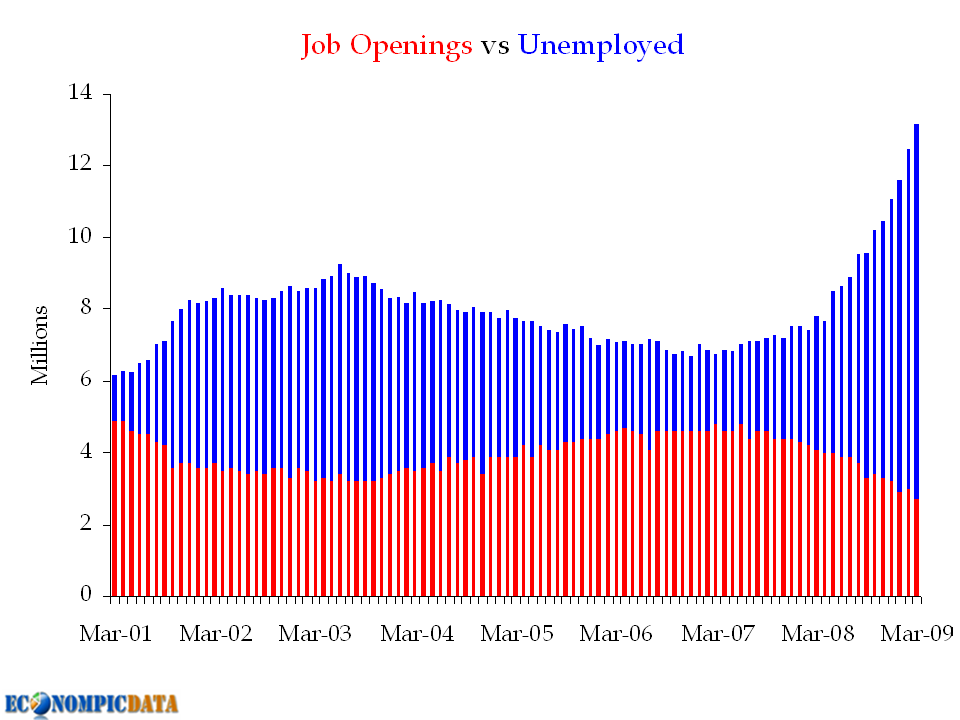
Courtney Schlisserman at Bloomberg reports that ADP Employer Services has released its estimate that US companies cut about 532,000 workers from their payrolls in May. "April’s reading was revised to show a reduction of 545,000 workers, up from a previous estimate of 491,000." Barry Ritholtz at the Big Picture links to Econopic Data's graphs of Job Openings plus number of Unemployed:


There are nearly five times as many reported unemployed people as there are reported job openings.

14. EIA REPORTS CRUDE STOCK BUILD

The EIA reported that, for the week ended May 29, commercial stocks of crude oil grew by 2.9 million barrels to nearly 366 million barrels.


As you can see from the EIA's graph above, commercial stocks remain quite high, historically speaking, and the stock build was contrary to analyst expectations of a 1.5 million barrel draw, per the Bloomberg survey. Gasoline stocks fell by 200,000, versus analyst expectations of a 650,000 build, and are below the five year average historical range for this time of year. Distillate stocks continue to grow by 1.6 million barrels.

Tuesday, April 21, 2009

Daily Sources 4/21

1. MORE GRIM FORECASTS FROM JAPAN AND THE IMF

MarketWatch reports that Tokyo is expected to cut its forecast for GDP growth to a 3% contraction for the year starting April 1. Mark Landler at the New York Times reports that the IMF released its global financial stability report today, estimating that banks and other financial institutions will suffer $4.1 trillion in aggregate losses in their holdings due to the financial crisis.
"In its global financial stability report, released Tuesday, the fund estimated that financial institutions would have to write down an estimated $2.7 trillion in loans and securities originating in the United States from 2007 to 2010. That estimate is up from $2.2 trillion in the fund’s report in January, and $1.4 trillion last October."
The story finishes by noting that the response to the crisis has been uneven:
"The fund estimates that in the United States, for example, banks reported $510 billion in write-downs by the end of 2008 and face an additional $550 billion in 2009 and 2010. In the euro zone, banks reported just $154 billion in write-downs by the end of last year and still face $750 billion. British banks are in somewhat better shape: having written down $110 billion, they face $200 billion more, the fund said."
2. KNOW YOUR CHICKEN: CHINA TO CONSIDER NEW RULES ON LENDING, CONSIDERED BY SOME ANALYSTS THE KEY TO BOTTOMING THE GLOBAL CRISIS; BUT IF THEY'RE COUNTING ON US CONSUMPTION, THE PROGNOSIS DON'T LOOK GOOD ... DEFLATION IN GERMANY, BUT LOW INTEREST RATES SUPPORTING ITALIAN REAL ESTATE MARKET; SWEDEN, THE ECB, AND CANADA LOOK SET TO BOARD THE QE BUS

The Wall Street Journal reports that the China Bank Regulating Commission is considering rules which would ensure that new loans are going to the real economy as opposed to the asset markets or bank accounts.
"A sharp cutback in credit would run the risk of derailing the nascent improvement, and is precisely what officials aren't planning to do. But they aren't pushing on the accelerator, either. The central bank has put interest-rate cuts on hold since December. The government is also expressing concern that the lending surge could be adding to financial risks or isn't directly aiding businesses in need of cash.

'Banks ought to fully realize that dealing with the impact of the crisis is a long-term task, and should pay close attention to risks accumulated from a burst of lending,' the head of China's banking regulator, Liu Mingkang, said at the agency's quarterly meeting last week."
A chart of loan growth by the WSJ:


The loan growth is what Brad Setser identified yesterday as a potential "green shoot" in the global economy--see Daily Sources 4/20 #1. Jesse's Café Américain reproduces a chart from contrary investor.com which shows how "falling aggregate demand and the weaker dollar" has undone the import market in the US--with the EU the largest market for Chinese imports:


Beijing appears to be placing some trust, therefore, in soon to recover American consumer demand. However, as Jesse comments:
"This is the worst decline in retail sales in the post World War II era.

The US consumer has finally hit the wall. The folks in DC think they can crank this Frankenstein monster of reckless consumption back up again, given the right jolts of liquidity and spin.

To think that consumers will start borrowing and buying again without a meaningful change in the dynamic of their cashflows implying an increase in the median wage, is a hard to believe. Even for the reckless American consumer, this episode has been daunting to their over-confidence, and rightfully so."
Rebecca Wilder at News N Economics adds that bank lending has stalled at an annual rate of growth of about 2.2% and that the credit crunch is now fully evident in the data. She points out:
"However, there is one exception: as of March, real estate lending is still rising slightly, but only because households are drawing on existing home equity lines of credit. I see this as another shoe to drop on consumer spending."


Her comments:
"The chart illustrates lending on revolving home equity lines of credit (HELOC). Lending (blue line) is still rising through March at a 20% annual rate. Households are using these lines of credit (presumably) to finance consumption needs, and a 20% annual growth rate is likely unsustainable.

Eventually, the lines of credit will run dry; and households will be forced to cut back on spending, taking another leg down. Not shown here is non-revolving real estate lending, which is down 1.3% in March since its peak in January 2008."
Well worth a look. In the meantime, Karey Wutkowski and Juan Lagorio at Reuters report that the credit card companies are scheduled to meet with the White House Thursday to discuss fees and interest rates.
"Scott Valentin, an analyst at Friedman, Billings, Ramsey, said credit card companies could also eliminate some late payments, or over-limit fees, to please Washington.

'The card companies are sensitive to what is going on around them, and public perception, and the government actions that are being contemplated, and are trying to put on a good face,' he said.

Credit card issuers have received over $120 billion in taxpayer funds since October, money the government has asked them to use to expand lending.

But with US credit card defaults at record highs, lenders are trying to protect themselves by tightening credit limits and closing accounts, actions that have infuriated lawmakers, consumers, and even triggered a New York state attorney general inquiry.

'Some of the very banks we rescued compound the hardships of ordinary Americans with unfair fees and interest charges,' said Senator Carl Levin, a Michigan Democrat who has co-authored credit card legislation.

Citigroup Chief Financial Officer Ned Kelly said in a conference call Friday with analysts to discuss the bank's quarterly results that the credit card business has shifted from growth to risk management.

He added that higher prices on credit cards helped the bank, one of the largest US credit card issuers, to cushion its losses."
The piece, well worth reading in full, concludes:
"'The administration clearly wants to keep the money flowing to the consumer, and the credit card companies are trying to protect themselves, hopefully there will be a middle ground some place,' said Anton Schutz, president of Mendon Capital."
In the meantime, Eurointelligence notes that Il Sole 24 published a story today noting that the one-month Euribor fell to below 1% this month for the first time ever. Euribor is the the rate at which euro interbank term deposits within the euro zone are offered by one prime bank to another prime bank. This is reportedly goosing the Italian real estate market as about 42% of new mortgages are based on one-month Euribor.
"The savings in mortgage payments to Italian mortgage holders are indeed substantial (the same applies almost to the same extent to the 3-month Euribor based mortgages, which are popular in Spain)."
In the meantime, Lukanyo Mnyanda and Anna Rascouet at Bloomberg report that the German Federal Statistics Office announced today that German producer prices fell by an annual rate of 0.5% last month, after rising 0.9% in February. German bonds prices rose on that news and the news yesterday that European Central Bank policy maker Christian Noyer indicated there was "room" for further interest rate cuts by the organization. In addition, Johan Carlstrom at Bloomberg reports that the Riksbank cut its benchmark interest rate by 0.5% to 0.5% and indicated that it stands ready to take further measures to resuscitate Sweden's economy. And the Bank of Canada also today cut its benchmark rate to 0.25% from 0.5%, indicating that it will leave the rate at that level through 2009, according to Bloomberg's Greg Quinn.
"'Conditional on the outlook for inflation, the target overnight rate can be expected to remain at its current level until the end of the second quarter of 2010,' the central bank said in a statement from Ottawa today. The central bank will provide updates at each future policy decision, starting June 4, on its commitment to leave the key rate unchanged."
3. THE EU IS TRAINING DIPLOMATS IN ANTICIPATION OF LISBON TREATY RATIFICATION

Der Spiegel reports that "hundreds of bureaucrats" at the European Commission are taking courses in political analysis and public relations in preparation for the new role the commission would take should the Lisbon Treaty come into force.
"Among the key provisions of the treaty is the creation of a European External Action Service and the appointment of a 'foreign minister,' though the title has been renamed as the 'high representative of the Union,' as well as an EU president. The idea is to groom an EU diplomatic service so it can start its work the day the treaty--once known, and rejected by voters in France and the Netherlands, as the 'EU constitution'--goes into effect."
4. CHINA WORKING TO DEFUSE INTERNATIONAL WORRIES

Javier Blas at the Financial Times reports that Niu Dun, China’s Deputy Agriculture Minister, told the journalist Monday that "We cannot rely on [investments in] other countries for our own food security. we have to depend on ourselves." In November, Zhang Xiaoqiang, Vice Chairman of China's National Development and Reform Commission, has announced that the country will set as a strategic priority domestic production of 95% of their grain consumption through 2020--see Daily Sources 11/14 #5. Obviously food security trumps all other resource security concerns, but Beijing's recent change in strategy in terms of overseas oil and gas resource acquisitions--via joint ventures and loan agreements--and its decision to veer away from the strategy pursued by other food deficit nations like Saudi Arabia to purchase overseas agricultural production seems to demonstrate recognition in Beijing that its resource security policies as set forth so far have ignited worries globally about their intentions. Obviously, if your resource security is dependent upon overseas holdings, their security would require the projection of force overseas. The notion that China is slightly adjusting the cut of its jib is also reinforced by the news today--via Jeb Blount at Bloomberg--that Petrobras Chief Executive Officer Jose Sergio Gabrielli said in an interview with the news wire that the company is not offering crude as collateral for the $10 billion in loans coming from China.

In that vein, there was an interesting comment made yesterday noting the story picked up by the US Naval Institute's blog that there has been heavy trading in options for McDermott International on rumors that CNPC is considering purchasing the company. McDermott is, among other things, the US Navy's sole provider of nuclear fuel and nuclear fuel assemblies as well as a manager of the US Strategic Petroleum Reserve. I doubt it is happening as rumored, but should it prove the case, it surely would be a huge story. In the meantime, Edward Wong at the New York Times notes that Beijing is clearly attempting to manage global concerns about China's rise, most recently deciding to unveil its nuclear submarines to public scrutiny in an international review of the country's fleet.
"The officer, Vice Adm. Ding Yiping, deputy commander of the Chinese Navy, told Xinhua in an interview on Monday that 'suspicions about China being a "threat" to world security are mostly because of misunderstandings and lack of understandings about China.'

He added: 'The suspicions would disappear if foreign counterparts could visit the Chinese Navy and know about the true situations.'"
Military analysts have most recently been concerned by the Chinese decision to retrofit ballistic missiles with warheads designed to take out air craft carriers. The recent news that supertanker companies expect the global fleet to contract in the medium term on the back of dismal demand is met, today, by the report by Toby Anderson at Lloyd's List that 35 additional very large crude carriers will be required if Venezuela is to meet its plans for increased crude supplies to China. (I'm afraid all I have access to is the snippet advertising the story, for the previous forecasts about the shape of the global supertanker fleet, see Daily Sources 4/16 #8.)

5. JAN 12 LETTER FROM KURDISH LEADER BARZANI TO OBAMA INCLUDED PLEA FOR SUPPORT FOR KRG OIL POLICIES

Ben Lando at Iraq Oil Report writes of a previously undisclosed letter from Kurdistan Regional Government of Iraq's President Massoud Barzani urging the Obama Administration to support the KRG's oil policies, whereby they would lease concessions to international oil companies without the explicit assent of the central government in Baghdad.
"He is blunt in pressing for U.S. support for controversial oil contracts signed by the KRG, which have been condemned as 'illegal' by Iraq Oil Minister Hussain al-Shahristani, criticized by Prime Minister Nouri al-Maliki and referred to by Bush administration officials as unhelpful in the reconciliation process."
The Obama Administration has declined, as of yet, to take sides in the matter.

6. THE BUSH ADMINISTRATION OFFERED TO DROP OIL SANCTIONS ON IRAN IN 2008

Kate Dourian at Platts reports that Hooshang Amirahmadi, speaking at the Middle East Petroleum and Gas conference in Dubai, said he was party to negotiations with Tehran in 2008 where the US offered to suspend sanctions on Iranian oil and gas in return for a six week suspension of uranium enrichment.
"'The bottom line is that the US offered to suspend sanctions on oil and gas in return for Iran freezing uranium enrichment for six weeks,' [Amirahmadi] said.

The offer was rejected by Tehran and the response to the US request for a 'wish list' from the Iranian leadership was: 'Leave us alone.'

Amirahmadi said when asked what type of sanctions the US was offering to suspend that it applied to executive orders dating back to the Clinton era, which imposed a trade ban against Iran, including trade in oil and gas, and prohibiting US investment in Iran's energy sector.

Other sanctions which were legislated, such as the Iran-Libya Sanctions Act (ILSA) of 1996--later amended to drop Libyan sanctions--was not included in the offer as it would require a congressional vote."
7. SAUDI ARABIA PUTS ANOTHER OIL PROJECT ON HOLD

Kevin Baxter at Reuters reports that Saudi Aramco has put the $9 billion Manifa offshore oilfield project on hold for six months.
"The Manifa project is in line to become Saudi Arabia’s largest offshore field, capable of producing 900,000 barrels of crude. However, the heavy sour crude the field holds makes it expensive to process and not economically viable in the current financial climate."
This delay is on top of delays for a number of domestic Saudi Aramco projects slated for export--see Daily Sources 4/14 #6.

8. VIETNAMESE ECONOMY EXPANDING!

Jason Folkmanis and Nguyen Dieu Tu Uyen at Bloomberg report that Vietnamese Prime Minister Nguyen Tan Dung told investors at a conference in Hong Kong yesterday that Vietnam's economic growth is rebounding after slowing in the first quarter.
"'The stimulus package has already had a good effect on the economy, and we believe it will have more impact,' he said. 'Growth will accelerate in the second, third and fourth quarters. We are targeting 5% to 5.5% growth for the year.'

Vietnam’s economy expanded 3.1% in the first quarter from a year earlier, the slowest pace on record, according to figures from the General Statistics Office in Hanoi.

Stimulus money will be invested in projects in areas including transportation and energy, Dung said. The $8 billion amount includes money from the government budget, according to the prime minister, who didn’t specify if any of the funds he was referring to had been included in the budget prior to the creation of stimulus plans."
9. HOW TO HELP MOLDOVA

Louis O'Neill, former OSCE ambassador and head of mission to Moldova, has an opinion piece in today's Wall Street Journal where he suggests a way to bolster Moldovan sovereignty in the current circumstance. To wit:
"With all these forces still tugging at a relatively new, unconsolidated and poor nation, it seems a proper time and in everyone's interest to give Moldovan sovereignty a boost. After all, every nation recognizes Moldova's territorial integrity and sovereignty, but also the right for Transdniestria to have a special status within a unified country. A serious restart of the '5+2' talks on Transdniestria comprising Russia, Ukraine, the Organization for Security and Cooperation in Europe, the EU, the US as well as Moldova and Transdniestria, could lead to a real settlement. Such a deal could open important new areas of trust in a reinvigorated US-EU-Russian relationship and improve the lives of people on both sides of the Dniester."
Well worth reading in full.

Monday, March 2, 2009

Daily Souces 3/2

1. Tony Barber at the Financial Times reports that the EU promised in its summit Sunday that it would provide financial assistance to eastern European nations in order to help them weather the crisis. However, the ministers rejected Hungary's appeal for a €180 billion package for the entire region, saying that it would consider financial aid on a case by case basis. (For the Hungarian appeal, see Daily Sources 2/27 #1.) Der Spiegel reports that Chancellor Merkel led the rejection of a region-wide bailout. "'I see a very different situation here,' she said on her way into the meeting. 'You cannot compare Slovenia or Slovakia with Hungary.'" There has been repeated speculation that the crisis would drive member states out of the monetary union, which has caused some to argue that the requirements for entry should be lowered. Chancellor Merkel apparently also led the rejection of that idea,
"Dutch Prime Minister Jan Peter Balkende said that if a nation wants to join 'it must meet the minimum economic criteria.' While Luxembourg Prime Minister Jean-Claude Juncker, who chairs the group of euro zone countries, said 'I don't think we can change the accession criteria to the euro overnight. This is not feasible.'"
2. Christian Neef and Jan Puhl ofDer Spiegel interview Polish Prime Minister Donald Tusk in today's international edition. An excerpt:
"SPIEGEL: There are also other conflicts. German Foreign Minister Frank-Walter Steinmeier, for example, rejects the American plan to install a missile defense shield in Eastern Europe and has conveyed this position to US Secretary of State Hillary Clinton.

Tusk: Poland will ensure that its interests are taken into consideration within the European Union and NATO. We need good relations with our western neighbors when it comes to questions of national security.

SPIEGEL: What does that mean in terms of the missile defense issue?

Tusk: We should speak openly about what best serves our security on the Continent. If the US and Poland are convinced that a missile defense shield will enhance the security of both countries, the other NATO members should accept this. Even Germany.

SPIEGEL: And if the project is abandoned, will the Poles again say that the major powers have cut a deal over their heads?

Tusk: If the stationing of the missile defense system is postponed, it will be an American decision. But then the remaining passages of the agreement -- i.e., the option of establishing other defense components in Poland -- should be immediately implemented. For us, it is important that we obtain American Patriot missiles.

SPIEGEL: Will Poland continue to strive for a special relationship with Washington?

Tusk: We are interested in pursuing close military cooperation with the US."
Well-worth reading in full.

3. Edward Hugh at Fistful of Euros reports that on Friday Sweden announced that its economy had officially contracted by 2.4% in the fourth quarter from the third--an annualized decline of 9.3%. Denmark officials reported that their economy had contracted by 3.9% in the fourth quarter over the year previous. Finnish GDP also fell by 1.3% in the fourth quarter.
"Unlike Denmark, Finland’s recession started with exports, and has now spread to areas like services and retail sales. Finance Minister Jyrki Katainen said last month that the Finnish economy may contract as much as 4.4% in 2009. The unemployment rate rose to 7% in January from 6.1 percent in December as companies cut jobs in the face of the slowdown."
4. Reuters reports that the Russian Finance Ministry said today that its Reserve Fund--oil revenues reserved for making up shortfalls in the budget--is currently worth over 4.8 trillion rubles (~ $136.3 billion) and the National Wealth Fund stands at 3.0 trillion rubles (~ $83.7 billion).

5. Seyoon Kim at Bloomberg reports that South Korea's Ministry of Knowledge Economy announced that exports fell again in February by 17.1% from a year earlier.

6. Eric Watkins at the Oil & Gas Journal reports that China's National Development and Reform Commission has approved CNPC's plan for a new 10 million tonne a year (~ 200 kb/d) refinery in Jieyang in Guangdong province. This is partially significant because CNPC's current refineries are all in the north of China, and so it indicates the breakdown of the informal divvying up of the nation's markets by the big three national oil companies. The NDRC also approved the following refinery expansions and construction:
"-- The capacity of the 400 kb/d Zhenhai refinery in Ningbo will be increased to 460 kb/d by September of this year and eventually to 600 kb/d.

-- In Shanghai, the combined capacity of the 280 kb/d Jinshan and the 220 kb/d Gaoqiao refineries will be boosted by 100 kb/d to 600 kb/d.

-- In Nanjin, the combined capacity of the 260 kb/d Jinling refinery and the 160 kb/d Yanzi refinery will be boosted to levels similar to those in Ningbo or Shanghai.

-- The cities of Maoming, Guangzhou, Huizhou, Quanzhou, and Tianjin will each see refinery capacity boosted to 400 kb/d.

-- Construction on a refinery is scheduled in Caofeidian.

Meanwhile, CNOOC—after a 6-month delay for unspecified reasons—is set to commission its 240 kb/d refinery at Huizhou, in Guangdong province, to operate on a trial basis when it goes online in March."
Many analysts have already remarked upon the huge addition of refining capacity in the Asia Pacific. Much of the refining additions were premised on China as an petroleum product market, for example in Saudi Arabia, India, South Korea, and even Japan. But if China moves ahead with all of its refining capacity addition plans--and usually Beijing makes good on its infrastructural construction plans--it is hard to see, given the trajectory of demand growth in an unsubsidized petroleum products market in both India and China and continued economic doldrums, where this additional potential supply would go. In addition, Winnie Zhu at Bloomberg reports that CNPC and Rosneft may begin construction on a 200 kb/d, $3 billion, refinery in Tianjin according to the municipal authorities there. The municipal authorities hope to get approval from the NDRC for the plant by the end of this year. Given the strong ties between Rosneft and CNPC--Rosenft has repeatedly gone to CNPC for large loans to deal with capital requirements for situations inside Russia--there is a fair likelihood that this will go forward. I would add that culturally, the Communist Party in China has few remaining vestiges of its original ideological goals, but that I suspect the import of finished or manufactured goods is still considered akin to the days of colonial exploitation and that Beijing will go to some lengths not to become the major market for imports of petroleum products, preferring to produce them internally.

7. Maureen Fan at the Washington Post reports that the US and China concluded on Saturday their first inter-military consultations after Washington OK'd an arms sale of $6.5 billion to Taiwan in October which had prompted Beijing to cut official military ties.
"'These were the best set of talks that I have ever been part of,' said David Sedney, deputy assistant secretary of defense for East Asia, who co-chaired the annual Defense Policy Coordination Talks. 'Not because we pretended that everything was fine and everything was resolved, but because we worked very seriously to address the obstacles while at the same time engaging in some discussions in some of the new areas like counterpiracy.'"
Tim Bowler at the BBC reports that in an interview with Chinese Commerce Minister Chen Deming said that "Given such a high degree of openness it is impossible for China to survive in an isolated way from the financial crisis. ... All countries in the world are in the same boat, and we share the same destiny."
"[Mr. Chen] ruled out major changes in the value of China's currency, despite pressure from the United States.

The US has long been angered that China does not allow the yuan to float freely, saying the artificially low currency makes Chinese exports unfairly cheap.

Mr Chen said he did not think 'for the next period of time' there would be a 'remarkable change' in the value of the yuan."
(h/t Yves Smith at naked capitalism.)

8. Fareed Zakaria at PostGlobal argues, as I have, that the compromise in Swat is not an unmitigated disaster, but rather that we should differentiate between Islamists bent on destroying the West and Islamists seeking a semblance of an operational justice system locally.
"The Swat Valley was historically a peaceful area that had autonomy within Pakistan (under a loose federal arrangement) and practiced a moderate version of sharia (Islamic law) in its courts. In 1969, Pakistan's laws were formally extended to the region. Over the years, the new courts functioned poorly, with long delays, and were plagued by corruption. Dysfunctional rule eroded government credibility. Some people grew
nostalgic for the simple, if sometimes brutal, justice of the old sharia courts. A movement demanding their restitution began in the early 1990s, and Benazir Bhutto's government signed an agreement to reintroduce some aspects of the sharia court system with Sufi Muhammed, the same cleric with whom the current government has struck a deal. (The Bhutto arrangement never really worked, and the protests started up again after a few years.) Few residents of the valley would say that the current truce is their preferred outcome. In the recent election, they voted for a secular party. But if the secularists produce chaos and corruption, people settle for
order.

The militants who were battling the army (led by Sufi Muhammed's son-in-law) have had to go along with the deal. The Pakistani government is hoping that this agreement will isolate the jihadists and win the public back to its side. This may not work, but at least it represents an effort to divide the camps of the Islamists between those who are violent and those who are merely extreme."
"'We won the war in Iraq chiefly because we separated the local militants from the global jihadists,' says Fawaz Gerges, a scholar at Sarah Lawrence College, who has interviewed hundreds of Muslim militants. 'Yet around the world we are still unwilling to make the distinction between these two groups.'"
Well-worth reading in full. I would add that sharia itself is not incompatible with existing Pakistani law--and that the possibility of appeal included in the agreement is a de juris acceptance of the supremacy of the federal courts. Reincorporating the major political organizations of Swat into the federal umbrella is a reasonable strategy on the part of Islamabad. For my earlier remarks on the swat agreement, see Daily Sources 2/19 #10 and Daily Sources 2/17 #4.)

9. Mary O'Grady has an opinion piece in the Wall Street Journal which argues that federal policy not to target medical marijuana distribution in the US de facto gives producers in Mexico--and Latin and South America--a stimulus, and thus exporting instability to the country. If you are familiar with my blog, you know I tend to disagree with Ms. O'Grady, but in this instance I believe she is right. If we intend to have prohibition, then we must target consumption in order to stop the export of instability to producing nations. If we cannot credibly target consumption, then we should take prohibition off the books. Worth reading in full.

10. Irene Tang at Platts reports that Malaysia will institute stricter specifications for gasoline and diesel in the middle of 2009. "Malaysia will introduce a new 95 RON gasoline grade in July 2009 and will
fully implement Euro-II compliant gasoline and diesel a month later." The new specifications, which mainly make the products more environmentally-friendly, are more expensive to make, and given that costs will be passed on to consumers, they will put upward pressure on price in Malaysia, and thus downward pressure on demand.

11. The Bureau of Economic Analysis said today that personal consumption grew by 0.4% in January from December in chained 2000 dollars, by 0.6% in nominal terms. Personal consumption accounts for 70% of US GDP.

12. Courtney Schlisserman at Bloomberg reports that the Institute for Supply Management’s factory index rose slightly to 35.8 in February from 35.6 in January. Anything below 50 indicates a contraction.

13. Reuters reports that semiconductor chip sales fell by 29% in January from a year ago.

14. Jeff Rubin, chief economist at CIBC World Markets, has published a research report which argues that car sales in the US will likely fall another 30-40% before bottoming. Rubin argues that about half of the 51 light vehicle plants in the US will be forced to close.
"Easy credit is already gone. The credit bubble wasn't just about sub-prime mortgages. It was just as much about car sales. Some two-thirds of vehicle sales in America over the last decade were debt financed. The leasing market has all but dried up and the securitization market for car loans isn't far behind. If you buy a car these days, try paying cash, which of course isn't superabundant, particularly for the over three-and-a-half million Americans who have already lost their jobs."
Rubin goes further and argues that car sales will never recover to the heights seen this decade, because Americans will adopt European driving habits as energy prices recover:
"The only reason gasoline is cheap, is because no one can afford to drive. When the recession is finally over, and Americans start filling up their SUVs, pump prices will go right back up to the $4/gallon price they were last Memorial Day."
Perhaps, but US population density is much smaller than Europe's, and to a certain extent, until cities west of the Mississippi radically restructure, circumstances will require that people will drive much more than Europeans.

15. Former Secretary of the Treasury under Reagan and State under Bush I, James Baker, writes in the Financial Times:
"During the 1990s, American officials routinely urged their Japanese counterparts to kill their zombie banks before they could do more damage to Japan’s economy. Today, it would be irresponsible if we did not heed our own advice."
A must read.

16. Warren Buffet's letter to Berkshire Hathaway shareholders has the chattering classes all abuzz. Barry Ritholtz's Big Picture carries the complete text. Scott Patterson at the Wall Street Journal has a story on the letter, which discusses the costs Berkshire faced in unwinding the exposure of reinsurance acquisition General Re to complex derivatives of particular interest:
"Berkshire's substantial insurance holdings haven't needed to take the massive write-downs on toxic subprime securities that have plagued much of the financial industry in the past two years. One reason is Mr. Buffett's longstanding dislike of complex derivatives, which he famously called 'financial weapons of mass destruction' in his 2002 shareholder letter and which he railed on again in his latest letter. He pushed General Re, the large reinsurance company Berkshire acquired in 1998, to disentangle itself from a vast web of derivatives -- financial instruments tied to the value of other securities, such as stocks or bonds -- over the course of five years, winding down its book of 23,218 derivatives contracts at a loss of about $400 million, he said in the letter. The losses may have been far more substantial if General Re had held onto to the contracts, Mr. Howard said.

'Upon leaving, our feelings about the business mirrored a line in a country song: "I liked you better before I got to know you so well,"' Mr. Buffett wrote, referring to General Re's derivatives book."


17. From Bloomberg, a graph of US meat consumption since the collapse of Lehman Brothers:


Meat is ethically problematic--newspeak, I guess, for a sector built on industrialized murder--but it has also historically viewed as a barometer of wealth. (I love meat and think humans are not especially more culpable than other predators for its consumption. Still, I find the industrialized slaughter of innocents troubling in a way that, say, an individual hunting or fishing--or even small scale farming--is not. As consumption goes down, and fewer are able to afford the expense of meat--not to mention hunting--however, the economics of industrial meat will only become more competitive. If transportation fuels costs rebound, this effect will only be strengthened.)

Thursday, February 5, 2009

Daily Sources 2/5

1. Julia Werdigier at the New York Times reports that the Bank of England cut the benchmark lending rate by 0.5% to 1% today. The European Central Bank decided to leave its benchmark lending rate unchanged at 2%.

2. Shai Oster at the China Journal reports that power demand in China is down--the China Electricity Council (CEC) announced yesterday that power consumption grew by 5.23% in 2008, down from 14.8% rate of growth seen in 2007. The CEC expects the growth rate of power consumption to continue to fall in 2009. The electricity grid has been under extreme stress over the last several years, often resulting in brownouts--the let up in demand growth probably signals a tapering off of such difficulties.
"[Beijing] plans to spend just under $85 billion on power projects this year, part of government economic stimulus plans. That is a little bit more than was spent last year.

Spending is likely to focus more on upgrading the national power grid, building an electricity superhighway of high voltage lines to bypass a lot of the aging infrastructure that has bottlenecked power supplies in the past."
Meanwhile, Xinhua Economic News reported today that China will begin the construction of eight more strategic petroleum reserves this year, after the four constructed in 2008 start operations. China's current SPR storage capacity stands at about 136 million barrels or 42.5 days of import demand. The State Council in 2007 suggested that the government ought plan to build 120 days of import demand storage capacity.

3. Keith Johnson at Environmental Capital reports that Sweden has decided to overturn it's old ban on nuclear power, announcing a slew of new nuclear power plant construction plans.
"That’s a big change, because Sweden was an early and ardent opponent of nuclear power, banning new reactors in 1980 even though nuclear power provides about half the country’s electricity. Sweden’s center-right government, which like the rest of the country had been long divided on the nuclear question, just announced an end to the official policy of phasing out nuclear power when the country’s ten reactors reach the end of their life. Most importantly, the government reversed its 2006 campaign pledge not to build any new reactors and ended a ban on nuclear-power research."
4. The IMF announced on Monday that it will seek to boost its capital available for lending to governments to $500 billion from $250 billion.

5. Arijit Ghosh and Shanthy Nambiar at Bloomberg report that Bank Indonesia is seeking to expand its currency swap arrangement with Japan given a fall in its currency reserves of $10 billion since July. This comes as Jakarta negotiates with Tokyo regarding on-going natural gas contracts. (see Daily Sources 2/4 #8.) Indonesia has similar agreements with China and South Korea for $3 billion each under the Chiang Mai Initiative and may well seek further assistance from another, unnamed, country.
"Finance ministers from Japan, China, South Korea and 10 Southeast Asian nations plan to meet on Feb. 22 this month to expand a deal under the Chiang Mai Initiative to boost the pool of foreign-exchange reserves to $120 billion to help defend their currencies."
(see Daily Sources 1/30 #4.)

6. Elisabeth Bumiller and Ellen Barry at the New York Times report that Kyrgyz president, Kurmanbek Bakiyev, announced in Moscow Tuesday that he will ask Parliament to close the US base at Manas.
"About 15,000 personnel and 500 tons of cargo pass through Manas each month. The base is also the home of large tanker aircraft that are used for in-air refueling of fighter planes on combat missions over Afghanistan."
Ms. Bumiller and Barry report that the Kyrgyz Parliament is set to consider the measure next week. However, the State Department's told the media yesterday that no official communication regard the base has been received.
"QUESTION: ... Have the Kyrgyz told you that you have to leave?

MR. WOOD: Look, we have not received any formal communication from the Kyrgyz authorities of any decision to close the base. But as I initially said, we’re having discussions with the Kyrgyz about this, and we’ll continue to do so."


On Tuesday Bakiyev announced that he had secured $150 million in aid from Moscow, the forgiveness of $180 million in debt, and $2 billion in loans. That is a tremendous amount of money for a country with an estimated GDP of $5.05 billion in 2008 (at nominal exchange rates.) The US reportedly provides Bishkek about $150 million in "assistance and compensation" annually, but only "a portion" of that money goes to the government. An anonymous State Department official interviewed by Ms. Bumiller and Barry said that, "fundamentally it comes to money, and the Russians are trying to buy us out."

7. Ijaz Kakakhel at the Pakistan Daily Times reports that an unnamed energy analyst forecast that the shortfall in natural gas would increase to 0.507 billion cubic feet/day (bcf/d) in 2010 as indigenous production is expected to be 4.309 bcf/d over expected demand of 4.816 bcf/d. Kakakhel quotes analysts as suggesting that the natural gas situation means that plans for the Iran-Pakistan-India pipeline ought to be finalized as quickly as possible. However, Tehran contract offers so far have not seemed reasonable to Islamabad or New Delhi. (see Daily Sources 1/19 #12.)

8. Marianne Stigset and Diana Kinch at Bloomberg report that Petrobras CEO Jose Gabrielli told journalists that the company had made no decision as to whether it would tap the equity markets as it seeks financing for its five year plan. Valor Economico had issued a note to investors that Petrobras might sell as much as 45 billion reals ($19.5 billion) of stock. Yesterday Petrobas sold $1.5 billion in 10 year bonds, a week after saying that debt was too expensive. (see Daily Sources 2/4 #12.) Meanwhile, Phaedra Friend at Rigzone reports that Petrobras confirmed it will begin the first phase of the development of the Tupi field in March--long term testing. The field is thought to hold between 5 and 8 billion barrels of recoverable oil equivalent. "Tupi is Brazil’s largest discovery to date, located in block BM-S-11 in the Santos Basin, 155 miles (250 kilometers) from the southern coast of Rio de Janeiro."


Peak production is expected to be about 200 kb/d of oil equivalent, sometime in the next 10 to 15 years. The Brazilian government indicated today that it had approved the five year plan.

9. Eric Watkins at the Oil & Gas Journal reports that in a visit to Lima by Algerian oil minister Chakib Khelil said that Sonatrach will join Petroperu in hydrocarbon exploration and production activities.

10. Courtney Schlisserman and Timothy R. Homan at Bloomberg report that first time unemployment claims rose to 626,000 for the week ended January 31. The total number of people collecting unemployment now stands at 4.788 million. The Bureau of Labor Statistics will announce the official unemployment totals tomorrow. The Associated Press reported that the Commerce Department announced today that factory orders fell by 3.9% in December. For the year of 2008 factory orders increased at a rate of 0.4%.

Tuesday, November 18, 2008

Daily Sources 11/18

1. Eurointelligence reports that recent poll suggest there is a narrow majority in favor of ratifying the Lisbon Treaty in Ireland, which had rejected the treaty in a referendum held this June. The issue will allegedly surface at the December EU summit meeting in Brussels. Sweden and the Czech Republic are the other countries which have yet to ratify the treaty. Germany and Poland have ratified the treaty, but have yet to deposit certification of their ratification with the Government of Italy, which is the final requisite step. As has been noted in earlier posts, nations with banking sectors too large for their respective national governments to shore up in case of an emergency, such as those found in Sweden, the Czech Republic, and Ireland, are likely to see the advantages of monetary union if they have not so far. It appears that the economic argument may persuade some of the advantages of a closer political union, which is what the Lisbon Treaty is a step toward. (Sweden is set to consider the treaty on November 20--Thursday.)

2. Shobhana Chandra at Bloomberg reports that the US Labor Department released data today suggesting that producer prices fell by an annual rate of 2.8% in October. Core prices, which exclude energy and food costs, rose by 0.4%. The cost of oil therefore accounts for most of the drop--the largest seen since data was first collected in 1949. In an interesting counterpart story, Brian Blackstone at Real Time Economics reports that chief U.S. economist at IHS Global Insight Nariman Behravesh's rule of thumb is that a $0.10 drop in gas prices equates to about a $12 billion tax cut.
"Mark Zandi, chief economist at Moody’s Economy.com, estimates that if oil prices just stay under $75 a barrel - December crude settled just below $55 Monday - it’s worth the equivalent of a $200 billion stimulus. If oil prices were to eventually fall to around $50 a barrel, hardly a farfetched notion, the stimulus would climb to $250 billion."
That's just in the United States, even taking into account countries with subsidized oil product prices, the stimulus of lower prices world wide must be considerable--I would guess that at $55/b it would be along the lines of half a trillion dollars, or nearly 1% of world GDP (at roughly $54 trillion.) In a related story by the UK Economic Times, IMF chief Dominique Strauss-Kahn on Monday in Tripoli said that as much as 2% of world GDP, or $1.2 trillion, should be spent on stimulate the economy. He also argued that the European Central Bank should consider a further benchmark interest rate cut.

3. Eurotintelligence reports that according to Denis Snower in FT Deutschland, investments account for 45% of Chinese growth. He suspects that investment will drop by 50% in the current financial crisis, or 22% of GDP. Beijing's stimulus program, coming in at 16% of GDP, may therefore fall well short of covering the difference. Daniel Colover at Platts writes that traders are reporting fairly steep declines in Chinese demand for West African crude. Traders report declines in West African shipments of 500,000 tonnes per month, or about 121.7 kb/d. The United States is the other large taker of West African crudes, which tend to be light and sweet and thus easy to refine into profitable products.

4. The Associated Press reports that Chinese President Hu Jintao toured Havana today.
"China is Cuba's second-largest trading partner, with the two sides generating $2.7 billion annually. Only Venezuela trades more with Cuba -- about $7 billion.

The island's state-run news agency AIN reported the two countries had reached "almost a dozen" agreements, including plans to rehabilitate the island's aging ports and earthquake detection systems."
There is a lot of speculation on how much oil Cuba might have in reserves off shore. China's state oil companies are involved in prospecting for it.

5. Platts reports that Iranian oil minister Gholamhossein Nozari said today that one of the likely outcomes of the November 29 extraordinary meeting of OPEC will be an effort to encourage non-OPEC countries, and specifically Russia, to cooperate in the management of oil prices. Nozari also confirmed on state run TV that there was an agreement for Russian and Qatari companies to cooperate on the development of South Pars, per Hashem Kalantari at Reuters. He also put the kibosh on the notion that the natural gas thus produced would go to Qatar for liquefaction and further export from there. In a related story, Hossein Jaseb of Reuters reports that Iran expects to commission its nuclear power plant at Bushehr next year at some point after February.

6. Juan Cole argues at informed comment that the recent abduction of an Iranian diplomat in Pakistan is evidence that the Taliban in determined to target Tehran for its cooperation with the West. Ideologically the Taliban is Sunni-extremist and tends to regard the Shia Islam of Iran as apostate. A representative was quoted as saying the abduction was a reprisal for:
"the arrest of top Al-Qaeda leaders in Iran, for facilitating the US invasion on Iraq through pro-Iran militias and last but not the least for waging the war on the Taliban in Pakistani Khurram agency where Iran provided arms and ammunition to the Shia tribal groups to fight against the Taliban ...."
In a related story, Ali Akbar Dareini at the Associated Press reports that the Iranian head of the Judiciary, Ayatollah Mahmoud Hashemi Shahroudi, has greeted positively the news that the al-Maliki cabinet had reached an agreement with the US regarding the status of forces in Iraq. The Iraqi parliament is expected to consider the agreement by November 24. Robert Dreyfuss at the Nation argues that Iran has quietly dropped its opposition to the agreement, signaling to Obama that Iran stands ready to talk and work with the US. Dreyfuss notes Muqtada al-Sadr's vehement opposition to the agreement and I have noted the potential threat Sadr presents to the leadership of the Iranian theological and revolutionary credibility.

7. Menzi Chinn at Econbrowser has an analysis at Econbrowser looking at the likely consequences should consumption continue to fall sharply in the US:
"If the US has truly stopped being the consumer of last resort, then to the extent the impending consumption decline in the US is autonomous (largely unrelated to income), we should expect the repercussions to be widely felt amongst our trading partners."
Well-worth reading in full.

Monday, November 3, 2008

Daily Sources 11/3

1. In an opinion piece in the Financial Times, Wolfgang Münchau argues that the financial crisis is likely to enlarge the eurozone as well as the EU. Münchau points out that the financial aid package given to Hungary by the European Union and the IMF last week has austerity measures that will ensure that Budapest meets the criteria for economic and monetary union. As I noted in an earlier post, Danes might now be rethinking the maintenance costs of a national currency as their benchmark lending rate is now 1.75% higher than the European Central Bank's. Countries which have banking systems too large to be defended by national authorities may decide to reverse their decisions to opt out of the eurozone, including Sweden and the Czech Republic. As for Iceland, which never joined the EU, the
"Reykjavik newspaper Frettabladid carried a poll last week showing approval for EU membership up from 48.9 per cent a year ago to 68.8 per cent now. The number in favour of adopting the euro is even higher."
Münchau also expects that support for eurozone membership will begin to grow in even the UK. That would be a tremendous sea change, to be sure, and might have some dampening effect, if not handled astutely by Washington, on the special relationship. The article is worth reading in full.

2. Andrew Batson at Real Time Economics has a translation of Premier Wen Jiabao's discussion of Chinese economic policy in a long piece published in the latest issue of the Communist Party Journal.
"Over the medium to long term, there is great market potential in expanding consumer spending. This is an advantage that our country has and also an important basis for resisting external shocks. We must make expanding domestic demand the fundamental basis of economic development."
Though there are obvious differences, my first response to reading this was China decides to turn inward, again. But there has been plenty of advice from the West that China do just that, including the recent editorial in the New York Times--which I was admittedly very snarky about. I think, therefore, you could read this as a sign of Beijing's determination to signal its desire to continue a policy of international financial cooperation at least for now. On the other hand, it is an important shift which also lays the groundwork, I think, for "decoupling"--or at least "an important basis for resisting external shocks."

3. Liz Sly at the Chicago Tribune reports that the al-Maliki government has announced plans to cut the salary of the sunni militias which had been central to the US strategy of increasing stability in Iraq from about $300/month to about $250/month. Sly's article does not mention whether this move is part of revamping the budget brought on by lower oil prices generally, but I imagine it likely a result of all public programs facing lower revenues. That said, it is obviously extremely divisive given the Shi'a government. The country is apparently in the middle of a political storm after Kurdish leader Massoud Barzani suggested that the Kurdish region might offer the US military bases if the Maliki government does not agree to a new status of forces agreement, per Juan Cole. It seems that the various political elements in Iraq are pursuing policies of division just as we are on the cusp of steep reductions in US forces, which at least arguably have been providing security. Not all that surprising, but still worth noting.

4. Cherian Thomas at Bloomberg reports that on November 1 the Reserve Bank of India lowered the repurchase rate--the rate at which the bank lends to commercial banks--by 0.5% (or 50 basis points) to 7.5%. The central bank also reduced the cash deposits reserve requirements for banks from 6.5% to 5.5% and in government debt from 25% to 24%. It also increased the amount of money commercial banks can borrow from the central bank to meet redemptions from mutual funds and non-banking financial companies from 0.5% of total deposits to 1.5%. "Citigroup Inc. economists Rohini Malkani and Anushka Shah estimate the steps will inject 1.2 trillion rupees ($24 billion) into the banking system."

5. Vipin V. Nair at Bloomberg reports that Tata Motors Ltd.'s sales dropped by 20% from a year ago in October. Tata is India's largest truck manufacturer.
"Maruti, the maker of half the cars sold in India, said sales fell 7 percent last month to 64,490. Bajaj Auto's sales of motorcycles, three-wheeled auto rickshaws and scooters plunged 31 percent to 191,840."
6. Seyoon Kim at Bloomberg reports that Finance Minister Kang Man Soo told the media that Seoul is planning a 14 trillion won ($10.8 billion) stimulus package for next year. About half of the money will be dedicated to infrastructure projects and tax breaks.
"An overseas trade report today highlights the risks to South Korea from the global financial turmoil. Exports, the main engine of growth, rose by the least in 13 months in October because shipments to China fell for the first time since 2002."
7. Edward Wong at the New York Times reports that the People's Republic of China's senior Taiwan negotiator Chen Yunli arrived in Taipei today for a five day of talks aimed at new economic and transportation deals. Chen is the highest ranking PRC representative to set foot in Taiwan since 1949 and follows the recent move by Taipei regulators to limit exposure to US agency debt. Pundits both on the island and in the mainland are allegedly wildly speculating as to whether Chen will meet with "President Ma Ying-jeou of Taiwan, who was elected last March after promising to improve both the economy and relations with the mainland."

8. Linda Gradstein at the Washington Post reports that Israel's director of domestic security told the outgoing Israeli cabinet that he was "very concerned" Israeli extremists would target for assassination government leaders pursuing a peaceful resolution with Palestine. Tel Aviv is worried about escalating vigilante violence from settler communities originally armed by the government.
"During Sunday's meeting, the cabinet decided to end government funding for infrastructure supporting outposts, which are Jewish homes in the West Bank that are not officially authorized by the Israeli government."
9. Reuters reports that the CEO of BP, Tony Hayward, told an industry conference: "According to our preliminary data, US demand was down 2 mb/d on the year over the last four weeks."

10. The Associated Press reports that Azeri officials announced that the first Kazakh shipment of oil has been put through the Baku-Ceyhan pipeline. "Oil from Tengiz, a Caspian field that is one of the world's largest, entered the Baku-Tbilisi-Ceyhan pipeline last week after being shipped across the Caspian Sea by ship, said Tamam Bayatli, a spokesman for pipeline operator BP." SOCAR officials have said that as much as 100 kb/d of Kazakh oil could eventually be sent via the pipeline.

11. Alan Johnston at BBC reports that naval vessels of Burma and Bangladesh are in a stand off at a disputed maritime boundary after Burma began exploration efforts in the area. "According to Bangladeshi sources, the dispute is taking place about 50 nautical miles south-west of an island called St Martin's."

12. Platts reports that on November 1 Russia cut its export duties on crude oil exports to $39.35/b on falling international crude prices had made exports unprofitable. Moscow also cut duties on exports of light oil products to $205.90/mt and $110.90/mt for heavy oil products.

13. Ellen Simon at the Associated Press reports that the Institute for Supply Management published their manufacturing index today showing that US manufacturing dropped sharply in October.

14. Nick Bunkley at the New York Times reports that US auto sales dropped sharply in October from a year ago. General Motors said sales were down 45% for that period. Ford said sales had dropped by 30.2% and Toyota reported an annual decline of 23%. Volkswagen reported a decline in sales of 7.9%. All categories of autos fell, but light trucks were hit the worst.