Showing posts with label nuclear. Show all posts

Monday, August 9, 2010

Daily Sources 8/9

1. SOUTHEAST ASIA BUYING WEAPONS AT BREAKNECK RATE

Jon Ponfret at the Washington Post reports that a recent publication by the Stockholm International Peace Research Institute shows that concerns over China's rise has pushed countries in Southeast Asia to almost double their weapons purchases from 2005 to 2009.
"The buying spree is set to continue, with reports that Vietnam has agreed to pay $2.4 billion for six Russian Kilo-class submarines and a dozen Su-30MKK jet fighters equipped for maritime warfare. This is in addition to Australia's stated commitment to buy or build nine more submarines and bolster its air force with 100 U.S.-built F-35s. Malaysia has also paid more than $1 billion for two diesel submarines from France, and Indonesia has recently announced that it, too, will acquire new submarines."
2. CHINA TO CLOSE 2,000 ENERGY INEFFICIENT FACTORIES

Keith Bradsher at the New York Times reports that China will close 2,087 steel mills, cement works and other energy-intensive factories by September 30 in order to try and increase its energy efficiency.

3. CHINA MAKES NO PUBLIC COMMENT ON SEIZURE OF ITS FISHERMEN

Brian Spegele at China Real Time reports that China has still made no public statement regarding the seizure of three fishermen by North Korea, allegedly for fishing in the North Korean exclusive economic zone.

4. HUGO CHAVEZ TO MEET NEW COLOMBIAN PRESIDENT TO TRY AND DAMP DOWN TENSIONS

Christopher Toothaker at the Associated Press reports that Hugo Chavez will meet the new Colombian president--Juan Manuel Santos--will meet in Colombia to discuss how to reduce tensions between the two countries.

5. PRESIDENT MEDVEDEV ARRIVES IN ABKHAZIA ON SUNDAY

CNN reports that Russian President Medvedev arrived Sunday in Abkhazia where he will meet with his counterpart, Sergey Bagapsh.

6. FORMER PRESIDENT OF MEXICO FOX CALLS FOR THE LEGALIZATION OF DRUGS

Jonathan J. Levin and Jens Erik Gould at Bloomberg report that the former President of Mexico, Vicente Fox, has called on the country to legalize drugs as a way of tamping down drug cartel violence.

8. COMPANIES ARE SEEKING LICENSES TO BUILD 22 NEW REACTORS

Chuck McCutcheon at the Christian Science Monitor reports that companies in the US are seeking licenses from the US Nuclear Regulatory Commission to build and operate 22 new reactors. A Gallup poll in March found that 62% of Americans now favor nuclear power.

9. US INCOMES FELL BY 1.8% IN 2009

Phil Izzo at Real Time Economics reports that US incomes fell by an average of 1.8% in 2009. The article includes a sortable chart of income growth by city.

10. KRUGMAN NOTES THAT CRITICAL INFRASTRUCTURE IN THE US IS BEING ALLOWED TO FALL INTO DISREPAIR

Paul Krugman at the New York Times reports that localities are letting their roads go to gravel, turning off the lights, and pushing through big cutbacks in education funding while the rest of the world is in the process of building up their infrastructure. A good read.

Wednesday, July 14, 2010

Daily Sources 7/14 (Bastille Day)

THE EU IS HALFWAY TO MEETING THEIR GOAL OF 20% RENEWABLE FUELS CONSUMPTION BY 2020

Reuters reports.

THE EURO'S INTERNATIONAL ROLE

The European Central Bank has released a 84 page paper on the international role of the Euro.

RUSSIAN SPENDING MORE THAN THE PRICE OF OIL WOULD ALLOW

Toni Vorobyova at Reuters reports that Russian spending is well above what the price of oil would allow without running a deficit.

GERMANS WORRIED THEIR RELATIONSHIP WITH RUSSIA IS COOLING

Matthias Schepp at Der Spiegel worries that the Merkel administration has not continued a strong tradition of courting Moscow, allowing other nations to attempt to get pride of place. In the meantime, John Roberts at Platts reports that RWE has decided to consider an offer from Moscow to join the South Stream pipeline plan, but loudly asserted its commitment to Nabucco.

BERLIN CONSIDERS AUCTIONING OFF EXTRA TIME FOR NUKE PLANTS

David Crossland at Der Spiegel reports that the Merkel Administration, which wants to bypass the plan to shutter all nuclear power plants by 2020, is considering auctioning off more time for the plants to operate. That is, the power companies could bid for additional time past 2020 in which they could operate. A key reason for the idea is that nuclear power makes it easier to meet carbon reduction goals.

SPANISH SOLAR POWER NOW BIGGER THAN US

Sharon Hong at News Watch Energy reports that with the commissioning of a new solar plant Spain now leads the US in solar power energy production.

SOUTH KOREAN PLAN FOR PRIVATE COS TO SPEND $18 BILLION ON GREEN TECH SMOKE AND MIRRORS

Christian Oliver at FT Energy Source warns us that the news yesterday that the plan for South Korean companies to spend $18.6 billion on green technologies is not quite what it seems.

NIGERIAN CRUDE EXPORTS TO US ON THE RISE

Jacinta Moran at Platts writes that NIgerian exports to the US are averaging 945 kb/d in the first quarter of 2010, up from 606 kb/d in the same quarter last year. A key reason is that efforts to mollify Niger Delta rebels have had some success. Meanwhile, Sharon Hong at News Watch Energy reports that the Nigerian state oil company is insolvent as it waits for the government to pay it its subsidies.

MORE THAN 4 PEOPLE ARE LOOKING FOR JOBS FOR EACH AVAILABLE JOB

Per Mark Thoma at Economist's View:


OIL PRICES MODERATING SOMEWHAT IN US

James Hamilton at Econobrowser updates some charts he uses to monitor energy costs in the US, including a chart of US retail gasoline prices.


Note that prices are in the range where they begin to affect driving behavior in the US, or $2.50/g. They are just short of $3.00/g where prices will have a strong effect on driving behavior.

CRUDE OIL STOCKS DOWN 5.1 MILLION BARRELS

The EIA reports that crude oil stocks fell by 5.1 million barrels in the week ended July 9th, though they are still well above the 5 year historical average. Gasoline stocks built by 1.6 million barrels and distillates grew 2.9 million barrels. The average price of gasoline for the week ended July 12th fell by 0.8 cents to 271.8 cents/gallon. For the week ended July 9th, refinery utilization grew to 90.5%.

Wednesday, August 5, 2009

Daily Sources 8/5

1. CHINESE TRANSPORT DATA SHOW YOY INCREASE IN IRON IMPORTS OF 35%; PROPERTY SALES IN CHINA FALL 4% IN JUNE; UNEMPLOYED MIGRANT WORKER CONCERNS PROVE OVERBLOWN; THE PEOPLE'S BANK OF CHINA WARNS OF THE DANGERS OF QUANTITATIVE EASING

Bloomberg reports that in the Ministry of Transport data released yesterday ships unloaded 35% more iron ore in July from July 2008. "Ships unloaded 56.5 million metric tonnes of iron ore in July at major ports." Meanwhile, China Daily reports that property sales across 30 Chinese cities fell by 4% in July from June. Property prices for 70 major Chinese cities rose by 0.8% in June.
"Property transactions in Guangzhou [formerly Canton, the capital of Guangdong province] fell 36% over June. The figure is only half of that of May, said Guangzhou's official property website.

'The fall has been triggered by high property prices and shrinking supplies in some cities,' said Qin Xiaomei, head of research, Jones Lang LaSalle Beijing. 'Property developers have slowed down the pace of new projects in the second half after robust sales in the first half,' she said."
Meanwhile, Andrew Batson at the China Journal reports that worries regarding large numbers of unemployed migrant workers have proven overstated. The IMF China mission chief, who visited the country in late May early June, told reporters in a conference call:
"I think our sense is that while there is certainly some dislocation in the labor markets as export sectors in the coastal regions have declined, but in general that process of reallocation of labor has been relatively smooth. Part of it has been that labor has returned back to export sectors, perhaps with some reduction in real wages, and been reabsorbed into those areas.

Part of it is that the interior of the country is doing quite well, and so some of that migrant labor has moved geographically across regions to where growth is stronger. And I think we’re seeing right now a dynamic where the historical pattern of very strong growth in the coastal regions and slower than average, national average growth in the interior is reversing, and you’re seeing much stronger growth in rural areas and in the interior provinces. And some of that labor has been reabsorbed into public infrastructure projects."
Meanwhile, Bloomberg News reports that the People's Bank of China yesterday in its quarterly monetary policy report warned that the quantitative easing policies of the developed nations threatens to spark sever inflation and currency volatility.
"Exiting too quickly from such policies, which the Chinese central bank said helped to prevent a repeat of the Great Depression, may undermine an economic recovery, the report said. Waiting for too long may trigger 'a new round of asset bubbles and severe inflation,' the central bank added.

'Central banks in major developed nations face a difficult choice between keeping government bond yields relatively low to promote economic recovery and maintaining currency stability' to protect national creditworthiness, it said."
2. UK ENERGY SECURITY ENVOY TO RECOMMEND TRIPLING NUCLEAR ELECTRICITY GENERATION CAPACITY; JULY SERVICES INDEX SHOWS SIGNIFICANT IMPROVEMENT

Robin Pagnamenta at the Times reports that the UK's Prime Minister’s special envoy on energy security, Malcolm Wicks, will publish a report today arguing that Britain should triple the amount of energy it generates from nuclear power. A Times source familiar with the report said it would argue:
"The question is whether or not the same rigor [that is being devoted to cutting emissions] is being applied to energy security.

The Government has not been good at asking serious questions about whether or not the UK is in the right place ... It’s a dangerous world and when we emerge from recession there will be a global grab for diminishing supplies of energy. Where is it all going to come from?"
Meanwhile, Vanessa Houlder at the Financial Times reports that the Markit Economics purchasing managers survey of the services sector rose to 53.2 in July from 51.6 in June, it's highest reading since February 2008. It is the third consecutive month with a reading above 50--above 50 indicates expansion and below indicates contraction.
"Analysts welcomed the latest figures as providing more evidence the recession was receding. Vicky Redwood, of Capital Economics, said: 'The latest UK data on both services and manufacturing suggest that a decent recovery is continuing across the economy.'

Kevin Daly, of Goldman Sachs, said the 'very strong' services survey was consistent with annualized growth in gross domestic product of between 1.5% and 2%."
3. TWO RUSSIAN SUBS PATROLLING OFF US COAST

Mark Mazzetti and Thom Shanker at the New York Times yesterday reported that two nuclear-powered attack submarines have been patrolling off the eastern coast of the US recently.
"'I don’t think they’ve put two first-line nuclear subs off the US coast in about 15 years,' said Norman Polmar, a naval historian and submarine warfare expert.

The submarines are of the Akula class, a counterpart to the Los Angeles class attack subs of the United States Navy, and not one of the larger submarines that can launch intercontinental nuclear missiles."
Galrahn at Information Dissemination notes that the report suggests that the submarines are staying out of the Economic Exclusion Zone--about 200 miles off the coast. He also asks why this information was leaked.

4. PAKISTAN TALIBAN SEES ITSELF AS PROVIDING GOOD GOVERNMENT

Qandeel Siddique at jihadica summarizes an Urdu-language interview of a Taliban commander in Pakistan. Key excerpt:
"The Swati Taliban claims to have the locals on their side: '… We are children of these people and they are our own. We live like brothers. We have a healthy relationship with them where they give us food and shelter, and we cooperate on matters. We are always in touch with the locals and share with them their burdens/grievances. We have built roads [for the Swati people] where in over 60 years the government could not. The locals are happy with us. They no longer need to pay tax to the government. We have build pipelines and provided water to people. [...] Also we resolved decade-long rivalries that had been going on and which the government failed to bring about peace. The Taliban have appointed ulema to solve these cases and bring peace.'

The Swati Taliban assumes the role of a surrogate government by providing its citizen’s basic amenities--roads and water. And of course justice, which the locals feel deprived of, believing that the Pakistani government time and again ignores the developmental needs of this region. On top of this, the commander conjures a horrific picture of the Pakistani army; he pins the blame for collateral damage during warfare on the military--not only do they take innocent lives, they also steal from peoples’ homes."
5. RUSCORP SIGNS MOU WITH NIGERIAN STATE OIL COMPANY TO PROVIDE SECURITY, MAINTAIN PIPELINE NETWORK

Uchenna Izundu at the Oil & Gas Journal notes that a Russian security and maintenance company, Ruscorp, has signed a memorandum of understanding with the Nigerian National Petroleum Corp. to monitor the country's pipeline network, improve the existing pipelines as well as build new distribution lines.

6. CHÁVEZ ISSUES DECREE NATIONALIZING EQUIPMENT AND WAREHOUSING FACILITIES AT PORTS

Rainbow Nelson at Lloyd's List reports that Caracas has issued a decree effectively terminating all private concessions at the countries ports, with state-owned companies taking over all equipment and warehousing facilities. (Subscription only, but the headline is a decent datapoint.)

7. CREDIT CARD JUNK MAIL BOTTOMS

Barbara Kiviat at the Curious Capitalist notes that Synovate, a firm which tracks junk mail, has produced a chart--available at her blog--which shows that credit card offers going out underwent a sharp fall from the fourth quarter of 2007, but seem to have bottomed out in the second quarter of 2009.

8. CASH FOR CLUNKERS MOSTLY STIMULUS FOR AUTO INDUSTRY; AUTO INDUSTRY RESPONSIBLE FOR MOST OF MANUFACTURING REBOUND IN JULY; MINUS STIMULUS CONSUMER SPENDING MAY WELL HAVE SHRUNK BY 10% IN 2Q; PROBLEMATIC CONSTRUCTION LOANS LIKELY TO UNDERMINE BANK BALANCES GOING FORWARD

To answer what aim was intended by the cash for clunkers program, see Robert Rapier's R-Squared blog, which notes that the US will consume approximately 72 million gallons less gasoline annually because of the program.
"In the context of the amount of gasoline we use--140 billion or so gallons per year (a bit less now because of the recession)--this amounts to only 0.05% of our annual gas usage. Experts have suggested that making sure tires are properly inflated could save 3% on gas usage, or 60 times the amount saved by "Cash for Clunkers" if the majority of people are driving around on under-inflated tires.

So, for $1 billion invested in the program, a savings of 72 million gallons means we taxpayers paid $13.89 for each gallon of gasoline/yr saved. Readers know that I am a big fan of much higher fuel efficiency, but $13.89 to save a gallon of gasoline per year? While this benefit will be spread over several years of gasoline savings, surely we can do better than this.

Even if--as one reader suggested--those cars would have been on the road for another 10 years, you are still paying over a buck a gallon for the savings."
Which nicely dovetails with James Hamilton's post on whether there be an economic recovery in the offing, writing:
"Americans bought 995,000 light vehicles in July, a 16% increase over June and the best monthly report since August 2008. Domestically manufactured light trucks (which includes SUVs) lost market share but still achieved an 8% monthly sales gain. Sales of domestic cars, imported cars, and imported light trucks were all up more than 20% month to month.

If we'd seen these kinds of numbers in the absence of the cash for clunkers incentives, I would have viewed it as a strong suggestion that the economic recovery has begun. As is, I'm left wondering, and fundamentally not knowing, whether the auto figures signal the shift we've all been watching for, or sales stolen from September and October and delivered to July."
John Maudlin at the Big Picture quoted from David Rosenberg analysis yesterday:
"The details in today’s report left something to be desired. Consumer spending came in at -1.2% annualized, twice the decline expected by the consensus. This occurred in the face of gargantuan fiscal stimulus and leaves wondering how this critical 70% chunk of the economy is going to perform as the cash-flow boost from Uncle Sam’s generosity recedes in the second half of the year. Imagine, government transfers to the household sector exploded at a 33% annual rate, while tax payments imploded at a 33% annual rate and the best we can do is a -1.2% annualized decline in consumer spending in real terms and flat in nominal terms? What do we do for an encore? In the absence of the fiscal largesse, it is quite conceivable that consumer spending would have shrunk at a 10% annual rate last quarter! Nonresidential construction action sagged at an 8.9% annual rate and this was on top of a 44.0% detonation in the first quarter. Ditto for equipment & software ‘capex’ spending, also down at a 9.0% annual rate and this too followed a 36.0% collapse in the first quarter. Residential construction slumped sharply yet again, this time at a 29.0% annual rate. These are the guts of private sector spending and collectively, they contracted at a 3.3% annual rate--the sixth decline in a row. So while there are many calls out there for the recession’s end, it remains a forecast as opposed to a present-day reality."
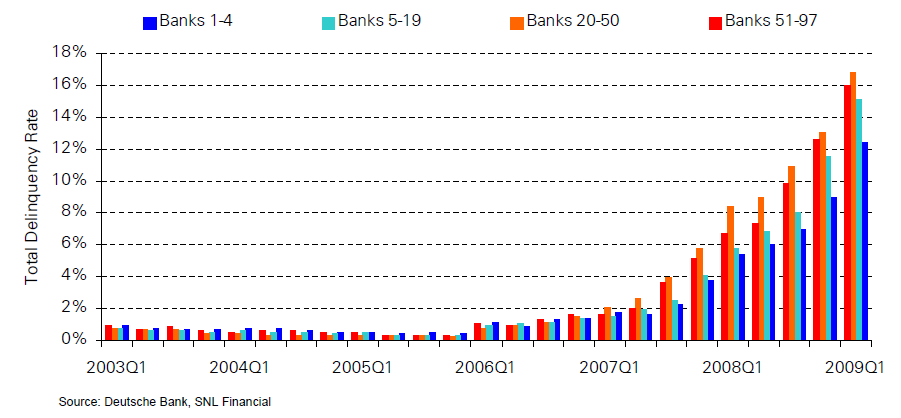
And Barry Ritholtz, also at Big Picture, notes the recent Deutsche Bank report which suggests that construction loans are likely to become a larger problem for the banks over time.
"Construction loans are structured with upfront reserves--meaning that it takes much longer for [Commercial Real Estate] defaults to occur. Low short-term interest rates also means reserves can last longer--BUT, as DB notes, Once reserves are exhausted, defaults will skyrocket."


9. COMMERCIAL CRUDE STOCKS BUILD MORE THAN EXPECTED, GASOLINE PRICES RISE, REFINING UTILIZATION DOWN

The EIA reports that crude oil commercial stocks built by 1.7 million barrels to 349.5 million barrels in the week ended July 31--above the five year historical range for this time of year. A Bloomberg survey had the median expectation of analysts at a 600,000 barrel build. Gasoline stocks fell by 200,000 barrels, are at the top of the historical range, and versus analyst expectations of a 800,000 barrel draw. Distillate stocks fell by 1.1 million barrels and at 161.5 million barrels are 28.2 million larger (or 21.2% more) than the comparable stock level seen last year--well above the five historical range. Analysts had expected a 1.23 million barrel build. Refining utilization fell to 84.54% from 84.57% the previous week. The national average of regular gasoline prices rose 5.4¢ to $2.557/gallon in the week ended August 3. (People tend to start driving less at prices between $2.50-$3.00/gallon.) The report also includes a helpful explanation of why refinery outages on the Gulf Coast have a large effect upon national prices.

10. POTATOES MAY ACCOUNT FOR AS MUCH AS 22% OF POPULATION GROWTH AND 47% OF URBANIZATION IN THE 18TH AND 19TH CENTURIES

Nathan Nunn and Nancy Qian at VoxEU argue that the introduction of new world crops to the old world--and in particular the potato--is in great part responsible for the population explosion and urbanization from 1800:
"The traditional explanation for the rise in population is that medical advances, such as the understanding of the germ theory or the innovation of vaccinations, and improvements in public sanitation greatly decreased infant and child mortality, which in turn led to an increase in population (e.g. Preston, 1975, 1980, 1996; Cutler, Deaton and Lleras-Muney, 2005, 2006). However, in recent years, scholars such as Thomas McKeown (1976) and Robert Fogel (1984, 1987, 1994, 2004) have argued that the increase in population was mostly due to an improvement in nutrition rather than the advances in medicine or sanitation. McKeown argued that the decline in mortality began to occur well before the most important innovations such as antibiotics or vaccinations, which did not become prevalent until the 20th century, and therefore, there is scope for other factors to contribute to the rise in population. Fogel argued that since height is positively correlated with nutritional investment during childhood as well as lower mortality rates, then the observation that heights in America and the UK were increasing is evidence that nutrition was improving during this period.

If Fogel is right, then we have to ask what caused the improvements in nutrition. Certainly, improvements in agricultural technology are part of the story. During this time, a number of productivity-enhancing technologies were developed. Examples include the seed drill, the threshing machine, and the Rotherham swing plough.

In recent research, we argue that another main contributor was the discovery of New World food crops, namely, the potato (Nunn and Qian 2009). Potatoes are extremely nutritious and a very 'cheap' source of calories. They produced much higher yields per acre relative to pre-existing Old World staple crops. Historical survey data from England show that if a family of four were to subsist on only one crop, it would require 66% less land if it were to plant potatoes rather than staples such as barley, wheat, or oats (Young, 1771). Potatoes are also easy to store and were popular as fodder for livestock through the winter. Therefore, cultivating potatoes also indirectly improved protein intake. The diffusion of potatoes also had a tremendous impact on nutrition in the Old World because vast land areas in Northern Europe, Asia, and high altitude areas of Africa were suitable for cultivating potatoes. Figure 2 maps suitability for potato cultivation. Yellow and brown colored regions are suitable. Darker colored regions are more suitable."

Monday, August 3, 2009

Daily Sources 8/3

1. EUROPE RETURNING TO NUCLEAR POWER

Kate Mackenzie at FT Energy Source has a good summary of the nuclear renaissance in Europe--where several countries have reversed, or are in the process of reversing, decisions to eliminate nuclear power from the generation mix.

2. TBLISI SAYS MOSCOW ATTEMPTING LAND GRAB FROM SOUTH OSSETIA

Misha Dzhindzhikhashvili at the Associated Press reports that Tblisi today accused Russia of attempting to take more territory outside the breakaway province of South Ossetia.
"'It's very alarming that as the first anniversary of the Russian aggression against Georgia comes close, Russia and its puppets are deliberately inciting tensions and behave defiantly,' the Georgian Foreign Ministry said.

But South Ossetia's spokeswoman Irina Gagloyeva told The Associated Press that the border move was legitimate and rejected any land-grabbing ambitions.

'Let the Georgians relax about their territory. We don't need a single centimeter of their soil,' Gagloyeva said."
3. CHINESE CRUDE STOCKS FALL 2.7% IN JUNE FROM MAY, REFINERIES PRODUCED 7.77 MB/D

Jim Bai and Aizhu Chen at Reuters write that Xinhua reported that Chinese crude stocks fell by 2.7% in June from May to 275 million barrels.
"Chinese refineries boosted production by 6% in June to a record 7.77 mb/d after a rise in domestic motor fuel prices aided margins."
4. TOKYO CONCERNED BY SLATE OF IRANIAN NEWS OF NEW CHINESE-IRANIAN OIL DEALS

Kyodo News reports that Tokyo has responded to the news aired in Iran that CNPC was to take a 70% share in South Azadegan, a field which Japan had secured interest earlier but dropped it on international concern about Tehran's nuclear program, by calling for renewed international cooperation on the issue. Japanese Vice Economy, Trade and Industry Minister Harufumi Mochizuki said "It is not desirable that international cooperation collapses this way." CNPC on Friday had denied that a new MOU regarding the field had been signed--see Daily Sources 7/31 #7. Tamsin Carlisle at the National reports that on Saturday a Chinese consortium signed a deal to build a new 360 kb/d refinery in Khuzestan province and expand the capacity of a refinery in Abadan to 360 kb/d from 210 kb/d. Carlisle provides a decent summary of Chinese-Iranian energy deals this year and further in the past as well as different details on the CNPC Azadegan deal:
"The agreement called for CNPC to purchase a 63% stake in the $2.5bn project from NIOC, leaving the Iranian state oil company with a 27% interest and Japan’s Inpex with 10%."
5. INDIA AND CHINA TO COOPERATE ON MONITORING HIMALAYAN MELTING GLACIERS

James Lamont at the Financial Times reports that India and China will collaborate on monitoring melting glaciers in the Himalayas, a crucial source of water supply for both countries.
"Jairam Ramesh, India's environment minister, said academic research bodies on both sides would share information. He also told the FT that New Delhi was also open to a dialogue about water resources with Beijing, saying the two countries had shared concerns."
6. SAUDI ARAMCO TO CUT PRICES, OPEC PRODUCING SLIGHTLY MORE IN JULY FROM JUNE

Christian Schmollinger at Bloomberg report that Saudi Aramco may cut the price of Arab Light crude oil by as average of $1.30/b,
"according to a survey of refiners from South Korea, Japan, Singapore and India. The company is expected to set new official levels this week. Extra Light may fall by $1.40/b, said the traders who asked not to be identified, citing confidentiality agreements.

Saudi Arabian Oil, known as Saudi Aramco, last month raised Arab Light by 10 cents to a premium of $1.50/b to the average of Persian Gulf benchmark’s Oman and Dubai. That was the highest price since July 2008. Asian refiners have been reducing their output as falling consumer demand has cut their so-called crack spreads, or profit margins."
Meanwhile, Karyn Peterson and Mark Shenk at Bloomberg report that the news wire's latest survey showed that OPEC increased oil output by 45kb/d to 28.39 mb/d in July from June."The 11 OPEC members with quotas ... pumped 26.035 mb/d, 1.19 million more than their target."
"Iran, the member that’s least compliant with output limits, according to the survey, expects oil prices to reach $80/b by the end of the year on 'optimistic' signs in the market, the country’s OPEC Governor, Mohammad Ali Khatibi, said.

Angola increased production by 20,000 barrels to 1.81 mb/d. The gain left output 293,000 barrels above the nation’s target, the second-biggest excess in the group. Output in the African country surpassed Nigeria’s for the first time since June 2008.

Venezuela raised output by 10,000 barrels to 2.21 mb/d. The South American country pumped 224 kb/d above its target of 1.986 million last month, the survey showed."
7. 100 IRANIAN POLITICIANS PUT ON TRIAL FOR FOMENTING UNREST IN COOPERATION WITH FOREIGNERS, LOTR FORMERLY INAUGURATES AHMADINEJAD'S SECOND TERM

Borzou Daragahi at the LA Times reported yesterday that Iran put 100 prominent politicians on trial, charging them with fomenting unrest in conspiracy with foreigners.
"Analysts say the confessions read at the trials are meant to lift the morale of hard-liners upset by coverage by reformist news outlets and Persian-language news channels abroad as well as to frighten opponents and take the wind out of the sails of the protest movement.

But as night fell, Tehran, the capital, erupted in angry cries of 'Allahu Akbar!' or 'God is great!' in what has become a daily rooftop ritual of protest."
The nighttime chants deliberately mirror events of the 1979 revolution. Thomas Erdbrink at the Washington Post reports that today Mahmoud Ahmadinejad was inaugurated by Leader of the Revolution Ayatollah Ali Khamenei as president for a second term. Karroubi, Mousavi, and Rafsanjani all elected not to attend the ceremony.
"Relatives of the late Ayatollah Ruhollah Khomeini, who led Iran's 1979 Islamic revolution, also failed to show up. According to pro-opposition Web sites, Hassan Khomeini, a grandson who usually attends such ceremonies, left for Pakistan some days ago. Other prominent absentees were two Friday prayer leaders from the Shiite holy city of Qom, the Parlemannews Web site reported."
8. NIGERIAN AGRICULTURAL POTENTIAL UNTAPPED, LEAVING FOOD SUPPLY VULNERABLE

David Hecht at the Washington Post notes that Nigeria's food supply is especially vulnerable to a disruption caused by low rainfall or other climate-driven variables. He concludes:
"The good news is that Nigeria has boundless agricultural potential. Of the 3.14 million irrigable hectares of land in the country, the World Bank says only 7% is currently being utilized. And though large tracts of farmland have been lost to desertification, more than half the country's estimated 98 million hectares of arable land currently lie fallow.

'The opportunities for our farmers are enormous if only they were to get the right institutional support,' said Sabo Nanono, the head of Kano state's commercial farmers association. 'We could feed the entire West African region; we could produce enough rice in just two or three [of Nigeria's 36] states to feed the nation and even to export.'

Somehow, the supply chain that feeds 140 million people keeps cranking along. The country has not seen a major famine for nearly four decades, since the Biafran civil war. But Nanono warned that it wouldn't take much to send this vulnerable country--and region--over the edge.

'The reality is that if the rains are bad throughout the region or the price of inputs became unaffordable, there could be massive food shortages, and neither the government nor any other institution stands ready to help,' he said. 'Then only God could save us.'"
Hecht's report is part of the Food Insecurity Project.

9. SOUTH AFRICAN PMI DOWN TO 37.3 IN JULY

Nasreen Seria at Bloomberg reports that South Africa's PMI fell to 37.3 in July from 37.9 in June. It is the first fall in PMI seen in three months.
"Manufacturing output, which makes up 15% of the economy, fell 17.1% in May from a year ago, after dropping a record 21.8% in the previous month, the statistics office said on July 9. Production has dropped every month since October 2008."
10. SETSER AND ZIEMBA ESTIMATE MAJOR SOVEREIGN WEALTH FUNDS HOLD ABOUT $1.5 TRILLION IN FOREIGN ASSETS, DOWN FROM $1.8 TRILLION LAST YEAR

Brad Setser and Rachel Ziemba at Follow the Money estimate, in contrast to other estimates, that total external assets of major sovereign wealth funds roughly were about $1.5 trillion as of June 2009, down from their estimate of roughly $1.8 trillion held in the middle of 2008.
"$1.5 trillion is lot of money. But it is substantially less than $7 trillion or so held as traditional foreign exchange reserves."
The post includes an extremely interesting table of estimated assets held by each major sovereign wealth funds at the bottom.

11. 1.5 MILLION TO EXHAUST INITIAL UNEMPLOYMENT INSURANCE IN THE NEXT FEW MONTHS, 1-IN-3 GROCERY SHOPPERS NOW ONLY PURCHASE ITEMS ON SALE

Barry Ritholtz has a pair of posts looking at the rate of people who have exhausted their unemployment insurance. In the first, he notes that the New York Times estimates that about 1.5 million more people will have exhausted their unemployment insurance over the course of the next few months. He links to a helpful graph from the NY Times:


In the second, he notes, as have others such as Rebecca Wilder at News and Economics, that there are additional unemployment programs available after one exhausts the initial unemployment insurance:
"[T]he Emergency Unemployment Compensation (EUC) which is good for 20 weeks. Then, there is the Supplemental EUC, which depending upon what your state thinks of the Federal largesse of handing out money to the recently unemployed, ranges anywhere from 13 to 20 more weeks."
Evidently, as of July 11, the number of people who have exhausted their initial unemployment insurance and are now on EUC or supplemental EUC, has gone from 127,000 a year ago to 2.66 million. The worry is that given that 70% of the economy is based on household consumption, growing unemployment will undermine any nascent recovery. In that vein, Credit Bubble Stocks notes that Information Resources Inc. has published market research which concludes that now
"about 1 in 3 [grocery] shoppers buy exclusively items on sale, twice as many as 18 months ago."
12. US PMI UP TO 48.9 IN JULY

Mark Shenk at Bloomberg reports that the Institute for Supply Management released its PMI today showing an uptick to 48.9 in July from 44.8 in June. (A reading above 50 indicates expansion; below 50 indicates contraction.) It is the highest reading seen since August 2008.

13. CHEVRON TO END ALL ONSHORE GAS DRILLING IN THE US

I missed the interesting factoid reported Friday by the Associated Press that Chevron will stop all US onshore gas rigs on low profitability this year.
"'By the end of the year, we will not have a single gas land-rig running,' George Kirkland, Chevron’s executive vice president for global upstream and gas said in a conference call."

Thursday, July 16, 2009

Daily Sources 7/16

1. CHINESE MONEY SUPPLY GROWTH 28.5% YOY IN JUNE, CHINA PUBLISHES DATA CLAIMING 7.9% GDP GROWTH, REVISITS "MADE IN CHINA" CAMPAIGN

Yesterday, Macro Man called out Prime Minister of China, Wen Jiabao, for having spurred China's M2 growth to 28.5% year over year, asked whether he deserves the moniker "Helicopter Wen" more than Ben does. He asks:
"Unfortunately, in an act reminiscent of Gordon Brown Stalin, the early 90's data has been wiped from the historical record. A cynic might suggest that this is because China's leadership doesn't want to remind people that one upon a time, money growth was this high and it didn't end well. Judge for yourselves."


Today, the National Statistics Bureau published new figures showing that Chinese GDP growth was 7.9% in the second quarter from the year previous, up from the growth of 6.1% in the first quarter, per Terence Poon and Andrew Batson at the Wall Street Journal.
"Also Thursday, the finance and economic committee of the National People's Congress, China's legislature, warned that the government must prevent the "extraordinary growth" of credit that could lead to inflation risks and problems for the financial system. It said China should strengthen credit checks and prevent a rebound in bad loans. The committee includes influential members but doesn't have a role in setting economic policy.

The People's Bank of China has already started to take some measures to fine-tune the rapid flow of credit. On Thursday, the central bank used its weekly sale of three-month bills to continue to guide money-market interest rates higher for the third straight week."
The Economist notes:
"In the year to June fixed investment surged by 35%, car sales rose by 48%, and purchases of homes by more than 80%. After falling last year, home prices are now rising briskly in some big cities, and share prices have soared by 80% from their November low. Domestic spending has been spurred partly by the government’s stimulus package, but probably even more important was the scrapping of restrictions on bank lending late last year. In June new lending was more than four times larger than a year earlier."


The Economist notes that the importance of property to domestic demand means it is unlikely that Beijing will clamp down too hard on the lending. In the meantime, Carlos Tejada at the China Journal reports that China is revisiting plans to launch a "Made in China" campaign.

2. WORLD BANK WARNS OF DEFLATION ON EXCESS INDUSTRIAL PRODUCTION

Ambrose Evans-Pritchard at the UK Telegraph reports that the chief economist at the World Bank, Justin Lin, in Cape Town recently warned that excess industrial capacity will cause a deflationary spiral unless it is addressed.
"Mr Lin said capacity use had fallen to 72% in Germany, 69% in the US, 65% in Japan, and as low as 50% in some developing countries, mostly touching lows not seen in modern times."
Lin suggests that competitive devaluation will have little productive effect in this environment, saying:
"No country can count on currency depreciation and exports as a way out of recession. Unless we deal with excess capacity, it will wreak havoc on all countries. There is urgent need for global, co-ordinated fiscal stimulus."
(h/t Yves Smith at naked capitalism.)

3. UK SETS GOAL OF 40% RENEWABLE SOURCE FOR ELECTRICITY GENERATION BY 2020

Selina Williams at the Wall Street Journal reports that the UK has set as its goal sourcing 40% of its electricity generation from low carbon energy sources by 2020, with fully 30% to come from wind power, wave and tidal energy and other renewables. The other 10% is to be from coal-powered plants with carbon capture technology and nuclear. (As of 2006, per the IEA, nuclear power generation accounted for 18.6% of total electricity supply in the UK. Coal accounted for 37.5%. All renewables accounted for 6.1%.)
"'Renewables, nuclear, clean fossil fuels, as this plan sets out, are the trinity of low carbon and the future of energy in Britain,' [Energy and Climate Change Secretary Ed] Miliband said yesterdat. 'All of them should be part of our future energy mix.'

The government wants the power sector to be almost completely free of carbon emissions by 2050 as it strives to meet a commitment to cut overall emissions by 80% by 2050. The UK has already cut its emissions by 21% since 1990."
4. TURKEY INCREASES FUEL AND RESTAURANT TAXES, REDUCES BENCHMARK INTEREST RATE TO 8.25%

Delphine Strauss at the Financial Times reports that Ankara yesterday announced that it would raise taxes on petroleum products and restaurants with immediate effect. The new taxes will add roughly 8% to prices at the pump and between 8 and 18% at high end hotels and restaurants.
"'The government is speeding up its efforts to tighten fiscal policy,' said Yakin Cebeci, economist at JPMorgan, estimating the measures could improve budget performance by 0.8% of GDP within 12 months.

Stimulus packages and a spending splurge before local elections in the spring have led to a rapidly widening budget deficit. Figures published on Wednesday by the finance ministry showed a deficit of 23.2bn lira ($15.2bn) in the first half of the year, compared with a surplus of 1.9bn lira in the same period of 2008."
Effective tax collection has been a point of dispute at the IMF in terms of approving a new financing package for Ankara. Meanwhile, Steve Bryant at Bloomberg reports that the Turkish central bank today cut its benchmark interest rate by half a point to 8.25%, it's ninth consecutive monthly cut, indicating that further cuts may be in the works.
"The inflation rate reached a 39-year low of 5.2% in May, before rising to 5.7% last month, a pick-up the central bank says will prove temporary. The bank’s target for this year is 7.5% and its most recent survey of economists and businessmen forecast a year-end rate of 6%.

'Inflation will remain at low levels for a long time,' the bank said in today’s statement."
"Industrial output fell 17.4% in May, extending a decline that drove a record 13.8% contraction in gross domestic product in the first three months of the year."
5. PRESIDENT OF ABKHAZIA SPEAKS OF RELATIONSHIP WITH RUSSIAN RAILWAYS JUST AFTER EBRD LOAN

In light of the EBRD's recent decision to make a $500 investment in Russian Railways, the following portion of a Der Spiegel interview of the President of Abkhazia, Sergei Bagapsh, might be of some interest:
"SPIEGEL ONLINE: There are Russian military bases in Abkhazia, Russian troops guard your external borders, and your currency is the ruble. And, then, you want the Russians to manage your railways for 10 years. Is it possible that you're getting just a little too dependent on Russia?

Bagapsch: We are dealing with the Russian railways because we have to modernize our own. We would be equally pleased to deal with the German railways if they were interested. In any case, there are no completely independent nations in this world. Liechtenstein is dependent on Switzerland, Luxembourg on France. We are all dependent on one another. Georgia is dependent on America; we are on Russia."
6. LOCKHEED MARTIN INDIA CEO STEPS DOWN AMIDST ESPIONAGE SCANDAL, WILL US, AUSTRALIA, INDIA AND JAPAN JOINTLY OPERATE AIR CRAFT CARRIERS IN RESPONSE TO CHINESE CONSTRUCTION OF 6?, INDIA SELECTS 2 SITES FOR US COS TO BUILD NUCLEAR POWER PLANTS

Ajai Shukla at the Business Standard reported on Monday that
"Ambassador Douglas A Hartwick, Lockheed Martin India’s CEO, who was spearheading the world’s largest defense manufacturer’s campaign to sell India the F-16 IN medium fighter aircraft, was withdrawn from India in an unusual hurry."
According to Indian Defense Ministry sources, Hartwick was removed as CEO of Indian operations after the company was discovered to be in possession of classified information regarding defense purchases. Meanwhile, Manu Sood at 8ak recently interviewed US historian Jason Verdugo on the possibility of the Quadrilateral Initiative (or Quad) countries (the US, Australia, India, and Japan) jointly operating the recently decommissioned US aircraft carrier--the USS Kitty Hawk--on the recent news that China has been secretly constructing six aircraft carriers. (I am indebted to Galrahn at Informed Comment for both of these items.) Meanwhile, Amol Sharma at the Wall Street Journal reports that India has selected two sites on which US companies could build nuclear power plants, which will be announced when Secretary Clinton arrives in the country next week.
"The two countries may also use Mrs. Clinton's trip to announce completion of an agreement for the US to track sales of defense equipment and ensure it is used for its stated intent, according to people familiar with the matter. That 'end-use monitoring' agreement will be crucial, experts say, as US companies compete for major contracts such as India's plans to purchase 126 fighter jets at an estimated cost of $11 billion.

A spokesman for India's Ministry of External Affairs said that some agreements will 'naturally' be finalized between the US and India during Mrs. Clinton's trip but declined to elaborate."


7. INDIA AND PAKISTAN AGREE TO INTELLIGENCE SHARING ON BACK OF AL QAEDA CALL FOR GENERAL REVOLT AGAINST ISLAMABAD

Rama Lakshmi at the Washington Post reports that the prime ministers of India and Pakistan met for two hours on the sidelines of a Non-Aligned Movement meeting in Cairo after which released a joint statement in which they agreed to share "real-time, credible and actionable" information on terrorist activities.
"[T]he text of the jointly agreed statement on Thursday said that 'action on terror should not be linked to the composite dialogue process and these should not be bracketed' and that 'terrorism is the main threat to both countries.'"
The statement follows the call by Al-Zawahiri, a key figure in al-Qaeda, for cooperation in its attacks on Pakistani interests, suggesting that the current government is actually in the employ of the US Ambassador. Juan Cole at Informed Comment posts the entire text per the Open Source Center's translation--note that it includes the nationalist refrain that "the West" seeks to break the country up:
"In Pakistan in particular, the Crusade aims at eradicating the growing jihadi nucleus in order to break up this nuclear-capable country, and transform it into tiny fragments, loyal to and dependent on the neo-Crusaders."
This seems increasingly desperate to me and that this particular band of extremists have worn out their welcome in Pakistan.

8. IRAN'S 12 YR CHIEF OF ATOMIC ENERGY ORGANIZATION--FORMERLY 12 YRS AS OIL MINISTER--LINKED TO MOUSAVI STEPS DOWN

BBC News reports that Gholam Reza Aghazadeh, the head of Iran's Atomic Energy Organization, has resigned.
"Mr Aghazadeh is a veteran official who served in the 1980s as a deputy to Mir Hossein Mousavi--the defeated candidate in Iran's disputed presidential elections last month.

In 1985 he began a 12-year stint as oil minister, staying in the post during the presidency of Ali Akbar Hashemi Rafsanjani.

He then moved to his job at the head of the atomic agency in 1997 under the reformist former president, Mohammad Khatami.

He continued in the post when Mr Ahmadinejad was first elected in 2005."
9. IRAQ'S OIL EXPORTS UP ON INCREASED NORTHERN PRODUCTION (STILL SIGNIFICANTLY BELOW PRE WAR PRODUCTION)

Faleh al-Khayat at Platts reports that Iraq's total oil exports rose by 19 kb/d in June to 1.925 mb/d.
"Exports from northern fields rose to 528 kb/d in June, a post-war record and 7 kb/d higher than May exports.

The ministry did not say if the figure for the north included exports from the Tawke and Taq Taq fields in Iraqi Kurdistan, which began exporting crude oil on June 1."
"Production from southern oil fields rose slightly to 1.794 mb/d from 1.759 mb/d in May.

Although this increase is a continuation of the recent improvement in production from the south, the rate achieved is still 161 kb/d below the 1.955 mb/d produced in July last year.

The steep decline in production from southern fields since last July lies behind recent escalation in criticism of oil minister Hussein al-Shahristani and led to his summons by parliament to answer questions about oil policy."
10. VIOLENT CLASH BETWEEN STATE GOVT BACKERS AND NATIONAL GUARD IN TOWN EAST OF CARACAS

Christopher Toothaker at the Associated Press reported yesterday that hundreds locals in a small town east of Caracas by the name of Curiepe reacted to the National Guard seizing a police station controlled by an elected figure from the opposition by massing outside it and hurling rocks, bottles and Molotov cocktails at the troops.
"The conflict began shortly before dawn when about 40 soldiers from the National Guard tossed tear gas canisters at the police post, forced officers to leave and took over the building, said Elisio Guzman, director of the Miranda state police. He contended the troops were following orders from the mayor."
"As the conflict wound down later Wednesday, Adriana D'Elia, a Miranda state government representative, said state authorities agreed to move their police to another building after meeting with the municipality's pro-Chávez mayor, Liliana Gonzalez."
11. FORECLOSURES UP 15% YOY IN 1H 2009, INITIAL UNEMPLOYMENT INSURANCE CLAIMS AT HALF MILLION

Barry Ritholtz at the Big Picture links to RealtyTrac's country-wide county foreclosure map, noting that
"1,905,723 foreclosure filings were reported on 1,528,364 US properties in the first six months of 2009, a 9% increase in total properties from the previous six months and a nearly 15% increase in total properties from the first six months of 2008."


Meanwhile, Reuters reports that initial jobless claims for state unemployment were a seasonally-adjusted 522,000 in the week ended July 11, 47,000 fewer than what was seen in the previous week, per the Labor Department.
"Continued claims of people still on jobless aid after an initial week of benefits fell to 6.273 million in the week ending July 4, the latest for which data is available.

It was the lowest reading since April and the largest one-week decline on record. Analysts had forecast continued claims would decline to 6.85 million."
12. US OIL IMPORTS DOWN 7.6% IN 1H 2009 YOY, JET FUEL IMPORTS HALVED

Robert DiNardo at Platts reports that US imports of crude oil and petroleum products fell in the first half of 2009 by 7.6% from the first half of 2008 to 12.048 mb/d, per the American Petroleum Institute's monthly statistical review.
"Crude oil imports in June were down by 12.2% at 8.754 mb/d from 9.974 mb/d in June 2008. For the January-June period, crude imports were down by 6.2% at 9.191 mb/d versus 9.801 mb/d in the prior period, according to API's estimate.

Product imports in June were also mostly lower. For instance, imports of gasoline fell by 27.5% from a year earlier to 981 kb/d from 1.353 mb/d."
Jet fuel imports collapsed, falling 57% to 39 kb/d in June from 91 kb/d in June 2008.

Monday, July 13, 2009

Daily Sources 7/13

I chose an awfully big week to take a break from this! Back to the regularly scheduled programming, though new obligations will likely mean that posting will soon become much more infrequent and Daily Sources will either become simple links or be discontinued altogether.

1. CHINA UNVEILS ADDITIONAL ANTI-CORRUPTION MEASURES, XINJIANG REPORTEDLY CALMING DOWN AFTER WEEK OF VIOLENCE

Carlos Tejada at China Journal reports that the Chinese Communist Party unveiled new anti-corruption measures Sunday, calling for public leaders and executives at state owned companies to be ousted if major accidents or abuse happens during their watch due to negligence. Tejada observes:
"The new rules are the latest of a recent spate of efforts to rein in what even national leaders acknowledge is a serious problem. Chinese officials in recent weeks have put a bounty on corruption and cracked down on military officials with a taste for the luxurious.

The fear, observers say: Reports or actual cases of corruption and incompetence could cause even more unrest.

Conduct by local officials sparked occasional public clashes even in good times, before China’s juggernaut economy slowed. And times are especially sensitive now because of the upcoming 60th anniversary of the founding of the People’s Republic of China on Oct. 1, which is intended to be a grand celebration of Communist Party rule."
Meanwhile, Gordon Fairclough reports that Urumqi in Xinjiang seems to be calming down after the violence last week:
"The regional government over the weekend updated its casualty figures, saying 184 people were killed in last week's violence--137 of them Han Chinese and 46 Uighurs. One member of another Muslim minority, the Hui, also died. More than 1,600 people were injured, the government said.

After attacks by Uighurs on Han Chinese, some Han Chinese armed themselves and sought revenge. The government said to quell the violence it flooded the city with 20,000 security personnel and has spent days urging people not to take the law into their own hands."
2. ASO CALLS FOR GENERAL ELECTIONS NEXT MONTH, JAPANESE ELECTRICITY GENERATION DOWN 5.6% YOY IN JUNE

Blaine Harden at the Washington Post reports that Japanese Prime Minister Taro Aso has called for general elections next month. Meanwhile, Megumi Yamanaka at Bloomberg reports that Japanese electricity generation declined for the eleventh straight month in June, falling 5.6% from a year previous.

3. KIM JONG-IL RUMORED TO SUFFER FROM PANCREATIC CANCER

Choe Sang-Hun at the New York Times writes that the South Korean media is reporting the rumor that the North Korean leader Kim Jong-il, is suffering from pancreatic cancer.

4. NABUCCO PROJECT SIGNING IN ANKARA TODAY

Der Spiegel reports that the prime ministers of Austria, Bulgaria, Hungary, Romania and Turkey have met in Ankara today to formally sign on to the Nabucco pipeline project.
"The European Union is backing Nabucco and EU Commission President Jose Manuel Barroso, who was at the ceremony, described the project as of 'crucial importance for the EU's and Turkey's energy security.'

He voiced his confidence in the viability of the project, saying 'I believe this pipeline is now inevitable rather than just probable.'"
Ed Crooks at FT Energy Source has a decent breakdown on the sourcing issues facing the pipeline and this fantastic graphic:


Rob Verdonck and Steve Bryant at Bloomberg note:
"Turkey wants Iran to join Nabucco, Erdogan said at the signing ceremony. Iran is able to supply Europe with 31 billion cubic meters of natural gas a year via the link, the Oil Ministry’s Shana news agency said today.

'We don’t believe today that Iran should be a part' of Nabucco, [Richard] Morningstar [US envoy for Caspian energy matters] said.

Iraq will aim to supply 15 billion cubic meters of gas to the pipe, Iraqi Prime Minister Nuri al-Maliki said at today’s ceremony, according to an aide."
"The five governments partnered in Nabucco can bid for up to 50% of the gas flowing through the route, Turkish Energy Minister Taner Yildiz said at a press conference today. He declined to comment on how much of the gas Turkey might request."
5. LLOYD'S BANKING GROUP EXPECTED TO POST LOSSES OF £6.3 BILLION IN 1H

Iain Dey and John Waples at the London Times report that Lloyd's Banking Group will post its numbers in three weeks and is likely, according to UBS analysts, to announce losses of £6.3 billion on its loans to commercial property, businesses and mortgage holders for the first half.
"The writeoffs for the first six months of the year would match the losses recorded by Lloyds TSB and HBOS in 2008, as they consummated their disastrous merger. The expected bad debt charge is almost twice what Lloyds paid for HBOS when they came together under the government’s watch last autumn. Total writeoffs for this year at Lloyds could exceed £20 billion."
(h/t Yves Smith at naked capitalism.)

6. GERMAN ECONOMICS MINISTRY ESTIMATES GDP GROWTH WAS 0% IN 2Q

Der Spiegel reports that the Economy Ministry in Berlin's internal report concluded that GDP growth for the second quarter was 0%--meaning that the recession is over.
"If confirmed, the data could allow the German government to revise its current predictions of minus 6% growth for 2009 and forecast a smaller contraction."
7. ITALIAN PARLIAMENT MANDATES RE-NUCLEARIZATION

Dan Yurman at the energy collective reports that Italy's parliament passed a law last week which officially puts the country back on the path of nuclear power, mandating that sties be identified in the next six months for new nuclear power plants.
"Energy Minister Scajola isn’t kidding when he says Italy needs to build at least eight-to-ten new nuclear power plants (10-12 GWe) to significantly reduce its dependence on imported oil and natural gas. However, the country also needs to avoid building more coal-fired power plants. One of the earliest options may be to buy a 12% share in a new Areva 1,600 MW EPR being built in France."
In February, Rome signed a nuclear power cooperation pact with France-- see Daily Sources 2/24 #2. In October 2008, Scajola indicated that Italian electricity prices were 80% above France's--which sources about 80% of its electricity generation from nuclear--and 30% above the European average. He noted that the cost of phasing out nuclear had come to €50 billion-see Daily Sources 10/17 #3.

8. RAINFALL RECOVERING IN INDIA

Yi Tian at Bloomberg reports that the rainfall deficit in India for the week ended July 8 narrowed to 8% from 29% the week earlier on stronger monsoons. Indian oil refiners had been worried that the low rainfall was causing diesel consumption to remain flat in a general environment of falling oil demand, and that it would grow as farmers turned to the fuel for pumping, digging, and electricity generation--see Daily Sources 7/1 #4.

9. PAKISTAN SEEKING $15 BILLION IN E&P INVESTMENT OVER NEXT 5 YRS

Khalid Qayum and Khaleeq Ahmed at Bloomberg reports that Pakistan is seeking $15 billion in investment in oil exploration and development over the next five years. Islamabad is reportedly offering generous returns as it tries to offset its import requirement, and will focus its licensing on blocks offshore its southern coast, as onshore exploration has been hampered by security concerns.
"Pakistan wants to boost domestic fuel production to reduce its oil import bill and meet energy demand, which is growing 5% annually. Gas production of 4.1 billion cubic feet a day meets about 60% of demand.

The government will try to improve security for explorers as it also seeks to attract investment in new fields in the country, ... [Asim] Hussain [adviser to the prime minister on the oil industry] ... said in [an] interview on July 10."
10. THE ROOTS OF THE PARADOX IN IRAN'S CONSTITUTION, REZAI CALLS FOR RECONCILIATION AMONGST CONSERVATIVE IRRITATION WITH AHMADINEJAD, TEHRAN SEEKING CHINESE INVESTMENT IN REFINERY EXPANSIONS

Jonathan Lyons has a post on informed comment which provides an analysis of how Khomeini's ideology of the rule of the best qualified cleric presented problems to the regime at the start of the 1979 revolution:
"Among the most influential of opponents to Khomeini’s revolutionary project of placing his new republic under the direct leadership of a senior cleric – in this case, himself--were his fellow grand ayatollahs, men who had attained the highest levels of religious learning and popular support and acclaim. And the most important among them was Grand Ayatollah Seyyed Mohammad Kazem Shariat-Madari, based in Tabriz, in Iran’s Azeri region.

Shariat-Madari, then the leading ayatollah resident in Iran, was adament: the clergy should not exercise political power as this could only lead to religious tyranny. The grand ayatollah had sided with the revolution against the shah, but he was not prepared to see the clerics in government. This was, of course, in perfect keeping with Shi’ite political theory: the clerics had united to defeat the pro-Western shah as a threat to the Muslim faithful; but their work was now done and it was time to withdraw and leave the dirty work of governance to others.

Khomeini was furious and he unleashed his militant supporters on his rival in December 1979, provoking pitched battles in the streets of Tabriz. Once the 'political mullahs' backing Khomeini were in control, the leader of the revolution undertook a punitive measure that no imperial shah had ever dared: he engineered the stripping of Shariat-Madari’s clerical rank and privileges.

In traditional practice, the rank of Grand Ayatollah--formally, the marja-e taqlid, or a source of emulation for others to follow--requires both the respect of one’s fellow clerics and the acclaim of believers, each of whom paid their religious taxes to support the ayatollah and his religious mission.

In fact, Iranian clerics often point to this system as an indigenous democratic institution, and it certainly gives the grand ayatollahs a huge measure of independence from the autocratic state and from one another while recognizing the importance of popular support and public opinion. What’s more, believers are free to choose their own marja, and even to switch their allegience as they see fit. Khomeini, himself a marja, trampled this system in the name of revolutionary expediency."
(Very much worth reading.) Robert F. Worth at the New York Times reports that opposition candidate Mohsen Rezai--and former chief of the Revolutionary Guards--issued a statement on his website yesterday
"in which he called for reconciliation and spoke about the danger of 'imprisoning' the legacy of the Islamic Revolution in divisive and shortsighted politics. The statement was posted on his Web site.

Although his message was largely nonpartisan, Mr. Rezai hinted that the government response after the election had been unfair, and he urged protesters to continue their work in legal and nonviolent channels."
"Other conservative figures have made gestures in recent days indicating their displeasure with the government’s tactics or their desire for more forgiving policies. On Saturday, Ayatollah Reza Ostadi, a senior member of a conservative clerical group, delivered a stinging criticism of a cleric who had organized a rally supporting Mr. Ahmadinejad, the Mehr news agency reported."
Meanwhile, Chen Aizhu at Reuters reports that Iran is seeking investment from China in its refinery expansion plans designed to eliminate its dependence on gasoline imports by 2012. (This is kind of old news, but there are some new developments/details:)
" An official with National Iranian Oil Company's (NIOC) Beijing office said last week's forum, chaired by Iran's deputy petroleum minister, Shahnazi Zadeh, was to be followed by detailed discussions with Chinese firms. He did not elaborate.

Hossein Noghrekar Shirazi, NIOC's refining head, was quoted by a Chinese newspaper as saying that Chinese investors would enjoy policy sweeteners such as a 5% discount in raw materials purchased in Iran and 8-year tax break for investments made in its free trade zones."
11. CANBERRA SUMMONS CHINESE AMBASSADOR FOR INFORMATION ON RIO TINTO EXECUTIVE CHARGES

Rachel Pannett and Alex Wilson at the Wall Street Journal reports that Canberra has summoned the acting Chinese ambassador to Australia for further details on the detention of a Rio Tinto employee on espionage charges.
"The Australian government, and in particular the Mandarin-speaking Prime Minister Kevin Rudd who is a former China diplomat, are under mounting pressure from opposition lawmakers to intervene at a higher level.

'This is the third time that [the Department of Foreign Affairs and Trade] has spoken to the acting ambassador since last Monday,' Mr. Smith said, adding that Australian officials are seeking similar information in Beijing.

Despite this, Australia's Finance Minister Lindsay Tanner said the government won't be changing its process for assessing foreign investment in Australia despite China's detention of Mr. Hu."
12. NIGERIA RELEASES HEAD OF MEND

Dulue Mbachu at Bloomberg reports that Abuja released the head of MEND today.
"The Movement for the Emancipation of the Niger Delta, or MEND, made the release of Okah one of its conditions for ending its armed rebellion."
Meanwhile, Jacques Lhuillery reports that international oil companies are nervous about the proposed tax changes in Nigeria on oil and gas, arguing that new oil and gas production projects will likely fall by 50% on the reduced returns.
"The petroleum industry Bill, which went through its second reading and debate in the senate last week, is intended to overhaul the regulatory and operational systems of the industry, the lifeline of the West African powerhouse.

It plans to transform the existing joint ventures between the transnational oil firms and the state Nigeria's National Petroleum Company (NNPC), and turn NNPC into an autonomous and internationally profitable entity.

It also wants to improve on tax collection--decoupling oil from gas taxes as well as develop a system responsive to fluctuations in oil prices so as to capture on any windfall profits.

According to leader of the Senate Teslim Folarin, the Bill is designed to 'simplify the collection of oil revenue through shifting emphasis to easily collectible revenue as royalties and rents'."
(h/t Kate MacKenzie at FT Energy Source.)

13. HONDURAS DOESN'T EXPECT MUCH DISRUPTION DUE TO CHAVEZ'S EMBARGO OF PRODUCTS EXPORTS

Evidently, Chavez didn't just stop exports of crude to Honduras (which were zero) but also of petroleum products. Honduras is a member of Petrocaribe and as such received products at discounted rates and under very easy financial terms. Robert Mayer at Platts reported Friday that Tegucigalpa doesn't expect too much disruption as a result of the cut off.
"The effect, however, will be negligible, a source with the Honduran government said Friday, as the Petrocaribe shipments constituted a small fraction of the overall supply for the local operations of Shell, Chevron and Dippsa.

'We're using (Petrocaribe refined products) as a top-off, so we're in good shape,' a source with Dippsa-Puma said Friday."
(Puma Energy is a vertically integrated oil company active globally, but which was formed to develop an independent network of oil products storage and distribution facilities in Latin America and is owned by Trafigura, a major oil--and other commodities--trading company incorporated in the Netherlands, but whose headquarters are located in Switzerland.)

14. HOME MORTGAGE MONTHLY FORECLOSURE RATES UP 8% ON THE YEAR, ROBERT REICH ARGUES THAT THE RECESSION IS NOT LIKELY TO END AS LONG AS CONSUMERS ARE STRUGGLING WITH HUGE NET WORTH DECLINES

Rebecca Wilder at News N Economics on Sunday picked up on the story by the LA Times that 26% of home mortgage defaults are strategic and 22% of homeowners are straddled with negative equity and notes that monthly foreclosure rates are 8% higher than they were last year. She plots a graph showing the monthly foreclosure rate of single family homes by state--


--and comments:
"Going forward, though, the monthly foreclosure rate is likely to grow in some economies, like those seen in Connecticut and Hawaii, as recessionary pressures of rising unemployment and falling income pass through to the housing market."
Wilder's blog is always worth a look. Robert Reich comments on the prospects for recovery in a consumer based economy facing steep falls in net worth:
"Problem is, consumers won't start spending until they have money in their pockets and feel reasonably secure. But they don't have the money, and it's hard to see where it will come from. They can't borrow. Their homes are worth a fraction of what they were before, so say goodbye to home equity loans and refinancings. One out of ten home owners is under water--owing more on their homes than their homes are worth. Unemployment continues to rise, and number of hours at work continues to drop. Those who can are saving. Those who can't are hunkering down, as they must.

Eventually consumers will replace cars and appliances and other stuff that wears out, but a recovery can't be built on replacements. Don't expect businesses to invest much more without lots of consumers hankering after lots of new stuff. And don't rely on exports. The global economy is contracting."
15. SAN JOAQUIN VALLEY HAS LOST 60 MILLION ACRE FEET OF GROUNDWATER SINCE 1961, LEGISLATION INTRODUCED WHICH WOULD MAKE IOU'S LEGAL TENDER FOR OBLIGATIONS TO STATE, IN EFFECT A STATE CURRENCY

Matt Weiser at the Sacramento Bee reports that California's San Joaquin Valley has lost 60 million acre feet of groundwater since 1961, according to a new federal study.
"The Central Valley is America's largest farming region; it's also the single-largest zone of groundwater pumping. About 20% of groundwater pumped in America comes from under the Central Valley, said Claudia Faunt, the study's project chief.

In the Sacramento Valley, the study found groundwater levels have remained stable. Virtually all of the groundwater loss has occurred in the San Joaquin Valley, where aquifer levels have dropped nearly 400 feet since 1961, she said."


California is the only state in the union which does not regulate groundwater use. The USGS chose the Central Valley because it is so critical to the country's food supply. A must read. Meanwhile, Mark Thoma at Economist's View notes that the Californian assembly on Friday introduced legislation which would make the IOUs with which it is currently paying its employees with legal tender for all taxes and other fees owed to the state. Thoma notes that that is tantamount to the establishment of a state currency. He quotes from Marshall Auerback's post on the subject:
"It will be interesting to see what the exchange rate is between California IOU and US currency--the IOUs do offer a yield, so should be less than par by design. I wonder if NY is next."

Wednesday, June 17, 2009

Daily Sources 6/17

1. JAPAN TO FINANCE CLEAN ENERGY EXPORTS

Keith Johnson at Environmental Capital notes that Japan plans to underwrite the switch of other countries to clean energy, but only if they use Japanese technology. Johnson quotes from a report from Bloomberg:
"Japan plans to offer loans to power producers in the US and Australia that buy so-called clean coal generators from Japanese manufacturers, according to a government document obtained by Bloomberg News. Funding from state-owned Japan Bank for International Cooperation would help drive sales of the plants that cost about $3.1 billion apiece, said a senior trade ministry official involved in producing the 113-page draft plan, due to be released today."
2. RUSSIA & CHINA RELEASE JOINT STATEMENT EXPRESSING CONCERN RE: NORTH KOREA

Steve Gutterman at the Associated Press reports that Chinese President Hu Jintao and Russia's Dmitry Medvedev issued a joint statement today after meeting in Moscow:
"expressed serious concern in connection with the situation on the Korean peninsula."
"Hu and Medvedev called for the 'swiftest renewal' of the talks involving their countries as well as North and South Korea, Japan and the United States, which broke down months ago.

The statement included no new initiatives on the mounting problem and used language that appeared aimed at avoiding raise North Korea's ire further."
3. US EXPLORING RUSSIAN PARTICIPATION IN MISSILE SHIELD SCHEME

Walter Pincus at the Washington Post reports that Deputy Defense Secretary William J. Lynn III told Congress yesterday that the US is considering ways to incorporate Russia into a missile defense system for Europe.
"Lynn said that a radar installation in Armavir in southern Russia 'would provide helpful early-warning detection in the case of an Iranian ballistic missile attack.' [Lt. Gen. Patrick] O'Reilly [director of the Missile Defense Agency] told the panel that he had visited a Russian radar facility at Gabala, Azerbaijan, and that both Russian radars would be helpful in monitoring Iranian missile tests. The data gained 'would significantly help our development of our missile defenses,' O'Reilly added.

Overall, Lynn said, 'the involvement of Russian assets, particularly Russian radars, would enhance the capability of that kind of European-based system.'

He also suggested another potential advantage of including Moscow in the effort: 'A US-Russian collaboration would have an additional benefit of a diplomatic signaling to the Iranians that this is an unacceptable course for them to pursue and that they will face a concerted international front, should they proceed down that path.'"
Confirmation, as far as I'm concerned, that the Obama administration is putting the squeeze on Iran by pursuing a "reboot" in relations with Moscow.

4. BRIC SUMMIT ENDS WITH JOINT STATEMENT CALLING FOR LARGER SAY IN INTERNATIONAL FINANCIAL SYSTEM, RUSSIA AND CHINA AGREE TO EXPLORE MORE SETTLEMENT IN DOMESTIC CURRENCIES IN BILATERAL TRADE, BUT GAZPROM ANNOUNCES GAS PIPELINE TO CHINA DELAYED BY NO AGREEMENT ON PRICE, AND LUKOIL VP CALLS FOR MOSCOW TO JOIN OPEC

Andrew Osborne at the Wall Street Journal reports that the BRIC countries released a joint statement following their summit yesterday in Ekaterinburg saying:
"The emerging and developing economies must have greater voice and representation in international financial institutions. There is a strong need for a stable, predictable and more diversified international monetary system."
Meanwhile, Lyubov Pronina and Alex Nicholson at Bloomberg report that following their bilateral meeting in Moscow of President Hu Jintao said that they agreed to expand the use of the yuan and ruble in settling bilateral trade between the two countries. Medvedev told reporters:
"We agreed to take further steps in this direction, including, perhaps, by adjusting contracts and laws that already exist."
However, Vladimir Soldatkin at Reuters reports that Gazprom deputy chief executive Alexander Ananenkov told a news conference that construction on natural gas pipelines to China have been delayed, as "it still cannot reach a pricing deal with Beijing." Further differences in perceived interests between Russia and China were illustrated by the comments by Lukoil VP Leonid Fedun made in an interview with the Kommersant newspaper reported in Reuters,
"Russia should join OpEC and move to direct contracts. Then we will jointly control 51% of world output and we can dictate the price by directive."
5. ACCESS TO CHINESE STIMULUS PROGRAM MONIES REQUIRES PREFERENCE FOR CHINESE FIRMS

Ian Johnson at the Wall Street Journal reports that a recent directive issued by various central government agencies, including from the National Reform and Development Commission, seems to require that projects receiving stimulus-mandated funds give preference to Chinese companies.
"The notice, dated May 26 but only posted on the commission's Web site this month, is part of a broader buy-local push in recent months by authorities, who have quietly been indicating that most of the two-year four trillion yuan ($588 billion) in stimulus spending will be aimed at Chinese companies.

'Apart from engineering goods or service that cannot be obtained under reasonable business conditions inside China, domestic products should be purchased for the government investment program,' according to the official notice."
6. LACK OF INDEPENDENT JUDICIARY IN CHINA LEAVES JUSTICE SYSTEM MORE VULNERABLE TO MOB RULE

Sky Canaves at China Journal notes that the lack of an independent judiciary in China works both ways:
"But nowadays, courts also seem to take guidance from below.

Deng Yujiao, a young hotel worker charged with killing a local official (who she alleged tried to rape her), was set free yesterday after a brief trial and the murder charges against her dismissed, a result that is being cited as a 'significant victory of the Chinese Internet users and Chinese democracy.'

The unofficial precedents for the outcome of Deng’s case can be seen in a couple of other cases from last year that pitted the small guy against perceived official privilege. Xu Ting, a young migrant worker who took advantage of a faulty ATM to withdraw a load of cash and then ran away, was tried and sentenced to life in prison. But Internet users noted that officials charged with corruption involving similar sums (175,000 yuan) would face much lighter penalties, sparking a media outcry that resulted in a retrial and a much shorter sentence of five years for Xu."
The problem of course is that the law is supposed to act as a barrier to mob rule, not to simply preside over judgments made by rumor and innuendo.

7. IN CENTRAL ASIA FINANCIAL CRISIS MAY DRIVE IMMIGRATION

Erica Alini at Real Time Economics notes that in a recent report by the Central Asia-Caucasus institute, "anecdotal evidence suggests that since the world economy nose-dived last fall, 'a higher number of young men bought one-way tickets to Russian cities in November 2008 through January 2009.'"
"Russia is a prime destination for migrant laborers from Uzbekistan, Kyrgyzstan, and Tajikistan, where remittances account for between 8% and nearly 50% of the national income. Thus, as the Russian economy started contracting amidst the economic downturn last year, Central Asia felt the pinch.

When the downturn poked the Russian housing bubble, Central Asian migrants were hit particularly hard because many of them work in construction, Willem Van Eeghen, a migration expert at the World Bank, said.

By December 2008 remittances were down by nearly half in Tajikistan and Kyrgyzstan, according Ms. Marat.

Uncharacteristically, though, the plunge in remittances seems to be pushing even more Tajiks, Kyrgyzs and Uzbeks toward Russia. That’s because many of them seem to think that home offers no prospect, even as things get tough abroad. "
8. SOUTH KOREAN LNG IMPORTS DOWN 41% YOY

Jonty Rushforth at Platts reports that South Korean LNG imports are down 41% year on year in May to 1.26 million metric tons from 2.13 million metric tons.
"They were also down 28.6% from April this year, when the country imported 1.76 million mt."
Not a green shoot.

9. NIGERIAN NIGER DELTA MILITANT TO ACCEPT AMNESTY OFFER

The BBC reports that one of Nigeria's militant leaders of the Niger Delta, Ateke Tom, has accepted, with provisions, the offer of the President to extend amnesty to those militants who lay down their weapons.
"'If the government is sincere, we are ready to lay down our arms,' Mr Tom told the BBC's Network Africa program.

'If the government is not sincere, we will not lay down our arms and the struggle will continue.'

President Yar'Adua first made the offer of an amnesty several weeks ago.

'It will be a great pleasure for me to personally accept the first militant leader to take advantage of the amnesty,' he said."
11. IEA CHIEF ECONOMIST SUGGESTS THAT $70/B OIL LIKELY TO TRANSLATE INTO INTEREST RATE HIKES ON INFLATION, BUT CPI DOWN 1.3% IN MAY YOY

Eurointelligence reports that Fatih Birol, the chief economist at the IEA, suggested that $70/b oil will lead to inflationary pressures, which will force central banks to raise their benchmark interest rates and undermine any nascent recovery. In the meantime, Brian Blackstone at the Wall Street Journal reports that the Labor Department announced that the consumer price index rose 0.1% in May from April; core CPI, which excludes both energy and food prices, also rose from May by 0.1%.
"Consumer prices fell 1.3% compared to one year ago, the largest 12-month decline since April 1950. That's way below the 2% annual rate of inflation that most Fed officials think is consistent with their dual mandate of price stability and maximum employment.

Earlier this month, San Francisco Fed President Janet Yellen said that after once favoring 1.5% as an inflation objective, 'I think if I now had to write down a number, I'd probably write 2%.'"
Sarah-Jane Belfield at Platts reports that demand for jet fuel in April fell month over month by 1.67% to 1.418 billion gallons, per the Bureau of Transportation Statistics. The drop from a year previous was 6.96%. Not a green shoot.

12. EIA ANNOUNCES CRUDE STOCKS DOWN, BUT REFINERY UTILIZATION FLAT, ARE STOCKS AT SEA SIMPLY BEING RESTOCKED?

The EIA reported that commercial crude stocks fell by 3.9 million barrels in the week ended June 12 to 357.7 million barrels--well above the historical range for this time of year, but well down from previous highs. Gasoline stocks, on the other hand, built by 3.4 million barrels, and are just below the historical range for this time of year. Distillate stocks grew by 300,000 barrels, and remain at levels well above the historical range. Izabella Kaminska at FT Alphaville asks whether or not floating oil storage has been restocked, and not unloaded due to a shrinking contango.
"This certainly would explain the larger than expected crude draw in the face of unchanged refinery utilization, and only a small rise in imports."
13. DOE DECIDES ON COMPANIES TO RECEIVE $18.5 BILLION IN FEDERAL LOAN GUARANTEES TO BUILD FIRST NEW NUCLEAR REACTORS IN THE US IN 30 YEARS

Keith Johnson at Environmental Capital reports that the Department of Energy has settled on the first companies which will receive $18.5 billion in federal loan guarantees to help build four new nuclear reactors--the first to be built in the US in three decades. The winners are UniStar Nuclear Energy, NRG Energy Inc., Scana Corp and Southern Co.
"As the WSJ notes, 'Foreign partners that might be able to contribute loans or equity were also considered a plus.' For instance, UniStar hopes to get the French government to kick in $10 billion; NRG wants the Japanese government to underwrite one-third of its costs.

The $18.5 billion in loan guarantees is a small fraction of the $122 billion that nuclear companies had applied for."