Showing posts with label sistani. Show all posts

Friday, July 17, 2009

Daily Sources 7/17

1. UN SECURITY COUNCIL FREEZES ASSETS AND BANS TRAVEL FOR 10 NORTH KOREAN INDIVIDUALS AND CORPORATIONS; RECENT PUBLICATION SEEMS TO INDICATE GROWING NERVOUSNESS ABOUT PYONGYANG IN BEIJING

Colum Lynch at the Washington Post reports that the UN Security Council yesterday froze assets and banned the travel of 10 North Korean individuals and corporations involved in the country's nuclear and ballistic missile programs. Meanwhile, the Fabius Maximus blog notes two recent articles which reporting on a piece by Zhang Liangui, an expert on North Korea at the Central Party School in Beijing, this month in World Affairs magazine, which is sponsored by the Chinese Ministry of Foreign Affairs, which seem to indicate rising concern in Beijing about the possibility of armed conflict with Pyongyang.

2. MARATHON TO SELL 20% OF ANGOLAN CONCESSION TO CNOOC AND SINOPEC, US COMMERCE SECY SAYS AMERICANS NEED TO REALIZE THAT THEIR CONSUMPTION IS DRIVING GREENHOUSE GAS EMISSIONS OVERSEAS

Platts reports that Marathon has signed an agreement to sell a 20% stake in Angola's block 32 concession to CNOOC and Sinopec for $1.3 billion, maintaining a 10% stake in the project.
"There is no doubting the prolific nature of the deepwater block they are buying into. Block 32 has already seen a mouth-watering 12 oil discoveries: Gindungo, Canela, Cola, Gengibre, Mostarda, Salsa, Caril, Manjericao, Louro, Cominhos, Colorau and Alho."
"Block 32 is operated by France's Total, which has a 30% stake. The remaining equity is owned by Sonangol (20%), ExxonMobil (15%) and Portugal's Petrogal (5%).

The existing partners in the block have the right of first refusal over the interest Marathon is selling."
Marathon has stated it hopes to conclude the deal by the end of the year. Meanwhile, Keith Johnson at Environmental Capital reports that the US Commerce Secretary, Gary Locke, told the American Chamber of Commerce in Shanghai yesterday:
"It’s important that those who consume the products being made all around the world to the benefit of America--and it’s our own consumption activity that’s causing the emission of greenhouse gases, then quite frankly Americans need to pay for that."
3. CHINA SHUTS DOWN HUMAN RIGHTS LEGAL CENTER IN BEIJING

Audra Ang at the Associated Press reports that Chinese officials shut down a legal research center led by human rights activist lawyers in Beijing today. In late May it was reported that Beijing had begun denying licenses to practice to law firms which take human rights cases--see Daily Sources 5/28 #1.

4. SOUTH KOREA TO SPEND $100 MILLION IN AID TO ASIAN NATIONS COPING WITH WATER SHORTAGES AND FLOODS

Shinhye Kang and Heejin Koo at Bloomberg report that South Korea plans to spend $100 million by 2012 to help Asian nations deal with water shortages and floods.
"Asia, with half the world’s population, has less available fresh water than any continent except Antarctica, Suzanne DiMaggio, director at the Asia Society, said in April. Glacier runoff is the primary water source for many nations in the region, and they are shrinking with climate change.

'Asian countries have depended on Himalayan glaciers as their main water sources may face water shortage as the glaciers are melting rapidly,' said Park, who also directs the nation’s task force on international cooperation at the Presidential Committee on Green Growth.

South Korea’s government announced a plan last month to spend 22.2 trillion won (~$17.7 billion) over four years to upgrade the water quality and supply systems of the nation’s four major rivers."
5. BP DROPS JATROPHA

Keith Johnson at Environmental Capital reports that BP has abandoned its jatropha venture, from which it had hoped to harvest biodiesel, selling its half of the project to its partner, D1 Oils.
"[T]he inedible but hardy plant that just a few years ago seemed like it could revolutionize biofuels has turned into a bust. The initial attraction was that it grows on marginal land, so it wouldn’t compete with food crops. But marginal land means marginal yields. And jatropha turned out to be a water hog as well, further darkening its environmental credentials."
The joint venture had planted more than 200,000 hectares of jatropha, about a quarter of worldwide jatropha planting. New Delhi has also bet on the plant's potential only to see protests break out over plans to reclassify land for seeding it--see Daily Sources 6/9 #6.

6. EASTERN EUROPEAN DIGNITARIES PUBLISH OPEN LETTER EXPRESSING SOME WORRY ABOUT OBAMA'S "RESET" WITH MOSCOW

Yesterday the Polish Gazeta Wyborcza published an open letter from 22 major political figures from Eastern Europe, including Lech Walesa and Vaclav Havel indicating worry about the Obama administration's "reset" policy with Russia. Key excerpts:
"Our hopes that relations with Russia would improve and that Moscow would finally fully accept our complete sovereignty and independence after joining NATO and the EU have not been fulfilled. Instead, Russia is back as a revisionist power pursuing a 19th-century agenda with 21st-century tactics and methods. At a global level, Russia has become, on most issues, a status-quo power. But at a regional level and vis-a-vis our nations, it increasingly acts as a revisionist one. It challenges our claims to our own historical experiences. It asserts a privileged position in determining our security choices. It uses overt and covert means of economic warfare, ranging from energy blockades and politically motivated investments to bribery and media manipulation in order to advance its interests and to challenge the transatlantic orientation of Central and Eastern Europe.

We welcome the 'reset' of the American-Russian relations. As the countries living closest to Russia, obviously nobody has a greater interest in the development of the democracy in Russia and better relations between Moscow and the West than we do. But there is also nervousness in our capitals. We want to ensure that too narrow an understanding of Western interests does not lead to the wrong concessions to Russia. Today the concern is, for example, that the United States and the major European powers might embrace the Medvedev plan for a 'Concert of Powers' to replace the continent's existing, value-based security structure. The danger is that Russia's creeping intimidation and influence-peddling in the region could over time lead to a de facto neutralization of the region. There are differing views within the region when it comes to Moscow's new policies. But there is a shared view that the full engagement of the United States is needed."
"When it comes to Russia, our experience has been that a more determined and principled policy toward Moscow will not only strengthen the West's security but will ultimately lead Moscow to follow a more cooperative policy as well. Furthermore, the more secure we feel inside NATO, the easier it will also be for our countries to reach out to engage Moscow on issues of common interest. That is the dual track approach we need and which should be reflected in the new NATO strategic concept."
"[T]he thorniest issue may well be America's planned missile-defense installations. Here too, there are different views in the region, including among our publics which are divided. Regardless of the military merits of this scheme and what Washington eventually decides to do, the issue has nevertheless also become--at least in some countries--a symbol of America's credibility and commitment to the region. How it is handled could have a significant impact on their future transatlantic orientation. The small number of missiles involved cannot be a threat to Russia's strategic capabilities, and the Kremlin knows this. We should decide the future of the program as allies and based on the strategic pluses and minuses of the different technical and political configurations. The Alliance should not allow the issue to be determined by unfounded Russian opposition. Abandoning the program entirely or involving Russia too deeply in it without consulting Poland or the Czech Republic can undermine the credibility of the United States across the whole region."
A must read.

7. TURMENISTAN SIGNS DEAL WITH GERMAN NABUCCO PARTNER FOR GAS EXPLORATION, EC PROPOSES NEW RULES FOR EU FOR HANDLING NAT GAS DISRUPTIONS

AFP reports that Turkmenistan signed a deal with RWE--a German firm involved in the Nabucco pipeline project--giving it a license to explore a block for six years and after finding gas the right to extract it for a period of 25 years.
"Moscow has a virtual monopoly on the export of Turkmen gas through its state-run energy giant Gazprom, but there have been signs of strain recently between the two countries ... .'"
Ashgabat publicly accused Gazprom of blowing up a pipeline sending its gas through Russia in order to put an end to payments it had contracted for at exorbitant prices late last year. In late June, Turkmenistan also inked a deal to increase its natural gas exports to China by 30%. On the first of July, Turmen President Kurbanguly Berdymukhamedov invited Russian President Medvedev to Ashgabat to discuss the resumption of exports--see Daily Sources 7/1 #3. Meanwhile, Alessandro Torello at the Wall Street Journal reports that the European Commission has proposed new rules to ensure that the European Union is prepared to weather a disruption in gas supplies such as the one caused by the cut off of supplies through Ukraine by Russia at the start of the year. The rules are designed, in part, to allow the EU to respond as a single entity to future disruptions.
"Under the proposals, each of the EU's 27 countries would have to designate an authority to look after security of their gas supplies, preparing plans aimed at preventing disruptions and dealing with any shortages that arise. The new rules would give the commission--the EU's executive arm--authority to ask for changes to these national plans if it considered them 'not effective' or incompatible with those of other EU countries.

The European Parliament and the 27 EU governments must back the proposal before it becomes law. Talks are expected to take months and might lead to a watered-down version of the rules."
8. OIL STOCKPILES IN ASIA BEING DRAWN DOWN ON LOW REFINERY UTILIZATION

Yuji Okada at Bloomberg reports that oil stockpiles in Asia are being drawn down on low refinery utilization rates.
"The fuel oil inventory in Singapore, Asia’s biggest oil-trading center, was 14.1 million barrels in the week ended July 15, 38% lower than a year earlier, said International Enterprise Singapore, a unit of the trade ministry. Refiners in South Korea and Japan are cutting crude throughput after the recession reduced demand, leading to high product stockpiles and reduced margins.

'The narrowing fuel oil crack in Singapore was mainly caused by the refinery run cut among Asian refiners, particularly ones in Japan and South Korea,' said Akira Kamiyama, a Tokyo-based trader at Mitsui & Co. 'Refinery utilization rates in these countries have been around 70%, while rates in the U.S. have been close to 90%.'

The refinery operating rate in Japan was 64.1% for the week ended June 20 and rose to 70% for the week ended July 11., according to the Petroleum Association of Japan."
10. EIGHT KILLED IN BOMB BLASTS IN TWO JAKARTAN HOTELS

John Aglionby at the Washington Post reports that eight people were killed in bomb blasts in two hotels in Jakarta.
"Speaking from the presidential palace in a live television address, the angry and visibly shaken president said the attackers were irresponsible and inhumane. While their identities remained unknown, the president said, the government will 'use the full extent of the law' to bring to justice 'those who did it, those who helped them, and the masterminds.'

Yudhoyono--who was reelected July 8 by a wide margin and is set to begin a second five-year term--said it was too early to say whether the bombing was linked to Jemaah Islamiah. But other officials and independent analysts said the radical Islamist group or an offshoot is the likeliest suspect."
11. KURDISH LEADERS WARN OF ARMED CONFLICT WITH BAGHDAD, IRAQI CLERICAL ESTABLISHMENT BELIEVES IRANIAN CLERICAL ESTABLISHMENT UNDERMINED BY ELECTIONS, RAFSANJANI USES FRIDAY SERMON TO CRITICIZE ELECTION RESULTS

Anthony Shadid at the Washington Post reports that the Kurdish Prime Minister, Nechirvan Barzani, said in an interview that
"If the problems are not solved [with the Maliki administration] and we're not sitting down together, then the risk of military confrontation will emerge."
Interviews with the Prime Minister and President Massoud Barzani
"described a stalemate in attempts to resolve long-standing disputes with Iraqi Prime Minister Nouri al-Maliki's emboldened government. Had it not been for the presence of the U.S. military in northern Iraq, Nechirvan Barzani said, fighting might have started in the most volatile regions."
Well worth reading in full. Meanwhile, Anthony Shadid at the Washington Post reports that the clerical elite in Iraq believes that the election crisis in Iran has strengthened the religious credibility of their own at the expense of the Shi'a leadership in Iran.
"'It's true,' said Ghaith Shubar, a cleric who runs a foundation in Najaf aligned with Grand Ayatollah Ali Sistani, Iraq's most powerful cleric. 'The spiritual guidance of the people in Iraq has become stronger than the guidance offered under the system in Iran. The marjaiya'--the term used to describe the authority of the most senior ayatollahs--'has more influence in Iraq, spiritual and otherwise, than it does in Iran.'"
The article--well worth reading--concludes with the following statement by Ali al-Waadh, a cleric and representative of Sistani's near the Kadhimiyah shrine in Baghdad, "We're not following Iran; Iran should follow Najaf." (Najaf is where Khomeini himself penned much of his criticisms of the Shah.) I alluded to some of the consequences of the supremacy of the Koran in Iran's legal and political system, given the relative lack of religious credentials of the Leader of the Revolution in a post early last year Law and Revolution in Iran. Meanwhile, in today's Friday prayer sermon, Rafsanjani said the following per a post at the Revolutionary Road blog:
"I have some suggestions. I have spoken to some members of the the expediency council and the assembly of experts about them too.

We must bring back the trust of the people. First of all, everyone must accept the law. The people, the parliament, everyone.

We must create a condition so that everyone can speak. We must speak logically. And a part of this is on the shoulders of the broadcasting corporation.

The Guardian Council did not make good use of the extra fives days given to them by the leader.

We do not need people in prison for this. Let’s allow them to return to their families."
On Wednesday, Borzou Daragahi at the Los Angeles Times reported that respect for the Leader of the Revolution has been diminished in Iran itself after taking sides in the election:
"'Public respect for him has been significantly damaged,' said one analyst, speaking on condition of anonymity. 'Opposing him is no longer the same as opposing God.'"
Protests followed Rafsanjani's sermon which were reportedly put down by security troops.

12. OLMERT SAYS SETTLEMENTS A SIDE ISSUE

Former Prime Minister of Isreal, Ehud Olmert, has an opinion piece in the Washington Post which argues that the current focus on Isreali settlements misplaces the focus of the peace talks. Key excerpt:
"Yet today, instead of a political process, the issue of settlement construction commands the agenda between the United States and Israel. This is a mistake that serves neither the process with the Palestinians nor relations between Israel and the Arab world. Moreover, it has the potential to greatly shake US-Israeli relations."
Worth reading.

13. SUDAN ACCUSES CHAD OF LAUNCHING AIR RAIDS INTO WESTERN SUDAN, ADDITIONAL MEASURES AGREED TO BY NORTHERN AND SOUTHERN SUDANESE OFFICIALS IN ANTICIPATION OF HAGUE RULING

AFP reports that the cross border conflict between Chad and Sudan is heating up again. Yesterday, state-Sudanese media reported that Chad had launched air raids in western Darfur.
"The website, quoting senior military officials, said there were no causalities but that the Sudanese army was on 'standby' and waiting for 'the green light for retaliation'."
Meanwhile, BBC News reports that southern and northern interlocutors in Sudan have agreed to new measures to quell any violence that could erupt in response to the Hague ruling on the border between the two regions expected next Thursday. The UN peacekeeping presence will be increased in the south, and both sides will send officials to explain the ruling once it is handed down.
"Tensions are rising ahead of national elections put back until April 2010 and a referendum on whether the south should secede, due in 2011."
In early June both sides began demobilizing their troops and on June 24th the two sides agreed to abide by the Hague's ruling--see Daily Sources 6/24 #10.

14. PETROECUADOR SEIZES PERENCO OILFIELDS, CHILE SIGNS CONTRACT FOR ECUADORIAN SUPPLY

Stephan Kueffner and Matthew Campbell at Bloomberg reports that PetroEcuador has seized the oilfields of Perenco SA, which operated the block 7 and 21 concessions producing about 21 kb/d.
"Perenco said yesterday it would suspend production after Ecuador started expropriating its crude oil in March because of a dispute over $327 million in back taxes. Ecuador, which increased a windfall tax on oil to 99% in October 2007, has said that Perenco and other companies haven’t paid the full levy, which has since been cut to 70%."
Perenco SA is an independent international oil firm whose main offices are in London and Paris with annual revenues of about $3 billion. Meanwhile, Tom Azzopardi at Platts reports that ENAP, Chile's national oil company, has signed a deal with PetroEcuador to import 800,000 barrels a month (~ 26.7 kb/d) to up to 10 million barrels a year (27.4 kb/d) of crude.
"Shipments are due to begin next month with two shiploads of 400,000
barrels each to Chilean ports ... ."
ENAP is the only refiner in Chile with a capacity of about 230 kb/d. Chile produces about 11 kb/d of its own crude needs. Ecuador stopped making payments on its sovereign debt on December 12 and later in that month pressured its social security system to purchase $1.2 billion in new bonds--see Daily Sources 12/29 #14. Ecuador currently uses the US dollar as its currency.

15. MEXICAN CENTRAL BANK CUTS BENCHMARK RATE TO 4.5%

Jens Erik Gould and Hugh Collins at Bloomberg reports that Mexico's central bank cut its benchmark rate by 0.25% to 4.5% in the seventh consecutive month of cuts. The bank's statement from the board indicated it will henceforth "pause its current monetary easing cycle" and that "[a]n improved performance in the general economic activity is expected in the second half of the year."
"Mexico’s annual inflation rate slowed to 5.74% in June, the lowest in nine months. While the rate was within the central bank’s forecast of 5.5% to 6% in the second quarter, it was above policy makers’ forecast of no more than 5.25% for the third quarter.

The bank aims to meet its inflation target of 3% by the end of 2010."
Remittances from abroad contracted by 20% in May, the sharpest drop on record.

16. NEW BUILDING PERMITS & HOUSING STARTS UP STATISTICALLY INSIGNIFICANT AMOUNT

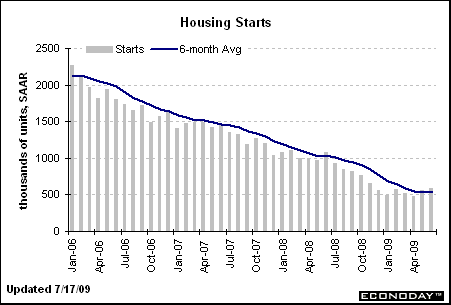
Barry Ritholtz at the Big Picture notes that new building permits in June were 8.7% (±3.0%) above May and that housing starts were up 3.6% (±11.3%). He comments:
"The year-over-year data is much clearer: New Starts down 46% [±4.3%], Permits down 52% [±3.6%]."
He links to a Barron's Econoday graph:

Friday, March 6, 2009

Daily Sources 3/6

1. Eurointelligence reports that credit default swaps for Austria traded yesterday at 264 basis points (2.64%), "meaning it costs €264,000 to insure €10m worth of Austrian bonds."
"Austria’s CDS are trading higher than Italy’s CDS. This has not yet translated into actual bonds spreads, which Austrian bond yields trading at 4.2%, while Greek bonds are at 5.8%. But sharp movements in the CDS are often an early warning of a change in bond rates. This is one to watch out for."
Meanwhile, Simon Johnson at Baseline Scenario points out that credit default swaps for major American banks have spiked again to levels not seen since mid-October.


American Express CDSs traded yesterday at 652.2. Johnson, a credible interpreter of markets being the former chief economist of the IMF and a professor at MIT, comments:
"The events of mid-September 2008 were traumatic and awful to behold. I saw that trailer and I don’t want to see the movie. But it is exactly into that scary future that we now head."
Worth reading in full. Rebecca Wilder at News N Economics points out that a recent OECD study shows that the fall in house prices in Europe has not passed through to construction as of yet.


European household consumption does not account for as large a share of GDP as it does in the US, and thus the cascade effects of rising debt to equity ratios on consumption and thus GDP should be less pronounced, if I understand correctly. However, construction will still get hit--and Ms. Wilder reports that German construction is already less than 6% of GDP, a historic low. Worth a look.

2. Charles Hawley at Der Spiegel reports that most observers in Germany believe that Chancellor Merkel's "grand coalition" is beginning to fray as the parties head into campaign mode. Not particularly good news given that international cooperation will thus be complicated.

3. Brad Setser at Follow the Money has a graph of Russian estimated treasuries and agencies holdings on the news yesterday that Moscow banned its wealth funds from investing in foreign government agencies--see Daily Sources 3/5 #4.


Setser comments:
"Russia’s sovereign fund was always quite conservative. Or at least its external portfolio was always managed fairly conservatively. It was primarily a fiscal stabilization fund, not an endowment fund — so this made some sense. Its existing guidelines implied that it couldn’t buy much of anything other than Agencies and Treasuries. Before the current crisis, Russia was planning to lift those restrictions so that its 'future' fund could take on a bit more risk to try to eke out higher returns. But the world has changed. And now even government-backed Agencies are too risky."
Emma O’Brien at Bloomberg reports that the ruble has not lost much value since Moscow gave notice to its banks that it would take a dim view of banks using bailout money to speculate against the ruble--see Daily Sources 2/9 #8.
"[Bank Rossii] purchased a net $862 million and €99 million (~ $125 million) in February, after selling a net $178 billion and €24 billion in the previous six months, it said yesterday. Bank Rossii’s Ulyukayev said last month the central bank will confine the ruble to a 39 to 41 trading range versus the basket in the first quarter, in an interview with Reuters."
Glenn Kessler at the Washington Post reports that Secretary Clinton will meet with Russian Foreign Minister Sergey Lavrov in Geneva today.
"In [an] NPR interview today, Clinton cast the overtures to Russian as part of a larger effort to engage antagonists such as Syria and Iran. 'We have a sense of urgency in the Obama administration,' Clinton said. 'We believe that there are a lot of challenges and threats that we have inherited that we have to address. But there are also opportunities. We are being extremely vigorous in our outreach because we are testing the waters, we are determining what is possible, we're turning new pages and resetting buttons. We are doing all kinds of efforts to try to create more partners and few adversaries.'"
Mark Landler at the New York Times reports that at a town hall meeting at the European Parliament today Secretary Clinton described Europe as "an essential partner" for the US in fighting climate change, terrorism, and the financial crisis.
"In her session at the European Parliament, the assembly’s president, Hans-Gerd Pöttinger, praised Mrs. Clinton, saying she sounded 'like a European.' The election of Mr. Obama, he predicted, would allow the administration to 'restore your country’s influence and its standing around the world.'"
Meanwhile, Secretary Clinton may have gone a bit overboard while declaiming that in regards to climate change, "we are long overdue in stepping up" and that "the United States has been negligent in facing up to its responsibilities." While I agree that climate change is a critical and pressing issue, the EU has passed quite a lot of laws to address the change, but its net carbon output isn't falling--and it is not clear that the current crisis will permit particularly strong actions in this arena.

4. Winnie Lee at Platts reports that in January, Chinese crude imports fell by 10.8% from December as imports from Angola and Iran grew by 50%.


Historically, there have often been large changes in suppliers share of China's crude import market. However, it is possibly significant that Sudan's exports to China fell by 56.2% from December as the ICC was heading for a decision--though I think it is unlikely. It is very notable that Brazil's crude exports have gone from basically nothing to 88 kb/d--almost 3% of total Chinese imports. NICOMEX reports that Petrobras concluded a deal with Beijing today to supply 100-160 kb/d. It is in the process of negotiating a $10 billion loan with China. It was earlier reported that the $10 billion loan had already been agreed to--see Daily Sources 2/19 #1.) It is also interesting that Venezuela is not even among the top 10 exporters to China in January.

The large number from Iran indicates that the country is likely cheating on its OPEC quota, which is more or less what everyone pretty much thought in the first place. Xinhua reports that the primary reason behind China's drop in imports is that most of the available storage is full, thus complicating its effort to purchase as much crude and products as it can in the current low price environment.

5. Stephanie McCrummen and Colum Lynch at the Washington Post report that president Omar Hassan al-Bashir has responded to the ICC warrant by expelling foreign aid groups from Sudan. Meanwhile, Bashir has moved to consolidate his political position domestically, framing himself as an anti-colonialist, saying, "We have refused to kneel to colonialism, that is why Sudan has been targeted." Ironically, Bashir was a major player in Chinese colonialism in Sudan, helping to bring its oil corporations in. Crowds yelled "Down, Down USA!" even though the US is not a party to the ICC.

6. Juan Cole at Informed Comment reports that former Iranian president, Ayatollah Akbar Hashemi-Rafsanjani met yesterday with Grand Ayatollah Ali Sistani in Najaf. "Sistani is said to have expressed concern about violence by extremists from both the Sunni and the Shiite side. Sistani declined Rafsanjani's invitation to visit Iran."

7. Samuel Cisnuk at UPI reports that Iraqi Prime Minister al-Maliki has put his support behind a two-pronged oil development strategy, which envisions rather incredible production increases:
"A plan has been drafted to boost Iraq's 2.4 mb/d crude-production capacity by 500 kb.d within six months, to 4 million bpd in two years and 6 million to 8 mb/d by 2013, relying in the first two phases mainly on domestic competencies and a recreated Iraqi National Oil Co. and a Supreme Petroleum Council.

The two-pronged plan means that development will be launched immediately on some of the fields that are simultaneously being tendered to IOCs in the ongoing licensing rounds, muddying the waters considerably. The plan has been launched to weaken the Oil Ministry, and the creation of an SPC will take much of the ministry's political steering power away and hand it to Iraq's political factions."
The Oil Ministry is regarded by many as a catspaw of the US government. The government's production plan is extremely optimistic, perhaps even manic. (h/t Jim Lobe's Iraq Oil Report.)

8. Robert Mackey at the Lede reports that Mullah Omar, leader of the Taliban, recently issued a letter calling upon the organization's members to halt attacks in Pakistan itself:
"Attacks on the Pakistani security forces and killing of fellow Muslims by the militants in the tribal areas and elsewhere in Pakistan is bringing a bad name to mujahedeen and harming the war against the US and NATO forces in Afghanistan."
Well worth reading in full.

9. John F. Burns at the New York Times reported yesterday the UK was to reestablish direct contact with Hezbollah in Lebanon.
"'It’s an interesting and positive development,' Paul Salem, the director of the Carnegie Middle East Center in Beirut, said of Britain’s move. 'Once the US starts talking with Syria and Iran, Hezbollah will be a difficult issue, and Britain’s opening up a direct channel with Hezbollah now could help defuse that.'"
10. Nariman Gizitdinov at Bloomberg reports that Kazakh President Nursultan Nazarbayev in his annual address at Astana promised to spend 600 billion tenge ($4 billion) in oil revenues to stimulate the economy. Nominal 2008 Kazakh GDP was about $141.2 billion, and the government has already announced it plans a 2.2 trillion tenge (~ $14.6 billion) plan (a little more than 10% of GDP). Oil revenues are thus expected to account for about 27% of the total stimulus budget.

11. Matthew Walter and Daniel Cancel at Bloomberg have a summary of recent moves by Chávez to nationalize basic foodstuff manufacturers, like Cargill earlier this week and Polar.
"National Guard troops occupied a rice mill owned by Mendoza’s company, Empresas Polar SA, last week, and Chávez directly warned Mendoza, 43, whose family has a net worth of $5 billion according to Forbes magazine, that he is now in the government’s cross hairs.

'You can’t work beyond the law, Mendoza,' Chávez said during a televised March 4 cabinet meeting, where he alleged the company was evading rules that require it to produce food at government-set prices. 'We could expropriate all of Polar’s plants.'"
If the government decides to expropriate Polar's assets, it will not offer cash as it has in past nationalizations, but rather bonds.
"In his latest crackdown, the president sent troops into rice mills to verify whether they’re complying with government regulations on production of price-controlled foods. The government began the process this week of seizing a rice plant owned by Cargill Inc., the biggest US agricultural company.

'We can’t allow monopolies like Polar,” Chávez said yesterday. 'That’s why we’ve ordered the intervention and possible expropriation of the plants, just like Cargill.'"
Well worth reading in full.

12. Sudeep Reddy at Real Time Economics reports that the Bureau of Labor Statistics announced that the official employment rate climbed to 8.1% in February, up from 7.6% in January. The broader employment category--U6--rose to 14.8%.
"We’ve already blown through the prior high point of the data series, which the Bureau of Labor Statistics started in 1994. An even broader (since discontinued) series hit 15% in late 1982, and we’re likely to fly right through that one next month."


Justin Fox at the Curious Capitalist posts a graph of the unemployment rate in the current slowdown versus previous recessions:


"What I get from the chart ... is that job losses from this recession are now worse than in 1981-1982, which is generally considered to have been the most severe economic downturn in the US since the Great Depression. Barring a more or less unimaginable turnaround in the month or two, they will be much worse. Just look at how steep that brown line is!"

Tuesday, December 30, 2008

Daily Sources 12/30

1. Ethan Bronner and Taghreed el-Khodary at the New York Times reports that Israeli Prime Minister Ehud Olmert said Tuesday that the Gazan airstrikes were "the first of several stages approved by the security cabinet." He went on to say "The government is giving the military its full backing and the room for maneuver to achieve the goal set out by the government."
"Interior Minister Meir Sheetrit told Israel Radio, 'There is no room for a cease-fire. The government is determined to remove the threat of fire on the south. Therefore, the Israeli Army must not stop the operation before breaking the will of Palestinians, of Hamas, to continue to fire at Israel.'"
Gazan residents reported seeing Israeli ships gathering offshore Gaza. Griff Witte and Sudarsan Raghavan at the Washington Post report that Israeli Defense Minister Ehud Barak declared "an all-out war against Hamas" on Monday. (I have no idea what practical effect that has in terms of international law--or whether a Defense Minister can declare war or whether the Israeli Cabinet and Parliament are required to pass a motion declaring war or whether, even such a declaration would mean a de facto recognition.)

The rhetorical reaction of the Islamic world has been pretty uniform. The Gulf Daily News reports that a prominent Saudi cleric, Sheikh Awad Al Qarni, published a fatwa ruling all Israeli interests--and "anything else related to Israel--legitimate targets. (h/t Will McCants at Jihadica) Sayed Salahuddin at Reuters reports that the Taliban has called upon the Muslim community to rise up in response to the Gaza conflict. Zeina Karam at the AP reports that tens of thousands of Hezbullah supporters stood in the rain in Beirut to protest the situation in Gaza, some 3,000 rallied in Cairo, and about 1,000 al-Sadr backers protested in Baghdad. The same piece reports--buried near the bottom--that the al-Maliki government issued a statement condemning the attacks and calling on all Muslim nations to end relations with Israel and all secret negotiations with it. Juan Cole has translated Grand Ayatollah Ali Sistani's fatwa issued on Sunday. It calls on action, more than has been done in the past, and strongly condemns words as opposed to practical action in response to the events:
"Mere verbal expressions of condemnation and disapproval of what is being done to our Palestinian brethren in Gaza, and of solidarity with them, mean nothing before the immensity of this horrific tragedy to which they are being subjected.

The Arab and Muslim worlds are called upon, more than at any past time, to take practical steps in order to stop this continual aggression and to break this cruel blockade that has been imposed on that proud people."
Cole's translation is well worth reading and many of the articles linked here came to my attention via his site.

Daoud Kuttab--a Palestinian journalist and former Princeton professor--has an op ed in the Washington Post in which he points out that Hamas was losing its popular appeal prior to the Israeli attacks--polls conducted in November gave them a 16.6% approval rating and Fatah 40%. He suggests that the IDF's attack serves to resurrect Hamas's bona fides while shoring up support for the government on the eve of elections in Israel. A more cynical person might suggest that Tel Eviv definitively wants an unattractive and unrelentingly hostile government in Palestine as it justifies intransigence. Kuttab, however, critically undermines the moral appeal of his argument when he poo-poos the rocket attacks into neighboring Israeli villages as "amateur rockets" which are "nagging" some of their citizens.

Benny Morris, an Israeli historian (whose books I've found especially enlightening) has an op ed in today's New York Times which gives a better sense of what the Israeli public fears. He outlines three "dire threats":
a) An Iran pursuing a nuclear program which many believe is intended to build Iran nuclear weapons, which they feel will be used against them. They regard Ahmadinejad's denial of the Holocaust and of the existence of homosexuality in Iran as evidence of his irrationality.

b) Hezbollah has rearmed in Lebanon, and now according to estimates has 30,000 to 40,000 Russian-made rockets.

c) Hamas, "whose charter promises to destroy Israel and bring every inch of Palestine under Islamic rule and law," has an army of thousands in Gaza and a substantial arsenal of home made and Russian made rockets.
Morris also undermines his argument with disingenuous claims. The "direness" of the threat to the north is substantially accounted for by reasonably successful talks with Syria, which Tel Eviv has just to all intents and purposes put on the kibosh. Clearly Hamas presents no clear and present existential danger to Israel, as we witness its armed forces basically running roughshod over the, what are in fact, irregulars in Gaza. Finally, Ahmadinejad is not the commander in chief of the Iranian armed forces and would, under no circumstances, have access to the button, so to speak. His irrationality is therefore a matter of relative indifference when calculating the potential threat arising from a potentially nuclear-armed Iran.

That said, it is always very easy to dismiss the threats made to someone else than it is to yourself and I think it is misleading to pish-posh these threat analyses as mere propaganda. However, they do seem to indicate that we should worry more about irrational responses from Tel Eviv than from Iran. I suspect that the realists more regularly prevail there, however, past performance is not a guarantee of future results. Morris's ultimate point remains fairly pointed, that the Israeli long term threat is internal--the birthrate of Israeli Arabs.

Israeli ideology does not make room for the notion of a non-majority Jewish state. Arab ideology does not make room for the notion of an Israel ruled by Jews. The raison d'etre of all the political associations on offer in both Palestine and Israel would be undermined by peace.

Bret Stephens in the Wall Street Journal has an opinion piece which points out that Hamas quite literally calls for genocide in Israel, quoting Palestinian cleric Muhsen Abu 'Ita as saying "The annihilation of the Jews here in Palestine is one of the most splendid blessings for Palestine." But, he says, Israel has won most of its conflicts as the proverbial hedgehog, when now it is the fox.

Either way, I'd say Morris is right when he says we can expect the conflict to continue.

2. Daryna Krasnolutska and Stephen Bierman at Bloomberg report that Ukraine has agreed to pay the amount Gazprom says it owes--over $2 billion. President Viktor Yushchenko’s office said in an email that the November gas has been paid for--$806 million--and that an advance payment has been made for December supplies, which were forecast to cost about $862 million in full. Gazprom had threatened to cut off natural gas supplies to the Ukraine on January 1 if back payments were not made. Since much of the natural gas that Europe consumes is provided via pipelines which traverse the Ukraine, the situation set off alarm bells across the continent as well as in the US.

3. Philip P. Pan and Howard Schneider at the Washington Post report that President Medvedev has signed into law a Constitutional amendment which extends the Presidential term to six years from four. The amendment will not come into force until the next presidential election. Many see this as a move to prepare a longer term for Putin who they believe will run for President again.

4. Glen Carey and Matthew Brown at Bloomberg report that Gulf Arab leaders have agreed to a plan to create a monetary union and central bank for the region. The plan must now be submitted to the national governments of the Gulf countries which are interested in the proposal. Saudi Arabia, Kuwait, Bahrain, Qatar, and the UAE will submit the plan. (Oman has withdrawn from the effort, which began in 2001 when the entire Gulf Cooperation Council agreed to form a monetary union along the lines of the European Union.)

5. Tarek el-Tablawy and Khaled el-Deeb at the Associated Press report that the head of the Libyan National Oil Company, Shukri Ghanem, told the journalists in a telephone interview today that Libya has ordered cuts in production of 270 kb/d, more than the cut of 252 kb/d that the December 17 meeting in Oran had mandated. OPEC, so far as I know, has not released its data on what the actual production of each member state was in September--and that was the number from which the December 17 announced a cut. The reporters also talked to Conrad Gerber of Petrologistics, who suggested that OPEC was making good on their cuts.
"According to Gerber's figures - which come from carefully monitoring tanker shipments and do not include oil in storage - OPEC had already cut output by 1.56 million barrels per day by the end of November, and has slashed another 320,000 barrels per day in December."
In a separate Reuters story by Alex Lawler today, Gerber said that Iran was expected to increase production by 170 kb/d to 3.85 mb/d and Venezuelan production is steady at 2.32 mb/d. Presumably the additional production is inferred by looking at additional shipments, and hence supply, though the way it is put is deliberately obfuscatory.

6. The Wall Street Journal Asia's editorial board reports that Bangladesh had a 80% turnout for its recent elections. Prime Minister Sheikh Hasina's Awami League won about 250 of 300 seats up for direct election. Islamist parties did not do very well.

7. Annika Breidthardt has an analysis at Reuters which argues that the commission of the new Reliance refinery in Jamnagar--a 580 kb/d capacity refinery which is very sophisticated--may bring Middle Eastern sour crudes to price parity with the light sweet benchmarks. Worth reading.

8. William Sim at Bloomberg reports that South Korea posted a current account surplus of $2.06 billion in November, up from $1.67 billion in October.
"South Korea may keep posting current-account surpluses in coming months as imports fall faster than exports amid a decline in oil costs, Yang Jae Ryong, a statistics official at the central bank, said in Seoul today."


9. Alan Beattie at the Financial Times wrote yesterday that a report just published by the IMF argues that tax cuts and specific industry bailouts are likely a waste of government resources in handling the financial crisis, what is needed is stimulus designed to provide credit to those who are having a hard time obtaining it. Providing funds to those who will likely put it in their savings would not be productive, in the organization's view.

10. Bob Willis at Bloomberg reports that the S&P/Case Shiller index declined 18% year over year in October, after falling at an annual rate of 17.4% in September. "The 20-city index is down 23% from its 2006 peak."

11. Greg Mancina in the Saginaw News tells us the news from Detroit is, now that the price of gasoline is averaging well-below $2/gallon, that in December trucks and SUVs are again outselling cars in the US. Depressing. But I suppose that simply means they are more popular than the alternatives--as long as the price of gasoline doesn't get too high. Completely understandable. Also, I imagine that the US might have some comparative advantage when it comes to making trucks and SUVs. That said, higher CAFE standards are desperately needed and this news means oil demand should recover in the US. Not that that's all that surprising. (see Daily Sources 10/15 #3--near the end where it is reported that SUVs maintained their market share in September.)

12. In a strange pair of pieces by the Wall Street Journal, we get a peek into some strange thought processes. The Editorial Board calls for a strong dollar--claiming it is the source of high oil prices--and a reversal of relaxed monetary policy in order to weaken Russia, Iran, and Venezuela. One might suggest that it's a tad late for that--and conveniently well past the time the financial bail out commenced--and that our monetary policy should focus on producing prosperity in the United States more than freedom overseas. But, beyond that, the estimation that a low crude prices will encourage the establishment of democracy in Venezuela, Russia, and Iran is based on the same faulty thinking that led to a 50 year and totally pointless embargo on Cuba. And to combat one almost laughable misapprehension: Russia's ability to squeeze European supply is not affected one whit by the price paid for it ... the fact is that Russia supplies a tremendous percentage of total supply which cannot be replaced if withdrawn. Still, the notion that Russia would have tried to use such a tool to pressure Europe in any but the most extreme of conditions is deliberately misleading. And a lower price only means that there is less economic incentive to get more out of the ground and thus meet Europe's future energy requirements.

I guess we can all take comfort though, in the revelation via Andrew Osborn's piece in the Wall Street Journal that Igor Panarin--a major US analyst in Russia--thinks that the United States will break up into different regions come 2010. Well, I guess I can say that I know of more than one region where there are people who openly advocate such a breakup--Hawai'ian secessionists come to mind--and there are plenty of blue staters fed up with the politics of red staters and vice-a-versa. It is a little disconcerting that Russian analysts would seriously be considering this future scenario. Still, sometimes it's nice to think that they understand us no better than we do them. It is also very important to note that Panarin says "But if we're talking reasonably, it's not the best scenario -- for Russia."

Monday, December 29, 2008

Daily Sources 12/29

1. Griff Witte at the Washington Post reports that Isreal continued bombing--for the third day--the Gaza strip on Monday as Hamas fired another round of missiles into neighboring Israeli villages. On NBC's "Meet the Press," Israeli Foreign Minister Tzipi Livni said that Tel Eviv did not intend to reoccupy the strip. Hamas leader Ismail Haniyeh vowed to never retreat in televised comments Sunday.
"The UN Security Council expressed 'serious concern' Sunday over the situation in Gaza and called for 'an immediate halt to all violence." Pope Benedict XVI also urged an end to the violence, saying 'the native land of Jesus cannot continue to be witness to so much bloodshed, repeating itself without end.'"
Israeli officials indicated that they expect military operations to last weeks at the very least. Iran's Supreme Leader, Ayatollah Ali Khamenei, on Sunday called for all Muslims to fight on behalf of the Gazans, saying that anyone who dies in this effort would be received in heaven as a martyr. More credibly, however, as Juan Cole reports, in the eyes of the Shi'a Muslim community, Grand Ayatollah Ali Sistani of Narjaf, Iraq, called on Muslims to support the Gazans with more than lip service. PressTV, an Iranian government program, translated Sistani's statement as follows:
"Condemning what is going on in Gaza and supporting our brothers only with words is meaningless, considering the big tragedy they are facing ... Arab and Islamic nations need to take a decisive stance, now more than ever, to end these ongoing aggressions and to break the unjust siege imposed on the brave people of Gaza ... ."
In the meantime, hospitals and other fundamental services and commodities--such as food--in Gaza are in short supply or being overwhelmed, given that it has been subject to an Israeli blockade for some time now. Sudarsan Raghavan and Islam Abdel Kareem at the Washington Post report that humanitarian aid groups called on Israel to allow supplies through the borders Sunday, saying that medical and food supplies are dangerously short. Both Post articles give good summaries of the situation.

2. David Rosenberg at Bloomberg reports that the Bank of Isreal reduced its benchmark interest rate by 0.75% (or 75 basis points) to 1.75%.
"The rate reduction 'will help strengthen the economy’s ability to cope with the implications of the global economic crisis,' the bank said in its statement. It added that the Gaza fighting increases 'geopolitical uncertainty' in Israel and has the potential 'to impact negatively' on the economy."
3. Robert Birsel at Reuters reports that the chairman of Pakistan's joint chiefs of staff committee, General Tariq Majid, told the visiting Chinese Vice Foreign Minister He Yafei today that New Delhi and Islamabad needed to institute reciprocal de-escalation measures and to avoid "belligerent posturing." Military officials from the two countries held an "unscheduled hotline call" this weekend as the Chinese minister arrived in Pakistan. In a related story, Rama Lakshmi at the Washington Post reports that no clear winner emerged from the election results for Jammu-Kashmir released on Sunday. The National Conference and Congress parties were the largest winners, taking 45 out of 87 constituencies combined. Indian Prime Minister Manmohan Singh, of the ruling Congress Party, welcomed the results, saying,
"I think the large turnout in Kashmir is a vote for democracy and national integration. We are all happy at the turnout, and who wins or loses is a secondary issue."
4. Jeffrey Gettleman at the New York Times reports that the President of Somalia resigned today, blaming the international community for not doing enough to shore up his government.
"Under Somalia’s transitional charter, the speaker of the Parliament will take over the presidency for one month until the Parliament elects a new president. Several moderate Islamists could be candidates.

Over the weekend, fighting broke out between moderate and radical factions in the first obvious sign of tensions within Somalia’s Islamist community.

On Sunday, a powerful, newly militarized Islamist group declared a “holy war” against the more militant Islamist factions, and it seems to have the muscle to back up its threats. The group, the Ahlu-Sunna Wal-Jama, killed more than 10 fighters from a rival Islamist faction that was known as one of Somalia’s toughest in fighting over the weekend."
Worth reading in full.

5. Brad Setser at Follow the Money has a post entitled "the collapse of financial globalization" today which shows that private inflows and outflows of capital to and from the United States have collapsed to near zero in the last few months. But, Setser shows that private inflows and outflows were closely tied to each other, and did not in fact represent an increase in net financing--of US debt. Evidently:
"I think we now more or less know that the strong increase in gross capital inflows and outflows after 2004 (gross inflows and outflows basically doubled from late 2004 to mid 2007) was tied to the expansion of the shadow banking system."
Which means that central banks have been for the past five years responsible for financing the bulk of the US deficit. Outside of Japan, the current account surplus nations were building up their reserves and sovereign wealth funds. Well worth reading in full.

6. David Oakley at the Financial Times reports that emerging markets may find it difficult to find financing as the developed economies are expected to offer as much as $3 trillion in sovereign debt in 2009.
"Mr. [Nick] Chamie[, head of emerging markets research at RBC Capital Markets,] said: 'Governments or companies that are highly rated will still be able to attract buyers, but the very large amount of issuance almost certainly means they will have to pay higher interest rates to get those investors.'"
7. Denis Maternovsky at Bloomberg reports that Bank Rossi has allowed the ruble to depreciate 1.7% against a currency basket of dollars and euros. This is the twelfth time in seven weeks that Bank Rossi has not acted to stop the ruble's fall against the basket peg, which is 55% in dollars and 45% in euros.
"Bank Rossii urged the country’s banks today to avoid buying foreign currencies in the first quarter of 2009 or risk losing access to central bank loans, Chairman Sergey Ignatiev said in a letter to banks that was posted on the central bank’s Web site today. Russian banks shouldn’t increase their holdings of 'foreign currency assets' from the average level between Aug. 1 and Oct. 25, Ignatiev said."
8. Jeffrey Ball at the blog Environmental Capital reports that Russia asked for the following, outside of permanent observer status, at OPEC's meeting in Oran, Algeria, on December 17:
a) Crude benchmarks outside of Brent and WTI,
b) A discussion of whether it would be advantageous to discard oil pricing in dollars in favor of pricing it to a basket of currencies, and
c) New futures trading markets outside of Europe and the US.
Without going too deeply into it, these are basically just whitewash remarks. There have been plenty efforts to establish other crude benchmarks, mostly which have failed because of lack of volume. (You need investors outside of commercial entities to get involved to make the futures market workable.) There are other futures trading markets outside of Europe and the US which trade crude futures, but they are unpopular for reasons of the opacity surrounding the underlying crude future and other issues of risk. Pricing oil in a basket of currencies would only serve to make price discovery that much more complicated a business--and the currency markets already price in the cost of oil.

However, the report may be evidence that market data is a primary objective of Russia at OPEC. Moscow has indicated it will wait to see whether the cartel members make good on their cuts before instituting any of their own.

9. Henry Meyer at Bloomberg reports that Russia and the Ukraine failed to reach an agreement in their natural gas dispute today, with two days left before the threatened cut off of supply by Moscow--supply to pipelines that carry a considerable portion of Europe's natural gas requirement. The Ukraine owes Moscow $1.662 billion for supplies delivered in November and December, and $450 million in fines for late payments.
"'It isn’t clear who is in charge and who is the right counterpart for Russia to talk to,' said Masha Lipman, an analyst at the Carnegie Moscow Center research group in Moscow. 'Ukraine is in political turmoil and in the midst of a serious economic crisis.'"
Still, Putin told reporters today in Moscow that the Ukraine does not want to pay for the gas. Meanwhile, as Stephen Bierman and Torrey Clark at Bloomberg report, Gazprom is assuring its European customers that it will "completely fulfill its obligations."

10. Wang Ying at Bloomberg reports that Zhang Guobao, the head of China's National Energy Administration wrote in the People's Daily today that it will encourage companies to fill their available oil storage facilities in the low price environment. "Companies will be encouraged to utilize their spare oil-storage capacity while state and commercial reserves of other 'strategic resources' will be set up ...."

11. Charles Lee at Platts reports that the South Korean Energy Ministry announced that the country will spend 6.9 trillion won (~$5.4 billion) over the next 14 years to expand its natural gas storage and distribution infrastructure. Under the ministry's plan, South Korea will transform the Donghae offshore gas field into a storage facility with capacity of 1.7 million metric tonnes of LNG by 2017. Work on the transformation should begin by 2014. The Donghae terminal would increase the country's storage capacity to 24.3% of expected annual demand in 2017.
"In September, state-run Korea Gas Corp. signed a $90 billion deal with Russia's gas giant Gazprom to import 10 Bcm of natural gas annually from Russia's Far East for 30 years beginning 2015 via a pipeline.

The undersea pipeline would reach the Samcheok terminal and the offshore Donghae terminal, the ministry said."
The plan includes increasing the total length of South Korea's natural gas pipelines from 2,739 km to 3,893 km by 2013, which should make natural gas available to 78% of all South Koreans as the infrastructure will be extended into rural areas.

12. Mriganka Jaipuriyar at Platts reports that oil product demand in South Korea was down 12% year over year in November.
"Demand for fuel oil saw the sharpest year on year slump in November, falling 30.4% from 7.1 million barrels to 4.94 million barrels. Gasoil demand fell 11.3% to 11.57 million barrels; naphtha was down 13% to 23.28 million barrels; and LPG was down 10.6% to 7.69 million barrels, KNOC's data showed."
Refining output, meanwhile, was down 6.3%. South Korea imports much more crude than it uses, exporting surplus products refined into the region.

13. Matthew Walter and Daniel Cancel at Bloomberg report that Venezuela's central bank estimates the economy grew by 4.9% in 2008, the slowest rate seen in five years. Oil accounted for 93% of the country's exports according to the bank.

14. Stephan Kueffner at Bloomberg reports that Ecuador's Social Security Institute will purchase another $500 million in government bonds. Ecuador stopped making payments on its sovereign debt on December 12. The Social Security Institute also purchased $700 million in government bonds on December 24. The Social Security Institute is barred by law from investing more than 50% of its money in the public sector and has about $1.2 billion in cash. The government plans to sell an additional $1.5 billion in bonds on the domestic market. (see Daily Sources 12/16 #3 for links on first reporting on the default, social security purchases, and potential de-dollarization of Ecuador as a result.)

15. Seth Mydans and Mark McDonald at the New York Times reports that protests have resumed in Thailand. This time it is the supporters of the party recently ousted from power--former Prime Minster Thaksin Shinawatra's organization. Protesters have surrounded the Parliament, forcing a delay in the legislature's opening under a new government. The pro-Thaksin "red shirts" are calling for the dissolution of the new government and new elections.

16. Ralph Atkins of the Financial Times reports on the paper's survey which showed that a large majority of Europeans, and 48% of Americans, polled believe that the euro will overtake the dollar in "global importance" by 2014. What this means is anyone's guess, I suppose.

17. William Tucker has an op ed at the Wall Street Journal which actually calls the next bubble--alternative energy. While I think his prognostication may well be a tad early, I think his argument for nuclear power is basically the right one.

18. Glenn Kessler on Saturday had a very interesting story in the Washington Post about how in October the International Accounting Standards Board changed its accounting rules to allow European financial institutions to rearrange their books, and fooling the markets into thinking their bottom lines were better than they are. Well worth reading in full, though I still have no idea why anyone would put any faith into any accounting corporation's estimation outside of the absence of any other alternative, at this stage. (h/t naked capitalism)

Monday, December 1, 2008

Daily Sources 12/1

1. Ambrose Evans-Pritchard at the UK Telegraph writes that a Citibank report asserts that traders are paying close attention to rumors coming out of China suggesting that Beijing is considering "boosting its gold reserves from 600 tonnes to nearer 4,000 tonnes to diversify away from paper currencies." The report predicts that gold will go to $2,000/ounce, arguing that the economic crisis is so deep and widespread, and the remedial action required of governments so radical, that we are either in for an inflation shock once economies begin to recover or for a period of instability, unrest, and international conflict. Both would traditionally be good for the price of gold. (The Telegraph is not known for the sobriety of its commentary.) In a related story, Judy Chen and Belinda Cao at Bloomberg report that today the yen fell 0.7%
"after the People's Bank of China set the daily reference rate at the weakest level since August, prompting speculation policy makers favor a depreciating currency to spur demand for Chinese goods. ... The yuan has now lost all the gains it made since the [the US and China] last held trade talks in mid June, after it advanced 6.6 percent in the first half of 2008."
Maureen Fan at the Washington Post reports that Chinese President Hu Jintao told a politburo meeting this weekend that "'External demand has obviously weakened, and China's traditional competitive advantage is being gradually weakened' as international demand is reduced." Dow Jones reports that the China Federation of Logistics & Purchasing said that China's Purchasing Managers Index fell to 38.8 in November from 44.6 in October. A reading above 50 indicates growth, anything below indicates contraction.

2. Roland Jackson at the AFP reports that OPEC decided in their meeting in Cairo on the 29th to maintain the current production quotas. The organization is looking at data to see to what extent various members are exporting at quota. Reuters reports that OPEC President Chakib Khelil told the media that the commercial inventories of the OECD will likely reach 59 days of supply if OPEC doesn't take action in the December 17 meeting. "Latest estimates are that stocks are at 55-56 days of cover and several OPEC ministers have said they would like to cut inventories to 52 days."

On Saturday, Saudi King Abdullah said in an interview published in a Kuwaiti paper that "We think that a fair price of oil is $75/b." In the meantime, Reuters reports that Riyadh has shelved plans to restart the Dammam oil field, which was expected to produce 75 kb/d and 100 million cubic feet of natural gas a day. The contract was to be awarded in the second quarter of 2009. The AFP reported that Oil Minister Gholam Hossein Nozari told journalists on Sunday: "There is oversupply of two million barrels per day on the market ...." Ladane Nasseri and Ayesha Daya at Bloomberg report that today in Tehran Secretary General Abdalla el-Badri told the media that "Everybody is in favor of a cut in the Algeria meeting - we are all gearing toward a cut."

El-Badri also said,
"We told Russia that OPEC will take action to lower output, but the burden is heavy. Mexico and Norway have a decline by themselves, but Russia promised to join OPEC in trying to solve the problem."
If Russia does decide to coordinate a production, export, or effective supply cut to the oil markets, it will represent a tectonic shift in their global strategy. Since the Soviet Union began piping natural gas to Europe in the 1980s, Moscow has geared its energy policy to integrating itself with Europe and supplying its full productive capacity. China, another large consumer, also appears to be the beneficiary of that policy. Were Russia to decide its interests were more closely bound to the producing nations than to the consuming nations, a number of long-held policies might be revisited.

In a related story, Platts reports that Moscow has given the green light for a pipeline to be built connecting the Druzhba (or "friendship") pipeline to the Baltic Sea port of Ust-Luga. Ust-Luga is a port to the west of St. Petersburg in the Luga Bay. The map below gives an idea of the path of the Druzhba pipeline and where the Baltic Pipline System 2 would be placed, though it wouldn't terminate in Primorsk, but to the south west. The pipeline would have a 1 mb/d capacity upon completion. By late 2012 it would be expected to have 600 kb/d in capacity.


Of course, exporting via pipeline to Europe means that the crude can go nowhere else. Via tanker it could have any destination outside of Russia. In another related story, Sam Fletcher at the Oil & Gas Journal writes that GCES has a report that Moscow, at the urging of Prime Minister Putin, is in the process of reconfiguring their crude export tariff system. Under the new system the export duty would be determined by the 30 day average of the price for Urals crude ending in the middle of the month prior to implementation, as opposed to the current system which determines the tariff by averaging the price seen in the previous two months every two months. Though this system would certainly be an improvement, it does not on the face of it appear to be flexible enough to prevent financial losses to either the government or the companies given current volatility.

3. Nadim Kawach at Business 24/7 reported Sunday that Saudi foreign assets grew by about SR48 billion ($12.8 billion) in October, but grew at a rate of about 30% less than that seen in previous months. The Saudi Arabian Monetary Agency announced yesterday that the foreign assets held by the kingdom's central bank stood at SR1.679 trillion (~$448 billion) at the end of October.

4. Alex Nicholson at Bloomberg reports that VTB Bank Europe published its Purchasing Managers Index for Russia fell to 39.8, its lowest level, from 46.4 in October. These indices mostly measure market sentiment.

5. Jan Cienski at the Financial Times reports that the Polish Prime Minister, Donald Tusk, told him that Warsaw has no intention of accumulating huge debt in order to combat the financial crisis. Tusk indicated that Poland had not been deeply affected by the crisis so far. His comments align Poland with Berlin in regards to the stimulus package proposed by the European Commission last week. Warsaw on Sunday announced a stimulus package of 91 billion zlotys (~ $30.6 billion), but apparently very little of those monies represent new, previously un-budgeted, spending. Well worth reading in full. Simon Kennedy at Bloomberg reports today that "[Manufacturing indexes] for Poland, Hungary, Sweden and the Czech Republic ... showed some of the steepest-ever declines as recession struck their main export markets." If I remember correctly, the zloty has been under pressure as investors have repatriated their equity. (From June 1 to November 30, the zloty lost 26.8% of its interbank value versus the dollar.)

6. Eurointelligence reports that German Chancellor Angela Merkel secured the backing of her party for her policy of delaying any tax cuts until after the election in September 2009. Finance Minister Peer Steinbruck told Der Spiegel that he thought the crisis should not be countered with government money. The papers in Germany favor the government approach. Bertrand Benoit at the Financial Times reports that Merkel told her party conference that "Germany will keep analyzing the situation. We will always keep all our options open. I repeat: all options."

7. Pradeep Rajan at Platts writes that Gibson Shipbrokers released a report showing that Shell and Koch have taken out time charters of very large crude carriers mostly for storage purposes. Both Shell and Koch have long term contracts with producers, and given the current market, much of that oil, if refined, would put further downward pressure on refined products prices. They also may be inclined to capture profits afforded by the current steep contango in crude oil prices.

8. RIA Novosti reports that the Saudi Ambassador to Kenya told reporters that the Sirius Star will be returned to Saudi Arabia within two days. He also said that no ransom would be paid. Jeffrey Gettleman at the New York Times reports that the head of a Kenyan maritime association charged with mediating between the pirates who captured the Ukrainian freighter lugging 33 T-72 battle tanks, grenade launchers and anti-aircraft guns told the media that the pirates have agreed on a ransom. The ship is expected to be released today or tomorrow and the final ransom is estimated at between $3-5 million. In the meantime, Oliver Smith at the UK Telegraph reports that Somali pirates attacked a luxury cruise liner in the Gulf of Aden yesterday. The liner possesses a "long-range acoustic device" which apparently was used to drive off the attackers.

9. Sudarsan Raghavan and Saad Sarhan at the Washington Post report that Grand Ayatollah Ali Sistani expressed on Saturday concern about the status of forces agreement the Iraqi Parliament ratified earlier in the week. Sistani thought that much of the language in the pact was a "mystery" and that he could discern no guarantee of a return of sovereignty to Baghdad.

10. Rama Lakshmi at the Washington Post reports that anger, quite understandably, is building over the attacks in Mumbai, leading to the resignation of the Indian home minister. Efforts to console the families of victims by government representatives have been met with snubs. Preliminary investigations by Indian authorities lead them to believe that the gunmen were trained in Pakistan and came to Mumbai via boats on the Arabian Sea. This has led a senior representative of the Hindu nationalist BJP to say,
"'It is time for unilateral action against the training camps in Pakistan. If the U.S. can go into Afghanistan to punish the Taliban and chase Osama bin Laden, why should India hesitate?'"
Condoleeza Rice is being sent to New Delhi on Wednesday to try and help calm tensions. An FBI team has been sent to help investigate the scene. Pakistani representatives deny any link to the terrorists, but Candace Rondeaux and Craig Whitlock report in the Washington Post today that the Lashkar-i-Taiba, the Kashmiri terrorist organization currently thought responsible for the shootings, has been operating openly in Pakistan as Jamaat-ud-Dawa.
"Jamaat-ud-Dawa was instrumental in delivering aid to victims of the 2005 earthquake in Kashmir. ... The US government classified Jamaat-ud-Dawa as a terrorist group in April 2006, calling it an 'alias' of Lashkar. But the Pakistani government has not reciprocated and allows the network to raise money, run religious schools and offer social-service programs. It hosts an extensive Web site, with versions in English and in Urdu."
11. Christopher Toothaker at the Associated Press reported yesterday that Hugo Chavez is asking supporters to petition for a national referendum to abolish term limits in the Venezuelan Constitution.
"'Last year, when we lost the referendum, I said I should accept the majority's decision,' the former paratroop commander told a crowd of red-clad government supporters at a rally in Caracas. But now, he added, 'I say you were right: Chavez will not go.'"
12. Tim Johnston at the Washington Post reports that thousands of government supporters rallied in Bangkok this Sunday. Pro-government supporters are wearing red shirts. Anti-government: yellow. So far there has been little violence between the two factions, but there is growing anxiety about the possibility of it. Given that the anti-government protesters (or members of PAD) allegedly number about 20,000, it seems odd that they have managed to shut down so many arteries of the city for so long. Considering that the pro-government supporters are urban, they should outnumber the mostly rural PAD. However, Johnston notes, "The government has only tenuous control over the army and police, which seem to be following their own agenda, allowing the [anti-government] PAD to break the law with impunity."

13. Lauren Etter at the Wall Street Journal reports that Brazil's agricultural sector is slowing down as farmers are having a hard time finding the financing they need for fertilizer, pesticide, and seed. Brazilian farmers get most of their financing from multinational agricultural firms like Cargill, as opposed to from local banks. Evidently these firms are being tighter with credit as they try to conserve cash. Worth reading in full.

14. The Associated Press reports that the Fed is widely expected to cut the federal funds rate by 50 basis points (0.5%) in their next meeting scheduled for December 15-16.

15. Timothy R. Homan at Bloomberg reports that the Institute for Supply Management’s US factory index dropped to 36.2 in November, the lowest level seen since 1982. "[T]he UK’s Chartered Institute of Purchasing and Supply’s factory index was at 34.4, the least since the survey began in January 1992."

16. Emelia Sithole-Matarise at Reuters reports that the spread on 10 year US Treasury credit default swaps has widened to 68.4 basis points (0.684%) today. Evidently the notion of a US default is slowly gaining some credence in the market. (I remain confused, though, as to how these instruments would actually provide any insurance given that the CDS is denominated in dollars .)

Wednesday, November 26, 2008

Daily Sources 11/26

1. Stephen Castle and David Jolly at the New York Times report that the European Commission proposed today a stimulus package totaling €200 billion (~ $256 billion). However, of the €200 billion, only €30 billion would come from Brussels, and, as we noted yesterday, Germany's Chancellor Angela Merkel appears to be set against a coordinated response. Much of the monies included are packages that have already been announced by member nations, and the EC has very little ability to bend the national governments to their will. Some analysts see it as an effort to pressure member governments to coordinate their responses to the crisis.

2. Norma Cohen at the Financial Times reports that the services sector in the UK contracted by 0.4% in the third quarter, as per the Office for National Statistics (ONS). This was the largest drop seen in the sector since the ONS began keeping track. The ONS also confirmed that GDP fell by 0.5% in the third quarter as per earlier predictions.

3. Olesya Vartanyan and Ellen Barry at the New York Times reports that Erosi Kitsmarishvili, Georgia’s former ambassador to Moscow, testified before Parliament that Tblisi was responsible for the conflict in South Ossetia.
"A former confidant of President Mikheil Saakashvili, Mr. Kitsmarishvili said Georgian officials told him in April that they planned to start a war in Abkhazia, one of two breakaway regions at issue in the war, and had received a green light from the United States government to do so. He said the Georgian government later decided to start the war in South Ossetia, the other region, and continue into Abkhazia."
When Mr. Kitsmarishvili tried to confirm that a green light had been given with US diplomats in Tblisi who told him that there had been no go ahead. Meanwhile, the New York Times' Judy Dempsey reports that US diplomats began an effort to have the Ukraine and Georgia admitted to NATO without going through the traditional admission process. Secretary of State Condoleeza Rice has allegedly had long telephone conversations with senior German, French, and other European diplomats in support of the initiative. In light of the most recent news from Georgia ... not gonna happen.

4. Vandana Hari and Mriganka Jaipuriyar at Platts report that IEA Executive Director Nobuo Tanaka told journalists in Singapore today that the integration of China and India into the organization was of strategic importance given that most new demand was in those countries. He urged OPEC to carefully examine the market data in their upcoming meetings and to stand ready to act should the market reverse. In the IEA oil market report released November 13, the IEA forecast that the fourth quarter call on OPEC crude would be 31.1 million b/d, about 1 million b/d below their estimate of OPEC's October production of 32.13 million b/d. Tanaka also suggested that the IEA might revise further downward their projection of 2009 oil demand growth, "Certainly there is a possibility of [another] downward revision. But how far, how much, I don't know."

Tanaka also said he would like to see greater cooperation with the countries of Southeast Asia and that the organization's interest in Indonesia is growing. (Indonesia recently left OPEC.)

5. Platts reports that Turkish energy minister Hilmi Guler told television reporters in Istanbul today that during his visit to India Monday he and Prime Minister Tayip
Erdogan discussed the development of MedStream--an oil transit corridor between the two countries.
He told reporters that a preliminary study of the feasibility of the project has been completed and that Turkey is in talks with other participatory countries to determine whether to move ahead with a full feasibility study.
"The route involves the construction of the long-planned Trans Anatolian Pipeline from the Black Sea to Turkey's Mediterranean oil hub at Ceyhan.

From Ceyhan a second pipeline would be built, to the Israeli oil port of Ashkelon and on to Israel's Red Sea port of Eilat from where tankers would carry the oil to markets in India and the Far East, he said.

Guler added that plans for the link between Ceyhan and Israel involved the construction of a triple pipeline carrying oil, natural and fresh water as well as electricity and fiber optic links."
6. Aaron David Miller has an opinion piece in the Washington Post which argues that it would be folly to make the Isreali-Palestine issue the Obama Administration's first foreign policy priority, but that Isreali-Syrian relations are ripe for a breakthrough. His primary argument against focusing especially on Palestine is that there is no real negotiating authority that Tel Aviv can negotiate with just now. Given that complication, expecting a serious resolution to an issue that includes resolving the status of a city holy to three separate religions seems quixotic. Syria, on the other hand, has a stable government and the issues between the two countries are well-understood and straight-forward: withdrawal, peace, security and water. I think Mr. Miller is probably right on this issue from a tactical perspective. His argument is well-worth reading in full.

7. Matthew Rosenberg at the Wall Street Journal report that Afghan President Hamid Karzai's office released today a transcript of a meeting with a UN delegation yesterday where the President said,
"'This war has gone on for seven years, the Afghans don't understand anymore, how come a little force like the Taliban can continue to exist, can continue to flourish, can continue to launch attacks.'"
Some think the harsh criticism comes as Karzai readies himself for elections, where he must be seen as independent of the West in order to counter domestic critics. But Karzai's comments include the remark that "If there is no deadline we have the right to another solution for peace and security, which is negotiations," which suggests he wants a deadline for the end of the war.

8. Sudarsan Raghavan at the Washington Post reports that the Iraqi Parliament has postponed a vote on the Status of Forces Agreement until tomorrow. They have also agreed that should Parliament pass the proposal, it will be subject to a national referendum next year. Grand Ayatollah Ali Sistani has said that any deal should have the support of every Iraqi party in order to be legitimate. Thus the Sunni bloc of 44 votes in a 275 member parliament has proved enough to block the deal. The Sunnis are demanding the dissolution of the special criminal court which tries former members of Saddam Hussein's government and the reinstatement of former Baath members to government jobs.

9. Fiona MacDonald at Bloomberg reports that the Kuwait state news agency has announced the country is not considering rerouting its tankers away from the Suez Canal.
"Eighty percent of Kuwaiti tankers go to Asia, bypassing the Gulf of Aden, al-Shuwaib said, according to KUNA. The remaining vessels leaving the country are rented and non-Kuwaiti, or are Kuwaiti ships that sail under international military protection, the news agency said, citing al-Shuwaib."
That is, most of our ships don't go through the Suez, those that do are protected by others' navies, and the rest don't fly our flag.

10. Jamie Dale at Lloyds List reports on further distress in the shipping industry, with Cargill chartering a capesize (of 180,180 dead weight tonnes) for a transatlatic round trip voyage at $1,000/day, which is way below the market rate as expressed on the Baltic Exchange of $1,864/day.
"Today the capesize average time charter rate fell to $2,773 per day, down $456 from a day earlier, and its lowest level since the Baltic Exchange began reporting this rate on March 1, 1999."
The decision to avoid the Suez Canal doesn't seem to have had much of an effect upon the price of shipping generally, as expressed by a chart of the Baltic Dry Index for the last month below:


11. The Associated Press reports that on Sunday Somalian pirates moved the Sirius Star 30 miles offshore Harardhere in a defensive move prompted by the promise Friday by Islamist fighters to free the ship--giving as cause its Islamic provenance. The promise was made by fighters claiming to represent al-Shabab, but yesterday the official spokesman for the group denied that they were part of the movement. "Al-Shabab had never attacked a pirated ship before, but militias linked to the Puntland administration in northern Somalia had twice intervened when pirates captured a ship with connections to Somali business interests."

12. David Osler at Lloyd's List reports that the pirate "mothership" destroyed by the Indian frigate may in fact have been a Thai fishing boat. The development has damaged Indo-Thai relations, with Bangkok summoning the Indian Ambassador for an explanation.

13. Tim Johnston at the Washington Post reports that Thai Army chief Anupong Paochinda told a news conference today that Prime Minister Somchai Wongsawat "'should dissolve parliament and call a snap election' as a way to end the crisis." He also called on protesters to disperse. Both refused. The article has a pretty good summary of the course of events and worth reading.

14. Li Yanping and Nipa Piboontanasawat at Bloomberg report that the People's Bank of China announced today it will reduce its benchmark lending rate tomorrow by 108 basis points (or 1.08%) to 5.58%. The deposit rate will also be reduced by 108 basis points to 2.52%. David Barboza at the New York Times reports that heavy industry in China is taking a serious hit.

15. Dorothy Kosich at Mineweb reports that the Soros, Citadel and Invesco hedge funds have recently taken large stakes in US coal mining operations. Investors apparently think coal is a good buy because it is used for power generation--which is less elastic than, say, transportation--and demand is growing. (It might face some substitution difficulties, though, especially from natural gas in the United States. China just made a major coal find.)

16. AP reports that the Commerce Department published data showing that new home sales fell 5.3% in October, the lowest level recorded since 1991. The median price of new homes sold fell by an annual rate of 7%. The Commerce Department also released data today indicating that consumer spending fell by 1% in October, per the Associated Press. Meanwhile, the AP also reports that the Labor Department announced that new jobless claims fell slightly from 543,000 to 529,000 (on a seasonally-adjusted basis). The number of people who continue to claim unemployment has also dropped from 4.02 million a week ago to 3.96 million.

17. Jane Black at the Washington Post reports that the number of Americans using food stamps looks likely to exceed the highest level ever seen. The Agricultural Department will release the data next week, but provided a basic sense of what to expect in a briefing last month.

18. The EIA's This Week in Petroleum announced that crude stocks grew by 7.3 million barrels(!) in the week ended November 21 and are nearing the top of the historical average. The Platts survey had analysts expecting a 400,000 barrel build. Gasoline stocks also grew by 1.9 million barrels, which is still at the bottom of the historical average, but well above the expectations of Wall Street of a 300,000 barrel build. Distillate stocks fell 200,000 barrels and are at the very bottom of the historical average. Analysts expected a draw of 900,000 barrels. Taken in isolation, this should be pretty bearish data. Taken in combination with a $30 full curve contango and it should be very bearish. But, so far, it looks like the market is mostly responding to the interest rate cut in China with a $4-5/b price rise.

19. Leslie Moore Mira at Platts reports that MasterCard Advisors published a survey on Tuesday which indicated that gasoline demand was up in the week ended November 21. Gasoline consumption still appears to be at 3% below the 2007 rate.