Showing posts with label Congo. Show all posts

Friday, January 23, 2009

Daily Sources 1/23

1. Real Time Economics carried yesterday excerpts from an interview of European Central Bank Executive Board member Lorenzo Bini Smaghi by the Wall Street Journal's Joellen Perry. Some excerpts of the excerpts:
"LBS: ... The transmission mechanism [through which monetary policy feeds through to the real economy] in the US seems to be more impaired. You can see this by comparing the level of the policy rate with the lending rates set by financial institutions. When you compare the euro area and the US, lending interest rates are basically the same, even though in the US policy rates are near zero. This suggests that to achieve the same level [of lending rates], policy rates in the US need to be much lower. Also, cutting interest rates to very low levels is effective in inducing agents to start holding again risky assets if the central bank commits to keeping rates at such low levels for a prolonged period of time. But this strategy is very risky, because it tends to delay the exit strategy. So this strategy should be followed only if you are convinced that there are substantial risks of deflation. And I think that in the euro area right now we do not see this risk of deflation.

WSJ: The risk of deflation is lower in the euro zone than in the US?

LBS: It’s substantially lower. We don’t have evidence, from expectations extracted from financial markets or professional forecasters, that there is going to be deflation. We will see a sharp disinflation in the course of the next few months, due to base effects. But this is not deflation. Deflation is a systematic reduction of prices and wages over several years. In order to avoid deflation, it’s important that inflation expectations remain well anchored at below 2% but close to 2%. If you look at inflation expectations in the US, they seem to be lower, although that doesn’t necessarily mean that deflation is a likely scenario."
...
"WSJ: You suggested recently that governments across the euro-zone should embark on a wholesale program of broad capital injections. Have we seen enough?

LBS: The problem is that the recapitalization programs were voluntary and involved some stigma. So banks have not applied for new capital and remained undercapitalized, at least in the judgment of the markets. We should move from a voluntary scheme to a coordinated scheme and it has to be associated with a clear, aggressive disclosure of losses, which would require a coordination between governments and supervisors in Europe. Which is, of course, not easy. This is why we need a stronger European supervisory structure.

WSJ: Are the market’s concerns that a euro-zone country could default logical?

LBS: No. The fact that we observe spreads [between yields on the bonds of different euro-zone governments] is a confirmation of the credibility of the monetary union institutions: both the independence of the central bank and the no-bailout clause [a provision stipulating that European countries are not liable for one another's debts]. It’s proof that markets believe in it. On the other hand, the size of the spreads is more the reflection of the malfunctioning of the market than a realistic assessment of the default risk."
...
"WSJ: Many things people thought were irrational or highly unlikely have happened. If a euro-zone country were to default, what would the impact be on the rest of the bloc?

LBS: That’s a hypothesis we have not really contemplated. But I also think that those that consider [a country would] exit from the euro area are not understanding the implications. The cost would surely be higher than staying. It would not only be a huge economic cost because, for instance, the [sovereign] debt is in euro, so it would [likely] increase in value. It would also imply exiting from the European Union. So it is also a huge political issue. And in the end no country would be willing to face this."
Well worth reading in full.

2. Edward Hugh at Fistful of Euros reports that early estimates from Germany's Markit purchasing managers' index show it falling to 38.0 from December's 39.5 reading. A reading above 50 means growth; below 50 means contraction.
"A 38 reading on the monthly PMI is probably equivalent to something in the order of a 10% annual rate of GDP contraction (or a 2.5% quarter on quarter drop), which is, well, massive."
...
"The heavy dependence of the German economy on exports means that as demand has fallen back elsewhere so has German economic activity. Exports fell by an unprecedented 10.6% month on month in November and according to an Economy Ministry official on Wednesday they fell by another 10-11% in December."
Worth reading in full.

3. Matthew Saltmarsh at the New York Times reports that the UK officially entered a recession in the fourth quarter, meaning it has met the condition of two consecutive quarters of GDP contraction.
"The country’s gross domestic product fell 1.5% from the third quarter and was down 1.8% from the period a year earlier, the Office for National Statistics said in a preliminary estimate."
4. Daryna Krasnolutska and Kateryna Choursina at Bloomberg report that the Ukrainian President, Viktor Yushchenko, will seek to renegotiate the gas supply contract just agreed upon with Gazprom, characterizing the agreement as "capitulation." Given Ukraine's economic situation, the President is unclear on how the country can afford the cost at this point. And in a very interesting revelation, given all the analysis on this side of the pond about how the dispute was really an dispute between elites on the take about how to distribute earnings from middleman RosUkrEnergo AG, Ukrainian first deputy prime minister Oleksandr Turchynov told reporters that Ukraine has strengthened its position because the company has been removed from the supply chain. RIA Novosti reports that the Federal Statistics Service announced today
"Russia's crude production in 2008 declined 0.7% year-on-year to 488 million metric tons (9.8 mln bbl/d), while natural gas output increased 1.6% to 663 billion cubic meters."
Meanwhile, Edward Hugh at Fistful of Euros reports that Russian industrial output was down 10.3% in December, following a 8.7% contraction in November, according to an announcement yesterday by the Federal Statistics Service. Here is the graph he helpfully provided, illustrating the current downturn:


"Russia’s international reserves fell $30.3 billion last week, the second-biggest drop on record, as the central bank accelerated the rate of the ruble devaluation and sold increasing quantities of foreign currency in an attempt to manage the pace of the decline. Russia’s reserves have now fallen 34% from the record high of $598.1 billion in August while the ruble has fallen 29% against the dollar over the same period."
And the AFP reports that the Hungarian Prime Minister Ferenc Gyurcsany told reporters today that Europe must, in view of the recent Russo-Ukrainian dispute, seriously pursue the Nabucco pipeline.
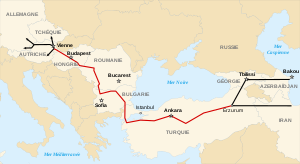


Gyurcsany was quoted as saying
"We expect the European Bank for Reconstruction and Development (EBRD) and the European Investment Bank (EIB) to make a clearer commitment to pre-financing the project. This project is not purely about business but also about Europe's energy security. It is therefore vital to make sure we have resources that are backed and guaranteed by the EU."
5. Grant Smith at Bloomberg reports that preliminary estimates from Petrologistics indicate that OPEC will cut supply by a further 5% in January.
"Oil supply from 11 members of the Organization of Petroleum Exporting Countries subject to quotas will average 26.15 mb/d in January, down from 27.65 mb/d, Conrad Gerber, the founder of PetroLogistics, said today by telephone from Geneva. From this month, members have a production quota of 24.845 mb/d. Iraq has no quota.

Saudi Arabia, the group’s largest member, led the cuts, lowering supply to 8.05 mb/d in January from 8.6 mb/d last month, Gerber said. The kingdom’s new total is in line with its Jan. 1 quota."
"Iran reduced supplies to 3.83 mb/d this month from 3.85 mb/d in December. Nigeria cut to 1.76 mb/d from 2.02 mb/d. Venezuela lowered output to 1.97 mb/d from 2.22 mb/d, and Angola trimmed to 1.84 mb/d from 1.88 mb/d, according to PetroLogistics.

Iraq, exempt from the quota system while its oil industry recovers from two wars, increased production to 2.45 mb/d from 2.43 mb/d, the tanker tracker said.
Given that Iran had not made good on 199 kb/d cuts promised in the October 24 meeting, and that the December 17 agreement was for cuts to actual supply--as understood by OPEC--in September, an additional 20 kb/d cut in supply suggests that Tehran is still producing far more than its stated quota. (Whatever their actual quota might be.)

6. Robert F. Worth at the New York Times reports that a former Guantanamo inmate, released to Saudi Arabia in 2007, has reemerged as a leader of al Qaeda in Yemen. This will surely complicate the closing of the extraterritorial prison. Thomas Hegghammer at Jihadica reports that al-Qaeda Yemen is thriving, if a recent flashy 44 page glossy publication is anything to go by, and is explicitly targeting the "far enemy."

7. Jeff Stein at SpyTalk reports that some of President Obama's first public diplomacy initiatives will target South America. Obama is scheduled to attend the April 17 Summit of the Americas in Trinidad and Tobago, "which may turn out to be his international debut as ambassador-in-chief." Obama is also expected to back S 1007, a bill first introduced by Senator Lugar (R-IN) on March 27, 2007 and which passed the Senate Foreign Relations Committee on September 23, 2008. (see Daily Sources 9/30 #12.) The bill is known as the United States-Brazil Energy Cooperation Pact of 2007 and directs the Secretary of State to strengthen energy cooperation between the United States and "willing" nations in the Western Hemisphere. In particular, it directs the Secretaries of State and Energy to establish "a regional-based ministerial forum to be known as the Western Hemisphere Energy Cooperation Forum" which should include "the Governments of Brazil, Canada, Mexico, the United States, and Venezuela."

The bill also seeks to reinforce and extend the biofuels relationship between Brazil and the United States as well as asks the Secretary of Energy to
"work with the Government of Mexico to conduct a technical analysis of the status of Mexican oil and gas production, future technological and investment needs, and recommendations for maintaining and increasing hydrocarbon production consistent with the priorities of the Government of Mexico."
The bill would also create an energy industry group and oil and gas group to try and increase private sector energy engagement in the Western Hemisphere.

Senator Lugar is an éminence grise in foreign affairs circles and, though the bill does speak to his own constituency of Indiana in terms of biofuels production, it is also clearly aimed at countering Chavez's oil diplomacy in the region and it is fairly sure that Obama is picking up on that vein of the legislation, at least in part. But the other, and rather important issue that Lugar foresaw coming in early 2007, was the decline in Mexican production, which fell by a full 9% in 2008 from 2007--which was reported on the day of Obama's inauguration no less. (see Daily Sources 1/20 #13.) The full text of the bill can be found here.


8. Robert Zoellick, president of the World Bank, has an op ed in the New York Times today which argues that President Obama, in the April meeting of the G-20 in London, should send an "audacious symbol of hope" by calling on each country to devote 0.7% of their stimulus packages to a fund for assisting developing nations weather the current crisis.
"The United States could begin by pledging some $6 billion of its own $825 billion stimulus package—-just 4% of what was provided to American International Group. With this modest step, the United States would speed up global recovery, help the world’s poor and bolster its foreign policy influence."
Zoellick concludes that with less than 1% of our stimulus package, President Obama can show global leadership and "reintroduce America to the world." Worth reading in full.

9. Jeffrey Gettleman at the New York Times reports that Gen. Laurent Nkunda, the Rwandan rebel leader in eastern Congo was arrested Thursday night by a joint Congolese-Rwandan military offensive. He is being taken to Kigali, the Rwandan capital. Apparently the Rwandan and Congolese governments have struck a deal whereby Rwanda helped to put an end to the Nkundan rebellion after Congo had allowed Rwandan troops to enter Congo so as to crush Hutu militants operating there.

10. In an particularly interesting story, Blaine Harden at the Washington Post reports that Japan--bedeviled by an aging and shrinking demographic--is now seeking to get immigrant workers to stay in the country even as it faces job losses.
"[The] extreme exposure of immigrant families to job loss and their sudden abandonment of Japan--has alarmed the government in Tokyo and pushed it to create programs that would make it easier for jobless immigrants to remain here in a country that has traditionally been wary of foreigners, especially those without work.

'Our goal is to get them to stay,' said Masahiko Ozeki, who is in charge of an interdepartmental office that was established this month in the cabinet of Prime Minister Taro Aso. 'As a government, we have not done anything like this before.'"
"No country has ever had fewer children or more elderly as a percentage of its total population. The number of children has fallen for 27 consecutive years. A record 22 percent of the population is older than 65, compared with about 12 percent in the United States. If those trends continue, in 50 years, the population of 127 million will have shrunk by a third; in a century, by two-thirds. "
Here is a projected population pyramid for Japan for 2010, courtesy of NationMaster.


A must read.

11. In something I missed, but that I noticed at Clarisse's Les Carnets Des Clarisse, the Vatican decided effective January 1 that it would no longer automatically adopt the laws of Italy, per David Willey at BBC. The Vatican had, per the Lateran Accords signed in 1929, agreed to immediately adopt any law made in Rome.
"A senior Vatican Canon lawyer, Monsignor Jose Maria Serrano Ruiz, has gone on record as saying that Italian laws are too many, too unstable and too often conflict with the moral teachings of the Catholic Church."
And, perhaps more significantly,
"The Vatican has also decided to scrutinise international treaties before deciding whether or not to adhere to them."
It may seem like a historical curiosity, but the Church has a place of preeminence in Western Law, having founded the first Law University in Bologna in around 1088 AD, just 11 years prior to the first Bull of Crusade. (Of course, at that time, and well into the 18th century, all universities in the West were church institutions, at first all Catholic of course, later Protestant schools were founded, like the majority of universities found in the United States.)

Notions of jurisprudence and evidence that we take for granted today as part of the inheritance of the Enlightenment were, in fact, formed in the crucible of competing jurisdictions of the Church (or Canon) Courts, the courts of the Kings, the courts of the Lords, and custom. Indeed, the Inquisition, often considered one of the most damning moments of the Catholic Church, was primarily a court, which had different rules of evidence, because the traditional canon rules made it too difficult to ever convict anyone of heresy, though it was quite clear to Rome that heresy was taking place. Indeed, the traditional rules of evidence in canon courts are rather strict--meaning it is difficult to prove something under them--even more so, in some instances, than US Federal Courts.

So it is in that light that one could see this as an especially interesting turn of historical events. The notion that the Church might decide to retire from certain international treaties that it was, de jure, a signatory to under the Lateran Accords also might prove interesting, given that the Church still wields considerable influence--or in the modern argot "soft power"--internationally. It is something to keep an eye on.

12. George Soros has an opinion piece in the Financial Times in which he argues that a "bad bank" is the wrong way for the US to proceed.
"Although the details have not yet been decided, this approach harks back to the approach originally taken – but eventually abandoned – by Hank Paulson, the former US Treasury secretary. The proposal suffers from the same shortcomings: the toxic securities are, by definition, hard to value. The introduction of a significant buyer will result, not in price discovery, but in price distortion.

Moreover, the securities are not homogeneous, which means that even an auction process would leave the aggregator bank with inferior assets through adverse selection. Even with artificially inflated prices, most banks could not afford to mark their remaining portfolios to market so they would have to be given some additional relief. The most likely solution is to 'ring-fence' their portfolios, with the Federal Reserve absorbing losses that extend beyond certain limits.

These measures–-if enacted-–would provide artificial life support for the banks at considerable expense to the taxpayer, but would not put the banks in a position to resume lending at competitive rates. The banks would need fat margins and steep yield curves for a long time to rebuild their equity."
...
"The hard choice facing the Obama administration is between partially nationalizing the banks, or leaving them in private hands but nationalizing their toxic assets. Choosing the first course would inflict great pain on a broad segment of the population – not only on bank shareholders but also on the beneficiaries of pension funds. However, it would clear the air and restart the economy."
Soros concludes with:
"President Barack Obama can fulfil his promise of a bold new approach only by establishing a discontinuity with the previous team. Congress and the public are right in feeling that too much has been done for the banks and not enough for beleaguered householders. The government ought to take the GSEs out of limbo and use them more actively to stabilise the housing market. Having done so, it could go back to Congress for authorisation to recapitalise the banking system the right way."
Well worth reading in full.

13. Ryan J. Donmoyer at Bloomberg reports that the Senate Finance Committee’s $455 billion stimulus plan announced today would provide $30 billion in tax incentives to producers of renewable energy.

14. Keith Johnson at Environmental Capital has a post regarding the US Armed Forces efforts to secure reliable alternative-fuel possibilities. Clearly, this is an important strategic issue, as the fact that the US is a net importer of oil means that in order to secure our logistical supply line the Armed Forces are (potentially) required to project force overseas. (This requirement in and of itself makes otherwise imperialistic policies rather more palatable to the public, and thus creates another set of political problems.) The US Navy, which is substantially powered by nuclear already, on the other hand, is already ahead of the curve. But overall the Pentagon is the largest consumer of petroleum in the country--which itself is the largest consumer of petroleum in the world. However, Johnston reports that Jane's Information Group's Industry Quarterly showed that:
"The bottom line is that for all the economic and operational advantages a shift to alternative fuels could bring—from a smaller logistics burden to greater energy security—those are still outweighed at present by the military establishment’s worries about the maturity and reliability of new technology—no small concerns in combat situations."
The complications posed by batteries are preventing the implementation of alternative fuels for Army uses. But change might come in the Air Force, which apparently uses more oil than the country of Denmark. Evidently it is looking both at biofuels--and it is possible to create bio-jet fuel nearly indistinguishable from the petroleum-based kind (see Daily Sources 10/3 #10)--and coal to liquid, the solution used by the Germans in WWII, a resource of which we have the largest reserves in the world, and very, very, dirty. Biofuel, on the other hand, requires lots of arable land or cooking oil waste in order to be logistically feasible for an enterprise the size of the US Air Force, not to mention the US Armed Forces as a whole. Worth a look.

15. The Federal Highway Administration yesterday released data showing that in November, Americans drove 12.9 billion vehicle miles traveled (VMT) less in November than were driven in November 2007, a 5.3% decline.
"The consecutive 13-month trend of declining driving--between November 2007 and November 2008--now tops 112 billion VMT, compared to the same 13-month period a year earlier. It dwarfs the 49.9 billion VMT decline of the 1970s, a decade characterized by high gas prices, fuel shortages and a recession."
The data show that the South Atlantic region and the West experienced the largest declines. The South Atlantic region may in part be explained by the gasoline shortages the region saw in October. (see Daily Sources 10/2 #8.) At least, that might explain why VMT fell there more than in the Northeast, where gasoline prices are typically much higher (than the South Atlantic region.) The West tends to have the highest prices in the nation.

Wednesday, December 10, 2008

Daily Sources 12/10

1. Brad Setser at Follow the Money reports that China's November trade data which shows a 2.2% year-over-year decline in exports and a 17.9% year-over-year fall in imports suggests that the global economy has stalled and is perhaps contracting.
"The November data from Korea and Taiwan tells a similar story. All experienced far larger falls in year over year falls in their exports than China did.
...
There isn’t much of a case for China to allow the yuan to depreciate against the dollar to help exports though. Not when Chinese exports are falling less than other countries exports, and China is gaining global market share. These are going to be hard times for everyone.

And China — with its large external surplus and strong fiscal position — should have more room to stimulate domestic demand than most. It certainly needs to do so.

China’s imports fell significantly faster than its exports in November, pushing China’s monthly trade surplus up to a record $40 billion."
Worth reading in full. Reuters has a story on the data as well that notes,
"In another sign that the economy has simply run into a wall, the statistics office reported earlier that wholesale price inflation collapsed to 2.0% in the year to November from October’s reading of 6.6%."
Analysts are worrying about deflationary recession risk. Which is problematic, given that the US especially wants the renminbi to appreciate. Which, apparently, Beijing is doing, as per Belinda Cao at Bloomberg.
"The yuan rose the most in six weeks on signs the central bank is allowing currency appreciation to encourage investors to keep money in the nation as the global economic slowdown deepens.
...
The currency has risen for six days in a row, the longest gaining run since June as a government report today showed foreign direct investment fell 36.5 percent to $5.3 billion in November, the least in 14 months."
Also at Bloomberg, Kevin Hamlin and Li Yanping note that
"The central bank pledged today to maintain a "moderately loose' monetary policy and aid small businesses, in a statement after a three-day annual meeting in Beijing where China’s leaders set economic policy."
2. Ambrose Evans-Pritchard at the UK Telegraph provides some additional data on the worsening trade picture for Taiwan and Japan:
"Flemming Nielsen, from Danske Bank, said exports from Korea and Taiwan both shrank by over 20pc last month. "The numbers are terrible. Intra-Asian trade is in free-fall. Taiwan's exports to mainland China in November were down a whopping 42pc.
...
Tokyo is already planning "purchase vouchers" to kick-start spending in the world's second largest economy. A fresh stimulus package worth 20,000bn yen (£146bn--or ~$216bn) is being prepared for early next year."
3. The Washington Post has posted the transcript of their interview with Taiwanese President Ma Ying-jeou in the presidential building in Taipei yesterday.

4. William Bi at Bloomberg reports that China is considering providing 5 million tons worth of corn export quotas, which should help farmers by raising prices for the crop domestically and depress international prices. The National Reform and Development Commission set a "strategic priority" on November 14 that domestic production of grain reach 95% of consumption by 2020. (See Daily Sources 11/14 #5.)

6. The Panama Canal Authority released a press release yesterday announcing that the International Finance Corporation, the Japan Bank for International Cooperation, the European Investment Bank, the Inter-American Development Bank, and the Corporacion Andina de Fomento agreed to provide $2.3 billion in financing for the expansion of the Canal.


7. Joshua Partlow and Lucien Chauvin at the Washington Post report that on Monday the Peruvian President announced a $3.4 billion bailout package, last week Argentina announced a $3.8 billion low-cost loan program paid for with the just-nationalized pension system, and Brazil has spent $3.5 billion to assist its auto manufacturing sector.

8. Mark Shenk at Bloomberg reports that Energy Minister Sergei Shmatko told Interfax that Russia would submit proposals for cutting output by December 17, when OPEC is scheduled to meet next. Schmatko said the he had had a telephone call with the President of OPEC and had indicated that Moscow was prepared to make "significant" output cuts. This is big news. It represents a tectonic shift in Russian energy policy strategy and, as such, foreign policy.

In related news, Greg Walters at Bloomberg reports that the Russian Finance Ministry has indicated it will likely cut export duties on crude by another 33% or so come January 1.

9. The EIA released its This Week in Petroleum today, showing that crude oil stocks grew by 400 kb in the week ending December 5, near the top of the historical average and well below analyst predictions of a 2.7 mb build. Gasoline stocks were up 3.8 million barrels, which is at the bottom of the historical average, and well above analyst expectations of 1.4 mb. Distillate stocks were up a whopping 5.6 mb, bringing stores into the historical average and in striking contrast to Wall Street expectations of a 1.6 million barrel decline. (This might suggest that European diesel demand has declined so much it cannot absorb excess US diesel production, much as I suspect the US is no longer absorbing excess European gasoline production.) In isolation, this data would put downward pressure on prices, and may be a deciding factor at the OPEC meeting on the 17th, next Wednesday.

However, in a related story, Julianne Pepitone at CNNMoney.com wrote yesterday that MasterCard Advisors's SpendingPulse report showed a 0.3% year-over-year increase in gasoline demand, the first such increase seen since April.

11. Matthew Walter at Bloomberg reports that Standard & Poor's cut Venezuela's debt rating outlook from stable to negative. They left the debt rating at BB-.

12. Nariman Gizitdinov at Bloomberg reports that Kazakhstan plans to spend 2.2 trillion tenge ($18.3 billion), or nearly 20% of GDP, on financial stabilization and economic stimulus.
"The National Wellbeing Fund [the government's primary vehicle for its bailout program] plans to spend $1 billion to buy 25 percent stakes in the country’s four biggest banks, and will keep $3 billion of bailout money in reserve, Kelimbetov said. The fund was created by merging state development holding Kazyna and Samruk, a state assets holding."
13. The AP reports that the Iraqi election commission has launched a petition to determine whether the state of Basra should hold a referendum on whether the region should be autonomous. Basra is an especially oil and gas rich region of Iraq and is the only province touching the sea in Iraq. If the referendum were to pass, the state would theoretically have control over all decisions having to do with oil and gas exploration and development in the region as well as all the revenues derived therefrom. The petition needs to secure signatures of 10% of the population of Basra for a referendum to be scheduled.

14. Xinhua reports that the Iranian Oil Industry Investment Company announced it will participate in some small exploration and production projects in northern Iraq today. The joint venture will cost about $32 million.

15. Jane Perlez at the New York Times reports that Islamabad has widened its crackdown on Islamist militant groups in Pakistan, including Lashkar-e-Taiba, raiding property and arresting as many as 20 suspects.
"Pakistan said Tuesday that it had arrested Zaki-ur-Rehman Lakhvi, the operational leader of Lashkar-e-Taiba, during a raid on Sunday on a camp outside Muzaffarabad, the capital of the Pakistani-controlled region of Kashmir. Mr. Lakhvi has been described as the mastermind of the Mumbai attacks.
...
Pakistani officials have indicated in the past few days that there were no plans for a large-scale crackdown on Lashkar-e-Taiba, a group founded in the 1980s by the Pakistani Army to fight a proxy war against India in Kashmir."
Worth reading in full.

16. Ruchir Sharma, head of Emerging Markets at Morgan Stanley Investment Management, argues that the recent local election results were determined by local, mostly economic, issues and that overarching issues of terrorism or inflation had little traction. Well worth reading in full. National elections are six months away. Sharma does not appear to think that electorate will rally around the government due to the conflict.

17. AFP reports that Merkel's cabinet has approved a plan to send up to 1,400 troops and a frigate to support the EU's piracy suppression mission off Somalia--Operation Atalanta. The German Parliament must approve the measure by December 19 before the forces can be sent.

18. Michael Gerson at the Washington Post gives an update on the Congo situation. Government forces broke the cease fire some time ago and the rebels were only barely prevented from taking Goma. Gerson suggests that a solution would be for a "hard-hitting European military force--supported by the United States" to insert itself between the rebels and the government, in support of the UN peacekeepers and to thus make time for peace negotiations to succeed. Worth reading in full. There may be some merit to the idea, but I think European policymakers are reasonable to conclude that there are limits to what can be done as long as the local parties feel their interests are best served by continued fighting. Ultimately, a solution must be found locally, a foreign-imposed peace cannot continue indefinitely, and a long term international force may only serve to delay a viable political solution. Clearly international forces are currently being viewed as catspaws in the conflict, to be used for temporary, tactical, advantage.

19. Shobhana Chandra and Andy Burt report that in a survey of economists by Bloomberg News the median expectation for household spending in 2009 is a 1% decline from 2008. "By the middle of next year, the economy will have shrunk for a record four consecutive quarters, the survey showed."

20. Alison Fitzgerald and Helen Murphy at Bloomberg have a very interesting story on how World Bank advice to developing nations has emptied their basic foodstuff storage. The bank apparently advised the countries to pursue private sector incentives without creating state-backed redundancies to ensure the minimum stock levels to feed the population in a crisis--a consideration which, by the way, has led to the decision by every single developed country to subsidize food production. A case study in how ideology can cause great harm. Worth reading in full.

Monday, November 10, 2008

Daily Sources 11/10

1. Andrew Batson at the Wall Street Journal reports that China unveiled a $586 billion stimulus plan this weekend. The sum is equal to about 16% of China's GDP in 2007. "The plan includes spending in housing, infrastructure, agriculture, health care and social welfare, and features a tax deduction for capital spending by companies." US Treasury Undersecretary for International Affairs David McCormick responded to the initiative Sunday, calling it "a welcome step." (The move to stimulate domestic demand had been recommended by various American economists, perhaps most significantly in an op-ed by the New York Times.) Chinese President Hu Jintao will be in Washington this Saturday for the G-20 summit and is expected to meet with President-elect Barack Obama at some point during his stay.

Brad Setser at Follow the Money has a post today arguing that the stimulus is a move in the right direction. He points out that large booms are often followed by big busts, and that China has been in a sustained export boom for six years. Thus, the Chinese needed to do something to offset a large export bust. Setser asks two questions. One: Is the announced stimulus package entirely new money or were already planned infrastructure expenditures part of the announced number? If it is all money on top of regular budgeted infrastructure developments, it should have an effect, he argues, if not, it will likely fall short. Two: Given that it is new money, can the stimulus be implemented quickly enough to offset the coming, large, downturn? The post is worth reading in its entirety.

These stories come on the back of an article by Leo Lewis published Saturday in the London Times that the chief economist of CLSA, an Asia specialist brokerage firm, argued that even with aggressive government action, growth in China could fall to as low as 5.5%.
"More than 70 per cent of the electricity generated in China is consumed by industry and according to reports, monthly national power output in October fell for the first time in a decade.

Traders in Singapore said it could be a slump that would have a huge negative impact on global commodity demand: ferrous and nonferrous metal-processing industries are among the heaviest consumers of electricity in China and it is their slowdown that is reflected in the drop in power usage."
Nonetheless, Julie Crust at Reuters reports that base metals are up on news of the stimulus plan. Copper jumped 9.7% on the London Metals Exchange. Nickel rose 13%, aluminum 4.1%, zinc 7.2%, lead 6.2% and tin 4.8%. The currencies of major commodity exporting countries also rose on news of the plan, with Adriana Brasileiro at Bloomberg reporting on the rise in Brazil's real and Andrea Jaramillo and Drew Benson also of Bloomberg reporting on rises in the currencies of Chile, Colombia, Argentina, and Venezuela.

2. Alexei Barrionuevo at the New York Times reports that the Brazilian President, Luiz Inácio Lula da Silva, blamed the developed world for the current financial crisis at the G20 meeting in Sao Paolo this weekend. The Brazilian delegation was at pains to urge the developed world to give the emerging markets a larger say in forthcoming international economic decisions and institutions. Many at the meeting suggested that the developed world should offer more money to the emerging economies in order to help them weather a crisis they argue originated in the developed world. In particular, India has argued that the US should be willing to shoulder more of the burden, as reported by Joshua Partlow in the Washington Post.

3. Edward Cody writes in an article published by the Washington Post Saturday that on Friday the leaders of the European Union released a statement urging the United States to implement strong regulatory measures within 100 days.
"Chief among the demands agreed on by the EU heads of state and government was tighter regulation of banking and investment markets. 'No financial institution, no market segment and no jurisdiction must escape proportionate and adequate regulation or at least oversight,' they said in a statement. The regulations must also cover rating agencies and speculative hedge funds, they added."
February 15--100 days from now--will be 26 days into Barak Obama's presidency. Cody reports that the 100 day time limit is designed to prevent the Bush Administration from passing off hard politically unpalatable choices to the Democrats.

I suspect that time limit is mostly aimed at the rest of the world, joining it in labeling the US as the cause of the problem, and demonstrating some solidarity with the notion of removing the US from its position as lynchpin in the international financial world--and signaling to Obama that his election has not changed their determination to create a more multipolar world. Obviously domestic political considerations are also in operation, and the possibility of selling to their publics the notion that the coming economic slide as the sole fault of the Americans and no doing of their own is probably very attractive. A 100 day deadline has the neat quality of being very unlikely of being met.

4. David Osler's blog at Lloyd's List has a very interesting post on how Warsaw is furious that Brussels has ruled that it must sell the Gdynia and Szczecin shipyards. Poland then must take the proceeds and "repay" the Union for illegal subsidies distributed to the two shipyards. The situation is exacerbated by French President Sarkozy's decision to take stakes in companies it regards as strategic, in order to defend them from foreign investors, looking to purchase them on the cheap. One of those companies is STX France, in which Paris has taken a 33% blocking minority, and which owns Chantiers de l’Atlantique--a major shipyard by the French port city of Nantes, the "Venice of the West." I think that Osler is right to think that the Poles will probably not let this happen and suspect they might try the "strategic industry" angle. Worth reading in full.

5. Ingrid Melander and Mark John at Reuters report that the European Union has agreed to deploy an air and sea anti-piracy force off the coast of Somalia. The force will be led from Northwood, England. Michelle Wiese Bockmann at Lloyd's List reports that the world’s leading shipping companies, "traders and charterers will gather in London for an urgent meeting on November 19 to discuss the financial crisis enveloping the dry bulk shipping industry." Shipping rates have fallen sharply since the commodity peak seen in June-July, "spot rates for capesize bulk carriers are around $4,500 per day -- less than half the accepted breakeven cost of around $12,000-$13,000 per day."

6. Anna Shiryaevskaya at Platts reports that the five largest oil and gas companies in Russia officially joined an exploration and production consortium for Venezuela on Saturady. Rosneft President Sergei Bogdanchikov told reporters over the weekend that Rosneft, Gazprom, Lukoil, TNK-BP and Surgutneftegaz will each take 20% and that the company will have a rotating operatorship. Rosneft has sent a request to Caracas for rights to develop the Delta Centro block in Orinoco province, a concession with much lighter oil than most of the Orinoco belt and which wouldn't require a bitumen upgrader. PdVSA will join the consortium in another vehicle before any operations begin.

7. The Wall Street Journal's Mary Anastasia O'Grady has a piece on the Miami trial of Venezuelan businessman Franklin Durán and what it has revealed about Chavez's foreign policy. Evidently Chavez made available considerable sums to Peronist candidate Cristina Kirchner during the 2007 presidential campaign in Argentina. The Venezuelan ambassador to Bolivia is alleged to have said he had $100 million to spend on that country in support of Evo Morales. In El Salvador, the FLMN receives petroleum products at large discount to market from PdVSA and then sells it at a small discount, capturing a large profit and filling its campaign coffers. Venezuela is evidently supplying 60-70% of Nicaragua's crude oil requirements via a scheme whereby Nicaragua pays for half of the shipments directly, and the other half via a 25 year loan from Caracas on very favorable terms. Since the main oil company in Nicaragua is the state-owned company, Petronic, Sandanista party officials control the revenues. What O'Grady omits from this story is that the program allowing the governments of El Salvador and Nicaragua to profit so handsomely is a joint program with Mexico--a close ally of the United States of course--under the San Jose accord. Both countries provide crude under favorable terms to Barbados, Belize, Costa Rica, El Salvador, Guatemala, Haiti, Honduras, Jamaica, Nicaragua, Panama and the Dominican Republic.(1) Still, the direct involvement in its neighbors' internal politics is an embarrassing revelation for Chavez--anti-imperialist rhetoric doesn't jive so well with overseas political slush funds--and O'Grady's piece is well-worth reading in full.

8. Michelle Faul at the Associated Press reports that Angolan troops have reportedly joined Congolese troops in the defense of the city of Goma in eastern Congo against the rebels. As the map below demonstrates, Goma is quite far from the Angolan/Congo border, and large troop movements from Angola to Goma would represent a serious logistical feat demonstrating very strong resolve to support Kinshasa.


"The involvement of Angolans could spread the conflict beyond Congo's borders. Neighboring Rwanda probably would consider Angolan troops a provocation. Rwanda's government is accused of supporting the Congolese rebels."

9. Pakistan's Online International News Network reports that Saudi Arabia guaranteed six months of oil supplies to Islamabad recently. Prime Minister Yousuf Raza Gilani told reporters that he hoped that the guarantee added to additional economic aid promised by the "friends of Pakistan" group meant that Pakistan would not be forced to go to the IMF for aid. The Prime Minister also announced that the government will fix wheat prices to ensure profitable planting. However, Sahar Ahmed at Reuters reports that Pakistani government officials are giving reporters an idea of the potential IMF deal, which would include a $15 - 20 billion loan for two years against a rise in the discount rate of at least 1 to 1.5%.

10. Aresu Eqbali at Platts reports that the Iranian oil minister, Gholamhossein Nozari, told reporters there was a "probability that we will have another meeting before December," if oil continues its downward trajectory. The next OPEC meeting is scheduled for December 17.

(1) EIA country analysis of Nicaragua: Discounted Oil Programs.

Monday, October 27, 2008

Daily Sources 10/27

1. In a delicious bit of irony I missed, al-Qaeda reportedly prefers a McCain Presidency, as per Nicholas D. Kristof at the New York Times.

2. Brian Blackstone at Real Time Economics reports that most analysts believe that the Federal Open Market Committee will reduce the federal funds rate by 50 basis points (0.5%) at its Tuesday-Wednesday meeting, bringing it down to 1%. The political will to reduce it even further allegedly exists. Also at Real Time Economics, Henry J. Pulizzi, Jeffrey McCracken and John D. Stoll report that White House Spokeswoman Dana Perino told journalists that the Administration has been "working 'as quickly as we possibly can' to release $25 billion in recently approved loans to the auto makers. But she declined to elaborate on other specifics steps that could be taken to help the ailing companies." Also, Jean-Claude Trichet told reporters in Madrid today that the ECB may cut interest rates again at its next meeting on November 6, as per Ben Sills and Gabi Thesing at Bloomberg. William Sim and Seyoon Kim, also of Bloomberg, report that the Bank of South Korea cut the benchmark lending rate 75 basis points (0.75%) to 4.25%.
"'More aggressive cuts are on the way,' said Lee Sang Jae, an economist at Hyundai Securities Co. in Seoul, who expects Korea's key rate will be slashed to around 3 percent by the first half of 2009. 'The government would need to expand tax cuts and increase fiscal spending to support the economy.'"
Chris Bryant at the Financial Times reports that Peer Steinbrück, the German finance minister, told the media on Sunday that "The danger of a collapse is far from over. Any attempt to give the all clear would be wrong."

3. There are a slew of articles on the crisis spreading to the emerging market countries, including this one from Credit Writedowns. The upshot is that European banks invested much more than their American counterparts in the emerging markets. Often loans and investments made by European banks were made in dollars, which means that if you want to cash out, you cash out in dollars, putting more upward pressure on the dollar. Laura Cochrane and Fabio Alves at Bloomberg report that emerging market markets were hit hard this morning. Margaret Coker and Chip Cummins at the Wall Street Journal report on the financial crisis as it hits the Persian Gulf states, hitherto deemed immune from the credit crunch. Investors are liquefying their assets in the region.


See Yves Smith's analysis and links at naked capitalism here, here, and here.

4. Carlos Caminada, Shruti Singh and Jeff Wilson at Bloomberg report that analysts are predicting that the credit squeeze--as well as falling commodities prices--is likely to reduce global production of staple foods worldwide.
"Global production of wheat, the most-consumed food crop, may drop 4.4 percent next year, said Dan Basse, president of AgResource Co. in Chicago ....
...
Futures contracts on the Chicago Board of Trade show wheat will jump 16 percent by the end of 2009, corn will rise 15 percent and soybeans will gain 3 percent.
...
'The net effect of the financial crisis may end up being lower planting, lower production,' [Abdolreza] Abbassian [secretary of the of the Intergovernmental Group on Grains at the UN Food and Agriculture Organization] said. 'More people will go hungry.'

In Brazil, the world's third-biggest exporter of corn after the U.S. and Argentina, production may fall more than 20 percent because farmers can't get loans to buy fertilizer, said Enori Barbieri, a National Corn Producers Association vice president. The nation's coffee harvest, the world's largest, may drop 25 percent for the same reason, said Lucio Araujo, commercial director at farmer cooperative Cooxupe, located in Guaxupe.
...
Minnetonka, Minnesota-based Cargill and Decatur, Illinois-based Archer Daniels, the world's largest grain processors, are among the crop buyers to halt financing for growers in Brazil, said Eduardo Dahe, who represents the companies as president of the National Association of Fertilizer Distributors.
...
In Russia, loan rates for farmers have jumped by half in some cases to more than 20 percent in the past few months, Arkady Zlochevsky, president of the Russian Grain Union, said in an interview earlier this month.
...
The value of the collateral farmers use to secure loans -- crops and land -- is diminishing. Lenders are demanding more equity for farm loans used to run operations or acquire land and equipment.

'We need two to three times the amount of money we used to need with the same collateral,' said Bo Stone, 37, a seventh- generation farmer in Rowland, North Carolina. 'It means we have way more risk than we've ever had. This is a time where one bad crop year, with the amount of money and input tied up, could potentially cost you your equipment, land and livelihood.'"
(h/t Gregor.us) In a related story, Javier Blas and Tim Johnston of the Financial Times report that Thai officials plan to barter rice for oil with Iran. The UNFAO believes that we should see more government-to-government deals like this going forward given the credit crunch and volatility in the commodities market.


5. Joshua Partlow at the Washington Post reports that President Luiz Inácio Lula da Silva's Party--the Workers' Party--lost the race for governor of the largest city in Brazil (and South America, for that matter), Sao Paulo. Sometimes it's bad to be king. That is, I'd expect a worldwide financial crisis to dim the hopes of incumbents everywhere.

6. Jeffrey Gettleman at the New York Times report that angry crowds in Congo are forming and throwing rocks at UN peacekeeping forces, apparently taking out frustration on them because they are unable to keep the peace as renegade general Laurent Nkunda's rebel forces advance Westwards. As far as I know, no one doubts that the constant warfare in the Congo is a humanitarian disaster, veering toward the genocidal. The problem is that there is no power sufficiently strong whose interests are threatened by it. It must be a pan-sub-Saharan-African solution, but who in the industrial world will pay for the inevitable political compromises (and thus human suffering) that would be required for a stable state to be incorporated? It's not an especially appetizing option, is it? If you don't have a dog in the fight, you aren't likely to want to force a settlement one way or another.

7. In a somewhat strange--to my eyes--development, I am seeing more and more suggestions as to what China should do to save the industrialized world from this financial crisis. The most recent is a piece by the editorial board of the New York Times. In a piece which I'm sure policymakers in Beijing were at pains to decipher, the Times suggested that Beijing's recent policy efforts were insufficient and misguided ... China should spend its cash reserves on converting from an export economy to an import economy! This follows on the suggestion by Brad Setser for Beijing to increase its purchases of Agency debt!--which, as the government has gone out of its way to publicize, are not backed by the full faith and credit of the US. And the other notion--almost wistful hope--that China should spend its cash on greening the energy infrastructure of Europe and the US! Being free with advice is considered by some to be an American trait, and I guess if you're a financial adviser, you advise those who happen to still have some cash. And maybe China's leaders are listening to the American punditocracy, who knows? But, were I Chinese, I would wait to see what happens to the dollar after this technical unwinding phase plays out before I would undertake something on that scale. In the meantime, Beijing appears to be using its cash in the traditional way overseas. The latest news is that it is working to provide a $1.5 million soft loan--ie, a loan with below market rates of interest--to Pakistan, after all.

8. Winnie Lee at Platts has a different read than the Bloomberg story of October 13 on what government statistics indicate in terms of crude imports, and thus demand. Ms. Lee reports that net crude imports for September were 14.45 million tonnes (3.53 mb/d), a 1.7% decline from imports of 15.25 million tonnes (3.59 mb/d) in August. Year-over-year net crude imports grew by 7.4% September. (On the 13th, Winnie Zhu and Wang Ying had suggested crude imports had surged 46% to 20 million tonnes in September.) China's apparent petroleum demand in September was 29.42 million tonnes (7.16 mb/d), 5.4% more than September 2007. However, demand growth numbers have been steadily been trending down, July saw 9.6% y-o-y growth and August saw 8.3% y-o-y growth as refiners draw down stocks built up to provide energy security for the Olympics.

9. Platts reports that Iran's OPEC governor Mohammad Ali Khatibi said on Sunday that OPEC is prepared to make further quota cuts in the December meeting, if the quota adjustment agreed to on Friday fail to stabilize the markets. Reuters reports that Qatari Prime Minister Sheikh Hamid bin Jasim told the media Monday that "The current prices are a bit low. We are talking about prices ranging from $70 to $90 which we think are fair for consumers and producers." Saudi Oil Minister Ali Naimi told reporters on Friday that the Khurais oil field will be operational--at 1.2 mb/d--in mid-2009. The field produces varieties of Arabian Light, a fairly high quality crude with between 33 and 36 API and with a sulfur content of 1.9% by weight.

10. Angela Moon at Reuters reported that SK Energy has dropped plans to build a refinery in China. SK had eyed the naphtha market in China given that the product is not as rigorously price-managed by the government as others. Evidently the losses seen by refiners in China over the last year caused SK to reconsider. (This is especially interesting because South Korea's energy security policy is to be a refining center. If you have more refining capacity than you need, and export the excess product, you are likely to have enough crude imports at any given time to weather a shortage. South Korea's policy has been copied in Singapore and is in the process of being instituted in India. Also, as Japanese refining capacity becomes more sophisticated and demand, due to an aging population structure, continues to decline, is also entering the market of product exports in Asia. Clearly the competition is stiff. Thus some, especially Saudi Arabia, some international oil companies, and, until now, South Korea decided that the best way to beat the competition is to actually produce "export" product inside the export destination country, ie China. That strategy might be especially difficult to pursue in a highly volatile international price environment while operating within the product prices market centrally managed by Beijing. Either way, the stakes involved are huge.)

11. Juan Cole has an analysis of some of the fighting in northwest Pakistan. He has some observations--and links--on the effectiveness of arming tribal levies against the Taliban in Pakistan and Pakistani armed forces proper efforts.
"Maulvi Faqir Muhammad and his Tehrik-i Taliban frontally attacked Pakistani military checkpoints and started a feud with the Pakistani army. The Tehrik-i Taliban has been blamed for the assassination of Benazir Bhutto last December, and it is said that as her widower, Asaf Ali Zardari, rose to the presidency, he pressured the military to destroy the movement, with which he now has a family feud."
Very interesting.

12. Patrick Ugeh at Nigeria's This Day reports that two major Nigerian oil unions called off proposed strikes after the government retracted a statement saying it planned to privatize the Nigerian Gas Company and Pipeline and Product Marketing Company.

Monday, October 20, 2008

Daily Sources 10/20

1. Brad Setser at Follow the Money has a piece on how the unlimited dollar currency swaps established by the Fed has eased the pressure on large institutions to purchase dollars, but that countries whose currencies have not been afforded unlimited dollar swaps, ie emerging economies, are facing tougher times as a result. Since a large percentage of debt worldwide is denominated in dollars, the lack of access to unlimited dollar currency swaps means that institutions exposed to such debt must either borrow the currency from their own central banks--which have plenty of dollar denominated debt on their books as well, generally speaking--or purchase dollars on the currency markets in order to service their debt.

Setser thinks this may make the gap between the G7 and emerging nations larger and deeper, balkanizing the international financial system in effect. His post is well worth reading in its entirety.

It occurs to me that many of the nations--with the exception of China--being forced to purchase dollars are export-oriented nations, whose interests are served by a weak exchange rate to the dollar insofar as their exports are thus more affordable in the importing nations--of which the US is the most significant.

As long as the price of oil does not climb too high, this might provide the underpinnings of a recovery. One set of nations scrambling for dollars under this "balkanized" scheme are the Gulf nations and most of the OPEC nations. Juan Forero of the Washington Post reports on some of the speculations regarding the effects on the Venezuelan economy. Ariana Eunjung Cha, also of the Post, reported on Saturday on US investors selling off their assets in the stock markets of the emerging economies is helping to push their currencies to new lows. It is bankrupting companies and leaving infrastructure projects unfinished throughout the emerging world. This includes Russia, Mexico, and I deduce Oman--three of the largest oil exporters which are not members of OPEC.

In terms of the rest of the G7, I imagine (as a non monetary economist) there would be less purpose to a strong dollar, especially given that the American share of consumption must fall until new credit can be credibly extended to the American consumer. Exports to the rest of the G7 could lead the way.

China, evidently, is not being affected by the currency swaps given its tremendous reserve of dollar holdings. Corporations do not need to turn to the international markets for dollars, but can simply turn to the Bank of China. However, Ariana Eunjung Cha reported today that China's growth in the third quarter, though high at 9%, was sharply below analyst expectations.
"Economists had expected China's exports to be affected by the slowdown in the United States and in Europe. But the extent to which other parts of its economy had deteriorated -- such as industrial production, government revenue and imports -- was a shock. This is the first time in more than five years that the National Statistics Bureau has recorded a single-digit GDP growth rate."
Analysts are widely quoted as noting that GDP growth must stay at at least 8%, as below that it no longer keeps pace with the growth in the size of the labor market--the number of workers.

Keith Bradsher at the New York Times reports that Beijing is moving quickly to stimulate the economy in response.
"As part of the new policy, the State Council announced that it would increase export tax rebates for everything from labor-intensive products like garments and textile to high-value products like mechanical and electrical products. Banks will be encouraged to lend more money to small and medium-size enterprises and support programs will be drafted to help farmers, the government said."
I wonder how welcome such rebates would be in Washington. Jim Yardley, also at the Times, reported yesterday that Beijing had decided to move forward with land reforms, which allow farmers to sell or lease the land to which they have "use rights."This at a time when high food prices have made farming a much more remunerative occupation in China than it has been in the past. Real Time Economics has a blurb from Hong Liang, an analyst at Goldman Sachs, which indicates that most of the decrease in growth actually comes from declines in domestic demand, as "the nominal trade surplus grew by 13.8% [year-to-year] in [the third quarter] versus -12.1% [year-to-year] in [the second quarter]." I find this hard to square with evidence such as the Baltic Dry Index--and suspect that the increase might have come as a result of the reduction in the cost of oil imports, but it's something to consider. Either way, just now it looks as if China is still mostly depending on exports for economic growth, mainly.

If all the above is a fair statement of the facts, I am led to ask the following questions:

A) If, hypothetically-speaking, China continues to buy dollars indefinitely in order to subsidize its exports, is it likely to alienate the rest of the (non-oil producing) export nation bloc? Presumably oil producers will benefit from a high-dollar currency exchange, even as the price of oil drops. Countries without oil reserves forced to purchase dollars in order to service debts might find this onerous, even if ultimately it would be likely to make their products even more competitive, on a currency-exchange basis, than China's. Would even such additional competitiveness serve to separate China's interests from most of the exporting economies ... except perhaps from Japan's?

B) If OPEC cuts its production, as most expect it to, what happens to the viability of continuing to rely on exports to the US? That is, if the price of oil goes up in response to OPEC cuts--and it did today and Friday, but that really means nothing even short term--at what price will the price of oil make exports to the US from the emerging markets non-viable? Muriel Boselli at Reuters reports that IEA Executive Director Nobuo Tanaka said at a news conference that "The IEA is concerned (an OPEC cut) might have a negative impact on the global economic recovery." Platts also reports that on October 17, UK Prime Minister Gordon Brown said, "I think it is absolutely scandalous that OPEC is thinking of meeting in the next few days to cut oil production so they can push up the price of oil again and we will certainly try and prevent this happening." On the other hand, the IEA is a political child of the consuming nations--which the UK is slated to become--and Nesa Subrahmaniyan at Bloomberg reports that London-based Goldman Sachs analysts said that the first cuts OPEC makes to production in a recessionary environment have historically not supported a price recovery, but only subsequent cuts did so.
The analysts also gave the following helpful estimations:Iran, Nigeria, Venezuela and Indonesia need a crude price of more than $80 a barrel to balance their national budgets, and the United Arab Emirates needs $30, while Saudi Arabia, the biggest OPEC member, requires $54 a barrel, the analysts said.
Aresu Eqbali at Platts reports that Iran's OPEC governor Mohammad Ali Khatibi thinks the organization will need to cut supply by 3 mb/d to see the price of oil recover. It is my sense that supply is still so tight that Iran, Nigeria, and Venezuela, were they to coordinate a cut independently of Riyhad, would be able to drive up the price. Barclays Capital, on the other hand, thinks that a 1 mb cut is unlikely to be made effective, given the imminent addition of 3 mb to the market.

I suspect that $54/b would sustain an export-based growth/recovery of the international economy, but am not sure about $80/b. The general consensus seems to be that supply capacity additions at the margin would require at least $70-80/b, in which case there may be no price at which the international economy can continue to grow on the back of international trade (where ships and planes run on oil anyways). So, to sum, at $54/b, international trade could underpin a recovery via exports, but would the balance of that growth go to nations other than China, given that their currencies will be much worse off vis-a-vis the dollar than the yuan? (The Bank of China has been keeping down the value of the yuan since June.) If that were to prove the case, would it make sense for China to stimulate demand for oil internally--putting it more at odds with the rest of the world?

C) If the dollar falls in value relative to the Euro, will Europe be the destination of choice for exporting countries, given the relative return? Is that possible given consumer behavior in Europe? If the US stops importing a considerable share of the world's exports, is it likely that debt will be denominated in Euros or Sterling? Will the Eurozone be the only area able to bear the cost of transportation inherent in oil-based trade?

D) We might expect the price of oil to rise as it should remain a decent hedge. As the price of oil relative to the Euro falls demand for oil might pick up in Europe--where a small percentage increase means a large absolute increase in oil demand. Would there be more enthusiasm for Euro-denominated oil contracts on the part of producers, even though Europe has been fairly serious about reducing consumption?

2. Stephanie McCrummen at the Washington Post reports that fighting between government forces and a renegade general in Eastern Congo has erupted, creating over 100,000 refugees.

3. Sahar Ahmed at Reuters reports that Pakistan was unable to secure a loan from Beijing and now is looking to the IMF in a meeting at Dubai slated for tomorrow.

4. Thom Shanker at the New York Times writes that the Chairman of the Joint Chiefs of Staff, Adm. Mike Mullen, is visiting Serbia. This is the first visit of a Chairman of the Joint Chiefs of Staff to Serbia.