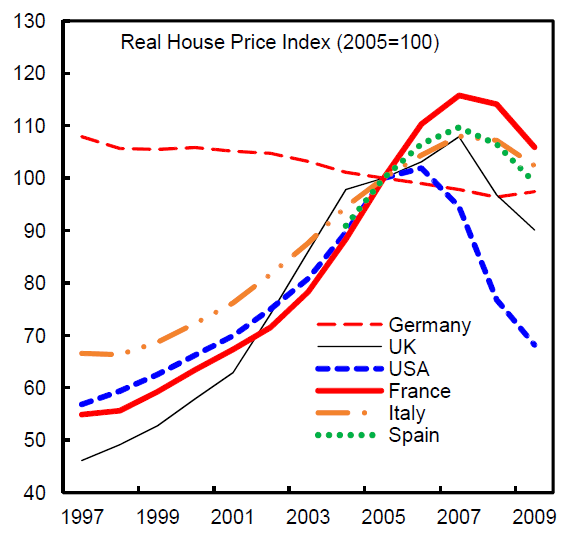
CHINESE BANKING REGULATOR ASKS BANKS TO PERFORM STRESS TESTS TO SEE WHAT WOULD HAPPEN WITH 60% REDUCTION IN HOUSING PRICES; NEW STUDY SHOWS THAT SMALLER CITIES NOT FACING SIMILAR HOUSING PRICING PROBLEMS IN CHINA
"Banks were instructed to include worst-case scenarios of prices dropping 50 percent to 60 percent in cities where they have risen excessively."
Meanwhile, Aaron Back at China Real Time reports that Standard Chartered has conducted a survey of "Tier 2 and 3" cities and found that they are not suffering from deep corrections.
"'The Tier 2 and Tier 3 cities have not seen much of a correction in land or apartment prices. Moreover, developers’ sentiment about sales volumes seems pretty good, and they do not appear to be postponing construction,' Standard Chartered said in a report on Tuesday. 'This is important, since if sales and construction activity holds up in most Tier 2 and Tier 3 cities, then the economy will not tank, and the State Council will not be forced to loosen real-estate or monetary policy.'"
PALESTINIAN PRESIDENTIAL ADVISER SAYS PEACE MAY CREATE 20% ECONOMIC GROWTH IN PALESTINE
1. THE EU SUGGESTS IT IS COMFORTABLE WITH $70/B BUT NOT $80/B, OPEC SUGGESTS $80/B IS REQUIRED; BUNDESBANK ADDS TO LIST OF ECONOMIC ANALYSIS BLAMING OIL FOR PART OF CURRENT CRISIS; VERLEGER SAYS OIL TO GO TO $20/B BY DECEMBER
"For the fragile world economy, $80 could be alarming, but representing the European Union, Energy Commissioner Andris Piebalgs said a price approaching $70 was not damaging. 'What we also discussed in our meeting is that $70 per barrel, the current price, definitely does not impede the recovery of the economy,' he said. 'We really believe the current situation has some good stability. If it continues it will be a chance for (economic) recovery and also guarantee that upstream investments will continue.'"
"FT Deutschland quotes from a Bundesbank study that apart from the financial crisis, the sharp rise in oil prices was an important contributing factor for the recession. For Germany, the costs of energy imports to from 1.8% of GDP in 2004 to 3.4% in 2008. The shock would have been much harder had it not been for the appreciation of the euro and the increase in energy saving and efficiency. The Bundesbank report also explained that the auto crisis in the US was caused in part by an oil-price induce switch to smaller and medium sized cars, which are mostly produced outside the US."
"The $20/b claim is one not just to 'stand out and be different,' but Verleger believes that continuously rising inventories might have something to do with it and points to data released last week by the Energy Information Group.
'[G]lobal supply has been running ahead of global demand since March 2007,' Verleger said. 'Over the first five months of 2009, supply exceeded demand by 1.7 mb/d. The 14-month build in inventories has caused the stock accumulation to approach the peak last record by EIG in 1997.'
Verleger believes that the monthly inventory builds have to stop soon because global consumption will increase or global supply will decline.
'My guess is it will be production, not consumption that falls,' Vergler notes. 'Oil producers will find themselves in the same predicament as natural gas producers today. In the case of gas, output is shut in because there are no buyers.'"
Other bears include Fereidun Fesharaki, who in the beginning of June suggested that there would be a $20/b drop in price in the middle of Summer due to the inventory build-up--see Daily Sources 6/1 #2--and Takayuki Nogami, a senior economist at Japan Oil, Gas and Metals National Corporation, who suggested that oil was likely to fall to $45/b by the end of July after economic optimism evaporates in the face of large inventories--see Daily Sources 5/28 #6.
2. EUROZONE STILL CONTRACTING, BUT AT SLOWER RATE; GERMANY DOING WORSE, FRANCE DOING RELATIVELY BETTER; SARKOZY REJECTS AUSTERITY; HOUSEHOLD SAVINGS RATES IN DEVELOPED WORLD SPIKING; ECB INDICATES IT WILL NOT LOWER RATES FURTHER; FALL IN PRIVATE FINANCIAL FLOWS TO AND FROM THE US FROM 2007 SHARPER THAN FALLS IN TRADE FLOWS
"[T]he flash reading on the composite purchasing managers index (which covers both industry and services) for the 16 nation euro area [rose] to 44.4, fractionally above the 44 registered in May."
(Readings below 50 indicate contraction; above 50 indicates expansion.) He notes that the German private sector contracted slightly in May,
"The flash estimate for the manufacturing PMI index rose to 40.5 from 39.6 in May, but the flash services PMI reading fell to 44.3 from 45.2 last month. And in the manufacturing sector the ratio of new orders to stocks of finished goods fell back to 1.12 after rising to 1.18 in May. Which effectively means inventories started to rise again."
"Sarkozy focused mostly on cushioning the effects of the recession rather than presenting a reinvigorated reform agenda. No tax rise and no austerity policies ('since these have always failed,') but more investment into the future: Reindustrialisation, support for the young and unemployed, universities and schools, etc., as the way out of the crisis.
In his speech Sarkozy distinguished between 'good' (cyclical and 'bad' (structural) deficits and a third type of deficit that would be 'reabsorbed by allocating the proceeds of growth'
He announced a new public bond to raise money for 'priority investments'. In the next three months the government will hold vast consultations with different stakeholders to identify priority investments (Les Echos has more details) Jean Francis Percresse writes that such a public bond could reunite the nation behind a growth strategy while at the same time accepting reforms such as the rise in the pensions age. But this was not a new strategy for France. The old policies had led to the present accumulation of debt."
"The wealth effects have been smaller in Germany and Canada ... but the impact on household saving has been very similar. This suggests that the wealth effect is (likely) a dominant determinant of saving patterns. Deleveraging may only be secondary, suggesting that renewed economic growth and a stabilization of asset values may cap the US saving rate below a German-style saving rate, 10%-12%."
"the past has shown that an overly generous provision of liquidity in global financial markets in connection with a very low level of interest rates promotes the formation of asset price bubbles."
"One thing though is sure: the scale of the collapse in private financial flows the experienced during this crisis is entirely unprecedented. There were a few instances in the past when private flows (excluding flows into Treasuries) were slightly negative. But outflows of 5% of GDP in a quarter are entirely unprecedented. And now that the US data has been revised to reflect the survey, adding private purchases of Treasuries back in doesn’t change all that much …"
Well worth reading in full.
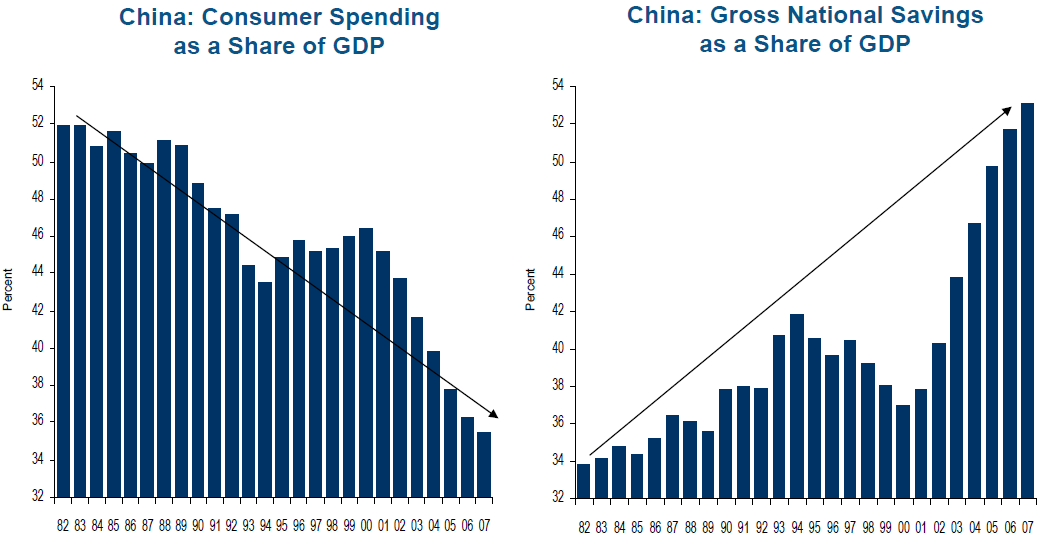
3. PETTIS ARGUES THAT CHINESE GDP GROWTH WILL BE CAPPED BY CONSUMPTION GROWTH AS US SAVINGS RATE GROWS
"Now that the US is raising its saving rate, this means among other things that the growth in US consumption will be lower than the growth in US GDP. If the US GDP grows slowly, consumption will be flat. If it contracts, consumption will contract sharply. In either case the US trade deficit should continue declining except in the very unlikely event that US investment grows by more than the increase in savings.
Since the balance of payments must balance, if US GDP growth exceeds US consumption growth, China’s consumption growth must exceed China’s GDP growth, and Chinese savings must decline. Chinese savings can decline because consumption rises, or they can decline because GDP declines, but they must decline.
That implies that Chinese GDP growth, rather than be constrained on the bottom by consumption growth (i.e. GDP must grow faster than consumption), will now be constrained on the top by consumption growth. China’s growth in GDP, in other words, will be less than its growth in consumption unless there is a surge in investment. There has, of course, been a fiscally induced surge in investment, but with rising debt and collapsing corporate profitability, I think this can at best continue for a year or two, and probably much less.
So what does that mean for future Chinese growth? When China was growing at 11-13% a year, Chinese consumption was growing by 9% a year. The rapid reversal in the earlier decline in US savings might cause Chinese GDP growth to grow by at least 1-2% below consumption. So if we assume that Chinese consumption continues growing at 9%, this initially suggests GDP growth rates of 7-8%.
But hold on. If GDP growth rates of 11-13% translate into 9% consumption growth rates, is it reasonable to assume that GDP growth rates of 7-8% will still result in 9% growth rates in consumption? I doubt it. My guess is that the growth in Chinese consumption will also slow. This suggests that while the US is adjusting, China’s annual growth rate must be significantly below 7-8%, perhaps 5-6%, or even lower. The key is the rate of Chinese and US fiscal expansion, in the former case to permit the rise in Chinese savings rates not to constrain domestic growth, and in the latter case to slow down the contraction of the US trade deficit."
Really should be read in full. (h/t Yves Smith at naked capitalism, whose comments on the piece are also worth reading.)
4. JAPAN BANK FOR INTERNATIONAL COOPERATION TO REVIEW LOANS TO VENEZUELA FOR REFINERY EXPANSIONS, NIPPON EXPORT AND INVESTMENT INSURANCE CONSIDERING ENDING COVERAGE FOR PROJECTS IN VENEZUELA ALTOGETHER
"Planned Japanese investments in Venezuela include $10 billion in liquefied natural gas projects, $8 billion in petrochemicals and $1.5 billion for the refineries, Chávez said while visiting Japanese Prime Minister Taro Aso in April."
Chávez signed the loan agreement with JBIC in Toyko in April--see Daily Sources 4/1 #8. Last week the the Lloyd’s and London company insurance markets’ Joint War Committee has reacted to Chávez's renewed nationalization drive by placing the country on its list of most risky places for shipping--see Daily Sources 6/15 #10.
"unconstitutional and against the economic interests of the Iraqi people. ... The regional government of Kurdistan has made clear progress in increasing Iraq's oil exports and oil revenues in a short time. This progress has been made by focusing on exploration and not on existing fields, in line with the best practices of international markets, and in accordance with the principles of the Constitution of Iraq. The regional government regrets that it cannot say the same thing on the procedures taken the Federal Ministry of Oil of Iraq."
(h/t Juan Cole at Informed Comment, who sees the conflict over oil concessions as an emerging constitutional crisis.)
6. PALESTINIAN PM CALLS FOR STATE WITHIN TWO YEARS, JUDT IN NY TIMES SAYS DISTINCTION BETWEEN SETTLEMENTS "SPECIOUS"
"There is no pluralism in security. The Palestinian Authority is solely responsible. We have to put a stop to this senseless argumentation. I call upon you all to line up on the project of state-building, good government and proper management so the Palestinian state can be a reality."
He also promised peace with Israel, saying
"We hope to embody our state next to your state through a meaningful peace. We do not wish to build walls but bridges."
"But if I am right, and there is no realistic prospect of removing Israel’s settlements, then for the American government to agree that the mere nonexpansion of 'authorized' settlements is a genuine step toward peace would be the worst possible outcome of the present diplomatic dance. No one else in the world believes this fairy tale; why should we? Israel’s political elite would breathe an unmerited sigh of relief, having once again pulled the wool over the eyes of its paymaster. The United States would be humiliated in the eyes of its friends, not to speak of its foes. If America cannot stand up for its own interests in the region, at least let it not be played yet again for a patsy."
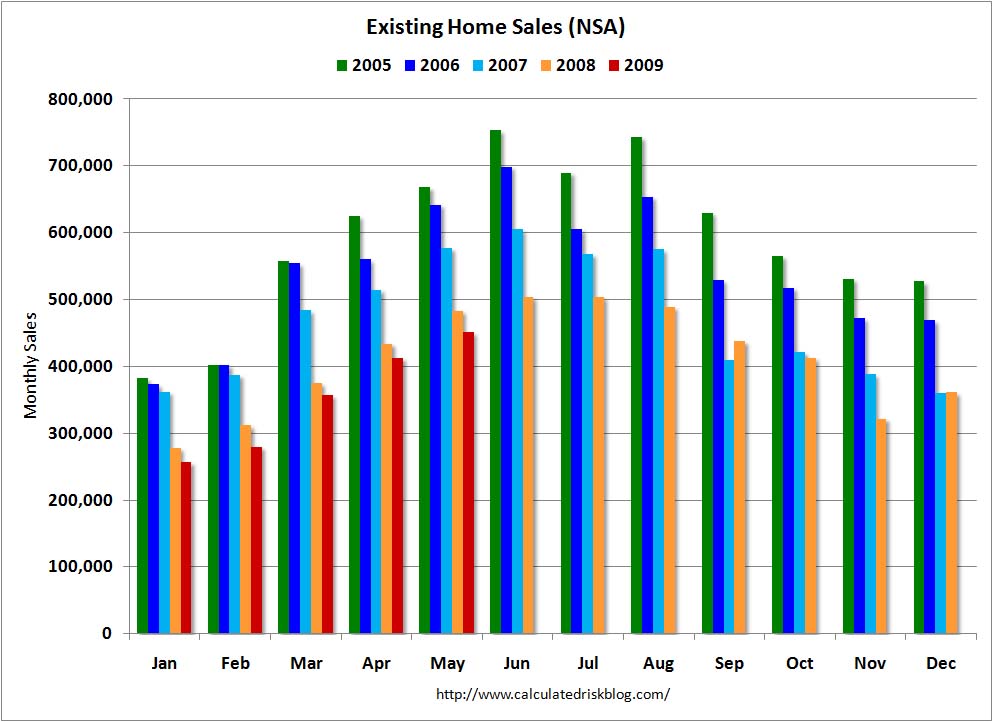
7. MAY EXISTING HOME SALES DOWN 3.6%; MOODY'S SAYS US SOVEREIGN DEBT Aaa RATING SOLID
"Sales in May 2009 rose 2.4% from April to 4.77 million. Note that these are apple and orange comparisons--revised to unrevised numbers. Once again, the prior monthly number was revised downwards (4.68 million down to 4.66 million)."
He links to a chart plotting monthly existing home sales from 2005 from Calculated Risk:
"'Although the US is losing altitude in the Aaa range, it is starting from a very strong base,' Cailleteau, who is chief international economist at Moody’s, said in Tokyo today. The economy is resilient enough to recover and the government is committed to raising taxes and cutting spending, he said."
8. BLOG COMPARING NEWS HEADLINES FROM GREAT DEPRESSION TO CURRENT CRISIS
1. BANKS OF CANADA, ENGLAND, AND EUROPE MAINTAIN BENCHMARK INTEREST RATES, B.O.E. AND E.C.B. REITERATE INTENTION TO ENGAGE IN SOME Q.E., SPEECH BY GERMAN F.M.--AND S.D.P. CHANCELLOR CANDIDATE--INDICATES INTEREST IN CHANGING THE STRUCTURE OF THE EUROPEAN MONETARY UNION
"The Bank of Canada ... said the 'unprecedentedly rapid rise' in the currency could 'fully offset' recent improvements in financial markets and consumer confidence and prolong the recession.
'The bank is confirming that the rise in the currency isn’t backed up by the fundamentals,' said John Curran, a Toronto-based senior vice president at CanadianForex Ltd., an online foreign-exchange dealing firm. 'While we do see some 'green shoots," for the economy to strengthen we can’t have the Canadian dollar as strong as it’s been in recent weeks. Once everyone gets a chance to digest this, you’ll see some US dollar strength."
"While the bank’s decision last month was unanimous, some policy makers did favor spending the full authorized total of 150 billion pounds and the panel said it will seek permission to print even more money than the maximum if needed. Minutes of today’s decision will be published on June 17."
"Asked if the bank will expand its bond plan, [ECB President Jean-Claude] Trichet replied: 'We have decided to embark on a 60 billion-euro purchase of covered bonds, full stop.'"
"# He explicitly acknowledges the problem of divergent economic developments in the EMU. This fact has been on the table for a few years now. As early as 2005, data on the first years of EMU pointed to these problems, and the trend of cyclical and structural divergence has even been acknowledged by the ECB in pursuing its monetary policy for an increasingly heterogeneous Eurozone economy. But Germany (which itself has been diverging from EMU average for instance in the years of its sever economic slump 2003/4 and subsequently recorded a very strong current account surplus) had so far not picked up this issue politically. It is hence the first time that a German member of government says what the current developments are: a possible threat to the existence of the EMU. # In order to tackle this problem, Steinmeier suggests stronger policy coordination. In other words: the Lisbon Agenda is not sufficient an instrument to cope with divergence and asymmetric shocks in the EMU. This is no surprise to most economic analysts of EMU (even not in the German administration), but a new political statement from Berlin. # He explicitly names wage, social and tax policies as an object for closer coordination in the EMU and speeks out strongly against tax and wage dumping. Again, this should be no surprise from a social democrat before two important elections dates - but it is a clear departure from the Berlin mainstream. For instance regarding the commonly held view that due to the 'Tarifautonomie' (i.e. the fact that social partners negotiate wages (more or less) independently in Germany) nothing can be done in the field of wage policy anyway. What Steinmeier may in fact mean is that some countries should be pushed towards giving up certain systems (e.g. wages indexed on inflation as is the case in Spain), which reinforce cyclical divergences in the EMU. # He also requests a stronger coordination of fiscal stimulus in the current crisis--rightly so, but in direct opposition to the position held by the Chancellor and the Finance Minister."
"On the face of it, the visit was seemingly a massive step forward in transparency for the Chinese government. But, while staring at 50 identical 100,000 cubic meter (~ 630,000 barrel) tanks neatly formed into rows is certainly impressive, it doesn’t really tell much about the state of China’s reserves. And while the officials we met were friendly and open, the key policy questions of where the oil comes from, how they bought it and under what conditions the reserves may be tapped were deferred to more senior officials--who weren’t there.
While the reporters may have been a little unsure as to what they were getting out of the experience, Beijing clearly knew exactly what it was doing from the unity of message coming from the National Energy Bureau officials traveling with us: The reserves are full."
It seems that Beijing is signaling it would like a lower price, no?
3. MALAYSIA CONSIDERING SETTLING TRADE WITH CHINA IN LOCAL CURRENCIES
"We can consider whether we can use local currencies to facilitate trade financing between our two countries. ... What worries us is that the [US] deficit is being financed by printing more money. That is what is happening. The Treasury in the United States is printing more notes."
The notion being to replace trade settlements in dollars with the ringgit and yuan. In May Bloomberg reported that Brazil's foreign minister told the media in Beijing that Brazil and China were considering a plan to settle in local currencies--see Daily Sources 5/20 #4.
4. VIETNAMESE NAVAL STRATEGY VS. CHINA TO MIRROR CHINA'S NAVAL STRATEGY VS. U.S., MALAYSIAN SHIPS MAY HAVE ENTERED OIL RICH AREA DISPUTED WITH INDONESIA
Feng at Information Dissemination comments on Vietnam's recent decision to purchase six project 636 kilo submarines for $1.8 billion. (Kilo class is the NATO designation for diesel-electric submarines made in Russia. Wikipedia states that the project 636 submarines are thought to be one of the quietest diesel-electric submarines in the the world.) Feng believes that the submarine purchase was made in an attempt to be able to project force into the China South Sea, and in particular, to the Spratly Islands, control over which is disputed by all the nearby nations, mostly because it is thought that oil and gas reserves lie under them.
Feng points out that the navies of countries further away from Vietnam, like, say, Australia, present a different challenge for the People's Liberation Army Navy [PLAN] than Vietnam, simply because Vietnamese ships would be operating mostly in areas over which the Chinese would be able to assert air superiority. Thus:
"[Vietnam is] actually adopting the same strategy that PLAN [has] supposedly [adopted to counter the capabilities of the US Navy]. Basically, Vietnam is [buying] a lot [of] small, fast ships equipped with long range missiles (and nothing else much ...) [and] quiet submarines."
"We want to avoid any form of provocation that can cause unpleasantness. We must handle the matter with caution."
"International borders in the area off Borneo island have yet to be determined, with each country claiming the area as its own.
Malaysia claims the area based on a 1979 maritime chart, while Indonesia bases its claims on the 1982 UN Convention on the Law of the Sea (UNCLOS), which states the area belongs to Indonesia.
Muhyiddin said the Malaysian security forces patrolling the Ambalat waters had performed their duties responsibly and in accordance with regulations."
The head of Malaysia's military, Abdul Aziz Zainal, told the media that ships had not entered the Ambalat region, and that he would be in Jakarta Tuesday to discuss the matter.
"Islam has always been a part of America's story. The first nation to recognize my country was Morocco. In signing the Treaty of Tripoli in 1796, our second President John Adams wrote, 'The United States has in itself no character of enmity against the laws, religion or tranquility of Muslims.'"
"Just as Muslims do not fit a crude stereotype, America is not the crude stereotype of a self-interested empire. The United States has been one of the greatest sources of progress that the world has ever known. We were born out of revolution against an empire. We were founded upon the ideal that all are created equal, and we have shed blood and struggled for centuries to give meaning to those words – within our borders, and around the world. We are shaped by every culture, drawn from every end of the Earth, and dedicated to a simple concept: E pluribus unum: 'Out of many, one.'"
"Make no mistake: we do not want to keep our troops in Afghanistan. We seek no military bases there. It is agonizing for America to lose our young men and women. It is costly and politically difficult to continue this conflict. We would gladly bring every single one of our troops home if we could be confident that there were not violent extremists in Afghanistan and Pakistan determined to kill as many Americans as they possibly can. But that is not yet the case."
"
The sooner the extremists are isolated and unwelcome in Muslim communities, the sooner we will all be safer."
"Around the world, the Jewish people were persecuted for centuries, and anti-Semitism in Europe culminated in an unprecedented Holocaust. Tomorrow, I will visit Buchenwald, which was part of a network of camps where Jews were enslaved, tortured, shot and gassed to death by the Third Reich. Six million Jews were killed--more than the entire Jewish population of Israel today. Denying that fact is baseless, ignorant, and hateful. Threatening Israel with destruction--or repeating vile stereotypes about Jews--is deeply wrong, and only serves to evoke in the minds of Israelis this most painful of memories while preventing the peace that the people of this region deserve.
On the other hand, it is also undeniable that the Palestinian people--Muslims and Christians--have suffered in pursuit of a homeland. For more than sixty years they have endured the pain of dislocation. Many wait in refugee camps in the West Bank, Gaza, and neighboring lands for a life of peace and security that they have never been able to lead. They endure the daily humiliations--large and small--that come with occupation. So let there be no doubt: the situation for the Palestinian people is intolerable. America will not turn our backs on the legitimate Palestinian aspiration for dignity, opportunity, and a state of their own.
For decades, there has been a stalemate: two peoples with legitimate aspirations, each with a painful history that makes compromise elusive. It is easy to point fingers--for Palestinians to point to the displacement brought by Israel's founding, and for Israelis to point to the constant hostility and attacks throughout its history from within its borders as well as beyond. But if we see this conflict only from one side or the other, then we will be blind to the truth: the only resolution is for the aspirations of both sides to be met through two states, where Israelis and Palestinians each live in peace and security.
That is in Israel's interest, Palestine's interest, America's interest, and the world's interest."
"Palestinians must abandon violence. Resistance through violence and killing is wrong and does not succeed. For centuries, black people in America suffered the lash of the whip as slaves and the humiliation of segregation. But it was not violence that won full and equal rights. It was a peaceful and determined insistence upon the ideals at the center of America's founding. This same story can be told by people from South Africa to South Asia; from Eastern Europe to Indonesia."
"At the same time, Israelis must acknowledge that just as Israel's right to exist cannot be denied, neither can Palestine's. The United States does not accept the legitimacy of continued Israeli settlements."
"And we will welcome all elected, peaceful governments--provided they govern with respect for all their people.
This last point is important because there are some who advocate for democracy only when they are out of power; once in power, they are ruthless in suppressing the rights of others."
A bit later in the speech, President Obama seems to echo yesterday's op ed in the Wall Street Journal by the prince of Dubai which argued that education was key to winning hearts and minds in the Middle East--see Daily Sources 6/3 #8.
"Many Gulf States have enjoyed great wealth as a consequence of oil, and some are beginning to focus it on broader development. But all of us must recognize that education and innovation will be the currency of the 21st century, and in too many Muslim communities there remains underinvestment in these areas. I am emphasizing such investments within my country. And while America in the past has focused on oil and gas in this part of the world, we now seek a broader engagement.
On education, we will expand exchange programs, and increase scholarships, like the one that brought my father to America, while encouraging more Americans to study in Muslim communities. And we will match promising Muslim students with internships in America; invest in on-line learning for teachers and children around the world; and create a new online network, so a teenager in Kansas can communicate instantly with a teenager in Cairo."
The speech is best read in full.
6. IRAN'S L.O.T.R. DISMISSES CAIRO SPEECH IN ADVANCE, IRAN ANNOUNCES CONSTRUCTION ON PARS PIPELINE BEGINS, WITHOUT HAVING DECIDED ON FINAL PATH
"[W]ithin hours of his arrival, Holbrooke said the 'dramatic increase' in aid was 'symbolic of our commitment and support.'
Holbrooke emphasized that his hastily arranged three-day visit was 'at the personal instruction of President Obama' and reflected White House concern about Pakistanis fleeing heavy fighting in the Swat Valley and surrounding regions northwest of Islamabad, the capital."
The trip is also an outgrowth of concern that the central government will not reestablish control in areas where the extremists have been flushed out, failing to provide for security and services, making it a simple matter for the Taliban to return once the offensive has ended.
8. RELIANCE TO HALT GASOLINE EXPORTS TO IRAN ON U.S. SANCTION FEARS
"Reliance was exporting 2% of its total output, worth around $280 million, from its two refineries in Jamnagar to Iran. A top RIL official, who requested anonymity, confirmed that the gasoline exports to Iran were stopped last month. However, he refused to elaborate on this issue. ... RIL exports petroleum products worth $14 billion annually, of which around 5% is exporting to the US."
As of late, the UAE has been providing Iran with about 80% of its product imports.
"In order to accommodate these immoral and gluttonous rushes for oil in Ogaden, Ethiopia killed, raped and illegally detained thousands of Ogaden civilian and imposed economic and aid blockade at a time of when there was a full-blown drought in the Ogaden.
ONLF has persistently warned these unscrupulous multinational companies and their governments ... the ONLF has been left no alternative but to take all measures necessary to protect the inalienable rights of the Ogaden people."
10. O.A.S. VOTES TO LIFT BAN ON CUBA, BUT CUBA MUST ENGAGE IN DIALOGUE IN ORDER TO RE-ENTER ORGANIZATION
1. Que la Resolución VI adoptada el 31 de enero de 1962 en la Octava Reunión de Consulta de Ministros de Relaciones Exteriores, mediante la cual se excluyó al Gobierno de Cuba de su participación en el Sistema Interamericano, queda sin efecto en la Organización de los Estados Americanos.
2. Que la participación de Cuba en la OEA será el resultado de un proceso de diálogo iniciado a solicitud del Gobierno de Cuba y de conformidad con las prácticas, los propósitos y principios de la OEA."
More or less:
"RESOLVED:
1. That Resolution VI adopted on January 31, 1962, in the Eighth Consultative Meeting of External Relations Ministers, by which the government of Cuba was excluded from participating in the Inter-American System, is hereby repealed in the Organization of the United States.
2. That the participation of Cuba in the OAS will be a result of a process of dialogue initiated at the request of the government of Cuba and in conformity with the practices, purposes, and principles of the OAS."
(Course, I wouldn't rely on my Spanish for this, but it does seem that only the dialogue itself must be conducted with the principles in mind, and that the sticking point is whether the dialogue would be initiated--or even participated in--by Havana.) Sheridan reports that Dan Restrepo, who is head of Western Hemisphere affairs at the White House, argued that the language was stronger that it might appear given the preamble which emphasize democracy and respect for human rights as part of the OAS's fundamental principles.
11. MEXICAN DRUG GANGS MOVING TO HONDURAS--MAY BE ASSISTED BY CROSS-SPECIAL FORCES TIES
"During the last year and a half, the Zetas have carved a bloody trail across Guatemala's northern and eastern provinces. More than 6,000 people were slain in Guatemala in 2008. Police say most of the killings were linked to the drug trade.
As the recent blood bath shows, the violence is now threatening the capital, deep in the interior.
Authorities say Mexican drug gangs, primarily the Zetas and rivals from the state of Sinaloa, are ramping up operations in Central America to evade increased marine patrols near Mexico as they relay drug shipments to the United States and Europe."
The Zetas are a gang that was formed by former members of the Mexican special forces in the 1990s.
"Guatemalan police commanders say their 20,000 officers cannot match the firepower of the Mexican traffickers, who have made growing use in Mexico of military-type arms, such as 40-millimeter grenades and .50-caliber rifles capable of piercing armor.
Recent seizures in Guatemala have yielded similar weapons. 'These are things we have seen only in photos of Iraq and the Gulf,' said Larios, the police commander. 'Not in Guatemala.'
But devising a response is complicated by Guatemala's troubled past. The memory of the army's brutal conduct during the civil war means that it would be politically dicey for Guatemalan leaders to respond by mobilizing the military, as Calderon has done in Mexico."
Further, the Zetas have reportedly received assistance from former Guatemalan special forces known as the Kaibiles--named for a Mayan leader who evaded capture by conquistadors led by Pedro de Alvarado in the 16th century. Mexican special forces received training from the Kaibiles in the 1990s, as well as from Brazilian special forces, and the US Army. Analysts are worried that the drug war may spill into Honduras as well.
The best English-language coverage of the drug war's effects on Latin America is in the Los Angeles Times. A must read.
12. GLOBAL AIR PASSENGER TRAFFIC DOWN 7.5% IN 1ST 4 MOS., FREIGHT TRAFFIC DOWN 22%
"IATA Director-General Giovanni Bisignani said airlines are facing an 'emergency situation' and should be given greater commercial freedom to serve global markets and consolidate."
Bisignani said that Asian carriers, which represent 44% of the global air cargo market, will be hit hardest by the crisis.
"The global pension crisis is really a crisis of modern day capitalism. If we don't figure out a long-term solution to this crisis, we risk having a new class of elderly poor who were cheated out of their pensions."
14. GEORGETOWN UNIVERSITY MAY LEAD NEW GENEVA CONVENTION PROTOCOL EFFORT
"'Soon,' [Matthew] Gerke, [a fellow at the center who worked for three and a half years in the Pentagon and in Iraq on rule of law issues,] said, the Center on National Security and the Law hopes to 'roll out' a campaign for a new Geneva Convention, hopefully boosted by an American figure with international stature.
Its first step would be to mount a new push for Senate ratification of the 'Additional Protocol No. 2, Relating to the Protection of Victims of Non-International Armed Conflicts.'"
In 1977, the Carter administration signed two additional protocols to the Geneva Convention which had provided rules for handling non-state combatants, but the Senate refused to ratify the treaty, "as it has ever since." Worth reading.
15. LOW SULFUR BUNKER FUEL REQUIREMENTS MAY ADD 4 MB/D NEW DIESEL DEMAND TO MARKET--ROUGHLY 10 MB/D ADDITIONAL CRUDE DEMAND
"It won't be even lower-sulfur bunker fuel that will allow shipowners to meet the requirements, Cuervo said. Instead, it will be marine diesel. There just simply won't be enough low-sulfur bottoms, of 0.5% sulfur by 2020, to meet the needs of shipowners. Diesel will fill the gap."
Cuervo estimates that the move to diesel by shipowners driven by the incoming low sulfur requirements will mean for an additional 4 mb/d of demand for diesel globally.
"As he noted, given that an efficient refinery can produce about 40% diesel, it's as if we need another 10 mb/d of crude supply to make 4 mb/d of diesel."
It's an interesting concern ... just now refiners would probably welcome additional diesel demand, given the size of inventories here in the US. But, in the run up of prices from 2007-8, some argue that the price of crude was chasing the diesel crack, and that could get real steep given a recovery in the global economy. Kingston notes there hasn't been a lot of interest so far in setting up refineries to produce low sulfur bunker fuel--
"They generally have viewed fuel oil the way Dracula views sunrise. 'How are you going to put a lot of money into something you've been trying to get rid of?' [Cuervo] said."
Worth reading in full.
16. NORTH AMERICAN RAIL TRAFFIC DOWN
Atlantic Systems Inc.'s Railfax report is out, showing that total North American rail traffic for the week ended May 30 was down 24.7% from the comparable week a year earlier. ASI plots the percent change in total North American rail traffic year over year for the week ended May 30, in 13 week rolling averages:
Coal volumes transported by train for the year ended May 30 was down 9.5% from the year previous.
17. INITIAL JOBLESS CLAIMS DOWN SLIGHTLY LAST WEEK, ANALYSTS EXPECT HEADLINE UNEMPLOYMENT TO HIT 9.2%
"The total jobless benefit rolls fell by 15,000 to 6.7 million, the first drop since early January. Continuing claims had set record highs every week since the week ending Jan. 24. The continuing claims data lag initial claims by one week.
Still, the number of initial claims remains stubbornly high, above the 605,000 level reached five weeks ago. That was the lowest level in 14 weeks.
The four-week average of claims, which smoothes out fluctuations, rose by 4,000 to 631,250."
"'Beijing's stimulus policies are having a longer-lasting effect than expected,' said Qin Xuwen, an analyst with Orient Securities. 'As long as volume continues to grow, which is quite likely given the records in March and April, and there is no sudden spike in commodity prices, bottom lines of automakers will improve this year.'"
Which is an issue, oil prices are perking up, to say the least.
2. AND MORE CARS = MORE OIL DEMAND, SO THE NDRC PUBLISHES MORE DETAILS ON ITS NEW FUEL PRICING POLICIES, WHICH ARE MORE RESPONSIVE TO GLOBAL PRICES
"China would adjust domestic fuel prices when global crude prices reported a daily fluctuation band of more than 4% for 22 working days in a row.
The commission said refiners would enjoy 'normal' profit when global crude prices are below US$80/b, but would face narrower profit margins when the crude prices rise above US$80/b.
However, fuel prices would not go further up, or only be raised by a small margin, when crude prices rise above US$130/b, and fiscal and tax tools would be used to ensure supplies, the NDRC said."
"The government has forecast GDP to expand 8% in 2009, Zheng said at a conference today in Singapore. This equates to China’s oil-product demand growing between 4.8% and 5.6% this year, according to Bloomberg calculations based on Zheng’s speech."
3. WHILE COMMODITIES PRICES APPEAR TO BE SPIKING (ON CHINESE STIMULUS) CAUSING CORPORATIONS TO HEDGE, CAUSING MORE PRICE RISES LIKELY TO UNDERMINE STIMULUS GIVEN WEAK OVERALL DEMAND
"The head of metals trading at a bank in London said: 'Consumers are being dragged to hedge, even if their demand is not strong, because they are afraid of the rapid price increase in some markets.'
Bankers pointed to hedge examples such as Delta, the world's largest airline, which has boosted its fuel hedge to 75% of this year's needs, from less than a third late last year.
Cargill and Louis Dreyfus, two of the world's largest agricultural trading houses, last week secured a hefty position in the sugar market, pushing prices higher, to supply India, the world's largest consumer."
The bright spot, from the perspective of oil bulls, seems to be localized in China, as even the stimulus program there does not appear to have especially heartened representatives of the steel sector there. Reuters reports that Mr Shan Shanghua, secretary general of the China Iron and Steel Association said,
"'We are still aiming at a yearly production of 460 million tonnes. Whether we can make it or not depends on exports and domestic demand. But I am sure that if we remain at that high production rate and do not cut output, it will be a disaster.'
Mr. Shan said the Chinese, led in the negotiations by Baosteel, should be able to get a price below the spot market, which would mean a cut of more than 30%. He said that 'There is a common sense that wholesale prices should always be lower than those for retail.'"
(h/t Yves Smith at naked capitalism.) The Baltic Dry Index, though off its lows, isn't recovering at a rate that would make me all that optimistic:
4. GERMAN EXPORTS DOWN 16 Y-O-Y IN MARCH, OWEN HUMPAGE SAYS EURO MORE LIKELY ALTERNATIVE TO DOLLAR THAN SDRS
"German industrial production remained flat in March, following a year long decline, data released by the Economics Ministry also showed on Friday.
'Recent positive impulses came from the car industry that has benefited from economic stimulus measures at home and abroad,' the ministry said in a statement, referring in part to the German 'scrapping bonus' scheme which pays a bonus to drivers junking an old car and buying a new one.
Meanwhile, German manufacturing orders released on Thursday, unexpectedly jumped just over 3% between February and March. The rise, its first in seven months, also fueled hopes that the worst of the recession may have passed."
"These currencies’ official reserve rankings parallel their status in international commerce more generally. This correlation should be of no surprise. Why hold a currency that no one uses? According to a 2007 BIS survey, roughly 88% of daily foreign exchange trades involve dollars. Again, the euro is a distant second, with the British pound and Japanese yen trailing."
He concludes that at its core the SDR notion is based on inflation concerns, which would be more easily met by switching to the euro than SDRs. Worth reading in full.
5. PAKISTANI PM TELLS COUNTRY ALL BETS ARE OFF IN SWAT, CHINESE AMBASSADOR TO ISLAMABAD COMPLAINS OF US PRESENCE IN REGION
"signaled the final collapse of a fragile peace accord between the government and Taliban forces in the Swat region. It also represented the civilian government's formal green light for a full-fledged offensive by the military, which until now has been fighting sporadically."
"‘These are issues of serious concern for China,’ he said, adding that China was concerned over the US policies and the presence of a large number of foreign troops in the region.
He said that US strategies needed some ‘corrective measures’ to contain terrorism. However, he added, terrorism was a serious issue and required cooperation between countries in the region to counter it."
6. FMR ASST SECY OF DEFENSE ARGUES AFGHAN MILITARY SHOULD BE GIVEN LARGER GOVERNANCE ROLE
"But as long as Pakistan is a sanctuary, US forces here will be on the strategic defensive, no matter how skillful their military tactics. We can't stay forever. The basic question is: How to consolidate the battlefield gains? That depends upon how the mission is defined. President Barack Obama has avoided promising to build a vibrant democratic nation. 'The achievable goal,' he said recently, 'is to make sure it [Afghanistan] is not a safe haven for terrorists.' Such a minimalist policy can be achieved in one of two ways.
The first is to apply the classic counterinsurgency model: After the military push the enemy from a populated area, the police take over, while government appointees provide honest governance and basic services. This approach pursues the expensive nation-building that Mr. Obama has not endorsed. It requires thousands of additional police trainers and hundreds of civilian advisers in the districts. These advisers also serve as watchdogs against corruption, acting as a shadow government to restrain officials prone to skimming and payoffs. It's a sound approach that is slow and expensive.
The second option is to expand the role of the Afghan army to act as the facilitators and watchdogs of governance. Today, American commanders like Capt. Howell routinely participate in shuras or councils. They can gradually hand off such governance-related tasks to Afghan officers."
Worth reading in full.
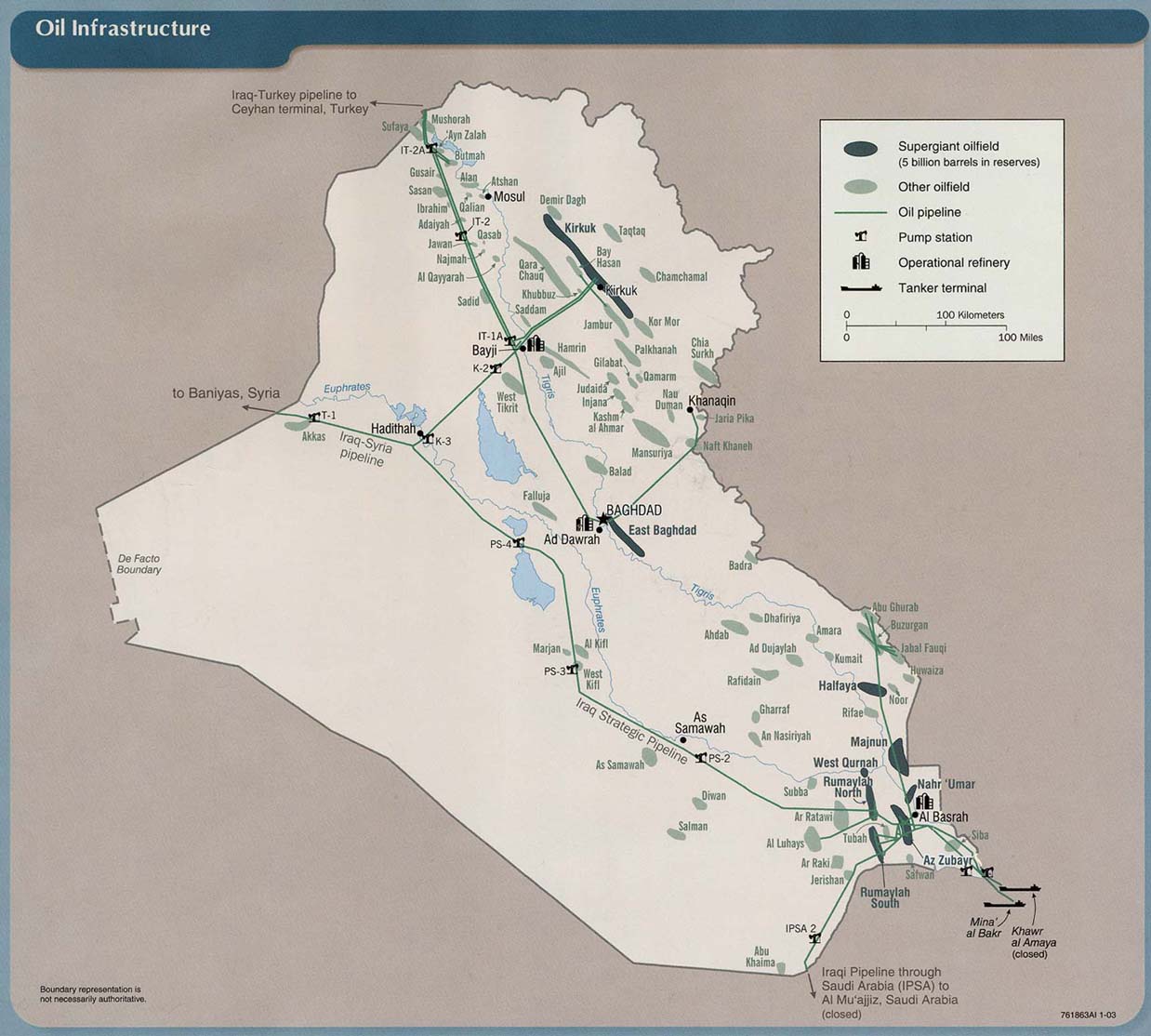
7. KRG LETTER SUGGESTS THAT A DEAL HAS BEEN STRUCK WITH BAGHDAD ON STATUS OF KURDISH CONTRACTS WITH OIL COMPANIES
Key excerpt from the letter which Energy Source reproduces in full:
"The exported crude oil from both fields will be marketed by SOMO [Iraq's State Oil Marketing Organization] and the revenue will be deposited to the federal Iraq account for the benefit of all Iraqi people. The average API gravity of the crude oil mix at a combined rate of 100,000 barrels per day will be around 35 degrees. Once the Taq-Taq pipeline is laid and further upgrades are made to the Tawke pipeline, the combined exports from these two fields will reach 250,000 barrels per day, with the average API gravity of around 39 degrees. These higher API gravity oil mixes will improve on the overall quality of the present Kirkuk oil mix which is only around 31 degrees API."
Though the letter clearly implies that a deal has been struck with the central government regarding the validity of the licenses the Kurdish Regional Government has granted various E&P firms in the region, the Iraqi Oil Ministry denied to reporters at Reuters that any such deal had been struck. The companies involved also indicated surprise when approached by reporters. McNamara adds:
"While no expected the power struggle between Iraq’s central and regional governments to end any time soon, many many players involved in the Kurdistan oil industry said in recent weeks that the two sides were closer than ever to an agreement over Kurdish oil exports and were hammering out the final details of revenue-sharing."
8. POPE VISITS HOLY LAND, BRZEZINSKI URGES LARGER, MORE PROACTIVE--AND MORE BALANCED--APPROACH BY OBAMA ADMINISTRATION IN PALESTINE PEACE PROCESS
"On Monday, Benedict lands in Tel Aviv for four intense days in Israel that will include visits to the Western Wall, holy to Jews; and, sacred to Catholics, the Church of the Holy Sepulcher and the hall where Jesus is believed to have had the Last Supper. In Jerusalem he will visit the religious compound in the Old City known to Muslims as the Noble Sanctuary and to Jews as the Temple Mount.
The Vatican’s Jewish interlocutors say they hope the trip will mend fences, while Israeli officials hope it will boost Christian tourism to the region.
The trip is an important opportunity for the pope 'to demonstrate visually,' that the relationship between Jews and Catholics 'has continued to flourish since the visit of John Paul II,' said Rabbi David Rosen, chairman of International Jewish Committee on Interreligious Consultations."
"If the new president is to avoid in the Middle East not only the gross errors of his immediate predecessor but also the much too long-lasting passivity of the Clinton years, he truly has to lead. Admittedly, making matters more difficult for him is the legacy of the last 16 years, when a subtle shift took place in the US approach to the Israeli-Palestinian conflict: the United States moved from being a genuine mediator seeking to nudge both sides toward peace to holding a posture of thinly veiled partiality in favor of one of the parties to the conflict. The result has been detrimental to the prospects for peace--for without engaged and genuinely forthright US mediation, the two parties to the conflict have shown themselves to be unable to reach a genuine compromise.
To make matters worse, Islamist extremism is gaining ground among a growing number of Palestinians, and Israeli politics are currently moving in an increasingly intransigent direction. In the months to come, the next Israeli prime minister may try to prod the United States to go to war with Iran, while arguing disingenuously that the Palestinians must first become economically more developed before an Israeli-Palestinian peace can be seriously considered. The argument regarding the Palestinian issue, in effect, will be for leaving things as they are, notwithstanding the danger that the prolonged stalemate (with its periodic violence and the relentless expansion of the settlements that it allows) is already poisoning the prospects for a two-state solution."
9. SUDAN TO ALLOW NEW HUMANITARIAN GROUPS INTO DARFUR
"'I think what we're hearing... is that new NGOs with new names, new logos, if necessary, can come in,' [UN humanitarian chief John Holmes] was quoted as saying by Reuters news agency.
'That means there's an opportunity to exploit some of that expertise and experience that is there and I think that is a welcome degree of flexibility about how it might happen in the future.'"
Sudan's President Omar al-Bashir expelled most aid agencies from Sudan and the Darfur region following his indictment in the International Criminal Court in March--see Daily Sources 3/6 #5. Bashir also responded to the decision by releasing from prison a prominent critic of his regime, Hassan al-Turabi, the foremost Islamist in Sudan who had ties to Osama bin Laden--see Daily Sources 3/10 #15. Turabi was originally imprisoned by Bashir in part because Turabi had come out in favor of the ICC's indictment of the President, which makes more sense, I suppose, in light of recent conjecture that it might indict former US officials for their actions in prosecuting the second Gulf War. Foreign Affairs hosted a Q&A session on Sudan with Andrew Natsios, Professor of Diplomacy at Georgetown University, where he was asked what "are the United States' key national interests with regard to the Sudan crisis?" His response:
"The central US national interest in Sudan is humanitarian. The cooperation between the Sudanese and US government on counterterrorism has been exaggerated and overemphasized as a motivating force in US policy--it is useful but not central to the relationship."
This is code. It is in the interests of US elected officials and other American political associations to address Sudan primarily in terms of Darfur, because the US is primarily a Christian country and to openly address it in a hard-headed fashion would be bad for the political future of either. If I were to take a stab at what the US national interest is in Sudan, it would be:
A) The establishment of a stable government, capable of policing its constituents, and thus with which meaningful negotiation can take place; B) So that a policy within Sudan which actively discourages militant Islamists from setting up base there; C) Which probably could only take place when the civil war is brought to an end, which leaks instability into neighboring countries, most significantly via panicked migration flows, all of which are unable to provide basic services to their own citizens or subjects, much less to foreign migrants, one of which, at least, is a key US ally;
D) Meaning that the consolidation of rebel movements into a single coalition with which the central government can come to an agreement with; and E) Additional supply of oil and gas to the global market, not only from Sudan, but also from Chad, which has been drawn into the conflict, as the additional crude theoretically mitigates price on the global market, and thus the share gasoline and diesel takes from the average American's pocket book.
"'Tomorrow, we will start to recuperate assets and goods that will now belong to the state, as social property, as they should always have been,' Chavez said, adding that thousands of workers would be taken on by state oil company PdVSA.
But members of a Zulia business group that represents local oil firms told Reuters soldiers seized the installations of 20 companies on the eastern side of [Lake Maracaibo] late on Thursday."
"companies re-injecting natural gas and or water to sustain oil production--a means that sustains one-sixth of all Venezuelan production--are the main intended targets of the new law, as well as companies providing E&P barge services."
Reports began surfacing in March that Caracas was having a tough time meeting its obligations to foreign contractors in the country--see Daily Sources 3/19 #5.
11. SWINE FLU CASES RISE, BUT REMEMBER THAT TB KILLS TENS OF THOUSANDS MORE DAILY
"Basically, the report offers a little bit of backing for the 'job market is turning' story that some other more timely but less reliable indicators have been hinting at, but not much. These numbers will be revised over the next couple of months as more data come in, and by then they may tell a somewhat different story. One thing that the revisions won't change: This employment downturn is now clearly much, much worse than those of 1981-1982 and 1973-1974."
Trying a different way of organizing the daily sources ... all thoughts welcome.
SIGNS OF DEFLATION APPEARING IN EUROPE AND JAPAN ... JAPAN TAKES ADVANTAGE OF THE PRODUCTS AND CRUDE PICTURE IN THE PACIFIC TO ESTABLISH A PRODUCTS SPR
Ambrose Evans-Pritchard notes that Ireland's finance minister, Brian Lenihan, recently remarked that consumer prices were set to fall by 4% this year, indicating that the country is facing a serious bout of deflation.
"This is torture for a debtors' economy. You can survive deflation; you can survive debt; but Irving Fisher taught us in his 1933 treatise 'Debt Deflation causes of Great Depressions' that the two together will eat you alive."
Pritchard argues that the European Central Bank is serving the interests of Germany above those of Europe by continuing to pursue an anti-inflationary monetary regime, noting that both France and Spain are beginning to "tip" into deflation.
"If the ECB continues to serve as the instrument of German tastes, keeping German inflation near zero, then Club Med and Ireland must necessarily deflate into Hell with all their debts. Unless Germany accepts inflation of 4%, 5% or 6% for a while, the only way the South can claw back lost competitiveness is through outright wage cuts, and that is not a macro-economic option for debtors. Is anybody facing up to this core reality in euroland?"
(h/t Yves Smith at naked capitalism.) Worth reading in full.(1) Meanwhile, the Japanese government announced today that wholesale prices fell by 2.2% in March from a year earlier.
"The latest figures follow a revised 1.6% fall in the year to February. It was the third month in a row of annual declines.
Analysts say it is inevitable that changes in consumer prices will soon turn negative after flat annual figures for the years to January and to February.
Overall final goods prices, which track prices of final products charged to businesses, fell 2.6% in March from a year earlier. Domestic final goods prices fell 1.7%."(2)
In the meantime, Japan's METI is planning to introduce strategic storage of refined products for the first time this year.
"Japan first began considering stockpiling refined products in April 2006, after Hurricane Katrina wrought major destruction on the US Gulf producing and refining facilities in August 2005, and global oil consumers concluded what they needed to relieve supply shortages immediately was oil products rather than crude.
METI's priority products for emergency stockpiling are gasoline, gasoil, kerosene, and A-fuel oil (a blend of gasoil and fuel oil in a 90:10 ratio)."(3)
Given the relatively low price of crude just now, and the huge addition of refining capacity over the course of 2008 and slated for 2009, the upward pressure on products prices caused by meeting stocks requirements is not likely to be too severe. John Kingston echoes much of the industry's view when he writes that the recent addition of the 580 kb/d capacity refinery at Jamnagar, India, and throughout the Asia Pacific is making refinery closures more likely.
"The consensus? Refining capacity in Japan is at risk, given the weak economy there and an aging, shrinking population with a demand for petroleum that is destined to keep dropping (and without a tradition of being a significant exporter of products)." (4)
Indeed, this comes on top of the news that the IEA expects Asian crude supply additions to come to 218 kb/d this year in the midst of declining demand globally.(5) Kingston notes that Reliance, the Jamnagar refinery's owner, is not only aiming for the Asian market, but also expects to sell into the US. "About a month ago, Platts' Esa Ramasamy reported that Reliance USA, a subsidiary of Reliance Industries, has taken taken 1.3 million barrels of clean product storage in the New York harbor area.
"We concluded a deal with Hess to take storage at the Port Reading and First Reserve terminals," a Reliance source told Platts. The Port Reading terminal is located in Port Reading, New Jersey, and the First Reserve terminal is in Perth Amboy, New Jersey.
The acquisition of storage at the Port Reading and First Reserve terminals will enable Reliance to participate in the New York Harbor barge and Buckeye gasoline and diesel markets. "Now Reliance can be expected to be a supplier of heating oil to the US Northeast too," said a New York Harbor trader at the time."
CANADA IN A RELATIVELY GOOD FISCAL POSITION
Rebecca Wilder notes that Canada is in a much stronger position to pursue stimulus spending than much of the OECD given a much better balance sheet. Her chart of Canada's debt to GDP ratio:
"2009 will be in sharp contrast to the recent past. Deficit spending of federal and provincial governments is expected to total $57 billion CAD--3.7% of GDP or the biggest ever--on stabilization spending and the stimulus bill. However, compared to other governments, whose economies are in worse shape, the Canada's prudent attention to finances puts it in a better position to respond to the economic downturn." (6)
CHINA CONSIDERING A NEW STIMULUS PLAN ALONG WITH NEW OVERSEAS RESOURCE ACQUISITIONS
China's State Council will reportedly meet on April 15 to discuss an additional stimulus plan.
"On [April 11], Premier Wen Jiabao, said in an interview with state media that China will 'closely' monitor changes in the domestic and world economy and 'hammer out' new response plans when needed."(7)
"To cope with the serious impact of the international financial crisis, and promote stable and rapid economic development, China adjusted its macroeconomic policy orientation in a timely manner, and adopted a series of measures to expand domestic demand and promote economic growth. At present, the measures taken have obtained some initial results and there have been some positive signs. Liquidity in the banking system is ample, money and credit are growing rapidly, and the financial system is running smoothly."
The markets have reportedly responded enthusiastically to the news, but central bank adviser Fan Gang was quoted in the media today as saying that "My basic judgment is, the recession in the global economy will last at least three or four years."(8) Brad Setser produces a graph showing that Chinese foreign asset reserves growth has basically come to a halt:
He comments:
"But there is some evidence that the pace of the 'hot' outflows has started to slow. Indeed, the evidence showing a turn here--assuming the data on the state banks’ doesn’t have any surprises--is better than the evidence showing a turnaround in trade flows. The non-deliverable forward market is no longer pricing in a depreciation of China’s currency, and in the past, changes in the NDF market have corresponded reasonable well with hot money flows.
I consequently wouldn’t be totally surprised if the pace of China’s reserve growth started to pick up again over the next couple of quarters. The fall in reserve growth over the past two quarters has corresponded to rise in capital outflows — not with a sustained fall in China’s trade surplus.
But even if reserve growth picks up a bit, China’s government will likely buy fewer US assets than it did in 2008. Some of those assets though were in a sense bought with 'borrowed' money-—the hot inflow. This adjustment though isn’t a bad thing; we all should want China to buy more of the world’s goods and fewer of the world’s bonds."(9)
A CNPC official yesterday said that China may agree this week to take a $10 billion minority holding in Kazakhstan's AO Mangistaumunaigas from state-run KazMunaiGaz National Co. when Kazakh President Nursultan Nazarbayev is in Beijing on April 15. (10)
China's customs office announced Friday that its March oil imports had declined 5.5% to 16.34 million metric tonnes of crude (~3.84 million b/d) from 17.3 million mt in March 2008.
"Despite falling from a year ago, the March crude import volume represented a 39.3% rebound from the 11.73 million mt imported in February, which was the lowest in 26 months.
Refined product imports crept up 2.2% from a year ago to 3.2 million mt in March, according to the preliminary customs data, released on April 10. However, the figure was lower than the 3.38 million mt of products imported in February.
Chinese crude exports in March totaled 470,000 mt, 17.5% higher than a year ago. But the figure paled in comparison with the 610,000 mt of crude exported in February."(11)
INDIA TO REJECT BINDING CARBON EMISSIONS REDUCTIONS
Meanwhile, the Indian delegation at the just finished UN conference in Bonn indicated that New Delhi is unlikely to agree to binding carbon emissions cuts:
"'If the question is whether India will take on binding emission reduction commitments, the answer is no. It is morally wrong for us to agree to reduce when 40 percent of Indians do not have access to electricity,' said a member of the Indian delegation to the recently concluded UN conference in Bonn, Germany, which is a prelude to a Copenhagen summit in December on climate change. 'Of course, everybody wants to go solar, but costs are very, very high.'"(12)
THAI PROTESTS SPREAD
The "Red Shirts" protests in Thailand have spread with at least three clashes with security forces in Bangkok and major highways shut down in the provinces just outside the city.(13) The government has announced a state of emergency, and the armed forces have said that they will take every measure to restore order.
"'We will not use weapons unless it is necessary to defend ourselves,' said Gen. Songkitti Jaggabatara, the supreme commander of Thailand’s armed forces. 'We will not use them excessively.'"(14)
(Both of the linked stories include slides of the clash with the military.) The ASEAN summit scheduled to be held in Bangkok this week has been canceled as a result of the protests. ISREAL TO RESTART PEACE NEGOTIATIONS WITH PALESTINE
Israeli Prime Minister Benjamin Netanyahu said on Sunday that he would start peace talks with Palestine, after taking a phone call from Palestinian President Mahmoud Abbas on Sunday made to extend Passover greetings. "The two had a 'friendly and warm' conversation, according to a statement from Netanyahu's office."(15)
MEXICO TO CONSIDER DECRIMINALIZING MARIJUANA CONSUMPTION
The Mexican Congress's Chamber of Deputies is scheduled to begin debating the decriminalization of marijuana consumption today.
"The forum will bring together experts from around the government and private sector. The forum is being called mainly because of the belief of many experts in Mexico that the prohibitionist policies have not produced the desired effects."
The post also provides the most recent news on the recent killings in Mexico in the fight between the military and the drug cartels. There were at least eight "narco executions" in Chihuahua last week. Worth reading.(16)
OBAMA TO LIFT TRAVEL RESTRICTIONS TO CUBA
The Obama Administration is reportedly set to announce that it is lifting travel restrictions for Cuban Americans who want to travel to Cuba.
"The decision does not lift the trade embargo on communist Cuba but eases the prohibitions that have restricted Cuban Americans from visiting their relatives and has limited what they can send back home."(17)
TEXAS LEADS COUNTRY IN WIND POWER ADDITIONS
The wind power industry association released a report stating that the US is ahead of schedule to generate 20% of its electricity from wind power by 2020. Texas is at the head of the class, having installed almost 2,700 megawatts of wind power in 2008. Only two countries installed more wind power last year than the lone star state. "In fact, if Texas were a country—an idea never entirely out of fashion in the Lone Star state—it would rank 6th in the world in wind power capacity."(18)
I am not an insider, and so I read the papers, watch the networks (more like Jon Stewart, but OK), and poke about on the internet to get my news.
Just like most folks, I make my judgments about what's going on in the world on the basis of this information. This blog is an attempt to record some of them.
Because I've had some experience in international affairs, I might have a few counterintuitive reads on things that others might find interesting--or at least I hope so.
But, caveat emptor, since I have no inside information, the best I can do is assume:
a) that the actors being analyzed are behaving rationally, and
b) that the facts as they are reported in open sources are pretty much the facts.
"All sciences are now under the obligation to prepare the ground for the future task of the philosopher, which is to solve the problem of value, to determine the true hierarchy of values."








 Posts
Posts

