Showing posts with label uk. Show all posts

Thursday, August 5, 2010

Daily Sources 8/5

1. THE ECB AND BANK OF ENGLAND MAINTAIN THEIR BENCHMARK INTEREST RATES

Gabi Thesing at Bloomberg reports that the European Central Bank left its benchmark rate at 1% today--the sixteenth month the rate has been at 1%.
"Separately, the Bank of England left its main rate at 0.5% and kept its bond-stimulus plan at 200 billion pounds ($318 billion)."
2. EVANS PRITCHARD ARGUES THE SPIKE IN WHEAT PRICES IS LIKELY TO GO DOWN; RUSSIA BANS EXPORT OF WHEAT FOR THE REST OF THE YEAR

Ambrose Evans Pritchard at the UK Telegraph says that the current problems with wheat are not the same as the problems which caused the 2008 wheat price spike. Global wheat stocks are much higher, the cost of oil is down, and there are likely to be bumper harvests in the US and elsewhere. In the meantime, Andrew E. Kramer and Jack Healy at the New York Times report that Russia announced today that it would ban grain exports through the rest of the year.
"In announcing the ban, which is in force from Aug. 15 to Dec. 31, Prime Minister Vladimir V. Putin said that Russia had sufficient stockpiles of grain but that blocking exports was an appropriate response to the worst drought in decades.

'We need to prevent a rise in domestic food prices, we need to preserve the number of cattle and build up reserves for the next year,' he said during a televised cabinet meeting, according to The Associated Press. 'As the saying goes: reserves don’t make your pocket heavy.'"
3. PEMEX REDUCES ACTIVITIES IN NORTHERN MEXICO DUE TO DRUG VIOLENCE

Upstream online reports that Pemex, the Mexican state oil company, has scaled back drilling and maintenance in the north's Burgos basin due to the deteriorating security situation there because of the ongoing drug violence in the region.

4. CHINA ADDED THE MOST WIND POWER IN 2009, SURPASSING THE US

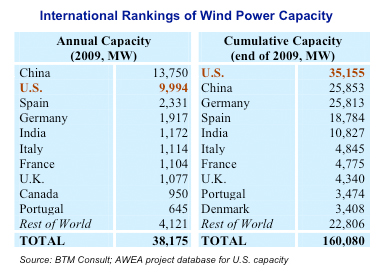
Austin Carr in Fast Company reports that China overtook the US in 2009 in terms of added wind power capacity. Cumulatively, the US still has more wind power, but if this trend continues not for long.


5. RELIANCE TAKES THIRD STAKE IN MARCELLUS SHALE GAS

Rakteem Katakey at Bloomberg reports that Reliance Industries of India has agreed to pay $392 million for a 60% stake in acreages in the Marcellus shale-gas areas of central and northeast Pennsylvania held by Carrizo Oil & Gas Inc. This is the third US shale gas acquisition Reliance has made this year.

6. VIOLENCE IN DARFUR ON THE RISE

Neil MacFarquhar at the New York Times reports that violence in Sudan's Darfur region is on the rise again as the referendum on independence in southern Sudan approaches.

7. INITIAL JOBLESS CLAIMS CLIMB TO 479,000

Bob Willis at Bloomberg reports that "Initial jobless claims climbed by 19,000 to 479,000 in the week ended July 31, the most since April."

8. RETAIL SALES IN JULY WERE FLAT YEAR-OVER-YEAR

MasterCard's SpendingPulse reports that overall July sales were flat year over year.
"Michael McNamara, Vice President, Research and Analysis for SpendingPulse, observes 'Overall, retail sales continued to tread water, following the pattern set with June's sales when consumers demonstrated a reluctance to make larger purchases, and instead, traded down. Particularly, we are noticing some weakness in industry sectors that rely on higher priced ticket items such as furniture and discretionary areas such as luxury and jewelry. We are also seeing this pattern echoed in the restaurant business, where we have seen consumers shift from full-service restaurants and particularly fine dining, to limited-service and quick-service outlets.'"

Thursday, July 29, 2010

Daily Sources 7/29

1. EUROPEAN ECONOMIC SENTIMENT HITS 28 MONTH HIGH

Marcin Grajewski at Reuters reports that consumer sentiment in Europe has hit a 28 month high.
"The European Commission said its economic sentiment indicator for the 16-nation currency area rose to 101.3 in July, a 28-month high, from an upwardly revised 99.0 in June."
2. GERMAN UNEMPLOYMENT FALLS FOR 13TH STRAIGHT MONTH

Rainer Buergin and Christian Vits at Bloomberg report that unemployment in Germany fell for the 13th straight month by a seasonally adjusted 20,000 to 3.21 million.

3. BANKS TO PREPARE FOR EUROZONE EXIT SCENARIOS

Eurointelligence reports that banks in Europe are preparing scenarios for eurozone states exiting the euro.
"The International Swaps and Derivative Association asked some of its members to form a group to consider what they may need to do if a eurozone state is ejected."
4. CZECH GOVERNMENT REFUSES TO SET DATE FOR EURO ADOPTION

Peter Laca and Ladka Bauerova at Bloomberg report that the Czech government has said that it refuses to commit to a date for euro adoption.
"[Prime Minister] Necas, 45, said the country will benefit from a flexible exchange rate as consumer prices converge with those in richer European Union-member states, and rapid euro adoption would risk fueling inflation. The koruna has gained 3.7 percent against the euro this month, the most among more than 170 currencies tracked by Bloomberg, making Czech exports more expensive.

'The government program will not include any target date or a promise to join the euro area,' Necas said today in an interview at his office in Prague. 'Exports are important, but this country is not only a country of exporters.'"
5. UK PRODUCTION OF GAS DOWN 14.3%

Platts reports that the UK's production of gas was down 14.3% in 2009 from 2008. "Gross natural gas production has fallen by 45% since its peak in 2000."

6. REGIONAL GROUPING TO DISCUSS COLOMBIA-VENEZUELA RIFT

BBC reports that Unasur, a regional grouping of foreign ministers, is set to discuss the rift between Venezuela and Colombia at its meeting in Quito today.

7. CONOCO WILL SELL ENTIRE STAKE IN LUKOIL

Sheila McNulty at the Financial Times reports that Conoco announced yesterday that it would sell its entire stake in Lukoil.
"Jim Mulva, Conoco chief executive, said the Lukoil investment had been aimed at doing joint deals and these had not happened."
8. IMF TO LEND UKRAINE $15.2 BILLION

Kateryna Choursina and Sandrine Rastello at Bloomberg report that Ukraine has secured a $15.2 billion, 2 1/2-year loan from the IMF.
"The Washington-based institution’s board of directors agreed to disburse $1.9 billion immediately, with subsequent payments subject to quarterly reviews.

“Ukraine is emerging from a difficult period during which the economy was severely hit by external shocks and exacerbated by domestic vulnerabilities,” John Lipsky, the fund’s first deputy managing director, said in a statement. “Authorities are committed to addressing existing imbalances and putting the economy on a path of durable growth, through important fiscal, energy, and financial sector reforms.” "
9. INITIAL UNEMPLOYMENT CLAIMS DOWN 11,000

Calculated Risk reports that
"In the week ending July 24, the advance figure for seasonally adjusted initial claims was 457,000, a decrease of 11,000 from the previous week's revised figure of 468,000. The 4-week moving average was 452,500, a decrease of 4,500 from the previous week's revised average of 457,000."

Thursday, July 15, 2010

Daily Sources 7/15

1. FRANCE, GERMANY AND THE UK WORKING TO CONVINCE EU TO ADOPT 30% CARBON REDUCTIONS BY 2020

Paul Whitehead at Platts reports that France, Germany and the UK have launched an effort to convince the EU as a whole to adopt a measure calling for 30% carbon reductions by 2020. The current goal for the EU is a 20% reduction by 2020.

2. TURKISH CENTRAL BANK LEAVES BENCHMARK RATE UNCHANGED

Steve Bryant at Bloomberg reports that the Turkish central bank left its key benchmark rate unchanged at 7%.

3. CHINESE GDP GROWTH UP BY 10.3% IN THE SECOND QUARTER

BBC reports that GDP in China grew by 10.3% in the second quarter, down from the 11.9% seen in the first quarter.
"Other official Chinese figures show retail sales are growing at around 18% a year, which suggests that consumption is still rising."
Meanwhile, Frontier Markets reports that manufacturing is already switching from China to other, cheaper, locales. Michael Schuman at the Curious Capitalist notes that some economists expect China to relax lending quotas again in a second stimulus.

4. MICHAEL PETTIS ARGUES THAT A FLOOD OF MONEY TO THE US IS MORE LIKELY THAN CHINA DUMPING US TREASURIES

Michael Pettis at Chinese Financial Markets argues that the US is more likely to see a "tsunami" of foreign capital entering the country than China exercising the "nuclear option" and selling its US treasuries holdings. He says the latter cannot and will not happen. Worth reading in full.

5. JAPANESE CARBON EMISSIONS CUTS GOALS INCOMPATIBLE WITH PROJECTED INDUSTRIAL DEMAND GROWTH

Hong Chou Hui at Platts writes that a new report by a consultancy predicts that Japanese manufacturing may be forced overseas if its goal for carbon emissions reductions--25% by 2020--are to be met. Forecasts of growth in industrial power demand are incompatible with the carbon emissions goals.

6. UAE AMBASSADOR SAYS AN ATTACK ON IRAN PREFERABLE TO IRANIAN NUCLEAR WEAPONS

Alexander Smoltczyk and Bernhard Zand at Der Spiegel report that the UAE ambassador to the US said
"A military attack on Iran by whomever would be a disaster, but Iran with a nuclear weapon would be a bigger disaster."
Spiegel concludes that an axis is forming against Iran in the Middle East.

7. TWO HOUSES BEING KEPT OFF MARKET FOR EVERY HOUSE ON SALE

Yves Smith at naked capitalism reports that for every house on sale there are two houses being kept off the market, or shadow housing.
"James Saccacio, CEO of RealtyTrac, said at the current pace, more than 3m properties will receive a foreclosure filing by the end of the year, and lenders will repossess more than 1m of them. According to a report from the Toronto-based Capital Economics, the weight of the shadow inventory may contribute to a double dip in the housing market. The report found that for every home currently on the market, two homes are waiting to be sold."


8. 429,000 NEW JOBLESS CLAIMS LAST WEEK

Kelly Evans at Real Time Economics reports that there were 429,000 initial jobless claims last week.

9. INDUSTRIAL PRODUCTION UP 0.1%

Courtney Schlisserman at Bloomberg reports that industrial production rose 0.1% in June.

Thursday, August 6, 2009

Daily Sources 8/6

1. JAPANESE GOVT REPORT COMPARES PARTY PLANS FOR GREENHOUSE GAS EMISSIONS REDUCTIONS ON ECONOMY

Yoko Kubota at Reuters reports that the plan by Japanese opposition party to cut greenhouse gas emissions by 25% from 1990 levels by 2020 would, per a government report, "push down real gross domestic product growth by 3.2 percentage points and the unemployment rate could grow by 1.3 percentage points." The government plan for an 8% reduction from 1990 levels by 2020 would, per the report, "push down Japan's economic growth by 0.6 percentage points and raise unemployment by 0.2 percentage points in 2020."

2. PBOC'S MONETARY REPORT INDICATES EASY CREDIT POLICY TO CONTINUE, MINISTRY OF HUMAN RESOURCES WARNS EMPLOYMENT SITUATION GRAVE, ELECTRICITY DATA SHOWS STEEP FALLS IN CONSUMPTION, BANKS LEND LESS IN JULY CONTRA PBOC REPORT, AND BP SAYS GDP DATA MORE OR LESS TRUSTWORTHY

Andrew Batson at the Wall Street Journal reports that the People's Bank of China's quarterly monetary report reaffirmed its commitment to continuing easy credit policies.
"'China's economy is now in a critical period of stabilization and recovery, and maintaining stable and rapid economic growth is still the most important task we face ... . Although the general trend of stabilization in the [global] economy has been basically established, the process of recovery may be slow and tortuous.'

With global demand for China's exports still weak, a solid rebound depends on domestic consumption and investment, the central bank said. Chinese companies may be more willing to ramp up production now that inventories have been reduced.

Sentiment among private-sector businesses remains weak, it said, and consumers' worries about future income could crimp spending. 'The foundation of the economic recovery is not yet stable,' it said, echoing other agencies' recent comments."
In a somewhat different take on the question of whether migrant unemployed in China are a reason to worry from the story cited yesterday--see Daily Sources 8/5 #1--Yves Smith links to an AFP report that
"China Tuesday warned of a 'grave' situation in the jobs market with millions of graduates and migrant workers yet to find work as companies continue to struggle with the effects of the global slump...

'China's current employment situation is still grave and the pressure for job creation remains large,' said Wang Yadong, a senior official at the Ministry of Human Resources and Social Security's employment section."
She also notes that:
"First-half electricity use by small and medium-sized enterprises fell almost 50% year-on-year, as these companies were more exposed to the economic downturn, the National Bureau of Statistics said on August 3.

SMEs saw power consumption plunge 48.9% year-on-year, against a 5.9% industry-wide drop."
And in contrast to the affirmation of the People's Bank of China in its quarterly report mentioned above:
"China's big state-owned commercial banks extended around 168 billion yuan worth of new loans in July, down sharply from the 497 billion issued in June, banking sources told Caijing on August 4."
And she picks up on the story in the FT yesterday that if you add up the output numbers of the various provinces, they are 10% more than overall national output as reported by Beijing. And to muddy the waters further, Sheetal Nasta at Platts reports that the chief Asia economist of BP, Chi Zhang, said at an event at the British Chamber of Commerce in Shanghai Wednesday that
"'in general, [the] data reflects economic growth reality,' given that China is 'very manufacturing intensive and there has been a lot of industrialization and an urbanization process is going on.'

While he admitted the Chinese have been likely 'taking advantage of low energy prices,' he retreated from the notion that government stockpiling was inflating prices.

Speaking of the oil price spike in 2008, he said data from BP's annual statistical review, issued earlier this year, shows that the 'big spike' in (price) coincided with related economic activity, primarily supply-side constraints due to investment shortfalls, geopolitical issues and few technological breakthroughs."
The continuing incredulity regarding official output growth numbers in China was driven by the disparity between the electricity consumption numbers, which are no longer published--see Daily Sources 6/8 #6--later reinforced by skepticism expressed in the May report by the International Energy Agency which suggested that oil demand would have been stronger than reported if it were to reconcile with the GDP numbers and suggested the possibility that "Real GDP data aren’t accurate and shouldn’t be taken at face value"--see Daily Sources 5/14 #2.

3. GERMAN FINANCE MINISTER SAYS FINANCIAL SECTOR RETURNING TO 'CASINO CAPITALISM', ECB MAINTAINS BENCHMARK RATE AND INDICATES THERE WILL BE NO ADDT'L STIMULUS

Der Spiegel reports that Finance Minister Peer Steinbrück is in the media warning against the return of 'casino capitalism.' Among other comments, he said:
"In the United States and Britain, lobbyists are already questioning some regulatory measures."
and, in Germany,
"Taxpayers are continuing to completely finance big bonuses [at banking firms]."
Meanwhile, Christian Vits and Simone Meier at Bloomberg report that European Central Bank president Jean-Claude Trichet indicated that the bank is unlikely to provide further stimulus after its monetary committee left the benchmark interest rate at 1%.
"Rates are 'appropriate' and policy makers are 'satisfied' with their asset-purchase program and measures to improve the flow of credit, he said."
"The ECB currently predicts the euro-region economy will contract about 4.6% this year and 0.3% in 2010. Inflation will average about 0.3% this year and 1% in 2010. The bank aims to keep inflation just below 2%."
4. BANK OF ENGLAND TO EXPAND QUANTITATIVE EASING, LONDON TO REPLACE SHORT HAUL AVIATION WITH HIGH SPEED RAIL

Niel Shah at the Wall Street Journal reports that the Bank of England today announced it would expand its quantitative easing program, increasing purchases by £50 billion (~ $85 billion) to a total of £175 billion.
"The increase required the bank to get special permission from the UK Treasury, which had previously capped the program at £150 billion.

The expansion of the program suggests policy makers are still worried about the long term outlook for the UK economy despite a recent spate of positive data pointing to recoveries in house prices, manufacturing and services."
"While banks' reserves of cash have more than tripled since the central bank launched the program back in March, one broad measure of lending in the economy--M4 money supply excluding certain financial intermediaries--has hardly budged. In the second quarter, the measure was up just 3.1% from the same period a year earlier, the weakest expansion since 1999.

Beyond that, rising unemployment and peoples' efforts to pare down heavy debt loads are likely to weigh on consumer spending, by far the largest driver of demand in the UK economy. As of May, the UK unemployment rate stood at 7.6%, the highest level in 12 years."
Meanwhile, Dan Milmo and Julian Glover at the Guardian report that Downing Street has announced plans which would replace domestic air travel with a high speed--250 mph--rail.
"The transport secretary, Lord Adonis, said switching 46 million domestic air passengers a year to a multibillion-pound north-south rail line was 'manifestly in the public interest'. Marking a government shift against aviation, Adonis added that rail journeys should be preferred to plane trips.

'For reasons of carbon reduction and wider environmental benefits, it is manifestly in the public interest that we systematically replace short-haul aviation with high-speed rail. But we would have to have, of course, the high-speed network before we can do it,' he said."


5. GEORGIAN AND RUSSIAN OFFICIALS TRY TO CALM WORRIES ABOUT NEW FIGHTING BREAKING OUT, SAAKASHVILI LAYS BLAME FOR 2008 CONFLICT ON MOSCOW IN OP ED

Jim Heintz at the Associated Press reports that senior officials in Tblisi and Moscow are walking back from rhetoric suggesting the possibility of renewed fighting.
"The deputy chief of Russia's general staff says Georgia is too weak after the war that devastated its military and caused an estimated $1 billion damage to the struggling country.

Georgia's national security adviser, however, says the danger of new fighting appears low because of 'preventive diplomacy' and because Russia knows a new war would undermine its influence among neighbors and rapprochement with the West."
In the meantime, Georgian President Mikheil Saakashvili has an op ed in today's Washington Post which lays the blame on last year's conflict squarely on Russia. Key excerpt:
"Russian provocations have not stopped; snipers in Russian-controlled areas have killed 28 Georgian policemen. In recent days, Moscow has engaged in a series of provocative acts and statements, echoing its prelude to last year's invasion. Even as the world watches, Moscow has vetoed monitoring missions from the United Nations and the Organization for Security and Cooperation in Europe. In violation of the cease-fire, Russia also denies European Union monitors access to the occupied territories.

Despite all this, and contrary to some expectations, Georgia has rebounded. Our democratic institutions are growing. Foreign investors are returning. The world should recognize that the kind of behavior Russia exhibited last August threatens not only Georgia but our entire region."
6. TURKISH PM MEETS WITH HEAD OF LARGEST TURKISH KURD PARTY, ANKARA SIGNS ON TO SOUTH STREAM

Nicholas Birch at the Wall Street Journal reports that Prime Minister Recep Tayyip Erdogan of Turkey met with the leader of the main Kurdish party in the country Wednesday, in what is the first meeting of the head of government with the party in the country's history.
"[M]any analysts say the new Kurdish opening is qualitatively different from anything that came before.

'For the first time ever, Turkish state institutions are working in synch to solve the problem,' said Henri Barkey, a Turkish expert at the Carnegie Endowment for International Peace, a Washington-based think tank.

The main catalyst for Turkey's new sense of urgency is Washington's announcement that it plans to pull its soldiers out of Iraq, Turkey's southern neighbor, by 2011.

The planned withdrawal has speeded up a rapprochement between Turkey and Iraqi Kurds, whose relations have been blighted for years by the PKK's use of Iraqi Kurdish mountains for its military bases."
"'There is an economic side to the rapprochement. "Turkey wants to use northern Iraqi gas for Nabucco,' says Bayram Bozyel, a Turkish Kurdish politician, referring to a pipeline project that the US and EU hope will help break a Russian stranglehold on European natural-gas supplies. 'And the [Iraqi] Kurds want to pump gas north.' That would be risky in the midst of a guerrilla war. The PKK claimed responsibility last year for a bomb attack on a major oil pipeline that passes through the same region."
Well worth reading.Today Russia and Turkey signed a deal to route Russia's South Stream pipeline through Turkey, per Charles Recknagel at RFE/RL.
"'The South Stream pipeline is a much needed project that is particularly important in the context of ensuring the energy security of the whole of Europe and the development of a broad range of ties between Russia and Turkey,' Putin said. 'Our negotiations showed that we can find solutions, together with the Turkish leadership, that open the way to new, large-scale energy projects.'"
7. IRAN LOWERS OFFICIAL PRICE OF OIL SOLD TO ASIA, QATAR LOWERS OFFICIAL PRICE OF OIL, FOLLOWING SAUDI ARAMCO REDUCTION ON PRICE TO ASIA

Yee Kai Pin at Bloomberg reports that the National Iranian Oil Company will reduce the official selling price of Iranian Light into Asia for the first time in four months.
"[NIOC] will set Iranian Light for September at 9 cents a barrel above the average of Persian Gulf benchmarks Oman and Dubai grades, based on a quarterly formula tied to prices set by Saudi Arabian Oil Co. The premium will be down $1.75, or 95%, from August and will be the smallest in seven months."
Meanwhile, Yee Kai Pin reports that Qatar Petroleum will also reduce the official selling price of Qatari crudes.
"The state-owned company cut its July price of Qatar Land crude oil to $65.50/b, down $5.60 from June, the official Qatar News Agency said on its Web site. The July price of Qatar Marine grade was reduced by $5.38 to $64.72/b. The cuts are the first in five months."
Earlier this week, Saudi Aramco cut its official selling price of Arab Light into Asia--see Daily Sources 8/3 #6. (The middle eastern national oil companies have different official prices for different regions of the world.)

8. DUBAI'S PROPERTY PRICE COLLAPSE SHARPEST IN WORLD

Kevin Brass at the New York Times reports that Dubai's property market is leading the world in price collapse.
"Dubai prices have dropped 32% in the last year and 40% in the last quarter, according to the latest edition of the Knight Frank Global House Price Index, released today.

Along with Dubai, Latvia (36%) and Singapore (23.8%) saw the largest declines since the first quarter of 2008, the property firm reports."
9. MEND LEADER INDICATES MOST NIGER DELTA MILITANTS WANT TO TAKE ADVANTAGE OF AMNESTY PROGRAM WHICH OFFICIALLY BEGAN TODAY; ANALYSTS DOUBT DIRE NIGERIAN PRODUCTION NUMBERS

Dulue Mbachu at Bloomberg reports that the leader of Nigerian militant group MEND indicated in a telephone interview that most fighters want to accept the government's amnesty program, saying "Like the government, we also want peace for there to be development."
"A government panel set up last year recommended raising the share of revenue going to states in the oil region to 25% from the current 13%. MEND wants the oil region to control 100% of oil revenue and pay a tax to the central government, according to the group’s spokesman, Jomo Gbomo.

'Whatever the people are demanding is also what I want,' Okah said, declining to commit to a figure.

The MEND leader said militant commanders in the oil region are divided between those who want money in exchange for weapons, as offered by the government, and those who want their political demands met.

'Personally I want a situation where weapons will be surrendered without cash,' Okah said. 'Because people can submit their weapons and buy new ones.'"
BBC News reports on the amnesty program which officially began today.
"Officials said gunmen who accept amnesty would be given 65,000 naira ($433; £255) a month for food and living expenses during the rehabilitation program, which runs from 6 August to 4 October.

But the main rebel group in the region, the Movement for the Emancipation of the Niger Delta (MEND), has not yet said it will take part in the amnesty.

'When we choose to disarm, it will be done freely, knowing that the reason for our uprising which is the emancipation of the Niger Delta from neglect and injustice has been achieved,' the group said in statement e-mailed to the AFP news agency.

The group, which called a temporary ceasefire last month after one of its leaders was freed from jail, is in talks with senior officials about the terms of any possible amnesty."


Tom Burgis at FT Energy Source reports that many believe that the current numbers for oil production coming from official Nigerian government sources are deliberately understated.
"On Wednesday afternoon, a Nigerian oil executive speaking in private snorted at the idea that production could be so low, suggesting 1.6m b/d was more accurate. Stewart Williams, principal sub-Saharan Africa analyst at energy consultancy Wood Mackenzie, puts production at 1.5m b/d to 1.6m b/d.

Why the discrepancy? Analysts with a cynical streak (easily acquired in a country so riddled with corruption and electoral violence) remark that it is in the state’s interest to create a sense of crisis as it tries to force through a comprehensive reform of the oil sector.

That the bill has merits--including the promise of greater transparency and restructuring the hopelessly ineffective state company--misses the point. Oil companies and the delta’s influential governors, who stand to get less cash as a result, are united in opposition to it.

The oil companies, too, are making data scarce at the moment. Like the government, they may have an interest in uncertainty as the negotiations continue."
10. BRAZILIAN SENATE'S INVESTIGATION INTO PETROBRAS TAX EVASION AND CORRUPTION CHARGES BEGIN TODAY, LULA INDICATES THAT HE BACKS FULL CONTROL OF PRE-SALT FOR PETROBRAS

Helder Marinho and Alexander Ragir at Bloomberg report that the Brazilian Senate's investigation into tax evasion and corruption allegations against state oil company Petrobras began today.
"An 11-member Senate committee, led by a member of [Brazilian President Luiz Inacio Lula da Silva's], Workers’ Party, is investigating the allegations. [CEO Jose Sergio] Gabrielli told Petrobras’s 74,000 employees in a July 14 letter that the company fired three employees after an internal investigation, and cooperated with the prosecutor’s office and federal police, into the bidding process for oil platforms.

Gabrielli, Chief Financial Officer Almir Barbassa and Haroldo Lima, the head of Brazil’s petroleum regulator, are among officials the committee in charge of the probe will invite to testify, according to a list senators handed to reporters during a session of the probe committee held today.

The officials will not be legally summoned or required to speak under oath, and the hearings will be arranged at their convenience, Senator Romero Juca said today in Brasilia. Juca, the head of the government coalition in the Senate, is responsible for leading the probe and writing its reports. Fired Petrobras executives will not be called to testify, he said."
"Since Lula first took office in January 2003, lawmakers have set up 25 committees to investigate everything from health insurance plans to piracy of industrial goods and corruption, according to CAC Consultoria Politica, a Brasilia-based political consultancy. While some ended without any conclusion, a 2005 investigation into allegations the Workers’ Party paid bribes to legislators in exchange for votes in Congress led to the resignation of Lula’s chief of staff, Jose Dirceu."
Natuza Nery at Reuters reported yesterday that Lula was to propose to Congress today that Petrobas be the exclusive operator of new offshore sub-salt oil fields. In June, resolutions were being introduced in the Brazilian Senate to create a new, 100% state-owned company, to lease Brazil's sub-salt fields--see Daily Sources 6/12 #11. (A majority of voting shares in Petrobras are owned by the government, but foreign investors own about 60% of its total outstanding stock.)

11. VENEZUELA TO PURCHASE SEVERAL DOZEN TANKS FROM RUSSIA, BANS COLOMBIAN STATE OIL COMPANY FROM PARTICIPATION IN ORINOCO BELT

Fabiola Sanchez at the Associated Press reports that President Hugo Chávez in a news conference yesterday said that Venezuela was going to purchase several dozen Russian tanks in a deal he wants to seal during a visit to Russia in September.
"'We're going to buy several battalions of Russian tanks,' Chavez said ...

Chavez's government has already bought more than $4 billion worth of Russian arms since 2005, including helicopters, fighter jets and Kalashnikov assault rifles.

The socialist leader called Colombia's plan to host more US soldiers a 'hostile act' and a 'true threat' to Venezuela and its leftist allies. He warned that a possible US buildup could lead to the 'start of a war in South America,' but gave no indication that Venezuela's military is mobilizing in preparation for any conflict."
"Cuban ex-President Fidel Castro supported Chavez in a column published Wednesday on the Cubadebate Web site, saying that 'Venezuela isn't arming itself against the sister nation of Colombia, it's arming itself against the (US) empire.'

'The threat ... is directed at all the countries' of South America, Castro wrote."
Meanwhile, Upstream online reports that Chávez told journalists yesterday that Ecopetrol, Colombia's national oil company, will have no role in developing the Orinoco belt.
"Chávez said ... that Colombia’s increased cooperation with the US to fight guerrillas and drugs is part of the US’s long- term plan to invade Venezuela and seize the Orinoco Belt."
"Ecopetrol was one of 19 companies that paid $2 million apiece for detailed information on the Carabobo block in the Orinoco Belt."
12. 24% OF OWNER-OCCUPIED HOMES UNDER WATER IN US, PERSONAL SAVINGS RATE INCREASE AHISTORICAL IN FACE OF REDUCED FEDERAL TAX RECEIPTS, AND AS UNEMPLOYMENT LOOKS SET TO CONTINUE TO RISE

Nick Timiraos at Developments reports that 24% of owner-occupied homes had mortgage debt which exceeded the market value of the home in question at the end of June, according to data from Equifax and Moody’s Economy.com.
"That number rises to 32% when looking at the share of homeowners with mortgages that don’t have equity left in their homes.

Overall, 16 million homeowners are 'upside-down' on their mortgages, up from 10 million, or 15% of owner-occupied homes, one year ago.

Nearly 10% of owner-occupied homes now have mortgage debt with loan-to-value ratios of at least 125%, and roughly half of those homes have mortgage debt with loan-to-value ratios of 150% or more."
In her most recent series of posts, Rebecca Wilder at News N Economics notes that a) this recession is different from past recessions in the sense that the personal savings rate is trending up:


And b) that the Daily Treasury Statement of August 4 "shows that the 1-month cumulative sum of income tax receipts (withheld plus paid taxes) is dropping at a 13% annual pace." She comments:
"This is the most up-to-date macroeconomic information out there, as most of the reports are 1-2 months old at the time of release. And the implication of this DTS is: that personal income and spending, which just released this week for June ... are likely to be weak into July."
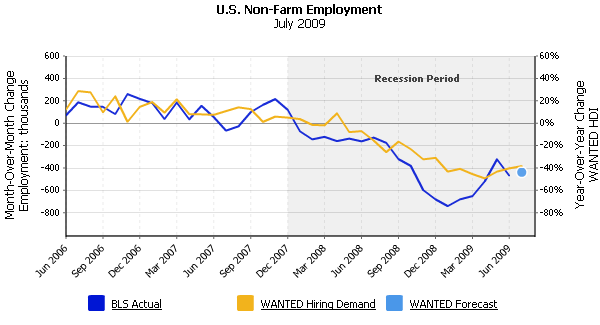
In that vein, Barry Ritholtz links to a graph by Bruce Murray, CEO of WANTED USA, plotting the actual month over month change in non-farm unemployment against year over year percent change in hiring demand:


13. RAIL TRAFFIC VOLUMES BOTTOMED OUT AT 18.9% BELOW LAST YEAR'S NUMBERS

The Railfax report is out today, and seems to indicate that rail traffic volumes have reached a bottom and holding steady at about 18.9% below their seasonal levels. Their chart for weekly loaded units in North America for the week ended August 1 in four week rolling averages:


Their chart for crushed stone and lumber and wood products, key components in construction, in four week rolling averages for North America:

Wednesday, August 5, 2009

Daily Sources 8/5

1. CHINESE TRANSPORT DATA SHOW YOY INCREASE IN IRON IMPORTS OF 35%; PROPERTY SALES IN CHINA FALL 4% IN JUNE; UNEMPLOYED MIGRANT WORKER CONCERNS PROVE OVERBLOWN; THE PEOPLE'S BANK OF CHINA WARNS OF THE DANGERS OF QUANTITATIVE EASING

Bloomberg reports that in the Ministry of Transport data released yesterday ships unloaded 35% more iron ore in July from July 2008. "Ships unloaded 56.5 million metric tonnes of iron ore in July at major ports." Meanwhile, China Daily reports that property sales across 30 Chinese cities fell by 4% in July from June. Property prices for 70 major Chinese cities rose by 0.8% in June.
"Property transactions in Guangzhou [formerly Canton, the capital of Guangdong province] fell 36% over June. The figure is only half of that of May, said Guangzhou's official property website.

'The fall has been triggered by high property prices and shrinking supplies in some cities,' said Qin Xiaomei, head of research, Jones Lang LaSalle Beijing. 'Property developers have slowed down the pace of new projects in the second half after robust sales in the first half,' she said."
Meanwhile, Andrew Batson at the China Journal reports that worries regarding large numbers of unemployed migrant workers have proven overstated. The IMF China mission chief, who visited the country in late May early June, told reporters in a conference call:
"I think our sense is that while there is certainly some dislocation in the labor markets as export sectors in the coastal regions have declined, but in general that process of reallocation of labor has been relatively smooth. Part of it has been that labor has returned back to export sectors, perhaps with some reduction in real wages, and been reabsorbed into those areas.

Part of it is that the interior of the country is doing quite well, and so some of that migrant labor has moved geographically across regions to where growth is stronger. And I think we’re seeing right now a dynamic where the historical pattern of very strong growth in the coastal regions and slower than average, national average growth in the interior is reversing, and you’re seeing much stronger growth in rural areas and in the interior provinces. And some of that labor has been reabsorbed into public infrastructure projects."
Meanwhile, Bloomberg News reports that the People's Bank of China yesterday in its quarterly monetary policy report warned that the quantitative easing policies of the developed nations threatens to spark sever inflation and currency volatility.
"Exiting too quickly from such policies, which the Chinese central bank said helped to prevent a repeat of the Great Depression, may undermine an economic recovery, the report said. Waiting for too long may trigger 'a new round of asset bubbles and severe inflation,' the central bank added.

'Central banks in major developed nations face a difficult choice between keeping government bond yields relatively low to promote economic recovery and maintaining currency stability' to protect national creditworthiness, it said."
2. UK ENERGY SECURITY ENVOY TO RECOMMEND TRIPLING NUCLEAR ELECTRICITY GENERATION CAPACITY; JULY SERVICES INDEX SHOWS SIGNIFICANT IMPROVEMENT

Robin Pagnamenta at the Times reports that the UK's Prime Minister’s special envoy on energy security, Malcolm Wicks, will publish a report today arguing that Britain should triple the amount of energy it generates from nuclear power. A Times source familiar with the report said it would argue:
"The question is whether or not the same rigor [that is being devoted to cutting emissions] is being applied to energy security.

The Government has not been good at asking serious questions about whether or not the UK is in the right place ... It’s a dangerous world and when we emerge from recession there will be a global grab for diminishing supplies of energy. Where is it all going to come from?"
Meanwhile, Vanessa Houlder at the Financial Times reports that the Markit Economics purchasing managers survey of the services sector rose to 53.2 in July from 51.6 in June, it's highest reading since February 2008. It is the third consecutive month with a reading above 50--above 50 indicates expansion and below indicates contraction.
"Analysts welcomed the latest figures as providing more evidence the recession was receding. Vicky Redwood, of Capital Economics, said: 'The latest UK data on both services and manufacturing suggest that a decent recovery is continuing across the economy.'

Kevin Daly, of Goldman Sachs, said the 'very strong' services survey was consistent with annualized growth in gross domestic product of between 1.5% and 2%."
3. TWO RUSSIAN SUBS PATROLLING OFF US COAST

Mark Mazzetti and Thom Shanker at the New York Times yesterday reported that two nuclear-powered attack submarines have been patrolling off the eastern coast of the US recently.
"'I don’t think they’ve put two first-line nuclear subs off the US coast in about 15 years,' said Norman Polmar, a naval historian and submarine warfare expert.

The submarines are of the Akula class, a counterpart to the Los Angeles class attack subs of the United States Navy, and not one of the larger submarines that can launch intercontinental nuclear missiles."
Galrahn at Information Dissemination notes that the report suggests that the submarines are staying out of the Economic Exclusion Zone--about 200 miles off the coast. He also asks why this information was leaked.

4. PAKISTAN TALIBAN SEES ITSELF AS PROVIDING GOOD GOVERNMENT

Qandeel Siddique at jihadica summarizes an Urdu-language interview of a Taliban commander in Pakistan. Key excerpt:
"The Swati Taliban claims to have the locals on their side: '… We are children of these people and they are our own. We live like brothers. We have a healthy relationship with them where they give us food and shelter, and we cooperate on matters. We are always in touch with the locals and share with them their burdens/grievances. We have built roads [for the Swati people] where in over 60 years the government could not. The locals are happy with us. They no longer need to pay tax to the government. We have build pipelines and provided water to people. [...] Also we resolved decade-long rivalries that had been going on and which the government failed to bring about peace. The Taliban have appointed ulema to solve these cases and bring peace.'

The Swati Taliban assumes the role of a surrogate government by providing its citizen’s basic amenities--roads and water. And of course justice, which the locals feel deprived of, believing that the Pakistani government time and again ignores the developmental needs of this region. On top of this, the commander conjures a horrific picture of the Pakistani army; he pins the blame for collateral damage during warfare on the military--not only do they take innocent lives, they also steal from peoples’ homes."
5. RUSCORP SIGNS MOU WITH NIGERIAN STATE OIL COMPANY TO PROVIDE SECURITY, MAINTAIN PIPELINE NETWORK

Uchenna Izundu at the Oil & Gas Journal notes that a Russian security and maintenance company, Ruscorp, has signed a memorandum of understanding with the Nigerian National Petroleum Corp. to monitor the country's pipeline network, improve the existing pipelines as well as build new distribution lines.

6. CHÁVEZ ISSUES DECREE NATIONALIZING EQUIPMENT AND WAREHOUSING FACILITIES AT PORTS

Rainbow Nelson at Lloyd's List reports that Caracas has issued a decree effectively terminating all private concessions at the countries ports, with state-owned companies taking over all equipment and warehousing facilities. (Subscription only, but the headline is a decent datapoint.)

7. CREDIT CARD JUNK MAIL BOTTOMS

Barbara Kiviat at the Curious Capitalist notes that Synovate, a firm which tracks junk mail, has produced a chart--available at her blog--which shows that credit card offers going out underwent a sharp fall from the fourth quarter of 2007, but seem to have bottomed out in the second quarter of 2009.

8. CASH FOR CLUNKERS MOSTLY STIMULUS FOR AUTO INDUSTRY; AUTO INDUSTRY RESPONSIBLE FOR MOST OF MANUFACTURING REBOUND IN JULY; MINUS STIMULUS CONSUMER SPENDING MAY WELL HAVE SHRUNK BY 10% IN 2Q; PROBLEMATIC CONSTRUCTION LOANS LIKELY TO UNDERMINE BANK BALANCES GOING FORWARD

To answer what aim was intended by the cash for clunkers program, see Robert Rapier's R-Squared blog, which notes that the US will consume approximately 72 million gallons less gasoline annually because of the program.
"In the context of the amount of gasoline we use--140 billion or so gallons per year (a bit less now because of the recession)--this amounts to only 0.05% of our annual gas usage. Experts have suggested that making sure tires are properly inflated could save 3% on gas usage, or 60 times the amount saved by "Cash for Clunkers" if the majority of people are driving around on under-inflated tires.

So, for $1 billion invested in the program, a savings of 72 million gallons means we taxpayers paid $13.89 for each gallon of gasoline/yr saved. Readers know that I am a big fan of much higher fuel efficiency, but $13.89 to save a gallon of gasoline per year? While this benefit will be spread over several years of gasoline savings, surely we can do better than this.

Even if--as one reader suggested--those cars would have been on the road for another 10 years, you are still paying over a buck a gallon for the savings."
Which nicely dovetails with James Hamilton's post on whether there be an economic recovery in the offing, writing:
"Americans bought 995,000 light vehicles in July, a 16% increase over June and the best monthly report since August 2008. Domestically manufactured light trucks (which includes SUVs) lost market share but still achieved an 8% monthly sales gain. Sales of domestic cars, imported cars, and imported light trucks were all up more than 20% month to month.

If we'd seen these kinds of numbers in the absence of the cash for clunkers incentives, I would have viewed it as a strong suggestion that the economic recovery has begun. As is, I'm left wondering, and fundamentally not knowing, whether the auto figures signal the shift we've all been watching for, or sales stolen from September and October and delivered to July."
John Maudlin at the Big Picture quoted from David Rosenberg analysis yesterday:
"The details in today’s report left something to be desired. Consumer spending came in at -1.2% annualized, twice the decline expected by the consensus. This occurred in the face of gargantuan fiscal stimulus and leaves wondering how this critical 70% chunk of the economy is going to perform as the cash-flow boost from Uncle Sam’s generosity recedes in the second half of the year. Imagine, government transfers to the household sector exploded at a 33% annual rate, while tax payments imploded at a 33% annual rate and the best we can do is a -1.2% annualized decline in consumer spending in real terms and flat in nominal terms? What do we do for an encore? In the absence of the fiscal largesse, it is quite conceivable that consumer spending would have shrunk at a 10% annual rate last quarter! Nonresidential construction action sagged at an 8.9% annual rate and this was on top of a 44.0% detonation in the first quarter. Ditto for equipment & software ‘capex’ spending, also down at a 9.0% annual rate and this too followed a 36.0% collapse in the first quarter. Residential construction slumped sharply yet again, this time at a 29.0% annual rate. These are the guts of private sector spending and collectively, they contracted at a 3.3% annual rate--the sixth decline in a row. So while there are many calls out there for the recession’s end, it remains a forecast as opposed to a present-day reality."
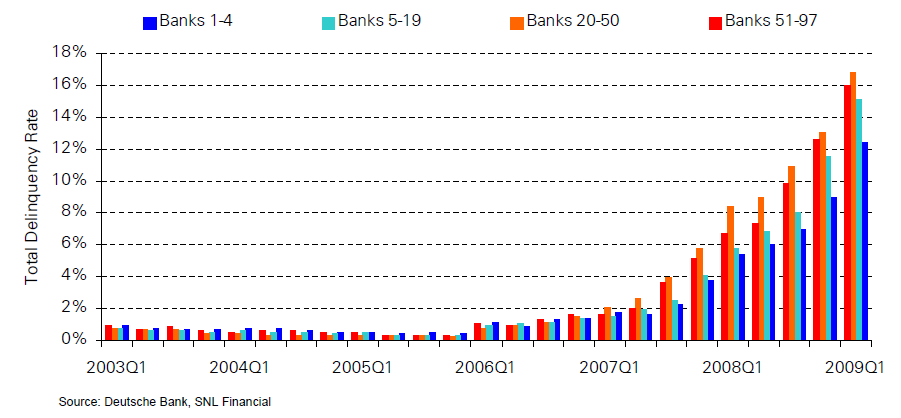
And Barry Ritholtz, also at Big Picture, notes the recent Deutsche Bank report which suggests that construction loans are likely to become a larger problem for the banks over time.
"Construction loans are structured with upfront reserves--meaning that it takes much longer for [Commercial Real Estate] defaults to occur. Low short-term interest rates also means reserves can last longer--BUT, as DB notes, Once reserves are exhausted, defaults will skyrocket."


9. COMMERCIAL CRUDE STOCKS BUILD MORE THAN EXPECTED, GASOLINE PRICES RISE, REFINING UTILIZATION DOWN

The EIA reports that crude oil commercial stocks built by 1.7 million barrels to 349.5 million barrels in the week ended July 31--above the five year historical range for this time of year. A Bloomberg survey had the median expectation of analysts at a 600,000 barrel build. Gasoline stocks fell by 200,000 barrels, are at the top of the historical range, and versus analyst expectations of a 800,000 barrel draw. Distillate stocks fell by 1.1 million barrels and at 161.5 million barrels are 28.2 million larger (or 21.2% more) than the comparable stock level seen last year--well above the five historical range. Analysts had expected a 1.23 million barrel build. Refining utilization fell to 84.54% from 84.57% the previous week. The national average of regular gasoline prices rose 5.4¢ to $2.557/gallon in the week ended August 3. (People tend to start driving less at prices between $2.50-$3.00/gallon.) The report also includes a helpful explanation of why refinery outages on the Gulf Coast have a large effect upon national prices.

10. POTATOES MAY ACCOUNT FOR AS MUCH AS 22% OF POPULATION GROWTH AND 47% OF URBANIZATION IN THE 18TH AND 19TH CENTURIES

Nathan Nunn and Nancy Qian at VoxEU argue that the introduction of new world crops to the old world--and in particular the potato--is in great part responsible for the population explosion and urbanization from 1800:
"The traditional explanation for the rise in population is that medical advances, such as the understanding of the germ theory or the innovation of vaccinations, and improvements in public sanitation greatly decreased infant and child mortality, which in turn led to an increase in population (e.g. Preston, 1975, 1980, 1996; Cutler, Deaton and Lleras-Muney, 2005, 2006). However, in recent years, scholars such as Thomas McKeown (1976) and Robert Fogel (1984, 1987, 1994, 2004) have argued that the increase in population was mostly due to an improvement in nutrition rather than the advances in medicine or sanitation. McKeown argued that the decline in mortality began to occur well before the most important innovations such as antibiotics or vaccinations, which did not become prevalent until the 20th century, and therefore, there is scope for other factors to contribute to the rise in population. Fogel argued that since height is positively correlated with nutritional investment during childhood as well as lower mortality rates, then the observation that heights in America and the UK were increasing is evidence that nutrition was improving during this period.

If Fogel is right, then we have to ask what caused the improvements in nutrition. Certainly, improvements in agricultural technology are part of the story. During this time, a number of productivity-enhancing technologies were developed. Examples include the seed drill, the threshing machine, and the Rotherham swing plough.

In recent research, we argue that another main contributor was the discovery of New World food crops, namely, the potato (Nunn and Qian 2009). Potatoes are extremely nutritious and a very 'cheap' source of calories. They produced much higher yields per acre relative to pre-existing Old World staple crops. Historical survey data from England show that if a family of four were to subsist on only one crop, it would require 66% less land if it were to plant potatoes rather than staples such as barley, wheat, or oats (Young, 1771). Potatoes are also easy to store and were popular as fodder for livestock through the winter. Therefore, cultivating potatoes also indirectly improved protein intake. The diffusion of potatoes also had a tremendous impact on nutrition in the Old World because vast land areas in Northern Europe, Asia, and high altitude areas of Africa were suitable for cultivating potatoes. Figure 2 maps suitability for potato cultivation. Yellow and brown colored regions are suitable. Darker colored regions are more suitable."

Thursday, July 30, 2009

Daily Sources 7/30

1. DEBATE OVER SUSTAINABILITY OF CHINESE FISCAL STIMULUS HEATS UP: CHINA SHUTTERS LARGE NUMBER OF SMALL COAL SOURCED POWER PLANTS, ONE ARGUES THAT CHINA'S STRENGTH VIS-A-VIS US FISCAL SITUATION OVERSTATED, ANOTHER SAYS CHINESE ARE COMPLAINING OF THEIR OWN BEHAVIOR IN OTHERS, AND YET ANOTHER SAYS TRADE CONFLICTS ARE INEVITABLE

Vitaliy Katsenelson in Morningstar opines:
"Despite everything, the Chinese economy has shown incredible resilience recently. Although its biggest customers--the United States and Europe--are struggling (to say the least) and its exports are down more than 20%, China is still spitting out economic growth numbers as if there weren’t a worry in the world. The most recent estimate put annual growth at nearly 8%.

Is the Chinese economy operating in a different economic reality? Will it continue to grow, no matter what the global economy is doing?

The answer to both questions is no."
I interrupt Katsenelson's point to note that the Associated Press reports that
"[Chinese a]uthorities have closed [small coal-fired] power plants with a total of 7,467 generating units, meeting a previously announced goal 18 months ahead of schedule, said Sun Qin, deputy administrator of the Cabinet's National Energy Administration.

'This couldn't be done when power demand was very intense,' Sun said at a news conference. 'Due to this financial crisis, the power generation has slowed down, so we took this opportunity to accelerate the shutdown.'"
OK, but China depends on coal for about 70% of its electricity generation. As many have noted before, the GDP growth numbers published by China don't seem to be consistent with having taken so much power generation off line--see Daily Sources 5/14 #2. In late May, the China Electricity Council, or association, announced it would stop publishing electricity consumption numbers--see Daily Sources 6/8 #6. Back to Katsenelson:
"Millions of people have migrated to its cities, and now they’re hungry and unemployed. People without food or work tend to riot. To keep that from happening, the government is more than willing to artificially stimulate the economy, in the hopes of buying time until the global system stabilizes. It’s literally forcing banks to lend--which will create a huge pile of horrible loans on top of the ones they’ve originated over the last decade.

But don’t confuse fast growth with sustainable growth. Much of China’s growth over the past decade has come from lending to the United States. The country suffers from real overcapacity. And now growth comes from borrowing--and hundreds of billion-dollar decisions made on the fly don’t inspire a lot of confidence. For example, a nearly completed, 13-story building in Shanghai collapsed in June due to the poor quality of its construction.

This growth will result in a huge pile of bad debt--as forced lending is bad lending. The list of negative consequences is very long, but the bottom line is simple: There is no miracle in the Chinese miracle growth, and China will pay a price. The only question is when and how much."
In this vein, Robert Flint at the Wall Street Journal reports:
"Since the beginning of this week, things have happened quickly on the bubble front. China's banking regulator issued rules Monday governing loans for fixed-asset investments in its latest attempt to ensure bank lending boosts the real economy and isn't funneled into markets.

On Tuesday, two of China's major lenders were quoted as saying they would sharply slow credit growth in the second half. This prompted fears of a sudden tightening of credit that could choke off the loans which have so far eased the effects of the world recession. Shanghai equity prices plunged as much as 7.7% at one point Wednesday and closed 5.0% down on the day.

Later on Wednesday, the PBOC said it will emphasize market-based systems, rather than administrative controls, in guiding the appropriate growth of credit. PBOC Vice Governor Su Ning's comments appeared to signal the PBOC wasn't about to set loan curbs in the second half of this year to cool explosive lending growth, as it had done in 2008."
Meanwhile, David Pilling argues in the Financial Times:
"If anything, it is Beijing--some of whose officials now privately boast they have nothing at all to learn from the Great Spendthrift--that has the upper hand. China’s seeming financial hold over the US has been brought into sharp relief. Beijing has become prone to lecture Washington on the need to safeguard its $2,000bn reserves, the bulk of which are parked in US dollars.

It is wholly appropriate that Washington accords due attention to China, the most important emerging power since America itself. But there is also a danger of taking China too seriously. In compensating for past neglect, things could swing too far the other way. For all the euphoria about the G2--the Sino-US axis that, according to some breathless reckoning, is the only meaningful global forum--it is worth pausing to survey the facts.

For a start, China’s financial grip over the US is not as tight as many suggest. Far from a sign of strength, Beijing’s accumulation of vast foreign reserves is the side-effect of an economic model too reliant on exports. The enormous trade surplus is the product of an undervalued renminbi that has allowed others to consume Chinese goods at the expense of Chinese people themselves.

Beijing cannot dream of selling down its Treasury holdings without triggering the very dollar collapse it purports to dread. Nor are its shrill calls for the US to close its twin deficits--which would inevitably involve buying fewer Chinese goods--entirely convincing. Rather than exposing the superiority of China’s state-led model, the global financial crisis has laid bare the compromising embrace in which the US and China find themselves."
And Brad Setser at Follow the Money notes that Chinese policy makers complaining of US government profligacy might fairly be asked if they aren't the pot calling the kettle black.
"Before the crisis, the Fed’s balance sheet was around 6% of US GDP. Right now, it is around 15% of US GDP. A big increase no doubt. But the balance sheet of the People’s Bank of China (PBoC) is around 70% of China’s GDP. Foreign assets make up about 80% of the PBoC’s balance sheet--or around 55% of China’s GDP. And the PBoC’s estimated holdings of US treasuries and agencies are about equal to 30% of China’s GDP--a level that is far higher, relative to China’s GDP, than the US Fed is ever likely to achieve. The Fed expects its balance sheet to peak at roughly $2.5 trillion, or between 15% and 20% of US GDP."
His colleague Paul Swartz provides a graph of the annual change in PBoC and Fed holdings of treasuries and agencies as a percentage of GDP:


Michael Pettis at China Financial Markets notes that trade lawyers are reporting that they expect a slew of industries to ask the EU for protective tariffs next month.
"As I have been arguing for over a year, as unemployment around the world rises and as the necessary contraction in US net demand picks up pace, there was inevitably going to be a conflict with China as Chinese policymakers responded to the collapse in trade in the only way they could, by substantially stepping up investment. The result is that China’s trade surplus has contracted very slowly--much more slowly than the contraction in the US trade deficit--and the result was a huge squeeze on the tradable goods sectors around the world.

The fact that policymakers in Europe, China, Japan and the US seem to have no clue as to how difficult the transition for each of the other countries is likely to be, and so are doing not nearly enough to coordinate their response (in fact lecturing and finger waggling seem to the favorite forms of policy coordination), makes trade conflict almost a dead certainty. I don’t think there are necessarily any bad guys here--each country is desperately doing what it can to get itself out of this mess--but there is a lot of failed opportunity and I am pretty sure that the trade environment will continue to decline."
Pettis notes that China's share of the US trade deficit (excluding oil) has grown from 26% in 2000 to 83% so far in 2009.
"Perhaps as a consequence of a fiscal stimulus aimed at boosting investment and production, China’s share of the US trade deficit has grown significantly. Since the US trade deficit is shrinking quickly, this means that other exporters are getting killed. As I have argued for a while, this is not sustainable and will almost certainly cause trade tensions to erupt.

Does this mean China is behaving in a predatory way? I don’t thinks so. I have warned for a long time that it would be very difficult for China to make the necessary transition to a consumption-led economy quickly enough to accommodate the global adjustment taking place. Unless it is willing to see its economy collapse, there is simply no way China can reduce its negative net demand quickly enough to match the contraction in US demand and so avoid squeezing the hell out of the global tradable goods sectors. That is why policy coordination is so important, especially between China and the USD, and of course that is why I continue to be a pessimist. I do not think this policy coordination is taking place."
Well worth reading in full.

2. JAPANESE INDUSTRIAL PRODUCTION UP 2.4% IN JUNE FROM MAY, JAPEX TO BID ON DEVELOPING 400 KB/D IRAQI FIELD, AND JAPAN TO START BURNING CRUDE JATROPHA OIL FOR POWER GENERATION

Yoshiaki Nohara at Bloomberg reports that the Japanese Trade Ministry announced that industrial production increased by 2.4% in June from May.
"Output gained 8.3% last quarter from the first three months of 2009, the most since 1953. Companies said they also planned to increase manufacturing by 1.6% in July and 3.3% in August, the report showed.

The heads of the Finance Ministry’s regional bureaus yesterday raised their assessment of the economy for the first time in five years, based on a recovery in exports and industrial production."
Meanwhile, Ashutosh Joshi and Taiga Uranaka at Reuters report that Japan Petroleum Exploration Co (Japex) has entered into negotiations with Iraq to develop the East Baghdad field, according to Nikkei Business Daily.
"Japex has proposed developing the southern portion of the field, with initial output forecast at 400 kb/d, enough to satisfy about 10% of Japanese demand, the newspaper said.

It also said that rival companies are expected to submit bids as well."
Meanwhile, Takeo Kumagai at Platts reports that Biomass Japan, a biodiesel supplier, will begin supplying power companies with crude jatropha oil for direct burning.
"Biomass Japan is scheduled to start receiving some 700 mt/month of crude jatropha oil in Okinawa from August, mainly from its pilot plants in Indonesia, Malaysia, Thailand and India, the source said."
"Biomass Japan declines to officially disclose exact costs for its crude jatropha oil, but according to the source production from the foreign pilot projects will cost less than Yen 50-60/liter (53-63 cents/liter) on a CIF basis, less than equivalent domestic production.

Biomass Japan is currently expanding its overseas jatropha production capacities beyond Southeast Asia, with new operations in Africa due to come on stream in the next few months, the source said.

From December it will be receiving a total of 5,000 mt/month of crude jatropha oil from Africa, said the source, declining to give details of the projects."
Some power plants in Japan directly burn crude oil to generate electricity--generation from jatropha should reduce net greenhouse gas emissions. However, jatropha has recently been abandoned by some producers, in part because it turns out that it is a water hog--see Daily Sources 7/17 #5.

3. SOUTH KOREAN HOUSEHOLD SAVINGS DOWN FROM 25.2% IN 1998 TO PROJECTED 3.2% IN 2010

Blaine Harden at the Washington Post reports that
"The household savings rate in South Korea will have plummeted from a world-beating 25.2% in 1988 to a projected world low of 3.2% in 2010, according to the OECD. Government policies have encouraged borrowing, while Korea's aggressive culture has supercharged spending on signifiers of success, whether they be Ivy League degrees or Louis Vuitton handbags.

'It is not recognized as a virtue to save, not anymore,' said Lee Sun-uk, an investment adviser for an office of Samsung Securities that is located in a wealthy neighborhood of Seoul. 'To maintain a certain status, people are willing to spend, even if their incomes have declined.'

In the past decade, average savings per household have plunged from about $3,300 to $525. On a percentage basis, it is the steepest savings decline in the developed world. Meanwhile, household debt as a percentage of individual disposable income has risen to 140%, higher than in the United States (136%), according to the Bank of Korea."


4. UK HOME PRICES UP 1.3% IN JULY FROM JUNE IN THIRD CONSECUTIVE MONTHLY INCREASE, UK WORRIED ABOUT OIL PRICE EFFECT ON RECOVERY

Real Time Economics reports that the UK Nationwide Building Society said the average home price rose 1.3% in July from June in the third consecutive month of increase.
"House prices have a 'reasonable chance' of ending 2009 up for the year, the Nationwide Building Society said."
Kate Mackenzie at FT Energy Sources reports that following news stories indicating that the Financial Services Authority has determined that speculation is not the source of the 2007-8 oil price spike, it is
"calling in big oil companies, hedge funds, banks and oil traders next week for a closed-door discussion on 'whether the current arrangements [in the oil market] remain appropriate'."
"[T]he FSA said representatives from the Treasury will also be at the meeting, which raises another possibility of what is driving this newfound concern ... over commodities. The UK government has recently aired concerns that high oil prices could threaten economic recovery. Alistair Darling, the chancellor, made this clear when he told the FT that high and volatile oil prices 'has the potential to be a huge problem as far as the recovery is concerned'."
5. EU DELEGATION IN TURKMENISTAN TO DISCUSS ENERGY COOPERATION

Upstream online reports that the EU has sent a delegation to Turkmenistan to discuss energy cooperation.
"'Developing and deepening mutually beneficial and equal ties with EU countries is a priority in (Turkmenistan's) foreign policy strategy,' Reuters quoted a report published by state news agency Turkmen Khabarlary as saying, citing a Foreign Ministry statement.

Turkmen President Kurbanguly Berdymukhamedov said this month his country was ready to supply gas through Nabucco, a pipeline designed to ease Europe's dependence on Russian gas."
6. IRAQ FACING DUSTBOWL ENVIRONMENT

Liz Sly at the Los Angeles Times reports on the emerging environmental catastrophe in Iraq.
"Decades of war and mismanagement, compounded by two years of drought, are wreaking havoc on Iraq's ecosystem, drying up riverbeds and marshes, turning arable land into desert, killing trees and plants, and generally transforming what was once the region's most fertile area into a wasteland.

Falling agricultural production means that Iraq, once a food exporter, will this year have to import nearly 80% of its food, spending money that is urgently needed for reconstruction projects.

'We're talking about something that's making the breadbasket of Iraq look like the Dust Bowl of Oklahoma in the early part of the 20th century,' said Adam L. Silverman, a social scientist with the US military who served south of Baghdad in 2008.

So fragile has the environment become that even the slightest wind whips up a pall of dust that lingers for days."
"Chronic electricity shortfalls also have played a role. People chop down trees for firewood, leaving more bare land, and the shortage of power has made it difficult to pump water through the irrigation channels that had sustained fertile lands far beyond the rivers. Compounding the already dire shortages, power stations have been forced to shut down for days at a time because they lack water.

Then came the regionwide drought that has dramatically depleted the amount of water available. Last year's rainfall was 80% below normal; this year only half as much rain fell as usual."
A must read.

7. US WILL SANCTION ERITREA IF IT DOESN'T HALT SUPPORT FOR SOMALI MILITANTS

BBC News reports that US envoy to the UN Susan Rice told a Congressional Committee that Eritrea will face sanctions if it does not put an end to support for Islamists fighting the transitional federal government in Somalia.
"In April the African Union, another backer of the Somali government, also called for sanctions over the issue.

But Eritrean officials have repeatedly denied the allegations, calling them a 'fabrication' of US intelligence.

The country suspended its membership of the AU in protest at the sanctions call in April."
8. GHANA'S FISCAL SITUATION IMPROVES ON OIL FINDS


Frontier Markets reports that
"Ghana’s Eurobonds have surged 93% since last November and may continue to rise given the country’s increasingly attractive fiscal position due in part to the production of a new oil field that is expected to put it in the world’s top 50 oil producers and to expand growth from an estimated 4.1% this year, to 6.1% in 2010 and 10.5% the year after. The yield on the 8.5% dollar-denominated bonds due 2017 fell from 9.83 to 9.73 percent during trading on Tuesday."
Could be a blessing for Ghanaians, depending on how the government manages it. Crossing my fingers.

9. MORE ON AFRICAN FARMLAND PURCHASES FROM FOREIGN INVESTORS AND GOVTS

Horand Knaup and Juliane von Mittelstaedt at Der Spiegel have a fascinating update on the rush to purchase African farmland story, with a number of additional details and interesting observations. Some key excerpts:
"'According to most prognoses, there could be 9.1 billion people living on earth in 2050, about two billion more than today. In the coming 20 years alone, worldwide demand for food is expected to rise by 50%. "These are pessimistic prospects,' says [an] OECD [analyst]."
"Food is becoming the new oil. Worldwide grain reserves dropped to a historic low at the beginning of 2008, and the ensuing price explosion marked a turning point, just as the oil crisis did in the 1970s. There were bread riots around the world, and 25 countries, including some of the biggest grain exporters, imposed restrictions on food exports."
"If the investors are successful, they could achieve what development agencies have been unable to do in the past few decades: reduce the hunger that now afflicts more people than ever, namely one billion worldwide. In the best case scenario this could be a win-win situation with profit for the investors and development for the poor.

It is not just bankers and speculators, but also governments that are acquiring land in other countries, seeking to reduce their dependence on the world market and imports. China is home to 20% of the world's population, but it has only 9% of the world's arable land. Japan is the world's largest corn importer, and South Korea is the second-largest. The Persian Gulf States import 60 percent of their food, while their natural water reserves are sufficient to support only another 30 years of agriculture."
"Klaus Deininger, an economist specializing in land policy at the World Bank, estimates that 10 to 30% of available arable land could be up for grabs, although only a fraction of the potential number of lease and sale agreements have been signed. 'There was a huge jump in 2008, when plans and applications in many countries more than doubled, in some cases tripled.' In Mozambique, says Deininger, foreign demand is more than double the existing cultivated farmland, and the government has already allocated four million hectares to investors, half of them from abroad."
"Saudi Arabia is one of the biggest and most aggressive buyers of land. This spring, the king attended a ceremony where he took delivery of the first export rice harvest, produced exclusively for the kingdom in hunger-stricken Ethiopia. Saudi Arabia spends $800 million a year promoting foreign companies that cultivate 'strategic field crops' like rice, wheat, barley and corn, which it then imports. Ironically, the country was the world's sixth-largest wheat exporter in the 1990s. But water is scarce and the desert nation aims to preserve its reserves. Exporting food also means exporting water."
"But many of the countries where land is being snapped up--Kazakhstan and Pakistan, for example--suffer from water shortages. Sub-Saharan Africa has adequate natural water reserves, but the only country in the region currently producing a food surplus is South Africa. Most countries, on the other hand, are importers and, with rapidly growing populations, will likely be even more dependent on food imports in the future. Can such countries truly become important food producers?

Audinet, the IFAD expert, knows the risks. 'The way these agreements are structured can harm the country and the farmers in the long term, robbing them of their most important asset: land.' Olivier De Schutter, the UN Special Rapporteur on the right to food, warns: 'Because the countries in Africa are competing for investors, they are undercutting each other.' Some contracts, says De Schutter, are barely three pages long--for hundreds of thousands of hectares of land."
The other must read of today.

10. RUSSIA INKS DEEPWATER EXPLORATION DEAL WITH CUBA

The Associated Press reports that Russian firm Zarubezhneft has signed four accords with the Cuban national oil company--Cubapetroleo--to explore for crude in Cuban deep waters.
"Moscow extended the island $150 million in credit for construction materials and farm machinery, state media said Wednesday.

The credit will give Cuba more time to pay for Russian equipment shipped to areas most affected by three hurricanes that caused more than $10 billion in damage last summer."
11. MEXICAN FEDERAL POLICE RAID PEMEX HEADQUARTERS


Robert Campbell at Reuters reported yesterday that the Mexican police raided the headquarters of national oil company Pemex "in an investigation into rampant fuel theft that costs the company more than $2 billion a year."


12. SEASONALLY-ADJUSTED INITIAL UNEMPLOYMENT CLAIMS DOWN 8,250 TO 559,000; FORECLOSURE ACTIVITY BECOMING A FUNCTION OF INCREASING UNEMPLOYMENT; HARLESS ARGUES THAT INCREASED US SAVINGS RATE HERE TO STAY

The Department of Labor announced today that
"In the week ending July 25, the advance figure for seasonally adjusted initial claims was 584,000, an increase of 25,000 from the previous week's revised figure of 559,000. The 4-week moving average was 559,000, a decrease of 8,250 from the previous week's revised average of 567,250.

The advance seasonally adjusted insured unemployment rate was 4.7% for the week ending July 18, unchanged from the prior week's unrevised rate of 4.7%."
Yves Smith at naked capitalism observes:
"A new dynamic appears to be emerging on the housing front. Heretofore, foreclosures were strongly correlated with where the mania had been most acute. California, Florida, and Arizona in particular showed dramatic declines in prices. But now as those markets have corrected to a considerable degree, foreclosure activity is now starting to be a function of increasing unemployment."
And Andy Harless at Employment, Interest, and Money thinks that an increased rate of savings in the US is here to stay, which should have the consequence of reducing the share of consumption as GDP:
"Undoubtedly the savings rate will fall somewhat as the degree of financial distress declines, but I think there’s a good case to be made that much of the increase is permanent.

For one thing, from the point of view of households, 'financial distress' may be extremely slow to lift. If the Japanese experience is any guide, it is a very slow process to get a severely distressed banking system to start lending normally again, and it’s not clear that things are going to be any easier for the US. Meanwhile, most forecasts expect the unemployment rate to remain quite high for several years. It could take 3 years, or 5 years, or 10 years, or 20 years before the financial distress lifts.

Granted, even 20 years is not forever, and 3 years is certainly not forever, but it’s long enough to stop thinking about household behavior as being continuous over time. We can reasonably surmise that, even without so much financial distress, the savings rate would have trended upward over time. Presumably households would gradually have come to recognize that they weren’t saving enough. (Can zero be anywhere near enough?) And as baby boomers’ children settle into their own careers, they would cease to be a drag on their parents’ savings, and at the same time those parents would have to start worrying seriously about retirement. The financial distress messed up this scenario (or maybe just speeded it up), but the underlying trend should still be going on 'beneath the surface.' By the time the distress lifts, there will be other reasons for the savings rate to be higher than it was in 2006.

That argument is rather speculative, I admit, but there are more solid reasons to expect the savings rate to remain high. While the current, comparatively high savings rate may reflect the effects of financial distress, the low savings rates of the 2005-2007 period did not merely represent the absence of financial distress. What is the opposite of financial distress? Financial ease? The degree of financial ease during that period (which was the culmination of a process that had been building on and off for a couple of decades) was well beyond normal, and well beyond what we can expect in the coming years, even if recent sources of distress are resolved fairly quickly. Consumption was supported (and aggregate saving accordingly reduced) by a fountain of credit that will not re-emerge with such force unless people in Washington and on Wall Street make some big mistakes."
Well worth reading in full. (I would note that if past performance is any indication of future performance, however, that Washington and Wall Street are likely to make some big mistakes.)

13. NEW STUDY SUGGESTS THAT MARCELLUS SHALE FORMATION COULD PRODUCE AS MUCH AS 489 TRILLION CUBIC FEET OF NATURAL GAS,

Rick Stouffer at the Pittsburgh Tribune-Review reports that a new study by Penn State University geosciences professor Terry Engelder projects that 489 trillion cubic feet of natural gas could be produced from the Appalachian Basin's Marcellus Shale formation.
"Engelder said the estimates are based on natural gas flow rates from wells drilled by major Marcellus Shale developers, which have been above expectations."
At the current rate of consumption, 489 trillion cubic feet represents more than 19 years of total US natural gas demand. Incidentally, natural gas is a major feedstock for the production of ammonia for use in fertilizer production.
Friday, July 24, 2009

Daily Sources 7/24

1. XINJIANG AUTHORITIES TO "HELP" DEFENDANTS BY ASSURING THEM THAT THEIR COUNSEL IS OF THEIR ETHNICITY, BUT NOT ESPECIALLY QUALIFIED TO REPRESENT CRIMINAL DEFENDANTS

Sky Canaves at China Journal reports that Xinjiang authorities plan to provide all Uighur defendants with legal representation free-of-cost. Further, they will use Uighur lawyers after providing them with quick legal training in criminal defense. It seems rather unusual to think that a lawyer could be quickly retrained into an entirely new specialty, but that appears to be the plan. Canaves notes that when human rights lawyers offered their services free in the aftermath of the recent troubles in Tibet, they were prevented from taking the cases and some subsequently lost their licenses to practice. Indeed, several human rights lawyers based in Beijing this year have yet to receive the renewal of their licenses to practice. These are capital cases. If those lawyers chosen are chosen for their ethnicity as opposed to their ability in the relevant field of law--and if those lawyers particularly interested in defending people suspected of having had their human rights abused are banned from practicing in general--it hardly seems like much of a benefit, but I suppose they will identify more closely with their (mostly) defenseless clients.

2. EICHENGREEN ARGUES CHINESE IMPORTS BEST WAY OUT OF GLOBAL CRISIS

Barry Eichengreen says increased Chinese imports is the best road out of the current financial crisis.
"China can purchase more industrial machinery, transport equipment, and steelmaking material, which are among its leading imports from the US. Directing spending toward imports of capital equipment would avoid overheating China’s own markets, boost the economy’s productive capacity (and thus its ability to grow in the future), and support demand for US, European, and Japanese products just when such support is needed most.

This strategy is not without risks. Allowing the renminbi to appreciate as a way of encouraging imports may also discourage exports, the traditional motor of Chinese growth. And lowering administrative barriers to imports might redirect more spending toward foreign goods than the authorities intend. But these are risks worth taking if China is serious about assuming a global leadership role."
Worth reading.

3. CHINA TO RAISE $2 BILLION FOR FINANCIAL BUSINESS EXPANSION IN AFRICA

Terence Poon and Aaron Back at the Wall Street Journal report that the China Development Bank has plans to raise $2 billion by November of this year for the China-Africa Development Fund. The funds will be used to finance the expansion of financial business ties to Africa.

4. SHANGHAI ADOPTS TWO CHILD POLICY IN ATTEMPT TO DEAL WITH AGING POPULATION

Sky Canaves at China Journal also notes that the city of Shanghai, faced with an aging population, has embarked upon a policy designed to encourage families to have two children.
"For several years, officials at various levels across the country have touted the possibility of allowing couples made up of people who grew up as only children to have two kids to have two kids. Such policies are gaining impetus as the first generation of women born under the one-child policy is now at the peak of its childbearing years. In 2004, Shanghai revised its family planning rules to specify the types of couples who would be eligible to have more than one child."
Evidently no one wants to use productivity gains to cover the costs of an inverted population pyramid just quite yet, meaning, I suspect, that the gains have been overstated (and not just in China).

5. CHINA MAY BE SET TO BECOME LARGEST CONSUMER OF GOLD

Sophie Leung at Bloomberg reports that China is set to overtake India as the world's largest consumer of gold, according to the World Gold Council.
"Jewelry demand in China expanded in the first quarter while dropping in India, Marcus Grubb, a managing director at the London-based council, said today at a conference in Hong Kong. Chinese gold demand will keep rising, he said."
"Total demand from India in the first quarter fell 83 percent to 17.7 metric tons, from 107.2 tons a year earlier, according to figures from the World Gold Council. Purchases in China rose 1.8 percent to 105.2 tons from 103.3 tons. Total Chinese demand for gold was six times that of India in the first quarter, the council said in May."
In the beginning of May, the Financial Times reported that some analysts were arguing that Beijing had embarked upon a policy of increasing the share of its reserves held in gold bullion as a diversification measure--see Daily Sources 5/7 #2.

6. BUITER CALLS BS ON CHINA, INDIA, BRAZIL, SOUTH AFRICA, AND AFRICAN UNION'S CALL FOR THE DEVELOPED WORLD TO PAY FOR CARBON EMISSIONS CUTS

Willem Buiter makes the rather important point that China and India received a great deal of benefit, directly and indirectly, from industrialism, though it was developed in the West. It is not clear that the West today should suffer for the poor policy choices of medieval to twentieth century China. Thus, the argument that the West should be responsible for the cost of carbon emission reductions in the developing world can be described as disingenuous--though it will have a lot of appeal to, well, the vast majority of people in the world. True, but the costs of inaction, should predictions be true, will fall just as generally upon the developing countries as it will on the rich. Very much worth reading, IMO.

7. UK 2Q GDP DOWN 0.2% FROM 1Q, DOWN 5.2% YOY

Laurence Norman at the Wall Street Journal reports that the UK Office for National Statistics announced today that UK GDP in the second quarter fell 0.8% from the first and was down 5.2% on the year.
"Output dropped 2.4% in the first quarter and was down 4.9% on the year. ... In the first half of the year, output fell 3.2%. The government had forecast a GDP decline of 3.5% for the whole year."
8. SPANISH UNEMPLOYMENT TO CLIMB TO 22% IN 2010 PER CITIBANK REPORT

Ed Harrison notes at naked capitalism that a recent report by Citigroup expects unemployment in Spain to climb to 22% in 2010 after having just hit 17.9%. He translates a Spanish article on the report:
"In the opinion of the experts at the company, the recovery will reach Spain later than elsewhere in Europe because of the extent of deleveraging facing the Spanish economy. Therefore, there remains a substantial possibility that unemployment will continue to rise, after the withdrawal of the effects of fiscal measures taken by the Government."
9. RUSSIA WILL SANCTION COMPANIES SELLING OFFENSIVE ARMS TO GEORGIA, PUTIN INDICATES MOSCOW IS READY TO PROTECT DOMESTIC STEEL INDUSTRY

Ellen Barry at the New York Times reports that:
"Dmitri O Rogozin, Russia’s envoy to NATO, said on Friday that Russian President Dmitri A Medvedev had issued a decree that would impose sanctions on any manufacturer who sells offensive weapons to Georgia, 'wherever he is, in the Arctic or Antarctic region or in the United States.'"
Meanwhile, Maria Kolesnikova and Ilya Khrennikov at Bloomberg report that in an address in Magnitogorsk, Prime Minister Vladimir Putin indicated that Moscow is prepared to protect the Russian steel industry.
"Metals companies in Russia may receive preferential treatment in supplying so-called natural monopolies, Putin said, using a phrase employed in the country to refer to state-controlled companies such as natural-gas provider OAO Gazprom.

'We could consider passing a special law on this,' he said."
10. ECUADOR SIGNS DEAL TO PROVIDE CHINE 3 MILLION BARRELS OF CRUDE A MONTH

Eduardo Garcia at Reuters reports that Ecuador has signed a deal to export 3 million barrels of crude oil a month (~ 100 kb/d) to China. Quito will receive a $1 billion advance payment in the first week of August.

11. FED CREATES INVESTORS ADVISORY COMMITTEE MADE UP ALMOST ENTIRELY OF REPRESENTATIVES OF BIG SPECULATIVE CAPITAL

Jesse's Café Américain links to the Federal Reserve Bank's press release announcing the establishment of an investors advisory committee, which will have no policy-making power, but a lot of extra access to decision-makers at the Fed. Jesse makes the point that no member of this committee meant to represent the interests of investors could plausibly represent most investors, but rather big capital. At least Goldman Sachs isn't on the list.