Showing posts with label china data. Show all posts

Thursday, August 6, 2009

Daily Sources 8/6

1. JAPANESE GOVT REPORT COMPARES PARTY PLANS FOR GREENHOUSE GAS EMISSIONS REDUCTIONS ON ECONOMY

Yoko Kubota at Reuters reports that the plan by Japanese opposition party to cut greenhouse gas emissions by 25% from 1990 levels by 2020 would, per a government report, "push down real gross domestic product growth by 3.2 percentage points and the unemployment rate could grow by 1.3 percentage points." The government plan for an 8% reduction from 1990 levels by 2020 would, per the report, "push down Japan's economic growth by 0.6 percentage points and raise unemployment by 0.2 percentage points in 2020."

2. PBOC'S MONETARY REPORT INDICATES EASY CREDIT POLICY TO CONTINUE, MINISTRY OF HUMAN RESOURCES WARNS EMPLOYMENT SITUATION GRAVE, ELECTRICITY DATA SHOWS STEEP FALLS IN CONSUMPTION, BANKS LEND LESS IN JULY CONTRA PBOC REPORT, AND BP SAYS GDP DATA MORE OR LESS TRUSTWORTHY

Andrew Batson at the Wall Street Journal reports that the People's Bank of China's quarterly monetary report reaffirmed its commitment to continuing easy credit policies.
"'China's economy is now in a critical period of stabilization and recovery, and maintaining stable and rapid economic growth is still the most important task we face ... . Although the general trend of stabilization in the [global] economy has been basically established, the process of recovery may be slow and tortuous.'

With global demand for China's exports still weak, a solid rebound depends on domestic consumption and investment, the central bank said. Chinese companies may be more willing to ramp up production now that inventories have been reduced.

Sentiment among private-sector businesses remains weak, it said, and consumers' worries about future income could crimp spending. 'The foundation of the economic recovery is not yet stable,' it said, echoing other agencies' recent comments."
In a somewhat different take on the question of whether migrant unemployed in China are a reason to worry from the story cited yesterday--see Daily Sources 8/5 #1--Yves Smith links to an AFP report that
"China Tuesday warned of a 'grave' situation in the jobs market with millions of graduates and migrant workers yet to find work as companies continue to struggle with the effects of the global slump...

'China's current employment situation is still grave and the pressure for job creation remains large,' said Wang Yadong, a senior official at the Ministry of Human Resources and Social Security's employment section."
She also notes that:
"First-half electricity use by small and medium-sized enterprises fell almost 50% year-on-year, as these companies were more exposed to the economic downturn, the National Bureau of Statistics said on August 3.

SMEs saw power consumption plunge 48.9% year-on-year, against a 5.9% industry-wide drop."
And in contrast to the affirmation of the People's Bank of China in its quarterly report mentioned above:
"China's big state-owned commercial banks extended around 168 billion yuan worth of new loans in July, down sharply from the 497 billion issued in June, banking sources told Caijing on August 4."
And she picks up on the story in the FT yesterday that if you add up the output numbers of the various provinces, they are 10% more than overall national output as reported by Beijing. And to muddy the waters further, Sheetal Nasta at Platts reports that the chief Asia economist of BP, Chi Zhang, said at an event at the British Chamber of Commerce in Shanghai Wednesday that
"'in general, [the] data reflects economic growth reality,' given that China is 'very manufacturing intensive and there has been a lot of industrialization and an urbanization process is going on.'

While he admitted the Chinese have been likely 'taking advantage of low energy prices,' he retreated from the notion that government stockpiling was inflating prices.

Speaking of the oil price spike in 2008, he said data from BP's annual statistical review, issued earlier this year, shows that the 'big spike' in (price) coincided with related economic activity, primarily supply-side constraints due to investment shortfalls, geopolitical issues and few technological breakthroughs."
The continuing incredulity regarding official output growth numbers in China was driven by the disparity between the electricity consumption numbers, which are no longer published--see Daily Sources 6/8 #6--later reinforced by skepticism expressed in the May report by the International Energy Agency which suggested that oil demand would have been stronger than reported if it were to reconcile with the GDP numbers and suggested the possibility that "Real GDP data aren’t accurate and shouldn’t be taken at face value"--see Daily Sources 5/14 #2.

3. GERMAN FINANCE MINISTER SAYS FINANCIAL SECTOR RETURNING TO 'CASINO CAPITALISM', ECB MAINTAINS BENCHMARK RATE AND INDICATES THERE WILL BE NO ADDT'L STIMULUS

Der Spiegel reports that Finance Minister Peer Steinbrück is in the media warning against the return of 'casino capitalism.' Among other comments, he said:
"In the United States and Britain, lobbyists are already questioning some regulatory measures."
and, in Germany,
"Taxpayers are continuing to completely finance big bonuses [at banking firms]."
Meanwhile, Christian Vits and Simone Meier at Bloomberg report that European Central Bank president Jean-Claude Trichet indicated that the bank is unlikely to provide further stimulus after its monetary committee left the benchmark interest rate at 1%.
"Rates are 'appropriate' and policy makers are 'satisfied' with their asset-purchase program and measures to improve the flow of credit, he said."
"The ECB currently predicts the euro-region economy will contract about 4.6% this year and 0.3% in 2010. Inflation will average about 0.3% this year and 1% in 2010. The bank aims to keep inflation just below 2%."
4. BANK OF ENGLAND TO EXPAND QUANTITATIVE EASING, LONDON TO REPLACE SHORT HAUL AVIATION WITH HIGH SPEED RAIL

Niel Shah at the Wall Street Journal reports that the Bank of England today announced it would expand its quantitative easing program, increasing purchases by £50 billion (~ $85 billion) to a total of £175 billion.
"The increase required the bank to get special permission from the UK Treasury, which had previously capped the program at £150 billion.

The expansion of the program suggests policy makers are still worried about the long term outlook for the UK economy despite a recent spate of positive data pointing to recoveries in house prices, manufacturing and services."
"While banks' reserves of cash have more than tripled since the central bank launched the program back in March, one broad measure of lending in the economy--M4 money supply excluding certain financial intermediaries--has hardly budged. In the second quarter, the measure was up just 3.1% from the same period a year earlier, the weakest expansion since 1999.

Beyond that, rising unemployment and peoples' efforts to pare down heavy debt loads are likely to weigh on consumer spending, by far the largest driver of demand in the UK economy. As of May, the UK unemployment rate stood at 7.6%, the highest level in 12 years."
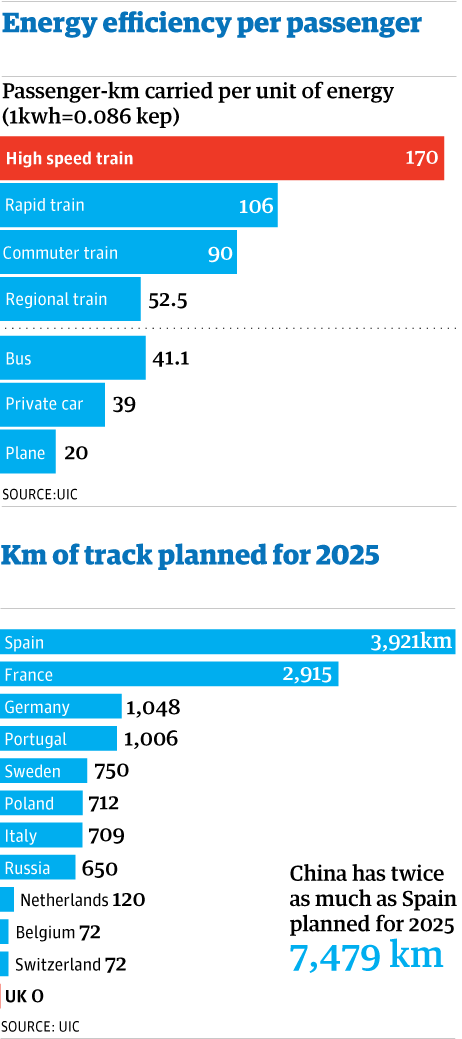
Meanwhile, Dan Milmo and Julian Glover at the Guardian report that Downing Street has announced plans which would replace domestic air travel with a high speed--250 mph--rail.
"The transport secretary, Lord Adonis, said switching 46 million domestic air passengers a year to a multibillion-pound north-south rail line was 'manifestly in the public interest'. Marking a government shift against aviation, Adonis added that rail journeys should be preferred to plane trips.

'For reasons of carbon reduction and wider environmental benefits, it is manifestly in the public interest that we systematically replace short-haul aviation with high-speed rail. But we would have to have, of course, the high-speed network before we can do it,' he said."

5. GEORGIAN AND RUSSIAN OFFICIALS TRY TO CALM WORRIES ABOUT NEW FIGHTING BREAKING OUT, SAAKASHVILI LAYS BLAME FOR 2008 CONFLICT ON MOSCOW IN OP ED

Jim Heintz at the Associated Press reports that senior officials in Tblisi and Moscow are walking back from rhetoric suggesting the possibility of renewed fighting.
"The deputy chief of Russia's general staff says Georgia is too weak after the war that devastated its military and caused an estimated $1 billion damage to the struggling country.

Georgia's national security adviser, however, says the danger of new fighting appears low because of 'preventive diplomacy' and because Russia knows a new war would undermine its influence among neighbors and rapprochement with the West."
In the meantime, Georgian President Mikheil Saakashvili has an op ed in today's Washington Post which lays the blame on last year's conflict squarely on Russia. Key excerpt:
"Russian provocations have not stopped; snipers in Russian-controlled areas have killed 28 Georgian policemen. In recent days, Moscow has engaged in a series of provocative acts and statements, echoing its prelude to last year's invasion. Even as the world watches, Moscow has vetoed monitoring missions from the United Nations and the Organization for Security and Cooperation in Europe. In violation of the cease-fire, Russia also denies European Union monitors access to the occupied territories.

Despite all this, and contrary to some expectations, Georgia has rebounded. Our democratic institutions are growing. Foreign investors are returning. The world should recognize that the kind of behavior Russia exhibited last August threatens not only Georgia but our entire region."
6. TURKISH PM MEETS WITH HEAD OF LARGEST TURKISH KURD PARTY, ANKARA SIGNS ON TO SOUTH STREAM

Nicholas Birch at the Wall Street Journal reports that Prime Minister Recep Tayyip Erdogan of Turkey met with the leader of the main Kurdish party in the country Wednesday, in what is the first meeting of the head of government with the party in the country's history.
"[M]any analysts say the new Kurdish opening is qualitatively different from anything that came before.

'For the first time ever, Turkish state institutions are working in synch to solve the problem,' said Henri Barkey, a Turkish expert at the Carnegie Endowment for International Peace, a Washington-based think tank.

The main catalyst for Turkey's new sense of urgency is Washington's announcement that it plans to pull its soldiers out of Iraq, Turkey's southern neighbor, by 2011.

The planned withdrawal has speeded up a rapprochement between Turkey and Iraqi Kurds, whose relations have been blighted for years by the PKK's use of Iraqi Kurdish mountains for its military bases."
"'There is an economic side to the rapprochement. "Turkey wants to use northern Iraqi gas for Nabucco,' says Bayram Bozyel, a Turkish Kurdish politician, referring to a pipeline project that the US and EU hope will help break a Russian stranglehold on European natural-gas supplies. 'And the [Iraqi] Kurds want to pump gas north.' That would be risky in the midst of a guerrilla war. The PKK claimed responsibility last year for a bomb attack on a major oil pipeline that passes through the same region."
Well worth reading.Today Russia and Turkey signed a deal to route Russia's South Stream pipeline through Turkey, per Charles Recknagel at RFE/RL.
"'The South Stream pipeline is a much needed project that is particularly important in the context of ensuring the energy security of the whole of Europe and the development of a broad range of ties between Russia and Turkey,' Putin said. 'Our negotiations showed that we can find solutions, together with the Turkish leadership, that open the way to new, large-scale energy projects.'"
7. IRAN LOWERS OFFICIAL PRICE OF OIL SOLD TO ASIA, QATAR LOWERS OFFICIAL PRICE OF OIL, FOLLOWING SAUDI ARAMCO REDUCTION ON PRICE TO ASIA

Yee Kai Pin at Bloomberg reports that the National Iranian Oil Company will reduce the official selling price of Iranian Light into Asia for the first time in four months.
"[NIOC] will set Iranian Light for September at 9 cents a barrel above the average of Persian Gulf benchmarks Oman and Dubai grades, based on a quarterly formula tied to prices set by Saudi Arabian Oil Co. The premium will be down $1.75, or 95%, from August and will be the smallest in seven months."
Meanwhile, Yee Kai Pin reports that Qatar Petroleum will also reduce the official selling price of Qatari crudes.
"The state-owned company cut its July price of Qatar Land crude oil to $65.50/b, down $5.60 from June, the official Qatar News Agency said on its Web site. The July price of Qatar Marine grade was reduced by $5.38 to $64.72/b. The cuts are the first in five months."
Earlier this week, Saudi Aramco cut its official selling price of Arab Light into Asia--see Daily Sources 8/3 #6. (The middle eastern national oil companies have different official prices for different regions of the world.)

8. DUBAI'S PROPERTY PRICE COLLAPSE SHARPEST IN WORLD

Kevin Brass at the New York Times reports that Dubai's property market is leading the world in price collapse.
"Dubai prices have dropped 32% in the last year and 40% in the last quarter, according to the latest edition of the Knight Frank Global House Price Index, released today.

Along with Dubai, Latvia (36%) and Singapore (23.8%) saw the largest declines since the first quarter of 2008, the property firm reports."
9. MEND LEADER INDICATES MOST NIGER DELTA MILITANTS WANT TO TAKE ADVANTAGE OF AMNESTY PROGRAM WHICH OFFICIALLY BEGAN TODAY; ANALYSTS DOUBT DIRE NIGERIAN PRODUCTION NUMBERS

Dulue Mbachu at Bloomberg reports that the leader of Nigerian militant group MEND indicated in a telephone interview that most fighters want to accept the government's amnesty program, saying "Like the government, we also want peace for there to be development."
"A government panel set up last year recommended raising the share of revenue going to states in the oil region to 25% from the current 13%. MEND wants the oil region to control 100% of oil revenue and pay a tax to the central government, according to the group’s spokesman, Jomo Gbomo.

'Whatever the people are demanding is also what I want,' Okah said, declining to commit to a figure.

The MEND leader said militant commanders in the oil region are divided between those who want money in exchange for weapons, as offered by the government, and those who want their political demands met.

'Personally I want a situation where weapons will be surrendered without cash,' Okah said. 'Because people can submit their weapons and buy new ones.'"
BBC News reports on the amnesty program which officially began today.
"Officials said gunmen who accept amnesty would be given 65,000 naira ($433; £255) a month for food and living expenses during the rehabilitation program, which runs from 6 August to 4 October.

But the main rebel group in the region, the Movement for the Emancipation of the Niger Delta (MEND), has not yet said it will take part in the amnesty.

'When we choose to disarm, it will be done freely, knowing that the reason for our uprising which is the emancipation of the Niger Delta from neglect and injustice has been achieved,' the group said in statement e-mailed to the AFP news agency.

The group, which called a temporary ceasefire last month after one of its leaders was freed from jail, is in talks with senior officials about the terms of any possible amnesty."


Tom Burgis at FT Energy Source reports that many believe that the current numbers for oil production coming from official Nigerian government sources are deliberately understated.
"On Wednesday afternoon, a Nigerian oil executive speaking in private snorted at the idea that production could be so low, suggesting 1.6m b/d was more accurate. Stewart Williams, principal sub-Saharan Africa analyst at energy consultancy Wood Mackenzie, puts production at 1.5m b/d to 1.6m b/d.

Why the discrepancy? Analysts with a cynical streak (easily acquired in a country so riddled with corruption and electoral violence) remark that it is in the state’s interest to create a sense of crisis as it tries to force through a comprehensive reform of the oil sector.

That the bill has merits--including the promise of greater transparency and restructuring the hopelessly ineffective state company--misses the point. Oil companies and the delta’s influential governors, who stand to get less cash as a result, are united in opposition to it.

The oil companies, too, are making data scarce at the moment. Like the government, they may have an interest in uncertainty as the negotiations continue."
10. BRAZILIAN SENATE'S INVESTIGATION INTO PETROBRAS TAX EVASION AND CORRUPTION CHARGES BEGIN TODAY, LULA INDICATES THAT HE BACKS FULL CONTROL OF PRE-SALT FOR PETROBRAS

Helder Marinho and Alexander Ragir at Bloomberg report that the Brazilian Senate's investigation into tax evasion and corruption allegations against state oil company Petrobras began today.
"An 11-member Senate committee, led by a member of [Brazilian President Luiz Inacio Lula da Silva's], Workers’ Party, is investigating the allegations. [CEO Jose Sergio] Gabrielli told Petrobras’s 74,000 employees in a July 14 letter that the company fired three employees after an internal investigation, and cooperated with the prosecutor’s office and federal police, into the bidding process for oil platforms.

Gabrielli, Chief Financial Officer Almir Barbassa and Haroldo Lima, the head of Brazil’s petroleum regulator, are among officials the committee in charge of the probe will invite to testify, according to a list senators handed to reporters during a session of the probe committee held today.

The officials will not be legally summoned or required to speak under oath, and the hearings will be arranged at their convenience, Senator Romero Juca said today in Brasilia. Juca, the head of the government coalition in the Senate, is responsible for leading the probe and writing its reports. Fired Petrobras executives will not be called to testify, he said."
"Since Lula first took office in January 2003, lawmakers have set up 25 committees to investigate everything from health insurance plans to piracy of industrial goods and corruption, according to CAC Consultoria Politica, a Brasilia-based political consultancy. While some ended without any conclusion, a 2005 investigation into allegations the Workers’ Party paid bribes to legislators in exchange for votes in Congress led to the resignation of Lula’s chief of staff, Jose Dirceu."
Natuza Nery at Reuters reported yesterday that Lula was to propose to Congress today that Petrobas be the exclusive operator of new offshore sub-salt oil fields. In June, resolutions were being introduced in the Brazilian Senate to create a new, 100% state-owned company, to lease Brazil's sub-salt fields--see Daily Sources 6/12 #11. (A majority of voting shares in Petrobras are owned by the government, but foreign investors own about 60% of its total outstanding stock.)

11. VENEZUELA TO PURCHASE SEVERAL DOZEN TANKS FROM RUSSIA, BANS COLOMBIAN STATE OIL COMPANY FROM PARTICIPATION IN ORINOCO BELT

Fabiola Sanchez at the Associated Press reports that President Hugo Chávez in a news conference yesterday said that Venezuela was going to purchase several dozen Russian tanks in a deal he wants to seal during a visit to Russia in September.
"'We're going to buy several battalions of Russian tanks,' Chavez said ...

Chavez's government has already bought more than $4 billion worth of Russian arms since 2005, including helicopters, fighter jets and Kalashnikov assault rifles.

The socialist leader called Colombia's plan to host more US soldiers a 'hostile act' and a 'true threat' to Venezuela and its leftist allies. He warned that a possible US buildup could lead to the 'start of a war in South America,' but gave no indication that Venezuela's military is mobilizing in preparation for any conflict."
"Cuban ex-President Fidel Castro supported Chavez in a column published Wednesday on the Cubadebate Web site, saying that 'Venezuela isn't arming itself against the sister nation of Colombia, it's arming itself against the (US) empire.'

'The threat ... is directed at all the countries' of South America, Castro wrote."
Meanwhile, Upstream online reports that Chávez told journalists yesterday that Ecopetrol, Colombia's national oil company, will have no role in developing the Orinoco belt.
"Chávez said ... that Colombia’s increased cooperation with the US to fight guerrillas and drugs is part of the US’s long- term plan to invade Venezuela and seize the Orinoco Belt."
"Ecopetrol was one of 19 companies that paid $2 million apiece for detailed information on the Carabobo block in the Orinoco Belt."
12. 24% OF OWNER-OCCUPIED HOMES UNDER WATER IN US, PERSONAL SAVINGS RATE INCREASE AHISTORICAL IN FACE OF REDUCED FEDERAL TAX RECEIPTS, AND AS UNEMPLOYMENT LOOKS SET TO CONTINUE TO RISE

Nick Timiraos at Developments reports that 24% of owner-occupied homes had mortgage debt which exceeded the market value of the home in question at the end of June, according to data from Equifax and Moody’s Economy.com.
"That number rises to 32% when looking at the share of homeowners with mortgages that don’t have equity left in their homes.

Overall, 16 million homeowners are 'upside-down' on their mortgages, up from 10 million, or 15% of owner-occupied homes, one year ago.

Nearly 10% of owner-occupied homes now have mortgage debt with loan-to-value ratios of at least 125%, and roughly half of those homes have mortgage debt with loan-to-value ratios of 150% or more."
In her most recent series of posts, Rebecca Wilder at News N Economics notes that a) this recession is different from past recessions in the sense that the personal savings rate is trending up:


And b) that the Daily Treasury Statement of August 4 "shows that the 1-month cumulative sum of income tax receipts (withheld plus paid taxes) is dropping at a 13% annual pace." She comments:
"This is the most up-to-date macroeconomic information out there, as most of the reports are 1-2 months old at the time of release. And the implication of this DTS is: that personal income and spending, which just released this week for June ... are likely to be weak into July."
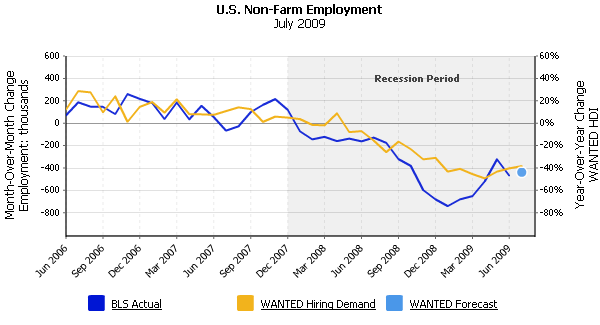
In that vein, Barry Ritholtz links to a graph by Bruce Murray, CEO of WANTED USA, plotting the actual month over month change in non-farm unemployment against year over year percent change in hiring demand:


13. RAIL TRAFFIC VOLUMES BOTTOMED OUT AT 18.9% BELOW LAST YEAR'S NUMBERS

The Railfax report is out today, and seems to indicate that rail traffic volumes have reached a bottom and holding steady at about 18.9% below their seasonal levels. Their chart for weekly loaded units in North America for the week ended August 1 in four week rolling averages:


Their chart for crushed stone and lumber and wood products, key components in construction, in four week rolling averages for North America:

Thursday, July 30, 2009

Daily Sources 7/30

1. DEBATE OVER SUSTAINABILITY OF CHINESE FISCAL STIMULUS HEATS UP: CHINA SHUTTERS LARGE NUMBER OF SMALL COAL SOURCED POWER PLANTS, ONE ARGUES THAT CHINA'S STRENGTH VIS-A-VIS US FISCAL SITUATION OVERSTATED, ANOTHER SAYS CHINESE ARE COMPLAINING OF THEIR OWN BEHAVIOR IN OTHERS, AND YET ANOTHER SAYS TRADE CONFLICTS ARE INEVITABLE

Vitaliy Katsenelson in Morningstar opines:
"Despite everything, the Chinese economy has shown incredible resilience recently. Although its biggest customers--the United States and Europe--are struggling (to say the least) and its exports are down more than 20%, China is still spitting out economic growth numbers as if there weren’t a worry in the world. The most recent estimate put annual growth at nearly 8%.

Is the Chinese economy operating in a different economic reality? Will it continue to grow, no matter what the global economy is doing?

The answer to both questions is no."
I interrupt Katsenelson's point to note that the Associated Press reports that
"[Chinese a]uthorities have closed [small coal-fired] power plants with a total of 7,467 generating units, meeting a previously announced goal 18 months ahead of schedule, said Sun Qin, deputy administrator of the Cabinet's National Energy Administration.

'This couldn't be done when power demand was very intense,' Sun said at a news conference. 'Due to this financial crisis, the power generation has slowed down, so we took this opportunity to accelerate the shutdown.'"
OK, but China depends on coal for about 70% of its electricity generation. As many have noted before, the GDP growth numbers published by China don't seem to be consistent with having taken so much power generation off line--see Daily Sources 5/14 #2. In late May, the China Electricity Council, or association, announced it would stop publishing electricity consumption numbers--see Daily Sources 6/8 #6. Back to Katsenelson:
"Millions of people have migrated to its cities, and now they’re hungry and unemployed. People without food or work tend to riot. To keep that from happening, the government is more than willing to artificially stimulate the economy, in the hopes of buying time until the global system stabilizes. It’s literally forcing banks to lend--which will create a huge pile of horrible loans on top of the ones they’ve originated over the last decade.

But don’t confuse fast growth with sustainable growth. Much of China’s growth over the past decade has come from lending to the United States. The country suffers from real overcapacity. And now growth comes from borrowing--and hundreds of billion-dollar decisions made on the fly don’t inspire a lot of confidence. For example, a nearly completed, 13-story building in Shanghai collapsed in June due to the poor quality of its construction.

This growth will result in a huge pile of bad debt--as forced lending is bad lending. The list of negative consequences is very long, but the bottom line is simple: There is no miracle in the Chinese miracle growth, and China will pay a price. The only question is when and how much."
In this vein, Robert Flint at the Wall Street Journal reports:
"Since the beginning of this week, things have happened quickly on the bubble front. China's banking regulator issued rules Monday governing loans for fixed-asset investments in its latest attempt to ensure bank lending boosts the real economy and isn't funneled into markets.

On Tuesday, two of China's major lenders were quoted as saying they would sharply slow credit growth in the second half. This prompted fears of a sudden tightening of credit that could choke off the loans which have so far eased the effects of the world recession. Shanghai equity prices plunged as much as 7.7% at one point Wednesday and closed 5.0% down on the day.

Later on Wednesday, the PBOC said it will emphasize market-based systems, rather than administrative controls, in guiding the appropriate growth of credit. PBOC Vice Governor Su Ning's comments appeared to signal the PBOC wasn't about to set loan curbs in the second half of this year to cool explosive lending growth, as it had done in 2008."
Meanwhile, David Pilling argues in the Financial Times:
"If anything, it is Beijing--some of whose officials now privately boast they have nothing at all to learn from the Great Spendthrift--that has the upper hand. China’s seeming financial hold over the US has been brought into sharp relief. Beijing has become prone to lecture Washington on the need to safeguard its $2,000bn reserves, the bulk of which are parked in US dollars.

It is wholly appropriate that Washington accords due attention to China, the most important emerging power since America itself. But there is also a danger of taking China too seriously. In compensating for past neglect, things could swing too far the other way. For all the euphoria about the G2--the Sino-US axis that, according to some breathless reckoning, is the only meaningful global forum--it is worth pausing to survey the facts.

For a start, China’s financial grip over the US is not as tight as many suggest. Far from a sign of strength, Beijing’s accumulation of vast foreign reserves is the side-effect of an economic model too reliant on exports. The enormous trade surplus is the product of an undervalued renminbi that has allowed others to consume Chinese goods at the expense of Chinese people themselves.

Beijing cannot dream of selling down its Treasury holdings without triggering the very dollar collapse it purports to dread. Nor are its shrill calls for the US to close its twin deficits--which would inevitably involve buying fewer Chinese goods--entirely convincing. Rather than exposing the superiority of China’s state-led model, the global financial crisis has laid bare the compromising embrace in which the US and China find themselves."
And Brad Setser at Follow the Money notes that Chinese policy makers complaining of US government profligacy might fairly be asked if they aren't the pot calling the kettle black.
"Before the crisis, the Fed’s balance sheet was around 6% of US GDP. Right now, it is around 15% of US GDP. A big increase no doubt. But the balance sheet of the People’s Bank of China (PBoC) is around 70% of China’s GDP. Foreign assets make up about 80% of the PBoC’s balance sheet--or around 55% of China’s GDP. And the PBoC’s estimated holdings of US treasuries and agencies are about equal to 30% of China’s GDP--a level that is far higher, relative to China’s GDP, than the US Fed is ever likely to achieve. The Fed expects its balance sheet to peak at roughly $2.5 trillion, or between 15% and 20% of US GDP."
His colleague Paul Swartz provides a graph of the annual change in PBoC and Fed holdings of treasuries and agencies as a percentage of GDP:


Michael Pettis at China Financial Markets notes that trade lawyers are reporting that they expect a slew of industries to ask the EU for protective tariffs next month.
"As I have been arguing for over a year, as unemployment around the world rises and as the necessary contraction in US net demand picks up pace, there was inevitably going to be a conflict with China as Chinese policymakers responded to the collapse in trade in the only way they could, by substantially stepping up investment. The result is that China’s trade surplus has contracted very slowly--much more slowly than the contraction in the US trade deficit--and the result was a huge squeeze on the tradable goods sectors around the world.

The fact that policymakers in Europe, China, Japan and the US seem to have no clue as to how difficult the transition for each of the other countries is likely to be, and so are doing not nearly enough to coordinate their response (in fact lecturing and finger waggling seem to the favorite forms of policy coordination), makes trade conflict almost a dead certainty. I don’t think there are necessarily any bad guys here--each country is desperately doing what it can to get itself out of this mess--but there is a lot of failed opportunity and I am pretty sure that the trade environment will continue to decline."
Pettis notes that China's share of the US trade deficit (excluding oil) has grown from 26% in 2000 to 83% so far in 2009.
"Perhaps as a consequence of a fiscal stimulus aimed at boosting investment and production, China’s share of the US trade deficit has grown significantly. Since the US trade deficit is shrinking quickly, this means that other exporters are getting killed. As I have argued for a while, this is not sustainable and will almost certainly cause trade tensions to erupt.

Does this mean China is behaving in a predatory way? I don’t thinks so. I have warned for a long time that it would be very difficult for China to make the necessary transition to a consumption-led economy quickly enough to accommodate the global adjustment taking place. Unless it is willing to see its economy collapse, there is simply no way China can reduce its negative net demand quickly enough to match the contraction in US demand and so avoid squeezing the hell out of the global tradable goods sectors. That is why policy coordination is so important, especially between China and the USD, and of course that is why I continue to be a pessimist. I do not think this policy coordination is taking place."
Well worth reading in full.

2. JAPANESE INDUSTRIAL PRODUCTION UP 2.4% IN JUNE FROM MAY, JAPEX TO BID ON DEVELOPING 400 KB/D IRAQI FIELD, AND JAPAN TO START BURNING CRUDE JATROPHA OIL FOR POWER GENERATION

Yoshiaki Nohara at Bloomberg reports that the Japanese Trade Ministry announced that industrial production increased by 2.4% in June from May.
"Output gained 8.3% last quarter from the first three months of 2009, the most since 1953. Companies said they also planned to increase manufacturing by 1.6% in July and 3.3% in August, the report showed.

The heads of the Finance Ministry’s regional bureaus yesterday raised their assessment of the economy for the first time in five years, based on a recovery in exports and industrial production."
Meanwhile, Ashutosh Joshi and Taiga Uranaka at Reuters report that Japan Petroleum Exploration Co (Japex) has entered into negotiations with Iraq to develop the East Baghdad field, according to Nikkei Business Daily.
"Japex has proposed developing the southern portion of the field, with initial output forecast at 400 kb/d, enough to satisfy about 10% of Japanese demand, the newspaper said.

It also said that rival companies are expected to submit bids as well."
Meanwhile, Takeo Kumagai at Platts reports that Biomass Japan, a biodiesel supplier, will begin supplying power companies with crude jatropha oil for direct burning.
"Biomass Japan is scheduled to start receiving some 700 mt/month of crude jatropha oil in Okinawa from August, mainly from its pilot plants in Indonesia, Malaysia, Thailand and India, the source said."
"Biomass Japan declines to officially disclose exact costs for its crude jatropha oil, but according to the source production from the foreign pilot projects will cost less than Yen 50-60/liter (53-63 cents/liter) on a CIF basis, less than equivalent domestic production.

Biomass Japan is currently expanding its overseas jatropha production capacities beyond Southeast Asia, with new operations in Africa due to come on stream in the next few months, the source said.

From December it will be receiving a total of 5,000 mt/month of crude jatropha oil from Africa, said the source, declining to give details of the projects."
Some power plants in Japan directly burn crude oil to generate electricity--generation from jatropha should reduce net greenhouse gas emissions. However, jatropha has recently been abandoned by some producers, in part because it turns out that it is a water hog--see Daily Sources 7/17 #5.

3. SOUTH KOREAN HOUSEHOLD SAVINGS DOWN FROM 25.2% IN 1998 TO PROJECTED 3.2% IN 2010

Blaine Harden at the Washington Post reports that
"The household savings rate in South Korea will have plummeted from a world-beating 25.2% in 1988 to a projected world low of 3.2% in 2010, according to the OECD. Government policies have encouraged borrowing, while Korea's aggressive culture has supercharged spending on signifiers of success, whether they be Ivy League degrees or Louis Vuitton handbags.

'It is not recognized as a virtue to save, not anymore,' said Lee Sun-uk, an investment adviser for an office of Samsung Securities that is located in a wealthy neighborhood of Seoul. 'To maintain a certain status, people are willing to spend, even if their incomes have declined.'

In the past decade, average savings per household have plunged from about $3,300 to $525. On a percentage basis, it is the steepest savings decline in the developed world. Meanwhile, household debt as a percentage of individual disposable income has risen to 140%, higher than in the United States (136%), according to the Bank of Korea."


4. UK HOME PRICES UP 1.3% IN JULY FROM JUNE IN THIRD CONSECUTIVE MONTHLY INCREASE, UK WORRIED ABOUT OIL PRICE EFFECT ON RECOVERY

Real Time Economics reports that the UK Nationwide Building Society said the average home price rose 1.3% in July from June in the third consecutive month of increase.
"House prices have a 'reasonable chance' of ending 2009 up for the year, the Nationwide Building Society said."
Kate Mackenzie at FT Energy Sources reports that following news stories indicating that the Financial Services Authority has determined that speculation is not the source of the 2007-8 oil price spike, it is
"calling in big oil companies, hedge funds, banks and oil traders next week for a closed-door discussion on 'whether the current arrangements [in the oil market] remain appropriate'."
"[T]he FSA said representatives from the Treasury will also be at the meeting, which raises another possibility of what is driving this newfound concern ... over commodities. The UK government has recently aired concerns that high oil prices could threaten economic recovery. Alistair Darling, the chancellor, made this clear when he told the FT that high and volatile oil prices 'has the potential to be a huge problem as far as the recovery is concerned'."
5. EU DELEGATION IN TURKMENISTAN TO DISCUSS ENERGY COOPERATION

Upstream online reports that the EU has sent a delegation to Turkmenistan to discuss energy cooperation.
"'Developing and deepening mutually beneficial and equal ties with EU countries is a priority in (Turkmenistan's) foreign policy strategy,' Reuters quoted a report published by state news agency Turkmen Khabarlary as saying, citing a Foreign Ministry statement.

Turkmen President Kurbanguly Berdymukhamedov said this month his country was ready to supply gas through Nabucco, a pipeline designed to ease Europe's dependence on Russian gas."
6. IRAQ FACING DUSTBOWL ENVIRONMENT

Liz Sly at the Los Angeles Times reports on the emerging environmental catastrophe in Iraq.
"Decades of war and mismanagement, compounded by two years of drought, are wreaking havoc on Iraq's ecosystem, drying up riverbeds and marshes, turning arable land into desert, killing trees and plants, and generally transforming what was once the region's most fertile area into a wasteland.

Falling agricultural production means that Iraq, once a food exporter, will this year have to import nearly 80% of its food, spending money that is urgently needed for reconstruction projects.

'We're talking about something that's making the breadbasket of Iraq look like the Dust Bowl of Oklahoma in the early part of the 20th century,' said Adam L. Silverman, a social scientist with the US military who served south of Baghdad in 2008.

So fragile has the environment become that even the slightest wind whips up a pall of dust that lingers for days."
"Chronic electricity shortfalls also have played a role. People chop down trees for firewood, leaving more bare land, and the shortage of power has made it difficult to pump water through the irrigation channels that had sustained fertile lands far beyond the rivers. Compounding the already dire shortages, power stations have been forced to shut down for days at a time because they lack water.

Then came the regionwide drought that has dramatically depleted the amount of water available. Last year's rainfall was 80% below normal; this year only half as much rain fell as usual."
A must read.

7. US WILL SANCTION ERITREA IF IT DOESN'T HALT SUPPORT FOR SOMALI MILITANTS

BBC News reports that US envoy to the UN Susan Rice told a Congressional Committee that Eritrea will face sanctions if it does not put an end to support for Islamists fighting the transitional federal government in Somalia.
"In April the African Union, another backer of the Somali government, also called for sanctions over the issue.

But Eritrean officials have repeatedly denied the allegations, calling them a 'fabrication' of US intelligence.

The country suspended its membership of the AU in protest at the sanctions call in April."
8. GHANA'S FISCAL SITUATION IMPROVES ON OIL FINDS


Frontier Markets reports that
"Ghana’s Eurobonds have surged 93% since last November and may continue to rise given the country’s increasingly attractive fiscal position due in part to the production of a new oil field that is expected to put it in the world’s top 50 oil producers and to expand growth from an estimated 4.1% this year, to 6.1% in 2010 and 10.5% the year after. The yield on the 8.5% dollar-denominated bonds due 2017 fell from 9.83 to 9.73 percent during trading on Tuesday."
Could be a blessing for Ghanaians, depending on how the government manages it. Crossing my fingers.

9. MORE ON AFRICAN FARMLAND PURCHASES FROM FOREIGN INVESTORS AND GOVTS

Horand Knaup and Juliane von Mittelstaedt at Der Spiegel have a fascinating update on the rush to purchase African farmland story, with a number of additional details and interesting observations. Some key excerpts:
"'According to most prognoses, there could be 9.1 billion people living on earth in 2050, about two billion more than today. In the coming 20 years alone, worldwide demand for food is expected to rise by 50%. "These are pessimistic prospects,' says [an] OECD [analyst]."
"Food is becoming the new oil. Worldwide grain reserves dropped to a historic low at the beginning of 2008, and the ensuing price explosion marked a turning point, just as the oil crisis did in the 1970s. There were bread riots around the world, and 25 countries, including some of the biggest grain exporters, imposed restrictions on food exports."
"If the investors are successful, they could achieve what development agencies have been unable to do in the past few decades: reduce the hunger that now afflicts more people than ever, namely one billion worldwide. In the best case scenario this could be a win-win situation with profit for the investors and development for the poor.

It is not just bankers and speculators, but also governments that are acquiring land in other countries, seeking to reduce their dependence on the world market and imports. China is home to 20% of the world's population, but it has only 9% of the world's arable land. Japan is the world's largest corn importer, and South Korea is the second-largest. The Persian Gulf States import 60 percent of their food, while their natural water reserves are sufficient to support only another 30 years of agriculture."
"Klaus Deininger, an economist specializing in land policy at the World Bank, estimates that 10 to 30% of available arable land could be up for grabs, although only a fraction of the potential number of lease and sale agreements have been signed. 'There was a huge jump in 2008, when plans and applications in many countries more than doubled, in some cases tripled.' In Mozambique, says Deininger, foreign demand is more than double the existing cultivated farmland, and the government has already allocated four million hectares to investors, half of them from abroad."
"Saudi Arabia is one of the biggest and most aggressive buyers of land. This spring, the king attended a ceremony where he took delivery of the first export rice harvest, produced exclusively for the kingdom in hunger-stricken Ethiopia. Saudi Arabia spends $800 million a year promoting foreign companies that cultivate 'strategic field crops' like rice, wheat, barley and corn, which it then imports. Ironically, the country was the world's sixth-largest wheat exporter in the 1990s. But water is scarce and the desert nation aims to preserve its reserves. Exporting food also means exporting water."
"But many of the countries where land is being snapped up--Kazakhstan and Pakistan, for example--suffer from water shortages. Sub-Saharan Africa has adequate natural water reserves, but the only country in the region currently producing a food surplus is South Africa. Most countries, on the other hand, are importers and, with rapidly growing populations, will likely be even more dependent on food imports in the future. Can such countries truly become important food producers?

Audinet, the IFAD expert, knows the risks. 'The way these agreements are structured can harm the country and the farmers in the long term, robbing them of their most important asset: land.' Olivier De Schutter, the UN Special Rapporteur on the right to food, warns: 'Because the countries in Africa are competing for investors, they are undercutting each other.' Some contracts, says De Schutter, are barely three pages long--for hundreds of thousands of hectares of land."
The other must read of today.

10. RUSSIA INKS DEEPWATER EXPLORATION DEAL WITH CUBA

The Associated Press reports that Russian firm Zarubezhneft has signed four accords with the Cuban national oil company--Cubapetroleo--to explore for crude in Cuban deep waters.
"Moscow extended the island $150 million in credit for construction materials and farm machinery, state media said Wednesday.

The credit will give Cuba more time to pay for Russian equipment shipped to areas most affected by three hurricanes that caused more than $10 billion in damage last summer."
11. MEXICAN FEDERAL POLICE RAID PEMEX HEADQUARTERS


Robert Campbell at Reuters reported yesterday that the Mexican police raided the headquarters of national oil company Pemex "in an investigation into rampant fuel theft that costs the company more than $2 billion a year."


12. SEASONALLY-ADJUSTED INITIAL UNEMPLOYMENT CLAIMS DOWN 8,250 TO 559,000; FORECLOSURE ACTIVITY BECOMING A FUNCTION OF INCREASING UNEMPLOYMENT; HARLESS ARGUES THAT INCREASED US SAVINGS RATE HERE TO STAY

The Department of Labor announced today that
"In the week ending July 25, the advance figure for seasonally adjusted initial claims was 584,000, an increase of 25,000 from the previous week's revised figure of 559,000. The 4-week moving average was 559,000, a decrease of 8,250 from the previous week's revised average of 567,250.

The advance seasonally adjusted insured unemployment rate was 4.7% for the week ending July 18, unchanged from the prior week's unrevised rate of 4.7%."
Yves Smith at naked capitalism observes:
"A new dynamic appears to be emerging on the housing front. Heretofore, foreclosures were strongly correlated with where the mania had been most acute. California, Florida, and Arizona in particular showed dramatic declines in prices. But now as those markets have corrected to a considerable degree, foreclosure activity is now starting to be a function of increasing unemployment."
And Andy Harless at Employment, Interest, and Money thinks that an increased rate of savings in the US is here to stay, which should have the consequence of reducing the share of consumption as GDP:
"Undoubtedly the savings rate will fall somewhat as the degree of financial distress declines, but I think there’s a good case to be made that much of the increase is permanent.

For one thing, from the point of view of households, 'financial distress' may be extremely slow to lift. If the Japanese experience is any guide, it is a very slow process to get a severely distressed banking system to start lending normally again, and it’s not clear that things are going to be any easier for the US. Meanwhile, most forecasts expect the unemployment rate to remain quite high for several years. It could take 3 years, or 5 years, or 10 years, or 20 years before the financial distress lifts.

Granted, even 20 years is not forever, and 3 years is certainly not forever, but it’s long enough to stop thinking about household behavior as being continuous over time. We can reasonably surmise that, even without so much financial distress, the savings rate would have trended upward over time. Presumably households would gradually have come to recognize that they weren’t saving enough. (Can zero be anywhere near enough?) And as baby boomers’ children settle into their own careers, they would cease to be a drag on their parents’ savings, and at the same time those parents would have to start worrying seriously about retirement. The financial distress messed up this scenario (or maybe just speeded it up), but the underlying trend should still be going on 'beneath the surface.' By the time the distress lifts, there will be other reasons for the savings rate to be higher than it was in 2006.

That argument is rather speculative, I admit, but there are more solid reasons to expect the savings rate to remain high. While the current, comparatively high savings rate may reflect the effects of financial distress, the low savings rates of the 2005-2007 period did not merely represent the absence of financial distress. What is the opposite of financial distress? Financial ease? The degree of financial ease during that period (which was the culmination of a process that had been building on and off for a couple of decades) was well beyond normal, and well beyond what we can expect in the coming years, even if recent sources of distress are resolved fairly quickly. Consumption was supported (and aggregate saving accordingly reduced) by a fountain of credit that will not re-emerge with such force unless people in Washington and on Wall Street make some big mistakes."
Well worth reading in full. (I would note that if past performance is any indication of future performance, however, that Washington and Wall Street are likely to make some big mistakes.)

13. NEW STUDY SUGGESTS THAT MARCELLUS SHALE FORMATION COULD PRODUCE AS MUCH AS 489 TRILLION CUBIC FEET OF NATURAL GAS,

Rick Stouffer at the Pittsburgh Tribune-Review reports that a new study by Penn State University geosciences professor Terry Engelder projects that 489 trillion cubic feet of natural gas could be produced from the Appalachian Basin's Marcellus Shale formation.
"Engelder said the estimates are based on natural gas flow rates from wells drilled by major Marcellus Shale developers, which have been above expectations."
At the current rate of consumption, 489 trillion cubic feet represents more than 19 years of total US natural gas demand. Incidentally, natural gas is a major feedstock for the production of ammonia for use in fertilizer production.

Monday, June 29, 2009

Daily Sources 6/29

1. IEA REVISES GLOBAL OIL DEMAND DOWN TO AN AVERAGE ANNUAL RATE OF 0.6% FROM 2008-14

Carola Hoyos at the Financial Times reports that the IEA has cut its forecast for incremental global oil demand from 2008-14 to an average annual rate of 0.6% or 540 kb/d, bring total consumption to 89 mb/d from 85.8 mb/d.
"This latest forecast is 3.3 mb/d lower than the previous forecast for 2013 volumes. If the agency’s most pessimistic economic scenario proves correct, oil demand could contract, with consumption falling to 84.9 mb/d by 2014, it said in a report."
Managing Director Nobuo Tanaka suggested that the current environment makes forecasting especially difficult and noted that the data on which the forecast was made, for April, is already old.

2. JAPANESE LNG IMPORTS DOWN 19.6% IN MAY FROM APRIL, BUT INDUSTRIAL PRODUCTION UP 5.9% IN MAY FROM APRIL--BOTH ARE DOWN 18.8% AND 30% FROM MAY 2008, RESPECTIVELY

Jonty Rushforth at Platts reports that Japan imported 4.24 million metric tons of LNG in May, down 18.8% from May 2008 and "19.6% from April, when Japan imported 5.27 million metric tons." (The Platts story includes a table of imports by source, month over month and year over year.) It is interesting in the context of the report released Sunday by the Ministry of Economy Trade and Industry (METI) which showed industrial production up 5.9% in May from April, though still down 30% year over year, as per Jake at Econopix. Their chart:


There has evidently been a rebound in production of passenger cars, which account for about 8.5% of the industrial production index. Worth a look.

3. NDRC RAISES GUIDELINE PRICES ON DIESEL & GASOLINE (SLIGHTLY LESS IN THE SOUTH)

Bloomberg reports that the National Development and Reform Commission announced yesterday that it will raise the price of diesel and gasoline today by as much as 11%. Prices for both will be lifted by 600 renminbi a metric ton ($87.80 or roughly $11.71/b ~ $0.28/gallon).
"Today’s price increases will vary by city and region, according to the NDRC’s statement.

In Beijing, the new ceiling price per ton for the retail grade of gasoline that meets euro III standards, known as 90 octane, will be 7930 yuan a ton (~$1,162/ton ~ $136.71/b ~ $3.26/gallon), while the ceiling price in southern Guangdong province is set at 7795 yuan (~1,142/ton ~ $134.38/b ~ $3.20/gallon)."
Guangdong is the center of economic growth in China, if I understand correctly. The NDRC is raising prices in part due to the surge in demand for cars, driven by the stimulus program.

4. PBOC GOVERNOR SAYS CHINESE RESERVE POLICY WILL NOT CHANGE SUDDENLY

Stephanie Phang at Bloomberg reports that People’s Bank of China Governor Zhou Xiaochuan told journalists today that "Our foreign-exchange reserve policy is always quite stable. There are not any sudden changes." This follows the release of the bank's review on Friday, which appeared to reiterate formally the call for an alternative to the dollar--see Daily Sources 6/26 #1. Yves Smith at naked capitalism comments:
"This certainly looks like a retreat, although Zhou may simply be clarifying the difference between long term policies and immediate plans. But that still begs the question of when and how the transition between the two comes into play.

The tension may also reflect the need to posture aggressively before a domestic audience without unduly rattling markets. But it may also result from the need to appease certain interests within the government. A New York Times article last year explained that as the central bank took foreign exchange losses as the RMB rose, it may have to go hat in hand to the finance ministry, which opposes many of the central bank's policies, particularly on the dollar ...."
5. CHINA PASSES NEW STATISTICS LAW

Andrew Batson at China Journal reports that on Saturday China passed a new law to take effect next year which will stiffen penalties for falsifying social and economic data.
"Recently, officials of the National Bureau of Statistics have become more forthcoming about deficiencies in their data, and have also started publishing a more detailed accounting of economic growth. And this year’s economic census, a quinquennial attempt to obtain basic information on every company of economic significance in the nation, is the centerpiece of the bureau’s effort to build up more accurate figures through the use modern survey techniques."
Batson quotes some examples of the misreporting the government is trying to eradicate:
"* In 2001, a township government in Liaoning province in 2001 instructed the villages it oversees to report quarterly economic indicators that were precisely one-fourth of the annual target, to ensure that the target was met.

* In one town near Ningbo, Zhejiang province, a party secretary reported a total industrial output of 463 million yuan in 2001, which was later determined to be 76% more than the actual figure.

* The leaders of one town near Chongqing in 2004 altered the statistical reports of local companies they sent to higher authorities, in one case changing output of 5 million yuan to 8 million yuan, and in another adding a zero to make output of 3 million yuan into 30 million yuan.

* Over-reporting is not confined to eager officials: one company in Wenzhou, Zhejiang province reported output of 32.15 million yuan in 2003, which was then discovered to exceed the actual figure by 71%."
The post includes a number of links to sources--worth a look.

6. NATO & RUSSIA RESUME OFFICIAL TIES; RUSSIA STARTS WARGAMES IN THE CAUCASUS, A FEW WEEKS AFTER NATO WARGAMES IN GEORGIA

The Associated Press reports that NATO and Russia have resumed ties after NATO suspended them in reaction to the Georgia conflict.
"Russian Foreign Minister Sergei Lavrov met his counterparts from NATO's 28 member nations on the western Greek island of Corfu ahead of a broader informal meeting of ministers from the 56-nation Organization for Security and Cooperation in Europe.

Mr. Scheffer described the talks as 'open and constructive, which means we did not try to paper over our differences on Georgia, for example. But we agreed not to allow those agreements to bring the [NATO-Russia Council] to a halt.'

He said the renewed military contacts would involve meetings of the chiefs of staff of Russia and NATO countries.

The meeting in Corfu, which came as President Barack Obama and Russian President Dmitry Medvedev prepare to hold a summit next week, reflected the trend toward improved relations with Russia."
Meanwhile, Michael Schwirtz at the New York Times reports that Russia has begun war games using 8,500 troops from all branches of the armed services in the Caucasus region.
"The event is also occurring a few weeks after NATO concluded its own exercises in Georgia, drawing complaints from the Russians.

'The Russian exercises, given the timing, are a definitive response,' said Dmitri O. Rogozin, Russia’s envoy to NATO, Interfax reported. 'We are conducting them to ensure the defensive capabilities of Russia in those areas where we see threats.'

Georgia on Monday expressed worry about Russian exercises so close to its borders.

'These exercises are a source of concern because they involve an unprecedented number of servicemen and the newest military hardware of Russia,' said Alexander Nalbandov, Georgia’s deputy foreign minister, Interfax reported. 'We hope that the events of last August, when the Russian army invaded Georgia and occupied its lands, will not repeat.'"
7. GAZPROM SEALS PURCHASE OF 500 MILLION CU M OF NAT GAS FROM AZERBAIJAN IN 2010, SAYS IT WILL RECEIVE PREFERENTIAL TREATMENT ON SHAH DENIZ GAS

Lyubov Pronina and Lucian Kim at Bloomberg report that Russian President Medvedev sealed a deal in Baku today for Gazprom to purchase 500 million cubic meters of natural gas from Azerbaijan next year.
"Gazprom will get priority treatment when the State Oil Co. of Azerbaijan determines the buyers for the [Shah Deniz] offshore field, said Alexei Miller, chief executive officer of the Russian company. Azerbaijan’s gas production will rise 11% to 30 billion cubic meters next year, Aliyev said."
Shah Deniz is a key source of potential supply for the Nabucco pipeline project--the alternative possibility of sourcing from Iran looks particularly politically difficult at the moment.


This follows the news Friday that former German foreign minister Joschka Fischer has been signed on as a consultant to Nabucco--see Daily Sources 6/26 #3.

8. INDIAN REFINERS RUN 2.4% MORE CRUDE IN APRIL, DOWN 4.3% FROM MAY 2008

Vandana Hari at Platts reports that Indian refiners ran 12.77 million metric tons (~3.02 mb/d) of crude in May, up about 2.4% from April, but down 4.3% from May 2008.
"The utilization rate against the country's total installed refining capacity was 102.5% in May, versus 107.1% a year ago.

Between January and May, Indian refiners have run around 65.57 million metric tons of crude, roughly 1.5% lower from a year ago. The trend contrasts with a 3.6% year-on-year increase in 2008 crude throughput over 2007."
Reliance started operating the Jamnagar addition of 500 kb/d capacity on Christmas--see Daily Sources 1/7 #3.

9. IRAQI VP TO BOYCOTT TUESDAY AUCTION, OIL EXPORTS UP 80 KB/D IN MAY (THE ADDT'L OIL CAME FROM THE NORTH), AND THE CABINET WILL NOW DELAY RATIFICATION OF THE OIL AUCTIONS TOMORROW INDEFINITELY

Ahmed Rasheed at Reuters reports that Iraqi Vice President Tareq al-Hashemi has announced on his website that he will boycott the auction on Tuesday to award concessions for eight oil and gas fields.
"'There are many existing reservations over this vital issue concerning Iraq's oil resources,' Hashemi said in a letter, posted on his website, to Oil Minister Hussain al-Shahristani.

He urged the minister to 'hold off on awarding bids to the winning companies and give parliament enough time to study these bids,' said the letter, released by Hashemi's office."
Ben Lando at the Iraq Oil Report notes that Iraqi oil exports grew to 1.9 mb/d in May from 1.823 million in April.
"In the south, where most of Iraq’s production and exports are located, May was a down month, exporting only 1.38 mb/d compared to 1.413 mb/d in April. In the north, however, exports increased to 522.6 kb/d from 410 kb/d in April."
Meanwhile, Faleh al-Khayat at Platts reports that the oil ministry said today that it will not announce the winners of the auction tomorrow, and instead only provide the names of the bidders and a score card of their bidding parameters.
"The cabinet may refer the contracts for approval by the parliament if it
deems this as necessary, marking another new element in the process.

As a result, the August 15 deadline for contract ratification by the council of ministers has been pushed back indefinitely, senior sources close to the licensing department said.

'The winner will not be declared by the score of each bidder and the name of the bidder will be declared,' said one source.

The formula to determine the winning bid has also been changed whereby the ministry will give more weight to the incremental production rather than the remuneration fee submitted by each of the bidding companies, the sources said."
10. ISLAMIC EMIRATE OF AFGHANISTAN THINKS OBAMA IS A BIGGER THREAT TO THE JIHADIST MOVEMENT THAN BUSH

Thomas Hegghammer at jihadica reports that the main story of the July issue of the Arabic-language magazine of the Islamic Emirate of Afghanistan argues that the Obama administration is more dangerous to al-Qaeda than the Bush administration was. The primary reason is that Bush, through foolhardy policies, did much to undermine American power, in language the Obama administration has already disavowed. However, the writer argues that the policies, in effect, will not change. I couldn't agree more insofar as the writer believes that Obama will work to protect the national interest of the US, something that the Bush administration seemed to abandon. (The president's ability to wield soft power is generally more unbounded than hard power--I suggested, as did others, that Obama's credibility advantage will present the largest challenge to our enemies in a piece in March 2008:The Geopolitical Consequences of the Candidates.) Hegghammer's post is worth reading in full.

11. ISRAEL NOT TO PURCHASE LCS'S FROM LOCKHEED MARTIN

Galrahn at Information Dissemination reports that Israel has decided not to go ahead with plans to purchase a number of Lockheed Martin's Littoral Combat Ship (or LCS). Galrahn notes:
"The interesting part of this story isn't necessarily that Israel doesn't want to buy the LCS anymore, and that is a big deal. The interesting thing is that the US would fund the LCS, but not the MEKO [built by the Hamburg-based ThyssenKrupp Marine Systems (TKMS)], through FMS [the Financial Management Service bureau of the Treasury] grant money. By choosing to buy the MEKO, Israel will try to fudge the system and get some of the parts paid for by buying US, with US funding."
12. FAO POLICY BRIEF ON INTERNATIONAL INVESTMENTS IN THE AGRICULTURAL SECTOR IN AFRICA SUGGESTS CONCERN A LITTLE OVERPLAYED

Denis Drechsler and David Hallam at VoxEU argue that concern regarding foreign acquisition of African farmlands is somewhat misplaced. They note that official development assistance going to agriculture has been on a downward trend since 1995:


Key findings:
"* Investments have increased
* Deals seek access to resources, not markets
* Main form of investment: land purchase or long-term lease
* Share of total land assets owned by foreigners is small
* Major investors: Gulf States, China, Republic of Korea
* Main target region: Africa
* Investors: mostly private sector, but governments involved
* Investment partners in host countries: mainly governments
* New focus: production of basic foods and animal feed"
Worth a look.

13. HONDURAN PRESIDENT OUSTED BY MILITARY, HONDURAN SUPREME COURT AND CONGRESS SUPPORT THE MOVE, THE REST OF THE WORLD EXPRESSES CONCERN

William Booth and Juan Forero at the Washington Post report that soldiers forcibly removed President Manuel Zelaya from the Honduran presidential palace yesterday and put him on a plane to Costa Rica.
"Zelaya was removed from office as Hondurans prepared to vote Sunday in a nonbinding referendum asking them whether they would support a constituent assembly to rewrite the constitution. Zelaya's critics said he wanted to use the referendum to open the door to reelection after his term ends in January 2010, an assertion that he denied.

The referendum--which US officials described as more of a 'survey' than a true vote--was condemned by broad swaths of Honduran society as an obvious power grab. The Honduran Supreme Court called the referendum unconstitutional, and leaders of Zelaya's own party denounced the measure."


Both the Honduran National Congress and the Supreme Court voiced support for the move by the military to oust Zeyala. The Honduran military broke off contact with the US following the coup. (The Post article is worth reading in full.) Condemnation of the move was widespread, coming from the OAS to Venezuela to Cuba to the US.

15. CANADA PASSES SUBSIDY FOR PAPER SECTOR IN RESPONSE TO (ALTERNATIVE FUELS) SUBSIDY FOR US PAPER SECTOR

The Wall Street Journal's editorial board notes that in 2007 Congress extended a $0.50 credit for every gallon of a blend of traditional and alternative fuels used to a broad spectrum of corporations, and it turned out that "'black liquor,' a carbon-rich substance the paper industry has used for decades to power its mills, qualified.
"All the paper industry had to do was blend some fossil fuel in with their alternative fuel and--voila!--billions of dollars in federal subsidies were within reach. So they did."
The Journal notes that the US paper industry is set to collect $6 billion in tax credits in 2009, enough to reduce the cost of paper products by 25%.
"Not surprisingly, Canadian paper companies are miffed at this subsidized windfall to their competition. Now they've gotten their Parliament to do something about it. Following the two-wrongs-make-a-right logic of trade wars, Canadian lawmakers recently passed a subsidy worth $882 million for their domestic paper industry."
Worth reading in full.

16. BANK FAILURES UP IN US, CONCENTRATED IN GEORGIA, BUT CONSOLIDATION LIKELY HAS A WAYS TO GO

Rebecca Wilder at News N Economics reports that bank failures are up slightly in 2009 from 2008, but the sector's consolidation has yet to see the number of failures experienced during the S&L crisis. Her graph:

"Notice that roughly 20% of the bank failures in 2008 and 2009 have been in Georgia, or as Camden Fine says to the WSJ, 'Georgia is basically the Chernobyl of banking right now; it's radioactive down there'. And according to the Wall Street Journal, the failures in Georgia have only just begun ..."
Worth reading in full.

17. COLORADO PASSES NEW LAWS PERMITTING RAINWATER HARVESTING

Kirk Johnson at the New York Times reports that two new laws have been passed in Colorado which allow people with private wells to legally collect rainwater, formerly they had only been allowed to do so if they possessed the water rights on their property.
"State water officials acknowledged that they rarely enforced the old law. With the new laws, the state created a system of fines for rain catchers without a permit; previously the only option was to shut a collector down.

But Kevin Rein, Colorado’s assistant state engineer, said enforcement would focus on people who violated water rules on a large scale.

'It’s not going to be a situation where we’re sending out people to look in backyards,' Mr. Rein said.

Science has also stepped forward to underline how incorrect the old sweeping legal generalizations were.

A study in 2007 proved crucial to convincing Colorado lawmakers that rain catching would not rob water owners of their rights. It found that in an average year, 97 percent of the precipitation that fell in Douglas County, near Denver, never got anywhere near a stream. The water evaporated or was used by plants.

But the deeper questions about rain are what really gnawed at rain harvesters like Todd S. Anderson, a small-scale farmer just east of Durango. Mr. Anderson said catching rain was not just thrifty--he is so water conscious that he has not washed his truck in five years--but also morally correct because it used water that would otherwise be pumped from the ground."

Wednesday, June 24, 2009

Daily Sources 6/24

1. JAPANESE EXPORTS IN MAY DOWN 40.9% YOY, 0.3% MOM; CHINESE GDP GROWTH NOT TRANSLATING INTO MORE IMPORTS; CHINA'S NBS PROVIDES QUARTERLY ESTIMATES OF GDP GROWTH

Jason Clenfield at Bloomberg reports that Japanese exports fell by 40.9% in May from a year previous, a sharper decline than the 39.1% seen in April. Exports fell by 0.3% in May from April.
"Shipments to China, Japan’s biggest trading partner, fell 29.7%, more than April’s 25.9%. Exports to Asia slid 35.5% from 33.4% a month earlier.
...
Imports slid 42.4% from a year earlier, and the trade surplus narrowed 12.1% to ¥299.8 billion (~ $3.1 billion), the Finance Ministry said."
Brad Setser at Follow the Money notes:
"US exports to China are also down (15.6% y/y, through in the first four months of 2009, though a bit less in April itself). The eurozone’s exports to China are also down--though the 8% or so fall y/y fall in the eurozone’s exports to China seems a bit more modest than the fall in Japan’s exports to China.

China’s economy may have expanded over the last year, but that expansion clearly hasn’t fed through into more Chinese demand for US, European or Japanese goods."
In the meantime, Andrew Batson at China Journal reports that Guo Tongxin, an official at the National Bureau of Statistics, provided GDP estimates on a quarterly basis in contrast to Beijing's traditional practice of providing year on year data.

"The new estimates from Guo, which only cover 2008 and early 2009, may be a surprise for skeptics who suspect that China’s statistics officials are only capable of reporting nice-sounding numbers. These figures actually show the slowdown in the fourth quarter of last year was even sharper than most outside economists had believed.

Economists surveyed by the Journal in February had, on average, estimated that fourth-quarter GDP expanded at an annualized rate of 2.1%. Guo cited what he called a preliminary estimate that fourth quarter GDP grew 0.1% from the previous quarter, equivalent to an annualized rate of just 0.4%.

The headline year-on-year growth rate announced at the time, by comparison, was 6.8%--a gap that clearly shows how quarterly and annual growth rates can give very different pictures of economic turning points."
2. THE US AND EU LODGE WTO COMPLAINT AGAINST CHINA ALLEGING THAT BEIJING HAS BLOCKED THE EXPORT OF RAW MATERIALS

Gabriella Stern at China Journal reports that the EU and the US have filed a WTO complaint against China. The complaint alleges:
"that Beijing unfairly helps domestic makers of steel, aluminum and chemicals, among others, by effectively blocking overseas exports of raw materials (eg. the ingredients that go into steel, aluminum and chemicals)."
Stern adds:
"Brian Blackstone points out the irony that the US government is complaining about China holding back on exports when Washington’s usual stance is to complain about China flooding the world with its exports. There are, indeed, many ironies in the messy world of trade disputes. This is the Obama administration’s first WTO complaint against China and the timing is sensitive, given America’s deep dependence on Beijing’s purchases of US sovereign debt--and also the global importance of a Chinese economic recovery spurred by that government’s thus-far-effective stimulus program."
3. BEIJING SUSPENDS REFORESTATION EFFORT ON FOOD SECURITY CONCERNS

Jonathan Watts at the Guardian reports that Beijing has suspended the reforestation of marginal arable land on fears of food shortages.
"Lu Xinshe, deputy head of the ministry of land and resources, said the country was struggling to hold the 120 million hectare 'red line' considered the minimum land areas needed for food self-sufficiency.
...
By the end of last year, the amount of arable land in China had decreased to within 1% of the 'red line.'"
In November, Zhang Xiaoqiang, Vice Chairman of China's National Development and Reform Commission, set as a national strategic priority domestic production of 95% of their grain consumption through 2020--see Daily Sources 11/14 #5. China was facing the worst drought it has seen since 1951 at the beginning of the year--see Daily Sources 2/9 #13--I have no idea what the rainfall situation is now.
"[S]elf-sufficiency [of 95%] requires the production of 500 million metric tons of grain a year. To maintain this level, prime minister Wen Jiabao has said the state would increase spending on agricultural production by 20%, well above inflation."
4. GERMAN HOUSEHOLD CONSUMPTION UP IN Q1; CABINET ADOPTS FISCAL PLAN WITH DEFICIT SPENDING

Eurointelligence reports that German household consumption appeared to rise in the first quarter, per FT Deutschland.

"Why should this be so? First, the article says, unemployment was still low and will be rising more strongly later this year and in 2010. But also there have been a number of tax cuts, a large increase in pension payments, a large increase in public sector wages to support private sector incomes."
In the meantime, Der Spiegel reports that Chancellor Merkel's cabinet adopted a fiscal plan for the next four years, which includes deficit spending.
"In total, it calls for €310 billion ($436 billion) in fresh debt from 2010 to 2013, including a whopping €86.1 billion ($121.2 billion) for 2010, far and away the largest single-year budgetary hole in the history of post-war Germany.

The 2010 total could even top €100 billion depending on the development of expenses related to Germany's economic stimulus packages (worth a total of €82 billion) and its bank bailout fund (worth €500 billion). Germany's previous record for fresh debt in a single fiscal year was the €40 billion borrowed in 1996. Steinbrück's new plan calls for new debt to begin falling after 2010, with €71.1 billion necessary in 2011, €58.7 billion in 2012 and €45.9 billion in 2013."
5. INTERNATIONAL INVESTORS LEARY OF NEW DELHI'S NEW DEBT ISSUANCE PLANS

Anil Varma and Anoop Agrawal at Bloomberg report that international investors appear uncomfortable with Indian Prime Minister Manmohan Singh’s plan to sell a record $74 billion in bonds this fiscal year.
"Foreign funds cut holdings of local-currency debt by 20% from a January peak to $5.7 billion, according to India’s Securities and Exchange Board. Investec Asset Management Ltd., Nikko Asset Management Ltd. and ING Investment Management, which together manage more than $15 billion in emerging-market debt, say they’re avoiding the market.

Yields are rising as Singh boosts spending on infrastructure and programs to reduce poverty, which he says are needed to return the economy to 9% growth, from the 6% forecast by the central bank for the year started April 1. Standard & Poor’s said June 22 that India may raise its budget deficit estimate in July to 6.5% of GDP, the most in 19 years. It has a negative outlook on the nation’s BBB- credit rating, the lowest investment grade."
6. KYRGYZSTAN REVERSES DECISION TO CLOSE MANAS AIR BASE TO US

Michael Schwirtz and Clifford J Levy at the New York Times report that Bishkek has decided to reverse its decision to end the US lease of the Manas air base.
"[T]he base is to be renamed a transit center, as opposed to an air base. And the Kyrgyz will control security around the base; currently, American military personnel do. The text of the new agreement specifies few other restrictions on how the United States can use the base. There do not seem to be any prohibitions on shipping weaponry.

One major change, though, is the rent. It will rise to $60 million annually from $17.4 million, Kadyrbek Sarbayev, Kyrgyzstan’s foreign minister, told the Kyrgyz Parliament on Tuesday.

Washington will also pay $36.6 million to expand the airport and will contribute tens of millions of dollars toward economic development and the fight against drug trafficking, Mr. Sarbayev said. He said the agreement would be for one year and would be contingent on the situation in Afghanistan."
The agreement must now be approved by parliament, which is reportedly a sure thing.

7. SINOPEC OFFERS $7.24 BILLION FOR ADDAX A WEEK AHEAD OF BAGHDAD'S OIL CONCESSION AUCTIONS

Kate Mackenzie at FT Energy Source reports that the rumored acquisition attempt of Addax Petroleum, which has a large stake in the Taq Taq field in Kurdish Iraq, are true. Sinopec has offered $7.24 billion for the company and the board has recommended the sale to its shareholders. Baghdad is set to auction concessions next week. Yesterday, the Kurdish government released a statement calling the planned auction "unconstitutional"--see Daily Sources 6/23 #5. On June 1, the Kurdish Regional Government presented Baghdad with a fait accompli, sending oil through the Iraq-Turkey pipeline without an arrangement for revenues to accrue to the operators of the fields--see Daily Sources 5/12 #8. Iraqi parliamentarians are openly calling for the resignation of oil minister Hussein al-Shahristani for his alleged mismanagement of the issue of oil concessions--see Daily Sources 5/21 #6.

8. LARGE MIDDLE EASTERN BUY US$/€ PROGRAM REPORTED

Macro Man reports that there "appears to be a large EUR/USD buy program emanating from the Middle East."

9. US TO SEND AMBASSADOR TO DAMASCUS AFTER 5 YR HIATUS

Patrick Rucker at Reuters reports that the US will send an ambassador to Syria, after having recalled the ambassador in 2005.

10. US EMBASSY IN KHARTOUM WARNS OF POTENTIAL ISLAMIC MILITANT ATTACKS ON GOVT

Andrew Heavens at Reuters reports that the US embassy in Sudan has issued a statement warning of attacks by Islamic militants on the government in Khartoum. The statement read in part:
"Statements threatening violent action against the government of Sudan have been posted on a jihadist website, following the death of a suspected Islamic extremist."
In the meantime, BBC News reports that representatives of southern and northern Sudan have agreed to abide by a ruling at the Hague's Court of Arbitration on the status of Abyei in talks led in Washington, DC, by US Sudan envoy Scott Gration.


Much of Sudan's oil wealth is in the region. The south began demobilizing earlier this month--see Daily Sources 6/11 #9.

11. CARACAS DOLLAR SALE PRIORITIES HURTING REGIONAL EXPORTERS TO VENEZUELA

Andrea Jaramillo at Bloomberg reports that Fabricato Tejicondor SA, Colombia’s biggest textile maker, has announced that exports to Venezuela have fallen by about 70% after Caracas decided to stop allowing the industry's importers to purchase dollars at the official exchange rate.
"Importers ... have to buy dollars in Venezuela’s unregulated parallel market, where the bolivar trades at 6.63 per dollar, a rate that is 68% weaker than the official 2.15-per-dollar, said Fabricato Chief Executive Officer Oscar Ivan Zuluaga. He said the surge in the cost in bolivar terms 'put a brake on demand' in Venezuela, which accounts for about half of Fabricato’s exports."
On April 24, the Venezuelan finance minister said that Caracas would make imports of food and medicine a priority in allotting dollars for sale at the official rate this year.

12. NEW ONE FAMILY HOME SALES UP 0.6% IN MAY FROM APRIL, DOWN 32.8% YOY

Barry Ritholtz at the Big Picture reports that sales of new one-family homes were up 0.6% in May from April, but notes that the margin of error is plus or minus 17.8%.
"And as expected, April’s data was revised downwards.

Year over year, sales fell 32.8%--a valid number relative to the error (±10.9%) below the May 2008 estimate ...."
He links to a Barron's Econoday chart plotting new homes sales since January 2006:


13. DURABLE GOODS ORDERS UP 1.8% IN MAY FROM APRIL

Shobhana Chandra and Courtney Schlisserman at Bloomberg reports that the Commerce Department announced today that orders for durable goods rose 1.8% from April.
"Economists projected goods orders would drop 0.9 percent, according to the median of 75 forecasts in a Bloomberg News survey. Estimates ranged from a decline of 3.9% to a gain of 1%. Commerce revised the April gain to 1.8% from a previously reported 1.9% increase."
14. US COMMERCIAL CRUDE STOCKS DOWN 3.8 MB, GASOLINE UP 3.9 MB, REFINERY UTILIZATION UP TO 87.05%

The EIA reports that commercial crude stocks were drawn down by 3.8 million barrels in the week ended June 19 to 353.9 million barrels. Holdings are well above the historical range for this time of year, but have been falling steadily in recent weeks. A Bloomberg News survey had the median expectation of analysts for a 950,000 barrel draw. Commercial gasoline stocks grew by 3.9 million barrels and are at the bottom of the historical range for this time of year. Distillate stocks grew by 2.1 million barrels and are 32.7% larger than the comparable week last year. The national average price of gasoline rose to $2.691/gallon for the week ended June 22. Refinery utilization for the week ended June 19 rose to 87.05% from the 85.90% seen in the week ended June 12.