Showing posts with label south stream. Show all posts

Monday, May 18, 2009

Daily Sources 5/18

1. GLOBAL HOUSING BUBBLE STILL LOOKS UNPOPPED

On Saturday, Rebecca Wilder at News N Economics took a look at the global housing bubble. She plots a graph of price-rent ratios for Ireland, Spain, the UK, Germany and the US indexed to 1997:


She says she "included the German price-rent ratio to show that housing bubbles are not uniformly the root cause of economic decline." Worth a look.

2. SUPPORT FOR LISBON TREATY IN IRELAND, ITS NEXT BATTLEGROUND, GROWS

Stephen Collins at the Irish Times reports that 52% of respondents in a new survey indicated that they would support the upcoming referendum for the Lisbon Treaty.
"Asked if, in the current crisis, it is better for Ireland to be part of the EU, an overwhelming majority of 79 per cent to 10 per cent say Yes, with a very small number of undecided voters at 11 per cent.

There is a substantial majority in favor of the EU among all social classes, age groups and party supporters.

Not surprisingly, Sinn Féin supporters are easily the most negative about the EU, although a decisive majority are still in favor.

What is surprising is that the most enthusiastic supporters of the EU are Green Party supporters, followed by Fianna Fáil, Fine Gael and Labour in that order."
The largest trend spotted by the survey was a softening of the stance of women toward the treaty, where a significant percentage switched from "No" to "I Don't Know." Dublin registered the largest majority in support of the treaty. (h/t Eurointelligence.)

3. EU ENERGY COMMISSIONER GIVES CREDENCE TO PEAK OIL THEORY

The Oil Drum has reproduced the comments of Andris Piebalgs, the European Energy Commissioner, in which he suggests that he thinks that peak oil analysts may well be right.Key excerpt:
"The world is aware that the production of the existing oil wells is decaying and that new discoveries are more scarce and more expensive. Some experts consider that global oil production may have peaked at [84] million barrels a day. The current economic crisis can make the situation worse. The lower prices that we are enjoying now can be in fact bad news. At this price oil producers have been forced to postpone many necessary investments in new production capacity. These investments take decades to be accomplished. In consequence, if the current economic crisis finished and demand recovers we could be facing huge shortage of supplies that can lead to extremely high prices."
4. BAGHDAD-KRG DISPUTE HEATING UP FURTHER ON KURDISH INDEPENDENT OIL EXPORTS, KRG BECOMES LINKED TO BATTLE BETWEEN THE NABUCCO AND SOUTH STREAM PIPELINE ALTERNATIVES, RUSSIA STRENGTHENS LINKS TO KEY TRANSPORT AND DELIVERY NATIONS--ITALY, AUSTRIA, HUNGARY

Missy Ryan and Mohammed Abbas at Reuters report that Iraqi Prime Minister Nuri al-Maliki said in a televised interview last Thursday that power-sharing pacts that have Sunnis and Kurds a greater say in the affairs of the country need to be pared back. He said,
"In the beginning, consensus was necessary for us. In this last period, we all embraced consensus and everyone took part together. We needed calm between all sides and political actors. But if this continues it will become a problem, a flaw, a catastrophe. The alternative is democracy, and that means majority rule ... From now on I call for an end to that degree of consensus."
The rule of consensus has resulted in minority groups taking posts in senior administrative roles regardless of their share of the national vote. Moves to end the custom would clearly benefit the Shi'a majority in the country. In the meantime, Saifur Rahman at Gulf News reports that Sharjah-based upstream energy explorers Dana Gas and Crescent Petroleum, in conjunction with Austrian energy group OMV and Hungary's MOL have signed a partnership to invest as much as $8 billion in the Kurdish region's energy sector.
"The strategic partnership is expected to boost gas output in Iraq's ... northern Kurdistan province from the current 90 million standard cubic feet of gas per day to a potential 3 billion by 2014 and help meet the growing energy demand in the region and beyond."
Part of the notion touted by OMV and MOL is to find gas supply for the Nabucco pipeline. However, in March Gazprom signed a deal with MOL to establish a 1.3 billion cubic meters storage facility in Hungary--see Daily Sources 3/18 #4. And Euroactive today reports that Russian oil company Surgutneftgas recently took a 21.2% stake in MOL, for €1.4 billion (~ $1.86 billion at the interbank exchange rate of the time.) OMV had launched a failed takeover bid for MOL in 2007, which led to it selling its stake to Surgutneftgas in March. Surgutneftgas is thought to be close to Prime Minister Vladimir Putin.


The Kurdish Regional Government's oil minister, Ashti Hawrami indicated last week that oil from concessions signed without Baghdad's approval will begin to flow through the Iraq-Turkish pipeline and that the only way for Baghdad to put a stop to that would be to shut all exports via that line--see Daily Sources 5/12 #8. In a likely related development, Faleh al-Khayat at Platts reports that Iraq's parliamentary committee has asked the speaker to summon Iraqi oil minister Hussein al-Shahristan to be queried on his failures to move central government oil policy forward.
"The call for a summons came in a statement read out by an official from the speaker's office on Iraq's Al-Sharqiya satellite television channel. The official said the request was signed by 140 of parliament's 275 members."
Shahristani is in open conflict with the Kurdish Regional Government, refusing to grant the legitimacy of 20 oil and gas concessions the region has granted without central government say so. In the meantime, Isabel Gorst at the Financial Times reported Saturday that Berlusconi and Putin signed a deal in Sochi Friday to increase the capacity of the planned South Stream gas pipeline to 63bn cubic meters a year.
"Paolo Scaroni, Eni chief executive, said South Stream would improve Europe's energy security. "What is the meaning of this capacity extension of South Stream? It means 1 billion cubic meters more here will be 1 billion cubic meters less gas crossing Ukraine.""
It is interesting in this context that Iran appears to be arguing at this time for the Pars Pipeline, and now has it moving not through Turkey, but through Iraq and Syria to the Mediterranean, which could potentially thread it through Iraqi Kurdistan. Iran has its own concerns about its Kurdish minority, and has an interest in maintaining strong relations with a Shia-dominated government in Baghdad, so the fact that such a move has even been placed on the table is of some interest.

5. RUSSIAN ANALYSTS SAYING MOSCOW SHOULD FOLLOW THE US AND TURN TO THE FAR EAST

Yevgeny Bendersky at the Compass translates some geopolitical analysis from Russia's Daily Izvestia:
"So whats for Russia in all of this? At present, we stand on the sidelines of the revolutionary transformation of the economic world order. We pray for high oil prices. Why? So that once again we can accumulate dollar reserves and invest in the United States? What for? At the same time, Russia does not belong to any serious economic bloc.

The world will be divided into three main regions: the Americas, Europe and the East, warn the economists. United States will lose some of its power, the leadership will shift towards Asia. That is why America is in a hurry to make friends with China, in order to prevent the creation of a powerful Asian bloc. Where is Russia in the new structure of the world? The East, of course, is closer to us. Already, 96% of Russia's far eastern exports are geared for consumption by the neighboring Asian countries. We need to unite with them--especially in an era of globalization."
6. THE PLA ORDERED TO ESCHEW HEDONISM

Sky Canaves at China Journal reports that the Central Military Commission, the powerful Communist Party organ that controls the People’s Liberation Army, issued a directive over the weekend warning PLA officers against ostentatious displays of wealth. It is only anecdotal, but I have been led to understand that in order to do business in China, you must have contacts with the PLA.
"Today the People’s Liberation Army Daily carried a front-page article ... on the directive, pledging more stringent controls over mid-level and senior military officers, emphasizing accountability and party loyalty."
7. BRAZILIAN PRESIDENT IN BEIJING TO TRY AND MAKE FINANCING DEALS REALITIES

Andre Soliani at Bloomberg reports that Brazil's President, Luiz Inacio Lula da Silva, is in Beijing today where he hopes to make reality financing plans for a variety of projects.
"If Lula’s plans pan out, he’ll return with a $10 billion credit for Petroleo Brasileiro SA, an $800 million loan for the state development bank, and financing for ports and waterways. He expects he’ll be able to open China to Brazilian poultry."
(In February, Petrobras announced it had signed a $10 billion loan agreement with China’s Development bank--see Daily Sources 2/19 #1.)
"China, according to central bank figures, has invested $141.6 million in Brazil since Nov. 12, 2004 when Lula, with Hu beside him, said Brazilians could look forward to $7 billion of Chinese financing.

'Given the potential of both economies, the investments both ways could be much bigger,' China’s ambassador to Brazil, Qiu Xiaoqi, told reporters May 7 in Brasilia when asked why the plans hadn’t materialized.

The biggest Brazilian project announced by the Chinese, a joint venture of Baosteel Group Corp. and Vale to build a $3.6 billion steel-slab plant, was canceled in January.

'The Chinese have made Africa their priority,' said Sandra Rios, coordinator of Brazil-China Observatory, a study group created by Brazil’s Industrial Confederation. 'They expect to have a bigger political influence in that region than in Brazil.'"
8. INDIAN ELECTIONS STRENGTHEN THE MODERATE CONGRESS PARTY

Arvind Subramanian, a senior fellow at the Peterson Institute for International Economics, posts at the Baseline Scenario that the recent elections in India have resulted in a significant victory for the incumbent Congress Party and its allies and defeats for the Communists and the Hindu-nationalist BJP. He comments:
"Going forward, these results augur well for Indian economic policy reform. The Congress will be numerically strong enough not to have to rely on partners for political support and will be able to push through new policy initiatives.

Another likely consequence is that the Nehru family will probably provide India, not immediately but within the next couple of years, with its fourth Prime Minister—Rahul Gandhi, son of Rajiv Gandhi, grandson of Indira Gandhi, and great grandson of India’s first Prime Minister Jawaharlal Nehru.

These results are surprising for two reasons. Indian elections have traditionally been characterized by the phenomenon of anti-incumbency: ruling politicians get routinely thrown out of power. This government is the first in over 40 years that has been re-elected after a full term in office."
Subramanian notes that part of the reason for the Congress Party's success has been that India has been weathering the financial crisis relatively well. Well worth reading in full.

9. US SENATE TOLD PAKISTAN RAPIDLY ADDING TO NUCLEAR ARSENAL

Thom Shanker and David E. Sanger at the New York Times report that a Senate committee Thursday was told that Pakistan is rapidly adding to its arsenal of nuclear weapons. Adm. Mike Mullen, the chairman of the Joint Chiefs of Staff, in response to a question of whether or not aid sent to Islamabad might be diverted to nuclear programs said, "Yes."

10. ISRAEL ALLEGEDLY URGED BY OBAMA ADMINISTRATION TO TONE DOWN IRAN RHETORIC

Steve Linde at the Jerusalam Post reports that the US has been urging Israel to tone down its rhetoric on Iran in advance of Prime Minister Benjamin Netanyahu's visit to DC this week.
"This was one of the purposes of a secret trip to Israel three weeks ago by CIA Director Leon Panetta, foreign diplomatic sources said.

Ostensibly, the CIA chief came to share information on Iran's nuclear program with Israeli intelligence officials and find out how serious the new Israeli government was in its stated position that Jerusalem cannot allow Iran to become a nuclear power.

Panetta was hosted by Mossad chief Meir Dagan and intelligence officials, but also met with Netanyahu and Defense Minister Ehud Barak."
Worth reading in full.

11. MALAYSIAN STATE TO SET UP NEW SOVEREIGN WEALTH FUND ON OIL REVENEUS

Netty Ismail at Bloomberg reports that the Malaysian state of Terengganu is planning to organize a sovereign wealth fund of 11 billion ringgit (~$3 billion).
"The Terengganu Investment Authority, the first sovereign wealth fund set up by a Malaysian state, said it will manage the long-term oil revenue of the state, located on the east coast of peninsular Malaysia."
12. CONFLICT IN NIGERIA CONTINUES TO HEAT UP

Platts reports that tensions continue to escalate in Nigeria as MEND threatened in an emailed statement Sunday to shut all waterways to oil industry vessels. In addition,
"MEND claimed Sunday to have blown up two major oil and gas pipelines in the state. Sources told Platts that one belonged to the state-owned Nigerian National Petroleum Corp. and supplied crude to the 110,000 b/d Kaduna refinery, while the other was a gas pipeline operated by Shell that fed natural gas to power plants in the region. The extent of the damage was unclear."
13. AL-SHABAAB OFFENSIVE APPEARS TO BE MAKING HEADWAY AGAINST CENTRAL GOVT IN SOMALIA, ERITREAN SUPPORT ALLEGED

Stephanie McCrummen at the Washington Post reports that al-Shabaab has launched a ten day offensive across the Somali capital in an attempt to topple the Transitional Federal Government under the new President, Sharif Ahmed.
"Momentum has been swinging back and forth between the government and rebels for days, but on Sunday it seemed to be with the rebels, who include several leaders who US officials have said maintain ties to al-Qaeda. In a major blow, they took a key government stronghold, Ahmed's home town of Jowhar, about 50 miles north of the capital, giving them control of major routes to the north."
Apparently as al-Shabaab has scored military successes, fighters who had switched allegiances to Ahmed have switched back again.
"The Somali government and the United States accused Eritrea of supporting the group by flying cargo planes full of AK-47 assault rifles, rocket-propelled grenades and other weapons to a sandy airstrip outside the capital just before the rebel advance began. Eritrea has denied the allegations."


I am unclear on why it would be in the interests of Eritrea to support a hard line Islamist group's ascent in Somalia, given that it is 98% Orthodox Christian and Sunni Muslim (more or less even divided.) It's longstanding enmity with Ethiopia may account for some sympathy for any organization at odds with Addis Ababa, perhaps Asmara believes that al-Shabaab is the only organization capable of truly creating a state which will impose law and order in Somalia. Still, having done so, it seems that al-Shabaab's ties with al-Qaeda would mean that that would simply result in a state which would seek to export instability to the region.

14. RWANDA TELLS SECURITY COUNCIL TO PUT THE KIBOSH ON FOREIGN FINANCING OF REBEL ACTIVITY IN EASTERN CONGO

Anita Powell at the Associated Press reports that Rwandan Foreign Minister Rosemary Museminali told reporters following a meeting of UN Security Council representatives in Rwanda that:
"There are movers and shakers (of the [Hutu opposition group FDLR]) in Europe and the rest of the world. We believe they should be sanctioned, we believe they should be dealt with, if we are to support the peace process in Congo."
Rwandan forces joined the Congolese in a joint military action against rebel Hutu forces in eastern Congo in late January--see Daily Sources 1/23 #9. In that offensive, a rebel Rwandan Powell reports that in 2006 the US imposed sanctions on businessmen and "warlords" who were allegedly financing instability in eastern Congo, near the Rwandan border.
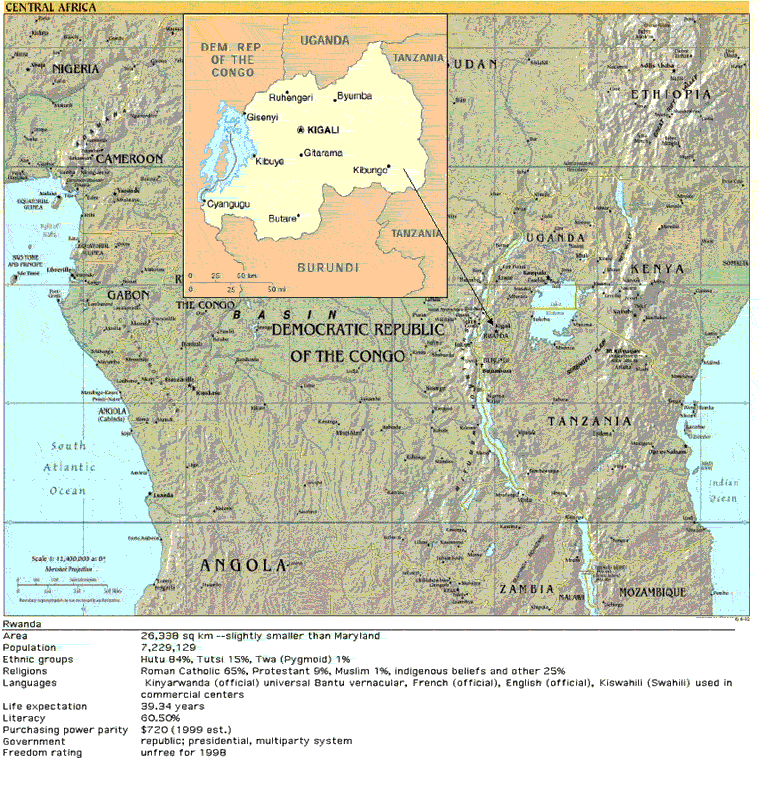


In November, Angola had reportedly sent troops to help Congolese forces combat rebels in the region, but it apparently took the active cooperation of the Rwandan government to make any serious progress--see Daily Sources 11/10 #8.

15. CHAD ENDS AIR STRIKES INTO SUDAN, SUDANESE REBEL APPEARS BEFORE THE ICC

Dany Padire at the Associated Press reports that Chad's interim defense minister, Adoum Younousmi, told the media that N'Djamena had ended air raids against Chadian rebel groups operating out of Sudan Sunday. Younousmi said,
"Our target was not the Sudanese government and less so the general population. Our objective was the Sudanese mercenaries wherever they were to be found, without causing any collateral damage."
The recent air attacks were the first attacks into western Sudan proper, where rebels have allegedly been operating, and whom N'Djamena has alleged Khartoum supports.
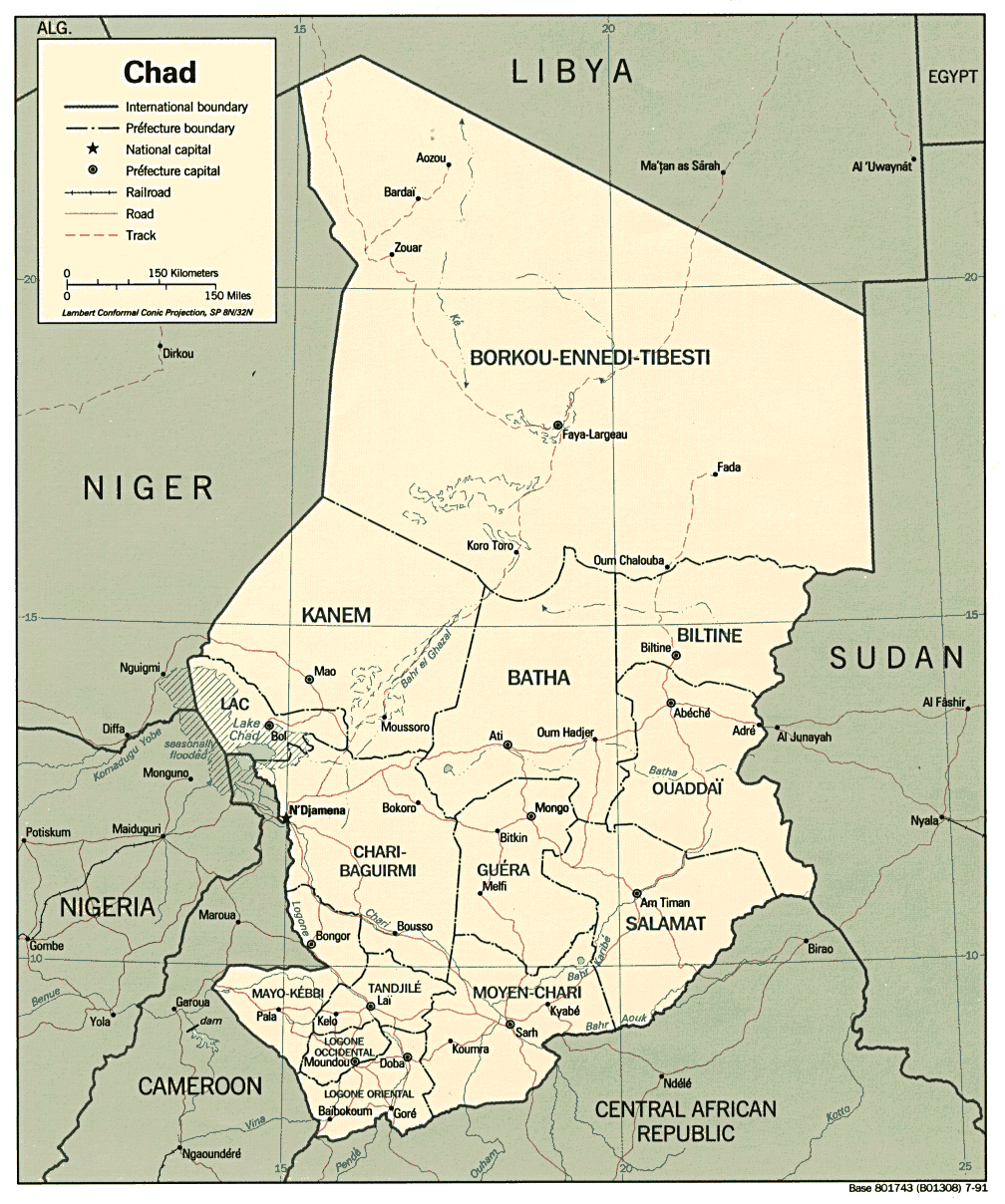
"Eastern Chad is a temporary home to about 300,000 refugees who have fled Sudan's Darfur conflict. The region also has camps for 187,000 Chadians displaced by fighting locally and in Darfur."
Younousmi said that the raids had destroyed seven pockets of rebels and that around 100 prisoners had been captured by ground forces operating in conjunction with the air attacks. In the meantime, BCC reports that a former member of the Darfur rebel group, the Justice and Equality Movement (JEM), Bahr Idriss Abu Garda has voluntarily appeared before the International Criminal Court to address charges of crimes against humanity leveled against him. (JEM is an Islamist group fighting the central government.) He is charged with taking part in an attack with killed 12 African Union peacekeepers in northern Darfur.


Mr. Abu Garda has since left JEM to form his own rebel movement, the United Resistance Movement. A spokesman for Mr. Abu Garda has argued that the charges against him are the result of fall out between him and JEM. The President of Sudan, Omar Hassan al-Bashir was charged with war crimes by the ICC in March and promptly expelled aid groups working in the Darfur region in response--see Daily Sources 3/6 #5.

16. NORWEGIAN PARLIAMENTARY VOTE ON CANADIAN OIL SANDS PARTICIPATION PUT OFF

Wojciech Moskwa and Terje Solsvik at Reuters report that the Norwegian government has delayed a parliamentary vote on whether StatOilHydro should withdraw from a $2 billion investment in Canada's oil sands.
"The oil sands issue has put the government in a bind four months before a general election, with political opponents saying state support for the oil sands project was hypocritical given the cabinet's self-professed environmental ambitions."
17. OBAMA ADMINISTRATION TO PROPOSE NEW NATIONAL CAFE STANDARDS

John M. Broder at the New York Times reports that the Obama Administration is set to announce as early as Tuesday new regulations for the emissions and mileage of cars and light trucks which will combine California's new auto-emissions rules with the existing corporate average fuel economy (CAFE) standard to create a single new national standard.
"Under the new standard, the national fleet mileage rule for cars would be roughly 42 miles a gallon in 2016. Light trucks would have to meet a fleet average of slightly more than 26.2 miles a gallon by 2016."
This is a big deal. Transportation accounts for about 60% of US oil consumption.

18. INDUSTRIAL REVOLUTION CAUSED BY CHEAP ENERGY, EXPENSIVE LABOR

In an extremely interesting piece, Robert C. Allen on Friday posted an article asking why the Industrial Revolution took place in England at Vox EU. His answer:
"The famous inventions of the Industrial Revolution were responses to the high wages and cheap energy of the British economy. These inventions also substituted capital and energy for labor."


It was difficult to transfer the technologies to places where either coal was expensive or labor was cheap. A must read. Note, just now many analysts expect the West, and the world, to enter a period where energy is expensive and labor is cheap.

Friday, May 15, 2009

Daily Sources 5/15

1. CHINESE FDI DOWN 22.5% IN APRIL YOY, EARLY MAY ELECTRICITY GENERATION DOWN 3.9% YOY

Elaine Kurtenbach at the Associated Press reports that foreign direct investment into China was down 22.5% in April from a year previous to $5.89 billion, according to data released today by the Commerce Ministry. There was a 9.5% annual rate of decline in FDI in March.
"Actual direct foreign investment in January-April fell 21% to $27.7 billion, as companies canceled or postponed spending on factories and other assets due to weakening trade and financial conditions.

April's figure was distorted somewhat by the high level of investment in April 2008, when such commitments jumped nearly 53% from a year earlier."
The sharpest declines in investments came from South Korea, the United States and Hong Kong. (Hong Kong remains the largest source of funds, accounting for 45% of all FDI into China in April.)

In the meantime, John Liu at Bloomberg reports that the China Securities Journal today reported that Chinese electricity generation was down 3.9% in early May from a year earlier. The Journal--state-owned media--cited an anonymous official at the China State Grid Corp.

2. EUROZONE GDP CONTRACTS 2.5% IN Q1

Matthew Satlmarsh at the New York Times reports that the economy of the euro-zone, or the 16 nations that comprise the monetary union within the EU, contracted by 2.5% in the first quarter from the fourth.

3. GERMAN GDP SHRINKS 3.8% IN Q1 FROM Q4

Edward Hugh at Fistful of Euros reports that the German Federal Statistics Office this morning released data showing the economy shrank by 3.8% in the first quarter from the fourth, "equivalent to a 15.2% contraction at an annualized rate." This marks the fourth consecutive quarter of contraction for Germany, and a contraction of 6.7% from the first quarter of 2008. Hugh notes that there are many signs that the rate at which the German economy is shrinking has slowed, but it is bottoming out at fairly low levels. Industrial output is at levels last seen in 1999/2000--


Hugh comments:
"Perhaps the worst casualty of all this will be German public finances. German tax revenue for 2009 is now projected to decline by more than an additional €300 billion as compared with previous estimates."
Long, but very detailed with a wealth of data--worth a look.

4. FRENCH GDP CONTRACTS 1.5% IN Q1 FROM Q4


Eurointelligence reports that the French statistical office's latest estimate released today shows GDP declining by 1.5% in the first quarter from the fourth, the worst rate of decline on record since 1974.
"[T]he contraction of capital stocks [is especially notable] with -0.6%, much higher than in any other euro zone country or the US or Japan."

5. ITALIAN GDP CONTRACTS 2.4% IN Q1 FROM Q4

Edward Hugh at Fistful of Euros reports that preliminary data from the Italian national statistics office [Istat] released today show that Italian GDP fell by 2.4% in the first quarter from the fourth. Annualized, the quarter-on-quarter contraction would translate to a 9.6% rate of decline. From the first quarter in 2008, 2009 first quarter GDP fell by 5.9%, "the sharpest drop since Istat’s most recent data series start in 1980." Industrial production fell by 23.8% in March from a year previous. Hugh's graph:


"Italy effectively entered recession in third quarter of 2008, and the economy now looks bound to shrink the most in more than half a century this year. The International Monetary Fund forecast on April 22 that the jobless rate will reach 8.9% this year and 10.5% in 2010. At the same time, Italian inflation has been slowing and hit a record low of 1.1 % in March, so if the contraction continues the deflation threat is real and present."
Gross government debt is expected to climb to 113% in 2009 and 116.1% in 2010 from 105.8% in 2008. Again, long but detailed and with a wealth of data--well worth a look.

6. RUSSIAN GDP CONTRACTS 23% IN Q1 FROM Q4

Alex Nicholson at Bloomberg reports that the Russian Federal Statistics Service announced on its website today that first quarter GDP shrank by 23% from the fourth. The contraction is the worst seen in 15 years--an annual rate of decline of 9.5%.
"'The big dip in industrial production jumps in your face,' said Tatiana Orlova, a Moscow-based economist with ING Groep NV, who plans to lower her forecast for a 2.7% contraction this year. 'The government should be worried. It’s very easy to come up with headlines announcing bailout measures, but the situation shows that you have to adjust them. It’s hard to do these things fast.'"
7. PUTIN MEETING WITH BERLUSCONI IN SOCHI REGARDING SOUTH STREAM, GAZPROM OFFERS TO PURCHASE ALL AZERI FEEDSTOCK FOR NABUCCO, TURKISH PM TO ARRIVE IN SOCHI TOMORROW

BBC News' Steven Eke reports that Russian Prime Minister Vladimir Putin is meeting in Sochi with Italian PM Silvio Berlusconi and top energy officials from Greece, Bulgaria and Serbia, to discuss joint ventures for the construction of the South Stream pipeline.


Meanwhile, Torrey Clark and Stephen Bierman at Bloomberg report that Gazprom Deputy Chief Executive Officer Alexander Medvedev said in a Moscow interview with Bloomberg TV that "[Gazprom is] ready to buy the whole volume of Shah Deniz II."
"The second phase of Shah Deniz could add 12 billion to 14 billion cubic meters of annual gas output in three to five years once a market is found and transit for the fuel ensured, Azeri President Ilham Aliyev said on April 18."
Shah Deniz II is a critical possible source of natural gas for the proposed Nabucco pipeline. Last week the EU signed an energy cooperation deal with Azerbaijan regarding a southern transit corridor--but failed to get Turkmenistan or Kazakhstan to join in, other key sources of supply in the potential pipeline, that is, outside of Iran. Indeed, Kazakhstan inked a law on Wednesday committing more volumes through the Russian Central Asia-Center pipeline system. Last week the Obama Administration envoy for energy, Richard Morningstar, was rumored to have backed off from support for Nabucco, suggesting that South Stream would work just as well--see Daily Sources 5/13 #5. In his remarks on the 8th in Prague published today by the State Department, Morningstar says:
"The United States shares the view expressed in the Joint Declaration that interconnections are a "basic prerequisite" for developing the Southern Corridor. Interconnectivity maximizes the potential of Southern Corridor projects, such as Nabucco and ITGI; likewise, when these projects add diverse sources and routes to an interconnected market, they act as protection against supply disruptions. Nabucco opens up many possibilities for enhancing European energy security, though it is not a cure-all. Nabucco, of course, will also contribute to the development of countries in the region.
...
Azerbaijani gas is the only realistically available gas in the short term, but accessing it requires agreement with Turkey on transit terms. We must also concentrate on other sources, such as Turkmenistan, Iraq, Kazakhstan, Uzbekistan, Egypt, and other related countries."

On the other hand, Robert M. Cutler in the Asia Times reports that two key problems were solved last week in Prague regarding Turkey's participation in Nabucco:
"The two problems that were solved in Prague last week involved pricing and the legal regime for Turkish consumption of gas flowing through the pipeline. The EU had insisted that Turkey pay the equivalent of European prices; Turkey had proposed a figure 15% less than that. The common-sense resolution that was adopted provides for Turkey's price to be based on the cost of transportation: the gas consumed in Turkey will hardly go all the way to Baumgarten, so it will cost less. As for the legal regime, the EU has abandoned its insistence that the norms of its acquis communautaire apply in Turkey, a non-member of the European body, and a middle ground within Turkish law has been found."
Turkish Prime Minister Recep Tayyip Erdogan will be in Sochi to join the discussions with Putin tomorrow.

8. IOC SECURES RUPEE DENOMINATED LOAN TO BUILD 300 KB/D REFINERY IN FACE OF WALL OF NEW REFINING CAPACITY IN THE REGION

Vandana Hari at Platts reports that Indian Oil Corporation--state-owned--has secured a rupees 149 billion ($2.97 billion) loan from a consortium of 21 domestic banks to build a grassroots refinery project at Paradip with nameplate capacity of 15 million
mt/year (or 300 kb/d).
The loan is denominated in rupees, which is about the only thing that makes any sense about the decision, given an avalanche of new refining capacity in the region. Meanwhile, Eric Watkins at the Oil & Gas Journal report that Kuwait and Sinopec have finalized the terms for a 300 kb/d new refinery at Zhanjiang in Guangdong province, with Sinopec taking a 50% share, Kuwait Petroleum International 30%, 10% for Dow Chemical Co, and 10% for Shell. And, Osamu Tsukimori at Reuters reports that TonenGeneral Sekiyu, Exxon Mobil's Japan group refiner, announced today that its oil product exports in the first quarter rose 5% from a year earlier, led by a 22% gain in middle distillate exports. Oil demand has been steadily declining in Japan on an aging and shrinking population. The recent restart of nuclear power plants shuttered by earthquakes should put a further dent in oil and gas demand in the island nation as its industrial production tanks.
"Japan's oil product exports last year increased 123% last year to 34 million kilolitres (584,000 barrels per day), equal to about 12% of the nation's refining capacity."


9. CUBA TO TAKE MORE ACTIVE ROLE IN PETROCARIBE, CHÁVEZ AND KIRCHNER TO SIGN AGREEMENT ON GASIFICATION PLANT IN ARGENTINA TODAY, CHÁVEZ TO SHUT DOWN OPPOSITION TV STATION

Eric Watkins at the Oil & Gas Journal report that the Cuban-Venezuela joint oil shipping line--Transportes del Alba (TransAlba)--has received its second vessel, the 490,000 barrel capacity tanker, Sandino.
"The tanker, built in China by New Times Shipbuilding Co., is the second of two 72,700-dwt ships funded under a 15-year, $122 million credit extended by Venezuela's state-run national economic and social development bank Bandes.

In February, TransAlba acquired its first tanker, the 72,700-dwt Petion, which will transport crude from Venezuela's Puerto La Cruz refinery to Cuba's Camilo Cienfuegos refinery."
The joint venture is considering the purchase of a third, smaller, tanker which would be able to unload at smaller Caribbean and Central American ports as it looks like Havana will take a more active role in Chávez's PetroCaribe initiative. Meanwhile, Charles Newbery at Platts reports that Chávez indicated that he was set to sign an agreement with his Argentine counterpart, Cristina Fernandez de Kirchner, agreeing on the location and start date for construction of an LNG regasification terminal in Argentina. A natural gas liquefaction plant in Venezuela is scheduled to begin operations in two years.
"Enarsa and PDVSA, the state energy companies of Argentina and Venezuela, respectively, have created a joint venture for building the LNG import terminal, which would have the capacity to deliver between 10 million cu m/d and 20 million cu m/d (353,000 Mcf/d to 706,000 Mcf/d) to the Argentine market. A likely location for the terminal is Bahia Blanca, where US-based Excelerate Energy is unloading LNG cargoes from Trinidad and Tobago at a floating regasification terminal."
And Juan Forero at the Washington Post reports that the Chávez Administration has taken steps to close Globovisión, an anti-government cable station. The government has accused the station of inciting panic in its coverage of the May 4 earthquake that hit the country.
"Venezuela has not closed any media outlets during Chávez's decade in power. But in May 2007, Chávez refused to renew the broadcast license of a stridently anti-government station, RCTV, accusing it of plotting against him. Harangues and threats against journalists are common, press-freedom groups say, and the state has made the creation of a parallel, pro-government media apparatus a priority."
Last Sunday, Chávez also reportedly publicly declared that "no land is private."

10. PYONGYANG TO PUT US JOURNALISTS ON TRIAL FOR SPYING IN JUNE

Blaine Harden at the Washington Post reports that Pyongyang will put two US reporters on trial for spying in June.
"The announcement, coming in the same week as Iran's release of a US reporter who had been convicted of spying, led to speculation that television reporters Laura Ling and Euna Lee might also be set free after trial as part of North Korea's diplomatic gamesmanship with the United States.

Ling and Lee, who work for former vice president Al Gore's San Francisco-based Current TV, were arrested March 17 along North Korea's border with China. They have been accused of illegal entry and 'hostile acts,' which in North Korea are punishable by five to 10 years in a labor camp.

In one sentence on its state news service, North Korea said its central court has 'decided to try the American journalists on June 4 according to the indictment of the competent organ.'"
11. BP AND STATOILHYDRO TAKE MORE SUPERTANKERS FOR CRUDE STORAGE; BIODIESEL SALES AT ZERO IN GERMANY

On news that entities with crude in storage were likely to start unloading their cargo--see Daily Sources 5/14 #9--Pradeep Rajan at Platts reports that StatOilHydro and BP have both secured a VLCC--or supertanker capable of carrying two million barrels of crude--for possible crude storage.
"Some of the players storing crude on sea include Shell with around 17 vessels, Vitol with 14, Koch at seven, Total with six, ConocoPhillips at four and BP and StatoilHydro with one vessel each. NITC, Clearlake, ST Shipping, Repsol and Valero are also reported to have vessels on storage."
In a related story, after Europe raised duties on US biodiesel imports effectively shutting off 85% of the US biodiesel market--see Daily Sources 5/5 #5 and Daily Sources 3/12 #10--Michael Hogan at Reuters reports that German bioenergy company Verbio announced yesterday that biodiesel sales have come to a halt in that country.
"Biodiesel is currently more expensive than fossil diesel in Germany following a further tax rise on green fuels this year and a fall in crude oil prices.

'Tax increases in combination with the falling prices for fossil diesel have brought the B-100 (petrol station) market to a virtual standstill,' Verbio said.

Verbio said its biodiesel production in the first quarter of 2009 fell to 78,866 tonnes from 93,907 tonnes a year earlier. It has capacity to produce about 450,000 tonnes annually."
12. MEXICAN EMIGRATION DOWN BY 25%, ANECDOTAL REPORTS THAT MANY IMMIGRANTS RETURNING TO MEXICO, EFFECTS ASIAN AND HISPANIC GROWTH IN THE US

Julia Preston at the New York Times reports that Mexican census data suggests that emigration has fallen by 25% in the year ended August 2008 from the year prior. All told, about 226,000 less people emigrated from Mexico during that time than the year previous. The vast majority of Mexican immigrants emigrate to the US.
"The trend emerged clearly with the onset of the recession and, demographers say, provides new evidence that illegal immigrants from Mexico, by far the biggest source of unauthorized migration to the United States, are drawn by jobs and respond to a sinking labor market by staying away."
This comes on top of reports seen in California in March that many Mexican immigrants in the US are choosing to return to Mexico in the midst of the crisis.


For example, on March 6, Cindy Carcamo at the Orange County Register reported that "anecdotal evidence and informal surveys" suggest that both "legal and illegal immigrants" are returning to their relatives in Mexico.
"In the Mexican heartland of Cerrito de Agua Caliente, where many have traditionally migrated to Orange County, about a third of those who visited their families during the holidays decided to stay put, said Cuerámaro City Clerk Cesar Torres.

Hundreds of miles north, at the central bus station in Tijuana, more than half of the passengers arriving on a Crucero bus line from the US during a two-week period earlier this year were in the process of returning home for good, according to a passenger survey.

And, at a rental property office in Anaheim, a manager says her vacancies have spiked partly because of immigrants returning to Mexico.

'There is no work,' says Baltazar Saldaña, shaking his head. 'That's the problem.'"
Ms. Carcamo also reports that bus drivers and ticket clerks have seen a surge in one-way tickets to Mexico. Her story is well worth reading in full for a variety of details. Both stories are on top of the story yesterday by Sam Roberts in the New York Times that Asian and Hispanic minorities in the US are still growing, but at a substantially reduced rate.
"The latest census estimates found that the minority population--other than non-Hispanic whites--grew by 2.3% from July 1, 2007, to July 1, 2008, compared with 2.4% the year before.

Ethnic and racial minorities (mostly blacks, Hispanic and Asian people) now account for 34% of the nation’s population.

The Hispanic population grew by 3.2% and Asians by 2.7%, a slight decrease from the year before. But those figures were down sharply from the beginning of the decade, when the Hispanic population grew by 4% and Asians by 3.7%, according to an analysis by the Population Reference Bureau, a private research group."
With the pace of immigration slowing down, a larger portion of that increase comes from regular population growth. (I imagine that it is likely that a similar process is happening in demographic trends in Europe, where job prospects are similarly becoming more scarce.)

13. RAILWAY DATA SHOWING DEEP DECLINES IN FREIGHT TRAFFIC

The weekly Railfax Report from Atlantic Systems Inc. for the week ended May 9 which plots total freight traffic via rail in the US shows an 18.1% year over year decline:


The breakdown of major commodities groups is especially interesting, note the nearly 50% decline in metal conveyance year over year.


Also the relatively small reduction in coal freight is interesting--the drop in industrial production should be having a large effect on coal just as it has on natural gas. (h/t CP at Credit Bubble Stocks via Yves Smith at naked capitalism.)

14. APRIL CONSUMER PRICES DOWN 0.7% ON YEAR, FLAT ON MONTH, APRIL INDUSTRIAL PRODUCTION DOWN 0.5% ON MONTH, 12.5% ON YEAR, MANUFACTURING CAPACITY RUNNING AT 65.7%

Jack Healy at the New York Times reports that the Labor Department announced today that the consumer price index was flat in April from March and down 0.7% on the year.
"The so-called core rate of inflation, which excludes volatile food and energy prices, rose a seasonally adjusted 0.3%, slightly more than its increases of 0.2% for each of the first three months of the year."
Much of that increase is apparently due to an increase in the cost of tobacco. Healy also reports that the Fed announced today that industrial production was down 0.5% in April from March, after having declined (a revised downward an additional 0.2%) 1.7% in March from February. The Fed's industrial production index showed a 12.5% decline in April from the year previous. Manufacturing capacity was running at 65.7% in April, down 0.1% from March. The manufacturing sector of the production index in April was down 0.3% from March and down 14.5% from the year previous. The Federal Reserve's statistical release on industrial production and capacity utilization can be found here. Rebecca Wilder's summary of global economic data for the week shows that the fall in industrial production mirrors what is happening generally all over the globe:


Ms. Wilder notes that inflation is volatile on food and energy costs, but suggests that it will continue to fall globally as well. The post is worth a look.

15. CALIFORNIA TO SELL $6 BILLION IN BONDS TO COVER BUDGET SHORTFALL, FIRE 5,000 EMPLOYEES

On the analysis yesterday--see Daily Sources 5/14 #13--that the government is the only organization hiring, but that state budgets are in crisis all over the country, Michael B. Marois and William Selway at Bloomberg report that California Governor Arnold Schwarzenegger has proposed selling $6 billion in bonds.
"Schwarzenegger’s proposal includes plans to fire 5,000 state employees, mostly prison workers and personnel from health and services agencies. The state employs about 200,000 people."

Wednesday, March 18, 2009

Daily Sources 3/18

1. Krishna Guha, Bertrand Benoit, Chris Giles and Daniel Pimlott at the Financial Times report that the IMF will reduce today its forecast for global GDP in 2009 to a contraction of 0.6%.
"The eurozone economy was forecast to contract by 3.2% in 2009, [Ms. Ter-Minassian, an adviser to IMF managing director Dominique Strauss-Kahn] said, against the earlier forecast of a 2% decline. The US would shrink by 2.6% (1.6%), and Japan 5% (2.6%), making it the worst-hit big economy. The IMF in Washington said the figures cited by Ms Ter-Minassian were 'unofficial' and 'out of date'."
In early March the IMF began indicating that a downward revision was under way--see Daily Sources 3/3 #1.

2. Philip P. Pan and Karen DeYoung at the Washington Post report that many Russia analysts believe that Moscow is signaling interest in a deal on Iran.
"In a meeting last week with a bipartisan commission studying US policy toward Russia, President Dmitry Medvedev expressed alarm in 'very graphic language' over Iran's successful test launch of a satellite last month, linking it to Tehran's nuclear program, said Dmitri Simes, director of the commission.

'Medvedev said it demonstrated how far-reaching Iran's nuclear ambitions are, and that he was very concerned,' said Simes, who is also president of the Nixon Center in Washington. 'He felt it was a clear challenge to both Russian and American interests and said he would like both countries to work on this challenge together.'"
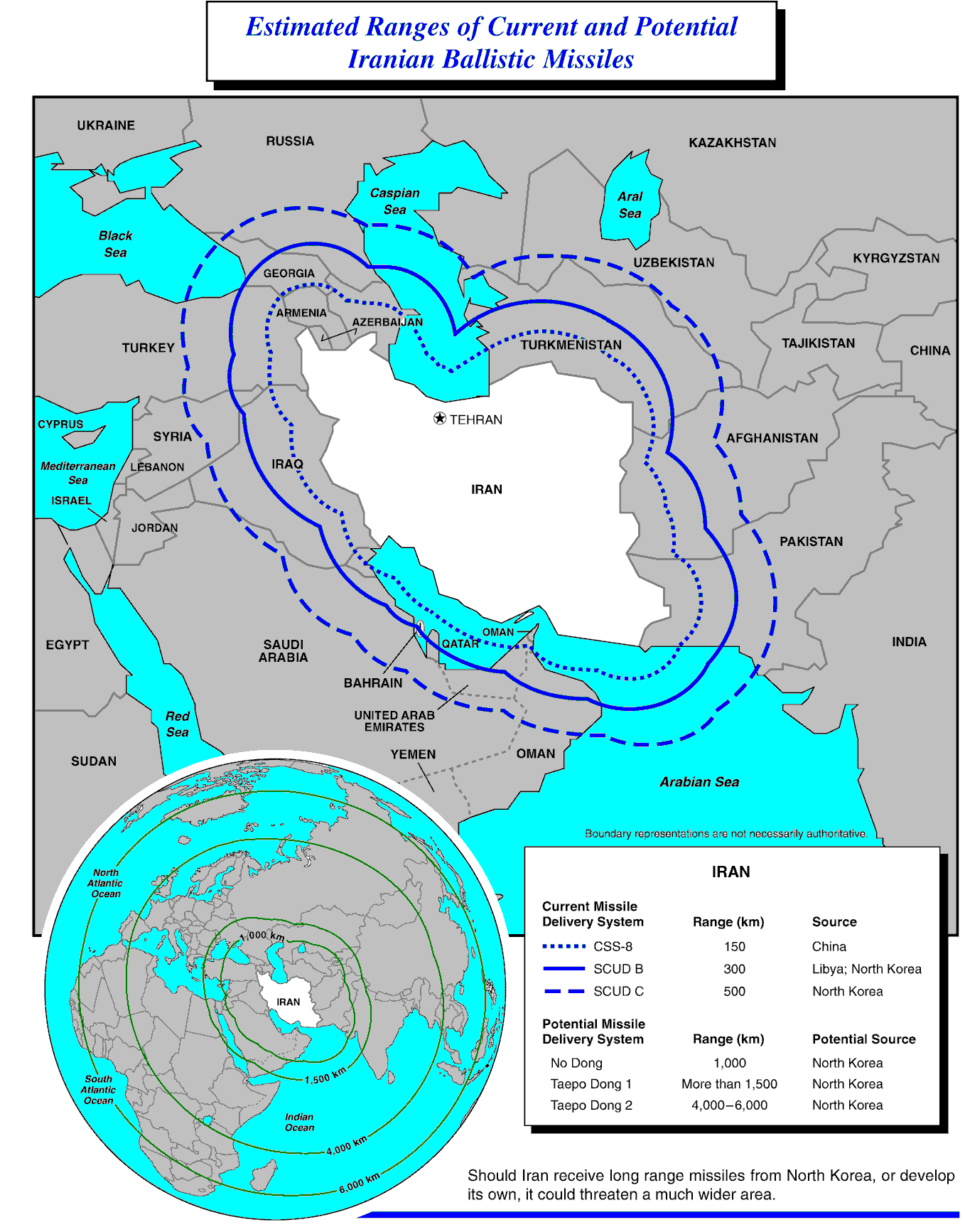
The Federation of American Scientists provide the following illustration of Iranian missile capabilities.


Satellite launches reportedly use technologies required for the development of ICBMs. In November, Iran claimed it had successfully tested missiles with a range of 1,200 miles, which as you can see from the map does not quite put Moscow in range--and obviously is even further from presenting any potential threat to, say, Warsaw. That said, it plainly makes a lot of sense that Iran's perennial missile tests would have the--likely unintended--effect of ruffling Moscow's feathers, given that a nuclear armed Tehran which could reach Moscow is definitely not in their interests.
"Alexander Pikayev, a top arms control scholar in Moscow, said Russian policy toward Iran will be determined by competing interest groups and political factions. Defense manufacturers and the atomic energy industry oppose tougher sanctions, for example, but the United States could win over the latter by reviving a bilateral pact on civilian nuclear cooperation that was frozen after the Georgian war, he said.

Pikayev said Medvedev may be more likely to support sanctions because a breakthrough in US relations would boost his political stature at home and set him apart from his powerful predecessor, Prime Minister Vladimir Putin. Putin might resist, but his relationship with Iranian President Mahmoud Ahmadinejad is said to be strained and he surprised Russia's foreign policy establishment by endorsing earlier U.N. sanctions, Pikayev said."
Frankly, I doubt this assessment--I think the notion of a nuclear armed Iran with the capability of hitting Moscow will outweigh the economic considerations involved in putting the kibosh on nuclear power cooperation with Iran. Indeed, it is hard to see many places in which Iranian and Russian interests coincide. Perhaps they do in terms of energy pricing, but Iran's potential as an alternative source of gas for European industry is probably a critical item in Moscow's long term thinking. And as the weekend's events proved, Russia still regards oil production coordination with OPEC as being less in its interest than good terms with Europe--and producing at full bore to claim all price increases produced by the cartel. (A policy which Iran appears to follow with respect to the organization's production quotas as well, ironically enough.)

3. The Associated Press reports that North Korea yesterday gave the organizations distributing US food aid inside that country till the end of March to leave--rejecting all future food aid.

4. Judy Dempsey at the New York Times yesterday reported that Russia signed two natural gas deals with Hungary yesterday. One deal signed last week has the Budapest and the Hungarian Development Bank to finance the South Stream project on Hungarian soil.


The other deal has Gazprom and MOL establishing a 1.3 billion cubic meters storage facility in Hungary. To make sense of that, here is a map that Jérôme Guillet drew up of Ukraine's gas infrastructure--note the three asterixes to the West, which represent gas storage facilities.


As Guillet pointed out in a piece for the European Tribune:
"Storage capacity is important in the gas business, as demand is seasonal (there is more in winter for heating) and can almost triple in Europe between summer and winter. If you can pre-position your gas near the markets when transport capacity becomes strained, you can extract a lot more value from that seasonality. The storage facilities near the Hungarian and Slovak borders were ideal for Soviet exports, but now they are in Ukrainian hands, and thus Russia must have a minimum of technical cooperation from the Ukrainians, who physically control and operate these facilities, not to lose a lot of money in their export markets. More, unavoidable leverage for the Ukrainians."
Hungarian Prime Minister Ferenc Gyurcsany's plea for a regional aid package from the EU was turned down last week. He has been a supporter of the Nabucco Pipeline, but questions of sourcing the gas (which would likely have to come from Iran) and project financing continue to bedevil the project.

5. Edward Hugh at Fistful of Euros posts that Poland's Central Statistical Office has released its industrial output data for February showing a 14.3% annual rate of decline in February, following a revised annual rate of decline of 15.3% in January. Output was up 2.7% in February from January however. Hugh provides a helpful graph of industrial production for the last two years:


Hugh points out that industrial production is on the decline across the spectrum of export-oriented Eastern European economies, warning against too much disambiguation between them. Worth reading and mercifully short.

6. Bettina Wassener at the New York Times reports that the World Bank lowered its forecast for Chinese growth in GDP for 2009 to 6.5%. 6.5%, though quite high by global standards just now, is well below the Chinese principle of "bao ba"--or "protect the 8"--below which conventional wisdom holds that Beijing will begin to see significant, read destabilizing, social unrest. Kevin Hamlin at Bloomberg reports that bank sees signs China's economy is stabilizing faster than the rest of the world.
"'The government’s stimulus is working,' said Louis Kuijs, a senior economist at the World Bank in Beijing. 'China’s fundamentals are strong enough to ride out this storm.'"
Meanwhile, Andrew Batson at China Journal helpfully translated the complete text of Chinese Ministry of Commerce’s statement announcing its decision to block Coca Cola’s proposed acquisition of China Huiyuan Juice Group Ltd. Key excerpt:
"Through its review, the Ministry of Commerce found that this concentration will have an adverse impact on competition. After the concentration is completed, Coca-Cola could use its market dominance in carbonated soft drinks to limit competition in the market for juice through tying, bundling or other exclusive transactions, resulting in consumers being forced to accept higher prices and reduced variety. At the same time, because brands can restrict entry to the market, it would be hard for the threat of potential competition to remove the restrictive effect on competition. In addition, the concentration will also reduce the room for small and medium-sized juice companies to survive, and will have an adverse effect on the structure of competition in China’s juice market."
The notion that dominance in the carbonated drink market could adversely affect competition in the juice market is unlikely to please most corporate headquarters. The fact that the Ministry of Commerce took stock of the market power of brands is interesting given that some have written that the primary value-addition that Western corporations bring to emerging markets is, well, brands. Meanwhile, the Sydney Morning Herald reports that shares in Rio Tinto have taken a beating on fears that the deal with Chinalco taking a 18% stake in the company.
"'[The 8.7% decline in share price] is [due to] the uncertainty surrounding the Chinalco deal, there has been a bit of talk out today that there is a lot of opposition to the deal and this is what's weighing on it,' MF Global senior trader Anthony Anderson said.

'The FIRB extension and the senate inquiry into foreign investment is adding to the uncertainty.'

The mounting political concern follows a decision by the Foreign Investment Review Board (FIRB) to extend its review to 90 days and initiate a more in-depth examination of the transaction, after the initial 30-day evaluation period closed on Monday.

The transaction, which has been backed by the Rio Tinto board, will also allow Chinalco to appoint two new non-executive board members to the global miners board."
(h/t Emmanuel at International Political Economy Zone.)

7. Platts reports that Italian major Eni has signed a major cooperation agreement with Pakistan to develop major projects all along the oil and gas product chain.
"The agreement also allows Eni to become a strategic partner in developing the oil and gas sector in Pakistan and to enter fields which are currently managed by state-run oil companies."
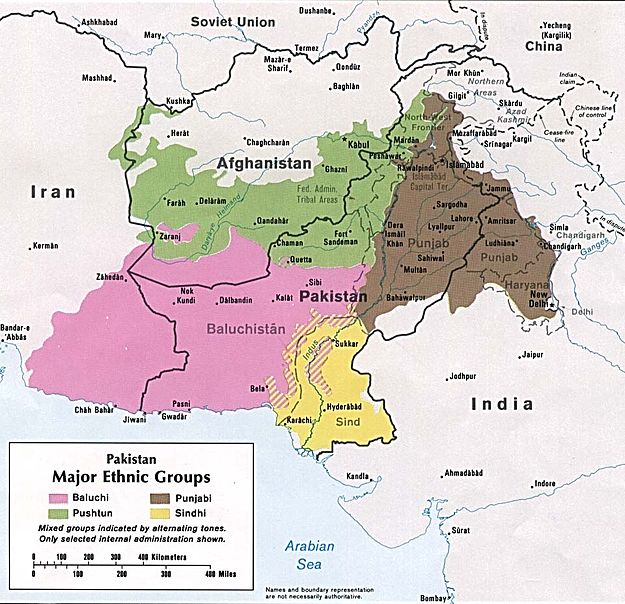
8. David E. Sanger and Eric Schmitt at the New York Times reports that "two of the high-level reports on Pakistan and Afghanistan that have been forwarded to the White House in recent weeks have called for broadening the target area to include a major insurgent sanctuary in and around the city of Quetta."


Baluchistan has separatist tendencies and is in the middle of a small bore separatist struggle, both in Pakistan and Iran.


Note that Baluchis can be found in southern Afghanistan where most of that country's opium production--and violence--is concentrated.

9. Galrahn at Information Dissemination notes that due to the Obama Administration's review of all military ties, GE has been asked to freeze work on turbines it was to provide the Indian navy for three Shivalik-class stealth frigates. Though I strongly disagree with the way Galrahn frames the story, I think it is an important data point. Clearly the US is likely to approve continued sales of engines to the Indian Navy.

10. Maher Chmaytelli and Juan Pablo Spinetto at Bloomberg report that Shokri Ghanem, chairman of Libya’s state-run National Oil Corp., told journalists today in Vienna that Libya will exercise its right to buy Calgary-based Verenex Energy Inc., which would effectively block CNPC's bid for the E&P company.
"Verenex has assets in Libya that are worth 'hundreds of millions' of dollars, Ghanem said in an interview with Bloomberg on March 16."
It is an interesting signal given China's Africa Policy announced in 2006 and Ghaddafi's recent selection as chair of the African Union--see Daily Sources 2/3 #9.

11. Justin Stares at Lloyd's List reports that the Bangladeshi High Court ordered the closure of all ship breaking yards operating without environmental clearance.
"Industry sources said they were 'staggered' by the ruling, which if confirmed will close down one of the world’s largest breaking industries just as scrapping activity peaks.

'None of the 36 shipbreaking yards in Chittagong currently have an environmental clearance,' said the NGO Platform on Shipbreaking. 'The decision therefore effectively shuts down an industry that has been highly criticized by environmentalists and human rights activists for many years for operating with complete disregard for the law, human health and the environment.'

The scrapping industry, which claims to employ 250,000 either directly or indirectly in Bangladesh, is expected to appeal.

The court was ruling on a petition filed by the Bangladesh Environmental Lawyers Association. Judges ordered that no ship on the Greenpeace 'dangerous ships list' be allowed into the country, according to reports by the platform and local media."
It is a decision bound to amplify the effects of the financial crisis, economically-speaking ... it seems that probity only comes when it will hurt the most, ironically. Note the significance of the courts in the Muslim-majority nation. Well-worth reading in full.

12. Nasreen Seria at Bloomberg reports that the South African Reserve Bank's Monetary Policy Committee will meet next week and accelerate its schedule to monthly meetings for the rest of the year from planned meetings every two months.
"Global economic conditions 'are getting worse' and the 'changed' environment requires the MPC to meet more regularly, Governor Tito Mboweni said in a phone interview from Pretoria today."
13. Victor L. Simpson at the Associated Press reports that in Cameroon Pope Benedict XVI reiterated yesterday that condoms were not an answer to the fight on AIDS--"You can't resolve it with the distribution of condoms. ... On the contrary, it increases the problem." I would note that Africa is one region where Catholicism--and more conservative Catholicism--is growing quickly. However, perhaps the one really impressive and compellingly moral US foreign policy triumph under the Bush Administration was the huge increase in aid to Africa in terms of the fight on AIDS, including condoms and retro-viral drugs. The people in Africa are well aware of how these aid programs have reduced the mortality rate in the continent. The notion that condoms are against life and a concession to death, and thus amoral, as opposed to a way to protect life and thus moral, will not, I believe, make much sense to them. Pope Benedict XVI appears to have a tin ear when it comes to husbanding the moral authority of the Church.

14. The Port of Long Beach recently posted its numbers for February, showing a 40% decline in container traffic from February 2008:


So far in 2009 the port has recorded a 20.2% decline in traffic. The Port of Marseilles, France, also recently posted its report for February, showing a 21% annual decline in total traffic. It registered a 16% decline from the traffic seen in January:


Hydrocarbons account for about 74% of Marseilles' traffic and it lost about 12% in volume from the year before. The grim trade data continue their march.

15. Bob Willis at Bloomberg reports that the consumer price index rose by 0.4% in February from January. Excluding fuel and food, prices climbed by 0.2% from the month prior. On an annual basis, the consumer price index rose by 0.2%, up from the 0% annual rate seen in January. Excluding fuel and food, prices climbed by an annual rate of 1.8% in February, up from a 1.7% annual rate of increase seen in January.
"Energy expenses increased 3.3%, led by an 8.3% increase in gasoline prices. Still, the fuel’s cost is down 36% from a year earlier.

Food prices, which account for about a fifth of the CPI, fell 0.1%, the first drop since April 2006."
16. The Federal Open Market Committee met today and decided to keep the federal funds rate unchanged at 0-.25%. Excerpt from its press release:
"To provide greater support to mortgage lending and housing markets, the Committee decided today to increase the size of the Federal Reserve’s balance sheet further by purchasing up to an additional $750 billion of agency mortgage-backed securities, bringing its total purchases of these securities to up to $1.25 trillion this year, and to increase its purchases of agency debt this year by up to $100 billion to a total of up to $200 billion. Moreover, to help improve conditions in private credit markets, the Committee decided to purchase up to $300 billion of longer-term Treasury securities over the next six months."
This follows the latest Treasury International Capital data which shows, courtesy of Brad Setser at Follow the Money, that foreign purchases of long term treasuries have collapsed:


Foreign government demand for US agency debt fell off a cliff late last year and purchases were even banned by Moscow just the other week. Meanwhile, Jon Hilsenrath at Real Time Economics reports that the Fed's quarterly survey of banks shows that during the week of February 2-6, banks extended $85.6 billion in credit to businesses, an increase of 13% from the first quarter of 2008--per JP Morgan Chase economist Michael Feroli:


17. The EIA reported that crude oil stocks built by 2 million barrels in the week ended March 13 to 353.3 million barrels, well above the historical average for this time of year, but still below the most recent peak of 354 million barrels seen on June 29, 2007. According to a survey by Bloomberg, analysts had expected a 1.5 million barrel build. Gasoline stocks grew by 3.2 million barrels, are near the top of the historical average. Analysts had expected a 1.5 million barrel draw. Distillates stocks grew by 100,000 barrels, are well above the five year historical average range as well as counter-cyclical, and versus analyst expectations of a 1 million barrel build. Taken in isolation, the data would be bearish on the price of crude.

Thursday, January 29, 2009

Daily Sources 1/29

1. The Wall Street Journal carries a transcript of Vladimir Putin's remarks at the Economic Forum in Davos today. Sadly, Putin made sure that many of his interlocutors on the US side of the pond were sure to stop paying much attention early on in his speech with:
"In the last few months, virtually every speech on this subject started with criticism of the United States. But I will do nothing of the kind.

I just want to remind you that, just a year ago, American delegates speaking from this rostrum emphasized the US economy's fundamental stability and its cloudless prospects. Today, investment banks, the pride of Wall Street, have virtually ceased to exist. In just 12 months, they have posted losses exceeding the profits they made in the last 25 years. This example alone reflects the real situation better than any criticism."
Not a good start. However, constructive remarks did follow, including the remarkable:
"Although additional protectionism will prove inevitable during the crisis, all of us must display a sense of proportion.

Excessive intervention in economic activity and blind faith in the state's omnipotence is another possible mistake.

True, the state's increased role in times of crisis is a natural reaction to market setbacks. Instead of streamlining market mechanisms, some are tempted to expand state economic intervention to the greatest possible extent.

The concentration of surplus assets in the hands of the state is a negative aspect of anti-crisis measures in virtually every nation.

In the 20th century, the Soviet Union made the state's role absolute. In the long run, this made the Soviet economy totally uncompetitive. This lesson cost us dearly. I am sure nobody wants to see it repeated."
In terms of addressing the financial crisis, Putin had the following to say:
"This means we must assess the real situation and write off all hopeless debts and 'bad' assets.

True, this will be an extremely painful and unpleasant process. Far from everyone can accept such measures, fearing for their capitalization, bonuses or reputation. However, we would "conserve" and prolong the crisis, unless we clean up our balance sheets. I believe financial authorities must work out the required mechanism for writing off debts that corresponds to today's needs.

Second. Apart from cleaning up our balance sheets, it is high time we got rid of virtual money, exaggerated reports and dubious ratings. We must not harbor any illusions while assessing the state of the global economy and the real corporate standing, even if such assessments are made by major auditors and analysts."
He also reiterates the call for the establishment of multiple reserve currencies, which is a fine idea of course, but given market participation it is unclear to me, precisely, how such alternative reserve currencies could be established by fiat.
"Excessive dependence on a single reserve currency is dangerous for the global economy. Consequently, it would be sensible to encourage the objective process of creating several strong reserve currencies in the future. It is high time we launched a detailed discussion of methods to facilitate a smooth and irreversible switchover to the new model.

Fourth. Most nations convert their international reserves into foreign currencies and must therefore be convinced that they are reliable. Those issuing reserve and accounting currencies are objectively interested in their use by other states.

This highlights mutual interests and interdependence.

Consequently, it is important that reserve currency issuers must implement more open monetary policies. Moreover, these nations must pledge to abide by internationally recognized rules of macroeconomic and financial discipline. In our opinion, this demand is not excessive."
Putin also emphasized that interdependence was the best means of pursuing international energy security--and takes aim at "speculators."
"The only way to ensure truly global energy security is to form interdependence, including a swap of assets, without any discrimination or dual standards. It is such interdependence that generates real mutual responsibility.

Unfortunately, the existing Energy Charter has failed to become a working instrument able to regulate emerging problems.

I propose we start laying down a new international legal framework for energy security. Implementation of our initiative could play a political role comparable to the treaty establishing the European Coal and Steel Community. That is to say, consumers and producers would finally be bound into a real single energy partnership based on clear-cut legal foundations.

Every one of us realizes that sharp and unpredictable fluctuations of energy prices are a colossal destabilizing factor in the global economy. Today's landslide fall of prices will lead to a growth in the consumption of resources.

On the one hand, investments in energy saving and alternative sources of energy will be curtailed. On the other, less money will be invested in oil production, which will result in its inevitable downturn. Which, in the final analysis, will escalate into another fit of uncontrolled price growth and a new crisis.

It is necessary to return to a balanced price based on an equilibrium between supply and demand, to strip pricing of a speculative element generated by many derivative financial instruments."
Which means that Russia has now officially joined OPEC in blaming "speculation" for price distortions in the oil market. Although I agree that as an asset class oil futures will attract investment disproportionate to supply and demand in certain situations, I would also note that OPEC and Russian oil industries would both increase control over the oil markets were that to happen. (One of many objections to the speculation is the source of all problems in the oil markets meme.)

Putin also emphasized the benefits to European supply security of Blue Stream, South Stream, Nord Stream, Yamal-Europe and the Baltic Pipeline System. He emphasized that Russia is becoming a key source of energy diversification in the Asia Pacific via the LNG plant under construction at Sakhalin. (Several nations of the Asia Pacific import over 80% of their oil and gas requirements from the Middle East.) The New York Times helpfully produced a map of competing natural gas pipeline proposals in southern Europe:


Near the end of his speech, Putin wishes the Obama administration success and emphasizes the need to develop international cooperation and trust. He also pointedly alludes to the foment of internal unrest elsewhere as a means of distracting domestic constituents at home. Quite long, but worth reading in full nonetheless. Meanwhile, Emma O’Brien at Bloomberg reports that the ruble experienced its worst two-day drop in over a decade versus the dollar. The currency is nearing the exchange rate the government has pledged to defend.
"Russian banks are 'getting cheap funding and shorting the ruble,' said Yefim Pavlotskiy, deputy director-general at Moscow’s Trinfico Group, which manages about $1.3 billion in Russian assets. 'The central bank will have to show the ruble can strengthen on some days so speculators get burned a few times, this way they won’t be so bold.'"
And Anna Shiryaevskaya at Platts reports that Turkmenistan suggested that the proposed capacity of a pipeline carrying Central Asia gas to Europe through Russia should be increased to 80 billion cubic meters/year (bcm/y) from 60 bcm/y.
"Julian Lee, senior energy analyst at the centre for global energy studies, said the proposal shows Turkmenistan wants to boost its production and sees Russia 'as the most viable way of getting its gas to Europe.'"
Turkmenistan has plans to increase its natural gas exports from 50 bcm in 2007 to 125 bcm by 2015 and 200 bcm by 2030.

2. Olesya Vartanyan and Ellen Barry at the New York Times report that opposition parties have gathered to call for new presidential and parliamentary elections in Georgia.
"'Today almost all the political parties agree,' [David Gamkrelidze, a chairman of the New Rights party] said. 'Every day more people and politicians understand that he has no capacity to overcome the crisis and that he is responsible for all these mistakes in Georgia and he must resign.'"
3. Jason Dean, James T. Areddy and Serena Ng at the Wall Street Journal report that Chinese Premier Wen Jiabao squarely placed the blame for the global financial crisis on the United States.That said,
"Frictions between the two countries began to worsen long before Mr. Obama took office. The Chinese central bank last year stopped lending its Treasury holdings for fear the borrowers will go bankrupt, according to people familiar with the discussions -- a decision that disrupted the functioning of the Treasury market. Beijing rejected pleas by Washington to resume its lending of Treasurys, the people said.

Meanwhile, China -- for years the largest foreign investor in bonds from Fannie Mae and Freddie Mac -- has been sharply trimming its holdings of that debt. After making direct net purchases of $46.0 billion in the first half of 2008, China's government and companies were net sellers of $26.1 billion in the five months through November, according to the latest U.S. data.

Weak demand for such debt from China and other foreign investors helped prompt the Federal Reserve to announce in November that it would take the step of buying up to $600 billion in debt from Fannie, Freddie and two other U.S. government-related mortgage businesses."
The journalists note that many in China suspect that the fiscal authorities are too close to Washington.
"Around October, a lengthy Chinese-language essay began circulating on the Internet excoriating Mr. Lou [Jiwei, chairman of China Investment Corp. (CIC)]and other top CIC officials, along with Zhou Xiaochuan, China's central bank governor, for being too close to the U.S. and then Treasury Secretary Henry Paulson. The diatribe quickly gained wide circulation in Chinese financial circles. One passage charged that Mr. Zhou 'colluded with Henry Paulson to buy US bonds, forced [Chinese yuan] appreciation, attached China's economy to the US and broke China's economic independence.'"
Well worth reading in full.

4. Maureen Fan at the Washington Post reports that Beijing has launched raids in Tibet, a "strike hard" campaign raiding thousands of homes and businesses in Lhasa. It is interesting that Beijing chose to begin the raid in the middle of the Economic Forum at Davos--apparently they are worried about the upcoming 50th anniversary of the Tibetan uprising of March 10. Meanwhile, Rebecca MacKinnon at the Huffington Post writes a letter to the President suggesting that Chinese public opinion is important despite the lack of its democratic character. I feel sure that the international relations gurus in the Obama Administration are fully aware of this given the role the German press played in foreign affairs prior to WWI. That said, MacKinnon provides the helpful reminder that,
"It is this young generation born after 1980 who were most vocal on the Chinese Internet last year, lashing out against Western critics and Western media coverage of their government's crackdown in Tibet. In response to international pressure, the Chinese government negotiated with the Dalai Lama, but it didn't feel the need to concede anything meaningful. In maintaining a hard line, the Chinese leadership could feel doubly secure in the fact that, not only did they have the strength of the People's Liberation Army and the People's Armed Police on their side; China's majority Han-Chinese public had no sympathy for the idea of Tibetan autonomy."
She suggests a change.gov type internet outreach to the people in a piece which is a strange combination of recognition of differences combined with preference for self.

5. Francois de Beaupuy and Helene Fouquet at Bloomberg report that France's eight largest labor unions went on strike today, disrupting the nation's rail network, airports and school system. The unions are demanding that the government do more about rising unemployment and falling purchasing power.
"About 69% of the French people back the strike, according to a poll by CSA-Opinion for newspaper Le Parisien on Jan. 25. Forty-six percent support the strike, while 23% “sympathize,” with the union call, Le Parisien said. Of those interviewed, 12% were opposed or hostile to the strike."
About half of Paris's subways are operational. Platts reports that 23% of EDF's workforce is taking part in the strike. (EDF provides most of France's power generation.) The FNME energy and mining union told the media that it had cut power output by 10GW, but that it plans to decrease output even further after the morning surge in power demand had passed. The cuts were made in every type of power plant, including nuclear.
"Average half-hourly power prices on France's within-day balancing mechanism rose to almost Eur200/MWh at 0600 CET and were at about Eur190/MWh at 0930 CET, figures from grid operator RTE show.

On Wednesday, day-ahead baseload power closed at Eur75/MWh and peak load
at Eur94/MWh in the OTC market."
Andrew Spurrier at Lloyd's List reports that cargo-handling has been brought to a complete standstill at the ports of Marseilles and Le Havre.
"Bernard Thibault, general secretary of the leading French union confederation, the CGT, warned President Nicolas Sarkozy and the government against behaving as if had nothing had happened after the day of action.

'The head of state cannot not hear us,' he said."
6. John Kingston at the Barrel reports that contract driller Helmerich & Payne has begun idling its rigs in Venezuela because it says PdVSA owes it $100 million in back payments. Kingston notes that this is confirmation of what many suspect, that as cash dries up in the producing countries capacity investment will also dry up. This makes sense, but it worrying in terms of future production needs. Also, I cannot imagine that Venezuela will, given this news and its past tendency to nationalize, be able to attract private corporate interest in its fields without advancing very generous terms. Which of course would be the excuse for a future nationalization, which, were I a private corporation, would make me want terms which would see a return almost immediately. That said, Platts reports that BP CEO Tony Hayward suggested at Davos today that an oil price of $60-80/b would be required for the capacity additions to supply required over the next two decades.
"'Over the next 20-odd years, the global energy industry... will invest of the order of $25-26 trillion, so in the order of $1 trillion/year, to provide the energy the world will need for that time-frame,' Hayward told a session of the World Economic Forum in Davos, Switzerland.

'From the perspective I have, for OPEC countries to be able to balance their budgets, sustain their social investment programs and invest for the future, it would appear that a price somewhere between $60 and $80 is appropriate.'"
Meanwhile, Maher Chmaytelli and Juan-Pablo Spinetto at Bloomberg report that OPEC general secretary Abdalla el-Badri told the forum that the cartel would not hesitate to cut supply further if prices remain low. He said that prices below $50/b were too low and suggested yesterday that the organization's target band was between $70-$100/b. Bloomberg carries video of his remarks at Davos:


7. Kartik Goyal at Bloomberg reports that Indian Commerce Secretary G.K. Pillai said in an interview that exports fell 1% in December and, "The job losses are very substantial and are likely to be of the order of 700,000 to 1 million, including temporary staff."
"India’s exports tumbled 9.9 percent to $11.5 billion in November from a year earlier after contracting 12.1% in October, the first decline in seven years. Industrial production rose 2.4% in November, after dropping 0.3% in October, the first contraction in 15 years.

Export growth may slow to 17% in the 12 months to March 31, compared with 25 percent a year ago, Trade Minister Kamal Nath told Bloomberg Television in an interview in Davos today. 'There will be job losses due to the global recession but I think domestic demand is going to help us.'"
Bloomberg carries video of the Nath interview.

8. The Associated Press reports that the Iraqi finance minister appealed to international financiers to open branches in Iraq at a conference on international banking held in Baghdad yesterday.
"Since the 2003 US-led invasion that toppled the previous regime, the Central Bank of Iraq has licensed some international banks to open branches in Iraq but security concerns prevented them from opening their branches."
The minister, Bayan Jabr, promised banks that the government would take special pains to clear any obstacles to operating in Iraq, including revisiting any laws that might be complicated things. Baghdad wants to attract international capital to the reconstruction effort, but Jabr encouraged international banks to develop joint ventures with local entities to help provide credit to investors.
"Iraq has seven state-run banks and 33 private banks. But only four of the banks have substantial capital, ranging between $40 million and $100 million."
Ahmed Rasheed at Reuters reports that at the conference Jabr also announced that Iraq would shortly issue government debt of about $5 billion. The issue would be the first since the fall of Saddam Hussein. Meanwhile, Juan Cole at Informed Comment carries a US Open Source Center translation of a recent Kurdish newspaper article which warns that the Patriotic Union of Kurdistan (PUK) has formed an emergency action committee in response to central government plans to put Kirkuk under national army control. A PUK official told the press that in terms of Iraqi military control of Kirkuk, "Our final word is that we don't accept that at all." Professor Cole notes: "This dispute has the dark potential to kick off another civil war in Iraq, this one not Sunni-Shiite but rather Arab-Kurdish." The monopoly of force issue was complicated from another side, as Timothy Willimans reports in the New York Times, Baghdad has refused to grant Blackwater a license to operate in the country. Blackwater had been operating without a license through much of 2008, but applied for one recently. A spokesman for the company noted that it had not received official notice of the denial yet. Peter Baker and Alissa J. Rubin report that President Obama visited the Pentagon for the first time yesterday and appears to be seeking a plan from the armed forces which would responsibly reduce our military commitment to Iraq.
"Among those consulted by the president was Gen. Ray Odierno, the top commander in Iraq, who has developed a plan that would move slower than Mr. Obama’s campaign timetable, by pulling out two brigades over the next six months. In an interview in Iraq on Wednesday, General Odierno suggested that it might take the rest of the year to determine exactly when United States forces could be drawn down significantly.Among those consulted by the president was Gen. Ray Odierno, the top commander in Iraq, who has developed a plan that would move slower than Mr. Obama’s campaign timetable, by pulling out two brigades over the next six months. In an interview in Iraq on Wednesday, General Odierno suggested that it might take the rest of the year to determine exactly when United States forces could be drawn down significantly."
9. Keith Weir at Reuters reports that the Guardian UK today ran the story that the Obama Administration is drafting a letter to the Supreme Leader of Iran--Ayatollah Ali Khamenei--which may well suggest opening direct and official lines of communication between DC and Tehran to be published as an open letter.
"In Washington, a State Department official said the policy on Iran was under review and declined to comment on whether a letter was possibly being prepared to send to the Iranians."
10. Keith Johnson at Environmental Capital reports that the EU yesterday announced plans to spend €1.25 billion on research on how best to store and capture carbon emissions at existing coal burning plants in Europe. Some in the coal industry had hoped for more, though many were quite pleased.

11. The Federal Open Market Committee decided to leave interest rates unchanged yesterday at 0-.25%. In its public statement, the FOMC stated that it expected inflation to remain subdued in the near to medium term. It went on to say:
"The Federal Reserve will employ all available tools to promote the resumption of sustainable economic growth and to preserve price stability. The focus of the Committee's policy is to support the functioning of financial markets and stimulate the economy through open market operations and other measures that are likely to keep the size of the Federal Reserve's balance sheet at a high level. The Federal Reserve continues to purchase large quantities of agency debt and mortgage-backed securities to provide support to the mortgage and housing markets, and it stands ready to expand the quantity of such purchases and the duration of the purchase program as conditions warrant. The Committee also is prepared to purchase longer-term Treasury securities if evolving circumstances indicate that such transactions would be particularly effective in improving conditions in private credit markets. The Federal Reserve will be implementing the Term Asset-Backed Securities Loan Facility to facilitate the extension of credit to households and small businesses."
12. Shobhana Chandra at Bloomberg reports that orders for US durable goods fell by 5.7% in 2008. The Commerce Department announced that orders in December fell for the fifth straight month, by 2.6%. The Labor Department announced that initial jobless claims grew by 3,000 to 588,000 last week. GDP contracted by a 5.5% annual rate in the fourth quarter.

13. Rebecca Wilder at News N Economics has a post which notes the correlation between GDP growth and consumer spending. She points out that analysts expect consumption will fall by a full 2% in the first quarter of 2009.


Consumption, she says, has been affected by high oil prices before, but that the culprit for such a steep fall in consumption must, at least in part, be put at the feet of another cause.
"The qualitative evidence is incontrovertible: this cycle is marked by serious adverse real estate wealth effects. On average (as measured by the Case-Shiller composite 20 index), home values have been declining since July 2006 - over two years - but households saw their biggest declines in home equity in just eleven months of 2008. The associated pull-back by consumers will set records, as households retrench amid record housing equity losses."
Worth reading in full.


14. The Oil & Gas Journal reports that Valero--the major refiner--reported a $3.3 billion loss in the third quarter.
"Calling the sluggish economy 'a headwind against demand growth for refined products,' Bill Klesse, Valero's chairman and chief executive officer, said Valero will manage its refinery run rates according to market demand.

'For example, we will shut down the entire Texas City refinery instead of running portions of it during scheduled maintenance this quarter,' Klesse said. 'At our Corpus Christi East plant, we have shut down the fluid catalytic cracking unit, which primarily produces gasoline. Across our system, the average utilization rate at our fluid catalytic cracking units is currently in the range of 70% to 75% of capacity.'"
The Texas City refinery has a capacity of 225 kb/d. The news comes on top of the news that Big West is shutting down its 66 kb/d refinery in Bakersfield, as it is finding it impossible to find alternative sources of crude.

15. Katherine Harmon at Scientific American reports that the American Society of Civil Engineers released a "report card" on US infrastructure yesterday which suggested that "The nation's roads, bridges, levees, schools, water-supply and other infrastructure are in such bad shape that it would take $2.2 trillion over five years to bring them up to speed."
"Following are the ASCE infrastructure grades, which were based on an analysis of government records by a panel of engineers.

Aviation D
Bridges C
Dams D
Drinking Water D-
Energy D+
Hazardous Waste D
Inland Waterways D-
Levees D-
Public Parks & Recreation C-
Rail C-
Roads D-
School D
Solid Waste C+
Transit D
Wastewater D-

Overall: D"
Drinking water is among the worst scoring categories. Schools do better, which should give us some idea of just how bad the situation is. Water is pretty important. Just saying.