Showing posts with label Gold. Show all posts

Thursday, May 7, 2009

Daily Sources 5/7

1. CZECH SENATE PASSES LISBON TREATY, ALL EYES TURN BACK TO IRELAND; THE EU TO OFFER ADDITIONAL AID TO A STRANGE MEDLEY OF FORMER SOVIET REPUBLICS; THE ECB LOWERS BENCHMARK INTEREST RATE TO 1% AND ENGAGES IN QUANTITATIVE EASING; THE BANK OF ENGLAND ENGAGES IN ADDITIONAL QUANTITATIVE EASING; AND MANY INDICATORS SEEM TO POINT TO A BOTTOMING OF THE FINANCIAL CRISIS ... BUT OIL LOOKS POISED TO PUT THE KIBOSH ON IT ALL

Jess Smee at Der Spiegel reports that the Czech Senate yesterday approved the Lisbon Treaty, with 54 of 79 voting to ratify. President Vaclav Klaus is a euroskeptic and will ensure that the treaty is reviewed by the Czech Republic's high court, but most expect much of that to be a formality.
"The international treaty--which replaces the ill-fated European Constitution rejected by French and Dutch voters with a slightly altered version of the same document, this time written in legalese, filled with caveats for different member states and sans some of the features of a United Europe such as a flag and an anthem--can only be adopted when it is approved by all members. In addition to Ireland, the Czech Republic, Poland and Germany must all still sign the treaty before it can be officially ratified."
Now attention will turn to Ireland, which rejected the treaty last year. In the meantime, Anatoly Medetsky at the Moscow Times reports that the European Union will offer today at a conference better trade ties and visa rules as well as €350 million ($466 million) in aid over four years for six countries neighboring Russia as part of an initiative known as the "Eastern Partnership."
"The EU names as a flagship project to pursue with the eastern partners the development of the 'southern energy corridor'--a term that describes all pipelines needed to bring Caspian Sea and Central Asian gas to the EU. The main part of the corridor is Nabucco, said Ferran Espuny, an EU energy spokesman.

Talks to secure commitments to supply gas and build pipelines for Nabucco are progressing well, Espuny said Wednesday."
The Eastern Partnership specifically refers to Armenia, Azerbaijan, Georgia, Moldova, Ukraine, and Belarus--with Belarus being the most surprising choice of all. In the meantime, the European Central Bank cut its benchmark interest rate by a quarter percent to 1% today, per a Bloomberg story by Jana Randow and Simone Meier. The bank also indicated it would purchase as much as €60 billion (~$80.5 billion) in bonds.
"ECB officials have spent the past months bickering over whether to fight a recession by purchasing assets, with Bundesbank President Axel Weber leading resistance to such a move. The US Federal Reserve, the Bank of England and Bank of Japan have lowered rates close to zero and are already buying bonds, effectively printing money to reflate their economies in a policy known as quantitative easing."
(h/t reader Charles.) Lukanyo Mnyanda at Bloomberg reports that Bank of England decided today to maintain its benchmark interest rate at 0.5%, but that it also announced it will spend an additional £50 billion (~ $75 billion) "of newly printed money to spur economic growth." Rebecca Wilder's weekly summary of global economic data seems to show that the aggressive stimulus measures are having some effect. She concludes that Chinese manufacturing probably has passed a cyclical low and that the same is true of the US, that export declines have slowed in South Korea, but are falling more steeply in India,


and that lagging indicators unemployment and prices are surging and falling on energy, respectively. I always find her analysis helpful and worth checking out. I would only point out, however, that if inflation is falling mostly on energy prices, then recent events in the oil market, counter intuitive as they might be, could translate into a considerable obstacle to global recovery, with the price of WTI having climbed $6/b over the course of the last week and some predicting a spike to $71/b on the back of cash-strapped traders trying to exit short positions--see Daily Sources 5/6 #7. As I've noted before, $70/b looks more or less to be the price after which demand starts to contract, as you can see in this chart of vehicle miles driven over the price of oil:


2. BEIJING ALLEGEDLY TO INCREASE GOLD HOLDINGS, PERHAPS EVEN FROM ITS PURPORTED NEMESIS THE IMF, AND IN THE FACE OF 10 YEAR EUROPEAN MONETARY AUTHORITIES POLICIES OF SELLING THE RESERVE METAL, CHINESE STATE BANKS MET 92% OF LENDING TARGET SET BY STIMULUS IN FIRST QUARTER, BUT WHERE DID THE MONEY GO? AND CAN BEIJING SECURE THE TRUST OF THE INTERNATIONAL FINANCIAL COMMUNITY (AND DOES THAT MATTER?), WELL MIDDLE EASTERN ARAB NATIONS ARE STICKING TO DOLLAR PEG FOR NOW, THANK YOU VERY MUCH--BUT WHAT WOULD THAT MEAN FOR THE COMMON CURRENCY SET FOR 2010?, ARAB FOREIGN MINISTERS IN CAIRO TO COORDINATE POLICY ON ISRAEL/PALESTINE

Patti Waldmeir at the Financial Times reported yesterday that analysts believe that Beijing has embarked upon a policy of increasing its holdings of gold bullion in order to diversify its foreign reserves.
"Beijing and Shanghai-based gold industry analysts said the country had almost doubled its bullion holdings. But they said China was likely to make as many purchases as possible within its borders, rather than turn to international markets where it could push up gold prices."
If it is state policy, turning to domestic markets for gold may be complicated by private household demand for gold, as evidenced by the 19.6% spike in gold and jewelry sales over the May Day Holiday of May 1 - 3 as reported by the Commerce Ministry--see Daily Sources 5/4 #2.
"China’s current gold reserves represent only about 1.6% of total foreign reserves, a vastly smaller percentage than the world’s average of 10.5%. Nevertheless, its percentage is similar to the 2.2% in Japan, the world’s seventh-largest holder. The challenge for Beijing is to attain a similar diversification, requiring large amounts of gold, without disturbing the market."
Ms. Waldmeir indicates that analysts speculate that Beijing may try and increase its holdings via the expected IMF sale of 400 metric tonnes of gold bullion, perhaps in an "off-market agreement." That would be interesting in the context of the speculation that the Chiang Mai Initiative is in effect an attempt to decouple from the IMF and the Western-led international financial system. That said, Javier Blas at the Financial Times also reports that the paper conducted an analysis showing that had several central banks of Europe not embarked upon a policy of selling gold ten years ago, they would be $40 billion richer than they are now. That, in and of itself, is not an astonishingly large number in the context of central banking--or so it seems to me--but the story also notes:
"The proportion of European reserves held as gold remains extremely large even after years of sales, at an average of about 60%, compared with the world average of 10.5%."
Several of the central banks that embarked upon the policy of gold sales had held as much as 90% of their reserves in gold. The move out of gold and into bonds was justified by the notion that bonds are less volatile, and, indeed, it is the case that the so-called "Great Moderation" did not affect commodities, which is why the notion of "core inflation" was invented--or so I surmise.


The FT includes a fascinating and especially informative graphic illustrating global central bank gold holdings and with commentary here. Terence Poon at the Wall Street Journal reports that the People's Bank of China said today that the country had yet to establish a solid economic footing in the crisis, and sounded a note of caution with respect to new lending.
"The central bank reiterated that it will maintain its moderately loose monetary policy and ensure sufficient liquidity in the banking system, but it added that loan quality needs to improve to 'prevent risks of amplifying volatility in the economy and of rebounding nonperforming loans.'

Despite its concerns about the sharp loan growth, the PBOC promised to ensure credit levels will accommodate economic growth. 'If the international financial crisis deepens in the future, credit will need to continue growing at a certain pace,' it said.

China extended 4.58 trillion yuan ($670 billion) of new loans in the first quarter, already 92% of the minimum five trillion yuan target the government set for the full year."
Meaning, I take it, that further strong measures to stimulate domestic demand will be required. Andrew Batson at the China Journal reports that the most recent central bank quarterly monetary policy release gives some hints as to where the loans are coming from and going to:
"China’s state-controlled banks are clearly leading the lending charge, accounting for 50.5% of the new credit extended during the quarter. Foreign banks are, however, behaving more like they are elsewhere, and are not following their Chinese colleagues into the lending surge. Loans by foreign financial institutions declined by 26.4 billion yuan in the first quarter.

The central bank’s breakdown of new medium- and long-term borrowing, the kind most likely to be used to pay for investment, shows that 50.1% went to infrastructure in the first quarter. That clearly reflects how banks are being pressed to give priority to government stimulus projects. But such lending has its own risks. 'Recent bank lending has been concentrated in government projects which, while helping drive rapid investment, also requires evaluation of local governments’ ability to repay the debts,' the central bank said.

Outside of stimulus projects, demand for credit is not as strong. Only 7.9% of new medium- and long-term lending went to manufacturing, and 11.2% to real estate development."
Andrew Batson, in the WSJ, reports that Beijing is responding to concerns about the veracity of the statistics it releases on the economy, by conducting an overhaul of the economic data collection system in the country.
"During the current downturn, China's National Bureau of Statistics has tried to provide more and better information. It is publishing data on food prices more frequently, and promises more detailed figures on output, jobs and wages. New penalties for falsifying statistical reports are also now in force.

But the real test will be whether higher authorities permit the numbers to show politically inconvenient fluctuations in China's economy.

'I think the check is less technical ability and resources, and more whether they are allowed to announce bad news, instead of only good news and okay news,' said Derek Scissors, a fellow at the Heritage Foundation in Washington."
This bit causes just a bit of cognitive dissonance given Beijing's recent decision to allow financial news organizations to operate in the country, but prohibit them from engaging in news gathering operations--see Daily Sources 5/1 #1. Meanwhile, Shanthy Nambiar and Camilla Hall at Bloomberg report that Saudi Arabia, Qatar and Bahrain monetary officials indicated today that they saw no need to move away from the dollar pegs for their currencies.
"A decision on the date for a single currency shared by Saudi Arabia, the UAE, Kuwait, Qatar and Bahrain hasn’t been taken yet, according to [Saudi central bank Governor Mohammed] al-Jasser.

Qatar’s central bank Governor al-Thani said today he still thinks meeting the 2010 target for the currency between Saudi Arabia, the UAE, Kuwait, Qatar and Bahrain is possible.

'We will still continue with 2010 and we’ll be working hard on the schedule to achieve our goals and objectives,' he said."
Meanwhile, the BBC reports that Arab foreign ministers are meeting in Cairo to formulate a common approach to the Middle East process.
"The Arab foreign ministers will also decide whether to send their report on alleged Israeli crimes in Gaza to the International Criminal Court."
3. TEPCO TO RESTART 1.356 GW NO 7 NUCLEAR REACTOR IN THE NEXT COUPLE MONTHS, SHOULD REDUCE DEMAND FOR LNG/CRUDE

Takeo Kumagai and Jonty Rushforth at Platts reports that Tokyo Electric Power Co. is ready to restart the 1.356 GW No. 7 nuclear reactor at the Kashiwazaki-Kariwa nuclear power plant, after receiving approval from the local authorities today.
"All of Tepco's nuclear reactors at the Kashiwazaki-Kariwa nuclear power plant, with a combined capacity of 8.212 GW over seven units, have been offline since they were shut July 16, 2007, following an earthquake.

The earthquake did relatively little damage to units No. 6 and No. 7, which have been repaired, but there is no timeframe for bringing the remaining five units back online. The No. 6 and No. 7 reactors each have a capacity of 1.356 GW."
It can take from two to three months to bring the reactor back on line following the approval of the local authorities. In the absence of the operating plant, Tepco is being forced to directly burn crude, low sulfur fuel oil, LNG, and coal as feedstock replacements.

4. SECTION OF PIPELINE SERVING KURDISH AUTONOMOUS REGION BLOWN UP, JUST AFTER WORLD CLASS GIANT OIL FIELD FIND

Following the news yesterday that a world class giant oil field find was confirmed in the Kurdish Autonomous Region of Iraq, the AFP reports that a section of the oil pipeline running from the large Bai Hassan oilfield near Kirkuk was blown up.
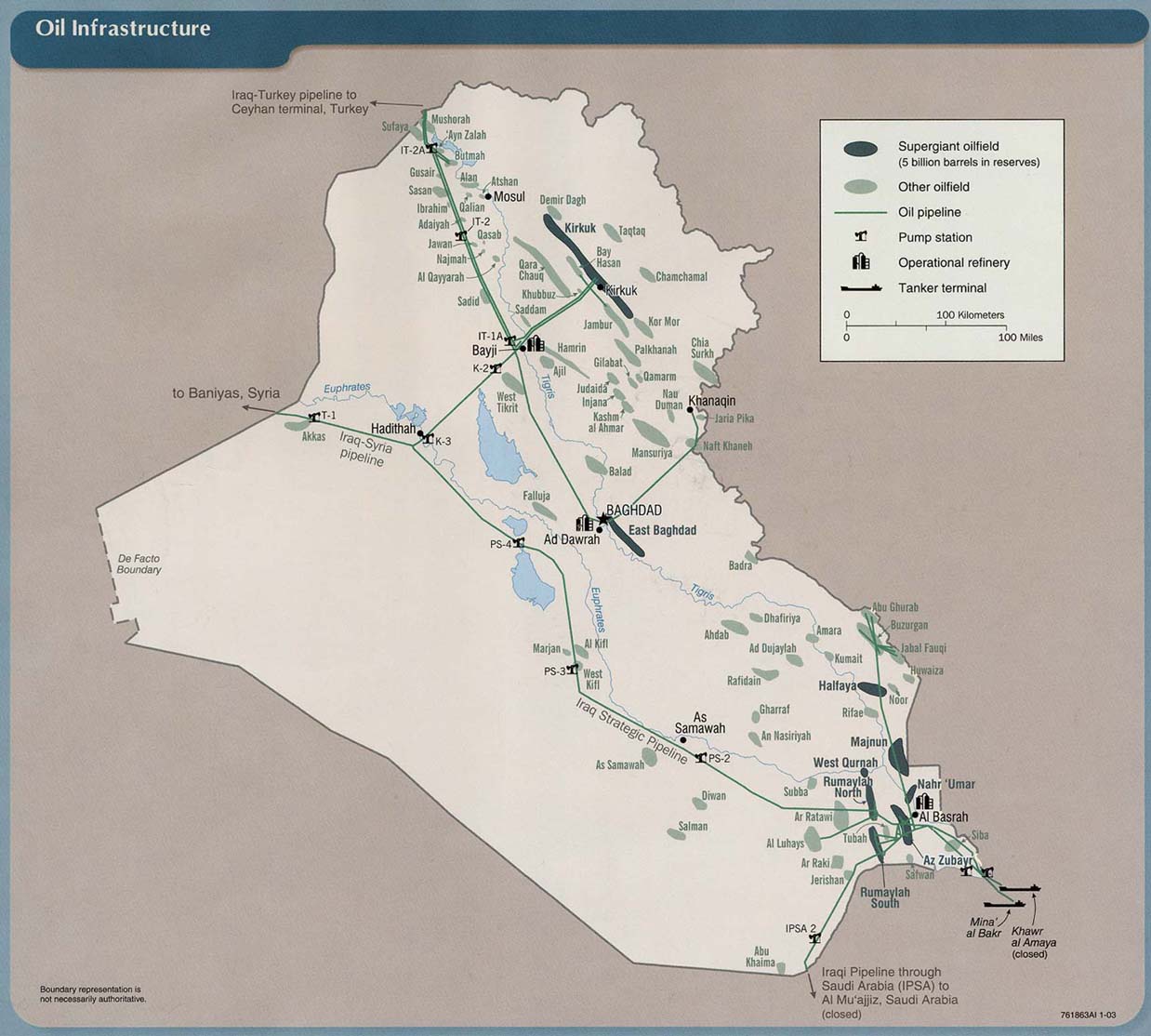

"'We were forced to interrupt pumping in 15 wells' because of the blast, [a North Oil Company, or government,] official said, adding that repairs will take up to seven days.

The North Oil Company produces 650,000-670,000 barrels of oil per day."
5. APPROX. 500,000 FLEE SWAT, BUNER, AND DIR; IS SHARIF PLAYING POLITICS WITH HIS COUNTRY'S SURVIVAL?

Alan Cowell at the New York Times reports that the International Red Cross published a statement today saying:
"[A]lthough figures remain unverifiable at this stage, reports indicated that up to 500,000 Pakistanis have been recently displaced by conflict in Dir, Buner and Swat."


It has been reported that PML-N's leader Nawaz Sharif has rejected an offer to rejoin the coalition government led by the PPP's Zardari, currently in talks with the Obama Administration in Washington, DC. An editorial in the Karachi Dawn suggests:
"Today, rising militancy is the main threat to national security, but the political class is divided on what is the best response. The PPP has shown itself willing to support military action, but the PML-N has baulked at supporting the option. Perhaps cleverly the PML-N has discerned that the electorate is not ready to support the military option because it causes unacceptable losses to local populations without seemingly being able to defeat the militants. And therefore, while sitting in the opposition, the PML-N can cleave to the populist line and not bear the burden of devising a credible and effective counter-insurgency and counter-terrorism policy which will inevitably involve a long-drawn-out and messy fight.

But what is good for the PML-N’s popularity is not necessarily what is best for the national interest. If the PPP and PML-N are nudged, or themselves agree, to join hands at the centre, they can form a formidable political alliance. The PML-N’s popularity in Punjab is unquestioned and Mr Sharif’s bona fides as the representative of the political right and conservative Pakistan are formidable. With the PML-N on board, the government will genuinely be able to claim its position on militancy represents the national will."
6. EL PAÍS ACCUSES CARACAS OF SHELTERING FARC LEADERS

Fausta Wertz at the Compass reports that Spanish daily El País published an article yesterday which speculates that three top FARC leaders are hiding out in Venezuela.
"The article from El País came up after Colombian president Alvaro Uribe urged Chávez to help destroy the FARC. Chávez flat-out refused, saying that it's not his war."
Ms. Wertz also notes that Chávez blamed the US for the recent crash of a helicopter, saying that the cost of patrolling the border with Colombia was beyond the financial resources of Caracas and that the conflict within Colombia itself is fueled to a great extent by the drug war. Fair points in my view, after all even the US with the largest federal government budget in the world finds cross-border traffic driven by the drug war impossible to police--and the precipitous decline in oil prices has put a serious crimp in Chávez's discretionary funds. (The proposed US budget includes $27 billion for "border and related security," an increase of 8% from last year. $27 billion is more than 8% of Venezuela's total GDP $331.8 billion and a little less than 27% of the 2008 budget in Caracas. It is 0.7% of the US proposed budget. Just sayin'.) However, it is also interesting in the context of Chávez's recent claim that Venezuela will not tolerate incursions by FARC into its territory--see Daily Sources 5/1 #2. Anyone who has been following my thinking on Chavez knows I don't think there's much chance of reconciliation, but in this particular instance I think that El País and Wertz are overstating the shock, just a bit.

7. OBAMA PROPOSES $3.4 TRILLION BUDGET PLAN

Lori Montgomery, Amy Goldstein and William Branigin at the Washington Post have the story on the Obama $3.4 trillion budget plan.
"The new budget documents, totaling more than 1,500 pages, fill in the details of a broad outline that Obama released in February. They include a massive appendix listing program-by-program information on the roughly 40% of the fiscal 2010 budget that constitutes discretionary spending, which will be set by Congress in what is expected to be a contentious appropriations process."
Under the plan, spending on operations in Afghanistan would exceed spending for Iraq for the first time since the second Gulf War began.

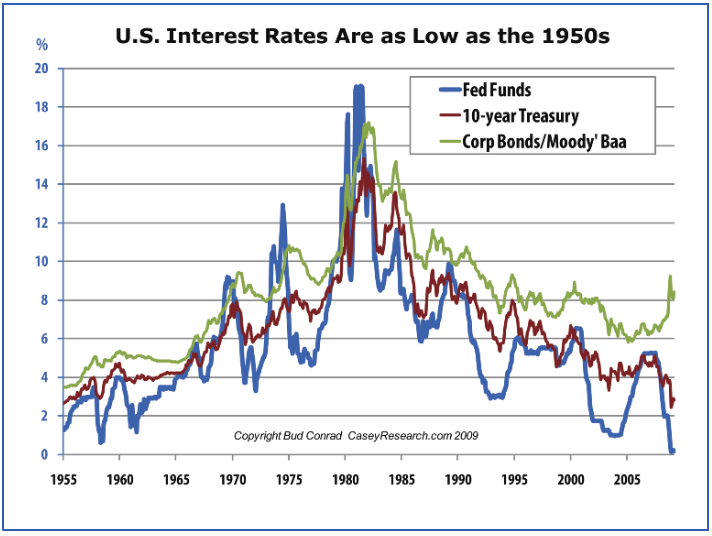
8. FED FUNDS RATE SINCE 1955

Barry Ritholtz at the Big Picture posts a graph plotting the Federal Funds Rate from 1955 on:


9. RETAIL DATA LOOKS BAD FOR ALL BUT APPAREL AND DISCOUNTERS--THE DATA TO BECOME EVEN MORE MURKY GOING FORWARD

Phil Izzo at Real Time Economics reports that a number of large retailers have released their sales data for April today, and RTE has posted a sortable table of the numbers on their site. Luxury retailers fared the worst. Discount and youth apparel firms seem, after a quick look, to have done relatively well. In a related story, Phil Izzo also reports that Wal Mart will no longer publish monthly sales data.
"The change also will remove an important piece for forecasters looking to get a handle on monthly retail sales. Wal-Mart is the nation’s largest retailer with $29.85 billion in sales just for April. An index for retail sales published by Thomson Reuters for April came in up 1.2% for the month, but excluding Wal-Mart’s results it posted a drop of 2.7%."
An already murky picture is thus going to become murkier--almost certainly at the advice of the corporation's investor relations team.

Monday, December 1, 2008

Daily Sources 12/1

1. Ambrose Evans-Pritchard at the UK Telegraph writes that a Citibank report asserts that traders are paying close attention to rumors coming out of China suggesting that Beijing is considering "boosting its gold reserves from 600 tonnes to nearer 4,000 tonnes to diversify away from paper currencies." The report predicts that gold will go to $2,000/ounce, arguing that the economic crisis is so deep and widespread, and the remedial action required of governments so radical, that we are either in for an inflation shock once economies begin to recover or for a period of instability, unrest, and international conflict. Both would traditionally be good for the price of gold. (The Telegraph is not known for the sobriety of its commentary.) In a related story, Judy Chen and Belinda Cao at Bloomberg report that today the yen fell 0.7%
"after the People's Bank of China set the daily reference rate at the weakest level since August, prompting speculation policy makers favor a depreciating currency to spur demand for Chinese goods. ... The yuan has now lost all the gains it made since the [the US and China] last held trade talks in mid June, after it advanced 6.6 percent in the first half of 2008."
Maureen Fan at the Washington Post reports that Chinese President Hu Jintao told a politburo meeting this weekend that "'External demand has obviously weakened, and China's traditional competitive advantage is being gradually weakened' as international demand is reduced." Dow Jones reports that the China Federation of Logistics & Purchasing said that China's Purchasing Managers Index fell to 38.8 in November from 44.6 in October. A reading above 50 indicates growth, anything below indicates contraction.

2. Roland Jackson at the AFP reports that OPEC decided in their meeting in Cairo on the 29th to maintain the current production quotas. The organization is looking at data to see to what extent various members are exporting at quota. Reuters reports that OPEC President Chakib Khelil told the media that the commercial inventories of the OECD will likely reach 59 days of supply if OPEC doesn't take action in the December 17 meeting. "Latest estimates are that stocks are at 55-56 days of cover and several OPEC ministers have said they would like to cut inventories to 52 days."

On Saturday, Saudi King Abdullah said in an interview published in a Kuwaiti paper that "We think that a fair price of oil is $75/b." In the meantime, Reuters reports that Riyadh has shelved plans to restart the Dammam oil field, which was expected to produce 75 kb/d and 100 million cubic feet of natural gas a day. The contract was to be awarded in the second quarter of 2009. The AFP reported that Oil Minister Gholam Hossein Nozari told journalists on Sunday: "There is oversupply of two million barrels per day on the market ...." Ladane Nasseri and Ayesha Daya at Bloomberg report that today in Tehran Secretary General Abdalla el-Badri told the media that "Everybody is in favor of a cut in the Algeria meeting - we are all gearing toward a cut."

El-Badri also said,
"We told Russia that OPEC will take action to lower output, but the burden is heavy. Mexico and Norway have a decline by themselves, but Russia promised to join OPEC in trying to solve the problem."
If Russia does decide to coordinate a production, export, or effective supply cut to the oil markets, it will represent a tectonic shift in their global strategy. Since the Soviet Union began piping natural gas to Europe in the 1980s, Moscow has geared its energy policy to integrating itself with Europe and supplying its full productive capacity. China, another large consumer, also appears to be the beneficiary of that policy. Were Russia to decide its interests were more closely bound to the producing nations than to the consuming nations, a number of long-held policies might be revisited.

In a related story, Platts reports that Moscow has given the green light for a pipeline to be built connecting the Druzhba (or "friendship") pipeline to the Baltic Sea port of Ust-Luga. Ust-Luga is a port to the west of St. Petersburg in the Luga Bay. The map below gives an idea of the path of the Druzhba pipeline and where the Baltic Pipline System 2 would be placed, though it wouldn't terminate in Primorsk, but to the south west. The pipeline would have a 1 mb/d capacity upon completion. By late 2012 it would be expected to have 600 kb/d in capacity.


Of course, exporting via pipeline to Europe means that the crude can go nowhere else. Via tanker it could have any destination outside of Russia. In another related story, Sam Fletcher at the Oil & Gas Journal writes that GCES has a report that Moscow, at the urging of Prime Minister Putin, is in the process of reconfiguring their crude export tariff system. Under the new system the export duty would be determined by the 30 day average of the price for Urals crude ending in the middle of the month prior to implementation, as opposed to the current system which determines the tariff by averaging the price seen in the previous two months every two months. Though this system would certainly be an improvement, it does not on the face of it appear to be flexible enough to prevent financial losses to either the government or the companies given current volatility.

3. Nadim Kawach at Business 24/7 reported Sunday that Saudi foreign assets grew by about SR48 billion ($12.8 billion) in October, but grew at a rate of about 30% less than that seen in previous months. The Saudi Arabian Monetary Agency announced yesterday that the foreign assets held by the kingdom's central bank stood at SR1.679 trillion (~$448 billion) at the end of October.

4. Alex Nicholson at Bloomberg reports that VTB Bank Europe published its Purchasing Managers Index for Russia fell to 39.8, its lowest level, from 46.4 in October. These indices mostly measure market sentiment.

5. Jan Cienski at the Financial Times reports that the Polish Prime Minister, Donald Tusk, told him that Warsaw has no intention of accumulating huge debt in order to combat the financial crisis. Tusk indicated that Poland had not been deeply affected by the crisis so far. His comments align Poland with Berlin in regards to the stimulus package proposed by the European Commission last week. Warsaw on Sunday announced a stimulus package of 91 billion zlotys (~ $30.6 billion), but apparently very little of those monies represent new, previously un-budgeted, spending. Well worth reading in full. Simon Kennedy at Bloomberg reports today that "[Manufacturing indexes] for Poland, Hungary, Sweden and the Czech Republic ... showed some of the steepest-ever declines as recession struck their main export markets." If I remember correctly, the zloty has been under pressure as investors have repatriated their equity. (From June 1 to November 30, the zloty lost 26.8% of its interbank value versus the dollar.)

6. Eurointelligence reports that German Chancellor Angela Merkel secured the backing of her party for her policy of delaying any tax cuts until after the election in September 2009. Finance Minister Peer Steinbruck told Der Spiegel that he thought the crisis should not be countered with government money. The papers in Germany favor the government approach. Bertrand Benoit at the Financial Times reports that Merkel told her party conference that "Germany will keep analyzing the situation. We will always keep all our options open. I repeat: all options."

7. Pradeep Rajan at Platts writes that Gibson Shipbrokers released a report showing that Shell and Koch have taken out time charters of very large crude carriers mostly for storage purposes. Both Shell and Koch have long term contracts with producers, and given the current market, much of that oil, if refined, would put further downward pressure on refined products prices. They also may be inclined to capture profits afforded by the current steep contango in crude oil prices.

8. RIA Novosti reports that the Saudi Ambassador to Kenya told reporters that the Sirius Star will be returned to Saudi Arabia within two days. He also said that no ransom would be paid. Jeffrey Gettleman at the New York Times reports that the head of a Kenyan maritime association charged with mediating between the pirates who captured the Ukrainian freighter lugging 33 T-72 battle tanks, grenade launchers and anti-aircraft guns told the media that the pirates have agreed on a ransom. The ship is expected to be released today or tomorrow and the final ransom is estimated at between $3-5 million. In the meantime, Oliver Smith at the UK Telegraph reports that Somali pirates attacked a luxury cruise liner in the Gulf of Aden yesterday. The liner possesses a "long-range acoustic device" which apparently was used to drive off the attackers.

9. Sudarsan Raghavan and Saad Sarhan at the Washington Post report that Grand Ayatollah Ali Sistani expressed on Saturday concern about the status of forces agreement the Iraqi Parliament ratified earlier in the week. Sistani thought that much of the language in the pact was a "mystery" and that he could discern no guarantee of a return of sovereignty to Baghdad.

10. Rama Lakshmi at the Washington Post reports that anger, quite understandably, is building over the attacks in Mumbai, leading to the resignation of the Indian home minister. Efforts to console the families of victims by government representatives have been met with snubs. Preliminary investigations by Indian authorities lead them to believe that the gunmen were trained in Pakistan and came to Mumbai via boats on the Arabian Sea. This has led a senior representative of the Hindu nationalist BJP to say,
"'It is time for unilateral action against the training camps in Pakistan. If the U.S. can go into Afghanistan to punish the Taliban and chase Osama bin Laden, why should India hesitate?'"
Condoleeza Rice is being sent to New Delhi on Wednesday to try and help calm tensions. An FBI team has been sent to help investigate the scene. Pakistani representatives deny any link to the terrorists, but Candace Rondeaux and Craig Whitlock report in the Washington Post today that the Lashkar-i-Taiba, the Kashmiri terrorist organization currently thought responsible for the shootings, has been operating openly in Pakistan as Jamaat-ud-Dawa.
"Jamaat-ud-Dawa was instrumental in delivering aid to victims of the 2005 earthquake in Kashmir. ... The US government classified Jamaat-ud-Dawa as a terrorist group in April 2006, calling it an 'alias' of Lashkar. But the Pakistani government has not reciprocated and allows the network to raise money, run religious schools and offer social-service programs. It hosts an extensive Web site, with versions in English and in Urdu."
11. Christopher Toothaker at the Associated Press reported yesterday that Hugo Chavez is asking supporters to petition for a national referendum to abolish term limits in the Venezuelan Constitution.
"'Last year, when we lost the referendum, I said I should accept the majority's decision,' the former paratroop commander told a crowd of red-clad government supporters at a rally in Caracas. But now, he added, 'I say you were right: Chavez will not go.'"
12. Tim Johnston at the Washington Post reports that thousands of government supporters rallied in Bangkok this Sunday. Pro-government supporters are wearing red shirts. Anti-government: yellow. So far there has been little violence between the two factions, but there is growing anxiety about the possibility of it. Given that the anti-government protesters (or members of PAD) allegedly number about 20,000, it seems odd that they have managed to shut down so many arteries of the city for so long. Considering that the pro-government supporters are urban, they should outnumber the mostly rural PAD. However, Johnston notes, "The government has only tenuous control over the army and police, which seem to be following their own agenda, allowing the [anti-government] PAD to break the law with impunity."

13. Lauren Etter at the Wall Street Journal reports that Brazil's agricultural sector is slowing down as farmers are having a hard time finding the financing they need for fertilizer, pesticide, and seed. Brazilian farmers get most of their financing from multinational agricultural firms like Cargill, as opposed to from local banks. Evidently these firms are being tighter with credit as they try to conserve cash. Worth reading in full.

14. The Associated Press reports that the Fed is widely expected to cut the federal funds rate by 50 basis points (0.5%) in their next meeting scheduled for December 15-16.

15. Timothy R. Homan at Bloomberg reports that the Institute for Supply Management’s US factory index dropped to 36.2 in November, the lowest level seen since 1982. "[T]he UK’s Chartered Institute of Purchasing and Supply’s factory index was at 34.4, the least since the survey began in January 1992."

16. Emelia Sithole-Matarise at Reuters reports that the spread on 10 year US Treasury credit default swaps has widened to 68.4 basis points (0.684%) today. Evidently the notion of a US default is slowly gaining some credence in the market. (I remain confused, though, as to how these instruments would actually provide any insurance given that the CDS is denominated in dollars .)

Monday, November 17, 2008

Daily Sources 11/17

1. Real Time Economics provides the full text of the White House's fact sheet on the agreements reached at the G-20 summit this weekend.
"Today’s Summit achieved five key objectives. The leaders:
# Reached a common understanding of the root causes of the global crisis;
# Reviewed actions countries have taken and will take to address the immediate crisis and strengthen growth;
# Agreed on common principles for reforming our financial markets;
# Launched an action plan to implement those principles and asked ministers to develop further specific recommendations that will be reviewed by leaders at a subsequent summit; and
# Reaffirmed their commitment to free market principles."
The members also promised to refrain from imposing any new protectionist barriers for the next 12 months.

2. Yves Smith has a useful post about the financial rescue programs and the failure of recent sovereign debt offerings. Yields on sovereign debt are rising as is the cost of insuring the debt (via the infamous, but still marketable, evidently, Credit Default Swaps.) She points out that the supply being added will make yields go up on its own. US Treasury bond supply is expected to reach between $1.4-1.9 trillion. In Europe, government bond supply is expected to grow to more than €1 trillion (~ $1.25 trillion). Carmen M. Reinhart and Vincent Reinhart have an interesting counterpart piece in today's VoxEU, where they ask whether the US is too large to fail. They point out, among other things, that US dollars represent a little more than 60% of foreign government holdings of foreign currency reserves and that foreign governments hold a little more than 20% of American government securities. "As Keynes once said: 'If you owe your bank a hundred pounds, you have a problem. But if you owe a million, the bank has a problem.'" Worth reading in full.

3. Michiyo Nakamoto at the Financial Times reports that Japan entered it's first official depression in seven years. Recession is technically defined as two straight quarters of economic contraction. Japan's GDP shrank at an annual rate of 3.7% in the second quarter and 0.4% in the third.

4. Peter Ford at the Christian Science Monitor writes that some analysts in the Japanese foreign policy community are arguing that Japan ought to use its foreign currency reserves (of which it holds more than $1 trillion) to help shore up the financial systems of South Korea and the United States. The notion is that it would serve Japanese interests economically and that Seoul and Washington would be indebted and, thus, grateful.

5. Paul Beckett at Real Time Economics reports that the managing director general of the Asia Development Bank, Rajat Nag, is upbeat on the prospect of China and India leading Asia out of the financial crisis.
"The Manila-based ADB is forecasting that China’s economy will grow by between 9.5% and 9.7% in 2008 and by about 8.5% in 2009, down from an annual average of about 10.5% from 2002-2007. India’s growth this year is forecast at 7.8% and next year at 6.3%-6.5%, down from about 8% annually from 2002-2007.

'We believe China and India will provide the drivers for Asian economic growth and Asia in turn will provide the driver for world economic growth,' he said."
6. Reuters reports that an adviser to Iranian President Mahmoud Ahmadinejad said in comments published Saturday that Iran had converted its foreign currency reserves into gold. This follows reports that over 13 billion riyals (~ $3.4 billion) was spent on gold purchases in Saudi markets over the last two weeks, according to Mariam Al Hakeem at Gulf News. (h/t Jesse's Café Américain)

7. Platts reports that OPEC cut its forecasts for 2008 and 2009 demand in their Monthly Oil Market Report released today.
"In outright terms, OPEC cut its estimate of world oil demand in 2008 by 260,000 b/d to 86.19 million b/d, and reduced the same figure for 2009 by 530,000 b/d to 86.68 million b/d.

Demand growth next year is expected to be largely confined to China and the Middle East, with consumption in the developed countries making up the OECD falling to 47.42 million b/d from this year's expected average of 48.01 million b/d."
8. Fiona MacDonald at Bloomberg reports that the Kuwaiti Oil Minister, Mohammed Al-Olaim, is quoted in local media as saying that Kuwait would support further production cuts in OPEC if it were shown that all countries had met their obligations. Platts reports that OPEC president Chakib Khelil told reporters that OPEC might have to wait until the December meeting to make further cuts--as opposed to at the extraordinary meeting scheduled for November 29 in Cairo--as the organization is not likely to have all the data it needs to make a decision before then.

9. Reuters reports that Somali pirates have seized a Very Large Crude Carrier (or a VLCC, which can hold as much as 2 million barrels of crude oil) owned by Saudi Aramco 450 nautical miles southeast of Mombasa, Kenya. The tanker was probably headed to the United States and was far from the Gulf of Aden--where nearly all of the past problems with Somali pirating have taken place. I think we can expect the industrialized nations to take further action.

10. Mary Beth Sheridan at the Washington Post reports that al-Maliki's cabinet has approved a new status of forces agreement with the United States which would allow the US to keep troops in the country until 2011. American soldiers will be required to procure warrants from Iraqi courts prior to executing arrests in Iraq, and then hand over prisoners to Iraqi courts. That does not strike me as a workable arrangement as it in effect puts American troops under the executive veto of Iraqi courts. The Iraqi Parliament must ratify the agreement.

11. Candace Rondeaux at the Washington Post reports that Afghan President Karzai has publicly guaranteed Taliban leader Mohammad Omar's security should he decide to enter into official talks.