Showing posts with label Poland. Show all posts

Wednesday, July 7, 2010

Daily Sources 7/7

1. CHINA'S US TREASURY HOLDINGS UP $5 BILLION IN APRIL

Bloomberg reports that China's State Administration of Foreign Exchange urged markets to not consider changes in US treasuries political statements. It further indicated that gold is not likely to become a major part of its reserves holdings because of its volatility and lack of interest payments. Some think this is just Beijing talking its book so it can buy further gold at depressed prices. Last year Beijing doubled its gold holdings.

2. FREE EXCHANGE HOSTS A NEAT INTERACTIVE MAP OF THE EU


3. NEW POLISH PRESIDENT AN EUROPEANIST

Greg Scoblete at Real Clear World reports that the new Polish President is a committed Europeanist as opposed to his predecessor, who was a committed Atlanticist.

4. US RHETORIC IN GEORGIA DESIGNED TO CALM FEARS IN T'BLISI

Mary Beth Sheridan at the Washington Post reports that in her visit to Georgia, Secretary Clinton indicated the US's opposition to Russia's "invasion and occupation" of Georgia. Prime Minister Putin took issue with the characterization of the Secretary of State, calling the Russian troop presence an effort to liberate the Abkhazians and South Ossetians.

5. DRILLING IN GREENLAND'S ARCTIC WATERS BEGAN LAST WEEK

Kate MacKenzie at FT Energy Source reports that deep water drilling in Greenland's Arctic waters began last week. And so the race for Arctic natural resources begins.


6. AUSTRALIA KEEPS BENCHMARK RATE AT 4.5%

Jacob Greber at Bloomberg reports that Central bank Governor Glenn Stevens yesterday left the benchmark cash rate at 4.5% for a second month. Australia's central bank had raised interest rates six times since October when it stood at a low of 3%. Inflation is expected to increase to more than 3% in the coming months.

7. INDIA DEPLOYS TROOPS IN KASHMIR IN EFFORT TO SUPPRESS UNREST

Lydia Polgreen at the New York Times reports that the Indian Army has deployed troops in Kashmir in an effort to calm the region after large street protests resulted in paramilitary units firing into the crowds.

8. RUMORS THAT MUBARAK'S HEALTH IS IN SERIOUS DECLINE

Michael Collins Dunn at the MEI Editor's Blog reports that Ha'aretz has picked up a rumor from a London-based daily that Mubarak's trip to France was for medical reasons. The story is that Mubarak's health is in serious decline and that his son is in line for succession.

9. OBAMA EXPECTS NETANYAHU TO BEGIN TALKS WITH PALESTINIANS BEFORE MORATORIUM ON NEW SETTLEMENT BUILDING EXPIRES IN SEPTEMBER

Sheryl Gay Stolberg and Mark Landler at the New York Times report.

10. BANK CARD DELINQUENCIES FALL BELOW 4%; SERVICE SECTOR NOT ADDING JOBS QUICKLY ENOUGH

In a good sign for the economy, Darrell A. Hughes at Real Time Economics reports that bank credit-card delinquencies dropped below 4% for the first time in eight years.
[ABA Chief Economist James] Chessen said the anticipated slow growth is unlikely to cause delinquencies to rise significantly, but there could be some impact. 'Until we get a sustained level of new jobs in this economy, we’re not going to see delinquencies fall to very low levels,' he said.
In the meantime, Phil Izzo at Real Time Economics reports that the Institute for Supply Management subindex for employment fell below 50, indicating a fall in employment.


11. THE EIA REPORTS THAT CRUDE STORAGE IS DOWN 2 MILLION BARRELS, STILL 12.9 MILLION MORE IN STORAGE THAN LAST YEAR

The EIA reports that crude stocks fell to 363.1 million barrels, down 2 million from last week, up 12.9 million from last year. Gasoline stocks rose by half a million while diesel stocks rose 2.5 million. Average US gasoline prices rose by 1.4 cents to 275.7 cents the week ended June 28. In the week ended June 25, refinery capacity utilization stood at 88.4%, down 1% from the week previous.

Tuesday, June 2, 2009

Daily Sources 6/2

1. EUROZONE UNEMPLOYMENT ENDS UP STILL BEING HIGHER THAN U.S. UNEMPLOYMENT, CLIMBING TO 9.2% IN APRIL

Ralph Atkins at the Financial Times reports that unemployment in the eurozone grew to a seasonally-adjusted rate of 9.2% in April, 0.3% more than the number for the US. In May many analysts had expected the unemployment rate in the eurozone to fall below the rate in the US for the first time--see Daily Sources 5/22 #9.
"The impact of lengthening jobless queues on demand in coming months is a main reason why economists expect the eurzone’s economic recovery to remain weak for a protracted. 'The eurozone recession may be past its peak, but for the labor market the worst is yet to come,' said Martin van Vliet at ING in Brussels.
...
European policymakers will also be alarmed by the rise in youth unemployment. In April, some 18.5% of the labour forced aged under 25 were without a job--up from 14.7% a year before."
2. AGREEMENT BETWEEN SPANISH RULING SOCIALISTS AND CONSERVATIVES TO REIN IN "UNIVERSAL JURISDICTION" CASES

Helene Zuber at Der Spiegel reports that the ruling Socialists in Spain have an agreement with conservatives in order to rein in the Audencia National--or National Court--of Spain which has been the court to which human rights plaintiffs could file cases under the principle of "universal jurisdiction." The agreement basically requires that there be some tie to Spain in order for the court to claim jurisdiction:
"The accused will have to be arrested in Spain, a victim will have to be a Spaniard, or there will have to be some other decisive connection to Spain before the court will be allowed to proceed. There will also have to be proof that no other national court system has taken up a given case."
The move clearly comes from international pressure, especially after Baltasar Garzón went ahead with plans to investigate six advisers to President George W. Bush for human rights violations that took place in Guantanamo Bay. In April Spanish prosecutors formally recommended that Baltasar Garzón--famous for his case against the former dictator of Chile, Augusto Pinochet--should not oversee any investigation into the six--see Daily Sources 4/17 #3. But pressure is also coming from Israel and China.
"Beijing has brusquely rejected a petition by [Spanish Justice Santiago] Pedraz to interrogate [ministers accused of [a "systematic attack on the people of Tibet] at home. The Madrid justice would be arrested immediately if he traveled to China, the government threatened. The Chinese foreign ministry warned the Spanish government--which is interested in good trade relations--not to meddle in China's internal affairs or to support the Tibetan separatists."
The Spanish senior judiciary is also reportedly uncomfortable with the potential consequences of asserting universal jurisdiction:
"'We cannot become the world's judicial gendarme,' said Carlos Divar, chief justice of the Spanish Supreme Court and chairman of an internal watchdog body that oversees Spanish courts. 'Who are we to pass judgment in foreign countries when we have so much to deal with at home?' said the man who until recently was president of the Audiencia Nacional and disapprovingly witnessed his judges' ardor for pursuing foreign cases. His successor, Angel Juanes, also wants to see more consideration for 'national interests' in the court's behavior."
Well worth reading in full.

3. POLAND SIGNS N.G. SUPPLY DEAL WITH GAZPROM, MAY SIGN DEAL THROUGH 2022

Patryk Wasilewski at Reuters reports that Polish gas delivery monopoly PGNiG concluded a deal with Gazprom for natural gas today after which supply was fully restored.
"Poland uses around 13-14 billion cubic metres of gas annually and imports about two-thirds of it from Russia.

Now that the short-term deal is signed, the government will press for a quick intergovernmental agreement with Russia, a necessary prerequisite to secure natural gas deliveries past 2009 when the PGNiG's deal with RosUkrEnergo runs out.

Poland may even agree to sign a deal with Russia until 2022, about eight years past the planned completion of the government's largest energy diversification project--the liquefied natural gas terminal, the economy minister said.

'It is easier to deal with a small surplus than shortage. From that point of view I don't see extension of the deal until 2022 as a problem,' Waldemar Pawlak told a press conference."
4. CHINA TO OPEN ANTI-DUMPING INVESTIGATION INTO RUSSIAN AND U.S. STEEL COMPANIES; STUDENTS LAUGH AT SECY GEITHNER'S ASSERTION THAT THEIR ASSETS ARE SAFE, BUT BEIJING REITERATES THAT U.S. AND CHINA NEED TO COOPERATE TO DEAL WITH CRISIS

Kris Maher at the Wall Street Journal reports that the Chinese Ministry of Commerce on Monday said that it was opening an anti-dumping investigation into US and Russian steelmakers to see if they "sold a specialized type of flat-rolled steel used in electrical transformers below market value." The ministry was also beginning an investigation into US state and federal subsidies of the industry. The case follows an April case filed in the US by steelmakers and United Steelworkers alleging Chinese dumping into the US market of types of tubular and steel pipe used in oil drilling.
"[S]ome analysts said they believe the move by the Chinese government is an effort to sway the US Trade Commission in deciding the April case. 'This is political,' said Michelle Applebaum of Steel Market Intelligence in Chicago. Ms. Appelbaum also said she believes the filing was timed to Mr. Geithner's visit to Beijing. 'I think the timing is very heavily influenced by Geithner being there.'"
Meanwhile, in addressing a student question after his speech at Peking University, Secretary Geithner said, "Chinese assets are very safe," per Glenn Somerville at Reuters. The student audience reportedly broke into loud laughter at the assurance.
"But later in the day, Chinese Vice Premier Wang Qishan said it was important for the two nations to show the world they are working together through their joint economic dialogue.

'We must through our dialogue send a clear signal that China and the US are engaged in practical cooperation to address the crisis,' Wang told Geithner, according to the Chinese Foreign Ministry's website (www.mfa.gov.cn).

'This is important for boosting confidence and encouraging global financial stability and economic revival,' said Wang."
The statement more or less mirrors the key message of Geithner's speech--see Daily Sources 6/1 #1.

5. U.S. TO SELL BUNKER BOMBS TO SOUTH KOREA, KIM JONG IL NAMES THIRD SON SUCCESSOR

Malcolm Moore at the UK Telegraph reports that an unnamed South Korean military official told the media that the US had agreed to sell bunker buster bombs to Seoul for delivery between 2010-4.
"The laser-guided GBU-28 bombs were first used in 1990 during the Gulf War to destroy underground command centers in Iraq.

The 19-ft-long, 5,000lb bombs can penetrate over 20ft of concrete and 100ft of earth and could be used to target North Korea's intricate system of military bunkers and a series of munitions tunnels along the border."
(h/t Joshua Keating at FP Passport's Morning Brief.) In the meantime, Blaine Harden at the Washington Post reports that the dictator of North Korea, Kim Jong Il, has chosen his third son, Kim Jong Un, as his successor.
"If Kim Jong Un does become the new leader--and there are analysts who doubt the decision is final--this second consecutive father-to-son handoff would be unique among nations that call themselves communist. There was no indication, however, that Kim Jong Il would be handing over power any time soon."
Some analysts have tied the recent behavior by Pyongyang to the question of succession there, given reports that Kim Jong Il is not well. The transition of power is often pointed to by political scientists as a structural weakness in autocratic systems.

6. SARKOZY TO MEET WITH IRANIAN FOREIGN MINISTER TOMORROW IN PARIS, THE U.S.D.O.S. O.K.S CONSULATE AND EMBASSY INVITATIONS TO IRANIAN GOV'T REPS FOR 4TH OF JULY CELEBRATIONS

Emmanuel Jarry at Reuters reports that French President Nicolas Sarkozy will meet with Iran's foreign minister Manouchehr Mottaki on Wednesday in Paris.
"Bilateral encounters at such a senior level between Iran and one of the countries involved in the nuclear issue are highly unusual. It will be the first time Sarkozy has met a top Iranian minister since he took office in 2007."
Meanwhile, Mark Landler at the New York Times reported yesterday that the State Department Friday sent out a cable to its consulates and embassies notifying them that they may invite representatives of the government of Iran to their fourth of July celebrations. Though some might dismiss the move as merely symbolic, a public reminder that the US has an anti-colonial past (and much of American engagement in the Middle East has been historically anti-colonial) is sly, in my opinion, given the ideological framework behind the Islamic Republic of Iran--see Law and Revolution in Iran.

7. SYRIAN KURDS SEE IRAQI KURDISH REGION AS SAFE HAVEN DESTINATION

Karlos Zurutuza at the Iraq Oil Report reported yesterday that Iraq's Kurdish region is becoming a destination for Syrian Kurds denied full citizenship rights by Damascus.
"Since 1962 Syria has classified Kurds as ‘Syrian Kurds’, ‘foreign Kurds’ and ‘concealed Kurds,’ only granting ‘Syrian Kurds’ full domestic rights and Syrian nationality. The remainder, who number an estimated 200,000, are registered as foreigners and live without domestic citizenship rights."
The relative security provided by the Kurdish Regional Authority inside Iraq's Kurdish region has made it into a refugee destination for Arab Sunnis and Shias as well Kurds from other parts of Iraq as well as other neighboring countries, including Turkey and Iran.

8. FORMER SAUDI INTELLIGENCE CHIEF SAYS KILL OSAMA BIN LADEN, DECLARE VICTORY, AND "GET THE HELL OUT" OF AFGHANISTAN, OFFERS TO HOST TALKS; OPEC SAYS PRICES NOT DRIVEN BY FUNDAMENTALS

Jeff Stein at Spy Talk reported yesterday that former Saudi intelligence chief, Prince Turki al-Faisal, said in an interview with the columnist that the US should kill Osama bin-Laden and then "get the hell out" of Afghanistan.
"Turki, who was also Saudi ambassador to the United States from 2005 to April 2009, likened al Qaeda to a 'cult' and its leader to a 'hydra head with venomous snakes.'

To destroy the cult, he said, 'you have to cut off the head.'

'After that,' he advised, 'declare victory...then get the hell out of Afghanistan.'"
Turki said that no one would be able to get all the jihadis, but that it was important to take out bin-Laden, who has become iconic. In an interview with NPR noted by Stein, Turki dismissed the issue of creating a martyr:
"So if he is eliminated there will be no more something to look up to. And the issue of a martyr, that some people say is there, is less attractive than having someone living and doing things and surviving the efforts to eliminate him."
Turki said that Afghanistan could not be fixed by NATO and US forces. He also indicated that Riyadh would be happy to host peace talks between the Karzai government and the Taliban, but would not mediate between them. Well worth reading in full. Meanwhile, Kate Dourian at Platts reports that OPEC's chief economist, Hassan Qabazard, said at the World National Oil Companies Congress in Abu Dhabi:
"Prices are being affected more by non-fundamentals rather than by fundamentals. ... I think personally prices for the fundamentals that we see today are quite high and that is due to the inflow of investment funds into the market ... we see much more long positions by investors now in the market who are expecting a higher price."
Qabazard indicated that he thought stocks of oil would be unloaded as the contango narrows and that prices may fall, as they "are going up too fast."

9. LAHORE HIGH COURT RULES INSUFFICIENT EVIDENCE TO HOLD SUSPECTED MUMBAI TERROR MASTERMIND

Griff Witte and Rama Lakshmi at the Washington Post report that the Lahore High Court ruled today that there was insufficient evidence to continue the house arrest of Hafiz Sayeed, founder of Lashkar-i-Taiba, and who is suspected of being a mastermind behind the Mumbai terror attack.
"In India, officials expressed deep displeasure.

'We are unhappy that Pakistan does not show the degree of seriousness and commitment that it should to bring to justice perpetrators of the Mumbai terror attack,' Indian home minister P. Chidambaram told reporters in New Delhi."
Government prosecutors said that they would appeal the court's decision.

10. CHINA OFFERS $3 MILLION IN HUMANITARIAN AID FOR DARFUR REGION

The AFP reports that China's special envoy to Darfur, Liu Guijin, met with Sudan's President, Omar al-Bashir, and pledged $3 million in humanitarian aid to the region. Mr. Liu was in Khartoum to talk with al-Bashir at the start of a new round of talks with the Justice and Equality Movement (JEM)--the main Islamist rebel group in Darfur. The AFP reported in late May that the US special envoy to Sudan, Scott Gration, in Qatar met with Mr. Liu in the first ever meeting of the Darfor envoys of the permanent members of the UN Security Council, and said of the meeting that it was very "positive"--see Daily Sources 5/28 #1.

11. CANADIAN OIL SANDS PROJECTS MAY COME BACK ON LINE WITH RETURNS AVAILABLE AT $60/B

Scott Haggett at Reuters reports that Andrew Potter of UBS Securities has released a report which suggests that many Canadian oil sands projects mothballed due to high labor and material costs in combination with low oil prices may now be re-started on falling labor and material costs.
"More than C$90 billion ($83 billion) worth of oil sands projects were delayed, deferred or canceled after prices plunged, freeing up a squeezed skilled-labor pool, boosting productivity and increasing the availability of contractors.

'Developers are likely to see vastly improved labor productivity and lower labor costs as fewer workers are required to execute long-term oil sands growth,' Potter wrote in his report."
Potter estimates that many projects now require $60/b oil to be profitable, versus estimates last year ranging from $80-100/b.

12. MEXICAN REMITTANCES FROM THE U.S. DECLINE BY 18.7% IN APRIL YOY

Elisabeth Malkin at the New York Times reports that remittances by Mexican workers in the US home have fallen by nearly 18.7% in April from a year previous to $1.8 billion, according to the Bank of Mexico. Remittances have been Mexico's second largest sources of foreign exchange, with oil being the largest. They are roughly equivalent to foreign direct investment with tourism taking the fourth spot.

13. PENDING HOME SALES INCREASE 6.7% MOM, 3.2% YOY

The Associated Press reports that the National Association of Realtors released its index of home sales which show a 6.7% increase in pending sales in April from March, and a 3.2% increase from the year previous.
"The big jump probably reflects the impact of a new $8,000 tax credit for first-time homebuyers that was included in the economic stimulus bill signed by President Obama in February. Since buyers need to finish their purchases by Nov. 30 to claim the credit, 'we expect greater activity in the months ahead,' Lawrence Yun, the Realtors’ chief economist, said in a statement."
14. FORD'S CAR SALES UP 20% IN MAY FROM APRIL, DOWN 24% YOY

Nick Bunkley at the New York Times reports that Ford's sales in May were up 20% from April, and down 24% from the year previous.
"Ford is the only Detroit automaker that has not entered bankruptcy, after General Motors filed for Chapter 11 protection on Monday and Chrysler did so a month ago. They and other automakers were scheduled to report their May sales figures later Tuesday.

Through April, auto sales in the United States were down 37% this year, as the economic recession deters many consumers from buying a new car or truck."

Tuesday, May 12, 2009

Daily Sources 5/12

1. CHINESE EXPORTS AND IMPORTS DOWN YEAR OVER YEAR, BUT IMPORTS ARE UP FROM MARCH, SEEN BY MANY AS A 'GREEN SHOOT'

Andrew Batson and Terence Poon at the Wall Street Journal report that Chinese exports fell 22.6% from a year earlier to $91.94 billion in April from roughly $117.3 billion. China's April imports sank 23% to $78.8 billion from the roughly $102.3 billion imported a year previous, but were up 9.9% from imports of $71.73 billion in March. Rebecca Wilder at News N Economics plots a graph of percentage import and export growth in dollars from Jan 2001:


Ms Wilder is encouraged by the relative recovery in imports, commenting:
"[I]mport growth surged. Now, this could be driven by several factors--anything that might affect the real exchange rate; however, it does suggest that domestic demand may be improving. Furthermore, and in normal times, greater access to imports is good for efficiency, productivity, and growth."
Her post is worth reading in full. In a subscription only report, Hui Ching-hoo at Lloyd's List reports that domestic growth has lifted volumes at the northern port of Tianjin.
"Latest figures show cargo throughput increased 2% to 32.2m tonnes last month, while container volumes surged 5.3% to 756,660 teu."
Batson and Poon further note:
"Investment in real estate, one of the main forms of private-sector investment in China, was up only 4.9% from a year earlier in the January-April period, compared to overall growth of 30.5% in the four-month period. Still, it's an improvement from even weaker growth in previous months, and comes as purchases of housing and other property pick up. The volume of real estate sales jumped 39% from a year earlier in April after 16.4% growth in March, reversing several months of decline."
On the back of stimulus programs, fixed asset investment grew by an annual rate of 33.9% in April after posting a 30.3% gain in March.

2. LENDING SHARPLY DOWN AFTER NEARING STIMULUS TARGETS, BUT NEW LIQUID CAPITAL IN PRIVATE HANDS NOT AN ESPECIALLY LARGE SHARE OF THE NEW MONEY

However, the number of new loans overall--as noted last week in Daily Sources 5/7 #2--has fallen rather steeply from 591.8 billion yuan (~ $86.88 billion) in April or 68.7% from 1.89 trillion yuan (~ $277.5 billion) in March, with the People's Bank of China noting that 92% of the stimulus lending target had already been met in the first quarter. Andrew Batson at the China Journal gives a partial breakdown of the end recipients of the new money:
"[L]oans to households made up 25% of April’s new loans, compared to just 9.2% in the first quarter, as housing sales continued to pick up. And medium and long-term loans, which primarily go to infrastructure projects, accounted for 63% of new loans in April, up sharply from 37% in the first quarter. 'This shows that more liquidity is flowing into the real economy,' said Ha Jiming, chief economist of China International Capital Corp.

Short-term lending has gotten particularly close scrutiny recently. Many analysts suspect the recent surge in such financing is at least partly driven by banks trying to pad their books, and companies using the money for financial speculation. But it’s starting to fade in importance.

Discount bill financing--a form of short-term borrowing, usually against accounts receivable--accounted for 21% of April’s net new lending, down from 32% in the first quarter. And other short-term lending actually declined by 78.6 billion yuan [~ $11.54 billion] in April."
Kevin Hamlin at Bloomberg adds:
"[I]nvestment figures showed the number of new projects started in the first four months jumped 45% to 86,420 from a year earlier. Planned spending on those projects climbed 91% to 3.68 trillion yuan [~ $540.2 billion].

Investment in property development rose 4.9%, quickening from 4.1% in the first quarter. Railway spending surged 94.2%, along with a 36.6% rise for coal extraction and processing and a 26.3% gain for non-ferrous metal processing."
3. COMMODITIES PRICES UP ON BEIJING'S DIRECTIVE TO BUY EM CHEAP, BUT, MY GUESSTIMATE IS THAT THEY DO NOT ACCOUNT FOR THE LION'S SHARE OF THE VALUE OF NEW IMPORTS

Chuin-Wei Yap at China Journal reports that Chinese imports of metals have surged likely due to the decision in Beijing to stockpile in the low price environment.
"Customs data Tuesday showed China imported 399,833 metric tons of copper and related products, up 62% on year and beating the previous record set just in March. Iron ore imports also rose to a new record of 57 million tons, up 33% on year."
As noted yesterday--see Daily Sources 5/11 #6--Chinese April oil imports were up 13.6% from a year earlier. Though the annual rate of imports growth in April was negative 23%, of the roughly $7.07 billion increase in Chinese imports in April from March, China imported roughly 82 kb/d more crude oil in April than March, which, given a $1.89/b increase in average price, means China may have spent as much as an additional $341.2 million on crude or roughly 4.8% of the increase in the overall value of imports in April from March.

The annual increase of 13.6% in crude imports was about 470 kb/d or, given that front month WTI averaged just below $49.50/b in April, the additional volume cost roughly $700 million, or nearly 10% of the $7.07 billion increase in imports from March, but crude was averaging $112.46/b in April 2008, so in dollar terms crude probably represented $11.67 billion of import values in April 2008 versus roughly $5.9 billion in April 2009. Meaning that even with the additional volumes, April 2009 crude accounted for about a 7.5% share of China's import bill as opposed to 11.4% of the value of its April 2008 imports, or a third less.

4. IN JAPAN VISIT, PUTIN CONCLUDING A WIDE VARIETY OF ENERGY COOPERATION AGREEMENTS AND DEALS

Anna Shiryaevskaya at Platts reports that Russian Prime Minister Vladimir Putin invited Japanese participation in Russia's Siberian oil and gas infrastructure efforts. In televised comments in Tokyo, Putin said:
"The participation of Japanese companies in the completion of construction of the oil pipeline from East Siberia to the Pacific Coast is quite possible.
...
In general, Japanese partners could take part in projects to develop pipelines and other transport infrastructure. I mean from Sakhalin Island to Khabarovsk to Vladivostok."


AFP also reported that Putin told reporters today that he expected to sign a nuclear cooperation pact with Japan during his week-long visit.
"Japan and Russia are in the final phase of talks over a pact to promote the non-military use of nuclear power, such as for electricity generation.

The pact will pave the way for Tokyo to entrust Moscow with uranium enrichment and allow Japan to export nuclear power plant technology to Russia, Kyodo News said."
Meanwhile, Takeo Kumagai at Platts reports that the state-owned Japan Oil, Gas and Metals National Corporation (formerly the Japan National Oil Company--JNOC) today announced that it had entered into an agreement with the privately owned Irkusk Oil Company to jointly explore two blocks of land in Eastern Siberia for oil and gas.
"The partners believe that the blocks could hold combined reserves of up to several hundred million barrels because of their proximity to discovered oil fields such as the Yaraktinskoye and Verkhnechonskoye oil fields, JOGMEC said."
And Oleg Shchedrov at Reuters reports that Gazprom had concluded a memorandum of understanding with METI, Itochu Corp and Japan Petroleum Exploration Co to explore gas projects in eastern Russia.
"[Gazprom CEO] Alexei Miller told reporters the memorandum would explore ways to process gas near the Pacific city of Vladivostok for supply to consumers in Russia and the Asia-Pacific region, including Japan."
5. NORTH KOREAN FOOD WOES SET TO CONTINUE AND EVEN GROW, IN LARGE PART BECAUSE OIL FOR TRACTORS AND FERTILIZER IN SHORT SUPPLY

The Australian Broadcasting Corporation broadcast an interview by Sonja Heydeman of Lena Savelli, World Food Programme spokeswoman in North Korea, and Prof John McKay at Analysis International in Melbourne, regarding the worsening food situation in North Korea.
"HEYDEMAN: South Korea's unification ministry said in February that the North's food production would fall more than one million tons short of demand this year. However, the World Food Program's Lena Savelli says that figure underestimates the gravity of the situation.

SAVELLI: The latest assessment on crop production done by The Food and Agriculture Organization and the World Food Program puts the deficit even higher .. as high as 1.8 million metric tons of food for the agriculture year 2009. We are planning to feed as many as 6.2 million people in the DPRK in 2009. Unfortunately we have not been able to raise enough resources to reach all the affected people.

HEYDEMAN: While agriculture in North Korea needs to be addressed, Professor John McKay from Analysis International in Melbourne says there's a broader systemic problem that needs to be considered.

He says the agricultural sector has been dragged down by the crisis in other sectors, particularly the industrial sector.

McKAY: When the Soviet Union collapsed North Korea lost its major ally .. the ally that provided oil and technology and all kinds of things including cheap access to certain kinds of food but more particularly to access a cheap level a whole range of industrial products and those industrial products had ramifications for the agricultural sector. For example, fertilizer much of which is a by-product of petroleum is no longer available in North Korea. There is no fuel oil to drive the tractors and other kinds of machinery and that has had a major impact on North Korean productivity."
(h/t The Oil Drum's daily Drumbeat.)

6. SOUTH KOREA DEAL FOR OIL AND GAS EXPLORATION IN UZBEKISTAN, CONTINUING ASIAN TREND IN STATE-DRIVEN OVERSEAS RESOURCE INVESTMENTS

Charles Lee at Platts reports that KNOC--the Korean National Oil Corporation--has signed a preliminary agreement with Uzbekistan to explore five oil and gas blocs.
"The deal is part of South Korea's push for oil-for-infrastructure packages with underdeveloped countries under which it would offer aid to improve their poor social infrastructure, such as bridges and roads, in return for stakes in oil and gas fields."
7. POLAND MIGHT DELAY ENTRY TO EUROPEAN MONETARY UNION BY A YEAR, OR MAYBE MORE, FINANCIAL CRISIS WILL MAKE ENTRY UNDER CURRENT TERMS DIFFICULT FOR MANY PROSPECTS

Go Warsaw.com summarizes a Financial Times interview with the Polish Finance Minister, Jacek Rostowski, where he indicated that Warsaw may delay its entry into the monetary union by as much as a year from the current target date of Jan 1, 2012.
"'The Jan 1, 2012 is still realistic, but it may require some delay,' Rostowski said. 'The world crisis has come along and it would be naive to pretend it has had no effect. If we move it by one year that's not the end of the world,' he told the daily"
Go Warsaw notes that the Deputy Financial Minister also serving as the government's plenipotentiary for euro adoption told Reuters in April that entry might be delayed by between one and two years. (h/t Eurointelligence.) In a post on differentiating the economic situations in eastern Europe, Edward Hugh at Fistful of Euros plots a graph of Polish sentiment, per the EU Economic Sentiment Indicator, which is the best reading in the entire region:


"[The EU monthly Economic Sentiment Indicator] is a composite which measures sentiment in industry, services, construction, retail and building, and does at least have the advantage of offering us a rule of thumb guide as to how a country is handling the crisis."
8. KRG SAYS OIL EXPORTS VIA DEALS STRUCK WITHOUT BAGHDAD ARE FAIT ACCOMPLI

Carola Hoyos at FT Energy Source yesterday quoted from an interview Friday with Ashti Hawrami, the Kurdish Regional Government's oil minister, where he made plain that the flow of oil from fields contracted for without the previous consent of Baghdad was a fait accompli:
"The oil operations are under KRG control. The operators have been allowed to reach the point of tie-in to the pipeline. The operators have been notified (that June 1 is the first flow date).
...
The rough edges of course still need to be worked out. But if someone says, I wouldnt allow it. I would say, how would you not allow it. Are you going to shut down the Kirkuk pipeline? Once we do this (flow oil), it’s gone. period."
Meaning all Iraqi oil flow through the pipeline, not just the oil flowing from the Kurdish Autonomous Region.


9. IRAN OPEC GOV. MISUNDERSTOOD YESTERDAY, WANTS OPEC TO CUT, ROXANA SABERI RELEASE MAY MEAN THOSE WHO WANT DETENTE WITH THE US ARE WINNING THE POLITICAL BATTLE IN TEHRAN, THE LEADER OF THE REVOLUTION MAY, BY POSSIBLY ENDORSING AHMADINEJAD, BE ENDORSING ENGAGEMENT

Following yesterday's report that Iran would not be pushing for a further cut in production at the upcoming OPEC meeting--see Daily Sources 5/11 #5--Platts reports that Mohammad Ali Khatibi told the Iranian state news agency that, "with the increase of stockpile levels, cutting oil supply is necessary." Meanwhile, Nazila Fathi and Mark Landler at the New York Times report that analysts believe the decision to release Roxana Saberi was due to forces in favor of detente with the US winning out over the revanchists.
"'They understood that this wouldn’t help them,' said Thomas R. Pickering, a former undersecretary of state who has conducted informal talks with Iranians. 'They were asking the US to put words into action, and at the same time, they were going in the opposite direction.'

Mr. Ahmadinejad is seeking re-election on June 12. The letter he sent to the court was the first time he had intervened in a judicial case in his four years in office. Analysts said it would help his prospects if he could advance negotiations with the United States before the election.

'Mr. Ahmadinejad wants to take serious steps towards improving ties with the United States before the elections,' said Ibrahim Yazdi, a political analyst in Tehran. 'If he succeeds, it would be to his interest.'"
Kevin Sullivan at The Compass reports that Nader Uskowi believes that the Leader of the Revolution, Ayatollah Khamenei has come close to endorsing Ahmadinejad for President in the upcoming elections. I tend to think that the regime has little interest in a real and full coming to terms with the US, but these items argue otherwise, and perhaps the resetting of relations with Moscow (combined with electioneering requirements) is creating an atmosphere of urgency in Tehran.

10. PALM OIL CORPORATION PLANTATION EXPANSIONS CREATING TENSIONS IN INDONESIA AND MALAYSIA

Michael Casey at the Associated Press reports that the Borneo Resources Institute of Malaysia and the World Wildlife Fund in Indonesia that the search by palm oil companies for viable land is causing considerable strife.
"In the wake of that push, hundreds of communities have filed complaints with courts in both countries about either being forced off their land or pressured to sell it at cheap prices, the groups said. Many of those affected are impoverished or indigenous communities whose ownership of the land is often not recognized by local authorities.

'The situation is getting critical at the moment. The companies are expanding more and more,' said Kalyana Bujang, director of the Borneo Resources Institute of Malaysia, which has documented 200 court cases in the state of Sarawak alone. 'The communities are caught unaware. They don't know what to do, or where to go.'"
Crude palm oil closed at 2,740 Malaysian ringgits per tonne, or roughly $108.74/b.

11. RAND RELEASES REPORT SAYING THAT OIL CONSUMPTION, NOT IMPORTS, IS THE SECURITY THREAT OIL POSES THE US

Carola Hoyos at FT Energy Source reports that RAND has released a report which argues that dependence upon oil imports do not particularly threaten US security, but that the size of US consumption does. Energy Source reproduces a table of risks to US security linked to oil in the report:


I'm not quite sure of the logic of this, because, well, huge oil demand is what requires oil imports, and it is the fact that imports are difficult to provide security for in a volatile world that makes a dependence on a preponderance of your oil requirement a troubling security concern. Erwin Seba at Reuters writes that the report recommends the following steps:
"- Maintenance of well-functioning oil markets;

- Do not impose price controls or rationing during disruptions;

- A top-level review by government and business of economic benefits and environmental hazards of removing restrictions on drilling for new oil fields;

- Clear environmental and other rules for developing new oil fields and producing oil substitutes;

- Impose an excise tax on oil to increase incentives to drivers and manufacturers to economize on fuel use and soften growth in demand for oil."
Hoyos also notes:
"The think tank also has a message for oil producers: embargoes don’t work to advance your foreign policy goals.

And a message for US allies: Help pay the bill--12 to 15 per cent of the US’s sizable 2008 defense budget--for patrolling the Persian Gulf."
RAND's summary of the report can be found here.

12. US TRADE DEFICIT DOWN; NOW MOSTLY OIL IMPORTS AND GOODS FROM CHINA

Calculated Risk reports that the Census Bureau has released data showing that an at annual rate US imports and exports are down 27% and 17.4%, respectively. The blog quotes the Bureau:
"The ... total March exports of $123.6 billion and imports of $151.2 billion resulted in a goods and services deficit of $27.6 billion, up from $26.1 billion in February, revised. March exports were $3.0 billion less than February exports of $126.6 billion. March imports were $1.6 billion less than February imports of $152.8 billion."
Calculated Risk produces a graph plotting the trade deficit if you exclude the cost of petroleum imports and concludes that the US trade deficit is now nearly all oil and Chinese imports:


Calculated Risk is always worth looking at. Brad Setser at Follow the Money has four key take-aways from the latest trade data. One, though US imports from China are down 11%, they are down substantially less from there than from elsewhere.
"Until China’s imports (and US exports) turn up, China’s won’t be pulling the US up. Because the US imports far more than it exports from China, the bilateral deficit with China is down--but it isn’t down by as much as it would be if US exports to China hadn’t fallen by more than US imports from China."
Two, US imports from from South Korea are down 22.9% in the first quarter, but US exports to South Korea are down further, by 39%. Three, US imports from Japan, on the other hand, are down 41.8% in the first quarter while exports to Japan are "only" down 22.9%. And four, US imports from the Eurozone are down by 24.6% in the first quarter, slightly more than exports to the Eurozone have fallen, by 22.6%. (I surmise that this is to a large extent due to Bush's parting shot of levying a huge tariff on French cheeses, as French imports from the US are flat, while US imports from France are down 20%.)

13. SMALL BUSINESSES OPTIMISTIC

Sara Murray at Real Time Economics reports that The Index of Small Business Optimism climbed 5.8 points to 86.8 in April from March.
"'[T]he real bounce came in the expectations variables (the usual pattern, first optimism returns, then spending follows as confidence builds). The outlook for business conditions and expected real sales both posted large gains in the net percent of optimistic owners,' according to the survey."
Ms. Murray writes that the survey concludes that pent up demand is building quickly.

14. EIA REVISES FORECAST FOR INDUSTRIAL DEMAND FOR NATURAL GAS DOWNWARDS

Reg Curren at Bloomberg reports that the Energy Department has forecast that natural gas consumption by industrial users will decline by 8% in 2009. The forecast is worse than last month's, which had industrial sector demand for natural gas falling by as much as 7.4% in 2009--see Daily Sources 4/14 #14. In 2007, industrial demand accounted for about 34% of total US natural gas demand.

Monday, April 27, 2009

Daily Sources 4/27

1. BANK OF JAPAN CUTS GDP FORECAST TO 3.3% CONTRACTION, GLOBAL LNG EXPORTS DOWN

Michiyo Nakamoto at the Financial Times reports that the Bank of Japan has forecast GDP to fall by 3.3% in the fiscal year beginning April 1.
"In spite of the worsening plight of the world’s second largest economy, the government’s efforts have boosted the popularity of Taro Aso, prime minister. Mr Aso’s approval rating fell to single digits earlier this year but a poll by the Nikkei business daily, published yesterday, found his rating had risen 7 percentage points from March to 32%.

Setting out its revised GDP forecast, the government said it expected exports to fall 27.6% this year and industrial production to decline 23.4%. It had earlier predicted declines of 3.2% and 4.8% in exports and production, respectively."
Dinakar Sethuraman at Bloomberg reports that JPMorgan released a study showing that global LNG exports fell by about 5.5% in the first two months of 2009.
"Last year, LNG exports declined about 2.9% to the equivalent of 23.08 billion cubic feet a day of natural gas, the US bank said.
...
'The decline in global LNG exports in 2009 is driven by reduced exports by six of the 14 largest exporters--Algeria, Nigeria, Qatar, Indonesia, Egypt and Equatorial Guinea,' JPMorgan said in the report. 'Producers are making individual decisions to reduce supply in the face of a weak global gas market.'"
Industrial production accounts for a considerable share of natural gas consumption, in the US in 2007 34% of the natural gas consumed in the country was for industrial uses.

2. SWINE FLU SPREADS TO EUROPE

Der Spiegel reports that the EU's health chief has warned travelers not to visit the US or Mexico except in cases of extreme urgency.
"The disease arrived in Europe as Spanish authorities said on Monday that a male patient had tested positive for the virus and 17 other people were under observation. The man was responding to medication and his infection wasn't life-threatening, Spanish Health Minister Trinidad Jimenez said."
3. POLAND TO DELAY ADOPTION OF THE EXCHANGE RATE MECHANISM

In an interview with Agnes Lovasz of Bloomberg, the Polish Deputy Finance Minister Dominik Radziwill indicated that Poland was unlikely to join the pre-euro adoption exchange rate mechanism in the first half of 2009, though Warsaw still expects to join the eurozone by 2012.
"The Polish zloty is 'too volatile' to consider entering the exchange-rate mechanism 'seriously,' Ludwik Kotecki, another of the country’s nine deputy finance ministers, said on April 1."
In yesterday's interview Radziwill indicated that Warsaw did not intend to use the $20.5 billion flexible credit line it applied for from the IMF earlier this month.

4. PEACE IN SWAT FAILS

Nahal Toosi at the Associated Press reports that the Pakistani military has started a push into southern Swat after the Taliban sent troops to occupy Buner, the province just South. The Taliban has responded by calling the peace deal establishing sharia in Swat "worthless" and the peace talks between Islamabad and the organization have been suspended. In today's Informed Comment, Juan Cole argues that the take on the situation in Pakistan is hugely overblown, noting:
"[T]he Pakistani military is not 'unable' to stop the Taliban in the North-West Frontier Province. The Zardari government is just not desirous of alienating the Pushtuns by being heavy-handed. They only sent in 250 special ops troops to deal with Buner, which is a very light touch for an army with lots of artillery, tanks and fighter jets.

Pakistan now is not like Russia in 1917. Its two main political parties are of old standing, have contested many elections, have millions of supporters and canvassers. The main threat to the PPP government is parliamentary--that it will be unseated by the Muslim League if it fails a vote of no contest and there are new elections."
Prof. Cole's post is worth reading in its entirety.

5. DC MEETING OF BIGGEST EMITTERS TAKES PLACE TO JUMP START DECEMBER COPENHAGEN TALKS

Deborah Zabarenko and Jeff Mason at Reuters report that the Obama Administration pledged to work with the other largest greenhouse gas emitters to reduce their carbon footprints.
"The major economies represented at the meeting include Australia, Brazil, Britain, Canada, China, the European Union, France, Germany, India, Indonesia, Italy, Japan, Korea, Mexico, Russia, South Africa and the United States.

Obama aims to cut US emissions by about 15% by 2020, back to 1990 levels. The European Union and many environmentalists want the United States to go further."
The meeting was scheduled with the idea of jump starting the environmental talks prior to the conference taking place in Copenhagen in December.
"[Secretary] Clinton touched on a major sticking point in international talks--the role that big developing countries should play--by admitting US mistakes in allowing its own emissions to skyrocket.

'As I have told my counterparts from China and India, we want your economies to grow ... We just hope we can work together in a way to avoid the mistakes that we made that have created a large part of the problem,' she said."

Tuesday, April 14, 2009

Daily Sources 4/14

still working on redrafting the format of Daily Sources ... all comments welcome

1. CHINA PUBLISHES HUMAN RIGHTS GOALS

China yesterday published its "National Human Rights Action Plan of China (2009-10)," which emphasized economic, social, and communal rights though it did outline some aims more in line with traditional western notions of individual human rights--most significantly legal rights of defendants.
"The 22,000-word, two-year plan outlines the government's aim for broader access to social security, health care and education. The death penalty will be 'strictly controlled and prudently applied,' it states, adding that defendants will be guaranteed fair trials. Forced confessions by torture and the mistreatment of detainees will be prohibited. These rights are to be 'promoted and protected' within two years, the document said."
Some international human rights groups criticized the document as being vague and simply reiterating commitments already made, but I rather think the point is that Beijing accepts them as goals. Humans are, after all, teleological creatures, and in order to plot a course to B from A, one must first figure out what B is. (Indeed, this feature of human life is what Machiavelli meant by "the ends justify the means.") The fact that the government accepts a) that Enlightenment and Magna Carta-based rights are in fact rights, entitled to legal protection and b)
"'China has a long road ahead in its efforts to improve its human-rights situation,' the document acknowledges"
is a very important step forward for liberty generally--and the step itself potentially undermines the legitimacy of the regime itself. (Loretta Chao in the Wall Street Journal.)

2. NORTH KOREA PULLS OUT OF NEGOTIATIONS ... WITH EVERYONE

North Korea reacted to the official condemnation by the UN Security Council Monday of its satellite launch by announcing its withdrawal from the six party talks--with China, Japan, Russia, South Korea and the US--which aim to denuclearize the nation and restart its nuclear program:
"'We have no choice but to further strengthen our nuclear deterrent to cope with additional military threats by hostile forces,' the statement [published today by the North Korean Foreign Ministry] said. It also hinted that the North would conduct more satellite tests, saying it will 'continue to exercise its sovereign rights to use space.'"
(Associated Press: "N. Korea to boycott six-party nuclear talks.") The response of to the statement by US and the other members of the six party talks has been to refer to the official condemnation. From the US State Department briefing today:
"[L]et me just say I know you all have a lot of questions about North Korea. I don’t have very much at all today that I’m going to give you. And I know you’re going to come at me with a lot of questions from various angles, but I just want to basically refer you back to the UN Security Council presidential statement that was issued. And this presidential statement made very clear the position of the UN Security Council plus Japan. And as you know, the statement calls for an early resumption of the Six-Party Talks, a verifiable denuclearization of the Korean Peninsula, and full implementation of the joint statement of 2005. I don’t have much more for you right now. At some later point, we’ll have more to say, but right now, that’s all I have."
3. TAIWAN LIKELY TO REVERSE NUCLEAR POWER BAN ON EMISSIONS CONCERNS

Taiwan has scheduled a two-day "state conference" beginning tomorrow which will bring together 205 government officials to debate whether Taipei should overturn its eight year old ban on new nuclear power plants:
"'Nuclear power is an inevitable option because we want to cut carbon emissions,' Tu Yueh-yuan, chief engineer of state-run Taiwan Power Co., said on April 2. The company has room to add as many as 10 reactors at its existing nuclear power plants, she said. To authorize that, [Taiwanese President] Ma [Ying-jeou] would have to reverse a decision by his predecessor, Chen Shui-bian."
The key problem facing the relatively small island nation vis-a-vis expanding its nuclear power capacity is how to safely dispose of the waste. (Yu-huay Sun: "Taiwan Energy Talks Pit Ma Against Nuclear Opponents," Bloomberg News.)

4. BEIJING'S LATEST ALTERNATIVE CURRENCY MOVE TAKES PLACE IN A WORSENING ECONOMIC ENVIRONMENT--AND IN THE PLACE MOST AFFECTED

The latest move in the question of an alternative to the dollar was made by Beijing last week when it decided to allow five of its largest trading cities--Shanghai, Guangzhou, Shenzhen, Zhuhai and Dongguan (four of which are in Guandong Province)--to settle cross-border trade deals in renminbi.
"The yuan settlement move may be a potentially huge boon to Chinese firms, which can sidestep foreign exchange risk without having to buy derivative products to hedge their currency exposure.

But it could be doomed to failure if Beijing can’t convince foreign counterparties to China’s trade that getting paid in yuan is in their own best interest.

That’s not going to be easy. Under current rules, if firms or individuals outside of China were to hold yuan, they wouldn’t be allowed to directly invest it in China’s capital markets. And as for hedging currency risk, Shanghai’s forwards and swaps markets are equally off-limits."
(See Denis McMahon: "The Yuan Abroad: Useful If Strong," China Journal and Denis McMahon: "Beijing Aims to Expand Foreign Trade in Yuan," The Wall Street Journal.)The State Council has asked for the cities involved to submit regulations proposals for the pilot program. It has yet to announce a date for the program to commence. The news comes on top of the recent story that preliminary estimates of GDP growth for Guandong Province in the first two months of 2009 are at 5% and 5.5% for the first quarter, 5% less growth than seen last year.
"Guangdong’s import and export dropped 25.9%, year on year, in January and February, and 22.9% in the first quarter. Guangdong’s foreign trade dependence is as high as 155%, more than double China’s average."
(China Stakes: "Export Plummet Shock: A Guangdong Tiger Under Water," h/t Yves Smith at naked capitalism.) Meanwhile, Cao Jianhai, a professor at the Chinese Academy of Social Sciences, said that the rebound in Chinese property markets was likely unsustainable and that residential property prices were likely to fall by 40 to 50% from their levels in 2008.
"'Prices may not fall in the near term but I expect a collapse starting next year, followed by many years of stagnation,” said Mr Cao, known as one of the 'three swordsmen' of the real estate market because of his influence as an official economist."
(See The Financial Times: "Property prices in China set to halve.")

5. SINGAPORE AND ASEAN 5 POSTING HORRIBLE ECONOMIC GROWTH NUMBERS

Rebecca Wilder notes that Singapore's Ministry of Trade and Industry today announced that it had downwardly revised its 2009 GDP growth forecast from between -2% and -5% in January to between -6% and -9% in April. The revision was made on the base of an advance estimate for first quarter GDP of a 11.5% contraction. Ms. Wilder helpfully produces a graph plotting the annual GDP growth (on a quarterly basis) of the ASEAN 5:


(Her post is worth a look: "Singapore is dropping quickly; dismal growth expected for the ASEAN countries" at News N Economics.)

6. TOTAL'S VENEZUELA GAMBIT ... RISKY AND SEEMS TO IGNORE THE REFINING PICTURE IN THE ASIA PACIFIC ... MEANWHILE RUSSIA AND BRAZIL TAKING MARKET SHARE ON OPEC CUTS

Following the visit of Hugo Chávez to China, the CEO of CNPC, Jiang Jiemin, said he would submit a plan to establish a joint refinery with the PdVSA in Guangdong province. The refinery would have a throughput of 20 million tonnes a year (~400 kb/d) and be 51%-owned by CNPC and 49% by PdVSA. Given that the refinery would be sophisticated, it could make the import of larger volumes of Venezuelan crude--a major goal of the Chávez administration, more viable as most new sophisticated refining capacity on or coming on line in China already has dedicated supply--mostly from the Saudi Arabia. However, there is reason to doubt that these ideas will go forward as planned:
"In May 2008, Chinese state media reported that CNPC subsidiary PetroChina entered into a joint venture agreement with PDVSA to build a 400 kb/d refinery in Guangdong province, configured to process Venezuelan heavy oil.

Under the agreement, witnessed by Chávez and Chinese Vice Premier Hui Liangyu, the crude is to be sourced from the Junin 4 block in the Orinoco belt.

At the time, officials said that the joint refinery, Venezuela's first such investment in China, would advance Chávez's goal of shipping to China 1 mb/d of oil by 2011, or 13% of current Chinese oil demand.

Reports vary on just how much oil Venezuela actually ships to China. Last May, Ramirez said shipments amounted to 500,000 b/d of oil, while Chinese state media reported 300—380 kb/d of products and 80 kb/d of crude."
(Eric Watkins: "China, Venezuela agree to speed up increased oil shipments," The Oil & Gas Journal.) That said, it is reported that senior officials from CNPC, PdVSA and Total SA are scheduled to meet next month in Caracas to discuss a potential 20 year contract to send 200 kb/d of Venezuelan oil to China, possibly starting in 2013, and with volumes rising beyond that.
"CNPC is talking to Total about a package involving a joint bid for Orinoco oil assets, building an upgrader to process the heavy oil produced in Venezuela and shipping it to a CNPC-PDVSA refinery to be built in Guangdong, southern China, a CNPC official told the news agency.

Total declined to comment, but a company spokeswoman told Dow Jones that the company had extensive links with China and confirmed that 'we are in discussions with CNPC on a variety of projects.'"
(Upstream online: "Caracas lines up three-way Orinoco pact.") In February Total CEO Christophe de Margerie told reporters in London that investment in Venezuela was preferable to Brazil, because there was less competition in Venezuela--see Daily Sources 2/13 #9. The statement was somewhat mystifying because, after all, the reason there is less competition in Venezuela is because Chávez has a habit of nationalizing your investments. However, if a project were done in conjunction with Chinese national oil companies, and increased economic integration with China is a goal of Caracas because Chávez believes Beijing may be able to offer military-political defense of his regime from an inevitably hostile US, then perhaps Total may be able to feel better protected against loss of its assets. Indeed, de Margerie may even feel that Chávez would not just be less likely to alienate Paris because of its habitual gad fly approach to US international policies, but also because of the cultural affinity that his first party--The Fifth Republic Movement--claimed with France (see my first post Venezuela vs ExxonMobil). That would be a reasonable strategy--an extremely risky one in my view, but international oil companies are rather experienced in taking such risks.

In the meantime, Brazil and Russia have taken advantage of the supply cuts made by OPEC to take a larger share of the US oil import market (which itself is shrinking).
"US imports from the Organization of Petroleum Exporting Countries fell 818 kb/d, or 14%, to 5.02 million in January from a year earlier, according to the latest monthly report from the Energy Department. At the same time, imports from Brazil more than doubled to 397,000 and Russia’s increased almost 10-fold to 157,000, a trend that continued in February and March, according to data from each country."
The story puts the data in a very strange way, but the latest monthly import data on the EIA website shows that Russian imports grew to 516 kb/d in January from 382kb/d in December (or 35%) and Brazilian imports grew to 450 kb/d in January from 225 kb/d in December (or 100%). (That said, imports from Brazil had been as must as 354 kb/d as recently as October and imports from Russia had been as much as 490 kb/d in August, so although there may be a trend, it is not as pronounced as those percentages would imply. See: EIA: "US Imports by Country of Origin.")
"Russian overall exports climbed 6.3% in February and 2.2% in March, according to the Energy Ministry. Brazilian total exports more than doubled in both February and March, according to Brazil’s Trade Ministry."
(Mark Shenk: "OPEC Cuts Thwarted as Brazil, Russia Grab US Market," Bloomberg News.) Beyond that, Saudi Arabia has put a hold on its two new major export refinery plans--for Tanbu and Jubail--of 800 kb/d in total throughput, but still has a fairly aggressive schedule of capacity addition downstream. Reuters ran the numbers in a series of tables:


As you can see, a fair amount, 440 kb/d is inside China itself--and we can expect a considerable portion of the domestic export refinery plans to target the Chinese market. This is probably true of any excess capacity produced from its JV refineries in Japan and South Korea as well:


7. TURKMEN PIPELINE BLAST ALLEGEDLY DUE TO GAZRPOM'S RELUCTANCE TO HONOR CONTRACT TERMS ... MEANWHILE LUKOIL SEEKS BP'S STAKE IN CPC AND IS DRILLING OVERSEAS DUE TO MOSCOW'S RELUCTANCE TO GRANT MORE DRILLING RIGHTS

Turkmen President Gurbanguli Berdymukhamedov has accused Moscow of being behind the recent natural gas pipeline blast which cut off its exports through Russia to eastern Europe and wants an international investigation into the causes of the pipeline blast.
"'Turkmenistan's president [Gurbanguly Berdymukhamedov] has ordered the government to carry out...an international study to investigate the causes of the incident,' the [Turkmen Foreign] ministry said in a statement."
In a televised speech at a Cabinet meeting the President said:
"We won't allow them to hurt our image as a reliable supplier of energy resources to global markers."
Gazprom has refused to comment on the issue, but Russian Foreign Minister Sergei Lavrov described the explosion as "purely technical." Evidently, Gazprom reduced intake by a full 90% without informing their Turkmen counterparts in advance. This was allegedly done because Gazprom at this time cannot recoup the cost of Turkmen gas, which it reportedly contracted for on December 31, 2008 at $340/tcm (~$9.61/MMBtu.) Yesterday, UK front month natural gas contracts closed at £0.2934/therm (~$4.31/MMBtu). Front month Brent closed at $52.14/b or about $8.99/MMBtu. Urals spot on Friday closed at $50.34/b or about $8.68/MMBtu. (The actual terms of the Turkmen contract are unknown, but it is thought they are tied by some formula to the price of oil, with a floor and a ceiling price.) (See: Alexander Vershinin: "Turkmen leader: Russia must pay for pipeline blast," Associated Press and Nadia Rodova: "Turkmenistan wants international experts to study gas line blast," Platts.) Meanwhile, Lukoil CEO Vagit Alekperov told Bloomberg in a televised interview that the company will seek to buy out BP's stake in the Caspian Pipeline Consortium.
"'Now we need to tie up the formalities and receive permission from the Kazakh government,' Alekperov said. 'I plan to be in Kazakhstan from April 25-30 where I’ll meet with the Kazakh president and I’ll raise that question in the hope of getting a positive answer.'"


Chevron, the operator of the Tenghiz field which is supplies much of the CPC pipeline's throughput, said in February that it intends to increase output in the field to 400 kb/d this year. Shareholders in the consortium plan to invest $1.6 billion to double pipeline capacity to 1.3 mb/d from 2013. (Stephen Bierman and Ellen Pinchuk: "Lukoil to Seek Kazakh Approval to Buy BP’s CPC, Tengiz Stakes," Bloomberg News.)Lukoil also is planning to drill for oil offshore the Ivory Coast and Ghana.
"'After the outstanding discoveries made in the recent years on the sea shelf of Ghana, this area is one of the most promising for exploration in West Africa,' Andrei Kuzyaev, head of Lukoil Overseas Holding Ltd., said in a statement on April 2."
Evidently a part of the thinking behind Lukoil's overseas acquisitions is that Moscow is slowing down the number of licenses to drill it is offering domestically. The number of auctions for oil licenses offered by Moscow last year fell to 147, or by half.
(Stephen Bierman and Ellen Pinchuk: "Lukoil to Drill in Africa as It Urges Russia to Offer Licenses," Bloomberg News.)


8. POLAND TO SEEK $20.5 BILLION CREDIT LINE FROM IMF

IMF Managing Director Dominique Strauss-Khan send an email statement to reporters saying that Poland was seeking a one-year credit line from the institution of $20.5 billion.
"Poland will become the second country after Mexico to use the flexible credit line as its economy faces the sharpest slowdown in almost a decade. The zloty lost almost a third of its value from a record high in July as investors sold riskier emerging-market assets amid the global credit crunch.

'This is the reflection of our cautious and responsible economic policy,' Finance Minister Jacek Rostowski told journalists after the government’s weekly meeting. 'This will help protect the zloty against uncontrolled depreciation that we saw during the first two months of this year. The consequences will be very positive for Poland.'

The loan will raise foreign reserves by almost a third, help cut Poland’s debt-servicing costs and facilitate access to international financing, he said.

'If Poland follows Mexico, maybe other countries would be willing to arrange a credit line,' said Ralph Sueppel, chief economist and strategist at London-based hedge fund BlueCrest Capital Management Ltd., which manages about $2 billion in emerging-market assets. 'The advantage for the Poland is that it provides support at a time when dollar funding is short.'"
(Marta Waldoch and Ewa Krukowska: "Poland to Ask IMF for Credit to Shield Economy, Zloty," Bloomberg News.)

9. CAIRO LOSING PATIENCE WITH HIZBULLAH ... HIZBULLAH MAKES OUT THAT CAIRO IS SUPPORTER OF TEL AVIV

The BBC reports that Egypt has accused 49 suspects of being agents of Hizbullah and planning hostile operations on its soil. Egyptian security forces are searching for 13 additional suspects on the Sinai Peninsula. Michael Collins Dunn comments:
"Part of the surprise here — actually a clever tactical move — is that Nasrullah did not offer the usual flat denial of involvement, but portrayed Hizbullah as trying to relieve the siege of Gaza, thus reminding the world that Egypt's keeping the Rafah crossing closed is as much responsible for Gaza's suffering as Israel's closure of the other crossings. Popular opinion inside Egypt has generally been critical of the government's policies on Gaza, and Hizbullah is playing to that.

Of course, there's a certain disingenuousness to Hizbullah claiming it does not carry out operations in other countries and admitting that it had agents operating in Sinai. But by rationalizing their presence rather than denying it, Nasrullah subtly shifts the debate from one of violating Egyptian sovereignty to one of spotlighting Egypt's keeping Rafah closed."
(see BBC News: "Egypt 'hunts Hezbollah suspects'," and Michael Collins Dunn, "Egypt/Hizbullah Feud Heating Up," MEI Editor's Blog.)

10. IRAN EMBARKS UPON STRATEGY OF MAKING AMICABLE NEGOTIATIONS AS POLITICALLY DIFFICULT TO PURSUE AS POSSIBLE

The US is continuing its strategy of engagement with Iran, as evidenced by yesterday's US Press Briefing:
"QUESTION: Separate issue. On Iran, Javier Solana spoke to Mr. Jalili and it seems that Iran is welcoming what they say – you know, they hope to be a constructive dialogue with the P-5+1. I just wondered whether you had any details on Solana’s call and whether you, you know, welcomed their welcoming of talks?

MR. WOOD: Yeah, I mean, of course, we welcome the fact that they’re, you know, interested in having a dialogue. And you know, I would refer you again to the sincere offer of the P-5+1 to provide Iran with what we believe is a very good, substantive package of incentives. We want to deal with Iran on this issue. It’s an important issue to the international community. And Iran needs to show the international community that its nuclear program is a peaceful one. Right now, the international community is very skeptical about that. But as I’ve said, we want to directly engage Iran on a range of issues, and we encourage Iran to continue – well, we encourage Iran to come forward and provide the international community with all of the assurances that it requires to be convinced that Iran is pursuing a peaceful nuclear program. But as I said, we remain skeptical about it."
And David Sanger at the New York Times reports that the US and its European allies are preparing "proposals" to drop the former US insistence on a rapid shut down of nuclear facilities in the early stages of negotiations with Tehran. But, in the meantime, Tehran appears to be doing much to make the realization of such negotiations more difficult. It has tried Roxana Saberi, a US-Iranian dual citizen and reporter, for espionage in a closed door trial with the verdict expected in two weeks. She has been imprisoned since late January for charges of purchasing alcohol originally. The charges have swiftly escalated to espionage. (The Associated Press: "Iran Says U.S. Journalist Has Been Tried Behind Closed Doors.") Today President Mahmoud Ahmadinejad has announced Iran will launch a satellite soon--on a missile with a range of up to 1,500 km (930 miles). Satellites pose a concern because they can be fitted with weapons and the technology is the basis for ICBMs. (And satellites have also proven to be of particular concern to Moscow.) (Hossein Jaseb and Hashem Kalantari: "Iran Plans to Send Bigger Satellite Into Space," Reuters.) And the Islamic Revolution Passdaran Guards Corp (IRGC) published a statement accusing Amsterdam (!) of attempting to instigate a "color revolution" in Iran via its support of internet websites.
"The statement, released by the 'IRGC Center for Organized Cyber Crimes,' claims, ‎‎'Hostile countries have demonstrated increasing interest in utilizing cyber space with the ‎expansion of the Internet, supporting the creation of websites, blogs and internet radio ‎and television networks.'

The IRGC’s statement identifies the 'Dutch Project' as one of the main soft overthrow ‎threats against the Islamic Republic, noting, 'One such country, which has supported the ‎opposition movement financially in recent years, is the Netherlands, which passed a ‎budget addendum in 2005 sponsored by Farah Karimi, an Iranian-born representative in ‎the Dutch parliament and a member of the leftist Green Party.' ‎

In another part of the IRGC statement, it is claimed that the Dutch budget is part of the ‎‎'long-term and strategic planning along the ideology of NATO,' which is 'pursuing the ‎agenda of global imperialism by absorbing vast capital, expert human resources and ‎political networks, setting up a group of expert journalists from the domestic and foreign ‎opposition with the help of the British, political and diplomatic support from the Dutch, ‎and with planning and secret budgets from the United States.'"
(Rooz online: "Revelations against Dutch Projects‎--Passdaran Guards Corp’s Statement on 'Media Overthrow'.) And Tehran has also given Shell and Repsol until May 20 to "clarify their involvement" in the Phase 13 of the South Pars project.
"'If subsequent to the expiry of the deadline these companies do not make clear their involvement in the Persian LNG project, talks will begin directly with Chinese (companies),' Seifollah Jashnsaz, managing director of the National Iranian Oil Company (NIOC), told the ISNA news agency.

'Presently not much remains to the end of this deadline,' he said, without giving further detail."
(Hashem Kalantari and Jonathan Gleave, "Iran gives Shell/Repsol deadline on LNG project," Reuters.)

11. SWAT VALLEY ADOPTS SHARIA ... TALIBAN EXPANDING TO PUNJAB

Pakistani President Asif Ali Zadari has signed into law legislation which introduces sharia law into the Swat Valley. The Taliban has been de facto in control of the region for some time now. The agreement, it should be noted, maintains the federal judiciary as the court of appeals--and thus superior to the Sharia courts. (See: BBC News, "Pakistan passes Swat Sharia deal.") Meanwhile, Sabrina Tavernise, Richard A. Oppel Jr. and Eric Schmitt at the New York Times report that the Taliban is making inroads in Punjab, the most populous region in Pakistan and the region at the heart of the recent dispute with Nawaz Sharif.

12. RED SHIRT PROTEST IN THAILAND SHUT DOWN BY MILITARY

The Red Shirt protests in Thailand have reportedly come to a halt after a large military presence intimidated the bulk of the protesters.
"'I want to save the people,' Jatuporn Phromphan, one of the protest leaders, said as he walked up to surrender to police with a grim-faced band of supporters. 'But I will continue to fight for democracy.'"
Evidently the military has either decided that it needs to create a sense of stability or it is backing the so-called Yellow Shirts. (Tim Johnston: "Thai Protesters Give Up to Avoid Further Violence Troops, Protesters Clash in Bangkok," The Washington Post -- includes a slide show.)

13. US MARITIME STRATEGY GOING FORWARD

Professor Tom Fedyszyn gave a copy of his power point presentation illustrating the evolution of the thinking behind US grand naval strategy going forward to Steve Clemons at The Washington Note, who made it available to all. Key excerpt:
"Today’s Maritime Strategy “Bottom egg” = Obama Direction

- Maritime security
- Maintenance of global commons
- Promotion of free trade
- Building partnerships
- Anti-piracy
- Humanitarian assistance
- Greatest threat to world instability is economic recession
- Need for US to cooperate and build partnerships
- World trade is cornerstone of strong economy
- US provides strong moral leadership
- Less implied concern over international power rivalries"
Very much worth a look.

14. RETAIL SALES DOWN, CORE CONSUMER PRICES FLAT ... SO MONEY SUPPLY AIN'T GROWING ALL THAT MUCH ... IN THE MEANTIME THE EIA FORECASTS INDUSTRIAL DEMAND FOR NATURAL GAS WILL DROP BY 7.4% IN 2009

The Commerce Department announced today that retail sales had fallen by 1.1% in March from a year earlier.
"Excluding autos, retail sales fell 0.9% after a 1% rise in February. That also was worse than analysts' forecasts of a flat reading for last month.

Sales at appliance stores fell 5.9% last month and furniture stores reported a 1.7% decline. Sales at specialty clothing stores fell 1.8% and dipped 0.2% at general merchandise stores, a category that includes Wal-Mart Stores Inc., Target Corp. and Macy's."
"Meanwhile, the Labor Department reported that wholesale prices plunged 1.2% in March as the cost of gasoline, other energy products and food fell sharply.

Gas prices fell 13.1%, the steepest drop since December, while food costs dipped 0.7%. Excluding volatile food and energy prices, the Producer Price Index was unchanged, below analysts' forecasts of a 0.1% rise."
(Associated Press: "Retail sales tumble unexpectedly in March; Consumer spending subdued amid rising unemployment.") IN the meantime, the EIA released its forecast today that natural gas consumption by the industrial sector is expected to decline by 7.4% in 2009 from 2008. The new forecast cut the average price forecast for natural gas delivered to Henry Hub at $4.24/Mcf.
"[The] EIA said it expects LNG imports to increase to about 480 Bcf this year, from 352 Bcf in 2008. Lower global economic activity and new liquefaction capacity in the Middle East and elsewhere should boost US imports."
(Joel Kirkland: "Industrial sector gas use could decline 7% in 2009: US EIA," Platts.) Not an especially rosy picture of near term economic growth from an official government agency, in other words.

Wednesday, March 18, 2009

Daily Sources 3/18

1. Krishna Guha, Bertrand Benoit, Chris Giles and Daniel Pimlott at the Financial Times report that the IMF will reduce today its forecast for global GDP in 2009 to a contraction of 0.6%.
"The eurozone economy was forecast to contract by 3.2% in 2009, [Ms. Ter-Minassian, an adviser to IMF managing director Dominique Strauss-Kahn] said, against the earlier forecast of a 2% decline. The US would shrink by 2.6% (1.6%), and Japan 5% (2.6%), making it the worst-hit big economy. The IMF in Washington said the figures cited by Ms Ter-Minassian were 'unofficial' and 'out of date'."
In early March the IMF began indicating that a downward revision was under way--see Daily Sources 3/3 #1.

2. Philip P. Pan and Karen DeYoung at the Washington Post report that many Russia analysts believe that Moscow is signaling interest in a deal on Iran.
"In a meeting last week with a bipartisan commission studying US policy toward Russia, President Dmitry Medvedev expressed alarm in 'very graphic language' over Iran's successful test launch of a satellite last month, linking it to Tehran's nuclear program, said Dmitri Simes, director of the commission.

'Medvedev said it demonstrated how far-reaching Iran's nuclear ambitions are, and that he was very concerned,' said Simes, who is also president of the Nixon Center in Washington. 'He felt it was a clear challenge to both Russian and American interests and said he would like both countries to work on this challenge together.'"
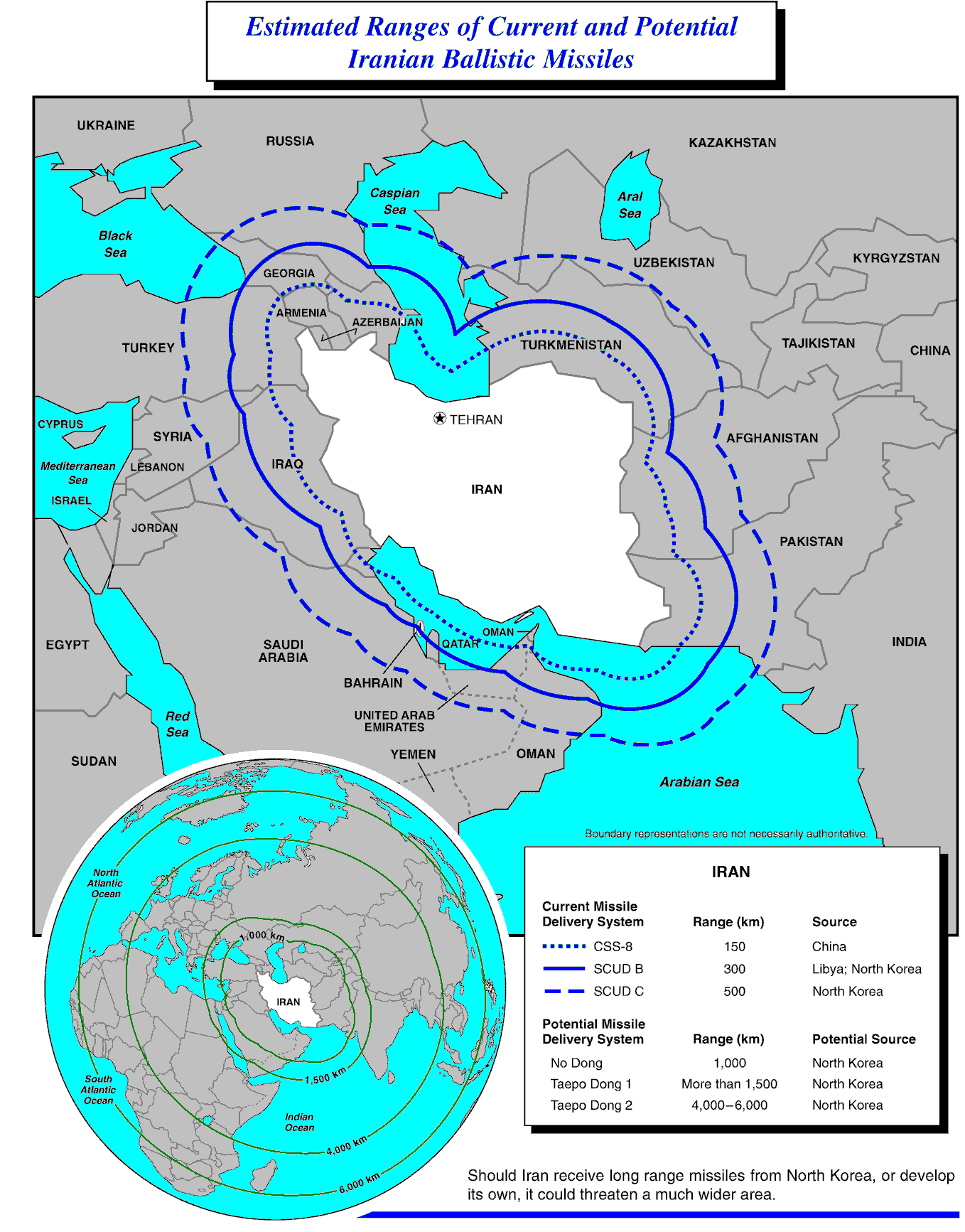
The Federation of American Scientists provide the following illustration of Iranian missile capabilities.


Satellite launches reportedly use technologies required for the development of ICBMs. In November, Iran claimed it had successfully tested missiles with a range of 1,200 miles, which as you can see from the map does not quite put Moscow in range--and obviously is even further from presenting any potential threat to, say, Warsaw. That said, it plainly makes a lot of sense that Iran's perennial missile tests would have the--likely unintended--effect of ruffling Moscow's feathers, given that a nuclear armed Tehran which could reach Moscow is definitely not in their interests.
"Alexander Pikayev, a top arms control scholar in Moscow, said Russian policy toward Iran will be determined by competing interest groups and political factions. Defense manufacturers and the atomic energy industry oppose tougher sanctions, for example, but the United States could win over the latter by reviving a bilateral pact on civilian nuclear cooperation that was frozen after the Georgian war, he said.

Pikayev said Medvedev may be more likely to support sanctions because a breakthrough in US relations would boost his political stature at home and set him apart from his powerful predecessor, Prime Minister Vladimir Putin. Putin might resist, but his relationship with Iranian President Mahmoud Ahmadinejad is said to be strained and he surprised Russia's foreign policy establishment by endorsing earlier U.N. sanctions, Pikayev said."
Frankly, I doubt this assessment--I think the notion of a nuclear armed Iran with the capability of hitting Moscow will outweigh the economic considerations involved in putting the kibosh on nuclear power cooperation with Iran. Indeed, it is hard to see many places in which Iranian and Russian interests coincide. Perhaps they do in terms of energy pricing, but Iran's potential as an alternative source of gas for European industry is probably a critical item in Moscow's long term thinking. And as the weekend's events proved, Russia still regards oil production coordination with OPEC as being less in its interest than good terms with Europe--and producing at full bore to claim all price increases produced by the cartel. (A policy which Iran appears to follow with respect to the organization's production quotas as well, ironically enough.)

3. The Associated Press reports that North Korea yesterday gave the organizations distributing US food aid inside that country till the end of March to leave--rejecting all future food aid.

4. Judy Dempsey at the New York Times yesterday reported that Russia signed two natural gas deals with Hungary yesterday. One deal signed last week has the Budapest and the Hungarian Development Bank to finance the South Stream project on Hungarian soil.


The other deal has Gazprom and MOL establishing a 1.3 billion cubic meters storage facility in Hungary. To make sense of that, here is a map that Jérôme Guillet drew up of Ukraine's gas infrastructure--note the three asterixes to the West, which represent gas storage facilities.


As Guillet pointed out in a piece for the European Tribune:
"Storage capacity is important in the gas business, as demand is seasonal (there is more in winter for heating) and can almost triple in Europe between summer and winter. If you can pre-position your gas near the markets when transport capacity becomes strained, you can extract a lot more value from that seasonality. The storage facilities near the Hungarian and Slovak borders were ideal for Soviet exports, but now they are in Ukrainian hands, and thus Russia must have a minimum of technical cooperation from the Ukrainians, who physically control and operate these facilities, not to lose a lot of money in their export markets. More, unavoidable leverage for the Ukrainians."
Hungarian Prime Minister Ferenc Gyurcsany's plea for a regional aid package from the EU was turned down last week. He has been a supporter of the Nabucco Pipeline, but questions of sourcing the gas (which would likely have to come from Iran) and project financing continue to bedevil the project.

5. Edward Hugh at Fistful of Euros posts that Poland's Central Statistical Office has released its industrial output data for February showing a 14.3% annual rate of decline in February, following a revised annual rate of decline of 15.3% in January. Output was up 2.7% in February from January however. Hugh provides a helpful graph of industrial production for the last two years:


Hugh points out that industrial production is on the decline across the spectrum of export-oriented Eastern European economies, warning against too much disambiguation between them. Worth reading and mercifully short.

6. Bettina Wassener at the New York Times reports that the World Bank lowered its forecast for Chinese growth in GDP for 2009 to 6.5%. 6.5%, though quite high by global standards just now, is well below the Chinese principle of "bao ba"--or "protect the 8"--below which conventional wisdom holds that Beijing will begin to see significant, read destabilizing, social unrest. Kevin Hamlin at Bloomberg reports that bank sees signs China's economy is stabilizing faster than the rest of the world.
"'The government’s stimulus is working,' said Louis Kuijs, a senior economist at the World Bank in Beijing. 'China’s fundamentals are strong enough to ride out this storm.'"
Meanwhile, Andrew Batson at China Journal helpfully translated the complete text of Chinese Ministry of Commerce’s statement announcing its decision to block Coca Cola’s proposed acquisition of China Huiyuan Juice Group Ltd. Key excerpt:
"Through its review, the Ministry of Commerce found that this concentration will have an adverse impact on competition. After the concentration is completed, Coca-Cola could use its market dominance in carbonated soft drinks to limit competition in the market for juice through tying, bundling or other exclusive transactions, resulting in consumers being forced to accept higher prices and reduced variety. At the same time, because brands can restrict entry to the market, it would be hard for the threat of potential competition to remove the restrictive effect on competition. In addition, the concentration will also reduce the room for small and medium-sized juice companies to survive, and will have an adverse effect on the structure of competition in China’s juice market."
The notion that dominance in the carbonated drink market could adversely affect competition in the juice market is unlikely to please most corporate headquarters. The fact that the Ministry of Commerce took stock of the market power of brands is interesting given that some have written that the primary value-addition that Western corporations bring to emerging markets is, well, brands. Meanwhile, the Sydney Morning Herald reports that shares in Rio Tinto have taken a beating on fears that the deal with Chinalco taking a 18% stake in the company.
"'[The 8.7% decline in share price] is [due to] the uncertainty surrounding the Chinalco deal, there has been a bit of talk out today that there is a lot of opposition to the deal and this is what's weighing on it,' MF Global senior trader Anthony Anderson said.

'The FIRB extension and the senate inquiry into foreign investment is adding to the uncertainty.'

The mounting political concern follows a decision by the Foreign Investment Review Board (FIRB) to extend its review to 90 days and initiate a more in-depth examination of the transaction, after the initial 30-day evaluation period closed on Monday.

The transaction, which has been backed by the Rio Tinto board, will also allow Chinalco to appoint two new non-executive board members to the global miners board."
(h/t Emmanuel at International Political Economy Zone.)

7. Platts reports that Italian major Eni has signed a major cooperation agreement with Pakistan to develop major projects all along the oil and gas product chain.
"The agreement also allows Eni to become a strategic partner in developing the oil and gas sector in Pakistan and to enter fields which are currently managed by state-run oil companies."
8. David E. Sanger and Eric Schmitt at the New York Times reports that "two of the high-level reports on Pakistan and Afghanistan that have been forwarded to the White House in recent weeks have called for broadening the target area to include a major insurgent sanctuary in and around the city of Quetta."


Baluchistan has separatist tendencies and is in the middle of a small bore separatist struggle, both in Pakistan and Iran.


Note that Baluchis can be found in southern Afghanistan where most of that country's opium production--and violence--is concentrated.

9. Galrahn at Information Dissemination notes that due to the Obama Administration's review of all military ties, GE has been asked to freeze work on turbines it was to provide the Indian navy for three Shivalik-class stealth frigates. Though I strongly disagree with the way Galrahn frames the story, I think it is an important data point. Clearly the US is likely to approve continued sales of engines to the Indian Navy.

10. Maher Chmaytelli and Juan Pablo Spinetto at Bloomberg report that Shokri Ghanem, chairman of Libya’s state-run National Oil Corp., told journalists today in Vienna that Libya will exercise its right to buy Calgary-based Verenex Energy Inc., which would effectively block CNPC's bid for the E&P company.
"Verenex has assets in Libya that are worth 'hundreds of millions' of dollars, Ghanem said in an interview with Bloomberg on March 16."
It is an interesting signal given China's Africa Policy announced in 2006 and Ghaddafi's recent selection as chair of the African Union--see Daily Sources 2/3 #9.

11. Justin Stares at Lloyd's List reports that the Bangladeshi High Court ordered the closure of all ship breaking yards operating without environmental clearance.
"Industry sources said they were 'staggered' by the ruling, which if confirmed will close down one of the world’s largest breaking industries just as scrapping activity peaks.

'None of the 36 shipbreaking yards in Chittagong currently have an environmental clearance,' said the NGO Platform on Shipbreaking. 'The decision therefore effectively shuts down an industry that has been highly criticized by environmentalists and human rights activists for many years for operating with complete disregard for the law, human health and the environment.'

The scrapping industry, which claims to employ 250,000 either directly or indirectly in Bangladesh, is expected to appeal.

The court was ruling on a petition filed by the Bangladesh Environmental Lawyers Association. Judges ordered that no ship on the Greenpeace 'dangerous ships list' be allowed into the country, according to reports by the platform and local media."
It is a decision bound to amplify the effects of the financial crisis, economically-speaking ... it seems that probity only comes when it will hurt the most, ironically. Note the significance of the courts in the Muslim-majority nation. Well-worth reading in full.

12. Nasreen Seria at Bloomberg reports that the South African Reserve Bank's Monetary Policy Committee will meet next week and accelerate its schedule to monthly meetings for the rest of the year from planned meetings every two months.
"Global economic conditions 'are getting worse' and the 'changed' environment requires the MPC to meet more regularly, Governor Tito Mboweni said in a phone interview from Pretoria today."
13. Victor L. Simpson at the Associated Press reports that in Cameroon Pope Benedict XVI reiterated yesterday that condoms were not an answer to the fight on AIDS--"You can't resolve it with the distribution of condoms. ... On the contrary, it increases the problem." I would note that Africa is one region where Catholicism--and more conservative Catholicism--is growing quickly. However, perhaps the one really impressive and compellingly moral US foreign policy triumph under the Bush Administration was the huge increase in aid to Africa in terms of the fight on AIDS, including condoms and retro-viral drugs. The people in Africa are well aware of how these aid programs have reduced the mortality rate in the continent. The notion that condoms are against life and a concession to death, and thus amoral, as opposed to a way to protect life and thus moral, will not, I believe, make much sense to them. Pope Benedict XVI appears to have a tin ear when it comes to husbanding the moral authority of the Church.

14. The Port of Long Beach recently posted its numbers for February, showing a 40% decline in container traffic from February 2008:


So far in 2009 the port has recorded a 20.2% decline in traffic. The Port of Marseilles, France, also recently posted its report for February, showing a 21% annual decline in total traffic. It registered a 16% decline from the traffic seen in January:


Hydrocarbons account for about 74% of Marseilles' traffic and it lost about 12% in volume from the year before. The grim trade data continue their march.

15. Bob Willis at Bloomberg reports that the consumer price index rose by 0.4% in February from January. Excluding fuel and food, prices climbed by 0.2% from the month prior. On an annual basis, the consumer price index rose by 0.2%, up from the 0% annual rate seen in January. Excluding fuel and food, prices climbed by an annual rate of 1.8% in February, up from a 1.7% annual rate of increase seen in January.
"Energy expenses increased 3.3%, led by an 8.3% increase in gasoline prices. Still, the fuel’s cost is down 36% from a year earlier.

Food prices, which account for about a fifth of the CPI, fell 0.1%, the first drop since April 2006."
16. The Federal Open Market Committee met today and decided to keep the federal funds rate unchanged at 0-.25%. Excerpt from its press release:
"To provide greater support to mortgage lending and housing markets, the Committee decided today to increase the size of the Federal Reserve’s balance sheet further by purchasing up to an additional $750 billion of agency mortgage-backed securities, bringing its total purchases of these securities to up to $1.25 trillion this year, and to increase its purchases of agency debt this year by up to $100 billion to a total of up to $200 billion. Moreover, to help improve conditions in private credit markets, the Committee decided to purchase up to $300 billion of longer-term Treasury securities over the next six months."
This follows the latest Treasury International Capital data which shows, courtesy of Brad Setser at Follow the Money, that foreign purchases of long term treasuries have collapsed:


Foreign government demand for US agency debt fell off a cliff late last year and purchases were even banned by Moscow just the other week. Meanwhile, Jon Hilsenrath at Real Time Economics reports that the Fed's quarterly survey of banks shows that during the week of February 2-6, banks extended $85.6 billion in credit to businesses, an increase of 13% from the first quarter of 2008--per JP Morgan Chase economist Michael Feroli:


17. The EIA reported that crude oil stocks built by 2 million barrels in the week ended March 13 to 353.3 million barrels, well above the historical average for this time of year, but still below the most recent peak of 354 million barrels seen on June 29, 2007. According to a survey by Bloomberg, analysts had expected a 1.5 million barrel build. Gasoline stocks grew by 3.2 million barrels, are near the top of the historical average. Analysts had expected a 1.5 million barrel draw. Distillates stocks grew by 100,000 barrels, are well above the five year historical average range as well as counter-cyclical, and versus analyst expectations of a 1 million barrel build. Taken in isolation, the data would be bearish on the price of crude.