Showing posts with label california. Show all posts

Tuesday, July 28, 2009

Daily Sources 7/28

1. MAYER AND WOOD ARGUE THAT CHINA'S ENTRANCE INTO THE WORLD ECONOMY HAS NOT SIGNIFICANTLY DE-INDUSTRIALIZED REST OF DEVELOPING WORLD

Jörg Mayer and Adrian Wood at Vox EU argue that China's integration into the world's economy has not had the effect of substantially de-industrializing other developing nations.
"The biggest possible effect would be for a country which initially produced or exported equal amounts of manufactures and of primary products, where a 15% fall in the ratio would reduce the share of manufactures by 3.5 percentage points.

These estimates are imprecise and subject to error; the true answer may lie outside their range. But there is no plausible modification of the calculations that could make the true answer much larger. This is mainly because, despite its size, China’s opening had only a modest effect on world average endowments. The upper-limit estimates, obtained by simply adding China’s endowments to the rest of the world’s, are a 9% rise (from 0.43 to 0.47) in the share of the global workforce with a complete primary or secondary education, and a 17% fall in the average land/labour ratio, from 2.9 to 2.4 square kilometres of land per 100 workers ... . The average effect on the structure of output and trade in other countries is unlikely to have been larger than these world average endowment changes and was probably smaller.

The significance of the China effect varied widely among developing countries. This is partly because its size varied with the composition of each country’s manufacturing and primary production – how closely its industrial products competed with Chinese exports, and how much demand there was from China for its primary exports (more, say, for copper than for coffee). It is also because there were many other forces acting on sectoral structures--including changes in countries’ own trade policies--whose effects often outweighed those of China."
Worth reading in full.

2. NEPAL HARASSING TIBETAN REFUGEES

Gopal Sharma at Reuters reports that Nepal is responding to pressure from Beijing by cracking down on Tibetan refugees in the country.
"Nepali authorities have regularly broken up protests by Tibetan exiles and arrested them for protesting against China's crackdown on demonstrations in Tibet.

The Washington-based [International Campaign for Tibet] said Tibetan refugees were 'increasingly demoralized' as Nepal 'relinquishes its historic and sovereign interests in response to incentivized political pressure from Beijing and its sympathizers.'

ICT said 'pre-emptive arrests of Tibetans, ID checks and house searches' by authorities were contributing to a 'widespread sense of fear and insecurity' among the exiles.

'Nepal's political leadership is betting that the internal benefits of assuaging China in the cause of oppressing Tibetans will be greater... than the traditional legal and historical concepts,' Mary Beth Markey, Vice President at ICT said."
3. INDIA TO ANNOUNCE SOLAR POWER TARGETS OF 1/8TH TOTAL ELECTRICITY DEMAND, CENTRAL BANK LEAVES INTEREST RATE UNCHANGED ON INFLATION CONCERNS

Krittivas Mukherjee and David Fogarty at Reuters reports that India will announce its targets for solar power generation in September. The plan promises to
"boost output from near zero to 20 gigawatts (GW) by 2020 as it firms up its national plan to fight global warming, draft documents show.

The target, which would help India close the gap on solar front-runners like China, is part of an ambitious $19 billion, 30-year scheme that could could increase India's leverage in international talks for a new UN climate pact in December, one of several measures meant to help cut emissions.

If fully implemented, solar power would be equivalent to one-eighth of India's current installed power base, helping the world's fourth-largest emitter of planet-warming greenhouse gas emissions limit its heavy reliance on dirty coal and assuaging the nagging power deficit that has crimped its growth.

The 'National Solar Mission', yet to be formally adopted by Prime Minister Manmohan Singh's special panel on climate, envisages the creation of a statutory solar authority that would make it mandatory for states to buy some solar power, according to a draft of the plan, which provided detailed proposals for the first time, obtained by Reuters ... ."
Meanwhile, Cherian Thomas at Bloomberg reports that India's central bank decided today to leave its benchmark interest rate unchanged at 3.25%.
"The central bank raised its inflation forecast for the year to March 31 to 'around 5%' from an April estimate of 4%, citing 'elevated' food and commodity prices."
4. EU TO TRAIN SOMALI SECURITY FORCES TO POLICE PIRACY

BBC News reports that the EU has announced plans to train Somali security forces to tackle the piracy plaguing their coasts.
"It will send a planning team to the region next month. The training will take place in neighboring Djibouti, which has French and US military bases."
(h/t Joshua Keating at FP's Morning Brief.)

5. IMF AND LATVIA REACH ACCORD, MAY OPEN UP NEW FUNDING

Aaron Eglitis and Timothy R Homan at Bloomberg report that the IMF and Latvia have reached an accord paving the way for the country to receive its first financial assistance from the organization since December.
"The review may unlock about 195 million euros ($285 million), which the IMF withheld in March after the Baltic country failed to commit to budget cuts, the fund said in an e- mailed statement.

Latvia turned to a group led by the European Commission and the IMF for a 7.5 billion-euro stabilization loan in December after its second-biggest bank needed a state rescue. The IMF announcement followed a 1.2 billion-euro transfer by the European Commission yesterday, helping quell concern about a lats devaluation that may have destabilized currencies across the region."
6. MOUSAVI CALLS FOR NEW STREET PROTESTS NEXT WEEK IN IRAN

Borzou Daragahi at the LA Times reports that opposition candidate Mir-Hossein Mousavi has called for more street protests during religious festivals next week.

7. KENYA TO BUILD AFRICA'S LARGEST WIND FARM

Xan Rice at the UK Guardian reports that Kenya plans to build the largest wind farm in Africa.
"Some 365 giant wind turbines are to be installed in desert around Lake Turkana in northern Kenya – used as a backdrop for the film The Constant Gardener--creating the biggest wind farm on the continent. When complete in 2012, the £533m (~ $758.8 million) project will have a capacity of 300MW, a quarter of Kenya's current installed power and one of the highest proportions of wind energy to be fed in a national grid anywhere in the world."
8. FUEL OIL APPROACHING COST OF CRUDE, HURTS SHIPPING, CHINESE FUEL OIL IMPORTS ROCKET UPWARD (FROM LOW BASE), VIETNAMESE MAIDEN REFINERY TO TAKE SPOT GASOLINE DEMAND OFF MARKET, WALL OF ASIAN PACIFIC REFINING YET TO PLAY OUT

Christian Schmollinger and Alaric Nightingale at Bloomberg report that the price of fuel oil--bunker fuel, the bottom of the barrel, which is used to power ships in great part because it is cheap, generally trading at a considerable discount to crude, is approaching the price of light crude and may surpass it.
"Fuel oil may surpass crude 'for quite some time, six months is possible,' JPMorgan Chase & Co. vice president of energy strategy Vima Jayabalan said in a phone interview from Singapore."
This means that the effect of rising crude prices is having a more pronounced affect upon the cost of shipping than it did during the 2003-2008 run up in the price of crude.
"'It’s really hurting' ship owners, said Parul Bhambri, a Singapore-based analyst at Drewry.

Maersk said May 12 that falling demand for freight hobbled its ability to pass on fuel costs to customers in the first quarter, when its shipping line lost $559 million after taxes, compared with an $80 million profit a year earlier. The shares are down 40% in the past year in Copenhagen trading."


As the price of fuel oil rises, however, many simple refineries, which do not have the equipment to maximize gasoline and diesel output, can become profitable again, which may undergird a recovery in overall crude demand. That said, it still doesn't look like there's much demand for gasoline and diesel out there, which could push down the crack spread and thus the price of crude. Winnie Lee at Platts reports that Chinese fuel oil imports in June were up 6.26% from May and 45.94% from June 2008 to 13.7 kb/d. It's largest supplier was Venezuela. In that vein, Irene Tang at Platt's the Barrel blog reports that the commissioning of Vietnam's first refinery at Dung Quat is poised to erase about 30% of the country's product import demand, which will in turn erase its demand for spot gasoline purchases. The wall of new refining capacity in Asia has yet to fully be appreciated,
"China has now joined India in becoming a major swing exporter of gasoline. Apart from greenfield refineries coming onstream in the country, Beijing's decision to adopt a new products pricing formula for the domestic market and the resulting price revisions in tandem with the global benchmarks has encouraged more speculative buying at the wholesale level, causing wide fluctuations in refiner inventories.

This, in turn, has made Chinese gasoline export volumes unpredictable. The latest customs figures show gasoline exports hit a two-year high of 560,000 mt in June, a 273% surge from the corresponding month of last year. The previous high was in April 2007, at 590,000 mt.

The figures point to Chinese 'apparent' gasoline demand in June being just 1.8% higher than the same month a year ago, a contrast with on-year growth rates of 20.2% in May and 13% in April. The anomaly of the June figure, in the backdrop of staggering double-digit growth rates of automobile sales in China and a 7.7% on-year average gasoline demand growth in the first half of the year, can only be explained by wild swings in stock builds and draws."
"The full impact of the start-up of Reliance Industries' new 580,000 b/d refinery in Jamnagar should be apparent as early as August, as the company's older 660,000 b/d refinery is now restarting from a partial shutdown. Monthly gasoline exports from RIL are expected to more than double to well above 600,000 mt."
9. NIGERIAN REBELS IN SOUTH TARGET OIL MINISTER'S COMPANY, NORTHERN ISLAMISTS CONTINUE UNREST

Platts reports that the Nigerian Joint Revolutionary Council has issued a warning to UK-based independent producer Afren Resources to stop operating in the Niger Delta or risk attacks on its equipment and personnel.
"The Joint Revolutionary Council, which styles itself as a coalition of militant groups based in southern Rivers and Bayelsa states, said in a statement that its ultimatum to Afren was aimed at expressing the group's opposition to the policies of Nigeria's Oil Minister Rilwanu Lukman--policies the group sees as skewed against the Niger Delta region in the country's south.

Lukman was a co-founder of Afren and stepped down from his position as chairman of the company's board of directors once he was appointed oil minister for Nigeria in late 2008. His shares in the company were to be held in a blind trust, the company said in a statement at the time."
Lukman wants to site an oil university in his home state in the north--Kaduna. Meanwhile, Ibrahim Mshelizza at Reuters reports on the increasing Islamist inspired unrest in northern Nigeria.
"The violence was triggered when some members of the group called Boko Haram, which wants a wider adoption of Islamic sharia law across Africa's most populous nation, were arrested Sunday in Bauchi state.

Unrest spread to the northern states of Kano, Yobe and Borno, whose capital Maiduguri is home to the group's leader, Mohammed Yusuf, and has seen the worst violence.


'The situation has been contained in Bauchi and Yobe. The bad situation we have now is in Borno where the leader of the group is residing ... We are going to launch an operation, a main operation to flush them out,' [Nigerian President Umaru] Yar'Adua told reporters after meeting security chiefs and state governors."
10. PRESSURE TO CHANGE DRUG WAR STRATEGY BUILDING IN MEXICO, MEXICAN CRUDE PRODUCTION WAY DOWN

William Booth and Steve Fainaru at the Washington Post report on the growing pressure on Mexican President to change Mexico's "surge" strategy in dealing with its drug cartels.
"Dan Lund, president of the MUND Group polling organization, said public support for Calderón's strategy appears to be weakest in the places where the federal government needs it most. 'In a series of national surveys, polls consistently have found a reasonable but cautious level of support for using the military in the front lines against the cartels,' he said. 'But in all the states where the military is actually deployed, the support goes down, sometimes dramatically.'

The situation has been exacerbated by the global economic crisis, which has cast millions of Mexicans into poverty. José Luis Piñeyro, a Mexican military analyst who maintains close ties with the armed forces, said rising unemployment and poverty 'is creating what I call an "army in reserve,"' for the traffickers.

In Michoacan, La Familia has used the media to try to align itself with the disenfranchised. After the recent attacks, one of its leaders, Servando Gómez, called a local television station and told viewers: 'I want to say to all Michoacanans, we love them and respect them.'"
Meanwhile, there was plenty of stories on the decline in Mexican production last week. John Kingston at the Barrel notes:
"But here's the more stunning figure: what's happened in two years. In July 2007, Pemex reported crude output of 3.165 million b/d. That's a 20.4% decline in 23 months."
11. VATICAN AIMS AT FREE MARKETEERS, SAYING MARKETS WITHOUT ETHICS DESTROY WEALTH AND CREATE POVERTY

Flavia Krause-Jackson at Bloomberg reports that the Vatican has attacked free markets, saying that they have legitimized greed. On June 7, the pope published an encyclical which examined the financial crisis and means out of it, saying that once profit becomes the exclusive goal of business, it destroys wealth and creates poverty.
"Last November, Italian Finance Minister Giulio Tremonti said the pope had pronounced a 'prophecy' in a paper Benedict wrote when he was a cardinal.

In 1985, then-Cardinal Joseph Ratzinger presented a paper titled 'Market Economy and Ethics' at a Rome event on the Catholic Church and the economy. He said a decline in ethics 'can actually cause the laws of the market to collapse.'"
I think it is plain that markets cannot sustain themselves without a modicum of trust, engendered by ethics held in common.

12. CFTC MAY OR MAY NOT REVISE LAST YEAR'S REPORT EXONERATING SPECULATION IN PRICE VOLATILITY, LONDON'S FSA EXONERATES SPECULATORS

Ianthe Jeanne Dugan and Alistair MacDonald at the Wall Street Journal report that the CFTC
"plans to issue a report next month suggesting speculators played a significant role in driving wild swings in oil prices--a reversal of an earlier CFTC position that augurs intensifying scrutiny on investors."
However, I understand that the Chair of the CFTC indicated today that the story in the WSJ that the report will be redone and altered are premature and inaccurate. From the WSJ story,
"In the US, the CFTC begins public hearings Tuesday to determine whether to limit speculative investments in commodities. Congress also is weighing whether to give the CFTC the authority, under a broader proposal to revamp financial regulation, to regulate commodities investments that occur off traditional exchanges. Byron Dorgan, a North Dakota Democrat, has called on the CFTC to curb 'oil speculators looking for a quick buck at the expense of American consumers.'"
I suspect that the direction of these accusations is misdirected, given that commercials may choose to purchase futures to profit on price just as much as to hedge their obligations.


Positions net long and short for the week ended July 21 only comprised 1% of the market. Note that from 2008 open interest--or the total number of contracts--has been steadily falling for both futures and options--though the trend for options was up through February.


If you include options, the number of positions held by traders net long or short represent 3.17% of the market--not an especially large share. Meanwhile, Alistair MacDonald and Carolyn Cui at the Wall Street Journal report that the Financial Services Authority in London has found no evidence that speculators are behind the wild swings in oil price seen from 2008.
"One person familiar with the matter said the FSA had seen no evidence to suggest that speculators are driving up the price of oil.

'More than they ever were before, [investors] are looking to the global economic climate and nobody is sure on that, and that is perhaps driving the volatility,' he said.

Given that view, the FSA doesn't believe that limiting the size of trading positions would be 'beneficial' for the market, said a person familiar with the matter. Still, the FSA acknowledges it doesn't have a 'full explanation' as to why the market has moved the way it has, said a person familiar with the matter.

The FSA's conclusion contradicts British Prime Minister Gordon Brown, who has linked the recent rises in oil to speculation.
...
Politicians around the world are worried about the effect of rising oil prices on the recovery potential of their recession-hit economies. World leaders from French President Nicolas Sarkozy to the leaders of Asia's biggest oil-consuming nations have tied these rises to oil speculators."
"Speculation," of course, is sufficiently vague to represent a politically useful bogeyman, and it seems likely that someone will call financial protectionism. That said, I do think it is in the global economic interest to make the cost of energy--and in particular transportation fuels--more stable and predictable, I just don't think that attacking "speculation" is a particularly productive way of doing so.

13. TRUCKING VOLUMES IN US DOWN 13.6% IN JUNE YOY

The American Truckers Association yesterday announced that their
"advance seasonally adjusted (SA) For-Hire Truck Tonnage Index fell 2.4% in June. In May, SA tonnage jumped 3.2%. June’s decrease, which lowered the SA index to 99.8 (2000=100), wasn’t large enough to completely offset the robust gain in the previous month."
Over June 2008, tonnage fell 13.6%, which exceeded the year over year drop of 11%.
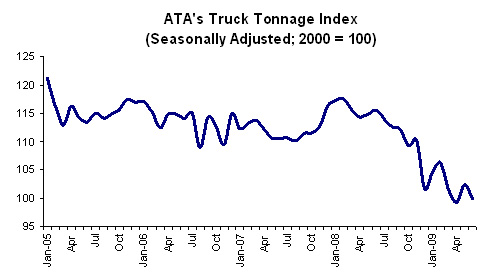


The ATA release warns:
"The sample includes an array of trucking companies, ranging from small fleets to multi-billion dollar carriers. When a company in the sample fails, we include its final month of operation and zero it out for the following month, with the assumption that the remaining carriers pick up that freight. As a result, it is close to a net wash and does not end up in a false increase. Nevertheless, some carriers are picking up freight from failures, and it may have boosted the index. Due to our correction mentioned above, however, it should be limited."
(h/t Barry Ritholtz at the Big Picture.)

14. HOME PRICE DECLINE SLOWING, CALIFORNIA FORECLOSURES DOUBLE NEW HOME SALES IN JUNE

Barry Ritholtz reports that home price declines are "slowly abating." Here is his graph:
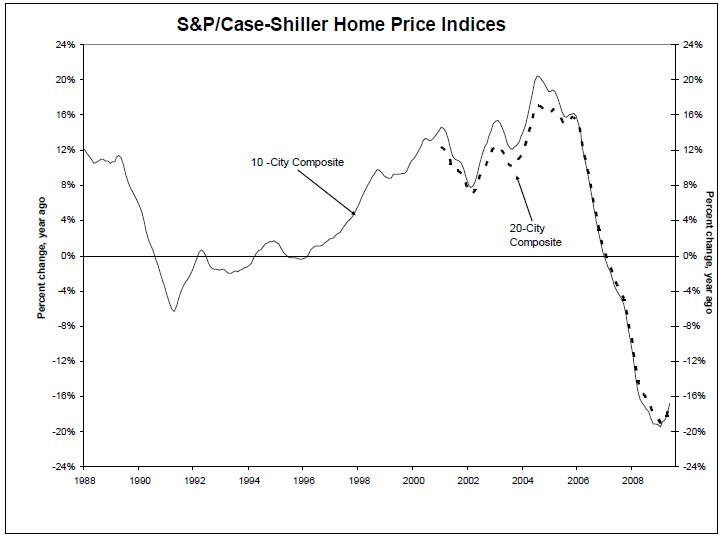


Jake at Econopic picked up on the Big Picture's quote of the day of Mark M Hanson which notes that California foreclosures are more than double the national new home sales for June. His graph:


15. EPA MAY GIVE ALGAE BIG BOOST

Russell Gold at Environmental Capital notes that Blair Carter at the Renewable + Law Blog reports that "that the Environmental Protection Agency will count algae as an advanced biofuel under Renewable Fuel Standard rules being developed."
"Why do EPA’s steps towards including algae matter? Because when Congress created its mandate to blend advanced biofuel into the fuel pool, it created a big market for these fuels. By 2012, the law mandates that two billion gallons of these advanced biofuels be blended, a figure that rises by tenfold by 2022. It’s all in Section 202 of the Energy Independence and Security Act of 2007.

... For algae to be included, the law says it needs to have no more than 50% of the 'lifecycle greenhouse gas emissions' of gasoline and diesel. This could be tricky, says David Woodburn, an alternative energy analyst with ThinkEquity. 'The hard part for me is understanding how the EPA plans to calculate the GHG emissions of algae fuels, based on the variety of feedstocks (sugar, CO2, other), processes (open ponds, photobioreactors), and algae varieties being explored--especially before November,' he says, noting when the rules are supposed to be finished."
Blair Carter's post can be found here.

16. TEXAS DROUGHT GETS WORSE

Tom Benning at the Wall Street Jounral reports on the drought in Texas.
"Nearly 80 of Texas' 254 counties are in 'extreme' or 'exceptional' drought, the worst possible levels on the US Department of Agriculture's index. Though other states are experiencing drought, no counties in the continental U.S. outside Texas currently register worse than 'severe.' In late April, the USDA designated 70 Texas counties as primary natural-disaster areas because of drought, above-normal temperatures and associated wildfires."
The Journal carries an interactive graphic:

Thursday, July 23, 2009

Daily Sources 7/23

1. UNEMPLOYMENT GROWING RAPIDLY IN THE G-7, BUT BRAZILIAN UNEMPLOYMENT UNEXPECTEDLY DOWN

Rebbeca Wilder at News N Economics notes that unemployment continues to grow quickly in the G7, which should damper consumption:


However, Helder Marinho and Andre Soliani at Bloomberg reported that Brazil's June jobless rate in six main metropolitan areas fell to 8.1% from 8.8% in May.
"Policy makers cut the so-called Selic rate by a half-point to a record 8.75 percent yesterday and said that level was adequate to spur growth and bring inflation back to target.

The drop in the jobless rate 'indicates how strong the domestic market is,' Pedro Tuesta, senior economist for Latin America with 4Cast Inc., said in a telephone interview. 'It reinforces the idea the bank should stop cutting rates.'"
"Annual inflation, as measured by Brazil’s IPCA index, slowed to 4.8% in June, down from 5.2% in May and the lowest since March 2008. Policy makers last month reaffirmed that they seek to slow inflation to 4.5% by year-end."
Average wages, however, are not keeping pace with inflation.

2. ICELAND FORMALLY APPLIES FOR EU MEMBERSHIP

Karl Ritter at the Associated Press reports that Iceland formally applied for membership in the EU today.
"'To be frank with you, if we would get a rotten deal on the fisheries, the Icelandic people would get quite angry,' Foreign Minister Ossur Skarphedinsson said after presenting the EU application to his Swedish counterpart, Carl Bildt. Sweden currently holds the EU presidency.

'This is not only an issue of economics. It is also an emotional issue. It is also an issue that is related to sovereignty,' said Skarphedinsson, a former fisherman."
3. UK RETAIL SALES UP 1.2% IN JUNE FROM MAY, 2.9% YOY, GOVT ANNOUNCES £1.1 BN PLAN TO ELECTRIFY MORE OF ITS RAIL SYSTEM

Svenja O’Donnell at Bloomberg reports that UK retail sales rose 1.2% in June from May, and 2.9% from June 2008.
"Sales at food stores increased by 0.7%, while they rose 1.6% at non-food retailers, the statistics office said. Textile, clothing and footwear shops saw sales increase for the first time in three months, by 4.7%."
Meanwhile, Nicholas Winning at the Wall Street Journal reports that the UK has announced plans to spend £1.1 billion ($1.81 billion) on electrifying two rail routes.
"The works represent the first big electrification of the rail network since the 1980s and will increase the proportion of electric rail journeys in the UK to 67% from 60%, the government said."
4. RUSSIAN MINISTERS TO CONSIDER 0% TAX ON INITIAL MINERAL EXTRACTION IN THE BLACK SEA AND SEA OF OKHTOSK, BUT WARNS MOL THAT IT HAD BETTER COMPLY WITH LICENSING IN SIBERIAN FIELD

Kate Mackenzie at FT Energy Source reports that Russian ministers today will discuss setting a zero rate of taxation for mineral extraction for the initial stages of development in the Black Sea and the Sea of Okhotsk.
"The tax breaks will apply until accumulative output reaches 20 million metric tons (~ 144 million barrels) at Black Sea fields and 30 million metric tons (~210 million barrels) in the Sea of Okhotsk, off Russia’s Pacific Coast. Alternatively, the zero rate may be applicable for 10 years or 15 years for fields being developed under combined exploration and production licenses, according to the statement."
Though I feel sure that it will be tempting enough to make some majors bite, the problem is that when the price of oil rises, Moscow will likely take measures to re-nationalize production at the fields, given their view of their strategic value. Meanwhile, Stephen Bierman and Edith Balazs at Bloomberg report that Mol--Hungary's largest refiner--pledged to meet all requirements in the license terms of a Siberian oil-production venture with OAO Russneft.
"'Mol always acts in accordance with the rules of the Russian Federation and the company will do everything on its part to fulfill all the requirements described in the license agreement,' Mol said today in an e-mailed statement.

On July 2 Russia’s subsoil agency, Rosnedra, gave the Zapadno-Malobalykskoye LLC oil venture six months to correct violations relating to its drilling plan and its use of so-called associated gas, Larisa Kalacheva, a spokeswoman for Russneft, said today. 'The time allotted to correct license infractions is very tight,' she said. 'Action is needed.'

Tensions between Mol and the Russian government have increased since Moscow-based OAO Surgutneftegaz bought a 21.2% share in the Budapest-based refiner in March. Mol called the move hostile and has barred the Russian company from participating in corporate meetings."
5. BIDEN CALLS ON RUSSIA TO REMOVE TROOPS FROM GEORGIAN BREAKAWAY REGIONS, BUT ALSO INDICATES THERE IS NO MILITARY OPTION FOR THEIR REMOVAL

Philip P Pan at the Washington Post reports that in Tblisi today Vice President Joe Biden urged Russia to withdraw its troops from the breakaway regions of Georgia.
"'What we can do is make clear to the whole world, and to the Russians particularly, that we stand with you, and that if they fail to meet their commitments, that it is a problem for them,' Biden told the children, referring to a ceasefire agreement that the Georgia and the United States say Russia is violating.

'A lot of you think maybe Russia did what they did, and they paid no price,' Biden added. 'They paid a pretty big price already diplomatically. The countries that surround Russia, even those that have been very, very loyal to Russia in their freedom, are now saying very harsh things.'"
However, earlier in the day in a speech before the Georgian parliament, Biden said there was "no military option" for Georgia to regain sovereignty over the breakaway regions.

6. CHINESE DEFENSE MINISTRY TO LAUNCH CHINESE / ENGLISH WEB SITE, CENTRAL BANKS OF CHINA, JAPAN, AND SOUTH KOREA ATTEND FIRST TRIPARTITE MEETING

Tini Tran at the Associated Press reports that the Chinese defense ministry will launch an official web site in both Chinese and English on August 1.
"The Web site appears aimed at reassuring Asian and Western nations that the PLA is becoming more accessible to the outside world, experts told the China Daily.

'As more attention is being given to online information, the Chinese army has moved one step forward in its public diplomacy,' Professor Li Xiguang, dean of Tsinghua University's journalism school, was quoted as saying.

The Web site's launch 'is a major step for the PLA to open up to the outside world,' Sr Col Huang Xueping, deputy director of the ministry's information office, said in an interview with the newspaper. The office was only set up last year.

The site will 'cover a large amount of information,' featuring regular activities and background of the Chinese military."
(h/t Sky Canaves at China Journal.) Meanwhile, the first tripartite meeting of the central banks of China, Japan, and South Korea took place today in Shenzhen.
"On December 10, 2008, in order to strengthen their mutual cooperation and communication and better safeguard economic and financial stability in the region, the three central banks jointly announced the establishment of a formal Tripartite Governors’ Meeting mechanism, based on the existing dialogue, which will take place once a year."
(h/t Rebecca Wilder at News N Economics.)

7. CLINTON SAYS US PREPARED TO EXPAND COMMERCIAL RELATIONSHIP WITH MYANMAR IF THEY RELEASE POLITICAL PRISONERS

Glenn Kessler at the Washington Post reports that Secretary Clinton told the media that the US was prepared to expand its commercial and aid relationship with Myanmar if it were to release political prisoners, and specifically Nobel Peace Prize laureate Aung San Suu Kyi.

8. AHMADINEJAD APPARENTLY DEFYING LOTR CALL FOR HIM TO WITHDRAW VP NOMINATION, IRAN SAYS IT HAS FOUND 46 OIL FIELDS IN THE CASPIAN

Ali Akbar Dareini and Lee Keath at the Associated Press report that Iranian President Mahmoud Ahmadinejad has apparently chosen to defy the Leader of the Revolution, Ayatollah Khamenei, who has called upon the president to withdraw his choice for first Vice President,Ahmadinejad's son-in-law.
"Arguing for a further chance to make his case, Ahmadinejad said, 'there is a need for time and another opportunity to fully explain my real feelings and assessment about Mr Mashai.'"
Dareini and Keath observe
"Now Khamenei is facing tests to his authority on two fronts. One is from Ahmadinejad, the other is the open defiance from the reformist opposition, which has continued its campaign against Ahmadinejad despite the supreme leader's declarations that the election dispute is over."
I would put it more as tests of authority from those who see the representative elements of the Constitution in their best interests and those who see it as protecting the vested interests of the old guard, but the point is salient nonetheless. Meanwhile, Xinhua reports that Iran's Oil Minister Gholam Hossein Nozari has reportedly said that Iran has identified 46 oil fields in the Caspian Sea, of which eight are ready for exploitation immediately. (h/t Leanan at the Oil Drum.)

9. MOODY'S UPGRADES PHILLIPINE SOVEREIGN DEBT

Karl Lester M Yap at Bloomberg reports that Moody's rating on Philippine sovereign debt was raised to Ba3 from B1, the highest the country has received in more than three years.
"'The upgrade was prompted by the relatively high degree of resiliency exhibited by both the country’s financial system and external payments position in face of the global financial and economic crises,' Moody’s said. 'International reserves of the central bank are at a historical high and exceptional policy measures have not been required to shield the banking system.'

Philippine international reserves climbed to a record $39.56 billion in January, as rising remittances sent home by citizens abroad countered collapsing exports. Higher debt ratings reduce the cost of borrowing, making it easier for the Philippines to sell debt to fund government spending plans."
10. MEXICAN IMMIGRATION TO THE US HAS SLOWED MARKEDLY SINCE 2006, BUT EMIGRATION BACK TO MEXICO HOLDING STEADY

In a report released yesterday, the Pew Hispanic Center concluded that:
"The flow of immigrants from Mexico to the United States has declined sharply since mid-decade, but there is no evidence of an increase in Mexican-born migrants returning home from the US.

Survey data from the US and Mexico reveal a large flow of migrants back to Mexico, but the size of the return flow appears to be stable since 2006."


(h/t Conor Dougherty at Real Time Economics.)

11. NAR ANNOUNCES THAT EXISTING HOME SALES ROSE 3.6% IN JUNE FROM MAY, DOWN 0.2% YOY; MEDIAN PRICES DOWN 15.4% FROM JUNE 2008

Maya Jackson Randall at the Wall Street Journal writes that the National Association of Realtors announced that existing home sales in June rose 3.6% from May, but are still down 0.2% from June 2008.
"Foreclosures and short sales reflect 31% of sales in June. Distressed property sales have pushed prices lower, year over year. The median price for an existing home last month was $181,800, a 15.4% decrease from June 2008."
Meanwhile, the Department of Labor announced today that seasonally adjusted initial unemployment insurance claims for the week ended July 18 were
"554,000, an increase of 30,000 from the previous week's revised figure of 524,000. The 4-week moving average was 566,000, a decrease of 19,000 from the previous week's average of 585,000."
12. USDA REPORT CONCLUDES FARMERS SITTING ON GOLD MINE IN CARBON OFFSETS INCLUDED IN CLIMATE BILL

Keith Johnson at Environmental Capital writes that a new report from the Agricultural Department concludes that farmers stand to make a fortune from the carbon offsets included in the climate bill.
"To wit: Farmer’s incomes will take a hit in the short term, falling by 1% through 2018. Things will get worse by 2027 (a 3.5% decline) and even worse by 2048 (a 7.2% decline.) That’s because things like fuel and fertilizer will cost more under the climate bill.

But farmers’ net incomes will keep rising, because they will be literally standing on a gold mine in the form of carbon offsets, which will become increasingly valuable. The goods:

'EPA’s analysis projects annual net returns to farmers of about $1-2 billion per year from 2012-18, rising to $20 billion per year in 2050. USDA’s analysis strongly suggests that revenue from agricultural offsets (afforestation, soil carbon, methane reduction, nitrous oxide reductions) rise faster than costs to agriculture from cap and trade legislation. It appears that in the medium to long term, net revenue from offsets will likely overtake net costs from HR 2454, perhaps substantially.'

It might be even juicier; the EPA’s Ms. Jackson estimated the value of agricultural offsets at more than $3 billion in 2020.

And wait—there’s more. '[W]e believe our analysis is conservative--it’s quite possible farmers will actually do better,' Secretary Vilsack said.

That’s because farmers also stand to make a fortune off of other government energy policies, such as ambitious mandates for renewable energy and biofuels that will create lucrative, mandatory markets for crops and even agricultural waste."
Today's must read. The USDA report itself can be found here.

13. OCCIDENTAL FINDS SIZABLE NEW OIL FIELD IN CALIFORNIA

The Los Angeles Business Journal reports that Occidental has announced a significant oil and gas find in Kern County, California.
"The company said in a statement that it believes there are between 150 million and 250 million gross barrels of oil equivalent reserves within the area. Approximately two-thirds of the discovery is believed to be natural gas.

Occidental holds an approximate 80% stake in the property, with Chevron Corp. holding the remaining interest."
That represents about 1.8-3 global days of oil demand.

Monday, July 13, 2009

Daily Sources 7/13

I chose an awfully big week to take a break from this! Back to the regularly scheduled programming, though new obligations will likely mean that posting will soon become much more infrequent and Daily Sources will either become simple links or be discontinued altogether.

1. CHINA UNVEILS ADDITIONAL ANTI-CORRUPTION MEASURES, XINJIANG REPORTEDLY CALMING DOWN AFTER WEEK OF VIOLENCE

Carlos Tejada at China Journal reports that the Chinese Communist Party unveiled new anti-corruption measures Sunday, calling for public leaders and executives at state owned companies to be ousted if major accidents or abuse happens during their watch due to negligence. Tejada observes:
"The new rules are the latest of a recent spate of efforts to rein in what even national leaders acknowledge is a serious problem. Chinese officials in recent weeks have put a bounty on corruption and cracked down on military officials with a taste for the luxurious.

The fear, observers say: Reports or actual cases of corruption and incompetence could cause even more unrest.

Conduct by local officials sparked occasional public clashes even in good times, before China’s juggernaut economy slowed. And times are especially sensitive now because of the upcoming 60th anniversary of the founding of the People’s Republic of China on Oct. 1, which is intended to be a grand celebration of Communist Party rule."
Meanwhile, Gordon Fairclough reports that Urumqi in Xinjiang seems to be calming down after the violence last week:
"The regional government over the weekend updated its casualty figures, saying 184 people were killed in last week's violence--137 of them Han Chinese and 46 Uighurs. One member of another Muslim minority, the Hui, also died. More than 1,600 people were injured, the government said.

After attacks by Uighurs on Han Chinese, some Han Chinese armed themselves and sought revenge. The government said to quell the violence it flooded the city with 20,000 security personnel and has spent days urging people not to take the law into their own hands."
2. ASO CALLS FOR GENERAL ELECTIONS NEXT MONTH, JAPANESE ELECTRICITY GENERATION DOWN 5.6% YOY IN JUNE

Blaine Harden at the Washington Post reports that Japanese Prime Minister Taro Aso has called for general elections next month. Meanwhile, Megumi Yamanaka at Bloomberg reports that Japanese electricity generation declined for the eleventh straight month in June, falling 5.6% from a year previous.

3. KIM JONG-IL RUMORED TO SUFFER FROM PANCREATIC CANCER

Choe Sang-Hun at the New York Times writes that the South Korean media is reporting the rumor that the North Korean leader Kim Jong-il, is suffering from pancreatic cancer.

4. NABUCCO PROJECT SIGNING IN ANKARA TODAY

Der Spiegel reports that the prime ministers of Austria, Bulgaria, Hungary, Romania and Turkey have met in Ankara today to formally sign on to the Nabucco pipeline project.
"The European Union is backing Nabucco and EU Commission President Jose Manuel Barroso, who was at the ceremony, described the project as of 'crucial importance for the EU's and Turkey's energy security.'

He voiced his confidence in the viability of the project, saying 'I believe this pipeline is now inevitable rather than just probable.'"
Ed Crooks at FT Energy Source has a decent breakdown on the sourcing issues facing the pipeline and this fantastic graphic:


Rob Verdonck and Steve Bryant at Bloomberg note:
"Turkey wants Iran to join Nabucco, Erdogan said at the signing ceremony. Iran is able to supply Europe with 31 billion cubic meters of natural gas a year via the link, the Oil Ministry’s Shana news agency said today.

'We don’t believe today that Iran should be a part' of Nabucco, [Richard] Morningstar [US envoy for Caspian energy matters] said.

Iraq will aim to supply 15 billion cubic meters of gas to the pipe, Iraqi Prime Minister Nuri al-Maliki said at today’s ceremony, according to an aide."
"The five governments partnered in Nabucco can bid for up to 50% of the gas flowing through the route, Turkish Energy Minister Taner Yildiz said at a press conference today. He declined to comment on how much of the gas Turkey might request."
5. LLOYD'S BANKING GROUP EXPECTED TO POST LOSSES OF £6.3 BILLION IN 1H

Iain Dey and John Waples at the London Times report that Lloyd's Banking Group will post its numbers in three weeks and is likely, according to UBS analysts, to announce losses of £6.3 billion on its loans to commercial property, businesses and mortgage holders for the first half.
"The writeoffs for the first six months of the year would match the losses recorded by Lloyds TSB and HBOS in 2008, as they consummated their disastrous merger. The expected bad debt charge is almost twice what Lloyds paid for HBOS when they came together under the government’s watch last autumn. Total writeoffs for this year at Lloyds could exceed £20 billion."
(h/t Yves Smith at naked capitalism.)

6. GERMAN ECONOMICS MINISTRY ESTIMATES GDP GROWTH WAS 0% IN 2Q

Der Spiegel reports that the Economy Ministry in Berlin's internal report concluded that GDP growth for the second quarter was 0%--meaning that the recession is over.
"If confirmed, the data could allow the German government to revise its current predictions of minus 6% growth for 2009 and forecast a smaller contraction."
7. ITALIAN PARLIAMENT MANDATES RE-NUCLEARIZATION

Dan Yurman at the energy collective reports that Italy's parliament passed a law last week which officially puts the country back on the path of nuclear power, mandating that sties be identified in the next six months for new nuclear power plants.
"Energy Minister Scajola isn’t kidding when he says Italy needs to build at least eight-to-ten new nuclear power plants (10-12 GWe) to significantly reduce its dependence on imported oil and natural gas. However, the country also needs to avoid building more coal-fired power plants. One of the earliest options may be to buy a 12% share in a new Areva 1,600 MW EPR being built in France."
In February, Rome signed a nuclear power cooperation pact with France-- see Daily Sources 2/24 #2. In October 2008, Scajola indicated that Italian electricity prices were 80% above France's--which sources about 80% of its electricity generation from nuclear--and 30% above the European average. He noted that the cost of phasing out nuclear had come to €50 billion-see Daily Sources 10/17 #3.

8. RAINFALL RECOVERING IN INDIA

Yi Tian at Bloomberg reports that the rainfall deficit in India for the week ended July 8 narrowed to 8% from 29% the week earlier on stronger monsoons. Indian oil refiners had been worried that the low rainfall was causing diesel consumption to remain flat in a general environment of falling oil demand, and that it would grow as farmers turned to the fuel for pumping, digging, and electricity generation--see Daily Sources 7/1 #4.

9. PAKISTAN SEEKING $15 BILLION IN E&P INVESTMENT OVER NEXT 5 YRS

Khalid Qayum and Khaleeq Ahmed at Bloomberg reports that Pakistan is seeking $15 billion in investment in oil exploration and development over the next five years. Islamabad is reportedly offering generous returns as it tries to offset its import requirement, and will focus its licensing on blocks offshore its southern coast, as onshore exploration has been hampered by security concerns.
"Pakistan wants to boost domestic fuel production to reduce its oil import bill and meet energy demand, which is growing 5% annually. Gas production of 4.1 billion cubic feet a day meets about 60% of demand.

The government will try to improve security for explorers as it also seeks to attract investment in new fields in the country, ... [Asim] Hussain [adviser to the prime minister on the oil industry] ... said in [an] interview on July 10."
10. THE ROOTS OF THE PARADOX IN IRAN'S CONSTITUTION, REZAI CALLS FOR RECONCILIATION AMONGST CONSERVATIVE IRRITATION WITH AHMADINEJAD, TEHRAN SEEKING CHINESE INVESTMENT IN REFINERY EXPANSIONS

Jonathan Lyons has a post on informed comment which provides an analysis of how Khomeini's ideology of the rule of the best qualified cleric presented problems to the regime at the start of the 1979 revolution:
"Among the most influential of opponents to Khomeini’s revolutionary project of placing his new republic under the direct leadership of a senior cleric – in this case, himself--were his fellow grand ayatollahs, men who had attained the highest levels of religious learning and popular support and acclaim. And the most important among them was Grand Ayatollah Seyyed Mohammad Kazem Shariat-Madari, based in Tabriz, in Iran’s Azeri region.

Shariat-Madari, then the leading ayatollah resident in Iran, was adament: the clergy should not exercise political power as this could only lead to religious tyranny. The grand ayatollah had sided with the revolution against the shah, but he was not prepared to see the clerics in government. This was, of course, in perfect keeping with Shi’ite political theory: the clerics had united to defeat the pro-Western shah as a threat to the Muslim faithful; but their work was now done and it was time to withdraw and leave the dirty work of governance to others.

Khomeini was furious and he unleashed his militant supporters on his rival in December 1979, provoking pitched battles in the streets of Tabriz. Once the 'political mullahs' backing Khomeini were in control, the leader of the revolution undertook a punitive measure that no imperial shah had ever dared: he engineered the stripping of Shariat-Madari’s clerical rank and privileges.

In traditional practice, the rank of Grand Ayatollah--formally, the marja-e taqlid, or a source of emulation for others to follow--requires both the respect of one’s fellow clerics and the acclaim of believers, each of whom paid their religious taxes to support the ayatollah and his religious mission.

In fact, Iranian clerics often point to this system as an indigenous democratic institution, and it certainly gives the grand ayatollahs a huge measure of independence from the autocratic state and from one another while recognizing the importance of popular support and public opinion. What’s more, believers are free to choose their own marja, and even to switch their allegience as they see fit. Khomeini, himself a marja, trampled this system in the name of revolutionary expediency."
(Very much worth reading.) Robert F. Worth at the New York Times reports that opposition candidate Mohsen Rezai--and former chief of the Revolutionary Guards--issued a statement on his website yesterday
"in which he called for reconciliation and spoke about the danger of 'imprisoning' the legacy of the Islamic Revolution in divisive and shortsighted politics. The statement was posted on his Web site.

Although his message was largely nonpartisan, Mr. Rezai hinted that the government response after the election had been unfair, and he urged protesters to continue their work in legal and nonviolent channels."
"Other conservative figures have made gestures in recent days indicating their displeasure with the government’s tactics or their desire for more forgiving policies. On Saturday, Ayatollah Reza Ostadi, a senior member of a conservative clerical group, delivered a stinging criticism of a cleric who had organized a rally supporting Mr. Ahmadinejad, the Mehr news agency reported."
Meanwhile, Chen Aizhu at Reuters reports that Iran is seeking investment from China in its refinery expansion plans designed to eliminate its dependence on gasoline imports by 2012. (This is kind of old news, but there are some new developments/details:)
" An official with National Iranian Oil Company's (NIOC) Beijing office said last week's forum, chaired by Iran's deputy petroleum minister, Shahnazi Zadeh, was to be followed by detailed discussions with Chinese firms. He did not elaborate.

Hossein Noghrekar Shirazi, NIOC's refining head, was quoted by a Chinese newspaper as saying that Chinese investors would enjoy policy sweeteners such as a 5% discount in raw materials purchased in Iran and 8-year tax break for investments made in its free trade zones."
11. CANBERRA SUMMONS CHINESE AMBASSADOR FOR INFORMATION ON RIO TINTO EXECUTIVE CHARGES

Rachel Pannett and Alex Wilson at the Wall Street Journal reports that Canberra has summoned the acting Chinese ambassador to Australia for further details on the detention of a Rio Tinto employee on espionage charges.
"The Australian government, and in particular the Mandarin-speaking Prime Minister Kevin Rudd who is a former China diplomat, are under mounting pressure from opposition lawmakers to intervene at a higher level.

'This is the third time that [the Department of Foreign Affairs and Trade] has spoken to the acting ambassador since last Monday,' Mr. Smith said, adding that Australian officials are seeking similar information in Beijing.

Despite this, Australia's Finance Minister Lindsay Tanner said the government won't be changing its process for assessing foreign investment in Australia despite China's detention of Mr. Hu."
12. NIGERIA RELEASES HEAD OF MEND

Dulue Mbachu at Bloomberg reports that Abuja released the head of MEND today.
"The Movement for the Emancipation of the Niger Delta, or MEND, made the release of Okah one of its conditions for ending its armed rebellion."
Meanwhile, Jacques Lhuillery reports that international oil companies are nervous about the proposed tax changes in Nigeria on oil and gas, arguing that new oil and gas production projects will likely fall by 50% on the reduced returns.
"The petroleum industry Bill, which went through its second reading and debate in the senate last week, is intended to overhaul the regulatory and operational systems of the industry, the lifeline of the West African powerhouse.

It plans to transform the existing joint ventures between the transnational oil firms and the state Nigeria's National Petroleum Company (NNPC), and turn NNPC into an autonomous and internationally profitable entity.

It also wants to improve on tax collection--decoupling oil from gas taxes as well as develop a system responsive to fluctuations in oil prices so as to capture on any windfall profits.

According to leader of the Senate Teslim Folarin, the Bill is designed to 'simplify the collection of oil revenue through shifting emphasis to easily collectible revenue as royalties and rents'."
(h/t Kate MacKenzie at FT Energy Source.)

13. HONDURAS DOESN'T EXPECT MUCH DISRUPTION DUE TO CHAVEZ'S EMBARGO OF PRODUCTS EXPORTS

Evidently, Chavez didn't just stop exports of crude to Honduras (which were zero) but also of petroleum products. Honduras is a member of Petrocaribe and as such received products at discounted rates and under very easy financial terms. Robert Mayer at Platts reported Friday that Tegucigalpa doesn't expect too much disruption as a result of the cut off.
"The effect, however, will be negligible, a source with the Honduran government said Friday, as the Petrocaribe shipments constituted a small fraction of the overall supply for the local operations of Shell, Chevron and Dippsa.

'We're using (Petrocaribe refined products) as a top-off, so we're in good shape,' a source with Dippsa-Puma said Friday."
(Puma Energy is a vertically integrated oil company active globally, but which was formed to develop an independent network of oil products storage and distribution facilities in Latin America and is owned by Trafigura, a major oil--and other commodities--trading company incorporated in the Netherlands, but whose headquarters are located in Switzerland.)

14. HOME MORTGAGE MONTHLY FORECLOSURE RATES UP 8% ON THE YEAR, ROBERT REICH ARGUES THAT THE RECESSION IS NOT LIKELY TO END AS LONG AS CONSUMERS ARE STRUGGLING WITH HUGE NET WORTH DECLINES

Rebecca Wilder at News N Economics on Sunday picked up on the story by the LA Times that 26% of home mortgage defaults are strategic and 22% of homeowners are straddled with negative equity and notes that monthly foreclosure rates are 8% higher than they were last year. She plots a graph showing the monthly foreclosure rate of single family homes by state--


--and comments:
"Going forward, though, the monthly foreclosure rate is likely to grow in some economies, like those seen in Connecticut and Hawaii, as recessionary pressures of rising unemployment and falling income pass through to the housing market."
Wilder's blog is always worth a look. Robert Reich comments on the prospects for recovery in a consumer based economy facing steep falls in net worth:
"Problem is, consumers won't start spending until they have money in their pockets and feel reasonably secure. But they don't have the money, and it's hard to see where it will come from. They can't borrow. Their homes are worth a fraction of what they were before, so say goodbye to home equity loans and refinancings. One out of ten home owners is under water--owing more on their homes than their homes are worth. Unemployment continues to rise, and number of hours at work continues to drop. Those who can are saving. Those who can't are hunkering down, as they must.

Eventually consumers will replace cars and appliances and other stuff that wears out, but a recovery can't be built on replacements. Don't expect businesses to invest much more without lots of consumers hankering after lots of new stuff. And don't rely on exports. The global economy is contracting."
15. SAN JOAQUIN VALLEY HAS LOST 60 MILLION ACRE FEET OF GROUNDWATER SINCE 1961, LEGISLATION INTRODUCED WHICH WOULD MAKE IOU'S LEGAL TENDER FOR OBLIGATIONS TO STATE, IN EFFECT A STATE CURRENCY

Matt Weiser at the Sacramento Bee reports that California's San Joaquin Valley has lost 60 million acre feet of groundwater since 1961, according to a new federal study.
"The Central Valley is America's largest farming region; it's also the single-largest zone of groundwater pumping. About 20% of groundwater pumped in America comes from under the Central Valley, said Claudia Faunt, the study's project chief.

In the Sacramento Valley, the study found groundwater levels have remained stable. Virtually all of the groundwater loss has occurred in the San Joaquin Valley, where aquifer levels have dropped nearly 400 feet since 1961, she said."


California is the only state in the union which does not regulate groundwater use. The USGS chose the Central Valley because it is so critical to the country's food supply. A must read. Meanwhile, Mark Thoma at Economist's View notes that the Californian assembly on Friday introduced legislation which would make the IOUs with which it is currently paying its employees with legal tender for all taxes and other fees owed to the state. Thoma notes that that is tantamount to the establishment of a state currency. He quotes from Marshall Auerback's post on the subject:
"It will be interesting to see what the exchange rate is between California IOU and US currency--the IOUs do offer a yield, so should be less than par by design. I wonder if NY is next."

Thursday, June 18, 2009

Daily Sources 6/18

1. BANK OF JAPAN JUNE REPORT INDICATES NO SPENDING GROWTH, HIGH UNEMPLOYMENT, ALMOST CERTAIN DEFLATION

Rebecca Wilder at News N Economics notes that the Bank of Japan released its June report on economic and financial developments today. She notes that the economy is bedeviled by no spending growth and high unemployment ... the one bright spot is that exports appear to be leveling out--her graph:


Ms Wilder notes: "since there is no domestic demand, deflation is all but given." Well worth reading in full. Kyodo News notes that the Bank of Japan report showed that the outstanding balance of financial assets held by households at the end of March fell by 3.7% from the year previous.
"Individual assets held in cash and deposits rose 1.4% to ¥786.50 trillion (~ $8.18 trillion), increasing for the ninth consecutive quarter and underscoring that households favor having their money on hand or keeping it in banks rather than invested in capital markets."
2. WORLD BANK RAISES FORECAST FOR CHINESE GDP IN 2009 TO 7.2%

Liu Li at the Wall Street Journal reports that the World Bank has raised its forecast of Chinese GDP growth to 7.2% in 2009 on the back of the stimulus program. In March, the bank forecast that growth would come in at about 6.5%.
"'The current surge in government influenced investment is welcome, and more domestic demand in China is helpful for the world economy," the bank said in its report. 'However, it is unlikely to lead to a rapid, broad based recovery in China, given the current global environment and the subdued short term prospects for market based investment.'

World Bank senior economist Louis Kuijs said at a press briefing the stimulus is likely to have a smaller impact on the economy next year."
Bank analysts also think that the stimulus this year may constrain the ability of Beijing to respond to events as they develop next year, during which the bank expects GDP to expand by 7.7%. Both numbers are below the "magic eight." It may or not be important in considering this report that some think that the World Bank's next head will hail from China.

3. CHINA RUSSIA'S LARGEST TRADING PARTNER IN FIRST FOUR MONTHS OF 2009

The Wall Street Journal notes that Russia's economy ministry said yesterday that China was Russia's largest trading partner in the first four months of 2009.

4. BANK OF ENGLAND CHIEF MERVYN KING SUGGESTS LIMITING SIZE OF BANKS

Katherine Griffiths at the London Times reports that the head of the Bank of England has indicated in a speech that he supports limiting the size of banks.
"Mr King sought to apply pressure on the Government to award the Bank stronger powers to police lenders that had in the past regularly ignored his warnings. But he admitted that he did not know in what form the Bank would discharge such a responsibility. But such a move would belittle the Financial Services Authority, the official banking regulator, which has been accused of allowing lenders to behave recklessly while on its watch.

The Governor reinforced a suggestion he had made before that retail banks should be split from investment banks and added that there should be a plan for potential winding down of the largest institutions so that there could be an orderly process if they failed."
His suggestions are more radical than suggestions made in either Brussels, Westminster, or Downing St. There is a video report with part of Mervyn King's speech and commentary at the link. (h/t Eurointelligence.)

5. OECD FORECASTS ITALIAN GDP TO CONTRACT BY 5.3% IN 2009

Eurointelligence reports that the OECD yesterday forecast that Italy's economy would contract by 5.3% in 2009, followed by a weak recovery in 2010.
"It warns of a rise in unemployment to over 10% next year, the public-sector deficit will hit 10%, while the level of debt will be approaching 120%. The reports also laments the slow progress Italy has made introducing reforms to free up the service sector, and to reform the administration. The OECD was particularly critical of car subsidies to prop up the country’s ailing auto sector, as this would lead to a misallocation of resources."
6. RUSSIAN ENERGY MINISTRY DRAFTS NEW OIL AND GAS TAX PROPOSAL

Anna Shiryaevskaya at Platts reports that Russia's energy ministry has drafted a new tax proposal with the idea of making production from new oil and gas fields profitable.
"If Russia implements new tax measures to stimulate oil production, the country might increase output to 511 million mt/year (10.2 million b/d) in 2013. Otherwise, production might drop to 450 million mt/year in 2013, [Energy Minister Sergei Shmatko] said. In 2008, Russia pumped 488.105 million mt (9.735 million b/d) of crude, down 0.7% on the year.

Among other incentives, Putin called for a temporary cut in the duty to export Eastern Siberia crude because transportation from the region is expensive and had limited infrastructure."
7. NORGES BANK CUTS BENCHMARK INTEREST RATE TO 1.25%

Josiane Kremer at Bloomberg reported yesterday that the Norges Bank cut the benchmark interest rate by 0.25% to 1.25%. The bank
"said it expects [the benchmark interest rate] to remain between 0.75% and 1.75% until Oct. 28. The assessment that the rate "can remain close to 1 percent for a period ahead still applies,' the bank said in a statement, forecasting a 1.5 percent benchmark in 2010."
The bank forecast that the mainland economy, excluding shipping and oil, will contract by 1.5% in 2009, and expand by 2.5% in 2010. It expects inflation to average 2.5% in 2009 and 1.75% in 2010.

8. BOLIVIA'S LITHIUM RESERVES PRESENT CONUNDRUM TO MULTINATIONALS

Rory Carroll and Andres Schipani at the Guardian UK report on the conundrum facing multinationals that want to become involved in Bolivia's lithium market. Bolivia is thought to posses fully half of the world's total supply of lithium, a key component in batteries for a variety of products, including electric cars. The government of Evo Morales, however, is wary of the influence of multinational corporations.
"'The government of Bolivia will never give away control of this natural resource,' [Morales has] said. He acknowledges, however, that a foreign partner is needed.

The government is talking to France's Bollore Group, South Korea's LG Group and Japan's Sumitomo and Mitsubishi. Bollore has been asked to join the government's scientific commission on lithium, suggesting it has the edge.

The government said it would choose as a partner the company which will help Bolivian industry and not just ­mining."
Morales has strong ties to the government of Hugo Chávez and followed in his footsteps by nationalizing the oil and gas industry in the country in 2006.

9. PERUVIAN AMAZON PROTEST LEADER LEAVES FOR NICARAGUA

The Associated Press reports Peruvian Amazon protest leader Alberto Pizango has left the country for Nicaragua, where he has been granted political asylum.
"Pizango sought refuge in Nicaragua's embassy last week after Peru filed sedition and rebellion charges against him, accusing him of provoking violence when protests over Amazon development proposals turned deadly. The June 5 clash left 24 police dead. Indian leaders say at least 30 civilians died."
Peru granted him safe passage Tuesday.

10. TOTAL US UNEMPLOYMENT INSURANCE ROLLS FALL, BUT INITIAL CLAIMS RISE, RISING OIL COSTS LIKELY TO UNDERMINE US TRADE SITUATION, NORTH AMERICAN TRAIN FREIGHT CONTINUES TO SHOW STEEP FALL

The Associated Press reports that the Labor Department announced that total unemployment insurance rolls fell last week by 148,000 to 6.76 million, for the first time since January. Initial claims, however, rose by 3,000 to a seasonally adjusted 608,000. "The four-week average, which smooths fluctuations, fell by 7,000 to 615,750." Phil Izzo at Real Time Economics reports that Panjiva, Inc. remarked in a research note that there was a 2% uptick in manufacturers exporting to the US in May. But,
"'Looking forward, with the price of petroleum skyrocketing, it is likely that we will see a further deterioration in our trade situation and that will not help us as we try to get out of this recession,' Naroff Economic Advisors said in a research note last week."
The railfax report for total North American freight by rail volumes for the week ended June 13 were down 19.2% from a year earlier.

11. US TOTAL NAT GAS RESERVES ESTIMATION UP 35%

Jad Mouawad at the New York Times reports that the Potential Gas Committee released a report today showing that natural gas reserves in the US have increased by 35%.
"Estimated natural gas reserves rose to 2,074 trillion cubic feet in 2008, from 1,532 trillion cubic feet in 2006, when the last report was issued. This includes the proven reserves compiled by the Energy Department of 237 trillion cubic feet, as well as the sum of the nation’s probable, possible and speculative reserves."
The New York Times provides a helpful illustration.


The report calculates all gas that one could conceivably get out of the ground, however, not the amount that would be economical to get out of the ground (which is one reason, for example, why reserves calculated by oil companies can fluctuate rather wildly with price.) Near term this will prove an important difference, front month natural gas is trading at a $46.36/b discount to front month sweet light on NYMEX on a BTU basis.

12. SOUTHERN CALIFORNIA EDISON REACHES AGREEMENT FOR AS MUCH AS 726 MWs FROM SOLAR-THERMAL TROUGH GENERATORS

Dow Jones reports that Edison International's Southern California Edison utility has reached agreements
"with wind and solar power suppliers on four pacts for as much as 960 megawatts of power from renewable-energy sources ... include a potential 726 megawatts of power from solar-thermal trough generators."
All for the good, but the water requirements of solar-thermal trough generators may prove a problem in the future--see Daily Sources 6/8 #16.

Wednesday, June 10, 2009

Daily Sources 6/10

1. GERMAN EXPORTS FALL BY 29% YOY IN APRIL; THE ECB FORECASTS THAT WEAKNESS IN THE FINANCIAL SECTOR IS LIKELY TO PREVENT ECONOMIC RECOVERY IN THE EUROZONE UNTIL 2010; THE IMF CALLS FOR A REAL ACCOUNTING OF THE EUROPEAN BANKING SECTORS BOOKS

BBC reports that German exports fell by 29% in April from the year previous, per the Federal Statistics Office. (Exports fell by 4.8% in April from March, when they had risen unexpectedly from February.) The economics ministry reported that industrial production fell by 21.6% in April compared with April 2008. On Monday, Walter Münchau noted that it was unlikely, given the current situation, for export-led economies to be able to export their way out of the recession. He further remarked that perhaps the Merkel Administration's apparent decision to push for allowing the euro to appreciate versus the dollar (and other currencies) could exacerbate the situation for Germany--see Daily Sources 6/8 #2. Joellen Perry at the Wall Street Journal reports that officials at the European Central Bank are concerned that financial sector weakness could prevent the eurozone from expanding before the middle of 2010, as per the remarks of Yves Mersch, the head of Luxembourg's central bank and a member of the ECB's Governing Council.
"The ECB expects the euro zone's first quarter--when output contracted by an annualized rate of nearly 10%--to mark the recession's trough, Mr. Mersch said. But he cautioned against overplaying recent signs of stabilization: 'We are reaching the valley, but we have to walk through the valley.'"
Well worth reading in full. A graph plotting the IMF's forecast of eurozone economic growth going forward from the IMF Survey published on Monday:


Meanwhile, Ambrose Evans-Pritchard at the UK Telegraph reports that the IMF's managing director, Dominique Strauss-Kahn, has called on the eurozone countries to take urgent steps to clean up their financial sector.
"To restore confidence, you need total disclosure of possible losses. Not only losses which are linked to the original sub-prime crisis, but also the losses linked to the slowdown in the economy, and impaired assets. There are lots of things that still have to be disclosed."
Strauss-Kahn went on to say that,
"Stresses persist, conditions for access to bank lending are tight, funding costs remain high. Sizeable losses lie ahead as the recession unfolds. The financial sector is hamstrung in fulfilling its vital intermediation role."
The IMF suggested that eurozone banks will need to raise an additional $375 billion as compared to $250 billion for US banks and called for stress tests along the lines of what was imposed by the US Treasury.

2. JAPAN ANNOUNCES GOAL OF REDUCING GREENHOUSE GAS EMISSIONS BY 8% FROM 1990 LEVELS BY 2020; EXPECTED TO ANNOUNCE $2 BILLION IN CLIMATE PROTECTION LOANS TO BANGLADESH, PHILIPPINES, THAILAND, AND VIETNAM

Shingo Ito at the AFP reports that Japanese Prime Minister Taro Aso said today that the government has set as a goal the reduction of greenhouse emissions by 8% from its 1990 levels by 2020.
"Aso said 'Japan must take the initiative in spearheading a global trend,' arguing that the target surpasses US and European goals because, unlike theirs, it does not factor in carbon trading or sequestration through forestry.

Japan's figure is far below the target announced by the European Union, which has said it would slash emissions by 20% from 1990 levels, or by 30% if others set a similarly ambitious goal."
On the other hand, Japanese power consumption has been steadily declining for some time now--in large part because of demographic changes. Mr. Aso also gave Japan's goals for 2050 for a 50% emissions cut, which matches the European Union's goal. In the meantime, Earth Times reports that Japan was expected to announce $2 billion in yen loans to Bangladesh, the Philippines, Thailand and Vietnam over two years for climate protection efforts. On April 29, China, India and South Africa called for at least $200 billion in aid from the developing nations to combat global warming--see Daily Sources 4/29 #1. In late May, African environmental ministers called upon the developed world for aid in combating climate change--analysts have argued that the countries would require at least $1 billion a year in order to effect change--see Daily Sources 5/29 #8.

3. CHINA'S CONSUMER PRICES FALL 1.4% YOY IN MAY, BUT HOUSE SALES VOLUMES INCREASE BY 27% IN JAN-MAY FROM 2008 PERIOD; CHINESE COMMODITIES PURCHASES ARE WELL IN EXCESS OF THE TREND HAD GROWTH CONTINUED AS USUAL FROM 2007

Terence Poon at the Wall Street Journal reports that China's consumer price index fell 1.4% in May from a year previous for the fourth straight month, according to data released by the National Bureau of Statistics today.
"Food prices, a key component of the CPI, fell 0.6% in May from a year earlier, but the decline was smaller than the 1.3% drop in April. The price of grains, a raw material of many food products, has risen sequentially for the past five months, the bureau said, adding 'it remains to be seen if the rise in grain prices will affect future CPI trends.'

China's domestic property market is also showing signs of a sustained recovery. The year-on-year drop in property prices in 70 of China's large and medium-sized cities shrank to 0.6% in May from 1.1% in April, the National Development and Reform Commission said Wednesday."
Further, the volume of housing sales grew by 27% in the period from January to May over the same period in 2008. Meanwhile, MacroMan has a fascinating post on the volume of imports of various raw materials, and notes that they are well-above the trend had China's economy continued to grow at the rates it had previous. His chart for coal:


His chart for copper:


He further notes that Chinese oil imports have returned to trend, and thus suspects that the additional demand is not likely responsible for the boost in price. (I think this reading is wrong, because it has to be taken in the context of OPEC taking a lot of supply off the market and the fact that implied oil consumption is well down, far below what Chinese GDP statistics would imply.) MacroMan summarizes:
"even if China manages to maintain its recent growth path over the next few quarters, its recent commodity buying spree might mean that it buys much less from the rest of the world than one might normally expect, perhaps with the exception of crude oil (the only commodity where Macro Man retains a long exposure.)

For now, the China syndrome giveth....but if Macro Man were long high-beta plays on Chinese growth, he'd be concerned that at some point, the China syndrome may taketh away."
Indeed, and this is the must read post of the day. Again, I think his relative bullishness on oil is misplaced, however, given the director of China's National Energy Administration telling reporters that all available crude storage was full, the State Council Information Office taking reporters on tours of previously secret strategic petroleum reserves apparently so they could confirm this with their own eyes, and the study of satellite images by Sanford Bernstein which suggest that as much as 400 kb/d of additional Chinese oil demand was going straight to those SPRs--see Daily Sources 6/9 #4.

4. US, RUSSIA, AND CHINA AGREE ON DRAFT SANCTIONS ON NORTH KOREA

Colum Lynch at the Washington Post reports that the US, China, and Russia have agreed upon a draft UN resolution which would condemn North Korea's April 5 nuclear test and impose additional military, financial and trade sanctions on Pyongyang. The draft has been presented to the full Security Council and its adoption is expected as early as Friday. In an interesting comment in the Wall Street Journal, Edward N. Luttwak, senior adviser at the Center for Strategic and International Studies, writes that the best diplomatic method of dealing with Pyongyang for the US just now is radio silence. His conclusion:
"The North Korean regime never yielded anything of significance in past negotiations, which have served nobody but them. This time, provocation must not be rewarded. Evidently, the North Korean aim is to evoke more attention, more offers of concessions, more gifts. They must receive nothing at all. Talking has failed utterly. Silence might yet persuade the North Koreans to improve their behavior."
Insofar as North Korea's goal is to have official direct talks with the US, in a way this policy is already in place, though perhaps no response will have the desired effect of moderating Pyongyang's provocative behavior. However, I wonder whether it would be seen as deliberately complicating a "soft solution" desired by Beijing, as evidenced by Tsinghua University professor Sun Zhe's recent interview, where he indicated that China's primary concern regarding North Korean intransigence is that Tokyo will decide to build its own nuclear deterrent--see Daily Sources 6/1 #4. Also, to do so would seem to simply abandon the initiative the US might have in orchestrating "Great Power" coordination on the issue, as per Kissinger's advice--see Daily Sources 6/8 #3.

5. RUSSIA COMMITS TO CONTINUING CURRENT LEVELS OF OIL PRODUCTION, APPARENTLY HAS NO INTENTION OF COORDINATING WITH OPEC; KUWAITI OIL MINISTER SAYS THAT $60-75/B OIL OK FOR WORLD, BUT THAT OPEC WOULD NOT CUT UNLESS PRICES HIT $100/B

The Associated Press reports that Russian Deputy Prime Minister Igor Sechin told Interfax that:
"We are not planning to cut the production in the next three years, but it may happen afterward if there is no investment in exploration and production."
Sechin also indicated that Russia was not interested in capping exports, saying "Exports have become more economically reasonable. So why cut it?"--apparently putting the nail in the coffin of the notion of Russia joining OPEC, worrisome at the time as it would have signified a tectonic shift in Russian foreign policy strategy--see Daily Sources 12/10 #8. Meantime, Fiona MacDonald at Bloomberg reports that Kuwait's Oil Minister Sheikh Ahmed al-Abdullah al-Sabah told reporters that OPEC would only consider increasing production if the price of oil hit $100/b.
"Oil prices have increased because investors have bought crude as a hedge against a weakening US dollar, not because demand is rising, Sheikh Ahmed said.

'The numbers, in terms of economic recovery, are not with the rise of oil,' he said. OPEC is seeing signs of an increase in demand for oil in Asia, Sheikh Ahmed said, 'but overall we don’t see any rise in demand. That’s why we should be cautious not to be driven by the market.'"
This statement is on top of the report by Miriam Amie at Platts yesterday where Sheikh Ahmed indicated that the market was not being driven by fundamentals, but that prices between $60-75/b were acceptable.
"But Sheikh Ahmed warned that a return to $100/b oil would harm the global economy and fuel inflation.

'Hopefully it will not jump to the hundreds, because this will fuel recession,' he said, adding that it would be like 'going back to square one.'"
6. BRAZIL AND RUSSIA ANNOUNCE PLANS TO PURCHASE $20 BILLION IN SPECIAL DRAWING RIGHTS-DENOMINATED BONDS FROM THE IMF, SAY CHINA PLANS A $50 BILLION PURCHASE, INDIA MAY FOLLOW SUIT

Alex Nicholson and Andre Soliani at Bloomberg report that Brazil and Russia announced plans to purchase $20 billion in bonds from the IMF denominated in special drawing rights.
"Alexei Ulyukayev, first deputy chairman of Bank Rossii, said today Russia will cut the share of US Treasuries 'because a window of opportunity for working with other instruments is opening,' according to Interfax news wire. Russia may also place more of the reserves in deposits with foreign banks, he said. The remarks were confirmed by a Bank Rossii official who declined to be named, citing bank policy."
Brazil’s Finance Minister Guido Mantega said of the move:
"For us, there is no interest in weakening the dollar, because when the dollar weakens the real gets stronger and when the real get stronger the exchange rate trips our exports up a bit. What we really want is that other currencies are also behind international transactions."
Mantega also indicated that China will purchase $50 billion of the IMF bonds and that India may well announce something along the same lines.

7. CNPC REPLACES TOTAL IN PHASE 11 OF IRAN'S SOUTH PARS

Reports of Total's ouster from Phase 11 of South Pars were not premature after all, or so I take it given Sanchez Wang at Bloomberg's report that NIOC released a statement saying that it had signed a $5 billion contract with CNPC for that stage of the natural gas development.

8. RAFSANJANI PUBLISHES OPEN LETTER TO LEADER OF REVOLUTION CALLING ON HIM TO CURB PRESIDENT AHMADINEJAD AS TENS OF THOUSAND SUPPORTERS OF PRESIDENTIAL CANDIDATES HIT THE STREETS IN TEHRAN, BRINGING CITY TO A HALT

Thomas Erdbrink at the Washington Post reports that Ayatollah Rafsanjani, former President of Iran and head of the Council of Experts (which determines who is qualified to be the Leader of the Revolution [LOTR]) as well as the Expediency Council (which settles legislative disputes between the Iranian Parliament and the Guardian Council), published an open letter to LOTR Ayatollah Khamenei complaining the he had not acted in the face of President Ahmadinejad's "insults, lies and false allegations" in a televised debate between the President and presidential candidate, former prime minister Mir Hossein Mousavi. Rafsanjani, and by implication other members of the revolutionary old guard in Iran such as Mousavi himself, were called "corrupt" by the President in the televised debate. Rafsanjani wrote:
"If the system cannot or does not want to confront such ugly and sin-infected phenomena as insults, lies and false allegations made in that debate, how can we consider ourselves followers of the sacred Islamic system?"
The letter was published as tens of thousands of supporters for both candidates filled the streets in Tehran, reportedly bringing the city to a halt. Juan Cole at Informed Comment links to reports that Mousavi appears to have detached key support from the Iranian Revolutionary Guards Corps from Ahmadinejad, the main basis of Ahmadinejad's power--a struggle over which may have led to Ahmadinejad's louder than usual complaints of corruption. Michael Collins Dunn at the Middle East Institute Editor's Blog notes that every incumbent president who has run again in Iran has won, so a Mousavi victory would indeed be an upset. He remarks:
"if Ahmadinejad is voted out in Iran, we should not try to claim a great victory: nothing would taint a President Mousavi more, and Khatami never recovered from being portrayed as too soft toward the West."
The links and commentary by both Cole and Dunn are well worth going through, should you have time.

9. RICHMOND FED CHIEF SAYS GROWTH IS WHAT WILL TRIGGER FED FUND RATE HIKES; TIPS YIELDS AND GOOGLE TRENDS SUGGEST INFLATION IS OVERTAKING DEFLATION AS GEN PUBLIC'S CONCERN RE: ECONOMY

Judith Burns at Real Time Economics reports that Richmond Federal Reserve Bank President Jeffrey Lacker told reporters today that
"I think growth is likely to warrant rates as low as they are now for some time. We’ll just have to wait to see how the growth process unfolds for some time."
Lacker added:
"I think the growth process needs to govern our rate decisions and I think the growth process is more important in governing our rate decisions than the unemployment rate per se."
On Friday, Atlanta Fed President Dennis Lockhart suggested that the FOMC should be "anticipatory," and not wait too long to raise the federal funds rate following even more hawkish remarks by Kansas City Fed President Thomas Hoenig, who warned of "significant" inflationary pressures. On that news, the yields on two-year treasuries shot up to an eight-month high on speculation that the FOMC would raise rates in its November meeting--see Daily Sources 6/5 #12. In the meantime, Kelly Evans, also at Real Time Economics, reports that:
"This morning, the 'breakeven' or expected inflation rate for securities [TIPS or Treasury Inflation Protected Secutires] maturing next April moved into positive territory for the first time since the financial crisis intensified in mid-September. That essentially means investors in these securities of any maturity no longer expect deflation to set in by next spring--or indeed at any other point in the future. The 'breakeven' rate on ten-year securities is now over 2%; earlier this year, it was 0%. For 30-year investments, expected inflation is even higher, at about 4.7%."
Evans remarks on another, "unscientific"--though I'm not sure what's so scientific about implied inflation expectations via TIPS, indicator recently was that the number of google searches for "hyperinflation" look set to pass the number of google searches for "deflation":


Both measures seem, to me at least, to be barometers of speculation regarding future conditions--though perhaps, and just perhaps--for there is no precise way to measure this, the expectations inferred from the treasury markets are better informed expectations.

10. HOMEOWNER EQUITY IN HOUSEHOLD REAL ESTATE HAS FALLEN BY NEARLY 50% OF GDP; US IMPORTS AND EXPORTS CONTINUE TO FALL IN APRIL; GASOLINE PRICES RISING ENOUGH TO BEGIN TO SIGNIFICANTLY EAT AWAY AT STIMULUS

Felix Salmon at Reuters notes that homeowner equity in household real estate has declined nationally by nearly 50% of GDP.


Yves Smith, at Naked Capitalism, through whom this piece came to my attention, points out that the bubble begins in 1997. Salmon notes:
"It’s easy to see why this recession is so severe, if you think about the unsustainable consumption boom fueled by mortgage equity withdrawals between 1997 and 2006. The loss in wealth during the dot-com bust might have been similar, but the effect on consumption wasn’t nearly as big: people weren’t borrowing against their tech stocks in order to buy new kitchens."
Put that in the context of Rebecca Wilder's observation that consumer credit is retrenching for pretty much the first time ever in the US both on the back of savings, but also credit card companies slashing credit lines--see Daily Sources 6/8 #15 for an excellent graph of hers--and the average number of work week hours declining to levels not seen since 1964 combined with expectations of more layoffs--see Daily Sources 6/9 #7--it is hard to see the economy recovering on the back of consumption any time soon. (Household consumption is said to account for about 70% of US GDP.) And, in what could be interpreted as evidence backing this concern, Rebecca Wilder at News N Economics reports that the Census Bureau today reported that April imports were down $2.2 billion from March and April exports were down $2.8 billion from March. She plots a graph of US trade since January 2008 showing that trade is down 20-30% from then:


Her blog is always worth a look. The EIA reports that for the week ended June 8, the national average price of gasoline was up $0.10/gallon to $2.624/gallon--at the bottom of the range at which I deduce Americans start driving less, or at which you see further declines in oil demand.

Peter Boockvar at the Big Picture comments on the price of gasoline:

"To quantify, the US uses about 9mm barrels of gasoline per day with 42 gallons in each barrel, thus 378mm gallons per day and almost 140b per year. Therefore, for every $1 move in the price of gasoline, it’s an extra $140b more in consumer spending at the pump. If gasoline prices stay elevated, it will dramatically dilute the tax cut portion of the Obama stimulus plan. On Feb 17th, Pres Obama signed the $787b stimulus plan that included $237b of ‘tax relief’ for individuals, $116b of which was a temporary payroll tax credit for income earners under a certain level."
Chief US economist at IHS Global Insight Nariman Behravesh's rule of thumb is that a $0.10 drop in gas prices equates to about a $12 billion tax cut--see Daily Sources 11/18 #2.

11. US COMMERCIAL CRUDE STOCKS FALL

The EIA reported that for the week ended June 5, commercial stocks of crude oil fell by a whopping 4.4 million barrels. They are still well above the historical range for this time of year, but the move was in contrast to analyst expectations of a 100k stock build, per a Bloomberg survey. Gasoline stocks also fell by 1.6 million barrels,are below the historical average for this time of year, and in contrast to analyst expectations of a 750k barrel build. The surprise however, was that distillate stocks also fell by 300k barrels. Stocks are well above the historical range for this time of year, but the draw was counter-cyclical--and surprising given recent rail and truck freight data--see Daily Sources 6/8 #14.

12. REPORT ARGUES THAT OIL SHALE WATER USE WILL COMPETE WITH WATER DEMAND FOR URBAN GROWTH AND AG USE, MAY RESULT IN "CALL" PROTECTING DOWNSTREAM CONSUMPTION RIGHTS; WATER SHORTAGE IN SAN JOAQUIM VALLEY

Jeremy Miller at Green Inc. writes that a report by the non-profit Western Resource Advocates released in March argues that increased water use for oil shale in the Colorado’s Piceance Basin:
"could hamper urban growth in the Rocky Mountain Front Range, threaten agriculture and critical habitat for endangered fish and increase the likelihood that Lower Basin states like Nevada, Arizona and California would issue a 'call'--a legal decree that forces junior upstream water rights holders to reduce, or eliminate altogether, water use until senior downstream rights are met."
The Western Resource Advocates report can be found here. Meanwhile, the Western Farm Press reports that legislation to protect Delta smelt has reduced water deliveries to San Joaquin Valley farmers by 90% and may cost the area as much as 45,000 jobs. (h/t Aquafornia.)