Showing posts with label norway. Show all posts

Thursday, June 18, 2009

Daily Sources 6/18

1. BANK OF JAPAN JUNE REPORT INDICATES NO SPENDING GROWTH, HIGH UNEMPLOYMENT, ALMOST CERTAIN DEFLATION

Rebecca Wilder at News N Economics notes that the Bank of Japan released its June report on economic and financial developments today. She notes that the economy is bedeviled by no spending growth and high unemployment ... the one bright spot is that exports appear to be leveling out--her graph:


Ms Wilder notes: "since there is no domestic demand, deflation is all but given." Well worth reading in full. Kyodo News notes that the Bank of Japan report showed that the outstanding balance of financial assets held by households at the end of March fell by 3.7% from the year previous.
"Individual assets held in cash and deposits rose 1.4% to ¥786.50 trillion (~ $8.18 trillion), increasing for the ninth consecutive quarter and underscoring that households favor having their money on hand or keeping it in banks rather than invested in capital markets."
2. WORLD BANK RAISES FORECAST FOR CHINESE GDP IN 2009 TO 7.2%

Liu Li at the Wall Street Journal reports that the World Bank has raised its forecast of Chinese GDP growth to 7.2% in 2009 on the back of the stimulus program. In March, the bank forecast that growth would come in at about 6.5%.
"'The current surge in government influenced investment is welcome, and more domestic demand in China is helpful for the world economy," the bank said in its report. 'However, it is unlikely to lead to a rapid, broad based recovery in China, given the current global environment and the subdued short term prospects for market based investment.'

World Bank senior economist Louis Kuijs said at a press briefing the stimulus is likely to have a smaller impact on the economy next year."
Bank analysts also think that the stimulus this year may constrain the ability of Beijing to respond to events as they develop next year, during which the bank expects GDP to expand by 7.7%. Both numbers are below the "magic eight." It may or not be important in considering this report that some think that the World Bank's next head will hail from China.

3. CHINA RUSSIA'S LARGEST TRADING PARTNER IN FIRST FOUR MONTHS OF 2009

The Wall Street Journal notes that Russia's economy ministry said yesterday that China was Russia's largest trading partner in the first four months of 2009.

4. BANK OF ENGLAND CHIEF MERVYN KING SUGGESTS LIMITING SIZE OF BANKS

Katherine Griffiths at the London Times reports that the head of the Bank of England has indicated in a speech that he supports limiting the size of banks.
"Mr King sought to apply pressure on the Government to award the Bank stronger powers to police lenders that had in the past regularly ignored his warnings. But he admitted that he did not know in what form the Bank would discharge such a responsibility. But such a move would belittle the Financial Services Authority, the official banking regulator, which has been accused of allowing lenders to behave recklessly while on its watch.

The Governor reinforced a suggestion he had made before that retail banks should be split from investment banks and added that there should be a plan for potential winding down of the largest institutions so that there could be an orderly process if they failed."
His suggestions are more radical than suggestions made in either Brussels, Westminster, or Downing St. There is a video report with part of Mervyn King's speech and commentary at the link. (h/t Eurointelligence.)

5. OECD FORECASTS ITALIAN GDP TO CONTRACT BY 5.3% IN 2009

Eurointelligence reports that the OECD yesterday forecast that Italy's economy would contract by 5.3% in 2009, followed by a weak recovery in 2010.
"It warns of a rise in unemployment to over 10% next year, the public-sector deficit will hit 10%, while the level of debt will be approaching 120%. The reports also laments the slow progress Italy has made introducing reforms to free up the service sector, and to reform the administration. The OECD was particularly critical of car subsidies to prop up the country’s ailing auto sector, as this would lead to a misallocation of resources."
6. RUSSIAN ENERGY MINISTRY DRAFTS NEW OIL AND GAS TAX PROPOSAL

Anna Shiryaevskaya at Platts reports that Russia's energy ministry has drafted a new tax proposal with the idea of making production from new oil and gas fields profitable.
"If Russia implements new tax measures to stimulate oil production, the country might increase output to 511 million mt/year (10.2 million b/d) in 2013. Otherwise, production might drop to 450 million mt/year in 2013, [Energy Minister Sergei Shmatko] said. In 2008, Russia pumped 488.105 million mt (9.735 million b/d) of crude, down 0.7% on the year.

Among other incentives, Putin called for a temporary cut in the duty to export Eastern Siberia crude because transportation from the region is expensive and had limited infrastructure."
7. NORGES BANK CUTS BENCHMARK INTEREST RATE TO 1.25%

Josiane Kremer at Bloomberg reported yesterday that the Norges Bank cut the benchmark interest rate by 0.25% to 1.25%. The bank
"said it expects [the benchmark interest rate] to remain between 0.75% and 1.75% until Oct. 28. The assessment that the rate "can remain close to 1 percent for a period ahead still applies,' the bank said in a statement, forecasting a 1.5 percent benchmark in 2010."
The bank forecast that the mainland economy, excluding shipping and oil, will contract by 1.5% in 2009, and expand by 2.5% in 2010. It expects inflation to average 2.5% in 2009 and 1.75% in 2010.

8. BOLIVIA'S LITHIUM RESERVES PRESENT CONUNDRUM TO MULTINATIONALS

Rory Carroll and Andres Schipani at the Guardian UK report on the conundrum facing multinationals that want to become involved in Bolivia's lithium market. Bolivia is thought to posses fully half of the world's total supply of lithium, a key component in batteries for a variety of products, including electric cars. The government of Evo Morales, however, is wary of the influence of multinational corporations.
"'The government of Bolivia will never give away control of this natural resource,' [Morales has] said. He acknowledges, however, that a foreign partner is needed.

The government is talking to France's Bollore Group, South Korea's LG Group and Japan's Sumitomo and Mitsubishi. Bollore has been asked to join the government's scientific commission on lithium, suggesting it has the edge.

The government said it would choose as a partner the company which will help Bolivian industry and not just ­mining."
Morales has strong ties to the government of Hugo Chávez and followed in his footsteps by nationalizing the oil and gas industry in the country in 2006.

9. PERUVIAN AMAZON PROTEST LEADER LEAVES FOR NICARAGUA

The Associated Press reports Peruvian Amazon protest leader Alberto Pizango has left the country for Nicaragua, where he has been granted political asylum.
"Pizango sought refuge in Nicaragua's embassy last week after Peru filed sedition and rebellion charges against him, accusing him of provoking violence when protests over Amazon development proposals turned deadly. The June 5 clash left 24 police dead. Indian leaders say at least 30 civilians died."
Peru granted him safe passage Tuesday.

10. TOTAL US UNEMPLOYMENT INSURANCE ROLLS FALL, BUT INITIAL CLAIMS RISE, RISING OIL COSTS LIKELY TO UNDERMINE US TRADE SITUATION, NORTH AMERICAN TRAIN FREIGHT CONTINUES TO SHOW STEEP FALL

The Associated Press reports that the Labor Department announced that total unemployment insurance rolls fell last week by 148,000 to 6.76 million, for the first time since January. Initial claims, however, rose by 3,000 to a seasonally adjusted 608,000. "The four-week average, which smooths fluctuations, fell by 7,000 to 615,750." Phil Izzo at Real Time Economics reports that Panjiva, Inc. remarked in a research note that there was a 2% uptick in manufacturers exporting to the US in May. But,
"'Looking forward, with the price of petroleum skyrocketing, it is likely that we will see a further deterioration in our trade situation and that will not help us as we try to get out of this recession,' Naroff Economic Advisors said in a research note last week."
The railfax report for total North American freight by rail volumes for the week ended June 13 were down 19.2% from a year earlier.

11. US TOTAL NAT GAS RESERVES ESTIMATION UP 35%

Jad Mouawad at the New York Times reports that the Potential Gas Committee released a report today showing that natural gas reserves in the US have increased by 35%.
"Estimated natural gas reserves rose to 2,074 trillion cubic feet in 2008, from 1,532 trillion cubic feet in 2006, when the last report was issued. This includes the proven reserves compiled by the Energy Department of 237 trillion cubic feet, as well as the sum of the nation’s probable, possible and speculative reserves."
The New York Times provides a helpful illustration.


The report calculates all gas that one could conceivably get out of the ground, however, not the amount that would be economical to get out of the ground (which is one reason, for example, why reserves calculated by oil companies can fluctuate rather wildly with price.) Near term this will prove an important difference, front month natural gas is trading at a $46.36/b discount to front month sweet light on NYMEX on a BTU basis.

12. SOUTHERN CALIFORNIA EDISON REACHES AGREEMENT FOR AS MUCH AS 726 MWs FROM SOLAR-THERMAL TROUGH GENERATORS

Dow Jones reports that Edison International's Southern California Edison utility has reached agreements
"with wind and solar power suppliers on four pacts for as much as 960 megawatts of power from renewable-energy sources ... include a potential 726 megawatts of power from solar-thermal trough generators."
All for the good, but the water requirements of solar-thermal trough generators may prove a problem in the future--see Daily Sources 6/8 #16.

Tuesday, May 19, 2009

Daily Sources 5/19

1. BEIJING TO EXTEND CAR AND HOUSEHOLD SUBSIDY PROGRAMS TO RURAL AREAS VIA NEW FOR OLD PROGRAM, THE GUARDIAN UK BREAKS STORY THAT US OFFICIALS WERE NEGOTIATING WITH CHINA REGARDING JOINT CLIMATE CONTROL EFFORT IN FINAL MONTHS OF BUSH ADMINISTRATION, BEIJING OUTLAWS CREDIT CARD CASH WITHDRAWAL ADVERTISING

Elaine Kurtenbach at the Associated Press reports that the State Council has announced a decision today to extend the length of its subsidization program for cars and home appliances as well as expand its reach from rural areas to "Beijing, Shanghai, Tianjin and several provinces in China's affluent coastal regions."
"According to the State Council's announcement, Beijing will spend a total of 5 billion yuan (~ $732 million) on subsidies to consumers who trade in older vehicles for new ones. It will devote 2 billion yuan (~ $290 billion) to the appliance subsidy program, which will pay rebates of 10 percent of the purchase price."
This subsidy, if I understand correctly, differs from the earlier subsidy program focused on rural provinces insofar as it is strictly designed to incentivize swapping old cars and appliances, which would increase the energy efficiency of the vehicle fleet and households generally.
"The decision by an executive meeting of the State Council is meant to pump up China's domestic demand, supporting domestic industries hit by a slump in demand for exports and encouraging use of more energy-efficient, less polluting cars and appliances, said a statement on the government's Web site."
In a related story, Suzanne Goldenberg at the Guardian UK reports that a bipartisan group of senior US officials led two China missions in the final months of Bush's final term in order to conduct secret negotiations in the hope of coming to an agreement on joint US-Chinese action on climate change.
"The first communications, in the autumn of 2007, were initiated by the Chinese. Xie Zhenhua, the vice-chairman of the National Development and Reform Commission, the country's central economic planning body, made the first move by expressing interest in a co-operative effort on carbon capture and storage and other technologies with the US."
Ms. Goldberg infers from the meetings that the Obama Administration is focused on coming to some climate control arrangement with China prior to the UN meeting on greenhouse gas emissions in Copenhagen this December. Meanwhile, Sky Canaves at China Journal reports that the State Administration of Industry and Commerce on Monday ruled that credit card companies in the country may not promote cash withdrawals in their advertising.

2. BEIJING OKS NEW PRIVATE YUAN DENOMINATED BOND ISSUES

James T. Areddy at the Wall Street Journal reports that the China units of HSBC Holdings PLC and Hong Kong's Bank of East Asia Ltd. have announced separately today that they have been granted permission by Beijing to issue renminbi-denominated bonds.
"A small number of Chinese issuers, including commercial and government banks, have sold yuan bonds outside mainland China in the past, also in Hong Kong. The issues were targeted at Hong Kong residents with yuan banking deposits.

Mainland China's bond markets, meanwhile, have been largely off limits to foreign issuers. In a rare offering, the World Bank's International Finance Corp. in 2005 issued 1.13 billion yuan in Chinese-currency securities in the country's interbank market. Those securities were dubbed 'panda' bonds."
The move could be another step in the direction of the internationalization of the yuan.

3. NEW US-RUSSIAN NUCLEAR ARMS CONTROL TREATY DISCUSSIONS UNDER WAY, JOINT US-RUSSIAN STUDY CONCLUDES MISSILE DEFENSE SHIELD TO PROTECT EUROPE FROM IRANIAN ATTACK WOULD BE INEFFECTIVE

Vladimir Isachenkov at the Associated Press reports that negotiating teams led by US Assistant Secretary of State Rose Gottemoeller and the chief of Russian Foreign Ministry's security and arms control department, Anatoly Antonov, began negotiations on a replacement to START I today. START I expires on December 5th. Should no treaty replace it, the US and Russia would have no formalized controls on the sizes of their respective nuclear arsenals.
"Gottemoeller said in a recent interview with Interfax that Obama's team is ready to negotiate cuts in missiles and other so-called delivery vehicles. But [Retired Maj. Gen. Vladimir] Dvorkin [a veteran Cold War arms control negotiator who helped write START] said it remains to be seen whether the two sides can agree on how to count the weapons.

There are other points of disagreement hampering progress.

The United States is prepared to count only the warheads ready for launch, while Russia wants to count those in storage as well.

The US also plans to swap nuclear warheads for conventional explosives on some long-range ballistic missiles. Russia opposes the plan because it would be impossible to tell whether a missile launched by the US was carrying a nuclear warhead."
In the meantime, Joby Warrick and R. Jeffrey Smith at the Washington Post report that a year-long joint US-Russian analysis of a planned US missile shield to protect Europe from a possible Iranian attack would likely be ineffective.
"The year-long study brought together six senior technical experts from both the United States and Russia to assess the military threat to Europe from Iran's nuclear and missile programs. The report's conclusions were reviewed by former defense secretary William J. Perry, among others, before being presented to national security adviser James L. Jones and Russian Foreign Minister Sergei Lavrov."
The full report is available at the East West Institute's website here, h/t Yevgeny Bendersky at the Compass.

4. RUSSIAN FOREIGN EXCHANGE HOLDINGS NOW MORE HEAVILY WEIGHTED IN EURO THAN DOLLAR, RUSSIAN FOREIGN MINISTER SAYS GDP SCENARIOS UNDER CONSIDERATION EXPECT A CONTRACTION OF FROM 4 TO 8%

Brad Setser at Follow the Money notes that according to the annual report of Bank Rossi, the euro's share of Russia's foreign reserves has grown to 47.5% in January 1, 2009 from 42.4% a year ago and that the dollar's share has fallen to 41.5% from 47% a year ago, and 49% at the start of 2007. Setser comments:
"It is often asserted that the dollar is the global reserve currency. It would be more accurate to say the dollar is the globe’s leading reserve currency. The dollar is the dominant reserve currency in Northeast Asia. And the two big economies of Northeast Asia both happen to both hold far more reserves than either really needs. The dollar is also the reserve currency of the Gulf. And Latin America.

But the dollar isn’t the dominant reserve currency along the periphery of the eurozone. Most European countries that aren’t part of the euro area now keep most of their reserves in euros. That makes sense. Most trade far more with Europe than the US--and some, especially in Eastern Europe, ultimately want to join the eurozone.

Russia has long traded far more with Europe than with the United States. By increasing the euro share of its reserves, Russia is in some sense just converging with the norm among other countries on the periphery of the eurozone."
In another long and detailed post at Fistful of Euros, Edward Hugh reports that the Russian Economy Minister, Elvira Nabiullina, said in an interview with Bloomberg Television that the economy was likely to contract from between four and eight percent in 2009. Last week the Russian Federal Statistics Office released data showing that first quarter GDP had contracted by 9.5% from the year previous--see Daily Sources 5/15 #6.

5. INDIAN ECONOMY WEATHERING DOWNTURN MOSTLY ON LIMITED EXPORT EXPOSURE

In yet another long and detailed post in Fistful of Euros, Edward Hugh notes that a good part of the reason India is weathering the current economic storm is that it isn't especially globalized--"only 15% of the Indian economy is export oriented--and Indian banks and financial corporations were relatively free of contamination from 'toxic' instruments." Hugh notes that inflation remains low in the country, allowing the central bank to maintain historically low benchmark interest rates. (He also discounts the idea that price spikes in the commodities complex will undermine this policy, which I think is right on the fundamentals, but am not hearing much positive reinforcement for my suspicion out of the oil analyst community that I have access to anyways.) Though industrial production is down in the first quarter, the ABM Amro Manufacturing PMI has been steadily rising from December and is back in expansion territory (over 50) in April:


Hugh concludes:
"[T]he massive slack which exists in the global economy means that Indian now has a more-or-less unique opportunity to accelerate the development process at non-inflationary growth rates well above those which would have been envisaged only two or three years ago. At the same time, as the age structure has shifted, and the weight of child dependence has reduced, India’s savings rate has risen steadily from 23.4% of GDP in 2000–01 to 35.4% in 2007–08. During the same period investment rose from 24% of GDP to 36.3% of GDP, suggesting the need for a slight current account deficit to cover the gap between savings and investment."
The piece should be read in full.

6. NORWAY ENTERS RECESSION

Matthew Saltmarsh at the New York Times reports that the Norwegian economy shrank by 1% in the first quarter from the fourth quarter, when it contracted by 0.8% from the quarter previous. The data released today by Statistics Norway means that the country has officially met the definition of a "recession," or two straight quarters of economic contraction.
"The relatively high levels of personal indebtedness make the economy particularly responsive to rate moves, Mr. [Kyrre] Aamdal [an analyst at DnB NOR] said. That and an expansive fiscal policy should produce an economic bounce next year, with growth of about 1.5%, he added.

Last week, the government said it would spend more of its oil wealth this year to help stimulate the economy and create jobs. The three-party coalition government said in a revised 2009 budget presentation that it would increase central government spending of oil revenue by 9.5 billion kroner, or $1.52 billion, to about 130 billion kroner, roughly 15 percent of total government expenditures for 2009.

Over all, the real underlying growth in government expenditure is now expected to be 6.75% in 2009, up from the 3.25% projection in the original budget for 2009."
7. SAUDI ARABIA TO IMPORT 29% LESS GASOLINE IN JUNE

James Jukwey at Arabian Business reports that Saudi Arabian gasoline imports are expected to fall 29% in June from May to about 50 kb/d. RBOB gasoline futures on NYMEX have been rising over the last couple of months, and there is a fairly persuasive argument that crude prices are following them, but the numbers are hard to figure given that there does not appear to be enough demand in the US to take up European surplus gasoline production.

8. ETHIOPIA RETURNS TO SOMALIA

BBC reports that Ethiopian troops are moving back into Somalia after having left four months ago, apparently in reaction to the recent successes of al-Shabaab.

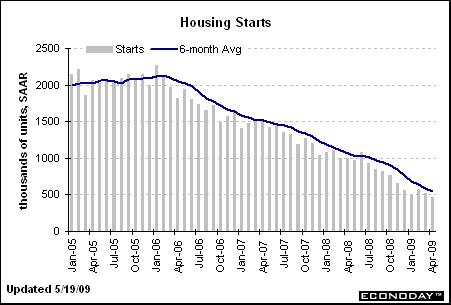
9. HOUSING STARTS FALL 50% IN APRIL FROM YEAR PREVIOUS

Barry Ritholtz reports that the number of building permits granted in April fell by 50.2% (±1.4%) from April 2008, and at a seasonally adjusted annualized rate of 3.3% (±2.3%) from March. Single family house building permits, however, were up 3.6% (±2.2%)from March, though down 42% from April 2008. Ritholz links to Barron's Econoday's chart plotting housing starts,


and comments:
"As bad as these numbers sound, they are actually a net positive. More inventory is a bad thing, so less starts and permits is a good thing. . We still have several million foreclosures possible over the next 3 years, and that will add to supply and drive prices further down. In the event that prices do move higher somehow, expect to see millions of shadow inventory--homes bought on spec or to be flipped--to hit the market."


10. CREDIT CRUNCH EASING ON RADICAL STEPS BY FED & TREASURY AND INFLATION EXPECTATIONS STILL MODERATE

Calculated Risk reports that LIBOR, and a number of other credit indicators, have returned to near normal.
"Last week, FDIC Sheila Bair said "the liquidity crisis is over for good". That might be a little optimistic (some ARS markets are still frozen), but it does appear the Fed has eased the liquidity crisis for now. The Treasury is still working on the solvency issues. "
Worth reading in full. In a related story, Menzie Chinn at Econbrowser points out that fears of hyperinflation in the US are neither manifested in survey- nor market-based expectations. Chinn notes that the median expectation for ten year inflation per surveys of economics forecasters remains pretty much as it has been for the last ten years. He plots a graph of market-based expectations, using the rate implied by the difference between the yields on 10 year Treasury Inflation-Protected Securities (TIPS) and 10 year treasuries:


Well worth reading in full.

Monday, May 11, 2009

Daily Sources 5/11

1. GLOBAL BUSINESS SERVICES INDICATORS SHOW SIGNS OF STABILIZATION

In a long and comprehensive post, Edward Hugh at Fistful of Euros reports that the rate of contraction in business services is stabilizing globally in parallel with production manufacturing index indicators.


"The JPMorgan Global Serices Report is based on the results of surveys covering around 3,500 executives in countries which taken together account for an estimated 60% of global service sector output."
Hugh notes that stabilization is not the same as recovery. His post gives some detail on the Eurozone, Spain, Italy, Germany, France, Russia, and the US, where the story is in outline fairly similar, though the devil is always in the details. For example, he touches on price indicators for Europe:
"All eurozone countries reported significant downward price pressures, and these are reflected in producer prices (which fell over 5% year on year in March, lead mainly by energy and commodities) and consumer price disinflation, where year on year price increases were only 0.6% in April, for the second month running."
Worth a look.

2. ICELAND LIKELY TO BEGIN PROCESS OF JOINING THE EU, SEEMINGLY CONFIRMING PREDICTIONS THAT THE CRISIS WILL BROADEN THE UNION

Eurointelligence reports that Iceland's new government has "formally decided to start a process leading to full EU accession, a decision to be backed up a parliamentary vote next Friday."
"The government wants to make a formal request for EU accession by July. The latest polls suggest that over 60% of the population is in favor of accession negotiations, with 27% against."
Given recent analysis which argues that the euro will end up benefiting most from the current debate over whether a new reserve currency is required as an alternative, at this stage it appears that Martin Feldstein's argument that the financial crisis will be a centrifugal force causing member nations to leave the European monetary union--see Daily Sources 1/5 #1--is proving less prescient than Wolfgang Münchau's that it is more likely to enlarge both the eurozone and the EU--see Daily Sources 11/13 #1.

3. POLLING SHOWS THAT MERKEL LIKELY TO HEAD WHICHEVER COALITION ENDS UP WINNING FUTURE GERMAN ELECTION; IN THE MEANTIME FRIDAY CONFERENCE HIGHLIGHTS HOW ABANDONING NUCLEAR WILL INCREASE GERMAN ENERGY DEPENDENCE

Eurointelligence also reports that the likely outcome of the elections in Germany this year will either be a coalition of the Christian Democratic Union and the Free Democratic Party--with a tiny majority--or a "grand coalition" of the CDU and the Social Democratic Party. Eurointelligence notes that Angela Merkel would remain Chancellor in either case. Meanwhile, on May 8 Mark Hibbs at Platts reported that
"Germany's planned phase-out of nuclear power generation will raise the country's natural gas demand between 12.6% and 23% by about 2023, according to a statement on energy security policy submitted to the EU summit in Prague on Friday by the co-ruling Christian Democrats."
The Russo-Ukrainian contract dispute which shut off natural gas supplies to much of Europe at the beginning of the year is expected by many to convince a majority of Germans that the decision to abandon nuclear power was a mistake. Lars Jossefson, CEO of Vattenfall--an electric utility which serves a number of states within Germany, told Reuters in January that he expected the discussion over nuclear to re-open shortly--see Daily Sources 1/15 #1. A global survey by Accenture published in March suggested that the general view of nuclear power was becoming more positive, with the exception of France, where it provides 80% of the country's nuclear power or thereabouts--see Daily Sources 3/17 #8.

4. NORWEGIAN OIL PRODUCTION DOWN 7% IN APRIL FROM MARCH; BRENT EXPORTS TO FALL 12% IN JUNE ON REPAIRS AND MAINTENANCE

Spencer Swartz at Environmental Capital reports that Norwegian oil production was down 7% in April to 1.99 mb/d from 2.15 mb/d in March. Meanwhile, Alexander Kwiatkowski at Bloomberg reports that Dated Brent crude exports will drop by 12% in June to 1.257 mb/d from 1.427 mb/d in May as field operators carry out maintenance and repairs.

5. IRANIAN, ALGERIAN AND KUWAITI OIL OFFICIALS INDICATE THAT THEY DO NOT THINK NEW OPEC CUTS LIKELY, SAUDI ARAMCO MAINTAINS SUPPLY CUTS TO ASIAN REFINERS, IRAN INDICATES IT WILL NEED WESTERN FINANCING IN ORDER TO MAINTAIN OIL EXPORT LEVELS GOING FORWARD, THE UAE EXPECTS GDP GROWTH ON OIL BTW $50-53/B, WHILE WESTERN ANALYSTS BECOME WORRIED ABOUT EFFECT OF COMMODITIES PRICE INCREASES ON RECOVERY

Tamsin Carlisle at the UAE's National reports that Iranian, Algerian, and Kuwaiti oil officials all have indicated in recent days that they expect OPEC not to opt for further supply cuts in the upcoming meeting. Christian Schmollinger at Bloomberg reports that refiners in Japan, Taiwan and South Korea told the journalist on condition of anonymity that Saudi Aramco was maintaining supply reductions to Asian refiners in June.
"Saudi Arabia produced 7.925 mb/d of crude in April, down 25 kb/d from March, according to a Bloomberg News survey of analysts, oil companies and producers. That’s 126 kb/d under its OPEC production target of 8.051 million barrels a day."
Upstream online reports that Seiffolah Jashnsaz, managing director of the National Iranian Oil Company, told a conference that Iran needed to increase its investment in oil and gas sector development if it is to maintain its status in OPEC through 2025. He indicated that investment requirements would run at about $25-30 billion per annum in order to do so and that Tehran would need to access financing from the West to carry out the required efforts, indicating that the country's earnings were not sufficient to cover the costs. Geoff King at Platts reports that department acting director Ahmad Abu Ghaida at the Abu Dhabi Department of Economic Planning told a conference that they expect economic growth to return to the UAE in the second half of 2009 on the back of oil prices of $50-53/b.
"Despite the ongoing global financial crisis causing 'economic turmoil and uncertainty worldwide,' Abu Ghaida said there are a number of factors providing a positive outlook for the UAE, including a 'relatively positive outlook for oil prices of 'around $50-$53/b in 2009 and around $60/b in 2010.' The UAE currently produces around 2.2 mb/d."
James Hamilton has a post at Econbrowser where he argues that the US Fed--and I'd expect other monetary authorities to be as well--is likely concerned about the rebound in commodities prices over the last couple months. He plots a graph of their prices from March 17:


And comments:
"Some increase in relative commodity prices is certainly to be expected if we are indeed about to see a recovery in real economic activity. But this is a trend the Fed needs to watch closely from here, and could prove to be a significant limiting factor on how much the Fed can hope to achieve from monetary stimulus.

Because I for one do not think it's a good idea to call for a replay of the 2008:H1 commodity market show."
Worth reading in full.

6. CHINESE OIL IMPORTS UP 13.6% IN APRIL YOY AND CONSUMER PRICES DOWN, MOSTLY ON FOOD, AND PORK, IN PARTICULAR

Eadie Chen and Tom Miles at Reuters report that China imported 16.17 million tonnes (3.93 mb/day) of crude oil in April, a 13.6% increase from the year prior.
"If confirmed, the daily rate would surpass last month's 3.85 mb/d and comes next only to a record import level of 4.07 mb/d in March 2008 when Beijing drummed up for the Beijing Olympics and would also be the first positive yearly growth this year."
Reuters provided a graph of oil imports from 2006:


Liu Li and Terrence Poon at the Wall Street Journal report that China's consumer price index fell at an annual rate of 1.5% in April, marking the third straight month in consumer price declines. "The producer price index was down 6.6% following March's 6.0% fall, the fifth straight month of deepening declines." Further, new loans extended in April fell to 591.8 billion yuan, down from 1.89 trillion yuan in March, but up 409 billion yuan from April 2008. In a related story, Shen Hong at China Journal reports that pork prices in major Chinese cities fell by 10% in April from a year previous.
"If prices continue to fall, farmers will start killing pigs because it makes no sense for them to buy the feed for hogs that are worth little when sold.

The TV report warned the government is already considering boosting the country’s pork reserves and offering subsidies to pig farmers, in a bid to ensure future supply.
...
Food constitutes nearly 33% of China’s CPI, and pork’s weight in the food category is estimated to be at least 10%."
With so many workers migrating back to the country, it makes intuitive sense that food in the major cities would be facing a decline in demand. The subsidies targeting the rural areas so far do not include food, as far as I understand.

7. CHINA AND KUWAIT TO BUILD 300 KB/D REFINING COMPLEX IN GUANGDONG

Joanna Hartley at Arabian Business.com reports that the Kuwaiti and Chinese governments signed yesterday five deals incorporating oil, gas and environmental sectors. John Duce and Eugene Tang at Bloomberg, on the other hand, report that the deal includes an agreement between Sinopec and the Kuwait national oil company to build a $9 billion refining complex in Guangdong province.
"[T]he Kuwaiti venture in Guangdong will have a refining capacity of 300 kb/d, Kuwait News Agency reported April 28, citing the country’s oil minister. No other details were available.

The project’s location may be moved to Zhanjiang from an earlier plan of Guangzhou, Zhang [Guobao, the head of China’s National Energy Administration] told reporters yesterday, adding talks between the companies are still continuing. The plant will include an oil refinery and an ethylene plant and the complex should be built away from 'big cities,' he said."
Mr. Zhang indicated that there will be a third investor in the project, and mentioned either BP or Shell. (There is some confusion about the deal, with some reporting that the complex is to be built in Kuwait, but I suspect that it would be built in China, as my guess is that Beijing wants to minimize products imports given an anti-colonialist ideology.)

8. ROXANA SABERI TO BE RELEASED TODAY

BBC reports that Roxana Saberi has had her sentence commuted and will be freed, and able to leave Iran, today. She has been banned from reporting in the country for five years.

9. CANADIAN NEW HOME PRICES FALLING, BUT NOT AT THE PRECIPITOUS RATE OF THE US

Rebecca Wilder at News N Economics reports that the Canadian new homes market is weakening slightly, but that this is a result of weakening economic fundamentals, not overly-indebted households. She plots a graph of Canadian vs US home prices from 1997:


10. HAS THE NEW SOMALI TRANSITIONAL FEDERAL GOVERNMENT GIVEN PIRATES WARNING THAT THEIR DAYS OF FREELY OPERATING ARE OVER?

Eagle1 at the Eagle Speak blog reports that:
"two leaders of Somali pirate groups (at least 30 hijacks between them, I am told) are under pressure from the Islamic courts to stop all hijacking by the end of this month, when the monsoon normally slows pirate activities anyway."
Further, mosque leaders in Puntland have reportedly been told to preach to their female parishioners that pirates bring shame to Somalia and are not good Muslims. It is an odd story, does "Islamic courts" refer to the ICU--Islamist Courts Union--defunct as an organization, as I understand it, but a former head of which is now putative President? They should have some more control in Puntland than al-Shabaab, which is the group which has international Islamist backing, though al-Shabaab, if memory serves, did threaten pirates operating out of Harardere, well north of Mogadishu, but they are not in charge there.

If "Islamic courts" refers to the "governing" coalition, that may well make sense ... and they could put an end to it, though they are much more moderate in their Islamist views (even though the US decided they were too Islamist once upon a time leading to the Ethiopian invasion) than al-Shabaab. (h/t Galrahn at Information Dissemination.) From a May 8 story at the New York Times by Jeffrey Gettleman also linked to in Galrahn's post:
"The new president [of Puntland, not the Transitional Federal Government], Mr. [Mohamed Mohamud] Abdirahman, is a technocrat who had been living in Australia and came back with many Western-educated advisers--and an ambition to be Somalia’s first leader to do something substantive about piracy. He formed an antipiracy commission and even issued a 'First 100 Days' report.

Yet, Puntland officials are doing precious little about the pirate kings under their noses00reluctant, perhaps, to provoke a war with crime lords backed by hundreds of gunmen. When asked why they weren’t arresting the big fish, Mr. Abdirahman said, 'Rumors are one thing, but we need evidence.'"
11. PIMCO LOWERS EXPOSURE TO US GOVERNMENT-RELATED DEBT

In what may be a leading indicator, Dakin Campbell at Bloomberg reports that Bill Gross, manager of Pacific Investment Management Co.’s [PIMCO] $150 billion Total Return Fund, has reduced the funds holdings of US government-related debt since March. In his May investment outlook, Gross wrote:
"The Obama cannon shot will have financial consequences. Investors should recognize that this grassroots trend signals--most importantly--an increasing uncertainty of cash flows from financial assets.
...
Do not be deceived by the euphoric sightings of ‘green shoots’ and the claims for the new bull markets in a multitude of asset classes."
Campbell reports that Gross concluded: "Investors should partner with the government but do so at the 'senior level of the balance sheet.'"

12. THE NEW FANGLED DERIVATIVES WERE MOSTLY USED BY FINANCIAL INSTITUTIONS, NOT BY THE BUSINESSES THEY WERE PRESUMABLY DESIGNED FOR

Adam S. Posen and Marc Hinterschweiger at Realtime Economic Issues Watch argue that the recent financial innovations in derivatives provided little, if any benefits, to any sector of the economy outside finance.
"Between 2003 and 2008, US gross fixed capital increased by about 25%, a reasonable number during an economic expansion, but hardly a boom. During the same five-year period, the global amount of over-the-counter (OTC) derivatives increased by 300%, while derivatives held by the 25 largest US commercial banks rose by 170%. Clearly, growth in new financial products has outpaced fixed capital formation both globally and in the United States by a large margin. This has been especially true since 2006, when investment stagnated, but derivatives continued to grow at a rapid rate. There only seems to be a weak link, if any, between the growth of the newest complex--and now proven dangerous if not toxic--financial products and real corporate investment."


Posen and Hinterschweiger further note that only 11% of the counterparties in OTC derivatives transactions were not financial institutions--meaning that the non-financial institutions for which the derivatives were presumably designed didn't, on the whole, use them. Worth reading in full.

13. HOTEL SECTOR BEING HIT HARD

Ed Harrison at Credit Writedowns reports that the hotel industry is being hit hard in conjunction with the commercial real estate market. Harrison remarks:
"[W]e should expect the cost cutting to continue unabated in terms of non-residential property investment--and this includes the travel & leisure sector as well as commercial real estate. Obviously, this will be a drag on GDP. Investment levels at least thirty percent below today’s investments are not an unreasonable expectation as I argued in a recent post (see the section on fixed investment)."
He notes that owners across the entire spectrum of the real estate market are cutting back on maintenance in order to meet cash flow requirements--which has economic cascading effects.

Thursday, March 26, 2009

Daily Sources 3/26

1. Eurointelligence reports that the Netherlands CPB Institute yesterday published January's data for global trade, which shows that global trade is down 20% from October. "FT Deutschland quotes a CPB staffer as saying this is faster than during the Great Depression (the estimates there range from 25-35% during 1929 and 1932)."

2. Lucy Hornby at Reuters reports that China estimates that the number of migrant workers that are now unemployed has risen to 23 million since the lunar year holiday in January. (h/t Yves Smith at naked capitalism.)

3. Upstream online.com reports that Liu Qi, deputy head of China's National Energy Administration, told an industry forum that
"Appropriately obtaining global resources is our inevitable choice and legal right...Winning foreign resources is even more important than stepping up domestic production."
Liu told the conference that China will offer oil companies tax and other policy incentives to continue exploring for purchases and concessions abroad. Meanwhile, Lydia Polgreen at the New York Times reports that analysts see Chinese decision makers becoming more conservative about their African investment decisions:
"'We have seen in the recent past Chinese companies wade into countries nobody else would,' said Philippe de Pontet, an analyst at ... a private research firm. 'That may be changing.'"
Meanwhile, Franz Wild and Helene Fouquet at Bloomberg report that Aveda, accompanying French President Nicolas Sarkozy on a two day business junket to central and western Africa, signed a joint venture uranium exploration agreement with the Democratic Republic of Congo.


4. Rebecca Christie at Bloomberg reports that Treasury Secretary Timothy Geithner told a forum hosted by the Council on Foreign Relations yesterday that the recent proposal to replace the dollar as a reserve currency by China is
"designed to increase the use of the IMF’s special drawing rights. And we’re actually quite open to that."
"The dollar slid as much as 1.3% against the euro within 10 minutes of news accounts of Geithner’s remarks. It recouped much of the loss about 15 minutes later, when Geithner then predicted no change in the US currency’s role."
Meanwhile, Eurointelligence reports that Dominique Strauss-Kahn, the head of the IMF, told a parliamentary finance committee in Paris that
"it is absolutely legitimate to discuss the possibility of a new international currency. This is not a new question but the current crisis renews the interest in this question. He also said that he does not consider that the dollar ceases to be an international reserve currency. Even the Chinese don’t think that."
Meanwhile, Mriganka Jaipuriyar at Platts reports that the chief economist of the Paris-based IEA, Fatih Birol, said that the organization is working very closely with Beijing to improve the flow of data, but that there is a long way to go.
"'Both on the IEA's side and the Chinese side, there are strong efforts to harmonize how we collect and analyze the statistics. I should say there are some improvements in that area but we are not yet at a level we would like to see,' Birol told Platts in an interview Thursday.

'We are at the beginning of a very long journey and it would be too premature to say that we have the information we need to make our analysis,' he added.

The IEA is pursuing similar talks with India and hopes to be able to better analyze the situation in these countries and their implication for the rest of the world, Birol said."
Platts reports that OPEC oil exports excluding Ecuador and Angola in the four weeks to April 11 are to fall to 22.23 million b/d, down by 770 kb/d from the previous four week period.

5. Thom Shanker at the New York Times reports that an annual Pentagon study released yesterday--"Military Power of the People’s Republic of China 2009"--argues that China is seeking weapons and technology which counter traditional American advantages. This seems natural enough to me, but China's Foreign Ministry was sufficiently disturbed to have its spokesman say "This report issued by the US side continues to play up the fallacy of China’s military threat." At his regular news briefing in Beijing the spokesman "suggested that the Pentagon stop issuing the annual report to avoid 'further damage to the two sides’ military relations.'" The report can be found here.

6. Wall Street Journal Asia has an editorial piece which points out that the EU and South Korea just signed a free trade agreement on Tuesday.
"Details haven't been released yet, but it's expected to be a comprehensive accord that will reduce or eliminate most tariffs on goods and liberalize European investment in Korea's tightly regulated service sector. Both sides are aiming to iron out the final details at next week's Group of 20 summit in London."
7. Veit Medick at Der Spiegel interviewed Martin Schulz, chairman of the Socialist group in European Parliament and head of foreign policy at the German Social Democratic Party's federal executive committee, about the consequences and causes of the fall of Prime Minister Mirek Topolánek's government in the Czech Republic while he was president of the EU. Key excerpts:
"Schulz: Topolánek was one of George W. Bush's closest allies when it came to the missile-defense system in eastern Europe. Now he uses the platform of the European Parliament to campaign against Bush's successor. He can do that in Prague, but not in the EU.

SPIEGEL ONLINE: Is the Lisbon Treaty now in danger?

Schulz: We'll see. The fact is, the two legislators who caused the collapse of his government were opponents of the treaty. That's not an encouraging sign."
SPIEGEL ONLINE: This fall, the Irish also plan to vote on the Lisbon Treaty. If the Czechs reject the treaty, would the Irish vote still be relevant?

Schulz: If the Czechs reject the treaty, we're going to be in a serious crisis. We might as well then bury the treaty. We'd then be thrown back to the Treaty of Nice, which was passed by 15 member states. But those same 15 governments, not to speak of the new member states, are unsatisfied with the old arrangements. That's why there was supposed to be a constitution. When that failed, we tried to include the essence of the reforms in the Lisbon Treaty. If that also fails, it would be a fiasco.
Worth reading in full. Meanwhile, Reuters reports that Irish GDP fell at an annual rate of 7.5% in the fourth quarter. "GDP fell 2.3% for the whole of 2008, data from the Central Statistics Office showed on Thursday."

8. Der Spiegel reports that in a speech calling for the reform of NATO, German Chancellor Angela Merkel said today:
"It is also in Germany's interest that dialogue between the new US administration and Russia gains momentum again. ... NATO wants Russia as a good partner ... We have not been rivals for 20 years now. The time of the Cold War is irrevocably over."
9. Doris Leblond at the Oil & Gas Journal put the kibosh on the notion, reported in the Russian press, that Moscow had been left out of discussions on how to pay for the modernization and increased transparency of the Ukrainian gas pipeline system. In fact, "Russian Energy Minister Sergei Schmatko and an important delegation was present." This was in addition to representatives from the EU, Canada, the US, World Bank, European Investment Bank, and European Bank for Reconstruction and Development. Meanwhile, RIA Novosti reports that the Russian Ambassador to Ukraine, Viktor Chernomyrdin, told the press that the deal struck Tuesday to modernize the system "looks as if a deaf man and a blind man sat at a table and signed the paper without even understanding what they had signed."

10. Johan Carlstrom at Bloomberg reported that the Norges Bank cut the benchmark interest rate by 0.5% to 2% yesterday.
"'The decline in activity in the Norwegian economy will be more pronounced than previously assumed,' Deputy Governor Jan. F. Qvigstad said in the statement. The bank may cut the rate as low as 1% 'in the course of the autumn.'"
11. Edward Hugh at Fistful of Euros notes that Serbia and the IMF have agreed to a €3 billion, 27 month, stabilization program.

12. Reuters reports that UK retail sales fell by 1.9% in February from January. "The annual rate of growth fell to 0.4%, its weakest since September 1995, the Office for National Statistics said."

13. The Associated Press reports that Ali Larijani, the Iranian Speaker of the Parliament and former nuclear negotiating point man, told the media yesterday that in Najaf that Iran's problems with the US are not a "sentimental issue" soluble with "a blessing and congratulations." "Larijani says the differences stem from 30 years of hostility, including Saddam Hussein's 1980 invasion of Iran which he said was 'instigated by America.'" For the record, it is my understanding that Saddam Hussein's 1980 invasion of Iran was not instigated by the Carter Administration, but never mind.

14. The AFP reports that Turkish President Abdullah Gul in Iraq promised his hosts that the water allocation from the Tigris and the Euphrates would be doubled this year. Juan Cole surmises that this is likely in return for a crackdown by Baghdad on Kurdish Workers Party guerrillas hiding in the mountains in Iraq just outside the Turkish border.

15. Fausta Wertz at The Compass notes that today Hugo Chávez had the military presence increased at the La Fría and San Antonio airports, saying
"we have begun the reversal process over everything that meant the dismemberment of national unity, the territory, and sovereignty, because prior governments fractured the country into pieces."
(Both airports are found in the state of Táchira, a small region on the border of Colombia.)


Chávez also ordered the creation of a new state company to manage the ports which will be required by law to "work under socialist guidelines and seek the development of the regions in which their respective seaports and airports operate." As Wertz notes, after the opposition won several major municipalities and regions in the November elections, Chávez has moved to strip them of control of the various ports, and with it valuable tariff revenues.

16. Juan Forero at the Washington Post reports that in January, Ecuador enacted a number of provisions to try and reduce the number of imports coming into the country.
"'What is the objective? To dampen demand for imported good and to increase consumption of domestic goods,' said Diego Borja, minister of economic policy. 'It was a difficult measure, but necessary and indispensable. We know that there are costs to getting out of a crisis.'

Borja said that because Ecuador's currency is the U.S. dollar, the country has been particularly exposed as imports rose in relation to exports. Unable to print money, or devalue to help Ecuadoran companies that export, the government decided to levy tariffs that reach 35%, decrease import volume as much as 35% and implement a range of surcharges. In all, 627 products fall under the new measures, including furniture, cellphones, electronic parts, shoes, alcohol and food products such as cookies and pastas. The government said the restrictions would reduce imports this year by nearly $1.5 billion compared with 2008.

Without the restrictions, officials here say, Ecuador could run out of money -- leading to economic collapse and political instability. 'We depend on dollars,' Borja said. 'If we don't have a revenue of dollars, then we have a very, very big problem.'"
In December Ecuador defaulted on its debt--see Daily Sources 12/15 #1--and then had its social security system purchase $1.2 billion in new sovereign debt--see Daily Sources 12/29 #14. The CIA estimates that Ecuadoran GDP was $107 billion in 2008 and that government expenditures (which were less than revenues) were about $17.79 billion.)

17. Ronald Buchanan at Platts writes that Mexican oil export revenues in February fell 56.4% year on year on $1.66 billion, according to a report by the National Statistics Institute, or Inegi, released yesterday. WTI on NYMEX averaged $95.35/b in February 2008 versus $39.26/b in February 2009, which at a 58.8% decline is consistent with a 56.4% decline. According to the EIA, Mexican sales of Isthmus crude--a medium sour crude with an APIº33.3 and 1.492 sulfur wt/%--averaged about $89.48/b in February 2008 and $39.22/b in February 2009. Sales of Maya crude--a heavy very sour crude with an APIº22.2 and 3.3 sulfur wt/%--averaged about $78.35/b in February 2008 and $37.17/b in February 2009. But in November, the Associated Press reported that the Mexican Treasury Secretary announced that the country had spent $1.5 billion to buy put options to sell 330 million barrels of Mexican crude--or about a third of its total 2008 output--at $70/b. Even considering the decline in total output, how does this add up?

18. Mary Beth Sheridan at the Washington Post reports that in a speech in Mexico Secretary Clinton said of the anti-narcotics effort:
"Clearly what we've been doing has not worked ... . Our insatiable demand for illegal drugs fuels the drug trade. Our inability to prevent weapons from being illegally smuggled across the border to arm these criminals causes the deaths of police, of soldiers and civilians.'"
19. Derek Sands at Platts reports that Scott Borgerson, a fellow for ocean governance at the Council of Foreign Relations told the House Committee on Foreign Relations that:
"It would be a mistake to assume that all these flashpoints [of new resource opportunities opening up due to melting ice in the Arctic] will remain sleeping dogs. The combination of new shipping routes, trillions of dollars in possible oil and gas resources and a poorly defined picture of state ownership make for a toxic brew."
Sands elaborates:
"US ratification of one mechanism to deal with Arctic resource issues--the UN Law of the Sea Treaty -- has been blocked by a small group of senators because of sovereignty concerns. That refusal could contribute to the US missing out on some of the Arctic's resources, according to the witnesses.

Other Arctic countries have ratified the treaty, and former President Bill Clinton signed it, but it still awaits Senate ratification.

Among other things, the treaty sets up a mechanism for countries to arbitrate disagreements over claims to undersea territory."
20. Bob Willis at Bloomberg reports that initial unemployment benefits applications grew by 8,000 in the week ended March 14 to 652,000, per the Labor Department release today. The total number of people receiving unemployment benefits jumped by 122,000 from the week prior to 5.56 million.

21. Shobhana Chandra at Bloomberg reports that the Commerce Department further revised its initial estimate of fourth quarter GDP to a 6.3% annual rate of contraction (from 3.8% and then 6.2% rates of decline).
"For all of 2008, the economy grew 1.1%, the same as previously estimated, as exports and government tax rebates in the first six months helped offset the slump in consumer spending that followed.

Consumer spending, which accounts for about 70 percent of the economy, fell at a 4.3% pace last quarter, marking the first back-to-back decreases in excess of 3% since record-keeping began in 1947.

Retailers are doing better so far this year. Sales fell less than forecast in February and January’s 1.8% gain was the biggest in three years, Commerce reported earlier this month."
Brian Blackstone at Real Time Economics notes that GDI--Gross Domestic Income, another measure of national economic activity--fell in the fourth quarter by 7.5% from 4Q2007.
"GDP is consumption driven: consumer spending, investment, government spending and the like. GDI is income based, meaning things like income and corporate profits. In theory, the two should line up — but not always. In the case of the fourth quarter, a severe slide in corporate profits was likely the root of the discrepancy. Employee compensation, the other main GDI component, held up much better."
22. Barry Ritholtz at the Big Picture takes aim at the news yesterday that new home sales increased by 4.7% in February from January, noting, to start with, that on an annual basis new home sales fell by 41% in February.
"Note that the month over month data at 4.7%--plus or minus 18.3%--is statistically insignificant. (i.e., meaningless). The reported data does not inform us if sales improved month-over-month or not. It is a range, from down -13.6% to plus 23%. Since 'zero' is part of that range, we can draw no conclusion. As the Census Department itself notes, “the change is not statistically significant; that is, it is uncertain whether there was an increase or decrease.”

The data does however, tell us that the year-over-year sales fell 41.1% plus or minus 7.9% gives us a range of -49% to -33.2%. The entire range is negative, therefore we can conclude sales fell year-over-year."
The Census Bureau noted that the seasonally adjusted estimate of new houses for sale indicates a 12.2 month supply at February sales rates.

23. Brian K. Sullivan at Bloomberg reports that the flooding in North Dakota is forecast to exceed 112 year records and thus may well significantly delay the planting of the spring wheat crop.
"Republican Governor John Hoeven declared a flood emergency across the state, while the federal government declared the state a major disaster area and said a public health emergency exists there. Rain and snow blanketed the area this week, covering ground already saturated by snow and rain earlier in the season."
The US is a major global supplier of wheat.

24. Keith Johnson at Environmental Capital posts the very useful observation that water consumption is a key issue--and perhaps the key issue--in evaluating the relative value of various forms of power generation.
"The water issue affects all kinds of power generation—coal, natural gas, and nuclear power; the nuclear industry’s water appetite in particular has become a flashpoint for criticism. The US Geological Survey figures power plants are the second-biggest users of water in the US, behind agriculture."
25. In an interesting side-note, it appears that the online musings of Paul Krugman have struck a nerve in Germany, whose press has taken note of Krugman's disrespectful tone and whose Finance Minister Peer Steinbrück has sent Krugman an invitation to visit him in Berlin to discuss their differences of opinion mano a mano.

Thursday, February 19, 2009

Daily Sources 2/19

1. Andrew Batson at Real Time Economics posted last night a translation of parts of the remarks made by Fang Shangpu--the deputy director of China's State Administration of Foreign Exchange--in a press conference. Some excerpts of the excerpts:
"Regarding the issue of purchases of US treasury bonds, Premier Wen Jiabao in his February 1 interview with the UK’s Financial Times explicitly stated that whether China continues to buy, and how much it buys, will be decided in accordance with China’s needs, as well as the requirement to preserve and increase the value of the foreign exchange reserves."
This appears to be official boilerplate as he repeats the same idea just a bit later.
"With the current international financial crisis still continuing, spreading and deepening, we firmly oppose trade and investment protectionism. We also hope that the major reserve currency countries can take active measures to effectively deal with the financial crisis and economic recession, in order to recover economic growth and financial stability as soon as possible, effectively protect the interests of investors and strengthen investor confidence."
"Investors" here means Chinese government investments in US sovereign and agency bonds. "Investment protectionism" is a barrier to China's external resources policy, like the US Congress's decision to block the acquisition of UNOCAL by CNOOC and probably meant as a direct reference to Canberra's recent decision to review Chinese investments in Australian mining companies. That said, Fang seems to say that Beijing will continue to purchase dollars in pursuit of domestic stimulus:
"For the next step, we will actively support the nation’s need for foreign-exchange funds to expand domestic demand and increase imports, and provide financing support and facilitation to companies’ foreign investments to help build the national economy."
Well worth reading--and if you have Mandarin, the post includes a link to the full Chinese transcript. Chen Deming, China's minister of commerce, has an opinion piece in today's Wall Street Journal Asia which reiterates SAFE's warning against protectionism. He stresses how much demand China added over 2008 and Beijing's commitment to stimulate it in the face of the crisis:
"Today's unprecedented financial crisis has inflicted a severe impact on China and other countries as well. China's economic growth has slowed, exports have plunged and unemployment pressure has mounted. Yet even so, China still firmly believes that trade protectionism isn't a solution to the world's problems. In 2008, amid a contraction in global trade, China imported $1.133 trillion worth of goods from countries around the world -- an 18.5% increase over the prior year. These imports are boosting the economic development of China's trading partners. Since the crisis broke out, the Chinese government has decisively put forward a series of measures aiming at stimulating domestic demand. Given the size and openness of our country, the growth in China's domestic markets can be translated into greater market potential and investment opportunities for other countries. This year China will continue to increase imports and send buying missions abroad for large-scale purchase of equipment, products and technology."
Well worth reading in full. Nadia Rodova at Platts has a follow up story on the news of Beijing's loan agreement with Rosneft and Transneft which reports that Rosneft has made clear that the oil contracted for under the agreement will be paid for at the market rates prevailing at the time of deliveries. Deliveries--of 300 kb/d for 30 years--are slated to commence in 2011. (for the story a few days ago, see Daily Sources 2/17 #5.) Meanwhile, Dale Crofts at Bloomberg reports that Petrobras announced it had signed a $10 billion loan agreement with China’s Development bank today. This comes after raising $1.5 billion in 10 year bonds via the capital markets on February 4th, just a week after stating that credit on the international markets was too dear (see Daily Sources 2/5 #8). I imagine the terms of this most recent agreement are generous.

2. Yves Smith quotes at length from a Lloyd's List article--not made free to the public--which throws cold water on the notion that recovery in the Baltic Dry Index is an indicator that global trade has bottomed.
"Box throughput at Singapore, the world’s largest container port took a 19% dive in January this year to 2m teu compared to 2.4m teu for the first month of 2008.

Singapore’s sharp drop in volumes in particular reflect the collapse in the Asia- Europe trade where it is a key relay port transhipping exports from surrounding countries to Europe and the Middle East.

... Hong Kong, saw January throughput plunge 23% in January..."


"At Malaysia’s largest port, Port Klang, the picture was not much better. Port Klang Authority general manager Lim Thean Shiang told local press that the port had seen a 16% drop in volumes in the first month of the year compared to January 2008."
"China’s Ministry of Transport said throughput of the country’s coastal ports has fallen for three consecutive months on a month-on-month term. China coastal ports handled 8.2m teu in January, down 15% from the same month last year and 10% from December.

The country’s third largest port, Shenzhen, saw throughput fall by 18% to 1.5m teu in the first month of this year. The proportion of empty boxes at east Shenzhen’s Yantian port district has risen from 60% to 80%, according to the city government....

The picture was equally grim for one of Southeast Asia largest exporters with the country’s [Indonesia's] trade minister Mari Pangestu forecast that its exports could fall by at least 20% this year."
The explanation of the recovery of the BDI so far--an increase of iron ore imports by China's steel industry--seems insufficient to explain the rise in the index, but the port traffic data is especially grim.

3. Hiroko Tabuchi at the New York Times reports that the Bank of Japan said today it would purchase ¥1 trillion (~$10.7 billion) in corporate bonds, extend its purchases of commercial paper and maintain its benchmark lending rate at 0.1%. Ron Harui and Kim-Mai Cutler at Bloomberg report that Barclays Capital analyst have noted that credit default swaps have risen to as much as 120.7 this week, in what they argue is a sign that the markets are reassessing their valuation of the yen as the best fiat store of value.

4. Eurointelligence reports that Poland has entered into talks with the European Central Bank regarding entering the European Exchange Rate Mechanism II. In brief, ERM-II establishes a band within which the adopting country's currency will trade against the euro. Yesterday, P O Neill at Fistful of Euros posted that the European Commission released its economic assessment of EU member states and announced it had begun "excessive deficit procedures" for six member countries whose deficits exceed 3% of GDP. They are Ireland, Greece, Spain, France, Latvia, and Malta.

5. Meanwhile, Lynnley Browning at the New York Times reports that UBS, the largest bank in Switzerland, had agreed to turn over the names of investors suspected of using the bank to avoid taxes. The bank has admitted to conspiring to defraud the IRS and agreed to pay $780 million to settle the case.
"But to some, turning over any names at all heralds the end of the secret Swiss bank account, whose traditions date to the Middle Ages.

'The Swiss are saying that this is the end of Swiss banking as they knew it,' said Jack Blum, an offshore tax specialist. 'Nobody will trust the security of the Swiss bank account.'"
To me, this is a better indicator of the stresses the international financial system is under than much of the news we get. When institutions abandon customs over 500 years old, "once in a century" is rendered an understatement. (The second, by the way, seen from Europe, given that the Bank of England cut rates to the lowest seen since its inception 315 years ago. see Daily Sources 1/9 #2.) The credibility of the argument that Switzerland will have to join the monetary union has just gone up considerably.

6. RIA Novosti reports that Naftogaz announced today via its website that it will likely be unable to keep current on its payments for Russian natural gas. The statement reads:
"The national joint stock company Naftogaz of Ukraine is giving notice of the possible deterioration of the situation with payments to Gazprom following a disastrous growth in utility companies' debts to its structures."


7. Steve Bryant at Bloomberg reports that the Turkish central bank cut its benchmark interest rate by 1.5% to 11.5%, "the lowest since Turkey began inflation targeting in 2002."
"The bank’s fortnightly survey of businessmen and economists on Feb. 9 showed expectations for inflation falling to 7.16%, below the bank’s goal of 7.5% at the end of this year."
8. Ayesha Daya, Haris Anwar and A. Craig Copetas at Bloomberg report that the United Arab Emirates is preparing a plan to stabilize its financial sector.
"'If we want the banks to lend again to real estate, then obviously governments will have to put a plan,' Sultan Ahmed bin Sulayem, who also sits on a committee studying the effects of the global credit crisis on Dubai’s economy, said in a Feb. 17 interview in his office. 'I know, I am aware, that the central bank and the federal government are taking steps to lend money.'"
9. Geoff King at Platts reports that Norwegian E&P company DNO said today that tie-in operations connecting the Tawke oil field to Iraq's northern pipeline are nearly complete and that the company is set to substantially increase production. "The company said in September that output from Tawke was averaging 11 kb/d but that this could be increased to 90 kb/d." Meanwhile, Juan Cole at Informed Comment reports that Iraqi-Kurdistan Prime Minister Nechirvan Barzani is stoking fears of an Arab-Kurdish civil war should the US withdraw prior to a final agreement on the region's status. In late November, Kurdistan received a shipment of arms from Bulgaria without seeking approval from Baghdad while complaining that al-Maliki was attempting to establish a praetorian guard answerable only to him. (see Daily Sources 11/24 #7.) Prof. Cole also reports rumors that several factions upset with the centralizing policy of al-Maliki are conspiring to set up a vote of no confidence.

10. Pamela Constable, Karen DeYoung and Haq Nawaz Khan at the Washington Post report that neither the Pakistani government nor their Taliban counterparts in Swat are willing to formalize the accord announced Monday. (see Daily Sources 2/17 #4.) The reaction in the press to the potential deal has been something close to incredulous. However, I think that Secretary Clinton had the right idea when she refused to comment on the issue more than to say that she was waiting to find out what the notion behind the deal was before making a conclusion.

From my far remove I regard the problem that Pakistan faces--and which the Taliban addresses--as lawlessness. If there is no sheriff in Swat who will obey the decisions of Islamabad without some sort of ratification by the local Islamicist political leaders, then there is, in effect no law. If the appeals process established by the accord were to be governed by the national judicial system, then the Sharia courts would be re-incorporated into the central government. (Also, if I understand correctly, Pakistani law already gives some jurisdictional precedence to Sharia and Sharia Courts in some instances--family law, for example. Given that my understanding is correct, that would mean that the move was entirely consistent with the Pakistani Constitution.) Secretary Clinton is absolutely right to have been so circumspect with regard to the accord--it may provide Islamabad with some needed breathing room in the current strongly centrifugal environment.

11. Steven Bodzin at Bloomberg reports that according to a confidential document obtained by the wire service that Venezuela's plans to boost crude production by 12% in a joint venture would cost $18.4 billion as opposed to estimates given in June by the Energy and Oil Minister, Rafael Ramirez, of $8 billion.
"'It will be very tricky for companies, big or small, to get that level of funding,' said David Thomson, a Latin America energy analyst for Wood Mackenzie in Edinburgh. 'Even if there wasn’t a credit crunch on, raising $10 billion to $20 billion for Venezuela wouldn’t be the easiest.'

Given past nationalization moves by Chávez, a self-avowed revolutionary socialist, Thomson said, 'Banks aren’t going to touch it with a bargepole.'"
Given that Chávez looks to be President for life, I suspect that even given the long term perspective of the oil and gas industry, even policy-driven investments would be few in number. That said, Total recently indicated that it would turn to Venezuela in preference to Brazil (see Daily Sources 2/17 #6) and they may be convinced that they will receive preferential treatment because Chávez's movement is modeled in part on the Fifth Republic and there are few state companies with the requisite technical capabilities for developing the Orinoco belt. (see Venezuela vs ExxonMobil.) Still, $18.4 billion would be an awfully big bet on historical sympathy.

12. Robert DiNard at the Barrel reports that President Obama will make his first visit abroad--for six hours--to Canada today, where he will meet with Canadian Prime Minister Steven Harper. Canada is America's largest trading partner and our largest source of crude oil--and an important part of the Obama Administration's energy strategy going forward. That said,
"Beyond oil sands development, the future Canada-US energy relationship will also hinge on how well the countries bilaterally handle their shared power grid. The US will not be able to get to its ultimate goal of a far more energy efficient grid without Canada, and it is uncertain how much money and effort Ottawa is willing to spend on this, or other energy infrastructure.

The newly minted US economic stimulus package contains around $11 billion in spending on the transmission system, while Canada's stimulus plan contains C$0 (US$0) for smart grid development. Canada is leaving the matter to each province, hardly a promising framework for a continent-wide solution."
Well worth reading in full, though I am unclear on how long Harper will be the primary point of contact, considering that he shuttered the parliament to put a stop to a no confidence vote in December. Keith Johnson at Environmental Capital notes that Jeff Rubin, chief economist at Canada’s CIBC investment bank, argues that the suspension of investment in Canada's oil sands due to the low price environment will in due course create another supply side shortage:To wit:
"Rather than growing by close to 400,000 barrels per day, due to rapidly expanding oil sands production, total Canadian production is likely to rise by only a third of that by 2010. Hardly an auspicious picture for the Canadian oil sands, a region that the IEA expects will be the single largest source of new crude supply, almost three times as important as Saudi Arabia over the next two decades […] If oil prices were to stay at current levels, [global] production, instead of plateauing around 88 million barrels per day by 2012 as we had previously forecast, would decline at an accelerating pace between now and 2015. By 2015 production would decline to around 76 million barrels per day, a level roughly 10% lower than last year’s level."
I do not think that this forecast, however, will persuade many financial authorities to pursue policies which would destroy the significant economic stimulus (a progressive one at that) rendered by cheap oil in the near term. In related news, John M. Broder at the New York Times reports that the EPA is expected to regulate carbon emissions for the first time.
"The environmental agency is under order from the Supreme Court to make a determination whether carbon dioxide is a pollutant that endangers public health and welfare, an order that the Bush administration essentially ignored despite near-unanimous belief among agency experts that research points inexorably to such a finding.

Lisa P. Jackson, the new EPA administrator, said in an interview that she had asked her staff to review the latest scientific evidence and prepare the documentation for a so-called endangerment finding. Ms. Jackson said she had not decided to issue such a finding but she pointedly noted that the second anniversary of the Supreme Court decision, Massachusetts v. EPA, is April 2, and there is the wide expectation that she will act by then."
Oil sands production emits considerable carbon--at levels similar to coal.

13. Calculated Risk posts on the recent unemployment numbers from the Department of Labor.
"The four week moving average is at 619,000, the highest since 1982.

Continued claims are now at 4.99 million--another new record--above the previous all time peak of 4.71 million in 1982."


14. Jack Healy at the New York Times reports that the producers price index rose by a seasonally adjusted rate of 0.8% in January. "Producer prices excluding volatile food and energy costs rose 0.4 percent"

15. The EIA reported today that crude oil stocks fell 200,000 barrels to 350.6 million barrels for the week ended February 6. According to a Bloomberg survey, analysts had expected a 3.2 million barrel build. The stock level is well above the five year historical average for this time of year, but still below the recent high seen in July 2007. Gasoline stocks grew by 1.1 million barrels, in the upper range of the historical average, and in contrast to analyst expectations of 500,000 barrel draw. Distillate stocks fell by 800,000 barrels and are still above the historical range. Taken in isolation, the news is mixed, given that the stocks level for crude is still historically high and the reduction of refinery utilization is matched by a build in gasoline--as the price of gasoline climbs, crude may follow until European arbitrage opens up. That said, considered alone the build in gasoline stocks should presage a drop in price.

Saturday, January 31, 2009

Spot Life CL Mar 09

The story of the CL March 09 contract's first eight trading days as front month, or spot, remains dominated by gloomy economic news. The data from Japan and South Korea were especially grim and the most recent US GDP and housing data only contributed to the sense that things are only going to get worse in the near term. Germany saw a much higher increase in unemployment than was expected. The British media spoke darkly of a "disorderly fall" in Sterling. That said, there has been some evidence that the collapse in trade volumes has bottomed out and there have been some reports that the credit markets have begun to function again, if barely. (The Baltic Dry Index seems to have bottomed, tight bunker fuel supplies in Hong Kong, and a growing spread between 10 year TIPS and 10 year Treasuries.) The FOMC maintained rates at 0-.25% and a $800 billion stimulus plan was passed.

Initial reports on OPEC compliance with the new quotas suggest that, for the most part, the cartel's members have met the stated supply cuts and Riyadh appears ready to cut beyond the quota as it stands. There have been some rumblings from members about whether there would be much point cutting further, as from Nigeria and Ecuador, but most members are telegraphing further efforts. Tehran has been especially anxious to convince non-OPEC members to join in supply cuts, though I haven't seen any evidence yet that Iran is keeping faith with its own quota. Moscow, which had indicated some interest in cooperating in cuts, along with Azerbaijan and Kazakhstan, has not yet seen fit to join in--despite its apparent difficulty of seeing eye to eye with continental Europe and the United States. CGES suggested that cuts so far are sufficient to stabilize price around $45/b, but warned that further cut allocations would probably undermine gains in price as it would likely result in further demand destruction. Moamar Ghaddafi simultaneously offered his plan for peace in the Middle East--Isratine--and warned that he--as well other producing countries--is considering nationalizing the assets of majors in Libya.

On the general political front, the Gazprom Naftogaz dispute was put to rest, for the time being, and Israel ended its operation in Gaza--with a large discovery of natural gas off its northern coast. President Barrack Obama was inaugurated and most governments seemed to sigh a sigh of relief and talk of resolving disputes. Davos of course took place, though it is hard to see what the point of it was, exactly.

Other news which directly affects supply included the oil rig count in North America dropping by nearly 23%. (I am guessing that a lot of stripper wells have come off line also.) Rigs came offline in Venezuela due to non-payment. Nigeria suggested that prices below $40/b meant that offshore drilling was no longer viable economically, and PENGASSAN threatened on the 30th to shut down all the oil export terminals if a suspect government contract wasn't canceled. Valero--one of the largest refiners in the US--has announced that it will take its Texas City refinery offline (225 kb/d) and that it will be reducing throughput given slack demand in the product market. Petrobras decided not to seek financing from the credit markets for their offshore development plans, saying that the cost of money was too high to justify the move. Oh, and French transport, port and energy workers joined in a strike to bring activity there to a halt on Thursday. (See what that Czech artist meant by Grève!?)

And the giant contango of 2008 didn't budge.


The EIA reported that crude in storage amounted to 338.9 million barrels, the most seen since July 2007 of 352.6 million barrels. (These storage numbers are still less than what was seen in the last super contango in 1998.) That said, some VLCCs being used for storage lifted anchor, presumably so as to deliver their cargoes, leaving one to wonder whether some storage tanks are being kept off the market. As you can see from the graph below, the spread between CL Mar 09 and Apr 09 delivery grew to $4.45/b as of January 30th, or ~10.7%. The spread between Cl Mar 09 and Mar 10 grew to $14.70/b, or ~ 35.3% of front month. The spread between front month and Dec 16 delivery (I will not use Dec 17 until I see more open interest and activity in it) was $30.41/b or ~ 73% of front month. (Extraordinary, but not the largest spread we've seen in the last few months.)


Below is the chart of CL versus the dollar euro interbank exchange rate. It doesn't look to me like the two are moving in concert, and now the analysts are saying that they have "decoupled." I am interested in whether the correlation was causal or not. I doubt it ... and suspect if anything crude was the driving force in any exchange movements, but I am not a monetary economist, so it is mostly just my suspicious nature speaking I guess. At interbank exchange rates, the euro gained $0.0107 or 0.8% from January 21, CL lost $1.87/b or ~4.3% during that same period.


Below is a graph of the interbank exchange rate of the euro, sterling, yen, Norwegian kroner, Brunei dollar, ruble, and Canadian dollar to the dollar as a percent change from the rate as of January 1, 2000 against the price of CL on NYMEX expressed as a percent change from that date. You can see that the Norwegian kroner and euro do seem to mirror each other, though the kroner seems to have decoupled as of late November or so. A quick internet search reveals that oil exports accounted for about 17% of GDP in 2004--so perhaps it accounted for as much as 30-35% in 2007 and 2008. In 2004 oil exports accounted for 40% of total Norwegian exports, I imagine that share must have been at least 50% in 2007-2008. It would make sense that its exchange value to the dollar would rise as the price of oil rose, but the euro? It now seems to be mirroring the Canadian dollar. The ruble appears to have lost much more value relative to the dollar than it presumably gained as a result of strength in the commodities complex. That said, I think the graph shows pretty clearly that there is no simple relationship between the cost of oil and the exchange rate of the dollar and any of these currencies. (During this time period, by the way, the renminbi has risen a little more than 21%, suggesting that the tempered rise was an indirect tax on consumption in China.)


As you can see from the graph below, RBOB has recovered from the lows of December and now appears to provide a reasonable profit on a per barrel basis versus crude. Heating oil, which is nearly identical to diesel, still seems to provide the largest profits. Natural gas is selling at a comfortable discount to crude on a Btu basis after skirting near parity last month.


At close on January 30, the same month delivery differentials of forward same month contracts for gasoline over crude on a per barrel basis seem to show that the gasoline market does not expect crude to fetch the price the crude contracts are going for. That said, the same month differentials of heating oil over crude seem to suggest the opposite. (The end of the curve shows the anticipation of the cyclical growth in demand for gasoline in the Summer and for heating oil in the Winter. Note that natural gas anticipates that the increased demand for heating generation will be more than offset by additional heating oil supply, presumably not at the prices the December contracts are going for now however.)


The commitment of traders report of January 27 still seems to suggest that the market expects the price to rise, given that commercials are hedging against a fall in price and non-commercials are long.