Showing posts with label imf. Show all posts

Thursday, July 29, 2010

Daily Sources 7/29

1. EUROPEAN ECONOMIC SENTIMENT HITS 28 MONTH HIGH

Marcin Grajewski at Reuters reports that consumer sentiment in Europe has hit a 28 month high.
"The European Commission said its economic sentiment indicator for the 16-nation currency area rose to 101.3 in July, a 28-month high, from an upwardly revised 99.0 in June."
2. GERMAN UNEMPLOYMENT FALLS FOR 13TH STRAIGHT MONTH

Rainer Buergin and Christian Vits at Bloomberg report that unemployment in Germany fell for the 13th straight month by a seasonally adjusted 20,000 to 3.21 million.

3. BANKS TO PREPARE FOR EUROZONE EXIT SCENARIOS

Eurointelligence reports that banks in Europe are preparing scenarios for eurozone states exiting the euro.
"The International Swaps and Derivative Association asked some of its members to form a group to consider what they may need to do if a eurozone state is ejected."
4. CZECH GOVERNMENT REFUSES TO SET DATE FOR EURO ADOPTION

Peter Laca and Ladka Bauerova at Bloomberg report that the Czech government has said that it refuses to commit to a date for euro adoption.
"[Prime Minister] Necas, 45, said the country will benefit from a flexible exchange rate as consumer prices converge with those in richer European Union-member states, and rapid euro adoption would risk fueling inflation. The koruna has gained 3.7 percent against the euro this month, the most among more than 170 currencies tracked by Bloomberg, making Czech exports more expensive.

'The government program will not include any target date or a promise to join the euro area,' Necas said today in an interview at his office in Prague. 'Exports are important, but this country is not only a country of exporters.'"
5. UK PRODUCTION OF GAS DOWN 14.3%

Platts reports that the UK's production of gas was down 14.3% in 2009 from 2008. "Gross natural gas production has fallen by 45% since its peak in 2000."

6. REGIONAL GROUPING TO DISCUSS COLOMBIA-VENEZUELA RIFT

BBC reports that Unasur, a regional grouping of foreign ministers, is set to discuss the rift between Venezuela and Colombia at its meeting in Quito today.

7. CONOCO WILL SELL ENTIRE STAKE IN LUKOIL

Sheila McNulty at the Financial Times reports that Conoco announced yesterday that it would sell its entire stake in Lukoil.
"Jim Mulva, Conoco chief executive, said the Lukoil investment had been aimed at doing joint deals and these had not happened."
8. IMF TO LEND UKRAINE $15.2 BILLION

Kateryna Choursina and Sandrine Rastello at Bloomberg report that Ukraine has secured a $15.2 billion, 2 1/2-year loan from the IMF.
"The Washington-based institution’s board of directors agreed to disburse $1.9 billion immediately, with subsequent payments subject to quarterly reviews.

“Ukraine is emerging from a difficult period during which the economy was severely hit by external shocks and exacerbated by domestic vulnerabilities,” John Lipsky, the fund’s first deputy managing director, said in a statement. “Authorities are committed to addressing existing imbalances and putting the economy on a path of durable growth, through important fiscal, energy, and financial sector reforms.” "
9. INITIAL UNEMPLOYMENT CLAIMS DOWN 11,000

Calculated Risk reports that
"In the week ending July 24, the advance figure for seasonally adjusted initial claims was 457,000, a decrease of 11,000 from the previous week's revised figure of 468,000. The 4-week moving average was 452,500, a decrease of 4,500 from the previous week's revised average of 457,000."

Monday, July 19, 2010

Daily Sources 7/19

GOLDMAN SACHS BEING FROZEN OUT OF EUROPEAN SOVEREIGN DEBT OFFERINGS

Elena Moya at the Guardian UK reports that European governments are freezing Goldman Sachs out of debt offerings. An observer in France says that there would be rioting in the streets if Paris chose Goldman to lead a bond sale. Worth reading in full.

PRIVATE EQUITY INVESTMENT IN INDIA GROWING RAPIDLY

James Lamont at beyondbrics reports that India's private equity market is predicted to reach $17 billion this year.
"New investments will originate from the US where investors seek to participate in India and China’s high growth profiles. Average deal size among private equity investments this year is already between $50m and $200m, up from an average of $21m last year."
CLINTON ANNOUNCES NEW AID PROJECTS FOR PAKISTAN

BBC News reports that US Secretary of State Hillary Clinton announced a number of new aid projects for Pakistan worth $500 million. The projects include the building of two new hydroelectric dams. The aid money comes from a five year $7.5 billion aid package agreed to by Congress last year.

HUNGARY SUSPENDS BUDGETARY REVIEW BY IMF AND EU

Judy Dempsey at the New York Times reports that Hungary's government has stated that it will not pursue further austerity measures despite pressure from international creditors. The IMF and EU suspended a budgetary review of Hungary over the weekend.

MOODY'S DOWNGRADES IRISH DEBT

Matthew Saltmarsh at the New York Times reports that Ireland's debt has been downgraded by Moody's to Aa2 from Aa1. It's outlook has been changed from stable to negative. Not sure why anyone would pay any attention to the ratings agencies after this last bugaboo, but there you have it. The rating is still well above junk.

IRANIAN REVOLUTIONARY GUARD PULLS OUT OF PHASES 15 AND 16 OF SOUTH PARS

Aresu Eqbali at Platts reports that due to sanctions, the Iranian Revolutionary Guard has pulled out of phases 15 and 16 of the South Pars project.
"The IRGC and its affiliates have grown into an economic power in Iran, largely as a result of a succession of UN sanctions imposed by the international community over suspicions that Tehran is secretly developing nuclear weapons, a charge the Iranians deny.

The involvement of IRGC or its subsidiaries would make it difficult to source parts and equipment from foreign companies, which run the risk of being in breach of the sanctions should they have to deal with Khatam al-Anbiya or any other banned entity."
BOEING SELLS 30 777S TO DUBAI

Christopher Drew at the New York Times reports that the Dubai-based Emirates Airlines has put in a purchase order to Boeing for 30 777s. Airbus has sold 131 commercial airplanes this year; Boeing has sold 177.

WATER START UP SEEKS MARKETS IN INDIA, SAUDI ARABIA, CYPRUS AND IRAQ

John Collins Rudolf reports that a start up company in Texas plans to ship fresh water from Sitka, Alaska, to markets in India, Saudi Arabia, Iraq, and Cyprus. The company has no contracts yet, but has signed a deal with Sitka.

MOZAMBIQUE SOURCE OF COKING COAL FOR CHINA, INDIA, AND SOUTH AFRICA

Frontier Markets reports that interest is growing in Mozambique from China, India, and South Africa due to its reserves of coking coal for use in their steel plants.

BUILDER CONFIDENCE IN NEWLY BUILT, SINGLE FAMILY HOMES DECLINES ACCORDING TO HMI

Free exchange opines that the outlook for housing will be grim for the foreseeable future.


TWO AND HALF MILLION UNEMPLOYED LOSE ACCESS TO UNEMPLOYMENT BENEFITS

Phil Izzo at Real Time Economics reports that 2,502,000 jobless Americans have lost access to unemployment benefits since June 2.
"The Senate is expected next week to vote to extend unemployment benefits, but the delay has caused a lapse in benefits for some 2.5 million of the nation’s jobless."
Meanwhile, Tom Barkley at Real Time Economics reports that the National Association for Business Economics survey of 84 companies found that they were back in hiring mode. Meanwhile, Free Exchange reproduces a Brookings graph which plots the length of time it will take for jobs to reach the height seen prior to the recession with how many jobs need to be created.


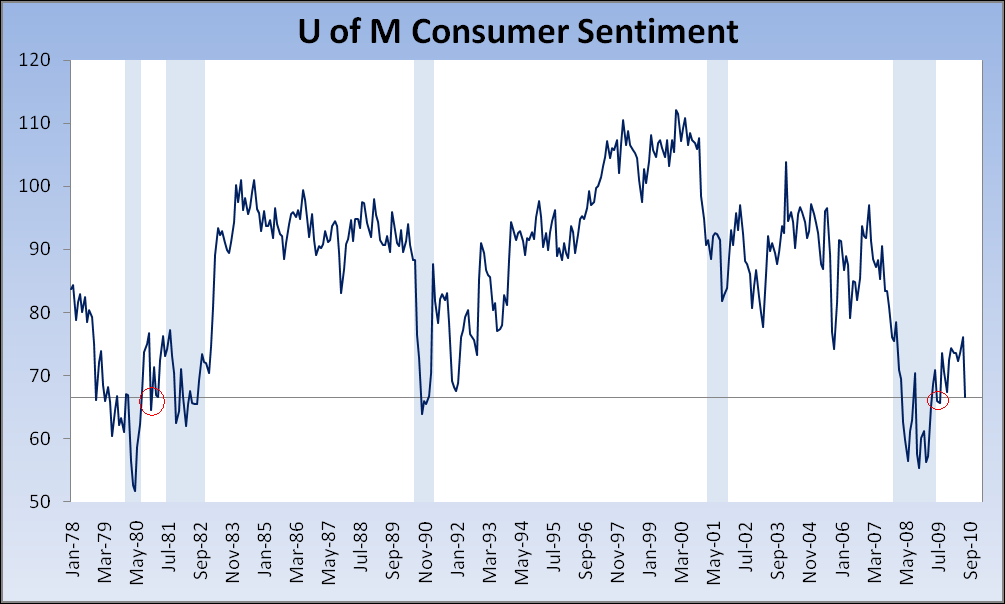
Invictus at the Big Picture reproduces a graph from the University of Michigan's Consumer Sentiment Survey and notes that the reading looks a lot like the last time we had a double dip recession.


THE CLEVELAND FED REPORTS THAT THE PUBLIC EXPECTS INFLATION TO STAY BELOW 2% OVER THE NEXT DECADE
"The Cleveland Fed’s estimate of inflation expectations is based on a model that combines information from a number of sources to address the shortcomings of other, commonly used measures, such as the "break-even" rate derived from Treasury inflation protected securities (TIPS) or survey-based estimates."

Thursday, July 8, 2010

Daily Sources 7/8

THE IMF REVISES ITS WORLD GROWTH MEASURE UPWARDS

S.D. at Free Exchange reports that the IMF has revised its world economic growth indicator upwards by 0.4% to 4.6%. The IMF indicated that it believed world growth was 5% for the first quarter of 2010. Meanwhile, Alex Frangos at Real Time Economics reports that the IMF's chief economist, Olivier Blanchard, has said that developing countries still need to worry about big inflows of money.

BALTIC DRY INDEX AT LOWEST POINT IN YEAR


BANK NEGARA MALAYSIA RAISES OVERNIGHT POLICY RATE TO 2.75% FROM 2.5%

Shamim Adam at Bloomberg reports.

BRAZILIAN SENATE APPROVES NEW STATE OIL COMPANY

Upstream Online reports that the Brazilian Senate has OK'd a new oil company to handle the offshore pre-salt fields, tentatively to be called Pre-Sal Petroleos. The bill remains stuck in the lower house of the Congress, however.

US AND MEXICO TO FORM BILATERAL COUNCIL ON COLORADO RIVER

David Steffen at the Imperial Valley Press reports that the US and Mexico have agreed to set up a bilateral council on the Colorado River.

"The U.S. and Mexican governments, Colorado River basin states and {International Boundry and Water Commission] representatives would make up the council. Its mission would be to facilitate administrative and legal aspects associated with the binational agreement, according to the minute."


COMMERCIAL VACANCIES CONTINUE TO CLIMB

Mark Thoma at Economist's View posted the following graph:


INFLATION NOWHERE TO BE FOUND

Menzie Chinn at Econbrowser checks a variety of data looking for US inflation, but finds none. Here is his graph of the annualized 3 month change in price indices.


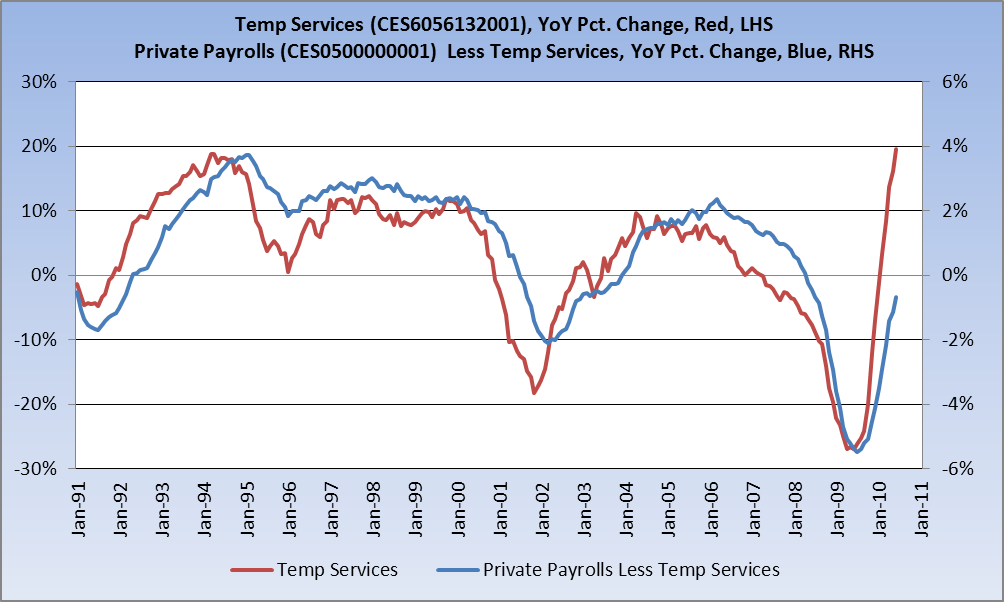
TEMP JOBS UP 19.6% YEAR OVER YEAR BUT FULL TIME DOWN 0.7% YEAR OVER YEAR

Invictus at the Big Picture reports that temp jobs are up 19.6% year over year, the most since the data series began to be recorded in 1990. Private sector full time jobs less temp jobs is down 0.7% year over year, unusually low given the temp jobs number.

Tuesday, July 28, 2009

Daily Sources 7/28

1. MAYER AND WOOD ARGUE THAT CHINA'S ENTRANCE INTO THE WORLD ECONOMY HAS NOT SIGNIFICANTLY DE-INDUSTRIALIZED REST OF DEVELOPING WORLD

Jörg Mayer and Adrian Wood at Vox EU argue that China's integration into the world's economy has not had the effect of substantially de-industrializing other developing nations.
"The biggest possible effect would be for a country which initially produced or exported equal amounts of manufactures and of primary products, where a 15% fall in the ratio would reduce the share of manufactures by 3.5 percentage points.

These estimates are imprecise and subject to error; the true answer may lie outside their range. But there is no plausible modification of the calculations that could make the true answer much larger. This is mainly because, despite its size, China’s opening had only a modest effect on world average endowments. The upper-limit estimates, obtained by simply adding China’s endowments to the rest of the world’s, are a 9% rise (from 0.43 to 0.47) in the share of the global workforce with a complete primary or secondary education, and a 17% fall in the average land/labour ratio, from 2.9 to 2.4 square kilometres of land per 100 workers ... . The average effect on the structure of output and trade in other countries is unlikely to have been larger than these world average endowment changes and was probably smaller.

The significance of the China effect varied widely among developing countries. This is partly because its size varied with the composition of each country’s manufacturing and primary production – how closely its industrial products competed with Chinese exports, and how much demand there was from China for its primary exports (more, say, for copper than for coffee). It is also because there were many other forces acting on sectoral structures--including changes in countries’ own trade policies--whose effects often outweighed those of China."
Worth reading in full.

2. NEPAL HARASSING TIBETAN REFUGEES

Gopal Sharma at Reuters reports that Nepal is responding to pressure from Beijing by cracking down on Tibetan refugees in the country.
"Nepali authorities have regularly broken up protests by Tibetan exiles and arrested them for protesting against China's crackdown on demonstrations in Tibet.

The Washington-based [International Campaign for Tibet] said Tibetan refugees were 'increasingly demoralized' as Nepal 'relinquishes its historic and sovereign interests in response to incentivized political pressure from Beijing and its sympathizers.'

ICT said 'pre-emptive arrests of Tibetans, ID checks and house searches' by authorities were contributing to a 'widespread sense of fear and insecurity' among the exiles.

'Nepal's political leadership is betting that the internal benefits of assuaging China in the cause of oppressing Tibetans will be greater... than the traditional legal and historical concepts,' Mary Beth Markey, Vice President at ICT said."
3. INDIA TO ANNOUNCE SOLAR POWER TARGETS OF 1/8TH TOTAL ELECTRICITY DEMAND, CENTRAL BANK LEAVES INTEREST RATE UNCHANGED ON INFLATION CONCERNS

Krittivas Mukherjee and David Fogarty at Reuters reports that India will announce its targets for solar power generation in September. The plan promises to
"boost output from near zero to 20 gigawatts (GW) by 2020 as it firms up its national plan to fight global warming, draft documents show.

The target, which would help India close the gap on solar front-runners like China, is part of an ambitious $19 billion, 30-year scheme that could could increase India's leverage in international talks for a new UN climate pact in December, one of several measures meant to help cut emissions.

If fully implemented, solar power would be equivalent to one-eighth of India's current installed power base, helping the world's fourth-largest emitter of planet-warming greenhouse gas emissions limit its heavy reliance on dirty coal and assuaging the nagging power deficit that has crimped its growth.

The 'National Solar Mission', yet to be formally adopted by Prime Minister Manmohan Singh's special panel on climate, envisages the creation of a statutory solar authority that would make it mandatory for states to buy some solar power, according to a draft of the plan, which provided detailed proposals for the first time, obtained by Reuters ... ."
Meanwhile, Cherian Thomas at Bloomberg reports that India's central bank decided today to leave its benchmark interest rate unchanged at 3.25%.
"The central bank raised its inflation forecast for the year to March 31 to 'around 5%' from an April estimate of 4%, citing 'elevated' food and commodity prices."
4. EU TO TRAIN SOMALI SECURITY FORCES TO POLICE PIRACY

BBC News reports that the EU has announced plans to train Somali security forces to tackle the piracy plaguing their coasts.
"It will send a planning team to the region next month. The training will take place in neighboring Djibouti, which has French and US military bases."
(h/t Joshua Keating at FP's Morning Brief.)

5. IMF AND LATVIA REACH ACCORD, MAY OPEN UP NEW FUNDING

Aaron Eglitis and Timothy R Homan at Bloomberg report that the IMF and Latvia have reached an accord paving the way for the country to receive its first financial assistance from the organization since December.
"The review may unlock about 195 million euros ($285 million), which the IMF withheld in March after the Baltic country failed to commit to budget cuts, the fund said in an e- mailed statement.

Latvia turned to a group led by the European Commission and the IMF for a 7.5 billion-euro stabilization loan in December after its second-biggest bank needed a state rescue. The IMF announcement followed a 1.2 billion-euro transfer by the European Commission yesterday, helping quell concern about a lats devaluation that may have destabilized currencies across the region."
6. MOUSAVI CALLS FOR NEW STREET PROTESTS NEXT WEEK IN IRAN

Borzou Daragahi at the LA Times reports that opposition candidate Mir-Hossein Mousavi has called for more street protests during religious festivals next week.

7. KENYA TO BUILD AFRICA'S LARGEST WIND FARM

Xan Rice at the UK Guardian reports that Kenya plans to build the largest wind farm in Africa.
"Some 365 giant wind turbines are to be installed in desert around Lake Turkana in northern Kenya – used as a backdrop for the film The Constant Gardener--creating the biggest wind farm on the continent. When complete in 2012, the £533m (~ $758.8 million) project will have a capacity of 300MW, a quarter of Kenya's current installed power and one of the highest proportions of wind energy to be fed in a national grid anywhere in the world."
8. FUEL OIL APPROACHING COST OF CRUDE, HURTS SHIPPING, CHINESE FUEL OIL IMPORTS ROCKET UPWARD (FROM LOW BASE), VIETNAMESE MAIDEN REFINERY TO TAKE SPOT GASOLINE DEMAND OFF MARKET, WALL OF ASIAN PACIFIC REFINING YET TO PLAY OUT

Christian Schmollinger and Alaric Nightingale at Bloomberg report that the price of fuel oil--bunker fuel, the bottom of the barrel, which is used to power ships in great part because it is cheap, generally trading at a considerable discount to crude, is approaching the price of light crude and may surpass it.
"Fuel oil may surpass crude 'for quite some time, six months is possible,' JPMorgan Chase & Co. vice president of energy strategy Vima Jayabalan said in a phone interview from Singapore."
This means that the effect of rising crude prices is having a more pronounced affect upon the cost of shipping than it did during the 2003-2008 run up in the price of crude.
"'It’s really hurting' ship owners, said Parul Bhambri, a Singapore-based analyst at Drewry.

Maersk said May 12 that falling demand for freight hobbled its ability to pass on fuel costs to customers in the first quarter, when its shipping line lost $559 million after taxes, compared with an $80 million profit a year earlier. The shares are down 40% in the past year in Copenhagen trading."


As the price of fuel oil rises, however, many simple refineries, which do not have the equipment to maximize gasoline and diesel output, can become profitable again, which may undergird a recovery in overall crude demand. That said, it still doesn't look like there's much demand for gasoline and diesel out there, which could push down the crack spread and thus the price of crude. Winnie Lee at Platts reports that Chinese fuel oil imports in June were up 6.26% from May and 45.94% from June 2008 to 13.7 kb/d. It's largest supplier was Venezuela. In that vein, Irene Tang at Platt's the Barrel blog reports that the commissioning of Vietnam's first refinery at Dung Quat is poised to erase about 30% of the country's product import demand, which will in turn erase its demand for spot gasoline purchases. The wall of new refining capacity in Asia has yet to fully be appreciated,
"China has now joined India in becoming a major swing exporter of gasoline. Apart from greenfield refineries coming onstream in the country, Beijing's decision to adopt a new products pricing formula for the domestic market and the resulting price revisions in tandem with the global benchmarks has encouraged more speculative buying at the wholesale level, causing wide fluctuations in refiner inventories.

This, in turn, has made Chinese gasoline export volumes unpredictable. The latest customs figures show gasoline exports hit a two-year high of 560,000 mt in June, a 273% surge from the corresponding month of last year. The previous high was in April 2007, at 590,000 mt.

The figures point to Chinese 'apparent' gasoline demand in June being just 1.8% higher than the same month a year ago, a contrast with on-year growth rates of 20.2% in May and 13% in April. The anomaly of the June figure, in the backdrop of staggering double-digit growth rates of automobile sales in China and a 7.7% on-year average gasoline demand growth in the first half of the year, can only be explained by wild swings in stock builds and draws."
"The full impact of the start-up of Reliance Industries' new 580,000 b/d refinery in Jamnagar should be apparent as early as August, as the company's older 660,000 b/d refinery is now restarting from a partial shutdown. Monthly gasoline exports from RIL are expected to more than double to well above 600,000 mt."
9. NIGERIAN REBELS IN SOUTH TARGET OIL MINISTER'S COMPANY, NORTHERN ISLAMISTS CONTINUE UNREST

Platts reports that the Nigerian Joint Revolutionary Council has issued a warning to UK-based independent producer Afren Resources to stop operating in the Niger Delta or risk attacks on its equipment and personnel.
"The Joint Revolutionary Council, which styles itself as a coalition of militant groups based in southern Rivers and Bayelsa states, said in a statement that its ultimatum to Afren was aimed at expressing the group's opposition to the policies of Nigeria's Oil Minister Rilwanu Lukman--policies the group sees as skewed against the Niger Delta region in the country's south.

Lukman was a co-founder of Afren and stepped down from his position as chairman of the company's board of directors once he was appointed oil minister for Nigeria in late 2008. His shares in the company were to be held in a blind trust, the company said in a statement at the time."
Lukman wants to site an oil university in his home state in the north--Kaduna. Meanwhile, Ibrahim Mshelizza at Reuters reports on the increasing Islamist inspired unrest in northern Nigeria.
"The violence was triggered when some members of the group called Boko Haram, which wants a wider adoption of Islamic sharia law across Africa's most populous nation, were arrested Sunday in Bauchi state.

Unrest spread to the northern states of Kano, Yobe and Borno, whose capital Maiduguri is home to the group's leader, Mohammed Yusuf, and has seen the worst violence.


'The situation has been contained in Bauchi and Yobe. The bad situation we have now is in Borno where the leader of the group is residing ... We are going to launch an operation, a main operation to flush them out,' [Nigerian President Umaru] Yar'Adua told reporters after meeting security chiefs and state governors."
10. PRESSURE TO CHANGE DRUG WAR STRATEGY BUILDING IN MEXICO, MEXICAN CRUDE PRODUCTION WAY DOWN

William Booth and Steve Fainaru at the Washington Post report on the growing pressure on Mexican President to change Mexico's "surge" strategy in dealing with its drug cartels.
"Dan Lund, president of the MUND Group polling organization, said public support for Calderón's strategy appears to be weakest in the places where the federal government needs it most. 'In a series of national surveys, polls consistently have found a reasonable but cautious level of support for using the military in the front lines against the cartels,' he said. 'But in all the states where the military is actually deployed, the support goes down, sometimes dramatically.'

The situation has been exacerbated by the global economic crisis, which has cast millions of Mexicans into poverty. José Luis Piñeyro, a Mexican military analyst who maintains close ties with the armed forces, said rising unemployment and poverty 'is creating what I call an "army in reserve,"' for the traffickers.

In Michoacan, La Familia has used the media to try to align itself with the disenfranchised. After the recent attacks, one of its leaders, Servando Gómez, called a local television station and told viewers: 'I want to say to all Michoacanans, we love them and respect them.'"
Meanwhile, there was plenty of stories on the decline in Mexican production last week. John Kingston at the Barrel notes:
"But here's the more stunning figure: what's happened in two years. In July 2007, Pemex reported crude output of 3.165 million b/d. That's a 20.4% decline in 23 months."
11. VATICAN AIMS AT FREE MARKETEERS, SAYING MARKETS WITHOUT ETHICS DESTROY WEALTH AND CREATE POVERTY

Flavia Krause-Jackson at Bloomberg reports that the Vatican has attacked free markets, saying that they have legitimized greed. On June 7, the pope published an encyclical which examined the financial crisis and means out of it, saying that once profit becomes the exclusive goal of business, it destroys wealth and creates poverty.
"Last November, Italian Finance Minister Giulio Tremonti said the pope had pronounced a 'prophecy' in a paper Benedict wrote when he was a cardinal.

In 1985, then-Cardinal Joseph Ratzinger presented a paper titled 'Market Economy and Ethics' at a Rome event on the Catholic Church and the economy. He said a decline in ethics 'can actually cause the laws of the market to collapse.'"
I think it is plain that markets cannot sustain themselves without a modicum of trust, engendered by ethics held in common.

12. CFTC MAY OR MAY NOT REVISE LAST YEAR'S REPORT EXONERATING SPECULATION IN PRICE VOLATILITY, LONDON'S FSA EXONERATES SPECULATORS

Ianthe Jeanne Dugan and Alistair MacDonald at the Wall Street Journal report that the CFTC
"plans to issue a report next month suggesting speculators played a significant role in driving wild swings in oil prices--a reversal of an earlier CFTC position that augurs intensifying scrutiny on investors."
However, I understand that the Chair of the CFTC indicated today that the story in the WSJ that the report will be redone and altered are premature and inaccurate. From the WSJ story,
"In the US, the CFTC begins public hearings Tuesday to determine whether to limit speculative investments in commodities. Congress also is weighing whether to give the CFTC the authority, under a broader proposal to revamp financial regulation, to regulate commodities investments that occur off traditional exchanges. Byron Dorgan, a North Dakota Democrat, has called on the CFTC to curb 'oil speculators looking for a quick buck at the expense of American consumers.'"
I suspect that the direction of these accusations is misdirected, given that commercials may choose to purchase futures to profit on price just as much as to hedge their obligations.


Positions net long and short for the week ended July 21 only comprised 1% of the market. Note that from 2008 open interest--or the total number of contracts--has been steadily falling for both futures and options--though the trend for options was up through February.


If you include options, the number of positions held by traders net long or short represent 3.17% of the market--not an especially large share. Meanwhile, Alistair MacDonald and Carolyn Cui at the Wall Street Journal report that the Financial Services Authority in London has found no evidence that speculators are behind the wild swings in oil price seen from 2008.
"One person familiar with the matter said the FSA had seen no evidence to suggest that speculators are driving up the price of oil.

'More than they ever were before, [investors] are looking to the global economic climate and nobody is sure on that, and that is perhaps driving the volatility,' he said.

Given that view, the FSA doesn't believe that limiting the size of trading positions would be 'beneficial' for the market, said a person familiar with the matter. Still, the FSA acknowledges it doesn't have a 'full explanation' as to why the market has moved the way it has, said a person familiar with the matter.

The FSA's conclusion contradicts British Prime Minister Gordon Brown, who has linked the recent rises in oil to speculation.
...
Politicians around the world are worried about the effect of rising oil prices on the recovery potential of their recession-hit economies. World leaders from French President Nicolas Sarkozy to the leaders of Asia's biggest oil-consuming nations have tied these rises to oil speculators."
"Speculation," of course, is sufficiently vague to represent a politically useful bogeyman, and it seems likely that someone will call financial protectionism. That said, I do think it is in the global economic interest to make the cost of energy--and in particular transportation fuels--more stable and predictable, I just don't think that attacking "speculation" is a particularly productive way of doing so.

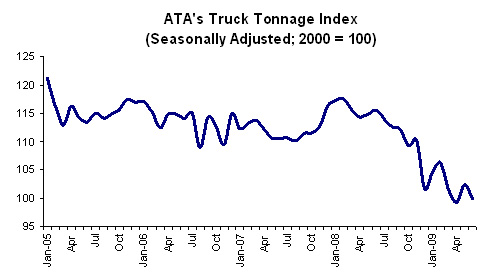
13. TRUCKING VOLUMES IN US DOWN 13.6% IN JUNE YOY

The American Truckers Association yesterday announced that their
"advance seasonally adjusted (SA) For-Hire Truck Tonnage Index fell 2.4% in June. In May, SA tonnage jumped 3.2%. June’s decrease, which lowered the SA index to 99.8 (2000=100), wasn’t large enough to completely offset the robust gain in the previous month."
Over June 2008, tonnage fell 13.6%, which exceeded the year over year drop of 11%.


The ATA release warns:
"The sample includes an array of trucking companies, ranging from small fleets to multi-billion dollar carriers. When a company in the sample fails, we include its final month of operation and zero it out for the following month, with the assumption that the remaining carriers pick up that freight. As a result, it is close to a net wash and does not end up in a false increase. Nevertheless, some carriers are picking up freight from failures, and it may have boosted the index. Due to our correction mentioned above, however, it should be limited."
(h/t Barry Ritholtz at the Big Picture.)

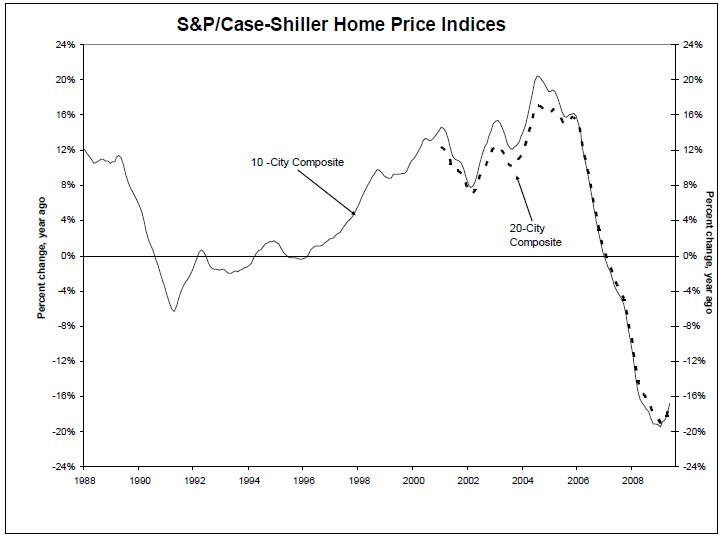
14. HOME PRICE DECLINE SLOWING, CALIFORNIA FORECLOSURES DOUBLE NEW HOME SALES IN JUNE

Barry Ritholtz reports that home price declines are "slowly abating." Here is his graph:


Jake at Econopic picked up on the Big Picture's quote of the day of Mark M Hanson which notes that California foreclosures are more than double the national new home sales for June. His graph:


15. EPA MAY GIVE ALGAE BIG BOOST

Russell Gold at Environmental Capital notes that Blair Carter at the Renewable + Law Blog reports that "that the Environmental Protection Agency will count algae as an advanced biofuel under Renewable Fuel Standard rules being developed."
"Why do EPA’s steps towards including algae matter? Because when Congress created its mandate to blend advanced biofuel into the fuel pool, it created a big market for these fuels. By 2012, the law mandates that two billion gallons of these advanced biofuels be blended, a figure that rises by tenfold by 2022. It’s all in Section 202 of the Energy Independence and Security Act of 2007.

... For algae to be included, the law says it needs to have no more than 50% of the 'lifecycle greenhouse gas emissions' of gasoline and diesel. This could be tricky, says David Woodburn, an alternative energy analyst with ThinkEquity. 'The hard part for me is understanding how the EPA plans to calculate the GHG emissions of algae fuels, based on the variety of feedstocks (sugar, CO2, other), processes (open ponds, photobioreactors), and algae varieties being explored--especially before November,' he says, noting when the rules are supposed to be finished."
Blair Carter's post can be found here.

16. TEXAS DROUGHT GETS WORSE

Tom Benning at the Wall Street Jounral reports on the drought in Texas.
"Nearly 80 of Texas' 254 counties are in 'extreme' or 'exceptional' drought, the worst possible levels on the US Department of Agriculture's index. Though other states are experiencing drought, no counties in the continental U.S. outside Texas currently register worse than 'severe.' In late April, the USDA designated 70 Texas counties as primary natural-disaster areas because of drought, above-normal temperatures and associated wildfires."
The Journal carries an interactive graphic:

Wednesday, July 22, 2009

Daily Sources 7/22

1. DO COAL STOCKS INDICATE GLOBAL RECOVERY?; WTO SAYS GLOBAL TRADE TO CONTRACT 10% IN 2009

Thomas MacLeod yesterday at Seeking Alpha deduced from the performance of global coal ETF KOL, the US DOW Coal Index, and the global steel ETF SLX that energy consumption globally is up and thus is the global economy beginning a rebound.
"The commodity that we believe is more representative of pure changes in economic fundamentals is coal. It is difficult to manipulate, its supply is not so affected by political or natural events and it is comparatively difficult and expensive to store, which effectively weeds out speculators.

Moreover, coal is a genuine industrial commodity with over half of the world’s electricity generation being powered by coal fired power stations. It is integral in the production of steel and can be converted to produce crude and other industrial chemicals.

In order to analyze the behavior of coal we look at the movement of coal stocks relative to major market stock indices. This eliminates the impact of stock market movements so we can ascertain the movement due to changing expectations of coal demand and supply. In essence, outperformance of coal stocks suggests global economic expansion."
Of course, the performance of coal stocks does not represent a one-to-one ratio to consumption. The latest data on coal volumes shipped by train, for example, still shows 8% down year over year, which suggests that in North America, anyway, it is difficult to deduce a rebound on the basis of coal volumes. Meanwhile, Jonathan Lynn and Kazunori Takada at Reuters reports that the WTO has forecast that world trade will shrink by 10% in 2009.
"The WTO said however the contraction appeared to be slowing.

'Our figures showed that Asian countries may be leading a recovery in global trade,' [Director General Pascal] Lamy told a news conference in Singapore, where he was attending a two-day Asia Pacific Economic Cooperation (APEC) trade meeting."
2. IMF SAYS CHINA COULD STAND MORE STIMULUS IN CONTRAST TO WORLD BANK ASSESSMENT, CHINA INDICATING THAT IT WILL USE ITS FOREIGN CURRENCY RESERVES TO FUND CHINESE FIRM EXPANSION OVERSEAS, IN PARTICULAR RESOURCE PLAYS, CHINESE OIL IMPORTS IN JUNE WAY UP IN CONTRAST TO OFFICIAL COMMENT THAT STOCKPILING OVER

Timothy R Homan at the Bloomberg reports that the IMF has indicated in its first executive-level review of China in three years that there is scope for more fiscal stimulus in that country.
"The IMF’s assessment is a clash with the World Bank, the international development-aid agency also based in Washington, which last month advised China to delay until 2010 any additional stimulus. It also comes as China is already recording an acceleration in its expansion, and as its central bank takes steps to avert bubbles in stock and property markets."
In the April G-20 meeting in London, the Obama administration secured from the IMF a pledge to open up the selection process for the executive directorship of the organization in return for opening up the process for the head of the World Bank, traditionally an American. Some expect China to win the top spot when the next head of the World Bank is selected, but in order for Beijing to have had a real shot, it needed to open up the country to official review from the international financial institutions again. Meanwhile, Brad Setser has some remarks on the recent report that China intends to use its reserves to support the overseas acquisitions of Chinese firms.
"That of course is China’s right. China clearly has more reserves than it really needs, and thus can take some risks with its reserves.

But it also has consequences. If Chinese firms are explicitly backed by China;s reserves, it gets harder to argue that their expansion reflects a purely commercial calculus. China’s government presumably will deploy its assets to pursue China’s strategic as well as its commercial goals.

In some sense it is surprising that China has decided to be so explicit about its new desire to use its reserves to support Chinese state firms. China’s government could have achieved the same result by quietly putting more foreign currency on deposit in the state banks, and having the state banks lend those funds out to firms looking to expand abroad."
Kate MacKenzie at FT Energy Source notes,
"In an interview published in state-controlled media, the chairman of China Development Bank said Chinese outbound investment would accelerate but should focus on resource-rich developing economies.

'Everyone is saying we should go to the western markets to scoop up [underpriced assets],' said Chen Yuan. 'I think we should not go to America’s Wall Street, but should look more to places with natural and energy resources.'"
Meanwhile, Platts notes that Chinese apparent oil demand is up in June. I have reconfigured their data into a barrels per day format:


3. GERMAN ROLE AT ECB MAY BE ESPECIALLY PROBLEMATIC FOR COORDINATING GLOBAL RECOVERY, ECB ARGUES THAT ITALY'S ADOPTION OF THE EURO HAS CUSHIONED THE COUNTRY'S ECONOMY FROM ITS POLITICAL INSTABILITY

Jörg Bibow at the New America Foundation has an interesting piece on the German role in determining monetary policy for Europe and why it is presenting a serious obstacle to an effective global response to the financial crisis. Key excerpts:
"Within German 'stability culture' the Bundesbank's part was to enforce discipline, both budgetary discipline and wage discipline. The result was not only low inflation, but inflation lower than inflation of Germany's trading partners. And that is an important factor within any system of pegged nominal exchange rates: over time a country with relatively low inflation gains in competitiveness which is boosting its export performance. Stability policy worked well under the Bretton Woods regime, establishing both Germany's export-oriented growth strategy and the Bundesbank's claim to fame as inflation fighter."
"Exporting the German model to Europe through the Maastricht regime meant inflation would be low across Europe, while all countries would try to balance their budgets at the same time. When German stability policy was jointly applied across Europe in the early 1990s, the predictable result was domestic demand stagnation and rising unemployment. Even by 1996 it looked as though EMU was not going to fly because stagnation kept budget deficits above the 3% ceiling across the continent. Luckily, the US 'new economy' boom and strong US dollar came to the rescue, and eleven countries qualified in the spring of 1998 to launch the euro in January 1999. In other words, laboring under the Maastricht constraints, Europe failed to generate sufficient homemade demand growth, but benevolent external forces allowed the euro to get off the ground just on time."
"What does all this mean for the collective action problem which, as I said at the start, the world is facing today? Recovery from the ongoing global crisis requires everyone to pay their dues and pull their weight. Built into the German model is a strategy to rely on the recoveries of others to sponsor one's own. The German model has become the European model (pace the U.K). ECB president Jean-Claude Trichet said as much in 2004 when Euroland was last hoping for external sponsors of recovery: 'Growth starts with exports, then passes on to investment and then to consumption. That is the normal sequence for Europe in this phase of the cycle.' (FT 22 April 2004). The trouble is that Europe's economy is as large as America's or even larger, and the German model wholly unsuitable for a large economy. In addition, Europe has its hands full with its own homemade crises, crises which are largely the consequence of the German model as well. Recent statements made by key German policymakers clearly indicate that enlightenment is not a realistic prospect."
Bibow makes the especially uncharitable comment that perhaps Berlin needs to relearn the lessons of the Great Depression, but there he clearly misses the point. Perhaps Belin needs to unlearn the lesson, which clearly has as its main pivot the notion that hyperinflation led to the political instability which eventually ushered in the NAZIs to political ascendancy. That (nastiness) aside, the piece is worth reading. Meanwhile, the European Central Bank has published a working paper by Marcel Fratzscher and Livio Stracca which argues that the adoption of the euro has insulated Italy from its political instability.
"The paper focuses on political events in Italy over the past 35 years and asks whether the adoption of the euro in 1999 has helped insulate Italy’s financial markets from the adverse consequences of its traditionally unstable political system. We find that important political events have exerted a statistically and economically significant effect on Italy’s financial markets throughout the 1970s, 1980s and 1990s. The introduction of the euro appears to have indeed played a major role in insulating financial markets from such adverse shocks."
(I am obliged for both of these pieces to Eurointelligence.)

4. NETHERLANDS THREATENING TO BLOCK ICELAND ACCESSION TO THE EU IF IT DOES NOT COMPENSATE DUTCH SAVERS ON LOSSES

NRC Handelsblad reports that Dutch Foreign Minister Maxime Verhagen is threatening to block Iceland's bid to join the European Union, unless Reykjavik meets its obligations to compensate Dutch savers.
"According to the agreement Iceland has to repay €1.3 billion to the Netherlands and €2.3 billion to the UK. The British and Dutch governments spent that money to compensate savers for the €20,000 the Icelandic government had guaranteed for those saving with Icelandic banks. The Icelandic government agreed to repay those damages in the form of a loan, but parliament could block that deal, as some members of the Althing have threatened to do.

'A solution to the problems surrounding Icesave could speed up the handling of the Icelandic application for EU membership," Verhagen said. He added it is "absolutely necessary' that Iceland approves the agreement to 'show that Iceland takes EU guidelines seriously.'"
5. GEORGIA SEEKING AMERICAN ARMS

Philip P Pan at the Washington Post reports that Georgian President Mikheil Saakashvili yesterday indicated in an interview that Tblisi is seeking a weapons deal with the United States.
"In a wide-ranging interview, Saakashvili said that discussions about a weapons deal remained at 'very early stages' but that he planned to press Biden to speed up delivery of antiaircraft and antitank systems, saying such weaponry was 'purely defensive' and 'would make any hotheads think twice about further military adventures.'

'I think the decision to help us is there,' he added, noting recent meetings between Georgian and US defense officials. 'It's a matter of speeding up the process. . . . We want the country to still be around when those things start to arrive here. That's ultimately what's right now at stake.'

The United States has been working to train and modernize the Georgian military for more than a decade, but Russia has warned strongly against new arms shipments to the former Soviet republic, which it routed in a brief war last year."
6. PAKISTANI SUPREME COURT ASKS FOR MUSHARRAF REPRESENTATION ON CASE CONSIDERING WHETHER EMERGENCY MEASURES IN 2007 WERE CONSTITUTIONAL, ISLAMABAD OBJECTS TO CAMPAIGN IN AFGHANISTAN, GERMAN INVOLVEMENT HEATS UP, PAKISTAN ASKS FOR ADDITIONAL INTEL SUPPORT FROM US AND WARNS THAT DEAL WITH INDIA COULD START ARMS RACE

BBC News reports that Pakistan's Supreme Court has decided that former President Musharraf should be represented in a case before it over whether or not the emergency rule imposed in November 2007 was constitutional.
"'This is the first time in Pakistani history that the court has taken cognizance of such action. In the past, the courts have tended to condone military takeovers,' a former chief justice of Pakistan, Saeeduzzaman Siddiqui, told Dawn News TV.

The BBC's Ilyas Khan in Islamabad says that the court apparently issued the notice to Mr Musharraf following the refusal on Tuesday by the attorney-general, who represents the government, to defend the former president's position in the case."
Meanwhile, Eric Schmitt and Jane Perlez at the New York Times report that Pakistan is objecting to expanded combat plans in Afghanistan.
"Pakistani officials have told the Obama administration that the Marines fighting the Taliban in southern Afghanistan will force militants across the border into Pakistan, with the potential to further inflame the troubled province of Baluchistan, according to Pakistani intelligence officials.

Pakistan does not have enough troops to deploy to Baluchistan to take on the Taliban without denuding its border with its archenemy, India, the officials said. Dialogue with the Taliban, not more fighting, is in Pakistan’s national interest, they said."
Matthias Gebauer and Shoib Najafizada at Der Spiegel report on German forces increasing involvement in the fighting in Afghanistan:
"The Bundeswehr is supporting the Afghans with around 300 members of the Quick Reaction Force (QRF). Their primary role is to help secure the area around the fighting and provide reconnaissance.
...
[T]he Bundeswehr has also become considerably more assertive. For the first time, Marder tanks--which have heavy firepower and were only recently relocated from Mazar-e-Sharif to Kunduz--have been deployed.
...
According to SPIEGEL ONLINE sources, missiles are also being fired by German fighter jets in northern Afghanistan for the first time. Following a first deployment of fighter jets on June 15 in northern Afghanistan by the ISAF international security force, most supplied by the United States, Afghan forces requested so-called 'air support' for a second time on Sunday.

Such air support had long been considered taboo in northern Afghanistan."
Meanwhile, Joshua Partlow at the Washington Post reports that Pakistani Prime Minister Yusuf Raza Gilani today has called on the US to provide real-time intelligence and other military support for the Pakistani effort against the Taliban, without relying on attacks from US drones. Both American national papers mention that Islamabad is concerned about the recent end use monitoring deal made with India, suggesting that it could spark an arms race.

7. KURDISTAN COMMISSIONS NEW REFINERY

Eric Watkins at the Oil & Gas Journal reports that Kurdistan has commissioned a new refinery near Arbil which will originally process 20 kb/d, ramping up to 40 kb/d by the end of the year. The refinery is one of several planned for the area, with plans to have total throughput capacity of about 200 kb/d. "Refinery director Baz Karim said the new facility is operated by private Kurdish investors Kar Group, and will process crude from the Khurmala Dome oil field ... ."

8. IRANIAN CONSERVATIVES RESPOND TO RAFSANJANI LETTER, LOTR TELLS AHMADINEJAD THAT HE NEEDS TO WITHDRAW SON IN LAW AS VP PICK

The best round up on recent maneuvering between elites in the aftermath of the Iranian elections is at Juan Cole's Informed Comment. The Leader of the Revolution has warned against further civil disobedience on Monday and includes an excerpt of his speech as translated by the Open Source Center. A representative of the LOTR at the Revolutionary Guards has indicated that support for the LOTR has foiled the plots of outsiders--Cole includes an excerpt from his speech as translated by the OSC. He also includes an excerpt of conservative cleric Ayatollah Mohammad Yazdi's recent charges that Rafsanjani has undermined the revolution as translated by the OSC. Press TV--an English-language state media organ of Iran--on Tuesday reported that the LOTR has told Ahmadinejad that he must undo the selection of his son-in-law as Vice President.

9. HAGUE RULES ON NORTH-SOUTH SUDAN BORDER

Stephanie McCrummen at the Washington Post reports that the Hague has issued a ruling on the disputed south-north border in the Sudan, striking a compromise.
"The ruling by the Permanent Court of Arbitration awards control of a lucrative Chinese-run oil field in the region of Abyei to the Sudanese government but defines the region's boundaries in a way that is politically beneficial to the south.

Officials from the south and President Omar Hassan al-Bashir's ruling party quickly promised to respect the ruling, which analysts called a major test of the fragile 2005 peace deal that ended the bloody north-south civil war, one of Africa's longest-running conflicts.

'Both parties have agreed to accept the boundaries,' said Majok Guandong, Sudan's ambassador in Nairobi. 'We think there will be no maneuvering by either side.'"
The ruling leaves a smaller working oil field in the territory of the south and defines the territory as being mostly populated with the Ngok Dinka, a nomadic tribe which identifies itself with the south and will likely vote to join it in the referendum on independence from Khartoum in 2011.

10. NIGERIA SAYS NIGER DELTA UNREST CUTTING OFF 1 MB/D IN SUPPLY

Platts reports that Nigeria's Oil Minister Rilwanu Lukman yesterday told the media that the country is losing approximately 1 mb/d in production due to continuing strife in the Niger Delta.
"Lukman told leaders of the ruling People's Democratic Party in Abuja that Nigeria's oil production had dropped to between 1.4 million and 1.5 mb/d, well below its assigned OPEC quota and far off from the 2009 budget benchmark of 2.29 mb/d, according to a Thisday newspaper report Wednesday.

'We have production capacity of 2.3 mb/d but because of problems in the Niger Delta, we cannot meet our target. This year's budget is based on having 2.2 mb/d. So, we are short of a million barrels,' the minister was quoted as saying.

'Our target is 4 million barrels in 2010, presently we have 37 billion barrels in our reserve. The target for next year's production is 4 mb/d,' Lukman said."
11. BRAZIL TO SELL DOLLAR DENOMINATED BONDS, SIGNS NUCLEAR ENERGY MOU WITH MOSCOW

After all the hoopla about the replacement of the dollar as the reserve currency, Andre Soliani and Carla Simoes at Bloomberg report that Brazilian Treasury Secretary Arno Augustin has said that Brasilia plans to sell dollar denominated bonds on the overseas credit markets shortly.
"The country will tap the market more than once before yearend and look to sell securities maturing in more than 10 years, Augustin ... said in an interview with Bloomberg Television in Brasilia today.

'We will certainly issue foreign bonds more than once in the second half, seeking to lengthen the debt’s profile and create conditions' for companies to sell bonds, Augustin said. There is investor demand for bonds maturing in 30 years, he said.

Brazil plans to tap international credit markets as speculation the global recession is easing fuels demand for higher-yielding assets."
As a counterpoint, today the Latin American Herald Tribune notes that Russian media yesterday reported that Russia and Brazil have signed a MOU on nuclear energy cooperation.
"The pact calls for the development of uranium prospecting technology and the design of new reactors, as well as the design and construction of nuclear research reactors.

The agreement opens the way for the production of radioisotopes for use in agriculture and the pharmaceutical industry, as well as the training of nuclear energy experts.

Russia and Brazil agreed to create a working group for atomic research and development projects."
12. US PLANS TO INCREASE PRESENCE IN COLOMBIAN MILITARY BASES ROILING NEIGHBORS

Simon Romero at the New York Times reports that a plan to increase the American presence at three military bases in Colombia is drawing the ire Bogota's neighbors.
"Venezuela, Ecuador and Nicaragua, which are members of a leftist political alliance that is led by President Hugo Chávez of Venezuela and backed by his nation’s oil revenues, have all criticized the plan, saying it would broaden the military reach of the United States in the Andes and the Caribbean at a time when they are still wary of American influence in the region.

Despite a slight improvement in Venezuela’s relations with the United States in recent months, Mr. Chávez has been especially vocal in lashing out at the plan. Speaking on state television here Monday night, he put Venezuela’s diplomatic ties with Colombia under review, calling the plan a platform for 'new aggression against us.'

Colombia’s foreign minister, Jaime Bermúdez, on Tuesday defended the negotiations, which are expected to produce an agreement in August, asking neighboring countries not to interfere in Colombia’s affairs. 'We never expressed our opinion in what our neighbors do,' he said, pointing to Mr. Chávez’s attempts to strengthen ties with non-Western nations. 'Not even when the Russian presence became known in Venezuelan waters, or with relations with China,' he added."
13. EIA SAYS COMMERCIAL CRUDE STOCKS DOWN, GASOLINE AND DISTILLATE UP--REGULAR GASOLINE PRICES DOWN, REFINERY UTILIZATION DOWN

The EIA reports that commercial crude oil stocks were drawn down by 1.8 million barrels in the week ended July 17 to 342.7 million barrels. Inventories are still above the five year historical range for this time of year. The draw down was smaller than the 2.1 million barrel fall expected as per the median expectation of analysts in a Bloomberg survey. Bloomberg also notes:
"In contrast to the Energy Department supply report, the American Petroleum Institute said late yesterday that stockpiles rose 3.1 million barrels last week, the first gain since April."
Gasoline stocks grew by 800,000 barrels and are now at the top of the five year historical range for this time of year. Distillate stocks grew by 1.2 million barrels and there are 32.4 million barrels more distillate in storage than there was this time last year, about 25.3% more. Refining utilization fell to 85.84% from 87.87% in the week previous. The national average price of regular gasoline fell to $2.463/gallon in the week ended July 20, just below the range where driving demand begins to fall in response to the price.

Thursday, July 16, 2009

Daily Sources 7/16

1. CHINESE MONEY SUPPLY GROWTH 28.5% YOY IN JUNE, CHINA PUBLISHES DATA CLAIMING 7.9% GDP GROWTH, REVISITS "MADE IN CHINA" CAMPAIGN

Yesterday, Macro Man called out Prime Minister of China, Wen Jiabao, for having spurred China's M2 growth to 28.5% year over year, asked whether he deserves the moniker "Helicopter Wen" more than Ben does. He asks:
"Unfortunately, in an act reminiscent of Gordon Brown Stalin, the early 90's data has been wiped from the historical record. A cynic might suggest that this is because China's leadership doesn't want to remind people that one upon a time, money growth was this high and it didn't end well. Judge for yourselves."


Today, the National Statistics Bureau published new figures showing that Chinese GDP growth was 7.9% in the second quarter from the year previous, up from the growth of 6.1% in the first quarter, per Terence Poon and Andrew Batson at the Wall Street Journal.
"Also Thursday, the finance and economic committee of the National People's Congress, China's legislature, warned that the government must prevent the "extraordinary growth" of credit that could lead to inflation risks and problems for the financial system. It said China should strengthen credit checks and prevent a rebound in bad loans. The committee includes influential members but doesn't have a role in setting economic policy.

The People's Bank of China has already started to take some measures to fine-tune the rapid flow of credit. On Thursday, the central bank used its weekly sale of three-month bills to continue to guide money-market interest rates higher for the third straight week."
The Economist notes:
"In the year to June fixed investment surged by 35%, car sales rose by 48%, and purchases of homes by more than 80%. After falling last year, home prices are now rising briskly in some big cities, and share prices have soared by 80% from their November low. Domestic spending has been spurred partly by the government’s stimulus package, but probably even more important was the scrapping of restrictions on bank lending late last year. In June new lending was more than four times larger than a year earlier."


The Economist notes that the importance of property to domestic demand means it is unlikely that Beijing will clamp down too hard on the lending. In the meantime, Carlos Tejada at the China Journal reports that China is revisiting plans to launch a "Made in China" campaign.

2. WORLD BANK WARNS OF DEFLATION ON EXCESS INDUSTRIAL PRODUCTION

Ambrose Evans-Pritchard at the UK Telegraph reports that the chief economist at the World Bank, Justin Lin, in Cape Town recently warned that excess industrial capacity will cause a deflationary spiral unless it is addressed.
"Mr Lin said capacity use had fallen to 72% in Germany, 69% in the US, 65% in Japan, and as low as 50% in some developing countries, mostly touching lows not seen in modern times."
Lin suggests that competitive devaluation will have little productive effect in this environment, saying:
"No country can count on currency depreciation and exports as a way out of recession. Unless we deal with excess capacity, it will wreak havoc on all countries. There is urgent need for global, co-ordinated fiscal stimulus."
(h/t Yves Smith at naked capitalism.)

3. UK SETS GOAL OF 40% RENEWABLE SOURCE FOR ELECTRICITY GENERATION BY 2020

Selina Williams at the Wall Street Journal reports that the UK has set as its goal sourcing 40% of its electricity generation from low carbon energy sources by 2020, with fully 30% to come from wind power, wave and tidal energy and other renewables. The other 10% is to be from coal-powered plants with carbon capture technology and nuclear. (As of 2006, per the IEA, nuclear power generation accounted for 18.6% of total electricity supply in the UK. Coal accounted for 37.5%. All renewables accounted for 6.1%.)
"'Renewables, nuclear, clean fossil fuels, as this plan sets out, are the trinity of low carbon and the future of energy in Britain,' [Energy and Climate Change Secretary Ed] Miliband said yesterdat. 'All of them should be part of our future energy mix.'

The government wants the power sector to be almost completely free of carbon emissions by 2050 as it strives to meet a commitment to cut overall emissions by 80% by 2050. The UK has already cut its emissions by 21% since 1990."
4. TURKEY INCREASES FUEL AND RESTAURANT TAXES, REDUCES BENCHMARK INTEREST RATE TO 8.25%

Delphine Strauss at the Financial Times reports that Ankara yesterday announced that it would raise taxes on petroleum products and restaurants with immediate effect. The new taxes will add roughly 8% to prices at the pump and between 8 and 18% at high end hotels and restaurants.
"'The government is speeding up its efforts to tighten fiscal policy,' said Yakin Cebeci, economist at JPMorgan, estimating the measures could improve budget performance by 0.8% of GDP within 12 months.

Stimulus packages and a spending splurge before local elections in the spring have led to a rapidly widening budget deficit. Figures published on Wednesday by the finance ministry showed a deficit of 23.2bn lira ($15.2bn) in the first half of the year, compared with a surplus of 1.9bn lira in the same period of 2008."
Effective tax collection has been a point of dispute at the IMF in terms of approving a new financing package for Ankara. Meanwhile, Steve Bryant at Bloomberg reports that the Turkish central bank today cut its benchmark interest rate by half a point to 8.25%, it's ninth consecutive monthly cut, indicating that further cuts may be in the works.
"The inflation rate reached a 39-year low of 5.2% in May, before rising to 5.7% last month, a pick-up the central bank says will prove temporary. The bank’s target for this year is 7.5% and its most recent survey of economists and businessmen forecast a year-end rate of 6%.

'Inflation will remain at low levels for a long time,' the bank said in today’s statement."
"Industrial output fell 17.4% in May, extending a decline that drove a record 13.8% contraction in gross domestic product in the first three months of the year."
5. PRESIDENT OF ABKHAZIA SPEAKS OF RELATIONSHIP WITH RUSSIAN RAILWAYS JUST AFTER EBRD LOAN

In light of the EBRD's recent decision to make a $500 investment in Russian Railways, the following portion of a Der Spiegel interview of the President of Abkhazia, Sergei Bagapsh, might be of some interest:
"SPIEGEL ONLINE: There are Russian military bases in Abkhazia, Russian troops guard your external borders, and your currency is the ruble. And, then, you want the Russians to manage your railways for 10 years. Is it possible that you're getting just a little too dependent on Russia?

Bagapsch: We are dealing with the Russian railways because we have to modernize our own. We would be equally pleased to deal with the German railways if they were interested. In any case, there are no completely independent nations in this world. Liechtenstein is dependent on Switzerland, Luxembourg on France. We are all dependent on one another. Georgia is dependent on America; we are on Russia."
6. LOCKHEED MARTIN INDIA CEO STEPS DOWN AMIDST ESPIONAGE SCANDAL, WILL US, AUSTRALIA, INDIA AND JAPAN JOINTLY OPERATE AIR CRAFT CARRIERS IN RESPONSE TO CHINESE CONSTRUCTION OF 6?, INDIA SELECTS 2 SITES FOR US COS TO BUILD NUCLEAR POWER PLANTS

Ajai Shukla at the Business Standard reported on Monday that
"Ambassador Douglas A Hartwick, Lockheed Martin India’s CEO, who was spearheading the world’s largest defense manufacturer’s campaign to sell India the F-16 IN medium fighter aircraft, was withdrawn from India in an unusual hurry."
According to Indian Defense Ministry sources, Hartwick was removed as CEO of Indian operations after the company was discovered to be in possession of classified information regarding defense purchases. Meanwhile, Manu Sood at 8ak recently interviewed US historian Jason Verdugo on the possibility of the Quadrilateral Initiative (or Quad) countries (the US, Australia, India, and Japan) jointly operating the recently decommissioned US aircraft carrier--the USS Kitty Hawk--on the recent news that China has been secretly constructing six aircraft carriers. (I am indebted to Galrahn at Informed Comment for both of these items.) Meanwhile, Amol Sharma at the Wall Street Journal reports that India has selected two sites on which US companies could build nuclear power plants, which will be announced when Secretary Clinton arrives in the country next week.
"The two countries may also use Mrs. Clinton's trip to announce completion of an agreement for the US to track sales of defense equipment and ensure it is used for its stated intent, according to people familiar with the matter. That 'end-use monitoring' agreement will be crucial, experts say, as US companies compete for major contracts such as India's plans to purchase 126 fighter jets at an estimated cost of $11 billion.

A spokesman for India's Ministry of External Affairs said that some agreements will 'naturally' be finalized between the US and India during Mrs. Clinton's trip but declined to elaborate."


7. INDIA AND PAKISTAN AGREE TO INTELLIGENCE SHARING ON BACK OF AL QAEDA CALL FOR GENERAL REVOLT AGAINST ISLAMABAD

Rama Lakshmi at the Washington Post reports that the prime ministers of India and Pakistan met for two hours on the sidelines of a Non-Aligned Movement meeting in Cairo after which released a joint statement in which they agreed to share "real-time, credible and actionable" information on terrorist activities.
"[T]he text of the jointly agreed statement on Thursday said that 'action on terror should not be linked to the composite dialogue process and these should not be bracketed' and that 'terrorism is the main threat to both countries.'"
The statement follows the call by Al-Zawahiri, a key figure in al-Qaeda, for cooperation in its attacks on Pakistani interests, suggesting that the current government is actually in the employ of the US Ambassador. Juan Cole at Informed Comment posts the entire text per the Open Source Center's translation--note that it includes the nationalist refrain that "the West" seeks to break the country up:
"In Pakistan in particular, the Crusade aims at eradicating the growing jihadi nucleus in order to break up this nuclear-capable country, and transform it into tiny fragments, loyal to and dependent on the neo-Crusaders."
This seems increasingly desperate to me and that this particular band of extremists have worn out their welcome in Pakistan.

8. IRAN'S 12 YR CHIEF OF ATOMIC ENERGY ORGANIZATION--FORMERLY 12 YRS AS OIL MINISTER--LINKED TO MOUSAVI STEPS DOWN

BBC News reports that Gholam Reza Aghazadeh, the head of Iran's Atomic Energy Organization, has resigned.
"Mr Aghazadeh is a veteran official who served in the 1980s as a deputy to Mir Hossein Mousavi--the defeated candidate in Iran's disputed presidential elections last month.

In 1985 he began a 12-year stint as oil minister, staying in the post during the presidency of Ali Akbar Hashemi Rafsanjani.

He then moved to his job at the head of the atomic agency in 1997 under the reformist former president, Mohammad Khatami.

He continued in the post when Mr Ahmadinejad was first elected in 2005."
9. IRAQ'S OIL EXPORTS UP ON INCREASED NORTHERN PRODUCTION (STILL SIGNIFICANTLY BELOW PRE WAR PRODUCTION)

Faleh al-Khayat at Platts reports that Iraq's total oil exports rose by 19 kb/d in June to 1.925 mb/d.
"Exports from northern fields rose to 528 kb/d in June, a post-war record and 7 kb/d higher than May exports.

The ministry did not say if the figure for the north included exports from the Tawke and Taq Taq fields in Iraqi Kurdistan, which began exporting crude oil on June 1."
"Production from southern oil fields rose slightly to 1.794 mb/d from 1.759 mb/d in May.

Although this increase is a continuation of the recent improvement in production from the south, the rate achieved is still 161 kb/d below the 1.955 mb/d produced in July last year.

The steep decline in production from southern fields since last July lies behind recent escalation in criticism of oil minister Hussein al-Shahristani and led to his summons by parliament to answer questions about oil policy."
10. VIOLENT CLASH BETWEEN STATE GOVT BACKERS AND NATIONAL GUARD IN TOWN EAST OF CARACAS

Christopher Toothaker at the Associated Press reported yesterday that hundreds locals in a small town east of Caracas by the name of Curiepe reacted to the National Guard seizing a police station controlled by an elected figure from the opposition by massing outside it and hurling rocks, bottles and Molotov cocktails at the troops.
"The conflict began shortly before dawn when about 40 soldiers from the National Guard tossed tear gas canisters at the police post, forced officers to leave and took over the building, said Elisio Guzman, director of the Miranda state police. He contended the troops were following orders from the mayor."
"As the conflict wound down later Wednesday, Adriana D'Elia, a Miranda state government representative, said state authorities agreed to move their police to another building after meeting with the municipality's pro-Chávez mayor, Liliana Gonzalez."
11. FORECLOSURES UP 15% YOY IN 1H 2009, INITIAL UNEMPLOYMENT INSURANCE CLAIMS AT HALF MILLION

Barry Ritholtz at the Big Picture links to RealtyTrac's country-wide county foreclosure map, noting that
"1,905,723 foreclosure filings were reported on 1,528,364 US properties in the first six months of 2009, a 9% increase in total properties from the previous six months and a nearly 15% increase in total properties from the first six months of 2008."


Meanwhile, Reuters reports that initial jobless claims for state unemployment were a seasonally-adjusted 522,000 in the week ended July 11, 47,000 fewer than what was seen in the previous week, per the Labor Department.
"Continued claims of people still on jobless aid after an initial week of benefits fell to 6.273 million in the week ending July 4, the latest for which data is available.

It was the lowest reading since April and the largest one-week decline on record. Analysts had forecast continued claims would decline to 6.85 million."
12. US OIL IMPORTS DOWN 7.6% IN 1H 2009 YOY, JET FUEL IMPORTS HALVED

Robert DiNardo at Platts reports that US imports of crude oil and petroleum products fell in the first half of 2009 by 7.6% from the first half of 2008 to 12.048 mb/d, per the American Petroleum Institute's monthly statistical review.
"Crude oil imports in June were down by 12.2% at 8.754 mb/d from 9.974 mb/d in June 2008. For the January-June period, crude imports were down by 6.2% at 9.191 mb/d versus 9.801 mb/d in the prior period, according to API's estimate.

Product imports in June were also mostly lower. For instance, imports of gasoline fell by 27.5% from a year earlier to 981 kb/d from 1.353 mb/d."
Jet fuel imports collapsed, falling 57% to 39 kb/d in June from 91 kb/d in June 2008.

Thursday, July 2, 2009

Daily Sources 7/2

1. JAPANESE HAWK CHOSEN TO LEAD IAEA

Sharon Otterman at the New York Times reports that Japanese diplomat, Yukiya Amano, was elected to head the UN's atomic watchdog--the IAEA.
"Depicted by experts as the candidate favored by the United States and other wealthy nations, Mr Amano favors maintaining the current approach toward controlling nuclear proliferation in Iran, which Western countries suspect of trying to build nuclear weapons. Iran says its nuclear program is purely for civilian purposes to generate energy.

'He’s a nonproliferation and disarmament guy, and he believes in it,' said David A Kay, a former IAEA official and senior fellow at the Potomac Institute for Policy Studies. 'He has been around in trying to keep the inspections in Iran going, and I expect him to continue very much in that line. He will not want to create a situation in which military action is the only alternative.'"
2. CHINA TO RESUME ALLOWING IMF REVIEWS OF ECONOMY

Andrew Batson at the Wall Street Journal reports that China next week will take a step toward reconciling with the IMF, which it has blocked from reviewing its economy for the last three years.
"But a team of IMF officials visited China about a month ago, and have completed a draft review that is now being circulated for comments.

The IMF's draft report says China's exchange rate 'continues to be substantially undervalued,' according to a person who has seen the document, called an Article IV consultation. That's in line with what senior IMF officials have repeatedly said in public. China has kept its currency, the yuan or renminbi, basically fixed against the US dollar since July last year, though it has risen, along with the dollar, against other currencies since then.

That description nonetheless marks a climbdown from an earlier push to label China's exchange rate as 'fundamentally misaligned,' a designation that would suggest the country is in violation of the IMF charter. The draft report also states that Chinese authorities 'disagreed with the staff's assessment' of the exchange rate, and notes their argument that the global turmoil calls for 'a policy of stability.'"
Simon Johnson argued in April that the Obama Administration had pulled off a coup at the G20 meeting, effectively getting Europe to make the selection process for the head of the IMF transparent in return, more or less, for opening up the process at the World Bank, the next head of which Johnson thinks is likely to be Chinese--see Daily Sources 4/3 #3. Clearly in order to clear the field for their own candidates and a larger role generally, Beijing will first be forced to work with the organizations they want to influence or lead.

3. PBOC TO ENCOURAGE CROSS-BORDER SETTLEMENT IN YUAN

Bob Chen and David Yong at Bloomberg report that the People's Bank of China will encourage cross border settlement in the renminbi starting today, per regulations posted on the central bank's website.
"Transactions inside China will take place in Shanghai and four cities in southern Guangdong province, including Guangzhou and Shenzhen, while those outside China will occur in Hong Kong, Macau and the Association of Southeast Asian Nations, it said."
(h/t Jesse's Café Américain.)

4. CNPC MAY REVIVE BID ON ARGENTINE UNIT OF REPSOL-YPF, CNOOC MAY JOIN IN

Sui-Lee Wee at Reuters reports that CNPC plans to revive its $17 billion bid for the Argentinian unit of Repsol-YPF, reportedly planning to make an offer for as much as 75%. CNOOC also may enter a bid for the remaining 25%. "Goldman Sachs is advising YPF on the sale, while Morgan Stanley and JP Morgan are advising CNPC and CNOOC respectively." YPF, or Yacimientos Petrolíferos Fiscales, was the national oil company of Argentina until 1991, when it was privatized and then purchased by Repsol. (h/t Carola Hoyos at FT Energy Source.)

5. SPANISH CONSUMER CREDIT DOWN 33.7% IN Q1

Edward Harrison at Credit Writedowns reports that consumer credit in Spain fell by 33.7% in the first quarter, according to the National Association of Financial Credit Institutions (Asnef).
"Asnef stressed that the fall in the consumer sector has been mainly due to losses on personal loans, due to the sharp decline in the credit available for consumer goods and by the contraction of revolving credit associated with credit card usage."
Harrison says he expects more failures or bailouts of Spanish banks in coming months. Worth reading in full.

6. RIKSBANK CUTS BENCHMARK INTEREST RATE TO 0.25%

Malin Rising at the Associated Press reports that the Riksbank cut its benchmark interest rate by 0.25% to 0.25% today.
"The central bank said it now expects Swedish gross domestic product to decline by 5.4% in 2009 -- a sharper drop than its previous forecast of a 4.5% fall. However, it raised its outlook for 2010 GDP to a growth rate of 1.4% from 1.3% previously.

It said the economic outlook is still uncertain and that although GDP is expected to be positive in 2010, employment will not begin to rise until 2011."
7. FINAL SECTION OF SINO-KAZAKH CRUDE PIPELINE COMPLETED

Naubet Bisenov at Platts reports that Kazakhstan's KazStroyService has finished the 10 million metric ton/annum (200 kb/d) Kenkiyak-Kumkol pipeline and will begin test runs on it shortly.
"The Kenkiyak-Kumkol link is the final section of the Sino-Kazakh crude pipeline which runs from Atyrau on the Caspian Sea coast of the Central Asian nation, to Atasu near Kazakhstan's eastern border, then onwards to Alashankou in China's northwestern Xinjiang Uygur autonomous region.

The Sino-Kazakh crude pipeline is jointly developed by Kazakh state oil company KazMunaiGaz and Chinese state oil giant China National Petroleum Corp."


8. TALIBAN HAS WORN OUT ITS WELCOME IN PAKISTAN

In another interesting report by World Public Opinion, an institute based out of the University of Maryland, Pakistani opinion has turned sharply against the Taliban.

"Large majorities express confidence in the government (69%) and the military (72%) to handle the situation [in Swat]. Retrospectively, the public leans (by 45% to 40%) toward thinking the government was right to try to make an agreement in which the Pakistani Taliban would shut down its camps and turn in its heavy weapons in return for a shari'a court system in Swat. But now 67% think the Pakistani Taliban violated the agreement when it sent its forces into more areas, and 63% think the people of Swat disapprove of the agreement.

On the Afghan Taliban, an overwhelming 87% think that groups fighting to overthrow the Afghan government should not be allowed to have bases in Pakistan. Most (77%) do not believe the Afghan Taliban has bases in Pakistan. However, if Pakistan's government were to identify such bases in the country, three in four (78%) think it should close the bases even if it requires using military force.

Public attitudes toward al Qaeda training camps follow the same pattern. Those saying the 'activities of al Qaeda' are a critical threat to Pakistan are up 41 points to 82%. Almost all (88%) think al Qaeda should not be allowed to operate training camps in Pakistan. Though 76% do not believe there are such camps, if the Pakistani government were to identify them, 74% say the government should close them, with force if necessary."
Unsurprising, to me, but still well worth reading in full. (h/t Juan Cole at Informed Comment.)

9. PETROBRAS STRIKES MORE OIL ONSHORE IN THE ESPIRITO SANTO BASIN

Tom Hennigan at Platts reports that Petrobras struck oil onshore in the Espirito Santo basin.
"The Espirito Santo basin has seen a string of strikes in recent months. Last week the company reported strikes in blocks ES-T-390 and BT-ES-15. Since March it has also made four oil strikes in the onshore ES-T-364 block alone.

The company also announced a gas and an oil and gas find in the onshore ES-T-505 block."
The block block is 100% owned by Petrobras. Seems like every other week they make a new announcement of new oil.

10. HONDURAN CRISIS IN PART DUE TO NO PROCESS FOR REMOVING PRESIDENT IN CONGRESS & HIS RELATIONSHIP WITH CHÁVEZ, SAY EXPERTS

Kevin Sullivan at Real Clear World posts the quick analysis of several Honduras experts. Juan Carlos Hidalgo at the CATO Institute makes the interesting observation:
"The Honduran constitution does not provide an effective civilian mechanism for removing a president from office after repeated violations of the law, such as impeachment. Honduras’ Supreme Court nonetheless ordered Zelaya’s removal and Congress bestowed the presidency on the civilian figure--the president of Congress--next in the line of succession according to the constitution. "
Jesus Rios at Gallup World Poll makes another interesting observation:
"The latest remarks by interim leader Micheletti suggest Zelaya’s increasing alignment to President Hugo Chavez’s regime is at the core of the crisis. So, if Zelaya does in fact return to power before the November presidential election, the question then becomes: how will he manage to govern amidst an adverse public opinion environment and among institutions that backed his ousting, including his own political party? And, what role, if any, will Chávez play in Honduran politics from now on? Will Zelaya drop or moderate his pro-Chávez stance to regain political support? According to the 2008 Gallup survey, just 20% of Hondurans approve of President Hugo Chávez."
11. WTO WARNS ON INCREASING PROTECTIONISM, SAYS GLOBAL TRADE VOLUMES WILL CONTRACT BY 10% IN 2009

Joshua Chaffin at the Financial Times reports that the WTO published a report today which warns that
"[g]overnments around the world have continued to push up trade barriers in spite of high-profile pledges at the G20 summit and other forums to resist protectionism"
The organization lowered its forecast for world trade to a contraction of 10% in the volume of goods and services.


12. BLS REPORTS 476,000 JOB LOSSES IN JUN, STATE FISCAL RESPONSIBILITY MEANS STATE ECONOMIC POLICY CONTRACTIONARY IN RECESSION

Barry Ritholtz at the Big Picture reports that the Bureau of Labor Statistics announced today that there were 467,000 job losses in June. The unemployment rate rose by 0.1% to 9.5%. The U-6 measure--marginally attached and involuntary part time workers--rose to 16.5%. Temporary employment fell by 37,600.
"Hours worked fell 0.8%, bringing the average workweek down 0.1 hours to 33; This is a record low going back to 1964."


Peter Boockvar, also at the Big Picture, also notes that initial jobless claims totaled 614,000. Continuing claims fell by 58,000 from last week.
"While there is no question benefits are expiring without one finding a job, as evidenced by the rising exhaustion rate, many losing those benefits now started getting them when initial claims were running in the 400k range last summer. Now its running above 600k, so there are still more people filing initial claims than getting removed from the continuing claims data, thus continuing claims still should trend higher assuming no sudden change in hiring trends."
Meanwhile, Free exchange makes the important observation:
"[S]tate budget policies are sharply contractionary at this point. Despite allocations of federal aid to states, services are being cut, state employees are being laid off, and taxes are being raised in order to balance the budgets of local governments constitutionally unable to run deficits. It's not at all clear that the federal stimulus will entirely compensate for state-level fiscal tightening, which means that American fiscal policy could, on net, be contractionary."
13. BARCLAYS EXPECTS WTI TO AVG $71/B IN W3

Yee Kai Pin at Bloomberg reports that Paul Horsnell's commodity team at Barclays has lifted its third quarter forecast for WTI to $71/b from $62/b. Horsnell increased his Q3 forecast for Brent to $69/b.
"'Among all the changes that have kept commodities on the boil in recent years, the key factor is that 'normal' is not what it used to be,' the analysts said in the report. 'Oil prices below $70 or copper prices below $3,000 are no longer normal.'"
I think he's wrong, but he does know of what he speaks.