Showing posts with label libya. Show all posts

Wednesday, March 18, 2009

Daily Sources 3/18

1. Krishna Guha, Bertrand Benoit, Chris Giles and Daniel Pimlott at the Financial Times report that the IMF will reduce today its forecast for global GDP in 2009 to a contraction of 0.6%.
"The eurozone economy was forecast to contract by 3.2% in 2009, [Ms. Ter-Minassian, an adviser to IMF managing director Dominique Strauss-Kahn] said, against the earlier forecast of a 2% decline. The US would shrink by 2.6% (1.6%), and Japan 5% (2.6%), making it the worst-hit big economy. The IMF in Washington said the figures cited by Ms Ter-Minassian were 'unofficial' and 'out of date'."
In early March the IMF began indicating that a downward revision was under way--see Daily Sources 3/3 #1.

2. Philip P. Pan and Karen DeYoung at the Washington Post report that many Russia analysts believe that Moscow is signaling interest in a deal on Iran.
"In a meeting last week with a bipartisan commission studying US policy toward Russia, President Dmitry Medvedev expressed alarm in 'very graphic language' over Iran's successful test launch of a satellite last month, linking it to Tehran's nuclear program, said Dmitri Simes, director of the commission.

'Medvedev said it demonstrated how far-reaching Iran's nuclear ambitions are, and that he was very concerned,' said Simes, who is also president of the Nixon Center in Washington. 'He felt it was a clear challenge to both Russian and American interests and said he would like both countries to work on this challenge together.'"
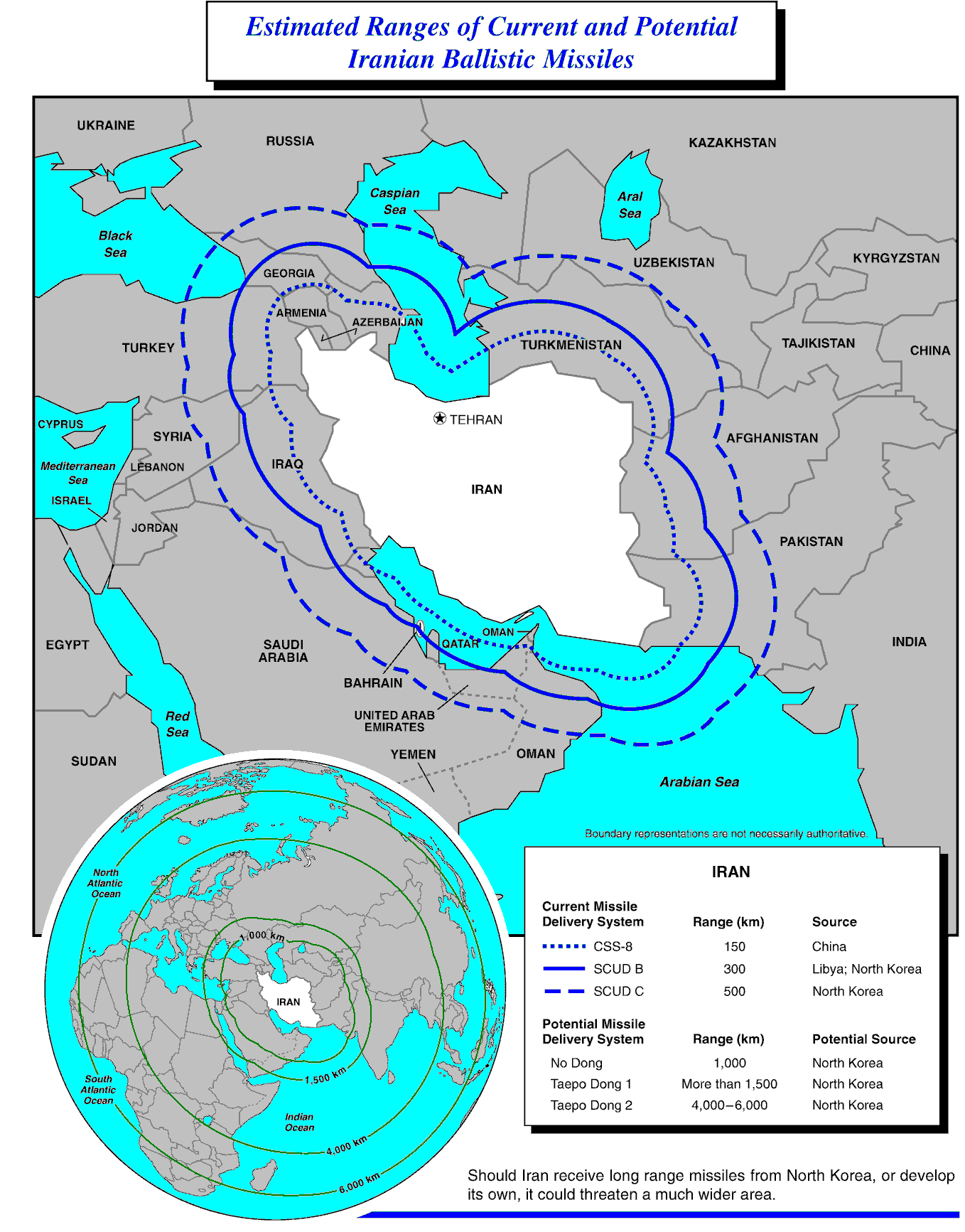
The Federation of American Scientists provide the following illustration of Iranian missile capabilities.


Satellite launches reportedly use technologies required for the development of ICBMs. In November, Iran claimed it had successfully tested missiles with a range of 1,200 miles, which as you can see from the map does not quite put Moscow in range--and obviously is even further from presenting any potential threat to, say, Warsaw. That said, it plainly makes a lot of sense that Iran's perennial missile tests would have the--likely unintended--effect of ruffling Moscow's feathers, given that a nuclear armed Tehran which could reach Moscow is definitely not in their interests.
"Alexander Pikayev, a top arms control scholar in Moscow, said Russian policy toward Iran will be determined by competing interest groups and political factions. Defense manufacturers and the atomic energy industry oppose tougher sanctions, for example, but the United States could win over the latter by reviving a bilateral pact on civilian nuclear cooperation that was frozen after the Georgian war, he said.

Pikayev said Medvedev may be more likely to support sanctions because a breakthrough in US relations would boost his political stature at home and set him apart from his powerful predecessor, Prime Minister Vladimir Putin. Putin might resist, but his relationship with Iranian President Mahmoud Ahmadinejad is said to be strained and he surprised Russia's foreign policy establishment by endorsing earlier U.N. sanctions, Pikayev said."
Frankly, I doubt this assessment--I think the notion of a nuclear armed Iran with the capability of hitting Moscow will outweigh the economic considerations involved in putting the kibosh on nuclear power cooperation with Iran. Indeed, it is hard to see many places in which Iranian and Russian interests coincide. Perhaps they do in terms of energy pricing, but Iran's potential as an alternative source of gas for European industry is probably a critical item in Moscow's long term thinking. And as the weekend's events proved, Russia still regards oil production coordination with OPEC as being less in its interest than good terms with Europe--and producing at full bore to claim all price increases produced by the cartel. (A policy which Iran appears to follow with respect to the organization's production quotas as well, ironically enough.)

3. The Associated Press reports that North Korea yesterday gave the organizations distributing US food aid inside that country till the end of March to leave--rejecting all future food aid.

4. Judy Dempsey at the New York Times yesterday reported that Russia signed two natural gas deals with Hungary yesterday. One deal signed last week has the Budapest and the Hungarian Development Bank to finance the South Stream project on Hungarian soil.


The other deal has Gazprom and MOL establishing a 1.3 billion cubic meters storage facility in Hungary. To make sense of that, here is a map that Jérôme Guillet drew up of Ukraine's gas infrastructure--note the three asterixes to the West, which represent gas storage facilities.


As Guillet pointed out in a piece for the European Tribune:
"Storage capacity is important in the gas business, as demand is seasonal (there is more in winter for heating) and can almost triple in Europe between summer and winter. If you can pre-position your gas near the markets when transport capacity becomes strained, you can extract a lot more value from that seasonality. The storage facilities near the Hungarian and Slovak borders were ideal for Soviet exports, but now they are in Ukrainian hands, and thus Russia must have a minimum of technical cooperation from the Ukrainians, who physically control and operate these facilities, not to lose a lot of money in their export markets. More, unavoidable leverage for the Ukrainians."
Hungarian Prime Minister Ferenc Gyurcsany's plea for a regional aid package from the EU was turned down last week. He has been a supporter of the Nabucco Pipeline, but questions of sourcing the gas (which would likely have to come from Iran) and project financing continue to bedevil the project.

5. Edward Hugh at Fistful of Euros posts that Poland's Central Statistical Office has released its industrial output data for February showing a 14.3% annual rate of decline in February, following a revised annual rate of decline of 15.3% in January. Output was up 2.7% in February from January however. Hugh provides a helpful graph of industrial production for the last two years:


Hugh points out that industrial production is on the decline across the spectrum of export-oriented Eastern European economies, warning against too much disambiguation between them. Worth reading and mercifully short.

6. Bettina Wassener at the New York Times reports that the World Bank lowered its forecast for Chinese growth in GDP for 2009 to 6.5%. 6.5%, though quite high by global standards just now, is well below the Chinese principle of "bao ba"--or "protect the 8"--below which conventional wisdom holds that Beijing will begin to see significant, read destabilizing, social unrest. Kevin Hamlin at Bloomberg reports that bank sees signs China's economy is stabilizing faster than the rest of the world.
"'The government’s stimulus is working,' said Louis Kuijs, a senior economist at the World Bank in Beijing. 'China’s fundamentals are strong enough to ride out this storm.'"
Meanwhile, Andrew Batson at China Journal helpfully translated the complete text of Chinese Ministry of Commerce’s statement announcing its decision to block Coca Cola’s proposed acquisition of China Huiyuan Juice Group Ltd. Key excerpt:
"Through its review, the Ministry of Commerce found that this concentration will have an adverse impact on competition. After the concentration is completed, Coca-Cola could use its market dominance in carbonated soft drinks to limit competition in the market for juice through tying, bundling or other exclusive transactions, resulting in consumers being forced to accept higher prices and reduced variety. At the same time, because brands can restrict entry to the market, it would be hard for the threat of potential competition to remove the restrictive effect on competition. In addition, the concentration will also reduce the room for small and medium-sized juice companies to survive, and will have an adverse effect on the structure of competition in China’s juice market."
The notion that dominance in the carbonated drink market could adversely affect competition in the juice market is unlikely to please most corporate headquarters. The fact that the Ministry of Commerce took stock of the market power of brands is interesting given that some have written that the primary value-addition that Western corporations bring to emerging markets is, well, brands. Meanwhile, the Sydney Morning Herald reports that shares in Rio Tinto have taken a beating on fears that the deal with Chinalco taking a 18% stake in the company.
"'[The 8.7% decline in share price] is [due to] the uncertainty surrounding the Chinalco deal, there has been a bit of talk out today that there is a lot of opposition to the deal and this is what's weighing on it,' MF Global senior trader Anthony Anderson said.

'The FIRB extension and the senate inquiry into foreign investment is adding to the uncertainty.'

The mounting political concern follows a decision by the Foreign Investment Review Board (FIRB) to extend its review to 90 days and initiate a more in-depth examination of the transaction, after the initial 30-day evaluation period closed on Monday.

The transaction, which has been backed by the Rio Tinto board, will also allow Chinalco to appoint two new non-executive board members to the global miners board."
(h/t Emmanuel at International Political Economy Zone.)

7. Platts reports that Italian major Eni has signed a major cooperation agreement with Pakistan to develop major projects all along the oil and gas product chain.
"The agreement also allows Eni to become a strategic partner in developing the oil and gas sector in Pakistan and to enter fields which are currently managed by state-run oil companies."
8. David E. Sanger and Eric Schmitt at the New York Times reports that "two of the high-level reports on Pakistan and Afghanistan that have been forwarded to the White House in recent weeks have called for broadening the target area to include a major insurgent sanctuary in and around the city of Quetta."


Baluchistan has separatist tendencies and is in the middle of a small bore separatist struggle, both in Pakistan and Iran.
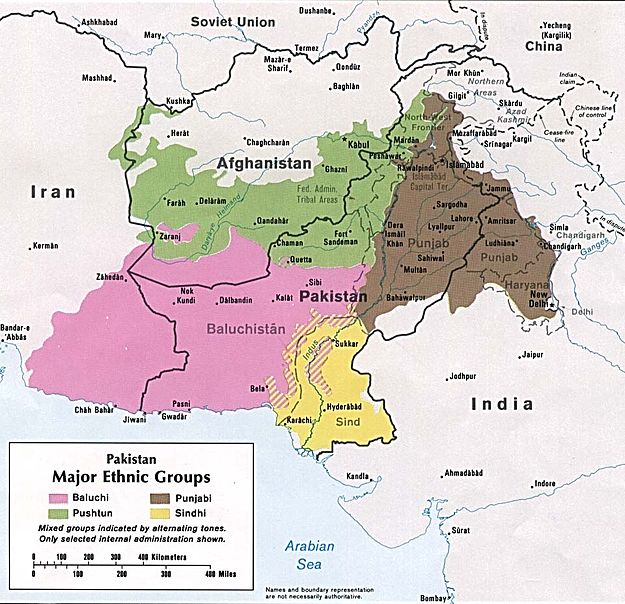


Note that Baluchis can be found in southern Afghanistan where most of that country's opium production--and violence--is concentrated.

9. Galrahn at Information Dissemination notes that due to the Obama Administration's review of all military ties, GE has been asked to freeze work on turbines it was to provide the Indian navy for three Shivalik-class stealth frigates. Though I strongly disagree with the way Galrahn frames the story, I think it is an important data point. Clearly the US is likely to approve continued sales of engines to the Indian Navy.

10. Maher Chmaytelli and Juan Pablo Spinetto at Bloomberg report that Shokri Ghanem, chairman of Libya’s state-run National Oil Corp., told journalists today in Vienna that Libya will exercise its right to buy Calgary-based Verenex Energy Inc., which would effectively block CNPC's bid for the E&P company.
"Verenex has assets in Libya that are worth 'hundreds of millions' of dollars, Ghanem said in an interview with Bloomberg on March 16."
It is an interesting signal given China's Africa Policy announced in 2006 and Ghaddafi's recent selection as chair of the African Union--see Daily Sources 2/3 #9.

11. Justin Stares at Lloyd's List reports that the Bangladeshi High Court ordered the closure of all ship breaking yards operating without environmental clearance.
"Industry sources said they were 'staggered' by the ruling, which if confirmed will close down one of the world’s largest breaking industries just as scrapping activity peaks.

'None of the 36 shipbreaking yards in Chittagong currently have an environmental clearance,' said the NGO Platform on Shipbreaking. 'The decision therefore effectively shuts down an industry that has been highly criticized by environmentalists and human rights activists for many years for operating with complete disregard for the law, human health and the environment.'

The scrapping industry, which claims to employ 250,000 either directly or indirectly in Bangladesh, is expected to appeal.

The court was ruling on a petition filed by the Bangladesh Environmental Lawyers Association. Judges ordered that no ship on the Greenpeace 'dangerous ships list' be allowed into the country, according to reports by the platform and local media."
It is a decision bound to amplify the effects of the financial crisis, economically-speaking ... it seems that probity only comes when it will hurt the most, ironically. Note the significance of the courts in the Muslim-majority nation. Well-worth reading in full.

12. Nasreen Seria at Bloomberg reports that the South African Reserve Bank's Monetary Policy Committee will meet next week and accelerate its schedule to monthly meetings for the rest of the year from planned meetings every two months.
"Global economic conditions 'are getting worse' and the 'changed' environment requires the MPC to meet more regularly, Governor Tito Mboweni said in a phone interview from Pretoria today."
13. Victor L. Simpson at the Associated Press reports that in Cameroon Pope Benedict XVI reiterated yesterday that condoms were not an answer to the fight on AIDS--"You can't resolve it with the distribution of condoms. ... On the contrary, it increases the problem." I would note that Africa is one region where Catholicism--and more conservative Catholicism--is growing quickly. However, perhaps the one really impressive and compellingly moral US foreign policy triumph under the Bush Administration was the huge increase in aid to Africa in terms of the fight on AIDS, including condoms and retro-viral drugs. The people in Africa are well aware of how these aid programs have reduced the mortality rate in the continent. The notion that condoms are against life and a concession to death, and thus amoral, as opposed to a way to protect life and thus moral, will not, I believe, make much sense to them. Pope Benedict XVI appears to have a tin ear when it comes to husbanding the moral authority of the Church.

14. The Port of Long Beach recently posted its numbers for February, showing a 40% decline in container traffic from February 2008:


So far in 2009 the port has recorded a 20.2% decline in traffic. The Port of Marseilles, France, also recently posted its report for February, showing a 21% annual decline in total traffic. It registered a 16% decline from the traffic seen in January:


Hydrocarbons account for about 74% of Marseilles' traffic and it lost about 12% in volume from the year before. The grim trade data continue their march.

15. Bob Willis at Bloomberg reports that the consumer price index rose by 0.4% in February from January. Excluding fuel and food, prices climbed by 0.2% from the month prior. On an annual basis, the consumer price index rose by 0.2%, up from the 0% annual rate seen in January. Excluding fuel and food, prices climbed by an annual rate of 1.8% in February, up from a 1.7% annual rate of increase seen in January.
"Energy expenses increased 3.3%, led by an 8.3% increase in gasoline prices. Still, the fuel’s cost is down 36% from a year earlier.

Food prices, which account for about a fifth of the CPI, fell 0.1%, the first drop since April 2006."
16. The Federal Open Market Committee met today and decided to keep the federal funds rate unchanged at 0-.25%. Excerpt from its press release:
"To provide greater support to mortgage lending and housing markets, the Committee decided today to increase the size of the Federal Reserve’s balance sheet further by purchasing up to an additional $750 billion of agency mortgage-backed securities, bringing its total purchases of these securities to up to $1.25 trillion this year, and to increase its purchases of agency debt this year by up to $100 billion to a total of up to $200 billion. Moreover, to help improve conditions in private credit markets, the Committee decided to purchase up to $300 billion of longer-term Treasury securities over the next six months."
This follows the latest Treasury International Capital data which shows, courtesy of Brad Setser at Follow the Money, that foreign purchases of long term treasuries have collapsed:


Foreign government demand for US agency debt fell off a cliff late last year and purchases were even banned by Moscow just the other week. Meanwhile, Jon Hilsenrath at Real Time Economics reports that the Fed's quarterly survey of banks shows that during the week of February 2-6, banks extended $85.6 billion in credit to businesses, an increase of 13% from the first quarter of 2008--per JP Morgan Chase economist Michael Feroli:


17. The EIA reported that crude oil stocks built by 2 million barrels in the week ended March 13 to 353.3 million barrels, well above the historical average for this time of year, but still below the most recent peak of 354 million barrels seen on June 29, 2007. According to a survey by Bloomberg, analysts had expected a 1.5 million barrel build. Gasoline stocks grew by 3.2 million barrels, are near the top of the historical average. Analysts had expected a 1.5 million barrel draw. Distillates stocks grew by 100,000 barrels, are well above the five year historical average range as well as counter-cyclical, and versus analyst expectations of a 1 million barrel build. Taken in isolation, the data would be bearish on the price of crude.

Monday, March 16, 2009

Daily Sources 3/16

1. Real Time Economics carries the full text of the G20 communique released on Saturday. Key excerpts:
"2. Our key priority now is to restore lending by tackling, where needed, problems in the financial system head on, through continued liquidity support, bank recapitalisation and dealing with impaired assets, through a common framework (attached). We reaffirm our commitment to take all necessary actions to ensure the soundness of systemically important institutions.
...
5. We are committed to helping emerging and developing economies to cope with the reversal in international capital flows. We recognise the urgent need to pursue all options for mobilising International Financial Institution (IFI) resources and liquidity to finance countercyclical spending, bank recapitalisation, infrastructure, trade finance, rollover risk and social support. We agreed on the urgent need to increase IMF resources very substantially. This could include further bilateral support, a significantly expanded and increased New Arrangements to Borrow (NAB), and an accelerated quota review. We should also ensure that all Multilateral Development Banks have the capital they need, beginning with a substantial capital increase for the Asian Development Bank, and put it to best use to help the world’s poorest.
...
7. We have also agreed to: regulatory oversight, including registration, of all Credit Rating Agencies whose ratings are used for regulatory purposes, and compliance with the International Organisation of Securities Commissions (IOSCO) code; full transparency of exposures to offbalance sheet vehicles; the need for improvements in accounting standards, including for provisioning and valuation uncertainty; greater standardisation and resilience of credit derivatives markets; the FSF’s sound practice principles for compensation; and the relevant international bodies identify non-cooperative jurisdictions and to develop a tool box of effective counter measures."
2. Michael Wines, Keith Bradsher, and Mark Landler at the New York Times reported on Friday that Chinese Prime Minister Wen Jiabao aired some of Beijing's worries with regard to their holdings of US debt ahead of the G20 meeting in London.
"'President Obama and his new government have adopted a series of measures to deal with the financial crisis. We have expectations as to the effects of these measures. ... We have lent a huge amount of money to the U.S. Of course we are concerned about the safety of our assets. To be honest, I am definitely a little worried.'

He called on the United States to 'maintain its good credit, to honor its promises and to guarantee the safety of China’s assets.'"
3. Xinhua reports that the Chinese Ministry of Finance announced on Friday that the 5 billion yuan (~$732 million) stimulus plan directed at subsidizing the purchase of automobiles and motorcycles in rural areas will translate into a 10-13% discount, respectively.
"Farmers who buy light trucks and minivans from March 1 to Dec. 31, would get a 10 percent discount, with the ceiling subsidies of 5,000 yuan (~$732.29).

Subsidies of 2,000 and 3,000 yuan (~$292.92 and ~$439.37) can be use to replace old three-wheeled and four-wheeled vehicles respectively.

From this Feb. 1 to Jan. 31 in 2013, farmers who buy motorcycles would get 13 percent of the purchase price back, with ceiling subsidies of 650 yuan (~$95.20)."
4. Borzou Daragahi at the Los Angeles Times reports that Iranian state television on Saturday carried an announcement by government officials that a $3.2 billion deal to develop the South Pars natural gas fields had been stuck with China.

5. Marcus Hand at Lloyd's List reports that Singapore port container cargo traffic fell by an annual rate of 20% in February. The number of containers that went through the port fell by 6% from January to 1.85m teu. Singapore's port is the world's largest container port.

6. Pamela Constable at the Washington Post reports that Pakistani President Zadari announced early today that he would reinstate a number the judges deposed by Pervez Musharraf in 2007, including former Chief Justice Iftikhar Mohammed Chaudhry.
"Zardari's turnabout came after thousands of demonstrators poured into the streets of this leafy capital of Punjab province [Lahore] Sunday, throwing rocks at police and cheering wildly. A wide cross section of Pakistan's political, social and religious sectors joined the day-long protests.

As the demonstrations escalated, police first responded with volleys of tear gas. But by mid-afternoon they suddenly withdrew from the streets, while numerous city and provincial officials were reported to have resigned. The swift collapse of authority signaled the end of Zardari's bid to seize control of Punjab, the most politically influential region of the country, and raised serious questions about his ability to remain president."
Worth reading in full. Includes links to fascinating pictures of hordes of lawyers protesting in Pakistan.

7. Haig Simonian at the Financial Times reports that on Friday Switzerland's finance minister, Hans Rudolf Merz, "said Bern would abolish the strict distinction between tax fraud, a crime in Swiss law, and tax evasion, a civil offence." Merz stressed that customer accounts would remain secret in all but exceptional cases, meaning that a specific request from an investigative body would be required in order to obtain the data, or so I infer. As I've said before, changes of 500 plus year traditions are better indicators, to me, of what kind of stresses the financial system is under than most. (h/t Yves Smith at naked capitalism.)

8. Eurointelligence notes a media report that Finnish manufacturing orders are down 38% year over year in January.

9. OPEC decided in its meeting Sunday to maintain the current quota allocations, and called on its members to fully comply with them. Current compliance is 79% according to the cartel--the producers which are probably the largest over-suppliers are Iran and Venezuela, ironically usually the biggest hawks in the group. The OPEC press release following the meeting can be found here. Key excerpt:
"The Conference, however, welcomed, some initial signs reported of a reversal in crude oil-stock trends, and a narrowing of the contango in the front price structure, indicating that the adjustment process instigated through OPEC measures vis-à-vis excess supply in the market is gradually helping to redress balance, and was also pleased to observe that following the decision taken by the 151st (Extraordinary) Meeting of the Conference in December 2008 to cut 4.2 mb/d from the actual September 2008 OPEC-11 production level with effect from 1st January 2009, compliance for the month of February, according to secondary sources, was 79%, which has contributed to balancing the price of the OPEC Reference Basket at around US$40/b since the beginning of the year, despite the critical economic outlook.

The Conference therefore emphasized its commitment to comply fully with its decision of December 2008, in order to further contribute to market stability. The Secretariat will monitor very closely developments in the market. Furthermore, the Conference will convene in Vienna, on Thursday 28th May 2009, to consider any further actions deemed necessary."
On a side note, the cartel decided to lengthen Abdullah Salem el-Badri's (of Libya) stay as Secretary General of the organization for another three year term. At Environmental Capital, Spencer Swartz reports that Russia decided not to join the organization or coordinate any serious production cuts.
"[Russian deputy prime minister Igor Sechin] proposed a slew of things for Russia and OPEC ministers to work on together, such as coordinating (i.e., raising) taxes on foreign oil firms’ crude production and refining operations."
Moscow had indicated that it would consider to what extent OPEC was complying with headline cuts before it joined in cooperation. Even so, this has to be considered good news in the West, given recent noise from Moscow and hints from Tehran.

10. Rania El Gamal at Reuters reports that Sheikh Nasser al-Mohammad al-Sabah told al-Watan newspaper that the country would officially cancel the al-Zour 615 kb/d export refinery construction project today in remarks published Sunday. In May, KNPC awarded $8.4 billion in construction tenders to four South Korean and one Japanese firm to build the refinery.

11. Rainbow Nelson at Lloyd's List reports that the Chavez administration expects the Venezuelan Congress to pass a law tomorrow which would transfer the administration of ports from the regional to the state level.
"'We are going to recover the ports and airports in the whole republic, oppose it whoever wants to, this is the law of the republic,' Mr Chavez said on his weekly television program ‘Alo Presidente’.

He warned Henrique Salas, who governs the department of Carabobo and oversees Venezuela’s most important port, Puerto Cabello, and Manuel Rosales, the governor of Zulia, which oversees the port of Maracaibo, that the navy and army would be used to quell any opposition to the move."
Opponents have pledged to resist the law.

12. The Associated Press reports that Mexico has slapped import duties on 90 US products in retaliation for the cancellation of a program that had allowed Mexican trucks to trasnport goods within the US.

13. Mary Williams Walsh at the New York Times reports that AIG issued a press release Sunday which provided the names of the institutions and governments which received payments via the bailout monies provided to the insurance company.
"Financial companies that received multibillion-dollar payments owed by AIG include Goldman Sachs ($12.9 billion), Merrill Lynch ($6.8 billion), Bank of America ($5.2 billion), Citigroup ($2.3 billion) and Wachovia ($1.5 billion).

Big foreign banks also received large sums from the rescue, including Société Générale of France and Deutsche Bank of Germany, which each received nearly $12 billion; Barclays of Britain ($8.5 billion); and UBS of Switzerland ($5 billion).

AIG also named the 20 largest states, starting with California, that stood to lose billions last fall because AIG was holding money they had raised with bond sales."


14. Justin Fox at the Curious Capitalist dug up the Bureau of Economic Research data on unemployment in the Great Depression to compare them to the financial crisis of 2008.


As Fox notes, nonfarm employment accounts for a much larger share of total employment in the US today than it did in 1929. Still, nonfarm employment accounted for about 78% of all private sector hours worked at that time, according to Robert Higgs at the Independent Institute.

Tuesday, February 10, 2009

Daily Sources 2/10

1. Tony Barber at the Financial Times reports that relations between EU member states are fraying given the latest bid for comparative advantage by one of its own--France's 6 billion aid package to its car industry. Mirek Topolanek, Czech prime minister and current president of the EU, reportedly said:
"If the member states continue to prefer an individualistic and protectionist approach, and if they choose to continue breaking the stability and growth pact rules, then there is a big danger of watering down the whole project."
Sarkozy had also called on French car makers to shut manufacturing plants in Eastern Europe and step up production at home. Worth reading in full. Eurointelligence reports that Le Monde has an article on Franco-German maneuvering at the Munich conference:
"... Merkel and Sarkozy met to discuss the crisis, and agreed, with Topolanek, to hold a crisis summit at the end of the month. The German apparently believe that the worst of the crisis will not come until the autumn (which is when they hold federal elections!), while the French are relatively more optimistic, believing that the crisis will end in the summer. Mr Sarkozy still favours a euro area head of government meeting, which Merkel strictly rejects. She does not want to come under pressure to authorise fiscal transfers as she heads into an election campaign. The article also says that Paris believes that the recession will be followed by a strong recovery with an upsurge in inflation, and that Paris wants the ECB to tolerate that increase in inflation, which is not acceptable for Germany."
2. Lukanyo Mnyanda at Bloomberg reports that French industrial production fell by 1.8% in December from November. In Italy, industrial production fell by 2.5% in December from November.

3. Alan Cowell at the New York Times reports that president Sarkozy of France made an unannounced visit to Baghdad today, as part of a trip to the Middle East which includes Oman, Bahrain and Kuwait.
"'We say to French companies that the time has come to return to Iraq,' Mr. Sarkozy told a news conference, according to Reuters."
4. Thomas Erdbrink at the Washington Post reports that Iranian president Mahmoud Ahmadinejad told a crowd celebrating the revolution's 30 year anniversary that
"The new US government has announced that it wants to create change and follow the path of talks. ... These talks should be held in a fair atmosphere in which there is mutual respect."
("Mutual respect" is a motif of Iranian rhetoric vis a vis the US, right up there with "Death to America.") That said, the language suggests that Tehran is open to the notion of direct talks, which is obviously in the interests of both nations. Erdbrink quotes Mohammad Marandi, head of the North American studies department at the University of Tehran, as saying,
"Iran can help the US in Iraq, Afghanistan. Pakistan is unraveling, Iran also wants security and stability in those nations. The fact that they now work separately makes it impossible to get things done."
The implication is that Iran is already trying to help stabilize the situation in both of its neighbors, but the lack of coordination and mutual suspicion is an unbridgeable complication. Though the Iranians publicly suggest that the US can gain more from them than the reverse, clearly serious instability in two neighboring countries is a much more pressing concern for Tehran than Washington, DC. The direct exposure to the mercy of events as they unfold in one is about to be seriously limited. So time is likely tight in the Iranian calculation, given a strong inclination by the current administration to unwind our military engagement in the region as quickly as possible. That said, as I have pointed out in a long analysis in April (Law and Revolution in Iran), the government's raison d'etre is that it represents a rebellion against colonial influences, for which you can read the US. Or, in the words of Ayatollah Ahmad Jannati, head of the Guardian Council:
"If pro-American tendencies come to power in Iran we have to say goodbye to everything. After all, anti-Americanism is among the main features of our Islamic state."
The Guardian Council is an assembly of twelve clerics and jurists appointed by the Supreme Leader who have the power to vet laws and election candidates.

5. Shimon Peres, the president of Israel, has an opinion piece in the Washington Post which rejects a single state solution, establishing that a two state solution is the only politically acceptable outcome for Israel. Peres argues that it is not only the only feasible solution, but also "within reach."
"The one-state solution has enough intrinsic flaws to render it no solution at all. From Israel's perspective, it is not possible for the Jewish people to accept an arrangement that signifies the end of the existence of a Jewish state. From the Palestinians' perspective, they should not be denied the opportunity to take their national destiny into their own hands."
Peres refers to Gaddafi's op ed in the Post on January 22 advocating a single state solution, or Isratine (see Daily Sources 1/22 #7), and, although he rejects the solution proffered, does welcome Gaddafi's premise that the Jews deserve a homeland. Worth reading in full.

6. Rama Lakshmi and Shaiq Hussain at the Washington Post report that the Pakistani cabinet's defense committee yesterday registered the Mumbai attacks as a crime with the police, but released a statement saying that, "without substantial evidence from India it will be exceedingly difficult to complete the investigation and proceed with the case." The defense committee also signaled that Islamabad has rejected New Delhi's demand that the suspects be extradited to India.

7. Bettina Wassener at the New York Times reports that Temasek Holdings, Singapore's sovereign wealth fund, announced today that the total value of its investment portfolio fell by 31%, or about $39 billion, between March and November last year. "Temasek’s portfolio was worth 127 billion Singapore dollars, or $85 billion, at the end of November."

8. Allan Cullison at the Wall Street Journal yesterday reported that the IMF is likely to suspend payments to Ukraine as Kiev is failing to meet the terms of the agreement.
"Faced with a cash shortage, Kiev is passing the hat around to global powers. Talks were held in Moscow last week over a $5 billion loan to help plug Ukraine's budget deficit.

Ukraine Prime Minister Yulia Tymoshenko said her government also sent letters to the US, European Union, China and Japan, and that 'Russia is ready to help with the credit agreement's signing.'

President Viktor Yushchenko criticized the talks with Moscow. 'It's a dangerous policy and poses a threat to Ukraine's national interests,' he said."
9. Steven Bodzin at Bloomberg reports that US refiner NuStar Energy LP told the media that PdVSA has canceled shipments of 1.2 million barrels of Boscan crude to its Texas refinery in February and March so as to comply with OPEC imposed supply cuts.
"Venezuela said it has cut daily output by 364,000 barrels since September to 3.01 million barrels, putting it in full compliance with the OPEC cuts. Bloomberg estimates that Venezuela reduced output by 210,000 barrels a day in the period to 2.15 million barrels. "
Boscan is an extremely heavy and sour crude with an APIº10.1 (just APIº0.1 lighter than water) and 5.4% sulfur by weight requiring very complicated refineries to produce profitable cuts of more expensive petroleum products.

10. Mark Shenk at Bloomberg reports that the EIA reduced its forecast of global oil demand to 84.7 mb/d for 2009, down 1.17 mb/d from projected global demand for 2008.

11. The University of Maryland's Program on International Policy Attitudes released the findings of a survey of perceptions of countries worldwide on February 5.

"Public opinion in Russia relative to public opinion in Europe and the US seems to be polarizing. Americans and Europeans have both grown more negative toward Russia, and Russians have become more negative toward the US, the EU, and less positive toward Germany and the UK (but not France). Russia's military action against Georgia and increasing limitations on civil rights may be affecting American and European attitudes, and US and European criticism of Russia may be affecting Russian attitudes. [Note that the polling was done before Russia's cut-off of natural gas supplies to Ukraine and parts of Europe.]

To some extent this polarizing trend seems to be appearing in relations between China and the West as well. Europeans have become more negative toward China, while the Chinese have become more negative toward the US (negative views have risen from 46% to 58%), the EU (16% to 28%), and France (positive views dropped from 64% to 44%--perhaps in reaction to French demonstrations regarding the Tibet issue).

However, Chinese views of the UK have grown more positive (rising from 56% to 67%), as have views of Germany (58% to 65%). And Americans have not grown more negative toward China, with negative views essentially unchanged at 52 per cent.

The US for the first time since 2005 has surpassed Russia in positive ratings (an average of 40% for the US as compared to 30% for Russia), but their negative ratings are similar as are the number of countries giving them predominantly positive or negative ratings."
Long, but well worth reading.

12. William Branigin and Michael D. Shear at the Washington Post report that the US Senate passed a $819 billion economic stimulus bill. $819 billion is 5.7% of 2008 GDP (of $14.264 trillion.) The vote was 61 to 37, with GOP Senators Susan Collins (ME), Olympia Snow (ME), and Arlen Specter (PA) joining with Democrats and Independents to pass the measure. Meanwhile, Edmund L. Andrews and Stephen Labaton at the New York Time report on Secretary Geithner's outline of a new plan to marshal as much as $2 trillion in public, Federal Reserve, and private funds in defense of the financial sector's stability.

13. Rebecca Wilder at News N Economics reports that spreads on non-financial commercial paper are returning to normal.
"The spread is returning to normal levels, indicating that investor confidence is returning - at least in nonfinancial paper. This is a good thing, especially since the Fed has unwound 22% of its holding of commercial paper since 1/14/09, when it held $334.6 billion of the commercial paper market."
14. Joe Carroll at Bloomberg has a useful article on why charter rates for deepwater drilling rigs have not been particularly hit by the financial crisis or the current glut of crude. The upshot is that it is punitively expensive to simply cancel an ongoing charter and it will take some time for contracts already in place to unwind.
"All of Transocean’s most-sophisticated rigs are booked until at least mid 2010, with some committed through November 2016. The company had a $41.1 billion backlog of orders as of Sept. 30."
Anadarko indicated that it could make a 10% profit on deepwater fields when oil is at $30/b.

Tuesday, February 3, 2009

Daily Sources 2/3

1. Maya Jackson Randall at Real Time Economics reports that the Federal Reserve plans to continue its dollar swap arrangements through the Fall.
"The Fed said the extension applies to the temporary reciprocal currency arrangements it has with each of the following banks: the Reserve Bank of Australia, the Banco Central do Brasil, the Bank of Canada, Denmark’s Nationalbank, the Bank of England, the European Central Bank, the Bank of Korea, the Banco de Mexico, the Reserve Bank of New Zealand, the Norges Bank, the Monetary Authority of Singapore, the Sveriges Riksbank and the Swiss National Bank.

The Fed said the Bank of Japan will consider the extension at its next monetary policy meeting."
2. Sophie Tedmanson at the London Times reports that the Reserve Bank of Australia yesterday cut its benchmark interest rate by 1% to 3.25%, the lowest in 45 years. Prime Minister Kevin Rudd also announced a new stimulus package of $42 billion to be known as the "Nation Building and Jobs plan."
"Mr. Rudd said that $28.8 billion would be invested in schools, housing and roads and a further $12.7 billion will provide cash support for lower-income families to be paid next month. This means low-income earners such as farmers, students and stay-at-home mothers will receive a one-off payment of $950."
Stimulus measures announced since September 2008 amount to $78 billion, nearly 8% of Australian GDP.

3. Keith Bradsher, the longtime China journalist for the New York Times, reports that currency flows are reversing and now moving out of China.
"In Shanghai, cash-rich Chinese companies are buying high-yield bonds issued by distressed American companies at a time when many Western investors are steering clear of bonds even from solid companies.

All over the world, Chinese companies are sending home fewer of the billions of dollars they earn from exports, parking them in overseas bank and brokerage accounts instead.

And in Hong Kong, wealthy mainlanders are turning up at jewelry stores in growing numbers seeking diamonds, big ones."
Total outflows in the fourth quarter of 2008 were as much as $240 billion. The "accumulation in China’s foreign exchange reserves plunged 74% over the course of last year" to $40.45 billion in the fourth quarter. Mostly anecdotal, but worth reading.

4. In a post Sunday on his Maverecon blog, Willem Buiter takes aim at the buy American provisions in the House version of the $819 billion stimulus plan. The prevailing theory regarding the Great Depression is that protectionist measures were responsible for deepening and lengthening the downturn. At Davos, Buiter reports that the finance ministers of the rest of the world were quick to threaten retaliation should the provision become law. But, Buiter is quick to note, protectionism is on the rise globally. Worth reading in full.

5. Niall Ferguson at the Financial Times argues that the banks must be nationalized and new banks established from their ruins. He goes on to say,
"The second step we need to take is a generalized conversion of American mortgages to lower interest rates and longer maturities. The idea of modifying mortgages appalls legal purists as a violation of the sanctity of contract. But there are times when the public interest requires us to honor the rule of law in the breach. Repeatedly during the course of the 19th century governments changed the terms of bonds that they issued through a process known as 'conversion'. A bond with a 5% coupon would simply be exchanged for one with a 3% coupon, to take account of falling market rates and prices. Such procedures were seldom stigmatized as default. Today, in the same way, we need an orderly conversion of adjustable rate mortgages to take account of the fundamentally altered financial environment."
Well worth reading. I certainly think nationalization will be more politically viable than a "bad bank"--and obviously restructuring mortgages will be politically popular generally, and have the potential benefit of improving the debt-equity ratio of a great number of people, thus potentially increasing consumption via a resurrection of disposable income. Barry Ritholtz at the Big Picture posts that he has been led to understand that Goldman Sachs representatives effectively lobbied the senior staff of Senate Banking, House Financial Services, the Joint Economic Committee late last week. Ritholtz highlights the following points of the alleged Goldman presentation:
"'- Government actions to date have prioritized interacting with banking institutions rather than directly influencing troubled asset prices;
- 'To date, banks have executed minimal de-risking, have not attracted meaningful additional common equity capital or sufficiently increased lending'; and
- 'A government program which provides non-recourse loans for asset markets should have a material impact on addressing these current challenges and could be an attractive alternative for the "aggregator bank" to explore'"
He includes a copy of the complete bullet points allegedly presented to the staffers. Both are worth reading in full.

6. Fredrik Dahl and Parisa Hafezi at Reuters report that Iran placed its first satellite in orbit today. It is a telecommunications and research satellite, but the analyst community has noted that putting a satellite in orbit requires some of the same science needed for intercontinental ballistic missiles. The launch also should have the effect of bolstering morale of the regime as well. (The launch coincides with the 30th anniversary of the Islamic Revolution in Iran.) The Reuters piece notes that Iran is the ninth country in the world to be both capable of domestically manufacturing a satellite and launching it into space. Meanwhile, Thomas Erdbrink at the Washington Post reports that in a visit to Tehran, Hamas leader Khaled Meshal was told in a Sunday meeting with the Supreme Leader, Ayatollah Ali Khamenei, that "Islamic resistance needs to be ready for every eventuality, even for another war in Gaza." Meshal is on a regional tour to drum up support for Hamas, and in a speech at Tehran University Monday thanked Iranian supporters, "Thank you for all your support--the financial, political and media and popular support which you gave to us."

7. In light of recent pronouncements by Russian US analysts Andrew Pronin and Igor Panarin about the incipient break up of the United States (see Daily Sources 12/30 #12 and Daily Sources 1/22 #5) it is interesting to see, via an anonymous comment to yesterday's post, that the New Hampshire House of Representatives State-Federal Relations and Veteran's Affairs Committee will consider a bill which would deem any act not explicitly authorized by the US Constitution as a nullification of the compact itself. HCR 6--text here--is sponsored by four GOP state representatives, was introduced on January 8, and is scheduled to be considered by the committee next on Thursday. Not likely to go anywhere, but surely will be seen as grist for the mill overseas.

8. Ben Block at the World Watch Institute reports that the The International Renewable Energy Agency (IRENA) was launched yesterday. 75 nations have signed the treaty establishing the international agency, which would be dedicated to help governments and private industry expand renewable energy installments in the developed world and assist the developing world acquire the expertise to develop domestic alternative energy industries. The agency was an initiative of Germany, Spain and Denmark, and signatories include France, India, the UAE, and Kenya, though the US, UK, Japan, Australia, and China have chosen so far to remain observers. (An official from the US Embassy in Berlin served as the US representative at the meeting.) At this stage it is difficult to see how much clout this organization could potentially hold, but an interesting development nonetheless. 25 nations will need to ratify the treaty prior to their final accession to it.

9. Lydia Polgreen at the New York Times reports that the President of Libya, Muammar el-Qaddafi, was named chairman of the African Union yesterday.
"Colonel Qaddafi is an ardent supporter of a long-held dream of transforming Africa, a collection of post-colonial fragments divided by borders that were drawn arbitrarily by Western powers, into a vast, unified state that could play a powerful role in global affairs. He has repeatedly proposed immediate unity and the establishment of a single currency, army and passport for the entire continent. He pledged Monday to bring up the issue for a vote at the African Union’s next summit meeting, in July."
Quixotic, but those member nations which would be made uncomfortable by some of Qaddafi's more explosive announcements have apparently been outvoted.

10. Rebecca Wilder at News N Economics reports that 34.6% of national home sales were sold at a loss in 2008. In the fourth quarter, 42.2% were at a loss. In 2008 as a whole, 19.9% of the houses sold were in foreclosure. Ms. Wilder drew up a graph tracking sales at a loss from the first quarter of 2004:


Worth a look.

Thursday, January 22, 2009

Daily Sources 1/22

1. Joel Martinsen at Danwei posted Tuesday that certain Chinese apparatchiks are pushing consumption as "patriotic" in local media outlets, and as a necessary means out of the current economic mess. The idea has roots in Marxist ideology, apparently, which the post outlines. There has been "push back," however in the Chinese media, including remarks in the Shanghai Daily, to wit:
"'Buy an apartment, and you are patriotic,' says a local Chinese official in her bizarre call to beggar the poor to bail out housing speculators.

Wang Aihua shocked the nation with her bold statement last Monday, delivered live on a local TV station in Hefei, capital of Anhui Province. Wang is the director of the city's urban planning bureau."
Well well well, all I can say is that reminds me of a certain someone's exhortation to go "shopping" in the face of another crisis, not so long ago. (h/t Carlos Tejeda, China Journal) But the screw hasn't finished turning, not by a long shot. Menzie Chinn reports at Econbrowser that the Bush Administration's take on the cause of the current financial crisis is that there has been a "Global Savings Glut," the actual subtitle of the section entitled "Origins of the Crisis" of the Economic Report of the President. An excerpt from the paper's executive summary itself:
"# The roots of the current global financial crisis began in the late 1990s. A rapid increase in saving by developing countries (sometimes called the "global saving glut") resulted in a large influx of capital to the United States and other industrialized countries, driving down the return on safe assets. The relatively low yield on safe assets likely encouraged investors to look for higher yields from riskier assets, whose yields also went down. What turned out to be an underpricing of risk across a number of markets (housing, commercial real estate, and leveraged buyouts, among others) in the United States and abroad, and an uncertainty about how this risk was distributed throughout the global financial system, set the stage for subsequent financial distress.
# The influx of inexpensive capital helped finance a housing boom. House prices appreciated rapidly earlier in this decade, and building increased to well-above historic levels. Eventually, house prices began to decline with this glut in housing supply."
My personal, non-economist, take is that the central banks of the developing world did finance US debt beyond what was credible, and that that did have the effect of lengthening an unsustainable boom in credit, and so there is some merit in the Administration's view. But, as I noted above, perhaps this had something to do with following the Administration's own prescription for a different crisis, altogether. Minzie, who is an economist, goes straight for the jugular:
"So, while I won't say that the idea of saving flows coming from East Asia had some role in the financial crisis we're now undergoing, I'd say one has to think about how those flows came about, as much as how big they are. We don't usually think of the rest-of-the-world driving macroeconomic events in the US ... and I still don't think it's time to start."
Well worth reading in full. Meanwhile, Yves Smith at Naked Capitalism pours cold water on the official Chinese GDP data for the fourth quarter, which show growth of 6.8%. Smith points out that power consumption in China was down 9.6% in November, after falling 4% in October, which is not consistent, usually, with pretty strong economic growth figures. She is waiting for the December power consumption numbers, before officially giving the statistics bureau a raspberry. (Chinn's piece came to my attention via Yves Smith as well, h/t.) Meanwhile, JR Wu at Real Time Economics has a piece on what recession looks like in China, examining the principle of "bao ba" or "protect the 8," the 8% GDP growth which conventional wisdom holds is the number below which you begin to see significant social unrest. The notion of "bao ba" apparently dates back to the Asian Financial Crisis. In 1989, the year of Tiananmen Square, GDP grew by 4.1%. Richard Herd, head China economist at the OECD, thinks that every percentage point decline in GDP equates to about 2 million job losses.
"According to Citigroup, China’s real GDP contracted 0.3% on an annualized basis in the fourth quarter from the third quarter — the first fall in at least 16 years. Morgan Stanley estimates China’s GDP fell 0.5% for the same period on a seasonally adjusted, annualized basis.

Goldman Sachs estimates that China’s economy grew 2.6% in the October-December period from the July-September quarter. The OECD puts the quarter-on-quarter growth for the same period at 0.3%."
Meanwhile, Paul Cavey, head of China economics at Macquarie Research has an opinion piece in Wall Street Journal Asia where he argues that the banking sector in China may, by instituting counter-cyclical policies, be setting the stage for a gigantic credit bubble.
"Whatever the dangers of a market-based system during a boom, it does have benefits on the way down. The caution of typical banks in downturns arises not just because they suffer capital shortages, but because economic risks increase. Having been tied in a knot of prudential and monetary restrictions, China's banks have had little opportunity to develop the skills needed to navigate this trickier environment.

In particular, there are worrying signs that, having avoided a credit bubble and bust during the boom, Beijing is now setting itself up for that cycle during the downturn. With a monetary expansion target of 17% in 2009 and the economy likely to expand 8% or less, the government is paving the way for exactly the sort of credit excesses that have already proved so damaging elsewhere. It is too early to be worried about this yet, but the result could be a future increase in nonperforming loans, and perhaps the need for a banking bailout with Chinese characteristics down the road.

So the rest of the world may be looking enviously at China right now. But as governments everywhere contemplate restructuring their own banking sectors, it is far too soon to conclude China offers the best model to follow."
This is particularly interesting to me because for a long time in foreign affairs circles the financial sector in China was regarded as especially vulnerable, only to watch Bank of America et. al. take huge stakes in partially privatized state-owned banks. Clearly a paradigm-shift has taken place if their public nature is to be envied. But it does give the gimlet eye to the notion of consumerism as the way forward and savings as hopelessly reactionary, does it not? Meanwhile, Rebecca Christie and Mark Drajem at Bloomberg report that Timothy Geithner, whose appointment as Treasury Secretary was cleared for a full vote by the Senate Finance Committee today, said that the new Administration believes that Beijing is "manipulating" the yuan.
"'President Obama -- backed by the conclusions of a broad range of economists -- believes that China is manipulating its currency,' Geithner said in the remarks posted on the committee’s Web site today. 'The new economic team will forge an integrated strategy on how best to achieve currency realignment in the current economic environment.'"
Senator Linsey Graham (R-SC) called the remarks "music to [his] ears". Graham sponsored legislation in 2007 which would punish imports from countries which have been found to "misalign" their currencies.

2. Chris Oliver at MarketWatch yesterday reported that Japanese exports were down 35% in December, following a 26.7% decline in November. "Exports to the US fell a record 36.9% in December on year, after declining 33.8% in November, the previous record. Exports to Asia were down 36.4%." Barclays Capital predicted that Japanese GDP would contract by 10.3% on an annual basis on the back of this and the news that industrial power consumption fell by 13% in December. In a follow-up story, Oliver reports that the Bank of Japan voted to keep benchmark interest rates unchanged at 0.1% today, and forecast that consumer price inflation would decline by 1.1% in fiscal 2010 and 0.4% in fiscal 2011.
"The board noted that conditions had "shifted significantly downward" from its outlook report published in October. Instead of expanding, the economy is likely to contract in the two years to fiscal 2010 before an expansion takes hold. Gross domestic product is expected to contract 1.8% in fiscal 2009 and 2% the following year."
3. Ian King and Patrick Hosking at the London Times report that the UK may be blocked from bailing out Barclays, because as a provision of the Abu Dhabi royal family's earlier infusion of capital, later dilution would be compensated for with additional shares.
"But the small print in the deal, in which Barclays raised £7.3 billion from Abu Dhabi and Qatar, means that if the bank raises fresh capital before the end of June, the Middle Eastern investors would receive a greater number of shares for their original investment without paying more. If Barclays were to raise fresh capital at last night’s closing price, for example, it would automatically hand almost 50 per cent of the bank to the Middle Eastern investors. The only way to get around the anti-dilution clause, should Barclays need more money before the end of June, would be if new capital was raised at more than the 153p-a-share at which paper issued to Abu Dhabi and Qatar is due to convert into Barclays stock.

This would mean that if the Government wanted to take a meaningful stake in the bank, it would have to do so by paying more than 153p for Barclays shares — which were trading at just 66.1p yesterday. The Treasury would face accusations of wasting taxpayers’ money were it to do this."
The clause was insisted upon by a certain Amanda Staveley, chief executive of PCP Capital a private equity firm which advised the Emirate on the deal. Worth reading in full.

4. Gabriel Gatehouse at BBC points out that the details of the gas contract between Russia and Ukraine have still not been made public.

5. Galrahn at Information Dissemination has an interesting translation of Russian military thinking on how it should change its approach in order to profit from soft power initiatives in the United States. As perhaps our analysis appears to Moscow, it does seem to demonstrate a large level of misunderstanding of how things work over here, but here is some of Galrahn's translation:
"The situation in American society favors the implementation of these plans. In many ways the United States today is reminiscent of the Soviet Union period of stagnation under Brezhnev. Militarism, foreign adventures, attacks on freedom of speech and human rights, censorship, the presence of the official ideology are evident. Multinational and multiracial American society does not have a common history and defines itself in terms of ideology, which is a more fragile foundation of national unity, rather than a common culture and history that binds cultures. If you choose to continue the comparison, the US, as in the Soviet Union, should be a peaceful ideological and cultural revolution. The challenge for Russia is to give impetus and direction to the process."
Some in Moscow apparently anticipate a color revolution in the US ... or its complete dissolution. Worth a look.

6. Dexter Filkins reports that NATO forces have effectively ceded much of southern Afghanistan to the Taliban. This is the NYT's map of unsecured areas, apparently:


7. Juan Cole at Informed Comment has a useful round up on the aftermath of the Israeli operation in Gaza. The Israeli Defense Force has issued a travel advisory to officers regarding travel to Europe, where several courts assert universal jurisdiction and where war crimes cases have been, or are in the process of being, filed.

This is not an idle concern, General Pinochet was prevented from leaving England due to an injunction filed by a Spanish judge on crimes against humanity charges. (Indeed, depending on how "activist" the various judiciaries in Europe are, this issue may trouble senior US government officials as well. It is important to remember in cases this charged with emotion the general view of what is just has the propensity to prevail over the written law and bilateral and multilateral treaties. As Chief Justice Oliver Wendell Holmes, Jr. once said, "The law is the will of he who the sheriff will obey." And, just now, Israel has a serious public relations problem on its hands.)

Cole points to Arab media sources reporting that Hamas is carrying out reprisals against "collaborators" in Gaza following the IDF's withdrawal. Evidently, Hamas is using the crisis to consolidate their power in the strip. Meanwhile, UN Secretary-General Ban ki-Moon visited Gaza and "demanded that nothing like the Gaza campaign ever be undertaken again ... and he said he would do what he could to establish accountability." Cole is not sympathetic to Israeli concerns, nonetheless, the post is worth reading in its entirety.

And, the dictator of Libya, Muammar Gaddafi has an op ed in the New York Times reiterating his call for a one state solution to the Israeli-Palestinian stand off. Key excerpts:
"The basis for the modern State of Israel is the persecution of the Jewish people, which is undeniable. The Jews have been held captive, massacred, disadvantaged in every possible fashion by the Egyptians, the Romans, the English, the Russians, the Babylonians, the Canaanites and, most recently, the Germans under Hitler. The Jewish people want and deserve their homeland.

But the Palestinians too have a history of persecution, and they view the coastal towns of Haifa, Acre, Jaffa and others as the land of their forefathers, passed from generation to generation, until only a short time ago.

Thus the Palestinians believe that what is now called Israel forms part of their nation, even were they to secure the West Bank and Gaza. And the Jews believe that the West Bank is Samaria and Judea, part of their homeland, even if a Palestinian state were established there. Now, as Gaza still smolders, calls for a two-state solution or partition persist. But neither will work."
"A key prerequisite for peace is the right of return for Palestinian refugees to the homes their families left behind in 1948. It is an injustice that Jews who were not originally inhabitants of Palestine, nor were their ancestors, can move in from abroad while Palestinians who were displaced only a relatively short time ago should not be so permitted.

It is a fact that Palestinians inhabited the land and owned farms and homes there until recently, fleeing in fear of violence at the hands of Jews after 1948 — violence that did not occur, but rumors of which led to a mass exodus. It is important to note that the Jews did not forcibly expel Palestinians. They were never “un-welcomed.” Yet only the full territories of Isratine can accommodate all the refugees and bring about the justice that is key to peace."
Worth reading in full. However, a key sticking point is that the raison d'etre of Israel is to provide a state which is majority Jewish, because the Jewish people have a history of being persecuted when they live in states which are not. Return is at direct odds with that purpose, as that would quickly lead to the Jewish population being a minority one in Israel--or, as Qaddafi would have it, Isratine. Meanwhile, Sue Pleming at Reuters reports that Gaddafi told students at Georgetown University via satellite link that:
"Oil exporting countries may move toward nationalization because of the rapidly declining prices. This is put on the table and is being discussed seriously,. Oil maybe should be owned by national companies or the public sector at this point, in order to control the oil prices, the oil production or maybe to stop it."
If Libya were to re-nationalize concessions recently parceled out, I imagine that might darken the legacy of what was considered one of the Bush Administration's more important foreign policy successes. That said, it wouldn't make much of a difference in terms of the global supply situation.

8. In a strange story, Maher Chmaytelli at Bloomberg reports that the oil minister of Algeria, Chakib Khelil, has said that Saudi Arabia will cut its production by 300 kb/d below its current OPEC quota.

9. Dulue Mbachu at Bloomberg reports that a draft bill sent to the parliament at Abuja would end all discretionary awarding of oil and gas contracts, mandating that all concessions be awarded via open bidding.
"A new national oil company [would] also be created to prospect for oil worldwide and raise funds from global financial markets. The country will set up a Nigerian Petroleum Directorate to develop policies and strategies for fossil energy and a National Petroleum Inspectorate to enforce policies and regulate technical and commercial aspects."
Open bidding could do much to restrain the wildly corrupt nature of doing business with the Nigerian government.

10. Eric Watkins at the Oil & Gas Journal reports that Petrobras will publish its new five year plan come January 26th--next Monday. Petrobras has moved back the date for the plan's publication several times in the last few months as it considered the changing oil price environment, likely critical to determining EROI on its new deepwater finds. (See Daily Sources 12/31 #13.)

11. The Calgary Herald reports that Daniel Yergin, head of Cambridge Energy Research Associates, said,
"Just on supply-demand, putting aside geopolitics, this surplus is going to last for a couple of years and that will have a dampening impact on oil prices. Right now, predicting oil prices is really predicting [GDP]."


12. In a bit of good news, the Baltic Dry Index, an indicator of global shipping levels and thus international trade, appears to be recovering somewhat, though it is still more than 80% below its height in 2008.


13. Samantha Young at the Associated Press reports that California Governor Arnold Schwarzennegar has sent a letter to President Obama, directly asking him to waive federal restrictions on new Californian vehicle emissions regulations. The EPA had refused to provide a waiver which would allow California to implement the new regulations despite the fact that they are stricter than the emissions requirements stipulated in federal law. (see Daily Sources 1/15 #18.)

14. Jack Healy at the New York Times reports that new home construction in the US fell 15.5% in December from November. The nation-wide unemployment rate has risen to 7.2%.

15. Damian Paletta and David Enrich at the Wall Street Journal write on alleged political interference in the distribution of TARP funds.
"Nonetheless, in December OneUnited got a $12 million injection from the Treasury's Troubled Asset Relief Program, or TARP. One apparent factor: the intercession of Rep. Barney Frank, the powerful head of the House Financial Services Committee.

Mr. Frank, by his own account, wrote into the TARP bill a provision specifically aimed at helping this particular home-state bank. And later, he acknowledges, he spoke to regulators urging that OneUnited be considered for a cash injection."
The Journal includes a map showing which states got the bulk of funds disbursed so far, which seems to correlate more or less to where the financial industry is located.


Still, it does seem to me that if our legislators really believe that we are in a crisis of such magnitude that over a trillion dollars in taxpayers funds are required for the safety of the entire economy that, perhaps, just perhaps, they should put aside pork and special interests in the interest of the nation as a whole. Is that really too much to ask? Is this view really naivete?

16. The EIA reports that US crude stocks jumped by a whopping 6.1 million barrels to 332.7 million barrels, well above the historical five year average for this time of year. That said, they are still below the highest stock levels seen in the last five years. According to a Bloomberg survey, analysts were expecting a 1.4 million barrel build. Gasoline stocks also rocketed up by 6.5 million barrels and now are a the top of the historical range. Analysts had expected a 1.8 million barrel build. Distillates stocks, by which the EIA mainly means stocks of diesel and heating oil, grew by 800,000 barrels, a bit more than Wall Street expectations of 500,000 barrels, and are well above the historical range. Taken in isolation, this should put considerable downward pressure on crude prices, but at the time of this writing, prices have recovered after falling a few dollars per barrel on the news.

Tuesday, December 30, 2008

Daily Sources 12/30

1. Ethan Bronner and Taghreed el-Khodary at the New York Times reports that Israeli Prime Minister Ehud Olmert said Tuesday that the Gazan airstrikes were "the first of several stages approved by the security cabinet." He went on to say "The government is giving the military its full backing and the room for maneuver to achieve the goal set out by the government."
"Interior Minister Meir Sheetrit told Israel Radio, 'There is no room for a cease-fire. The government is determined to remove the threat of fire on the south. Therefore, the Israeli Army must not stop the operation before breaking the will of Palestinians, of Hamas, to continue to fire at Israel.'"
Gazan residents reported seeing Israeli ships gathering offshore Gaza. Griff Witte and Sudarsan Raghavan at the Washington Post report that Israeli Defense Minister Ehud Barak declared "an all-out war against Hamas" on Monday. (I have no idea what practical effect that has in terms of international law--or whether a Defense Minister can declare war or whether the Israeli Cabinet and Parliament are required to pass a motion declaring war or whether, even such a declaration would mean a de facto recognition.)

The rhetorical reaction of the Islamic world has been pretty uniform. The Gulf Daily News reports that a prominent Saudi cleric, Sheikh Awad Al Qarni, published a fatwa ruling all Israeli interests--and "anything else related to Israel--legitimate targets. (h/t Will McCants at Jihadica) Sayed Salahuddin at Reuters reports that the Taliban has called upon the Muslim community to rise up in response to the Gaza conflict. Zeina Karam at the AP reports that tens of thousands of Hezbullah supporters stood in the rain in Beirut to protest the situation in Gaza, some 3,000 rallied in Cairo, and about 1,000 al-Sadr backers protested in Baghdad. The same piece reports--buried near the bottom--that the al-Maliki government issued a statement condemning the attacks and calling on all Muslim nations to end relations with Israel and all secret negotiations with it. Juan Cole has translated Grand Ayatollah Ali Sistani's fatwa issued on Sunday. It calls on action, more than has been done in the past, and strongly condemns words as opposed to practical action in response to the events:
"Mere verbal expressions of condemnation and disapproval of what is being done to our Palestinian brethren in Gaza, and of solidarity with them, mean nothing before the immensity of this horrific tragedy to which they are being subjected.

The Arab and Muslim worlds are called upon, more than at any past time, to take practical steps in order to stop this continual aggression and to break this cruel blockade that has been imposed on that proud people."
Cole's translation is well worth reading and many of the articles linked here came to my attention via his site.

Daoud Kuttab--a Palestinian journalist and former Princeton professor--has an op ed in the Washington Post in which he points out that Hamas was losing its popular appeal prior to the Israeli attacks--polls conducted in November gave them a 16.6% approval rating and Fatah 40%. He suggests that the IDF's attack serves to resurrect Hamas's bona fides while shoring up support for the government on the eve of elections in Israel. A more cynical person might suggest that Tel Eviv definitively wants an unattractive and unrelentingly hostile government in Palestine as it justifies intransigence. Kuttab, however, critically undermines the moral appeal of his argument when he poo-poos the rocket attacks into neighboring Israeli villages as "amateur rockets" which are "nagging" some of their citizens.

Benny Morris, an Israeli historian (whose books I've found especially enlightening) has an op ed in today's New York Times which gives a better sense of what the Israeli public fears. He outlines three "dire threats":
a) An Iran pursuing a nuclear program which many believe is intended to build Iran nuclear weapons, which they feel will be used against them. They regard Ahmadinejad's denial of the Holocaust and of the existence of homosexuality in Iran as evidence of his irrationality.

b) Hezbollah has rearmed in Lebanon, and now according to estimates has 30,000 to 40,000 Russian-made rockets.

c) Hamas, "whose charter promises to destroy Israel and bring every inch of Palestine under Islamic rule and law," has an army of thousands in Gaza and a substantial arsenal of home made and Russian made rockets.
Morris also undermines his argument with disingenuous claims. The "direness" of the threat to the north is substantially accounted for by reasonably successful talks with Syria, which Tel Eviv has just to all intents and purposes put on the kibosh. Clearly Hamas presents no clear and present existential danger to Israel, as we witness its armed forces basically running roughshod over the, what are in fact, irregulars in Gaza. Finally, Ahmadinejad is not the commander in chief of the Iranian armed forces and would, under no circumstances, have access to the button, so to speak. His irrationality is therefore a matter of relative indifference when calculating the potential threat arising from a potentially nuclear-armed Iran.

That said, it is always very easy to dismiss the threats made to someone else than it is to yourself and I think it is misleading to pish-posh these threat analyses as mere propaganda. However, they do seem to indicate that we should worry more about irrational responses from Tel Eviv than from Iran. I suspect that the realists more regularly prevail there, however, past performance is not a guarantee of future results. Morris's ultimate point remains fairly pointed, that the Israeli long term threat is internal--the birthrate of Israeli Arabs.

Israeli ideology does not make room for the notion of a non-majority Jewish state. Arab ideology does not make room for the notion of an Israel ruled by Jews. The raison d'etre of all the political associations on offer in both Palestine and Israel would be undermined by peace.

Bret Stephens in the Wall Street Journal has an opinion piece which points out that Hamas quite literally calls for genocide in Israel, quoting Palestinian cleric Muhsen Abu 'Ita as saying "The annihilation of the Jews here in Palestine is one of the most splendid blessings for Palestine." But, he says, Israel has won most of its conflicts as the proverbial hedgehog, when now it is the fox.

Either way, I'd say Morris is right when he says we can expect the conflict to continue.

2. Daryna Krasnolutska and Stephen Bierman at Bloomberg report that Ukraine has agreed to pay the amount Gazprom says it owes--over $2 billion. President Viktor Yushchenko’s office said in an email that the November gas has been paid for--$806 million--and that an advance payment has been made for December supplies, which were forecast to cost about $862 million in full. Gazprom had threatened to cut off natural gas supplies to the Ukraine on January 1 if back payments were not made. Since much of the natural gas that Europe consumes is provided via pipelines which traverse the Ukraine, the situation set off alarm bells across the continent as well as in the US.

3. Philip P. Pan and Howard Schneider at the Washington Post report that President Medvedev has signed into law a Constitutional amendment which extends the Presidential term to six years from four. The amendment will not come into force until the next presidential election. Many see this as a move to prepare a longer term for Putin who they believe will run for President again.

4. Glen Carey and Matthew Brown at Bloomberg report that Gulf Arab leaders have agreed to a plan to create a monetary union and central bank for the region. The plan must now be submitted to the national governments of the Gulf countries which are interested in the proposal. Saudi Arabia, Kuwait, Bahrain, Qatar, and the UAE will submit the plan. (Oman has withdrawn from the effort, which began in 2001 when the entire Gulf Cooperation Council agreed to form a monetary union along the lines of the European Union.)

5. Tarek el-Tablawy and Khaled el-Deeb at the Associated Press report that the head of the Libyan National Oil Company, Shukri Ghanem, told the journalists in a telephone interview today that Libya has ordered cuts in production of 270 kb/d, more than the cut of 252 kb/d that the December 17 meeting in Oran had mandated. OPEC, so far as I know, has not released its data on what the actual production of each member state was in September--and that was the number from which the December 17 announced a cut. The reporters also talked to Conrad Gerber of Petrologistics, who suggested that OPEC was making good on their cuts.
"According to Gerber's figures - which come from carefully monitoring tanker shipments and do not include oil in storage - OPEC had already cut output by 1.56 million barrels per day by the end of November, and has slashed another 320,000 barrels per day in December."
In a separate Reuters story by Alex Lawler today, Gerber said that Iran was expected to increase production by 170 kb/d to 3.85 mb/d and Venezuelan production is steady at 2.32 mb/d. Presumably the additional production is inferred by looking at additional shipments, and hence supply, though the way it is put is deliberately obfuscatory.

6. The Wall Street Journal Asia's editorial board reports that Bangladesh had a 80% turnout for its recent elections. Prime Minister Sheikh Hasina's Awami League won about 250 of 300 seats up for direct election. Islamist parties did not do very well.

7. Annika Breidthardt has an analysis at Reuters which argues that the commission of the new Reliance refinery in Jamnagar--a 580 kb/d capacity refinery which is very sophisticated--may bring Middle Eastern sour crudes to price parity with the light sweet benchmarks. Worth reading.

8. William Sim at Bloomberg reports that South Korea posted a current account surplus of $2.06 billion in November, up from $1.67 billion in October.
"South Korea may keep posting current-account surpluses in coming months as imports fall faster than exports amid a decline in oil costs, Yang Jae Ryong, a statistics official at the central bank, said in Seoul today."


9. Alan Beattie at the Financial Times wrote yesterday that a report just published by the IMF argues that tax cuts and specific industry bailouts are likely a waste of government resources in handling the financial crisis, what is needed is stimulus designed to provide credit to those who are having a hard time obtaining it. Providing funds to those who will likely put it in their savings would not be productive, in the organization's view.

10. Bob Willis at Bloomberg reports that the S&P/Case Shiller index declined 18% year over year in October, after falling at an annual rate of 17.4% in September. "The 20-city index is down 23% from its 2006 peak."

11. Greg Mancina in the Saginaw News tells us the news from Detroit is, now that the price of gasoline is averaging well-below $2/gallon, that in December trucks and SUVs are again outselling cars in the US. Depressing. But I suppose that simply means they are more popular than the alternatives--as long as the price of gasoline doesn't get too high. Completely understandable. Also, I imagine that the US might have some comparative advantage when it comes to making trucks and SUVs. That said, higher CAFE standards are desperately needed and this news means oil demand should recover in the US. Not that that's all that surprising. (see Daily Sources 10/15 #3--near the end where it is reported that SUVs maintained their market share in September.)

12. In a strange pair of pieces by the Wall Street Journal, we get a peek into some strange thought processes. The Editorial Board calls for a strong dollar--claiming it is the source of high oil prices--and a reversal of relaxed monetary policy in order to weaken Russia, Iran, and Venezuela. One might suggest that it's a tad late for that--and conveniently well past the time the financial bail out commenced--and that our monetary policy should focus on producing prosperity in the United States more than freedom overseas. But, beyond that, the estimation that a low crude prices will encourage the establishment of democracy in Venezuela, Russia, and Iran is based on the same faulty thinking that led to a 50 year and totally pointless embargo on Cuba. And to combat one almost laughable misapprehension: Russia's ability to squeeze European supply is not affected one whit by the price paid for it ... the fact is that Russia supplies a tremendous percentage of total supply which cannot be replaced if withdrawn. Still, the notion that Russia would have tried to use such a tool to pressure Europe in any but the most extreme of conditions is deliberately misleading. And a lower price only means that there is less economic incentive to get more out of the ground and thus meet Europe's future energy requirements.

I guess we can all take comfort though, in the revelation via Andrew Osborn's piece in the Wall Street Journal that Igor Panarin--a major US analyst in Russia--thinks that the United States will break up into different regions come 2010. Well, I guess I can say that I know of more than one region where there are people who openly advocate such a breakup--Hawai'ian secessionists come to mind--and there are plenty of blue staters fed up with the politics of red staters and vice-a-versa. It is a little disconcerting that Russian analysts would seriously be considering this future scenario. Still, sometimes it's nice to think that they understand us no better than we do them. It is also very important to note that Panarin says "But if we're talking reasonably, it's not the best scenario -- for Russia."