Showing posts with label trans-Saharan pipeline. Show all posts

Monday, July 20, 2009

Daily Sources 7/20

1. MORNINGSTAR OUTLINES US COMMITMENT TO EUROPEAN ENERGY SECURITY IN SENATE REMARKS

Richard Morningstar, the US Special Envoy for Eurasian Energy, emphasized the American commitment to European energy security in remarks made before the Senate Foreign Relations Committee on Friday. Key excerpt:
"There are three main components of our Eurasian energy strategy. First, we want to encourage the development of new oil and gas resources and also promote efficiency and conservation in the use of all energy resources. Because there is a world market for oil, new production can meet growing demand anywhere in the world, including in the US. When we are talking about new natural gas production in the Caspian region, it is unlikely that even one molecule of that gas will reach the US, but it is still important because it would add to international gas supply. Additional supply in one place naturally frees up supply in another. And as the market for liquefied natural gas grows, we can start to think about gas moving around markets in much the same way oil does.

Second, we want to assist Europe in its quest for energy security. Taking goods and services together, the EU27 and the US account for the largest bilateral trade relationship in the world. Europe is our partner on any number of global issues. We have an interest in an economically strong Europe. Of course, Europe is composed of many different states and energy security is a more pressing issue to some than to others. Some countries in Europe do not have a diverse energy mix and depend to a great degree on one supplier and one transport route. When that route is disrupted, as we witnessed in January 2009, the consequences can be severe. The populations of Bulgaria and Serbia and others who suffered in the cold can attest to that. So our aim is to encourage the development of multiple energy sources with multiple routes to market. This approach furthers competitive, efficient markets and the best prices for consumers.

Third, we want to help Caspian and Central Asian countries find new routes to market. We want to help foster economic growth and prosperity in these countries. By expanding export routes, they can increase competition for their resources and demand a higher price.

Some people have portrayed our energy policy and Russia’s as the next round in the Great Game in Central Asia. I reject this analogy. Energy security should not be a zero sum game. Zero sum games are too expensive and we need to find areas where we try to cooperate with Russia. In this spirit, on July 6, the White House announced a new binational presidential commission that will cover a host of different issues, including energy."
2. BERLIN CONSIDERS NEW MEANS OF JUMP STARTING CREDIT FLOWS AGAIN

Christian Reiermann, Christian Salewski and Michael Sauga at Der Spiegel report that Berlin, worried that a deepening credit crunch will undermine any recovery in the second half of the year, are considering various plans to restore the flow of credit to the country.
"[Finance Minister Peer] Steinbrück is now pursuing yet another plan. Officials at the Finance Ministry have prepared another version of an emergency financing plan, which calls for the government-owned KfW development bank to take action, instead of the Bundesbank. Before the crisis began, KfW and the banks through which it channels its loans onto the market each bore half the credit risk. In exceptional cases, KfW may assume 80 percent of the risk, while the other bank assumes the remaining 20 percent. In the future, however, KfW's share could be even higher, perhaps even 100 percent, according to the Finance Ministry's latest plans. The Economics Ministry is fashioning similar schemes.

Some plans are even more radical, including the possibility of KfW lending directly to businesses in the future. The funds for the new loans would come from the existing stimulus programs."
3. ADVISORY BOARD TO OUTGOING BULGARIAN GOV'T WARNS OF RUSSIAN INFLUENCE

The European Union Law blog reports that the Financial Times has acquired a report written by a six-member advisory board of Bulgaria's recently ousted Stanishev government, chaired by Dominique de Villepin, a former French prime minister, which argues that Bulgaria is at risk of falling under Russian economic and political influence. The blog quotes from the report:
"If Bulgaria fails in the fulfillment of this objective, different consequences could arise. First, the Bulgarian state could become more vulnerable, encouraging populist movements and planting the seeds of discouragement among Bulgarian civil society.

Second, the efforts undertaken to build up a stronger, more modern and efficient state apparatus could weaken, and so would the trust of the people in the state. Finally, it could undo the ties between the EU and Bulgaria, prompting a shift of Bulgaria towards Russian political and economic interests."
4. US AND INDIA ANNOUNCE END-USE MONITORING AGREEMENT, CITIBANK TO ADVISE ONGC ON GHANA ACQUISITION

Matthew Rosenberg at the Wall Street Journal reports that Secretary of State Hillary Clinton and Indian External Affairs Minister SM Krishna announced an "end-use monitoring" agreement which will facilitate sales of arms from the US to India. Meanwhile, Joseph Chaney and Narayanan Somasundaram at Reuters reports that Indian state oil company ONGC has hired Citigroup to advise it on a bid for Kosmos Energy's stake in the Jubilee oil field offshore Ghana. The deal is reportedly worth around $3 billion.

5. FORMER IRANIAN PRESIDENT CALLS FOR REFERENDUM ON ELECTION LEGITIMACY, SHIRIN EBADI NOTES ANTI-RUSSIAN AND ANTI-CHINESE SLOGANS IN FRIDAY PRAYERS

Robert F Worth at the New York Times reported that former president Mohammad Khatami called for a referendum on the legitimacy of the recent elections.
"Mr Khatami on Sunday praised Mr Rafsanjani’s speech and said a referendum would help achieve Mr Rafsanjani’s goal of restoring trust, reformist Web sites and the BBC’s Persian service reported. He said it should be carried out by an independent body, like the Expediency Council, an arbitration group that is headed by Mr Rafsanjani.

'If the majority of people accept the situation, we also will accept it,' Mr Khatami said, Web sites reported."
"Although some Iranian conservatives have criticized Mr Rafsanjani for his speech on Friday, more have made stinging criticisms of Mr Ahmadinejad over a controversial cabinet appointment made public on the same day. The president named as his first vice president Esfandiar Rahim Mashaei, who angered hard-liners by saying in 2008 that Iranians are 'friends of all people in the world--even Israelis.' Mr Mashaei, whose daughter is married to the president’s son, also angered clerics in 2007 when he attended a ceremony in Turkey in which women performed a traditional dance.

On Saturday, Ayatollah Ahmad Khatami, a prominent conservative, called the appointment of Mr Mashaei 'completely unbelievable' and said to promote him was to 'ridicule the highest religious authorities.'"
Der Spiegel carried an interview with Iranian Nobel prize winning human rights lawyer Shirin Ebadi in which she said the following:
"[The Friday prayers led by Rafsanjani and attended by Mir Hossein Mousavi and Mehdi Karroubi] was bordering on an historic event, not just for Iran, but for the entire Islamist world--because so many people from the protest movement participated in these Friday prayers. The slogans were also important. The crowd for the first time chanted 'Death to China' and 'Death to Russia!,' they attacked the two most important countries that have supported the leadership in Tehran--at the United Nations, for example. The people have seen just who has been on the side of this regime for decades--two countries that themselves massively violate human rights."
Worth reading in full.

6. RENEWED INTEREST IN KURDISH OIL CONCESSIONS, KURDISH MINORITY IN NINEVEH THREATENS SECESSION

William MacNamara at FT Energy Source reports that Gulf Keystone was awarded two Kurdistan oil licenses this weekend at Sheihk Adi and Ber Bahr.
"One of Gulf Keystone’s joint venture partners will be Genel Energy, the Turkish company leading the incipient consolidation of the Iraqi Kurdish concessions through its proposed merger with Heritage Oil."
Geoff King at Platts reports that
"The work programs for both blocks include the drilling of one exploratory well on each block using current, existing and to be acquired data, Gulf Keystone said, and both [production sharing contracts] PSCs are subject to a 20% KRG carry and no third-party back-in rights."
Meanwhile, Jamal al-Badrani at Reuters reports that Kurdish local councilors in a Nineveh--a northern province in Iraq--are boycotting all contact with the Arab governor of the region and threatening to set up their own governing body unless he successfully addresses their concerns about marginalization. Kurdish representatives hold 16 of 37 seats in Nineveh's governing council.
"The Kurds see parts of majority Arab Nineveh as part of their ancient homeland and want them included in Iraq's semi-autonomous region of Kurdistan. They complain that [Governor Atheel] Nujaifi has marginalized them in the provincial council since he was elected in January.

'If no solution is found, we will be forced to form the Nineveh council to run the 16 administrative units,' said Kurdish councilor Derrman Khitari, adding that he would ask the central government to divert part of its Nineveh budget."
"Nujaifi told Reuters he would come down hard on any local councilors who attempt to secede.

"Their demand is illegal and the constitution will not endorse it. It violates the provincial council law. If any local council within these areas violates the constitution, we have the authority to dissolve it and form a new one," he warned.

He said the door was still open to dialogue. A delegation of Shi'ite Arab politicians from the movement of cleric Moqtada al-Sadr is mediating, but have yet to produce results."
7. NIGERIA, NIGER, AND ALGERIA SIGN TRANS-SAHARAN PIPELINE AGREEMENT

The Wall Street Journal reports that the Nigerian national oil company signed an agreement with Algeria and Niger to create a $10 billion trans-Saharan pipeline to ship natural gas to Europe. On September 8, 2008, the European Commission and African Union Commission established an "African-EU energy partnership" and created an informal joint experts group on energy which was to first meet in October of that year--see Daily Sources 9/22 #5. In late February, Total SA indicated that it was interested in participating in any such project--see Daily Sources 2/26 #5. Gazprom announced late last month that it would begin construction of the pipeline late next year after having established a 50-50 JV with the Nigerian national oil company to handle oil, gas, gas processing and transportation projects--see Daily Sources 6/25 #10.


8. GAO REPORT DETERMINES THAT VENEZUELAN STATE SUPPORT FOR FARC MAKING VENEZUELA KEY HUB IN COCAINE TRAFFICKING

Juan Forero at the Washington Post reports that a GAO report commissioned by Sen. Richard Lugar (R-IN) in February 2008 concludes that state aid from Venezuela to FARC has turned Venezuela into a key source of cocaine being trafficked into the United States.
"Since 1996, successive US administrations have considered Venezuela a key drug-trafficking hub, the Government Accountability Office report says. But now, it says, the amount of cocaine flowing into Venezuela from Colombia, Venezuela's neighbor and the world's top producer of the drug, has skyrocketed, going from an estimated 60 metric tons in 2004 to 260 metric tons in 2007. That amounted to 17% of all the cocaine produced in the Andes in 2007."
9. ORTEGA CALLS FOR END TO TERM LIMITS

Reuters reports that Nicaraguan President Daniel Ortega--who accepted the results of elections after serving as the Communist leader of the country from 1979-1990--has called for a change in the law which now prevents presidents from serving two consecutive terms. In a speech yesterday he said,
"Congressman are re-elected all the time. Mayors are not allowed to be re-elected. If we are going to be just and fair, re-election should be allowed for all (public officials)."
Ortega was elected president in 2006--beginning his term in 2007; the next elections are scheduled to be held in late 2011.

10. WSJ STUDY SHOWS COMMERCIAL MORTGAGES BEING CHARGED OFF AT FASTEST RATE IN NEARLY 20 YEARS

Lingling Wei and Maurice Tamman at the Wall Street Journal report that commercial banks have been charging off commercial mortgages at the fastest rate in close to 20 years.
"At that rate, losses on loans used to finance offices, shopping malls, hotels, apartments and other commercial property could reach about $30 billion by the end of 2009.

The losses by regional banks on their commercial real-estate loans will be among the most watched details as thousands of banks report second-quarter results over the next two weeks. Many of the most troubled banks have heavy exposure to commercial real estate. So far, 57 banks have failed this year.

The $30 billion estimate is based on financial reports filed by more than 8,000 banks for the first quarter. The trend continued as a handful of major banks reported second-quarter results, including Goldman Sachs Group Inc, JP Morgan Chase & Co. and Bank of America Corp. Regional banks tend to have higher exposure to commercial real estate than these big financial institutions."
The commercial real estate market represents about 13% of US GDP.

11. PETROLEUM IMPORTS NOW REPRESENT LARGEST SHARE OF THE TRADE DEFICIT

Brad Setser notes that as of May the largest share of the trade deficit is due to petroleum imports.


And comments:
"Discussions about the policies that gave rise to imbalances typically focus on macroeconomic policy choices. That increasingly strikes me as incomplete. Energy policy should enter the calculus too. The US isn’t going to start exporting petrol--not on a net basis--anytime soon. But it certainly could do more to reduce its demand for imported energy."

Thursday, June 25, 2009

Daily Sources 6/25

1. OECD REVISES FORECAST FOR CHINESE 2009 GDP GROWTH UPWARD TO 7.7%

Liu Li at the Wall Street Journal reports that the OECD has upped its forecast of Chinese GDP growth in 2009 to 7.7% from its 6.3% projection made in March.
"The OECD said it now expects China's economy, the world's third largest, to grow 9.3% in 2010, up from its previous projection of 8.5%. Still, it cautioned that 'the outlook for 2010 is more uncertain and depends on the extent to which private consumption and business investment react to the stronger economic situation, as both the fiscal and monetary stimulus will be easing.'"
The OECD stood by its projection that the consumer price index in China would fall by 1% in 2009 versus the projections coming out of Beijing of an 4% increase.

2. CONSUMER SENTIMENT UPTICK IN JAPAN, BUT BOJ SEEMS TO BE DISCOURAGING TOO MUCH OPTIMISM

Edward Hugh at Fistful of Euros has a characteristically long and detailed post on the Japanese economy where he notes that consumer sentiment is upbeat, with the confidence index climbing to 35.7 from 32.4 in April, according to the Cabinet Office in Tokyo--but in the face of horrible export numbers. Hugh notes that the OECD's new forecast has Japan's GDP still on course to contract by 6.8% in 2009 and has revised its forecast for 2010 down to 0.7% growth in 2010. Hugh remarks:
"In its Monthly Report of Recent Economic and Financial Developments the BOJ revised its basic view of the economy upwards for the second consecutive month. In April, the Bank were saying that “Japan’s economic conditions have deteriorated significantly”, but this was revised in May to the view that 'Japan’s economic conditions have been deteriorating, but exports and production are beginning to level out', and in June to the view that 'Japan’s economic conditions, after deteriorating significantly, have begun to stop worsening'.

This has been widely seen as an indication that the BOJ has revised its view on the economy upward, but the BOJ itself has been trying to discourage this interpretation. At the press conference, Governor Shirakawa said that the BOJ’s view on the current state of the economy was in line with the forecast made in the Outlook for Economic Activity and Prices report published on 30 April, namely that 'the pace of deterioration in economic conditions will likely moderate gradually and start to level out', thus emphasizing that the BOJ has not changed its view. To reinforce this point, using the analogy of a weather forecast, he said that if the weather forecast for the following day turns out to have been right, this does not mean that the forecast has been revised."
Well worth reading in full.

3. CHINA AND TURKMENISTAN INK DEAL FOR ADDITIONAL 30% SUPPLY OF NAT GAS, CHINA AGREES TO $4 BILLION LOAN ON PREFERENTIAL TERMS

Alexander Vershinin at the Associated Press reports that China has signed a 30 year deal to increase purchases of Turkmen natural gas by 30%.
"Chinese Vice Premier Li Keqiang met with his Turkmen counterpart Wednesday to sign the contract, which increases gas deliveries to 40 billion cubic meters (52 billion cubic yards) annually, the state-run newspaper Neutral Turkmenistan reported.

Work on a 7,000-kilometer (4,300-mile) pipeline from Turkmenistan to China is expected to be finished by the end of the year.

'This agreement is very important for ensuring a stable, long-term and adequate supply of gas for this pipeline,' Li said at an official signing ceremony, according to the newspaper.

China has also committed to lending Turkmenistan's state gas company $4 billion on preferential terms, the newspaper reported."
4. JAPAN STRIKES DEAL WITH ADNOC TO INCREASE ITS STRATEGIC PETROLEUM RESERVE

Chikako Mogi at Reuters reports that the Japanese trade ministry has concluded a basic agreement with the UAE's ADNOC to store stocks of oil in Kagoshima, southern Japan.
"The ministry did not provide details of the volume that Japan was expected to receive from ADNOC.

The ministry said the project will help beef up Japan's energy security by tapping the supply from ADNOC in times of supply shortages."
5. KOGAS AND GAZPROM AGREE TO FEASIBILITY STUDY ON NAT GAS PIPELINE EXTENSION TO SOUTH KOREA

Eric Watkins at the Oil & Gas Journal reports that Gazprom and Kogas have signed a memorandum of understanding to study the feasibility of supplying gas to South Korea via a pipeline extension from the Sakhalin-Khabarovsk-Vladivostok (SKV) gas pipeline.

"According to analyst Global Insight, two pipeline options between Russia and South Korea are currently being evaluated: an overland route via North Korea and a direct subsea line.

'The first option suffers from severe geopolitical risks while the second option presents partners with formidable technological and financial challenges,' GI said, adding, 'A drawn-out negotiation and planning process for the project…can be assured in either scenario.'

Underlining that point, Russian officials also have been courting Japanese investors into joining the SKV pipeline project."
In televised comments during his visit to Tokyo in May, Prime Minister Vladimir Putin said,
"Japanese partners could take part in projects to develop pipelines and other transport infrastructure. I mean from Sakhalin Island to Khabarovsk to Vladivostok." (see Daily Sources 5/12 #4.
6. IRAQI MINISTRY CONSIDERING HOW TO RESPOND TO SINOPEC'S BID FOR ADDAX

Anthony DiPaola at Bloomberg reports that the Iraqi Oil Ministry is considering whether to exclude Sinopec from bidding on developing oil fields, following the news that the company had made an offer on Addax Petroleum, which operates fields in Kurdish Iraq. (See Daily Sources 6/24 #7.)
"The Oil Minister hasn’t yet decided, a ministry spokesman said by telephone today. The Chinese company, also known as Sinopec Group, is among more than 30 oil producers short-listed by Iraq to bid for development rights on June 29 and 30.

The government hasn’t received official notification of the agreement between Sinopec and Addax, said Abdul Mahdy al-Ameedi, deputy director general of the Oil Ministry department running the bid rounds.

'They can participate so far,' he said of Sinopec. 'There are some days until the bidding process,' he said, adding the government would be reviewing the deal."
7. OPEC SAYS WORLD OIL MARKET IN "DELICATE AND PRECARIOUS" STATE

Margaret McQuaile at Platts reports that in its latest bulletin, OPEC said that the world oil market is in a "delicate and precarious state."
"A commentary in the latest issue of the OPEC Bulletin said oil prices were now 'closer to levels that could support sound investment plans for future production' but were not justified by fundamentals of supply and demand.

It noted that OPEC's own crude basket, which had stood at $44/barrel at the start of the March 15 ministerial meeting, had climbed above $70/b since the most recent conference on May 28 despite supply continuing to be greater than demand and OECD commercial stocks remaining well above five-year average levels."
8. RUMORS OF SAUDI-SYRIAN-LEBANESE 'GRAND BARGAIN'

Michael Collins Dunn at the MEI's Editor's Blog reports that there are rumors of a grand bargain being arranged between the Saudis, Damascus, and Lebanon.
"To sum it all up before I start linking: Syria is going to accept the idea of Sa‘d Hariri as Prime Minister in Lebanon. In turn, Saudi Arabia is going to patch up its relations with Syria. King ‘Abdullah will then visit Damascus. And if the Lebanese can smooth out the outlines of a unity government of some sort, Syria won't stand in the way."
Worth reading in full.

9. US DELIVERS WEAPONS TO SOMALIA'S TFG

Stephanie McCrummen at the Washington Post reports that the US has sent a shipment of weapons and ammunition in aid for the transitional federal government in Somalia.
"To cut off the rebels' weapons and supplies, the United States has stepped up pressure on Eritrea, and foreign warships patrolling Somali waters to combat piracy have begun blocking cargo ships heading to the rebel-held port of Kismaayo in southern Somalia.

African diplomats have also proposed a no-fly zone over Somalia to prevent weapons from being flown in from Eritrea to the rebels, but it is unclear whether that idea will gather necessary support at the United Nations."
10. MEND ATTACKS IN NIGERIA FORCE CLOSING OF TWO REFINERIES, GAZPROM AGREES TO JV WITH THE NIGERIAN NATIONAL OIL COMPANY, GAZPROM TO BEGIN CONSTRUCTION ON TRANS-SAHARAN PIPELINE NEXT YEAR, TOTAL OFFERS TO COOPERATE WITH GAZPROM--ESPECIALLY IN AFRICA

Jacinta Moran at Platts reports that Nigeria shut down the 125 kb/d Warri and the 150 kb/d Port Harcourt after attacks by MEND on pipelines and other oil facilities have cut the flow of crude, making operations impossible. Warri has reportedly been shut down for over a month.
"Nigeria's main militant group earlier Thursday said it sabotaged a Shell oil pipeline in the Delta today, the latest in a slew of attacks against facilities in Africa's biggest oil producing country.

The Movement for the Emancipation of the Niger Delta (MEND) said in an emailed statement it had attacked the Billie-Krakama pipeline in Rivers state in the Niger Delta.

'Cawthorne Channel 1, 2 and 3 flow stations feeding the Bonny export terminal have been effectively put out of service,' it said."
Susan Njanji at AFP reports that Shell confirmed that the Billie-Krakama pipeline had been attacked and stated that it had been shut down.
"President Umaru Yar'Adua on Wednesday expressed hope he could resolve the Niger Delta crisis this year.

'I am hopeful and confident that by the end of this year, we will have a secure and stable environment in the Niger Delta,' he told a news conference with [Russian President] Medvedev [who was in Nigeria yesterday to pursue energy cooperation initiatives.]

Yar'Adua is Thursday expected to unveil details of an amnesty package for militants who cease hostilities as part of efforts to end the unrest and save the crucial oil and gas industry."
BBC reported last week that one militant leader took advantage of the amnesty offer--see Daily Sources 6/17 #9. Meanwhile, Medvedev's visit evidently bore fruit as Gazprom announced that they have started a 50-50 JV in oil, gas, gas processing and transportation. Gazprom also announced it plans to begin construction of the Trans-Saharan pipeline next year.


Meanwhile, Simon Shuster at Reuters reports that the general director of Total E&P Russie told reporters today, "We are very open to discussing with a company like Gazprom to have developments abroad including, of course, in Africa."Douglas Muir at Fistful of Euros observes:
"If you’re a human being who speaks French, you’re more likely to be African than European. La Francophonie’s demographic center of gravity is now somewhere around Bamako, Mali.
...
Demographic growth plus the slow-but-steady rise of literacy rates in most of Africa means that by the next decade, most literate Francophones will be African too.
...
[T]he Academie Francaise has always allowed non-French citizens to be members; by 2050, I’d expect these members to be approaching a majority.
...
If you’re a human being who speaks French, and is also a practicing Catholic, you’re almost certainly African--like, ten-to-one odds. Plenty of people have already pointed out that Catholicism, slowly retreating in Europe, is growing like crazy in Africa, so I won’t go into that here.

But: French is now one of the major languages of Islam. "


11. VENEZUELA AND US TO EXCHANGE AMBASSADORS

Ian James at the Associated Press reports that Venezuela and the United States will exchange ambassadors, after each expelled them nine months ago.

12. CREDIT CARD CHARGEOFFS RISE WITH UNEMPLOYMENT INSURANCE EXHAUSTION RATES, INITIAL UNEMPLOYMENT CLAIMS UP

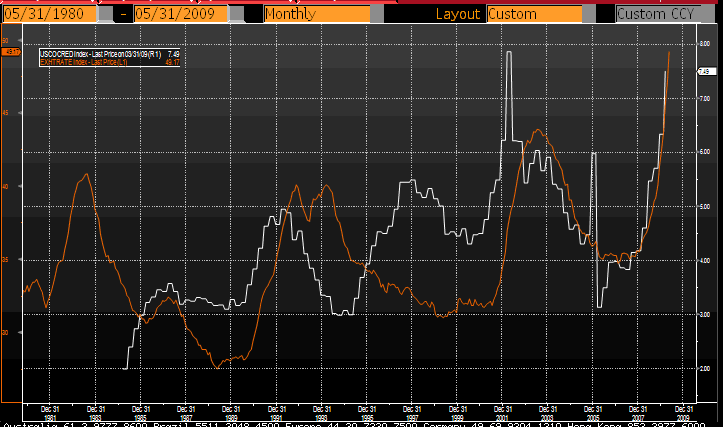
Barry Ritholtz at the Big Picture compares credit card charge off rates to the rate of people who have exhausted their unemployment insurance.


Meanwhile, Glenn Somerville at Reuters reports that initial unemployment claims rose by 15,000 to a seasonally-adjusted total of 627,000.
"Continued claims, which gauge how many Americans were still on jobless rolls after an initial week of claims, rose 29,000 to 6.738 million in the week ended June 13, the latest period for which the data was available."
12. ANOTHER STUDY LINKING US RECESSIONS TO PRICE OF OIL

Sheila McNulty at FT Energy Source reports that Steven Kopits of Douglas Westwood Energy research has released a study which notes that in the last 37 years the US has experienced seven recessions, and that oil has played an important role in each. "In every case when oil consumption breached 4% of GDP, he notes, the US has suffered a recession." Koptis also remarks that every time there has been a sustained rise of more than 50% or more in the price of oil, the US enters a recession. McNulty writes:
"From his research, then, it seems there are three rules by which to avoid recession caused by oil prices:

- Crude oil expenditures should not exceed 4% of GDP.

- Oil prices should not increase by more than 50% year-on-year.

- Oil price increases should not be so great that a potential demand adjustment should have to reach 0.8% of GDP on an annual basis, as shedding demand at this rate has generally been associated with recession."
Kotis' piece graphs nominal and inflation-adjusted crude prices from 1970-2009, shading the periods of US recession.


His work can be found here--well worth reading in full. Meanwhile, Grant Smith at Bloomberg reports that Barclay's Capital technical analysis that crude will fall to below $66/b after having broken through a "Ichimoku cloud" at $70.35/b.
"The so-called Ichimoku cloud is an area bound by two predictive lines on a general-overview chart, the investment banking arm of Barclays Plc said. Crude breached the lower boundary of this cloud at around $70.35 a barrel in New York on June 19, and oil may consequently be dragged towards a support layer around $66 and fall below that, the bank said.

'You still want to be looking to sell,' Barclays analyst MacNeil Curry said in a telephone interview from New York. 'In the sessions ahead, we look for a break of trend-line support at $66.83 to reignite the downtrend,' the bank said in a report."
This analysis comes from a different team, if I understand aright, than the one led by Paul Horsnell in London, which correctly predicted in May that prices were set to breach $70/b--see Daily Sources 5/14 #9.

Thursday, February 26, 2009

Daily Sources 2/26

1. Stefan Wagstyl at the Financial Times has an analysis of the financial crisis's effect upon Central and Eastern European nations which argues that analysis is unjustly grouping them all as one.
"Pavol Demes, a former Slovak foreign minister and head of the CEE office of the German Marshall Fund, a US think-tank, says: 'People are questioning liberal democracy, the markets and the EU. They see countries like France going for national solutions when international solutions are needed. They feel excluded.'

He and others applaud the Czech Republic, holder of the EU’s rotating presidency, for challenging Nicolas Sarkozy, the French president, over suggestions that aid to France’s carmakers might be tied to preserving French jobs rather than those the marques provide in central Europe. Mirek Topolanek, Czech prime minister, spoke for many in the CEE region when he said the response of eurozone countries 'has deformed the joint project of the euro more than any other imaginable event'."


"Whatever happens, different countries are likely to go through the crisis with widely differing results. At one extreme are nations under particularly severe financial pressures, headed by Hungary, Latvia and Ukraine, which have secured IMF rescue packages. At the other stand Poland, the Czech Republic and Slovakia, a base of relative economic stability in the central European heartland. Manfred Wimmer, chief financial officer of Erste Group, the Austrian bank with big CEE operations, warns: 'What’s been lost in this crisis very often has been the ability of people to differentiate.'"
Well worth reading in full.

2. Romano Prodi, former prime minister of Italy and president of the European Commission from 1999-2004, has an opinion piece in the Financial Times which argues that the EU should offer sovereign debt, because "a euro spent to defend the EU as a whole has much more value then a euro spent to defend one individual country."
"[Two] decisions must now urgently be taken at the European level.

The first concerns the EU budget, which is today lower than 1 per cent of the European gross domestic product. This budget should be increased to 1.25 per cent when the 2008-09 budget is revised, targeting and binding the extra 0.25 per cent to extraordinary interventions aimed to reduce the tensions in the EU countries. This measure will greatly help in stabilizing European financial markets.

The second decision concerns the issuance of European public debt notes in addition to, rather than as a substitute for, the Treasury bills of the member states. How to issue, control and use these notes should be the sole responsibility of the finance ministers of the eurozone, in strict agreement with the European Central Bank.

These two tools should be used by Europe to ensure it is proactive and does not end up the passive victim of the financial storms afflicting individual countries."
Well worth reading in full.

3. The Associated Press reports that Naftogaz has asked Gazprom if it could renegotiate its gas contract to take delivery of 33 billion cubic meters, down from the original agreement to take 40. This follows the news last week that the Ukrainian company had posted on its website notice that it would likely have difficulty meeting its payment obligations to Gazprom given the financial crisis. (see Daily Sources 2/19 #6.) A reduction in imports would seem necessitated by the decline in industrial production seen in Ukraine of a startling 28.6% in November alone. GDP decline has also been reported in the double digits and it is unclear whether the IMF has canceled its loan facility to Kiev at this stage or not.

4. Lyubov Pronina, Torrey Clark and Ellen Pinchuk at Bloomberg report that Arkady Dvorkovich, an economic adviser to President Dmitry Medvedev, told the journalists in an interview that Russia has sufficient oil fund reserves to make it through the rest of the year without selling debt. "If market conditions will improve, then the government will start borrowing."

5. Matthew Green at the Financial Times reports that Guy Maurice, managing director of Total Exploration and Production in Nigeria, told an oil and gas conference in Nigeria yesterday that it was ready to participate in the proposed Trans-Saharan natural gas pipeline. Maurice was quoted as saying:
"Total believes this is a long-term strategic diversification for Nigeria, which is quite interesting. I take this opportunity to mention publicly that Total is ready to become involved in this project."
Diversification away from the US, which is Nigeria's largest export market. A map of the proposed route for the pipeline is below, courtesy of the FT:


The pipeline would deliver between 20 and 30 billion cubic meters of natural gas a year to Europe from Nigeria, via Niger and Algeria, at a projected cost of €15 billion (~ $19.1 billion). No consortium has emerged to actually develop the pipeline so far, however, though in September Gazprom became the first international firm to evince interest in the project by signing a MOU with the Nigerian National Petroleum Corporation.
"Gazprom has [most recently] said it would start work in Nigeria by investing at least $2.5 billion to develop government plans to build a network of pipelines and processing plants to harness gas for local use.

'We’re continuing saying that though we are very interested in the Trans-Saharan pipeline, Trans-Saharan starts after the Nigerian gas grid is completed,' Vladimir Ilyanin, managing director of Gazprom’s subsidiary in Nigeria, told the conference."
In September, however, the African Union Commission and the European Commission formed an African-EU "energy partnership" which began the consideration of the trans-Saharan idea, which at the time it had put the potential cost at €7 billion (or ~ $8.9 billion in today's dollars)--see Daily Sources 9/22 #5.)

6. Vandana Hari at Platts reports that a 3E Information Development & Consultants report states that China added 800 kb/d in refining capacity in 2008 and looks set to add an additional 1.3 mb/d in 2009. The report states that total capacity will reach 11.2 mb/d by the end of 2009--a fair bit more than the EIA's latest forecast of Chinese consumption in 2009 of 8.225 mb/d.
"China's secondary refining capacity took an even bigger leap last year, to meet the growing need for light-ends and higher quality fuel in the domestic market, the report said.

Catalytic cracking capacity rose 12.5%, hydrocracking 26.2%, coking 21.3%, reforming 16.8% and hydrotreating 21.3%, 3E said, but did not offer details."
(Catalytic cracking maximizes gasoline production; hydrocracking maximizes diesel and jet fuel production.)
"The Chinese government's stimulus plan for the petrochemicals sector supports refining capacity expansions, 3E noted. 'Quite a few large joint-venture refining and petrochemical projects and giant petrochemical centers with refining capacity of 400,000 to 600,000 b/d each that were previously under early-stage discussions are now officially listed in the state petrochemical rescue plan,' it said."
Given the tremendous amount of additional refining capacity coming online generally all over the Asia Pacific, cracking margins are likely to be very tight--and it will be very unlikely for crude to chase the Asian prices for petroleum products any time soon.

7. Reggie Le at Platts reports that the China Iron and Steel Association (CISA) revised upwards its forecast of steel consumption in 2009 on the back of the stimulus program to 430 million tonnes (or a 5% annual decline) from 390 million tonnes (about a 13.9% decline).

8. Henry A. Kissinger has an opinion piece in the Washington Post which argues that the US cannot expect the political environment in Afghanistan to evolve (toward Western norms) at the same rate at which the military situation does.
"Military strategy should concentrate on preventing the emergence of a coherent, contiguous state within the state controlled by jihadists. In practice, this would mean control of Kabul and the Pashtun area. A jihadist base area on both sides of the mountainous Afghan-Pakistani border would become a permanent threat to hopes for a moderate evolution and to all of Afghanistan's neighbors. Gen. David Petraeus has argued that, reinforced by the number of American forces he has recommended, he should be able to control the 10 percent of Afghan territory where, in his words, 80% of the military threat originates. This is the region where the 'clear, hold and build' strategy that had success in Iraq is particularly applicable."
A must read.

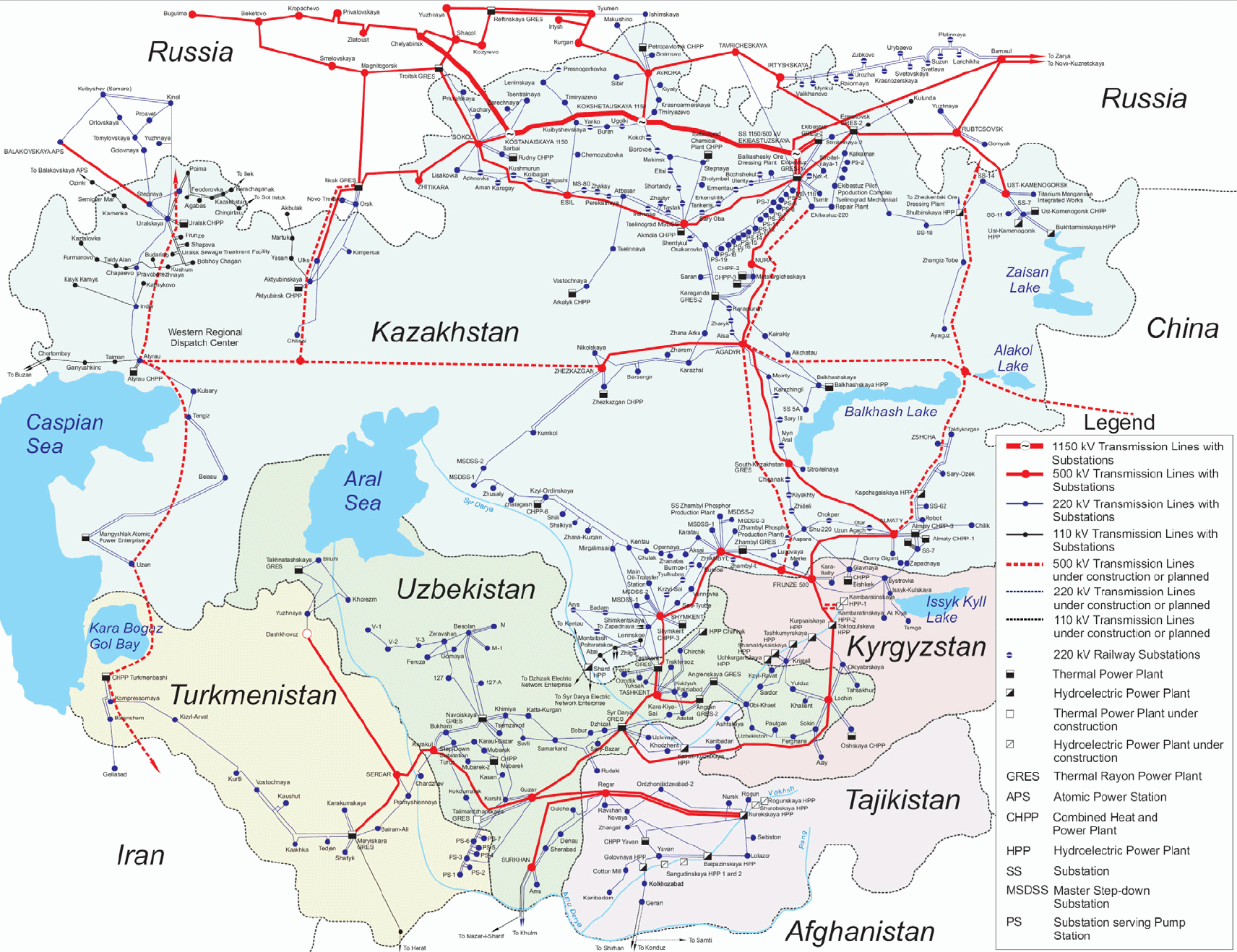
9. Peter Leonard at the Associated Press reports that Kazakhstan announced today that it has withdrawn from the Central Asian power grid, which has forced electricity rationing in northern Kyrgyzstan required to keep the country from overloading its domestic grid. Kazakhstan indicated that it was forced to withdraw by Tajikistan's continual "siphoning" off the grid.
"'As of Feb. 26, Tajik state energy company has made unscheduled use of 84 million kilowatt hours of electricity,' the state-owned Kazakhstan Electricity Grid Operating Company said."


10. The Associated Press reports that the UAE will cut supply in April by an additional 15-17% of various crude streams, including Murban. Murban represents about 60% of UAE total production capacity of about 2.55 mb/d. This cut comes on top of the cut announced in December of 15% (see Daily Sources 12/26 #5) which may put the volume of Murban ADNOC is supplying at about 1 mb/d and total UAE volumes near 1.6 mb/d, though only an educated guess.

11. Elzbieta Rabalska at Platts reports that some traders argue the market for sour crudes--dominated by the Middle East--is tight, and that the price of sweet crudes is chasing price increases in the sour market.
"'It's a very tight market led from sour [crude],' one trading source said Thursday. 'It would be tighter if we weren't seeing product come out of storage. It emanates from the East where there is no production and which relies heavily on OPEC production.'"
12. Lilian Karunungan and Shanthy Nambiar at Bloomberg report that Indonesia's issue of $4 billion in dollar denominated 5 and 10 year sovereign debt was oversubscribed by at least $500 million today.
"'Countries are trying to tap debt markets as quickly as possible in case the situation deteriorates further in the second half,' said Paul Biszko, a senior emerging-markets strategist with RBC Capital Markets in Toronto. 'It doesn’t surprise me that Indonesia is trying to issue.'"
The five year debt is yielding between 10.5-10.75% and the ten year debt 11.75-12%.

13. Janet Porter at Lloyd's List reports that the latest Drewry Container Freight Rate Insight report states that container shipping could see as much as a $68 billion decline in global revenues in 2009, or a fall of a third. The report says that container freight rates are at their lowest levels ever.
"The 42% collapse in all-in rates from South China to Europe since November has been so shocking that Drewry is asking whether the market has veered out of control."


14. Shobhana Chandra and Timothy R. Homan at Bloomberg report that first time unemployment claims rose to 667,000 last week, and the number of people still receiving unemployment benefits rose to 5.112 million.
"February payroll figures, due from Labor next week, may show job cuts exceeded half a million for a fourth consecutive month, according to a Bloomberg survey. The unemployment rate probably climbed to 7.9%, the highest level since 1984."
15. Agence France-Presse reported yesterday that Toshiba won a contract to build two Advanced Boiling Water Reactor (ABWR) nuclear power plants in Texas. If true, I believe the two plants would be the first nuclear power plants built in the US in 40 years, and the first ever ABWR reactors.

16. Keith Johnson at Environmental Capital has an interesting post on the efforts of researchers in New Zealand and Australia to reduce the aggregate flatulence of its sheep and cow herds.
"Globally, however, livestock emissions outweigh emissions from the entire transport sector. Add in emissions from deforestation—which is often a consequence of razing trees for fresh pasture land—the plant and animal world makes up about 40% of global greenhouse-gas emissions."
Vegetarianism does more, therefore, for reducing your carbon footprint than driving a Prius. Short and well-worth reading.