Showing posts with label tibet. Show all posts

Tuesday, July 28, 2009

Daily Sources 7/28

1. MAYER AND WOOD ARGUE THAT CHINA'S ENTRANCE INTO THE WORLD ECONOMY HAS NOT SIGNIFICANTLY DE-INDUSTRIALIZED REST OF DEVELOPING WORLD

Jörg Mayer and Adrian Wood at Vox EU argue that China's integration into the world's economy has not had the effect of substantially de-industrializing other developing nations.
"The biggest possible effect would be for a country which initially produced or exported equal amounts of manufactures and of primary products, where a 15% fall in the ratio would reduce the share of manufactures by 3.5 percentage points.

These estimates are imprecise and subject to error; the true answer may lie outside their range. But there is no plausible modification of the calculations that could make the true answer much larger. This is mainly because, despite its size, China’s opening had only a modest effect on world average endowments. The upper-limit estimates, obtained by simply adding China’s endowments to the rest of the world’s, are a 9% rise (from 0.43 to 0.47) in the share of the global workforce with a complete primary or secondary education, and a 17% fall in the average land/labour ratio, from 2.9 to 2.4 square kilometres of land per 100 workers ... . The average effect on the structure of output and trade in other countries is unlikely to have been larger than these world average endowment changes and was probably smaller.

The significance of the China effect varied widely among developing countries. This is partly because its size varied with the composition of each country’s manufacturing and primary production – how closely its industrial products competed with Chinese exports, and how much demand there was from China for its primary exports (more, say, for copper than for coffee). It is also because there were many other forces acting on sectoral structures--including changes in countries’ own trade policies--whose effects often outweighed those of China."
Worth reading in full.

2. NEPAL HARASSING TIBETAN REFUGEES

Gopal Sharma at Reuters reports that Nepal is responding to pressure from Beijing by cracking down on Tibetan refugees in the country.
"Nepali authorities have regularly broken up protests by Tibetan exiles and arrested them for protesting against China's crackdown on demonstrations in Tibet.

The Washington-based [International Campaign for Tibet] said Tibetan refugees were 'increasingly demoralized' as Nepal 'relinquishes its historic and sovereign interests in response to incentivized political pressure from Beijing and its sympathizers.'

ICT said 'pre-emptive arrests of Tibetans, ID checks and house searches' by authorities were contributing to a 'widespread sense of fear and insecurity' among the exiles.

'Nepal's political leadership is betting that the internal benefits of assuaging China in the cause of oppressing Tibetans will be greater... than the traditional legal and historical concepts,' Mary Beth Markey, Vice President at ICT said."
3. INDIA TO ANNOUNCE SOLAR POWER TARGETS OF 1/8TH TOTAL ELECTRICITY DEMAND, CENTRAL BANK LEAVES INTEREST RATE UNCHANGED ON INFLATION CONCERNS

Krittivas Mukherjee and David Fogarty at Reuters reports that India will announce its targets for solar power generation in September. The plan promises to
"boost output from near zero to 20 gigawatts (GW) by 2020 as it firms up its national plan to fight global warming, draft documents show.

The target, which would help India close the gap on solar front-runners like China, is part of an ambitious $19 billion, 30-year scheme that could could increase India's leverage in international talks for a new UN climate pact in December, one of several measures meant to help cut emissions.

If fully implemented, solar power would be equivalent to one-eighth of India's current installed power base, helping the world's fourth-largest emitter of planet-warming greenhouse gas emissions limit its heavy reliance on dirty coal and assuaging the nagging power deficit that has crimped its growth.

The 'National Solar Mission', yet to be formally adopted by Prime Minister Manmohan Singh's special panel on climate, envisages the creation of a statutory solar authority that would make it mandatory for states to buy some solar power, according to a draft of the plan, which provided detailed proposals for the first time, obtained by Reuters ... ."
Meanwhile, Cherian Thomas at Bloomberg reports that India's central bank decided today to leave its benchmark interest rate unchanged at 3.25%.
"The central bank raised its inflation forecast for the year to March 31 to 'around 5%' from an April estimate of 4%, citing 'elevated' food and commodity prices."
4. EU TO TRAIN SOMALI SECURITY FORCES TO POLICE PIRACY

BBC News reports that the EU has announced plans to train Somali security forces to tackle the piracy plaguing their coasts.
"It will send a planning team to the region next month. The training will take place in neighboring Djibouti, which has French and US military bases."
(h/t Joshua Keating at FP's Morning Brief.)

5. IMF AND LATVIA REACH ACCORD, MAY OPEN UP NEW FUNDING

Aaron Eglitis and Timothy R Homan at Bloomberg report that the IMF and Latvia have reached an accord paving the way for the country to receive its first financial assistance from the organization since December.
"The review may unlock about 195 million euros ($285 million), which the IMF withheld in March after the Baltic country failed to commit to budget cuts, the fund said in an e- mailed statement.

Latvia turned to a group led by the European Commission and the IMF for a 7.5 billion-euro stabilization loan in December after its second-biggest bank needed a state rescue. The IMF announcement followed a 1.2 billion-euro transfer by the European Commission yesterday, helping quell concern about a lats devaluation that may have destabilized currencies across the region."
6. MOUSAVI CALLS FOR NEW STREET PROTESTS NEXT WEEK IN IRAN

Borzou Daragahi at the LA Times reports that opposition candidate Mir-Hossein Mousavi has called for more street protests during religious festivals next week.

7. KENYA TO BUILD AFRICA'S LARGEST WIND FARM

Xan Rice at the UK Guardian reports that Kenya plans to build the largest wind farm in Africa.
"Some 365 giant wind turbines are to be installed in desert around Lake Turkana in northern Kenya – used as a backdrop for the film The Constant Gardener--creating the biggest wind farm on the continent. When complete in 2012, the £533m (~ $758.8 million) project will have a capacity of 300MW, a quarter of Kenya's current installed power and one of the highest proportions of wind energy to be fed in a national grid anywhere in the world."
8. FUEL OIL APPROACHING COST OF CRUDE, HURTS SHIPPING, CHINESE FUEL OIL IMPORTS ROCKET UPWARD (FROM LOW BASE), VIETNAMESE MAIDEN REFINERY TO TAKE SPOT GASOLINE DEMAND OFF MARKET, WALL OF ASIAN PACIFIC REFINING YET TO PLAY OUT

Christian Schmollinger and Alaric Nightingale at Bloomberg report that the price of fuel oil--bunker fuel, the bottom of the barrel, which is used to power ships in great part because it is cheap, generally trading at a considerable discount to crude, is approaching the price of light crude and may surpass it.
"Fuel oil may surpass crude 'for quite some time, six months is possible,' JPMorgan Chase & Co. vice president of energy strategy Vima Jayabalan said in a phone interview from Singapore."
This means that the effect of rising crude prices is having a more pronounced affect upon the cost of shipping than it did during the 2003-2008 run up in the price of crude.
"'It’s really hurting' ship owners, said Parul Bhambri, a Singapore-based analyst at Drewry.

Maersk said May 12 that falling demand for freight hobbled its ability to pass on fuel costs to customers in the first quarter, when its shipping line lost $559 million after taxes, compared with an $80 million profit a year earlier. The shares are down 40% in the past year in Copenhagen trading."


As the price of fuel oil rises, however, many simple refineries, which do not have the equipment to maximize gasoline and diesel output, can become profitable again, which may undergird a recovery in overall crude demand. That said, it still doesn't look like there's much demand for gasoline and diesel out there, which could push down the crack spread and thus the price of crude. Winnie Lee at Platts reports that Chinese fuel oil imports in June were up 6.26% from May and 45.94% from June 2008 to 13.7 kb/d. It's largest supplier was Venezuela. In that vein, Irene Tang at Platt's the Barrel blog reports that the commissioning of Vietnam's first refinery at Dung Quat is poised to erase about 30% of the country's product import demand, which will in turn erase its demand for spot gasoline purchases. The wall of new refining capacity in Asia has yet to fully be appreciated,
"China has now joined India in becoming a major swing exporter of gasoline. Apart from greenfield refineries coming onstream in the country, Beijing's decision to adopt a new products pricing formula for the domestic market and the resulting price revisions in tandem with the global benchmarks has encouraged more speculative buying at the wholesale level, causing wide fluctuations in refiner inventories.

This, in turn, has made Chinese gasoline export volumes unpredictable. The latest customs figures show gasoline exports hit a two-year high of 560,000 mt in June, a 273% surge from the corresponding month of last year. The previous high was in April 2007, at 590,000 mt.

The figures point to Chinese 'apparent' gasoline demand in June being just 1.8% higher than the same month a year ago, a contrast with on-year growth rates of 20.2% in May and 13% in April. The anomaly of the June figure, in the backdrop of staggering double-digit growth rates of automobile sales in China and a 7.7% on-year average gasoline demand growth in the first half of the year, can only be explained by wild swings in stock builds and draws."
"The full impact of the start-up of Reliance Industries' new 580,000 b/d refinery in Jamnagar should be apparent as early as August, as the company's older 660,000 b/d refinery is now restarting from a partial shutdown. Monthly gasoline exports from RIL are expected to more than double to well above 600,000 mt."
9. NIGERIAN REBELS IN SOUTH TARGET OIL MINISTER'S COMPANY, NORTHERN ISLAMISTS CONTINUE UNREST

Platts reports that the Nigerian Joint Revolutionary Council has issued a warning to UK-based independent producer Afren Resources to stop operating in the Niger Delta or risk attacks on its equipment and personnel.
"The Joint Revolutionary Council, which styles itself as a coalition of militant groups based in southern Rivers and Bayelsa states, said in a statement that its ultimatum to Afren was aimed at expressing the group's opposition to the policies of Nigeria's Oil Minister Rilwanu Lukman--policies the group sees as skewed against the Niger Delta region in the country's south.

Lukman was a co-founder of Afren and stepped down from his position as chairman of the company's board of directors once he was appointed oil minister for Nigeria in late 2008. His shares in the company were to be held in a blind trust, the company said in a statement at the time."
Lukman wants to site an oil university in his home state in the north--Kaduna. Meanwhile, Ibrahim Mshelizza at Reuters reports on the increasing Islamist inspired unrest in northern Nigeria.
"The violence was triggered when some members of the group called Boko Haram, which wants a wider adoption of Islamic sharia law across Africa's most populous nation, were arrested Sunday in Bauchi state.

Unrest spread to the northern states of Kano, Yobe and Borno, whose capital Maiduguri is home to the group's leader, Mohammed Yusuf, and has seen the worst violence.


'The situation has been contained in Bauchi and Yobe. The bad situation we have now is in Borno where the leader of the group is residing ... We are going to launch an operation, a main operation to flush them out,' [Nigerian President Umaru] Yar'Adua told reporters after meeting security chiefs and state governors."
10. PRESSURE TO CHANGE DRUG WAR STRATEGY BUILDING IN MEXICO, MEXICAN CRUDE PRODUCTION WAY DOWN

William Booth and Steve Fainaru at the Washington Post report on the growing pressure on Mexican President to change Mexico's "surge" strategy in dealing with its drug cartels.
"Dan Lund, president of the MUND Group polling organization, said public support for Calderón's strategy appears to be weakest in the places where the federal government needs it most. 'In a series of national surveys, polls consistently have found a reasonable but cautious level of support for using the military in the front lines against the cartels,' he said. 'But in all the states where the military is actually deployed, the support goes down, sometimes dramatically.'

The situation has been exacerbated by the global economic crisis, which has cast millions of Mexicans into poverty. José Luis Piñeyro, a Mexican military analyst who maintains close ties with the armed forces, said rising unemployment and poverty 'is creating what I call an "army in reserve,"' for the traffickers.

In Michoacan, La Familia has used the media to try to align itself with the disenfranchised. After the recent attacks, one of its leaders, Servando Gómez, called a local television station and told viewers: 'I want to say to all Michoacanans, we love them and respect them.'"
Meanwhile, there was plenty of stories on the decline in Mexican production last week. John Kingston at the Barrel notes:
"But here's the more stunning figure: what's happened in two years. In July 2007, Pemex reported crude output of 3.165 million b/d. That's a 20.4% decline in 23 months."
11. VATICAN AIMS AT FREE MARKETEERS, SAYING MARKETS WITHOUT ETHICS DESTROY WEALTH AND CREATE POVERTY

Flavia Krause-Jackson at Bloomberg reports that the Vatican has attacked free markets, saying that they have legitimized greed. On June 7, the pope published an encyclical which examined the financial crisis and means out of it, saying that once profit becomes the exclusive goal of business, it destroys wealth and creates poverty.
"Last November, Italian Finance Minister Giulio Tremonti said the pope had pronounced a 'prophecy' in a paper Benedict wrote when he was a cardinal.

In 1985, then-Cardinal Joseph Ratzinger presented a paper titled 'Market Economy and Ethics' at a Rome event on the Catholic Church and the economy. He said a decline in ethics 'can actually cause the laws of the market to collapse.'"
I think it is plain that markets cannot sustain themselves without a modicum of trust, engendered by ethics held in common.

12. CFTC MAY OR MAY NOT REVISE LAST YEAR'S REPORT EXONERATING SPECULATION IN PRICE VOLATILITY, LONDON'S FSA EXONERATES SPECULATORS

Ianthe Jeanne Dugan and Alistair MacDonald at the Wall Street Journal report that the CFTC
"plans to issue a report next month suggesting speculators played a significant role in driving wild swings in oil prices--a reversal of an earlier CFTC position that augurs intensifying scrutiny on investors."
However, I understand that the Chair of the CFTC indicated today that the story in the WSJ that the report will be redone and altered are premature and inaccurate. From the WSJ story,
"In the US, the CFTC begins public hearings Tuesday to determine whether to limit speculative investments in commodities. Congress also is weighing whether to give the CFTC the authority, under a broader proposal to revamp financial regulation, to regulate commodities investments that occur off traditional exchanges. Byron Dorgan, a North Dakota Democrat, has called on the CFTC to curb 'oil speculators looking for a quick buck at the expense of American consumers.'"
I suspect that the direction of these accusations is misdirected, given that commercials may choose to purchase futures to profit on price just as much as to hedge their obligations.


Positions net long and short for the week ended July 21 only comprised 1% of the market. Note that from 2008 open interest--or the total number of contracts--has been steadily falling for both futures and options--though the trend for options was up through February.


If you include options, the number of positions held by traders net long or short represent 3.17% of the market--not an especially large share. Meanwhile, Alistair MacDonald and Carolyn Cui at the Wall Street Journal report that the Financial Services Authority in London has found no evidence that speculators are behind the wild swings in oil price seen from 2008.
"One person familiar with the matter said the FSA had seen no evidence to suggest that speculators are driving up the price of oil.

'More than they ever were before, [investors] are looking to the global economic climate and nobody is sure on that, and that is perhaps driving the volatility,' he said.

Given that view, the FSA doesn't believe that limiting the size of trading positions would be 'beneficial' for the market, said a person familiar with the matter. Still, the FSA acknowledges it doesn't have a 'full explanation' as to why the market has moved the way it has, said a person familiar with the matter.

The FSA's conclusion contradicts British Prime Minister Gordon Brown, who has linked the recent rises in oil to speculation.
...
Politicians around the world are worried about the effect of rising oil prices on the recovery potential of their recession-hit economies. World leaders from French President Nicolas Sarkozy to the leaders of Asia's biggest oil-consuming nations have tied these rises to oil speculators."
"Speculation," of course, is sufficiently vague to represent a politically useful bogeyman, and it seems likely that someone will call financial protectionism. That said, I do think it is in the global economic interest to make the cost of energy--and in particular transportation fuels--more stable and predictable, I just don't think that attacking "speculation" is a particularly productive way of doing so.

13. TRUCKING VOLUMES IN US DOWN 13.6% IN JUNE YOY

The American Truckers Association yesterday announced that their
"advance seasonally adjusted (SA) For-Hire Truck Tonnage Index fell 2.4% in June. In May, SA tonnage jumped 3.2%. June’s decrease, which lowered the SA index to 99.8 (2000=100), wasn’t large enough to completely offset the robust gain in the previous month."
Over June 2008, tonnage fell 13.6%, which exceeded the year over year drop of 11%.
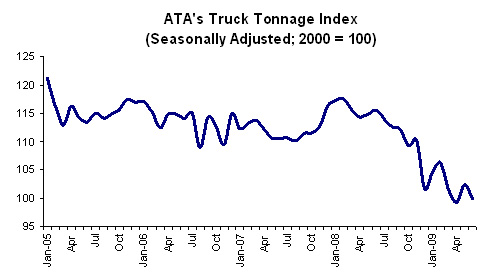


The ATA release warns:
"The sample includes an array of trucking companies, ranging from small fleets to multi-billion dollar carriers. When a company in the sample fails, we include its final month of operation and zero it out for the following month, with the assumption that the remaining carriers pick up that freight. As a result, it is close to a net wash and does not end up in a false increase. Nevertheless, some carriers are picking up freight from failures, and it may have boosted the index. Due to our correction mentioned above, however, it should be limited."
(h/t Barry Ritholtz at the Big Picture.)

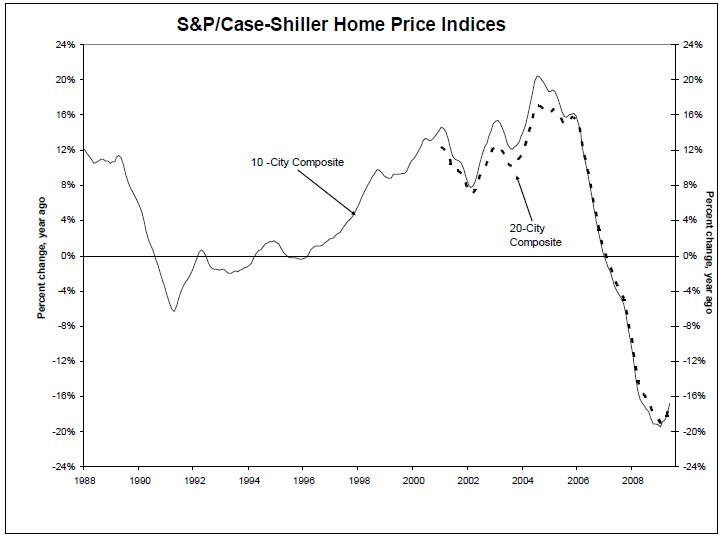
14. HOME PRICE DECLINE SLOWING, CALIFORNIA FORECLOSURES DOUBLE NEW HOME SALES IN JUNE

Barry Ritholtz reports that home price declines are "slowly abating." Here is his graph:


Jake at Econopic picked up on the Big Picture's quote of the day of Mark M Hanson which notes that California foreclosures are more than double the national new home sales for June. His graph:


15. EPA MAY GIVE ALGAE BIG BOOST

Russell Gold at Environmental Capital notes that Blair Carter at the Renewable + Law Blog reports that "that the Environmental Protection Agency will count algae as an advanced biofuel under Renewable Fuel Standard rules being developed."
"Why do EPA’s steps towards including algae matter? Because when Congress created its mandate to blend advanced biofuel into the fuel pool, it created a big market for these fuels. By 2012, the law mandates that two billion gallons of these advanced biofuels be blended, a figure that rises by tenfold by 2022. It’s all in Section 202 of the Energy Independence and Security Act of 2007.

... For algae to be included, the law says it needs to have no more than 50% of the 'lifecycle greenhouse gas emissions' of gasoline and diesel. This could be tricky, says David Woodburn, an alternative energy analyst with ThinkEquity. 'The hard part for me is understanding how the EPA plans to calculate the GHG emissions of algae fuels, based on the variety of feedstocks (sugar, CO2, other), processes (open ponds, photobioreactors), and algae varieties being explored--especially before November,' he says, noting when the rules are supposed to be finished."
Blair Carter's post can be found here.

16. TEXAS DROUGHT GETS WORSE

Tom Benning at the Wall Street Jounral reports on the drought in Texas.
"Nearly 80 of Texas' 254 counties are in 'extreme' or 'exceptional' drought, the worst possible levels on the US Department of Agriculture's index. Though other states are experiencing drought, no counties in the continental U.S. outside Texas currently register worse than 'severe.' In late April, the USDA designated 70 Texas counties as primary natural-disaster areas because of drought, above-normal temperatures and associated wildfires."
The Journal carries an interactive graphic:

Thursday, April 23, 2009

Daily Source 4/23

1. EVERYONE SAYS THAT CHINA AND THE US NEED TO WORK TOGETHER TO RESOLVE THE FINANCIAL CRISIS AND OTHER GLOBAL ISSUES, ESPECIALLY GIVEN BEIJING'S HUGE HOLDINGS OF US$ ASSETS, WHICH HAPPENS TO MIRROR FRANCE'S SITUATION IN THE GREAT DEPRESSION ... MEANWHILE CHINESE ECONOMIC DATA MIXED AND BEIJING WARNS TOKYO ON YASUKUNI SHRINE AND US ON DALAI LAMA

Brad Setser at Follow the Money reports that the IMF Global Financial Stability Report implies that going forward the only country with a significant trade surplus globally will be China.
"If oil averages $50 or so this year and $60 or so next year--and if intra-European surpluses and deficits are netted out--the world’s macroeconomic imbalances reduce to the United States external deficit (which the IMF estimates will be under 3% of US GDP in 09), a somewhat smaller EU deficit and China’s 10% of GDP surplus.

On the surplus side of the global ledger, the IMF forecasts that there will soon be China--and almost no one else."
Setser comments:
"[The IMF seems to expect] China’s surplus [will] continue to fuel Chinese reserve growth and thus the buildup of Chinese government claims on the US and Europe. And, implicitly, China’s government would risk ever larger losses on its ever growing foreign portfolio--at least so long as China finances the world by buying dollars and euros, not making yuan-denominated loans."
Sky Canaves at China Journal reports that the latest reading of the Nielsen Global Consumer Confidence Index has 65% of Chinese respondents stating that there is no recession in the Middle Kingdom. However, Ms. Canaves notes:
"Perhaps it is a face-saving gesture, as Chinese consumers appeared more ready to admit declining confidence on a personal, rather than national, level. China’s consumer confidence index also fell by seven points over the last six months, though from 96 to 89, putting it well above the global average. (The survey has a baseline of 100, and by way of comparison, US consumers were slightly more confident than average, at 80)."
Perhaps some respondents were afraid of angering the authorities as well. On the other hand, in her weekly roundup of global economic data, Rebecca Wilder at News N Economics notes that Chinese retail sales are up 14.7% year on year in March. Her graph:


Returning to the first hand,China Stakes reports that the China Electricity Regulatory Commission expects a 4% decline in power generation in April (from March, or so I infer).
"According to statistics from the State Grid, power generation dropped 0.7% year on year in March, after a rise of 5.9% in February and a fall of 12.3% in January. Experts believe the fallback indicates economic uncertainties. State Grid figures also show that power generation in the first quarter of this year dropped 2.25%, year on year."
And Olivier Accominotti has the especially interesting post at VOX which points out that China's huge volume of dollar reserves is paralleled by the situation facing France as it entered the Great Depression:
"Economic history offers one striking example of a country being trapped by the huge volume of its foreign reserves. This country was France, the period was the early 1930s, and the currency at stake the pound sterling. The episode ended up dramatically. Sterling suffered a major currency crisis, French authorities lost a lot of money, and their subsequent policy largely contributed to the Great Depression.

The origin of the problem lay in the government’s decision of 1926 to peg the franc to the sterling and dollar, two years before re-establishing the gold standard. Since the trade balance was in surplus and capital was flowing into the country, this goal was achieved through public purchases of foreign exchange. The Bank of France therefore accumulated a bulging portfolio of foreign holdings. At the end of the 1920s, the country held more than half of the world’s volume of foreign reserves."
At the time, the Bank of France room for action was limited by the size of its position, it could not sell large amounts of Sterling without causing a collapse in its value and thus its key holding. The bank was eventually forced to reverse its sales and support the Pound.
"When the pound eventually collapsed, the Bank of France was put into a state of technical bankruptcy. It was only able to survive thanks to a state’s rescue, obtained under tough conditions. Moreover, there were now rising fears over the dollar. The will to avoid further losses therefore led authorities to convert all their dollar assets into gold, a policy that heavily contributed to the global monetary contraction of the 1930s."
Well worth reading in full. And Former Secretary of Defense, William Cohen, has an opinion piece in the Wall Street Journal arguing that "Virtually no global challenge can be met without China-US cooperation." Key excerpt:
"The most immediate opportunity for cooperation is in confronting the international financial crisis. China currently holds $2 trillion worth of largely US dollar-denominated foreign exchange reserves, and it is by far the world's largest holder of US government debt. As the Obama administration increases that debt to finance its economic stimulus plan, China will almost certainly be called upon to purchase the lion's share of new US debt instruments. China also has an interest in working with the US to ensure those efforts succeed, because it depends on economic growth in the US (still its largest single trading partner) to ensure stability at home.

There is a compelling need to create a new dialogue on finance and economics. This conversation began with President Barack Obama and Chinese President Hu Jintao's discussions at the G-20 summit this month in London. Meetings between US and Chinese leaders have been dubbed the 'G-2' by some to reflect the crucial role of economic negotiations between our two countries. This first meeting between the two men, and the agreement reached by world leaders at the close of the summit, mark a positive beginning to the effort to harmonize our financial management and banking regulatory practices, and explore ways to expand bilateral trade opportunities in areas such as energy and environmental technologies."
Cohen also makes special mention of greenhouse gas emissions, the nuclear dilemma in North Korea, and efforts to put an end to the opium trade originating in Afghanistan. Well worth reading in full. In the meantime, the Associated Press's Gillian Wong reports that the Chinese Foreign Ministry Spokesperson stated that it would take umbrage were President Obama to meet with the Dalai Lama when he visits the US in October.
"We firmly oppose the Dalai's engagement in separatist activities in any country under whatever capacity and under whatever name. We have made representations to the United States urging the U.S. to honor its commitments and not allow the Dalai to engage in separatist activities in the United States."
In addition, AFP reports that the Foreign Ministry Spokesperson "expressed concern" over Japanese Prime Minister Taro Aso's Tuesday visit to the Yasukuni shrine:
"The Chinese side has already expressed to the Japanese side through diplomatic channels our serious concern and dissatisfaction. [We] reiterated that the question of history is highly sensitive, that any mistaken action by the Japanese side will bring a serious and negative influence to bilateral relations."
2. JAPANESE DEMOGRAPHY PRESENTS SPECIAL DIFFICULTIES IN RECESSION, LOOKING FOR STRATEGIC OIL SUPPLY BASED IN BRAZIL

Hiroko Tabuchi at the New York Times reports that the Japanese government is offering to pay foreign workers thousands of dollars to return home and pay for their airfare if they promise never to return.
"In 1990, Japan--facing a growing industrial labor shortage--started issuing thousands of special work visas to descendants of these emigrants. An estimated 366,000 Brazilians and Peruvians now live in Japan.

The guest workers quickly became the largest group of foreign blue-collar workers in an otherwise immigration-averse country, filling the so-called three-K jobs (kitsui, kitanai, kiken--hard, dirty and dangerous).

But the nation’s manufacturing sector has slumped as demand for Japanese goods evaporated, pushing unemployment to a three-year high of 4.4%. Japan’s exports plunged 45.6% in March from a year earlier, and industrial production is at its lowest level in 25 years."
The demographic challenge of producing economic growth solely via boosts in productivity as population declines remains a dilemma for Tokyo. In the meantime, Takeo Kumagai at Platts reports that Petrobras is in talks with the Japan Bank for International Cooperation about establishing a "strategic oil supply."
"'We do not have a clear structure yet. We are still discussing a framework, conceptions of transaction,' [Petrobras CFO Almir] Barbassa said. 'As JBIC has been an important finance source for Petrobras, we are leading further development, an opportunity where Japan can be supplied if they need oil.'

'This is not to sell crude oil right now,' Barbassa said. 'This is the strategic oil supply in five years for example if there is lack of oil. We can grant some volume of oil.'"
Japan sources the vast majority of its crude imports from the Middle East and has nearly no domestic production.

3. BANK ROSSI CUTS ITS BENCHMARK LENDING RATES; ARMENIA AND TURKEY ESTABLISH FRAMEWORK FOR THE NORMALIZATION OF RELATIONS, WHICH MAY CAUSE BAKU TO CHOOSE TO SEND MORE NATURAL GAS THROUGH RUSSIA, AS OPPOSED TO WESTERN BACKED CAUCASIAN ROUTES

Emma O’Brien and Alex Nicholson at Bloomberg report that Bank Rossi cut its key benchmark interest rates today, effective tomorrow. It cut the refinancing rate by 0.5% to 12.5% and the repurchase rate charged on central bank loans by 0.5% to 11.5%. "Rates could be reduced further should inflation continue to slow, First Deputy Chairman Alexei Ulyukayev said today, according to the Interfax newswire."

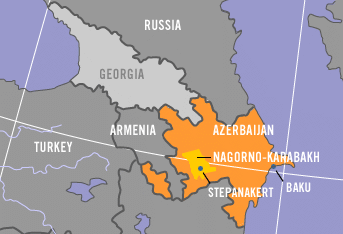
And in a surprising development, Thomas Grove at Reuters reports that Turkey and Armenia have agreed on a framework to normalize ties after Ankara cut them and closed the border in 1993 in solidarity with Azerbaijan in its dispute with Armenia over Nakorno-Karabagh.
"'The two parties have achieved tangible progress and mutual understanding in this process and they have agreed on a comprehensive framework for the normalization of their bilateral relations,' the foreign ministries of both countries said late on Wednesday, without elaborating."
Nagorno-Karabagh is an ethnic enclave of Armenians inside Azerbaijan.


War erupted between Armenian secessionists and Baku in 1991 with the result that the Armenians wresting control of the region. A cease fire was signed in 1994 with Armenia continuing to exercise its control over the area.
"Some analysts have warned a Turkey-Armenia thaw may put at risk gas deals to boost exports to Europe.

'If Azerbaijan feels that Turkey is betraying them, then why would Azerbaijan not move in a Russian direction? And the Russians are offering to buy all their gas at European prices,' Svante Cornell, research director at the Central Asia-Caucasus Institute said.

A key supplier of oil and gas to Turkey and Europe, Azerbaijan said Armenian troops should be withdrawn from Nagorno-Karabakh during the normalization process.

'The opening of the Armenian-Turkish border cannot take place without a process to resolve the conflict over Nagorno-Karabakh,' Azeri Foreign Ministry spokesman Elkhan Polukhov said."
On April 17, following a meeting with Azeri President Ilham Aliyev, Russian President Dmitri Medvedev told reporters "We have a very high chance of entering a full-blown agreement" on natural gas supply from Azerbaijan through Russia--see Daily Sources 4/17 #4.

4. SWAT MILITANTS TAKE ADVANTAGE OF SHARIA DEAL TO OCCUPY ITS SOUTHERN NEIGHBOR

In a very worrisome development, the Associated Press reports that Taliban militants who have recently struck a deal to impose Sharia on Swat Valley have entered neighboring Buner Province in large numbers. Inside Buner they have set up checkpoints and started patrolling roads.


Government paramilitaries are being rushed to the region to protect federal government buildings and infrastructural nodes and have reportedly exchanged gunfire with the militants.
"[A] meeting between tribal elders and the Taliban on Thursday in Daggar, Buner's main town, ended without any indication that the Taliban would withdraw.
...
Two Taliban representatives declined to comment after the meeting, driving away in a pickup truck full of gun-toting associates. However, a Taliban leader who goes by the name Commander Khalil said the militants had agreed to stop patrolling in Buner, though they would still keep armed guards in their vehicles.

'We are here peacefully preaching for Sharia. We don't want to fight,' Khalil told an AP reporter by phone.

Another Taliban leader, Maulana Muhammad Bashir, said the militants had agreed not to target those who had opposed them in the past in Buner--a key demand of local leaders, some of whom had raised tribal militias to fight the Taliban."
Clearly if the Taliban cannot be convinced via compromises to pursue its political aims peacefully, then Islamabad has little option but to allow the civil war to spread.

5. THE UN DELIVERS ITS RECOMMENDATIONS RE: KIRKUK; IRAQI SECURITY FORCES CLAIM THEY HAVE CAUGHT AL-QAEDA IN IRAQ LEADER

Corinne Reilly at McClatchy Newspapers reports that the UN's recommendations on how to resolve the dispute of Kirkuk was distributed to all parties yesterday. The details of the recommendations were not made public, but reportedly included four options for handling Kirkuk. Analysts were skeptical it would produce any solutions:
"'I think everyone will reject the report's findings,' said Joost Hiltermann, the International Crisis Group's senior Iraq analyst. 'I think it presents a brilliant opportunity for compromise, but I'm not convinced either party is ready for that. Both likely think they can win more if they fight.'"
In the meantime, Mark Lynch at the Abu Aardvark's Middle East blog reports that Iraqi security forces have claimed they have captured Abu Omar al-Baghdadi, the Emir of the Islamic State of Iraq (al-Qaeda in Iraq). Lynch comments:
"How much does it matter, if true? Depends on how much you think 'al-Qaeda' is responsible for the recent uptick in violence and the ongoing hot conflict in the northern cities. My guess is that some portion of the recent wave of violence has to do with the disintegration of the Awakenings experiment -- either actively, through the return to the fray of some of the "former" insurgents who populated its ranks than by the remnants of AQI, or passively as they stop working as vigilantly to prevent attacks. Such Sunni groups are not part of AQI or the ISI, and indeed have been fighting against them bitterly for several years. To the extent that a significant portion of the recent violence is driven by their political struggles, then damping it back down requires a political solution with the Iraqi government. Hurting AQI by getting Baghdadi won't do a thing to address the mounting complaints of these non-AQI Sunnis over the Maliki government's foot-dragging on integration of the Awakenings into the security forces, selective repression of various Awakenings leaders, and so forth."
6. EGYPT OFFICIALLY INVITES NETANYAHU FOR A VISIT

BBC reports that Cairo has officially invited Israeli Prime Minister Benjamin Netanyahu to visit Egypt.
"During the Jerusalem talks [between Mr. Netanyahu and Egyptian intelligence chief Omar Suleiman], Mr. Netanyahu told Mr. Suleiman that 'Israel and Egypt have common interests, and the most important one is peace,' Israel's Haaretz newspaper reported."
7. THE CONTANGO IN OIL JUST WON'T GO AWAY

Jonathan Saul at Reuters reports that nearly 100 million barrels of oil is being stored in supertankers at sea per Frontline, the highest level seen since 1991--mirroring the stocks data in the US where commercial crude in storage is at the highest levels seen since September 1990.
"One London-based analyst estimated that the current rate for 30-90 days storage using vessels was $37,500 a day, down from $55,000-$60,000 a day during the first quarter of 2009, making storing oil a cheaper option now."
For VLCCs (which hold about 2 million barrels of oil) that works out to about a $1.68/b for 90 days and $0.56/b for 30. The month 3 contract for sweet light at NYMEX closed yesterday at a $3.34/b premium to front month. The month 2 contract closed at a $1.85/b premium to front. Daily global oil consumption is running at about 84 mb/d, so 100 mb represents about a 1 1/5 days of global consumption.

8. MORE DISMAL NEWS ON THE US ECONOMY

Tom Krisher at the Associated Press reports that GM is set to idle nearly all of its factories in the US for 9 weeks this Summer to reduce inventory.
"One of the people briefed on the plan said details are still being worked out. Some of the closings could be staggered between mid-May and the end of July, but the exact number of plants to be idled has not yet been determined."
In addition, Jeff Bater and Maya Jackson Randall at the Wall Street Journal reports that existing home sales, or "home resales," fell by an rate of 3% for annual sales ended March over annual sales ended February per data released today by the National Association of Realtors. The median price was down 12% from a year earlier. Meanwhile:
"Initial claims for state jobless benefits grew 27,000 to 640,000 in the week ended April 18, the Labor Department said in a weekly report Thursday.

Wall Street economists had expected a 30,000 rise, according to a Dow Jones Newswires survey. The prior week's level was revised to 613,000, which is 2,000 higher than the 610,000 level initially reported."

Wednesday, March 25, 2009

Daily Sources 3/25

1. Jason Clenfield at Bloomberg reports that Japanese exports fell 49% in February year-over-year. Shipments to the US fell 58.4%. Automobile exports fell 70.9%. "Exports to Europe dropped a record 54.7%, shipments to Asia declined 46.3% and goods sent to China slumped 39.7%." Imports fell 43%.

2. Geoffrey A. Fowler at China Journal reports that Beijing's decision to shut down access to youtube.com coincided with the release on March 20th of a video by the Tibetan government in exile of Chinese security forces beating Tibetan protesters. This is the offending video:


Karin Brulliard at the Washington Post reports that a peace conference which was to publicize the role of sports in unity and the reconciliation of differences was canceled today because the South African government had denied the Dalai Lama the visa required for his attendance.
"Two of three South African Nobel peace laureates who had invited the Tibetan leader, retired Archbishop Desmond Tutu and former president FW de Klerk, said Monday that they would boycott the event, and organizers said the third, former president Nelson Mandela, would probably do the same. The Norwegian Nobel Committee also backed out."
A spokesman for South African President Kgalema Motlanthe told the media that South Africa would not welcome the Dalai Lama under any circumstances nor at any time.

3. Peter Stein at China Journal reports that Fan Gang, the head of China's National Economic Research Institute and a member of the People's Bank of China's monetary policy committee, responded to President Obama's televised remarks yesterday today by saying:
"Of course [an alternative is necessary] in the long run, if we want to avoid the cyclical problems associated with the dollar standard."
Mr. Fan also addressed the question of managing the renminbi.
"Fan says while China is eager to keep its currency stable, there is pressure to let the yuan fall-—'not just domestic pressure, but regional pressure,' as other Asian currencies weaken, making them more competitive. Rather than let the yuan fall against the dollar, he suggests that China should make reference more to the other currencies in the basket it uses to set the yuan’s exchange rate. 'Eventually, China’s currency should be related to other currencies, not just the dollar,' he says.

Fan worries that the Fed’s quantitative easing is raising the risk of dollar inflation and devaluation, which 'is a concern not just for China but for everyone.'"
(By the way, the Federal Reserve Bank of Atlanta's macroblog had a post yesterday by SVP in charge of research for the Atlanta Fed, David Altig and Daniel Littman, an economist at the Cleveland Fed, which was at pains to show that the Fed's move is not, strictly speaking, "quantitative easing." The reason (basically): quantitative easing is about increasing liabilities only--or quantity of bank reserves from the perspective of central banks--whereas the FOMC's most recent move was also explicitly about increasing the number of assets on the Fed's balance sheet. h/t Mark Thoma at Economist's View.)

Meanwhile, Phil Izzo at Real Time Economics reports that in a conference hosted by the Wall Street Journal yesterday Paul Volcker seemed to be both reassuring to Beijing while simultaneously dismissive of the primary complaint. The former head of the Fed and current chair of the White House’s Economic Recovery Advisory Board, said that the US's greatest strengths were its history and reputation, and that that shouldn't be put at risk by deliberately inducing inflation:
"One historic way of getting yourself out of this situation—-or trying to—-is to inflate. Either you do it deliberately or you allow it to happen. And if we permit that to happen then I think all these dollars will come tumbling down on us. I get a little nervous when I see the Federal Reserve announcements that they want have the amount of inflation that’s conducive to recovery. I don’t know what ‘the amount of inflation that’s conducive to recovery’ would be appropriate. I’d much rather they say that they want to maintain stability in the currency, which is conducive to confidence and recovery."
All of which would seem to reassure Beijing. On the other hand, Volcker appeared unmoved by the naif taken advantage of by slick Uncle Sam act coming from Beijing:
"I think the Chinese are a little disingenuous to say, ‘Now isn’t it so bad that we hold all these dollars.’ They hold all these dollars because they chose to buy the dollars, and they didn’t want to sell the dollars because they didn’t want to appreciate their currency. It was a very simple calculation on their part, so they shouldn’t come around blaming it all on us."
Indeed, were Chinese long term strategy to include dislodging the dollar from its reserve currency status, perhaps the policy of overloading the US with debt long after it was clear that the debt was unsustainable would be a reasonable policy.

Meanwhile, China Daily News today reported that the government raised "the benchmark retail prices of gasoline by 290 yuan (US$42.46) per ton, or 5%, and diesel by 180 yuan per ton, or 3.7%." The National Reform and Development Commission did not specify whether the increases were for factory gate prices or retail prices. Either way, the decision should put downward pressure on demand for gasoline and diesel. The prices are well above comparable US prices.

4. Eurointelligence notes that the vote of no confidence removing Czech Prime Minister Mirek Topolánek from office yesterday basically means that the largest obstacle to the Lisbon Treaty is now the Czech Republic.
"[The] really worrying aspect of the Topolanek resignation lies in the politics of Lisbon ratification. The Czech parliament’s lower house has accepted the Treaty, but the Senate has yet to vote. [Jean] Quatremer quotes MEP Elmar Brok as saying that this could mean the end of the Lisbon Treaty."
P O Neill at Fistful of Euros reports that in a speech to the European Parliament today, Topolánek said:
"that President Barack Obama’s massive stimulus package and banking bailout 'will undermine the stability of the global financial market.' … Topolanek bluntly said that 'the United States did not take the right path.'

He slammed the US’ widening budget deficit and protectionist trade measures — such as the 'Buy America'-—and said that 'all of these steps, these combinations and permanency is the way to hell.' 'We need to read the history books and the lessons of history and the biggest success of the (EU) is the refusal to go this way,' he said.

'Americans will need liquidity to finance all their measures and they will balance this with the sale of their bonds but this will undermine the stability of the global financial market,' said Topolanek."
5. Anna Shiryaevskaya at Platts reports that Gazprom may exercise its option--which expires in April--of purchasing a majority stake in gas fields in West Siberia and a 20% stake in oil production company Gazprom Neft from Italian oil and gas companies Eni and Enel. The assets were purchased by Eni and Enel in the April 2007 tender of Yukos properties. A deal to purchase the assets might be announced in Italian Prime Minister Silvio Berlusconi's April 6-7 visit to Moscow.

6. Simone Meier at Bloomberg reports that Munich's Ifo Institute's business climate index, based on a survey of 7,000 executives, fell to 82.1 from 82.6 in February.
"Ifo’s gauge of current conditions declined to 82.7 from 84.3. Still, the measure of expectations increased to 81.6 from 80.9.

'The Ifo’s absolute level is still depressingly low,' said Carsten Brzeski, an economist at ING Group in Brussels. 'Nevertheless, the gradual improvement of the Ifo’s expectation component is at least a tender green shoot of stabilization.'"
7. Doris Leblond at the Oil & Gas Journal reports that at a press conference yesterday meant to officially launch France's adoption of countrywide 10% ethanol requirement in gasoline in fact let the public know that the initiative would take longer to complete than previously thought. Jean-Louis Schilansky, president of the oil trade group UFIP, said at the conference that he expected 75% of the country's retail station network would offer 10% ethanol gasoline by the end of the year.
"The government's purpose in introducing the E10 at least 5 years ahead of the EU is that is should reduce carbon dioxide emissions in France by 1 million tonnes/year by 2010."
8. David Jolly at the New York Times reports that the IMF announced via a communique from Washington that it would provide a $17.5 billion loan to Romania under a two-year stand by arrangement. An additional $9.7 billion loan from the European Union and other bodies will be forthcoming as part of an international stabilization package.

9. A post of Willem Buiter, which originally appeared on his Maverecon.com blog, was reposted on VOX EU arguing that the eurozone is vulnerable because there is no single fiscal organization that can recapitalize either the European Central Bank or cross border financial institutions when they make systemically dangerous decisions.
"When the Bank of England develops an unsustainable hole in its balance sheet, Mervyn King knows he only needs to call one person: Alistair Darling, the UK Chancellor of the Exchequer. If the Fed were to become dangerously decapitalised, Ben Bernanke also needs to call just one person, Timothy Geithner, the US Secretary of the Treasury.

Whom does Jean-Claude Trichet call if the Eurosystem experiences a mission-threatening and mandate-threatening capital loss? Does he have to make 16 phone calls, one to each of the ministers of finance of the 16 Eurozone member states? Or 27 phone calls, one to each of the ministers of finance of the 27 EU member states whose national central banks are the shareholders of the ECB? I don’t know the answer, and I doubt whether Mr. Trichet does.

This situation is intolerable. We need a fiscal Europe ... ."
10. Travis Pantin at the UAE National reports that the Gulf Cooperation Council secretariat decided at a conference in Manama yesterday that the original deadline for a common currency for the member nations of January 1, 2010, is untenable.
"Although the GCC states still plan to complete preliminary steps to prepare for introducing the common currency by December, the process will not be finalised until a dedicated GCC monetary council is created towards the end of this year.

'As soon as the monetary council is ratified by the member states, one of its tasks is to set the new timetable for introducing the physical currency,' said Nasser al Kaud, the deputy of the assistant secretariat general for economic affairs at the GCC."
The GCC, minus Oman, agreed to create a monetary council as a prelude to a joint central bank and monetary union in an accord late last year--see Daily Sources 12/30 #4. The GCC originally decided to form a monetary union by 2010 in 2001.

11. Upstream online.com reports that Oil Minister Hussain Shahristani told the media today that the Kurdistan Regional Government refuses to allow oil to be exported from the country via the national oil pipeline network.
"'Work is continuing to connect the (northern oilfields) to the Iraqi network. But there are objections from the KRG to handing over the oil, claiming that companies that developed the oilfields should be rewarded,' Reuters quoted Shahristani saying in an interview published in today's pan-Arab Asharq al-Aswat A newspaper."
12. The AFP reports that Morocco has begun a clampdown on Shia worshipers in the primarily Sunni country.
"The independent Arabic-language newspaper Al Jarida Al Aoula has reported that dozens of people suspected of having Shiite sympathies have been arrested since Friday in Tangiers in the north, Essaouira in the south and Ouyazze 120 kilometres (75 miles) north of Rabat."
The country simultaneously began a clampdown on homosexuality. Morocco cut ties with Iran a few weeks ago in response to the statement by a former speaker of the Majlis calling Bahrain the 14th province of Iran.

13. Mary Beth Sheridan at the Washington Post reports that Secretary of State Hillary Clinton today begins a trip to Mexico, the first of three cabinet level visits to the country which will precede President Obama's scheduled visit there from April 16-7.
"A senior State Department official said Clinton's trip will highlight the broad range of issues on which the neighbors interact. Mexico is the United States' third-largest trading partner and maintains close contacts with U.S. officials in areas ranging from agriculture to immigration.

'The idea of this trip is to not allow Mexico to be pigeonholed by one or two issues,' the official said Tuesday, briefing reporters on condition of anonymity. That approach will undoubtedly please Mexican authorities, who have angrily rejected suggestions by US military officials that the country could increasingly become ungovernable or even turn into a 'failed state.'"
Spencer S. Hsu and Joby Warrick at the Washington Post report that yesterday the Obama Administration announced that it would move 450 law enforcement officers to the border of Mexico to help combat violence erupting from conflicts with the drug cartels.
"Instead of proposing a costly new package, federal officials said they will redirect resources to cut off the financial lifelines supporting the cartels, in particular the estimated $18 billion to $39 billion in cash, wire transfers and other smuggled payments moving each year from the United States to Mexico.

The other US focus is 'to get its own house in order,' O'Neil said, increasing enforcement against the 90% of guns from the United States that are used in crimes in Mexico and acknowledging a $65 billion domestic market for illegal drugs that drives demand."
"Acknowledging" that US demand is the reason for the drug cartels' success in Latin and South America does nothing. Either steps towards ending this Prohibition need to be taken or the US needs to seriously target consumption. What does it mean to have outlawed cannabis and cocaine when our current and the last two presidents--at the very least--have admitted to their consumption?

14. Bryan Keogh and Andrea Jaramillo at Bloomberg report that Peru will sell 10 year dollar denominated bonds yielding 4.5% more than US treasuries. It is the first dollar-denominated debt the country will have sold in two years and Lima has hired Goldman Sachs and JP Morgan Chase to manage the sale. In September it was reported that foreign banks account for about 51% of Peru's financial system--see Daily Sources 9/30 #4. In January, two months after hosting an APEC conference, Peru's finance minister told the press that Lima was in talks with both the Fed and the People's Bank of China to arrange dollar swaps for the sol--see Daily Sources 1/15 #14.

15. Courtney Schlisserman at Bloomberg reports that US durable goods orders rose by 3.4% in February from January. "Excluding transportation equipment, orders gained 3.9 percent, the most since August 2005."

16. The EIA reported that for the week ended March 20 crude stocks grew by 3.3 million barrels to 356.583 million barrels, the largest commercial stockpile of crude seen in the US since July 23, 1993. According to a Bloomberg survey, Wall Street analysts had expected a 1.1 million barrel build. Gasoline stocks fell by 1.1 million barrels versus analyst expectations of a 650 kb drop, and are at the top of the historical range for this time of year. Distillate stocks fell by 1.6 million barrels versus Wall Street expectations of a 100 kb drop, and are well above the historical range for this time of year.

Thursday, March 12, 2009

Daily Sources 3/12

1. Edward Cody at the Washington Post reports that France will return to a full membership in NATO after a 43 year departure.
"'The time has come,' [President Nicolas Sarkozy] said in a speech to France's Strategic Research Foundation, adding, 'Our strategy cannot remain stuck in the past when the conditions of our security have changed radically.'"
I never thought I'd see it happen.

2. Platts reports that Prime Minister Putin said today that Russia will not fine Naftogaz for not taking the contracted for volumes of natural gas from Gazprom. Quote:
"[We] forgive these fines because we understand the reality--they have nothing to pay with. They are on the verge of bankruptcy, and you understand perfectly well that you can't kill your partner, because it will then not be capable of anything."
3. Eurointelligence reports that the US is calling for the tripling of funds available to the IMF in preparation for the G20 meeting in London this weekend. "Geithner also said that each G20 country should set a target of spending 2% of GDP for 2009 and 2010 in fiscal stimulus, and that the IMF should monitor progress towards that goal." David Cho and Anthony Faiola at the Washington Post reports that the Administration will ask Congress for nearly double the US commitment to the IMF to $100 billion.

4. Edward Wong at the New York Times reports that China has officially protested the passage of non-binding resolution H. Res. 226 passed by Congress yesterday. In a news conference today, Chinese foreign ministry spokesman Ma Zhaoxu, said that the resolution "makes groundless accusations against China’s religious policies" and "rudely intervenes in China’s internal affairs." HR226 was introduced on Monday and passed on Wednesday with a roll call vote of 422-1. Key language:
"Resolved, That the House of Representatives--

(1) recognizes the Tibetan people for their perseverance in face of hardship and adversity in Tibet and for creating a vibrant and democratic community in exile that sustains the Tibetan identity;

(2) recognizes the Government and people of India for their generosity toward the Tibetan refugee population for the last 50 years;

(3) calls upon the Government of the People's Republic of China to respond to the Dalai Lama's initiatives to find a lasting solution to the Tibetan issue, cease its repression of the Tibetan people, and to lift immediately the harsh policies imposed on Tibetans, including patriotic education campaigns, detention and abuses of those freely expressing political views or relaying news about local conditions, and limitations on travel and communications; and

(4) calls upon the Administration to recommit to a sustained effort consistent with the Tibetan Policy Act of 2002, that employs diplomatic, programmatic, and multilateral resources to press the People's Republic of China to respect the Tibetans' identity and the human rights of the Tibetan people."


5. Tracy Withers at Bloomberg reports that the Reserve Bank of New Zealand cut its benchmark rate by 0.5% to 3%.

6. Seyoon Kim at Bloomberg reports that the Bank of South Korea today decided to leave its benchmark interest rate unchanged at 2%.
"South Korea’s government said today it will provide cash, loans, school fees and other financial incentives valued at 6 trillion won to help those on lower incomes cope with rising unemployment. The aid package will use funds from the extra budget being proposed this month, the finance ministry said.

Bank of Korea Governor Lee said he expects the government to propose 'a significant' extra spending package, financed through bond sales. The central bank will watch the effect of debt sales on financial markets as it decides whether to purchase bonds, he added.

'The Korean economy is likely to remain in recession due to the persistent weakness of both domestic and overseas demand.'"
7. Juan Cole at Informed Comment has a pretty good overview of the situation in Pakistan as the government there rounds up lawyers involved in this year's long march under Section 144 of the Criminal Procedure Code. Cole concludes that the situation is rapidly becoming an open invitation to the military to take over again.

8. Andre Soliani and Joshua Goodman at Bloomberg report that the policy makers at the Brazilian central bank unanimously voted to cut the benchmark interest rate by 1.5% to 11.25% last night.
"The central bank, in a statement accompanying its decision, said it would evaluate the 'magnitude and speed' of 2.5 percentage points in cuts since January and their cumulative effect before deciding on its next steps."
9. Daniel Cancel at Bloomberg reports that Barclay's analyst Alejandro Grisanti said in a speech today in Caracas that Venezuelan GDP was likely to contract by 4.1% in 2009.

10. Vanessa Ronsisvalle and Beth Evans at Platts reports that the EU imposed anti-dumping duties on imports of US biodiesel today.
"The anti-subsidy duty, designed to offset financial incentive offered to US producers by the US government has been set at rates varying from €211.2/mt-€237/mt [$270-$303/mt or ~$36.00-$40.40/b], according to the Commission's decision published in the official journal of the European Union.

The anti-dumping duty has been set at rates varying from €23.6/mt to €208.2/mt [$30.02-$264.81/mt or ~$4.00-$35.31/b]. The anti-subsidy duties specified by the commission vary less, ranging from a low of €211.2/mt to a high of €237/mt [$268.63-$301.44/mt or ~$35.82-$40.19/b].

Details of the EC's decision showed some companies were given individual anti-dumping duties, ranging from as little as €23.60/mt (~$4/b) for Archer Daniels Midland and €60.50/mt (~$10.26/b) for Cargill to a high of €208.20/mt (~$35.31/b) for Peter Cremer North America.

All other companies listed in the commission's statement, including ED&F Man, Louis Dreyfus, Trafigura, Vinmar and Vitol, face an anti-dumping duty of €122.90/mt (~$20.84/b), while imports from companies not named in the document are subject to a €182.40/mt (~$30.93/b) duty."


11. Shobhana Chandra at Bloomberg reports that the Commerce Department today announced that retail sales fell by 0.1% in February from January. The decline was much less than had been expected by most analysts and if you exclude automobile sales from the numbers retail sales climbed by 0.7%.

Tuesday, March 10, 2009

Daily Sources 3/10

1. Hadi Soesastro, the head of Indonesia's Center for Strategic and International Studies, has a post at Vox EU which calls for proactive engagement by east Asian nations in the G20.
"There is now no better forum than G20. Essentially, it will act as a 'steering committee for the world economy', as Barry Eichengreen aptly said, and this forum should now replace the G7 or G8 for good."
Soesastro appears to regard the preoccupation with the expanded Chiang Mai Initiative as parochial and not broad enough to really address the economic concerns in the Asia Pacific. Worth reading.

2. Keith Bradsher at the New York Times reports that the National Bureau of Statistics announced the consumer prices in China fell by an annual rate of 1.6% in February. Producer prices fell 4.5% for the same time period.
"In yet another possible hint of deflation, an index of real estate prices in 70 Chinese cities also fell in February, inching down 0.3% from January and down 1.2% from a year ago."
3. Zhou Xin at Reuters reported yesterday that the head of the Chinese National Energy Agency, Zhang Guobao, made comments in the China Reform Daily yesterday which argued that China should use its nearly $2 trillion in foreign exchange reserves to buy more gold, oil, uranium and other strategic commodities.
"[Mr. Zhang] added that agencies such as China's National Oil Reserves Centre should be allowed to issue foreign exchange bonds to obtain money from China's forex reserves for overseas purchases."
(h/t Chuck Butler at Daily Pfenning.) Meanwhile, Judy Chen at Bloomberg reports that Wang Jian, secretary general of the China Society of Macroeconomics which itself is a division of the National Development and Reform Commission, said in an interview that a weaker yuan "won't help exports. Foreign consumers still won’t have enough money to buy."
"'A three percent in appreciation would attract more foreign capital into China to help us acquire assets overseas,' said Wang. 'We should take advantage of the low prices and use reserves to buy more commodities, oil fields and valuable assets in the US.'"
4. Janet Ong at Bloomberg reports that Taiwanese exports fell at an annual rate of 28.6% in January.
"Exports, which are equivalent to about 70% of GDP, fell 37.2% over the first two months of 2009, the largest decline on record. China and the US are Taiwan's biggest overseas markets.

The economy contracted 8.36% in the fourth quarter, pushing the island into its first recession since the technology bubble burst in 2001. The jobless rate climbed to a seven-year high of 5.33% in January.
...
Taiwan's shipments to China fell 32.6% compared with a 63.5% plunge in January. Exports to the U.S. declined 24.7% from a year earlier and sales to Europe fell 34.7%, more than January's 32.6% decrease."
February's export decline was Taiwan's sixth consecutive month of exports contraction.

5. Gordon Fairclough at the Wall Street Journal reports that the Dalai Lama delivered a speech in Dharamsala, India, to mark the 50th anniversary of his exile in which he condemned Chinese control of the region in especially harsh terms.
"The Dalai Lama said China's Communist government had subjected Tibet and its people to 'untold suffering and destruction' over the past five decades, turning the Himalayan region into 'hell on earth.' He also called for 'meaningful autonomy' for Tibetans."
Edward Wong at the New York Times reports that the Dalai Lama said,
"Today, the religion, culture, language and identity, which successive generations of Tibetans have considered more precious than their lives, are nearing extinction."
China's foreign ministry spokesman responded to the criticism by dismissing it as lies and claiming that Beijing's policies are "blazing a new path for Tibet's prosperity."

6. Der Spiegel reports that Jean-Claude Juncker, prime minister of Luxembourg and the chairman of 16 finance ministers from the eurozone, told reporters yesterday that the EU has rejected an appeal by the US to launch further economic stimulus coordinated internationally. He said, "We're not prepared to increase the economic programs."

7. Ben Hall at the Financial Times reports that French industrial production fell by an annual rate of 13.8% in January.


"January’s plunge was the sixth consecutive monthly decline in industrial output, the longest continuous contraction in the 29-year old statistic series."
8. Emma O’Brien at Bloomberg reports that Ukraine's central bank--Natsionalnyi Bank Ukrainy--has issued warnings to a set of domestic banks not to sell the hryvnia below the rate it sets.
"'This is a tussle between the banks and the NBU,' said Dmitry Gourov, a Ukraine economist in Vienna at UniCredit SpA, Italy’s largest bank. 'The central bank could easily make a scapegoat of one particular bank, there’s always that risk.'"
The hryvnia has fallen 39% versus the dollar in the past six months.

9. RIA Novosti reports that the Russian Finance Ministry will cut its export duty on crude from $115.3 to $108-$112 per metric tonne (~$14.79-$15.34/b) starting April 1. The ministry reportedly expects the Urals blend price to average between $41.54-$42.54/b in March.

10. Anthony DiPaola and Glen Carey at Bloomberg report that Abdullah bin Hamad al-Attiyah, Qatari minister of oil, said in an interview that "We cannot discuss another [OPEC] cut until we see the compliance at 100%." Al-Attiyah indicated that neither a price target nor a price band was in the works. Shigeru Sato and Yuji Okada at Bloomberg report that Saudi Aramco kept supply to Japanese refiners at the same level seen in March for April.
"'The Saudis seem to have avoided a deeper reduction in April supplies to Japan, hinting that the kingdom may oppose an additional reduction,' said Ken Hasegawa, a commodity derivatives sales manager at Newedge in Tokyo."
11. Ladane Nasseri at Bloomberg reports that Iran's energy ministry announced that the Bushehr nuclear plant will be producing 500 megawatts by August 22, per a press release by Energy Minister Parviz Fattah. The other 500MW of the 1,000 MW plant is scheduled to be linked to the grid by March 2010.

12. Michael Collins Dunn at the Middle East Institute Editor's blog posted yesterday on the decision of Morocco to cut relations with Tehran. Tehran had criticized Morocco for expressing support for Bahrain after a former speaker of the Iranian parliament called it the 14th province of Iran--see Daily Sources 2/20 #6. Morocco may have felt singled out by Iran given that the rest of the Arab Muslim nations also backed Bahrain.
"[The] Moroccan announcement breaking relations also spoke of Iranian attempts to 'alter the religious fundamentals of the kingdom, to attack the roots of the Moroccan people's ancestral identity.' Iran called the charges baseless, but it seems the Moroccans are alleging direct interference with their internal affairs.

Morocco has complained in the past that the Iranian Embassy in Rabat was seeking to spread Shi'ism in the Sunni Kingdom, where the King also claims religious leadership and the title Amir al-Mu'minin or Commander of the Faithful."
13. Borzou Daragahi and Ramin Mostaghim at the Los Angeles Times reports that the arrival of Turkish Foreign Minister Ali Babacan in Tehran has sparked speculation that Ankara is looking to serve as a mediator for talks between the US and Iran.
"'The term "mediation" is used at times,' Babacan told reporters in Ankara ... before departing for Iran, according to the Turkish newspaper Sabah. 'This will only be realized if a concrete request is made by both sides. We could contribute to the furthering of relations between the two nations to a positive level.'
...
Clinton told Turkey's Kanal D television last week that the Obama administration welcomed any Turkish efforts to help sway the Islamic Republic. 'You know the Iranians better than we do,' she said. 'You have shared a border for--I think I was told over 350 or so years. So we are going to ask for your help in trying to influence Iranian behavior.'"
14. Ismail Khan at the New York Times reported yesterday that the Mamoond tribe, which resides in the Bajaur region of Pakistan and in Afghanistan, signed an agreement with Islamabad to hand over several Taliban leaders, lay down their arms, and stop harboring foreign militants. "The entire Taliban leadership in Bajaur comes from the Mamoond, which has also been accused of harboring al Qaeda operatives."

15. Lydia Polgreen at the New York Times reported yesterday that President Omar Hassan al-Bashir released from prison Hassan al-Turabi today. Turabi was originally arrested two months ago because he came out in favor of the ICC trying al-Bashir. When he was released, he reiterated that support, "We must accept all international policies, especially if they address justice." (Turabi is Sudan's most prominent Islamist, and as such puts a premium on jurisprudential thinking.) Analysts say the move might be to bridge political divisions in Sudan now that the regime is under new pressure, which makes sense. I would add, however, that Turabi, an old colleague of Osama bin Laden, and prominent Islamist is not exactly considered friendly by most of the West.

16. Joshua Goodman and Andre Soliani at Bloomberg reports that Brazil's GDP shrank by 3.6% in the fourth quarter from the third. However, Brazil's GDP grew by 1.3% in the fourth quarter of 2008 from 4Q 2007.
"Brazil’s economy expanded 5.1% last year, compared with 5.7% in 2007. Industrial activity fell 7.4% from the previous quarter. Household consumption fell 2%."
17. Christine Cordner at Platts reports that the EPA today proposed a comprehensive national system for monitoring carbon dioxide and other greenhouse gas emissions which would begin reporting in 2011.
"EPA said that about 13,000 facilities, accounting for about 85-90% of US GHG emissions emitted, would be covered under the proposal. The new reporting requirements would apply to suppliers of fossil fuel and industrial chemicals, manufacturers of motor vehicles and engines, as well as large direct emitters with emissions equal to or greater than 25,000 metric tons/year."

Monday, March 9, 2009

Daily Sources 3/9

1. Edmund L. Andrews at the New York Times reports that the World Bank released a new report Sunday which forecasts that the global economy and the volume of global trade will shrink in 2009 for the first time since World War II.
"The bank’s assessment for 2009 was grimmer than those of most private forecasters. It did not provide a specific estimate, but bank officials said its economists would be publishing one in the next several weeks."
2. Sean O'Grady at the UK Telegraph reports that the latest data from the Bank of England shows that there has been a $1 trillion decline in the accounts held by foreigners in the UK.
"Some $597.5 billion was lost to the banks in the last quarter of last year alone, after a modest positive inflow in the summer, but a massive $682.5 billion hemorrhaged in the second quarter of 2008–-a record. About 15% of the monies held by foreigners in the UK were withdrawn over the period, leaving about $6 trillion."
One reason behind the outflow is the decline in sterling--most financial instruments held in the UK are priced in sterling, as it falls losses are increased for foreign accounts with currencies rising relative to it.

3. The Associated Press reports that Chinese ships shadowed and harassed a UN Navy vessel--the USNS Impeccable--with a civilian crew conducting surveys in international waters of the South China sea.
"The [Pentagon] statement said the Navy sprayed one ship with water from fire hoses to force it away and the Chinese crew members stripped to their underwear and continued closing within 25 feet."
The Obama Administration has made an official protest about the incident. (h/t Galrahn at Information Dissemination.)

4. Kumar Malhotra at the BBC reports that the Indian defense establishment has become concerned about strengthening ties between Nepal and China. The Hindu nationalist party, Bharatiya Janata Party, raised the issue in parliament last month. Beijing is likely strengthening ties with the Maoist government in Kathmandu as the 50th anniversary of the exile of the Dalai Lama approaches in an attempt to tamp down protests by Tibetians in Nepal this year.

5. Geoff King at Platts reports that OPEC secretary general Abdalla el-Badri said today that cartel compliance with the December 17 production allocations was at 85%. He indicated OPEC will encourage further compliance given fears of new price slides on the back of large stocks of crude and products on land and at sea. "'This price [$40/b] is not suitable for any future investments,' Badri said, referring to what he said was the International Energy Agency's preferred price level."


6. Edward Luce and Chrystia Freeland of the Financial Times report that in an interview, Larry Summers made the case for coordinated stimulus globally:
"'The old global imbalances agenda was more demand in China, less demand in America. Nobody thinks that is the right agenda now,' said Mr Summers.

'There’s no place that should be reducing its contribution to global demand right now. It is really the universal demand agenda.'

While the US and other western nations should return to living within their means in the medium term, everyone should raise spending sharply now.

'The right macro-economic focus for the G20 is on global demand and the world needs more global demand,' said Mr Summers."
7. Michael Cooper at the New York Times reports that there was a 4% increase in ridership on public transportation systems nationally in 2008.
"Ridership was up on all modes of public transportation in 2008; it grew on subways by 3.5%, on buses by 3.9% and on commuter rail by 4.7%. Light-rail use increased by 8.3%, spurred in part by a new system in Charlotte, N.C., and growth in New Orleans, which is still recovering from Hurricane Katrina."
Analysts do not expect ridership to continue to increase in 2009, as states will be forced to raise fares and cut back on service in order to compensate for declining tax revenues.

Thursday, January 29, 2009

Daily Sources 1/29

1. The Wall Street Journal carries a transcript of Vladimir Putin's remarks at the Economic Forum in Davos today. Sadly, Putin made sure that many of his interlocutors on the US side of the pond were sure to stop paying much attention early on in his speech with:
"In the last few months, virtually every speech on this subject started with criticism of the United States. But I will do nothing of the kind.

I just want to remind you that, just a year ago, American delegates speaking from this rostrum emphasized the US economy's fundamental stability and its cloudless prospects. Today, investment banks, the pride of Wall Street, have virtually ceased to exist. In just 12 months, they have posted losses exceeding the profits they made in the last 25 years. This example alone reflects the real situation better than any criticism."
Not a good start. However, constructive remarks did follow, including the remarkable:
"Although additional protectionism will prove inevitable during the crisis, all of us must display a sense of proportion.

Excessive intervention in economic activity and blind faith in the state's omnipotence is another possible mistake.

True, the state's increased role in times of crisis is a natural reaction to market setbacks. Instead of streamlining market mechanisms, some are tempted to expand state economic intervention to the greatest possible extent.

The concentration of surplus assets in the hands of the state is a negative aspect of anti-crisis measures in virtually every nation.

In the 20th century, the Soviet Union made the state's role absolute. In the long run, this made the Soviet economy totally uncompetitive. This lesson cost us dearly. I am sure nobody wants to see it repeated."
In terms of addressing the financial crisis, Putin had the following to say:
"This means we must assess the real situation and write off all hopeless debts and 'bad' assets.

True, this will be an extremely painful and unpleasant process. Far from everyone can accept such measures, fearing for their capitalization, bonuses or reputation. However, we would "conserve" and prolong the crisis, unless we clean up our balance sheets. I believe financial authorities must work out the required mechanism for writing off debts that corresponds to today's needs.

Second. Apart from cleaning up our balance sheets, it is high time we got rid of virtual money, exaggerated reports and dubious ratings. We must not harbor any illusions while assessing the state of the global economy and the real corporate standing, even if such assessments are made by major auditors and analysts."
He also reiterates the call for the establishment of multiple reserve currencies, which is a fine idea of course, but given market participation it is unclear to me, precisely, how such alternative reserve currencies could be established by fiat.
"Excessive dependence on a single reserve currency is dangerous for the global economy. Consequently, it would be sensible to encourage the objective process of creating several strong reserve currencies in the future. It is high time we launched a detailed discussion of methods to facilitate a smooth and irreversible switchover to the new model.

Fourth. Most nations convert their international reserves into foreign currencies and must therefore be convinced that they are reliable. Those issuing reserve and accounting currencies are objectively interested in their use by other states.

This highlights mutual interests and interdependence.

Consequently, it is important that reserve currency issuers must implement more open monetary policies. Moreover, these nations must pledge to abide by internationally recognized rules of macroeconomic and financial discipline. In our opinion, this demand is not excessive."
Putin also emphasized that interdependence was the best means of pursuing international energy security--and takes aim at "speculators."
"The only way to ensure truly global energy security is to form interdependence, including a swap of assets, without any discrimination or dual standards. It is such interdependence that generates real mutual responsibility.

Unfortunately, the existing Energy Charter has failed to become a working instrument able to regulate emerging problems.

I propose we start laying down a new international legal framework for energy security. Implementation of our initiative could play a political role comparable to the treaty establishing the European Coal and Steel Community. That is to say, consumers and producers would finally be bound into a real single energy partnership based on clear-cut legal foundations.

Every one of us realizes that sharp and unpredictable fluctuations of energy prices are a colossal destabilizing factor in the global economy. Today's landslide fall of prices will lead to a growth in the consumption of resources.

On the one hand, investments in energy saving and alternative sources of energy will be curtailed. On the other, less money will be invested in oil production, which will result in its inevitable downturn. Which, in the final analysis, will escalate into another fit of uncontrolled price growth and a new crisis.

It is necessary to return to a balanced price based on an equilibrium between supply and demand, to strip pricing of a speculative element generated by many derivative financial instruments."
Which means that Russia has now officially joined OPEC in blaming "speculation" for price distortions in the oil market. Although I agree that as an asset class oil futures will attract investment disproportionate to supply and demand in certain situations, I would also note that OPEC and Russian oil industries would both increase control over the oil markets were that to happen. (One of many objections to the speculation is the source of all problems in the oil markets meme.)

Putin also emphasized the benefits to European supply security of Blue Stream, South Stream, Nord Stream, Yamal-Europe and the Baltic Pipeline System. He emphasized that Russia is becoming a key source of energy diversification in the Asia Pacific via the LNG plant under construction at Sakhalin. (Several nations of the Asia Pacific import over 80% of their oil and gas requirements from the Middle East.) The New York Times helpfully produced a map of competing natural gas pipeline proposals in southern Europe:


Near the end of his speech, Putin wishes the Obama administration success and emphasizes the need to develop international cooperation and trust. He also pointedly alludes to the foment of internal unrest elsewhere as a means of distracting domestic constituents at home. Quite long, but worth reading in full nonetheless. Meanwhile, Emma O’Brien at Bloomberg reports that the ruble experienced its worst two-day drop in over a decade versus the dollar. The currency is nearing the exchange rate the government has pledged to defend.
"Russian banks are 'getting cheap funding and shorting the ruble,' said Yefim Pavlotskiy, deputy director-general at Moscow’s Trinfico Group, which manages about $1.3 billion in Russian assets. 'The central bank will have to show the ruble can strengthen on some days so speculators get burned a few times, this way they won’t be so bold.'"
And Anna Shiryaevskaya at Platts reports that Turkmenistan suggested that the proposed capacity of a pipeline carrying Central Asia gas to Europe through Russia should be increased to 80 billion cubic meters/year (bcm/y) from 60 bcm/y.
"Julian Lee, senior energy analyst at the centre for global energy studies, said the proposal shows Turkmenistan wants to boost its production and sees Russia 'as the most viable way of getting its gas to Europe.'"
Turkmenistan has plans to increase its natural gas exports from 50 bcm in 2007 to 125 bcm by 2015 and 200 bcm by 2030.

2. Olesya Vartanyan and Ellen Barry at the New York Times report that opposition parties have gathered to call for new presidential and parliamentary elections in Georgia.
"'Today almost all the political parties agree,' [David Gamkrelidze, a chairman of the New Rights party] said. 'Every day more people and politicians understand that he has no capacity to overcome the crisis and that he is responsible for all these mistakes in Georgia and he must resign.'"
3. Jason Dean, James T. Areddy and Serena Ng at the Wall Street Journal report that Chinese Premier Wen Jiabao squarely placed the blame for the global financial crisis on the United States.That said,
"Frictions between the two countries began to worsen long before Mr. Obama took office. The Chinese central bank last year stopped lending its Treasury holdings for fear the borrowers will go bankrupt, according to people familiar with the discussions -- a decision that disrupted the functioning of the Treasury market. Beijing rejected pleas by Washington to resume its lending of Treasurys, the people said.

Meanwhile, China -- for years the largest foreign investor in bonds from Fannie Mae and Freddie Mac -- has been sharply trimming its holdings of that debt. After making direct net purchases of $46.0 billion in the first half of 2008, China's government and companies were net sellers of $26.1 billion in the five months through November, according to the latest U.S. data.

Weak demand for such debt from China and other foreign investors helped prompt the Federal Reserve to announce in November that it would take the step of buying up to $600 billion in debt from Fannie, Freddie and two other U.S. government-related mortgage businesses."
The journalists note that many in China suspect that the fiscal authorities are too close to Washington.
"Around October, a lengthy Chinese-language essay began circulating on the Internet excoriating Mr. Lou [Jiwei, chairman of China Investment Corp. (CIC)]and other top CIC officials, along with Zhou Xiaochuan, China's central bank governor, for being too close to the U.S. and then Treasury Secretary Henry Paulson. The diatribe quickly gained wide circulation in Chinese financial circles. One passage charged that Mr. Zhou 'colluded with Henry Paulson to buy US bonds, forced [Chinese yuan] appreciation, attached China's economy to the US and broke China's economic independence.'"
Well worth reading in full.

4. Maureen Fan at the Washington Post reports that Beijing has launched raids in Tibet, a "strike hard" campaign raiding thousands of homes and businesses in Lhasa. It is interesting that Beijing chose to begin the raid in the middle of the Economic Forum at Davos--apparently they are worried about the upcoming 50th anniversary of the Tibetan uprising of March 10. Meanwhile, Rebecca MacKinnon at the Huffington Post writes a letter to the President suggesting that Chinese public opinion is important despite the lack of its democratic character. I feel sure that the international relations gurus in the Obama Administration are fully aware of this given the role the German press played in foreign affairs prior to WWI. That said, MacKinnon provides the helpful reminder that,
"It is this young generation born after 1980 who were most vocal on the Chinese Internet last year, lashing out against Western critics and Western media coverage of their government's crackdown in Tibet. In response to international pressure, the Chinese government negotiated with the Dalai Lama, but it didn't feel the need to concede anything meaningful. In maintaining a hard line, the Chinese leadership could feel doubly secure in the fact that, not only did they have the strength of the People's Liberation Army and the People's Armed Police on their side; China's majority Han-Chinese public had no sympathy for the idea of Tibetan autonomy."
She suggests a change.gov type internet outreach to the people in a piece which is a strange combination of recognition of differences combined with preference for self.

5. Francois de Beaupuy and Helene Fouquet at Bloomberg report that France's eight largest labor unions went on strike today, disrupting the nation's rail network, airports and school system. The unions are demanding that the government do more about rising unemployment and falling purchasing power.
"About 69% of the French people back the strike, according to a poll by CSA-Opinion for newspaper Le Parisien on Jan. 25. Forty-six percent support the strike, while 23% “sympathize,” with the union call, Le Parisien said. Of those interviewed, 12% were opposed or hostile to the strike."
About half of Paris's subways are operational. Platts reports that 23% of EDF's workforce is taking part in the strike. (EDF provides most of France's power generation.) The FNME energy and mining union told the media that it had cut power output by 10GW, but that it plans to decrease output even further after the morning surge in power demand had passed. The cuts were made in every type of power plant, including nuclear.
"Average half-hourly power prices on France's within-day balancing mechanism rose to almost Eur200/MWh at 0600 CET and were at about Eur190/MWh at 0930 CET, figures from grid operator RTE show.

On Wednesday, day-ahead baseload power closed at Eur75/MWh and peak load
at Eur94/MWh in the OTC market."
Andrew Spurrier at Lloyd's List reports that cargo-handling has been brought to a complete standstill at the ports of Marseilles and Le Havre.
"Bernard Thibault, general secretary of the leading French union confederation, the CGT, warned President Nicolas Sarkozy and the government against behaving as if had nothing had happened after the day of action.

'The head of state cannot not hear us,' he said."
6. John Kingston at the Barrel reports that contract driller Helmerich & Payne has begun idling its rigs in Venezuela because it says PdVSA owes it $100 million in back payments. Kingston notes that this is confirmation of what many suspect, that as cash dries up in the producing countries capacity investment will also dry up. This makes sense, but it worrying in terms of future production needs. Also, I cannot imagine that Venezuela will, given this news and its past tendency to nationalize, be able to attract private corporate interest in its fields without advancing very generous terms. Which of course would be the excuse for a future nationalization, which, were I a private corporation, would make me want terms which would see a return almost immediately. That said, Platts reports that BP CEO Tony Hayward suggested at Davos today that an oil price of $60-80/b would be required for the capacity additions to supply required over the next two decades.
"'Over the next 20-odd years, the global energy industry... will invest of the order of $25-26 trillion, so in the order of $1 trillion/year, to provide the energy the world will need for that time-frame,' Hayward told a session of the World Economic Forum in Davos, Switzerland.

'From the perspective I have, for OPEC countries to be able to balance their budgets, sustain their social investment programs and invest for the future, it would appear that a price somewhere between $60 and $80 is appropriate.'"
Meanwhile, Maher Chmaytelli and Juan-Pablo Spinetto at Bloomberg report that OPEC general secretary Abdalla el-Badri told the forum that the cartel would not hesitate to cut supply further if prices remain low. He said that prices below $50/b were too low and suggested yesterday that the organization's target band was between $70-$100/b. Bloomberg carries video of his remarks at Davos:


7. Kartik Goyal at Bloomberg reports that Indian Commerce Secretary G.K. Pillai said in an interview that exports fell 1% in December and, "The job losses are very substantial and are likely to be of the order of 700,000 to 1 million, including temporary staff."
"India’s exports tumbled 9.9 percent to $11.5 billion in November from a year earlier after contracting 12.1% in October, the first decline in seven years. Industrial production rose 2.4% in November, after dropping 0.3% in October, the first contraction in 15 years.

Export growth may slow to 17% in the 12 months to March 31, compared with 25 percent a year ago, Trade Minister Kamal Nath told Bloomberg Television in an interview in Davos today. 'There will be job losses due to the global recession but I think domestic demand is going to help us.'"
Bloomberg carries video of the Nath interview.

8. The Associated Press reports that the Iraqi finance minister appealed to international financiers to open branches in Iraq at a conference on international banking held in Baghdad yesterday.
"Since the 2003 US-led invasion that toppled the previous regime, the Central Bank of Iraq has licensed some international banks to open branches in Iraq but security concerns prevented them from opening their branches."
The minister, Bayan Jabr, promised banks that the government would take special pains to clear any obstacles to operating in Iraq, including revisiting any laws that might be complicated things. Baghdad wants to attract international capital to the reconstruction effort, but Jabr encouraged international banks to develop joint ventures with local entities to help provide credit to investors.
"Iraq has seven state-run banks and 33 private banks. But only four of the banks have substantial capital, ranging between $40 million and $100 million."
Ahmed Rasheed at Reuters reports that at the conference Jabr also announced that Iraq would shortly issue government debt of about $5 billion. The issue would be the first since the fall of Saddam Hussein. Meanwhile, Juan Cole at Informed Comment carries a US Open Source Center translation of a recent Kurdish newspaper article which warns that the Patriotic Union of Kurdistan (PUK) has formed an emergency action committee in response to central government plans to put Kirkuk under national army control. A PUK official told the press that in terms of Iraqi military control of Kirkuk, "Our final word is that we don't accept that at all." Professor Cole notes: "This dispute has the dark potential to kick off another civil war in Iraq, this one not Sunni-Shiite but rather Arab-Kurdish." The monopoly of force issue was complicated from another side, as Timothy Willimans reports in the New York Times, Baghdad has refused to grant Blackwater a license to operate in the country. Blackwater had been operating without a license through much of 2008, but applied for one recently. A spokesman for the company noted that it had not received official notice of the denial yet. Peter Baker and Alissa J. Rubin report that President Obama visited the Pentagon for the first time yesterday and appears to be seeking a plan from the armed forces which would responsibly reduce our military commitment to Iraq.
"Among those consulted by the president was Gen. Ray Odierno, the top commander in Iraq, who has developed a plan that would move slower than Mr. Obama’s campaign timetable, by pulling out two brigades over the next six months. In an interview in Iraq on Wednesday, General Odierno suggested that it might take the rest of the year to determine exactly when United States forces could be drawn down significantly.Among those consulted by the president was Gen. Ray Odierno, the top commander in Iraq, who has developed a plan that would move slower than Mr. Obama’s campaign timetable, by pulling out two brigades over the next six months. In an interview in Iraq on Wednesday, General Odierno suggested that it might take the rest of the year to determine exactly when United States forces could be drawn down significantly."
9. Keith Weir at Reuters reports that the Guardian UK today ran the story that the Obama Administration is drafting a letter to the Supreme Leader of Iran--Ayatollah Ali Khamenei--which may well suggest opening direct and official lines of communication between DC and Tehran to be published as an open letter.
"In Washington, a State Department official said the policy on Iran was under review and declined to comment on whether a letter was possibly being prepared to send to the Iranians."
10. Keith Johnson at Environmental Capital reports that the EU yesterday announced plans to spend €1.25 billion on research on how best to store and capture carbon emissions at existing coal burning plants in Europe. Some in the coal industry had hoped for more, though many were quite pleased.

11. The Federal Open Market Committee decided to leave interest rates unchanged yesterday at 0-.25%. In its public statement, the FOMC stated that it expected inflation to remain subdued in the near to medium term. It went on to say:
"The Federal Reserve will employ all available tools to promote the resumption of sustainable economic growth and to preserve price stability. The focus of the Committee's policy is to support the functioning of financial markets and stimulate the economy through open market operations and other measures that are likely to keep the size of the Federal Reserve's balance sheet at a high level. The Federal Reserve continues to purchase large quantities of agency debt and mortgage-backed securities to provide support to the mortgage and housing markets, and it stands ready to expand the quantity of such purchases and the duration of the purchase program as conditions warrant. The Committee also is prepared to purchase longer-term Treasury securities if evolving circumstances indicate that such transactions would be particularly effective in improving conditions in private credit markets. The Federal Reserve will be implementing the Term Asset-Backed Securities Loan Facility to facilitate the extension of credit to households and small businesses."
12. Shobhana Chandra at Bloomberg reports that orders for US durable goods fell by 5.7% in 2008. The Commerce Department announced that orders in December fell for the fifth straight month, by 2.6%. The Labor Department announced that initial jobless claims grew by 3,000 to 588,000 last week. GDP contracted by a 5.5% annual rate in the fourth quarter.

13. Rebecca Wilder at News N Economics has a post which notes the correlation between GDP growth and consumer spending. She points out that analysts expect consumption will fall by a full 2% in the first quarter of 2009.


Consumption, she says, has been affected by high oil prices before, but that the culprit for such a steep fall in consumption must, at least in part, be put at the feet of another cause.
"The qualitative evidence is incontrovertible: this cycle is marked by serious adverse real estate wealth effects. On average (as measured by the Case-Shiller composite 20 index), home values have been declining since July 2006 - over two years - but households saw their biggest declines in home equity in just eleven months of 2008. The associated pull-back by consumers will set records, as households retrench amid record housing equity losses."
Worth reading in full.


14. The Oil & Gas Journal reports that Valero--the major refiner--reported a $3.3 billion loss in the third quarter.
"Calling the sluggish economy 'a headwind against demand growth for refined products,' Bill Klesse, Valero's chairman and chief executive officer, said Valero will manage its refinery run rates according to market demand.

'For example, we will shut down the entire Texas City refinery instead of running portions of it during scheduled maintenance this quarter,' Klesse said. 'At our Corpus Christi East plant, we have shut down the fluid catalytic cracking unit, which primarily produces gasoline. Across our system, the average utilization rate at our fluid catalytic cracking units is currently in the range of 70% to 75% of capacity.'"
The Texas City refinery has a capacity of 225 kb/d. The news comes on top of the news that Big West is shutting down its 66 kb/d refinery in Bakersfield, as it is finding it impossible to find alternative sources of crude.

15. Katherine Harmon at Scientific American reports that the American Society of Civil Engineers released a "report card" on US infrastructure yesterday which suggested that "The nation's roads, bridges, levees, schools, water-supply and other infrastructure are in such bad shape that it would take $2.2 trillion over five years to bring them up to speed."
"Following are the ASCE infrastructure grades, which were based on an analysis of government records by a panel of engineers.

Aviation D
Bridges C
Dams D
Drinking Water D-
Energy D+
Hazardous Waste D
Inland Waterways D-
Levees D-
Public Parks & Recreation C-
Rail C-
Roads D-
School D
Solid Waste C+
Transit D
Wastewater D-

Overall: D"
Drinking water is among the worst scoring categories. Schools do better, which should give us some idea of just how bad the situation is. Water is pretty important. Just saying.