Showing posts with label ASEAN. Show all posts

Monday, April 13, 2009

Daily Sources 4/13

Trying a different way of organizing the daily sources ... all thoughts welcome.

SIGNS OF DEFLATION APPEARING IN EUROPE AND JAPAN ... JAPAN TAKES ADVANTAGE OF THE PRODUCTS AND CRUDE PICTURE IN THE PACIFIC TO ESTABLISH A PRODUCTS SPR

Ambrose Evans-Pritchard notes that Ireland's finance minister, Brian Lenihan, recently remarked that consumer prices were set to fall by 4% this year, indicating that the country is facing a serious bout of deflation.
"This is torture for a debtors' economy. You can survive deflation; you can survive debt; but Irving Fisher taught us in his 1933 treatise 'Debt Deflation causes of Great Depressions' that the two together will eat you alive."
Pritchard argues that the European Central Bank is serving the interests of Germany above those of Europe by continuing to pursue an anti-inflationary monetary regime, noting that both France and Spain are beginning to "tip" into deflation.
"If the ECB continues to serve as the instrument of German tastes, keeping German inflation near zero, then Club Med and Ireland must necessarily deflate into Hell with all their debts. Unless Germany accepts inflation of 4%, 5% or 6% for a while, the only way the South can claw back lost competitiveness is through outright wage cuts, and that is not a macro-economic option for debtors. Is anybody facing up to this core reality in euroland?"
(h/t Yves Smith at naked capitalism.) Worth reading in full.(1) Meanwhile, the Japanese government announced today that wholesale prices fell by 2.2% in March from a year earlier.
"The latest figures follow a revised 1.6% fall in the year to February. It was the third month in a row of annual declines.

Analysts say it is inevitable that changes in consumer prices will soon turn negative after flat annual figures for the years to January and to February.

Overall final goods prices, which track prices of final products charged to businesses, fell 2.6% in March from a year earlier. Domestic final goods prices fell 1.7%."(2)
In the meantime, Japan's METI is planning to introduce strategic storage of refined products for the first time this year.
"Japan first began considering stockpiling refined products in April 2006, after Hurricane Katrina wrought major destruction on the US Gulf producing and refining facilities in August 2005, and global oil consumers concluded what they needed to relieve supply shortages immediately was oil products rather than crude.

METI's priority products for emergency stockpiling are gasoline, gasoil, kerosene, and A-fuel oil (a blend of gasoil and fuel oil in a 90:10 ratio)."(3)
Given the relatively low price of crude just now, and the huge addition of refining capacity over the course of 2008 and slated for 2009, the upward pressure on products prices caused by meeting stocks requirements is not likely to be too severe. John Kingston echoes much of the industry's view when he writes that the recent addition of the 580 kb/d capacity refinery at Jamnagar, India, and throughout the Asia Pacific is making refinery closures more likely.
"The consensus? Refining capacity in Japan is at risk, given the weak economy there and an aging, shrinking population with a demand for petroleum that is destined to keep dropping (and without a tradition of being a significant exporter of products)." (4)
Indeed, this comes on top of the news that the IEA expects Asian crude supply additions to come to 218 kb/d this year in the midst of declining demand globally.(5) Kingston notes that Reliance, the Jamnagar refinery's owner, is not only aiming for the Asian market, but also expects to sell into the US. "About a month ago, Platts' Esa Ramasamy reported that Reliance USA, a subsidiary of Reliance Industries, has taken taken 1.3 million barrels of clean product storage in the New York harbor area.
"We concluded a deal with Hess to take storage at the Port Reading and First Reserve terminals," a Reliance source told Platts. The Port Reading terminal is located in Port Reading, New Jersey, and the First Reserve terminal is in Perth Amboy, New Jersey.

The acquisition of storage at the Port Reading and First Reserve terminals will enable Reliance to participate in the New York Harbor barge and Buckeye gasoline and diesel markets. "Now Reliance can be expected to be a supplier of heating oil to the US Northeast too," said a New York Harbor trader at the time."
CANADA IN A RELATIVELY GOOD FISCAL POSITION

Rebecca Wilder notes that Canada is in a much stronger position to pursue stimulus spending than much of the OECD given a much better balance sheet. Her chart of Canada's debt to GDP ratio:


"2009 will be in sharp contrast to the recent past. Deficit spending of federal and provincial governments is expected to total $57 billion CAD--3.7% of GDP or the biggest ever--on stabilization spending and the stimulus bill. However, compared to other governments, whose economies are in worse shape, the Canada's prudent attention to finances puts it in a better position to respond to the economic downturn." (6)
CHINA CONSIDERING A NEW STIMULUS PLAN ALONG WITH NEW OVERSEAS RESOURCE ACQUISITIONS

China's State Council will reportedly meet on April 15 to discuss an additional stimulus plan.
"On [April 11], Premier Wen Jiabao, said in an interview with state media that China will 'closely' monitor changes in the domestic and world economy and 'hammer out' new response plans when needed."(7)
The government will issue guidelines and use further fiscal and taxation measures in order to boost consumption. Real Time Economics hosts a translation of a selection of the People's Bank of China's recent Monetary Policy Committee's press release indicating that bank liquidity in the country is ample:
"To cope with the serious impact of the international financial crisis, and promote stable and rapid economic development, China adjusted its macroeconomic policy orientation in a timely manner, and adopted a series of measures to expand domestic demand and promote economic growth. At present, the measures taken have obtained some initial results and there have been some positive signs. Liquidity in the banking system is ample, money and credit are growing rapidly, and the financial system is running smoothly."
The markets have reportedly responded enthusiastically to the news, but central bank adviser Fan Gang was quoted in the media today as saying that "My basic judgment is, the recession in the global economy will last at least three or four years."(8) Brad Setser produces a graph showing that Chinese foreign asset reserves growth has basically come to a halt:


He comments:
"But there is some evidence that the pace of the 'hot' outflows has started to slow. Indeed, the evidence showing a turn here--assuming the data on the state banks’ doesn’t have any surprises--is better than the evidence showing a turnaround in trade flows. The non-deliverable forward market is no longer pricing in a depreciation of China’s currency, and in the past, changes in the NDF market have corresponded reasonable well with hot money flows.

I consequently wouldn’t be totally surprised if the pace of China’s reserve growth started to pick up again over the next couple of quarters. The fall in reserve growth over the past two quarters has corresponded to rise in capital outflows — not with a sustained fall in China’s trade surplus.

But even if reserve growth picks up a bit, China’s government will likely buy fewer US assets than it did in 2008. Some of those assets though were in a sense bought with 'borrowed' money-—the hot inflow. This adjustment though isn’t a bad thing; we all should want China to buy more of the world’s goods and fewer of the world’s bonds."(9)
A CNPC official yesterday said that China may agree this week to take a $10 billion minority holding in Kazakhstan's AO Mangistaumunaigas from state-run KazMunaiGaz National Co. when Kazakh President Nursultan Nazarbayev is in Beijing on April 15. (10)


China's customs office announced Friday that its March oil imports had declined 5.5% to 16.34 million metric tonnes of crude (~3.84 million b/d) from 17.3 million mt in March 2008.
"Despite falling from a year ago, the March crude import volume represented a 39.3% rebound from the 11.73 million mt imported in February, which was the lowest in 26 months.

Refined product imports crept up 2.2% from a year ago to 3.2 million mt in March, according to the preliminary customs data, released on April 10. However, the figure was lower than the 3.38 million mt of products imported in February.

Chinese crude exports in March totaled 470,000 mt, 17.5% higher than a year ago. But the figure paled in comparison with the 610,000 mt of crude exported in February."(11)
INDIA TO REJECT BINDING CARBON EMISSIONS REDUCTIONS

Meanwhile, the Indian delegation at the just finished UN conference in Bonn indicated that New Delhi is unlikely to agree to binding carbon emissions cuts:
"'If the question is whether India will take on binding emission reduction commitments, the answer is no. It is morally wrong for us to agree to reduce when 40 percent of Indians do not have access to electricity,' said a member of the Indian delegation to the recently concluded UN conference in Bonn, Germany, which is a prelude to a Copenhagen summit in December on climate change. 'Of course, everybody wants to go solar, but costs are very, very high.'"(12)
THAI PROTESTS SPREAD

The "Red Shirts" protests in Thailand have spread with at least three clashes with security forces in Bangkok and major highways shut down in the provinces just outside the city.(13) The government has announced a state of emergency, and the armed forces have said that they will take every measure to restore order.
"'We will not use weapons unless it is necessary to defend ourselves,' said Gen. Songkitti Jaggabatara, the supreme commander of Thailand’s armed forces. 'We will not use them excessively.'"(14)
(Both of the linked stories include slides of the clash with the military.) The ASEAN summit scheduled to be held in Bangkok this week has been canceled as a result of the protests.

ISREAL TO RESTART PEACE NEGOTIATIONS WITH PALESTINE


Israeli Prime Minister Benjamin Netanyahu said on Sunday that he would start peace talks with Palestine, after taking a phone call from Palestinian President Mahmoud Abbas on Sunday made to extend Passover greetings. "The two had a 'friendly and warm' conversation, according to a statement from Netanyahu's office."(15)

MEXICO TO CONSIDER DECRIMINALIZING MARIJUANA CONSUMPTION

The Mexican Congress's Chamber of Deputies is scheduled to begin debating the decriminalization of marijuana consumption today.
"The forum will bring together experts from around the government and private sector. The forum is being called mainly because of the belief of many experts in Mexico that the prohibitionist policies have not produced the desired effects."
The post also provides the most recent news on the recent killings in Mexico in the fight between the military and the drug cartels. There were at least eight "narco executions" in Chihuahua last week. Worth reading.(16)

OBAMA TO LIFT TRAVEL RESTRICTIONS TO CUBA

The Obama Administration is reportedly set to announce that it is lifting travel restrictions for Cuban Americans who want to travel to Cuba.
"The decision does not lift the trade embargo on communist Cuba but eases the prohibitions that have restricted Cuban Americans from visiting their relatives and has limited what they can send back home."(17)
TEXAS LEADS COUNTRY IN WIND POWER ADDITIONS

The wind power industry association released a report stating that the US is ahead of schedule to generate 20% of its electricity from wind power by 2020. Texas is at the head of the class, having installed almost 2,700 megawatts of wind power in 2008. Only two countries installed more wind power last year than the lone star state. "In fact, if Texas were a country—an idea never entirely out of fashion in the Lone Star state—it would rank 6th in the world in wind power capacity."(18)

1. "Ireland is ECB's sacrifical lamb to satisfy German inflation demands," Ambrose Evans-Pritchard, UK Telegraph, 12 April 2009.
2. "Falling Prices in Japan Feed Deflation Fears," Reuters, Sunday, 12 April 2009.
3. "Japan set to introduce oil products in strategic stocks: sources," Takeo Kumagai, Platts, Monday, 13 April 2009.
4. "New refineries in the US? More likely, a closure," John Kingston, The Barrel, 9 April 2009.
5. "Asia to see bumper oil harvest," Reuters, Monday, 13 April 2009.
6. "Canada: a relatively strong fiscal position," Rebecca Wilder, News N Economics, Monday, April 13, 2009.
7. "China Mulls New Stimulus to Boost Consumption, Bolster Recovery," Paul Panckhurst, Bloomberg News, Monday, 13 April 2009.
8. "China economy won't bottom out soon -c.bank adviser," Aileen Wang and Edmund Klamann, Reuters, Monday, 13 April 2009.
9. "China’s reserves are still growing, but at a slower pace than before," Brad Setser, Follow the Money, Monday, 13 April 2009.
10. "China, Kazakhstan May Sign $10 Billion Accord for Oil," Eugene Tang and Chen Shiyin, Bloomberg News, Saturday, 11 April 2009.
11. "China Mar crude imports down on year but rebound from Feb," Vandana Hari, Platts, Monday, 13 April 2009.
12. "India Rejects Calls For Emission Cuts; Officials Say Growth Will Be Compromised," Rama Lakshmi, Washington Post, Monday, 13 April 2009.
13. "Anti-Government Protests Spread Throughout Thailand," Tim Johnston, Washington Post, Monday, 13 April 2009.
14. "Thai Army Chief Vows to End ‘Chaos’ as Protests Widen," Seth Mydans and Thomas Fuller, New York Times, Monday, 13 April 2009.
15. "First contact between Netanyahu, Abbas," Egypt News, 12 April 2009.
16. "Mexico: Drug Armies vs. Calderon's Army," Paul Talley, The Compass, Saturday, April 12, 2009.
17. "Obama to Lift Cuba Travel Restrictions," Michael D. Shear, 44 The Obama Presidency, 13 April 2009.
18. "Wind Power: Everything’s Bigger in Texas," Keith Johnson, Environmental Capital, Monday, April 13, 2009.

Friday, January 30, 2009

Daily Sources 1/30

1. Jason Clenfield and Toru Fujioka at Bloomberg write that Japan's Trade Ministry reported that industrial output fell by 9.6% in December from November, which itself had fallen 8.5% from October.
"The jobless rate soared to 4.4% from 3.9%, the government said. Household spending slid 4.6%, a 10th monthly drop, as people grew more concerned about job security."
2. William Sim at Bloomberg report that South Korean industrial production fell 18.6% from a year earlier in December, after recording a 14% decline in November. The decline was 9.6% from November.
"Confidence among South Korean manufacturers remained close to a record low, a central bank survey showed this week. Exports, which make up about half of the economy, probably plunged by a record 29.1% in January, economists forecast ahead of a Feb. 2 report.
...
South Korean sales of consumer goods fell 1.8% in December from November and dropped 7% from a year earlier, today’s [government statistics office] report showed. Construction orders plunged 33.5% from a year earlier and investment in factories decreased 24.1%."
3. Choe Sang-Hun at the New York Times reports that North Korea declared today that it was scrapping all accords it signed with South Korea to ease military tensions between the two countries.
"'All the agreed points concerning the issue of putting an end to the political and military confrontation between the North and the South will be nullified,' said a statement from the Committee for the Peaceful Reunification of Korea, the North Korean agency in charge of relations with South Korea."
The agreements include a 1991 agreement on reconciliation and non-aggression. Pyongyang also reportedly referred to the 1953 armistice ending the Korean War as "a useless piece of paper."

4. Keiko Ujikane and Kyoko Shimodoi at Bloomberg report that the finance ministers of China, Japan and South Korea together with those of ASEAN are planning an emergency meeting next month in order "to forge a pact to pool $120 billion of foreign exchange reserves to help defend their currencies."
"The grouping plans to increase the pool from the $80 billion proposed last May in Madrid in an expansion of an arrangement that allows only bilateral currency swaps known as the Chiangmai Initiative. The meeting may take place on Feb. 22 in Thailand, according to two Japanese Finance Ministry officials who spoke on the condition of anonymity."
5. Danny Friedmann at IP Dragon reports that inventors and corporations in China have filed the sixth largest number of patents applications in the world under the Patent Cooperation Treaty (PCT) in 2008.
"Using the PCT, [corporations[ can file patent applications in different countries in an efficient way: filing ... patent applications in more than one country using one patent office. A real international patent does not exist yet, but the second best is to get a bundle of national patents, using the PCT."
China surpassed the UK in patent applications using PCT. (h/t Carlos Tejeda at China Journal)

6. The International Air Transport Association published a press release yesterday announcing that global international air cargo traffic fell by an annual rate of 22.6% in December compared to December 2007. International passenger traffic fell by 4.6% against the same month.
"For the full-year 2008, international cargo traffic was down 4.0%, passenger traffic showed a modest increase of 1.6%, and the international load factor stood at 75.9%."
(h/t Calculated Risk)

7. Janet Porter at Lloyd's List reports that container lines have cut the number of Asia-Europe ship loops by more than a quarter in recent months.
"The latest string to be removed is the Grand Alliance’s EU5 service, which is being suspended for at least five months with immediate effect.

Member lines Hapag-Lloyd, NYK, OOCL and MISC said this would remove about 12% of capacity from their Asia-Europe network of services."
That said, the Baltic Dry Index still appears to have bottomed, though the indicator is still sharply down from the highs of early 2008:


In an interesting piece of related news, Rajesh Nair at Platts reports that average daily demand for bunker fuel in Hong Kong "in January far exceeded expectations, even surpassing average volumes seen in November and December." Bunker fuel is the petroleum product used to power ships, and strong results in that category should indicate that shipping has bottomed, though from a steep decline--partially due to the comparative advantage of nearby ports in southern China. Delays in bunker fuel cargoes have even reportedly caused the Hong Kong market for the fuel to tighten.

8. Javier Blas at the Financial Times reports that the International Grains Council forecast a sharp drop in the world's wheat harvest in 2009-10. The crop is expected to fall to 650 million tonnes, or 5%, from the record harvest of 687 million tonnes in 2008-9.
"'The largest declines are expected in the EU, Russia, Ukraine, the US and China,' the IGC noted in its monthly report."
Lack of credit is reportedly forcing wheat importers to purchase on a hand-to-mouth basis, reducing up front demand. The steep decline in prices has caused farmers to reduce acreage cultivated with wheat by 1%, globally. (h/t Yves Smith at naked capitalism.)

9. Eurointelligence reports that European Central Bank data shows that the volume of loans in the eurozone fell by 0.4% in December from November. But: "On an annual basis, loans to companies were still up 9.4% compared with 2007, and loans to consumers were up 1.8%.

10. Edward Evans and Francine Lacqua at Bloomberg report that Hamad bin Jasim, the prime minister and head of Qatar's $58 billion sovereign wealth fund, said the country's fund was on the hunt for three blue chip investments. The fund is reportedly interested in the financial services, industrial, and tourism sectors. (Clearly it believes that these sectors are near their bottoms. The news is also interesting insofar as most analysts believe that the Gulf's sovereign wealth funds have been hard hit by the fall in oil prices and equities generally. Evidently, Qatar has managed to weather the current financial crisis without too many losses.) "Bin Hamad said Qatar would 'very seriously' consider raising its stake in Barclays Plc, if the London-based bank seeks more capital. Barclays raised £5.3 billion ($7.6 billion) in October by selling securities including convertible notes to Middle Eastern investors such as Qatar Holding."

11. Sebnem Arsu and Katrin Bennhold at the New York Times report that Turkish Prime Minister Recep Tayyip Erdogan returned home to a hero's welcome after an angry exchange with the Israeli president, Shimon Peres, at the World Economic Forum in Davos. Crowds met the prime minister in Istanbul waving Turkish and Palestinian flags and chanting pro-government slogans. Erdogan was upset that his comments about Gaza were curtailed by David Ignatius, of the Washington Post, who was moderating the debate. The final exchange is described thus:
"'Mr. Peres, you are older than me,' [Erdogan] said. 'Your voice comes out in a very high tone. And the high tone of your voice has to do with a guilty conscience. My voice, however, will not come out in the same tone.'

Resisting efforts by Mr. Ignatius to end the session, Mr. Erdogan continued, saying to Mr. Peres, 'When it comes to killing, you know well how to kill.'

Eventually, the prime minister gathered up his papers and departed, saying, “And so Davos is over for me from now on.'"
The Associated Press reports that Peres told reporters he spoke with Erdogan after the incident and that "My respect for him didn't change."Turkey is a linchpin in Israeli security strategy in the Middle East and Tel Eviv hopes to link its energy infrastructure to it as well.

12. Emily Wax at the Washington Post reports that due to lobbying by Delhi, Jammu-Kashmir has been taken off the mandate of the Administration's envoy to the Pakistan and Afghanistan, Richard C. Holbrooke. The decision has been received in India as a significant concession--a symptom of warming relations with Washington.
"'I think it is time for us -- having fobbed off Holbrooke--to sit quietly and ask where are we and how do we manage the situation,' said C. Raja Mohan, an Indian strategic analyst who served on India's national security advisory board in 2006."
13. Dexter Filkins at the New York Times reported yesterday that the Karzai administration announced it would postpone Afghani elections until August.
"[The] decision, which appeared to contravene Afghanistan’s Constitution, raised questions about the legitimacy of what could be President Hamid Karzai’s final months in office."
14. The news yesterday reported by the Guardian UK that the Obama Administration was composing a letter to the Supreme Leader of Iran (see Daily Sources 1/29 #9) appears to be false. From the State Department's daily press briefing yesterday:
"QUESTION: ... So is the State Department helping President Obama draft a letter to President Ahmadinejad, and what’s the status of that letter?

MR. WOOD: Look, what I can tell you – and I’ve had a number of conversations this morning about this issue. Nobody from the Administration has tasked anyone within the White House, the State Department, to draft any letter to the Iranians.

Now, there is a review underway, as you know, on Iran, and there are lots of ideas that are being bandied about. But until that review is completed, we’re not going to be able to outline how we’re going to go forward with regard to engaging Iran.

Could somebody in this building at some point have taken it upon his or herself to draft something? You know how large this building is. It’s hard to know. But I can tell you with certainty that no one – not the Secretary, or the President, no one has tasked anybody within the Administration to draft any kind of a letter to Iran."
15. Michael Schwirtz at the New York Times reports that Raul Castro and Dmitry Medvedev signed a "strategic partnership" during Castro's visit to Moscow this week.
"Russian officials promised the delivery of 25,000 tons of grain and a $20 million loan for the development of Cuba’s construction, energy and agriculture sectors."
Cuba's economy is estimated to have contracted by at least 60% following the interruption of subsidies provided by the former Soviet Union after its collapse in 1991. Recently there has been considerable national oil company interest in E&P efforts off the Cuban coast in the Gulf of Mexico.

16. Carlos Camacho at Platts reports that PdVSA announced on Thursday it will certify 235 billion barrels in proven reserves this year.
"PDVSA has been working with Canadian oil accountancy firm Ryder Scott, as well as several national oil companies ... to assess the Orinoco reserves carefully as part of the Magna Reserva plan which began in 2006."
When Magna Carta was launched, PdVSA announced that it thought there are 1 trillion barrels of crude in the Orinoco basin of which 20-30% is recoverable with existing technologies. Orinoco crude, however, is extremely heavy (tar essentially), and needs to be upgraded before it can even be refined. As it stands, the corporations with the most experience and technical competence in that field remain the major international oil companies.

17. Xinhua reports that the Nigerian National Union of Petroleum and Natural Gas Workers (PENGASSAN) have threatened to shut down all of Nigeria's 21 crude oil export terminals by February 11 unless the government cancels a contract with Cobalt Services Nigeria Limited as a pre-shipment agent. The union does not believe the corporation has the requisite qualifications to fulfill its contract and that Nigeria's Minister of Petroleum, Rilwanu Lukman, has a stake in the company.

18. Timothy R. Homan at Bloomberg reports that US GDP contracted by 3.8% in the fourth quarter from the year before. The number is considerably less than what most analysts I have read expected and some expect the numbers to be considerably revised, on the downside. Unadjusted for inflation, the economy shrank by 4.1% for the period considered. Consumer spending led the fall, dropping 3.5% in the fourth quarter after a 3.8% decline in the third. "For all of 2008, the economy expanded 1.3% as a boost from exports and government tax rebates in the first half of the year helped offset the deepening spending slump."

19. Calculated Risk has an analysis of the recent Census Bureau report that new home sales fell at an annual rate of 44.8% in December. The blog provides a helpful graph plotting new home sales since 1963, with past recessions marked in blue:


You should check out their graphs of months of new home supply and and new home inventory. Not good for housing prices and thus not good for household debt to equity ratios. In short, bad.

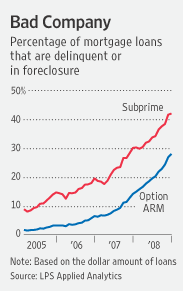
20. Barry Ritholtz at the Big Picture posts that LPS Applied Analytics announced findings showing that as of December 28% of existing option adjustable rate mortgages are delinquent or in foreclosure. That is up from 23% in September. Ritholtz provides a graph demonstrating the rise in delinquencies and foreclosures as a share of outstanding option ARMs:


JP Morgan believes that fully 55% of borrowers with option ARMs are underwater, meaning that the nominal debt is more than their value of the home. The post doesn't estimate the share of option ARMs of the overall mortgage market.

21. In a bit of good news, Rebecca Wilder at News N Economics reports that investors are beginning to move money from low yielding treasuries to corporate bonds. She provides a graph illustrating the differential between 10 year treasuries and 10 year treasury inflation-protected securities (or TIPs which automatically adjust payout to inflation, guaranteeing no losses due to inflation):


She notes that the inflation expectation inferred from the differential is rather low given the fundamentals of the government's balance sheet, but that it is a great improvement from what we were seeing before. That said, the market is so volatile it is by no means assured that the indicator indicates long term direction. short and to the point, with several helpful illustrations--worth taking a look.

22. Jesse's Café Américain features a Reuters piece which reports that Goldman Sachs economists think that were the Obama Administration move ahead with the plan to set up a bad bank to absorb the "toxic" assets of the financial sector costs could reach $4 trillion. $4 trillion is about one third of US GDP.
"The figure far exceeds even the most pessimistic estimates of how great the loan losses might be because there is so much uncertainty about default rates, which means the government may need to take on a bigger chunk of bank debt to ease concerns.

Goldman Sachs economists said ideally the public sector would step in to remove the hardest-to-value assets, which would alleviate nagging worries about future losses and hopefully help get lending going again.

'Unfortunately, with an unprecedented meltdown in mortgage credit and a deep recession in the broader economy, there is a great deal of uncertainty about the value of almost every asset,' they wrote in a note to clients."
I'd like to say fat chance. But who knows? That said, it seems to me that there is little reason to absorb these toxic assets if they will cost the government more than purchasing the equity of the banks in question. (As Brad Setser points out in a recent post, $350 billion is enough to purchase most of the equity in the US financial system.) Clearly, much of the reason it is difficult to posit a value for any asset is because the books are cooked. Until we have an honest accounting and rating system--and a transparent market for the derivatives that are the source of the toxicity--there seems little point in buttressing the financial system.

23. Barbara Kiviat at the Curious Capitalist reports that the freelance economy is being hit by the financial crisis as well, predictably enough. She points out, however, that the stimulus bill will do little for the self-employed, as "things like extending unemployment benefits and COBRA health care coverage ... do nothing for the self-employed people out there whose incomes are getting obliterated, too." She provides a graph to illustrate how that sector is being affected:


If the Great Depression is to be our guide, historically the sector is especially vulnerable.

24. I should have linked to this earlier, but better late than never, Putin's exclusive interview with Bloomberg. In it he suggests that he is far too trusting and treats us to his mother's advice: "never complain." I have to note that the notion of a former KGB operative being too trusting is, well, odd in its conceit.

25. Another thing I should have linked to earlier, but better late than never, Obama's interview on al-Arabiya: