Showing posts with label pakistan. Show all posts

Wednesday, August 11, 2010

Daily Sources 8/11

CHINESE ECONOMY SLOWING SOME FROM BREAKNECK SPEEDS

Keith Bradsher at the New York Times reports that the Chinese economy is slowing:
"The gradual slowing in China is evident in the factories that have turned the country into the manufacturing center of the world. Industrial output rose 13.4 percent last month compared with the same month last year.

By comparison, industrial output had been up 13.7 percent in June from a year earlier, and was up 16.5 percent as recently as May.

Much the same pattern was evident in fixed asset investment, which was up 24.9 percent last month compared with a year earlier. It had been ahead by 25.5 percent in June, and 25.9 percent in May.

Retail sales rose 17.9 percent in July compared with the same month last year, as Chinese consumers with rising wages continued to flock to stores for ever more spending. But sales had grown 18.3 percent in June compared with a year earlier, and had been up 18.7 percent in May."
What we would do for such growth!

RUSSIA DEPLOYS S-300 MISSILE SYSTEM IN ABKHAZIA

Dmitry Solovyov at Reuters reports that Russia has deployed a S-300 missile system in Abkhazia.
"The S-300, codenamed 'Favorite' in Russia, is a mobile, long-range air defense system that can detect, track and destroy ballistic missiles, cruise missiles and both high- and low-flying aircraft."
RUSSIAN ECONOMY GROWS BY 5.2% IN THE SECOND QUARTER FROM A YEAR EARLIER

Maria Levitov at Bloomberg reports that the Russian Federal Statistics Service said today in an email that its second quarter economic growth came in at 5.2% over the second quarter of last year.

IEA REPORTS THAT IRANIAN IMPORTS OF GASOLINE HURT BY SANCTIONS; TURKEY INDICATES IT WILL NOT COMPLY WITH GASOLINE SANCTIONS ON IRAN

Carola Hoyos at the Financial Times reports that the most recent IEA report says that the tougher sanctions on Iran have halved Tehran's gasoline imports.
"As a result Iran has been forced to pay a 25 per cent premium to market prices for its petrol deliveries as many companies shy away from supplying the country, the International Energy Agency reported on Wednesday."
Meanwhile, Orhan Coskun at Reuters reports that the Turkish Energy Minister told the wire service that Ankara will support sales of gasoline to Iran.
"Tupras, Turkey's sole refiner and gasoline exporter which is owned by Koc Holding, declined to say whether the company had sold anything to Iran. The refiner buys 33 percent of its crude from the Islamic Republic, however."
Also, if I remember correctly, Turkey imports some natural gas from Iran.

UN APPEALING FOR $459 MILLION FOR FLOOD RELIEF IN PAKISTAN

The Associated Press reports that the UN is appealing for $459 million in order to help flood victims in Pakistan.
"The UN Office for the Coordination of Humanitarian Affairs said 'the worst monsoon-related floods in living memory' has affected more than 14 million people and at least six or seven million require immediate humanitarian assistance including food, clean water, shelter and medical care."
AN OVERVIEW OF THE INDIAN ENERGY SECTOR

Utpal Bhaskar and Elizabeth Roche at livemint.com gives a pretty good overview of the energy situation facing India.

VENEZUELA AND COLOMBIA REINSTATE DIPLOMATIC RELATIONS; COLOMBIA INDICATES THAT IT IS OPEN TO TALKS WITH FARC REBELS

The BBC reports that Colombia and Venezuela reinstated diplomatic relations yesterday. Relations were cut off after the Colombian government accused Venezuela of allowing Colombian rebels to operate from Venezuela. Juan Forero at the Washington Post reports that the new Colombian President, Juan Manuel Santos, has indicated that the government is open to talks with FARC.

BRAZILIAN GROWTH Q-O-Q WAS 1.32%

Andre Soliani and Iuri Dantas at Bloomberg report that Brazilian growth from the second quarter over the first quarter was at 1.32%, "compared with a 2.45% jump in the first three months of the year."
"Latin America’s biggest economy is regaining speed in the third quarter, growing 5 percent to 6 percent, after slowing in the second quarter, Finance Minister Guido Mantega said yesterday. Brazil’s gross domestic product expanded 9 percent from a year earlier in the first quarter, the fastest rate since 1995, led by domestic demand and a record rate of investment."
FOMC LEAVES BENCHMARK INTEREST RATE UNCHANGED

The Federal Open Market Committee left the US benchmark interest rates at 0-0.25% yesterday. Real Time Economics hosts the full statement of the FOMC.

US TRADE DEFICIT RISES TO $50 BILLION

Free Exchange reports that the US trade deficit rose to $50 billion:


FOOD PRICES TO STAY HIGH IN NEAR FUTURE; US WILL TAKE ADVANTAGE OF RUSSIAN BAN ON WHEAT EXPORTS

Michael Schuman at the Curious Capitalist reports that food prices are likely to stay high by the standard of recent history.
"But whatever happens to wheat over the next few weeks, food is still expensive by the standards of recent history, and is likely to stay that way. The Organization for Economic Cooperation and Development and the Food & Agriculture Organization spelled that out in a June report. Their outlook sees average wheat and coarse grain prices between 15% and 40% higher in real terms (adjusted for inflation) over the next 10 years than their average levels during the period between 1997 and 2006. Real prices for vegetable oils are projected to be more than 40% higher, while dairy prices are forecast to be on average between 16% and 45% percent higher."
Meanwhile, Alan Bjerga at Bloomberg reports that the US has been contacted by grain importers to see if the US can fill orders for wheat that have been cut off by the recent ban on wheat exports by Russia.
[Agriculture Secretary Tom] Vilsack said he expects markets to stabilize as more information on the drought’s effects, including tomorrow’s USDA crop forecasts, becomes available.
EIA REPORTS THAT CRUDE OIL STORAGE FELL BY 3 MILLION BARRELS IN WEEK ENDED AUGUST 6TH

The EIA today reported that stocks of crude oil fell by 3 million barrels to 355 million barrels the week ended August 6th. The amount of crude in storage is well above the historical average. Gasoline stocks rose by 0.4 million barrels countercyclically and distillate stocks grew by 3.5 million barrels. Both are also well above the historical average. Refining capacity utilization fell to 88.1%. The national price of gasoline rose 4.8 cents to 278.3 cents in the week ended August 9th.

Wednesday, July 21, 2010

Daily Sources 7/21

1. BANK OF CANADA RAISES INTEREST RATE TO 0.75%

Greg Quinn at Bloomberg reports that Canada yesterday raised its benchmark interest rate by a quarter percent to 0.75%. The central bank indicated that it would consider international developments before raising the rate further.

2. MEXICAN RETAIL SALES UP 5% IN MAY

Jonathan J. Levin at Bloomberg reports that Mexico's retail sales were up 5% from last year in May. The increase took place outside of Mexico's border regions with the US where drug cartel-inspired violence has become endemic. Americans are "thinking twice" before crossing the border to shop.

3. JF-17 MAKES A SPLASH AT FARNBOROUGH

Brian Spegele at China Real Time reports that the Chinese and Pakistani new fighter jet--the JF-17--made a splash at this year's Farnborough International Air Show in England.
"Aircraft sales are the most lucrative part of Beijing’s weapons exports, totaling some $815 million, China Daily reported."
The plane relies on Russian made jet engines, but the fact that China is willing to export its latest technology makes for a different arms theory than that practiced by the US.

4. INTERNET USAGE IN CHINA IS SURGING

Kevin Sullivan at the Compass reports that Chinese internet usage is surging.


23% of a billion is a lot of people.

5. CHINA FACING HOUSING BUBBLE?

James Hamilton at Econbrowser asks whether China is facing a housing bubble.


6. NEW SANCTIONS ON NORTH KOREA

Craig Whitlock and Karen DeYoung at the Washington Post report that the US has announced that it will impose further sanctions on North Korea.

7. INSURANCE COMPANIES ABANDONING IRANIAN SHIPPING

Thomas Erdbrink and Colum Lynch at the Washington Post report that insurance companies have abandoned their relationship with Iranian shipping in order to comply with new US sanctions. Ports will refuse to allow Iranian ships entry if they are not covered for potential damages. Worth reading in full.

8. KURDS BLOW UP TURKO-IRANIAN GAS PIPELINE

Ivan Watson and Yesim Comert at CNN report that Kurdish rebels today took credit for the bombing of a Turkish-Iranian gas pipeline.
"An official from BOTAS, Turkey's state oil and gas company, speaking on condition of anonymity, told CNN that the fire had been extinguished. However, the official said, it will take at least six days to resume pumping fuel through the pipeline. In the meantime, BOTAS has increased the flow of gas from Azerbaijan to compensate for the gas cut."
9. INDIA AND PAKISTAN DISPUTE KASHMIR DAM

Lydia Polgreen and Sabrina Tavernise at the New York Times report that tensions are rising over the construction of a dam in Jammu-Kashmir. Pakistan is worried that India will be able to control water flow to its farmers during planting season. Worth reading in full.

10. COLOMBIA LOOKING UP

Frontier Markets optimistically notes that Colombia is emerging from its drug war. Investors will be more likely to place their money in Colombia than, say, Venezuela.

12. HOUSING HEADED FOR A DOUBLE DIP?

Barbara Kiviat at the Curious Capitalist argues that a double dip in housing is likely.

13. CRUDE AND PRODUCTS STORAGE INCREASES

The EIA reports that crude oil stocks grew by .4 million barrels in the week ended July 16th. Gasoline stocks grew by 1.1 million and distillate stocks grew by 3.9 million barrels. The national price of gasoline rose by 0.4 cents to 272.2 cents per gallon for the week ended July 19th. (Prices between $2.50 and $3.00 per gallon is where you start to see modification of use.) For the week ended 7/16 refinery utilization crept up to 91.5%.

Monday, July 19, 2010

Daily Sources 7/19

GOLDMAN SACHS BEING FROZEN OUT OF EUROPEAN SOVEREIGN DEBT OFFERINGS

Elena Moya at the Guardian UK reports that European governments are freezing Goldman Sachs out of debt offerings. An observer in France says that there would be rioting in the streets if Paris chose Goldman to lead a bond sale. Worth reading in full.

PRIVATE EQUITY INVESTMENT IN INDIA GROWING RAPIDLY

James Lamont at beyondbrics reports that India's private equity market is predicted to reach $17 billion this year.
"New investments will originate from the US where investors seek to participate in India and China’s high growth profiles. Average deal size among private equity investments this year is already between $50m and $200m, up from an average of $21m last year."
CLINTON ANNOUNCES NEW AID PROJECTS FOR PAKISTAN

BBC News reports that US Secretary of State Hillary Clinton announced a number of new aid projects for Pakistan worth $500 million. The projects include the building of two new hydroelectric dams. The aid money comes from a five year $7.5 billion aid package agreed to by Congress last year.

HUNGARY SUSPENDS BUDGETARY REVIEW BY IMF AND EU

Judy Dempsey at the New York Times reports that Hungary's government has stated that it will not pursue further austerity measures despite pressure from international creditors. The IMF and EU suspended a budgetary review of Hungary over the weekend.

MOODY'S DOWNGRADES IRISH DEBT

Matthew Saltmarsh at the New York Times reports that Ireland's debt has been downgraded by Moody's to Aa2 from Aa1. It's outlook has been changed from stable to negative. Not sure why anyone would pay any attention to the ratings agencies after this last bugaboo, but there you have it. The rating is still well above junk.

IRANIAN REVOLUTIONARY GUARD PULLS OUT OF PHASES 15 AND 16 OF SOUTH PARS

Aresu Eqbali at Platts reports that due to sanctions, the Iranian Revolutionary Guard has pulled out of phases 15 and 16 of the South Pars project.
"The IRGC and its affiliates have grown into an economic power in Iran, largely as a result of a succession of UN sanctions imposed by the international community over suspicions that Tehran is secretly developing nuclear weapons, a charge the Iranians deny.

The involvement of IRGC or its subsidiaries would make it difficult to source parts and equipment from foreign companies, which run the risk of being in breach of the sanctions should they have to deal with Khatam al-Anbiya or any other banned entity."
BOEING SELLS 30 777S TO DUBAI

Christopher Drew at the New York Times reports that the Dubai-based Emirates Airlines has put in a purchase order to Boeing for 30 777s. Airbus has sold 131 commercial airplanes this year; Boeing has sold 177.

WATER START UP SEEKS MARKETS IN INDIA, SAUDI ARABIA, CYPRUS AND IRAQ

John Collins Rudolf reports that a start up company in Texas plans to ship fresh water from Sitka, Alaska, to markets in India, Saudi Arabia, Iraq, and Cyprus. The company has no contracts yet, but has signed a deal with Sitka.

MOZAMBIQUE SOURCE OF COKING COAL FOR CHINA, INDIA, AND SOUTH AFRICA

Frontier Markets reports that interest is growing in Mozambique from China, India, and South Africa due to its reserves of coking coal for use in their steel plants.

BUILDER CONFIDENCE IN NEWLY BUILT, SINGLE FAMILY HOMES DECLINES ACCORDING TO HMI

Free exchange opines that the outlook for housing will be grim for the foreseeable future.


TWO AND HALF MILLION UNEMPLOYED LOSE ACCESS TO UNEMPLOYMENT BENEFITS

Phil Izzo at Real Time Economics reports that 2,502,000 jobless Americans have lost access to unemployment benefits since June 2.
"The Senate is expected next week to vote to extend unemployment benefits, but the delay has caused a lapse in benefits for some 2.5 million of the nation’s jobless."
Meanwhile, Tom Barkley at Real Time Economics reports that the National Association for Business Economics survey of 84 companies found that they were back in hiring mode. Meanwhile, Free Exchange reproduces a Brookings graph which plots the length of time it will take for jobs to reach the height seen prior to the recession with how many jobs need to be created.


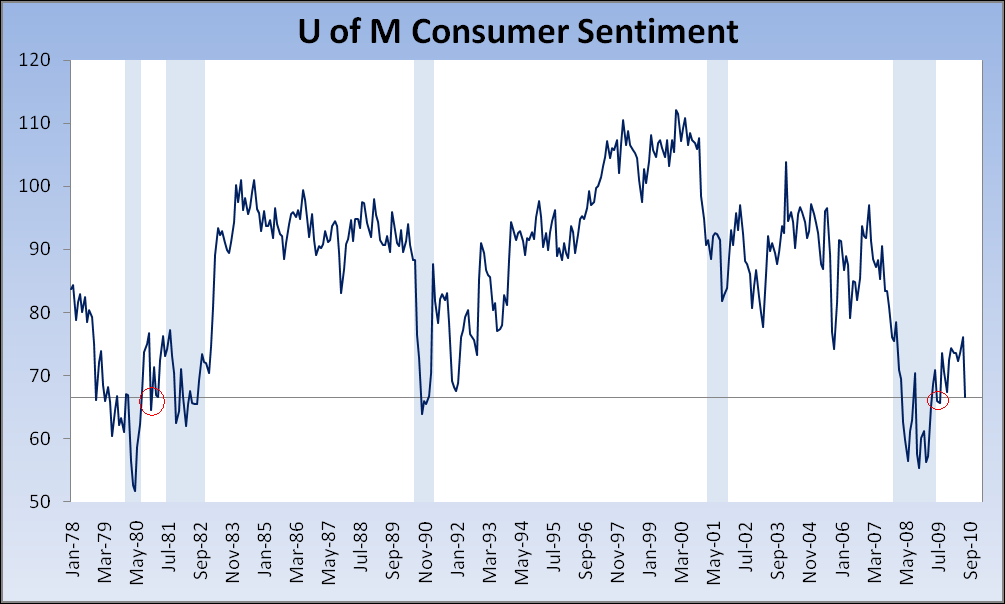
Invictus at the Big Picture reproduces a graph from the University of Michigan's Consumer Sentiment Survey and notes that the reading looks a lot like the last time we had a double dip recession.


THE CLEVELAND FED REPORTS THAT THE PUBLIC EXPECTS INFLATION TO STAY BELOW 2% OVER THE NEXT DECADE
"The Cleveland Fed’s estimate of inflation expectations is based on a model that combines information from a number of sources to address the shortcomings of other, commonly used measures, such as the "break-even" rate derived from Treasury inflation protected securities (TIPS) or survey-based estimates."

Wednesday, August 5, 2009

Daily Sources 8/5

1. CHINESE TRANSPORT DATA SHOW YOY INCREASE IN IRON IMPORTS OF 35%; PROPERTY SALES IN CHINA FALL 4% IN JUNE; UNEMPLOYED MIGRANT WORKER CONCERNS PROVE OVERBLOWN; THE PEOPLE'S BANK OF CHINA WARNS OF THE DANGERS OF QUANTITATIVE EASING

Bloomberg reports that in the Ministry of Transport data released yesterday ships unloaded 35% more iron ore in July from July 2008. "Ships unloaded 56.5 million metric tonnes of iron ore in July at major ports." Meanwhile, China Daily reports that property sales across 30 Chinese cities fell by 4% in July from June. Property prices for 70 major Chinese cities rose by 0.8% in June.
"Property transactions in Guangzhou [formerly Canton, the capital of Guangdong province] fell 36% over June. The figure is only half of that of May, said Guangzhou's official property website.

'The fall has been triggered by high property prices and shrinking supplies in some cities,' said Qin Xiaomei, head of research, Jones Lang LaSalle Beijing. 'Property developers have slowed down the pace of new projects in the second half after robust sales in the first half,' she said."
Meanwhile, Andrew Batson at the China Journal reports that worries regarding large numbers of unemployed migrant workers have proven overstated. The IMF China mission chief, who visited the country in late May early June, told reporters in a conference call:
"I think our sense is that while there is certainly some dislocation in the labor markets as export sectors in the coastal regions have declined, but in general that process of reallocation of labor has been relatively smooth. Part of it has been that labor has returned back to export sectors, perhaps with some reduction in real wages, and been reabsorbed into those areas.

Part of it is that the interior of the country is doing quite well, and so some of that migrant labor has moved geographically across regions to where growth is stronger. And I think we’re seeing right now a dynamic where the historical pattern of very strong growth in the coastal regions and slower than average, national average growth in the interior is reversing, and you’re seeing much stronger growth in rural areas and in the interior provinces. And some of that labor has been reabsorbed into public infrastructure projects."
Meanwhile, Bloomberg News reports that the People's Bank of China yesterday in its quarterly monetary policy report warned that the quantitative easing policies of the developed nations threatens to spark sever inflation and currency volatility.
"Exiting too quickly from such policies, which the Chinese central bank said helped to prevent a repeat of the Great Depression, may undermine an economic recovery, the report said. Waiting for too long may trigger 'a new round of asset bubbles and severe inflation,' the central bank added.

'Central banks in major developed nations face a difficult choice between keeping government bond yields relatively low to promote economic recovery and maintaining currency stability' to protect national creditworthiness, it said."
2. UK ENERGY SECURITY ENVOY TO RECOMMEND TRIPLING NUCLEAR ELECTRICITY GENERATION CAPACITY; JULY SERVICES INDEX SHOWS SIGNIFICANT IMPROVEMENT

Robin Pagnamenta at the Times reports that the UK's Prime Minister’s special envoy on energy security, Malcolm Wicks, will publish a report today arguing that Britain should triple the amount of energy it generates from nuclear power. A Times source familiar with the report said it would argue:
"The question is whether or not the same rigor [that is being devoted to cutting emissions] is being applied to energy security.

The Government has not been good at asking serious questions about whether or not the UK is in the right place ... It’s a dangerous world and when we emerge from recession there will be a global grab for diminishing supplies of energy. Where is it all going to come from?"
Meanwhile, Vanessa Houlder at the Financial Times reports that the Markit Economics purchasing managers survey of the services sector rose to 53.2 in July from 51.6 in June, it's highest reading since February 2008. It is the third consecutive month with a reading above 50--above 50 indicates expansion and below indicates contraction.
"Analysts welcomed the latest figures as providing more evidence the recession was receding. Vicky Redwood, of Capital Economics, said: 'The latest UK data on both services and manufacturing suggest that a decent recovery is continuing across the economy.'

Kevin Daly, of Goldman Sachs, said the 'very strong' services survey was consistent with annualized growth in gross domestic product of between 1.5% and 2%."
3. TWO RUSSIAN SUBS PATROLLING OFF US COAST

Mark Mazzetti and Thom Shanker at the New York Times yesterday reported that two nuclear-powered attack submarines have been patrolling off the eastern coast of the US recently.
"'I don’t think they’ve put two first-line nuclear subs off the US coast in about 15 years,' said Norman Polmar, a naval historian and submarine warfare expert.

The submarines are of the Akula class, a counterpart to the Los Angeles class attack subs of the United States Navy, and not one of the larger submarines that can launch intercontinental nuclear missiles."
Galrahn at Information Dissemination notes that the report suggests that the submarines are staying out of the Economic Exclusion Zone--about 200 miles off the coast. He also asks why this information was leaked.

4. PAKISTAN TALIBAN SEES ITSELF AS PROVIDING GOOD GOVERNMENT

Qandeel Siddique at jihadica summarizes an Urdu-language interview of a Taliban commander in Pakistan. Key excerpt:
"The Swati Taliban claims to have the locals on their side: '… We are children of these people and they are our own. We live like brothers. We have a healthy relationship with them where they give us food and shelter, and we cooperate on matters. We are always in touch with the locals and share with them their burdens/grievances. We have built roads [for the Swati people] where in over 60 years the government could not. The locals are happy with us. They no longer need to pay tax to the government. We have build pipelines and provided water to people. [...] Also we resolved decade-long rivalries that had been going on and which the government failed to bring about peace. The Taliban have appointed ulema to solve these cases and bring peace.'

The Swati Taliban assumes the role of a surrogate government by providing its citizen’s basic amenities--roads and water. And of course justice, which the locals feel deprived of, believing that the Pakistani government time and again ignores the developmental needs of this region. On top of this, the commander conjures a horrific picture of the Pakistani army; he pins the blame for collateral damage during warfare on the military--not only do they take innocent lives, they also steal from peoples’ homes."
5. RUSCORP SIGNS MOU WITH NIGERIAN STATE OIL COMPANY TO PROVIDE SECURITY, MAINTAIN PIPELINE NETWORK

Uchenna Izundu at the Oil & Gas Journal notes that a Russian security and maintenance company, Ruscorp, has signed a memorandum of understanding with the Nigerian National Petroleum Corp. to monitor the country's pipeline network, improve the existing pipelines as well as build new distribution lines.

6. CHÁVEZ ISSUES DECREE NATIONALIZING EQUIPMENT AND WAREHOUSING FACILITIES AT PORTS

Rainbow Nelson at Lloyd's List reports that Caracas has issued a decree effectively terminating all private concessions at the countries ports, with state-owned companies taking over all equipment and warehousing facilities. (Subscription only, but the headline is a decent datapoint.)

7. CREDIT CARD JUNK MAIL BOTTOMS

Barbara Kiviat at the Curious Capitalist notes that Synovate, a firm which tracks junk mail, has produced a chart--available at her blog--which shows that credit card offers going out underwent a sharp fall from the fourth quarter of 2007, but seem to have bottomed out in the second quarter of 2009.

8. CASH FOR CLUNKERS MOSTLY STIMULUS FOR AUTO INDUSTRY; AUTO INDUSTRY RESPONSIBLE FOR MOST OF MANUFACTURING REBOUND IN JULY; MINUS STIMULUS CONSUMER SPENDING MAY WELL HAVE SHRUNK BY 10% IN 2Q; PROBLEMATIC CONSTRUCTION LOANS LIKELY TO UNDERMINE BANK BALANCES GOING FORWARD

To answer what aim was intended by the cash for clunkers program, see Robert Rapier's R-Squared blog, which notes that the US will consume approximately 72 million gallons less gasoline annually because of the program.
"In the context of the amount of gasoline we use--140 billion or so gallons per year (a bit less now because of the recession)--this amounts to only 0.05% of our annual gas usage. Experts have suggested that making sure tires are properly inflated could save 3% on gas usage, or 60 times the amount saved by "Cash for Clunkers" if the majority of people are driving around on under-inflated tires.

So, for $1 billion invested in the program, a savings of 72 million gallons means we taxpayers paid $13.89 for each gallon of gasoline/yr saved. Readers know that I am a big fan of much higher fuel efficiency, but $13.89 to save a gallon of gasoline per year? While this benefit will be spread over several years of gasoline savings, surely we can do better than this.

Even if--as one reader suggested--those cars would have been on the road for another 10 years, you are still paying over a buck a gallon for the savings."
Which nicely dovetails with James Hamilton's post on whether there be an economic recovery in the offing, writing:
"Americans bought 995,000 light vehicles in July, a 16% increase over June and the best monthly report since August 2008. Domestically manufactured light trucks (which includes SUVs) lost market share but still achieved an 8% monthly sales gain. Sales of domestic cars, imported cars, and imported light trucks were all up more than 20% month to month.

If we'd seen these kinds of numbers in the absence of the cash for clunkers incentives, I would have viewed it as a strong suggestion that the economic recovery has begun. As is, I'm left wondering, and fundamentally not knowing, whether the auto figures signal the shift we've all been watching for, or sales stolen from September and October and delivered to July."
John Maudlin at the Big Picture quoted from David Rosenberg analysis yesterday:
"The details in today’s report left something to be desired. Consumer spending came in at -1.2% annualized, twice the decline expected by the consensus. This occurred in the face of gargantuan fiscal stimulus and leaves wondering how this critical 70% chunk of the economy is going to perform as the cash-flow boost from Uncle Sam’s generosity recedes in the second half of the year. Imagine, government transfers to the household sector exploded at a 33% annual rate, while tax payments imploded at a 33% annual rate and the best we can do is a -1.2% annualized decline in consumer spending in real terms and flat in nominal terms? What do we do for an encore? In the absence of the fiscal largesse, it is quite conceivable that consumer spending would have shrunk at a 10% annual rate last quarter! Nonresidential construction action sagged at an 8.9% annual rate and this was on top of a 44.0% detonation in the first quarter. Ditto for equipment & software ‘capex’ spending, also down at a 9.0% annual rate and this too followed a 36.0% collapse in the first quarter. Residential construction slumped sharply yet again, this time at a 29.0% annual rate. These are the guts of private sector spending and collectively, they contracted at a 3.3% annual rate--the sixth decline in a row. So while there are many calls out there for the recession’s end, it remains a forecast as opposed to a present-day reality."
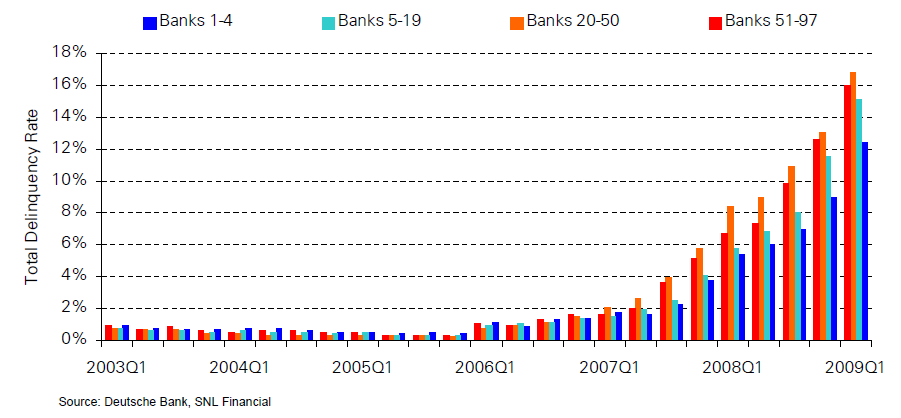
And Barry Ritholtz, also at Big Picture, notes the recent Deutsche Bank report which suggests that construction loans are likely to become a larger problem for the banks over time.
"Construction loans are structured with upfront reserves--meaning that it takes much longer for [Commercial Real Estate] defaults to occur. Low short-term interest rates also means reserves can last longer--BUT, as DB notes, Once reserves are exhausted, defaults will skyrocket."


9. COMMERCIAL CRUDE STOCKS BUILD MORE THAN EXPECTED, GASOLINE PRICES RISE, REFINING UTILIZATION DOWN

The EIA reports that crude oil commercial stocks built by 1.7 million barrels to 349.5 million barrels in the week ended July 31--above the five year historical range for this time of year. A Bloomberg survey had the median expectation of analysts at a 600,000 barrel build. Gasoline stocks fell by 200,000 barrels, are at the top of the historical range, and versus analyst expectations of a 800,000 barrel draw. Distillate stocks fell by 1.1 million barrels and at 161.5 million barrels are 28.2 million larger (or 21.2% more) than the comparable stock level seen last year--well above the five historical range. Analysts had expected a 1.23 million barrel build. Refining utilization fell to 84.54% from 84.57% the previous week. The national average of regular gasoline prices rose 5.4¢ to $2.557/gallon in the week ended August 3. (People tend to start driving less at prices between $2.50-$3.00/gallon.) The report also includes a helpful explanation of why refinery outages on the Gulf Coast have a large effect upon national prices.

10. POTATOES MAY ACCOUNT FOR AS MUCH AS 22% OF POPULATION GROWTH AND 47% OF URBANIZATION IN THE 18TH AND 19TH CENTURIES

Nathan Nunn and Nancy Qian at VoxEU argue that the introduction of new world crops to the old world--and in particular the potato--is in great part responsible for the population explosion and urbanization from 1800:
"The traditional explanation for the rise in population is that medical advances, such as the understanding of the germ theory or the innovation of vaccinations, and improvements in public sanitation greatly decreased infant and child mortality, which in turn led to an increase in population (e.g. Preston, 1975, 1980, 1996; Cutler, Deaton and Lleras-Muney, 2005, 2006). However, in recent years, scholars such as Thomas McKeown (1976) and Robert Fogel (1984, 1987, 1994, 2004) have argued that the increase in population was mostly due to an improvement in nutrition rather than the advances in medicine or sanitation. McKeown argued that the decline in mortality began to occur well before the most important innovations such as antibiotics or vaccinations, which did not become prevalent until the 20th century, and therefore, there is scope for other factors to contribute to the rise in population. Fogel argued that since height is positively correlated with nutritional investment during childhood as well as lower mortality rates, then the observation that heights in America and the UK were increasing is evidence that nutrition was improving during this period.

If Fogel is right, then we have to ask what caused the improvements in nutrition. Certainly, improvements in agricultural technology are part of the story. During this time, a number of productivity-enhancing technologies were developed. Examples include the seed drill, the threshing machine, and the Rotherham swing plough.

In recent research, we argue that another main contributor was the discovery of New World food crops, namely, the potato (Nunn and Qian 2009). Potatoes are extremely nutritious and a very 'cheap' source of calories. They produced much higher yields per acre relative to pre-existing Old World staple crops. Historical survey data from England show that if a family of four were to subsist on only one crop, it would require 66% less land if it were to plant potatoes rather than staples such as barley, wheat, or oats (Young, 1771). Potatoes are also easy to store and were popular as fodder for livestock through the winter. Therefore, cultivating potatoes also indirectly improved protein intake. The diffusion of potatoes also had a tremendous impact on nutrition in the Old World because vast land areas in Northern Europe, Asia, and high altitude areas of Africa were suitable for cultivating potatoes. Figure 2 maps suitability for potato cultivation. Yellow and brown colored regions are suitable. Darker colored regions are more suitable."

Friday, July 31, 2009

Daily Sources 7/31

1. MESSERLIN AND MAREL ARGUE THE US & EC COULD REAP GAINS BY OPENING SERVICES SECTOR

Patrick A Messerlin and Erik van der Marel at VoxEU argue that the US and the European Commission should launch transatlantic negotiations in opening the services sector as a prelude to multilateral negotiations. Key excerpts:
"Services providers are busy redesigning their strategies for coping with the ongoing economic crisis. To take the appropriate decisions, they need predictable future market access in services. Meanwhile, as many services are still highly protected, opening services markets would deliver large benefits to consumers impoverished by the crisis."
"Is there any appetite for services negotiations now? Yes. The July 2008 Signalling Conference held under the aegis of the Doha Round showed a substantial number of participants expressing strong interests in most services, offers and requests in mode 3 in many services (foreign direct investment), and even a willingness to include mode 4 (movement of natural persons, by far the most contentious part of any service negotiations) in some services.

Such a willingness to negotiate appears particularly strong in three services: business, communication, and distribution services. Together, these three services in the EC, US, and top eight countries represent almost one-third of the world GDP, a size so huge that negotiators could work on deals within as well as between these services sectors. The three services face high levels of regulatory constraints, ensuring huge economic gains in case of market opening. Finally, negotiations are made easier by the fact that business and communication services are resilient to the current crisis, while the inflationist pressures to come should make governments eager to have distribution services as competitive as possible.

Last but not least, the foreign policy dimension of the whole endeavour is crucial for Europe. Many US decision-makers are looking to Asia for good reasons (Bergsten, 2009) while Europeans have not yet fully grasped the growing importance of Asia nor captured its attention, as illustrated by the disappointing June 2009 Asia Europe Ministerial meeting on energy."
2. EUROZONE UNEMPLOYMENT UP TO 9.4% IN JUNE, CONSUMER PRICES FELL AT ANNUAL RATE OF 0.6%

Reuters reports that eurozone unemployment rose to 9.4% in June, up from a revised figure of 9.3% in May.
"The European Union’s statistics office also said on Friday that inflation in the euro area had moved much further into negative territory than forecast in July, with consumer prices falling at an annualized rate of 0.6%.

The drop raised worries about deflation and heightened expectations that the European Central Bank will maintain its loose monetary policy."
3. US OPEN TO BRINGING RUSSIA INTO NATO

Yevgeny Bendersky at the Compass reports that
"Assistant Secretary of State Philip Gordon told US lawmakers Tuesday during the House International Relations Committee hearing that the United States would consider Russian membership in NATO."
Gordon said:
"[I]f Russia meets the criteria and can contribute to common security, and there is a consensus in the alliance, it shouldn't be excluded."
Bendersky points out that some in Eastern Europe might be cold to the idea. Given that membership would freeze, so to speak, the current borders by militarily integrating the members, it may arguably provide superior protection than the current relationship. It certainly would make adventurism a much more complicated affair.

4. NIPPON OIL IN TALKS WITH SK ENERGY TO BUILD NEW REFINERY IN VIETNAM

Megumi Yamanaka and Yuji Okada at Bloomberg report that Nippon Oil Company has announced it might build a refinery in Vietnam with SK Energy Co.
"'We’ve been in talks with SK and have agreed on the need for participating in a refining project' in Asia, Nippon Oil Chairman Fumiaki Watari said in an interview in Tokyo yesterday. Vietnam is a potential location for the first venture between Japan and South Korea’s biggest refiners, and the plant may process 200-300 kb/d of crude oil, he said.

Seo Young Joon, a spokesman at SK Energy in Seoul, said he couldn’t immediately comment. Idemitsu Kosan Co., Japan’s second-largest refiner, and Mitsui Chemicals Inc. plan to spend $5.8 billion to build a 200 kb/d plant in Vietnam."
"'We know that about 25% of Japan’s refining capacity will be unnecessary in the next five years.' Watari said."
Vietnam inaugurated its first refinery this year with capacity of 148 kb/d and which is poised to supply about 30% of Vietnam's product requirement--see Daily Sources 7/28 #8. The EIA projects its total petroleum demand was about 288 kb/d in 2008. Hanoi projects GDP will grow by 5.5% in 2009, adding perhaps as much as 10 kb/d in demand this year.

5. INDIAN FIELD BEGINNING PRODUCTION TO UP INDIAN CRUDE PRODUCTION BY 25%

The Economic Times reports that Indian crude production is expected to rise by about 25% when Cairn begins pumping from the Mangla field of its Rajasthan acreage next month.
"'We are operationally ready to commence oil production in August,' Cairn India CEO Rahul Dhir said. In its various filings to the government, Cairn has indicated that production will quickly touch 30 kb/d by the end of third quarter this year and reach a plateau of 175 kb/d (8.75 million tonnes a year) in 2011. Goldman Sachs, however, has pegged the peak output at 190 kb/d (9.5 million tonnes a year)."
Using EIA projections, Indian crude production in 2008 was 693.7 kb/d. Its imports came in at 2.056 mb/d, so the Mangla field at 175 kb/d would represent about 8.5% of its import requirement. However, some of those imports are reexported as products, for example to the US--Reliance is set to restart its old Jamnagar refinery shortly, bringing another 660,000 kb/d of nameplate capacity on line. It is expected to double Reliance gasoline exports to about 170 kb/d.

6. PAKISTANI SUPREME COURT REJECTS PETITION TO TRY MUSHARRAF ON TREASON CHARGES

BBC News reports that the Pakistani Supreme Court has rejected a petition to try former President Musharraf on charges of treason.
"The court had asked him to explain his decision in 2007 to invoke emergency rule and suspend the constitution.

It has now ruled that parliament is the place to debate Mr Musharraf's actions.

Chief Justice Iftikhar Mohammed Chaudhry rejected a petition to launch a treason case against the former president.

Mr Chaudhry was himself removed from his position as a result of President Musharraf's imposition of emergency rule, but was reinstated after he resigned in August."
For more on the lawyers revolution in Pakistan, I wrote a long piece on it early last year--see The Law in Pakistan.

7. 40 DAY CYCLE OF PROTESTS IN IRAN MIRROR 1979 REVOLUTION, PRESS REPORTS OF CHINESE-IRAN MOU ON SOUTH AZADEGAN FIELD DENIED BY CNPC, US SENATE TO BAR THOSE SELLING PETROLEUM PRODUCTS TO IRAN FROM PARTICIPATION IN SPR

Michael Collins Dunn at the MEI Editor's Blog observes that the 40-day cycle in protests seen in the 1979 Iranian Revolution is being repeated in the current conflict over the elections. Juan Cole at Informed Comment has a good roundup of the recent political events in Iran. Meanwhile, Upstream Online notes that there have been stories that CNPC has signed an MOU with NIOC to develop the South Azadegan oilfield, taking a 70% stake in the field in return for covering 90% of development costs.
"However, a CNPC manager based in Beijing told Reuters today that the MoU was actually signed earlier this year and there has been no real breakthrough in talks with the oil ministry since then.

'The MoU is not a binding contract, and we are still negotiating with NIOC about specific details,' the CNPC source, who declined to be named because he was not authorized to speak to the media, told the news agency."
In the meantime, Jean Chemnick and Katharine Fraser at Platts report that the US Senate has inserted language into the Senate Energy and Water Appropriations bill [H.R. 3183] which would prohibit companies that sell gasoline and diesel to Iran from entering into contracts to fill the Strategic Petroleum Reserve.
"At least three companies fit that bill, Glencore, Shell Trading and Vitol, according to the Foundation for Defense of Democracies. In January, the three were named by DOE as suppliers to the SPR for deliveries this year. While it could not be immediately confirmed whether any of the three currently sell refined products to Iran, all of them are known active traders in oil markets throughout the world."
In June, Reliance--a private oil company in India--halted gasoline exports to Iran, apparently because they expected difficulties for their exports to the US--see Daily Sources 6/4 #8. The UAE provides about 80% of Iranian product requirements, IIRC.

8. BAHRAIN CENTRAL BANK SEIZES TWO BANKS HELD BY SAUDI CONGLOMERATES

Frederik Richter at Reuters reports that the central bank of Bahrain has seized two banks owned by major Saudi conglomerates.
"The central bank said in a statement on Thursday it had assumed control of Awal Bank, owned by Saad Group and The International Banking Corporation, a unit of the Ahmad Hamad Algosaibi and Brothers conglomerate.

The central bank said an investigation at both banks had shown a substantial shortfall in assets compared with their liabilities and that it would appoint an external administrator to identify creditors' claims and manage the distribution of the remaining assets."
9. NIGERIAN PRESIDENT ENTERS TALKS WITH 6 NIGER DELTA GOVERNORS TO PREVENT THREATENED BOYCOTT OF MILITANT AMNESTY PLAN

Platts reports that Nigerian President Umaru Yar'Adua has begun talks with six governors from the Niger Delta in an effort to avert a threatened boycott of the amnesty program for militants in the region.
"The governors of southern Akwa Ibom, Bayelsa, Edo, Delta, Cross River and Rivers states last week said they would pull back their involvement in the amnesty deal for Delta militants in protest of the federal government's plan to relocate the petroleum training college in Delta state to northern city of Kaduna.

'There is a serious misunderstanding about some of the issues raised, but the president is very concerned and has been talking with the Niger Delta governors individually,' Presidential spokesman Olusegun Adeniyi in a statement. 'The president has respect for the Niger Delta region. He did not approach the crisis in the area as a Northerner.'

The governors also had grouse against a provision in the oil sector reform bill, which they said takes away royalties due Delta communities."
Earlier this week, the Nigerian Joint Revolutionary Council--an umbrella group of militants in the Niger Delta which includes MEND--warned a company linked to a current oil minister to stop operations to express their displeasure with the plan to locate the petroleum university in the north--see Daily Sources 7/28 #9.

10. US ENVOY FOR SUDAN RECOMMENDS TAKING KHARTOUM OF TERRORIST LIST

Reuters reports that General Scott Gration, the US special envoy for Sudan, recommended to Congress that Sudan be taken off the state sponsors of terrorism list.
"'There is no evidence in our intelligence community that supports [Sudan] being on the state sponsors of terrorism list,' Gration said. 'It's a political decision.'"
"'We are actually hurting the very development things we need to do help the south become ... if they chose to secede, a viable economic state,' Gration said, noting that Washington could not bring in heavy equipment to build roads and railways.

'At some point we are going to have to unwind some of these sanctions so that we can do the very things that we need to do to ensure a peaceful transition and a state that's viable in the (south) should they choose to do that,' he added.

In its latest report, the State Department described Sudan as 'a cooperative partner in global counterterrorism efforts.'"
11. CHÁVEZ PROPOSES LAW GIVING GOVT ARBITRARY POWER TO CONTROL MEDIA

Fausta Wertz at the Compass has the best summary of the news that Hugo Chávez's administration has now proposed a set of laws which would limit broadcasting rights and would make the rather arbitrarily defined violations are punishable with prison terms.
"The proposed law ... includes all media and applies to not only owners and publishers but also reporters, freelancers and anyone making a statement that could be interpreted as (my translation) 'any person who manipulates or distorts the news, creating a false perception of facts... as long as there is damage to social peace, national security, public order, or the mental health or public morals.'

The charge carries a compulsory 2-4 year prison sentence."
Wertz includes a link to the text of the law. She notes that the UN has registered its worries regarding the proposed legislation, but projects the protest will have little affect upon the administration's decision-making process ... correctly in my view.

12. RESEARCHERS FIND THAT EFFORTS TO HALT OVERFISHING ARE SUCCESSFUL

BBC News reports that a team of researchers have released the findings of a two-year study which concludes that efforts to halt overfishing in 5 of 10 marine ecosytems have helped fishing stocks to recover.
"The authors observed: 'Some of the most spectacular rebuilding efforts have involved bold experimentation with closed areas, [fishing] gear restrictions and new approaches to catch allocations and enforcement.'

But they warned that the signs of recovery should not be interpreted by policymakers as a sign that all was well beneath the waves.

The majority of fisheries were still in trouble, and were not being managed or regulated properly.

But Dr Worm said that the team's 'watershed paper' offered a blueprint for sustainable fishing.

'It clearly shows what needs to be done to not only avoid fisheries collapse, but to actually rebuild fish stocks and ecosystems.'"
(h/t Yves Smith at naked capitalism.)

13. US GDP DOWN AT ANNUALIZED RATE OF 1% IN Q2, CHICAGO PMI INDICATES BOTTOM

The Bureau of Economic Analysis released its estimation today that Q2 GDP fell at an annualized rate of 1%. Ed Harrison of Credit Writedowns observes:
"Down 1.5% was the consensus expectation. But Q1 was revised down to minus 6.4% from 5.5%. The GDP Deflator for Q2 came in at 0.2%, which shows that disinflation risks tipping into deflation still. The dollar is weaker and the short end of the treasury curve is up massively on these data and revisions.

Also ... the 2008 numbers were revised down. Q1 2008 was revised from positive 0.9% to negative –0.7%. Q2 2008 was revised way down as well from 2.8% to 1.5%. Q3 2008 was also very negative, now –2.7%. This confirms the December 2007 recession call.

There was a $140 billion reduction in inventories in Q2. I have been saying for some time that this would set us up for lots of upside come Q3 and Q4 as the inventory purge dissipates. So, we will get a technical recovery in my opinion. The question is whether there is any underlying demand uptick behind the inventory changes. In the data ... from the BEA website, you can clearly see ... that consumers are not even spending on basic items. Spending on non-durable goods was down 2.5% annualized. That is not good."
Peter Boockvar at the Big Picture reports that the Chicago PMI was 43.4 in July, up from 39.9 in June. (PMI readings of above 50 indicate expansion; below 50 indicates contraction.) He observes:
"Inventories remained extremely lean, falling to 25.4 from 34.2, the lowest since 1949 and is the perfect set up for a sharp contribution to GDP from this area in the 2nd half of the year, led by auto’s and related sectors. The employment index rose 6.4 points to 35.3, well below 50 but at the highest level since Dec ‘08. Prices paid fell a touch. Bottom line, the data confirms the backdrop for an improvement in GDP. The degree and sustainability of the recovery will however remain in the hands of end demand, aka, predominantly the US consumer."
Rebecca Wilder at News N Economics observes that
"Households have been 'delevering' for a longer time period than previously thought--as recent as 2008 Q1, the saving rate that was reported to be essentially zero, 0.2%, is now 1.2%."
Her chart of the US savings rate (with revisions as of today):

"The BEA has 'found' that households have been in fact saving roughly 1% of their disposable income per quarter since 1995, 0.9% per quarter in 2008."
Well worth a look, as always.

Wednesday, July 22, 2009

Daily Sources 7/22

1. DO COAL STOCKS INDICATE GLOBAL RECOVERY?; WTO SAYS GLOBAL TRADE TO CONTRACT 10% IN 2009

Thomas MacLeod yesterday at Seeking Alpha deduced from the performance of global coal ETF KOL, the US DOW Coal Index, and the global steel ETF SLX that energy consumption globally is up and thus is the global economy beginning a rebound.
"The commodity that we believe is more representative of pure changes in economic fundamentals is coal. It is difficult to manipulate, its supply is not so affected by political or natural events and it is comparatively difficult and expensive to store, which effectively weeds out speculators.

Moreover, coal is a genuine industrial commodity with over half of the world’s electricity generation being powered by coal fired power stations. It is integral in the production of steel and can be converted to produce crude and other industrial chemicals.

In order to analyze the behavior of coal we look at the movement of coal stocks relative to major market stock indices. This eliminates the impact of stock market movements so we can ascertain the movement due to changing expectations of coal demand and supply. In essence, outperformance of coal stocks suggests global economic expansion."
Of course, the performance of coal stocks does not represent a one-to-one ratio to consumption. The latest data on coal volumes shipped by train, for example, still shows 8% down year over year, which suggests that in North America, anyway, it is difficult to deduce a rebound on the basis of coal volumes. Meanwhile, Jonathan Lynn and Kazunori Takada at Reuters reports that the WTO has forecast that world trade will shrink by 10% in 2009.
"The WTO said however the contraction appeared to be slowing.

'Our figures showed that Asian countries may be leading a recovery in global trade,' [Director General Pascal] Lamy told a news conference in Singapore, where he was attending a two-day Asia Pacific Economic Cooperation (APEC) trade meeting."
2. IMF SAYS CHINA COULD STAND MORE STIMULUS IN CONTRAST TO WORLD BANK ASSESSMENT, CHINA INDICATING THAT IT WILL USE ITS FOREIGN CURRENCY RESERVES TO FUND CHINESE FIRM EXPANSION OVERSEAS, IN PARTICULAR RESOURCE PLAYS, CHINESE OIL IMPORTS IN JUNE WAY UP IN CONTRAST TO OFFICIAL COMMENT THAT STOCKPILING OVER

Timothy R Homan at the Bloomberg reports that the IMF has indicated in its first executive-level review of China in three years that there is scope for more fiscal stimulus in that country.
"The IMF’s assessment is a clash with the World Bank, the international development-aid agency also based in Washington, which last month advised China to delay until 2010 any additional stimulus. It also comes as China is already recording an acceleration in its expansion, and as its central bank takes steps to avert bubbles in stock and property markets."
In the April G-20 meeting in London, the Obama administration secured from the IMF a pledge to open up the selection process for the executive directorship of the organization in return for opening up the process for the head of the World Bank, traditionally an American. Some expect China to win the top spot when the next head of the World Bank is selected, but in order for Beijing to have had a real shot, it needed to open up the country to official review from the international financial institutions again. Meanwhile, Brad Setser has some remarks on the recent report that China intends to use its reserves to support the overseas acquisitions of Chinese firms.
"That of course is China’s right. China clearly has more reserves than it really needs, and thus can take some risks with its reserves.

But it also has consequences. If Chinese firms are explicitly backed by China;s reserves, it gets harder to argue that their expansion reflects a purely commercial calculus. China’s government presumably will deploy its assets to pursue China’s strategic as well as its commercial goals.

In some sense it is surprising that China has decided to be so explicit about its new desire to use its reserves to support Chinese state firms. China’s government could have achieved the same result by quietly putting more foreign currency on deposit in the state banks, and having the state banks lend those funds out to firms looking to expand abroad."
Kate MacKenzie at FT Energy Source notes,
"In an interview published in state-controlled media, the chairman of China Development Bank said Chinese outbound investment would accelerate but should focus on resource-rich developing economies.

'Everyone is saying we should go to the western markets to scoop up [underpriced assets],' said Chen Yuan. 'I think we should not go to America’s Wall Street, but should look more to places with natural and energy resources.'"
Meanwhile, Platts notes that Chinese apparent oil demand is up in June. I have reconfigured their data into a barrels per day format:


3. GERMAN ROLE AT ECB MAY BE ESPECIALLY PROBLEMATIC FOR COORDINATING GLOBAL RECOVERY, ECB ARGUES THAT ITALY'S ADOPTION OF THE EURO HAS CUSHIONED THE COUNTRY'S ECONOMY FROM ITS POLITICAL INSTABILITY

Jörg Bibow at the New America Foundation has an interesting piece on the German role in determining monetary policy for Europe and why it is presenting a serious obstacle to an effective global response to the financial crisis. Key excerpts:
"Within German 'stability culture' the Bundesbank's part was to enforce discipline, both budgetary discipline and wage discipline. The result was not only low inflation, but inflation lower than inflation of Germany's trading partners. And that is an important factor within any system of pegged nominal exchange rates: over time a country with relatively low inflation gains in competitiveness which is boosting its export performance. Stability policy worked well under the Bretton Woods regime, establishing both Germany's export-oriented growth strategy and the Bundesbank's claim to fame as inflation fighter."
"Exporting the German model to Europe through the Maastricht regime meant inflation would be low across Europe, while all countries would try to balance their budgets at the same time. When German stability policy was jointly applied across Europe in the early 1990s, the predictable result was domestic demand stagnation and rising unemployment. Even by 1996 it looked as though EMU was not going to fly because stagnation kept budget deficits above the 3% ceiling across the continent. Luckily, the US 'new economy' boom and strong US dollar came to the rescue, and eleven countries qualified in the spring of 1998 to launch the euro in January 1999. In other words, laboring under the Maastricht constraints, Europe failed to generate sufficient homemade demand growth, but benevolent external forces allowed the euro to get off the ground just on time."
"What does all this mean for the collective action problem which, as I said at the start, the world is facing today? Recovery from the ongoing global crisis requires everyone to pay their dues and pull their weight. Built into the German model is a strategy to rely on the recoveries of others to sponsor one's own. The German model has become the European model (pace the U.K). ECB president Jean-Claude Trichet said as much in 2004 when Euroland was last hoping for external sponsors of recovery: 'Growth starts with exports, then passes on to investment and then to consumption. That is the normal sequence for Europe in this phase of the cycle.' (FT 22 April 2004). The trouble is that Europe's economy is as large as America's or even larger, and the German model wholly unsuitable for a large economy. In addition, Europe has its hands full with its own homemade crises, crises which are largely the consequence of the German model as well. Recent statements made by key German policymakers clearly indicate that enlightenment is not a realistic prospect."
Bibow makes the especially uncharitable comment that perhaps Berlin needs to relearn the lessons of the Great Depression, but there he clearly misses the point. Perhaps Belin needs to unlearn the lesson, which clearly has as its main pivot the notion that hyperinflation led to the political instability which eventually ushered in the NAZIs to political ascendancy. That (nastiness) aside, the piece is worth reading. Meanwhile, the European Central Bank has published a working paper by Marcel Fratzscher and Livio Stracca which argues that the adoption of the euro has insulated Italy from its political instability.
"The paper focuses on political events in Italy over the past 35 years and asks whether the adoption of the euro in 1999 has helped insulate Italy’s financial markets from the adverse consequences of its traditionally unstable political system. We find that important political events have exerted a statistically and economically significant effect on Italy’s financial markets throughout the 1970s, 1980s and 1990s. The introduction of the euro appears to have indeed played a major role in insulating financial markets from such adverse shocks."
(I am obliged for both of these pieces to Eurointelligence.)

4. NETHERLANDS THREATENING TO BLOCK ICELAND ACCESSION TO THE EU IF IT DOES NOT COMPENSATE DUTCH SAVERS ON LOSSES

NRC Handelsblad reports that Dutch Foreign Minister Maxime Verhagen is threatening to block Iceland's bid to join the European Union, unless Reykjavik meets its obligations to compensate Dutch savers.
"According to the agreement Iceland has to repay €1.3 billion to the Netherlands and €2.3 billion to the UK. The British and Dutch governments spent that money to compensate savers for the €20,000 the Icelandic government had guaranteed for those saving with Icelandic banks. The Icelandic government agreed to repay those damages in the form of a loan, but parliament could block that deal, as some members of the Althing have threatened to do.

'A solution to the problems surrounding Icesave could speed up the handling of the Icelandic application for EU membership," Verhagen said. He added it is "absolutely necessary' that Iceland approves the agreement to 'show that Iceland takes EU guidelines seriously.'"
5. GEORGIA SEEKING AMERICAN ARMS

Philip P Pan at the Washington Post reports that Georgian President Mikheil Saakashvili yesterday indicated in an interview that Tblisi is seeking a weapons deal with the United States.
"In a wide-ranging interview, Saakashvili said that discussions about a weapons deal remained at 'very early stages' but that he planned to press Biden to speed up delivery of antiaircraft and antitank systems, saying such weaponry was 'purely defensive' and 'would make any hotheads think twice about further military adventures.'

'I think the decision to help us is there,' he added, noting recent meetings between Georgian and US defense officials. 'It's a matter of speeding up the process. . . . We want the country to still be around when those things start to arrive here. That's ultimately what's right now at stake.'

The United States has been working to train and modernize the Georgian military for more than a decade, but Russia has warned strongly against new arms shipments to the former Soviet republic, which it routed in a brief war last year."
6. PAKISTANI SUPREME COURT ASKS FOR MUSHARRAF REPRESENTATION ON CASE CONSIDERING WHETHER EMERGENCY MEASURES IN 2007 WERE CONSTITUTIONAL, ISLAMABAD OBJECTS TO CAMPAIGN IN AFGHANISTAN, GERMAN INVOLVEMENT HEATS UP, PAKISTAN ASKS FOR ADDITIONAL INTEL SUPPORT FROM US AND WARNS THAT DEAL WITH INDIA COULD START ARMS RACE

BBC News reports that Pakistan's Supreme Court has decided that former President Musharraf should be represented in a case before it over whether or not the emergency rule imposed in November 2007 was constitutional.
"'This is the first time in Pakistani history that the court has taken cognizance of such action. In the past, the courts have tended to condone military takeovers,' a former chief justice of Pakistan, Saeeduzzaman Siddiqui, told Dawn News TV.

The BBC's Ilyas Khan in Islamabad says that the court apparently issued the notice to Mr Musharraf following the refusal on Tuesday by the attorney-general, who represents the government, to defend the former president's position in the case."
Meanwhile, Eric Schmitt and Jane Perlez at the New York Times report that Pakistan is objecting to expanded combat plans in Afghanistan.
"Pakistani officials have told the Obama administration that the Marines fighting the Taliban in southern Afghanistan will force militants across the border into Pakistan, with the potential to further inflame the troubled province of Baluchistan, according to Pakistani intelligence officials.

Pakistan does not have enough troops to deploy to Baluchistan to take on the Taliban without denuding its border with its archenemy, India, the officials said. Dialogue with the Taliban, not more fighting, is in Pakistan’s national interest, they said."
Matthias Gebauer and Shoib Najafizada at Der Spiegel report on German forces increasing involvement in the fighting in Afghanistan:
"The Bundeswehr is supporting the Afghans with around 300 members of the Quick Reaction Force (QRF). Their primary role is to help secure the area around the fighting and provide reconnaissance.
...
[T]he Bundeswehr has also become considerably more assertive. For the first time, Marder tanks--which have heavy firepower and were only recently relocated from Mazar-e-Sharif to Kunduz--have been deployed.
...
According to SPIEGEL ONLINE sources, missiles are also being fired by German fighter jets in northern Afghanistan for the first time. Following a first deployment of fighter jets on June 15 in northern Afghanistan by the ISAF international security force, most supplied by the United States, Afghan forces requested so-called 'air support' for a second time on Sunday.

Such air support had long been considered taboo in northern Afghanistan."
Meanwhile, Joshua Partlow at the Washington Post reports that Pakistani Prime Minister Yusuf Raza Gilani today has called on the US to provide real-time intelligence and other military support for the Pakistani effort against the Taliban, without relying on attacks from US drones. Both American national papers mention that Islamabad is concerned about the recent end use monitoring deal made with India, suggesting that it could spark an arms race.

7. KURDISTAN COMMISSIONS NEW REFINERY

Eric Watkins at the Oil & Gas Journal reports that Kurdistan has commissioned a new refinery near Arbil which will originally process 20 kb/d, ramping up to 40 kb/d by the end of the year. The refinery is one of several planned for the area, with plans to have total throughput capacity of about 200 kb/d. "Refinery director Baz Karim said the new facility is operated by private Kurdish investors Kar Group, and will process crude from the Khurmala Dome oil field ... ."

8. IRANIAN CONSERVATIVES RESPOND TO RAFSANJANI LETTER, LOTR TELLS AHMADINEJAD THAT HE NEEDS TO WITHDRAW SON IN LAW AS VP PICK

The best round up on recent maneuvering between elites in the aftermath of the Iranian elections is at Juan Cole's Informed Comment. The Leader of the Revolution has warned against further civil disobedience on Monday and includes an excerpt of his speech as translated by the Open Source Center. A representative of the LOTR at the Revolutionary Guards has indicated that support for the LOTR has foiled the plots of outsiders--Cole includes an excerpt from his speech as translated by the OSC. He also includes an excerpt of conservative cleric Ayatollah Mohammad Yazdi's recent charges that Rafsanjani has undermined the revolution as translated by the OSC. Press TV--an English-language state media organ of Iran--on Tuesday reported that the LOTR has told Ahmadinejad that he must undo the selection of his son-in-law as Vice President.

9. HAGUE RULES ON NORTH-SOUTH SUDAN BORDER

Stephanie McCrummen at the Washington Post reports that the Hague has issued a ruling on the disputed south-north border in the Sudan, striking a compromise.
"The ruling by the Permanent Court of Arbitration awards control of a lucrative Chinese-run oil field in the region of Abyei to the Sudanese government but defines the region's boundaries in a way that is politically beneficial to the south.

Officials from the south and President Omar Hassan al-Bashir's ruling party quickly promised to respect the ruling, which analysts called a major test of the fragile 2005 peace deal that ended the bloody north-south civil war, one of Africa's longest-running conflicts.

'Both parties have agreed to accept the boundaries,' said Majok Guandong, Sudan's ambassador in Nairobi. 'We think there will be no maneuvering by either side.'"
The ruling leaves a smaller working oil field in the territory of the south and defines the territory as being mostly populated with the Ngok Dinka, a nomadic tribe which identifies itself with the south and will likely vote to join it in the referendum on independence from Khartoum in 2011.

10. NIGERIA SAYS NIGER DELTA UNREST CUTTING OFF 1 MB/D IN SUPPLY

Platts reports that Nigeria's Oil Minister Rilwanu Lukman yesterday told the media that the country is losing approximately 1 mb/d in production due to continuing strife in the Niger Delta.
"Lukman told leaders of the ruling People's Democratic Party in Abuja that Nigeria's oil production had dropped to between 1.4 million and 1.5 mb/d, well below its assigned OPEC quota and far off from the 2009 budget benchmark of 2.29 mb/d, according to a Thisday newspaper report Wednesday.

'We have production capacity of 2.3 mb/d but because of problems in the Niger Delta, we cannot meet our target. This year's budget is based on having 2.2 mb/d. So, we are short of a million barrels,' the minister was quoted as saying.

'Our target is 4 million barrels in 2010, presently we have 37 billion barrels in our reserve. The target for next year's production is 4 mb/d,' Lukman said."
11. BRAZIL TO SELL DOLLAR DENOMINATED BONDS, SIGNS NUCLEAR ENERGY MOU WITH MOSCOW

After all the hoopla about the replacement of the dollar as the reserve currency, Andre Soliani and Carla Simoes at Bloomberg report that Brazilian Treasury Secretary Arno Augustin has said that Brasilia plans to sell dollar denominated bonds on the overseas credit markets shortly.
"The country will tap the market more than once before yearend and look to sell securities maturing in more than 10 years, Augustin ... said in an interview with Bloomberg Television in Brasilia today.

'We will certainly issue foreign bonds more than once in the second half, seeking to lengthen the debt’s profile and create conditions' for companies to sell bonds, Augustin said. There is investor demand for bonds maturing in 30 years, he said.

Brazil plans to tap international credit markets as speculation the global recession is easing fuels demand for higher-yielding assets."
As a counterpoint, today the Latin American Herald Tribune notes that Russian media yesterday reported that Russia and Brazil have signed a MOU on nuclear energy cooperation.
"The pact calls for the development of uranium prospecting technology and the design of new reactors, as well as the design and construction of nuclear research reactors.

The agreement opens the way for the production of radioisotopes for use in agriculture and the pharmaceutical industry, as well as the training of nuclear energy experts.

Russia and Brazil agreed to create a working group for atomic research and development projects."
12. US PLANS TO INCREASE PRESENCE IN COLOMBIAN MILITARY BASES ROILING NEIGHBORS

Simon Romero at the New York Times reports that a plan to increase the American presence at three military bases in Colombia is drawing the ire Bogota's neighbors.
"Venezuela, Ecuador and Nicaragua, which are members of a leftist political alliance that is led by President Hugo Chávez of Venezuela and backed by his nation’s oil revenues, have all criticized the plan, saying it would broaden the military reach of the United States in the Andes and the Caribbean at a time when they are still wary of American influence in the region.

Despite a slight improvement in Venezuela’s relations with the United States in recent months, Mr. Chávez has been especially vocal in lashing out at the plan. Speaking on state television here Monday night, he put Venezuela’s diplomatic ties with Colombia under review, calling the plan a platform for 'new aggression against us.'

Colombia’s foreign minister, Jaime Bermúdez, on Tuesday defended the negotiations, which are expected to produce an agreement in August, asking neighboring countries not to interfere in Colombia’s affairs. 'We never expressed our opinion in what our neighbors do,' he said, pointing to Mr. Chávez’s attempts to strengthen ties with non-Western nations. 'Not even when the Russian presence became known in Venezuelan waters, or with relations with China,' he added."
13. EIA SAYS COMMERCIAL CRUDE STOCKS DOWN, GASOLINE AND DISTILLATE UP--REGULAR GASOLINE PRICES DOWN, REFINERY UTILIZATION DOWN

The EIA reports that commercial crude oil stocks were drawn down by 1.8 million barrels in the week ended July 17 to 342.7 million barrels. Inventories are still above the five year historical range for this time of year. The draw down was smaller than the 2.1 million barrel fall expected as per the median expectation of analysts in a Bloomberg survey. Bloomberg also notes:
"In contrast to the Energy Department supply report, the American Petroleum Institute said late yesterday that stockpiles rose 3.1 million barrels last week, the first gain since April."
Gasoline stocks grew by 800,000 barrels and are now at the top of the five year historical range for this time of year. Distillate stocks grew by 1.2 million barrels and there are 32.4 million barrels more distillate in storage than there was this time last year, about 25.3% more. Refining utilization fell to 85.84% from 87.87% in the week previous. The national average price of regular gasoline fell to $2.463/gallon in the week ended July 20, just below the range where driving demand begins to fall in response to the price.

Thursday, July 16, 2009

Daily Sources 7/16

1. CHINESE MONEY SUPPLY GROWTH 28.5% YOY IN JUNE, CHINA PUBLISHES DATA CLAIMING 7.9% GDP GROWTH, REVISITS "MADE IN CHINA" CAMPAIGN

Yesterday, Macro Man called out Prime Minister of China, Wen Jiabao, for having spurred China's M2 growth to 28.5% year over year, asked whether he deserves the moniker "Helicopter Wen" more than Ben does. He asks:
"Unfortunately, in an act reminiscent of Gordon Brown Stalin, the early 90's data has been wiped from the historical record. A cynic might suggest that this is because China's leadership doesn't want to remind people that one upon a time, money growth was this high and it didn't end well. Judge for yourselves."


Today, the National Statistics Bureau published new figures showing that Chinese GDP growth was 7.9% in the second quarter from the year previous, up from the growth of 6.1% in the first quarter, per Terence Poon and Andrew Batson at the Wall Street Journal.
"Also Thursday, the finance and economic committee of the National People's Congress, China's legislature, warned that the government must prevent the "extraordinary growth" of credit that could lead to inflation risks and problems for the financial system. It said China should strengthen credit checks and prevent a rebound in bad loans. The committee includes influential members but doesn't have a role in setting economic policy.

The People's Bank of China has already started to take some measures to fine-tune the rapid flow of credit. On Thursday, the central bank used its weekly sale of three-month bills to continue to guide money-market interest rates higher for the third straight week."
The Economist notes:
"In the year to June fixed investment surged by 35%, car sales rose by 48%, and purchases of homes by more than 80%. After falling last year, home prices are now rising briskly in some big cities, and share prices have soared by 80% from their November low. Domestic spending has been spurred partly by the government’s stimulus package, but probably even more important was the scrapping of restrictions on bank lending late last year. In June new lending was more than four times larger than a year earlier."


The Economist notes that the importance of property to domestic demand means it is unlikely that Beijing will clamp down too hard on the lending. In the meantime, Carlos Tejada at the China Journal reports that China is revisiting plans to launch a "Made in China" campaign.

2. WORLD BANK WARNS OF DEFLATION ON EXCESS INDUSTRIAL PRODUCTION

Ambrose Evans-Pritchard at the UK Telegraph reports that the chief economist at the World Bank, Justin Lin, in Cape Town recently warned that excess industrial capacity will cause a deflationary spiral unless it is addressed.
"Mr Lin said capacity use had fallen to 72% in Germany, 69% in the US, 65% in Japan, and as low as 50% in some developing countries, mostly touching lows not seen in modern times."
Lin suggests that competitive devaluation will have little productive effect in this environment, saying:
"No country can count on currency depreciation and exports as a way out of recession. Unless we deal with excess capacity, it will wreak havoc on all countries. There is urgent need for global, co-ordinated fiscal stimulus."
(h/t Yves Smith at naked capitalism.)

3. UK SETS GOAL OF 40% RENEWABLE SOURCE FOR ELECTRICITY GENERATION BY 2020

Selina Williams at the Wall Street Journal reports that the UK has set as its goal sourcing 40% of its electricity generation from low carbon energy sources by 2020, with fully 30% to come from wind power, wave and tidal energy and other renewables. The other 10% is to be from coal-powered plants with carbon capture technology and nuclear. (As of 2006, per the IEA, nuclear power generation accounted for 18.6% of total electricity supply in the UK. Coal accounted for 37.5%. All renewables accounted for 6.1%.)
"'Renewables, nuclear, clean fossil fuels, as this plan sets out, are the trinity of low carbon and the future of energy in Britain,' [Energy and Climate Change Secretary Ed] Miliband said yesterdat. 'All of them should be part of our future energy mix.'

The government wants the power sector to be almost completely free of carbon emissions by 2050 as it strives to meet a commitment to cut overall emissions by 80% by 2050. The UK has already cut its emissions by 21% since 1990."
4. TURKEY INCREASES FUEL AND RESTAURANT TAXES, REDUCES BENCHMARK INTEREST RATE TO 8.25%

Delphine Strauss at the Financial Times reports that Ankara yesterday announced that it would raise taxes on petroleum products and restaurants with immediate effect. The new taxes will add roughly 8% to prices at the pump and between 8 and 18% at high end hotels and restaurants.
"'The government is speeding up its efforts to tighten fiscal policy,' said Yakin Cebeci, economist at JPMorgan, estimating the measures could improve budget performance by 0.8% of GDP within 12 months.

Stimulus packages and a spending splurge before local elections in the spring have led to a rapidly widening budget deficit. Figures published on Wednesday by the finance ministry showed a deficit of 23.2bn lira ($15.2bn) in the first half of the year, compared with a surplus of 1.9bn lira in the same period of 2008."
Effective tax collection has been a point of dispute at the IMF in terms of approving a new financing package for Ankara. Meanwhile, Steve Bryant at Bloomberg reports that the Turkish central bank today cut its benchmark interest rate by half a point to 8.25%, it's ninth consecutive monthly cut, indicating that further cuts may be in the works.
"The inflation rate reached a 39-year low of 5.2% in May, before rising to 5.7% last month, a pick-up the central bank says will prove temporary. The bank’s target for this year is 7.5% and its most recent survey of economists and businessmen forecast a year-end rate of 6%.

'Inflation will remain at low levels for a long time,' the bank said in today’s statement."
"Industrial output fell 17.4% in May, extending a decline that drove a record 13.8% contraction in gross domestic product in the first three months of the year."
5. PRESIDENT OF ABKHAZIA SPEAKS OF RELATIONSHIP WITH RUSSIAN RAILWAYS JUST AFTER EBRD LOAN

In light of the EBRD's recent decision to make a $500 investment in Russian Railways, the following portion of a Der Spiegel interview of the President of Abkhazia, Sergei Bagapsh, might be of some interest:
"SPIEGEL ONLINE: There are Russian military bases in Abkhazia, Russian troops guard your external borders, and your currency is the ruble. And, then, you want the Russians to manage your railways for 10 years. Is it possible that you're getting just a little too dependent on Russia?

Bagapsch: We are dealing with the Russian railways because we have to modernize our own. We would be equally pleased to deal with the German railways if they were interested. In any case, there are no completely independent nations in this world. Liechtenstein is dependent on Switzerland, Luxembourg on France. We are all dependent on one another. Georgia is dependent on America; we are on Russia."
6. LOCKHEED MARTIN INDIA CEO STEPS DOWN AMIDST ESPIONAGE SCANDAL, WILL US, AUSTRALIA, INDIA AND JAPAN JOINTLY OPERATE AIR CRAFT CARRIERS IN RESPONSE TO CHINESE CONSTRUCTION OF 6?, INDIA SELECTS 2 SITES FOR US COS TO BUILD NUCLEAR POWER PLANTS

Ajai Shukla at the Business Standard reported on Monday that
"Ambassador Douglas A Hartwick, Lockheed Martin India’s CEO, who was spearheading the world’s largest defense manufacturer’s campaign to sell India the F-16 IN medium fighter aircraft, was withdrawn from India in an unusual hurry."
According to Indian Defense Ministry sources, Hartwick was removed as CEO of Indian operations after the company was discovered to be in possession of classified information regarding defense purchases. Meanwhile, Manu Sood at 8ak recently interviewed US historian Jason Verdugo on the possibility of the Quadrilateral Initiative (or Quad) countries (the US, Australia, India, and Japan) jointly operating the recently decommissioned US aircraft carrier--the USS Kitty Hawk--on the recent news that China has been secretly constructing six aircraft carriers. (I am indebted to Galrahn at Informed Comment for both of these items.) Meanwhile, Amol Sharma at the Wall Street Journal reports that India has selected two sites on which US companies could build nuclear power plants, which will be announced when Secretary Clinton arrives in the country next week.
"The two countries may also use Mrs. Clinton's trip to announce completion of an agreement for the US to track sales of defense equipment and ensure it is used for its stated intent, according to people familiar with the matter. That 'end-use monitoring' agreement will be crucial, experts say, as US companies compete for major contracts such as India's plans to purchase 126 fighter jets at an estimated cost of $11 billion.

A spokesman for India's Ministry of External Affairs said that some agreements will 'naturally' be finalized between the US and India during Mrs. Clinton's trip but declined to elaborate."


7. INDIA AND PAKISTAN AGREE TO INTELLIGENCE SHARING ON BACK OF AL QAEDA CALL FOR GENERAL REVOLT AGAINST ISLAMABAD

Rama Lakshmi at the Washington Post reports that the prime ministers of India and Pakistan met for two hours on the sidelines of a Non-Aligned Movement meeting in Cairo after which released a joint statement in which they agreed to share "real-time, credible and actionable" information on terrorist activities.
"[T]he text of the jointly agreed statement on Thursday said that 'action on terror should not be linked to the composite dialogue process and these should not be bracketed' and that 'terrorism is the main threat to both countries.'"
The statement follows the call by Al-Zawahiri, a key figure in al-Qaeda, for cooperation in its attacks on Pakistani interests, suggesting that the current government is actually in the employ of the US Ambassador. Juan Cole at Informed Comment posts the entire text per the Open Source Center's translation--note that it includes the nationalist refrain that "the West" seeks to break the country up:
"In Pakistan in particular, the Crusade aims at eradicating the growing jihadi nucleus in order to break up this nuclear-capable country, and transform it into tiny fragments, loyal to and dependent on the neo-Crusaders."
This seems increasingly desperate to me and that this particular band of extremists have worn out their welcome in Pakistan.

8. IRAN'S 12 YR CHIEF OF ATOMIC ENERGY ORGANIZATION--FORMERLY 12 YRS AS OIL MINISTER--LINKED TO MOUSAVI STEPS DOWN

BBC News reports that Gholam Reza Aghazadeh, the head of Iran's Atomic Energy Organization, has resigned.
"Mr Aghazadeh is a veteran official who served in the 1980s as a deputy to Mir Hossein Mousavi--the defeated candidate in Iran's disputed presidential elections last month.

In 1985 he began a 12-year stint as oil minister, staying in the post during the presidency of Ali Akbar Hashemi Rafsanjani.

He then moved to his job at the head of the atomic agency in 1997 under the reformist former president, Mohammad Khatami.

He continued in the post when Mr Ahmadinejad was first elected in 2005."
9. IRAQ'S OIL EXPORTS UP ON INCREASED NORTHERN PRODUCTION (STILL SIGNIFICANTLY BELOW PRE WAR PRODUCTION)

Faleh al-Khayat at Platts reports that Iraq's total oil exports rose by 19 kb/d in June to 1.925 mb/d.
"Exports from northern fields rose to 528 kb/d in June, a post-war record and 7 kb/d higher than May exports.

The ministry did not say if the figure for the north included exports from the Tawke and Taq Taq fields in Iraqi Kurdistan, which began exporting crude oil on June 1."
"Production from southern oil fields rose slightly to 1.794 mb/d from 1.759 mb/d in May.

Although this increase is a continuation of the recent improvement in production from the south, the rate achieved is still 161 kb/d below the 1.955 mb/d produced in July last year.

The steep decline in production from southern fields since last July lies behind recent escalation in criticism of oil minister Hussein al-Shahristani and led to his summons by parliament to answer questions about oil policy."
10. VIOLENT CLASH BETWEEN STATE GOVT BACKERS AND NATIONAL GUARD IN TOWN EAST OF CARACAS

Christopher Toothaker at the Associated Press reported yesterday that hundreds locals in a small town east of Caracas by the name of Curiepe reacted to the National Guard seizing a police station controlled by an elected figure from the opposition by massing outside it and hurling rocks, bottles and Molotov cocktails at the troops.
"The conflict began shortly before dawn when about 40 soldiers from the National Guard tossed tear gas canisters at the police post, forced officers to leave and took over the building, said Elisio Guzman, director of the Miranda state police. He contended the troops were following orders from the mayor."
"As the conflict wound down later Wednesday, Adriana D'Elia, a Miranda state government representative, said state authorities agreed to move their police to another building after meeting with the municipality's pro-Chávez mayor, Liliana Gonzalez."
11. FORECLOSURES UP 15% YOY IN 1H 2009, INITIAL UNEMPLOYMENT INSURANCE CLAIMS AT HALF MILLION

Barry Ritholtz at the Big Picture links to RealtyTrac's country-wide county foreclosure map, noting that
"1,905,723 foreclosure filings were reported on 1,528,364 US properties in the first six months of 2009, a 9% increase in total properties from the previous six months and a nearly 15% increase in total properties from the first six months of 2008."


Meanwhile, Reuters reports that initial jobless claims for state unemployment were a seasonally-adjusted 522,000 in the week ended July 11, 47,000 fewer than what was seen in the previous week, per the Labor Department.
"Continued claims of people still on jobless aid after an initial week of benefits fell to 6.273 million in the week ending July 4, the latest for which data is available.

It was the lowest reading since April and the largest one-week decline on record. Analysts had forecast continued claims would decline to 6.85 million."
12. US OIL IMPORTS DOWN 7.6% IN 1H 2009 YOY, JET FUEL IMPORTS HALVED

Robert DiNardo at Platts reports that US imports of crude oil and petroleum products fell in the first half of 2009 by 7.6% from the first half of 2008 to 12.048 mb/d, per the American Petroleum Institute's monthly statistical review.
"Crude oil imports in June were down by 12.2% at 8.754 mb/d from 9.974 mb/d in June 2008. For the January-June period, crude imports were down by 6.2% at 9.191 mb/d versus 9.801 mb/d in the prior period, according to API's estimate.

Product imports in June were also mostly lower. For instance, imports of gasoline fell by 27.5% from a year earlier to 981 kb/d from 1.353 mb/d."
Jet fuel imports collapsed, falling 57% to 39 kb/d in June from 91 kb/d in June 2008.