Showing posts with label euro. Show all posts

Wednesday, August 4, 2010

Daily Sources 8/4

August is surely a slow news month.

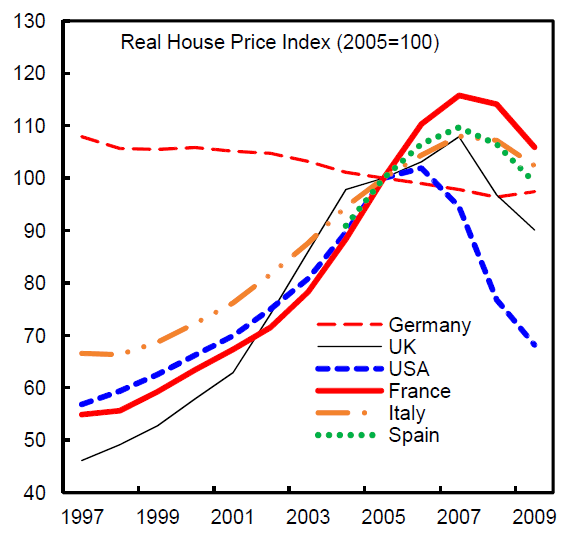
EUROPEAN HOME PRICES HAVE MUCH ROOM TO CORRECT

Barry Ritholtz at the Big Picture hosts a graph of developed nations' home prices.


As you can see there is plenty of room left for correction in the European housing markets.

CHINA TO HAVE 500 MILLION BARRELS OF PETROLEUM PRODUCTS STORAGE BY 2015

David Winning at the Wall Street Journal reports that Chinese petroleum product storage tanks are set to grow by 500 million barrels by 2015. In addition, China is adding 338 million barrels to the existing 102 million barrel strategic petroleum reserve. Filling these tanks will put upward pressure on the price of oil. Building the tanks will also dampen the dreams of other countries with spare storage capacity, South Korea and Singapore, to sell into the Chinese market.

CHINA'S CAR SALES NOW FAR SURPASS US'S

Alex Taylor III at Fortune Magazine reports that China is expected to sell 15.6 automobiles in 2010, a 20% rise from the year before. Auto sales in the US are expected to reach 11.6 million units this year.

CHINESE BANKING REGULATOR ASKS BANKS TO PERFORM STRESS TESTS TO SEE WHAT WOULD HAPPEN WITH 60% REDUCTION IN HOUSING PRICES; NEW STUDY SHOWS THAT SMALLER CITIES NOT FACING SIMILAR HOUSING PRICING PROBLEMS IN CHINA

Bloomberg reports that China's banking regulator last month asked its banks to perform stress tests to see what would happen if housing prices declined.
"Banks were instructed to include worst-case scenarios of prices dropping 50 percent to 60 percent in cities where they have risen excessively."
Meanwhile, Aaron Back at China Real Time reports that Standard Chartered has conducted a survey of "Tier 2 and 3" cities and found that they are not suffering from deep corrections.
"'The Tier 2 and Tier 3 cities have not seen much of a correction in land or apartment prices. Moreover, developers’ sentiment about sales volumes seems pretty good, and they do not appear to be postponing construction,' Standard Chartered said in a report on Tuesday. 'This is important, since if sales and construction activity holds up in most Tier 2 and Tier 3 cities, then the economy will not tank, and the State Council will not be forced to loosen real-estate or monetary policy.'"
PALESTINIAN PRESIDENTIAL ADVISER SAYS PEACE MAY CREATE 20% ECONOMIC GROWTH IN PALESTINE

Jonathan Ferziger at Bloomberg reports that a key adviser to the Palestinian president said that the Palestinian economy may grow by as much as 20% if there is peace with Israel.

EIA REPORTS 2.8 MILLION BARREL CRUDE DRAW DOWN IN STOCKS

The EIA reported today that for the week ended July 30 crude oil stocks drew down by 2.8 million barrels to 358 million barrels. Crude oil stocks are well above the five year historical average. Gasoline stocks grew by 0.7 million barrels and distillate stocks grew by 2.2 million barrels. Refining capacity utilization grew to 91.2%. For the week ended August 2nd, national gasoline prices fell by 1.4 cents to 273.5 cents.

Thursday, July 29, 2010

Daily Sources 7/29

1. EUROPEAN ECONOMIC SENTIMENT HITS 28 MONTH HIGH

Marcin Grajewski at Reuters reports that consumer sentiment in Europe has hit a 28 month high.
"The European Commission said its economic sentiment indicator for the 16-nation currency area rose to 101.3 in July, a 28-month high, from an upwardly revised 99.0 in June."
2. GERMAN UNEMPLOYMENT FALLS FOR 13TH STRAIGHT MONTH

Rainer Buergin and Christian Vits at Bloomberg report that unemployment in Germany fell for the 13th straight month by a seasonally adjusted 20,000 to 3.21 million.

3. BANKS TO PREPARE FOR EUROZONE EXIT SCENARIOS

Eurointelligence reports that banks in Europe are preparing scenarios for eurozone states exiting the euro.
"The International Swaps and Derivative Association asked some of its members to form a group to consider what they may need to do if a eurozone state is ejected."
4. CZECH GOVERNMENT REFUSES TO SET DATE FOR EURO ADOPTION

Peter Laca and Ladka Bauerova at Bloomberg report that the Czech government has said that it refuses to commit to a date for euro adoption.
"[Prime Minister] Necas, 45, said the country will benefit from a flexible exchange rate as consumer prices converge with those in richer European Union-member states, and rapid euro adoption would risk fueling inflation. The koruna has gained 3.7 percent against the euro this month, the most among more than 170 currencies tracked by Bloomberg, making Czech exports more expensive.

'The government program will not include any target date or a promise to join the euro area,' Necas said today in an interview at his office in Prague. 'Exports are important, but this country is not only a country of exporters.'"
5. UK PRODUCTION OF GAS DOWN 14.3%

Platts reports that the UK's production of gas was down 14.3% in 2009 from 2008. "Gross natural gas production has fallen by 45% since its peak in 2000."

6. REGIONAL GROUPING TO DISCUSS COLOMBIA-VENEZUELA RIFT

BBC reports that Unasur, a regional grouping of foreign ministers, is set to discuss the rift between Venezuela and Colombia at its meeting in Quito today.

7. CONOCO WILL SELL ENTIRE STAKE IN LUKOIL

Sheila McNulty at the Financial Times reports that Conoco announced yesterday that it would sell its entire stake in Lukoil.
"Jim Mulva, Conoco chief executive, said the Lukoil investment had been aimed at doing joint deals and these had not happened."
8. IMF TO LEND UKRAINE $15.2 BILLION

Kateryna Choursina and Sandrine Rastello at Bloomberg report that Ukraine has secured a $15.2 billion, 2 1/2-year loan from the IMF.
"The Washington-based institution’s board of directors agreed to disburse $1.9 billion immediately, with subsequent payments subject to quarterly reviews.

“Ukraine is emerging from a difficult period during which the economy was severely hit by external shocks and exacerbated by domestic vulnerabilities,” John Lipsky, the fund’s first deputy managing director, said in a statement. “Authorities are committed to addressing existing imbalances and putting the economy on a path of durable growth, through important fiscal, energy, and financial sector reforms.” "
9. INITIAL UNEMPLOYMENT CLAIMS DOWN 11,000

Calculated Risk reports that
"In the week ending July 24, the advance figure for seasonally adjusted initial claims was 457,000, a decrease of 11,000 from the previous week's revised figure of 468,000. The 4-week moving average was 452,500, a decrease of 4,500 from the previous week's revised average of 457,000."

Tuesday, July 20, 2010

Daily Sources 7/20

1. BUNDESBANK SAYS CURRENT-ACCOUNT DEFICITS OF IRELAND, SPAIN, GREECE AND PORTUGAL THREATEN EUROZONE

Thomas Molloy at the Independent reports that the economic policies of Ireland, Spain, Greece, and Portugal represent a threat to the Eurozone as a whole and the entire Euro project.
"'These macro-economically erroneous trends' are 'a source of danger for other member countries and the currency region as a whole,' the Bundesbank wrote in its monthly bulletin. Deficit countries damage the eurozone's stability and 'it is urgently necessary to correct maldevelopments and avoid a repetition in the future'."
2. EUROPEAN COMMISSION TO BAN COAL SUBSIDIES BY 2014

James Kanter at Green reports that the European Commission has tentatively banned subsidies for coal mining starting 2014.

3. PEW SAYS THE DEVELOPED WORLD UNHAPPY WITH CHINA'S RISE

Free Exchange notes that concerns about China's economic might are high in the developed world. Much of the developing world ain't so keen on its rising military prowess either.


4. CHINA NOW THE WORLD'S LARGEST ENERGY USER

Grant Smith at Bloomberg reports that according to the IEA China is now the largest user of energy consuming 2,252 million metric tons of oil equivalent in 2009 versus the 2,170 million tons used by the US. Somewhat oddly, Shai Oster at China Real Time reports that the Chinese leadership has rushed to deny that it is now the largest energy user, saying that by their calculations the US remains top dog in that department.

5. JAPAN AND CHINA TO NEGOTIATE HOW TO DEVELOP UP EAST CHINA SEA GAS

Takeo Kumagai at Platts reports that Japan and China are seeking to schedule negotiations on how best to jointly develop the East China Sea gas fields which have been the source of some friction between the two governments.

6. US AND SOUTH KOREA TO CONDUCT NAVAL DRILLS NEXT WEEK

After a delay which caused some to speculate that the US was worried about upsetting China, Elisabeth Bumiller and Edward Wong at the New York Times report that the US and South Korea have agreed to hold naval exercises in the Sea of Japan and Yellow Sea next week. The exercises are in part a response to the sinking of a South Korean ship by a North Korean submarine four months ago. Beijing has strongly objected to the US holding naval drills in the Yellow Sea.

7. JAPAN TO CONSIDER ENERGY HUB AMBITIONS

Takeo Kumagai at Platts reports that Japan is considering using its spare storage capacity to act as an energy hub in the region. Japanese oil consumption is on a downward trend leaving considerable spare capacity. Some are considering using that spare capacity to export out into regional markets extra petroleum products, becoming the third trading hub in the region after Singapore and South Korea.

8. RUSSIA SENDS MISSION TO CLARIFY BORDER ON ARCTIC SHELF

Elena Kovachich at the Voice of Russia reports that
"The flagship of Russia’s polar fleet “Academician Fyodorov” has left for the Arctic on an expedition to clarify the outer border of the country’s continental shelf."
9. NABUCCO COMPLETES PUBLIC HEARINGS IN TURKEY

Alex Froley at Platts reports that the Nabucco pipeline project has completed the first round of public hearings in Turkey.
"Erdal Tuzunoglu, managing director for Nabucco Turkey, said: 'The completion of the public hearings is an important step towards the realization of the Nabucco project. The communities are very interested in the project and we feel that their concerns were addressed and discussed.'"


10. JUNE UNEMPLOYMENT BY STATE SHOWS IMPROVEMENT

Phil Izzo at Real Time Economics reports that the Bureau of Labor Statistics announced that most states--37--saw unemployment fall in June, while five saw an increase and in six there was no change. 27 saw a decrease in payroll employment while 21 saw an increase. Click on the link for neat interactive map and chart.

11. THE WHITE HOUSE ANNOUNCES FORMATION OF NATIONAL OCEAN COUNCIL

John M. Broder at Green reports that the White House yesterday announced the creation of a National Ocean Council. The new body will not have the power to create new regulations, but will attempt to coordinate the policy of overlapping institutions regulating ocean policy. Worth reading in full.

Wednesday, July 14, 2010

Daily Sources 7/14 (Bastille Day)

THE EU IS HALFWAY TO MEETING THEIR GOAL OF 20% RENEWABLE FUELS CONSUMPTION BY 2020

Reuters reports.

THE EURO'S INTERNATIONAL ROLE

The European Central Bank has released a 84 page paper on the international role of the Euro.

RUSSIAN SPENDING MORE THAN THE PRICE OF OIL WOULD ALLOW

Toni Vorobyova at Reuters reports that Russian spending is well above what the price of oil would allow without running a deficit.

GERMANS WORRIED THEIR RELATIONSHIP WITH RUSSIA IS COOLING

Matthias Schepp at Der Spiegel worries that the Merkel administration has not continued a strong tradition of courting Moscow, allowing other nations to attempt to get pride of place. In the meantime, John Roberts at Platts reports that RWE has decided to consider an offer from Moscow to join the South Stream pipeline plan, but loudly asserted its commitment to Nabucco.

BERLIN CONSIDERS AUCTIONING OFF EXTRA TIME FOR NUKE PLANTS

David Crossland at Der Spiegel reports that the Merkel Administration, which wants to bypass the plan to shutter all nuclear power plants by 2020, is considering auctioning off more time for the plants to operate. That is, the power companies could bid for additional time past 2020 in which they could operate. A key reason for the idea is that nuclear power makes it easier to meet carbon reduction goals.

SPANISH SOLAR POWER NOW BIGGER THAN US

Sharon Hong at News Watch Energy reports that with the commissioning of a new solar plant Spain now leads the US in solar power energy production.

SOUTH KOREAN PLAN FOR PRIVATE COS TO SPEND $18 BILLION ON GREEN TECH SMOKE AND MIRRORS

Christian Oliver at FT Energy Source warns us that the news yesterday that the plan for South Korean companies to spend $18.6 billion on green technologies is not quite what it seems.

NIGERIAN CRUDE EXPORTS TO US ON THE RISE

Jacinta Moran at Platts writes that NIgerian exports to the US are averaging 945 kb/d in the first quarter of 2010, up from 606 kb/d in the same quarter last year. A key reason is that efforts to mollify Niger Delta rebels have had some success. Meanwhile, Sharon Hong at News Watch Energy reports that the Nigerian state oil company is insolvent as it waits for the government to pay it its subsidies.

MORE THAN 4 PEOPLE ARE LOOKING FOR JOBS FOR EACH AVAILABLE JOB

Per Mark Thoma at Economist's View:


OIL PRICES MODERATING SOMEWHAT IN US

James Hamilton at Econobrowser updates some charts he uses to monitor energy costs in the US, including a chart of US retail gasoline prices.


Note that prices are in the range where they begin to affect driving behavior in the US, or $2.50/g. They are just short of $3.00/g where prices will have a strong effect on driving behavior.

CRUDE OIL STOCKS DOWN 5.1 MILLION BARRELS

The EIA reports that crude oil stocks fell by 5.1 million barrels in the week ended July 9th, though they are still well above the 5 year historical average. Gasoline stocks built by 1.6 million barrels and distillates grew 2.9 million barrels. The average price of gasoline for the week ended July 12th fell by 0.8 cents to 271.8 cents/gallon. For the week ended July 9th, refinery utilization grew to 90.5%.

Friday, July 31, 2009

Daily Sources 7/31

1. MESSERLIN AND MAREL ARGUE THE US & EC COULD REAP GAINS BY OPENING SERVICES SECTOR

Patrick A Messerlin and Erik van der Marel at VoxEU argue that the US and the European Commission should launch transatlantic negotiations in opening the services sector as a prelude to multilateral negotiations. Key excerpts:
"Services providers are busy redesigning their strategies for coping with the ongoing economic crisis. To take the appropriate decisions, they need predictable future market access in services. Meanwhile, as many services are still highly protected, opening services markets would deliver large benefits to consumers impoverished by the crisis."
"Is there any appetite for services negotiations now? Yes. The July 2008 Signalling Conference held under the aegis of the Doha Round showed a substantial number of participants expressing strong interests in most services, offers and requests in mode 3 in many services (foreign direct investment), and even a willingness to include mode 4 (movement of natural persons, by far the most contentious part of any service negotiations) in some services.

Such a willingness to negotiate appears particularly strong in three services: business, communication, and distribution services. Together, these three services in the EC, US, and top eight countries represent almost one-third of the world GDP, a size so huge that negotiators could work on deals within as well as between these services sectors. The three services face high levels of regulatory constraints, ensuring huge economic gains in case of market opening. Finally, negotiations are made easier by the fact that business and communication services are resilient to the current crisis, while the inflationist pressures to come should make governments eager to have distribution services as competitive as possible.

Last but not least, the foreign policy dimension of the whole endeavour is crucial for Europe. Many US decision-makers are looking to Asia for good reasons (Bergsten, 2009) while Europeans have not yet fully grasped the growing importance of Asia nor captured its attention, as illustrated by the disappointing June 2009 Asia Europe Ministerial meeting on energy."
2. EUROZONE UNEMPLOYMENT UP TO 9.4% IN JUNE, CONSUMER PRICES FELL AT ANNUAL RATE OF 0.6%

Reuters reports that eurozone unemployment rose to 9.4% in June, up from a revised figure of 9.3% in May.
"The European Union’s statistics office also said on Friday that inflation in the euro area had moved much further into negative territory than forecast in July, with consumer prices falling at an annualized rate of 0.6%.

The drop raised worries about deflation and heightened expectations that the European Central Bank will maintain its loose monetary policy."
3. US OPEN TO BRINGING RUSSIA INTO NATO

Yevgeny Bendersky at the Compass reports that
"Assistant Secretary of State Philip Gordon told US lawmakers Tuesday during the House International Relations Committee hearing that the United States would consider Russian membership in NATO."
Gordon said:
"[I]f Russia meets the criteria and can contribute to common security, and there is a consensus in the alliance, it shouldn't be excluded."
Bendersky points out that some in Eastern Europe might be cold to the idea. Given that membership would freeze, so to speak, the current borders by militarily integrating the members, it may arguably provide superior protection than the current relationship. It certainly would make adventurism a much more complicated affair.

4. NIPPON OIL IN TALKS WITH SK ENERGY TO BUILD NEW REFINERY IN VIETNAM

Megumi Yamanaka and Yuji Okada at Bloomberg report that Nippon Oil Company has announced it might build a refinery in Vietnam with SK Energy Co.
"'We’ve been in talks with SK and have agreed on the need for participating in a refining project' in Asia, Nippon Oil Chairman Fumiaki Watari said in an interview in Tokyo yesterday. Vietnam is a potential location for the first venture between Japan and South Korea’s biggest refiners, and the plant may process 200-300 kb/d of crude oil, he said.

Seo Young Joon, a spokesman at SK Energy in Seoul, said he couldn’t immediately comment. Idemitsu Kosan Co., Japan’s second-largest refiner, and Mitsui Chemicals Inc. plan to spend $5.8 billion to build a 200 kb/d plant in Vietnam."
"'We know that about 25% of Japan’s refining capacity will be unnecessary in the next five years.' Watari said."
Vietnam inaugurated its first refinery this year with capacity of 148 kb/d and which is poised to supply about 30% of Vietnam's product requirement--see Daily Sources 7/28 #8. The EIA projects its total petroleum demand was about 288 kb/d in 2008. Hanoi projects GDP will grow by 5.5% in 2009, adding perhaps as much as 10 kb/d in demand this year.

5. INDIAN FIELD BEGINNING PRODUCTION TO UP INDIAN CRUDE PRODUCTION BY 25%

The Economic Times reports that Indian crude production is expected to rise by about 25% when Cairn begins pumping from the Mangla field of its Rajasthan acreage next month.
"'We are operationally ready to commence oil production in August,' Cairn India CEO Rahul Dhir said. In its various filings to the government, Cairn has indicated that production will quickly touch 30 kb/d by the end of third quarter this year and reach a plateau of 175 kb/d (8.75 million tonnes a year) in 2011. Goldman Sachs, however, has pegged the peak output at 190 kb/d (9.5 million tonnes a year)."
Using EIA projections, Indian crude production in 2008 was 693.7 kb/d. Its imports came in at 2.056 mb/d, so the Mangla field at 175 kb/d would represent about 8.5% of its import requirement. However, some of those imports are reexported as products, for example to the US--Reliance is set to restart its old Jamnagar refinery shortly, bringing another 660,000 kb/d of nameplate capacity on line. It is expected to double Reliance gasoline exports to about 170 kb/d.

6. PAKISTANI SUPREME COURT REJECTS PETITION TO TRY MUSHARRAF ON TREASON CHARGES

BBC News reports that the Pakistani Supreme Court has rejected a petition to try former President Musharraf on charges of treason.
"The court had asked him to explain his decision in 2007 to invoke emergency rule and suspend the constitution.

It has now ruled that parliament is the place to debate Mr Musharraf's actions.

Chief Justice Iftikhar Mohammed Chaudhry rejected a petition to launch a treason case against the former president.

Mr Chaudhry was himself removed from his position as a result of President Musharraf's imposition of emergency rule, but was reinstated after he resigned in August."
For more on the lawyers revolution in Pakistan, I wrote a long piece on it early last year--see The Law in Pakistan.

7. 40 DAY CYCLE OF PROTESTS IN IRAN MIRROR 1979 REVOLUTION, PRESS REPORTS OF CHINESE-IRAN MOU ON SOUTH AZADEGAN FIELD DENIED BY CNPC, US SENATE TO BAR THOSE SELLING PETROLEUM PRODUCTS TO IRAN FROM PARTICIPATION IN SPR

Michael Collins Dunn at the MEI Editor's Blog observes that the 40-day cycle in protests seen in the 1979 Iranian Revolution is being repeated in the current conflict over the elections. Juan Cole at Informed Comment has a good roundup of the recent political events in Iran. Meanwhile, Upstream Online notes that there have been stories that CNPC has signed an MOU with NIOC to develop the South Azadegan oilfield, taking a 70% stake in the field in return for covering 90% of development costs.
"However, a CNPC manager based in Beijing told Reuters today that the MoU was actually signed earlier this year and there has been no real breakthrough in talks with the oil ministry since then.

'The MoU is not a binding contract, and we are still negotiating with NIOC about specific details,' the CNPC source, who declined to be named because he was not authorized to speak to the media, told the news agency."
In the meantime, Jean Chemnick and Katharine Fraser at Platts report that the US Senate has inserted language into the Senate Energy and Water Appropriations bill [H.R. 3183] which would prohibit companies that sell gasoline and diesel to Iran from entering into contracts to fill the Strategic Petroleum Reserve.
"At least three companies fit that bill, Glencore, Shell Trading and Vitol, according to the Foundation for Defense of Democracies. In January, the three were named by DOE as suppliers to the SPR for deliveries this year. While it could not be immediately confirmed whether any of the three currently sell refined products to Iran, all of them are known active traders in oil markets throughout the world."
In June, Reliance--a private oil company in India--halted gasoline exports to Iran, apparently because they expected difficulties for their exports to the US--see Daily Sources 6/4 #8. The UAE provides about 80% of Iranian product requirements, IIRC.

8. BAHRAIN CENTRAL BANK SEIZES TWO BANKS HELD BY SAUDI CONGLOMERATES

Frederik Richter at Reuters reports that the central bank of Bahrain has seized two banks owned by major Saudi conglomerates.
"The central bank said in a statement on Thursday it had assumed control of Awal Bank, owned by Saad Group and The International Banking Corporation, a unit of the Ahmad Hamad Algosaibi and Brothers conglomerate.

The central bank said an investigation at both banks had shown a substantial shortfall in assets compared with their liabilities and that it would appoint an external administrator to identify creditors' claims and manage the distribution of the remaining assets."
9. NIGERIAN PRESIDENT ENTERS TALKS WITH 6 NIGER DELTA GOVERNORS TO PREVENT THREATENED BOYCOTT OF MILITANT AMNESTY PLAN

Platts reports that Nigerian President Umaru Yar'Adua has begun talks with six governors from the Niger Delta in an effort to avert a threatened boycott of the amnesty program for militants in the region.
"The governors of southern Akwa Ibom, Bayelsa, Edo, Delta, Cross River and Rivers states last week said they would pull back their involvement in the amnesty deal for Delta militants in protest of the federal government's plan to relocate the petroleum training college in Delta state to northern city of Kaduna.

'There is a serious misunderstanding about some of the issues raised, but the president is very concerned and has been talking with the Niger Delta governors individually,' Presidential spokesman Olusegun Adeniyi in a statement. 'The president has respect for the Niger Delta region. He did not approach the crisis in the area as a Northerner.'

The governors also had grouse against a provision in the oil sector reform bill, which they said takes away royalties due Delta communities."
Earlier this week, the Nigerian Joint Revolutionary Council--an umbrella group of militants in the Niger Delta which includes MEND--warned a company linked to a current oil minister to stop operations to express their displeasure with the plan to locate the petroleum university in the north--see Daily Sources 7/28 #9.

10. US ENVOY FOR SUDAN RECOMMENDS TAKING KHARTOUM OF TERRORIST LIST

Reuters reports that General Scott Gration, the US special envoy for Sudan, recommended to Congress that Sudan be taken off the state sponsors of terrorism list.
"'There is no evidence in our intelligence community that supports [Sudan] being on the state sponsors of terrorism list,' Gration said. 'It's a political decision.'"
"'We are actually hurting the very development things we need to do help the south become ... if they chose to secede, a viable economic state,' Gration said, noting that Washington could not bring in heavy equipment to build roads and railways.

'At some point we are going to have to unwind some of these sanctions so that we can do the very things that we need to do to ensure a peaceful transition and a state that's viable in the (south) should they choose to do that,' he added.

In its latest report, the State Department described Sudan as 'a cooperative partner in global counterterrorism efforts.'"
11. CHÁVEZ PROPOSES LAW GIVING GOVT ARBITRARY POWER TO CONTROL MEDIA

Fausta Wertz at the Compass has the best summary of the news that Hugo Chávez's administration has now proposed a set of laws which would limit broadcasting rights and would make the rather arbitrarily defined violations are punishable with prison terms.
"The proposed law ... includes all media and applies to not only owners and publishers but also reporters, freelancers and anyone making a statement that could be interpreted as (my translation) 'any person who manipulates or distorts the news, creating a false perception of facts... as long as there is damage to social peace, national security, public order, or the mental health or public morals.'

The charge carries a compulsory 2-4 year prison sentence."
Wertz includes a link to the text of the law. She notes that the UN has registered its worries regarding the proposed legislation, but projects the protest will have little affect upon the administration's decision-making process ... correctly in my view.

12. RESEARCHERS FIND THAT EFFORTS TO HALT OVERFISHING ARE SUCCESSFUL

BBC News reports that a team of researchers have released the findings of a two-year study which concludes that efforts to halt overfishing in 5 of 10 marine ecosytems have helped fishing stocks to recover.
"The authors observed: 'Some of the most spectacular rebuilding efforts have involved bold experimentation with closed areas, [fishing] gear restrictions and new approaches to catch allocations and enforcement.'

But they warned that the signs of recovery should not be interpreted by policymakers as a sign that all was well beneath the waves.

The majority of fisheries were still in trouble, and were not being managed or regulated properly.

But Dr Worm said that the team's 'watershed paper' offered a blueprint for sustainable fishing.

'It clearly shows what needs to be done to not only avoid fisheries collapse, but to actually rebuild fish stocks and ecosystems.'"
(h/t Yves Smith at naked capitalism.)

13. US GDP DOWN AT ANNUALIZED RATE OF 1% IN Q2, CHICAGO PMI INDICATES BOTTOM

The Bureau of Economic Analysis released its estimation today that Q2 GDP fell at an annualized rate of 1%. Ed Harrison of Credit Writedowns observes:
"Down 1.5% was the consensus expectation. But Q1 was revised down to minus 6.4% from 5.5%. The GDP Deflator for Q2 came in at 0.2%, which shows that disinflation risks tipping into deflation still. The dollar is weaker and the short end of the treasury curve is up massively on these data and revisions.

Also ... the 2008 numbers were revised down. Q1 2008 was revised from positive 0.9% to negative –0.7%. Q2 2008 was revised way down as well from 2.8% to 1.5%. Q3 2008 was also very negative, now –2.7%. This confirms the December 2007 recession call.

There was a $140 billion reduction in inventories in Q2. I have been saying for some time that this would set us up for lots of upside come Q3 and Q4 as the inventory purge dissipates. So, we will get a technical recovery in my opinion. The question is whether there is any underlying demand uptick behind the inventory changes. In the data ... from the BEA website, you can clearly see ... that consumers are not even spending on basic items. Spending on non-durable goods was down 2.5% annualized. That is not good."
Peter Boockvar at the Big Picture reports that the Chicago PMI was 43.4 in July, up from 39.9 in June. (PMI readings of above 50 indicate expansion; below 50 indicates contraction.) He observes:
"Inventories remained extremely lean, falling to 25.4 from 34.2, the lowest since 1949 and is the perfect set up for a sharp contribution to GDP from this area in the 2nd half of the year, led by auto’s and related sectors. The employment index rose 6.4 points to 35.3, well below 50 but at the highest level since Dec ‘08. Prices paid fell a touch. Bottom line, the data confirms the backdrop for an improvement in GDP. The degree and sustainability of the recovery will however remain in the hands of end demand, aka, predominantly the US consumer."
Rebecca Wilder at News N Economics observes that
"Households have been 'delevering' for a longer time period than previously thought--as recent as 2008 Q1, the saving rate that was reported to be essentially zero, 0.2%, is now 1.2%."
Her chart of the US savings rate (with revisions as of today):

"The BEA has 'found' that households have been in fact saving roughly 1% of their disposable income per quarter since 1995, 0.9% per quarter in 2008."
Well worth a look, as always.

Wednesday, July 15, 2009

Daily Sources 7/15

1. PETROCHINA'S REFINING PROFITS AT RECORD ON PRICE LIBERALIZATIONS

Wang Ying at Bloomberg reports that PetroChina increased its refining profits in the first half of 2009 on the back of the revised pricing system which allows refiners to pass on the cost of production to consumers. Gasoline and diesel are, as a result, considerably more expensive in China than they are, say, in the US. I suspect it will go some ways to dampen demand. Meanwhile, Beijing made an example of the former ex-Chairman of Sinopec, Winnie Lee at Platts reports that Chen Tonghai was sentenced to death for bribery, but given a two-year reprieve.
"The court said Chen abused his authority ... to pursue material gains for third parties in areas related to business operation, transfer of land, and contract procurement, according to the Xinhua report.

The two-year reprieve means that Chen's sentence will be commuted to life imprisonment if he commits no further crime while in jail.

Chen resigned from his posts as the head of China Petrochemical Corporation Group and Sinopec Corporation in June 2007."
2. SOUTH KOREAN COURT HEARS PROPERTY RIGHTS CLAIM BY NORTH KOREAN CITIZENS

Su-Hyun Lee at the New York Times reports that a South Korean court has for the first time decided to hear a case brought by North Korean citizens attempting to establish property rights in the south.
"Four North Korean brothers and sisters have sued their late father’s second wife and that couple’s four children in South Korea for a share of an inheritance from the estate of the father, a successful doctor.

The suit claims at least a quarter of the father’s land and other property, worth about $8 million. He left North Korea for the South with his eldest daughter during the 1950-53 Korean War and never returned. In 1959, he reported that his first wife had died and married a South Korean woman, with whom he had four more children. He died in 1987.

Family members in the south, including the sister who came there with the father, asked that only the family name, Yoon, be used, to protect the relatives in the North and the privacy of those in the south."
Although this is the first suit by North Korean citizens to be accepted by a South Korean court, the right of North Koreans to sue in South Korean courts has already been established by rulings of "the Supreme Court and the Constitution"--though I am left unsure as to exactly what kind of complaint was addressed by the courts establishing this in the absence of a North Korean plaintiff. In any case, the smooth handling of the case may well reassure some of the anxieties of both Northerners and Southerners.

3. EUROPEAN CASH FOR CLUNKERS PLAN MAY BE REVERSING DIESELIZATION

Tim Worledge at the Barrel makes the especially interesting observation that Europe's "cash for clunkers" program--designed to slow the steep fall in auto sales--has pushed sales of gasoline-driven cars up above diesel-driven ones.
"According to the European Automobile Manufacturers' Association, ACEA, diesel comprised around 53% of all new car sales in 2007 and 2008, before the scrappage schemes were introduced.

For the first five months of this year, diesel sales fell to 46.3% of the total, apparently marking a reversal in the 20-year 'dieselization' of Europe."
"This threat to diesel's dominance represents a seismic shift.

Bolstered by favorable tax regimes, the growing use of diesel in Europe has done more than any other trend to spur refining investment and shape global trading patterns in the oil market. It has been clear in recent years that Europe is very long gasoline, with the surplus largely shipped to the US, and is short diesel, which it takes from anywhere it can get it.

Within Europe, and further afield, this has spawned massive investment programs as refinery kit designed to meet gasoline demand is re-aligned, augmented and upgraded to produce ever greater volumes of diesel."
"It's the same story in France, regarded as the bastion of diesel and birthplace of the engine's inventor Rudolf. In 2008, diesel sales peaked at a whacking 77.3% of all new cars, but this has now fallen to 71.6%.

Whether this is a blip, a temporary stumble along the road to full European dieselization, remains to be seen, although it's worth noting that even those diesel cars that are being purchased are burning up to 48% less of what is an increasingly bio-blended road fuel."
However, if it does represent a long-term reverse in trend, the window for diesel arbitrage to Europe will mostly be closed, meaning that there will be no outlet for excess diesel supply in the US, which would likely result in another retooling of US capacity back to full gasoline maximization.

4. EUROZONE INDUSTRIAL PRODUCTION UP 0.6% IN MAY MOM, DOWN 17% YOY

Gerrit Wiesmann at the Financial Times reports that eurozone industrial production rose by 0.6% in May from April, though it was still down 17% from May 2008.
"Strong monthly increases reported by Germany, France and Italy in recent days had led economists to expect a bounce of 1% in May. However, these hopes were dashed by output decreases in Spain and some smaller countries."
5. RUSSIAN RAILWAYS RECEIVES $500 MILLION LOAN FROM THE EBRD, LARGEST LOAN IN THE BANK'S HISTORY

Paul Abelsky and Denis Maternovsky at Bloomberg report that OAO Russian Railways has borrowed from the European Bank for Reconstruction and Development $500 million over 10 years in what is the largest loan ever provided by the bank.
"The deal is the London-based development bank’s largest single investment since it was founded in 1991 to fund infrastructure in former communist nations in Europe and central Asia, the EBRD said in a statement today. Moscow-based Russian Railways sold 90 billion rubles ($2.8 billion) of domestic bonds this year, more than any other company in the country, to finance its investment program."
"Russian Railways, the country’s biggest commercial employer, is seeking fresh funds after posting a loss of 17.1 billion rubles ($534 million) in the first quarter. Rail cargo shipments fell an annual 23% in the first half and may drop 19% in the year, Vladimir Yakunin, the company’s chief executive officer, said July 6.

Russian Railways cut annual spending by more than 34%, to 252 billion rubles, this year after the government reduced financial support for the company and domestic demand for its services waned, Yakunin said in an interview published today in the Vedomosti newspaper. Railroads account for about 85% of Russia’s total cargo transport capacity, according to VTB Capital data.

EBRD aims to invest a minimum of $3 billion in Russia this year, President Thomas Mirow said last month at an economic forum in St. Petersburg."
6. BULGARIA TO GET SPUR FROM THE ITGI PIPELINE

Kerin Hope and Theodor Troev at the Financial Times reports that Greek, Bulgarian, and Turkish companies signed an agreement to build a spur from the ITGI pipeline carrying natural gas from Azerbaijan to Turkey and Greece and which is to be extended to Italy. The spur would have a 3-5 bcm/year capacity and is scheduled to be completed by 2012 at a cost of €120 million (~ $167 million).

"The project highlights the new spirit of co-operation between Athens and Sofia. The Balkan neighbors have a history of bilateral disputes, from arguments over sharing water resources to stake-holdings in a proposed cross-border oil pipeline.

Both countries are keen to become regional transit hubs for gas pipelines from central Asia and the Middle East.

Bulgaria signed up on Monday to join Nabucco and, like Greece, is also a partner in the proposed South Stream pipeline to bring Russian gas to the EU under the Black Sea."
Sofia has secured about €45 million in EU grants to fund the project. According to a 2007 Edison press release, ITGI as it stands has a capacity of 11.5 bcm/year of which Italy had been slated to receive, following the completion of the final section also in 2012, 8 bcm/year. According to a story featured on the Azerbaijan Business Center, Gian Luigi Mascia, the Italian Ambassador to Azerbaijan, said in Baku today that
"The gas pipeline is designed only for Azeri gas. Its overall capacity will be up to 14 bcm a year, including 1 bcm to be delivered to Greece, 10 bcm to Italy and 1-3 bcm to Bulgaria."


Bulgaria responded to the Russo-Ukrainian gas transit dispute in January by re-starting a nuclear reactor despite it violating the terms for its accession to the EU--see Daily Sources 1/15 #1.

7. ISRAEL HAVING TOUGHER TIME IN EUROPE, ISREALI WARSHIPS PASS THROUGH SUEZ

Juan Cole has an interesting analysis suggesting that Israel is more on the outs with Europe than usual. He notes that Javier Solana called for the recognition of a "Pelstinian state by the world community by a date certain, regardless of the Israeli position" suggesting that he is more or less Europe's foreign minister. (Much much less, actually, though important, and certainly an interesting development. The analysis contains a goodly share of wishful thinking, on Prof. Cole's part, but it is still interesting and what he records may well be a sign of a sharper move in the European capitals.) Meanwhile, Michael Collins Dunn at the MEI's Editor's Blog notes that two Israeli corvettes (warships slightly smaller than frigates) have been allowed, by Cairo, to pass through the Suez. He notes:
"Warship transits, while guaranteed under the Israeli-Egyptian peace treaty, are rare, given the fact that Israel is concerned about security. As anyone who has seen the canal knows, it is narrow, and warships passing are easily viewed by civilians and others along its banks."
8. MEND ANNOUNCES CEASEFIRE, QUICKLY THREATENS TO END IT

Platts reports that MEND earlier Wednesday announced a ceasefire following the release of its leader--Henry Okah--yesterday, but has since threatened to call it off, accusing the government of using it as an opportunity to ramp up its military presence in the region.

9. VENEZUELAN OIL MINISTER SAYS ALL PDVSA EMPLOYEES MUST JOIN "SOCIALIST COMMITTEES"

Marianna Parraga at Reuters reports that Venezuelan oil minister Rafael Ramirez yesterday told a rally of workers who had been employed by PdVSA following the nationalization of oil services firms operating in the country that
"By now, there should not be a single counter-revolutionary in the heart of our company, our industry. There cannot be a single PdVSA installation where socialist committees do not exist. Whoever is not in a committee will be suspected of conspiring against the revolution."
"Socialist committees are loosely defined political groups often organized by Chávez's Socialist Party."

10. US COMMERCIAL CRUDE STOCKS DOWN, GASOLINE & DISTILLATE STOCKS UP, REFINERY UTILIZATION UP, BUT US INDUSTRIAL PRODUCTION DOWN 0.4% IN JUNE FROM MAY, 13.6% YOY, CONSUMER PRICES UP 0.7% NEARLY ALL ON ENERGY COSTS, WHILE US WAGES, ADJUSTED FOR INFLATION, FALL 1.2%

The EIA today reported that commercial crude stockpiles fell by 2.8 million barrels to 344.5 million barrels in the week ended July 10. The amount is storage is still above the five year historical range for this time of year, but the draw was for more than the 2.1 million barrel draw expected by Wall Street analysts, per a survey by Bloomberg. Gasoline stocks grew by 1.5 million barrels versus analyst expectations of a 875 kb build and are now near the top of the five year historical range for this time of year. Distillate stocks grew by 600 kb versus analyst expectations for a 2 mb build and are still at extremely elevated levels, about 28% more than what was in storage in the comparable week of last year. Overall US refining capacity went up in the week ended July 10 to 87.87% of total operable capacity from 86.8%. However, industrial production in June was down 0.4% from May and 13.6% from June 2008 according to the Fed's index. From the report:
"For the second quarter as a whole, output fell at an annual rate of 11.6%, a more moderate contraction than in the first quarter, when output fell 19.1%. Manufacturing output moved down 0.6% in June, with declines at both durable and nondurable goods producers. Outside of manufacturing, the output of mines fell 0.5% in June, and the output of utilities increased 0.8%. The rate of capacity utilization for total industry declined in June to 68.0%, a level 12.9% points below its average for 1972-2008. Prior to the current recession, the low over the history of this series, which begins in 1967, was 70.9% in December 1982."
Meanwhile, Gerry Shih at the New York Times reports that the Labor Department announced that its consumer price index climbed 0.7% in June from May. The "core" index, which excludes food and energy prices, rose by 2%.
"Compared with a year ago, the Consumer Price Index has fallen 1.4%, the steepest plunge since 1950, as the prolonged downturn takes its toll on demand in the economy. ...

A separate Labor Department report released Wednesday said that American wages, adjusted for inflation, fell by 1.2% in June."

Tuesday, June 2, 2009

Daily Sources 6/2

1. EUROZONE UNEMPLOYMENT ENDS UP STILL BEING HIGHER THAN U.S. UNEMPLOYMENT, CLIMBING TO 9.2% IN APRIL

Ralph Atkins at the Financial Times reports that unemployment in the eurozone grew to a seasonally-adjusted rate of 9.2% in April, 0.3% more than the number for the US. In May many analysts had expected the unemployment rate in the eurozone to fall below the rate in the US for the first time--see Daily Sources 5/22 #9.
"The impact of lengthening jobless queues on demand in coming months is a main reason why economists expect the eurzone’s economic recovery to remain weak for a protracted. 'The eurozone recession may be past its peak, but for the labor market the worst is yet to come,' said Martin van Vliet at ING in Brussels.
...
European policymakers will also be alarmed by the rise in youth unemployment. In April, some 18.5% of the labour forced aged under 25 were without a job--up from 14.7% a year before."
2. AGREEMENT BETWEEN SPANISH RULING SOCIALISTS AND CONSERVATIVES TO REIN IN "UNIVERSAL JURISDICTION" CASES

Helene Zuber at Der Spiegel reports that the ruling Socialists in Spain have an agreement with conservatives in order to rein in the Audencia National--or National Court--of Spain which has been the court to which human rights plaintiffs could file cases under the principle of "universal jurisdiction." The agreement basically requires that there be some tie to Spain in order for the court to claim jurisdiction:
"The accused will have to be arrested in Spain, a victim will have to be a Spaniard, or there will have to be some other decisive connection to Spain before the court will be allowed to proceed. There will also have to be proof that no other national court system has taken up a given case."
The move clearly comes from international pressure, especially after Baltasar Garzón went ahead with plans to investigate six advisers to President George W. Bush for human rights violations that took place in Guantanamo Bay. In April Spanish prosecutors formally recommended that Baltasar Garzón--famous for his case against the former dictator of Chile, Augusto Pinochet--should not oversee any investigation into the six--see Daily Sources 4/17 #3. But pressure is also coming from Israel and China.
"Beijing has brusquely rejected a petition by [Spanish Justice Santiago] Pedraz to interrogate [ministers accused of [a "systematic attack on the people of Tibet] at home. The Madrid justice would be arrested immediately if he traveled to China, the government threatened. The Chinese foreign ministry warned the Spanish government--which is interested in good trade relations--not to meddle in China's internal affairs or to support the Tibetan separatists."
The Spanish senior judiciary is also reportedly uncomfortable with the potential consequences of asserting universal jurisdiction:
"'We cannot become the world's judicial gendarme,' said Carlos Divar, chief justice of the Spanish Supreme Court and chairman of an internal watchdog body that oversees Spanish courts. 'Who are we to pass judgment in foreign countries when we have so much to deal with at home?' said the man who until recently was president of the Audiencia Nacional and disapprovingly witnessed his judges' ardor for pursuing foreign cases. His successor, Angel Juanes, also wants to see more consideration for 'national interests' in the court's behavior."
Well worth reading in full.

3. POLAND SIGNS N.G. SUPPLY DEAL WITH GAZPROM, MAY SIGN DEAL THROUGH 2022

Patryk Wasilewski at Reuters reports that Polish gas delivery monopoly PGNiG concluded a deal with Gazprom for natural gas today after which supply was fully restored.
"Poland uses around 13-14 billion cubic metres of gas annually and imports about two-thirds of it from Russia.

Now that the short-term deal is signed, the government will press for a quick intergovernmental agreement with Russia, a necessary prerequisite to secure natural gas deliveries past 2009 when the PGNiG's deal with RosUkrEnergo runs out.

Poland may even agree to sign a deal with Russia until 2022, about eight years past the planned completion of the government's largest energy diversification project--the liquefied natural gas terminal, the economy minister said.

'It is easier to deal with a small surplus than shortage. From that point of view I don't see extension of the deal until 2022 as a problem,' Waldemar Pawlak told a press conference."
4. CHINA TO OPEN ANTI-DUMPING INVESTIGATION INTO RUSSIAN AND U.S. STEEL COMPANIES; STUDENTS LAUGH AT SECY GEITHNER'S ASSERTION THAT THEIR ASSETS ARE SAFE, BUT BEIJING REITERATES THAT U.S. AND CHINA NEED TO COOPERATE TO DEAL WITH CRISIS

Kris Maher at the Wall Street Journal reports that the Chinese Ministry of Commerce on Monday said that it was opening an anti-dumping investigation into US and Russian steelmakers to see if they "sold a specialized type of flat-rolled steel used in electrical transformers below market value." The ministry was also beginning an investigation into US state and federal subsidies of the industry. The case follows an April case filed in the US by steelmakers and United Steelworkers alleging Chinese dumping into the US market of types of tubular and steel pipe used in oil drilling.
"[S]ome analysts said they believe the move by the Chinese government is an effort to sway the US Trade Commission in deciding the April case. 'This is political,' said Michelle Applebaum of Steel Market Intelligence in Chicago. Ms. Appelbaum also said she believes the filing was timed to Mr. Geithner's visit to Beijing. 'I think the timing is very heavily influenced by Geithner being there.'"
Meanwhile, in addressing a student question after his speech at Peking University, Secretary Geithner said, "Chinese assets are very safe," per Glenn Somerville at Reuters. The student audience reportedly broke into loud laughter at the assurance.
"But later in the day, Chinese Vice Premier Wang Qishan said it was important for the two nations to show the world they are working together through their joint economic dialogue.

'We must through our dialogue send a clear signal that China and the US are engaged in practical cooperation to address the crisis,' Wang told Geithner, according to the Chinese Foreign Ministry's website (www.mfa.gov.cn).

'This is important for boosting confidence and encouraging global financial stability and economic revival,' said Wang."
The statement more or less mirrors the key message of Geithner's speech--see Daily Sources 6/1 #1.

5. U.S. TO SELL BUNKER BOMBS TO SOUTH KOREA, KIM JONG IL NAMES THIRD SON SUCCESSOR

Malcolm Moore at the UK Telegraph reports that an unnamed South Korean military official told the media that the US had agreed to sell bunker buster bombs to Seoul for delivery between 2010-4.
"The laser-guided GBU-28 bombs were first used in 1990 during the Gulf War to destroy underground command centers in Iraq.

The 19-ft-long, 5,000lb bombs can penetrate over 20ft of concrete and 100ft of earth and could be used to target North Korea's intricate system of military bunkers and a series of munitions tunnels along the border."
(h/t Joshua Keating at FP Passport's Morning Brief.) In the meantime, Blaine Harden at the Washington Post reports that the dictator of North Korea, Kim Jong Il, has chosen his third son, Kim Jong Un, as his successor.
"If Kim Jong Un does become the new leader--and there are analysts who doubt the decision is final--this second consecutive father-to-son handoff would be unique among nations that call themselves communist. There was no indication, however, that Kim Jong Il would be handing over power any time soon."
Some analysts have tied the recent behavior by Pyongyang to the question of succession there, given reports that Kim Jong Il is not well. The transition of power is often pointed to by political scientists as a structural weakness in autocratic systems.

6. SARKOZY TO MEET WITH IRANIAN FOREIGN MINISTER TOMORROW IN PARIS, THE U.S.D.O.S. O.K.S CONSULATE AND EMBASSY INVITATIONS TO IRANIAN GOV'T REPS FOR 4TH OF JULY CELEBRATIONS

Emmanuel Jarry at Reuters reports that French President Nicolas Sarkozy will meet with Iran's foreign minister Manouchehr Mottaki on Wednesday in Paris.
"Bilateral encounters at such a senior level between Iran and one of the countries involved in the nuclear issue are highly unusual. It will be the first time Sarkozy has met a top Iranian minister since he took office in 2007."
Meanwhile, Mark Landler at the New York Times reported yesterday that the State Department Friday sent out a cable to its consulates and embassies notifying them that they may invite representatives of the government of Iran to their fourth of July celebrations. Though some might dismiss the move as merely symbolic, a public reminder that the US has an anti-colonial past (and much of American engagement in the Middle East has been historically anti-colonial) is sly, in my opinion, given the ideological framework behind the Islamic Republic of Iran--see Law and Revolution in Iran.

7. SYRIAN KURDS SEE IRAQI KURDISH REGION AS SAFE HAVEN DESTINATION

Karlos Zurutuza at the Iraq Oil Report reported yesterday that Iraq's Kurdish region is becoming a destination for Syrian Kurds denied full citizenship rights by Damascus.
"Since 1962 Syria has classified Kurds as ‘Syrian Kurds’, ‘foreign Kurds’ and ‘concealed Kurds,’ only granting ‘Syrian Kurds’ full domestic rights and Syrian nationality. The remainder, who number an estimated 200,000, are registered as foreigners and live without domestic citizenship rights."
The relative security provided by the Kurdish Regional Authority inside Iraq's Kurdish region has made it into a refugee destination for Arab Sunnis and Shias as well Kurds from other parts of Iraq as well as other neighboring countries, including Turkey and Iran.

8. FORMER SAUDI INTELLIGENCE CHIEF SAYS KILL OSAMA BIN LADEN, DECLARE VICTORY, AND "GET THE HELL OUT" OF AFGHANISTAN, OFFERS TO HOST TALKS; OPEC SAYS PRICES NOT DRIVEN BY FUNDAMENTALS

Jeff Stein at Spy Talk reported yesterday that former Saudi intelligence chief, Prince Turki al-Faisal, said in an interview with the columnist that the US should kill Osama bin-Laden and then "get the hell out" of Afghanistan.
"Turki, who was also Saudi ambassador to the United States from 2005 to April 2009, likened al Qaeda to a 'cult' and its leader to a 'hydra head with venomous snakes.'

To destroy the cult, he said, 'you have to cut off the head.'

'After that,' he advised, 'declare victory...then get the hell out of Afghanistan.'"
Turki said that no one would be able to get all the jihadis, but that it was important to take out bin-Laden, who has become iconic. In an interview with NPR noted by Stein, Turki dismissed the issue of creating a martyr:
"So if he is eliminated there will be no more something to look up to. And the issue of a martyr, that some people say is there, is less attractive than having someone living and doing things and surviving the efforts to eliminate him."
Turki said that Afghanistan could not be fixed by NATO and US forces. He also indicated that Riyadh would be happy to host peace talks between the Karzai government and the Taliban, but would not mediate between them. Well worth reading in full. Meanwhile, Kate Dourian at Platts reports that OPEC's chief economist, Hassan Qabazard, said at the World National Oil Companies Congress in Abu Dhabi:
"Prices are being affected more by non-fundamentals rather than by fundamentals. ... I think personally prices for the fundamentals that we see today are quite high and that is due to the inflow of investment funds into the market ... we see much more long positions by investors now in the market who are expecting a higher price."
Qabazard indicated that he thought stocks of oil would be unloaded as the contango narrows and that prices may fall, as they "are going up too fast."

9. LAHORE HIGH COURT RULES INSUFFICIENT EVIDENCE TO HOLD SUSPECTED MUMBAI TERROR MASTERMIND

Griff Witte and Rama Lakshmi at the Washington Post report that the Lahore High Court ruled today that there was insufficient evidence to continue the house arrest of Hafiz Sayeed, founder of Lashkar-i-Taiba, and who is suspected of being a mastermind behind the Mumbai terror attack.
"In India, officials expressed deep displeasure.

'We are unhappy that Pakistan does not show the degree of seriousness and commitment that it should to bring to justice perpetrators of the Mumbai terror attack,' Indian home minister P. Chidambaram told reporters in New Delhi."
Government prosecutors said that they would appeal the court's decision.

10. CHINA OFFERS $3 MILLION IN HUMANITARIAN AID FOR DARFUR REGION

The AFP reports that China's special envoy to Darfur, Liu Guijin, met with Sudan's President, Omar al-Bashir, and pledged $3 million in humanitarian aid to the region. Mr. Liu was in Khartoum to talk with al-Bashir at the start of a new round of talks with the Justice and Equality Movement (JEM)--the main Islamist rebel group in Darfur. The AFP reported in late May that the US special envoy to Sudan, Scott Gration, in Qatar met with Mr. Liu in the first ever meeting of the Darfor envoys of the permanent members of the UN Security Council, and said of the meeting that it was very "positive"--see Daily Sources 5/28 #1.

11. CANADIAN OIL SANDS PROJECTS MAY COME BACK ON LINE WITH RETURNS AVAILABLE AT $60/B

Scott Haggett at Reuters reports that Andrew Potter of UBS Securities has released a report which suggests that many Canadian oil sands projects mothballed due to high labor and material costs in combination with low oil prices may now be re-started on falling labor and material costs.
"More than C$90 billion ($83 billion) worth of oil sands projects were delayed, deferred or canceled after prices plunged, freeing up a squeezed skilled-labor pool, boosting productivity and increasing the availability of contractors.

'Developers are likely to see vastly improved labor productivity and lower labor costs as fewer workers are required to execute long-term oil sands growth,' Potter wrote in his report."
Potter estimates that many projects now require $60/b oil to be profitable, versus estimates last year ranging from $80-100/b.

12. MEXICAN REMITTANCES FROM THE U.S. DECLINE BY 18.7% IN APRIL YOY

Elisabeth Malkin at the New York Times reports that remittances by Mexican workers in the US home have fallen by nearly 18.7% in April from a year previous to $1.8 billion, according to the Bank of Mexico. Remittances have been Mexico's second largest sources of foreign exchange, with oil being the largest. They are roughly equivalent to foreign direct investment with tourism taking the fourth spot.

13. PENDING HOME SALES INCREASE 6.7% MOM, 3.2% YOY

The Associated Press reports that the National Association of Realtors released its index of home sales which show a 6.7% increase in pending sales in April from March, and a 3.2% increase from the year previous.
"The big jump probably reflects the impact of a new $8,000 tax credit for first-time homebuyers that was included in the economic stimulus bill signed by President Obama in February. Since buyers need to finish their purchases by Nov. 30 to claim the credit, 'we expect greater activity in the months ahead,' Lawrence Yun, the Realtors’ chief economist, said in a statement."
14. FORD'S CAR SALES UP 20% IN MAY FROM APRIL, DOWN 24% YOY

Nick Bunkley at the New York Times reports that Ford's sales in May were up 20% from April, and down 24% from the year previous.
"Ford is the only Detroit automaker that has not entered bankruptcy, after General Motors filed for Chapter 11 protection on Monday and Chrysler did so a month ago. They and other automakers were scheduled to report their May sales figures later Tuesday.

Through April, auto sales in the United States were down 37% this year, as the economic recession deters many consumers from buying a new car or truck."

Tuesday, May 19, 2009

Daily Sources 5/19

1. BEIJING TO EXTEND CAR AND HOUSEHOLD SUBSIDY PROGRAMS TO RURAL AREAS VIA NEW FOR OLD PROGRAM, THE GUARDIAN UK BREAKS STORY THAT US OFFICIALS WERE NEGOTIATING WITH CHINA REGARDING JOINT CLIMATE CONTROL EFFORT IN FINAL MONTHS OF BUSH ADMINISTRATION, BEIJING OUTLAWS CREDIT CARD CASH WITHDRAWAL ADVERTISING

Elaine Kurtenbach at the Associated Press reports that the State Council has announced a decision today to extend the length of its subsidization program for cars and home appliances as well as expand its reach from rural areas to "Beijing, Shanghai, Tianjin and several provinces in China's affluent coastal regions."
"According to the State Council's announcement, Beijing will spend a total of 5 billion yuan (~ $732 million) on subsidies to consumers who trade in older vehicles for new ones. It will devote 2 billion yuan (~ $290 billion) to the appliance subsidy program, which will pay rebates of 10 percent of the purchase price."
This subsidy, if I understand correctly, differs from the earlier subsidy program focused on rural provinces insofar as it is strictly designed to incentivize swapping old cars and appliances, which would increase the energy efficiency of the vehicle fleet and households generally.
"The decision by an executive meeting of the State Council is meant to pump up China's domestic demand, supporting domestic industries hit by a slump in demand for exports and encouraging use of more energy-efficient, less polluting cars and appliances, said a statement on the government's Web site."
In a related story, Suzanne Goldenberg at the Guardian UK reports that a bipartisan group of senior US officials led two China missions in the final months of Bush's final term in order to conduct secret negotiations in the hope of coming to an agreement on joint US-Chinese action on climate change.
"The first communications, in the autumn of 2007, were initiated by the Chinese. Xie Zhenhua, the vice-chairman of the National Development and Reform Commission, the country's central economic planning body, made the first move by expressing interest in a co-operative effort on carbon capture and storage and other technologies with the US."
Ms. Goldberg infers from the meetings that the Obama Administration is focused on coming to some climate control arrangement with China prior to the UN meeting on greenhouse gas emissions in Copenhagen this December. Meanwhile, Sky Canaves at China Journal reports that the State Administration of Industry and Commerce on Monday ruled that credit card companies in the country may not promote cash withdrawals in their advertising.

2. BEIJING OKS NEW PRIVATE YUAN DENOMINATED BOND ISSUES

James T. Areddy at the Wall Street Journal reports that the China units of HSBC Holdings PLC and Hong Kong's Bank of East Asia Ltd. have announced separately today that they have been granted permission by Beijing to issue renminbi-denominated bonds.
"A small number of Chinese issuers, including commercial and government banks, have sold yuan bonds outside mainland China in the past, also in Hong Kong. The issues were targeted at Hong Kong residents with yuan banking deposits.

Mainland China's bond markets, meanwhile, have been largely off limits to foreign issuers. In a rare offering, the World Bank's International Finance Corp. in 2005 issued 1.13 billion yuan in Chinese-currency securities in the country's interbank market. Those securities were dubbed 'panda' bonds."
The move could be another step in the direction of the internationalization of the yuan.

3. NEW US-RUSSIAN NUCLEAR ARMS CONTROL TREATY DISCUSSIONS UNDER WAY, JOINT US-RUSSIAN STUDY CONCLUDES MISSILE DEFENSE SHIELD TO PROTECT EUROPE FROM IRANIAN ATTACK WOULD BE INEFFECTIVE

Vladimir Isachenkov at the Associated Press reports that negotiating teams led by US Assistant Secretary of State Rose Gottemoeller and the chief of Russian Foreign Ministry's security and arms control department, Anatoly Antonov, began negotiations on a replacement to START I today. START I expires on December 5th. Should no treaty replace it, the US and Russia would have no formalized controls on the sizes of their respective nuclear arsenals.
"Gottemoeller said in a recent interview with Interfax that Obama's team is ready to negotiate cuts in missiles and other so-called delivery vehicles. But [Retired Maj. Gen. Vladimir] Dvorkin [a veteran Cold War arms control negotiator who helped write START] said it remains to be seen whether the two sides can agree on how to count the weapons.

There are other points of disagreement hampering progress.

The United States is prepared to count only the warheads ready for launch, while Russia wants to count those in storage as well.

The US also plans to swap nuclear warheads for conventional explosives on some long-range ballistic missiles. Russia opposes the plan because it would be impossible to tell whether a missile launched by the US was carrying a nuclear warhead."
In the meantime, Joby Warrick and R. Jeffrey Smith at the Washington Post report that a year-long joint US-Russian analysis of a planned US missile shield to protect Europe from a possible Iranian attack would likely be ineffective.
"The year-long study brought together six senior technical experts from both the United States and Russia to assess the military threat to Europe from Iran's nuclear and missile programs. The report's conclusions were reviewed by former defense secretary William J. Perry, among others, before being presented to national security adviser James L. Jones and Russian Foreign Minister Sergei Lavrov."
The full report is available at the East West Institute's website here, h/t Yevgeny Bendersky at the Compass.

4. RUSSIAN FOREIGN EXCHANGE HOLDINGS NOW MORE HEAVILY WEIGHTED IN EURO THAN DOLLAR, RUSSIAN FOREIGN MINISTER SAYS GDP SCENARIOS UNDER CONSIDERATION EXPECT A CONTRACTION OF FROM 4 TO 8%

Brad Setser at Follow the Money notes that according to the annual report of Bank Rossi, the euro's share of Russia's foreign reserves has grown to 47.5% in January 1, 2009 from 42.4% a year ago and that the dollar's share has fallen to 41.5% from 47% a year ago, and 49% at the start of 2007. Setser comments:
"It is often asserted that the dollar is the global reserve currency. It would be more accurate to say the dollar is the globe’s leading reserve currency. The dollar is the dominant reserve currency in Northeast Asia. And the two big economies of Northeast Asia both happen to both hold far more reserves than either really needs. The dollar is also the reserve currency of the Gulf. And Latin America.

But the dollar isn’t the dominant reserve currency along the periphery of the eurozone. Most European countries that aren’t part of the euro area now keep most of their reserves in euros. That makes sense. Most trade far more with Europe than the US--and some, especially in Eastern Europe, ultimately want to join the eurozone.

Russia has long traded far more with Europe than with the United States. By increasing the euro share of its reserves, Russia is in some sense just converging with the norm among other countries on the periphery of the eurozone."
In another long and detailed post at Fistful of Euros, Edward Hugh reports that the Russian Economy Minister, Elvira Nabiullina, said in an interview with Bloomberg Television that the economy was likely to contract from between four and eight percent in 2009. Last week the Russian Federal Statistics Office released data showing that first quarter GDP had contracted by 9.5% from the year previous--see Daily Sources 5/15 #6.

5. INDIAN ECONOMY WEATHERING DOWNTURN MOSTLY ON LIMITED EXPORT EXPOSURE

In yet another long and detailed post in Fistful of Euros, Edward Hugh notes that a good part of the reason India is weathering the current economic storm is that it isn't especially globalized--"only 15% of the Indian economy is export oriented--and Indian banks and financial corporations were relatively free of contamination from 'toxic' instruments." Hugh notes that inflation remains low in the country, allowing the central bank to maintain historically low benchmark interest rates. (He also discounts the idea that price spikes in the commodities complex will undermine this policy, which I think is right on the fundamentals, but am not hearing much positive reinforcement for my suspicion out of the oil analyst community that I have access to anyways.) Though industrial production is down in the first quarter, the ABM Amro Manufacturing PMI has been steadily rising from December and is back in expansion territory (over 50) in April:


Hugh concludes:
"[T]he massive slack which exists in the global economy means that Indian now has a more-or-less unique opportunity to accelerate the development process at non-inflationary growth rates well above those which would have been envisaged only two or three years ago. At the same time, as the age structure has shifted, and the weight of child dependence has reduced, India’s savings rate has risen steadily from 23.4% of GDP in 2000–01 to 35.4% in 2007–08. During the same period investment rose from 24% of GDP to 36.3% of GDP, suggesting the need for a slight current account deficit to cover the gap between savings and investment."
The piece should be read in full.

6. NORWAY ENTERS RECESSION

Matthew Saltmarsh at the New York Times reports that the Norwegian economy shrank by 1% in the first quarter from the fourth quarter, when it contracted by 0.8% from the quarter previous. The data released today by Statistics Norway means that the country has officially met the definition of a "recession," or two straight quarters of economic contraction.
"The relatively high levels of personal indebtedness make the economy particularly responsive to rate moves, Mr. [Kyrre] Aamdal [an analyst at DnB NOR] said. That and an expansive fiscal policy should produce an economic bounce next year, with growth of about 1.5%, he added.

Last week, the government said it would spend more of its oil wealth this year to help stimulate the economy and create jobs. The three-party coalition government said in a revised 2009 budget presentation that it would increase central government spending of oil revenue by 9.5 billion kroner, or $1.52 billion, to about 130 billion kroner, roughly 15 percent of total government expenditures for 2009.

Over all, the real underlying growth in government expenditure is now expected to be 6.75% in 2009, up from the 3.25% projection in the original budget for 2009."
7. SAUDI ARABIA TO IMPORT 29% LESS GASOLINE IN JUNE

James Jukwey at Arabian Business reports that Saudi Arabian gasoline imports are expected to fall 29% in June from May to about 50 kb/d. RBOB gasoline futures on NYMEX have been rising over the last couple of months, and there is a fairly persuasive argument that crude prices are following them, but the numbers are hard to figure given that there does not appear to be enough demand in the US to take up European surplus gasoline production.

8. ETHIOPIA RETURNS TO SOMALIA

BBC reports that Ethiopian troops are moving back into Somalia after having left four months ago, apparently in reaction to the recent successes of al-Shabaab.

9. HOUSING STARTS FALL 50% IN APRIL FROM YEAR PREVIOUS

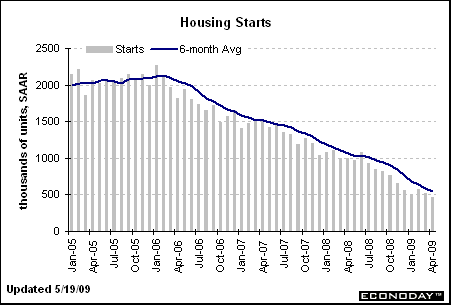
Barry Ritholtz reports that the number of building permits granted in April fell by 50.2% (±1.4%) from April 2008, and at a seasonally adjusted annualized rate of 3.3% (±2.3%) from March. Single family house building permits, however, were up 3.6% (±2.2%)from March, though down 42% from April 2008. Ritholz links to Barron's Econoday's chart plotting housing starts,


and comments:
"As bad as these numbers sound, they are actually a net positive. More inventory is a bad thing, so less starts and permits is a good thing. . We still have several million foreclosures possible over the next 3 years, and that will add to supply and drive prices further down. In the event that prices do move higher somehow, expect to see millions of shadow inventory--homes bought on spec or to be flipped--to hit the market."


10. CREDIT CRUNCH EASING ON RADICAL STEPS BY FED & TREASURY AND INFLATION EXPECTATIONS STILL MODERATE

Calculated Risk reports that LIBOR, and a number of other credit indicators, have returned to near normal.
"Last week, FDIC Sheila Bair said "the liquidity crisis is over for good". That might be a little optimistic (some ARS markets are still frozen), but it does appear the Fed has eased the liquidity crisis for now. The Treasury is still working on the solvency issues. "
Worth reading in full. In a related story, Menzie Chinn at Econbrowser points out that fears of hyperinflation in the US are neither manifested in survey- nor market-based expectations. Chinn notes that the median expectation for ten year inflation per surveys of economics forecasters remains pretty much as it has been for the last ten years. He plots a graph of market-based expectations, using the rate implied by the difference between the yields on 10 year Treasury Inflation-Protected Securities (TIPS) and 10 year treasuries:


Well worth reading in full.

Friday, May 15, 2009

Daily Sources 5/15

1. CHINESE FDI DOWN 22.5% IN APRIL YOY, EARLY MAY ELECTRICITY GENERATION DOWN 3.9% YOY

Elaine Kurtenbach at the Associated Press reports that foreign direct investment into China was down 22.5% in April from a year previous to $5.89 billion, according to data released today by the Commerce Ministry. There was a 9.5% annual rate of decline in FDI in March.
"Actual direct foreign investment in January-April fell 21% to $27.7 billion, as companies canceled or postponed spending on factories and other assets due to weakening trade and financial conditions.

April's figure was distorted somewhat by the high level of investment in April 2008, when such commitments jumped nearly 53% from a year earlier."
The sharpest declines in investments came from South Korea, the United States and Hong Kong. (Hong Kong remains the largest source of funds, accounting for 45% of all FDI into China in April.)

In the meantime, John Liu at Bloomberg reports that the China Securities Journal today reported that Chinese electricity generation was down 3.9% in early May from a year earlier. The Journal--state-owned media--cited an anonymous official at the China State Grid Corp.

2. EUROZONE GDP CONTRACTS 2.5% IN Q1

Matthew Satlmarsh at the New York Times reports that the economy of the euro-zone, or the 16 nations that comprise the monetary union within the EU, contracted by 2.5% in the first quarter from the fourth.

3. GERMAN GDP SHRINKS 3.8% IN Q1 FROM Q4

Edward Hugh at Fistful of Euros reports that the German Federal Statistics Office this morning released data showing the economy shrank by 3.8% in the first quarter from the fourth, "equivalent to a 15.2% contraction at an annualized rate." This marks the fourth consecutive quarter of contraction for Germany, and a contraction of 6.7% from the first quarter of 2008. Hugh notes that there are many signs that the rate at which the German economy is shrinking has slowed, but it is bottoming out at fairly low levels. Industrial output is at levels last seen in 1999/2000--


Hugh comments:
"Perhaps the worst casualty of all this will be German public finances. German tax revenue for 2009 is now projected to decline by more than an additional €300 billion as compared with previous estimates."
Long, but very detailed with a wealth of data--worth a look.

4. FRENCH GDP CONTRACTS 1.5% IN Q1 FROM Q4


Eurointelligence reports that the French statistical office's latest estimate released today shows GDP declining by 1.5% in the first quarter from the fourth, the worst rate of decline on record since 1974.
"[T]he contraction of capital stocks [is especially notable] with -0.6%, much higher than in any other euro zone country or the US or Japan."

5. ITALIAN GDP CONTRACTS 2.4% IN Q1 FROM Q4

Edward Hugh at Fistful of Euros reports that preliminary data from the Italian national statistics office [Istat] released today show that Italian GDP fell by 2.4% in the first quarter from the fourth. Annualized, the quarter-on-quarter contraction would translate to a 9.6% rate of decline. From the first quarter in 2008, 2009 first quarter GDP fell by 5.9%, "the sharpest drop since Istat’s most recent data series start in 1980." Industrial production fell by 23.8% in March from a year previous. Hugh's graph:


"Italy effectively entered recession in third quarter of 2008, and the economy now looks bound to shrink the most in more than half a century this year. The International Monetary Fund forecast on April 22 that the jobless rate will reach 8.9% this year and 10.5% in 2010. At the same time, Italian inflation has been slowing and hit a record low of 1.1 % in March, so if the contraction continues the deflation threat is real and present."
Gross government debt is expected to climb to 113% in 2009 and 116.1% in 2010 from 105.8% in 2008. Again, long but detailed and with a wealth of data--well worth a look.

6. RUSSIAN GDP CONTRACTS 23% IN Q1 FROM Q4

Alex Nicholson at Bloomberg reports that the Russian Federal Statistics Service announced on its website today that first quarter GDP shrank by 23% from the fourth. The contraction is the worst seen in 15 years--an annual rate of decline of 9.5%.
"'The big dip in industrial production jumps in your face,' said Tatiana Orlova, a Moscow-based economist with ING Groep NV, who plans to lower her forecast for a 2.7% contraction this year. 'The government should be worried. It’s very easy to come up with headlines announcing bailout measures, but the situation shows that you have to adjust them. It’s hard to do these things fast.'"
7. PUTIN MEETING WITH BERLUSCONI IN SOCHI REGARDING SOUTH STREAM, GAZPROM OFFERS TO PURCHASE ALL AZERI FEEDSTOCK FOR NABUCCO, TURKISH PM TO ARRIVE IN SOCHI TOMORROW

BBC News' Steven Eke reports that Russian Prime Minister Vladimir Putin is meeting in Sochi with Italian PM Silvio Berlusconi and top energy officials from Greece, Bulgaria and Serbia, to discuss joint ventures for the construction of the South Stream pipeline.


Meanwhile, Torrey Clark and Stephen Bierman at Bloomberg report that Gazprom Deputy Chief Executive Officer Alexander Medvedev said in a Moscow interview with Bloomberg TV that "[Gazprom is] ready to buy the whole volume of Shah Deniz II."
"The second phase of Shah Deniz could add 12 billion to 14 billion cubic meters of annual gas output in three to five years once a market is found and transit for the fuel ensured, Azeri President Ilham Aliyev said on April 18."
Shah Deniz II is a critical possible source of natural gas for the proposed Nabucco pipeline. Last week the EU signed an energy cooperation deal with Azerbaijan regarding a southern transit corridor--but failed to get Turkmenistan or Kazakhstan to join in, other key sources of supply in the potential pipeline, that is, outside of Iran. Indeed, Kazakhstan inked a law on Wednesday committing more volumes through the Russian Central Asia-Center pipeline system. Last week the Obama Administration envoy for energy, Richard Morningstar, was rumored to have backed off from support for Nabucco, suggesting that South Stream would work just as well--see Daily Sources 5/13 #5. In his remarks on the 8th in Prague published today by the State Department, Morningstar says:
"The United States shares the view expressed in the Joint Declaration that interconnections are a "basic prerequisite" for developing the Southern Corridor. Interconnectivity maximizes the potential of Southern Corridor projects, such as Nabucco and ITGI; likewise, when these projects add diverse sources and routes to an interconnected market, they act as protection against supply disruptions. Nabucco opens up many possibilities for enhancing European energy security, though it is not a cure-all. Nabucco, of course, will also contribute to the development of countries in the region.
...
Azerbaijani gas is the only realistically available gas in the short term, but accessing it requires agreement with Turkey on transit terms. We must also concentrate on other sources, such as Turkmenistan, Iraq, Kazakhstan, Uzbekistan, Egypt, and other related countries."

On the other hand, Robert M. Cutler in the Asia Times reports that two key problems were solved last week in Prague regarding Turkey's participation in Nabucco:
"The two problems that were solved in Prague last week involved pricing and the legal regime for Turkish consumption of gas flowing through the pipeline. The EU had insisted that Turkey pay the equivalent of European prices; Turkey had proposed a figure 15% less than that. The common-sense resolution that was adopted provides for Turkey's price to be based on the cost of transportation: the gas consumed in Turkey will hardly go all the way to Baumgarten, so it will cost less. As for the legal regime, the EU has abandoned its insistence that the norms of its acquis communautaire apply in Turkey, a non-member of the European body, and a middle ground within Turkish law has been found."
Turkish Prime Minister Recep Tayyip Erdogan will be in Sochi to join the discussions with Putin tomorrow.

8. IOC SECURES RUPEE DENOMINATED LOAN TO BUILD 300 KB/D REFINERY IN FACE OF WALL OF NEW REFINING CAPACITY IN THE REGION

Vandana Hari at Platts reports that Indian Oil Corporation--state-owned--has secured a rupees 149 billion ($2.97 billion) loan from a consortium of 21 domestic banks to build a grassroots refinery project at Paradip with nameplate capacity of 15 million
mt/year (or 300 kb/d).
The loan is denominated in rupees, which is about the only thing that makes any sense about the decision, given an avalanche of new refining capacity in the region. Meanwhile, Eric Watkins at the Oil & Gas Journal report that Kuwait and Sinopec have finalized the terms for a 300 kb/d new refinery at Zhanjiang in Guangdong province, with Sinopec taking a 50% share, Kuwait Petroleum International 30%, 10% for Dow Chemical Co, and 10% for Shell. And, Osamu Tsukimori at Reuters reports that TonenGeneral Sekiyu, Exxon Mobil's Japan group refiner, announced today that its oil product exports in the first quarter rose 5% from a year earlier, led by a 22% gain in middle distillate exports. Oil demand has been steadily declining in Japan on an aging and shrinking population. The recent restart of nuclear power plants shuttered by earthquakes should put a further dent in oil and gas demand in the island nation as its industrial production tanks.
"Japan's oil product exports last year increased 123% last year to 34 million kilolitres (584,000 barrels per day), equal to about 12% of the nation's refining capacity."


9. CUBA TO TAKE MORE ACTIVE ROLE IN PETROCARIBE, CHÁVEZ AND KIRCHNER TO SIGN AGREEMENT ON GASIFICATION PLANT IN ARGENTINA TODAY, CHÁVEZ TO SHUT DOWN OPPOSITION TV STATION

Eric Watkins at the Oil & Gas Journal report that the Cuban-Venezuela joint oil shipping line--Transportes del Alba (TransAlba)--has received its second vessel, the 490,000 barrel capacity tanker, Sandino.
"The tanker, built in China by New Times Shipbuilding Co., is the second of two 72,700-dwt ships funded under a 15-year, $122 million credit extended by Venezuela's state-run national economic and social development bank Bandes.

In February, TransAlba acquired its first tanker, the 72,700-dwt Petion, which will transport crude from Venezuela's Puerto La Cruz refinery to Cuba's Camilo Cienfuegos refinery."
The joint venture is considering the purchase of a third, smaller, tanker which would be able to unload at smaller Caribbean and Central American ports as it looks like Havana will take a more active role in Chávez's PetroCaribe initiative. Meanwhile, Charles Newbery at Platts reports that Chávez indicated that he was set to sign an agreement with his Argentine counterpart, Cristina Fernandez de Kirchner, agreeing on the location and start date for construction of an LNG regasification terminal in Argentina. A natural gas liquefaction plant in Venezuela is scheduled to begin operations in two years.
"Enarsa and PDVSA, the state energy companies of Argentina and Venezuela, respectively, have created a joint venture for building the LNG import terminal, which would have the capacity to deliver between 10 million cu m/d and 20 million cu m/d (353,000 Mcf/d to 706,000 Mcf/d) to the Argentine market. A likely location for the terminal is Bahia Blanca, where US-based Excelerate Energy is unloading LNG cargoes from Trinidad and Tobago at a floating regasification terminal."
And Juan Forero at the Washington Post reports that the Chávez Administration has taken steps to close Globovisión, an anti-government cable station. The government has accused the station of inciting panic in its coverage of the May 4 earthquake that hit the country.
"Venezuela has not closed any media outlets during Chávez's decade in power. But in May 2007, Chávez refused to renew the broadcast license of a stridently anti-government station, RCTV, accusing it of plotting against him. Harangues and threats against journalists are common, press-freedom groups say, and the state has made the creation of a parallel, pro-government media apparatus a priority."
Last Sunday, Chávez also reportedly publicly declared that "no land is private."

10. PYONGYANG TO PUT US JOURNALISTS ON TRIAL FOR SPYING IN JUNE

Blaine Harden at the Washington Post reports that Pyongyang will put two US reporters on trial for spying in June.
"The announcement, coming in the same week as Iran's release of a US reporter who had been convicted of spying, led to speculation that television reporters Laura Ling and Euna Lee might also be set free after trial as part of North Korea's diplomatic gamesmanship with the United States.

Ling and Lee, who work for former vice president Al Gore's San Francisco-based Current TV, were arrested March 17 along North Korea's border with China. They have been accused of illegal entry and 'hostile acts,' which in North Korea are punishable by five to 10 years in a labor camp.

In one sentence on its state news service, North Korea said its central court has 'decided to try the American journalists on June 4 according to the indictment of the competent organ.'"
11. BP AND STATOILHYDRO TAKE MORE SUPERTANKERS FOR CRUDE STORAGE; BIODIESEL SALES AT ZERO IN GERMANY

On news that entities with crude in storage were likely to start unloading their cargo--see Daily Sources 5/14 #9--Pradeep Rajan at Platts reports that StatOilHydro and BP have both secured a VLCC--or supertanker capable of carrying two million barrels of crude--for possible crude storage.
"Some of the players storing crude on sea include Shell with around 17 vessels, Vitol with 14, Koch at seven, Total with six, ConocoPhillips at four and BP and StatoilHydro with one vessel each. NITC, Clearlake, ST Shipping, Repsol and Valero are also reported to have vessels on storage."
In a related story, after Europe raised duties on US biodiesel imports effectively shutting off 85% of the US biodiesel market--see Daily Sources 5/5 #5 and Daily Sources 3/12 #10--Michael Hogan at Reuters reports that German bioenergy company Verbio announced yesterday that biodiesel sales have come to a halt in that country.
"Biodiesel is currently more expensive than fossil diesel in Germany following a further tax rise on green fuels this year and a fall in crude oil prices.

'Tax increases in combination with the falling prices for fossil diesel have brought the B-100 (petrol station) market to a virtual standstill,' Verbio said.

Verbio said its biodiesel production in the first quarter of 2009 fell to 78,866 tonnes from 93,907 tonnes a year earlier. It has capacity to produce about 450,000 tonnes annually."
12. MEXICAN EMIGRATION DOWN BY 25%, ANECDOTAL REPORTS THAT MANY IMMIGRANTS RETURNING TO MEXICO, EFFECTS ASIAN AND HISPANIC GROWTH IN THE US

Julia Preston at the New York Times reports that Mexican census data suggests that emigration has fallen by 25% in the year ended August 2008 from the year prior. All told, about 226,000 less people emigrated from Mexico during that time than the year previous. The vast majority of Mexican immigrants emigrate to the US.
"The trend emerged clearly with the onset of the recession and, demographers say, provides new evidence that illegal immigrants from Mexico, by far the biggest source of unauthorized migration to the United States, are drawn by jobs and respond to a sinking labor market by staying away."
This comes on top of reports seen in California in March that many Mexican immigrants in the US are choosing to return to Mexico in the midst of the crisis.


For example, on March 6, Cindy Carcamo at the Orange County Register reported that "anecdotal evidence and informal surveys" suggest that both "legal and illegal immigrants" are returning to their relatives in Mexico.
"In the Mexican heartland of Cerrito de Agua Caliente, where many have traditionally migrated to Orange County, about a third of those who visited their families during the holidays decided to stay put, said Cuerámaro City Clerk Cesar Torres.

Hundreds of miles north, at the central bus station in Tijuana, more than half of the passengers arriving on a Crucero bus line from the US during a two-week period earlier this year were in the process of returning home for good, according to a passenger survey.

And, at a rental property office in Anaheim, a manager says her vacancies have spiked partly because of immigrants returning to Mexico.

'There is no work,' says Baltazar Saldaña, shaking his head. 'That's the problem.'"
Ms. Carcamo also reports that bus drivers and ticket clerks have seen a surge in one-way tickets to Mexico. Her story is well worth reading in full for a variety of details. Both stories are on top of the story yesterday by Sam Roberts in the New York Times that Asian and Hispanic minorities in the US are still growing, but at a substantially reduced rate.
"The latest census estimates found that the minority population--other than non-Hispanic whites--grew by 2.3% from July 1, 2007, to July 1, 2008, compared with 2.4% the year before.

Ethnic and racial minorities (mostly blacks, Hispanic and Asian people) now account for 34% of the nation’s population.

The Hispanic population grew by 3.2% and Asians by 2.7%, a slight decrease from the year before. But those figures were down sharply from the beginning of the decade, when the Hispanic population grew by 4% and Asians by 3.7%, according to an analysis by the Population Reference Bureau, a private research group."
With the pace of immigration slowing down, a larger portion of that increase comes from regular population growth. (I imagine that it is likely that a similar process is happening in demographic trends in Europe, where job prospects are similarly becoming more scarce.)

13. RAILWAY DATA SHOWING DEEP DECLINES IN FREIGHT TRAFFIC

The weekly Railfax Report from Atlantic Systems Inc. for the week ended May 9 which plots total freight traffic via rail in the US shows an 18.1% year over year decline:


The breakdown of major commodities groups is especially interesting, note the nearly 50% decline in metal conveyance year over year.


Also the relatively small reduction in coal freight is interesting--the drop in industrial production should be having a large effect on coal just as it has on natural gas. (h/t CP at Credit Bubble Stocks via Yves Smith at naked capitalism.)

14. APRIL CONSUMER PRICES DOWN 0.7% ON YEAR, FLAT ON MONTH, APRIL INDUSTRIAL PRODUCTION DOWN 0.5% ON MONTH, 12.5% ON YEAR, MANUFACTURING CAPACITY RUNNING AT 65.7%

Jack Healy at the New York Times reports that the Labor Department announced today that the consumer price index was flat in April from March and down 0.7% on the year.
"The so-called core rate of inflation, which excludes volatile food and energy prices, rose a seasonally adjusted 0.3%, slightly more than its increases of 0.2% for each of the first three months of the year."
Much of that increase is apparently due to an increase in the cost of tobacco. Healy also reports that the Fed announced today that industrial production was down 0.5% in April from March, after having declined (a revised downward an additional 0.2%) 1.7% in March from February. The Fed's industrial production index showed a 12.5% decline in April from the year previous. Manufacturing capacity was running at 65.7% in April, down 0.1% from March. The manufacturing sector of the production index in April was down 0.3% from March and down 14.5% from the year previous. The Federal Reserve's statistical release on industrial production and capacity utilization can be found here. Rebecca Wilder's summary of global economic data for the week shows that the fall in industrial production mirrors what is happening generally all over the globe:


Ms. Wilder notes that inflation is volatile on food and energy costs, but suggests that it will continue to fall globally as well. The post is worth a look.

15. CALIFORNIA TO SELL $6 BILLION IN BONDS TO COVER BUDGET SHORTFALL, FIRE 5,000 EMPLOYEES

On the analysis yesterday--see Daily Sources 5/14 #13--that the government is the only organization hiring, but that state budgets are in crisis all over the country, Michael B. Marois and William Selway at Bloomberg report that California Governor Arnold Schwarzenegger has proposed selling $6 billion in bonds.
"Schwarzenegger’s proposal includes plans to fire 5,000 state employees, mostly prison workers and personnel from health and services agencies. The state employs about 200,000 people."