SOUTH KOREA RAISES BENCHMARK INTEREST RATE BY .25%
William Sim and Shinhye Kang at Bloomberg report that South Korea's central bank on Friday raised its benchmark interest rate by .25% to 2.25%. GDP is expected to grow by 5.9%, up from previous estimates of 5.2%. Exports are expected to rise by 26.4%. Consumer price inflation is expected to hit 2.8% this year and 3.4% in 2011. Guess they're not worried about a double dip in the recession.
INDIA ENDS FUEL SUBSIDIES, PROTESTS IMMEDIATELY ERUPT
Chris Stanton at the National reports that India has ended its subsidies on gasoline and substantially reducing them for diesel. Large protests immediately erupt.
IS YEMEN THE NEXT AFGHANISTAN?
Robert F. Worth at the New York Times Magazine asks whether Yemen is the next Afghanistan.
UGANDA HIT BY TERRORIST BOMBINGS
Josh Kron at the New York Times writes that at least 64 people were killed in three bombings in Uganda. The main suspect is Al-Shabaab. Uganda has ties with the transitional government in Somalia.
Showing posts with label yemen. Show all posts
Showing posts with label yemen. Show all posts
Monday, July 12, 2010


Friday, January 23, 2009
Daily Sources 1/23
1. Real Time Economics carried yesterday excerpts from an interview of European Central Bank Executive Board member Lorenzo Bini Smaghi by the Wall Street Journal's Joellen Perry. Some excerpts of the excerpts:
2. Edward Hugh at Fistful of Euros reports that early estimates from Germany's Markit purchasing managers' index show it falling to 38.0 from December's 39.5 reading. A reading above 50 means growth; below 50 means contraction.
3. Matthew Saltmarsh at the New York Times reports that the UK officially entered a recession in the fourth quarter, meaning it has met the condition of two consecutive quarters of GDP contraction.


Gyurcsany was quoted as saying
6. Robert F. Worth at the New York Times reports that a former Guantanamo inmate, released to Saudi Arabia in 2007, has reemerged as a leader of al Qaeda in Yemen. This will surely complicate the closing of the extraterritorial prison. Thomas Hegghammer at Jihadica reports that al-Qaeda Yemen is thriving, if a recent flashy 44 page glossy publication is anything to go by, and is explicitly targeting the "far enemy."
7. Jeff Stein at SpyTalk reports that some of President Obama's first public diplomacy initiatives will target South America. Obama is scheduled to attend the April 17 Summit of the Americas in Trinidad and Tobago, "which may turn out to be his international debut as ambassador-in-chief." Obama is also expected to back S 1007, a bill first introduced by Senator Lugar (R-IN) on March 27, 2007 and which passed the Senate Foreign Relations Committee on September 23, 2008. (see Daily Sources 9/30 #12.) The bill is known as the United States-Brazil Energy Cooperation Pact of 2007 and directs the Secretary of State to strengthen energy cooperation between the United States and "willing" nations in the Western Hemisphere. In particular, it directs the Secretaries of State and Energy to establish "a regional-based ministerial forum to be known as the Western Hemisphere Energy Cooperation Forum" which should include "the Governments of Brazil, Canada, Mexico, the United States, and Venezuela."
The bill also seeks to reinforce and extend the biofuels relationship between Brazil and the United States as well as asks the Secretary of Energy to
Senator Lugar is an éminence grise in foreign affairs circles and, though the bill does speak to his own constituency of Indiana in terms of biofuels production, it is also clearly aimed at countering Chavez's oil diplomacy in the region and it is fairly sure that Obama is picking up on that vein of the legislation, at least in part. But the other, and rather important issue that Lugar foresaw coming in early 2007, was the decline in Mexican production, which fell by a full 9% in 2008 from 2007--which was reported on the day of Obama's inauguration no less. (see Daily Sources 1/20 #13.) The full text of the bill can be found here.
8. Robert Zoellick, president of the World Bank, has an op ed in the New York Times today which argues that President Obama, in the April meeting of the G-20 in London, should send an "audacious symbol of hope" by calling on each country to devote 0.7% of their stimulus packages to a fund for assisting developing nations weather the current crisis.
9. Jeffrey Gettleman at the New York Times reports that Gen. Laurent Nkunda, the Rwandan rebel leader in eastern Congo was arrested Thursday night by a joint Congolese-Rwandan military offensive. He is being taken to Kigali, the Rwandan capital. Apparently the Rwandan and Congolese governments have struck a deal whereby Rwanda helped to put an end to the Nkundan rebellion after Congo had allowed Rwandan troops to enter Congo so as to crush Hutu militants operating there.
10. In an particularly interesting story, Blaine Harden at the Washington Post reports that Japan--bedeviled by an aging and shrinking demographic--is now seeking to get immigrant workers to stay in the country even as it faces job losses.

A must read.
11. In something I missed, but that I noticed at Clarisse's Les Carnets Des Clarisse, the Vatican decided effective January 1 that it would no longer automatically adopt the laws of Italy, per David Willey at BBC. The Vatican had, per the Lateran Accords signed in 1929, agreed to immediately adopt any law made in Rome.
Notions of jurisprudence and evidence that we take for granted today as part of the inheritance of the Enlightenment were, in fact, formed in the crucible of competing jurisdictions of the Church (or Canon) Courts, the courts of the Kings, the courts of the Lords, and custom. Indeed, the Inquisition, often considered one of the most damning moments of the Catholic Church, was primarily a court, which had different rules of evidence, because the traditional canon rules made it too difficult to ever convict anyone of heresy, though it was quite clear to Rome that heresy was taking place. Indeed, the traditional rules of evidence in canon courts are rather strict--meaning it is difficult to prove something under them--even more so, in some instances, than US Federal Courts.
So it is in that light that one could see this as an especially interesting turn of historical events. The notion that the Church might decide to retire from certain international treaties that it was, de jure, a signatory to under the Lateran Accords also might prove interesting, given that the Church still wields considerable influence--or in the modern argot "soft power"--internationally. It is something to keep an eye on.
12. George Soros has an opinion piece in the Financial Times in which he argues that a "bad bank" is the wrong way for the US to proceed.
13. Ryan J. Donmoyer at Bloomberg reports that the Senate Finance Committee’s $455 billion stimulus plan announced today would provide $30 billion in tax incentives to producers of renewable energy.
14. Keith Johnson at Environmental Capital has a post regarding the US Armed Forces efforts to secure reliable alternative-fuel possibilities. Clearly, this is an important strategic issue, as the fact that the US is a net importer of oil means that in order to secure our logistical supply line the Armed Forces are (potentially) required to project force overseas. (This requirement in and of itself makes otherwise imperialistic policies rather more palatable to the public, and thus creates another set of political problems.) The US Navy, which is substantially powered by nuclear already, on the other hand, is already ahead of the curve. But overall the Pentagon is the largest consumer of petroleum in the country--which itself is the largest consumer of petroleum in the world. However, Johnston reports that Jane's Information Group's Industry Quarterly showed that:
15. The Federal Highway Administration yesterday released data showing that in November, Americans drove 12.9 billion vehicle miles traveled (VMT) less in November than were driven in November 2007, a 5.3% decline.
"LBS: ... The transmission mechanism [through which monetary policy feeds through to the real economy] in the US seems to be more impaired. You can see this by comparing the level of the policy rate with the lending rates set by financial institutions. When you compare the euro area and the US, lending interest rates are basically the same, even though in the US policy rates are near zero. This suggests that to achieve the same level [of lending rates], policy rates in the US need to be much lower. Also, cutting interest rates to very low levels is effective in inducing agents to start holding again risky assets if the central bank commits to keeping rates at such low levels for a prolonged period of time. But this strategy is very risky, because it tends to delay the exit strategy. So this strategy should be followed only if you are convinced that there are substantial risks of deflation. And I think that in the euro area right now we do not see this risk of deflation....
WSJ: The risk of deflation is lower in the euro zone than in the US?
LBS: It’s substantially lower. We don’t have evidence, from expectations extracted from financial markets or professional forecasters, that there is going to be deflation. We will see a sharp disinflation in the course of the next few months, due to base effects. But this is not deflation. Deflation is a systematic reduction of prices and wages over several years. In order to avoid deflation, it’s important that inflation expectations remain well anchored at below 2% but close to 2%. If you look at inflation expectations in the US, they seem to be lower, although that doesn’t necessarily mean that deflation is a likely scenario."
"WSJ: You suggested recently that governments across the euro-zone should embark on a wholesale program of broad capital injections. Have we seen enough?...
LBS: The problem is that the recapitalization programs were voluntary and involved some stigma. So banks have not applied for new capital and remained undercapitalized, at least in the judgment of the markets. We should move from a voluntary scheme to a coordinated scheme and it has to be associated with a clear, aggressive disclosure of losses, which would require a coordination between governments and supervisors in Europe. Which is, of course, not easy. This is why we need a stronger European supervisory structure.
WSJ: Are the market’s concerns that a euro-zone country could default logical?
LBS: No. The fact that we observe spreads [between yields on the bonds of different euro-zone governments] is a confirmation of the credibility of the monetary union institutions: both the independence of the central bank and the no-bailout clause [a provision stipulating that European countries are not liable for one another's debts]. It’s proof that markets believe in it. On the other hand, the size of the spreads is more the reflection of the malfunctioning of the market than a realistic assessment of the default risk."
"WSJ: Many things people thought were irrational or highly unlikely have happened. If a euro-zone country were to default, what would the impact be on the rest of the bloc?Well worth reading in full.
LBS: That’s a hypothesis we have not really contemplated. But I also think that those that consider [a country would] exit from the euro area are not understanding the implications. The cost would surely be higher than staying. It would not only be a huge economic cost because, for instance, the [sovereign] debt is in euro, so it would [likely] increase in value. It would also imply exiting from the European Union. So it is also a huge political issue. And in the end no country would be willing to face this."
2. Edward Hugh at Fistful of Euros reports that early estimates from Germany's Markit purchasing managers' index show it falling to 38.0 from December's 39.5 reading. A reading above 50 means growth; below 50 means contraction.
"A 38 reading on the monthly PMI is probably equivalent to something in the order of a 10% annual rate of GDP contraction (or a 2.5% quarter on quarter drop), which is, well, massive."...
"The heavy dependence of the German economy on exports means that as demand has fallen back elsewhere so has German economic activity. Exports fell by an unprecedented 10.6% month on month in November and according to an Economy Ministry official on Wednesday they fell by another 10-11% in December."Worth reading in full.
3. Matthew Saltmarsh at the New York Times reports that the UK officially entered a recession in the fourth quarter, meaning it has met the condition of two consecutive quarters of GDP contraction.
"The country’s gross domestic product fell 1.5% from the third quarter and was down 1.8% from the period a year earlier, the Office for National Statistics said in a preliminary estimate."4. Daryna Krasnolutska and Kateryna Choursina at Bloomberg report that the Ukrainian President, Viktor Yushchenko, will seek to renegotiate the gas supply contract just agreed upon with Gazprom, characterizing the agreement as "capitulation." Given Ukraine's economic situation, the President is unclear on how the country can afford the cost at this point. And in a very interesting revelation, given all the analysis on this side of the pond about how the dispute was really an dispute between elites on the take about how to distribute earnings from middleman RosUkrEnergo AG, Ukrainian first deputy prime minister Oleksandr Turchynov told reporters that Ukraine has strengthened its position because the company has been removed from the supply chain. RIA Novosti reports that the Federal Statistics Service announced today
"Russia's crude production in 2008 declined 0.7% year-on-year to 488 million metric tons (9.8 mln bbl/d), while natural gas output increased 1.6% to 663 billion cubic meters."Meanwhile, Edward Hugh at Fistful of Euros reports that Russian industrial output was down 10.3% in December, following a 8.7% contraction in November, according to an announcement yesterday by the Federal Statistics Service. Here is the graph he helpfully provided, illustrating the current downturn:
"Russia’s international reserves fell $30.3 billion last week, the second-biggest drop on record, as the central bank accelerated the rate of the ruble devaluation and sold increasing quantities of foreign currency in an attempt to manage the pace of the decline. Russia’s reserves have now fallen 34% from the record high of $598.1 billion in August while the ruble has fallen 29% against the dollar over the same period."And the AFP reports that the Hungarian Prime Minister Ferenc Gyurcsany told reporters today that Europe must, in view of the recent Russo-Ukrainian dispute, seriously pursue the Nabucco pipeline.
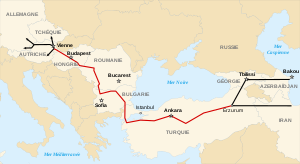
Gyurcsany was quoted as saying
"We expect the European Bank for Reconstruction and Development (EBRD) and the European Investment Bank (EIB) to make a clearer commitment to pre-financing the project. This project is not purely about business but also about Europe's energy security. It is therefore vital to make sure we have resources that are backed and guaranteed by the EU."5. Grant Smith at Bloomberg reports that preliminary estimates from Petrologistics indicate that OPEC will cut supply by a further 5% in January.
"Oil supply from 11 members of the Organization of Petroleum Exporting Countries subject to quotas will average 26.15 mb/d in January, down from 27.65 mb/d, Conrad Gerber, the founder of PetroLogistics, said today by telephone from Geneva. From this month, members have a production quota of 24.845 mb/d. Iraq has no quota.
Saudi Arabia, the group’s largest member, led the cuts, lowering supply to 8.05 mb/d in January from 8.6 mb/d last month, Gerber said. The kingdom’s new total is in line with its Jan. 1 quota."
"Iran reduced supplies to 3.83 mb/d this month from 3.85 mb/d in December. Nigeria cut to 1.76 mb/d from 2.02 mb/d. Venezuela lowered output to 1.97 mb/d from 2.22 mb/d, and Angola trimmed to 1.84 mb/d from 1.88 mb/d, according to PetroLogistics.Given that Iran had not made good on 199 kb/d cuts promised in the October 24 meeting, and that the December 17 agreement was for cuts to actual supply--as understood by OPEC--in September, an additional 20 kb/d cut in supply suggests that Tehran is still producing far more than its stated quota. (Whatever their actual quota might be.)
Iraq, exempt from the quota system while its oil industry recovers from two wars, increased production to 2.45 mb/d from 2.43 mb/d, the tanker tracker said.
6. Robert F. Worth at the New York Times reports that a former Guantanamo inmate, released to Saudi Arabia in 2007, has reemerged as a leader of al Qaeda in Yemen. This will surely complicate the closing of the extraterritorial prison. Thomas Hegghammer at Jihadica reports that al-Qaeda Yemen is thriving, if a recent flashy 44 page glossy publication is anything to go by, and is explicitly targeting the "far enemy."
7. Jeff Stein at SpyTalk reports that some of President Obama's first public diplomacy initiatives will target South America. Obama is scheduled to attend the April 17 Summit of the Americas in Trinidad and Tobago, "which may turn out to be his international debut as ambassador-in-chief." Obama is also expected to back S 1007, a bill first introduced by Senator Lugar (R-IN) on March 27, 2007 and which passed the Senate Foreign Relations Committee on September 23, 2008. (see Daily Sources 9/30 #12.) The bill is known as the United States-Brazil Energy Cooperation Pact of 2007 and directs the Secretary of State to strengthen energy cooperation between the United States and "willing" nations in the Western Hemisphere. In particular, it directs the Secretaries of State and Energy to establish "a regional-based ministerial forum to be known as the Western Hemisphere Energy Cooperation Forum" which should include "the Governments of Brazil, Canada, Mexico, the United States, and Venezuela."
The bill also seeks to reinforce and extend the biofuels relationship between Brazil and the United States as well as asks the Secretary of Energy to
"work with the Government of Mexico to conduct a technical analysis of the status of Mexican oil and gas production, future technological and investment needs, and recommendations for maintaining and increasing hydrocarbon production consistent with the priorities of the Government of Mexico."The bill would also create an energy industry group and oil and gas group to try and increase private sector energy engagement in the Western Hemisphere.
Senator Lugar is an éminence grise in foreign affairs circles and, though the bill does speak to his own constituency of Indiana in terms of biofuels production, it is also clearly aimed at countering Chavez's oil diplomacy in the region and it is fairly sure that Obama is picking up on that vein of the legislation, at least in part. But the other, and rather important issue that Lugar foresaw coming in early 2007, was the decline in Mexican production, which fell by a full 9% in 2008 from 2007--which was reported on the day of Obama's inauguration no less. (see Daily Sources 1/20 #13.) The full text of the bill can be found here.
8. Robert Zoellick, president of the World Bank, has an op ed in the New York Times today which argues that President Obama, in the April meeting of the G-20 in London, should send an "audacious symbol of hope" by calling on each country to devote 0.7% of their stimulus packages to a fund for assisting developing nations weather the current crisis.
"The United States could begin by pledging some $6 billion of its own $825 billion stimulus package—-just 4% of what was provided to American International Group. With this modest step, the United States would speed up global recovery, help the world’s poor and bolster its foreign policy influence."Zoellick concludes that with less than 1% of our stimulus package, President Obama can show global leadership and "reintroduce America to the world." Worth reading in full.
9. Jeffrey Gettleman at the New York Times reports that Gen. Laurent Nkunda, the Rwandan rebel leader in eastern Congo was arrested Thursday night by a joint Congolese-Rwandan military offensive. He is being taken to Kigali, the Rwandan capital. Apparently the Rwandan and Congolese governments have struck a deal whereby Rwanda helped to put an end to the Nkundan rebellion after Congo had allowed Rwandan troops to enter Congo so as to crush Hutu militants operating there.
10. In an particularly interesting story, Blaine Harden at the Washington Post reports that Japan--bedeviled by an aging and shrinking demographic--is now seeking to get immigrant workers to stay in the country even as it faces job losses.
"[The] extreme exposure of immigrant families to job loss and their sudden abandonment of Japan--has alarmed the government in Tokyo and pushed it to create programs that would make it easier for jobless immigrants to remain here in a country that has traditionally been wary of foreigners, especially those without work.
'Our goal is to get them to stay,' said Masahiko Ozeki, who is in charge of an interdepartmental office that was established this month in the cabinet of Prime Minister Taro Aso. 'As a government, we have not done anything like this before.'"
"No country has ever had fewer children or more elderly as a percentage of its total population. The number of children has fallen for 27 consecutive years. A record 22 percent of the population is older than 65, compared with about 12 percent in the United States. If those trends continue, in 50 years, the population of 127 million will have shrunk by a third; in a century, by two-thirds. "Here is a projected population pyramid for Japan for 2010, courtesy of NationMaster.

A must read.
11. In something I missed, but that I noticed at Clarisse's Les Carnets Des Clarisse, the Vatican decided effective January 1 that it would no longer automatically adopt the laws of Italy, per David Willey at BBC. The Vatican had, per the Lateran Accords signed in 1929, agreed to immediately adopt any law made in Rome.
"A senior Vatican Canon lawyer, Monsignor Jose Maria Serrano Ruiz, has gone on record as saying that Italian laws are too many, too unstable and too often conflict with the moral teachings of the Catholic Church."And, perhaps more significantly,
"The Vatican has also decided to scrutinise international treaties before deciding whether or not to adhere to them."It may seem like a historical curiosity, but the Church has a place of preeminence in Western Law, having founded the first Law University in Bologna in around 1088 AD, just 11 years prior to the first Bull of Crusade. (Of course, at that time, and well into the 18th century, all universities in the West were church institutions, at first all Catholic of course, later Protestant schools were founded, like the majority of universities found in the United States.)
Notions of jurisprudence and evidence that we take for granted today as part of the inheritance of the Enlightenment were, in fact, formed in the crucible of competing jurisdictions of the Church (or Canon) Courts, the courts of the Kings, the courts of the Lords, and custom. Indeed, the Inquisition, often considered one of the most damning moments of the Catholic Church, was primarily a court, which had different rules of evidence, because the traditional canon rules made it too difficult to ever convict anyone of heresy, though it was quite clear to Rome that heresy was taking place. Indeed, the traditional rules of evidence in canon courts are rather strict--meaning it is difficult to prove something under them--even more so, in some instances, than US Federal Courts.
So it is in that light that one could see this as an especially interesting turn of historical events. The notion that the Church might decide to retire from certain international treaties that it was, de jure, a signatory to under the Lateran Accords also might prove interesting, given that the Church still wields considerable influence--or in the modern argot "soft power"--internationally. It is something to keep an eye on.
12. George Soros has an opinion piece in the Financial Times in which he argues that a "bad bank" is the wrong way for the US to proceed.
"Although the details have not yet been decided, this approach harks back to the approach originally taken – but eventually abandoned – by Hank Paulson, the former US Treasury secretary. The proposal suffers from the same shortcomings: the toxic securities are, by definition, hard to value. The introduction of a significant buyer will result, not in price discovery, but in price distortion....
Moreover, the securities are not homogeneous, which means that even an auction process would leave the aggregator bank with inferior assets through adverse selection. Even with artificially inflated prices, most banks could not afford to mark their remaining portfolios to market so they would have to be given some additional relief. The most likely solution is to 'ring-fence' their portfolios, with the Federal Reserve absorbing losses that extend beyond certain limits.
These measures–-if enacted-–would provide artificial life support for the banks at considerable expense to the taxpayer, but would not put the banks in a position to resume lending at competitive rates. The banks would need fat margins and steep yield curves for a long time to rebuild their equity."
"The hard choice facing the Obama administration is between partially nationalizing the banks, or leaving them in private hands but nationalizing their toxic assets. Choosing the first course would inflict great pain on a broad segment of the population – not only on bank shareholders but also on the beneficiaries of pension funds. However, it would clear the air and restart the economy."Soros concludes with:
"President Barack Obama can fulfil his promise of a bold new approach only by establishing a discontinuity with the previous team. Congress and the public are right in feeling that too much has been done for the banks and not enough for beleaguered householders. The government ought to take the GSEs out of limbo and use them more actively to stabilise the housing market. Having done so, it could go back to Congress for authorisation to recapitalise the banking system the right way."Well worth reading in full.
13. Ryan J. Donmoyer at Bloomberg reports that the Senate Finance Committee’s $455 billion stimulus plan announced today would provide $30 billion in tax incentives to producers of renewable energy.
14. Keith Johnson at Environmental Capital has a post regarding the US Armed Forces efforts to secure reliable alternative-fuel possibilities. Clearly, this is an important strategic issue, as the fact that the US is a net importer of oil means that in order to secure our logistical supply line the Armed Forces are (potentially) required to project force overseas. (This requirement in and of itself makes otherwise imperialistic policies rather more palatable to the public, and thus creates another set of political problems.) The US Navy, which is substantially powered by nuclear already, on the other hand, is already ahead of the curve. But overall the Pentagon is the largest consumer of petroleum in the country--which itself is the largest consumer of petroleum in the world. However, Johnston reports that Jane's Information Group's Industry Quarterly showed that:
"The bottom line is that for all the economic and operational advantages a shift to alternative fuels could bring—from a smaller logistics burden to greater energy security—those are still outweighed at present by the military establishment’s worries about the maturity and reliability of new technology—no small concerns in combat situations."The complications posed by batteries are preventing the implementation of alternative fuels for Army uses. But change might come in the Air Force, which apparently uses more oil than the country of Denmark. Evidently it is looking both at biofuels--and it is possible to create bio-jet fuel nearly indistinguishable from the petroleum-based kind (see Daily Sources 10/3 #10)--and coal to liquid, the solution used by the Germans in WWII, a resource of which we have the largest reserves in the world, and very, very, dirty. Biofuel, on the other hand, requires lots of arable land or cooking oil waste in order to be logistically feasible for an enterprise the size of the US Air Force, not to mention the US Armed Forces as a whole. Worth a look.
15. The Federal Highway Administration yesterday released data showing that in November, Americans drove 12.9 billion vehicle miles traveled (VMT) less in November than were driven in November 2007, a 5.3% decline.
"The consecutive 13-month trend of declining driving--between November 2007 and November 2008--now tops 112 billion VMT, compared to the same 13-month period a year earlier. It dwarfs the 49.9 billion VMT decline of the 1970s, a decade characterized by high gas prices, fuel shortages and a recession."The data show that the South Atlantic region and the West experienced the largest declines. The South Atlantic region may in part be explained by the gasoline shortages the region saw in October. (see Daily Sources 10/2 #8.) At least, that might explain why VMT fell there more than in the Northeast, where gasoline prices are typically much higher (than the South Atlantic region.) The West tends to have the highest prices in the nation.
Thursday, September 18, 2008
Daily Sources 9/18
1. AFP reported that Jacques Diouf, Director General of the UN Food and Agriculture Organization [FAO], told the Italian Parliament that the number of people in the world facing "acute hunger" by the end of 2008 is likely to exceed one billion. So far this year the number globally has risen to 925 million from 850 million. The World Bank estimates that 100 million people have been pushed below the poverty line by risign food prices. The rise in food prices globally are mostly attributed to the rise in oil prices, the dedication of arable land to biofuel production, and the increased consumption of land, food and energy intensive meat in the emerging economies. "Hunger hotspots" identified by the FAO include Ethiopia, Djibouti, Ghana, Guinea, Haiti, Liberia, Mauritania, Mozambique, Nepal, the occupied Palestinian territories, Pakistan, Senegal, Tajikistan, Uganda and Yemen.
2. Dow Jones Newswires reported that Abbas Naki, Secretary General of OAPEC (Organization of Arab Petroleum Exporting Countries), said that Middle Eastern oil producing countries are likely to shelve a number of production boosting projects should the price of oil drop below $80/b.
3. Lyubov Pronina and Greg Walters at Bloomberg report that Alexei Kudrin, Russian Finance Minister, announced today that Russia will reduce its duty on crude exports from $495.90 a tonne to $372 a tonne beginning October 1. (A metric ton of oil roughly equals 7.3 barrels assuming 33 ºAPI. Urals Blend is about 30.9 ºAPI. Various Urals crudes range from 26.69-33.61 ºAPI. i.e. ~ 6 - 7.3 barrels/tonne) The tarrif on light oil products will be cut to $263.10/tonne and the heavy products tarrif will be cut to $141.70/tonne. Light products generally include jet fuel, diesel, and gasoline. Heavy products usually refers to the various varieties of fuel oil, asphalt, etc.
4. Dow Jones reports that the Norwegian Foreign Minister Jonas Gahr Stoere told reporters today that all territorial claims in the Artic must fall, as it has so far, under the international Law of the Sea, following Russian call to formally establish the claims of all bordering countries.
5. Marcin Grajewski at Reuters reports that the European Commission has denied Lithuania's request to keep its Ignalina nuclear power plant open. The Baltic States hope to build a modern nuclear plant to handle energy generation requirements, but one will not be operational until 2015 at the earliest. Under its treaty to join the European Union, Lithuania was obliged to shutter the plant by the end of 2009. There is a question of how the Baltic states are to handle their energy requirements in the interim. Russia is considered especially suspect given Polish control of the Mazeikiai Refinery (in Lithuania and the only refinery in the Baltic) and rumors surrounding a fire that shut the complex down in 2006. Russia stopped all deliveries of crude oil to Lithuania via the Druzhba pipeline system in 2006, apparently in retaliation for selling the Yukos stake in the Mazeikiai to PKN Orlen instead of a Russian company. Druzhba is Russian for "friendship."
6. The Wall Street Journal has an editorial about the "Run on Russia." Though the crowing tone, probable mistaking of correlation with causation, and self-congratulatory bellicose tone is useless, the implied admission of the correlation of Russian interests with Western interests is, at least, useful.
7. Henry A. Kissinger and Martin Feldstein have an interesting op-ed in the Washington Post advocating the establishment of closer cooperation between oil consumers. I think this is a good idea, generally speaking, and have argued as much in the past. The devil is in the details, though. Making coal clean by any environmental standard, for example, would be a neat trick.
8. Chris Buckley at Reuters reported that on Wednesday the People's Daily called for a new world financial order that was not dependent upon the United States. (h/t Jesse's Cafe Americain) Still, Vice Premier Wang Qishan told U.S. trade officials in a meeting in the US on Tuesday, "The Chinese government is well aware of the fact that the United States, which is the world's largest developed country, and China, which is the world's largest developing country, should have constructive and cooperative economic and trade relations."
9. Dealbook writes that the rumor mill now floats the story that Goldman Sachs and Morgan Stanley, the two remaining investment banks, are not long for this earth. Yesterday, Morgan Stanley and Goldman Sachs were down 24% and 14%, respectively. Brad Setser's Follow the Money has a response to the news that the Chinese Investment Company is being asked if it would be interested in acquiring 49% of Morgan Stanley by executives there. I can only begin to imagine the political storm that would take place if that happened. Remember Unocal?
10. The Associated Press reported that the British Financial Authority has banned all short selling until January 16, 2009, as per Jesse's Cafe Americain.
11. The Global Director of Market Pricing at Platts, Jorge Montepeque, told a Standard & Poor's commodity investing conference today in London that oil companies are unwilling to trade with their banks, according to Chanyaporn Chanjaroen, Alaric Nightingale and Lars Paulsson at Bloomberg. Nonetheless, E.ON Energy Trading said the had not seen liquidity drying up in any of the energy markets.
12. Patricia Lui and Wes Goodman at Bloomberg report that central bankers in South Korea, the Philippines, India and Thailand are stopping using their currency reserves to defend their currencies for now, accepting lower rates versus the dollar. South Korea's cash reserves dropped 8% in the last five months to $243.2 billion. India's dropped 7.4% this quarter to $280 billion. Thailand's dropped 5% to $101 billion. "Barclays Plc, the third-biggest currency trader, predicts the won will fall to 1,200 by year-end, the baht to 37 and the rupiah to 9,450 and is now revising those forecasts lower."
13. Platts reports that the Nigerian government has been forced to use proceeds from crude export sales to pay for the subsidies on oil product imports, as the cost has exceeded the budgeted amount. The cost of subsidies this year are expected to exceed 1 trillion Naira, or about $8.6 billion.
2. Dow Jones Newswires reported that Abbas Naki, Secretary General of OAPEC (Organization of Arab Petroleum Exporting Countries), said that Middle Eastern oil producing countries are likely to shelve a number of production boosting projects should the price of oil drop below $80/b.
3. Lyubov Pronina and Greg Walters at Bloomberg report that Alexei Kudrin, Russian Finance Minister, announced today that Russia will reduce its duty on crude exports from $495.90 a tonne to $372 a tonne beginning October 1. (A metric ton of oil roughly equals 7.3 barrels assuming 33 ºAPI. Urals Blend is about 30.9 ºAPI. Various Urals crudes range from 26.69-33.61 ºAPI. i.e. ~ 6 - 7.3 barrels/tonne) The tarrif on light oil products will be cut to $263.10/tonne and the heavy products tarrif will be cut to $141.70/tonne. Light products generally include jet fuel, diesel, and gasoline. Heavy products usually refers to the various varieties of fuel oil, asphalt, etc.
4. Dow Jones reports that the Norwegian Foreign Minister Jonas Gahr Stoere told reporters today that all territorial claims in the Artic must fall, as it has so far, under the international Law of the Sea, following Russian call to formally establish the claims of all bordering countries.
5. Marcin Grajewski at Reuters reports that the European Commission has denied Lithuania's request to keep its Ignalina nuclear power plant open. The Baltic States hope to build a modern nuclear plant to handle energy generation requirements, but one will not be operational until 2015 at the earliest. Under its treaty to join the European Union, Lithuania was obliged to shutter the plant by the end of 2009. There is a question of how the Baltic states are to handle their energy requirements in the interim. Russia is considered especially suspect given Polish control of the Mazeikiai Refinery (in Lithuania and the only refinery in the Baltic) and rumors surrounding a fire that shut the complex down in 2006. Russia stopped all deliveries of crude oil to Lithuania via the Druzhba pipeline system in 2006, apparently in retaliation for selling the Yukos stake in the Mazeikiai to PKN Orlen instead of a Russian company. Druzhba is Russian for "friendship."
6. The Wall Street Journal has an editorial about the "Run on Russia." Though the crowing tone, probable mistaking of correlation with causation, and self-congratulatory bellicose tone is useless, the implied admission of the correlation of Russian interests with Western interests is, at least, useful.
7. Henry A. Kissinger and Martin Feldstein have an interesting op-ed in the Washington Post advocating the establishment of closer cooperation between oil consumers. I think this is a good idea, generally speaking, and have argued as much in the past. The devil is in the details, though. Making coal clean by any environmental standard, for example, would be a neat trick.
8. Chris Buckley at Reuters reported that on Wednesday the People's Daily called for a new world financial order that was not dependent upon the United States. (h/t Jesse's Cafe Americain) Still, Vice Premier Wang Qishan told U.S. trade officials in a meeting in the US on Tuesday, "The Chinese government is well aware of the fact that the United States, which is the world's largest developed country, and China, which is the world's largest developing country, should have constructive and cooperative economic and trade relations."
9. Dealbook writes that the rumor mill now floats the story that Goldman Sachs and Morgan Stanley, the two remaining investment banks, are not long for this earth. Yesterday, Morgan Stanley and Goldman Sachs were down 24% and 14%, respectively. Brad Setser's Follow the Money has a response to the news that the Chinese Investment Company is being asked if it would be interested in acquiring 49% of Morgan Stanley by executives there. I can only begin to imagine the political storm that would take place if that happened. Remember Unocal?
10. The Associated Press reported that the British Financial Authority has banned all short selling until January 16, 2009, as per Jesse's Cafe Americain.
11. The Global Director of Market Pricing at Platts, Jorge Montepeque, told a Standard & Poor's commodity investing conference today in London that oil companies are unwilling to trade with their banks, according to Chanyaporn Chanjaroen, Alaric Nightingale and Lars Paulsson at Bloomberg. Nonetheless, E.ON Energy Trading said the had not seen liquidity drying up in any of the energy markets.
12. Patricia Lui and Wes Goodman at Bloomberg report that central bankers in South Korea, the Philippines, India and Thailand are stopping using their currency reserves to defend their currencies for now, accepting lower rates versus the dollar. South Korea's cash reserves dropped 8% in the last five months to $243.2 billion. India's dropped 7.4% this quarter to $280 billion. Thailand's dropped 5% to $101 billion. "Barclays Plc, the third-biggest currency trader, predicts the won will fall to 1,200 by year-end, the baht to 37 and the rupiah to 9,450 and is now revising those forecasts lower."
13. Platts reports that the Nigerian government has been forced to use proceeds from crude export sales to pay for the subsidies on oil product imports, as the cost has exceeded the budgeted amount. The cost of subsidies this year are expected to exceed 1 trillion Naira, or about $8.6 billion.
Wednesday, September 17, 2008
Daily Sources 9/17
1. Andrew E. Kramer at the New York Times reports that trading was halted on the Russian stock market for the second time this week. The market has dropped by more than 25% this week and is off 57% since its peak in May. The Russian Central Bank and regulators also announced a 4% reduction in bank reserve requirements today, which the central bank’s chairman, Sergei Ignatyev, said would free up $11.76 billion. The Russian finance minister, Aleksei L. Kudrin, also announced he would free up about $44 billion by increasing the repayment time of state loans to state banks from one week to three months. Kudrin also said that the discussed measure of having Russia's Sovereign Wealth Fund invest in the market has, for now, been deemed unnecessary.
2. The Moscow Times reports that UBS analysts have said that the price of crude has dropped so much that a barrel is now worth less than the cost of transport and Russian taxes. If you are a pure crude exporter--and don't have a refinery from which you then sell products--you are losing money. (Evidently the mandated prices of transportation fuels in Russia now would not be counted as subsidies.)
3. Margarita Antidze and Matt Robinson at Reuters report that Russia has signed treaties with Abkhazia and South Ossetia which formally commits Moscow to coming to their defense should they be attacked. In 19th century gunboat diplomatic terms, you would call it a "guarantee of independence."
4. AP reports the US Embassy in Yemen was assaulted with a car suicide bomb, rocket-propelled grenades, and automatic weapons today. At least 16 are dead, although apparently no Americans were hurt. President Bush used the incident to say that the attack is a "reminder" that we are "at war with extremists." Officials believe it is likely an al-Qaeda attack. Non-essential personnel were just allowed back into the facility last month.
5. MEND's oil war continues to heat up in Nigeria, as per Ibanga Isine and Victor Sam at the Punch. The "oil war" is also referred to by MEND as "Operation Hurricane Barbarossa"--which is probably meant to evoke the Turkish privateer "Redbeard" who put an end to the damage the Knights of Saint John were doing to Ottoman shipping and eventually became the Fleet Admiral of the Ottoman Navy(a) and not Hitler's "Operation Barbarossa" (or the code name for the invasion plan of the Soviet Union.) The Hurricane part I understand ... and so far many of the attacks seem to have come via speed boats.
It is in this environment that the Nigerian Senate is considering an anti-terrorism bill reports John Alechenu at the Punch. Yet another foreign political utilization of the Bush Administration's "War on Terror" (by the way, just yesterday Putin referred to the Georgian terrorist situation)--and it is worth remembering that America remains very popular in Nigeria.(b) "If passed, the attorney-general will be empowered to detain persons for up to 60 days where he has reasonable grounds to 'believe or suspect' that 'the entity knowingly committed; attempted to commit, participate in committing; or facilitated the commission of terrorist acts.'" I think that such broad language tends to erode the rule of law, and this would be in a country where the rule of law is not particularly strong to begin with.
6. Juan Forero at the Washington Post has an important report on a witness in ongoing trials in Colombia linking Gen. Mario Montoya to death squads in Medellin. Montoya is apparently well-known in Washington and was one of the generals involved in orchestrating the spectacular rescue of hostage Ingrid Betancourt from FARC. The State Department stood behind Montoya today in interviews. Should these allegations prove true, they will likely be very damaging to the Uribe Administration as well as further undermine the American image in South America.
7. Thom Shanker at the New York Times reports that Defense Secretary Gates has apologized for the deaths of non-combatants in recent strikes in Afghanistan. I think that--though it might stick in the craw a little--this was a very wise move.
8. Xinhua reports that China will allow local governments to raise the cost of heating in response to the increased costs of coal.
9. Tom Doggett at Reuters reports that Sam Bodman, Secretary of Energy, told reporters that the Administration is considering asking the IEA for some of its gasoline reserves.
10. Edmund L. Andrews, Michael J. de la Merced and Mary Williams Walsh at the New York Times report that The Federal Reserve Bank has agreed to lend AIG $85 billion for a majority equity stake in the company.
11. David Cho at the Washington Post reports that the Federal Reserve has asked the Treasury for a $40 billion deposit.
12. Brain Setser at Follow the Money yesterday had a blog entry which partially answered my question regarding where foreign banks were going to put their money, following the Treasury's release of the Treasury International Capital data for July (TIC.) Answer: fleeing the US, and insofar as they are investing in the US, investing in the safest possible instrument, Treasuries. To paraphrase:
Today the yield on the 3 month Treasury bill went to zero. That suggests to me that the market believes that the dollar will be worth more tomorrow, versus a basket of goods, than it is today. By basket of goods, I mean basket of currencies and securities because commodities appear to have rebounded recently. (Gold for December went up, if I understand correctly, $70 today! h/t Jesse's Cafe Americain) So, does this mean that foreign central banks will now be forced to sell dollars in order to defend their currencies or that they will be forced to buy dollars in order to defend their exports? I dunno.
(a) Wikipedia: Hayreddin Barbarossa
(b) Pew's 47-Nation Global Attitudes Study of 2007 has 70% of Nigerians having favorable views of the United States. Table: "Favorable Views of the U.S.", page 17. You also might want to check out my blog entry from March: The Geopolitical Consequences of the Candidates.
2. The Moscow Times reports that UBS analysts have said that the price of crude has dropped so much that a barrel is now worth less than the cost of transport and Russian taxes. If you are a pure crude exporter--and don't have a refinery from which you then sell products--you are losing money. (Evidently the mandated prices of transportation fuels in Russia now would not be counted as subsidies.)
3. Margarita Antidze and Matt Robinson at Reuters report that Russia has signed treaties with Abkhazia and South Ossetia which formally commits Moscow to coming to their defense should they be attacked. In 19th century gunboat diplomatic terms, you would call it a "guarantee of independence."
4. AP reports the US Embassy in Yemen was assaulted with a car suicide bomb, rocket-propelled grenades, and automatic weapons today. At least 16 are dead, although apparently no Americans were hurt. President Bush used the incident to say that the attack is a "reminder" that we are "at war with extremists." Officials believe it is likely an al-Qaeda attack. Non-essential personnel were just allowed back into the facility last month.
5. MEND's oil war continues to heat up in Nigeria, as per Ibanga Isine and Victor Sam at the Punch. The "oil war" is also referred to by MEND as "Operation Hurricane Barbarossa"--which is probably meant to evoke the Turkish privateer "Redbeard" who put an end to the damage the Knights of Saint John were doing to Ottoman shipping and eventually became the Fleet Admiral of the Ottoman Navy(a) and not Hitler's "Operation Barbarossa" (or the code name for the invasion plan of the Soviet Union.) The Hurricane part I understand ... and so far many of the attacks seem to have come via speed boats.
It is in this environment that the Nigerian Senate is considering an anti-terrorism bill reports John Alechenu at the Punch. Yet another foreign political utilization of the Bush Administration's "War on Terror" (by the way, just yesterday Putin referred to the Georgian terrorist situation)--and it is worth remembering that America remains very popular in Nigeria.(b) "If passed, the attorney-general will be empowered to detain persons for up to 60 days where he has reasonable grounds to 'believe or suspect' that 'the entity knowingly committed; attempted to commit, participate in committing; or facilitated the commission of terrorist acts.'" I think that such broad language tends to erode the rule of law, and this would be in a country where the rule of law is not particularly strong to begin with.
6. Juan Forero at the Washington Post has an important report on a witness in ongoing trials in Colombia linking Gen. Mario Montoya to death squads in Medellin. Montoya is apparently well-known in Washington and was one of the generals involved in orchestrating the spectacular rescue of hostage Ingrid Betancourt from FARC. The State Department stood behind Montoya today in interviews. Should these allegations prove true, they will likely be very damaging to the Uribe Administration as well as further undermine the American image in South America.
7. Thom Shanker at the New York Times reports that Defense Secretary Gates has apologized for the deaths of non-combatants in recent strikes in Afghanistan. I think that--though it might stick in the craw a little--this was a very wise move.
8. Xinhua reports that China will allow local governments to raise the cost of heating in response to the increased costs of coal.
9. Tom Doggett at Reuters reports that Sam Bodman, Secretary of Energy, told reporters that the Administration is considering asking the IEA for some of its gasoline reserves.
10. Edmund L. Andrews, Michael J. de la Merced and Mary Williams Walsh at the New York Times report that The Federal Reserve Bank has agreed to lend AIG $85 billion for a majority equity stake in the company.
11. David Cho at the Washington Post reports that the Federal Reserve has asked the Treasury for a $40 billion deposit.
12. Brain Setser at Follow the Money yesterday had a blog entry which partially answered my question regarding where foreign banks were going to put their money, following the Treasury's release of the Treasury International Capital data for July (TIC.) Answer: fleeing the US, and insofar as they are investing in the US, investing in the safest possible instrument, Treasuries. To paraphrase:
Before the crisis, foreigners bought roughly:
- $205b of long-term Treasury bonds
- reduced their holdings of bills by $10b
- $285b of long-term Agencies
- $540b of long-term corporate bonds
- $210b of US equity.
or about $1,230 billion per month.
After the crisis:
- $350b of long-term US treasury bonds
- $125b of short-term bills
- $150b in Agency bonds
- $210b of corporate bonds
- $55b of US equity
or about $890 billion per month.
Today the yield on the 3 month Treasury bill went to zero. That suggests to me that the market believes that the dollar will be worth more tomorrow, versus a basket of goods, than it is today. By basket of goods, I mean basket of currencies and securities because commodities appear to have rebounded recently. (Gold for December went up, if I understand correctly, $70 today! h/t Jesse's Cafe Americain) So, does this mean that foreign central banks will now be forced to sell dollars in order to defend their currencies or that they will be forced to buy dollars in order to defend their exports? I dunno.
(a) Wikipedia: Hayreddin Barbarossa
(b) Pew's 47-Nation Global Attitudes Study of 2007 has 70% of Nigerians having favorable views of the United States. Table: "Favorable Views of the U.S.", page 17. You also might want to check out my blog entry from March: The Geopolitical Consequences of the Candidates.
Subscribe to:
Posts (Atom)

 Posts
Posts

