Showing posts with label drug war. Show all posts

Monday, August 9, 2010

Daily Sources 8/9

1. SOUTHEAST ASIA BUYING WEAPONS AT BREAKNECK RATE

Jon Ponfret at the Washington Post reports that a recent publication by the Stockholm International Peace Research Institute shows that concerns over China's rise has pushed countries in Southeast Asia to almost double their weapons purchases from 2005 to 2009.
"The buying spree is set to continue, with reports that Vietnam has agreed to pay $2.4 billion for six Russian Kilo-class submarines and a dozen Su-30MKK jet fighters equipped for maritime warfare. This is in addition to Australia's stated commitment to buy or build nine more submarines and bolster its air force with 100 U.S.-built F-35s. Malaysia has also paid more than $1 billion for two diesel submarines from France, and Indonesia has recently announced that it, too, will acquire new submarines."
2. CHINA TO CLOSE 2,000 ENERGY INEFFICIENT FACTORIES

Keith Bradsher at the New York Times reports that China will close 2,087 steel mills, cement works and other energy-intensive factories by September 30 in order to try and increase its energy efficiency.

3. CHINA MAKES NO PUBLIC COMMENT ON SEIZURE OF ITS FISHERMEN

Brian Spegele at China Real Time reports that China has still made no public statement regarding the seizure of three fishermen by North Korea, allegedly for fishing in the North Korean exclusive economic zone.

4. HUGO CHAVEZ TO MEET NEW COLOMBIAN PRESIDENT TO TRY AND DAMP DOWN TENSIONS

Christopher Toothaker at the Associated Press reports that Hugo Chavez will meet the new Colombian president--Juan Manuel Santos--will meet in Colombia to discuss how to reduce tensions between the two countries.

5. PRESIDENT MEDVEDEV ARRIVES IN ABKHAZIA ON SUNDAY

CNN reports that Russian President Medvedev arrived Sunday in Abkhazia where he will meet with his counterpart, Sergey Bagapsh.

6. FORMER PRESIDENT OF MEXICO FOX CALLS FOR THE LEGALIZATION OF DRUGS

Jonathan J. Levin and Jens Erik Gould at Bloomberg report that the former President of Mexico, Vicente Fox, has called on the country to legalize drugs as a way of tamping down drug cartel violence.

8. COMPANIES ARE SEEKING LICENSES TO BUILD 22 NEW REACTORS

Chuck McCutcheon at the Christian Science Monitor reports that companies in the US are seeking licenses from the US Nuclear Regulatory Commission to build and operate 22 new reactors. A Gallup poll in March found that 62% of Americans now favor nuclear power.

9. US INCOMES FELL BY 1.8% IN 2009

Phil Izzo at Real Time Economics reports that US incomes fell by an average of 1.8% in 2009. The article includes a sortable chart of income growth by city.

10. KRUGMAN NOTES THAT CRITICAL INFRASTRUCTURE IN THE US IS BEING ALLOWED TO FALL INTO DISREPAIR

Paul Krugman at the New York Times reports that localities are letting their roads go to gravel, turning off the lights, and pushing through big cutbacks in education funding while the rest of the world is in the process of building up their infrastructure. A good read.

Thursday, August 5, 2010

Daily Sources 8/5

1. THE ECB AND BANK OF ENGLAND MAINTAIN THEIR BENCHMARK INTEREST RATES

Gabi Thesing at Bloomberg reports that the European Central Bank left its benchmark rate at 1% today--the sixteenth month the rate has been at 1%.
"Separately, the Bank of England left its main rate at 0.5% and kept its bond-stimulus plan at 200 billion pounds ($318 billion)."
2. EVANS PRITCHARD ARGUES THE SPIKE IN WHEAT PRICES IS LIKELY TO GO DOWN; RUSSIA BANS EXPORT OF WHEAT FOR THE REST OF THE YEAR

Ambrose Evans Pritchard at the UK Telegraph says that the current problems with wheat are not the same as the problems which caused the 2008 wheat price spike. Global wheat stocks are much higher, the cost of oil is down, and there are likely to be bumper harvests in the US and elsewhere. In the meantime, Andrew E. Kramer and Jack Healy at the New York Times report that Russia announced today that it would ban grain exports through the rest of the year.
"In announcing the ban, which is in force from Aug. 15 to Dec. 31, Prime Minister Vladimir V. Putin said that Russia had sufficient stockpiles of grain but that blocking exports was an appropriate response to the worst drought in decades.

'We need to prevent a rise in domestic food prices, we need to preserve the number of cattle and build up reserves for the next year,' he said during a televised cabinet meeting, according to The Associated Press. 'As the saying goes: reserves don’t make your pocket heavy.'"
3. PEMEX REDUCES ACTIVITIES IN NORTHERN MEXICO DUE TO DRUG VIOLENCE

Upstream online reports that Pemex, the Mexican state oil company, has scaled back drilling and maintenance in the north's Burgos basin due to the deteriorating security situation there because of the ongoing drug violence in the region.

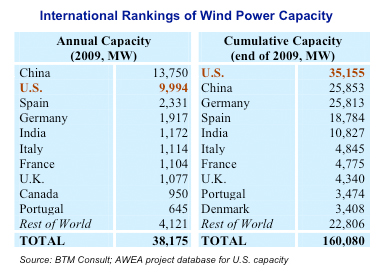
4. CHINA ADDED THE MOST WIND POWER IN 2009, SURPASSING THE US

Austin Carr in Fast Company reports that China overtook the US in 2009 in terms of added wind power capacity. Cumulatively, the US still has more wind power, but if this trend continues not for long.


5. RELIANCE TAKES THIRD STAKE IN MARCELLUS SHALE GAS

Rakteem Katakey at Bloomberg reports that Reliance Industries of India has agreed to pay $392 million for a 60% stake in acreages in the Marcellus shale-gas areas of central and northeast Pennsylvania held by Carrizo Oil & Gas Inc. This is the third US shale gas acquisition Reliance has made this year.

6. VIOLENCE IN DARFUR ON THE RISE

Neil MacFarquhar at the New York Times reports that violence in Sudan's Darfur region is on the rise again as the referendum on independence in southern Sudan approaches.

7. INITIAL JOBLESS CLAIMS CLIMB TO 479,000

Bob Willis at Bloomberg reports that "Initial jobless claims climbed by 19,000 to 479,000 in the week ended July 31, the most since April."

8. RETAIL SALES IN JULY WERE FLAT YEAR-OVER-YEAR

MasterCard's SpendingPulse reports that overall July sales were flat year over year.
"Michael McNamara, Vice President, Research and Analysis for SpendingPulse, observes 'Overall, retail sales continued to tread water, following the pattern set with June's sales when consumers demonstrated a reluctance to make larger purchases, and instead, traded down. Particularly, we are noticing some weakness in industry sectors that rely on higher priced ticket items such as furniture and discretionary areas such as luxury and jewelry. We are also seeing this pattern echoed in the restaurant business, where we have seen consumers shift from full-service restaurants and particularly fine dining, to limited-service and quick-service outlets.'"

Monday, July 26, 2010

Daily Sources 7/26

US SENATORS PEN LETTER RE: REPORT ON CHINA'S MILITARY BUILD-UP

Several US Senators have penned a letter to the Defense Department asking for assurances that the report on China's military build-up hasn't been toned down. The report is five months late in the making.

PLAN TO BROADCAST MORE IN MANDARIN IN GUANGDONG LEADS TO PROTEST

Brian Spegele at China Real Time reports that a plan to broadcast more shows in Mandarin in Cantonese-speaking Guangdong Province led to a decent-sized protest.

CHINA FACING DIFFICULTIES MANAGING WATER RESOURCES

Christina Larson at Environment 360 reports that China is facing increasing difficulty managing its water resources. China has 20% of the world's population, but just 7% of the world's fresh water resources.
"World Bank estimates show that China possesses only one-fourth the global average amount of water per capita. As more and more of its people move to cities, household demands will grow. Professor Wang estimates that Beijing’s water use has grown 150 percent in just the last decade. China’s power sector is extremely water-intensive, and steeply rising energy use is also driving water demand."
UKRAINE MAY ISSUE RUBLE-DENOMINATED DEBT

Daryna Krasnolutska and Denis Maternovsky at Bloomberg report that Ukraine is considering issuing ruble-denominated bonds after abandoning a US-dollar bond issue in the middle of July.


ISRAEL RAISES BENCHMARK INTEREST RATE

Alisa Odenheimer at Bloomberg reports that the Bank of Israel has raised its benchmark interest rate a quarter point to 1.75%.

AFRICAN UNION HEAD CONDEMNS ICC'S INDICTMENT OF SUDANESE PRESIDENT

Agence France Press reports that the head of the African Union, the President of Malawi, has said that the International Criminal Court's indictment of the President of Sudan undermines peace and security in Africa:
"To subject a sovereign head of state to a warrant of arrest is undermining African solidarity and African peace and security that we fought for for so many years."
ANADARKO DISCOVERS OIL OFFSHORE GHANA

Sharon Hong at Newswatch: Energy reports that Anadarko has made a significant oil discovery off-shore Ghana.
"The discovery well found about 174 net feet of "high-quality" oil pay in two zones, the company said. The oil appears to be light crude between 33 and 36 degrees API."
MONEY FOR MEXICAN DRUG WAR NOT SENT

Jackson Diehl reports that only a small percentage of money budgeted to help Mexico in its drug war is actually reaching Mexico City.

JUNE HOME SALES WORST EVER RECORDED (SINCE 1963)

Calculated Risk reports that
"Sales of new single-family houses in June 2010 were at a seasonally adjusted annual rate of 330,000 ... This is 23.6 percent (±15.3%) above the revised May rate of 267,000, but is 16.7 percent (±10.9%) below the June 2009 estimate of 396,000."


HOUSEHOLD NET WORTH AS A PERCENTAGE OF DISPOSABLE INCOME BACK TO LATE 80S EARLY 90S LEVELS

Barry Ritholtz at the Big Picture hosts a graph of household net worth as a percentage of disposable income:


IS AMERICA FACING INCREASED STRUCTURAL UNEMPLOYMENT?

FreeExchange hosts a debate.

Wednesday, July 21, 2010

Daily Sources 7/21

1. BANK OF CANADA RAISES INTEREST RATE TO 0.75%

Greg Quinn at Bloomberg reports that Canada yesterday raised its benchmark interest rate by a quarter percent to 0.75%. The central bank indicated that it would consider international developments before raising the rate further.

2. MEXICAN RETAIL SALES UP 5% IN MAY

Jonathan J. Levin at Bloomberg reports that Mexico's retail sales were up 5% from last year in May. The increase took place outside of Mexico's border regions with the US where drug cartel-inspired violence has become endemic. Americans are "thinking twice" before crossing the border to shop.

3. JF-17 MAKES A SPLASH AT FARNBOROUGH

Brian Spegele at China Real Time reports that the Chinese and Pakistani new fighter jet--the JF-17--made a splash at this year's Farnborough International Air Show in England.
"Aircraft sales are the most lucrative part of Beijing’s weapons exports, totaling some $815 million, China Daily reported."
The plane relies on Russian made jet engines, but the fact that China is willing to export its latest technology makes for a different arms theory than that practiced by the US.

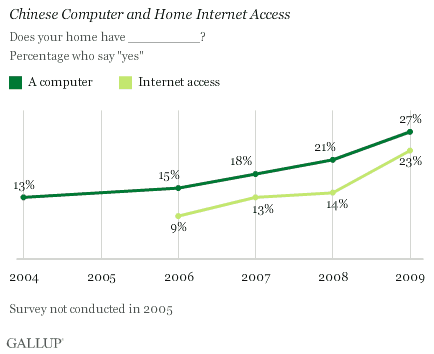
4. INTERNET USAGE IN CHINA IS SURGING

Kevin Sullivan at the Compass reports that Chinese internet usage is surging.


23% of a billion is a lot of people.

5. CHINA FACING HOUSING BUBBLE?

James Hamilton at Econbrowser asks whether China is facing a housing bubble.


6. NEW SANCTIONS ON NORTH KOREA

Craig Whitlock and Karen DeYoung at the Washington Post report that the US has announced that it will impose further sanctions on North Korea.

7. INSURANCE COMPANIES ABANDONING IRANIAN SHIPPING

Thomas Erdbrink and Colum Lynch at the Washington Post report that insurance companies have abandoned their relationship with Iranian shipping in order to comply with new US sanctions. Ports will refuse to allow Iranian ships entry if they are not covered for potential damages. Worth reading in full.

8. KURDS BLOW UP TURKO-IRANIAN GAS PIPELINE

Ivan Watson and Yesim Comert at CNN report that Kurdish rebels today took credit for the bombing of a Turkish-Iranian gas pipeline.
"An official from BOTAS, Turkey's state oil and gas company, speaking on condition of anonymity, told CNN that the fire had been extinguished. However, the official said, it will take at least six days to resume pumping fuel through the pipeline. In the meantime, BOTAS has increased the flow of gas from Azerbaijan to compensate for the gas cut."
9. INDIA AND PAKISTAN DISPUTE KASHMIR DAM

Lydia Polgreen and Sabrina Tavernise at the New York Times report that tensions are rising over the construction of a dam in Jammu-Kashmir. Pakistan is worried that India will be able to control water flow to its farmers during planting season. Worth reading in full.

10. COLOMBIA LOOKING UP

Frontier Markets optimistically notes that Colombia is emerging from its drug war. Investors will be more likely to place their money in Colombia than, say, Venezuela.

12. HOUSING HEADED FOR A DOUBLE DIP?

Barbara Kiviat at the Curious Capitalist argues that a double dip in housing is likely.

13. CRUDE AND PRODUCTS STORAGE INCREASES

The EIA reports that crude oil stocks grew by .4 million barrels in the week ended July 16th. Gasoline stocks grew by 1.1 million and distillate stocks grew by 3.9 million barrels. The national price of gasoline rose by 0.4 cents to 272.2 cents per gallon for the week ended July 19th. (Prices between $2.50 and $3.00 per gallon is where you start to see modification of use.) For the week ended 7/16 refinery utilization crept up to 91.5%.

Tuesday, July 28, 2009

Daily Sources 7/28

1. MAYER AND WOOD ARGUE THAT CHINA'S ENTRANCE INTO THE WORLD ECONOMY HAS NOT SIGNIFICANTLY DE-INDUSTRIALIZED REST OF DEVELOPING WORLD

Jörg Mayer and Adrian Wood at Vox EU argue that China's integration into the world's economy has not had the effect of substantially de-industrializing other developing nations.
"The biggest possible effect would be for a country which initially produced or exported equal amounts of manufactures and of primary products, where a 15% fall in the ratio would reduce the share of manufactures by 3.5 percentage points.

These estimates are imprecise and subject to error; the true answer may lie outside their range. But there is no plausible modification of the calculations that could make the true answer much larger. This is mainly because, despite its size, China’s opening had only a modest effect on world average endowments. The upper-limit estimates, obtained by simply adding China’s endowments to the rest of the world’s, are a 9% rise (from 0.43 to 0.47) in the share of the global workforce with a complete primary or secondary education, and a 17% fall in the average land/labour ratio, from 2.9 to 2.4 square kilometres of land per 100 workers ... . The average effect on the structure of output and trade in other countries is unlikely to have been larger than these world average endowment changes and was probably smaller.

The significance of the China effect varied widely among developing countries. This is partly because its size varied with the composition of each country’s manufacturing and primary production – how closely its industrial products competed with Chinese exports, and how much demand there was from China for its primary exports (more, say, for copper than for coffee). It is also because there were many other forces acting on sectoral structures--including changes in countries’ own trade policies--whose effects often outweighed those of China."
Worth reading in full.

2. NEPAL HARASSING TIBETAN REFUGEES

Gopal Sharma at Reuters reports that Nepal is responding to pressure from Beijing by cracking down on Tibetan refugees in the country.
"Nepali authorities have regularly broken up protests by Tibetan exiles and arrested them for protesting against China's crackdown on demonstrations in Tibet.

The Washington-based [International Campaign for Tibet] said Tibetan refugees were 'increasingly demoralized' as Nepal 'relinquishes its historic and sovereign interests in response to incentivized political pressure from Beijing and its sympathizers.'

ICT said 'pre-emptive arrests of Tibetans, ID checks and house searches' by authorities were contributing to a 'widespread sense of fear and insecurity' among the exiles.

'Nepal's political leadership is betting that the internal benefits of assuaging China in the cause of oppressing Tibetans will be greater... than the traditional legal and historical concepts,' Mary Beth Markey, Vice President at ICT said."
3. INDIA TO ANNOUNCE SOLAR POWER TARGETS OF 1/8TH TOTAL ELECTRICITY DEMAND, CENTRAL BANK LEAVES INTEREST RATE UNCHANGED ON INFLATION CONCERNS

Krittivas Mukherjee and David Fogarty at Reuters reports that India will announce its targets for solar power generation in September. The plan promises to
"boost output from near zero to 20 gigawatts (GW) by 2020 as it firms up its national plan to fight global warming, draft documents show.

The target, which would help India close the gap on solar front-runners like China, is part of an ambitious $19 billion, 30-year scheme that could could increase India's leverage in international talks for a new UN climate pact in December, one of several measures meant to help cut emissions.

If fully implemented, solar power would be equivalent to one-eighth of India's current installed power base, helping the world's fourth-largest emitter of planet-warming greenhouse gas emissions limit its heavy reliance on dirty coal and assuaging the nagging power deficit that has crimped its growth.

The 'National Solar Mission', yet to be formally adopted by Prime Minister Manmohan Singh's special panel on climate, envisages the creation of a statutory solar authority that would make it mandatory for states to buy some solar power, according to a draft of the plan, which provided detailed proposals for the first time, obtained by Reuters ... ."
Meanwhile, Cherian Thomas at Bloomberg reports that India's central bank decided today to leave its benchmark interest rate unchanged at 3.25%.
"The central bank raised its inflation forecast for the year to March 31 to 'around 5%' from an April estimate of 4%, citing 'elevated' food and commodity prices."
4. EU TO TRAIN SOMALI SECURITY FORCES TO POLICE PIRACY

BBC News reports that the EU has announced plans to train Somali security forces to tackle the piracy plaguing their coasts.
"It will send a planning team to the region next month. The training will take place in neighboring Djibouti, which has French and US military bases."
(h/t Joshua Keating at FP's Morning Brief.)

5. IMF AND LATVIA REACH ACCORD, MAY OPEN UP NEW FUNDING

Aaron Eglitis and Timothy R Homan at Bloomberg report that the IMF and Latvia have reached an accord paving the way for the country to receive its first financial assistance from the organization since December.
"The review may unlock about 195 million euros ($285 million), which the IMF withheld in March after the Baltic country failed to commit to budget cuts, the fund said in an e- mailed statement.

Latvia turned to a group led by the European Commission and the IMF for a 7.5 billion-euro stabilization loan in December after its second-biggest bank needed a state rescue. The IMF announcement followed a 1.2 billion-euro transfer by the European Commission yesterday, helping quell concern about a lats devaluation that may have destabilized currencies across the region."
6. MOUSAVI CALLS FOR NEW STREET PROTESTS NEXT WEEK IN IRAN

Borzou Daragahi at the LA Times reports that opposition candidate Mir-Hossein Mousavi has called for more street protests during religious festivals next week.

7. KENYA TO BUILD AFRICA'S LARGEST WIND FARM

Xan Rice at the UK Guardian reports that Kenya plans to build the largest wind farm in Africa.
"Some 365 giant wind turbines are to be installed in desert around Lake Turkana in northern Kenya – used as a backdrop for the film The Constant Gardener--creating the biggest wind farm on the continent. When complete in 2012, the £533m (~ $758.8 million) project will have a capacity of 300MW, a quarter of Kenya's current installed power and one of the highest proportions of wind energy to be fed in a national grid anywhere in the world."
8. FUEL OIL APPROACHING COST OF CRUDE, HURTS SHIPPING, CHINESE FUEL OIL IMPORTS ROCKET UPWARD (FROM LOW BASE), VIETNAMESE MAIDEN REFINERY TO TAKE SPOT GASOLINE DEMAND OFF MARKET, WALL OF ASIAN PACIFIC REFINING YET TO PLAY OUT

Christian Schmollinger and Alaric Nightingale at Bloomberg report that the price of fuel oil--bunker fuel, the bottom of the barrel, which is used to power ships in great part because it is cheap, generally trading at a considerable discount to crude, is approaching the price of light crude and may surpass it.
"Fuel oil may surpass crude 'for quite some time, six months is possible,' JPMorgan Chase & Co. vice president of energy strategy Vima Jayabalan said in a phone interview from Singapore."
This means that the effect of rising crude prices is having a more pronounced affect upon the cost of shipping than it did during the 2003-2008 run up in the price of crude.
"'It’s really hurting' ship owners, said Parul Bhambri, a Singapore-based analyst at Drewry.

Maersk said May 12 that falling demand for freight hobbled its ability to pass on fuel costs to customers in the first quarter, when its shipping line lost $559 million after taxes, compared with an $80 million profit a year earlier. The shares are down 40% in the past year in Copenhagen trading."


As the price of fuel oil rises, however, many simple refineries, which do not have the equipment to maximize gasoline and diesel output, can become profitable again, which may undergird a recovery in overall crude demand. That said, it still doesn't look like there's much demand for gasoline and diesel out there, which could push down the crack spread and thus the price of crude. Winnie Lee at Platts reports that Chinese fuel oil imports in June were up 6.26% from May and 45.94% from June 2008 to 13.7 kb/d. It's largest supplier was Venezuela. In that vein, Irene Tang at Platt's the Barrel blog reports that the commissioning of Vietnam's first refinery at Dung Quat is poised to erase about 30% of the country's product import demand, which will in turn erase its demand for spot gasoline purchases. The wall of new refining capacity in Asia has yet to fully be appreciated,
"China has now joined India in becoming a major swing exporter of gasoline. Apart from greenfield refineries coming onstream in the country, Beijing's decision to adopt a new products pricing formula for the domestic market and the resulting price revisions in tandem with the global benchmarks has encouraged more speculative buying at the wholesale level, causing wide fluctuations in refiner inventories.

This, in turn, has made Chinese gasoline export volumes unpredictable. The latest customs figures show gasoline exports hit a two-year high of 560,000 mt in June, a 273% surge from the corresponding month of last year. The previous high was in April 2007, at 590,000 mt.

The figures point to Chinese 'apparent' gasoline demand in June being just 1.8% higher than the same month a year ago, a contrast with on-year growth rates of 20.2% in May and 13% in April. The anomaly of the June figure, in the backdrop of staggering double-digit growth rates of automobile sales in China and a 7.7% on-year average gasoline demand growth in the first half of the year, can only be explained by wild swings in stock builds and draws."
"The full impact of the start-up of Reliance Industries' new 580,000 b/d refinery in Jamnagar should be apparent as early as August, as the company's older 660,000 b/d refinery is now restarting from a partial shutdown. Monthly gasoline exports from RIL are expected to more than double to well above 600,000 mt."
9. NIGERIAN REBELS IN SOUTH TARGET OIL MINISTER'S COMPANY, NORTHERN ISLAMISTS CONTINUE UNREST

Platts reports that the Nigerian Joint Revolutionary Council has issued a warning to UK-based independent producer Afren Resources to stop operating in the Niger Delta or risk attacks on its equipment and personnel.
"The Joint Revolutionary Council, which styles itself as a coalition of militant groups based in southern Rivers and Bayelsa states, said in a statement that its ultimatum to Afren was aimed at expressing the group's opposition to the policies of Nigeria's Oil Minister Rilwanu Lukman--policies the group sees as skewed against the Niger Delta region in the country's south.

Lukman was a co-founder of Afren and stepped down from his position as chairman of the company's board of directors once he was appointed oil minister for Nigeria in late 2008. His shares in the company were to be held in a blind trust, the company said in a statement at the time."
Lukman wants to site an oil university in his home state in the north--Kaduna. Meanwhile, Ibrahim Mshelizza at Reuters reports on the increasing Islamist inspired unrest in northern Nigeria.
"The violence was triggered when some members of the group called Boko Haram, which wants a wider adoption of Islamic sharia law across Africa's most populous nation, were arrested Sunday in Bauchi state.

Unrest spread to the northern states of Kano, Yobe and Borno, whose capital Maiduguri is home to the group's leader, Mohammed Yusuf, and has seen the worst violence.


'The situation has been contained in Bauchi and Yobe. The bad situation we have now is in Borno where the leader of the group is residing ... We are going to launch an operation, a main operation to flush them out,' [Nigerian President Umaru] Yar'Adua told reporters after meeting security chiefs and state governors."
10. PRESSURE TO CHANGE DRUG WAR STRATEGY BUILDING IN MEXICO, MEXICAN CRUDE PRODUCTION WAY DOWN

William Booth and Steve Fainaru at the Washington Post report on the growing pressure on Mexican President to change Mexico's "surge" strategy in dealing with its drug cartels.
"Dan Lund, president of the MUND Group polling organization, said public support for Calderón's strategy appears to be weakest in the places where the federal government needs it most. 'In a series of national surveys, polls consistently have found a reasonable but cautious level of support for using the military in the front lines against the cartels,' he said. 'But in all the states where the military is actually deployed, the support goes down, sometimes dramatically.'

The situation has been exacerbated by the global economic crisis, which has cast millions of Mexicans into poverty. José Luis Piñeyro, a Mexican military analyst who maintains close ties with the armed forces, said rising unemployment and poverty 'is creating what I call an "army in reserve,"' for the traffickers.

In Michoacan, La Familia has used the media to try to align itself with the disenfranchised. After the recent attacks, one of its leaders, Servando Gómez, called a local television station and told viewers: 'I want to say to all Michoacanans, we love them and respect them.'"
Meanwhile, there was plenty of stories on the decline in Mexican production last week. John Kingston at the Barrel notes:
"But here's the more stunning figure: what's happened in two years. In July 2007, Pemex reported crude output of 3.165 million b/d. That's a 20.4% decline in 23 months."
11. VATICAN AIMS AT FREE MARKETEERS, SAYING MARKETS WITHOUT ETHICS DESTROY WEALTH AND CREATE POVERTY

Flavia Krause-Jackson at Bloomberg reports that the Vatican has attacked free markets, saying that they have legitimized greed. On June 7, the pope published an encyclical which examined the financial crisis and means out of it, saying that once profit becomes the exclusive goal of business, it destroys wealth and creates poverty.
"Last November, Italian Finance Minister Giulio Tremonti said the pope had pronounced a 'prophecy' in a paper Benedict wrote when he was a cardinal.

In 1985, then-Cardinal Joseph Ratzinger presented a paper titled 'Market Economy and Ethics' at a Rome event on the Catholic Church and the economy. He said a decline in ethics 'can actually cause the laws of the market to collapse.'"
I think it is plain that markets cannot sustain themselves without a modicum of trust, engendered by ethics held in common.

12. CFTC MAY OR MAY NOT REVISE LAST YEAR'S REPORT EXONERATING SPECULATION IN PRICE VOLATILITY, LONDON'S FSA EXONERATES SPECULATORS

Ianthe Jeanne Dugan and Alistair MacDonald at the Wall Street Journal report that the CFTC
"plans to issue a report next month suggesting speculators played a significant role in driving wild swings in oil prices--a reversal of an earlier CFTC position that augurs intensifying scrutiny on investors."
However, I understand that the Chair of the CFTC indicated today that the story in the WSJ that the report will be redone and altered are premature and inaccurate. From the WSJ story,
"In the US, the CFTC begins public hearings Tuesday to determine whether to limit speculative investments in commodities. Congress also is weighing whether to give the CFTC the authority, under a broader proposal to revamp financial regulation, to regulate commodities investments that occur off traditional exchanges. Byron Dorgan, a North Dakota Democrat, has called on the CFTC to curb 'oil speculators looking for a quick buck at the expense of American consumers.'"
I suspect that the direction of these accusations is misdirected, given that commercials may choose to purchase futures to profit on price just as much as to hedge their obligations.


Positions net long and short for the week ended July 21 only comprised 1% of the market. Note that from 2008 open interest--or the total number of contracts--has been steadily falling for both futures and options--though the trend for options was up through February.


If you include options, the number of positions held by traders net long or short represent 3.17% of the market--not an especially large share. Meanwhile, Alistair MacDonald and Carolyn Cui at the Wall Street Journal report that the Financial Services Authority in London has found no evidence that speculators are behind the wild swings in oil price seen from 2008.
"One person familiar with the matter said the FSA had seen no evidence to suggest that speculators are driving up the price of oil.

'More than they ever were before, [investors] are looking to the global economic climate and nobody is sure on that, and that is perhaps driving the volatility,' he said.

Given that view, the FSA doesn't believe that limiting the size of trading positions would be 'beneficial' for the market, said a person familiar with the matter. Still, the FSA acknowledges it doesn't have a 'full explanation' as to why the market has moved the way it has, said a person familiar with the matter.

The FSA's conclusion contradicts British Prime Minister Gordon Brown, who has linked the recent rises in oil to speculation.
...
Politicians around the world are worried about the effect of rising oil prices on the recovery potential of their recession-hit economies. World leaders from French President Nicolas Sarkozy to the leaders of Asia's biggest oil-consuming nations have tied these rises to oil speculators."
"Speculation," of course, is sufficiently vague to represent a politically useful bogeyman, and it seems likely that someone will call financial protectionism. That said, I do think it is in the global economic interest to make the cost of energy--and in particular transportation fuels--more stable and predictable, I just don't think that attacking "speculation" is a particularly productive way of doing so.

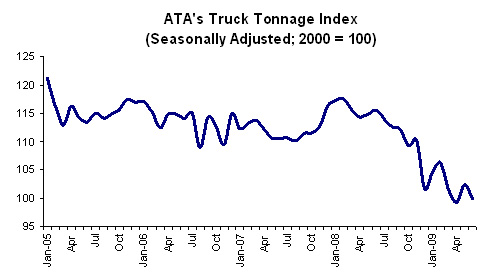
13. TRUCKING VOLUMES IN US DOWN 13.6% IN JUNE YOY

The American Truckers Association yesterday announced that their
"advance seasonally adjusted (SA) For-Hire Truck Tonnage Index fell 2.4% in June. In May, SA tonnage jumped 3.2%. June’s decrease, which lowered the SA index to 99.8 (2000=100), wasn’t large enough to completely offset the robust gain in the previous month."
Over June 2008, tonnage fell 13.6%, which exceeded the year over year drop of 11%.


The ATA release warns:
"The sample includes an array of trucking companies, ranging from small fleets to multi-billion dollar carriers. When a company in the sample fails, we include its final month of operation and zero it out for the following month, with the assumption that the remaining carriers pick up that freight. As a result, it is close to a net wash and does not end up in a false increase. Nevertheless, some carriers are picking up freight from failures, and it may have boosted the index. Due to our correction mentioned above, however, it should be limited."
(h/t Barry Ritholtz at the Big Picture.)

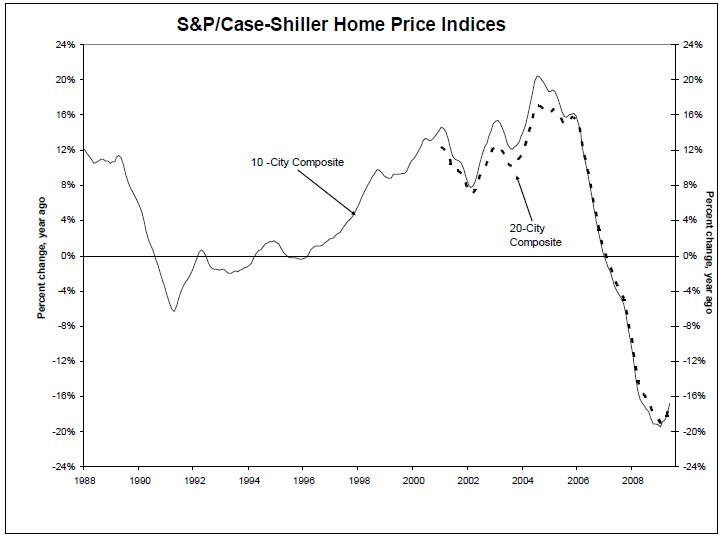
14. HOME PRICE DECLINE SLOWING, CALIFORNIA FORECLOSURES DOUBLE NEW HOME SALES IN JUNE

Barry Ritholtz reports that home price declines are "slowly abating." Here is his graph:


Jake at Econopic picked up on the Big Picture's quote of the day of Mark M Hanson which notes that California foreclosures are more than double the national new home sales for June. His graph:


15. EPA MAY GIVE ALGAE BIG BOOST

Russell Gold at Environmental Capital notes that Blair Carter at the Renewable + Law Blog reports that "that the Environmental Protection Agency will count algae as an advanced biofuel under Renewable Fuel Standard rules being developed."
"Why do EPA’s steps towards including algae matter? Because when Congress created its mandate to blend advanced biofuel into the fuel pool, it created a big market for these fuels. By 2012, the law mandates that two billion gallons of these advanced biofuels be blended, a figure that rises by tenfold by 2022. It’s all in Section 202 of the Energy Independence and Security Act of 2007.

... For algae to be included, the law says it needs to have no more than 50% of the 'lifecycle greenhouse gas emissions' of gasoline and diesel. This could be tricky, says David Woodburn, an alternative energy analyst with ThinkEquity. 'The hard part for me is understanding how the EPA plans to calculate the GHG emissions of algae fuels, based on the variety of feedstocks (sugar, CO2, other), processes (open ponds, photobioreactors), and algae varieties being explored--especially before November,' he says, noting when the rules are supposed to be finished."
Blair Carter's post can be found here.

16. TEXAS DROUGHT GETS WORSE

Tom Benning at the Wall Street Jounral reports on the drought in Texas.
"Nearly 80 of Texas' 254 counties are in 'extreme' or 'exceptional' drought, the worst possible levels on the US Department of Agriculture's index. Though other states are experiencing drought, no counties in the continental U.S. outside Texas currently register worse than 'severe.' In late April, the USDA designated 70 Texas counties as primary natural-disaster areas because of drought, above-normal temperatures and associated wildfires."
The Journal carries an interactive graphic:

Monday, July 20, 2009

Daily Sources 7/20

1. MORNINGSTAR OUTLINES US COMMITMENT TO EUROPEAN ENERGY SECURITY IN SENATE REMARKS

Richard Morningstar, the US Special Envoy for Eurasian Energy, emphasized the American commitment to European energy security in remarks made before the Senate Foreign Relations Committee on Friday. Key excerpt:
"There are three main components of our Eurasian energy strategy. First, we want to encourage the development of new oil and gas resources and also promote efficiency and conservation in the use of all energy resources. Because there is a world market for oil, new production can meet growing demand anywhere in the world, including in the US. When we are talking about new natural gas production in the Caspian region, it is unlikely that even one molecule of that gas will reach the US, but it is still important because it would add to international gas supply. Additional supply in one place naturally frees up supply in another. And as the market for liquefied natural gas grows, we can start to think about gas moving around markets in much the same way oil does.

Second, we want to assist Europe in its quest for energy security. Taking goods and services together, the EU27 and the US account for the largest bilateral trade relationship in the world. Europe is our partner on any number of global issues. We have an interest in an economically strong Europe. Of course, Europe is composed of many different states and energy security is a more pressing issue to some than to others. Some countries in Europe do not have a diverse energy mix and depend to a great degree on one supplier and one transport route. When that route is disrupted, as we witnessed in January 2009, the consequences can be severe. The populations of Bulgaria and Serbia and others who suffered in the cold can attest to that. So our aim is to encourage the development of multiple energy sources with multiple routes to market. This approach furthers competitive, efficient markets and the best prices for consumers.

Third, we want to help Caspian and Central Asian countries find new routes to market. We want to help foster economic growth and prosperity in these countries. By expanding export routes, they can increase competition for their resources and demand a higher price.

Some people have portrayed our energy policy and Russia’s as the next round in the Great Game in Central Asia. I reject this analogy. Energy security should not be a zero sum game. Zero sum games are too expensive and we need to find areas where we try to cooperate with Russia. In this spirit, on July 6, the White House announced a new binational presidential commission that will cover a host of different issues, including energy."
2. BERLIN CONSIDERS NEW MEANS OF JUMP STARTING CREDIT FLOWS AGAIN

Christian Reiermann, Christian Salewski and Michael Sauga at Der Spiegel report that Berlin, worried that a deepening credit crunch will undermine any recovery in the second half of the year, are considering various plans to restore the flow of credit to the country.
"[Finance Minister Peer] Steinbrück is now pursuing yet another plan. Officials at the Finance Ministry have prepared another version of an emergency financing plan, which calls for the government-owned KfW development bank to take action, instead of the Bundesbank. Before the crisis began, KfW and the banks through which it channels its loans onto the market each bore half the credit risk. In exceptional cases, KfW may assume 80 percent of the risk, while the other bank assumes the remaining 20 percent. In the future, however, KfW's share could be even higher, perhaps even 100 percent, according to the Finance Ministry's latest plans. The Economics Ministry is fashioning similar schemes.

Some plans are even more radical, including the possibility of KfW lending directly to businesses in the future. The funds for the new loans would come from the existing stimulus programs."
3. ADVISORY BOARD TO OUTGOING BULGARIAN GOV'T WARNS OF RUSSIAN INFLUENCE

The European Union Law blog reports that the Financial Times has acquired a report written by a six-member advisory board of Bulgaria's recently ousted Stanishev government, chaired by Dominique de Villepin, a former French prime minister, which argues that Bulgaria is at risk of falling under Russian economic and political influence. The blog quotes from the report:
"If Bulgaria fails in the fulfillment of this objective, different consequences could arise. First, the Bulgarian state could become more vulnerable, encouraging populist movements and planting the seeds of discouragement among Bulgarian civil society.

Second, the efforts undertaken to build up a stronger, more modern and efficient state apparatus could weaken, and so would the trust of the people in the state. Finally, it could undo the ties between the EU and Bulgaria, prompting a shift of Bulgaria towards Russian political and economic interests."
4. US AND INDIA ANNOUNCE END-USE MONITORING AGREEMENT, CITIBANK TO ADVISE ONGC ON GHANA ACQUISITION

Matthew Rosenberg at the Wall Street Journal reports that Secretary of State Hillary Clinton and Indian External Affairs Minister SM Krishna announced an "end-use monitoring" agreement which will facilitate sales of arms from the US to India. Meanwhile, Joseph Chaney and Narayanan Somasundaram at Reuters reports that Indian state oil company ONGC has hired Citigroup to advise it on a bid for Kosmos Energy's stake in the Jubilee oil field offshore Ghana. The deal is reportedly worth around $3 billion.

5. FORMER IRANIAN PRESIDENT CALLS FOR REFERENDUM ON ELECTION LEGITIMACY, SHIRIN EBADI NOTES ANTI-RUSSIAN AND ANTI-CHINESE SLOGANS IN FRIDAY PRAYERS

Robert F Worth at the New York Times reported that former president Mohammad Khatami called for a referendum on the legitimacy of the recent elections.
"Mr Khatami on Sunday praised Mr Rafsanjani’s speech and said a referendum would help achieve Mr Rafsanjani’s goal of restoring trust, reformist Web sites and the BBC’s Persian service reported. He said it should be carried out by an independent body, like the Expediency Council, an arbitration group that is headed by Mr Rafsanjani.

'If the majority of people accept the situation, we also will accept it,' Mr Khatami said, Web sites reported."
"Although some Iranian conservatives have criticized Mr Rafsanjani for his speech on Friday, more have made stinging criticisms of Mr Ahmadinejad over a controversial cabinet appointment made public on the same day. The president named as his first vice president Esfandiar Rahim Mashaei, who angered hard-liners by saying in 2008 that Iranians are 'friends of all people in the world--even Israelis.' Mr Mashaei, whose daughter is married to the president’s son, also angered clerics in 2007 when he attended a ceremony in Turkey in which women performed a traditional dance.

On Saturday, Ayatollah Ahmad Khatami, a prominent conservative, called the appointment of Mr Mashaei 'completely unbelievable' and said to promote him was to 'ridicule the highest religious authorities.'"
Der Spiegel carried an interview with Iranian Nobel prize winning human rights lawyer Shirin Ebadi in which she said the following:
"[The Friday prayers led by Rafsanjani and attended by Mir Hossein Mousavi and Mehdi Karroubi] was bordering on an historic event, not just for Iran, but for the entire Islamist world--because so many people from the protest movement participated in these Friday prayers. The slogans were also important. The crowd for the first time chanted 'Death to China' and 'Death to Russia!,' they attacked the two most important countries that have supported the leadership in Tehran--at the United Nations, for example. The people have seen just who has been on the side of this regime for decades--two countries that themselves massively violate human rights."
Worth reading in full.

6. RENEWED INTEREST IN KURDISH OIL CONCESSIONS, KURDISH MINORITY IN NINEVEH THREATENS SECESSION

William MacNamara at FT Energy Source reports that Gulf Keystone was awarded two Kurdistan oil licenses this weekend at Sheihk Adi and Ber Bahr.
"One of Gulf Keystone’s joint venture partners will be Genel Energy, the Turkish company leading the incipient consolidation of the Iraqi Kurdish concessions through its proposed merger with Heritage Oil."
Geoff King at Platts reports that
"The work programs for both blocks include the drilling of one exploratory well on each block using current, existing and to be acquired data, Gulf Keystone said, and both [production sharing contracts] PSCs are subject to a 20% KRG carry and no third-party back-in rights."
Meanwhile, Jamal al-Badrani at Reuters reports that Kurdish local councilors in a Nineveh--a northern province in Iraq--are boycotting all contact with the Arab governor of the region and threatening to set up their own governing body unless he successfully addresses their concerns about marginalization. Kurdish representatives hold 16 of 37 seats in Nineveh's governing council.
"The Kurds see parts of majority Arab Nineveh as part of their ancient homeland and want them included in Iraq's semi-autonomous region of Kurdistan. They complain that [Governor Atheel] Nujaifi has marginalized them in the provincial council since he was elected in January.

'If no solution is found, we will be forced to form the Nineveh council to run the 16 administrative units,' said Kurdish councilor Derrman Khitari, adding that he would ask the central government to divert part of its Nineveh budget."
"Nujaifi told Reuters he would come down hard on any local councilors who attempt to secede.

"Their demand is illegal and the constitution will not endorse it. It violates the provincial council law. If any local council within these areas violates the constitution, we have the authority to dissolve it and form a new one," he warned.

He said the door was still open to dialogue. A delegation of Shi'ite Arab politicians from the movement of cleric Moqtada al-Sadr is mediating, but have yet to produce results."
7. NIGERIA, NIGER, AND ALGERIA SIGN TRANS-SAHARAN PIPELINE AGREEMENT

The Wall Street Journal reports that the Nigerian national oil company signed an agreement with Algeria and Niger to create a $10 billion trans-Saharan pipeline to ship natural gas to Europe. On September 8, 2008, the European Commission and African Union Commission established an "African-EU energy partnership" and created an informal joint experts group on energy which was to first meet in October of that year--see Daily Sources 9/22 #5. In late February, Total SA indicated that it was interested in participating in any such project--see Daily Sources 2/26 #5. Gazprom announced late last month that it would begin construction of the pipeline late next year after having established a 50-50 JV with the Nigerian national oil company to handle oil, gas, gas processing and transportation projects--see Daily Sources 6/25 #10.


8. GAO REPORT DETERMINES THAT VENEZUELAN STATE SUPPORT FOR FARC MAKING VENEZUELA KEY HUB IN COCAINE TRAFFICKING

Juan Forero at the Washington Post reports that a GAO report commissioned by Sen. Richard Lugar (R-IN) in February 2008 concludes that state aid from Venezuela to FARC has turned Venezuela into a key source of cocaine being trafficked into the United States.
"Since 1996, successive US administrations have considered Venezuela a key drug-trafficking hub, the Government Accountability Office report says. But now, it says, the amount of cocaine flowing into Venezuela from Colombia, Venezuela's neighbor and the world's top producer of the drug, has skyrocketed, going from an estimated 60 metric tons in 2004 to 260 metric tons in 2007. That amounted to 17% of all the cocaine produced in the Andes in 2007."
9. ORTEGA CALLS FOR END TO TERM LIMITS

Reuters reports that Nicaraguan President Daniel Ortega--who accepted the results of elections after serving as the Communist leader of the country from 1979-1990--has called for a change in the law which now prevents presidents from serving two consecutive terms. In a speech yesterday he said,
"Congressman are re-elected all the time. Mayors are not allowed to be re-elected. If we are going to be just and fair, re-election should be allowed for all (public officials)."
Ortega was elected president in 2006--beginning his term in 2007; the next elections are scheduled to be held in late 2011.

10. WSJ STUDY SHOWS COMMERCIAL MORTGAGES BEING CHARGED OFF AT FASTEST RATE IN NEARLY 20 YEARS

Lingling Wei and Maurice Tamman at the Wall Street Journal report that commercial banks have been charging off commercial mortgages at the fastest rate in close to 20 years.
"At that rate, losses on loans used to finance offices, shopping malls, hotels, apartments and other commercial property could reach about $30 billion by the end of 2009.

The losses by regional banks on their commercial real-estate loans will be among the most watched details as thousands of banks report second-quarter results over the next two weeks. Many of the most troubled banks have heavy exposure to commercial real estate. So far, 57 banks have failed this year.

The $30 billion estimate is based on financial reports filed by more than 8,000 banks for the first quarter. The trend continued as a handful of major banks reported second-quarter results, including Goldman Sachs Group Inc, JP Morgan Chase & Co. and Bank of America Corp. Regional banks tend to have higher exposure to commercial real estate than these big financial institutions."
The commercial real estate market represents about 13% of US GDP.

11. PETROLEUM IMPORTS NOW REPRESENT LARGEST SHARE OF THE TRADE DEFICIT

Brad Setser notes that as of May the largest share of the trade deficit is due to petroleum imports.


And comments:
"Discussions about the policies that gave rise to imbalances typically focus on macroeconomic policy choices. That increasingly strikes me as incomplete. Energy policy should enter the calculus too. The US isn’t going to start exporting petrol--not on a net basis--anytime soon. But it certainly could do more to reduce its demand for imported energy."

Thursday, June 4, 2009

Daily Sources 6/4

1. BANKS OF CANADA, ENGLAND, AND EUROPE MAINTAIN BENCHMARK INTEREST RATES, B.O.E. AND E.C.B. REITERATE INTENTION TO ENGAGE IN SOME Q.E., SPEECH BY GERMAN F.M.--AND S.D.P. CHANCELLOR CANDIDATE--INDICATES INTEREST IN CHANGING THE STRUCTURE OF THE EUROPEAN MONETARY UNION

Daniel Kruger and Chris Fournier at Bloomberg report that the Bank of Canada today decided to leave its benchmark interest rate unchanged at 0.25%.
"The Bank of Canada ... said the 'unprecedentedly rapid rise' in the currency could 'fully offset' recent improvements in financial markets and consumer confidence and prolong the recession.

'The bank is confirming that the rise in the currency isn’t backed up by the fundamentals,' said John Curran, a Toronto-based senior vice president at CanadianForex Ltd., an online foreign-exchange dealing firm. 'While we do see some 'green shoots," for the economy to strengthen we can’t have the Canadian dollar as strong as it’s been in recent weeks. Once everyone gets a chance to digest this, you’ll see some US dollar strength."
Meanwhile, Jennifer Ryan at Bloomberg reports that the Bank of England also left its benchmark interest rate unchanged at 0.5 today, and reiterated its intention to purchase £125 billion (~$205 billion) in government and corporate bonds.
"While the bank’s decision last month was unanimous, some policy makers did favor spending the full authorized total of 150 billion pounds and the panel said it will seek permission to print even more money than the maximum if needed. Minutes of today’s decision will be published on June 17."
And Gabi Thesing and Christian Vits at Bloomberg report that the European Central Bank [ECB] also left its benchmark interest rate unchanged today at 1%.
"Asked if the bank will expand its bond plan, [ECB President Jean-Claude] Trichet replied: 'We have decided to embark on a 60 billion-euro purchase of covered bonds, full stop.'"
Meanwhile, Daniela Schwarzer at Eurozone Watch reports that German Foreign Secretary Frank-Walter Steinmeier in a speech yesterday at Budapest suggested that the current structure for the European monetary union ought, under the current circumstances, be rearranged, Schwarzer's analysis:
"# He explicitly acknowledges the problem of divergent economic developments in the EMU. This fact has been on the table for a few years now. As early as 2005, data on the first years of EMU pointed to these problems, and the trend of cyclical and structural divergence has even been acknowledged by the ECB in pursuing its monetary policy for an increasingly heterogeneous Eurozone economy. But Germany (which itself has been diverging from EMU average for instance in the years of its sever economic slump 2003/4 and subsequently recorded a very strong current account surplus) had so far not picked up this issue politically. It is hence the first time that a German member of government says what the current developments are: a possible threat to the existence of the EMU.
# In order to tackle this problem, Steinmeier suggests stronger policy coordination. In other words: the Lisbon Agenda is not sufficient an instrument to cope with divergence and asymmetric shocks in the EMU. This is no surprise to most economic analysts of EMU (even not in the German administration), but a new political statement from Berlin.
# He explicitly names wage, social and tax policies as an object for closer coordination in the EMU and speeks out strongly against tax and wage dumping. Again, this should be no surprise from a social democrat before two important elections dates - but it is a clear departure from the Berlin mainstream. For instance regarding the commonly held view that due to the 'Tarifautonomie' (i.e. the fact that social partners negotiate wages (more or less) independently in Germany) nothing can be done in the field of wage policy anyway. What Steinmeier may in fact mean is that some countries should be pushed towards giving up certain systems (e.g. wages indexed on inflation as is the case in Spain), which reinforce cyclical divergences in the EMU.
# He also requests a stronger coordination of fiscal stimulus in the current crisis--rightly so, but in direct opposition to the position held by the Chancellor and the Finance Minister."
Worth reading in full.

2. REPORTERS TAKEN TO CHINESE S.P.R.S

Denis McMahon at China Journal reports that he was taken on a reporting trip to Zhenhai and Zhoushan, two SPRs located south of Shanghai, arranged by the State Council Information Office.
"On the face of it, the visit was seemingly a massive step forward in transparency for the Chinese government. But, while staring at 50 identical 100,000 cubic meter (~ 630,000 barrel) tanks neatly formed into rows is certainly impressive, it doesn’t really tell much about the state of China’s reserves. And while the officials we met were friendly and open, the key policy questions of where the oil comes from, how they bought it and under what conditions the reserves may be tapped were deferred to more senior officials--who weren’t there.

While the reporters may have been a little unsure as to what they were getting out of the experience, Beijing clearly knew exactly what it was doing from the unity of message coming from the National Energy Bureau officials traveling with us: The reserves are full."
It seems that Beijing is signaling it would like a lower price, no?

3. MALAYSIA CONSIDERING SETTLING TRADE WITH CHINA IN LOCAL CURRENCIES

Shai Oster at the Wall Street Journal reports that Malaysian Prime Minister Najib Abdul Razak told the media after meeting with China's premier, Wen Jiabao, on Wednesday that:
"We can consider whether we can use local currencies to facilitate trade financing between our two countries. ... What worries us is that the [US] deficit is being financed by printing more money. That is what is happening. The Treasury in the United States is printing more notes."
The notion being to replace trade settlements in dollars with the ringgit and yuan. In May Bloomberg reported that Brazil's foreign minister told the media in Beijing that Brazil and China were considering a plan to settle in local currencies--see Daily Sources 5/20 #4.

4. VIETNAMESE NAVAL STRATEGY VS. CHINA TO MIRROR CHINA'S NAVAL STRATEGY VS. U.S., MALAYSIAN SHIPS MAY HAVE ENTERED OIL RICH AREA DISPUTED WITH INDONESIA

Feng at Information Dissemination comments on Vietnam's recent decision to purchase six project 636 kilo submarines for $1.8 billion. (Kilo class is the NATO designation for diesel-electric submarines made in Russia. Wikipedia states that the project 636 submarines are thought to be one of the quietest diesel-electric submarines in the the world.) Feng believes that the submarine purchase was made in an attempt to be able to project force into the China South Sea, and in particular, to the Spratly Islands, control over which is disputed by all the nearby nations, mostly because it is thought that oil and gas reserves lie under them.


Feng points out that the navies of countries further away from Vietnam, like, say, Australia, present a different challenge for the People's Liberation Army Navy [PLAN] than Vietnam, simply because Vietnamese ships would be operating mostly in areas over which the Chinese would be able to assert air superiority. Thus:
"[Vietnam is] actually adopting the same strategy that PLAN [has] supposedly [adopted to counter the capabilities of the US Navy]. Basically, Vietnam is [buying] a lot [of] small, fast ships equipped with long range missiles (and nothing else much ...) [and] quiet submarines."
Of course, Hanoi cannot make purchases on the scale that Beijing can, but it is presented with more or less the same dilemma facing Beijing when considering what it should do in case of a confrontation with the US. Interesting observation. Meanwhile, AFP reports that Malaysia's deputy prime minister Muhyiddin Yassin called for calm amidst reports that Malaysian warships had entered waters off northeastern Borneo also claimed by Indonesia, saying:
"We want to avoid any form of provocation that can cause unpleasantness. We must handle the matter with caution."
"International borders in the area off Borneo island have yet to be determined, with each country claiming the area as its own.

Malaysia claims the area based on a 1979 maritime chart, while Indonesia bases its claims on the 1982 UN Convention on the Law of the Sea (UNCLOS), which states the area belongs to Indonesia.

Muhyiddin said the Malaysian security forces patrolling the Ambalat waters had performed their duties responsibly and in accordance with regulations."
The head of Malaysia's military, Abdul Aziz Zainal, told the media that ships had not entered the Ambalat region, and that he would be in Jakarta Tuesday to discuss the matter.

5. OBAMA'S SPEAKS AT CAIRO TODAY

The New York Times carried the full text of President Obama's much anticipated speech in Cairo today. Key excerpts:
"Islam has always been a part of America's story. The first nation to recognize my country was Morocco. In signing the Treaty of Tripoli in 1796, our second President John Adams wrote, 'The United States has in itself no character of enmity against the laws, religion or tranquility of Muslims.'"
"Just as Muslims do not fit a crude stereotype, America is not the crude stereotype of a self-interested empire. The United States has been one of the greatest sources of progress that the world has ever known. We were born out of revolution against an empire. We were founded upon the ideal that all are created equal, and we have shed blood and struggled for centuries to give meaning to those words – within our borders, and around the world. We are shaped by every culture, drawn from every end of the Earth, and dedicated to a simple concept: E pluribus unum: 'Out of many, one.'"
"Make no mistake: we do not want to keep our troops in Afghanistan. We seek no military bases there. It is agonizing for America to lose our young men and women. It is costly and politically difficult to continue this conflict. We would gladly bring every single one of our troops home if we could be confident that there were not violent extremists in Afghanistan and Pakistan determined to kill as many Americans as they possibly can. But that is not yet the case."
"
The sooner the extremists are isolated and unwelcome in Muslim communities, the sooner we will all be safer."
"Around the world, the Jewish people were persecuted for centuries, and anti-Semitism in Europe culminated in an unprecedented Holocaust. Tomorrow, I will visit Buchenwald, which was part of a network of camps where Jews were enslaved, tortured, shot and gassed to death by the Third Reich. Six million Jews were killed--more than the entire Jewish population of Israel today. Denying that fact is baseless, ignorant, and hateful. Threatening Israel with destruction--or repeating vile stereotypes about Jews--is deeply wrong, and only serves to evoke in the minds of Israelis this most painful of memories while preventing the peace that the people of this region deserve.

On the other hand, it is also undeniable that the Palestinian people--Muslims and Christians--have suffered in pursuit of a homeland. For more than sixty years they have endured the pain of dislocation. Many wait in refugee camps in the West Bank, Gaza, and neighboring lands for a life of peace and security that they have never been able to lead. They endure the daily humiliations--large and small--that come with occupation. So let there be no doubt: the situation for the Palestinian people is intolerable. America will not turn our backs on the legitimate Palestinian aspiration for dignity, opportunity, and a state of their own.

For decades, there has been a stalemate: two peoples with legitimate aspirations, each with a painful history that makes compromise elusive. It is easy to point fingers--for Palestinians to point to the displacement brought by Israel's founding, and for Israelis to point to the constant hostility and attacks throughout its history from within its borders as well as beyond. But if we see this conflict only from one side or the other, then we will be blind to the truth: the only resolution is for the aspirations of both sides to be met through two states, where Israelis and Palestinians each live in peace and security.

That is in Israel's interest, Palestine's interest, America's interest, and the world's interest."
"Palestinians must abandon violence. Resistance through violence and killing is wrong and does not succeed. For centuries, black people in America suffered the lash of the whip as slaves and the humiliation of segregation. But it was not violence that won full and equal rights. It was a peaceful and determined insistence upon the ideals at the center of America's founding. This same story can be told by people from South Africa to South Asia; from Eastern Europe to Indonesia."
"At the same time, Israelis must acknowledge that just as Israel's right to exist cannot be denied, neither can Palestine's. The United States does not accept the legitimacy of continued Israeli settlements."
"And we will welcome all elected, peaceful governments--provided they govern with respect for all their people.

This last point is important because there are some who advocate for democracy only when they are out of power; once in power, they are ruthless in suppressing the rights of others."
A bit later in the speech, President Obama seems to echo yesterday's op ed in the Wall Street Journal by the prince of Dubai which argued that education was key to winning hearts and minds in the Middle East--see Daily Sources 6/3 #8.
"Many Gulf States have enjoyed great wealth as a consequence of oil, and some are beginning to focus it on broader development. But all of us must recognize that education and innovation will be the currency of the 21st century, and in too many Muslim communities there remains underinvestment in these areas. I am emphasizing such investments within my country. And while America in the past has focused on oil and gas in this part of the world, we now seek a broader engagement.

On education, we will expand exchange programs, and increase scholarships, like the one that brought my father to America, while encouraging more Americans to study in Muslim communities. And we will match promising Muslim students with internships in America; invest in on-line learning for teachers and children around the world; and create a new online network, so a teenager in Kansas can communicate instantly with a teenager in Cairo."
The speech is best read in full.

6. IRAN'S L.O.T.R. DISMISSES CAIRO SPEECH IN ADVANCE, IRAN ANNOUNCES CONSTRUCTION ON PARS PIPELINE BEGINS, WITHOUT HAVING DECIDED ON FINAL PATH

Thomas Erdbrink and William Branigin at the Washington Post report that Iran's Leader of the Revolution [LOTR] Ayatollah Ali Khamenei said:
"People of the Middle East, the Muslim region and North Africa--people of these regions--hate America from the bottom of their heart"
shortly before President Obama's speech in Cairo. LOTR Khamenei said that "beautiful speeches" would not reverse this feeling. Meanwhile, PressTV reports that construction on the Pars (or Persian) Pipeline has begun, but that Ahmad Noorani, the head of economic affairs at the Iranian embassy in Turkey, suggested:
"Another route could go through Iraq and Syria and then go through the Mediterranean to Greece and Italy."
(h/t reader Geoff.)

7. HOLBROOKE SAYS ADMINISTRATION HAS ASKED CONGRESS FOR ADDITIONAL $200 MILLION IN AID FOR PAKISTANIS DISPLACED BY FIGHTING WITH TALIBAN

Karen DeYoung at the Washington Post reports that Richard Holbrooke, special representative for Afghanistan and Pakistan, said at a press conference with Pakistani President Asif Ali Zadari in Islamabad yesterday that President Obama had asked Congress for an additional $200 million in aid for those displaced by the fighting with the Taliban.
"[W]ithin hours of his arrival, Holbrooke said the 'dramatic increase' in aid was 'symbolic of our commitment and support.'

Holbrooke emphasized that his hastily arranged three-day visit was 'at the personal instruction of President Obama' and reflected White House concern about Pakistanis fleeing heavy fighting in the Swat Valley and surrounding regions northwest of Islamabad, the capital."
The trip is also an outgrowth of concern that the central government will not reestablish control in areas where the extremists have been flushed out, failing to provide for security and services, making it a simple matter for the Taliban to return once the offensive has ended.

8. RELIANCE TO HALT GASOLINE EXPORTS TO IRAN ON U.S. SANCTION FEARS

Dev Chatterjee & Piyush Pandey at the Economic Times reports that Reliance has decided to stop exports of petroleum products to Iran in an effort to stave off restrictions on sales of products to the US market.
"Reliance was exporting 2% of its total output, worth around $280 million, from its two refineries in Jamnagar to Iran. A top RIL official, who requested anonymity, confirmed that the gasoline exports to Iran were stopped last month. However, he refused to elaborate on this issue.
...
RIL exports petroleum products worth $14 billion annually, of which around 5% is exporting to the US."
As of late, the UAE has been providing Iran with about 80% of its product imports.

9. ETHIOPIAN SOMALI SECESSIONISTS WARN AWAY OIL PROSPECTORS

Barry Malone at Reuters yesterday reported that the Ogaden National Liberation Front (ONLF)--or secessionists from the ethnically Somali Ogaden region--have emailed a warning to oil companies not to operate in that area of Ethiopia.


The email statement said:
"In order to accommodate these immoral and gluttonous rushes for oil in Ogaden, Ethiopia killed, raped and illegally detained thousands of Ogaden civilian and imposed economic and aid blockade at a time of when there was a full-blown drought in the Ogaden.

ONLF has persistently warned these unscrupulous multinational companies and their governments ... the ONLF has been left no alternative but to take all measures necessary to protect the inalienable rights of the Ogaden people."
10. O.A.S. VOTES TO LIFT BAN ON CUBA, BUT CUBA MUST ENGAGE IN DIALOGUE IN ORDER TO RE-ENTER ORGANIZATION

Mary Beth Sheridan at the Washington Post reports that the Organization of American States [OAS] voted to lift its 47 year old suspension of Cuba. The language of the resolution doesn't seem to explicitly require anything specific of Havana, outside of initiating a process of dialogue which itself must be in conformity with the practices, purposes, and principles of the OAS.The press release includes the actual language of the resolution (in Spanish only).
"RESUELVE:

1. Que la Resolución VI adoptada el 31 de enero de 1962 en la Octava Reunión de Consulta de Ministros de Relaciones Exteriores, mediante la cual se excluyó al Gobierno de Cuba de su participación en el Sistema Interamericano, queda sin efecto en la Organización de los Estados Americanos.

2. Que la participación de Cuba en la OEA será el resultado de un proceso de diálogo iniciado a solicitud del Gobierno de Cuba y de conformidad con las prácticas, los propósitos y principios de la OEA."
More or less:
"RESOLVED:

1. That Resolution VI adopted on January 31, 1962, in the Eighth Consultative Meeting of External Relations Ministers, by which the government of Cuba was excluded from participating in the Inter-American System, is hereby repealed in the Organization of the United States.

2. That the participation of Cuba in the OAS will be a result of a process of dialogue initiated at the request of the government of Cuba and in conformity with the practices, purposes, and principles of the OAS."
(Course, I wouldn't rely on my Spanish for this, but it does seem that only the dialogue itself must be conducted with the principles in mind, and that the sticking point is whether the dialogue would be initiated--or even participated in--by Havana.) Sheridan reports that Dan Restrepo, who is head of Western Hemisphere affairs at the White House, argued that the language was stronger that it might appear given the preamble which emphasize democracy and respect for human rights as part of the OAS's fundamental principles.

11. MEXICAN DRUG GANGS MOVING TO HONDURAS--MAY BE ASSISTED BY CROSS-SPECIAL FORCES TIES

Ken Ellingwood at the Los Angeles Times reports that the drug war in Mexico has spilled over into Guatemala, as gangs have found the environment easier to operate in there.
"During the last year and a half, the Zetas have carved a bloody trail across Guatemala's northern and eastern provinces. More than 6,000 people were slain in Guatemala in 2008. Police say most of the killings were linked to the drug trade.

As the recent blood bath shows, the violence is now threatening the capital, deep in the interior.

Authorities say Mexican drug gangs, primarily the Zetas and rivals from the state of Sinaloa, are ramping up operations in Central America to evade increased marine patrols near Mexico as they relay drug shipments to the United States and Europe."
The Zetas are a gang that was formed by former members of the Mexican special forces in the 1990s.
"Guatemalan police commanders say their 20,000 officers cannot match the firepower of the Mexican traffickers, who have made growing use in Mexico of military-type arms, such as 40-millimeter grenades and .50-caliber rifles capable of piercing armor.

Recent seizures in Guatemala have yielded similar weapons. 'These are things we have seen only in photos of Iraq and the Gulf,' said Larios, the police commander. 'Not in Guatemala.'

But devising a response is complicated by Guatemala's troubled past. The memory of the army's brutal conduct during the civil war means that it would be politically dicey for Guatemalan leaders to respond by mobilizing the military, as Calderon has done in Mexico."
Further, the Zetas have reportedly received assistance from former Guatemalan special forces known as the Kaibiles--named for a Mayan leader who evaded capture by conquistadors led by Pedro de Alvarado in the 16th century. Mexican special forces received training from the Kaibiles in the 1990s, as well as from Brazilian special forces, and the US Army. Analysts are worried that the drug war may spill into Honduras as well.


The best English-language coverage of the drug war's effects on Latin America is in the Los Angeles Times. A must read.

12. GLOBAL AIR PASSENGER TRAFFIC DOWN 7.5% IN 1ST 4 MOS., FREIGHT TRAFFIC DOWN 22%

Eileen Ng at the Associated Press reports that the International Air Transport Association recently announced that global passenger demand fell 7.5% in January-April from the same period a year ago while cargo demand fell 22%.
"IATA Director-General Giovanni Bisignani said airlines are facing an 'emergency situation' and should be given greater commercial freedom to serve global markets and consolidate."
Bisignani said that Asian carriers, which represent 44% of the global air cargo market, will be hit hardest by the crisis.

13. PENSIONS GETTING HIT GLOBALLY

Leo Kolivakis at Pension Pulse gives a rough summary of major difficulties facing major pensions globally, as pensions find themselves unable to meet their obligations given the current crisis. "Pension tension" is being seen in the US, Canada, and throughout Europe, including at the European Central Bank. His list is well worth considering, as well as his comment:
"The global pension crisis is really a crisis of modern day capitalism. If we don't figure out a long-term solution to this crisis, we risk having a new class of elderly poor who were cheated out of their pensions."
14. GEORGETOWN UNIVERSITY MAY LEAD NEW GENEVA CONVENTION PROTOCOL EFFORT

Jeff Stein at Spy Talk reports that Georgetown University's new Center on National Security and the Law's legal scholars have been pushing for a new international agreement to update the Geneva Convention to address terrorism and stateless armies. The center was until recently led by Neal Katyal, who joined the Obama Administration to become the Principal Deputy Solicitor General.
"'Soon,' [Matthew] Gerke, [a fellow at the center who worked for three and a half years in the Pentagon and in Iraq on rule of law issues,] said, the Center on National Security and the Law hopes to 'roll out' a campaign for a new Geneva Convention, hopefully boosted by an American figure with international stature.

Its first step would be to mount a new push for Senate ratification of the 'Additional Protocol No. 2, Relating to the Protection of Victims of Non-International Armed Conflicts.'"
In 1977, the Carter administration signed two additional protocols to the Geneva Convention which had provided rules for handling non-state combatants, but the Senate refused to ratify the treaty, "as it has ever since." Worth reading.

15. LOW SULFUR BUNKER FUEL REQUIREMENTS MAY ADD 4 MB/D NEW DIESEL DEMAND TO MARKET--ROUGHLY 10 MB/D ADDITIONAL CRUDE DEMAND

John Kingston at the Barrel reports on the interesting observation about the incoming low sulfur specifications for shipping use by Carlos Cuervo, SVP for supply and trading at World Fuel Services, who argues that low sulfur product from the bottom of the barrel, or low sulfur fuel, will start seeing considerable more demand starting next year. However, after 2015:
"It won't be even lower-sulfur bunker fuel that will allow shipowners to meet the requirements, Cuervo said. Instead, it will be marine diesel. There just simply won't be enough low-sulfur bottoms, of 0.5% sulfur by 2020, to meet the needs of shipowners. Diesel will fill the gap."
Cuervo estimates that the move to diesel by shipowners driven by the incoming low sulfur requirements will mean for an additional 4 mb/d of demand for diesel globally.
"As he noted, given that an efficient refinery can produce about 40% diesel, it's as if we need another 10 mb/d of crude supply to make 4 mb/d of diesel."
It's an interesting concern ... just now refiners would probably welcome additional diesel demand, given the size of inventories here in the US. But, in the run up of prices from 2007-8, some argue that the price of crude was chasing the diesel crack, and that could get real steep given a recovery in the global economy. Kingston notes there hasn't been a lot of interest so far in setting up refineries to produce low sulfur bunker fuel--
"They generally have viewed fuel oil the way Dracula views sunrise. 'How are you going to put a lot of money into something you've been trying to get rid of?' [Cuervo] said."
Worth reading in full.

16. NORTH AMERICAN RAIL TRAFFIC DOWN

Atlantic Systems Inc.'s Railfax report is out, showing that total North American rail traffic for the week ended May 30 was down 24.7% from the comparable week a year earlier. ASI plots the percent change in total North American rail traffic year over year for the week ended May 30, in 13 week rolling averages:


Coal volumes transported by train for the year ended May 30 was down 9.5% from the year previous.

17. INITIAL JOBLESS CLAIMS DOWN SLIGHTLY LAST WEEK, ANALYSTS EXPECT HEADLINE UNEMPLOYMENT TO HIT 9.2%

The Associated Press reports that the Labor Department released data today showing initial jobless claims fell slightly last week to a seasonally-adjusted 621,000 from the previous week's revised total of 625,000.
"The total jobless benefit rolls fell by 15,000 to 6.7 million, the first drop since early January. Continuing claims had set record highs every week since the week ending Jan. 24. The continuing claims data lag initial claims by one week.

Still, the number of initial claims remains stubbornly high, above the 605,000 level reached five weeks ago. That was the lowest level in 14 weeks.

The four-week average of claims, which smoothes out fluctuations, rose by 4,000 to 631,250."
Analysts expect unemployment to rise to 9.2%.