Showing posts with label isreal. Show all posts

Friday, August 7, 2009

Daily Sources 8/7

1. BALTIC DRY INDEX FALLS 17% ON REDUCED CHINESE DEMAND FOR COAL AND IRON, FUEL OIL--USED FOR SHIPS AND ELECTRICITY GENERATION--SWITCHING INTO CONTANGO ON INCREASED SUPPLY AND FALLING DEMAND, CRUDE RUNS SLIGHTLY DOWN IN CHINA ON 7% INCREASE IN PRODUCT INVENTORIES IN JUNE, AND THE SECOND-LARGEST CHINESE BANK WILL REDUCE NEW LENDING BY 70% IN 2H 2009

Alaric Nightingale at Bloomberg reports that the Baltic Dry Index fell by 17% this week on reduced Chinese demand for coal and iron.
"'The Chinese have backed off and it’s starting to show in the number of shipments this month,' Gavin Durrell, a Cape Town-based official at Island View Shipping SA, Africa’s biggest commodities shipping line, said by phone today. 'Iron ore and coal seem to be slowing down.'

China’s record coal and iron ore imports in the first half helped the index to advance as much as fivefold this year, reversing some of the record 92% collapse in 2008. Demand rose after the country’s government announced a 4 trillion yuan ($586 billion) stimulus package."


(h/t Yves Smith at naked capitalism.) In that vein, Jonathan Nonis at Platts reports that the 180 CST fuel oil--mostly used for power generation or marine fuel--appears to be set to switch into contango--where the nearby in time price is less than the future price--on increasing supply and less-than-expected demand.
"By 11.00 am Singapore time (0300 GMT) the September/October 180 CST spread was pegged at parity, down 50 cents/mt from the Asian close on Thursday. The last time the prompt 180 CST spread had been in contango at the Asian close was on June 16 at minus 50 cents/mt.

The weaker market structure on the utility grade also dampened the structure for the 380 CST bunker grade with the September/October 380 CST spread narrowing to 1.50/mt, from $2.20/mt on Thursday's close.

The softer fuel oil sentiment is brought about by larger Western arbitrage volumes in August and September, while demand over the same period is expected to decline on higher outright fuel oil prices, traders said.

Between 3.2 to 3.5 million mt of fuel oil is expected to arrive in Singapore in August, while September volumes were said to be in the range of 3.6-3.7 million mt. Meanwhile, the higher fuel oil prices--prompted by the sharp rise in crude prices--in recent weeks has had a negative impact on bunker demand in Singapore as well as regional buyers.

Reflecting this, heavy distillate stocks in landed storage in Singapore recovered from a seven-month low by a massive 5.26 million barrels (800,000 mt) to 19.320 million barrels for the week ended August 5, data from IE Singapore showed."
In late July fuel oil prices rose to nearly the cost of crude--see Daily Sources 7/28 #8. Meanwhile, Jim Bai and Aizhu Chen at Reuters report that Chinese refiners will cut very slightly crude runs in August to
"2.63 mb/d of crude oil in August, down marginally from 2.65 mb/d in July.

The August volume would represent around 88% of their total refining capacity."
Gasoline and diesel stocks held by CNPC and Sinopec rose by 7.7%
and 7.1% respectively at the end of June from the end of May.
"'Demand is not as high as what is being supplied,' a refinery official in east China also said, declining to be named as he is not authorized to speak to the media.

'Some plants may just want to accomplish their full-year plan after a slow start this year,' he added."
Meanwhile, Bloomberg News reports that the President of China's second-largest bank, the China Construction Bank, Zhang Jianguo, said that it would reduce new loans by 70% in the second half of 2009.
"'We noticed that some loans didn’t go into the real economy,' Zhang, 54, said in an interview yesterday at the bank’s headquarters in Beijing. 'I feel that some industries are expanding too rapidly. For example, housing prices are rising too fast, and housing sales are growing too fast.'"
"Construction Bank is one of the main beneficiaries of demand for infrastructure loans induced by China’s 4 trillion yuan economic stimulus package. Established in 1954 to fund building of roads, bridges, dams and other infrastructure, it was the nation’s biggest mortgage lender until the first half of 2008, when ICBC pushed it to second place."
The People's Bank of China in its recent quarterly monetary report announced that it would continue its policy of easy credit--see Daily Sources 8/6 #2.

2. INDONESIA TO CUT SUBSIDIES ON FOSSIL FUELS WITHIN A YEAR

Yvonne Chan at Business Green reports that the head of Indonesia's National Council on Climate Change, Agus Purnomo, told Reuters last week that Jakarta was likely to reduce subsidies for fossil fuels within a year.
"Some economists have forecast that fossil fuel consumption would drop by one-fifth if the subsidy were scrapped entirely. However, the complete removal of the subsidies is highly unlikely, given that previous cuts have led to social unrest.

Purnomo said a subsidy would continue to exist but would be 'below the distortion level that discourages renewable energy'."
Subsidies on propane, for example, which is used for cooking, and especially by the poor, are very difficult to scrap given the consequences.

3.GERMAN EXPORTS UP 7% IN JUNE FROM MAY, DOWN 22.3% FROM JUNE 2008, IMPORTS UP 6.8%

Der Spiegel reports that Germany's Federal Statistics Office announced today that the country's exports were up 7% in June from May, but down 22.3% from June 2008.
"[I]t was the biggest rise in exports since September 2006, when the figure was 7.3%. Experts had only anticipated a 1.1% rise after the figures were seasonally adjusted. The figure in May was a mere 0.2% gain."
"The Federation of German Wholesale and Foreign Trade (BGA) is forecasting an 18% slump in export sales for 2009, the first contraction since 1993 and the largest in postwar history. For 2010, BGA president Anton Börner is anticipating a return to growth of 5 or 10%.

Imports to Germany were also up slightly in June, climbing by 6.8% compared to the previous month. In total, goods valued at €56.3 billion euros were imported--17.2% less than the same period in 2008."
3. RUSSIAN ELECTRICITY DEMAND UP 4.2% IN JULY FROM JUNE ON INCREASING INDUSTRIAL DEMAND

James Allen at Platts reports that Russian electricity demand fell by 6.6% in the first seven months of the year, but have risen 4.2% in July from June. Year over year demand was down 5.7% in July.
"'We think the July increase in consumption may be a sign of economic recovery in Russia given the increasing capacity utilization being observed in some industries, particularly the metals sector,' said analysts at Alfa Bank in a daily briefing Friday.

Consumption in the Southern Russian, Mid-Volga and industrialized Urals Integrated Power Systems rose, respectively, 10.7%, 7.2% and 4.8% month on month while electricity demand in the northwestern region stayed flat after falling 7.6% month on month in June."
4. UKRAINE TO RECEIVE INTERNATIONAL FINANCING TO COVER PAYMENTS FOR GAZPROM GAS

Doris Leblond at the Oil & Gas Journal report that The European Commission, European Bank for Reconstruction and Development (EBRD), European Investment Bank (EIB), and World Bank
"have agreed to cooperate on a support package to help Ukrainian authorities develop 'sustainable solutions to Ukraine's medium-term gas transit payment obligations,' and to continue to 'support Ukraine's economic stabilization reform, including reform of the gas sector and accompanying reform of the social safety net,' according to a joint statement by the organizations."
The EIB and the EBRD are each considering loan packages of as much as $450 million; the World Bank is considering committing as much as $500 million.

5. UK ENERGY SECURITY REPORT

The recent report by Malcolm Wicks commissioned by UK Prime Minister Gordon Brown on British energy security can be found here. I have not been able to read it, but it was reported that it calls for trebling the amount of nuclear electrical generation in the country--see Daily Sources 8/5 #2.

6. INTERNAL ISRAELI MEMO CRITICAL OF NETANYAHU'S PUBLIC STAND ON SETTLEMENTS

Mark Lavie at the Associated Press reports that an internal memo by the Israeli Consul to Boston which criticized the Netanyahu administration for taking a combative stance with Washington regarding the settlements issue was leaked to an Isreali TV station, which read the report on air. The memo said the disagreement was causing "strategic damage to Israel." It goes on to say:
"In the distance created between us and the US administration, there are clear implications for Israel's deterrent capabilities. ...

There have always been differences between the governments, but coordination was always maintained. Now there is the feeling in Washington that Obama has to deal with obstinacy from the governments of Iran, North Korea and Israel. ...

The US administration makes efforts to lower the profile of the disagreements, but ironically, we are the source of the public disputes. ...

The standing of American Jews is also being damaged ... . The perception of confrontation between the governments of Israel and Obama puts the American Jewish community, which is so important to us, in a problematical position. The confrontation is distancing many from Israel."
7. KUWAIT BECOMES NET NATURAL GAS IMPORTER

Chris Stanton at the National reports that Kuwait's first cargo of LNG has arrived at its terminal, making it for the first time a net natural gas importer.
"Officials say LNG is an interim solution to plug the summer deficit, when consumption of gas at power stations spikes. Domestic supplies under development by Kuwait Oil Company (KOC) will eventually supplant the imports, the government said in June when it signed a supply contract.

But imports could be necessary for years to come, given the difficulty Kuwait will face in raising domestic production, said Raja Kiwan, an analyst at PFC Energy, a US-based consultancy."
8. 32 MEMBERS OF MEND MEET WITH NIGERIAN PRESIDENT ON AMNESTY PROGRAM

Felix Onuah at Reuters reports that
"[t]hirty-two members of the Movement for the Emancipation of the Niger Delta (MEND) led by the group's leader in Bayelsa state--Ebikabowei Victor Ben, known locally as Boyloaf--met Yar'Adua at the presidential villa in the capital Abuja.

'We on our part in the spirit of fair bargain hereby declare and agree to lay down our arms for this administration to immediately commence the other part of the bargain,' Ben said."
9. US TO PROVIDE $10 BILLION IN FINANCING FOR BRAZIL'S EXPLOITATION OF PRE-SALT FIELDS, BRAZIL AND PERU CONSIDERING $15 BILLION IN HYDROELECTRIC PROJECTS

EFE News Services reports that Brazilian Planning Minister Paulo Bernardo da Silva on Wednesday indicated that the US National Security Advisor, Gen. James Jones, indicated that the US was prepared to offer $10 billion in loans to develop the country's sub-salt reserves off its coast.
"He said the US Export-Import Bank already has signed a letter of intent in that regard with Brazilian state oil company Petrobras.

The loan is equal in value to a similar credit line agreed to with the China Development Bank, also for exploiting Brazil's 'pre-salt' area, so-named because the estimated 80 billion barrels of high-quality crude in that new oil frontier lie far beneath the ocean floor under layers of rock and an unstable salt formation."
Meanwhile, Andre Soliani Costa and Alex Emery at Bloomberg report that the Brazilian Energy Minister, Edison Lobao, told reporters that Brazil and Peru are considering five hydroelectric projects that may cost as much as $15 billion.
"'We need to have energy, to ensure Brazil’s energy security,' Lobao said. 'Whatever exceeds Peruvian needs will be exported to Brazil, which may re-ship the energy to other neighboring countries.'

Brazil is expanding its electricity grid to link jungle dams to industrial centers and reduce costly diesel-fuel generation. Latin America’s largest economy needs to boost its generating capacity by 50% in 10 years to 150,000 megawatts, Lobao said in March."
10. NEW ENHANCED RECOVERY TECHNOLOGY DEVELOPED BY CHEVRON MAY SUBSTANTIALLY INCREASE THEIR BOOKABLE BARRELS

Sheila McNulty at FT Energy Source reports that Chevron has invented an innovative carbonated steam flood technology to enhance recovery from oil fields--Berstein Research says it could several times over.
"It notes in a new report that the Middle East has many other examples of large scale heavy and intermediate oil accumulations trapped within carbonate reservoirs, and the role of steam assisted recovery in accessing these resources is only just getting started.

Chevron’s technology works by pumping steam into the carbonate reservoir, which heats up the heavy oil in the reservoir, reducing its viscosity so that it can more easily flow. At the same time it creates a pressure gradient, which pushes the oil towards vertical production wells.

Chevron this year began testing the technology in the partitioned neutral zone between Saudi Arabia and Kuwait, in which Chevron owns a 50% share of the resources."
Berstein estimates that the new method of enhancing recovery could increase Chevron's booked barrels quite substantially,
"this could equate to an additional 600-1,800 million barrels of oil equivalent of booked reserves being added over a number of years. This equates to approximately 5%-16% of Chevron’s 2008 end of year reserve base."
Worth reading in full.

11. UNEMPLOYMENT DOWN TO 9.4% IN JULY FROM JUNE, PRIVATE SECTOR HAS ADDED ZERO NEW JOBS IN 10 YEARS

Justin Fox writes that the July monthly employment report by the Bureau of Labor Statistics showed that non-farm employment was
"down 247,000 in July—compared with 395,000 in June and an average of 645,000 during the dark months of November through April."
The official unemployment rate fell to 9.4% from 9.5% in June. The U-6 number, for "marginally attached workers," also fell.
"Without the seasonal adjustments, employment fell a whopping 1.3 million in the month. And there were 5.9 million fewer jobs in July 2009 than in July 2008.'
Floyd Norris at the New York Times reports that for the first time since the Great Depression, the US has added virtually zero jobs in the private sector.
"Until the current downturn, the long-term annual growth rate for private sector jobs had not dipped below 1% since the since the early 1960s. Most often, the rate was well above that."
12. NEW FED REPORT SHOWS RATE OF GLACIERS MELTING IN NORTH AMERICA ACCELERATING

Jim Tankersley at the Los Angeles Times reports that the federal government yesterday released its most comprehensive study yet of melting glaciers in North America which showed that their rate of shrinkage is accelerating.
"For five decades, USGS researchers have periodically measured the glaciers' size with tools including measurement stakes and photographic surveys. Their data include tallies of winter snow accumulation and summer melt.

In each case, the data show that summer melting accelerated in the last 20 years. At the same time, winter snowpacks have tapered off. The reduced accumulations and increased melts have resulted in shrinking glaciers.

South Cascade Glacier, for example, had a volume of nearly 0.06 cubic mile of water in 1958, Josberger said. By 2008, it was down to 0.03 cubic mile.

When glaciers shrink, water runoff declines, setting the stage for drier conditions in the region, particularly at the end of summer, when other supplies of water dwindle."

Wednesday, July 15, 2009

Daily Sources 7/15

1. PETROCHINA'S REFINING PROFITS AT RECORD ON PRICE LIBERALIZATIONS

Wang Ying at Bloomberg reports that PetroChina increased its refining profits in the first half of 2009 on the back of the revised pricing system which allows refiners to pass on the cost of production to consumers. Gasoline and diesel are, as a result, considerably more expensive in China than they are, say, in the US. I suspect it will go some ways to dampen demand. Meanwhile, Beijing made an example of the former ex-Chairman of Sinopec, Winnie Lee at Platts reports that Chen Tonghai was sentenced to death for bribery, but given a two-year reprieve.
"The court said Chen abused his authority ... to pursue material gains for third parties in areas related to business operation, transfer of land, and contract procurement, according to the Xinhua report.

The two-year reprieve means that Chen's sentence will be commuted to life imprisonment if he commits no further crime while in jail.

Chen resigned from his posts as the head of China Petrochemical Corporation Group and Sinopec Corporation in June 2007."
2. SOUTH KOREAN COURT HEARS PROPERTY RIGHTS CLAIM BY NORTH KOREAN CITIZENS

Su-Hyun Lee at the New York Times reports that a South Korean court has for the first time decided to hear a case brought by North Korean citizens attempting to establish property rights in the south.
"Four North Korean brothers and sisters have sued their late father’s second wife and that couple’s four children in South Korea for a share of an inheritance from the estate of the father, a successful doctor.

The suit claims at least a quarter of the father’s land and other property, worth about $8 million. He left North Korea for the South with his eldest daughter during the 1950-53 Korean War and never returned. In 1959, he reported that his first wife had died and married a South Korean woman, with whom he had four more children. He died in 1987.

Family members in the south, including the sister who came there with the father, asked that only the family name, Yoon, be used, to protect the relatives in the North and the privacy of those in the south."
Although this is the first suit by North Korean citizens to be accepted by a South Korean court, the right of North Koreans to sue in South Korean courts has already been established by rulings of "the Supreme Court and the Constitution"--though I am left unsure as to exactly what kind of complaint was addressed by the courts establishing this in the absence of a North Korean plaintiff. In any case, the smooth handling of the case may well reassure some of the anxieties of both Northerners and Southerners.

3. EUROPEAN CASH FOR CLUNKERS PLAN MAY BE REVERSING DIESELIZATION

Tim Worledge at the Barrel makes the especially interesting observation that Europe's "cash for clunkers" program--designed to slow the steep fall in auto sales--has pushed sales of gasoline-driven cars up above diesel-driven ones.
"According to the European Automobile Manufacturers' Association, ACEA, diesel comprised around 53% of all new car sales in 2007 and 2008, before the scrappage schemes were introduced.

For the first five months of this year, diesel sales fell to 46.3% of the total, apparently marking a reversal in the 20-year 'dieselization' of Europe."
"This threat to diesel's dominance represents a seismic shift.

Bolstered by favorable tax regimes, the growing use of diesel in Europe has done more than any other trend to spur refining investment and shape global trading patterns in the oil market. It has been clear in recent years that Europe is very long gasoline, with the surplus largely shipped to the US, and is short diesel, which it takes from anywhere it can get it.

Within Europe, and further afield, this has spawned massive investment programs as refinery kit designed to meet gasoline demand is re-aligned, augmented and upgraded to produce ever greater volumes of diesel."
"It's the same story in France, regarded as the bastion of diesel and birthplace of the engine's inventor Rudolf. In 2008, diesel sales peaked at a whacking 77.3% of all new cars, but this has now fallen to 71.6%.

Whether this is a blip, a temporary stumble along the road to full European dieselization, remains to be seen, although it's worth noting that even those diesel cars that are being purchased are burning up to 48% less of what is an increasingly bio-blended road fuel."
However, if it does represent a long-term reverse in trend, the window for diesel arbitrage to Europe will mostly be closed, meaning that there will be no outlet for excess diesel supply in the US, which would likely result in another retooling of US capacity back to full gasoline maximization.

4. EUROZONE INDUSTRIAL PRODUCTION UP 0.6% IN MAY MOM, DOWN 17% YOY

Gerrit Wiesmann at the Financial Times reports that eurozone industrial production rose by 0.6% in May from April, though it was still down 17% from May 2008.
"Strong monthly increases reported by Germany, France and Italy in recent days had led economists to expect a bounce of 1% in May. However, these hopes were dashed by output decreases in Spain and some smaller countries."
5. RUSSIAN RAILWAYS RECEIVES $500 MILLION LOAN FROM THE EBRD, LARGEST LOAN IN THE BANK'S HISTORY

Paul Abelsky and Denis Maternovsky at Bloomberg report that OAO Russian Railways has borrowed from the European Bank for Reconstruction and Development $500 million over 10 years in what is the largest loan ever provided by the bank.
"The deal is the London-based development bank’s largest single investment since it was founded in 1991 to fund infrastructure in former communist nations in Europe and central Asia, the EBRD said in a statement today. Moscow-based Russian Railways sold 90 billion rubles ($2.8 billion) of domestic bonds this year, more than any other company in the country, to finance its investment program."
"Russian Railways, the country’s biggest commercial employer, is seeking fresh funds after posting a loss of 17.1 billion rubles ($534 million) in the first quarter. Rail cargo shipments fell an annual 23% in the first half and may drop 19% in the year, Vladimir Yakunin, the company’s chief executive officer, said July 6.

Russian Railways cut annual spending by more than 34%, to 252 billion rubles, this year after the government reduced financial support for the company and domestic demand for its services waned, Yakunin said in an interview published today in the Vedomosti newspaper. Railroads account for about 85% of Russia’s total cargo transport capacity, according to VTB Capital data.

EBRD aims to invest a minimum of $3 billion in Russia this year, President Thomas Mirow said last month at an economic forum in St. Petersburg."
6. BULGARIA TO GET SPUR FROM THE ITGI PIPELINE

Kerin Hope and Theodor Troev at the Financial Times reports that Greek, Bulgarian, and Turkish companies signed an agreement to build a spur from the ITGI pipeline carrying natural gas from Azerbaijan to Turkey and Greece and which is to be extended to Italy. The spur would have a 3-5 bcm/year capacity and is scheduled to be completed by 2012 at a cost of €120 million (~ $167 million).

"The project highlights the new spirit of co-operation between Athens and Sofia. The Balkan neighbors have a history of bilateral disputes, from arguments over sharing water resources to stake-holdings in a proposed cross-border oil pipeline.

Both countries are keen to become regional transit hubs for gas pipelines from central Asia and the Middle East.

Bulgaria signed up on Monday to join Nabucco and, like Greece, is also a partner in the proposed South Stream pipeline to bring Russian gas to the EU under the Black Sea."
Sofia has secured about €45 million in EU grants to fund the project. According to a 2007 Edison press release, ITGI as it stands has a capacity of 11.5 bcm/year of which Italy had been slated to receive, following the completion of the final section also in 2012, 8 bcm/year. According to a story featured on the Azerbaijan Business Center, Gian Luigi Mascia, the Italian Ambassador to Azerbaijan, said in Baku today that
"The gas pipeline is designed only for Azeri gas. Its overall capacity will be up to 14 bcm a year, including 1 bcm to be delivered to Greece, 10 bcm to Italy and 1-3 bcm to Bulgaria."


Bulgaria responded to the Russo-Ukrainian gas transit dispute in January by re-starting a nuclear reactor despite it violating the terms for its accession to the EU--see Daily Sources 1/15 #1.

7. ISRAEL HAVING TOUGHER TIME IN EUROPE, ISREALI WARSHIPS PASS THROUGH SUEZ

Juan Cole has an interesting analysis suggesting that Israel is more on the outs with Europe than usual. He notes that Javier Solana called for the recognition of a "Pelstinian state by the world community by a date certain, regardless of the Israeli position" suggesting that he is more or less Europe's foreign minister. (Much much less, actually, though important, and certainly an interesting development. The analysis contains a goodly share of wishful thinking, on Prof. Cole's part, but it is still interesting and what he records may well be a sign of a sharper move in the European capitals.) Meanwhile, Michael Collins Dunn at the MEI's Editor's Blog notes that two Israeli corvettes (warships slightly smaller than frigates) have been allowed, by Cairo, to pass through the Suez. He notes:
"Warship transits, while guaranteed under the Israeli-Egyptian peace treaty, are rare, given the fact that Israel is concerned about security. As anyone who has seen the canal knows, it is narrow, and warships passing are easily viewed by civilians and others along its banks."
8. MEND ANNOUNCES CEASEFIRE, QUICKLY THREATENS TO END IT

Platts reports that MEND earlier Wednesday announced a ceasefire following the release of its leader--Henry Okah--yesterday, but has since threatened to call it off, accusing the government of using it as an opportunity to ramp up its military presence in the region.

9. VENEZUELAN OIL MINISTER SAYS ALL PDVSA EMPLOYEES MUST JOIN "SOCIALIST COMMITTEES"

Marianna Parraga at Reuters reports that Venezuelan oil minister Rafael Ramirez yesterday told a rally of workers who had been employed by PdVSA following the nationalization of oil services firms operating in the country that
"By now, there should not be a single counter-revolutionary in the heart of our company, our industry. There cannot be a single PdVSA installation where socialist committees do not exist. Whoever is not in a committee will be suspected of conspiring against the revolution."
"Socialist committees are loosely defined political groups often organized by Chávez's Socialist Party."

10. US COMMERCIAL CRUDE STOCKS DOWN, GASOLINE & DISTILLATE STOCKS UP, REFINERY UTILIZATION UP, BUT US INDUSTRIAL PRODUCTION DOWN 0.4% IN JUNE FROM MAY, 13.6% YOY, CONSUMER PRICES UP 0.7% NEARLY ALL ON ENERGY COSTS, WHILE US WAGES, ADJUSTED FOR INFLATION, FALL 1.2%

The EIA today reported that commercial crude stockpiles fell by 2.8 million barrels to 344.5 million barrels in the week ended July 10. The amount is storage is still above the five year historical range for this time of year, but the draw was for more than the 2.1 million barrel draw expected by Wall Street analysts, per a survey by Bloomberg. Gasoline stocks grew by 1.5 million barrels versus analyst expectations of a 875 kb build and are now near the top of the five year historical range for this time of year. Distillate stocks grew by 600 kb versus analyst expectations for a 2 mb build and are still at extremely elevated levels, about 28% more than what was in storage in the comparable week of last year. Overall US refining capacity went up in the week ended July 10 to 87.87% of total operable capacity from 86.8%. However, industrial production in June was down 0.4% from May and 13.6% from June 2008 according to the Fed's index. From the report:
"For the second quarter as a whole, output fell at an annual rate of 11.6%, a more moderate contraction than in the first quarter, when output fell 19.1%. Manufacturing output moved down 0.6% in June, with declines at both durable and nondurable goods producers. Outside of manufacturing, the output of mines fell 0.5% in June, and the output of utilities increased 0.8%. The rate of capacity utilization for total industry declined in June to 68.0%, a level 12.9% points below its average for 1972-2008. Prior to the current recession, the low over the history of this series, which begins in 1967, was 70.9% in December 1982."
Meanwhile, Gerry Shih at the New York Times reports that the Labor Department announced that its consumer price index climbed 0.7% in June from May. The "core" index, which excludes food and energy prices, rose by 2%.
"Compared with a year ago, the Consumer Price Index has fallen 1.4%, the steepest plunge since 1950, as the prolonged downturn takes its toll on demand in the economy. ...

A separate Labor Department report released Wednesday said that American wages, adjusted for inflation, fell by 1.2% in June."

Wednesday, June 3, 2009

Daily Sources 6/3

1. JAPAN MAY NEED TO SHUT MORE THAN A 5TH OF ITS REFINING CAPACITY ON REDUCED DEMAND

Reuters reports that Nippon Oil Corp President Shinji Nishio told the Reuters Energy Summit that Japan may be forced to shut as much as 1 mb/d of refining throughput capacity, more than a fifth of the country's total capacity, as oil demand is falling more quickly than previously expected.
"'I think we are likely to see an even faster decline than the government's projection,' he said in Tokyo.

Japan's trade ministry projects oil sales will fall by an average annual 3.5% to 168.2 million kl (2.9 mb/d) in the year from April 2013, from a total 3.46 mb/d last year. It has the capacity to refine 4.8 mb/d.

'Unless we cut the capacity by (1 mb/d), the nation's production will not be at an optimum level,' he said. 'When you think about the future beyond (2013), we will have to cut even further.'

Major Japanese refiners have slashed refinery production sharply in response to weakening demand, but relatively few have thus far mothballed capacity, despite a downturn in global profit margins that is likely to curtail hopes of shifting to exports."
There will be fierce competition for export markets given the wall of new refining capacity which is hitting the Asia Pacific.

2. C.I.C. TAKES AN ADDITIONAL $1.2 BILLION IN MORGAN STANLEY; AN OBSCURE TOW TRUCK MANUFACTURER TO BUY G.M.'S HUMMER UNIT

Jason Dean and Peter Stein at the Deal Journal report that the China Investment Corporation--one of China's sovereign wealth funds--took an additional $1.2 billion stake in Morgan Stanley yesterday.
"CIC executives and other Chinese officials have talked about how little confidence they had in US and European financial sector, thanks in large part to the heavy paper losses CIC suffered on a previous $5.6 billion stake it bought in Morgan Stanley in December 2007, plus an earlier stake in Blackstone Group. Officials said they worried about the market turmoil and the uncertainty over US and European government bailout programs.

So, the new deal is clearly a new vote of confidence by CIC–though one perhaps foreshadowed in April, when CIC Chairman Lou Jiwei said the fund was starting to see opportunities and planned to expand its overseas investments this year."
This comes a day after the news that Chinese students at Peking University laughed at Secretary Geithner's assertion that Chinese assets were safe. The article also points out that Temasek--Singapore's sovereign wealth fund--sold its entire stake in Bank of America in the middle of May. At that time the New York Times reported that Bank of America sold a consortium of sellers which included Temasek about a third of its 16% holding in China Construction Bank. Meanwhile, Joe McDonald at the Associated Press reports that Sichuan Tengzhong Heavy Industrial Machinery Co. announced yesterday that it would purchase the Hummer unit of GM.
"Tengzhong's Web site says the company is privately owned, though that status can be murky in the Chinese system. Comments posted Wednesday on Chinese Web sites for car lovers asked whether China's military financed the Hummer takeover."
The company is four years old and has 4,300 employees. It makes cement mixers and tow trucks--the Hummer will be its first venture into passenger cars.

3. KASHGAR PARTY SECRETARY SAYS BEIJING HAS DISRUPTED 7 UIGHUR TERRORIST CELLS THIS YEAR

The Associated Press reports that the Communist Party secretary of Kashgar, China, Zhang Jian, told China Daily that the government had uncovered seven Uighur terrorist cells in the city so far this year.
"Zhang was quoted in a Xinhua News Agency article Tuesday saying the government had broken up 591 alleged separatist and terrorist groups from 1990 until 2003.

Last July, the China Daily paper said officials had foiled a dozen terrorist cells linked to foreign-based organizations in the region, making it hard to determine if the seven marked an increase in activity.

China says militants among the Uighurs--Turkic-speaking Muslims--are leading a violent Islamic separatist movement in Xinjiang and are seeking to set up an independent state in the Central Asia border region. A series of several attacks around the Olympics last year were blamed on separatist groups."


(h/t Sky Canaves at China Journal.)

4. CHANCELLOR MERKEL SPEECH ATTACKS Q.E., DER SPIEGEL WORRIES SHE IS BEING LEFT OUT OF THE LOOP

Joellen Perry at Real Time Economics reports that German Chancellor Angela Merkel said in a speech yesterday in Berlin:
"[T]he independence of the European Central Bank must be preserved and the things that other central banks are now doing must be retracted. I view with great skepticism the powers of the Fed, for example, and also how, within Europe, the Bank of England has carved out its own small line. The European Central Bank has also bowed somewhat to international pressure with the purchase of covered bonds. We must return together to an independent central-bank policy and to a policy of reason, otherwise we will be in exactly the same situation in 10 years’ time."
Meanwhile, Gregor Peter Schmitz and Gabor Steingart in Der Spiegel report that the White House views the Chancellor as difficult, and that Berlin is increasingly being left out of the loop in international financial policy decisions.
"Washington has not forgotten how she thwarted the US Treasury's attempts to solve the crisis within the forum of the G-20. The Chancellery instead used diplomatic channels to push for a meeting of G-8 states.

The thinking in Berlin was that Germany would have had more influence over G-8 decisions. And that would have meant that China, the world's third largest economy and the US's biggest creditor, would not have been involved. However, the US regarded Germany's stance as unacceptable both economically and politically. In the end Berlin had to back down.

Ever since, the Germans have been shown time and again that things can be done without them. It was the Americans and the British who were behind the push to triple the International Monetary Fund's lending capacity to $750 billion. The Germans, who had originally specified a lower figure, were persuaded to fall in line.

The IMF's executive board, on which Germany has a seat, didn't even get to meet to discuss the issue. It simply had to implement the decision made at the London G-20 summit. For the first time in the IMF's history huge sums could be doled out without obligations attached. In recent weeks credit lines worth billions of dollars have been granted to Poles, Mexicans and Colombians. A leading IMF employees said: 'We have almost no control over how this money is used.'"
When President Obama visits Germany en route to Normandy to commemorate the beach landing of 1944, he will visit the Buchenwald concentration camp. Well worth reading in full.

5. RIKSBANK SAYS LOAN LOSSES FACED BY MAJOR SWEDISH BANKS LIKELY $22.8 BILLION, 40% OF WHICH ON EASTERN EUROPE EXPOSURE

Mia Shanley and Niklas Pollard at Reuters report that the Swedish central bank, or Riksbank, said in its biannual financial stability report that it expected loan losses at major Swedish banks of 170 billion krona (~$22.8 billion) this year and next.
"The central bank said it estimated just under 40 percent of total losses were expected to stem from the banks' operations in the Baltic countries and the rest of eastern Europe.

'It is primarily the corporate sector, both in Sweden and in other countries where the Swedish banks have operations, that is contributing to the increase in loan losses,' it said.

The Riksbank said the main scenario set out in its report was 'very uncertain' and that conditions for banks could prove more daunting than previously thought, for instance if either the regional or wider downturn worsened."
The report said that Swedish banks were sufficiently capitalized to weather the crisis, and "well-capitalized in an international comparison." (h/t Chuck Butler's Daily Pfenning.)

6. OBAMA IN SAUDI ARABIA TO VISIT BIRTHPLACE OF ISLAM, AL-QAEDA RELEASES OSAMA TAPE

Scott Wilson at the Washington Post reports that President Obama is in Riyadh today to discuss with King Abdullah Iran's nuclear program, the Palestine peace process, and, in all likelihood, the price of oil. On the tarmac the President told reporters:
"Obviously the United States and Saudi Arabia have a long history of friendship, we have a strategic relationship. ... I thought it was very important to come to the place where Islam began and to seek His Majesty's counsel and to discuss with him many of the issues that we confront here in the Middle East."
Al-Qaeda released a new audio-tape, purportedly by Osama bin-Laden, to al Jazeera to coincide with the visit in which it accuses the President of "planting seeds [of] 'revenge and hatred' toward the United States in the Muslim world." Thomas Hegghammer at Jihadica observes that the tape did not reach the news organization by "regular channels" and deduces that bin-Laden may be feeling the squeeze. An excerpt:
"While most statements by AQ Central in recent years have been posted directly on the Internet, this one was distributed 'the old way', in a physical copy delivered by courier to al-Jazeera. As of 2pm EST, the statement has not yet appeared on the forums. Moreover, the absence of references to recent events suggests the tape was recorded several weeks ago. Finally the length of the tape is reportedly only around four minutes, which is unusually short. In all these respects, the latest tape differs from UBL’s three previous statements this year, on Gaza in January and on Gaza and Somalia in March."
Worth reading in full.

7. SYRIA AGREES TO HOST US MILITARY DELEGATION IN DAMASCUS FOR DISCUSSIONS ON IRAQ

Glenn Kessler at the Washington Post reports that Syria has agreed to schedule a meeting with a US delegation of military commanders in Damascus in the coming weeks to discuss how best to put down the insurgency in Iraq.
"US officials said the administration was not committing to drafting a formal plan for improving relations, but the two visits could form the building blocks of a new relationship. Although officials from US Central Command have met their Syrian counterparts at regional security meetings on Iraq, military officials have been unable for years to have a thorough, joint discussion on the situation in Iraq."
8. SHEIK OF DUBAI SAYS MIDDLE EAST NEEDS TO CONCENTRATE ON EDUCATION

Mohammed bin Rashid al-Maktoum, vice president and prime minister of the UAE as well as the ruler of Dubai, has an opinion piece in today's Wall Street Journal where he remarks that over half of the 300 million people in the Middle East are under 25 years of age, meaning that efforts to win hearts and minds should be a priority. Key excerpt:
"[P]erhaps Mr. Obama might want to consider a new American-Arab education and health-care initiative. Arabs have the primary responsibility to create a better investment climate and stronger policies concerning education and economics. This will require greater transparency in governance, a stronger rule of law, and more independent institutions of justice.

Far too frequently in our region, good governance strategies take a back seat to military spending. Such recklessness has cost Arabs decades in lost development. The total expenditure on conflicts in the Middle East in the last six decades has exceeded $3 trillion. In fact, the Middle East is the world's most militarized region. And how much do we spend on education? The per capita expenditure of our region's 22 nations has shrunk in the last 15 years to 10% from 20% of what the world's 30 wealthiest countries spend.

We in the United Arab Emirates are dedicated a new education paradigm, notwithstanding some recent setbacks on account of the world financial crisis. We're urging our Arab brethren to do the same."
Worth reading in full.

9. ISRAELI FOREIGN MINISTER SAYS TEL AVIV WILL NOT ATTACK IRAN

Steve Gutterman at the Associated Press reports that Israel's Foreign Minister Avigdor Lieberman said to reporters after a Moscow meeting with Vladimir Putin:
"We do not intend to bomb Iran, and nobody will solve their problems with our hands. We don't need that. Israel is a strong country, we can protect ourselves. But the world should understand that the Iran's entrance into the nuclear club would prompt a whole arms race, a crazy race of unconventional weaponry across the Mideast. That is a threat to the entire world order, a challenge to the whole international community. So we do not want a global problem to be solved with our hands."
Lieberman also suggested that those most concerned about a nuclear-armed Iran were its Arab neighbors in the Middle East, more so than Israel in any case.

10. CNPC TO REPLACE TOTAL ON SOUTH PARS PHASE 11

Zahra Hosseinian and Fredrik Dahl at Reuters report that IRNA, Iran's state news agency, has reported that CNPC has replaced Total SA as the developer of Phase 11 of the South Pars gas fields. The announcement today was made to coincide with Iran's foreign minister scheduled meeting with President Sarkozy in Paris.
"It was signed in Beijing by Seifollah Jashnsaz, managing director of the state National Iranian Oil Company (NIOC), and his CNPC counterpart, ... IRNA ... said.

'The signing of the cooperation agreement between Iran and China took place as CNPC has replaced the French company of Total,' IRNA said.

Jashnsaz said the aim was to reach daily production of 50 million cubic metres of natural gas and other products.

Total had no immediate comment on the report. In Beijing, CNPC officials were not immediately available for comment."
11. USDOE OFFICIAL REMARKS ON LARGE RESERVES IN UGANDA, HERITAGE OIL IN MERGER TALKS

Edris Kisambira at Kampala's East African Business Week reports that Sally Kornfield, a senior analyst in the USDOE's office of fossil energy, told a visiting Ugandan delegation in Washington DC yesterday that:
"You are blessed with amazing reservoirs. Your reservoirs are incredible. I am amazed by what I have seen, you might rival Saudi Arabia."
Heritage Oil announced that it had found enough oil in Uganda to expect a return on its investment in January, estimating that its blocks by Lake Albert contain 2 billion barrels--see Daily Sources 1/13 #10. In May, Heritage announced a world class giant oil field find in Kurdish Iraq--see Daily Sources 5/6 #4. Fred Pals at Bloomberg reports that Heritage today announced that it is in preliminary discussions which may lead to a merger.
"'No agreement has been reached between the third party and the company and there can be no assurances that any agreement will be reached or even if reached, that any such agreement will be completed,' Heritage said in the statement."
Last year Heritage had received an "unsolicited approach." From the story it is unclear if this is a merger discussion or a takeover.

12. U.S. COMPROMISE ON CUBAN READMISSION TO O.A.S. REJECTED

Mark Landler at the New York Times reports that a compromise fashioned by Secretary of State Clinton regarding the readmission of Cuba to the Organization of American States failed to gain any traction at the club's meeting in Honduras today. The compromise would have given Havana a road map to readmission, enumerating the steps it would have to take in order to rejoin. It was reportedly clear that there was a clear majority in favor of Cuba's readmission, though whether or not a vote would be forced on the issue was yet to be seen. It would take a two-thirds majority for the ban to be overturned.

13. A.D.P. ESTIMATES U.S. COMPANIES CUT 532,000 WORKERS IN MAY, FIVE TIMES AS MANY OFFICIAL UNEMPLOYED AS REPORTED JOB OPENINGS

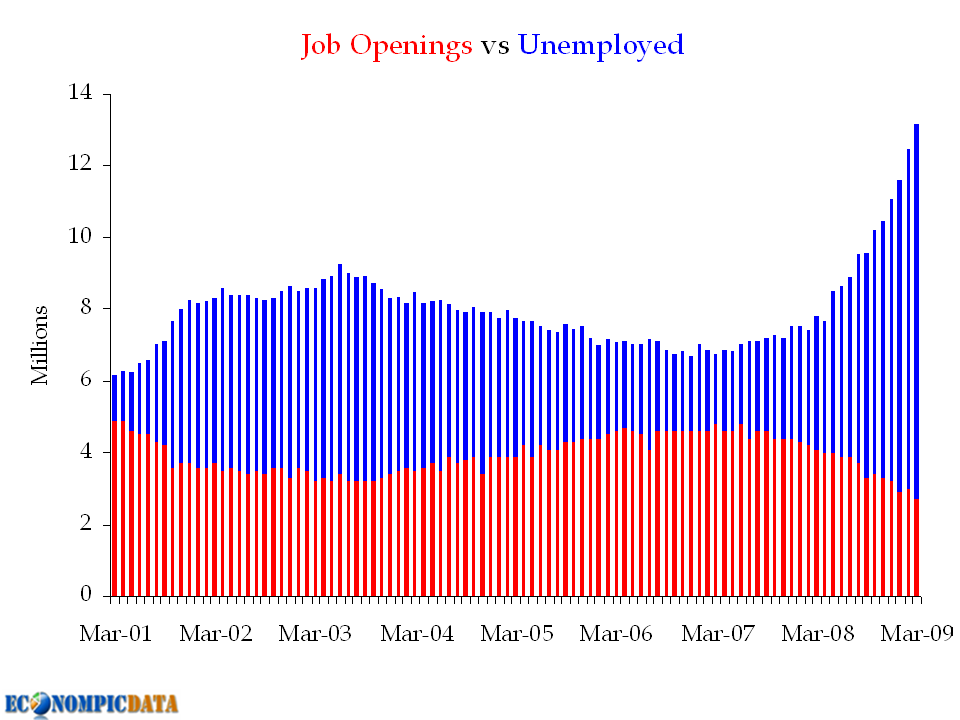
Courtney Schlisserman at Bloomberg reports that ADP Employer Services has released its estimate that US companies cut about 532,000 workers from their payrolls in May. "April’s reading was revised to show a reduction of 545,000 workers, up from a previous estimate of 491,000." Barry Ritholtz at the Big Picture links to Econopic Data's graphs of Job Openings plus number of Unemployed:


There are nearly five times as many reported unemployed people as there are reported job openings.

14. EIA REPORTS CRUDE STOCK BUILD

The EIA reported that, for the week ended May 29, commercial stocks of crude oil grew by 2.9 million barrels to nearly 366 million barrels.


As you can see from the EIA's graph above, commercial stocks remain quite high, historically speaking, and the stock build was contrary to analyst expectations of a 1.5 million barrel draw, per the Bloomberg survey. Gasoline stocks fell by 200,000, versus analyst expectations of a 650,000 build, and are below the five year average historical range for this time of year. Distillate stocks continue to grow by 1.6 million barrels.

Wednesday, May 13, 2009

Daily Sources 5/13

1. EUROZONE INDUSTRIAL PRODUCTION DOWN 20% IN MARCH YOY, EVEN AS GERMAN IP IS FLAT

Jan Strupczewski at Reuters reports that Eurostat released data today showing the industrial production in the eurozone fell by 20% in March from the year previous. From February, industrial production for the 16 members of the monetary union fell 2% in March.
"Industrial production accounts for roughly 17% of euro zone gross domestic product and the grim March output data could mean the economy shrank more than economists expect.

'Following today's release this indicator is pointing to a -2.2-2.3% quarter-on-quarter reading in Q1. This suggests downside risks to our 2% forecast,' said Saleem Bahaj, economist at Goldman Sachs.

Eurostat also revised down production data for February to a monthly fall of 2.5% from the initially reported decline of 2.3% and, in year-on-year terms, to a plunge of 19.1% from 18.4%."
However, Germany, the largest economy in the eurozone, announced flat industrial production in March last week, though exports continued to drop--see Daily Sources 5/8 #4.

2. CHINESE INDUSTRIAL PRODUCTION UP 7.3% IN APRIL YOY, EVEN AS ELECTRICAL GENERATION DOWN AS MUCH AS 4% YOY AND INDUSTRIAL PRODUCTS IMPORTS FALL BY 14.3%

The AFP reports that Chinese industrial output rose by 7.3% in April year over year according to data released by the National Bureau of Statistics today.
"The figure was down from 8.3% growth in March, and 11.0% in February, according to earlier data issued by the government.

'It was a small fluctuation in a generally upgoing trend,' said Lian Ping, a Shanghai-based economist with the Bank of Communications.

'It's rather unlikely it will go back to a rate of around five percent,' he said.

Growth in industrial output--a main gauge of activity in factories and plants across China--hit lows of little more than five percent at the end of last year."
On May 5, the China Electricity Council released preliminary data that electricity generation was down 3.55% from a year previous and that the finalized statistic--to be released later this month--was likely to be a 4% decline. This was also in the face of CLSA Asia Pacific Markets' positive PMI reading for April--see Daily Sources 5/5 #3 for both of these. I find the notion of industrial production continuing to increase at annual rates of 7% or more difficult to reconcile with electrical generation decreases of annual rates of up to 4%.
"Exports of industrial products totaled 566.2 billion yuan (~ $83 billion ) last month, a steep decline of 14.3% from the same month in 2008, the statistics bureau said."
3. CHINA BANKING REGULATORS PROPOSE RULES FOR ESTABLISHMENT OF CONSUMER LENDING FIRMS AS WESTERN BANKS EXIT CHINESE FINANCIAL SECTOR IN ORDER TO SHORE UP BOOKS

Sky Canaves at the China Journal reports that the China Banking Regulatory Commission told Xinhua that it had issued a draft of new regulations that establish guidelines for the establishment of new consumer financing corporations. Although there was a record number of new loans made in the first quarter and April, consumer lending accounts for only 12% of total loans--see Daily Sources 5/7 #2 and Daily Sources 5/12 #2.
"Under the proposed rules, domestic and foreign-invested consumer finance companies would be able to make loans for durable goods, as well as general-purpose personal loans, in amounts up to five times the borrower’s monthly income.

The finance companies would not be allowed to accept deposits and would have to maintain a minimum registered capital of 300 million yuan (~ $44 million). Prospective applicants should have at least 80 billion yuan in total assets, five years of experience in consumer financing, and profitability in the last two fiscal years, according to the draft rules."
Canaves notes that private consumption currently accounts for about 35% of Chinese GDP. Chen Qiong, an official with the commission said,
"The establishment of consumer finance companies will expedite an increase in personal consumption, thus driving increases in the production and sales volumes of manufacturers and retailers, while also driving demand in related industries and altering the GDP’s over-reliance on exports and fixed asset investment."
In the meantime, Louise Story and David Barboza at the New York Times reports that Bank of America agreed yesterday to sell about a third of its 16% stake in China Construction Bank for $7.3 billion.
"[A] person involved in the deal said Bank of America agreed to a private placement sale to a consortium that includes China Life Insurance, Temasek Holdings of Singapore and the private investment firm Hopu Investments of China, which is partly controlled by Fang Fenglei, the Chinese partner of Goldman Sachs. ...
Bank of America’s move comes a few weeks after Allianz and American Express sold nearly $2 billion worth of shares in another big Chinese bank, the Industrial and Commercial Bank of China, according to Reuters. The Royal Bank of Scotland also recently sold its stake in the Bank of China."
4. CHINA MAY HAVE RESTARTED AS MUCH AS 1.4 MMT OF ALUMINUM CAPACITY IN APRIL AS RIO TINTO DEAL LOOKS LIKELY TO SOUR

Richard Dobson at Bloomberg report Ru Xiaojie, an analyst at Aluminum Corp. of China Ltd., indicated at a conference today that the country may have restarted as much as 1.4 million metric tons of capacity in April. Ms. Ru indicated that the country may produce as much as 12.6 million tonnes of aluminum this year. Alcoa notes there is oversupply on the market. Meanwhile, the Rio Tinto Chinalco deal appears unlikely to go through.

5. KAZAKH PRESIDENT SIGNS BILL INTO LAW SENDING MORE GAS VIA RUSSIA, EU NABUCCO EFFORT DOESN'T SECURE FEEDSTOCK PARTICIPATION AS THE U.S. SEEMS TO RELAX SUPPORT FOR NABUCCO

Upstream online.com reports that Kazakh President Nursultan Nazarbayev has signed into law Kazakhstan's agreement with Russia and Turkmenistan today to carry more natural gas via the Central Asia-Center pipeline system, which would take the gas to Europe through Russia.

"The Russian pipeline plan is expected to transport up to an extra 10 billion cubic metres of Turkmen gas a year and the same volume of extra Kazakh supplies, according to the original deal."
Last Friday's the EU, meaning I infer Andris Piebalgs, signed an "energy agreement" with Azerbaijan, Georgia, Turkey and Egypt regarding a southern transit corridor. The Southern Corridor Summit apparently failed to seal the deal with other key meeting participants: Turkmenistan and Kazakhstan, ie most of the feedstock, which now appears to have gone north. On Friday the rumor that the US was not unequivocal in its support for Nabucco was mooted at the USDOS daily press briefing:
"QUESTION: Robert, just a quick thing on energy issues. The new Obama Administration envoy for energy Richard Morningstar was in a conference in Bulgaria, and he seemed to say that the Nabucco pipeline, which is EU-backed, was not, quote, 'the holy grail,' and suggested that the Russian alternative, South Stream, might work as well. Is this part of the reset in relations with Russia and the US? And what’s the US position on the two pipelines?

MR. WOOD: I think it--I think--and I haven’t seen the remarks from Ambassador Morningstar. But we have always supported diversification of energy supply and resources. And--but I don’t have the specifics with regard to the two pipelines. I haven’t heard--you know, only--I’ve only heard what you have said about it. I’d have to talk to Ambassador Morningstar to get further clarification. But as I said, we want to see a diversification of energy resources in that region, as we said, and worldwide in general."


6. OFFICIAL KREMLIN STRATEGY FORECAST EXPECTS RESOURCES TO BE CENTER OF FUTURE INTERNATIONAL DISPUTES

Al Jazeera reports today that the Kremlin released its National Security Strategy today which forecast that
"The attention of international politics in the long-term perspective will be concentrated on the acquisition of energy resources.

Amid competitive struggle for resources, attempts to use military force to solve emerging problems can't be excluded.

The existing balance of forces near the borders of the Russian Federation and its allies can be violated."
The document identified the Middle East, the Barents Sea, the Arctic, the Caspian Sea and Central Asia as likely loci of future resource conflicts. (h/t Leanan at the Oil Drum's Drumbeat.)

7. BANK ROSSI CUTS RATES ON OIL PRICE INCREASES, WHILE OPEC MONTHLY OIL REPORT SHOWS INCREASE IN SUPPLY IN APRIL, BIGGEST CHEATER IS IRAN

Emma O’Brien at Bloomberg reports that Bank Rossi cut its benchmark interest rates effective tomorrow today, the refinancing rate, seen as the limit for borrowing, was cut to 12% from 12.5% and the repurchase rate charged on central bank loans was cut to 11% from 11.5%.
"Bank Rossii has been buying foreign currency on the market as a way of reducing the ruble’s volatility and controlling its advance, [First Deputy Chairman Alexei] Ulyukayev said. The central bank is purchasing dollars and euros at about 37.20 versus the basket, after earlier defending 37.25, MDM [Bank]’s [Mikhail] Galkin, [head of fixed-income and credit research in Moscow] said, adding that policy makers bought about $1 billion yesterday."
The ruble has been climbing on stronger oil prices.


Spencer Swartz at Environmental Capital reports that OPEC's monthly report released today found that its eleven central members increased oil production by 220 kb/d.
"The production increase--as if the global recession and rising oil prices weren’t already a good enough deterrent--further diminishes the prospect of OPEC announcing any production cut when it meets in Vienna May 28. After months of reducing its output by around 150,000 barrels a day more than its OPEC quota obliges it to, Saudi Arabia, OPEC’s top dog, will be in no mood to hear Iran talk about more cuts when the Persian state is pumping some 400,000 barrels over its quota, according to OPEC’s latest data.

The kingdom was already annoyed privately in March when OPEC last met about the “cheaters” within OPEC. Ditto with the other OPEC Gulf producers, like Kuwait, which have also been carrying their full weight of OPEC cuts and forgoing oil revenue.

The April rise in production 'buries the chance of a fresh cut,' says one analyst who tracks OPEC closely."
Jackson Thies and Mine Yücel at the Dallas Federal Reserve Bank produce a graph showing OPEC production as a percentage of the (implied) quota in February and March:


The EIA produced a graph of OPEC surplus capacity versus price in today's Week in Petroleum report as well:


All fundamentals--even with the reduction in commercial stockpiles reported on below--do seem to point toward a downward pressure on price.

8. UZBEKISTAN, VIA SOUTH KOREA, TO ALLOW NATO SUPPLY TO AFGHANISTAN VIA NAVOI, OBVIATING MANAS CONTROVERSY

Deirdre Tynan at EurasiaNet.org reports that Uzbek President Islam Karimov announced during the state visit of South Korean President Lee Myung-Bak that a cargo airport in the city of Navoi is being used for non-lethal supply of NATO forces in Afghanistan.


A South Korean corporation is heading a renovation project at the airport which would convert it into a world-class air freight hub.
"South Korea’s involvement in the project provides a face-saving way for the resumption of US-Uzbek strategic cooperation, capping over a year of US diplomatic efforts to bridge the rift that opened amid the fallout from the 2005 Andijan massacre.

Karimov evicted US forces from an air base in Karshi Khanabad in late 2005 as a response to US protests over his administration’s handling of the Andijan events.

The Uzbek-South Korean agreement regarding Navoi airport gives Karimov the ability to deny to Moscow that he has cut a deal with the United States. But at the same time, Washington stands to get what it needs--a transit base that can take over much of the load from the American base in Kyrgyzstan, which is scheduled to close this summer."
Though the deal is publicly a commercial arrangement between South Korean and Uzbek entities, the US Transportation Command in late 2008 conducted a market survey which concluded that the hub at Navoi could provide "an integrated commercial-based solution to meet US forces’ transportation requirements to Afghanistan." In late February, the Kyrgyz Parliament voted nearly unanimously to formally cancel the US lease to Manas, giving the President the power to serve US forces an eviction notice within 180 days--see Daily Sources 2/20 #4. In the beginning of February the Kyrgyz President, Kurmanbek Bakiyev, announced in Moscow that he had secured $150 million in aid from Moscow, the forgiveness of $180 million in debt, and $2 billion in loans. Kyrgyz nominal GDP in 2008 was about $5 billion. US annual aid was running at about $150 million, but mostly was directed to non-governmental recipients--see Daily Sources 2/5 #6. Navoi's use as a supply route for NATO forces came as KNOC signed deals to explore five oil and gas fields as part of an oil for infrastructure strategy being employed by the big four energy importers in Asia--China, India, Japan, and South Korea--see Daily Sources 5/12 #6. If Seoul is coordinating its energy security policy with US general security concerns in Asia that may well, in certain corners of the world, give it a considerable edge, in a way similar to, say, Total's decision to enter a new upstream venture in Venezuela in conjunction with China's CNPC--see Daily Sources 4/14 #6. Tynan's piece at EurasiaNet is well worth reading in full. (h/t FP Passport's Morning Brief.)

9. POPE CALLS FOR TWO STATE SOLUTION TO ISRAEL PALESTINE CONFLICT AND END TO GAZA EMBARGO, ANGERS EVERYONE

Howard Schneider at the Washington Post reports that Pope Benedict called for greater international pressure on Israel for the creation of a Palestinian state as well as urging an end to the embargo on Gaza. Scneider quotes the Pope as telling the crowd in Bethlehem, which is located in the West Bank:
"I call on the international community to bring its influence to bear in favor of a solution. ... I pray too that, with the assistance of the international community, reconstruction work can proceed swiftly wherever homes, schools or hospitals have been damaged or destroyed, especially during the recent fighting in Gaza. ... Please be assured of my solidarity with you in the immense work of rebuilding which now lies ahead, and my prayers that the embargo will soon be lifted."


Unsurprisingly, the pontiff managed to displease everyone, as Israelis condemned him for not making stronger expressions of regret for the Holocaust and Palestinians said that since he did not refer to the situation as the "Israeli occupation," he is a tacit ally of Tel Aviv. However, perhaps Benedict's overriding concern was to assure--in light of his speech in 2006 which highlighted a dialogue of Manuel II Paleologus saying that the spread of faith by the sword was irrational and contrary to God's will which offended so many and the recent televised meeting of US Christian soldiers in Afghanistan mulling over how best to proselytize given their situation--that Islamic community that Catholicism, insofar as he is its highest plenipotentiary, is not a sponsor of what many in the Muslim community regard as a Crusade.

10. MEND SAYS CIVIL WAR EMERGING IN NIGERIA

Platts reports that Nigeria's MEND released an email statement warning oil companies to remove personnel from the region as the conflict with the central authorities flared up.
"Oil companies operating in the region are advised to evacuate their staff within the next 24 hours to avoid them being part of the statistics of an emerging civil war.

All freedom fighters in the Niger Delta have been placed on alert to defend their positions and unleash a horrible toll on the oil industry and the Nigerian economy."
11. US RETAIL SALES DOWN 0.4% IN APRIL FROM MARCH

Jeff Bater at the Wall Street Journal reports that US retail sales fell by 0.4% in April from March, according to the latest data from the Commerce Department.
"Sales in March were revised down, decreasing 1.3% instead of 1.2% as previously reported. Sales rose in January and February, after sliding six straight months."
Import prices rose by 1.6% in April from March, completely due to the 15.4% increase in petroleum prices during that time. Excluding oil, import prices were down 0.4% in April from March, and 5.6% down in April from a year previous. Including oil, import prices in April were down 16.3% from the year previous, "the biggest one-year drop since the index was first published in 1982."

12. GOVERNMENT ONLY GUY HIRING, BUT GOVERNMENT IS BROKE, WILL IT GO AFTER PREDATORY LENDERS TO SHORE UP REVENUES?

Rebecca Wilder makes the point that the April jobs report showed that the government was adding a record number of jobs, but that this is taking place as state budgets generally are sharply in the red. She notes that federal jobs only account for 13% of all government jobs (as of April), whereas state jobs have a 24% share and local governments account for 64%. She links to Conor Dougherty's story at Real Time Economics which notes that revenue has declined in 45 of the 47 states which have reported their first quarter numbers. The WSJ helpfully provides a map:


Dougherty notes that the steepest decline in revenue was seen in Alaska, where first quarter revenues were down a whopping 74.1%, primarily on oil prices. In the meantime, Bruce Krasting at his blog notes that Goldman Sachs settled with the Massachusetts Attorney General for $60 million in a case which charged GS with predatory lending practices in Boston. Krastings notes:
"This means next to nothing for Goldman Sachs. However, a very dangerous precedent has been set. In the critical years 2005-2007 Goldman was ranked 15th in the League Tables for sub prime and Alt-A origination/securitization. Goldman’s management must be pleased as punch with that poor showing today. Those that ranked high on that list are no doubt consulting with their attorneys.

If Goldman gets its hand slapped for $60 million over 714 mortgages what does this mean for Countrywide Financial?"
(h/t Yves Smith at naked capitalism.)

13. FORECLOSURES UP, SPREADING TO SUBURBS, AND CORRELATED TO JOB LOSSES, WHICH ARE EXPECTED TO CONTINUE

On top of this news, Dan Levy at Bloomberg reports that US foreclosure filings rose to a record level for the second consecutive month in April, per data released from RealtyTrac today. 342,038 properties received an auction or default notice in April, as banks have increased their efforts to seize properties.
"Foreclosure filings jumped 32% from the year-earlier period, RealtyTrac said. Filings were little changed from March as some states delayed seizures. Ten states accounted for three-quarters of all foreclosures in April, with California leading the nation."
The culprit? "The inevitable result" of steep job losses. (California, incidentally, is one of the state's facing the worst budget shortfall this year.) And Crain's Chicago Business News notes that the foreclosure wave has headed out to the Chicago suburbs from the city proper according to data from the Woodstock Institute, perhaps indicating that the same is happening generally across the nation.
"Foreclosure cases filed in the first quarter jumped between 25% and 70% from the fourth quarter in DuPage, Will, McHenry, Lake and Kane counties, according to new data provided to Crain's by the Woodstock Institute, a Chicago-based housing advocacy group. Meanwhile, foreclosures fell 8% in Chicago, the first quarterly decline in a year.

Across the six-county Chicago metropolitan area, foreclosure filings rose 6% in the first quarter to 17,819, the highest one-quarter total since the housing crisis began in mid-2006.

The shifting locus of new foreclosures shows how the recession and job losses are supplanting subprime lending as the main driver of mortgage defaults, says Geoff Smith, vice-president in charge of research at Woodstock. While the first wave of foreclosures hit hardest in poorer city neighborhoods targeted by high-interest-rate lenders with loose credit standards, the latest round is striking middle-class areas where most borrowers qualified for standard-rate mortgages."
(I also came across this article due to Yves Smith's daily links.)


And on top of that, Phil Izzo at Real Time Economics records that the National Association of Realtors reported yesterday that the median single-family home price fell 14% in the first quarter from the year previous to $169,000. Izzo's post includes a useful sortable chart of the rate of change in home prices by region correlated to job losses for the same. "The data are sortable by city, state, price, percent change from a year earlier and unemployment rate." Michael Shenk, a Research Assistant at the Federal Reserve Bank of Cleveland plots a graph of the number of new single family home sales versus the median sales price for those houses:


(I wonder whether the average sales price would look worse than the median sales price.) Shenk notes:
"[T]he most positive sign for housing markets is that the home-price indexes are beginning to suggest that price declines may be slowing. Both the latest S&P/Case-Shiller indexes and the FHFA index indicate some stability in the 12-month growth rate of prices as of February. The FHFA index shows prices actually improving in February, while the Case-Shiller index, which is narrower than the FHFA index in terms of geographic coverage but also includes nonconforming loans which the FHFA index leaves out, simply has prices falling at a slower pace."


(h/t Mark Thoma at Economist's View.)

14. MIT COMMERCIAL REAL ESTATE INDEX SHOWS PRICES FELL 28% YOY

In the meantime, the MIT commercial property price transactions-based index developed by Professor David Geltner showed that transaction prices of commercial property sold by major institutional investors fell by 5.8% in the first quarter. The index is now down 21% on the year and 26% below its peak in mid-2007. Geltner commented:
"It's possible that the first quarter of 2009 was the nadir in market sentiment. Sales volume is down almost to nothing, as reflected in our demand index. The prices buyers are willing to pay fell a record 12% in the first quarter and is now 28% below a year ago and 39% below its mid-2007 peak."
(I also came across this story via Mark Thoma's blog.)

15. OBAMA ADMINISTRATION TO REGULATE DERIVATIVES

Stephen Labaton at the New York Times reports that the Obama Administration will ask Congress to pass legislation which would require that all derivatives instruments be traded via an exchange and be subject to tight regulatory oversight.

16. COMMERCIAL OIL STOCKS UNEXPECTEDLY FALL, SENATE TO CONSIDER STRATEGIC PETROLEUM PRODUCTS RESERVE

In a sharp reversal from weeks of stock builds, the EIA today announced that commercial stocks of crude oil fell by a whopping 4.7 million barrels in the week ended May 8 to 370.6 million barrels. Though the stocks are still well above the five year historical range for this time of year and at highs last seen in the early 90s, a Bloomberg survey indicated that the median expectation of analysts was for a one million barrel build. Gasoline inventories also fell by 4.1 million barrels, and are now in the middle of the five year historical range for this time of year, versus a split analyst expectation for builds and draws. Distillate stocks built by a million barrels to 147.5 million barrels and are completely counter-cyclical with 40.4 million barrels (37.7%) more in storage than this week last year.


Nick Snow at the Oil & Gas Journal reports that the US Senate Energy and Natural Resources Committee will consider a bill introduced by Jeff Bingaman (D-NM)--S. 967, the Strategic Petroleum Reserve Modernization Act of 2009--which would create a strategic petroleum products reserve. Europe maintains products reserves, but the US strategic reserve is entirely made of crude. There are two primary difficulties with creating strategic products reserves:

One: Petroleum products degrade in storage at relatively speedy rates; crudes do not.
Two: The specifications for each petroleum product in the US varies by state. So, for example, gasoline stored for use in Texas would meet the environmental regulations for Texas gasoline, much more lax than those in California.

Of course, in an emergency Washington has in the past relaxed specifications requirements to meet products shortages, so this second objection is more about the rationality of the US products market than a products SPR, per se.

Thursday, January 22, 2009

Daily Sources 1/22

1. Joel Martinsen at Danwei posted Tuesday that certain Chinese apparatchiks are pushing consumption as "patriotic" in local media outlets, and as a necessary means out of the current economic mess. The idea has roots in Marxist ideology, apparently, which the post outlines. There has been "push back," however in the Chinese media, including remarks in the Shanghai Daily, to wit:
"'Buy an apartment, and you are patriotic,' says a local Chinese official in her bizarre call to beggar the poor to bail out housing speculators.

Wang Aihua shocked the nation with her bold statement last Monday, delivered live on a local TV station in Hefei, capital of Anhui Province. Wang is the director of the city's urban planning bureau."
Well well well, all I can say is that reminds me of a certain someone's exhortation to go "shopping" in the face of another crisis, not so long ago. (h/t Carlos Tejeda, China Journal) But the screw hasn't finished turning, not by a long shot. Menzie Chinn reports at Econbrowser that the Bush Administration's take on the cause of the current financial crisis is that there has been a "Global Savings Glut," the actual subtitle of the section entitled "Origins of the Crisis" of the Economic Report of the President. An excerpt from the paper's executive summary itself:
"# The roots of the current global financial crisis began in the late 1990s. A rapid increase in saving by developing countries (sometimes called the "global saving glut") resulted in a large influx of capital to the United States and other industrialized countries, driving down the return on safe assets. The relatively low yield on safe assets likely encouraged investors to look for higher yields from riskier assets, whose yields also went down. What turned out to be an underpricing of risk across a number of markets (housing, commercial real estate, and leveraged buyouts, among others) in the United States and abroad, and an uncertainty about how this risk was distributed throughout the global financial system, set the stage for subsequent financial distress.
# The influx of inexpensive capital helped finance a housing boom. House prices appreciated rapidly earlier in this decade, and building increased to well-above historic levels. Eventually, house prices began to decline with this glut in housing supply."
My personal, non-economist, take is that the central banks of the developing world did finance US debt beyond what was credible, and that that did have the effect of lengthening an unsustainable boom in credit, and so there is some merit in the Administration's view. But, as I noted above, perhaps this had something to do with following the Administration's own prescription for a different crisis, altogether. Minzie, who is an economist, goes straight for the jugular:
"So, while I won't say that the idea of saving flows coming from East Asia had some role in the financial crisis we're now undergoing, I'd say one has to think about how those flows came about, as much as how big they are. We don't usually think of the rest-of-the-world driving macroeconomic events in the US ... and I still don't think it's time to start."
Well worth reading in full. Meanwhile, Yves Smith at Naked Capitalism pours cold water on the official Chinese GDP data for the fourth quarter, which show growth of 6.8%. Smith points out that power consumption in China was down 9.6% in November, after falling 4% in October, which is not consistent, usually, with pretty strong economic growth figures. She is waiting for the December power consumption numbers, before officially giving the statistics bureau a raspberry. (Chinn's piece came to my attention via Yves Smith as well, h/t.) Meanwhile, JR Wu at Real Time Economics has a piece on what recession looks like in China, examining the principle of "bao ba" or "protect the 8," the 8% GDP growth which conventional wisdom holds is the number below which you begin to see significant social unrest. The notion of "bao ba" apparently dates back to the Asian Financial Crisis. In 1989, the year of Tiananmen Square, GDP grew by 4.1%. Richard Herd, head China economist at the OECD, thinks that every percentage point decline in GDP equates to about 2 million job losses.
"According to Citigroup, China’s real GDP contracted 0.3% on an annualized basis in the fourth quarter from the third quarter — the first fall in at least 16 years. Morgan Stanley estimates China’s GDP fell 0.5% for the same period on a seasonally adjusted, annualized basis.

Goldman Sachs estimates that China’s economy grew 2.6% in the October-December period from the July-September quarter. The OECD puts the quarter-on-quarter growth for the same period at 0.3%."
Meanwhile, Paul Cavey, head of China economics at Macquarie Research has an opinion piece in Wall Street Journal Asia where he argues that the banking sector in China may, by instituting counter-cyclical policies, be setting the stage for a gigantic credit bubble.
"Whatever the dangers of a market-based system during a boom, it does have benefits on the way down. The caution of typical banks in downturns arises not just because they suffer capital shortages, but because economic risks increase. Having been tied in a knot of prudential and monetary restrictions, China's banks have had little opportunity to develop the skills needed to navigate this trickier environment.

In particular, there are worrying signs that, having avoided a credit bubble and bust during the boom, Beijing is now setting itself up for that cycle during the downturn. With a monetary expansion target of 17% in 2009 and the economy likely to expand 8% or less, the government is paving the way for exactly the sort of credit excesses that have already proved so damaging elsewhere. It is too early to be worried about this yet, but the result could be a future increase in nonperforming loans, and perhaps the need for a banking bailout with Chinese characteristics down the road.

So the rest of the world may be looking enviously at China right now. But as governments everywhere contemplate restructuring their own banking sectors, it is far too soon to conclude China offers the best model to follow."
This is particularly interesting to me because for a long time in foreign affairs circles the financial sector in China was regarded as especially vulnerable, only to watch Bank of America et. al. take huge stakes in partially privatized state-owned banks. Clearly a paradigm-shift has taken place if their public nature is to be envied. But it does give the gimlet eye to the notion of consumerism as the way forward and savings as hopelessly reactionary, does it not? Meanwhile, Rebecca Christie and Mark Drajem at Bloomberg report that Timothy Geithner, whose appointment as Treasury Secretary was cleared for a full vote by the Senate Finance Committee today, said that the new Administration believes that Beijing is "manipulating" the yuan.
"'President Obama -- backed by the conclusions of a broad range of economists -- believes that China is manipulating its currency,' Geithner said in the remarks posted on the committee’s Web site today. 'The new economic team will forge an integrated strategy on how best to achieve currency realignment in the current economic environment.'"
Senator Linsey Graham (R-SC) called the remarks "music to [his] ears". Graham sponsored legislation in 2007 which would punish imports from countries which have been found to "misalign" their currencies.

2. Chris Oliver at MarketWatch yesterday reported that Japanese exports were down 35% in December, following a 26.7% decline in November. "Exports to the US fell a record 36.9% in December on year, after declining 33.8% in November, the previous record. Exports to Asia were down 36.4%." Barclays Capital predicted that Japanese GDP would contract by 10.3% on an annual basis on the back of this and the news that industrial power consumption fell by 13% in December. In a follow-up story, Oliver reports that the Bank of Japan voted to keep benchmark interest rates unchanged at 0.1% today, and forecast that consumer price inflation would decline by 1.1% in fiscal 2010 and 0.4% in fiscal 2011.
"The board noted that conditions had "shifted significantly downward" from its outlook report published in October. Instead of expanding, the economy is likely to contract in the two years to fiscal 2010 before an expansion takes hold. Gross domestic product is expected to contract 1.8% in fiscal 2009 and 2% the following year."
3. Ian King and Patrick Hosking at the London Times report that the UK may be blocked from bailing out Barclays, because as a provision of the Abu Dhabi royal family's earlier infusion of capital, later dilution would be compensated for with additional shares.
"But the small print in the deal, in which Barclays raised £7.3 billion from Abu Dhabi and Qatar, means that if the bank raises fresh capital before the end of June, the Middle Eastern investors would receive a greater number of shares for their original investment without paying more. If Barclays were to raise fresh capital at last night’s closing price, for example, it would automatically hand almost 50 per cent of the bank to the Middle Eastern investors. The only way to get around the anti-dilution clause, should Barclays need more money before the end of June, would be if new capital was raised at more than the 153p-a-share at which paper issued to Abu Dhabi and Qatar is due to convert into Barclays stock.

This would mean that if the Government wanted to take a meaningful stake in the bank, it would have to do so by paying more than 153p for Barclays shares — which were trading at just 66.1p yesterday. The Treasury would face accusations of wasting taxpayers’ money were it to do this."
The clause was insisted upon by a certain Amanda Staveley, chief executive of PCP Capital a private equity firm which advised the Emirate on the deal. Worth reading in full.

4. Gabriel Gatehouse at BBC points out that the details of the gas contract between Russia and Ukraine have still not been made public.

5. Galrahn at Information Dissemination has an interesting translation of Russian military thinking on how it should change its approach in order to profit from soft power initiatives in the United States. As perhaps our analysis appears to Moscow, it does seem to demonstrate a large level of misunderstanding of how things work over here, but here is some of Galrahn's translation:
"The situation in American society favors the implementation of these plans. In many ways the United States today is reminiscent of the Soviet Union period of stagnation under Brezhnev. Militarism, foreign adventures, attacks on freedom of speech and human rights, censorship, the presence of the official ideology are evident. Multinational and multiracial American society does not have a common history and defines itself in terms of ideology, which is a more fragile foundation of national unity, rather than a common culture and history that binds cultures. If you choose to continue the comparison, the US, as in the Soviet Union, should be a peaceful ideological and cultural revolution. The challenge for Russia is to give impetus and direction to the process."
Some in Moscow apparently anticipate a color revolution in the US ... or its complete dissolution. Worth a look.

6. Dexter Filkins reports that NATO forces have effectively ceded much of southern Afghanistan to the Taliban. This is the NYT's map of unsecured areas, apparently:


7. Juan Cole at Informed Comment has a useful round up on the aftermath of the Israeli operation in Gaza. The Israeli Defense Force has issued a travel advisory to officers regarding travel to Europe, where several courts assert universal jurisdiction and where war crimes cases have been, or are in the process of being, filed.

This is not an idle concern, General Pinochet was prevented from leaving England due to an injunction filed by a Spanish judge on crimes against humanity charges. (Indeed, depending on how "activist" the various judiciaries in Europe are, this issue may trouble senior US government officials as well. It is important to remember in cases this charged with emotion the general view of what is just has the propensity to prevail over the written law and bilateral and multilateral treaties. As Chief Justice Oliver Wendell Holmes, Jr. once said, "The law is the will of he who the sheriff will obey." And, just now, Israel has a serious public relations problem on its hands.)

Cole points to Arab media sources reporting that Hamas is carrying out reprisals against "collaborators" in Gaza following the IDF's withdrawal. Evidently, Hamas is using the crisis to consolidate their power in the strip. Meanwhile, UN Secretary-General Ban ki-Moon visited Gaza and "demanded that nothing like the Gaza campaign ever be undertaken again ... and he said he would do what he could to establish accountability." Cole is not sympathetic to Israeli concerns, nonetheless, the post is worth reading in its entirety.

And, the dictator of Libya, Muammar Gaddafi has an op ed in the New York Times reiterating his call for a one state solution to the Israeli-Palestinian stand off. Key excerpts:
"The basis for the modern State of Israel is the persecution of the Jewish people, which is undeniable. The Jews have been held captive, massacred, disadvantaged in every possible fashion by the Egyptians, the Romans, the English, the Russians, the Babylonians, the Canaanites and, most recently, the Germans under Hitler. The Jewish people want and deserve their homeland.

But the Palestinians too have a history of persecution, and they view the coastal towns of Haifa, Acre, Jaffa and others as the land of their forefathers, passed from generation to generation, until only a short time ago.

Thus the Palestinians believe that what is now called Israel forms part of their nation, even were they to secure the West Bank and Gaza. And the Jews believe that the West Bank is Samaria and Judea, part of their homeland, even if a Palestinian state were established there. Now, as Gaza still smolders, calls for a two-state solution or partition persist. But neither will work."
"A key prerequisite for peace is the right of return for Palestinian refugees to the homes their families left behind in 1948. It is an injustice that Jews who were not originally inhabitants of Palestine, nor were their ancestors, can move in from abroad while Palestinians who were displaced only a relatively short time ago should not be so permitted.

It is a fact that Palestinians inhabited the land and owned farms and homes there until recently, fleeing in fear of violence at the hands of Jews after 1948 — violence that did not occur, but rumors of which led to a mass exodus. It is important to note that the Jews did not forcibly expel Palestinians. They were never “un-welcomed.” Yet only the full territories of Isratine can accommodate all the refugees and bring about the justice that is key to peace."
Worth reading in full. However, a key sticking point is that the raison d'etre of Israel is to provide a state which is majority Jewish, because the Jewish people have a history of being persecuted when they live in states which are not. Return is at direct odds with that purpose, as that would quickly lead to the Jewish population being a minority one in Israel--or, as Qaddafi would have it, Isratine. Meanwhile, Sue Pleming at Reuters reports that Gaddafi told students at Georgetown University via satellite link that:
"Oil exporting countries may move toward nationalization because of the rapidly declining prices. This is put on the table and is being discussed seriously,. Oil maybe should be owned by national companies or the public sector at this point, in order to control the oil prices, the oil production or maybe to stop it."
If Libya were to re-nationalize concessions recently parceled out, I imagine that might darken the legacy of what was considered one of the Bush Administration's more important foreign policy successes. That said, it wouldn't make much of a difference in terms of the global supply situation.

8. In a strange story, Maher Chmaytelli at Bloomberg reports that the oil minister of Algeria, Chakib Khelil, has said that Saudi Arabia will cut its production by 300 kb/d below its current OPEC quota.

9. Dulue Mbachu at Bloomberg reports that a draft bill sent to the parliament at Abuja would end all discretionary awarding of oil and gas contracts, mandating that all concessions be awarded via open bidding.
"A new national oil company [would] also be created to prospect for oil worldwide and raise funds from global financial markets. The country will set up a Nigerian Petroleum Directorate to develop policies and strategies for fossil energy and a National Petroleum Inspectorate to enforce policies and regulate technical and commercial aspects."
Open bidding could do much to restrain the wildly corrupt nature of doing business with the Nigerian government.

10. Eric Watkins at the Oil & Gas Journal reports that Petrobras will publish its new five year plan come January 26th--next Monday. Petrobras has moved back the date for the plan's publication several times in the last few months as it considered the changing oil price environment, likely critical to determining EROI on its new deepwater finds. (See Daily Sources 12/31 #13.)

11. The Calgary Herald reports that Daniel Yergin, head of Cambridge Energy Research Associates, said,
"Just on supply-demand, putting aside geopolitics, this surplus is going to last for a couple of years and that will have a dampening impact on oil prices. Right now, predicting oil prices is really predicting [GDP]."


12. In a bit of good news, the Baltic Dry Index, an indicator of global shipping levels and thus international trade, appears to be recovering somewhat, though it is still more than 80% below its height in 2008.


13. Samantha Young at the Associated Press reports that California Governor Arnold Schwarzennegar has sent a letter to President Obama, directly asking him to waive federal restrictions on new Californian vehicle emissions regulations. The EPA had refused to provide a waiver which would allow California to implement the new regulations despite the fact that they are stricter than the emissions requirements stipulated in federal law. (see Daily Sources 1/15 #18.)

14. Jack Healy at the New York Times reports that new home construction in the US fell 15.5% in December from November. The nation-wide unemployment rate has risen to 7.2%.

15. Damian Paletta and David Enrich at the Wall Street Journal write on alleged political interference in the distribution of TARP funds.
"Nonetheless, in December OneUnited got a $12 million injection from the Treasury's Troubled Asset Relief Program, or TARP. One apparent factor: the intercession of Rep. Barney Frank, the powerful head of the House Financial Services Committee.

Mr. Frank, by his own account, wrote into the TARP bill a provision specifically aimed at helping this particular home-state bank. And later, he acknowledges, he spoke to regulators urging that OneUnited be considered for a cash injection."
The Journal includes a map showing which states got the bulk of funds disbursed so far, which seems to correlate more or less to where the financial industry is located.


Still, it does seem to me that if our legislators really believe that we are in a crisis of such magnitude that over a trillion dollars in taxpayers funds are required for the safety of the entire economy that, perhaps, just perhaps, they should put aside pork and special interests in the interest of the nation as a whole. Is that really too much to ask? Is this view really naivete?

16. The EIA reports that US crude stocks jumped by a whopping 6.1 million barrels to 332.7 million barrels, well above the historical five year average for this time of year. That said, they are still below the highest stock levels seen in the last five years. According to a Bloomberg survey, analysts were expecting a 1.4 million barrel build. Gasoline stocks also rocketed up by 6.5 million barrels and now are a the top of the historical range. Analysts had expected a 1.8 million barrel build. Distillates stocks, by which the EIA mainly means stocks of diesel and heating oil, grew by 800,000 barrels, a bit more than Wall Street expectations of 500,000 barrels, and are well above the historical range. Taken in isolation, this should put considerable downward pressure on crude prices, but at the time of this writing, prices have recovered after falling a few dollars per barrel on the news.