Showing posts with label bangladesh. Show all posts

Wednesday, July 28, 2010

Daily Sources 7/28

CHINA HOUSING BUBBLE TO UNDERMINE ECONOMY

Yongheng Deng, Joseph Gyourko and Jing Wu at Vox EU argue that the Chinese housing bubble is likely to undermine the entire economy. Richard Smith at naked capitalism argues that the Chinese banking system is likely to go bust.

NO NEW UK COAL FIRED POWER PLANTS WITHOUT CARBON CAPTURE AND STORAGE TECHNOLOGY

Fiona Harvey at the Financial Times reports that the UK government indicated Tuesday that no new coal-fired power plants can be built without carbon capture and storage technology.
"[Energy Secretary] Mr [Chris] Huhne predicted: 'We will see the first new nuclear power station on track for 2018.'"
JAPAN TO BUILD UP SUBMARINE FLEET

Greg Scoblete at the Compass reports that Japan is to increase its submarine fleet for the first time in 36 years. The plan is apparently to counter the Chinese build-up.

JAPAN'S REFINING UTILIZATION HITS A 10 WEEK HIGH

Yuji Okada at Bloomberg reports that refining utilization hit a 10 week high as Japanese companies restarted idled plants. Capacity utilization hit 75%. A hotter than usual Summer may soften the dent in margins.

JORDAN'S KING ABDULLAH II AND ISRAEL'S NETANYAHU MEET

CNN reports that Jordan's King Abdullah II and Israel's Netanyahu are meeting to discuss the Israeli Palestinian peace process in a regional context.

SAUDI ARABIA'S HOUSING MARKET READY TO TAKE OFF?

Frontier Markets reports that it is.

IS EGYPT TOO BIG TO FAIL?

Michael Collins Dunn at the MEI Editor's Blog considers whether Egypt is too big to fail and if so how that has affected the political culture there.

BANGLADESH TO IMPORT 250 MW FROM INDIA STARTING 2012

UPI reports that India and Bangladesh have concluded a deal for Bangladesh to import 250 megawatts of electricity from India starting 2012.
"Under the deal, state-owned Power Grid Corporation of India Ltd. will invest and construct 50 miles of transmission line, which it will own, operate and maintain. PGCIL will recover the construction costs under a fixed rate over 35 years."


NIGERIAN OIL RESERVES DOWN 4.8%

Platts reports that Nigeria's oil reserves are down 4.8% on the year due to decreased exploration efforts by oil companies in the region. The oil companies are leery of continuing exploration efforts due to legislation the Nigerian government is considering which would leave little room for companies to profit from investments.

INVESTMENT IN DURABLE GOODS UP

Timothy R. Homan at Bloomberg reports that investment in non-military capital equipment climbed 0.6% last month after a revised upwards jump of 4.6% in May.
"'Business investment remains the bright spot in an otherwise dull economic outlook,' said Jay Feldman, an economist at Credit Suisse in New York. 'Corporations have actually underinvested quite dramatically in recent years and, to some extent, we are catching up.'"
CRUDE OIL STOCKS JUMP 7.2 MILLION BARRELS

The EIA reported that crude oil stocks jumped by 7.2 million barrels the week ended July 23rd to 360.8 million barrels. Gasoline stocks climbed by 0.1 million barrels and distillate stocks grew by 0.9 million barrels. Refinery utilization was at 90.6%. The price of gasoline climbed 2.7 cents to 274.9 cents for the week ended July 26th.

Tuesday, June 16, 2009

Daily Sources 6/16

1. IRAN PROTESTS CONTINUE, AHMADINEJAD LEAVES FOR EKATERINBURG, RUSSIA

Protests are continuing. The most interesting data point to me is that President Ahmadinejad either felt the situation secure enough or irrelevant enough to leave the country to observe the goings on at the Shanghai Cooperation Organization's summit today in Ekaterinburg, Russia, per Vladimir Isachenkov at the Associated Press. Will try and put up another post on the ongoing situation a bit later today.

2. MOODY'S DOWNGRADES THE FINANCIAL STRENGTH RATINGS OF 30 SPANISH BANKS, INCLUDING SANTANDER

Izabella Kaminska at FT Alphaville reports that Moody's downgraded the senior unsecured debt and deposit ratings of 25 Spanish banks today, 18 by one notch and seven institutions by two notches.
"At the same time, Moody’s downgraded the Bank Financial Strength Ratings of 30 banks. Among these banks, the rating agency downgraded the dated subordinated debt of 17 institutions, the junior subordinated debt of eight institutions, and the preference shares of 14 banks.

'The rising pressure that many Spanish banks face from a sharp deterioration of their asset quality is reflected in their stand-alone financial strength ratings, a third of which now fall at a “D-” level or lower,' said Maria Cabanyes, a Senior Vice President at Moody’s. 'However, the moderate downgrade of these banks’ senior ratings reflects our expectation that government support would be forthcoming for these institutions should such support become necessary.'"
3. CHINA PROMISES $10 BILLION IN LOANS TO MEMBER STATES OF SCO TO HELP THEM WEATHER ECONOMIC CRISIS, MEDVEDEV CALLS UPON SCO MEMBERS TO SETTLE BILATERAL TRADE IN DOMESTIC CURRENCIES


Lyubov Pronina and Lucian Kim at Bloomberg report that Chinese President Hu Jintao offered to lend $10 billion to member states of the Shanghai Cooperation Organization [SCO] so they might better weather the financial crisis.
Jintao made the offer at the regional organization's summit in Yekaterinberg, Russia, today. The other members of the SCO are Kazakhstan, Kyrgyzstan, Tajikistan, Uzbekistan, and Russia.
"Russian President Dmitry Medvedev is hosting back-to-back summits of developing economies in Yekaterinburg, in the Ural Mountains that divide Europe and Asia, as he seeks to lessen the world economy’s dependence on the US dollar. Medvedev and Hu will hold talks later today with Indian Prime Minister Manmohan Singh and Brazilian President Luiz Inacio Lula da Silva in the first summit of so-called BRIC nations.

Hu called for greater coordination among Shanghai members on monetary policy, including regular meetings of finance ministers."
Medvedev reportedly encouraged China and the other SCO members today to conduct bilateral trade in their domestic currencies as opposed to the dollar. He further said,
"There can be no successful global currency system if the financial instruments that are used are denominated in only one currency. Today this is the case and the currency is the dollar."
4. RUSSIA VETOES CONTINUATION OF UN PEACEKEEPING MISSION IN ABKHAZIA, GEORGIA

John Heilprin at the Associated Press reports that Russia has exercised its veto power at the UN Security Council in order to put an end to the 16 year old UN mission to Georgian breakaway region Abkhazia.
"'It is understandable,' Russia's Foreign Ministry said in a statement Monday, 'that in the new political and legal conditions most of the names and terms previously used in the old documents are inapplicable.'"
What the ministry means is that now Abkhazia is recognized by Moscow as a new state, altogether independent of Georgia. Clearly the move will hurt Saakashvili's political chances, the government is currently bedeviled by constant popular opposition protests.

5. INDIAN PM AND PAKISTANI PRESIDENT MEET IN EKATERINBURG

Vladimir Isachenkov at the Associated Press reports that Indian Prime Minister Manmohan Singh met with Pakistani President Asif Ali Zardari met for talks behind closed doors in Yekaterinberg today for the first time since the Mumbai terror attacks of last year.
"'My mandate is to tell you that Pakistani territory should not be used for terrorism against India,' Indian and Russian news agencies quoted Singh as saying after shaking hands with Pakistani President Asif Ali Zardari ahead of their meeting."
Both India and Pakistan have observer status in the SCO.

6. SAMA CUTS REVERSE REPURCHASE RATE BY 0.25% TO 0.25%

The Associated Press reports that the Saudi Arabian central bank, the Saudi Arabian Monetary Authority, or SAMA, has cut its reverse repurchase rate by 0.25% to 0.25%. It is the second reduction made by the fiscal authorities this year.

6. MICRO-POWER IN BANGLADESH MAY HAVE BENEFITS SIMILAR TO MICRO-FINANCE

Shafiq Alam at AFP has an anecdotal account of how Bangladeshis, frustrated by the governments perennial inability to make good on promises to bring the people electricity, have begun installing solar power panels on their homes if they can afford it. One tailor, for example, can now sew well into the night, and has reportedly doubled his income. So, much like micro-finance, micro-power could have the potential to radically transform the lives of many in the developing world.

7. ANALYSTS THINK MEXICO MAY NOT HEDGE OIL FURTHER ... SOVEREIGN MAY HAVE HAD CONSIDERABLE SHARE OF OPEN INTEREST ON NYMEX

Andres R. Martinez and Carlos Manuel Rodriguez at Bloomberg report that some analysts think that Mexico might not hedge the price of oil going forward. The interesting data point, to me, was that Mexico spent $1.5 billion to buy the option to sell crude oil at $70/b. Apparently it has hedged a total of 330 million barrels for the whole of 2009. That is 330,000 contracts on NYMEX, or over 12.7% of total open interest on both futures and options for light sweet crude for the week ended June 9, as per the commitment of traders report.

8. ABERDEEN ASSET MGMT SAYS CORREA PLAYED MARKET FOR FOOLS

Lester Pimentel at Bloomberg reports that Edwin Gutierrez at Aberdeen Asset Management Plc recently said the Ecuadorian President
"'played the market for fools' by defaulting on $3.2 billion of debt six months ago and then repurchasing the bonds at less than 40 cents on the dollar."
"'Ecuador won,' Edwin Gutierrez, who manages $5 billion at Aberdeen and sold his Ecuador holdings before the default, said in a telephone interview from London. Correa’s government 'played the market for fools. Remind me never to play poker with that guy,' he said.

Correa, a 46-year-old economist who counts Venezuelan President Hugo Chavez as one of his closest allies, halted payments on the bonds because he said they were issued illegally. He called the bondholders 'true monsters who won’t hesitate to crush the country' when he announced the default on Dec. 12 and said in a national radio address the next day that he wanted to force them to accept a 'big discount.'"
Ecuador stopped making payments on its sovereign debt on December 12 and later in that month pressured its social security system to purchase $1.2 billion in new bonds--see Daily Sources 12/29 #14. Ecuador currently uses the US dollar as its currency.

9. HOUSING STARTS AND PERMITS DOWN 45.2% IN MAY FROM YEAR PREVIOUS, UP 17.2% FROM APRIL

Barry Ritholtz at the Big Picture reports that housing starts and permits increased in the month of May from April with Starts at 17.2% (±14.4%) and Permits at 4.0% (±1.7%)--ie, both above the statistical margin of error. However, "The stunning news was the 45.2% (±5.8%) collapse below the May 2008 rate. That is simply an unbelievable free fall."

Wednesday, March 18, 2009

Daily Sources 3/18

1. Krishna Guha, Bertrand Benoit, Chris Giles and Daniel Pimlott at the Financial Times report that the IMF will reduce today its forecast for global GDP in 2009 to a contraction of 0.6%.
"The eurozone economy was forecast to contract by 3.2% in 2009, [Ms. Ter-Minassian, an adviser to IMF managing director Dominique Strauss-Kahn] said, against the earlier forecast of a 2% decline. The US would shrink by 2.6% (1.6%), and Japan 5% (2.6%), making it the worst-hit big economy. The IMF in Washington said the figures cited by Ms Ter-Minassian were 'unofficial' and 'out of date'."
In early March the IMF began indicating that a downward revision was under way--see Daily Sources 3/3 #1.

2. Philip P. Pan and Karen DeYoung at the Washington Post report that many Russia analysts believe that Moscow is signaling interest in a deal on Iran.
"In a meeting last week with a bipartisan commission studying US policy toward Russia, President Dmitry Medvedev expressed alarm in 'very graphic language' over Iran's successful test launch of a satellite last month, linking it to Tehran's nuclear program, said Dmitri Simes, director of the commission.

'Medvedev said it demonstrated how far-reaching Iran's nuclear ambitions are, and that he was very concerned,' said Simes, who is also president of the Nixon Center in Washington. 'He felt it was a clear challenge to both Russian and American interests and said he would like both countries to work on this challenge together.'"
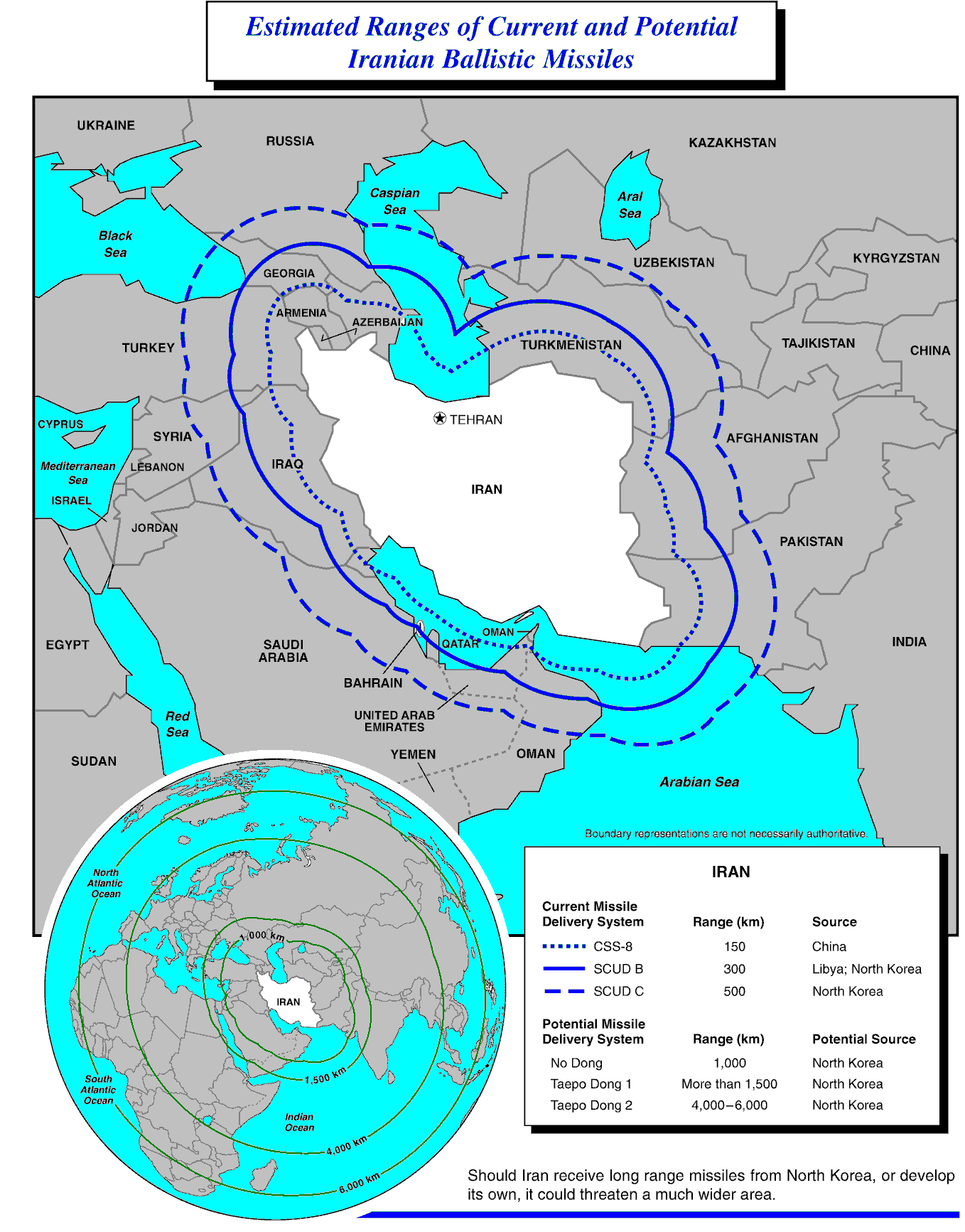
The Federation of American Scientists provide the following illustration of Iranian missile capabilities.


Satellite launches reportedly use technologies required for the development of ICBMs. In November, Iran claimed it had successfully tested missiles with a range of 1,200 miles, which as you can see from the map does not quite put Moscow in range--and obviously is even further from presenting any potential threat to, say, Warsaw. That said, it plainly makes a lot of sense that Iran's perennial missile tests would have the--likely unintended--effect of ruffling Moscow's feathers, given that a nuclear armed Tehran which could reach Moscow is definitely not in their interests.
"Alexander Pikayev, a top arms control scholar in Moscow, said Russian policy toward Iran will be determined by competing interest groups and political factions. Defense manufacturers and the atomic energy industry oppose tougher sanctions, for example, but the United States could win over the latter by reviving a bilateral pact on civilian nuclear cooperation that was frozen after the Georgian war, he said.

Pikayev said Medvedev may be more likely to support sanctions because a breakthrough in US relations would boost his political stature at home and set him apart from his powerful predecessor, Prime Minister Vladimir Putin. Putin might resist, but his relationship with Iranian President Mahmoud Ahmadinejad is said to be strained and he surprised Russia's foreign policy establishment by endorsing earlier U.N. sanctions, Pikayev said."
Frankly, I doubt this assessment--I think the notion of a nuclear armed Iran with the capability of hitting Moscow will outweigh the economic considerations involved in putting the kibosh on nuclear power cooperation with Iran. Indeed, it is hard to see many places in which Iranian and Russian interests coincide. Perhaps they do in terms of energy pricing, but Iran's potential as an alternative source of gas for European industry is probably a critical item in Moscow's long term thinking. And as the weekend's events proved, Russia still regards oil production coordination with OPEC as being less in its interest than good terms with Europe--and producing at full bore to claim all price increases produced by the cartel. (A policy which Iran appears to follow with respect to the organization's production quotas as well, ironically enough.)

3. The Associated Press reports that North Korea yesterday gave the organizations distributing US food aid inside that country till the end of March to leave--rejecting all future food aid.

4. Judy Dempsey at the New York Times yesterday reported that Russia signed two natural gas deals with Hungary yesterday. One deal signed last week has the Budapest and the Hungarian Development Bank to finance the South Stream project on Hungarian soil.


The other deal has Gazprom and MOL establishing a 1.3 billion cubic meters storage facility in Hungary. To make sense of that, here is a map that Jérôme Guillet drew up of Ukraine's gas infrastructure--note the three asterixes to the West, which represent gas storage facilities.


As Guillet pointed out in a piece for the European Tribune:
"Storage capacity is important in the gas business, as demand is seasonal (there is more in winter for heating) and can almost triple in Europe between summer and winter. If you can pre-position your gas near the markets when transport capacity becomes strained, you can extract a lot more value from that seasonality. The storage facilities near the Hungarian and Slovak borders were ideal for Soviet exports, but now they are in Ukrainian hands, and thus Russia must have a minimum of technical cooperation from the Ukrainians, who physically control and operate these facilities, not to lose a lot of money in their export markets. More, unavoidable leverage for the Ukrainians."
Hungarian Prime Minister Ferenc Gyurcsany's plea for a regional aid package from the EU was turned down last week. He has been a supporter of the Nabucco Pipeline, but questions of sourcing the gas (which would likely have to come from Iran) and project financing continue to bedevil the project.

5. Edward Hugh at Fistful of Euros posts that Poland's Central Statistical Office has released its industrial output data for February showing a 14.3% annual rate of decline in February, following a revised annual rate of decline of 15.3% in January. Output was up 2.7% in February from January however. Hugh provides a helpful graph of industrial production for the last two years:


Hugh points out that industrial production is on the decline across the spectrum of export-oriented Eastern European economies, warning against too much disambiguation between them. Worth reading and mercifully short.

6. Bettina Wassener at the New York Times reports that the World Bank lowered its forecast for Chinese growth in GDP for 2009 to 6.5%. 6.5%, though quite high by global standards just now, is well below the Chinese principle of "bao ba"--or "protect the 8"--below which conventional wisdom holds that Beijing will begin to see significant, read destabilizing, social unrest. Kevin Hamlin at Bloomberg reports that bank sees signs China's economy is stabilizing faster than the rest of the world.
"'The government’s stimulus is working,' said Louis Kuijs, a senior economist at the World Bank in Beijing. 'China’s fundamentals are strong enough to ride out this storm.'"
Meanwhile, Andrew Batson at China Journal helpfully translated the complete text of Chinese Ministry of Commerce’s statement announcing its decision to block Coca Cola’s proposed acquisition of China Huiyuan Juice Group Ltd. Key excerpt:
"Through its review, the Ministry of Commerce found that this concentration will have an adverse impact on competition. After the concentration is completed, Coca-Cola could use its market dominance in carbonated soft drinks to limit competition in the market for juice through tying, bundling or other exclusive transactions, resulting in consumers being forced to accept higher prices and reduced variety. At the same time, because brands can restrict entry to the market, it would be hard for the threat of potential competition to remove the restrictive effect on competition. In addition, the concentration will also reduce the room for small and medium-sized juice companies to survive, and will have an adverse effect on the structure of competition in China’s juice market."
The notion that dominance in the carbonated drink market could adversely affect competition in the juice market is unlikely to please most corporate headquarters. The fact that the Ministry of Commerce took stock of the market power of brands is interesting given that some have written that the primary value-addition that Western corporations bring to emerging markets is, well, brands. Meanwhile, the Sydney Morning Herald reports that shares in Rio Tinto have taken a beating on fears that the deal with Chinalco taking a 18% stake in the company.
"'[The 8.7% decline in share price] is [due to] the uncertainty surrounding the Chinalco deal, there has been a bit of talk out today that there is a lot of opposition to the deal and this is what's weighing on it,' MF Global senior trader Anthony Anderson said.

'The FIRB extension and the senate inquiry into foreign investment is adding to the uncertainty.'

The mounting political concern follows a decision by the Foreign Investment Review Board (FIRB) to extend its review to 90 days and initiate a more in-depth examination of the transaction, after the initial 30-day evaluation period closed on Monday.

The transaction, which has been backed by the Rio Tinto board, will also allow Chinalco to appoint two new non-executive board members to the global miners board."
(h/t Emmanuel at International Political Economy Zone.)

7. Platts reports that Italian major Eni has signed a major cooperation agreement with Pakistan to develop major projects all along the oil and gas product chain.
"The agreement also allows Eni to become a strategic partner in developing the oil and gas sector in Pakistan and to enter fields which are currently managed by state-run oil companies."
8. David E. Sanger and Eric Schmitt at the New York Times reports that "two of the high-level reports on Pakistan and Afghanistan that have been forwarded to the White House in recent weeks have called for broadening the target area to include a major insurgent sanctuary in and around the city of Quetta."


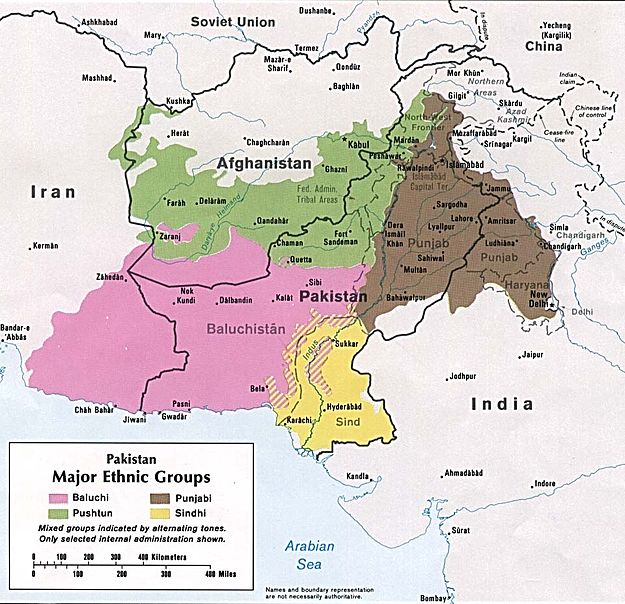
Baluchistan has separatist tendencies and is in the middle of a small bore separatist struggle, both in Pakistan and Iran.


Note that Baluchis can be found in southern Afghanistan where most of that country's opium production--and violence--is concentrated.

9. Galrahn at Information Dissemination notes that due to the Obama Administration's review of all military ties, GE has been asked to freeze work on turbines it was to provide the Indian navy for three Shivalik-class stealth frigates. Though I strongly disagree with the way Galrahn frames the story, I think it is an important data point. Clearly the US is likely to approve continued sales of engines to the Indian Navy.

10. Maher Chmaytelli and Juan Pablo Spinetto at Bloomberg report that Shokri Ghanem, chairman of Libya’s state-run National Oil Corp., told journalists today in Vienna that Libya will exercise its right to buy Calgary-based Verenex Energy Inc., which would effectively block CNPC's bid for the E&P company.
"Verenex has assets in Libya that are worth 'hundreds of millions' of dollars, Ghanem said in an interview with Bloomberg on March 16."
It is an interesting signal given China's Africa Policy announced in 2006 and Ghaddafi's recent selection as chair of the African Union--see Daily Sources 2/3 #9.

11. Justin Stares at Lloyd's List reports that the Bangladeshi High Court ordered the closure of all ship breaking yards operating without environmental clearance.
"Industry sources said they were 'staggered' by the ruling, which if confirmed will close down one of the world’s largest breaking industries just as scrapping activity peaks.

'None of the 36 shipbreaking yards in Chittagong currently have an environmental clearance,' said the NGO Platform on Shipbreaking. 'The decision therefore effectively shuts down an industry that has been highly criticized by environmentalists and human rights activists for many years for operating with complete disregard for the law, human health and the environment.'

The scrapping industry, which claims to employ 250,000 either directly or indirectly in Bangladesh, is expected to appeal.

The court was ruling on a petition filed by the Bangladesh Environmental Lawyers Association. Judges ordered that no ship on the Greenpeace 'dangerous ships list' be allowed into the country, according to reports by the platform and local media."
It is a decision bound to amplify the effects of the financial crisis, economically-speaking ... it seems that probity only comes when it will hurt the most, ironically. Note the significance of the courts in the Muslim-majority nation. Well-worth reading in full.

12. Nasreen Seria at Bloomberg reports that the South African Reserve Bank's Monetary Policy Committee will meet next week and accelerate its schedule to monthly meetings for the rest of the year from planned meetings every two months.
"Global economic conditions 'are getting worse' and the 'changed' environment requires the MPC to meet more regularly, Governor Tito Mboweni said in a phone interview from Pretoria today."
13. Victor L. Simpson at the Associated Press reports that in Cameroon Pope Benedict XVI reiterated yesterday that condoms were not an answer to the fight on AIDS--"You can't resolve it with the distribution of condoms. ... On the contrary, it increases the problem." I would note that Africa is one region where Catholicism--and more conservative Catholicism--is growing quickly. However, perhaps the one really impressive and compellingly moral US foreign policy triumph under the Bush Administration was the huge increase in aid to Africa in terms of the fight on AIDS, including condoms and retro-viral drugs. The people in Africa are well aware of how these aid programs have reduced the mortality rate in the continent. The notion that condoms are against life and a concession to death, and thus amoral, as opposed to a way to protect life and thus moral, will not, I believe, make much sense to them. Pope Benedict XVI appears to have a tin ear when it comes to husbanding the moral authority of the Church.

14. The Port of Long Beach recently posted its numbers for February, showing a 40% decline in container traffic from February 2008:


So far in 2009 the port has recorded a 20.2% decline in traffic. The Port of Marseilles, France, also recently posted its report for February, showing a 21% annual decline in total traffic. It registered a 16% decline from the traffic seen in January:


Hydrocarbons account for about 74% of Marseilles' traffic and it lost about 12% in volume from the year before. The grim trade data continue their march.

15. Bob Willis at Bloomberg reports that the consumer price index rose by 0.4% in February from January. Excluding fuel and food, prices climbed by 0.2% from the month prior. On an annual basis, the consumer price index rose by 0.2%, up from the 0% annual rate seen in January. Excluding fuel and food, prices climbed by an annual rate of 1.8% in February, up from a 1.7% annual rate of increase seen in January.
"Energy expenses increased 3.3%, led by an 8.3% increase in gasoline prices. Still, the fuel’s cost is down 36% from a year earlier.

Food prices, which account for about a fifth of the CPI, fell 0.1%, the first drop since April 2006."
16. The Federal Open Market Committee met today and decided to keep the federal funds rate unchanged at 0-.25%. Excerpt from its press release:
"To provide greater support to mortgage lending and housing markets, the Committee decided today to increase the size of the Federal Reserve’s balance sheet further by purchasing up to an additional $750 billion of agency mortgage-backed securities, bringing its total purchases of these securities to up to $1.25 trillion this year, and to increase its purchases of agency debt this year by up to $100 billion to a total of up to $200 billion. Moreover, to help improve conditions in private credit markets, the Committee decided to purchase up to $300 billion of longer-term Treasury securities over the next six months."
This follows the latest Treasury International Capital data which shows, courtesy of Brad Setser at Follow the Money, that foreign purchases of long term treasuries have collapsed:


Foreign government demand for US agency debt fell off a cliff late last year and purchases were even banned by Moscow just the other week. Meanwhile, Jon Hilsenrath at Real Time Economics reports that the Fed's quarterly survey of banks shows that during the week of February 2-6, banks extended $85.6 billion in credit to businesses, an increase of 13% from the first quarter of 2008--per JP Morgan Chase economist Michael Feroli:


17. The EIA reported that crude oil stocks built by 2 million barrels in the week ended March 13 to 353.3 million barrels, well above the historical average for this time of year, but still below the most recent peak of 354 million barrels seen on June 29, 2007. According to a survey by Bloomberg, analysts had expected a 1.5 million barrel build. Gasoline stocks grew by 3.2 million barrels, are near the top of the historical average. Analysts had expected a 1.5 million barrel draw. Distillates stocks grew by 100,000 barrels, are well above the five year historical average range as well as counter-cyclical, and versus analyst expectations of a 1 million barrel build. Taken in isolation, the data would be bearish on the price of crude.

Tuesday, March 17, 2009

Daily Sources 3/17

1. Doris Leblond at the Oil & Gas Journal reports that Eurogas released preliminary data showing that European demand for natural gas grew by 2.1% in 2008, from from 506.4 bcm to 517 bcm.
"The total number of gas customers connected to the EU27 gas grid rose 1% to 112.5 million customers. ... Although natural gas markets vary significantly from one EU country to another, Eurogas believes some general trends may explain the overall increase. The main one is that the weather was mild in 2007 but rather cold in 2008 which, in addition, was a leap year of 366 days."
2. Eurointelligence notes that Le Monde reported that support for a 50% cap on income taxes and the "detaxation" of extra working hours no longer has majority support in France.
"Ahead of the parliamentary budget examination this week, several MEPs called for a suspension of this measure to make high income earners participate in an effort to re-establish confidence in the economic relaunch plan. Even former prime minister Dominique de Villepin called in an interview with Les Echos for a burden share and an increase of the cap to 60%."
3. Dinah Deckstein at Der Spiegel reports that in February senior executives from Airbus and Emirates--which has ordered 54 A380 super-jumbos--to conduct an emergency meeting regarding problems with the plane after having taken delivery of its first two nearly two years late.
"It is still not clear how the spat between the aircraft maker and its dissatisfied customer will end. Competitors Singapore Airlines and Qantas have also had to ground their A380 jets several times in recent weeks and months.

The Asians have had trouble with the fuel pumps and the on-board electronics. The Australians noticed that the highly sensitive measuring sensors in the tank were not working properly, although it is still unclear whether the problem was attributable to the devices themselves or was caused by impurities in the fuel.

Unlike Emirates, Singapore Airlines and Qantas have taken a more relaxed approach to the problems. However they, unlike the Arabs, have not just ordered dozens of new A380s.

Since the end of last week, the Dubai-based airline has however tried to defuse the conflict. 'Technical problems are to be expected in a new aircraft, especially one in which so many new technologies are used,' says an Emirates spokesman."
Worth reading in full.

4. Platts conducted a survey of 27 Chinese state-run refineries which indicated that they were likely to maintain crude runs at about 81% of nameplate capacity in March on high stocks and weak demand.
"The survey covered Sinopec's 19 refineries, which have an overall nameplate crude processing capacity of 3.56 mb/day, accounting for 89% of Sinopec's total refining capacity of 4 mb/d.

Meanwhile, the eight PetroChina refineries surveyed have an overall nameplate crude processing capacity of 1.43 mb/d, which accounts for 51% of PetroChina's total crude processing capacity of 2.8 mb/d."
5. Razib Ahmed at the South Asia Blog posts on the return of immigrant workers to South Asia and the recent decision by Malaysia to cancel visas for some 55,000 Bangladeshi workers. Ahmed also notes that Kuwait's foreign workforce shrank for the first time since 1990 and that there has been a fall in the number of people leaving Nepal in search of work. (h/t Mark Thoma at Economist's View.)

6. Simon Romero at the New York Times reports that the Shining Path in Peru has recently turned to the cocaine trade after the end to the war in 2000--and that the trade is heating up the conflict with Lima again.
"[Vizcatán], a 250-square-mile region in the Apurímac and Ene River Valley, nine hours by four-wheel drive along switchbacks from the Maoist rebels’ Andean cradle of Ayacucho, is Peru’s largest producer of coca, the raw ingredient for cocaine.

The Shining Path controls a large part of the cocaine trade here, and as Peru’s production has thrived, now second only to Colombia’s, the rebel group has used its profits to rebuild."
7. Brad Setser at Follow the Money posted on the latest Treasury International Capital data for January which showed a net outflow in capital of $148.9 billion, and Setser notes that net capital outflows from the US cannot sustain a budget deficit.
"Setting December (when foreign private investors bought a bunch of US corporate bonds) aside, foreign investors haven’t been buying long-term US assets since the crisis hit.

The swing came from two sources:

1) US investors bought a bunch of foreign bonds. That is a change. US investors had been net sellers of foreign bonds and equities through out the fall.

2) Banks stopped piling into US assets. In October — at the peak of the crisis — private investors abroad bought $64 billion US t-bills and increased their dollar deposits by $196 billion (see line 29 of the TIC data; “change in banks own (net) dollar-denominated liabilities). In January, credit conditions eased a bit, and private investors reduced their t-bill holds by $44 billion and the banks reduced their (net) dollar deposits by $119 billion."
"Incidentally China is still buying Treasuries. It bought $12.2 billion in January, including $11.6b in short-term Treasury bills. It also is still selling Agencies — its Agency holdings fell by $3.1 b.

Russia also, interestingly, added to its holdings of short-term Treasury bills. The Gulf reduced its dollar deposits (now at $114.3b, down from a peak of $125.5b in November) whether to support its domestic banks or to cover stretched budgets. The Gulf (and Brazil) also bought a decent number of long-term Treasuries. Most official buying, though, came at the short-end. In aggregate, the official sector sold $1.9 billion of long-term Treasuries while adding $29 billion to its short-term bills.

That continues a broader trend. Over the last 12 months official investors added close to $280 billion to their bill portfolio."
Well worth reading in full.

8. Keith Johnson at Environmental Capital reports that a new Accenture survey of attitudes toward nuclear power has been released, showing growing support for nuclear worldwide. The survey was of 10,500 people in 20 countries.
"The upshot? About 69% of people favor adding more nuclear power; 31% are opposed. In the past three years, 29% of people have become more supportive, and 19% have become more entrenched in their opposition."
China has the highest level of unconditional support for nuclear power at 50%. In the US, 37% say they have become more supportive of nuclear recently with 81% in favor of using more.
"One of the most surprising findings is the erosion of support for nuclear power in France, which gets almost 80% of its electricity from nuclear plants, and which is often held up by nuclear-energy proponents as a model for the US.

Hardcore French support for nuclear power stands at just 20%, similar to levels in anti-nuclear Germany. Over the past three years, opposition to nuclear power has grown in France more than in any of the other countries in the survey."


9. Courtney Schlisserman at Bloomberg reports that the producer price index grew by 0.1% in February from January. Core producer prices--prices excluding energy and food--grew by 0.2% for that time period. At an annual rate, producer prices fell by 1.3% in February. Core producer prices rose by 4% from a year earlier.

10. Shobhana Chandra at Bloomberg reports that housing starts grew by 22% in February from January.
"While the glut of unsold properties on the market means the housing industry’s recession will probably continue for some time, economists said today’s report indicates the worst of the contraction may have passed. Retail sales figures for February last week also indicated a slower rate of decline."
Year over year, housing starts are still down nearly 50% in February.

11. Bob Willis at Bloomberg yesterday reported that US industrial production fell by 1.4% in February from January. Year over year industrial production fell by 11.2%, the sharpest contraction seen since 1975.
"Excluding automobiles, factory output dropped 1.2%.

Utility production decreased 7.7%, propelled by unseasonably warm weather that caused declines in the use of electricity and natural gas. Mining output, which includes oil drilling, decreased 0.4%.

The auto industry is at the center of the manufacturing slump. Car sales in February slid 41% to the lowest rate since December 1981, according to Autodata Corp., led by a 53% drop for General Motors Corp."
12. Macro Man posts the data on the increased defaults seen in January from credit card holders, suggesting that many have made the New Year's Resolution to stop paying their credit card bills.

Tuesday, December 30, 2008

Daily Sources 12/30

1. Ethan Bronner and Taghreed el-Khodary at the New York Times reports that Israeli Prime Minister Ehud Olmert said Tuesday that the Gazan airstrikes were "the first of several stages approved by the security cabinet." He went on to say "The government is giving the military its full backing and the room for maneuver to achieve the goal set out by the government."
"Interior Minister Meir Sheetrit told Israel Radio, 'There is no room for a cease-fire. The government is determined to remove the threat of fire on the south. Therefore, the Israeli Army must not stop the operation before breaking the will of Palestinians, of Hamas, to continue to fire at Israel.'"
Gazan residents reported seeing Israeli ships gathering offshore Gaza. Griff Witte and Sudarsan Raghavan at the Washington Post report that Israeli Defense Minister Ehud Barak declared "an all-out war against Hamas" on Monday. (I have no idea what practical effect that has in terms of international law--or whether a Defense Minister can declare war or whether the Israeli Cabinet and Parliament are required to pass a motion declaring war or whether, even such a declaration would mean a de facto recognition.)

The rhetorical reaction of the Islamic world has been pretty uniform. The Gulf Daily News reports that a prominent Saudi cleric, Sheikh Awad Al Qarni, published a fatwa ruling all Israeli interests--and "anything else related to Israel--legitimate targets. (h/t Will McCants at Jihadica) Sayed Salahuddin at Reuters reports that the Taliban has called upon the Muslim community to rise up in response to the Gaza conflict. Zeina Karam at the AP reports that tens of thousands of Hezbullah supporters stood in the rain in Beirut to protest the situation in Gaza, some 3,000 rallied in Cairo, and about 1,000 al-Sadr backers protested in Baghdad. The same piece reports--buried near the bottom--that the al-Maliki government issued a statement condemning the attacks and calling on all Muslim nations to end relations with Israel and all secret negotiations with it. Juan Cole has translated Grand Ayatollah Ali Sistani's fatwa issued on Sunday. It calls on action, more than has been done in the past, and strongly condemns words as opposed to practical action in response to the events:
"Mere verbal expressions of condemnation and disapproval of what is being done to our Palestinian brethren in Gaza, and of solidarity with them, mean nothing before the immensity of this horrific tragedy to which they are being subjected.

The Arab and Muslim worlds are called upon, more than at any past time, to take practical steps in order to stop this continual aggression and to break this cruel blockade that has been imposed on that proud people."
Cole's translation is well worth reading and many of the articles linked here came to my attention via his site.

Daoud Kuttab--a Palestinian journalist and former Princeton professor--has an op ed in the Washington Post in which he points out that Hamas was losing its popular appeal prior to the Israeli attacks--polls conducted in November gave them a 16.6% approval rating and Fatah 40%. He suggests that the IDF's attack serves to resurrect Hamas's bona fides while shoring up support for the government on the eve of elections in Israel. A more cynical person might suggest that Tel Eviv definitively wants an unattractive and unrelentingly hostile government in Palestine as it justifies intransigence. Kuttab, however, critically undermines the moral appeal of his argument when he poo-poos the rocket attacks into neighboring Israeli villages as "amateur rockets" which are "nagging" some of their citizens.

Benny Morris, an Israeli historian (whose books I've found especially enlightening) has an op ed in today's New York Times which gives a better sense of what the Israeli public fears. He outlines three "dire threats":
a) An Iran pursuing a nuclear program which many believe is intended to build Iran nuclear weapons, which they feel will be used against them. They regard Ahmadinejad's denial of the Holocaust and of the existence of homosexuality in Iran as evidence of his irrationality.

b) Hezbollah has rearmed in Lebanon, and now according to estimates has 30,000 to 40,000 Russian-made rockets.

c) Hamas, "whose charter promises to destroy Israel and bring every inch of Palestine under Islamic rule and law," has an army of thousands in Gaza and a substantial arsenal of home made and Russian made rockets.
Morris also undermines his argument with disingenuous claims. The "direness" of the threat to the north is substantially accounted for by reasonably successful talks with Syria, which Tel Eviv has just to all intents and purposes put on the kibosh. Clearly Hamas presents no clear and present existential danger to Israel, as we witness its armed forces basically running roughshod over the, what are in fact, irregulars in Gaza. Finally, Ahmadinejad is not the commander in chief of the Iranian armed forces and would, under no circumstances, have access to the button, so to speak. His irrationality is therefore a matter of relative indifference when calculating the potential threat arising from a potentially nuclear-armed Iran.

That said, it is always very easy to dismiss the threats made to someone else than it is to yourself and I think it is misleading to pish-posh these threat analyses as mere propaganda. However, they do seem to indicate that we should worry more about irrational responses from Tel Eviv than from Iran. I suspect that the realists more regularly prevail there, however, past performance is not a guarantee of future results. Morris's ultimate point remains fairly pointed, that the Israeli long term threat is internal--the birthrate of Israeli Arabs.

Israeli ideology does not make room for the notion of a non-majority Jewish state. Arab ideology does not make room for the notion of an Israel ruled by Jews. The raison d'etre of all the political associations on offer in both Palestine and Israel would be undermined by peace.

Bret Stephens in the Wall Street Journal has an opinion piece which points out that Hamas quite literally calls for genocide in Israel, quoting Palestinian cleric Muhsen Abu 'Ita as saying "The annihilation of the Jews here in Palestine is one of the most splendid blessings for Palestine." But, he says, Israel has won most of its conflicts as the proverbial hedgehog, when now it is the fox.

Either way, I'd say Morris is right when he says we can expect the conflict to continue.

2. Daryna Krasnolutska and Stephen Bierman at Bloomberg report that Ukraine has agreed to pay the amount Gazprom says it owes--over $2 billion. President Viktor Yushchenko’s office said in an email that the November gas has been paid for--$806 million--and that an advance payment has been made for December supplies, which were forecast to cost about $862 million in full. Gazprom had threatened to cut off natural gas supplies to the Ukraine on January 1 if back payments were not made. Since much of the natural gas that Europe consumes is provided via pipelines which traverse the Ukraine, the situation set off alarm bells across the continent as well as in the US.

3. Philip P. Pan and Howard Schneider at the Washington Post report that President Medvedev has signed into law a Constitutional amendment which extends the Presidential term to six years from four. The amendment will not come into force until the next presidential election. Many see this as a move to prepare a longer term for Putin who they believe will run for President again.

4. Glen Carey and Matthew Brown at Bloomberg report that Gulf Arab leaders have agreed to a plan to create a monetary union and central bank for the region. The plan must now be submitted to the national governments of the Gulf countries which are interested in the proposal. Saudi Arabia, Kuwait, Bahrain, Qatar, and the UAE will submit the plan. (Oman has withdrawn from the effort, which began in 2001 when the entire Gulf Cooperation Council agreed to form a monetary union along the lines of the European Union.)

5. Tarek el-Tablawy and Khaled el-Deeb at the Associated Press report that the head of the Libyan National Oil Company, Shukri Ghanem, told the journalists in a telephone interview today that Libya has ordered cuts in production of 270 kb/d, more than the cut of 252 kb/d that the December 17 meeting in Oran had mandated. OPEC, so far as I know, has not released its data on what the actual production of each member state was in September--and that was the number from which the December 17 announced a cut. The reporters also talked to Conrad Gerber of Petrologistics, who suggested that OPEC was making good on their cuts.
"According to Gerber's figures - which come from carefully monitoring tanker shipments and do not include oil in storage - OPEC had already cut output by 1.56 million barrels per day by the end of November, and has slashed another 320,000 barrels per day in December."
In a separate Reuters story by Alex Lawler today, Gerber said that Iran was expected to increase production by 170 kb/d to 3.85 mb/d and Venezuelan production is steady at 2.32 mb/d. Presumably the additional production is inferred by looking at additional shipments, and hence supply, though the way it is put is deliberately obfuscatory.

6. The Wall Street Journal Asia's editorial board reports that Bangladesh had a 80% turnout for its recent elections. Prime Minister Sheikh Hasina's Awami League won about 250 of 300 seats up for direct election. Islamist parties did not do very well.

7. Annika Breidthardt has an analysis at Reuters which argues that the commission of the new Reliance refinery in Jamnagar--a 580 kb/d capacity refinery which is very sophisticated--may bring Middle Eastern sour crudes to price parity with the light sweet benchmarks. Worth reading.

8. William Sim at Bloomberg reports that South Korea posted a current account surplus of $2.06 billion in November, up from $1.67 billion in October.
"South Korea may keep posting current-account surpluses in coming months as imports fall faster than exports amid a decline in oil costs, Yang Jae Ryong, a statistics official at the central bank, said in Seoul today."


9. Alan Beattie at the Financial Times wrote yesterday that a report just published by the IMF argues that tax cuts and specific industry bailouts are likely a waste of government resources in handling the financial crisis, what is needed is stimulus designed to provide credit to those who are having a hard time obtaining it. Providing funds to those who will likely put it in their savings would not be productive, in the organization's view.

10. Bob Willis at Bloomberg reports that the S&P/Case Shiller index declined 18% year over year in October, after falling at an annual rate of 17.4% in September. "The 20-city index is down 23% from its 2006 peak."

11. Greg Mancina in the Saginaw News tells us the news from Detroit is, now that the price of gasoline is averaging well-below $2/gallon, that in December trucks and SUVs are again outselling cars in the US. Depressing. But I suppose that simply means they are more popular than the alternatives--as long as the price of gasoline doesn't get too high. Completely understandable. Also, I imagine that the US might have some comparative advantage when it comes to making trucks and SUVs. That said, higher CAFE standards are desperately needed and this news means oil demand should recover in the US. Not that that's all that surprising. (see Daily Sources 10/15 #3--near the end where it is reported that SUVs maintained their market share in September.)

12. In a strange pair of pieces by the Wall Street Journal, we get a peek into some strange thought processes. The Editorial Board calls for a strong dollar--claiming it is the source of high oil prices--and a reversal of relaxed monetary policy in order to weaken Russia, Iran, and Venezuela. One might suggest that it's a tad late for that--and conveniently well past the time the financial bail out commenced--and that our monetary policy should focus on producing prosperity in the United States more than freedom overseas. But, beyond that, the estimation that a low crude prices will encourage the establishment of democracy in Venezuela, Russia, and Iran is based on the same faulty thinking that led to a 50 year and totally pointless embargo on Cuba. And to combat one almost laughable misapprehension: Russia's ability to squeeze European supply is not affected one whit by the price paid for it ... the fact is that Russia supplies a tremendous percentage of total supply which cannot be replaced if withdrawn. Still, the notion that Russia would have tried to use such a tool to pressure Europe in any but the most extreme of conditions is deliberately misleading. And a lower price only means that there is less economic incentive to get more out of the ground and thus meet Europe's future energy requirements.

I guess we can all take comfort though, in the revelation via Andrew Osborn's piece in the Wall Street Journal that Igor Panarin--a major US analyst in Russia--thinks that the United States will break up into different regions come 2010. Well, I guess I can say that I know of more than one region where there are people who openly advocate such a breakup--Hawai'ian secessionists come to mind--and there are plenty of blue staters fed up with the politics of red staters and vice-a-versa. It is a little disconcerting that Russian analysts would seriously be considering this future scenario. Still, sometimes it's nice to think that they understand us no better than we do them. It is also very important to note that Panarin says "But if we're talking reasonably, it's not the best scenario -- for Russia."

Tuesday, November 11, 2008

Daily Sources 11/11

1. Stephen Castle at the New York Times reports that the European Union announced yesterday that it will resume strategic partnership talks with Russia after having postponed them on August 1st in response to the Georgia crisis. 26 out of 27 Union countries agreed to resume the talks, the dissenter was Lithuania. "Among the issues expected to be discussed when talks resume are energy, trade, and cooperation on security and combating terrorism." French President Sarkozy will meet with Russian President Medvedev on Friday in Nice in preparation for the G20 summit in Washington on Saturday, November 15.

2. Laura Cochrane and Emma O'Brien at Bloomberg report that concerns regarding the weakening of the ruble have driven a steep fall in the Russian stock markets.
"Bank Rossii widened its range on the ruble against a basket of dollars and euros by 30 kopeks (1 cent) to increase the currency's ``flexibility'' and lifted its benchmark refinancing rate to 12 percent from 11 percent to arrest outflows, according to separate statements after the stock market closed. The Micex Index plunged 13 percent, the biggest decline worldwide, and won't open tomorrow, spokeswoman Anna Cheryomushkina said."
Russia has used 19% of its currency reserves since August to stem the flow out of rubles into the dollar and euro. Kremlin officials are concerned that if oil falls below $50/b it will trigger a further collapse in the ruble exchange rate.

3. Anna Shiryaevskaya at Platts reports that "Russia, Qatar and Iran plan to discuss the implementation of the South Pars project at a second round of talks in the Qatari capital Doha on Wednesday, Gazprom said in a statement Tuesday." Difficulty in developing South Pars has perennially dogged Iran's natural gas plans, including decisions as to gas injection into oil fields, exports to Pakistan and India, and power generation. (It was argued recently that if the current plans are not implemented in time that Iran will face a major heating crisis this Winter.)

4. Eric Watkins at the Oil & Gas Journal reports that Turkey's future gas demand is a major obstacle to the planned Nabucco pipeline.
"Nabucco's gas needs appear increasingly to be in conflict with those of its main transit country, Turkey, which also needs to find new sources of gas both to meet increasing demand and to reduce dependence on Russia."
Nabucco would potentially transport 30 billion cubic meters/year through Turkey to Austria, via Bulgaria, Romania and Hungary.
"With a view to securing gas supplies for the line, the EU has already signed agreements with Turkmenistan, Azerbaijan, Kazakhstan, and Ukraine to help develop their reserves. The EU also is eyeing Egypt and Iraq as possible future suppliers."
5. Winnie Lee at Platts reports that Xinhua carried the story Tuesday that on Monday Iraqi Oil Minister Hussein al-Shahristani signed the oil services contract to develop the al-Ahdab oil field with CNPC president Jiang Jiemin. Al-Ahdab is located in the central Wasit province and is expected to produce more than 110 kb/d. Most of the oil is slated for use by the al-Zubaydiya power plant in Wasit; the surplus is slated for export--to China. Production is expected to start in three years time at 25 kb/d and the contract is for 20 years. CNPC will receive 4% of production (4.4 kb/d), but no equity. The field contains 225 million barrels of recoverable reserves.


6. Justin Fox at the Curious Capitalist argues that the markets are discounting the Chinese stimulus plan as mostly more of the same. Infrastructure spending has increased at an average annual rate of 20% over the last 30 years. The question, it seems, is whether the $586 billion will be monies on top of expected infrastructure spending or the total. That and whether Beijing will be able to stimulate consumer spending.

7. Randall W. Forsyth at Barron's argues that the growing yield curve on US Treasuries may be a sign the markets are anticipating a default. The climbing yield curve--which is now as much as 2.5%--is accompanied by increasing cost of insuring against default. That is, CDSs insuring against default on US Treasuries are becoming more expensive. Forsyth calls it unthinkable that the US would default on its debt obligations. However, many state governments in the US defaulted on their debts in the 1830s despite grave warnings, especially from England, as to it ruining American credit-worthiness forever. His article is well-worth reading in its entirety.(h/t Jesse's Café Américain) For a libertarian take on the desirability of default, with which I take issue but still find interesting, see Jeffrey Rogers Hummel's post on the History News Network.

8. Platts reports that MEND is threatening a new oil war--operation "Hurricane Obama"--should the Nigerian Joint Task Force carry out attacks on MEND positions. MEND says it is in possession of plans for such an attack and would respond by targeting
"the oil industry in a way never done before which will in turn make the Nigerian governments 2009 budget projections based on oil revenue an economic disaster."
MEND says it is assured of a "landslide victory."

9. Scott MacLeod has a very interesting post on the response in the Middle East to Obama's selection of Rahm Emmanuel for chief of staff. Emmanuel's father apparently is connected to Irgun Zvai Leumi, one of the terrorist or freedom fighter groups--depending on your point of view--that operated in Palestine during the British mandate. This is obviously contentious material; I would point out that past affiliation with, say, the IRA by an Irish American would not necessarily be an definite indicator of foreign policy positions today. But it would indicate a strong family and emotional tie to the country in question.
"The Arab News in Jeddah, whose editorials are a good reflection of the Arab mainstream, did an astounding somersault on Friday. Just the previous day, the paper hailed the 'symbol of hope and change' in the U.S., saying Obama's historic election 'threatens the cosy Washington consensus. We are, therefore, embarking on exciting times.' After hearing of Emanuel's appointment, the paper headlined its next editorial 'Don't pin much hope on Obama.' Arab expectations, the paper warned, 'are likely to be dashed, generating a great deal of pain and resentment...The new team may turn out to be as pro-Israeli as the one it is replacing.'"
The post, though controversial, is well-worth reading. I think it is plain that the choice of Emmanuel will be reassuring to many Jewish Americans who were worried that Obama's presidency would represent a turning away from Israel--and thus a politically savvy move domestically. However, the story that an Isreali diplomat worried that Emmanuel might be more problematic for Israel given that his familiarity with Hebrew and its history will make it difficult to "pull the wool over his eyes" is likely to raise eyebrows here, given the inference that Israeli diplomats make a habit of pulling the wool over DC's eyes!

In a related post, Tony Karon at Time writes on how Obama's win will affect upcoming elections in Israel, Iran, Iraq, and Afghanistan. Karon argues that Isreali voters might be inclined to swing right towards Netanyahu given fears about a nuclear Iran. On the other hand, he argues that voters in Iran might decide to move leftwards from Ahmadinejad, given that his inflammatory rhetoric would undermine attempts at detente. He also argues that Obama's election, and the commitment to a near term withdrawal, may exacerbate sectarian conflicts in Iraq, because he believes elections tend to stoke division in tribally organized societies. On balance, however, he thinks it would shore up support for al-Maliki, who would be the man who managed the American withdrawal. Worth reading in full.

10. Gareth Porter at The Raw Story reports that:
"The International Atomic Energy Agency (IAEA) has obtained evidence suggesting that documents which have been described as technical studies for a secret Iranian nuclear weapons-related research program may have been fabricated."
If so, the forgery will further undermine the case for confrontation with Iran over its nuclear program. However, it seems to me that American credibility will still be renewed come January 20.

11. Eric Watkins at the Oil & Gas Journal reported yesterday that Daewoo has suspended their exploration effort in the Bay of Bengal under pressure from the Bangladeshi government. Delegations from Mayanmar and Bangladesh are scheduled to meet in Dacca Nov 16-7 to discuss the maritime boundary dispute.

12. John Kingston at the Barrel gives a roster of major hydrocarbon projects that have been postponed in the last few weeks due to the fall in the price of crude. Given flat non-OPEC production capacity additions over the last five years some analysts are worrying about a spike in price by the second half of 2009.

Wednesday, November 5, 2008

Daily Sources 11/5

1. Paul Kedrosky at Infectious Greed has a very interesting post ranking the institutions with the largest net exposure to credit default swaps. It turns out that of the 18 institutions most exposed, nine are governments. To wit: Italy, Spain, Brazil, Germany, Russia, Turkey, South Korea, France and Portugal.


I am somewhat non-plussed, therefore, as to why Merkel's administration is so against a coordinated European response to the financial crisis. According to Eurointelligence, the French are similarly confused by the response. Germany apparently wants to put the kibosh on Sarkozy's recent proposal for holding regular euro summits. In the meantime, Italy will provide up to €30 billion to recapitalize its bank over the next few days. Also,
"The European Commission yesterday proposed a new strategy to improve access by European companies to some markets for rare and strategic commodities, amid suggestions that China and some other emerging markets have signed contracts with an intent to corner the market."
Very interesting, in a number of ways, and it sure would be nice to know that that new strategy is.

2. Steve Gutterman and Vladimir Isachenkov at the Associated Press report that Russian President Dmitry Medvedev announced in a state of the union speech that Russia would deploy short range missiles near Poland in order to counter the anti-missile shield that the US plans to install there.
"'From what we have seen in recent years — the creation of a missile defense system, the encirclement of Russia with military bases, the relentless expansion of NATO — we have gotten the clear impression that they are testing our strength,' Medvedev said."
State Department spokesman Sean McCormack said in response today that "But, again, this [the anti-missile shield] is not directed at them. Hopefully one day they'll realize that." The notion that Washington apparently wants to sell Moscow, or maybe the American public--it is so absurd I frankly am unsure who its intended audience is--is that the anti-missile system is meant to defend Poland from Iran. I simply cannot make sense of why such obvious nonsense would be the official statement of the United States of America! What American interest is being served?

Medvedev also announced that the United Russia Party was considering an effort to change the Constitution so as to extend the President's term from 4 to 6 years. In related news, Platts reports that Russia has purchased Oman's 7% stake in the Caspian Pipeline Consortium bringing its share to 31%. CPC is
"a privately owned, Chevron-led crude pipeline that currently pumps around 670,000 b/d from Kazakhstan through Russia to the port of Novorossiisk on the Black Sea.

Oman said earlier this year it wanted to sell its stake because of its inefficiency and complicated shareholder structure. State shareholders Russia and Kazakhstan had pre-emptive rights to buy the stake, which Oman values at $700 million.

Kazakhstan had hoped to split the stake with Russia."
3. RIA Novosti reports that Gazprom CEO Alexei Miller told reporters that OPEC ministers are considering further cuts of as much as 10% of current production. Stefano Ambrogi at Reuters writes that Lloyd's Marine Intelligence Unit estimates that OPEC seaborne exports (excluding Ecuador) fell to 22.837 mb/d from 23.031 mb/d--194 kb/d--seen in the four weeks beginning September 21. The consultancy says that shipments are down 830 kb/d from the peak seen in mid-September.

4. Tony Gray at Lloyd's List reports that Jefferson Clarke at Poten & Partners told a conference that rates for very large crude carriers were likely to remain above long-term averages despite the current price climate.
"He said the US’s domestic production was 'not robust' and output from some relatively close sources of imports, such as Mexico, was in decline.

Thus, long-haul cargoes would continue to be in demand.

'The Middle East will have a real impact on tonne-mile demand,' Mr Clarke said.

'Tanker demand significantly increases with incremental growth of long-haul trades.'
...
Fleet growth so far this year had been modest, with the VLCC sector increasing only 1%, and suezmaxes actually experiencing nil growth."
5. The EIA's This Week in Petroleum reported that crude inventories remained unchanged for the week of October 31 at 311.9 million barrels, versus analyst expectations of a 1 million barrel build. Crude stocks are slightly above the historical average. There was a build in gasoline stocks of 1.1 million barrels versus expectations of a 700,000 barrel draw. Gasoline stocks are at the very bottom of their historical averages. Distillate stocks grew by 1.2 million barrels which was basically what was expected by Wall Street and is a just a bit below the historical average. The report also had this to say about the outlook for 2009:
"OPEC surplus capacity could reach 4 million bbl/d by the end of 2009, nearly all in Saudi Arabia, providing Saudi decision-makers with a significant cushion that they could use to dampen the impact of future disruptions or geopolitical uncertainties.
...
The credit crunch and the recent decline in prices for oil and natural gas are likely to affect exploration and production investment in both OPEC and non-OPEC countries. Some countries with nationalized oil sectors will be under considerable pressure to maintain the flow of oil revenue to social programs, reducing resources available for reinvestment in the oil sector. High-cost projects such as Canada’s oil sands or Brazil’s subsalt, already technically and financially demanding, could face additional challenges to their profitability. (In fact, delays in some new oil sands projects in Canada have already been reported.) Insofar as non-OPEC producers are concerned, the major investor-owned oil companies are likely to be less affected by the credit crunch than independent producers. The greater the delays in investment in existing and new oil fields, the lower production will be once the world economy and oil demand recover, increasing the risk that we will return to a tight supply situation."
6. Ben Lando at UPI has acquired a copy of a heads of agreement between the Iraqi Oil Ministry and Royal Dutch Shell--the Anglo-Dutch major. The HOA would give a joint venture between Shell and the government of Iraq sole access to natural gas production in the province of Basra of which Iraq would hold a 51% stake and Shell 49%. Most of the natural gas covered by the JV is mostly associated gas--or gas that is produced as part of the drilling process for oil. (Just now most associated natural gas is either flared off or re-injected into the oil fields.) The JV will purchase the natural gas from Iraqi state oil companies and either transport it to customers or convert it into salable products.
"Shell, which has proposed to the Iraqi government a nationwide gas master plan, will create a "high-level evaluation of dry gas export schemes."

Shell would have the rights to all liquefied natural gas. Although Iraq currently does not have LNG facilities, the HOA tasks Shell with assessing the 'feasibility of an early LNG export project.'"
It appears that the HoA also would also basically give the JV rights to any gas found offshore Basra in the Persian Gulf. (As you can see from the map below, Basra is the only littoral province in Iraq.) The JV would be for 25 years, renewable, and all revenue, dividends, and investments will be split 51/49 as well. It would be subject to corporate taxes.


7. Nizam Ahmed and Masud Karim at Reuters report that the Foreign Minister of Bangladesh met with the Chinese Ambassador to that country in Dacca to appeal for Chinese help in resolving the maritime dispute with Myanmar. Bangladesh is pursuing a diplomatic solution to the row and sent a diplomatic team to Yangon Tuesday in that effort.

8. Yves Smith at naked capitalism reports that Nouriel Roubini thinks China is headed for a hard landing economically.
"[N]et exports (or the trade balance surplus) are close to 12% of GDP (up from 2% earlier in the decade) and exports represent about 40% of GDP. Real investment in China is about 45% of GDP and, leaving aside the part of this investment that is housing and infrastructure spending, about half of this capex spending goes towards the production of new capital goods that produces more exportable goods. So, with the sum of exports and investment representing about 80% of GDP, most of Chinese aggregate demand depends on its ability to sustain an export based economic growth."
But the main importer, the US, will not have an appetite for more goods at the moment. (Though, if I remember correctly, American imports from China have been flat for two years now and the problem now is not just shrinking American demand but shrinking European demand.) Either way, worth reading in full.

9. Platts reports that China is expected to cut its guideline prices for oil products in mid-November in response to the fall in international crude prices. "'We have been told to clear our high inventory as fast as possible as it is widely expected the guidance price will be cut in mid-November,' a source with a Sinopec refinery in Shandong said."

10. Irene Tang at Platts reports that Taiwan's national oil company, CPC, is working to end Taiwan's oil product subsidy program by November 27. The company has informally raised the issue with the ministry of economic affairs, but has yet to receive a firm answer. Taiwan instituted subsidies on May 28, 2008, as a measure to mitigate gas pump pain as crude prices soared. (Taiwan has no significant oil production of its own and must import to meet its requirements.)

11. Renae Merle at the Washington Post reports that the stock market fell on a variety of bad economic data. The Institute of Supply Management saw a decline in its service sector index to 44.4 in October from 50.2 in September. ADP found that private employers cut 157,000 jobs from September to October on a seasonally-adjusted basis. "GMAC Financial Services, which is owned by Capital Management and General Motors, reported a $2.52 billion third-quarter loss, compared with a loss of $1.6 billion during the same period last year."