Showing posts with label France. Show all posts

Thursday, July 15, 2010

Daily Sources 7/15

1. FRANCE, GERMANY AND THE UK WORKING TO CONVINCE EU TO ADOPT 30% CARBON REDUCTIONS BY 2020

Paul Whitehead at Platts reports that France, Germany and the UK have launched an effort to convince the EU as a whole to adopt a measure calling for 30% carbon reductions by 2020. The current goal for the EU is a 20% reduction by 2020.

2. TURKISH CENTRAL BANK LEAVES BENCHMARK RATE UNCHANGED

Steve Bryant at Bloomberg reports that the Turkish central bank left its key benchmark rate unchanged at 7%.

3. CHINESE GDP GROWTH UP BY 10.3% IN THE SECOND QUARTER

BBC reports that GDP in China grew by 10.3% in the second quarter, down from the 11.9% seen in the first quarter.
"Other official Chinese figures show retail sales are growing at around 18% a year, which suggests that consumption is still rising."
Meanwhile, Frontier Markets reports that manufacturing is already switching from China to other, cheaper, locales. Michael Schuman at the Curious Capitalist notes that some economists expect China to relax lending quotas again in a second stimulus.

4. MICHAEL PETTIS ARGUES THAT A FLOOD OF MONEY TO THE US IS MORE LIKELY THAN CHINA DUMPING US TREASURIES

Michael Pettis at Chinese Financial Markets argues that the US is more likely to see a "tsunami" of foreign capital entering the country than China exercising the "nuclear option" and selling its US treasuries holdings. He says the latter cannot and will not happen. Worth reading in full.

5. JAPANESE CARBON EMISSIONS CUTS GOALS INCOMPATIBLE WITH PROJECTED INDUSTRIAL DEMAND GROWTH

Hong Chou Hui at Platts writes that a new report by a consultancy predicts that Japanese manufacturing may be forced overseas if its goal for carbon emissions reductions--25% by 2020--are to be met. Forecasts of growth in industrial power demand are incompatible with the carbon emissions goals.

6. UAE AMBASSADOR SAYS AN ATTACK ON IRAN PREFERABLE TO IRANIAN NUCLEAR WEAPONS

Alexander Smoltczyk and Bernhard Zand at Der Spiegel report that the UAE ambassador to the US said
"A military attack on Iran by whomever would be a disaster, but Iran with a nuclear weapon would be a bigger disaster."
Spiegel concludes that an axis is forming against Iran in the Middle East.

7. TWO HOUSES BEING KEPT OFF MARKET FOR EVERY HOUSE ON SALE

Yves Smith at naked capitalism reports that for every house on sale there are two houses being kept off the market, or shadow housing.
"James Saccacio, CEO of RealtyTrac, said at the current pace, more than 3m properties will receive a foreclosure filing by the end of the year, and lenders will repossess more than 1m of them. According to a report from the Toronto-based Capital Economics, the weight of the shadow inventory may contribute to a double dip in the housing market. The report found that for every home currently on the market, two homes are waiting to be sold."


8. 429,000 NEW JOBLESS CLAIMS LAST WEEK

Kelly Evans at Real Time Economics reports that there were 429,000 initial jobless claims last week.

9. INDUSTRIAL PRODUCTION UP 0.1%

Courtney Schlisserman at Bloomberg reports that industrial production rose 0.1% in June.

Wednesday, July 1, 2009

Daily Sources 7/1

1. JAPAN TO MOVE AHEAD WITH STRATEGIC PETROLEUM PRODUCTS RESERVE IN AUGUST

Takeo Kumagai at Platts reports that Japan's Ministry of Economy, Trade & Industry [METI] has decided to move ahead with plans to establish strategic petroleum product reserves beginning in mid-August with a day's worth of kerosene consumption.
"After nearly three years of discussing the matter in depth both internally and at its advisory meetings, METI was set to introduce the national oil products stockpile this year, with one or a combination of light and middle distillates, equivalent to one day's consumption of the particular product or products chosen, Platts reported earlier.

METI has chosen to start the products stockpile with kerosene because it would affect consumers living in northern Japan during the country's winter demand season, the official said. Kerosene is used as heating oil in Japan, with demand typically peaking over December-February."
2. CHINA'S OFFICIAL PMI UP TO 53.2, CLSA'S CHINA PMI UP TO 51.8; CHINA TO BAN IMPORTS OF US CHICKEN

Terence Poon at the Wall Street Journal reported yesterday that the official purchasing manager's index for China rose to 53.2 in June from 53.1 in May. (A reading of above 50 indicates expansion; below 50 indicates contraction.)
"The new export orders component of the PMI rose to 51.4 in June from 50.1 in May. June was the second consecutive month where the export-order subindex has remained above 50, suggesting a deterioration in exports in the past several months is abating.

But the inventory subindex of the PMI fell to 45 in June from 46.2 in May. [Moody's] Economy.com's [analyst] Sherman Chan said that drop suggests manufacturers remain cautious about building up inventories amid an uncertain global economic outlook.

'If the external environment doesn't improve, it will be difficult for the government to sustain its fiscal spending for a long time,' she said."
Chinaknowledge reports that CLSA Asia-Pacific Markets' China PMI also showed improvement, rising to to 51.8% in June from 51.2% in May. Meanwhile, Lauren Etter and Stephen Power at the Wall Street Journal reports that China is expected to ban imports of US chicken in the next several days.
"The potential ban could be a big blow to the US chicken industry, which has been struggling with high grain prices and a price-depressing oversupply of chicken. Exports had been a bright spot for the industry, and last year China surpassed Russia as the largest destination for US chicken, according to the USA Poultry & Egg Export Council."
"[I]n 2007 lawmakers inserted a provision in the 2008 fiscal-year spending bill that prohibited the USDA from allowing chicken processed in China to be imported. The same prohibition was included in the spending bill in the next two fiscal years.

Trade tension between China and the US heightened earlier this week when the US International Trade Commission recommended imposing punitive duties of as much as 55% on low-cost Chinese tire imports because they are disrupting the US market, in a move that could sharply increase costs for consumers. GITI Tire, China's largest tire manufacturer, has called the move 'decidedly protectionist' and said it would take its case to President Barack Obama.

Last week, the House approved legislation to curb US greenhouse-gas emissions that includes a provision to impose tariffs on goods from countries that don't match US efforts to combat climate change."
Last week the US and EU lodged a WTO complaint alleging that China was blocking the export of raw materials--Daily Sources 6/24 #2.

3. ASHGABAT INVITES MEDVEDEV FOR VISIT TO DISCUSS GAS PURCHASES

Upstream online reports that Turkmen President Kurbanguly Berdymukhamedov has invited President Medvedev to visit Ashgabat to discuss the resumption of Turkmen gas exports to Russia.
"Russia, the main buyer of Turkmen gas, halted its imports in April after a pipeline explosion.

The pipeline has been repaired but the two sides cannot agree on new terms of sales as Russia's Gazprom needs less gas than in the past."
The move comes after China sealed a deal to increase its gas imports from Turkmenistan by 30% last week--see Daily Sources 6/25 #3. Ashgabat publicly suspected that Gazprom had engineered the explosion at the pipeline in order to stop paying the $340/tcm (~$9.61/MMBtu) price it had reportedly contracted to pay for Turkmen gas on December 31, 2008--see Daily Sources 4/14 #7.

4. INDIAN OIL REFINERS NERVOUS ABOUT DELAYED MONSOON EFFECT ON DIESEL PURCHASES

Murali Gopalan and Richa Mishra at the Hindu Business Line reports that Indian oil refiners are worried about heavy losses on diesel as low rainfall so far this year results in digging and pumping groundwater and diesel electricity generation.
"[W]hile [oil demand] growth figures for May are negative ... , diesel consumption at 4.748 million tonnes ... was otherwise normal and has not fallen in absolute terms.

Another reason for this was due to a continuous decline in the industrial sector’s use as diesel-direct sales showed negative growth of 4.7% in May.

It was the sixth successive month when industrial sales of diesel showed negative growth, coinciding with the onset of the economic recession in the second half of 2008-09. While economics dictated the pace of diesel consumption so far, the weather patterns could change the pattern, fear experts.

However, the consumption trend for diesel seems to be changing in June, with the eastern region recording a 45% growth, with Bihar alone registering nearly 65%."
5. MALAYSIA TO PULL BACK MALAY-PREFERENTIAL POLICY

Thomas Fuller at the New York Times reports that the Prime Minister of Malaysia, Najib Razak, announced a rollback in the policy which required companies issuing stock to reserve 30% of their shares for ethnic Malays.
"'The world is changing quickly, and we must be ready to change with it or risk being left behind,' he said Tuesday.

The change would leave some ethnic preferences intact and come with caveats. But it would dilute one of the most important components of what is known as the New Economic Policy, introduced in 1971: the requirement that companies listing on the stock exchange sell 30% of their shares to ethnic Malays.

That requirement was scrapped for companies already listed on the stock exchange and reduced to 12.5% for initial public offerings. The requirement will remain in place for 'strategic industries' like telecommunications, water, ports and energy.

Mr. Najib also said he would lower barriers for foreign investors. The government would eliminate a special vetting process for foreign companies wanting to invest in, merge or take over a Malaysian company, he said."
6. IMF EXPECTED TO AUTHORIZE $150 ISSUANCE OF SDR-DENOMINATED DEBT TODAY

Timothy R Homan at Bloomberg reports that the IMF board of directors are expected to authorize the issuance of as much as $150 billion in SDR-denominated bonds, voting on the matter today.
"The IMF is also considering making them tradable between all central banks from countries that are IMF members, said a G- 8 official, who spoke on condition of anonymity. It would stop short of allowing them to trade on the open market, he said."
7. SARKOZY TELLS NETANYAHU TO GET RID OF LIEBERMAN

Michael Collins Dunn at the MEI Editor's Blog notes that President Sarkozy has reportedly expressed in a "private message" to Benjamin Netanyahu that he should remove Avigdor Lieberman from his post as foreign minister.

8. KIRKUK FIRST CITY SINCE START OF IRAQ WAR TO GET 24 HOUR ELECTRICITY


Diaa Al-Khalidi at the Iraq Oil Report reports that Kirkuk has become the first Iraqi city to enjoy 24-hour electricity since 1993--and the first time the city itself has experienced it since 1991, when Saddam Hussein cut power to the regions in order to ensure round the clock access in Baghdad following his defeat in Kuwait.
Kirkuk is outside the formal borders of the Kurdish Regional Authority, but, if I understand correctly, currently effectively security in the city is provided by it:


Security is key in the maintenance of energy infrastructure.

9. ARAMCO AND CONOCO TO RESUME BIDDING FOR CONSTRUCTION OF YANBU EXPORT REFINERY

Sheila McNulty at FT Energy Source reports that Saudi Aramco and ConocoPhillips have decided to resume the bidding process for the construction of the 400 kb/d export refinery at Yanbu. "Now some bids are to be awarded in November 2009 and the others in the second quarter of 2010." Evidently, the bidding process has resumed on an optimistic view of the global economy going forward--and that sufficient financing exists to get it done. (I suspect that this would more likely be the view of Saudi Aramco than ConocoPhillips, given the recent statements from OPEC, but Saudi Aramco controls the facts on the ground.)

10. OPEC 11 SUPPLIES 110 KB/D MORE OIL IN JUNE THAN MAY

Reuters reports that OPEC 11 output in June rose to 26.02 mb/d in June from 25.91 mb/d in May--a 72% compliance rate with the implied production target of 24.84 mb/d, down from 75% in May.

11. NIGER DELTA MILITANT GROUP CRITICIZES MEND FOR ATTACKS AFTER AMNESTY OFFER

Platts reports that the Ijaw Youth Campaign for Peace [IYC]--a coalition from the ethnic Ijaw community in Nigeria's Niger Delta--issued a statement today condemning continued attacks on oil installations by MEND following the introduction of the amnesty offer by Abuja.
"'We are shocked by the activities of our sons considering the recent [press] release by MEND [saying] they have vandalized Shell platforms in Forcados,' the IYC said.

'If the purported sabotage was actually true we in the Ijaw Youth Campaign for Peace hereby condemn it in all facets,' the group stated.

The group said the continued sabotage of oil installations 'will present our people as not actually fighting for a genuine cause, but personal gain, which the government can see as armed robbery and criminality.'"
The story also notes reports that the amnesty offer has hit a snag as the heavy military presence in the region has made militants leery of going to areas designated as arms collection centers.

12. OAS GIVES HONDURAS ULTIMATUM, UN CALLS FOR ZEYALA'S RETURN, ARGENTINA'S FERNANDEZ TO TRAVEL TO HONDURAS TO NEGOTIATE SOLUTION, CHAVEZ SAYS VENEZUELA MAY CEASE ALL CRUDE EXPORTS TO HONDURAS--ALL 0 KB/D OF THEM

Ginger Thompson at the Washington Post reports that the Organization of American States on Wednesday gave Honduras three days to restore ousted President Manuel Zelaya to power or face expulsion from the organization.
"Diplomats said they had rarely seen the OAS unite so solidly behind a common cause, and that it was the first time the group had invoked its so-called Democratic Charter since it was adopted in 2001 as a clean break with the region’s history of authoritarian rule."
The United States is the only country in the Western Hemisphere which has not reacted to the coup by withdrawing its ambassador. On the other hand, Joshua Goodman and Andres R Martinez at Bloomberg report that yesterday the UN General Assembly passed a resolution, co-sponsored by the US, calling for the restoration of Zelaya.
"OAS Secretary General Jose Miguel Insulza said yesterday he wanted to return to the Central American nation with Zelaya to demand his reinstatement. Argentine President Cristina Fernandez de Kirchner will accompany the mission, Buenos Aires newspaper Infobae reported.

As protests against Zelaya swell, a showdown is imminent. [Interim Honduran President Roberto] Micheletti said that Zelaya faces arrest and 20 years in prison should he attempt to return to Honduras, Central America’s third-poorest country.

The country’s Supreme Court, congress and business groups have also expressed support for Zelaya’s removal, over concerns he was seeking to retain power beyond his original mandate by ignoring court rulings and changing the constitution through a referendum on term limits.

Approval for the Zelaya government fell to 30 percent in February from a high of 57 percent in January 2007, according to a nationwide poll by CID-Gallup. The former cattle rancher lost support over the past two years as he strengthened ties with Chavez ... ."
Paul Talley at the Compass comments:
"For Fernandez, accompanying Zelaya gives her a chance to play a popular role in world politics that might offer a distraction from her own political problems at home."
Talley seems skeptical about the practical effect however--his post is worth a look. Meanwhile, Carlos Camacho at Platts reports that Hugo Chávez has delayed a trip to the Dominican Republic to finalize PdVSA's purchase of a 49% stake in the Refidomsa refinery there until the Honduran crisis is resolved. Chávez has reportedly threatened to halt all exports of crude to Honduras until Zelaya is reinstated. Of course, Honduras has no refining capacity, so a halt in crude exports wouldn't have much of an effect upon the country.

13. SURVEY SHOWS OBAMA MOST TRUSTED LEADER IN THE WORLD

World Public Opinion recently conducted a survey of 19,224 people in 20 countries, asking them to rate their confidence in leaders of foreign countries. The margins of error in the polls range from ±3-4%. "The survey was conducted between April 4 and June 12, 2009, prior to Obama's speech in Cairo but subsequent to his Ankara speech." The poll seems to show that Obama has by far the most trust of any world leader internationally.


That's a fair amount of political capital. The poll includes ratings for Putin (somewhat oddly), Ban Ki-Moon, Merkel, Brown, Sarkozy, Hu Jintao, and Ahmadinejad. (h/t Greg Scoblete at the Compass.)

14. KC FED CHIEF SAYS THE GOVT HAS INSTITUTIONALIZED "TOO BIG TO FAIL", ST. LOUIS FED CHIEF SAYS FED RATES LIKELY TO STAY UNCHANGED FOR "FORESEEABLE FUTURE," SF FED CHIEF TAKES AIM AT INFLATIONISTAS, SAYING DOWNTURN LIKELY TO BE PROLONGED

Greg Robb and Kate Gibson at MarketWatch report that Thomas Hoenig, president of the Federal Reserve Bank of Kansas City, has criticized the "ad hoc" approach to the financial crisis, saying it has institutionalized the notion of "too big to fail."
"'The current crisis has made it clear that the group of systemically important firms that might be deemed worthy of special consideration by policy-makers is larger than previously thought,' Hoenig said in a Tuesday speech at New York University."
"The Obama administration's overhaul of financial rules is only a start of a dialogue on the issue, Hoenig commented. 'The most important part of any plan ... will be the requirement that public authorities resolve such institutions by taking them into receivership and restructuring them to emerge under new and more careful management and ownership,' without exceptions."
Worth reading in full (h/t Yves Smith at naked capitalism.) Meanwhile, Jon Hilsenrath at Real Time Economics reports that James Bullard, president of the St Louis Fed, said in a talk at Philadelphia’s Global Interdependence Center today that the Fed Funds Rate is likely to remain at its current rate for the "foreseeable future." He also said that the Fed's
"'liquidity programs', such as efforts to support the commercial paper market or money market mutual funds, are on track to end next year 'if financial conditions continue to improve."
He further indicated that the Fed may reevaluate its purchases of mortgage-backed securities in its next meeting in August. In a story which has received wide coverage in the econoblogosphere, Jon Hilsenrath at Real Time Economics reports that Janet Yellen, President of the Federal Reserve Bank of San Francisco, took aim at the inflationistas, saying:
"We are far from the kinds of unemployment rates that would make inflation a danger. ... The very weak economy is, if anything, putting downward pressure on wages and prices ...

In past deep recessions, the Fed was able to step on the accelerator by cutting the federal funds rate sharply, causing the economy to shoot ahead. This time, we already have our foot planted firmly on the floor. We can’t take the federal funds rate any lower than zero. I believe that the Fed’s novel programs are stimulating the flow of credit, but they simply aren’t as powerful levers as large rate cuts, so this time monetary policy alone can’t power a rapid recovery.
...
I also think that a massive shift in consumer behavior is under way—one that will produce great benefits in the long run but slow our recovery in the short term. 4 American households entered this recession stretched to the limit with mortgage and other debt. The personal saving rate fell from around 8 percent of disposable income two decades ago to almost zero. Households financed their lifestyles by drawing on increasing stock market and housing wealth, and taking on higher levels of debt. But falling house and stock prices have destroyed trillions of dollars in wealth, cutting off those ready sources of cash. What’s more, the stark realities of this recession have scared many households straight, convincing them that they need to save larger fractions of their incomes. In the long run, higher saving promises to channel resources from consumption to investment, making capital more readily available to retool industry and fix our infrastructure. But, in the here and now, such a rediscovery of thrift means fewer sales at the mall, and fewer jobs on assembly lines and store counters."
The full text of her speech can be found here.

15. FORD TO RAMP UP PRODUCTION

Nick Bunkley at the New York Times reports that vehicle sales were down 11% in June from June 2008, the lowest annual rate of decline seen by any major carmaker since last Summer.
"Ford said this week that it was increasing production in the third quarter, which starts Wednesday, to match the rise in demand its dealers were seeing. The company now plans to build 67,000 more vehicles, a 16% increase, than it did in the third quarter of 2008.
...
Over all, industry sales are expected to be down at least 25% compared with June 2008. Though dismal by any measure, it could be the first time since September that total sales fell by less than 30 percent on a year-over-year basis, a positive sign.

June could also be the first month this year in which new vehicles sold at an annualized rate of at least 10 million. For most of the last decade, auto sales in the United States were around 17 million a year before plummeting in 2008. Fewer than 5 million vehicles were sold in the first half of 2009, a decrease of nearly 37%."
16. CRUDE STOCKS SHARPLY DOWN, BUT PRODUCTS STOCKS SHARPLY UP ... REFINING UTILIZATION SLIGHTLY DOWN

The EIA reports that commercial crude stocks were drawn down in the week ended June 26 by 3.7 million barrels to 350.2 million barrels, still above the historical range for this time of year, but not dramatically higher any more. Gasoline stocks grew by 2.3 million barrels, and are now in the middle of the five-year historical range for this time of year. The median analyst expectation per a Bloomberg survey was for a 2 million barrel build. Distillate stocks also grew by 2.9 million barrels to 155 million barrels, 34.3 million more barrels than were held in commercial inventories in the comparable week last year. The analyst expectation was for a 1.5 million barrel build. The national average price of gasoline for the week ended June 29 fell by 4.9¢ to $2.642/gallon. Refinery utilization for the week ended June 26 fell .06% to 86.99%.

17. 10 TOP US CITIES GROWING FASTER THAN THEIR SUBURBS SINCE 2007

Conor Dougherty at Real Time Economics notes the report by Mark Mather at the Population Reference Bureau which shows that population in the ten largest American cities have been growing faster than the areas around them since 2007:


Worth reading in full.

Tuesday, June 23, 2009

Daily Sources 6/23

1. THE EU SUGGESTS IT IS COMFORTABLE WITH $70/B BUT NOT $80/B, OPEC SUGGESTS $80/B IS REQUIRED; BUNDESBANK ADDS TO LIST OF ECONOMIC ANALYSIS BLAMING OIL FOR PART OF CURRENT CRISIS; VERLEGER SAYS OIL TO GO TO $20/B BY DECEMBER

Kate Mackenzie at FT Energy Source reports that in the annual meeting of the EU and OPEC today the EU's energy commissioner, Andris Piebalgs, suggested that the EU would be comfortable with an oil price of $70/b. She quotes from a Reuters story:
"For the fragile world economy, $80 could be alarming, but representing the European Union, Energy Commissioner Andris Piebalgs said a price approaching $70 was not damaging. 'What we also discussed in our meeting is that $70 per barrel, the current price, definitely does not impede the recovery of the economy,' he said. 'We really believe the current situation has some good stability. If it continues it will be a chance for (economic) recovery and also guarantee that upstream investments will continue.'"
Piebalgs indicated that the EU was in agreement with OPEC insofar as it thought that "speculation" in the oil markets needed to be curbed. Alessandro Torello and Flemming Emil Hansen at Dow Jones Newswires reports that OPEC President Jose Maria Botelho de Vasconcelos told journalists in a press conference following the meeting that OPEC "would like to reach the $80 per barrel, so that investment could be met."
"He said the current level of between $60 a barrel and $70 a barrel is comfortable as it allows some investment, but a higher price would be better."
Eurointelligence notes that a report by the Bundesbank suggests that the oil shock was a contributing cause of the current economic crisis:
"FT Deutschland quotes from a Bundesbank study that apart from the financial crisis, the sharp rise in oil prices was an important contributing factor for the recession. For Germany, the costs of energy imports to from 1.8% of GDP in 2004 to 3.4% in 2008. The shock would have been much harder had it not been for the appreciation of the euro and the increase in energy saving and efficiency. The Bundesbank report also explained that the auto crisis in the US was caused in part by an oil-price induce switch to smaller and medium sized cars, which are mostly produced outside the US."
Tom Liodice at the Platts blog The Barrel reports that Philip Verleger in his Notes at the Margin forecast that oil will fall to as low as $20/b by December 20.
"The $20/b claim is one not just to 'stand out and be different,' but Verleger believes that continuously rising inventories might have something to do with it and points to data released last week by the Energy Information Group.

'[G]lobal supply has been running ahead of global demand since March 2007,' Verleger said. 'Over the first five months of 2009, supply exceeded demand by 1.7 mb/d. The 14-month build in inventories has caused the stock accumulation to approach the peak last record by EIG in 1997.'

Verleger believes that the monthly inventory builds have to stop soon because global consumption will increase or global supply will decline.

'My guess is it will be production, not consumption that falls,' Vergler notes. 'Oil producers will find themselves in the same predicament as natural gas producers today. In the case of gas, output is shut in because there are no buyers.'"
Other bears include Fereidun Fesharaki, who in the beginning of June suggested that there would be a $20/b drop in price in the middle of Summer due to the inventory build-up--see Daily Sources 6/1 #2--and Takayuki Nogami, a senior economist at Japan Oil, Gas and Metals National Corporation, who suggested that oil was likely to fall to $45/b by the end of July after economic optimism evaporates in the face of large inventories--see Daily Sources 5/28 #6.

2. EUROZONE STILL CONTRACTING, BUT AT SLOWER RATE; GERMANY DOING WORSE, FRANCE DOING RELATIVELY BETTER; SARKOZY REJECTS AUSTERITY; HOUSEHOLD SAVINGS RATES IN DEVELOPED WORLD SPIKING; ECB INDICATES IT WILL NOT LOWER RATES FURTHER; FALL IN PRIVATE FINANCIAL FLOWS TO AND FROM THE US FROM 2007 SHARPER THAN FALLS IN TRADE FLOWS

Edward Hugh has a useful post at Fistful of Euros where he notes that the eurozone economy is still contracting, but the rate of contraction has stabilized.
"[T]he flash reading on the composite purchasing managers index (which covers both industry and services) for the 16 nation euro area [rose] to 44.4, fractionally above the 44 registered in May."
(Readings below 50 indicate contraction; above 50 indicates expansion.) He notes that the German private sector contracted slightly in May,
"The flash estimate for the manufacturing PMI index rose to 40.5 from 39.6 in May, but the flash services PMI reading fell to 44.3 from 45.2 last month. And in the manufacturing sector the ratio of new orders to stocks of finished goods fell back to 1.12 after rising to 1.18 in May. Which effectively means inventories started to rise again."


The French economy, on the other hand is recovering, though Hugh notes that the recovery is especially fragile at this stage. Well worth reading in full. Eurointelligence reports that in his speech to the parliament at Versailles yesterday, President Sarkozy rejected austerity measures:
"Sarkozy focused mostly on cushioning the effects of the recession rather than presenting a reinvigorated reform agenda. No tax rise and no austerity policies ('since these have always failed,') but more investment into the future: Reindustrialisation, support for the young and unemployed, universities and schools, etc., as the way out of the crisis.

In his speech Sarkozy distinguished between 'good' (cyclical and 'bad' (structural) deficits and a third type of deficit that would be 'reabsorbed by allocating the proceeds of growth'

He announced a new public bond to raise money for 'priority investments'. In the next three months the government will hold vast consultations with different stakeholders to identify priority investments (Les Echos has more details) Jean Francis Percresse writes that such a public bond could reunite the nation behind a growth strategy while at the same time accepting reforms such as the rise in the pensions age. But this was not a new strategy for France. The old policies had led to the present accumulation of debt."
Rebecca Wilder notes that household savings rates are rising in the US, Canada, the UK, and Germany. She plots a graph of personal savings rates for those countries from the first quarter of 1997:


She comments:
"The wealth effects have been smaller in Germany and Canada ... but the impact on household saving has been very similar. This suggests that the wealth effect is (likely) a dominant determinant of saving patterns. Deleveraging may only be secondary, suggesting that renewed economic growth and a stabilization of asset values may cap the US saving rate below a German-style saving rate, 10%-12%."
Well worth reading in full. Peter Boockvar at the Big Picture notes that European Central Bank [ECB] member Weber today said, in effect, that the ECB would not lower the benchmark rate any further. He also sniped at the Fed's policy, saying
"the past has shown that an overly generous provision of liquidity in global financial markets in connection with a very low level of interest rates promotes the formation of asset price bubbles."
And Brad Setser, at Follow the Money, notes that the fall in private financial flows--both to and from the US--was sharper than even trade flows.

"One thing though is sure: the scale of the collapse in private financial flows the experienced during this crisis is entirely unprecedented. There were a few instances in the past when private flows (excluding flows into Treasuries) were slightly negative. But outflows of 5% of GDP in a quarter are entirely unprecedented. And now that the US data has been revised to reflect the survey, adding private purchases of Treasuries back in doesn’t change all that much …"
Well worth reading in full.

3. PETTIS ARGUES THAT CHINESE GDP GROWTH WILL BE CAPPED BY CONSUMPTION GROWTH AS US SAVINGS RATE GROWS

Michael Pettis at China Financial Markets has an interesting analysis of the effect of the growing US household savings rate on the Chinese economy:
"Now that the US is raising its saving rate, this means among other things that the growth in US consumption will be lower than the growth in US GDP. If the US GDP grows slowly, consumption will be flat. If it contracts, consumption will contract sharply. In either case the US trade deficit should continue declining except in the very unlikely event that US investment grows by more than the increase in savings.

Since the balance of payments must balance, if US GDP growth exceeds US consumption growth, China’s consumption growth must exceed China’s GDP growth, and Chinese savings must decline. Chinese savings can decline because consumption rises, or they can decline because GDP declines, but they must decline.

That implies that Chinese GDP growth, rather than be constrained on the bottom by consumption growth (i.e. GDP must grow faster than consumption), will now be constrained on the top by consumption growth. China’s growth in GDP, in other words, will be less than its growth in consumption unless there is a surge in investment. There has, of course, been a fiscally induced surge in investment, but with rising debt and collapsing corporate profitability, I think this can at best continue for a year or two, and probably much less.

So what does that mean for future Chinese growth? When China was growing at 11-13% a year, Chinese consumption was growing by 9% a year. The rapid reversal in the earlier decline in US savings might cause Chinese GDP growth to grow by at least 1-2% below consumption. So if we assume that Chinese consumption continues growing at 9%, this initially suggests GDP growth rates of 7-8%.

But hold on. If GDP growth rates of 11-13% translate into 9% consumption growth rates, is it reasonable to assume that GDP growth rates of 7-8% will still result in 9% growth rates in consumption? I doubt it. My guess is that the growth in Chinese consumption will also slow. This suggests that while the US is adjusting, China’s annual growth rate must be significantly below 7-8%, perhaps 5-6%, or even lower. The key is the rate of Chinese and US fiscal expansion, in the former case to permit the rise in Chinese savings rates not to constrain domestic growth, and in the latter case to slow down the contraction of the US trade deficit."
Really should be read in full. (h/t Yves Smith at naked capitalism, whose comments on the piece are also worth reading.)

4. JAPAN BANK FOR INTERNATIONAL COOPERATION TO REVIEW LOANS TO VENEZUELA FOR REFINERY EXPANSIONS, NIPPON EXPORT AND INVESTMENT INSURANCE CONSIDERING ENDING COVERAGE FOR PROJECTS IN VENEZUELA ALTOGETHER


Steven Bodzin and Shigeru Sato at Bloomberg report that the Japan Bank for International Cooperation [JBIC] is reviewing agreements to provide Venezuela $1.5 billion in financing for the expansion of the El Palito and Puerto La Cruz refineries after the Chávez administration has moved to nationalize plants owned by Japanese companies and delayed payments to oil services companies.
Further, Nippon Export and Investment Insurance is considering ending coverage for projects in Venezuela altogether.
"Planned Japanese investments in Venezuela include $10 billion in liquefied natural gas projects, $8 billion in petrochemicals and $1.5 billion for the refineries, Chávez said while visiting Japanese Prime Minister Taro Aso in April."
Chávez signed the loan agreement with JBIC in Toyko in April--see Daily Sources 4/1 #8. Last week the the Lloyd’s and London company insurance markets’ Joint War Committee has reacted to Chávez's renewed nationalization drive by placing the country on its list of most risky places for shipping--see Daily Sources 6/15 #10.

5. KURDISH GOV SAYS SCHEDULED BAGHDAD OIL CONCESSIONS UNCONSTITUTIONAL

The AFP reports that the Kurdish government today released a statement labeling the oil and gas contracts Baghdad is set to award this month "unconstitutional." The statement said Baghdad's policy was
"unconstitutional and against the economic interests of the Iraqi people. ... The regional government of Kurdistan has made clear progress in increasing Iraq's oil exports and oil revenues in a short time. This progress has been made by focusing on exploration and not on existing fields, in line with the best practices of international markets, and in accordance with the principles of the Constitution of Iraq. The regional government regrets that it cannot say the same thing on the procedures taken the Federal Ministry of Oil of Iraq."
(h/t Juan Cole at Informed Comment, who sees the conflict over oil concessions as an emerging constitutional crisis.)

6. PALESTINIAN PM CALLS FOR STATE WITHIN TWO YEARS, JUDT IN NY TIMES SAYS DISTINCTION BETWEEN SETTLEMENTS "SPECIOUS"

Howard Schneider at the Washington Post reports that in a speech yesterday, Palestinian Prime Minister Salam Fayyad called for the establishment of a Palestinian state within two years. He called upon Palestinians to accept the Palestinian Authority as the only institution responsible for security in the territories.
"There is no pluralism in security. The Palestinian Authority is solely responsible. We have to put a stop to this senseless argumentation. I call upon you all to line up on the project of state-building, good government and proper management so the Palestinian state can be a reality."
He also promised peace with Israel, saying
"We hope to embody our state next to your state through a meaningful peace. We do not wish to build walls but bridges."
Yesterday, Tony Judt, one of the more influential historians whose focus of study is the 20th century intellectual history, had a remarkable op ed in the New York Times, in which he argues that the distinction between "authorized" and "unauthorized" settlements made by the Israeli government is sophistic.Key excerpt:
"But if I am right, and there is no realistic prospect of removing Israel’s settlements, then for the American government to agree that the mere nonexpansion of 'authorized' settlements is a genuine step toward peace would be the worst possible outcome of the present diplomatic dance. No one else in the world believes this fairy tale; why should we? Israel’s political elite would breathe an unmerited sigh of relief, having once again pulled the wool over the eyes of its paymaster. The United States would be humiliated in the eyes of its friends, not to speak of its foes. If America cannot stand up for its own interests in the region, at least let it not be played yet again for a patsy."
7. MAY EXISTING HOME SALES DOWN 3.6%; MOODY'S SAYS US SOVEREIGN DEBT Aaa RATING SOLID

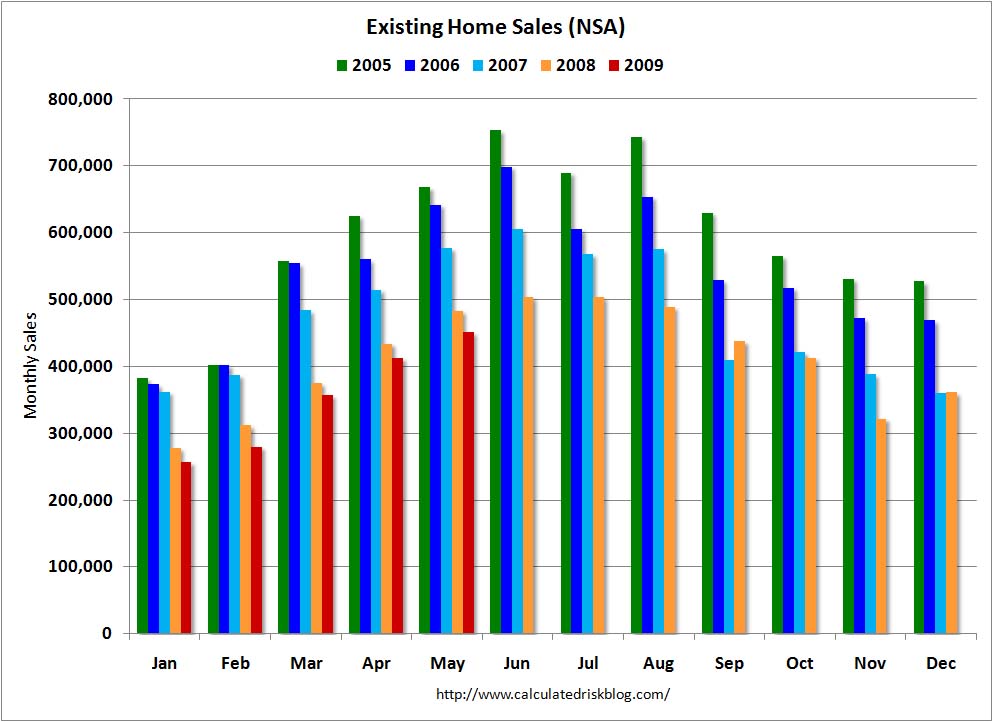
Barry Ritholtz at the Big Picture reports that in May existing home sales fell by 3.6% from May 2008.
"Sales in May 2009 rose 2.4% from April to 4.77 million. Note that these are apple and orange comparisons--revised to unrevised numbers. Once again, the prior monthly number was revised downwards (4.68 million down to 4.66 million)."
He links to a chart plotting monthly existing home sales from 2005 from Calculated Risk:


Meanwhile, Keiko Ujikane and Jason Clenfield at Bloomberg report that Moody's Aaa rating of US sovereign debt 'remains solid."
"'Although the US is losing altitude in the Aaa range, it is starting from a very strong base,' Cailleteau, who is chief international economist at Moody’s, said in Tokyo today. The economy is resilient enough to recover and the government is committed to raising taxes and cutting spending, he said."
8. BLOG COMPARING NEWS HEADLINES FROM GREAT DEPRESSION TO CURRENT CRISIS

An interesting new blog which gives headlines from the week 79 years ago in the Great Depression has been linked to general all over the economic blogosphere.

Monday, June 22, 2009

Daily Sources 6/22

1. GORDON BROWN ASKS MINISTERS TO FORMULATE PROPOSALS FOR HANDLING OIL PRICE, INCLUDING PLAN TO HAVE IMF ACT AS PRICE REGULATOR; CGES SAYS OPEC SHOULD INCREASE PRODUCTION TO HELP GLOBAL ECONOMIC RECOVERY, BUT WON'T; HAMILTON SHOWS CONSUMER SENTIMENT STRONGLY CORRELATED TO GAS PRICE; AIRLINES COMPLAIN TO OBAMA OF OIL SPECULATION; ANDY XIE ARGUES STIMULUS BACKED LENDING SURGE IN CHINA BEING INVESTED IN COMMODITY SPECULATION

Kate Mackenzie at FT Energy Source reports that UK Prime Minister Gordon Brown asked top ministers at the Treasury and the Department of Business to draw up plans for responding to high oil prices. Apparently the administration is also considering proposals by which the IMF would take a role in monitoring oil prices--and influencing price. (The IEA mostly acts as a data collector and canary.)
"Brown believes that the G20 meeting in London in the spring missed an opportunity to put in place measures to stabilize the oil price, after it fell from a peak of $147 a barrel to less than $35 early this year."
The idea currently being mulled could reportedly form a key element of the UK proposal at the G20 meeting to be held in Pittsburgh in October. In the meantime, Platts reports that the Centre for Global Energy Studies, based in London and led by former Saudi Arabian oil minister Ahmed Zaki Yamani,
"is forecasting that oil prices will rise steadily through the rest of this year, reaching $80/b in the fourth quarter, as OPEC continues to maintain its current levels of quota compliance."
The CGES argues that OPEC should raise production in order to moderate price and gird a potential economic recovery, but is choosing not to do so. James Hamilton at Econobrowser plots the correlation between gasoline price and US consumer sentiment (with the dashed line [RH] being the miles per dollar spent on gasoline and the solid line [LH] representing the Reuters/Michigan index of consumer sentiment):


He comments:
"So how should we assess the likely consequences of the fact that gas prices have now come back up significantly from their lows of December? The Edelstein-Kilian regressions employed in my paper from a recent conference at the Brookings Institution imply that a 20% increase in energy prices would historically be followed within 2 months by a 15-point drop in consumer sentiment and a 1.4% decline (relative to trend) in real consumption spending. From that perspective, the 46% (logarithmic) increase in (seasonally unadjusted) gasoline prices since December is quite worrisome.

On the other hand, since those December prices were 88% (logarithmically) below the July 2008 peak, consumers should have been giddy in December and still be significantly more sanguine now than they had been last summer, if the only thing on their mind was the price of gasoline.

Only problem is, consumers were anything but giddy in December. Credit and employment challenges have weighed far more heavily than gas prices over the last 9 months, and are presumably far more important than gas prices for determining what happens over the next few months as well."
A bit wonky, but nonetheless the must read of the day. And Kyle Peterson at Reuters reports that the Airline Transport Association sent a letter dated June 11 to President Obama, complaining of the role of speculators in the oil market:
"A repeat of last summer's astronomical crude-oil prices will bring the nation's economic recovery to a painful halt. ... Businesses that spend billions of dollars on fuel each year, already dealing with the impacts of decreased consumer spending, are especially vulnerable."
(h/t Kate Mackenzie at FT Energy Source.) In the meantime, Andy Xie on Friday had an opinion piece at Caijin Magazine where he argued that the lending inside mandated by the stimulus program has not been spent on "tangible projects" but in asset markets.
"There's little doubt that China's bank lending since last December has driven speculative inventory demand for commodities. Chinese banks lend for commodity purchases, allowing the underlying commodities to be used as collateral. These loans are structured like mortgages.

Banks usually have to be extremely cautious about such lending, as commodity prices fluctuate far more than property prices. But Chinese banks are relatively lenient. As an industrializing economy, China's support for industrial activities such as raw material purchases for production is understandable. However, when commodities are bought on speculation, lenders face high risks without benefiting the economy.
...
The international media has been following reports of record commodity imports by China. The surge is being portrayed as reflecting China's recovering economy. Indeed, the international financial market is portraying China's perceived recovery as a harbinger for global recovery. It is a major factor pushing up stock prices around the world.

But China's imports are mostly for speculative inventories. Bank loans were so cheap and easy to get that many commodity distributors used financing for speculation. The first wave of purchases was to arbitrage the difference between spot and futures prices. That was smart. But now that price curves have flattened for most commodities, these imports are based on speculation that prices will increase. Demand from China's army of speculators is driving up prices, making their expectations self-fulfilling in the short term."
The other must read of the day.

2. GLOBAL RETAIL SALES NUMBERS DOWN

Rebecca Wilder at News N Economics notes that retail sales are taking a serious hit globally. Here is her graph of retail numbers for Asia:


She observes:
"Out of the 27 countries listed below, 18 posted a positive average annual growth rate in 2008, while just 5 saw the same in 2009 ytd."
Worth reading in full.

3. WORLD BANK SAYS GLOBAL ECONOMY TO CONTRACT BY 2.9% IN 2009, TRADE TO FALL BY 9.7%

Timothy R Homan at Bloomberg reports that the World Bank released a report today forecasting that the global economy will contract by 2.9% in 2009, a rougher contraction than the bank previously forecast of 1.7%. Global trade is expected to fall by 9.7% versus the fall of 6.1% forecast in March.
"'Unemployment is on the rise, and poverty is set to increase in developing economies, bringing with it a substantial deterioration in conditions for the world’s poor,' the World Bank said. While the world is set to return to growth in the second half of 2009, a recovery will be subdued, the report said.

Reduced capital inflows from exports, remittances and foreign direct investment means 'increasingly grave economic prospects' for developing nations, the lender said. After peaking at $1.2 trillion in 2007, inflows this year may fall to $363 billion, it said."
4. SARKOZY TO GIVE "STATE OF THE UNION ADDRESS" IN VERSAILLES, OVERTURN CENTURY OF PRECEDENT

Emmanuel Georges-Picot at the Associated Press reports that French President Nicolas Sarkozy has decided to overturn 136 years of precedent and directly address both houses of the French parliament today at the Chateau of Versailles. Sarkozy means to use the event to establish a platform by which to address the country on big issues along the lines of the American "State of the Nation" address.
"The last presidential speech to France's parliament was in 1873, before lawmakers banned the practice to protect the separation of powers and keep the president in check."
5. MALAYSIA'S CENTRAL BANK TAKES KEY STEP IN DIRECTION OF PURCHASING YUAN-DENOMINATED DEBT AS RESERVE

Denis McMahon at the Wall Street Journal reports that the China Securities Regulatory Commission said on June 12 that it had approved the Malaysian central bank--Bank Negara Malaysia--as a qualified foreign institutional investor [QFII].
"That status allows the Malaysian central bank to invest in China's exchange-traded equities and debt, including Ministry of Finance bonds."
Potentially, therefore, Bank Negara Malaysia could act as the first central bank to buy Chinese debt as a reserve. However, Bank Negara Malaysia has yet to be approved by China's currency regulator to purchase renminbi. In February, China and Malaysia signed a currency swap agreement.

6. RUSSIA INVOLVED IN TAIWANESE JET FIGHTER UPGRADE, BELARUS & RUSSIA ANNOUNCE JOINT MILITARY EXERCISES

Yevgeny Bendersky at the Compass notes the recent report that Russia was involved in the development of the third generation fighter planes for the Republic of Taiwan.
"According to The China Times, Taiwan has begun work on a new military aircraft after appeals to the US with a request for the sale of 66 fighter aircraft F-16C/D. Washington, as previously reported, denied this request, not wanting to spoil relations with Beijing. Chinese journalists also point out that the plane, developed by a public company Taiwan Aerospace Industrial Development Corporation (AIDC), has two engines and has a short take-off capability. Its development, according to The China Times, was completed only after Russia sent its experts to Taiwan--the source did not specify what Russian organization or company they represented.

This is certainly a new turn for the Russian defense industry and presents a dilemma for the United States. Washington and Taipei have a very close defense relationship, even if certain military hardware is not sold to the ROC from time to time. Taiwan is one of the high-tech sources for a great deal of technology that powers high-tech American industry, as well as American military developments. Russians were always keen on seeing first hand how far Western--and US in particular--military development has advanced, since at this time, Moscow can only watch on the sidelines as America and her allies implement next-generation high-tech military gear. Did the Russians get a chance to see first hand the advanced technology that Washington sold to Taipei, and did they take good notes to take back with them? An even larger question is what this news may do to the Moscow-Beijing military cooperation. Russia has sold a wide variety of advanced high-tech aircraft to mainland China recently, including Su-27 multi-role fighter bomber. China, making sure it was able to level the playing field, quickly reverse-engineered the Russian plane and began its indigenous production under J-11 designation.

Russians recently expressed concern that China is making plans to produce its own version of an even more advanced plane that Russia sold to Beijing about 8 years ago--Su-30 Flanker multirole fighter, a more advanced version of Su-27. Since all of Taiwan's military aircraft are designed and fielded against mainland China, Russian know-how now is part of ROC's high-tech air force pointed at the mainland. One has to wonder what Beijing thinks about all this, and whether Moscow's action was a pay back of sorts for China deciding to copy Russian technology."
Bendersky also notes that Belarus and Russia announced their joint military exercises for 2009, on the back of the recent refusal of Minsk to join the Moscow-led Collective Security Treaty--see Daily Sources 6/15 #3.

7. TALIBAN OPERATIONS IN AFGHANISTAN AND PAKISTAN RE-CENTRALIZING

Matthew Rosenberg, Yochi J. Dreazen and Siobhan Gorman at the Wall Street Journal report that Mullah Omar, the head of the Taliban, has been reasserting direct control over the militants in their struggle with NATO in Afghanistan.
"'This is Quetta's answer to Obama's surge,' said a senior member of a militant network led by Gulbuddin Hekmatyar, an independent Afghan warlord who fights alongside the Taliban. He was referring to plans by the administration of President Barack Obama to send an additional 21,000 troops to Afghanistan over the next few months. The Quetta 'are not ready to lay down their weapons,' he said in an interview in the Pakistani city of Peshawar."
Omar is thought to lead the Taliban leadership council from the city of Quetta in south Pakistan. There are some indications that the effort to re-centralize decision-making for the Taliban is upsetting some lieutenants which may make them more amenable to US outreach efforts. Insofar as Omar is directing attacks at Islamic institutions in Pakistan, I suspect he is setting fire to his own bed.

8. ZADARI SAYS US TOO COZY WITH DICTATORS, ASKS FOR MORE MONEY

Pakistan's President, Asif Ali Zardari, has an op ed in today's Washington Post, which sounds more than a little like a rebuke. To wit:
"The West, most notably the United States, has been all too willing to dance with dictators in pursuit of perceived short-term goals. The litany of these policies and their consequences clutter the earth, from the Marcos regime in the Philippines, to the Shah in Iran, to Mohammed Zia ul-Haq and Pervez Musharraf in Pakistan. Invariably, each case has proved that myopic strategies that sacrifice principle lead to unanticipated long-term consequences."
His ask sounds more like a threat than a plea:
"We need immediate assistance. The Obama administration recognizes that only an economically viable Pakistan can contain the terrorist menace. The United States has committed $1.5 billion a year for five years to help stabilize our economy, and the House of Representatives and the Senate Foreign Relations Committee have acted decisively to reorient the Pakistani-American relationship toward not just a military alliance but a sustained economic partnership.

Now, the rest of the world must step up and match the US effort. Pakistan needs a robust assistance package so that we can deliver for the people and defeat the militants. And the rest of the world should again follow the American lead in helping us deal with the millions of internally displaced people who are the most recent victims of terrorism in our nation.

But aid is not enough. In the long term, Pakistan needs trade to allow us to become economically independent. Only such an economically robust Pakistan will be able to contain the fanatics and demonstrate to the 1.5 billion Muslims worldwide that democracy and economic development go hand in hand. Notably, the United States is moving forward with regional opportunity zones in Afghanistan and the Federally Administered Tribal Areas region of Pakistan that will remove trade barriers and provide economic incentives to build factories, start industries, employ workers -- and give hope to the people. This opportunity zone concept should be a model to Europe, as well. Europe must realize that it is in its own self-interest, as the United States has realized, to do everything possible to grow the Pakistani economy and to provide incentives for Pakistani exports to the continent."
I suspect that someone's PR advisers weren't thinking when they composed this. It is not exactly a secret that Zadari is known to his countrymen as Mr. 5% nor that he recently moved to try and bar his main opponent for the office of President from running for office and his brother from running the province he had been elected to govern. Insofar as he backed down in the face of the lawyers' movement, I feel that he is "committed" to rule of law and democracy, but the rhetoric of the piece is rather closer to that of Evita Peron than to Nelson Mandela. Should be read in full, of course.

9. CONTINUED US JOBLESS CLAIMS FALLING MOST LIKELY DUE TO INSURANCE EXPIRING

Barry Ritholtz at the Big Picture observes that the decline reported in continuing claims is not due to the unemployed finding work, but rather to their unemployment insurance expiring. He plots the "exhaustion rate" for jobless benefits:


and notes, "They are now unemployed AND broke. That is hardly a green shoot ..."

Friday, June 19, 2009

Daily Sources 6/19

1. COMPROMISE LEADS TO NEW IRISH REFERENDUM ON LISBON TREATY IN OCTOBER

Carsten Volkery at Der Spiegel reports that the EU leadership have agreed upon a compromise insisted upon by Dublin where guarantees of sovereignty will be included in the text of the Lisbon Treaty. As a result, Irish Prime Minister Brian Cowen has announced that Ireland will hold a referendum on the treaty in October.
"The EU has provided guarantees to Ireland that it will remain independent in determining tax policies, military neutrality and abortion law (Ireland has one of Europe's most restrictive abortion policies). The sovereignty guarantees are expected to be anchored in EU law as a treaty protocol in the mid-term future."
Polls show that the Irish appear more receptive to the treaty, given the current economic crisis. Well worth reading in full.

2. THE EU TO BEGIN CONSIDERING HOW TO TRANSFER CARBON CAPTURE TECH TO CHINA & INDIA

Pete Harrison at Reuters reports that a draft document from the European Commission suggests that the EU will begin to determine how best to help India and China develop carbon capture technology next week.
"The European Union will start a consultation process on how finance and technology should be delivered to China and later India. This could be critical in securing their commitment to a new global deal on climate change at talks in Copenhagen in December.

'China builds, every year, as much coal-fired power plant as the entire UK generating capacity,' said a report prepared for consultations with industry and seen by Reuters on Friday.

'Unless a way can be found of making this climate-compatible, we can never meet our climate objectives, regardless of what action we take in Europe,' it added."
3. CHINA PROTESTS ADB LOAN TO INDIA, 74% OF CHINESE RESPONDENTS REGARD INDIA AS A THREAT

The India Times reports that the Chinese foreign ministry has issued a statement condemning the Asia Development Bank's recent decision to approve a $2.9 billion loan to India, $60 million of which is earmarked for a watershed project in the Arunachal Pradesh, where the border between the two countries is disputed.


The statement said:
"China expresses strong dissatisfaction to the move, which can neither change the existence of immense territorial disputes between China and India, nor China's fundamental position on its border issues with India.
...
As a regional institution on development, the ADB should not intervene in the political affairs of its members. The adoption of the document has not only dealt a severe blow to its own reputation but also undermines the interests of its members."
India has recently been strengthening the defenses in the region, including moving additional troops into it. The Chinese media has in the past few weeks been attacking New Delhi for putting "fresh strains on the relationship." In an interesting data point, a recent poll in China found that 74% of respondents look upon India as a threat.

4. CHINESE IMPLIED OIL DEMAND RISES 5.96% IN MAY YOY

Winnie Lee at Platts reported yesterday that Chinese implied oil demand rose by 5.96% in May from the year previous. Crude imports rose by 3.55% to to 16.62 million metric tons (~ 3.92 mb/d). It is the second consecutive month where implied demand has risen year over year, which could be interpreted as a sign the economy is rebounding. On the other hand, the director of China's National Energy Administration, told reporters on June 1st that "a substantial portion" of the crude oil trade in the first half had been due to stockpiling, and seemed to indicate that China's tanks were full--see Daily Sources 6/1 #2.

5. FRANCE STATS OFFICE PREDICTS ECONOMY WILL STABILIZE IN Q4

Eurointelligence reports that French statistical office INSEE released its latest forecasts this morning which see the economy stabilizing in the fourth quarter.
"Employment is expected to continue to fall, for 2009 the loss is expected to reach 700,000 jobs in the private sector. Consumption growth is still positive (forecast at +0.7%), though saving rates are about to rise slightly. France seems thus in a much better position than the rest of the euro area, for which GDP is forecast to contract by 5.6% and consumption by -1.6%."
6. BANK OF MEXICO CUTS BENCHMARK INTEREST RATE TO 4.75%

Jens Erik Gould at Bloomberg reports that the central bank of Mexico today cut its benchmark interest rate by 0.5% to 4.75%.
"The [bank's] board 'considers that its easing cycle is close to ending,' the bank said in a statement. 'Future actions that might be taken will possibly be of smaller magnitude and consistent with both the evolution of the economy and the performance of inflation.'

The economic contraction has been 'severe' in the first half of the year, and is a greater risk than inflation, the bank said. The comments signal that it will probably cut a quarter point next month and then keep the rate unchanged for the rest of the year, said Gabriel Casillas, chief economist for Mexico and Chile at UBS AG."
7. ANGOLA STILL PLANS TO LAUNCH SOVEREIGN WEALTH FUND THIS YEAR

Henrique Almeida at Reuters reports that Angolan Finance Minister Severim de Morais said today that Luanda intends to launch a sovereign wealth fund in 2009 to invest its oil wealth abroad.
"Plans to create the fund, known as the Fundo Soberano Angolano, were announced in November by President Jose Eduardo dos Santos, but the project has since been delayed due to the global economic downturn.

Asked whether the fund would be launched this year, de Morais replied: 'Yes, our aim is to launch the fund in 2009.'"
8. CREDIT CARD SQUEEZE HURTING SMALL BUSINESSES, UNEMPLOYMENT IN THE WEST RISES TO 10.1% IN MAY

Yves Smith at naked capitalism notes that the credit card squeeze is hurting small businesses, historically the largest source of job creation in the US.
"The importance of credit cards as a source of funding to small companies has gone largely unnoticed in the wider world, yet is well know to experts on entrepreneurship. Indeed, Amar Bhide, in his landmark The Origin and Growth of New Businesses, pointed out that, contrary to popular mythology, venture capital played a trivial role in forming new businesses. Personal savings, loans or investments from friends and family, and credit card borrowings were the most important sources.

And before readers chide supposedly foolish owners for paying interest, consider: using credit cards includes the astute use of float, which can give companies six or seven weeks of free money. And in better days, card companies offered products targeted to small business owners with favorable rates, often from 9% to 14% (and also offered them even cheaper 'life of the balance' deals, now a distant memory). With interest tax deducible, this was a viable source of funds, particularly for companies that faced short-term financing needs, such seasonal sales patterns.

As we noted, American Express, first to target small businesses, halted its credit line programs as of early 2009 (regular corporate ards for small businesses are still in effect). Advanta, which focused solely on this market, has found itself saddled with a heap of bad debt (default rates of 20%) and has stopped extending new credit as of early June."
Well worth reading in full. Meanwhile, the Associated Press reports that the Labor Department announced today that the unemployment rate rose to 10.1% in the American West in May.
"By region, the Midwest had the second-highest rate, at 9.8%, underscoring the toll of job losses in manufacturing. The South’s unemployment rate was 8.9%, and the Northeast had the lowest at 8.3%."
Unemployment rose in all but two states last month.

Wednesday, June 10, 2009

Daily Sources 6/10

1. GERMAN EXPORTS FALL BY 29% YOY IN APRIL; THE ECB FORECASTS THAT WEAKNESS IN THE FINANCIAL SECTOR IS LIKELY TO PREVENT ECONOMIC RECOVERY IN THE EUROZONE UNTIL 2010; THE IMF CALLS FOR A REAL ACCOUNTING OF THE EUROPEAN BANKING SECTORS BOOKS

BBC reports that German exports fell by 29% in April from the year previous, per the Federal Statistics Office. (Exports fell by 4.8% in April from March, when they had risen unexpectedly from February.) The economics ministry reported that industrial production fell by 21.6% in April compared with April 2008. On Monday, Walter Münchau noted that it was unlikely, given the current situation, for export-led economies to be able to export their way out of the recession. He further remarked that perhaps the Merkel Administration's apparent decision to push for allowing the euro to appreciate versus the dollar (and other currencies) could exacerbate the situation for Germany--see Daily Sources 6/8 #2. Joellen Perry at the Wall Street Journal reports that officials at the European Central Bank are concerned that financial sector weakness could prevent the eurozone from expanding before the middle of 2010, as per the remarks of Yves Mersch, the head of Luxembourg's central bank and a member of the ECB's Governing Council.
"The ECB expects the euro zone's first quarter--when output contracted by an annualized rate of nearly 10%--to mark the recession's trough, Mr. Mersch said. But he cautioned against overplaying recent signs of stabilization: 'We are reaching the valley, but we have to walk through the valley.'"
Well worth reading in full. A graph plotting the IMF's forecast of eurozone economic growth going forward from the IMF Survey published on Monday:


Meanwhile, Ambrose Evans-Pritchard at the UK Telegraph reports that the IMF's managing director, Dominique Strauss-Kahn, has called on the eurozone countries to take urgent steps to clean up their financial sector.
"To restore confidence, you need total disclosure of possible losses. Not only losses which are linked to the original sub-prime crisis, but also the losses linked to the slowdown in the economy, and impaired assets. There are lots of things that still have to be disclosed."
Strauss-Kahn went on to say that,
"Stresses persist, conditions for access to bank lending are tight, funding costs remain high. Sizeable losses lie ahead as the recession unfolds. The financial sector is hamstrung in fulfilling its vital intermediation role."
The IMF suggested that eurozone banks will need to raise an additional $375 billion as compared to $250 billion for US banks and called for stress tests along the lines of what was imposed by the US Treasury.

2. JAPAN ANNOUNCES GOAL OF REDUCING GREENHOUSE GAS EMISSIONS BY 8% FROM 1990 LEVELS BY 2020; EXPECTED TO ANNOUNCE $2 BILLION IN CLIMATE PROTECTION LOANS TO BANGLADESH, PHILIPPINES, THAILAND, AND VIETNAM

Shingo Ito at the AFP reports that Japanese Prime Minister Taro Aso said today that the government has set as a goal the reduction of greenhouse emissions by 8% from its 1990 levels by 2020.
"Aso said 'Japan must take the initiative in spearheading a global trend,' arguing that the target surpasses US and European goals because, unlike theirs, it does not factor in carbon trading or sequestration through forestry.

Japan's figure is far below the target announced by the European Union, which has said it would slash emissions by 20% from 1990 levels, or by 30% if others set a similarly ambitious goal."
On the other hand, Japanese power consumption has been steadily declining for some time now--in large part because of demographic changes. Mr. Aso also gave Japan's goals for 2050 for a 50% emissions cut, which matches the European Union's goal. In the meantime, Earth Times reports that Japan was expected to announce $2 billion in yen loans to Bangladesh, the Philippines, Thailand and Vietnam over two years for climate protection efforts. On April 29, China, India and South Africa called for at least $200 billion in aid from the developing nations to combat global warming--see Daily Sources 4/29 #1. In late May, African environmental ministers called upon the developed world for aid in combating climate change--analysts have argued that the countries would require at least $1 billion a year in order to effect change--see Daily Sources 5/29 #8.

3. CHINA'S CONSUMER PRICES FALL 1.4% YOY IN MAY, BUT HOUSE SALES VOLUMES INCREASE BY 27% IN JAN-MAY FROM 2008 PERIOD; CHINESE COMMODITIES PURCHASES ARE WELL IN EXCESS OF THE TREND HAD GROWTH CONTINUED AS USUAL FROM 2007

Terence Poon at the Wall Street Journal reports that China's consumer price index fell 1.4% in May from a year previous for the fourth straight month, according to data released by the National Bureau of Statistics today.
"Food prices, a key component of the CPI, fell 0.6% in May from a year earlier, but the decline was smaller than the 1.3% drop in April. The price of grains, a raw material of many food products, has risen sequentially for the past five months, the bureau said, adding 'it remains to be seen if the rise in grain prices will affect future CPI trends.'

China's domestic property market is also showing signs of a sustained recovery. The year-on-year drop in property prices in 70 of China's large and medium-sized cities shrank to 0.6% in May from 1.1% in April, the National Development and Reform Commission said Wednesday."
Further, the volume of housing sales grew by 27% in the period from January to May over the same period in 2008. Meanwhile, MacroMan has a fascinating post on the volume of imports of various raw materials, and notes that they are well-above the trend had China's economy continued to grow at the rates it had previous. His chart for coal:


His chart for copper:


He further notes that Chinese oil imports have returned to trend, and thus suspects that the additional demand is not likely responsible for the boost in price. (I think this reading is wrong, because it has to be taken in the context of OPEC taking a lot of supply off the market and the fact that implied oil consumption is well down, far below what Chinese GDP statistics would imply.) MacroMan summarizes:
"even if China manages to maintain its recent growth path over the next few quarters, its recent commodity buying spree might mean that it buys much less from the rest of the world than one might normally expect, perhaps with the exception of crude oil (the only commodity where Macro Man retains a long exposure.)

For now, the China syndrome giveth....but if Macro Man were long high-beta plays on Chinese growth, he'd be concerned that at some point, the China syndrome may taketh away."
Indeed, and this is the must read post of the day. Again, I think his relative bullishness on oil is misplaced, however, given the director of China's National Energy Administration telling reporters that all available crude storage was full, the State Council Information Office taking reporters on tours of previously secret strategic petroleum reserves apparently so they could confirm this with their own eyes, and the study of satellite images by Sanford Bernstein which suggest that as much as 400 kb/d of additional Chinese oil demand was going straight to those SPRs--see Daily Sources 6/9 #4.

4. US, RUSSIA, AND CHINA AGREE ON DRAFT SANCTIONS ON NORTH KOREA

Colum Lynch at the Washington Post reports that the US, China, and Russia have agreed upon a draft UN resolution which would condemn North Korea's April 5 nuclear test and impose additional military, financial and trade sanctions on Pyongyang. The draft has been presented to the full Security Council and its adoption is expected as early as Friday. In an interesting comment in the Wall Street Journal, Edward N. Luttwak, senior adviser at the Center for Strategic and International Studies, writes that the best diplomatic method of dealing with Pyongyang for the US just now is radio silence. His conclusion:
"The North Korean regime never yielded anything of significance in past negotiations, which have served nobody but them. This time, provocation must not be rewarded. Evidently, the North Korean aim is to evoke more attention, more offers of concessions, more gifts. They must receive nothing at all. Talking has failed utterly. Silence might yet persuade the North Koreans to improve their behavior."
Insofar as North Korea's goal is to have official direct talks with the US, in a way this policy is already in place, though perhaps no response will have the desired effect of moderating Pyongyang's provocative behavior. However, I wonder whether it would be seen as deliberately complicating a "soft solution" desired by Beijing, as evidenced by Tsinghua University professor Sun Zhe's recent interview, where he indicated that China's primary concern regarding North Korean intransigence is that Tokyo will decide to build its own nuclear deterrent--see Daily Sources 6/1 #4. Also, to do so would seem to simply abandon the initiative the US might have in orchestrating "Great Power" coordination on the issue, as per Kissinger's advice--see Daily Sources 6/8 #3.

5. RUSSIA COMMITS TO CONTINUING CURRENT LEVELS OF OIL PRODUCTION, APPARENTLY HAS NO INTENTION OF COORDINATING WITH OPEC; KUWAITI OIL MINISTER SAYS THAT $60-75/B OIL OK FOR WORLD, BUT THAT OPEC WOULD NOT CUT UNLESS PRICES HIT $100/B

The Associated Press reports that Russian Deputy Prime Minister Igor Sechin told Interfax that:
"We are not planning to cut the production in the next three years, but it may happen afterward if there is no investment in exploration and production."
Sechin also indicated that Russia was not interested in capping exports, saying "Exports have become more economically reasonable. So why cut it?"--apparently putting the nail in the coffin of the notion of Russia joining OPEC, worrisome at the time as it would have signified a tectonic shift in Russian foreign policy strategy--see Daily Sources 12/10 #8. Meantime, Fiona MacDonald at Bloomberg reports that Kuwait's Oil Minister Sheikh Ahmed al-Abdullah al-Sabah told reporters that OPEC would only consider increasing production if the price of oil hit $100/b.
"Oil prices have increased because investors have bought crude as a hedge against a weakening US dollar, not because demand is rising, Sheikh Ahmed said.

'The numbers, in terms of economic recovery, are not with the rise of oil,' he said. OPEC is seeing signs of an increase in demand for oil in Asia, Sheikh Ahmed said, 'but overall we don’t see any rise in demand. That’s why we should be cautious not to be driven by the market.'"
This statement is on top of the report by Miriam Amie at Platts yesterday where Sheikh Ahmed indicated that the market was not being driven by fundamentals, but that prices between $60-75/b were acceptable.
"But Sheikh Ahmed warned that a return to $100/b oil would harm the global economy and fuel inflation.

'Hopefully it will not jump to the hundreds, because this will fuel recession,' he said, adding that it would be like 'going back to square one.'"
6. BRAZIL AND RUSSIA ANNOUNCE PLANS TO PURCHASE $20 BILLION IN SPECIAL DRAWING RIGHTS-DENOMINATED BONDS FROM THE IMF, SAY CHINA PLANS A $50 BILLION PURCHASE, INDIA MAY FOLLOW SUIT

Alex Nicholson and Andre Soliani at Bloomberg report that Brazil and Russia announced plans to purchase $20 billion in bonds from the IMF denominated in special drawing rights.
"Alexei Ulyukayev, first deputy chairman of Bank Rossii, said today Russia will cut the share of US Treasuries 'because a window of opportunity for working with other instruments is opening,' according to Interfax news wire. Russia may also place more of the reserves in deposits with foreign banks, he said. The remarks were confirmed by a Bank Rossii official who declined to be named, citing bank policy."
Brazil’s Finance Minister Guido Mantega said of the move:
"For us, there is no interest in weakening the dollar, because when the dollar weakens the real gets stronger and when the real get stronger the exchange rate trips our exports up a bit. What we really want is that other currencies are also behind international transactions."
Mantega also indicated that China will purchase $50 billion of the IMF bonds and that India may well announce something along the same lines.

7. CNPC REPLACES TOTAL IN PHASE 11 OF IRAN'S SOUTH PARS

Reports of Total's ouster from Phase 11 of South Pars were not premature after all, or so I take it given Sanchez Wang at Bloomberg's report that NIOC released a statement saying that it had signed a $5 billion contract with CNPC for that stage of the natural gas development.

8. RAFSANJANI PUBLISHES OPEN LETTER TO LEADER OF REVOLUTION CALLING ON HIM TO CURB PRESIDENT AHMADINEJAD AS TENS OF THOUSAND SUPPORTERS OF PRESIDENTIAL CANDIDATES HIT THE STREETS IN TEHRAN, BRINGING CITY TO A HALT

Thomas Erdbrink at the Washington Post reports that Ayatollah Rafsanjani, former President of Iran and head of the Council of Experts (which determines who is qualified to be the Leader of the Revolution [LOTR]) as well as the Expediency Council (which settles legislative disputes between the Iranian Parliament and the Guardian Council), published an open letter to LOTR Ayatollah Khamenei complaining the he had not acted in the face of President Ahmadinejad's "insults, lies and false allegations" in a televised debate between the President and presidential candidate, former prime minister Mir Hossein Mousavi. Rafsanjani, and by implication other members of the revolutionary old guard in Iran such as Mousavi himself, were called "corrupt" by the President in the televised debate. Rafsanjani wrote:
"If the system cannot or does not want to confront such ugly and sin-infected phenomena as insults, lies and false allegations made in that debate, how can we consider ourselves followers of the sacred Islamic system?"
The letter was published as tens of thousands of supporters for both candidates filled the streets in Tehran, reportedly bringing the city to a halt. Juan Cole at Informed Comment links to reports that Mousavi appears to have detached key support from the Iranian Revolutionary Guards Corps from Ahmadinejad, the main basis of Ahmadinejad's power--a struggle over which may have led to Ahmadinejad's louder than usual complaints of corruption. Michael Collins Dunn at the Middle East Institute Editor's Blog notes that every incumbent president who has run again in Iran has won, so a Mousavi victory would indeed be an upset. He remarks:
"if Ahmadinejad is voted out in Iran, we should not try to claim a great victory: nothing would taint a President Mousavi more, and Khatami never recovered from being portrayed as too soft toward the West."
The links and commentary by both Cole and Dunn are well worth going through, should you have time.

9. RICHMOND FED CHIEF SAYS GROWTH IS WHAT WILL TRIGGER FED FUND RATE HIKES; TIPS YIELDS AND GOOGLE TRENDS SUGGEST INFLATION IS OVERTAKING DEFLATION AS GEN PUBLIC'S CONCERN RE: ECONOMY

Judith Burns at Real Time Economics reports that Richmond Federal Reserve Bank President Jeffrey Lacker told reporters today that
"I think growth is likely to warrant rates as low as they are now for some time. We’ll just have to wait to see how the growth process unfolds for some time."
Lacker added:
"I think the growth process needs to govern our rate decisions and I think the growth process is more important in governing our rate decisions than the unemployment rate per se."
On Friday, Atlanta Fed President Dennis Lockhart suggested that the FOMC should be "anticipatory," and not wait too long to raise the federal funds rate following even more hawkish remarks by Kansas City Fed President Thomas Hoenig, who warned of "significant" inflationary pressures. On that news, the yields on two-year treasuries shot up to an eight-month high on speculation that the FOMC would raise rates in its November meeting--see Daily Sources 6/5 #12. In the meantime, Kelly Evans, also at Real Time Economics, reports that:
"This morning, the 'breakeven' or expected inflation rate for securities [TIPS or Treasury Inflation Protected Secutires] maturing next April moved into positive territory for the first time since the financial crisis intensified in mid-September. That essentially means investors in these securities of any maturity no longer expect deflation to set in by next spring--or indeed at any other point in the future. The 'breakeven' rate on ten-year securities is now over 2%; earlier this year, it was 0%. For 30-year investments, expected inflation is even higher, at about 4.7%."
Evans remarks on another, "unscientific"--though I'm not sure what's so scientific about implied inflation expectations via TIPS, indicator recently was that the number of google searches for "hyperinflation" look set to pass the number of google searches for "deflation":


Both measures seem, to me at least, to be barometers of speculation regarding future conditions--though perhaps, and just perhaps--for there is no precise way to measure this, the expectations inferred from the treasury markets are better informed expectations.

10. HOMEOWNER EQUITY IN HOUSEHOLD REAL ESTATE HAS FALLEN BY NEARLY 50% OF GDP; US IMPORTS AND EXPORTS CONTINUE TO FALL IN APRIL; GASOLINE PRICES RISING ENOUGH TO BEGIN TO SIGNIFICANTLY EAT AWAY AT STIMULUS

Felix Salmon at Reuters notes that homeowner equity in household real estate has declined nationally by nearly 50% of GDP.


Yves Smith, at Naked Capitalism, through whom this piece came to my attention, points out that the bubble begins in 1997. Salmon notes:
"It’s easy to see why this recession is so severe, if you think about the unsustainable consumption boom fueled by mortgage equity withdrawals between 1997 and 2006. The loss in wealth during the dot-com bust might have been similar, but the effect on consumption wasn’t nearly as big: people weren’t borrowing against their tech stocks in order to buy new kitchens."
Put that in the context of Rebecca Wilder's observation that consumer credit is retrenching for pretty much the first time ever in the US both on the back of savings, but also credit card companies slashing credit lines--see Daily Sources 6/8 #15 for an excellent graph of hers--and the average number of work week hours declining to levels not seen since 1964 combined with expectations of more layoffs--see Daily Sources 6/9 #7--it is hard to see the economy recovering on the back of consumption any time soon. (Household consumption is said to account for about 70% of US GDP.) And, in what could be interpreted as evidence backing this concern, Rebecca Wilder at News N Economics reports that the Census Bureau today reported that April imports were down $2.2 billion from March and April exports were down $2.8 billion from March. She plots a graph of US trade since January 2008 showing that trade is down 20-30% from then:


Her blog is always worth a look. The EIA reports that for the week ended June 8, the national average price of gasoline was up $0.10/gallon to $2.624/gallon--at the bottom of the range at which I deduce Americans start driving less, or at which you see further declines in oil demand.

Peter Boockvar at the Big Picture comments on the price of gasoline:

"To quantify, the US uses about 9mm barrels of gasoline per day with 42 gallons in each barrel, thus 378mm gallons per day and almost 140b per year. Therefore, for every $1 move in the price of gasoline, it’s an extra $140b more in consumer spending at the pump. If gasoline prices stay elevated, it will dramatically dilute the tax cut portion of the Obama stimulus plan. On Feb 17th, Pres Obama signed the $787b stimulus plan that included $237b of ‘tax relief’ for individuals, $116b of which was a temporary payroll tax credit for income earners under a certain level."
Chief US economist at IHS Global Insight Nariman Behravesh's rule of thumb is that a $0.10 drop in gas prices equates to about a $12 billion tax cut--see Daily Sources 11/18 #2.

11. US COMMERCIAL CRUDE STOCKS FALL

The EIA reported that for the week ended June 5, commercial stocks of crude oil fell by a whopping 4.4 million barrels. They are still well above the historical range for this time of year, but the move was in contrast to analyst expectations of a 100k stock build, per a Bloomberg survey. Gasoline stocks also fell by 1.6 million barrels,are below the historical average for this time of year, and in contrast to analyst expectations of a 750k barrel build. The surprise however, was that distillate stocks also fell by 300k barrels. Stocks are well above the historical range for this time of year, but the draw was counter-cyclical--and surprising given recent rail and truck freight data--see Daily Sources 6/8 #14.

12. REPORT ARGUES THAT OIL SHALE WATER USE WILL COMPETE WITH WATER DEMAND FOR URBAN GROWTH AND AG USE, MAY RESULT IN "CALL" PROTECTING DOWNSTREAM CONSUMPTION RIGHTS; WATER SHORTAGE IN SAN JOAQUIM VALLEY

Jeremy Miller at Green Inc. writes that a report by the non-profit Western Resource Advocates released in March argues that increased water use for oil shale in the Colorado’s Piceance Basin:
"could hamper urban growth in the Rocky Mountain Front Range, threaten agriculture and critical habitat for endangered fish and increase the likelihood that Lower Basin states like Nevada, Arizona and California would issue a 'call'--a legal decree that forces junior upstream water rights holders to reduce, or eliminate altogether, water use until senior downstream rights are met."
The Western Resource Advocates report can be found here. Meanwhile, the Western Farm Press reports that legislation to protect Delta smelt has reduced water deliveries to San Joaquin Valley farmers by 90% and may cost the area as much as 45,000 jobs. (h/t Aquafornia.)