Showing posts with label un. Show all posts

Wednesday, August 11, 2010

Daily Sources 8/11

CHINESE ECONOMY SLOWING SOME FROM BREAKNECK SPEEDS

Keith Bradsher at the New York Times reports that the Chinese economy is slowing:
"The gradual slowing in China is evident in the factories that have turned the country into the manufacturing center of the world. Industrial output rose 13.4 percent last month compared with the same month last year.

By comparison, industrial output had been up 13.7 percent in June from a year earlier, and was up 16.5 percent as recently as May.

Much the same pattern was evident in fixed asset investment, which was up 24.9 percent last month compared with a year earlier. It had been ahead by 25.5 percent in June, and 25.9 percent in May.

Retail sales rose 17.9 percent in July compared with the same month last year, as Chinese consumers with rising wages continued to flock to stores for ever more spending. But sales had grown 18.3 percent in June compared with a year earlier, and had been up 18.7 percent in May."
What we would do for such growth!

RUSSIA DEPLOYS S-300 MISSILE SYSTEM IN ABKHAZIA

Dmitry Solovyov at Reuters reports that Russia has deployed a S-300 missile system in Abkhazia.
"The S-300, codenamed 'Favorite' in Russia, is a mobile, long-range air defense system that can detect, track and destroy ballistic missiles, cruise missiles and both high- and low-flying aircraft."
RUSSIAN ECONOMY GROWS BY 5.2% IN THE SECOND QUARTER FROM A YEAR EARLIER

Maria Levitov at Bloomberg reports that the Russian Federal Statistics Service said today in an email that its second quarter economic growth came in at 5.2% over the second quarter of last year.

IEA REPORTS THAT IRANIAN IMPORTS OF GASOLINE HURT BY SANCTIONS; TURKEY INDICATES IT WILL NOT COMPLY WITH GASOLINE SANCTIONS ON IRAN

Carola Hoyos at the Financial Times reports that the most recent IEA report says that the tougher sanctions on Iran have halved Tehran's gasoline imports.
"As a result Iran has been forced to pay a 25 per cent premium to market prices for its petrol deliveries as many companies shy away from supplying the country, the International Energy Agency reported on Wednesday."
Meanwhile, Orhan Coskun at Reuters reports that the Turkish Energy Minister told the wire service that Ankara will support sales of gasoline to Iran.
"Tupras, Turkey's sole refiner and gasoline exporter which is owned by Koc Holding, declined to say whether the company had sold anything to Iran. The refiner buys 33 percent of its crude from the Islamic Republic, however."
Also, if I remember correctly, Turkey imports some natural gas from Iran.

UN APPEALING FOR $459 MILLION FOR FLOOD RELIEF IN PAKISTAN

The Associated Press reports that the UN is appealing for $459 million in order to help flood victims in Pakistan.
"The UN Office for the Coordination of Humanitarian Affairs said 'the worst monsoon-related floods in living memory' has affected more than 14 million people and at least six or seven million require immediate humanitarian assistance including food, clean water, shelter and medical care."
AN OVERVIEW OF THE INDIAN ENERGY SECTOR

Utpal Bhaskar and Elizabeth Roche at livemint.com gives a pretty good overview of the energy situation facing India.

VENEZUELA AND COLOMBIA REINSTATE DIPLOMATIC RELATIONS; COLOMBIA INDICATES THAT IT IS OPEN TO TALKS WITH FARC REBELS

The BBC reports that Colombia and Venezuela reinstated diplomatic relations yesterday. Relations were cut off after the Colombian government accused Venezuela of allowing Colombian rebels to operate from Venezuela. Juan Forero at the Washington Post reports that the new Colombian President, Juan Manuel Santos, has indicated that the government is open to talks with FARC.

BRAZILIAN GROWTH Q-O-Q WAS 1.32%

Andre Soliani and Iuri Dantas at Bloomberg report that Brazilian growth from the second quarter over the first quarter was at 1.32%, "compared with a 2.45% jump in the first three months of the year."
"Latin America’s biggest economy is regaining speed in the third quarter, growing 5 percent to 6 percent, after slowing in the second quarter, Finance Minister Guido Mantega said yesterday. Brazil’s gross domestic product expanded 9 percent from a year earlier in the first quarter, the fastest rate since 1995, led by domestic demand and a record rate of investment."
FOMC LEAVES BENCHMARK INTEREST RATE UNCHANGED

The Federal Open Market Committee left the US benchmark interest rates at 0-0.25% yesterday. Real Time Economics hosts the full statement of the FOMC.

US TRADE DEFICIT RISES TO $50 BILLION

Free Exchange reports that the US trade deficit rose to $50 billion:


FOOD PRICES TO STAY HIGH IN NEAR FUTURE; US WILL TAKE ADVANTAGE OF RUSSIAN BAN ON WHEAT EXPORTS

Michael Schuman at the Curious Capitalist reports that food prices are likely to stay high by the standard of recent history.
"But whatever happens to wheat over the next few weeks, food is still expensive by the standards of recent history, and is likely to stay that way. The Organization for Economic Cooperation and Development and the Food & Agriculture Organization spelled that out in a June report. Their outlook sees average wheat and coarse grain prices between 15% and 40% higher in real terms (adjusted for inflation) over the next 10 years than their average levels during the period between 1997 and 2006. Real prices for vegetable oils are projected to be more than 40% higher, while dairy prices are forecast to be on average between 16% and 45% percent higher."
Meanwhile, Alan Bjerga at Bloomberg reports that the US has been contacted by grain importers to see if the US can fill orders for wheat that have been cut off by the recent ban on wheat exports by Russia.
[Agriculture Secretary Tom] Vilsack said he expects markets to stabilize as more information on the drought’s effects, including tomorrow’s USDA crop forecasts, becomes available.
EIA REPORTS THAT CRUDE OIL STORAGE FELL BY 3 MILLION BARRELS IN WEEK ENDED AUGUST 6TH

The EIA today reported that stocks of crude oil fell by 3 million barrels to 355 million barrels the week ended August 6th. The amount of crude in storage is well above the historical average. Gasoline stocks rose by 0.4 million barrels countercyclically and distillate stocks grew by 3.5 million barrels. Both are also well above the historical average. Refining capacity utilization fell to 88.1%. The national price of gasoline rose 4.8 cents to 278.3 cents in the week ended August 9th.

Wednesday, July 29, 2009

Daily Sources 7/29

1. UN WARNS THAT DEVELOPED WORLD WILL FACE WATER PROBLEMS DRIVEN BY GLOBAL WARNING AND OUTLINES GRIM SCENARIO FOR DEVELOPING WORLD

Thalif Deen at IPS reports that UN Secretary-General Ban Ki-moon yesterday said that
"The United States, Spain, Australia and the Netherlands are likely to face the consequences of climate change resulting in water-related disasters, including droughts, floods, hurricanes and sea-level rise.

'Even the world's richest nations are not immune,' UN Secretary-General Ban Ki-moon warned Tuesday.

Citing official US figures, he said the state of California, the world's fifth largest economy, 'could see prime farmland reduced to a dustbowl, and major cities running out of water by the end of the century'.

Blaming it on the negative impact of global warming, he said that climate is changing--globally. 'And so, therefore, must we.'

He quoted scientists as saying that by 2020, 75 to 250 million people in Africa will face growing shortages of water due to climate change.

'Yields from rain-fed agriculture could fall by half in some African countries in the next 10 years. These are frightening scenarios,' he declared."
(h/t Aqua Blog Maven at Aquafornia.)

2. JAPANESE RETAIL SALES DOWN 3% YOY IN JUNE

Toru Fujioka at Bloomberg reports that Japanese retail sales fell 3% year over year in June, from May they fell 0.3%.
"'The worst is over but that doesn’t completely wipe out households’ concerns,' said Takeshi Minami, chief economist at Norinchukin Research Institute in Tokyo. 'Japan’s recovery will be weak until a pickup in jobs and wages boosts consumer spending.'"
3. CHINA CUTS GASOLINE AND DIESEL PRICES

Wan Zhihong at China Daily reports that Beijing has cut the prices of gasoline and diesel by 220 yuan per ton or 3%, effective today.
"This equals price cut of 0.16 yuan per liter in gasoline prices (~$0.089/gallon) and 0.19 yuan per liter (~$0.105/gallon) in diesel prices. It is the second price cut on fuel prices this year.

The price cut was in response to recent falls in global crude prices, according to the National Development and Reform Commission (NDRC), the country's top economic planning body.

China adopted a new oil pricing system this year, under which domestic fuel prices would be adjusted when the moving average of a basket of international crude (Brent, Dubai and Cinta) changes more than 4% over a period of 22 working days."
Bloomberg reports:
"Pump prices for 90 octane gasoline will be set at a maximum of 5.7 yuan ($0.83) a liter, or about $3.14 a gallon, in Beijing, the National Development and Reform Commission said in a statement on its Web site. Prices were adjusted to reflect the decline in global crude prices, said China’s top planning agency."
The reduction in price will encourage demand, of course.

4. MANUFACTURERS SAYS CHINESE COST OF LABOR NOT FALLING IN RESPONSE TO GLOBAL DOWNTURN, REPORTS OF ILLUSORY REAL ESTATE BOOM

The American Chamber of Commerce recently released a report which says that the cost of labor is not falling substantially in China despite the global economic slowdown.
"Even with the current economic conditions, manufacturing in China has become more expensive. Companies reported that costs are still rising--up to 15% in 2008 compared to an increase of 10% in 2007--particularly in compensation costs for management, support staff and blue-collar workers as well as raw materials. Although labor and raw materials costs have come down from the premium levels of last summer, they are expected to rise again once market conditions improve.

Finding reliable, experienced talent has always been a challenge in China and despite rising unemployment during the current downturn, companies must ensure turnover remains at a minimum for when growth resumes.

• 86% of companies reported implementing pay-for-performance compensation plans.
• 62% of companies said they were providing training and development programs."
(h/t Carlos Tejada at the China Journal.) Meanwhile, China Stakes reports that while the Chinese real estate market appears to be in the midst of a boom, defaults are on the rise.
"Statistics show that from May 1 to July 24, which seemed to be good days for Shanghai's real estate market, many housing projects were seeing over 30% cancellations, and the cancellation rate of some projects was as high as 125%. Behind the 'boom' of the housing market are irregular behaviors such as getting bank loans by cheating and making fake housing purchasing contracts.

Among the top ten housing projects with the highest cancellation rates, 60% are developments by small and medium real estate companies. 'In fact, it is still difficult for small and medium developer to get credit support from banks,' said a sales manager of a medium real estate company.

Now it is common for developers to sell an apartment to an employee as a "reward" and then secure a loan from a bank with the housing purchasing contract signed by the employee. 'There's a window between the sale and the issuance of housing ownership certificate, during which employees can decide whether to keep or cancel the contract,' the sales manager added."
Prieur du Plessis at Investment Postcards from Cape Town links to a video of Hugh Hendry
"walking around the streets of China (presumably Beijing or Shanghai) and pointing out numerous empty buildings. Huge debt must have been incurred in erecting these buildings and without tenants there is no prospect of servicing the debt. What’s more, the workmanship also seems shoddy as a nearly-completed 13-story building in Shanghai collapsed last month.

Who will pick up the tab for creating all the overcapacity in the Chinese economy?"
Worth checking out.

5. EUROZONE BANKERS TIGHTENING CREDIT, FRUSTRATING STIMULUS EFFORTS

Margot Patrick, Laurence Norman, and Nina Koeppen at the Wall Street Journal report that the European Central Bank released a report today showing that eurozone banks continued to tighten credit in the second quarter, frustrating efforts at stimulus.
"Banks in the 16-country euro zone further tightened their credit standards in the second quarter, and companies and households may even face slightly tougher requirements in the current quarter, the European Central Bank said in a report on bank lending released Wednesday."
"'Access to credit has become clearly more difficult,' said Ifo Institute President Hans-Werner Sinn, commenting on the think-tank's latest credit constraint survey for German industry and trade, also published Wednesday. 'Despite the expansive monetary policy of the ECB, banks have become more restrictive in granting credit,' Mr Sinn said."
Worth reading in full.

6. TURKISH CENTRAL BANK GOVERNOR INDICATES RATE CUTS TO CONTINUE


Ali Berat Meric and Steve Bryant at Bloomberg report that the governor of the Turkish central bank--Durmus Yilmaz--has indicated that it will continue to cut the benchmark interest rate and is unlikely to raise the rate until some point in 2011.
"The bank reduced its forecast for year-end inflation to 5.9% from 6%, assuming that 'policy rates are further lowered in the short term and held unchanged until the end of 2010,' Yilmaz said at a news conference in Ankara today. Inflation was 5.7% in June, compared with the bank’s year-end target of 7.5%."
7. BAGHDAD PLEDGES SUPPORT IN SUPPRESSING THE PKK

Thomas Grove and Pinar Aydinli at Reuters report that Iraqi Minister of State for National Security Shirwan al-Waeli told a news conference in Ankara that Baghdad will cooperate with Turkish and American efforts to suppress the Kurdish Workers' Party (PKK) until it is eliminated.
"Waeli and Turkish Interior Minister Besir Atalay told the joint news conference they expected concrete results of their cooperation by the time they meet again in Iraq in October but provided no further details."
8. IRAQI CABINET APPROVES THE RE-INCORPORATION OF A NATIONAL OIL COMPANY, OIL EXPORTS AND REVENUES INCREASE

Dow Jones Newswires reports that the Iraqi cabinet yesterday approved a law which would establish an Iraqi national oil company; it now must be approved by the parliament.
"The reinstated national oil company would act as the parent of the existing three major Iraqi oil operators--the South Oil Co., Iraq's largest petroleum company in Basra; North Oil Co. in Kirkuk; and Missan Oil Co. in Ammarh in southern Iraq."
"'In the new draft law we didn't mention the fields that the new company would run,' [Thamir] Ghadhban [an energy adviser to Prime Minister Nouri al-Maliki] said. 'The fields to be operated by the company would be determined by a federal oil and gas council yet to be established,' he said.

The previous law stated that the INOC would have authority to conclude service and management contracts with international oil companies to improve oil recovery from producing fields. It isn't known if that provision was retained in the new law."
Meanwhile, Ben Lando at the Iraqi Oil Report reports that the Iraqi Oil Ministry announced that oil exports and revenues increased in June.
"The Oil Ministry data show oil exports reached 1.923 mb/d last month, up from 1.906 mb/d in May. Iraqi crude fetched an average $64.37/b, a more than $7/b increase on May.

Iraq earned nearly $62 billion in oil revenue last year and through July 22 this year’s exports have brought in $17.11 billion, according to the U.S. State Department’s most recent Iraq Status Report. It also estimated July production thus far at 2.46 mb/d and exports at 1.99 mb/d."
9. KYRGYZ POLICE BREAK UP ELECTION PROTESTS

The Associated Press reports that Kyrgyz police broke up opposition rallies protesting the recent Kyrgyz election results, which they contend were rigged.
"The opposition planned separate rallies and marches around the country Wednesday, rather than call all of its supporters to the center of the capital, Bishkek, in an effort to avoid a confrontation with police."
10. IRANIAN DEATHS IN DETENTION FUELING PUBLIC ANGER

Robert F Worth at the New York Times reports that accounts regarding the abuse of protesters arrested in Iran is fueling widespread anger at the administration.
"The head of Iran’s Supreme Administrative Court, Ayatollah Ghorbanali Dorri-Najafabadi, said more prisoners would be released by the end of the week. He added that a 'serious judicial inquiry' was being conducted into the deaths that have occurred in prisons since the June 12 election.

On Wednesday, there were conflicting reports about whether the government had released Saeed Hajjarian, a prominent reformist figure whose family said he was being subjected to torture.

Iran plans to put 20 people accused of rioting on trial starting Saturday, the official IRNA news agency reported. They are charged with 'attacking military units and universities, carrying firearms and explosives, organizing thugs and rioters, and vandalizing public property.'

On Tuesday, the state-financed English-language broadcaster Press TV quoted Farhad Tajari, deputy head of the parliamentary judicial commission, as saying that the former deputy interior minister, Mostafa Tajzadeh, and former deputy speaker of Parliament, Behzad Nabavi, were in detention facing major security charges and could be released on bail.

The prisoner releases appear to be the act of a government desperate to defuse the issue, coming quickly after the head of Iran’s judiciary promised Monday that the detainees’ cases would be expedited."
11. OBAMA ADMINISTRATION TO EASE SANCTIONS ON A CASE-BY-CASE BASIS WITH SYRIA

Sharon Otterman at the New York Times reports that Obama Administration officials yesterday indicated that a message was conveyed by George Mitchell to Syrian President Bashar al-Assad that the US will take new actions to ease sanctions on Syria on a case-by-case basis.
"[T]he American government [will] try to expedite the process for obtaining individual exemptions to the sanctions, which prohibit the export of all American products to Syria except food and medicine.

The move will particularly affect 'requests to export products related to information technology and telecommunication equipment and parts and components related to the safety of civil aviation,' said a State Department spokesman, Andrew J Laine."
The law imposing sanctions on Syria itself will, at this stage, remain untouched, but the Administration is indicating that OFAC will take a broader view when considering corporate requests for individual waivers.

12. UN WARNS OF WORSENING SITUATION IN SOUTH LEBANON

Naharnet News Desk reports that the UN has warned of a deteriorating situation in south Lebanon.
"The warning was made by Oscar Fernandez-Taranco, Assistant Secretary-General for Political Affairs, during a Security Council meeting on the Middle East.

Taranco urged both the Israeli and Lebanese sides to 'end' their violations of Security Council Resolution 1701 which halted a 34-day war between the Jewish state and Hizbullah in the summer of 2006."
(h/t Michael Collins Dunn at the MEI's Editor's Blog.)

13. VENEZUELA RECALLS COLOMBIAN AMBASSADOR, THREATENS TO SHUT OFF TRADE, FARC SAYS HAD MADE NO ELECTION CAMPAIGN CONTRIBUTIONS TO ANY FOREIGN CANDIDATE, VENEZUELAN OIL MINISTER SAYS JAPAN-VENEZUELAN ORINOCO E&P JV WILL BE FINALIZED BY YEAR END

Christopher Toothaker at the Associated Press reported yesterday that Venezuela has recalled its ambassador to Colombia and threatened to halt imports from the country on the accusation aired by Bogota that anti-tank weapons found in a FARC stash came from Venezuela.
"Chávez also said he would sever diplomatic ties completely and seize control of Colombian-owned businesses 'if there's one more accusation against Venezuela.'"
"Chávez also raised the possibility of shutting down a 139-mile (224-kilometer) pipeline that carries 5.7 million to 8.5 million cubic meters (200 million to 300 million cubic feet) of natural gas daily from Colombia to oil installations in western Venezuela.

'The gas that comes from Colombia isn't indispensable for us. We could shut down that gas pipeline,' he said."
Tensions between Caracas and Bogota have long been tense, most recently inflamed by US plans to expand our military presence at three military bases in Colombia--see Daily Sources 7/22 #12. Meanwhile, the Associated Press reported yesterday that FARC officially denied that it had contributed to the 2006 election campaign of Ecuadorian President Rafael Correa. Correa recently publicly asked FARC to confirm that he had received no campaign contributions from the militant organization. FARC stated that it had at no time contributed to any election campaign in any foreign state.
"The FARC's ruling secretariat contends in a July 25 communique that video given to The Associated Press earlier this month by Colombian officials was manipulated by Bogota and Washington. The video shows the FARC's No 2 leader reading a letter in which contributions to Correa's campaign are mentioned."
Meanwhile, Carlos Camacho and Takeo Kumagai at Platts report that Venezuelan oil minister Rafael Ramirez announced yesterday that Japan and Venezuela will have an exploration and production plan for the Junin area of the Orinoco belt ready by October and a JV to carry out the E&P activity will be launched by year-end.
"Ramirez did not mention, which Japanese companies would be given the E&P contract (in a minority role, by law) together with PDVSA, but Mitsubishi, Itochu, Mitsui and Marubeni all have ongoing energy projects in Venezuela."
14. US MANUFACTURED DURABLE GOODS DOWN 2.5% IN JUNE FROM MAY, DOWN 27.7% YOY, MORTGAGE ASSOCIATION WARNS THAT INCENTIVES FOR MODIFYING MORTGAGES INSUFFICIENT

The Commerce Department today announced that new orders for manufactured durable goods in June fell $4.1 billion or 2.5% from May. Excluding transportation equipment, new orders rose 1.1%. Un-seasonally adjusted year over year new orders were down 26.7%, excluding transportation they are down 23.4% year over year. Meanwhile, Al Yoon at Reuters reports that the Independent Mortgage Servicers Coalition has issued a warning that the government incentives to modify bad mortgages may prove counterproductive.
"'We are in a position where it's a very tough balance act, and that's weighing heavily on us now,' said [Bruce] Rose [CEO of Carrington Capital Management, LLC], in an interview on Monday. 'This is a classic case of an unfunded government mandate.'

The costs of borrowing to finance delinquent payments to bond investors far outweigh expected revenue from incentives paid by the government, Rose said. The government will pay servicers $1,000 for every loan modified, and another $1,000 a year for three years if the borrower stays current.

The group since September has approached the Treasury, the Federal Reserve and Congress for help in funding the temporary 'advances' that are fully reimbursed when a loan is modified or foreclosed, Rose said. Help offered through the Fed's Term Asset-Backed Securities Loan Facility (TALF,) which allows for the pooling of advances for sale to investors, has backfired, and is increasing financing costs, he said."
(h/t Yves Smith at naked capitalism.)

15. COMMERCIAL CRUDE STOCKS WAY UP, REFINING UTILIZATION DOWN, IEA SUGGESTS $50-60 BOTTOM FOR OIL PRICE

The EIA reports that commercial crude stocks built by a whopping 5.1 million barrels in the week ended July 24 to 347.8 million barrels. The stock levels are above the five year historical range for this time of year and the build was versus the median expectation of analysts of a 1.5 million barrel draw, per a Bloomberg survey. Gasoline stocks were drawn down by 2.3 million barrels and are near the top of the five year historical range. Distillate stocks, on the other hand, continued to build by another 2.1 million barrels versus analyst expectations of a 1 million barrel build. Distillate--diesel and heating oil--stocks are well above the historical range for this time of year, there are 32.1 million barrels more distillate held in commercial stocks than the equivalent week last year, or 24.6% more.


The ongoing build is consistent with the reports from the American Truckers Association, the American Association of Railroads, and US major ports. Total US refining utilization fell to 84.57% from the 85.84% reported for the week previous. For the week ended July 27, the national average of regular gasoline prices rose by 4 cents to $250.3/gallon, just inside the range where you start to see demand fall. The EIA report includes the following observation:
"On May 21, NOAA predicted a 70% probability that nine to 14 named storms will form within the Atlantic Basin during the current hurricane season, including four to seven total hurricanes of which one to three will be intense. These ranges are slightly above the seasonal average. Using these storm projections, the STEO analysis estimates the uncertainty surrounding seasonal shut-in projections. The median of the probability distribution represents an outage of 4.5 million barrels for the entire season, which is the assumption that the STEO uses for its forecasts for crude oil production."
Upstream online reports that Eduardo Lopez, a senior oil demand analyst at the International Energy Agency told Reuters that
"The evidence so far suggests that prices have probably reached a floor which maybe around $50 to $60. So, unless something dramatic were to happen, its plausible...prices will remain again at around that level, of course with probably a lot of volatility."
Monday Mark Shenk at Bloomberg noted that the current demand projections from the IEA do not correlate well with its past correlation with global GDP growth--see Daily Sources 7/27 #12.

16. FARM STATES INFLUENCE ON FOREIGN ENERGY POLICY--SHOCKED, JUST SHOCKED

Keith Johnson at Environmental Capital has a nice anecdote of how farm-state congressmen influence US foreign policy--including energy policy.
"Iowa’s Republican Sen. Chuck Grassley is holding up the nomination of Thomas Shannon to become ambassador to Brazil. The problem? Mr. Shannon has hinted he’s in favor of repealing the $0.54 cent-per-gallon tariff the US levies on imports of Brazilian sugar-cane ethanol—a direct threat to the farm-state interests Mr. Grassley represents."
Worth reading in full.

Friday, July 17, 2009

Daily Sources 7/17

1. UN SECURITY COUNCIL FREEZES ASSETS AND BANS TRAVEL FOR 10 NORTH KOREAN INDIVIDUALS AND CORPORATIONS; RECENT PUBLICATION SEEMS TO INDICATE GROWING NERVOUSNESS ABOUT PYONGYANG IN BEIJING

Colum Lynch at the Washington Post reports that the UN Security Council yesterday froze assets and banned the travel of 10 North Korean individuals and corporations involved in the country's nuclear and ballistic missile programs. Meanwhile, the Fabius Maximus blog notes two recent articles which reporting on a piece by Zhang Liangui, an expert on North Korea at the Central Party School in Beijing, this month in World Affairs magazine, which is sponsored by the Chinese Ministry of Foreign Affairs, which seem to indicate rising concern in Beijing about the possibility of armed conflict with Pyongyang.

2. MARATHON TO SELL 20% OF ANGOLAN CONCESSION TO CNOOC AND SINOPEC, US COMMERCE SECY SAYS AMERICANS NEED TO REALIZE THAT THEIR CONSUMPTION IS DRIVING GREENHOUSE GAS EMISSIONS OVERSEAS

Platts reports that Marathon has signed an agreement to sell a 20% stake in Angola's block 32 concession to CNOOC and Sinopec for $1.3 billion, maintaining a 10% stake in the project.
"There is no doubting the prolific nature of the deepwater block they are buying into. Block 32 has already seen a mouth-watering 12 oil discoveries: Gindungo, Canela, Cola, Gengibre, Mostarda, Salsa, Caril, Manjericao, Louro, Cominhos, Colorau and Alho."
"Block 32 is operated by France's Total, which has a 30% stake. The remaining equity is owned by Sonangol (20%), ExxonMobil (15%) and Portugal's Petrogal (5%).

The existing partners in the block have the right of first refusal over the interest Marathon is selling."
Marathon has stated it hopes to conclude the deal by the end of the year. Meanwhile, Keith Johnson at Environmental Capital reports that the US Commerce Secretary, Gary Locke, told the American Chamber of Commerce in Shanghai yesterday:
"It’s important that those who consume the products being made all around the world to the benefit of America--and it’s our own consumption activity that’s causing the emission of greenhouse gases, then quite frankly Americans need to pay for that."
3. CHINA SHUTS DOWN HUMAN RIGHTS LEGAL CENTER IN BEIJING

Audra Ang at the Associated Press reports that Chinese officials shut down a legal research center led by human rights activist lawyers in Beijing today. In late May it was reported that Beijing had begun denying licenses to practice to law firms which take human rights cases--see Daily Sources 5/28 #1.

4. SOUTH KOREA TO SPEND $100 MILLION IN AID TO ASIAN NATIONS COPING WITH WATER SHORTAGES AND FLOODS

Shinhye Kang and Heejin Koo at Bloomberg report that South Korea plans to spend $100 million by 2012 to help Asian nations deal with water shortages and floods.
"Asia, with half the world’s population, has less available fresh water than any continent except Antarctica, Suzanne DiMaggio, director at the Asia Society, said in April. Glacier runoff is the primary water source for many nations in the region, and they are shrinking with climate change.

'Asian countries have depended on Himalayan glaciers as their main water sources may face water shortage as the glaciers are melting rapidly,' said Park, who also directs the nation’s task force on international cooperation at the Presidential Committee on Green Growth.

South Korea’s government announced a plan last month to spend 22.2 trillion won (~$17.7 billion) over four years to upgrade the water quality and supply systems of the nation’s four major rivers."
5. BP DROPS JATROPHA

Keith Johnson at Environmental Capital reports that BP has abandoned its jatropha venture, from which it had hoped to harvest biodiesel, selling its half of the project to its partner, D1 Oils.
"[T]he inedible but hardy plant that just a few years ago seemed like it could revolutionize biofuels has turned into a bust. The initial attraction was that it grows on marginal land, so it wouldn’t compete with food crops. But marginal land means marginal yields. And jatropha turned out to be a water hog as well, further darkening its environmental credentials."
The joint venture had planted more than 200,000 hectares of jatropha, about a quarter of worldwide jatropha planting. New Delhi has also bet on the plant's potential only to see protests break out over plans to reclassify land for seeding it--see Daily Sources 6/9 #6.

6. EASTERN EUROPEAN DIGNITARIES PUBLISH OPEN LETTER EXPRESSING SOME WORRY ABOUT OBAMA'S "RESET" WITH MOSCOW

Yesterday the Polish Gazeta Wyborcza published an open letter from 22 major political figures from Eastern Europe, including Lech Walesa and Vaclav Havel indicating worry about the Obama administration's "reset" policy with Russia. Key excerpts:
"Our hopes that relations with Russia would improve and that Moscow would finally fully accept our complete sovereignty and independence after joining NATO and the EU have not been fulfilled. Instead, Russia is back as a revisionist power pursuing a 19th-century agenda with 21st-century tactics and methods. At a global level, Russia has become, on most issues, a status-quo power. But at a regional level and vis-a-vis our nations, it increasingly acts as a revisionist one. It challenges our claims to our own historical experiences. It asserts a privileged position in determining our security choices. It uses overt and covert means of economic warfare, ranging from energy blockades and politically motivated investments to bribery and media manipulation in order to advance its interests and to challenge the transatlantic orientation of Central and Eastern Europe.

We welcome the 'reset' of the American-Russian relations. As the countries living closest to Russia, obviously nobody has a greater interest in the development of the democracy in Russia and better relations between Moscow and the West than we do. But there is also nervousness in our capitals. We want to ensure that too narrow an understanding of Western interests does not lead to the wrong concessions to Russia. Today the concern is, for example, that the United States and the major European powers might embrace the Medvedev plan for a 'Concert of Powers' to replace the continent's existing, value-based security structure. The danger is that Russia's creeping intimidation and influence-peddling in the region could over time lead to a de facto neutralization of the region. There are differing views within the region when it comes to Moscow's new policies. But there is a shared view that the full engagement of the United States is needed."
"When it comes to Russia, our experience has been that a more determined and principled policy toward Moscow will not only strengthen the West's security but will ultimately lead Moscow to follow a more cooperative policy as well. Furthermore, the more secure we feel inside NATO, the easier it will also be for our countries to reach out to engage Moscow on issues of common interest. That is the dual track approach we need and which should be reflected in the new NATO strategic concept."
"[T]he thorniest issue may well be America's planned missile-defense installations. Here too, there are different views in the region, including among our publics which are divided. Regardless of the military merits of this scheme and what Washington eventually decides to do, the issue has nevertheless also become--at least in some countries--a symbol of America's credibility and commitment to the region. How it is handled could have a significant impact on their future transatlantic orientation. The small number of missiles involved cannot be a threat to Russia's strategic capabilities, and the Kremlin knows this. We should decide the future of the program as allies and based on the strategic pluses and minuses of the different technical and political configurations. The Alliance should not allow the issue to be determined by unfounded Russian opposition. Abandoning the program entirely or involving Russia too deeply in it without consulting Poland or the Czech Republic can undermine the credibility of the United States across the whole region."
A must read.

7. TURMENISTAN SIGNS DEAL WITH GERMAN NABUCCO PARTNER FOR GAS EXPLORATION, EC PROPOSES NEW RULES FOR EU FOR HANDLING NAT GAS DISRUPTIONS

AFP reports that Turkmenistan signed a deal with RWE--a German firm involved in the Nabucco pipeline project--giving it a license to explore a block for six years and after finding gas the right to extract it for a period of 25 years.
"Moscow has a virtual monopoly on the export of Turkmen gas through its state-run energy giant Gazprom, but there have been signs of strain recently between the two countries ... .'"
Ashgabat publicly accused Gazprom of blowing up a pipeline sending its gas through Russia in order to put an end to payments it had contracted for at exorbitant prices late last year. In late June, Turkmenistan also inked a deal to increase its natural gas exports to China by 30%. On the first of July, Turmen President Kurbanguly Berdymukhamedov invited Russian President Medvedev to Ashgabat to discuss the resumption of exports--see Daily Sources 7/1 #3. Meanwhile, Alessandro Torello at the Wall Street Journal reports that the European Commission has proposed new rules to ensure that the European Union is prepared to weather a disruption in gas supplies such as the one caused by the cut off of supplies through Ukraine by Russia at the start of the year. The rules are designed, in part, to allow the EU to respond as a single entity to future disruptions.
"Under the proposals, each of the EU's 27 countries would have to designate an authority to look after security of their gas supplies, preparing plans aimed at preventing disruptions and dealing with any shortages that arise. The new rules would give the commission--the EU's executive arm--authority to ask for changes to these national plans if it considered them 'not effective' or incompatible with those of other EU countries.

The European Parliament and the 27 EU governments must back the proposal before it becomes law. Talks are expected to take months and might lead to a watered-down version of the rules."
8. OIL STOCKPILES IN ASIA BEING DRAWN DOWN ON LOW REFINERY UTILIZATION

Yuji Okada at Bloomberg reports that oil stockpiles in Asia are being drawn down on low refinery utilization rates.
"The fuel oil inventory in Singapore, Asia’s biggest oil-trading center, was 14.1 million barrels in the week ended July 15, 38% lower than a year earlier, said International Enterprise Singapore, a unit of the trade ministry. Refiners in South Korea and Japan are cutting crude throughput after the recession reduced demand, leading to high product stockpiles and reduced margins.

'The narrowing fuel oil crack in Singapore was mainly caused by the refinery run cut among Asian refiners, particularly ones in Japan and South Korea,' said Akira Kamiyama, a Tokyo-based trader at Mitsui & Co. 'Refinery utilization rates in these countries have been around 70%, while rates in the U.S. have been close to 90%.'

The refinery operating rate in Japan was 64.1% for the week ended June 20 and rose to 70% for the week ended July 11., according to the Petroleum Association of Japan."
10. EIGHT KILLED IN BOMB BLASTS IN TWO JAKARTAN HOTELS

John Aglionby at the Washington Post reports that eight people were killed in bomb blasts in two hotels in Jakarta.
"Speaking from the presidential palace in a live television address, the angry and visibly shaken president said the attackers were irresponsible and inhumane. While their identities remained unknown, the president said, the government will 'use the full extent of the law' to bring to justice 'those who did it, those who helped them, and the masterminds.'

Yudhoyono--who was reelected July 8 by a wide margin and is set to begin a second five-year term--said it was too early to say whether the bombing was linked to Jemaah Islamiah. But other officials and independent analysts said the radical Islamist group or an offshoot is the likeliest suspect."
11. KURDISH LEADERS WARN OF ARMED CONFLICT WITH BAGHDAD, IRAQI CLERICAL ESTABLISHMENT BELIEVES IRANIAN CLERICAL ESTABLISHMENT UNDERMINED BY ELECTIONS, RAFSANJANI USES FRIDAY SERMON TO CRITICIZE ELECTION RESULTS

Anthony Shadid at the Washington Post reports that the Kurdish Prime Minister, Nechirvan Barzani, said in an interview that
"If the problems are not solved [with the Maliki administration] and we're not sitting down together, then the risk of military confrontation will emerge."
Interviews with the Prime Minister and President Massoud Barzani
"described a stalemate in attempts to resolve long-standing disputes with Iraqi Prime Minister Nouri al-Maliki's emboldened government. Had it not been for the presence of the U.S. military in northern Iraq, Nechirvan Barzani said, fighting might have started in the most volatile regions."
Well worth reading in full. Meanwhile, Anthony Shadid at the Washington Post reports that the clerical elite in Iraq believes that the election crisis in Iran has strengthened the religious credibility of their own at the expense of the Shi'a leadership in Iran.
"'It's true,' said Ghaith Shubar, a cleric who runs a foundation in Najaf aligned with Grand Ayatollah Ali Sistani, Iraq's most powerful cleric. 'The spiritual guidance of the people in Iraq has become stronger than the guidance offered under the system in Iran. The marjaiya'--the term used to describe the authority of the most senior ayatollahs--'has more influence in Iraq, spiritual and otherwise, than it does in Iran.'"
The article--well worth reading--concludes with the following statement by Ali al-Waadh, a cleric and representative of Sistani's near the Kadhimiyah shrine in Baghdad, "We're not following Iran; Iran should follow Najaf." (Najaf is where Khomeini himself penned much of his criticisms of the Shah.) I alluded to some of the consequences of the supremacy of the Koran in Iran's legal and political system, given the relative lack of religious credentials of the Leader of the Revolution in a post early last year Law and Revolution in Iran. Meanwhile, in today's Friday prayer sermon, Rafsanjani said the following per a post at the Revolutionary Road blog:
"I have some suggestions. I have spoken to some members of the the expediency council and the assembly of experts about them too.

We must bring back the trust of the people. First of all, everyone must accept the law. The people, the parliament, everyone.

We must create a condition so that everyone can speak. We must speak logically. And a part of this is on the shoulders of the broadcasting corporation.

The Guardian Council did not make good use of the extra fives days given to them by the leader.

We do not need people in prison for this. Let’s allow them to return to their families."
On Wednesday, Borzou Daragahi at the Los Angeles Times reported that respect for the Leader of the Revolution has been diminished in Iran itself after taking sides in the election:
"'Public respect for him has been significantly damaged,' said one analyst, speaking on condition of anonymity. 'Opposing him is no longer the same as opposing God.'"
Protests followed Rafsanjani's sermon which were reportedly put down by security troops.

12. OLMERT SAYS SETTLEMENTS A SIDE ISSUE

Former Prime Minister of Isreal, Ehud Olmert, has an opinion piece in the Washington Post which argues that the current focus on Isreali settlements misplaces the focus of the peace talks. Key excerpt:
"Yet today, instead of a political process, the issue of settlement construction commands the agenda between the United States and Israel. This is a mistake that serves neither the process with the Palestinians nor relations between Israel and the Arab world. Moreover, it has the potential to greatly shake US-Israeli relations."
Worth reading.

13. SUDAN ACCUSES CHAD OF LAUNCHING AIR RAIDS INTO WESTERN SUDAN, ADDITIONAL MEASURES AGREED TO BY NORTHERN AND SOUTHERN SUDANESE OFFICIALS IN ANTICIPATION OF HAGUE RULING

AFP reports that the cross border conflict between Chad and Sudan is heating up again. Yesterday, state-Sudanese media reported that Chad had launched air raids in western Darfur.
"The website, quoting senior military officials, said there were no causalities but that the Sudanese army was on 'standby' and waiting for 'the green light for retaliation'."
Meanwhile, BBC News reports that southern and northern interlocutors in Sudan have agreed to new measures to quell any violence that could erupt in response to the Hague ruling on the border between the two regions expected next Thursday. The UN peacekeeping presence will be increased in the south, and both sides will send officials to explain the ruling once it is handed down.
"Tensions are rising ahead of national elections put back until April 2010 and a referendum on whether the south should secede, due in 2011."
In early June both sides began demobilizing their troops and on June 24th the two sides agreed to abide by the Hague's ruling--see Daily Sources 6/24 #10.

14. PETROECUADOR SEIZES PERENCO OILFIELDS, CHILE SIGNS CONTRACT FOR ECUADORIAN SUPPLY

Stephan Kueffner and Matthew Campbell at Bloomberg reports that PetroEcuador has seized the oilfields of Perenco SA, which operated the block 7 and 21 concessions producing about 21 kb/d.
"Perenco said yesterday it would suspend production after Ecuador started expropriating its crude oil in March because of a dispute over $327 million in back taxes. Ecuador, which increased a windfall tax on oil to 99% in October 2007, has said that Perenco and other companies haven’t paid the full levy, which has since been cut to 70%."
Perenco SA is an independent international oil firm whose main offices are in London and Paris with annual revenues of about $3 billion. Meanwhile, Tom Azzopardi at Platts reports that ENAP, Chile's national oil company, has signed a deal with PetroEcuador to import 800,000 barrels a month (~ 26.7 kb/d) to up to 10 million barrels a year (27.4 kb/d) of crude.
"Shipments are due to begin next month with two shiploads of 400,000
barrels each to Chilean ports ... ."
ENAP is the only refiner in Chile with a capacity of about 230 kb/d. Chile produces about 11 kb/d of its own crude needs. Ecuador stopped making payments on its sovereign debt on December 12 and later in that month pressured its social security system to purchase $1.2 billion in new bonds--see Daily Sources 12/29 #14. Ecuador currently uses the US dollar as its currency.

15. MEXICAN CENTRAL BANK CUTS BENCHMARK RATE TO 4.5%

Jens Erik Gould and Hugh Collins at Bloomberg reports that Mexico's central bank cut its benchmark rate by 0.25% to 4.5% in the seventh consecutive month of cuts. The bank's statement from the board indicated it will henceforth "pause its current monetary easing cycle" and that "[a]n improved performance in the general economic activity is expected in the second half of the year."
"Mexico’s annual inflation rate slowed to 5.74% in June, the lowest in nine months. While the rate was within the central bank’s forecast of 5.5% to 6% in the second quarter, it was above policy makers’ forecast of no more than 5.25% for the third quarter.

The bank aims to meet its inflation target of 3% by the end of 2010."
Remittances from abroad contracted by 20% in May, the sharpest drop on record.

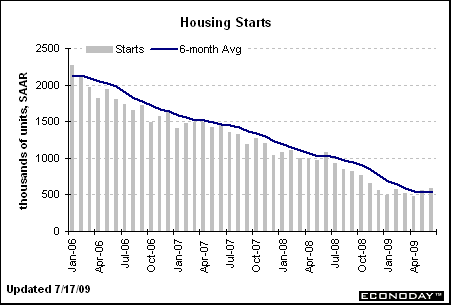
16. NEW BUILDING PERMITS & HOUSING STARTS UP STATISTICALLY INSIGNIFICANT AMOUNT

Barry Ritholtz at the Big Picture notes that new building permits in June were 8.7% (±3.0%) above May and that housing starts were up 3.6% (±11.3%). He comments:
"The year-over-year data is much clearer: New Starts down 46% [±4.3%], Permits down 52% [±3.6%]."
He links to a Barron's Econoday graph:

Thursday, July 2, 2009

Daily Sources 7/2

1. JAPANESE HAWK CHOSEN TO LEAD IAEA

Sharon Otterman at the New York Times reports that Japanese diplomat, Yukiya Amano, was elected to head the UN's atomic watchdog--the IAEA.
"Depicted by experts as the candidate favored by the United States and other wealthy nations, Mr Amano favors maintaining the current approach toward controlling nuclear proliferation in Iran, which Western countries suspect of trying to build nuclear weapons. Iran says its nuclear program is purely for civilian purposes to generate energy.

'He’s a nonproliferation and disarmament guy, and he believes in it,' said David A Kay, a former IAEA official and senior fellow at the Potomac Institute for Policy Studies. 'He has been around in trying to keep the inspections in Iran going, and I expect him to continue very much in that line. He will not want to create a situation in which military action is the only alternative.'"
2. CHINA TO RESUME ALLOWING IMF REVIEWS OF ECONOMY

Andrew Batson at the Wall Street Journal reports that China next week will take a step toward reconciling with the IMF, which it has blocked from reviewing its economy for the last three years.
"But a team of IMF officials visited China about a month ago, and have completed a draft review that is now being circulated for comments.

The IMF's draft report says China's exchange rate 'continues to be substantially undervalued,' according to a person who has seen the document, called an Article IV consultation. That's in line with what senior IMF officials have repeatedly said in public. China has kept its currency, the yuan or renminbi, basically fixed against the US dollar since July last year, though it has risen, along with the dollar, against other currencies since then.

That description nonetheless marks a climbdown from an earlier push to label China's exchange rate as 'fundamentally misaligned,' a designation that would suggest the country is in violation of the IMF charter. The draft report also states that Chinese authorities 'disagreed with the staff's assessment' of the exchange rate, and notes their argument that the global turmoil calls for 'a policy of stability.'"
Simon Johnson argued in April that the Obama Administration had pulled off a coup at the G20 meeting, effectively getting Europe to make the selection process for the head of the IMF transparent in return, more or less, for opening up the process at the World Bank, the next head of which Johnson thinks is likely to be Chinese--see Daily Sources 4/3 #3. Clearly in order to clear the field for their own candidates and a larger role generally, Beijing will first be forced to work with the organizations they want to influence or lead.

3. PBOC TO ENCOURAGE CROSS-BORDER SETTLEMENT IN YUAN

Bob Chen and David Yong at Bloomberg report that the People's Bank of China will encourage cross border settlement in the renminbi starting today, per regulations posted on the central bank's website.
"Transactions inside China will take place in Shanghai and four cities in southern Guangdong province, including Guangzhou and Shenzhen, while those outside China will occur in Hong Kong, Macau and the Association of Southeast Asian Nations, it said."
(h/t Jesse's Café Américain.)

4. CNPC MAY REVIVE BID ON ARGENTINE UNIT OF REPSOL-YPF, CNOOC MAY JOIN IN

Sui-Lee Wee at Reuters reports that CNPC plans to revive its $17 billion bid for the Argentinian unit of Repsol-YPF, reportedly planning to make an offer for as much as 75%. CNOOC also may enter a bid for the remaining 25%. "Goldman Sachs is advising YPF on the sale, while Morgan Stanley and JP Morgan are advising CNPC and CNOOC respectively." YPF, or Yacimientos Petrolíferos Fiscales, was the national oil company of Argentina until 1991, when it was privatized and then purchased by Repsol. (h/t Carola Hoyos at FT Energy Source.)

5. SPANISH CONSUMER CREDIT DOWN 33.7% IN Q1

Edward Harrison at Credit Writedowns reports that consumer credit in Spain fell by 33.7% in the first quarter, according to the National Association of Financial Credit Institutions (Asnef).
"Asnef stressed that the fall in the consumer sector has been mainly due to losses on personal loans, due to the sharp decline in the credit available for consumer goods and by the contraction of revolving credit associated with credit card usage."
Harrison says he expects more failures or bailouts of Spanish banks in coming months. Worth reading in full.

6. RIKSBANK CUTS BENCHMARK INTEREST RATE TO 0.25%

Malin Rising at the Associated Press reports that the Riksbank cut its benchmark interest rate by 0.25% to 0.25% today.
"The central bank said it now expects Swedish gross domestic product to decline by 5.4% in 2009 -- a sharper drop than its previous forecast of a 4.5% fall. However, it raised its outlook for 2010 GDP to a growth rate of 1.4% from 1.3% previously.

It said the economic outlook is still uncertain and that although GDP is expected to be positive in 2010, employment will not begin to rise until 2011."
7. FINAL SECTION OF SINO-KAZAKH CRUDE PIPELINE COMPLETED

Naubet Bisenov at Platts reports that Kazakhstan's KazStroyService has finished the 10 million metric ton/annum (200 kb/d) Kenkiyak-Kumkol pipeline and will begin test runs on it shortly.
"The Kenkiyak-Kumkol link is the final section of the Sino-Kazakh crude pipeline which runs from Atyrau on the Caspian Sea coast of the Central Asian nation, to Atasu near Kazakhstan's eastern border, then onwards to Alashankou in China's northwestern Xinjiang Uygur autonomous region.

The Sino-Kazakh crude pipeline is jointly developed by Kazakh state oil company KazMunaiGaz and Chinese state oil giant China National Petroleum Corp."


8. TALIBAN HAS WORN OUT ITS WELCOME IN PAKISTAN

In another interesting report by World Public Opinion, an institute based out of the University of Maryland, Pakistani opinion has turned sharply against the Taliban.

"Large majorities express confidence in the government (69%) and the military (72%) to handle the situation [in Swat]. Retrospectively, the public leans (by 45% to 40%) toward thinking the government was right to try to make an agreement in which the Pakistani Taliban would shut down its camps and turn in its heavy weapons in return for a shari'a court system in Swat. But now 67% think the Pakistani Taliban violated the agreement when it sent its forces into more areas, and 63% think the people of Swat disapprove of the agreement.

On the Afghan Taliban, an overwhelming 87% think that groups fighting to overthrow the Afghan government should not be allowed to have bases in Pakistan. Most (77%) do not believe the Afghan Taliban has bases in Pakistan. However, if Pakistan's government were to identify such bases in the country, three in four (78%) think it should close the bases even if it requires using military force.

Public attitudes toward al Qaeda training camps follow the same pattern. Those saying the 'activities of al Qaeda' are a critical threat to Pakistan are up 41 points to 82%. Almost all (88%) think al Qaeda should not be allowed to operate training camps in Pakistan. Though 76% do not believe there are such camps, if the Pakistani government were to identify them, 74% say the government should close them, with force if necessary."
Unsurprising, to me, but still well worth reading in full. (h/t Juan Cole at Informed Comment.)

9. PETROBRAS STRIKES MORE OIL ONSHORE IN THE ESPIRITO SANTO BASIN

Tom Hennigan at Platts reports that Petrobras struck oil onshore in the Espirito Santo basin.
"The Espirito Santo basin has seen a string of strikes in recent months. Last week the company reported strikes in blocks ES-T-390 and BT-ES-15. Since March it has also made four oil strikes in the onshore ES-T-364 block alone.

The company also announced a gas and an oil and gas find in the onshore ES-T-505 block."
The block block is 100% owned by Petrobras. Seems like every other week they make a new announcement of new oil.

10. HONDURAN CRISIS IN PART DUE TO NO PROCESS FOR REMOVING PRESIDENT IN CONGRESS & HIS RELATIONSHIP WITH CHÁVEZ, SAY EXPERTS

Kevin Sullivan at Real Clear World posts the quick analysis of several Honduras experts. Juan Carlos Hidalgo at the CATO Institute makes the interesting observation:
"The Honduran constitution does not provide an effective civilian mechanism for removing a president from office after repeated violations of the law, such as impeachment. Honduras’ Supreme Court nonetheless ordered Zelaya’s removal and Congress bestowed the presidency on the civilian figure--the president of Congress--next in the line of succession according to the constitution. "
Jesus Rios at Gallup World Poll makes another interesting observation:
"The latest remarks by interim leader Micheletti suggest Zelaya’s increasing alignment to President Hugo Chavez’s regime is at the core of the crisis. So, if Zelaya does in fact return to power before the November presidential election, the question then becomes: how will he manage to govern amidst an adverse public opinion environment and among institutions that backed his ousting, including his own political party? And, what role, if any, will Chávez play in Honduran politics from now on? Will Zelaya drop or moderate his pro-Chávez stance to regain political support? According to the 2008 Gallup survey, just 20% of Hondurans approve of President Hugo Chávez."
11. WTO WARNS ON INCREASING PROTECTIONISM, SAYS GLOBAL TRADE VOLUMES WILL CONTRACT BY 10% IN 2009

Joshua Chaffin at the Financial Times reports that the WTO published a report today which warns that
"[g]overnments around the world have continued to push up trade barriers in spite of high-profile pledges at the G20 summit and other forums to resist protectionism"
The organization lowered its forecast for world trade to a contraction of 10% in the volume of goods and services.


12. BLS REPORTS 476,000 JOB LOSSES IN JUN, STATE FISCAL RESPONSIBILITY MEANS STATE ECONOMIC POLICY CONTRACTIONARY IN RECESSION

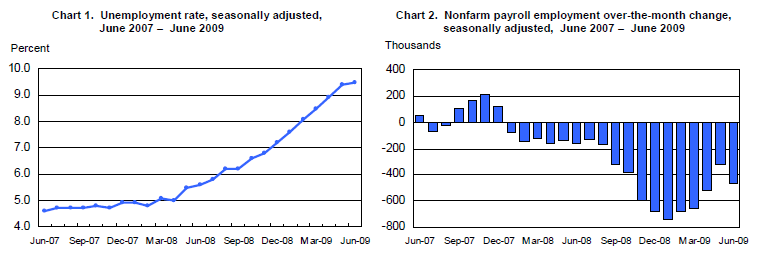
Barry Ritholtz at the Big Picture reports that the Bureau of Labor Statistics announced today that there were 467,000 job losses in June. The unemployment rate rose by 0.1% to 9.5%. The U-6 measure--marginally attached and involuntary part time workers--rose to 16.5%. Temporary employment fell by 37,600.
"Hours worked fell 0.8%, bringing the average workweek down 0.1 hours to 33; This is a record low going back to 1964."


Peter Boockvar, also at the Big Picture, also notes that initial jobless claims totaled 614,000. Continuing claims fell by 58,000 from last week.
"While there is no question benefits are expiring without one finding a job, as evidenced by the rising exhaustion rate, many losing those benefits now started getting them when initial claims were running in the 400k range last summer. Now its running above 600k, so there are still more people filing initial claims than getting removed from the continuing claims data, thus continuing claims still should trend higher assuming no sudden change in hiring trends."
Meanwhile, Free exchange makes the important observation:
"[S]tate budget policies are sharply contractionary at this point. Despite allocations of federal aid to states, services are being cut, state employees are being laid off, and taxes are being raised in order to balance the budgets of local governments constitutionally unable to run deficits. It's not at all clear that the federal stimulus will entirely compensate for state-level fiscal tightening, which means that American fiscal policy could, on net, be contractionary."
13. BARCLAYS EXPECTS WTI TO AVG $71/B IN W3

Yee Kai Pin at Bloomberg reports that Paul Horsnell's commodity team at Barclays has lifted its third quarter forecast for WTI to $71/b from $62/b. Horsnell increased his Q3 forecast for Brent to $69/b.
"'Among all the changes that have kept commodities on the boil in recent years, the key factor is that 'normal' is not what it used to be,' the analysts said in the report. 'Oil prices below $70 or copper prices below $3,000 are no longer normal.'"
I think he's wrong, but he does know of what he speaks.

Wednesday, July 1, 2009

Daily Sources 7/1

1. JAPAN TO MOVE AHEAD WITH STRATEGIC PETROLEUM PRODUCTS RESERVE IN AUGUST

Takeo Kumagai at Platts reports that Japan's Ministry of Economy, Trade & Industry [METI] has decided to move ahead with plans to establish strategic petroleum product reserves beginning in mid-August with a day's worth of kerosene consumption.
"After nearly three years of discussing the matter in depth both internally and at its advisory meetings, METI was set to introduce the national oil products stockpile this year, with one or a combination of light and middle distillates, equivalent to one day's consumption of the particular product or products chosen, Platts reported earlier.

METI has chosen to start the products stockpile with kerosene because it would affect consumers living in northern Japan during the country's winter demand season, the official said. Kerosene is used as heating oil in Japan, with demand typically peaking over December-February."
2. CHINA'S OFFICIAL PMI UP TO 53.2, CLSA'S CHINA PMI UP TO 51.8; CHINA TO BAN IMPORTS OF US CHICKEN

Terence Poon at the Wall Street Journal reported yesterday that the official purchasing manager's index for China rose to 53.2 in June from 53.1 in May. (A reading of above 50 indicates expansion; below 50 indicates contraction.)
"The new export orders component of the PMI rose to 51.4 in June from 50.1 in May. June was the second consecutive month where the export-order subindex has remained above 50, suggesting a deterioration in exports in the past several months is abating.

But the inventory subindex of the PMI fell to 45 in June from 46.2 in May. [Moody's] Economy.com's [analyst] Sherman Chan said that drop suggests manufacturers remain cautious about building up inventories amid an uncertain global economic outlook.

'If the external environment doesn't improve, it will be difficult for the government to sustain its fiscal spending for a long time,' she said."
Chinaknowledge reports that CLSA Asia-Pacific Markets' China PMI also showed improvement, rising to to 51.8% in June from 51.2% in May. Meanwhile, Lauren Etter and Stephen Power at the Wall Street Journal reports that China is expected to ban imports of US chicken in the next several days.
"The potential ban could be a big blow to the US chicken industry, which has been struggling with high grain prices and a price-depressing oversupply of chicken. Exports had been a bright spot for the industry, and last year China surpassed Russia as the largest destination for US chicken, according to the USA Poultry & Egg Export Council."
"[I]n 2007 lawmakers inserted a provision in the 2008 fiscal-year spending bill that prohibited the USDA from allowing chicken processed in China to be imported. The same prohibition was included in the spending bill in the next two fiscal years.

Trade tension between China and the US heightened earlier this week when the US International Trade Commission recommended imposing punitive duties of as much as 55% on low-cost Chinese tire imports because they are disrupting the US market, in a move that could sharply increase costs for consumers. GITI Tire, China's largest tire manufacturer, has called the move 'decidedly protectionist' and said it would take its case to President Barack Obama.

Last week, the House approved legislation to curb US greenhouse-gas emissions that includes a provision to impose tariffs on goods from countries that don't match US efforts to combat climate change."
Last week the US and EU lodged a WTO complaint alleging that China was blocking the export of raw materials--Daily Sources 6/24 #2.

3. ASHGABAT INVITES MEDVEDEV FOR VISIT TO DISCUSS GAS PURCHASES

Upstream online reports that Turkmen President Kurbanguly Berdymukhamedov has invited President Medvedev to visit Ashgabat to discuss the resumption of Turkmen gas exports to Russia.
"Russia, the main buyer of Turkmen gas, halted its imports in April after a pipeline explosion.

The pipeline has been repaired but the two sides cannot agree on new terms of sales as Russia's Gazprom needs less gas than in the past."
The move comes after China sealed a deal to increase its gas imports from Turkmenistan by 30% last week--see Daily Sources 6/25 #3. Ashgabat publicly suspected that Gazprom had engineered the explosion at the pipeline in order to stop paying the $340/tcm (~$9.61/MMBtu) price it had reportedly contracted to pay for Turkmen gas on December 31, 2008--see Daily Sources 4/14 #7.

4. INDIAN OIL REFINERS NERVOUS ABOUT DELAYED MONSOON EFFECT ON DIESEL PURCHASES

Murali Gopalan and Richa Mishra at the Hindu Business Line reports that Indian oil refiners are worried about heavy losses on diesel as low rainfall so far this year results in digging and pumping groundwater and diesel electricity generation.
"[W]hile [oil demand] growth figures for May are negative ... , diesel consumption at 4.748 million tonnes ... was otherwise normal and has not fallen in absolute terms.

Another reason for this was due to a continuous decline in the industrial sector’s use as diesel-direct sales showed negative growth of 4.7% in May.

It was the sixth successive month when industrial sales of diesel showed negative growth, coinciding with the onset of the economic recession in the second half of 2008-09. While economics dictated the pace of diesel consumption so far, the weather patterns could change the pattern, fear experts.

However, the consumption trend for diesel seems to be changing in June, with the eastern region recording a 45% growth, with Bihar alone registering nearly 65%."
5. MALAYSIA TO PULL BACK MALAY-PREFERENTIAL POLICY

Thomas Fuller at the New York Times reports that the Prime Minister of Malaysia, Najib Razak, announced a rollback in the policy which required companies issuing stock to reserve 30% of their shares for ethnic Malays.
"'The world is changing quickly, and we must be ready to change with it or risk being left behind,' he said Tuesday.

The change would leave some ethnic preferences intact and come with caveats. But it would dilute one of the most important components of what is known as the New Economic Policy, introduced in 1971: the requirement that companies listing on the stock exchange sell 30% of their shares to ethnic Malays.

That requirement was scrapped for companies already listed on the stock exchange and reduced to 12.5% for initial public offerings. The requirement will remain in place for 'strategic industries' like telecommunications, water, ports and energy.

Mr. Najib also said he would lower barriers for foreign investors. The government would eliminate a special vetting process for foreign companies wanting to invest in, merge or take over a Malaysian company, he said."
6. IMF EXPECTED TO AUTHORIZE $150 ISSUANCE OF SDR-DENOMINATED DEBT TODAY

Timothy R Homan at Bloomberg reports that the IMF board of directors are expected to authorize the issuance of as much as $150 billion in SDR-denominated bonds, voting on the matter today.
"The IMF is also considering making them tradable between all central banks from countries that are IMF members, said a G- 8 official, who spoke on condition of anonymity. It would stop short of allowing them to trade on the open market, he said."
7. SARKOZY TELLS NETANYAHU TO GET RID OF LIEBERMAN

Michael Collins Dunn at the MEI Editor's Blog notes that President Sarkozy has reportedly expressed in a "private message" to Benjamin Netanyahu that he should remove Avigdor Lieberman from his post as foreign minister.

8. KIRKUK FIRST CITY SINCE START OF IRAQ WAR TO GET 24 HOUR ELECTRICITY


Diaa Al-Khalidi at the Iraq Oil Report reports that Kirkuk has become the first Iraqi city to enjoy 24-hour electricity since 1993--and the first time the city itself has experienced it since 1991, when Saddam Hussein cut power to the regions in order to ensure round the clock access in Baghdad following his defeat in Kuwait.
Kirkuk is outside the formal borders of the Kurdish Regional Authority, but, if I understand correctly, currently effectively security in the city is provided by it:


Security is key in the maintenance of energy infrastructure.

9. ARAMCO AND CONOCO TO RESUME BIDDING FOR CONSTRUCTION OF YANBU EXPORT REFINERY

Sheila McNulty at FT Energy Source reports that Saudi Aramco and ConocoPhillips have decided to resume the bidding process for the construction of the 400 kb/d export refinery at Yanbu. "Now some bids are to be awarded in November 2009 and the others in the second quarter of 2010." Evidently, the bidding process has resumed on an optimistic view of the global economy going forward--and that sufficient financing exists to get it done. (I suspect that this would more likely be the view of Saudi Aramco than ConocoPhillips, given the recent statements from OPEC, but Saudi Aramco controls the facts on the ground.)

10. OPEC 11 SUPPLIES 110 KB/D MORE OIL IN JUNE THAN MAY

Reuters reports that OPEC 11 output in June rose to 26.02 mb/d in June from 25.91 mb/d in May--a 72% compliance rate with the implied production target of 24.84 mb/d, down from 75% in May.

11. NIGER DELTA MILITANT GROUP CRITICIZES MEND FOR ATTACKS AFTER AMNESTY OFFER

Platts reports that the Ijaw Youth Campaign for Peace [IYC]--a coalition from the ethnic Ijaw community in Nigeria's Niger Delta--issued a statement today condemning continued attacks on oil installations by MEND following the introduction of the amnesty offer by Abuja.
"'We are shocked by the activities of our sons considering the recent [press] release by MEND [saying] they have vandalized Shell platforms in Forcados,' the IYC said.

'If the purported sabotage was actually true we in the Ijaw Youth Campaign for Peace hereby condemn it in all facets,' the group stated.

The group said the continued sabotage of oil installations 'will present our people as not actually fighting for a genuine cause, but personal gain, which the government can see as armed robbery and criminality.'"
The story also notes reports that the amnesty offer has hit a snag as the heavy military presence in the region has made militants leery of going to areas designated as arms collection centers.

12. OAS GIVES HONDURAS ULTIMATUM, UN CALLS FOR ZEYALA'S RETURN, ARGENTINA'S FERNANDEZ TO TRAVEL TO HONDURAS TO NEGOTIATE SOLUTION, CHAVEZ SAYS VENEZUELA MAY CEASE ALL CRUDE EXPORTS TO HONDURAS--ALL 0 KB/D OF THEM

Ginger Thompson at the Washington Post reports that the Organization of American States on Wednesday gave Honduras three days to restore ousted President Manuel Zelaya to power or face expulsion from the organization.
"Diplomats said they had rarely seen the OAS unite so solidly behind a common cause, and that it was the first time the group had invoked its so-called Democratic Charter since it was adopted in 2001 as a clean break with the region’s history of authoritarian rule."
The United States is the only country in the Western Hemisphere which has not reacted to the coup by withdrawing its ambassador. On the other hand, Joshua Goodman and Andres R Martinez at Bloomberg report that yesterday the UN General Assembly passed a resolution, co-sponsored by the US, calling for the restoration of Zelaya.
"OAS Secretary General Jose Miguel Insulza said yesterday he wanted to return to the Central American nation with Zelaya to demand his reinstatement. Argentine President Cristina Fernandez de Kirchner will accompany the mission, Buenos Aires newspaper Infobae reported.

As protests against Zelaya swell, a showdown is imminent. [Interim Honduran President Roberto] Micheletti said that Zelaya faces arrest and 20 years in prison should he attempt to return to Honduras, Central America’s third-poorest country.

The country’s Supreme Court, congress and business groups have also expressed support for Zelaya’s removal, over concerns he was seeking to retain power beyond his original mandate by ignoring court rulings and changing the constitution through a referendum on term limits.

Approval for the Zelaya government fell to 30 percent in February from a high of 57 percent in January 2007, according to a nationwide poll by CID-Gallup. The former cattle rancher lost support over the past two years as he strengthened ties with Chavez ... ."
Paul Talley at the Compass comments:
"For Fernandez, accompanying Zelaya gives her a chance to play a popular role in world politics that might offer a distraction from her own political problems at home."
Talley seems skeptical about the practical effect however--his post is worth a look. Meanwhile, Carlos Camacho at Platts reports that Hugo Chávez has delayed a trip to the Dominican Republic to finalize PdVSA's purchase of a 49% stake in the Refidomsa refinery there until the Honduran crisis is resolved. Chávez has reportedly threatened to halt all exports of crude to Honduras until Zelaya is reinstated. Of course, Honduras has no refining capacity, so a halt in crude exports wouldn't have much of an effect upon the country.

13. SURVEY SHOWS OBAMA MOST TRUSTED LEADER IN THE WORLD

World Public Opinion recently conducted a survey of 19,224 people in 20 countries, asking them to rate their confidence in leaders of foreign countries. The margins of error in the polls range from ±3-4%. "The survey was conducted between April 4 and June 12, 2009, prior to Obama's speech in Cairo but subsequent to his Ankara speech." The poll seems to show that Obama has by far the most trust of any world leader internationally.


That's a fair amount of political capital. The poll includes ratings for Putin (somewhat oddly), Ban Ki-Moon, Merkel, Brown, Sarkozy, Hu Jintao, and Ahmadinejad. (h/t Greg Scoblete at the Compass.)

14. KC FED CHIEF SAYS THE GOVT HAS INSTITUTIONALIZED "TOO BIG TO FAIL", ST. LOUIS FED CHIEF SAYS FED RATES LIKELY TO STAY UNCHANGED FOR "FORESEEABLE FUTURE," SF FED CHIEF TAKES AIM AT INFLATIONISTAS, SAYING DOWNTURN LIKELY TO BE PROLONGED

Greg Robb and Kate Gibson at MarketWatch report that Thomas Hoenig, president of the Federal Reserve Bank of Kansas City, has criticized the "ad hoc" approach to the financial crisis, saying it has institutionalized the notion of "too big to fail."
"'The current crisis has made it clear that the group of systemically important firms that might be deemed worthy of special consideration by policy-makers is larger than previously thought,' Hoenig said in a Tuesday speech at New York University."
"The Obama administration's overhaul of financial rules is only a start of a dialogue on the issue, Hoenig commented. 'The most important part of any plan ... will be the requirement that public authorities resolve such institutions by taking them into receivership and restructuring them to emerge under new and more careful management and ownership,' without exceptions."
Worth reading in full (h/t Yves Smith at naked capitalism.) Meanwhile, Jon Hilsenrath at Real Time Economics reports that James Bullard, president of the St Louis Fed, said in a talk at Philadelphia’s Global Interdependence Center today that the Fed Funds Rate is likely to remain at its current rate for the "foreseeable future." He also said that the Fed's
"'liquidity programs', such as efforts to support the commercial paper market or money market mutual funds, are on track to end next year 'if financial conditions continue to improve."
He further indicated that the Fed may reevaluate its purchases of mortgage-backed securities in its next meeting in August. In a story which has received wide coverage in the econoblogosphere, Jon Hilsenrath at Real Time Economics reports that Janet Yellen, President of the Federal Reserve Bank of San Francisco, took aim at the inflationistas, saying:
"We are far from the kinds of unemployment rates that would make inflation a danger. ... The very weak economy is, if anything, putting downward pressure on wages and prices ...

In past deep recessions, the Fed was able to step on the accelerator by cutting the federal funds rate sharply, causing the economy to shoot ahead. This time, we already have our foot planted firmly on the floor. We can’t take the federal funds rate any lower than zero. I believe that the Fed’s novel programs are stimulating the flow of credit, but they simply aren’t as powerful levers as large rate cuts, so this time monetary policy alone can’t power a rapid recovery.
...
I also think that a massive shift in consumer behavior is under way—one that will produce great benefits in the long run but slow our recovery in the short term. 4 American households entered this recession stretched to the limit with mortgage and other debt. The personal saving rate fell from around 8 percent of disposable income two decades ago to almost zero. Households financed their lifestyles by drawing on increasing stock market and housing wealth, and taking on higher levels of debt. But falling house and stock prices have destroyed trillions of dollars in wealth, cutting off those ready sources of cash. What’s more, the stark realities of this recession have scared many households straight, convincing them that they need to save larger fractions of their incomes. In the long run, higher saving promises to channel resources from consumption to investment, making capital more readily available to retool industry and fix our infrastructure. But, in the here and now, such a rediscovery of thrift means fewer sales at the mall, and fewer jobs on assembly lines and store counters."
The full text of her speech can be found here.

15. FORD TO RAMP UP PRODUCTION

Nick Bunkley at the New York Times reports that vehicle sales were down 11% in June from June 2008, the lowest annual rate of decline seen by any major carmaker since last Summer.
"Ford said this week that it was increasing production in the third quarter, which starts Wednesday, to match the rise in demand its dealers were seeing. The company now plans to build 67,000 more vehicles, a 16% increase, than it did in the third quarter of 2008.
...
Over all, industry sales are expected to be down at least 25% compared with June 2008. Though dismal by any measure, it could be the first time since September that total sales fell by less than 30 percent on a year-over-year basis, a positive sign.

June could also be the first month this year in which new vehicles sold at an annualized rate of at least 10 million. For most of the last decade, auto sales in the United States were around 17 million a year before plummeting in 2008. Fewer than 5 million vehicles were sold in the first half of 2009, a decrease of nearly 37%."
16. CRUDE STOCKS SHARPLY DOWN, BUT PRODUCTS STOCKS SHARPLY UP ... REFINING UTILIZATION SLIGHTLY DOWN

The EIA reports that commercial crude stocks were drawn down in the week ended June 26 by 3.7 million barrels to 350.2 million barrels, still above the historical range for this time of year, but not dramatically higher any more. Gasoline stocks grew by 2.3 million barrels, and are now in the middle of the five-year historical range for this time of year. The median analyst expectation per a Bloomberg survey was for a 2 million barrel build. Distillate stocks also grew by 2.9 million barrels to 155 million barrels, 34.3 million more barrels than were held in commercial inventories in the comparable week last year. The analyst expectation was for a 1.5 million barrel build. The national average price of gasoline for the week ended June 29 fell by 4.9¢ to $2.642/gallon. Refinery utilization for the week ended June 26 fell .06% to 86.99%.

17. 10 TOP US CITIES GROWING FASTER THAN THEIR SUBURBS SINCE 2007

Conor Dougherty at Real Time Economics notes the report by Mark Mather at the Population Reference Bureau which shows that population in the ten largest American cities have been growing faster than the areas around them since 2007:


Worth reading in full.

Tuesday, June 16, 2009

Daily Sources 6/16

1. IRAN PROTESTS CONTINUE, AHMADINEJAD LEAVES FOR EKATERINBURG, RUSSIA

Protests are continuing. The most interesting data point to me is that President Ahmadinejad either felt the situation secure enough or irrelevant enough to leave the country to observe the goings on at the Shanghai Cooperation Organization's summit today in Ekaterinburg, Russia, per Vladimir Isachenkov at the Associated Press. Will try and put up another post on the ongoing situation a bit later today.

2. MOODY'S DOWNGRADES THE FINANCIAL STRENGTH RATINGS OF 30 SPANISH BANKS, INCLUDING SANTANDER

Izabella Kaminska at FT Alphaville reports that Moody's downgraded the senior unsecured debt and deposit ratings of 25 Spanish banks today, 18 by one notch and seven institutions by two notches.
"At the same time, Moody’s downgraded the Bank Financial Strength Ratings of 30 banks. Among these banks, the rating agency downgraded the dated subordinated debt of 17 institutions, the junior subordinated debt of eight institutions, and the preference shares of 14 banks.

'The rising pressure that many Spanish banks face from a sharp deterioration of their asset quality is reflected in their stand-alone financial strength ratings, a third of which now fall at a “D-” level or lower,' said Maria Cabanyes, a Senior Vice President at Moody’s. 'However, the moderate downgrade of these banks’ senior ratings reflects our expectation that government support would be forthcoming for these institutions should such support become necessary.'"
3. CHINA PROMISES $10 BILLION IN LOANS TO MEMBER STATES OF SCO TO HELP THEM WEATHER ECONOMIC CRISIS, MEDVEDEV CALLS UPON SCO MEMBERS TO SETTLE BILATERAL TRADE IN DOMESTIC CURRENCIES


Lyubov Pronina and Lucian Kim at Bloomberg report that Chinese President Hu Jintao offered to lend $10 billion to member states of the Shanghai Cooperation Organization [SCO] so they might better weather the financial crisis.
Jintao made the offer at the regional organization's summit in Yekaterinberg, Russia, today. The other members of the SCO are Kazakhstan, Kyrgyzstan, Tajikistan, Uzbekistan, and Russia.
"Russian President Dmitry Medvedev is hosting back-to-back summits of developing economies in Yekaterinburg, in the Ural Mountains that divide Europe and Asia, as he seeks to lessen the world economy’s dependence on the US dollar. Medvedev and Hu will hold talks later today with Indian Prime Minister Manmohan Singh and Brazilian President Luiz Inacio Lula da Silva in the first summit of so-called BRIC nations.

Hu called for greater coordination among Shanghai members on monetary policy, including regular meetings of finance ministers."
Medvedev reportedly encouraged China and the other SCO members today to conduct bilateral trade in their domestic currencies as opposed to the dollar. He further said,
"There can be no successful global currency system if the financial instruments that are used are denominated in only one currency. Today this is the case and the currency is the dollar."
4. RUSSIA VETOES CONTINUATION OF UN PEACEKEEPING MISSION IN ABKHAZIA, GEORGIA

John Heilprin at the Associated Press reports that Russia has exercised its veto power at the UN Security Council in order to put an end to the 16 year old UN mission to Georgian breakaway region Abkhazia.
"'It is understandable,' Russia's Foreign Ministry said in a statement Monday, 'that in the new political and legal conditions most of the names and terms previously used in the old documents are inapplicable.'"
What the ministry means is that now Abkhazia is recognized by Moscow as a new state, altogether independent of Georgia. Clearly the move will hurt Saakashvili's political chances, the government is currently bedeviled by constant popular opposition protests.

5. INDIAN PM AND PAKISTANI PRESIDENT MEET IN EKATERINBURG

Vladimir Isachenkov at the Associated Press reports that Indian Prime Minister Manmohan Singh met with Pakistani President Asif Ali Zardari met for talks behind closed doors in Yekaterinberg today for the first time since the Mumbai terror attacks of last year.
"'My mandate is to tell you that Pakistani territory should not be used for terrorism against India,' Indian and Russian news agencies quoted Singh as saying after shaking hands with Pakistani President Asif Ali Zardari ahead of their meeting."
Both India and Pakistan have observer status in the SCO.

6. SAMA CUTS REVERSE REPURCHASE RATE BY 0.25% TO 0.25%

The Associated Press reports that the Saudi Arabian central bank, the Saudi Arabian Monetary Authority, or SAMA, has cut its reverse repurchase rate by 0.25% to 0.25%. It is the second reduction made by the fiscal authorities this year.

6. MICRO-POWER IN BANGLADESH MAY HAVE BENEFITS SIMILAR TO MICRO-FINANCE

Shafiq Alam at AFP has an anecdotal account of how Bangladeshis, frustrated by the governments perennial inability to make good on promises to bring the people electricity, have begun installing solar power panels on their homes if they can afford it. One tailor, for example, can now sew well into the night, and has reportedly doubled his income. So, much like micro-finance, micro-power could have the potential to radically transform the lives of many in the developing world.

7. ANALYSTS THINK MEXICO MAY NOT HEDGE OIL FURTHER ... SOVEREIGN MAY HAVE HAD CONSIDERABLE SHARE OF OPEN INTEREST ON NYMEX

Andres R. Martinez and Carlos Manuel Rodriguez at Bloomberg report that some analysts think that Mexico might not hedge the price of oil going forward. The interesting data point, to me, was that Mexico spent $1.5 billion to buy the option to sell crude oil at $70/b. Apparently it has hedged a total of 330 million barrels for the whole of 2009. That is 330,000 contracts on NYMEX, or over 12.7% of total open interest on both futures and options for light sweet crude for the week ended June 9, as per the commitment of traders report.

8. ABERDEEN ASSET MGMT SAYS CORREA PLAYED MARKET FOR FOOLS

Lester Pimentel at Bloomberg reports that Edwin Gutierrez at Aberdeen Asset Management Plc recently said the Ecuadorian President
"'played the market for fools' by defaulting on $3.2 billion of debt six months ago and then repurchasing the bonds at less than 40 cents on the dollar."
"'Ecuador won,' Edwin Gutierrez, who manages $5 billion at Aberdeen and sold his Ecuador holdings before the default, said in a telephone interview from London. Correa’s government 'played the market for fools. Remind me never to play poker with that guy,' he said.

Correa, a 46-year-old economist who counts Venezuelan President Hugo Chavez as one of his closest allies, halted payments on the bonds because he said they were issued illegally. He called the bondholders 'true monsters who won’t hesitate to crush the country' when he announced the default on Dec. 12 and said in a national radio address the next day that he wanted to force them to accept a 'big discount.'"
Ecuador stopped making payments on its sovereign debt on December 12 and later in that month pressured its social security system to purchase $1.2 billion in new bonds--see Daily Sources 12/29 #14. Ecuador currently uses the US dollar as its currency.

9. HOUSING STARTS AND PERMITS DOWN 45.2% IN MAY FROM YEAR PREVIOUS, UP 17.2% FROM APRIL

Barry Ritholtz at the Big Picture reports that housing starts and permits increased in the month of May from April with Starts at 17.2% (±14.4%) and Permits at 4.0% (±1.7%)--ie, both above the statistical margin of error. However, "The stunning news was the 45.2% (±5.8%) collapse below the May 2008 rate. That is simply an unbelievable free fall."