Showing posts with label al-qaeda. Show all posts

Monday, June 29, 2009

Daily Sources 6/29

1. IEA REVISES GLOBAL OIL DEMAND DOWN TO AN AVERAGE ANNUAL RATE OF 0.6% FROM 2008-14

Carola Hoyos at the Financial Times reports that the IEA has cut its forecast for incremental global oil demand from 2008-14 to an average annual rate of 0.6% or 540 kb/d, bring total consumption to 89 mb/d from 85.8 mb/d.
"This latest forecast is 3.3 mb/d lower than the previous forecast for 2013 volumes. If the agency’s most pessimistic economic scenario proves correct, oil demand could contract, with consumption falling to 84.9 mb/d by 2014, it said in a report."
Managing Director Nobuo Tanaka suggested that the current environment makes forecasting especially difficult and noted that the data on which the forecast was made, for April, is already old.

2. JAPANESE LNG IMPORTS DOWN 19.6% IN MAY FROM APRIL, BUT INDUSTRIAL PRODUCTION UP 5.9% IN MAY FROM APRIL--BOTH ARE DOWN 18.8% AND 30% FROM MAY 2008, RESPECTIVELY

Jonty Rushforth at Platts reports that Japan imported 4.24 million metric tons of LNG in May, down 18.8% from May 2008 and "19.6% from April, when Japan imported 5.27 million metric tons." (The Platts story includes a table of imports by source, month over month and year over year.) It is interesting in the context of the report released Sunday by the Ministry of Economy Trade and Industry (METI) which showed industrial production up 5.9% in May from April, though still down 30% year over year, as per Jake at Econopix. Their chart:


There has evidently been a rebound in production of passenger cars, which account for about 8.5% of the industrial production index. Worth a look.

3. NDRC RAISES GUIDELINE PRICES ON DIESEL & GASOLINE (SLIGHTLY LESS IN THE SOUTH)

Bloomberg reports that the National Development and Reform Commission announced yesterday that it will raise the price of diesel and gasoline today by as much as 11%. Prices for both will be lifted by 600 renminbi a metric ton ($87.80 or roughly $11.71/b ~ $0.28/gallon).
"Today’s price increases will vary by city and region, according to the NDRC’s statement.

In Beijing, the new ceiling price per ton for the retail grade of gasoline that meets euro III standards, known as 90 octane, will be 7930 yuan a ton (~$1,162/ton ~ $136.71/b ~ $3.26/gallon), while the ceiling price in southern Guangdong province is set at 7795 yuan (~1,142/ton ~ $134.38/b ~ $3.20/gallon)."
Guangdong is the center of economic growth in China, if I understand correctly. The NDRC is raising prices in part due to the surge in demand for cars, driven by the stimulus program.

4. PBOC GOVERNOR SAYS CHINESE RESERVE POLICY WILL NOT CHANGE SUDDENLY

Stephanie Phang at Bloomberg reports that People’s Bank of China Governor Zhou Xiaochuan told journalists today that "Our foreign-exchange reserve policy is always quite stable. There are not any sudden changes." This follows the release of the bank's review on Friday, which appeared to reiterate formally the call for an alternative to the dollar--see Daily Sources 6/26 #1. Yves Smith at naked capitalism comments:
"This certainly looks like a retreat, although Zhou may simply be clarifying the difference between long term policies and immediate plans. But that still begs the question of when and how the transition between the two comes into play.

The tension may also reflect the need to posture aggressively before a domestic audience without unduly rattling markets. But it may also result from the need to appease certain interests within the government. A New York Times article last year explained that as the central bank took foreign exchange losses as the RMB rose, it may have to go hat in hand to the finance ministry, which opposes many of the central bank's policies, particularly on the dollar ...."
5. CHINA PASSES NEW STATISTICS LAW

Andrew Batson at China Journal reports that on Saturday China passed a new law to take effect next year which will stiffen penalties for falsifying social and economic data.
"Recently, officials of the National Bureau of Statistics have become more forthcoming about deficiencies in their data, and have also started publishing a more detailed accounting of economic growth. And this year’s economic census, a quinquennial attempt to obtain basic information on every company of economic significance in the nation, is the centerpiece of the bureau’s effort to build up more accurate figures through the use modern survey techniques."
Batson quotes some examples of the misreporting the government is trying to eradicate:
"* In 2001, a township government in Liaoning province in 2001 instructed the villages it oversees to report quarterly economic indicators that were precisely one-fourth of the annual target, to ensure that the target was met.

* In one town near Ningbo, Zhejiang province, a party secretary reported a total industrial output of 463 million yuan in 2001, which was later determined to be 76% more than the actual figure.

* The leaders of one town near Chongqing in 2004 altered the statistical reports of local companies they sent to higher authorities, in one case changing output of 5 million yuan to 8 million yuan, and in another adding a zero to make output of 3 million yuan into 30 million yuan.

* Over-reporting is not confined to eager officials: one company in Wenzhou, Zhejiang province reported output of 32.15 million yuan in 2003, which was then discovered to exceed the actual figure by 71%."
The post includes a number of links to sources--worth a look.

6. NATO & RUSSIA RESUME OFFICIAL TIES; RUSSIA STARTS WARGAMES IN THE CAUCASUS, A FEW WEEKS AFTER NATO WARGAMES IN GEORGIA

The Associated Press reports that NATO and Russia have resumed ties after NATO suspended them in reaction to the Georgia conflict.
"Russian Foreign Minister Sergei Lavrov met his counterparts from NATO's 28 member nations on the western Greek island of Corfu ahead of a broader informal meeting of ministers from the 56-nation Organization for Security and Cooperation in Europe.

Mr. Scheffer described the talks as 'open and constructive, which means we did not try to paper over our differences on Georgia, for example. But we agreed not to allow those agreements to bring the [NATO-Russia Council] to a halt.'

He said the renewed military contacts would involve meetings of the chiefs of staff of Russia and NATO countries.

The meeting in Corfu, which came as President Barack Obama and Russian President Dmitry Medvedev prepare to hold a summit next week, reflected the trend toward improved relations with Russia."
Meanwhile, Michael Schwirtz at the New York Times reports that Russia has begun war games using 8,500 troops from all branches of the armed services in the Caucasus region.
"The event is also occurring a few weeks after NATO concluded its own exercises in Georgia, drawing complaints from the Russians.

'The Russian exercises, given the timing, are a definitive response,' said Dmitri O. Rogozin, Russia’s envoy to NATO, Interfax reported. 'We are conducting them to ensure the defensive capabilities of Russia in those areas where we see threats.'

Georgia on Monday expressed worry about Russian exercises so close to its borders.

'These exercises are a source of concern because they involve an unprecedented number of servicemen and the newest military hardware of Russia,' said Alexander Nalbandov, Georgia’s deputy foreign minister, Interfax reported. 'We hope that the events of last August, when the Russian army invaded Georgia and occupied its lands, will not repeat.'"
7. GAZPROM SEALS PURCHASE OF 500 MILLION CU M OF NAT GAS FROM AZERBAIJAN IN 2010, SAYS IT WILL RECEIVE PREFERENTIAL TREATMENT ON SHAH DENIZ GAS

Lyubov Pronina and Lucian Kim at Bloomberg report that Russian President Medvedev sealed a deal in Baku today for Gazprom to purchase 500 million cubic meters of natural gas from Azerbaijan next year.
"Gazprom will get priority treatment when the State Oil Co. of Azerbaijan determines the buyers for the [Shah Deniz] offshore field, said Alexei Miller, chief executive officer of the Russian company. Azerbaijan’s gas production will rise 11% to 30 billion cubic meters next year, Aliyev said."
Shah Deniz is a key source of potential supply for the Nabucco pipeline project--the alternative possibility of sourcing from Iran looks particularly politically difficult at the moment.


This follows the news Friday that former German foreign minister Joschka Fischer has been signed on as a consultant to Nabucco--see Daily Sources 6/26 #3.

8. INDIAN REFINERS RUN 2.4% MORE CRUDE IN APRIL, DOWN 4.3% FROM MAY 2008

Vandana Hari at Platts reports that Indian refiners ran 12.77 million metric tons (~3.02 mb/d) of crude in May, up about 2.4% from April, but down 4.3% from May 2008.
"The utilization rate against the country's total installed refining capacity was 102.5% in May, versus 107.1% a year ago.

Between January and May, Indian refiners have run around 65.57 million metric tons of crude, roughly 1.5% lower from a year ago. The trend contrasts with a 3.6% year-on-year increase in 2008 crude throughput over 2007."
Reliance started operating the Jamnagar addition of 500 kb/d capacity on Christmas--see Daily Sources 1/7 #3.

9. IRAQI VP TO BOYCOTT TUESDAY AUCTION, OIL EXPORTS UP 80 KB/D IN MAY (THE ADDT'L OIL CAME FROM THE NORTH), AND THE CABINET WILL NOW DELAY RATIFICATION OF THE OIL AUCTIONS TOMORROW INDEFINITELY

Ahmed Rasheed at Reuters reports that Iraqi Vice President Tareq al-Hashemi has announced on his website that he will boycott the auction on Tuesday to award concessions for eight oil and gas fields.
"'There are many existing reservations over this vital issue concerning Iraq's oil resources,' Hashemi said in a letter, posted on his website, to Oil Minister Hussain al-Shahristani.

He urged the minister to 'hold off on awarding bids to the winning companies and give parliament enough time to study these bids,' said the letter, released by Hashemi's office."
Ben Lando at the Iraq Oil Report notes that Iraqi oil exports grew to 1.9 mb/d in May from 1.823 million in April.
"In the south, where most of Iraq’s production and exports are located, May was a down month, exporting only 1.38 mb/d compared to 1.413 mb/d in April. In the north, however, exports increased to 522.6 kb/d from 410 kb/d in April."
Meanwhile, Faleh al-Khayat at Platts reports that the oil ministry said today that it will not announce the winners of the auction tomorrow, and instead only provide the names of the bidders and a score card of their bidding parameters.
"The cabinet may refer the contracts for approval by the parliament if it
deems this as necessary, marking another new element in the process.

As a result, the August 15 deadline for contract ratification by the council of ministers has been pushed back indefinitely, senior sources close to the licensing department said.

'The winner will not be declared by the score of each bidder and the name of the bidder will be declared,' said one source.

The formula to determine the winning bid has also been changed whereby the ministry will give more weight to the incremental production rather than the remuneration fee submitted by each of the bidding companies, the sources said."
10. ISLAMIC EMIRATE OF AFGHANISTAN THINKS OBAMA IS A BIGGER THREAT TO THE JIHADIST MOVEMENT THAN BUSH

Thomas Hegghammer at jihadica reports that the main story of the July issue of the Arabic-language magazine of the Islamic Emirate of Afghanistan argues that the Obama administration is more dangerous to al-Qaeda than the Bush administration was. The primary reason is that Bush, through foolhardy policies, did much to undermine American power, in language the Obama administration has already disavowed. However, the writer argues that the policies, in effect, will not change. I couldn't agree more insofar as the writer believes that Obama will work to protect the national interest of the US, something that the Bush administration seemed to abandon. (The president's ability to wield soft power is generally more unbounded than hard power--I suggested, as did others, that Obama's credibility advantage will present the largest challenge to our enemies in a piece in March 2008:The Geopolitical Consequences of the Candidates.) Hegghammer's post is worth reading in full.

11. ISRAEL NOT TO PURCHASE LCS'S FROM LOCKHEED MARTIN

Galrahn at Information Dissemination reports that Israel has decided not to go ahead with plans to purchase a number of Lockheed Martin's Littoral Combat Ship (or LCS). Galrahn notes:
"The interesting part of this story isn't necessarily that Israel doesn't want to buy the LCS anymore, and that is a big deal. The interesting thing is that the US would fund the LCS, but not the MEKO [built by the Hamburg-based ThyssenKrupp Marine Systems (TKMS)], through FMS [the Financial Management Service bureau of the Treasury] grant money. By choosing to buy the MEKO, Israel will try to fudge the system and get some of the parts paid for by buying US, with US funding."
12. FAO POLICY BRIEF ON INTERNATIONAL INVESTMENTS IN THE AGRICULTURAL SECTOR IN AFRICA SUGGESTS CONCERN A LITTLE OVERPLAYED

Denis Drechsler and David Hallam at VoxEU argue that concern regarding foreign acquisition of African farmlands is somewhat misplaced. They note that official development assistance going to agriculture has been on a downward trend since 1995:


Key findings:
"* Investments have increased
* Deals seek access to resources, not markets
* Main form of investment: land purchase or long-term lease
* Share of total land assets owned by foreigners is small
* Major investors: Gulf States, China, Republic of Korea
* Main target region: Africa
* Investors: mostly private sector, but governments involved
* Investment partners in host countries: mainly governments
* New focus: production of basic foods and animal feed"
Worth a look.

13. HONDURAN PRESIDENT OUSTED BY MILITARY, HONDURAN SUPREME COURT AND CONGRESS SUPPORT THE MOVE, THE REST OF THE WORLD EXPRESSES CONCERN

William Booth and Juan Forero at the Washington Post report that soldiers forcibly removed President Manuel Zelaya from the Honduran presidential palace yesterday and put him on a plane to Costa Rica.
"Zelaya was removed from office as Hondurans prepared to vote Sunday in a nonbinding referendum asking them whether they would support a constituent assembly to rewrite the constitution. Zelaya's critics said he wanted to use the referendum to open the door to reelection after his term ends in January 2010, an assertion that he denied.

The referendum--which US officials described as more of a 'survey' than a true vote--was condemned by broad swaths of Honduran society as an obvious power grab. The Honduran Supreme Court called the referendum unconstitutional, and leaders of Zelaya's own party denounced the measure."


Both the Honduran National Congress and the Supreme Court voiced support for the move by the military to oust Zeyala. The Honduran military broke off contact with the US following the coup. (The Post article is worth reading in full.) Condemnation of the move was widespread, coming from the OAS to Venezuela to Cuba to the US.

15. CANADA PASSES SUBSIDY FOR PAPER SECTOR IN RESPONSE TO (ALTERNATIVE FUELS) SUBSIDY FOR US PAPER SECTOR

The Wall Street Journal's editorial board notes that in 2007 Congress extended a $0.50 credit for every gallon of a blend of traditional and alternative fuels used to a broad spectrum of corporations, and it turned out that "'black liquor,' a carbon-rich substance the paper industry has used for decades to power its mills, qualified.
"All the paper industry had to do was blend some fossil fuel in with their alternative fuel and--voila!--billions of dollars in federal subsidies were within reach. So they did."
The Journal notes that the US paper industry is set to collect $6 billion in tax credits in 2009, enough to reduce the cost of paper products by 25%.
"Not surprisingly, Canadian paper companies are miffed at this subsidized windfall to their competition. Now they've gotten their Parliament to do something about it. Following the two-wrongs-make-a-right logic of trade wars, Canadian lawmakers recently passed a subsidy worth $882 million for their domestic paper industry."
Worth reading in full.

16. BANK FAILURES UP IN US, CONCENTRATED IN GEORGIA, BUT CONSOLIDATION LIKELY HAS A WAYS TO GO

Rebecca Wilder at News N Economics reports that bank failures are up slightly in 2009 from 2008, but the sector's consolidation has yet to see the number of failures experienced during the S&L crisis. Her graph:

"Notice that roughly 20% of the bank failures in 2008 and 2009 have been in Georgia, or as Camden Fine says to the WSJ, 'Georgia is basically the Chernobyl of banking right now; it's radioactive down there'. And according to the Wall Street Journal, the failures in Georgia have only just begun ..."
Worth reading in full.

17. COLORADO PASSES NEW LAWS PERMITTING RAINWATER HARVESTING

Kirk Johnson at the New York Times reports that two new laws have been passed in Colorado which allow people with private wells to legally collect rainwater, formerly they had only been allowed to do so if they possessed the water rights on their property.
"State water officials acknowledged that they rarely enforced the old law. With the new laws, the state created a system of fines for rain catchers without a permit; previously the only option was to shut a collector down.

But Kevin Rein, Colorado’s assistant state engineer, said enforcement would focus on people who violated water rules on a large scale.

'It’s not going to be a situation where we’re sending out people to look in backyards,' Mr. Rein said.

Science has also stepped forward to underline how incorrect the old sweeping legal generalizations were.

A study in 2007 proved crucial to convincing Colorado lawmakers that rain catching would not rob water owners of their rights. It found that in an average year, 97 percent of the precipitation that fell in Douglas County, near Denver, never got anywhere near a stream. The water evaporated or was used by plants.

But the deeper questions about rain are what really gnawed at rain harvesters like Todd S. Anderson, a small-scale farmer just east of Durango. Mr. Anderson said catching rain was not just thrifty--he is so water conscious that he has not washed his truck in five years--but also morally correct because it used water that would otherwise be pumped from the ground."

Wednesday, June 3, 2009

Daily Sources 6/3

1. JAPAN MAY NEED TO SHUT MORE THAN A 5TH OF ITS REFINING CAPACITY ON REDUCED DEMAND

Reuters reports that Nippon Oil Corp President Shinji Nishio told the Reuters Energy Summit that Japan may be forced to shut as much as 1 mb/d of refining throughput capacity, more than a fifth of the country's total capacity, as oil demand is falling more quickly than previously expected.
"'I think we are likely to see an even faster decline than the government's projection,' he said in Tokyo.

Japan's trade ministry projects oil sales will fall by an average annual 3.5% to 168.2 million kl (2.9 mb/d) in the year from April 2013, from a total 3.46 mb/d last year. It has the capacity to refine 4.8 mb/d.

'Unless we cut the capacity by (1 mb/d), the nation's production will not be at an optimum level,' he said. 'When you think about the future beyond (2013), we will have to cut even further.'

Major Japanese refiners have slashed refinery production sharply in response to weakening demand, but relatively few have thus far mothballed capacity, despite a downturn in global profit margins that is likely to curtail hopes of shifting to exports."
There will be fierce competition for export markets given the wall of new refining capacity which is hitting the Asia Pacific.

2. C.I.C. TAKES AN ADDITIONAL $1.2 BILLION IN MORGAN STANLEY; AN OBSCURE TOW TRUCK MANUFACTURER TO BUY G.M.'S HUMMER UNIT

Jason Dean and Peter Stein at the Deal Journal report that the China Investment Corporation--one of China's sovereign wealth funds--took an additional $1.2 billion stake in Morgan Stanley yesterday.
"CIC executives and other Chinese officials have talked about how little confidence they had in US and European financial sector, thanks in large part to the heavy paper losses CIC suffered on a previous $5.6 billion stake it bought in Morgan Stanley in December 2007, plus an earlier stake in Blackstone Group. Officials said they worried about the market turmoil and the uncertainty over US and European government bailout programs.

So, the new deal is clearly a new vote of confidence by CIC–though one perhaps foreshadowed in April, when CIC Chairman Lou Jiwei said the fund was starting to see opportunities and planned to expand its overseas investments this year."
This comes a day after the news that Chinese students at Peking University laughed at Secretary Geithner's assertion that Chinese assets were safe. The article also points out that Temasek--Singapore's sovereign wealth fund--sold its entire stake in Bank of America in the middle of May. At that time the New York Times reported that Bank of America sold a consortium of sellers which included Temasek about a third of its 16% holding in China Construction Bank. Meanwhile, Joe McDonald at the Associated Press reports that Sichuan Tengzhong Heavy Industrial Machinery Co. announced yesterday that it would purchase the Hummer unit of GM.
"Tengzhong's Web site says the company is privately owned, though that status can be murky in the Chinese system. Comments posted Wednesday on Chinese Web sites for car lovers asked whether China's military financed the Hummer takeover."
The company is four years old and has 4,300 employees. It makes cement mixers and tow trucks--the Hummer will be its first venture into passenger cars.

3. KASHGAR PARTY SECRETARY SAYS BEIJING HAS DISRUPTED 7 UIGHUR TERRORIST CELLS THIS YEAR

The Associated Press reports that the Communist Party secretary of Kashgar, China, Zhang Jian, told China Daily that the government had uncovered seven Uighur terrorist cells in the city so far this year.
"Zhang was quoted in a Xinhua News Agency article Tuesday saying the government had broken up 591 alleged separatist and terrorist groups from 1990 until 2003.

Last July, the China Daily paper said officials had foiled a dozen terrorist cells linked to foreign-based organizations in the region, making it hard to determine if the seven marked an increase in activity.

China says militants among the Uighurs--Turkic-speaking Muslims--are leading a violent Islamic separatist movement in Xinjiang and are seeking to set up an independent state in the Central Asia border region. A series of several attacks around the Olympics last year were blamed on separatist groups."


(h/t Sky Canaves at China Journal.)

4. CHANCELLOR MERKEL SPEECH ATTACKS Q.E., DER SPIEGEL WORRIES SHE IS BEING LEFT OUT OF THE LOOP

Joellen Perry at Real Time Economics reports that German Chancellor Angela Merkel said in a speech yesterday in Berlin:
"[T]he independence of the European Central Bank must be preserved and the things that other central banks are now doing must be retracted. I view with great skepticism the powers of the Fed, for example, and also how, within Europe, the Bank of England has carved out its own small line. The European Central Bank has also bowed somewhat to international pressure with the purchase of covered bonds. We must return together to an independent central-bank policy and to a policy of reason, otherwise we will be in exactly the same situation in 10 years’ time."
Meanwhile, Gregor Peter Schmitz and Gabor Steingart in Der Spiegel report that the White House views the Chancellor as difficult, and that Berlin is increasingly being left out of the loop in international financial policy decisions.
"Washington has not forgotten how she thwarted the US Treasury's attempts to solve the crisis within the forum of the G-20. The Chancellery instead used diplomatic channels to push for a meeting of G-8 states.

The thinking in Berlin was that Germany would have had more influence over G-8 decisions. And that would have meant that China, the world's third largest economy and the US's biggest creditor, would not have been involved. However, the US regarded Germany's stance as unacceptable both economically and politically. In the end Berlin had to back down.

Ever since, the Germans have been shown time and again that things can be done without them. It was the Americans and the British who were behind the push to triple the International Monetary Fund's lending capacity to $750 billion. The Germans, who had originally specified a lower figure, were persuaded to fall in line.

The IMF's executive board, on which Germany has a seat, didn't even get to meet to discuss the issue. It simply had to implement the decision made at the London G-20 summit. For the first time in the IMF's history huge sums could be doled out without obligations attached. In recent weeks credit lines worth billions of dollars have been granted to Poles, Mexicans and Colombians. A leading IMF employees said: 'We have almost no control over how this money is used.'"
When President Obama visits Germany en route to Normandy to commemorate the beach landing of 1944, he will visit the Buchenwald concentration camp. Well worth reading in full.

5. RIKSBANK SAYS LOAN LOSSES FACED BY MAJOR SWEDISH BANKS LIKELY $22.8 BILLION, 40% OF WHICH ON EASTERN EUROPE EXPOSURE

Mia Shanley and Niklas Pollard at Reuters report that the Swedish central bank, or Riksbank, said in its biannual financial stability report that it expected loan losses at major Swedish banks of 170 billion krona (~$22.8 billion) this year and next.
"The central bank said it estimated just under 40 percent of total losses were expected to stem from the banks' operations in the Baltic countries and the rest of eastern Europe.

'It is primarily the corporate sector, both in Sweden and in other countries where the Swedish banks have operations, that is contributing to the increase in loan losses,' it said.

The Riksbank said the main scenario set out in its report was 'very uncertain' and that conditions for banks could prove more daunting than previously thought, for instance if either the regional or wider downturn worsened."
The report said that Swedish banks were sufficiently capitalized to weather the crisis, and "well-capitalized in an international comparison." (h/t Chuck Butler's Daily Pfenning.)

6. OBAMA IN SAUDI ARABIA TO VISIT BIRTHPLACE OF ISLAM, AL-QAEDA RELEASES OSAMA TAPE

Scott Wilson at the Washington Post reports that President Obama is in Riyadh today to discuss with King Abdullah Iran's nuclear program, the Palestine peace process, and, in all likelihood, the price of oil. On the tarmac the President told reporters:
"Obviously the United States and Saudi Arabia have a long history of friendship, we have a strategic relationship. ... I thought it was very important to come to the place where Islam began and to seek His Majesty's counsel and to discuss with him many of the issues that we confront here in the Middle East."
Al-Qaeda released a new audio-tape, purportedly by Osama bin-Laden, to al Jazeera to coincide with the visit in which it accuses the President of "planting seeds [of] 'revenge and hatred' toward the United States in the Muslim world." Thomas Hegghammer at Jihadica observes that the tape did not reach the news organization by "regular channels" and deduces that bin-Laden may be feeling the squeeze. An excerpt:
"While most statements by AQ Central in recent years have been posted directly on the Internet, this one was distributed 'the old way', in a physical copy delivered by courier to al-Jazeera. As of 2pm EST, the statement has not yet appeared on the forums. Moreover, the absence of references to recent events suggests the tape was recorded several weeks ago. Finally the length of the tape is reportedly only around four minutes, which is unusually short. In all these respects, the latest tape differs from UBL’s three previous statements this year, on Gaza in January and on Gaza and Somalia in March."
Worth reading in full.

7. SYRIA AGREES TO HOST US MILITARY DELEGATION IN DAMASCUS FOR DISCUSSIONS ON IRAQ

Glenn Kessler at the Washington Post reports that Syria has agreed to schedule a meeting with a US delegation of military commanders in Damascus in the coming weeks to discuss how best to put down the insurgency in Iraq.
"US officials said the administration was not committing to drafting a formal plan for improving relations, but the two visits could form the building blocks of a new relationship. Although officials from US Central Command have met their Syrian counterparts at regional security meetings on Iraq, military officials have been unable for years to have a thorough, joint discussion on the situation in Iraq."
8. SHEIK OF DUBAI SAYS MIDDLE EAST NEEDS TO CONCENTRATE ON EDUCATION

Mohammed bin Rashid al-Maktoum, vice president and prime minister of the UAE as well as the ruler of Dubai, has an opinion piece in today's Wall Street Journal where he remarks that over half of the 300 million people in the Middle East are under 25 years of age, meaning that efforts to win hearts and minds should be a priority. Key excerpt:
"[P]erhaps Mr. Obama might want to consider a new American-Arab education and health-care initiative. Arabs have the primary responsibility to create a better investment climate and stronger policies concerning education and economics. This will require greater transparency in governance, a stronger rule of law, and more independent institutions of justice.

Far too frequently in our region, good governance strategies take a back seat to military spending. Such recklessness has cost Arabs decades in lost development. The total expenditure on conflicts in the Middle East in the last six decades has exceeded $3 trillion. In fact, the Middle East is the world's most militarized region. And how much do we spend on education? The per capita expenditure of our region's 22 nations has shrunk in the last 15 years to 10% from 20% of what the world's 30 wealthiest countries spend.

We in the United Arab Emirates are dedicated a new education paradigm, notwithstanding some recent setbacks on account of the world financial crisis. We're urging our Arab brethren to do the same."
Worth reading in full.

9. ISRAELI FOREIGN MINISTER SAYS TEL AVIV WILL NOT ATTACK IRAN

Steve Gutterman at the Associated Press reports that Israel's Foreign Minister Avigdor Lieberman said to reporters after a Moscow meeting with Vladimir Putin:
"We do not intend to bomb Iran, and nobody will solve their problems with our hands. We don't need that. Israel is a strong country, we can protect ourselves. But the world should understand that the Iran's entrance into the nuclear club would prompt a whole arms race, a crazy race of unconventional weaponry across the Mideast. That is a threat to the entire world order, a challenge to the whole international community. So we do not want a global problem to be solved with our hands."
Lieberman also suggested that those most concerned about a nuclear-armed Iran were its Arab neighbors in the Middle East, more so than Israel in any case.

10. CNPC TO REPLACE TOTAL ON SOUTH PARS PHASE 11

Zahra Hosseinian and Fredrik Dahl at Reuters report that IRNA, Iran's state news agency, has reported that CNPC has replaced Total SA as the developer of Phase 11 of the South Pars gas fields. The announcement today was made to coincide with Iran's foreign minister scheduled meeting with President Sarkozy in Paris.
"It was signed in Beijing by Seifollah Jashnsaz, managing director of the state National Iranian Oil Company (NIOC), and his CNPC counterpart, ... IRNA ... said.

'The signing of the cooperation agreement between Iran and China took place as CNPC has replaced the French company of Total,' IRNA said.

Jashnsaz said the aim was to reach daily production of 50 million cubic metres of natural gas and other products.

Total had no immediate comment on the report. In Beijing, CNPC officials were not immediately available for comment."
11. USDOE OFFICIAL REMARKS ON LARGE RESERVES IN UGANDA, HERITAGE OIL IN MERGER TALKS

Edris Kisambira at Kampala's East African Business Week reports that Sally Kornfield, a senior analyst in the USDOE's office of fossil energy, told a visiting Ugandan delegation in Washington DC yesterday that:
"You are blessed with amazing reservoirs. Your reservoirs are incredible. I am amazed by what I have seen, you might rival Saudi Arabia."
Heritage Oil announced that it had found enough oil in Uganda to expect a return on its investment in January, estimating that its blocks by Lake Albert contain 2 billion barrels--see Daily Sources 1/13 #10. In May, Heritage announced a world class giant oil field find in Kurdish Iraq--see Daily Sources 5/6 #4. Fred Pals at Bloomberg reports that Heritage today announced that it is in preliminary discussions which may lead to a merger.
"'No agreement has been reached between the third party and the company and there can be no assurances that any agreement will be reached or even if reached, that any such agreement will be completed,' Heritage said in the statement."
Last year Heritage had received an "unsolicited approach." From the story it is unclear if this is a merger discussion or a takeover.

12. U.S. COMPROMISE ON CUBAN READMISSION TO O.A.S. REJECTED

Mark Landler at the New York Times reports that a compromise fashioned by Secretary of State Clinton regarding the readmission of Cuba to the Organization of American States failed to gain any traction at the club's meeting in Honduras today. The compromise would have given Havana a road map to readmission, enumerating the steps it would have to take in order to rejoin. It was reportedly clear that there was a clear majority in favor of Cuba's readmission, though whether or not a vote would be forced on the issue was yet to be seen. It would take a two-thirds majority for the ban to be overturned.

13. A.D.P. ESTIMATES U.S. COMPANIES CUT 532,000 WORKERS IN MAY, FIVE TIMES AS MANY OFFICIAL UNEMPLOYED AS REPORTED JOB OPENINGS

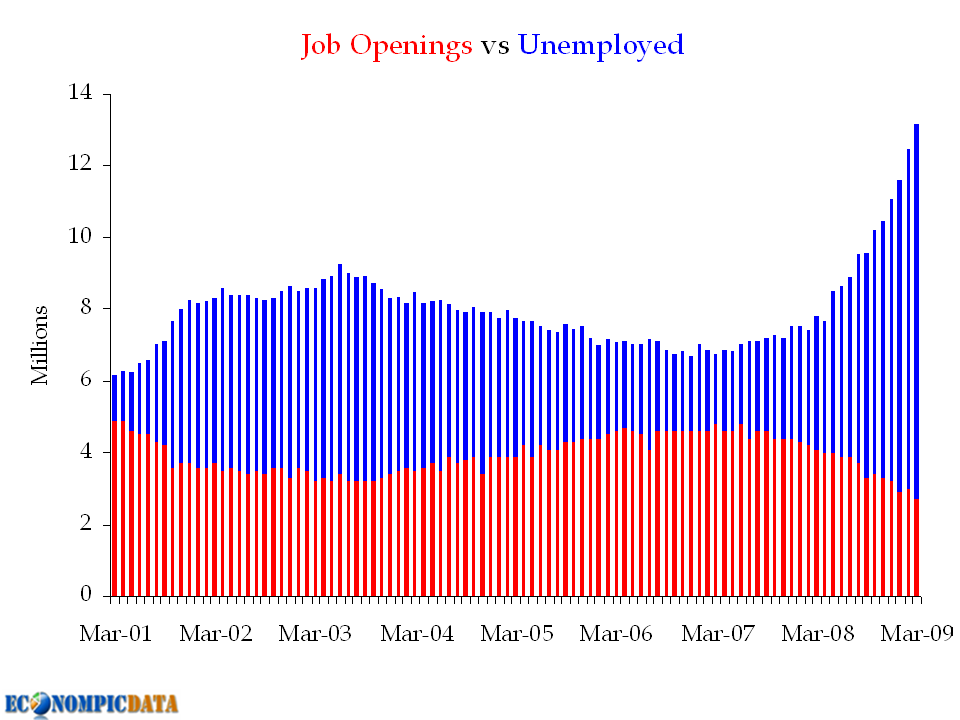
Courtney Schlisserman at Bloomberg reports that ADP Employer Services has released its estimate that US companies cut about 532,000 workers from their payrolls in May. "April’s reading was revised to show a reduction of 545,000 workers, up from a previous estimate of 491,000." Barry Ritholtz at the Big Picture links to Econopic Data's graphs of Job Openings plus number of Unemployed:


There are nearly five times as many reported unemployed people as there are reported job openings.

14. EIA REPORTS CRUDE STOCK BUILD

The EIA reported that, for the week ended May 29, commercial stocks of crude oil grew by 2.9 million barrels to nearly 366 million barrels.


As you can see from the EIA's graph above, commercial stocks remain quite high, historically speaking, and the stock build was contrary to analyst expectations of a 1.5 million barrel draw, per the Bloomberg survey. Gasoline stocks fell by 200,000, versus analyst expectations of a 650,000 build, and are below the five year average historical range for this time of year. Distillate stocks continue to grow by 1.6 million barrels.

Thursday, March 19, 2009

Daily Sources 3/19

1. Zhang Xin at China Daily reports that Wu Zhuang, director of China's Administration of Fishery and Fishing Harbor Supervision of the South China Sea, told the media that Beijing will step up patrols of China's exclusive economic zone in the South China Sea.
"Faced with a growing amount of illegal fishing and other countries' unfounded territorial claims of islands in China's EEZ, it has become necessary to step up the fishery administration's patrols to protect China's rights and interests. China will make the best use of its (retired) naval ships and may also build more fishery patrol ships, depending on the need."
On March 5, Malaysian Prime Minister Abdullah Ahmad Badawi claimed the Nansha Islands (aka the Spratley Islands) despite Chinese counterclaims. On March 10, Philippine President Maria Gloria Macapagal-Arroyo signed into law a bill which claimed Huangyan Island (aka the Scarborough Shoals) and the Nansha Islands as Philippine territory over Beijing's objections.


(h/t Carlos Tejada at China Journal.)

2. Fu Chenghao at Shanghai Daily reports that he China Iron and Steel Association said in a statement on its website yesterday that steel exports may fall as much as 80% in 2009 from 2008, a sharper contraction than the 50% the organization had previously predicted.
"A survey showed China's 28 largest steel exporters would ship only 299,100 tons this month and 129,600 tons in April, and China would probably become a net importer of steel products in March, it said."
(h/t Yves Smith at naked capitalism, who also notes that the Baltic Dry Index has fallen 20% in the last five days.)


Meanwhile, Tian Ying at Bloomberg reports that the Chinese cut in retail taxes has resulted in GM's Chinese minivan venture increasing sales by 32% in the first two months of 2009. The government has also announced the details of a rural auto subsidy program--see Daily Sources 3/16 #3.
"'Every farmer in China wants a new vehicle, all 800 million of them,' said Yale Zhang, a consultant at CSM Asia in Shanghai. 'It looks like the government wants to make that happen.'
...
Vehicle sales in China may rise between 5 percent and 10 percent this year, according to GM, the largest overseas automaker in the country. It had previously forecast sale growth of less than 3 percent. The automaker expects to outperform the wider market by as much as 3 percentage points, helped by sales at SAIC-GM-Wuling Automobile Co., the largest minivan-maker in China. The venture accounts for at least half of GM’s China sales."
3. Charles Lee at Platts reports that Korea Gas February sales fell by 22.9% from February 2009.
"Of the total, [LNG] sales to power generators plunged 35.5% to 731,692 mt, while retail gas companies accounted for 1.7 million mt, down 16.1% from the same month last year."
It was the fifth consecutive month of sales contraction.

4. Agence France Presse reported that Kuwaiti Emir Sheikh Sabah al-Ahmad al-Sabah dissolved Parliament yesterday, calling for a snap election in the next two months. The Emir is expected to issue by decree a stimulus bill that had been held up in Parliament for the last six weeks.

5. Takeo Kumagai at Platts reports that Japan's Minister of Economy, Trade and Industry, Toshihiro Nikai, signed today a memorandum of understanding with the Venezuelan Oil Minister, Rafael Ramirez, in Tokyo regarding broad cooperation in the energy sector.
"Details of the MOU were not made public, but sources close to the matter said Japan and Venezuela will form a joint committee to consider opportunities Venezuela's upstream and downstream oil and gas sectors."
An unnamed official told Platts that in the light of Japan's downstream investment, Tokyo would likely be looking for upstream natural gas opportunities.
"Earlier this month, Venezuela's state-owned PDVSA, US major Chevron, Japan's Mitsubishi and Mitsui, and a few other oil companies signed an agreement to develop the Delta Caribe LNG project.

The $12 billion project will comprise two 4.8 million mt/year gas liquefaction plants and includes development of dedicated gas fields."
Ramirez also indicated to the media in Tokyo outside METI that it was the position of Caracas that the market was 1 mb/d oversupplied. Bloomberg reports that Chávez will visit Japan on April 6. Meanwhile, Matthew Walter and Daniel Cancel at Bloomberg report that Venezuela is postponing payments to foreign contractors as the low price of oil cuts into the budget. Brazil's Odebrecht SA indicated last week that it was engaging in a work slowdown on the Caracas subway system because the government was late in payments. The government also is estimated to still owe $10.2 billion on nationalizations it has carried out in pursuit of Chávez's revolution.
"[PdVSA] has amassed at least $7.86 billion in back payments to oil service companies and suppliers, according to its third-quarter earnings statement. Dallas-based Ensco International Inc. and Helmerich & Payne Inc., headquartered in Tulsa, Oklahoma, idled rigs in Venezuela this year because of payment problems."
One wonders what kinds of assurances Ramirez gave Nikai that Japan's investments wouldn't be simply expropriated at a later date--especially given Tokyo's close ties to the US. Are Chevron, Mitsubishi and Mitsui simply betting that Chávez will not be encouraged by future high prices to go on another nationalization spree? That we will not see high prices again any time soon ... and that they will outlast Chávez?

6. The Associated Press reported that Iranian Oil Minister Gholam Hossein Nozari said yesterday in Vienna that Iran was diverting funds from other sectors of its national budget to oil production. The comments suggest that the oil sector, which supplies about 60% of the Tehran's budget, is losing money. In a conversation with AP reporters later, Nozari indicated that a substantial enough share of its oil production is unprofitable at current prices that it is making a net loss. It is unclear why, under those circumstances, that Iran would fail to comply fully with its OPEC quota as of December 17.

7. Platts reports that Eni CEO Paolo Scaroni told reporters in Vienna today that it had been tendered Iraq's Nassiriya field in a no-bid contest with Japan's Nippon Oil and Spain's Repsol. The field, which is estimated to have sustained production capacity of about 300 kb/d and 4.4 billion barrels of proven reserves, would be developed by the winner on a an engineering, procurement and construction (EPC) basis. Meanwhile, Upstream online reports that Scaroni told the conference that industry needs oil prices above $60/b to maintain investments, but that economic growth cannot be maintained at prices above $75/b. Meanwhile, Keith Johnson at Environmental Capital reports that Saudi Oil Minister Ali al Naimi told that $40/b oil only affects the investment plans of marginal producers.
"Despite the current economic situation and other challenges to the energy sector, Saudi Arabia will stay the course with our long-term capital investments for oil and gas expansion."
Some corporations expect upstream costs--which are about 2.2 times higher than they were in 2000--to fall precipitously in 18 months or so. Their investment plans are centered around that forecast.
"Just one problem with those hopes, says OPEC secretary general Abdullah Salem El-Badri: 'We have not seen costs coming down.'"
8. The Associated Press reports that al-Qaeda has posted a new tape by Osama bin Laden which urges Somali militants to overthrow the new government in Mogadishu. Bin Laden's 11 1/2 minute message was entirely focused on Somalia.

9. Sangar Rahimi and Carlotta Gall at the New York Times report that a spokesman for the Afghan National Security Directorate said in a news briefing yesterday that the February 11 attack on the Justice Ministry in Kabul was organized in Pakistan's tribal areas. The spokesman also
"suggested that Pakistani intelligence had a role in planning the attacks. 'I would like to say specifically that the intelligence agency of our neighboring country is involved and behind these attacks and organizing these activities.'"
Sens. John McCain and Joe Lieberman have an op ed in today's Washington Post arguing that a "minimalist" strategy in Afghanistan would be a mistake. Key excerpt:
"Loose rhetoric about a minimal commitment in Afghanistan is counterproductive for another reason: It exacerbates suspicions, already widespread in South Asia, that the United States will tire of this war and retreat. These doubts about our staying power deter ordinary Afghans from siding with our coalition against the insurgency. Also important is that these suspicions are a major reason some in Pakistan are reluctant to break decisively with insurgent groups, which, in a hedging strategy, they view as integral to positioning Pakistan for influence 'the day after' the United States gives up and leaves Afghanistan. That is why it is so important for the president to reject the temptations of minimalism in Afghanistan and instead adopt a fully resourced, comprehensive counterinsurgency strategy, backed by an unambiguous American commitment to success over the long term. In doing so, he must invest the political capital to remind Americans why this fight is necessary for our national security, speak openly and frankly to our nation about the difficult path ahead, and--most of all--explain clearly to our fellow citizens why he is confident that we can prevail."
Well worth reading in full.

10. Platts reports that Nigerian militants sabotaged a second Shell-operated pipeline in the Niger Delta today. The volume of oil lost has yet to be confirmed.

11. Matthew Saltmarsh and David Jolly at the New York Times reports that French unions have gone on strike today in the rail, airports, utilities and public sector.
"Two-thirds of the country’s high-speed TGV trains were canceled. Air France said most of its flights were operating normally from Roissy Charles de Gaulle International Airport, while about one-third of its flights from Orly Airport had been canceled. Traffic on the Paris Métro and bus networks were close to normal, according to transit officials, but suburban rail line service was disrupted."
The unions are calling upon the government to protect jobs and worker purchasing power. A poll has found that 78% of the French support the strikes. Workers have stopped six Total refineries, but the company claims that the impact on production is limited. Eurointelligence reports that the French Parliament has proposed a rider which would place a tax surcharge of 5% on top income earners for the next two years.

12. Tracy Rucinski at Reuters reports that Spain will withdraw its 600 troops in Kosovo. Spain has yet to recognize Kosovo as an independent nation. Spain, once known as Las Españas, or "the Spains," has several secessionist movements of its own to contend with--especially in the Basque region and Catalonia.

13. Tony Barber at the Financial Times reports that European Commission president, José Manuel Barroso, told reporters that EU member nations should spend more on stimulus programs if they could afford to.

14. Rebecca Wilder at News N Economics has a weekly world economic update for March 12-18 which has graphs demonstrating that the unemployment rate is "surging in every corner of the world," that industrial production is similarly "cliff diving," that retail sales are "anemic" globally, and that inflation is in full retreat. Worth a look. She also points out that Canada and the US, each others largest trade partners by far, are reporting extremely limited demand for imports.


15. Christine McGourty at BBC News reports that the UK's chief scientist forecast that by 2030 global resource demand will create a crisis akin to a "perfect storm."
"Demand for food and energy will jump 50% by 2030 and for fresh water by 30%, as the population tops 8.3 billion, he told a conference in London.

Climate change will exacerbate matters in unpredictable ways, he added."
Grim reading.

Thursday, December 4, 2008

Daily Sources 12/4

1. Li Yanping and Dune Lawrence at Bloomberg report that Secretary Paulson is in Beijing today pressing for a stronger Reminbi.
"The fifth round of the Strategic Economic Dialogue between China and the U.S. is a swansong for Paulson, who initiated the talks and will exit with the Bush administration. The currency appreciation that he’s applauded -- a 20 percent gain since the end of a peg to the dollar -- may be wound back as President Hu Jintao seeks to protect exporters from the global recession."
The discussions will also focus on agreements on electricity generation, transportation, and environmental cooperation. Philip Lagerkranser at Bloomberg reports that China may resist US calls in the dialogue to relax restrictions on foreign ownership of their banks. Unsurprising, I suppose. It was Brad Setser who first pointed out that by taking stakes in major international financial institutions, the US was ironically taking stakes in international concerns, funded in part by the international appetite for US debt. Brad Setser also has another interesting post today worth reading in full regarding China's stance regarding the devaluation of the yuan and the US as a "debtor country." It sounds reasonable to me, but I am beginning to suspect that the major exporting nations--China, India, and Germany--are considering whether it is in their interests to pursue policies which encourage US dollar deflation. Let me stress my lack of monetary economics background here, while at the same time suggesting that, should that be the case, it may be reasonable to expect a default, followed by an inflation shock here in the US.

2. Gregory Viscusi at Bloomberg has a useful synopsis of the history behind the rise of piracy in Somalia. In 2005, the Islamic Courts Union (ICU), "an alliance of sharia tribunals," won control of Somalia. They imposed Islamic Law and, as a result, piracy was completely suppressed. The US tried to persuade the Islamists to create a coalition government with opposition parties, but when the ICU refused it is alleged Washington gave the covert green light for an invasion to oust the government by Ethiopia which began in December 2006. In mid-December 2006 the US alleged that the ICU was linked to al-Qaeda.
"'The U.S. denies it publicly, but it’s a commonly held view that the American government provided tacit if not overt support to the Ethiopians,' says Roger Middleton, an Africa researcher at Chatham House, a London consultant."
Worth reading in full.

Robert Farley and Yoav Gortzak write in Foreign Policy that the European Union will, following the passage of UN Security Council Resolution 1846, launch Operation Atalanta on December 8 to protect shipping against piracy in the Gulf of Aden. They report that Euroskeptics in England, though the fleet will be controlled by a Vice Admiral from the Royal Navy, are upset by the decision to deploy warships under the EU aegis. (Some in England are upset that the French have been allowed to build a larger navy than theirs as well, it seems. However, the new law of the sea did not make it into the Queen's speech yesterday, which suggests that the Brown Administration, at least, thought 1846 was sufficient for the UK's interests for now.) However, Farley and Gortzak favor the move because it would begin to put the EU in the habit of deploying forces outside of the NATO structure. The EU presents to much of the world a less controversial aspect than the US-led NATO. Whose interests that would serve might be a matter of debate, however. Galrahn at Information Dissemination--who linked the Foreign Policy piece--notes that a Russian Admiral went on TV today to praise Resolution 1846 because it gave his ships the freedom of action required to engage the pirates. Jerry Frank at Lloyd's List reports that Major-General Jin Yinan, the head of China’s National Defence University, told Reuters that he believed Beijing should send warships to assist the various navies off Somalia. Apparently there is a coterie of influential advisers to the government who are pushing for China's involvement, in part because of China's Africa Policy of 2006 which envisions deepening involvement with African nations in order to secure a share of the natural resources there.
"China’s ambassador to the UN, Zhang Yeui, also backed the early deployment of an UN peacekeeping force to tackle the threat to the international economy and Somalians."
Also today in a blog post, Frank suggests:
"An Islamic extremist victory in Somalia — the very end result the US and western powers did not want — may be the best hope for international shipping running the gauntlet through the Gulf of Aden."
3. Alissa J. Rubin at the New York Times reports that Iraqi Prime Minister Nuri Kamal al-Maliki rejected Kurdish arguments that he was not authorized by the Constitution to establish tribal councils, or "Support Councils."
"[Al-Maliki's] government says the councils are unarmed volunteer groups, though that is a gray area, as every adult male is permitted one gun.

But Kurdish officials fear that the councils will instead be full-fledged militias that could be used against them in the north."
President Jalal Talabani, a Kurd, said on Monday that he would be sending the question of the legality of the Support Councils to the Federal Supreme Court. Al-Maliki's response is that not every institution in the government requires the authorization of the Supreme Court.

4. Emily Wax and Rama Lakshmi at the Washington Post report that yesterday Secretary Condoleeza Rice in New Delhi urged Pakistan to quickly act to help find and arrest those responsible for the terrorist attack on Mumbai last week. As she was speaking, tens of thousands of protesters in Mumbai were chanting "Death to Pakistan."
"Rice made demands on both countries. She said that Pakistan had a 'special responsibility' to cooperate with India and help prevent attacks. She also warned India against any impulsive moves that could have 'unintended consequences.'"
Rice also for the first time suggested there might be a link between the attackers and al-Qaeda.

5. Henry Meyer and Torrey Clark at Bloomberg report that Putin pledged further state aid to help cushion the economy in a three hour call-in television show today. The government has already pledged $200 billion in that effort. Concerns about the economy are deepening, however, VTB Capital forecast that unemployment in Russia will rise to 10-11% next year from about 6% now. At the bottom an interesting tidbit:
"Putin may try to persuade Medvedev to step down to allow him to assume full control and avoid taking blame for the crisis as prime minister, say analysts including Olga Kryshtanovskaya, a political analyst at the Russian Academy of Sciences, and Leonid Sedov, an analyst from the Levada Center research group in Moscow."
For the record, I doubt it, but it would be extremely enlightening should it be prescient.

6. Carter Dougherty at the New York Times reports that several European central banks cut their benchmark lending rates today.
"The European Central Bank, meeting in Brussels, cut its benchmark rate to 2.5 percent, from 3.25 percent. The Bank of England reduced its rate to 2 percent, from 3 percent, on top of an unexpectedly large reduction just a month ago."
In Sweden, the Riksbank cut its rate by 175 basis points (1.75%) to 2%. Real Time Economics has the text of the head of the European Central Bank's, Jean-Claude Trichet, statement announcing the cut.

7. Kevin Sullivan at the Washington Post reports that UK Prime Minister Gordon Brown said yesterday that homeowners who have lost their jobs or are facing deep cuts in income will be allowed to defer interest payments on mortgages for up to two years.
"Brown did not provide many details of the plan, but analysts said it basically amounts to a government insurance program for mortgage lenders. The BBC reported that the plan will cover people with mortgages of up to 400,000 pounds, or nearly $600,000."
8. Ian Austen at the New York Times reports that the Canadian Prime Minister has shut down the Parliament until January 26 in order to forestall a non-confidence vote he was sure to lose due to the new opposition coalition. Read it to believe it.

9. Grant Smith at Bloomberg writes that Francisco Blanch, a Commodity Strategist with Merrill Lynch, released a report today saying that if the recession spread to China, and absent large cuts by OPEC, oil might fall to as low as $25/b. "In the short-run, global oil demand growth will likely take a further beating as banks continue to cut credit to consumers and corporations." The lower band most have suggested up to now has been around $40/b. Iranian President Ahmadinejad suggested $35/b just yesterday (Daily Sources 12/3 #1) and in a report in early Fall Philip Verleger gave $10/b as a low case scenario, but these have been outliers for the most part. Predictive qualities aside, the mood is clearly darkening. "Producers in Canada may shutter almost 800,000 barrels a day if prices decline below $35 a barrel, Blanch added."

10. Paul Okolo and Garth Theunissen at Bloomberg report that the Nigerian Naira fell 5% against the dollar this week after the central bank restricted the sale of dollars to $100 million versus the $800 million typically seen earlier.
"The shortage of dollars has prevented trading in naira between Nigeria’s commercial banks, which demanded more than $1 billion of U.S. currency at auctions in the past month, Citigroup Inc. said."
The bank apparently thinks the demand for dollars is being driven by "speculation on the naira," rather than the unwinding of dollar-denominated debt. The United States imports more than half, if I remember correctly, of Nigerian crude production. To go out on a limb into monetary economics where I have no expertise: Has the price of oil gone down so much that the Nigerian central bank would be helped by access to cash swaps with the Federal Reserve? "Nigeria’s cash reserves dropped 4.3 percent to $55.9 billion in November, the central bank said yesterday."

11. Aloysius Unditu and Arijit Ghosh at Bloomberg report that the central bank of Indonesia cut their benchmark lending rate by 25 basis points to 9.25%. The rupiah has fallen 25% in the last three months, suggesting that the high interest rate was not defending the currency. Consumer price inflation grew 11.7% in November, year over year. The government's decision to cut the subsidized price of gasoline by 8.3% on December 1st may be followed by a similar cut in diesel prices, which may cut inflation some.

12. David Cho, Zachary A. Goldfarb and Dina ElBoghdady at the Washington Post report that the Treasury is considering a plan to directly intervene in the mortgage market by purchasing securities which finance new home loans. However, to receive the government funding, banks would have to sell mortgages at low rates, for example at 4.5% for 30 year fixed-rate loans. It is not clear how the Treasury would finance their purchases, one option is to sell bonds at 3%, thus making a profit on the 4.5% mortgages.

13. Shobhana Chandra and Bob Willis at Bloomberg report that the Labor Department announced that a larger number of jobless than expected--4.09 million--received unemployment checks the week ended November 22.

14. Stanley Reed at BusinessWeek reports that Bernstein analysts Ben Dell and Neil McMahon made a presentation today which suggested that US stripper wells--onshore oil wells that produce as little as 15 b/d--amount to 18% of US onshore production. Stripper wells require high oil prices to be profitable, but the article does not provide a break-even point. Either way, the analysts expect that the low price environment may take as much as 1.3 mb/d of US production offline, about 20% of US production, or about 1.5% of global demand and around 6.5% of US demand.

Thursday, November 20, 2008

Daily Sources 11/20

1. Brian Blackstone at Real Time Economics reports that the Labor Department released job claims data which shows there was another jump in claims for the week ended Nov. 15.
"In quarterly forecasts released Wednesday, the Federal Reserve said the central tendency of officials’ unemployment rate forecasts for the end of 2009 was 7.1% to 7.6%, though individual forecasts went as high as 8%."
Henry J. Pulizzi, also of Real Time Economics, reports that Dana Perino, White House Spokesman, has signaled that the Administration backs the extension of unemployment benefits, "Because of the tight job market, the President believes it would be appropriate to further extend unemployment benefits, and he would sign the legislation now pending in Congress."

2. The Economic Times reports that the European Commission is planning a €130 billion (~ $164.2 billion) stimulus plan according to a spokeswoman for the German economic ministry. That would equate to about 1% of GDP for each member state. (For Germany that means something along the lines of €25 billion.)

3. Maya Jackson Randall at Dow Jones reports that the minutes of the October 28-29 Federal Open Market Committee meeting demonstrate that they stand ready to cut the Federal Funds Rate further, should that prove necessary. The minutes also reveal that most Committee members expected the economy to contract in the second half of 2008 and the first half of 2009. In a related story, Jason Clenfield at Bloomberg reports that JP Morgan economist Jason Clenfield advised clients that he expected the Fed to cut the Federal Funds Rate by 50 basis points (0.5%) in each of the next two FOMC policy meetings on December 16 and January 28 to 0%. Paul Krugman argued the same on November 7. Neither, however, feel that that would mean that the Fed had emptied its economic tool kit. Arnold Kling at EconLog argues that zero isn't even necessarily the lower bound for interest rates, and that you might have negative interest rates. He is speaking theoretically, but it does make a kind of sense--in a deflationary environment, you could pay interest to be in dollars and make a return.

4. Sahar Ahmed at Reuters reports that Pakistan and the IMF have agreed upon terms for a $7.6 billion emergency loan to the country. "The interest rate on the credit facility would vary between 3.51 and 4.51 percent with changes according to market conditions, and would be payable between fiscal 2011/12 and 2015/16." Delphine Strauss at the Financial Times reports that Turkey is close to an agreement for a loan from the IMF in the region of $20-40 billion.

5. John Acher and Wojciech Moskwa at Reuters report that Norways Sovereign Wealth Fund has increased its holdings of European stocks from 0.77% of total European securities to 1.25% and on the lookout for purchases worldwide. The Norwegian finance ministry has given the fund permission to invest up to 5% of its assets in real estate. The fund's Executive Director, Yngve Slyngstad, says they have about $20 billion waiting to invest in real estate, but that they are not sure if they will enter the market in the first or second half of 2009.

6. Luke Pachymuthu at Reuters reports that Koch and Shell are renting oil tankers for use as storage.
"Koch has booked Very Large Crude Carrier (VLCC) the Dubai Titan, with capacity to hold over two million barrels, for storage in the U.S. Gulf Coast, ship brokers said on Thursday.

Koch has already taken two other VLCCs for storage in the U.S. Gulf, they said.
...
Oil major Royal Dutch Shell has booked a second supertanker to be used for storage, shipbrokers said on Thursday."
Although the container shipping market seems to have collapsed, anecdotal evidence suggests that oil tankers are still fetching profitable rates of around 70 world scale. That suggests to me that either land based storage is becoming scarce or that financing for floating storage is somehow easier to secure.

Either way, the contango in oil is so steep, that floating storage is a profitable proposition even though demand for oil tankers is fairly steady. (Yesterday, the differential between front month and the Dec '09 contract was $10.21/b or 19% of the front month price. The differential between front month and the Dec '16 contract was $32.86/b, or 61% of the front month price.)

Jamie Dale reports that Black Sea and Middle east shipping rates have doubled on piracy concerns. The Baltic Dry Index shows a very small uptick.


Alaric Nightingale and John Martens at Bloomberg report that with the announcement--telegraphed yesterday--today that Maersk will stop sailing ships through the Suez, and Euronav NV, TMT Co. Ltd., BW Shipping Managers Pte, and Frontline Ltd. are reviewing doing so themselves. Odfjell SE is the other shipping company that has official abandoned the Suez route. Combined the companies control 117 supertankers, 2.7 days of global demand or 229.5 million barrels of oil. Tony Gray at Lloyd's List reports that "Senior figures in the maritime industry are calling for a co-ordinated approach to dealing with the crisis in the shipping industry." That is, some are calling for the creation of a cartel to artificially take shipping supply off the markets and thus shore up price.

7. Gary Kasparov has an editorial in the Wall Street Journal saying that Obama has the chance to start fresh with Russia, and that he should do so by labeling Putin a dictator from the start.

8. Del Quentin Wilber at the Washington Post reports that US District Judge Richard J. Leon has ordered the release of five Algerian detainees held at Guantanamo. Leon was a Bush appointee. He took the extraordinary step of urging the government not to appeal, saying that 7 years was long enough for these people to face uncertainty in terms of their fate.

9. Juan Cole at informed comment has a long post on al-Qaeda leader Ayman al-Zawahiri's long anti-Obama video released onto the internet Tuesday. He spends a long time pointing out the inaccuracies in Zawahiri's characterizations of the facts which is just odd. The main thing to be learned, it seems to me, from the video is how weak al-Qaeda's--and in the Middle East generally--understanding of the West is. There is little point in debating the facts with the leadership of al-Qaeda--for them nothing is as it appears. This is not just true of radical groups, but also of leadership in important nations like Iran. The Bush Administration has only lent more credibility to this perspective over the last eight years, of course.

10. Henry Meyer and Lyubov Pronina at Bloomberg report that Vladimir Putin has pledged to a conference of the United Russia party--which he leads--to do everything in his power to prevent the financial collapse of the country. He announced measures to increase welfare payments and cut corporate taxes and promised to defend the ruble. He said, "We'll do everything we can to prevent a repeat in our country of the problems of past years, the collapse of past years."

11. Eric Watkins at the Oil & Gas Journal reports that the Indonesian government has ordered oil firms to keep funds for energy projects in domestic banks. Companies that do not do so will not be allowed to participate in the cost recovery scheme for the various projects.
"Djoko Harsono, BPMigas deputy for finance, said, 'This policy aims to help boost rupiah value against the dollar. We want contractors in energy projects to put all their US dollar funds in local banks, especially state-owned banks.'"
12. In another interesting article by Eric Watkins, Saudi Arabia announced that it has canceled its contract for the Manifa field with Snamprogetti, which would potentially have added 900 kb/d in capacity by 2011. The project to add the capacity is now under review.

13. Eric Watkins at the Oil & Gas Journal report that CNPC and Costa Rica's Recope are considering plans to build a 200 kb/d capacity refinery in that country. "As part of the Moin development, Recope announced plans in February to expand its storage capacity by 550,000 bbl to 3.95 million bbl by 2011."

Wednesday, October 1, 2008

Daily Sources 10/1

1. Craig Whitlock, Mary Jordan, Edward Cody, Emily Wax, Shannon Smiley, and Karla Adam at the Washington Post report that Central Bankers around the world are becoming increasingly nervous as an American bailout plan continues to be delayed. Very nice survey article. Evidently the European response has been fragmented. So far they are unable to design a unified response. To paraphrase an old banker's saying: If you lend someone $1 million, he'd better watch out, if you lend him $1 billion, you'd better watch out. Andreas Scholz and Gabi Thesing at Bloomberg report that the head of the European Central Bank, Jean-Claude Trichet, said in an interview that US lawmakers must pass a bailout package. He refused to answer any questions about the rate meeting the ECB was holding tomorrow. Chris Giles at the Financial Times had a story yesterday on the various efforts foreign central bankers are taking to try and stem the fallout from the crisis. Also, Yves Smith at Naked Capitalism has an interesting analysis of the decision by the EU to impose more capital requirements on member banks shortly. She argues that imposing an requirement increase during the crisis would be counterproductive.

2. Jeff Fick at Dow Jones reports that Brazil announced two more offshore oil finds today. Petrobras and Anadarko both made the finds in the Campos Basin in the past 24 to 48 hours.


3. Jaspal Singh at the New Strait Times reports that seafood prices are surging in Malaysia due to fuel shortages. Catches have dropped by 60% since August 22nd as a shortage of subsidized diesel idled the fishing fleet. "Seafood prices are expected to rise by at least 20 per cent next week, with fears that prices could rise further if the fuel shortage persists."

4. Kim Graham of Sun Media Corp reports that Cameco is planning a $6 million expansion to their Blind River uranium refinery in Ontario, Canada. The refinery converts raw uranium ore into UO3, not quite yellowcake or U3O8 if I understand correctly, but still requiring further upgrading before it becomes nuclear fuel either way. The outlook for nuclear power is pretty good worldwide, considering the alternatives. But electricity demand may not jump as quickly as expected if growth in the export-model economies is essentially limited by oil prices. In that vein, Kaori Kaneko at Reuters reported today that the Northwest Airlines CEO said that the airline could be profitable at $100/b. Possibly, but I suspect the bar is lower for the continued profitability of the export-economies.

5. Jason Leopold at the Intelligence Daily reports that Secretary of State Rice gave a statement to the Senate Armed Service Committee which said she led high-level discussions about subjecting al-Qaeda detainees to torture techniques. (h/t informed comment) This gives the lie to statements by President Bush, Cheney, and others that the torture was done by a few bad apples and went forward without the OK of higher-ups. Well, at least the truth is finally out there.

6. Securing America's Future Energy, a program led by the Energy Security Leadership Council, has released a "National Strategy for Energy Strategy." I have not had time to actually read it, but it is likely to be influential. Its membership includes Maurice R. Greenberg (yes, that Greenberg), Edgar M. Bronfman (yes, that Bonfman), the current CEOs of Southwest Airlines (whose success with oil hedging has become famous), FedEx, the International Continental Exchange (ICE ... on which the basic Brent contract is traded and which was targeted in part by the commodities anti-speculation bill that recently passed the House), and Waste Management, Inc., among others. It also includes a rather illustrious roster of former generals and admirals.

7. Brian Burnsed at Businessweek reports that the gasoline shortage in the Southeast continues unabated. Remember the US decided not to ask for emergency gasoline supplies from the International Energy Agency (IEA), so presumably they expect this problem to resolve itself before the supplies would have arrived. The Energy Information Administration reported today that only one refinery in the Gulf (which is where the South East gets a substantial portion of their product from) remains shut down. However, they also report that "742,000 barrels per day of the original crude oil outage of 1.3 million barrels per day [remains] shut in."

8. Chris Frank at KAKE News reports that the Kansas Energy Council is considering lowering the speed limit in that state from 70 to 65 mph. "There is a seven to 23 percent increase in fuel consumption with each five mile per hour increase over 60." Welcome news as it seems our federal representatives do not have the guts to do something so straightforward (and in doing so making American security a priority). I believe the numbers are that if the US made 55 mph the national speed limit, then the country would consume 2 mb/d less. That would represent fully 10% of our current demand. It would represent about 2.3% of world demand. That could theoretically mean a 40% reduction in price--though it would be silly to promise that and I am suspicious of the supply elasticity numbers that have been thrown around by the petroleum economics community.

9. The US Department of Transportation announced today that Americans drove
"3.6 percent less, or 9.6 billion miles fewer, in July 2008 than July 2007. Since last November, Americans have driven 62.6 billion miles less than they did over the same nine-month period last year. Meanwhile, she said, transit ridership is up 11 percent, and in July, Amtrak carried more passengers than in any single month in its history."
In June, Americans drove 4.7% less than they did in June 2007. The Summer is the driving season in the United States, so it is too soon to see if the demand reduction will pass through the Fall, but the fact that prices are at the very least reducing "disposable" driving is a sign that this price environment erodes the largest and richest export market for oil--the US. If it can be extrapolated to Europe, the second largest, that suggests considerable demand destruction going forward. We know that in India and China the price environment is forcing the governments there to scale back subsidies of transportation fuels as much as is politically possible.

10. The EIA published This Week in Petroleum reporting a 0.9 million barrel increase in American gasoline stocks today. Analysts were expecting a 1-3 million decline, but stocks are still at historically (read lowest in 40 years or so) low levels. Crude stocks were up 4.3 million barrels, which put them in the middle range of historical levels, and were against a range of analyst expectations. Distillate stocks fell 2.3 million barrels to near the bottom of average holdings and consistent with analyst projections. Propane stocks grew 2.4 million barrels, but are slightly below the average historical range. This news should put downward pressure on crude prices.

11. Greg Robb at Marketwatch reports that the Institute for Supply Management's manufacturing index for September indicates that manufacturers cut down on production to 43.5% from 49.9% in August. "This is the lowest level since October 2001. ... This is the biggest drop in the index since 1984. The drop surprised economists." On the other hand, the Automatic Data Processing employment report released today shows that jobs "only" fell by 8,000 in September, which is less than expected, as per Real Time Economics. Jennifer Waters at Market Watch also has the story that credit card debt is "on the brink of imploding.

Wednesday, September 17, 2008

Daily Sources 9/17

1. Andrew E. Kramer at the New York Times reports that trading was halted on the Russian stock market for the second time this week. The market has dropped by more than 25% this week and is off 57% since its peak in May. The Russian Central Bank and regulators also announced a 4% reduction in bank reserve requirements today, which the central bank’s chairman, Sergei Ignatyev, said would free up $11.76 billion. The Russian finance minister, Aleksei L. Kudrin, also announced he would free up about $44 billion by increasing the repayment time of state loans to state banks from one week to three months. Kudrin also said that the discussed measure of having Russia's Sovereign Wealth Fund invest in the market has, for now, been deemed unnecessary.

2. The Moscow Times reports that UBS analysts have said that the price of crude has dropped so much that a barrel is now worth less than the cost of transport and Russian taxes. If you are a pure crude exporter--and don't have a refinery from which you then sell products--you are losing money. (Evidently the mandated prices of transportation fuels in Russia now would not be counted as subsidies.)

3. Margarita Antidze and Matt Robinson at Reuters report that Russia has signed treaties with Abkhazia and South Ossetia which formally commits Moscow to coming to their defense should they be attacked. In 19th century gunboat diplomatic terms, you would call it a "guarantee of independence."

4. AP reports the US Embassy in Yemen was assaulted with a car suicide bomb, rocket-propelled grenades, and automatic weapons today. At least 16 are dead, although apparently no Americans were hurt. President Bush used the incident to say that the attack is a "reminder" that we are "at war with extremists." Officials believe it is likely an al-Qaeda attack. Non-essential personnel were just allowed back into the facility last month.

5. MEND's oil war continues to heat up in Nigeria, as per Ibanga Isine and Victor Sam at the Punch. The "oil war" is also referred to by MEND as "Operation Hurricane Barbarossa"--which is probably meant to evoke the Turkish privateer "Redbeard" who put an end to the damage the Knights of Saint John were doing to Ottoman shipping and eventually became the Fleet Admiral of the Ottoman Navy(a) and not Hitler's "Operation Barbarossa" (or the code name for the invasion plan of the Soviet Union.) The Hurricane part I understand ... and so far many of the attacks seem to have come via speed boats.

It is in this environment that the Nigerian Senate is considering an anti-terrorism bill reports John Alechenu at the Punch. Yet another foreign political utilization of the Bush Administration's "War on Terror" (by the way, just yesterday Putin referred to the Georgian terrorist situation)--and it is worth remembering that America remains very popular in Nigeria.(b) "If passed, the attorney-general will be empowered to detain persons for up to 60 days where he has reasonable grounds to 'believe or suspect' that 'the entity knowingly committed; attempted to commit, participate in committing; or facilitated the commission of terrorist acts.'" I think that such broad language tends to erode the rule of law, and this would be in a country where the rule of law is not particularly strong to begin with.

6. Juan Forero at the Washington Post has an important report on a witness in ongoing trials in Colombia linking Gen. Mario Montoya to death squads in Medellin. Montoya is apparently well-known in Washington and was one of the generals involved in orchestrating the spectacular rescue of hostage Ingrid Betancourt from FARC. The State Department stood behind Montoya today in interviews. Should these allegations prove true, they will likely be very damaging to the Uribe Administration as well as further undermine the American image in South America.

7. Thom Shanker at the New York Times reports that Defense Secretary Gates has apologized for the deaths of non-combatants in recent strikes in Afghanistan. I think that--though it might stick in the craw a little--this was a very wise move.

8. Xinhua reports that China will allow local governments to raise the cost of heating in response to the increased costs of coal.

9. Tom Doggett at Reuters reports that Sam Bodman, Secretary of Energy, told reporters that the Administration is considering asking the IEA for some of its gasoline reserves.

10. Edmund L. Andrews, Michael J. de la Merced and Mary Williams Walsh at the New York Times report that The Federal Reserve Bank has agreed to lend AIG $85 billion for a majority equity stake in the company.

11. David Cho at the Washington Post reports that the Federal Reserve has asked the Treasury for a $40 billion deposit.

12. Brain Setser at Follow the Money yesterday had a blog entry which partially answered my question regarding where foreign banks were going to put their money, following the Treasury's release of the Treasury International Capital data for July (TIC.) Answer: fleeing the US, and insofar as they are investing in the US, investing in the safest possible instrument, Treasuries. To paraphrase:
Before the crisis, foreigners bought roughly:

- $205b of long-term Treasury bonds
- reduced their holdings of bills by $10b
- $285b of long-term Agencies
- $540b of long-term corporate bonds
- $210b of US equity.
or about $1,230 billion per month.

After the crisis:
- $350b of long-term US treasury bonds
- $125b of short-term bills
- $150b in Agency bonds
- $210b of corporate bonds
- $55b of US equity
or about $890 billion per month.

Today the yield on the 3 month Treasury bill went to zero. That suggests to me that the market believes that the dollar will be worth more tomorrow, versus a basket of goods, than it is today. By basket of goods, I mean basket of currencies and securities because commodities appear to have rebounded recently. (Gold for December went up, if I understand correctly, $70 today! h/t Jesse's Cafe Americain) So, does this mean that foreign central banks will now be forced to sell dollars in order to defend their currencies or that they will be forced to buy dollars in order to defend their exports? I dunno.

(a) Wikipedia: Hayreddin Barbarossa
(b) Pew's 47-Nation Global Attitudes Study of 2007 has 70% of Nigerians having favorable views of the United States. Table: "Favorable Views of the U.S.", page 17. You also might want to check out my blog entry from March: The Geopolitical Consequences of the Candidates.