Showing posts with label Kazakhstan. Show all posts

Tuesday, August 10, 2010

Daily Sources 8/10

US AND VIETNAM HOLD JOINT NAVAL EXERCISES

BBC reports that the US and Vietnam are holding joint naval exercises in the South China Sea this week. "The week-long activities focus mainly on non-combatant exercises and are part of the 15th anniversary of diplomatic ties between Washington and Hanoi."

CHINA'S TRADE SURPLUS GREW TO $28.7 BILLION IN JULY

Keith Bradsher at the New York Times reports that China's trade surplus grew to $28.7 billion in July, "the largest total since January of last year."

SINOPEC TO COMPLETE OIL STORAGE PROJECT BY 2011

Platts reports that Sinopec announced on its website that it would complete its oil storage tank project on Cezi island by 2011. Once finished, the oil tanks would have a capacity of 84.91 million barrels and would bring Sinopec's total capacity to 122.65 million barrels.

CHINA NOT TO CLOSE 2000 + FACTORIES, BUT TO ELIMINATE EQUIPMENT AT THEM

Jason Dean at China Real Time reports that the story yesterday about China closing 2,000 + inefficient factories is an exaggeration.
"In fact, the MIIT’s list is generally quite specific about which equipment in which factory should be eliminated: two blast furnaces at Haicheng City Xiyang Steel Co. in Liaoning province, one cement mill at the Hongdong County Huoyue Construction Materials Co. in Shanxi, 91 rotary drums at the Shijiazhuang City Tongtai Leather Industry Co. in Hebei etc. Only about a dozen factories are listed for full closure, including a pair of paper plants in Hebei, five printing-and-dyeing operations in Guangdong, and a trio of liquor factories in Sichuan."
JAPAN LEAVES BENCHMARK RATE AT 0.1%

Mayumi Otsuma at Bloomberg reports that the Bank of Japan has left its benchmark interest rate at 0.1%.
"[Bank of Japan Governor Masaaki] Shirakawa said the discussion of the yen, which is approaching a 15-year high against the dollar, dominated today’s meeting because of the risk it poses to exporters and the economy."
KNOC DISCOVERS OIL IN KURDISH REGION OF IRAQ

AFP reports that the Korean National Oil Company (KNOC) has discovered oil in the Kurdish region of Iraq.
"[T]he Korea National Oil Corp (KNOC) said in a statement it was too early to estimate the size of the reserves. It said a formal announcement of the discovery would be made only after consultation with local authorities."
The newspaper that broke the story reported that there was an estimated 2 billion barrels in the newly found reserves. South Korea has been banned from participating in any oil concessions in the rest of Iraq because it has chosen to participate in exploration in Kurdistan before the relationship between Baghdad and Kurdistan has crystallized in terms of oil.

45% OF ELECTRICITY IN PORTUGAL TO COME FROM RENEWABLES THIS YEAR

Elisabeth Rosenthal at the New York Times reports that
"[n]early 45% of the electricity in Portugal’s grid will come from renewable sources this year, up from 17% just five years ago."

[C]omplaints about rising electricity rates are a mainstay of pensioners’ gossip here. Mr. Sócrates, who after a landslide victory in 2005 pushed through the major elements of the energy makeover over the objections of the country’s fossil fuel industry, survived last year’s election only as the leader of a weak coalition.
KAZAKHSTAN LARGEST PRODUCER OF URANIUM IN THE WORLD


Nirode Masson at IDN reports that Kazakhstan is now the largest producer of uranium in the world.
"Kazakhstan has a major plant making nuclear fuel pellets and aims eventually to sell value-added fuel rather than just uranium. It aims to supply 30 percent of the world fuel fabrication market by 2015, according to World Nuclear News (WNN)."
GATES SUGGESTS CLOSING OF JOINT FORCES COMMAND IN NORFOLK

Thom Shanker at the New York Times reports that Defense Secretary Gates has announced plans to close the Joint Forces Command in Norfolk, Virginia, as part of a plan to reduce spending by the military.
"The White House, which is under intense political pressure to address the rapid increase in the national debt, quickly stepped in to back Mr. Gates, saying his plan would free money that could be better spent on war fighting."
WORKER PRODUCTIVITY FELL IN JULY BY AN 0.9% ANNUAL RATE

Courtney Schlisserman at Bloomberg reports that "the measure of employee output per hour fell at a 0.9% annual rate, the first drop since late 2008."
"Hours worked climbed at a 3.6% rate, leading to a 2.6% increase in the amount of goods and services produced.

A lengthening workweek signals employers have reached efficiency limits after productivity climbed by the most in five decades in the 12 months to March."
HOTTER SEAS LEAD TO POSSIBILITY OF MORE DANGEROUS HURRICANES

Brian K. Sullivan at Bloomberg reports that a hotter Atlantic Ocean is likely to lead to more and stronger hurricanes this hurricane season. The sea is hotter now that it was when hurricane Katrina formed.

HIGHER TEMPERATURES REDUCE RICE YIELDS

Richard Black at BBC reports that a new study has found that higher temperatures reduce the rice yield globally.
"Yields have fallen by 10-20% over the last 25 years in some locations.

The group of mainly US-based scientists studied records from 227 farms in six important rice-producing countries such as Thailand, Vietnam, India and China."
NON-FARM EMPLOYMENT MOSTLY FLAT FOR LAST DECADE


Free Exchange hosts a graph of non-farm employment from 1939 and notes that in the last decade the gauge has been mostly flat.


A CALL FOR A GLOBAL ARCHITECTURE FOR FOOD POLICY

Joachim von Braun at the Financial Times argues that a global architecture for food policies is overdue. He further states that food security is worse now than it was in 2008 when food riots took place around the world.

Thursday, July 2, 2009

Daily Sources 7/2

1. JAPANESE HAWK CHOSEN TO LEAD IAEA

Sharon Otterman at the New York Times reports that Japanese diplomat, Yukiya Amano, was elected to head the UN's atomic watchdog--the IAEA.
"Depicted by experts as the candidate favored by the United States and other wealthy nations, Mr Amano favors maintaining the current approach toward controlling nuclear proliferation in Iran, which Western countries suspect of trying to build nuclear weapons. Iran says its nuclear program is purely for civilian purposes to generate energy.

'He’s a nonproliferation and disarmament guy, and he believes in it,' said David A Kay, a former IAEA official and senior fellow at the Potomac Institute for Policy Studies. 'He has been around in trying to keep the inspections in Iran going, and I expect him to continue very much in that line. He will not want to create a situation in which military action is the only alternative.'"
2. CHINA TO RESUME ALLOWING IMF REVIEWS OF ECONOMY

Andrew Batson at the Wall Street Journal reports that China next week will take a step toward reconciling with the IMF, which it has blocked from reviewing its economy for the last three years.
"But a team of IMF officials visited China about a month ago, and have completed a draft review that is now being circulated for comments.

The IMF's draft report says China's exchange rate 'continues to be substantially undervalued,' according to a person who has seen the document, called an Article IV consultation. That's in line with what senior IMF officials have repeatedly said in public. China has kept its currency, the yuan or renminbi, basically fixed against the US dollar since July last year, though it has risen, along with the dollar, against other currencies since then.

That description nonetheless marks a climbdown from an earlier push to label China's exchange rate as 'fundamentally misaligned,' a designation that would suggest the country is in violation of the IMF charter. The draft report also states that Chinese authorities 'disagreed with the staff's assessment' of the exchange rate, and notes their argument that the global turmoil calls for 'a policy of stability.'"
Simon Johnson argued in April that the Obama Administration had pulled off a coup at the G20 meeting, effectively getting Europe to make the selection process for the head of the IMF transparent in return, more or less, for opening up the process at the World Bank, the next head of which Johnson thinks is likely to be Chinese--see Daily Sources 4/3 #3. Clearly in order to clear the field for their own candidates and a larger role generally, Beijing will first be forced to work with the organizations they want to influence or lead.

3. PBOC TO ENCOURAGE CROSS-BORDER SETTLEMENT IN YUAN

Bob Chen and David Yong at Bloomberg report that the People's Bank of China will encourage cross border settlement in the renminbi starting today, per regulations posted on the central bank's website.
"Transactions inside China will take place in Shanghai and four cities in southern Guangdong province, including Guangzhou and Shenzhen, while those outside China will occur in Hong Kong, Macau and the Association of Southeast Asian Nations, it said."
(h/t Jesse's Café Américain.)

4. CNPC MAY REVIVE BID ON ARGENTINE UNIT OF REPSOL-YPF, CNOOC MAY JOIN IN

Sui-Lee Wee at Reuters reports that CNPC plans to revive its $17 billion bid for the Argentinian unit of Repsol-YPF, reportedly planning to make an offer for as much as 75%. CNOOC also may enter a bid for the remaining 25%. "Goldman Sachs is advising YPF on the sale, while Morgan Stanley and JP Morgan are advising CNPC and CNOOC respectively." YPF, or Yacimientos Petrolíferos Fiscales, was the national oil company of Argentina until 1991, when it was privatized and then purchased by Repsol. (h/t Carola Hoyos at FT Energy Source.)

5. SPANISH CONSUMER CREDIT DOWN 33.7% IN Q1

Edward Harrison at Credit Writedowns reports that consumer credit in Spain fell by 33.7% in the first quarter, according to the National Association of Financial Credit Institutions (Asnef).
"Asnef stressed that the fall in the consumer sector has been mainly due to losses on personal loans, due to the sharp decline in the credit available for consumer goods and by the contraction of revolving credit associated with credit card usage."
Harrison says he expects more failures or bailouts of Spanish banks in coming months. Worth reading in full.

6. RIKSBANK CUTS BENCHMARK INTEREST RATE TO 0.25%

Malin Rising at the Associated Press reports that the Riksbank cut its benchmark interest rate by 0.25% to 0.25% today.
"The central bank said it now expects Swedish gross domestic product to decline by 5.4% in 2009 -- a sharper drop than its previous forecast of a 4.5% fall. However, it raised its outlook for 2010 GDP to a growth rate of 1.4% from 1.3% previously.

It said the economic outlook is still uncertain and that although GDP is expected to be positive in 2010, employment will not begin to rise until 2011."
7. FINAL SECTION OF SINO-KAZAKH CRUDE PIPELINE COMPLETED

Naubet Bisenov at Platts reports that Kazakhstan's KazStroyService has finished the 10 million metric ton/annum (200 kb/d) Kenkiyak-Kumkol pipeline and will begin test runs on it shortly.
"The Kenkiyak-Kumkol link is the final section of the Sino-Kazakh crude pipeline which runs from Atyrau on the Caspian Sea coast of the Central Asian nation, to Atasu near Kazakhstan's eastern border, then onwards to Alashankou in China's northwestern Xinjiang Uygur autonomous region.

The Sino-Kazakh crude pipeline is jointly developed by Kazakh state oil company KazMunaiGaz and Chinese state oil giant China National Petroleum Corp."


8. TALIBAN HAS WORN OUT ITS WELCOME IN PAKISTAN

In another interesting report by World Public Opinion, an institute based out of the University of Maryland, Pakistani opinion has turned sharply against the Taliban.

"Large majorities express confidence in the government (69%) and the military (72%) to handle the situation [in Swat]. Retrospectively, the public leans (by 45% to 40%) toward thinking the government was right to try to make an agreement in which the Pakistani Taliban would shut down its camps and turn in its heavy weapons in return for a shari'a court system in Swat. But now 67% think the Pakistani Taliban violated the agreement when it sent its forces into more areas, and 63% think the people of Swat disapprove of the agreement.

On the Afghan Taliban, an overwhelming 87% think that groups fighting to overthrow the Afghan government should not be allowed to have bases in Pakistan. Most (77%) do not believe the Afghan Taliban has bases in Pakistan. However, if Pakistan's government were to identify such bases in the country, three in four (78%) think it should close the bases even if it requires using military force.

Public attitudes toward al Qaeda training camps follow the same pattern. Those saying the 'activities of al Qaeda' are a critical threat to Pakistan are up 41 points to 82%. Almost all (88%) think al Qaeda should not be allowed to operate training camps in Pakistan. Though 76% do not believe there are such camps, if the Pakistani government were to identify them, 74% say the government should close them, with force if necessary."
Unsurprising, to me, but still well worth reading in full. (h/t Juan Cole at Informed Comment.)

9. PETROBRAS STRIKES MORE OIL ONSHORE IN THE ESPIRITO SANTO BASIN

Tom Hennigan at Platts reports that Petrobras struck oil onshore in the Espirito Santo basin.
"The Espirito Santo basin has seen a string of strikes in recent months. Last week the company reported strikes in blocks ES-T-390 and BT-ES-15. Since March it has also made four oil strikes in the onshore ES-T-364 block alone.

The company also announced a gas and an oil and gas find in the onshore ES-T-505 block."
The block block is 100% owned by Petrobras. Seems like every other week they make a new announcement of new oil.

10. HONDURAN CRISIS IN PART DUE TO NO PROCESS FOR REMOVING PRESIDENT IN CONGRESS & HIS RELATIONSHIP WITH CHÁVEZ, SAY EXPERTS

Kevin Sullivan at Real Clear World posts the quick analysis of several Honduras experts. Juan Carlos Hidalgo at the CATO Institute makes the interesting observation:
"The Honduran constitution does not provide an effective civilian mechanism for removing a president from office after repeated violations of the law, such as impeachment. Honduras’ Supreme Court nonetheless ordered Zelaya’s removal and Congress bestowed the presidency on the civilian figure--the president of Congress--next in the line of succession according to the constitution. "
Jesus Rios at Gallup World Poll makes another interesting observation:
"The latest remarks by interim leader Micheletti suggest Zelaya’s increasing alignment to President Hugo Chavez’s regime is at the core of the crisis. So, if Zelaya does in fact return to power before the November presidential election, the question then becomes: how will he manage to govern amidst an adverse public opinion environment and among institutions that backed his ousting, including his own political party? And, what role, if any, will Chávez play in Honduran politics from now on? Will Zelaya drop or moderate his pro-Chávez stance to regain political support? According to the 2008 Gallup survey, just 20% of Hondurans approve of President Hugo Chávez."
11. WTO WARNS ON INCREASING PROTECTIONISM, SAYS GLOBAL TRADE VOLUMES WILL CONTRACT BY 10% IN 2009

Joshua Chaffin at the Financial Times reports that the WTO published a report today which warns that
"[g]overnments around the world have continued to push up trade barriers in spite of high-profile pledges at the G20 summit and other forums to resist protectionism"
The organization lowered its forecast for world trade to a contraction of 10% in the volume of goods and services.


12. BLS REPORTS 476,000 JOB LOSSES IN JUN, STATE FISCAL RESPONSIBILITY MEANS STATE ECONOMIC POLICY CONTRACTIONARY IN RECESSION

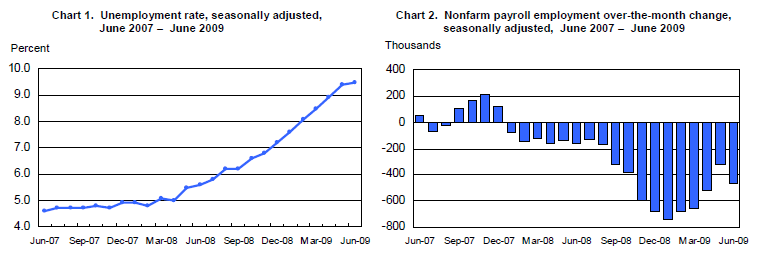
Barry Ritholtz at the Big Picture reports that the Bureau of Labor Statistics announced today that there were 467,000 job losses in June. The unemployment rate rose by 0.1% to 9.5%. The U-6 measure--marginally attached and involuntary part time workers--rose to 16.5%. Temporary employment fell by 37,600.
"Hours worked fell 0.8%, bringing the average workweek down 0.1 hours to 33; This is a record low going back to 1964."


Peter Boockvar, also at the Big Picture, also notes that initial jobless claims totaled 614,000. Continuing claims fell by 58,000 from last week.
"While there is no question benefits are expiring without one finding a job, as evidenced by the rising exhaustion rate, many losing those benefits now started getting them when initial claims were running in the 400k range last summer. Now its running above 600k, so there are still more people filing initial claims than getting removed from the continuing claims data, thus continuing claims still should trend higher assuming no sudden change in hiring trends."
Meanwhile, Free exchange makes the important observation:
"[S]tate budget policies are sharply contractionary at this point. Despite allocations of federal aid to states, services are being cut, state employees are being laid off, and taxes are being raised in order to balance the budgets of local governments constitutionally unable to run deficits. It's not at all clear that the federal stimulus will entirely compensate for state-level fiscal tightening, which means that American fiscal policy could, on net, be contractionary."
13. BARCLAYS EXPECTS WTI TO AVG $71/B IN W3

Yee Kai Pin at Bloomberg reports that Paul Horsnell's commodity team at Barclays has lifted its third quarter forecast for WTI to $71/b from $62/b. Horsnell increased his Q3 forecast for Brent to $69/b.
"'Among all the changes that have kept commodities on the boil in recent years, the key factor is that 'normal' is not what it used to be,' the analysts said in the report. 'Oil prices below $70 or copper prices below $3,000 are no longer normal.'"
I think he's wrong, but he does know of what he speaks.

Wednesday, May 13, 2009

Daily Sources 5/13

1. EUROZONE INDUSTRIAL PRODUCTION DOWN 20% IN MARCH YOY, EVEN AS GERMAN IP IS FLAT

Jan Strupczewski at Reuters reports that Eurostat released data today showing the industrial production in the eurozone fell by 20% in March from the year previous. From February, industrial production for the 16 members of the monetary union fell 2% in March.
"Industrial production accounts for roughly 17% of euro zone gross domestic product and the grim March output data could mean the economy shrank more than economists expect.

'Following today's release this indicator is pointing to a -2.2-2.3% quarter-on-quarter reading in Q1. This suggests downside risks to our 2% forecast,' said Saleem Bahaj, economist at Goldman Sachs.

Eurostat also revised down production data for February to a monthly fall of 2.5% from the initially reported decline of 2.3% and, in year-on-year terms, to a plunge of 19.1% from 18.4%."
However, Germany, the largest economy in the eurozone, announced flat industrial production in March last week, though exports continued to drop--see Daily Sources 5/8 #4.

2. CHINESE INDUSTRIAL PRODUCTION UP 7.3% IN APRIL YOY, EVEN AS ELECTRICAL GENERATION DOWN AS MUCH AS 4% YOY AND INDUSTRIAL PRODUCTS IMPORTS FALL BY 14.3%

The AFP reports that Chinese industrial output rose by 7.3% in April year over year according to data released by the National Bureau of Statistics today.
"The figure was down from 8.3% growth in March, and 11.0% in February, according to earlier data issued by the government.

'It was a small fluctuation in a generally upgoing trend,' said Lian Ping, a Shanghai-based economist with the Bank of Communications.

'It's rather unlikely it will go back to a rate of around five percent,' he said.

Growth in industrial output--a main gauge of activity in factories and plants across China--hit lows of little more than five percent at the end of last year."
On May 5, the China Electricity Council released preliminary data that electricity generation was down 3.55% from a year previous and that the finalized statistic--to be released later this month--was likely to be a 4% decline. This was also in the face of CLSA Asia Pacific Markets' positive PMI reading for April--see Daily Sources 5/5 #3 for both of these. I find the notion of industrial production continuing to increase at annual rates of 7% or more difficult to reconcile with electrical generation decreases of annual rates of up to 4%.
"Exports of industrial products totaled 566.2 billion yuan (~ $83 billion ) last month, a steep decline of 14.3% from the same month in 2008, the statistics bureau said."
3. CHINA BANKING REGULATORS PROPOSE RULES FOR ESTABLISHMENT OF CONSUMER LENDING FIRMS AS WESTERN BANKS EXIT CHINESE FINANCIAL SECTOR IN ORDER TO SHORE UP BOOKS

Sky Canaves at the China Journal reports that the China Banking Regulatory Commission told Xinhua that it had issued a draft of new regulations that establish guidelines for the establishment of new consumer financing corporations. Although there was a record number of new loans made in the first quarter and April, consumer lending accounts for only 12% of total loans--see Daily Sources 5/7 #2 and Daily Sources 5/12 #2.
"Under the proposed rules, domestic and foreign-invested consumer finance companies would be able to make loans for durable goods, as well as general-purpose personal loans, in amounts up to five times the borrower’s monthly income.

The finance companies would not be allowed to accept deposits and would have to maintain a minimum registered capital of 300 million yuan (~ $44 million). Prospective applicants should have at least 80 billion yuan in total assets, five years of experience in consumer financing, and profitability in the last two fiscal years, according to the draft rules."
Canaves notes that private consumption currently accounts for about 35% of Chinese GDP. Chen Qiong, an official with the commission said,
"The establishment of consumer finance companies will expedite an increase in personal consumption, thus driving increases in the production and sales volumes of manufacturers and retailers, while also driving demand in related industries and altering the GDP’s over-reliance on exports and fixed asset investment."
In the meantime, Louise Story and David Barboza at the New York Times reports that Bank of America agreed yesterday to sell about a third of its 16% stake in China Construction Bank for $7.3 billion.
"[A] person involved in the deal said Bank of America agreed to a private placement sale to a consortium that includes China Life Insurance, Temasek Holdings of Singapore and the private investment firm Hopu Investments of China, which is partly controlled by Fang Fenglei, the Chinese partner of Goldman Sachs. ...
Bank of America’s move comes a few weeks after Allianz and American Express sold nearly $2 billion worth of shares in another big Chinese bank, the Industrial and Commercial Bank of China, according to Reuters. The Royal Bank of Scotland also recently sold its stake in the Bank of China."
4. CHINA MAY HAVE RESTARTED AS MUCH AS 1.4 MMT OF ALUMINUM CAPACITY IN APRIL AS RIO TINTO DEAL LOOKS LIKELY TO SOUR

Richard Dobson at Bloomberg report Ru Xiaojie, an analyst at Aluminum Corp. of China Ltd., indicated at a conference today that the country may have restarted as much as 1.4 million metric tons of capacity in April. Ms. Ru indicated that the country may produce as much as 12.6 million tonnes of aluminum this year. Alcoa notes there is oversupply on the market. Meanwhile, the Rio Tinto Chinalco deal appears unlikely to go through.

5. KAZAKH PRESIDENT SIGNS BILL INTO LAW SENDING MORE GAS VIA RUSSIA, EU NABUCCO EFFORT DOESN'T SECURE FEEDSTOCK PARTICIPATION AS THE U.S. SEEMS TO RELAX SUPPORT FOR NABUCCO

Upstream online.com reports that Kazakh President Nursultan Nazarbayev has signed into law Kazakhstan's agreement with Russia and Turkmenistan today to carry more natural gas via the Central Asia-Center pipeline system, which would take the gas to Europe through Russia.

"The Russian pipeline plan is expected to transport up to an extra 10 billion cubic metres of Turkmen gas a year and the same volume of extra Kazakh supplies, according to the original deal."
Last Friday's the EU, meaning I infer Andris Piebalgs, signed an "energy agreement" with Azerbaijan, Georgia, Turkey and Egypt regarding a southern transit corridor. The Southern Corridor Summit apparently failed to seal the deal with other key meeting participants: Turkmenistan and Kazakhstan, ie most of the feedstock, which now appears to have gone north. On Friday the rumor that the US was not unequivocal in its support for Nabucco was mooted at the USDOS daily press briefing:
"QUESTION: Robert, just a quick thing on energy issues. The new Obama Administration envoy for energy Richard Morningstar was in a conference in Bulgaria, and he seemed to say that the Nabucco pipeline, which is EU-backed, was not, quote, 'the holy grail,' and suggested that the Russian alternative, South Stream, might work as well. Is this part of the reset in relations with Russia and the US? And what’s the US position on the two pipelines?

MR. WOOD: I think it--I think--and I haven’t seen the remarks from Ambassador Morningstar. But we have always supported diversification of energy supply and resources. And--but I don’t have the specifics with regard to the two pipelines. I haven’t heard--you know, only--I’ve only heard what you have said about it. I’d have to talk to Ambassador Morningstar to get further clarification. But as I said, we want to see a diversification of energy resources in that region, as we said, and worldwide in general."


6. OFFICIAL KREMLIN STRATEGY FORECAST EXPECTS RESOURCES TO BE CENTER OF FUTURE INTERNATIONAL DISPUTES

Al Jazeera reports today that the Kremlin released its National Security Strategy today which forecast that
"The attention of international politics in the long-term perspective will be concentrated on the acquisition of energy resources.

Amid competitive struggle for resources, attempts to use military force to solve emerging problems can't be excluded.

The existing balance of forces near the borders of the Russian Federation and its allies can be violated."
The document identified the Middle East, the Barents Sea, the Arctic, the Caspian Sea and Central Asia as likely loci of future resource conflicts. (h/t Leanan at the Oil Drum's Drumbeat.)

7. BANK ROSSI CUTS RATES ON OIL PRICE INCREASES, WHILE OPEC MONTHLY OIL REPORT SHOWS INCREASE IN SUPPLY IN APRIL, BIGGEST CHEATER IS IRAN

Emma O’Brien at Bloomberg reports that Bank Rossi cut its benchmark interest rates effective tomorrow today, the refinancing rate, seen as the limit for borrowing, was cut to 12% from 12.5% and the repurchase rate charged on central bank loans was cut to 11% from 11.5%.
"Bank Rossii has been buying foreign currency on the market as a way of reducing the ruble’s volatility and controlling its advance, [First Deputy Chairman Alexei] Ulyukayev said. The central bank is purchasing dollars and euros at about 37.20 versus the basket, after earlier defending 37.25, MDM [Bank]’s [Mikhail] Galkin, [head of fixed-income and credit research in Moscow] said, adding that policy makers bought about $1 billion yesterday."
The ruble has been climbing on stronger oil prices.


Spencer Swartz at Environmental Capital reports that OPEC's monthly report released today found that its eleven central members increased oil production by 220 kb/d.
"The production increase--as if the global recession and rising oil prices weren’t already a good enough deterrent--further diminishes the prospect of OPEC announcing any production cut when it meets in Vienna May 28. After months of reducing its output by around 150,000 barrels a day more than its OPEC quota obliges it to, Saudi Arabia, OPEC’s top dog, will be in no mood to hear Iran talk about more cuts when the Persian state is pumping some 400,000 barrels over its quota, according to OPEC’s latest data.

The kingdom was already annoyed privately in March when OPEC last met about the “cheaters” within OPEC. Ditto with the other OPEC Gulf producers, like Kuwait, which have also been carrying their full weight of OPEC cuts and forgoing oil revenue.

The April rise in production 'buries the chance of a fresh cut,' says one analyst who tracks OPEC closely."
Jackson Thies and Mine Yücel at the Dallas Federal Reserve Bank produce a graph showing OPEC production as a percentage of the (implied) quota in February and March:


The EIA produced a graph of OPEC surplus capacity versus price in today's Week in Petroleum report as well:


All fundamentals--even with the reduction in commercial stockpiles reported on below--do seem to point toward a downward pressure on price.

8. UZBEKISTAN, VIA SOUTH KOREA, TO ALLOW NATO SUPPLY TO AFGHANISTAN VIA NAVOI, OBVIATING MANAS CONTROVERSY

Deirdre Tynan at EurasiaNet.org reports that Uzbek President Islam Karimov announced during the state visit of South Korean President Lee Myung-Bak that a cargo airport in the city of Navoi is being used for non-lethal supply of NATO forces in Afghanistan.


A South Korean corporation is heading a renovation project at the airport which would convert it into a world-class air freight hub.
"South Korea’s involvement in the project provides a face-saving way for the resumption of US-Uzbek strategic cooperation, capping over a year of US diplomatic efforts to bridge the rift that opened amid the fallout from the 2005 Andijan massacre.

Karimov evicted US forces from an air base in Karshi Khanabad in late 2005 as a response to US protests over his administration’s handling of the Andijan events.

The Uzbek-South Korean agreement regarding Navoi airport gives Karimov the ability to deny to Moscow that he has cut a deal with the United States. But at the same time, Washington stands to get what it needs--a transit base that can take over much of the load from the American base in Kyrgyzstan, which is scheduled to close this summer."
Though the deal is publicly a commercial arrangement between South Korean and Uzbek entities, the US Transportation Command in late 2008 conducted a market survey which concluded that the hub at Navoi could provide "an integrated commercial-based solution to meet US forces’ transportation requirements to Afghanistan." In late February, the Kyrgyz Parliament voted nearly unanimously to formally cancel the US lease to Manas, giving the President the power to serve US forces an eviction notice within 180 days--see Daily Sources 2/20 #4. In the beginning of February the Kyrgyz President, Kurmanbek Bakiyev, announced in Moscow that he had secured $150 million in aid from Moscow, the forgiveness of $180 million in debt, and $2 billion in loans. Kyrgyz nominal GDP in 2008 was about $5 billion. US annual aid was running at about $150 million, but mostly was directed to non-governmental recipients--see Daily Sources 2/5 #6. Navoi's use as a supply route for NATO forces came as KNOC signed deals to explore five oil and gas fields as part of an oil for infrastructure strategy being employed by the big four energy importers in Asia--China, India, Japan, and South Korea--see Daily Sources 5/12 #6. If Seoul is coordinating its energy security policy with US general security concerns in Asia that may well, in certain corners of the world, give it a considerable edge, in a way similar to, say, Total's decision to enter a new upstream venture in Venezuela in conjunction with China's CNPC--see Daily Sources 4/14 #6. Tynan's piece at EurasiaNet is well worth reading in full. (h/t FP Passport's Morning Brief.)

9. POPE CALLS FOR TWO STATE SOLUTION TO ISRAEL PALESTINE CONFLICT AND END TO GAZA EMBARGO, ANGERS EVERYONE

Howard Schneider at the Washington Post reports that Pope Benedict called for greater international pressure on Israel for the creation of a Palestinian state as well as urging an end to the embargo on Gaza. Scneider quotes the Pope as telling the crowd in Bethlehem, which is located in the West Bank:
"I call on the international community to bring its influence to bear in favor of a solution. ... I pray too that, with the assistance of the international community, reconstruction work can proceed swiftly wherever homes, schools or hospitals have been damaged or destroyed, especially during the recent fighting in Gaza. ... Please be assured of my solidarity with you in the immense work of rebuilding which now lies ahead, and my prayers that the embargo will soon be lifted."


Unsurprisingly, the pontiff managed to displease everyone, as Israelis condemned him for not making stronger expressions of regret for the Holocaust and Palestinians said that since he did not refer to the situation as the "Israeli occupation," he is a tacit ally of Tel Aviv. However, perhaps Benedict's overriding concern was to assure--in light of his speech in 2006 which highlighted a dialogue of Manuel II Paleologus saying that the spread of faith by the sword was irrational and contrary to God's will which offended so many and the recent televised meeting of US Christian soldiers in Afghanistan mulling over how best to proselytize given their situation--that Islamic community that Catholicism, insofar as he is its highest plenipotentiary, is not a sponsor of what many in the Muslim community regard as a Crusade.

10. MEND SAYS CIVIL WAR EMERGING IN NIGERIA

Platts reports that Nigeria's MEND released an email statement warning oil companies to remove personnel from the region as the conflict with the central authorities flared up.
"Oil companies operating in the region are advised to evacuate their staff within the next 24 hours to avoid them being part of the statistics of an emerging civil war.

All freedom fighters in the Niger Delta have been placed on alert to defend their positions and unleash a horrible toll on the oil industry and the Nigerian economy."
11. US RETAIL SALES DOWN 0.4% IN APRIL FROM MARCH

Jeff Bater at the Wall Street Journal reports that US retail sales fell by 0.4% in April from March, according to the latest data from the Commerce Department.
"Sales in March were revised down, decreasing 1.3% instead of 1.2% as previously reported. Sales rose in January and February, after sliding six straight months."
Import prices rose by 1.6% in April from March, completely due to the 15.4% increase in petroleum prices during that time. Excluding oil, import prices were down 0.4% in April from March, and 5.6% down in April from a year previous. Including oil, import prices in April were down 16.3% from the year previous, "the biggest one-year drop since the index was first published in 1982."

12. GOVERNMENT ONLY GUY HIRING, BUT GOVERNMENT IS BROKE, WILL IT GO AFTER PREDATORY LENDERS TO SHORE UP REVENUES?

Rebecca Wilder makes the point that the April jobs report showed that the government was adding a record number of jobs, but that this is taking place as state budgets generally are sharply in the red. She notes that federal jobs only account for 13% of all government jobs (as of April), whereas state jobs have a 24% share and local governments account for 64%. She links to Conor Dougherty's story at Real Time Economics which notes that revenue has declined in 45 of the 47 states which have reported their first quarter numbers. The WSJ helpfully provides a map:


Dougherty notes that the steepest decline in revenue was seen in Alaska, where first quarter revenues were down a whopping 74.1%, primarily on oil prices. In the meantime, Bruce Krasting at his blog notes that Goldman Sachs settled with the Massachusetts Attorney General for $60 million in a case which charged GS with predatory lending practices in Boston. Krastings notes:
"This means next to nothing for Goldman Sachs. However, a very dangerous precedent has been set. In the critical years 2005-2007 Goldman was ranked 15th in the League Tables for sub prime and Alt-A origination/securitization. Goldman’s management must be pleased as punch with that poor showing today. Those that ranked high on that list are no doubt consulting with their attorneys.

If Goldman gets its hand slapped for $60 million over 714 mortgages what does this mean for Countrywide Financial?"
(h/t Yves Smith at naked capitalism.)

13. FORECLOSURES UP, SPREADING TO SUBURBS, AND CORRELATED TO JOB LOSSES, WHICH ARE EXPECTED TO CONTINUE

On top of this news, Dan Levy at Bloomberg reports that US foreclosure filings rose to a record level for the second consecutive month in April, per data released from RealtyTrac today. 342,038 properties received an auction or default notice in April, as banks have increased their efforts to seize properties.
"Foreclosure filings jumped 32% from the year-earlier period, RealtyTrac said. Filings were little changed from March as some states delayed seizures. Ten states accounted for three-quarters of all foreclosures in April, with California leading the nation."
The culprit? "The inevitable result" of steep job losses. (California, incidentally, is one of the state's facing the worst budget shortfall this year.) And Crain's Chicago Business News notes that the foreclosure wave has headed out to the Chicago suburbs from the city proper according to data from the Woodstock Institute, perhaps indicating that the same is happening generally across the nation.
"Foreclosure cases filed in the first quarter jumped between 25% and 70% from the fourth quarter in DuPage, Will, McHenry, Lake and Kane counties, according to new data provided to Crain's by the Woodstock Institute, a Chicago-based housing advocacy group. Meanwhile, foreclosures fell 8% in Chicago, the first quarterly decline in a year.

Across the six-county Chicago metropolitan area, foreclosure filings rose 6% in the first quarter to 17,819, the highest one-quarter total since the housing crisis began in mid-2006.

The shifting locus of new foreclosures shows how the recession and job losses are supplanting subprime lending as the main driver of mortgage defaults, says Geoff Smith, vice-president in charge of research at Woodstock. While the first wave of foreclosures hit hardest in poorer city neighborhoods targeted by high-interest-rate lenders with loose credit standards, the latest round is striking middle-class areas where most borrowers qualified for standard-rate mortgages."
(I also came across this article due to Yves Smith's daily links.)


And on top of that, Phil Izzo at Real Time Economics records that the National Association of Realtors reported yesterday that the median single-family home price fell 14% in the first quarter from the year previous to $169,000. Izzo's post includes a useful sortable chart of the rate of change in home prices by region correlated to job losses for the same. "The data are sortable by city, state, price, percent change from a year earlier and unemployment rate." Michael Shenk, a Research Assistant at the Federal Reserve Bank of Cleveland plots a graph of the number of new single family home sales versus the median sales price for those houses:


(I wonder whether the average sales price would look worse than the median sales price.) Shenk notes:
"[T]he most positive sign for housing markets is that the home-price indexes are beginning to suggest that price declines may be slowing. Both the latest S&P/Case-Shiller indexes and the FHFA index indicate some stability in the 12-month growth rate of prices as of February. The FHFA index shows prices actually improving in February, while the Case-Shiller index, which is narrower than the FHFA index in terms of geographic coverage but also includes nonconforming loans which the FHFA index leaves out, simply has prices falling at a slower pace."


(h/t Mark Thoma at Economist's View.)

14. MIT COMMERCIAL REAL ESTATE INDEX SHOWS PRICES FELL 28% YOY

In the meantime, the MIT commercial property price transactions-based index developed by Professor David Geltner showed that transaction prices of commercial property sold by major institutional investors fell by 5.8% in the first quarter. The index is now down 21% on the year and 26% below its peak in mid-2007. Geltner commented:
"It's possible that the first quarter of 2009 was the nadir in market sentiment. Sales volume is down almost to nothing, as reflected in our demand index. The prices buyers are willing to pay fell a record 12% in the first quarter and is now 28% below a year ago and 39% below its mid-2007 peak."
(I also came across this story via Mark Thoma's blog.)

15. OBAMA ADMINISTRATION TO REGULATE DERIVATIVES

Stephen Labaton at the New York Times reports that the Obama Administration will ask Congress to pass legislation which would require that all derivatives instruments be traded via an exchange and be subject to tight regulatory oversight.

16. COMMERCIAL OIL STOCKS UNEXPECTEDLY FALL, SENATE TO CONSIDER STRATEGIC PETROLEUM PRODUCTS RESERVE

In a sharp reversal from weeks of stock builds, the EIA today announced that commercial stocks of crude oil fell by a whopping 4.7 million barrels in the week ended May 8 to 370.6 million barrels. Though the stocks are still well above the five year historical range for this time of year and at highs last seen in the early 90s, a Bloomberg survey indicated that the median expectation of analysts was for a one million barrel build. Gasoline inventories also fell by 4.1 million barrels, and are now in the middle of the five year historical range for this time of year, versus a split analyst expectation for builds and draws. Distillate stocks built by a million barrels to 147.5 million barrels and are completely counter-cyclical with 40.4 million barrels (37.7%) more in storage than this week last year.


Nick Snow at the Oil & Gas Journal reports that the US Senate Energy and Natural Resources Committee will consider a bill introduced by Jeff Bingaman (D-NM)--S. 967, the Strategic Petroleum Reserve Modernization Act of 2009--which would create a strategic petroleum products reserve. Europe maintains products reserves, but the US strategic reserve is entirely made of crude. There are two primary difficulties with creating strategic products reserves:

One: Petroleum products degrade in storage at relatively speedy rates; crudes do not.
Two: The specifications for each petroleum product in the US varies by state. So, for example, gasoline stored for use in Texas would meet the environmental regulations for Texas gasoline, much more lax than those in California.

Of course, in an emergency Washington has in the past relaxed specifications requirements to meet products shortages, so this second objection is more about the rationality of the US products market than a products SPR, per se.

Thursday, April 16, 2009

Daily Sources 4/16

1. CHINESE GDP GROWTH BELOW THE MAGIC 8, CHINESE RESOURCE INVESTMENTS CONTINUE, AND THE US DECLINES TO DEEM BEIJING A 'CURRENCY MANIPULATOR'

Terence Poon (what a great name!) and Andrew Batson at the Wall Street Journal report that China reported GDP growth of 6.1% in the first quarter. The number is lower than what many analysts regard as necessary to prevent significant social unrest as the number of entrants to the labor market begins to far exceed the ability of the economy to absorb them. Beijing has made the number official, having a policy dating from the first Asian Crisis of 'bao ba," or "protect the eight"--see Daily Sources 3/18 #6.

Eugene Tang at Bloomberg reports that China will lend Kazakhstan $10 billion in return for a stake in Kazakh oil producer AO Mangistaumunaigas:
"China National Petroleum Corp. and KazMunaiGaz National Co. will buy AO Mangistaumunaigas, according to one of 11 agreements that were signed in the presence of President Hu Jintao and his Kazakhstan counterpart Nursultan Nazarbayev in Beijing today. The $10 billion aid comprises a $5 billion loan from the Export-Import Bank of China to the Development Bank of Kazakhstan and another $5 billion from China National to KazMunaiGaz."
The loan mirrors the recent $10 billion loan agreement struck with Brazil (see Daily Sources 2/19 #1) as well as a number of other deals globally.

Brad Setser at Follow the Money comments on the recent report to Congress by the Treasury which does not name Beijing as a currency manipulator
:
"But make no mistake, China’s currency still looks undervalued. It is only a bit higher — according to the BIS index--than it was in 2001 or 2002, back when China was exporting a fraction of what it does now. In other words, the rise in the productivity of China’s economy hasn’t been mirrored by a rise in the external purchasing power of its currency. That is a big reason why China’s current account surplus remains large.

And the underlying issue remains: the biggest driver of moves in China’s real exchange rate remains moves in the dollar. History suggests that China cannot count on dollar appreciation to bring about the real appreciation it and the global economy need if China’s surplus--and thus China’s accumulation of money-losing foreign assets--is going to come down. It will be hard--in my view--to have a stable international monetary system if the currencies of all the major economies but one float against each other. And China is now a major economy by any measure.

But it makes far more sense to have a fight over China’s exchange rate regime when China’s currency is depreciating in real terms and Chinese intervention in the foreign exchange market is rising--not when China’s currency is rising in real terms and Chinese intervention in the foreign exchange market is falling."
Well worth reading in full.

2. POLAND SIGNS LNG DEAL WITH QATAR

Eric Watkins at the Oil & Gas Journal reports that Poland's state-owned Polskie Gornictwo Naftowe i Gazownictwo (PGNIG) has signed a deal with Qatargas to supply 1 million tonnes/year of LNG for 20 years starting 2014.
"In March the Polish government passed legislation to speed construction of the Swinousjcie LNG terminal in northwestern Poland. The law is designed to make the construction of the terminal 'simpler and quicker.'

The Swinousjcie terminal, which is expected to be operational by yearend 2013 or early 2014, will have an initial import capacity of 2.5 billion cu m/year, eventually rising to 7.5 billion cu m/year."
The shipments would meet roughly 6% of Poland's natural gas demand forecast for 2014. Warsaw wants to diversify its natural gas import sources away from Russia, in short:
"According to PGNIG Chairman Michal Szubski, LNG supplies are 'one of the keys' to a diversified gas portfolio in Poland, which meets 30% of its gas needs from its own resources, 40% from Russian imports, and the remaining 30% from other sources."
The Energy Regulatory Office in Poland recently reported that Russia supplies nearly 50% of Polish natural gas consumption as of 2006.

3. OBAMA ADMINISTRATION URGED SUPPORT FOR THE JUDICIARY IN PAKISTAN, ZADARI-PACKED COURT RELEASES MILITANT CLERIC INVOLVED IN STAND OFF WITH THE MILITARY

David Ignatius at the Washington Post has a fascinating piece of reporting on how the US urged the Pakistani military to refuse an order by Pakistani President Zadari to shut down the lawyers' protests which eventually reinstated Chief Justice Chaudhry:
"The lawyers' movement began its march on March 12, pledging to occupy Islamabad until the government restored Chaudhry to his post. Zardari sent a police force known as the Rangers into the streets of Lahore, apparently hoping to intimidate Sharif and the marchers. But Sharif evaded the police and joined the protesters as they headed north toward Islamabad.

[Pakistani Army Chief of Staff General Ashfaq] Kiyani then faced the moment of decision. According to US and Pakistani sources, Zardari asked the army chief to stop the march and protect Islamabad. Kiyani refused, after discussing the dilemma with his friend Mullen, the chairman of the Joint Chiefs of Staff. Meanwhile, Kiyani called Sharif and told him to return home to Lahore, according to one source. And he called the leader of the lawyers' movement, Aitzaz Ahsan, and told him to halt in the city of Gujranwala and wait for a government announcement.

Pressure on Zardari was also building within his People's Party. According to a US official, Prime Minister Yousaf Raza Gillani told the president on the night of March 15 that he would resign if Chaudhry wasn't reinstated. (Zardari's camp says it was only a rumor of resignation.) In any event, Gillani went on television at 5 the next morning to announce that the former chief justice would return. The crisis was over."
A success I'd warrant, but the problem, as Ignatius notes, is that the perceived involvement in Pakistani internal affairs is creating serious resentments by important political players in the country--which may have seen their private feud with the Taliban as a guarantee of support. A must read.

In the meantime, Salman Masood at the New York Times reports that the Pakistani Supreme Court ordered yesterday granted bail to a hard-line Islamic cleric--Maulana Abdul Aziz--who allegedly led a standoff with the army two years ago.
"The three-member bench of the Supreme Court that heard the case did not include the newly restored Chief Justice Iftikhar Muhammad Chaudhry.

Analysts said the government of President Asif Ali Zardari lacked the political will to go hard after the Islamists, especially at a time when national sentiment was strongly anti-American."


4. ISLAMIST PARTIES LOST HALF THEIR SHARE OF THE INDONESIAN VOTE IN ELECTIONS LAST WEEK


Sadanand Dhume makes the observation in an opinion piece in today's Wall Street Journal that "Islam-based parties saw their cumulative vote-share shrink to about 20% from 38% five years ago."
Worth reading infull.

5. OBAMA IMPOSES FINANCIAL SANCTIONS ON DRUG CARTELS ON EVE OF VISIT TO MEXICO

Spencer S. Hsu at the Washington Post reports that the Obama Administration has reiterated US policy of targeting distribution as opposed to consumption in the war on drugs:
"On the eve of his summit with Mexican President Felipe Calderón today, Obama added the cartels to the list of banned foreign 'drug kingpins,' a move that empowers the federal government to seize their assets, estimated to be in the billions of dollars. It also allows the government to seek criminal penalties against US firms or individuals who provide weapons, launder money or transport drugs or cash for the organizations.

By targeting the cartels--Sinaloa, Los Zetas and La Familia Michoacana--the administration expanded its support for Calderón's crackdown on the narco-traffickers, an effort that has provoked a violent backlash and led to thousands of deaths in the past two years."
The counterproductive, and instability-exporting, policy of prohibition continues.

6. INDUSTRIAL PRODUCTION DOWN THE MOST SINCE V-E DAY, IMF ECHOES REINHART / ROGOFF OBSERVATION THAT FINANCIALLY-LED RECESSIONS ARE DEEP AND LONG

Calculated Risk reported yesterday that:
"[i]ndustrial production is down 13.3% since the recession began in December 2007, the largest percentage decline since the end of World War II."
Here is their graph of industrial capacity utilization since 1967:


Calculated Risk notes that the Federal Reserve observed:
"For the first quarter as a whole, output dropped at an annual rate of 20.0%, the largest quarterly decrease of the current contraction."
Always worth checking out Calculated Risk.

Tom Barkley at Real Time Economics reports that the IMF released the findings of a study of historical recessions:
"'These findings suggest that the current recession is likely to be unusually long and severe, and the recovery sluggish. However, strong countercyclical policy action, combined with action to restore confidence in the financial sector, could improve prospects for recovery,' the fund said.

In a study of 122 recessions across 21 advanced economies since 1960, the IMF found that crises that are globally synchronized and caused by financial shock tend last twice as long as the average recession, at more than seven quarters. They are also more severe, with real gross domestic product contracting 4.8%, versus an average of 2.7%.

Recoveries from such events take twice as long on average - nearly seven quarters - and are weaker in a global financial crisis. GDP tends to rise 2.8%, compared with an average of 4.1%.

In the current crisis, 15 out of the 21 advanced countries covered in the study were in recession by the fourth quarter of 2008 and the downturns 'are already more severe and longer than usual,' the fund said.

'Hence, it is unlikely that overleveraged economies will be able to bounce back quickly via strong growth in domestic private demand--fundamentally, a prolonged period of above-average saving is required,' the report said."
The report more or less echoes the findings of Carmen Reinhart and Kenneth Rogoff in January--see Daily Sources 1/2 #18.

7. MORE SHIPPING DATA

Rebecca Wilder at News N Economics echoes, with reservations, the notion yesterday mooted by Calculated Risk that port activity may be reaching a bottom, noting an article by Ronald D. White in the Los Angeles Times which quotes Port of Los Angeles spokeswoman Lauri Kellman:
"One month isn't much of a benchmark for us, especially a month like March when things are historically slow. But the numbers were up compared to last month, and that is an encouraging sign."
And thoughthe Port of Long Beach numbers don't look so good, showing a yearly decline in volume of 24.9%, they represent a 17.6% increase on February volumes.


February is 10% shorter than March, so another way of putting this would be that average daily TEUs in February were 11,359 TEUs/day against March average daily TEUs of 12,069 TEUs/day or a 6.25% increase in volume month on month. From the LA Times story:
"At the Port of Los Angeles, the nation's busiest cargo container port, about 278,000 containers carrying imported goods arrived in March, down 6.2% from March 2008, port officials said Wednesday. That was the slowest March performance in seven years, but it was substantially better than February, when only 206,000 containers arrived."
On an average daily basis, container volume in March was 8,968 TEUs/day versus February's 7,357 TEUs/day, or a fairly strong 21.9% increase.

The Baltic Dry Index shows a small uptick, though it is still down about 85% from the highs seen in 2008:


8. US COMMERCIAL CRUDE STOCKS UP 5.6 MILLION BARRELS, CRUDE IMPORTS DOWN, MARKET SHRUGS

The EIA yesterday reported that crude oil stocks built by 5.6 million barrels to 366.7 million barrels for the week ended April 10, the biggest number seen since September 1990. According to a Bloomberg survey, analysts had expected an increase of 1.75 million barrels. Gasoline stocks fell by 900 kb. Distillate stocks fell 1.2 million barrels. Taken in isolation, these numbers should be pretty bearish for the price of crude. Margot Habiby and Mark Shenk at Bloomberg note that the report showed that overall fuel demand in the last four weeks was down 5% for the same period last year.
"Stockpiles at Cushing, Oklahoma, where New York-traded West Texas Intermediate crude is delivered, fell 742,000 barrels to 29.2 million last week, the lowest since the week end Dec. 26.

'The Cushing drop is really important,' said James Cordier, portfolio manager at OptionSellers.com in Tampa, Florida. 'That will keep crude from falling out of bed. It will keep the spot month steady.'"
Meanwhile, Alaric Nightingale yesterday reported that Jens Martin Jensen, CEO of Frontline Ltd., the largest operator of supertankers globally, thinks that orders for new supertankers are about to face massive cancellations and that many ships in the current fleet will be scrapped.
"Supertankers are making $4,335 a day after fuel costs for delivering Middle East crude to Asia and the US, according to data from the London-based Baltic Exchange. Hamilton, Bermuda-based Frontline said Feb. 26 it needs $12,000 to cover costs such as repairs, crew, insurance and lubricants for engines. Interest on loans takes the figure to $32,100.
...
Shipyards in South Korea, China and Japan have all but two of the 146 orders for very large crude carriers, according to Lloyd’s Register-Fairplay data on Bloomberg. Daewoo Shipbuilding & Marine Engineering Co., based in Seoul, has the most, with 26 orders, the data show. Hyundai Heavy Industries Co., the world’s largest shipbuilder by market value, has orders for 16."
Platts reports that US February crude imports were down 649 kb/d to 9.203 mb/d from January, or about 6.6%.
"Preliminary data from the EIA show Canada retaining the lead supplier slot with 1.913 mb/d, down from 1.946 mb/d in January and 2.033 mb/d in December.

Mexico climbed to second place, pushing Saudi Arabia back into third place despite a fall to 1.219 million b/d from January's 1.299 mb/d.

Crude imports from Saudi Arabia fell to 1.135 mb/d from 1.337 mb/d the previous month, a drop of 200 kb/d."
The US imported 962 kb/d from Venezuela, 671 kb/d from Angola, 519 kb/d from Iraq, 457 kb/d from Nigeria, 365 kb/d from Brazil, 251 kb/d from Kuwait, and 243 kb/d from Ecuador.

9. THE TENTH AMENDMENT

In a movement I regarded merely as a way for the GOP to rebrand itself some time back--see Daily Sources 2/6 #11--a rather large number of states have seen similar bills introduced. I predicted that the bills were unlikely to pass, and though they have failed in several states, one has apparently passed in Idaho. I haven't had time to explore which of these are petitions and which are law, but it is certainly an interesting development. The site hosting the movement is quite explicitly secessionist, see the item in the lower left hand corner which has a fictional account of the US post-secession. I still doubt that the movement will gain enough support to represent a serious threat to the Union, but would make the note that I can think of quite a few liberal ideas and states which could arguably be put into effect by recourse to the Tenth Amendment, should the courts recognize the various legislatures' interpretation of the document. The movement seems to entertain the somewhat laughable notion that the economies of certain oil and gas states would have a major renaissance as federal environmental and concessions limitations were lifted. Of course, the additional supply wouldn't be all that great for those stripper wells. (h/t Gregor.us)

10. SPANISH PROSECUTORS MOVING AHEAD WITH PROSECUTION OF BUSH ADMINISTRATION OFFICIALS

Juan Cole notes that Spanish prosecutors appear to be moving ahead with the prosecution of Attorney General Alberto Gonzales and other Bush Administration officials and that others are likely to be indited according to Scott Horton include:
"Federal Appeals Court Judge and former Assistant Attorney General Jay Bybee, University of California law professor and former Deputy Assistant Attorney General John Yoo, former Defense Department general counsel and current Chevron lawyer William J. Haynes II, Vice President Cheney’s former chief of staff David Addington, and former Undersecretary of Defense Douglas J. Feith"
Cole also links to an Al Jazeera interview of Richard Armitrage where he states that he and Colin Powell lost the battle inside the Administration to ensure that the Geneva Conventions were applied to enemy combatants in the "war on terror."


Prof. Cole's summary and analysis are worth reading.

Tuesday, April 14, 2009

Daily Sources 4/14

still working on redrafting the format of Daily Sources ... all comments welcome

1. CHINA PUBLISHES HUMAN RIGHTS GOALS

China yesterday published its "National Human Rights Action Plan of China (2009-10)," which emphasized economic, social, and communal rights though it did outline some aims more in line with traditional western notions of individual human rights--most significantly legal rights of defendants.
"The 22,000-word, two-year plan outlines the government's aim for broader access to social security, health care and education. The death penalty will be 'strictly controlled and prudently applied,' it states, adding that defendants will be guaranteed fair trials. Forced confessions by torture and the mistreatment of detainees will be prohibited. These rights are to be 'promoted and protected' within two years, the document said."
Some international human rights groups criticized the document as being vague and simply reiterating commitments already made, but I rather think the point is that Beijing accepts them as goals. Humans are, after all, teleological creatures, and in order to plot a course to B from A, one must first figure out what B is. (Indeed, this feature of human life is what Machiavelli meant by "the ends justify the means.") The fact that the government accepts a) that Enlightenment and Magna Carta-based rights are in fact rights, entitled to legal protection and b)
"'China has a long road ahead in its efforts to improve its human-rights situation,' the document acknowledges"
is a very important step forward for liberty generally--and the step itself potentially undermines the legitimacy of the regime itself. (Loretta Chao in the Wall Street Journal.)

2. NORTH KOREA PULLS OUT OF NEGOTIATIONS ... WITH EVERYONE

North Korea reacted to the official condemnation by the UN Security Council Monday of its satellite launch by announcing its withdrawal from the six party talks--with China, Japan, Russia, South Korea and the US--which aim to denuclearize the nation and restart its nuclear program:
"'We have no choice but to further strengthen our nuclear deterrent to cope with additional military threats by hostile forces,' the statement [published today by the North Korean Foreign Ministry] said. It also hinted that the North would conduct more satellite tests, saying it will 'continue to exercise its sovereign rights to use space.'"
(Associated Press: "N. Korea to boycott six-party nuclear talks.") The response of to the statement by US and the other members of the six party talks has been to refer to the official condemnation. From the US State Department briefing today:
"[L]et me just say I know you all have a lot of questions about North Korea. I don’t have very much at all today that I’m going to give you. And I know you’re going to come at me with a lot of questions from various angles, but I just want to basically refer you back to the UN Security Council presidential statement that was issued. And this presidential statement made very clear the position of the UN Security Council plus Japan. And as you know, the statement calls for an early resumption of the Six-Party Talks, a verifiable denuclearization of the Korean Peninsula, and full implementation of the joint statement of 2005. I don’t have much more for you right now. At some later point, we’ll have more to say, but right now, that’s all I have."
3. TAIWAN LIKELY TO REVERSE NUCLEAR POWER BAN ON EMISSIONS CONCERNS

Taiwan has scheduled a two-day "state conference" beginning tomorrow which will bring together 205 government officials to debate whether Taipei should overturn its eight year old ban on new nuclear power plants:
"'Nuclear power is an inevitable option because we want to cut carbon emissions,' Tu Yueh-yuan, chief engineer of state-run Taiwan Power Co., said on April 2. The company has room to add as many as 10 reactors at its existing nuclear power plants, she said. To authorize that, [Taiwanese President] Ma [Ying-jeou] would have to reverse a decision by his predecessor, Chen Shui-bian."
The key problem facing the relatively small island nation vis-a-vis expanding its nuclear power capacity is how to safely dispose of the waste. (Yu-huay Sun: "Taiwan Energy Talks Pit Ma Against Nuclear Opponents," Bloomberg News.)

4. BEIJING'S LATEST ALTERNATIVE CURRENCY MOVE TAKES PLACE IN A WORSENING ECONOMIC ENVIRONMENT--AND IN THE PLACE MOST AFFECTED

The latest move in the question of an alternative to the dollar was made by Beijing last week when it decided to allow five of its largest trading cities--Shanghai, Guangzhou, Shenzhen, Zhuhai and Dongguan (four of which are in Guandong Province)--to settle cross-border trade deals in renminbi.
"The yuan settlement move may be a potentially huge boon to Chinese firms, which can sidestep foreign exchange risk without having to buy derivative products to hedge their currency exposure.

But it could be doomed to failure if Beijing can’t convince foreign counterparties to China’s trade that getting paid in yuan is in their own best interest.

That’s not going to be easy. Under current rules, if firms or individuals outside of China were to hold yuan, they wouldn’t be allowed to directly invest it in China’s capital markets. And as for hedging currency risk, Shanghai’s forwards and swaps markets are equally off-limits."
(See Denis McMahon: "The Yuan Abroad: Useful If Strong," China Journal and Denis McMahon: "Beijing Aims to Expand Foreign Trade in Yuan," The Wall Street Journal.)The State Council has asked for the cities involved to submit regulations proposals for the pilot program. It has yet to announce a date for the program to commence. The news comes on top of the recent story that preliminary estimates of GDP growth for Guandong Province in the first two months of 2009 are at 5% and 5.5% for the first quarter, 5% less growth than seen last year.
"Guangdong’s import and export dropped 25.9%, year on year, in January and February, and 22.9% in the first quarter. Guangdong’s foreign trade dependence is as high as 155%, more than double China’s average."
(China Stakes: "Export Plummet Shock: A Guangdong Tiger Under Water," h/t Yves Smith at naked capitalism.) Meanwhile, Cao Jianhai, a professor at the Chinese Academy of Social Sciences, said that the rebound in Chinese property markets was likely unsustainable and that residential property prices were likely to fall by 40 to 50% from their levels in 2008.
"'Prices may not fall in the near term but I expect a collapse starting next year, followed by many years of stagnation,” said Mr Cao, known as one of the 'three swordsmen' of the real estate market because of his influence as an official economist."
(See The Financial Times: "Property prices in China set to halve.")

5. SINGAPORE AND ASEAN 5 POSTING HORRIBLE ECONOMIC GROWTH NUMBERS

Rebecca Wilder notes that Singapore's Ministry of Trade and Industry today announced that it had downwardly revised its 2009 GDP growth forecast from between -2% and -5% in January to between -6% and -9% in April. The revision was made on the base of an advance estimate for first quarter GDP of a 11.5% contraction. Ms. Wilder helpfully produces a graph plotting the annual GDP growth (on a quarterly basis) of the ASEAN 5:


(Her post is worth a look: "Singapore is dropping quickly; dismal growth expected for the ASEAN countries" at News N Economics.)

6. TOTAL'S VENEZUELA GAMBIT ... RISKY AND SEEMS TO IGNORE THE REFINING PICTURE IN THE ASIA PACIFIC ... MEANWHILE RUSSIA AND BRAZIL TAKING MARKET SHARE ON OPEC CUTS

Following the visit of Hugo Chávez to China, the CEO of CNPC, Jiang Jiemin, said he would submit a plan to establish a joint refinery with the PdVSA in Guangdong province. The refinery would have a throughput of 20 million tonnes a year (~400 kb/d) and be 51%-owned by CNPC and 49% by PdVSA. Given that the refinery would be sophisticated, it could make the import of larger volumes of Venezuelan crude--a major goal of the Chávez administration, more viable as most new sophisticated refining capacity on or coming on line in China already has dedicated supply--mostly from the Saudi Arabia. However, there is reason to doubt that these ideas will go forward as planned:
"In May 2008, Chinese state media reported that CNPC subsidiary PetroChina entered into a joint venture agreement with PDVSA to build a 400 kb/d refinery in Guangdong province, configured to process Venezuelan heavy oil.

Under the agreement, witnessed by Chávez and Chinese Vice Premier Hui Liangyu, the crude is to be sourced from the Junin 4 block in the Orinoco belt.

At the time, officials said that the joint refinery, Venezuela's first such investment in China, would advance Chávez's goal of shipping to China 1 mb/d of oil by 2011, or 13% of current Chinese oil demand.

Reports vary on just how much oil Venezuela actually ships to China. Last May, Ramirez said shipments amounted to 500,000 b/d of oil, while Chinese state media reported 300—380 kb/d of products and 80 kb/d of crude."
(Eric Watkins: "China, Venezuela agree to speed up increased oil shipments," The Oil & Gas Journal.) That said, it is reported that senior officials from CNPC, PdVSA and Total SA are scheduled to meet next month in Caracas to discuss a potential 20 year contract to send 200 kb/d of Venezuelan oil to China, possibly starting in 2013, and with volumes rising beyond that.
"CNPC is talking to Total about a package involving a joint bid for Orinoco oil assets, building an upgrader to process the heavy oil produced in Venezuela and shipping it to a CNPC-PDVSA refinery to be built in Guangdong, southern China, a CNPC official told the news agency.

Total declined to comment, but a company spokeswoman told Dow Jones that the company had extensive links with China and confirmed that 'we are in discussions with CNPC on a variety of projects.'"
(Upstream online: "Caracas lines up three-way Orinoco pact.") In February Total CEO Christophe de Margerie told reporters in London that investment in Venezuela was preferable to Brazil, because there was less competition in Venezuela--see Daily Sources 2/13 #9. The statement was somewhat mystifying because, after all, the reason there is less competition in Venezuela is because Chávez has a habit of nationalizing your investments. However, if a project were done in conjunction with Chinese national oil companies, and increased economic integration with China is a goal of Caracas because Chávez believes Beijing may be able to offer military-political defense of his regime from an inevitably hostile US, then perhaps Total may be able to feel better protected against loss of its assets. Indeed, de Margerie may even feel that Chávez would not just be less likely to alienate Paris because of its habitual gad fly approach to US international policies, but also because of the cultural affinity that his first party--The Fifth Republic Movement--claimed with France (see my first post Venezuela vs ExxonMobil). That would be a reasonable strategy--an extremely risky one in my view, but international oil companies are rather experienced in taking such risks.

In the meantime, Brazil and Russia have taken advantage of the supply cuts made by OPEC to take a larger share of the US oil import market (which itself is shrinking).
"US imports from the Organization of Petroleum Exporting Countries fell 818 kb/d, or 14%, to 5.02 million in January from a year earlier, according to the latest monthly report from the Energy Department. At the same time, imports from Brazil more than doubled to 397,000 and Russia’s increased almost 10-fold to 157,000, a trend that continued in February and March, according to data from each country."
The story puts the data in a very strange way, but the latest monthly import data on the EIA website shows that Russian imports grew to 516 kb/d in January from 382kb/d in December (or 35%) and Brazilian imports grew to 450 kb/d in January from 225 kb/d in December (or 100%). (That said, imports from Brazil had been as must as 354 kb/d as recently as October and imports from Russia had been as much as 490 kb/d in August, so although there may be a trend, it is not as pronounced as those percentages would imply. See: EIA: "US Imports by Country of Origin.")
"Russian overall exports climbed 6.3% in February and 2.2% in March, according to the Energy Ministry. Brazilian total exports more than doubled in both February and March, according to Brazil’s Trade Ministry."
(Mark Shenk: "OPEC Cuts Thwarted as Brazil, Russia Grab US Market," Bloomberg News.) Beyond that, Saudi Arabia has put a hold on its two new major export refinery plans--for Tanbu and Jubail--of 800 kb/d in total throughput, but still has a fairly aggressive schedule of capacity addition downstream. Reuters ran the numbers in a series of tables:


As you can see, a fair amount, 440 kb/d is inside China itself--and we can expect a considerable portion of the domestic export refinery plans to target the Chinese market. This is probably true of any excess capacity produced from its JV refineries in Japan and South Korea as well:


7. TURKMEN PIPELINE BLAST ALLEGEDLY DUE TO GAZRPOM'S RELUCTANCE TO HONOR CONTRACT TERMS ... MEANWHILE LUKOIL SEEKS BP'S STAKE IN CPC AND IS DRILLING OVERSEAS DUE TO MOSCOW'S RELUCTANCE TO GRANT MORE DRILLING RIGHTS

Turkmen President Gurbanguli Berdymukhamedov has accused Moscow of being behind the recent natural gas pipeline blast which cut off its exports through Russia to eastern Europe and wants an international investigation into the causes of the pipeline blast.
"'Turkmenistan's president [Gurbanguly Berdymukhamedov] has ordered the government to carry out...an international study to investigate the causes of the incident,' the [Turkmen Foreign] ministry said in a statement."
In a televised speech at a Cabinet meeting the President said:
"We won't allow them to hurt our image as a reliable supplier of energy resources to global markers."
Gazprom has refused to comment on the issue, but Russian Foreign Minister Sergei Lavrov described the explosion as "purely technical." Evidently, Gazprom reduced intake by a full 90% without informing their Turkmen counterparts in advance. This was allegedly done because Gazprom at this time cannot recoup the cost of Turkmen gas, which it reportedly contracted for on December 31, 2008 at $340/tcm (~$9.61/MMBtu.) Yesterday, UK front month natural gas contracts closed at £0.2934/therm (~$4.31/MMBtu). Front month Brent closed at $52.14/b or about $8.99/MMBtu. Urals spot on Friday closed at $50.34/b or about $8.68/MMBtu. (The actual terms of the Turkmen contract are unknown, but it is thought they are tied by some formula to the price of oil, with a floor and a ceiling price.) (See: Alexander Vershinin: "Turkmen leader: Russia must pay for pipeline blast," Associated Press and Nadia Rodova: "Turkmenistan wants international experts to study gas line blast," Platts.) Meanwhile, Lukoil CEO Vagit Alekperov told Bloomberg in a televised interview that the company will seek to buy out BP's stake in the Caspian Pipeline Consortium.
"'Now we need to tie up the formalities and receive permission from the Kazakh government,' Alekperov said. 'I plan to be in Kazakhstan from April 25-30 where I’ll meet with the Kazakh president and I’ll raise that question in the hope of getting a positive answer.'"


Chevron, the operator of the Tenghiz field which is supplies much of the CPC pipeline's throughput, said in February that it intends to increase output in the field to 400 kb/d this year. Shareholders in the consortium plan to invest $1.6 billion to double pipeline capacity to 1.3 mb/d from 2013. (Stephen Bierman and Ellen Pinchuk: "Lukoil to Seek Kazakh Approval to Buy BP’s CPC, Tengiz Stakes," Bloomberg News.)Lukoil also is planning to drill for oil offshore the Ivory Coast and Ghana.
"'After the outstanding discoveries made in the recent years on the sea shelf of Ghana, this area is one of the most promising for exploration in West Africa,' Andrei Kuzyaev, head of Lukoil Overseas Holding Ltd., said in a statement on April 2."
Evidently a part of the thinking behind Lukoil's overseas acquisitions is that Moscow is slowing down the number of licenses to drill it is offering domestically. The number of auctions for oil licenses offered by Moscow last year fell to 147, or by half.
(Stephen Bierman and Ellen Pinchuk: "Lukoil to Drill in Africa as It Urges Russia to Offer Licenses," Bloomberg News.)


8. POLAND TO SEEK $20.5 BILLION CREDIT LINE FROM IMF

IMF Managing Director Dominique Strauss-Khan send an email statement to reporters saying that Poland was seeking a one-year credit line from the institution of $20.5 billion.
"Poland will become the second country after Mexico to use the flexible credit line as its economy faces the sharpest slowdown in almost a decade. The zloty lost almost a third of its value from a record high in July as investors sold riskier emerging-market assets amid the global credit crunch.

'This is the reflection of our cautious and responsible economic policy,' Finance Minister Jacek Rostowski told journalists after the government’s weekly meeting. 'This will help protect the zloty against uncontrolled depreciation that we saw during the first two months of this year. The consequences will be very positive for Poland.'

The loan will raise foreign reserves by almost a third, help cut Poland’s debt-servicing costs and facilitate access to international financing, he said.

'If Poland follows Mexico, maybe other countries would be willing to arrange a credit line,' said Ralph Sueppel, chief economist and strategist at London-based hedge fund BlueCrest Capital Management Ltd., which manages about $2 billion in emerging-market assets. 'The advantage for the Poland is that it provides support at a time when dollar funding is short.'"
(Marta Waldoch and Ewa Krukowska: "Poland to Ask IMF for Credit to Shield Economy, Zloty," Bloomberg News.)

9. CAIRO LOSING PATIENCE WITH HIZBULLAH ... HIZBULLAH MAKES OUT THAT CAIRO IS SUPPORTER OF TEL AVIV

The BBC reports that Egypt has accused 49 suspects of being agents of Hizbullah and planning hostile operations on its soil. Egyptian security forces are searching for 13 additional suspects on the Sinai Peninsula. Michael Collins Dunn comments:
"Part of the surprise here — actually a clever tactical move — is that Nasrullah did not offer the usual flat denial of involvement, but portrayed Hizbullah as trying to relieve the siege of Gaza, thus reminding the world that Egypt's keeping the Rafah crossing closed is as much responsible for Gaza's suffering as Israel's closure of the other crossings. Popular opinion inside Egypt has generally been critical of the government's policies on Gaza, and Hizbullah is playing to that.

Of course, there's a certain disingenuousness to Hizbullah claiming it does not carry out operations in other countries and admitting that it had agents operating in Sinai. But by rationalizing their presence rather than denying it, Nasrullah subtly shifts the debate from one of violating Egyptian sovereignty to one of spotlighting Egypt's keeping Rafah closed."
(see BBC News: "Egypt 'hunts Hezbollah suspects'," and Michael Collins Dunn, "Egypt/Hizbullah Feud Heating Up," MEI Editor's Blog.)

10. IRAN EMBARKS UPON STRATEGY OF MAKING AMICABLE NEGOTIATIONS AS POLITICALLY DIFFICULT TO PURSUE AS POSSIBLE

The US is continuing its strategy of engagement with Iran, as evidenced by yesterday's US Press Briefing:
"QUESTION: Separate issue. On Iran, Javier Solana spoke to Mr. Jalili and it seems that Iran is welcoming what they say – you know, they hope to be a constructive dialogue with the P-5+1. I just wondered whether you had any details on Solana’s call and whether you, you know, welcomed their welcoming of talks?

MR. WOOD: Yeah, I mean, of course, we welcome the fact that they’re, you know, interested in having a dialogue. And you know, I would refer you again to the sincere offer of the P-5+1 to provide Iran with what we believe is a very good, substantive package of incentives. We want to deal with Iran on this issue. It’s an important issue to the international community. And Iran needs to show the international community that its nuclear program is a peaceful one. Right now, the international community is very skeptical about that. But as I’ve said, we want to directly engage Iran on a range of issues, and we encourage Iran to continue – well, we encourage Iran to come forward and provide the international community with all of the assurances that it requires to be convinced that Iran is pursuing a peaceful nuclear program. But as I said, we remain skeptical about it."
And David Sanger at the New York Times reports that the US and its European allies are preparing "proposals" to drop the former US insistence on a rapid shut down of nuclear facilities in the early stages of negotiations with Tehran. But, in the meantime, Tehran appears to be doing much to make the realization of such negotiations more difficult. It has tried Roxana Saberi, a US-Iranian dual citizen and reporter, for espionage in a closed door trial with the verdict expected in two weeks. She has been imprisoned since late January for charges of purchasing alcohol originally. The charges have swiftly escalated to espionage. (The Associated Press: "Iran Says U.S. Journalist Has Been Tried Behind Closed Doors.") Today President Mahmoud Ahmadinejad has announced Iran will launch a satellite soon--on a missile with a range of up to 1,500 km (930 miles). Satellites pose a concern because they can be fitted with weapons and the technology is the basis for ICBMs. (And satellites have also proven to be of particular concern to Moscow.) (Hossein Jaseb and Hashem Kalantari: "Iran Plans to Send Bigger Satellite Into Space," Reuters.) And the Islamic Revolution Passdaran Guards Corp (IRGC) published a statement accusing Amsterdam (!) of attempting to instigate a "color revolution" in Iran via its support of internet websites.
"The statement, released by the 'IRGC Center for Organized Cyber Crimes,' claims, ‎‎'Hostile countries have demonstrated increasing interest in utilizing cyber space with the ‎expansion of the Internet, supporting the creation of websites, blogs and internet radio ‎and television networks.'

The IRGC’s statement identifies the 'Dutch Project' as one of the main soft overthrow ‎threats against the Islamic Republic, noting, 'One such country, which has supported the ‎opposition movement financially in recent years, is the Netherlands, which passed a ‎budget addendum in 2005 sponsored by Farah Karimi, an Iranian-born representative in ‎the Dutch parliament and a member of the leftist Green Party.' ‎

In another part of the IRGC statement, it is claimed that the Dutch budget is part of the ‎‎'long-term and strategic planning along the ideology of NATO,' which is 'pursuing the ‎agenda of global imperialism by absorbing vast capital, expert human resources and ‎political networks, setting up a group of expert journalists from the domestic and foreign ‎opposition with the help of the British, political and diplomatic support from the Dutch, ‎and with planning and secret budgets from the United States.'"
(Rooz online: "Revelations against Dutch Projects‎--Passdaran Guards Corp’s Statement on 'Media Overthrow'.) And Tehran has also given Shell and Repsol until May 20 to "clarify their involvement" in the Phase 13 of the South Pars project.
"'If subsequent to the expiry of the deadline these companies do not make clear their involvement in the Persian LNG project, talks will begin directly with Chinese (companies),' Seifollah Jashnsaz, managing director of the National Iranian Oil Company (NIOC), told the ISNA news agency.

'Presently not much remains to the end of this deadline,' he said, without giving further detail."
(Hashem Kalantari and Jonathan Gleave, "Iran gives Shell/Repsol deadline on LNG project," Reuters.)

11. SWAT VALLEY ADOPTS SHARIA ... TALIBAN EXPANDING TO PUNJAB

Pakistani President Asif Ali Zadari has signed into law legislation which introduces sharia law into the Swat Valley. The Taliban has been de facto in control of the region for some time now. The agreement, it should be noted, maintains the federal judiciary as the court of appeals--and thus superior to the Sharia courts. (See: BBC News, "Pakistan passes Swat Sharia deal.") Meanwhile, Sabrina Tavernise, Richard A. Oppel Jr. and Eric Schmitt at the New York Times report that the Taliban is making inroads in Punjab, the most populous region in Pakistan and the region at the heart of the recent dispute with Nawaz Sharif.

12. RED SHIRT PROTEST IN THAILAND SHUT DOWN BY MILITARY

The Red Shirt protests in Thailand have reportedly come to a halt after a large military presence intimidated the bulk of the protesters.
"'I want to save the people,' Jatuporn Phromphan, one of the protest leaders, said as he walked up to surrender to police with a grim-faced band of supporters. 'But I will continue to fight for democracy.'"
Evidently the military has either decided that it needs to create a sense of stability or it is backing the so-called Yellow Shirts. (Tim Johnston: "Thai Protesters Give Up to Avoid Further Violence Troops, Protesters Clash in Bangkok," The Washington Post -- includes a slide show.)

13. US MARITIME STRATEGY GOING FORWARD

Professor Tom Fedyszyn gave a copy of his power point presentation illustrating the evolution of the thinking behind US grand naval strategy going forward to Steve Clemons at The Washington Note, who made it available to all. Key excerpt:
"Today’s Maritime Strategy “Bottom egg” = Obama Direction

- Maritime security
- Maintenance of global commons
- Promotion of free trade
- Building partnerships
- Anti-piracy
- Humanitarian assistance
- Greatest threat to world instability is economic recession
- Need for US to cooperate and build partnerships
- World trade is cornerstone of strong economy
- US provides strong moral leadership
- Less implied concern over international power rivalries"
Very much worth a look.

14. RETAIL SALES DOWN, CORE CONSUMER PRICES FLAT ... SO MONEY SUPPLY AIN'T GROWING ALL THAT MUCH ... IN THE MEANTIME THE EIA FORECASTS INDUSTRIAL DEMAND FOR NATURAL GAS WILL DROP BY 7.4% IN 2009

The Commerce Department announced today that retail sales had fallen by 1.1% in March from a year earlier.
"Excluding autos, retail sales fell 0.9% after a 1% rise in February. That also was worse than analysts' forecasts of a flat reading for last month.

Sales at appliance stores fell 5.9% last month and furniture stores reported a 1.7% decline. Sales at specialty clothing stores fell 1.8% and dipped 0.2% at general merchandise stores, a category that includes Wal-Mart Stores Inc., Target Corp. and Macy's."
"Meanwhile, the Labor Department reported that wholesale prices plunged 1.2% in March as the cost of gasoline, other energy products and food fell sharply.

Gas prices fell 13.1%, the steepest drop since December, while food costs dipped 0.7%. Excluding volatile food and energy prices, the Producer Price Index was unchanged, below analysts' forecasts of a 0.1% rise."
(Associated Press: "Retail sales tumble unexpectedly in March; Consumer spending subdued amid rising unemployment.") IN the meantime, the EIA released its forecast today that natural gas consumption by the industrial sector is expected to decline by 7.4% in 2009 from 2008. The new forecast cut the average price forecast for natural gas delivered to Henry Hub at $4.24/Mcf.
"[The] EIA said it expects LNG imports to increase to about 480 Bcf this year, from 352 Bcf in 2008. Lower global economic activity and new liquefaction capacity in the Middle East and elsewhere should boost US imports."
(Joel Kirkland: "Industrial sector gas use could decline 7% in 2009: US EIA," Platts.) Not an especially rosy picture of near term economic growth from an official government agency, in other words.