Showing posts with label MEND. Show all posts

Friday, August 7, 2009

Daily Sources 8/7

1. BALTIC DRY INDEX FALLS 17% ON REDUCED CHINESE DEMAND FOR COAL AND IRON, FUEL OIL--USED FOR SHIPS AND ELECTRICITY GENERATION--SWITCHING INTO CONTANGO ON INCREASED SUPPLY AND FALLING DEMAND, CRUDE RUNS SLIGHTLY DOWN IN CHINA ON 7% INCREASE IN PRODUCT INVENTORIES IN JUNE, AND THE SECOND-LARGEST CHINESE BANK WILL REDUCE NEW LENDING BY 70% IN 2H 2009

Alaric Nightingale at Bloomberg reports that the Baltic Dry Index fell by 17% this week on reduced Chinese demand for coal and iron.
"'The Chinese have backed off and it’s starting to show in the number of shipments this month,' Gavin Durrell, a Cape Town-based official at Island View Shipping SA, Africa’s biggest commodities shipping line, said by phone today. 'Iron ore and coal seem to be slowing down.'

China’s record coal and iron ore imports in the first half helped the index to advance as much as fivefold this year, reversing some of the record 92% collapse in 2008. Demand rose after the country’s government announced a 4 trillion yuan ($586 billion) stimulus package."


(h/t Yves Smith at naked capitalism.) In that vein, Jonathan Nonis at Platts reports that the 180 CST fuel oil--mostly used for power generation or marine fuel--appears to be set to switch into contango--where the nearby in time price is less than the future price--on increasing supply and less-than-expected demand.
"By 11.00 am Singapore time (0300 GMT) the September/October 180 CST spread was pegged at parity, down 50 cents/mt from the Asian close on Thursday. The last time the prompt 180 CST spread had been in contango at the Asian close was on June 16 at minus 50 cents/mt.

The weaker market structure on the utility grade also dampened the structure for the 380 CST bunker grade with the September/October 380 CST spread narrowing to 1.50/mt, from $2.20/mt on Thursday's close.

The softer fuel oil sentiment is brought about by larger Western arbitrage volumes in August and September, while demand over the same period is expected to decline on higher outright fuel oil prices, traders said.

Between 3.2 to 3.5 million mt of fuel oil is expected to arrive in Singapore in August, while September volumes were said to be in the range of 3.6-3.7 million mt. Meanwhile, the higher fuel oil prices--prompted by the sharp rise in crude prices--in recent weeks has had a negative impact on bunker demand in Singapore as well as regional buyers.

Reflecting this, heavy distillate stocks in landed storage in Singapore recovered from a seven-month low by a massive 5.26 million barrels (800,000 mt) to 19.320 million barrels for the week ended August 5, data from IE Singapore showed."
In late July fuel oil prices rose to nearly the cost of crude--see Daily Sources 7/28 #8. Meanwhile, Jim Bai and Aizhu Chen at Reuters report that Chinese refiners will cut very slightly crude runs in August to
"2.63 mb/d of crude oil in August, down marginally from 2.65 mb/d in July.

The August volume would represent around 88% of their total refining capacity."
Gasoline and diesel stocks held by CNPC and Sinopec rose by 7.7%
and 7.1% respectively at the end of June from the end of May.
"'Demand is not as high as what is being supplied,' a refinery official in east China also said, declining to be named as he is not authorized to speak to the media.

'Some plants may just want to accomplish their full-year plan after a slow start this year,' he added."
Meanwhile, Bloomberg News reports that the President of China's second-largest bank, the China Construction Bank, Zhang Jianguo, said that it would reduce new loans by 70% in the second half of 2009.
"'We noticed that some loans didn’t go into the real economy,' Zhang, 54, said in an interview yesterday at the bank’s headquarters in Beijing. 'I feel that some industries are expanding too rapidly. For example, housing prices are rising too fast, and housing sales are growing too fast.'"
"Construction Bank is one of the main beneficiaries of demand for infrastructure loans induced by China’s 4 trillion yuan economic stimulus package. Established in 1954 to fund building of roads, bridges, dams and other infrastructure, it was the nation’s biggest mortgage lender until the first half of 2008, when ICBC pushed it to second place."
The People's Bank of China in its recent quarterly monetary report announced that it would continue its policy of easy credit--see Daily Sources 8/6 #2.

2. INDONESIA TO CUT SUBSIDIES ON FOSSIL FUELS WITHIN A YEAR

Yvonne Chan at Business Green reports that the head of Indonesia's National Council on Climate Change, Agus Purnomo, told Reuters last week that Jakarta was likely to reduce subsidies for fossil fuels within a year.
"Some economists have forecast that fossil fuel consumption would drop by one-fifth if the subsidy were scrapped entirely. However, the complete removal of the subsidies is highly unlikely, given that previous cuts have led to social unrest.

Purnomo said a subsidy would continue to exist but would be 'below the distortion level that discourages renewable energy'."
Subsidies on propane, for example, which is used for cooking, and especially by the poor, are very difficult to scrap given the consequences.

3.GERMAN EXPORTS UP 7% IN JUNE FROM MAY, DOWN 22.3% FROM JUNE 2008, IMPORTS UP 6.8%

Der Spiegel reports that Germany's Federal Statistics Office announced today that the country's exports were up 7% in June from May, but down 22.3% from June 2008.
"[I]t was the biggest rise in exports since September 2006, when the figure was 7.3%. Experts had only anticipated a 1.1% rise after the figures were seasonally adjusted. The figure in May was a mere 0.2% gain."
"The Federation of German Wholesale and Foreign Trade (BGA) is forecasting an 18% slump in export sales for 2009, the first contraction since 1993 and the largest in postwar history. For 2010, BGA president Anton Börner is anticipating a return to growth of 5 or 10%.

Imports to Germany were also up slightly in June, climbing by 6.8% compared to the previous month. In total, goods valued at €56.3 billion euros were imported--17.2% less than the same period in 2008."
3. RUSSIAN ELECTRICITY DEMAND UP 4.2% IN JULY FROM JUNE ON INCREASING INDUSTRIAL DEMAND

James Allen at Platts reports that Russian electricity demand fell by 6.6% in the first seven months of the year, but have risen 4.2% in July from June. Year over year demand was down 5.7% in July.
"'We think the July increase in consumption may be a sign of economic recovery in Russia given the increasing capacity utilization being observed in some industries, particularly the metals sector,' said analysts at Alfa Bank in a daily briefing Friday.

Consumption in the Southern Russian, Mid-Volga and industrialized Urals Integrated Power Systems rose, respectively, 10.7%, 7.2% and 4.8% month on month while electricity demand in the northwestern region stayed flat after falling 7.6% month on month in June."
4. UKRAINE TO RECEIVE INTERNATIONAL FINANCING TO COVER PAYMENTS FOR GAZPROM GAS

Doris Leblond at the Oil & Gas Journal report that The European Commission, European Bank for Reconstruction and Development (EBRD), European Investment Bank (EIB), and World Bank
"have agreed to cooperate on a support package to help Ukrainian authorities develop 'sustainable solutions to Ukraine's medium-term gas transit payment obligations,' and to continue to 'support Ukraine's economic stabilization reform, including reform of the gas sector and accompanying reform of the social safety net,' according to a joint statement by the organizations."
The EIB and the EBRD are each considering loan packages of as much as $450 million; the World Bank is considering committing as much as $500 million.

5. UK ENERGY SECURITY REPORT

The recent report by Malcolm Wicks commissioned by UK Prime Minister Gordon Brown on British energy security can be found here. I have not been able to read it, but it was reported that it calls for trebling the amount of nuclear electrical generation in the country--see Daily Sources 8/5 #2.

6. INTERNAL ISRAELI MEMO CRITICAL OF NETANYAHU'S PUBLIC STAND ON SETTLEMENTS

Mark Lavie at the Associated Press reports that an internal memo by the Israeli Consul to Boston which criticized the Netanyahu administration for taking a combative stance with Washington regarding the settlements issue was leaked to an Isreali TV station, which read the report on air. The memo said the disagreement was causing "strategic damage to Israel." It goes on to say:
"In the distance created between us and the US administration, there are clear implications for Israel's deterrent capabilities. ...

There have always been differences between the governments, but coordination was always maintained. Now there is the feeling in Washington that Obama has to deal with obstinacy from the governments of Iran, North Korea and Israel. ...

The US administration makes efforts to lower the profile of the disagreements, but ironically, we are the source of the public disputes. ...

The standing of American Jews is also being damaged ... . The perception of confrontation between the governments of Israel and Obama puts the American Jewish community, which is so important to us, in a problematical position. The confrontation is distancing many from Israel."
7. KUWAIT BECOMES NET NATURAL GAS IMPORTER

Chris Stanton at the National reports that Kuwait's first cargo of LNG has arrived at its terminal, making it for the first time a net natural gas importer.
"Officials say LNG is an interim solution to plug the summer deficit, when consumption of gas at power stations spikes. Domestic supplies under development by Kuwait Oil Company (KOC) will eventually supplant the imports, the government said in June when it signed a supply contract.

But imports could be necessary for years to come, given the difficulty Kuwait will face in raising domestic production, said Raja Kiwan, an analyst at PFC Energy, a US-based consultancy."
8. 32 MEMBERS OF MEND MEET WITH NIGERIAN PRESIDENT ON AMNESTY PROGRAM

Felix Onuah at Reuters reports that
"[t]hirty-two members of the Movement for the Emancipation of the Niger Delta (MEND) led by the group's leader in Bayelsa state--Ebikabowei Victor Ben, known locally as Boyloaf--met Yar'Adua at the presidential villa in the capital Abuja.

'We on our part in the spirit of fair bargain hereby declare and agree to lay down our arms for this administration to immediately commence the other part of the bargain,' Ben said."
9. US TO PROVIDE $10 BILLION IN FINANCING FOR BRAZIL'S EXPLOITATION OF PRE-SALT FIELDS, BRAZIL AND PERU CONSIDERING $15 BILLION IN HYDROELECTRIC PROJECTS

EFE News Services reports that Brazilian Planning Minister Paulo Bernardo da Silva on Wednesday indicated that the US National Security Advisor, Gen. James Jones, indicated that the US was prepared to offer $10 billion in loans to develop the country's sub-salt reserves off its coast.
"He said the US Export-Import Bank already has signed a letter of intent in that regard with Brazilian state oil company Petrobras.

The loan is equal in value to a similar credit line agreed to with the China Development Bank, also for exploiting Brazil's 'pre-salt' area, so-named because the estimated 80 billion barrels of high-quality crude in that new oil frontier lie far beneath the ocean floor under layers of rock and an unstable salt formation."
Meanwhile, Andre Soliani Costa and Alex Emery at Bloomberg report that the Brazilian Energy Minister, Edison Lobao, told reporters that Brazil and Peru are considering five hydroelectric projects that may cost as much as $15 billion.
"'We need to have energy, to ensure Brazil’s energy security,' Lobao said. 'Whatever exceeds Peruvian needs will be exported to Brazil, which may re-ship the energy to other neighboring countries.'

Brazil is expanding its electricity grid to link jungle dams to industrial centers and reduce costly diesel-fuel generation. Latin America’s largest economy needs to boost its generating capacity by 50% in 10 years to 150,000 megawatts, Lobao said in March."
10. NEW ENHANCED RECOVERY TECHNOLOGY DEVELOPED BY CHEVRON MAY SUBSTANTIALLY INCREASE THEIR BOOKABLE BARRELS

Sheila McNulty at FT Energy Source reports that Chevron has invented an innovative carbonated steam flood technology to enhance recovery from oil fields--Berstein Research says it could several times over.
"It notes in a new report that the Middle East has many other examples of large scale heavy and intermediate oil accumulations trapped within carbonate reservoirs, and the role of steam assisted recovery in accessing these resources is only just getting started.

Chevron’s technology works by pumping steam into the carbonate reservoir, which heats up the heavy oil in the reservoir, reducing its viscosity so that it can more easily flow. At the same time it creates a pressure gradient, which pushes the oil towards vertical production wells.

Chevron this year began testing the technology in the partitioned neutral zone between Saudi Arabia and Kuwait, in which Chevron owns a 50% share of the resources."
Berstein estimates that the new method of enhancing recovery could increase Chevron's booked barrels quite substantially,
"this could equate to an additional 600-1,800 million barrels of oil equivalent of booked reserves being added over a number of years. This equates to approximately 5%-16% of Chevron’s 2008 end of year reserve base."
Worth reading in full.

11. UNEMPLOYMENT DOWN TO 9.4% IN JULY FROM JUNE, PRIVATE SECTOR HAS ADDED ZERO NEW JOBS IN 10 YEARS

Justin Fox writes that the July monthly employment report by the Bureau of Labor Statistics showed that non-farm employment was
"down 247,000 in July—compared with 395,000 in June and an average of 645,000 during the dark months of November through April."
The official unemployment rate fell to 9.4% from 9.5% in June. The U-6 number, for "marginally attached workers," also fell.
"Without the seasonal adjustments, employment fell a whopping 1.3 million in the month. And there were 5.9 million fewer jobs in July 2009 than in July 2008.'
Floyd Norris at the New York Times reports that for the first time since the Great Depression, the US has added virtually zero jobs in the private sector.
"Until the current downturn, the long-term annual growth rate for private sector jobs had not dipped below 1% since the since the early 1960s. Most often, the rate was well above that."
12. NEW FED REPORT SHOWS RATE OF GLACIERS MELTING IN NORTH AMERICA ACCELERATING

Jim Tankersley at the Los Angeles Times reports that the federal government yesterday released its most comprehensive study yet of melting glaciers in North America which showed that their rate of shrinkage is accelerating.
"For five decades, USGS researchers have periodically measured the glaciers' size with tools including measurement stakes and photographic surveys. Their data include tallies of winter snow accumulation and summer melt.

In each case, the data show that summer melting accelerated in the last 20 years. At the same time, winter snowpacks have tapered off. The reduced accumulations and increased melts have resulted in shrinking glaciers.

South Cascade Glacier, for example, had a volume of nearly 0.06 cubic mile of water in 1958, Josberger said. By 2008, it was down to 0.03 cubic mile.

When glaciers shrink, water runoff declines, setting the stage for drier conditions in the region, particularly at the end of summer, when other supplies of water dwindle."

Thursday, August 6, 2009

Daily Sources 8/6

1. JAPANESE GOVT REPORT COMPARES PARTY PLANS FOR GREENHOUSE GAS EMISSIONS REDUCTIONS ON ECONOMY

Yoko Kubota at Reuters reports that the plan by Japanese opposition party to cut greenhouse gas emissions by 25% from 1990 levels by 2020 would, per a government report, "push down real gross domestic product growth by 3.2 percentage points and the unemployment rate could grow by 1.3 percentage points." The government plan for an 8% reduction from 1990 levels by 2020 would, per the report, "push down Japan's economic growth by 0.6 percentage points and raise unemployment by 0.2 percentage points in 2020."

2. PBOC'S MONETARY REPORT INDICATES EASY CREDIT POLICY TO CONTINUE, MINISTRY OF HUMAN RESOURCES WARNS EMPLOYMENT SITUATION GRAVE, ELECTRICITY DATA SHOWS STEEP FALLS IN CONSUMPTION, BANKS LEND LESS IN JULY CONTRA PBOC REPORT, AND BP SAYS GDP DATA MORE OR LESS TRUSTWORTHY

Andrew Batson at the Wall Street Journal reports that the People's Bank of China's quarterly monetary report reaffirmed its commitment to continuing easy credit policies.
"'China's economy is now in a critical period of stabilization and recovery, and maintaining stable and rapid economic growth is still the most important task we face ... . Although the general trend of stabilization in the [global] economy has been basically established, the process of recovery may be slow and tortuous.'

With global demand for China's exports still weak, a solid rebound depends on domestic consumption and investment, the central bank said. Chinese companies may be more willing to ramp up production now that inventories have been reduced.

Sentiment among private-sector businesses remains weak, it said, and consumers' worries about future income could crimp spending. 'The foundation of the economic recovery is not yet stable,' it said, echoing other agencies' recent comments."
In a somewhat different take on the question of whether migrant unemployed in China are a reason to worry from the story cited yesterday--see Daily Sources 8/5 #1--Yves Smith links to an AFP report that
"China Tuesday warned of a 'grave' situation in the jobs market with millions of graduates and migrant workers yet to find work as companies continue to struggle with the effects of the global slump...

'China's current employment situation is still grave and the pressure for job creation remains large,' said Wang Yadong, a senior official at the Ministry of Human Resources and Social Security's employment section."
She also notes that:
"First-half electricity use by small and medium-sized enterprises fell almost 50% year-on-year, as these companies were more exposed to the economic downturn, the National Bureau of Statistics said on August 3.

SMEs saw power consumption plunge 48.9% year-on-year, against a 5.9% industry-wide drop."
And in contrast to the affirmation of the People's Bank of China in its quarterly report mentioned above:
"China's big state-owned commercial banks extended around 168 billion yuan worth of new loans in July, down sharply from the 497 billion issued in June, banking sources told Caijing on August 4."
And she picks up on the story in the FT yesterday that if you add up the output numbers of the various provinces, they are 10% more than overall national output as reported by Beijing. And to muddy the waters further, Sheetal Nasta at Platts reports that the chief Asia economist of BP, Chi Zhang, said at an event at the British Chamber of Commerce in Shanghai Wednesday that
"'in general, [the] data reflects economic growth reality,' given that China is 'very manufacturing intensive and there has been a lot of industrialization and an urbanization process is going on.'

While he admitted the Chinese have been likely 'taking advantage of low energy prices,' he retreated from the notion that government stockpiling was inflating prices.

Speaking of the oil price spike in 2008, he said data from BP's annual statistical review, issued earlier this year, shows that the 'big spike' in (price) coincided with related economic activity, primarily supply-side constraints due to investment shortfalls, geopolitical issues and few technological breakthroughs."
The continuing incredulity regarding official output growth numbers in China was driven by the disparity between the electricity consumption numbers, which are no longer published--see Daily Sources 6/8 #6--later reinforced by skepticism expressed in the May report by the International Energy Agency which suggested that oil demand would have been stronger than reported if it were to reconcile with the GDP numbers and suggested the possibility that "Real GDP data aren’t accurate and shouldn’t be taken at face value"--see Daily Sources 5/14 #2.

3. GERMAN FINANCE MINISTER SAYS FINANCIAL SECTOR RETURNING TO 'CASINO CAPITALISM', ECB MAINTAINS BENCHMARK RATE AND INDICATES THERE WILL BE NO ADDT'L STIMULUS

Der Spiegel reports that Finance Minister Peer Steinbrück is in the media warning against the return of 'casino capitalism.' Among other comments, he said:
"In the United States and Britain, lobbyists are already questioning some regulatory measures."
and, in Germany,
"Taxpayers are continuing to completely finance big bonuses [at banking firms]."
Meanwhile, Christian Vits and Simone Meier at Bloomberg report that European Central Bank president Jean-Claude Trichet indicated that the bank is unlikely to provide further stimulus after its monetary committee left the benchmark interest rate at 1%.
"Rates are 'appropriate' and policy makers are 'satisfied' with their asset-purchase program and measures to improve the flow of credit, he said."
"The ECB currently predicts the euro-region economy will contract about 4.6% this year and 0.3% in 2010. Inflation will average about 0.3% this year and 1% in 2010. The bank aims to keep inflation just below 2%."
4. BANK OF ENGLAND TO EXPAND QUANTITATIVE EASING, LONDON TO REPLACE SHORT HAUL AVIATION WITH HIGH SPEED RAIL

Niel Shah at the Wall Street Journal reports that the Bank of England today announced it would expand its quantitative easing program, increasing purchases by £50 billion (~ $85 billion) to a total of £175 billion.
"The increase required the bank to get special permission from the UK Treasury, which had previously capped the program at £150 billion.

The expansion of the program suggests policy makers are still worried about the long term outlook for the UK economy despite a recent spate of positive data pointing to recoveries in house prices, manufacturing and services."
"While banks' reserves of cash have more than tripled since the central bank launched the program back in March, one broad measure of lending in the economy--M4 money supply excluding certain financial intermediaries--has hardly budged. In the second quarter, the measure was up just 3.1% from the same period a year earlier, the weakest expansion since 1999.

Beyond that, rising unemployment and peoples' efforts to pare down heavy debt loads are likely to weigh on consumer spending, by far the largest driver of demand in the UK economy. As of May, the UK unemployment rate stood at 7.6%, the highest level in 12 years."
Meanwhile, Dan Milmo and Julian Glover at the Guardian report that Downing Street has announced plans which would replace domestic air travel with a high speed--250 mph--rail.
"The transport secretary, Lord Adonis, said switching 46 million domestic air passengers a year to a multibillion-pound north-south rail line was 'manifestly in the public interest'. Marking a government shift against aviation, Adonis added that rail journeys should be preferred to plane trips.

'For reasons of carbon reduction and wider environmental benefits, it is manifestly in the public interest that we systematically replace short-haul aviation with high-speed rail. But we would have to have, of course, the high-speed network before we can do it,' he said."


5. GEORGIAN AND RUSSIAN OFFICIALS TRY TO CALM WORRIES ABOUT NEW FIGHTING BREAKING OUT, SAAKASHVILI LAYS BLAME FOR 2008 CONFLICT ON MOSCOW IN OP ED

Jim Heintz at the Associated Press reports that senior officials in Tblisi and Moscow are walking back from rhetoric suggesting the possibility of renewed fighting.
"The deputy chief of Russia's general staff says Georgia is too weak after the war that devastated its military and caused an estimated $1 billion damage to the struggling country.

Georgia's national security adviser, however, says the danger of new fighting appears low because of 'preventive diplomacy' and because Russia knows a new war would undermine its influence among neighbors and rapprochement with the West."
In the meantime, Georgian President Mikheil Saakashvili has an op ed in today's Washington Post which lays the blame on last year's conflict squarely on Russia. Key excerpt:
"Russian provocations have not stopped; snipers in Russian-controlled areas have killed 28 Georgian policemen. In recent days, Moscow has engaged in a series of provocative acts and statements, echoing its prelude to last year's invasion. Even as the world watches, Moscow has vetoed monitoring missions from the United Nations and the Organization for Security and Cooperation in Europe. In violation of the cease-fire, Russia also denies European Union monitors access to the occupied territories.

Despite all this, and contrary to some expectations, Georgia has rebounded. Our democratic institutions are growing. Foreign investors are returning. The world should recognize that the kind of behavior Russia exhibited last August threatens not only Georgia but our entire region."
6. TURKISH PM MEETS WITH HEAD OF LARGEST TURKISH KURD PARTY, ANKARA SIGNS ON TO SOUTH STREAM

Nicholas Birch at the Wall Street Journal reports that Prime Minister Recep Tayyip Erdogan of Turkey met with the leader of the main Kurdish party in the country Wednesday, in what is the first meeting of the head of government with the party in the country's history.
"[M]any analysts say the new Kurdish opening is qualitatively different from anything that came before.

'For the first time ever, Turkish state institutions are working in synch to solve the problem,' said Henri Barkey, a Turkish expert at the Carnegie Endowment for International Peace, a Washington-based think tank.

The main catalyst for Turkey's new sense of urgency is Washington's announcement that it plans to pull its soldiers out of Iraq, Turkey's southern neighbor, by 2011.

The planned withdrawal has speeded up a rapprochement between Turkey and Iraqi Kurds, whose relations have been blighted for years by the PKK's use of Iraqi Kurdish mountains for its military bases."
"'There is an economic side to the rapprochement. "Turkey wants to use northern Iraqi gas for Nabucco,' says Bayram Bozyel, a Turkish Kurdish politician, referring to a pipeline project that the US and EU hope will help break a Russian stranglehold on European natural-gas supplies. 'And the [Iraqi] Kurds want to pump gas north.' That would be risky in the midst of a guerrilla war. The PKK claimed responsibility last year for a bomb attack on a major oil pipeline that passes through the same region."
Well worth reading.Today Russia and Turkey signed a deal to route Russia's South Stream pipeline through Turkey, per Charles Recknagel at RFE/RL.
"'The South Stream pipeline is a much needed project that is particularly important in the context of ensuring the energy security of the whole of Europe and the development of a broad range of ties between Russia and Turkey,' Putin said. 'Our negotiations showed that we can find solutions, together with the Turkish leadership, that open the way to new, large-scale energy projects.'"
7. IRAN LOWERS OFFICIAL PRICE OF OIL SOLD TO ASIA, QATAR LOWERS OFFICIAL PRICE OF OIL, FOLLOWING SAUDI ARAMCO REDUCTION ON PRICE TO ASIA

Yee Kai Pin at Bloomberg reports that the National Iranian Oil Company will reduce the official selling price of Iranian Light into Asia for the first time in four months.
"[NIOC] will set Iranian Light for September at 9 cents a barrel above the average of Persian Gulf benchmarks Oman and Dubai grades, based on a quarterly formula tied to prices set by Saudi Arabian Oil Co. The premium will be down $1.75, or 95%, from August and will be the smallest in seven months."
Meanwhile, Yee Kai Pin reports that Qatar Petroleum will also reduce the official selling price of Qatari crudes.
"The state-owned company cut its July price of Qatar Land crude oil to $65.50/b, down $5.60 from June, the official Qatar News Agency said on its Web site. The July price of Qatar Marine grade was reduced by $5.38 to $64.72/b. The cuts are the first in five months."
Earlier this week, Saudi Aramco cut its official selling price of Arab Light into Asia--see Daily Sources 8/3 #6. (The middle eastern national oil companies have different official prices for different regions of the world.)

8. DUBAI'S PROPERTY PRICE COLLAPSE SHARPEST IN WORLD

Kevin Brass at the New York Times reports that Dubai's property market is leading the world in price collapse.
"Dubai prices have dropped 32% in the last year and 40% in the last quarter, according to the latest edition of the Knight Frank Global House Price Index, released today.

Along with Dubai, Latvia (36%) and Singapore (23.8%) saw the largest declines since the first quarter of 2008, the property firm reports."
9. MEND LEADER INDICATES MOST NIGER DELTA MILITANTS WANT TO TAKE ADVANTAGE OF AMNESTY PROGRAM WHICH OFFICIALLY BEGAN TODAY; ANALYSTS DOUBT DIRE NIGERIAN PRODUCTION NUMBERS

Dulue Mbachu at Bloomberg reports that the leader of Nigerian militant group MEND indicated in a telephone interview that most fighters want to accept the government's amnesty program, saying "Like the government, we also want peace for there to be development."
"A government panel set up last year recommended raising the share of revenue going to states in the oil region to 25% from the current 13%. MEND wants the oil region to control 100% of oil revenue and pay a tax to the central government, according to the group’s spokesman, Jomo Gbomo.

'Whatever the people are demanding is also what I want,' Okah said, declining to commit to a figure.

The MEND leader said militant commanders in the oil region are divided between those who want money in exchange for weapons, as offered by the government, and those who want their political demands met.

'Personally I want a situation where weapons will be surrendered without cash,' Okah said. 'Because people can submit their weapons and buy new ones.'"
BBC News reports on the amnesty program which officially began today.
"Officials said gunmen who accept amnesty would be given 65,000 naira ($433; £255) a month for food and living expenses during the rehabilitation program, which runs from 6 August to 4 October.

But the main rebel group in the region, the Movement for the Emancipation of the Niger Delta (MEND), has not yet said it will take part in the amnesty.

'When we choose to disarm, it will be done freely, knowing that the reason for our uprising which is the emancipation of the Niger Delta from neglect and injustice has been achieved,' the group said in statement e-mailed to the AFP news agency.

The group, which called a temporary ceasefire last month after one of its leaders was freed from jail, is in talks with senior officials about the terms of any possible amnesty."


Tom Burgis at FT Energy Source reports that many believe that the current numbers for oil production coming from official Nigerian government sources are deliberately understated.
"On Wednesday afternoon, a Nigerian oil executive speaking in private snorted at the idea that production could be so low, suggesting 1.6m b/d was more accurate. Stewart Williams, principal sub-Saharan Africa analyst at energy consultancy Wood Mackenzie, puts production at 1.5m b/d to 1.6m b/d.

Why the discrepancy? Analysts with a cynical streak (easily acquired in a country so riddled with corruption and electoral violence) remark that it is in the state’s interest to create a sense of crisis as it tries to force through a comprehensive reform of the oil sector.

That the bill has merits--including the promise of greater transparency and restructuring the hopelessly ineffective state company--misses the point. Oil companies and the delta’s influential governors, who stand to get less cash as a result, are united in opposition to it.

The oil companies, too, are making data scarce at the moment. Like the government, they may have an interest in uncertainty as the negotiations continue."
10. BRAZILIAN SENATE'S INVESTIGATION INTO PETROBRAS TAX EVASION AND CORRUPTION CHARGES BEGIN TODAY, LULA INDICATES THAT HE BACKS FULL CONTROL OF PRE-SALT FOR PETROBRAS

Helder Marinho and Alexander Ragir at Bloomberg report that the Brazilian Senate's investigation into tax evasion and corruption allegations against state oil company Petrobras began today.
"An 11-member Senate committee, led by a member of [Brazilian President Luiz Inacio Lula da Silva's], Workers’ Party, is investigating the allegations. [CEO Jose Sergio] Gabrielli told Petrobras’s 74,000 employees in a July 14 letter that the company fired three employees after an internal investigation, and cooperated with the prosecutor’s office and federal police, into the bidding process for oil platforms.

Gabrielli, Chief Financial Officer Almir Barbassa and Haroldo Lima, the head of Brazil’s petroleum regulator, are among officials the committee in charge of the probe will invite to testify, according to a list senators handed to reporters during a session of the probe committee held today.

The officials will not be legally summoned or required to speak under oath, and the hearings will be arranged at their convenience, Senator Romero Juca said today in Brasilia. Juca, the head of the government coalition in the Senate, is responsible for leading the probe and writing its reports. Fired Petrobras executives will not be called to testify, he said."
"Since Lula first took office in January 2003, lawmakers have set up 25 committees to investigate everything from health insurance plans to piracy of industrial goods and corruption, according to CAC Consultoria Politica, a Brasilia-based political consultancy. While some ended without any conclusion, a 2005 investigation into allegations the Workers’ Party paid bribes to legislators in exchange for votes in Congress led to the resignation of Lula’s chief of staff, Jose Dirceu."
Natuza Nery at Reuters reported yesterday that Lula was to propose to Congress today that Petrobas be the exclusive operator of new offshore sub-salt oil fields. In June, resolutions were being introduced in the Brazilian Senate to create a new, 100% state-owned company, to lease Brazil's sub-salt fields--see Daily Sources 6/12 #11. (A majority of voting shares in Petrobras are owned by the government, but foreign investors own about 60% of its total outstanding stock.)

11. VENEZUELA TO PURCHASE SEVERAL DOZEN TANKS FROM RUSSIA, BANS COLOMBIAN STATE OIL COMPANY FROM PARTICIPATION IN ORINOCO BELT

Fabiola Sanchez at the Associated Press reports that President Hugo Chávez in a news conference yesterday said that Venezuela was going to purchase several dozen Russian tanks in a deal he wants to seal during a visit to Russia in September.
"'We're going to buy several battalions of Russian tanks,' Chavez said ...

Chavez's government has already bought more than $4 billion worth of Russian arms since 2005, including helicopters, fighter jets and Kalashnikov assault rifles.

The socialist leader called Colombia's plan to host more US soldiers a 'hostile act' and a 'true threat' to Venezuela and its leftist allies. He warned that a possible US buildup could lead to the 'start of a war in South America,' but gave no indication that Venezuela's military is mobilizing in preparation for any conflict."
"Cuban ex-President Fidel Castro supported Chavez in a column published Wednesday on the Cubadebate Web site, saying that 'Venezuela isn't arming itself against the sister nation of Colombia, it's arming itself against the (US) empire.'

'The threat ... is directed at all the countries' of South America, Castro wrote."
Meanwhile, Upstream online reports that Chávez told journalists yesterday that Ecopetrol, Colombia's national oil company, will have no role in developing the Orinoco belt.
"Chávez said ... that Colombia’s increased cooperation with the US to fight guerrillas and drugs is part of the US’s long- term plan to invade Venezuela and seize the Orinoco Belt."
"Ecopetrol was one of 19 companies that paid $2 million apiece for detailed information on the Carabobo block in the Orinoco Belt."
12. 24% OF OWNER-OCCUPIED HOMES UNDER WATER IN US, PERSONAL SAVINGS RATE INCREASE AHISTORICAL IN FACE OF REDUCED FEDERAL TAX RECEIPTS, AND AS UNEMPLOYMENT LOOKS SET TO CONTINUE TO RISE

Nick Timiraos at Developments reports that 24% of owner-occupied homes had mortgage debt which exceeded the market value of the home in question at the end of June, according to data from Equifax and Moody’s Economy.com.
"That number rises to 32% when looking at the share of homeowners with mortgages that don’t have equity left in their homes.

Overall, 16 million homeowners are 'upside-down' on their mortgages, up from 10 million, or 15% of owner-occupied homes, one year ago.

Nearly 10% of owner-occupied homes now have mortgage debt with loan-to-value ratios of at least 125%, and roughly half of those homes have mortgage debt with loan-to-value ratios of 150% or more."
In her most recent series of posts, Rebecca Wilder at News N Economics notes that a) this recession is different from past recessions in the sense that the personal savings rate is trending up:


And b) that the Daily Treasury Statement of August 4 "shows that the 1-month cumulative sum of income tax receipts (withheld plus paid taxes) is dropping at a 13% annual pace." She comments:
"This is the most up-to-date macroeconomic information out there, as most of the reports are 1-2 months old at the time of release. And the implication of this DTS is: that personal income and spending, which just released this week for June ... are likely to be weak into July."
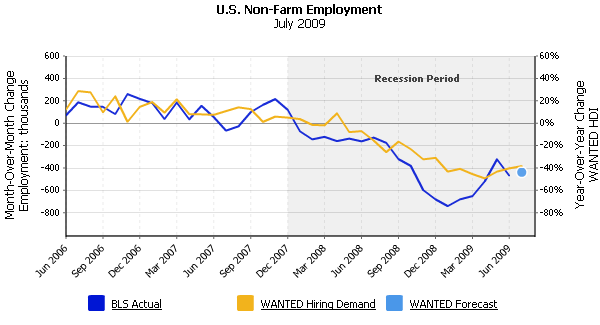
In that vein, Barry Ritholtz links to a graph by Bruce Murray, CEO of WANTED USA, plotting the actual month over month change in non-farm unemployment against year over year percent change in hiring demand:


13. RAIL TRAFFIC VOLUMES BOTTOMED OUT AT 18.9% BELOW LAST YEAR'S NUMBERS

The Railfax report is out today, and seems to indicate that rail traffic volumes have reached a bottom and holding steady at about 18.9% below their seasonal levels. Their chart for weekly loaded units in North America for the week ended August 1 in four week rolling averages:


Their chart for crushed stone and lumber and wood products, key components in construction, in four week rolling averages for North America:

Wednesday, July 15, 2009

Daily Sources 7/15

1. PETROCHINA'S REFINING PROFITS AT RECORD ON PRICE LIBERALIZATIONS

Wang Ying at Bloomberg reports that PetroChina increased its refining profits in the first half of 2009 on the back of the revised pricing system which allows refiners to pass on the cost of production to consumers. Gasoline and diesel are, as a result, considerably more expensive in China than they are, say, in the US. I suspect it will go some ways to dampen demand. Meanwhile, Beijing made an example of the former ex-Chairman of Sinopec, Winnie Lee at Platts reports that Chen Tonghai was sentenced to death for bribery, but given a two-year reprieve.
"The court said Chen abused his authority ... to pursue material gains for third parties in areas related to business operation, transfer of land, and contract procurement, according to the Xinhua report.

The two-year reprieve means that Chen's sentence will be commuted to life imprisonment if he commits no further crime while in jail.

Chen resigned from his posts as the head of China Petrochemical Corporation Group and Sinopec Corporation in June 2007."
2. SOUTH KOREAN COURT HEARS PROPERTY RIGHTS CLAIM BY NORTH KOREAN CITIZENS

Su-Hyun Lee at the New York Times reports that a South Korean court has for the first time decided to hear a case brought by North Korean citizens attempting to establish property rights in the south.
"Four North Korean brothers and sisters have sued their late father’s second wife and that couple’s four children in South Korea for a share of an inheritance from the estate of the father, a successful doctor.

The suit claims at least a quarter of the father’s land and other property, worth about $8 million. He left North Korea for the South with his eldest daughter during the 1950-53 Korean War and never returned. In 1959, he reported that his first wife had died and married a South Korean woman, with whom he had four more children. He died in 1987.

Family members in the south, including the sister who came there with the father, asked that only the family name, Yoon, be used, to protect the relatives in the North and the privacy of those in the south."
Although this is the first suit by North Korean citizens to be accepted by a South Korean court, the right of North Koreans to sue in South Korean courts has already been established by rulings of "the Supreme Court and the Constitution"--though I am left unsure as to exactly what kind of complaint was addressed by the courts establishing this in the absence of a North Korean plaintiff. In any case, the smooth handling of the case may well reassure some of the anxieties of both Northerners and Southerners.

3. EUROPEAN CASH FOR CLUNKERS PLAN MAY BE REVERSING DIESELIZATION

Tim Worledge at the Barrel makes the especially interesting observation that Europe's "cash for clunkers" program--designed to slow the steep fall in auto sales--has pushed sales of gasoline-driven cars up above diesel-driven ones.
"According to the European Automobile Manufacturers' Association, ACEA, diesel comprised around 53% of all new car sales in 2007 and 2008, before the scrappage schemes were introduced.

For the first five months of this year, diesel sales fell to 46.3% of the total, apparently marking a reversal in the 20-year 'dieselization' of Europe."
"This threat to diesel's dominance represents a seismic shift.

Bolstered by favorable tax regimes, the growing use of diesel in Europe has done more than any other trend to spur refining investment and shape global trading patterns in the oil market. It has been clear in recent years that Europe is very long gasoline, with the surplus largely shipped to the US, and is short diesel, which it takes from anywhere it can get it.

Within Europe, and further afield, this has spawned massive investment programs as refinery kit designed to meet gasoline demand is re-aligned, augmented and upgraded to produce ever greater volumes of diesel."
"It's the same story in France, regarded as the bastion of diesel and birthplace of the engine's inventor Rudolf. In 2008, diesel sales peaked at a whacking 77.3% of all new cars, but this has now fallen to 71.6%.

Whether this is a blip, a temporary stumble along the road to full European dieselization, remains to be seen, although it's worth noting that even those diesel cars that are being purchased are burning up to 48% less of what is an increasingly bio-blended road fuel."
However, if it does represent a long-term reverse in trend, the window for diesel arbitrage to Europe will mostly be closed, meaning that there will be no outlet for excess diesel supply in the US, which would likely result in another retooling of US capacity back to full gasoline maximization.

4. EUROZONE INDUSTRIAL PRODUCTION UP 0.6% IN MAY MOM, DOWN 17% YOY

Gerrit Wiesmann at the Financial Times reports that eurozone industrial production rose by 0.6% in May from April, though it was still down 17% from May 2008.
"Strong monthly increases reported by Germany, France and Italy in recent days had led economists to expect a bounce of 1% in May. However, these hopes were dashed by output decreases in Spain and some smaller countries."
5. RUSSIAN RAILWAYS RECEIVES $500 MILLION LOAN FROM THE EBRD, LARGEST LOAN IN THE BANK'S HISTORY

Paul Abelsky and Denis Maternovsky at Bloomberg report that OAO Russian Railways has borrowed from the European Bank for Reconstruction and Development $500 million over 10 years in what is the largest loan ever provided by the bank.
"The deal is the London-based development bank’s largest single investment since it was founded in 1991 to fund infrastructure in former communist nations in Europe and central Asia, the EBRD said in a statement today. Moscow-based Russian Railways sold 90 billion rubles ($2.8 billion) of domestic bonds this year, more than any other company in the country, to finance its investment program."
"Russian Railways, the country’s biggest commercial employer, is seeking fresh funds after posting a loss of 17.1 billion rubles ($534 million) in the first quarter. Rail cargo shipments fell an annual 23% in the first half and may drop 19% in the year, Vladimir Yakunin, the company’s chief executive officer, said July 6.

Russian Railways cut annual spending by more than 34%, to 252 billion rubles, this year after the government reduced financial support for the company and domestic demand for its services waned, Yakunin said in an interview published today in the Vedomosti newspaper. Railroads account for about 85% of Russia’s total cargo transport capacity, according to VTB Capital data.

EBRD aims to invest a minimum of $3 billion in Russia this year, President Thomas Mirow said last month at an economic forum in St. Petersburg."
6. BULGARIA TO GET SPUR FROM THE ITGI PIPELINE

Kerin Hope and Theodor Troev at the Financial Times reports that Greek, Bulgarian, and Turkish companies signed an agreement to build a spur from the ITGI pipeline carrying natural gas from Azerbaijan to Turkey and Greece and which is to be extended to Italy. The spur would have a 3-5 bcm/year capacity and is scheduled to be completed by 2012 at a cost of €120 million (~ $167 million).

"The project highlights the new spirit of co-operation between Athens and Sofia. The Balkan neighbors have a history of bilateral disputes, from arguments over sharing water resources to stake-holdings in a proposed cross-border oil pipeline.

Both countries are keen to become regional transit hubs for gas pipelines from central Asia and the Middle East.

Bulgaria signed up on Monday to join Nabucco and, like Greece, is also a partner in the proposed South Stream pipeline to bring Russian gas to the EU under the Black Sea."
Sofia has secured about €45 million in EU grants to fund the project. According to a 2007 Edison press release, ITGI as it stands has a capacity of 11.5 bcm/year of which Italy had been slated to receive, following the completion of the final section also in 2012, 8 bcm/year. According to a story featured on the Azerbaijan Business Center, Gian Luigi Mascia, the Italian Ambassador to Azerbaijan, said in Baku today that
"The gas pipeline is designed only for Azeri gas. Its overall capacity will be up to 14 bcm a year, including 1 bcm to be delivered to Greece, 10 bcm to Italy and 1-3 bcm to Bulgaria."


Bulgaria responded to the Russo-Ukrainian gas transit dispute in January by re-starting a nuclear reactor despite it violating the terms for its accession to the EU--see Daily Sources 1/15 #1.

7. ISRAEL HAVING TOUGHER TIME IN EUROPE, ISREALI WARSHIPS PASS THROUGH SUEZ

Juan Cole has an interesting analysis suggesting that Israel is more on the outs with Europe than usual. He notes that Javier Solana called for the recognition of a "Pelstinian state by the world community by a date certain, regardless of the Israeli position" suggesting that he is more or less Europe's foreign minister. (Much much less, actually, though important, and certainly an interesting development. The analysis contains a goodly share of wishful thinking, on Prof. Cole's part, but it is still interesting and what he records may well be a sign of a sharper move in the European capitals.) Meanwhile, Michael Collins Dunn at the MEI's Editor's Blog notes that two Israeli corvettes (warships slightly smaller than frigates) have been allowed, by Cairo, to pass through the Suez. He notes:
"Warship transits, while guaranteed under the Israeli-Egyptian peace treaty, are rare, given the fact that Israel is concerned about security. As anyone who has seen the canal knows, it is narrow, and warships passing are easily viewed by civilians and others along its banks."
8. MEND ANNOUNCES CEASEFIRE, QUICKLY THREATENS TO END IT

Platts reports that MEND earlier Wednesday announced a ceasefire following the release of its leader--Henry Okah--yesterday, but has since threatened to call it off, accusing the government of using it as an opportunity to ramp up its military presence in the region.

9. VENEZUELAN OIL MINISTER SAYS ALL PDVSA EMPLOYEES MUST JOIN "SOCIALIST COMMITTEES"

Marianna Parraga at Reuters reports that Venezuelan oil minister Rafael Ramirez yesterday told a rally of workers who had been employed by PdVSA following the nationalization of oil services firms operating in the country that
"By now, there should not be a single counter-revolutionary in the heart of our company, our industry. There cannot be a single PdVSA installation where socialist committees do not exist. Whoever is not in a committee will be suspected of conspiring against the revolution."
"Socialist committees are loosely defined political groups often organized by Chávez's Socialist Party."

10. US COMMERCIAL CRUDE STOCKS DOWN, GASOLINE & DISTILLATE STOCKS UP, REFINERY UTILIZATION UP, BUT US INDUSTRIAL PRODUCTION DOWN 0.4% IN JUNE FROM MAY, 13.6% YOY, CONSUMER PRICES UP 0.7% NEARLY ALL ON ENERGY COSTS, WHILE US WAGES, ADJUSTED FOR INFLATION, FALL 1.2%

The EIA today reported that commercial crude stockpiles fell by 2.8 million barrels to 344.5 million barrels in the week ended July 10. The amount is storage is still above the five year historical range for this time of year, but the draw was for more than the 2.1 million barrel draw expected by Wall Street analysts, per a survey by Bloomberg. Gasoline stocks grew by 1.5 million barrels versus analyst expectations of a 875 kb build and are now near the top of the five year historical range for this time of year. Distillate stocks grew by 600 kb versus analyst expectations for a 2 mb build and are still at extremely elevated levels, about 28% more than what was in storage in the comparable week of last year. Overall US refining capacity went up in the week ended July 10 to 87.87% of total operable capacity from 86.8%. However, industrial production in June was down 0.4% from May and 13.6% from June 2008 according to the Fed's index. From the report:
"For the second quarter as a whole, output fell at an annual rate of 11.6%, a more moderate contraction than in the first quarter, when output fell 19.1%. Manufacturing output moved down 0.6% in June, with declines at both durable and nondurable goods producers. Outside of manufacturing, the output of mines fell 0.5% in June, and the output of utilities increased 0.8%. The rate of capacity utilization for total industry declined in June to 68.0%, a level 12.9% points below its average for 1972-2008. Prior to the current recession, the low over the history of this series, which begins in 1967, was 70.9% in December 1982."
Meanwhile, Gerry Shih at the New York Times reports that the Labor Department announced that its consumer price index climbed 0.7% in June from May. The "core" index, which excludes food and energy prices, rose by 2%.
"Compared with a year ago, the Consumer Price Index has fallen 1.4%, the steepest plunge since 1950, as the prolonged downturn takes its toll on demand in the economy. ...

A separate Labor Department report released Wednesday said that American wages, adjusted for inflation, fell by 1.2% in June."

Monday, July 13, 2009

Daily Sources 7/13

I chose an awfully big week to take a break from this! Back to the regularly scheduled programming, though new obligations will likely mean that posting will soon become much more infrequent and Daily Sources will either become simple links or be discontinued altogether.

1. CHINA UNVEILS ADDITIONAL ANTI-CORRUPTION MEASURES, XINJIANG REPORTEDLY CALMING DOWN AFTER WEEK OF VIOLENCE

Carlos Tejada at China Journal reports that the Chinese Communist Party unveiled new anti-corruption measures Sunday, calling for public leaders and executives at state owned companies to be ousted if major accidents or abuse happens during their watch due to negligence. Tejada observes:
"The new rules are the latest of a recent spate of efforts to rein in what even national leaders acknowledge is a serious problem. Chinese officials in recent weeks have put a bounty on corruption and cracked down on military officials with a taste for the luxurious.

The fear, observers say: Reports or actual cases of corruption and incompetence could cause even more unrest.

Conduct by local officials sparked occasional public clashes even in good times, before China’s juggernaut economy slowed. And times are especially sensitive now because of the upcoming 60th anniversary of the founding of the People’s Republic of China on Oct. 1, which is intended to be a grand celebration of Communist Party rule."
Meanwhile, Gordon Fairclough reports that Urumqi in Xinjiang seems to be calming down after the violence last week:
"The regional government over the weekend updated its casualty figures, saying 184 people were killed in last week's violence--137 of them Han Chinese and 46 Uighurs. One member of another Muslim minority, the Hui, also died. More than 1,600 people were injured, the government said.

After attacks by Uighurs on Han Chinese, some Han Chinese armed themselves and sought revenge. The government said to quell the violence it flooded the city with 20,000 security personnel and has spent days urging people not to take the law into their own hands."
2. ASO CALLS FOR GENERAL ELECTIONS NEXT MONTH, JAPANESE ELECTRICITY GENERATION DOWN 5.6% YOY IN JUNE

Blaine Harden at the Washington Post reports that Japanese Prime Minister Taro Aso has called for general elections next month. Meanwhile, Megumi Yamanaka at Bloomberg reports that Japanese electricity generation declined for the eleventh straight month in June, falling 5.6% from a year previous.

3. KIM JONG-IL RUMORED TO SUFFER FROM PANCREATIC CANCER

Choe Sang-Hun at the New York Times writes that the South Korean media is reporting the rumor that the North Korean leader Kim Jong-il, is suffering from pancreatic cancer.

4. NABUCCO PROJECT SIGNING IN ANKARA TODAY

Der Spiegel reports that the prime ministers of Austria, Bulgaria, Hungary, Romania and Turkey have met in Ankara today to formally sign on to the Nabucco pipeline project.
"The European Union is backing Nabucco and EU Commission President Jose Manuel Barroso, who was at the ceremony, described the project as of 'crucial importance for the EU's and Turkey's energy security.'

He voiced his confidence in the viability of the project, saying 'I believe this pipeline is now inevitable rather than just probable.'"
Ed Crooks at FT Energy Source has a decent breakdown on the sourcing issues facing the pipeline and this fantastic graphic:


Rob Verdonck and Steve Bryant at Bloomberg note:
"Turkey wants Iran to join Nabucco, Erdogan said at the signing ceremony. Iran is able to supply Europe with 31 billion cubic meters of natural gas a year via the link, the Oil Ministry’s Shana news agency said today.

'We don’t believe today that Iran should be a part' of Nabucco, [Richard] Morningstar [US envoy for Caspian energy matters] said.

Iraq will aim to supply 15 billion cubic meters of gas to the pipe, Iraqi Prime Minister Nuri al-Maliki said at today’s ceremony, according to an aide."
"The five governments partnered in Nabucco can bid for up to 50% of the gas flowing through the route, Turkish Energy Minister Taner Yildiz said at a press conference today. He declined to comment on how much of the gas Turkey might request."
5. LLOYD'S BANKING GROUP EXPECTED TO POST LOSSES OF £6.3 BILLION IN 1H

Iain Dey and John Waples at the London Times report that Lloyd's Banking Group will post its numbers in three weeks and is likely, according to UBS analysts, to announce losses of £6.3 billion on its loans to commercial property, businesses and mortgage holders for the first half.
"The writeoffs for the first six months of the year would match the losses recorded by Lloyds TSB and HBOS in 2008, as they consummated their disastrous merger. The expected bad debt charge is almost twice what Lloyds paid for HBOS when they came together under the government’s watch last autumn. Total writeoffs for this year at Lloyds could exceed £20 billion."
(h/t Yves Smith at naked capitalism.)

6. GERMAN ECONOMICS MINISTRY ESTIMATES GDP GROWTH WAS 0% IN 2Q

Der Spiegel reports that the Economy Ministry in Berlin's internal report concluded that GDP growth for the second quarter was 0%--meaning that the recession is over.
"If confirmed, the data could allow the German government to revise its current predictions of minus 6% growth for 2009 and forecast a smaller contraction."
7. ITALIAN PARLIAMENT MANDATES RE-NUCLEARIZATION

Dan Yurman at the energy collective reports that Italy's parliament passed a law last week which officially puts the country back on the path of nuclear power, mandating that sties be identified in the next six months for new nuclear power plants.
"Energy Minister Scajola isn’t kidding when he says Italy needs to build at least eight-to-ten new nuclear power plants (10-12 GWe) to significantly reduce its dependence on imported oil and natural gas. However, the country also needs to avoid building more coal-fired power plants. One of the earliest options may be to buy a 12% share in a new Areva 1,600 MW EPR being built in France."
In February, Rome signed a nuclear power cooperation pact with France-- see Daily Sources 2/24 #2. In October 2008, Scajola indicated that Italian electricity prices were 80% above France's--which sources about 80% of its electricity generation from nuclear--and 30% above the European average. He noted that the cost of phasing out nuclear had come to €50 billion-see Daily Sources 10/17 #3.

8. RAINFALL RECOVERING IN INDIA

Yi Tian at Bloomberg reports that the rainfall deficit in India for the week ended July 8 narrowed to 8% from 29% the week earlier on stronger monsoons. Indian oil refiners had been worried that the low rainfall was causing diesel consumption to remain flat in a general environment of falling oil demand, and that it would grow as farmers turned to the fuel for pumping, digging, and electricity generation--see Daily Sources 7/1 #4.

9. PAKISTAN SEEKING $15 BILLION IN E&P INVESTMENT OVER NEXT 5 YRS

Khalid Qayum and Khaleeq Ahmed at Bloomberg reports that Pakistan is seeking $15 billion in investment in oil exploration and development over the next five years. Islamabad is reportedly offering generous returns as it tries to offset its import requirement, and will focus its licensing on blocks offshore its southern coast, as onshore exploration has been hampered by security concerns.
"Pakistan wants to boost domestic fuel production to reduce its oil import bill and meet energy demand, which is growing 5% annually. Gas production of 4.1 billion cubic feet a day meets about 60% of demand.

The government will try to improve security for explorers as it also seeks to attract investment in new fields in the country, ... [Asim] Hussain [adviser to the prime minister on the oil industry] ... said in [an] interview on July 10."
10. THE ROOTS OF THE PARADOX IN IRAN'S CONSTITUTION, REZAI CALLS FOR RECONCILIATION AMONGST CONSERVATIVE IRRITATION WITH AHMADINEJAD, TEHRAN SEEKING CHINESE INVESTMENT IN REFINERY EXPANSIONS

Jonathan Lyons has a post on informed comment which provides an analysis of how Khomeini's ideology of the rule of the best qualified cleric presented problems to the regime at the start of the 1979 revolution:
"Among the most influential of opponents to Khomeini’s revolutionary project of placing his new republic under the direct leadership of a senior cleric – in this case, himself--were his fellow grand ayatollahs, men who had attained the highest levels of religious learning and popular support and acclaim. And the most important among them was Grand Ayatollah Seyyed Mohammad Kazem Shariat-Madari, based in Tabriz, in Iran’s Azeri region.

Shariat-Madari, then the leading ayatollah resident in Iran, was adament: the clergy should not exercise political power as this could only lead to religious tyranny. The grand ayatollah had sided with the revolution against the shah, but he was not prepared to see the clerics in government. This was, of course, in perfect keeping with Shi’ite political theory: the clerics had united to defeat the pro-Western shah as a threat to the Muslim faithful; but their work was now done and it was time to withdraw and leave the dirty work of governance to others.

Khomeini was furious and he unleashed his militant supporters on his rival in December 1979, provoking pitched battles in the streets of Tabriz. Once the 'political mullahs' backing Khomeini were in control, the leader of the revolution undertook a punitive measure that no imperial shah had ever dared: he engineered the stripping of Shariat-Madari’s clerical rank and privileges.

In traditional practice, the rank of Grand Ayatollah--formally, the marja-e taqlid, or a source of emulation for others to follow--requires both the respect of one’s fellow clerics and the acclaim of believers, each of whom paid their religious taxes to support the ayatollah and his religious mission.

In fact, Iranian clerics often point to this system as an indigenous democratic institution, and it certainly gives the grand ayatollahs a huge measure of independence from the autocratic state and from one another while recognizing the importance of popular support and public opinion. What’s more, believers are free to choose their own marja, and even to switch their allegience as they see fit. Khomeini, himself a marja, trampled this system in the name of revolutionary expediency."
(Very much worth reading.) Robert F. Worth at the New York Times reports that opposition candidate Mohsen Rezai--and former chief of the Revolutionary Guards--issued a statement on his website yesterday
"in which he called for reconciliation and spoke about the danger of 'imprisoning' the legacy of the Islamic Revolution in divisive and shortsighted politics. The statement was posted on his Web site.

Although his message was largely nonpartisan, Mr. Rezai hinted that the government response after the election had been unfair, and he urged protesters to continue their work in legal and nonviolent channels."
"Other conservative figures have made gestures in recent days indicating their displeasure with the government’s tactics or their desire for more forgiving policies. On Saturday, Ayatollah Reza Ostadi, a senior member of a conservative clerical group, delivered a stinging criticism of a cleric who had organized a rally supporting Mr. Ahmadinejad, the Mehr news agency reported."
Meanwhile, Chen Aizhu at Reuters reports that Iran is seeking investment from China in its refinery expansion plans designed to eliminate its dependence on gasoline imports by 2012. (This is kind of old news, but there are some new developments/details:)
" An official with National Iranian Oil Company's (NIOC) Beijing office said last week's forum, chaired by Iran's deputy petroleum minister, Shahnazi Zadeh, was to be followed by detailed discussions with Chinese firms. He did not elaborate.

Hossein Noghrekar Shirazi, NIOC's refining head, was quoted by a Chinese newspaper as saying that Chinese investors would enjoy policy sweeteners such as a 5% discount in raw materials purchased in Iran and 8-year tax break for investments made in its free trade zones."
11. CANBERRA SUMMONS CHINESE AMBASSADOR FOR INFORMATION ON RIO TINTO EXECUTIVE CHARGES

Rachel Pannett and Alex Wilson at the Wall Street Journal reports that Canberra has summoned the acting Chinese ambassador to Australia for further details on the detention of a Rio Tinto employee on espionage charges.
"The Australian government, and in particular the Mandarin-speaking Prime Minister Kevin Rudd who is a former China diplomat, are under mounting pressure from opposition lawmakers to intervene at a higher level.

'This is the third time that [the Department of Foreign Affairs and Trade] has spoken to the acting ambassador since last Monday,' Mr. Smith said, adding that Australian officials are seeking similar information in Beijing.

Despite this, Australia's Finance Minister Lindsay Tanner said the government won't be changing its process for assessing foreign investment in Australia despite China's detention of Mr. Hu."
12. NIGERIA RELEASES HEAD OF MEND

Dulue Mbachu at Bloomberg reports that Abuja released the head of MEND today.
"The Movement for the Emancipation of the Niger Delta, or MEND, made the release of Okah one of its conditions for ending its armed rebellion."
Meanwhile, Jacques Lhuillery reports that international oil companies are nervous about the proposed tax changes in Nigeria on oil and gas, arguing that new oil and gas production projects will likely fall by 50% on the reduced returns.
"The petroleum industry Bill, which went through its second reading and debate in the senate last week, is intended to overhaul the regulatory and operational systems of the industry, the lifeline of the West African powerhouse.

It plans to transform the existing joint ventures between the transnational oil firms and the state Nigeria's National Petroleum Company (NNPC), and turn NNPC into an autonomous and internationally profitable entity.

It also wants to improve on tax collection--decoupling oil from gas taxes as well as develop a system responsive to fluctuations in oil prices so as to capture on any windfall profits.

According to leader of the Senate Teslim Folarin, the Bill is designed to 'simplify the collection of oil revenue through shifting emphasis to easily collectible revenue as royalties and rents'."
(h/t Kate MacKenzie at FT Energy Source.)

13. HONDURAS DOESN'T EXPECT MUCH DISRUPTION DUE TO CHAVEZ'S EMBARGO OF PRODUCTS EXPORTS

Evidently, Chavez didn't just stop exports of crude to Honduras (which were zero) but also of petroleum products. Honduras is a member of Petrocaribe and as such received products at discounted rates and under very easy financial terms. Robert Mayer at Platts reported Friday that Tegucigalpa doesn't expect too much disruption as a result of the cut off.
"The effect, however, will be negligible, a source with the Honduran government said Friday, as the Petrocaribe shipments constituted a small fraction of the overall supply for the local operations of Shell, Chevron and Dippsa.

'We're using (Petrocaribe refined products) as a top-off, so we're in good shape,' a source with Dippsa-Puma said Friday."
(Puma Energy is a vertically integrated oil company active globally, but which was formed to develop an independent network of oil products storage and distribution facilities in Latin America and is owned by Trafigura, a major oil--and other commodities--trading company incorporated in the Netherlands, but whose headquarters are located in Switzerland.)

14. HOME MORTGAGE MONTHLY FORECLOSURE RATES UP 8% ON THE YEAR, ROBERT REICH ARGUES THAT THE RECESSION IS NOT LIKELY TO END AS LONG AS CONSUMERS ARE STRUGGLING WITH HUGE NET WORTH DECLINES

Rebecca Wilder at News N Economics on Sunday picked up on the story by the LA Times that 26% of home mortgage defaults are strategic and 22% of homeowners are straddled with negative equity and notes that monthly foreclosure rates are 8% higher than they were last year. She plots a graph showing the monthly foreclosure rate of single family homes by state--


--and comments:
"Going forward, though, the monthly foreclosure rate is likely to grow in some economies, like those seen in Connecticut and Hawaii, as recessionary pressures of rising unemployment and falling income pass through to the housing market."
Wilder's blog is always worth a look. Robert Reich comments on the prospects for recovery in a consumer based economy facing steep falls in net worth:
"Problem is, consumers won't start spending until they have money in their pockets and feel reasonably secure. But they don't have the money, and it's hard to see where it will come from. They can't borrow. Their homes are worth a fraction of what they were before, so say goodbye to home equity loans and refinancings. One out of ten home owners is under water--owing more on their homes than their homes are worth. Unemployment continues to rise, and number of hours at work continues to drop. Those who can are saving. Those who can't are hunkering down, as they must.

Eventually consumers will replace cars and appliances and other stuff that wears out, but a recovery can't be built on replacements. Don't expect businesses to invest much more without lots of consumers hankering after lots of new stuff. And don't rely on exports. The global economy is contracting."
15. SAN JOAQUIN VALLEY HAS LOST 60 MILLION ACRE FEET OF GROUNDWATER SINCE 1961, LEGISLATION INTRODUCED WHICH WOULD MAKE IOU'S LEGAL TENDER FOR OBLIGATIONS TO STATE, IN EFFECT A STATE CURRENCY

Matt Weiser at the Sacramento Bee reports that California's San Joaquin Valley has lost 60 million acre feet of groundwater since 1961, according to a new federal study.
"The Central Valley is America's largest farming region; it's also the single-largest zone of groundwater pumping. About 20% of groundwater pumped in America comes from under the Central Valley, said Claudia Faunt, the study's project chief.

In the Sacramento Valley, the study found groundwater levels have remained stable. Virtually all of the groundwater loss has occurred in the San Joaquin Valley, where aquifer levels have dropped nearly 400 feet since 1961, she said."


California is the only state in the union which does not regulate groundwater use. The USGS chose the Central Valley because it is so critical to the country's food supply. A must read. Meanwhile, Mark Thoma at Economist's View notes that the Californian assembly on Friday introduced legislation which would make the IOUs with which it is currently paying its employees with legal tender for all taxes and other fees owed to the state. Thoma notes that that is tantamount to the establishment of a state currency. He quotes from Marshall Auerback's post on the subject:
"It will be interesting to see what the exchange rate is between California IOU and US currency--the IOUs do offer a yield, so should be less than par by design. I wonder if NY is next."

Wednesday, July 1, 2009

Daily Sources 7/1

1. JAPAN TO MOVE AHEAD WITH STRATEGIC PETROLEUM PRODUCTS RESERVE IN AUGUST

Takeo Kumagai at Platts reports that Japan's Ministry of Economy, Trade & Industry [METI] has decided to move ahead with plans to establish strategic petroleum product reserves beginning in mid-August with a day's worth of kerosene consumption.
"After nearly three years of discussing the matter in depth both internally and at its advisory meetings, METI was set to introduce the national oil products stockpile this year, with one or a combination of light and middle distillates, equivalent to one day's consumption of the particular product or products chosen, Platts reported earlier.

METI has chosen to start the products stockpile with kerosene because it would affect consumers living in northern Japan during the country's winter demand season, the official said. Kerosene is used as heating oil in Japan, with demand typically peaking over December-February."
2. CHINA'S OFFICIAL PMI UP TO 53.2, CLSA'S CHINA PMI UP TO 51.8; CHINA TO BAN IMPORTS OF US CHICKEN

Terence Poon at the Wall Street Journal reported yesterday that the official purchasing manager's index for China rose to 53.2 in June from 53.1 in May. (A reading of above 50 indicates expansion; below 50 indicates contraction.)
"The new export orders component of the PMI rose to 51.4 in June from 50.1 in May. June was the second consecutive month where the export-order subindex has remained above 50, suggesting a deterioration in exports in the past several months is abating.

But the inventory subindex of the PMI fell to 45 in June from 46.2 in May. [Moody's] Economy.com's [analyst] Sherman Chan said that drop suggests manufacturers remain cautious about building up inventories amid an uncertain global economic outlook.

'If the external environment doesn't improve, it will be difficult for the government to sustain its fiscal spending for a long time,' she said."
Chinaknowledge reports that CLSA Asia-Pacific Markets' China PMI also showed improvement, rising to to 51.8% in June from 51.2% in May. Meanwhile, Lauren Etter and Stephen Power at the Wall Street Journal reports that China is expected to ban imports of US chicken in the next several days.
"The potential ban could be a big blow to the US chicken industry, which has been struggling with high grain prices and a price-depressing oversupply of chicken. Exports had been a bright spot for the industry, and last year China surpassed Russia as the largest destination for US chicken, according to the USA Poultry & Egg Export Council."
"[I]n 2007 lawmakers inserted a provision in the 2008 fiscal-year spending bill that prohibited the USDA from allowing chicken processed in China to be imported. The same prohibition was included in the spending bill in the next two fiscal years.

Trade tension between China and the US heightened earlier this week when the US International Trade Commission recommended imposing punitive duties of as much as 55% on low-cost Chinese tire imports because they are disrupting the US market, in a move that could sharply increase costs for consumers. GITI Tire, China's largest tire manufacturer, has called the move 'decidedly protectionist' and said it would take its case to President Barack Obama.

Last week, the House approved legislation to curb US greenhouse-gas emissions that includes a provision to impose tariffs on goods from countries that don't match US efforts to combat climate change."
Last week the US and EU lodged a WTO complaint alleging that China was blocking the export of raw materials--Daily Sources 6/24 #2.

3. ASHGABAT INVITES MEDVEDEV FOR VISIT TO DISCUSS GAS PURCHASES

Upstream online reports that Turkmen President Kurbanguly Berdymukhamedov has invited President Medvedev to visit Ashgabat to discuss the resumption of Turkmen gas exports to Russia.
"Russia, the main buyer of Turkmen gas, halted its imports in April after a pipeline explosion.

The pipeline has been repaired but the two sides cannot agree on new terms of sales as Russia's Gazprom needs less gas than in the past."
The move comes after China sealed a deal to increase its gas imports from Turkmenistan by 30% last week--see Daily Sources 6/25 #3. Ashgabat publicly suspected that Gazprom had engineered the explosion at the pipeline in order to stop paying the $340/tcm (~$9.61/MMBtu) price it had reportedly contracted to pay for Turkmen gas on December 31, 2008--see Daily Sources 4/14 #7.

4. INDIAN OIL REFINERS NERVOUS ABOUT DELAYED MONSOON EFFECT ON DIESEL PURCHASES

Murali Gopalan and Richa Mishra at the Hindu Business Line reports that Indian oil refiners are worried about heavy losses on diesel as low rainfall so far this year results in digging and pumping groundwater and diesel electricity generation.
"[W]hile [oil demand] growth figures for May are negative ... , diesel consumption at 4.748 million tonnes ... was otherwise normal and has not fallen in absolute terms.

Another reason for this was due to a continuous decline in the industrial sector’s use as diesel-direct sales showed negative growth of 4.7% in May.

It was the sixth successive month when industrial sales of diesel showed negative growth, coinciding with the onset of the economic recession in the second half of 2008-09. While economics dictated the pace of diesel consumption so far, the weather patterns could change the pattern, fear experts.

However, the consumption trend for diesel seems to be changing in June, with the eastern region recording a 45% growth, with Bihar alone registering nearly 65%."
5. MALAYSIA TO PULL BACK MALAY-PREFERENTIAL POLICY

Thomas Fuller at the New York Times reports that the Prime Minister of Malaysia, Najib Razak, announced a rollback in the policy which required companies issuing stock to reserve 30% of their shares for ethnic Malays.
"'The world is changing quickly, and we must be ready to change with it or risk being left behind,' he said Tuesday.

The change would leave some ethnic preferences intact and come with caveats. But it would dilute one of the most important components of what is known as the New Economic Policy, introduced in 1971: the requirement that companies listing on the stock exchange sell 30% of their shares to ethnic Malays.

That requirement was scrapped for companies already listed on the stock exchange and reduced to 12.5% for initial public offerings. The requirement will remain in place for 'strategic industries' like telecommunications, water, ports and energy.

Mr. Najib also said he would lower barriers for foreign investors. The government would eliminate a special vetting process for foreign companies wanting to invest in, merge or take over a Malaysian company, he said."
6. IMF EXPECTED TO AUTHORIZE $150 ISSUANCE OF SDR-DENOMINATED DEBT TODAY

Timothy R Homan at Bloomberg reports that the IMF board of directors are expected to authorize the issuance of as much as $150 billion in SDR-denominated bonds, voting on the matter today.
"The IMF is also considering making them tradable between all central banks from countries that are IMF members, said a G- 8 official, who spoke on condition of anonymity. It would stop short of allowing them to trade on the open market, he said."
7. SARKOZY TELLS NETANYAHU TO GET RID OF LIEBERMAN

Michael Collins Dunn at the MEI Editor's Blog notes that President Sarkozy has reportedly expressed in a "private message" to Benjamin Netanyahu that he should remove Avigdor Lieberman from his post as foreign minister.

8. KIRKUK FIRST CITY SINCE START OF IRAQ WAR TO GET 24 HOUR ELECTRICITY


Diaa Al-Khalidi at the Iraq Oil Report reports that Kirkuk has become the first Iraqi city to enjoy 24-hour electricity since 1993--and the first time the city itself has experienced it since 1991, when Saddam Hussein cut power to the regions in order to ensure round the clock access in Baghdad following his defeat in Kuwait.
Kirkuk is outside the formal borders of the Kurdish Regional Authority, but, if I understand correctly, currently effectively security in the city is provided by it:


Security is key in the maintenance of energy infrastructure.

9. ARAMCO AND CONOCO TO RESUME BIDDING FOR CONSTRUCTION OF YANBU EXPORT REFINERY

Sheila McNulty at FT Energy Source reports that Saudi Aramco and ConocoPhillips have decided to resume the bidding process for the construction of the 400 kb/d export refinery at Yanbu. "Now some bids are to be awarded in November 2009 and the others in the second quarter of 2010." Evidently, the bidding process has resumed on an optimistic view of the global economy going forward--and that sufficient financing exists to get it done. (I suspect that this would more likely be the view of Saudi Aramco than ConocoPhillips, given the recent statements from OPEC, but Saudi Aramco controls the facts on the ground.)

10. OPEC 11 SUPPLIES 110 KB/D MORE OIL IN JUNE THAN MAY

Reuters reports that OPEC 11 output in June rose to 26.02 mb/d in June from 25.91 mb/d in May--a 72% compliance rate with the implied production target of 24.84 mb/d, down from 75% in May.

11. NIGER DELTA MILITANT GROUP CRITICIZES MEND FOR ATTACKS AFTER AMNESTY OFFER

Platts reports that the Ijaw Youth Campaign for Peace [IYC]--a coalition from the ethnic Ijaw community in Nigeria's Niger Delta--issued a statement today condemning continued attacks on oil installations by MEND following the introduction of the amnesty offer by Abuja.
"'We are shocked by the activities of our sons considering the recent [press] release by MEND [saying] they have vandalized Shell platforms in Forcados,' the IYC said.

'If the purported sabotage was actually true we in the Ijaw Youth Campaign for Peace hereby condemn it in all facets,' the group stated.

The group said the continued sabotage of oil installations 'will present our people as not actually fighting for a genuine cause, but personal gain, which the government can see as armed robbery and criminality.'"
The story also notes reports that the amnesty offer has hit a snag as the heavy military presence in the region has made militants leery of going to areas designated as arms collection centers.

12. OAS GIVES HONDURAS ULTIMATUM, UN CALLS FOR ZEYALA'S RETURN, ARGENTINA'S FERNANDEZ TO TRAVEL TO HONDURAS TO NEGOTIATE SOLUTION, CHAVEZ SAYS VENEZUELA MAY CEASE ALL CRUDE EXPORTS TO HONDURAS--ALL 0 KB/D OF THEM

Ginger Thompson at the Washington Post reports that the Organization of American States on Wednesday gave Honduras three days to restore ousted President Manuel Zelaya to power or face expulsion from the organization.
"Diplomats said they had rarely seen the OAS unite so solidly behind a common cause, and that it was the first time the group had invoked its so-called Democratic Charter since it was adopted in 2001 as a clean break with the region’s history of authoritarian rule."
The United States is the only country in the Western Hemisphere which has not reacted to the coup by withdrawing its ambassador. On the other hand, Joshua Goodman and Andres R Martinez at Bloomberg report that yesterday the UN General Assembly passed a resolution, co-sponsored by the US, calling for the restoration of Zelaya.
"OAS Secretary General Jose Miguel Insulza said yesterday he wanted to return to the Central American nation with Zelaya to demand his reinstatement. Argentine President Cristina Fernandez de Kirchner will accompany the mission, Buenos Aires newspaper Infobae reported.

As protests against Zelaya swell, a showdown is imminent. [Interim Honduran President Roberto] Micheletti said that Zelaya faces arrest and 20 years in prison should he attempt to return to Honduras, Central America’s third-poorest country.

The country’s Supreme Court, congress and business groups have also expressed support for Zelaya’s removal, over concerns he was seeking to retain power beyond his original mandate by ignoring court rulings and changing the constitution through a referendum on term limits.

Approval for the Zelaya government fell to 30 percent in February from a high of 57 percent in January 2007, according to a nationwide poll by CID-Gallup. The former cattle rancher lost support over the past two years as he strengthened ties with Chavez ... ."
Paul Talley at the Compass comments:
"For Fernandez, accompanying Zelaya gives her a chance to play a popular role in world politics that might offer a distraction from her own political problems at home."
Talley seems skeptical about the practical effect however--his post is worth a look. Meanwhile, Carlos Camacho at Platts reports that Hugo Chávez has delayed a trip to the Dominican Republic to finalize PdVSA's purchase of a 49% stake in the Refidomsa refinery there until the Honduran crisis is resolved. Chávez has reportedly threatened to halt all exports of crude to Honduras until Zelaya is reinstated. Of course, Honduras has no refining capacity, so a halt in crude exports wouldn't have much of an effect upon the country.

13. SURVEY SHOWS OBAMA MOST TRUSTED LEADER IN THE WORLD

World Public Opinion recently conducted a survey of 19,224 people in 20 countries, asking them to rate their confidence in leaders of foreign countries. The margins of error in the polls range from ±3-4%. "The survey was conducted between April 4 and June 12, 2009, prior to Obama's speech in Cairo but subsequent to his Ankara speech." The poll seems to show that Obama has by far the most trust of any world leader internationally.


That's a fair amount of political capital. The poll includes ratings for Putin (somewhat oddly), Ban Ki-Moon, Merkel, Brown, Sarkozy, Hu Jintao, and Ahmadinejad. (h/t Greg Scoblete at the Compass.)

14. KC FED CHIEF SAYS THE GOVT HAS INSTITUTIONALIZED "TOO BIG TO FAIL", ST. LOUIS FED CHIEF SAYS FED RATES LIKELY TO STAY UNCHANGED FOR "FORESEEABLE FUTURE," SF FED CHIEF TAKES AIM AT INFLATIONISTAS, SAYING DOWNTURN LIKELY TO BE PROLONGED

Greg Robb and Kate Gibson at MarketWatch report that Thomas Hoenig, president of the Federal Reserve Bank of Kansas City, has criticized the "ad hoc" approach to the financial crisis, saying it has institutionalized the notion of "too big to fail."
"'The current crisis has made it clear that the group of systemically important firms that might be deemed worthy of special consideration by policy-makers is larger than previously thought,' Hoenig said in a Tuesday speech at New York University."
"The Obama administration's overhaul of financial rules is only a start of a dialogue on the issue, Hoenig commented. 'The most important part of any plan ... will be the requirement that public authorities resolve such institutions by taking them into receivership and restructuring them to emerge under new and more careful management and ownership,' without exceptions."
Worth reading in full (h/t Yves Smith at naked capitalism.) Meanwhile, Jon Hilsenrath at Real Time Economics reports that James Bullard, president of the St Louis Fed, said in a talk at Philadelphia’s Global Interdependence Center today that the Fed Funds Rate is likely to remain at its current rate for the "foreseeable future." He also said that the Fed's
"'liquidity programs', such as efforts to support the commercial paper market or money market mutual funds, are on track to end next year 'if financial conditions continue to improve."
He further indicated that the Fed may reevaluate its purchases of mortgage-backed securities in its next meeting in August. In a story which has received wide coverage in the econoblogosphere, Jon Hilsenrath at Real Time Economics reports that Janet Yellen, President of the Federal Reserve Bank of San Francisco, took aim at the inflationistas, saying:
"We are far from the kinds of unemployment rates that would make inflation a danger. ... The very weak economy is, if anything, putting downward pressure on wages and prices ...

In past deep recessions, the Fed was able to step on the accelerator by cutting the federal funds rate sharply, causing the economy to shoot ahead. This time, we already have our foot planted firmly on the floor. We can’t take the federal funds rate any lower than zero. I believe that the Fed’s novel programs are stimulating the flow of credit, but they simply aren’t as powerful levers as large rate cuts, so this time monetary policy alone can’t power a rapid recovery.
...
I also think that a massive shift in consumer behavior is under way—one that will produce great benefits in the long run but slow our recovery in the short term. 4 American households entered this recession stretched to the limit with mortgage and other debt. The personal saving rate fell from around 8 percent of disposable income two decades ago to almost zero. Households financed their lifestyles by drawing on increasing stock market and housing wealth, and taking on higher levels of debt. But falling house and stock prices have destroyed trillions of dollars in wealth, cutting off those ready sources of cash. What’s more, the stark realities of this recession have scared many households straight, convincing them that they need to save larger fractions of their incomes. In the long run, higher saving promises to channel resources from consumption to investment, making capital more readily available to retool industry and fix our infrastructure. But, in the here and now, such a rediscovery of thrift means fewer sales at the mall, and fewer jobs on assembly lines and store counters."
The full text of her speech can be found here.

15. FORD TO RAMP UP PRODUCTION

Nick Bunkley at the New York Times reports that vehicle sales were down 11% in June from June 2008, the lowest annual rate of decline seen by any major carmaker since last Summer.
"Ford said this week that it was increasing production in the third quarter, which starts Wednesday, to match the rise in demand its dealers were seeing. The company now plans to build 67,000 more vehicles, a 16% increase, than it did in the third quarter of 2008.
...
Over all, industry sales are expected to be down at least 25% compared with June 2008. Though dismal by any measure, it could be the first time since September that total sales fell by less than 30 percent on a year-over-year basis, a positive sign.

June could also be the first month this year in which new vehicles sold at an annualized rate of at least 10 million. For most of the last decade, auto sales in the United States were around 17 million a year before plummeting in 2008. Fewer than 5 million vehicles were sold in the first half of 2009, a decrease of nearly 37%."
16. CRUDE STOCKS SHARPLY DOWN, BUT PRODUCTS STOCKS SHARPLY UP ... REFINING UTILIZATION SLIGHTLY DOWN

The EIA reports that commercial crude stocks were drawn down in the week ended June 26 by 3.7 million barrels to 350.2 million barrels, still above the historical range for this time of year, but not dramatically higher any more. Gasoline stocks grew by 2.3 million barrels, and are now in the middle of the five-year historical range for this time of year. The median analyst expectation per a Bloomberg survey was for a 2 million barrel build. Distillate stocks also grew by 2.9 million barrels to 155 million barrels, 34.3 million more barrels than were held in commercial inventories in the comparable week last year. The analyst expectation was for a 1.5 million barrel build. The national average price of gasoline for the week ended June 29 fell by 4.9¢ to $2.642/gallon. Refinery utilization for the week ended June 26 fell .06% to 86.99%.

17. 10 TOP US CITIES GROWING FASTER THAN THEIR SUBURBS SINCE 2007

Conor Dougherty at Real Time Economics notes the report by Mark Mather at the Population Reference Bureau which shows that population in the ten largest American cities have been growing faster than the areas around them since 2007:


Worth reading in full.