Showing posts with label south korea. Show all posts

Tuesday, August 10, 2010

Daily Sources 8/10

US AND VIETNAM HOLD JOINT NAVAL EXERCISES

BBC reports that the US and Vietnam are holding joint naval exercises in the South China Sea this week. "The week-long activities focus mainly on non-combatant exercises and are part of the 15th anniversary of diplomatic ties between Washington and Hanoi."

CHINA'S TRADE SURPLUS GREW TO $28.7 BILLION IN JULY

Keith Bradsher at the New York Times reports that China's trade surplus grew to $28.7 billion in July, "the largest total since January of last year."

SINOPEC TO COMPLETE OIL STORAGE PROJECT BY 2011

Platts reports that Sinopec announced on its website that it would complete its oil storage tank project on Cezi island by 2011. Once finished, the oil tanks would have a capacity of 84.91 million barrels and would bring Sinopec's total capacity to 122.65 million barrels.

CHINA NOT TO CLOSE 2000 + FACTORIES, BUT TO ELIMINATE EQUIPMENT AT THEM

Jason Dean at China Real Time reports that the story yesterday about China closing 2,000 + inefficient factories is an exaggeration.
"In fact, the MIIT’s list is generally quite specific about which equipment in which factory should be eliminated: two blast furnaces at Haicheng City Xiyang Steel Co. in Liaoning province, one cement mill at the Hongdong County Huoyue Construction Materials Co. in Shanxi, 91 rotary drums at the Shijiazhuang City Tongtai Leather Industry Co. in Hebei etc. Only about a dozen factories are listed for full closure, including a pair of paper plants in Hebei, five printing-and-dyeing operations in Guangdong, and a trio of liquor factories in Sichuan."
JAPAN LEAVES BENCHMARK RATE AT 0.1%

Mayumi Otsuma at Bloomberg reports that the Bank of Japan has left its benchmark interest rate at 0.1%.
"[Bank of Japan Governor Masaaki] Shirakawa said the discussion of the yen, which is approaching a 15-year high against the dollar, dominated today’s meeting because of the risk it poses to exporters and the economy."
KNOC DISCOVERS OIL IN KURDISH REGION OF IRAQ

AFP reports that the Korean National Oil Company (KNOC) has discovered oil in the Kurdish region of Iraq.
"[T]he Korea National Oil Corp (KNOC) said in a statement it was too early to estimate the size of the reserves. It said a formal announcement of the discovery would be made only after consultation with local authorities."
The newspaper that broke the story reported that there was an estimated 2 billion barrels in the newly found reserves. South Korea has been banned from participating in any oil concessions in the rest of Iraq because it has chosen to participate in exploration in Kurdistan before the relationship between Baghdad and Kurdistan has crystallized in terms of oil.

45% OF ELECTRICITY IN PORTUGAL TO COME FROM RENEWABLES THIS YEAR

Elisabeth Rosenthal at the New York Times reports that
"[n]early 45% of the electricity in Portugal’s grid will come from renewable sources this year, up from 17% just five years ago."

[C]omplaints about rising electricity rates are a mainstay of pensioners’ gossip here. Mr. Sócrates, who after a landslide victory in 2005 pushed through the major elements of the energy makeover over the objections of the country’s fossil fuel industry, survived last year’s election only as the leader of a weak coalition.
KAZAKHSTAN LARGEST PRODUCER OF URANIUM IN THE WORLD


Nirode Masson at IDN reports that Kazakhstan is now the largest producer of uranium in the world.
"Kazakhstan has a major plant making nuclear fuel pellets and aims eventually to sell value-added fuel rather than just uranium. It aims to supply 30 percent of the world fuel fabrication market by 2015, according to World Nuclear News (WNN)."
GATES SUGGESTS CLOSING OF JOINT FORCES COMMAND IN NORFOLK

Thom Shanker at the New York Times reports that Defense Secretary Gates has announced plans to close the Joint Forces Command in Norfolk, Virginia, as part of a plan to reduce spending by the military.
"The White House, which is under intense political pressure to address the rapid increase in the national debt, quickly stepped in to back Mr. Gates, saying his plan would free money that could be better spent on war fighting."
WORKER PRODUCTIVITY FELL IN JULY BY AN 0.9% ANNUAL RATE

Courtney Schlisserman at Bloomberg reports that "the measure of employee output per hour fell at a 0.9% annual rate, the first drop since late 2008."
"Hours worked climbed at a 3.6% rate, leading to a 2.6% increase in the amount of goods and services produced.

A lengthening workweek signals employers have reached efficiency limits after productivity climbed by the most in five decades in the 12 months to March."
HOTTER SEAS LEAD TO POSSIBILITY OF MORE DANGEROUS HURRICANES

Brian K. Sullivan at Bloomberg reports that a hotter Atlantic Ocean is likely to lead to more and stronger hurricanes this hurricane season. The sea is hotter now that it was when hurricane Katrina formed.

HIGHER TEMPERATURES REDUCE RICE YIELDS

Richard Black at BBC reports that a new study has found that higher temperatures reduce the rice yield globally.
"Yields have fallen by 10-20% over the last 25 years in some locations.

The group of mainly US-based scientists studied records from 227 farms in six important rice-producing countries such as Thailand, Vietnam, India and China."
NON-FARM EMPLOYMENT MOSTLY FLAT FOR LAST DECADE


Free Exchange hosts a graph of non-farm employment from 1939 and notes that in the last decade the gauge has been mostly flat.


A CALL FOR A GLOBAL ARCHITECTURE FOR FOOD POLICY

Joachim von Braun at the Financial Times argues that a global architecture for food policies is overdue. He further states that food security is worse now than it was in 2008 when food riots took place around the world.

Monday, August 2, 2010

Daily Sources 8/2

The China Car Times reports that"China now has 65,000km of highways across the nation, making it the second largest highway network in the world after the United States." According to the state's 2020 plan, China should have 100,000km of highways by then, about the same as what we have in the US. This should provide a tremendous economic boost over time as well as security dividends in China where it will be easier to deploy troops from one place to another.

CHINESE PMI FALLS TO 51.2

Peter Boockvar at the Big Picture reports that China's state Purchasing Managers' Index fell to 51.2. (Numbers above 50 indicate expansion; below 50 indicates contraction.)

GUANGZHOU AND HONG KONG ANTI-MANDARIN PROTESTS

Carmen Ng at China Real Time reports that there has been a second protest in Guangzhou and Hong Kong regarding the plan to change some prime time TV programming from Cantonese to Mandarin speaking. The first took place July 25th.

JAPANESE JULY PMI FELL SLIGHTLY TO 52.8

Prieur du Plessis at Investment Postcards from Cape Town reports that Japanese Purchasing Managers' Index fell slightly to 52.8. (Numbers above 50 indicate expansion; below 50 indicates contraction.)


GERMAN ELECTRICITY AND NATURAL GAS DEMAND UP 8% IN 1H

Andreas Franke at Platts reports that natural gas and electric power demand in Germany grew by 8% in the first half of the year over the same period one year ago.
"Based on its latest estimates, electricity consumption was up by 4.6% at 274 billion KWh, while the use of natural gas was 14% higher than in the first half of 2009, the BDEW said in the statement.

According to the BDEW, the main reason for the demand increase is the positive development of industrial production in Germany, which accounts for 40-45% of energy demand, while the demand for gas was also boosted by the long winter."
Demand has still not recovered to pre-crisis levels, however.

SPAIN TO CUT SUBSIDIES TO PHOTOVOLTAIC POWER PLANTS BY 45%

Victor Mallet at the Financial Times reports that Spain's industry ministry has announced the subsidized electricity prices paid to photovoltaic power plants by up to 45%. Worth reading in full.

AFTER NUCLEAR DEALS, SOUTH KOREA AND UAE AGREE TO COOPERATE IN OIL AND GAS EXPLORATION AS WELL AS STOCKPILING OIL IN SOUTH KOREA


Shinhye Kang and Ayesha Daya at Bloomberg report that after having secured a deal to build the UAE nuclear power plants South Korea and the Emirates have agreed to cooperate on oil and gas exploration and for the stockpiling of oil in South Korea.
Part of Seoul's energy security program has to do with oil stockpiling by various producers in South Korea to take advantage of quick changes in the Asian oil market. South Korea gets to draw down on those stockpiles in case of an emergency disruption in oil supply. The UAE is a major entrepot for stockpiling oil in the Middle East.

DELINQUENCIES GROW IN COMMERCIAL REAL ESTATE MARKET

Yves Smith at naked capitalism reports that the commercial real estate sector is feeling pain:
"• All deals seasoned at least a year have a total unpaid balance of $767.76 billion, with $60.45 billion delinquent – a 7.87% rate (up from only 5.28% six months prior).
• When agency CMBS deals are removed from the equation, deals seasoned at least a year have a total unpaid balance of $736.75 billion, with $60.39 billion delinquent – a 8.2% rate (up from only 5.46% six months prior).
• Conduit and fusion deals seasoned at least a year have a total unpaid balance of $655.41 billion, with $54.69 billion delinquent – a 8.35% rate (up from only 5.33% six months prior)."
JULY PMI DOWN TO 55.5

Shobhana Chandra at Bloomberg reports that US manufacturing grew at a slightly slower rate in July than June. The Institute for Supply Management's Purchasing Managers' Index fell to 55.5 from 56.2 in June. (Readings above 50 indicate growth; readings below 50 indicate contraction.)

BEN BERNANKE SAYS CONSUMER SPENDING TO PICK UP IN COMING MONTHS

Scott Lanman and Steve Matthews at Bloomberg report that Fed chief Ben Bernanke said in a speech today that consumer spending was likely to pick up in coming months.

HARLESS ARGUES THAT STRUCTURAL UNEMPLOYMENT NOT A PROBLEM

Andy Harless at Employement, Interest and Money argues that we are not seeing new structural unemployment, but rather cyclical unemployment. Worth reading in full.

MAXINE UDALL REPORTS THAT ROADS ARE BEING ALLOWED TO REVERT TO GRAVEL

Maxine Udall reports that in the US highways are being allowed to turn back to gravel. This should have significant detriments going forward, including that the amount of gas to travel from one place to another on gravel roads is higher than on paved roads. A must read.

Tuesday, July 20, 2010

Daily Sources 7/20

1. BUNDESBANK SAYS CURRENT-ACCOUNT DEFICITS OF IRELAND, SPAIN, GREECE AND PORTUGAL THREATEN EUROZONE

Thomas Molloy at the Independent reports that the economic policies of Ireland, Spain, Greece, and Portugal represent a threat to the Eurozone as a whole and the entire Euro project.
"'These macro-economically erroneous trends' are 'a source of danger for other member countries and the currency region as a whole,' the Bundesbank wrote in its monthly bulletin. Deficit countries damage the eurozone's stability and 'it is urgently necessary to correct maldevelopments and avoid a repetition in the future'."
2. EUROPEAN COMMISSION TO BAN COAL SUBSIDIES BY 2014

James Kanter at Green reports that the European Commission has tentatively banned subsidies for coal mining starting 2014.

3. PEW SAYS THE DEVELOPED WORLD UNHAPPY WITH CHINA'S RISE

Free Exchange notes that concerns about China's economic might are high in the developed world. Much of the developing world ain't so keen on its rising military prowess either.


4. CHINA NOW THE WORLD'S LARGEST ENERGY USER

Grant Smith at Bloomberg reports that according to the IEA China is now the largest user of energy consuming 2,252 million metric tons of oil equivalent in 2009 versus the 2,170 million tons used by the US. Somewhat oddly, Shai Oster at China Real Time reports that the Chinese leadership has rushed to deny that it is now the largest energy user, saying that by their calculations the US remains top dog in that department.

5. JAPAN AND CHINA TO NEGOTIATE HOW TO DEVELOP UP EAST CHINA SEA GAS

Takeo Kumagai at Platts reports that Japan and China are seeking to schedule negotiations on how best to jointly develop the East China Sea gas fields which have been the source of some friction between the two governments.

6. US AND SOUTH KOREA TO CONDUCT NAVAL DRILLS NEXT WEEK

After a delay which caused some to speculate that the US was worried about upsetting China, Elisabeth Bumiller and Edward Wong at the New York Times report that the US and South Korea have agreed to hold naval exercises in the Sea of Japan and Yellow Sea next week. The exercises are in part a response to the sinking of a South Korean ship by a North Korean submarine four months ago. Beijing has strongly objected to the US holding naval drills in the Yellow Sea.

7. JAPAN TO CONSIDER ENERGY HUB AMBITIONS

Takeo Kumagai at Platts reports that Japan is considering using its spare storage capacity to act as an energy hub in the region. Japanese oil consumption is on a downward trend leaving considerable spare capacity. Some are considering using that spare capacity to export out into regional markets extra petroleum products, becoming the third trading hub in the region after Singapore and South Korea.

8. RUSSIA SENDS MISSION TO CLARIFY BORDER ON ARCTIC SHELF

Elena Kovachich at the Voice of Russia reports that
"The flagship of Russia’s polar fleet “Academician Fyodorov” has left for the Arctic on an expedition to clarify the outer border of the country’s continental shelf."
9. NABUCCO COMPLETES PUBLIC HEARINGS IN TURKEY

Alex Froley at Platts reports that the Nabucco pipeline project has completed the first round of public hearings in Turkey.
"Erdal Tuzunoglu, managing director for Nabucco Turkey, said: 'The completion of the public hearings is an important step towards the realization of the Nabucco project. The communities are very interested in the project and we feel that their concerns were addressed and discussed.'"


10. JUNE UNEMPLOYMENT BY STATE SHOWS IMPROVEMENT

Phil Izzo at Real Time Economics reports that the Bureau of Labor Statistics announced that most states--37--saw unemployment fall in June, while five saw an increase and in six there was no change. 27 saw a decrease in payroll employment while 21 saw an increase. Click on the link for neat interactive map and chart.

11. THE WHITE HOUSE ANNOUNCES FORMATION OF NATIONAL OCEAN COUNCIL

John M. Broder at Green reports that the White House yesterday announced the creation of a National Ocean Council. The new body will not have the power to create new regulations, but will attempt to coordinate the policy of overlapping institutions regulating ocean policy. Worth reading in full.

Wednesday, July 14, 2010

Daily Sources 7/14 (Bastille Day)

THE EU IS HALFWAY TO MEETING THEIR GOAL OF 20% RENEWABLE FUELS CONSUMPTION BY 2020

Reuters reports.

THE EURO'S INTERNATIONAL ROLE

The European Central Bank has released a 84 page paper on the international role of the Euro.

RUSSIAN SPENDING MORE THAN THE PRICE OF OIL WOULD ALLOW

Toni Vorobyova at Reuters reports that Russian spending is well above what the price of oil would allow without running a deficit.

GERMANS WORRIED THEIR RELATIONSHIP WITH RUSSIA IS COOLING

Matthias Schepp at Der Spiegel worries that the Merkel administration has not continued a strong tradition of courting Moscow, allowing other nations to attempt to get pride of place. In the meantime, John Roberts at Platts reports that RWE has decided to consider an offer from Moscow to join the South Stream pipeline plan, but loudly asserted its commitment to Nabucco.

BERLIN CONSIDERS AUCTIONING OFF EXTRA TIME FOR NUKE PLANTS

David Crossland at Der Spiegel reports that the Merkel Administration, which wants to bypass the plan to shutter all nuclear power plants by 2020, is considering auctioning off more time for the plants to operate. That is, the power companies could bid for additional time past 2020 in which they could operate. A key reason for the idea is that nuclear power makes it easier to meet carbon reduction goals.

SPANISH SOLAR POWER NOW BIGGER THAN US

Sharon Hong at News Watch Energy reports that with the commissioning of a new solar plant Spain now leads the US in solar power energy production.

SOUTH KOREAN PLAN FOR PRIVATE COS TO SPEND $18 BILLION ON GREEN TECH SMOKE AND MIRRORS

Christian Oliver at FT Energy Source warns us that the news yesterday that the plan for South Korean companies to spend $18.6 billion on green technologies is not quite what it seems.

NIGERIAN CRUDE EXPORTS TO US ON THE RISE

Jacinta Moran at Platts writes that NIgerian exports to the US are averaging 945 kb/d in the first quarter of 2010, up from 606 kb/d in the same quarter last year. A key reason is that efforts to mollify Niger Delta rebels have had some success. Meanwhile, Sharon Hong at News Watch Energy reports that the Nigerian state oil company is insolvent as it waits for the government to pay it its subsidies.

MORE THAN 4 PEOPLE ARE LOOKING FOR JOBS FOR EACH AVAILABLE JOB

Per Mark Thoma at Economist's View:


OIL PRICES MODERATING SOMEWHAT IN US

James Hamilton at Econobrowser updates some charts he uses to monitor energy costs in the US, including a chart of US retail gasoline prices.


Note that prices are in the range where they begin to affect driving behavior in the US, or $2.50/g. They are just short of $3.00/g where prices will have a strong effect on driving behavior.

CRUDE OIL STOCKS DOWN 5.1 MILLION BARRELS

The EIA reports that crude oil stocks fell by 5.1 million barrels in the week ended July 9th, though they are still well above the 5 year historical average. Gasoline stocks built by 1.6 million barrels and distillates grew 2.9 million barrels. The average price of gasoline for the week ended July 12th fell by 0.8 cents to 271.8 cents/gallon. For the week ended July 9th, refinery utilization grew to 90.5%.

Tuesday, July 13, 2010

Daily Sources 7/13

WILL CHINA'S DEBT EXPLOSION BITE IT IN THE BUTT?

Asks Michael Schuman at the Curious Capitalist.

THE NOTION OF A EUROPEAN-NORTH AFRICAN SUPER-GRID GAINING GROUND

FT Energy Source reproduces an interview with Gregor Czisch of Germany’s Kassel University, who argues that such a supergrid would not be more geopolitically compromising than the current dependence on natural gas.


SOUTH KOREAN INDUSTRIES TO SPEND $18.5 BILLION ON GREEN TECHS TO 2013

Shinhye Kang at Bloomberg reports that South Korean companies plan to spend $18.5 billion in clean energy technologies to capture government spending on green technology and jobs. In the meantime, Choe Sang-Hun at the New York Times reports that there may be some friction between Seoul and DC when they begin renegotiating their nuclear fuel treaty later this year. Nuclear energy provides about 40% of South Korea's electricity. Seoul wants to reprocess the nuclear fuel; the US is opposed because reprocessing makes making nuclear weapons a simpler prospect.

PUTIN EXTENDS FUEL SUBSIDIES FOR FARMERS FACING DROUGHT

Maria Kolesnikova at Bloomberg reports that Prime Minister Putin has agreed to continue fuel discounts to farmers in Russia, who are facing the worst drought in a decade.

OPEC PREDICTS 2.1% INCREASE IN GLOBAL OIL DEMAND IN 2010

Robert Perkins at Platts reports that the IEA predicts a 2.1% increase in global oil demand in 2010, or an additional 1.8 million b/d rise from 2009. For 2011, the IEA predicts a 1.3 million b/d year-on-year growth in global oil demand to 87.8 million b/d. The slowing demand growth comes on top of predictions of growing global GDP.

BASHIR CHARGED WITH GENOCIDE BY INTERNATIONAL CRIMINAL COURT

Colum Lynch and Rebecca Hamilton at the Washington Post report that the International Criminal Court has charged the sitting Sudanese President, Omar Hassan al-Bashir, with genocide. David Eggers and John Pendergrast opine in the New York Times that the US should threaten Sudan to try and ensure that the North-South peace referendum takes place in January. Right now it looks to them that war is inevitable between them. Although they make room for the ICC's recent holding, it is not clear to me how it would be likely to produce a peaceful solution to the emerging problem.

PEMEX TO SELL DOLLAR BONDS

Gabrielle Coppola and Andres R. Martinez at Bloomberg report that Pemex, Mexico's national oil company, will sell at least $500 million in dollar bonds, yielding 250 basis points over US Treasuries today.

BOSTON FED PRESIDENT WORRIED MORE ABOUT DEFLATION THAN INFLATION

Jon Hilsenrath at Real Time Economics reports that Federal Reserve Bank of Boston President Eric Rosengren is more concerned about the possibility of deflation than of inflation.
“The core inflation rate is right around 1%,” he said. “Given the amount of substantial excess capacity that we have in the economy, there is some risk of further disinflation. And I would say the risk of deflation has gone up and is more of a risk than I would like to see at this point.”
Rebecca Wilder at News N Economics reports that inflation expectations for all the developed countries appear to be going down.


Edward Hugh at Fistful of Euros argues that there is a global slowdown in the works.

Monday, July 12, 2010

Daily Sources 7/12

SOUTH KOREA RAISES BENCHMARK INTEREST RATE BY .25%

William Sim and Shinhye Kang at Bloomberg report that South Korea's central bank on Friday raised its benchmark interest rate by .25% to 2.25%. GDP is expected to grow by 5.9%, up from previous estimates of 5.2%. Exports are expected to rise by 26.4%. Consumer price inflation is expected to hit 2.8% this year and 3.4% in 2011. Guess they're not worried about a double dip in the recession.

INDIA ENDS FUEL SUBSIDIES, PROTESTS IMMEDIATELY ERUPT

Chris Stanton at the National reports that India has ended its subsidies on gasoline and substantially reducing them for diesel. Large protests immediately erupt.

IS YEMEN THE NEXT AFGHANISTAN?

Robert F. Worth at the New York Times Magazine asks whether Yemen is the next Afghanistan.

UGANDA HIT BY TERRORIST BOMBINGS

Josh Kron at the New York Times writes that at least 64 people were killed in three bombings in Uganda. The main suspect is Al-Shabaab. Uganda has ties with the transitional government in Somalia.

Thursday, July 30, 2009

Daily Sources 7/30

1. DEBATE OVER SUSTAINABILITY OF CHINESE FISCAL STIMULUS HEATS UP: CHINA SHUTTERS LARGE NUMBER OF SMALL COAL SOURCED POWER PLANTS, ONE ARGUES THAT CHINA'S STRENGTH VIS-A-VIS US FISCAL SITUATION OVERSTATED, ANOTHER SAYS CHINESE ARE COMPLAINING OF THEIR OWN BEHAVIOR IN OTHERS, AND YET ANOTHER SAYS TRADE CONFLICTS ARE INEVITABLE

Vitaliy Katsenelson in Morningstar opines:
"Despite everything, the Chinese economy has shown incredible resilience recently. Although its biggest customers--the United States and Europe--are struggling (to say the least) and its exports are down more than 20%, China is still spitting out economic growth numbers as if there weren’t a worry in the world. The most recent estimate put annual growth at nearly 8%.

Is the Chinese economy operating in a different economic reality? Will it continue to grow, no matter what the global economy is doing?

The answer to both questions is no."
I interrupt Katsenelson's point to note that the Associated Press reports that
"[Chinese a]uthorities have closed [small coal-fired] power plants with a total of 7,467 generating units, meeting a previously announced goal 18 months ahead of schedule, said Sun Qin, deputy administrator of the Cabinet's National Energy Administration.

'This couldn't be done when power demand was very intense,' Sun said at a news conference. 'Due to this financial crisis, the power generation has slowed down, so we took this opportunity to accelerate the shutdown.'"
OK, but China depends on coal for about 70% of its electricity generation. As many have noted before, the GDP growth numbers published by China don't seem to be consistent with having taken so much power generation off line--see Daily Sources 5/14 #2. In late May, the China Electricity Council, or association, announced it would stop publishing electricity consumption numbers--see Daily Sources 6/8 #6. Back to Katsenelson:
"Millions of people have migrated to its cities, and now they’re hungry and unemployed. People without food or work tend to riot. To keep that from happening, the government is more than willing to artificially stimulate the economy, in the hopes of buying time until the global system stabilizes. It’s literally forcing banks to lend--which will create a huge pile of horrible loans on top of the ones they’ve originated over the last decade.

But don’t confuse fast growth with sustainable growth. Much of China’s growth over the past decade has come from lending to the United States. The country suffers from real overcapacity. And now growth comes from borrowing--and hundreds of billion-dollar decisions made on the fly don’t inspire a lot of confidence. For example, a nearly completed, 13-story building in Shanghai collapsed in June due to the poor quality of its construction.

This growth will result in a huge pile of bad debt--as forced lending is bad lending. The list of negative consequences is very long, but the bottom line is simple: There is no miracle in the Chinese miracle growth, and China will pay a price. The only question is when and how much."
In this vein, Robert Flint at the Wall Street Journal reports:
"Since the beginning of this week, things have happened quickly on the bubble front. China's banking regulator issued rules Monday governing loans for fixed-asset investments in its latest attempt to ensure bank lending boosts the real economy and isn't funneled into markets.

On Tuesday, two of China's major lenders were quoted as saying they would sharply slow credit growth in the second half. This prompted fears of a sudden tightening of credit that could choke off the loans which have so far eased the effects of the world recession. Shanghai equity prices plunged as much as 7.7% at one point Wednesday and closed 5.0% down on the day.

Later on Wednesday, the PBOC said it will emphasize market-based systems, rather than administrative controls, in guiding the appropriate growth of credit. PBOC Vice Governor Su Ning's comments appeared to signal the PBOC wasn't about to set loan curbs in the second half of this year to cool explosive lending growth, as it had done in 2008."
Meanwhile, David Pilling argues in the Financial Times:
"If anything, it is Beijing--some of whose officials now privately boast they have nothing at all to learn from the Great Spendthrift--that has the upper hand. China’s seeming financial hold over the US has been brought into sharp relief. Beijing has become prone to lecture Washington on the need to safeguard its $2,000bn reserves, the bulk of which are parked in US dollars.

It is wholly appropriate that Washington accords due attention to China, the most important emerging power since America itself. But there is also a danger of taking China too seriously. In compensating for past neglect, things could swing too far the other way. For all the euphoria about the G2--the Sino-US axis that, according to some breathless reckoning, is the only meaningful global forum--it is worth pausing to survey the facts.

For a start, China’s financial grip over the US is not as tight as many suggest. Far from a sign of strength, Beijing’s accumulation of vast foreign reserves is the side-effect of an economic model too reliant on exports. The enormous trade surplus is the product of an undervalued renminbi that has allowed others to consume Chinese goods at the expense of Chinese people themselves.

Beijing cannot dream of selling down its Treasury holdings without triggering the very dollar collapse it purports to dread. Nor are its shrill calls for the US to close its twin deficits--which would inevitably involve buying fewer Chinese goods--entirely convincing. Rather than exposing the superiority of China’s state-led model, the global financial crisis has laid bare the compromising embrace in which the US and China find themselves."
And Brad Setser at Follow the Money notes that Chinese policy makers complaining of US government profligacy might fairly be asked if they aren't the pot calling the kettle black.
"Before the crisis, the Fed’s balance sheet was around 6% of US GDP. Right now, it is around 15% of US GDP. A big increase no doubt. But the balance sheet of the People’s Bank of China (PBoC) is around 70% of China’s GDP. Foreign assets make up about 80% of the PBoC’s balance sheet--or around 55% of China’s GDP. And the PBoC’s estimated holdings of US treasuries and agencies are about equal to 30% of China’s GDP--a level that is far higher, relative to China’s GDP, than the US Fed is ever likely to achieve. The Fed expects its balance sheet to peak at roughly $2.5 trillion, or between 15% and 20% of US GDP."
His colleague Paul Swartz provides a graph of the annual change in PBoC and Fed holdings of treasuries and agencies as a percentage of GDP:


Michael Pettis at China Financial Markets notes that trade lawyers are reporting that they expect a slew of industries to ask the EU for protective tariffs next month.
"As I have been arguing for over a year, as unemployment around the world rises and as the necessary contraction in US net demand picks up pace, there was inevitably going to be a conflict with China as Chinese policymakers responded to the collapse in trade in the only way they could, by substantially stepping up investment. The result is that China’s trade surplus has contracted very slowly--much more slowly than the contraction in the US trade deficit--and the result was a huge squeeze on the tradable goods sectors around the world.

The fact that policymakers in Europe, China, Japan and the US seem to have no clue as to how difficult the transition for each of the other countries is likely to be, and so are doing not nearly enough to coordinate their response (in fact lecturing and finger waggling seem to the favorite forms of policy coordination), makes trade conflict almost a dead certainty. I don’t think there are necessarily any bad guys here--each country is desperately doing what it can to get itself out of this mess--but there is a lot of failed opportunity and I am pretty sure that the trade environment will continue to decline."
Pettis notes that China's share of the US trade deficit (excluding oil) has grown from 26% in 2000 to 83% so far in 2009.
"Perhaps as a consequence of a fiscal stimulus aimed at boosting investment and production, China’s share of the US trade deficit has grown significantly. Since the US trade deficit is shrinking quickly, this means that other exporters are getting killed. As I have argued for a while, this is not sustainable and will almost certainly cause trade tensions to erupt.

Does this mean China is behaving in a predatory way? I don’t thinks so. I have warned for a long time that it would be very difficult for China to make the necessary transition to a consumption-led economy quickly enough to accommodate the global adjustment taking place. Unless it is willing to see its economy collapse, there is simply no way China can reduce its negative net demand quickly enough to match the contraction in US demand and so avoid squeezing the hell out of the global tradable goods sectors. That is why policy coordination is so important, especially between China and the USD, and of course that is why I continue to be a pessimist. I do not think this policy coordination is taking place."
Well worth reading in full.

2. JAPANESE INDUSTRIAL PRODUCTION UP 2.4% IN JUNE FROM MAY, JAPEX TO BID ON DEVELOPING 400 KB/D IRAQI FIELD, AND JAPAN TO START BURNING CRUDE JATROPHA OIL FOR POWER GENERATION

Yoshiaki Nohara at Bloomberg reports that the Japanese Trade Ministry announced that industrial production increased by 2.4% in June from May.
"Output gained 8.3% last quarter from the first three months of 2009, the most since 1953. Companies said they also planned to increase manufacturing by 1.6% in July and 3.3% in August, the report showed.

The heads of the Finance Ministry’s regional bureaus yesterday raised their assessment of the economy for the first time in five years, based on a recovery in exports and industrial production."
Meanwhile, Ashutosh Joshi and Taiga Uranaka at Reuters report that Japan Petroleum Exploration Co (Japex) has entered into negotiations with Iraq to develop the East Baghdad field, according to Nikkei Business Daily.
"Japex has proposed developing the southern portion of the field, with initial output forecast at 400 kb/d, enough to satisfy about 10% of Japanese demand, the newspaper said.

It also said that rival companies are expected to submit bids as well."
Meanwhile, Takeo Kumagai at Platts reports that Biomass Japan, a biodiesel supplier, will begin supplying power companies with crude jatropha oil for direct burning.
"Biomass Japan is scheduled to start receiving some 700 mt/month of crude jatropha oil in Okinawa from August, mainly from its pilot plants in Indonesia, Malaysia, Thailand and India, the source said."
"Biomass Japan declines to officially disclose exact costs for its crude jatropha oil, but according to the source production from the foreign pilot projects will cost less than Yen 50-60/liter (53-63 cents/liter) on a CIF basis, less than equivalent domestic production.

Biomass Japan is currently expanding its overseas jatropha production capacities beyond Southeast Asia, with new operations in Africa due to come on stream in the next few months, the source said.

From December it will be receiving a total of 5,000 mt/month of crude jatropha oil from Africa, said the source, declining to give details of the projects."
Some power plants in Japan directly burn crude oil to generate electricity--generation from jatropha should reduce net greenhouse gas emissions. However, jatropha has recently been abandoned by some producers, in part because it turns out that it is a water hog--see Daily Sources 7/17 #5.

3. SOUTH KOREAN HOUSEHOLD SAVINGS DOWN FROM 25.2% IN 1998 TO PROJECTED 3.2% IN 2010

Blaine Harden at the Washington Post reports that
"The household savings rate in South Korea will have plummeted from a world-beating 25.2% in 1988 to a projected world low of 3.2% in 2010, according to the OECD. Government policies have encouraged borrowing, while Korea's aggressive culture has supercharged spending on signifiers of success, whether they be Ivy League degrees or Louis Vuitton handbags.

'It is not recognized as a virtue to save, not anymore,' said Lee Sun-uk, an investment adviser for an office of Samsung Securities that is located in a wealthy neighborhood of Seoul. 'To maintain a certain status, people are willing to spend, even if their incomes have declined.'

In the past decade, average savings per household have plunged from about $3,300 to $525. On a percentage basis, it is the steepest savings decline in the developed world. Meanwhile, household debt as a percentage of individual disposable income has risen to 140%, higher than in the United States (136%), according to the Bank of Korea."


4. UK HOME PRICES UP 1.3% IN JULY FROM JUNE IN THIRD CONSECUTIVE MONTHLY INCREASE, UK WORRIED ABOUT OIL PRICE EFFECT ON RECOVERY

Real Time Economics reports that the UK Nationwide Building Society said the average home price rose 1.3% in July from June in the third consecutive month of increase.
"House prices have a 'reasonable chance' of ending 2009 up for the year, the Nationwide Building Society said."
Kate Mackenzie at FT Energy Sources reports that following news stories indicating that the Financial Services Authority has determined that speculation is not the source of the 2007-8 oil price spike, it is
"calling in big oil companies, hedge funds, banks and oil traders next week for a closed-door discussion on 'whether the current arrangements [in the oil market] remain appropriate'."
"[T]he FSA said representatives from the Treasury will also be at the meeting, which raises another possibility of what is driving this newfound concern ... over commodities. The UK government has recently aired concerns that high oil prices could threaten economic recovery. Alistair Darling, the chancellor, made this clear when he told the FT that high and volatile oil prices 'has the potential to be a huge problem as far as the recovery is concerned'."
5. EU DELEGATION IN TURKMENISTAN TO DISCUSS ENERGY COOPERATION

Upstream online reports that the EU has sent a delegation to Turkmenistan to discuss energy cooperation.
"'Developing and deepening mutually beneficial and equal ties with EU countries is a priority in (Turkmenistan's) foreign policy strategy,' Reuters quoted a report published by state news agency Turkmen Khabarlary as saying, citing a Foreign Ministry statement.

Turkmen President Kurbanguly Berdymukhamedov said this month his country was ready to supply gas through Nabucco, a pipeline designed to ease Europe's dependence on Russian gas."
6. IRAQ FACING DUSTBOWL ENVIRONMENT

Liz Sly at the Los Angeles Times reports on the emerging environmental catastrophe in Iraq.
"Decades of war and mismanagement, compounded by two years of drought, are wreaking havoc on Iraq's ecosystem, drying up riverbeds and marshes, turning arable land into desert, killing trees and plants, and generally transforming what was once the region's most fertile area into a wasteland.

Falling agricultural production means that Iraq, once a food exporter, will this year have to import nearly 80% of its food, spending money that is urgently needed for reconstruction projects.

'We're talking about something that's making the breadbasket of Iraq look like the Dust Bowl of Oklahoma in the early part of the 20th century,' said Adam L. Silverman, a social scientist with the US military who served south of Baghdad in 2008.

So fragile has the environment become that even the slightest wind whips up a pall of dust that lingers for days."
"Chronic electricity shortfalls also have played a role. People chop down trees for firewood, leaving more bare land, and the shortage of power has made it difficult to pump water through the irrigation channels that had sustained fertile lands far beyond the rivers. Compounding the already dire shortages, power stations have been forced to shut down for days at a time because they lack water.

Then came the regionwide drought that has dramatically depleted the amount of water available. Last year's rainfall was 80% below normal; this year only half as much rain fell as usual."
A must read.

7. US WILL SANCTION ERITREA IF IT DOESN'T HALT SUPPORT FOR SOMALI MILITANTS

BBC News reports that US envoy to the UN Susan Rice told a Congressional Committee that Eritrea will face sanctions if it does not put an end to support for Islamists fighting the transitional federal government in Somalia.
"In April the African Union, another backer of the Somali government, also called for sanctions over the issue.

But Eritrean officials have repeatedly denied the allegations, calling them a 'fabrication' of US intelligence.

The country suspended its membership of the AU in protest at the sanctions call in April."
8. GHANA'S FISCAL SITUATION IMPROVES ON OIL FINDS


Frontier Markets reports that
"Ghana’s Eurobonds have surged 93% since last November and may continue to rise given the country’s increasingly attractive fiscal position due in part to the production of a new oil field that is expected to put it in the world’s top 50 oil producers and to expand growth from an estimated 4.1% this year, to 6.1% in 2010 and 10.5% the year after. The yield on the 8.5% dollar-denominated bonds due 2017 fell from 9.83 to 9.73 percent during trading on Tuesday."
Could be a blessing for Ghanaians, depending on how the government manages it. Crossing my fingers.

9. MORE ON AFRICAN FARMLAND PURCHASES FROM FOREIGN INVESTORS AND GOVTS

Horand Knaup and Juliane von Mittelstaedt at Der Spiegel have a fascinating update on the rush to purchase African farmland story, with a number of additional details and interesting observations. Some key excerpts:
"'According to most prognoses, there could be 9.1 billion people living on earth in 2050, about two billion more than today. In the coming 20 years alone, worldwide demand for food is expected to rise by 50%. "These are pessimistic prospects,' says [an] OECD [analyst]."
"Food is becoming the new oil. Worldwide grain reserves dropped to a historic low at the beginning of 2008, and the ensuing price explosion marked a turning point, just as the oil crisis did in the 1970s. There were bread riots around the world, and 25 countries, including some of the biggest grain exporters, imposed restrictions on food exports."
"If the investors are successful, they could achieve what development agencies have been unable to do in the past few decades: reduce the hunger that now afflicts more people than ever, namely one billion worldwide. In the best case scenario this could be a win-win situation with profit for the investors and development for the poor.

It is not just bankers and speculators, but also governments that are acquiring land in other countries, seeking to reduce their dependence on the world market and imports. China is home to 20% of the world's population, but it has only 9% of the world's arable land. Japan is the world's largest corn importer, and South Korea is the second-largest. The Persian Gulf States import 60 percent of their food, while their natural water reserves are sufficient to support only another 30 years of agriculture."
"Klaus Deininger, an economist specializing in land policy at the World Bank, estimates that 10 to 30% of available arable land could be up for grabs, although only a fraction of the potential number of lease and sale agreements have been signed. 'There was a huge jump in 2008, when plans and applications in many countries more than doubled, in some cases tripled.' In Mozambique, says Deininger, foreign demand is more than double the existing cultivated farmland, and the government has already allocated four million hectares to investors, half of them from abroad."
"Saudi Arabia is one of the biggest and most aggressive buyers of land. This spring, the king attended a ceremony where he took delivery of the first export rice harvest, produced exclusively for the kingdom in hunger-stricken Ethiopia. Saudi Arabia spends $800 million a year promoting foreign companies that cultivate 'strategic field crops' like rice, wheat, barley and corn, which it then imports. Ironically, the country was the world's sixth-largest wheat exporter in the 1990s. But water is scarce and the desert nation aims to preserve its reserves. Exporting food also means exporting water."
"But many of the countries where land is being snapped up--Kazakhstan and Pakistan, for example--suffer from water shortages. Sub-Saharan Africa has adequate natural water reserves, but the only country in the region currently producing a food surplus is South Africa. Most countries, on the other hand, are importers and, with rapidly growing populations, will likely be even more dependent on food imports in the future. Can such countries truly become important food producers?

Audinet, the IFAD expert, knows the risks. 'The way these agreements are structured can harm the country and the farmers in the long term, robbing them of their most important asset: land.' Olivier De Schutter, the UN Special Rapporteur on the right to food, warns: 'Because the countries in Africa are competing for investors, they are undercutting each other.' Some contracts, says De Schutter, are barely three pages long--for hundreds of thousands of hectares of land."
The other must read of today.

10. RUSSIA INKS DEEPWATER EXPLORATION DEAL WITH CUBA

The Associated Press reports that Russian firm Zarubezhneft has signed four accords with the Cuban national oil company--Cubapetroleo--to explore for crude in Cuban deep waters.
"Moscow extended the island $150 million in credit for construction materials and farm machinery, state media said Wednesday.

The credit will give Cuba more time to pay for Russian equipment shipped to areas most affected by three hurricanes that caused more than $10 billion in damage last summer."
11. MEXICAN FEDERAL POLICE RAID PEMEX HEADQUARTERS


Robert Campbell at Reuters reported yesterday that the Mexican police raided the headquarters of national oil company Pemex "in an investigation into rampant fuel theft that costs the company more than $2 billion a year."


12. SEASONALLY-ADJUSTED INITIAL UNEMPLOYMENT CLAIMS DOWN 8,250 TO 559,000; FORECLOSURE ACTIVITY BECOMING A FUNCTION OF INCREASING UNEMPLOYMENT; HARLESS ARGUES THAT INCREASED US SAVINGS RATE HERE TO STAY

The Department of Labor announced today that
"In the week ending July 25, the advance figure for seasonally adjusted initial claims was 584,000, an increase of 25,000 from the previous week's revised figure of 559,000. The 4-week moving average was 559,000, a decrease of 8,250 from the previous week's revised average of 567,250.

The advance seasonally adjusted insured unemployment rate was 4.7% for the week ending July 18, unchanged from the prior week's unrevised rate of 4.7%."
Yves Smith at naked capitalism observes:
"A new dynamic appears to be emerging on the housing front. Heretofore, foreclosures were strongly correlated with where the mania had been most acute. California, Florida, and Arizona in particular showed dramatic declines in prices. But now as those markets have corrected to a considerable degree, foreclosure activity is now starting to be a function of increasing unemployment."
And Andy Harless at Employment, Interest, and Money thinks that an increased rate of savings in the US is here to stay, which should have the consequence of reducing the share of consumption as GDP:
"Undoubtedly the savings rate will fall somewhat as the degree of financial distress declines, but I think there’s a good case to be made that much of the increase is permanent.

For one thing, from the point of view of households, 'financial distress' may be extremely slow to lift. If the Japanese experience is any guide, it is a very slow process to get a severely distressed banking system to start lending normally again, and it’s not clear that things are going to be any easier for the US. Meanwhile, most forecasts expect the unemployment rate to remain quite high for several years. It could take 3 years, or 5 years, or 10 years, or 20 years before the financial distress lifts.

Granted, even 20 years is not forever, and 3 years is certainly not forever, but it’s long enough to stop thinking about household behavior as being continuous over time. We can reasonably surmise that, even without so much financial distress, the savings rate would have trended upward over time. Presumably households would gradually have come to recognize that they weren’t saving enough. (Can zero be anywhere near enough?) And as baby boomers’ children settle into their own careers, they would cease to be a drag on their parents’ savings, and at the same time those parents would have to start worrying seriously about retirement. The financial distress messed up this scenario (or maybe just speeded it up), but the underlying trend should still be going on 'beneath the surface.' By the time the distress lifts, there will be other reasons for the savings rate to be higher than it was in 2006.

That argument is rather speculative, I admit, but there are more solid reasons to expect the savings rate to remain high. While the current, comparatively high savings rate may reflect the effects of financial distress, the low savings rates of the 2005-2007 period did not merely represent the absence of financial distress. What is the opposite of financial distress? Financial ease? The degree of financial ease during that period (which was the culmination of a process that had been building on and off for a couple of decades) was well beyond normal, and well beyond what we can expect in the coming years, even if recent sources of distress are resolved fairly quickly. Consumption was supported (and aggregate saving accordingly reduced) by a fountain of credit that will not re-emerge with such force unless people in Washington and on Wall Street make some big mistakes."
Well worth reading in full. (I would note that if past performance is any indication of future performance, however, that Washington and Wall Street are likely to make some big mistakes.)

13. NEW STUDY SUGGESTS THAT MARCELLUS SHALE FORMATION COULD PRODUCE AS MUCH AS 489 TRILLION CUBIC FEET OF NATURAL GAS,

Rick Stouffer at the Pittsburgh Tribune-Review reports that a new study by Penn State University geosciences professor Terry Engelder projects that 489 trillion cubic feet of natural gas could be produced from the Appalachian Basin's Marcellus Shale formation.
"Engelder said the estimates are based on natural gas flow rates from wells drilled by major Marcellus Shale developers, which have been above expectations."
At the current rate of consumption, 489 trillion cubic feet represents more than 19 years of total US natural gas demand. Incidentally, natural gas is a major feedstock for the production of ammonia for use in fertilizer production.

Thursday, July 23, 2009

Daily Sources 7/23

1. UNEMPLOYMENT GROWING RAPIDLY IN THE G-7, BUT BRAZILIAN UNEMPLOYMENT UNEXPECTEDLY DOWN

Rebbeca Wilder at News N Economics notes that unemployment continues to grow quickly in the G7, which should damper consumption:


However, Helder Marinho and Andre Soliani at Bloomberg reported that Brazil's June jobless rate in six main metropolitan areas fell to 8.1% from 8.8% in May.
"Policy makers cut the so-called Selic rate by a half-point to a record 8.75 percent yesterday and said that level was adequate to spur growth and bring inflation back to target.

The drop in the jobless rate 'indicates how strong the domestic market is,' Pedro Tuesta, senior economist for Latin America with 4Cast Inc., said in a telephone interview. 'It reinforces the idea the bank should stop cutting rates.'"
"Annual inflation, as measured by Brazil’s IPCA index, slowed to 4.8% in June, down from 5.2% in May and the lowest since March 2008. Policy makers last month reaffirmed that they seek to slow inflation to 4.5% by year-end."
Average wages, however, are not keeping pace with inflation.

2. ICELAND FORMALLY APPLIES FOR EU MEMBERSHIP

Karl Ritter at the Associated Press reports that Iceland formally applied for membership in the EU today.
"'To be frank with you, if we would get a rotten deal on the fisheries, the Icelandic people would get quite angry,' Foreign Minister Ossur Skarphedinsson said after presenting the EU application to his Swedish counterpart, Carl Bildt. Sweden currently holds the EU presidency.

'This is not only an issue of economics. It is also an emotional issue. It is also an issue that is related to sovereignty,' said Skarphedinsson, a former fisherman."
3. UK RETAIL SALES UP 1.2% IN JUNE FROM MAY, 2.9% YOY, GOVT ANNOUNCES £1.1 BN PLAN TO ELECTRIFY MORE OF ITS RAIL SYSTEM

Svenja O’Donnell at Bloomberg reports that UK retail sales rose 1.2% in June from May, and 2.9% from June 2008.
"Sales at food stores increased by 0.7%, while they rose 1.6% at non-food retailers, the statistics office said. Textile, clothing and footwear shops saw sales increase for the first time in three months, by 4.7%."
Meanwhile, Nicholas Winning at the Wall Street Journal reports that the UK has announced plans to spend £1.1 billion ($1.81 billion) on electrifying two rail routes.
"The works represent the first big electrification of the rail network since the 1980s and will increase the proportion of electric rail journeys in the UK to 67% from 60%, the government said."
4. RUSSIAN MINISTERS TO CONSIDER 0% TAX ON INITIAL MINERAL EXTRACTION IN THE BLACK SEA AND SEA OF OKHTOSK, BUT WARNS MOL THAT IT HAD BETTER COMPLY WITH LICENSING IN SIBERIAN FIELD

Kate Mackenzie at FT Energy Source reports that Russian ministers today will discuss setting a zero rate of taxation for mineral extraction for the initial stages of development in the Black Sea and the Sea of Okhotsk.
"The tax breaks will apply until accumulative output reaches 20 million metric tons (~ 144 million barrels) at Black Sea fields and 30 million metric tons (~210 million barrels) in the Sea of Okhotsk, off Russia’s Pacific Coast. Alternatively, the zero rate may be applicable for 10 years or 15 years for fields being developed under combined exploration and production licenses, according to the statement."
Though I feel sure that it will be tempting enough to make some majors bite, the problem is that when the price of oil rises, Moscow will likely take measures to re-nationalize production at the fields, given their view of their strategic value. Meanwhile, Stephen Bierman and Edith Balazs at Bloomberg report that Mol--Hungary's largest refiner--pledged to meet all requirements in the license terms of a Siberian oil-production venture with OAO Russneft.
"'Mol always acts in accordance with the rules of the Russian Federation and the company will do everything on its part to fulfill all the requirements described in the license agreement,' Mol said today in an e-mailed statement.

On July 2 Russia’s subsoil agency, Rosnedra, gave the Zapadno-Malobalykskoye LLC oil venture six months to correct violations relating to its drilling plan and its use of so-called associated gas, Larisa Kalacheva, a spokeswoman for Russneft, said today. 'The time allotted to correct license infractions is very tight,' she said. 'Action is needed.'

Tensions between Mol and the Russian government have increased since Moscow-based OAO Surgutneftegaz bought a 21.2% share in the Budapest-based refiner in March. Mol called the move hostile and has barred the Russian company from participating in corporate meetings."
5. BIDEN CALLS ON RUSSIA TO REMOVE TROOPS FROM GEORGIAN BREAKAWAY REGIONS, BUT ALSO INDICATES THERE IS NO MILITARY OPTION FOR THEIR REMOVAL

Philip P Pan at the Washington Post reports that in Tblisi today Vice President Joe Biden urged Russia to withdraw its troops from the breakaway regions of Georgia.
"'What we can do is make clear to the whole world, and to the Russians particularly, that we stand with you, and that if they fail to meet their commitments, that it is a problem for them,' Biden told the children, referring to a ceasefire agreement that the Georgia and the United States say Russia is violating.

'A lot of you think maybe Russia did what they did, and they paid no price,' Biden added. 'They paid a pretty big price already diplomatically. The countries that surround Russia, even those that have been very, very loyal to Russia in their freedom, are now saying very harsh things.'"
However, earlier in the day in a speech before the Georgian parliament, Biden said there was "no military option" for Georgia to regain sovereignty over the breakaway regions.

6. CHINESE DEFENSE MINISTRY TO LAUNCH CHINESE / ENGLISH WEB SITE, CENTRAL BANKS OF CHINA, JAPAN, AND SOUTH KOREA ATTEND FIRST TRIPARTITE MEETING

Tini Tran at the Associated Press reports that the Chinese defense ministry will launch an official web site in both Chinese and English on August 1.
"The Web site appears aimed at reassuring Asian and Western nations that the PLA is becoming more accessible to the outside world, experts told the China Daily.

'As more attention is being given to online information, the Chinese army has moved one step forward in its public diplomacy,' Professor Li Xiguang, dean of Tsinghua University's journalism school, was quoted as saying.

The Web site's launch 'is a major step for the PLA to open up to the outside world,' Sr Col Huang Xueping, deputy director of the ministry's information office, said in an interview with the newspaper. The office was only set up last year.

The site will 'cover a large amount of information,' featuring regular activities and background of the Chinese military."
(h/t Sky Canaves at China Journal.) Meanwhile, the first tripartite meeting of the central banks of China, Japan, and South Korea took place today in Shenzhen.
"On December 10, 2008, in order to strengthen their mutual cooperation and communication and better safeguard economic and financial stability in the region, the three central banks jointly announced the establishment of a formal Tripartite Governors’ Meeting mechanism, based on the existing dialogue, which will take place once a year."
(h/t Rebecca Wilder at News N Economics.)

7. CLINTON SAYS US PREPARED TO EXPAND COMMERCIAL RELATIONSHIP WITH MYANMAR IF THEY RELEASE POLITICAL PRISONERS

Glenn Kessler at the Washington Post reports that Secretary Clinton told the media that the US was prepared to expand its commercial and aid relationship with Myanmar if it were to release political prisoners, and specifically Nobel Peace Prize laureate Aung San Suu Kyi.

8. AHMADINEJAD APPARENTLY DEFYING LOTR CALL FOR HIM TO WITHDRAW VP NOMINATION, IRAN SAYS IT HAS FOUND 46 OIL FIELDS IN THE CASPIAN

Ali Akbar Dareini and Lee Keath at the Associated Press report that Iranian President Mahmoud Ahmadinejad has apparently chosen to defy the Leader of the Revolution, Ayatollah Khamenei, who has called upon the president to withdraw his choice for first Vice President,Ahmadinejad's son-in-law.
"Arguing for a further chance to make his case, Ahmadinejad said, 'there is a need for time and another opportunity to fully explain my real feelings and assessment about Mr Mashai.'"
Dareini and Keath observe
"Now Khamenei is facing tests to his authority on two fronts. One is from Ahmadinejad, the other is the open defiance from the reformist opposition, which has continued its campaign against Ahmadinejad despite the supreme leader's declarations that the election dispute is over."
I would put it more as tests of authority from those who see the representative elements of the Constitution in their best interests and those who see it as protecting the vested interests of the old guard, but the point is salient nonetheless. Meanwhile, Xinhua reports that Iran's Oil Minister Gholam Hossein Nozari has reportedly said that Iran has identified 46 oil fields in the Caspian Sea, of which eight are ready for exploitation immediately. (h/t Leanan at the Oil Drum.)

9. MOODY'S UPGRADES PHILLIPINE SOVEREIGN DEBT

Karl Lester M Yap at Bloomberg reports that Moody's rating on Philippine sovereign debt was raised to Ba3 from B1, the highest the country has received in more than three years.
"'The upgrade was prompted by the relatively high degree of resiliency exhibited by both the country’s financial system and external payments position in face of the global financial and economic crises,' Moody’s said. 'International reserves of the central bank are at a historical high and exceptional policy measures have not been required to shield the banking system.'

Philippine international reserves climbed to a record $39.56 billion in January, as rising remittances sent home by citizens abroad countered collapsing exports. Higher debt ratings reduce the cost of borrowing, making it easier for the Philippines to sell debt to fund government spending plans."
10. MEXICAN IMMIGRATION TO THE US HAS SLOWED MARKEDLY SINCE 2006, BUT EMIGRATION BACK TO MEXICO HOLDING STEADY

In a report released yesterday, the Pew Hispanic Center concluded that:
"The flow of immigrants from Mexico to the United States has declined sharply since mid-decade, but there is no evidence of an increase in Mexican-born migrants returning home from the US.

Survey data from the US and Mexico reveal a large flow of migrants back to Mexico, but the size of the return flow appears to be stable since 2006."


(h/t Conor Dougherty at Real Time Economics.)

11. NAR ANNOUNCES THAT EXISTING HOME SALES ROSE 3.6% IN JUNE FROM MAY, DOWN 0.2% YOY; MEDIAN PRICES DOWN 15.4% FROM JUNE 2008

Maya Jackson Randall at the Wall Street Journal writes that the National Association of Realtors announced that existing home sales in June rose 3.6% from May, but are still down 0.2% from June 2008.
"Foreclosures and short sales reflect 31% of sales in June. Distressed property sales have pushed prices lower, year over year. The median price for an existing home last month was $181,800, a 15.4% decrease from June 2008."
Meanwhile, the Department of Labor announced today that seasonally adjusted initial unemployment insurance claims for the week ended July 18 were
"554,000, an increase of 30,000 from the previous week's revised figure of 524,000. The 4-week moving average was 566,000, a decrease of 19,000 from the previous week's average of 585,000."
12. USDA REPORT CONCLUDES FARMERS SITTING ON GOLD MINE IN CARBON OFFSETS INCLUDED IN CLIMATE BILL

Keith Johnson at Environmental Capital writes that a new report from the Agricultural Department concludes that farmers stand to make a fortune from the carbon offsets included in the climate bill.
"To wit: Farmer’s incomes will take a hit in the short term, falling by 1% through 2018. Things will get worse by 2027 (a 3.5% decline) and even worse by 2048 (a 7.2% decline.) That’s because things like fuel and fertilizer will cost more under the climate bill.

But farmers’ net incomes will keep rising, because they will be literally standing on a gold mine in the form of carbon offsets, which will become increasingly valuable. The goods:

'EPA’s analysis projects annual net returns to farmers of about $1-2 billion per year from 2012-18, rising to $20 billion per year in 2050. USDA’s analysis strongly suggests that revenue from agricultural offsets (afforestation, soil carbon, methane reduction, nitrous oxide reductions) rise faster than costs to agriculture from cap and trade legislation. It appears that in the medium to long term, net revenue from offsets will likely overtake net costs from HR 2454, perhaps substantially.'

It might be even juicier; the EPA’s Ms. Jackson estimated the value of agricultural offsets at more than $3 billion in 2020.

And wait—there’s more. '[W]e believe our analysis is conservative--it’s quite possible farmers will actually do better,' Secretary Vilsack said.

That’s because farmers also stand to make a fortune off of other government energy policies, such as ambitious mandates for renewable energy and biofuels that will create lucrative, mandatory markets for crops and even agricultural waste."
Today's must read. The USDA report itself can be found here.

13. OCCIDENTAL FINDS SIZABLE NEW OIL FIELD IN CALIFORNIA

The Los Angeles Business Journal reports that Occidental has announced a significant oil and gas find in Kern County, California.
"The company said in a statement that it believes there are between 150 million and 250 million gross barrels of oil equivalent reserves within the area. Approximately two-thirds of the discovery is believed to be natural gas.

Occidental holds an approximate 80% stake in the property, with Chevron Corp. holding the remaining interest."
That represents about 1.8-3 global days of oil demand.

Friday, July 17, 2009

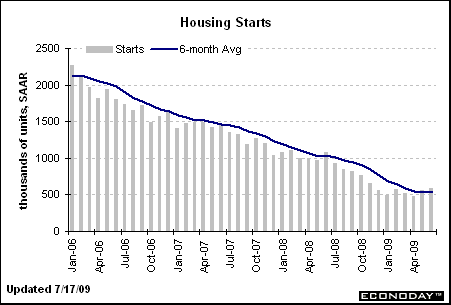
Daily Sources 7/17

1. UN SECURITY COUNCIL FREEZES ASSETS AND BANS TRAVEL FOR 10 NORTH KOREAN INDIVIDUALS AND CORPORATIONS; RECENT PUBLICATION SEEMS TO INDICATE GROWING NERVOUSNESS ABOUT PYONGYANG IN BEIJING

Colum Lynch at the Washington Post reports that the UN Security Council yesterday froze assets and banned the travel of 10 North Korean individuals and corporations involved in the country's nuclear and ballistic missile programs. Meanwhile, the Fabius Maximus blog notes two recent articles which reporting on a piece by Zhang Liangui, an expert on North Korea at the Central Party School in Beijing, this month in World Affairs magazine, which is sponsored by the Chinese Ministry of Foreign Affairs, which seem to indicate rising concern in Beijing about the possibility of armed conflict with Pyongyang.

2. MARATHON TO SELL 20% OF ANGOLAN CONCESSION TO CNOOC AND SINOPEC, US COMMERCE SECY SAYS AMERICANS NEED TO REALIZE THAT THEIR CONSUMPTION IS DRIVING GREENHOUSE GAS EMISSIONS OVERSEAS

Platts reports that Marathon has signed an agreement to sell a 20% stake in Angola's block 32 concession to CNOOC and Sinopec for $1.3 billion, maintaining a 10% stake in the project.
"There is no doubting the prolific nature of the deepwater block they are buying into. Block 32 has already seen a mouth-watering 12 oil discoveries: Gindungo, Canela, Cola, Gengibre, Mostarda, Salsa, Caril, Manjericao, Louro, Cominhos, Colorau and Alho."
"Block 32 is operated by France's Total, which has a 30% stake. The remaining equity is owned by Sonangol (20%), ExxonMobil (15%) and Portugal's Petrogal (5%).

The existing partners in the block have the right of first refusal over the interest Marathon is selling."
Marathon has stated it hopes to conclude the deal by the end of the year. Meanwhile, Keith Johnson at Environmental Capital reports that the US Commerce Secretary, Gary Locke, told the American Chamber of Commerce in Shanghai yesterday:
"It’s important that those who consume the products being made all around the world to the benefit of America--and it’s our own consumption activity that’s causing the emission of greenhouse gases, then quite frankly Americans need to pay for that."
3. CHINA SHUTS DOWN HUMAN RIGHTS LEGAL CENTER IN BEIJING

Audra Ang at the Associated Press reports that Chinese officials shut down a legal research center led by human rights activist lawyers in Beijing today. In late May it was reported that Beijing had begun denying licenses to practice to law firms which take human rights cases--see Daily Sources 5/28 #1.

4. SOUTH KOREA TO SPEND $100 MILLION IN AID TO ASIAN NATIONS COPING WITH WATER SHORTAGES AND FLOODS

Shinhye Kang and Heejin Koo at Bloomberg report that South Korea plans to spend $100 million by 2012 to help Asian nations deal with water shortages and floods.
"Asia, with half the world’s population, has less available fresh water than any continent except Antarctica, Suzanne DiMaggio, director at the Asia Society, said in April. Glacier runoff is the primary water source for many nations in the region, and they are shrinking with climate change.

'Asian countries have depended on Himalayan glaciers as their main water sources may face water shortage as the glaciers are melting rapidly,' said Park, who also directs the nation’s task force on international cooperation at the Presidential Committee on Green Growth.

South Korea’s government announced a plan last month to spend 22.2 trillion won (~$17.7 billion) over four years to upgrade the water quality and supply systems of the nation’s four major rivers."
5. BP DROPS JATROPHA

Keith Johnson at Environmental Capital reports that BP has abandoned its jatropha venture, from which it had hoped to harvest biodiesel, selling its half of the project to its partner, D1 Oils.
"[T]he inedible but hardy plant that just a few years ago seemed like it could revolutionize biofuels has turned into a bust. The initial attraction was that it grows on marginal land, so it wouldn’t compete with food crops. But marginal land means marginal yields. And jatropha turned out to be a water hog as well, further darkening its environmental credentials."
The joint venture had planted more than 200,000 hectares of jatropha, about a quarter of worldwide jatropha planting. New Delhi has also bet on the plant's potential only to see protests break out over plans to reclassify land for seeding it--see Daily Sources 6/9 #6.

6. EASTERN EUROPEAN DIGNITARIES PUBLISH OPEN LETTER EXPRESSING SOME WORRY ABOUT OBAMA'S "RESET" WITH MOSCOW

Yesterday the Polish Gazeta Wyborcza published an open letter from 22 major political figures from Eastern Europe, including Lech Walesa and Vaclav Havel indicating worry about the Obama administration's "reset" policy with Russia. Key excerpts:
"Our hopes that relations with Russia would improve and that Moscow would finally fully accept our complete sovereignty and independence after joining NATO and the EU have not been fulfilled. Instead, Russia is back as a revisionist power pursuing a 19th-century agenda with 21st-century tactics and methods. At a global level, Russia has become, on most issues, a status-quo power. But at a regional level and vis-a-vis our nations, it increasingly acts as a revisionist one. It challenges our claims to our own historical experiences. It asserts a privileged position in determining our security choices. It uses overt and covert means of economic warfare, ranging from energy blockades and politically motivated investments to bribery and media manipulation in order to advance its interests and to challenge the transatlantic orientation of Central and Eastern Europe.

We welcome the 'reset' of the American-Russian relations. As the countries living closest to Russia, obviously nobody has a greater interest in the development of the democracy in Russia and better relations between Moscow and the West than we do. But there is also nervousness in our capitals. We want to ensure that too narrow an understanding of Western interests does not lead to the wrong concessions to Russia. Today the concern is, for example, that the United States and the major European powers might embrace the Medvedev plan for a 'Concert of Powers' to replace the continent's existing, value-based security structure. The danger is that Russia's creeping intimidation and influence-peddling in the region could over time lead to a de facto neutralization of the region. There are differing views within the region when it comes to Moscow's new policies. But there is a shared view that the full engagement of the United States is needed."
"When it comes to Russia, our experience has been that a more determined and principled policy toward Moscow will not only strengthen the West's security but will ultimately lead Moscow to follow a more cooperative policy as well. Furthermore, the more secure we feel inside NATO, the easier it will also be for our countries to reach out to engage Moscow on issues of common interest. That is the dual track approach we need and which should be reflected in the new NATO strategic concept."
"[T]he thorniest issue may well be America's planned missile-defense installations. Here too, there are different views in the region, including among our publics which are divided. Regardless of the military merits of this scheme and what Washington eventually decides to do, the issue has nevertheless also become--at least in some countries--a symbol of America's credibility and commitment to the region. How it is handled could have a significant impact on their future transatlantic orientation. The small number of missiles involved cannot be a threat to Russia's strategic capabilities, and the Kremlin knows this. We should decide the future of the program as allies and based on the strategic pluses and minuses of the different technical and political configurations. The Alliance should not allow the issue to be determined by unfounded Russian opposition. Abandoning the program entirely or involving Russia too deeply in it without consulting Poland or the Czech Republic can undermine the credibility of the United States across the whole region."
A must read.

7. TURMENISTAN SIGNS DEAL WITH GERMAN NABUCCO PARTNER FOR GAS EXPLORATION, EC PROPOSES NEW RULES FOR EU FOR HANDLING NAT GAS DISRUPTIONS

AFP reports that Turkmenistan signed a deal with RWE--a German firm involved in the Nabucco pipeline project--giving it a license to explore a block for six years and after finding gas the right to extract it for a period of 25 years.
"Moscow has a virtual monopoly on the export of Turkmen gas through its state-run energy giant Gazprom, but there have been signs of strain recently between the two countries ... .'"
Ashgabat publicly accused Gazprom of blowing up a pipeline sending its gas through Russia in order to put an end to payments it had contracted for at exorbitant prices late last year. In late June, Turkmenistan also inked a deal to increase its natural gas exports to China by 30%. On the first of July, Turmen President Kurbanguly Berdymukhamedov invited Russian President Medvedev to Ashgabat to discuss the resumption of exports--see Daily Sources 7/1 #3. Meanwhile, Alessandro Torello at the Wall Street Journal reports that the European Commission has proposed new rules to ensure that the European Union is prepared to weather a disruption in gas supplies such as the one caused by the cut off of supplies through Ukraine by Russia at the start of the year. The rules are designed, in part, to allow the EU to respond as a single entity to future disruptions.
"Under the proposals, each of the EU's 27 countries would have to designate an authority to look after security of their gas supplies, preparing plans aimed at preventing disruptions and dealing with any shortages that arise. The new rules would give the commission--the EU's executive arm--authority to ask for changes to these national plans if it considered them 'not effective' or incompatible with those of other EU countries.

The European Parliament and the 27 EU governments must back the proposal before it becomes law. Talks are expected to take months and might lead to a watered-down version of the rules."
8. OIL STOCKPILES IN ASIA BEING DRAWN DOWN ON LOW REFINERY UTILIZATION

Yuji Okada at Bloomberg reports that oil stockpiles in Asia are being drawn down on low refinery utilization rates.
"The fuel oil inventory in Singapore, Asia’s biggest oil-trading center, was 14.1 million barrels in the week ended July 15, 38% lower than a year earlier, said International Enterprise Singapore, a unit of the trade ministry. Refiners in South Korea and Japan are cutting crude throughput after the recession reduced demand, leading to high product stockpiles and reduced margins.

'The narrowing fuel oil crack in Singapore was mainly caused by the refinery run cut among Asian refiners, particularly ones in Japan and South Korea,' said Akira Kamiyama, a Tokyo-based trader at Mitsui & Co. 'Refinery utilization rates in these countries have been around 70%, while rates in the U.S. have been close to 90%.'

The refinery operating rate in Japan was 64.1% for the week ended June 20 and rose to 70% for the week ended July 11., according to the Petroleum Association of Japan."
10. EIGHT KILLED IN BOMB BLASTS IN TWO JAKARTAN HOTELS

John Aglionby at the Washington Post reports that eight people were killed in bomb blasts in two hotels in Jakarta.
"Speaking from the presidential palace in a live television address, the angry and visibly shaken president said the attackers were irresponsible and inhumane. While their identities remained unknown, the president said, the government will 'use the full extent of the law' to bring to justice 'those who did it, those who helped them, and the masterminds.'

Yudhoyono--who was reelected July 8 by a wide margin and is set to begin a second five-year term--said it was too early to say whether the bombing was linked to Jemaah Islamiah. But other officials and independent analysts said the radical Islamist group or an offshoot is the likeliest suspect."
11. KURDISH LEADERS WARN OF ARMED CONFLICT WITH BAGHDAD, IRAQI CLERICAL ESTABLISHMENT BELIEVES IRANIAN CLERICAL ESTABLISHMENT UNDERMINED BY ELECTIONS, RAFSANJANI USES FRIDAY SERMON TO CRITICIZE ELECTION RESULTS

Anthony Shadid at the Washington Post reports that the Kurdish Prime Minister, Nechirvan Barzani, said in an interview that
"If the problems are not solved [with the Maliki administration] and we're not sitting down together, then the risk of military confrontation will emerge."
Interviews with the Prime Minister and President Massoud Barzani
"described a stalemate in attempts to resolve long-standing disputes with Iraqi Prime Minister Nouri al-Maliki's emboldened government. Had it not been for the presence of the U.S. military in northern Iraq, Nechirvan Barzani said, fighting might have started in the most volatile regions."
Well worth reading in full. Meanwhile, Anthony Shadid at the Washington Post reports that the clerical elite in Iraq believes that the election crisis in Iran has strengthened the religious credibility of their own at the expense of the Shi'a leadership in Iran.
"'It's true,' said Ghaith Shubar, a cleric who runs a foundation in Najaf aligned with Grand Ayatollah Ali Sistani, Iraq's most powerful cleric. 'The spiritual guidance of the people in Iraq has become stronger than the guidance offered under the system in Iran. The marjaiya'--the term used to describe the authority of the most senior ayatollahs--'has more influence in Iraq, spiritual and otherwise, than it does in Iran.'"
The article--well worth reading--concludes with the following statement by Ali al-Waadh, a cleric and representative of Sistani's near the Kadhimiyah shrine in Baghdad, "We're not following Iran; Iran should follow Najaf." (Najaf is where Khomeini himself penned much of his criticisms of the Shah.) I alluded to some of the consequences of the supremacy of the Koran in Iran's legal and political system, given the relative lack of religious credentials of the Leader of the Revolution in a post early last year Law and Revolution in Iran. Meanwhile, in today's Friday prayer sermon, Rafsanjani said the following per a post at the Revolutionary Road blog:
"I have some suggestions. I have spoken to some members of the the expediency council and the assembly of experts about them too.

We must bring back the trust of the people. First of all, everyone must accept the law. The people, the parliament, everyone.

We must create a condition so that everyone can speak. We must speak logically. And a part of this is on the shoulders of the broadcasting corporation.

The Guardian Council did not make good use of the extra fives days given to them by the leader.

We do not need people in prison for this. Let’s allow them to return to their families."
On Wednesday, Borzou Daragahi at the Los Angeles Times reported that respect for the Leader of the Revolution has been diminished in Iran itself after taking sides in the election:
"'Public respect for him has been significantly damaged,' said one analyst, speaking on condition of anonymity. 'Opposing him is no longer the same as opposing God.'"
Protests followed Rafsanjani's sermon which were reportedly put down by security troops.

12. OLMERT SAYS SETTLEMENTS A SIDE ISSUE

Former Prime Minister of Isreal, Ehud Olmert, has an opinion piece in the Washington Post which argues that the current focus on Isreali settlements misplaces the focus of the peace talks. Key excerpt:
"Yet today, instead of a political process, the issue of settlement construction commands the agenda between the United States and Israel. This is a mistake that serves neither the process with the Palestinians nor relations between Israel and the Arab world. Moreover, it has the potential to greatly shake US-Israeli relations."
Worth reading.

13. SUDAN ACCUSES CHAD OF LAUNCHING AIR RAIDS INTO WESTERN SUDAN, ADDITIONAL MEASURES AGREED TO BY NORTHERN AND SOUTHERN SUDANESE OFFICIALS IN ANTICIPATION OF HAGUE RULING

AFP reports that the cross border conflict between Chad and Sudan is heating up again. Yesterday, state-Sudanese media reported that Chad had launched air raids in western Darfur.
"The website, quoting senior military officials, said there were no causalities but that the Sudanese army was on 'standby' and waiting for 'the green light for retaliation'."
Meanwhile, BBC News reports that southern and northern interlocutors in Sudan have agreed to new measures to quell any violence that could erupt in response to the Hague ruling on the border between the two regions expected next Thursday. The UN peacekeeping presence will be increased in the south, and both sides will send officials to explain the ruling once it is handed down.
"Tensions are rising ahead of national elections put back until April 2010 and a referendum on whether the south should secede, due in 2011."
In early June both sides began demobilizing their troops and on June 24th the two sides agreed to abide by the Hague's ruling--see Daily Sources 6/24 #10.

14. PETROECUADOR SEIZES PERENCO OILFIELDS, CHILE SIGNS CONTRACT FOR ECUADORIAN SUPPLY

Stephan Kueffner and Matthew Campbell at Bloomberg reports that PetroEcuador has seized the oilfields of Perenco SA, which operated the block 7 and 21 concessions producing about 21 kb/d.
"Perenco said yesterday it would suspend production after Ecuador started expropriating its crude oil in March because of a dispute over $327 million in back taxes. Ecuador, which increased a windfall tax on oil to 99% in October 2007, has said that Perenco and other companies haven’t paid the full levy, which has since been cut to 70%."
Perenco SA is an independent international oil firm whose main offices are in London and Paris with annual revenues of about $3 billion. Meanwhile, Tom Azzopardi at Platts reports that ENAP, Chile's national oil company, has signed a deal with PetroEcuador to import 800,000 barrels a month (~ 26.7 kb/d) to up to 10 million barrels a year (27.4 kb/d) of crude.
"Shipments are due to begin next month with two shiploads of 400,000
barrels each to Chilean ports ... ."
ENAP is the only refiner in Chile with a capacity of about 230 kb/d. Chile produces about 11 kb/d of its own crude needs. Ecuador stopped making payments on its sovereign debt on December 12 and later in that month pressured its social security system to purchase $1.2 billion in new bonds--see Daily Sources 12/29 #14. Ecuador currently uses the US dollar as its currency.

15. MEXICAN CENTRAL BANK CUTS BENCHMARK RATE TO 4.5%

Jens Erik Gould and Hugh Collins at Bloomberg reports that Mexico's central bank cut its benchmark rate by 0.25% to 4.5% in the seventh consecutive month of cuts. The bank's statement from the board indicated it will henceforth "pause its current monetary easing cycle" and that "[a]n improved performance in the general economic activity is expected in the second half of the year."
"Mexico’s annual inflation rate slowed to 5.74% in June, the lowest in nine months. While the rate was within the central bank’s forecast of 5.5% to 6% in the second quarter, it was above policy makers’ forecast of no more than 5.25% for the third quarter.

The bank aims to meet its inflation target of 3% by the end of 2010."
Remittances from abroad contracted by 20% in May, the sharpest drop on record.

16. NEW BUILDING PERMITS & HOUSING STARTS UP STATISTICALLY INSIGNIFICANT AMOUNT

Barry Ritholtz at the Big Picture notes that new building permits in June were 8.7% (±3.0%) above May and that housing starts were up 3.6% (±11.3%). He comments:
"The year-over-year data is much clearer: New Starts down 46% [±4.3%], Permits down 52% [±3.6%]."
He links to a Barron's Econoday graph: