Showing posts with label denmark. Show all posts

Wednesday, July 7, 2010

Daily Sources 7/7

1. CHINA'S US TREASURY HOLDINGS UP $5 BILLION IN APRIL

Bloomberg reports that China's State Administration of Foreign Exchange urged markets to not consider changes in US treasuries political statements. It further indicated that gold is not likely to become a major part of its reserves holdings because of its volatility and lack of interest payments. Some think this is just Beijing talking its book so it can buy further gold at depressed prices. Last year Beijing doubled its gold holdings.

2. FREE EXCHANGE HOSTS A NEAT INTERACTIVE MAP OF THE EU


3. NEW POLISH PRESIDENT AN EUROPEANIST

Greg Scoblete at Real Clear World reports that the new Polish President is a committed Europeanist as opposed to his predecessor, who was a committed Atlanticist.

4. US RHETORIC IN GEORGIA DESIGNED TO CALM FEARS IN T'BLISI

Mary Beth Sheridan at the Washington Post reports that in her visit to Georgia, Secretary Clinton indicated the US's opposition to Russia's "invasion and occupation" of Georgia. Prime Minister Putin took issue with the characterization of the Secretary of State, calling the Russian troop presence an effort to liberate the Abkhazians and South Ossetians.

5. DRILLING IN GREENLAND'S ARCTIC WATERS BEGAN LAST WEEK

Kate MacKenzie at FT Energy Source reports that deep water drilling in Greenland's Arctic waters began last week. And so the race for Arctic natural resources begins.


6. AUSTRALIA KEEPS BENCHMARK RATE AT 4.5%

Jacob Greber at Bloomberg reports that Central bank Governor Glenn Stevens yesterday left the benchmark cash rate at 4.5% for a second month. Australia's central bank had raised interest rates six times since October when it stood at a low of 3%. Inflation is expected to increase to more than 3% in the coming months.

7. INDIA DEPLOYS TROOPS IN KASHMIR IN EFFORT TO SUPPRESS UNREST

Lydia Polgreen at the New York Times reports that the Indian Army has deployed troops in Kashmir in an effort to calm the region after large street protests resulted in paramilitary units firing into the crowds.

8. RUMORS THAT MUBARAK'S HEALTH IS IN SERIOUS DECLINE

Michael Collins Dunn at the MEI Editor's Blog reports that Ha'aretz has picked up a rumor from a London-based daily that Mubarak's trip to France was for medical reasons. The story is that Mubarak's health is in serious decline and that his son is in line for succession.

9. OBAMA EXPECTS NETANYAHU TO BEGIN TALKS WITH PALESTINIANS BEFORE MORATORIUM ON NEW SETTLEMENT BUILDING EXPIRES IN SEPTEMBER

Sheryl Gay Stolberg and Mark Landler at the New York Times report.

10. BANK CARD DELINQUENCIES FALL BELOW 4%; SERVICE SECTOR NOT ADDING JOBS QUICKLY ENOUGH

In a good sign for the economy, Darrell A. Hughes at Real Time Economics reports that bank credit-card delinquencies dropped below 4% for the first time in eight years.
[ABA Chief Economist James] Chessen said the anticipated slow growth is unlikely to cause delinquencies to rise significantly, but there could be some impact. 'Until we get a sustained level of new jobs in this economy, we’re not going to see delinquencies fall to very low levels,' he said.
In the meantime, Phil Izzo at Real Time Economics reports that the Institute for Supply Management subindex for employment fell below 50, indicating a fall in employment.


11. THE EIA REPORTS THAT CRUDE STORAGE IS DOWN 2 MILLION BARRELS, STILL 12.9 MILLION MORE IN STORAGE THAN LAST YEAR

The EIA reports that crude stocks fell to 363.1 million barrels, down 2 million from last week, up 12.9 million from last year. Gasoline stocks rose by half a million while diesel stocks rose 2.5 million. Average US gasoline prices rose by 1.4 cents to 275.7 cents the week ended June 28. In the week ended June 25, refinery capacity utilization stood at 88.4%, down 1% from the week previous.

Monday, March 2, 2009

Daily Souces 3/2

1. Tony Barber at the Financial Times reports that the EU promised in its summit Sunday that it would provide financial assistance to eastern European nations in order to help them weather the crisis. However, the ministers rejected Hungary's appeal for a €180 billion package for the entire region, saying that it would consider financial aid on a case by case basis. (For the Hungarian appeal, see Daily Sources 2/27 #1.) Der Spiegel reports that Chancellor Merkel led the rejection of a region-wide bailout. "'I see a very different situation here,' she said on her way into the meeting. 'You cannot compare Slovenia or Slovakia with Hungary.'" There has been repeated speculation that the crisis would drive member states out of the monetary union, which has caused some to argue that the requirements for entry should be lowered. Chancellor Merkel apparently also led the rejection of that idea,
"Dutch Prime Minister Jan Peter Balkende said that if a nation wants to join 'it must meet the minimum economic criteria.' While Luxembourg Prime Minister Jean-Claude Juncker, who chairs the group of euro zone countries, said 'I don't think we can change the accession criteria to the euro overnight. This is not feasible.'"
2. Christian Neef and Jan Puhl ofDer Spiegel interview Polish Prime Minister Donald Tusk in today's international edition. An excerpt:
"SPIEGEL: There are also other conflicts. German Foreign Minister Frank-Walter Steinmeier, for example, rejects the American plan to install a missile defense shield in Eastern Europe and has conveyed this position to US Secretary of State Hillary Clinton.

Tusk: Poland will ensure that its interests are taken into consideration within the European Union and NATO. We need good relations with our western neighbors when it comes to questions of national security.

SPIEGEL: What does that mean in terms of the missile defense issue?

Tusk: We should speak openly about what best serves our security on the Continent. If the US and Poland are convinced that a missile defense shield will enhance the security of both countries, the other NATO members should accept this. Even Germany.

SPIEGEL: And if the project is abandoned, will the Poles again say that the major powers have cut a deal over their heads?

Tusk: If the stationing of the missile defense system is postponed, it will be an American decision. But then the remaining passages of the agreement -- i.e., the option of establishing other defense components in Poland -- should be immediately implemented. For us, it is important that we obtain American Patriot missiles.

SPIEGEL: Will Poland continue to strive for a special relationship with Washington?

Tusk: We are interested in pursuing close military cooperation with the US."
Well-worth reading in full.

3. Edward Hugh at Fistful of Euros reports that on Friday Sweden announced that its economy had officially contracted by 2.4% in the fourth quarter from the third--an annualized decline of 9.3%. Denmark officials reported that their economy had contracted by 3.9% in the fourth quarter over the year previous. Finnish GDP also fell by 1.3% in the fourth quarter.
"Unlike Denmark, Finland’s recession started with exports, and has now spread to areas like services and retail sales. Finance Minister Jyrki Katainen said last month that the Finnish economy may contract as much as 4.4% in 2009. The unemployment rate rose to 7% in January from 6.1 percent in December as companies cut jobs in the face of the slowdown."
4. Reuters reports that the Russian Finance Ministry said today that its Reserve Fund--oil revenues reserved for making up shortfalls in the budget--is currently worth over 4.8 trillion rubles (~ $136.3 billion) and the National Wealth Fund stands at 3.0 trillion rubles (~ $83.7 billion).

5. Seyoon Kim at Bloomberg reports that South Korea's Ministry of Knowledge Economy announced that exports fell again in February by 17.1% from a year earlier.

6. Eric Watkins at the Oil & Gas Journal reports that China's National Development and Reform Commission has approved CNPC's plan for a new 10 million tonne a year (~ 200 kb/d) refinery in Jieyang in Guangdong province. This is partially significant because CNPC's current refineries are all in the north of China, and so it indicates the breakdown of the informal divvying up of the nation's markets by the big three national oil companies. The NDRC also approved the following refinery expansions and construction:
"-- The capacity of the 400 kb/d Zhenhai refinery in Ningbo will be increased to 460 kb/d by September of this year and eventually to 600 kb/d.

-- In Shanghai, the combined capacity of the 280 kb/d Jinshan and the 220 kb/d Gaoqiao refineries will be boosted by 100 kb/d to 600 kb/d.

-- In Nanjin, the combined capacity of the 260 kb/d Jinling refinery and the 160 kb/d Yanzi refinery will be boosted to levels similar to those in Ningbo or Shanghai.

-- The cities of Maoming, Guangzhou, Huizhou, Quanzhou, and Tianjin will each see refinery capacity boosted to 400 kb/d.

-- Construction on a refinery is scheduled in Caofeidian.

Meanwhile, CNOOC—after a 6-month delay for unspecified reasons—is set to commission its 240 kb/d refinery at Huizhou, in Guangdong province, to operate on a trial basis when it goes online in March."
Many analysts have already remarked upon the huge addition of refining capacity in the Asia Pacific. Much of the refining additions were premised on China as an petroleum product market, for example in Saudi Arabia, India, South Korea, and even Japan. But if China moves ahead with all of its refining capacity addition plans--and usually Beijing makes good on its infrastructural construction plans--it is hard to see, given the trajectory of demand growth in an unsubsidized petroleum products market in both India and China and continued economic doldrums, where this additional potential supply would go. In addition, Winnie Zhu at Bloomberg reports that CNPC and Rosneft may begin construction on a 200 kb/d, $3 billion, refinery in Tianjin according to the municipal authorities there. The municipal authorities hope to get approval from the NDRC for the plant by the end of this year. Given the strong ties between Rosneft and CNPC--Rosenft has repeatedly gone to CNPC for large loans to deal with capital requirements for situations inside Russia--there is a fair likelihood that this will go forward. I would add that culturally, the Communist Party in China has few remaining vestiges of its original ideological goals, but that I suspect the import of finished or manufactured goods is still considered akin to the days of colonial exploitation and that Beijing will go to some lengths not to become the major market for imports of petroleum products, preferring to produce them internally.

7. Maureen Fan at the Washington Post reports that the US and China concluded on Saturday their first inter-military consultations after Washington OK'd an arms sale of $6.5 billion to Taiwan in October which had prompted Beijing to cut official military ties.
"'These were the best set of talks that I have ever been part of,' said David Sedney, deputy assistant secretary of defense for East Asia, who co-chaired the annual Defense Policy Coordination Talks. 'Not because we pretended that everything was fine and everything was resolved, but because we worked very seriously to address the obstacles while at the same time engaging in some discussions in some of the new areas like counterpiracy.'"
Tim Bowler at the BBC reports that in an interview with Chinese Commerce Minister Chen Deming said that "Given such a high degree of openness it is impossible for China to survive in an isolated way from the financial crisis. ... All countries in the world are in the same boat, and we share the same destiny."
"[Mr. Chen] ruled out major changes in the value of China's currency, despite pressure from the United States.

The US has long been angered that China does not allow the yuan to float freely, saying the artificially low currency makes Chinese exports unfairly cheap.

Mr Chen said he did not think 'for the next period of time' there would be a 'remarkable change' in the value of the yuan."
(h/t Yves Smith at naked capitalism.)

8. Fareed Zakaria at PostGlobal argues, as I have, that the compromise in Swat is not an unmitigated disaster, but rather that we should differentiate between Islamists bent on destroying the West and Islamists seeking a semblance of an operational justice system locally.
"The Swat Valley was historically a peaceful area that had autonomy within Pakistan (under a loose federal arrangement) and practiced a moderate version of sharia (Islamic law) in its courts. In 1969, Pakistan's laws were formally extended to the region. Over the years, the new courts functioned poorly, with long delays, and were plagued by corruption. Dysfunctional rule eroded government credibility. Some people grew
nostalgic for the simple, if sometimes brutal, justice of the old sharia courts. A movement demanding their restitution began in the early 1990s, and Benazir Bhutto's government signed an agreement to reintroduce some aspects of the sharia court system with Sufi Muhammed, the same cleric with whom the current government has struck a deal. (The Bhutto arrangement never really worked, and the protests started up again after a few years.) Few residents of the valley would say that the current truce is their preferred outcome. In the recent election, they voted for a secular party. But if the secularists produce chaos and corruption, people settle for
order.

The militants who were battling the army (led by Sufi Muhammed's son-in-law) have had to go along with the deal. The Pakistani government is hoping that this agreement will isolate the jihadists and win the public back to its side. This may not work, but at least it represents an effort to divide the camps of the Islamists between those who are violent and those who are merely extreme."
"'We won the war in Iraq chiefly because we separated the local militants from the global jihadists,' says Fawaz Gerges, a scholar at Sarah Lawrence College, who has interviewed hundreds of Muslim militants. 'Yet around the world we are still unwilling to make the distinction between these two groups.'"
Well-worth reading in full. I would add that sharia itself is not incompatible with existing Pakistani law--and that the possibility of appeal included in the agreement is a de juris acceptance of the supremacy of the federal courts. Reincorporating the major political organizations of Swat into the federal umbrella is a reasonable strategy on the part of Islamabad. For my earlier remarks on the swat agreement, see Daily Sources 2/19 #10 and Daily Sources 2/17 #4.)

9. Mary O'Grady has an opinion piece in the Wall Street Journal which argues that federal policy not to target medical marijuana distribution in the US de facto gives producers in Mexico--and Latin and South America--a stimulus, and thus exporting instability to the country. If you are familiar with my blog, you know I tend to disagree with Ms. O'Grady, but in this instance I believe she is right. If we intend to have prohibition, then we must target consumption in order to stop the export of instability to producing nations. If we cannot credibly target consumption, then we should take prohibition off the books. Worth reading in full.

10. Irene Tang at Platts reports that Malaysia will institute stricter specifications for gasoline and diesel in the middle of 2009. "Malaysia will introduce a new 95 RON gasoline grade in July 2009 and will
fully implement Euro-II compliant gasoline and diesel a month later." The new specifications, which mainly make the products more environmentally-friendly, are more expensive to make, and given that costs will be passed on to consumers, they will put upward pressure on price in Malaysia, and thus downward pressure on demand.

11. The Bureau of Economic Analysis said today that personal consumption grew by 0.4% in January from December in chained 2000 dollars, by 0.6% in nominal terms. Personal consumption accounts for 70% of US GDP.

12. Courtney Schlisserman at Bloomberg reports that the Institute for Supply Management’s factory index rose slightly to 35.8 in February from 35.6 in January. Anything below 50 indicates a contraction.

13. Reuters reports that semiconductor chip sales fell by 29% in January from a year ago.

14. Jeff Rubin, chief economist at CIBC World Markets, has published a research report which argues that car sales in the US will likely fall another 30-40% before bottoming. Rubin argues that about half of the 51 light vehicle plants in the US will be forced to close.
"Easy credit is already gone. The credit bubble wasn't just about sub-prime mortgages. It was just as much about car sales. Some two-thirds of vehicle sales in America over the last decade were debt financed. The leasing market has all but dried up and the securitization market for car loans isn't far behind. If you buy a car these days, try paying cash, which of course isn't superabundant, particularly for the over three-and-a-half million Americans who have already lost their jobs."
Rubin goes further and argues that car sales will never recover to the heights seen this decade, because Americans will adopt European driving habits as energy prices recover:
"The only reason gasoline is cheap, is because no one can afford to drive. When the recession is finally over, and Americans start filling up their SUVs, pump prices will go right back up to the $4/gallon price they were last Memorial Day."
Perhaps, but US population density is much smaller than Europe's, and to a certain extent, until cities west of the Mississippi radically restructure, circumstances will require that people will drive much more than Europeans.

15. Former Secretary of the Treasury under Reagan and State under Bush I, James Baker, writes in the Financial Times:
"During the 1990s, American officials routinely urged their Japanese counterparts to kill their zombie banks before they could do more damage to Japan’s economy. Today, it would be irresponsible if we did not heed our own advice."
A must read.

16. Warren Buffet's letter to Berkshire Hathaway shareholders has the chattering classes all abuzz. Barry Ritholtz's Big Picture carries the complete text. Scott Patterson at the Wall Street Journal has a story on the letter, which discusses the costs Berkshire faced in unwinding the exposure of reinsurance acquisition General Re to complex derivatives of particular interest:
"Berkshire's substantial insurance holdings haven't needed to take the massive write-downs on toxic subprime securities that have plagued much of the financial industry in the past two years. One reason is Mr. Buffett's longstanding dislike of complex derivatives, which he famously called 'financial weapons of mass destruction' in his 2002 shareholder letter and which he railed on again in his latest letter. He pushed General Re, the large reinsurance company Berkshire acquired in 1998, to disentangle itself from a vast web of derivatives -- financial instruments tied to the value of other securities, such as stocks or bonds -- over the course of five years, winding down its book of 23,218 derivatives contracts at a loss of about $400 million, he said in the letter. The losses may have been far more substantial if General Re had held onto to the contracts, Mr. Howard said.

'Upon leaving, our feelings about the business mirrored a line in a country song: "I liked you better before I got to know you so well,"' Mr. Buffett wrote, referring to General Re's derivatives book."


17. From Bloomberg, a graph of US meat consumption since the collapse of Lehman Brothers:


Meat is ethically problematic--newspeak, I guess, for a sector built on industrialized murder--but it has also historically viewed as a barometer of wealth. (I love meat and think humans are not especially more culpable than other predators for its consumption. Still, I find the industrialized slaughter of innocents troubling in a way that, say, an individual hunting or fishing--or even small scale farming--is not. As consumption goes down, and fewer are able to afford the expense of meat--not to mention hunting--however, the economics of industrial meat will only become more competitive. If transportation fuels costs rebound, this effect will only be strengthened.)

Friday, February 20, 2009

Daily Sources 2/20

1. President Obama and Canadian Prime Minister Stephen Harper agreed yesterday to establish a senior-level U.S.-Canada Clean Energy Dialogue which will focus cooperation on several issues including:
"- Expand clean energy research and development
- Develop and deploy clean energy technology
- Build a more efficient electricity grid based on clean and renewable generation"
The two leaders also announced that they would work in tandem at the G-20 summit in April in Trinidad and Tobago to ensure it "contributes to restoring confidence in financial markets." (h/t Rachel Ziemba at Follow the Money.)

2. Edward Hugh at Fistful of Euros reports that the initial Markit euro-zone manufacturing index fell to a record low of 33.6 in February from 34.4 in January. (Readings above indicate growth; below 50 indicates contraction.) Services PMI also fell to a record low of 38.9 from 42.2 in January. The composite PMI fell to 36.2 from 38.3 in January. This is how well the flash PMIs have tracked actual GDP in the past, courtesy Fistful of Euros:


Christian Reiermann at Der Speigel reports that Peer Steinbrück now believes that the several members of the EU and, more specifically the eurozone, will require bail outs similar to the financial and auto sector rescues:

"But now Steinmeier is creating the impression that some euro zone members may ultimately require the same kind of bailout already seen in the banking industry and manufacturing. It could come at the cost of billions to taxpayers. "The euro-region treaties don't foresee any help for insolvent countries, but in reality the other states would have to rescue those running into difficulty," Steinbrück said.

For German taxpayers, this would be no small sum. If Germany were to pay into a bailout based on its size relative to other euro zone countries, it would be forced to cover one-fourth of the entire tab."

Helful explanatory illustration from Der Spiegel:


Long, but well-worth the read.

3. Edward Harrison at Credit Writedowns reports that Citibank has cut all lending in Denmark. "Citigroup has sold its German operations to a French bank and I understand they are cutting credit lines in the UK as well." (h/t Yves Smith at Naked Capitalism.)

4. Sarah Schafer at the Washington Post reports that the Kyrgyz Parliament voted Thursday to end the lease of the Manas air base to the US, leaving the decision in the hands of the President, who, today signed the bill, giving him the power to serve the US with an eviction notice with 180 days to end operations there. The vote was 78 to 1 in favor of the bill. Baktybek Abdrisaev, Kyrgyz Ambassador to the US and Canada from 1997 to 2005, has an opinion piece in the Washington Post which states that the base's closure is not primarily due to Russian pressure. Abdrisaev says the primary reason for it's establishment in the first place was Kyrgyzstan's conflict with the Islamic Movement of Uzbekistan and sympathy for the US following 9/11. I suspect the notion of US dollars flowing into the nation and the signal it would send to nations with which it has boundary issues (ie China) were also primary concerns. Abdrisaev suggests, however, that a primary reason for the ouster is that the US subordinated support for democratic institutions and procedures to its prosecution of the wars in Iraq and Afghanistan, allowing authoritarian elements to grab hold of the tiny mountain nation. There is some truth to this, though I suspect Kyrgyzstan's interests calculation has changed more from events outside the nation than its new government.

One: If the war in Afghanistan is calculated to be more destabilizing than allowing whatever Islamist organization to become its sovereign, then it is in the interests of Moscow and Bishkek to end the NATO presence there.

Two: Bishkek is a poor country in a world without a lot of largesse to spread about just now. Its GDP is $5 billion. Russia's offer of aid was almost half of Kyrgyz GDP--$150 million in aid, forgiveness of $180 million in debt, and $2 billion in loans.

5. Linda Gradstein at the Washington Post reports that Israeli President Shimon Peres formally asked Likud leader Binyamin Netanyahu to form the next government. Although Kadima leader Tzipi Livni won more seats in Parliament than Likud, apparently more members of Parliament support Netanyahu for Prime Minister. Livni indicated that she would not join a Netanyahu-led government. Netanyahu had previously indicated that he will not form a coalition with the far right Yisrael Beitenu party led by Avigdor Lieberman, reportedly because Lieberman supports civil marriages in Israel which is anathema to Orthodox support for Netanyahu. All of which is to say that it is unclear whether Netanyahu can at this stage form a governing coalition without Livni or Lieberman and, thus, it might be some time before we see one. Until then, it is unlikely to see a formal cease fire agreement with Hamas.

6. Reem Khalifa at the Associated Press today reports that Bahrain has halted talks over a natural gas import deal with Iran after former Iranian speaker of the Majlis was quoted in the media saying that Bahrain was Iran's 14th province until 1970. Bahrain's Foreign Minister Sheik Khalid bin Ahmed al-Khalifa said that the remark was an "infringement of sovereignty" and a "distortion of historical fact."


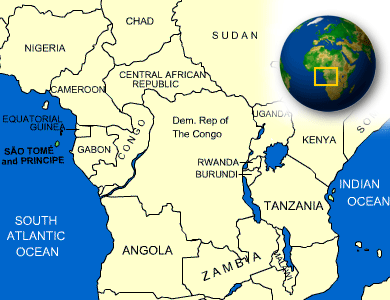
7. Henrique Almeida at Reuters reports that Angolan national oil company Sonangol is close to a deal with Sao Tome for producing oil from the tiny island's waters.


8. Sharon Schmickle at the Washington Post reports that the re-emergence of the stem rust fungus is threatening wheat production throughout East Africa. A must read.

9. Andre Soliani and Joshua Goodman at Bloomberg report that Brazil's unemployment rate has jumped to 8.2% in January from 6.8% according to the national statistics agency.

10. Paul Krugman of the New York Times highlights the following passage from the minutes of the last FOMC meeting:
"All participants anticipated that unemployment would remain substantially above its longer-run sustainable rate at the end of 2011, even absent further economic shocks; a few indicated that more than five to six years would be needed for the economy to converge to a longer-run path characterized by sustainable rates of output growth and unemployment and by an appropriate rate of inflation."
11. Shobhana Chandra at Bloomberg reports that the Department of Labor announced today that the consumer price index grew by 0.3% in January. "Excluding food and fuel, the so-called core rate, prices advanced 0.2%, due to autos, clothing, and medical care. The CPI was unchanged on an annual basis--the first time it hasn’t risen since 1955."

12. Reg Curren at Bloomberg reports that natural gas prices in the US have fallen below $4/MMBtu on the drop in industrial demand, which accounts for about 29% of total natural gas consumption. GM alone closed most of its 22 plants last month.

Friday, October 31, 2008

Daily Sources 10/31

1. The AP reports that the US Commerce Department announced today that consumer spending dropped by 0.3% in September from August. Paul Krugman has an opinion piece in the New York Times analyzing the consequences of the fall in consumer spending (which was at an annual rate of 3.4% in the third quarter. In sum, the citizen can no longer count on growing equity via his home or his stock portfolio, and so has begun to squirrel money away. This comes at a bad time because as less people spend money, the economy will shrink and so too, eventually, will the peoples' incomes. If their incomes fall faster than their savings, you have a scenario known as "the paradox of thrift." The Fed would usually stimulate the economy by cutting interest rates, but there isn't much left of the federal funds rate to go. Therefore, the only way to keep the economy from shrinking given a reduction in consumer spending and no room for further interest rate stimulae is government spending. Worth reading in its entirety.

And it turns out that folks in Congress are getting upset that the bailout funds extended to the banking system aren't being used to make loans, and thus grease the wheels of the economy, but to finance the purchases of other banks. Jessica Holzer at Real Time Economics reports that Rep. Barney Frank (D-MA) and Sen. Christopher Dodd (D-CT), are arguing that funds used by the banks for purposes other than lending are in violation of the terms of the act.

Joellen Perry and Luca Di Leo at Real Time Economics report that Mario Draghi, European Bank board member and head of the Financial Stability Forum--one of the entities asked to play a part in the November 15 financial summit--urged governments to provide further economic stimulus by cutting taxes and/or increasing spending.
"'Given the minimum level reached by America’s official interest rates and the ample liquidity put in circulation by central banks, the room for monetary policy maneuver is reduced,' Mr. Draghi told a meeting of Italy’s top bankers in Rome, noting that EU rules allow for increased spending during tough times. 'To sustain demand on a global level, the anti-cyclical action of budget policy may be required.'"
It sounds as if central bankers are more worried about the prospects of deflation now than they are for inflation. In Forbes, Nouriel Roubini argues that this will be their main preoccupation in the next six months as "a sharp slack in goods, labor and commodity markets will lead to global deflationary trends over the next year." His piece is well-worth reading in its entirety. If his thesis is true, the fall in supply and investment in new supply should not be able to do much to stop the fall of oil prices. That said, they rose considerably today.

2. Barbara Kiviat at the Curious Capital reports that First American CoreLogic released data today showing that in the US 18.3% of homeowners now have mortgages more expensive than the market value of their homes--are "underwater"--and an additional 5% are on the cusp. CoreLogic put out a state-by-state breakdown--the states worst hit are Nevada (47.8%), Michigan (38.6%), Arizona (29.2%), Florida (29.2%), California (27.4%), Georgia (23.2%), Ohio (22.0%).
What's in a way scarier, though, is that First American is also seeing a third group of states emerging—those where a lot of new people moved in and bought houses and simply didn't have much time to build equity before prices started falling. That partly accounts for why Georgia is so high up on the list, as well as growing problems in Texas (16.5%), Arkansas (16.3%) and Tennessee (15.0%)
3. Martin Fackler at the New York Times reports that the Bank of Japan cut its benchmark interest rate 0.2% to 0.3%. This is the first time the BoJ has cut rates in seven years as it also reduced its forecast for growth this year to 0%, "citing higher energy prices and weakening export demand. ... The eight members of the policy board were evenly divided on the cut; the bank governor, Masaaki Shirakawa, cast the deciding vote in favor, the bank said." Most analysts thought the rate cut more of a sign of Tokyo's willingness to coordinate with fiscal authorities internationally than fiscal stimulus given the initial low rate.

4. Eurointelligence has the story that Denmark may decide to join the euro after all as a result of the financial crisis. This is because Denmark has been forced to raise benchmark interbank lending rates in defense of the krone, to 5.5%, which is 1.75% above the rate for the European Central Bank. (Denmark has opted out of the euro, but has pegged the krone to the euro.) The Danish people dislike the notion of being left out of the economic stimulus--and paying more for money than their neighbors--in order to maintain a national currency. There is some hope for the Europeanists in Copenhagen that a referendum to annul the opt out provisions might pass now as early as 2011.

Generally speaking, however, it seems as if the crisis will delay the accession of many of the Eastern European nations to the euro as it will be harder to meet the economic prerequisites to joining the currency. (For example, Hungary is not likely to meet the current account requirement any time soon.) On the other hand, Sweden may find it convenient to join. However, now might be a good time to relax some of the prerequisites to joining the euro given that being part of the eurozone will generally seem more appealing as the financial crisis wears on.

The same issue of Eurointelligence reports that German representatives in Brussels are blocking efforts by the European Commission to raise the maximum insurance for deposits to €100,000 (now about US$130,500 )from €20,000 (~ $26,100). Germany does not want to raise the limit of its own deposit guarantee.

5. Andrew E. Kramer at the New York Times reported yesterday that Russia's bailout plan favored Russia's richest businessmen. Putting aside that our bailout plan surely favored the rich and connected, it might be important to realize that what is meant here is major holders of corporations deemed strategic by the Kremlin. For the most part the folks known as the oligarchs were replaced with Kremlin (perhaps better put as FSB)-friendly personnel. Of the original oligarchs the ones who remain are the ones who have made plain to the Kremlin that they will stay out of politics. It may not ultimately make much of a difference in direction, but today Bloomberg reported that shares in the Russian bourse soared Thursday. Perhaps that is because the taxpayer funds are being used as intended?

Snarkiness aside, and I admit that the jingoistic approach to Russia so favored by the press and pols is a pet peeve of mine, Brad Setser points out that money is leaving the economy faster that it entered it--Russia's reserves fell by $30 billion in the third week of October. $15 billion of that reflects efforts by the Russian central bank to shore up the ruble and to provide credit to companies seeking to service foreign currency denominated debt.
"$15 billion is a result of the drop in value of the ruble versus the euro and dollar. $15 billion is as much as the IMF committed to lend Russia back in 1998. And the IMF actually only disbursed a third of that total.

The most the IMF ever actually lent out to a single country in the past was roughly $30 billion (to Brazil, in 2002-03). At the current rate, Russia will run through that much in two weeks."
Setser suggests that though Russia has its own specific financial weaknesses, their situation is probably similar to what is being seen in the rest of the emerging economies.

6. Insofar as likely action taken by the Chinese with their currency reserves, Vandana Hari at Platts reports that Sinopec has launched a $1.7 billion takeover bid for Canada's Tanganyika Oil, a producer of heavy oil in Syria. Given that there is a fairly large consensus that the world economy will start to percolate in the second half of 2009 and that oil prices will surely follow, it seems at this stage that China is likely to pursue the conservative policy of continuing to purchase a production sharing contracts overseas. Net production from the fields in the first half of 2008 averaged about 6 kb/d. Further news in that vein--Eric Watkins at the Oil & Gas Journal report that Indonesia and China will renegotiate the price of Tangguh LNG to CNOOC's terminal in Fujian. This is after the renegotiation of 2006, where the price was raised to $3.80/MMBtu for 2.6 million tonnes/year on a ceiling price of $38/b (of oil).
"Following this week's agreement in Beijing, [Indonesian President Susilo Bambang] Yudhoyono and [Chinese Premier] Hu [Jintao] said the concessionary loan program China had initiated for Indonesia would continue despite the current global financial crisis.

Yudhoyono wants cooperation with China stepped up in the field of energy, especially in the construction of power plants under China's concessionary loan program"
Jakarta's government is under pressure to use its natural gas production for domestic power plants and for re-injection into oil fields in order to boost production of the more lucrative export. Energy planners in Japan have been especially anxious at language suggesting that contracts will not be renewed once they expire.

7. Julia Werdigier at the New York Times reports that Barclays will seek $11.8 billion from Qatar and Dubai instead of from the UK stabilization program. This comes in the middle of UK Prime Minister Gordon Brown's visit to the Gulf nations in an effort to secure substantial support for expanded IMF loan programs.

8. Al Jazeera reported yesterday that the UN General Assembly on Wednesday approved 185-3 a non-binding resolution calling upon the United States to lift the embargo on Cuba. The US, Israel and Palau voted against. Micronesia and the Marshall Islands abstained. "New" Europe voted for. Noticeably, so did Iraq. From a legalistic perspective, the United States either must strike a security agreement with al-Maliki's government or convince the UN to extend the mandate to operate in Iraq past December 31 of this year or the United States forces will have no more legal standing to be there. Matthew Lee at the Associated Press reports that the Bush Administration is beginning to think that a deal will not be struck with Baghdad. Votes like these make me think it might be difficult to secure an extension to the UN mandate, especially since the US negotiating team would be of a lame duck Administration which is of a party that as of now appears unlikely to win any of the elected branches of government. Failure to do so, however, would put our troops in a difficult position.

Meanwhile, the Oil & Gas Journal reports that Petrobras--Brazil's national oil company--announced today details of its plans to explore block 37 off northwest Cuba.

9. Vandana Hari at Platts reports that Indian Oil Minister Murli Deora met with the Minister of Finance, P. Chidambaram, to seek an increase in the amount of oil bonds the government will issue to compensate the refiners for selling oil products at below-market prices. The refiners' losses due to astronomical oil prices in the third quarter was exacerbated by a rapidly depreciating rupee, as the companies had to purchase dollars on the markets in order to buy the crude. Furthermore, the volatility of the foreign exchange markets and high cost of money has made the refiners especially leery of taking on foreign currency debt.

10. Amanda Rayborn and Nadia Rodova report that Kazakhstan has reached a new agreement with the seven corporations operating the Kashagan field--the largest single oil concession in decades. The agreement doubled the government owned company's stake and stressed that if the companies do not begin producing oil by year end 2013, they will not be allowed to recoup their investments in the project.
"Commercial production at Kashagan will start at 75,000 b/d in December 2012 and gradually to rise to 370,000 b/d, KazMunaiGaz executive director Aman Maksimov was quoted by Russia's Prime-Tass as saying in Astana after the project partners signed the new agreements.

'The third stage -- in two-three years -- [will see output] at 450,000 b/d,' Maksimov said.
...
In early October, company officials told Platts the revamped development plan for Kashagan aims for commercial production to begin in the fourth quarter of 2013 with a rapid ramp-up to an initial maximum production capacity of 370,000 b/d within a year. By late 2016, the consortium plans to take production to 730,000 b/d."
11. Sam Fletcher at the Oil & Gas Journal provides further evidence that the drop in oil prices has put the kibosh on new Canadian oil sands production.
"Some analysts are anticipating a 10-15% drop in capital spending in western Canada next year as producers try to remain within their cash-flow expectations. To many observers, this is a sign that low oil prices are starting to discourage new investment. Projects that were feasible a year ago no longer seem economic in the current environment. Other companies, including the Nexen Inc.-OPTI Canada partnership and privately held BA Energy Inc., announced delays at smaller projects in recent weeks."