Showing posts with label lebanon. Show all posts

Thursday, August 12, 2010

Daily Sources 8/12

CHINA BUYING YEN

Tim Duy at Tim Duy's Fed Watch reports that the renminbi, dollar and yen are on a collision course. China is buying yen at a time where the yen is hitting record highs. If Japan responds by buying dollars, then China has managed to get Japan to help maintain the value of their dollar holdings as well as their ability to sell them. Well worth reading in full.

CHINESE STRATEGISTS SEE EXERCISES IN YELLOW SEA AS PART OF EFFORT TO ENCIRCLE CHINA WITH AN ASIAN NATO

Dai Xu at China.org.cn argues that the US is trying to build an Asian NATO to encircle China.


JAPANESE CONSIDER OPTIONS AFTER ATTACK ON TANKER

Takeo Kumagai and Pradeep Rajan at Platts report that the Japanese are considering how to increase security at the Straits of Hormuz after the bomb attack on the M Star VLCC. One option being considered is to only send tankers through the strait during the day time. However restricting passage to daytime hours would add to the congestion in traffic through the strait. Japan is stuck with importing oil through the Strait of Hormuz--80% of their oil supplies pass through it.

GREEK ECONOMY SHRINKS BY 1.5% IN THE SECOND QUARTER

The BBC reports that the Greek economy shrank by 1.5% in the second quarter from the first. The economy shrank by 3.5% from this time last year.
"That adds to 0.8% decline in GDP recorded for the first three months of the year, suggesting that the decline in the economy is speeding up."
INDUSTRIAL PRODUCTION IN INDIA RISES 7.1%

Kartik Goyal and Unni Krishnan at Bloomberg report that industrial production in India increased 7.1% in June from a year earlier. 7.1% is the slowest rate in 13 months and some see it as evidence that the economies in Asia are cooling.

TURKEY USED CHEMICAL WEAPONS AGAINST PKK

Daniel Steinvorth and Yassin Musharbash at Der Spiegel report that photos have been taken of dead PKK members which seem to demonstrate that Turkey used chemical weapons to kill them. German politicians are demanding an explanation from Ankara.

TOP IRAQI MILITARY COMMANDER SAYS US EXIT IS COMING TOO SOON

BBC reports that the top Iraqi military commander has indicated that the US plan to remove all its troops by 2011 is too soon. He said that the army will only be ready to take control of the situation in 2020.

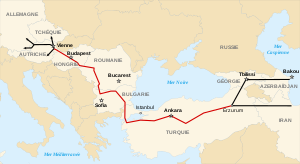
IRAQ WILLING TO ACCOMMODATE IRANIAN PIPELINE TO SYRIA

Deutsche Presse-Agentur reports that the Iraqi oil ministry has published a press release stating that the government has no objection to a gas pipeline from Iran crossing Iraqi territory to Syria.
"'Iraq does not mind facilitating the extension of the Iranian gas pipeline through its territory to Syria and the Mediterranean Sea,' Iraqi oil minister Hussein al-Sharistani said in the statement"
CHINA AND IRAN AGREE TO BROADER OIL AND GAS COOPERATION; LUKOIL RESUMES GASOLINE EXPORTS TO IRAN; IRAN CANCELS TWO LNG PROJECTS

The Tehran Times reports that Iran's oil minister and China's vice premier met and agreed to broaden their cooperation in the oil and gas sector. Meanwhile, Reuters reports that Lukoil has resumed exports of gasoline to Iran.
"In July, Russia’s energy minister Sergei Shmatko said Russian companies would be ready to supply fuel to Iran if there were commercial interest and attractive terms."
However, the sanctions appear to be having an effect on Iran's natural gas plans, canceling two LNG projects Spencer Swartz reports in the Wall Street Journal. LNG technology is mostly held by Western firms.

EUROPEAN COMMISSION LAUNCHES INVESTIGATION INTO US BIODIESEL DUMPING

Isis Almeida at Platts reports that the European Commission is investigating whether US biodiesel exporters are avoiding anti-dumping duties by sending the product through a third country like Canada or exporting B19--19% biodiesel, 81% diesel--which is not subject to the anti-dumping tax.
US biodiesel receives a subsidy of $1/gal ($300/mt) if blended with diesel, which the European Union says represents unfair competition.

This led the European Commission to slap provisional anti-subsidy and antidumping duties on imports of US biodiesel in March 2009. The measure was extended for five years last July, with definitive antidumping duties on US biodiesel of Eur200-400/mt ($274-$548/mt).
CONGRESSMEN SEEK TO KILL $100 MILLION IN AID TO LEBANESE ARMY ON HEZBOLLAH FEARS

Daniel W. Drezner at Foreign Policy reports that members of the US Congress are seeking to stop $100 million in aid to the Lebanese Army.
"Now, I understand the Congressional impulse to do something here -- I really do. What I don't understand is how Congress thinks that withholding aid from the Lebanese military will weaken Hezbollah. Congress seems to think that anything that aids the Lebanese Armed Forces (LAF) will concomitantly aid Hezbollah. The latter group, however, has independent sources of financial, political and military support. It's better to think of the LAF as a competing power base than as a conduit to Hezbollah. Anything that weakens national institutions in Lebanon empowers the groups that can survive in a more anarchical environment -- and gee, whaddaya know, that would include Hezbollah."
INITIAL JOBLESS CLAIMS UP

Courtney Schlisserman and Tim Homan at Bloomberg report that initial jobless claims for the week ended August 7th rose by 2,000 to 484,000, the highest level since February.
"The number of people receiving unemployment benefits dropped, while those getting supplemental benefits surged by 1.34 million reflecting the government’s extension of eligibility."
HUD TO OFFER $1 BILLION IN INTEREST FREE LOANS TO FOLKS FACING FORECLOSURE

Lorraine Woellert and Kathleen M. Howley at Bloomberg report that HUD is to offer $1 billion in interest-free loans to help out folks who have lost income and are facing foreclosure on their homes.
"The Department of Housing and Urban Development plans to make loans of as much as $50,000 for borrowers “in hard hit local areas” to make mortgage, tax and insurance payments for as long as two years, according to a statement released today. The Treasury Department will also provide as much as $2 billion in aid under an existing program for 17 states and the District of Columbia, according to the statement."

Tuesday, July 27, 2010

Daily Sources 7/27

LATEST ECB LENDING DATA MIXED

Brian Blackstone at Real Time Economics reports
"Total loans to the private sector grew 0.3% last month from one year ago. Though hardly signaling a resurgence in economic activity, that’s still the best pace in almost one year and well above the trough of -0.8% last October.

What ECB economists will notice is the breakdown. Loans to households grew 2.8% on the year, led by a 3.4% rise in lending for home purchases (consumer credit fell). Home loans have been rising steadily since early last year, when they were contracting on an annual basis. The rise in lending to households last month offset a 1.9% drop in loans to nonfinancial corporations.

According to an ECB paper last year, loans to households tend to be a leading indicator for GDP by one or two quarters, while loans to businesses lag the economic cycle."
CHINA INVESTS HEAVILY IN BRAZIL

John Pomfret at the Washington Post reports that China is investing heavily into Brazil. Now some in Brazil, and elsewhere in South America, are beginning to see the Chinese as the new colonialists. Worth reading in full.

ENGLISH SPREADING IN INDONESIA DRIVING FEARS FOR THE FATE OF INDONESIAN

Norimitsu Onishi at the New York Times reports that English is spreading in Indonesia as the language of the upper classes; some fear for the fate of the native Indonesian language as a result.

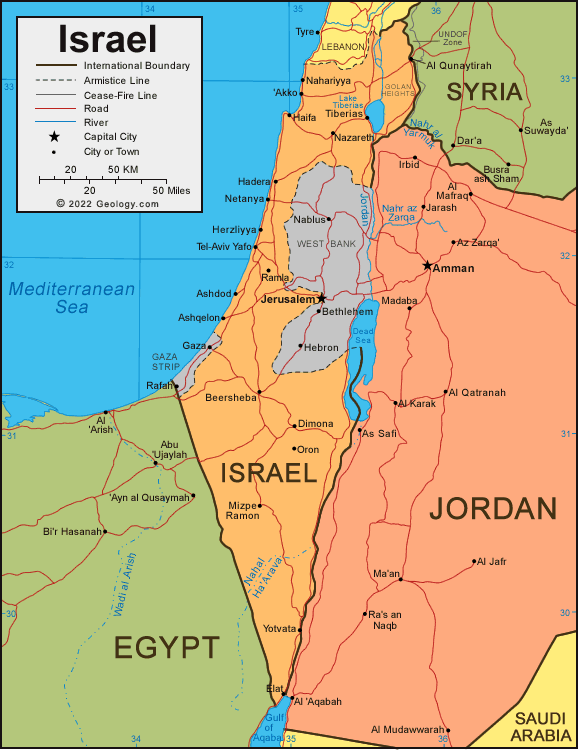
LEBANON CLAIMS ISRAELI OFFSHORE GAS FIELDS CROSS INTO LEBANESE TERRITORY

Bassem Mroue at the Associated Press reports that Hezbollah is claiming that Israel's offshore gas fields found last year cross into Lebanese territory and that force needs to be used to stop them from being stolen from.

KYRGYZSTAN'S ENERGY CRISIS WORSENS

Asyl Osmonaliyeva at Central Asia Online reports that Kyrgyzstan's energy crisis is deepening.

CONSUMER CONFIDENCE FELL TO A FIVE MONTH LOW OF 50.4

Shobhana Chandra at Bloomberg reports that
"The Conference Board’s sentiment index fell to 50.4, below the median forecast of economists surveyed by Bloomberg News and the lowest level in five months, figures from the New York-based private research group showed today."
CASE SHILLER INDEX UP

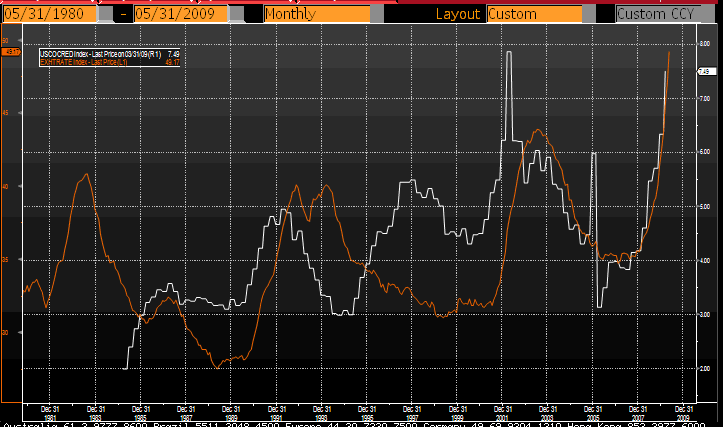
Invictus at the Big Picture hosts a graph of the Case Shiller Index, which showed a small rise in its most recent reading:


Free Exchange wonders why the readings are up in places where the bubble was worst, such as Las Vegas.

Wednesday, July 29, 2009

Daily Sources 7/29

1. UN WARNS THAT DEVELOPED WORLD WILL FACE WATER PROBLEMS DRIVEN BY GLOBAL WARNING AND OUTLINES GRIM SCENARIO FOR DEVELOPING WORLD

Thalif Deen at IPS reports that UN Secretary-General Ban Ki-moon yesterday said that
"The United States, Spain, Australia and the Netherlands are likely to face the consequences of climate change resulting in water-related disasters, including droughts, floods, hurricanes and sea-level rise.

'Even the world's richest nations are not immune,' UN Secretary-General Ban Ki-moon warned Tuesday.

Citing official US figures, he said the state of California, the world's fifth largest economy, 'could see prime farmland reduced to a dustbowl, and major cities running out of water by the end of the century'.

Blaming it on the negative impact of global warming, he said that climate is changing--globally. 'And so, therefore, must we.'

He quoted scientists as saying that by 2020, 75 to 250 million people in Africa will face growing shortages of water due to climate change.

'Yields from rain-fed agriculture could fall by half in some African countries in the next 10 years. These are frightening scenarios,' he declared."
(h/t Aqua Blog Maven at Aquafornia.)

2. JAPANESE RETAIL SALES DOWN 3% YOY IN JUNE

Toru Fujioka at Bloomberg reports that Japanese retail sales fell 3% year over year in June, from May they fell 0.3%.
"'The worst is over but that doesn’t completely wipe out households’ concerns,' said Takeshi Minami, chief economist at Norinchukin Research Institute in Tokyo. 'Japan’s recovery will be weak until a pickup in jobs and wages boosts consumer spending.'"
3. CHINA CUTS GASOLINE AND DIESEL PRICES

Wan Zhihong at China Daily reports that Beijing has cut the prices of gasoline and diesel by 220 yuan per ton or 3%, effective today.
"This equals price cut of 0.16 yuan per liter in gasoline prices (~$0.089/gallon) and 0.19 yuan per liter (~$0.105/gallon) in diesel prices. It is the second price cut on fuel prices this year.

The price cut was in response to recent falls in global crude prices, according to the National Development and Reform Commission (NDRC), the country's top economic planning body.

China adopted a new oil pricing system this year, under which domestic fuel prices would be adjusted when the moving average of a basket of international crude (Brent, Dubai and Cinta) changes more than 4% over a period of 22 working days."
Bloomberg reports:
"Pump prices for 90 octane gasoline will be set at a maximum of 5.7 yuan ($0.83) a liter, or about $3.14 a gallon, in Beijing, the National Development and Reform Commission said in a statement on its Web site. Prices were adjusted to reflect the decline in global crude prices, said China’s top planning agency."
The reduction in price will encourage demand, of course.

4. MANUFACTURERS SAYS CHINESE COST OF LABOR NOT FALLING IN RESPONSE TO GLOBAL DOWNTURN, REPORTS OF ILLUSORY REAL ESTATE BOOM

The American Chamber of Commerce recently released a report which says that the cost of labor is not falling substantially in China despite the global economic slowdown.
"Even with the current economic conditions, manufacturing in China has become more expensive. Companies reported that costs are still rising--up to 15% in 2008 compared to an increase of 10% in 2007--particularly in compensation costs for management, support staff and blue-collar workers as well as raw materials. Although labor and raw materials costs have come down from the premium levels of last summer, they are expected to rise again once market conditions improve.

Finding reliable, experienced talent has always been a challenge in China and despite rising unemployment during the current downturn, companies must ensure turnover remains at a minimum for when growth resumes.

• 86% of companies reported implementing pay-for-performance compensation plans.
• 62% of companies said they were providing training and development programs."
(h/t Carlos Tejada at the China Journal.) Meanwhile, China Stakes reports that while the Chinese real estate market appears to be in the midst of a boom, defaults are on the rise.
"Statistics show that from May 1 to July 24, which seemed to be good days for Shanghai's real estate market, many housing projects were seeing over 30% cancellations, and the cancellation rate of some projects was as high as 125%. Behind the 'boom' of the housing market are irregular behaviors such as getting bank loans by cheating and making fake housing purchasing contracts.

Among the top ten housing projects with the highest cancellation rates, 60% are developments by small and medium real estate companies. 'In fact, it is still difficult for small and medium developer to get credit support from banks,' said a sales manager of a medium real estate company.

Now it is common for developers to sell an apartment to an employee as a "reward" and then secure a loan from a bank with the housing purchasing contract signed by the employee. 'There's a window between the sale and the issuance of housing ownership certificate, during which employees can decide whether to keep or cancel the contract,' the sales manager added."
Prieur du Plessis at Investment Postcards from Cape Town links to a video of Hugh Hendry
"walking around the streets of China (presumably Beijing or Shanghai) and pointing out numerous empty buildings. Huge debt must have been incurred in erecting these buildings and without tenants there is no prospect of servicing the debt. What’s more, the workmanship also seems shoddy as a nearly-completed 13-story building in Shanghai collapsed last month.

Who will pick up the tab for creating all the overcapacity in the Chinese economy?"
Worth checking out.

5. EUROZONE BANKERS TIGHTENING CREDIT, FRUSTRATING STIMULUS EFFORTS

Margot Patrick, Laurence Norman, and Nina Koeppen at the Wall Street Journal report that the European Central Bank released a report today showing that eurozone banks continued to tighten credit in the second quarter, frustrating efforts at stimulus.
"Banks in the 16-country euro zone further tightened their credit standards in the second quarter, and companies and households may even face slightly tougher requirements in the current quarter, the European Central Bank said in a report on bank lending released Wednesday."
"'Access to credit has become clearly more difficult,' said Ifo Institute President Hans-Werner Sinn, commenting on the think-tank's latest credit constraint survey for German industry and trade, also published Wednesday. 'Despite the expansive monetary policy of the ECB, banks have become more restrictive in granting credit,' Mr Sinn said."
Worth reading in full.

6. TURKISH CENTRAL BANK GOVERNOR INDICATES RATE CUTS TO CONTINUE


Ali Berat Meric and Steve Bryant at Bloomberg report that the governor of the Turkish central bank--Durmus Yilmaz--has indicated that it will continue to cut the benchmark interest rate and is unlikely to raise the rate until some point in 2011.
"The bank reduced its forecast for year-end inflation to 5.9% from 6%, assuming that 'policy rates are further lowered in the short term and held unchanged until the end of 2010,' Yilmaz said at a news conference in Ankara today. Inflation was 5.7% in June, compared with the bank’s year-end target of 7.5%."
7. BAGHDAD PLEDGES SUPPORT IN SUPPRESSING THE PKK

Thomas Grove and Pinar Aydinli at Reuters report that Iraqi Minister of State for National Security Shirwan al-Waeli told a news conference in Ankara that Baghdad will cooperate with Turkish and American efforts to suppress the Kurdish Workers' Party (PKK) until it is eliminated.
"Waeli and Turkish Interior Minister Besir Atalay told the joint news conference they expected concrete results of their cooperation by the time they meet again in Iraq in October but provided no further details."
8. IRAQI CABINET APPROVES THE RE-INCORPORATION OF A NATIONAL OIL COMPANY, OIL EXPORTS AND REVENUES INCREASE

Dow Jones Newswires reports that the Iraqi cabinet yesterday approved a law which would establish an Iraqi national oil company; it now must be approved by the parliament.
"The reinstated national oil company would act as the parent of the existing three major Iraqi oil operators--the South Oil Co., Iraq's largest petroleum company in Basra; North Oil Co. in Kirkuk; and Missan Oil Co. in Ammarh in southern Iraq."
"'In the new draft law we didn't mention the fields that the new company would run,' [Thamir] Ghadhban [an energy adviser to Prime Minister Nouri al-Maliki] said. 'The fields to be operated by the company would be determined by a federal oil and gas council yet to be established,' he said.

The previous law stated that the INOC would have authority to conclude service and management contracts with international oil companies to improve oil recovery from producing fields. It isn't known if that provision was retained in the new law."
Meanwhile, Ben Lando at the Iraqi Oil Report reports that the Iraqi Oil Ministry announced that oil exports and revenues increased in June.
"The Oil Ministry data show oil exports reached 1.923 mb/d last month, up from 1.906 mb/d in May. Iraqi crude fetched an average $64.37/b, a more than $7/b increase on May.

Iraq earned nearly $62 billion in oil revenue last year and through July 22 this year’s exports have brought in $17.11 billion, according to the U.S. State Department’s most recent Iraq Status Report. It also estimated July production thus far at 2.46 mb/d and exports at 1.99 mb/d."
9. KYRGYZ POLICE BREAK UP ELECTION PROTESTS

The Associated Press reports that Kyrgyz police broke up opposition rallies protesting the recent Kyrgyz election results, which they contend were rigged.
"The opposition planned separate rallies and marches around the country Wednesday, rather than call all of its supporters to the center of the capital, Bishkek, in an effort to avoid a confrontation with police."
10. IRANIAN DEATHS IN DETENTION FUELING PUBLIC ANGER

Robert F Worth at the New York Times reports that accounts regarding the abuse of protesters arrested in Iran is fueling widespread anger at the administration.
"The head of Iran’s Supreme Administrative Court, Ayatollah Ghorbanali Dorri-Najafabadi, said more prisoners would be released by the end of the week. He added that a 'serious judicial inquiry' was being conducted into the deaths that have occurred in prisons since the June 12 election.

On Wednesday, there were conflicting reports about whether the government had released Saeed Hajjarian, a prominent reformist figure whose family said he was being subjected to torture.

Iran plans to put 20 people accused of rioting on trial starting Saturday, the official IRNA news agency reported. They are charged with 'attacking military units and universities, carrying firearms and explosives, organizing thugs and rioters, and vandalizing public property.'

On Tuesday, the state-financed English-language broadcaster Press TV quoted Farhad Tajari, deputy head of the parliamentary judicial commission, as saying that the former deputy interior minister, Mostafa Tajzadeh, and former deputy speaker of Parliament, Behzad Nabavi, were in detention facing major security charges and could be released on bail.

The prisoner releases appear to be the act of a government desperate to defuse the issue, coming quickly after the head of Iran’s judiciary promised Monday that the detainees’ cases would be expedited."
11. OBAMA ADMINISTRATION TO EASE SANCTIONS ON A CASE-BY-CASE BASIS WITH SYRIA

Sharon Otterman at the New York Times reports that Obama Administration officials yesterday indicated that a message was conveyed by George Mitchell to Syrian President Bashar al-Assad that the US will take new actions to ease sanctions on Syria on a case-by-case basis.
"[T]he American government [will] try to expedite the process for obtaining individual exemptions to the sanctions, which prohibit the export of all American products to Syria except food and medicine.

The move will particularly affect 'requests to export products related to information technology and telecommunication equipment and parts and components related to the safety of civil aviation,' said a State Department spokesman, Andrew J Laine."
The law imposing sanctions on Syria itself will, at this stage, remain untouched, but the Administration is indicating that OFAC will take a broader view when considering corporate requests for individual waivers.

12. UN WARNS OF WORSENING SITUATION IN SOUTH LEBANON

Naharnet News Desk reports that the UN has warned of a deteriorating situation in south Lebanon.
"The warning was made by Oscar Fernandez-Taranco, Assistant Secretary-General for Political Affairs, during a Security Council meeting on the Middle East.

Taranco urged both the Israeli and Lebanese sides to 'end' their violations of Security Council Resolution 1701 which halted a 34-day war between the Jewish state and Hizbullah in the summer of 2006."
(h/t Michael Collins Dunn at the MEI's Editor's Blog.)

13. VENEZUELA RECALLS COLOMBIAN AMBASSADOR, THREATENS TO SHUT OFF TRADE, FARC SAYS HAD MADE NO ELECTION CAMPAIGN CONTRIBUTIONS TO ANY FOREIGN CANDIDATE, VENEZUELAN OIL MINISTER SAYS JAPAN-VENEZUELAN ORINOCO E&P JV WILL BE FINALIZED BY YEAR END

Christopher Toothaker at the Associated Press reported yesterday that Venezuela has recalled its ambassador to Colombia and threatened to halt imports from the country on the accusation aired by Bogota that anti-tank weapons found in a FARC stash came from Venezuela.
"Chávez also said he would sever diplomatic ties completely and seize control of Colombian-owned businesses 'if there's one more accusation against Venezuela.'"
"Chávez also raised the possibility of shutting down a 139-mile (224-kilometer) pipeline that carries 5.7 million to 8.5 million cubic meters (200 million to 300 million cubic feet) of natural gas daily from Colombia to oil installations in western Venezuela.

'The gas that comes from Colombia isn't indispensable for us. We could shut down that gas pipeline,' he said."
Tensions between Caracas and Bogota have long been tense, most recently inflamed by US plans to expand our military presence at three military bases in Colombia--see Daily Sources 7/22 #12. Meanwhile, the Associated Press reported yesterday that FARC officially denied that it had contributed to the 2006 election campaign of Ecuadorian President Rafael Correa. Correa recently publicly asked FARC to confirm that he had received no campaign contributions from the militant organization. FARC stated that it had at no time contributed to any election campaign in any foreign state.
"The FARC's ruling secretariat contends in a July 25 communique that video given to The Associated Press earlier this month by Colombian officials was manipulated by Bogota and Washington. The video shows the FARC's No 2 leader reading a letter in which contributions to Correa's campaign are mentioned."
Meanwhile, Carlos Camacho and Takeo Kumagai at Platts report that Venezuelan oil minister Rafael Ramirez announced yesterday that Japan and Venezuela will have an exploration and production plan for the Junin area of the Orinoco belt ready by October and a JV to carry out the E&P activity will be launched by year-end.
"Ramirez did not mention, which Japanese companies would be given the E&P contract (in a minority role, by law) together with PDVSA, but Mitsubishi, Itochu, Mitsui and Marubeni all have ongoing energy projects in Venezuela."
14. US MANUFACTURED DURABLE GOODS DOWN 2.5% IN JUNE FROM MAY, DOWN 27.7% YOY, MORTGAGE ASSOCIATION WARNS THAT INCENTIVES FOR MODIFYING MORTGAGES INSUFFICIENT

The Commerce Department today announced that new orders for manufactured durable goods in June fell $4.1 billion or 2.5% from May. Excluding transportation equipment, new orders rose 1.1%. Un-seasonally adjusted year over year new orders were down 26.7%, excluding transportation they are down 23.4% year over year. Meanwhile, Al Yoon at Reuters reports that the Independent Mortgage Servicers Coalition has issued a warning that the government incentives to modify bad mortgages may prove counterproductive.
"'We are in a position where it's a very tough balance act, and that's weighing heavily on us now,' said [Bruce] Rose [CEO of Carrington Capital Management, LLC], in an interview on Monday. 'This is a classic case of an unfunded government mandate.'

The costs of borrowing to finance delinquent payments to bond investors far outweigh expected revenue from incentives paid by the government, Rose said. The government will pay servicers $1,000 for every loan modified, and another $1,000 a year for three years if the borrower stays current.

The group since September has approached the Treasury, the Federal Reserve and Congress for help in funding the temporary 'advances' that are fully reimbursed when a loan is modified or foreclosed, Rose said. Help offered through the Fed's Term Asset-Backed Securities Loan Facility (TALF,) which allows for the pooling of advances for sale to investors, has backfired, and is increasing financing costs, he said."
(h/t Yves Smith at naked capitalism.)

15. COMMERCIAL CRUDE STOCKS WAY UP, REFINING UTILIZATION DOWN, IEA SUGGESTS $50-60 BOTTOM FOR OIL PRICE

The EIA reports that commercial crude stocks built by a whopping 5.1 million barrels in the week ended July 24 to 347.8 million barrels. The stock levels are above the five year historical range for this time of year and the build was versus the median expectation of analysts of a 1.5 million barrel draw, per a Bloomberg survey. Gasoline stocks were drawn down by 2.3 million barrels and are near the top of the five year historical range. Distillate stocks, on the other hand, continued to build by another 2.1 million barrels versus analyst expectations of a 1 million barrel build. Distillate--diesel and heating oil--stocks are well above the historical range for this time of year, there are 32.1 million barrels more distillate held in commercial stocks than the equivalent week last year, or 24.6% more.


The ongoing build is consistent with the reports from the American Truckers Association, the American Association of Railroads, and US major ports. Total US refining utilization fell to 84.57% from the 85.84% reported for the week previous. For the week ended July 27, the national average of regular gasoline prices rose by 4 cents to $250.3/gallon, just inside the range where you start to see demand fall. The EIA report includes the following observation:
"On May 21, NOAA predicted a 70% probability that nine to 14 named storms will form within the Atlantic Basin during the current hurricane season, including four to seven total hurricanes of which one to three will be intense. These ranges are slightly above the seasonal average. Using these storm projections, the STEO analysis estimates the uncertainty surrounding seasonal shut-in projections. The median of the probability distribution represents an outage of 4.5 million barrels for the entire season, which is the assumption that the STEO uses for its forecasts for crude oil production."
Upstream online reports that Eduardo Lopez, a senior oil demand analyst at the International Energy Agency told Reuters that
"The evidence so far suggests that prices have probably reached a floor which maybe around $50 to $60. So, unless something dramatic were to happen, its plausible...prices will remain again at around that level, of course with probably a lot of volatility."
Monday Mark Shenk at Bloomberg noted that the current demand projections from the IEA do not correlate well with its past correlation with global GDP growth--see Daily Sources 7/27 #12.

16. FARM STATES INFLUENCE ON FOREIGN ENERGY POLICY--SHOCKED, JUST SHOCKED

Keith Johnson at Environmental Capital has a nice anecdote of how farm-state congressmen influence US foreign policy--including energy policy.
"Iowa’s Republican Sen. Chuck Grassley is holding up the nomination of Thomas Shannon to become ambassador to Brazil. The problem? Mr. Shannon has hinted he’s in favor of repealing the $0.54 cent-per-gallon tariff the US levies on imports of Brazilian sugar-cane ethanol—a direct threat to the farm-state interests Mr. Grassley represents."
Worth reading in full.

Thursday, June 25, 2009

Daily Sources 6/25

1. OECD REVISES FORECAST FOR CHINESE 2009 GDP GROWTH UPWARD TO 7.7%

Liu Li at the Wall Street Journal reports that the OECD has upped its forecast of Chinese GDP growth in 2009 to 7.7% from its 6.3% projection made in March.
"The OECD said it now expects China's economy, the world's third largest, to grow 9.3% in 2010, up from its previous projection of 8.5%. Still, it cautioned that 'the outlook for 2010 is more uncertain and depends on the extent to which private consumption and business investment react to the stronger economic situation, as both the fiscal and monetary stimulus will be easing.'"
The OECD stood by its projection that the consumer price index in China would fall by 1% in 2009 versus the projections coming out of Beijing of an 4% increase.

2. CONSUMER SENTIMENT UPTICK IN JAPAN, BUT BOJ SEEMS TO BE DISCOURAGING TOO MUCH OPTIMISM

Edward Hugh at Fistful of Euros has a characteristically long and detailed post on the Japanese economy where he notes that consumer sentiment is upbeat, with the confidence index climbing to 35.7 from 32.4 in April, according to the Cabinet Office in Tokyo--but in the face of horrible export numbers. Hugh notes that the OECD's new forecast has Japan's GDP still on course to contract by 6.8% in 2009 and has revised its forecast for 2010 down to 0.7% growth in 2010. Hugh remarks:
"In its Monthly Report of Recent Economic and Financial Developments the BOJ revised its basic view of the economy upwards for the second consecutive month. In April, the Bank were saying that “Japan’s economic conditions have deteriorated significantly”, but this was revised in May to the view that 'Japan’s economic conditions have been deteriorating, but exports and production are beginning to level out', and in June to the view that 'Japan’s economic conditions, after deteriorating significantly, have begun to stop worsening'.

This has been widely seen as an indication that the BOJ has revised its view on the economy upward, but the BOJ itself has been trying to discourage this interpretation. At the press conference, Governor Shirakawa said that the BOJ’s view on the current state of the economy was in line with the forecast made in the Outlook for Economic Activity and Prices report published on 30 April, namely that 'the pace of deterioration in economic conditions will likely moderate gradually and start to level out', thus emphasizing that the BOJ has not changed its view. To reinforce this point, using the analogy of a weather forecast, he said that if the weather forecast for the following day turns out to have been right, this does not mean that the forecast has been revised."
Well worth reading in full.

3. CHINA AND TURKMENISTAN INK DEAL FOR ADDITIONAL 30% SUPPLY OF NAT GAS, CHINA AGREES TO $4 BILLION LOAN ON PREFERENTIAL TERMS

Alexander Vershinin at the Associated Press reports that China has signed a 30 year deal to increase purchases of Turkmen natural gas by 30%.
"Chinese Vice Premier Li Keqiang met with his Turkmen counterpart Wednesday to sign the contract, which increases gas deliveries to 40 billion cubic meters (52 billion cubic yards) annually, the state-run newspaper Neutral Turkmenistan reported.

Work on a 7,000-kilometer (4,300-mile) pipeline from Turkmenistan to China is expected to be finished by the end of the year.

'This agreement is very important for ensuring a stable, long-term and adequate supply of gas for this pipeline,' Li said at an official signing ceremony, according to the newspaper.

China has also committed to lending Turkmenistan's state gas company $4 billion on preferential terms, the newspaper reported."
4. JAPAN STRIKES DEAL WITH ADNOC TO INCREASE ITS STRATEGIC PETROLEUM RESERVE

Chikako Mogi at Reuters reports that the Japanese trade ministry has concluded a basic agreement with the UAE's ADNOC to store stocks of oil in Kagoshima, southern Japan.
"The ministry did not provide details of the volume that Japan was expected to receive from ADNOC.

The ministry said the project will help beef up Japan's energy security by tapping the supply from ADNOC in times of supply shortages."
5. KOGAS AND GAZPROM AGREE TO FEASIBILITY STUDY ON NAT GAS PIPELINE EXTENSION TO SOUTH KOREA

Eric Watkins at the Oil & Gas Journal reports that Gazprom and Kogas have signed a memorandum of understanding to study the feasibility of supplying gas to South Korea via a pipeline extension from the Sakhalin-Khabarovsk-Vladivostok (SKV) gas pipeline.

"According to analyst Global Insight, two pipeline options between Russia and South Korea are currently being evaluated: an overland route via North Korea and a direct subsea line.

'The first option suffers from severe geopolitical risks while the second option presents partners with formidable technological and financial challenges,' GI said, adding, 'A drawn-out negotiation and planning process for the project…can be assured in either scenario.'

Underlining that point, Russian officials also have been courting Japanese investors into joining the SKV pipeline project."
In televised comments during his visit to Tokyo in May, Prime Minister Vladimir Putin said,
"Japanese partners could take part in projects to develop pipelines and other transport infrastructure. I mean from Sakhalin Island to Khabarovsk to Vladivostok." (see Daily Sources 5/12 #4.
6. IRAQI MINISTRY CONSIDERING HOW TO RESPOND TO SINOPEC'S BID FOR ADDAX

Anthony DiPaola at Bloomberg reports that the Iraqi Oil Ministry is considering whether to exclude Sinopec from bidding on developing oil fields, following the news that the company had made an offer on Addax Petroleum, which operates fields in Kurdish Iraq. (See Daily Sources 6/24 #7.)
"The Oil Minister hasn’t yet decided, a ministry spokesman said by telephone today. The Chinese company, also known as Sinopec Group, is among more than 30 oil producers short-listed by Iraq to bid for development rights on June 29 and 30.

The government hasn’t received official notification of the agreement between Sinopec and Addax, said Abdul Mahdy al-Ameedi, deputy director general of the Oil Ministry department running the bid rounds.

'They can participate so far,' he said of Sinopec. 'There are some days until the bidding process,' he said, adding the government would be reviewing the deal."
7. OPEC SAYS WORLD OIL MARKET IN "DELICATE AND PRECARIOUS" STATE

Margaret McQuaile at Platts reports that in its latest bulletin, OPEC said that the world oil market is in a "delicate and precarious state."
"A commentary in the latest issue of the OPEC Bulletin said oil prices were now 'closer to levels that could support sound investment plans for future production' but were not justified by fundamentals of supply and demand.

It noted that OPEC's own crude basket, which had stood at $44/barrel at the start of the March 15 ministerial meeting, had climbed above $70/b since the most recent conference on May 28 despite supply continuing to be greater than demand and OECD commercial stocks remaining well above five-year average levels."
8. RUMORS OF SAUDI-SYRIAN-LEBANESE 'GRAND BARGAIN'

Michael Collins Dunn at the MEI's Editor's Blog reports that there are rumors of a grand bargain being arranged between the Saudis, Damascus, and Lebanon.
"To sum it all up before I start linking: Syria is going to accept the idea of Sa‘d Hariri as Prime Minister in Lebanon. In turn, Saudi Arabia is going to patch up its relations with Syria. King ‘Abdullah will then visit Damascus. And if the Lebanese can smooth out the outlines of a unity government of some sort, Syria won't stand in the way."
Worth reading in full.

9. US DELIVERS WEAPONS TO SOMALIA'S TFG

Stephanie McCrummen at the Washington Post reports that the US has sent a shipment of weapons and ammunition in aid for the transitional federal government in Somalia.
"To cut off the rebels' weapons and supplies, the United States has stepped up pressure on Eritrea, and foreign warships patrolling Somali waters to combat piracy have begun blocking cargo ships heading to the rebel-held port of Kismaayo in southern Somalia.

African diplomats have also proposed a no-fly zone over Somalia to prevent weapons from being flown in from Eritrea to the rebels, but it is unclear whether that idea will gather necessary support at the United Nations."
10. MEND ATTACKS IN NIGERIA FORCE CLOSING OF TWO REFINERIES, GAZPROM AGREES TO JV WITH THE NIGERIAN NATIONAL OIL COMPANY, GAZPROM TO BEGIN CONSTRUCTION ON TRANS-SAHARAN PIPELINE NEXT YEAR, TOTAL OFFERS TO COOPERATE WITH GAZPROM--ESPECIALLY IN AFRICA

Jacinta Moran at Platts reports that Nigeria shut down the 125 kb/d Warri and the 150 kb/d Port Harcourt after attacks by MEND on pipelines and other oil facilities have cut the flow of crude, making operations impossible. Warri has reportedly been shut down for over a month.
"Nigeria's main militant group earlier Thursday said it sabotaged a Shell oil pipeline in the Delta today, the latest in a slew of attacks against facilities in Africa's biggest oil producing country.

The Movement for the Emancipation of the Niger Delta (MEND) said in an emailed statement it had attacked the Billie-Krakama pipeline in Rivers state in the Niger Delta.

'Cawthorne Channel 1, 2 and 3 flow stations feeding the Bonny export terminal have been effectively put out of service,' it said."
Susan Njanji at AFP reports that Shell confirmed that the Billie-Krakama pipeline had been attacked and stated that it had been shut down.
"President Umaru Yar'Adua on Wednesday expressed hope he could resolve the Niger Delta crisis this year.

'I am hopeful and confident that by the end of this year, we will have a secure and stable environment in the Niger Delta,' he told a news conference with [Russian President] Medvedev [who was in Nigeria yesterday to pursue energy cooperation initiatives.]

Yar'Adua is Thursday expected to unveil details of an amnesty package for militants who cease hostilities as part of efforts to end the unrest and save the crucial oil and gas industry."
BBC reported last week that one militant leader took advantage of the amnesty offer--see Daily Sources 6/17 #9. Meanwhile, Medvedev's visit evidently bore fruit as Gazprom announced that they have started a 50-50 JV in oil, gas, gas processing and transportation. Gazprom also announced it plans to begin construction of the Trans-Saharan pipeline next year.


Meanwhile, Simon Shuster at Reuters reports that the general director of Total E&P Russie told reporters today, "We are very open to discussing with a company like Gazprom to have developments abroad including, of course, in Africa."Douglas Muir at Fistful of Euros observes:
"If you’re a human being who speaks French, you’re more likely to be African than European. La Francophonie’s demographic center of gravity is now somewhere around Bamako, Mali.
...
Demographic growth plus the slow-but-steady rise of literacy rates in most of Africa means that by the next decade, most literate Francophones will be African too.
...
[T]he Academie Francaise has always allowed non-French citizens to be members; by 2050, I’d expect these members to be approaching a majority.
...
If you’re a human being who speaks French, and is also a practicing Catholic, you’re almost certainly African--like, ten-to-one odds. Plenty of people have already pointed out that Catholicism, slowly retreating in Europe, is growing like crazy in Africa, so I won’t go into that here.

But: French is now one of the major languages of Islam. "


11. VENEZUELA AND US TO EXCHANGE AMBASSADORS

Ian James at the Associated Press reports that Venezuela and the United States will exchange ambassadors, after each expelled them nine months ago.

12. CREDIT CARD CHARGEOFFS RISE WITH UNEMPLOYMENT INSURANCE EXHAUSTION RATES, INITIAL UNEMPLOYMENT CLAIMS UP

Barry Ritholtz at the Big Picture compares credit card charge off rates to the rate of people who have exhausted their unemployment insurance.


Meanwhile, Glenn Somerville at Reuters reports that initial unemployment claims rose by 15,000 to a seasonally-adjusted total of 627,000.
"Continued claims, which gauge how many Americans were still on jobless rolls after an initial week of claims, rose 29,000 to 6.738 million in the week ended June 13, the latest period for which the data was available."
12. ANOTHER STUDY LINKING US RECESSIONS TO PRICE OF OIL

Sheila McNulty at FT Energy Source reports that Steven Kopits of Douglas Westwood Energy research has released a study which notes that in the last 37 years the US has experienced seven recessions, and that oil has played an important role in each. "In every case when oil consumption breached 4% of GDP, he notes, the US has suffered a recession." Koptis also remarks that every time there has been a sustained rise of more than 50% or more in the price of oil, the US enters a recession. McNulty writes:
"From his research, then, it seems there are three rules by which to avoid recession caused by oil prices:

- Crude oil expenditures should not exceed 4% of GDP.

- Oil prices should not increase by more than 50% year-on-year.

- Oil price increases should not be so great that a potential demand adjustment should have to reach 0.8% of GDP on an annual basis, as shedding demand at this rate has generally been associated with recession."
Kotis' piece graphs nominal and inflation-adjusted crude prices from 1970-2009, shading the periods of US recession.


His work can be found here--well worth reading in full. Meanwhile, Grant Smith at Bloomberg reports that Barclay's Capital technical analysis that crude will fall to below $66/b after having broken through a "Ichimoku cloud" at $70.35/b.
"The so-called Ichimoku cloud is an area bound by two predictive lines on a general-overview chart, the investment banking arm of Barclays Plc said. Crude breached the lower boundary of this cloud at around $70.35 a barrel in New York on June 19, and oil may consequently be dragged towards a support layer around $66 and fall below that, the bank said.

'You still want to be looking to sell,' Barclays analyst MacNeil Curry said in a telephone interview from New York. 'In the sessions ahead, we look for a break of trend-line support at $66.83 to reignite the downtrend,' the bank said in a report."
This analysis comes from a different team, if I understand aright, than the one led by Paul Horsnell in London, which correctly predicted in May that prices were set to breach $70/b--see Daily Sources 5/14 #9.

Wednesday, April 22, 2009

Daily Sources 4/22

1. IMF RELEASES GLOBAL FINANCIAL STABILITY REPORT, CHARTING CURRENT FINANCIAL CRISIS VERSUS PREVIOUS RECESSION ... PERHAPS IT UNDERESTIMATES THE AFFECT ON OIL CONSUMPTION GIVEN THAT THE LAST SHOCK SAW A LARGER DROP AND INDIA AND CHINA, LARGEST CONTRIBUTORS TO INCREMENTAL DEMAND IN RECENT YEARS, APPEAR TO BE SEEING SIGNIFICANT REDUCTIONS IN DEMAND

The IMF has released its Global Financial Stability Report, the first chapter of which can be found here. I have not had time to read it--it comes in at 72 pages--but from all accounts it is sobering reading. Bob Davis at Real Time Economics comments:
"By that definition [a decline in real per-capita world GDP, backed by industrial production, trade, capital flows, oil consumption and unemployment data], this is the fourth global recession since World War II, and deepest by a long shot. The earlier recessions were in 1975, 1982 and 1991. All were one-year recessions when measured by purchasing power parity, which the IMF favors for global comparisons. Those stats take into account the different cost of goods and services in different countries — for instance, a haircut costs a lot less in Beijing than Boston. Looking at global GDP by the more traditional method using exchange rates, the 1991 recession lasted until 1993.

In 2009, the IMF estimates per-capita GDP will decline 2.5%, using purchasing power parity, compared to a 0.4% contraction, on average, during the three previous recessions. Industrial production, trade, capital flows and oil consumption in the 2009 recession will fall much more sharply than in the previous global recessions, while unemployment will increase more."
The post has a helpful (sortable) chart of the recessions of 1975, 1982, 1991, and the forecast for 2009 showing the percentage declines for the indicators of per capita output (PPP weighted), industrial production, total trade, capital flows, oil use, and the jobless rate. My own first impression of the oil use indicator is that it is an under-estimation, given the decline seen in 1982, though, as I've said, I haven't had time to investigate the IMF's analysis of that particular indicator.

In that vein, Vandana Hari at Platts reports that Indian total oil demand rose to 132.4 million tonnes (~ 2.648 mb/d) in the fiscal year ending March 31, or 3.9% from the fiscal year prior.
"The industry had projected a 7% rise in Indian oil consumption in fiscal 2008-09, but the economic downturn that set in during the latter half of 2008 put a damper on consumption, [a senior industry official said late Tuesday.] The 1.5% drop in the combined demand for furnace oil and low sulfur heavy stock to 11.7 million mt in the year ended March 31 was directly related to an industrial slowdown, he said. These heavy products are used as secondary fuel for thermal power plants, as fuel for industrial units and feedstock for fertilizer plants in India."
Haris Zamir at Platts reports that Pakistani petroleum products imports were flat for the period from July 2008 to March 2009 over the same period a year earlier, and crude oil imports were down 11.5% for the same period from a year earlier. The story suggests that the fall in prices may support consumption levels from this point on. Winnie Lee at Platts reports that Chinese apparent oil demand is down about 4.5% in the first quarter from a year earlier. China and India are the two places where most incremental demand growth had been seen in recent years.


Platts also published the oil and production data for March over February and from March a year earlier, as per the official government data. I have changed the reporting to a daily basis, as the March over February data can be misleading given that February is about 10% shorter than March:


The 0.7% increase in crude throughput is the first increase seen since November of last year. Further, Eugene Tang and Dinakar Sethuraman at Bloomberg report that China has resumed spot LNG imports on lower prices for the first time in six months.
"China paid about $493 a metric ton, equivalent to about $9.4/MMBtu, on delivered terms for a spot cargo of 58,064 tons from Trinidad & Tobago last month, customs data released today showed.

Spot supplies of conventional-sized LNG cargoes to China ceased in October after China National Offshore Oil Corp. paid $20.43.MMBtu, a record, in September for a cargo from Algeria. The emergence of China may prop up spot prices that have fallen 70% from last year’s peak because of the global recession, and divert tankers from the US and Europe.

China imported at least three spot cargoes in April and paid less than $5 per million Btu on a free-on-board basis for a shipment from Russia, according to AIS Live ship-tracking data compiled by Bloomberg and an official. That’s a drop of at least 75 percent from the September record high.

Spot LNG sells for $4.60/MMBtu, a 47% discount to crude oil, JPMorgan Chase & Co. said in a note on April 3. LNG sold for a premium to oil in 2008."
2. SACHS ASSESSES REPORTS ON WATER ECONOMICS

Jeffrey Sachs has an opinion piece in Today's Zaman which argues takes stock of a series of recent studies of the water economies of various countries--The UN World Water Development Report 2009, The World Bank's India's Water Economy: Bracing for a Turbulent Future and Pakistan's Water Economy: Running Dry, and the Asia Society's Asia's Next Challenge: Securing the Region's Water Future--and concludes that the leaders from those societies likely to be most affected need to brainstorm in concert on how best to address the coming problems. Key excerpt:
"[T]he precise nature of the water crisis will vary, with different pressure points in different regions. For example, Pakistan, an already arid country, will suffer under the pressures of a rapidly rising population, which has grown from 42 million in 1950 to 184 million in 2010, and may increase further to 335 million in 2050, according to the UN's 'medium' scenario. Even worse, farmers are now relying on groundwater that is being depleted by over-pumping. Moreover, the Himalayan glaciers that feed Pakistan's rivers may melt by 2050, owing to global warming.

Solutions will have to be found at all 'scales,' meaning that we will need water solutions within individual communities (as in the piped-water project in Senegal), along the length of a river (even as it crosses national boundaries), and globally, for example, to head off the worst effects of global climate change. Lasting solutions will require partnerships between government, business and civil society, which can be hard to negotiate and manage, since these different sectors of society often have little or no experience in dealing with each other and may mistrust each other considerably."
Worth reading in full.

3. FRANCE TO INVITE CHINESE PRESIDENT TO VISIT

Carlos Tejada at China Journal links to a China Daily story stating that Paris intends to invite Chinese President Hu Jintao for a state visit, though the link appears broken. The move is part of a thawing of relations between Paris and Beijing after the two released a joint statement stating that "France refuses to support any kind of 'Tibet independence'"--see Daily Sources 4/1 #5.

4. UK DEBT AT HIGHEST LEVEL SEEN SINCE WWII


Julia Werdigier at the New York Times reports that British sovereign debt is slated to reach £175 billion (~$255 billion) in 2009, the highest level since World War II.
"Britain’s net borrowing is expected to reach 11.9% of gross domestic product in 2010 and finances would only balance by 2016. The dismal outlook and rising debt pushed the pound lower against all major currencies on Wednesday and government bonds dropped."
5. RUSSIA FURTHER INTEGRATES INTO ITALIAN ENERGY SECTOR

Svetlana Kovalyova at Reuters reports that Gazprom announced that it will purchase downstream assets in Italy from Chevron.
"Gazprom Neft will buy a plant in Bari, southern Italy, which produces 36,000 tonnes of lubricants a year for cars, trucks and other industrial uses, and fuel marketing and sales operations in Rome, the companies said."
The move does seem to represent an especial affinity for integration with the Italian energy infrastructure.

6. EGYPT'S FEUD WITH HIZBULLAH WIDENS

Michael Collins Dunn at the MEI Editor's blog reports that Egypt's feud with Hizbullah has now expanded to include official protests to the head of Iran's interests section in Cairo as well as allegations that Lebanon was involved in the plot. In the meantime, Nazila Fathi at the New York Times reports that Tehran made an official announcement via the IRNA news agency that it welcomed talks over its nuclear program, and that it had a proposal ready to resolve the dispute over it.
"The statement also said that Iran would continue its ongoing nuclear work in 'active collaboration' with the United Nations nuclear agency and in the framework of the main international treaty that aims to halt the spread of nuclear weapons and promote peaceful uses of nuclear power.

'The Islamic Republic of Iran will continue its nuclear activities in an active collaboration with the International Atomic Energy Agency in the framework of the NPT, along with other member nations,' it said ... ."
7. CHÁVEZ FURTHER CONSOLIDATES POWER

Fausta Wertz at The Compass reports that Hugo Chávez is now moving to oust those governors that have opposed his move to federalize national ports. Manuel Rosales, mayor of Maracaibo, has fled the country and is seeking political asylum in Peru.
"Retired General Raúl Baduel, who brought Chávez to power following the 2002 attempted coup and later was instrumental in defeating Chávez's constitutional referendum in 2007, was arrested at gunpoint on April 7, pending corruption charges. He issued from prison a plea for Venezuelans 'to save democracy,' which was recorded by his son, Raúl Emilio Baduel, with his cell phone. You can watch the video (in Spanish) here."
The governor of the state of Miranda, Henrique Capriles Radonski, is being investigated for corruption; Henrique Salas Feo, governor of the state of Carabobo, is being investigated for "promoting secession;" and César Pérez Vivas, governor of the state of Táchira, is having his election challenged. Further, the mayor of Caracas, Antonio Ledezma, has been forced out of his offices by squatters and Chávez has appointed a vice mayor in his place. Well worth reading in full.

8. MEXICAN CRUDE PRODUCTION CONTINUES TO DECLINE

Robert Campbell at Reuters reports that Mexican oil production declined by 7.8% in the first quarter of 2009 from the first quarter of 2008 to 2.667 mb/d.

9. ZIMBABWE STOCKS REBOUND ON RE-DENOMINATION IN DOLLARS, IS THAT, COMBINED WITH RECORD DOLLAR DENOMINATED DEBT ISSUES, A COUNTERPOINT TO THE ALTERNATIVE TO THE DOLLAR MOVEMENT?

In an interesting story vis-a-vis the global movement for an alternative to the dollar on top of record debt issues denominated in dollars, Janice Kew at Bloomberg reports that Zimbabwean stocks have doubled after shares were re-denominated in dollars and the new coalition government took office two months ago.
"'In an economy which continues to be devoid of dollar liquidity the rise has come as a surprise,' Harare-based Danha wrote in the note. 'Interestingly there is still no evidence of significant foreign portfolio inflows, and much of the trade can be attributable to locals.'

The central bank shut down the exchange in November as inflation estimated at 89.7 sextillion percent, a plunge in the Zimbabwe dollar to 12.6 trillion per US dollar and international sanctions against President Robert Mugabe’s regime caused the economy to collapse. A new coalition government was sworn in on Feb. 11 in a power-sharing agreement between Mugabe and opposition leader Morgan Tsvangirai.

Gains have been led by Innscor Africa Ltd., producer of crocodile skin for Gucci Group NV and Prada SpA, Delta Corp., Zimbabwe’s largest beer and beverages maker, and Econet Wireless Holdings Ltd., the country’s biggest mobile-phone operator, according to Renaissance, a Moscow-based brokerage with offices in Africa."
10. GEITHNER'S SPEECH BEFORE THE ECONOMIC CLUB FAIRLY GLOOMY

The full text of Secretary of Treasury Tim Geithner's remarks today before The Economic Club of Washington can be found here. Key excerpt:
"The International Monetary Fund now expects the world economy to decline this year for the first time in more than six decades. The 1.3% decline forecast by the IMF represents a sharp deterioration from the roughly 4% annual rate at which the world economy normally would be expected to grow. The lost output could be as high as three to four trillion dollars this year alone.

And those numbers mask grave damage to economies around the world.

Only 17 of the 182 economies followed by the IMF are expected to grow faster this year than they did last year. Some 71--including 30 of the world's 34 advanced economies--are expected to shrink. The collapse of world trade is will likely be the worst since the end of World War II.

Several crucial lessons flow from the simultaneous nature of this crisis.

The rest of the world needs the US economy and financial system to recover in order for it to revive. We remain at the center of global economic activity with financial and trade ties to every region of the globe.

Just as importantly, we need the rest of the world to recover if we are to prosper again here at home. Before the crisis, US exports were among our economy's fastest-growing sectors, accounting for more than 6 million American jobs, or about 5% of total private sector employment in the US. Now, they are one of its fastest-shrinking."
(h/t David Wessel at Real Time Economics.) Worth reading in full.

11. MORE SHOES TO DROP IN HOUSING MARKET

The New York Times posts a very illustrative interactive graphic plotting homes prices versus median incomes for twenty cities from the first quarter of 1979 to the second quarter of 2009. In the accompanying article, David Leonhardt notes:
"The glut of foreclosed homes creates a self-reinforcing cycle. Falling prices lead to more foreclosures. Foreclosures lead to an excess supply of homes for sale. The excess supply then leads to further price declines. Jan Hatzius, the chief economist at Goldman Sachs, says that the 'massive amount of excess supply' means that home prices nationwide will probably fall an additional 15%.

This estimate hides a lot of variation, too. In Miami, Goldman forecasts, prices could drop an additional 33%, which is pretty amazing since they’ve already fallen 50% from their 2006 peak."
Barry Ritholtz at the Big Picture quotes from Bloomberg:
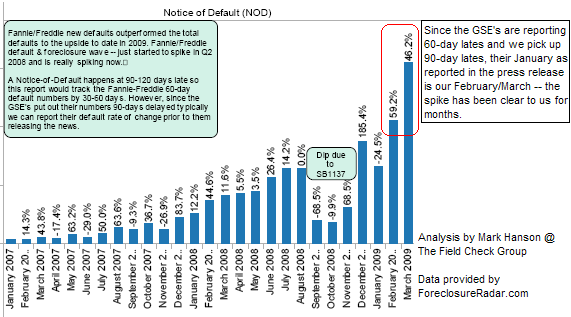
"Fannie Mae and Freddie Mac mortgage delinquencies among the most creditworthy homeowners rose 50 percent in a month as borrowers said drops in income or too much debt caused them to fall behind, according to data from federal regulators . . .

Of all borrowers who ended up in default, 34 percent told Fannie and Freddie they were earning less money, about 20 percent cited excessive debt as a reason for missing mortgage payments, and 8.1 percent blamed unemployment, FHFA said."
Ritholtz links to a chart from the Field Check Group plotting the climb in default notices, remarking: "Note once again these are not Sub-prime or alt-A--they are Prime, the highest quality borrowers possible."


12. CARBON TO BE PRICES AT BETWEEN $13-26 A METRIC TON

Simon Lomax at Bloomberg reports that a proposed law to issue carbon emissions permits as a way to reduce greenhouse gas emissions would price carbon dioxide at about $13 to $26 a metric ton by 2015.
"The price range of $13 to $26 a permit was the result of five rounds of economic modeling that each used different assumptions. For 2020, the estimated permit price range is $17 to $33, the agency said. Each permit, also known as an allowance, would give the holder the right to emit the equivalent of one metric ton of carbon dioxide."
13. COMMERCIAL CRUDE AND PRODUCTS STOCKS CONTINUE TO GROW

The EIA reports that for the week ended April 17 crude stocks grew by 3.9 million barrels to 370.6 million barrels, the largest stock holdings seen since September 1990. Gasoline stocks grew by 800 kb, and are well above the historical range for this time of year. Distillate stocks grew by 2.7 million barrels, and are behaving completely counter-cyclically. A story by Mark Shenk at Bloomberg quotes Tim Evans, an energy analyst with Citi Futures Perspective in New York:
"There are a large number of financial professionals trading oil who are paying more attention to the equity markets and the U.S. dollar, while ignoring the fundamentals of the oil market. There is nothing subtle about the numbers in today’s report."
14. KISSINGER ARGUES THAT FINANCIAL CRISIS FAVORS CONCERT DIPLOMACY

Henry Kissinger has an opinion piece in the Washington Post which argues that the economic crisis favors "concert diplomacy," "in which groupings of great powers work together to enforce international norms." Key excerpt:
"Proliferation is perhaps the most immediate illustration of the relationship between world order and diplomacy. If North Korea and Iran succeed in establishing nuclear arsenals in the face of the stated opposition of all the major powers in the UN Security Council and outside of it, the prospects for a homogeneous international order will be severely damaged. In a world of multiplying nuclear weapons states, it would be unreasonable to expect that those arsenals will never be used or never fall into the hands of rogue organizations. A new, less universal approach to world order would be needed. The next (literally) few years will be the last opportunity to achieve an enforceable restraint. If the United States, China, Japan, South Korea and Russia cannot achieve this vis-à-vis a country with next to no impact on international trade and no resources needed by anyone, the phrase 'world community' will become empty."
Whether you agree with him or not, he is always worth reading in full.

Friday, March 6, 2009

Daily Sources 3/6

1. Eurointelligence reports that credit default swaps for Austria traded yesterday at 264 basis points (2.64%), "meaning it costs €264,000 to insure €10m worth of Austrian bonds."
"Austria’s CDS are trading higher than Italy’s CDS. This has not yet translated into actual bonds spreads, which Austrian bond yields trading at 4.2%, while Greek bonds are at 5.8%. But sharp movements in the CDS are often an early warning of a change in bond rates. This is one to watch out for."
Meanwhile, Simon Johnson at Baseline Scenario points out that credit default swaps for major American banks have spiked again to levels not seen since mid-October.


American Express CDSs traded yesterday at 652.2. Johnson, a credible interpreter of markets being the former chief economist of the IMF and a professor at MIT, comments:
"The events of mid-September 2008 were traumatic and awful to behold. I saw that trailer and I don’t want to see the movie. But it is exactly into that scary future that we now head."
Worth reading in full. Rebecca Wilder at News N Economics points out that a recent OECD study shows that the fall in house prices in Europe has not passed through to construction as of yet.


European household consumption does not account for as large a share of GDP as it does in the US, and thus the cascade effects of rising debt to equity ratios on consumption and thus GDP should be less pronounced, if I understand correctly. However, construction will still get hit--and Ms. Wilder reports that German construction is already less than 6% of GDP, a historic low. Worth a look.

2. Charles Hawley at Der Spiegel reports that most observers in Germany believe that Chancellor Merkel's "grand coalition" is beginning to fray as the parties head into campaign mode. Not particularly good news given that international cooperation will thus be complicated.

3. Brad Setser at Follow the Money has a graph of Russian estimated treasuries and agencies holdings on the news yesterday that Moscow banned its wealth funds from investing in foreign government agencies--see Daily Sources 3/5 #4.


Setser comments:
"Russia’s sovereign fund was always quite conservative. Or at least its external portfolio was always managed fairly conservatively. It was primarily a fiscal stabilization fund, not an endowment fund — so this made some sense. Its existing guidelines implied that it couldn’t buy much of anything other than Agencies and Treasuries. Before the current crisis, Russia was planning to lift those restrictions so that its 'future' fund could take on a bit more risk to try to eke out higher returns. But the world has changed. And now even government-backed Agencies are too risky."
Emma O’Brien at Bloomberg reports that the ruble has not lost much value since Moscow gave notice to its banks that it would take a dim view of banks using bailout money to speculate against the ruble--see Daily Sources 2/9 #8.
"[Bank Rossii] purchased a net $862 million and €99 million (~ $125 million) in February, after selling a net $178 billion and €24 billion in the previous six months, it said yesterday. Bank Rossii’s Ulyukayev said last month the central bank will confine the ruble to a 39 to 41 trading range versus the basket in the first quarter, in an interview with Reuters."
Glenn Kessler at the Washington Post reports that Secretary Clinton will meet with Russian Foreign Minister Sergey Lavrov in Geneva today.
"In [an] NPR interview today, Clinton cast the overtures to Russian as part of a larger effort to engage antagonists such as Syria and Iran. 'We have a sense of urgency in the Obama administration,' Clinton said. 'We believe that there are a lot of challenges and threats that we have inherited that we have to address. But there are also opportunities. We are being extremely vigorous in our outreach because we are testing the waters, we are determining what is possible, we're turning new pages and resetting buttons. We are doing all kinds of efforts to try to create more partners and few adversaries.'"
Mark Landler at the New York Times reports that at a town hall meeting at the European Parliament today Secretary Clinton described Europe as "an essential partner" for the US in fighting climate change, terrorism, and the financial crisis.
"In her session at the European Parliament, the assembly’s president, Hans-Gerd Pöttinger, praised Mrs. Clinton, saying she sounded 'like a European.' The election of Mr. Obama, he predicted, would allow the administration to 'restore your country’s influence and its standing around the world.'"
Meanwhile, Secretary Clinton may have gone a bit overboard while declaiming that in regards to climate change, "we are long overdue in stepping up" and that "the United States has been negligent in facing up to its responsibilities." While I agree that climate change is a critical and pressing issue, the EU has passed quite a lot of laws to address the change, but its net carbon output isn't falling--and it is not clear that the current crisis will permit particularly strong actions in this arena.

4. Winnie Lee at Platts reports that in January, Chinese crude imports fell by 10.8% from December as imports from Angola and Iran grew by 50%.


Historically, there have often been large changes in suppliers share of China's crude import market. However, it is possibly significant that Sudan's exports to China fell by 56.2% from December as the ICC was heading for a decision--though I think it is unlikely. It is very notable that Brazil's crude exports have gone from basically nothing to 88 kb/d--almost 3% of total Chinese imports. NICOMEX reports that Petrobras concluded a deal with Beijing today to supply 100-160 kb/d. It is in the process of negotiating a $10 billion loan with China. It was earlier reported that the $10 billion loan had already been agreed to--see Daily Sources 2/19 #1.) It is also interesting that Venezuela is not even among the top 10 exporters to China in January.

The large number from Iran indicates that the country is likely cheating on its OPEC quota, which is more or less what everyone pretty much thought in the first place. Xinhua reports that the primary reason behind China's drop in imports is that most of the available storage is full, thus complicating its effort to purchase as much crude and products as it can in the current low price environment.

5. Stephanie McCrummen and Colum Lynch at the Washington Post report that president Omar Hassan al-Bashir has responded to the ICC warrant by expelling foreign aid groups from Sudan. Meanwhile, Bashir has moved to consolidate his political position domestically, framing himself as an anti-colonialist, saying, "We have refused to kneel to colonialism, that is why Sudan has been targeted." Ironically, Bashir was a major player in Chinese colonialism in Sudan, helping to bring its oil corporations in. Crowds yelled "Down, Down USA!" even though the US is not a party to the ICC.

6. Juan Cole at Informed Comment reports that former Iranian president, Ayatollah Akbar Hashemi-Rafsanjani met yesterday with Grand Ayatollah Ali Sistani in Najaf. "Sistani is said to have expressed concern about violence by extremists from both the Sunni and the Shiite side. Sistani declined Rafsanjani's invitation to visit Iran."

7. Samuel Cisnuk at UPI reports that Iraqi Prime Minister al-Maliki has put his support behind a two-pronged oil development strategy, which envisions rather incredible production increases:
"A plan has been drafted to boost Iraq's 2.4 mb/d crude-production capacity by 500 kb.d within six months, to 4 million bpd in two years and 6 million to 8 mb/d by 2013, relying in the first two phases mainly on domestic competencies and a recreated Iraqi National Oil Co. and a Supreme Petroleum Council.

The two-pronged plan means that development will be launched immediately on some of the fields that are simultaneously being tendered to IOCs in the ongoing licensing rounds, muddying the waters considerably. The plan has been launched to weaken the Oil Ministry, and the creation of an SPC will take much of the ministry's political steering power away and hand it to Iraq's political factions."
The Oil Ministry is regarded by many as a catspaw of the US government. The government's production plan is extremely optimistic, perhaps even manic. (h/t Jim Lobe's Iraq Oil Report.)

8. Robert Mackey at the Lede reports that Mullah Omar, leader of the Taliban, recently issued a letter calling upon the organization's members to halt attacks in Pakistan itself:
"Attacks on the Pakistani security forces and killing of fellow Muslims by the militants in the tribal areas and elsewhere in Pakistan is bringing a bad name to mujahedeen and harming the war against the US and NATO forces in Afghanistan."
Well worth reading in full.

9. John F. Burns at the New York Times reported yesterday the UK was to reestablish direct contact with Hezbollah in Lebanon.
"'It’s an interesting and positive development,' Paul Salem, the director of the Carnegie Middle East Center in Beirut, said of Britain’s move. 'Once the US starts talking with Syria and Iran, Hezbollah will be a difficult issue, and Britain’s opening up a direct channel with Hezbollah now could help defuse that.'"
10. Nariman Gizitdinov at Bloomberg reports that Kazakh President Nursultan Nazarbayev in his annual address at Astana promised to spend 600 billion tenge ($4 billion) in oil revenues to stimulate the economy. Nominal 2008 Kazakh GDP was about $141.2 billion, and the government has already announced it plans a 2.2 trillion tenge (~ $14.6 billion) plan (a little more than 10% of GDP). Oil revenues are thus expected to account for about 27% of the total stimulus budget.

11. Matthew Walter and Daniel Cancel at Bloomberg have a summary of recent moves by Chávez to nationalize basic foodstuff manufacturers, like Cargill earlier this week and Polar.
"National Guard troops occupied a rice mill owned by Mendoza’s company, Empresas Polar SA, last week, and Chávez directly warned Mendoza, 43, whose family has a net worth of $5 billion according to Forbes magazine, that he is now in the government’s cross hairs.

'You can’t work beyond the law, Mendoza,' Chávez said during a televised March 4 cabinet meeting, where he alleged the company was evading rules that require it to produce food at government-set prices. 'We could expropriate all of Polar’s plants.'"
If the government decides to expropriate Polar's assets, it will not offer cash as it has in past nationalizations, but rather bonds.
"In his latest crackdown, the president sent troops into rice mills to verify whether they’re complying with government regulations on production of price-controlled foods. The government began the process this week of seizing a rice plant owned by Cargill Inc., the biggest US agricultural company.

'We can’t allow monopolies like Polar,” Chávez said yesterday. 'That’s why we’ve ordered the intervention and possible expropriation of the plants, just like Cargill.'"
Well worth reading in full.

12. Sudeep Reddy at Real Time Economics reports that the Bureau of Labor Statistics announced that the official employment rate climbed to 8.1% in February, up from 7.6% in January. The broader employment category--U6--rose to 14.8%.
"We’ve already blown through the prior high point of the data series, which the Bureau of Labor Statistics started in 1994. An even broader (since discontinued) series hit 15% in late 1982, and we’re likely to fly right through that one next month."


Justin Fox at the Curious Capitalist posts a graph of the unemployment rate in the current slowdown versus previous recessions:


"What I get from the chart ... is that job losses from this recession are now worse than in 1981-1982, which is generally considered to have been the most severe economic downturn in the US since the Great Depression. Barring a more or less unimaginable turnaround in the month or two, they will be much worse. Just look at how steep that brown line is!"

Tuesday, January 20, 2009

Daily Sources 1/20

1. Barack Obama was sworn in as President of the United States today. He has a tremendous amount of political capital here in the US--and abroad. The Associated Press carried the full text of his inauguration speech. Some excerpts:
"We will restore science to its rightful place, and wield technology's wonders to raise health care's quality and lower its cost. We will harness the sun and the winds and the soil to fuel our cars and run our factories. And we will transform our schools and colleges and universities to meet the demands of a new age. All this we can do. All this we will do."
"Restore science to its rightful place"--implying that the previous Administration did not have the proper respect for science. But, also, from the historical perspective, it is the restoration of the place of the Enlightenment in the world.
"As for our common defense, we reject as false the choice between our safety and our ideals. Our Founding Fathers, faced with perils we can scarcely imagine, drafted a charter to assure the rule of law and the rights of man, a charter expanded by the blood of generations. Those ideals still light the world, and we will not give them up for expedience's sake. And so to all other peoples and governments who are watching today, from the grandest capitals to the small village where my father was born: know that America is a friend of each nation and every man, woman, and child who seeks a future of peace and dignity, and we are ready to lead once more."
These words should have a powerful effect across the globe. Calling the Bush Administration the exception that proves the rule, and challenging those regimes to explain, if they can, how it is, were their views of the US true, Obama could have ever become President of the United States.
"Guided by these principles once more, we can meet those new threats that demand even greater effort — even greater cooperation and understanding between nations."
One of a series of foreign policy statements that give a broad sense of the stance the Obama Administration will take in the world.
"With old friends and former foes, we will work tirelessly to lessen the nuclear threat, and roll back the specter of a warming planet. We will not apologize for our way of life, nor will we waver in its defense, and for those who seek to advance their aims by inducing terror and slaughtering innocents, we say to you now that our spirit is stronger and cannot be broken; you cannot outlast us, and we will defeat you."
An important holding out of the hand to Moscow and a distancing from "the war on terror" rhetoric which is also much needed.
"To the Muslim world, we seek a new way forward, based on mutual interest and mutual respect. To those leaders around the globe who seek to sow conflict, or blame their society's ills on the West — know that your people will judge you on what you can build, not what you destroy. To those who cling to power through corruption and deceit and the silencing of dissent, know that you are on the wrong side of history; but that we will extend a hand if you are willing to unclench your fist.

To the people of poor nations, we pledge to work alongside you to make your farms flourish and let clean waters flow; to nourish starved bodies and feed hungry minds. And to those nations like ours that enjoy relative plenty, we say we can no longer afford indifference to suffering outside our borders; nor can we consume the world's resources without regard to effect. For the world has changed, and we must change with it."
Referring to Palestine, Iraq, and Iran. The notion of mutual respect is, of course, especially important if the Administration wants to pursue lines of cooperation and potential relations with nations like Iran. Essential to read in full, of course. Debbi Wilgoren and David Nakamura at the Washington Post write of "festive masses converging on the capital" today for the inauguration. Gabriel Schoenfeld, resident scholar at the Witherspoon Institute, has an opinion piece in the Wall Street Journal which reminds readers of the Democratic roots of the neoconservative movement. He argues that it is too early to say which way the Obama Administration's foreign policy will "really swing" and that he has an opportunity to gather support from "hawks." I read Obama's speech as giving little room for the narcissistic approach to the world of the neoconservative movement, but I agree that it is possible.

2. Thomas Erdbrink at the Washington Post reported that the head of the Iranian counter-espionage unit in remarks to the media warned the US yesterday not to spy on Iran.
"He described a 'full-fledged intelligence war' between the two nations and offered rare, detailed comments about what he described as 'heavy damages' suffered by the United States in efforts to recruit agents among doctors, artists and fashion designers in Iran.

The official, who was not named by local media, said two Iranian AIDS specialists, whose arrests last year sparked concern in the West, are part of a group of four 'ringleaders' who were recently convicted of involvement in an alleged U.S.-funded plot to overthrow the Islamic government. Dozens of others have been arrested and interrogated, the official said.

He accused the United States of stationing intelligence agents in neighboring countries, and specifically mentioned the United Arab Emirates, Turkey, Kuwait and Azerbaijan as places from where the United States is designing 'plots' against Iran. The agents are seeking to create 'social crisis, street demonstrations and ethnic disputes,' he said. 'A soft revolution has been programmed against our country and carried out in some instances, but it was suffocated in the cradle,' Fars News quoted the official as saying."
As I have pointed out in the past, xenophobia is enshrined in the Iranian Constitution. The government in Iran is a revolutionary government and the official title of the "Supreme Leader" is "Leader of the Revolution." Their raison d'etre is to rid the country of foreign control, and to that extent it needs the US--and others--as enemies, otherwise the cognitive dissonance between its purpose and the situation will undermine its ideological justification--and thus the political will to fight for the regime.

3. Brussels Gonzo at Fistful of Euros reports that Turkish Prime Minister Recep Tayyip Erdoğan gave a speech to the European Policy Centre in Brussels yesterday. Gonzo reports that the speech was rather long and actually somewhat demagogic in nature, blaming the French for holding up the pace of Turkish accession to the EU and threatening "to review Turkish support for the Nabucco pipeline if the Greek Cypriots were not forced to drop their objections to opening the energy chapter of Turkey’s accession treaty." The Nabucco pipeline would stretch from Turkey to Austria, Germany and the Czech Republic and the just resolved natural gas dispute between Russia and Ukraine has put it in the front of European energy policy priorities.


There is the possibility of Iran or Iraq providing gas to the pipeline, given that Turkish demand for natural gas is growing quite rapidly as well. Apparently, Erdoğan backed off on this threat later in the day with European Commission president Barroso. Erdoğan did emphasize his support for Turkish entry to the EU, however. Further, Platts reports that the German economy minister Michael Glos said at conference that Germany's energy future should be in clean coal as opposed to natural gas. Clean coal is mostly a fiction at this stage, but Germany does have considerable reserves. It is hard to see how, given current technology and Germany's climate commitments, clean coal could become a reasonable alternative in the near future, but the remarks do show how much the Russo-Ukrainian dispute is affecting German foreign policy direction. (Glos also reiterated his support for nuclear power at the meeting.)

4. Meanwhile, Upstream online yesterday reported that Noble Energy struck more than 460 feet of net gas pay at the Tamar-1 deep water well off northern Israel. The find is the largest in Noble's history and the reserves are at least equal to reserves of 3 trillion cubic feet. "Analysts estimated the estimated natural gas reserves were worth about $26 billion at current prices and will be sold starting in 2013." The well is 90 miles offshore Haifa.


The Jerusalem Post reports that Lebanon was quick to respond to the news, warning Noble Energy that the reserve may in part be in Lebanese waters.
"In a meeting of the Energy, Infrastructure and Public Works Committee in the Lebanese Parliament, Chairman Muhammad Kabbani said Israeli media reports on the recently discovered natural gas reserve raise the possibility that the reserve extends to Lebanon's territorial waters. "We should take every legal measure possible in order to preserve Lebanon's right,' ... Kabbani [said.]

Kabbani added that he was concerned of the possibility that Lebanon would lose because 'Israel is the only country which is not a signatory to [international] maritime agreements.'"
Neal Sandler at BusinessWeek reports that the Israeli National Infrastructure Minister Benjamin Ben-Eliezer said that "The field can meet Israel's natural gas needs for the next two decades." An executive of the consortium that developed the field even predicted that Israel may become a net exporter of gas. Sandler reports that the find will likely spur a rash of oil and gas exploration off the Levantine coast. If further significant finds are made, or the Tamar-1 field proves large enough, Israel will in all likelihood seek to export any surplus gas to Europe via Turkey--and possibly the Nabucco pipeline.

5. Edward Yeranian at Voice of America reported that at the Arab summit in Kuwait yesterday, Saudi King Abdullah pledged $1 billion to help rebuild Gaza. Abdullah was joined by several other Arab leaders in calling on Israel to pursue the peace plan proffered in the 2002 Arab summit. (Riyadh has been reemphasizing their commitment to the 2002 plan recently, including an op ed by former Saudi head of intelligence and ambassador to the US Turki al-Faisal in the Washington Post in December. see Daily Sources 12/26 #6.)

6. Eurointelligence reports that the European Commission forecast a deep, but short, recession for the eurozone.
"The forecast numbers for 2009 are predictably bad. Euro area growth to fall 1.9%, Germany a little worse, France a litte better. Ireland’s economy will collapse by 5%, and Latvia even by 6.9%. But the European Commission is optimistic about 2010, when the Commission forecasts a resumption of a positive, though still subdued, euro area growth rate of 0.4%"
7. Stefan Collignon at the Financial Times argues that the German stimulus program is designed mostly to improve its comparative advantage via increasing labor cost competitiveness, thus pursuing export growth as a way out of the financial crisis and at the expense of Berlin's neighbors. Key excerpts:
"[The] immediate effect of the stimulus program] on private consumption is weak. A person with an annual income of €25,000 will be able to spend an extra €136.67. A Keynesian stimulus alone was not palatable to supply-side-oriented German “ordo-liberals”, the high guardians of the German social market economy. They sought to strengthen German competitiveness. Most importantly, payroll taxes and social insurance contributions were cut with the aim of reducing wage costs. In an economy dependent on manufacturing for the world market, that seems reasonable. However, there comes a point where improving one’s competitive advantage becomes malign. Germany has now reached this point."
"[Germany's] trade surplus with partners in the European Union has more than doubled over the past decade and amounts now to more than 5 per cent of GDP. At the same time intra-European trade balances have deteriorated for all of Germany’s immediate neighbours.

This development must stop. Competitive tensions are increasing rapidly and could soon reach the tipping point where the euro and the single market fall apart. The gleeful policy consensus in Berlin (“We are world champions in exports”) resembles the last dance on The Titanic, moments before it hit the iceberg."
Worth reading in full.

8. Svenja O’Donnell at Bloomberg reports that UK consumer prices rose 3.1% in December from a year earlier, down from 4.1% in November. Still seems pretty high to me, but folks are already mooting the idea of wage cuts, arguing that deflation is still a concern.

9. Michael Schwirtz reported yesterday that Russian human rights lawyer Stanislav Markelov was assassinated last night in what appears to have been a contract killing. A freelance reporter highly critical of the government, who was with Schwirtz at the time, was also murdered.
"Mr. Markelov, at the news conference just before his death, told reporters that he might file an appeal to the European Court of Human Rights against the early release of [Yuri D.Budanov, a former Russian tank commander imprisoned for strangling a young Chechen woman in his quarters and] who was a decorated colonel of the Russian Army before he was stripped of his rank. In an interview last week with The New York Times, Mr. Markelov said he might also file a lawsuit against the administration of the prison that released Mr. Budanov last Thursday."
10. Li Yanping at Bloomberg reports that the Chinese official urban unemployment rate rose to 4.2% in the fourth quarter of 2008, up from 4% in the third quarter.
"The official figure understates unemployment because it doesn’t include those who aren’t registered, including migrant workers. The state-backed Chinese Academy of Social Sciences said the rate including migrant workers may be higher than 9.4 percent in 2009."
11. Joel Martinsen at Danwei reports that
"According to a set of statistics I consulted, the number of bloggers in China exceeded 100 million in 2007. Phenomenally-popular finance blogger Xu Xiaoming was the 'hit king' of Chinese blogs in 2008 with 355 million hits. Other statistics predict that between 2012 and 2015, China will see blogs with hit counts of 1 billion."
An advertisers dream. But it will be hard for Beijing to control the flow of information given those numbers. (h/t Carlos Tejada at China Journal)

12. Reuters reports that the Bank of Canada today cut its benchmark interest rate to 1%.

13. Andres R. Martinez at Bloomberg reports that Petroleos Mexicanos (Pemex) likely extracted about 2.8 mb/d in 2008, down 9% from 20007, when it extracted 3.08 million barrels. Mexico City is considering how best to bring in private industry to help increase its crude oil productivity and exploration efforts. It is the third largest exporter of crude to the US.

14. Gareth Chetwynd at Upstream online reports that ExxonMobil notified Brazilian authorities that it has found oil in a deep water sub salt field in the Santos Basin. The prospect is in block BM-S-22 on the southern flank of the super-structure known as Sugarloaf which some petroleum geologists think might have as much as 10 billion barrels of recoverable oil.


15. Nick Bunkley at the New York Times reports that Fiat agreed to take a 35% stake in Chrysler today. Meanwhile, Russ Dallen at the Latin American Herald Tribune reports that GM will invest $1 billion of its bailout money in Brazil in order to avoid the troubles it faces here in the US. (!) (h/t Robert Oak at the Economic Populist)