Showing posts with label spain. Show all posts

Monday, August 2, 2010

Daily Sources 8/2

The China Car Times reports that"China now has 65,000km of highways across the nation, making it the second largest highway network in the world after the United States." According to the state's 2020 plan, China should have 100,000km of highways by then, about the same as what we have in the US. This should provide a tremendous economic boost over time as well as security dividends in China where it will be easier to deploy troops from one place to another.

CHINESE PMI FALLS TO 51.2

Peter Boockvar at the Big Picture reports that China's state Purchasing Managers' Index fell to 51.2. (Numbers above 50 indicate expansion; below 50 indicates contraction.)

GUANGZHOU AND HONG KONG ANTI-MANDARIN PROTESTS

Carmen Ng at China Real Time reports that there has been a second protest in Guangzhou and Hong Kong regarding the plan to change some prime time TV programming from Cantonese to Mandarin speaking. The first took place July 25th.

JAPANESE JULY PMI FELL SLIGHTLY TO 52.8

Prieur du Plessis at Investment Postcards from Cape Town reports that Japanese Purchasing Managers' Index fell slightly to 52.8. (Numbers above 50 indicate expansion; below 50 indicates contraction.)


GERMAN ELECTRICITY AND NATURAL GAS DEMAND UP 8% IN 1H

Andreas Franke at Platts reports that natural gas and electric power demand in Germany grew by 8% in the first half of the year over the same period one year ago.
"Based on its latest estimates, electricity consumption was up by 4.6% at 274 billion KWh, while the use of natural gas was 14% higher than in the first half of 2009, the BDEW said in the statement.

According to the BDEW, the main reason for the demand increase is the positive development of industrial production in Germany, which accounts for 40-45% of energy demand, while the demand for gas was also boosted by the long winter."
Demand has still not recovered to pre-crisis levels, however.

SPAIN TO CUT SUBSIDIES TO PHOTOVOLTAIC POWER PLANTS BY 45%

Victor Mallet at the Financial Times reports that Spain's industry ministry has announced the subsidized electricity prices paid to photovoltaic power plants by up to 45%. Worth reading in full.

AFTER NUCLEAR DEALS, SOUTH KOREA AND UAE AGREE TO COOPERATE IN OIL AND GAS EXPLORATION AS WELL AS STOCKPILING OIL IN SOUTH KOREA


Shinhye Kang and Ayesha Daya at Bloomberg report that after having secured a deal to build the UAE nuclear power plants South Korea and the Emirates have agreed to cooperate on oil and gas exploration and for the stockpiling of oil in South Korea.
Part of Seoul's energy security program has to do with oil stockpiling by various producers in South Korea to take advantage of quick changes in the Asian oil market. South Korea gets to draw down on those stockpiles in case of an emergency disruption in oil supply. The UAE is a major entrepot for stockpiling oil in the Middle East.

DELINQUENCIES GROW IN COMMERCIAL REAL ESTATE MARKET

Yves Smith at naked capitalism reports that the commercial real estate sector is feeling pain:
"• All deals seasoned at least a year have a total unpaid balance of $767.76 billion, with $60.45 billion delinquent – a 7.87% rate (up from only 5.28% six months prior).
• When agency CMBS deals are removed from the equation, deals seasoned at least a year have a total unpaid balance of $736.75 billion, with $60.39 billion delinquent – a 8.2% rate (up from only 5.46% six months prior).
• Conduit and fusion deals seasoned at least a year have a total unpaid balance of $655.41 billion, with $54.69 billion delinquent – a 8.35% rate (up from only 5.33% six months prior)."
JULY PMI DOWN TO 55.5

Shobhana Chandra at Bloomberg reports that US manufacturing grew at a slightly slower rate in July than June. The Institute for Supply Management's Purchasing Managers' Index fell to 55.5 from 56.2 in June. (Readings above 50 indicate growth; readings below 50 indicate contraction.)

BEN BERNANKE SAYS CONSUMER SPENDING TO PICK UP IN COMING MONTHS

Scott Lanman and Steve Matthews at Bloomberg report that Fed chief Ben Bernanke said in a speech today that consumer spending was likely to pick up in coming months.

HARLESS ARGUES THAT STRUCTURAL UNEMPLOYMENT NOT A PROBLEM

Andy Harless at Employement, Interest and Money argues that we are not seeing new structural unemployment, but rather cyclical unemployment. Worth reading in full.

MAXINE UDALL REPORTS THAT ROADS ARE BEING ALLOWED TO REVERT TO GRAVEL

Maxine Udall reports that in the US highways are being allowed to turn back to gravel. This should have significant detriments going forward, including that the amount of gas to travel from one place to another on gravel roads is higher than on paved roads. A must read.

Tuesday, July 20, 2010

Daily Sources 7/20

1. BUNDESBANK SAYS CURRENT-ACCOUNT DEFICITS OF IRELAND, SPAIN, GREECE AND PORTUGAL THREATEN EUROZONE

Thomas Molloy at the Independent reports that the economic policies of Ireland, Spain, Greece, and Portugal represent a threat to the Eurozone as a whole and the entire Euro project.
"'These macro-economically erroneous trends' are 'a source of danger for other member countries and the currency region as a whole,' the Bundesbank wrote in its monthly bulletin. Deficit countries damage the eurozone's stability and 'it is urgently necessary to correct maldevelopments and avoid a repetition in the future'."
2. EUROPEAN COMMISSION TO BAN COAL SUBSIDIES BY 2014

James Kanter at Green reports that the European Commission has tentatively banned subsidies for coal mining starting 2014.

3. PEW SAYS THE DEVELOPED WORLD UNHAPPY WITH CHINA'S RISE

Free Exchange notes that concerns about China's economic might are high in the developed world. Much of the developing world ain't so keen on its rising military prowess either.


4. CHINA NOW THE WORLD'S LARGEST ENERGY USER

Grant Smith at Bloomberg reports that according to the IEA China is now the largest user of energy consuming 2,252 million metric tons of oil equivalent in 2009 versus the 2,170 million tons used by the US. Somewhat oddly, Shai Oster at China Real Time reports that the Chinese leadership has rushed to deny that it is now the largest energy user, saying that by their calculations the US remains top dog in that department.

5. JAPAN AND CHINA TO NEGOTIATE HOW TO DEVELOP UP EAST CHINA SEA GAS

Takeo Kumagai at Platts reports that Japan and China are seeking to schedule negotiations on how best to jointly develop the East China Sea gas fields which have been the source of some friction between the two governments.

6. US AND SOUTH KOREA TO CONDUCT NAVAL DRILLS NEXT WEEK

After a delay which caused some to speculate that the US was worried about upsetting China, Elisabeth Bumiller and Edward Wong at the New York Times report that the US and South Korea have agreed to hold naval exercises in the Sea of Japan and Yellow Sea next week. The exercises are in part a response to the sinking of a South Korean ship by a North Korean submarine four months ago. Beijing has strongly objected to the US holding naval drills in the Yellow Sea.

7. JAPAN TO CONSIDER ENERGY HUB AMBITIONS

Takeo Kumagai at Platts reports that Japan is considering using its spare storage capacity to act as an energy hub in the region. Japanese oil consumption is on a downward trend leaving considerable spare capacity. Some are considering using that spare capacity to export out into regional markets extra petroleum products, becoming the third trading hub in the region after Singapore and South Korea.

8. RUSSIA SENDS MISSION TO CLARIFY BORDER ON ARCTIC SHELF

Elena Kovachich at the Voice of Russia reports that
"The flagship of Russia’s polar fleet “Academician Fyodorov” has left for the Arctic on an expedition to clarify the outer border of the country’s continental shelf."
9. NABUCCO COMPLETES PUBLIC HEARINGS IN TURKEY

Alex Froley at Platts reports that the Nabucco pipeline project has completed the first round of public hearings in Turkey.
"Erdal Tuzunoglu, managing director for Nabucco Turkey, said: 'The completion of the public hearings is an important step towards the realization of the Nabucco project. The communities are very interested in the project and we feel that their concerns were addressed and discussed.'"


10. JUNE UNEMPLOYMENT BY STATE SHOWS IMPROVEMENT

Phil Izzo at Real Time Economics reports that the Bureau of Labor Statistics announced that most states--37--saw unemployment fall in June, while five saw an increase and in six there was no change. 27 saw a decrease in payroll employment while 21 saw an increase. Click on the link for neat interactive map and chart.

11. THE WHITE HOUSE ANNOUNCES FORMATION OF NATIONAL OCEAN COUNCIL

John M. Broder at Green reports that the White House yesterday announced the creation of a National Ocean Council. The new body will not have the power to create new regulations, but will attempt to coordinate the policy of overlapping institutions regulating ocean policy. Worth reading in full.

Wednesday, July 14, 2010

Daily Sources 7/14 (Bastille Day)

THE EU IS HALFWAY TO MEETING THEIR GOAL OF 20% RENEWABLE FUELS CONSUMPTION BY 2020

Reuters reports.

THE EURO'S INTERNATIONAL ROLE

The European Central Bank has released a 84 page paper on the international role of the Euro.

RUSSIAN SPENDING MORE THAN THE PRICE OF OIL WOULD ALLOW

Toni Vorobyova at Reuters reports that Russian spending is well above what the price of oil would allow without running a deficit.

GERMANS WORRIED THEIR RELATIONSHIP WITH RUSSIA IS COOLING

Matthias Schepp at Der Spiegel worries that the Merkel administration has not continued a strong tradition of courting Moscow, allowing other nations to attempt to get pride of place. In the meantime, John Roberts at Platts reports that RWE has decided to consider an offer from Moscow to join the South Stream pipeline plan, but loudly asserted its commitment to Nabucco.

BERLIN CONSIDERS AUCTIONING OFF EXTRA TIME FOR NUKE PLANTS

David Crossland at Der Spiegel reports that the Merkel Administration, which wants to bypass the plan to shutter all nuclear power plants by 2020, is considering auctioning off more time for the plants to operate. That is, the power companies could bid for additional time past 2020 in which they could operate. A key reason for the idea is that nuclear power makes it easier to meet carbon reduction goals.

SPANISH SOLAR POWER NOW BIGGER THAN US

Sharon Hong at News Watch Energy reports that with the commissioning of a new solar plant Spain now leads the US in solar power energy production.

SOUTH KOREAN PLAN FOR PRIVATE COS TO SPEND $18 BILLION ON GREEN TECH SMOKE AND MIRRORS

Christian Oliver at FT Energy Source warns us that the news yesterday that the plan for South Korean companies to spend $18.6 billion on green technologies is not quite what it seems.

NIGERIAN CRUDE EXPORTS TO US ON THE RISE

Jacinta Moran at Platts writes that NIgerian exports to the US are averaging 945 kb/d in the first quarter of 2010, up from 606 kb/d in the same quarter last year. A key reason is that efforts to mollify Niger Delta rebels have had some success. Meanwhile, Sharon Hong at News Watch Energy reports that the Nigerian state oil company is insolvent as it waits for the government to pay it its subsidies.

MORE THAN 4 PEOPLE ARE LOOKING FOR JOBS FOR EACH AVAILABLE JOB

Per Mark Thoma at Economist's View:


OIL PRICES MODERATING SOMEWHAT IN US

James Hamilton at Econobrowser updates some charts he uses to monitor energy costs in the US, including a chart of US retail gasoline prices.


Note that prices are in the range where they begin to affect driving behavior in the US, or $2.50/g. They are just short of $3.00/g where prices will have a strong effect on driving behavior.

CRUDE OIL STOCKS DOWN 5.1 MILLION BARRELS

The EIA reports that crude oil stocks fell by 5.1 million barrels in the week ended July 9th, though they are still well above the 5 year historical average. Gasoline stocks built by 1.6 million barrels and distillates grew 2.9 million barrels. The average price of gasoline for the week ended July 12th fell by 0.8 cents to 271.8 cents/gallon. For the week ended July 9th, refinery utilization grew to 90.5%.

Friday, July 24, 2009

Daily Sources 7/24

1. XINJIANG AUTHORITIES TO "HELP" DEFENDANTS BY ASSURING THEM THAT THEIR COUNSEL IS OF THEIR ETHNICITY, BUT NOT ESPECIALLY QUALIFIED TO REPRESENT CRIMINAL DEFENDANTS

Sky Canaves at China Journal reports that Xinjiang authorities plan to provide all Uighur defendants with legal representation free-of-cost. Further, they will use Uighur lawyers after providing them with quick legal training in criminal defense. It seems rather unusual to think that a lawyer could be quickly retrained into an entirely new specialty, but that appears to be the plan. Canaves notes that when human rights lawyers offered their services free in the aftermath of the recent troubles in Tibet, they were prevented from taking the cases and some subsequently lost their licenses to practice. Indeed, several human rights lawyers based in Beijing this year have yet to receive the renewal of their licenses to practice. These are capital cases. If those lawyers chosen are chosen for their ethnicity as opposed to their ability in the relevant field of law--and if those lawyers particularly interested in defending people suspected of having had their human rights abused are banned from practicing in general--it hardly seems like much of a benefit, but I suppose they will identify more closely with their (mostly) defenseless clients.

2. EICHENGREEN ARGUES CHINESE IMPORTS BEST WAY OUT OF GLOBAL CRISIS

Barry Eichengreen says increased Chinese imports is the best road out of the current financial crisis.
"China can purchase more industrial machinery, transport equipment, and steelmaking material, which are among its leading imports from the US. Directing spending toward imports of capital equipment would avoid overheating China’s own markets, boost the economy’s productive capacity (and thus its ability to grow in the future), and support demand for US, European, and Japanese products just when such support is needed most.

This strategy is not without risks. Allowing the renminbi to appreciate as a way of encouraging imports may also discourage exports, the traditional motor of Chinese growth. And lowering administrative barriers to imports might redirect more spending toward foreign goods than the authorities intend. But these are risks worth taking if China is serious about assuming a global leadership role."
Worth reading.

3. CHINA TO RAISE $2 BILLION FOR FINANCIAL BUSINESS EXPANSION IN AFRICA

Terence Poon and Aaron Back at the Wall Street Journal report that the China Development Bank has plans to raise $2 billion by November of this year for the China-Africa Development Fund. The funds will be used to finance the expansion of financial business ties to Africa.

4. SHANGHAI ADOPTS TWO CHILD POLICY IN ATTEMPT TO DEAL WITH AGING POPULATION

Sky Canaves at China Journal also notes that the city of Shanghai, faced with an aging population, has embarked upon a policy designed to encourage families to have two children.
"For several years, officials at various levels across the country have touted the possibility of allowing couples made up of people who grew up as only children to have two kids to have two kids. Such policies are gaining impetus as the first generation of women born under the one-child policy is now at the peak of its childbearing years. In 2004, Shanghai revised its family planning rules to specify the types of couples who would be eligible to have more than one child."
Evidently no one wants to use productivity gains to cover the costs of an inverted population pyramid just quite yet, meaning, I suspect, that the gains have been overstated (and not just in China).

5. CHINA MAY BE SET TO BECOME LARGEST CONSUMER OF GOLD

Sophie Leung at Bloomberg reports that China is set to overtake India as the world's largest consumer of gold, according to the World Gold Council.
"Jewelry demand in China expanded in the first quarter while dropping in India, Marcus Grubb, a managing director at the London-based council, said today at a conference in Hong Kong. Chinese gold demand will keep rising, he said."
"Total demand from India in the first quarter fell 83 percent to 17.7 metric tons, from 107.2 tons a year earlier, according to figures from the World Gold Council. Purchases in China rose 1.8 percent to 105.2 tons from 103.3 tons. Total Chinese demand for gold was six times that of India in the first quarter, the council said in May."
In the beginning of May, the Financial Times reported that some analysts were arguing that Beijing had embarked upon a policy of increasing the share of its reserves held in gold bullion as a diversification measure--see Daily Sources 5/7 #2.

6. BUITER CALLS BS ON CHINA, INDIA, BRAZIL, SOUTH AFRICA, AND AFRICAN UNION'S CALL FOR THE DEVELOPED WORLD TO PAY FOR CARBON EMISSIONS CUTS

Willem Buiter makes the rather important point that China and India received a great deal of benefit, directly and indirectly, from industrialism, though it was developed in the West. It is not clear that the West today should suffer for the poor policy choices of medieval to twentieth century China. Thus, the argument that the West should be responsible for the cost of carbon emission reductions in the developing world can be described as disingenuous--though it will have a lot of appeal to, well, the vast majority of people in the world. True, but the costs of inaction, should predictions be true, will fall just as generally upon the developing countries as it will on the rich. Very much worth reading, IMO.

7. UK 2Q GDP DOWN 0.2% FROM 1Q, DOWN 5.2% YOY

Laurence Norman at the Wall Street Journal reports that the UK Office for National Statistics announced today that UK GDP in the second quarter fell 0.8% from the first and was down 5.2% on the year.
"Output dropped 2.4% in the first quarter and was down 4.9% on the year. ... In the first half of the year, output fell 3.2%. The government had forecast a GDP decline of 3.5% for the whole year."
8. SPANISH UNEMPLOYMENT TO CLIMB TO 22% IN 2010 PER CITIBANK REPORT

Ed Harrison notes at naked capitalism that a recent report by Citigroup expects unemployment in Spain to climb to 22% in 2010 after having just hit 17.9%. He translates a Spanish article on the report:
"In the opinion of the experts at the company, the recovery will reach Spain later than elsewhere in Europe because of the extent of deleveraging facing the Spanish economy. Therefore, there remains a substantial possibility that unemployment will continue to rise, after the withdrawal of the effects of fiscal measures taken by the Government."
9. RUSSIA WILL SANCTION COMPANIES SELLING OFFENSIVE ARMS TO GEORGIA, PUTIN INDICATES MOSCOW IS READY TO PROTECT DOMESTIC STEEL INDUSTRY

Ellen Barry at the New York Times reports that:
"Dmitri O Rogozin, Russia’s envoy to NATO, said on Friday that Russian President Dmitri A Medvedev had issued a decree that would impose sanctions on any manufacturer who sells offensive weapons to Georgia, 'wherever he is, in the Arctic or Antarctic region or in the United States.'"
Meanwhile, Maria Kolesnikova and Ilya Khrennikov at Bloomberg report that in an address in Magnitogorsk, Prime Minister Vladimir Putin indicated that Moscow is prepared to protect the Russian steel industry.
"Metals companies in Russia may receive preferential treatment in supplying so-called natural monopolies, Putin said, using a phrase employed in the country to refer to state-controlled companies such as natural-gas provider OAO Gazprom.

'We could consider passing a special law on this,' he said."
10. ECUADOR SIGNS DEAL TO PROVIDE CHINE 3 MILLION BARRELS OF CRUDE A MONTH

Eduardo Garcia at Reuters reports that Ecuador has signed a deal to export 3 million barrels of crude oil a month (~ 100 kb/d) to China. Quito will receive a $1 billion advance payment in the first week of August.

11. FED CREATES INVESTORS ADVISORY COMMITTEE MADE UP ALMOST ENTIRELY OF REPRESENTATIVES OF BIG SPECULATIVE CAPITAL

Jesse's Café Américain links to the Federal Reserve Bank's press release announcing the establishment of an investors advisory committee, which will have no policy-making power, but a lot of extra access to decision-makers at the Fed. Jesse makes the point that no member of this committee meant to represent the interests of investors could plausibly represent most investors, but rather big capital. At least Goldman Sachs isn't on the list.

Thursday, July 2, 2009

Daily Sources 7/2

1. JAPANESE HAWK CHOSEN TO LEAD IAEA

Sharon Otterman at the New York Times reports that Japanese diplomat, Yukiya Amano, was elected to head the UN's atomic watchdog--the IAEA.
"Depicted by experts as the candidate favored by the United States and other wealthy nations, Mr Amano favors maintaining the current approach toward controlling nuclear proliferation in Iran, which Western countries suspect of trying to build nuclear weapons. Iran says its nuclear program is purely for civilian purposes to generate energy.

'He’s a nonproliferation and disarmament guy, and he believes in it,' said David A Kay, a former IAEA official and senior fellow at the Potomac Institute for Policy Studies. 'He has been around in trying to keep the inspections in Iran going, and I expect him to continue very much in that line. He will not want to create a situation in which military action is the only alternative.'"
2. CHINA TO RESUME ALLOWING IMF REVIEWS OF ECONOMY

Andrew Batson at the Wall Street Journal reports that China next week will take a step toward reconciling with the IMF, which it has blocked from reviewing its economy for the last three years.
"But a team of IMF officials visited China about a month ago, and have completed a draft review that is now being circulated for comments.

The IMF's draft report says China's exchange rate 'continues to be substantially undervalued,' according to a person who has seen the document, called an Article IV consultation. That's in line with what senior IMF officials have repeatedly said in public. China has kept its currency, the yuan or renminbi, basically fixed against the US dollar since July last year, though it has risen, along with the dollar, against other currencies since then.

That description nonetheless marks a climbdown from an earlier push to label China's exchange rate as 'fundamentally misaligned,' a designation that would suggest the country is in violation of the IMF charter. The draft report also states that Chinese authorities 'disagreed with the staff's assessment' of the exchange rate, and notes their argument that the global turmoil calls for 'a policy of stability.'"
Simon Johnson argued in April that the Obama Administration had pulled off a coup at the G20 meeting, effectively getting Europe to make the selection process for the head of the IMF transparent in return, more or less, for opening up the process at the World Bank, the next head of which Johnson thinks is likely to be Chinese--see Daily Sources 4/3 #3. Clearly in order to clear the field for their own candidates and a larger role generally, Beijing will first be forced to work with the organizations they want to influence or lead.

3. PBOC TO ENCOURAGE CROSS-BORDER SETTLEMENT IN YUAN

Bob Chen and David Yong at Bloomberg report that the People's Bank of China will encourage cross border settlement in the renminbi starting today, per regulations posted on the central bank's website.
"Transactions inside China will take place in Shanghai and four cities in southern Guangdong province, including Guangzhou and Shenzhen, while those outside China will occur in Hong Kong, Macau and the Association of Southeast Asian Nations, it said."
(h/t Jesse's Café Américain.)

4. CNPC MAY REVIVE BID ON ARGENTINE UNIT OF REPSOL-YPF, CNOOC MAY JOIN IN

Sui-Lee Wee at Reuters reports that CNPC plans to revive its $17 billion bid for the Argentinian unit of Repsol-YPF, reportedly planning to make an offer for as much as 75%. CNOOC also may enter a bid for the remaining 25%. "Goldman Sachs is advising YPF on the sale, while Morgan Stanley and JP Morgan are advising CNPC and CNOOC respectively." YPF, or Yacimientos Petrolíferos Fiscales, was the national oil company of Argentina until 1991, when it was privatized and then purchased by Repsol. (h/t Carola Hoyos at FT Energy Source.)

5. SPANISH CONSUMER CREDIT DOWN 33.7% IN Q1

Edward Harrison at Credit Writedowns reports that consumer credit in Spain fell by 33.7% in the first quarter, according to the National Association of Financial Credit Institutions (Asnef).
"Asnef stressed that the fall in the consumer sector has been mainly due to losses on personal loans, due to the sharp decline in the credit available for consumer goods and by the contraction of revolving credit associated with credit card usage."
Harrison says he expects more failures or bailouts of Spanish banks in coming months. Worth reading in full.

6. RIKSBANK CUTS BENCHMARK INTEREST RATE TO 0.25%

Malin Rising at the Associated Press reports that the Riksbank cut its benchmark interest rate by 0.25% to 0.25% today.
"The central bank said it now expects Swedish gross domestic product to decline by 5.4% in 2009 -- a sharper drop than its previous forecast of a 4.5% fall. However, it raised its outlook for 2010 GDP to a growth rate of 1.4% from 1.3% previously.

It said the economic outlook is still uncertain and that although GDP is expected to be positive in 2010, employment will not begin to rise until 2011."
7. FINAL SECTION OF SINO-KAZAKH CRUDE PIPELINE COMPLETED

Naubet Bisenov at Platts reports that Kazakhstan's KazStroyService has finished the 10 million metric ton/annum (200 kb/d) Kenkiyak-Kumkol pipeline and will begin test runs on it shortly.
"The Kenkiyak-Kumkol link is the final section of the Sino-Kazakh crude pipeline which runs from Atyrau on the Caspian Sea coast of the Central Asian nation, to Atasu near Kazakhstan's eastern border, then onwards to Alashankou in China's northwestern Xinjiang Uygur autonomous region.

The Sino-Kazakh crude pipeline is jointly developed by Kazakh state oil company KazMunaiGaz and Chinese state oil giant China National Petroleum Corp."


8. TALIBAN HAS WORN OUT ITS WELCOME IN PAKISTAN

In another interesting report by World Public Opinion, an institute based out of the University of Maryland, Pakistani opinion has turned sharply against the Taliban.

"Large majorities express confidence in the government (69%) and the military (72%) to handle the situation [in Swat]. Retrospectively, the public leans (by 45% to 40%) toward thinking the government was right to try to make an agreement in which the Pakistani Taliban would shut down its camps and turn in its heavy weapons in return for a shari'a court system in Swat. But now 67% think the Pakistani Taliban violated the agreement when it sent its forces into more areas, and 63% think the people of Swat disapprove of the agreement.

On the Afghan Taliban, an overwhelming 87% think that groups fighting to overthrow the Afghan government should not be allowed to have bases in Pakistan. Most (77%) do not believe the Afghan Taliban has bases in Pakistan. However, if Pakistan's government were to identify such bases in the country, three in four (78%) think it should close the bases even if it requires using military force.

Public attitudes toward al Qaeda training camps follow the same pattern. Those saying the 'activities of al Qaeda' are a critical threat to Pakistan are up 41 points to 82%. Almost all (88%) think al Qaeda should not be allowed to operate training camps in Pakistan. Though 76% do not believe there are such camps, if the Pakistani government were to identify them, 74% say the government should close them, with force if necessary."
Unsurprising, to me, but still well worth reading in full. (h/t Juan Cole at Informed Comment.)

9. PETROBRAS STRIKES MORE OIL ONSHORE IN THE ESPIRITO SANTO BASIN

Tom Hennigan at Platts reports that Petrobras struck oil onshore in the Espirito Santo basin.
"The Espirito Santo basin has seen a string of strikes in recent months. Last week the company reported strikes in blocks ES-T-390 and BT-ES-15. Since March it has also made four oil strikes in the onshore ES-T-364 block alone.

The company also announced a gas and an oil and gas find in the onshore ES-T-505 block."
The block block is 100% owned by Petrobras. Seems like every other week they make a new announcement of new oil.

10. HONDURAN CRISIS IN PART DUE TO NO PROCESS FOR REMOVING PRESIDENT IN CONGRESS & HIS RELATIONSHIP WITH CHÁVEZ, SAY EXPERTS

Kevin Sullivan at Real Clear World posts the quick analysis of several Honduras experts. Juan Carlos Hidalgo at the CATO Institute makes the interesting observation:
"The Honduran constitution does not provide an effective civilian mechanism for removing a president from office after repeated violations of the law, such as impeachment. Honduras’ Supreme Court nonetheless ordered Zelaya’s removal and Congress bestowed the presidency on the civilian figure--the president of Congress--next in the line of succession according to the constitution. "
Jesus Rios at Gallup World Poll makes another interesting observation:
"The latest remarks by interim leader Micheletti suggest Zelaya’s increasing alignment to President Hugo Chavez’s regime is at the core of the crisis. So, if Zelaya does in fact return to power before the November presidential election, the question then becomes: how will he manage to govern amidst an adverse public opinion environment and among institutions that backed his ousting, including his own political party? And, what role, if any, will Chávez play in Honduran politics from now on? Will Zelaya drop or moderate his pro-Chávez stance to regain political support? According to the 2008 Gallup survey, just 20% of Hondurans approve of President Hugo Chávez."
11. WTO WARNS ON INCREASING PROTECTIONISM, SAYS GLOBAL TRADE VOLUMES WILL CONTRACT BY 10% IN 2009

Joshua Chaffin at the Financial Times reports that the WTO published a report today which warns that
"[g]overnments around the world have continued to push up trade barriers in spite of high-profile pledges at the G20 summit and other forums to resist protectionism"
The organization lowered its forecast for world trade to a contraction of 10% in the volume of goods and services.


12. BLS REPORTS 476,000 JOB LOSSES IN JUN, STATE FISCAL RESPONSIBILITY MEANS STATE ECONOMIC POLICY CONTRACTIONARY IN RECESSION

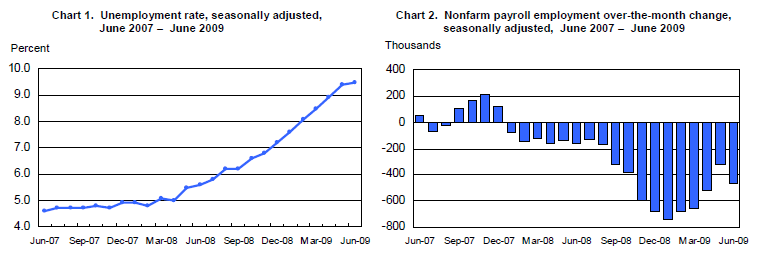
Barry Ritholtz at the Big Picture reports that the Bureau of Labor Statistics announced today that there were 467,000 job losses in June. The unemployment rate rose by 0.1% to 9.5%. The U-6 measure--marginally attached and involuntary part time workers--rose to 16.5%. Temporary employment fell by 37,600.
"Hours worked fell 0.8%, bringing the average workweek down 0.1 hours to 33; This is a record low going back to 1964."


Peter Boockvar, also at the Big Picture, also notes that initial jobless claims totaled 614,000. Continuing claims fell by 58,000 from last week.
"While there is no question benefits are expiring without one finding a job, as evidenced by the rising exhaustion rate, many losing those benefits now started getting them when initial claims were running in the 400k range last summer. Now its running above 600k, so there are still more people filing initial claims than getting removed from the continuing claims data, thus continuing claims still should trend higher assuming no sudden change in hiring trends."
Meanwhile, Free exchange makes the important observation:
"[S]tate budget policies are sharply contractionary at this point. Despite allocations of federal aid to states, services are being cut, state employees are being laid off, and taxes are being raised in order to balance the budgets of local governments constitutionally unable to run deficits. It's not at all clear that the federal stimulus will entirely compensate for state-level fiscal tightening, which means that American fiscal policy could, on net, be contractionary."
13. BARCLAYS EXPECTS WTI TO AVG $71/B IN W3

Yee Kai Pin at Bloomberg reports that Paul Horsnell's commodity team at Barclays has lifted its third quarter forecast for WTI to $71/b from $62/b. Horsnell increased his Q3 forecast for Brent to $69/b.
"'Among all the changes that have kept commodities on the boil in recent years, the key factor is that 'normal' is not what it used to be,' the analysts said in the report. 'Oil prices below $70 or copper prices below $3,000 are no longer normal.'"
I think he's wrong, but he does know of what he speaks.

Friday, June 12, 2009

Daily Sources 6/12

1. RECENT MOVES TO PURCHASE IMF SDR BONDS MAY BE MORE ABOUT DEVELOPING NATION PARTICIPATION IN THE IMF THAN CHALLENGE TO THE DOLLAR: JAPAN'S TRUST IN THE US UNSHAKABLE, MEXICO MAY PURCHASE BONDS

Susanne Walker at Bloomberg reports that in an interview with the news wire Japanese Finance Minister Kaoru Yosano said
"The US dollar’s position as the world’s reserve currency isn’t under threat. Our trust in US Treasuries is absolutely unshakable."
Meanwhile, Jens Erik Gould, also at Bloomberg reports that Mexican central bank Governor Guillermo Ortiz said in an interview that Mexico would contribute more to the IMF either by purchasing special drawing rights bonds or by directly lending to the institution. He went on to say:
"The IMF has to be re-energized and revitalized and that of course involves changes in the governing structure, and at the center of those changes is a greater participation from the emerging markets. The other side of the coin is that they also have to contribute."
He further indicated:
"The dollar will remain the central reserve currency probably for some time. I am not really worried about the status of the dollar at the present time."
Simon Johnson's analysis of the April 2 G-20 meeting provides, I think, some insight into what is taking place here--see Daily Sources 4/3 #3. In short, he argued that the Obama Administration convinced the Europeans, who traditionally have led the IMF, to make the selection process for its chief open and transparent. "Insiders" believe the current IMF managing director to resign within the year, meaning that the campaign for the next MD has already begun.
"How did the Obama administration pull this off? In a brilliant move, they took the lead by volunteering to open up the selection process for the World Bank, the IMF’s sister organization, which has always been run by an American. The next president of the World Bank is very likely to be Chinese."


2. CHINA'S NBR SAYS INDUSTRIAL PRODUCTION UP 8.9% IN MAY YOY, TURNS OUT THAT CAR STATS ARE NOT FOR PURCHASES, BUT FOR DELIVERIES FROM FACTORIES TO RETAIL OUTLETS, FITCH RATINGS SKEPTICAL OF CHINESE FINANCIAL SECTOR DATA

Terence Poon and Juan Chen at Dow Jones report that China's National Bureau of Statistics announced that value-added industrial production rose by 8.9% in May from a year previous. And Yves Smith at Naked Capitalism says she feels like she's being gaslighted, given the recent revelation that the data on car sales from China are not for cars that people have bought, but for a shipment from a factory to a retailer. She quotes from MetalMiner:
"There are some apparently contradictory numbers coming out of China at the moment. Take those car sales as an example. Our man on the ground tells us BYD, a noted Chinese car maker, reported 30,000 car sales of one model by end of last year, but the number plate agency recorded only 10,000 new cars of that model registered for use on the road. What happened to the other 20,000 are they running around without number plates? In a police state, I don’t think so. Our understanding is auto sales are recorded in China when they leave the factory, not when they are registered on the road, so dealers can build up inventory while car 'sales' are rising."
So maybe sales of cars in China aren't quite outstripping those in the US. Which is perhaps more reason to doubt the official GDP and industrial production numbers, given electricity generation and consumption and apparent oil demand numbers, as per the IEA--see Daily Sources 5/14 #2. In late May, the China Electricity Council, or association, announced it would stop publishing electricity consumption numbers--see Daily Sources 6/8 #6. Of course, the number of cars on the road have a large effect on oil consumption. (But it would be inadvisable to mount a high horse on this issue, lest it die underneath you--see Michael J. Panzner's elucidation of how the US government cooks its own statistics at Financial Armageddon.) That said, James T. Areddy at China Journal notes that Charlene Chu, a Fitch Ratings analyst in Beijing,
"has compiled numbers that seem to suggest that when credit policy in China has gotten tighter and stock prices have gone lower, banks have started peddling more wealth management products to their rich clients — and in doing so piled up hidden risks for themselves.

After Wall Street collapsed last year and US government was prompted to bail out its biggest banks, China’s financial institutions gained recognition as among the world’s largest and healthiest. After all, nonperforming loan ratios in China were near 2% on average last year from about 15% in 2003.

Chu, a former China watcher for the Federal Reserve Bank of New York, isn’t sanguine about such figures. The Fitch analyst has long argued that NPL ratios and other basic indicators of banking-system health favored by China’s policymakers sometimes mask other concerns. She sees evidence that local banks are downgrading their assessment of loans within the five categories of loan quality, without boosting NPLs, and notes that Chinese banks’ profit margins are getting pinched."
Chu says the sector suffers from "high information risk." Worth reading in full.

3. EUROZONE INDUSTRIAL PRODUCTION DOWN 1.9% IN APRIL MOM, 21.6% YOY

Ralph Atkins at the Financial Times reports that Eurostat announced that eurozone industrial production fell by 1.9% in April from March, down 21.6% since April 2008.
"Economists pointed out that the latest fall in industrial production was noticeably less severe than around the turn of the year, and that other 'hard' data--for instance, German industrial orders figures--have shown a marked improvement.

Still, the sharp contraction in activity has left the eurozone economy badly wounded. Industrial production in April was down to a level not seen for almost 12 years, and the latest monthly fall offered scant hope of an early return to economic growth.

'We are definitely in the recovery phase but today’s data confirm that it will be fragile and there will be negative surprises,' said Marco Annunziata, chief economist at Unicredit. 'Policymakers should not be in any hurry to withdraw [economic] policy stimulus.'"
4. SPAIN TO DECIDE ON RENEWING NUCLEAR POWER LICENSE IN COMING WEEKS

Elisa Santafe at the AFP reports that Madrid will either come down for or against nuclear power in the coming weeks as it decides whether to renew the operating licenses of the oldest of its six nuclear power plants.
"Prime Minister Jose Luis Rodriguez Zapatero, whose socialist government has backed the development renewable energy sources such as solar and wind power, has said he wants to phase out nuclear energy in the country when the life span of its six nuclear plants expires.

But on Monday the five-member board of the country's nuclear watchdog unanimously agreed to recommend that the Garona nuclear plant in northern Spain should get a new 10-year operating license if it upgrades its safety equipment.

Nuclear Safety Council chairwoman Carmen Martinez Ten said the decision was taken on technical and security grounds and not for reasons of 'energy policy, economics or another nature'."
Phasing out nuclear energy doesn't make a lot of sense from the perspective of Spain's energy security--it provides about 20% of the country's electricity generation--be interesting to see. (h/t Leanon at Drum Beat.)

5. ITALY TO RECEIVE PREFERENTIAL TREATMENT IN LIBYA

Adam L. Freeman and Flavia Krause-Jackson at Bloomberg report that Libyan leader Muammar Qaddafi promised today to give Italian companies preferential treatment.
"Qaddafi is visiting Italy for the first time after the country agreed last year to pay the North African nation $5 billion (3.5 billion euros) over 25 years to compensate for the occupation from 1911 to 1943. That paved the way for closer commercial ties and increased efforts by Libya to contain illegal immigration."
"Libya, Africa’s third-largest oil producer, is studying further investment in Italy’s Enel SpA and Eni SpA, Shokri Ghanem, chairman of Libya’s National Oil Corp., said on June 1 in Abu Dhabi. The Libyan Investment Authority, the country’s investment arm, has $80 billion in liquid assets. Libya owns almost 5 percent of UniCredit SpA, Italy’s biggest bank.

'Libya is an important country for us,' Fulvio Conti, chief executive officer of Enel, told reporters in Rome today, news agency Radiocor reported. 'We have always had excellent relations and we will continue to do so in the future.'

Libya accounted for 31% of Italy’s oil imports in the first quarter while the North African country’s gas met 13% of Italian demand, according to the Italian statistics agency."
Italy is also moving to integrate its energy sector more closely with Russia, following, it seems, Berlin's lead in that area.

6. UN SECURITY COUNCIL ANNOUNCES NEW SANCTIONS ON NORTH KOREA

Colum Lynch at the Washington Post reports that the UN Security Council today voted unanimously to impose new financial, military and trade sanctions on North Korea in response to its recent decision to restart its nuclear program, nuclear test blast, and missile launches--as well as its decision to call the 1953 Armistice a dead letter.The sanctions do not provide for a comprehensive trade embargo, however, and China specifically inserted an exception which would allow for continued sales of small arms and light weapons.
"The resolution calls for UN members to inspect all shipments entering or leaving North Korea if there is a reasonable suspicion that the cargo contains banned nuclear or missile technology. Member nations would be given the right to search ships suspected of carrying banned materials on the high seas and to seize any contraband.

The resolution, however, includes important caveats, such as the need for the flag state--the country in which a ship is registered--to approve the searches. If the flag state does not allow inspections on the high seas, it would be required to direct the ship to a nearby port for a search. But council members would not be authorized to use force to ensure that happens."
Galrahn at Information Dissemination notes that a resolution was introduced in Japan yesterday to allow for naval intercepts, ie participation in a blockade:
"Japan may change its laws to allow its navy to inspect North Korean vessels on the high seas if the UN Security Council approves such a step, the government said on Thursday.

'Once the resolution is adopted, we have to clear the issue of enacting a domestic law,' to pave the way for naval intercepts by officially pacifist Japan, said Chief Cabinet Secretary Takeo Kawamura."
Some analysts believe that the recent measures taken by Pyongyang are the result of the question of succession--the USDOS Press Secretary answered some related questions in the briefing today:
"QUESTION: When South Korea media, at the beginning of this month, first started reporting on the existence of documents in which North Korean diplomats stationed overseas were apparently being foresworn to allegiance to Kim Jong-un as the successor of Kim Jong-il, the spokesman for this Department at the podium on June 2, who shall remain nameless, but whose initials are Robert Wood, said – (laughter) – that such reports were speculative. I wonder whether the Department today still regards the reporting surrounding the apparent anointment of Kim Jong-un to be purely speculative.

MR. CROWLEY: Obviously, we have heard the same reports that you have heard, and we know there are questions of succession in North Korea, given the questionable health of Kim Jong-il. As to--as far as we know, Kim Jong-il is still the leader of North Korea. I believe his--he is in firm control of the country. What happens down the road, we don’t know. That is up to North Korea.

QUSTION: So you are no more illuminated on the subject of whether or not Kim Jong-un has been anointed the successor today than the Department was when this question was raised on June 2?

MR. CROWLEY: It is something that we are conscious of. We are looking at it. We don’t know that it necessarily influences what is happening now.

QUESTION: But you don’t question that the anointment has occurred?

MR. CROWLEY: I don’t--I mean, who the--we know who the current leader of North Korea is. Who the next leader of North Korea is is up to North Korea. We are more conscious of what they are doing and for whatever reason, obviously, the actions that North Korea has taken recently are provocative, unhelpful. We expect sometime today there will be a vote on a new Security Council resolution. And at the end of this vote, should the resolution be adopted, North Korea will be facing a sanctions regime unlike any other on earth.

And in that regard, we will continue close consultations with the members of the Security Council, those in the five-party process, for the moment. We will implement those sanctions aggressively. As I think Ambassador Bosworth said in testimony yesterday before the Senate Foreign Relations Committee, we are taking appropriate defensive measures. But he made clear also that the door is still open to negotiations, and we hope that North Korea will, at some point in the future, come back to that process."


7. TALIBAN TARGETS ISLAMIC INSTITUTIONS IN PAKISTAN

Shaiq Hussain and Haq Nawaz Khan at the Washington Post report that a top anti-Taliban cleric was killed in a suicide bomb attack on a religious seminary in Lahore today. An apparently coordinated attack took place in a mosque in the northwestern garrison town of Nowshera, where another bomb killed four and wounded many others. I doubt that the decision by the Taliban to target Islamic institutions will be likely to bolster its reputation in Pakistan, nor cow the population at large. Sounds like they're getting desperate to me.

8. KYRGYZSTAN REBUFFS APPEAL TO KEEP MANAS OPEN ... THE UZBEK CONNECTION

Michael Schwirtz at the New York Times reports that Kyrgyzstan yesterday rebuffed an appeal from the Obama Administration to allow the US to continue to operate from the Manas airbase.
"On Thursday, Foreign Minister Kadyrbek Sarbayev said there were no plans to reverse that decision, despite the appeal by Mr. Obama, who, according to the Kyrgyz government, sent a letter to Mr. Bakiyev seeking greater cooperation between the countries. American officials in the region had no immediate public comment on the Kyrgyz government’s statement."
In May, Uzbek President Islam Karimov announced during a state visit of South Korean President President Lee Myung-Bak that the Navoi cargo airbase is being used for non-lethal supply to NATO forces in Afghanistan. The announcement coincided with a number of agreements with KNOC--Korea's state oil company--and seemed an indication that South Korea was coordinating energy security policy with the US--see Daily Sources 5/13 #8. The Kyrgyz parliament voted to approve its President's measure to end the lease of the Manas base to US forces on February 19. A former Kyrgyz Ambassador to the US published an opinion piece at the time which stated that Russian pressure was not the primary reason for the closure--and that the original reason for allowing the US access was Bishkek's conflict with the Islamic Movement of Uzbekistan and sympathy for the US following 9/11. That said, Russia's offer of aid was almost half of Kyrgyz GDP--$150 million in aid, forgiveness of $180 million in debt, and $2 billion in loans--see Daily Sources 2/20 #4.

9. OBAMA'S CAIRO SPEECH MAY HAVE INSPIRED HAMAS POLICY SHIFT, NETANYAHU GOVT SEEMS UNLIKELY TO ACCEPT TWO-STATE SOLUTION

Middle East Pulse reports that according to Assaf Gabor in Makor Rishon-Hatzofe Obama's Cairo speech may have inspired a shift in Hamas policy:
"Hamas Political Bureau Director Khaled Mashal: 'Hamas will not be an obstacle to a peace agreement in the 1967 borders, Hamas will be a positive element helping to reach a solution that is fair to the Palestinians and will enable them to realize their rights.'

In response, high-ranking Hamas figure Salah Bardawil told Makor Rishon-Hatzofe, 'Mashal disclosed the first details of Hamas's new policy, as a factor that will act in the framework of a Palestinian government, after there is Palestinian unity, and in the framework of the Mecca agreement.'

Bardawil explained Hamas's strategy, which is dealing with a situation of being globally ostracized: 'The change is a response to Israeli pressure to make Hamas irrelevant and to disregard it as representing the Palestinian majority.' He said that the new compromising American policy had an effect: 'Khaled Mashal, after Obama's visit and the change in policy being led by Obama, said this with the goal of showing the world the real problem, which is Israel's attitude."
Bardawil further suggested that the condition for Hamas recognizing Israel is a Palestinian state. Gil Hoffman at the Jerusalem Post seems to suggest that a two-state solution is something that the Netanyahu administration cannot politically accept, however. (h/t to Michael Collins Dunn at MEI's Editor's Blog for both of these.)

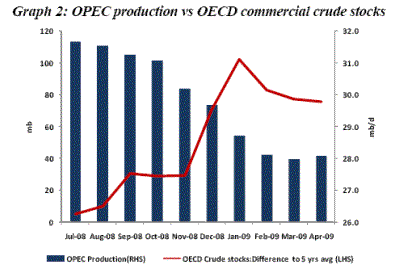
10. OPEC SUPPLIED 118KB/D MORE IN MAY THAN APRIL, REDUCES GLOBAL DEMAND FORECAST BY 200 KB/D, UPBEAT ON GLOBAL ECONOMY

Alexander Kwiatkowski at Bloomberg reports that OPEC reported that it supplied 118 kb/d more oil in May than it did in April.
"OPEC reduced the forecast for demand for its crude as global consumption shrinks. The group estimates it will need to produce 28.6 mb/d in 2009 to balance global supply and demand, 2.2 mb/d less than last year. Last month it estimated that it would need to pump 28.8 mb/d."
The report indicated the organization's view that:
"In light of the considerable challenges the world economy and commodity market, particularly the oil market, have undergone, the worst appears to be behind us. Prices have not only remained steady, but have even moved higher."
Kate Mackenzie at FT Energy Source puts that in the context of the IEA's decision yesterday to up its demand forecast for 2009 by 120kb/d and the EIA's earlier slight increase in projected world demand--by 5kb/d IIRC. She notes that OPEC indicated that the contango in oil has flattened some as OECD inventories fell in parallel with falling production.


11. BRAZIL'S SENATE TO SET UP NEW OIL COMPANY FOR SANTOS BASIN

Kate Mackenzie at FT Energy Source reports that new regulations are being introduced quickly which, in sum, will create a 100% state-owned company to lease Brazil's pre-salt fields, or Santos basin, to Petrobras and others.
"Petrobras, although state-controlled, is 60% owned by mostly foreign shareholders, and the country’s left-wing government is unenthusiastic about sharing the huge gains from the pre-salt fields with others--hence the creation of the new company. The plan is that the new state-owned company will be able to grant concessions without going to tender, which industry observers believe will favor Petrobras. For international oil companies, however, the outlook is less certain."


12. CHÁVEZ THREATENS TO SHUT GLOBOVISIÓN--A BIT MORE DIRECTLY THIS TIME

Christopher Toothaker at the Associated Press reports that Hugo Chávez yesterday urged executives at Globovisión "to reflect" upon their critical stance towards the government, or the station "won't be on the airwaves much longer."
"Globovisión--a Caracas-based all-news network--has been the only anti-Chavez channel on the open airwaves since 2007, when Chavez refused to renew the broadcast license of another opposition-sided channel, Radio Caracas Television. That network moved to cable."
The best summary of the recent efforts to silence opposition in Venezuela I've seen recently was Fausta Wertz's--see Daily Sources 6/1 #10.

Tuesday, June 2, 2009

Daily Sources 6/2

1. EUROZONE UNEMPLOYMENT ENDS UP STILL BEING HIGHER THAN U.S. UNEMPLOYMENT, CLIMBING TO 9.2% IN APRIL

Ralph Atkins at the Financial Times reports that unemployment in the eurozone grew to a seasonally-adjusted rate of 9.2% in April, 0.3% more than the number for the US. In May many analysts had expected the unemployment rate in the eurozone to fall below the rate in the US for the first time--see Daily Sources 5/22 #9.
"The impact of lengthening jobless queues on demand in coming months is a main reason why economists expect the eurzone’s economic recovery to remain weak for a protracted. 'The eurozone recession may be past its peak, but for the labor market the worst is yet to come,' said Martin van Vliet at ING in Brussels.
...
European policymakers will also be alarmed by the rise in youth unemployment. In April, some 18.5% of the labour forced aged under 25 were without a job--up from 14.7% a year before."
2. AGREEMENT BETWEEN SPANISH RULING SOCIALISTS AND CONSERVATIVES TO REIN IN "UNIVERSAL JURISDICTION" CASES

Helene Zuber at Der Spiegel reports that the ruling Socialists in Spain have an agreement with conservatives in order to rein in the Audencia National--or National Court--of Spain which has been the court to which human rights plaintiffs could file cases under the principle of "universal jurisdiction." The agreement basically requires that there be some tie to Spain in order for the court to claim jurisdiction:
"The accused will have to be arrested in Spain, a victim will have to be a Spaniard, or there will have to be some other decisive connection to Spain before the court will be allowed to proceed. There will also have to be proof that no other national court system has taken up a given case."
The move clearly comes from international pressure, especially after Baltasar Garzón went ahead with plans to investigate six advisers to President George W. Bush for human rights violations that took place in Guantanamo Bay. In April Spanish prosecutors formally recommended that Baltasar Garzón--famous for his case against the former dictator of Chile, Augusto Pinochet--should not oversee any investigation into the six--see Daily Sources 4/17 #3. But pressure is also coming from Israel and China.
"Beijing has brusquely rejected a petition by [Spanish Justice Santiago] Pedraz to interrogate [ministers accused of [a "systematic attack on the people of Tibet] at home. The Madrid justice would be arrested immediately if he traveled to China, the government threatened. The Chinese foreign ministry warned the Spanish government--which is interested in good trade relations--not to meddle in China's internal affairs or to support the Tibetan separatists."
The Spanish senior judiciary is also reportedly uncomfortable with the potential consequences of asserting universal jurisdiction:
"'We cannot become the world's judicial gendarme,' said Carlos Divar, chief justice of the Spanish Supreme Court and chairman of an internal watchdog body that oversees Spanish courts. 'Who are we to pass judgment in foreign countries when we have so much to deal with at home?' said the man who until recently was president of the Audiencia Nacional and disapprovingly witnessed his judges' ardor for pursuing foreign cases. His successor, Angel Juanes, also wants to see more consideration for 'national interests' in the court's behavior."
Well worth reading in full.

3. POLAND SIGNS N.G. SUPPLY DEAL WITH GAZPROM, MAY SIGN DEAL THROUGH 2022

Patryk Wasilewski at Reuters reports that Polish gas delivery monopoly PGNiG concluded a deal with Gazprom for natural gas today after which supply was fully restored.
"Poland uses around 13-14 billion cubic metres of gas annually and imports about two-thirds of it from Russia.

Now that the short-term deal is signed, the government will press for a quick intergovernmental agreement with Russia, a necessary prerequisite to secure natural gas deliveries past 2009 when the PGNiG's deal with RosUkrEnergo runs out.

Poland may even agree to sign a deal with Russia until 2022, about eight years past the planned completion of the government's largest energy diversification project--the liquefied natural gas terminal, the economy minister said.

'It is easier to deal with a small surplus than shortage. From that point of view I don't see extension of the deal until 2022 as a problem,' Waldemar Pawlak told a press conference."
4. CHINA TO OPEN ANTI-DUMPING INVESTIGATION INTO RUSSIAN AND U.S. STEEL COMPANIES; STUDENTS LAUGH AT SECY GEITHNER'S ASSERTION THAT THEIR ASSETS ARE SAFE, BUT BEIJING REITERATES THAT U.S. AND CHINA NEED TO COOPERATE TO DEAL WITH CRISIS

Kris Maher at the Wall Street Journal reports that the Chinese Ministry of Commerce on Monday said that it was opening an anti-dumping investigation into US and Russian steelmakers to see if they "sold a specialized type of flat-rolled steel used in electrical transformers below market value." The ministry was also beginning an investigation into US state and federal subsidies of the industry. The case follows an April case filed in the US by steelmakers and United Steelworkers alleging Chinese dumping into the US market of types of tubular and steel pipe used in oil drilling.
"[S]ome analysts said they believe the move by the Chinese government is an effort to sway the US Trade Commission in deciding the April case. 'This is political,' said Michelle Applebaum of Steel Market Intelligence in Chicago. Ms. Appelbaum also said she believes the filing was timed to Mr. Geithner's visit to Beijing. 'I think the timing is very heavily influenced by Geithner being there.'"
Meanwhile, in addressing a student question after his speech at Peking University, Secretary Geithner said, "Chinese assets are very safe," per Glenn Somerville at Reuters. The student audience reportedly broke into loud laughter at the assurance.
"But later in the day, Chinese Vice Premier Wang Qishan said it was important for the two nations to show the world they are working together through their joint economic dialogue.

'We must through our dialogue send a clear signal that China and the US are engaged in practical cooperation to address the crisis,' Wang told Geithner, according to the Chinese Foreign Ministry's website (www.mfa.gov.cn).

'This is important for boosting confidence and encouraging global financial stability and economic revival,' said Wang."
The statement more or less mirrors the key message of Geithner's speech--see Daily Sources 6/1 #1.

5. U.S. TO SELL BUNKER BOMBS TO SOUTH KOREA, KIM JONG IL NAMES THIRD SON SUCCESSOR

Malcolm Moore at the UK Telegraph reports that an unnamed South Korean military official told the media that the US had agreed to sell bunker buster bombs to Seoul for delivery between 2010-4.
"The laser-guided GBU-28 bombs were first used in 1990 during the Gulf War to destroy underground command centers in Iraq.

The 19-ft-long, 5,000lb bombs can penetrate over 20ft of concrete and 100ft of earth and could be used to target North Korea's intricate system of military bunkers and a series of munitions tunnels along the border."
(h/t Joshua Keating at FP Passport's Morning Brief.) In the meantime, Blaine Harden at the Washington Post reports that the dictator of North Korea, Kim Jong Il, has chosen his third son, Kim Jong Un, as his successor.
"If Kim Jong Un does become the new leader--and there are analysts who doubt the decision is final--this second consecutive father-to-son handoff would be unique among nations that call themselves communist. There was no indication, however, that Kim Jong Il would be handing over power any time soon."
Some analysts have tied the recent behavior by Pyongyang to the question of succession there, given reports that Kim Jong Il is not well. The transition of power is often pointed to by political scientists as a structural weakness in autocratic systems.

6. SARKOZY TO MEET WITH IRANIAN FOREIGN MINISTER TOMORROW IN PARIS, THE U.S.D.O.S. O.K.S CONSULATE AND EMBASSY INVITATIONS TO IRANIAN GOV'T REPS FOR 4TH OF JULY CELEBRATIONS

Emmanuel Jarry at Reuters reports that French President Nicolas Sarkozy will meet with Iran's foreign minister Manouchehr Mottaki on Wednesday in Paris.
"Bilateral encounters at such a senior level between Iran and one of the countries involved in the nuclear issue are highly unusual. It will be the first time Sarkozy has met a top Iranian minister since he took office in 2007."
Meanwhile, Mark Landler at the New York Times reported yesterday that the State Department Friday sent out a cable to its consulates and embassies notifying them that they may invite representatives of the government of Iran to their fourth of July celebrations. Though some might dismiss the move as merely symbolic, a public reminder that the US has an anti-colonial past (and much of American engagement in the Middle East has been historically anti-colonial) is sly, in my opinion, given the ideological framework behind the Islamic Republic of Iran--see Law and Revolution in Iran.

7. SYRIAN KURDS SEE IRAQI KURDISH REGION AS SAFE HAVEN DESTINATION

Karlos Zurutuza at the Iraq Oil Report reported yesterday that Iraq's Kurdish region is becoming a destination for Syrian Kurds denied full citizenship rights by Damascus.
"Since 1962 Syria has classified Kurds as ‘Syrian Kurds’, ‘foreign Kurds’ and ‘concealed Kurds,’ only granting ‘Syrian Kurds’ full domestic rights and Syrian nationality. The remainder, who number an estimated 200,000, are registered as foreigners and live without domestic citizenship rights."
The relative security provided by the Kurdish Regional Authority inside Iraq's Kurdish region has made it into a refugee destination for Arab Sunnis and Shias as well Kurds from other parts of Iraq as well as other neighboring countries, including Turkey and Iran.

8. FORMER SAUDI INTELLIGENCE CHIEF SAYS KILL OSAMA BIN LADEN, DECLARE VICTORY, AND "GET THE HELL OUT" OF AFGHANISTAN, OFFERS TO HOST TALKS; OPEC SAYS PRICES NOT DRIVEN BY FUNDAMENTALS

Jeff Stein at Spy Talk reported yesterday that former Saudi intelligence chief, Prince Turki al-Faisal, said in an interview with the columnist that the US should kill Osama bin-Laden and then "get the hell out" of Afghanistan.
"Turki, who was also Saudi ambassador to the United States from 2005 to April 2009, likened al Qaeda to a 'cult' and its leader to a 'hydra head with venomous snakes.'

To destroy the cult, he said, 'you have to cut off the head.'

'After that,' he advised, 'declare victory...then get the hell out of Afghanistan.'"
Turki said that no one would be able to get all the jihadis, but that it was important to take out bin-Laden, who has become iconic. In an interview with NPR noted by Stein, Turki dismissed the issue of creating a martyr:
"So if he is eliminated there will be no more something to look up to. And the issue of a martyr, that some people say is there, is less attractive than having someone living and doing things and surviving the efforts to eliminate him."
Turki said that Afghanistan could not be fixed by NATO and US forces. He also indicated that Riyadh would be happy to host peace talks between the Karzai government and the Taliban, but would not mediate between them. Well worth reading in full. Meanwhile, Kate Dourian at Platts reports that OPEC's chief economist, Hassan Qabazard, said at the World National Oil Companies Congress in Abu Dhabi:
"Prices are being affected more by non-fundamentals rather than by fundamentals. ... I think personally prices for the fundamentals that we see today are quite high and that is due to the inflow of investment funds into the market ... we see much more long positions by investors now in the market who are expecting a higher price."
Qabazard indicated that he thought stocks of oil would be unloaded as the contango narrows and that prices may fall, as they "are going up too fast."

9. LAHORE HIGH COURT RULES INSUFFICIENT EVIDENCE TO HOLD SUSPECTED MUMBAI TERROR MASTERMIND

Griff Witte and Rama Lakshmi at the Washington Post report that the Lahore High Court ruled today that there was insufficient evidence to continue the house arrest of Hafiz Sayeed, founder of Lashkar-i-Taiba, and who is suspected of being a mastermind behind the Mumbai terror attack.
"In India, officials expressed deep displeasure.

'We are unhappy that Pakistan does not show the degree of seriousness and commitment that it should to bring to justice perpetrators of the Mumbai terror attack,' Indian home minister P. Chidambaram told reporters in New Delhi."
Government prosecutors said that they would appeal the court's decision.

10. CHINA OFFERS $3 MILLION IN HUMANITARIAN AID FOR DARFUR REGION

The AFP reports that China's special envoy to Darfur, Liu Guijin, met with Sudan's President, Omar al-Bashir, and pledged $3 million in humanitarian aid to the region. Mr. Liu was in Khartoum to talk with al-Bashir at the start of a new round of talks with the Justice and Equality Movement (JEM)--the main Islamist rebel group in Darfur. The AFP reported in late May that the US special envoy to Sudan, Scott Gration, in Qatar met with Mr. Liu in the first ever meeting of the Darfor envoys of the permanent members of the UN Security Council, and said of the meeting that it was very "positive"--see Daily Sources 5/28 #1.

11. CANADIAN OIL SANDS PROJECTS MAY COME BACK ON LINE WITH RETURNS AVAILABLE AT $60/B

Scott Haggett at Reuters reports that Andrew Potter of UBS Securities has released a report which suggests that many Canadian oil sands projects mothballed due to high labor and material costs in combination with low oil prices may now be re-started on falling labor and material costs.
"More than C$90 billion ($83 billion) worth of oil sands projects were delayed, deferred or canceled after prices plunged, freeing up a squeezed skilled-labor pool, boosting productivity and increasing the availability of contractors.

'Developers are likely to see vastly improved labor productivity and lower labor costs as fewer workers are required to execute long-term oil sands growth,' Potter wrote in his report."
Potter estimates that many projects now require $60/b oil to be profitable, versus estimates last year ranging from $80-100/b.

12. MEXICAN REMITTANCES FROM THE U.S. DECLINE BY 18.7% IN APRIL YOY

Elisabeth Malkin at the New York Times reports that remittances by Mexican workers in the US home have fallen by nearly 18.7% in April from a year previous to $1.8 billion, according to the Bank of Mexico. Remittances have been Mexico's second largest sources of foreign exchange, with oil being the largest. They are roughly equivalent to foreign direct investment with tourism taking the fourth spot.

13. PENDING HOME SALES INCREASE 6.7% MOM, 3.2% YOY

The Associated Press reports that the National Association of Realtors released its index of home sales which show a 6.7% increase in pending sales in April from March, and a 3.2% increase from the year previous.
"The big jump probably reflects the impact of a new $8,000 tax credit for first-time homebuyers that was included in the economic stimulus bill signed by President Obama in February. Since buyers need to finish their purchases by Nov. 30 to claim the credit, 'we expect greater activity in the months ahead,' Lawrence Yun, the Realtors’ chief economist, said in a statement."
14. FORD'S CAR SALES UP 20% IN MAY FROM APRIL, DOWN 24% YOY

Nick Bunkley at the New York Times reports that Ford's sales in May were up 20% from April, and down 24% from the year previous.
"Ford is the only Detroit automaker that has not entered bankruptcy, after General Motors filed for Chapter 11 protection on Monday and Chrysler did so a month ago. They and other automakers were scheduled to report their May sales figures later Tuesday.

Through April, auto sales in the United States were down 37% this year, as the economic recession deters many consumers from buying a new car or truck."

Thursday, May 14, 2009

Daily Sources 5/14

1. JAPANESE OPPOSITION PLATFORM TO CONTINUE PURCHASING U.S. DEBT, BUT DENOMINATED IN YEN; ROUBINI SAYS DIFFICULT MEASURES MUST BE TAKEN IF THE DOLLAR IS NOT TO LOSE ITS POSITION AS RESERVE CURRENCY TO THE YUAN; FORMER TRANSLATOR FOR DENG XIAOPING SAYS CHINESE SENTIMENTAL ATTACHMENT TO THE DOLLAR IS ON THE WAY OUT

BBC reports that the chief finance spokesman for the main opposition party in Japan, the Democratic Party of Japan (DPJ), said in an interview with the broadcaster that Tokyo will only continue to purchase US debt if it is denominated in yen.
"However observers say that, while the move would be a remarkable policy shift, it was unlikely that Mr Nakagawa's party will win the forthcoming election, due before mid-September, despite the unpopularity of the ruling Liberal party."
Linda Sieg and Yoko Kubota at Reuters report that former DPJ leader Yukio Hatoyama announced his candidacy to lead the party after Ichiro Ozawa's resignation last week amidst a scandal in an effort to boost the party's chances of winning upcoming elections. The reporters enumerate some key elements of Hatoyama's background, including:
"Hatoyama is known less for economic policies than for his stance on security and diplomacy. He has advocated revising Japan's pacifist constitution to acknowledge the nation's right to defend itself and maintain a military for that purpose. He has also been critical of Japan's foreign and security policies for being too subservient to close ally the United States."
The so-called FACTBOX is worth consulting. Nouriel Roubini, professor at NYU made famous by his forecast accurate in many particulars of the current crisis, has an op ed in the New York Times where he dismisses arguments that the euro could replace the dollar as the world's reserve currency, instead suggesting that the renminbi is likely to take its place. Key excerpt:
"If China and other countries were to diversify their reserve holdings away from the dollar--and they eventually will--the United States would suffer. We have reaped significant financial benefits from having the dollar as the reserve currency. In particular, the strong market for the dollar allows Americans to borrow at better rates. We have thus been able to finance larger deficits for longer and at lower interest rates, as foreign demand has kept Treasury yields low. We have been able to issue debt in our own currency rather than a foreign one, thus shifting the losses of a fall in the value of the dollar to our creditors. Having commodities priced in dollars has also meant that a fall in the dollar’s value doesn’t lead to a rise in the price of imports.

Now, imagine a world in which China could borrow and lend internationally in its own currency. The renminbi, rather than the dollar, could eventually become a means of payment in trade and a unit of account in pricing imports and exports, as well as a store of value for wealth by international investors. Americans would pay the price. We would have to shell out more for imported goods, and interest rates on both private and public debt would rise. The higher private cost of borrowing could lead to weaker consumption and investment, and slower growth.

This decline of the dollar might take more than a decade, but it could happen even sooner if we do not get our financial house in order."
Well worth reading in full. Victor Zhikai Gao--executive director of the Beijing Private Equity Association and a director of the China National Association of International Studies--also has an op ed in the New York Times which points out that many Chinese actually have a sentimental attachment to the US dollar, known by many as mei jin, or "American gold." The dollar had for many years cache simply because it was illegal to hold them--the law required that all private citizens convert dollar holdings into the renminbi, and thus the notion of the dollar being "gold" long outlasted Nixon's decision to delink the dollar from the yellow metal. Key excerpt:
"Beijing recently called for a greater role in international trade for the special drawing rights currency of the International Monetary Fund. But China is also fully aware that the United States can veto an IMF decision. China’s call was more meant to sound an alarm to the United States.

Many Chinese people increasingly fear the rapid erosion of the American dollar. The United States may want to consider offering inflation-protection measures for China’s existing investments in America, and offer additional security or collateral for its continued investments. America should also provide its largest creditor with greater transparency and information.

We still call the dollar American gold. But the United States should not assume that this will never change."
2. THE IEA SAYS CHINESE GDP DATA MAY WELL BE WRONG; KEY CHINESE STATISTICIAN OUTLINES PROBLEMS WITH CHINESE RETAIL SALES DATA

David Winning at the China Journal reports that the Paris-based IEA global energy report today cast doubt on Beijing's official 6.1% GDP growth number for the first quarter, saying it didn't quite reconcile with a 3.5% drop in oil consumption.
"'Admittedly, pinpointing China’s oil demand with accuracy is an exercise fraught with difficulties, given the lack of data and the underlying assumptions analysts must make regarding stocks and refinery output from independent producers,' the IEA said in its latest report on the global oil market.

'Still, one would have expected stronger, positive oil demand growth commensurate with the reported economic resilience, unless income elasticities had drastically changed.'

The IEA floated another possibility: Real GDP data aren’t accurate and shouldn’t be taken at face value."
The IEA also mentioned a fall in electricity generation, which I noted in yesterday's Daily Sources 5/13 #2 were supposed to have fallen by as much as 4% in April after experiencing year over year declines in power generation for the last seven months. Chinese statistics have been in for a lot of rubbishing recently Andrew Batson reports in China Journal: a new essay by Xu Xianchun, a top statistician at the National Bureau of Statistics tries to explain why "one can’t simply add up China’s monthly indicators of investment and spending to get an accurate picture of gross domestic product."
"Yet many economists have long felt that the retail sales figures are not a reliable guide to China’s household consumption. Mr. Xu himself notes these well-known gaps, pointing out that the official retail sales numbers include things that cannot be considered consumer spending.

The most important are retail sales to companies and institutions, which of course are not consumers at all, and sales of construction materials for housing, which should be counted as part of household investment. Retail sales also do not include spending on services like education or health care, or rural households’ consumption of produce they grow themselves, he notes.

'Compared with retail sales, using household consumption expenditure obtained from the rural and urban household surveys is closer to consumer spending,' Mr. Xu writes.

Those measures show much slower growth than the headline retail sales figure. Mr. Xu says the bureau’s household surveys put the real growth in urban household consumption in the first quarter at 9.6%, and 9.3% for rural households. That would mark somewhat faster growth than in the second half of 2008 but somewhat slower growth than in the first half, when food prices soared, according to figures previously released by the bureau."
Worth reading in full. The National Bureau of Statistics is attempting to overhaul its data collection and publication methodologies in the face of growing criticism regarding the accuracy of their data--see Daily Sources 5/7 #2 (near the bottom of the item.)

3. PLANS TO ALLOW MAINLAND CHINESE INVESTMENT FLOWS TO TAIWAN CAUSING IRRATIONAL EXUBERANCE IN TAIWANESE MARKETS

Jonathan Adams at the New York Times reports that after announcing plans late last month to sign accords providing for cross-strait exchange in banking, insurance and access to financial markets the Taipei stock markets and dollar have been posting strong gains in the face of horrible economic data.
"[S]ince Ma Ying-jeou was inaugurated as president nearly a year ago, Taiwan has moved rapidly to forge closer commercial links with China to lift its sagging economy. In the past year, it signed deals with China on tourism, airline flights and shipping.

Investment, however, has remained a one-way street, flowing from the island to the mainland. Taiwan has invested $150 billion in the mainland since the 1980s, according to one Taiwan government estimate. Mainland China has until now been barred from directly investing in Taiwan."
For now, Beijing is capping Taiwan-bound investment at 7.2 billion Taiwan dollars (~ $219 million) leading analysts to remark that the market is likely overreacting.

4. BANK OF ENGLAND WARNS THAT RECOVERY WILL BE PROTRACTED TO 2012, LONDON COMMERCIAL RENTALS AT PRICES LAST SEEN IN 1991

Julia Werdigier at the New York Times reports that Mervyn King, head of the Bank of England, warned yesterday that "Growth has just as much chance of being positive over the next 12 months as it has of being negative."
"The central bank predicted that inflation would slow to as low as 0.4% this year and then accelerate to 1.5% by the end of 2010, revising upward an earlier forecast. But inflation is still unlikely to hit 2% by 2012, the central bank said."
2012. Mr. King said the recovery would likely be "slow and protracted." Meanwhile, Chris Bourke at Bloomberg reports that commercial rent in the city of London, the UK's main financial district, has fallen to levels last seen in 1991.
"The City already has enough empty offices to hold two- thirds of Canary Wharf, the docklands area developed 1 1/2-miles east in the 1980s to lure investment bankers. About 9 million square feet (855,000 square meters) are available in the City and that may climb to 12 million by the end of 2009, according to CB Richard Ellis Group Inc., the biggest commercial property broker. Almost 19% of all City offices may be vacant next year, analysts at CB Richard Ellis estimate."
(h/t Barry Ritholtz at the Big Picture.)

5. SPANISH GDP DOWN 1.8% IN Q1, RECOVERY COMPLICATED BY DEBT TO GDP RATIO

Edward Hugh at Fistful of Euros reports that Spanish GDP fell at a rate of 1.8% in the first quarter following a 1% contraction in the fourth quarter of 2008 which, annualized, results in a contraction of 7.2%.
"Over the first quarter of 2008 (that is year on year) GDP decreased by 2.9%, the sharpest decline recorded in almost 40 years. In fact you would need to go back to 1945 to find a year in which the Spanish economy contracted as strongly as it is likely to this year."
Hugh argues, in the very long post, that the crisis in Spain is mostly due to excessive bank lending--to get 4% annual GDP growth Spanish households and corporations were apparently increasing their borrowing by a rate of 20% per annum. Hugh concludes:
"So as I say, debt to GDP is most probably rising even now, but it is obviously going to have to come substantially down, which is why I insist on saying, this correction has hardly even gotten underway yet."
Long, but with substantial detail and worth reading given time.

6. RUSSIA PROPOSES RENEGOTIATING THE CONVENTIONAL FORCES IN EUROPE TREATY, BELARUSSIAN PRESIDENT COMPLAINS THAT RUSSIA HAS NOT WORKED FOR RENUNION, GEORGIAN OPPOSITION LEADER SAYS SAAKASHVILI IS TRYING TO CREATE AUTOCRATIC STATE

Vladimir Isachenkov at the Associated Press reports that Russian Foreign Ministry spokesman Andrei Nesterenko told the media that Moscow is proposing to renegotiate the Conventional Forces in Europe Treaty, and would honor the agreement if the changes were accepted by Washington and its NATO allies.
"The 1990 treaty limits the number of tanks, aircraft and other heavy non-nuclear weapons that could be deployed west of the Ural Mountains--the edge of European Russia. A new revised version was signed in 1999, but NATO countries have not ratified it and in 2007 Russia suspended its participation."
The West has insisted that Moscow remove troops from the breakaway regions of South Ossetia and Abkhazia as a prerequisite for reconsidering the CFE treaty. Meanwhile, Yevgeny Bendersky at the Compass reports that Belarussian President Aleksandr Lukashenko last week blamed Moscow for failing to reunite Russia with Belarus.
"'The fact that we have not progressed in constructing a federal partnership is not our fault. It is their (Russia's) fault... Who does not fulfill the contract on the construction of the Unified State? We had to hold a joint referendum on that. Why didn't we? Because the Russians did not want to,'--said Lukashenko, advising Moscow to 'look at the internal causes of turmoil in our relationship.'"
Although the Belarussian reunification with Russia would likely be regarded with serious alarm in the West, the standard take on this, if I recall correctly, is that United Russia, the party of Medvedev and Putin, doesn't particularly want Lukashenko as a political challenger for the presidency and that Moscow doesn't particularly want to bear the costs of reintegrating the Belarussian economy, which has been basically destroyed by Lukashenko.


Prime Minister Putin is, by the way, Chairman of the Council of Ministers of the Union of Russia and Belarus. Belarus was one of the nations explicitly targeted by the EU's "Eastern Partnership" initiative, which would offer better trade ties, relaxed visa rules and aid over four years for six countries neighboring Russia--see Daily Sources 5/7 #1. Meanwhile, Benjamin Bidder at Der Spiegel conducted an interview with Georgian opposition leader Salome Zurabishvili in which she calls President Sakaashvili "insane." Key excerpt:
"SPIEGEL ONLINE: But during the war between Russia and Georgia in August of 2008 you united the entire opposition in support of Saakashvili. You even forbade any criticism of the president.

Zurabishvili: That was following the national tragedy! We stood united so that we could prevent Russia from using the situation to their advantage after the war.

SPIEGEL ONLINE: Why is the opposition so set on seeing Saakashvili as the bogeyman?

Zurabishvili: There is simply no one to turn to in other state institutions because none of them have any power anymore. That's the situation in which we find ourselves. The situation is serious and very dangerous. Because if, after these peaceful protests, we don't get any results--not even a small concession--then things could get out of control, as they did on May 6th."
Zurabishvili also accuses the President of faking the mutiny at the Mukhrovani tank camp--see Daily Sources 5/5 #4--saying that he is attempting to intimidate the armed forces as opposition to his administration grows. In short, she accuses the President of trying to establish an autocratic state.

7. TURKISH CENTRAL BANK CUTS BENCHMARK RATE TO 9.25%, CONSUMER PRICES RISING AT SLOWEST RATE SINCE 1970

Steve Bryant at Bloomberg reports that the Turkish Central Bank has reduced its benchmark interest rate by 0.5% to 9.25%.
"Bank Governor Durmus Yilmaz has shaved 7.5 percentage points from the benchmark rate in seven months, joining policy makers worldwide in trying to pull economies out of recession as inflation slows. Turkish consumer prices rose an annual 6.1% in April, the slowest pace since July 1970."
Unemployment rose to 15.5% in January, the highest rate seen since records were inaugurated in 2005.

8. 735 CARGO SHIPS ANCHORED OFF SINGAPORE ON COLLAPSE IN GLOBAL TRADE, 300 OFF ROTTERDAM, 150 OFF GIBRALTAR

Keith Bradsher at the New York Times reports that as many as 735 cargo ships, some weighing as much as 300,000 dead weight tonnes, have anchored off the coast of Singapore in the Strait of Malacca on the global fall in international trade. Charles Pertwee captured a beautiful picture of the situation for the Times, illustrating the concern shipping lines have as the parked behemoths are creating an obstacle course in one of the busiest shipping channels in the world:


"The gathering of so many freighters 'is extraordinary,' said Christopher Pålsson, a senior consultant at Lloyd’s Register-Fairplay Research, the consulting division of Lloyd’s Register-Fairplay. 'We have probably not witnessed anything like this since the early 1980s,' during the last big bust in the global shipping industry.

The world’s fleet has nearly doubled since the early 1980s, so the tonnage of vessels in and around Singapore’s waters this spring may be the highest ever, he said, cautioning that detailed worldwide ship tracking data has been available only for the last five years."
Ships are anchoring off other ports too with about 300 off Rotterdam and 150 off the Strait of Gibraltar.

9. THE IEA CUTS GLOBAL OIL DEMAND FORECAST TO A 3% REDUCTION FROM 2008, WORST DEMAND REDUCTION SINCE THE OIL SHOCK OF 1981, BUT OIL INVENTORIES MAY HAVE STOPPED BUILDING

Mark Shenk at Bloomberg reports that the Paris-based IEA cut its estimate of global oil demand to 83.2 mb/d in 2009, down 3% from 2008 and the steepest fall since the oil shock of 1981. This is triple the decline forecast by the IMF in Global Financial Stability Report of a decline in oil use of 1.5%--see Daily Sources 4/22 #1. (The IMF records an oil use decline of 2.87% in 1982.) OPEC and the EIA also lowered their global demand forecasts this year. John Kingston at The Barrel gives three reasons why the global build in inventories that has happened over the last months has, in his view, probably come to an end. Key excerpt:
"Platts' Sheela Tobben reported that the volume of foreign crude sitting aboard floating storage in the US Gulf has declined to around 20 million barrels Wednesday, from 30-35 million barrels at the end of April, according to market sources. This follows sales that began last week by holders of that oil under pressure from a narrower NYMEX crude contango, a stronger WTI/Brent and the incentive provided by healthy gasoline margins, they said. 'Last count sweet and sour total about 20 million barrels in the USG but seems a little high given many stems moved last week,' said a trader with a major, referring to several sales of Russian Urals last week.

With the world markets seeing tighter inventories, the most visible sign of it is in the spread among different calendar months delivery of crude. Following the release of the API inventories, the spread between June and July crude had narrowed to 70 cts, with July about that much higher than June. At one point in mid-April, the front month to second month spread was more than $3. That sort of movement only occurs when inventories are being drawn down, and the numbers, and stories from the market, are beginning to confirm that."
Worth reading in full. Keith Johnson at Environmental Capital also notes that Barclays' Paul Horsnell thinks that inventories will now start drawing down, which means it is only a question of when, not if, oil goes back above $70/b. (JBC Energy predicted oil would start coming out of storage at sea on May 5th as Goldman Sachs predicted all available oil storage would be full by June, see Daily Sources 5/5 #5.) In the meantime, al-Hayat, a Saudi paper widely watched by the oil patch, reported that in a recent meeting with French Economy Minister Christine Lagarde Saudi King Abdullah and Oil Minister al-Naimi said factors other than supply and demand had pushed the price above $60/b in the first place, according to Reuters.

10. CARBON TAXES WILL MAKE SUPER-POLLUTING CANADIAN OIL SANDS LESS ECONOMICAL

It is an old story, but it bears repeating. Ben Casselman at Environmental Capital reports that carbon taxes will make oil sands production in Canada that much more difficult to make economical. Oil sands production releases huge amounts of carbon into the atmosphere via current technology, and the Canadian Energy Research Institute thinks that new emissions regulations would likely push the price of economically producing oil from oil sands to $105/b. "As a result, CERI expects growth in the oil sands to be as much as 40% lower in the coming years than previous projections." Oil sands represent a considerable portion of Canadian production--and Canada is the largest exporter of oil to the US.

11. OBAMA BLOCKS RELEASE OF ADDITIONAL PRISONER ABUSE IMAGES

Peter Wallsten and Janet Hook at the Los Angeles Times reports that the Obama Administration decided yesterday to block the release of additional images depicting the abuse of prisoners by US military personnel in Iraq. The decision, which may be reversed by the courts, will surely make some rethink their view that the administration represents a clear break with its predecessor. On the other hand, the visceral reaction that people have to pictures of people abusing captives is much more emotional, and potentially explosive, than to a decision to go back on campaign promises of transparency. I suspect that the decision is with the safety of US personnel overseas foremost in mind. That said, the decision begins the process of erosion of the Administration's credibility--perhaps inevitable, but ultimately the load-bearing pillar of soft power for any Administration.

12. S&P INDICATED EXPECTATION FOR BANKING CRISIS TO CONTINUE FOR 3 - 4 MORE YEARS, AIG TELLS CONGRESS IT WILL TAKE 3 - 5 YEARS TO COMPLETELY RESTRUCTURE, US SENATE OK'S 41% INTEREST RATES ON CREDIT CARDS

Jonathan Stempel at Reuters reports that Standard & Poor's Managing Director Tanya Azarchs said--though it did not mention via which medium--"There's nothing to say that this banking crisis can't go on for another three or four years."Stemple writes that the Managing Director indicated that the rating agency thinks the banking crisis has merely entered into a new phase, which should last some time. He writes:
"While efforts to spur lending, take bad assets off banks' balance sheets, and restart the market for packaging and selling securities may help the sector, S&P said banks will have a tough time surviving absent a bigger capital cushion than regulators require."
I'm not sure why anyone would pay attention to the ratings agencies given their total failure to warn the market prior to its meltdown, but, hey, you know what they say in the financial sector--"past performance is no indication of future performance"--so perhaps some credence ought to be extended to Ms. Azarchs. Meanwhile, Edmund L. Andrews at the New York Times reports that the Chairman of AIG, Edward M. Liddy, told the House Committee on Oversight and Government Reform that it would likely take the company three to five years to restructure and fully repay its obligations to the US taxpayer.
"'We must take the time and exercise the diligence to do this restructuring properly,' [Liddy] told lawmakers. 'Let me be clear: our plan is explicitly designed to avoid having to divest A.I.G. assets at fire-sale prices.'"
When pushed for more detail on the restructuring plan, Liddy reportedly "balked," but indicated he would do so under conditions more likely to preserve the plan's confidentiality. In the meantime, Carl Hulse at the New York Times reports that the US Senate has rejected a bill which would cap credit card interest rates at 15%, 33-60. Apparently the US Senate has determined that credit card companies must be allowed to charge its customers rates as high as 41% if they are to remain viable entities. Senator Bernie Sanders (I-VT) introduced the bill arguing that over a third of all credit card holders pay interest of over 20% on their debts to the companies.

13. SEASONALLY-ADJUSTED INITIAL JOBLESS CLAIMS UP TO 637,000 FOR WK ENDED MAY 9, CHRYSLER AND GM SENDS LETTERS LETTING GO THOUSANDS OF RETAIL FRANCHISES

Bob Willis and Shobhana Chandra at Bloomberg report that the Labor Department today released data showing that seasonally-adjusted initial jobless claims grew by 32,000 to 637,000 in the week ended May 9.
"The total number of people collecting unemployment insurance surged in the prior week to 6.56 million, setting a record for the 15th straight week and indicating companies are still not hiring. The lack of jobs may restrain consumer spending, the biggest part of the economy, and put off a return to growth that economists project for later this year."
The unadjusted for seasonality advance number of actual initial claims under state programs totaled 565,395, up 27,856 from the previous week. There were 325,480 initial claims in the comparable week in 2008. The previous week's initial unemployment claims number was revised slightly upwards to 605,000 from 601,000. Nick Bunkley at the New York Times reports that Chrysler filed a list of the car dealers it is cutting from roster in bankruptcy court today. 789 of its 3,200 dealers will lose their franchise with the company as of June 9.
"[S]ome dealerships could be saved by rulings from Chrysler’s bankruptcy judge or if other dealers decide to sell their franchises."
Tomorrow 1,000-1,200 dealers are expected to receive a similar letter from GM. The National Automobile Dealers Association are meeting today with members of the Obama Administration to urge them to reduce the letting as much as possible.

14. PRODUCER PRICES UP 0.3% IN APRIL FROM MARCH, DOWN 3.7% FROM A YEAR PREVIOUS

Jack Healy at the New York Times reports that the Labor Department released data today showing that producer prices rose by 0.3% in April from March, but down 3.7% from a year previous. Most of the price increase came from food prices--which rose by 1.5%--and oil prices. If you exclude energy and food prices from the index it rose 0.1% in April from March.