Showing posts with label OECD. Show all posts

Thursday, June 25, 2009

Daily Sources 6/25

1. OECD REVISES FORECAST FOR CHINESE 2009 GDP GROWTH UPWARD TO 7.7%

Liu Li at the Wall Street Journal reports that the OECD has upped its forecast of Chinese GDP growth in 2009 to 7.7% from its 6.3% projection made in March.
"The OECD said it now expects China's economy, the world's third largest, to grow 9.3% in 2010, up from its previous projection of 8.5%. Still, it cautioned that 'the outlook for 2010 is more uncertain and depends on the extent to which private consumption and business investment react to the stronger economic situation, as both the fiscal and monetary stimulus will be easing.'"
The OECD stood by its projection that the consumer price index in China would fall by 1% in 2009 versus the projections coming out of Beijing of an 4% increase.

2. CONSUMER SENTIMENT UPTICK IN JAPAN, BUT BOJ SEEMS TO BE DISCOURAGING TOO MUCH OPTIMISM

Edward Hugh at Fistful of Euros has a characteristically long and detailed post on the Japanese economy where he notes that consumer sentiment is upbeat, with the confidence index climbing to 35.7 from 32.4 in April, according to the Cabinet Office in Tokyo--but in the face of horrible export numbers. Hugh notes that the OECD's new forecast has Japan's GDP still on course to contract by 6.8% in 2009 and has revised its forecast for 2010 down to 0.7% growth in 2010. Hugh remarks:
"In its Monthly Report of Recent Economic and Financial Developments the BOJ revised its basic view of the economy upwards for the second consecutive month. In April, the Bank were saying that “Japan’s economic conditions have deteriorated significantly”, but this was revised in May to the view that 'Japan’s economic conditions have been deteriorating, but exports and production are beginning to level out', and in June to the view that 'Japan’s economic conditions, after deteriorating significantly, have begun to stop worsening'.

This has been widely seen as an indication that the BOJ has revised its view on the economy upward, but the BOJ itself has been trying to discourage this interpretation. At the press conference, Governor Shirakawa said that the BOJ’s view on the current state of the economy was in line with the forecast made in the Outlook for Economic Activity and Prices report published on 30 April, namely that 'the pace of deterioration in economic conditions will likely moderate gradually and start to level out', thus emphasizing that the BOJ has not changed its view. To reinforce this point, using the analogy of a weather forecast, he said that if the weather forecast for the following day turns out to have been right, this does not mean that the forecast has been revised."
Well worth reading in full.

3. CHINA AND TURKMENISTAN INK DEAL FOR ADDITIONAL 30% SUPPLY OF NAT GAS, CHINA AGREES TO $4 BILLION LOAN ON PREFERENTIAL TERMS

Alexander Vershinin at the Associated Press reports that China has signed a 30 year deal to increase purchases of Turkmen natural gas by 30%.
"Chinese Vice Premier Li Keqiang met with his Turkmen counterpart Wednesday to sign the contract, which increases gas deliveries to 40 billion cubic meters (52 billion cubic yards) annually, the state-run newspaper Neutral Turkmenistan reported.

Work on a 7,000-kilometer (4,300-mile) pipeline from Turkmenistan to China is expected to be finished by the end of the year.

'This agreement is very important for ensuring a stable, long-term and adequate supply of gas for this pipeline,' Li said at an official signing ceremony, according to the newspaper.

China has also committed to lending Turkmenistan's state gas company $4 billion on preferential terms, the newspaper reported."
4. JAPAN STRIKES DEAL WITH ADNOC TO INCREASE ITS STRATEGIC PETROLEUM RESERVE

Chikako Mogi at Reuters reports that the Japanese trade ministry has concluded a basic agreement with the UAE's ADNOC to store stocks of oil in Kagoshima, southern Japan.
"The ministry did not provide details of the volume that Japan was expected to receive from ADNOC.

The ministry said the project will help beef up Japan's energy security by tapping the supply from ADNOC in times of supply shortages."
5. KOGAS AND GAZPROM AGREE TO FEASIBILITY STUDY ON NAT GAS PIPELINE EXTENSION TO SOUTH KOREA

Eric Watkins at the Oil & Gas Journal reports that Gazprom and Kogas have signed a memorandum of understanding to study the feasibility of supplying gas to South Korea via a pipeline extension from the Sakhalin-Khabarovsk-Vladivostok (SKV) gas pipeline.

"According to analyst Global Insight, two pipeline options between Russia and South Korea are currently being evaluated: an overland route via North Korea and a direct subsea line.

'The first option suffers from severe geopolitical risks while the second option presents partners with formidable technological and financial challenges,' GI said, adding, 'A drawn-out negotiation and planning process for the project…can be assured in either scenario.'

Underlining that point, Russian officials also have been courting Japanese investors into joining the SKV pipeline project."
In televised comments during his visit to Tokyo in May, Prime Minister Vladimir Putin said,
"Japanese partners could take part in projects to develop pipelines and other transport infrastructure. I mean from Sakhalin Island to Khabarovsk to Vladivostok." (see Daily Sources 5/12 #4.
6. IRAQI MINISTRY CONSIDERING HOW TO RESPOND TO SINOPEC'S BID FOR ADDAX

Anthony DiPaola at Bloomberg reports that the Iraqi Oil Ministry is considering whether to exclude Sinopec from bidding on developing oil fields, following the news that the company had made an offer on Addax Petroleum, which operates fields in Kurdish Iraq. (See Daily Sources 6/24 #7.)
"The Oil Minister hasn’t yet decided, a ministry spokesman said by telephone today. The Chinese company, also known as Sinopec Group, is among more than 30 oil producers short-listed by Iraq to bid for development rights on June 29 and 30.

The government hasn’t received official notification of the agreement between Sinopec and Addax, said Abdul Mahdy al-Ameedi, deputy director general of the Oil Ministry department running the bid rounds.

'They can participate so far,' he said of Sinopec. 'There are some days until the bidding process,' he said, adding the government would be reviewing the deal."
7. OPEC SAYS WORLD OIL MARKET IN "DELICATE AND PRECARIOUS" STATE

Margaret McQuaile at Platts reports that in its latest bulletin, OPEC said that the world oil market is in a "delicate and precarious state."
"A commentary in the latest issue of the OPEC Bulletin said oil prices were now 'closer to levels that could support sound investment plans for future production' but were not justified by fundamentals of supply and demand.

It noted that OPEC's own crude basket, which had stood at $44/barrel at the start of the March 15 ministerial meeting, had climbed above $70/b since the most recent conference on May 28 despite supply continuing to be greater than demand and OECD commercial stocks remaining well above five-year average levels."
8. RUMORS OF SAUDI-SYRIAN-LEBANESE 'GRAND BARGAIN'

Michael Collins Dunn at the MEI's Editor's Blog reports that there are rumors of a grand bargain being arranged between the Saudis, Damascus, and Lebanon.
"To sum it all up before I start linking: Syria is going to accept the idea of Sa‘d Hariri as Prime Minister in Lebanon. In turn, Saudi Arabia is going to patch up its relations with Syria. King ‘Abdullah will then visit Damascus. And if the Lebanese can smooth out the outlines of a unity government of some sort, Syria won't stand in the way."
Worth reading in full.

9. US DELIVERS WEAPONS TO SOMALIA'S TFG

Stephanie McCrummen at the Washington Post reports that the US has sent a shipment of weapons and ammunition in aid for the transitional federal government in Somalia.
"To cut off the rebels' weapons and supplies, the United States has stepped up pressure on Eritrea, and foreign warships patrolling Somali waters to combat piracy have begun blocking cargo ships heading to the rebel-held port of Kismaayo in southern Somalia.

African diplomats have also proposed a no-fly zone over Somalia to prevent weapons from being flown in from Eritrea to the rebels, but it is unclear whether that idea will gather necessary support at the United Nations."
10. MEND ATTACKS IN NIGERIA FORCE CLOSING OF TWO REFINERIES, GAZPROM AGREES TO JV WITH THE NIGERIAN NATIONAL OIL COMPANY, GAZPROM TO BEGIN CONSTRUCTION ON TRANS-SAHARAN PIPELINE NEXT YEAR, TOTAL OFFERS TO COOPERATE WITH GAZPROM--ESPECIALLY IN AFRICA

Jacinta Moran at Platts reports that Nigeria shut down the 125 kb/d Warri and the 150 kb/d Port Harcourt after attacks by MEND on pipelines and other oil facilities have cut the flow of crude, making operations impossible. Warri has reportedly been shut down for over a month.
"Nigeria's main militant group earlier Thursday said it sabotaged a Shell oil pipeline in the Delta today, the latest in a slew of attacks against facilities in Africa's biggest oil producing country.

The Movement for the Emancipation of the Niger Delta (MEND) said in an emailed statement it had attacked the Billie-Krakama pipeline in Rivers state in the Niger Delta.

'Cawthorne Channel 1, 2 and 3 flow stations feeding the Bonny export terminal have been effectively put out of service,' it said."
Susan Njanji at AFP reports that Shell confirmed that the Billie-Krakama pipeline had been attacked and stated that it had been shut down.
"President Umaru Yar'Adua on Wednesday expressed hope he could resolve the Niger Delta crisis this year.

'I am hopeful and confident that by the end of this year, we will have a secure and stable environment in the Niger Delta,' he told a news conference with [Russian President] Medvedev [who was in Nigeria yesterday to pursue energy cooperation initiatives.]

Yar'Adua is Thursday expected to unveil details of an amnesty package for militants who cease hostilities as part of efforts to end the unrest and save the crucial oil and gas industry."
BBC reported last week that one militant leader took advantage of the amnesty offer--see Daily Sources 6/17 #9. Meanwhile, Medvedev's visit evidently bore fruit as Gazprom announced that they have started a 50-50 JV in oil, gas, gas processing and transportation. Gazprom also announced it plans to begin construction of the Trans-Saharan pipeline next year.


Meanwhile, Simon Shuster at Reuters reports that the general director of Total E&P Russie told reporters today, "We are very open to discussing with a company like Gazprom to have developments abroad including, of course, in Africa."Douglas Muir at Fistful of Euros observes:
"If you’re a human being who speaks French, you’re more likely to be African than European. La Francophonie’s demographic center of gravity is now somewhere around Bamako, Mali.
...
Demographic growth plus the slow-but-steady rise of literacy rates in most of Africa means that by the next decade, most literate Francophones will be African too.
...
[T]he Academie Francaise has always allowed non-French citizens to be members; by 2050, I’d expect these members to be approaching a majority.
...
If you’re a human being who speaks French, and is also a practicing Catholic, you’re almost certainly African--like, ten-to-one odds. Plenty of people have already pointed out that Catholicism, slowly retreating in Europe, is growing like crazy in Africa, so I won’t go into that here.

But: French is now one of the major languages of Islam. "


11. VENEZUELA AND US TO EXCHANGE AMBASSADORS

Ian James at the Associated Press reports that Venezuela and the United States will exchange ambassadors, after each expelled them nine months ago.

12. CREDIT CARD CHARGEOFFS RISE WITH UNEMPLOYMENT INSURANCE EXHAUSTION RATES, INITIAL UNEMPLOYMENT CLAIMS UP

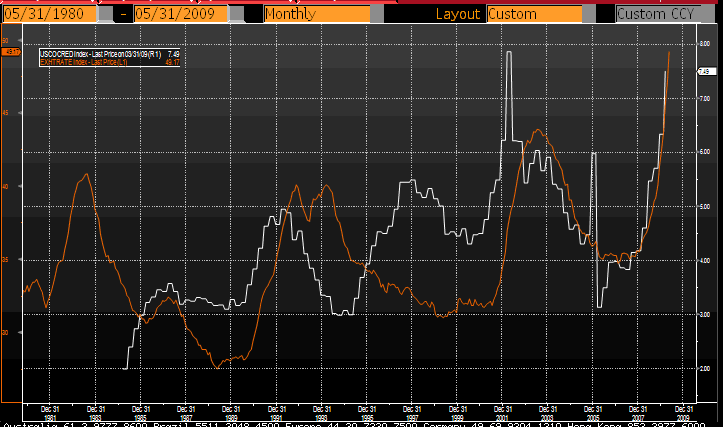
Barry Ritholtz at the Big Picture compares credit card charge off rates to the rate of people who have exhausted their unemployment insurance.


Meanwhile, Glenn Somerville at Reuters reports that initial unemployment claims rose by 15,000 to a seasonally-adjusted total of 627,000.
"Continued claims, which gauge how many Americans were still on jobless rolls after an initial week of claims, rose 29,000 to 6.738 million in the week ended June 13, the latest period for which the data was available."
12. ANOTHER STUDY LINKING US RECESSIONS TO PRICE OF OIL

Sheila McNulty at FT Energy Source reports that Steven Kopits of Douglas Westwood Energy research has released a study which notes that in the last 37 years the US has experienced seven recessions, and that oil has played an important role in each. "In every case when oil consumption breached 4% of GDP, he notes, the US has suffered a recession." Koptis also remarks that every time there has been a sustained rise of more than 50% or more in the price of oil, the US enters a recession. McNulty writes:
"From his research, then, it seems there are three rules by which to avoid recession caused by oil prices:

- Crude oil expenditures should not exceed 4% of GDP.

- Oil prices should not increase by more than 50% year-on-year.

- Oil price increases should not be so great that a potential demand adjustment should have to reach 0.8% of GDP on an annual basis, as shedding demand at this rate has generally been associated with recession."
Kotis' piece graphs nominal and inflation-adjusted crude prices from 1970-2009, shading the periods of US recession.


His work can be found here--well worth reading in full. Meanwhile, Grant Smith at Bloomberg reports that Barclay's Capital technical analysis that crude will fall to below $66/b after having broken through a "Ichimoku cloud" at $70.35/b.
"The so-called Ichimoku cloud is an area bound by two predictive lines on a general-overview chart, the investment banking arm of Barclays Plc said. Crude breached the lower boundary of this cloud at around $70.35 a barrel in New York on June 19, and oil may consequently be dragged towards a support layer around $66 and fall below that, the bank said.

'You still want to be looking to sell,' Barclays analyst MacNeil Curry said in a telephone interview from New York. 'In the sessions ahead, we look for a break of trend-line support at $66.83 to reignite the downtrend,' the bank said in a report."
This analysis comes from a different team, if I understand aright, than the one led by Paul Horsnell in London, which correctly predicted in May that prices were set to breach $70/b--see Daily Sources 5/14 #9.

Tuesday, March 31, 2009

Daily Sources 3/31

1. Chris Giles, Ralph Atkins, and Mark Mulligan at the Financial Times reported yesterday that the head of the OECD said Monday that there will be a 10% rate of unemployment by 2010 in all the developed economies, "practically with no exceptions."
"Angel Gurría warned that the ranks of the unemployed in the 30 advanced OECD countries would swell 'by about 25m people, by far the largest and most rapid increase in OECD unemployment in the postwar period.'"
(h/t Yves Smith at naked capitalism for this and a few other pieces listed.)

2. Julie MacIntosh, Francesco Guerrera and Bernard Simon at the Financial Times reported that Canadian Prime Minister, Stephen Harper, told the newspaper yesterday that Canadian banks should capitalize on their solid balance sheets to acquire assets in the US and other foreign nations.
"Mr. Harper indicated Canada’s banks could lead an eventual charge toward consolidation, and said he would support such efforts as 'an opportunity for Canada to expand its role in the world financial sector.'

'I’m not going to try running banks, but I hope our banks will see this as an opportunity to build the brand--the country’s brand, their own brand--and to expand their scope and profitability over time,' Mr. Harper said. 'I can assure you that the steps we’re taking in the financial sector will not be designed to promote greater protectionism.'"
3. Rick Carew at Deal Journal gives some details on the financing terms Aluminum Corp. of China [Chinalco] is getting for its proposed $19.5 billion investment in Rio Tinto.
"An SEC filing released Monday shows that policy lender China Development Bank is leading a syndicated loan by four Chinese banks offering the cash at 0.90 point more than the sixth-month benchmark London interbank offered rate. With sixth-month Libor rates at just 1.75% these days that means Chinalco, as the Chinese aluminum maker is known, is looking at payments starting at 2.65%.

That is cheap money compared with the roughly 9.25% coupon Rio is paying Chinalco on $7.2 billion of convertible bonds Rio issued under the deal. In short, Chinalco will pocket the 6.60-point spread between its cost of capital and coupon payments from Rio, though the spread could narrow if Libor rates rise on a global economic recovery. That demonstrates the government’s desire to keep Chinalco afloat despite it being highly indebted and its publicly traded subsidiary barely profitable."
Meanwhile, Bettina Wassener at the New York Times reports that Australian Treasurer approved a bid by Hunan Valin Iron and Steel Group to take as much as 17.55% in iron ore miner Fortescue for $438 million.

4. Richard K. Green at Richard's Real Estate and Urban Economics Blog drew up a graph of property prices against property rights in Asia:


"The X axis is a measure of property rights by country: property rights are weakest in Vietnam and strongest in Singapore and Hong Kong. Note the correlation. Even though the property rights index is only ordinal, it has a correlation of .78 with the price per square meter of a 120 square meter flat in the national and or financial capital of each country."
India is explained, per Prof. Green, by supply constraints. Well-worth a look. (h/t Mark Thoma at Economist's View.)

5. James Hookway at Real Time Economics reports that Vietnam's economy is managing to avoid the worst of the financial crisis. The Asian Development Bank released its forecast for Asian Pacific nations today and forecast that Vietnam's GDP will grow by 4.5% this year.
"There is now a brand new middle class in the country which didn’t exist before and its spending power has kept Vietnam chugging through the downturn. In fact, the ADB’s Hanoi-based economist Bahodir Ganiev told reporters earlier, 'when it comes to Vietnam, we actually should not use the word "downturn" or "recession". It’s just a slowdown.'"
6. Reuters reports that Ali Asghar Arshi, executive director for international affairs at National Iranian Oil Co (NIOC), told the newswire that Iran has made no allocation for diesel purchases in its budget starting March 21 on the expectation that increased natural gas production will cover the country's requirements.
"'We will substitute with gas from our network,' Arshi told Reuters. 'Because we now have new production from South Pars... and other fields.'

In the first three months of this year Iran imported as much as 5 million barrels of diesel, or around 55,0000 barrels per day (bpd), traders and analysts said."
FACTS Global Energy estimates that Iran imported about 550kb/d in 2007.
"Iran had taken advantage of cheaper prices to build inventories earlier this year, storing as much as 2 million barrels of gas oil [diesel] on ships.

Arshi said Iran had drawn down those inventories and would not continue stockpiling the fuel."
Blockading or otherwise putting a halt to Iranian imports of petroleum products has been mooted by various policy analysts as a way to put pressure on Iran. Meanwhile, Ali Akbar Javanfekr, the presidential advisor for press affairs to Iranian President Mahmoud Ahmadinejad, has an opinion piece in the Los Angeles Times today which is a response to President Obama's Nowruz greeting. Continuing in the vein of the March 22 speech by Leader of the Revolution Ayatollah Ali Khamenei, it begins by insulting the Democratic Party:
"America's Democratic Party has historically been less honest than its rival Republican Party. I hope President Obama can change this approach and that he will turn out to be the most honest US president of all."
He also repeats the message of Khamenei that Iran distrusts the rhetoric of change and will reserve judgment until it sees action--and in fact demands it:
"President Obama has proclaimed a policy of 'change,' and the American people have embraced it. But to remedy its image in the world, the US needs to truly change its past methods.

Change is mandatory for the US administration. For as history demonstrates, either you change, or you are forced to change."
The piece also reiterates the Iranian historical complaint against the US. It further makes the odd claim that Ahmadinejad is loved round the world:
"Mr. Obama expressed his country's willingness to see our Islamic Republic take its true position in the international community. This new approach by the United States is appreciated, but we would note that Iran already occupies a distinguished position in the international community. President Ahmadinejad is one of the most beloved dignitaries in the world, and freedom-loving nations in all corners of the Earth love Iran."
That said, the piece does indicate the willingness to engage in talks,
"The president expressed a willingness to talk openly with Iran's leaders. This willingness is promising. The Islamic Republic of Iran appreciates friendly behavior that stems from respect and courtesy toward other cultures and nations."
and
"Mr. Obama has talked about his commitment to creating constructive diplomatic ties between the US and Iran. He must first begin dressing the deep and old wounds inflicted on the Iranian nation and start to correct the misunderstandings created by the misconduct of previous US administrations in their actions against Iran."
Meanwhile, Mark Landler at the New York Times reports that Secretary of State Hillary Clinton confirmed today that Richard C. Holbrooke met in an unplanned meeting on the sidelines of a conference devoted to Afghanistan with Iran’s deputy foreign minister, Mohammad Mehdi Akhondzadeh. Clinton told reporters:
"It was cordial, unplanned, and they agreed to stay in touch. I myself did not have any direct contact with the Iranian delegation."
and
"The fact that they came today, that they intervened today, is a promising sign that there will be future cooperation.

The questions of border security, and in particular the transit of narcotics across the border from Afghanistan to Iran is a worry that the Iranians have, which we share."
The piece is worth reading in full. The State Department offered further clarification of the US position today:
"MR. DUGUID: I think the Secretary has answered the question that Iranian participation was welcome and that we wanted to make sure that this conference was one that included everyone in the region. Everyone in the region has a role to play to help Afghanistan. We should not look for, at this time, individual and uncoordinated approaches to Afghanistan. We should look for a regionally based and coordinated approach to dealing with the problems in Afghanistan and with Pakistan.

QUESTION: But Iranian action today in the conference criticized increased – troop increase––US troop increase in Afghanistan and kind of confronting this concept.

MR. DUGUID: The Iranians expressed their opinions. That’s what they were there to do. And we were there listening to what they had to say. We have gone through a 60-day intensive review of our strategy. We have come forth and laid that out for everyone. The conference itself was our first foray into an international fora to explain our policy and to show that this is – these are the reasons why we see this as being the best way forward. You cannot have a solely military solution in Afghanistan and our strategy recognizes that. That is why we are looking for an increase in resources not only on the military side, but on the civilian side, on the side of trainers for economic development, for other institutional-building and capacity-building efforts that we see as necessary."
It seems to me that Tehran regards cordial relations with the US as difficult to sustain, given the ideological self-justification of the regime. That said, it does seem that they are feeling the pinch of the growing possibility of being caught by a deal with Moscow regarding their nuclear program--and likely some pressure at home for reconciliation. Insofar as that is the case, they appear willing, as in the past, to cooperate on mutual interests quietly and, as much as possible, out of the public eye, but remain wedded to revanchist rhetoric. Meanwhile, President of Russia, Dmitry A. Medvedev, proffered a much more conciliatory tone in a piece published in the Washington Post today.
"Unfortunately, relations soured because of the previous US administration's plans--specifically, deployment of the US global missile defense system in Eastern Europe, efforts to push NATO's borders eastward and refusal to ratify the Treaty on Conventional Armed Forces in Europe. All of these positions undermined Russia's interests and, if implemented, would inevitably require a response on our part.

I believe that removing such obstacles to good relations would be beneficial to our countries--essentially removing 'toxic assets' to make good a negative balance sheet--and beneficial to the world.

This will require joint efforts. The exchange of letters between myself and President Obama this year showed mutual readiness to build mature bilateral relations in a pragmatic and businesslike manner. For that we have a 'road map'--the Strategic Framework Declaration our countries signed in Sochi in 2008. It is essential that the positive ideas in that declaration be brought to life. We are ready for that.

Possible areas of cooperation abound."
Medvedev also asserts:
"Neither Russia nor the United States can tolerate drift and indifference in our relations. I spoke in Washington last November about the need to put an end to the crisis of confidence. To begin with, we should agree that overcoming our common negative legacy is possible only by ensuring equality and mutual benefit and by taking into account our mutual interests. I am ready for such work with President Obama on the basis of these principles, and I hope to begin as early as tomorrow at our first meeting in London before the Group of 20 summit. "
Well worth reading in full. Further, Abdullah Gül, the President of Turkey, has a piece in the Wall Street Journal which argues for stronger efforts to establish law and order in Afghanistan.
"But more troops and more money alone will not be enough. The Afghan government needs military force to operate from a position of strength. But real improvement requires embracing every Afghan ready to work through peaceful means for the good of their country.

Political, diplomatic, economic, and social efforts must be increased and focused on consolidating national unity to bring about tangible improvement to people's lives. To have peace, we must win over the people.

There is a role here for the international community in enabling Afghan officials working to meet the basic needs of their people. Health care and education must both be top priorities. The country's civil service needs work. Its judiciary and police forces need to be strengthened. The people must come to believe that change is underway that will create a sense of normalcy for them."
Also well worth reading in full.

7. Munir Ahmad at the Associated Press reports that the newly reconstituted Supreme Court in Pakistan restored the province of Punjab to the main opposition party, under Shahbaz Sharif, the brother of the head of Pakistan Muslim League (N) Nawaz Sharif.

8. Edward Hugh at Fistful of Euros reports that the EU Economic Sentiment Indicator for the EU27 fell by 0.6 points to 60.3 and for the eurozone fell by 0.7 points to 64.6. The post looks at economic sentiment in most of the major economies in the region as well as Eastern Europe. However, "economic sentiment recovered slightly in the Netherlands (1.3) and (amazingly) in Spain (0.8)." Worth a look.

9. Brian Murphy at the Associated Press reports that Venezuelan President Hugo Chávez, upon setting foot in Qatar, proposed a "petro-currency" as an alternative to the dollar, to be backed by the oil producing nations.
"The idea never reached the full agenda of a summit of leaders from South America and the Arab League--and has little hope of gaining any momentum among the US allies in the Middle East."
Meanwhile, Daniel Cancel at Bloomberg reports that Venezuela, according to a resolution published today in the Official Gazette, will sell 2.68 billion bolivars ($1.2 billion) of bonds in the local market as part of an effort to fund the budget. The bonds will be sold in two tranches, will have a fixed coupon and mature between 2010 and 2016.

10. David M. Herszenhorn and Clifford Krauss at the New York Times report that a bill in the House, sponsored by Representative Betty Sutton of Ohio, seeks to give those trading in a new car for a fuel efficient model a $4,000 voucher if the car gets at least 27 miles per gallon and is assembled in the US. Cars assembled outside the US would qualify if they got at least 30 miles per gallon. Cars assembled inside the US getting 30 miles per gallon would receive a voucher for $5,000.
"Officials said the program could cost $2 billion or more depending on how long it operated. Ms. Sutton said the most important thing was to get the program started quickly. 'The urgency for its initiation is extraordinary,' she said."
The Senate version is slightly less generous. The Obama Administration indicted that it supported an effort along these lines on Monday.

11. Mark Pittman and Bob Ivry at Bloomberg report that the US Government and Federal Reserve have "spent, lent, or committed" $12.8 trillion, close to 2008 GDP.
"New pledges from the Fed, the Treasury Department and the Federal Deposit Insurance Corp. include $1 trillion for the Public-Private Investment Program, designed to help investors buy distressed loans and other assets from U.S. banks. The money works out to $42,105 for every man, woman and child in the U.S. and 14 times the $899.8 billion of currency in circulation. The nation’s gross domestic product was $14.2 trillion in 2008.'
The piece includes a useful balance sheet of commitments and expenditures. Worth a look.

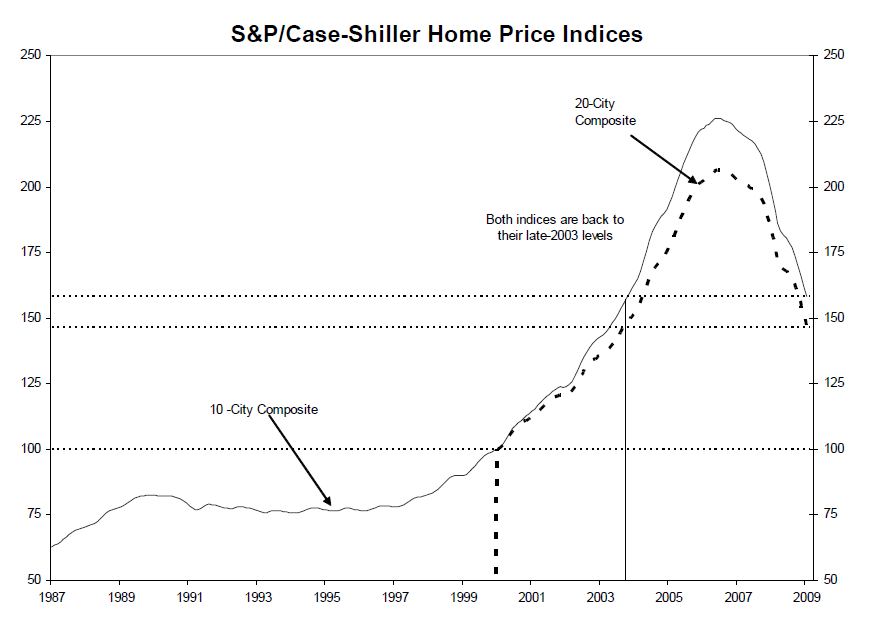
12. Barry Ritholtz at the Big Picture reports that Standard & Poor's Case Shiller 20 city Home Price Index fell at an annual rate of 18.97% in January. Prices have fallen to late 2003 levels as per an S&P graph:


Worth a look. The full S&P Case-Shiller US National Home Price Index can be found here.

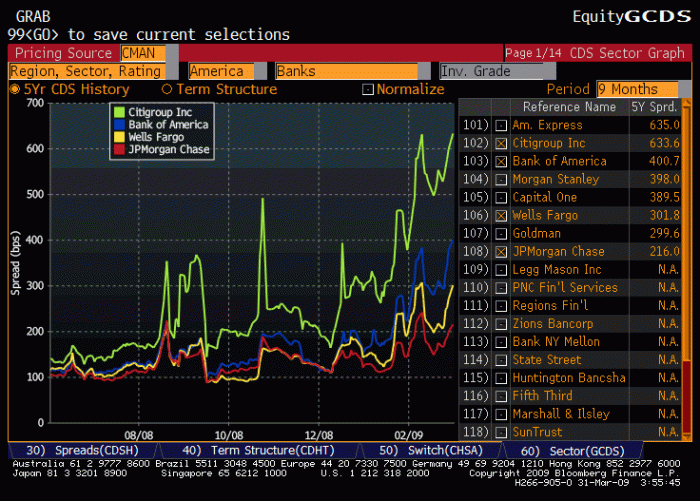
13. Simon Johnson at Baseline Scenario notes that CDS spreads are the highs last seen in early February.


14. Jeanne Meserve and Mike M. Ahlers at CNN report that the Federal Aviation Administration released its forecast today which sees the number of travelers using US airlines will fall 7.8% in 2009, the steepest decline seen since the period following 9/11.
"The short-term forecast is downbeat for virtually every segment of the aviation business, the Federal Aviation Administration predicted. Major airlines are expected to bear the brunt of the decline, with a projected 8.8% drop that would return them to passenger levels last seen in 1995.

Regional airlines will see business drop 4.5%, taking them back to volumes they had four or five years ago, while air cargo is expected to slide 2.8%."
Private industry analysts disagree with long-term analysis of the FAA that passenger levels will rebound in 2010.

15. Amartya Sen, in the New York Review of Books, has a piece which points out that historically "capitalism" can only exist in a framework of trust and rule of law--the tradition of keeping one's contracts, of course, obviating the need of recourse to the courts too often. Long, but should you have the time, worth reading. (h/t Justin Fox at The Curious Capitalist.)

Thursday, January 22, 2009

Daily Sources 1/22

1. Joel Martinsen at Danwei posted Tuesday that certain Chinese apparatchiks are pushing consumption as "patriotic" in local media outlets, and as a necessary means out of the current economic mess. The idea has roots in Marxist ideology, apparently, which the post outlines. There has been "push back," however in the Chinese media, including remarks in the Shanghai Daily, to wit:
"'Buy an apartment, and you are patriotic,' says a local Chinese official in her bizarre call to beggar the poor to bail out housing speculators.

Wang Aihua shocked the nation with her bold statement last Monday, delivered live on a local TV station in Hefei, capital of Anhui Province. Wang is the director of the city's urban planning bureau."
Well well well, all I can say is that reminds me of a certain someone's exhortation to go "shopping" in the face of another crisis, not so long ago. (h/t Carlos Tejeda, China Journal) But the screw hasn't finished turning, not by a long shot. Menzie Chinn reports at Econbrowser that the Bush Administration's take on the cause of the current financial crisis is that there has been a "Global Savings Glut," the actual subtitle of the section entitled "Origins of the Crisis" of the Economic Report of the President. An excerpt from the paper's executive summary itself:
"# The roots of the current global financial crisis began in the late 1990s. A rapid increase in saving by developing countries (sometimes called the "global saving glut") resulted in a large influx of capital to the United States and other industrialized countries, driving down the return on safe assets. The relatively low yield on safe assets likely encouraged investors to look for higher yields from riskier assets, whose yields also went down. What turned out to be an underpricing of risk across a number of markets (housing, commercial real estate, and leveraged buyouts, among others) in the United States and abroad, and an uncertainty about how this risk was distributed throughout the global financial system, set the stage for subsequent financial distress.
# The influx of inexpensive capital helped finance a housing boom. House prices appreciated rapidly earlier in this decade, and building increased to well-above historic levels. Eventually, house prices began to decline with this glut in housing supply."
My personal, non-economist, take is that the central banks of the developing world did finance US debt beyond what was credible, and that that did have the effect of lengthening an unsustainable boom in credit, and so there is some merit in the Administration's view. But, as I noted above, perhaps this had something to do with following the Administration's own prescription for a different crisis, altogether. Minzie, who is an economist, goes straight for the jugular:
"So, while I won't say that the idea of saving flows coming from East Asia had some role in the financial crisis we're now undergoing, I'd say one has to think about how those flows came about, as much as how big they are. We don't usually think of the rest-of-the-world driving macroeconomic events in the US ... and I still don't think it's time to start."
Well worth reading in full. Meanwhile, Yves Smith at Naked Capitalism pours cold water on the official Chinese GDP data for the fourth quarter, which show growth of 6.8%. Smith points out that power consumption in China was down 9.6% in November, after falling 4% in October, which is not consistent, usually, with pretty strong economic growth figures. She is waiting for the December power consumption numbers, before officially giving the statistics bureau a raspberry. (Chinn's piece came to my attention via Yves Smith as well, h/t.) Meanwhile, JR Wu at Real Time Economics has a piece on what recession looks like in China, examining the principle of "bao ba" or "protect the 8," the 8% GDP growth which conventional wisdom holds is the number below which you begin to see significant social unrest. The notion of "bao ba" apparently dates back to the Asian Financial Crisis. In 1989, the year of Tiananmen Square, GDP grew by 4.1%. Richard Herd, head China economist at the OECD, thinks that every percentage point decline in GDP equates to about 2 million job losses.
"According to Citigroup, China’s real GDP contracted 0.3% on an annualized basis in the fourth quarter from the third quarter — the first fall in at least 16 years. Morgan Stanley estimates China’s GDP fell 0.5% for the same period on a seasonally adjusted, annualized basis.

Goldman Sachs estimates that China’s economy grew 2.6% in the October-December period from the July-September quarter. The OECD puts the quarter-on-quarter growth for the same period at 0.3%."
Meanwhile, Paul Cavey, head of China economics at Macquarie Research has an opinion piece in Wall Street Journal Asia where he argues that the banking sector in China may, by instituting counter-cyclical policies, be setting the stage for a gigantic credit bubble.
"Whatever the dangers of a market-based system during a boom, it does have benefits on the way down. The caution of typical banks in downturns arises not just because they suffer capital shortages, but because economic risks increase. Having been tied in a knot of prudential and monetary restrictions, China's banks have had little opportunity to develop the skills needed to navigate this trickier environment.

In particular, there are worrying signs that, having avoided a credit bubble and bust during the boom, Beijing is now setting itself up for that cycle during the downturn. With a monetary expansion target of 17% in 2009 and the economy likely to expand 8% or less, the government is paving the way for exactly the sort of credit excesses that have already proved so damaging elsewhere. It is too early to be worried about this yet, but the result could be a future increase in nonperforming loans, and perhaps the need for a banking bailout with Chinese characteristics down the road.

So the rest of the world may be looking enviously at China right now. But as governments everywhere contemplate restructuring their own banking sectors, it is far too soon to conclude China offers the best model to follow."
This is particularly interesting to me because for a long time in foreign affairs circles the financial sector in China was regarded as especially vulnerable, only to watch Bank of America et. al. take huge stakes in partially privatized state-owned banks. Clearly a paradigm-shift has taken place if their public nature is to be envied. But it does give the gimlet eye to the notion of consumerism as the way forward and savings as hopelessly reactionary, does it not? Meanwhile, Rebecca Christie and Mark Drajem at Bloomberg report that Timothy Geithner, whose appointment as Treasury Secretary was cleared for a full vote by the Senate Finance Committee today, said that the new Administration believes that Beijing is "manipulating" the yuan.
"'President Obama -- backed by the conclusions of a broad range of economists -- believes that China is manipulating its currency,' Geithner said in the remarks posted on the committee’s Web site today. 'The new economic team will forge an integrated strategy on how best to achieve currency realignment in the current economic environment.'"
Senator Linsey Graham (R-SC) called the remarks "music to [his] ears". Graham sponsored legislation in 2007 which would punish imports from countries which have been found to "misalign" their currencies.

2. Chris Oliver at MarketWatch yesterday reported that Japanese exports were down 35% in December, following a 26.7% decline in November. "Exports to the US fell a record 36.9% in December on year, after declining 33.8% in November, the previous record. Exports to Asia were down 36.4%." Barclays Capital predicted that Japanese GDP would contract by 10.3% on an annual basis on the back of this and the news that industrial power consumption fell by 13% in December. In a follow-up story, Oliver reports that the Bank of Japan voted to keep benchmark interest rates unchanged at 0.1% today, and forecast that consumer price inflation would decline by 1.1% in fiscal 2010 and 0.4% in fiscal 2011.
"The board noted that conditions had "shifted significantly downward" from its outlook report published in October. Instead of expanding, the economy is likely to contract in the two years to fiscal 2010 before an expansion takes hold. Gross domestic product is expected to contract 1.8% in fiscal 2009 and 2% the following year."
3. Ian King and Patrick Hosking at the London Times report that the UK may be blocked from bailing out Barclays, because as a provision of the Abu Dhabi royal family's earlier infusion of capital, later dilution would be compensated for with additional shares.
"But the small print in the deal, in which Barclays raised £7.3 billion from Abu Dhabi and Qatar, means that if the bank raises fresh capital before the end of June, the Middle Eastern investors would receive a greater number of shares for their original investment without paying more. If Barclays were to raise fresh capital at last night’s closing price, for example, it would automatically hand almost 50 per cent of the bank to the Middle Eastern investors. The only way to get around the anti-dilution clause, should Barclays need more money before the end of June, would be if new capital was raised at more than the 153p-a-share at which paper issued to Abu Dhabi and Qatar is due to convert into Barclays stock.

This would mean that if the Government wanted to take a meaningful stake in the bank, it would have to do so by paying more than 153p for Barclays shares — which were trading at just 66.1p yesterday. The Treasury would face accusations of wasting taxpayers’ money were it to do this."
The clause was insisted upon by a certain Amanda Staveley, chief executive of PCP Capital a private equity firm which advised the Emirate on the deal. Worth reading in full.

4. Gabriel Gatehouse at BBC points out that the details of the gas contract between Russia and Ukraine have still not been made public.

5. Galrahn at Information Dissemination has an interesting translation of Russian military thinking on how it should change its approach in order to profit from soft power initiatives in the United States. As perhaps our analysis appears to Moscow, it does seem to demonstrate a large level of misunderstanding of how things work over here, but here is some of Galrahn's translation:
"The situation in American society favors the implementation of these plans. In many ways the United States today is reminiscent of the Soviet Union period of stagnation under Brezhnev. Militarism, foreign adventures, attacks on freedom of speech and human rights, censorship, the presence of the official ideology are evident. Multinational and multiracial American society does not have a common history and defines itself in terms of ideology, which is a more fragile foundation of national unity, rather than a common culture and history that binds cultures. If you choose to continue the comparison, the US, as in the Soviet Union, should be a peaceful ideological and cultural revolution. The challenge for Russia is to give impetus and direction to the process."
Some in Moscow apparently anticipate a color revolution in the US ... or its complete dissolution. Worth a look.

6. Dexter Filkins reports that NATO forces have effectively ceded much of southern Afghanistan to the Taliban. This is the NYT's map of unsecured areas, apparently:


7. Juan Cole at Informed Comment has a useful round up on the aftermath of the Israeli operation in Gaza. The Israeli Defense Force has issued a travel advisory to officers regarding travel to Europe, where several courts assert universal jurisdiction and where war crimes cases have been, or are in the process of being, filed.

This is not an idle concern, General Pinochet was prevented from leaving England due to an injunction filed by a Spanish judge on crimes against humanity charges. (Indeed, depending on how "activist" the various judiciaries in Europe are, this issue may trouble senior US government officials as well. It is important to remember in cases this charged with emotion the general view of what is just has the propensity to prevail over the written law and bilateral and multilateral treaties. As Chief Justice Oliver Wendell Holmes, Jr. once said, "The law is the will of he who the sheriff will obey." And, just now, Israel has a serious public relations problem on its hands.)

Cole points to Arab media sources reporting that Hamas is carrying out reprisals against "collaborators" in Gaza following the IDF's withdrawal. Evidently, Hamas is using the crisis to consolidate their power in the strip. Meanwhile, UN Secretary-General Ban ki-Moon visited Gaza and "demanded that nothing like the Gaza campaign ever be undertaken again ... and he said he would do what he could to establish accountability." Cole is not sympathetic to Israeli concerns, nonetheless, the post is worth reading in its entirety.

And, the dictator of Libya, Muammar Gaddafi has an op ed in the New York Times reiterating his call for a one state solution to the Israeli-Palestinian stand off. Key excerpts:
"The basis for the modern State of Israel is the persecution of the Jewish people, which is undeniable. The Jews have been held captive, massacred, disadvantaged in every possible fashion by the Egyptians, the Romans, the English, the Russians, the Babylonians, the Canaanites and, most recently, the Germans under Hitler. The Jewish people want and deserve their homeland.

But the Palestinians too have a history of persecution, and they view the coastal towns of Haifa, Acre, Jaffa and others as the land of their forefathers, passed from generation to generation, until only a short time ago.

Thus the Palestinians believe that what is now called Israel forms part of their nation, even were they to secure the West Bank and Gaza. And the Jews believe that the West Bank is Samaria and Judea, part of their homeland, even if a Palestinian state were established there. Now, as Gaza still smolders, calls for a two-state solution or partition persist. But neither will work."
"A key prerequisite for peace is the right of return for Palestinian refugees to the homes their families left behind in 1948. It is an injustice that Jews who were not originally inhabitants of Palestine, nor were their ancestors, can move in from abroad while Palestinians who were displaced only a relatively short time ago should not be so permitted.

It is a fact that Palestinians inhabited the land and owned farms and homes there until recently, fleeing in fear of violence at the hands of Jews after 1948 — violence that did not occur, but rumors of which led to a mass exodus. It is important to note that the Jews did not forcibly expel Palestinians. They were never “un-welcomed.” Yet only the full territories of Isratine can accommodate all the refugees and bring about the justice that is key to peace."
Worth reading in full. However, a key sticking point is that the raison d'etre of Israel is to provide a state which is majority Jewish, because the Jewish people have a history of being persecuted when they live in states which are not. Return is at direct odds with that purpose, as that would quickly lead to the Jewish population being a minority one in Israel--or, as Qaddafi would have it, Isratine. Meanwhile, Sue Pleming at Reuters reports that Gaddafi told students at Georgetown University via satellite link that:
"Oil exporting countries may move toward nationalization because of the rapidly declining prices. This is put on the table and is being discussed seriously,. Oil maybe should be owned by national companies or the public sector at this point, in order to control the oil prices, the oil production or maybe to stop it."
If Libya were to re-nationalize concessions recently parceled out, I imagine that might darken the legacy of what was considered one of the Bush Administration's more important foreign policy successes. That said, it wouldn't make much of a difference in terms of the global supply situation.

8. In a strange story, Maher Chmaytelli at Bloomberg reports that the oil minister of Algeria, Chakib Khelil, has said that Saudi Arabia will cut its production by 300 kb/d below its current OPEC quota.

9. Dulue Mbachu at Bloomberg reports that a draft bill sent to the parliament at Abuja would end all discretionary awarding of oil and gas contracts, mandating that all concessions be awarded via open bidding.
"A new national oil company [would] also be created to prospect for oil worldwide and raise funds from global financial markets. The country will set up a Nigerian Petroleum Directorate to develop policies and strategies for fossil energy and a National Petroleum Inspectorate to enforce policies and regulate technical and commercial aspects."
Open bidding could do much to restrain the wildly corrupt nature of doing business with the Nigerian government.

10. Eric Watkins at the Oil & Gas Journal reports that Petrobras will publish its new five year plan come January 26th--next Monday. Petrobras has moved back the date for the plan's publication several times in the last few months as it considered the changing oil price environment, likely critical to determining EROI on its new deepwater finds. (See Daily Sources 12/31 #13.)

11. The Calgary Herald reports that Daniel Yergin, head of Cambridge Energy Research Associates, said,
"Just on supply-demand, putting aside geopolitics, this surplus is going to last for a couple of years and that will have a dampening impact on oil prices. Right now, predicting oil prices is really predicting [GDP]."


12. In a bit of good news, the Baltic Dry Index, an indicator of global shipping levels and thus international trade, appears to be recovering somewhat, though it is still more than 80% below its height in 2008.


13. Samantha Young at the Associated Press reports that California Governor Arnold Schwarzennegar has sent a letter to President Obama, directly asking him to waive federal restrictions on new Californian vehicle emissions regulations. The EPA had refused to provide a waiver which would allow California to implement the new regulations despite the fact that they are stricter than the emissions requirements stipulated in federal law. (see Daily Sources 1/15 #18.)

14. Jack Healy at the New York Times reports that new home construction in the US fell 15.5% in December from November. The nation-wide unemployment rate has risen to 7.2%.

15. Damian Paletta and David Enrich at the Wall Street Journal write on alleged political interference in the distribution of TARP funds.
"Nonetheless, in December OneUnited got a $12 million injection from the Treasury's Troubled Asset Relief Program, or TARP. One apparent factor: the intercession of Rep. Barney Frank, the powerful head of the House Financial Services Committee.

Mr. Frank, by his own account, wrote into the TARP bill a provision specifically aimed at helping this particular home-state bank. And later, he acknowledges, he spoke to regulators urging that OneUnited be considered for a cash injection."
The Journal includes a map showing which states got the bulk of funds disbursed so far, which seems to correlate more or less to where the financial industry is located.


Still, it does seem to me that if our legislators really believe that we are in a crisis of such magnitude that over a trillion dollars in taxpayers funds are required for the safety of the entire economy that, perhaps, just perhaps, they should put aside pork and special interests in the interest of the nation as a whole. Is that really too much to ask? Is this view really naivete?

16. The EIA reports that US crude stocks jumped by a whopping 6.1 million barrels to 332.7 million barrels, well above the historical five year average for this time of year. That said, they are still below the highest stock levels seen in the last five years. According to a Bloomberg survey, analysts were expecting a 1.4 million barrel build. Gasoline stocks also rocketed up by 6.5 million barrels and now are a the top of the historical range. Analysts had expected a 1.8 million barrel build. Distillates stocks, by which the EIA mainly means stocks of diesel and heating oil, grew by 800,000 barrels, a bit more than Wall Street expectations of 500,000 barrels, and are well above the historical range. Taken in isolation, this should put considerable downward pressure on crude prices, but at the time of this writing, prices have recovered after falling a few dollars per barrel on the news.

Monday, December 1, 2008

Daily Sources 12/1

1. Ambrose Evans-Pritchard at the UK Telegraph writes that a Citibank report asserts that traders are paying close attention to rumors coming out of China suggesting that Beijing is considering "boosting its gold reserves from 600 tonnes to nearer 4,000 tonnes to diversify away from paper currencies." The report predicts that gold will go to $2,000/ounce, arguing that the economic crisis is so deep and widespread, and the remedial action required of governments so radical, that we are either in for an inflation shock once economies begin to recover or for a period of instability, unrest, and international conflict. Both would traditionally be good for the price of gold. (The Telegraph is not known for the sobriety of its commentary.) In a related story, Judy Chen and Belinda Cao at Bloomberg report that today the yen fell 0.7%
"after the People's Bank of China set the daily reference rate at the weakest level since August, prompting speculation policy makers favor a depreciating currency to spur demand for Chinese goods. ... The yuan has now lost all the gains it made since the [the US and China] last held trade talks in mid June, after it advanced 6.6 percent in the first half of 2008."
Maureen Fan at the Washington Post reports that Chinese President Hu Jintao told a politburo meeting this weekend that "'External demand has obviously weakened, and China's traditional competitive advantage is being gradually weakened' as international demand is reduced." Dow Jones reports that the China Federation of Logistics & Purchasing said that China's Purchasing Managers Index fell to 38.8 in November from 44.6 in October. A reading above 50 indicates growth, anything below indicates contraction.

2. Roland Jackson at the AFP reports that OPEC decided in their meeting in Cairo on the 29th to maintain the current production quotas. The organization is looking at data to see to what extent various members are exporting at quota. Reuters reports that OPEC President Chakib Khelil told the media that the commercial inventories of the OECD will likely reach 59 days of supply if OPEC doesn't take action in the December 17 meeting. "Latest estimates are that stocks are at 55-56 days of cover and several OPEC ministers have said they would like to cut inventories to 52 days."

On Saturday, Saudi King Abdullah said in an interview published in a Kuwaiti paper that "We think that a fair price of oil is $75/b." In the meantime, Reuters reports that Riyadh has shelved plans to restart the Dammam oil field, which was expected to produce 75 kb/d and 100 million cubic feet of natural gas a day. The contract was to be awarded in the second quarter of 2009. The AFP reported that Oil Minister Gholam Hossein Nozari told journalists on Sunday: "There is oversupply of two million barrels per day on the market ...." Ladane Nasseri and Ayesha Daya at Bloomberg report that today in Tehran Secretary General Abdalla el-Badri told the media that "Everybody is in favor of a cut in the Algeria meeting - we are all gearing toward a cut."

El-Badri also said,
"We told Russia that OPEC will take action to lower output, but the burden is heavy. Mexico and Norway have a decline by themselves, but Russia promised to join OPEC in trying to solve the problem."
If Russia does decide to coordinate a production, export, or effective supply cut to the oil markets, it will represent a tectonic shift in their global strategy. Since the Soviet Union began piping natural gas to Europe in the 1980s, Moscow has geared its energy policy to integrating itself with Europe and supplying its full productive capacity. China, another large consumer, also appears to be the beneficiary of that policy. Were Russia to decide its interests were more closely bound to the producing nations than to the consuming nations, a number of long-held policies might be revisited.

In a related story, Platts reports that Moscow has given the green light for a pipeline to be built connecting the Druzhba (or "friendship") pipeline to the Baltic Sea port of Ust-Luga. Ust-Luga is a port to the west of St. Petersburg in the Luga Bay. The map below gives an idea of the path of the Druzhba pipeline and where the Baltic Pipline System 2 would be placed, though it wouldn't terminate in Primorsk, but to the south west. The pipeline would have a 1 mb/d capacity upon completion. By late 2012 it would be expected to have 600 kb/d in capacity.


Of course, exporting via pipeline to Europe means that the crude can go nowhere else. Via tanker it could have any destination outside of Russia. In another related story, Sam Fletcher at the Oil & Gas Journal writes that GCES has a report that Moscow, at the urging of Prime Minister Putin, is in the process of reconfiguring their crude export tariff system. Under the new system the export duty would be determined by the 30 day average of the price for Urals crude ending in the middle of the month prior to implementation, as opposed to the current system which determines the tariff by averaging the price seen in the previous two months every two months. Though this system would certainly be an improvement, it does not on the face of it appear to be flexible enough to prevent financial losses to either the government or the companies given current volatility.

3. Nadim Kawach at Business 24/7 reported Sunday that Saudi foreign assets grew by about SR48 billion ($12.8 billion) in October, but grew at a rate of about 30% less than that seen in previous months. The Saudi Arabian Monetary Agency announced yesterday that the foreign assets held by the kingdom's central bank stood at SR1.679 trillion (~$448 billion) at the end of October.

4. Alex Nicholson at Bloomberg reports that VTB Bank Europe published its Purchasing Managers Index for Russia fell to 39.8, its lowest level, from 46.4 in October. These indices mostly measure market sentiment.

5. Jan Cienski at the Financial Times reports that the Polish Prime Minister, Donald Tusk, told him that Warsaw has no intention of accumulating huge debt in order to combat the financial crisis. Tusk indicated that Poland had not been deeply affected by the crisis so far. His comments align Poland with Berlin in regards to the stimulus package proposed by the European Commission last week. Warsaw on Sunday announced a stimulus package of 91 billion zlotys (~ $30.6 billion), but apparently very little of those monies represent new, previously un-budgeted, spending. Well worth reading in full. Simon Kennedy at Bloomberg reports today that "[Manufacturing indexes] for Poland, Hungary, Sweden and the Czech Republic ... showed some of the steepest-ever declines as recession struck their main export markets." If I remember correctly, the zloty has been under pressure as investors have repatriated their equity. (From June 1 to November 30, the zloty lost 26.8% of its interbank value versus the dollar.)

6. Eurointelligence reports that German Chancellor Angela Merkel secured the backing of her party for her policy of delaying any tax cuts until after the election in September 2009. Finance Minister Peer Steinbruck told Der Spiegel that he thought the crisis should not be countered with government money. The papers in Germany favor the government approach. Bertrand Benoit at the Financial Times reports that Merkel told her party conference that "Germany will keep analyzing the situation. We will always keep all our options open. I repeat: all options."

7. Pradeep Rajan at Platts writes that Gibson Shipbrokers released a report showing that Shell and Koch have taken out time charters of very large crude carriers mostly for storage purposes. Both Shell and Koch have long term contracts with producers, and given the current market, much of that oil, if refined, would put further downward pressure on refined products prices. They also may be inclined to capture profits afforded by the current steep contango in crude oil prices.

8. RIA Novosti reports that the Saudi Ambassador to Kenya told reporters that the Sirius Star will be returned to Saudi Arabia within two days. He also said that no ransom would be paid. Jeffrey Gettleman at the New York Times reports that the head of a Kenyan maritime association charged with mediating between the pirates who captured the Ukrainian freighter lugging 33 T-72 battle tanks, grenade launchers and anti-aircraft guns told the media that the pirates have agreed on a ransom. The ship is expected to be released today or tomorrow and the final ransom is estimated at between $3-5 million. In the meantime, Oliver Smith at the UK Telegraph reports that Somali pirates attacked a luxury cruise liner in the Gulf of Aden yesterday. The liner possesses a "long-range acoustic device" which apparently was used to drive off the attackers.

9. Sudarsan Raghavan and Saad Sarhan at the Washington Post report that Grand Ayatollah Ali Sistani expressed on Saturday concern about the status of forces agreement the Iraqi Parliament ratified earlier in the week. Sistani thought that much of the language in the pact was a "mystery" and that he could discern no guarantee of a return of sovereignty to Baghdad.

10. Rama Lakshmi at the Washington Post reports that anger, quite understandably, is building over the attacks in Mumbai, leading to the resignation of the Indian home minister. Efforts to console the families of victims by government representatives have been met with snubs. Preliminary investigations by Indian authorities lead them to believe that the gunmen were trained in Pakistan and came to Mumbai via boats on the Arabian Sea. This has led a senior representative of the Hindu nationalist BJP to say,
"'It is time for unilateral action against the training camps in Pakistan. If the U.S. can go into Afghanistan to punish the Taliban and chase Osama bin Laden, why should India hesitate?'"
Condoleeza Rice is being sent to New Delhi on Wednesday to try and help calm tensions. An FBI team has been sent to help investigate the scene. Pakistani representatives deny any link to the terrorists, but Candace Rondeaux and Craig Whitlock report in the Washington Post today that the Lashkar-i-Taiba, the Kashmiri terrorist organization currently thought responsible for the shootings, has been operating openly in Pakistan as Jamaat-ud-Dawa.
"Jamaat-ud-Dawa was instrumental in delivering aid to victims of the 2005 earthquake in Kashmir. ... The US government classified Jamaat-ud-Dawa as a terrorist group in April 2006, calling it an 'alias' of Lashkar. But the Pakistani government has not reciprocated and allows the network to raise money, run religious schools and offer social-service programs. It hosts an extensive Web site, with versions in English and in Urdu."
11. Christopher Toothaker at the Associated Press reported yesterday that Hugo Chavez is asking supporters to petition for a national referendum to abolish term limits in the Venezuelan Constitution.
"'Last year, when we lost the referendum, I said I should accept the majority's decision,' the former paratroop commander told a crowd of red-clad government supporters at a rally in Caracas. But now, he added, 'I say you were right: Chavez will not go.'"
12. Tim Johnston at the Washington Post reports that thousands of government supporters rallied in Bangkok this Sunday. Pro-government supporters are wearing red shirts. Anti-government: yellow. So far there has been little violence between the two factions, but there is growing anxiety about the possibility of it. Given that the anti-government protesters (or members of PAD) allegedly number about 20,000, it seems odd that they have managed to shut down so many arteries of the city for so long. Considering that the pro-government supporters are urban, they should outnumber the mostly rural PAD. However, Johnston notes, "The government has only tenuous control over the army and police, which seem to be following their own agenda, allowing the [anti-government] PAD to break the law with impunity."

13. Lauren Etter at the Wall Street Journal reports that Brazil's agricultural sector is slowing down as farmers are having a hard time finding the financing they need for fertilizer, pesticide, and seed. Brazilian farmers get most of their financing from multinational agricultural firms like Cargill, as opposed to from local banks. Evidently these firms are being tighter with credit as they try to conserve cash. Worth reading in full.

14. The Associated Press reports that the Fed is widely expected to cut the federal funds rate by 50 basis points (0.5%) in their next meeting scheduled for December 15-16.

15. Timothy R. Homan at Bloomberg reports that the Institute for Supply Management’s US factory index dropped to 36.2 in November, the lowest level seen since 1982. "[T]he UK’s Chartered Institute of Purchasing and Supply’s factory index was at 34.4, the least since the survey began in January 1992."

16. Emelia Sithole-Matarise at Reuters reports that the spread on 10 year US Treasury credit default swaps has widened to 68.4 basis points (0.684%) today. Evidently the notion of a US default is slowly gaining some credence in the market. (I remain confused, though, as to how these instruments would actually provide any insurance given that the CDS is denominated in dollars .)

Thursday, November 13, 2008

Daily Sources 11/13

1. Nipa Piboontanasawat at Bloomberg reports that industrial production in China rose 8.2% at an annual rate in the month of October. Though that sounds awfully rosy, it appears to be sobering news as no economist predicted that the rate would be that low. It is the smallest gain seen in seven years. Inflation fell to the lowest rate in 17 months. Credit Suisse AG forecast that the economy might expand by 5.8% this quarter, which is way below what analysts estimate is required for political stability because the number of jobs created would be significantly smaller than the number of new entrants into the job market. In a related story, David Philling at the Financial Times points out that statistics emerging from China are not especially trustworthy. Platts reports that Sinopec and PetroChina, China's largest refining firms, are cutting crude throughput in November. The numbers quoted seem rather small in relation to Chinese overall product demand, however.

2. David Jolly at the New York Times reports that the OECD forecast that the developed economies will enter a steep downturn soon. The OECD is a political organization--given that its member states want good news this kind of forecast is especially worrisome. Eurointelligence reports that industrial production was down September 2.4% year over year in the euro area. The decline is the largest seen since 2002. The worst deterioration seen was in Germany at -3.7%.

3. Kate Dourian and Aresu Eqbali at Reuters report that OPEC's Secretary General, Abdalla el-Badri, told the journalists that the organization will meet in Cairo on November 29, well in advance of the originally scheduled meeting in Oran for December 17.

4. Alexander Yershov and Dmitry Zhdannikov at Reuters report that Vladimir Putin has allegedly made it clear to Russian oil producers that they must resume exporting oil. Many companies started selling their crude domestically, as export duties had made international sales unprofitable. This is welcome news in the developed world, though I am guessing it is not driven by the desire to make folks in Brussels and Washington DC more amiable. It does come on the back of the decision by the European Union to resume strategic partnership talks with Moscow yesterday. Perhaps it can be said to represent Russia's determination to leave OPEC with the task of shoring up oil prices. That way, Russia's oil companies gain market share. However, it is more likely that the Kremlin has determined that the oil companies must subsidize the government's effort to weather the financial crisis, even if that means they must operate at a loss for some time. After all, many of them received considerable government aid, in terms of share purchases, last month.

5. In an interesting follow up to the story yesterday on the possible forthcoming Russian, Qatari, and Iranian cooperation in developing South Pars, Dmitry Zhdannikov and Jonathan Gleave at Reuters report that Deputy Prime Minister Alexander Zhukov told Russian news outlets yesterday that Russia was considering taking a 20% stake in Repsol, the private Spanish oil and gas company which was convinced to leaver South Pars under pressure from Washington DC due to fears of Tehran's nuclear program. The story quotes an analyst as suggesting that Gazprom might not be an especially welcome bidder in Madrid. Sarkozy's notion of using European sovereign wealth funds to defend strategic companies may find another taker in Spain going forward.

6. Hashem Kalantari reports that Iranian Oil Minister Gholamhossein Nozari signed a contract for natural gas imports with Turkmenistan today. FGE Energy recently argued that South Pars phases 9-10 needed to be completed this December if the country was to avoid a heating crisis this Winter. It appears this potential difficulty has been obviated.

7. Thomas Erdbrink at the Washington Post reports that Iranian political and military leaders are now sounding wary of talks with Washington now that Obama is the President-elect. (Obama has long telegraphed his willingness to talk to various rogue regimes without preconditions.) As I have noted in earlier posts, there are plenty of elements in Iran who would not be served politically by losing America as an enemy. After all, the real title of the "Supreme Leader" in Iran translates as "Leader of the Revolution". The Iranian Revolution was against the Shah, but the Shah was widely regarded by the clerics as a catspaw for the United States--the "Great Satan." That is, the Revolution was a revolution against the United States. Were there to be a detente, the revolution would lose its raison d'etre.

I think that President-elect Obama is right to indicate that the United States will talk to Tehran without preconditions. But I think he ought to indicate that DC is only interested insofar as Tehran feels there is a point in doing so. Washington shouldn't indicate any need for hurry--Iran is a significant force in the Middle East, but hardly an existential threat to the US or any of its interests.

The people molding policy in Iran have a very weak understanding of the United States. For example, key figures there thought that the powers that be "would not allow" Obama to become President of the United States. Their misunderstanding is exacerbated by an exaggerated sense of their importance on the international stage. Iran is absolutely significant and a critical strategic consideration, but leaders there seem somewhat of the opinion that their decisions are driving world events. This has been true since their determination that they essentially rigged the US election for Reagan by holding the hostages until after he was inaugurated. It will be difficult to conduct a productive bilateral discussion as long as this megalomania persists. The US should do nothing to encourage it.

The article is well-worth reading in full.

8. Afghanistannews.net reports that the King of Saudi Arabia, Abdullah Bin Abdulaziz Al Saud has held meetings with Afghani President Karzai and Pakistani President Asif Ali Zardari to discuss solutions to common problems seen on the Afghan-Pakistan border.

9. Dow Jones reports that Chinese aid of about $500 million promised to Pakistan during Zadari's visit to Beijing last week is due to arrive in Islamabad in the next two to three days. Saudi Arabia also just recently guaranteed crude for 6 months to Pakistan. This comes on top of closer ties between China and Riyadh.

10. The Associated Press reports that Sudanese President has offered a ceasefire in Darfur on Wednesday, including an offer to disarm militias operating in the region. Rebels, distrusting Kartoum's intentions, have refused an immediate ceasefire unless a peace framework is agreed upon.

11. Helen Chernikoff and Patrick Rucker at Reuters report that according to a monthly report by RealtyTrac foreclosure filings have risen by 25% annually in the month of October. "That means one in every 452 U.S. housing units received a foreclosure filing in October, the firm said in its report released on Thursday."

12. Candice Zachariahs at Bloomberg reports that Goldman Sachs expects the Yen to rise 6% against the dollar and 4% against the euro in the next three months. It seems that they expect the dollar to claw some of that back in six months, which may be an indication that they expect deflation to hit the US. On the other hand, it may not mean much as the currency markets are extremely volatile just now. At interbank rates the yen has risen 10% against the dollar since August 1st. The euro has lost 19% against the dollar in that time period.

13. The EIA's This Week in Petroleum showed that crude stocks were flat for the week ended November 7 at 311.9 million barrels, somewhat above the historical average. Gasoline stocks rose 2 million barrels, still at the bottom of the historical average. Distillate stocks were up 600,000 barrels, and are at about the historical average. Analysts had expected a 1.2 million barrel build in crude stocks, a 200,000 barrel build in gasoline, and a 700,000 barrel build in distillates. Taken in isolation it's a somewhat mixed bag, though the large gasoline build combined with flat crude stocks suggests that a lot of gasoline is going unsold, which would suggest that crude prices will fall.

Friday, November 7, 2008

Daily Sources 11/7

1. CJ Chivers and Ellen Barry at the New York Times report OECD observers in South Ossetia at the time the conflict began have called into question Georgia's narrative regarding the start of the war. The independent accounts have Georgia targeting the separatist capital Tskhinvali on August 7th with indiscriminate artillery and rocket fire. The notion that the United States encouraged adventurist behavior by a tiny, mafia-run, north Caucasian state in exchange for worsening relations with a major power with more than 5,000 nuclear warheads and the ability to actually deliver them to American soil is just beyond infuriating to me. To what end, exactly? What American interest could possibly be served by deliberately aggravating relations with Moscow?

2. Yves Smith has a very interesting post asking whether reports on the risks Swiss banks took in recent years has ruined Switzerland's status as a banking haven. Switzerland has been facing down inquiries by American and European fiscal authorities trying to determine whether their citizens were paying their taxes. The official policy of turning away tax investigators at the borders is one of Geneva's comparative advantages in the financial sector. But, if it turns out that Switzerland is forced to look for financial support from the international system, given that the central bank is not large enough to combat a systemic crisis on its own, will the Swiss be forced into a transparent banking regime?

3. William Sim at Bloomberg reports that the Bank of Korea lowered its benchmark rate by 0.25% (or 25 basis points) to 4%. This is the third time the bank has cut rates in four weeks and central bank Governor Lee Seong Tae said he stands ready to take further action if needed.

4. Rob Delaney's article in Bloomberg suggests that China's Finance Minister Xie Xuren may not attend the November 15 global summit on the financial crisis. (h/t Yves Smith @ naked capitalism)"Xie will not attend the Group of Twenty meetings in Sao Paulo, Brazil, this weekend, one finance ministry official said. Xie's attendance for next week's Washington summit on financial crisis is yet to be confirmed, the official added."

5. Brad Setser at Follow the Money reports that central banks are globally fleeing from risk and purchasing treasuries. Setser argues that the bottom can be called when the balance sheet of the Fed starts to shrink. Worth reading in full.

6. Platts reports that Devon has found new oil offshore Brazil in the Campos Basin.
x. Paul Krugman thinks that the latest economic data means we are sure to have a zero interest rate policy in the near future. That essentially means that one of the tools of the government to stimulate the economy will have been exhausted. I'm not sure if it means he expects inflation. He is referring to the Bureau of Labor Statistics report released today which shows that nonfarm payroll employment fell by 240,000, raising the unemployment rate to 6.5% from 6.1%. I think it is significant that 1.6 million people were marginally attached to the labor pool in October, 273,000 more than last year. "Marginally attached" workers are people who want a job and have looked for one in the last 12 months, but have not in the last four weeks, and so are not counted as "unemployed." Krugman also links to Stephanie Rosenbloom's article on the sharp decline in retail sales:
"Sales at Neiman Marcus, the luxury department store, dropped nearly 28 percent in October compared with the same month last year. Sales fell 20 percent at Abercrombie & Fitch, nearly 17 percent at Saks, 16 percent at Gap and nearly that much at Nordstrom.

Of the more than two dozen major retailers that reported on Thursday, most had sales declines at stores open at least a year, the majority of the decreases in double digits."
That, and Rex Nutting at Marketwatch's story that Goldman Sachs economists expect unemployment to rise to 8.5% next year and even higher in 2010. Goldman expects the Fed to cut the federal funds rate to 0.5% (from 1%) by December.