Showing posts with label 2008 elections. Show all posts

Tuesday, January 20, 2009

Daily Sources 1/20

1. Barack Obama was sworn in as President of the United States today. He has a tremendous amount of political capital here in the US--and abroad. The Associated Press carried the full text of his inauguration speech. Some excerpts:
"We will restore science to its rightful place, and wield technology's wonders to raise health care's quality and lower its cost. We will harness the sun and the winds and the soil to fuel our cars and run our factories. And we will transform our schools and colleges and universities to meet the demands of a new age. All this we can do. All this we will do."
"Restore science to its rightful place"--implying that the previous Administration did not have the proper respect for science. But, also, from the historical perspective, it is the restoration of the place of the Enlightenment in the world.
"As for our common defense, we reject as false the choice between our safety and our ideals. Our Founding Fathers, faced with perils we can scarcely imagine, drafted a charter to assure the rule of law and the rights of man, a charter expanded by the blood of generations. Those ideals still light the world, and we will not give them up for expedience's sake. And so to all other peoples and governments who are watching today, from the grandest capitals to the small village where my father was born: know that America is a friend of each nation and every man, woman, and child who seeks a future of peace and dignity, and we are ready to lead once more."
These words should have a powerful effect across the globe. Calling the Bush Administration the exception that proves the rule, and challenging those regimes to explain, if they can, how it is, were their views of the US true, Obama could have ever become President of the United States.
"Guided by these principles once more, we can meet those new threats that demand even greater effort — even greater cooperation and understanding between nations."
One of a series of foreign policy statements that give a broad sense of the stance the Obama Administration will take in the world.
"With old friends and former foes, we will work tirelessly to lessen the nuclear threat, and roll back the specter of a warming planet. We will not apologize for our way of life, nor will we waver in its defense, and for those who seek to advance their aims by inducing terror and slaughtering innocents, we say to you now that our spirit is stronger and cannot be broken; you cannot outlast us, and we will defeat you."
An important holding out of the hand to Moscow and a distancing from "the war on terror" rhetoric which is also much needed.
"To the Muslim world, we seek a new way forward, based on mutual interest and mutual respect. To those leaders around the globe who seek to sow conflict, or blame their society's ills on the West — know that your people will judge you on what you can build, not what you destroy. To those who cling to power through corruption and deceit and the silencing of dissent, know that you are on the wrong side of history; but that we will extend a hand if you are willing to unclench your fist.

To the people of poor nations, we pledge to work alongside you to make your farms flourish and let clean waters flow; to nourish starved bodies and feed hungry minds. And to those nations like ours that enjoy relative plenty, we say we can no longer afford indifference to suffering outside our borders; nor can we consume the world's resources without regard to effect. For the world has changed, and we must change with it."
Referring to Palestine, Iraq, and Iran. The notion of mutual respect is, of course, especially important if the Administration wants to pursue lines of cooperation and potential relations with nations like Iran. Essential to read in full, of course. Debbi Wilgoren and David Nakamura at the Washington Post write of "festive masses converging on the capital" today for the inauguration. Gabriel Schoenfeld, resident scholar at the Witherspoon Institute, has an opinion piece in the Wall Street Journal which reminds readers of the Democratic roots of the neoconservative movement. He argues that it is too early to say which way the Obama Administration's foreign policy will "really swing" and that he has an opportunity to gather support from "hawks." I read Obama's speech as giving little room for the narcissistic approach to the world of the neoconservative movement, but I agree that it is possible.

2. Thomas Erdbrink at the Washington Post reported that the head of the Iranian counter-espionage unit in remarks to the media warned the US yesterday not to spy on Iran.
"He described a 'full-fledged intelligence war' between the two nations and offered rare, detailed comments about what he described as 'heavy damages' suffered by the United States in efforts to recruit agents among doctors, artists and fashion designers in Iran.

The official, who was not named by local media, said two Iranian AIDS specialists, whose arrests last year sparked concern in the West, are part of a group of four 'ringleaders' who were recently convicted of involvement in an alleged U.S.-funded plot to overthrow the Islamic government. Dozens of others have been arrested and interrogated, the official said.

He accused the United States of stationing intelligence agents in neighboring countries, and specifically mentioned the United Arab Emirates, Turkey, Kuwait and Azerbaijan as places from where the United States is designing 'plots' against Iran. The agents are seeking to create 'social crisis, street demonstrations and ethnic disputes,' he said. 'A soft revolution has been programmed against our country and carried out in some instances, but it was suffocated in the cradle,' Fars News quoted the official as saying."
As I have pointed out in the past, xenophobia is enshrined in the Iranian Constitution. The government in Iran is a revolutionary government and the official title of the "Supreme Leader" is "Leader of the Revolution." Their raison d'etre is to rid the country of foreign control, and to that extent it needs the US--and others--as enemies, otherwise the cognitive dissonance between its purpose and the situation will undermine its ideological justification--and thus the political will to fight for the regime.

3. Brussels Gonzo at Fistful of Euros reports that Turkish Prime Minister Recep Tayyip Erdoğan gave a speech to the European Policy Centre in Brussels yesterday. Gonzo reports that the speech was rather long and actually somewhat demagogic in nature, blaming the French for holding up the pace of Turkish accession to the EU and threatening "to review Turkish support for the Nabucco pipeline if the Greek Cypriots were not forced to drop their objections to opening the energy chapter of Turkey’s accession treaty." The Nabucco pipeline would stretch from Turkey to Austria, Germany and the Czech Republic and the just resolved natural gas dispute between Russia and Ukraine has put it in the front of European energy policy priorities.
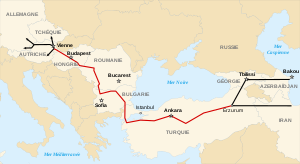


There is the possibility of Iran or Iraq providing gas to the pipeline, given that Turkish demand for natural gas is growing quite rapidly as well. Apparently, Erdoğan backed off on this threat later in the day with European Commission president Barroso. Erdoğan did emphasize his support for Turkish entry to the EU, however. Further, Platts reports that the German economy minister Michael Glos said at conference that Germany's energy future should be in clean coal as opposed to natural gas. Clean coal is mostly a fiction at this stage, but Germany does have considerable reserves. It is hard to see how, given current technology and Germany's climate commitments, clean coal could become a reasonable alternative in the near future, but the remarks do show how much the Russo-Ukrainian dispute is affecting German foreign policy direction. (Glos also reiterated his support for nuclear power at the meeting.)

4. Meanwhile, Upstream online yesterday reported that Noble Energy struck more than 460 feet of net gas pay at the Tamar-1 deep water well off northern Israel. The find is the largest in Noble's history and the reserves are at least equal to reserves of 3 trillion cubic feet. "Analysts estimated the estimated natural gas reserves were worth about $26 billion at current prices and will be sold starting in 2013." The well is 90 miles offshore Haifa.
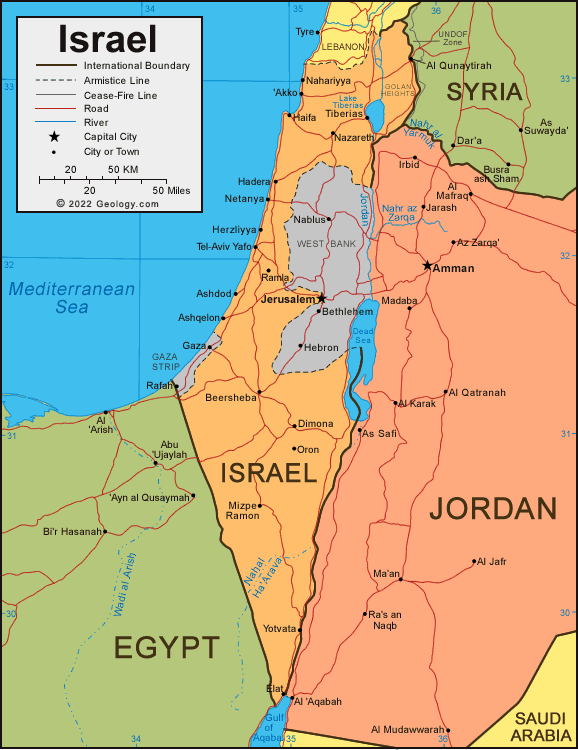


The Jerusalem Post reports that Lebanon was quick to respond to the news, warning Noble Energy that the reserve may in part be in Lebanese waters.
"In a meeting of the Energy, Infrastructure and Public Works Committee in the Lebanese Parliament, Chairman Muhammad Kabbani said Israeli media reports on the recently discovered natural gas reserve raise the possibility that the reserve extends to Lebanon's territorial waters. "We should take every legal measure possible in order to preserve Lebanon's right,' ... Kabbani [said.]

Kabbani added that he was concerned of the possibility that Lebanon would lose because 'Israel is the only country which is not a signatory to [international] maritime agreements.'"
Neal Sandler at BusinessWeek reports that the Israeli National Infrastructure Minister Benjamin Ben-Eliezer said that "The field can meet Israel's natural gas needs for the next two decades." An executive of the consortium that developed the field even predicted that Israel may become a net exporter of gas. Sandler reports that the find will likely spur a rash of oil and gas exploration off the Levantine coast. If further significant finds are made, or the Tamar-1 field proves large enough, Israel will in all likelihood seek to export any surplus gas to Europe via Turkey--and possibly the Nabucco pipeline.

5. Edward Yeranian at Voice of America reported that at the Arab summit in Kuwait yesterday, Saudi King Abdullah pledged $1 billion to help rebuild Gaza. Abdullah was joined by several other Arab leaders in calling on Israel to pursue the peace plan proffered in the 2002 Arab summit. (Riyadh has been reemphasizing their commitment to the 2002 plan recently, including an op ed by former Saudi head of intelligence and ambassador to the US Turki al-Faisal in the Washington Post in December. see Daily Sources 12/26 #6.)

6. Eurointelligence reports that the European Commission forecast a deep, but short, recession for the eurozone.
"The forecast numbers for 2009 are predictably bad. Euro area growth to fall 1.9%, Germany a little worse, France a litte better. Ireland’s economy will collapse by 5%, and Latvia even by 6.9%. But the European Commission is optimistic about 2010, when the Commission forecasts a resumption of a positive, though still subdued, euro area growth rate of 0.4%"
7. Stefan Collignon at the Financial Times argues that the German stimulus program is designed mostly to improve its comparative advantage via increasing labor cost competitiveness, thus pursuing export growth as a way out of the financial crisis and at the expense of Berlin's neighbors. Key excerpts:
"[The] immediate effect of the stimulus program] on private consumption is weak. A person with an annual income of €25,000 will be able to spend an extra €136.67. A Keynesian stimulus alone was not palatable to supply-side-oriented German “ordo-liberals”, the high guardians of the German social market economy. They sought to strengthen German competitiveness. Most importantly, payroll taxes and social insurance contributions were cut with the aim of reducing wage costs. In an economy dependent on manufacturing for the world market, that seems reasonable. However, there comes a point where improving one’s competitive advantage becomes malign. Germany has now reached this point."
"[Germany's] trade surplus with partners in the European Union has more than doubled over the past decade and amounts now to more than 5 per cent of GDP. At the same time intra-European trade balances have deteriorated for all of Germany’s immediate neighbours.

This development must stop. Competitive tensions are increasing rapidly and could soon reach the tipping point where the euro and the single market fall apart. The gleeful policy consensus in Berlin (“We are world champions in exports”) resembles the last dance on The Titanic, moments before it hit the iceberg."
Worth reading in full.

8. Svenja O’Donnell at Bloomberg reports that UK consumer prices rose 3.1% in December from a year earlier, down from 4.1% in November. Still seems pretty high to me, but folks are already mooting the idea of wage cuts, arguing that deflation is still a concern.

9. Michael Schwirtz reported yesterday that Russian human rights lawyer Stanislav Markelov was assassinated last night in what appears to have been a contract killing. A freelance reporter highly critical of the government, who was with Schwirtz at the time, was also murdered.
"Mr. Markelov, at the news conference just before his death, told reporters that he might file an appeal to the European Court of Human Rights against the early release of [Yuri D.Budanov, a former Russian tank commander imprisoned for strangling a young Chechen woman in his quarters and] who was a decorated colonel of the Russian Army before he was stripped of his rank. In an interview last week with The New York Times, Mr. Markelov said he might also file a lawsuit against the administration of the prison that released Mr. Budanov last Thursday."
10. Li Yanping at Bloomberg reports that the Chinese official urban unemployment rate rose to 4.2% in the fourth quarter of 2008, up from 4% in the third quarter.
"The official figure understates unemployment because it doesn’t include those who aren’t registered, including migrant workers. The state-backed Chinese Academy of Social Sciences said the rate including migrant workers may be higher than 9.4 percent in 2009."
11. Joel Martinsen at Danwei reports that
"According to a set of statistics I consulted, the number of bloggers in China exceeded 100 million in 2007. Phenomenally-popular finance blogger Xu Xiaoming was the 'hit king' of Chinese blogs in 2008 with 355 million hits. Other statistics predict that between 2012 and 2015, China will see blogs with hit counts of 1 billion."
An advertisers dream. But it will be hard for Beijing to control the flow of information given those numbers. (h/t Carlos Tejada at China Journal)

12. Reuters reports that the Bank of Canada today cut its benchmark interest rate to 1%.

13. Andres R. Martinez at Bloomberg reports that Petroleos Mexicanos (Pemex) likely extracted about 2.8 mb/d in 2008, down 9% from 20007, when it extracted 3.08 million barrels. Mexico City is considering how best to bring in private industry to help increase its crude oil productivity and exploration efforts. It is the third largest exporter of crude to the US.

14. Gareth Chetwynd at Upstream online reports that ExxonMobil notified Brazilian authorities that it has found oil in a deep water sub salt field in the Santos Basin. The prospect is in block BM-S-22 on the southern flank of the super-structure known as Sugarloaf which some petroleum geologists think might have as much as 10 billion barrels of recoverable oil.


15. Nick Bunkley at the New York Times reports that Fiat agreed to take a 35% stake in Chrysler today. Meanwhile, Russ Dallen at the Latin American Herald Tribune reports that GM will invest $1 billion of its bailout money in Brazil in order to avoid the troubles it faces here in the US. (!) (h/t Robert Oak at the Economic Populist)

Thursday, October 16, 2008

Daily Sources 10/16

1. Yves Smith at Naked Capitalism has a series of links to articles investigating the effect the inability of cargo shippers to secure letters of credit is having on the shipping industry and, by extension, international trade. Evidently yesterday Tom Albanese, Rio Tinto’s CEO, provided more anecdotal evidence that China's demand for commodities is slowing down.
Peter Norfolk, director of research and consultancy at London-based Simpson, Spence and Young shipbrokers, said: “You face continued freezing of activity because of the problems with credit in particular.”
Pacific Basin Shipping Ltd., Hong Kong's biggest dry-bulk carrier, and Precious Shipping Pcl. said demand for moving coal, iron ore and other commodities will fall because banks are guaranteeing fewer loads.
This is resulting in US cargos of grain sitting in buyers' ports waiting to offload because importers are unable to obtain letters of credit with which to purchase the cargoes. It seems to me that if this becomes a real problem, where people are facing hunger as a result, the banks will see various governments getting involved in this business. I can't imagine this would be the financiers' goal, given that this is an especially low risk--as I understand it--part of their business operations. It doesn't make a hell of a lot of sense.

2. Michael Steen at the Financial Times reports that the Unico Banking Group, which represents eight banks with 21% of Europe's retail banking market, said Wednesday that they will resume unsecured lending of up to three months at LIBOR. Evidently calls for the private sector to begin making good on the efforts of the central banks to provide security are having an effect.

3. Shobhana Chandra at Bloomberg reports that US industrial production fell 2.8% in September.
This was the biggest decline since 1974. For the third quarter, industrial production fell 6%, which is the most seen since 1991. However, analysts basically think the data represents a decline in production brought on by Hurricanes Ike and Gustav. Further mitigating news is that consumer price inflation was flat last month.

4. Nelson D. Schwartz at the New York Times reports that the Swiss National Bank extended a $60 billion lifeline to UBS.
"$31 billion in American assets will be taken over by the Swiss National Bank, much of it in the form of debt linked to subprime and Alt-A mortgages, in addition to securities linked to commercial real estate and student loans. An additional $18 billion worth of non-American assets will also be transferred.

The Swiss government will also provide UBS with 6 billion francs in exchange for bonds convertible into a nonvoting 9 percent equity stake."
Credit Suisse turned down the offer of government help, preferring to raise capital via private funding sources. Credit Suisse plans to raise $8.75 billion and potential creditors include the Qatari Investment Authority. The government also announced that it plans to increase its maximum deposit insurance shortly.

5. Anthony Faiola and Karen DeYoung at the Washington Post report that Pakistani President Asif Ali Zardari arrived in Beijing Tuesday for a four day visit. The President is there partially to see if it can secure a loan to cover upcoming purchases of food and oil to the country, given that it only has enough reserves left for a month's worth. A request for forebearance on petroleum import payments from Saudi Arabia made in July have so far gone unanswered. Zadari has said he needs $100 billion in credit and, as I have pointed out in an earlier post, he is known in his home country as Mr. 10% for the corruption charges levied against him. Given the propinquity of Pakistan to China, Beijing may feel more obliged to do something to shore up the situation in Pakistan. However, the fact that President Zadari feels the situation is secure enough to allow international travel suggests a level of stability inconsistent with imminent state collapse.

6. Xinhua reports that the two-day EU summit has produced draft conclusions which include a commitment to strengthening energy supply security. More specifically, the draft endorses efforts to speed up energy infrastructure connections in the Baltic. The Union will seek to further develop its ties to producer and transit nations. A meeting of Caspian Sea producers and transit countries will be organized by the Czech Presidency of the Union next spring. Platts reports that the European Biodiesel industry today asked the EU to require the detailed registration of all biodiesel imports from the United States. The industry claims that the EU imported 900,000 tonnes of biodiesel from the US last year, or about 18.4 kb/d.

7. Kate Dourian at Platts reports that OPEC has moved up its emergency meeting from November 18 to October 24. Ahmed Rouaba at Bloomberg reports that OPEC President and Algerian Oil Minister Chakib Khelil told journalists that the "ideal" price for crude is between $70-90/b. Iraqi Oil Ministry spokesman Assem Jihad said that $100/b was a fair and reasonable price for both producers and consumers, as per the AP. Alonso Soto at Reuters reports that Ecuador's Oil and Mines Minister Derlis Palacios said today that OPEC should cut production. Ecuador, though tied to Chavez politically, has generally taken a moderate stance on price recently. Maher Chmaytelli at Bloomberg reports that the Qatari Oil Minister Abdullah al-Attiyah said OPEC will cut production by 1 million barrels or more come October 24. Qatar is generally not hawkish on price and this echoes PFC Energy's prediction yesterday. Iraq joins the list of OPEC countries that have reported they will need to revisit their 2009 budget today. Sinan Salaheddin at the Associated Press reports that the Iraqi Finance Ministry said yesterday that it will likely have to scale back its $79 billion budget on lower oil prices. This comes on top of political rhetoric in the US regarding the costs of the Iraqi war. Taken in isolation these items should provide some support to the price of oil. The growing spread between front month and December 2016--at around $14/b last I looked--may partially be explained by these OPEC signals. Ole Petter Skonnord at Reuters reports that non-OPEC producer Norway announced today that it has no plans to reduce output on the declining price.

8. Juan Forero at the Washington Post reports that Chavez has ramped up the fear factor in preparation for upcoming elections.
Documentaries on the CIA-supported coup of Chile's socialist president, Salvador Allende, in 1973 are daily fare on Venezuelan state television, with pundits warning that the same could happen here. One recent program included excerpts of the 1997 Barry Levinson film "Wag the Dog," in which a Washington spin doctor hatches a war. Carlos Lanz, an associate of the president, provided commentary, explaining that the film showed how the United States topples governments.
The Russian naval maneuvers are seen as an effort to warn off an impending US invasion of the country. Pretty far-fetched. I guess it is fair to say it is straight out of Bush's playbook.

9. RIA Novosti reports that the Russian Federal Antitrust Service (FAS) announced it would take legal action against the five largest Russian crude producers unless they reduced their product prices inside the country. I am not clear on whether the FAS is working at cross-purposes to the Kremlin here or not. It is an interesting item. Russian product prices are slightly below market rate--or they were a few months ago.

10. The EIA reported that crude oil stocks grew by 5.6 million barrels for week ended October 10. This is at the middle of the historical range and against analyst expectations of a 3.1 million barrel build, as per Platts' survey Tuesday. Gasoline stock grew by 7 million barrels versus analyst expectations of the same 3.1 million barrel build. Though stocks are still below the historical average for gasoline, they are much closer to the historical band than they were in the last two weeks where stocks dropped to their lowest levels since 1967. Distillate stocks dropped by 0.5 million barrels and are slightly below the historical average. Taken in isolation, this should put downward pressure on the price of oil.

Thursday, October 9, 2008

Daily Sources 10/9

1. James R. Hagerty and Ruth Simon at the Wall Street Journal report that 1 in 6 homeowners are "under water"--the market value of their homes is less than their mortgage. Look at the interactive map on the Journal's site it seems the states hit hardest by this are California, Florida, Arizona, and Michigan. McCain's campaign just abandoned Michigan. Arizona is his home state. Florida is of course the key swing state. More evidence that Obama is likely to be the next President of the United States.

2. The Wall Street Journal's editorial board has a comment today entitled "Dmitry's Diatribe: Chavez, Ahmadinejad, Medvedev." It notes that yesterday in Evian, France, President Medvedev said that the US missed a chance to build a democratic world order after 9/11. It quotes him as saying, "Sovietology, like paranoia, is a very dangerous disease, and it is a pity that part of the U.S. Administration still suffers from it." Evidently the Wall Street Journal's editorial board does not think these are fair criticisms; the inferred critique is that Russia continues in its "defiance." I would note that the notion of defiance includes the notion of authority, which the US does not have in a legal, or sovereign, sense over the world. Indeed, it is standard American foreign policy to reject the--rather quixotic--notion of an international legal authority.

I would also point out that George Bush did squander America's moral authority after 9/11 with the foolish use of American power ... and that the Wall Street Journal led the cheer as he did it. Perhaps that is why the Wall Street Journal is so sensitive about the critique. Moreover, domestic critics of this stupid use of power were--and are--branded traitors. I guess you can't quite label Medvedev that. However, as an American, I think that there is a good argument that the cheerleaders of the Bush Administration and its war in Iraq themselves were traitors. The campaign to sell the Iraq war to the American public very clearly aided and abetted our enemy: al Qaeda. I personally am reluctant to go that far. But after all the inflammatory rhetoric coming from the right over the last 8 years, I really wouldn't be surprised if the argument surfaced elsewhere and if it had legs.

But, insofar as the question of Russia goes, the United States wins nothing if the Kremlin is demonized in the American political dialogue. It is not in America's national interest to subordinate our relationship with Moscow to the vagaries of the American political argument. Medvedev is right to argue that old Sovietologists represent the bulk of the analysis on Russia, because there is less status and money in understanding Russia than there was during the Cold War. Surely the Wall Street Journal editorial board can understand the economic underpinnings of rhetoric--that, after all, is their specialty. It should not be the ambition of the American press to push the country into decision trees similar to Ghadaffi's. It's rough seas for the papers, but even if alarmist language serves to sell papers in the short term, it ain't gonna help the balance sheets of the sector in the long term if the country becomes a banana republic as a result!

John Roberts, a Energy Security Analyst for Platts, has a decent summary of the question of energy security from the perspective of Europe. It seems more and more evident that some political elements in Europe are being tempted by Moscow's evident call for a realignment towards the East on the part of Brussels. Tara Bahrampour at the Washington Post reports that Russia removed its troops from positions in Georgia proper two days ahead of schedule. Tblisi says that the troop withdrawal is not yet complete. This deference to European opinion is taking place in stark contrast to the naval exercises taking place with Caracas.

As former Secretaries of State Kissinger and Schultz--both of whom could hardly be characterized as soft on Russia--argued just yesterday, now is the time to emphasize the shared interests of Washington, London, Brussels, Berlin and Moscow, not to invent bogeyman for short term political advantage. As it is, it is the G7 that meets this Friday to discuss the crisis, not the G8. Given the criticism of the US coming from the emerging markets on the cusp of the meeting reported by Blaine Harden at the Washington Post, this may actually be doing Russia the favor of disassociation while, at the same time, making it more difficult for us to persuade Moscow of our views. Neil Irwin at the Washington Post reports that in addition to the central banks mentioned yesterday, the total number of central banks that simultaneously cut benchmark lending rates came to 21. No roster of participating countries was provided. Today the central banks of South Korea, Taiwan and Hong Kong also cut their benchmark lending rates.

3. Reuters reports that the Managing Director of Iranian petrochemical company Qeshm Energy told an industry conference in Amsterdam today that Iran would likely favor Asian buyers of their gas to Europe. I only link to this because:
a) Just now, Iran isn't selling its natural gas to anyone ... but Turkey. It is simpler to expand the existing pipeline infrastructure towards the West than eastwards.

b) Given the financial requirements of any major natural gas project, just now neither Asia, Europe, nor the US are likely financiers of Iran's projects, because they never seem to go anywhere and money is tight. By dithering forever on South Pars and deliberately feeding the rhetorical fire over its nuclear program, Iran missed the low cost moment in terms of developing South Pars for the medium term, at least. Iran missed the boat and is trying to disguise this.

c) Iran knows, just as Russia knows, that tying Europe's economy to Iranian gas supplies increases their security vis-a-vis Europe. Just now Iran is not particularly concerned about military security issues coming from China or India, though this may change. The Iran-Pakistan-India pipeline is effectively dead right now, mostly because of Pakistan's dire situation and the never ending argument over price. (Will Iran provide Zadari with the $100 billion he is asking for? Short answer: no.)

d) Evidence that Iran is becoming a bit more compromising--even desperate--regarding natural gas projects ... Ladane Nasseri article in Bloomberg today reporting that Iran has offered to jointly develop the disputed Arash natural gas field with Saudi Arabia and Kuwait.
And thus this statement can be dismissed as diplomatic bluster and not an honest assessment of the political-economic possibilities of Iran's natural gas exports.

4. Bloomberg reports that Libya has stopped oil deliveries to its refining unit Tamoil in Switzerland. Tamoil's 50 kb/d capacity Collombey refinery provides about 20% of Switzerland's oil supply. The story is that this is in retaliation for the arrest in July of one of Ghaddafi's sons for misbehavior in a Geneva hotel. If so, it is a fine example of a nation behaving contrary to its national interest, either out of the simple emotional pique of a dictator or due to domestic political considerations. (That is the arrest if left unanswered might have been seen in Tripoli as a sign of weakness that could have undermined Ghadaffi's position.)

5. More evidence of an economic slow down in China: Weilyn Loo's Platts report that a gigantic jet fuel arbitrage trade from Asia to Europe is forming. Jet fuel is the only real petroleum product with a global market, because there are only two commercial specifications globally and they are very similar. (Specifications meaning legal requirements as to the quality and characteristics of the fuel.) So, were gasoline demand dropping, it would not necessarily be simply a matter of shipping it to Europe if stocks were overflowing, because specifications are different.
With the current steep contango in Asia, it does make sense to store jet fuel, but the fact that traders are sending barrels to Europe suggests tanks are full to the brim, sources said.

[Spot] demand from top consuming nation China has slumped post-Olympics. China's jet fuel import demand, which is closely tied to jet fuel produced by domestic refineries, is expected to come in around 1 million mt (~ 86 kb/d) for Q4 and could remain around this level going into Q1 2009, trade sources said.
6. The Associated Press reports that OPEC will meet ahead of schedule on November 18th to discuss a response to falling oil prices.

7. The World Bank released a report today entitled “Rising food and fuel prices: addressing the risks to future generations”. It states that high food and fuel prices will increase the number of malnourished people in the world by 44 millions, to 967 million.

8. Chika Amanze-Nwachuku and Ejiofor Alike at This Day report that the crippling of a feeder pipeline to the Kaduna Refinery may bring petroleum product production to zero in November, from running at 30% capacity. Petroleum product imports have already created a budget crisis of sorts in Nigeria.

9. Edmund L. Andrews and Mark Landler at the New York Times have the story that the Fed is considering using the funds entrusted to it by Congress to purchase equity shares in troubled banks, thus recapitalizing them. It seems that a fairly large share of the economist community are of the consensus that capitalization is the real problem facing the financial community, more so than a liquidity crisis.

10. Glenn Kessler at the Washington Post reports that North Korea banned IEAE inspectors from the Yongbyon nuclear complex today. This is in response to the US refusal to remove Pyongyang from the state sponsors of terrorism list.

Wednesday, October 8, 2008

Daily Sources 10/8

1. Nancy Trejos at the Washington Post reports that $2 trillion has been wiped out of retirement accounts in the US.
According to a survey released yesterday by AARP, 20 percent of baby boomers stopped contributing to their retirement plans in the past year because they have had trouble making ends meet.
This news makes me think I can predict with nearly complete confidence that Barack Obama will be the next President of the United States. In a previous blog I provided an analysis of how his election would affect America's geopolitical situation, but could not have expected that he would have been elected to the position on top of such a tremendous mess. Figuring out just how this crisis will play out geopolitically generally and in terms of specific nations is no small puzzle. But I do think that Obama would return some confidence to the markets worldwide, and as such, may do something to alleviate the situation we have found ourselves in. There was some good news today, AP reported that pending home sales rose 7.4% from July to August as per the National Association of Realtors. The index of pending sales reading is at the highest seen since July 2007.

2. Naked Capitalism has a post on Arvind Subramanian's proposal for a bail out of the American financial system by China published in the Financial Times yesterday. He suggests that the People's Bank of China could lend the US $500 billion (of its $1.8 billion cash reserves) on the condition that the money only be used to recapitalize the banks (as opposed to providing liquidity by purchasing toxic assets, as our current emergency financial stabilization fund is structured to do.) Yves Smith thinks the tongue in cheek plan makes a lot of sense. In today's Washington Post, Subramanian and C. Fred Bergsten have an op ed arguing that a globalized crisis "requires a globalized response." Well, just in time for ...

3. Carter Dougherty and Edmund L. Andrews at the New York Times report that the Fed, the European Central Bank, the Bank of England, and the central banks of Canada and Sweden all coordinated a cut in interest rates of a half percent. Switzerland also cut its benchmark rate and Japan publicly supported the move, though it left its benchmark rate of 0.5% (if I remember correctly.) (The yen is rapidly approaching the landmark 100 per dollar rate (interbank).) China also reduced its benchmark lending rate by 0.27%.

4. Nigel Morris, David Prosser and Sean Farrel at the Independent report that Downing Street has arranged a £50 billion rescue fund for the British banking system.

5. Denis Maternovsky at Bloomberg has the story that Russia, Indonesia and Ukraine shut down their stock markets today in the face of massive sell offs. Russia's RTS bourse will be shut indefinitely. MICEX will be closed until Friday. Jakarta's exchange will shut indefinitely, or so I have been led to believe.
Hungary headed for its worst daily decline since 1999 as the Budapest Stock Exchange fell 6.3 percent. Latvia's OMX Riga Index lost 6.5 percent to its lowest level since January 2004. India's Sensex index slid 2.6 percent and China's CSI 300 Index fell 3.8 percent, its third day of declines. South Korea's Kospi Index lost 5.8 percent.
6. From a panel discussion at the Council on Foreign Relations featuring Nouriel Roubini, Brad Setser, Benn Steil and Mort Zuckerman on September 25:
ROUBINI: So what you have to ask yourself is whether the sharp falling U.S. private consumption demand -- is there enough domestic private demand in the rest of the world in emerging markets that can grow to suspend global economic growth, and my answer is no because, you know, in U.S. the total consumption's about $9.5 trillion. Take the entire consumption of 1 billion Chinese, it's about $1 trillion. Take all of the consumption of almost 1 billion Indians, it's $600 billion. So the sum of the consumption of 2 billion Chindians is about one sixth of the U.S. consumption, right?

So if there's a shortfall U.S. consumption, can their consumption go up by 500 percent in order to compensate for the falling U.S.? The answer is no. The question in this country is whether we're relying especially China some parts of Asia some parts of Latin America on expert to the United States is the main engine of goods, and the rest of the demand is essentially production of investment goods that produce more exportables is the question of whether their policy stimulus in terms of monetary and fiscal policy can be aggressive enough to avoid a hard landing.

And for China -- by the way, a hard landing means a growth that's gone from 11 (percent) to 6 percent because China needs a growth rates of 10 percent in order to move about 15 million--(inaudible)--investment sector every year to maintain social and political stability. And my concern is that while now they're going to have a fiscal stimulus, they cannot so aggressively flow all of the infrastructural spending they want to do over the next five, 10 years over a year or two. And if that's the case actually, their policy response may not be aggressive enough to control the fall out coming from the collapse of demand in the United States and the recession and the rest of the advanced economy. And if China goes into essentially a hard landing, then the two main engines of global growth, that were U.S. and China, one on the consumption, the other one on the production are going to have a recession or a near recession, then you have real trouble for the global economy.

SETSER: If I could just make one small amendment to what Nouriel said which is that over the last two years, Europe has been a bigger engine of demand growth for most of them, the emerging world than the United States because our net exports have been contributing to growth and so for much of the emerging world, the economic trajectory of Europe over the next 12 months will matter as much if not more than that of the United States, which is a significant change from the world of, say, five years ago.

STEIL: And in terms of the so-called--very briefly, in terms of the so-called BRIC countries--Brazil, Russia, India, and China--I'm particularly concerned about Brazil and Russia. The reason is that we really haven't seen fundamental reforms in those economies, their boom has been very much based on the rise in commodities prices. If global demand really does take a deep hit, I think Brazil and Russia go down with it.
I'm pretty convinced by these remarks that we are likely to see a significant slowdown in China and India. Continuing in that vein, Steve Mufson at PostGlobal reports that Chinese gasoline demand fell 5.6% (470 kb/d) in August from July and 2.7% (or 200 kb/d) in July from June. Chinese gasoline prices averaged about $3.62/gallon in September, as compared to the US average of $3.72/gallon. Diesel prices are still 21% lower in China than the US (and China "dieselized"), but clearly these prices can be expected to put a damper on Chinese demand. Paul Cavey has an op ed in today's Wall Street Journal Asia which states that China's domestic real estate market has contracted by 50% over the last few months. Cavey, head of China economics at Macquarie Capital Securities, argues that domestic real estate and exports are the two central drivers of Chinese economic growth.

7. Isambard Wilkinson at the Telegraph reports that Pakistan has enough reserves to purchase about 30 days worth of food and fuel, after which the country faces bankruptcy.
Pakistani President Zardari told the Wall Street Journal that Pakistan needed a bail out worth $100 billion from the international community.
Evidently talks with Riyadh to defer payments on the daily delivery of 100,000 barrels of oil have not born any fruit at this stage. Islamabad has been unable to secure loans at favorable terms from friendly countries. The rupee has lost 21% of its value so far this year and Standard & Poor's rates Pakistani debt at CCC+. (Well, whatever else you think of governments, at least they are transparent enough that you can rate their debt with some accuracy!) The problem here is that Zadari is known in Pakistan as "Mr. 10%." The government of Musharraf fell, from what I can tell, in great part as a result of the "lawyers revolt" there, caused by the removal by Musharraf of Supreme Court Justice Chaudhry. Even though the lawyers' movement brought down the general, Zadari has refused so far to reinstate the Justice--who presided over the corruption trials brought against the President. It might be difficult to go around the world, hat in hand, asking for $100 billion--no matter how genuine Pakistan's need is--if the general response is going to be how much of that money is actually going to be "... um ... and so what's your cut?" I know I'd be pretty reluctant. But then we have to consider that Pakistan is a nuclear power where food and fuel shortages could create serious unrest and even potentially a total state failure. Is the US about to be subjected to nuclear blackmail by their key ally in the war against terror?

8. Kelly Zang at Xinhua reports that Russia did not include the Altai gas pipeline project in its recently published blueprint for gas sector development to 2030. The Altai pipeline would have shipped 30 billion cubic meters of natural gas from Western Siberia to China. China was hoping for first shipments in 2011. There are plenty of customers vying for Russian gas. In the east, Tokyo offered a $14 billion subsidy for a pipeline to the Pacific. (Japan is looking at cuts in supply from traditional suppliers Indonesia and Malaysia.) Europe also is likely to want more gas going forward. It would be significant if Moscow decided not to integrate their energy complex too tightly to Beijing, choosing a line to Japan or more to Europe.

9. Henry Kissinger and George Schultz have an important and thoughtful op-ed in the Washington Post today which argues, much as I have in my own little way, that:
We believe that the fundamental interests of the United States, Europe and Russia are more aligned today -- or can be made so -- even in the wake of the Georgian crisis, than at any point in recent history. We must not waste that opportunity.
Though perhaps it was necessary to do given military exercises with Venezuela--and though I believe Secretary Gates is a pragmatic realist--Peter Finn in the Washington Post reports that he re-emphasized American support for Kosovan independence in a visit to the province today.

10. Peter Finn at the Washington Post reports that Secretary Gates in Macedonia asked Europe for 10 - 12,000 more troops for action in Afghanistan.

11. Platts reports that the Iraqi oil minister Hussain Al-Shahristani told reporters in Turkey that OPEC was ready to convene an emergency meeting should oil fall much below $90/b. Their next meeting is currently scheduled for December 17 in Oran, Algeria.

12. Nick Tattersall and Thomas Grove at Reuters report that the Nigerian Oil Minister Odein Ajumogobia has expressed concern about the drop in oil, suggesting that OPEC should consider production cuts.

13. Sabrina Tavernise at the Washington Post reported that the Turkish Parliament voted by 497 to 18 to reauthorize projection of force by the Turkish military against Kurdish separatists in Iraq.

14. Dan Scotto told Energytechstocks.com that,
"At best, the Wall Street meltdown has probably set back the timetable for constructing a new generation of nuclear power plants in the U.S. by three years."
Nuclear is difficult to provide security for, but it does burn clean.

15. Dorothy Kosich at Mineweb reports that the US emergency financial stability fund bill (HR 1424) included a fair amount of concessions to the coal lobby.
H.R. 1424 and the short-term budget bill Congress also contained the following provisions supported by National Mining Association (NMA):
- Extension of the mine safety equipment and training tax credit;
- Additional tax credits for advanced coal electricity projects and coal gasification, including gasification in Coal-to-Liquid (CTL) production;
- New tax credits for carbon capture and storage or reuse in enhanced oil recovery
- An extension of the alternative fuels credit applicable to CTL;
- Funding to support the Department of Defense's ongoing CTL testing.
Coal is probably part of the solution to America's energy security, but why such provisions needed to be added as pork to an emergency financial stabilization bill is beyond me. It should be added that of all the fossil fuels, coal is by far the dirtiest to extract and to burn. Coal-to-liquid processes have potential, but just now the climate costs of CTL production are prohibitive. We have Sens. Max Baucus (D-Montana), Mitch McConnell (R-Kentucky), and Jay Rockefeller (D-West Virginia) and Reps. Roy Blunt (R-Missouri--the Minority Whip) and Artur David (D-Alabama) to thank for this particular piece of pork, as per the NMA.

16. Frank Ahrens at the Washington Post reports that the NY Fed will borrow $37.8 billion in investment grade securities from AIG in return for cash. This comes on top of reports that following the government's $85 billion bailout of the insurance company top execs went on a week-long stay at a California spa resort. The new CEO defended this action, saying it was de riguer in the insurance industry. Yeah, maybe, but it ain't de riguer in the government industry, which is what AIG is nowadays.

17. Norval Scott in yesterday's Globe and Mail has a story on how the credit crisis is killing plans for new oil sands upgrading plants in Canada. The story says that an upgrader--essentially a refinery that upgrades the tar in the sands into synthetic crude which can then be refined by another refinery into oil products--now requires $90/b oil to be profitable. Just three years ago I heard prices ranging from $40-$60/b. Given the reader comments, apparently much of the price increase is coming from a scarcity of skilled labor as much as the cost of money.

18. Claire Leow and Yoga Rusmana at Bloomberg reported that government estimates in Jakarta are that palm oil exports will likely drop by as much as 1.5 million tonnes next year due to the biodiesel mandate which came into force late September. The regulations stipulate that all transportation diesel sold in the country must be 1% biodiesel. The country is expected to produce more than 19 million tonnes of palm oil next year and as much as 20 million tonnes in 2010.
Indonesia's biofuel industry can produce between 1.3 million [tonnes] to 1.5 million [tonnes] annually. Capacity may double to 3 million [tonnes] by 2010.
19. The EIA's Week in Petroleum reported that crude stocks built by 8.1 million barrels last week against analyst expectations (as per the Platts survey) of a 1 million barrel draw. (Crude stocks are now a bit above the historical average.) Gasoline stocks increased by 7.2 million barrels versus the 2 million barrel build expected on Wall Street. Stocks are still well below the historical average, but that is a big build against the lowest levels seen since 1967. Distillates saw a 0.5 million barrel draw down against the 1 million barrel increase expected by most Wall Street analysts. Some of this is continuing fall out from the refinery closures caused by Hurricanes Ike and Gustav. I think, even given the shortages, that it is a signal of more demand destruction, and thus, taken in isolation, lower crude prices.

Wednesday, September 10, 2008

Daily Sources 9/10

1. Sean Brodrick, at Money and Markets, published a piece entitled "The Agriculture Bomb" today. I think the analysis is solid, for the most part. (I have no thoughts on the stock advice.)

2. Thomas Frank at the Wall Street Journal has an interesting piece, not all that related to geopolitics, which points out that the GOP's strategy of alienating the coasts altogether might prove just a tad self-defeating. Most interesting factoid: Sen. Obama has a 100% rating from the Farmer's Union, Sen. McCan a 0% rating.

3. OPEC announced the outcome of its meeting in Vienna today, noting that the market was "oversupplied," but establishing an overall production quota of 28.8 mb/d, an increase over last quota (set in November) of 27.3 mb/d, though members promised to "strictly comply" with them. (This is viewed as a de facto cut of 500 kb/d, coming from Saudi Arabia, but we will have to see whether Riyadh actually cuts.) Oil Ministers which came to "observe" were from Russia, the Sudan, and Egypt. Resolutions passed will be published October 10, should the member countries' legislative wings ratify them. Evidently, Saudi Arabia has already promised not to abide by the new quota, as per a story by Jad Mouawad at the New York Times.

4. Felix Onuah at Reuters reports that the Nigerian President, Umaru Yar'Adua, reorganized many of the government ministries today, including the Energy Ministry.

5. The EIA's Short-Term Energy Outlook was released yesterday. It predicts that global consumption / demand will grow by 970 kb/d in the second half of 2008 and 920 kb/d in 2009, on a year over year basis. Demand growth was slow in the first half of 2008, with a 930 kb/d decline in US consumption. "Moderation in China’s demand, however, is expected to be temporary, as sustained economic growth is expected to support oil consumption growth." The EIA's Week in Petroleum was released today and it reports a 5.9 mb drop in crude stocks, a 6.5 mb decline in gasoline stocks, and a 1.2 mb decline in distillate inventories. However, stock levels were at about the average of the last five years, except for in the case of gasoline. This edition also has a useful and interesting graphic of the prices paid for gasoline and diesel in countries across the world.


The Oil & Gas Journal reports that the IEA (International Energy Agency) published its Oil Market Report today and revised downwards their projections of worldwide demand growth. However, it predicts that non-OECD demand will grow more than previously predicted, mostly on the strength of Chinese and Indian demand growth.

6. Andres R. Martinez and Jens Erik Gould at Bloomberg report that the Mexican government will raise the price of gasoline sold by Pemex on a weekly basis until they are at the market rate.

7. Assocham published a study which posits that tight money policy in India has, in conjunction with high energy prices and subsidization, caused energy companies to defer expansion plans, as per domain-b.

8. Curbs on Oil Speculators a Diversion by Andrea Corcoran and Tom Corcoran. My view.

9. Enlightening, if not surprising, piece by Greg Farrell at the Financial Times about how Ohio Republican Mike Oxley had submitted legislation in 2005 to reform the GSE's which was put down by the White House, which argued that the only solution to the troubles of Fannie and Freddie could be their complete privatization.

10. Leon Aron has another piece of alarmist analysis in the Wall Street Journal today, which, given the storm of it, is likely self-fulfilling. Provide Russia with the rationale--NATO expansion--to involve itself further in Ukrainian affairs, encourage an energy environment of high prices--via two wars and belligerent diplomacy--enabling Russian adventurism, demonize Moscow thus discouraging efforts to recognize mutual interests and thus why non-confrontational jaw jaw is better than war war, and then cry, see, I told you so!

Wednesday, March 12, 2008

Geopolitical Consequences of the Candidates


Given the upcoming--and ongoing--elections for President of the United States of America, I thought it might be interesting to take a look at the potential geopolitical effect each of the candidates could have on our standing in the world.

Elections are not believed to be decided on foreign affairs issues. As the Honorable Tip O'Neill famously pointed out, "All politics is local." We are, however, in the midst of a seven year war on two separate fronts, and it may be that some votes will be decided in 2008 on the basis of our foreign policy options and which candidate is most likely to perform well internationally. I am aware of no data on how many voters rate it their top concern, however.

One thing is pretty clear: the world's opinion of the United States has dropped significantly since the war in Iraq began. According to the Pew Global Attitudes Project, in the nation with which we enjoy a "special relationship"(1)--Britain--favorable public opinion of the United States has dropped 19% since 2003--from 70 to 51. In Germany, the drop was 15%--from 45 to 30. In Italy we lost 7% from 60 to 53; in Spain we lost 4% from 38 to 34; and in that old bugbear France we lost 3%, from 42 to 39.(2)

For the rest of the world, there are mixed results since 2003, but the trend from 9/11 is clear. In Canada, by far our largest trading partner(3) and an important source of hydrocarbons, favorable opinion has dropped from 71% in 2000 to 55% in 2007. In Mexico, favorable opinion has dropped from 68% in 2000 to 56% in 2007. For the same period, favorable opinion has dropped by 34% in Argentina, 33% in Venezuela, 24% in Bolivia, 13% in Peru, and 12% in Brazil--mostly from strong majorities.(4)

In Eastern Europe, most states have registered double digit drops in favorable opinions of the US since 2000. (However, this is from strong highs, with several states reporting majority favorable opinions and no states reporting less than 41%.) The very notable--and rather inexplicable to me--exception is Russia, which has seen a 4% rise since 2000, from 37 to 41%. In Turkey, perhaps our most important Muslim ally worldwide and a geostrategical skeleton key to the Middle East, the Mediterranean, and the Black Sea, favorable opinion has dropped from 52% in 2000 to 9% in 2007.(5)

Pew doesn't have data for 2000 for most of the Middle East, but numbers in 2007 are mostly quite low, with Egypt reporting a favorable opinion of 21%, Jordan 20%, and the Palestinian Territories 13%. Kuwait, which we liberated from Saddam in the first Gulf War, reports a favorable opinion of 46%, down 17% from 2003. Lebanon, where the United States was the primary foreign sponsor of removing Syrian influence on that country, has seen a 20% rise since 2003 to a favorable rating of 47%.(6)

Like the Middle East, Pew does not have numbers dating back to 2000 for all the countries it covers in Asia , but the story remains mostly the same. In China, the most significant rising economic and political power in the world, favorable opinions of America have dropped from 42% in 2005 to 34% in 2007. In India, easily the second most significant rising economic and political power worldwide, favorable opinion has dropped from 66% in 2002 to 59% in 2007. (This is despite the nuclear deal of 2006(7), and the determination of the US to create a strong alliance with India.) In Indonesia, which has the largest population of Muslims in the world, membership in OPEC, and sits right on some of the most important shipping lanes in the world, favorable opinion of the US has dropped from 75% in 2000 to 29% in 2007. (This is up, however, from the low of 15% seen in 2003.)(8)

Japan, the third largest economy in the world and our most important ally in Asia, has registered a drop in favorable opinion of 15% from 77% in 2000 to 61% in 2007. South Korea remains steady at 58%. 15% of Pakistanis had a favorable opinion of the US in 2007, worrying given their importance to our efforts versus Al Qaeda and in Afghanistan. 27% of Malaysians have a favorable view of the US. Bangladesh has bucked the trend with 53% seeing the US in a positive light in 2007, up from 45% in 2002.(9)

The good news is Africa, where most nations reported strong majorities having positive views of the US. In Nigeria, the largest oil exporter to the US in Africa and a country with a large Muslims population, our numbers have actually gone up with 70% reporting a positive view of the US in 2007, as opposed to 46% in 2000.(10)

While these numbers are not as bad as some scare-mongers and headlines suggest, the trend is clear and--outside of sub-Saharan Africa--it is not good for American interests. The numbers for several key geopolitical flash points--Turkey, Indonesia, China, Pakistan, and the Middle East--are not good or frankly awful. The numbers for key allies like Japan, the UK, Canada, France, Germany, and Mexico are down.

Given that the above is a fair assessment of the situation, what is the likely effect of our Presidential candidates if elected?

BRIEF ASSESSMENT OF OVERALL US POSITION

SOFT POWER(11):
It seems fairly plain that it would be hard to do worse than our current Administration insofar as our cultural and ideological influence around the world goes.

This is, after all, the Administration that OK'd the use of torture, engaged in rendition in order to have others do our dirty work for us, established a prison which seems to have no due process of law in Cuba, no less, and manufactured evidence in front of the entire world in order to prosecute a war against an old enemy.(12)

All the old standbys regarding our principles and what America stands for--due process of the law, fair-mindedness, honesty, work ethic, personal responsibility, democracy, human rights--appear to have been compromised or nearly completely discredited by the current Administration.

This is a tremendous shame because it squandered the overwhelming sympathy the world felt for us after 9/11, and means that we are less able to pursue, and put an end to, those who were responsible. It seems to me that all of the presidential candidates would represent a considerable advantage over the current administration in terms of soft power, though some have more distinct advantages than others, which I will explore below.

HARD POWER(13):
American hard power--which is used to refer to the military, economic, and geographic resources that a country may use as carrots and sticks to influence other nations--has been compromised by the current Administration in many ways, though ultimately the country remains undeniably extremely strong.

We are in the middle of a two-front war that has lasted about seven years, with little end in sight. It appears that our military is very stretched at the moment, unable to find enough new recruits to fulfill its current obligations. Should new significant hostilities arise elsewhere, it is not clear that we would have enough material and men available to address it.

Although this may encourage other state actors to behave adventuristically--see, for example, Chavez's recent support for the FARC in Colombia(14)--I suspect there are few that are willing to seriously try the patience of any incoming administration and even fewer that have good reasons, given their interests, to do so. The United States still has the most sophisticated and one of the largest militaries in the world, and by far the largest military budget in the world.(15)

Also, despite the recent downturn, the United States is still the largest economy in the world. This is likely to change somewhat as China and India grow, but whomever we choose to be President will have little effect upon that evolution. Either way, the President will still have considerable resources to bear in any negotiation that the United States might find itself in. Nonetheless, some candidates will have more experience with using these tools than others, which I will discuss below.

THE CANDIDATES:

BARACK OBAMA

SOFT POWER:
I think it is plain that Senator Obama would have a tremendous effect on the world were he elected to the Presidency. To state the obvious, his skin is black, and there are many around the world--and even here in the US--who believe that a black man could never be elected President of the United States. There are many in the world who see us as an evil hegemon and who argue that our elections are a sham and that the powers that be would never allow a black man to become President. What would these people say were Senator Obama elected? If the one is true, how could the other have taken place? The credibility of our elections would be in many ways restored, especially after Vice President Al Gore's loss in Florida to the Supreme Court of the United States. There will be some who cannot be convinced no matter what, but the public relations value of his Presidency would be enormous.

Since it is at least popularly perceived that Obama opposed the war in Iraq from the start, the Senator will also not be tied to the current policy in quite the way that the other candidates are. His assertions that the United States will put an end to the use of torture, put an end to Guantanamo, and negotiate directly with those with which the US has strained relations would likely be received as more credible than with the other candidates. This, I believe, would restore much of the credibility of the United States throughout the world and represents a great opportunity.

Moreover, the fact that Obama spent some of his childhood in Indonesia is likely to make some there feel that he would have an understanding of their point of view, an important asset. Indonesia is an important geopolitical flash point where the percentage of folks with a favorable view of the United States dropped to 29% in 2007. His father is from Kenya, and I suspect that the peoples of sub-Saharan Africa, and even in Somalia, would greet his election with something akin to wonder at the universal potential of the United States.

However, to state the obvious, Senator Obama is a black man, and much of the world is racist, sad to say. Some leaders might see him as less than equal to their own skills and test our limits for that very reason. However, I think that this would have a small effect, and I suspect that Senator Obama would handle any such challenges handily.

So, as to the potential positive value of his presidency in terms of soft power, I give the Senator an 8 out of 10 (on my completely random scale.)

HARD POWER:
It is hard to rate how a candidate might fare in terms of hard power because so much is out of his hands. It seems to me that the primary factor is experience, how energetic they are, and their common sense, all difficult things to assess from reports in the press.

The notion that Senator Obama is the least experienced of the three candidates is nonsense in my opinion. He has the second longest career as an elected official, though his time in the US Senate is the shortest. His early political career was spent in Chicago, famous for hard ball politics. However, his foreign affairs experience is necessarily limited by the relative shortness of his stay in the Senate.

Ultimately, part of the President's job, however, is to listen to his advisors in a way that demonstrates common sense. The Senator's advisory team is very distinguished and not filled with idealists, but rather their opposite. His most famous advisor, Secretary Brzezinsky, is an old cold warrior with about as cold an eye when it comes to American interests as they come.

In all, on a hard power scale then, I believe that Senator Obama would rate about a 5 out of 10.

HILLARY CLINTON

SOFT POWER:
One might think that Senator Clinton's sex would send a positive sign to the rest of the world, about 50% of it in fact. However, I think that it would not be as powerful a signal as Senator Obama's for the simple reason that the United States is already regarded as the place where women have the most opportunities--with the possible exception of Scandinavia.

I think her value from a public relations perspective would come mostly from her being attached to her husband, who is extremely well-regarded in the world. Much of Europe, for example, would breathe a sigh of relief that sanity and amity had returned to America's foreign policy drivers.

On the other hand, Senator Clinton did vote for the war in Iraq, and her opposition to some of the other, more egregious, violations of American principles such as due process and the prohibition of cruel or unusual punishment are not well known. I don't think that her election would make the world that much more ready to take American negotiators at face value--many, perhaps a majority, would consider her a business-as-usual candidate, though one much more predictable and, thus, reasonable, than her predecessor.

Also, just as much of the world is racist, it is sexist, too, and there is some likelihood despite Senator Clinton's obvious no-nonsense approach to foreign affairs, that her limits would be tried by some were she President. Still, I believe that the Senator would be able to handle such challenges readily.

I thus give Senator a 5 out of 10 in terms of soft power advantage over the Bush Administration.

HARD POWER:
As I stated above, I believe that Senator Clinton is the least experienced elected states person on offer. However, she will, just as Senator Obama, bring many very experienced foreign policy advisors with her, none of which are known for being fabulists when it comes to the rest of the world.

Moreover, her time in the White House, even if unelected, must of given her tremendous insight into how the levers of power inside Washington, DC, actually operate. The years in the White House and after have also brought the Senator into contact with nearly all the leaders of the world, and a real familiarity with the way that diplomacy operates.

I therefore give Senator Clinton a 6 out of 10 in hard power advantage over the current Administration on my completely arbitrary scale.

JOHN MCCAIN

SOFT POWER:
Senator John McCain is a genuine war hero, with decades of experience in the Senate, who has opposed the use of torture and the denial of due process in Guantanamo from the beginning. He has firsthand experience of being a prisoner of war and I believe means every word when he says he means to put an end to those practices. He is an honorable man with years of experience in the military and I believe that he would be seen as a breath of fresh air by the world in this respect.

However, the Senator has stated that we will stay in Iraq for 10,000 years if necessary.(16) I don't think the Senator meant that in quite the way it has been repeated, he said at the time on Face the Nation that what he believes Americans are concerned about is having our troops face the brunt of the conflict. However, the world is not likely to give the Senator much slack in terms of these sorts of statements, and I believe they will think that he is in many ways the business-as-usual candidate. Perhaps the one most likely to spread conflict in destabilizing ways.

Although the Senator is getting on in years, much of the world respects the elderly much more than we do in the United States, sad to say. I think his age would be a net plus, especially in Asia, though it is given short shrift domestically. He is unlikely to be tried by foreign adversaries, who likely remember that President Reagan was fairly elderly as well.

Therefore, in terms of his advantage over the Bush Administration in soft power, Senator McCain is decidedly mixed, and I give him a 3 out of 10. Anyone would be a welcome relief from the current Administration, but to a large extent he will be seen as business-as-usual.

HARD POWER:
The breadth of Senator McCain's experience is undeniable, though he has never served in an executive branch. He has knowledge of the world, and nearly 30 years in Washington, DC, must have imparted a deep understanding of how the levers of power operate.

I therefore give him a 8 out of 10 on a hard power scale.

RELATIVE ADVANTAGES OF SOFT VS. HARD POWER

Everyone has to make their own determinations about the relative advantages of soft vs hard power, though I do believe that in the final estimation of competing nations hard power is the decider.

However, I do not think that Presidents have much effect upon hard power outside of their decisions on how to wield it. Economies do not run on a timetable keyed to Presidential elections. Our military will be the most powerful in the world for the foreseeable future, no matter our current strategic position.

The primary consideration, in terms of geopolitical effect, of our Presidential candidates, then, is soft power, and Senator Obama is the clear winner in that category. If it seemed that he was not energetic or did not have enough common sense to use our hard power wisely, then he would not be the best on offer. But, solely in terms of foreign affairs, I believe he would have the best effect in terms of our national interests.

Finally, I believe that all the candidates would make great presidents and am not sure that foreign affairs should be the deciding factor in choosing one or the other. But were it so, I believe that Senator Obama would be the most rational choice.

(1) For a decent discussion of the US-UK "special relationship," see the Wikipedia article on the same.
(2) 47-Nation Pew Global Attitudes Survey, The Pew Global Attitudes Project, 27 June 2007, Table: "Favorable Views of the U.S.", page 17
(3) Hoover Institution: FACTS ON POLICY: Top Trading Partners
(4) 47-Nation Pew Global Attitudes Survey, The Pew Global Attitudes Project, 27 June 2007, Table: "Favorable Views of the U.S.", page 17

(5) 47-Nation Pew Global Attitudes Survey, The Pew Global Attitudes Project, 27 June 2007, Table: "Favorable Views of the U.S.", page 17
(6) 47-Nation Pew Global Attitudes Survey, The Pew Global Attitudes Project, 27 June 2007, Table: "Favorable Views of the U.S.", page 17

(7) For a decent discussion of the United States-India Peaceful Atomic Energy Act, see the Wikipedia article of the same name.
(8) 47-Nation Pew Global Attitudes Survey, The Pew Global Attitudes Project, 27 June 2007, Table: "Favorable Views of the U.S.", page 17
(9) 47-Nation Pew Global Attitudes Survey, The Pew Global Attitudes Project, 27 June 2007, Table: "Favorable Views of the U.S.", page 17
(10) 47-Nation Pew Global Attitudes Survey, The Pew Global Attitudes Project, 27 June 2007, Table: "Favorable Views of the U.S.", page 17 Plainly our efforts to combat the spread of HIV/AIDS in sub-Saharan Africa have won us friends there and, it seems to me, this is one of the few lasting--and very important--foreign policy successes of the Bush Administration, for which Colin Powell also deserves much credit. President Bush should be rightly proud of this particular initiative.
(11) For a short dicussion of the meaning of "soft power" and the term's provenance and evolution, see the Wikipedia article of the same name.
(12) McClatchy Newspapers: "Exhaustive review finds no link between Saddam and al Qaida", by Warren P. Strobel, March 10, 2008
(13) A short discussion of "hard power" is available on Wikipedia.
(14) For a little background on the recent conflagoration between Venezuela, Ecuador and Columbia, see: Time Magazine, "Colombia: Chavez Funds FARC", by Toby Muse, March 4, 2008, and Time Magazine, "War Drums in Latin America," by Tim Padgett, March 3, 2008.
(15) Article on the Military budget of the United States in Wikipedia.
(16) Youtube video of clips from Face the Nation and Meet the Press where Senator McCain states that he would keep troops there for 10,000 years if necessary. The Boston Globe, "McCain fights back in '10,000 years war", February 13, 2008