Showing posts with label indonesia. Show all posts

Monday, August 9, 2010

Daily Sources 8/9

1. SOUTHEAST ASIA BUYING WEAPONS AT BREAKNECK RATE

Jon Ponfret at the Washington Post reports that a recent publication by the Stockholm International Peace Research Institute shows that concerns over China's rise has pushed countries in Southeast Asia to almost double their weapons purchases from 2005 to 2009.
"The buying spree is set to continue, with reports that Vietnam has agreed to pay $2.4 billion for six Russian Kilo-class submarines and a dozen Su-30MKK jet fighters equipped for maritime warfare. This is in addition to Australia's stated commitment to buy or build nine more submarines and bolster its air force with 100 U.S.-built F-35s. Malaysia has also paid more than $1 billion for two diesel submarines from France, and Indonesia has recently announced that it, too, will acquire new submarines."
2. CHINA TO CLOSE 2,000 ENERGY INEFFICIENT FACTORIES

Keith Bradsher at the New York Times reports that China will close 2,087 steel mills, cement works and other energy-intensive factories by September 30 in order to try and increase its energy efficiency.

3. CHINA MAKES NO PUBLIC COMMENT ON SEIZURE OF ITS FISHERMEN

Brian Spegele at China Real Time reports that China has still made no public statement regarding the seizure of three fishermen by North Korea, allegedly for fishing in the North Korean exclusive economic zone.

4. HUGO CHAVEZ TO MEET NEW COLOMBIAN PRESIDENT TO TRY AND DAMP DOWN TENSIONS

Christopher Toothaker at the Associated Press reports that Hugo Chavez will meet the new Colombian president--Juan Manuel Santos--will meet in Colombia to discuss how to reduce tensions between the two countries.

5. PRESIDENT MEDVEDEV ARRIVES IN ABKHAZIA ON SUNDAY

CNN reports that Russian President Medvedev arrived Sunday in Abkhazia where he will meet with his counterpart, Sergey Bagapsh.

6. FORMER PRESIDENT OF MEXICO FOX CALLS FOR THE LEGALIZATION OF DRUGS

Jonathan J. Levin and Jens Erik Gould at Bloomberg report that the former President of Mexico, Vicente Fox, has called on the country to legalize drugs as a way of tamping down drug cartel violence.

8. COMPANIES ARE SEEKING LICENSES TO BUILD 22 NEW REACTORS

Chuck McCutcheon at the Christian Science Monitor reports that companies in the US are seeking licenses from the US Nuclear Regulatory Commission to build and operate 22 new reactors. A Gallup poll in March found that 62% of Americans now favor nuclear power.

9. US INCOMES FELL BY 1.8% IN 2009

Phil Izzo at Real Time Economics reports that US incomes fell by an average of 1.8% in 2009. The article includes a sortable chart of income growth by city.

10. KRUGMAN NOTES THAT CRITICAL INFRASTRUCTURE IN THE US IS BEING ALLOWED TO FALL INTO DISREPAIR

Paul Krugman at the New York Times reports that localities are letting their roads go to gravel, turning off the lights, and pushing through big cutbacks in education funding while the rest of the world is in the process of building up their infrastructure. A good read.

Tuesday, July 27, 2010

Daily Sources 7/27

LATEST ECB LENDING DATA MIXED

Brian Blackstone at Real Time Economics reports
"Total loans to the private sector grew 0.3% last month from one year ago. Though hardly signaling a resurgence in economic activity, that’s still the best pace in almost one year and well above the trough of -0.8% last October.

What ECB economists will notice is the breakdown. Loans to households grew 2.8% on the year, led by a 3.4% rise in lending for home purchases (consumer credit fell). Home loans have been rising steadily since early last year, when they were contracting on an annual basis. The rise in lending to households last month offset a 1.9% drop in loans to nonfinancial corporations.

According to an ECB paper last year, loans to households tend to be a leading indicator for GDP by one or two quarters, while loans to businesses lag the economic cycle."
CHINA INVESTS HEAVILY IN BRAZIL

John Pomfret at the Washington Post reports that China is investing heavily into Brazil. Now some in Brazil, and elsewhere in South America, are beginning to see the Chinese as the new colonialists. Worth reading in full.

ENGLISH SPREADING IN INDONESIA DRIVING FEARS FOR THE FATE OF INDONESIAN

Norimitsu Onishi at the New York Times reports that English is spreading in Indonesia as the language of the upper classes; some fear for the fate of the native Indonesian language as a result.

LEBANON CLAIMS ISRAELI OFFSHORE GAS FIELDS CROSS INTO LEBANESE TERRITORY

Bassem Mroue at the Associated Press reports that Hezbollah is claiming that Israel's offshore gas fields found last year cross into Lebanese territory and that force needs to be used to stop them from being stolen from.

KYRGYZSTAN'S ENERGY CRISIS WORSENS

Asyl Osmonaliyeva at Central Asia Online reports that Kyrgyzstan's energy crisis is deepening.

CONSUMER CONFIDENCE FELL TO A FIVE MONTH LOW OF 50.4

Shobhana Chandra at Bloomberg reports that
"The Conference Board’s sentiment index fell to 50.4, below the median forecast of economists surveyed by Bloomberg News and the lowest level in five months, figures from the New York-based private research group showed today."
CASE SHILLER INDEX UP

Invictus at the Big Picture hosts a graph of the Case Shiller Index, which showed a small rise in its most recent reading:


Free Exchange wonders why the readings are up in places where the bubble was worst, such as Las Vegas.

Friday, August 7, 2009

Daily Sources 8/7

1. BALTIC DRY INDEX FALLS 17% ON REDUCED CHINESE DEMAND FOR COAL AND IRON, FUEL OIL--USED FOR SHIPS AND ELECTRICITY GENERATION--SWITCHING INTO CONTANGO ON INCREASED SUPPLY AND FALLING DEMAND, CRUDE RUNS SLIGHTLY DOWN IN CHINA ON 7% INCREASE IN PRODUCT INVENTORIES IN JUNE, AND THE SECOND-LARGEST CHINESE BANK WILL REDUCE NEW LENDING BY 70% IN 2H 2009

Alaric Nightingale at Bloomberg reports that the Baltic Dry Index fell by 17% this week on reduced Chinese demand for coal and iron.
"'The Chinese have backed off and it’s starting to show in the number of shipments this month,' Gavin Durrell, a Cape Town-based official at Island View Shipping SA, Africa’s biggest commodities shipping line, said by phone today. 'Iron ore and coal seem to be slowing down.'

China’s record coal and iron ore imports in the first half helped the index to advance as much as fivefold this year, reversing some of the record 92% collapse in 2008. Demand rose after the country’s government announced a 4 trillion yuan ($586 billion) stimulus package."


(h/t Yves Smith at naked capitalism.) In that vein, Jonathan Nonis at Platts reports that the 180 CST fuel oil--mostly used for power generation or marine fuel--appears to be set to switch into contango--where the nearby in time price is less than the future price--on increasing supply and less-than-expected demand.
"By 11.00 am Singapore time (0300 GMT) the September/October 180 CST spread was pegged at parity, down 50 cents/mt from the Asian close on Thursday. The last time the prompt 180 CST spread had been in contango at the Asian close was on June 16 at minus 50 cents/mt.

The weaker market structure on the utility grade also dampened the structure for the 380 CST bunker grade with the September/October 380 CST spread narrowing to 1.50/mt, from $2.20/mt on Thursday's close.

The softer fuel oil sentiment is brought about by larger Western arbitrage volumes in August and September, while demand over the same period is expected to decline on higher outright fuel oil prices, traders said.

Between 3.2 to 3.5 million mt of fuel oil is expected to arrive in Singapore in August, while September volumes were said to be in the range of 3.6-3.7 million mt. Meanwhile, the higher fuel oil prices--prompted by the sharp rise in crude prices--in recent weeks has had a negative impact on bunker demand in Singapore as well as regional buyers.

Reflecting this, heavy distillate stocks in landed storage in Singapore recovered from a seven-month low by a massive 5.26 million barrels (800,000 mt) to 19.320 million barrels for the week ended August 5, data from IE Singapore showed."
In late July fuel oil prices rose to nearly the cost of crude--see Daily Sources 7/28 #8. Meanwhile, Jim Bai and Aizhu Chen at Reuters report that Chinese refiners will cut very slightly crude runs in August to
"2.63 mb/d of crude oil in August, down marginally from 2.65 mb/d in July.

The August volume would represent around 88% of their total refining capacity."
Gasoline and diesel stocks held by CNPC and Sinopec rose by 7.7%
and 7.1% respectively at the end of June from the end of May.
"'Demand is not as high as what is being supplied,' a refinery official in east China also said, declining to be named as he is not authorized to speak to the media.

'Some plants may just want to accomplish their full-year plan after a slow start this year,' he added."
Meanwhile, Bloomberg News reports that the President of China's second-largest bank, the China Construction Bank, Zhang Jianguo, said that it would reduce new loans by 70% in the second half of 2009.
"'We noticed that some loans didn’t go into the real economy,' Zhang, 54, said in an interview yesterday at the bank’s headquarters in Beijing. 'I feel that some industries are expanding too rapidly. For example, housing prices are rising too fast, and housing sales are growing too fast.'"
"Construction Bank is one of the main beneficiaries of demand for infrastructure loans induced by China’s 4 trillion yuan economic stimulus package. Established in 1954 to fund building of roads, bridges, dams and other infrastructure, it was the nation’s biggest mortgage lender until the first half of 2008, when ICBC pushed it to second place."
The People's Bank of China in its recent quarterly monetary report announced that it would continue its policy of easy credit--see Daily Sources 8/6 #2.

2. INDONESIA TO CUT SUBSIDIES ON FOSSIL FUELS WITHIN A YEAR

Yvonne Chan at Business Green reports that the head of Indonesia's National Council on Climate Change, Agus Purnomo, told Reuters last week that Jakarta was likely to reduce subsidies for fossil fuels within a year.
"Some economists have forecast that fossil fuel consumption would drop by one-fifth if the subsidy were scrapped entirely. However, the complete removal of the subsidies is highly unlikely, given that previous cuts have led to social unrest.

Purnomo said a subsidy would continue to exist but would be 'below the distortion level that discourages renewable energy'."
Subsidies on propane, for example, which is used for cooking, and especially by the poor, are very difficult to scrap given the consequences.

3.GERMAN EXPORTS UP 7% IN JUNE FROM MAY, DOWN 22.3% FROM JUNE 2008, IMPORTS UP 6.8%

Der Spiegel reports that Germany's Federal Statistics Office announced today that the country's exports were up 7% in June from May, but down 22.3% from June 2008.
"[I]t was the biggest rise in exports since September 2006, when the figure was 7.3%. Experts had only anticipated a 1.1% rise after the figures were seasonally adjusted. The figure in May was a mere 0.2% gain."
"The Federation of German Wholesale and Foreign Trade (BGA) is forecasting an 18% slump in export sales for 2009, the first contraction since 1993 and the largest in postwar history. For 2010, BGA president Anton Börner is anticipating a return to growth of 5 or 10%.

Imports to Germany were also up slightly in June, climbing by 6.8% compared to the previous month. In total, goods valued at €56.3 billion euros were imported--17.2% less than the same period in 2008."
3. RUSSIAN ELECTRICITY DEMAND UP 4.2% IN JULY FROM JUNE ON INCREASING INDUSTRIAL DEMAND

James Allen at Platts reports that Russian electricity demand fell by 6.6% in the first seven months of the year, but have risen 4.2% in July from June. Year over year demand was down 5.7% in July.
"'We think the July increase in consumption may be a sign of economic recovery in Russia given the increasing capacity utilization being observed in some industries, particularly the metals sector,' said analysts at Alfa Bank in a daily briefing Friday.

Consumption in the Southern Russian, Mid-Volga and industrialized Urals Integrated Power Systems rose, respectively, 10.7%, 7.2% and 4.8% month on month while electricity demand in the northwestern region stayed flat after falling 7.6% month on month in June."
4. UKRAINE TO RECEIVE INTERNATIONAL FINANCING TO COVER PAYMENTS FOR GAZPROM GAS

Doris Leblond at the Oil & Gas Journal report that The European Commission, European Bank for Reconstruction and Development (EBRD), European Investment Bank (EIB), and World Bank
"have agreed to cooperate on a support package to help Ukrainian authorities develop 'sustainable solutions to Ukraine's medium-term gas transit payment obligations,' and to continue to 'support Ukraine's economic stabilization reform, including reform of the gas sector and accompanying reform of the social safety net,' according to a joint statement by the organizations."
The EIB and the EBRD are each considering loan packages of as much as $450 million; the World Bank is considering committing as much as $500 million.

5. UK ENERGY SECURITY REPORT

The recent report by Malcolm Wicks commissioned by UK Prime Minister Gordon Brown on British energy security can be found here. I have not been able to read it, but it was reported that it calls for trebling the amount of nuclear electrical generation in the country--see Daily Sources 8/5 #2.

6. INTERNAL ISRAELI MEMO CRITICAL OF NETANYAHU'S PUBLIC STAND ON SETTLEMENTS

Mark Lavie at the Associated Press reports that an internal memo by the Israeli Consul to Boston which criticized the Netanyahu administration for taking a combative stance with Washington regarding the settlements issue was leaked to an Isreali TV station, which read the report on air. The memo said the disagreement was causing "strategic damage to Israel." It goes on to say:
"In the distance created between us and the US administration, there are clear implications for Israel's deterrent capabilities. ...

There have always been differences between the governments, but coordination was always maintained. Now there is the feeling in Washington that Obama has to deal with obstinacy from the governments of Iran, North Korea and Israel. ...

The US administration makes efforts to lower the profile of the disagreements, but ironically, we are the source of the public disputes. ...

The standing of American Jews is also being damaged ... . The perception of confrontation between the governments of Israel and Obama puts the American Jewish community, which is so important to us, in a problematical position. The confrontation is distancing many from Israel."
7. KUWAIT BECOMES NET NATURAL GAS IMPORTER

Chris Stanton at the National reports that Kuwait's first cargo of LNG has arrived at its terminal, making it for the first time a net natural gas importer.
"Officials say LNG is an interim solution to plug the summer deficit, when consumption of gas at power stations spikes. Domestic supplies under development by Kuwait Oil Company (KOC) will eventually supplant the imports, the government said in June when it signed a supply contract.

But imports could be necessary for years to come, given the difficulty Kuwait will face in raising domestic production, said Raja Kiwan, an analyst at PFC Energy, a US-based consultancy."
8. 32 MEMBERS OF MEND MEET WITH NIGERIAN PRESIDENT ON AMNESTY PROGRAM

Felix Onuah at Reuters reports that
"[t]hirty-two members of the Movement for the Emancipation of the Niger Delta (MEND) led by the group's leader in Bayelsa state--Ebikabowei Victor Ben, known locally as Boyloaf--met Yar'Adua at the presidential villa in the capital Abuja.

'We on our part in the spirit of fair bargain hereby declare and agree to lay down our arms for this administration to immediately commence the other part of the bargain,' Ben said."
9. US TO PROVIDE $10 BILLION IN FINANCING FOR BRAZIL'S EXPLOITATION OF PRE-SALT FIELDS, BRAZIL AND PERU CONSIDERING $15 BILLION IN HYDROELECTRIC PROJECTS

EFE News Services reports that Brazilian Planning Minister Paulo Bernardo da Silva on Wednesday indicated that the US National Security Advisor, Gen. James Jones, indicated that the US was prepared to offer $10 billion in loans to develop the country's sub-salt reserves off its coast.
"He said the US Export-Import Bank already has signed a letter of intent in that regard with Brazilian state oil company Petrobras.

The loan is equal in value to a similar credit line agreed to with the China Development Bank, also for exploiting Brazil's 'pre-salt' area, so-named because the estimated 80 billion barrels of high-quality crude in that new oil frontier lie far beneath the ocean floor under layers of rock and an unstable salt formation."
Meanwhile, Andre Soliani Costa and Alex Emery at Bloomberg report that the Brazilian Energy Minister, Edison Lobao, told reporters that Brazil and Peru are considering five hydroelectric projects that may cost as much as $15 billion.
"'We need to have energy, to ensure Brazil’s energy security,' Lobao said. 'Whatever exceeds Peruvian needs will be exported to Brazil, which may re-ship the energy to other neighboring countries.'

Brazil is expanding its electricity grid to link jungle dams to industrial centers and reduce costly diesel-fuel generation. Latin America’s largest economy needs to boost its generating capacity by 50% in 10 years to 150,000 megawatts, Lobao said in March."
10. NEW ENHANCED RECOVERY TECHNOLOGY DEVELOPED BY CHEVRON MAY SUBSTANTIALLY INCREASE THEIR BOOKABLE BARRELS

Sheila McNulty at FT Energy Source reports that Chevron has invented an innovative carbonated steam flood technology to enhance recovery from oil fields--Berstein Research says it could several times over.
"It notes in a new report that the Middle East has many other examples of large scale heavy and intermediate oil accumulations trapped within carbonate reservoirs, and the role of steam assisted recovery in accessing these resources is only just getting started.

Chevron’s technology works by pumping steam into the carbonate reservoir, which heats up the heavy oil in the reservoir, reducing its viscosity so that it can more easily flow. At the same time it creates a pressure gradient, which pushes the oil towards vertical production wells.

Chevron this year began testing the technology in the partitioned neutral zone between Saudi Arabia and Kuwait, in which Chevron owns a 50% share of the resources."
Berstein estimates that the new method of enhancing recovery could increase Chevron's booked barrels quite substantially,
"this could equate to an additional 600-1,800 million barrels of oil equivalent of booked reserves being added over a number of years. This equates to approximately 5%-16% of Chevron’s 2008 end of year reserve base."
Worth reading in full.

11. UNEMPLOYMENT DOWN TO 9.4% IN JULY FROM JUNE, PRIVATE SECTOR HAS ADDED ZERO NEW JOBS IN 10 YEARS

Justin Fox writes that the July monthly employment report by the Bureau of Labor Statistics showed that non-farm employment was
"down 247,000 in July—compared with 395,000 in June and an average of 645,000 during the dark months of November through April."
The official unemployment rate fell to 9.4% from 9.5% in June. The U-6 number, for "marginally attached workers," also fell.
"Without the seasonal adjustments, employment fell a whopping 1.3 million in the month. And there were 5.9 million fewer jobs in July 2009 than in July 2008.'
Floyd Norris at the New York Times reports that for the first time since the Great Depression, the US has added virtually zero jobs in the private sector.
"Until the current downturn, the long-term annual growth rate for private sector jobs had not dipped below 1% since the since the early 1960s. Most often, the rate was well above that."
12. NEW FED REPORT SHOWS RATE OF GLACIERS MELTING IN NORTH AMERICA ACCELERATING

Jim Tankersley at the Los Angeles Times reports that the federal government yesterday released its most comprehensive study yet of melting glaciers in North America which showed that their rate of shrinkage is accelerating.
"For five decades, USGS researchers have periodically measured the glaciers' size with tools including measurement stakes and photographic surveys. Their data include tallies of winter snow accumulation and summer melt.

In each case, the data show that summer melting accelerated in the last 20 years. At the same time, winter snowpacks have tapered off. The reduced accumulations and increased melts have resulted in shrinking glaciers.

South Cascade Glacier, for example, had a volume of nearly 0.06 cubic mile of water in 1958, Josberger said. By 2008, it was down to 0.03 cubic mile.

When glaciers shrink, water runoff declines, setting the stage for drier conditions in the region, particularly at the end of summer, when other supplies of water dwindle."

Friday, July 17, 2009

Daily Sources 7/17

1. UN SECURITY COUNCIL FREEZES ASSETS AND BANS TRAVEL FOR 10 NORTH KOREAN INDIVIDUALS AND CORPORATIONS; RECENT PUBLICATION SEEMS TO INDICATE GROWING NERVOUSNESS ABOUT PYONGYANG IN BEIJING

Colum Lynch at the Washington Post reports that the UN Security Council yesterday froze assets and banned the travel of 10 North Korean individuals and corporations involved in the country's nuclear and ballistic missile programs. Meanwhile, the Fabius Maximus blog notes two recent articles which reporting on a piece by Zhang Liangui, an expert on North Korea at the Central Party School in Beijing, this month in World Affairs magazine, which is sponsored by the Chinese Ministry of Foreign Affairs, which seem to indicate rising concern in Beijing about the possibility of armed conflict with Pyongyang.

2. MARATHON TO SELL 20% OF ANGOLAN CONCESSION TO CNOOC AND SINOPEC, US COMMERCE SECY SAYS AMERICANS NEED TO REALIZE THAT THEIR CONSUMPTION IS DRIVING GREENHOUSE GAS EMISSIONS OVERSEAS

Platts reports that Marathon has signed an agreement to sell a 20% stake in Angola's block 32 concession to CNOOC and Sinopec for $1.3 billion, maintaining a 10% stake in the project.
"There is no doubting the prolific nature of the deepwater block they are buying into. Block 32 has already seen a mouth-watering 12 oil discoveries: Gindungo, Canela, Cola, Gengibre, Mostarda, Salsa, Caril, Manjericao, Louro, Cominhos, Colorau and Alho."
"Block 32 is operated by France's Total, which has a 30% stake. The remaining equity is owned by Sonangol (20%), ExxonMobil (15%) and Portugal's Petrogal (5%).

The existing partners in the block have the right of first refusal over the interest Marathon is selling."
Marathon has stated it hopes to conclude the deal by the end of the year. Meanwhile, Keith Johnson at Environmental Capital reports that the US Commerce Secretary, Gary Locke, told the American Chamber of Commerce in Shanghai yesterday:
"It’s important that those who consume the products being made all around the world to the benefit of America--and it’s our own consumption activity that’s causing the emission of greenhouse gases, then quite frankly Americans need to pay for that."
3. CHINA SHUTS DOWN HUMAN RIGHTS LEGAL CENTER IN BEIJING

Audra Ang at the Associated Press reports that Chinese officials shut down a legal research center led by human rights activist lawyers in Beijing today. In late May it was reported that Beijing had begun denying licenses to practice to law firms which take human rights cases--see Daily Sources 5/28 #1.

4. SOUTH KOREA TO SPEND $100 MILLION IN AID TO ASIAN NATIONS COPING WITH WATER SHORTAGES AND FLOODS

Shinhye Kang and Heejin Koo at Bloomberg report that South Korea plans to spend $100 million by 2012 to help Asian nations deal with water shortages and floods.
"Asia, with half the world’s population, has less available fresh water than any continent except Antarctica, Suzanne DiMaggio, director at the Asia Society, said in April. Glacier runoff is the primary water source for many nations in the region, and they are shrinking with climate change.

'Asian countries have depended on Himalayan glaciers as their main water sources may face water shortage as the glaciers are melting rapidly,' said Park, who also directs the nation’s task force on international cooperation at the Presidential Committee on Green Growth.

South Korea’s government announced a plan last month to spend 22.2 trillion won (~$17.7 billion) over four years to upgrade the water quality and supply systems of the nation’s four major rivers."
5. BP DROPS JATROPHA

Keith Johnson at Environmental Capital reports that BP has abandoned its jatropha venture, from which it had hoped to harvest biodiesel, selling its half of the project to its partner, D1 Oils.
"[T]he inedible but hardy plant that just a few years ago seemed like it could revolutionize biofuels has turned into a bust. The initial attraction was that it grows on marginal land, so it wouldn’t compete with food crops. But marginal land means marginal yields. And jatropha turned out to be a water hog as well, further darkening its environmental credentials."
The joint venture had planted more than 200,000 hectares of jatropha, about a quarter of worldwide jatropha planting. New Delhi has also bet on the plant's potential only to see protests break out over plans to reclassify land for seeding it--see Daily Sources 6/9 #6.

6. EASTERN EUROPEAN DIGNITARIES PUBLISH OPEN LETTER EXPRESSING SOME WORRY ABOUT OBAMA'S "RESET" WITH MOSCOW

Yesterday the Polish Gazeta Wyborcza published an open letter from 22 major political figures from Eastern Europe, including Lech Walesa and Vaclav Havel indicating worry about the Obama administration's "reset" policy with Russia. Key excerpts:
"Our hopes that relations with Russia would improve and that Moscow would finally fully accept our complete sovereignty and independence after joining NATO and the EU have not been fulfilled. Instead, Russia is back as a revisionist power pursuing a 19th-century agenda with 21st-century tactics and methods. At a global level, Russia has become, on most issues, a status-quo power. But at a regional level and vis-a-vis our nations, it increasingly acts as a revisionist one. It challenges our claims to our own historical experiences. It asserts a privileged position in determining our security choices. It uses overt and covert means of economic warfare, ranging from energy blockades and politically motivated investments to bribery and media manipulation in order to advance its interests and to challenge the transatlantic orientation of Central and Eastern Europe.

We welcome the 'reset' of the American-Russian relations. As the countries living closest to Russia, obviously nobody has a greater interest in the development of the democracy in Russia and better relations between Moscow and the West than we do. But there is also nervousness in our capitals. We want to ensure that too narrow an understanding of Western interests does not lead to the wrong concessions to Russia. Today the concern is, for example, that the United States and the major European powers might embrace the Medvedev plan for a 'Concert of Powers' to replace the continent's existing, value-based security structure. The danger is that Russia's creeping intimidation and influence-peddling in the region could over time lead to a de facto neutralization of the region. There are differing views within the region when it comes to Moscow's new policies. But there is a shared view that the full engagement of the United States is needed."
"When it comes to Russia, our experience has been that a more determined and principled policy toward Moscow will not only strengthen the West's security but will ultimately lead Moscow to follow a more cooperative policy as well. Furthermore, the more secure we feel inside NATO, the easier it will also be for our countries to reach out to engage Moscow on issues of common interest. That is the dual track approach we need and which should be reflected in the new NATO strategic concept."
"[T]he thorniest issue may well be America's planned missile-defense installations. Here too, there are different views in the region, including among our publics which are divided. Regardless of the military merits of this scheme and what Washington eventually decides to do, the issue has nevertheless also become--at least in some countries--a symbol of America's credibility and commitment to the region. How it is handled could have a significant impact on their future transatlantic orientation. The small number of missiles involved cannot be a threat to Russia's strategic capabilities, and the Kremlin knows this. We should decide the future of the program as allies and based on the strategic pluses and minuses of the different technical and political configurations. The Alliance should not allow the issue to be determined by unfounded Russian opposition. Abandoning the program entirely or involving Russia too deeply in it without consulting Poland or the Czech Republic can undermine the credibility of the United States across the whole region."
A must read.

7. TURMENISTAN SIGNS DEAL WITH GERMAN NABUCCO PARTNER FOR GAS EXPLORATION, EC PROPOSES NEW RULES FOR EU FOR HANDLING NAT GAS DISRUPTIONS

AFP reports that Turkmenistan signed a deal with RWE--a German firm involved in the Nabucco pipeline project--giving it a license to explore a block for six years and after finding gas the right to extract it for a period of 25 years.
"Moscow has a virtual monopoly on the export of Turkmen gas through its state-run energy giant Gazprom, but there have been signs of strain recently between the two countries ... .'"
Ashgabat publicly accused Gazprom of blowing up a pipeline sending its gas through Russia in order to put an end to payments it had contracted for at exorbitant prices late last year. In late June, Turkmenistan also inked a deal to increase its natural gas exports to China by 30%. On the first of July, Turmen President Kurbanguly Berdymukhamedov invited Russian President Medvedev to Ashgabat to discuss the resumption of exports--see Daily Sources 7/1 #3. Meanwhile, Alessandro Torello at the Wall Street Journal reports that the European Commission has proposed new rules to ensure that the European Union is prepared to weather a disruption in gas supplies such as the one caused by the cut off of supplies through Ukraine by Russia at the start of the year. The rules are designed, in part, to allow the EU to respond as a single entity to future disruptions.
"Under the proposals, each of the EU's 27 countries would have to designate an authority to look after security of their gas supplies, preparing plans aimed at preventing disruptions and dealing with any shortages that arise. The new rules would give the commission--the EU's executive arm--authority to ask for changes to these national plans if it considered them 'not effective' or incompatible with those of other EU countries.

The European Parliament and the 27 EU governments must back the proposal before it becomes law. Talks are expected to take months and might lead to a watered-down version of the rules."
8. OIL STOCKPILES IN ASIA BEING DRAWN DOWN ON LOW REFINERY UTILIZATION

Yuji Okada at Bloomberg reports that oil stockpiles in Asia are being drawn down on low refinery utilization rates.
"The fuel oil inventory in Singapore, Asia’s biggest oil-trading center, was 14.1 million barrels in the week ended July 15, 38% lower than a year earlier, said International Enterprise Singapore, a unit of the trade ministry. Refiners in South Korea and Japan are cutting crude throughput after the recession reduced demand, leading to high product stockpiles and reduced margins.

'The narrowing fuel oil crack in Singapore was mainly caused by the refinery run cut among Asian refiners, particularly ones in Japan and South Korea,' said Akira Kamiyama, a Tokyo-based trader at Mitsui & Co. 'Refinery utilization rates in these countries have been around 70%, while rates in the U.S. have been close to 90%.'

The refinery operating rate in Japan was 64.1% for the week ended June 20 and rose to 70% for the week ended July 11., according to the Petroleum Association of Japan."
10. EIGHT KILLED IN BOMB BLASTS IN TWO JAKARTAN HOTELS

John Aglionby at the Washington Post reports that eight people were killed in bomb blasts in two hotels in Jakarta.
"Speaking from the presidential palace in a live television address, the angry and visibly shaken president said the attackers were irresponsible and inhumane. While their identities remained unknown, the president said, the government will 'use the full extent of the law' to bring to justice 'those who did it, those who helped them, and the masterminds.'

Yudhoyono--who was reelected July 8 by a wide margin and is set to begin a second five-year term--said it was too early to say whether the bombing was linked to Jemaah Islamiah. But other officials and independent analysts said the radical Islamist group or an offshoot is the likeliest suspect."
11. KURDISH LEADERS WARN OF ARMED CONFLICT WITH BAGHDAD, IRAQI CLERICAL ESTABLISHMENT BELIEVES IRANIAN CLERICAL ESTABLISHMENT UNDERMINED BY ELECTIONS, RAFSANJANI USES FRIDAY SERMON TO CRITICIZE ELECTION RESULTS

Anthony Shadid at the Washington Post reports that the Kurdish Prime Minister, Nechirvan Barzani, said in an interview that
"If the problems are not solved [with the Maliki administration] and we're not sitting down together, then the risk of military confrontation will emerge."
Interviews with the Prime Minister and President Massoud Barzani
"described a stalemate in attempts to resolve long-standing disputes with Iraqi Prime Minister Nouri al-Maliki's emboldened government. Had it not been for the presence of the U.S. military in northern Iraq, Nechirvan Barzani said, fighting might have started in the most volatile regions."
Well worth reading in full. Meanwhile, Anthony Shadid at the Washington Post reports that the clerical elite in Iraq believes that the election crisis in Iran has strengthened the religious credibility of their own at the expense of the Shi'a leadership in Iran.
"'It's true,' said Ghaith Shubar, a cleric who runs a foundation in Najaf aligned with Grand Ayatollah Ali Sistani, Iraq's most powerful cleric. 'The spiritual guidance of the people in Iraq has become stronger than the guidance offered under the system in Iran. The marjaiya'--the term used to describe the authority of the most senior ayatollahs--'has more influence in Iraq, spiritual and otherwise, than it does in Iran.'"
The article--well worth reading--concludes with the following statement by Ali al-Waadh, a cleric and representative of Sistani's near the Kadhimiyah shrine in Baghdad, "We're not following Iran; Iran should follow Najaf." (Najaf is where Khomeini himself penned much of his criticisms of the Shah.) I alluded to some of the consequences of the supremacy of the Koran in Iran's legal and political system, given the relative lack of religious credentials of the Leader of the Revolution in a post early last year Law and Revolution in Iran. Meanwhile, in today's Friday prayer sermon, Rafsanjani said the following per a post at the Revolutionary Road blog:
"I have some suggestions. I have spoken to some members of the the expediency council and the assembly of experts about them too.

We must bring back the trust of the people. First of all, everyone must accept the law. The people, the parliament, everyone.

We must create a condition so that everyone can speak. We must speak logically. And a part of this is on the shoulders of the broadcasting corporation.

The Guardian Council did not make good use of the extra fives days given to them by the leader.

We do not need people in prison for this. Let’s allow them to return to their families."
On Wednesday, Borzou Daragahi at the Los Angeles Times reported that respect for the Leader of the Revolution has been diminished in Iran itself after taking sides in the election:
"'Public respect for him has been significantly damaged,' said one analyst, speaking on condition of anonymity. 'Opposing him is no longer the same as opposing God.'"
Protests followed Rafsanjani's sermon which were reportedly put down by security troops.

12. OLMERT SAYS SETTLEMENTS A SIDE ISSUE

Former Prime Minister of Isreal, Ehud Olmert, has an opinion piece in the Washington Post which argues that the current focus on Isreali settlements misplaces the focus of the peace talks. Key excerpt:
"Yet today, instead of a political process, the issue of settlement construction commands the agenda between the United States and Israel. This is a mistake that serves neither the process with the Palestinians nor relations between Israel and the Arab world. Moreover, it has the potential to greatly shake US-Israeli relations."
Worth reading.

13. SUDAN ACCUSES CHAD OF LAUNCHING AIR RAIDS INTO WESTERN SUDAN, ADDITIONAL MEASURES AGREED TO BY NORTHERN AND SOUTHERN SUDANESE OFFICIALS IN ANTICIPATION OF HAGUE RULING

AFP reports that the cross border conflict between Chad and Sudan is heating up again. Yesterday, state-Sudanese media reported that Chad had launched air raids in western Darfur.
"The website, quoting senior military officials, said there were no causalities but that the Sudanese army was on 'standby' and waiting for 'the green light for retaliation'."
Meanwhile, BBC News reports that southern and northern interlocutors in Sudan have agreed to new measures to quell any violence that could erupt in response to the Hague ruling on the border between the two regions expected next Thursday. The UN peacekeeping presence will be increased in the south, and both sides will send officials to explain the ruling once it is handed down.
"Tensions are rising ahead of national elections put back until April 2010 and a referendum on whether the south should secede, due in 2011."
In early June both sides began demobilizing their troops and on June 24th the two sides agreed to abide by the Hague's ruling--see Daily Sources 6/24 #10.

14. PETROECUADOR SEIZES PERENCO OILFIELDS, CHILE SIGNS CONTRACT FOR ECUADORIAN SUPPLY

Stephan Kueffner and Matthew Campbell at Bloomberg reports that PetroEcuador has seized the oilfields of Perenco SA, which operated the block 7 and 21 concessions producing about 21 kb/d.
"Perenco said yesterday it would suspend production after Ecuador started expropriating its crude oil in March because of a dispute over $327 million in back taxes. Ecuador, which increased a windfall tax on oil to 99% in October 2007, has said that Perenco and other companies haven’t paid the full levy, which has since been cut to 70%."
Perenco SA is an independent international oil firm whose main offices are in London and Paris with annual revenues of about $3 billion. Meanwhile, Tom Azzopardi at Platts reports that ENAP, Chile's national oil company, has signed a deal with PetroEcuador to import 800,000 barrels a month (~ 26.7 kb/d) to up to 10 million barrels a year (27.4 kb/d) of crude.
"Shipments are due to begin next month with two shiploads of 400,000
barrels each to Chilean ports ... ."
ENAP is the only refiner in Chile with a capacity of about 230 kb/d. Chile produces about 11 kb/d of its own crude needs. Ecuador stopped making payments on its sovereign debt on December 12 and later in that month pressured its social security system to purchase $1.2 billion in new bonds--see Daily Sources 12/29 #14. Ecuador currently uses the US dollar as its currency.

15. MEXICAN CENTRAL BANK CUTS BENCHMARK RATE TO 4.5%

Jens Erik Gould and Hugh Collins at Bloomberg reports that Mexico's central bank cut its benchmark rate by 0.25% to 4.5% in the seventh consecutive month of cuts. The bank's statement from the board indicated it will henceforth "pause its current monetary easing cycle" and that "[a]n improved performance in the general economic activity is expected in the second half of the year."
"Mexico’s annual inflation rate slowed to 5.74% in June, the lowest in nine months. While the rate was within the central bank’s forecast of 5.5% to 6% in the second quarter, it was above policy makers’ forecast of no more than 5.25% for the third quarter.

The bank aims to meet its inflation target of 3% by the end of 2010."
Remittances from abroad contracted by 20% in May, the sharpest drop on record.

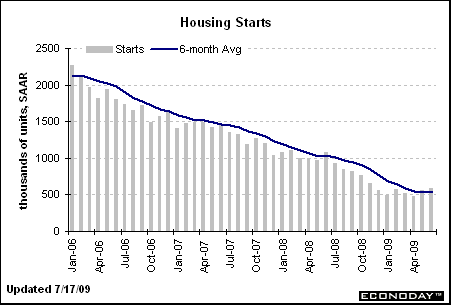
16. NEW BUILDING PERMITS & HOUSING STARTS UP STATISTICALLY INSIGNIFICANT AMOUNT

Barry Ritholtz at the Big Picture notes that new building permits in June were 8.7% (±3.0%) above May and that housing starts were up 3.6% (±11.3%). He comments:
"The year-over-year data is much clearer: New Starts down 46% [±4.3%], Permits down 52% [±3.6%]."
He links to a Barron's Econoday graph:

Thursday, June 4, 2009

Daily Sources 6/4

1. BANKS OF CANADA, ENGLAND, AND EUROPE MAINTAIN BENCHMARK INTEREST RATES, B.O.E. AND E.C.B. REITERATE INTENTION TO ENGAGE IN SOME Q.E., SPEECH BY GERMAN F.M.--AND S.D.P. CHANCELLOR CANDIDATE--INDICATES INTEREST IN CHANGING THE STRUCTURE OF THE EUROPEAN MONETARY UNION

Daniel Kruger and Chris Fournier at Bloomberg report that the Bank of Canada today decided to leave its benchmark interest rate unchanged at 0.25%.
"The Bank of Canada ... said the 'unprecedentedly rapid rise' in the currency could 'fully offset' recent improvements in financial markets and consumer confidence and prolong the recession.

'The bank is confirming that the rise in the currency isn’t backed up by the fundamentals,' said John Curran, a Toronto-based senior vice president at CanadianForex Ltd., an online foreign-exchange dealing firm. 'While we do see some 'green shoots," for the economy to strengthen we can’t have the Canadian dollar as strong as it’s been in recent weeks. Once everyone gets a chance to digest this, you’ll see some US dollar strength."
Meanwhile, Jennifer Ryan at Bloomberg reports that the Bank of England also left its benchmark interest rate unchanged at 0.5 today, and reiterated its intention to purchase £125 billion (~$205 billion) in government and corporate bonds.
"While the bank’s decision last month was unanimous, some policy makers did favor spending the full authorized total of 150 billion pounds and the panel said it will seek permission to print even more money than the maximum if needed. Minutes of today’s decision will be published on June 17."
And Gabi Thesing and Christian Vits at Bloomberg report that the European Central Bank [ECB] also left its benchmark interest rate unchanged today at 1%.
"Asked if the bank will expand its bond plan, [ECB President Jean-Claude] Trichet replied: 'We have decided to embark on a 60 billion-euro purchase of covered bonds, full stop.'"
Meanwhile, Daniela Schwarzer at Eurozone Watch reports that German Foreign Secretary Frank-Walter Steinmeier in a speech yesterday at Budapest suggested that the current structure for the European monetary union ought, under the current circumstances, be rearranged, Schwarzer's analysis:
"# He explicitly acknowledges the problem of divergent economic developments in the EMU. This fact has been on the table for a few years now. As early as 2005, data on the first years of EMU pointed to these problems, and the trend of cyclical and structural divergence has even been acknowledged by the ECB in pursuing its monetary policy for an increasingly heterogeneous Eurozone economy. But Germany (which itself has been diverging from EMU average for instance in the years of its sever economic slump 2003/4 and subsequently recorded a very strong current account surplus) had so far not picked up this issue politically. It is hence the first time that a German member of government says what the current developments are: a possible threat to the existence of the EMU.
# In order to tackle this problem, Steinmeier suggests stronger policy coordination. In other words: the Lisbon Agenda is not sufficient an instrument to cope with divergence and asymmetric shocks in the EMU. This is no surprise to most economic analysts of EMU (even not in the German administration), but a new political statement from Berlin.
# He explicitly names wage, social and tax policies as an object for closer coordination in the EMU and speeks out strongly against tax and wage dumping. Again, this should be no surprise from a social democrat before two important elections dates - but it is a clear departure from the Berlin mainstream. For instance regarding the commonly held view that due to the 'Tarifautonomie' (i.e. the fact that social partners negotiate wages (more or less) independently in Germany) nothing can be done in the field of wage policy anyway. What Steinmeier may in fact mean is that some countries should be pushed towards giving up certain systems (e.g. wages indexed on inflation as is the case in Spain), which reinforce cyclical divergences in the EMU.
# He also requests a stronger coordination of fiscal stimulus in the current crisis--rightly so, but in direct opposition to the position held by the Chancellor and the Finance Minister."
Worth reading in full.

2. REPORTERS TAKEN TO CHINESE S.P.R.S

Denis McMahon at China Journal reports that he was taken on a reporting trip to Zhenhai and Zhoushan, two SPRs located south of Shanghai, arranged by the State Council Information Office.
"On the face of it, the visit was seemingly a massive step forward in transparency for the Chinese government. But, while staring at 50 identical 100,000 cubic meter (~ 630,000 barrel) tanks neatly formed into rows is certainly impressive, it doesn’t really tell much about the state of China’s reserves. And while the officials we met were friendly and open, the key policy questions of where the oil comes from, how they bought it and under what conditions the reserves may be tapped were deferred to more senior officials--who weren’t there.

While the reporters may have been a little unsure as to what they were getting out of the experience, Beijing clearly knew exactly what it was doing from the unity of message coming from the National Energy Bureau officials traveling with us: The reserves are full."
It seems that Beijing is signaling it would like a lower price, no?

3. MALAYSIA CONSIDERING SETTLING TRADE WITH CHINA IN LOCAL CURRENCIES

Shai Oster at the Wall Street Journal reports that Malaysian Prime Minister Najib Abdul Razak told the media after meeting with China's premier, Wen Jiabao, on Wednesday that:
"We can consider whether we can use local currencies to facilitate trade financing between our two countries. ... What worries us is that the [US] deficit is being financed by printing more money. That is what is happening. The Treasury in the United States is printing more notes."
The notion being to replace trade settlements in dollars with the ringgit and yuan. In May Bloomberg reported that Brazil's foreign minister told the media in Beijing that Brazil and China were considering a plan to settle in local currencies--see Daily Sources 5/20 #4.

4. VIETNAMESE NAVAL STRATEGY VS. CHINA TO MIRROR CHINA'S NAVAL STRATEGY VS. U.S., MALAYSIAN SHIPS MAY HAVE ENTERED OIL RICH AREA DISPUTED WITH INDONESIA

Feng at Information Dissemination comments on Vietnam's recent decision to purchase six project 636 kilo submarines for $1.8 billion. (Kilo class is the NATO designation for diesel-electric submarines made in Russia. Wikipedia states that the project 636 submarines are thought to be one of the quietest diesel-electric submarines in the the world.) Feng believes that the submarine purchase was made in an attempt to be able to project force into the China South Sea, and in particular, to the Spratly Islands, control over which is disputed by all the nearby nations, mostly because it is thought that oil and gas reserves lie under them.


Feng points out that the navies of countries further away from Vietnam, like, say, Australia, present a different challenge for the People's Liberation Army Navy [PLAN] than Vietnam, simply because Vietnamese ships would be operating mostly in areas over which the Chinese would be able to assert air superiority. Thus:
"[Vietnam is] actually adopting the same strategy that PLAN [has] supposedly [adopted to counter the capabilities of the US Navy]. Basically, Vietnam is [buying] a lot [of] small, fast ships equipped with long range missiles (and nothing else much ...) [and] quiet submarines."
Of course, Hanoi cannot make purchases on the scale that Beijing can, but it is presented with more or less the same dilemma facing Beijing when considering what it should do in case of a confrontation with the US. Interesting observation. Meanwhile, AFP reports that Malaysia's deputy prime minister Muhyiddin Yassin called for calm amidst reports that Malaysian warships had entered waters off northeastern Borneo also claimed by Indonesia, saying:
"We want to avoid any form of provocation that can cause unpleasantness. We must handle the matter with caution."
"International borders in the area off Borneo island have yet to be determined, with each country claiming the area as its own.

Malaysia claims the area based on a 1979 maritime chart, while Indonesia bases its claims on the 1982 UN Convention on the Law of the Sea (UNCLOS), which states the area belongs to Indonesia.

Muhyiddin said the Malaysian security forces patrolling the Ambalat waters had performed their duties responsibly and in accordance with regulations."
The head of Malaysia's military, Abdul Aziz Zainal, told the media that ships had not entered the Ambalat region, and that he would be in Jakarta Tuesday to discuss the matter.

5. OBAMA'S SPEAKS AT CAIRO TODAY

The New York Times carried the full text of President Obama's much anticipated speech in Cairo today. Key excerpts:
"Islam has always been a part of America's story. The first nation to recognize my country was Morocco. In signing the Treaty of Tripoli in 1796, our second President John Adams wrote, 'The United States has in itself no character of enmity against the laws, religion or tranquility of Muslims.'"
"Just as Muslims do not fit a crude stereotype, America is not the crude stereotype of a self-interested empire. The United States has been one of the greatest sources of progress that the world has ever known. We were born out of revolution against an empire. We were founded upon the ideal that all are created equal, and we have shed blood and struggled for centuries to give meaning to those words – within our borders, and around the world. We are shaped by every culture, drawn from every end of the Earth, and dedicated to a simple concept: E pluribus unum: 'Out of many, one.'"
"Make no mistake: we do not want to keep our troops in Afghanistan. We seek no military bases there. It is agonizing for America to lose our young men and women. It is costly and politically difficult to continue this conflict. We would gladly bring every single one of our troops home if we could be confident that there were not violent extremists in Afghanistan and Pakistan determined to kill as many Americans as they possibly can. But that is not yet the case."
"
The sooner the extremists are isolated and unwelcome in Muslim communities, the sooner we will all be safer."
"Around the world, the Jewish people were persecuted for centuries, and anti-Semitism in Europe culminated in an unprecedented Holocaust. Tomorrow, I will visit Buchenwald, which was part of a network of camps where Jews were enslaved, tortured, shot and gassed to death by the Third Reich. Six million Jews were killed--more than the entire Jewish population of Israel today. Denying that fact is baseless, ignorant, and hateful. Threatening Israel with destruction--or repeating vile stereotypes about Jews--is deeply wrong, and only serves to evoke in the minds of Israelis this most painful of memories while preventing the peace that the people of this region deserve.

On the other hand, it is also undeniable that the Palestinian people--Muslims and Christians--have suffered in pursuit of a homeland. For more than sixty years they have endured the pain of dislocation. Many wait in refugee camps in the West Bank, Gaza, and neighboring lands for a life of peace and security that they have never been able to lead. They endure the daily humiliations--large and small--that come with occupation. So let there be no doubt: the situation for the Palestinian people is intolerable. America will not turn our backs on the legitimate Palestinian aspiration for dignity, opportunity, and a state of their own.

For decades, there has been a stalemate: two peoples with legitimate aspirations, each with a painful history that makes compromise elusive. It is easy to point fingers--for Palestinians to point to the displacement brought by Israel's founding, and for Israelis to point to the constant hostility and attacks throughout its history from within its borders as well as beyond. But if we see this conflict only from one side or the other, then we will be blind to the truth: the only resolution is for the aspirations of both sides to be met through two states, where Israelis and Palestinians each live in peace and security.

That is in Israel's interest, Palestine's interest, America's interest, and the world's interest."
"Palestinians must abandon violence. Resistance through violence and killing is wrong and does not succeed. For centuries, black people in America suffered the lash of the whip as slaves and the humiliation of segregation. But it was not violence that won full and equal rights. It was a peaceful and determined insistence upon the ideals at the center of America's founding. This same story can be told by people from South Africa to South Asia; from Eastern Europe to Indonesia."
"At the same time, Israelis must acknowledge that just as Israel's right to exist cannot be denied, neither can Palestine's. The United States does not accept the legitimacy of continued Israeli settlements."
"And we will welcome all elected, peaceful governments--provided they govern with respect for all their people.

This last point is important because there are some who advocate for democracy only when they are out of power; once in power, they are ruthless in suppressing the rights of others."
A bit later in the speech, President Obama seems to echo yesterday's op ed in the Wall Street Journal by the prince of Dubai which argued that education was key to winning hearts and minds in the Middle East--see Daily Sources 6/3 #8.
"Many Gulf States have enjoyed great wealth as a consequence of oil, and some are beginning to focus it on broader development. But all of us must recognize that education and innovation will be the currency of the 21st century, and in too many Muslim communities there remains underinvestment in these areas. I am emphasizing such investments within my country. And while America in the past has focused on oil and gas in this part of the world, we now seek a broader engagement.

On education, we will expand exchange programs, and increase scholarships, like the one that brought my father to America, while encouraging more Americans to study in Muslim communities. And we will match promising Muslim students with internships in America; invest in on-line learning for teachers and children around the world; and create a new online network, so a teenager in Kansas can communicate instantly with a teenager in Cairo."
The speech is best read in full.

6. IRAN'S L.O.T.R. DISMISSES CAIRO SPEECH IN ADVANCE, IRAN ANNOUNCES CONSTRUCTION ON PARS PIPELINE BEGINS, WITHOUT HAVING DECIDED ON FINAL PATH

Thomas Erdbrink and William Branigin at the Washington Post report that Iran's Leader of the Revolution [LOTR] Ayatollah Ali Khamenei said:
"People of the Middle East, the Muslim region and North Africa--people of these regions--hate America from the bottom of their heart"
shortly before President Obama's speech in Cairo. LOTR Khamenei said that "beautiful speeches" would not reverse this feeling. Meanwhile, PressTV reports that construction on the Pars (or Persian) Pipeline has begun, but that Ahmad Noorani, the head of economic affairs at the Iranian embassy in Turkey, suggested:
"Another route could go through Iraq and Syria and then go through the Mediterranean to Greece and Italy."
(h/t reader Geoff.)

7. HOLBROOKE SAYS ADMINISTRATION HAS ASKED CONGRESS FOR ADDITIONAL $200 MILLION IN AID FOR PAKISTANIS DISPLACED BY FIGHTING WITH TALIBAN

Karen DeYoung at the Washington Post reports that Richard Holbrooke, special representative for Afghanistan and Pakistan, said at a press conference with Pakistani President Asif Ali Zadari in Islamabad yesterday that President Obama had asked Congress for an additional $200 million in aid for those displaced by the fighting with the Taliban.
"[W]ithin hours of his arrival, Holbrooke said the 'dramatic increase' in aid was 'symbolic of our commitment and support.'

Holbrooke emphasized that his hastily arranged three-day visit was 'at the personal instruction of President Obama' and reflected White House concern about Pakistanis fleeing heavy fighting in the Swat Valley and surrounding regions northwest of Islamabad, the capital."
The trip is also an outgrowth of concern that the central government will not reestablish control in areas where the extremists have been flushed out, failing to provide for security and services, making it a simple matter for the Taliban to return once the offensive has ended.

8. RELIANCE TO HALT GASOLINE EXPORTS TO IRAN ON U.S. SANCTION FEARS

Dev Chatterjee & Piyush Pandey at the Economic Times reports that Reliance has decided to stop exports of petroleum products to Iran in an effort to stave off restrictions on sales of products to the US market.
"Reliance was exporting 2% of its total output, worth around $280 million, from its two refineries in Jamnagar to Iran. A top RIL official, who requested anonymity, confirmed that the gasoline exports to Iran were stopped last month. However, he refused to elaborate on this issue.
...
RIL exports petroleum products worth $14 billion annually, of which around 5% is exporting to the US."
As of late, the UAE has been providing Iran with about 80% of its product imports.

9. ETHIOPIAN SOMALI SECESSIONISTS WARN AWAY OIL PROSPECTORS

Barry Malone at Reuters yesterday reported that the Ogaden National Liberation Front (ONLF)--or secessionists from the ethnically Somali Ogaden region--have emailed a warning to oil companies not to operate in that area of Ethiopia.


The email statement said:
"In order to accommodate these immoral and gluttonous rushes for oil in Ogaden, Ethiopia killed, raped and illegally detained thousands of Ogaden civilian and imposed economic and aid blockade at a time of when there was a full-blown drought in the Ogaden.

ONLF has persistently warned these unscrupulous multinational companies and their governments ... the ONLF has been left no alternative but to take all measures necessary to protect the inalienable rights of the Ogaden people."
10. O.A.S. VOTES TO LIFT BAN ON CUBA, BUT CUBA MUST ENGAGE IN DIALOGUE IN ORDER TO RE-ENTER ORGANIZATION

Mary Beth Sheridan at the Washington Post reports that the Organization of American States [OAS] voted to lift its 47 year old suspension of Cuba. The language of the resolution doesn't seem to explicitly require anything specific of Havana, outside of initiating a process of dialogue which itself must be in conformity with the practices, purposes, and principles of the OAS.The press release includes the actual language of the resolution (in Spanish only).
"RESUELVE:

1. Que la ResoluciĂłn VI adoptada el 31 de enero de 1962 en la Octava ReuniĂłn de Consulta de Ministros de Relaciones Exteriores, mediante la cual se excluyĂł al Gobierno de Cuba de su participaciĂłn en el Sistema Interamericano, queda sin efecto en la OrganizaciĂłn de los Estados Americanos.

2. Que la participación de Cuba en la OEA será el resultado de un proceso de diálogo iniciado a solicitud del Gobierno de Cuba y de conformidad con las prácticas, los propósitos y principios de la OEA."
More or less:
"RESOLVED:

1. That Resolution VI adopted on January 31, 1962, in the Eighth Consultative Meeting of External Relations Ministers, by which the government of Cuba was excluded from participating in the Inter-American System, is hereby repealed in the Organization of the United States.

2. That the participation of Cuba in the OAS will be a result of a process of dialogue initiated at the request of the government of Cuba and in conformity with the practices, purposes, and principles of the OAS."
(Course, I wouldn't rely on my Spanish for this, but it does seem that only the dialogue itself must be conducted with the principles in mind, and that the sticking point is whether the dialogue would be initiated--or even participated in--by Havana.) Sheridan reports that Dan Restrepo, who is head of Western Hemisphere affairs at the White House, argued that the language was stronger that it might appear given the preamble which emphasize democracy and respect for human rights as part of the OAS's fundamental principles.

11. MEXICAN DRUG GANGS MOVING TO HONDURAS--MAY BE ASSISTED BY CROSS-SPECIAL FORCES TIES

Ken Ellingwood at the Los Angeles Times reports that the drug war in Mexico has spilled over into Guatemala, as gangs have found the environment easier to operate in there.
"During the last year and a half, the Zetas have carved a bloody trail across Guatemala's northern and eastern provinces. More than 6,000 people were slain in Guatemala in 2008. Police say most of the killings were linked to the drug trade.

As the recent blood bath shows, the violence is now threatening the capital, deep in the interior.

Authorities say Mexican drug gangs, primarily the Zetas and rivals from the state of Sinaloa, are ramping up operations in Central America to evade increased marine patrols near Mexico as they relay drug shipments to the United States and Europe."
The Zetas are a gang that was formed by former members of the Mexican special forces in the 1990s.
"Guatemalan police commanders say their 20,000 officers cannot match the firepower of the Mexican traffickers, who have made growing use in Mexico of military-type arms, such as 40-millimeter grenades and .50-caliber rifles capable of piercing armor.

Recent seizures in Guatemala have yielded similar weapons. 'These are things we have seen only in photos of Iraq and the Gulf,' said Larios, the police commander. 'Not in Guatemala.'

But devising a response is complicated by Guatemala's troubled past. The memory of the army's brutal conduct during the civil war means that it would be politically dicey for Guatemalan leaders to respond by mobilizing the military, as Calderon has done in Mexico."
Further, the Zetas have reportedly received assistance from former Guatemalan special forces known as the Kaibiles--named for a Mayan leader who evaded capture by conquistadors led by Pedro de Alvarado in the 16th century. Mexican special forces received training from the Kaibiles in the 1990s, as well as from Brazilian special forces, and the US Army. Analysts are worried that the drug war may spill into Honduras as well.


The best English-language coverage of the drug war's effects on Latin America is in the Los Angeles Times. A must read.

12. GLOBAL AIR PASSENGER TRAFFIC DOWN 7.5% IN 1ST 4 MOS., FREIGHT TRAFFIC DOWN 22%

Eileen Ng at the Associated Press reports that the International Air Transport Association recently announced that global passenger demand fell 7.5% in January-April from the same period a year ago while cargo demand fell 22%.
"IATA Director-General Giovanni Bisignani said airlines are facing an 'emergency situation' and should be given greater commercial freedom to serve global markets and consolidate."
Bisignani said that Asian carriers, which represent 44% of the global air cargo market, will be hit hardest by the crisis.

13. PENSIONS GETTING HIT GLOBALLY

Leo Kolivakis at Pension Pulse gives a rough summary of major difficulties facing major pensions globally, as pensions find themselves unable to meet their obligations given the current crisis. "Pension tension" is being seen in the US, Canada, and throughout Europe, including at the European Central Bank. His list is well worth considering, as well as his comment:
"The global pension crisis is really a crisis of modern day capitalism. If we don't figure out a long-term solution to this crisis, we risk having a new class of elderly poor who were cheated out of their pensions."
14. GEORGETOWN UNIVERSITY MAY LEAD NEW GENEVA CONVENTION PROTOCOL EFFORT

Jeff Stein at Spy Talk reports that Georgetown University's new Center on National Security and the Law's legal scholars have been pushing for a new international agreement to update the Geneva Convention to address terrorism and stateless armies. The center was until recently led by Neal Katyal, who joined the Obama Administration to become the Principal Deputy Solicitor General.
"'Soon,' [Matthew] Gerke, [a fellow at the center who worked for three and a half years in the Pentagon and in Iraq on rule of law issues,] said, the Center on National Security and the Law hopes to 'roll out' a campaign for a new Geneva Convention, hopefully boosted by an American figure with international stature.

Its first step would be to mount a new push for Senate ratification of the 'Additional Protocol No. 2, Relating to the Protection of Victims of Non-International Armed Conflicts.'"
In 1977, the Carter administration signed two additional protocols to the Geneva Convention which had provided rules for handling non-state combatants, but the Senate refused to ratify the treaty, "as it has ever since." Worth reading.

15. LOW SULFUR BUNKER FUEL REQUIREMENTS MAY ADD 4 MB/D NEW DIESEL DEMAND TO MARKET--ROUGHLY 10 MB/D ADDITIONAL CRUDE DEMAND

John Kingston at the Barrel reports on the interesting observation about the incoming low sulfur specifications for shipping use by Carlos Cuervo, SVP for supply and trading at World Fuel Services, who argues that low sulfur product from the bottom of the barrel, or low sulfur fuel, will start seeing considerable more demand starting next year. However, after 2015:
"It won't be even lower-sulfur bunker fuel that will allow shipowners to meet the requirements, Cuervo said. Instead, it will be marine diesel. There just simply won't be enough low-sulfur bottoms, of 0.5% sulfur by 2020, to meet the needs of shipowners. Diesel will fill the gap."
Cuervo estimates that the move to diesel by shipowners driven by the incoming low sulfur requirements will mean for an additional 4 mb/d of demand for diesel globally.
"As he noted, given that an efficient refinery can produce about 40% diesel, it's as if we need another 10 mb/d of crude supply to make 4 mb/d of diesel."
It's an interesting concern ... just now refiners would probably welcome additional diesel demand, given the size of inventories here in the US. But, in the run up of prices from 2007-8, some argue that the price of crude was chasing the diesel crack, and that could get real steep given a recovery in the global economy. Kingston notes there hasn't been a lot of interest so far in setting up refineries to produce low sulfur bunker fuel--
"They generally have viewed fuel oil the way Dracula views sunrise. 'How are you going to put a lot of money into something you've been trying to get rid of?' [Cuervo] said."
Worth reading in full.

16. NORTH AMERICAN RAIL TRAFFIC DOWN

Atlantic Systems Inc.'s Railfax report is out, showing that total North American rail traffic for the week ended May 30 was down 24.7% from the comparable week a year earlier. ASI plots the percent change in total North American rail traffic year over year for the week ended May 30, in 13 week rolling averages:


Coal volumes transported by train for the year ended May 30 was down 9.5% from the year previous.

17. INITIAL JOBLESS CLAIMS DOWN SLIGHTLY LAST WEEK, ANALYSTS EXPECT HEADLINE UNEMPLOYMENT TO HIT 9.2%

The Associated Press reports that the Labor Department released data today showing initial jobless claims fell slightly last week to a seasonally-adjusted 621,000 from the previous week's revised total of 625,000.
"The total jobless benefit rolls fell by 15,000 to 6.7 million, the first drop since early January. Continuing claims had set record highs every week since the week ending Jan. 24. The continuing claims data lag initial claims by one week.

Still, the number of initial claims remains stubbornly high, above the 605,000 level reached five weeks ago. That was the lowest level in 14 weeks.

The four-week average of claims, which smoothes out fluctuations, rose by 4,000 to 631,250."
Analysts expect unemployment to rise to 9.2%.

Tuesday, May 12, 2009

Daily Sources 5/12

1. CHINESE EXPORTS AND IMPORTS DOWN YEAR OVER YEAR, BUT IMPORTS ARE UP FROM MARCH, SEEN BY MANY AS A 'GREEN SHOOT'

Andrew Batson and Terence Poon at the Wall Street Journal report that Chinese exports fell 22.6% from a year earlier to $91.94 billion in April from roughly $117.3 billion. China's April imports sank 23% to $78.8 billion from the roughly $102.3 billion imported a year previous, but were up 9.9% from imports of $71.73 billion in March. Rebecca Wilder at News N Economics plots a graph of percentage import and export growth in dollars from Jan 2001:


Ms Wilder is encouraged by the relative recovery in imports, commenting:
"[I]mport growth surged. Now, this could be driven by several factors--anything that might affect the real exchange rate; however, it does suggest that domestic demand may be improving. Furthermore, and in normal times, greater access to imports is good for efficiency, productivity, and growth."
Her post is worth reading in full. In a subscription only report, Hui Ching-hoo at Lloyd's List reports that domestic growth has lifted volumes at the northern port of Tianjin.
"Latest figures show cargo throughput increased 2% to 32.2m tonnes last month, while container volumes surged 5.3% to 756,660 teu."
Batson and Poon further note:
"Investment in real estate, one of the main forms of private-sector investment in China, was up only 4.9% from a year earlier in the January-April period, compared to overall growth of 30.5% in the four-month period. Still, it's an improvement from even weaker growth in previous months, and comes as purchases of housing and other property pick up. The volume of real estate sales jumped 39% from a year earlier in April after 16.4% growth in March, reversing several months of decline."
On the back of stimulus programs, fixed asset investment grew by an annual rate of 33.9% in April after posting a 30.3% gain in March.

2. LENDING SHARPLY DOWN AFTER NEARING STIMULUS TARGETS, BUT NEW LIQUID CAPITAL IN PRIVATE HANDS NOT AN ESPECIALLY LARGE SHARE OF THE NEW MONEY

However, the number of new loans overall--as noted last week in Daily Sources 5/7 #2--has fallen rather steeply from 591.8 billion yuan (~ $86.88 billion) in April or 68.7% from 1.89 trillion yuan (~ $277.5 billion) in March, with the People's Bank of China noting that 92% of the stimulus lending target had already been met in the first quarter. Andrew Batson at the China Journal gives a partial breakdown of the end recipients of the new money:
"[L]oans to households made up 25% of April’s new loans, compared to just 9.2% in the first quarter, as housing sales continued to pick up. And medium and long-term loans, which primarily go to infrastructure projects, accounted for 63% of new loans in April, up sharply from 37% in the first quarter. 'This shows that more liquidity is flowing into the real economy,' said Ha Jiming, chief economist of China International Capital Corp.

Short-term lending has gotten particularly close scrutiny recently. Many analysts suspect the recent surge in such financing is at least partly driven by banks trying to pad their books, and companies using the money for financial speculation. But it’s starting to fade in importance.

Discount bill financing--a form of short-term borrowing, usually against accounts receivable--accounted for 21% of April’s net new lending, down from 32% in the first quarter. And other short-term lending actually declined by 78.6 billion yuan [~ $11.54 billion] in April."
Kevin Hamlin at Bloomberg adds:
"[I]nvestment figures showed the number of new projects started in the first four months jumped 45% to 86,420 from a year earlier. Planned spending on those projects climbed 91% to 3.68 trillion yuan [~ $540.2 billion].

Investment in property development rose 4.9%, quickening from 4.1% in the first quarter. Railway spending surged 94.2%, along with a 36.6% rise for coal extraction and processing and a 26.3% gain for non-ferrous metal processing."
3. COMMODITIES PRICES UP ON BEIJING'S DIRECTIVE TO BUY EM CHEAP, BUT, MY GUESSTIMATE IS THAT THEY DO NOT ACCOUNT FOR THE LION'S SHARE OF THE VALUE OF NEW IMPORTS

Chuin-Wei Yap at China Journal reports that Chinese imports of metals have surged likely due to the decision in Beijing to stockpile in the low price environment.
"Customs data Tuesday showed China imported 399,833 metric tons of copper and related products, up 62% on year and beating the previous record set just in March. Iron ore imports also rose to a new record of 57 million tons, up 33% on year."
As noted yesterday--see Daily Sources 5/11 #6--Chinese April oil imports were up 13.6% from a year earlier. Though the annual rate of imports growth in April was negative 23%, of the roughly $7.07 billion increase in Chinese imports in April from March, China imported roughly 82 kb/d more crude oil in April than March, which, given a $1.89/b increase in average price, means China may have spent as much as an additional $341.2 million on crude or roughly 4.8% of the increase in the overall value of imports in April from March.

The annual increase of 13.6% in crude imports was about 470 kb/d or, given that front month WTI averaged just below $49.50/b in April, the additional volume cost roughly $700 million, or nearly 10% of the $7.07 billion increase in imports from March, but crude was averaging $112.46/b in April 2008, so in dollar terms crude probably represented $11.67 billion of import values in April 2008 versus roughly $5.9 billion in April 2009. Meaning that even with the additional volumes, April 2009 crude accounted for about a 7.5% share of China's import bill as opposed to 11.4% of the value of its April 2008 imports, or a third less.

4. IN JAPAN VISIT, PUTIN CONCLUDING A WIDE VARIETY OF ENERGY COOPERATION AGREEMENTS AND DEALS

Anna Shiryaevskaya at Platts reports that Russian Prime Minister Vladimir Putin invited Japanese participation in Russia's Siberian oil and gas infrastructure efforts. In televised comments in Tokyo, Putin said:
"The participation of Japanese companies in the completion of construction of the oil pipeline from East Siberia to the Pacific Coast is quite possible.
...
In general, Japanese partners could take part in projects to develop pipelines and other transport infrastructure. I mean from Sakhalin Island to Khabarovsk to Vladivostok."


AFP also reported that Putin told reporters today that he expected to sign a nuclear cooperation pact with Japan during his week-long visit.
"Japan and Russia are in the final phase of talks over a pact to promote the non-military use of nuclear power, such as for electricity generation.

The pact will pave the way for Tokyo to entrust Moscow with uranium enrichment and allow Japan to export nuclear power plant technology to Russia, Kyodo News said."
Meanwhile, Takeo Kumagai at Platts reports that the state-owned Japan Oil, Gas and Metals National Corporation (formerly the Japan National Oil Company--JNOC) today announced that it had entered into an agreement with the privately owned Irkusk Oil Company to jointly explore two blocks of land in Eastern Siberia for oil and gas.
"The partners believe that the blocks could hold combined reserves of up to several hundred million barrels because of their proximity to discovered oil fields such as the Yaraktinskoye and Verkhnechonskoye oil fields, JOGMEC said."
And Oleg Shchedrov at Reuters reports that Gazprom had concluded a memorandum of understanding with METI, Itochu Corp and Japan Petroleum Exploration Co to explore gas projects in eastern Russia.
"[Gazprom CEO] Alexei Miller told reporters the memorandum would explore ways to process gas near the Pacific city of Vladivostok for supply to consumers in Russia and the Asia-Pacific region, including Japan."
5. NORTH KOREAN FOOD WOES SET TO CONTINUE AND EVEN GROW, IN LARGE PART BECAUSE OIL FOR TRACTORS AND FERTILIZER IN SHORT SUPPLY

The Australian Broadcasting Corporation broadcast an interview by Sonja Heydeman of Lena Savelli, World Food Programme spokeswoman in North Korea, and Prof John McKay at Analysis International in Melbourne, regarding the worsening food situation in North Korea.
"HEYDEMAN: South Korea's unification ministry said in February that the North's food production would fall more than one million tons short of demand this year. However, the World Food Program's Lena Savelli says that figure underestimates the gravity of the situation.

SAVELLI: The latest assessment on crop production done by The Food and Agriculture Organization and the World Food Program puts the deficit even higher .. as high as 1.8 million metric tons of food for the agriculture year 2009. We are planning to feed as many as 6.2 million people in the DPRK in 2009. Unfortunately we have not been able to raise enough resources to reach all the affected people.

HEYDEMAN: While agriculture in North Korea needs to be addressed, Professor John McKay from Analysis International in Melbourne says there's a broader systemic problem that needs to be considered.

He says the agricultural sector has been dragged down by the crisis in other sectors, particularly the industrial sector.

McKAY: When the Soviet Union collapsed North Korea lost its major ally .. the ally that provided oil and technology and all kinds of things including cheap access to certain kinds of food but more particularly to access a cheap level a whole range of industrial products and those industrial products had ramifications for the agricultural sector. For example, fertilizer much of which is a by-product of petroleum is no longer available in North Korea. There is no fuel oil to drive the tractors and other kinds of machinery and that has had a major impact on North Korean productivity."
(h/t The Oil Drum's daily Drumbeat.)

6. SOUTH KOREA DEAL FOR OIL AND GAS EXPLORATION IN UZBEKISTAN, CONTINUING ASIAN TREND IN STATE-DRIVEN OVERSEAS RESOURCE INVESTMENTS

Charles Lee at Platts reports that KNOC--the Korean National Oil Corporation--has signed a preliminary agreement with Uzbekistan to explore five oil and gas blocs.
"The deal is part of South Korea's push for oil-for-infrastructure packages with underdeveloped countries under which it would offer aid to improve their poor social infrastructure, such as bridges and roads, in return for stakes in oil and gas fields."
7. POLAND MIGHT DELAY ENTRY TO EUROPEAN MONETARY UNION BY A YEAR, OR MAYBE MORE, FINANCIAL CRISIS WILL MAKE ENTRY UNDER CURRENT TERMS DIFFICULT FOR MANY PROSPECTS

Go Warsaw.com summarizes a Financial Times interview with the Polish Finance Minister, Jacek Rostowski, where he indicated that Warsaw may delay its entry into the monetary union by as much as a year from the current target date of Jan 1, 2012.
"'The Jan 1, 2012 is still realistic, but it may require some delay,' Rostowski said. 'The world crisis has come along and it would be naive to pretend it has had no effect. If we move it by one year that's not the end of the world,' he told the daily"
Go Warsaw notes that the Deputy Financial Minister also serving as the government's plenipotentiary for euro adoption told Reuters in April that entry might be delayed by between one and two years. (h/t Eurointelligence.) In a post on differentiating the economic situations in eastern Europe, Edward Hugh at Fistful of Euros plots a graph of Polish sentiment, per the EU Economic Sentiment Indicator, which is the best reading in the entire region:


"[The EU monthly Economic Sentiment Indicator] is a composite which measures sentiment in industry, services, construction, retail and building, and does at least have the advantage of offering us a rule of thumb guide as to how a country is handling the crisis."
8. KRG SAYS OIL EXPORTS VIA DEALS STRUCK WITHOUT BAGHDAD ARE FAIT ACCOMPLI

Carola Hoyos at FT Energy Source yesterday quoted from an interview Friday with Ashti Hawrami, the Kurdish Regional Government's oil minister, where he made plain that the flow of oil from fields contracted for without the previous consent of Baghdad was a fait accompli:
"The oil operations are under KRG control. The operators have been allowed to reach the point of tie-in to the pipeline. The operators have been notified (that June 1 is the first flow date).
...
The rough edges of course still need to be worked out. But if someone says, I wouldnt allow it. I would say, how would you not allow it. Are you going to shut down the Kirkuk pipeline? Once we do this (flow oil), it’s gone. period."
Meaning all Iraqi oil flow through the pipeline, not just the oil flowing from the Kurdish Autonomous Region.


9. IRAN OPEC GOV. MISUNDERSTOOD YESTERDAY, WANTS OPEC TO CUT, ROXANA SABERI RELEASE MAY MEAN THOSE WHO WANT DETENTE WITH THE US ARE WINNING THE POLITICAL BATTLE IN TEHRAN, THE LEADER OF THE REVOLUTION MAY, BY POSSIBLY ENDORSING AHMADINEJAD, BE ENDORSING ENGAGEMENT

Following yesterday's report that Iran would not be pushing for a further cut in production at the upcoming OPEC meeting--see Daily Sources 5/11 #5--Platts reports that Mohammad Ali Khatibi told the Iranian state news agency that, "with the increase of stockpile levels, cutting oil supply is necessary." Meanwhile, Nazila Fathi and Mark Landler at the New York Times report that analysts believe the decision to release Roxana Saberi was due to forces in favor of detente with the US winning out over the revanchists.
"'They understood that this wouldn’t help them,' said Thomas R. Pickering, a former undersecretary of state who has conducted informal talks with Iranians. 'They were asking the US to put words into action, and at the same time, they were going in the opposite direction.'

Mr. Ahmadinejad is seeking re-election on June 12. The letter he sent to the court was the first time he had intervened in a judicial case in his four years in office. Analysts said it would help his prospects if he could advance negotiations with the United States before the election.

'Mr. Ahmadinejad wants to take serious steps towards improving ties with the United States before the elections,' said Ibrahim Yazdi, a political analyst in Tehran. 'If he succeeds, it would be to his interest.'"
Kevin Sullivan at The Compass reports that Nader Uskowi believes that the Leader of the Revolution, Ayatollah Khamenei has come close to endorsing Ahmadinejad for President in the upcoming elections. I tend to think that the regime has little interest in a real and full coming to terms with the US, but these items argue otherwise, and perhaps the resetting of relations with Moscow (combined with electioneering requirements) is creating an atmosphere of urgency in Tehran.

10. PALM OIL CORPORATION PLANTATION EXPANSIONS CREATING TENSIONS IN INDONESIA AND MALAYSIA

Michael Casey at the Associated Press reports that the Borneo Resources Institute of Malaysia and the World Wildlife Fund in Indonesia that the search by palm oil companies for viable land is causing considerable strife.
"In the wake of that push, hundreds of communities have filed complaints with courts in both countries about either being forced off their land or pressured to sell it at cheap prices, the groups said. Many of those affected are impoverished or indigenous communities whose ownership of the land is often not recognized by local authorities.

'The situation is getting critical at the moment. The companies are expanding more and more,' said Kalyana Bujang, director of the Borneo Resources Institute of Malaysia, which has documented 200 court cases in the state of Sarawak alone. 'The communities are caught unaware. They don't know what to do, or where to go.'"
Crude palm oil closed at 2,740 Malaysian ringgits per tonne, or roughly $108.74/b.

11. RAND RELEASES REPORT SAYING THAT OIL CONSUMPTION, NOT IMPORTS, IS THE SECURITY THREAT OIL POSES THE US

Carola Hoyos at FT Energy Source reports that RAND has released a report which argues that dependence upon oil imports do not particularly threaten US security, but that the size of US consumption does. Energy Source reproduces a table of risks to US security linked to oil in the report:


I'm not quite sure of the logic of this, because, well, huge oil demand is what requires oil imports, and it is the fact that imports are difficult to provide security for in a volatile world that makes a dependence on a preponderance of your oil requirement a troubling security concern. Erwin Seba at Reuters writes that the report recommends the following steps:
"- Maintenance of well-functioning oil markets;

- Do not impose price controls or rationing during disruptions;

- A top-level review by government and business of economic benefits and environmental hazards of removing restrictions on drilling for new oil fields;

- Clear environmental and other rules for developing new oil fields and producing oil substitutes;

- Impose an excise tax on oil to increase incentives to drivers and manufacturers to economize on fuel use and soften growth in demand for oil."
Hoyos also notes:
"The think tank also has a message for oil producers: embargoes don’t work to advance your foreign policy goals.

And a message for US allies: Help pay the bill--12 to 15 per cent of the US’s sizable 2008 defense budget--for patrolling the Persian Gulf."
RAND's summary of the report can be found here.

12. US TRADE DEFICIT DOWN; NOW MOSTLY OIL IMPORTS AND GOODS FROM CHINA

Calculated Risk reports that the Census Bureau has released data showing that an at annual rate US imports and exports are down 27% and 17.4%, respectively. The blog quotes the Bureau:
"The ... total March exports of $123.6 billion and imports of $151.2 billion resulted in a goods and services deficit of $27.6 billion, up from $26.1 billion in February, revised. March exports were $3.0 billion less than February exports of $126.6 billion. March imports were $1.6 billion less than February imports of $152.8 billion."
Calculated Risk produces a graph plotting the trade deficit if you exclude the cost of petroleum imports and concludes that the US trade deficit is now nearly all oil and Chinese imports:


Calculated Risk is always worth looking at. Brad Setser at Follow the Money has four key take-aways from the latest trade data. One, though US imports from China are down 11%, they are down substantially less from there than from elsewhere.
"Until China’s imports (and US exports) turn up, China’s won’t be pulling the US up. Because the US imports far more than it exports from China, the bilateral deficit with China is down--but it isn’t down by as much as it would be if US exports to China hadn’t fallen by more than US imports from China."
Two, US imports from from South Korea are down 22.9% in the first quarter, but US exports to South Korea are down further, by 39%. Three, US imports from Japan, on the other hand, are down 41.8% in the first quarter while exports to Japan are "only" down 22.9%. And four, US imports from the Eurozone are down by 24.6% in the first quarter, slightly more than exports to the Eurozone have fallen, by 22.6%. (I surmise that this is to a large extent due to Bush's parting shot of levying a huge tariff on French cheeses, as French imports from the US are flat, while US imports from France are down 20%.)

13. SMALL BUSINESSES OPTIMISTIC

Sara Murray at Real Time Economics reports that The Index of Small Business Optimism climbed 5.8 points to 86.8 in April from March.
"'[T]he real bounce came in the expectations variables (the usual pattern, first optimism returns, then spending follows as confidence builds). The outlook for business conditions and expected real sales both posted large gains in the net percent of optimistic owners,' according to the survey."
Ms. Murray writes that the survey concludes that pent up demand is building quickly.

14. EIA REVISES FORECAST FOR INDUSTRIAL DEMAND FOR NATURAL GAS DOWNWARDS

Reg Curren at Bloomberg reports that the Energy Department has forecast that natural gas consumption by industrial users will decline by 8% in 2009. The forecast is worse than last month's, which had industrial sector demand for natural gas falling by as much as 7.4% in 2009--see Daily Sources 4/14 #14. In 2007, industrial demand accounted for about 34% of total US natural gas demand.