Showing posts with label lisbon treaty. Show all posts

Tuesday, July 14, 2009

Daily Sources 7/14

1. CHINA CALLS ON ERDOGAN TO WITHDRAW REMARKS ON UIGHURS, ONLY GULF STATE TO PUBLICLY CRITICIZE BEIJING IS IRAN

China Daily, a state owned newspaper, published an editorial today entitled "Don't Twist Facts" which states that Turkish Prime Minister Recep Tayyip Erdogan would be "well advised" to withdraw his statement saying that the events in Xinjiang amount to "a kind of genocide." The piece notes that China's one child policy applies only to Han Chinese and not to ethnic minorities, arguing that the immigration policy in the region cannot, therefore, be seen as colonization or a drowning out of the ethnic Uighurs in a sea of Han. It concludes:
"Mr Erdogan's remarks, which constitute interference in China's internal affairs, are the last thing the Uighur and Han Chinese would find helpful when they are looking forward to lasting peace."
Josef Federman at the Associated Press reports that much of the Arab Muslim world has remained mute on the question of the Uighurs, but that senior official in (Persian) Iran criticized Beijing openly:
"Iran has been one of the few Muslim countries to speak out on the crackdown. On Sunday, the official IRNA news agency reported that Foreign Minister Manouchehr Mottaki had discussed the ethnic clashes in a phone conversation with his Chinese counterpart and 'reflected concerns among Islamic countries.'

High-ranking clerics also condemned the crackdown and urged the government to complain to China.

'Silence and indifference toward such oppressions on the people is an unforgivable vice,' said Grand Ayatollah Youssef Saanei, a major religious figure who has criticized his own government's violent response to mass protests over the disputed June 12 election."
Iran has a very close relationship with Beijing, it's original oil sales to the country were conducted with a military organization solely incorporated to conduct the exchanges.

2. CHINA'S PROPERTY INDEX CLIMBS 0.61%

Xinhua reports that China's national property climate index rose 0.61% to 96.55 last month per an announcement by the National Bureau of Statistics.
"Real estate investment nationwide rose by 9.9% in the first half from the same period last year, and the growth rate was 3.1 percentage points higher than the January-May level, said NBS."
3. CHINA SURPASSES US AS WORLD'S LARGEST MARKET FOR WIND POWER

Keith Bradsher at the New York Times reports that China surpasses the US this year as the world's largest market for wind energy,
"now building 6 wind farms with a capacity of 10,000 to 20,000 megawatts apiece, using extensive low-interest loans from state-owned banks."
In May, Joerg Wuttke, president of the European Union Chamber of Commerce in China, accused Beijing of deliberately locking out foreign corporations from stimulus-related projects, specifically addressing a package of wind turbine orders worth €5 billion (~ $6.98 billion)--see Daily Sources 5/28 #3.

4. MÜNCHAU'S ANALYSIS OF THE GERMAN HIGH COURT'S RULING ON THE LISBON TREATY--THOSE IN MONETARY UNION SHOULD BE AFRAID

Wolfgang Münchau had an opinion piece in yesterday's Financial Times which examines the consequences of Germany's recent high court ruling on the Lisbon Treaty--see Daily Sources 6/30 #2. He makes three main points about the ruling:
"First, Germany’s constitutional court takes a clear stance on sovereignty. Ultimate authority always has to rest in a single place--and that is the member state for now. If you wanted to transfer sovereignty to the EU, you would have to dump your national constitution and adopt a European version in its place. As this is not going to happen, the court, in effect, ruled that all sovereignty in the EU is national. Power may be shared, but sovereignty may not."
"Second, the court does not recognize the European parliament as a genuine legislature, representing the will of a single European people, but as a representative body of member states. ... As a result, Germany will be able to ratify the Lisbon treaty only after a change in a domestic power-sharing law."
"Third, and perhaps most important, the court has given an explicit opinion on the question of European integration. Where does it end? The answer is: right here. The court said member states must have sovereignty in the following areas: criminal law, police, military operations, fiscal policy, social policy, education, culture, media, and relations with religious groups. In other words, European integration ends with the Lisbon treaty."
He concludes that anyone in a monetary union with Germany ought, therefore, to be worried. Well worth reading.

5. ITALY CALLS FOR EUROPEAN OIL FUTURES MARKET & GLOBAL REGS

Lorenzo Totaro at Bloomberg reports that the Italian Electricity and Gas Authority Chairman Alessandro Ortis said in a presentation in Rome today that a European oil market should be established in order to quell price volatility. He argued that the situation requires "A real, regulated European oil bourse open to selected operators" which would trade "long or very long term products, with delivery within Europe and guaranteed by a reliable central European counterpart." Ortis also joined the chorus of politicos who blame "speculation" for the price volatility, calling for global "governance agreements and international rules."

6. RELIANCE WANTS TO SELL DIRECTLY INTO US AS PROSPECTS OF LIFTING SUBSIDIES ON GASOLINE IN INDIA GET BETTER

Rakteem Katakey at Bloomberg reports that Reliance is seeking to sell petroleum products directly into the US--minus an intermediary.
"Reliance is currently selling fuel through Hess Corp. ... . Mumbai-based Reliance has leased storage space from Hess, [an anonymous company executive] said, without giving capacity details."
In April, Platts reported that in March Reliance had taken 1.3 million barrels of clean storage from Hess in the New York Harbor area--see Daily Sources 4/13. (The reason given for Reliance exporting in the story is extremely misleading--the Jamnagar refinery was always slated to be an export refinery--excess refining capacity is a strategy endorsed by New Delhi, though Reliance is private, and based on precedents set in Singapore and South Korea.) In June, Reliance halted exports of gasoline to Iran under pressure from the US, perhaps this (odd) story is more about that--see Daily Sources 6/4 #8--and the following. Vandana Hari at The Barrel reports that the Congress Party, having won a larger share of the vote in the recent elections, may press ahead with the liberalization of gasoline prices. Diesel is unlikely to be fully de-subsidized because of its role in agriculture and power generation, but it appears there is some likelihood that gasoline prices will become completely deregulated and unsubsidized.
"LPG and kerosene subsidies look likely to be left undisturbed for now. While kerosene is used by the poorest for cooking and home lighting, the consumers of LPG do not necessarily need state help to pay the market price of a cylinder. LPG could be taken down the same route as gasoil, with government help kicking in when prices cross a pain threshold.

As fuel price liberalization eases the subsidy burden of state-owned refiners and marketers Indian Oil Corp., Bharat Petroleum Corp. and Hindustan Petroleum Corp., as well as their upstream peers Oil and Natural Gas Corp. and GAIL, it would free up cash for their business growth and expansion."
There have been several stories recently about how Chinese state corporations have been making successful bids for overseas resources, often beating out competing Indian bids.

7. PAKISTAN LIFTS RESTRICTIONS ON PEOPLE RETURNING TO THE SWAT VALLEY

Izaz Mohmand at Reuters reports that Pakistan has lifted restriction on displaced people returning to the Swat Valley.

8. PHOTOS OF A DRY EUPHRATES, SECURITY TIGHTENED AROUND CHRISTIAN CHURCHES ON LAST WEEK'S SPREE OF ATTACKS

The New York Times carries a photo essay by Moises Saman of the ongoing agricultural crisis in Iraq as the country watches its rivers go dry as Turkey and Syria withhold water via dam projects at their source--see Daily Sources 6/8 #10. The accompanying story has the following anecdote:
"The Sunni areas upriver seem to have enough water, Mr Joda [a man who resides near Karbala] observed, a comment heavy with implication."
That said,
"Recently, the Water Ministry announced that Turkey had doubled the water flow into the Euphrates, salvaging the planting phase of the rice season in some areas."
Meanwhile, Nada Bakri at the Washington Post reports that security has been tightened around Christian churches in Baghdad and the northern province of Nineveh after a string of attacks last week.
"Iraq's Christians were the target of Islamist extremists after the U.S.-led invasion of Iraq in 2003 that toppled Saddam Hussein. Many have fled the country despite improved security. But fears of renewed attacks have mounted. In past weeks, devastating bombings also have struck Iraq's Turkmen and Shabak minorities in the north, which remains one of Iraq's most diverse regions."
9. RAFSANJANI TO MAKE FRIDAY'S WEEKLY KEYNOTE SERMON

Borzou Daragahi at the LA Times reports that Ayatollah Ali Akbar Hashemi Rafsanjani will deliver the nation's weekly keynote religious sermon, after having stayed away--for reasons which are the source of much speculation--for two months. Mousavi and Khatami will reportedly also attend the sermon.
"News of the return of reformists and moderates to the official Friday prayer ceremony could serve as a challenge to hard-liners, led by supreme leader Ali Khamenei, on their home turf. Alternately, it could be a sign that the two sides have brokered a truce in their continuing political conflict."
Iason Athanasiadis at the Christian Science Monitor reports that reformists are organizing to flood the prayer hall. (For some reason the CSM site appears to be down for me completely, here is an abstract at Iranian.com.) (h/t Juan Cole at informed comment.)

10. OPEC SAYS FUNDAMENTALS UNLIKELY TO PUT UPWARD PRESSURE ON PRICE IN 2010

OPEC published its monthly report today, which I have not had time to read, but which Platts reports it forecasts that fundamentals are unlikely to push oil prices up significantly in 2010.
"Although OPEC sees world oil demand growing by 500 kb/d in 2010, it expects this to be satisfied by non-OPEC producers and sees demand for its own crude falling by 400 kb/d next year on top of the 2.3 mb/d drop in demand between 2008 and 2009.

With current crude production--estimated at 28.44 mb/d in June--more than 300 kb/d than the 28.1 mb/d projected 2010 call on OPEC crude, the cartel will have food for thought at its next meeting, scheduled for September 9 in Vienna."
11. BRAZILIAN RETAIL SALES CLIMB FOR SECOND STRAIGHT MONTH, UNEMPLOYMENT DECLINES

Joshua Goodman and Andre Soliani at Bloomberg report that Brazil's retail sales rose by 0.8% in May from April and 4% from a year previous, according to the national statistics agency. April's year on year sales increase was revised upward to 7.1%.
"Unemployment fell for the second straight month in May, to 8.8%, while companies added jobs for the fourth month, cementing expectations that the economic recovery gained pace in the second quarter."
(Apparently in this case unemployment is not a lagging indicator.) Analysts see the rebound in sales as evidence that consumer demand is driving the Brazilian recovery.

12. US RETAIL SALES UP 0.6% IN JUNE FROM MAY, MOSTLY ON GASOLINE PRICES, THOUGH SALES OF AUTOS AND PARTS UP TOO; ZUCKERMAN PESSIMISTIC ON ECONOMY GIVEN UNEMPLOYMENT PICTURE

Shobhana Chandra at Bloomberg reports that retail sales rose 0.6% in June from May, the largest gain since January.
"Excluding autos and gas, purchases dropped for a fourth consecutive month. The Labor Department’s producer-price index gained 1.8%, twice as much as anticipated."
Sales at auto dealers and parts shops grew by 2.3%. Gasoline and diesel prices represent the largest share of the gain. However, the EIA yesterday reported that the average price of gasoline nationally fell 8¢ to $2.528/gallon in the week ended July 13 per Platts, just inside the price range ($2.50-3.00/gallon where driving starts to fall off). On the other hand, Mortimer Zuckerman has an opinion piece in the Wall Street Journal today where he argues that the economy is worse than we think, mostly because the average length of unemployment has grown sharply.
"Unemployment has doubled to 9.5% from 4.8% in only 16 months, a rate so fast it may influence future economic behavior and outlook."
Worth reading in full.

Tuesday, June 30, 2009

Daily Sources 6/30

1. CHINA'S NDRC HEAD OF METALS SAYS STOCKPILING OVER, DEPENDENCE ON FOREIGN OIL EXCEEDED US DEPENDENCE (PERCENTAGE-WISE) IN MAY

John Garnaut at the Sydney Morning Herald reports that Yu Dongming, the head of the metallurgical department of the National Development and Reform Commission, told the paper that "We don't anticipate that the country will continue to build its reserves." Zhang Bin, an economist at the Chinese Academy of Social Sciences, told the Herald that
"The commission is acting to reduce pressure on commodities prices and discourage over-production in heavy industry, including guiding steel production and reducing the building of excess capacity. Too much increase in inventories of commodities is not a good thing because the economy is still not that strong and cannot consume this level of imports of iron ore and coal."
(h/t Yves Smith at naked capitalism.) In a related piece, Steve Ladurantaye at the Toronto Globe and Mail reports that Bank of Nova Scotia commodity market specialist Patricia Mohr noted in its monthly report yesterday that the share of oil consumed by China coming from external sources surpassed the dependence on foreign oil of the US in May.
"China relied on imports for 57% of its petroleum production in May while the US imported 55% of its needs. ... China imported 4.3 mb/d, while consuming 7.6 mb/d. The US imported 9.9 mb/d, and consumed 18.2 mb/d."
May may well have been an extraordinary month, given that Chinese consumption rose by nearly 6% and oil imports grew by 3.5% from a year previous--a strong deviation from trend. And given noise from the government that the current bate of commodity stockpiling has come to a close, the June 1 announcement by the head of the National Energy Administration which seemed to say that Chinese storage was full, and the raise in prices for gasoline and diesel of 11% this weekend, Chinese demand may be about to take a big dive. We'll see. (h/t Leanan's Drum Beat at the Oil Drum.)

2. GERMAN HIGH COURT OKS LISBON TREATY PROVIDED LAW STRENGTHENING PARLIAMENT'S ABILITY TO IMPLEMENT EUROPEAN LAWS IS PASSED

Der Spiegel reports that the German high court--the Federal Constitutional Court--has ruled that the Lisbon Treaty is not fundamentally at odds with the Constitution, but that the Parliament must pass legislation strengthening its own involvement in the implementation of European law in order for the ratification process to proceed.
"Although the German parliament voted in favor of the treaty last year, a number of members from across the political spectrum petitioned the Constitutional Court to reject the treaty. While most are from the far-left Left Party, Peter Gauweiler, a member of Bavaria's Christian Social Union--the sister party to Chancellor Angela Merkel's Christian Democratic Party--led the challenge. He argued that the Lisbon Treaty would enable the EU to circumvent national parliaments and thus undermine Germany sovereignty.

President Horst Köhler had refused to sign the treaty until after the Karlsruhe court had made its ruling. The parliament will now be under pressure to rapidly bring in new legislation so that the ratification process can continue. The Lisbon Treaty is supposed to be implemented by the beginning of 2010 at the latest. [Andreas] Vosskuhle [the court's presiding judge] said on Tuesday that he was sure that the 'last hurdles' would soon be overcome. The German parliament is to gather for a special sitting on August 26 for a first reading of the new law, a spokesperson for the Social Democrats parliamentary party announced on Tuesday. The vote in the lower house would then take place on Sept. 8, just weeks before Germany's national election."
3. UK GDP FALLS 2.4% IN Q1, MORE THAN PREVIOUSLY ESTIMATED

Svenja O’Donnell at Bloomberg reports that revised figures show UK GDP fell by 2.4% in the first quarter from the fourth quarter of 2008. The Office for National Statistics' prior estimate had been of a 1.9% decline.
"The UK’s GDP will probably fall 4.3% this year, the Organization for Economic Cooperation and Development said in a June 24 report. That compares with a 4.8% drop in the euro area and a 2.8% decline in the US."
4. TURKISH GDP FELL 13.8% IN Q1

Steve Bryant at Bloomberg reports that the Turkish state statistics office published data today showing first quarter GDP falling by 13.8% from a year previous. First quarter GDP fell by 6.2% from the fourth quarter. Exports fell 26% in the first quarter from a year previous. Industrial production fell by 22% in the first quarter from Q1 2008. Unemployment rose to 16.1%.
"The slump in output is adding to pressure on Prime Minister Recep Tayyip Erdogan to accept assistance from the International Monetary Fund, just as Turkey did during the last crisis in 2001. To date, Erdogan has resisted a loan accord with the IMF, opting instead to expand the budget deficit to fund tax cuts and incentives designed to preserve jobs."
4. US TROOPS LEAVE IRAQI CITIES

Ernesto Londoño at the Washington Post reports that US troops left the major metropolitan areas in Iraq, returning responsibility for security to Iraqi forces. More than 130,000 troops remain in the country, but the US has closed or returned to local control 120 bases and facilities, with plans to formally transfer control for another 30 today.
"The government staged a military parade to mark 'National Sovereignty Day,' and Prime Minister Nouri al-Maliki made a triumphant, nationally televised address.

"This day, which we consider a national celebration, is an achievement made by all Iraqis," said Maliki, speaking before the explosion at a market in Kirkuk, which damaged at least 30 shops."
Iraqi Interior Minister Jawad al Bolani has an opinion piece in the Washington Post in which he enumerates the problems the country will face going forward, in "the beginning of a highly uncertain chapter in Iraqi democracy and self-governance." Key excerpt:
"Looking beyond the policing and anti-corruption efforts, ordinary Iraqis will perhaps have the strongest say yet in how their future takes hold. We are already looking well past June 30 to Jan. 30, 2010, the date of our next national elections. Many parties, including my own, will field candidates. But this democratic process is not an end in itself. The mere act of voting does not secure our democracy, for it can easily fall into the hands of separatist or foreign-controlled parties. Each successive election here has been a tug of war for our national survival; perhaps none will be more momentous than 2010."
5. IRAQI OIL AUCTION HITS SOME SNAGS--CHINA NOT FROZEN OUT YET

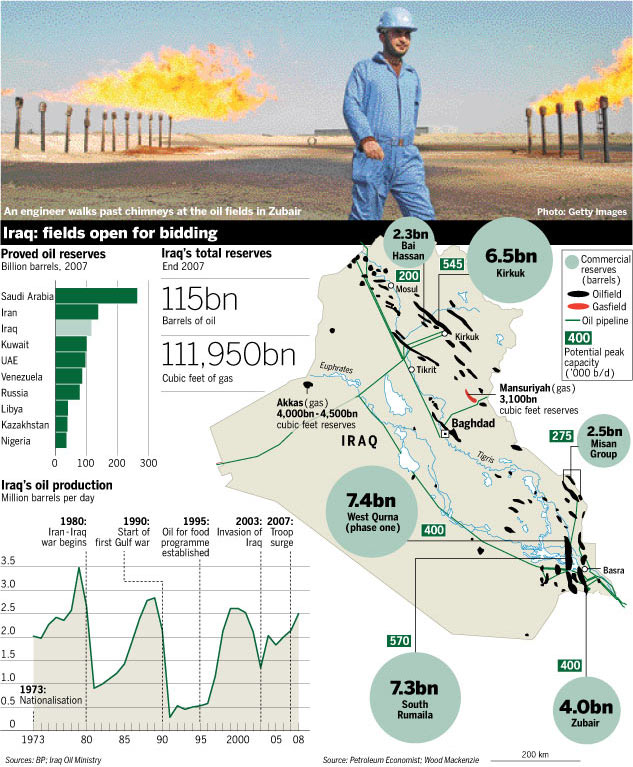
Carola Hoyos at FT Energy Source reports on the outcome of the auction of rights to develop Iraqi oil and gas fields today.

"BP and CNPC have won the right to help Iraq develop the Rumaila field. The UK and Chinese companies beat ExxonMobil, the US oil company, which had partnered with Petronas, the Malaysian oil company. BP clinched the contract when it agreed to reduce its fee per barrel from $3.99 to $2.
...
The Mansuriyah gas field got no bids.

There were four bids from different consortia for the Zubair oilfield. But in the end the winning bidder rejected the terms on which Iraq was insisting and the field went unawarded. The groups that had initially bid were BP , together with CNPC; India’s ONGC with Gazprom Russia and Turkish Petroleum Corp. The third was headed by Italy’s ENI, with China’s Sinopec, Occidental and Korean Gas; and the fourth was led by Exxon Mobil, with Royal Dutch Shell and Petronas.

The Maysan field failed to find a developer as Iraq and the single consortium that bid (Cnooc and Sinochem) could not agree the terms.

The Kirkuk field got one bid by a group led by Royal Dutch Shell and including Sinopec and the Turkish Petroleum Corp.

The Bai Hassan failed to find a developer as Iraq and the ConocoPhillips-led consortium that bid on it failed to agree terms.

The West Qurna field got five bids, but its future hangs in the balance after ExxonMobil and CNPC both rejected Iraq’s tougher terms.

The Akkas gas field got one bid from a group led by Edison.

The the group led by Cnooc, the Chinese oil company, that bid on the Missan oil field, ended up rejecting Iraq’s tougher terms."
The report yesterday at Platts that winners will not be "announced" may mean that the ratification process leaves room for those who have lost bids to lobby. So far the decision by Sinopec to make an offer on Addax does not appear to have affected the ability of Chinese companies to secure concessions with Baghdad.

6. CHINA EXTENDS $950 M TO ZIMBABWE

The BBC reports that Prime Minister Morgan Tsvangirai told the media that "The government through the minister of finance, secured credit lines of almost $950m from China."
"'We will encourage and facilitate more Chinese companies to seek development in Zimbabwe,' Chinese official Zhou Yongkang told state news agency Xinhua."
I am increasingly becoming convinced that Chinese international loan agreements are mostly headlines, with the actual flow of finances tending to be much smaller.

7. US SUPREME CT SAYS ECUADOR IS NOT REQUIRED TO SUBMIT DISPUTE TO ARBITRATION

Gerald Karey at Platts reports that the US Supreme Court has declined to overrule a lower court ruling which rejected Chevron's claim that the joint operating agreement under which they operated in Ecuador required any dispute to be resolved via arbitration before the American Arbitration Association. In the meantime, Chevron
"is awaiting a ruling by a judge in Ecuador in a lawsuit seeking damages for Amazon residents for what could be upward of $27 billion. A judgment is expected later this year.

The Ecuador suit alleges that Texaco (later acquired by Chevron) dumped billions of gallons of toxic waste in the Ecuadorean rain forest from 1964 to 1990. Chevron has argued that Petroecuador should pay a share of any damages award. Petroecuador partnered with Texaco from 1974 to 1992, when the state-owned company took over sole operations."
8. FAO SAYS 1 BILLION GLOBALLY UNDERNOURISHED

On June 19, the AFP reported that the FAO released figures showing that one billion people globally are undernourished.
"[Jacques] Diouf [FAO chief] said in a statement earlier: 'A dangerous mix of the global economic slowdown combined with stubbornly high food prices in many countries has pushed some 100 million more people than last year into chronic hunger and poverty.'

An FAO statement said 1.02 billion people do not get enough to eat and predicted an 11 percent increase for all of 2009.

An estimated 642 million of the total are in the Asia-Pacific region, the agency said in a statement. Some 265 million are in sub-Saharan Africa, 53 million in Latin America and the Caribbean and 52 million in the Middle East and north Africa.

Some 15 million are hungry in developed countries, the FAO said."
(h/t Charles Kenny at Fistful of Euros.)

9. BIS CALLS FOR SWEEPING REFORMS TO FINANCIAL REGULATION

Chris Giles at the Financial Times yesterday reported that the Bank for International Settlements [BIS]--an international organization of 55 central banks--published its annual report calling for sweeping financial regulation reforms.
"It advocated big reforms to markets to limit bilateral trading between banks and instead introduce central counter parties, with trading on regulated exchanges.

It said institutions, particularly banks which posed a risk to the financial system, should also be subject to higher requirements to hold bigger buffers of capital against a future crisis. The authorities should strive to increase those buffers in good times.

It also recommended 'a scheme analogous to the hierarchy controlling the availability of pharmaceuticals', with a sliding scale topped by the safest products available for everyone to purchase, and tailed by financial instruments deemed illegal."
10. CASE SHILLER APRIL INDEX HOME PRICES DOWN 18% YOY, INITIAL CLAIMS DATA MAY MEAN JOB LOSSES HAVE PEAKED--UNEMPLOYMENT INSURANCE EXHAUSTION'S EFFECT ON CONSUMPTION MAY HAVE BEEN OVERSTATED

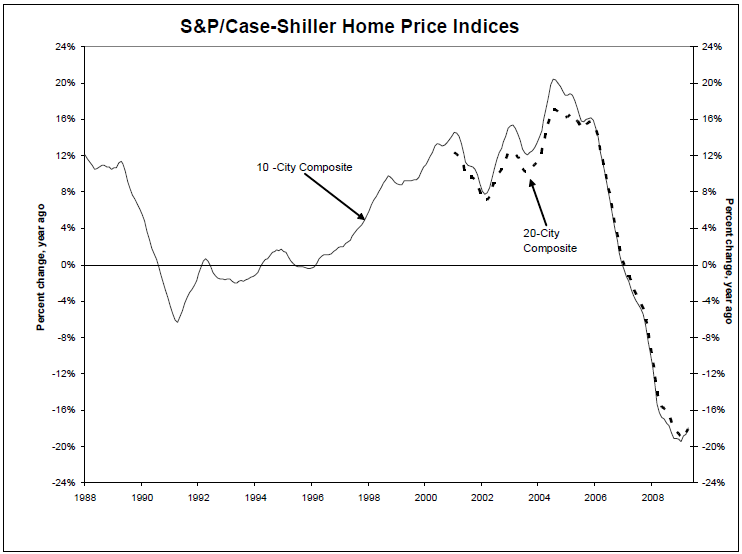
Barry Ritholtz at the Big Picture reports that the Case Shiller index showed home prices continuing to decline in April--18% year over year--but at a slower rate than in March.


Rebecca Wilder at News N Economics argues that if you take the four week moving average of initial unemployment claims, it looks likely that job losses are likely to slow from now on.
"Robert Gordon ([in an] Econbrowser post from April 2009) noticed a pattern that is quite evident in the chart [below]: for each recession, the 4-week moving average is a good predictor of the recession's end. We will see if that happens this time."


Wilder further notes that once unemployment claims peak, they tend to fall sharply. She also puts the kibosh on the notion that exhausted claims means that the fall in continuing claims is simply an indicator of people falling off unemployment losing all support for basic necessities. She notes that there are a number of additional unemployment programs not included in the basic state numbers--and
"By including the number of people that are collecting benefits under the [Emergency Benefits] EB and [Emergency Unemployment Compensation] EUC-2008 programs, the total stock of claimants tallies closer to 9 million rather than the 6.1 million (not seasonally adjusted) claiming under the regular program."
Worth reading in full.
11. STATES ONLY ALLOT 0.9% OF STIMULUS FUNDS FOR TRANSPORTATION TO PUBLIC TRANSPORTATION AND OTHER GREEN TRANSPORTATION INFRASTRUCTURE--THE REST GOES TO ROADS

Ana Campoy at Environmental Capital reports that the American Recovery and Reinvestment Act of 2009, which appropriated stimulus money to jump start transportation projects, is being used almost exclusively to fund highway and road construction and repair, per a report released Monday by Smart Growth America--a green transportation advocacy organization.
"Instead of pouring the money into new, cleaner ways of getting around, such as street cars or bike paths, many states fell back on their old habits: more than 30% of the funds are going towards building new roads. Another 63% will be used to fix the nation’s decrepit transportation infrastructure. In contrast, states are only spending 0.9% of the stimulus money on public transportation projects."
Worth reading in full.

Friday, June 19, 2009

Daily Sources 6/19

1. COMPROMISE LEADS TO NEW IRISH REFERENDUM ON LISBON TREATY IN OCTOBER

Carsten Volkery at Der Spiegel reports that the EU leadership have agreed upon a compromise insisted upon by Dublin where guarantees of sovereignty will be included in the text of the Lisbon Treaty. As a result, Irish Prime Minister Brian Cowen has announced that Ireland will hold a referendum on the treaty in October.
"The EU has provided guarantees to Ireland that it will remain independent in determining tax policies, military neutrality and abortion law (Ireland has one of Europe's most restrictive abortion policies). The sovereignty guarantees are expected to be anchored in EU law as a treaty protocol in the mid-term future."
Polls show that the Irish appear more receptive to the treaty, given the current economic crisis. Well worth reading in full.

2. THE EU TO BEGIN CONSIDERING HOW TO TRANSFER CARBON CAPTURE TECH TO CHINA & INDIA

Pete Harrison at Reuters reports that a draft document from the European Commission suggests that the EU will begin to determine how best to help India and China develop carbon capture technology next week.
"The European Union will start a consultation process on how finance and technology should be delivered to China and later India. This could be critical in securing their commitment to a new global deal on climate change at talks in Copenhagen in December.

'China builds, every year, as much coal-fired power plant as the entire UK generating capacity,' said a report prepared for consultations with industry and seen by Reuters on Friday.

'Unless a way can be found of making this climate-compatible, we can never meet our climate objectives, regardless of what action we take in Europe,' it added."
3. CHINA PROTESTS ADB LOAN TO INDIA, 74% OF CHINESE RESPONDENTS REGARD INDIA AS A THREAT

The India Times reports that the Chinese foreign ministry has issued a statement condemning the Asia Development Bank's recent decision to approve a $2.9 billion loan to India, $60 million of which is earmarked for a watershed project in the Arunachal Pradesh, where the border between the two countries is disputed.


The statement said:
"China expresses strong dissatisfaction to the move, which can neither change the existence of immense territorial disputes between China and India, nor China's fundamental position on its border issues with India.
...
As a regional institution on development, the ADB should not intervene in the political affairs of its members. The adoption of the document has not only dealt a severe blow to its own reputation but also undermines the interests of its members."
India has recently been strengthening the defenses in the region, including moving additional troops into it. The Chinese media has in the past few weeks been attacking New Delhi for putting "fresh strains on the relationship." In an interesting data point, a recent poll in China found that 74% of respondents look upon India as a threat.

4. CHINESE IMPLIED OIL DEMAND RISES 5.96% IN MAY YOY

Winnie Lee at Platts reported yesterday that Chinese implied oil demand rose by 5.96% in May from the year previous. Crude imports rose by 3.55% to to 16.62 million metric tons (~ 3.92 mb/d). It is the second consecutive month where implied demand has risen year over year, which could be interpreted as a sign the economy is rebounding. On the other hand, the director of China's National Energy Administration, told reporters on June 1st that "a substantial portion" of the crude oil trade in the first half had been due to stockpiling, and seemed to indicate that China's tanks were full--see Daily Sources 6/1 #2.

5. FRANCE STATS OFFICE PREDICTS ECONOMY WILL STABILIZE IN Q4

Eurointelligence reports that French statistical office INSEE released its latest forecasts this morning which see the economy stabilizing in the fourth quarter.
"Employment is expected to continue to fall, for 2009 the loss is expected to reach 700,000 jobs in the private sector. Consumption growth is still positive (forecast at +0.7%), though saving rates are about to rise slightly. France seems thus in a much better position than the rest of the euro area, for which GDP is forecast to contract by 5.6% and consumption by -1.6%."
6. BANK OF MEXICO CUTS BENCHMARK INTEREST RATE TO 4.75%

Jens Erik Gould at Bloomberg reports that the central bank of Mexico today cut its benchmark interest rate by 0.5% to 4.75%.
"The [bank's] board 'considers that its easing cycle is close to ending,' the bank said in a statement. 'Future actions that might be taken will possibly be of smaller magnitude and consistent with both the evolution of the economy and the performance of inflation.'

The economic contraction has been 'severe' in the first half of the year, and is a greater risk than inflation, the bank said. The comments signal that it will probably cut a quarter point next month and then keep the rate unchanged for the rest of the year, said Gabriel Casillas, chief economist for Mexico and Chile at UBS AG."
7. ANGOLA STILL PLANS TO LAUNCH SOVEREIGN WEALTH FUND THIS YEAR

Henrique Almeida at Reuters reports that Angolan Finance Minister Severim de Morais said today that Luanda intends to launch a sovereign wealth fund in 2009 to invest its oil wealth abroad.
"Plans to create the fund, known as the Fundo Soberano Angolano, were announced in November by President Jose Eduardo dos Santos, but the project has since been delayed due to the global economic downturn.

Asked whether the fund would be launched this year, de Morais replied: 'Yes, our aim is to launch the fund in 2009.'"
8. CREDIT CARD SQUEEZE HURTING SMALL BUSINESSES, UNEMPLOYMENT IN THE WEST RISES TO 10.1% IN MAY

Yves Smith at naked capitalism notes that the credit card squeeze is hurting small businesses, historically the largest source of job creation in the US.
"The importance of credit cards as a source of funding to small companies has gone largely unnoticed in the wider world, yet is well know to experts on entrepreneurship. Indeed, Amar Bhide, in his landmark The Origin and Growth of New Businesses, pointed out that, contrary to popular mythology, venture capital played a trivial role in forming new businesses. Personal savings, loans or investments from friends and family, and credit card borrowings were the most important sources.

And before readers chide supposedly foolish owners for paying interest, consider: using credit cards includes the astute use of float, which can give companies six or seven weeks of free money. And in better days, card companies offered products targeted to small business owners with favorable rates, often from 9% to 14% (and also offered them even cheaper 'life of the balance' deals, now a distant memory). With interest tax deducible, this was a viable source of funds, particularly for companies that faced short-term financing needs, such seasonal sales patterns.

As we noted, American Express, first to target small businesses, halted its credit line programs as of early 2009 (regular corporate ards for small businesses are still in effect). Advanta, which focused solely on this market, has found itself saddled with a heap of bad debt (default rates of 20%) and has stopped extending new credit as of early June."
Well worth reading in full. Meanwhile, the Associated Press reports that the Labor Department announced today that the unemployment rate rose to 10.1% in the American West in May.
"By region, the Midwest had the second-highest rate, at 9.8%, underscoring the toll of job losses in manufacturing. The South’s unemployment rate was 8.9%, and the Northeast had the lowest at 8.3%."
Unemployment rose in all but two states last month.

Monday, May 18, 2009

Daily Sources 5/18

1. GLOBAL HOUSING BUBBLE STILL LOOKS UNPOPPED

On Saturday, Rebecca Wilder at News N Economics took a look at the global housing bubble. She plots a graph of price-rent ratios for Ireland, Spain, the UK, Germany and the US indexed to 1997:


She says she "included the German price-rent ratio to show that housing bubbles are not uniformly the root cause of economic decline." Worth a look.

2. SUPPORT FOR LISBON TREATY IN IRELAND, ITS NEXT BATTLEGROUND, GROWS

Stephen Collins at the Irish Times reports that 52% of respondents in a new survey indicated that they would support the upcoming referendum for the Lisbon Treaty.
"Asked if, in the current crisis, it is better for Ireland to be part of the EU, an overwhelming majority of 79 per cent to 10 per cent say Yes, with a very small number of undecided voters at 11 per cent.

There is a substantial majority in favor of the EU among all social classes, age groups and party supporters.

Not surprisingly, Sinn Féin supporters are easily the most negative about the EU, although a decisive majority are still in favor.

What is surprising is that the most enthusiastic supporters of the EU are Green Party supporters, followed by Fianna Fáil, Fine Gael and Labour in that order."
The largest trend spotted by the survey was a softening of the stance of women toward the treaty, where a significant percentage switched from "No" to "I Don't Know." Dublin registered the largest majority in support of the treaty. (h/t Eurointelligence.)

3. EU ENERGY COMMISSIONER GIVES CREDENCE TO PEAK OIL THEORY

The Oil Drum has reproduced the comments of Andris Piebalgs, the European Energy Commissioner, in which he suggests that he thinks that peak oil analysts may well be right.Key excerpt:
"The world is aware that the production of the existing oil wells is decaying and that new discoveries are more scarce and more expensive. Some experts consider that global oil production may have peaked at [84] million barrels a day. The current economic crisis can make the situation worse. The lower prices that we are enjoying now can be in fact bad news. At this price oil producers have been forced to postpone many necessary investments in new production capacity. These investments take decades to be accomplished. In consequence, if the current economic crisis finished and demand recovers we could be facing huge shortage of supplies that can lead to extremely high prices."
4. BAGHDAD-KRG DISPUTE HEATING UP FURTHER ON KURDISH INDEPENDENT OIL EXPORTS, KRG BECOMES LINKED TO BATTLE BETWEEN THE NABUCCO AND SOUTH STREAM PIPELINE ALTERNATIVES, RUSSIA STRENGTHENS LINKS TO KEY TRANSPORT AND DELIVERY NATIONS--ITALY, AUSTRIA, HUNGARY

Missy Ryan and Mohammed Abbas at Reuters report that Iraqi Prime Minister Nuri al-Maliki said in a televised interview last Thursday that power-sharing pacts that have Sunnis and Kurds a greater say in the affairs of the country need to be pared back. He said,
"In the beginning, consensus was necessary for us. In this last period, we all embraced consensus and everyone took part together. We needed calm between all sides and political actors. But if this continues it will become a problem, a flaw, a catastrophe. The alternative is democracy, and that means majority rule ... From now on I call for an end to that degree of consensus."
The rule of consensus has resulted in minority groups taking posts in senior administrative roles regardless of their share of the national vote. Moves to end the custom would clearly benefit the Shi'a majority in the country. In the meantime, Saifur Rahman at Gulf News reports that Sharjah-based upstream energy explorers Dana Gas and Crescent Petroleum, in conjunction with Austrian energy group OMV and Hungary's MOL have signed a partnership to invest as much as $8 billion in the Kurdish region's energy sector.
"The strategic partnership is expected to boost gas output in Iraq's ... northern Kurdistan province from the current 90 million standard cubic feet of gas per day to a potential 3 billion by 2014 and help meet the growing energy demand in the region and beyond."
Part of the notion touted by OMV and MOL is to find gas supply for the Nabucco pipeline. However, in March Gazprom signed a deal with MOL to establish a 1.3 billion cubic meters storage facility in Hungary--see Daily Sources 3/18 #4. And Euroactive today reports that Russian oil company Surgutneftgas recently took a 21.2% stake in MOL, for €1.4 billion (~ $1.86 billion at the interbank exchange rate of the time.) OMV had launched a failed takeover bid for MOL in 2007, which led to it selling its stake to Surgutneftgas in March. Surgutneftgas is thought to be close to Prime Minister Vladimir Putin.


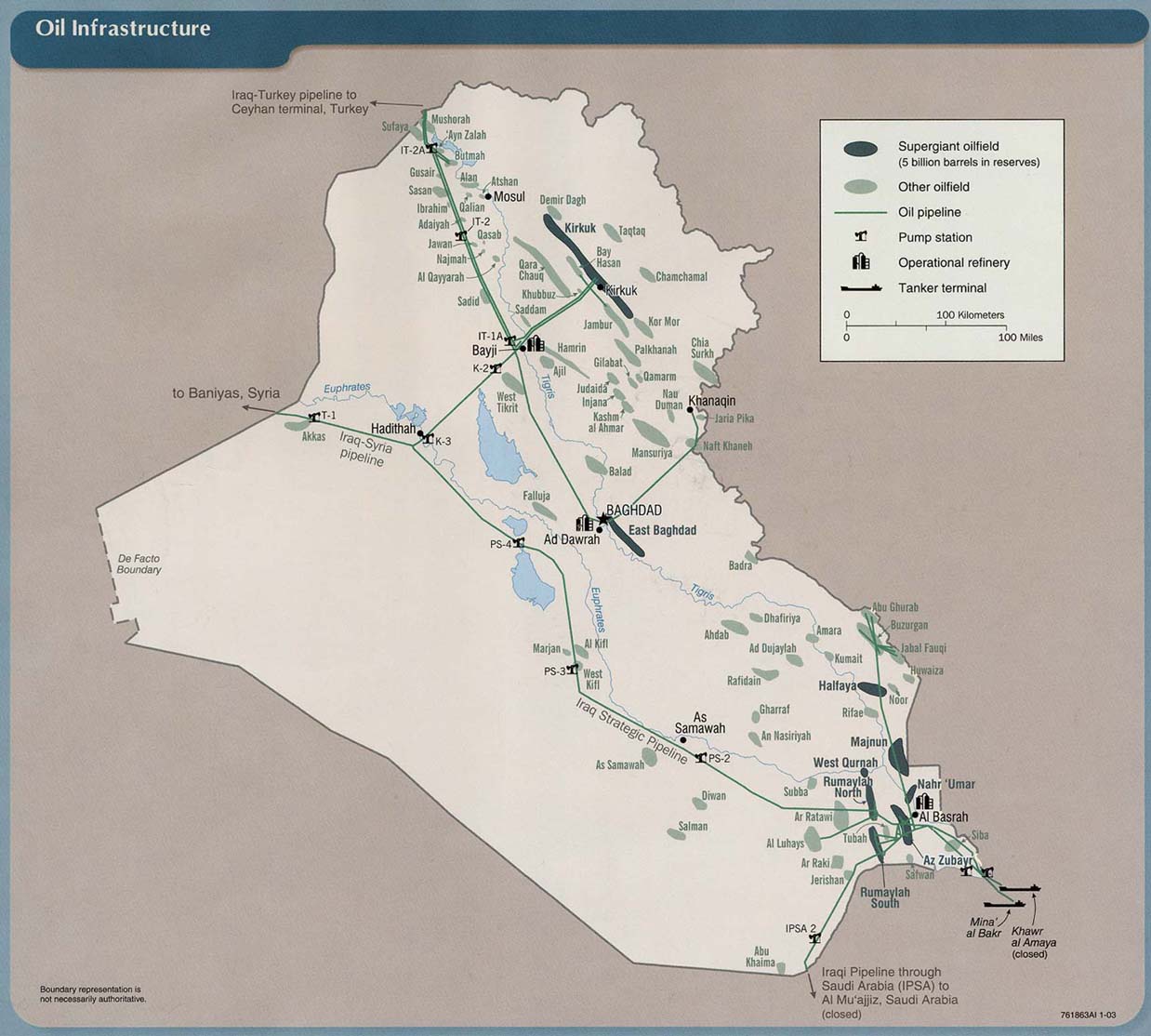
The Kurdish Regional Government's oil minister, Ashti Hawrami indicated last week that oil from concessions signed without Baghdad's approval will begin to flow through the Iraq-Turkish pipeline and that the only way for Baghdad to put a stop to that would be to shut all exports via that line--see Daily Sources 5/12 #8. In a likely related development, Faleh al-Khayat at Platts reports that Iraq's parliamentary committee has asked the speaker to summon Iraqi oil minister Hussein al-Shahristan to be queried on his failures to move central government oil policy forward.
"The call for a summons came in a statement read out by an official from the speaker's office on Iraq's Al-Sharqiya satellite television channel. The official said the request was signed by 140 of parliament's 275 members."
Shahristani is in open conflict with the Kurdish Regional Government, refusing to grant the legitimacy of 20 oil and gas concessions the region has granted without central government say so. In the meantime, Isabel Gorst at the Financial Times reported Saturday that Berlusconi and Putin signed a deal in Sochi Friday to increase the capacity of the planned South Stream gas pipeline to 63bn cubic meters a year.
"Paolo Scaroni, Eni chief executive, said South Stream would improve Europe's energy security. "What is the meaning of this capacity extension of South Stream? It means 1 billion cubic meters more here will be 1 billion cubic meters less gas crossing Ukraine.""
It is interesting in this context that Iran appears to be arguing at this time for the Pars Pipeline, and now has it moving not through Turkey, but through Iraq and Syria to the Mediterranean, which could potentially thread it through Iraqi Kurdistan. Iran has its own concerns about its Kurdish minority, and has an interest in maintaining strong relations with a Shia-dominated government in Baghdad, so the fact that such a move has even been placed on the table is of some interest.

5. RUSSIAN ANALYSTS SAYING MOSCOW SHOULD FOLLOW THE US AND TURN TO THE FAR EAST

Yevgeny Bendersky at the Compass translates some geopolitical analysis from Russia's Daily Izvestia:
"So whats for Russia in all of this? At present, we stand on the sidelines of the revolutionary transformation of the economic world order. We pray for high oil prices. Why? So that once again we can accumulate dollar reserves and invest in the United States? What for? At the same time, Russia does not belong to any serious economic bloc.

The world will be divided into three main regions: the Americas, Europe and the East, warn the economists. United States will lose some of its power, the leadership will shift towards Asia. That is why America is in a hurry to make friends with China, in order to prevent the creation of a powerful Asian bloc. Where is Russia in the new structure of the world? The East, of course, is closer to us. Already, 96% of Russia's far eastern exports are geared for consumption by the neighboring Asian countries. We need to unite with them--especially in an era of globalization."
6. THE PLA ORDERED TO ESCHEW HEDONISM

Sky Canaves at China Journal reports that the Central Military Commission, the powerful Communist Party organ that controls the People’s Liberation Army, issued a directive over the weekend warning PLA officers against ostentatious displays of wealth. It is only anecdotal, but I have been led to understand that in order to do business in China, you must have contacts with the PLA.
"Today the People’s Liberation Army Daily carried a front-page article ... on the directive, pledging more stringent controls over mid-level and senior military officers, emphasizing accountability and party loyalty."
7. BRAZILIAN PRESIDENT IN BEIJING TO TRY AND MAKE FINANCING DEALS REALITIES

Andre Soliani at Bloomberg reports that Brazil's President, Luiz Inacio Lula da Silva, is in Beijing today where he hopes to make reality financing plans for a variety of projects.
"If Lula’s plans pan out, he’ll return with a $10 billion credit for Petroleo Brasileiro SA, an $800 million loan for the state development bank, and financing for ports and waterways. He expects he’ll be able to open China to Brazilian poultry."
(In February, Petrobras announced it had signed a $10 billion loan agreement with China’s Development bank--see Daily Sources 2/19 #1.)
"China, according to central bank figures, has invested $141.6 million in Brazil since Nov. 12, 2004 when Lula, with Hu beside him, said Brazilians could look forward to $7 billion of Chinese financing.

'Given the potential of both economies, the investments both ways could be much bigger,' China’s ambassador to Brazil, Qiu Xiaoqi, told reporters May 7 in Brasilia when asked why the plans hadn’t materialized.

The biggest Brazilian project announced by the Chinese, a joint venture of Baosteel Group Corp. and Vale to build a $3.6 billion steel-slab plant, was canceled in January.

'The Chinese have made Africa their priority,' said Sandra Rios, coordinator of Brazil-China Observatory, a study group created by Brazil’s Industrial Confederation. 'They expect to have a bigger political influence in that region than in Brazil.'"
8. INDIAN ELECTIONS STRENGTHEN THE MODERATE CONGRESS PARTY

Arvind Subramanian, a senior fellow at the Peterson Institute for International Economics, posts at the Baseline Scenario that the recent elections in India have resulted in a significant victory for the incumbent Congress Party and its allies and defeats for the Communists and the Hindu-nationalist BJP. He comments:
"Going forward, these results augur well for Indian economic policy reform. The Congress will be numerically strong enough not to have to rely on partners for political support and will be able to push through new policy initiatives.

Another likely consequence is that the Nehru family will probably provide India, not immediately but within the next couple of years, with its fourth Prime Minister—Rahul Gandhi, son of Rajiv Gandhi, grandson of Indira Gandhi, and great grandson of India’s first Prime Minister Jawaharlal Nehru.

These results are surprising for two reasons. Indian elections have traditionally been characterized by the phenomenon of anti-incumbency: ruling politicians get routinely thrown out of power. This government is the first in over 40 years that has been re-elected after a full term in office."
Subramanian notes that part of the reason for the Congress Party's success has been that India has been weathering the financial crisis relatively well. Well worth reading in full.

9. US SENATE TOLD PAKISTAN RAPIDLY ADDING TO NUCLEAR ARSENAL

Thom Shanker and David E. Sanger at the New York Times report that a Senate committee Thursday was told that Pakistan is rapidly adding to its arsenal of nuclear weapons. Adm. Mike Mullen, the chairman of the Joint Chiefs of Staff, in response to a question of whether or not aid sent to Islamabad might be diverted to nuclear programs said, "Yes."

10. ISRAEL ALLEGEDLY URGED BY OBAMA ADMINISTRATION TO TONE DOWN IRAN RHETORIC

Steve Linde at the Jerusalam Post reports that the US has been urging Israel to tone down its rhetoric on Iran in advance of Prime Minister Benjamin Netanyahu's visit to DC this week.
"This was one of the purposes of a secret trip to Israel three weeks ago by CIA Director Leon Panetta, foreign diplomatic sources said.

Ostensibly, the CIA chief came to share information on Iran's nuclear program with Israeli intelligence officials and find out how serious the new Israeli government was in its stated position that Jerusalem cannot allow Iran to become a nuclear power.

Panetta was hosted by Mossad chief Meir Dagan and intelligence officials, but also met with Netanyahu and Defense Minister Ehud Barak."
Worth reading in full.

11. MALAYSIAN STATE TO SET UP NEW SOVEREIGN WEALTH FUND ON OIL REVENEUS

Netty Ismail at Bloomberg reports that the Malaysian state of Terengganu is planning to organize a sovereign wealth fund of 11 billion ringgit (~$3 billion).
"The Terengganu Investment Authority, the first sovereign wealth fund set up by a Malaysian state, said it will manage the long-term oil revenue of the state, located on the east coast of peninsular Malaysia."
12. CONFLICT IN NIGERIA CONTINUES TO HEAT UP

Platts reports that tensions continue to escalate in Nigeria as MEND threatened in an emailed statement Sunday to shut all waterways to oil industry vessels. In addition,
"MEND claimed Sunday to have blown up two major oil and gas pipelines in the state. Sources told Platts that one belonged to the state-owned Nigerian National Petroleum Corp. and supplied crude to the 110,000 b/d Kaduna refinery, while the other was a gas pipeline operated by Shell that fed natural gas to power plants in the region. The extent of the damage was unclear."
13. AL-SHABAAB OFFENSIVE APPEARS TO BE MAKING HEADWAY AGAINST CENTRAL GOVT IN SOMALIA, ERITREAN SUPPORT ALLEGED

Stephanie McCrummen at the Washington Post reports that al-Shabaab has launched a ten day offensive across the Somali capital in an attempt to topple the Transitional Federal Government under the new President, Sharif Ahmed.
"Momentum has been swinging back and forth between the government and rebels for days, but on Sunday it seemed to be with the rebels, who include several leaders who US officials have said maintain ties to al-Qaeda. In a major blow, they took a key government stronghold, Ahmed's home town of Jowhar, about 50 miles north of the capital, giving them control of major routes to the north."
Apparently as al-Shabaab has scored military successes, fighters who had switched allegiances to Ahmed have switched back again.
"The Somali government and the United States accused Eritrea of supporting the group by flying cargo planes full of AK-47 assault rifles, rocket-propelled grenades and other weapons to a sandy airstrip outside the capital just before the rebel advance began. Eritrea has denied the allegations."


I am unclear on why it would be in the interests of Eritrea to support a hard line Islamist group's ascent in Somalia, given that it is 98% Orthodox Christian and Sunni Muslim (more or less even divided.) It's longstanding enmity with Ethiopia may account for some sympathy for any organization at odds with Addis Ababa, perhaps Asmara believes that al-Shabaab is the only organization capable of truly creating a state which will impose law and order in Somalia. Still, having done so, it seems that al-Shabaab's ties with al-Qaeda would mean that that would simply result in a state which would seek to export instability to the region.

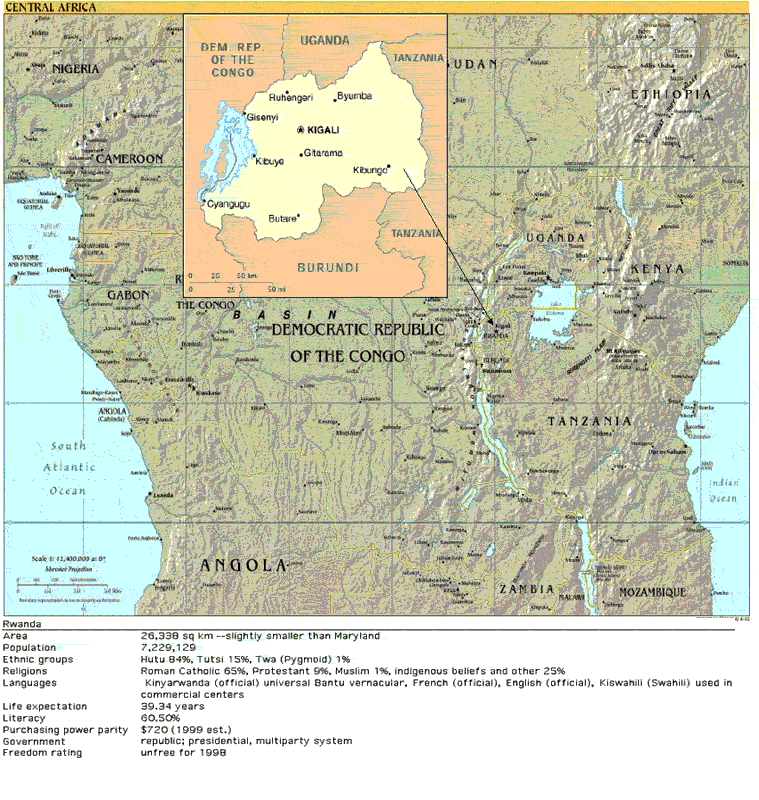
14. RWANDA TELLS SECURITY COUNCIL TO PUT THE KIBOSH ON FOREIGN FINANCING OF REBEL ACTIVITY IN EASTERN CONGO

Anita Powell at the Associated Press reports that Rwandan Foreign Minister Rosemary Museminali told reporters following a meeting of UN Security Council representatives in Rwanda that:
"There are movers and shakers (of the [Hutu opposition group FDLR]) in Europe and the rest of the world. We believe they should be sanctioned, we believe they should be dealt with, if we are to support the peace process in Congo."
Rwandan forces joined the Congolese in a joint military action against rebel Hutu forces in eastern Congo in late January--see Daily Sources 1/23 #9. In that offensive, a rebel Rwandan Powell reports that in 2006 the US imposed sanctions on businessmen and "warlords" who were allegedly financing instability in eastern Congo, near the Rwandan border.


In November, Angola had reportedly sent troops to help Congolese forces combat rebels in the region, but it apparently took the active cooperation of the Rwandan government to make any serious progress--see Daily Sources 11/10 #8.

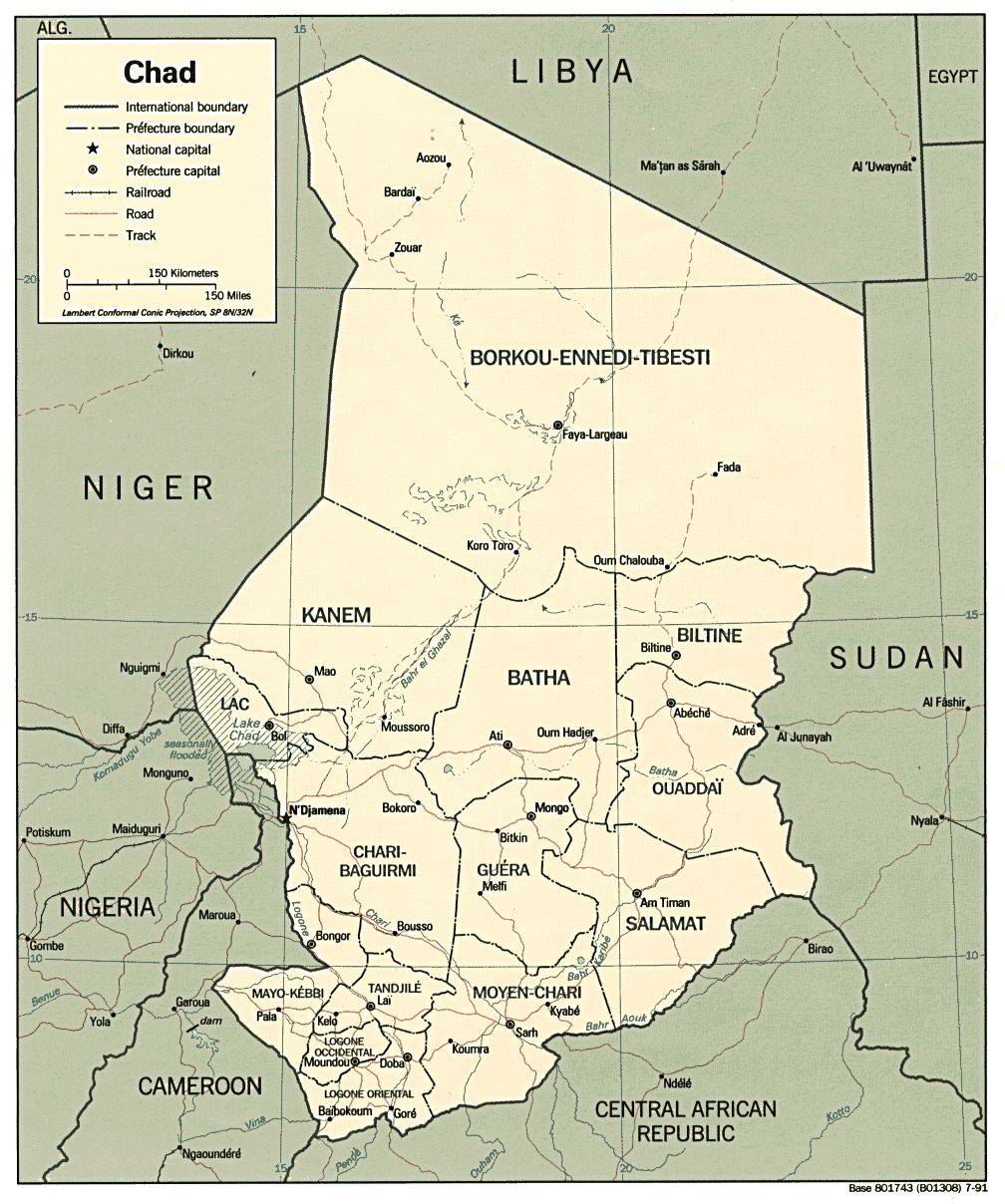
15. CHAD ENDS AIR STRIKES INTO SUDAN, SUDANESE REBEL APPEARS BEFORE THE ICC

Dany Padire at the Associated Press reports that Chad's interim defense minister, Adoum Younousmi, told the media that N'Djamena had ended air raids against Chadian rebel groups operating out of Sudan Sunday. Younousmi said,
"Our target was not the Sudanese government and less so the general population. Our objective was the Sudanese mercenaries wherever they were to be found, without causing any collateral damage."
The recent air attacks were the first attacks into western Sudan proper, where rebels have allegedly been operating, and whom N'Djamena has alleged Khartoum supports.

"Eastern Chad is a temporary home to about 300,000 refugees who have fled Sudan's Darfur conflict. The region also has camps for 187,000 Chadians displaced by fighting locally and in Darfur."
Younousmi said that the raids had destroyed seven pockets of rebels and that around 100 prisoners had been captured by ground forces operating in conjunction with the air attacks. In the meantime, BCC reports that a former member of the Darfur rebel group, the Justice and Equality Movement (JEM), Bahr Idriss Abu Garda has voluntarily appeared before the International Criminal Court to address charges of crimes against humanity leveled against him. (JEM is an Islamist group fighting the central government.) He is charged with taking part in an attack with killed 12 African Union peacekeepers in northern Darfur.


Mr. Abu Garda has since left JEM to form his own rebel movement, the United Resistance Movement. A spokesman for Mr. Abu Garda has argued that the charges against him are the result of fall out between him and JEM. The President of Sudan, Omar Hassan al-Bashir was charged with war crimes by the ICC in March and promptly expelled aid groups working in the Darfur region in response--see Daily Sources 3/6 #5.

16. NORWEGIAN PARLIAMENTARY VOTE ON CANADIAN OIL SANDS PARTICIPATION PUT OFF

Wojciech Moskwa and Terje Solsvik at Reuters report that the Norwegian government has delayed a parliamentary vote on whether StatOilHydro should withdraw from a $2 billion investment in Canada's oil sands.
"The oil sands issue has put the government in a bind four months before a general election, with political opponents saying state support for the oil sands project was hypocritical given the cabinet's self-professed environmental ambitions."
17. OBAMA ADMINISTRATION TO PROPOSE NEW NATIONAL CAFE STANDARDS

John M. Broder at the New York Times reports that the Obama Administration is set to announce as early as Tuesday new regulations for the emissions and mileage of cars and light trucks which will combine California's new auto-emissions rules with the existing corporate average fuel economy (CAFE) standard to create a single new national standard.
"Under the new standard, the national fleet mileage rule for cars would be roughly 42 miles a gallon in 2016. Light trucks would have to meet a fleet average of slightly more than 26.2 miles a gallon by 2016."
This is a big deal. Transportation accounts for about 60% of US oil consumption.

18. INDUSTRIAL REVOLUTION CAUSED BY CHEAP ENERGY, EXPENSIVE LABOR

In an extremely interesting piece, Robert C. Allen on Friday posted an article asking why the Industrial Revolution took place in England at Vox EU. His answer:
"The famous inventions of the Industrial Revolution were responses to the high wages and cheap energy of the British economy. These inventions also substituted capital and energy for labor."


It was difficult to transfer the technologies to places where either coal was expensive or labor was cheap. A must read. Note, just now many analysts expect the West, and the world, to enter a period where energy is expensive and labor is cheap.

Thursday, May 7, 2009

Daily Sources 5/7

1. CZECH SENATE PASSES LISBON TREATY, ALL EYES TURN BACK TO IRELAND; THE EU TO OFFER ADDITIONAL AID TO A STRANGE MEDLEY OF FORMER SOVIET REPUBLICS; THE ECB LOWERS BENCHMARK INTEREST RATE TO 1% AND ENGAGES IN QUANTITATIVE EASING; THE BANK OF ENGLAND ENGAGES IN ADDITIONAL QUANTITATIVE EASING; AND MANY INDICATORS SEEM TO POINT TO A BOTTOMING OF THE FINANCIAL CRISIS ... BUT OIL LOOKS POISED TO PUT THE KIBOSH ON IT ALL

Jess Smee at Der Spiegel reports that the Czech Senate yesterday approved the Lisbon Treaty, with 54 of 79 voting to ratify. President Vaclav Klaus is a euroskeptic and will ensure that the treaty is reviewed by the Czech Republic's high court, but most expect much of that to be a formality.
"The international treaty--which replaces the ill-fated European Constitution rejected by French and Dutch voters with a slightly altered version of the same document, this time written in legalese, filled with caveats for different member states and sans some of the features of a United Europe such as a flag and an anthem--can only be adopted when it is approved by all members. In addition to Ireland, the Czech Republic, Poland and Germany must all still sign the treaty before it can be officially ratified."
Now attention will turn to Ireland, which rejected the treaty last year. In the meantime, Anatoly Medetsky at the Moscow Times reports that the European Union will offer today at a conference better trade ties and visa rules as well as €350 million ($466 million) in aid over four years for six countries neighboring Russia as part of an initiative known as the "Eastern Partnership."
"The EU names as a flagship project to pursue with the eastern partners the development of the 'southern energy corridor'--a term that describes all pipelines needed to bring Caspian Sea and Central Asian gas to the EU. The main part of the corridor is Nabucco, said Ferran Espuny, an EU energy spokesman.

Talks to secure commitments to supply gas and build pipelines for Nabucco are progressing well, Espuny said Wednesday."
The Eastern Partnership specifically refers to Armenia, Azerbaijan, Georgia, Moldova, Ukraine, and Belarus--with Belarus being the most surprising choice of all. In the meantime, the European Central Bank cut its benchmark interest rate by a quarter percent to 1% today, per a Bloomberg story by Jana Randow and Simone Meier. The bank also indicated it would purchase as much as €60 billion (~$80.5 billion) in bonds.
"ECB officials have spent the past months bickering over whether to fight a recession by purchasing assets, with Bundesbank President Axel Weber leading resistance to such a move. The US Federal Reserve, the Bank of England and Bank of Japan have lowered rates close to zero and are already buying bonds, effectively printing money to reflate their economies in a policy known as quantitative easing."
(h/t reader Charles.) Lukanyo Mnyanda at Bloomberg reports that Bank of England decided today to maintain its benchmark interest rate at 0.5%, but that it also announced it will spend an additional £50 billion (~ $75 billion) "of newly printed money to spur economic growth." Rebecca Wilder's weekly summary of global economic data seems to show that the aggressive stimulus measures are having some effect. She concludes that Chinese manufacturing probably has passed a cyclical low and that the same is true of the US, that export declines have slowed in South Korea, but are falling more steeply in India,


and that lagging indicators unemployment and prices are surging and falling on energy, respectively. I always find her analysis helpful and worth checking out. I would only point out, however, that if inflation is falling mostly on energy prices, then recent events in the oil market, counter intuitive as they might be, could translate into a considerable obstacle to global recovery, with the price of WTI having climbed $6/b over the course of the last week and some predicting a spike to $71/b on the back of cash-strapped traders trying to exit short positions--see Daily Sources 5/6 #7. As I've noted before, $70/b looks more or less to be the price after which demand starts to contract, as you can see in this chart of vehicle miles driven over the price of oil:


2. BEIJING ALLEGEDLY TO INCREASE GOLD HOLDINGS, PERHAPS EVEN FROM ITS PURPORTED NEMESIS THE IMF, AND IN THE FACE OF 10 YEAR EUROPEAN MONETARY AUTHORITIES POLICIES OF SELLING THE RESERVE METAL, CHINESE STATE BANKS MET 92% OF LENDING TARGET SET BY STIMULUS IN FIRST QUARTER, BUT WHERE DID THE MONEY GO? AND CAN BEIJING SECURE THE TRUST OF THE INTERNATIONAL FINANCIAL COMMUNITY (AND DOES THAT MATTER?), WELL MIDDLE EASTERN ARAB NATIONS ARE STICKING TO DOLLAR PEG FOR NOW, THANK YOU VERY MUCH--BUT WHAT WOULD THAT MEAN FOR THE COMMON CURRENCY SET FOR 2010?, ARAB FOREIGN MINISTERS IN CAIRO TO COORDINATE POLICY ON ISRAEL/PALESTINE

Patti Waldmeir at the Financial Times reported yesterday that analysts believe that Beijing has embarked upon a policy of increasing its holdings of gold bullion in order to diversify its foreign reserves.
"Beijing and Shanghai-based gold industry analysts said the country had almost doubled its bullion holdings. But they said China was likely to make as many purchases as possible within its borders, rather than turn to international markets where it could push up gold prices."
If it is state policy, turning to domestic markets for gold may be complicated by private household demand for gold, as evidenced by the 19.6% spike in gold and jewelry sales over the May Day Holiday of May 1 - 3 as reported by the Commerce Ministry--see Daily Sources 5/4 #2.
"China’s current gold reserves represent only about 1.6% of total foreign reserves, a vastly smaller percentage than the world’s average of 10.5%. Nevertheless, its percentage is similar to the 2.2% in Japan, the world’s seventh-largest holder. The challenge for Beijing is to attain a similar diversification, requiring large amounts of gold, without disturbing the market."
Ms. Waldmeir indicates that analysts speculate that Beijing may try and increase its holdings via the expected IMF sale of 400 metric tonnes of gold bullion, perhaps in an "off-market agreement." That would be interesting in the context of the speculation that the Chiang Mai Initiative is in effect an attempt to decouple from the IMF and the Western-led international financial system. That said, Javier Blas at the Financial Times also reports that the paper conducted an analysis showing that had several central banks of Europe not embarked upon a policy of selling gold ten years ago, they would be $40 billion richer than they are now. That, in and of itself, is not an astonishingly large number in the context of central banking--or so it seems to me--but the story also notes:
"The proportion of European reserves held as gold remains extremely large even after years of sales, at an average of about 60%, compared with the world average of 10.5%."
Several of the central banks that embarked upon the policy of gold sales had held as much as 90% of their reserves in gold. The move out of gold and into bonds was justified by the notion that bonds are less volatile, and, indeed, it is the case that the so-called "Great Moderation" did not affect commodities, which is why the notion of "core inflation" was invented--or so I surmise.


The FT includes a fascinating and especially informative graphic illustrating global central bank gold holdings and with commentary here. Terence Poon at the Wall Street Journal reports that the People's Bank of China said today that the country had yet to establish a solid economic footing in the crisis, and sounded a note of caution with respect to new lending.
"The central bank reiterated that it will maintain its moderately loose monetary policy and ensure sufficient liquidity in the banking system, but it added that loan quality needs to improve to 'prevent risks of amplifying volatility in the economy and of rebounding nonperforming loans.'

Despite its concerns about the sharp loan growth, the PBOC promised to ensure credit levels will accommodate economic growth. 'If the international financial crisis deepens in the future, credit will need to continue growing at a certain pace,' it said.

China extended 4.58 trillion yuan ($670 billion) of new loans in the first quarter, already 92% of the minimum five trillion yuan target the government set for the full year."
Meaning, I take it, that further strong measures to stimulate domestic demand will be required. Andrew Batson at the China Journal reports that the most recent central bank quarterly monetary policy release gives some hints as to where the loans are coming from and going to:
"China’s state-controlled banks are clearly leading the lending charge, accounting for 50.5% of the new credit extended during the quarter. Foreign banks are, however, behaving more like they are elsewhere, and are not following their Chinese colleagues into the lending surge. Loans by foreign financial institutions declined by 26.4 billion yuan in the first quarter.

The central bank’s breakdown of new medium- and long-term borrowing, the kind most likely to be used to pay for investment, shows that 50.1% went to infrastructure in the first quarter. That clearly reflects how banks are being pressed to give priority to government stimulus projects. But such lending has its own risks. 'Recent bank lending has been concentrated in government projects which, while helping drive rapid investment, also requires evaluation of local governments’ ability to repay the debts,' the central bank said.

Outside of stimulus projects, demand for credit is not as strong. Only 7.9% of new medium- and long-term lending went to manufacturing, and 11.2% to real estate development."
Andrew Batson, in the WSJ, reports that Beijing is responding to concerns about the veracity of the statistics it releases on the economy, by conducting an overhaul of the economic data collection system in the country.
"During the current downturn, China's National Bureau of Statistics has tried to provide more and better information. It is publishing data on food prices more frequently, and promises more detailed figures on output, jobs and wages. New penalties for falsifying statistical reports are also now in force.

But the real test will be whether higher authorities permit the numbers to show politically inconvenient fluctuations in China's economy.

'I think the check is less technical ability and resources, and more whether they are allowed to announce bad news, instead of only good news and okay news,' said Derek Scissors, a fellow at the Heritage Foundation in Washington."
This bit causes just a bit of cognitive dissonance given Beijing's recent decision to allow financial news organizations to operate in the country, but prohibit them from engaging in news gathering operations--see Daily Sources 5/1 #1. Meanwhile, Shanthy Nambiar and Camilla Hall at Bloomberg report that Saudi Arabia, Qatar and Bahrain monetary officials indicated today that they saw no need to move away from the dollar pegs for their currencies.
"A decision on the date for a single currency shared by Saudi Arabia, the UAE, Kuwait, Qatar and Bahrain hasn’t been taken yet, according to [Saudi central bank Governor Mohammed] al-Jasser.

Qatar’s central bank Governor al-Thani said today he still thinks meeting the 2010 target for the currency between Saudi Arabia, the UAE, Kuwait, Qatar and Bahrain is possible.

'We will still continue with 2010 and we’ll be working hard on the schedule to achieve our goals and objectives,' he said."
Meanwhile, the BBC reports that Arab foreign ministers are meeting in Cairo to formulate a common approach to the Middle East process.
"The Arab foreign ministers will also decide whether to send their report on alleged Israeli crimes in Gaza to the International Criminal Court."
3. TEPCO TO RESTART 1.356 GW NO 7 NUCLEAR REACTOR IN THE NEXT COUPLE MONTHS, SHOULD REDUCE DEMAND FOR LNG/CRUDE

Takeo Kumagai and Jonty Rushforth at Platts reports that Tokyo Electric Power Co. is ready to restart the 1.356 GW No. 7 nuclear reactor at the Kashiwazaki-Kariwa nuclear power plant, after receiving approval from the local authorities today.
"All of Tepco's nuclear reactors at the Kashiwazaki-Kariwa nuclear power plant, with a combined capacity of 8.212 GW over seven units, have been offline since they were shut July 16, 2007, following an earthquake.

The earthquake did relatively little damage to units No. 6 and No. 7, which have been repaired, but there is no timeframe for bringing the remaining five units back online. The No. 6 and No. 7 reactors each have a capacity of 1.356 GW."
It can take from two to three months to bring the reactor back on line following the approval of the local authorities. In the absence of the operating plant, Tepco is being forced to directly burn crude, low sulfur fuel oil, LNG, and coal as feedstock replacements.

4. SECTION OF PIPELINE SERVING KURDISH AUTONOMOUS REGION BLOWN UP, JUST AFTER WORLD CLASS GIANT OIL FIELD FIND

Following the news yesterday that a world class giant oil field find was confirmed in the Kurdish Autonomous Region of Iraq, the AFP reports that a section of the oil pipeline running from the large Bai Hassan oilfield near Kirkuk was blown up.


"'We were forced to interrupt pumping in 15 wells' because of the blast, [a North Oil Company, or government,] official said, adding that repairs will take up to seven days.

The North Oil Company produces 650,000-670,000 barrels of oil per day."
5. APPROX. 500,000 FLEE SWAT, BUNER, AND DIR; IS SHARIF PLAYING POLITICS WITH HIS COUNTRY'S SURVIVAL?

Alan Cowell at the New York Times reports that the International Red Cross published a statement today saying:
"[A]lthough figures remain unverifiable at this stage, reports indicated that up to 500,000 Pakistanis have been recently displaced by conflict in Dir, Buner and Swat."


It has been reported that PML-N's leader Nawaz Sharif has rejected an offer to rejoin the coalition government led by the PPP's Zardari, currently in talks with the Obama Administration in Washington, DC. An editorial in the Karachi Dawn suggests:
"Today, rising militancy is the main threat to national security, but the political class is divided on what is the best response. The PPP has shown itself willing to support military action, but the PML-N has baulked at supporting the option. Perhaps cleverly the PML-N has discerned that the electorate is not ready to support the military option because it causes unacceptable losses to local populations without seemingly being able to defeat the militants. And therefore, while sitting in the opposition, the PML-N can cleave to the populist line and not bear the burden of devising a credible and effective counter-insurgency and counter-terrorism policy which will inevitably involve a long-drawn-out and messy fight.

But what is good for the PML-N’s popularity is not necessarily what is best for the national interest. If the PPP and PML-N are nudged, or themselves agree, to join hands at the centre, they can form a formidable political alliance. The PML-N’s popularity in Punjab is unquestioned and Mr Sharif’s bona fides as the representative of the political right and conservative Pakistan are formidable. With the PML-N on board, the government will genuinely be able to claim its position on militancy represents the national will."
6. EL PAÍS ACCUSES CARACAS OF SHELTERING FARC LEADERS

Fausta Wertz at the Compass reports that Spanish daily El País published an article yesterday which speculates that three top FARC leaders are hiding out in Venezuela.
"The article from El País came up after Colombian president Alvaro Uribe urged Chávez to help destroy the FARC. Chávez flat-out refused, saying that it's not his war."
Ms. Wertz also notes that Chávez blamed the US for the recent crash of a helicopter, saying that the cost of patrolling the border with Colombia was beyond the financial resources of Caracas and that the conflict within Colombia itself is fueled to a great extent by the drug war. Fair points in my view, after all even the US with the largest federal government budget in the world finds cross-border traffic driven by the drug war impossible to police--and the precipitous decline in oil prices has put a serious crimp in Chávez's discretionary funds. (The proposed US budget includes $27 billion for "border and related security," an increase of 8% from last year. $27 billion is more than 8% of Venezuela's total GDP $331.8 billion and a little less than 27% of the 2008 budget in Caracas. It is 0.7% of the US proposed budget. Just sayin'.) However, it is also interesting in the context of Chávez's recent claim that Venezuela will not tolerate incursions by FARC into its territory--see Daily Sources 5/1 #2. Anyone who has been following my thinking on Chavez knows I don't think there's much chance of reconciliation, but in this particular instance I think that El País and Wertz are overstating the shock, just a bit.

7. OBAMA PROPOSES $3.4 TRILLION BUDGET PLAN

Lori Montgomery, Amy Goldstein and William Branigin at the Washington Post have the story on the Obama $3.4 trillion budget plan.
"The new budget documents, totaling more than 1,500 pages, fill in the details of a broad outline that Obama released in February. They include a massive appendix listing program-by-program information on the roughly 40% of the fiscal 2010 budget that constitutes discretionary spending, which will be set by Congress in what is expected to be a contentious appropriations process."
Under the plan, spending on operations in Afghanistan would exceed spending for Iraq for the first time since the second Gulf War began.

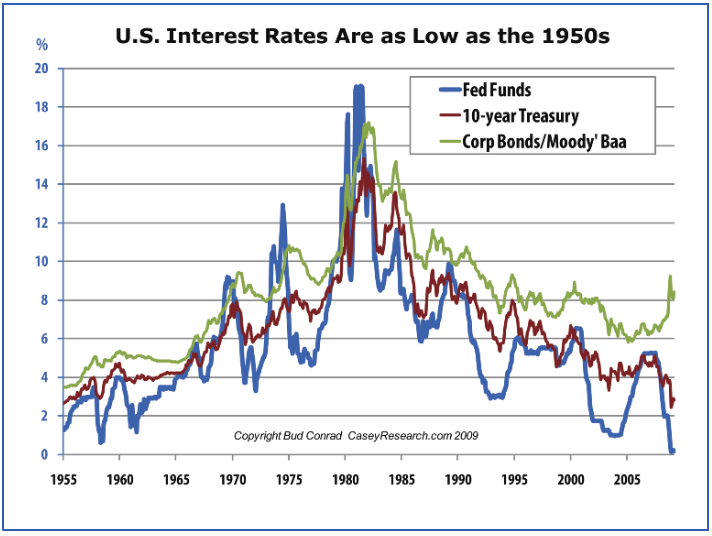
8. FED FUNDS RATE SINCE 1955

Barry Ritholtz at the Big Picture posts a graph plotting the Federal Funds Rate from 1955 on:


9. RETAIL DATA LOOKS BAD FOR ALL BUT APPAREL AND DISCOUNTERS--THE DATA TO BECOME EVEN MORE MURKY GOING FORWARD

Phil Izzo at Real Time Economics reports that a number of large retailers have released their sales data for April today, and RTE has posted a sortable table of the numbers on their site. Luxury retailers fared the worst. Discount and youth apparel firms seem, after a quick look, to have done relatively well. In a related story, Phil Izzo also reports that Wal Mart will no longer publish monthly sales data.
"The change also will remove an important piece for forecasters looking to get a handle on monthly retail sales. Wal-Mart is the nation’s largest retailer with $29.85 billion in sales just for April. An index for retail sales published by Thomson Reuters for April came in up 1.2% for the month, but excluding Wal-Mart’s results it posted a drop of 2.7%."
An already murky picture is thus going to become murkier--almost certainly at the advice of the corporation's investor relations team.

Tuesday, April 21, 2009

Daily Sources 4/21

1. MORE GRIM FORECASTS FROM JAPAN AND THE IMF

MarketWatch reports that Tokyo is expected to cut its forecast for GDP growth to a 3% contraction for the year starting April 1. Mark Landler at the New York Times reports that the IMF released its global financial stability report today, estimating that banks and other financial institutions will suffer $4.1 trillion in aggregate losses in their holdings due to the financial crisis.
"In its global financial stability report, released Tuesday, the fund estimated that financial institutions would have to write down an estimated $2.7 trillion in loans and securities originating in the United States from 2007 to 2010. That estimate is up from $2.2 trillion in the fund’s report in January, and $1.4 trillion last October."
The story finishes by noting that the response to the crisis has been uneven:
"The fund estimates that in the United States, for example, banks reported $510 billion in write-downs by the end of 2008 and face an additional $550 billion in 2009 and 2010. In the euro zone, banks reported just $154 billion in write-downs by the end of last year and still face $750 billion. British banks are in somewhat better shape: having written down $110 billion, they face $200 billion more, the fund said."
2. KNOW YOUR CHICKEN: CHINA TO CONSIDER NEW RULES ON LENDING, CONSIDERED BY SOME ANALYSTS THE KEY TO BOTTOMING THE GLOBAL CRISIS; BUT IF THEY'RE COUNTING ON US CONSUMPTION, THE PROGNOSIS DON'T LOOK GOOD ... DEFLATION IN GERMANY, BUT LOW INTEREST RATES SUPPORTING ITALIAN REAL ESTATE MARKET; SWEDEN, THE ECB, AND CANADA LOOK SET TO BOARD THE QE BUS

The Wall Street Journal reports that the China Bank Regulating Commission is considering rules which would ensure that new loans are going to the real economy as opposed to the asset markets or bank accounts.
"A sharp cutback in credit would run the risk of derailing the nascent improvement, and is precisely what officials aren't planning to do. But they aren't pushing on the accelerator, either. The central bank has put interest-rate cuts on hold since December. The government is also expressing concern that the lending surge could be adding to financial risks or isn't directly aiding businesses in need of cash.

'Banks ought to fully realize that dealing with the impact of the crisis is a long-term task, and should pay close attention to risks accumulated from a burst of lending,' the head of China's banking regulator, Liu Mingkang, said at the agency's quarterly meeting last week."
A chart of loan growth by the WSJ:


The loan growth is what Brad Setser identified yesterday as a potential "green shoot" in the global economy--see Daily Sources 4/20 #1. Jesse's Café Américain reproduces a chart from contrary investor.com which shows how "falling aggregate demand and the weaker dollar" has undone the import market in the US--with the EU the largest market for Chinese imports:


Beijing appears to be placing some trust, therefore, in soon to recover American consumer demand. However, as Jesse comments:
"This is the worst decline in retail sales in the post World War II era.

The US consumer has finally hit the wall. The folks in DC think they can crank this Frankenstein monster of reckless consumption back up again, given the right jolts of liquidity and spin.

To think that consumers will start borrowing and buying again without a meaningful change in the dynamic of their cashflows implying an increase in the median wage, is a hard to believe. Even for the reckless American consumer, this episode has been daunting to their over-confidence, and rightfully so."
Rebecca Wilder at News N Economics adds that bank lending has stalled at an annual rate of growth of about 2.2% and that the credit crunch is now fully evident in the data. She points out:
"However, there is one exception: as of March, real estate lending is still rising slightly, but only because households are drawing on existing home equity lines of credit. I see this as another shoe to drop on consumer spending."


Her comments:
"The chart illustrates lending on revolving home equity lines of credit (HELOC). Lending (blue line) is still rising through March at a 20% annual rate. Households are using these lines of credit (presumably) to finance consumption needs, and a 20% annual growth rate is likely unsustainable.

Eventually, the lines of credit will run dry; and households will be forced to cut back on spending, taking another leg down. Not shown here is non-revolving real estate lending, which is down 1.3% in March since its peak in January 2008."
Well worth a look. In the meantime, Karey Wutkowski and Juan Lagorio at Reuters report that the credit card companies are scheduled to meet with the White House Thursday to discuss fees and interest rates.
"Scott Valentin, an analyst at Friedman, Billings, Ramsey, said credit card companies could also eliminate some late payments, or over-limit fees, to please Washington.

'The card companies are sensitive to what is going on around them, and public perception, and the government actions that are being contemplated, and are trying to put on a good face,' he said.

Credit card issuers have received over $120 billion in taxpayer funds since October, money the government has asked them to use to expand lending.

But with US credit card defaults at record highs, lenders are trying to protect themselves by tightening credit limits and closing accounts, actions that have infuriated lawmakers, consumers, and even triggered a New York state attorney general inquiry.

'Some of the very banks we rescued compound the hardships of ordinary Americans with unfair fees and interest charges,' said Senator Carl Levin, a Michigan Democrat who has co-authored credit card legislation.

Citigroup Chief Financial Officer Ned Kelly said in a conference call Friday with analysts to discuss the bank's quarterly results that the credit card business has shifted from growth to risk management.

He added that higher prices on credit cards helped the bank, one of the largest US credit card issuers, to cushion its losses."
The piece, well worth reading in full, concludes:
"'The administration clearly wants to keep the money flowing to the consumer, and the credit card companies are trying to protect themselves, hopefully there will be a middle ground some place,' said Anton Schutz, president of Mendon Capital."
In the meantime, Eurointelligence notes that Il Sole 24 published a story today noting that the one-month Euribor fell to below 1% this month for the first time ever. Euribor is the the rate at which euro interbank term deposits within the euro zone are offered by one prime bank to another prime bank. This is reportedly goosing the Italian real estate market as about 42% of new mortgages are based on one-month Euribor.
"The savings in mortgage payments to Italian mortgage holders are indeed substantial (the same applies almost to the same extent to the 3-month Euribor based mortgages, which are popular in Spain)."
In the meantime, Lukanyo Mnyanda and Anna Rascouet at Bloomberg report that the German Federal Statistics Office announced today that German producer prices fell by an annual rate of 0.5% last month, after rising 0.9% in February. German bonds prices rose on that news and the news yesterday that European Central Bank policy maker Christian Noyer indicated there was "room" for further interest rate cuts by the organization. In addition, Johan Carlstrom at Bloomberg reports that the Riksbank cut its benchmark interest rate by 0.5% to 0.5% and indicated that it stands ready to take further measures to resuscitate Sweden's economy. And the Bank of Canada also today cut its benchmark rate to 0.25% from 0.5%, indicating that it will leave the rate at that level through 2009, according to Bloomberg's Greg Quinn.
"'Conditional on the outlook for inflation, the target overnight rate can be expected to remain at its current level until the end of the second quarter of 2010,' the central bank said in a statement from Ottawa today. The central bank will provide updates at each future policy decision, starting June 4, on its commitment to leave the key rate unchanged."
3. THE EU IS TRAINING DIPLOMATS IN ANTICIPATION OF LISBON TREATY RATIFICATION

Der Spiegel reports that "hundreds of bureaucrats" at the European Commission are taking courses in political analysis and public relations in preparation for the new role the commission would take should the Lisbon Treaty come into force.
"Among the key provisions of the treaty is the creation of a European External Action Service and the appointment of a 'foreign minister,' though the title has been renamed as the 'high representative of the Union,' as well as an EU president. The idea is to groom an EU diplomatic service so it can start its work the day the treaty--once known, and rejected by voters in France and the Netherlands, as the 'EU constitution'--goes into effect."
4. CHINA WORKING TO DEFUSE INTERNATIONAL WORRIES

Javier Blas at the Financial Times reports that Niu Dun, China’s Deputy Agriculture Minister, told the journalist Monday that "We cannot rely on [investments in] other countries for our own food security. we have to depend on ourselves." In November, Zhang Xiaoqiang, Vice Chairman of China's National Development and Reform Commission, has announced that the country will set as a strategic priority domestic production of 95% of their grain consumption through 2020--see Daily Sources 11/14 #5. Obviously food security trumps all other resource security concerns, but Beijing's recent change in strategy in terms of overseas oil and gas resource acquisitions--via joint ventures and loan agreements--and its decision to veer away from the strategy pursued by other food deficit nations like Saudi Arabia to purchase overseas agricultural production seems to demonstrate recognition in Beijing that its resource security policies as set forth so far have ignited worries globally about their intentions. Obviously, if your resource security is dependent upon overseas holdings, their security would require the projection of force overseas. The notion that China is slightly adjusting the cut of its jib is also reinforced by the news today--via Jeb Blount at Bloomberg--that Petrobras Chief Executive Officer Jose Sergio Gabrielli said in an interview with the news wire that the company is not offering crude as collateral for the $10 billion in loans coming from China.

In that vein, there was an interesting comment made yesterday noting the story picked up by the US Naval Institute's blog that there has been heavy trading in options for McDermott International on rumors that CNPC is considering purchasing the company. McDermott is, among other things, the US Navy's sole provider of nuclear fuel and nuclear fuel assemblies as well as a manager of the US Strategic Petroleum Reserve. I doubt it is happening as rumored, but should it prove the case, it surely would be a huge story. In the meantime, Edward Wong at the New York Times notes that Beijing is clearly attempting to manage global concerns about China's rise, most recently deciding to unveil its nuclear submarines to public scrutiny in an international review of the country's fleet.
"The officer, Vice Adm. Ding Yiping, deputy commander of the Chinese Navy, told Xinhua in an interview on Monday that 'suspicions about China being a "threat" to world security are mostly because of misunderstandings and lack of understandings about China.'

He added: 'The suspicions would disappear if foreign counterparts could visit the Chinese Navy and know about the true situations.'"
Military analysts have most recently been concerned by the Chinese decision to retrofit ballistic missiles with warheads designed to take out air craft carriers. The recent news that supertanker companies expect the global fleet to contract in the medium term on the back of dismal demand is met, today, by the report by Toby Anderson at Lloyd's List that 35 additional very large crude carriers will be required if Venezuela is to meet its plans for increased crude supplies to China. (I'm afraid all I have access to is the snippet advertising the story, for the previous forecasts about the shape of the global supertanker fleet, see Daily Sources 4/16 #8.)

5. JAN 12 LETTER FROM KURDISH LEADER BARZANI TO OBAMA INCLUDED PLEA FOR SUPPORT FOR KRG OIL POLICIES

Ben Lando at Iraq Oil Report writes of a previously undisclosed letter from Kurdistan Regional Government of Iraq's President Massoud Barzani urging the Obama Administration to support the KRG's oil policies, whereby they would lease concessions to international oil companies without the explicit assent of the central government in Baghdad.
"He is blunt in pressing for U.S. support for controversial oil contracts signed by the KRG, which have been condemned as 'illegal' by Iraq Oil Minister Hussain al-Shahristani, criticized by Prime Minister Nouri al-Maliki and referred to by Bush administration officials as unhelpful in the reconciliation process."
The Obama Administration has declined, as of yet, to take sides in the matter.

6. THE BUSH ADMINISTRATION OFFERED TO DROP OIL SANCTIONS ON IRAN IN 2008

Kate Dourian at Platts reports that Hooshang Amirahmadi, speaking at the Middle East Petroleum and Gas conference in Dubai, said he was party to negotiations with Tehran in 2008 where the US offered to suspend sanctions on Iranian oil and gas in return for a six week suspension of uranium enrichment.
"'The bottom line is that the US offered to suspend sanctions on oil and gas in return for Iran freezing uranium enrichment for six weeks,' [Amirahmadi] said.

The offer was rejected by Tehran and the response to the US request for a 'wish list' from the Iranian leadership was: 'Leave us alone.'

Amirahmadi said when asked what type of sanctions the US was offering to suspend that it applied to executive orders dating back to the Clinton era, which imposed a trade ban against Iran, including trade in oil and gas, and prohibiting US investment in Iran's energy sector.

Other sanctions which were legislated, such as the Iran-Libya Sanctions Act (ILSA) of 1996--later amended to drop Libyan sanctions--was not included in the offer as it would require a congressional vote."
7. SAUDI ARABIA PUTS ANOTHER OIL PROJECT ON HOLD

Kevin Baxter at Reuters reports that Saudi Aramco has put the $9 billion Manifa offshore oilfield project on hold for six months.
"The Manifa project is in line to become Saudi Arabia’s largest offshore field, capable of producing 900,000 barrels of crude. However, the heavy sour crude the field holds makes it expensive to process and not economically viable in the current financial climate."
This delay is on top of delays for a number of domestic Saudi Aramco projects slated for export--see Daily Sources 4/14 #6.

8. VIETNAMESE ECONOMY EXPANDING!

Jason Folkmanis and Nguyen Dieu Tu Uyen at Bloomberg report that Vietnamese Prime Minister Nguyen Tan Dung told investors at a conference in Hong Kong yesterday that Vietnam's economic growth is rebounding after slowing in the first quarter.
"'The stimulus package has already had a good effect on the economy, and we believe it will have more impact,' he said. 'Growth will accelerate in the second, third and fourth quarters. We are targeting 5% to 5.5% growth for the year.'

Vietnam’s economy expanded 3.1% in the first quarter from a year earlier, the slowest pace on record, according to figures from the General Statistics Office in Hanoi.

Stimulus money will be invested in projects in areas including transportation and energy, Dung said. The $8 billion amount includes money from the government budget, according to the prime minister, who didn’t specify if any of the funds he was referring to had been included in the budget prior to the creation of stimulus plans."
9. HOW TO HELP MOLDOVA

Louis O'Neill, former OSCE ambassador and head of mission to Moldova, has an opinion piece in today's Wall Street Journal where he suggests a way to bolster Moldovan sovereignty in the current circumstance. To wit:
"With all these forces still tugging at a relatively new, unconsolidated and poor nation, it seems a proper time and in everyone's interest to give Moldovan sovereignty a boost. After all, every nation recognizes Moldova's territorial integrity and sovereignty, but also the right for Transdniestria to have a special status within a unified country. A serious restart of the '5+2' talks on Transdniestria comprising Russia, Ukraine, the Organization for Security and Cooperation in Europe, the EU, the US as well as Moldova and Transdniestria, could lead to a real settlement. Such a deal could open important new areas of trust in a reinvigorated US-EU-Russian relationship and improve the lives of people on both sides of the Dniester."
Well worth reading in full.