Showing posts with label SPR. Show all posts

Wednesday, August 4, 2010

Daily Sources 8/4

August is surely a slow news month.

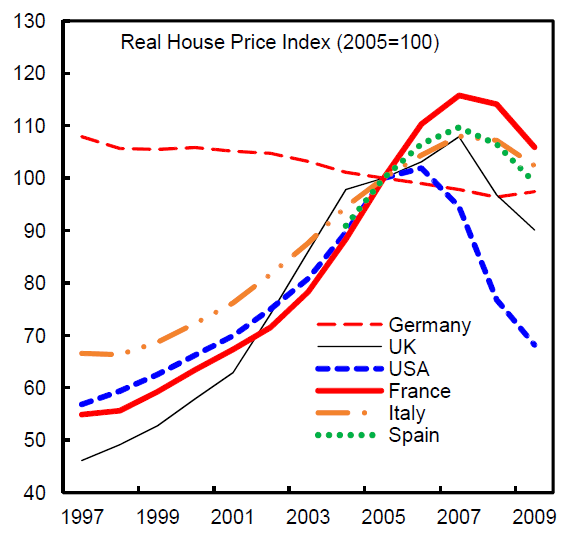
EUROPEAN HOME PRICES HAVE MUCH ROOM TO CORRECT

Barry Ritholtz at the Big Picture hosts a graph of developed nations' home prices.


As you can see there is plenty of room left for correction in the European housing markets.

CHINA TO HAVE 500 MILLION BARRELS OF PETROLEUM PRODUCTS STORAGE BY 2015

David Winning at the Wall Street Journal reports that Chinese petroleum product storage tanks are set to grow by 500 million barrels by 2015. In addition, China is adding 338 million barrels to the existing 102 million barrel strategic petroleum reserve. Filling these tanks will put upward pressure on the price of oil. Building the tanks will also dampen the dreams of other countries with spare storage capacity, South Korea and Singapore, to sell into the Chinese market.

CHINA'S CAR SALES NOW FAR SURPASS US'S

Alex Taylor III at Fortune Magazine reports that China is expected to sell 15.6 automobiles in 2010, a 20% rise from the year before. Auto sales in the US are expected to reach 11.6 million units this year.

CHINESE BANKING REGULATOR ASKS BANKS TO PERFORM STRESS TESTS TO SEE WHAT WOULD HAPPEN WITH 60% REDUCTION IN HOUSING PRICES; NEW STUDY SHOWS THAT SMALLER CITIES NOT FACING SIMILAR HOUSING PRICING PROBLEMS IN CHINA

Bloomberg reports that China's banking regulator last month asked its banks to perform stress tests to see what would happen if housing prices declined.
"Banks were instructed to include worst-case scenarios of prices dropping 50 percent to 60 percent in cities where they have risen excessively."
Meanwhile, Aaron Back at China Real Time reports that Standard Chartered has conducted a survey of "Tier 2 and 3" cities and found that they are not suffering from deep corrections.
"'The Tier 2 and Tier 3 cities have not seen much of a correction in land or apartment prices. Moreover, developers’ sentiment about sales volumes seems pretty good, and they do not appear to be postponing construction,' Standard Chartered said in a report on Tuesday. 'This is important, since if sales and construction activity holds up in most Tier 2 and Tier 3 cities, then the economy will not tank, and the State Council will not be forced to loosen real-estate or monetary policy.'"
PALESTINIAN PRESIDENTIAL ADVISER SAYS PEACE MAY CREATE 20% ECONOMIC GROWTH IN PALESTINE

Jonathan Ferziger at Bloomberg reports that a key adviser to the Palestinian president said that the Palestinian economy may grow by as much as 20% if there is peace with Israel.

EIA REPORTS 2.8 MILLION BARREL CRUDE DRAW DOWN IN STOCKS

The EIA reported today that for the week ended July 30 crude oil stocks drew down by 2.8 million barrels to 358 million barrels. Crude oil stocks are well above the five year historical average. Gasoline stocks grew by 0.7 million barrels and distillate stocks grew by 2.2 million barrels. Refining capacity utilization grew to 91.2%. For the week ended August 2nd, national gasoline prices fell by 1.4 cents to 273.5 cents.

Friday, July 31, 2009

Daily Sources 7/31

1. MESSERLIN AND MAREL ARGUE THE US & EC COULD REAP GAINS BY OPENING SERVICES SECTOR

Patrick A Messerlin and Erik van der Marel at VoxEU argue that the US and the European Commission should launch transatlantic negotiations in opening the services sector as a prelude to multilateral negotiations. Key excerpts:
"Services providers are busy redesigning their strategies for coping with the ongoing economic crisis. To take the appropriate decisions, they need predictable future market access in services. Meanwhile, as many services are still highly protected, opening services markets would deliver large benefits to consumers impoverished by the crisis."
"Is there any appetite for services negotiations now? Yes. The July 2008 Signalling Conference held under the aegis of the Doha Round showed a substantial number of participants expressing strong interests in most services, offers and requests in mode 3 in many services (foreign direct investment), and even a willingness to include mode 4 (movement of natural persons, by far the most contentious part of any service negotiations) in some services.

Such a willingness to negotiate appears particularly strong in three services: business, communication, and distribution services. Together, these three services in the EC, US, and top eight countries represent almost one-third of the world GDP, a size so huge that negotiators could work on deals within as well as between these services sectors. The three services face high levels of regulatory constraints, ensuring huge economic gains in case of market opening. Finally, negotiations are made easier by the fact that business and communication services are resilient to the current crisis, while the inflationist pressures to come should make governments eager to have distribution services as competitive as possible.

Last but not least, the foreign policy dimension of the whole endeavour is crucial for Europe. Many US decision-makers are looking to Asia for good reasons (Bergsten, 2009) while Europeans have not yet fully grasped the growing importance of Asia nor captured its attention, as illustrated by the disappointing June 2009 Asia Europe Ministerial meeting on energy."
2. EUROZONE UNEMPLOYMENT UP TO 9.4% IN JUNE, CONSUMER PRICES FELL AT ANNUAL RATE OF 0.6%

Reuters reports that eurozone unemployment rose to 9.4% in June, up from a revised figure of 9.3% in May.
"The European Union’s statistics office also said on Friday that inflation in the euro area had moved much further into negative territory than forecast in July, with consumer prices falling at an annualized rate of 0.6%.

The drop raised worries about deflation and heightened expectations that the European Central Bank will maintain its loose monetary policy."
3. US OPEN TO BRINGING RUSSIA INTO NATO

Yevgeny Bendersky at the Compass reports that
"Assistant Secretary of State Philip Gordon told US lawmakers Tuesday during the House International Relations Committee hearing that the United States would consider Russian membership in NATO."
Gordon said:
"[I]f Russia meets the criteria and can contribute to common security, and there is a consensus in the alliance, it shouldn't be excluded."
Bendersky points out that some in Eastern Europe might be cold to the idea. Given that membership would freeze, so to speak, the current borders by militarily integrating the members, it may arguably provide superior protection than the current relationship. It certainly would make adventurism a much more complicated affair.

4. NIPPON OIL IN TALKS WITH SK ENERGY TO BUILD NEW REFINERY IN VIETNAM

Megumi Yamanaka and Yuji Okada at Bloomberg report that Nippon Oil Company has announced it might build a refinery in Vietnam with SK Energy Co.
"'We’ve been in talks with SK and have agreed on the need for participating in a refining project' in Asia, Nippon Oil Chairman Fumiaki Watari said in an interview in Tokyo yesterday. Vietnam is a potential location for the first venture between Japan and South Korea’s biggest refiners, and the plant may process 200-300 kb/d of crude oil, he said.

Seo Young Joon, a spokesman at SK Energy in Seoul, said he couldn’t immediately comment. Idemitsu Kosan Co., Japan’s second-largest refiner, and Mitsui Chemicals Inc. plan to spend $5.8 billion to build a 200 kb/d plant in Vietnam."
"'We know that about 25% of Japan’s refining capacity will be unnecessary in the next five years.' Watari said."
Vietnam inaugurated its first refinery this year with capacity of 148 kb/d and which is poised to supply about 30% of Vietnam's product requirement--see Daily Sources 7/28 #8. The EIA projects its total petroleum demand was about 288 kb/d in 2008. Hanoi projects GDP will grow by 5.5% in 2009, adding perhaps as much as 10 kb/d in demand this year.

5. INDIAN FIELD BEGINNING PRODUCTION TO UP INDIAN CRUDE PRODUCTION BY 25%

The Economic Times reports that Indian crude production is expected to rise by about 25% when Cairn begins pumping from the Mangla field of its Rajasthan acreage next month.
"'We are operationally ready to commence oil production in August,' Cairn India CEO Rahul Dhir said. In its various filings to the government, Cairn has indicated that production will quickly touch 30 kb/d by the end of third quarter this year and reach a plateau of 175 kb/d (8.75 million tonnes a year) in 2011. Goldman Sachs, however, has pegged the peak output at 190 kb/d (9.5 million tonnes a year)."
Using EIA projections, Indian crude production in 2008 was 693.7 kb/d. Its imports came in at 2.056 mb/d, so the Mangla field at 175 kb/d would represent about 8.5% of its import requirement. However, some of those imports are reexported as products, for example to the US--Reliance is set to restart its old Jamnagar refinery shortly, bringing another 660,000 kb/d of nameplate capacity on line. It is expected to double Reliance gasoline exports to about 170 kb/d.

6. PAKISTANI SUPREME COURT REJECTS PETITION TO TRY MUSHARRAF ON TREASON CHARGES

BBC News reports that the Pakistani Supreme Court has rejected a petition to try former President Musharraf on charges of treason.
"The court had asked him to explain his decision in 2007 to invoke emergency rule and suspend the constitution.

It has now ruled that parliament is the place to debate Mr Musharraf's actions.

Chief Justice Iftikhar Mohammed Chaudhry rejected a petition to launch a treason case against the former president.

Mr Chaudhry was himself removed from his position as a result of President Musharraf's imposition of emergency rule, but was reinstated after he resigned in August."
For more on the lawyers revolution in Pakistan, I wrote a long piece on it early last year--see The Law in Pakistan.

7. 40 DAY CYCLE OF PROTESTS IN IRAN MIRROR 1979 REVOLUTION, PRESS REPORTS OF CHINESE-IRAN MOU ON SOUTH AZADEGAN FIELD DENIED BY CNPC, US SENATE TO BAR THOSE SELLING PETROLEUM PRODUCTS TO IRAN FROM PARTICIPATION IN SPR

Michael Collins Dunn at the MEI Editor's Blog observes that the 40-day cycle in protests seen in the 1979 Iranian Revolution is being repeated in the current conflict over the elections. Juan Cole at Informed Comment has a good roundup of the recent political events in Iran. Meanwhile, Upstream Online notes that there have been stories that CNPC has signed an MOU with NIOC to develop the South Azadegan oilfield, taking a 70% stake in the field in return for covering 90% of development costs.
"However, a CNPC manager based in Beijing told Reuters today that the MoU was actually signed earlier this year and there has been no real breakthrough in talks with the oil ministry since then.

'The MoU is not a binding contract, and we are still negotiating with NIOC about specific details,' the CNPC source, who declined to be named because he was not authorized to speak to the media, told the news agency."
In the meantime, Jean Chemnick and Katharine Fraser at Platts report that the US Senate has inserted language into the Senate Energy and Water Appropriations bill [H.R. 3183] which would prohibit companies that sell gasoline and diesel to Iran from entering into contracts to fill the Strategic Petroleum Reserve.
"At least three companies fit that bill, Glencore, Shell Trading and Vitol, according to the Foundation for Defense of Democracies. In January, the three were named by DOE as suppliers to the SPR for deliveries this year. While it could not be immediately confirmed whether any of the three currently sell refined products to Iran, all of them are known active traders in oil markets throughout the world."
In June, Reliance--a private oil company in India--halted gasoline exports to Iran, apparently because they expected difficulties for their exports to the US--see Daily Sources 6/4 #8. The UAE provides about 80% of Iranian product requirements, IIRC.

8. BAHRAIN CENTRAL BANK SEIZES TWO BANKS HELD BY SAUDI CONGLOMERATES

Frederik Richter at Reuters reports that the central bank of Bahrain has seized two banks owned by major Saudi conglomerates.
"The central bank said in a statement on Thursday it had assumed control of Awal Bank, owned by Saad Group and The International Banking Corporation, a unit of the Ahmad Hamad Algosaibi and Brothers conglomerate.

The central bank said an investigation at both banks had shown a substantial shortfall in assets compared with their liabilities and that it would appoint an external administrator to identify creditors' claims and manage the distribution of the remaining assets."
9. NIGERIAN PRESIDENT ENTERS TALKS WITH 6 NIGER DELTA GOVERNORS TO PREVENT THREATENED BOYCOTT OF MILITANT AMNESTY PLAN

Platts reports that Nigerian President Umaru Yar'Adua has begun talks with six governors from the Niger Delta in an effort to avert a threatened boycott of the amnesty program for militants in the region.
"The governors of southern Akwa Ibom, Bayelsa, Edo, Delta, Cross River and Rivers states last week said they would pull back their involvement in the amnesty deal for Delta militants in protest of the federal government's plan to relocate the petroleum training college in Delta state to northern city of Kaduna.

'There is a serious misunderstanding about some of the issues raised, but the president is very concerned and has been talking with the Niger Delta governors individually,' Presidential spokesman Olusegun Adeniyi in a statement. 'The president has respect for the Niger Delta region. He did not approach the crisis in the area as a Northerner.'

The governors also had grouse against a provision in the oil sector reform bill, which they said takes away royalties due Delta communities."
Earlier this week, the Nigerian Joint Revolutionary Council--an umbrella group of militants in the Niger Delta which includes MEND--warned a company linked to a current oil minister to stop operations to express their displeasure with the plan to locate the petroleum university in the north--see Daily Sources 7/28 #9.

10. US ENVOY FOR SUDAN RECOMMENDS TAKING KHARTOUM OF TERRORIST LIST

Reuters reports that General Scott Gration, the US special envoy for Sudan, recommended to Congress that Sudan be taken off the state sponsors of terrorism list.
"'There is no evidence in our intelligence community that supports [Sudan] being on the state sponsors of terrorism list,' Gration said. 'It's a political decision.'"
"'We are actually hurting the very development things we need to do help the south become ... if they chose to secede, a viable economic state,' Gration said, noting that Washington could not bring in heavy equipment to build roads and railways.

'At some point we are going to have to unwind some of these sanctions so that we can do the very things that we need to do to ensure a peaceful transition and a state that's viable in the (south) should they choose to do that,' he added.

In its latest report, the State Department described Sudan as 'a cooperative partner in global counterterrorism efforts.'"
11. CHÁVEZ PROPOSES LAW GIVING GOVT ARBITRARY POWER TO CONTROL MEDIA

Fausta Wertz at the Compass has the best summary of the news that Hugo Chávez's administration has now proposed a set of laws which would limit broadcasting rights and would make the rather arbitrarily defined violations are punishable with prison terms.
"The proposed law ... includes all media and applies to not only owners and publishers but also reporters, freelancers and anyone making a statement that could be interpreted as (my translation) 'any person who manipulates or distorts the news, creating a false perception of facts... as long as there is damage to social peace, national security, public order, or the mental health or public morals.'

The charge carries a compulsory 2-4 year prison sentence."
Wertz includes a link to the text of the law. She notes that the UN has registered its worries regarding the proposed legislation, but projects the protest will have little affect upon the administration's decision-making process ... correctly in my view.

12. RESEARCHERS FIND THAT EFFORTS TO HALT OVERFISHING ARE SUCCESSFUL

BBC News reports that a team of researchers have released the findings of a two-year study which concludes that efforts to halt overfishing in 5 of 10 marine ecosytems have helped fishing stocks to recover.
"The authors observed: 'Some of the most spectacular rebuilding efforts have involved bold experimentation with closed areas, [fishing] gear restrictions and new approaches to catch allocations and enforcement.'

But they warned that the signs of recovery should not be interpreted by policymakers as a sign that all was well beneath the waves.

The majority of fisheries were still in trouble, and were not being managed or regulated properly.

But Dr Worm said that the team's 'watershed paper' offered a blueprint for sustainable fishing.

'It clearly shows what needs to be done to not only avoid fisheries collapse, but to actually rebuild fish stocks and ecosystems.'"
(h/t Yves Smith at naked capitalism.)

13. US GDP DOWN AT ANNUALIZED RATE OF 1% IN Q2, CHICAGO PMI INDICATES BOTTOM

The Bureau of Economic Analysis released its estimation today that Q2 GDP fell at an annualized rate of 1%. Ed Harrison of Credit Writedowns observes:
"Down 1.5% was the consensus expectation. But Q1 was revised down to minus 6.4% from 5.5%. The GDP Deflator for Q2 came in at 0.2%, which shows that disinflation risks tipping into deflation still. The dollar is weaker and the short end of the treasury curve is up massively on these data and revisions.

Also ... the 2008 numbers were revised down. Q1 2008 was revised from positive 0.9% to negative –0.7%. Q2 2008 was revised way down as well from 2.8% to 1.5%. Q3 2008 was also very negative, now –2.7%. This confirms the December 2007 recession call.

There was a $140 billion reduction in inventories in Q2. I have been saying for some time that this would set us up for lots of upside come Q3 and Q4 as the inventory purge dissipates. So, we will get a technical recovery in my opinion. The question is whether there is any underlying demand uptick behind the inventory changes. In the data ... from the BEA website, you can clearly see ... that consumers are not even spending on basic items. Spending on non-durable goods was down 2.5% annualized. That is not good."
Peter Boockvar at the Big Picture reports that the Chicago PMI was 43.4 in July, up from 39.9 in June. (PMI readings of above 50 indicate expansion; below 50 indicates contraction.) He observes:
"Inventories remained extremely lean, falling to 25.4 from 34.2, the lowest since 1949 and is the perfect set up for a sharp contribution to GDP from this area in the 2nd half of the year, led by auto’s and related sectors. The employment index rose 6.4 points to 35.3, well below 50 but at the highest level since Dec ‘08. Prices paid fell a touch. Bottom line, the data confirms the backdrop for an improvement in GDP. The degree and sustainability of the recovery will however remain in the hands of end demand, aka, predominantly the US consumer."
Rebecca Wilder at News N Economics observes that
"Households have been 'delevering' for a longer time period than previously thought--as recent as 2008 Q1, the saving rate that was reported to be essentially zero, 0.2%, is now 1.2%."
Her chart of the US savings rate (with revisions as of today):

"The BEA has 'found' that households have been in fact saving roughly 1% of their disposable income per quarter since 1995, 0.9% per quarter in 2008."
Well worth a look, as always.

Wednesday, July 1, 2009

Daily Sources 7/1

1. JAPAN TO MOVE AHEAD WITH STRATEGIC PETROLEUM PRODUCTS RESERVE IN AUGUST

Takeo Kumagai at Platts reports that Japan's Ministry of Economy, Trade & Industry [METI] has decided to move ahead with plans to establish strategic petroleum product reserves beginning in mid-August with a day's worth of kerosene consumption.
"After nearly three years of discussing the matter in depth both internally and at its advisory meetings, METI was set to introduce the national oil products stockpile this year, with one or a combination of light and middle distillates, equivalent to one day's consumption of the particular product or products chosen, Platts reported earlier.

METI has chosen to start the products stockpile with kerosene because it would affect consumers living in northern Japan during the country's winter demand season, the official said. Kerosene is used as heating oil in Japan, with demand typically peaking over December-February."
2. CHINA'S OFFICIAL PMI UP TO 53.2, CLSA'S CHINA PMI UP TO 51.8; CHINA TO BAN IMPORTS OF US CHICKEN

Terence Poon at the Wall Street Journal reported yesterday that the official purchasing manager's index for China rose to 53.2 in June from 53.1 in May. (A reading of above 50 indicates expansion; below 50 indicates contraction.)
"The new export orders component of the PMI rose to 51.4 in June from 50.1 in May. June was the second consecutive month where the export-order subindex has remained above 50, suggesting a deterioration in exports in the past several months is abating.

But the inventory subindex of the PMI fell to 45 in June from 46.2 in May. [Moody's] Economy.com's [analyst] Sherman Chan said that drop suggests manufacturers remain cautious about building up inventories amid an uncertain global economic outlook.

'If the external environment doesn't improve, it will be difficult for the government to sustain its fiscal spending for a long time,' she said."
Chinaknowledge reports that CLSA Asia-Pacific Markets' China PMI also showed improvement, rising to to 51.8% in June from 51.2% in May. Meanwhile, Lauren Etter and Stephen Power at the Wall Street Journal reports that China is expected to ban imports of US chicken in the next several days.
"The potential ban could be a big blow to the US chicken industry, which has been struggling with high grain prices and a price-depressing oversupply of chicken. Exports had been a bright spot for the industry, and last year China surpassed Russia as the largest destination for US chicken, according to the USA Poultry & Egg Export Council."
"[I]n 2007 lawmakers inserted a provision in the 2008 fiscal-year spending bill that prohibited the USDA from allowing chicken processed in China to be imported. The same prohibition was included in the spending bill in the next two fiscal years.

Trade tension between China and the US heightened earlier this week when the US International Trade Commission recommended imposing punitive duties of as much as 55% on low-cost Chinese tire imports because they are disrupting the US market, in a move that could sharply increase costs for consumers. GITI Tire, China's largest tire manufacturer, has called the move 'decidedly protectionist' and said it would take its case to President Barack Obama.

Last week, the House approved legislation to curb US greenhouse-gas emissions that includes a provision to impose tariffs on goods from countries that don't match US efforts to combat climate change."
Last week the US and EU lodged a WTO complaint alleging that China was blocking the export of raw materials--Daily Sources 6/24 #2.

3. ASHGABAT INVITES MEDVEDEV FOR VISIT TO DISCUSS GAS PURCHASES

Upstream online reports that Turkmen President Kurbanguly Berdymukhamedov has invited President Medvedev to visit Ashgabat to discuss the resumption of Turkmen gas exports to Russia.
"Russia, the main buyer of Turkmen gas, halted its imports in April after a pipeline explosion.

The pipeline has been repaired but the two sides cannot agree on new terms of sales as Russia's Gazprom needs less gas than in the past."
The move comes after China sealed a deal to increase its gas imports from Turkmenistan by 30% last week--see Daily Sources 6/25 #3. Ashgabat publicly suspected that Gazprom had engineered the explosion at the pipeline in order to stop paying the $340/tcm (~$9.61/MMBtu) price it had reportedly contracted to pay for Turkmen gas on December 31, 2008--see Daily Sources 4/14 #7.

4. INDIAN OIL REFINERS NERVOUS ABOUT DELAYED MONSOON EFFECT ON DIESEL PURCHASES

Murali Gopalan and Richa Mishra at the Hindu Business Line reports that Indian oil refiners are worried about heavy losses on diesel as low rainfall so far this year results in digging and pumping groundwater and diesel electricity generation.
"[W]hile [oil demand] growth figures for May are negative ... , diesel consumption at 4.748 million tonnes ... was otherwise normal and has not fallen in absolute terms.

Another reason for this was due to a continuous decline in the industrial sector’s use as diesel-direct sales showed negative growth of 4.7% in May.

It was the sixth successive month when industrial sales of diesel showed negative growth, coinciding with the onset of the economic recession in the second half of 2008-09. While economics dictated the pace of diesel consumption so far, the weather patterns could change the pattern, fear experts.

However, the consumption trend for diesel seems to be changing in June, with the eastern region recording a 45% growth, with Bihar alone registering nearly 65%."
5. MALAYSIA TO PULL BACK MALAY-PREFERENTIAL POLICY

Thomas Fuller at the New York Times reports that the Prime Minister of Malaysia, Najib Razak, announced a rollback in the policy which required companies issuing stock to reserve 30% of their shares for ethnic Malays.
"'The world is changing quickly, and we must be ready to change with it or risk being left behind,' he said Tuesday.

The change would leave some ethnic preferences intact and come with caveats. But it would dilute one of the most important components of what is known as the New Economic Policy, introduced in 1971: the requirement that companies listing on the stock exchange sell 30% of their shares to ethnic Malays.

That requirement was scrapped for companies already listed on the stock exchange and reduced to 12.5% for initial public offerings. The requirement will remain in place for 'strategic industries' like telecommunications, water, ports and energy.

Mr. Najib also said he would lower barriers for foreign investors. The government would eliminate a special vetting process for foreign companies wanting to invest in, merge or take over a Malaysian company, he said."
6. IMF EXPECTED TO AUTHORIZE $150 ISSUANCE OF SDR-DENOMINATED DEBT TODAY

Timothy R Homan at Bloomberg reports that the IMF board of directors are expected to authorize the issuance of as much as $150 billion in SDR-denominated bonds, voting on the matter today.
"The IMF is also considering making them tradable between all central banks from countries that are IMF members, said a G- 8 official, who spoke on condition of anonymity. It would stop short of allowing them to trade on the open market, he said."
7. SARKOZY TELLS NETANYAHU TO GET RID OF LIEBERMAN

Michael Collins Dunn at the MEI Editor's Blog notes that President Sarkozy has reportedly expressed in a "private message" to Benjamin Netanyahu that he should remove Avigdor Lieberman from his post as foreign minister.

8. KIRKUK FIRST CITY SINCE START OF IRAQ WAR TO GET 24 HOUR ELECTRICITY


Diaa Al-Khalidi at the Iraq Oil Report reports that Kirkuk has become the first Iraqi city to enjoy 24-hour electricity since 1993--and the first time the city itself has experienced it since 1991, when Saddam Hussein cut power to the regions in order to ensure round the clock access in Baghdad following his defeat in Kuwait.
Kirkuk is outside the formal borders of the Kurdish Regional Authority, but, if I understand correctly, currently effectively security in the city is provided by it:


Security is key in the maintenance of energy infrastructure.

9. ARAMCO AND CONOCO TO RESUME BIDDING FOR CONSTRUCTION OF YANBU EXPORT REFINERY

Sheila McNulty at FT Energy Source reports that Saudi Aramco and ConocoPhillips have decided to resume the bidding process for the construction of the 400 kb/d export refinery at Yanbu. "Now some bids are to be awarded in November 2009 and the others in the second quarter of 2010." Evidently, the bidding process has resumed on an optimistic view of the global economy going forward--and that sufficient financing exists to get it done. (I suspect that this would more likely be the view of Saudi Aramco than ConocoPhillips, given the recent statements from OPEC, but Saudi Aramco controls the facts on the ground.)

10. OPEC 11 SUPPLIES 110 KB/D MORE OIL IN JUNE THAN MAY

Reuters reports that OPEC 11 output in June rose to 26.02 mb/d in June from 25.91 mb/d in May--a 72% compliance rate with the implied production target of 24.84 mb/d, down from 75% in May.

11. NIGER DELTA MILITANT GROUP CRITICIZES MEND FOR ATTACKS AFTER AMNESTY OFFER

Platts reports that the Ijaw Youth Campaign for Peace [IYC]--a coalition from the ethnic Ijaw community in Nigeria's Niger Delta--issued a statement today condemning continued attacks on oil installations by MEND following the introduction of the amnesty offer by Abuja.
"'We are shocked by the activities of our sons considering the recent [press] release by MEND [saying] they have vandalized Shell platforms in Forcados,' the IYC said.

'If the purported sabotage was actually true we in the Ijaw Youth Campaign for Peace hereby condemn it in all facets,' the group stated.

The group said the continued sabotage of oil installations 'will present our people as not actually fighting for a genuine cause, but personal gain, which the government can see as armed robbery and criminality.'"
The story also notes reports that the amnesty offer has hit a snag as the heavy military presence in the region has made militants leery of going to areas designated as arms collection centers.

12. OAS GIVES HONDURAS ULTIMATUM, UN CALLS FOR ZEYALA'S RETURN, ARGENTINA'S FERNANDEZ TO TRAVEL TO HONDURAS TO NEGOTIATE SOLUTION, CHAVEZ SAYS VENEZUELA MAY CEASE ALL CRUDE EXPORTS TO HONDURAS--ALL 0 KB/D OF THEM

Ginger Thompson at the Washington Post reports that the Organization of American States on Wednesday gave Honduras three days to restore ousted President Manuel Zelaya to power or face expulsion from the organization.
"Diplomats said they had rarely seen the OAS unite so solidly behind a common cause, and that it was the first time the group had invoked its so-called Democratic Charter since it was adopted in 2001 as a clean break with the region’s history of authoritarian rule."
The United States is the only country in the Western Hemisphere which has not reacted to the coup by withdrawing its ambassador. On the other hand, Joshua Goodman and Andres R Martinez at Bloomberg report that yesterday the UN General Assembly passed a resolution, co-sponsored by the US, calling for the restoration of Zelaya.
"OAS Secretary General Jose Miguel Insulza said yesterday he wanted to return to the Central American nation with Zelaya to demand his reinstatement. Argentine President Cristina Fernandez de Kirchner will accompany the mission, Buenos Aires newspaper Infobae reported.

As protests against Zelaya swell, a showdown is imminent. [Interim Honduran President Roberto] Micheletti said that Zelaya faces arrest and 20 years in prison should he attempt to return to Honduras, Central America’s third-poorest country.

The country’s Supreme Court, congress and business groups have also expressed support for Zelaya’s removal, over concerns he was seeking to retain power beyond his original mandate by ignoring court rulings and changing the constitution through a referendum on term limits.

Approval for the Zelaya government fell to 30 percent in February from a high of 57 percent in January 2007, according to a nationwide poll by CID-Gallup. The former cattle rancher lost support over the past two years as he strengthened ties with Chavez ... ."
Paul Talley at the Compass comments:
"For Fernandez, accompanying Zelaya gives her a chance to play a popular role in world politics that might offer a distraction from her own political problems at home."
Talley seems skeptical about the practical effect however--his post is worth a look. Meanwhile, Carlos Camacho at Platts reports that Hugo Chávez has delayed a trip to the Dominican Republic to finalize PdVSA's purchase of a 49% stake in the Refidomsa refinery there until the Honduran crisis is resolved. Chávez has reportedly threatened to halt all exports of crude to Honduras until Zelaya is reinstated. Of course, Honduras has no refining capacity, so a halt in crude exports wouldn't have much of an effect upon the country.

13. SURVEY SHOWS OBAMA MOST TRUSTED LEADER IN THE WORLD

World Public Opinion recently conducted a survey of 19,224 people in 20 countries, asking them to rate their confidence in leaders of foreign countries. The margins of error in the polls range from ±3-4%. "The survey was conducted between April 4 and June 12, 2009, prior to Obama's speech in Cairo but subsequent to his Ankara speech." The poll seems to show that Obama has by far the most trust of any world leader internationally.


That's a fair amount of political capital. The poll includes ratings for Putin (somewhat oddly), Ban Ki-Moon, Merkel, Brown, Sarkozy, Hu Jintao, and Ahmadinejad. (h/t Greg Scoblete at the Compass.)

14. KC FED CHIEF SAYS THE GOVT HAS INSTITUTIONALIZED "TOO BIG TO FAIL", ST. LOUIS FED CHIEF SAYS FED RATES LIKELY TO STAY UNCHANGED FOR "FORESEEABLE FUTURE," SF FED CHIEF TAKES AIM AT INFLATIONISTAS, SAYING DOWNTURN LIKELY TO BE PROLONGED

Greg Robb and Kate Gibson at MarketWatch report that Thomas Hoenig, president of the Federal Reserve Bank of Kansas City, has criticized the "ad hoc" approach to the financial crisis, saying it has institutionalized the notion of "too big to fail."
"'The current crisis has made it clear that the group of systemically important firms that might be deemed worthy of special consideration by policy-makers is larger than previously thought,' Hoenig said in a Tuesday speech at New York University."
"The Obama administration's overhaul of financial rules is only a start of a dialogue on the issue, Hoenig commented. 'The most important part of any plan ... will be the requirement that public authorities resolve such institutions by taking them into receivership and restructuring them to emerge under new and more careful management and ownership,' without exceptions."
Worth reading in full (h/t Yves Smith at naked capitalism.) Meanwhile, Jon Hilsenrath at Real Time Economics reports that James Bullard, president of the St Louis Fed, said in a talk at Philadelphia’s Global Interdependence Center today that the Fed Funds Rate is likely to remain at its current rate for the "foreseeable future." He also said that the Fed's
"'liquidity programs', such as efforts to support the commercial paper market or money market mutual funds, are on track to end next year 'if financial conditions continue to improve."
He further indicated that the Fed may reevaluate its purchases of mortgage-backed securities in its next meeting in August. In a story which has received wide coverage in the econoblogosphere, Jon Hilsenrath at Real Time Economics reports that Janet Yellen, President of the Federal Reserve Bank of San Francisco, took aim at the inflationistas, saying:
"We are far from the kinds of unemployment rates that would make inflation a danger. ... The very weak economy is, if anything, putting downward pressure on wages and prices ...

In past deep recessions, the Fed was able to step on the accelerator by cutting the federal funds rate sharply, causing the economy to shoot ahead. This time, we already have our foot planted firmly on the floor. We can’t take the federal funds rate any lower than zero. I believe that the Fed’s novel programs are stimulating the flow of credit, but they simply aren’t as powerful levers as large rate cuts, so this time monetary policy alone can’t power a rapid recovery.
...
I also think that a massive shift in consumer behavior is under way—one that will produce great benefits in the long run but slow our recovery in the short term. 4 American households entered this recession stretched to the limit with mortgage and other debt. The personal saving rate fell from around 8 percent of disposable income two decades ago to almost zero. Households financed their lifestyles by drawing on increasing stock market and housing wealth, and taking on higher levels of debt. But falling house and stock prices have destroyed trillions of dollars in wealth, cutting off those ready sources of cash. What’s more, the stark realities of this recession have scared many households straight, convincing them that they need to save larger fractions of their incomes. In the long run, higher saving promises to channel resources from consumption to investment, making capital more readily available to retool industry and fix our infrastructure. But, in the here and now, such a rediscovery of thrift means fewer sales at the mall, and fewer jobs on assembly lines and store counters."
The full text of her speech can be found here.

15. FORD TO RAMP UP PRODUCTION

Nick Bunkley at the New York Times reports that vehicle sales were down 11% in June from June 2008, the lowest annual rate of decline seen by any major carmaker since last Summer.
"Ford said this week that it was increasing production in the third quarter, which starts Wednesday, to match the rise in demand its dealers were seeing. The company now plans to build 67,000 more vehicles, a 16% increase, than it did in the third quarter of 2008.
...
Over all, industry sales are expected to be down at least 25% compared with June 2008. Though dismal by any measure, it could be the first time since September that total sales fell by less than 30 percent on a year-over-year basis, a positive sign.

June could also be the first month this year in which new vehicles sold at an annualized rate of at least 10 million. For most of the last decade, auto sales in the United States were around 17 million a year before plummeting in 2008. Fewer than 5 million vehicles were sold in the first half of 2009, a decrease of nearly 37%."
16. CRUDE STOCKS SHARPLY DOWN, BUT PRODUCTS STOCKS SHARPLY UP ... REFINING UTILIZATION SLIGHTLY DOWN

The EIA reports that commercial crude stocks were drawn down in the week ended June 26 by 3.7 million barrels to 350.2 million barrels, still above the historical range for this time of year, but not dramatically higher any more. Gasoline stocks grew by 2.3 million barrels, and are now in the middle of the five-year historical range for this time of year. The median analyst expectation per a Bloomberg survey was for a 2 million barrel build. Distillate stocks also grew by 2.9 million barrels to 155 million barrels, 34.3 million more barrels than were held in commercial inventories in the comparable week last year. The analyst expectation was for a 1.5 million barrel build. The national average price of gasoline for the week ended June 29 fell by 4.9¢ to $2.642/gallon. Refinery utilization for the week ended June 26 fell .06% to 86.99%.

17. 10 TOP US CITIES GROWING FASTER THAN THEIR SUBURBS SINCE 2007

Conor Dougherty at Real Time Economics notes the report by Mark Mather at the Population Reference Bureau which shows that population in the ten largest American cities have been growing faster than the areas around them since 2007:


Worth reading in full.

Monday, June 1, 2009

Daily Sources 6/1

1. BOTH OFFICIAL AND PRIVATE CHINESE PMI'S SHOW MANUFACTURING GROWING IN MAY, IN BEIJING SPEECH GEITHNER FULLY BACKS INCREASED CHINESE INPUT INTO INTERNATIONAL FINANCIAL SYSTEM DECISIONS

Liu Li at the Wall Street Journal reports that both the official Chinese purchasing managing index (PMI) as well as the privately-produced index produced by the CLSA which has a large following indicate that the manufacturing sector was expanding in May.
"China's official Purchasing Managers Index, issued by the China Federation of Logistics & Purchasing, came in at 53.1 in May, compared with 53.5 in April, the third month the indicator has stayed above 50, after remaining below that level for five consecutive months. A PMI reading above 50 indicates growth, while a reading below 50 indicates contraction.

Meanwhile, the CLSA China PMI, which is compiled by U.K.-based research firm Markit Group Ltd., rose to 51.2 in May, from 50.1 in April, marking the second consecutive month the CLSA PMI was above 50, after eight months below the key level."
Meanwhile, China Journal's Sky Canaves posted the full text of Timothy Geithner's speech at Peking University today. Key excerpt:
"As part of this process of reform[ing the international financial system], the United States will fully support having China play a role in the principal cooperative arrangements that help shape the international system, a role that is commensurate with China’s importance in the global economy.

I believe that a greater role for China is necessary for China, for the effectiveness of the international financial institutions themselves, and for the world economy.

China is already too important to the global economy not to have a full seat at the international table, helping to define the policies that are critical to the effective functioning of the international financial system."
Geithner reiterated the meme that US-Chinese cooperation is required for the successful management of the current roster of problems facing the globe.

2. CHINA'S NATIONAL ENERGY ADMINISTRATION CHIEF TOLD MEDIA THAT SUBSTANTIAL AMOUNT OF CHINESE OIL PURCHASES IN 1H 2009 WERE FOR STOCKPILING PURPOSES AND NOT CONSUMED, ON BACK OF OPEC DECISION TO LEAVE OUTPUT AS IS, CHINA RAISES RETAIL PRICES ON GAS

John Liu at Bloomberg reports that Zhang Guobao, the director of China's National Energy Administration, told reporters today that
"Crude stockpile facilities at most countries have been fully filled in the first half. It will be difficult for those countries to greatly increase crude reserves in the second half as they did in the first."
Mr. Zhang provided more evidence that Chinese stockpiling had put a bottom on the price of crude, saying that "a substantial portion" of the crude oil trade in the first half had been due to stockpiling, and that the consuming countries weren't, in fact, consuming the oil they had purchased. Zhang said:
"Analysts should pay attention to this phenomenon when predicting the future trend of oil prices."
And Ben Sharples at Bloomberg reports that Fereidun Fesharaki suggested at an oil conference in Darwin Australia that there is a scenario where:
"sometime in the middle of summer, there will be a $20 drop in the price of oil because of the huge inventory build-up taking place."
He expects OPEC to cut production again if prices reach $40/b--though it is unclear whether the managers of China's SPRs will cooperate at that point. Meanwhile, Platts reports that China's National Reform and Development Commission announced it was raising the retail price of gasoline and diesel by 400 Yuan/metric ton ($7.85/b) on Sunday.
"In south China's Guangdong market, the retail price of gasoline rose 6% to Yuan 5.35/liter, Yuan 5.76/liter and Yuan 6.24/liter for 90 RON, 93 RON and 97 RON, respectively, while the retail price of gasoil rose 6.6% to Yuan 5.50/liter."
(American markets tend to offer 87-93 RON gasoline. 5.35 Yuan/liter ~ $2.97/gallon.) If $2.50-3.00/gallon begins to cut into demand in the US, I suspect it may limit the growth in consumption in China driven by record new car purchases resulting form the stimulus program.

3. ERNST & YOUNG REPORT THAT MIDDLE EAST OIL COMPANIES TO SPEND LESS ON NEW OIL PRODUCTION CAPACITY THAN REST OF WORLD

Spencer Swartz at Environmental Capital reports that Ernst & Young published a report today which shows that the national oil companies of the Middle East will be outspent by the national oil companies of Russia, China, and South America on developing production capacity. Only African national oil companies will spend less.
"E&Y, which looked at data from 20 of the biggest national oil companies, says spending should total about $270 billion this year. Chinese and Indian companies will top the list with $100 billion; South America, led by Brazil, will spend $91 billion; Russia and the former Soviet republics, $36 billion; the Middle East, $29 billion; and Africa, $21 billion."
I am unsure of what this means, after all the competitive advantage of Middle Eastern oil is mostly that it is relatively easy to get out of the ground and a great percentage of the world's spare production capacity happens to be in the Middle East.

4. SUN ZHE ARGUES BEIJING'S PRIMARY CONCERN RE: PYONGYANG IS WHETHER OR NOT IT CAUSES TOYKO TO CHOOSE TO BUILD NUCLEAR WEAPONS

Andreas Lorenz of Der Spiegel conducted an interview with Sun Zhe, professor at the Institute for International Studies at Beijing's Tsinghua University, regarding North Korea's intentions, Beijing's worries, and potential outcomes given the noise coming from Pyongyang.Key excerpt:
"Sun: The only way to exert pressure on Pyongyang is to cut off deliveries of energy and food.

SPIEGEL: Is that what will happen now?

Sun: No. I don't think that our government will radically alter its policies toward North Korea. It is in a particularly bad position. If it goes along with international sanctions, it gives the impression that it is serving as the handmaid to American foreign policy. It won't let that happen under any circumstance.

SPIEGEL: Will China do anything to antagonize the North Koreans?

Sun: More than anything, Beijing wants to prevent Japan from using the situation in North Korea as an excuse for becoming a nuclear power itself."
Dr. Sun indicated that he thought the way forward would be for the US to engage in direct talks with Pyongyang and to try and arrange a "soft landing" for the country. Worth reading in full.

5. U.K. MILITARY COMMANDERS TELL BROWN HE'S UNDERMINING CENTRAL PILLAR OF U.K. INTERNATIONAL STRATEGY

Kim Sengupta at the UK Independent reports that British senior commanders have warned Gordon Brown that unless the country commits a size-able force to the effort in Afghanistan, it will lose credibility with the US.
"Mr Brown has until now turned down, on cost grounds, the generals' proposal to send 2,500 extra troops in support of the projected US-led 'surge' against the Taliban. Instead, he has authorized a deployment of 700 temporary troops to cover the period of the forthcoming elections in that country. But The Independent has learnt that defense chiefs have persuaded the Government to review the situation in the autumn. Even then, any increase is likely to be in the hundreds rather than in the numbers that the Army believes are needed.

In a sign of the private concern felt by senior military personnel over the Government's stance, General Sir Richard Dannatt, the head of the Army, has publicly warned that Britain's strategic alliance with US is at risk unless British forces are seen to be pulling their weight in Afghanistan.

In a speech to the international relations think-tank Chatham House he said: 'Britain's calculation has long been that maintaining military strategic "partner-of-choice" status with the United States offers a degree of influence and security that has been pivotal to our foreign and defense policy. But this relationship can only be sustained if it is founded on a certain "military credibility threshold".

'Credibility with the US is earned by being an ally that can be relied on to state clearly what it will do and then does it effectively. And credibility is also linked to the vital currency of reputation.' General Dannatt added that 'unfairly or not' British performance in Iraq and Afghanistan has already been called into question by some in the US administration."
Worth reading in full. (h/t Greg Scoblete at The Compass.)

6. SERIOUSNESS ON SETTLEMENTS SURPRISES ISRAELI CABINET, GIVES OBAMA MORE CREDENCE FOR UPCOMING MIDDLE EAST TRIP

Marc Lynch at the Abu Aardvark's Middle East Blog notes that the Israeli negotiating team has reportedly been shocked by the Obama Administration's unwillingness to back down on the issue of no new settlements--and his apparent ability to consolidate support for the position in Congress. Lynch notes that Saudi paper al-Hayat published on the front page today an interview with General Petraeus where he argues that a resolution of the Israeli-Palestinian conflict will increase US security. Lynch remarks:
"As Obama leaves for Saudi Arabia and Egypt, he will thus benefit from the headlines and op-eds in the Arab press featuring his strong stand on the settlements. His team has done an outstanding job setting the stage, establishing its credibility both with Israeli and Arab audiences and generating real momentum. It should help him get a receptive audience for the much-anticipated address, and allow him to point to deeds matching words (the most frequent Arab criticism of his outreach thus far)."
7. FINANCIAL CRISIS WILL LIKELY FORCE CONSOLIDATION OF GULF'S FINANCIAL SECTOR

JCW at Frontier Markets reports that AT Kearney recently published a study which concluded that the Gulf banking sector was ripe for consolidation, given the current financial crisis.
"AT Kearney’s study notes that the banking market in the [Gulf Cooperation Council] is largely fragmented, as the top three banks account for just 14% of market share. 'We see great potential for regional banks to consolidate and grow regionally,' said Dr. Alexander von Pock, senior manager of the Financial Institutions Group of AT Kearney Middle East."
Perhaps the private sector will take the lead in creating a regional market going forward, given that the UAE's recent decision to withdraw from the monetary union project--see Daily Sources 5/20 #5.

8. NEW ATTACK IN BALUCHI IRAN, TEHRAN CLOSES BORDER WITH PAKISTAN, PAKISTAN VOWS TO DESTROY MILITANTS RESPONSIBLE

Thomas Erdbrink at the Washington Post reports that five people have died in an arson attack Monday in Zahedan, where a mosque was destroyed by a bomb attack last week.
"Monday's arson attack capped several days of violence in the volatile southeastern province of Sistan va Baluchistan, where an Islamist group called Jundullah has asserted responsibility for the mosque bombing Thursday."
On Saturday, Iran summoned the Pakistani Ambassador to discuss the group, which is based in Pakistan. Saleem Shahid at the Dawn reports that on Monday Iran completely closed its border to Pakistan. The Tehran Times reports that Pakistan's interior ministry has vowed to wipe out the group, having shared all the intelligence they have on the insurgency with the ISI and military intelligence. Strangely, the story reports that the interior ministry had reported that it had shared its information with the FIA, or the interior ministry's branch of intelligence, the Federal Investigation Agency. (For the last two items, h/t to Juan Cole at Informed Comment.)

9. OPEC SUPPLY UP BY 405 KB/D IN MAY FROM APRIL

Karyn Peterson and Mark Shenk at Bloomberg report that according to a survey by the news wire OPEC supplied the market 405 kb/d more crude in May, or 1.5% more, than it had April.
"Saudi Arabia, the United Arab Emirates, Kuwait and Qatar were the only OPEC members to produce less oil than their respective targets during both April and May.
...
Iran, OPEC’s second-biggest producer, raised daily output by 80,000 barrels to 3.78 million, the biggest increase of any member. The country’s production is now averaging 444,000 barrels a day above its target, exceeding the quota by more than any other member, according to the survey.

Venezuela reduced output by 25,000 barrels to 2.1 million barrels a day, the only production decline. The country produced 114,000 barrels a day in excess of its target of 1.986 million last month, the survey showed."
10. CHÁVEZ NOW TARGETING MILITARY, CONFLICT WITH MARIO VARGAS LLOSA DRAWS IRE OF BRAZILIAN SENATE, AND CHÁVEZ BACKS OUT OF PROMISE TO DEBATE HIS INTELLECTUAL OPPONENTS

Fausta Wertz at the Compass has an excellent summary of recent moves by the Chávez administration to put an end to all significant sources of opposition to his government in Venezuela, including more recently efforts to oust any objectors inside the military. Her account of Chávez's conflict with Mario Vargas Llosa is especially interesting. He was arrested on May 25, causing the Brazilian Senate to, on May 29, officially ask for an explanation for why the Peruvian writer had been detained. Of course, in late May Brazilian papers reported that Caracas was in the process of negotiating loans for as much as $4.3 billion from the Brazilian state development bank--see Daily Sources 5/22 #6--and the Senate has just launched an investigation into Petrobras, the state oil company, itself for tax evasion and the illegal granting of contracts--see Daily Sources 5/28 #7. Wertz's account:
"Chávez is in the middle of a four-day-long cadena, celebrating the 10th anniversary of his TV program Aló Presidente, which all licensed TV and radio stations in the country have to broadcast live. During yesterday's rambling monologue he invited the conference speakers to debate him live at 11AM Saturday morning. Mario Vargas Llosa agreed almost immediately after Chávez issued the invitation, on the condition that it would be a debate with Chávez himself. Enrique Krauze also agreed, requesting that there be clear rules for a debate so it wouldn't become a [Chávez] monologue, saying

'It would be a splendid opportunity for the Venezuelan TV audience, who for ten years have watched president Hugo Chávez daily for four or five hours, in an almost total monologue.'

Jorge Castañeda also agreed under the same conditions.

I have met Mario Vargas Llosa and he is a brilliant speaker, a most erudite and knowledgeable man with a first-rate mind. I have also met Enrique Krauze, who is equally impressive. You better have all your ducks in a row if you're going to debate any of the two, much more so if you are going to debate the two together.

Chávez must have recognized that; he backtracked.

At first Chávez refused to debate Mario Vargas Llosa, stating "In order for me to debate Vargas Llosa, he would have to be president of Peru," but later on he stated he would moderate the debate between the Cedice participants and his - unnamed - supporters,

'I can help as moderate the debate, but the debate is among intellectuals, and I am simply a president, a soldier.'

Of course, Mario Vargas Llosa, upon hearing that, deplored that Chávez is not a man of his word and denounced that Chávez was not interested in a dialogue, since 'autocrats do not know how to dialogue.'

Chávez canceled today's TV show with no explanation."
Well worth reading in full.

11. CUBA & U.S. TO RESUME DIRECT TALKS ON MIGRATION AND DIRECT MAIL, OAS VOTE EXPECTED TO FAVOR HAVANA

John Whitesides at Reuters reports that Cuba has agreed to a US proposal to resume talks regarding migration issues between the two countries and the possible establishment of a direct mail link. Direct talks on migration had been eliminated in 2003. Havana also indicated an interest in counter-terrorism, counter-narcotics trafficking, and hurricane disaster responses--all areas where the two countries have had significant cooperation despite their ideological hostility. Whitesides reports that at the OAS meeting tomorrow the vote to readmit Cuba is expected to pass--readmission requires a two-thirds majority.

12. BRAZILIAN INDUSTRIAL PRODUCTION UP 1.1% IN APRIL FROM MARCH, DOWN 14.8% ON THE YEAR

Andre Soliani and Iuri Dantas at Bloomberg report that Brazilian industrial production rose by 1.1% in April from March, the fourth straight month over month increase seen in the country. April's industrial output was down 14.8% from the year previous.

13. NUMBER OF SUPPLIERS SHIPPING TO THE U.S. NO LONGER IN FREE FALL, BUT 31% ARE SEEING 50% OR MORE DECLINES IN VOLUMES; PRICES FOR SHIPPING APPEAR TO BE RECOVERING, BUT ONLY ON THE BACK OF IDLED CARGO SPACE

Phil Izzo at Real Time Economics reports that according to Panjiva, Inc, the number of companies exporting to the US is no longer in freefall, but that
"Panjiva compiles a Watch List of manufacturers suffering a 50% decline in volume shipped to US customers in the most recent three month period, versus the same period a year ago. In April, 31% of significant suppliers were on that list, up from 30% in March and 24% as recently as December of last year."
Rates appear to be recovering for shipping per the Baltic Dry Index:


but this appears to be due, in part, to the shipping industry idling a considerable portion of their respective fleets.

14. INCOMES RISE BY 0.5% ON INVESTMENTS, NOT WAGES, AND CONSUMER SPENDING FELL 0.1% IN APRIL FROM MARCH; IMF EXPECTS JOB LOSSES TO CONTINUE WELL INTO 2010; ISM PMI STILL INDICATES DECLINE AT 42.8 IN MAY, BUT UP FROM APRIL; GM INDICATES WHICH 14 FACTORIES IT WILL SHUTTER IN THE U.S. AS PART OF BANKRUPTCY FILING

The Associated Press reports that data released today showed that consumer spending fell by 0.1% in April from March, but incomes rose by 0.5%, surprising economists, and on top of flat wages and salaries, meaning, presumably, that the balance was made on returns on investments. Meanwhile, Bob Davis at Real Time Economics reports that the number two man at the IMF, John Lipsky, said in an interview that he didn't expect unemployment to begin to fall in the developed nations until "well into next year." Lipsky said:
"Economic data may indicate that GDP has stopped contracting and started increasing, but the ‘man on the street’ will not be completely convinced things have turned around until they can stop worrying about losing their jobs."
(Though I suppose the survey data on confidence is pretty good, considering.) And Justin Lahart at Real Time Economics reports that the Institute for Supply Management's PMI rose to 42.8 in May from 40.1 in April. (Anything above a 50 indicated expansion; anything below indicates contraction.) Lahart quotes the chair of the ISM, Norbert Orr:
"I believe we’re in the recovery stage right now. We’ve seen a dramatic improvement in new orders that comes as a result of the major inventory correction."
Meanwhile, Nick Bunkley at the New York Times reports that GM has designated 14 factories that it will close in the US as a part of its filing for bankruptcy.

Friday, May 22, 2009

Daily Sources 5/22

1. IEA SAYS ELECTRICITY CONSUMPTION IS TO FALL IN 2009, ONLY FALL SEEN FROM 1945, LOW FOSSIL FUEL PRICES LIKELY TO MAKE RENEWABLE INVESTMENT LESS ATTRACTIVE, IEA CHIEF ECONOMIST SAYS G20 NEEDS TO INCREASE RENEWABLE SPENDING BY 600% IN ORDER TO MEET CLIMATE PROTECTION GOALS

Ed Crooks at FT Energy Source reports that the IEA expects electricity consumption to fall in 2009, the first decline seen since 1945, per its report to be delivered to the G8 this Sunday in Rome. Crooks notes that an analysis by Colette Lewiner of consultancy Capgemini argues that the data does not suggest that renewable energy will be competitive in the near term:
"The current economic signals don’t give incentives to invest in renewable energies. The prices of fossil fuels make such investments even less profitable than before the crisis (for example for windmills compared to gas power stations). In addition, at their current low price, CO2 emissions represent only a small burden for gas or coal fired plants and therefore do not help to close the economic gap with the renewable energies.

In Europe in the second half of 2008 (compared to the second half of 2007) investments in renewable energies fell by 14% to US$21.2bn, and in the United States, there was a 50% reduction to $10.7bn."
Kate Mackenzie reports that Fatih Birol, the IEA's chief economist, made the following comment regarding the renewable energy component of the stimulus packages of the G20:
"We have looked at all G20 stimulus packages--and all the money they are putting into renewable energy. The money they have put aside for renewables is definitely important, but it is still much lower than what it should be, if we want it to be come to a sustainable level of energy trends--to bring CO2 emissions down. In order to come to that trend, [spending on] renewable energy needs to increase by a factor of six."
Meanwhile, Grant Smith at Bloomberg reports that JBC Energy's most recent technical analysis suggests that the current rise in oil prices is likely to stall at $62.65/b, and from there likely to fall back to $45/b.
"'Prices will fall to $45 before they rise in the second half of the year to $68,' JBC’s Vienna-based Chief Executive Officer Johannes Benigni said in a telephone interview. 'The recovery was too early, and as oil market fundamentals look extremely bad a correction is expected.'"
JBC Energy predicted that oil would start coming out of tankers at sea in May 5--see Daily Sources 5/5 #5--and the EIA has reported declines in US commercial crude (and gasoline) stocks in the weeks since.

2. SANFORD BERNSTEIN DEDUCES THAT CHINA IS ADDING 400 KB/D TO ITS STRATEGIC PETROLEUM RESERVES

Spencer Swartz at Environmental Capital reports that Neil McMahon at Sanford Bernstein analysts have deduced from satellite images on Google that the amount of oil entering strategic petroleum reserve ports in China has risen by as much as 400 kb/d, or about 0.5% of daily global demand or roughly 5.8% of China's implied consumption in March.
"'Our analysis confirms that tanker capacity arrivals into China have spiked up in recent months, in line with imports, but more importantly, tanker arrivals into Strategic Petroleum Reserve ports have increased materially,' Bernstein says Friday in a research report."
Kate McKenzie at FT Energy Source also quotes the following from the report:
"And satellite images confirm a significant increase in storage construction in the last few years. This suggests that China is stock-piling crude oil, in line with its stated objective to increase its days of forward cover, which currently stands at only 28 days of imports and 14 days of total consumption (if the SPR is full). This is well below the target level of 90-100 days. Overall, this recent drive by the Chinese to fill their SPR should have offered some support to crude prices, and will continue to do so going forward during implementation of the next two phases of the project."
China's current SPR storage capacity stands at about 136 million barrels or 42.5 days of import demand. The State Council in 2007 suggested that the government ought plan to build 120 days of import demand storage capacity. Xinhua reported that China plans to build an additional eight SPRs this year--see Daily Sources 2/5 #2. Gotta say the use of Google satellite images to deduce this is pretty brilliant--wish I had thought of that.

3. CHINA'S NDRC DETAILS WHAT STIMULUS HAS BEEN SPENT ON SO FAR

Sky Canaves at China Journal reports that China's National Development and Reform Commission (NDRC) has issued a report detailing the status of spending mandated by the 4 trillion yuan ($486 billion) economic stimulus package. As of April 30, the central government has spent 230 billion yuan for the stimulus. (70% of the stimulus is to originate from local governments and bank lending--the People's Bank of China noted that 92% of the lending targeted by the stimulus had already been met in the middle of May--see Daily Sources 5/12 #2.) Ms. Canaves provides a helpful breakdown of how the stimulus is to be allocated:
"1. Housing: China’s stimulus plan allocates 400 billion yuan (10% of the total stimulus) to the construction of low-income housing, upgrading shanty towns and other measures to improve housing conditions.

2. Rural Development: Basic village infrastructure and civil engineering projects, such as providing water, electricity and gas to rural areas will account for 370 billion yuan (or 9.25%) of stimulus spending.

3. Major Infrastructure. This area are set to receive the largest chunk of stimulus spending--1.5 trillion yuan, or 37.5% of the total. Projects include railroads, highways, airports, other large-scale basic infrastructure and an upgrade of the urban electricity grids.

4. Health Care, Education, Culture: Social development projects get 150 billion yuan (3.75%).

5. Environment: Energy saving, emissions reduction and ecological construction projects are allocated 210 billion yuan (5.25%).

6. Industry and Technology: China has allocated 370 billion yuan (9.25% of the total stimulus) to fund independent innovation and industrial restructuring.

7. Post-quake Reconstruction: One trillion yuan (25% of the stimulus) is to be spent on rebuilding areas hit by last year’s Sichuan earthquake."
Canaves also provides the NDRC's breakdown on what has actually been done with the monies so far.

4. S&P LOWERS OUTLOOK FOR UK DEBT TO NEGATIVE FROM STABLE

Julia Werdigier at the New York Times reports that Standard & Poor's lowered its outlook for UK sovereign debt from stable to negative.
"'Even assuming additional fiscal tightening,' S&P said in a report, 'the net general government debt burden could approach 100% of gross domestic product and remain near that level for the medium term.'

The two main rival agencies, Moody’s Investors Service and Fitch Ratings, maintained a stable rating for Britain and said it was not under review. Britain has been rated AAA by S&P since it initiated coverage in 1978 and has never received a negative outlook."
5. GAZPROM DEPUTY-HEAD SAYS GAS PRODUCTION TO BE DOWN 18% IN 2009 ON DECLINES IN EUROPEAN DEMAND, ECHOING IEA REPORT; EU AND RUSSIA FAIL TO COME TO NEW ENERGY ACCORD

Simon Shuster at Reuters writes that deputy head of Gazprom Alexander Ananenkov was reported by Interfax to have said that its natural gas output may well drop by 18% in 2009 on the back of steep falls in demand in Europe. Meanwhile, Clifford J. Levy at the New York Times reports that Russia and the EU failed to come to a new energy accord in meetings in Khabarovsk today.

6. VENEZUELA ANNOUNCES IT WILL NATIONALIZE MORE METALS COMPANIES, BRAZIL CONSIDERING FINANCING VENEZUELAN INFRASTRUCTURE PROJECTS


Daniel Cancel at Bloomberg reports that the Chávez administration announced the government will nationalize the hot-briquetted iron industry and other metal companies, without providing a schedule for the take overs.
"'These companies will be nationalized to create a single industrial complex,' Chávez said yesterday on state television. 'There’s nothing to discuss. We should have done this a long time ago.'

The companies would be brought under the same management and included in plans to build an industrial complex to refine and process raw materials into finished products in a bid to reduce expensive imports, Chávez said."
In the meantime, Brazilian papers today reported that Caracas is negotiating loans for as much as $4.3 billion from the Brazilian state development bank, per Guillermo Parra-Bernal at Reuters.
"Coutinho visited Venezuela this week to negotiate the final details of the loan accord, which could be announced when Chavez visits Brazil on May 26, according to [Brazilian daily] Folha

Some of the loans may involve trade finance deals and two credit facilities worth a total $723 million to expand the subway in the capital city Caracas. Odebrecht SA, Brazil's largest construction group, is handling the expansion."
7. MEXICO CITY RELAXES SWINE FLU ALERT, CONSUMER INFLATION DOWN 0.34% IN 1ST HALF OF MAY, UP 0.13% EX-ENERGY AND FOOD

Istra Pacheco at the Associated Press reports that Mexico City has relaxed its swine flu alert, citing a lack of new cases during a week's time.
"City Health Secretary Armando Ahued said nobody has been hospitalized with respiratory infections in the last three days, and no swine flu cases have been confirmed since May 14. 'We are seeing a 96.1% drop in cases, and that's why we are dropping the alert level to green today,' Ahued said."
Jens Erik Gould at Bloomberg reports that Mexican consumer price inflation fell by 0.34% in the first half of May.
"The annual inflation rate was 6.06 percent, remaining above the central bank’s forecast of no higher than 6 percent in the second quarter. Concern that inflation remains above target may lead central bank policy makers to slow the pace of interest rate cuts to only a quarter point in June, said Delia Paredes, a senior economist at Banco Santander SA in Mexico City."
Consumer prices fell in the first half of May mostly due to a reduction in energy prices mandated by the authorities, if you exclude energy and food prices, consumer prices rose 0.13%.

8. CFR RELEASES REPORT SAYING OIL SANDS PRODUCTION "ONLY" INCREASES GHG EMISSIONS BY 17%

Keith Johnson at Environmental Capital reports that the Council on Foreign Relations has released a report which suggests that the "well-to-wheel" environmental impact of developing Canadian and Venezuelan oil sands is "just" 17% more than regular crude. The part that is difficult to understand is the "just 17% more." Global oil consumption is roughly 84 mb/d or 30.66 billion barrels/year and accounts for a considerable portion of global greenhouse emissions. The US consumes about 25% of global oil production and its largest foreign supplier is Canada. Venezuela was our fourth largest supplier in February. When you are thinking in those terms, 17% is a lot. Perhaps the report, which I have not had time to read, will make this more comprehensible--it can be found here.

9. UNEMPLOYMENT IN US SET TO EXCEED EU'S

Floyd Norris at the New York Times reports that unemployment in the US may be higher than in the European Union once the EU data for April is compiled.
"'The current economic crisis,' wrote John Schmitt, Hye Jin Rho and Shawn Fremstad of the Center for Economic and Policy Research, a research organization in Washington, 'has turned the case for the US model almost entirely on its head.'"
The headline US unemployment rate rose to 8.9% in April with most analysts expecting further net job losses.

10. COMMERCIAL REAL ESTATE LEADING INDICATOR TANKING

Barry Ritholtz at The Big Picture links to Merrill Lynch/Bank of America analyst Neil Dutta's chart plotting the National Association of Realtors US Commercial Real Estate index from 1990:


11. BRODA GHEZZI AND LEVY-YEYATI ARGUE RECENT DOLLAR STRENGTH LIKELY TO REVERSE

The econoblogosphere is buzzing about the recent post by Christian Broda, Piero Ghezzi, and Eduardo Levy-Yeyati at Vox EU which argues that financial de-globalization will reverse the dollars gains versus other currencies.
"We believe [the global flight to safety favoring the US dollar] can be largely explained by three factors of varying degrees of persistence:

* A drastic decline in risk appetite that benefited low-risk US assets.

* A collapse of financial cross-border flows--i.e., 'financial de-globalisation'--associated with an increase in the home bias of domestic portfolios, which brought home an important stock of dollar-funded portfolio investment abroad.

* A sharp increase in US household savings due to the combined wealth effect of the burst of the housing bubble and stock market correction that, together with lower oil prices, contributed to balance the current account.

We believe this unexpected response of the US dollar will be reversed and that quantitative easing will only temporarily be able to keep US long-term rates at their current low levels. Three reasons lie behind this:

* An increase of global risk aversion that is eminently a transitory phenomenon that benefits US assets.

* The 'savings drain' that has replaced the pre-crisis savings glut, as fiscal stimulus and narrower trade surpluses take hold in major external savers (Japan, China and oil-exporting countries).

* The lower degree of financial globalization in a world with more financial regulation, which will toughen the terms at which current-account deficit countries can finance themselves."
In short, the collapse in international trade, turning toward domestic growth in China, reduced savings in Japan, should reduce foreign investment by countries with current account surpluses.
"The new financial landscape--with greater financial regulation and lower leverage--is likely to make this shortage of international capital more persistent. In turn, the retrenchment of private savers--especially in oil-exporting countries and Japan--and expansionary fiscal policies almost everywhere are likely to lead us towards a 'savings drain' by global lenders--the opposite of the 'savings glut' in pre-crisis years."
Well worth reading in full.

Wednesday, May 13, 2009

Daily Sources 5/13

1. EUROZONE INDUSTRIAL PRODUCTION DOWN 20% IN MARCH YOY, EVEN AS GERMAN IP IS FLAT

Jan Strupczewski at Reuters reports that Eurostat released data today showing the industrial production in the eurozone fell by 20% in March from the year previous. From February, industrial production for the 16 members of the monetary union fell 2% in March.
"Industrial production accounts for roughly 17% of euro zone gross domestic product and the grim March output data could mean the economy shrank more than economists expect.

'Following today's release this indicator is pointing to a -2.2-2.3% quarter-on-quarter reading in Q1. This suggests downside risks to our 2% forecast,' said Saleem Bahaj, economist at Goldman Sachs.

Eurostat also revised down production data for February to a monthly fall of 2.5% from the initially reported decline of 2.3% and, in year-on-year terms, to a plunge of 19.1% from 18.4%."
However, Germany, the largest economy in the eurozone, announced flat industrial production in March last week, though exports continued to drop--see Daily Sources 5/8 #4.

2. CHINESE INDUSTRIAL PRODUCTION UP 7.3% IN APRIL YOY, EVEN AS ELECTRICAL GENERATION DOWN AS MUCH AS 4% YOY AND INDUSTRIAL PRODUCTS IMPORTS FALL BY 14.3%

The AFP reports that Chinese industrial output rose by 7.3% in April year over year according to data released by the National Bureau of Statistics today.
"The figure was down from 8.3% growth in March, and 11.0% in February, according to earlier data issued by the government.

'It was a small fluctuation in a generally upgoing trend,' said Lian Ping, a Shanghai-based economist with the Bank of Communications.

'It's rather unlikely it will go back to a rate of around five percent,' he said.

Growth in industrial output--a main gauge of activity in factories and plants across China--hit lows of little more than five percent at the end of last year."
On May 5, the China Electricity Council released preliminary data that electricity generation was down 3.55% from a year previous and that the finalized statistic--to be released later this month--was likely to be a 4% decline. This was also in the face of CLSA Asia Pacific Markets' positive PMI reading for April--see Daily Sources 5/5 #3 for both of these. I find the notion of industrial production continuing to increase at annual rates of 7% or more difficult to reconcile with electrical generation decreases of annual rates of up to 4%.
"Exports of industrial products totaled 566.2 billion yuan (~ $83 billion ) last month, a steep decline of 14.3% from the same month in 2008, the statistics bureau said."
3. CHINA BANKING REGULATORS PROPOSE RULES FOR ESTABLISHMENT OF CONSUMER LENDING FIRMS AS WESTERN BANKS EXIT CHINESE FINANCIAL SECTOR IN ORDER TO SHORE UP BOOKS

Sky Canaves at the China Journal reports that the China Banking Regulatory Commission told Xinhua that it had issued a draft of new regulations that establish guidelines for the establishment of new consumer financing corporations. Although there was a record number of new loans made in the first quarter and April, consumer lending accounts for only 12% of total loans--see Daily Sources 5/7 #2 and Daily Sources 5/12 #2.
"Under the proposed rules, domestic and foreign-invested consumer finance companies would be able to make loans for durable goods, as well as general-purpose personal loans, in amounts up to five times the borrower’s monthly income.

The finance companies would not be allowed to accept deposits and would have to maintain a minimum registered capital of 300 million yuan (~ $44 million). Prospective applicants should have at least 80 billion yuan in total assets, five years of experience in consumer financing, and profitability in the last two fiscal years, according to the draft rules."
Canaves notes that private consumption currently accounts for about 35% of Chinese GDP. Chen Qiong, an official with the commission said,
"The establishment of consumer finance companies will expedite an increase in personal consumption, thus driving increases in the production and sales volumes of manufacturers and retailers, while also driving demand in related industries and altering the GDP’s over-reliance on exports and fixed asset investment."
In the meantime, Louise Story and David Barboza at the New York Times reports that Bank of America agreed yesterday to sell about a third of its 16% stake in China Construction Bank for $7.3 billion.
"[A] person involved in the deal said Bank of America agreed to a private placement sale to a consortium that includes China Life Insurance, Temasek Holdings of Singapore and the private investment firm Hopu Investments of China, which is partly controlled by Fang Fenglei, the Chinese partner of Goldman Sachs. ...
Bank of America’s move comes a few weeks after Allianz and American Express sold nearly $2 billion worth of shares in another big Chinese bank, the Industrial and Commercial Bank of China, according to Reuters. The Royal Bank of Scotland also recently sold its stake in the Bank of China."
4. CHINA MAY HAVE RESTARTED AS MUCH AS 1.4 MMT OF ALUMINUM CAPACITY IN APRIL AS RIO TINTO DEAL LOOKS LIKELY TO SOUR

Richard Dobson at Bloomberg report Ru Xiaojie, an analyst at Aluminum Corp. of China Ltd., indicated at a conference today that the country may have restarted as much as 1.4 million metric tons of capacity in April. Ms. Ru indicated that the country may produce as much as 12.6 million tonnes of aluminum this year. Alcoa notes there is oversupply on the market. Meanwhile, the Rio Tinto Chinalco deal appears unlikely to go through.

5. KAZAKH PRESIDENT SIGNS BILL INTO LAW SENDING MORE GAS VIA RUSSIA, EU NABUCCO EFFORT DOESN'T SECURE FEEDSTOCK PARTICIPATION AS THE U.S. SEEMS TO RELAX SUPPORT FOR NABUCCO

Upstream online.com reports that Kazakh President Nursultan Nazarbayev has signed into law Kazakhstan's agreement with Russia and Turkmenistan today to carry more natural gas via the Central Asia-Center pipeline system, which would take the gas to Europe through Russia.

"The Russian pipeline plan is expected to transport up to an extra 10 billion cubic metres of Turkmen gas a year and the same volume of extra Kazakh supplies, according to the original deal."
Last Friday's the EU, meaning I infer Andris Piebalgs, signed an "energy agreement" with Azerbaijan, Georgia, Turkey and Egypt regarding a southern transit corridor. The Southern Corridor Summit apparently failed to seal the deal with other key meeting participants: Turkmenistan and Kazakhstan, ie most of the feedstock, which now appears to have gone north. On Friday the rumor that the US was not unequivocal in its support for Nabucco was mooted at the USDOS daily press briefing:
"QUESTION: Robert, just a quick thing on energy issues. The new Obama Administration envoy for energy Richard Morningstar was in a conference in Bulgaria, and he seemed to say that the Nabucco pipeline, which is EU-backed, was not, quote, 'the holy grail,' and suggested that the Russian alternative, South Stream, might work as well. Is this part of the reset in relations with Russia and the US? And what’s the US position on the two pipelines?

MR. WOOD: I think it--I think--and I haven’t seen the remarks from Ambassador Morningstar. But we have always supported diversification of energy supply and resources. And--but I don’t have the specifics with regard to the two pipelines. I haven’t heard--you know, only--I’ve only heard what you have said about it. I’d have to talk to Ambassador Morningstar to get further clarification. But as I said, we want to see a diversification of energy resources in that region, as we said, and worldwide in general."


6. OFFICIAL KREMLIN STRATEGY FORECAST EXPECTS RESOURCES TO BE CENTER OF FUTURE INTERNATIONAL DISPUTES

Al Jazeera reports today that the Kremlin released its National Security Strategy today which forecast that
"The attention of international politics in the long-term perspective will be concentrated on the acquisition of energy resources.

Amid competitive struggle for resources, attempts to use military force to solve emerging problems can't be excluded.

The existing balance of forces near the borders of the Russian Federation and its allies can be violated."
The document identified the Middle East, the Barents Sea, the Arctic, the Caspian Sea and Central Asia as likely loci of future resource conflicts. (h/t Leanan at the Oil Drum's Drumbeat.)

7. BANK ROSSI CUTS RATES ON OIL PRICE INCREASES, WHILE OPEC MONTHLY OIL REPORT SHOWS INCREASE IN SUPPLY IN APRIL, BIGGEST CHEATER IS IRAN

Emma O’Brien at Bloomberg reports that Bank Rossi cut its benchmark interest rates effective tomorrow today, the refinancing rate, seen as the limit for borrowing, was cut to 12% from 12.5% and the repurchase rate charged on central bank loans was cut to 11% from 11.5%.
"Bank Rossii has been buying foreign currency on the market as a way of reducing the ruble’s volatility and controlling its advance, [First Deputy Chairman Alexei] Ulyukayev said. The central bank is purchasing dollars and euros at about 37.20 versus the basket, after earlier defending 37.25, MDM [Bank]’s [Mikhail] Galkin, [head of fixed-income and credit research in Moscow] said, adding that policy makers bought about $1 billion yesterday."
The ruble has been climbing on stronger oil prices.


Spencer Swartz at Environmental Capital reports that OPEC's monthly report released today found that its eleven central members increased oil production by 220 kb/d.
"The production increase--as if the global recession and rising oil prices weren’t already a good enough deterrent--further diminishes the prospect of OPEC announcing any production cut when it meets in Vienna May 28. After months of reducing its output by around 150,000 barrels a day more than its OPEC quota obliges it to, Saudi Arabia, OPEC’s top dog, will be in no mood to hear Iran talk about more cuts when the Persian state is pumping some 400,000 barrels over its quota, according to OPEC’s latest data.

The kingdom was already annoyed privately in March when OPEC last met about the “cheaters” within OPEC. Ditto with the other OPEC Gulf producers, like Kuwait, which have also been carrying their full weight of OPEC cuts and forgoing oil revenue.

The April rise in production 'buries the chance of a fresh cut,' says one analyst who tracks OPEC closely."
Jackson Thies and Mine Yücel at the Dallas Federal Reserve Bank produce a graph showing OPEC production as a percentage of the (implied) quota in February and March:


The EIA produced a graph of OPEC surplus capacity versus price in today's Week in Petroleum report as well:


All fundamentals--even with the reduction in commercial stockpiles reported on below--do seem to point toward a downward pressure on price.

8. UZBEKISTAN, VIA SOUTH KOREA, TO ALLOW NATO SUPPLY TO AFGHANISTAN VIA NAVOI, OBVIATING MANAS CONTROVERSY

Deirdre Tynan at EurasiaNet.org reports that Uzbek President Islam Karimov announced during the state visit of South Korean President Lee Myung-Bak that a cargo airport in the city of Navoi is being used for non-lethal supply of NATO forces in Afghanistan.


A South Korean corporation is heading a renovation project at the airport which would convert it into a world-class air freight hub.
"South Korea’s involvement in the project provides a face-saving way for the resumption of US-Uzbek strategic cooperation, capping over a year of US diplomatic efforts to bridge the rift that opened amid the fallout from the 2005 Andijan massacre.

Karimov evicted US forces from an air base in Karshi Khanabad in late 2005 as a response to US protests over his administration’s handling of the Andijan events.

The Uzbek-South Korean agreement regarding Navoi airport gives Karimov the ability to deny to Moscow that he has cut a deal with the United States. But at the same time, Washington stands to get what it needs--a transit base that can take over much of the load from the American base in Kyrgyzstan, which is scheduled to close this summer."
Though the deal is publicly a commercial arrangement between South Korean and Uzbek entities, the US Transportation Command in late 2008 conducted a market survey which concluded that the hub at Navoi could provide "an integrated commercial-based solution to meet US forces’ transportation requirements to Afghanistan." In late February, the Kyrgyz Parliament voted nearly unanimously to formally cancel the US lease to Manas, giving the President the power to serve US forces an eviction notice within 180 days--see Daily Sources 2/20 #4. In the beginning of February the Kyrgyz President, Kurmanbek Bakiyev, announced in Moscow that he had secured $150 million in aid from Moscow, the forgiveness of $180 million in debt, and $2 billion in loans. Kyrgyz nominal GDP in 2008 was about $5 billion. US annual aid was running at about $150 million, but mostly was directed to non-governmental recipients--see Daily Sources 2/5 #6. Navoi's use as a supply route for NATO forces came as KNOC signed deals to explore five oil and gas fields as part of an oil for infrastructure strategy being employed by the big four energy importers in Asia--China, India, Japan, and South Korea--see Daily Sources 5/12 #6. If Seoul is coordinating its energy security policy with US general security concerns in Asia that may well, in certain corners of the world, give it a considerable edge, in a way similar to, say, Total's decision to enter a new upstream venture in Venezuela in conjunction with China's CNPC--see Daily Sources 4/14 #6. Tynan's piece at EurasiaNet is well worth reading in full. (h/t FP Passport's Morning Brief.)

9. POPE CALLS FOR TWO STATE SOLUTION TO ISRAEL PALESTINE CONFLICT AND END TO GAZA EMBARGO, ANGERS EVERYONE

Howard Schneider at the Washington Post reports that Pope Benedict called for greater international pressure on Israel for the creation of a Palestinian state as well as urging an end to the embargo on Gaza. Scneider quotes the Pope as telling the crowd in Bethlehem, which is located in the West Bank:
"I call on the international community to bring its influence to bear in favor of a solution. ... I pray too that, with the assistance of the international community, reconstruction work can proceed swiftly wherever homes, schools or hospitals have been damaged or destroyed, especially during the recent fighting in Gaza. ... Please be assured of my solidarity with you in the immense work of rebuilding which now lies ahead, and my prayers that the embargo will soon be lifted."


Unsurprisingly, the pontiff managed to displease everyone, as Israelis condemned him for not making stronger expressions of regret for the Holocaust and Palestinians said that since he did not refer to the situation as the "Israeli occupation," he is a tacit ally of Tel Aviv. However, perhaps Benedict's overriding concern was to assure--in light of his speech in 2006 which highlighted a dialogue of Manuel II Paleologus saying that the spread of faith by the sword was irrational and contrary to God's will which offended so many and the recent televised meeting of US Christian soldiers in Afghanistan mulling over how best to proselytize given their situation--that Islamic community that Catholicism, insofar as he is its highest plenipotentiary, is not a sponsor of what many in the Muslim community regard as a Crusade.

10. MEND SAYS CIVIL WAR EMERGING IN NIGERIA

Platts reports that Nigeria's MEND released an email statement warning oil companies to remove personnel from the region as the conflict with the central authorities flared up.
"Oil companies operating in the region are advised to evacuate their staff within the next 24 hours to avoid them being part of the statistics of an emerging civil war.

All freedom fighters in the Niger Delta have been placed on alert to defend their positions and unleash a horrible toll on the oil industry and the Nigerian economy."
11. US RETAIL SALES DOWN 0.4% IN APRIL FROM MARCH

Jeff Bater at the Wall Street Journal reports that US retail sales fell by 0.4% in April from March, according to the latest data from the Commerce Department.
"Sales in March were revised down, decreasing 1.3% instead of 1.2% as previously reported. Sales rose in January and February, after sliding six straight months."
Import prices rose by 1.6% in April from March, completely due to the 15.4% increase in petroleum prices during that time. Excluding oil, import prices were down 0.4% in April from March, and 5.6% down in April from a year previous. Including oil, import prices in April were down 16.3% from the year previous, "the biggest one-year drop since the index was first published in 1982."

12. GOVERNMENT ONLY GUY HIRING, BUT GOVERNMENT IS BROKE, WILL IT GO AFTER PREDATORY LENDERS TO SHORE UP REVENUES?

Rebecca Wilder makes the point that the April jobs report showed that the government was adding a record number of jobs, but that this is taking place as state budgets generally are sharply in the red. She notes that federal jobs only account for 13% of all government jobs (as of April), whereas state jobs have a 24% share and local governments account for 64%. She links to Conor Dougherty's story at Real Time Economics which notes that revenue has declined in 45 of the 47 states which have reported their first quarter numbers. The WSJ helpfully provides a map:


Dougherty notes that the steepest decline in revenue was seen in Alaska, where first quarter revenues were down a whopping 74.1%, primarily on oil prices. In the meantime, Bruce Krasting at his blog notes that Goldman Sachs settled with the Massachusetts Attorney General for $60 million in a case which charged GS with predatory lending practices in Boston. Krastings notes:
"This means next to nothing for Goldman Sachs. However, a very dangerous precedent has been set. In the critical years 2005-2007 Goldman was ranked 15th in the League Tables for sub prime and Alt-A origination/securitization. Goldman’s management must be pleased as punch with that poor showing today. Those that ranked high on that list are no doubt consulting with their attorneys.

If Goldman gets its hand slapped for $60 million over 714 mortgages what does this mean for Countrywide Financial?"
(h/t Yves Smith at naked capitalism.)

13. FORECLOSURES UP, SPREADING TO SUBURBS, AND CORRELATED TO JOB LOSSES, WHICH ARE EXPECTED TO CONTINUE

On top of this news, Dan Levy at Bloomberg reports that US foreclosure filings rose to a record level for the second consecutive month in April, per data released from RealtyTrac today. 342,038 properties received an auction or default notice in April, as banks have increased their efforts to seize properties.
"Foreclosure filings jumped 32% from the year-earlier period, RealtyTrac said. Filings were little changed from March as some states delayed seizures. Ten states accounted for three-quarters of all foreclosures in April, with California leading the nation."
The culprit? "The inevitable result" of steep job losses. (California, incidentally, is one of the state's facing the worst budget shortfall this year.) And Crain's Chicago Business News notes that the foreclosure wave has headed out to the Chicago suburbs from the city proper according to data from the Woodstock Institute, perhaps indicating that the same is happening generally across the nation.
"Foreclosure cases filed in the first quarter jumped between 25% and 70% from the fourth quarter in DuPage, Will, McHenry, Lake and Kane counties, according to new data provided to Crain's by the Woodstock Institute, a Chicago-based housing advocacy group. Meanwhile, foreclosures fell 8% in Chicago, the first quarterly decline in a year.

Across the six-county Chicago metropolitan area, foreclosure filings rose 6% in the first quarter to 17,819, the highest one-quarter total since the housing crisis began in mid-2006.

The shifting locus of new foreclosures shows how the recession and job losses are supplanting subprime lending as the main driver of mortgage defaults, says Geoff Smith, vice-president in charge of research at Woodstock. While the first wave of foreclosures hit hardest in poorer city neighborhoods targeted by high-interest-rate lenders with loose credit standards, the latest round is striking middle-class areas where most borrowers qualified for standard-rate mortgages."
(I also came across this article due to Yves Smith's daily links.)


And on top of that, Phil Izzo at Real Time Economics records that the National Association of Realtors reported yesterday that the median single-family home price fell 14% in the first quarter from the year previous to $169,000. Izzo's post includes a useful sortable chart of the rate of change in home prices by region correlated to job losses for the same. "The data are sortable by city, state, price, percent change from a year earlier and unemployment rate." Michael Shenk, a Research Assistant at the Federal Reserve Bank of Cleveland plots a graph of the number of new single family home sales versus the median sales price for those houses:


(I wonder whether the average sales price would look worse than the median sales price.) Shenk notes:
"[T]he most positive sign for housing markets is that the home-price indexes are beginning to suggest that price declines may be slowing. Both the latest S&P/Case-Shiller indexes and the FHFA index indicate some stability in the 12-month growth rate of prices as of February. The FHFA index shows prices actually improving in February, while the Case-Shiller index, which is narrower than the FHFA index in terms of geographic coverage but also includes nonconforming loans which the FHFA index leaves out, simply has prices falling at a slower pace."


(h/t Mark Thoma at Economist's View.)

14. MIT COMMERCIAL REAL ESTATE INDEX SHOWS PRICES FELL 28% YOY

In the meantime, the MIT commercial property price transactions-based index developed by Professor David Geltner showed that transaction prices of commercial property sold by major institutional investors fell by 5.8% in the first quarter. The index is now down 21% on the year and 26% below its peak in mid-2007. Geltner commented:
"It's possible that the first quarter of 2009 was the nadir in market sentiment. Sales volume is down almost to nothing, as reflected in our demand index. The prices buyers are willing to pay fell a record 12% in the first quarter and is now 28% below a year ago and 39% below its mid-2007 peak."
(I also came across this story via Mark Thoma's blog.)

15. OBAMA ADMINISTRATION TO REGULATE DERIVATIVES

Stephen Labaton at the New York Times reports that the Obama Administration will ask Congress to pass legislation which would require that all derivatives instruments be traded via an exchange and be subject to tight regulatory oversight.

16. COMMERCIAL OIL STOCKS UNEXPECTEDLY FALL, SENATE TO CONSIDER STRATEGIC PETROLEUM PRODUCTS RESERVE

In a sharp reversal from weeks of stock builds, the EIA today announced that commercial stocks of crude oil fell by a whopping 4.7 million barrels in the week ended May 8 to 370.6 million barrels. Though the stocks are still well above the five year historical range for this time of year and at highs last seen in the early 90s, a Bloomberg survey indicated that the median expectation of analysts was for a one million barrel build. Gasoline inventories also fell by 4.1 million barrels, and are now in the middle of the five year historical range for this time of year, versus a split analyst expectation for builds and draws. Distillate stocks built by a million barrels to 147.5 million barrels and are completely counter-cyclical with 40.4 million barrels (37.7%) more in storage than this week last year.


Nick Snow at the Oil & Gas Journal reports that the US Senate Energy and Natural Resources Committee will consider a bill introduced by Jeff Bingaman (D-NM)--S. 967, the Strategic Petroleum Reserve Modernization Act of 2009--which would create a strategic petroleum products reserve. Europe maintains products reserves, but the US strategic reserve is entirely made of crude. There are two primary difficulties with creating strategic products reserves:

One: Petroleum products degrade in storage at relatively speedy rates; crudes do not.
Two: The specifications for each petroleum product in the US varies by state. So, for example, gasoline stored for use in Texas would meet the environmental regulations for Texas gasoline, much more lax than those in California.

Of course, in an emergency Washington has in the past relaxed specifications requirements to meet products shortages, so this second objection is more about the rationality of the US products market than a products SPR, per se.