Showing posts with label ukraine. Show all posts

Thursday, July 29, 2010

Daily Sources 7/29

1. EUROPEAN ECONOMIC SENTIMENT HITS 28 MONTH HIGH

Marcin Grajewski at Reuters reports that consumer sentiment in Europe has hit a 28 month high.
"The European Commission said its economic sentiment indicator for the 16-nation currency area rose to 101.3 in July, a 28-month high, from an upwardly revised 99.0 in June."
2. GERMAN UNEMPLOYMENT FALLS FOR 13TH STRAIGHT MONTH

Rainer Buergin and Christian Vits at Bloomberg report that unemployment in Germany fell for the 13th straight month by a seasonally adjusted 20,000 to 3.21 million.

3. BANKS TO PREPARE FOR EUROZONE EXIT SCENARIOS

Eurointelligence reports that banks in Europe are preparing scenarios for eurozone states exiting the euro.
"The International Swaps and Derivative Association asked some of its members to form a group to consider what they may need to do if a eurozone state is ejected."
4. CZECH GOVERNMENT REFUSES TO SET DATE FOR EURO ADOPTION

Peter Laca and Ladka Bauerova at Bloomberg report that the Czech government has said that it refuses to commit to a date for euro adoption.
"[Prime Minister] Necas, 45, said the country will benefit from a flexible exchange rate as consumer prices converge with those in richer European Union-member states, and rapid euro adoption would risk fueling inflation. The koruna has gained 3.7 percent against the euro this month, the most among more than 170 currencies tracked by Bloomberg, making Czech exports more expensive.

'The government program will not include any target date or a promise to join the euro area,' Necas said today in an interview at his office in Prague. 'Exports are important, but this country is not only a country of exporters.'"
5. UK PRODUCTION OF GAS DOWN 14.3%

Platts reports that the UK's production of gas was down 14.3% in 2009 from 2008. "Gross natural gas production has fallen by 45% since its peak in 2000."

6. REGIONAL GROUPING TO DISCUSS COLOMBIA-VENEZUELA RIFT

BBC reports that Unasur, a regional grouping of foreign ministers, is set to discuss the rift between Venezuela and Colombia at its meeting in Quito today.

7. CONOCO WILL SELL ENTIRE STAKE IN LUKOIL

Sheila McNulty at the Financial Times reports that Conoco announced yesterday that it would sell its entire stake in Lukoil.
"Jim Mulva, Conoco chief executive, said the Lukoil investment had been aimed at doing joint deals and these had not happened."
8. IMF TO LEND UKRAINE $15.2 BILLION

Kateryna Choursina and Sandrine Rastello at Bloomberg report that Ukraine has secured a $15.2 billion, 2 1/2-year loan from the IMF.
"The Washington-based institution’s board of directors agreed to disburse $1.9 billion immediately, with subsequent payments subject to quarterly reviews.

“Ukraine is emerging from a difficult period during which the economy was severely hit by external shocks and exacerbated by domestic vulnerabilities,” John Lipsky, the fund’s first deputy managing director, said in a statement. “Authorities are committed to addressing existing imbalances and putting the economy on a path of durable growth, through important fiscal, energy, and financial sector reforms.” "
9. INITIAL UNEMPLOYMENT CLAIMS DOWN 11,000

Calculated Risk reports that
"In the week ending July 24, the advance figure for seasonally adjusted initial claims was 457,000, a decrease of 11,000 from the previous week's revised figure of 468,000. The 4-week moving average was 452,500, a decrease of 4,500 from the previous week's revised average of 457,000."

Friday, August 7, 2009

Daily Sources 8/7

1. BALTIC DRY INDEX FALLS 17% ON REDUCED CHINESE DEMAND FOR COAL AND IRON, FUEL OIL--USED FOR SHIPS AND ELECTRICITY GENERATION--SWITCHING INTO CONTANGO ON INCREASED SUPPLY AND FALLING DEMAND, CRUDE RUNS SLIGHTLY DOWN IN CHINA ON 7% INCREASE IN PRODUCT INVENTORIES IN JUNE, AND THE SECOND-LARGEST CHINESE BANK WILL REDUCE NEW LENDING BY 70% IN 2H 2009

Alaric Nightingale at Bloomberg reports that the Baltic Dry Index fell by 17% this week on reduced Chinese demand for coal and iron.
"'The Chinese have backed off and it’s starting to show in the number of shipments this month,' Gavin Durrell, a Cape Town-based official at Island View Shipping SA, Africa’s biggest commodities shipping line, said by phone today. 'Iron ore and coal seem to be slowing down.'

China’s record coal and iron ore imports in the first half helped the index to advance as much as fivefold this year, reversing some of the record 92% collapse in 2008. Demand rose after the country’s government announced a 4 trillion yuan ($586 billion) stimulus package."


(h/t Yves Smith at naked capitalism.) In that vein, Jonathan Nonis at Platts reports that the 180 CST fuel oil--mostly used for power generation or marine fuel--appears to be set to switch into contango--where the nearby in time price is less than the future price--on increasing supply and less-than-expected demand.
"By 11.00 am Singapore time (0300 GMT) the September/October 180 CST spread was pegged at parity, down 50 cents/mt from the Asian close on Thursday. The last time the prompt 180 CST spread had been in contango at the Asian close was on June 16 at minus 50 cents/mt.

The weaker market structure on the utility grade also dampened the structure for the 380 CST bunker grade with the September/October 380 CST spread narrowing to 1.50/mt, from $2.20/mt on Thursday's close.

The softer fuel oil sentiment is brought about by larger Western arbitrage volumes in August and September, while demand over the same period is expected to decline on higher outright fuel oil prices, traders said.

Between 3.2 to 3.5 million mt of fuel oil is expected to arrive in Singapore in August, while September volumes were said to be in the range of 3.6-3.7 million mt. Meanwhile, the higher fuel oil prices--prompted by the sharp rise in crude prices--in recent weeks has had a negative impact on bunker demand in Singapore as well as regional buyers.

Reflecting this, heavy distillate stocks in landed storage in Singapore recovered from a seven-month low by a massive 5.26 million barrels (800,000 mt) to 19.320 million barrels for the week ended August 5, data from IE Singapore showed."
In late July fuel oil prices rose to nearly the cost of crude--see Daily Sources 7/28 #8. Meanwhile, Jim Bai and Aizhu Chen at Reuters report that Chinese refiners will cut very slightly crude runs in August to
"2.63 mb/d of crude oil in August, down marginally from 2.65 mb/d in July.

The August volume would represent around 88% of their total refining capacity."
Gasoline and diesel stocks held by CNPC and Sinopec rose by 7.7%
and 7.1% respectively at the end of June from the end of May.
"'Demand is not as high as what is being supplied,' a refinery official in east China also said, declining to be named as he is not authorized to speak to the media.

'Some plants may just want to accomplish their full-year plan after a slow start this year,' he added."
Meanwhile, Bloomberg News reports that the President of China's second-largest bank, the China Construction Bank, Zhang Jianguo, said that it would reduce new loans by 70% in the second half of 2009.
"'We noticed that some loans didn’t go into the real economy,' Zhang, 54, said in an interview yesterday at the bank’s headquarters in Beijing. 'I feel that some industries are expanding too rapidly. For example, housing prices are rising too fast, and housing sales are growing too fast.'"
"Construction Bank is one of the main beneficiaries of demand for infrastructure loans induced by China’s 4 trillion yuan economic stimulus package. Established in 1954 to fund building of roads, bridges, dams and other infrastructure, it was the nation’s biggest mortgage lender until the first half of 2008, when ICBC pushed it to second place."
The People's Bank of China in its recent quarterly monetary report announced that it would continue its policy of easy credit--see Daily Sources 8/6 #2.

2. INDONESIA TO CUT SUBSIDIES ON FOSSIL FUELS WITHIN A YEAR

Yvonne Chan at Business Green reports that the head of Indonesia's National Council on Climate Change, Agus Purnomo, told Reuters last week that Jakarta was likely to reduce subsidies for fossil fuels within a year.
"Some economists have forecast that fossil fuel consumption would drop by one-fifth if the subsidy were scrapped entirely. However, the complete removal of the subsidies is highly unlikely, given that previous cuts have led to social unrest.

Purnomo said a subsidy would continue to exist but would be 'below the distortion level that discourages renewable energy'."
Subsidies on propane, for example, which is used for cooking, and especially by the poor, are very difficult to scrap given the consequences.

3.GERMAN EXPORTS UP 7% IN JUNE FROM MAY, DOWN 22.3% FROM JUNE 2008, IMPORTS UP 6.8%

Der Spiegel reports that Germany's Federal Statistics Office announced today that the country's exports were up 7% in June from May, but down 22.3% from June 2008.
"[I]t was the biggest rise in exports since September 2006, when the figure was 7.3%. Experts had only anticipated a 1.1% rise after the figures were seasonally adjusted. The figure in May was a mere 0.2% gain."
"The Federation of German Wholesale and Foreign Trade (BGA) is forecasting an 18% slump in export sales for 2009, the first contraction since 1993 and the largest in postwar history. For 2010, BGA president Anton Börner is anticipating a return to growth of 5 or 10%.

Imports to Germany were also up slightly in June, climbing by 6.8% compared to the previous month. In total, goods valued at €56.3 billion euros were imported--17.2% less than the same period in 2008."
3. RUSSIAN ELECTRICITY DEMAND UP 4.2% IN JULY FROM JUNE ON INCREASING INDUSTRIAL DEMAND

James Allen at Platts reports that Russian electricity demand fell by 6.6% in the first seven months of the year, but have risen 4.2% in July from June. Year over year demand was down 5.7% in July.
"'We think the July increase in consumption may be a sign of economic recovery in Russia given the increasing capacity utilization being observed in some industries, particularly the metals sector,' said analysts at Alfa Bank in a daily briefing Friday.

Consumption in the Southern Russian, Mid-Volga and industrialized Urals Integrated Power Systems rose, respectively, 10.7%, 7.2% and 4.8% month on month while electricity demand in the northwestern region stayed flat after falling 7.6% month on month in June."
4. UKRAINE TO RECEIVE INTERNATIONAL FINANCING TO COVER PAYMENTS FOR GAZPROM GAS

Doris Leblond at the Oil & Gas Journal report that The European Commission, European Bank for Reconstruction and Development (EBRD), European Investment Bank (EIB), and World Bank
"have agreed to cooperate on a support package to help Ukrainian authorities develop 'sustainable solutions to Ukraine's medium-term gas transit payment obligations,' and to continue to 'support Ukraine's economic stabilization reform, including reform of the gas sector and accompanying reform of the social safety net,' according to a joint statement by the organizations."
The EIB and the EBRD are each considering loan packages of as much as $450 million; the World Bank is considering committing as much as $500 million.

5. UK ENERGY SECURITY REPORT

The recent report by Malcolm Wicks commissioned by UK Prime Minister Gordon Brown on British energy security can be found here. I have not been able to read it, but it was reported that it calls for trebling the amount of nuclear electrical generation in the country--see Daily Sources 8/5 #2.

6. INTERNAL ISRAELI MEMO CRITICAL OF NETANYAHU'S PUBLIC STAND ON SETTLEMENTS

Mark Lavie at the Associated Press reports that an internal memo by the Israeli Consul to Boston which criticized the Netanyahu administration for taking a combative stance with Washington regarding the settlements issue was leaked to an Isreali TV station, which read the report on air. The memo said the disagreement was causing "strategic damage to Israel." It goes on to say:
"In the distance created between us and the US administration, there are clear implications for Israel's deterrent capabilities. ...

There have always been differences between the governments, but coordination was always maintained. Now there is the feeling in Washington that Obama has to deal with obstinacy from the governments of Iran, North Korea and Israel. ...

The US administration makes efforts to lower the profile of the disagreements, but ironically, we are the source of the public disputes. ...

The standing of American Jews is also being damaged ... . The perception of confrontation between the governments of Israel and Obama puts the American Jewish community, which is so important to us, in a problematical position. The confrontation is distancing many from Israel."
7. KUWAIT BECOMES NET NATURAL GAS IMPORTER

Chris Stanton at the National reports that Kuwait's first cargo of LNG has arrived at its terminal, making it for the first time a net natural gas importer.
"Officials say LNG is an interim solution to plug the summer deficit, when consumption of gas at power stations spikes. Domestic supplies under development by Kuwait Oil Company (KOC) will eventually supplant the imports, the government said in June when it signed a supply contract.

But imports could be necessary for years to come, given the difficulty Kuwait will face in raising domestic production, said Raja Kiwan, an analyst at PFC Energy, a US-based consultancy."
8. 32 MEMBERS OF MEND MEET WITH NIGERIAN PRESIDENT ON AMNESTY PROGRAM

Felix Onuah at Reuters reports that
"[t]hirty-two members of the Movement for the Emancipation of the Niger Delta (MEND) led by the group's leader in Bayelsa state--Ebikabowei Victor Ben, known locally as Boyloaf--met Yar'Adua at the presidential villa in the capital Abuja.

'We on our part in the spirit of fair bargain hereby declare and agree to lay down our arms for this administration to immediately commence the other part of the bargain,' Ben said."
9. US TO PROVIDE $10 BILLION IN FINANCING FOR BRAZIL'S EXPLOITATION OF PRE-SALT FIELDS, BRAZIL AND PERU CONSIDERING $15 BILLION IN HYDROELECTRIC PROJECTS

EFE News Services reports that Brazilian Planning Minister Paulo Bernardo da Silva on Wednesday indicated that the US National Security Advisor, Gen. James Jones, indicated that the US was prepared to offer $10 billion in loans to develop the country's sub-salt reserves off its coast.
"He said the US Export-Import Bank already has signed a letter of intent in that regard with Brazilian state oil company Petrobras.

The loan is equal in value to a similar credit line agreed to with the China Development Bank, also for exploiting Brazil's 'pre-salt' area, so-named because the estimated 80 billion barrels of high-quality crude in that new oil frontier lie far beneath the ocean floor under layers of rock and an unstable salt formation."
Meanwhile, Andre Soliani Costa and Alex Emery at Bloomberg report that the Brazilian Energy Minister, Edison Lobao, told reporters that Brazil and Peru are considering five hydroelectric projects that may cost as much as $15 billion.
"'We need to have energy, to ensure Brazil’s energy security,' Lobao said. 'Whatever exceeds Peruvian needs will be exported to Brazil, which may re-ship the energy to other neighboring countries.'

Brazil is expanding its electricity grid to link jungle dams to industrial centers and reduce costly diesel-fuel generation. Latin America’s largest economy needs to boost its generating capacity by 50% in 10 years to 150,000 megawatts, Lobao said in March."
10. NEW ENHANCED RECOVERY TECHNOLOGY DEVELOPED BY CHEVRON MAY SUBSTANTIALLY INCREASE THEIR BOOKABLE BARRELS

Sheila McNulty at FT Energy Source reports that Chevron has invented an innovative carbonated steam flood technology to enhance recovery from oil fields--Berstein Research says it could several times over.
"It notes in a new report that the Middle East has many other examples of large scale heavy and intermediate oil accumulations trapped within carbonate reservoirs, and the role of steam assisted recovery in accessing these resources is only just getting started.

Chevron’s technology works by pumping steam into the carbonate reservoir, which heats up the heavy oil in the reservoir, reducing its viscosity so that it can more easily flow. At the same time it creates a pressure gradient, which pushes the oil towards vertical production wells.

Chevron this year began testing the technology in the partitioned neutral zone between Saudi Arabia and Kuwait, in which Chevron owns a 50% share of the resources."
Berstein estimates that the new method of enhancing recovery could increase Chevron's booked barrels quite substantially,
"this could equate to an additional 600-1,800 million barrels of oil equivalent of booked reserves being added over a number of years. This equates to approximately 5%-16% of Chevron’s 2008 end of year reserve base."
Worth reading in full.

11. UNEMPLOYMENT DOWN TO 9.4% IN JULY FROM JUNE, PRIVATE SECTOR HAS ADDED ZERO NEW JOBS IN 10 YEARS

Justin Fox writes that the July monthly employment report by the Bureau of Labor Statistics showed that non-farm employment was
"down 247,000 in July—compared with 395,000 in June and an average of 645,000 during the dark months of November through April."
The official unemployment rate fell to 9.4% from 9.5% in June. The U-6 number, for "marginally attached workers," also fell.
"Without the seasonal adjustments, employment fell a whopping 1.3 million in the month. And there were 5.9 million fewer jobs in July 2009 than in July 2008.'
Floyd Norris at the New York Times reports that for the first time since the Great Depression, the US has added virtually zero jobs in the private sector.
"Until the current downturn, the long-term annual growth rate for private sector jobs had not dipped below 1% since the since the early 1960s. Most often, the rate was well above that."
12. NEW FED REPORT SHOWS RATE OF GLACIERS MELTING IN NORTH AMERICA ACCELERATING

Jim Tankersley at the Los Angeles Times reports that the federal government yesterday released its most comprehensive study yet of melting glaciers in North America which showed that their rate of shrinkage is accelerating.
"For five decades, USGS researchers have periodically measured the glaciers' size with tools including measurement stakes and photographic surveys. Their data include tallies of winter snow accumulation and summer melt.

In each case, the data show that summer melting accelerated in the last 20 years. At the same time, winter snowpacks have tapered off. The reduced accumulations and increased melts have resulted in shrinking glaciers.

South Cascade Glacier, for example, had a volume of nearly 0.06 cubic mile of water in 1958, Josberger said. By 2008, it was down to 0.03 cubic mile.

When glaciers shrink, water runoff declines, setting the stage for drier conditions in the region, particularly at the end of summer, when other supplies of water dwindle."

Wednesday, May 20, 2009

Daily Sources 5/20

1. JAPAN'S GDP FALLS 4% QUARTER OVER QUARTER, AT AN ANNUALIZED RATE OF 15.2%

United Press International reports that Japan's Cabinet Office released preliminary data today showing that GDP contracted by 4% in the first quarter from the fourth.
"Based on the latest numbers, the GDP contracted at an annual rate of 15.2%, Kyodo news service reported.

That beat the previous annual worst performance record of 13.1% in the January-March quarter of 1974, which was blamed on the global oil crisis."
2. AMOUNT OF NATURAL GAS TRANSITING UKRAINIAN PIPELINE SYSTEM IN FIRST FOUR MONTHS DOWN 50% YEAR OVER YEAR--LIKELY CULPRIT REDUCED INDUSTRIAL PRODUCTION

Upstream online reports that the volume of natural gas transiting the Ukrainian pipeline system to Europe has fallen by 50% in the first four months of 2009 from the first four of 2008, per a statement on the Ukrainian energy ministry's website.
"Russia transported 23.2 billion cubic metres of gas through Ukraine to Europe against 46.3 Bcm last year in January-April, according to the ministry's statement, wrote Reuters."
3. CHINA INTRODUCES NEW RURAL STIMULUS FOR LENDING, TAKES MEASURES TO REDUCE STIMULUS-BASED CORRUPTION, AND REPORTS THAT REGIONAL STIMULUS OBLIGATIONS NOT BEING MET

Jason Subler at Reuters reports that China's Ministry of Finance today announced that it would provide qualified rural financial institutions with subsidies equal to 2% of their loan books. In the meantime, the Associated Press reports that Tuesday the China Banking Regulatory Commission announced new rules governing loans of more than 5 million yuan (~ $732,000) or which account for more than 5% of the project financed. The new rules are in effect anti-corruption legislation.
"[T]he National Audit Office [NAO] said in a report released earlier this week that it found that local governments were failing to disburse funds allocated for projects, causing delays and other problems.

Less than half of the funding due from local governments had been invested, it said."
JR WU at the Wall Street Journal also reports on the NAO's audit, writing:
"The report 'has some substantial findings,' said Xianfang Ren, an analyst with IHS Global Insight. She said the issues it raised--funding delays and not enough stimulus for small- and medium-size enterprises--are big problems that have long been suspected. The report also raised the matter of speculative bill financing, which occurs when borrowers use loans not for working capital but to buy stocks or speculate in other assets.

The auditor called for a review of how some financial institutions are carrying out their work to expand domestic demand and promote economic growth. The review would include some state-controlled commercial banks; Agricultural Bank of China; policy lenders Agricultural Development Bank of China and Export-Import Bank of China; and China Credit & Export Insurance Corp., or Sinosure, a policy-oriented export credit-insurance firm.

A China Ex-Im Bank spokesman said he didn't know when the review would take place. Reviews of state-owned institutions are regularly conducted by the audit office, he said."
4. BRAZIL AND CHINA 'FINALIZE' $10 BILLION LOAN PACKAGE, PETROBRAS AGREES TO PROVIDE 4%+ OF CHINESE CRUDE OIL IMPORT REQUIREMENT, BOTH STUDY OPTION TO SETTLE BILATERAL TRADE IN THEIR OWN CURRENCIES

Yesterday Brazil and China appeared to finalize a $10 billion loan package first announced in February in da Silva's visit to Beijing. Winnie Lee at Platts reports that part of the agreement, per a statement on Sinopec's website posted today, is for Petrobras to export 150 kb/d of crude oil to China in 2009 and for volumes to rise to 200 kb/d between 2010-2019.
"The 150 kb/d of crude supply which Petrobras has promised Sinopec for 2009 is equivalent to about 4.2% of China's overall crude imports last year, and would catapult Brazil to the ranks of top foreign crude suppliers of China."
In January, Brazil was the 10th largest supplier of crude to Beijing, exporting 88 kb/d, up 50.6% from exports to China of 58.5 kb/d in December. In January 2008, Brazil exported zero crude to China. Dune Lawrence and Paul Panckhurst at Bloomberg report that Brazil's foreign minister, Celso Amorim, said in a press briefing in Beijing yesterday that the two countries are researching a plan to conduct bilateral trade in local currencies--effectively eschewing the dollar. Even if priced in dollars, or if contracts for oil were linked to futures prices listed in dollars, there is no reason actual transactions for oil would have to be conducted in dollars. Why not in reais, if the renminbi remains restricted?


5. UAE DROPS OUT OF GCC MONETARY UNION, UAE NUCLEAR ENERGY MAY BE DOOMED BY VIDEO OF ROYAL BEATING MERCHANT

Maher Chmaytelli and Camilla Hall at Bloomberg reports that a UAE foreign ministry spokesman told the media that the confederation will withdraw from the Gulf Cooperation Council's planned monetary union. UAE Central bank Governor Sultan bin Nasser al-Suwaidi told journalists "the UAE will continue to maintain its expansionary monetary policy and will keep the exchange rate of the dirham pegged to the dollar."
"'This decision seems to be linked to the decision to locate the GCC Monetary Council in Riyadh,' Tristan Cooper, chief regional economist at Moody’s Investors Service, said by e-mail. 'It remains to be seen what the ramifications of this decision will be for the UAE’s bilateral relations with Saudi Arabia, but clearly it is not positive.'"
Meanwhile, Mary Beth Sheridan at the Washington Post reports that the UAE nuclear energy accord with the US has been put in jeopardy by the emergence of a tape of a half brother of a UAE crown prince beating a merchant.
"Screened for a stunned congressional audience last week, it shows a robed sheik heaping sand into the mouth of a writhing Afghan merchant pinned to the ground by uniformed police.

The sheik later slams a board with a protruding nail into the Afghan's naked backside. In a gruesome conclusion, a black SUV is driven over the victim's bruised and bleeding body."
6. US AND ISREAL FORM WORKING GROUP ON IRAN, IRAN TEST-FIRES MISSILE WITH 1,200 MILE RANGE

Eli Lake at the Washington Times reports that Israel and the US have formed a high-level joint working group to share intelligence on Iran.
"The agreement, reached during Monday's meeting between Israeli Prime Minister Benjamin Netanyahu and Mr. Obama, gives the US a clear channel for communicating with the new Israeli government and a vehicle for keeping tabs on any military contingency plans Israel might make if diplomacy fails and Iran develops nuclear weapons capability."
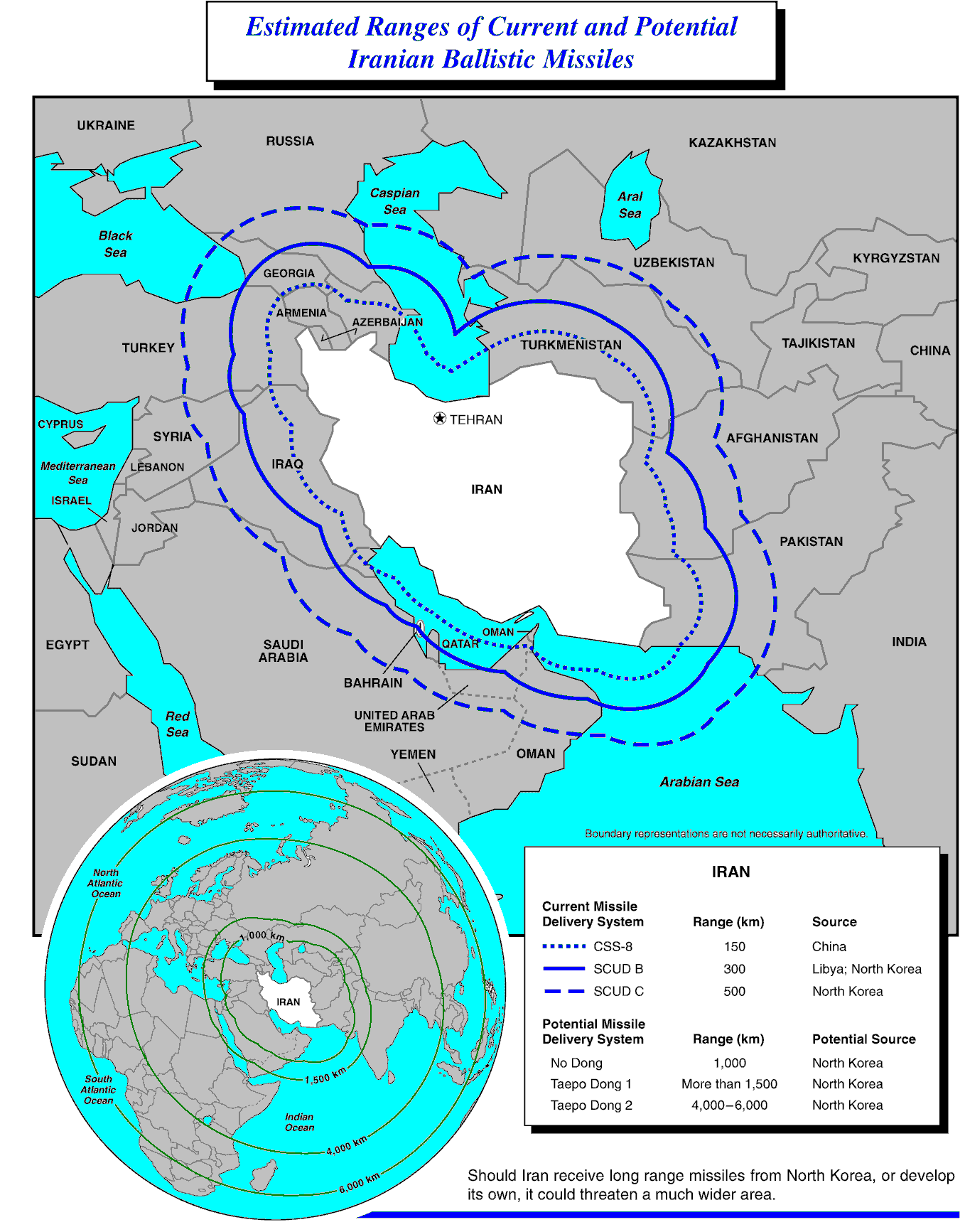
A day after a joint Russian-US analysis determined that a US missile shield based in Europe would likely be ineffective against an ICBM launched from Iran, Nazila Fathi and Alan Cowell at the New York Times report that President Mahmoud Ahmadinejad told the media today that the country had test-fired a missile with a range of 1,200 miles today. The Federation of American Scientists plotted a map illustrating the relative reach of Iranian missiles.


As I have noted in the past, Tehran does not appear to be especially keen on rapprochement with the US.

7. TALIBAN FORCING MARRIAGE AND MILITARY SERVICE IN SWAT, AFGHAN TALIBAN FOUND WITH US MUNITIONS, US PLEDGES $110 MILLION IN AID FOR THOSE DISPLACED BY SWAT OFFENSIVE

As Pakistan pursues its military offensive in Taliban held areas, the Afghanistan News Network reports that Taliban is forcing the daughters of locals in Swat to marry its operatives at gunpoint, evidently in order to force allegiance in the oldest way on record. (h/t Juan Cole at Informed Comment.) Cole also notes that the Taliban is allegedly forcing the sons of locals into military service. Meanwhile, CJ Chivers at the New York Times reports that arms and ordnance collected from Taliban dead from firefights with NATO forces appear to be identical to those given by the US to the Afghan Army.
"The scope of that diversion remains unknown, and the 30 magazines represented a single sampling of fewer than 1,000 cartridges. But military officials, arms analysts and dealers say it points to a worrisome possibility: With only spotty American and Afghan controls on the vast inventory of weapons and ammunition sent into Afghanistan during an eight-year conflict, poor discipline and outright corruption among Afghan forces may have helped insurgents stay supplied."
Some are beginning to wonder what conceivable point our military occupation in Afghanistan might have. Fabius Maximus, for example, thinks the reason we cannot get our NATO allies to commit more troops to the conflict are--an issue which Defense Secretary Gates recently found "puzzling":
"How might the leaders of our NATO allies answer, after we injected them with truth serum?

(1) There is no point to this occupation of Afghanistan. They will find their own destiny, and our armies can do little to influence this. Neither can your flocks of airborne killers, nor your legions of special ops assassins.

(2) Afghanistan poses no conceivable threat to us--nor to you, and probably none to Pakistan. The Taliban’s support for al Qaeda’s attack on the US (to the extent that they did support or facilitate it) was a one-off event, for which they paid dearly. There is no evidence or logic to suggest they found the experience so enjoyable that they will repeat it."
I'm not sure I entirely agree--clearly Islamabad regards the government of Karzai as potentially problematic. But, therein lies the rub, there are many governments more directly affected by the events in Afghanistan than the US and to which their national interest is quite closely tied. Three major powers--Russia, China, and India--are all more directly affected by instability in Afghanistan than the US. Furthermore, a regional power historically constantly in conflict with Russia is also directly affected by such instability. I doubt that their respective analysts believe our current efforts are particularly stabilizing for the region, but, I imagine that some of NATO allies calculate that it may make more sense, in terms of blood and treasure, to leave the question of stabilizing Afghanistan, a country with few raw resources and little industry, to those nations which are more likely to regard a rapid US withdrawal from the country with real concern. In the meantime, Arshad Mohammed at Reuters reports that the US announced yesterday that it would provide $110 million to Pakistan to help attend to the needs of the two million people that have reportedly fled the Swat Valley to get out of the way of the Pakistan armed forces' operation there.
"The White House said that the United States would provide $100 million in humanitarian aid such as food, tents, radios, generators and other items and that the US Defense Department would give a further $10 million in unspecified assistance."
Unfortunately, the President of Pakistan just now is known to his own people as Mr 5%.

8. ETHIOPIA DENIES THAT TROOPS HAVE CROSSED INTO SOMALIA

Mohamed Olad Hassan at the Associated Press reports that Ethiopia has officially denied allegations that its troops had re-entered Somalia yesterday.
"'Our troops have not returned to Somalia,' Ethiopian Foreign Ministry spokesman Wahde Belay said. 'Our troops are on our side of the border.'"
9. CHAD ANNOUNCES NEW CROSS-BORDER OFFENSIVE VS REBELS IN SUDAN

Reuters reports that Chad has announced that it will send troops into Sudan again today in order to intercept a rebel assault being prepared there, two days after calling a halt to cross-border bombing raids into the country.
"Sudan called last week's bombing raids on its territory an 'act of war' and issued another warning on Tuesday.

'We would urge Chad to refrain from violating the sovereignty of the country and stop its aggression,' Ali Youssef Ahmed, an official in Sudan's foreign ministry, told Reuters.

'Chad needs to come to its senses and respect the agreement which was signed in Doha. We hold them responsible for any repercussions that may arise from such actions.'

Chad and Sudan held reconciliation talks in Doha earlier this month and agreed to refrain from using force to resolve their conflicts. But N'Djamena accused Khartoum of sending armed groups over its border just hours after the deal was signed."
10. CALIFORNIA AND FRENCH PORT DATA STILL SHOWING LARGE ANNUAL DECLINES IN VOLUME

The Port of Long Beach has released its April TEU data, showing a 26.6% year over year decline in volume for the month:


The Port of Los Angeles has also released its April TEU data, showing a 12.11% decline year over year in volume:


And the Port of Marseilles has released its April TEU data, showing a 12% decline year over year in volumes handled:


It does look from the Marseilles data the the worst declines may be over, though the contraction is still pretty steep.

11. UN NEGOTIATING TEXT ON CLIMATE TREATY WANTS NEAR ELIMINATION OF DEVELOPED WORLD EMISSIONS, 25% REDUCTION IN DEVELOPING WORLD EMISSIONS

Alex Morales and Jeremy Van Loon at Bloomberg report that the UN's negotiating draft for a new treaty to put a stop to global warming was published today.
"The United Nations’ first draft of a new treaty to stem global warming suggests goals such as the near elimination of greenhouse-gas emissions by mid-century in developed countries including the US and Japan.

China, India and other emerging economies would have to aim for a 25% reduction of heat-trapping gases, under a separate option that would mark the first-ever target for developing nations."
The 50 odd page negotiating text can be found here.

12. IEA PUTS NUMBER ON OIL DEFERRED BY PRICE DECLINE

The Paris-based IEA put a number on the delayed investments in new oil supply, per Kate McKenzie at FT Energy Source:
"In a new report, the agency reportedly warned that oil companies and investors have postponed about $170 billion of projects, equivalent to about 2 mb/d, and a further 4.2 [mb/d] in future oil supply capacity has been delayed by at least 18 months."
13. THE CENTER FOR NAVAL ANALYSES SAYS FOSSIL FUEL USE IS AN URGENT NATIONAL SECURITY THREAT

The Military Advisory Board of the Center for Naval Analyses has concluded that fossil fuel use is an urgent national security threat. (h/t reader Dee Illuminati.)

14. WET WEATHER DELAYING PLANTING OF US WHEAT CROP

Tony C. Dreibus at Bloomberg reports that wheat prices have risen to the highest levels seen since January as wet weather in the US has hindered the planting of the crop.
"About 50% of the spring crop was planted as of May 17, down from the five-year average of 90%, the Department of Agriculture said this week. Parts of central Kansas have received as much as three times the normal rainfall in the past month, National Weather Service data show."
The US is the world's largest exporter of wheat.

15. EIA DATA SHOWS CRUDE STOCKS STILL AT HIGHS, BUT BIG DRAWDOWNS IN BOTH CRUDE AND GASOLINE--NATIONAL GAS AND DIESEL PRICES CLIMBING BACK UP ... NOT FAR FROM DEMAND DESTRUCTION TERRITORY

The EIA announced today that commercial stocks of crude oil fell by 2.1 million barrels in the week ended May 15 to 368.5 million barrels, a big drop, but still the most seen since September 1990. The median expectation of analysts was, according to a Bloomberg survey, for a 400,000 stock draw. Gasoline stocks fell by a whopping 4.3 million barrels to 204 million barrels, moving in the course of a month from holdings in excess of the five year historical range for the time of year to below the five year historical range for the time of year.


The decline in gasoline stocks was "more than three times what was forecast." Distillate stocks, by which the EIA primarily means diesel and heating oil, built by 600,000 barrels to 148.1 million barrels, 40.8 million barrels or 27% more distillates are in storage than this time last year. They also produce a chart of retail gasoline and diesel prices in the US over the last six years or so:


I've previously remarked that at about $2.50-$3.00/gallon you start seeing Americans reducing their driving ... we are beginning to enter that price range now.

16. SF FED'S REPORT ON HOUSEHOLD DELEVERAGING AND FUTURE CONSUMPTION GROWTH SEEMS TO SUGGEST THAT CONSUMPTION GROWTH IS UNLIKELY

Mike Shedlock at Mish's Global Economic Trend Analysis notes the recent release of the Federal Reserve Bank of San Francisco's report on Household Deleveraging and Future Consumption Growth. Mish republishes a graph from the report:


and comments:
"Notice the enormous gap between debt and income. This gap will be filled by deleveraging (increased savings), by default, or a combination of both. Either way, given consumer spending is close to 70% of the economy, it is irrational to expect the stock market to come roaring back anytime soon."
and points to another revealing graph from the bank:


Well worth reading in full.

17. COULD SPENDING ON RAIL CREATE AS MANY JOBS AS SPENDING ON THE CAR INDUSTRY?

Yonah Freemark at The Infrastructurist argues that investing in rail will employ more people than commensurate investments in the auto industry would.
"France’s TGV high-speed trains, which criss-cross that country, carried 100 million people in 2008, and the national rail company employs about 200,000 people (that number includes people working on commuter trains). France is 1/5th the size of the US in population.

One can extrapolate: an equivalent American rail network could transport 500 million passengers a year on fast rail and provide jobs for one million people operating trains, maintaining track, and serving customers. There are about as many people working in motor vehicle and part manufacturing in the US today. A vibrant rail industry would mostly be a service-oriented one, rather than a manufacturing one.

The US isn’t close to providing anything of the sort today: Amtrak’s 18,000 employees served only 29 million passengers in 2008. It’s hard to imagine an $8 billion dollar investment from Washington being enough to stimulate the 20-fold expansion of a transportation sector, but it’s a start."
(h/t Kate McKenzie at FT Energy Source.)

Friday, April 3, 2009

Daily Sources 4/3

1. Reuters reports that the Markit Eurozone Composite PMI employment index for the eurozone showed that corporations continue to fire workers in response to the crisis, falling to 40.3, down from February's 40.8. Edward Hugh at Fistful of Euros reports that unemployment in Spain rose by 123,543 in March, a slower rate of increase than what was seen in February and March. But if you look at the annual rate, unemployment in March grew by 56.69%. His chart:


Worth reading.

2. Jane Baird and Douwe Miedema at Reuters note that after yesterday's European Central Bank decision, Governor Jean Claude Trichet indicated that the bank was preparing to consider "non-standard measures," by which he is understood to mean "quantitative easing."

3. In a very helpful analysis, Simon Johnson at Economix argues that the Obama Administration managed to pull of a coup by getting the European members of the G20 to agree to make the selection process for the head of the IMF open transparent and competitive.
"The managing director of the IMF is very powerful, with a great deal of authority and discretion, and has always been a European--in effect, appointed by European governments to represent their interests. The G-20 made it clear that this will stop--the communiquĂ© says the selection process will be open, transparent and competitive. But really this is code for saying they will pick someone from an emerging-market country, such as India or Brazil (and there are some excellent candidates). The right person in this job could have a huge positive effect on the IMF’s legitimacy.

To make things matters more interesting, the IMF’s managing director is expected by insiders to resign within a year, to resume his (promising) pursuit of the French presidency. The leadership race for the next managing director effectively starts today; the stakes are high, and competition will be intense.

How did the Obama administration pull this off? In a brilliant move, they took the lead by volunteering to open up the selection process for the World Bank, the IMF’s sister organization, which has always been run by an American. The next president of the World Bank is very likely to be Chinese."
C. Randall Henning at the Peterson Institute for International Economics drew attention to the worries that the nations of the Asia Pacific were going to basically abandon the IMF via the Chiang Mai Initiative [CMI] in a paper published on February 27:
"Steve Weisman: Do you see any danger of them going separately from the IMF and having their own deals to bail out countries in times of crises?
C. Randall Henning: That of course is what a number of people are worried about. I’m not worried about that at this point. First of all, there are differences of view within Asia about how to construct and administer these arrangements, and I don’t
think that they are willing to break with the IMF right now. They’re aware that they have to make more progress in the development of their regional surveillance mechanism. Before East Asia is going to be in a position to define any conditionality that would flow through a multilateralized CMI, until they develop a regional capacity for analysis and surveillance, they’re going to continue to rely on the IMF to help define the conditions that should be attached to the financing. So the way it’s structured now in the bilateral swap arrangements under the CMI is that most of that money would not flow to a borrower in Southeast Asia unless that borrower also negotiated an IMF program. So it’s designed as a parallel line of defense. But that will continue under a multilateralized CMI, although they may change the ratio between the linked portion and the unlinked portion in these arrangements."
(h/t RGE Monitor)

4. Czech Prime Minister Mirek Topolánek has a piece in today's Wall Street Journal which argues that NATO is indispensable.
"When thinking about the further development of NATO, I try to imagine a world without it. I imagine countries threatened with terrorism (and which country would dare say that it is not?) left alone to defend themselves. I imagine invaded countries scrambling to find allies too late. I imagine Afghanistan or another unstable country becoming the center of militant organizations and drug cartels. I imagine countries in strategic locations becoming toys in the hands of powerful neighbors.

As President Barack Obama rightly said in his recent speech unveiling a new strategy on Afghanistan and Pakistan, 'the very idea that free nations can come together on behalf of our common security . . . was the founding cause of NATO six decades ago, and that must be our common purpose today.' If such a world without NATO indeed existed, I would be the first to call, on the basis of historical experience encompassing the Munich Treaty and the end of democratic Czechoslovakia, for the creation of an alliance that would protect freedom, equality and respect for human dignity and life."
One suspects that Topolánek, whose coalition was recently ousted by a no confidence vote, is trying to undo some of the damage done by framing US fiscal policy as "the way to hell"--see Daily Sources 3/25 #4. Meanwhile, Edward Cody at the Washington Post reports that the Europeans are unlikely to commit more troops to Afghanistan in support of the new US plan for addressing the situation there.
"European officials said Obama is likely to come away from the summit Saturday with a broad endorsement of his idea that stabilizing Afghanistan is a strategic goal for NATO and support for his decision to devote more civilian as well as military resources to eliminating al-Qaeda havens there and in Pakistan. But they also said that summit pleasantries are unlikely to mask Europe's refusal to commit to major new troop deployments.

Europe's main new contribution for now, French officials said, will be a 300-member corps of paramilitary gendarmes to mentor Afghan policemen in the provinces. France, Italy, Spain and Portugal have expressed interest in participating, the officials said, but the project is still under discussion and, in any case, the force would be deployed only in areas considered pacified enough for NATO soldiers to turn the area over to Afghan authorities."
That said, the Washington Post has published the transcript of a joint press conference of Chancellor Angela Merkel and President Obama in which she said,
"Well, what is indeed gratifying to note is that the new approach of the new administration of the United States as regards Afghanistan is very much in step with what Germany is envisaging, the sort of networked security, as we call it, or an integrated security, where you have a civilian component of rebuilding, training, and last, but not least, obviously, also, the capacity of the Afghans to really defend themselves.

That is actually what we were after with our mission to Afghanistan."
The transcript is worth reading in full. It seems to me that Obama's commitment to transition the US effort out of Iraq into Afghanistan will remind many in Europe of the original reasons for their support for the US effort in Afghanistan--and may well produce more cooperation in that effort than we have seen so far. I find this line of thinking convincing in part because of the US's decision to include Iran in the recent negotiations. In the meantime, a Spanish magistrate, Baltasar Garzon, has asked a Spanish prosecutor to file charges against Douglas Feith. I believe this is the same magistrate who pursued a case against Pinochet. Feith has written an op ed in the Wall Street Journal, serving as his own defense attorney.

5. Xinhua reports that Russian Prime Minister Vladimir Putin indicated that Moscow supported continuing talks with Ukraine regarding natural gas transit.
"At the corporate level, of course, the dialogue must continue in all areas. Ukraine is our important partner from the standpoint of gas transit."
Meanwhile, CJ Chivers at the New York Times reports that Russia has maintained troops in the breakaway regions of Abkhazia and South Ossetia in violation of the cease fire agreement which called for both sides to withdraw their troops to the positions held before the war broke out.
"Gilles Janvier, deputy head of the European monitoring mission, said in an interview that Russia had told diplomats that it had entered its own military agreement with the two breakaway regions in Georgia, which the Kremlin recognizes as independent states, and that these newer arrangements rendered the troop withdrawal component of the cease-fire plan obsolete."
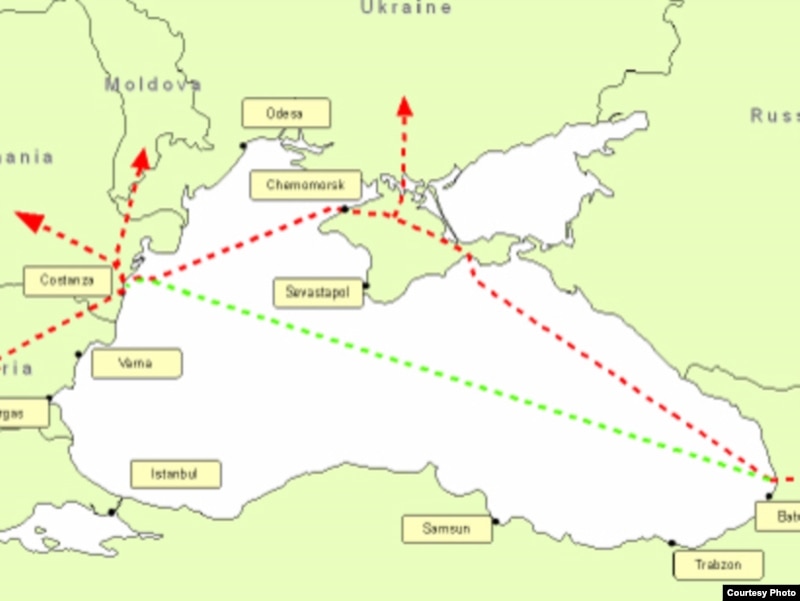
6. John Roberts at Platts reports that the Georgian government signed a memorandum of understanding with the GUEU-White Stream Pipeline Company to support a natural gas pipeline which would pass through Georgia, the Black Sea, to Romania and onwards towards the rest of Europe. Romania has yet to sign an MOU in support of the project. White Stream corporate development director Giorgi Vashakmadze told Platts that "It will take us five years to start laying the first pipeline after we have completed all the necessary agreements," and that the planned pipeline is meant to be complementary with the Nabucco pipeline. Alternatively, the pipeline might pass through the Ukraine, though recent events would seem to make that an unlikely choice. The two proposed paths of the pipeline are indicated in the map below.


7. UPI reports that IRNA reported that Iranian Oil Minister Gholamhossein Nozari in talks with his Syrian counterpart, Sufian Allaw, in Damascus argued that natural gas export deals to Syria should be concluded as quickly as possible. "'Iran will transfer gas to Greece and Italy through Iraq, Syria and the Mediterranean Sea,' Nozari said." The Turkish Weekly reported on Iran's case for an alternative to the Nabucco Pipeline today:
"Safe transit routes will be determined based on political and strategic realities. The Nabucco pipeline will pass through Turkey and the Balkans. The Persian Pipeline might pass through Iraq, Syria and the Mediterranean to Europe. These alternative routes will be discussed by the buyers, suppliers and transit countries."
Up until now, the Persian Pipeline, aka Pars Pipeline, has been envisioned as passing through Bazargan, a city on the Turkish border--completely bypassing Syria and Iraq. Bazargan is about where I indicate on the map below.


The "haste" so "urged" sounds to me like Iran is beginning to get worried about the fact of potential Russian cooperation with US efforts to put the kibosh on the nuclear power program.

8. Shamal Aqrawi and Ahmed Rasheed at Reuters report that South Korea's SK Energy has yet to withdraw from contracts with the Kurdish Regional Government, which Baghdad insists it must cancel in order to be approved as a bidder for the central government's oil concessions.

9. Zhou Xin at Reuters reports that the official Chinese PMI for March indicates expansion, moving from 49.0 in February to 52.4 in March.
"'The continuous increase in PMI, along with positive signs I can witness from different places, showed that the Chinese economy may have started to warm up,' Ma Jiantang, the head of China's National Bureau of Statistics, told the China Information Daily, the statistics bureau's mouthpiece."
The official index stands in contrast to the private CLSA China PMI, which fell to 44.8 in March, down from 45.1 in February--see Daily Sources 4/1 #6. (Readings above 50 imply expansion; below 50 implies contraction.)

10. Robert Campbell at Reuters reports that in a report delivered to the US Congress on Wednesday states that the Mexican finance ministry expects crude oil production to fall below 2.5 mb/d in 2011.
"The finance ministry estimated oil exports would drop to 1.125 mb/d in 2010 from 1.370 mb/d forecast for this year."
11. Jens Erik Gould at Bloomberg reports that Manuel Marrero Faz, senior oil adviser at Cuba's Ministry of Basic Industries, said that the country would welcome US participation in its offshore oil fields were the embargo ended.
"We are open. ... We’re very close to each other. We’re neighbors. Why not do business?"
"The US Geological Survey estimates Cuba’s North Basin region, one of three offshore areas believed to hold oil, has 4.6 billion barrels." To put that in context, 4.6 billion barrels is about 55 days of global oil consumption (at a rate of 84 mb/d).

12. Barry Ritholtz at the Big Picture reports that the non-farm payroll employment number out today from the Bureau of Labor Statistics fell by 663,000 in March, bringing the headline unemployment number to 8.5%, from 8.1% in February. Calculated Risk plots the trajectory of the decline in employment against the post war recessions in a useful graph:


The U-6 number, or total unemployed plus the total of "marginally attached" workers plus total employed part-time for economic reasons has reached 15.6% in March from 14.8% in February.

13. Rebecca Wilder at News N Economics has a post showing that although the number of bank failures due to this financial crisis have been high, at 46, the number is not especially large historically-speaking, "the Fed and the Treasury likely enabled the economy to skirt a depression-sized disaster."


She argues that the financial situation will require consolidation, sooner or later. Well worth a look.

14. James Hamilton at UCSD has authored a very important report for the Brookings Institution which shows--to his own disbelief, evidently--that the oil shock of 2008 was a primary cause of the current financial crisis. As Justin Lahart's post on the piece in Real Time Economics summarizes:
"[Maybe] what happened to oil prices had something to do with credit markets seizing up. The housing bubble saw people of lesser means traveling further afield to buy homes. That gave them long commutes that they were able to afford when gas was $2 a gallon, but maybe they couldn’t at $3. Housing in the exurbs got hit hardest, and one reason why is that high gasoline prices made it hard for people to lived in them to keep up with their mortgage payments, and hard for them to sell their homes without taking a steep loss. In some meaningful way, that has to have contributed to mortgage problems."
Hamilton's own summary is here. The report--quite long at 70 pages, is here.

15. Charles Abbott and Russ Blinch at Reuters reported yesterday that 32.2 million Americans received food stamps in January, or 1 in 10, 10%.
"The average benefit was $112.82 per person in January. ... Food stamp benefits get a temporary 13% increase, beginning with this month, under the economic stimulus law signed by President Barack Obama. The increase equals $80 a month for a household of four."
Seriously worrisome stuff. I personally feel--strongly--that more should be offered ... especially given that food stamps produce the largest "multiplier" of all stimulus measures, as they must be spent in a set time--see Menzie Chinn's post on October 27, 2008. Food security is the most critical measure of stability, always. As Bob Marley put it, "A hungry man is an angry man."

Thursday, March 26, 2009

Daily Sources 3/26

1. Eurointelligence reports that the Netherlands CPB Institute yesterday published January's data for global trade, which shows that global trade is down 20% from October. "FT Deutschland quotes a CPB staffer as saying this is faster than during the Great Depression (the estimates there range from 25-35% during 1929 and 1932)."

2. Lucy Hornby at Reuters reports that China estimates that the number of migrant workers that are now unemployed has risen to 23 million since the lunar year holiday in January. (h/t Yves Smith at naked capitalism.)

3. Upstream online.com reports that Liu Qi, deputy head of China's National Energy Administration, told an industry forum that
"Appropriately obtaining global resources is our inevitable choice and legal right...Winning foreign resources is even more important than stepping up domestic production."
Liu told the conference that China will offer oil companies tax and other policy incentives to continue exploring for purchases and concessions abroad. Meanwhile, Lydia Polgreen at the New York Times reports that analysts see Chinese decision makers becoming more conservative about their African investment decisions:
"'We have seen in the recent past Chinese companies wade into countries nobody else would,' said Philippe de Pontet, an analyst at ... a private research firm. 'That may be changing.'"
Meanwhile, Franz Wild and Helene Fouquet at Bloomberg report that Aveda, accompanying French President Nicolas Sarkozy on a two day business junket to central and western Africa, signed a joint venture uranium exploration agreement with the Democratic Republic of Congo.


4. Rebecca Christie at Bloomberg reports that Treasury Secretary Timothy Geithner told a forum hosted by the Council on Foreign Relations yesterday that the recent proposal to replace the dollar as a reserve currency by China is
"designed to increase the use of the IMF’s special drawing rights. And we’re actually quite open to that."
"The dollar slid as much as 1.3% against the euro within 10 minutes of news accounts of Geithner’s remarks. It recouped much of the loss about 15 minutes later, when Geithner then predicted no change in the US currency’s role."
Meanwhile, Eurointelligence reports that Dominique Strauss-Kahn, the head of the IMF, told a parliamentary finance committee in Paris that
"it is absolutely legitimate to discuss the possibility of a new international currency. This is not a new question but the current crisis renews the interest in this question. He also said that he does not consider that the dollar ceases to be an international reserve currency. Even the Chinese don’t think that."
Meanwhile, Mriganka Jaipuriyar at Platts reports that the chief economist of the Paris-based IEA, Fatih Birol, said that the organization is working very closely with Beijing to improve the flow of data, but that there is a long way to go.
"'Both on the IEA's side and the Chinese side, there are strong efforts to harmonize how we collect and analyze the statistics. I should say there are some improvements in that area but we are not yet at a level we would like to see,' Birol told Platts in an interview Thursday.

'We are at the beginning of a very long journey and it would be too premature to say that we have the information we need to make our analysis,' he added.

The IEA is pursuing similar talks with India and hopes to be able to better analyze the situation in these countries and their implication for the rest of the world, Birol said."
Platts reports that OPEC oil exports excluding Ecuador and Angola in the four weeks to April 11 are to fall to 22.23 million b/d, down by 770 kb/d from the previous four week period.

5. Thom Shanker at the New York Times reports that an annual Pentagon study released yesterday--"Military Power of the People’s Republic of China 2009"--argues that China is seeking weapons and technology which counter traditional American advantages. This seems natural enough to me, but China's Foreign Ministry was sufficiently disturbed to have its spokesman say "This report issued by the US side continues to play up the fallacy of China’s military threat." At his regular news briefing in Beijing the spokesman "suggested that the Pentagon stop issuing the annual report to avoid 'further damage to the two sides’ military relations.'" The report can be found here.

6. Wall Street Journal Asia has an editorial piece which points out that the EU and South Korea just signed a free trade agreement on Tuesday.
"Details haven't been released yet, but it's expected to be a comprehensive accord that will reduce or eliminate most tariffs on goods and liberalize European investment in Korea's tightly regulated service sector. Both sides are aiming to iron out the final details at next week's Group of 20 summit in London."
7. Veit Medick at Der Spiegel interviewed Martin Schulz, chairman of the Socialist group in European Parliament and head of foreign policy at the German Social Democratic Party's federal executive committee, about the consequences and causes of the fall of Prime Minister Mirek Topolánek's government in the Czech Republic while he was president of the EU. Key excerpts:
"Schulz: Topolánek was one of George W. Bush's closest allies when it came to the missile-defense system in eastern Europe. Now he uses the platform of the European Parliament to campaign against Bush's successor. He can do that in Prague, but not in the EU.

SPIEGEL ONLINE: Is the Lisbon Treaty now in danger?

Schulz: We'll see. The fact is, the two legislators who caused the collapse of his government were opponents of the treaty. That's not an encouraging sign."
SPIEGEL ONLINE: This fall, the Irish also plan to vote on the Lisbon Treaty. If the Czechs reject the treaty, would the Irish vote still be relevant?

Schulz: If the Czechs reject the treaty, we're going to be in a serious crisis. We might as well then bury the treaty. We'd then be thrown back to the Treaty of Nice, which was passed by 15 member states. But those same 15 governments, not to speak of the new member states, are unsatisfied with the old arrangements. That's why there was supposed to be a constitution. When that failed, we tried to include the essence of the reforms in the Lisbon Treaty. If that also fails, it would be a fiasco.
Worth reading in full. Meanwhile, Reuters reports that Irish GDP fell at an annual rate of 7.5% in the fourth quarter. "GDP fell 2.3% for the whole of 2008, data from the Central Statistics Office showed on Thursday."

8. Der Spiegel reports that in a speech calling for the reform of NATO, German Chancellor Angela Merkel said today:
"It is also in Germany's interest that dialogue between the new US administration and Russia gains momentum again. ... NATO wants Russia as a good partner ... We have not been rivals for 20 years now. The time of the Cold War is irrevocably over."
9. Doris Leblond at the Oil & Gas Journal put the kibosh on the notion, reported in the Russian press, that Moscow had been left out of discussions on how to pay for the modernization and increased transparency of the Ukrainian gas pipeline system. In fact, "Russian Energy Minister Sergei Schmatko and an important delegation was present." This was in addition to representatives from the EU, Canada, the US, World Bank, European Investment Bank, and European Bank for Reconstruction and Development. Meanwhile, RIA Novosti reports that the Russian Ambassador to Ukraine, Viktor Chernomyrdin, told the press that the deal struck Tuesday to modernize the system "looks as if a deaf man and a blind man sat at a table and signed the paper without even understanding what they had signed."

10. Johan Carlstrom at Bloomberg reported that the Norges Bank cut the benchmark interest rate by 0.5% to 2% yesterday.
"'The decline in activity in the Norwegian economy will be more pronounced than previously assumed,' Deputy Governor Jan. F. Qvigstad said in the statement. The bank may cut the rate as low as 1% 'in the course of the autumn.'"
11. Edward Hugh at Fistful of Euros notes that Serbia and the IMF have agreed to a €3 billion, 27 month, stabilization program.

12. Reuters reports that UK retail sales fell by 1.9% in February from January. "The annual rate of growth fell to 0.4%, its weakest since September 1995, the Office for National Statistics said."

13. The Associated Press reports that Ali Larijani, the Iranian Speaker of the Parliament and former nuclear negotiating point man, told the media yesterday that in Najaf that Iran's problems with the US are not a "sentimental issue" soluble with "a blessing and congratulations." "Larijani says the differences stem from 30 years of hostility, including Saddam Hussein's 1980 invasion of Iran which he said was 'instigated by America.'" For the record, it is my understanding that Saddam Hussein's 1980 invasion of Iran was not instigated by the Carter Administration, but never mind.

14. The AFP reports that Turkish President Abdullah Gul in Iraq promised his hosts that the water allocation from the Tigris and the Euphrates would be doubled this year. Juan Cole surmises that this is likely in return for a crackdown by Baghdad on Kurdish Workers Party guerrillas hiding in the mountains in Iraq just outside the Turkish border.

15. Fausta Wertz at The Compass notes that today Hugo Chávez had the military presence increased at the La Fría and San Antonio airports, saying
"we have begun the reversal process over everything that meant the dismemberment of national unity, the territory, and sovereignty, because prior governments fractured the country into pieces."
(Both airports are found in the state of Táchira, a small region on the border of Colombia.)


Chávez also ordered the creation of a new state company to manage the ports which will be required by law to "work under socialist guidelines and seek the development of the regions in which their respective seaports and airports operate." As Wertz notes, after the opposition won several major municipalities and regions in the November elections, Chávez has moved to strip them of control of the various ports, and with it valuable tariff revenues.

16. Juan Forero at the Washington Post reports that in January, Ecuador enacted a number of provisions to try and reduce the number of imports coming into the country.
"'What is the objective? To dampen demand for imported good and to increase consumption of domestic goods,' said Diego Borja, minister of economic policy. 'It was a difficult measure, but necessary and indispensable. We know that there are costs to getting out of a crisis.'

Borja said that because Ecuador's currency is the U.S. dollar, the country has been particularly exposed as imports rose in relation to exports. Unable to print money, or devalue to help Ecuadoran companies that export, the government decided to levy tariffs that reach 35%, decrease import volume as much as 35% and implement a range of surcharges. In all, 627 products fall under the new measures, including furniture, cellphones, electronic parts, shoes, alcohol and food products such as cookies and pastas. The government said the restrictions would reduce imports this year by nearly $1.5 billion compared with 2008.

Without the restrictions, officials here say, Ecuador could run out of money -- leading to economic collapse and political instability. 'We depend on dollars,' Borja said. 'If we don't have a revenue of dollars, then we have a very, very big problem.'"
In December Ecuador defaulted on its debt--see Daily Sources 12/15 #1--and then had its social security system purchase $1.2 billion in new sovereign debt--see Daily Sources 12/29 #14. The CIA estimates that Ecuadoran GDP was $107 billion in 2008 and that government expenditures (which were less than revenues) were about $17.79 billion.)

17. Ronald Buchanan at Platts writes that Mexican oil export revenues in February fell 56.4% year on year on $1.66 billion, according to a report by the National Statistics Institute, or Inegi, released yesterday. WTI on NYMEX averaged $95.35/b in February 2008 versus $39.26/b in February 2009, which at a 58.8% decline is consistent with a 56.4% decline. According to the EIA, Mexican sales of Isthmus crude--a medium sour crude with an APIÂş33.3 and 1.492 sulfur wt/%--averaged about $89.48/b in February 2008 and $39.22/b in February 2009. Sales of Maya crude--a heavy very sour crude with an APIÂş22.2 and 3.3 sulfur wt/%--averaged about $78.35/b in February 2008 and $37.17/b in February 2009. But in November, the Associated Press reported that the Mexican Treasury Secretary announced that the country had spent $1.5 billion to buy put options to sell 330 million barrels of Mexican crude--or about a third of its total 2008 output--at $70/b. Even considering the decline in total output, how does this add up?

18. Mary Beth Sheridan at the Washington Post reports that in a speech in Mexico Secretary Clinton said of the anti-narcotics effort:
"Clearly what we've been doing has not worked ... . Our insatiable demand for illegal drugs fuels the drug trade. Our inability to prevent weapons from being illegally smuggled across the border to arm these criminals causes the deaths of police, of soldiers and civilians.'"
19. Derek Sands at Platts reports that Scott Borgerson, a fellow for ocean governance at the Council of Foreign Relations told the House Committee on Foreign Relations that:
"It would be a mistake to assume that all these flashpoints [of new resource opportunities opening up due to melting ice in the Arctic] will remain sleeping dogs. The combination of new shipping routes, trillions of dollars in possible oil and gas resources and a poorly defined picture of state ownership make for a toxic brew."
Sands elaborates:
"US ratification of one mechanism to deal with Arctic resource issues--the UN Law of the Sea Treaty -- has been blocked by a small group of senators because of sovereignty concerns. That refusal could contribute to the US missing out on some of the Arctic's resources, according to the witnesses.

Other Arctic countries have ratified the treaty, and former President Bill Clinton signed it, but it still awaits Senate ratification.

Among other things, the treaty sets up a mechanism for countries to arbitrate disagreements over claims to undersea territory."
20. Bob Willis at Bloomberg reports that initial unemployment benefits applications grew by 8,000 in the week ended March 14 to 652,000, per the Labor Department release today. The total number of people receiving unemployment benefits jumped by 122,000 from the week prior to 5.56 million.

21. Shobhana Chandra at Bloomberg reports that the Commerce Department further revised its initial estimate of fourth quarter GDP to a 6.3% annual rate of contraction (from 3.8% and then 6.2% rates of decline).
"For all of 2008, the economy grew 1.1%, the same as previously estimated, as exports and government tax rebates in the first six months helped offset the slump in consumer spending that followed.

Consumer spending, which accounts for about 70 percent of the economy, fell at a 4.3% pace last quarter, marking the first back-to-back decreases in excess of 3% since record-keeping began in 1947.

Retailers are doing better so far this year. Sales fell less than forecast in February and January’s 1.8% gain was the biggest in three years, Commerce reported earlier this month."
Brian Blackstone at Real Time Economics notes that GDI--Gross Domestic Income, another measure of national economic activity--fell in the fourth quarter by 7.5% from 4Q2007.
"GDP is consumption driven: consumer spending, investment, government spending and the like. GDI is income based, meaning things like income and corporate profits. In theory, the two should line up — but not always. In the case of the fourth quarter, a severe slide in corporate profits was likely the root of the discrepancy. Employee compensation, the other main GDI component, held up much better."
22. Barry Ritholtz at the Big Picture takes aim at the news yesterday that new home sales increased by 4.7% in February from January, noting, to start with, that on an annual basis new home sales fell by 41% in February.
"Note that the month over month data at 4.7%--plus or minus 18.3%--is statistically insignificant. (i.e., meaningless). The reported data does not inform us if sales improved month-over-month or not. It is a range, from down -13.6% to plus 23%. Since 'zero' is part of that range, we can draw no conclusion. As the Census Department itself notes, “the change is not statistically significant; that is, it is uncertain whether there was an increase or decrease.”

The data does however, tell us that the year-over-year sales fell 41.1% plus or minus 7.9% gives us a range of -49% to -33.2%. The entire range is negative, therefore we can conclude sales fell year-over-year."
The Census Bureau noted that the seasonally adjusted estimate of new houses for sale indicates a 12.2 month supply at February sales rates.

23. Brian K. Sullivan at Bloomberg reports that the flooding in North Dakota is forecast to exceed 112 year records and thus may well significantly delay the planting of the spring wheat crop.
"Republican Governor John Hoeven declared a flood emergency across the state, while the federal government declared the state a major disaster area and said a public health emergency exists there. Rain and snow blanketed the area this week, covering ground already saturated by snow and rain earlier in the season."
The US is a major global supplier of wheat.

24. Keith Johnson at Environmental Capital posts the very useful observation that water consumption is a key issue--and perhaps the key issue--in evaluating the relative value of various forms of power generation.
"The water issue affects all kinds of power generation—coal, natural gas, and nuclear power; the nuclear industry’s water appetite in particular has become a flashpoint for criticism. The US Geological Survey figures power plants are the second-biggest users of water in the US, behind agriculture."
25. In an interesting side-note, it appears that the online musings of Paul Krugman have struck a nerve in Germany, whose press has taken note of Krugman's disrespectful tone and whose Finance Minister Peer SteinbrĂĽck has sent Krugman an invitation to visit him in Berlin to discuss their differences of opinion mano a mano.

Tuesday, March 24, 2009

Daily Sources 3/24

1. President Barack Obama has an op ed in the Los Angeles Times today which urges the leaders of the G20 to strong measures and to continue to coordinate their response to the financial crisis with the US in the upcoming London summit. Key excerpts:
"My message is clear: The United States is ready to lead, and we call on our partners to join us with a sense of urgency and common purpose. Much good work has been done, but much more remains. Our leadership is grounded in a simple premise: We will act boldly to lift the American economy out of crisis and reform our regulatory structure, and these actions will be strengthened by complementary action abroad. Through our example, the United States can promote a global recovery and build confidence around the world; and if the London summit helps galvanize collective action, we can forge a secure recovery, and future crises can be averted."
The President stresses that the US has pursued two basic means of addressing the crisis, fiscal stimulus and the restoration of credit, and that these efforts will be enhanced by global coordination:
"This must continue to be amplified by the actions of our G-20 partners. Together, we can embrace a common framework that insists on transparency, accountability and a focus on restoring the flow of credit that is the lifeblood of a growing global economy. And the G-20, together with multilateral institutions, can provide trade finance to help lift up exports and create jobs."
The essay also specifically calls for greater contributions to the IMF:
"Third, we have an economic, security and moral obligation to extend a hand to countries and people who face the greatest risk. If we turn our backs on them, the suffering caused by this crisis will be enlarged and our own recovery will be delayed because markets for our goods will shrink further and more U.S. jobs will be lost. The G-20 should quickly deploy resources to stabilize emerging markets, substantially boost the emergency capacity of the International Monetary Fund and help regional development banks accelerate lending. Meanwhile, America will support new and meaningful investments in food security that can help the poorest weather the difficult days that will come."
The Administration chose the Los Angeles Times as the delivery vehicle for this message, which suggests that it is primarily directed at the members of the G20 that reside in Asia and will make more sense after the next item. Worth reading in full.

2. Andrew Batson at the Wall Street Journal reports that China's central bank governor Zhou Xiaochuan on Monday published a proposal to create a new currency to replace the dollar as the global reserve currency.
"In his paper, published in Chinese and English on the central bank's Web site, Mr. Zhou argued for reducing the dominance of a few individual currencies, such as the dollar, euro and yen, in international trade and finance. Most nations concentrate their assets in those reserve currencies, which exaggerates the size of flows and makes financial systems overall more volatile, Mr. Zhou said.

Moving to a reserve currency that belongs to no individual nation would make it easier for all nations to manage their economies better, he argued, because it would give the reserve-currency nations more freedom to shift monetary policy and exchange rates. It could also be the basis for a more equitable way of financing the IMF, Mr. Zhou added. China is among several nations under pressure to pony up extra cash to help the IMF."
The US has a 15% vote at the IMF which requires a 85% consensus in order to approve a change, meaning that every nation but the US has to agree in order for a proposal to be accepted.
"Mr. Zhou's idea is to expand the use of "special drawing rights," or SDRs--a kind of synthetic currency created by the IMF in the 1960s. Its value is determined by a basket of major currencies. Originally, the SDR was intended to serve as a shared currency for international reserves, though that aspect never really got off the ground.

These days, the SDR is mainly used in the IMF's accounting for its transactions with member nations. Mr. Zhou suggested countries could increase their contributions to the IMF in exchange for greater access to a pool of reserves in SDRs.

Holding more international reserves in SDRs would increase the role and powers of the IMF. That indicates China and other developing nations aren't hostile to international financial institutions -- they just want to have more say in running them. China has resisted the US push to make an immediate loan to the IMF because that wouldn't give China a bigger vote. "
The official translation of Zhou's speech can be found on the People's Bank of China's website here. Justin Fox at the Curious Capitalist argues, interestingly, that it would be in US interests to accept the proposal:
"Zhou's proposal was treated in the WSJ and the NYT as another Chinese attack on the dollar, and I guess it is. But it also points the way toward a global monetary regime that, in theory at least, would better serve the long-term interests of the US than the current dollar-denominated one.

The advantage of having your country's currency as the world's reserve currency is that you don't really have to play by the rules: You can run big deficits financed by the rest of the world, you can spend more than you earn, and to a certain extent you can escape the consequences of your profligacy by devaluing your currency when you run into trouble. The obvious disadvantages are that running big deficits and spending more than you earn aren't really great long-term economic strategies."
Worth reading in full. Meanwhile, Rebecca Wilder has the very useful post demonstrating that the quantitative easing by the Fed and the Bank of England have resulted in less growth in money supply than one might imagine, because the multiplier is collapsing as the banks and consumers hoard cash. She concludes that the European Central Bank and Bank of Japan are lagging in terms of growth in money supply, and that the ECB has actually allowed the money supply growth to go negative. Her graph illustrating this:


Worth a look.

3. Alex Morales and Mathew Carr at Bloomberg report that China, as well as dozens of developed nations, will be asked by the UN to accept "binding" targets on their carbon emissions in six days at negotiations to be held in Bonn.
"The UN whittled down hundreds of proposals circulating to get poor and rich countries to focus on closing a gap that threatens to derail a deal. Nations are closer to agreeing on a year for a long-term emissions target, 2050, and on how to fund greenhouse-gas reductions in poor countries, the UN said today.

'In a number of areas there is a very clear convergence and countries are quite close to each other,' Yvo de Boer, the UN’s top climate official, said in a telephone interview from Germany. Still, 'there are a number of areas where a lot of blanks need to be filled in."

China and India are among developing countries that have rejected adopting any targets until industrialized nations first make reductions. They argue that countries in North America and Europe were responsible for most of the buildup of heat-trapping emissions in the atmosphere blamed for warming the planet, dating to the beginning of the industrial age."
4. The Associated Press reports that Ukrainian Prime Minister Yulia Tymoshenko yesterday signed an agreement with European Commission President José Manuel Barroso which pledged to provide financing for the upgrade of Ukraine's 40 year old natural gas pipeline system in return for "embracing market economy practices."
"[The agreement] aims to improve both the safety and capacity of Ukraine's pipeline network and revamp its management so Western investors can put up money without fear of losing any of it to endless red tape or corruption."
Meanwhile, Edward Hugh at Fistful of Euros reports that "Ihor Burakovsky, the director and board chairman of the Institute for Economic Research and Policy Consulting says that 'experts' have forecast a 12% drop in Ukraine’s GDP in 2009 and an 18% inflation rate."
"In fact [industrial] output was up slightly month on month (by 5.4%) in February, in part as a result of the demand for steel exports produced by the sharp Hyrvnia devaluation, and February output was “only” down by 31.6%, following January’s 34.1% annual fall, so you could say that things were getting better, but frankly, and at this stage of the game, such finesse is a little but lost on me."
Ukraine is still yet to receive the second installment of the $16.4 billion IMF loan, as the IMF refuses to disburse the monies until certain measures are passed by the government.
"Lawmakers need to pass two more bills to qualify for the $1.9 billion installment of the IMF loan, which originally was expected on Feb. 15, according to Oleksandr Shlapak, the first deputy head of the president’s staff, with the central bone of contention being the 5% budget deficit projected for 2009, and on a lot lower contraction forecast than the current 'most realistic case' scenario."
Meanwhile, Upstreamonline.com reports that Russia responded to the EU-Ukrainian agreement by suspending talks with Kiev. Apparently, Moscow was upset it was not included in the talks between the EU and Ukraine in the first place.
"Prime Minister Vladimir Putin threatened to review ties with the European Union and officials warned that the risk of gas supply disruptions would rise if Russian interests were ignored."
RIA Novosti quoted the Prime Minster as saying,
"If Russia's interests are ignored, we will also have to start reviewing the fundamentals of our relations. We would very much like for things not to reach this point."
Putin indicated that Moscow had proposed to the European Commission that the two jointly allocate funds to Kiev, but at the time the EC indicated that they had no funds available for the Ukraine. Meanwhile, Vladimir Soldatkin at Reuters reports that Russian energy minister Sergei Shmatko told the media that Russia could maintain and raise oil output if prices remain above $50/b.

5. Uwe Klussmann at Der Spiegel reports that the television appearance of General Kurashvili, who was in charge of the Georgian peacekeeping forces in South Ossetia on August 7, 2008, is playing a key role in the EU's investigation into the causes of the Russo-Georgian conflict at that time.
"This is because Kurashvili may have been quoting directly from Order No. 2 from Aug. 7, a Georgian document that could shed light on the question of who started the war. When the commission questioned the Russian deputy head of the general staff, Anatoly Nogovitsyn, in Moscow, he quoted from the very same Georgian order. According to Nogovitsyn, the document also contained the phrase "reestablishment of constitutional order." If the order, which Russian intelligence intercepted, is authentic, it would prove that Saakashvili lied [and that Tblisi had chosen to mass troops by South Ossetia and then use a Russian response as an excuse for an attack]."
Tblisi refuses to allow EU investigators access to Order No. 2 of August 7, which seems awful close to an admission of guilt. Greg Scoblete at Real Clear World notes the Hill story by Kevin Bogardus on the 19th that Georgia had spent $300k on a six month contract and $470k on an eleven-month contract with lobbyists with contacts with the Democrats. Apparently Randy Scheunemann, Tblisi's old main PR man in the US (and foreign adviser to GOP presidential candidate Sen. John McCain--see Daily Sources 12/2 #1.) has been thrown over.

6. Eurointelligence notes that the FT Deutschland reports that the German Foreign Ministry has established a task force to explore potential threats to security posed by the financial crisis. "The scenarios include state defaults in politically unstable regions such as the Caucasus."

7. Scott Peterson at Japan Economy Watch notes that Japanese household financial assets fell by an annual rate of 5.7% in December--the sharpest drop on record. Peterson adds
"this is not good news for a country where a large proportion of the population is expecting to live off of savings fairly shortly. Further, Japanese consumers are unlikely to provide a boost to GDP as they are not going to increase discretionary spending in the face of investment losses."
8. Seyoon Kim at Bloomberg reports that Seoul plans to append 17.7 trillion won (~$13 billion), or 1.9% of GDP, on cash "handouts," cheap loans, infrastructure and job training to its 51 billion won already allocated. "The stimulus will boost economic growth by 1.5 percentage points and help create 552,000 new jobs, the finance ministry said in Gwacheon today." The government hopes to get the measure passed by parliament in April.

9. Platts reports that Nigerian oil and gas labor unions have rescinded their threat to strike tomorrow.
"'We have decided to suspend plans to call a strike following our meeting with the national security adviser Monday, which we believe was favorable,'deputy general secretary of the Petroleum and Natural Gas Senior Staff Association of Nigeria, or Pengassan, Lumamba Okugba, told Platts."
10. Nasreen Seria and Vernon Wessels at Bloomberg report that South Africa's central bank--the Reserve Bank--decided today to cut benchmark interest rates by 1% to 9.5%.
"The Reserve Bank is not 'necessarily at the end of the cycle' of rate cuts, [Monetary Policy Committee] member Brian Kahn said in a televised interview with the South African Broadcasting Corp. today. The risks to inflation are now 'more on the downside because of the softening economy.'"
Governor Tito Mboweni also indicated that the decision to accelerate the schedule of monetary policy committee meetings should not be misconstrued to mean that there will be changes in the repurchase rate at every meeting.

11. Valerie Rota at Bloomberg reports that Moody's Investor Service has said that Mexico's credit rating is safe.
"'Despite heightened anxiety about the escalation of violence and organized crime activity, Mexico does not fit the general profile of countries identified as failed states,' Moody’s said in a report released today. 'The general foundations of its investment-grade rating remain solid.'"
While I would usually be happy to hear of calm-headed assessments of situations distant, I imagine the first thought in a lot of heads today was much the same as mine: "Last time Moody's rated something ... sell, sell, shit, SELL SELL SELL!!!!" But then, today also Enrique Krauze has an op ed in the New York Times which points out that the failed state meme is best described as a caricature of the situation in the country. Key excerpts:
"Mexico is a tolerant and secular state, without the religious tensions of Pakistan or Iraq. It is an inclusive society, without the racial hatreds of the Balkans. It has no serious prospects of regional secession or disputed territories, unlike the Middle East. Guerrilla movements have never been a real threat to the state, in stark contrast to Colombia.

Most important, Mexico is a young democracy that eliminated an essentially one-party political system, controlled by the Institutional Revolutionary Party, that lasted more than 70 years. And with all its defects, the domination of the party, known as the P.R.I., never even approached the same level of virtually absolute dictatorship as that of Robert Mugabe in Zimbabwe, or even of Venezuela’s Hugo Chávez.
...
Our national institutions function. The army is (and long has been) subject to the civilian control of the president; the church continues to be a cohesive force; a powerful business class shows no desire to move to Miami. We have strong labor unions, good universities, important public enterprises and social programs that provide reasonable results."
That said, Krauze does call on readers to consider how much instability America's drug war is exporting. Worth reading.

12. R. Colin Johnson at the EE Times reports that US Navy researchers claimed to have found experimental evidence of cold fusion at the American Chemical Society's annual meeting.
"Cold fusion was first reported in 1989 by researchers Martin Fleischmann and Stanley Pons, then with the University of Utah, prompting a global effort to develop the technology. Normal fusion reactions, where hydrogen is fused into helium, occur at millions of degrees inside the Sun. If room temperature fusion reactions could be realized commercially, as Fleishchmann and Pons claimed to have achieved inside an electrolytic cell, it promised to produce abundant nuclear energy from deuterium--heavy hydrogen--extracted from seawater.

Other scientists were unable to duplicate the 1989 results, thereby discrediting the work."
Italian and Japanese researchers also reportedly presented evidence of cold fusion.