Showing posts with label argentina. Show all posts

Thursday, July 2, 2009

Daily Sources 7/2

1. JAPANESE HAWK CHOSEN TO LEAD IAEA

Sharon Otterman at the New York Times reports that Japanese diplomat, Yukiya Amano, was elected to head the UN's atomic watchdog--the IAEA.
"Depicted by experts as the candidate favored by the United States and other wealthy nations, Mr Amano favors maintaining the current approach toward controlling nuclear proliferation in Iran, which Western countries suspect of trying to build nuclear weapons. Iran says its nuclear program is purely for civilian purposes to generate energy.

'He’s a nonproliferation and disarmament guy, and he believes in it,' said David A Kay, a former IAEA official and senior fellow at the Potomac Institute for Policy Studies. 'He has been around in trying to keep the inspections in Iran going, and I expect him to continue very much in that line. He will not want to create a situation in which military action is the only alternative.'"
2. CHINA TO RESUME ALLOWING IMF REVIEWS OF ECONOMY

Andrew Batson at the Wall Street Journal reports that China next week will take a step toward reconciling with the IMF, which it has blocked from reviewing its economy for the last three years.
"But a team of IMF officials visited China about a month ago, and have completed a draft review that is now being circulated for comments.

The IMF's draft report says China's exchange rate 'continues to be substantially undervalued,' according to a person who has seen the document, called an Article IV consultation. That's in line with what senior IMF officials have repeatedly said in public. China has kept its currency, the yuan or renminbi, basically fixed against the US dollar since July last year, though it has risen, along with the dollar, against other currencies since then.

That description nonetheless marks a climbdown from an earlier push to label China's exchange rate as 'fundamentally misaligned,' a designation that would suggest the country is in violation of the IMF charter. The draft report also states that Chinese authorities 'disagreed with the staff's assessment' of the exchange rate, and notes their argument that the global turmoil calls for 'a policy of stability.'"
Simon Johnson argued in April that the Obama Administration had pulled off a coup at the G20 meeting, effectively getting Europe to make the selection process for the head of the IMF transparent in return, more or less, for opening up the process at the World Bank, the next head of which Johnson thinks is likely to be Chinese--see Daily Sources 4/3 #3. Clearly in order to clear the field for their own candidates and a larger role generally, Beijing will first be forced to work with the organizations they want to influence or lead.

3. PBOC TO ENCOURAGE CROSS-BORDER SETTLEMENT IN YUAN

Bob Chen and David Yong at Bloomberg report that the People's Bank of China will encourage cross border settlement in the renminbi starting today, per regulations posted on the central bank's website.
"Transactions inside China will take place in Shanghai and four cities in southern Guangdong province, including Guangzhou and Shenzhen, while those outside China will occur in Hong Kong, Macau and the Association of Southeast Asian Nations, it said."
(h/t Jesse's Café Américain.)

4. CNPC MAY REVIVE BID ON ARGENTINE UNIT OF REPSOL-YPF, CNOOC MAY JOIN IN

Sui-Lee Wee at Reuters reports that CNPC plans to revive its $17 billion bid for the Argentinian unit of Repsol-YPF, reportedly planning to make an offer for as much as 75%. CNOOC also may enter a bid for the remaining 25%. "Goldman Sachs is advising YPF on the sale, while Morgan Stanley and JP Morgan are advising CNPC and CNOOC respectively." YPF, or Yacimientos Petrolíferos Fiscales, was the national oil company of Argentina until 1991, when it was privatized and then purchased by Repsol. (h/t Carola Hoyos at FT Energy Source.)

5. SPANISH CONSUMER CREDIT DOWN 33.7% IN Q1

Edward Harrison at Credit Writedowns reports that consumer credit in Spain fell by 33.7% in the first quarter, according to the National Association of Financial Credit Institutions (Asnef).
"Asnef stressed that the fall in the consumer sector has been mainly due to losses on personal loans, due to the sharp decline in the credit available for consumer goods and by the contraction of revolving credit associated with credit card usage."
Harrison says he expects more failures or bailouts of Spanish banks in coming months. Worth reading in full.

6. RIKSBANK CUTS BENCHMARK INTEREST RATE TO 0.25%

Malin Rising at the Associated Press reports that the Riksbank cut its benchmark interest rate by 0.25% to 0.25% today.
"The central bank said it now expects Swedish gross domestic product to decline by 5.4% in 2009 -- a sharper drop than its previous forecast of a 4.5% fall. However, it raised its outlook for 2010 GDP to a growth rate of 1.4% from 1.3% previously.

It said the economic outlook is still uncertain and that although GDP is expected to be positive in 2010, employment will not begin to rise until 2011."
7. FINAL SECTION OF SINO-KAZAKH CRUDE PIPELINE COMPLETED

Naubet Bisenov at Platts reports that Kazakhstan's KazStroyService has finished the 10 million metric ton/annum (200 kb/d) Kenkiyak-Kumkol pipeline and will begin test runs on it shortly.
"The Kenkiyak-Kumkol link is the final section of the Sino-Kazakh crude pipeline which runs from Atyrau on the Caspian Sea coast of the Central Asian nation, to Atasu near Kazakhstan's eastern border, then onwards to Alashankou in China's northwestern Xinjiang Uygur autonomous region.

The Sino-Kazakh crude pipeline is jointly developed by Kazakh state oil company KazMunaiGaz and Chinese state oil giant China National Petroleum Corp."


8. TALIBAN HAS WORN OUT ITS WELCOME IN PAKISTAN

In another interesting report by World Public Opinion, an institute based out of the University of Maryland, Pakistani opinion has turned sharply against the Taliban.

"Large majorities express confidence in the government (69%) and the military (72%) to handle the situation [in Swat]. Retrospectively, the public leans (by 45% to 40%) toward thinking the government was right to try to make an agreement in which the Pakistani Taliban would shut down its camps and turn in its heavy weapons in return for a shari'a court system in Swat. But now 67% think the Pakistani Taliban violated the agreement when it sent its forces into more areas, and 63% think the people of Swat disapprove of the agreement.

On the Afghan Taliban, an overwhelming 87% think that groups fighting to overthrow the Afghan government should not be allowed to have bases in Pakistan. Most (77%) do not believe the Afghan Taliban has bases in Pakistan. However, if Pakistan's government were to identify such bases in the country, three in four (78%) think it should close the bases even if it requires using military force.

Public attitudes toward al Qaeda training camps follow the same pattern. Those saying the 'activities of al Qaeda' are a critical threat to Pakistan are up 41 points to 82%. Almost all (88%) think al Qaeda should not be allowed to operate training camps in Pakistan. Though 76% do not believe there are such camps, if the Pakistani government were to identify them, 74% say the government should close them, with force if necessary."
Unsurprising, to me, but still well worth reading in full. (h/t Juan Cole at Informed Comment.)

9. PETROBRAS STRIKES MORE OIL ONSHORE IN THE ESPIRITO SANTO BASIN

Tom Hennigan at Platts reports that Petrobras struck oil onshore in the Espirito Santo basin.
"The Espirito Santo basin has seen a string of strikes in recent months. Last week the company reported strikes in blocks ES-T-390 and BT-ES-15. Since March it has also made four oil strikes in the onshore ES-T-364 block alone.

The company also announced a gas and an oil and gas find in the onshore ES-T-505 block."
The block block is 100% owned by Petrobras. Seems like every other week they make a new announcement of new oil.

10. HONDURAN CRISIS IN PART DUE TO NO PROCESS FOR REMOVING PRESIDENT IN CONGRESS & HIS RELATIONSHIP WITH CHÁVEZ, SAY EXPERTS

Kevin Sullivan at Real Clear World posts the quick analysis of several Honduras experts. Juan Carlos Hidalgo at the CATO Institute makes the interesting observation:
"The Honduran constitution does not provide an effective civilian mechanism for removing a president from office after repeated violations of the law, such as impeachment. Honduras’ Supreme Court nonetheless ordered Zelaya’s removal and Congress bestowed the presidency on the civilian figure--the president of Congress--next in the line of succession according to the constitution. "
Jesus Rios at Gallup World Poll makes another interesting observation:
"The latest remarks by interim leader Micheletti suggest Zelaya’s increasing alignment to President Hugo Chavez’s regime is at the core of the crisis. So, if Zelaya does in fact return to power before the November presidential election, the question then becomes: how will he manage to govern amidst an adverse public opinion environment and among institutions that backed his ousting, including his own political party? And, what role, if any, will Chávez play in Honduran politics from now on? Will Zelaya drop or moderate his pro-Chávez stance to regain political support? According to the 2008 Gallup survey, just 20% of Hondurans approve of President Hugo Chávez."
11. WTO WARNS ON INCREASING PROTECTIONISM, SAYS GLOBAL TRADE VOLUMES WILL CONTRACT BY 10% IN 2009

Joshua Chaffin at the Financial Times reports that the WTO published a report today which warns that
"[g]overnments around the world have continued to push up trade barriers in spite of high-profile pledges at the G20 summit and other forums to resist protectionism"
The organization lowered its forecast for world trade to a contraction of 10% in the volume of goods and services.


12. BLS REPORTS 476,000 JOB LOSSES IN JUN, STATE FISCAL RESPONSIBILITY MEANS STATE ECONOMIC POLICY CONTRACTIONARY IN RECESSION

Barry Ritholtz at the Big Picture reports that the Bureau of Labor Statistics announced today that there were 467,000 job losses in June. The unemployment rate rose by 0.1% to 9.5%. The U-6 measure--marginally attached and involuntary part time workers--rose to 16.5%. Temporary employment fell by 37,600.
"Hours worked fell 0.8%, bringing the average workweek down 0.1 hours to 33; This is a record low going back to 1964."
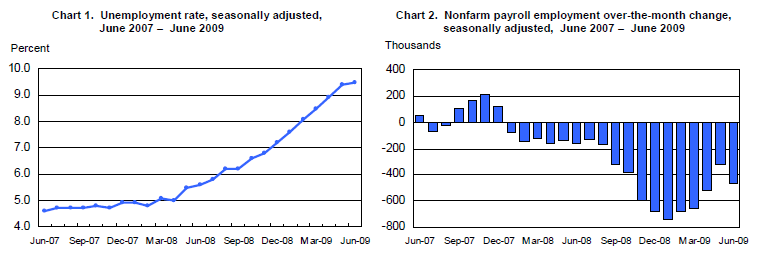

Peter Boockvar, also at the Big Picture, also notes that initial jobless claims totaled 614,000. Continuing claims fell by 58,000 from last week.
"While there is no question benefits are expiring without one finding a job, as evidenced by the rising exhaustion rate, many losing those benefits now started getting them when initial claims were running in the 400k range last summer. Now its running above 600k, so there are still more people filing initial claims than getting removed from the continuing claims data, thus continuing claims still should trend higher assuming no sudden change in hiring trends."
Meanwhile, Free exchange makes the important observation:
"[S]tate budget policies are sharply contractionary at this point. Despite allocations of federal aid to states, services are being cut, state employees are being laid off, and taxes are being raised in order to balance the budgets of local governments constitutionally unable to run deficits. It's not at all clear that the federal stimulus will entirely compensate for state-level fiscal tightening, which means that American fiscal policy could, on net, be contractionary."
13. BARCLAYS EXPECTS WTI TO AVG $71/B IN W3

Yee Kai Pin at Bloomberg reports that Paul Horsnell's commodity team at Barclays has lifted its third quarter forecast for WTI to $71/b from $62/b. Horsnell increased his Q3 forecast for Brent to $69/b.
"'Among all the changes that have kept commodities on the boil in recent years, the key factor is that 'normal' is not what it used to be,' the analysts said in the report. 'Oil prices below $70 or copper prices below $3,000 are no longer normal.'"
I think he's wrong, but he does know of what he speaks.

Wednesday, July 1, 2009

Daily Sources 7/1

1. JAPAN TO MOVE AHEAD WITH STRATEGIC PETROLEUM PRODUCTS RESERVE IN AUGUST

Takeo Kumagai at Platts reports that Japan's Ministry of Economy, Trade & Industry [METI] has decided to move ahead with plans to establish strategic petroleum product reserves beginning in mid-August with a day's worth of kerosene consumption.
"After nearly three years of discussing the matter in depth both internally and at its advisory meetings, METI was set to introduce the national oil products stockpile this year, with one or a combination of light and middle distillates, equivalent to one day's consumption of the particular product or products chosen, Platts reported earlier.

METI has chosen to start the products stockpile with kerosene because it would affect consumers living in northern Japan during the country's winter demand season, the official said. Kerosene is used as heating oil in Japan, with demand typically peaking over December-February."
2. CHINA'S OFFICIAL PMI UP TO 53.2, CLSA'S CHINA PMI UP TO 51.8; CHINA TO BAN IMPORTS OF US CHICKEN

Terence Poon at the Wall Street Journal reported yesterday that the official purchasing manager's index for China rose to 53.2 in June from 53.1 in May. (A reading of above 50 indicates expansion; below 50 indicates contraction.)
"The new export orders component of the PMI rose to 51.4 in June from 50.1 in May. June was the second consecutive month where the export-order subindex has remained above 50, suggesting a deterioration in exports in the past several months is abating.

But the inventory subindex of the PMI fell to 45 in June from 46.2 in May. [Moody's] Economy.com's [analyst] Sherman Chan said that drop suggests manufacturers remain cautious about building up inventories amid an uncertain global economic outlook.

'If the external environment doesn't improve, it will be difficult for the government to sustain its fiscal spending for a long time,' she said."
Chinaknowledge reports that CLSA Asia-Pacific Markets' China PMI also showed improvement, rising to to 51.8% in June from 51.2% in May. Meanwhile, Lauren Etter and Stephen Power at the Wall Street Journal reports that China is expected to ban imports of US chicken in the next several days.
"The potential ban could be a big blow to the US chicken industry, which has been struggling with high grain prices and a price-depressing oversupply of chicken. Exports had been a bright spot for the industry, and last year China surpassed Russia as the largest destination for US chicken, according to the USA Poultry & Egg Export Council."
"[I]n 2007 lawmakers inserted a provision in the 2008 fiscal-year spending bill that prohibited the USDA from allowing chicken processed in China to be imported. The same prohibition was included in the spending bill in the next two fiscal years.

Trade tension between China and the US heightened earlier this week when the US International Trade Commission recommended imposing punitive duties of as much as 55% on low-cost Chinese tire imports because they are disrupting the US market, in a move that could sharply increase costs for consumers. GITI Tire, China's largest tire manufacturer, has called the move 'decidedly protectionist' and said it would take its case to President Barack Obama.

Last week, the House approved legislation to curb US greenhouse-gas emissions that includes a provision to impose tariffs on goods from countries that don't match US efforts to combat climate change."
Last week the US and EU lodged a WTO complaint alleging that China was blocking the export of raw materials--Daily Sources 6/24 #2.

3. ASHGABAT INVITES MEDVEDEV FOR VISIT TO DISCUSS GAS PURCHASES

Upstream online reports that Turkmen President Kurbanguly Berdymukhamedov has invited President Medvedev to visit Ashgabat to discuss the resumption of Turkmen gas exports to Russia.
"Russia, the main buyer of Turkmen gas, halted its imports in April after a pipeline explosion.

The pipeline has been repaired but the two sides cannot agree on new terms of sales as Russia's Gazprom needs less gas than in the past."
The move comes after China sealed a deal to increase its gas imports from Turkmenistan by 30% last week--see Daily Sources 6/25 #3. Ashgabat publicly suspected that Gazprom had engineered the explosion at the pipeline in order to stop paying the $340/tcm (~$9.61/MMBtu) price it had reportedly contracted to pay for Turkmen gas on December 31, 2008--see Daily Sources 4/14 #7.

4. INDIAN OIL REFINERS NERVOUS ABOUT DELAYED MONSOON EFFECT ON DIESEL PURCHASES

Murali Gopalan and Richa Mishra at the Hindu Business Line reports that Indian oil refiners are worried about heavy losses on diesel as low rainfall so far this year results in digging and pumping groundwater and diesel electricity generation.
"[W]hile [oil demand] growth figures for May are negative ... , diesel consumption at 4.748 million tonnes ... was otherwise normal and has not fallen in absolute terms.

Another reason for this was due to a continuous decline in the industrial sector’s use as diesel-direct sales showed negative growth of 4.7% in May.

It was the sixth successive month when industrial sales of diesel showed negative growth, coinciding with the onset of the economic recession in the second half of 2008-09. While economics dictated the pace of diesel consumption so far, the weather patterns could change the pattern, fear experts.

However, the consumption trend for diesel seems to be changing in June, with the eastern region recording a 45% growth, with Bihar alone registering nearly 65%."
5. MALAYSIA TO PULL BACK MALAY-PREFERENTIAL POLICY

Thomas Fuller at the New York Times reports that the Prime Minister of Malaysia, Najib Razak, announced a rollback in the policy which required companies issuing stock to reserve 30% of their shares for ethnic Malays.
"'The world is changing quickly, and we must be ready to change with it or risk being left behind,' he said Tuesday.

The change would leave some ethnic preferences intact and come with caveats. But it would dilute one of the most important components of what is known as the New Economic Policy, introduced in 1971: the requirement that companies listing on the stock exchange sell 30% of their shares to ethnic Malays.

That requirement was scrapped for companies already listed on the stock exchange and reduced to 12.5% for initial public offerings. The requirement will remain in place for 'strategic industries' like telecommunications, water, ports and energy.

Mr. Najib also said he would lower barriers for foreign investors. The government would eliminate a special vetting process for foreign companies wanting to invest in, merge or take over a Malaysian company, he said."
6. IMF EXPECTED TO AUTHORIZE $150 ISSUANCE OF SDR-DENOMINATED DEBT TODAY

Timothy R Homan at Bloomberg reports that the IMF board of directors are expected to authorize the issuance of as much as $150 billion in SDR-denominated bonds, voting on the matter today.
"The IMF is also considering making them tradable between all central banks from countries that are IMF members, said a G- 8 official, who spoke on condition of anonymity. It would stop short of allowing them to trade on the open market, he said."
7. SARKOZY TELLS NETANYAHU TO GET RID OF LIEBERMAN

Michael Collins Dunn at the MEI Editor's Blog notes that President Sarkozy has reportedly expressed in a "private message" to Benjamin Netanyahu that he should remove Avigdor Lieberman from his post as foreign minister.

8. KIRKUK FIRST CITY SINCE START OF IRAQ WAR TO GET 24 HOUR ELECTRICITY


Diaa Al-Khalidi at the Iraq Oil Report reports that Kirkuk has become the first Iraqi city to enjoy 24-hour electricity since 1993--and the first time the city itself has experienced it since 1991, when Saddam Hussein cut power to the regions in order to ensure round the clock access in Baghdad following his defeat in Kuwait.
Kirkuk is outside the formal borders of the Kurdish Regional Authority, but, if I understand correctly, currently effectively security in the city is provided by it:


Security is key in the maintenance of energy infrastructure.

9. ARAMCO AND CONOCO TO RESUME BIDDING FOR CONSTRUCTION OF YANBU EXPORT REFINERY

Sheila McNulty at FT Energy Source reports that Saudi Aramco and ConocoPhillips have decided to resume the bidding process for the construction of the 400 kb/d export refinery at Yanbu. "Now some bids are to be awarded in November 2009 and the others in the second quarter of 2010." Evidently, the bidding process has resumed on an optimistic view of the global economy going forward--and that sufficient financing exists to get it done. (I suspect that this would more likely be the view of Saudi Aramco than ConocoPhillips, given the recent statements from OPEC, but Saudi Aramco controls the facts on the ground.)

10. OPEC 11 SUPPLIES 110 KB/D MORE OIL IN JUNE THAN MAY

Reuters reports that OPEC 11 output in June rose to 26.02 mb/d in June from 25.91 mb/d in May--a 72% compliance rate with the implied production target of 24.84 mb/d, down from 75% in May.

11. NIGER DELTA MILITANT GROUP CRITICIZES MEND FOR ATTACKS AFTER AMNESTY OFFER

Platts reports that the Ijaw Youth Campaign for Peace [IYC]--a coalition from the ethnic Ijaw community in Nigeria's Niger Delta--issued a statement today condemning continued attacks on oil installations by MEND following the introduction of the amnesty offer by Abuja.
"'We are shocked by the activities of our sons considering the recent [press] release by MEND [saying] they have vandalized Shell platforms in Forcados,' the IYC said.

'If the purported sabotage was actually true we in the Ijaw Youth Campaign for Peace hereby condemn it in all facets,' the group stated.

The group said the continued sabotage of oil installations 'will present our people as not actually fighting for a genuine cause, but personal gain, which the government can see as armed robbery and criminality.'"
The story also notes reports that the amnesty offer has hit a snag as the heavy military presence in the region has made militants leery of going to areas designated as arms collection centers.

12. OAS GIVES HONDURAS ULTIMATUM, UN CALLS FOR ZEYALA'S RETURN, ARGENTINA'S FERNANDEZ TO TRAVEL TO HONDURAS TO NEGOTIATE SOLUTION, CHAVEZ SAYS VENEZUELA MAY CEASE ALL CRUDE EXPORTS TO HONDURAS--ALL 0 KB/D OF THEM

Ginger Thompson at the Washington Post reports that the Organization of American States on Wednesday gave Honduras three days to restore ousted President Manuel Zelaya to power or face expulsion from the organization.
"Diplomats said they had rarely seen the OAS unite so solidly behind a common cause, and that it was the first time the group had invoked its so-called Democratic Charter since it was adopted in 2001 as a clean break with the region’s history of authoritarian rule."
The United States is the only country in the Western Hemisphere which has not reacted to the coup by withdrawing its ambassador. On the other hand, Joshua Goodman and Andres R Martinez at Bloomberg report that yesterday the UN General Assembly passed a resolution, co-sponsored by the US, calling for the restoration of Zelaya.
"OAS Secretary General Jose Miguel Insulza said yesterday he wanted to return to the Central American nation with Zelaya to demand his reinstatement. Argentine President Cristina Fernandez de Kirchner will accompany the mission, Buenos Aires newspaper Infobae reported.

As protests against Zelaya swell, a showdown is imminent. [Interim Honduran President Roberto] Micheletti said that Zelaya faces arrest and 20 years in prison should he attempt to return to Honduras, Central America’s third-poorest country.

The country’s Supreme Court, congress and business groups have also expressed support for Zelaya’s removal, over concerns he was seeking to retain power beyond his original mandate by ignoring court rulings and changing the constitution through a referendum on term limits.

Approval for the Zelaya government fell to 30 percent in February from a high of 57 percent in January 2007, according to a nationwide poll by CID-Gallup. The former cattle rancher lost support over the past two years as he strengthened ties with Chavez ... ."
Paul Talley at the Compass comments:
"For Fernandez, accompanying Zelaya gives her a chance to play a popular role in world politics that might offer a distraction from her own political problems at home."
Talley seems skeptical about the practical effect however--his post is worth a look. Meanwhile, Carlos Camacho at Platts reports that Hugo Chávez has delayed a trip to the Dominican Republic to finalize PdVSA's purchase of a 49% stake in the Refidomsa refinery there until the Honduran crisis is resolved. Chávez has reportedly threatened to halt all exports of crude to Honduras until Zelaya is reinstated. Of course, Honduras has no refining capacity, so a halt in crude exports wouldn't have much of an effect upon the country.

13. SURVEY SHOWS OBAMA MOST TRUSTED LEADER IN THE WORLD

World Public Opinion recently conducted a survey of 19,224 people in 20 countries, asking them to rate their confidence in leaders of foreign countries. The margins of error in the polls range from ±3-4%. "The survey was conducted between April 4 and June 12, 2009, prior to Obama's speech in Cairo but subsequent to his Ankara speech." The poll seems to show that Obama has by far the most trust of any world leader internationally.


That's a fair amount of political capital. The poll includes ratings for Putin (somewhat oddly), Ban Ki-Moon, Merkel, Brown, Sarkozy, Hu Jintao, and Ahmadinejad. (h/t Greg Scoblete at the Compass.)

14. KC FED CHIEF SAYS THE GOVT HAS INSTITUTIONALIZED "TOO BIG TO FAIL", ST. LOUIS FED CHIEF SAYS FED RATES LIKELY TO STAY UNCHANGED FOR "FORESEEABLE FUTURE," SF FED CHIEF TAKES AIM AT INFLATIONISTAS, SAYING DOWNTURN LIKELY TO BE PROLONGED

Greg Robb and Kate Gibson at MarketWatch report that Thomas Hoenig, president of the Federal Reserve Bank of Kansas City, has criticized the "ad hoc" approach to the financial crisis, saying it has institutionalized the notion of "too big to fail."
"'The current crisis has made it clear that the group of systemically important firms that might be deemed worthy of special consideration by policy-makers is larger than previously thought,' Hoenig said in a Tuesday speech at New York University."
"The Obama administration's overhaul of financial rules is only a start of a dialogue on the issue, Hoenig commented. 'The most important part of any plan ... will be the requirement that public authorities resolve such institutions by taking them into receivership and restructuring them to emerge under new and more careful management and ownership,' without exceptions."
Worth reading in full (h/t Yves Smith at naked capitalism.) Meanwhile, Jon Hilsenrath at Real Time Economics reports that James Bullard, president of the St Louis Fed, said in a talk at Philadelphia’s Global Interdependence Center today that the Fed Funds Rate is likely to remain at its current rate for the "foreseeable future." He also said that the Fed's
"'liquidity programs', such as efforts to support the commercial paper market or money market mutual funds, are on track to end next year 'if financial conditions continue to improve."
He further indicated that the Fed may reevaluate its purchases of mortgage-backed securities in its next meeting in August. In a story which has received wide coverage in the econoblogosphere, Jon Hilsenrath at Real Time Economics reports that Janet Yellen, President of the Federal Reserve Bank of San Francisco, took aim at the inflationistas, saying:
"We are far from the kinds of unemployment rates that would make inflation a danger. ... The very weak economy is, if anything, putting downward pressure on wages and prices ...

In past deep recessions, the Fed was able to step on the accelerator by cutting the federal funds rate sharply, causing the economy to shoot ahead. This time, we already have our foot planted firmly on the floor. We can’t take the federal funds rate any lower than zero. I believe that the Fed’s novel programs are stimulating the flow of credit, but they simply aren’t as powerful levers as large rate cuts, so this time monetary policy alone can’t power a rapid recovery.
...
I also think that a massive shift in consumer behavior is under way—one that will produce great benefits in the long run but slow our recovery in the short term. 4 American households entered this recession stretched to the limit with mortgage and other debt. The personal saving rate fell from around 8 percent of disposable income two decades ago to almost zero. Households financed their lifestyles by drawing on increasing stock market and housing wealth, and taking on higher levels of debt. But falling house and stock prices have destroyed trillions of dollars in wealth, cutting off those ready sources of cash. What’s more, the stark realities of this recession have scared many households straight, convincing them that they need to save larger fractions of their incomes. In the long run, higher saving promises to channel resources from consumption to investment, making capital more readily available to retool industry and fix our infrastructure. But, in the here and now, such a rediscovery of thrift means fewer sales at the mall, and fewer jobs on assembly lines and store counters."
The full text of her speech can be found here.

15. FORD TO RAMP UP PRODUCTION

Nick Bunkley at the New York Times reports that vehicle sales were down 11% in June from June 2008, the lowest annual rate of decline seen by any major carmaker since last Summer.
"Ford said this week that it was increasing production in the third quarter, which starts Wednesday, to match the rise in demand its dealers were seeing. The company now plans to build 67,000 more vehicles, a 16% increase, than it did in the third quarter of 2008.
...
Over all, industry sales are expected to be down at least 25% compared with June 2008. Though dismal by any measure, it could be the first time since September that total sales fell by less than 30 percent on a year-over-year basis, a positive sign.

June could also be the first month this year in which new vehicles sold at an annualized rate of at least 10 million. For most of the last decade, auto sales in the United States were around 17 million a year before plummeting in 2008. Fewer than 5 million vehicles were sold in the first half of 2009, a decrease of nearly 37%."
16. CRUDE STOCKS SHARPLY DOWN, BUT PRODUCTS STOCKS SHARPLY UP ... REFINING UTILIZATION SLIGHTLY DOWN

The EIA reports that commercial crude stocks were drawn down in the week ended June 26 by 3.7 million barrels to 350.2 million barrels, still above the historical range for this time of year, but not dramatically higher any more. Gasoline stocks grew by 2.3 million barrels, and are now in the middle of the five-year historical range for this time of year. The median analyst expectation per a Bloomberg survey was for a 2 million barrel build. Distillate stocks also grew by 2.9 million barrels to 155 million barrels, 34.3 million more barrels than were held in commercial inventories in the comparable week last year. The analyst expectation was for a 1.5 million barrel build. The national average price of gasoline for the week ended June 29 fell by 4.9¢ to $2.642/gallon. Refinery utilization for the week ended June 26 fell .06% to 86.99%.

17. 10 TOP US CITIES GROWING FASTER THAN THEIR SUBURBS SINCE 2007

Conor Dougherty at Real Time Economics notes the report by Mark Mather at the Population Reference Bureau which shows that population in the ten largest American cities have been growing faster than the areas around them since 2007:


Worth reading in full.

Friday, May 15, 2009

Daily Sources 5/15

1. CHINESE FDI DOWN 22.5% IN APRIL YOY, EARLY MAY ELECTRICITY GENERATION DOWN 3.9% YOY

Elaine Kurtenbach at the Associated Press reports that foreign direct investment into China was down 22.5% in April from a year previous to $5.89 billion, according to data released today by the Commerce Ministry. There was a 9.5% annual rate of decline in FDI in March.
"Actual direct foreign investment in January-April fell 21% to $27.7 billion, as companies canceled or postponed spending on factories and other assets due to weakening trade and financial conditions.

April's figure was distorted somewhat by the high level of investment in April 2008, when such commitments jumped nearly 53% from a year earlier."
The sharpest declines in investments came from South Korea, the United States and Hong Kong. (Hong Kong remains the largest source of funds, accounting for 45% of all FDI into China in April.)

In the meantime, John Liu at Bloomberg reports that the China Securities Journal today reported that Chinese electricity generation was down 3.9% in early May from a year earlier. The Journal--state-owned media--cited an anonymous official at the China State Grid Corp.

2. EUROZONE GDP CONTRACTS 2.5% IN Q1

Matthew Satlmarsh at the New York Times reports that the economy of the euro-zone, or the 16 nations that comprise the monetary union within the EU, contracted by 2.5% in the first quarter from the fourth.

3. GERMAN GDP SHRINKS 3.8% IN Q1 FROM Q4

Edward Hugh at Fistful of Euros reports that the German Federal Statistics Office this morning released data showing the economy shrank by 3.8% in the first quarter from the fourth, "equivalent to a 15.2% contraction at an annualized rate." This marks the fourth consecutive quarter of contraction for Germany, and a contraction of 6.7% from the first quarter of 2008. Hugh notes that there are many signs that the rate at which the German economy is shrinking has slowed, but it is bottoming out at fairly low levels. Industrial output is at levels last seen in 1999/2000--


Hugh comments:
"Perhaps the worst casualty of all this will be German public finances. German tax revenue for 2009 is now projected to decline by more than an additional €300 billion as compared with previous estimates."
Long, but very detailed with a wealth of data--worth a look.

4. FRENCH GDP CONTRACTS 1.5% IN Q1 FROM Q4


Eurointelligence reports that the French statistical office's latest estimate released today shows GDP declining by 1.5% in the first quarter from the fourth, the worst rate of decline on record since 1974.
"[T]he contraction of capital stocks [is especially notable] with -0.6%, much higher than in any other euro zone country or the US or Japan."

5. ITALIAN GDP CONTRACTS 2.4% IN Q1 FROM Q4

Edward Hugh at Fistful of Euros reports that preliminary data from the Italian national statistics office [Istat] released today show that Italian GDP fell by 2.4% in the first quarter from the fourth. Annualized, the quarter-on-quarter contraction would translate to a 9.6% rate of decline. From the first quarter in 2008, 2009 first quarter GDP fell by 5.9%, "the sharpest drop since Istat’s most recent data series start in 1980." Industrial production fell by 23.8% in March from a year previous. Hugh's graph:


"Italy effectively entered recession in third quarter of 2008, and the economy now looks bound to shrink the most in more than half a century this year. The International Monetary Fund forecast on April 22 that the jobless rate will reach 8.9% this year and 10.5% in 2010. At the same time, Italian inflation has been slowing and hit a record low of 1.1 % in March, so if the contraction continues the deflation threat is real and present."
Gross government debt is expected to climb to 113% in 2009 and 116.1% in 2010 from 105.8% in 2008. Again, long but detailed and with a wealth of data--well worth a look.

6. RUSSIAN GDP CONTRACTS 23% IN Q1 FROM Q4

Alex Nicholson at Bloomberg reports that the Russian Federal Statistics Service announced on its website today that first quarter GDP shrank by 23% from the fourth. The contraction is the worst seen in 15 years--an annual rate of decline of 9.5%.
"'The big dip in industrial production jumps in your face,' said Tatiana Orlova, a Moscow-based economist with ING Groep NV, who plans to lower her forecast for a 2.7% contraction this year. 'The government should be worried. It’s very easy to come up with headlines announcing bailout measures, but the situation shows that you have to adjust them. It’s hard to do these things fast.'"
7. PUTIN MEETING WITH BERLUSCONI IN SOCHI REGARDING SOUTH STREAM, GAZPROM OFFERS TO PURCHASE ALL AZERI FEEDSTOCK FOR NABUCCO, TURKISH PM TO ARRIVE IN SOCHI TOMORROW

BBC News' Steven Eke reports that Russian Prime Minister Vladimir Putin is meeting in Sochi with Italian PM Silvio Berlusconi and top energy officials from Greece, Bulgaria and Serbia, to discuss joint ventures for the construction of the South Stream pipeline.


Meanwhile, Torrey Clark and Stephen Bierman at Bloomberg report that Gazprom Deputy Chief Executive Officer Alexander Medvedev said in a Moscow interview with Bloomberg TV that "[Gazprom is] ready to buy the whole volume of Shah Deniz II."
"The second phase of Shah Deniz could add 12 billion to 14 billion cubic meters of annual gas output in three to five years once a market is found and transit for the fuel ensured, Azeri President Ilham Aliyev said on April 18."
Shah Deniz II is a critical possible source of natural gas for the proposed Nabucco pipeline. Last week the EU signed an energy cooperation deal with Azerbaijan regarding a southern transit corridor--but failed to get Turkmenistan or Kazakhstan to join in, other key sources of supply in the potential pipeline, that is, outside of Iran. Indeed, Kazakhstan inked a law on Wednesday committing more volumes through the Russian Central Asia-Center pipeline system. Last week the Obama Administration envoy for energy, Richard Morningstar, was rumored to have backed off from support for Nabucco, suggesting that South Stream would work just as well--see Daily Sources 5/13 #5. In his remarks on the 8th in Prague published today by the State Department, Morningstar says:
"The United States shares the view expressed in the Joint Declaration that interconnections are a "basic prerequisite" for developing the Southern Corridor. Interconnectivity maximizes the potential of Southern Corridor projects, such as Nabucco and ITGI; likewise, when these projects add diverse sources and routes to an interconnected market, they act as protection against supply disruptions. Nabucco opens up many possibilities for enhancing European energy security, though it is not a cure-all. Nabucco, of course, will also contribute to the development of countries in the region.
...
Azerbaijani gas is the only realistically available gas in the short term, but accessing it requires agreement with Turkey on transit terms. We must also concentrate on other sources, such as Turkmenistan, Iraq, Kazakhstan, Uzbekistan, Egypt, and other related countries."

On the other hand, Robert M. Cutler in the Asia Times reports that two key problems were solved last week in Prague regarding Turkey's participation in Nabucco:
"The two problems that were solved in Prague last week involved pricing and the legal regime for Turkish consumption of gas flowing through the pipeline. The EU had insisted that Turkey pay the equivalent of European prices; Turkey had proposed a figure 15% less than that. The common-sense resolution that was adopted provides for Turkey's price to be based on the cost of transportation: the gas consumed in Turkey will hardly go all the way to Baumgarten, so it will cost less. As for the legal regime, the EU has abandoned its insistence that the norms of its acquis communautaire apply in Turkey, a non-member of the European body, and a middle ground within Turkish law has been found."
Turkish Prime Minister Recep Tayyip Erdogan will be in Sochi to join the discussions with Putin tomorrow.

8. IOC SECURES RUPEE DENOMINATED LOAN TO BUILD 300 KB/D REFINERY IN FACE OF WALL OF NEW REFINING CAPACITY IN THE REGION

Vandana Hari at Platts reports that Indian Oil Corporation--state-owned--has secured a rupees 149 billion ($2.97 billion) loan from a consortium of 21 domestic banks to build a grassroots refinery project at Paradip with nameplate capacity of 15 million
mt/year (or 300 kb/d).
The loan is denominated in rupees, which is about the only thing that makes any sense about the decision, given an avalanche of new refining capacity in the region. Meanwhile, Eric Watkins at the Oil & Gas Journal report that Kuwait and Sinopec have finalized the terms for a 300 kb/d new refinery at Zhanjiang in Guangdong province, with Sinopec taking a 50% share, Kuwait Petroleum International 30%, 10% for Dow Chemical Co, and 10% for Shell. And, Osamu Tsukimori at Reuters reports that TonenGeneral Sekiyu, Exxon Mobil's Japan group refiner, announced today that its oil product exports in the first quarter rose 5% from a year earlier, led by a 22% gain in middle distillate exports. Oil demand has been steadily declining in Japan on an aging and shrinking population. The recent restart of nuclear power plants shuttered by earthquakes should put a further dent in oil and gas demand in the island nation as its industrial production tanks.
"Japan's oil product exports last year increased 123% last year to 34 million kilolitres (584,000 barrels per day), equal to about 12% of the nation's refining capacity."


9. CUBA TO TAKE MORE ACTIVE ROLE IN PETROCARIBE, CHÁVEZ AND KIRCHNER TO SIGN AGREEMENT ON GASIFICATION PLANT IN ARGENTINA TODAY, CHÁVEZ TO SHUT DOWN OPPOSITION TV STATION

Eric Watkins at the Oil & Gas Journal report that the Cuban-Venezuela joint oil shipping line--Transportes del Alba (TransAlba)--has received its second vessel, the 490,000 barrel capacity tanker, Sandino.
"The tanker, built in China by New Times Shipbuilding Co., is the second of two 72,700-dwt ships funded under a 15-year, $122 million credit extended by Venezuela's state-run national economic and social development bank Bandes.

In February, TransAlba acquired its first tanker, the 72,700-dwt Petion, which will transport crude from Venezuela's Puerto La Cruz refinery to Cuba's Camilo Cienfuegos refinery."
The joint venture is considering the purchase of a third, smaller, tanker which would be able to unload at smaller Caribbean and Central American ports as it looks like Havana will take a more active role in Chávez's PetroCaribe initiative. Meanwhile, Charles Newbery at Platts reports that Chávez indicated that he was set to sign an agreement with his Argentine counterpart, Cristina Fernandez de Kirchner, agreeing on the location and start date for construction of an LNG regasification terminal in Argentina. A natural gas liquefaction plant in Venezuela is scheduled to begin operations in two years.
"Enarsa and PDVSA, the state energy companies of Argentina and Venezuela, respectively, have created a joint venture for building the LNG import terminal, which would have the capacity to deliver between 10 million cu m/d and 20 million cu m/d (353,000 Mcf/d to 706,000 Mcf/d) to the Argentine market. A likely location for the terminal is Bahia Blanca, where US-based Excelerate Energy is unloading LNG cargoes from Trinidad and Tobago at a floating regasification terminal."
And Juan Forero at the Washington Post reports that the Chávez Administration has taken steps to close Globovisión, an anti-government cable station. The government has accused the station of inciting panic in its coverage of the May 4 earthquake that hit the country.
"Venezuela has not closed any media outlets during Chávez's decade in power. But in May 2007, Chávez refused to renew the broadcast license of a stridently anti-government station, RCTV, accusing it of plotting against him. Harangues and threats against journalists are common, press-freedom groups say, and the state has made the creation of a parallel, pro-government media apparatus a priority."
Last Sunday, Chávez also reportedly publicly declared that "no land is private."

10. PYONGYANG TO PUT US JOURNALISTS ON TRIAL FOR SPYING IN JUNE

Blaine Harden at the Washington Post reports that Pyongyang will put two US reporters on trial for spying in June.
"The announcement, coming in the same week as Iran's release of a US reporter who had been convicted of spying, led to speculation that television reporters Laura Ling and Euna Lee might also be set free after trial as part of North Korea's diplomatic gamesmanship with the United States.

Ling and Lee, who work for former vice president Al Gore's San Francisco-based Current TV, were arrested March 17 along North Korea's border with China. They have been accused of illegal entry and 'hostile acts,' which in North Korea are punishable by five to 10 years in a labor camp.

In one sentence on its state news service, North Korea said its central court has 'decided to try the American journalists on June 4 according to the indictment of the competent organ.'"
11. BP AND STATOILHYDRO TAKE MORE SUPERTANKERS FOR CRUDE STORAGE; BIODIESEL SALES AT ZERO IN GERMANY

On news that entities with crude in storage were likely to start unloading their cargo--see Daily Sources 5/14 #9--Pradeep Rajan at Platts reports that StatOilHydro and BP have both secured a VLCC--or supertanker capable of carrying two million barrels of crude--for possible crude storage.
"Some of the players storing crude on sea include Shell with around 17 vessels, Vitol with 14, Koch at seven, Total with six, ConocoPhillips at four and BP and StatoilHydro with one vessel each. NITC, Clearlake, ST Shipping, Repsol and Valero are also reported to have vessels on storage."
In a related story, after Europe raised duties on US biodiesel imports effectively shutting off 85% of the US biodiesel market--see Daily Sources 5/5 #5 and Daily Sources 3/12 #10--Michael Hogan at Reuters reports that German bioenergy company Verbio announced yesterday that biodiesel sales have come to a halt in that country.
"Biodiesel is currently more expensive than fossil diesel in Germany following a further tax rise on green fuels this year and a fall in crude oil prices.

'Tax increases in combination with the falling prices for fossil diesel have brought the B-100 (petrol station) market to a virtual standstill,' Verbio said.

Verbio said its biodiesel production in the first quarter of 2009 fell to 78,866 tonnes from 93,907 tonnes a year earlier. It has capacity to produce about 450,000 tonnes annually."
12. MEXICAN EMIGRATION DOWN BY 25%, ANECDOTAL REPORTS THAT MANY IMMIGRANTS RETURNING TO MEXICO, EFFECTS ASIAN AND HISPANIC GROWTH IN THE US

Julia Preston at the New York Times reports that Mexican census data suggests that emigration has fallen by 25% in the year ended August 2008 from the year prior. All told, about 226,000 less people emigrated from Mexico during that time than the year previous. The vast majority of Mexican immigrants emigrate to the US.
"The trend emerged clearly with the onset of the recession and, demographers say, provides new evidence that illegal immigrants from Mexico, by far the biggest source of unauthorized migration to the United States, are drawn by jobs and respond to a sinking labor market by staying away."
This comes on top of reports seen in California in March that many Mexican immigrants in the US are choosing to return to Mexico in the midst of the crisis.


For example, on March 6, Cindy Carcamo at the Orange County Register reported that "anecdotal evidence and informal surveys" suggest that both "legal and illegal immigrants" are returning to their relatives in Mexico.
"In the Mexican heartland of Cerrito de Agua Caliente, where many have traditionally migrated to Orange County, about a third of those who visited their families during the holidays decided to stay put, said Cuerámaro City Clerk Cesar Torres.

Hundreds of miles north, at the central bus station in Tijuana, more than half of the passengers arriving on a Crucero bus line from the US during a two-week period earlier this year were in the process of returning home for good, according to a passenger survey.

And, at a rental property office in Anaheim, a manager says her vacancies have spiked partly because of immigrants returning to Mexico.

'There is no work,' says Baltazar Saldaña, shaking his head. 'That's the problem.'"
Ms. Carcamo also reports that bus drivers and ticket clerks have seen a surge in one-way tickets to Mexico. Her story is well worth reading in full for a variety of details. Both stories are on top of the story yesterday by Sam Roberts in the New York Times that Asian and Hispanic minorities in the US are still growing, but at a substantially reduced rate.
"The latest census estimates found that the minority population--other than non-Hispanic whites--grew by 2.3% from July 1, 2007, to July 1, 2008, compared with 2.4% the year before.

Ethnic and racial minorities (mostly blacks, Hispanic and Asian people) now account for 34% of the nation’s population.

The Hispanic population grew by 3.2% and Asians by 2.7%, a slight decrease from the year before. But those figures were down sharply from the beginning of the decade, when the Hispanic population grew by 4% and Asians by 3.7%, according to an analysis by the Population Reference Bureau, a private research group."
With the pace of immigration slowing down, a larger portion of that increase comes from regular population growth. (I imagine that it is likely that a similar process is happening in demographic trends in Europe, where job prospects are similarly becoming more scarce.)

13. RAILWAY DATA SHOWING DEEP DECLINES IN FREIGHT TRAFFIC

The weekly Railfax Report from Atlantic Systems Inc. for the week ended May 9 which plots total freight traffic via rail in the US shows an 18.1% year over year decline:


The breakdown of major commodities groups is especially interesting, note the nearly 50% decline in metal conveyance year over year.


Also the relatively small reduction in coal freight is interesting--the drop in industrial production should be having a large effect on coal just as it has on natural gas. (h/t CP at Credit Bubble Stocks via Yves Smith at naked capitalism.)

14. APRIL CONSUMER PRICES DOWN 0.7% ON YEAR, FLAT ON MONTH, APRIL INDUSTRIAL PRODUCTION DOWN 0.5% ON MONTH, 12.5% ON YEAR, MANUFACTURING CAPACITY RUNNING AT 65.7%

Jack Healy at the New York Times reports that the Labor Department announced today that the consumer price index was flat in April from March and down 0.7% on the year.
"The so-called core rate of inflation, which excludes volatile food and energy prices, rose a seasonally adjusted 0.3%, slightly more than its increases of 0.2% for each of the first three months of the year."
Much of that increase is apparently due to an increase in the cost of tobacco. Healy also reports that the Fed announced today that industrial production was down 0.5% in April from March, after having declined (a revised downward an additional 0.2%) 1.7% in March from February. The Fed's industrial production index showed a 12.5% decline in April from the year previous. Manufacturing capacity was running at 65.7% in April, down 0.1% from March. The manufacturing sector of the production index in April was down 0.3% from March and down 14.5% from the year previous. The Federal Reserve's statistical release on industrial production and capacity utilization can be found here. Rebecca Wilder's summary of global economic data for the week shows that the fall in industrial production mirrors what is happening generally all over the globe:


Ms. Wilder notes that inflation is volatile on food and energy costs, but suggests that it will continue to fall globally as well. The post is worth a look.

15. CALIFORNIA TO SELL $6 BILLION IN BONDS TO COVER BUDGET SHORTFALL, FIRE 5,000 EMPLOYEES

On the analysis yesterday--see Daily Sources 5/14 #13--that the government is the only organization hiring, but that state budgets are in crisis all over the country, Michael B. Marois and William Selway at Bloomberg report that California Governor Arnold Schwarzenegger has proposed selling $6 billion in bonds.
"Schwarzenegger’s proposal includes plans to fire 5,000 state employees, mostly prison workers and personnel from health and services agencies. The state employs about 200,000 people."

Friday, February 27, 2009

Daily Sources 2/27

1. Agnes Lovasz at Bloomberg reports that The World Bank, the European Bank for Reconstruction and Development, and the European Investment Bank released a joint statement today stating that they will lend as much as €24.5 billion (~ $31 billion) to help central and eastern Europe weather the financial crisis.
"'We have a special responsibility for the region and because it makes economic sense,' EBRD President Thomas Mirow said in a joint statement issued by the international organizations today in London. 'For many years, the growing integration of Europe has been a source of prosperity and mutual benefit and we must not allow this process to be reversed.'

The EBRD will provide about €6 billion, the EIB about €11 billion and the World Bank about €7.5 billion, the statement said. The aid will take the form of equity and debt financing, credit lines and political risk insurance."
Meanwhile, Balazs Penz and Agnes Lovasz at Bloomberg report that the Hungarian Prime Minister Ferenc Gyurcsany is lobbying the EU to arrange an aid package of €180 billion (~ $230 billion) for eastern Europe.

2. Eurointelligence reports that French unemployment grew by 90,000 in one month.

3. Mark Landler at the New York Times reports that the US will hold regular three-way meetings with Afghanistan and Pakistan regarding the prosecution of the war against the Taliban. It is fairly amazing to me that this is a new process, though the Times assures us it is so:
"[T]his week’s meetings involved a much larger cross-section of military and government leaders — among them foreign ministers and the heads of the Afghan and Pakistani intelligence services.

'These were not just photo ops,' said Richard C. Holbrooke, the special representative for Afghanistan and Pakistan. 'Meetings in this configuration have not taken place.'"
From today's State Department press briefing:
"MR. WOOD: I think it’s pretty much understood by all parties that there is a link between Afghan and Pakistani security. The Taliban and al-Qaida are threats to both countries. And what we want to see is much closer cooperation between the United States, Pakistan, and Afghanistan, as we try to deal with these threats.

It was a good-–a good discussion. There were a number of issues that were dealt with at this trilateral meeting. There will be future meetings. I believe the Secretary said that probably either-–I think sometime in late April or May would probably be the next trilateral meeting. It was a very good forum for trying to deal with these very, very thorny issues of security. And you know, the Secretary thought it was very useful to have, you know, representatives from, you know, both Pakistan and Afghanistan here together so that we could really talk about this threat to regional security that’s posed by al-Qaida and the Taliban."
4. Taghreed el-Khodary and Isabel Kershner at the New York Times report that at a joint news conference in Cairo, "Ahmed Qurei of Fatah and Moussa Abu Marzouk of Hamas announced the establishment of committees to find formulas for a Palestinian unity government and new elections." Hamas and Fatah expect the organizations to complete their work by the end of March.

5. Richard Meade at Lloyd's List reports that EU legal teams are nearing a multilateral agreement which will provide a legal framework for the prosecution of pirates generally in the Gulf of Aden and off the Somalian littoral. Kenya, Tanzania, Ethiopia and Egypt all potentially could have jurisdiction under the agreement.
"According to [Rear Admiral Philip Jones, the British commander of EU naval forces operating in the region] an agreement with Kenya is now in its final stages, while separate negotiations with several other states are continuing.

The aim of the negotiations is to establish a legal mandate that will allow all EU forces operating off Somalia to detain pirates either on the high seas or within Somali territorial waters and subsequently land those suspects in a neighboring coastal state for trial and prosecution.

One key stumbling block has been a political desire within EU member states to avoid signing deals with countries that impose the death penalty."
6. Keith Johnson at Environmental Capital reports that Global Geo Services chief executive Knut Oversjoen told the media that a US company has expressed interest in purchasing its 'Persian Carpet' seismic study of Iran's offshore. "That data would be useful if US sanctions against Iran were dropped and US companies could bid for exploration leases."

7. Eric Watkins at the Oil & Gas Journal writes that Oil Movements reports that OPEC seaborne crude exports will fall to a five-year low by mid-March.
"However, the [consultancy] said that 'the reduction in sailings will (implicitly) still fall some way short' of the 4.2 million b/d in cuts that OPEC has decided upon in a bid to increase prices."
"'Over the next three months the normal seasonal direction for this series is northerly, and just holding on at current low levels would be a sizable departure from the normal pattern,' OM said.

Westbound sailings from the Middle East are 750 kb/d down on year ago at the furthest out date, and that difference will show up in arriving barrels heading into the second quarter.

But by implication, OM said, 'Hard volumetric evidence available from import and stock figures may not fully reflect supply changes that will still be working through the system by the time OPEC meets next month.'"
8. Platts reports that Abuja has announced it will fully deregulate the downstream sector, completely withdrawing the subsidy of petroleum imports.
"The government's decision is sure to elicit protests from labor unions and the public who see subsidized fuel as the only benefit they enjoy from the country's oil wealth.

The two powerful oil workers' unions, Pengassan and Nupeng, warned in 2008 that they would resist any attempt by the government to withdraw fuel subsidies."
As part of the same restructuring, Vincent Nwanma at Bloomberg reports that finance minister Mansur Muhtar and petroleum minister Rilwanu Lukman said on television last night that Nigeria will seek to sell its four refineries. The refineries have a total capacity of about 445 kb/d and are located in Kaduna, Warri and two at Port Harcourt. EIA estimates that Nigeria consumed about 271 kb/d in oil in 2007--the refineries, due to a variety of issues, have been running at about 214 kb/d.


9. Eliana Raszewski at Bloomberg reports that Buenos Aires is considering a plan to nationalize the grain trade in order to ensure that the domestic market requirements are met before basic foodstuffs are exported.
"Any such move would set back negotiations between the government and farm leaders, who are pressing for reductions in export taxes and fewer restrictions on shipping their produce abroad, said Nestor Roulet, vice president of the Argentine Rural Confederation. Last year, the country’s farm groups withheld grains and blocked highways during a four-month protest against planned tax increases and a ban on beef exports."
10. Catherine Rampell at the New York Times reports that the Bureau of Economic Analysis revised its GDP growth numbers for the fourth quarter down from a 3.8% decline to a 6.2% annual rate of decline. (For the initial estimates, which were widely regarded as way too optimistic at the time, see Daily Sources 1/30 #18.)

11. Margot Habiby at Bloomberg reports that the US rig count is down to the lowest seen since January 2005 to 1,243 according to Baker Hughes.

Monday, February 9, 2009

Daily Sources 2/9

1. Peter Boone, Simon Johnson, and James Kwak at Baseline Scenario have a long and detailed post on the likely direction of the global economy, which they say faces an economic environment similar to the one faced by Japan in the 1990s and a "lost decade" for the global economy is a likely outcome.
"[The] situation in emerging markets is moving sharply towards near-crisis, particularly as global trade contracts and there are immediate effects on both corporates and the financial system. Currency collapse and debt default will be averted only by fiscal austerity. The current IMF strategy - most clearly evident in East-Central Europe - is to protect creditors fully with programs that do not allow for nominal exchange rate depreciation. This approach increases the degree of contraction and social costs faced by domestic residents, while also making economic recovery more difficult. These programs will likely prove more unpopular and less successful than were similar programs in Latin America in the 1980s and in Asia in the 1990s. As East-Central Europe slips into deeper recession, there are severe negative consequences for West European banks with a high exposure to the region (including Austria, Sweden and Greece)."
Quite long and detailed, but worth reading if you have the time.

2. Marcus Hand at Lloyd's List reported Friday that the Thursday surge seen in the Baltic Dry Index of 14% was driven by a jump in Chinese iron ore imports. Given that there will be limited demand for steel in the near term--though the stimulus program should provide some sort of bottom--the recovery in the BDI could be short-lived. But, so far anyway, the BDI continues to show signs of recovery, so much so that you can even discern it from a year's-eye view:


Another potential reason for the recovery, however limited, indicated by the BDI has been the Chinese New Year. I don't see how the New Years would have an affect now; clearly the BDI couldn't have fallen all that much farther from its low.

3. David Pearson at Real Time Economics reports that Bank of France governor Christian Noyer said in a radio interview Saturday that there was no risk that any eurozone countries would leave the monetary union.
"There has been some speculation in recent weeks that one or two countries might seek to leave the system to escape its rigid policy rules. But Noyer observed that recent investment rating downgrades of sovereign debt by some rating agencies have been 'very excessively exaggerated.'"
4. Andrew Batson at Real Time Economics looks at the analyst disputes over the extent to which Beijing's official economic data represents reality. He includes a list of estimates by several banks regarding what the 6.8% official GDP growth for the fourth quarter represents in terms of annual GDP growth.


The story also quotes the head of China's National Bureau of Statistics--Ma Jiantang--as throwing water on the notion that electricity consumption growth is a good proxy for GDP growth, "‘You have negative growth in electricity consumption, so how can GDP be growing by 6.8%?’ People who hold this view do not actually understand the internal relationships of different factors in the economy." Fair enough, still I'd appreciate an explanation of those "internal relationships of different factors in the economy."

Meanwhile, Zhang Dingmin at Bloomberg reports that China's Ministry of Finance’s research institute published a report Saturday calling for depreciation of the renminbi to about 6.93 per dollar (or about $0.1443/renminbi, about a 1.5% depreciation from the current interbank rate.)

5. In a series of post, Edward Hugh at Fistful of Euros reports that the Latvian economy contracted by 10.4% in the fourth quarter, that the Bank of France expects a contraction of 0.6% in the first quarter, which would mean that it will have technically entered a recession, and that the German Federal Statistics Office announced this morning that December exports were up 3.7% in November and down 7.7% from a year before.

6. The Spanish finance minister, Pedro Sobles, has an opinion piece in Wall Street Journal Europe calling for further economic cooperation in the face of the financial crisis.

7. Joaquín Almunia--European commissioner for economic and monetary affairs--has an opinion piece at Wall Street Journal Europe which argues that the reluctance to moderate the excesses of the laissez faire system are gone, suggesting a new consensus.
"The period we are entering will be characterized by a more active involvement of the public sector in the economy and, in particular, by a more abundant and extensive regulation of the financial system. That system will have to be more transparent, its supervision more rigorous, cross-border coordination of supervisory authorities more efficient, and risk management more cautious. Consensus on all these aspects is very broad: The roadmaps which have been drawn up listing the initiatives to make this possible, at the European and global levels, are detailed and lay down a strict timetable. Europe has started delivering: We have taken steps to strengthen capital requirements, to have stricter regulation for credit rating agencies and to protect bank deposits. We have changed accounting rules and taken steps to bring the credit default swaps market into central clearing in the EU.

But we have no illusions about the scale of the task ahead. We need to deliver more and do so quickly, all while coordinating action at the international level. This requires urgently involving the emerging economies in this task and in the relevant international forums such as the International Monetary Fund and the Financial Stability Forum."
8. Edward Hugh at Fistful of Euros reports that the great bulk of the speculative attacks on the ruble have apparently been funded by the government itself! It turns out that Moscow had extended credit to the banks in an effort to combat the credit crunch, and that the banks had used the funds to finance speculative attacks on the ruble.
"Kommersant reported (Friday) that policy makers planned to reduce bank loans in an attempt to limit bets on the ongoing ruble devaluation. As a result the ruble remained safely within the target band all day Friday, and there was no need for any kind of intervention."
Meanwhile, Hugh lists a long roster of indicators showing that the Russian economy is going through a brutal contraction.

"If we look at the monthly contraction rate as a reflection of the current quarter on quarter contraction, we find a rate of minus 1.6%, which means that the present rate is something like a 6.5% annualized [rate of contraction]. At present this is stationary and not accelerating, but it is quite strong, especially for an economy which only six months ago was expanding at a 6.5% annualized rate."
Long, but worth a look.

9. Philip P. Pan at the Washington Post has an interesting piece which argues that recent moves by Russian President Medvedev suggest that he is increasingly asserting independence from Putin and that a break is developing between the two men.
"In a sign of tensions in the relationship, one Russian official, also speaking on the condition of anonymity, said Putin and Medvedev recently decided that a note-taker should keep minutes of their discussions because 'misunderstandings' had arisen following past meetings. 'It's a very bad sign,' the official said, arguing that a rift in the leadership could destabilize the government."
Tea leaves aside, the narrative that Putin is the absolute ruler of Russia with Medvedev as his pawn has been way oversold. That said, the notion that there is a real break between the two looks like wishful thinking to me at this stage. Either way, the article is well worth reading. Craig Whitlock, also at the Washington Post, on Sunday reported that Vice President Biden, said at an international security conference in Munich on Saturday that the Administration seeks to "reset" relations with Moscow.Biden said,
"The last few years have seen a dangerous drift in relations between Russia and members of our alliance. The US and Russia can disagree but still work together where its interests coincide."
Angela Merkel echoed the need to incorporate Russia into European security projects, but Nicholas Sarkozy and Polish prime minister Donald Tusk both appeared convinced of hostile intentions on the part of Moscow. Long, but also worth reading.

10. Shigeru Sato at Bloomberg reports that Japanese refiners have told the media that Saudi Aramco has slashed the amount of crude it will supply them by 11 to 14% from their annual contracted levels.

11. Jim Jelter at Market Watch on Saturday reported that Iraqi Oil Minister, Hussain al-Shahristani, told journalists that he expected OPEC to cut supply again in the March meeting. Al-Shahristani said that Baghdad thinks the price should be at least $70/b. (Revenues from the oil and gas sector account for about 90% of the government's budget.) Margaret McQuaile and Stuart Elliott at Platts report that OPEC's secretary general--Abdalla el-Badri--suggested that OPEC needs to comply completely with the current 4.2 mb/d supply cut before another cut could be agreed to. Badri said that 897 kb/d of supply needs to come offline before the 4.2 mb/d target is met. He also urged non-OPEC producers to join in the cut, saying "We urge Norway, Russia and Mexico to give a hand, because the situation is very difficult and we cannot handle it by ourselves." He also said that OPEC currently has 8 mb/d of surplus capacity shut in.

12. The Gulf Times reports that Iran's National Audit Office reported that $1.058 billion in surplus oil revenues for the 2006-7 budget has not been returned to the national treasury by the Ahmadinejad administration.

13. Shai Oster at the Wall Street Journal reported Friday that Chinese President Hu Jintao and Premier Wen Jiabao ordered the State Council on Thursday to make every effort to combat the drought now afflicting China. The drought is the worst seen since 1951 in some areas, and is likely to severely affect the wheat crop.
"The affected area is primarily in central and eastern China, covering the country's breadbasket where much of the winter wheat crop is raised. The area also includes the region surrounding Beijing, the capital, which hasn't had precipitation in more than 100 days. In all, 1.85 million livestock are short of water."
The International Grains Council forecast a sharp reduction in the world wheat 2009-2010 harvest in late January (see Daily Sources 1/30 #8.) In November, China's National Development and Reform Commission set grain self-sufficiency as a national security goal of 2020 (see Daily Sources 11/4 #5.)

14. Joshua Partlow at the Washington Post reports that the drought in Argentina has killed at least 1.5 million cattle there. The drought started a couple of years ago near Buenos Aires and has spread through the pampas--Argentina's breadbasket. The cattle are so starved that the government has recently reduced the minimum weight allowable for the market to 575 lbs from 615 lbs.
"Agricultural groups estimate that Argentina, one of the world's top grain exporters, has lost more than $5 billion from the weather and that it could significantly slow the nation's economic growth. The 2008 harvests of several crops came in far smaller than those of the previous year."

Monday, December 22, 2008

Daily Sources 12/22

1. Robert Lindsay at the London Times reports that the Ernst & Young ITEM Club expects China's economy to be the world's largest within a decade, due to the credit crunch.
"Brazil, Russia, India and China, the “Bric” nations, will account for 40 per cent of global economic growth between next year and 2020, according to ITEM. Of this, China will account for a quarter."
I cannot help but be just a tad snarky about the credibility of accounting corporations these days, as in, oh, an accounting company said so, its account thus must have a likelihood of coming to pass of, oh, say, precisely zero. How's that for a number?

2. Ambrose Evans-Pritchard at the UK Telegraph reports that a variety of countries have begun to raise tariffs in response to the financial crisis. Russia has imposed 30% import tariffs on cars, 15% on agircultural equipment and 95% on poultry imports.
"'It is possible during the financial crisis to support domestic producers by raising customs duties,' said Premier Vladimir Putin. ... India and Vietnam have imposed steel tariffs. Indonesia is resorting to special 'licenses' to choke off imports."
In the meantime, China has moved towards subsidizing its steel industry and appears to be maintaining its currency peg to the dollar, as opposed to allowing the renminbi to appreciate. Anthony Faiola and Glenn Kessler at the Washington Post have a similar story--if less alarmist--which notes that Argentina and Brazil are seeking to raise tariffs on a wide variety of products, and that France is providing its sovereign wealth fund with additional monies to prevent the foreign takeover of "strategic" industries. Faiola and Kessler note that on Friday the US announced it was going to take China to task within the WTO framework for providing illegal subsidies to its export sector. Robert Samuelson in the Washington Post notes that much of the fiscal stimulus coordination between the major industrialized and developing economies is mostly for the press releases.
"Countries agree on broad principles but then go their separate ways. Germany's 'stimulus' program, for instance, is much smaller than the one apparently planned by the Obama administration. Countries renounce protectionism, but there are signs that China -- with a massive trade surplus -- might relax its policy of currency appreciation. By making the yuan cheaper, China would give its exports an added price advantage. If the United States inserted "Buy American" provisions in any stimulus legislation, it, too, would be embracing economic nationalism."
Yves Smith provides her own analysis, which more or less concludes that many nations have begun instituting beggar thy neighbor policies. All four pieces are worth reading in full.

3. Li Yanping and Kevin Hamlin at Bloomberg report that China has cut its benchmark interest rate by 27 basis points (0.27%) to 5.31%. This is the fifth time Beijing has cut its benchmark interest rate in three months.

4. Martin Fackler at the New York Times reports that Toyota announced that it expects an operating loss of ¥150 billion (~ $1.7 billion) for the fiscal year ending March 31. This is the first operating loss Toyota would experience in its 70 year history.

5. Yuriy Humber and Torrey Clark at Bloomberg report that many of the so-called "oligarchs" in Russia are approaching the government for bridge loans to weather the financial crisis.
"More than 100 business leaders are vying for loans from Putin and the administration of President Dmitry Medvedev because Russian companies have about $110 billion of foreign obligations due next year, according to the central bank, double the total owed in Brazil, India and China."
The government is taking voting shares and requiring representatives on corporate boards in return for capitalization. Many of the corporations will therefore revert to state control. Well worth reading in its entirety.

6. Lucian Kim at Bloomberg reports that Russian Prime Minister Vladimir Putin will personally open the next meeting of the Gas Exporting Countries Forum (GECF) in Moscow tomorrow. Many worry about the GCEF as a new OPEC, but there are too many differences between natural gas and oil business realities for GCEF to really have the same kind of influence on the market as OPEC does. (I might write something explaining this further later.) In any case, the members of GCEF include Algeria, Bolivia, Brunei, Egypt, Indonesia (which may soon cease to be a natural gas exporter), Iran, Libya, Malaysia, Nigeria, Qatar, Russia, Trinidad & Tobago, the UAE, and Venezuela. Norway and Equatorial Guinea both have observer status with the organization. It's website can be found here.

7. Sam Fletcher at the Oil & Gas Journal reports that in a report for the London Energy Meeting, Cambridge Energy Research Associates wrote that the global oil market is being hit hard by a global "recession shock."
"At the start of this year, some analysts estimated global demand growth as high as 2.1 million b/d. CERA's current global demand estimate for 2008 is a 300,000 b/d decline and for 2009, an additional 660,000 b/d drop. 'The last time demand dropped this much was in the deep recession of 1981,' it said."
The report also appears to claim that the oil markets have been in the grip of unprecedented price volatility in 2008, which is odd given my recent analysis of front month price volatility which showed, for example, more instances of 5% price moves in front month oil in 1986 than I had seen so far in 2008. (see Spot Life CL Jan 09 pt 2, which was posted on 12/11.) I'll take a look at the data again, but I don't think my last account is much off. Mathew Carr at Bloomberg writes that the CERA report stresses that more data transparency would do much to smooth the price volatility we see in the oil markets.
"I think it would be hard to find anyone who would disagree with that. A US Securities Exchange Commission redefinition of reserves may prove to be a model for the world, [Daniel] Yergin said. 'The definition of reserves for financial reporting purposes needs to be updated.'"
I think it would be hard to find anyone who would openly disagree with that, but, it was just recently that Russia was reported to have delayed the introduction of more transparent oil reserves data accounting methods. (see Daily Sources 12/16 #1) The reasons that producing countries have an interest in opacity need to be better explored, clearly, as they do not appear to be especially anxious to provide it. Just saying following Western accounting "best practices" does not have much persuasive power these days given the obvious lack of credibility the Western accounting powerhouses have in pretty much every market sector they happen to cover.

8. Richard Meade at Lloyd's List writes that increased transparency is currently being considered by the shipping industry as a way to combat chronic woes.

9. John Kingston at the Platts blog "The Barrel," notes
"In its monthly report this week, OPEC said OECD stocks currently stand at 56.3 days of forward cover, about four days more than the average for the past five years. But given the steepness of virtually all forward curves for crude and major products, and given antecdotal reports from individual markets, it's tough to find anybody who really believes that number. Almost everyone believes it is much higher. It's that number that will keep oil depressed for the foreseeable future, unless just about every barrel of OPEC's cuts takes hold."
Steve Gelsi at Marketwatch has the related story that oil stored at Cushing, Oklahoma, is approaching the record level of 28 million barrels set earlier this year. (h/t reader trexbean) Given the huge contango, it seems that folks in the market are having a hard time financing storage deals but that all available storage is about to be gone even with such difficulties.

10. The AFP reports that on Sunday it interviewed a PKK spokesman and, in it, he openly worried about Ankara's relationship with the Kurdish Regional Government in Iraq.
"'Since they failed in their military campaign in the border region over the past year, they have come up with the policy of trying to divide the Kurds and provoke infighting among them,' Kamal Kheyri told AFP by telephone."
(h/t informed comment)

11. The BBC reported that the Iraqi Parliament on Saturday rejected the draft law which would have allowed coalition forces not covered by the Status of Forces Agreement, ie everyone but the US, to remain in Iraq beyond 2008. The Parliament in effect called for individual agreements with each coalition member. The al-Maliki cabinet has until the new year to craft a new bill and get it through Parliament or there will be no legal mandate for the British presence there. Somewhat ironic given the English media's response to the blanket legislation, considering the fact that the UK did not have an individual agreement a "national humiliation." (see Daily Sources 12/15 #11)

12. Ernesto Londoño at the Washington Post reports that the al-Maliki government is threatening to expel from Iraq members of the anti-Iranian opposition fighters--or terrorists, depending on your point of view--group the MEK. There are about 3,500 Iranian members of the MEK residing in a refugee camp, more or less, in northern Iraq. The US State Department designated them a terrorist group some time ago. Danny Postel provides some links to neoconservative support for the MEK over the years, including Daniel Pipes, David Horowitz, Max Boot, and Patrick Clawson. If I remember correctly, Pipes was involved in a controversy a few years ago when he was to speak at an MEK rally to be held openly in Washington, DC.

13. Thomas Erdbrink at the Washington Post reports that on Sunday police in Tehran shut down the office of Shirin Ebadi's human rights organization. The article is well worth reading in full.
"In a telephone interview, Ebadi called the closure of her organization's office 'illegal' and "unacceptable." She vowed to reopen the center, saying that 'the police actions are against the law.'"
The fact that the government is going out of its way to impede the operation of Ebadi is important because it shows that Tehran regards this human rights lawyer as a significant threat to the credibility of the regime. It is just as important that the reason given is that Ebadi's organization did not possess the appropriate license for operations in Tehran, that is, the government is using "the letter of the law" to oppose, in Ebadi's view, the spirit of it. I go into great length about the unique vulnerability of the Islamic regimes to a disregard for rule of law in a piece I wrote in April, Law and Revolution in Iran.

14. Stephanie McCrummen has an interesting account of conditions in Somalia. As the situation deteriorates, many apparently feel they have no choice but to join one militant group or another. In this case, mostly al-Shabaab. Worth reading.

15. Nicholas Winning at Real Time Economics reports that the European Union’s Eurostat statistics agency released figures today showing that in October new industrial orders in the eurozone fell 4.7% on the month and 15.1% on the year. This is the worst decline seen since records were first kept in 1997. Also,
"The Belgian National Bank [released the results of a survey today with] its main confidence index [plunging] to -31.3 from -23.7 in November. The drop was most noticeable in the manufacturing sector, where confidence fell to -36.5 from -27.1."
16. Bloomberg reports that the Irish government announced a plan to recapitalize its three largest domestic banks by purchasing preferred shares and underwriting the issue of further shares in the companies. The government will take a controlling stake in Anglo Irish Bank Corporation with preferred shares representing 75% of the corporation's voting rights in return for an investment of €1.5 billion (~ $2.087 billion). Dublin will pay €2 billion (~ $2.783 billion) each for preferred shares with voting rights in Allied Irish Banks and Bank of Ireland. "Irish financial shares have fallen on average 92% this year, led by Anglo Irish, which has plunged 97%." You'll recall that Ireland began a sort of race toward upping state insurance of domestic financial institutions, thus putting their European financial competition at a disadvantage, in late September early October, presaging the disunity in the European fiscal response to the financial crisis seen of late. (see Daily Sources 10/6 #1)

17. David Smith at the London Times reports that revised third quarter GDP figures for the UK will be released this week showing a contraction of at least 0.5%.
"The Centre for Economics and Business Research, a consultancy, predicts that Britain will contract by 3% in 2009 and a further 0.7% in 2010, implying a long, deep recession.

Capital Economics, another consultancy, now predicts a fall of 2.5% in GDP next year, with a further drop of 1% during 2010.

This compares with the Treasury’s prediction of a decline in GDP of between 0.7% and 1.25% next year, followed by a recovery in 2010, when it expects to see the economy grow by between 1.5% and 2%."
18. George Soros, writing for the interesting non-profit organization--the Project Syndicate--makes the following observation:
"The US consumer can no longer serve as the motor of the world economy. To avoid a global depression other countries must also stimulate their domestic economies. But periphery countries without large export surpluses are not in a position to employ countercyclical policies. It is up to the IMF to find ways to finance countercyclical fiscal deficits. This could be done partly by enlisting sovereign wealth funds and partly by issuing Special Drawing Rights so that rich countries that can finance their own fiscal deficits could cede to poorer countries that cannot."
He also has a sort of neo-Kantian notion of the markets, saying that they do not honestly reflect the conditions of the organizations in which they invest. Worth reading.

19. Matthew Brown at Bloomberg reports that the TED spread--the difference between what banks and the US government pay to borrow money--has dropped to below 150 basis points (1.5%) for the first time since the demise of Lehman Brothers. The indicator suggests that interbank lending has not increased as a result of the financing efforts of various governments.

20. Fareed Zakaria has an opinion piece in today's Washington Post which says, in tones laden with hysteria, that, for Obama to have done his job well, he will have to "do nothing less than rescue capitalism." I tend to like Zakaria's analyses, which are generally extremely well informed, nuanced, and sly. This piece, however, suggests that Zakaria should take a break from the press and its sensationalist ways. The troubles we face are serious, indeed, and require measured un-sensational, in short serious, analysis. There is no need to deify the moment any further. You can almost hear the ghost of Heidegger chuckling in the wings.