Showing posts with label wto. Show all posts

Thursday, July 2, 2009

Daily Sources 7/2

1. JAPANESE HAWK CHOSEN TO LEAD IAEA

Sharon Otterman at the New York Times reports that Japanese diplomat, Yukiya Amano, was elected to head the UN's atomic watchdog--the IAEA.
"Depicted by experts as the candidate favored by the United States and other wealthy nations, Mr Amano favors maintaining the current approach toward controlling nuclear proliferation in Iran, which Western countries suspect of trying to build nuclear weapons. Iran says its nuclear program is purely for civilian purposes to generate energy.

'He’s a nonproliferation and disarmament guy, and he believes in it,' said David A Kay, a former IAEA official and senior fellow at the Potomac Institute for Policy Studies. 'He has been around in trying to keep the inspections in Iran going, and I expect him to continue very much in that line. He will not want to create a situation in which military action is the only alternative.'"
2. CHINA TO RESUME ALLOWING IMF REVIEWS OF ECONOMY

Andrew Batson at the Wall Street Journal reports that China next week will take a step toward reconciling with the IMF, which it has blocked from reviewing its economy for the last three years.
"But a team of IMF officials visited China about a month ago, and have completed a draft review that is now being circulated for comments.

The IMF's draft report says China's exchange rate 'continues to be substantially undervalued,' according to a person who has seen the document, called an Article IV consultation. That's in line with what senior IMF officials have repeatedly said in public. China has kept its currency, the yuan or renminbi, basically fixed against the US dollar since July last year, though it has risen, along with the dollar, against other currencies since then.

That description nonetheless marks a climbdown from an earlier push to label China's exchange rate as 'fundamentally misaligned,' a designation that would suggest the country is in violation of the IMF charter. The draft report also states that Chinese authorities 'disagreed with the staff's assessment' of the exchange rate, and notes their argument that the global turmoil calls for 'a policy of stability.'"
Simon Johnson argued in April that the Obama Administration had pulled off a coup at the G20 meeting, effectively getting Europe to make the selection process for the head of the IMF transparent in return, more or less, for opening up the process at the World Bank, the next head of which Johnson thinks is likely to be Chinese--see Daily Sources 4/3 #3. Clearly in order to clear the field for their own candidates and a larger role generally, Beijing will first be forced to work with the organizations they want to influence or lead.

3. PBOC TO ENCOURAGE CROSS-BORDER SETTLEMENT IN YUAN

Bob Chen and David Yong at Bloomberg report that the People's Bank of China will encourage cross border settlement in the renminbi starting today, per regulations posted on the central bank's website.
"Transactions inside China will take place in Shanghai and four cities in southern Guangdong province, including Guangzhou and Shenzhen, while those outside China will occur in Hong Kong, Macau and the Association of Southeast Asian Nations, it said."
(h/t Jesse's Café Américain.)

4. CNPC MAY REVIVE BID ON ARGENTINE UNIT OF REPSOL-YPF, CNOOC MAY JOIN IN

Sui-Lee Wee at Reuters reports that CNPC plans to revive its $17 billion bid for the Argentinian unit of Repsol-YPF, reportedly planning to make an offer for as much as 75%. CNOOC also may enter a bid for the remaining 25%. "Goldman Sachs is advising YPF on the sale, while Morgan Stanley and JP Morgan are advising CNPC and CNOOC respectively." YPF, or Yacimientos Petrolíferos Fiscales, was the national oil company of Argentina until 1991, when it was privatized and then purchased by Repsol. (h/t Carola Hoyos at FT Energy Source.)

5. SPANISH CONSUMER CREDIT DOWN 33.7% IN Q1

Edward Harrison at Credit Writedowns reports that consumer credit in Spain fell by 33.7% in the first quarter, according to the National Association of Financial Credit Institutions (Asnef).
"Asnef stressed that the fall in the consumer sector has been mainly due to losses on personal loans, due to the sharp decline in the credit available for consumer goods and by the contraction of revolving credit associated with credit card usage."
Harrison says he expects more failures or bailouts of Spanish banks in coming months. Worth reading in full.

6. RIKSBANK CUTS BENCHMARK INTEREST RATE TO 0.25%

Malin Rising at the Associated Press reports that the Riksbank cut its benchmark interest rate by 0.25% to 0.25% today.
"The central bank said it now expects Swedish gross domestic product to decline by 5.4% in 2009 -- a sharper drop than its previous forecast of a 4.5% fall. However, it raised its outlook for 2010 GDP to a growth rate of 1.4% from 1.3% previously.

It said the economic outlook is still uncertain and that although GDP is expected to be positive in 2010, employment will not begin to rise until 2011."
7. FINAL SECTION OF SINO-KAZAKH CRUDE PIPELINE COMPLETED

Naubet Bisenov at Platts reports that Kazakhstan's KazStroyService has finished the 10 million metric ton/annum (200 kb/d) Kenkiyak-Kumkol pipeline and will begin test runs on it shortly.
"The Kenkiyak-Kumkol link is the final section of the Sino-Kazakh crude pipeline which runs from Atyrau on the Caspian Sea coast of the Central Asian nation, to Atasu near Kazakhstan's eastern border, then onwards to Alashankou in China's northwestern Xinjiang Uygur autonomous region.

The Sino-Kazakh crude pipeline is jointly developed by Kazakh state oil company KazMunaiGaz and Chinese state oil giant China National Petroleum Corp."


8. TALIBAN HAS WORN OUT ITS WELCOME IN PAKISTAN

In another interesting report by World Public Opinion, an institute based out of the University of Maryland, Pakistani opinion has turned sharply against the Taliban.

"Large majorities express confidence in the government (69%) and the military (72%) to handle the situation [in Swat]. Retrospectively, the public leans (by 45% to 40%) toward thinking the government was right to try to make an agreement in which the Pakistani Taliban would shut down its camps and turn in its heavy weapons in return for a shari'a court system in Swat. But now 67% think the Pakistani Taliban violated the agreement when it sent its forces into more areas, and 63% think the people of Swat disapprove of the agreement.

On the Afghan Taliban, an overwhelming 87% think that groups fighting to overthrow the Afghan government should not be allowed to have bases in Pakistan. Most (77%) do not believe the Afghan Taliban has bases in Pakistan. However, if Pakistan's government were to identify such bases in the country, three in four (78%) think it should close the bases even if it requires using military force.

Public attitudes toward al Qaeda training camps follow the same pattern. Those saying the 'activities of al Qaeda' are a critical threat to Pakistan are up 41 points to 82%. Almost all (88%) think al Qaeda should not be allowed to operate training camps in Pakistan. Though 76% do not believe there are such camps, if the Pakistani government were to identify them, 74% say the government should close them, with force if necessary."
Unsurprising, to me, but still well worth reading in full. (h/t Juan Cole at Informed Comment.)

9. PETROBRAS STRIKES MORE OIL ONSHORE IN THE ESPIRITO SANTO BASIN

Tom Hennigan at Platts reports that Petrobras struck oil onshore in the Espirito Santo basin.
"The Espirito Santo basin has seen a string of strikes in recent months. Last week the company reported strikes in blocks ES-T-390 and BT-ES-15. Since March it has also made four oil strikes in the onshore ES-T-364 block alone.

The company also announced a gas and an oil and gas find in the onshore ES-T-505 block."
The block block is 100% owned by Petrobras. Seems like every other week they make a new announcement of new oil.

10. HONDURAN CRISIS IN PART DUE TO NO PROCESS FOR REMOVING PRESIDENT IN CONGRESS & HIS RELATIONSHIP WITH CHÁVEZ, SAY EXPERTS

Kevin Sullivan at Real Clear World posts the quick analysis of several Honduras experts. Juan Carlos Hidalgo at the CATO Institute makes the interesting observation:
"The Honduran constitution does not provide an effective civilian mechanism for removing a president from office after repeated violations of the law, such as impeachment. Honduras’ Supreme Court nonetheless ordered Zelaya’s removal and Congress bestowed the presidency on the civilian figure--the president of Congress--next in the line of succession according to the constitution. "
Jesus Rios at Gallup World Poll makes another interesting observation:
"The latest remarks by interim leader Micheletti suggest Zelaya’s increasing alignment to President Hugo Chavez’s regime is at the core of the crisis. So, if Zelaya does in fact return to power before the November presidential election, the question then becomes: how will he manage to govern amidst an adverse public opinion environment and among institutions that backed his ousting, including his own political party? And, what role, if any, will Chávez play in Honduran politics from now on? Will Zelaya drop or moderate his pro-Chávez stance to regain political support? According to the 2008 Gallup survey, just 20% of Hondurans approve of President Hugo Chávez."
11. WTO WARNS ON INCREASING PROTECTIONISM, SAYS GLOBAL TRADE VOLUMES WILL CONTRACT BY 10% IN 2009

Joshua Chaffin at the Financial Times reports that the WTO published a report today which warns that
"[g]overnments around the world have continued to push up trade barriers in spite of high-profile pledges at the G20 summit and other forums to resist protectionism"
The organization lowered its forecast for world trade to a contraction of 10% in the volume of goods and services.


12. BLS REPORTS 476,000 JOB LOSSES IN JUN, STATE FISCAL RESPONSIBILITY MEANS STATE ECONOMIC POLICY CONTRACTIONARY IN RECESSION

Barry Ritholtz at the Big Picture reports that the Bureau of Labor Statistics announced today that there were 467,000 job losses in June. The unemployment rate rose by 0.1% to 9.5%. The U-6 measure--marginally attached and involuntary part time workers--rose to 16.5%. Temporary employment fell by 37,600.
"Hours worked fell 0.8%, bringing the average workweek down 0.1 hours to 33; This is a record low going back to 1964."
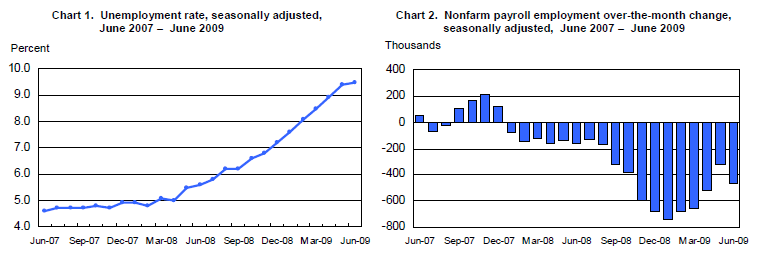

Peter Boockvar, also at the Big Picture, also notes that initial jobless claims totaled 614,000. Continuing claims fell by 58,000 from last week.
"While there is no question benefits are expiring without one finding a job, as evidenced by the rising exhaustion rate, many losing those benefits now started getting them when initial claims were running in the 400k range last summer. Now its running above 600k, so there are still more people filing initial claims than getting removed from the continuing claims data, thus continuing claims still should trend higher assuming no sudden change in hiring trends."
Meanwhile, Free exchange makes the important observation:
"[S]tate budget policies are sharply contractionary at this point. Despite allocations of federal aid to states, services are being cut, state employees are being laid off, and taxes are being raised in order to balance the budgets of local governments constitutionally unable to run deficits. It's not at all clear that the federal stimulus will entirely compensate for state-level fiscal tightening, which means that American fiscal policy could, on net, be contractionary."
13. BARCLAYS EXPECTS WTI TO AVG $71/B IN W3

Yee Kai Pin at Bloomberg reports that Paul Horsnell's commodity team at Barclays has lifted its third quarter forecast for WTI to $71/b from $62/b. Horsnell increased his Q3 forecast for Brent to $69/b.
"'Among all the changes that have kept commodities on the boil in recent years, the key factor is that 'normal' is not what it used to be,' the analysts said in the report. 'Oil prices below $70 or copper prices below $3,000 are no longer normal.'"
I think he's wrong, but he does know of what he speaks.

Wednesday, June 24, 2009

Daily Sources 6/24

1. JAPANESE EXPORTS IN MAY DOWN 40.9% YOY, 0.3% MOM; CHINESE GDP GROWTH NOT TRANSLATING INTO MORE IMPORTS; CHINA'S NBS PROVIDES QUARTERLY ESTIMATES OF GDP GROWTH

Jason Clenfield at Bloomberg reports that Japanese exports fell by 40.9% in May from a year previous, a sharper decline than the 39.1% seen in April. Exports fell by 0.3% in May from April.
"Shipments to China, Japan’s biggest trading partner, fell 29.7%, more than April’s 25.9%. Exports to Asia slid 35.5% from 33.4% a month earlier.
...
Imports slid 42.4% from a year earlier, and the trade surplus narrowed 12.1% to ¥299.8 billion (~ $3.1 billion), the Finance Ministry said."
Brad Setser at Follow the Money notes:
"US exports to China are also down (15.6% y/y, through in the first four months of 2009, though a bit less in April itself). The eurozone’s exports to China are also down--though the 8% or so fall y/y fall in the eurozone’s exports to China seems a bit more modest than the fall in Japan’s exports to China.

China’s economy may have expanded over the last year, but that expansion clearly hasn’t fed through into more Chinese demand for US, European or Japanese goods."
In the meantime, Andrew Batson at China Journal reports that Guo Tongxin, an official at the National Bureau of Statistics, provided GDP estimates on a quarterly basis in contrast to Beijing's traditional practice of providing year on year data.

"The new estimates from Guo, which only cover 2008 and early 2009, may be a surprise for skeptics who suspect that China’s statistics officials are only capable of reporting nice-sounding numbers. These figures actually show the slowdown in the fourth quarter of last year was even sharper than most outside economists had believed.

Economists surveyed by the Journal in February had, on average, estimated that fourth-quarter GDP expanded at an annualized rate of 2.1%. Guo cited what he called a preliminary estimate that fourth quarter GDP grew 0.1% from the previous quarter, equivalent to an annualized rate of just 0.4%.

The headline year-on-year growth rate announced at the time, by comparison, was 6.8%--a gap that clearly shows how quarterly and annual growth rates can give very different pictures of economic turning points."
2. THE US AND EU LODGE WTO COMPLAINT AGAINST CHINA ALLEGING THAT BEIJING HAS BLOCKED THE EXPORT OF RAW MATERIALS

Gabriella Stern at China Journal reports that the EU and the US have filed a WTO complaint against China. The complaint alleges:
"that Beijing unfairly helps domestic makers of steel, aluminum and chemicals, among others, by effectively blocking overseas exports of raw materials (eg. the ingredients that go into steel, aluminum and chemicals)."
Stern adds:
"Brian Blackstone points out the irony that the US government is complaining about China holding back on exports when Washington’s usual stance is to complain about China flooding the world with its exports. There are, indeed, many ironies in the messy world of trade disputes. This is the Obama administration’s first WTO complaint against China and the timing is sensitive, given America’s deep dependence on Beijing’s purchases of US sovereign debt--and also the global importance of a Chinese economic recovery spurred by that government’s thus-far-effective stimulus program."
3. BEIJING SUSPENDS REFORESTATION EFFORT ON FOOD SECURITY CONCERNS

Jonathan Watts at the Guardian reports that Beijing has suspended the reforestation of marginal arable land on fears of food shortages.
"Lu Xinshe, deputy head of the ministry of land and resources, said the country was struggling to hold the 120 million hectare 'red line' considered the minimum land areas needed for food self-sufficiency.
...
By the end of last year, the amount of arable land in China had decreased to within 1% of the 'red line.'"
In November, Zhang Xiaoqiang, Vice Chairman of China's National Development and Reform Commission, set as a national strategic priority domestic production of 95% of their grain consumption through 2020--see Daily Sources 11/14 #5. China was facing the worst drought it has seen since 1951 at the beginning of the year--see Daily Sources 2/9 #13--I have no idea what the rainfall situation is now.
"[S]elf-sufficiency [of 95%] requires the production of 500 million metric tons of grain a year. To maintain this level, prime minister Wen Jiabao has said the state would increase spending on agricultural production by 20%, well above inflation."
4. GERMAN HOUSEHOLD CONSUMPTION UP IN Q1; CABINET ADOPTS FISCAL PLAN WITH DEFICIT SPENDING

Eurointelligence reports that German household consumption appeared to rise in the first quarter, per FT Deutschland.

"Why should this be so? First, the article says, unemployment was still low and will be rising more strongly later this year and in 2010. But also there have been a number of tax cuts, a large increase in pension payments, a large increase in public sector wages to support private sector incomes."
In the meantime, Der Spiegel reports that Chancellor Merkel's cabinet adopted a fiscal plan for the next four years, which includes deficit spending.
"In total, it calls for €310 billion ($436 billion) in fresh debt from 2010 to 2013, including a whopping €86.1 billion ($121.2 billion) for 2010, far and away the largest single-year budgetary hole in the history of post-war Germany.

The 2010 total could even top €100 billion depending on the development of expenses related to Germany's economic stimulus packages (worth a total of €82 billion) and its bank bailout fund (worth €500 billion). Germany's previous record for fresh debt in a single fiscal year was the €40 billion borrowed in 1996. Steinbrück's new plan calls for new debt to begin falling after 2010, with €71.1 billion necessary in 2011, €58.7 billion in 2012 and €45.9 billion in 2013."
5. INTERNATIONAL INVESTORS LEARY OF NEW DELHI'S NEW DEBT ISSUANCE PLANS

Anil Varma and Anoop Agrawal at Bloomberg report that international investors appear uncomfortable with Indian Prime Minister Manmohan Singh’s plan to sell a record $74 billion in bonds this fiscal year.
"Foreign funds cut holdings of local-currency debt by 20% from a January peak to $5.7 billion, according to India’s Securities and Exchange Board. Investec Asset Management Ltd., Nikko Asset Management Ltd. and ING Investment Management, which together manage more than $15 billion in emerging-market debt, say they’re avoiding the market.

Yields are rising as Singh boosts spending on infrastructure and programs to reduce poverty, which he says are needed to return the economy to 9% growth, from the 6% forecast by the central bank for the year started April 1. Standard & Poor’s said June 22 that India may raise its budget deficit estimate in July to 6.5% of GDP, the most in 19 years. It has a negative outlook on the nation’s BBB- credit rating, the lowest investment grade."
6. KYRGYZSTAN REVERSES DECISION TO CLOSE MANAS AIR BASE TO US

Michael Schwirtz and Clifford J Levy at the New York Times report that Bishkek has decided to reverse its decision to end the US lease of the Manas air base.
"[T]he base is to be renamed a transit center, as opposed to an air base. And the Kyrgyz will control security around the base; currently, American military personnel do. The text of the new agreement specifies few other restrictions on how the United States can use the base. There do not seem to be any prohibitions on shipping weaponry.

One major change, though, is the rent. It will rise to $60 million annually from $17.4 million, Kadyrbek Sarbayev, Kyrgyzstan’s foreign minister, told the Kyrgyz Parliament on Tuesday.

Washington will also pay $36.6 million to expand the airport and will contribute tens of millions of dollars toward economic development and the fight against drug trafficking, Mr. Sarbayev said. He said the agreement would be for one year and would be contingent on the situation in Afghanistan."
The agreement must now be approved by parliament, which is reportedly a sure thing.

7. SINOPEC OFFERS $7.24 BILLION FOR ADDAX A WEEK AHEAD OF BAGHDAD'S OIL CONCESSION AUCTIONS

Kate Mackenzie at FT Energy Source reports that the rumored acquisition attempt of Addax Petroleum, which has a large stake in the Taq Taq field in Kurdish Iraq, are true. Sinopec has offered $7.24 billion for the company and the board has recommended the sale to its shareholders. Baghdad is set to auction concessions next week. Yesterday, the Kurdish government released a statement calling the planned auction "unconstitutional"--see Daily Sources 6/23 #5. On June 1, the Kurdish Regional Government presented Baghdad with a fait accompli, sending oil through the Iraq-Turkey pipeline without an arrangement for revenues to accrue to the operators of the fields--see Daily Sources 5/12 #8. Iraqi parliamentarians are openly calling for the resignation of oil minister Hussein al-Shahristani for his alleged mismanagement of the issue of oil concessions--see Daily Sources 5/21 #6.

8. LARGE MIDDLE EASTERN BUY US$/€ PROGRAM REPORTED

Macro Man reports that there "appears to be a large EUR/USD buy program emanating from the Middle East."

9. US TO SEND AMBASSADOR TO DAMASCUS AFTER 5 YR HIATUS

Patrick Rucker at Reuters reports that the US will send an ambassador to Syria, after having recalled the ambassador in 2005.

10. US EMBASSY IN KHARTOUM WARNS OF POTENTIAL ISLAMIC MILITANT ATTACKS ON GOVT

Andrew Heavens at Reuters reports that the US embassy in Sudan has issued a statement warning of attacks by Islamic militants on the government in Khartoum. The statement read in part:
"Statements threatening violent action against the government of Sudan have been posted on a jihadist website, following the death of a suspected Islamic extremist."
In the meantime, BBC News reports that representatives of southern and northern Sudan have agreed to abide by a ruling at the Hague's Court of Arbitration on the status of Abyei in talks led in Washington, DC, by US Sudan envoy Scott Gration.


Much of Sudan's oil wealth is in the region. The south began demobilizing earlier this month--see Daily Sources 6/11 #9.

11. CARACAS DOLLAR SALE PRIORITIES HURTING REGIONAL EXPORTERS TO VENEZUELA

Andrea Jaramillo at Bloomberg reports that Fabricato Tejicondor SA, Colombia’s biggest textile maker, has announced that exports to Venezuela have fallen by about 70% after Caracas decided to stop allowing the industry's importers to purchase dollars at the official exchange rate.
"Importers ... have to buy dollars in Venezuela’s unregulated parallel market, where the bolivar trades at 6.63 per dollar, a rate that is 68% weaker than the official 2.15-per-dollar, said Fabricato Chief Executive Officer Oscar Ivan Zuluaga. He said the surge in the cost in bolivar terms 'put a brake on demand' in Venezuela, which accounts for about half of Fabricato’s exports."
On April 24, the Venezuelan finance minister said that Caracas would make imports of food and medicine a priority in allotting dollars for sale at the official rate this year.

12. NEW ONE FAMILY HOME SALES UP 0.6% IN MAY FROM APRIL, DOWN 32.8% YOY

Barry Ritholtz at the Big Picture reports that sales of new one-family homes were up 0.6% in May from April, but notes that the margin of error is plus or minus 17.8%.
"And as expected, April’s data was revised downwards.

Year over year, sales fell 32.8%--a valid number relative to the error (±10.9%) below the May 2008 estimate ...."
He links to a Barron's Econoday chart plotting new homes sales since January 2006:


13. DURABLE GOODS ORDERS UP 1.8% IN MAY FROM APRIL

Shobhana Chandra and Courtney Schlisserman at Bloomberg reports that the Commerce Department announced today that orders for durable goods rose 1.8% from April.
"Economists projected goods orders would drop 0.9 percent, according to the median of 75 forecasts in a Bloomberg News survey. Estimates ranged from a decline of 3.9% to a gain of 1%. Commerce revised the April gain to 1.8% from a previously reported 1.9% increase."
14. US COMMERCIAL CRUDE STOCKS DOWN 3.8 MB, GASOLINE UP 3.9 MB, REFINERY UTILIZATION UP TO 87.05%

The EIA reports that commercial crude stocks were drawn down by 3.8 million barrels in the week ended June 19 to 353.9 million barrels. Holdings are well above the historical range for this time of year, but have been falling steadily in recent weeks. A Bloomberg News survey had the median expectation of analysts for a 950,000 barrel draw. Commercial gasoline stocks grew by 3.9 million barrels and are at the bottom of the historical range for this time of year. Distillate stocks grew by 2.1 million barrels and are 32.7% larger than the comparable week last year. The national average price of gasoline rose to $2.691/gallon for the week ended June 22. Refinery utilization for the week ended June 19 rose to 87.05% from the 85.90% seen in the week ended June 12.

Monday, December 15, 2008

Daily Sources 12/15

1. Platts reports that the Centre for Global Energy Studies--a petroleum consulting outfit founded by former Saudi oil minister Zaki Yamani--released a report today arguing that were OPEC to cut supply by one million barrels, and fully implement the allocation reduction, that would be enough to arrest the fall in oil prices in 2009. Full compliance would likely provide the foundation for a rise in price, the report argues, but not to $75/b levels. However, the report also argues, critically:
"A bigger output cut, in pursuit of much higher prices, risks undermining the already fragile global economy, sending oil demand down further and undermining the very price rally it was meant to stimulate."
CGES also expects global oil demand to fall by 500 kb/d next year. In a related story, Jim Bai at Reuters reports that Chinese apparent oil demand fell by 2.3% year over year in November.


China exported a little over 79.6 kb/d of gasoline in the month of November. It imported no gasoline in November. Platts reports that Chinese refiners have cut throughput further in December after a 13% decrease in throughput November. Managers told reporters that Sinopec and PetroChina expected to reduce throughput by 810,000 metric tonnes in December combined, or about 191.5 kb/d. Total throughput by the two refiners--and Sinopec affiliates--is expected to be 24.73 million tonnes of crude in December, or 5.84 mb/d.

Nadia Rodova at Platts reports that Peter O'Brien, Vice President at Rosneft, told journalists today that the company--which expects no natural decline in production in 2009--stands ready to implement any cut coordinated by Moscow with OPEC. Rosneft is expected to negotiate a $1-1.5 billion bridge loan from Western banks in early 2009 to refinance its debts. Jacob Gronholt-Pedersen at Dow Jones reports that Vagit Alekperov, CEO of Lukoil, said today that OPEC expects Moscow to reduce production by between 200-300 kb/d. Such a cut itself may not be regarded as part of an overall OPEC production cut, because some in the market have already priced in a 400 kb/d decline in Russian production for 2009.

For Russia, supporting crude prices should have the effect of supporting the price of the ruble, which has been falling precipitously of late. William Mauldin and Alex Nicholson at Bloomberg report that Bank Rossii has widened the rate at which the ruble is allowed to trade against a basket of dollars and rubles for the second time in a week by 1%. (The currency basket is 55% dollars and 45% euros.) Traditional austerity measures to defend the currency appear to be unpopular in Moscow, especially given the results of the first privatization efforts after the fall of the Soviet Union. In that context, there is a piece in the Economist pointing out that several developing countries are asking themselves whether they ought to be pursuing counter-cyclical policies to shore up demand at the expense of their currencies. Doing so reduces international appetite for new debt, but reduces the country's current debt burden.

Dani Rodrik, professor of Political Economy at Harvard's Kennedy School of Government, published an article Friday arguing that developing nations should institute a tax on currency exchanges, "at a low enough level – say, 0.25% – [so that] such a tax would have little adverse effect on the global economy while raising considerable revenue" ... and discourage excessive speculation or capital flows profiting from tiny differences in currency exchanges. (Rodrik also argues that developing nations should lobby for lending rules by international government creditors which correctly value redundancies and subsidies designed to support critical stability arenas, like food security, are compatible with rational international credit policies. I couldn't agree more.)

And, as recrimination grows, Ecuador has, according to Lester Pimentel and Stephan Kueffner at Bloomberg, decided to default on its national debt.
"[President] Correa, a 45-year-old economist who won election in 2006 promising to spend on the poor before paying debt, said Dec. 13 that his government is preparing to defeat legal challenges from 'vultures.' The day before, he ordered officials not to make the $30.6 million interest payment due today on $510 million of 12 percent bonds maturing in 2012.

The bonds were 'always structured for the benefit of the creditors, trampling on the national interests, dignity and sovereignty of our countries,' Correa told reporters in Guayaquil. 'It is now time to bring in justice and dignity.'
Ecuador, of course, is a member of OPEC, and the fall in the price of crude has hurt it.

In a related piece, Kenneth Rogoff, Professor of Economics and Public Policy at Harvard University and former chief economist for the IMF, writes that inflationary policy is the only way forward for the Project Syndicate. This as Yves Smith approvingly quotes in full a post by "London Banker", a former central banker who blogs, which argues that deflation is now inevitable. Also, Jonathan House at Real Time Economics reports that Dominique Strauss-Kahn, head of the IMF, said in a speech in Madrid today that "Actions taken so far aren’t enough. We are facing an unprecedented decline to output."
"Strauss Kahn said governments need to take measures to support financial markets - by, for example, recapitalizing banks - and they need to ramp up spending to stimulate domestic demand.

The IMF recently recommended a fiscal stimulus effort equivalent to 2% of world GDP. Strauss-Kahn said some countries face external financial difficulties or have high debt burdens that will constrain their efforts."
(Strauss-Kahn also encouraged member countries to increase their contributions to the fund, saying that he was not sure whether in 6 months' time there would be enough to finance financial stability projects.) And Michael Hudson and Jeffrey Sommers in a piece in Counterpunch calling for the end of the Washington Consensus argue:
"Today’s desperate U.S. attempt to re-inflate post-crash prices cannot cure the bad-debt problem. Foreign attempts to do this will merely aid foreign bankers and financial investors, not the domestic economy. Countries need to invest in their real economy, to raise productivity and wages. Governments must punish speculation and capital gains that merely reflect asset-price inflation, not real value. Otherwise, the real economy’s productive powers and living standards will be impaired and, in the neoliberal model, loaded down with debt."
All four of the pieces just mentioned are well-worth reading in their entirety.

The argument with Germany about coordinating a European stimulus package seems, from my limited experience in monetary economics, to be part of the same agon as the pro and cons of counter-cyclical economic policies for developing nations. Paul Krugman, in an op-ed in today's New York Times, argues that there is little time for Germany to join the stimulus crowd. In his blog Krugman provides the math behind his assumptions, arguing that a coordinated stimulus program has a significantly higher multiplier effect upon GDP and much more bang for the euro. Wolfgang Münchau in the Financial Times argues that the global trade slowdown will hit Germany especially hard, and that therefore to maintain an independent stimulus package of only 0.5% of GDP is likely to hurt. But he also says that household consumption is providing the economy with some support, and Eurointelligence reports that in a meeting with industrial representatives, Chancellor Merkel was promised no layoffs until the general elections, which I believe is scheduled to take place in September 2009. Münchau goes on to say,
"The electoral timetable in the US has delayed an effective policy response and I fear that the new economics team of President-elect Barack Obama will be too much focused on domestic stimulus and not enough on global co-ordination. The Europeans and Asians, meanwhile, are unbelievably complacent. Even a US stimulus at 10 per cent of GDP will not miraculously pull the world economy out of recession. It will most likely focus on domestic infrastructure investment rather than private consumption. US households, meanwhile, will continue to adjust their balance sheets, which will take some time."
Again, I am not competent to give intelligent criticism of these analyses, but have some, I hope, pertinent comments.

It is clear that the US response will be delayed until next year, this puts the major exporting countries with large current account balances in a dilemma, because it is not clear where the dollar will go. (See arguments about deflation versus inflation. I suspect that if dollar denominated debts have mostly been unwound, it will not require further stimulus to push devaluation of the dollar versus international currencies.) If Beijing wants to support its economy via exports, it will want to buy dollars to maintain US purchasing power--as long as the stimulus programs result in US and developed world inflation. This is probably true of Germany and Japan as well. If we see dollar deflation despite a stimulus, then Beijing might want to unwind its position in US debt as quickly as it can before an inevitable default. In any case, would it be irrational in a US dollar deflationary spiral for Beijing to provide extra domestic stimulus, as exports should recover?

Moscow clearly wants to support its currency in order to avoid defaults on dollar-denominated debts, but does not want to institute pro-cyclical policies--such as high interest rates on government debt--because that would slow down growth even further, likely causing political instability. (Their last experience with default was ugly and the source of many of the political outcomes DC is so unhappy with today.) This is probably true of every member of OPEC that has not pegged its currency to the dollar. (And, perhaps there are some OPEC members who have pegged to the dollar which would like to see their dollar or domestic currency denominated debt burden eased as well versus crude.) That said, OPEC is almost certain to cut, by at least one million barrels, with a supporting coordinated cut coming from Russia. They may overshoot--and further cripple a hobbling global economy--but their policy will be to inflate the dollar to support the financing of their current obligations. Beijing and Berlin may want to see how OPEC's decisions will pan out and what the eventual stimulus package from the Obama Administration will be before they decide where to commit the bulk of their available financial resources and fiscal policy options.

2. Kevin Hamlin and Li Yanping at Bloomberg write that the Chinese statistics bureau report that industrial production grew by 5.4% in November, a rate much lower than seen in a long time. Analysts worry that if GDP grows by less than an annual rate of 8% in China, there will not be enough job growth in order to absorb new entries to the labor market, which could result in social unrest.

3. Simeon Djankov at the Crisis Talk blog hosted by the International Finance Corporation of the World Bank writes that export growth nations are seeing steeper falls in trade than China. In November, Chile's exports fell at an annual rate of 19.1%, South Korea's fell by 18.3%, Taiwan's fell 21.6%, and Isreal's fell 17%. Chile's imports fell by an annual rate of 14%, Korea's fell by 14.6%, Taiwan's fell by 11.3%, and Vietnam's fell by 7.8%. Global air cargo in October fell by 8% year-over-year, "with a 12% decline in Latin America, 11% decline in East Asia, and 5.4% in Europe."

4. Bertrand Benoit and James Wilson of the Financial Times report that the German Parliament's Financial Committee has written a letter to the Finance Minister--Peer Steinbrück--stating that the €400 billion fund set up to guarantee bank debt has not resulted in the resumption of lending, and thus failed.

5. Bettina Wassener at the New York Times reports that the Bank of Japan's quarterly Tankan survey of manufacturer sentiment was released Monday showing a fall in the index from -3 to -24. "The deterioration in sentiment was in line with what economists had expected."

6. Joellen Perry at Real Time Economics reported Friday that the European Central Bank is considering additional ways to get credit flowing again.
"One idea the ECB would consider is a clearinghouse to guarantee the short-term loans euro-zone banks make to one another. How such a clearinghouse might work remains unclear, but a working group at Germany’s central bank is studying whether the central bank itself or other authorities could guarantee such loans for terms of three months or less.

The ECB’s main goal: ensuring that any measures taken to guarantee bank-to-bank loans aren’t national."
The ECB is also considering directly purchasing corporate or government debt. Of course, given 15 different countries with corporations with different financing traditions, the question is which corporations, which debt instruments, and/or whose government debt? Worth reading in full.

7. In a press release dated Friday, December 12, WTO Director-General Pascal Lamy said that in his judgment there was not sufficient political will to spend the political capital required for further trade openings at this time to justify a ministerial meeting next week.

8. Keith Wallis at Lloyd's List reports that Taiwanese shipping companies launched direct services to mainland China today.
"Five vessels, one from [Evergreen Marine, Yang Ming Marine, Wan Hai Lines, Taiwan Navigation, and Huarong Marine] each, took part in the historical reconnection of direct links across the Taiwan Strait that were severed in 1949 when the communists took control of China and nationalists fled to Taiwan."
Mark McDonald at the New York Times reports on the establishiment of direct air routes as well:
"As many as 108 direct passenger charters are scheduled to operate each week across the strait, state media reported Monday, as well as 60 direct cargo flights a month. The flights will come and go from 21 cities on the mainland and 8 cities in Taiwan."
9. Mohamed Olad Hassan at the Associated Press reports that Somalia's President fired the Prime Minister Sunday, accusing him of ""corruption, inefficiency and treason." The Prime Minister will contest his ouster as unconstitutional as Islamist insurgents assert their control over most of the country. Colum Lynch at the Washington Post reports that the Bush Administration will launch an effort this week in the UN to garner international backing for a small peacekeeping force in Somalia, in an effort to put down piracy and prevent the assumption of control of the country by Islamists. The proposed group would be restricted to the area around Mogadishu in southern Somalia and has support from China as well as some key African nations like South Africa. However, it seems to me that the notion of putting yourself in between several competing factions which have support in the country, while attempting to arrest the growth of all, is unlikely to have much success. Perhaps quietly backing an Islamist group other than al-Shabaab--which has the support of the international Islamist community--would be a way of tamping down international Islamist ambitions in the country while re-establishing law and order. The Post article is worth reading in full.

10. Richard A. Oppel Jr. and Salman Masood at the New York Times report that the Prime Minister of the United Kingdom, Gordon Brown, shuttled from India to Pakistan in efforts to try and reduce the tensions between the countries in the wake of the Mumbai attacks.
"Three-fourths of serious terrorist plots investigated in Britain have links to Al Qaeda in Pakistan, Mr. Brown said at a news conference with Pakistan’s president, Asif Ali Zardari, in Islamabad. 'The time has come for action, and not words' from Pakistan, he said."
11. Deborah Haynes at the London Times reports that the UK will withdraw its troops by July 31, 2009. The Times characterized this deal as humiliating because their presence was negotiated with the Iraqi government en bloc with other relatively smaller armed force contributors, such as Romania, El Salvador and Estonia. (On Thursday the Washington Post reported that the English media was mooting rumors that the UK contingent would leave Iraq come March. See Daily Sources 12/11 #12.)

12. The Editorial Board at the Wall Street Journal praises the courage of students openly criticizing the regime in Tehran. The Journal suggests that the choice the US has is to engage these brave students or engage the regime they criticize. The problem is that the Journal presumes that the students are any less critical of the United States' role in the world than they are of their own leadership. They are not, and most are actually afraid that the American government might decide to engage with them, because they think it will de-legitimize them in their eyes of their colleagues.

13. The Baltic Dry Index appears to be rebounding slightly recently, as you can see from this one month chart:


Possible reasons for this include the rerouting of ships away from the Suez Canal and around the Cape of Good Hope--a much longer haul--and several ships being mothballed, including as use for storage for companies wanting to capture the profits of the super-contango in oil. I'd guess that a further cut in OPEC supply would have the short-term effect of reducing shipping rate indices, given less demand for tankers, but a medium-term effect of increasing them, given increases in cost of fuel. (Also, apparently higher fuel costs apparently push captains to sail more slowly, to conserve on those costs, which reduces the amount of cargo space available at any given time due to increased time at sea. An effect which would be multiplied by avoidance of the Suez Canal.)

14. Jack Healy at the New York Times reports that US industrial production fell by 0.6% in November. Estimates of industrial production for October were revised upwards to growth of 1.5% in October, from initial estimates of 1.3%. "Capacity utilization, the percentage of plants in use, fell to 75.4% from 76% in October."