Showing posts with label malaysia. Show all posts

Monday, August 9, 2010

Daily Sources 8/9

1. SOUTHEAST ASIA BUYING WEAPONS AT BREAKNECK RATE

Jon Ponfret at the Washington Post reports that a recent publication by the Stockholm International Peace Research Institute shows that concerns over China's rise has pushed countries in Southeast Asia to almost double their weapons purchases from 2005 to 2009.
"The buying spree is set to continue, with reports that Vietnam has agreed to pay $2.4 billion for six Russian Kilo-class submarines and a dozen Su-30MKK jet fighters equipped for maritime warfare. This is in addition to Australia's stated commitment to buy or build nine more submarines and bolster its air force with 100 U.S.-built F-35s. Malaysia has also paid more than $1 billion for two diesel submarines from France, and Indonesia has recently announced that it, too, will acquire new submarines."
2. CHINA TO CLOSE 2,000 ENERGY INEFFICIENT FACTORIES

Keith Bradsher at the New York Times reports that China will close 2,087 steel mills, cement works and other energy-intensive factories by September 30 in order to try and increase its energy efficiency.

3. CHINA MAKES NO PUBLIC COMMENT ON SEIZURE OF ITS FISHERMEN

Brian Spegele at China Real Time reports that China has still made no public statement regarding the seizure of three fishermen by North Korea, allegedly for fishing in the North Korean exclusive economic zone.

4. HUGO CHAVEZ TO MEET NEW COLOMBIAN PRESIDENT TO TRY AND DAMP DOWN TENSIONS

Christopher Toothaker at the Associated Press reports that Hugo Chavez will meet the new Colombian president--Juan Manuel Santos--will meet in Colombia to discuss how to reduce tensions between the two countries.

5. PRESIDENT MEDVEDEV ARRIVES IN ABKHAZIA ON SUNDAY

CNN reports that Russian President Medvedev arrived Sunday in Abkhazia where he will meet with his counterpart, Sergey Bagapsh.

6. FORMER PRESIDENT OF MEXICO FOX CALLS FOR THE LEGALIZATION OF DRUGS

Jonathan J. Levin and Jens Erik Gould at Bloomberg report that the former President of Mexico, Vicente Fox, has called on the country to legalize drugs as a way of tamping down drug cartel violence.

8. COMPANIES ARE SEEKING LICENSES TO BUILD 22 NEW REACTORS

Chuck McCutcheon at the Christian Science Monitor reports that companies in the US are seeking licenses from the US Nuclear Regulatory Commission to build and operate 22 new reactors. A Gallup poll in March found that 62% of Americans now favor nuclear power.

9. US INCOMES FELL BY 1.8% IN 2009

Phil Izzo at Real Time Economics reports that US incomes fell by an average of 1.8% in 2009. The article includes a sortable chart of income growth by city.

10. KRUGMAN NOTES THAT CRITICAL INFRASTRUCTURE IN THE US IS BEING ALLOWED TO FALL INTO DISREPAIR

Paul Krugman at the New York Times reports that localities are letting their roads go to gravel, turning off the lights, and pushing through big cutbacks in education funding while the rest of the world is in the process of building up their infrastructure. A good read.

Thursday, July 8, 2010

Daily Sources 7/8

THE IMF REVISES ITS WORLD GROWTH MEASURE UPWARDS

S.D. at Free Exchange reports that the IMF has revised its world economic growth indicator upwards by 0.4% to 4.6%. The IMF indicated that it believed world growth was 5% for the first quarter of 2010. Meanwhile, Alex Frangos at Real Time Economics reports that the IMF's chief economist, Olivier Blanchard, has said that developing countries still need to worry about big inflows of money.

BALTIC DRY INDEX AT LOWEST POINT IN YEAR


BANK NEGARA MALAYSIA RAISES OVERNIGHT POLICY RATE TO 2.75% FROM 2.5%

Shamim Adam at Bloomberg reports.

BRAZILIAN SENATE APPROVES NEW STATE OIL COMPANY

Upstream Online reports that the Brazilian Senate has OK'd a new oil company to handle the offshore pre-salt fields, tentatively to be called Pre-Sal Petroleos. The bill remains stuck in the lower house of the Congress, however.

US AND MEXICO TO FORM BILATERAL COUNCIL ON COLORADO RIVER

David Steffen at the Imperial Valley Press reports that the US and Mexico have agreed to set up a bilateral council on the Colorado River.

"The U.S. and Mexican governments, Colorado River basin states and {International Boundry and Water Commission] representatives would make up the council. Its mission would be to facilitate administrative and legal aspects associated with the binational agreement, according to the minute."


COMMERCIAL VACANCIES CONTINUE TO CLIMB

Mark Thoma at Economist's View posted the following graph:


INFLATION NOWHERE TO BE FOUND

Menzie Chinn at Econbrowser checks a variety of data looking for US inflation, but finds none. Here is his graph of the annualized 3 month change in price indices.


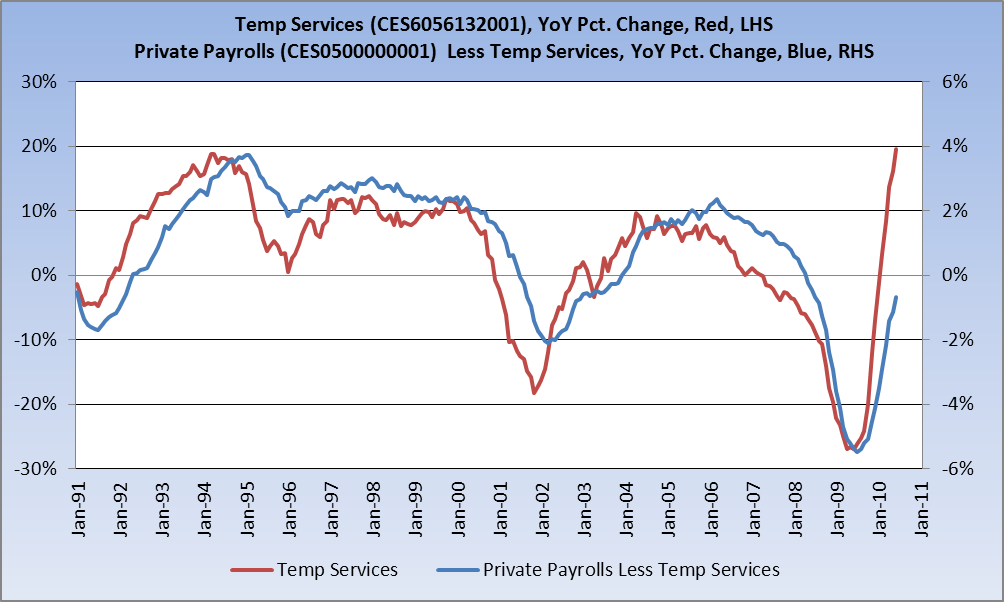
TEMP JOBS UP 19.6% YEAR OVER YEAR BUT FULL TIME DOWN 0.7% YEAR OVER YEAR

Invictus at the Big Picture reports that temp jobs are up 19.6% year over year, the most since the data series began to be recorded in 1990. Private sector full time jobs less temp jobs is down 0.7% year over year, unusually low given the temp jobs number.

Wednesday, July 1, 2009

Daily Sources 7/1

1. JAPAN TO MOVE AHEAD WITH STRATEGIC PETROLEUM PRODUCTS RESERVE IN AUGUST

Takeo Kumagai at Platts reports that Japan's Ministry of Economy, Trade & Industry [METI] has decided to move ahead with plans to establish strategic petroleum product reserves beginning in mid-August with a day's worth of kerosene consumption.
"After nearly three years of discussing the matter in depth both internally and at its advisory meetings, METI was set to introduce the national oil products stockpile this year, with one or a combination of light and middle distillates, equivalent to one day's consumption of the particular product or products chosen, Platts reported earlier.

METI has chosen to start the products stockpile with kerosene because it would affect consumers living in northern Japan during the country's winter demand season, the official said. Kerosene is used as heating oil in Japan, with demand typically peaking over December-February."
2. CHINA'S OFFICIAL PMI UP TO 53.2, CLSA'S CHINA PMI UP TO 51.8; CHINA TO BAN IMPORTS OF US CHICKEN

Terence Poon at the Wall Street Journal reported yesterday that the official purchasing manager's index for China rose to 53.2 in June from 53.1 in May. (A reading of above 50 indicates expansion; below 50 indicates contraction.)
"The new export orders component of the PMI rose to 51.4 in June from 50.1 in May. June was the second consecutive month where the export-order subindex has remained above 50, suggesting a deterioration in exports in the past several months is abating.

But the inventory subindex of the PMI fell to 45 in June from 46.2 in May. [Moody's] Economy.com's [analyst] Sherman Chan said that drop suggests manufacturers remain cautious about building up inventories amid an uncertain global economic outlook.

'If the external environment doesn't improve, it will be difficult for the government to sustain its fiscal spending for a long time,' she said."
Chinaknowledge reports that CLSA Asia-Pacific Markets' China PMI also showed improvement, rising to to 51.8% in June from 51.2% in May. Meanwhile, Lauren Etter and Stephen Power at the Wall Street Journal reports that China is expected to ban imports of US chicken in the next several days.
"The potential ban could be a big blow to the US chicken industry, which has been struggling with high grain prices and a price-depressing oversupply of chicken. Exports had been a bright spot for the industry, and last year China surpassed Russia as the largest destination for US chicken, according to the USA Poultry & Egg Export Council."
"[I]n 2007 lawmakers inserted a provision in the 2008 fiscal-year spending bill that prohibited the USDA from allowing chicken processed in China to be imported. The same prohibition was included in the spending bill in the next two fiscal years.

Trade tension between China and the US heightened earlier this week when the US International Trade Commission recommended imposing punitive duties of as much as 55% on low-cost Chinese tire imports because they are disrupting the US market, in a move that could sharply increase costs for consumers. GITI Tire, China's largest tire manufacturer, has called the move 'decidedly protectionist' and said it would take its case to President Barack Obama.

Last week, the House approved legislation to curb US greenhouse-gas emissions that includes a provision to impose tariffs on goods from countries that don't match US efforts to combat climate change."
Last week the US and EU lodged a WTO complaint alleging that China was blocking the export of raw materials--Daily Sources 6/24 #2.

3. ASHGABAT INVITES MEDVEDEV FOR VISIT TO DISCUSS GAS PURCHASES

Upstream online reports that Turkmen President Kurbanguly Berdymukhamedov has invited President Medvedev to visit Ashgabat to discuss the resumption of Turkmen gas exports to Russia.
"Russia, the main buyer of Turkmen gas, halted its imports in April after a pipeline explosion.

The pipeline has been repaired but the two sides cannot agree on new terms of sales as Russia's Gazprom needs less gas than in the past."
The move comes after China sealed a deal to increase its gas imports from Turkmenistan by 30% last week--see Daily Sources 6/25 #3. Ashgabat publicly suspected that Gazprom had engineered the explosion at the pipeline in order to stop paying the $340/tcm (~$9.61/MMBtu) price it had reportedly contracted to pay for Turkmen gas on December 31, 2008--see Daily Sources 4/14 #7.

4. INDIAN OIL REFINERS NERVOUS ABOUT DELAYED MONSOON EFFECT ON DIESEL PURCHASES

Murali Gopalan and Richa Mishra at the Hindu Business Line reports that Indian oil refiners are worried about heavy losses on diesel as low rainfall so far this year results in digging and pumping groundwater and diesel electricity generation.
"[W]hile [oil demand] growth figures for May are negative ... , diesel consumption at 4.748 million tonnes ... was otherwise normal and has not fallen in absolute terms.

Another reason for this was due to a continuous decline in the industrial sector’s use as diesel-direct sales showed negative growth of 4.7% in May.

It was the sixth successive month when industrial sales of diesel showed negative growth, coinciding with the onset of the economic recession in the second half of 2008-09. While economics dictated the pace of diesel consumption so far, the weather patterns could change the pattern, fear experts.

However, the consumption trend for diesel seems to be changing in June, with the eastern region recording a 45% growth, with Bihar alone registering nearly 65%."
5. MALAYSIA TO PULL BACK MALAY-PREFERENTIAL POLICY

Thomas Fuller at the New York Times reports that the Prime Minister of Malaysia, Najib Razak, announced a rollback in the policy which required companies issuing stock to reserve 30% of their shares for ethnic Malays.
"'The world is changing quickly, and we must be ready to change with it or risk being left behind,' he said Tuesday.

The change would leave some ethnic preferences intact and come with caveats. But it would dilute one of the most important components of what is known as the New Economic Policy, introduced in 1971: the requirement that companies listing on the stock exchange sell 30% of their shares to ethnic Malays.

That requirement was scrapped for companies already listed on the stock exchange and reduced to 12.5% for initial public offerings. The requirement will remain in place for 'strategic industries' like telecommunications, water, ports and energy.

Mr. Najib also said he would lower barriers for foreign investors. The government would eliminate a special vetting process for foreign companies wanting to invest in, merge or take over a Malaysian company, he said."
6. IMF EXPECTED TO AUTHORIZE $150 ISSUANCE OF SDR-DENOMINATED DEBT TODAY

Timothy R Homan at Bloomberg reports that the IMF board of directors are expected to authorize the issuance of as much as $150 billion in SDR-denominated bonds, voting on the matter today.
"The IMF is also considering making them tradable between all central banks from countries that are IMF members, said a G- 8 official, who spoke on condition of anonymity. It would stop short of allowing them to trade on the open market, he said."
7. SARKOZY TELLS NETANYAHU TO GET RID OF LIEBERMAN

Michael Collins Dunn at the MEI Editor's Blog notes that President Sarkozy has reportedly expressed in a "private message" to Benjamin Netanyahu that he should remove Avigdor Lieberman from his post as foreign minister.

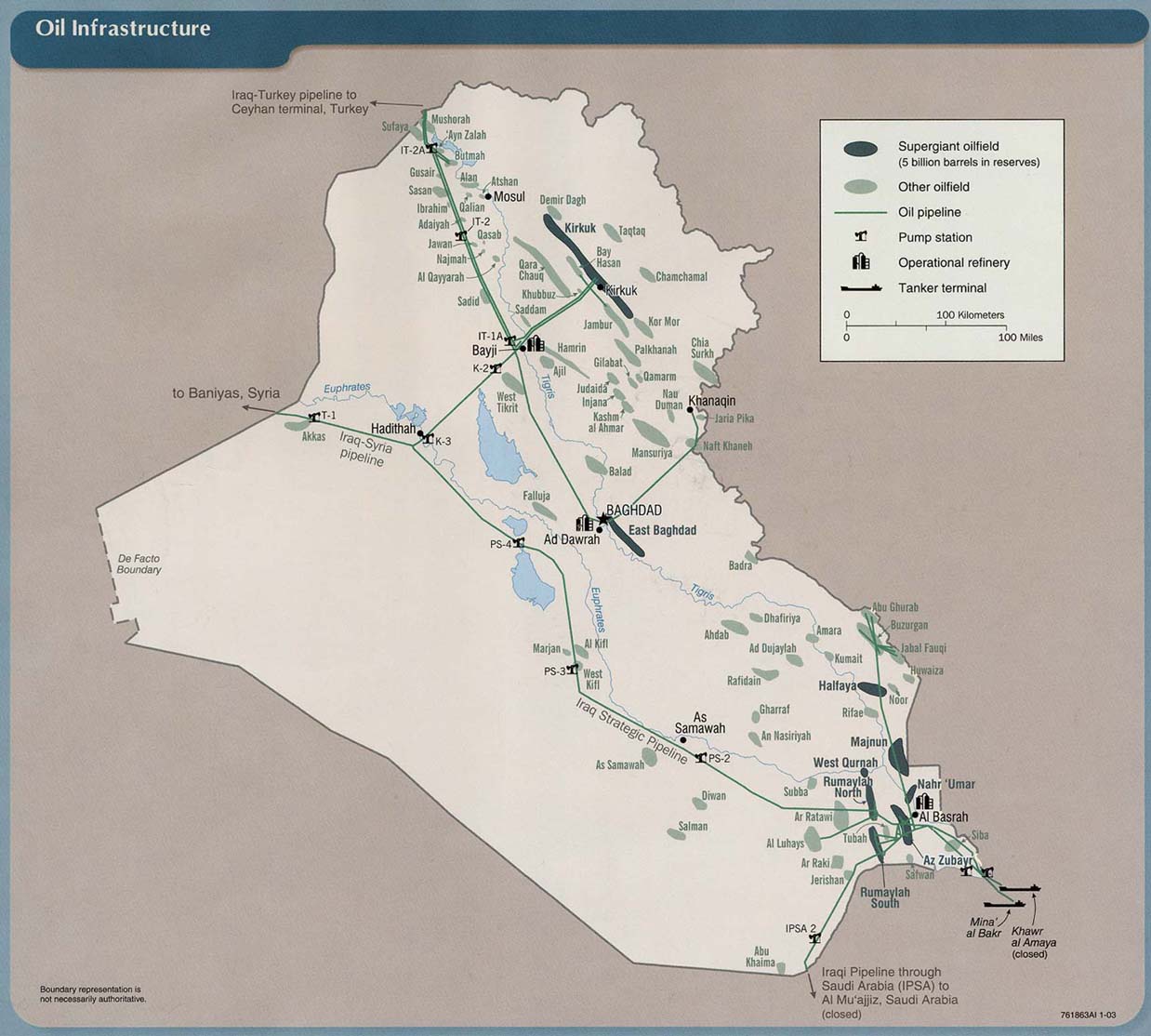
8. KIRKUK FIRST CITY SINCE START OF IRAQ WAR TO GET 24 HOUR ELECTRICITY


Diaa Al-Khalidi at the Iraq Oil Report reports that Kirkuk has become the first Iraqi city to enjoy 24-hour electricity since 1993--and the first time the city itself has experienced it since 1991, when Saddam Hussein cut power to the regions in order to ensure round the clock access in Baghdad following his defeat in Kuwait.
Kirkuk is outside the formal borders of the Kurdish Regional Authority, but, if I understand correctly, currently effectively security in the city is provided by it:


Security is key in the maintenance of energy infrastructure.

9. ARAMCO AND CONOCO TO RESUME BIDDING FOR CONSTRUCTION OF YANBU EXPORT REFINERY

Sheila McNulty at FT Energy Source reports that Saudi Aramco and ConocoPhillips have decided to resume the bidding process for the construction of the 400 kb/d export refinery at Yanbu. "Now some bids are to be awarded in November 2009 and the others in the second quarter of 2010." Evidently, the bidding process has resumed on an optimistic view of the global economy going forward--and that sufficient financing exists to get it done. (I suspect that this would more likely be the view of Saudi Aramco than ConocoPhillips, given the recent statements from OPEC, but Saudi Aramco controls the facts on the ground.)

10. OPEC 11 SUPPLIES 110 KB/D MORE OIL IN JUNE THAN MAY

Reuters reports that OPEC 11 output in June rose to 26.02 mb/d in June from 25.91 mb/d in May--a 72% compliance rate with the implied production target of 24.84 mb/d, down from 75% in May.

11. NIGER DELTA MILITANT GROUP CRITICIZES MEND FOR ATTACKS AFTER AMNESTY OFFER

Platts reports that the Ijaw Youth Campaign for Peace [IYC]--a coalition from the ethnic Ijaw community in Nigeria's Niger Delta--issued a statement today condemning continued attacks on oil installations by MEND following the introduction of the amnesty offer by Abuja.
"'We are shocked by the activities of our sons considering the recent [press] release by MEND [saying] they have vandalized Shell platforms in Forcados,' the IYC said.

'If the purported sabotage was actually true we in the Ijaw Youth Campaign for Peace hereby condemn it in all facets,' the group stated.

The group said the continued sabotage of oil installations 'will present our people as not actually fighting for a genuine cause, but personal gain, which the government can see as armed robbery and criminality.'"
The story also notes reports that the amnesty offer has hit a snag as the heavy military presence in the region has made militants leery of going to areas designated as arms collection centers.

12. OAS GIVES HONDURAS ULTIMATUM, UN CALLS FOR ZEYALA'S RETURN, ARGENTINA'S FERNANDEZ TO TRAVEL TO HONDURAS TO NEGOTIATE SOLUTION, CHAVEZ SAYS VENEZUELA MAY CEASE ALL CRUDE EXPORTS TO HONDURAS--ALL 0 KB/D OF THEM

Ginger Thompson at the Washington Post reports that the Organization of American States on Wednesday gave Honduras three days to restore ousted President Manuel Zelaya to power or face expulsion from the organization.
"Diplomats said they had rarely seen the OAS unite so solidly behind a common cause, and that it was the first time the group had invoked its so-called Democratic Charter since it was adopted in 2001 as a clean break with the region’s history of authoritarian rule."
The United States is the only country in the Western Hemisphere which has not reacted to the coup by withdrawing its ambassador. On the other hand, Joshua Goodman and Andres R Martinez at Bloomberg report that yesterday the UN General Assembly passed a resolution, co-sponsored by the US, calling for the restoration of Zelaya.
"OAS Secretary General Jose Miguel Insulza said yesterday he wanted to return to the Central American nation with Zelaya to demand his reinstatement. Argentine President Cristina Fernandez de Kirchner will accompany the mission, Buenos Aires newspaper Infobae reported.

As protests against Zelaya swell, a showdown is imminent. [Interim Honduran President Roberto] Micheletti said that Zelaya faces arrest and 20 years in prison should he attempt to return to Honduras, Central America’s third-poorest country.

The country’s Supreme Court, congress and business groups have also expressed support for Zelaya’s removal, over concerns he was seeking to retain power beyond his original mandate by ignoring court rulings and changing the constitution through a referendum on term limits.

Approval for the Zelaya government fell to 30 percent in February from a high of 57 percent in January 2007, according to a nationwide poll by CID-Gallup. The former cattle rancher lost support over the past two years as he strengthened ties with Chavez ... ."
Paul Talley at the Compass comments:
"For Fernandez, accompanying Zelaya gives her a chance to play a popular role in world politics that might offer a distraction from her own political problems at home."
Talley seems skeptical about the practical effect however--his post is worth a look. Meanwhile, Carlos Camacho at Platts reports that Hugo Chávez has delayed a trip to the Dominican Republic to finalize PdVSA's purchase of a 49% stake in the Refidomsa refinery there until the Honduran crisis is resolved. Chávez has reportedly threatened to halt all exports of crude to Honduras until Zelaya is reinstated. Of course, Honduras has no refining capacity, so a halt in crude exports wouldn't have much of an effect upon the country.

13. SURVEY SHOWS OBAMA MOST TRUSTED LEADER IN THE WORLD

World Public Opinion recently conducted a survey of 19,224 people in 20 countries, asking them to rate their confidence in leaders of foreign countries. The margins of error in the polls range from ±3-4%. "The survey was conducted between April 4 and June 12, 2009, prior to Obama's speech in Cairo but subsequent to his Ankara speech." The poll seems to show that Obama has by far the most trust of any world leader internationally.


That's a fair amount of political capital. The poll includes ratings for Putin (somewhat oddly), Ban Ki-Moon, Merkel, Brown, Sarkozy, Hu Jintao, and Ahmadinejad. (h/t Greg Scoblete at the Compass.)

14. KC FED CHIEF SAYS THE GOVT HAS INSTITUTIONALIZED "TOO BIG TO FAIL", ST. LOUIS FED CHIEF SAYS FED RATES LIKELY TO STAY UNCHANGED FOR "FORESEEABLE FUTURE," SF FED CHIEF TAKES AIM AT INFLATIONISTAS, SAYING DOWNTURN LIKELY TO BE PROLONGED

Greg Robb and Kate Gibson at MarketWatch report that Thomas Hoenig, president of the Federal Reserve Bank of Kansas City, has criticized the "ad hoc" approach to the financial crisis, saying it has institutionalized the notion of "too big to fail."
"'The current crisis has made it clear that the group of systemically important firms that might be deemed worthy of special consideration by policy-makers is larger than previously thought,' Hoenig said in a Tuesday speech at New York University."
"The Obama administration's overhaul of financial rules is only a start of a dialogue on the issue, Hoenig commented. 'The most important part of any plan ... will be the requirement that public authorities resolve such institutions by taking them into receivership and restructuring them to emerge under new and more careful management and ownership,' without exceptions."
Worth reading in full (h/t Yves Smith at naked capitalism.) Meanwhile, Jon Hilsenrath at Real Time Economics reports that James Bullard, president of the St Louis Fed, said in a talk at Philadelphia’s Global Interdependence Center today that the Fed Funds Rate is likely to remain at its current rate for the "foreseeable future." He also said that the Fed's
"'liquidity programs', such as efforts to support the commercial paper market or money market mutual funds, are on track to end next year 'if financial conditions continue to improve."
He further indicated that the Fed may reevaluate its purchases of mortgage-backed securities in its next meeting in August. In a story which has received wide coverage in the econoblogosphere, Jon Hilsenrath at Real Time Economics reports that Janet Yellen, President of the Federal Reserve Bank of San Francisco, took aim at the inflationistas, saying:
"We are far from the kinds of unemployment rates that would make inflation a danger. ... The very weak economy is, if anything, putting downward pressure on wages and prices ...

In past deep recessions, the Fed was able to step on the accelerator by cutting the federal funds rate sharply, causing the economy to shoot ahead. This time, we already have our foot planted firmly on the floor. We can’t take the federal funds rate any lower than zero. I believe that the Fed’s novel programs are stimulating the flow of credit, but they simply aren’t as powerful levers as large rate cuts, so this time monetary policy alone can’t power a rapid recovery.
...
I also think that a massive shift in consumer behavior is under way—one that will produce great benefits in the long run but slow our recovery in the short term. 4 American households entered this recession stretched to the limit with mortgage and other debt. The personal saving rate fell from around 8 percent of disposable income two decades ago to almost zero. Households financed their lifestyles by drawing on increasing stock market and housing wealth, and taking on higher levels of debt. But falling house and stock prices have destroyed trillions of dollars in wealth, cutting off those ready sources of cash. What’s more, the stark realities of this recession have scared many households straight, convincing them that they need to save larger fractions of their incomes. In the long run, higher saving promises to channel resources from consumption to investment, making capital more readily available to retool industry and fix our infrastructure. But, in the here and now, such a rediscovery of thrift means fewer sales at the mall, and fewer jobs on assembly lines and store counters."
The full text of her speech can be found here.

15. FORD TO RAMP UP PRODUCTION

Nick Bunkley at the New York Times reports that vehicle sales were down 11% in June from June 2008, the lowest annual rate of decline seen by any major carmaker since last Summer.
"Ford said this week that it was increasing production in the third quarter, which starts Wednesday, to match the rise in demand its dealers were seeing. The company now plans to build 67,000 more vehicles, a 16% increase, than it did in the third quarter of 2008.
...
Over all, industry sales are expected to be down at least 25% compared with June 2008. Though dismal by any measure, it could be the first time since September that total sales fell by less than 30 percent on a year-over-year basis, a positive sign.

June could also be the first month this year in which new vehicles sold at an annualized rate of at least 10 million. For most of the last decade, auto sales in the United States were around 17 million a year before plummeting in 2008. Fewer than 5 million vehicles were sold in the first half of 2009, a decrease of nearly 37%."
16. CRUDE STOCKS SHARPLY DOWN, BUT PRODUCTS STOCKS SHARPLY UP ... REFINING UTILIZATION SLIGHTLY DOWN

The EIA reports that commercial crude stocks were drawn down in the week ended June 26 by 3.7 million barrels to 350.2 million barrels, still above the historical range for this time of year, but not dramatically higher any more. Gasoline stocks grew by 2.3 million barrels, and are now in the middle of the five-year historical range for this time of year. The median analyst expectation per a Bloomberg survey was for a 2 million barrel build. Distillate stocks also grew by 2.9 million barrels to 155 million barrels, 34.3 million more barrels than were held in commercial inventories in the comparable week last year. The analyst expectation was for a 1.5 million barrel build. The national average price of gasoline for the week ended June 29 fell by 4.9¢ to $2.642/gallon. Refinery utilization for the week ended June 26 fell .06% to 86.99%.

17. 10 TOP US CITIES GROWING FASTER THAN THEIR SUBURBS SINCE 2007

Conor Dougherty at Real Time Economics notes the report by Mark Mather at the Population Reference Bureau which shows that population in the ten largest American cities have been growing faster than the areas around them since 2007:


Worth reading in full.

Monday, June 22, 2009

Daily Sources 6/22

1. GORDON BROWN ASKS MINISTERS TO FORMULATE PROPOSALS FOR HANDLING OIL PRICE, INCLUDING PLAN TO HAVE IMF ACT AS PRICE REGULATOR; CGES SAYS OPEC SHOULD INCREASE PRODUCTION TO HELP GLOBAL ECONOMIC RECOVERY, BUT WON'T; HAMILTON SHOWS CONSUMER SENTIMENT STRONGLY CORRELATED TO GAS PRICE; AIRLINES COMPLAIN TO OBAMA OF OIL SPECULATION; ANDY XIE ARGUES STIMULUS BACKED LENDING SURGE IN CHINA BEING INVESTED IN COMMODITY SPECULATION

Kate Mackenzie at FT Energy Source reports that UK Prime Minister Gordon Brown asked top ministers at the Treasury and the Department of Business to draw up plans for responding to high oil prices. Apparently the administration is also considering proposals by which the IMF would take a role in monitoring oil prices--and influencing price. (The IEA mostly acts as a data collector and canary.)
"Brown believes that the G20 meeting in London in the spring missed an opportunity to put in place measures to stabilize the oil price, after it fell from a peak of $147 a barrel to less than $35 early this year."
The idea currently being mulled could reportedly form a key element of the UK proposal at the G20 meeting to be held in Pittsburgh in October. In the meantime, Platts reports that the Centre for Global Energy Studies, based in London and led by former Saudi Arabian oil minister Ahmed Zaki Yamani,
"is forecasting that oil prices will rise steadily through the rest of this year, reaching $80/b in the fourth quarter, as OPEC continues to maintain its current levels of quota compliance."
The CGES argues that OPEC should raise production in order to moderate price and gird a potential economic recovery, but is choosing not to do so. James Hamilton at Econobrowser plots the correlation between gasoline price and US consumer sentiment (with the dashed line [RH] being the miles per dollar spent on gasoline and the solid line [LH] representing the Reuters/Michigan index of consumer sentiment):


He comments:
"So how should we assess the likely consequences of the fact that gas prices have now come back up significantly from their lows of December? The Edelstein-Kilian regressions employed in my paper from a recent conference at the Brookings Institution imply that a 20% increase in energy prices would historically be followed within 2 months by a 15-point drop in consumer sentiment and a 1.4% decline (relative to trend) in real consumption spending. From that perspective, the 46% (logarithmic) increase in (seasonally unadjusted) gasoline prices since December is quite worrisome.

On the other hand, since those December prices were 88% (logarithmically) below the July 2008 peak, consumers should have been giddy in December and still be significantly more sanguine now than they had been last summer, if the only thing on their mind was the price of gasoline.

Only problem is, consumers were anything but giddy in December. Credit and employment challenges have weighed far more heavily than gas prices over the last 9 months, and are presumably far more important than gas prices for determining what happens over the next few months as well."
A bit wonky, but nonetheless the must read of the day. And Kyle Peterson at Reuters reports that the Airline Transport Association sent a letter dated June 11 to President Obama, complaining of the role of speculators in the oil market:
"A repeat of last summer's astronomical crude-oil prices will bring the nation's economic recovery to a painful halt. ... Businesses that spend billions of dollars on fuel each year, already dealing with the impacts of decreased consumer spending, are especially vulnerable."
(h/t Kate Mackenzie at FT Energy Source.) In the meantime, Andy Xie on Friday had an opinion piece at Caijin Magazine where he argued that the lending inside mandated by the stimulus program has not been spent on "tangible projects" but in asset markets.
"There's little doubt that China's bank lending since last December has driven speculative inventory demand for commodities. Chinese banks lend for commodity purchases, allowing the underlying commodities to be used as collateral. These loans are structured like mortgages.

Banks usually have to be extremely cautious about such lending, as commodity prices fluctuate far more than property prices. But Chinese banks are relatively lenient. As an industrializing economy, China's support for industrial activities such as raw material purchases for production is understandable. However, when commodities are bought on speculation, lenders face high risks without benefiting the economy.
...
The international media has been following reports of record commodity imports by China. The surge is being portrayed as reflecting China's recovering economy. Indeed, the international financial market is portraying China's perceived recovery as a harbinger for global recovery. It is a major factor pushing up stock prices around the world.

But China's imports are mostly for speculative inventories. Bank loans were so cheap and easy to get that many commodity distributors used financing for speculation. The first wave of purchases was to arbitrage the difference between spot and futures prices. That was smart. But now that price curves have flattened for most commodities, these imports are based on speculation that prices will increase. Demand from China's army of speculators is driving up prices, making their expectations self-fulfilling in the short term."
The other must read of the day.

2. GLOBAL RETAIL SALES NUMBERS DOWN

Rebecca Wilder at News N Economics notes that retail sales are taking a serious hit globally. Here is her graph of retail numbers for Asia:


She observes:
"Out of the 27 countries listed below, 18 posted a positive average annual growth rate in 2008, while just 5 saw the same in 2009 ytd."
Worth reading in full.

3. WORLD BANK SAYS GLOBAL ECONOMY TO CONTRACT BY 2.9% IN 2009, TRADE TO FALL BY 9.7%

Timothy R Homan at Bloomberg reports that the World Bank released a report today forecasting that the global economy will contract by 2.9% in 2009, a rougher contraction than the bank previously forecast of 1.7%. Global trade is expected to fall by 9.7% versus the fall of 6.1% forecast in March.
"'Unemployment is on the rise, and poverty is set to increase in developing economies, bringing with it a substantial deterioration in conditions for the world’s poor,' the World Bank said. While the world is set to return to growth in the second half of 2009, a recovery will be subdued, the report said.

Reduced capital inflows from exports, remittances and foreign direct investment means 'increasingly grave economic prospects' for developing nations, the lender said. After peaking at $1.2 trillion in 2007, inflows this year may fall to $363 billion, it said."
4. SARKOZY TO GIVE "STATE OF THE UNION ADDRESS" IN VERSAILLES, OVERTURN CENTURY OF PRECEDENT

Emmanuel Georges-Picot at the Associated Press reports that French President Nicolas Sarkozy has decided to overturn 136 years of precedent and directly address both houses of the French parliament today at the Chateau of Versailles. Sarkozy means to use the event to establish a platform by which to address the country on big issues along the lines of the American "State of the Nation" address.
"The last presidential speech to France's parliament was in 1873, before lawmakers banned the practice to protect the separation of powers and keep the president in check."
5. MALAYSIA'S CENTRAL BANK TAKES KEY STEP IN DIRECTION OF PURCHASING YUAN-DENOMINATED DEBT AS RESERVE

Denis McMahon at the Wall Street Journal reports that the China Securities Regulatory Commission said on June 12 that it had approved the Malaysian central bank--Bank Negara Malaysia--as a qualified foreign institutional investor [QFII].
"That status allows the Malaysian central bank to invest in China's exchange-traded equities and debt, including Ministry of Finance bonds."
Potentially, therefore, Bank Negara Malaysia could act as the first central bank to buy Chinese debt as a reserve. However, Bank Negara Malaysia has yet to be approved by China's currency regulator to purchase renminbi. In February, China and Malaysia signed a currency swap agreement.

6. RUSSIA INVOLVED IN TAIWANESE JET FIGHTER UPGRADE, BELARUS & RUSSIA ANNOUNCE JOINT MILITARY EXERCISES

Yevgeny Bendersky at the Compass notes the recent report that Russia was involved in the development of the third generation fighter planes for the Republic of Taiwan.
"According to The China Times, Taiwan has begun work on a new military aircraft after appeals to the US with a request for the sale of 66 fighter aircraft F-16C/D. Washington, as previously reported, denied this request, not wanting to spoil relations with Beijing. Chinese journalists also point out that the plane, developed by a public company Taiwan Aerospace Industrial Development Corporation (AIDC), has two engines and has a short take-off capability. Its development, according to The China Times, was completed only after Russia sent its experts to Taiwan--the source did not specify what Russian organization or company they represented.

This is certainly a new turn for the Russian defense industry and presents a dilemma for the United States. Washington and Taipei have a very close defense relationship, even if certain military hardware is not sold to the ROC from time to time. Taiwan is one of the high-tech sources for a great deal of technology that powers high-tech American industry, as well as American military developments. Russians were always keen on seeing first hand how far Western--and US in particular--military development has advanced, since at this time, Moscow can only watch on the sidelines as America and her allies implement next-generation high-tech military gear. Did the Russians get a chance to see first hand the advanced technology that Washington sold to Taipei, and did they take good notes to take back with them? An even larger question is what this news may do to the Moscow-Beijing military cooperation. Russia has sold a wide variety of advanced high-tech aircraft to mainland China recently, including Su-27 multi-role fighter bomber. China, making sure it was able to level the playing field, quickly reverse-engineered the Russian plane and began its indigenous production under J-11 designation.

Russians recently expressed concern that China is making plans to produce its own version of an even more advanced plane that Russia sold to Beijing about 8 years ago--Su-30 Flanker multirole fighter, a more advanced version of Su-27. Since all of Taiwan's military aircraft are designed and fielded against mainland China, Russian know-how now is part of ROC's high-tech air force pointed at the mainland. One has to wonder what Beijing thinks about all this, and whether Moscow's action was a pay back of sorts for China deciding to copy Russian technology."
Bendersky also notes that Belarus and Russia announced their joint military exercises for 2009, on the back of the recent refusal of Minsk to join the Moscow-led Collective Security Treaty--see Daily Sources 6/15 #3.

7. TALIBAN OPERATIONS IN AFGHANISTAN AND PAKISTAN RE-CENTRALIZING

Matthew Rosenberg, Yochi J. Dreazen and Siobhan Gorman at the Wall Street Journal report that Mullah Omar, the head of the Taliban, has been reasserting direct control over the militants in their struggle with NATO in Afghanistan.
"'This is Quetta's answer to Obama's surge,' said a senior member of a militant network led by Gulbuddin Hekmatyar, an independent Afghan warlord who fights alongside the Taliban. He was referring to plans by the administration of President Barack Obama to send an additional 21,000 troops to Afghanistan over the next few months. The Quetta 'are not ready to lay down their weapons,' he said in an interview in the Pakistani city of Peshawar."
Omar is thought to lead the Taliban leadership council from the city of Quetta in south Pakistan. There are some indications that the effort to re-centralize decision-making for the Taliban is upsetting some lieutenants which may make them more amenable to US outreach efforts. Insofar as Omar is directing attacks at Islamic institutions in Pakistan, I suspect he is setting fire to his own bed.

8. ZADARI SAYS US TOO COZY WITH DICTATORS, ASKS FOR MORE MONEY

Pakistan's President, Asif Ali Zardari, has an op ed in today's Washington Post, which sounds more than a little like a rebuke. To wit:
"The West, most notably the United States, has been all too willing to dance with dictators in pursuit of perceived short-term goals. The litany of these policies and their consequences clutter the earth, from the Marcos regime in the Philippines, to the Shah in Iran, to Mohammed Zia ul-Haq and Pervez Musharraf in Pakistan. Invariably, each case has proved that myopic strategies that sacrifice principle lead to unanticipated long-term consequences."
His ask sounds more like a threat than a plea:
"We need immediate assistance. The Obama administration recognizes that only an economically viable Pakistan can contain the terrorist menace. The United States has committed $1.5 billion a year for five years to help stabilize our economy, and the House of Representatives and the Senate Foreign Relations Committee have acted decisively to reorient the Pakistani-American relationship toward not just a military alliance but a sustained economic partnership.

Now, the rest of the world must step up and match the US effort. Pakistan needs a robust assistance package so that we can deliver for the people and defeat the militants. And the rest of the world should again follow the American lead in helping us deal with the millions of internally displaced people who are the most recent victims of terrorism in our nation.

But aid is not enough. In the long term, Pakistan needs trade to allow us to become economically independent. Only such an economically robust Pakistan will be able to contain the fanatics and demonstrate to the 1.5 billion Muslims worldwide that democracy and economic development go hand in hand. Notably, the United States is moving forward with regional opportunity zones in Afghanistan and the Federally Administered Tribal Areas region of Pakistan that will remove trade barriers and provide economic incentives to build factories, start industries, employ workers -- and give hope to the people. This opportunity zone concept should be a model to Europe, as well. Europe must realize that it is in its own self-interest, as the United States has realized, to do everything possible to grow the Pakistani economy and to provide incentives for Pakistani exports to the continent."
I suspect that someone's PR advisers weren't thinking when they composed this. It is not exactly a secret that Zadari is known to his countrymen as Mr. 5% nor that he recently moved to try and bar his main opponent for the office of President from running for office and his brother from running the province he had been elected to govern. Insofar as he backed down in the face of the lawyers' movement, I feel that he is "committed" to rule of law and democracy, but the rhetoric of the piece is rather closer to that of Evita Peron than to Nelson Mandela. Should be read in full, of course.

9. CONTINUED US JOBLESS CLAIMS FALLING MOST LIKELY DUE TO INSURANCE EXPIRING

Barry Ritholtz at the Big Picture observes that the decline reported in continuing claims is not due to the unemployed finding work, but rather to their unemployment insurance expiring. He plots the "exhaustion rate" for jobless benefits:


and notes, "They are now unemployed AND broke. That is hardly a green shoot ..."

Thursday, June 4, 2009

Daily Sources 6/4

1. BANKS OF CANADA, ENGLAND, AND EUROPE MAINTAIN BENCHMARK INTEREST RATES, B.O.E. AND E.C.B. REITERATE INTENTION TO ENGAGE IN SOME Q.E., SPEECH BY GERMAN F.M.--AND S.D.P. CHANCELLOR CANDIDATE--INDICATES INTEREST IN CHANGING THE STRUCTURE OF THE EUROPEAN MONETARY UNION

Daniel Kruger and Chris Fournier at Bloomberg report that the Bank of Canada today decided to leave its benchmark interest rate unchanged at 0.25%.
"The Bank of Canada ... said the 'unprecedentedly rapid rise' in the currency could 'fully offset' recent improvements in financial markets and consumer confidence and prolong the recession.

'The bank is confirming that the rise in the currency isn’t backed up by the fundamentals,' said John Curran, a Toronto-based senior vice president at CanadianForex Ltd., an online foreign-exchange dealing firm. 'While we do see some 'green shoots," for the economy to strengthen we can’t have the Canadian dollar as strong as it’s been in recent weeks. Once everyone gets a chance to digest this, you’ll see some US dollar strength."
Meanwhile, Jennifer Ryan at Bloomberg reports that the Bank of England also left its benchmark interest rate unchanged at 0.5 today, and reiterated its intention to purchase £125 billion (~$205 billion) in government and corporate bonds.
"While the bank’s decision last month was unanimous, some policy makers did favor spending the full authorized total of 150 billion pounds and the panel said it will seek permission to print even more money than the maximum if needed. Minutes of today’s decision will be published on June 17."
And Gabi Thesing and Christian Vits at Bloomberg report that the European Central Bank [ECB] also left its benchmark interest rate unchanged today at 1%.
"Asked if the bank will expand its bond plan, [ECB President Jean-Claude] Trichet replied: 'We have decided to embark on a 60 billion-euro purchase of covered bonds, full stop.'"
Meanwhile, Daniela Schwarzer at Eurozone Watch reports that German Foreign Secretary Frank-Walter Steinmeier in a speech yesterday at Budapest suggested that the current structure for the European monetary union ought, under the current circumstances, be rearranged, Schwarzer's analysis:
"# He explicitly acknowledges the problem of divergent economic developments in the EMU. This fact has been on the table for a few years now. As early as 2005, data on the first years of EMU pointed to these problems, and the trend of cyclical and structural divergence has even been acknowledged by the ECB in pursuing its monetary policy for an increasingly heterogeneous Eurozone economy. But Germany (which itself has been diverging from EMU average for instance in the years of its sever economic slump 2003/4 and subsequently recorded a very strong current account surplus) had so far not picked up this issue politically. It is hence the first time that a German member of government says what the current developments are: a possible threat to the existence of the EMU.
# In order to tackle this problem, Steinmeier suggests stronger policy coordination. In other words: the Lisbon Agenda is not sufficient an instrument to cope with divergence and asymmetric shocks in the EMU. This is no surprise to most economic analysts of EMU (even not in the German administration), but a new political statement from Berlin.
# He explicitly names wage, social and tax policies as an object for closer coordination in the EMU and speeks out strongly against tax and wage dumping. Again, this should be no surprise from a social democrat before two important elections dates - but it is a clear departure from the Berlin mainstream. For instance regarding the commonly held view that due to the 'Tarifautonomie' (i.e. the fact that social partners negotiate wages (more or less) independently in Germany) nothing can be done in the field of wage policy anyway. What Steinmeier may in fact mean is that some countries should be pushed towards giving up certain systems (e.g. wages indexed on inflation as is the case in Spain), which reinforce cyclical divergences in the EMU.
# He also requests a stronger coordination of fiscal stimulus in the current crisis--rightly so, but in direct opposition to the position held by the Chancellor and the Finance Minister."
Worth reading in full.

2. REPORTERS TAKEN TO CHINESE S.P.R.S

Denis McMahon at China Journal reports that he was taken on a reporting trip to Zhenhai and Zhoushan, two SPRs located south of Shanghai, arranged by the State Council Information Office.
"On the face of it, the visit was seemingly a massive step forward in transparency for the Chinese government. But, while staring at 50 identical 100,000 cubic meter (~ 630,000 barrel) tanks neatly formed into rows is certainly impressive, it doesn’t really tell much about the state of China’s reserves. And while the officials we met were friendly and open, the key policy questions of where the oil comes from, how they bought it and under what conditions the reserves may be tapped were deferred to more senior officials--who weren’t there.

While the reporters may have been a little unsure as to what they were getting out of the experience, Beijing clearly knew exactly what it was doing from the unity of message coming from the National Energy Bureau officials traveling with us: The reserves are full."
It seems that Beijing is signaling it would like a lower price, no?

3. MALAYSIA CONSIDERING SETTLING TRADE WITH CHINA IN LOCAL CURRENCIES

Shai Oster at the Wall Street Journal reports that Malaysian Prime Minister Najib Abdul Razak told the media after meeting with China's premier, Wen Jiabao, on Wednesday that:
"We can consider whether we can use local currencies to facilitate trade financing between our two countries. ... What worries us is that the [US] deficit is being financed by printing more money. That is what is happening. The Treasury in the United States is printing more notes."
The notion being to replace trade settlements in dollars with the ringgit and yuan. In May Bloomberg reported that Brazil's foreign minister told the media in Beijing that Brazil and China were considering a plan to settle in local currencies--see Daily Sources 5/20 #4.

4. VIETNAMESE NAVAL STRATEGY VS. CHINA TO MIRROR CHINA'S NAVAL STRATEGY VS. U.S., MALAYSIAN SHIPS MAY HAVE ENTERED OIL RICH AREA DISPUTED WITH INDONESIA

Feng at Information Dissemination comments on Vietnam's recent decision to purchase six project 636 kilo submarines for $1.8 billion. (Kilo class is the NATO designation for diesel-electric submarines made in Russia. Wikipedia states that the project 636 submarines are thought to be one of the quietest diesel-electric submarines in the the world.) Feng believes that the submarine purchase was made in an attempt to be able to project force into the China South Sea, and in particular, to the Spratly Islands, control over which is disputed by all the nearby nations, mostly because it is thought that oil and gas reserves lie under them.


Feng points out that the navies of countries further away from Vietnam, like, say, Australia, present a different challenge for the People's Liberation Army Navy [PLAN] than Vietnam, simply because Vietnamese ships would be operating mostly in areas over which the Chinese would be able to assert air superiority. Thus:
"[Vietnam is] actually adopting the same strategy that PLAN [has] supposedly [adopted to counter the capabilities of the US Navy]. Basically, Vietnam is [buying] a lot [of] small, fast ships equipped with long range missiles (and nothing else much ...) [and] quiet submarines."
Of course, Hanoi cannot make purchases on the scale that Beijing can, but it is presented with more or less the same dilemma facing Beijing when considering what it should do in case of a confrontation with the US. Interesting observation. Meanwhile, AFP reports that Malaysia's deputy prime minister Muhyiddin Yassin called for calm amidst reports that Malaysian warships had entered waters off northeastern Borneo also claimed by Indonesia, saying:
"We want to avoid any form of provocation that can cause unpleasantness. We must handle the matter with caution."
"International borders in the area off Borneo island have yet to be determined, with each country claiming the area as its own.

Malaysia claims the area based on a 1979 maritime chart, while Indonesia bases its claims on the 1982 UN Convention on the Law of the Sea (UNCLOS), which states the area belongs to Indonesia.

Muhyiddin said the Malaysian security forces patrolling the Ambalat waters had performed their duties responsibly and in accordance with regulations."
The head of Malaysia's military, Abdul Aziz Zainal, told the media that ships had not entered the Ambalat region, and that he would be in Jakarta Tuesday to discuss the matter.

5. OBAMA'S SPEAKS AT CAIRO TODAY

The New York Times carried the full text of President Obama's much anticipated speech in Cairo today. Key excerpts:
"Islam has always been a part of America's story. The first nation to recognize my country was Morocco. In signing the Treaty of Tripoli in 1796, our second President John Adams wrote, 'The United States has in itself no character of enmity against the laws, religion or tranquility of Muslims.'"
"Just as Muslims do not fit a crude stereotype, America is not the crude stereotype of a self-interested empire. The United States has been one of the greatest sources of progress that the world has ever known. We were born out of revolution against an empire. We were founded upon the ideal that all are created equal, and we have shed blood and struggled for centuries to give meaning to those words – within our borders, and around the world. We are shaped by every culture, drawn from every end of the Earth, and dedicated to a simple concept: E pluribus unum: 'Out of many, one.'"
"Make no mistake: we do not want to keep our troops in Afghanistan. We seek no military bases there. It is agonizing for America to lose our young men and women. It is costly and politically difficult to continue this conflict. We would gladly bring every single one of our troops home if we could be confident that there were not violent extremists in Afghanistan and Pakistan determined to kill as many Americans as they possibly can. But that is not yet the case."
"
The sooner the extremists are isolated and unwelcome in Muslim communities, the sooner we will all be safer."
"Around the world, the Jewish people were persecuted for centuries, and anti-Semitism in Europe culminated in an unprecedented Holocaust. Tomorrow, I will visit Buchenwald, which was part of a network of camps where Jews were enslaved, tortured, shot and gassed to death by the Third Reich. Six million Jews were killed--more than the entire Jewish population of Israel today. Denying that fact is baseless, ignorant, and hateful. Threatening Israel with destruction--or repeating vile stereotypes about Jews--is deeply wrong, and only serves to evoke in the minds of Israelis this most painful of memories while preventing the peace that the people of this region deserve.

On the other hand, it is also undeniable that the Palestinian people--Muslims and Christians--have suffered in pursuit of a homeland. For more than sixty years they have endured the pain of dislocation. Many wait in refugee camps in the West Bank, Gaza, and neighboring lands for a life of peace and security that they have never been able to lead. They endure the daily humiliations--large and small--that come with occupation. So let there be no doubt: the situation for the Palestinian people is intolerable. America will not turn our backs on the legitimate Palestinian aspiration for dignity, opportunity, and a state of their own.

For decades, there has been a stalemate: two peoples with legitimate aspirations, each with a painful history that makes compromise elusive. It is easy to point fingers--for Palestinians to point to the displacement brought by Israel's founding, and for Israelis to point to the constant hostility and attacks throughout its history from within its borders as well as beyond. But if we see this conflict only from one side or the other, then we will be blind to the truth: the only resolution is for the aspirations of both sides to be met through two states, where Israelis and Palestinians each live in peace and security.

That is in Israel's interest, Palestine's interest, America's interest, and the world's interest."
"Palestinians must abandon violence. Resistance through violence and killing is wrong and does not succeed. For centuries, black people in America suffered the lash of the whip as slaves and the humiliation of segregation. But it was not violence that won full and equal rights. It was a peaceful and determined insistence upon the ideals at the center of America's founding. This same story can be told by people from South Africa to South Asia; from Eastern Europe to Indonesia."
"At the same time, Israelis must acknowledge that just as Israel's right to exist cannot be denied, neither can Palestine's. The United States does not accept the legitimacy of continued Israeli settlements."
"And we will welcome all elected, peaceful governments--provided they govern with respect for all their people.

This last point is important because there are some who advocate for democracy only when they are out of power; once in power, they are ruthless in suppressing the rights of others."
A bit later in the speech, President Obama seems to echo yesterday's op ed in the Wall Street Journal by the prince of Dubai which argued that education was key to winning hearts and minds in the Middle East--see Daily Sources 6/3 #8.
"Many Gulf States have enjoyed great wealth as a consequence of oil, and some are beginning to focus it on broader development. But all of us must recognize that education and innovation will be the currency of the 21st century, and in too many Muslim communities there remains underinvestment in these areas. I am emphasizing such investments within my country. And while America in the past has focused on oil and gas in this part of the world, we now seek a broader engagement.

On education, we will expand exchange programs, and increase scholarships, like the one that brought my father to America, while encouraging more Americans to study in Muslim communities. And we will match promising Muslim students with internships in America; invest in on-line learning for teachers and children around the world; and create a new online network, so a teenager in Kansas can communicate instantly with a teenager in Cairo."
The speech is best read in full.

6. IRAN'S L.O.T.R. DISMISSES CAIRO SPEECH IN ADVANCE, IRAN ANNOUNCES CONSTRUCTION ON PARS PIPELINE BEGINS, WITHOUT HAVING DECIDED ON FINAL PATH

Thomas Erdbrink and William Branigin at the Washington Post report that Iran's Leader of the Revolution [LOTR] Ayatollah Ali Khamenei said:
"People of the Middle East, the Muslim region and North Africa--people of these regions--hate America from the bottom of their heart"
shortly before President Obama's speech in Cairo. LOTR Khamenei said that "beautiful speeches" would not reverse this feeling. Meanwhile, PressTV reports that construction on the Pars (or Persian) Pipeline has begun, but that Ahmad Noorani, the head of economic affairs at the Iranian embassy in Turkey, suggested:
"Another route could go through Iraq and Syria and then go through the Mediterranean to Greece and Italy."
(h/t reader Geoff.)

7. HOLBROOKE SAYS ADMINISTRATION HAS ASKED CONGRESS FOR ADDITIONAL $200 MILLION IN AID FOR PAKISTANIS DISPLACED BY FIGHTING WITH TALIBAN

Karen DeYoung at the Washington Post reports that Richard Holbrooke, special representative for Afghanistan and Pakistan, said at a press conference with Pakistani President Asif Ali Zadari in Islamabad yesterday that President Obama had asked Congress for an additional $200 million in aid for those displaced by the fighting with the Taliban.
"[W]ithin hours of his arrival, Holbrooke said the 'dramatic increase' in aid was 'symbolic of our commitment and support.'

Holbrooke emphasized that his hastily arranged three-day visit was 'at the personal instruction of President Obama' and reflected White House concern about Pakistanis fleeing heavy fighting in the Swat Valley and surrounding regions northwest of Islamabad, the capital."
The trip is also an outgrowth of concern that the central government will not reestablish control in areas where the extremists have been flushed out, failing to provide for security and services, making it a simple matter for the Taliban to return once the offensive has ended.

8. RELIANCE TO HALT GASOLINE EXPORTS TO IRAN ON U.S. SANCTION FEARS

Dev Chatterjee & Piyush Pandey at the Economic Times reports that Reliance has decided to stop exports of petroleum products to Iran in an effort to stave off restrictions on sales of products to the US market.
"Reliance was exporting 2% of its total output, worth around $280 million, from its two refineries in Jamnagar to Iran. A top RIL official, who requested anonymity, confirmed that the gasoline exports to Iran were stopped last month. However, he refused to elaborate on this issue.
...
RIL exports petroleum products worth $14 billion annually, of which around 5% is exporting to the US."
As of late, the UAE has been providing Iran with about 80% of its product imports.

9. ETHIOPIAN SOMALI SECESSIONISTS WARN AWAY OIL PROSPECTORS

Barry Malone at Reuters yesterday reported that the Ogaden National Liberation Front (ONLF)--or secessionists from the ethnically Somali Ogaden region--have emailed a warning to oil companies not to operate in that area of Ethiopia.


The email statement said:
"In order to accommodate these immoral and gluttonous rushes for oil in Ogaden, Ethiopia killed, raped and illegally detained thousands of Ogaden civilian and imposed economic and aid blockade at a time of when there was a full-blown drought in the Ogaden.

ONLF has persistently warned these unscrupulous multinational companies and their governments ... the ONLF has been left no alternative but to take all measures necessary to protect the inalienable rights of the Ogaden people."
10. O.A.S. VOTES TO LIFT BAN ON CUBA, BUT CUBA MUST ENGAGE IN DIALOGUE IN ORDER TO RE-ENTER ORGANIZATION

Mary Beth Sheridan at the Washington Post reports that the Organization of American States [OAS] voted to lift its 47 year old suspension of Cuba. The language of the resolution doesn't seem to explicitly require anything specific of Havana, outside of initiating a process of dialogue which itself must be in conformity with the practices, purposes, and principles of the OAS.The press release includes the actual language of the resolution (in Spanish only).
"RESUELVE:

1. Que la Resolución VI adoptada el 31 de enero de 1962 en la Octava Reunión de Consulta de Ministros de Relaciones Exteriores, mediante la cual se excluyó al Gobierno de Cuba de su participación en el Sistema Interamericano, queda sin efecto en la Organización de los Estados Americanos.

2. Que la participación de Cuba en la OEA será el resultado de un proceso de diálogo iniciado a solicitud del Gobierno de Cuba y de conformidad con las prácticas, los propósitos y principios de la OEA."
More or less:
"RESOLVED:

1. That Resolution VI adopted on January 31, 1962, in the Eighth Consultative Meeting of External Relations Ministers, by which the government of Cuba was excluded from participating in the Inter-American System, is hereby repealed in the Organization of the United States.

2. That the participation of Cuba in the OAS will be a result of a process of dialogue initiated at the request of the government of Cuba and in conformity with the practices, purposes, and principles of the OAS."
(Course, I wouldn't rely on my Spanish for this, but it does seem that only the dialogue itself must be conducted with the principles in mind, and that the sticking point is whether the dialogue would be initiated--or even participated in--by Havana.) Sheridan reports that Dan Restrepo, who is head of Western Hemisphere affairs at the White House, argued that the language was stronger that it might appear given the preamble which emphasize democracy and respect for human rights as part of the OAS's fundamental principles.

11. MEXICAN DRUG GANGS MOVING TO HONDURAS--MAY BE ASSISTED BY CROSS-SPECIAL FORCES TIES

Ken Ellingwood at the Los Angeles Times reports that the drug war in Mexico has spilled over into Guatemala, as gangs have found the environment easier to operate in there.
"During the last year and a half, the Zetas have carved a bloody trail across Guatemala's northern and eastern provinces. More than 6,000 people were slain in Guatemala in 2008. Police say most of the killings were linked to the drug trade.

As the recent blood bath shows, the violence is now threatening the capital, deep in the interior.

Authorities say Mexican drug gangs, primarily the Zetas and rivals from the state of Sinaloa, are ramping up operations in Central America to evade increased marine patrols near Mexico as they relay drug shipments to the United States and Europe."
The Zetas are a gang that was formed by former members of the Mexican special forces in the 1990s.
"Guatemalan police commanders say their 20,000 officers cannot match the firepower of the Mexican traffickers, who have made growing use in Mexico of military-type arms, such as 40-millimeter grenades and .50-caliber rifles capable of piercing armor.

Recent seizures in Guatemala have yielded similar weapons. 'These are things we have seen only in photos of Iraq and the Gulf,' said Larios, the police commander. 'Not in Guatemala.'

But devising a response is complicated by Guatemala's troubled past. The memory of the army's brutal conduct during the civil war means that it would be politically dicey for Guatemalan leaders to respond by mobilizing the military, as Calderon has done in Mexico."
Further, the Zetas have reportedly received assistance from former Guatemalan special forces known as the Kaibiles--named for a Mayan leader who evaded capture by conquistadors led by Pedro de Alvarado in the 16th century. Mexican special forces received training from the Kaibiles in the 1990s, as well as from Brazilian special forces, and the US Army. Analysts are worried that the drug war may spill into Honduras as well.


The best English-language coverage of the drug war's effects on Latin America is in the Los Angeles Times. A must read.

12. GLOBAL AIR PASSENGER TRAFFIC DOWN 7.5% IN 1ST 4 MOS., FREIGHT TRAFFIC DOWN 22%

Eileen Ng at the Associated Press reports that the International Air Transport Association recently announced that global passenger demand fell 7.5% in January-April from the same period a year ago while cargo demand fell 22%.
"IATA Director-General Giovanni Bisignani said airlines are facing an 'emergency situation' and should be given greater commercial freedom to serve global markets and consolidate."
Bisignani said that Asian carriers, which represent 44% of the global air cargo market, will be hit hardest by the crisis.

13. PENSIONS GETTING HIT GLOBALLY

Leo Kolivakis at Pension Pulse gives a rough summary of major difficulties facing major pensions globally, as pensions find themselves unable to meet their obligations given the current crisis. "Pension tension" is being seen in the US, Canada, and throughout Europe, including at the European Central Bank. His list is well worth considering, as well as his comment:
"The global pension crisis is really a crisis of modern day capitalism. If we don't figure out a long-term solution to this crisis, we risk having a new class of elderly poor who were cheated out of their pensions."
14. GEORGETOWN UNIVERSITY MAY LEAD NEW GENEVA CONVENTION PROTOCOL EFFORT

Jeff Stein at Spy Talk reports that Georgetown University's new Center on National Security and the Law's legal scholars have been pushing for a new international agreement to update the Geneva Convention to address terrorism and stateless armies. The center was until recently led by Neal Katyal, who joined the Obama Administration to become the Principal Deputy Solicitor General.
"'Soon,' [Matthew] Gerke, [a fellow at the center who worked for three and a half years in the Pentagon and in Iraq on rule of law issues,] said, the Center on National Security and the Law hopes to 'roll out' a campaign for a new Geneva Convention, hopefully boosted by an American figure with international stature.

Its first step would be to mount a new push for Senate ratification of the 'Additional Protocol No. 2, Relating to the Protection of Victims of Non-International Armed Conflicts.'"
In 1977, the Carter administration signed two additional protocols to the Geneva Convention which had provided rules for handling non-state combatants, but the Senate refused to ratify the treaty, "as it has ever since." Worth reading.

15. LOW SULFUR BUNKER FUEL REQUIREMENTS MAY ADD 4 MB/D NEW DIESEL DEMAND TO MARKET--ROUGHLY 10 MB/D ADDITIONAL CRUDE DEMAND

John Kingston at the Barrel reports on the interesting observation about the incoming low sulfur specifications for shipping use by Carlos Cuervo, SVP for supply and trading at World Fuel Services, who argues that low sulfur product from the bottom of the barrel, or low sulfur fuel, will start seeing considerable more demand starting next year. However, after 2015:
"It won't be even lower-sulfur bunker fuel that will allow shipowners to meet the requirements, Cuervo said. Instead, it will be marine diesel. There just simply won't be enough low-sulfur bottoms, of 0.5% sulfur by 2020, to meet the needs of shipowners. Diesel will fill the gap."
Cuervo estimates that the move to diesel by shipowners driven by the incoming low sulfur requirements will mean for an additional 4 mb/d of demand for diesel globally.
"As he noted, given that an efficient refinery can produce about 40% diesel, it's as if we need another 10 mb/d of crude supply to make 4 mb/d of diesel."
It's an interesting concern ... just now refiners would probably welcome additional diesel demand, given the size of inventories here in the US. But, in the run up of prices from 2007-8, some argue that the price of crude was chasing the diesel crack, and that could get real steep given a recovery in the global economy. Kingston notes there hasn't been a lot of interest so far in setting up refineries to produce low sulfur bunker fuel--
"They generally have viewed fuel oil the way Dracula views sunrise. 'How are you going to put a lot of money into something you've been trying to get rid of?' [Cuervo] said."
Worth reading in full.

16. NORTH AMERICAN RAIL TRAFFIC DOWN

Atlantic Systems Inc.'s Railfax report is out, showing that total North American rail traffic for the week ended May 30 was down 24.7% from the comparable week a year earlier. ASI plots the percent change in total North American rail traffic year over year for the week ended May 30, in 13 week rolling averages:


Coal volumes transported by train for the year ended May 30 was down 9.5% from the year previous.

17. INITIAL JOBLESS CLAIMS DOWN SLIGHTLY LAST WEEK, ANALYSTS EXPECT HEADLINE UNEMPLOYMENT TO HIT 9.2%

The Associated Press reports that the Labor Department released data today showing initial jobless claims fell slightly last week to a seasonally-adjusted 621,000 from the previous week's revised total of 625,000.
"The total jobless benefit rolls fell by 15,000 to 6.7 million, the first drop since early January. Continuing claims had set record highs every week since the week ending Jan. 24. The continuing claims data lag initial claims by one week.

Still, the number of initial claims remains stubbornly high, above the 605,000 level reached five weeks ago. That was the lowest level in 14 weeks.

The four-week average of claims, which smoothes out fluctuations, rose by 4,000 to 631,250."
Analysts expect unemployment to rise to 9.2%.

Tuesday, May 12, 2009

Daily Sources 5/12

1. CHINESE EXPORTS AND IMPORTS DOWN YEAR OVER YEAR, BUT IMPORTS ARE UP FROM MARCH, SEEN BY MANY AS A 'GREEN SHOOT'

Andrew Batson and Terence Poon at the Wall Street Journal report that Chinese exports fell 22.6% from a year earlier to $91.94 billion in April from roughly $117.3 billion. China's April imports sank 23% to $78.8 billion from the roughly $102.3 billion imported a year previous, but were up 9.9% from imports of $71.73 billion in March. Rebecca Wilder at News N Economics plots a graph of percentage import and export growth in dollars from Jan 2001:


Ms Wilder is encouraged by the relative recovery in imports, commenting:
"[I]mport growth surged. Now, this could be driven by several factors--anything that might affect the real exchange rate; however, it does suggest that domestic demand may be improving. Furthermore, and in normal times, greater access to imports is good for efficiency, productivity, and growth."
Her post is worth reading in full. In a subscription only report, Hui Ching-hoo at Lloyd's List reports that domestic growth has lifted volumes at the northern port of Tianjin.
"Latest figures show cargo throughput increased 2% to 32.2m tonnes last month, while container volumes surged 5.3% to 756,660 teu."
Batson and Poon further note:
"Investment in real estate, one of the main forms of private-sector investment in China, was up only 4.9% from a year earlier in the January-April period, compared to overall growth of 30.5% in the four-month period. Still, it's an improvement from even weaker growth in previous months, and comes as purchases of housing and other property pick up. The volume of real estate sales jumped 39% from a year earlier in April after 16.4% growth in March, reversing several months of decline."
On the back of stimulus programs, fixed asset investment grew by an annual rate of 33.9% in April after posting a 30.3% gain in March.

2. LENDING SHARPLY DOWN AFTER NEARING STIMULUS TARGETS, BUT NEW LIQUID CAPITAL IN PRIVATE HANDS NOT AN ESPECIALLY LARGE SHARE OF THE NEW MONEY

However, the number of new loans overall--as noted last week in Daily Sources 5/7 #2--has fallen rather steeply from 591.8 billion yuan (~ $86.88 billion) in April or 68.7% from 1.89 trillion yuan (~ $277.5 billion) in March, with the People's Bank of China noting that 92% of the stimulus lending target had already been met in the first quarter. Andrew Batson at the China Journal gives a partial breakdown of the end recipients of the new money:
"[L]oans to households made up 25% of April’s new loans, compared to just 9.2% in the first quarter, as housing sales continued to pick up. And medium and long-term loans, which primarily go to infrastructure projects, accounted for 63% of new loans in April, up sharply from 37% in the first quarter. 'This shows that more liquidity is flowing into the real economy,' said Ha Jiming, chief economist of China International Capital Corp.

Short-term lending has gotten particularly close scrutiny recently. Many analysts suspect the recent surge in such financing is at least partly driven by banks trying to pad their books, and companies using the money for financial speculation. But it’s starting to fade in importance.

Discount bill financing--a form of short-term borrowing, usually against accounts receivable--accounted for 21% of April’s net new lending, down from 32% in the first quarter. And other short-term lending actually declined by 78.6 billion yuan [~ $11.54 billion] in April."
Kevin Hamlin at Bloomberg adds:
"[I]nvestment figures showed the number of new projects started in the first four months jumped 45% to 86,420 from a year earlier. Planned spending on those projects climbed 91% to 3.68 trillion yuan [~ $540.2 billion].

Investment in property development rose 4.9%, quickening from 4.1% in the first quarter. Railway spending surged 94.2%, along with a 36.6% rise for coal extraction and processing and a 26.3% gain for non-ferrous metal processing."
3. COMMODITIES PRICES UP ON BEIJING'S DIRECTIVE TO BUY EM CHEAP, BUT, MY GUESSTIMATE IS THAT THEY DO NOT ACCOUNT FOR THE LION'S SHARE OF THE VALUE OF NEW IMPORTS

Chuin-Wei Yap at China Journal reports that Chinese imports of metals have surged likely due to the decision in Beijing to stockpile in the low price environment.
"Customs data Tuesday showed China imported 399,833 metric tons of copper and related products, up 62% on year and beating the previous record set just in March. Iron ore imports also rose to a new record of 57 million tons, up 33% on year."
As noted yesterday--see Daily Sources 5/11 #6--Chinese April oil imports were up 13.6% from a year earlier. Though the annual rate of imports growth in April was negative 23%, of the roughly $7.07 billion increase in Chinese imports in April from March, China imported roughly 82 kb/d more crude oil in April than March, which, given a $1.89/b increase in average price, means China may have spent as much as an additional $341.2 million on crude or roughly 4.8% of the increase in the overall value of imports in April from March.

The annual increase of 13.6% in crude imports was about 470 kb/d or, given that front month WTI averaged just below $49.50/b in April, the additional volume cost roughly $700 million, or nearly 10% of the $7.07 billion increase in imports from March, but crude was averaging $112.46/b in April 2008, so in dollar terms crude probably represented $11.67 billion of import values in April 2008 versus roughly $5.9 billion in April 2009. Meaning that even with the additional volumes, April 2009 crude accounted for about a 7.5% share of China's import bill as opposed to 11.4% of the value of its April 2008 imports, or a third less.

4. IN JAPAN VISIT, PUTIN CONCLUDING A WIDE VARIETY OF ENERGY COOPERATION AGREEMENTS AND DEALS

Anna Shiryaevskaya at Platts reports that Russian Prime Minister Vladimir Putin invited Japanese participation in Russia's Siberian oil and gas infrastructure efforts. In televised comments in Tokyo, Putin said:
"The participation of Japanese companies in the completion of construction of the oil pipeline from East Siberia to the Pacific Coast is quite possible.
...
In general, Japanese partners could take part in projects to develop pipelines and other transport infrastructure. I mean from Sakhalin Island to Khabarovsk to Vladivostok."


AFP also reported that Putin told reporters today that he expected to sign a nuclear cooperation pact with Japan during his week-long visit.
"Japan and Russia are in the final phase of talks over a pact to promote the non-military use of nuclear power, such as for electricity generation.

The pact will pave the way for Tokyo to entrust Moscow with uranium enrichment and allow Japan to export nuclear power plant technology to Russia, Kyodo News said."
Meanwhile, Takeo Kumagai at Platts reports that the state-owned Japan Oil, Gas and Metals National Corporation (formerly the Japan National Oil Company--JNOC) today announced that it had entered into an agreement with the privately owned Irkusk Oil Company to jointly explore two blocks of land in Eastern Siberia for oil and gas.
"The partners believe that the blocks could hold combined reserves of up to several hundred million barrels because of their proximity to discovered oil fields such as the Yaraktinskoye and Verkhnechonskoye oil fields, JOGMEC said."
And Oleg Shchedrov at Reuters reports that Gazprom had concluded a memorandum of understanding with METI, Itochu Corp and Japan Petroleum Exploration Co to explore gas projects in eastern Russia.
"[Gazprom CEO] Alexei Miller told reporters the memorandum would explore ways to process gas near the Pacific city of Vladivostok for supply to consumers in Russia and the Asia-Pacific region, including Japan."
5. NORTH KOREAN FOOD WOES SET TO CONTINUE AND EVEN GROW, IN LARGE PART BECAUSE OIL FOR TRACTORS AND FERTILIZER IN SHORT SUPPLY

The Australian Broadcasting Corporation broadcast an interview by Sonja Heydeman of Lena Savelli, World Food Programme spokeswoman in North Korea, and Prof John McKay at Analysis International in Melbourne, regarding the worsening food situation in North Korea.
"HEYDEMAN: South Korea's unification ministry said in February that the North's food production would fall more than one million tons short of demand this year. However, the World Food Program's Lena Savelli says that figure underestimates the gravity of the situation.

SAVELLI: The latest assessment on crop production done by The Food and Agriculture Organization and the World Food Program puts the deficit even higher .. as high as 1.8 million metric tons of food for the agriculture year 2009. We are planning to feed as many as 6.2 million people in the DPRK in 2009. Unfortunately we have not been able to raise enough resources to reach all the affected people.

HEYDEMAN: While agriculture in North Korea needs to be addressed, Professor John McKay from Analysis International in Melbourne says there's a broader systemic problem that needs to be considered.

He says the agricultural sector has been dragged down by the crisis in other sectors, particularly the industrial sector.

McKAY: When the Soviet Union collapsed North Korea lost its major ally .. the ally that provided oil and technology and all kinds of things including cheap access to certain kinds of food but more particularly to access a cheap level a whole range of industrial products and those industrial products had ramifications for the agricultural sector. For example, fertilizer much of which is a by-product of petroleum is no longer available in North Korea. There is no fuel oil to drive the tractors and other kinds of machinery and that has had a major impact on North Korean productivity."
(h/t The Oil Drum's daily Drumbeat.)

6. SOUTH KOREA DEAL FOR OIL AND GAS EXPLORATION IN UZBEKISTAN, CONTINUING ASIAN TREND IN STATE-DRIVEN OVERSEAS RESOURCE INVESTMENTS

Charles Lee at Platts reports that KNOC--the Korean National Oil Corporation--has signed a preliminary agreement with Uzbekistan to explore five oil and gas blocs.
"The deal is part of South Korea's push for oil-for-infrastructure packages with underdeveloped countries under which it would offer aid to improve their poor social infrastructure, such as bridges and roads, in return for stakes in oil and gas fields."
7. POLAND MIGHT DELAY ENTRY TO EUROPEAN MONETARY UNION BY A YEAR, OR MAYBE MORE, FINANCIAL CRISIS WILL MAKE ENTRY UNDER CURRENT TERMS DIFFICULT FOR MANY PROSPECTS

Go Warsaw.com summarizes a Financial Times interview with the Polish Finance Minister, Jacek Rostowski, where he indicated that Warsaw may delay its entry into the monetary union by as much as a year from the current target date of Jan 1, 2012.
"'The Jan 1, 2012 is still realistic, but it may require some delay,' Rostowski said. 'The world crisis has come along and it would be naive to pretend it has had no effect. If we move it by one year that's not the end of the world,' he told the daily"
Go Warsaw notes that the Deputy Financial Minister also serving as the government's plenipotentiary for euro adoption told Reuters in April that entry might be delayed by between one and two years. (h/t Eurointelligence.) In a post on differentiating the economic situations in eastern Europe, Edward Hugh at Fistful of Euros plots a graph of Polish sentiment, per the EU Economic Sentiment Indicator, which is the best reading in the entire region:


"[The EU monthly Economic Sentiment Indicator] is a composite which measures sentiment in industry, services, construction, retail and building, and does at least have the advantage of offering us a rule of thumb guide as to how a country is handling the crisis."
8. KRG SAYS OIL EXPORTS VIA DEALS STRUCK WITHOUT BAGHDAD ARE FAIT ACCOMPLI

Carola Hoyos at FT Energy Source yesterday quoted from an interview Friday with Ashti Hawrami, the Kurdish Regional Government's oil minister, where he made plain that the flow of oil from fields contracted for without the previous consent of Baghdad was a fait accompli:
"The oil operations are under KRG control. The operators have been allowed to reach the point of tie-in to the pipeline. The operators have been notified (that June 1 is the first flow date).
...
The rough edges of course still need to be worked out. But if someone says, I wouldnt allow it. I would say, how would you not allow it. Are you going to shut down the Kirkuk pipeline? Once we do this (flow oil), it’s gone. period."
Meaning all Iraqi oil flow through the pipeline, not just the oil flowing from the Kurdish Autonomous Region.


9. IRAN OPEC GOV. MISUNDERSTOOD YESTERDAY, WANTS OPEC TO CUT, ROXANA SABERI RELEASE MAY MEAN THOSE WHO WANT DETENTE WITH THE US ARE WINNING THE POLITICAL BATTLE IN TEHRAN, THE LEADER OF THE REVOLUTION MAY, BY POSSIBLY ENDORSING AHMADINEJAD, BE ENDORSING ENGAGEMENT

Following yesterday's report that Iran would not be pushing for a further cut in production at the upcoming OPEC meeting--see Daily Sources 5/11 #5--Platts reports that Mohammad Ali Khatibi told the Iranian state news agency that, "with the increase of stockpile levels, cutting oil supply is necessary." Meanwhile, Nazila Fathi and Mark Landler at the New York Times report that analysts believe the decision to release Roxana Saberi was due to forces in favor of detente with the US winning out over the revanchists.
"'They understood that this wouldn’t help them,' said Thomas R. Pickering, a former undersecretary of state who has conducted informal talks with Iranians. 'They were asking the US to put words into action, and at the same time, they were going in the opposite direction.'

Mr. Ahmadinejad is seeking re-election on June 12. The letter he sent to the court was the first time he had intervened in a judicial case in his four years in office. Analysts said it would help his prospects if he could advance negotiations with the United States before the election.

'Mr. Ahmadinejad wants to take serious steps towards improving ties with the United States before the elections,' said Ibrahim Yazdi, a political analyst in Tehran. 'If he succeeds, it would be to his interest.'"
Kevin Sullivan at The Compass reports that Nader Uskowi believes that the Leader of the Revolution, Ayatollah Khamenei has come close to endorsing Ahmadinejad for President in the upcoming elections. I tend to think that the regime has little interest in a real and full coming to terms with the US, but these items argue otherwise, and perhaps the resetting of relations with Moscow (combined with electioneering requirements) is creating an atmosphere of urgency in Tehran.

10. PALM OIL CORPORATION PLANTATION EXPANSIONS CREATING TENSIONS IN INDONESIA AND MALAYSIA

Michael Casey at the Associated Press reports that the Borneo Resources Institute of Malaysia and the World Wildlife Fund in Indonesia that the search by palm oil companies for viable land is causing considerable strife.
"In the wake of that push, hundreds of communities have filed complaints with courts in both countries about either being forced off their land or pressured to sell it at cheap prices, the groups said. Many of those affected are impoverished or indigenous communities whose ownership of the land is often not recognized by local authorities.

'The situation is getting critical at the moment. The companies are expanding more and more,' said Kalyana Bujang, director of the Borneo Resources Institute of Malaysia, which has documented 200 court cases in the state of Sarawak alone. 'The communities are caught unaware. They don't know what to do, or where to go.'"
Crude palm oil closed at 2,740 Malaysian ringgits per tonne, or roughly $108.74/b.

11. RAND RELEASES REPORT SAYING THAT OIL CONSUMPTION, NOT IMPORTS, IS THE SECURITY THREAT OIL POSES THE US

Carola Hoyos at FT Energy Source reports that RAND has released a report which argues that dependence upon oil imports do not particularly threaten US security, but that the size of US consumption does. Energy Source reproduces a table of risks to US security linked to oil in the report:


I'm not quite sure of the logic of this, because, well, huge oil demand is what requires oil imports, and it is the fact that imports are difficult to provide security for in a volatile world that makes a dependence on a preponderance of your oil requirement a troubling security concern. Erwin Seba at Reuters writes that the report recommends the following steps:
"- Maintenance of well-functioning oil markets;

- Do not impose price controls or rationing during disruptions;

- A top-level review by government and business of economic benefits and environmental hazards of removing restrictions on drilling for new oil fields;

- Clear environmental and other rules for developing new oil fields and producing oil substitutes;

- Impose an excise tax on oil to increase incentives to drivers and manufacturers to economize on fuel use and soften growth in demand for oil."
Hoyos also notes:
"The think tank also has a message for oil producers: embargoes don’t work to advance your foreign policy goals.

And a message for US allies: Help pay the bill--12 to 15 per cent of the US’s sizable 2008 defense budget--for patrolling the Persian Gulf."
RAND's summary of the report can be found here.

12. US TRADE DEFICIT DOWN; NOW MOSTLY OIL IMPORTS AND GOODS FROM CHINA

Calculated Risk reports that the Census Bureau has released data showing that an at annual rate US imports and exports are down 27% and 17.4%, respectively. The blog quotes the Bureau:
"The ... total March exports of $123.6 billion and imports of $151.2 billion resulted in a goods and services deficit of $27.6 billion, up from $26.1 billion in February, revised. March exports were $3.0 billion less than February exports of $126.6 billion. March imports were $1.6 billion less than February imports of $152.8 billion."
Calculated Risk produces a graph plotting the trade deficit if you exclude the cost of petroleum imports and concludes that the US trade deficit is now nearly all oil and Chinese imports:


Calculated Risk is always worth looking at. Brad Setser at Follow the Money has four key take-aways from the latest trade data. One, though US imports from China are down 11%, they are down substantially less from there than from elsewhere.
"Until China’s imports (and US exports) turn up, China’s won’t be pulling the US up. Because the US imports far more than it exports from China, the bilateral deficit with China is down--but it isn’t down by as much as it would be if US exports to China hadn’t fallen by more than US imports from China."
Two, US imports from from South Korea are down 22.9% in the first quarter, but US exports to South Korea are down further, by 39%. Three, US imports from Japan, on the other hand, are down 41.8% in the first quarter while exports to Japan are "only" down 22.9%. And four, US imports from the Eurozone are down by 24.6% in the first quarter, slightly more than exports to the Eurozone have fallen, by 22.6%. (I surmise that this is to a large extent due to Bush's parting shot of levying a huge tariff on French cheeses, as French imports from the US are flat, while US imports from France are down 20%.)

13. SMALL BUSINESSES OPTIMISTIC

Sara Murray at Real Time Economics reports that The Index of Small Business Optimism climbed 5.8 points to 86.8 in April from March.
"'[T]he real bounce came in the expectations variables (the usual pattern, first optimism returns, then spending follows as confidence builds). The outlook for business conditions and expected real sales both posted large gains in the net percent of optimistic owners,' according to the survey."
Ms. Murray writes that the survey concludes that pent up demand is building quickly.

14. EIA REVISES FORECAST FOR INDUSTRIAL DEMAND FOR NATURAL GAS DOWNWARDS

Reg Curren at Bloomberg reports that the Energy Department has forecast that natural gas consumption by industrial users will decline by 8% in 2009. The forecast is worse than last month's, which had industrial sector demand for natural gas falling by as much as 7.4% in 2009--see Daily Sources 4/14 #14. In 2007, industrial demand accounted for about 34% of total US natural gas demand.