Showing posts with label angola. Show all posts

Friday, July 17, 2009

Daily Sources 7/17

1. UN SECURITY COUNCIL FREEZES ASSETS AND BANS TRAVEL FOR 10 NORTH KOREAN INDIVIDUALS AND CORPORATIONS; RECENT PUBLICATION SEEMS TO INDICATE GROWING NERVOUSNESS ABOUT PYONGYANG IN BEIJING

Colum Lynch at the Washington Post reports that the UN Security Council yesterday froze assets and banned the travel of 10 North Korean individuals and corporations involved in the country's nuclear and ballistic missile programs. Meanwhile, the Fabius Maximus blog notes two recent articles which reporting on a piece by Zhang Liangui, an expert on North Korea at the Central Party School in Beijing, this month in World Affairs magazine, which is sponsored by the Chinese Ministry of Foreign Affairs, which seem to indicate rising concern in Beijing about the possibility of armed conflict with Pyongyang.

2. MARATHON TO SELL 20% OF ANGOLAN CONCESSION TO CNOOC AND SINOPEC, US COMMERCE SECY SAYS AMERICANS NEED TO REALIZE THAT THEIR CONSUMPTION IS DRIVING GREENHOUSE GAS EMISSIONS OVERSEAS

Platts reports that Marathon has signed an agreement to sell a 20% stake in Angola's block 32 concession to CNOOC and Sinopec for $1.3 billion, maintaining a 10% stake in the project.
"There is no doubting the prolific nature of the deepwater block they are buying into. Block 32 has already seen a mouth-watering 12 oil discoveries: Gindungo, Canela, Cola, Gengibre, Mostarda, Salsa, Caril, Manjericao, Louro, Cominhos, Colorau and Alho."
"Block 32 is operated by France's Total, which has a 30% stake. The remaining equity is owned by Sonangol (20%), ExxonMobil (15%) and Portugal's Petrogal (5%).

The existing partners in the block have the right of first refusal over the interest Marathon is selling."
Marathon has stated it hopes to conclude the deal by the end of the year. Meanwhile, Keith Johnson at Environmental Capital reports that the US Commerce Secretary, Gary Locke, told the American Chamber of Commerce in Shanghai yesterday:
"It’s important that those who consume the products being made all around the world to the benefit of America--and it’s our own consumption activity that’s causing the emission of greenhouse gases, then quite frankly Americans need to pay for that."
3. CHINA SHUTS DOWN HUMAN RIGHTS LEGAL CENTER IN BEIJING

Audra Ang at the Associated Press reports that Chinese officials shut down a legal research center led by human rights activist lawyers in Beijing today. In late May it was reported that Beijing had begun denying licenses to practice to law firms which take human rights cases--see Daily Sources 5/28 #1.

4. SOUTH KOREA TO SPEND $100 MILLION IN AID TO ASIAN NATIONS COPING WITH WATER SHORTAGES AND FLOODS

Shinhye Kang and Heejin Koo at Bloomberg report that South Korea plans to spend $100 million by 2012 to help Asian nations deal with water shortages and floods.
"Asia, with half the world’s population, has less available fresh water than any continent except Antarctica, Suzanne DiMaggio, director at the Asia Society, said in April. Glacier runoff is the primary water source for many nations in the region, and they are shrinking with climate change.

'Asian countries have depended on Himalayan glaciers as their main water sources may face water shortage as the glaciers are melting rapidly,' said Park, who also directs the nation’s task force on international cooperation at the Presidential Committee on Green Growth.

South Korea’s government announced a plan last month to spend 22.2 trillion won (~$17.7 billion) over four years to upgrade the water quality and supply systems of the nation’s four major rivers."
5. BP DROPS JATROPHA

Keith Johnson at Environmental Capital reports that BP has abandoned its jatropha venture, from which it had hoped to harvest biodiesel, selling its half of the project to its partner, D1 Oils.
"[T]he inedible but hardy plant that just a few years ago seemed like it could revolutionize biofuels has turned into a bust. The initial attraction was that it grows on marginal land, so it wouldn’t compete with food crops. But marginal land means marginal yields. And jatropha turned out to be a water hog as well, further darkening its environmental credentials."
The joint venture had planted more than 200,000 hectares of jatropha, about a quarter of worldwide jatropha planting. New Delhi has also bet on the plant's potential only to see protests break out over plans to reclassify land for seeding it--see Daily Sources 6/9 #6.

6. EASTERN EUROPEAN DIGNITARIES PUBLISH OPEN LETTER EXPRESSING SOME WORRY ABOUT OBAMA'S "RESET" WITH MOSCOW

Yesterday the Polish Gazeta Wyborcza published an open letter from 22 major political figures from Eastern Europe, including Lech Walesa and Vaclav Havel indicating worry about the Obama administration's "reset" policy with Russia. Key excerpts:
"Our hopes that relations with Russia would improve and that Moscow would finally fully accept our complete sovereignty and independence after joining NATO and the EU have not been fulfilled. Instead, Russia is back as a revisionist power pursuing a 19th-century agenda with 21st-century tactics and methods. At a global level, Russia has become, on most issues, a status-quo power. But at a regional level and vis-a-vis our nations, it increasingly acts as a revisionist one. It challenges our claims to our own historical experiences. It asserts a privileged position in determining our security choices. It uses overt and covert means of economic warfare, ranging from energy blockades and politically motivated investments to bribery and media manipulation in order to advance its interests and to challenge the transatlantic orientation of Central and Eastern Europe.

We welcome the 'reset' of the American-Russian relations. As the countries living closest to Russia, obviously nobody has a greater interest in the development of the democracy in Russia and better relations between Moscow and the West than we do. But there is also nervousness in our capitals. We want to ensure that too narrow an understanding of Western interests does not lead to the wrong concessions to Russia. Today the concern is, for example, that the United States and the major European powers might embrace the Medvedev plan for a 'Concert of Powers' to replace the continent's existing, value-based security structure. The danger is that Russia's creeping intimidation and influence-peddling in the region could over time lead to a de facto neutralization of the region. There are differing views within the region when it comes to Moscow's new policies. But there is a shared view that the full engagement of the United States is needed."
"When it comes to Russia, our experience has been that a more determined and principled policy toward Moscow will not only strengthen the West's security but will ultimately lead Moscow to follow a more cooperative policy as well. Furthermore, the more secure we feel inside NATO, the easier it will also be for our countries to reach out to engage Moscow on issues of common interest. That is the dual track approach we need and which should be reflected in the new NATO strategic concept."
"[T]he thorniest issue may well be America's planned missile-defense installations. Here too, there are different views in the region, including among our publics which are divided. Regardless of the military merits of this scheme and what Washington eventually decides to do, the issue has nevertheless also become--at least in some countries--a symbol of America's credibility and commitment to the region. How it is handled could have a significant impact on their future transatlantic orientation. The small number of missiles involved cannot be a threat to Russia's strategic capabilities, and the Kremlin knows this. We should decide the future of the program as allies and based on the strategic pluses and minuses of the different technical and political configurations. The Alliance should not allow the issue to be determined by unfounded Russian opposition. Abandoning the program entirely or involving Russia too deeply in it without consulting Poland or the Czech Republic can undermine the credibility of the United States across the whole region."
A must read.

7. TURMENISTAN SIGNS DEAL WITH GERMAN NABUCCO PARTNER FOR GAS EXPLORATION, EC PROPOSES NEW RULES FOR EU FOR HANDLING NAT GAS DISRUPTIONS

AFP reports that Turkmenistan signed a deal with RWE--a German firm involved in the Nabucco pipeline project--giving it a license to explore a block for six years and after finding gas the right to extract it for a period of 25 years.
"Moscow has a virtual monopoly on the export of Turkmen gas through its state-run energy giant Gazprom, but there have been signs of strain recently between the two countries ... .'"
Ashgabat publicly accused Gazprom of blowing up a pipeline sending its gas through Russia in order to put an end to payments it had contracted for at exorbitant prices late last year. In late June, Turkmenistan also inked a deal to increase its natural gas exports to China by 30%. On the first of July, Turmen President Kurbanguly Berdymukhamedov invited Russian President Medvedev to Ashgabat to discuss the resumption of exports--see Daily Sources 7/1 #3. Meanwhile, Alessandro Torello at the Wall Street Journal reports that the European Commission has proposed new rules to ensure that the European Union is prepared to weather a disruption in gas supplies such as the one caused by the cut off of supplies through Ukraine by Russia at the start of the year. The rules are designed, in part, to allow the EU to respond as a single entity to future disruptions.
"Under the proposals, each of the EU's 27 countries would have to designate an authority to look after security of their gas supplies, preparing plans aimed at preventing disruptions and dealing with any shortages that arise. The new rules would give the commission--the EU's executive arm--authority to ask for changes to these national plans if it considered them 'not effective' or incompatible with those of other EU countries.

The European Parliament and the 27 EU governments must back the proposal before it becomes law. Talks are expected to take months and might lead to a watered-down version of the rules."
8. OIL STOCKPILES IN ASIA BEING DRAWN DOWN ON LOW REFINERY UTILIZATION

Yuji Okada at Bloomberg reports that oil stockpiles in Asia are being drawn down on low refinery utilization rates.
"The fuel oil inventory in Singapore, Asia’s biggest oil-trading center, was 14.1 million barrels in the week ended July 15, 38% lower than a year earlier, said International Enterprise Singapore, a unit of the trade ministry. Refiners in South Korea and Japan are cutting crude throughput after the recession reduced demand, leading to high product stockpiles and reduced margins.

'The narrowing fuel oil crack in Singapore was mainly caused by the refinery run cut among Asian refiners, particularly ones in Japan and South Korea,' said Akira Kamiyama, a Tokyo-based trader at Mitsui & Co. 'Refinery utilization rates in these countries have been around 70%, while rates in the U.S. have been close to 90%.'

The refinery operating rate in Japan was 64.1% for the week ended June 20 and rose to 70% for the week ended July 11., according to the Petroleum Association of Japan."
10. EIGHT KILLED IN BOMB BLASTS IN TWO JAKARTAN HOTELS

John Aglionby at the Washington Post reports that eight people were killed in bomb blasts in two hotels in Jakarta.
"Speaking from the presidential palace in a live television address, the angry and visibly shaken president said the attackers were irresponsible and inhumane. While their identities remained unknown, the president said, the government will 'use the full extent of the law' to bring to justice 'those who did it, those who helped them, and the masterminds.'

Yudhoyono--who was reelected July 8 by a wide margin and is set to begin a second five-year term--said it was too early to say whether the bombing was linked to Jemaah Islamiah. But other officials and independent analysts said the radical Islamist group or an offshoot is the likeliest suspect."
11. KURDISH LEADERS WARN OF ARMED CONFLICT WITH BAGHDAD, IRAQI CLERICAL ESTABLISHMENT BELIEVES IRANIAN CLERICAL ESTABLISHMENT UNDERMINED BY ELECTIONS, RAFSANJANI USES FRIDAY SERMON TO CRITICIZE ELECTION RESULTS

Anthony Shadid at the Washington Post reports that the Kurdish Prime Minister, Nechirvan Barzani, said in an interview that
"If the problems are not solved [with the Maliki administration] and we're not sitting down together, then the risk of military confrontation will emerge."
Interviews with the Prime Minister and President Massoud Barzani
"described a stalemate in attempts to resolve long-standing disputes with Iraqi Prime Minister Nouri al-Maliki's emboldened government. Had it not been for the presence of the U.S. military in northern Iraq, Nechirvan Barzani said, fighting might have started in the most volatile regions."
Well worth reading in full. Meanwhile, Anthony Shadid at the Washington Post reports that the clerical elite in Iraq believes that the election crisis in Iran has strengthened the religious credibility of their own at the expense of the Shi'a leadership in Iran.
"'It's true,' said Ghaith Shubar, a cleric who runs a foundation in Najaf aligned with Grand Ayatollah Ali Sistani, Iraq's most powerful cleric. 'The spiritual guidance of the people in Iraq has become stronger than the guidance offered under the system in Iran. The marjaiya'--the term used to describe the authority of the most senior ayatollahs--'has more influence in Iraq, spiritual and otherwise, than it does in Iran.'"
The article--well worth reading--concludes with the following statement by Ali al-Waadh, a cleric and representative of Sistani's near the Kadhimiyah shrine in Baghdad, "We're not following Iran; Iran should follow Najaf." (Najaf is where Khomeini himself penned much of his criticisms of the Shah.) I alluded to some of the consequences of the supremacy of the Koran in Iran's legal and political system, given the relative lack of religious credentials of the Leader of the Revolution in a post early last year Law and Revolution in Iran. Meanwhile, in today's Friday prayer sermon, Rafsanjani said the following per a post at the Revolutionary Road blog:
"I have some suggestions. I have spoken to some members of the the expediency council and the assembly of experts about them too.

We must bring back the trust of the people. First of all, everyone must accept the law. The people, the parliament, everyone.

We must create a condition so that everyone can speak. We must speak logically. And a part of this is on the shoulders of the broadcasting corporation.

The Guardian Council did not make good use of the extra fives days given to them by the leader.

We do not need people in prison for this. Let’s allow them to return to their families."
On Wednesday, Borzou Daragahi at the Los Angeles Times reported that respect for the Leader of the Revolution has been diminished in Iran itself after taking sides in the election:
"'Public respect for him has been significantly damaged,' said one analyst, speaking on condition of anonymity. 'Opposing him is no longer the same as opposing God.'"
Protests followed Rafsanjani's sermon which were reportedly put down by security troops.

12. OLMERT SAYS SETTLEMENTS A SIDE ISSUE

Former Prime Minister of Isreal, Ehud Olmert, has an opinion piece in the Washington Post which argues that the current focus on Isreali settlements misplaces the focus of the peace talks. Key excerpt:
"Yet today, instead of a political process, the issue of settlement construction commands the agenda between the United States and Israel. This is a mistake that serves neither the process with the Palestinians nor relations between Israel and the Arab world. Moreover, it has the potential to greatly shake US-Israeli relations."
Worth reading.

13. SUDAN ACCUSES CHAD OF LAUNCHING AIR RAIDS INTO WESTERN SUDAN, ADDITIONAL MEASURES AGREED TO BY NORTHERN AND SOUTHERN SUDANESE OFFICIALS IN ANTICIPATION OF HAGUE RULING

AFP reports that the cross border conflict between Chad and Sudan is heating up again. Yesterday, state-Sudanese media reported that Chad had launched air raids in western Darfur.
"The website, quoting senior military officials, said there were no causalities but that the Sudanese army was on 'standby' and waiting for 'the green light for retaliation'."
Meanwhile, BBC News reports that southern and northern interlocutors in Sudan have agreed to new measures to quell any violence that could erupt in response to the Hague ruling on the border between the two regions expected next Thursday. The UN peacekeeping presence will be increased in the south, and both sides will send officials to explain the ruling once it is handed down.
"Tensions are rising ahead of national elections put back until April 2010 and a referendum on whether the south should secede, due in 2011."
In early June both sides began demobilizing their troops and on June 24th the two sides agreed to abide by the Hague's ruling--see Daily Sources 6/24 #10.

14. PETROECUADOR SEIZES PERENCO OILFIELDS, CHILE SIGNS CONTRACT FOR ECUADORIAN SUPPLY

Stephan Kueffner and Matthew Campbell at Bloomberg reports that PetroEcuador has seized the oilfields of Perenco SA, which operated the block 7 and 21 concessions producing about 21 kb/d.
"Perenco said yesterday it would suspend production after Ecuador started expropriating its crude oil in March because of a dispute over $327 million in back taxes. Ecuador, which increased a windfall tax on oil to 99% in October 2007, has said that Perenco and other companies haven’t paid the full levy, which has since been cut to 70%."
Perenco SA is an independent international oil firm whose main offices are in London and Paris with annual revenues of about $3 billion. Meanwhile, Tom Azzopardi at Platts reports that ENAP, Chile's national oil company, has signed a deal with PetroEcuador to import 800,000 barrels a month (~ 26.7 kb/d) to up to 10 million barrels a year (27.4 kb/d) of crude.
"Shipments are due to begin next month with two shiploads of 400,000
barrels each to Chilean ports ... ."
ENAP is the only refiner in Chile with a capacity of about 230 kb/d. Chile produces about 11 kb/d of its own crude needs. Ecuador stopped making payments on its sovereign debt on December 12 and later in that month pressured its social security system to purchase $1.2 billion in new bonds--see Daily Sources 12/29 #14. Ecuador currently uses the US dollar as its currency.

15. MEXICAN CENTRAL BANK CUTS BENCHMARK RATE TO 4.5%

Jens Erik Gould and Hugh Collins at Bloomberg reports that Mexico's central bank cut its benchmark rate by 0.25% to 4.5% in the seventh consecutive month of cuts. The bank's statement from the board indicated it will henceforth "pause its current monetary easing cycle" and that "[a]n improved performance in the general economic activity is expected in the second half of the year."
"Mexico’s annual inflation rate slowed to 5.74% in June, the lowest in nine months. While the rate was within the central bank’s forecast of 5.5% to 6% in the second quarter, it was above policy makers’ forecast of no more than 5.25% for the third quarter.

The bank aims to meet its inflation target of 3% by the end of 2010."
Remittances from abroad contracted by 20% in May, the sharpest drop on record.

16. NEW BUILDING PERMITS & HOUSING STARTS UP STATISTICALLY INSIGNIFICANT AMOUNT

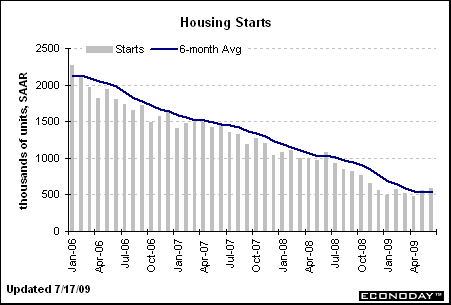
Barry Ritholtz at the Big Picture notes that new building permits in June were 8.7% (±3.0%) above May and that housing starts were up 3.6% (±11.3%). He comments:
"The year-over-year data is much clearer: New Starts down 46% [±4.3%], Permits down 52% [±3.6%]."
He links to a Barron's Econoday graph:

Friday, June 19, 2009

Daily Sources 6/19

1. COMPROMISE LEADS TO NEW IRISH REFERENDUM ON LISBON TREATY IN OCTOBER

Carsten Volkery at Der Spiegel reports that the EU leadership have agreed upon a compromise insisted upon by Dublin where guarantees of sovereignty will be included in the text of the Lisbon Treaty. As a result, Irish Prime Minister Brian Cowen has announced that Ireland will hold a referendum on the treaty in October.
"The EU has provided guarantees to Ireland that it will remain independent in determining tax policies, military neutrality and abortion law (Ireland has one of Europe's most restrictive abortion policies). The sovereignty guarantees are expected to be anchored in EU law as a treaty protocol in the mid-term future."
Polls show that the Irish appear more receptive to the treaty, given the current economic crisis. Well worth reading in full.

2. THE EU TO BEGIN CONSIDERING HOW TO TRANSFER CARBON CAPTURE TECH TO CHINA & INDIA

Pete Harrison at Reuters reports that a draft document from the European Commission suggests that the EU will begin to determine how best to help India and China develop carbon capture technology next week.
"The European Union will start a consultation process on how finance and technology should be delivered to China and later India. This could be critical in securing their commitment to a new global deal on climate change at talks in Copenhagen in December.

'China builds, every year, as much coal-fired power plant as the entire UK generating capacity,' said a report prepared for consultations with industry and seen by Reuters on Friday.

'Unless a way can be found of making this climate-compatible, we can never meet our climate objectives, regardless of what action we take in Europe,' it added."
3. CHINA PROTESTS ADB LOAN TO INDIA, 74% OF CHINESE RESPONDENTS REGARD INDIA AS A THREAT

The India Times reports that the Chinese foreign ministry has issued a statement condemning the Asia Development Bank's recent decision to approve a $2.9 billion loan to India, $60 million of which is earmarked for a watershed project in the Arunachal Pradesh, where the border between the two countries is disputed.


The statement said:
"China expresses strong dissatisfaction to the move, which can neither change the existence of immense territorial disputes between China and India, nor China's fundamental position on its border issues with India.
...
As a regional institution on development, the ADB should not intervene in the political affairs of its members. The adoption of the document has not only dealt a severe blow to its own reputation but also undermines the interests of its members."
India has recently been strengthening the defenses in the region, including moving additional troops into it. The Chinese media has in the past few weeks been attacking New Delhi for putting "fresh strains on the relationship." In an interesting data point, a recent poll in China found that 74% of respondents look upon India as a threat.

4. CHINESE IMPLIED OIL DEMAND RISES 5.96% IN MAY YOY

Winnie Lee at Platts reported yesterday that Chinese implied oil demand rose by 5.96% in May from the year previous. Crude imports rose by 3.55% to to 16.62 million metric tons (~ 3.92 mb/d). It is the second consecutive month where implied demand has risen year over year, which could be interpreted as a sign the economy is rebounding. On the other hand, the director of China's National Energy Administration, told reporters on June 1st that "a substantial portion" of the crude oil trade in the first half had been due to stockpiling, and seemed to indicate that China's tanks were full--see Daily Sources 6/1 #2.

5. FRANCE STATS OFFICE PREDICTS ECONOMY WILL STABILIZE IN Q4

Eurointelligence reports that French statistical office INSEE released its latest forecasts this morning which see the economy stabilizing in the fourth quarter.
"Employment is expected to continue to fall, for 2009 the loss is expected to reach 700,000 jobs in the private sector. Consumption growth is still positive (forecast at +0.7%), though saving rates are about to rise slightly. France seems thus in a much better position than the rest of the euro area, for which GDP is forecast to contract by 5.6% and consumption by -1.6%."
6. BANK OF MEXICO CUTS BENCHMARK INTEREST RATE TO 4.75%

Jens Erik Gould at Bloomberg reports that the central bank of Mexico today cut its benchmark interest rate by 0.5% to 4.75%.
"The [bank's] board 'considers that its easing cycle is close to ending,' the bank said in a statement. 'Future actions that might be taken will possibly be of smaller magnitude and consistent with both the evolution of the economy and the performance of inflation.'

The economic contraction has been 'severe' in the first half of the year, and is a greater risk than inflation, the bank said. The comments signal that it will probably cut a quarter point next month and then keep the rate unchanged for the rest of the year, said Gabriel Casillas, chief economist for Mexico and Chile at UBS AG."
7. ANGOLA STILL PLANS TO LAUNCH SOVEREIGN WEALTH FUND THIS YEAR

Henrique Almeida at Reuters reports that Angolan Finance Minister Severim de Morais said today that Luanda intends to launch a sovereign wealth fund in 2009 to invest its oil wealth abroad.
"Plans to create the fund, known as the Fundo Soberano Angolano, were announced in November by President Jose Eduardo dos Santos, but the project has since been delayed due to the global economic downturn.

Asked whether the fund would be launched this year, de Morais replied: 'Yes, our aim is to launch the fund in 2009.'"
8. CREDIT CARD SQUEEZE HURTING SMALL BUSINESSES, UNEMPLOYMENT IN THE WEST RISES TO 10.1% IN MAY

Yves Smith at naked capitalism notes that the credit card squeeze is hurting small businesses, historically the largest source of job creation in the US.
"The importance of credit cards as a source of funding to small companies has gone largely unnoticed in the wider world, yet is well know to experts on entrepreneurship. Indeed, Amar Bhide, in his landmark The Origin and Growth of New Businesses, pointed out that, contrary to popular mythology, venture capital played a trivial role in forming new businesses. Personal savings, loans or investments from friends and family, and credit card borrowings were the most important sources.

And before readers chide supposedly foolish owners for paying interest, consider: using credit cards includes the astute use of float, which can give companies six or seven weeks of free money. And in better days, card companies offered products targeted to small business owners with favorable rates, often from 9% to 14% (and also offered them even cheaper 'life of the balance' deals, now a distant memory). With interest tax deducible, this was a viable source of funds, particularly for companies that faced short-term financing needs, such seasonal sales patterns.

As we noted, American Express, first to target small businesses, halted its credit line programs as of early 2009 (regular corporate ards for small businesses are still in effect). Advanta, which focused solely on this market, has found itself saddled with a heap of bad debt (default rates of 20%) and has stopped extending new credit as of early June."
Well worth reading in full. Meanwhile, the Associated Press reports that the Labor Department announced today that the unemployment rate rose to 10.1% in the American West in May.
"By region, the Midwest had the second-highest rate, at 9.8%, underscoring the toll of job losses in manufacturing. The South’s unemployment rate was 8.9%, and the Northeast had the lowest at 8.3%."
Unemployment rose in all but two states last month.

Tuesday, May 5, 2009

Daily Sources 5/5

¡Feliz Cinco de Mayo!

1. DON'T PANIC, GLOBALIZATION MOSTLY HARMLESS, PACE SWINE FLU

Bret Stephens at the Wall Street Journal opines that the worries over the swine flu are overcooked, at this stage anyway. The primary fear aired by most commentators is that the flu will have the same effects as the Spanish Flu of 1918-19, but, as Stephens observes:
"Hasn't medical science made some progress in the past 90 years? An article in yesterday's Times of London notes that in 1919 the recommended precautions included mustard baths, Bovril (a salty meat extract, apparently), and salt water for gargling. Also, 'the good effects of wine continue to be emphasized, and most agree in selecting port as the best of these.'

Now we know better. Now, also, there are not several million exhausted and frightened men living in filthy conditions and close quarters along two sides of a 450-mile front. Or troops and sailors being moved in crowded trains and crowded ships, or being treated in overcrowded hospitals. And at least in Western cities, it is no longer typically five-to-a-room in squalid tenement housing.

These details matter because, as science writer Wendy Orent has pointed out in the New Republic, 'only the precise conditions of World War I's Western Front--a true disease factory--could have created a flu as virulent as the one responsible for the 1918 pandemic. ... The virus didn't need to keep people well enough to walk about--fresh victims were close at hand.'

Sure enough, no flu pandemic has been even remotely comparable: The worst was the Asian flu of 1957-58, which killed an estimated two million people, including 70,000 in the U.S. (or about twice the annual average.) That's been true despite the more than tripling of the world's population, the advent of factory farming, 'climate change' and planeloads of potentially disease-bearing people bouncing between Mexico City and Hong Kong and New York and Paris."
Well put and worth reading, though the potential of a incredibly lethal pandemic taking place in our time is not something to laugh off, and I think the recommendation of Judge Posner I linked to yesterday is well-considered--see Daily Sources 5/4 #1.

2. EUROPEAN COMMISSION'S FORECAST PRETTY GRIM, WAGES FALLING IN THE US, UK AND JAPAN WHILE DEBT EATS UP A LARGER AND LARGER SHARE OF DISPOSABLE INCOME

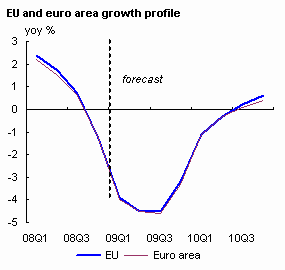
Rebecca Wilder at News N Economics reports that in the European Commission's spring forecast released yesterday it announced it expected EU GDP to contract by fully 4% in 2009 before stabilizing in 2010. The Commission's graph:


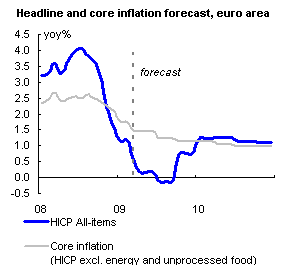
The Commission expects unemployment to rise to 11% in the EU by 2010 as well. Moreover, inflation, or the Harmonized Index of Consumer Prices (HICP), is expected to fall to a bit less than 1% in the EU and 0.5% in the eurozone (or those countries within the EU which have adopted the euro as their currency.) HICP is expected to rise in 2010 to about 1.5%.


(The EC's site includes an illustrative interactive map including the individual economic forecasts of all EU members, which can be found here.) Mike Shedlock at Mish's Global Economic Trend Analysis notes that wages are falling in the US, the UK, and Japan. Mr. Shedlock notes that disposable income, or income after taxes, is still growing, overall, though at a steadily declining rate. His chart:


Mr. Shedlock suspects that were the top 10% of earners taken out of this graph that it would indicate negative disposable income growth. Anecdotally, I would too--and for some time, and suspect that a considerable portion of overall growth for the top 10% has been the simple redistribution of wages from one class to another and via an economy whose health is predicated upon economies of scale, ie, selling products to the very people that are being paid less over time. Shedlock comments:
"Notice that DPI growth became very weak in the era of biggest debt growth, yet it was strong when debt growth was subdued. So much for the notion that inflating money supply and credit 'creates wealth'."
Shedlock notes that household debt now takes a 14% share of disposable income, up from 11% in the 1990s, and that the broader category of household financial obligations now accounts for 19% of disposable income. He concludes that it looks unlikely that the mountain of consumer debt will be paid off. His post really should be read in full.

3. CHINA THINK TANK SAYS GDP TO GROW BY 7% IN 2Q AND CLSA PMI ECHOES OFFICIAL PMI INDICATING EXPANSION; NEW LOANS FALL ON 1Q, BUT STILL 30% MORE THAN LAST YEAR IN APRIL, ANDY XIE SAYS THE CURRENT FINANCIAL REGIME PUNISHES SAVERS, IE THE CHINESE, WHILE ED HARRISON SAYS THE CHIANG MAI INITIATIVE IS A FIRST STEP FOR ASIA TO DECOUPLE FROM THE WEST, BUT EICHENGREEN NOTES THAT THE PRIMARY MARKET MAKER FOR THE ALTERNATIVE CURRENCY--THE SDR--WOULD NATURALLY BE THE IMF, THAT WHICH THE CHIANG MAI INITIATIVE IS PUTATIVELY TO REPLACE!

The Associated Press reports that the State Information Center, an official think tank based in Beijing, forecast that the Chinese economy will grow by 7% in the second quarter on the strength of the stimulus package. The State Information Center's report predicted that even so exports would fall by an annual rate of 20.2% in the second quarter and that imports will fall even further, by 25.5%. The recovery will thus be based on goosing domestic demand.
"To that end, state-run banks, largely insulated from the credit crunch in other markets, have heeded government orders to back growth, issuing 4.6 trillion yuan ($673 billion) in new loans in the first quarter of the year, 20% more than in all of 2007."
The story also mentions that CLSA Asia Pacific Markets released its PMI on Monday with a reading of 50.1 for April, echoing the official government PMI which showed a rise to 53.5. (I admit I found the CLSA finding that manufacturing is beginning to recover surprising. Part of the reason is the story from Xinhua today that the State Grid Corporation of China released preliminary data indicating that power generation in the country was down 3.55% in April from a year previous. China has experienced year over year declines in power generation for the last seven months. The official figure will be released by the China Electricity Council later this month.
"The official figure for April was likely to slide about four percent year on year, indicating an economic recovery was still some way off, the China Daily newspaper cited a source familiar with the matter as saying."
But I suppose PMI surveys are leading indicators in contrast to power generation data. Still, Lu Jianxin and Edmund Klamann at Reuters report that new renminbi denominated loans have fallen by nearly 70% in April from March to 600 billion yuan, according to the state-run China Securities Journal. However, 600 billion yuan is still 30% more credit extended in April from a year earlier.
"'Although new loans fell sharply month on month in April, market watchers believe the scale and growth were more reasonble than in the first three months,' the newspaper said, quoting unnamed banking sources.

'It is forecast that new loans in May and June will not fall sharply from April.'"
Meanwhile, Andy Xie, former chief economist for Asia Pacific at Morgan Stanley, has an opinion piece in the Financial Times which argues that the Keynesian response to the financial crisis is pushing China toward an "alternative financial system," after which the dollar will collapse. Key excerpt:
"The global environment is extremely negative for savers. The prices of property and shares, though having declined substantially, are not good value yet and may decline further. Interest rates are near zero. The Fed is printing money, which will eventually inflate away the value of dollar holdings. Other currencies are not safe havens either. As the Fed expands the money supply, it puts pressure on other currencies to appreciate. This will force other central banks to expand their own money supplies to depress their currencies. Hence, major currencies may take turns devaluing. The end result is inflation and negative real interest rates everywhere. Central banks are punishing savers to redeem the sins of debtors and speculators. Unfortunately, ethnic Chinese are the biggest savers.

Diluting Chinese savings to bail out America’s failing banks and bankrupt households, though highly beneficial to the US national interest in the short term, will destroy the dollar’s global status. Ethnic Chinese demand for the dollar has been waning already. China’s bulging foreign exchange reserves reflect the lack of private demand for dollars, which was driven by the renminbi’s appreciation. Though this was speculative in nature, it shows the renminbi’s rising credibility and its potential to replace the dollar as the main vehicle of wealth storage for ethnic Chinese."
Well worth reading in full. Edward Harrison at Credit Writedowns figures that the Chiang Mai Initiative is a sign that the process of abandoning the dollar is already under way. Mr. Harrison provides some background:
"You will recall that the Asians were forced to go cap in hand to the IMF for bailout funds after the Asian Crisis in the late 1990s. This experience was very humiliating for some and caused extreme hardship as the IMF programs were rather severe and deflationary. Resentment toward the IMF remains as a result. I see this development as an explicit measure to exclude the IMF in Asia."
This possibility was identified some time back by C. Randall Henning at the Peterson Institute in a paper published in late February. Simon Johnson argued that the great coup pulled off by the Obama Administration in the London G20 meeting was to open up the selection process for the managing director of the IMF, likely meaning that a candidate from an emerging economy like Brazil will be chosen to lead the organization next (as opposed to a European), in return for opening up the selection process for the World Bank, traditionally held by an American, and probably meaning that a Chinese candidate will take the helm of that organization next. (See Daily Sources 4/3 #3.) Nonetheless, Harrison remains concerned, concluding:
"Asia looks poised to break away from the West, dare I say de-couple. I am loathe to use that word because the inter-connectedness of the global economy has meant that negative demand-side shocks in the West will be felt in Asia as well. Nevertheless, Asia looks to be developing an Asia-only dynamic and re-focusing on internal trade and politics. This is good for Asia, but, for the West, not so much."
Further, if SDRs are to be the basis of an alternative reserve currency, Barry Eichengreen notes in the Gulf Times that the obvious candidate for a market maker in SDRs would be the IMF:
"If China is serious about elevating the SDR to reserve-currency status, it should take steps to create a liquid market in SDR claims. It could issue its own SDR-denominated bonds.

Better still, it could encourage other G-20 countries to do likewise. They would pay a price, since investors in these bonds would initially demand a novelty premium. But nothing is free. That price would be an investment in a more stable international system.

Of course, an earlier attempt was made to create a commercial market in SDR-denominated claims. Back in the 1970’s, there was some limited issuance of SDR-denominated liabilities by commercial banks and SDR-denominated bonds by corporations. But these efforts ultimately went nowhere. The dollar being more liquid, its first-mover advantage proved impossible to surmount.

Overcoming that advantage now would require someone to act as market-maker for private as well as official transactions and subsidise the market in its start-up phase. The obvious someone is the IMF. The Fund could stand ready to buy and sell SDR claims to all comers, private as well as official, at narrow bid/ask spreads competitive with those for dollars."
In which case perhaps abandoning the IMF or decoupling the Asian financial system from the West could prove counter productive. Prof. Eichengreen's essay is worth reading in full.

4. SAAKASHVILI PUTS DOWN MILITARY MUTINY, MOSCOW DENIES INVOLVEMENT ... MEANWHILE PACIFIC OIL TERMINAL ON SCHEDULE FOR PRELIMINARY COMPLETION IN DECEMBER

Niko Mchedlishvili at the Washington Post reports that the Saakashvili Administration said that it put down a mutiny at a military base--the Mukhrovani tank camp--12 miles from Tblisi today.


"Georgian Defense Minister David Sikharulidze said the rebellion was aimed at disrupting month-long NATO exercises beginning on Wednesday at a former Russian air force base several kilometers from Mukhrovani."
Moscow denies the allegation. Meanwhile, Amanda Rayborn at Platts reports that the Russian Pacific oil terminal at Kozmino in Primorsky Province is on schedule to be operational by December.


In December, the terminal should have the capability of loading supertankers with storage capacity of 1 million barrels. Eventually the terminal will be capable of serving VLCCs with 2 million barrel holds.
"The first stage of ESPO envisages crude deliveries via a 600 kb/d pipeline from Taishet in East Siberia to Skovorodino in the Amur region in Russia's Far East. From there, 300 kb/d will be transported by railroad to Kozmino. The other 300 kb/d will flow via a 60 km offshoot from Skovorodino to China.

In the second stage, the line is to be extended to the sea terminal, with
the route's capacity increased to 1.6 mb/d."
Rosneft is considering constructing a 400 kb/d refinery nearby the terminal.

5. ANALYSTS RUBBISH THE NOTION THAT RUSSIAN BOOST IN CRUDE PRODUCTION IS A TREND, ANGOLA ALLEGEDLY COMPOSES LETTER ASKING OPEC FOR THE OK FOR MORE OUTPUT, GOLDMAN SACHS SAYS ALL AVAILABLE GLOBAL OIL STORAGE TO BE FULL BY JUNE, JBC ENERGY SAYS NARROWING CONTANGO WILL GET HOTELLERS TO SELL AND ENBRIDGE SET TO SELL OLD STORAGE BY CUSHING, BUT BARCLAYS SAYS IMMINENT RISE IN PRICE WILL FORCE SHORT COVERING DRIVING PRICE TO AS HIGH AS $70/B, WHILE SAUDI ARAMCO OFFERS US LOWER PRICES FOR CRUDE IN JUNE AND EUROPE HIGHER PRICES IN JUNE AS EUROPEAN ANTI-DUMPING MEASURES KILLS US BIODIESEL INDUSTRY

Spencer Swartz at Environmental Capital reports that most analysts think the recent boost in oil production in Russia--see Daily Sources 5/4 #6--is a blip and that the country will soon return to the trend of declining output.
"Like many oil forecasters outside Russia, consultants at PFC Energy in Washington think the country’s crude production could drop by at least 300,000 barrels a day in 2009 after sinking by almost 100,000 barrels a day last year, based on PFC calculations."
Meanwhile, Tamsin Carlisle at The National reports that Angola, which currently holds the presidency of OPEC, may have sent a letter to the secretary general of the organization asking for the go ahead to pump more crude going forward.
"According to the May 4 issue of the weekly Middle East Economic Survey (MEES), the letter argued that Angola had a special need for oil revenues to rebuild an economy damaged by 30 years of civil war. It also said the country would be severely penalized if forced to adhere to its 1.517 mb/d OPEC production target, as several high-cost offshore oil developments are due to come on stream."
Angola pumped 1.71 mb/d of crude in April, 30 kb/d more than March, per a recent Reuters survey. The letter seems somewhat of a formality, given the survey by Bloomberg in the middle of April which showed that loadings already scheduled for June are at 1.85 mb/d--see Daily Sources 4/17 #9. In that vein, Goldman Sachs estimated last week that global spare storage capacity for crude will be completely full by June, per Richard Spencer at the UK Telegraph. The story also quotes Ahmad Abdallah, a commodities analyst at Gavekal, an economics consultancy:
"From a commodities point of view, world trade is appalling and the demand is just not there. All inventories are rising--they are bursting at their seams."
Goldman Sachs sees prices at around $45/b for the near and medium term. Meanwhile, Alexander Kwiatkowski at Bloomberg reports that JBC Energy predicted today that traders holding more than 100 million barrels of oil in supertanker storage offshore are likely to begin selling it.
"'Oil should soon start to return to the market as contango structures appear to be narrowing, especially in the US,' Vienna-based JBC said in an e-mailed research note today. JBC estimates that as of end-April, 40 million barrels were being stored in the US Gulf Coast while as many as 24 million barrels were anchored off the U.K. and West Africa."
I haven't noticed a considerable narrowing as of late, but OK. And, if you weren't confused enough, Joshua Schneyer at Reuters reports that Enbridge is planning to shut 500,000 barrels worth of storage capacity at Cushing, Oklahoma, precisely one of the best places to take advantage of the contango. Apparently some of the tanks date back to the 1920s, and 500,000 only represents 3% of the company's storage facilities in the mid-continent, which stands at 16.7 million barrels. And just so all views are heard, Christian Schmollinger at Bloomberg reports that Barclays Capital commodities analysts, led by Jordan Kotick, said that crude may jump to $71.55/b if the June contract breaks through $56.10/b, forcing a large number of traders to exit a large number of short positions. I thought Paul Horsnell was the head of their oil analysis group, perhaps he's moved on. In any case, his bullishness lingers on. Meanwhile, Ayesha Daya and Alexander Kwiatkowski at Bloomberg report that Saudi Aramco has cut the price of its crudes to the US buyers, while raising the price to northwest European takers.
"Saudi Arabia lowered the price of its Extra Light crude the most, cutting it by $1.15 a barrel to $1.95 below the cost of West Texas Intermediate crude, the state oil company said in a faxed statement today. The price of Light crude dropped 70 cents to $2.95 a barrel below WTI, while the Medium crude price fell 25 cents to a $4.10 a barrel discount. Heavy crude exports were left unchanged at a discount of $4.85."
Bloomberg produces a table of the price changes:


The direction of US oil futures prices are often led by European prices, both Brent and gasoil. Meanwhile, Beth Evans and Robert Sharp at Platts report that US biodiesel producers have cut capacity utilization to 15%! In March the EU slapped duties on US biodiesel in order to curb imports and nurture their own domestic producers.
"The EU duties, which were announced in mid-March, took a particularly
heavy toll on US biodiesel producers, said Zedlitz, [spokesman for GreenHunter Energy, the largest biodiesel maker on the Gulf Coast.] 'We believe about 85% of
biodiesel produced in the US went to Europe,' he said. That included GreenHunter production, none of which is now headed overseas, said Zedlitz."
The anti-dumping duties were unevenly applied, with some major agribusiness firms facing relatively small tariffs and other businesses facing truly insurmountable ones, from $4/b for Archer Daniel Midlands to more than $40/b for others--see Daily Sources 3/12 #10.

6. IRAQI PRIME MINISTER BACKS TOTAL BID FOR IRAQI OIL CONCESSION, TOTAL APPEARS TO HAVE THE MOST APPETITE FOR POLITICAL RISK OF ALL THE IOCS

Helene Fouquet at Bloomberg reports that in an interview on France 2 to be aired today Iraqi Prime Minister Nuri al-Maliki indicated that he supports Total SA's bid for an oil exploration and production contract in his country, expressing the hope that the company would sign the contract during French Prime Minister Francois Fillon’s visit to Iraq in June.
"Al-Maliki did not specify which oil field would be attributed to Total. He met today in Paris with Total Chief Executive Officer Christophe de Margerie.

'The meeting came in the course of ongoing discussions to reinforce our cooperation with the Iraqi authorities,' Total spokeswoman Phenelope Semavoine said over the telephone."
Two thoughts:

One: Traditionally it is held that feeling free to leave one's country to conduct business is an indication that a head of state feels comparatively sure that he will not be ousted by any political association in the meantime. Al-Sadr is also out of the country in Turkey, but still, it is a sign of strength.

Two: Total SA these days appears to have taken the mantle of the international oil company with the largest appetite for political risk. Ironically, in my view anyway, the company appears to have divorced itself from France's colonial past in the eyes of the developing world. That security for its operations might be provided by the UK--see Daily Sources 5/1 #3--really puts the cherry on it.

7. PRESIDENTS OF PAKISTAN AND AFGHANISTAN TO MEET OBAMA TOMORROW IN DC WHILE PEOPLE IN THE SWAT VALLEY PREPARE FOR REAL WAR TO BEGIN; LUGAR AND KERRY DRAFT BILL TO GIVE SUBSTANTIAL NON-MILITARY AID TO ISLAMABAD

Reuters reports that Pakistani President Asif Ali Zardari and Afghan President Hamid Karzai are scheduled to meet in Washington, DC, for tripartite talks with President Obama tomorrow while hundreds of people fled the Swat Valley in order to avoid the anticipated violence.
"[S]ecurity forces launched an offensive to expel militants from Buner and another district on April 26. About 180 militants have been killed, according to the military, although there has been no independent confirmation.

The operation in Buner was going smoothly and troops were consolidating their positions, the military said."
Pamela Constable at the Washington Post reports:
"'The government is trying its best to give time and space to the other side to allow the reconciliation process to reach its logical conclusion,' Maj. Gen. Athar Abbas, the military's spokesman, told a Pakistani news channel. He said that the army's orders were limited to clearing the Taliban from Buner and that if reconciliation fails, 'it will be the decision of the government whether to extend operations to Swat.'

Abbas referred to the Taliban in noticeably respectful terms, even as he complained that it had killed prisoners whose hands had been tied. His language contrasted sharply with the mocking defiance of recent Taliban pronouncements. In the past two days, Taliban spokesmen have asserted that democracy is 'infidel' and that the fighters will never lay down their weapons.

In Swat, meanwhile, Taliban forces were described Monday as preparing for sustained resistance against any attack, taking positions on rooftops in the district capital, hiding in a labyrinth of tunnels in local emerald mines and occupying homes and offices from which thousands of people have fled."
Meanwhile, Farah Stockman at the Boston Globe reports that Senators John F. Kerry (D-MA) and Richard Lugar (R-IN) introduced a bill yesterday which would triple non-military aid to Pakistan to $1.5 billion a year for the next five years.
"The bill authorizes, but does not appropriate, the money, so Obama will still have to go through the formal process of requesting the funds. Once the money comes, the challenge will be to spend it effectively, said Daniel Markey, a former State Department policy planner.

A separate program launched by the Bush administration to spend $750 million over five years on development aid in Pakistan's lawless tribal areas has faced 'enormous difficulties' because of poor security and a lack of local institutions to partner with, Markey said."
The text of the proposed legislation can be found here. It includes the Senators' assessment of the mutual interests of the two countries:
"The people of Pakistan and the United States share many compatible goals, including—
(A) combating terrorism and violent radicalism, both inside Pakistan and elsewhere;
(B) solidifying democracy and the rule of law in Pakistan;
(C) promoting the economic development of Pakistan, both through the building of infrastructure and the facilitation of increased trade;
(D) promoting the social and material well-being of Pakistani citizens, particularly through development of such basic services as public education, access to potable water, and medical treatment; and
(E) safeguarding the peace and security of South Asia, including by facilitating peaceful relations between Pakistan and its neighbors."
Evidently parallel legislation in the House is so packed with conditions that Islamabad could never accept its terms. The National Journal has published the responses of nine international relations experts on the situation in Pakistan--
-Daniel Serwer, Vice President, Center for Post-Conflict Peace and Stability Operations, United States Institute of Peace;
-James Kitfield, NationalJournal.com;
-Joseph J. Collins, Professor, National War College;
-Michael Vlahos, Fellow and Principal, Johns Hopkins University Applied Physics Laboratory;
-Col. W. Patrick Lang, (U.S. Army, ret.);
-Ron Marks, Senior Vice President for Government Relations, Oxford-Analytica;
-Michael F. Scheuer, Adjunct Professor of Security Studies, Georgetown University;
-Bruce Hoffman, Professor, School of Foreign Service, Georgetown University; and
-Paul R. Pillar, Visiting Professor, Georgetown University.
I have not had the time to go through the analyses yet, but they were recommended by Michael Collins Dunn at the Middle East Institute, who recommended especially that readers check out Pillar's thoughts.

8. GATES REASSURES ME ALLIES THAT DETENTE WITH IRAN DOESN'T MEAN THE US WILL ABANDON THEM; BOTH IRANIAN PRESIDENTIAL CANDIDATES RIP OFF YES WE CAN SLOGAN FROM OBAMA

Greg Jaffe at the Washington Post reports that Defense Secretary Robert Gates is working to reassure US allies in the Middle East that the effort to reach a detente with Iran will not derail their relationship with DC.
"In Egypt, Gates played down the likelihood of a major breakthrough, or 'grand bargain,' that would lead to dramatic changes in the US-Iranian relationship, such as the re-establishment of diplomatic relations.

'I believe that kind of prospect is very remote,' he told reporters in Cairo Tuesday after meeting with President Hosni Mubarak. 'We'll just have to see how the Iranians respond to the offer from the president. Frankly, some of the first things that have happened as a result of the extension of that open hand have not been encouraging.'"
Indeed, but on the other hand it appears as if both Iranian presidential candidates have decided to see if they can adopt Obama's campaign slogan of Yes, We Can! for their very own. That's right, Ben Schott at Schott's Vocab reports that Mahmoud Ahmadinejad’s re-election slogan is Ma Mitavanim, or "We Can" in Farsi.
"Meanwhile, Radio Free Europe reported that Ahmadinejad’s challenger, Mehdi Karrubi, had adopted as his campaign slogan the (equally Obamaesque) word 'change':

Karrubi said that he took the slogan from a verse in the Koran which says that the fate of a nation does not change unless the people decide to change it."
And so it is that the wheel of meaning turns.

Monday, January 19, 2009

Daily Sources 1/19

1. David Jolly at the New York Times reports that the Brown Administration announced a new bailout for British banks today. The new plan would increase controls over lenders, offer banks insurance on troubled assets as well as other steps to restore the offering of credit. The government is also revising its assistance to the Royal Bank of Scotland, now taking 70% of the company's shares, up from 58%.
"The British Treasury said the latest steps would cost taxpayers another £100 billion, or $147 billion, on top of the £37 billion plan announced in October and a £20 billion stimulus plan announced in November."
Pan Pylas at the Associated Press reports that European stock markets have responded to the news by falling and with financial stocks in "free fall."

2. Eurointelligence reports that the Der Spiegel ran the story this morning that German banks have about €300 billion ($398.4 billion) in toxic assets, which is much worse than previously estimated. The FD Deutschland has the story that the EU is pushing ahead with regulation which would force all credit default swaps to be traded through a central clearing system.

3. Platts reports that the German Parliament is set to have a final vote on legislation proposed by the Merkel Administration which would ban the importation of biofuels derived from soybeans or palm oil that benefit from foreign tax relief. Even though this is consistent with WTO regulations, I believe you will see more aggressive attempts to prevent dumping generally.

4. Chris Bryant at the Financial Times reports that the conservative coalition of the Christian Democratic Union (Chancellor Angela Merkel's party) and the Free Democratic party won big in the election in the western German state of Hesse. It is interesting that the German voter would reward the party of free markets over the Social Democratic party, given the current situation. Apparently the election being regarded as a bellwether of German politics going forward in the European press generally.

5. Edward Hugh at Fistful of Euros reports that S&P cut the rating for Spanish long term sovereign debt to AA+ from AAA.

6. Platts reported yesterday that Gazprom and Naftogaz began drafting documents for the resumption of supplies to Ukraine and via Ukraine to the rest of Europe. Kiev has apparently agreed to the European pricing formula for the gas. In 2009, "Russia will grant Ukraine a 20% discount on gas imports as long as Ukraine keeps its tariffs for the transit of Russian gas to Europe at the 2008 level." In 2010, Ukraine will switch to the full European price. Andrew E. Kramer in the New York Times reports that European gas prices are tied to oil prices, but on a six month delay. NYMEX sweet light was trading at $134.60 on July 16, which on a Btu basis roughly translates to $23.20/MMBtu or $819.20/tcm. European customers were reportedly paying an average of $450/tcm at the beginning of the year, so we still don't have enough to suss out the terms.
"Gazprom ... has projected the average price in Europe next year to be between $260 and $300 for 1,000 cubic meters of natural gas. The prices are pegged to oil prices with a delay of six months. Thus Ukraine would pay between $208 and $240."
Daryna Krasnolutska and Stephen Bierman at Bloomberg report that the contract signed today is a contract for 10 years of supply. Mathew Carr and Kateryna Choursina at Bloomberg reported that in an official statement the European Union expressed some skepticism as to whether the deal is really done, and that no more fireworks were forthcoming. The statement read in part: "We have seen many false dawns in this dispute. The ‘test’ in this case is whether or not the gas flows to Europe’s customers. Until that point, the wait goes on." Laura Cochrane at Bloomberg reports that the gap in yields between Ukraine's bonds and treasuries tripled to 25.1%, signaling that the market now expects default. The long bonds now yield 9.6% more than comparable debt sold by Argentina. Meanwhile, Emma O’Brien at Bloomberg reports that Russia has allowed the ruble to devalue against a currency basket of dollars and euros (55% dollar, 45% euro) for the sixth time this year. Toni Vorobyova at Reuters reports that Vladimir Putin has advised the cabinet that the 2009 budget should be reviewed with the assumption that oil will average $41/b this year. $41/b is roughly $7.06/MMBtu on a Btu basis or about $249.53/tcm. Edward Hugh--yes the same Catalan economist who writes at Fistful of Euros--at Russia Economy Watch writes that Russia's GDP contracted by a full percentage point in December.


7. Brad Setser at Follow the Money argues that, in terms of China, what we should be worrying about is them importing less, not purchasing less US treasuries. As imports slow, China's trade surplus will grow, which will likely draw the People's Bank of China to sell yuan in order to prevent a rise against the dollar. But, even if dollar demand inside China grows to the point that the government does not need to defend against a rise in the yuan, then at least a portion of that dollar demand will likely translate into purchases of US treasuries. Meaning that they will be purchased willy-nilly, even if by the private sector instead of the public. Thus:
"A big fall in [economic] activity [in China] also means less Chinese demand for the world’s products — as well as less Chinese demand for China’s products, which frees up capacity to export. That adds to the deflationary forces in the world economy.

And right now, the risk of a shortfall in global demand strikes me as the bigger risk than a shortfall in demand for Treasuries. The last thing the US should want is a larger Chinese current account surplus, even if a larger surplus would increase China’s capacity to finance the US deficit."
Setser's proposes to Beijing stimulus spending. (But I have to wonder if private Chinese demand for US treasuries would really make up for a lack of demand from the People's Bank of China due to a need to finance a social net. As Setser has pointed out in the past, the vast majority of treasuries purchases in 2007 appear to be by central banks.)

8. Winnie Lee at Platts reports that CNOOC plans to bring its greenfield 240 kb/d capacity Huizhou refinery in Guangdong province online in March.
"The Huizhou refinery is designed to process high-acid heavy crude from CNOOC's offshore blocks in China's Bohai Bay. The plant is capable of producing 7.3 million mt/year of gasoline, gasoil and kerosene meeting Euro III and Euro IV standards, 1.5 million mt/year of ethylene and 800,000 mt/year of paraxylene."
9. Platts reported yesterday that on Saturday Algerian oil minister Chekib Khelil told journalists that OPEC might cut production again in March if prices continue to fall. He went on to say,
"I think that prices will stabilize around current levels of $45-$46/barrel before rising again during the third quarter of this year as a result of adherence by OPEC members with agreed output cuts."
Platts reports that Venezuelan oil minister Rafael Ramirez also indicated on Saturday that Caracas would back further cuts in the March meeting.Meanwhile, Alexander Kwiatkowski at Bloomberg reports that Angola announced it will increase crude shipments by 1.8% in March. Angola is the current holder of the presidency of OPEC. Xinhua yesterday reported that in a meeting in Luanda, the Chinese Minister of Commerce Chen Deming told the prime minister that China would provide assistance in reviving the Angolan agricultural sector. (China is a net importer of basic foodstuffs.)

10. Shashank Shekhar at Emirates Business 24/7 reported yesterday that Gustavo Soares, a senior commodity strategist with Merrill Lynch, thinks that given current oil prices plans to switch to cleaner fuels for power generation by the Gulf countries may face roadblocks. However,
"'Nuclear power is more of a policy-driven market,' Soares said and added the Gulf states can sustain their nuclear energy projects if the governments so decide it as a policy."
Arif Sharif at Bloomberg reports that the Saudi Arabian Monetary Authority cut its benchmark rate to 2% and that the UAE will cut its benchmark lending rate to 1%.

11. Reuters reports that Iranian oil Minister Gholamhossein Nozari told the state media that "In the opinion of the Oil Ministry, taking into account predictions by various international institutes, the anticipated oil price in the year 2009 will be around $40." He also said that non-OPEC countries were not cooperating with the cuts so far, in a reference to Russia, which had suggested it might cut in cooperation with OPEC if it decided that the organization was making good on its quota reductions. Most analysis that I have seen so far suggests that Iran is supplying much more than it promised.

12. The Oil & Gas Journal reports that the Pakistani government has decided that it cannot afford to import gas from Iran, which would cost $500 million per month. That, I take it, puts the kibosh on the proposed Iran-Pakistan-India pipeline, which has been stalled for some time as New Delhi has been uncomfortable with the contract terms Tehran has proposed.


13. Ibrahim Barzak and Christopher Torchia at the Associated Press report that Israel began withdrawing from Gaza Sunday.
"Hamas Prime Minister Ismail Haniyeh claimed "a heavenly victory" in remarks broadcast on Al-Jazeera Arabic news channel."
"The Israeli military warned that the next few days were critical and that any Hamas attacks would be met with harsh retaliation.

'Right now the operation hasn't ended,' Maj. Gen. Amir Eshel said. "It has just transitioned to a new phase, to hold fire. To give a chance to a cease-fire to take over and end this operation.'"
14. James Taranto suggests in the Wall Street Journal that a way to disambiguate radical Islamists in a way which might have the effect of making them pariahs would be to introduce the term "Islamic Supremacists." There is a need to disambiguate Islam generally from Islamists, but I suspect the effect Taranto is looking for will take place more in the Western world than in the Islamic one.

15. Jorge Silva at Reuters reports that on Saturday Venezuelan president Hugo Chavez said,
"If Obama as president of the United States does not obey the orders of the empire, they will kill him, like they killed Kennedy, like they killed Martin Luther King, or Lincoln, who freed the blacks and paid with his life."
Rhetorical repositioning to be sure, for Chavez needs the US as an enemy. But, depending on the Obama Administration's approach, it may become more and more difficult to sustain.

Friday, January 2, 2009

Daily Sources 1/2

1. Philip P. Pan at the Washington Post reports that the political leadership in the Ukraine have been put aside in a joint statement yesterday offering Gazprom $201 per thousand cubic meters of natural gas, up 11.7% from the $180 per thousand cubic meters paid in 2008. The negotiations between Moscow and Kiev have been hobbled somewhat by the fact of the longstanding and bitter feud between Ukrainian president, Viktor Yushchenko, and its prime minister, Yulia Tymoshenko. That said, Gazprom at 10am yesterday cut off all shipments of natural gas through the Ukrainian pipeline system. Also yesterday, Gazprom withdrew its offer of natural gas for $250 per thousand cubic meters to Ukraine after Ukraine rejected it and is now asking for $418, more or less the price paid by Western European customers. Stephen Bierman and Henry Meyer at Bloomberg report that Russia has reacted by boosting the amount of natural gas to Europe via the Belarussian pipeline network. Russia provides about a quarter of Europe's natural gas requirement, 80% of which has historical been sent via Ukraine.
"'The Belarus option is certainly viable and they could put some of the gas through Belarus,' Jonathan Stern, director of gas research at Oxford Energy, said today. 'But it certainly is not the solution. There is some spare capacity within the Belarus corridor but it is probably within the order of 10 percent from Ukraine capacity.'"
Ukraine receives 70% of its natural gas requirement from Russia and is facing temperatures in Kiev of as low as 14ºF. It has natural gas supplies in storage equivalent to about 35% of yearly consumption and so it would seem that the crisis is not likely to be resolved just yet. The Bloomberg article is worth reading in full.

In a related story, Tom Barkley at the Wall Street Journal reports that the IMF plans to lend Belarus $2.5 billion to help the country weather the financial crisis. "Following news of the deal, the Belarus central bank said it will devalue its currency by 20% as of Jan. 2 and raise its key refinancing rate." Belarus paid about $129 per 1,000 cubic meters of gas from Russia in 2008 and may have negotiated a lower price for 2009, but is a staunch ally of Moscow with which it has been mooting the idea of reunification for many years now.

2. Nadia Rodova at Platts reports that Russian crude oil production was down 0.7% in 2008 from 2007, to 488.105 million metric tonnes (9.735 mb/d). Average daily output, as opposed to total tonnage, was down 1% on the year from 9.83 mb/d. Crude output in December was 40.87 million tonnes (roughly 9.62 mb/d.)

3. Alexander Kwiatkowski and Candido Mendes at Bloomberg report that Angola assumed the Presidency of OPEC yesterday.
"Oil from Angola accounted for about 5 percent of total U.S. crude imports in 2007, or 496,000 barrels a day, according to the Energy Information Administration. China imports 500,000 barrels of day of oil from Angola, according to Glencore International AG, the world’s largest commodity-trading company."
4. Li Yanping at Bloomberg reports that manufacturing in China contracted for the fifth straight month in China, as indicated by the CLSA China Purchasing Managers’ Index. The index stood at 41.2 at the end of December, slightly up from the 40.9 seen in November. (Anything above 50 indicates growth; anything below 50 indicates contraction.)
"China’s economic growth may have slipped to 5.5 percent last quarter, the weakest pace in at least 15 years, according to Shanghai-based Industrial Bank Co."
Anything below 8% is considered below the rate required to absorb new additions to the labor market and thus likely to cause instability. In the vein, Lauren Keane at the Washington Post has an atmospheric, finger testing the wind, story about the situation facing migrant workers in China. China's People's Daily reported Wednesday that the People's Bank of China released a report on Tuesday showing that non-cash payments declined by 8.3% year over year in the third quarter.
"The amount of money involved in non-cash payments, including commercial papers and bank cards, was about 157.3 trillion yuan ($22.97 trillion) in the third quarter ...."
Catalan economist Edward Hugh has another analysis at Fistful of Euros more or less calling the latest Chinese data a leading indicator for a second Great Depression.
"Well China isn’t quite in Great Depression mode yet, but manufacturing activity - which forms the core of the Chinese economy and accounts for 43% of all activity - is already very close to a technical recession ...."
Hugh's piece is a long analysis friendly to economic laymen worth reading in full. Brad Setser at Follow the Money argues that the latest data suggests that China is clinging to its traditional export-led growth policy, which flies in the face of the growing evidence that there will export markets are in the process of shrinking, protectionist trade policy or not. Mostly the same argument Setser has been making for a while, but still worth reading.

6. Eric Watkins at the Oil & Gas Journal reports that Indonesia will continue its price renegotiations for natural gas from Tangguh with China this month. The original 25 year contract for the gas had been for $2.40/MMBtu (~ $13.92/b on a BTU basis.) China later offered $3.80/MMBtu (~ $22.04/b on a BTU basis), but Indonesia declined. (The contracts are sometimes linked to benchmark crude prices on a futures exchange with ceilings and floors, Watkins did not indicate whether the contract was based on a formula or a flat price.) Yesterday the NYMEX natural gas contract for delivery at Henry Hub in February was $5.622/MMBtu (~ $32.60/b on a BTU basis) the UK price was £5.7/MMBtu (~ $8.34/MMBtu or ~ $48.37/b on a BTU basis.)

7. Kartik Goyal and Anil Varma at Bloomberg report that the Reserve Bank of India lowered its benchmark lending rate by 1% to 5.5% today.

8. Ravi Nessman of the Associated Press reports that the Sri Lankan military captured the Tamil Tiger's main headquarters Friday. It is the latest episode in the 25 year long civil war and celebrations erupted in Colombo after the capture was reported. The Tigers immediately signaled they would continue the fight by exploding a suicide bomb near the air force headquarters in Colombo.

9. Amit R. Paley in the Washington Post reports that the US handed over control of the "green zone" yesterday to Iraqi authorities.

The Green Zone was in the heart of Baghdad, the capital city, and as such the transfer was a symbol of the transfer of sovereignty.

10. Mohamed Ibrahim and Jeffrey Gettleman at the New York Times report that the Ethiopian army began pulling out of Somalia's capital, Mogadishu, today.
"It is not clear whether the Ethiopian troops are leaving Somalia entirely or simply redeploying from Mogadishu to other areas of the country. Western diplomats estimate there are still several thousand Ethiopian troops inside Somalia, and many Somalia analysts have predicted that the Ethiopians will linger for some time inside the country or along the border as a buffer against Islamist militants."
That said, last month Addis Ababa indicated that it would withdraw more or less entirely. An Ethiopian official told the AFP that the withdrawal process will take some time, meaning, I suppose, that they may decide to use troops to tip the contest for power in Somalia in favor of one faction or another.

11. Simon Romero of the New York Times reports that Cuba held celebrations yesterday to mark the 50th anniversary of its revolution. In the Washington Post Eugene Robinson argues that it is time for the US to abandon the 50 year policy of embargoing Cuba, which has clearly not produced the intended result.
"US policy for dealing with the rest of the communist world was always to push for more contact and exchange, on the theory that exposure to Western ideas, freedoms and prosperity would hasten communism's demise. It worked.

I'm convinced that it would have worked in Cuba, too. At the very least, if the U.S. government had treated Cuba the way it treated other communist nations, the onus would have been on Castro. If he wanted to keep Cuban society from being infected by democracy, consumerism and other yanqui diseases, he would have had to justify measures to keep Americans and American products out. Instead, he has been able to portray his revolution as a noble David, menaced by a hulking, aggressive Goliath to the north."
This argument has been being made with little practical effect for some time now, with the exception of lifting the ban on sales and donations of food and medicine to Cuba in the late 90s. The difference is that there is evidence that the Cuban-American community is finally coming round to this point of view. Once support for the policy collapses in the Cuban-American community, the embargo will lose nearly all of its political appeal. I suspect, like Robinson, that the only reason Castro has managed to maintain his hold on Cuba is the embargo.

12. In an unusual move, The Wall Street Journal's editorial board today endorsed Sarkozy's remark that "the monetary system should be rethought [within] fixed exchange rates." The board argues that the euro has been a signal success for Europe, but that its volatility against the dollar has traumatized global trade.


"But the world could ... harness the benefits of exchange-rate stability if its political and economic leaders began to discuss how better to coordinate monetary policy. Mr. [Robert] Mundell[, the Nobel laureate and intellectual father of the euro,] suggests, for starters, a mechanism for close coordination among the Fed, the ECB, and the Banks of England, China and Japan."
Mundell also argues that the escalation of financial panic of September 2008 was catalyzed by the sudden rise of the dollar versus the euro. Well-worth reading in full.

13. Daniel Goldstein at Platts reports that the US Department of Energy may begin purchasing crude for the Strategic Petroleum Reserve again in February. The DOE announcement follows calls from Congress that the Administration do just that. The SPR currently holds somewhat more than 700 million barrels of crude oil and has a capacity of 727 million barrels. Prior to the decision in May last year to cut off additions to the SPR, the complex was receiving about 70 kb/d in crude deliveries--mostly of light sweet crude.

14. Bernard Simon at the Financial Times reports that "US hybrid petro-electric sales in November shrank 53 per cent from a year earlier, compared with a 37 per cent drop overall, according to Autodata, a market-research firm. December sales, to be announced on Monday, are to show a similar trend."
"Sales of most hybrid models have dropped sharply. Demand for Toyota’s Prius hatchback, the top-selling hybrid, fell by almost half in November from a year earlier. The Camry sedan was down 57 per cent, and the Ford Escape crossover 35 per cent."
15. Howard Schneider at the Washington Post reports that the Institute for Supply Management's index of industrial production fell by 3.8% in December from November to 32.4. It is the fifth consecutive month in which the index has fallen. (A number above 50 indicates manufacturing growth; below 50 indicates contraction.)
"The group's index of new orders and prices showed them at their lowest levels since the late 1940s. ... The ISM has conducted its survey since 1931."
16. Andrew Martin, at the New York Times, has a very interesting story on the huge surplus of milk on the market.
"Other agricultural sectors are also struggling with a slowdown in demand from foreign buyers because of the global recession and an increase in the value of the dollar, which has made American exports more expensive abroad. The Agriculture Department is expecting steep declines in exports of corn, wheat, soybeans and pork.

But while the government has price-support programs for about two dozen agricultural products, so far milk powder is the only commodity that has sunk low enough to start the flow of government dollars. Some expect that taxpayers will soon be buying blocks of cheese, too, given the plunging price."
It might be inefficient, but ensuring a surplus of food is a very good thing for political stability. That said, countries which are net food importers will have a tough time if surplus producing nations have expensive currencies. Well worth reading in full.

17. Robert Rosenkrantz, the Chairman and CEO of Delphi Financial Group, has an opinion piece in the Wall Street Journal where he argues that capital reserve requirements for bond holdings should not be determined by law on the basis of credit rating agencies.
"For every dollar of equity that insurance companies are required to hold for bonds rated AAA, $3 is needed for bonds rated BBB, and $11 is needed for bonds rated just below investment grade (BB). For banks, the sensitivity of capital requirements to ratings is generally even more extreme.
...
Since the ratings determine required capital, they have a profound influence on how financial institutions invest their assets -- in effect, the regulatory reliance on ratings makes the rating agencies the de facto allocators of capital in our system. And every actor in the financial system has every incentive to group and slice assets in ways that maximize not their fundamental soundness but their rating."
Given that the ratings agencies have been shown to be in the pocket of the financial industry, this certainly makes sense to me. However, it still seems to me that in order for the financial system to regain some footing, consumers will need to have a reliable sense of what assets and liabilities public corporations hold. Taking the rating agencies out of the law might be reasonable, but it would not resolve this particular problem at all. Worth reading in full.

18. Yves Smith at Naked Capitalism reports on a study by Carmen Reinhart and Kenneth Rogoff which suggests that the on the basis of past financial crises that the economic contractions that follow as a result are usually much larger than normal--non-financially catalyzed--recessions.
"Their latest piece looks at how crises generally progress and resolve themselves. The usual outcomes are worse than most commentators forecast for the US (save the fall in average real estate prices):

1. Real housing price declines average over 35% over a six year period. Note in other crises, residential real estate was not necessarily a focus of the bubble. Even excluding Japan (which has suffered a 17 year housing price decline) the average is over 5 years.
2. Equity prices fall 55% over three and a half years.
3. GDP fall an average of 9% (read that twice)
4. Unemployment increases 7% over previous norms.
5. Government debt "explodes", increasing an average of 86%, but the cause is typically not a banking industry recapitalization, but maintaining services in the face of collapsing tax revenues and counter-cyclical measure ex financial system measures."
Well worth reading in full.